
Breed profile
Lambkin Cat in India: The Registry Claim That Does Not Check Out
A curly-coated short-legged cat also called the Nanus Rex, widely reported as recognised by the World Cat Federation, and absent from all 198 rows of the World Cat Federation's own table.
Quick answer
No lambkin cat price in India could be sourced on 9 September 2026, and no registry in this survey holds the breed at all. The World Cat Federation's own cross-registry table was pulled in full, all 198 rows, and contains no Lambkin row, which contradicts the widely repeated claim that the WCF recognises it. India's leading cat pricing guide never uses the word, while pricing the parent Munchkin at Rs 30,000 to Rs 60,000.
This page reports published veterinary research on chondrodysplasia in cats, including imaging studies with samples as small as one and two animals, and it states in the text where the evidence runs out and where nothing has been measured at all. It is reference material, not a diagnosis and not a treatment plan, and no figure here should be used to decide whether an animal needs care. Consult your nearby vet, a registered veterinarian who can examine your own cat, before acting on anything you read here, and treat any change in how a cat walks and any straining in the litter tray as urgent.
Lambkin at a glance
What a Lambkin actually is
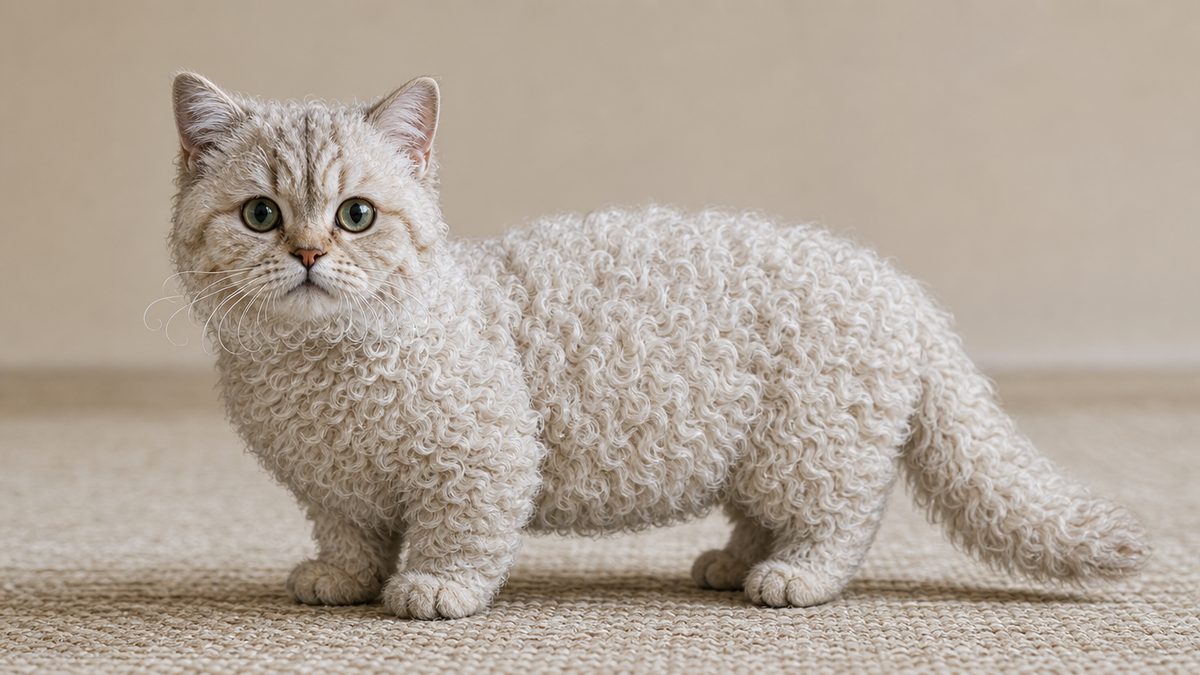
A Lambkin is a short-legged cat with a curly coat, produced by crossing the Munchkin with the Selkirk Rex, and also called the Nanus Rex. It carries two separate described mutations at once, and unlike its better-known relatives it holds no place in any of the six major registries this page checked.
Take the two inheritances apart, because they behave completely differently and almost no page separates them. The short legs come from the Munchkin and are a chondrodysplasia caused by a 3,303 base pair deletion with a 108 base pair insertion in the UGDH gene, inherited as an autosomal dominant for which no homozygous cat has ever been observed. The curly coat comes from the Selkirk Rex and is a splice site variant in Keratin 71, found on cat chromosome B4 at a raw p value of 2.87 times ten to the minus eleven.
The two genes behave in opposite ways, and that is the interesting part
The Selkirk curl is an autosomal incomplete dominant and its homozygotes live. Segregation analysis of genetically proven matings supported incomplete dominance, and homozygous curl cats can be distinguished from heterozygous ones by head and body type as well as by the presentation of the curl. The Munchkin short leg is the opposite case: no homozygous mutant cat was found in the study population and litter sizes were reduced, which the authors read as a recessive lethal in the homozygote state.
So a Lambkin stacks a viable-homozygous dominant onto a lethal-homozygous dominant. A breeder pairing two curly short-legged cats is running two different Punnett squares at once, one of which loses a quarter of conceptions before birth. Nobody has published what that combination does to litter size, and this page does not pretend otherwise.
Selkirk kittens are born curly, then the curl often disappears and returns. Google's generated answer, drawing on the breed guides, records that Lambkin kittens may temporarily lose or straighten their curls around 16 weeks before the curly coat returns at 8 to 10 months. An Indian buyer who sees a four-month-old kitten with a straight coat is not necessarily being sold the wrong cat, and one who buys a curly eight-week-old is not guaranteed a curly adult either. Ask to see the parents.
Which registries hold the Lambkin, and the claim that does not survive checking
None of the six major registries holds the Lambkin, and the widely repeated claim that the World Cat Federation recognises it is checkably false. The WCF's own cross-registry table runs to 198 rows and contains no Lambkin row and no Nanus Rex row, while issuing codes to the Munchkin, the Munchkin Longhair, the Minuet, the Minuet Longhair, the Selkirk Rex and the Selkirk Rex Longhair.
That claim is worth pinning down precisely, because it is what most readers will meet first. Google India's generated answer on 9 September 2026 states that the Lambkin is recognized by the Rare and Exotic Feline Registry and the World Cat Federation, though it is not widely accepted by major universal cat registries yet. Two bodies are named. Both can be checked, and neither check supports the sentence as written.
Registry recognition also means a breed standard exists somewhere, and here none does. The strings Lambkin and Nanus each return zero occurrences in TICA's 59-page standards compilation and zero in its Registration Rules The International Cat Association, so there is no written description of a correct animal that a buyer could hold a kitten against. That is a practical problem rather than a bureaucratic one, and it is why the sourcing advice on this page rests on meeting the parents.
| Registry | Position | How it was checked |
|---|---|---|
| WCF | Not held. No Lambkin and no Nanus Rex row anywhere in the map, which does carry Munchkin, Minuet and Selkirk Rex codes | Complete 198-row EMS table pulled by POSTing to the wpDataTables endpoint with the page's own nonce, 9 September 2026 |
| TICA | Not held. Absent from all six registration categories, including the Category VI Registration Only list that does name the Minskin | Registration Rules Version B, 22 November 2024, read with pypdf |
| TICA standards | No standard. Lambkin returns zero occurrences | Standards of all TICA breeds, 59 pages, May 2025 capture |
| GCCF | Not named, but reached by the Red Status row for Munchkin, Minuet (and other dwarf breeds) | Unrecognised Breeds, modified 23 September 2025 |
| FIFe | Prohibited by the clause covering any mutation resulting in a foreshortening of the limbs | Health and Welfare Rules, read 9 September 2026; absent from the 52-breed EMS list |
| CFA | No breed council, and not in the Miscellaneous or Provisional block | Declared Candidates for Breed Council Secretary, modified 31 July 2026 |
| LOOF | No breed group and no pedigrees. The Munchkin has its own row at 126 pedigrees in 2025 | Nombre de chats, pedigrees issued 2025 |
This is worth learning because it applies to every rare breed. First, the World Cat Federation's EMS table serves only ten of its rows to an ordinary page view, so anyone reading the page sees Category 1 Longhair and concludes nothing. The full 198 rows come back only from the underlying data endpoint, and that is where the absence is checkable. Second, the other named body, the Rare and Exotic Feline Registry, returned a DNS resolution failure at the address the ranking results point to, from two different tools on two different network paths on 9 September 2026. That is a fact about one day rather than a verdict about the registry, and the honest statement is that the claim could not be checked, not that it is false.
Where the GCCF and FIFe actually catch this breed
Neither body names the Lambkin, and both reach it anyway. The GCCF's Red Status table carries a row reading Munchkin, Minuet (and other dwarf breeds), with the Genetics Committee comment Ineligible due to reported health problems and the owner note Risk of suffering as they age, possible heart problems. FIFe's Health and Welfare Rules refuse to register or recognise any breed showing achondroplasia or pseudo-achondroplasia as a breed characteristic, and add, verbatim, any other form of genetic mutation which results in a miniaturised cat or a foreshortening of the limbs of the cats.
Reasoning from the absence of the proper name would clear this breed from two stated policies that plainly reach it. That is the same error a reader makes when a list contains a category word rather than a name, and it is worth naming rather than working around.
Where the Lambkin came from, and the state of the record
The Lambkin was created by crossing the Munchkin with the Selkirk Rex, and beyond that the documented record is thin enough to state plainly. No registry standard exists anywhere, no peer-reviewed paper about the breed exists, and the accounts in circulation trace to breed guides rather than to studbooks.
Both parent breeds are far better documented than their cross, which is the useful contrast. The Selkirk Rex arose from a spontaneous mutation discovered in the United States in 1987, and by 2012 had been characterised genetically: Bayesian clustering of short tandem repeat genotypes from 31 cats representing the future breeding stock placed it close to the British Shorthair, Scottish Fold, Persian and Exotic Shorthair, which the authors describe as making the Selkirk part of the Persian breed family. Heterozygosity was 0.630 and the mean inbreeding coefficient 0.057, which they read as a diverse genetic foundation.
The Munchkin's short leg was mapped in 2020 by whole genome sequencing with case-control validation across cohorts of standard and non-standard Munchkins plus a panel of popular breeds, and the variant segregated perfectly with the phenotype.
Nothing comparable exists for the cross. PubMed returns thirteen records for Lambkin[tiab] and not one is about a cat: they are entomology papers by C. L. Lambkin and addiction-research papers by F. J. Kay-Lambkin. That is a surname collision rather than a literature, and the count is meaningless until you open the titles.
It would be easy to read the Selkirk Rex's low inbreeding coefficient of 0.057 as reassurance about the Lambkin, and it is not. That figure describes the Selkirk Rex breeding population in 2012. A cross made from a small number of founders drawn out of two breeds has its own population structure, and nobody has published it. Orthopaedic specialists writing about a different four-breed short-legged cross put the general point sharply: inbreeding and chondrodystrophism is likely to result in the diagnosis of musculoskeletal diseases that have not previously been reported in this species.
Lambkin cat price in India, and the figures that circulate
No Lambkin cat price in India could be sourced on 9 September 2026. India's most-read cat pricing guide runs to 206,421 characters and returns zero occurrences of Lambkin, while naming the Munchkin seven times and pricing it at Rs 30,000 to Rs 60,000.
What an Indian searcher actually gets instead is Munchkin pricing, and the mechanism is worth watching in the open. Asked whether one can get a Munchkin cat in India, Google's generated answer on 9 September 2026 returned Rs 80,000 to Rs 2,50,000 for kittens and INR 3,000 to INR 8,000 in monthly expenses, attributing both to two Indian listing sites. An answer engine restating classified asking prices is not a market observation, and India's most-read pricing guide gives a band less than half as high for the same breed on the same day.
| Figure | Source | What it actually is |
|---|---|---|
| Rs 30,000 to Rs 60,000 | Supertails 2026 quick-reference table, for the Munchkin | The published Indian price of the breed supplying the short leg. Not a Lambkin price |
| Rs 80,000 to Rs 2,50,000 | Google's generated answer, attributed to two Indian listing sites | An engine restating asking prices for the Munchkin, more than double the guide figure for the same breed on the same day |
| INR 3,000 to INR 8,000 a month | The same generated answer | A plausible monthly cost for any small cat in an Indian metro, consistent with the sourced figures in the next section |
| Rs 0 to Rs 2,000 | Supertails 2026 table, for the Indian Domestic or Desi cat | The price of a normal-legged, normal-coated cat |
There is no registry anywhere that will issue a Lambkin pedigree that this page could verify The International Cat Association. So a cat offered in India as a Lambkin is a curly-coated short-legged cat with no paperwork, or a Munchkin with a wavy coat, or a Selkirk Rex cross with ordinary legs. All three can be perfectly good cats. None of them is worth a rare-breed premium, because there is no register to be rare in.
Import is not a route either. Live cats are a Restricted import in India under ITC(HS) code 01061900, and anything outside the personal pet baggage route is referred to the Exim Facilitation Committee.
Monthly cost of a small curly short-legged cat in India
Budget Rs 3,000 to Rs 8,000 a month for a small cat in an Indian metro, and treat the first year as the expensive one. Nothing in this breed's coat or legs adds a routine monthly cost, and the honest extras are a grooming habit and an orthopaedic contingency.
The routine figures are sourced and they are the same for any cat this size. Vetic, a chain with clinics across eleven Indian cities, prices a kitten course of three visits at days 60, 90 and 120 from Rs 3,999 against a struck-through Rs 5,065, an adult annual booster from Rs 1,899, anti-rabies alone at Rs 699 and a feline CRP at Rs 1,249.
- Licence, Rs 50 in Chennai. The Greater Chennai Corporation licenses pet animals generally rather than dogs only, and issued 9,115 licences in Tamil Nadu during 2024.
- Free municipal treatment in Chennai. Its pet clinics provide all treatment and anti-rabies vaccination free of cost.
- Microchipping, Rs 1,250 at a Chennai clinic's own transacted price.
- No statutory microchip duty for a kitten. Rule 7(16) of the Pet Shop Rules, 2018 makes microchipping mandatory for puppies only.
- No breed genetic test to buy. Both traits are visible, so leg length and coat tell you the genotypes and a DNA panel adds nothing you cannot see. There is also no breed club health scheme to screen against, because no registry holds the breed.
- Budget nothing for an imported cat. Live cats are Restricted and there is no verifiable pedigree to import against, so an unregistered Indian kitten is the realistic offering.
The contingency that belongs in the plan
Two published cases in short-legged cats show the shape of it. A one-year-old Minuet with progressive hind-limb paralysis needed myelography, computed tomography, MRI, a four-vertebra hemilaminectomy and vertebral stabilisation with threaded pins and bone cement, and recovered fully. A ten-month-old Dwelf with elbow subluxation had treatment limited by financial restrictions to a single procedure, after which the lameness resolved but a degree of subluxation persisted.
Those are two cats and not a prevalence. What they establish is that the interventions this conformation can require are specialist ones, available in a small number of Indian referral hospitals in Bengaluru, Mumbai, Delhi and Chennai, and that money changes the outcome.
Weight control is free and is the highest-value daily action for a cat whose limbs carry abnormal alignment by measurement. Rugs on polished Indian floors cost very little and give grip to a cat with externally rotated radii. Stepped routes to height replace jumps. None of this appears on a price list and all of it does more than any supplement.
Heat tolerance and the Indian climate
A curly-coated short-legged cat handles Indian heat about as well as any small shorthair, and its real climate problem is access rather than thermoregulation. The short leg does nothing to how a cat sheds heat; it changes what parts of a hot Indian flat the cat can actually reach.
The coat is the part people worry about and it is the smaller issue. A rexed coat is a modified normal coat rather than an insulating double coat, so it neither traps heat like a Persian's nor exposes skin like a Sphynx's. Heat tolerance in this breed is therefore close to that of an ordinary shorthaired cat of the same size.
What the short leg actually changes in an Indian summer
A cat that cannot jump onto a windowsill cannot reach the moving air, and a cat that cannot get onto a bed cannot get off a hot floor. In Delhi, Ahmedabad, Hyderabad or Pune in May, the practical job is building a route to height in steps rather than leaps, and giving the cat a shaded tiled floor it can reach when nobody is home.
- Three 20 cm rises rather than one 60 cm jump, which is the whole of short-legged cat furniture.
- A shaded tile or stone floor the cat can reach unassisted.
- Water at least three feet from the food bowl, because cats drink less when they can smell food.
- Comb before the monsoon rather than during it, since a curly coat opened up in April mats less in July.
Indian law places the temperature duty on the seller and does it breed by breed. Rule 6(5) of the Pet Shop Rules, 2018 puts that obligation on the establishment rather than fixing one number for all animals, and rule 7(1) requires a species-suitable environment. A shop holding a short-legged cat in an unventilated Karnataka summer is in breach of its own licence conditions.
Temperament, household fit and who should not buy one
Lambkin temperament is described in the breed guides as gentle, affectionate, playful and highly social, and compatible with children, older people and other pets. Those descriptions come from breed guides rather than from any study, and this page labels them rather than dressing them up as findings.
The parent breeds give a reasonable prior. The Selkirk Rex sits genetically inside the Persian family, which is a group known for placid, undemanding cats, and the Munchkin contributes an active, sociable cat that runs fast and jumps less well. A small curly cat that wants a lap and a corridor to sprint down is a fair expectation.
Household fit in an Indian flat is genuinely good on temperament grounds. Low vertical demand suits an apartment, and a small sociable cat suits a household with people in it. Nothing about the temperament argues against this breed.
Anyone who wants registered paperwork should not, because no registry in this survey holds the breed and the two bodies named as recognising it could not be confirmed Retrieval attempt on the Rare and Exotic…. Anyone who cannot fund an orthopaedic or neurological contingency should think hard Lunde K, Langley-Hobbs SJ. Radial head…. And anyone buying because the coat looks like a lamb should meet the parents first, because the curl in this line can disappear at around 16 weeks and return at 8 to 10 months.
Training a Lambkin, and the handling that prevents damage
Teach the two-handed lift and teach the comb, in the first sixteen weeks. For a short-legged curly-coated cat those two handling lessons prevent more trouble than any trick, and both get harder every month you delay.
- One hand under the chest, one under the hindquarters, every time. Never lift a short-legged cat by the forelimbs, because every radius measured in a dwarf cat carried external torsion with incongruity at the elbow and carpus.
- Comb after a meal, one region per session. A fed kitten does not treat the comb as an ambush.
- Comb the lower back and tail base yourself, always. A short-legged cat cannot reach them, and that is where the mats form.
- Handle every paw each session, so nail clipping stays a home job.
- Teach the carrier before you need it, which saves heat stress on a Chennai afternoon.
Litter training needs a low-sided tray a short-legged cat can walk into rather than climb into, plus a second tray in another room. A cat that has to cross a flat to reach a tray will sometimes not bother, and that reads as a behaviour problem when it is a furniture problem.
Build one habit that is not really training. Monitor how the cat moves on a non-slip floor once a week and know what normal looks like for your animal, because the published cases in short-legged cats presented as progressive change rather than sudden events Lunde K, Langley-Hobbs SJ. Radial head….
How much exercise a Lambkin actually needs
Budget 30 to 45 minutes of horizontal play a day in two or three sessions, with the toy dragged along the floor rather than lifted. A short-legged cat runs well and jumps poorly, and the exercise should follow the legs the cat has.
- Floor-level wand play down a corridor, which suits a low centre of gravity.
- Stepped routes rather than jumps, so climbing does not load a deformed elbow on landing.
- Food puzzles for the working day, doing the job while you are out.
- Cool hours only in summer, in Kolkata, Mumbai, Bengaluru or Delhi alike.
Weight control is the reason this section is not optional. On a 2.3 to 4.1 kg cat an extra 300 g is close to a tenth of body weight, loaded onto joints that already sit at abnormal angles by measurement. Feed measured meals rather than leaving a bowl down.
Do not read reduced jumping as pain by itself. A cat with shortened limbs jumps less because the limbs are shorter, and what deserves a vet's opinion is a change from that individual cat's own baseline rather than a comparison with a normal-legged cat.
Grooming a curly coat in Indian humidity
Comb gently and infrequently, and never brush a rexed coat hard. Breed guidance for this cross is explicit that it requires gentle, occasional brushing so the curls do not straighten out or become damaged, which is the opposite instruction to the one most Indian owners are given for a longhair.
The coat itself is well described even though the breed is not. The Selkirk curl is caused by a splice site variant in Keratin 71, identified through a genome-wide association study of 9 curly-coated Selkirk Rex against 29 controls, with a unique haplotype spanning about 600 kilobases shared by every curly cat. Homozygous curl cats differ from heterozygous ones in the presentation of the curl as well as in head and body type, so two curly Lambkins can carry visibly different coats.
- A wide-toothed comb, used lightly, rather than a slicker brush that will pull a curl straight.
- The lower back and tail base every session, which the cat cannot reach because of the leg length.
- Behind the ears and between the front legs weekly, which are missed more often than anywhere else.
- Nails every two to three weeks. A cat with long nails hooks its own curl and creates the mats you are preventing.
The monsoon adjustment
Between June and September, dry the coat mechanically rather than letting it air dry, and drop the bath frequency rather than raising it. Overseas rex-coat guidance often recommends letting the coat dry naturally to preserve the curl, which is written for a temperate climate. In 90 percent Mumbai or Kochi humidity a coat left to dry naturally does not finish drying, and a damp curly coat against skin is where trouble starts.
One grooming observation doubles as a health check. Reduced grooming over the lower back is one of the changes owners most often reinterpret as a cat mellowing with age, and in a breed with measured limb deformity it deserves a veterinary opinion rather than a note in the diary.
Lambkin health, and the honest state of the evidence
No health issues have been measured in this breed at all. PubMed returns thirteen records for Lambkin[tiab] and every one is an entomologist or an addiction researcher rather than a cat, against a Persian control returning 322 in the same session. What can be stated is what each parent mutation is known to do, and what the imaging of short-legged cats has actually found.
The short leg, and the two readings of the same paper
The short leg is a chondrodysplasia caused by a 3,303 base pair deletion with a 108 base pair insertion in UGDH. No homozygous mutant cats were observed in the study population, litter sizes were reduced, and the authors concluded an autosomal recessive lethal trait in the homozygote state with autosomal dominant inheritance of the short-legged condition. UGDH-deficient mouse, drosophila and zebrafish mutants are likewise embryonically lethal.
Those same authors wrote the sentence the breed's defenders quote, and it deserves quoting accurately rather than paraphrased in either direction. Their discussion states that heterozygous standard Munchkins exhibit reduced leg length without impaired health, as found in Dexter cattle. It appears in the same paper as a computed tomography description of one Munchkin whose radius was bent about 43 degrees in its longitudinal axis, producing incongruity in the ulnocarpal and radiocarpal joints.
What imaging of short-legged cats has found
| Study | Cats | Finding |
|---|---|---|
| Struck 2020, computed tomography | 1 Munchkin against 1 normal control | All long bones shortened with normal metatarsals, elbow incongruity from an internally rotated humerus, and a radius bent about 43 degrees. Hind limbs showed no rotation or structural effects |
| Anderson 2021, joint orientation angles | 5 dwarf cats, 20 limbs, against 24 thoracic and 100 pelvic normal limbs | All limbs possessed deformities, with external torsion in every radius |
| Anderson 2021, spinal MRI | 2 dwarf cats | No spinal pathology detected. Incidence of intervertebral disc degeneration called inconclusive |
| Kihara 2024, case report | 1 Minuet, aged one year | Thoracic vertebral canal stenosis and vertebral instability needing four-vertebra surgery, with full recovery |
| Lunde 2025, case report | 1 Dwelf, aged ten months | Elbow subluxation with radial head displacement, described as the first reported developmental case in a chondrodystrophic cat |
Three things are true at once and campaigners and breeders each quote one of them. The limb evidence is consistent and it is not reassuring, because every limb of every dwarf cat imaged carried measurable deformity across two independent studies Anderson LM, Fox DB, Chesney KL, Coates JR. The spine evidence points both ways on very small numbers, with two MRIs finding nothing and one one-year-old needing four-vertebra surgery Kihara S, Aikawa T, Miyazaki Y. And the link from deformed limbs to clinical pain has never been measured in any short-legged breed. Anyone who tells you every short-legged cat is suffering, and anyone who tells you the conformation is demonstrably harmless, is talking past the same missing study.
Osteoarthritis, and the baseline that changes the argument
Feline osteoarthritis is common in ordinary cats and always has been. One hundred British cats euthanised in 1972 and 1973 were radiographed post mortem and 74 percent had appendicular osteoarthritis, two decades before any short-legged cat breed existed, and the authors concluded plainly that feline osteoarthritis is not a novel disease. A 2025 review puts current prevalence at well over a quarter of the feline population and notes that only 29 publications exist on managing it, many lacking rigorous methodology.
That baseline cuts both ways. A Lambkin developing arthritis in old age proves nothing about the breed, because most cats do. It also does not answer the mechanism argument, because abnormal joint alignment is an established route to osteoarthritis and this conformation has abnormal alignment in every limb examined. The comparison between short-legged and normal-legged cats has never been run, and that is the single most useful missing study about any of these breeds.
What a real breed-level investigation looks like
Thoracic wall deformity in Bengal cats was investigated with whole-body computed tomography, macroscopic and microscopic rib-cage examination and a breeder questionnaire covering 311 litters over two years. Affected kittens appeared in 38 of 311 litters, or 12 percent. Stillbirths and deaths within the first 24 hours ran at 20 percent in affected litters against 12 percent in unaffected ones, at p equals 0.025. Males were over-represented at 72 percent, two thirds of affected kittens survived, and the proportion of affected litters varied between sires. That is what a breed-level answer looks like, and the technique is available to anyone. Nothing of the kind has been attempted for a short-legged breed.
The one condition documented in this breed's Munchkin ancestry
Xanthine urolithiasis has been documented in a family of four related Munchkin pedigree cats, three of them full siblings. Clinical signs began at three to eight months of age and included haematuria, pollakiuria, dysuria and urethral and ureteral obstruction, with upper urinary tract stones in every cat. Routine urinalysis was insufficient to diagnose any of them, and infrared mass spectrometry of the stone or the urine was required. A protein-restricted diet reduced signs in all cats in the medium to long term. One family is not a breed prevalence, and if a young cat passes blood or strains in the tray, ask for the stone to be analysed rather than discarded.
Life expectancy
No measured figure exists. The commonly published estimate of 12 to 14 years is described in the source that carries it as an estimate rather than a measurement. The Lambkin is not among the 12 breeds that reached the 15-death threshold in the largest UK feline life-table study, so it sits inside the grouped other category holding 111 of that study's 7,936 confirmed deaths. From the same table, crossbred cats reached 11.89 years of life expectancy at age 0 with a confidence interval of 11.75 to 12.03 on 7,117 deaths, which is the most reliable general number available to an owner of any unregistered cat.
Nothing on this page is a diagnosis or a treatment plan. Book an appointment this week for any of the following: a change in how the cat walks, reluctance to use a step it used to manage, stiffness first thing in the morning, objecting when an elbow or carpus is handled, reduced grooming over the lower back, eliminating beside the tray rather than in it, or blood in the urine or straining. Chronic pain in cats is quiet and owners routinely reinterpret it as a cat mellowing with age. Consult your nearby vet, a registered veterinarian who can examine your own cat, before acting on anything you read here.
Feeding a Lambkin in India
Feed measured meals rather than leaving a bowl down, and check body condition by hand every fortnight. On a small cat with abnormal joint alignment, weight control is the highest-value daily intervention available and it costs nothing.
- Kitten to twelve months, three to four small measured meals.
- Adult, two measured meals, weighed once with a kitchen scale, because a scoop is not a measurement.
- Wet food daily where the budget allows, since the water matters in an Indian summer.
- Treats under ten percent of daily calories, which on a small cat is very few.
- Discuss an omega-3 enriched diet with your vet if osteoarthritis is diagnosed. In a 2025 review it showed efficacy comparable to standard pharmacological treatment, without side effects and with high compliance, and worked as well in severe as in moderate disease.
Body condition by hand beats any chart, and a curly coat hides a rising weight more effectively than a flat one does. Feel for the ribs under a thin fat cover and look for a waist from above.
One dietary caution belongs to the Munchkin ancestry rather than to general nutrition. If a young cat in this line shows repeated urinary signs, a protein-restricted diet was the management that reduced clinical signs in all documented xanthinuria cases, but that belongs to a confirmed diagnosis rather than a hunch, and the diagnosis requires the stone or the urine analysed rather than a routine urinalysis.
Kitten timeline, month by month through the first year
A Lambkin kitten's first year has three breed-specific points and the rest is ordinary. Meet the parents before you pay, learn the two-handed lift in the first fortnight, and expect the coat to change twice before the cat is a year old.
- Before you pay, meet both parents and look at their coats and their legs. No registry paperwork is available to check, so the parents are the evidence.
- Weeks 0 to 8, do not take the kitten. The Pet Shop Rules, 2018 treat kittens below eight weeks as un-weaned and rule 7(15) bars their sale.
- Week 8 to 9, home and settle, with a low-sided tray and a stepped route to one high place.
- Day 60, first vaccination. Vetic's kitten course runs three visits from Rs 3,999.
- Weeks 9 to 16, the handling window. The two-handed lift, the comb, the paws and the carrier.
- Around week 16, expect the curl to change. Kittens in this line may temporarily lose or straighten their curls at about 16 weeks.
- Day 90 and day 120, visits two and three, adding anti-rabies at Rs 699 when your vet advises.
- Months 3 to 8, watch the litter tray. The documented Munchkin xanthinuria family showed signs at three to eight months.
- Month 4 to 5, microchip at Rs 1,250 and licence at Rs 50 where your municipality issues one.
- Month 5 to 7, neuter. Sex and neuter status are better evidenced influences on allergen output than breed.
- Months 8 to 10, the adult curl returns.
- Month 12, first annual booster from Rs 1,899.
One item deliberately does not appear on that list. There is no genetic test worth buying for either of this cat's two defining traits, because both are visible: leg length tells you the UGDH genotype and the coat tells you the KRT71 one Gandolfi B, Alhaddad H, Joslin SE, Khan R. Spend the money on the vet visits instead.
Lambkin versus the other Munchkin crosses and the Selkirk Rex
Five short-legged breeds carry the same UGDH variant and differ only in what else was crossed in. The Lambkin sits at the bottom of that group on every measure of registry standing and published evidence, and the table shows how far.
| Breed | Second inheritance | Registry standing | Published evidence about the breed itself |
|---|---|---|---|
| Munchkin | None. The short leg alone | TICA Category III championship, plus WCF, CCCA, SACC and LOOF, which issued 126 pedigrees in 2025 Livre Officiel des Origines Felines | Its own gene paper, its own imaging and a documented xanthinuria family Pritchard EC, Haase B, Wall MJ, O'Brien CR |
| Minuet | The Persian group | TICA Category IV championship since 2016, plus WCF codes MIS and MIL World Cat Federation, WCF EMS code table | One case report, a one-year-old needing spinal surgery |
| Minskin | Sphynx and Devon Rex coat, plus Burmese | TICA Category VI, Registration Only, no standard. Absent from the WCF map World Cat Federation, WCF EMS code table | None. PubMed returns three records for the name and none is the cat |
| Dwelf | Sphynx coat plus American Curl ears | Not held under that name by TICA or the WCF World Cat Federation, WCF EMS code table | One case report, a ten-month-old with elbow subluxation |
| Lambkin | The Selkirk Rex curl | Held by none of the six. Absent from all TICA categories and from all 198 WCF rows World Cat Federation, WCF EMS code table | None. PubMed returns thirteen records for the name and none is the cat |
The comparison an Indian buyer should actually make
| Breed | What it shares | What it avoids | Availability in India |
|---|---|---|---|
| Selkirk Rex | The identical curly coat, from the same KRT71 variant | The UGDH chondrodysplasia entirely | Recognised by every body on the WCF map, in both coat lengths |
| Munchkin | The short leg and the temperament | The coat mutation, so one inheritance rather than two | Rs 30,000 to Rs 60,000, and the only one of these with a published Indian price |
| Devon Rex | A curly coat, from a different variant in the same gene | The short leg, and it is held by every major registry | Not separately priced in the Supertails table |
| British Shorthair | A small sturdy build and a calm temperament | Both mutations. The GCCF names it as the alternative to dwarf breeds | Rs 20,000 to Rs 60,000 |
| Indian Domestic or Desi cat | Nothing genetic, and everything practical | Both mutations, plus the price | Rs 0 to Rs 2,000 |
Mistakes Indian buyers make with the Lambkin
Five mistakes account for most of what goes wrong here, and the first is the one this whole page exists to correct.
- Believing the breed is WCF-recognised. The World Cat Federation's own 198-row table contains no Lambkin row and no Nanus Rex row, while carrying Munchkin, Minuet and Selkirk Rex codes.
- Paying a rare-breed premium for a cat with no register. There is no registry in this survey that will issue a pedigree, so there is nothing to be rare in.
- Lifting the cat by the front legs. Every radius measured in a dwarf cat carried external torsion with joint incongruity at the elbow and carpus.
- Brushing the curl hard. Rexed coats need gentle occasional combing so the curls do not straighten or become damaged.
- Reading the Selkirk Rex's genetics as reassurance about this cross. The 0.057 mean inbreeding coefficient describes the Selkirk Rex population, not a cross drawn from a handful of founders.
A sixth mistake is about searching rather than buying. If you look this breed up in PubMed yourself, Lambkin[tiab] returns thirteen records and none of them is a cat, because the string is a surname carried by an entomologist and an addiction researcher. A count is not a literature, and opening the titles is what tells you so.
One last caution about generated answers. Three of the four questions Google returned for this breed on 9 September 2026 were about the Munchkin rather than the Lambkin, which is a fair signal that the engine has very little breed-specific material to work with. Where an engine has little to say about a breed it will answer about the nearest one it knows, and that is exactly what happened here.
Adoption, sourcing and the honest Indian answer
No Lambkin breeder operates in India that Bonbeno could identify, and the breed is absent from India's leading cat price guide entirely. Since no registry in this survey issues a pedigree, adoption and careful private sourcing are the only routes that exist.
- Ask which registry issued any paperwork you are shown, and verify it with that registry. Neither TICA's rulebook nor the WCF's table holds this breed.
- Meet both parents. With no register to check, the parents are the only evidence about legs, coat and temperament.
- Check the age before anything else. Sale below eight weeks is prohibited outright.
- Consider a Selkirk Rex instead if it is the curl you want, because it carries the identical coat variant without the chondrodysplasia and is held by every body on the WCF map World Cat Federation, WCF EMS code table.
- Use the municipal route where it exists. Chennai licenses pet animals at Rs 50 and treats and vaccinates them free at its own clinics.
There is a real argument for adopting a short-legged cat that already exists, and it is worth stating plainly. Such an animal is already born, already carries whatever deformity it carries, and needs a home that will manage its weight, provide stepped routes and watch its gait. Adopting one changes nothing about how many are bred. Commissioning one does.
Import is not a workaround. Live cats are a Restricted import under ITC(HS) 01061900, and anything outside the personal pet baggage route goes to the Exim Facilitation Committee. Bonbeno does not broker cats and does not recommend breeders.
Lambkin questions Indian buyers actually ask
Can I get a Munchkin cat in India?
Yes, and it is the breed Indian searchers actually reach when they look for a Lambkin. India's most-read cat pricing guide lists the Munchkin at Rs 30,000 to Rs 60,000 and names it seven times, while never using the word Lambkin at all. A generated answer on the same day gave Rs 80,000 to Rs 2,50,000 attributed to two Indian listing sites, which is more than double the guide figure for the same breed and is an engine restating asking prices rather than observing a market.
What cat breed has lamb-like fur?
The Selkirk Rex, and the breeds crossed from it including the Lambkin, which is also called the Nanus Rex for that reason. The curl comes from a splice site variant in Keratin 71, identified through a genome-wide association study of 9 curly Selkirk Rex against 29 controls, with a shared haplotype spanning about 600 kilobases. If it is the coat you want rather than the legs, the Selkirk Rex carries the identical variant without the chondrodysplasia and is recognised by every registry on the World Cat Federation's map.
Is a Munchkin cat expensive?
In India, moderately, and the published figures disagree by a factor of more than two. India's most-read cat pricing guide gives Rs 30,000 to Rs 60,000, which places the Munchkin below the Sphynx at Rs 50,000 to Rs 1,50,000 and above the Bombay at Rs 10,000 to Rs 30,000. A generated answer on the same day gave Rs 80,000 to Rs 2,50,000 from listing sites. The Indian Domestic or Desi cat sits at Rs 0 to Rs 2,000 for comparison.
Is a Munchkin cat a good pet?
On temperament, yes, and on conformation the evidence is genuinely mixed and worth reading before deciding. Every limb of every dwarf cat radiographed carried measurable deformity, in a study of five cats against 124 normal limbs, and every radius showed external torsion. Against that, spinal MRI in two dwarf cats found no pathology, and the authors who identified the causal gene concluded that heterozygous short-legged cats show reduced leg length without impaired health. No study has compared osteoarthritis rates between short-legged and normal-legged cats.
Is the Lambkin recognised by the World Cat Federation?
No, and this is the most repeated error about the breed. The World Cat Federation's cross-registry table was pulled in full on 9 September 2026, all 198 rows, and contains no Lambkin row and no Nanus Rex row. The same table issues codes to the Munchkin, the Munchkin Longhair, the Minuet, the Minuet Longhair, the Selkirk Rex and the Selkirk Rex Longhair, so the body is plainly willing to code both parent breeds. The claim appears in generated answers and breed guides, not in the registry's own document.
Which registries recognise the Lambkin?
None of the six checked. TICA's Registration Rules of 22 November 2024 contain no Lambkin entry in any of the six registration categories, including the Category VI Registration Only list that does name the Minskin, and the string returns zero occurrences in TICA's standards book. The World Cat Federation's 198-row table has no row, the CFA runs no breed council, FIFe bars the class outright, and the French national studbook issued no pedigrees. One further body named in generated answers could not be checked because its domain failed DNS resolution from two tools on the day.
What is the difference between a Lambkin and a Selkirk Rex?
The legs. Both carry the same Keratin 71 splice variant that produces the curl, but the Lambkin also carries the UGDH chondrodysplasia from its Munchkin side and the Selkirk Rex does not. The two genes behave differently as well: the Selkirk curl is an autosomal incomplete dominant whose homozygotes live and can be told apart by head and body type, while no cat homozygous for the Munchkin variant has ever been observed.
How long do Lambkin cats live?
No measured figure exists. The commonly published 12 to 14 years is described by the sources that carry it as an estimate rather than a measurement. The Lambkin is not among the 12 breeds that reached the 15-death threshold in the largest UK feline life-table study, so it sits inside the grouped other category holding 111 of that study's 7,936 confirmed deaths. From the same table, crossbred cats reached 11.89 years of life expectancy at age 0 on 7,117 deaths, which is the most reliable general number for an unregistered cat.
Do Lambkin cats have health problems?
Nothing has been measured in this breed, because PubMed returns thirteen records for the name and every one is an entomologist or an addiction researcher rather than a cat. What is established belongs to the Munchkin side: all 20 limbs of the five dwarf cats radiographed carried deformity, one young Minuet needed four-vertebra spinal surgery, and a comparable cross produced the first reported developmental radial head subluxation in a chondrodystrophic cat at ten months old.
Why does a Lambkin kitten's coat go straight?
Because the rex coat develops in stages, and this catches Indian buyers out. Kittens in this line may temporarily lose or straighten their curls at around 16 weeks, with the curly coat returning at 8 to 10 months. A four-month-old with a straight coat is therefore not necessarily the wrong cat, and a curly eight-week-old is not a guarantee of a curly adult. Look at both parents rather than at the kitten's coat on the day.
Are Lambkin cats hypoallergenic?
No, and no cat breed is. A 2024 review in Allergologie Select states in its full text that to date there is no scientific evidence for a hypoallergenic cat breed, and that even hairless Sphynx cats produce Fel d 1. A curly coat changes how hair is shed, not what the cat produces. Sex and neuter status are better evidenced influences than breed, since unneutered males average more Fel d 1 than females.
Can a Lambkin live comfortably in an Indian flat?
Yes, with the furniture adjusted. Build routes to height in three short rises rather than one long jump, because a short-legged cat cannot reach the windowsill where the moving air is, and give it a shaded tiled floor it can reach when nobody is home. The curly coat itself is close to an ordinary shorthair for heat. Indian law places the temperature duty on the seller breed by breed under rule 6(5) of the Pet Shop Rules, 2018.
Compare with similar breeds
Lambkin sits in 1 Bonbeno group. Each one compares it directly against the breeds it is genuinely an alternative to, on the same figures.