
Breed profile
Selkirk Rex in India: A Curly Persian in a Hot Country
A curly-coated cat built out of Persians and British Shorthairs, whose curl was mapped to a single splice variant and whose French registry treats it as a kidney risk before it treats it as a coat.
Quick answer
No Selkirk Rex price in India could be verified. Six Indian commerce pages were opened on 9 September 2026 and none carries the breed, while Persian, Bengal and Maine Coon controls appear on all six. The curl is a splice variant in KRT71, and the breed clusters genetically with the Persian, so a kidney test matters more than a coat test.
This page reports what registries and published studies say about the Selkirk Rex, including a 2026 study in which the breed was significantly overrepresented among cats presented with otitis. None of it is a diagnosis and none of it is a treatment plan. Consult your nearby vet, a registered veterinarian, about any animal in your care before acting on anything here.
Selkirk Rex at a glance
What a Selkirk Rex is
The Selkirk Rex is a heavy-boned, plush, curly-coated cat descended from one 1980s Montana kitten, and it is the only cat breed named after a person.
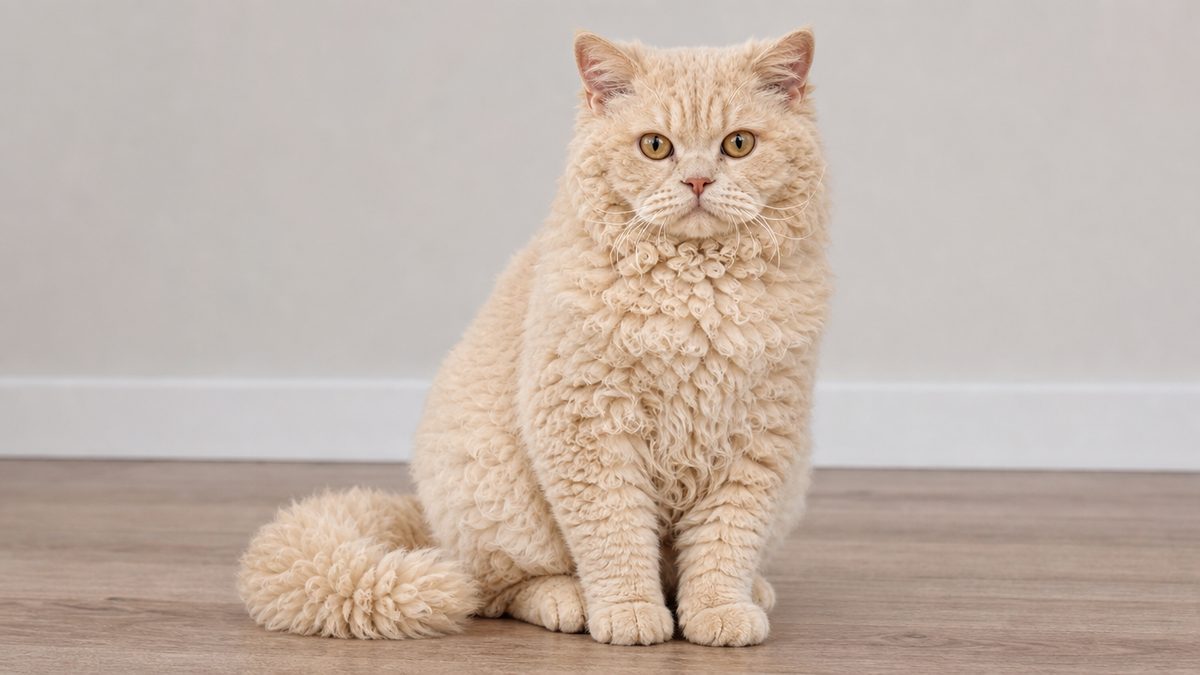
Two things separate it from every other rex. The first is the coat itself. CFA describes well-defined individual curls that may be short and slightly crisp or long and luxurious, explicitly unlike the tight marcel wave of a Cornish Rex or the soft waves of a Devon Rex The Cat Fanciers' Association. The curl is random and unstructured, arranged in loose individual curls that appear in clumps or ringlets rather than as an all-over wave, and it is most evident around the neck, on the tail and on the belly.
The second is density. Where the Cornish and Devon coats are sparse, the Selkirk carries guard, down and awn hairs all present, and TICA states that the dominant gene affects all three. The coat is dense and full with no bald or thinly covered areas. Anyone who buys a rex expecting a thin coat has bought the wrong rex.
The breed standard is where the coat description comes from, and it is worth reading rather than taking second hand. The WCF breed standard for the shorthair describes a medium to large cat, muscular and stocky, with broad and massive chest, shoulders and back, and the longhair standard opens with the identical body description and differs on the coat. The French studbook files the breed as semi-cobby with a curled coat type. Coat texture is scored separately from curl in the CFA standard, which is why an affectionate but poorly-textured cat still loses points.
The founding cat, and a date the registries disagree on
TICA's account is the fuller one. In 1987 a feral blue tortie and white cat in Montana had a strange-looking kitten in a litter of five. At nine weeks the kitten came to the attention of the Persian breeder Jeri Newman, who took her and named her Miss DePesto because she was always pestering for attention. She had curly whiskers, brillo hair in her ears, and a coat that looked like a body wave. At fourteen months Newman bred her to a black Persian male, Ch. Photo Finish of Deekay, and the litter of six produced three curly kittens, which proved the gene was dominant.
CFA tells the same story with two differences. It dates the founding litter to 1986 rather than 1987, and it gives the cat's full name as Miss DePesto of NoFace. The peer-reviewed genetic characterisation of the breed sides with TICA, describing a spontaneous mutation discovered in the United States in 1987. This page publishes the disagreement rather than picking one, because it is a genuine conflict between two current registry documents.
CFA states that Newman took her stepfather's family name, Selkirk, and that to date it is the only breed of cat to be named after a person. That is a strong claim and it holds up against the obvious counter-examples, since the Havana Brown is a colour, the Birman is a country and the Ragdoll a posture. What it also does is create the problem the search results on this page document: Selkirk is a Scottish town, a pickleball brand, a Canadian college and an Indian chimney supplier, and the cat ranks behind all of them.
Size, shape and how slowly the coat arrives
A medium-to-large cat with heavy boning, a slightly rectangular and very muscular body, and a rounded head with large round eyes, giving a firm feel under a soft coat. Both sexes have definite jowls. The important timing detail for a buyer is that the coat continues to develop until about two years of age, and kittens are curly at birth, may then lose that coat, and begin to develop the adult curly coat at eight to ten months. A curly ten-week kitten is not evidence of a curly adult, and a straight ten-week kitten is not evidence of a straight one.
The temperament, by TICA's account, is inherited as deliberately as the coat: the British Shorthair contributed the laid-back personality, the Persian added the cuddly nature and the Exotic Shorthair brought an impish playfulness. That is a description of the breed's construction as much as of its character.
The curl is one splice variant, and the breed's real risk is not the coat
The Selkirk curl is a splice site variant in the KRT71 gene, mapped in 2013 on nine curly cats against 29 controls, and the breed's genetic neighbours are the Persian and the British Shorthair rather than the other rexes.
Most breed pages say the Selkirk curl is a dominant mutation and stop. The published work says considerably more than that, and the extra detail is what tells an Indian buyer which test to ask for.
The mapping study, with its numbers
A genome-wide case-control association study used 9 curly-coated Selkirk Rex and 29 controls, the controls including straight-coated Selkirk Rex, British Shorthairs and Persians, validated as controls by Bayesian clustering, multi-dimensional scaling and genomic inflation. A significant association was found on cat chromosome B4 at a raw p value of 2.87 x 10 to the minus 11, with a unique haplotype spanning about 600 kilobases shared by all the curly cats. Direct sequencing of four candidate genes revealed a splice site variant within KRT71.
The earlier characterisation established the inheritance. Informal segregation analysis of genetically proven matings supported autosomal, incompletely dominant expression, and homozygous curl cats can be distinguished from heterozygous cats by head and body type as well as by the presentation of the hair curl. A new locus, SADRE, was proposed for the trait.
Three rex breeds, three different answers. The Selkirk curl is a KRT71 splice variant, while the Ural Rex's curly coat is associated with a mutation in the lipase H gene entirely. Nothing about one rex breed transfers to another, and a seller who tells you a Selkirk is genetically a Cornish with a different look is wrong on the genetics.
The finding that should change what you ask a breeder
Bayesian clustering of short tandem repeat genotypes from 31 cats representing the future breeding stock placed the Selkirk Rex close to the British Shorthair, Scottish Fold, Persian and Exotic Shorthair, and the authors concluded that the Selkirk is part of the Persian breed family. That is not a stylistic observation. It is why the French national studbook requires a polycystic kidney disease test on this breed and not a coat test.
The same study also found a high heterozygosity of 0.630 and a low mean inbreeding coefficient of 0.057, which it reads as a diverse genetic foundation. For a breed built on a single mutation in a single cat that is a better result than the origin story would predict, and it is worth knowing because founder-effect worries are the usual objection to breeds like this one.
The Persian connection, from the other direction
Work on selection signatures in the Persian breed itself gives the same picture from the Persian side, examining the genomic regions under selection that define that breed and its relatives. Read the two together and the Selkirk stops looking like a rex breed with Persian outcrosses and starts looking like a Persian-family cat carrying one keratin variant. That is the framing this page uses throughout, and it is the framing that predicts the health section.
Registry recognition, checked body by body
All six registries this site checks hold the Selkirk Rex, and they split on how many separate things it is: FIFe and TICA register two, the French studbook registers four.
| Registry | Status | How it is filed | Rows registered |
|---|---|---|---|
| CFA | Championship since 2000 | Shorthair breed council; registration accepted 1992 | One breed, two coat lengths |
| TICA | Championship since February 1994 | New Breed programme from 1990 | Selkirk Rex and Selkirk Rex Longhair |
| FIFe | Recognised | SRL Category 1 Longhair, SRS Category 3 Shorthair | Two |
| GCCF | Recognised | Section 3 Group B with British Longhair and Chartreux | LH and SH |
| WCF | Recognised, marked ALL | SRL Category 1, SRX Category 3 | Two |
| LOOF | Recognised | Selkirk Rex P.C. and P.L. plus Selkirk Straight P.C. and P.L. | Four |
The four-row filing is the informative one
The French studbook registers the straight-coated Selkirk as a named variety in both coat lengths, alongside the curly one. That follows directly from the genetics: an incompletely dominant coat variant produces straight-coated siblings in normal proportions, and those cats are pedigree Selkirks that happen not to have inherited the curl. A registry that names them is telling breeders that a straight kitten is a registrable outcome rather than a failure, which matters when you are being sold one.
The numbers, and what they say about rarity
FIFe's 2024 breeding statistics rank 54 codes whose registrations sum exactly to the printed total of 96,075, a check this page ran before quoting anything from it. The Selkirk Rex Longhair sits at rank 22 with 277 kittens and the Shorthair at rank 41 with 42. That six-to-one split in favour of the longhair is the single most surprising figure on this page, because the shorthair is the variety most photographs show and the one CFA compares to a teddy bear.
For scale, the Persian registered 1,981 kittens in the same year and the British Shorthair 16,278. So the Selkirk is genuinely uncommon inside its own genetic family, and the combined 319 kittens across both coat lengths is fewer than the Chartreux alone at 811.
Where the GCCF puts it
The GCCF places the Selkirk Rex, in both coat lengths, in Section 3 Group B alongside the British Longhair and the Chartreux, with one Grand and one Imperial title available in that group. Note what that filing says: the Selkirk is grouped with British-type cats, not with the Cornish Rex, Devon Rex, LaPerm, Lykoi and Sphynx that make up Section 4 Group B. The UK registry files this breed by body type rather than by coat mutation, and the genetics say it is right to.
TICA's website served a Cloudflare browser challenge to every request in this session. Six user-agent strings were tried, including an empty one, and all six returned the same HTTP 403 interstitial with challenge-platform markers, so this is a browser-integrity check rather than a user-agent filter. TICA content here comes from Internet Archive captures with dates recorded: the breed page from 20 July 2026 and the breeds index from 28 August 2026 The International Cat Association.
Three further checks close the recognition question. CFA's index of declared breed council candidates carries a named Selkirk Rex secretary under Shorthair Breeds, which is what full CFA status looks like from outside. FIFe's breeds index carries SRL and SRS as two of its 52 EMS rows. And the GCCF's own cat breeds index lists the Selkirk Rex among its recognised breeds, which matters because the same registry refuses other novel coat and structure breeds outright. Wikipedia's account of the breed agrees on the substance and is the page most Indian readers will meet first.
Selkirk Rex price in India, and why this page publishes none
No Selkirk Rex price in India could be verified, because no Indian seller checked on 9 September 2026 carries the breed.
The method matters more than the conclusion, so here it is. Six Indian commerce pages were opened directly, chosen because they are the pages Bing India returns for the unqualified query cat price in india, which is a query the engine does read properly. Each was searched for the Selkirk Rex alongside three control breeds.
| Indian page | Selkirk Rex | Persian | Bengal | Maine Coon |
|---|---|---|---|---|
| Supertails, position 1 for cat price in india | No | Yes | Yes | Yes |
| Wrapinfur cat price guide | No | Yes | Yes | Yes |
| World Blaze cat breeds price list | No | Yes | Yes | Yes |
| MyKitten, verified breeders | No | Yes | Yes | Yes |
| Puppiezo, live listings | No | Yes | Yes | Yes |
| Nearby Pets India, live listings | No | Yes | No | Yes |
Three controls present on every page and the target absent from every page is composition evidence rather than volume evidence MyKitten, Cats for Sale in India Wrapinfur, Cat Price in India 2026 World Blaze, List of Cat Breeds Price… Nearby Pets India. Puppiezo's breed index in particular runs to well over a hundred names including the Scottish Fold, which is a member of the same genetic cluster, and still has no Selkirk.
The search results are part of the answer
Bing India's ten results for the commercial query are, in order, a pickleball equipment brand, an Indian chimney and venting company called Selkirk India, the same pickleball brand again, the Scottish Borders town, an Indian sports retailer selling Selkirk pickleball paddles, an American industrial supplier, an Australian arm of the same, a Canadian college, a Scottish tourism page and Amazon's Selkirk Sport store. Not one is about the cat. An Indian searcher looking for this breed is served a chimney manufacturer and a paddle shop.
Ask four things in writing. Which registry issued the pedigree, since CFA, TICA, FIFe, GCCF, WCF and LOOF all hold this breed and their paperwork differs. Whether the kitten is Rex or Straight, because an incompletely dominant coat variant means straight-coated siblings are normal and registrable. Whether both parents are PKD N/N, which is what the French studbook demands of every Selkirk it registers. And the kitten's date of birth, because eight weeks is the legal floor for collection under the Pet Shop Rules 2018.
Import is the other route people ask about, and it is narrow. The DGFT's own FAQ states that import of cats into India is restricted and permitted only with an authorisation, that animals for commercial or breeding purposes are not allowed, and that entry is confined to the airports and seaports of Delhi, Mumbai, Chennai, Hyderabad, Bangalore and Kolkata under ITC(HS) code 01061900. DAHD added a seventh port, Cochin International Airport at Kochi, for pets arriving under the baggage rules in October 2024. The practical route is transfer of residence rather than purchase. The full route, which covers cats too, is set out in how to import a dog to India.
What a Selkirk Rex would cost to keep in India
Budget roughly Rs 45,000 to Rs 75,000 a year for a Selkirk Rex in an Indian metro. The cost of ownership here is ordinary for a plush-coated cat, with one addition: a kidney test in the first year.
The purchase price does not exist here, so the recurring monthly cost is the whole of the money question. Every figure below is a published Indian rate re-checked on 9 September 2026.
An imported cat is expensive before it arrives, so the recurring monthly cost is the part you can actually plan.
| Item | Published figure | Source |
|---|---|---|
| Kitten vaccination course, three visits | From Rs 3,999, list price Rs 5,065 | Vetic |
| Adult annual booster | From Rs 1,899 | Vetic |
| Anti-rabies, single dose | Rs 699 | Vetic |
| CRP (Tricat or Feligen) | Rs 1,249 | Vetic |
| Pet licence, Chennai | Rs 50 for pet animals generally | Greater Chennai Corporation |
| Boarding, 24 hours, Bengaluru | Rs 899 | PawSpace |
| Daycare to 10 hours, Bengaluru | Rs 799 | PawSpace |
The Vetic figures are promotional floors from one clinic chain rather than a market average, and the same chain quotes different course prices on different city pages on the same day, so record which city page a figure came from. Chennai's Rs 50 licence covers pet animals generally, and the corporation's six pet clinics give treatment and anti-rabies vaccination free of charge.
The breed-specific line
Add kidney screening. The French studbook requires PKD N/N of every Selkirk in its register at every qualification level, and the genetic reason is that this breed sits inside the Persian family. In India that means either a DNA test on the cat, which is a one-off, or a renal ultrasound, which is not. Discuss with your vet which is appropriate for an animal whose parents' status you cannot verify, and price it before you buy rather than after.
Grooming, which is moderate rather than heavy
TICA's instruction is to comb a couple of times a week to prevent or remove tangles, to run fingers through the coat to fluff the curls, and that Selkirks do shed so regular combing removes dead hair. That is less work than a semi-longhair and more than a shorthair. Boarding at Rs 899 a night adds Rs 6,293 for a week away. Taken together, an Indian metro annual total of roughly Rs 45,000 to Rs 75,000 is realistic, with the width driven by whether you groom the cat yourself.
Heat tolerance: a dense coat that people mistake for a thin one
A Selkirk Rex needs the same Indian cooling plan as a plush-coated cat, because the rex label describes the curl and not the density, and both varieties carry guard, down and awn hairs.
Start by discarding the assumption. A Cornish Rex has no guard hairs and a Devon Rex has a sparse coat, so both feel like thin-coated cats. The Selkirk is the opposite: the coat is dense and full with no bald or thinly covered areas, and the dominant gene affects the guard, down and awn hairs rather than removing any of them The International Cat Association. Treat this as a plush cat for climate purposes.
| City | Annual mean (C) | Hottest month | Mean daily max, hottest month (C) | Annual mean RH (%) | Peak wet bulb (C) |
|---|---|---|---|---|---|
| Bengaluru | 23.74 | April, 28.37 | 36.31 | 67.84 | 21.86 |
| Pune | 23.86 | April, 28.93 | 38.56 | 66.68 | 22.97 |
| Delhi | 25.57 | June, 35.88 | 41.66 | 45.51 | 26.50 |
| Kolkata | 25.80 | May, 31.53 | 37.43 | 73.84 | 27.09 |
| Mumbai | 26.77 | May, 31.19 | 38.17 | 67.28 | 25.77 |
| Chennai | 27.94 | May, 31.51 | 36.02 | 72.39 | 26.11 |
Every point above is a plains or coastal city and every NASA POWER cell landed within 83 m of the real elevation, so the cells describe the towns rather than a neighbouring hill. Bengaluru and Pune are the two workable cities on the wet-bulb column, at 21.86 and 22.97 degrees against Kolkata's 27.09.
Longhair against shorthair, which is the real decision
The shorthair is a dense plush curl and the longhair has an even more tousled, woolly look. For an Indian buyer that difference is the whole climate question, and it is worth stating that FIFe registered 277 longhairs against 42 shorthairs in 2024, so the variety more likely to be offered to you is the one less suited to a hot country. If you have the choice, take the shorthair.
TICA says a bath is rarely necessary, but if the cat gets dirty, use a moisturising shampoo and let them air dry for a few hours in a warm, draft-free place, adding that a blow dryer gives the cat the appearance of a Poodle. Air drying a dense curly coat for hours is sound advice in a temperate climate. In an Indian monsoon it leaves moisture trapped against skin under a full undercoat, and a 2026 study found this breed significantly overrepresented among cats presented with otitis. Dry to the skin on a cool setting instead, and never leave the ears wet.
Call this a heat-sensitive cat and plan accordingly. It is not the worst on this site, because the body is not brachycephalic and the coat is shorter than a Persian's, but a dense full coat in a Chennai May is a cooling bill rather than a detail.
Temperament and household fit
A Selkirk Rex is a patient, physically solid lap cat that asks for attention and dislikes being left alone, and both registries describe the same animal.
TICA calls them mellow, placid and cuddly yet still very active and fond of play, very social, and says they dislike being left alone for long periods. It also records the trait that gave the founding cat her name: Miss DePesto was a pest for attention, and her descendants often politely ask for your time and then jump into a lap or onto a bent back if the request is not met quickly enough.
Where the temperament comes from
TICA attributes it component by component. The British Shorthair contributed the laid-back personality, the Persian added the cuddly nature, and the Exotic Shorthair brought an impish playfulness. That is a useful thing for a buyer to know, because it means the temperament is as much a product of the outcross programme as the coat is, and a cat from lines heavier in one parent breed will read differently.
Who it suits in India
- Families with children, whom TICA calls a perfect match, and cat-friendly dogs.
- Households where someone is home much of the day, since this breed dislikes long solitude.
- Apartment owners, because the activity level is moderate rather than athletic.
- Owners who want a cat that tolerates handling, which matters for a coat that needs combing.
- People who will accept a straight-coated kitten from a Selkirk litter as the pedigree cat it is.
Who it does not suit is the household out twelve hours a day, and anyone who wanted a low-contact cat. Visitors will want to touch the coat and the cat will be handled constantly, which TICA says this breed tolerates well. A cat that hates handling would be miserable in the same house.
Training a Selkirk Rex, and what it resists
Train a Selkirk Rex around grooming tolerance first, because the one thing this cat must accept for life is a comb through a dense coat.
The training priority for this breed is unusual and specific. Most cat-training advice is about recall and carriers. Here the load-bearing skill is standing still to be combed twice a week for fifteen years, and the window to build it is the same window in which the adult coat has not yet arrived.
- Handle the belly, flanks, neck and tail base daily from eight weeks, before there is much coat to comb.
- Pair the comb with food from the first session, so the tool predicts a reward rather than a restraint.
- Build carrier tolerance in the same period, leaving the carrier open with bedding inside.
- Clicker-train a hand target, which converts into moving the cat for grooming without lifting it.
- Keep sessions to two or three minutes, ending before the cat objects rather than after.
TICA notes the breed can be taught to walk on a leash to join family outings, which is worth knowing but is secondary in an Indian city where a street walk is rarely safe or sensible for a cat. Use the harness for a balcony or a terrace, or not at all.
What it resists
Very little, which is the point of the breed. The resistance you will meet is to being left alone, and no amount of training fixes that; the answer is company, a second cat or a different breed. The second is the annual coat change, when a cat that combed happily last month objects because the coat is denser and the comb pulls. Switch tools rather than pushing through.
Daily exercise for a moderate cat
Two ten-minute play sessions and a tall scratching post cover a Selkirk Rex, because this is an active cat rather than an athletic one.
TICA's framing is that Selkirks are known for a placid, cuddly nature yet are still very active and love to play, and that a fishing-pole toy or a laser beam will thrill them. That is a moderate requirement by pedigree-cat standards, and it is one of the reasons this breed suits an Indian flat better than most.
- Two wand sessions of ten minutes, timed for the cool ends of the Indian day.
- One tall scratching post, which both registries recommend for every cat.
- One elevated resting place per cat, which is also what the Pet Shop Rules require of shops.
- Puzzle feeding for one meal, to occupy a cat that would otherwise ask you for attention.
- A second animal if the household is out all day, since solitude is this breed's weak point.
Weight is the thing to watch, because a heavy-boned cat with a placid streak and a dense coat hides gain well. Weigh monthly and record it. The largest recent UK life-table study associates body weight deviance with shortened lifespan at an estimate of minus 0.02 years per 100 g in cats that died after nine months.
Grooming a curly coat in Indian humidity
Comb a Selkirk Rex twice a week with a wide-toothed comb, then fluff the curls with your fingers, and check the ears every week rather than every month.
TICA's routine is short and worth following: the dense coat should be combed a couple of times a week to prevent or remove tangles, Selkirks do shed so regular combing removes dead hair, and gently running your fingers through the coat helps fluff up the curls. Brushing rather than combing flattens the curl, which is a cosmetic problem and also hides tangles under a smoothed surface.
| When | What | Why it is on this list |
|---|---|---|
| Twice weekly | Wide-toothed comb through the coat, then finger-fluff | Removes dead hair without flattening the curl |
| Weekly | Ear check and clean if needed | This breed was significantly overrepresented in a 2026 otitis series |
| Weekly in the moult | Add a third combing session | Shedding is real in a dense coat, whatever the curl suggests |
| Fortnightly | Nails and teeth | Standard, and easy on a cat trained young |
| Monsoon months | Dry to the skin after any soaking, on a cool setting | Trapped moisture under a full undercoat is the local risk |
| Rarely | Bath, with a moisturising shampoo | TICA says a bath is rarely necessary |
The ear routine, and why it is on this page at all
A retrospective study of 103 cats presented with otitis to a French veterinary teaching hospital between 2020 and 2022 found Maine Coon, Sphynx, Turkish Angora and Selkirk Rex significantly overrepresented. Chronic otitis accounted for 71.8 percent of cases, a primary cause was identified in 66.0 percent, most often feline atopic syndrome, inflammatory polyps, neoplasia, isolated otitis media and otoacariasis, and Staphylococcus species predominated in 84.6 percent of cultures. Suppurative otitis was present in 42 of the 103 cats, 40.8 percent.
This is a referral dermatology caseload in France, not a population prevalence and not an Indian one. Overrepresentation in a specialist clinic can reflect who gets referred as much as who gets ill. What it justifies is a weekly ear check on a Selkirk in a humid Indian city, and a prompt vet visit for head-shaking or discharge rather than a wait-and-see. It does not justify a percentage risk, and this page publishes none.
The breed also carries brillo-textured hair in the ears, a trait present on the founding cat and described in TICA's own history. Curly hair inside an ear canal in a humid climate is a plausible mechanism rather than a proven one, and this page states it as the former.
Health risks and the one test that matters most
Test a Selkirk Rex, or its parents, for polycystic kidney disease, because the breed sits inside the Persian genetic family and the French national studbook requires exactly that before it will register a mating.
Consult your nearby vet before acting on anything in this section. The studies below were done in France, the United States and South Korea, not in India, and two of them are single-animal case reports.
Polycystic kidney disease, and why it is first
The French studbook's Grille de Qualification des Reproducteurs lists, for every breed, the DNA tests required at each of three breeding-qualification levels. For Selkirk Rex P.C., Selkirk Rex P.L., Selkirk Straight P.C. and Selkirk Straight P.L. the requirement is the same at all three levels: PKD : N/N. No coat test appears anywhere in those rows.
The reason is genetic rather than administrative. Bayesian clustering of short tandem repeat genotypes from 31 Selkirks placed the breed close to the British Shorthair, Scottish Fold, Persian and Exotic Shorthair, and the authors concluded that the Selkirk is part of the Persian breed family. Polycystic kidney disease is the classic Persian-family inherited condition, and a registry that requires the test is acting on the pedigree rather than on the appearance.
Ask for both parents' PKD result, N/N, with the laboratory name and the date on the certificate. It is a DNA test, so it is done once per cat and never repeated, which means a breeder who has done it can produce the paper in minutes. A breeder who cannot is telling you something.
The two published case reports
A 2025 report describes a 16-month-old intact male Selkirk Rex referred for recurrent haematuria, dysuria and oliguria, in which cystitis with a bladder calculus was diagnosed and a splenocaval extrahepatic portosystemic shunt with malformation of the left hepatic vein was found incidentally. Computed tomographic angiography showed the left hepatic vein crossing the diaphragm and draining into the right atrium, and cellophane banding of the shunt was performed. The authors describe the anomalous left hepatic vein as extremely rare in humans and this as the first report of such an anomaly in the veterinary literature.
The 2026 otitis series is covered in the grooming section and is the other breed-specific finding: among 103 cats presented with otitis, the Selkirk Rex was one of four breeds significantly overrepresented.
What is not established
No Selkirk-specific prevalence figure exists for polycystic kidney disease, hypertrophic cardiomyopathy or anything else in the sources this page opened. TICA says only that the breed is generally healthy and that vaccinations, parasite treatment and regular veterinary appointments should be kept up to date. A page that gives you a percentage for this breed has invented it.
Lifespan
TICA gives 10 to 15 years or more, and that is the only breed figure available. The largest recent UK life-table study covered 7,936 confirmed deaths and reported only 12 breeds, because breeds with fewer than 15 deaths were grouped into other; the Selkirk Rex is not among the 12 breeds that reached that threshold. Two figures from the same paper apply to any cat: entire cats had 4.29 times the odds of dying before three years compared with neutered cats, and purebreds 1.83 times the odds compared with crossbreds.
The Indian risk that is not about the breed
Tick-borne disease is an under-discussed load on Indian pets. A Kerala study of 120 animals tested at veterinary clinics found Babesia in 80 of them, 66.7 percent, with a pre-monsoon peak from March to May. That is a clinic caseload rather than a population prevalence and it concerns dogs, so read it as a reason to keep any cat on a vet-prescribed parasite protocol, and to part a dense curly coat when you check rather than looking at the surface.
Feeding a heavy-boned cat that hides weight under a curl
Feed a Selkirk Rex an ordinary complete diet and weigh it monthly, because a dense curly coat over heavy boning conceals weight gain better than almost any other coat.
TICA is explicit that the breed has no particular nutritional needs beyond good quality wet or dry cat food. That is the whole of the breed-specific dietary advice available, and this page will not manufacture more.
- Split the ration into three or four meals rather than free-feeding a placid cat.
- Deliver one meal through a puzzle feeder, which occupies a cat that would otherwise ask for attention.
- Weigh monthly on a kitchen scale and record the number, since the coat hides the trend.
- Keep water away from food and in more than one place, following the standard feline recommendation TICA repeats.
- Store dry food airtight and out of the heat, because Indian summer storage is what spoils kibble.
The weight point is worth one more sentence because it is measurable. The UK life-table study associates body weight deviance from the breed and sex mean with shortened lifespan, at an estimate of minus 0.02 years per 100 g in cats that died after nine months of age. On a heavy-boned cat whose ideal weight you cannot judge by eye through a curly coat, the scale is the only honest instrument.
Kitten timeline: month by month through the first year
The Selkirk Rex first year is ordinary veterinary work plus one thing unique to the breed, which is that the coat you were sold does not arrive until month eight at the earliest.
| Age | What is happening | What you do |
|---|---|---|
| Before 8 weeks | Legally un-weaned under the Pet Shop Rules 2018 | Do not collect. Get the date of birth in writing |
| 8 to 9 weeks | Collection window opens; first vaccinations | Start the kitten course, from Rs 3,999 at one national chain |
| 9 to 12 weeks | Socialisation window still open | Handle belly, flanks, tail base daily. Introduce the comb before there is coat to comb |
| 3 to 4 months | Second and third vaccinations, deworming | Ask for both parents' PKD certificates if you did not get them at purchase |
| 4 to 8 months | Kitten coat may be lost; cat may look straight | Do not panic and do not accept a discount narrative. This is normal |
| 5 to 6 months | Neutering conversation | Discuss timing with your vet. Entire cats carry 4.29 times the odds of early death |
| 8 to 10 months | The adult curly coat begins to develop | Move to a twice-weekly comb and start the weekly ear check |
| 12 months | Adult in name, not in coat | Reassess grooming tools. A denser coat needs a wider comb |
| Year 2 | Coat finishes developing at about two years | This is the first point at which you can judge the adult coat |
Vaccinate on your vet's schedule rather than on a seller's, and start the course only once the kitten is legally old enough to have left its mother.
The eight-week floor is legal rather than advisory. Rule 2(1)(p)(ii) of the Pet Shop Rules 2018 defines an un-weaned animal to include kittens below eight weeks, and rule 7(15) provides that no pet shop shall sell un-weaned or underage animals. Eight weeks is 56 days.
TICA states that kittens are curly at birth, may lose that coat, and begin to develop the adult curly coat at eight to ten months, with the coat continuing to develop until about two years of age. A buyer who pays a curly-coat premium for a ten-week kitten is paying for something nobody can yet see, and a straight-looking six-month-old is not evidence of a mis-sold cat. Get the parents' coat status and the kitten's genotype in writing instead of judging the photograph.
Selkirk Rex against the breeds it is confused with
Every comparison a buyer makes for this breed is with another rex, and every one of those comparisons is wrong, because the Selkirk's real relatives are the Persian and the British Shorthair.
| Breed | Coat | Gene | GCCF section | FIFe 2024 kittens | On Indian seller pages |
|---|---|---|---|---|---|
| Selkirk Rex | Dense, plush, loose individual curls | KRT71 splice variant | 3B, with British Longhair | 319 across both lengths | 0 of 6 |
| Cornish Rex | No guard hairs, tight marcel wave | Different rex locus | 4B, with Devon and Sphynx | 697 | 0 of 6 |
| Devon Rex | Sparse, soft waves | Different rex locus | 4B | 4,296 | 0 of 6 |
| German Rex | Soft, plush, wavy | Different rex locus | Green list, unrecognised | 26 | 0 of 6 |
| Persian | Long, fine, dense | Not a rex | 1 | 1,981 | Yes, on all six |
| British Shorthair | Short, dense, crisp | Not a rex | 3A | 16,278 | Yes, on most |
Against the Cornish and Devon Rex
The visible difference is curl shape and density: CFA describes well-defined individual curls, explicitly unlike the Cornish Rex marcel wave or the Devon Rex soft waves. The invisible difference is bigger. The Selkirk curl is a KRT71 splice variant and the Devon and Cornish coats arise from different loci, so nothing about one breed's health or coat care transfers to another. The GCCF files the Selkirk with British-type cats and puts the Cornish, Devon, LaPerm, Lykoi and Sphynx together in a different group.
Against the Persian
This is the comparison that actually predicts your veterinary bills. The Selkirk clusters genetically with the Persian and the French studbook applies the Persian family's kidney test to it Livre Officiel des Origines Felines. What the Selkirk does not inherit is the Persian's flat face, since the standard calls for a rounded head with a sweet expression rather than a foreshortened muzzle. For an Indian buyer that is a real advantage, because brachycephalic breathing and heat do not combine well.
Against what you can actually buy in India
None of the rex breeds appeared on any of the six Indian commerce pages checked, while the Persian appeared on all six and the British Shorthair on most MyKitten, Cats for Sale in India. If what attracts you to the Selkirk is a plush cat with a British body and a gentle temperament, two of its three parent breeds are sold in India and the third is not. And purebreds in the UK life-table study had 1.83 times the odds of dying before three years compared with crossbreds, which is the benchmark any pedigree has to justify.
What buyers get wrong about this breed
Six mistakes recur, and the first two come from assuming that rex means thin-coated.
- Expecting a low-maintenance coat. The Selkirk carries guard, down and awn hairs and a dense full coat with no thinly covered areas. It sheds, it tangles, and it needs combing twice a week.
- Expecting a hypoallergenic cat. No rex breed is hypoallergenic. Fel d 1 is made by glands and carried to the coat by grooming, so changing the shape of the hair does not change the amount of allergen.
- Judging the coat on a kitten. Kittens are curly at birth, may lose it, and only begin developing the adult curl at eight to ten months, with the coat finishing at about two years.
- Treating a straight-coated sibling as a defect. The curl is incompletely dominant, so straight-coated Selkirks are a normal outcome and are registered as a named variety by the French studbook.
- Asking for a coat test instead of a kidney test. The registry that specifies tests for this breed asks for PKD N/N and nothing about the coat.
- Air-drying after a bath in an Indian monsoon. Sound advice in a temperate climate, and the wrong advice under a dense curly coat in 90 percent humidity.
Buying an imported kitten without asking which registry issued the pedigree. All six registries this site checks hold the Selkirk Rex, but they file it differently: FIFe and TICA register two varieties, the French studbook registers four, and the GCCF groups it with British cats rather than with rexes The Governing Council of the Cat Fancy. A pedigree that an Indian buyer cannot match to a registry is a piece of paper rather than a document.
Adoption, verification and the honest recommendation
There is no Indian adoption route for this breed because there is no Indian population of it, so adopt a cat and stop looking for this one.
No Selkirk Rex appeared on any of the six Indian commerce pages checked, and no Indian rescue route this site tracks lists the breed. Supertails names CUPA in Bengaluru and Friendicoes in Delhi as starting points for adopting a cat in India, and its own advice is that an Indian domestic cat is the most low-maintenance and resilient choice.
If you import, verify these five things
- Both parents' PKD results, N/N, with laboratory and date.
- The registry, because six hold this breed and their varieties and paperwork differ.
- Whether the kitten is Rex or Straight, in writing on the pedigree.
- The DGFT authorisation, since import of cats is restricted, commercial and breeding imports are refused, and entry is limited to seven ports.
- The date of birth, because eight weeks is the collection floor under Indian law.
What the Pet Shop Rules give you as a buyer
Rule 6(5) of the Pet Shop Rules 2018 makes temperature the shop's responsibility and states that comfortable temperature varies from animal to animal and from breed to breed, with the onus on the shop owner to familiarise himself with the requirements of the breeds he deals in. The Second Schedule paragraph 2, headed FOR CATS, requires a solid floor, elevated resting surfaces, matting, soft clean play toys, the litter-box area excluded from the space calculation, and cats or kittens kept in a room not shared with inimical species such as dogs. Rule 7(16) makes microchipping mandatory for puppies only, so a kitten falls outside it; chip yours anyway.
The honest recommendation
The Selkirk Rex is a genuinely good pet cat: patient, sociable, moderate in energy, sound in genetic diversity by the one study that measured it, and free of the flat face that makes its Persian relatives struggle in Indian heat. It is also unavailable here, and the import route is narrow enough that most Indian readers will not take it. If the appeal is the temperament, the British Shorthair delivers most of it and is sold in India. If the appeal is the coat, nothing else looks like this, and that is the honest reason people keep asking.
Four things, named rather than papered over. No People Also Ask box could be captured on the day this page was built. A rendered Google India result on 18 September 2026 did carry one, 4 questions, and the FAQ below answers 3 of them verbatim. No Selkirk-specific prevalence figure exists for polycystic kidney disease or hypertrophic cardiomyopathy in any source we opened. CFA and TICA disagree on whether the founding litter was born in 1986 or 1987 and this page publishes both. And no Indian price exists to report, which is the finding rather than a gap.
Selkirk Rex questions Indian buyers actually ask
What is the Selkirk Rex price in India?
No Indian price could be verified. Six Indian commerce pages were opened on 9 September 2026, including the page ranking first for cat price in india and two live-listing marketplaces, and none carries the Selkirk Rex, while Persian, Bengal and Maine Coon appear on all six. Bonbeno will not convert a foreign figure into rupees.
What causes the Selkirk Rex curly coat?
A splice site variant in the KRT71 gene. A genome-wide association study of nine curly Selkirk Rex against 29 controls localised the trait to cat chromosome B4 with a raw p value of 2.87 times ten to the minus eleven, found a shared haplotype of about 600 kilobases in every curly cat, and sequenced four candidate genes to reach KRT71.
Is the Selkirk Rex hypoallergenic?
No, and nothing about a curly coat makes a cat hypoallergenic. The major cat allergen Fel d 1 is produced by glands and carried onto the coat by grooming, so coat shape does not change how much a cat makes. Neither CFA nor TICA makes an allergy claim for this breed on its own breed page.
What health tests should a Selkirk Rex breeder have done?
A polycystic kidney disease DNA test, at minimum. The French national studbook requires PKD N/N at every qualification level for all four Selkirk rows it registers, which is a direct consequence of the Persian ancestry in the breed's foundation rather than of the curl.
What is the difference between a Selkirk Rex and a Selkirk Straight?
One copy of the curl variant or none. The curl is autosomal and incompletely dominant, so a straight-coated cat from Selkirk parents is a normal and registrable outcome. The French studbook registers Selkirk Straight in both coat lengths as separate rows and applies the same kidney test to them.
When does a Selkirk Rex kitten get its curls?
Later than buyers expect. TICA says kittens are curly at birth, may then lose that coat, and begin to develop the adult curly coat at eight to ten months, with the coat continuing to develop until about two years of age. A ten-week kitten's coat tells you very little about the adult.
Which registries recognise the Selkirk Rex?
All six this site checks. CFA gave registration in 1992 and Championship in 2000, TICA gave Championship in February 1994, FIFe registers SRL and SRS separately, the GCCF places the breed in Section 3 Group B with the British Longhair and Chartreux, the WCF holds SRX and SRL, and the French studbook LOOF registers four Selkirk rows.
Can a Selkirk Rex cope with Indian heat?
The shorthair can, in a cooled flat. The longhair is harder. Both varieties carry a dense, full coat with guard, down and awn hairs present, which is the opposite of the sparse coat people assume a rex breed has, so treat the Selkirk as a plush-coated cat rather than as a thin-coated one.
Is the Selkirk Rex prone to ear problems?
A 2026 French study of 103 cats presented with otitis found Maine Coon, Sphynx, Turkish Angora and Selkirk Rex significantly overrepresented. Chronic otitis made up 71.8 percent of cases and Staphylococcus species predominated in 84.6 percent of cultures. In a humid Indian summer that is a reason to check ears weekly.
Why is the Selkirk Rex named Selkirk?
After a person, which makes it unusual. Jeri Newman, the Persian breeder who took in the founding kitten, incorporated her stepfather's family name into the breed name, and CFA states that to date it is the only breed of cat to be named after a person.
Are Selkirk Rex cats expensive?
In India the honest answer is that no purchase price can be verified at all. Six Indian commerce pages were opened, including the page ranking first for cat price in india and two live-listing marketplaces, and none carries the Selkirk Rex while Persian, Bengal and Maine Coon appear on all six, so this page publishes no rupee price and will not convert a foreign figure. What can be budgeted is the cost of keeping one, roughly Rs 45,000 to Rs 75,000 a year in an Indian metro, which is ordinary for a plush-coated cat, plus a polycystic kidney disease DNA test in the first year.
Do Selkirk Rex cats have health problems?
Two are documented and neither is the curl. The breed clusters genetically with the Persian family, so polycystic kidney disease is the risk that matters most, and the French national studbook requires a PKD N/N result at every breeding-qualification level for all four Selkirk rows it registers. Separately, a 2026 French series of 103 cats presented with otitis found the Selkirk Rex among four breeds significantly overrepresented, which justifies a weekly ear check in a humid Indian city. No breed-specific prevalence figure exists for any condition, and TICA describes the breed as generally healthy with a lifespan of 10 to 15 years or more.
Are Selkirk Rex cats high maintenance?
Moderately, and more than the word rex suggests. The coat is dense and full, with guard, down and awn hairs all present, so it sheds and tangles like a plush cat rather than a thin-coated one. TICA's routine is to comb it a couple of times a week to prevent or remove tangles, fluff the curls with your fingers, and bathe rarely. In Indian humidity add a weekly ear check, because the breed was significantly overrepresented in a 2026 otitis series, and dry the coat to the skin after any bath. The breed tolerates handling well, which makes the combing easier than it would be on a cat that hates it.
Compare with similar breeds
Selkirk Rex sits in 1 Bonbeno group. Each one compares it directly against the breeds it is genuinely an alternative to, on the same figures.