
Breed profile
Snowshoe Cat in India: Pointed Genes, Blue Eyes and Real Costs
A pointed bicolour cat built in Philadelphia, with mandatory blue eyes, a documented neuropathy in young cats, and no Indian market at all.
Quick answer
No Snowshoe cat price in India exists, because no Indian seller lists the breed. India's largest cat marketplace has zero Snowshoe entries in its cat catalogue, and two of the ten Indian results for the query are listings for a paperback about the breed. Overseas guides quote about 1,500 to 3,000 US dollars for a pet-quality kitten.
This page reports what the registries and the veterinary literature say about the Snowshoe, including two case reports that name the breed and one registry health section that does not mention them. It is general information for Indian cat owners, not a diagnosis, and it cannot assess your cat. Consult your nearby veterinarian in person before acting on anything here, and treat any hind-limb weakness, stumbling or change in gait in a young cat as urgent rather than as something to watch.
Snowshoe at a glance
What the Snowshoe actually is
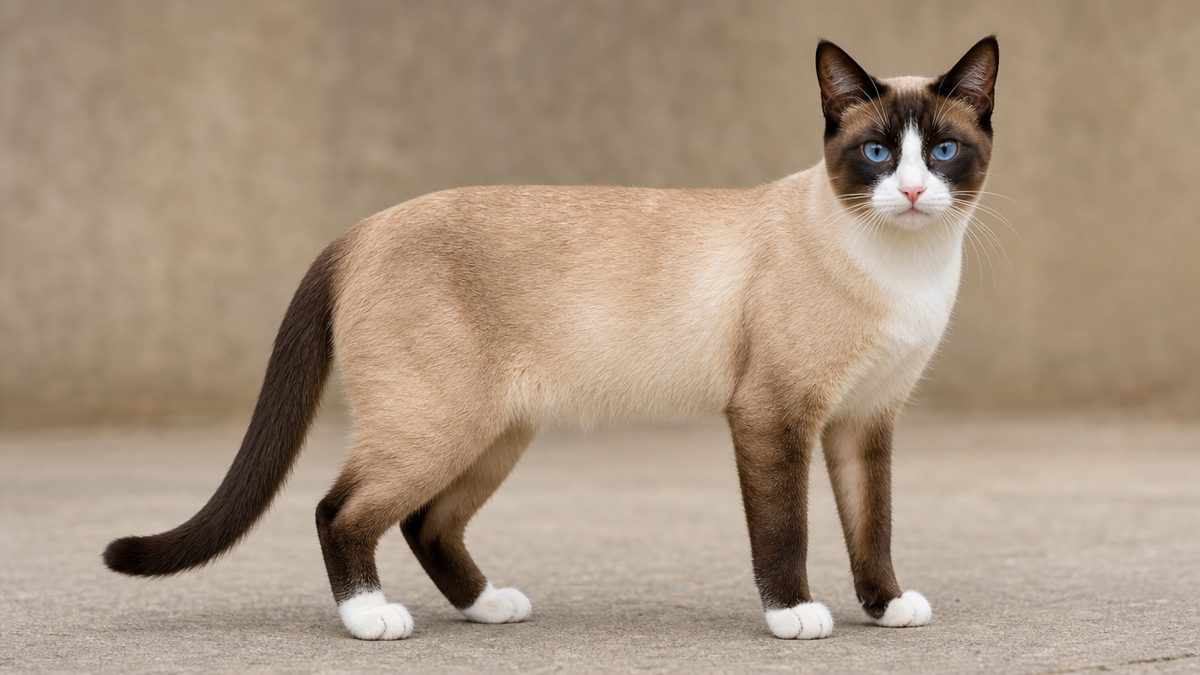
The Snowshoe is a short-coated bicolour pointed cat with four white paws and, ideally, an inverted white V on the face, built from Siamese and a tuxedo-marked American Shorthair in Philadelphia from the early 1960s. Everything distinctive about it is the collision of two separate pigment systems on one cat.
The GCCF says so in one sentence: "The unusual combination of pointing, the white pattern and the moderate body build set the Snowshoe apart from all other breeds";. FIFe describes a medium sized cat "combining the heftiness of its shorthair ancestors with the length of" its Siamese ones. TICA puts it as a recipe: pointed colours and a light body from the Siamese, white feet and a tuxedo look from the American Shorthair side.
What the show standard actually demands
The white is regulated tightly. A Snowshoe on the show bench must have four white paws and not more than one third white overall, with no white on the ears or the tail. The ideal is a balanced inverted V of white on the face, starting on the bridge of the nose, covering the nose, whisker pads and chin, and not extending beyond the outer aperture of the eye. Front paws should carry evenly matched white mittens, back legs evenly matched boots to just below the hock.
Eye colour is not a preference either. The standard requires "a definite blue, the deeper the blue the better, bright, sparkling and expressive", and calls turquoise or insipid blue undesirable. That single requirement is what ties this breed to a body of genetics and neuroscience literature, and it is covered in the next section.
The standard that scores temperament
The GCCF gives the Snowshoe a scale of points in which temperament is worth 10 of 100, alongside head 20, eyes 15, body and bone structure 15 and colour and markings 15. Very few cat standards score temperament at all. The breed description adds that Snowshoes "have a sparkling personality and are human orientated and most affectionate", which is a claim a judge is expected to assess in the ring.
| Feature | Snowshoe | Siamese | Birman | Ragdoll |
|---|---|---|---|---|
| Coat | Short, single, no noticeable undercoat | Short, fine | Semi-longhair | Semi-longhair |
| White markings | Four white paws required, no more than 1/3 white | None | White gloves | Varies by pattern |
| Eye colour | Definite blue required | Blue | Blue | Blue |
| Held by CFA | No | Yes | Yes | Yes |
| FIFe registrations in 2024 | 36, rank 42 of 54 | 929, rank 17 | 3,147, rank 8 | 15,052, rank 3 |
| UK life expectancy at age 0 | No row | 11.69 years, 88 deaths | 14.39 years, 38 deaths | 10.31 years, 69 deaths |
TICA's own breed page says the Snowshoe "is a shorthair cat, not to be confused with either a Birman or a Ragdoll and is not related to either of these breeds". All three are pointed with white on the feet, and only the Snowshoe has a single short coat with no undercoat. Coat length is the free check.
Coat genetics, where two mapped mutations meet on one cat
The Snowshoe's coat genetics are unusually well understood, because both halves have been mapped. The points come from a temperature-sensitive tyrosinase mutation and the white feet from an endogenous retrovirus insertion in the KIT gene. Neither was mapped in this breed, and both are what the standard requires.
The points, and why kittens are born white
The Siamese pattern is a mutation in the tyrosinase gene, mapped and published in 2005. Tyrosinase is the enzyme that starts melanin synthesis, and the Siamese allele makes it temperature sensitive: it works where the skin is cooler and fails where it is warm. That is the whole explanation for the two things every Snowshoe owner notices.
- Kittens are born completely white, because the uterus is uniformly warm and no pigment forms anywhere.
- Points appear on the ears, mask, legs and tail within weeks, because those extremities run cooler than the trunk.
- The body darkens with age, which is why the GCCF asks judges to allow for darker shading in older cats provided contrast remains.
- TICA says full colour, point and white-area development can take up to two years, especially in dilute colours.
Those four consequences all follow from one enzyme's temperature sensitivity, and no Indian page explains it. TICA and the ranking pages state that kittens are born white; the reason is the interesting part Lyons LA, Imes DL, Rah HC.
The same tyrosinase mutation has a documented effect beyond colour. In albinism of all species, perturbed melanin biosynthesis in the eye leads to foveal hypoplasia, retinal ganglion cell misrouting and, consequently, altered binocular vision, and the classic characterisation of those visual pathway anomalies was done in the Siamese cat, on this exact temperature-sensitive tyrosinase mutation. No study has measured this in Snowshoes specifically, so this page states the mechanism and its source rather than claiming a Snowshoe finding. A breed standard that requires deep blue eyes is requiring the phenotype that literature is about.
The white feet, and what they actually are
White and white spotting in domestic cats were traced in 2014 to an endogenous retrovirus insertion in the KIT oncogene. In plain terms, an ancient viral sequence sitting inside a pigment-cell gene disrupts the migration of pigment cells during development, and the parts that pigment cells reach last stay white. That is why white appears on the feet, the chest, the belly and the face rather than at random.
It also explains why the standard has to work so hard. The GCCF notes that the amount of white "may vary from paw to paw and leg to leg and cover only the toes or extend up the entire leg", and that patterns other than the show pattern are not acceptable on the bench but may be used in breeding. TICA records that much of the breed's early history was lost partly because the original pattern restrictions discouraged breeders, given the inconsistency of the white patterning.
White spotting is variable by mechanism, not by breeder skill. A litter from two correctly marked parents can produce kittens with too little white, too much white, or white in the wrong place, and none of them is a defect in the cats. That variability is the reason the GCCF explicitly permits non-show patterns for breeding, and it is a fair thing to ask a breeder about rather than a sign of poor stock.
Registry recognition, and the registry that holds nothing
Registry recognition of the Snowshoe is real but partial, and the gap is the same one that appears twice in this batch: the Cat Fanciers' Association does not hold the breed at any level.
TICA is the breed's home registry and accepted the Snowshoe as a championship breed in 1994, one of the 73 breeds it recognises. FIFe recognised it in 2004, printing "SNO Rec. 2004" on the face of its standard, in category 3. The GCCF carries a full Standard of Points entry at page 181 in Section 4 Group A. LOOF holds its own Snowshoe breed record.
The CFA's own enumeration of every breed council, plus the committee chairs for Miscellaneous and Provisional breeds, contains no Snowshoe entry of any kind. So an American buyer can show a Snowshoe at TICA and cannot show one at CFA, and an Indian buyer offered CFA papers for a Snowshoe is being offered something that does not exist.
| Registry | Status | Date on the record |
|---|---|---|
| TICA | Championship | Accepted 1994 |
| FIFe | Fully recognised, category 3, code SNO | Rec. 2004, standard valid 01.01.2026 |
| GCCF | Own Standard of Points entry, Section 4 Group A, page 181 | Not dated on the entry |
| LOOF | Own breed record | First French pedigrees 2011 |
| CFA | No breed council, no breed page, no Miscellaneous entry | Not applicable |
How close the breed came to disappearing
TICA's own history is unusually frank about it. Between 1960 and 1977 interest declined until there was only one breeder in 1977, and by 1989 there were close to thirty documented breeders. The same page says much of the breed's history was lost through poorly kept records. A breed that passed through a single-breeder bottleneck in living memory is worth knowing about before you pay for a pedigree.
The numbers now, and they are moving the right way
FIFe's Breeding Statistics 2024 covers 96,075 registered kittens across 54 breeds and puts the Snowshoe 42nd with 36 registrations, marked as having risen in rank. France's studbook recorded its first two Snowshoe pedigrees in 2011, 72 across the twenty years to 2022, and 21 in 2024 against 18 in 2023. Small numbers, but rising ones, which is the opposite of the Nebelung and Singapura pattern in the same tables.
Ask which body issued the pedigree papers, then open that body's own breed list. TICA, FIFe, the GCCF and LOOF all hold this breed and can issue a real pedigree. The CFA cannot, because it does not recognise the Snowshoe at any level, so a certificate claiming CFA registration for a Snowshoe describes a registration that does not exist.
Snowshoe cat price in India, and why there is not one
No Snowshoe cat price in India exists. India's most visible cat marketplace lists no Snowshoe at all, two of the ten Indian results for the query are storefront listings for a paperback about the breed, and every page that does quote a figure quotes US dollars.
We pulled the Indian results on 8 September 2026 with gl=IN and hl=en and read the pages in their raw markup.
| Rank | Domain | What it is | Snowshoe price given |
|---|---|---|---|
| 1 | supertails.com | Indian all-breeds cat price guide | None. The breed is not mentioned |
| 2 | petful.com | US price guide | About 1,500 to 3,000 US dollars |
| 3 | instagram.com | Indian seller account listing other breeds | None |
| 4 | amazon.in | A paperback about Snowshoe cats | Rupees, for a book |
| 5 | desertcart.in | The same paperback, ISBN 1941070809 | Rupees, for a book |
| 6 | catster.com | US price guide | Blocked to our retrieval, so not quoted |
| 7 | reddit.com | A US thread about a PetSmart cat | None verifiable |
| 8 | puppiezo.com | Indian marketplace cat catalogue | No Snowshoe in the catalogue |
| 9 | khankittens.com | Indian seller, Persian, British Shorthair, Ragdoll, Maine Coon | Not this breed |
| 10 | qualitykitten.in | Indian seller, Persians from Rs 15,000 | Not this breed |
The rupee figures on that page belong to a book
Positions four and five are two Indian storefronts selling the same paperback. The Desertcart page confirms it in its own specifications: ISBN-10 1941070809, ranked number 379 in Cat Breeds under Books, dimensions 6 by 0.3 by 9 inches. It is an owner's guide, not a cat. A price scraper or an AI summary reading that results page would find rupee figures attached to the words Snowshoe and India, and every one of them would be the price of a book.
The Indian marketplace check, done directly
Rather than infer the absence from search results, we opened India's most visible cat marketplace and read its own cat catalogue. Its raw markup contains zero occurrences of Snowshoe, and also zero of Singapura, Nebelung, Ocicat and Somali. India's largest cat-price guide, titled Cat Price in India 2026: All Breeds, mentions the Persian 22 times and the Snowshoe zero times.
Petful gives about 1,500 to 3,000 US dollars for a pet-quality kitten from a reputable breeder. Turning that into a rupee band would invent an Indian market that does not exist. Any page or AI answer that says no local price is available and then prints a rupee range has performed that conversion, and the resulting number describes an American market with an American wait list.
What that absence is actually made of
FIFe registered 36 Snowshoes worldwide across all its member clubs in 2024, and France's national studbook registered 21. A breed producing numbers in the tens across whole national registers is not going to produce an Indian retail market, and the honest answer to the price question is the absence rather than a figure.
Cost of ownership in India, from published rate cards
The cost of ownership for a short-coated cat in India is built from litter, food, vaccination, parasite control and occasional boarding, with the grooming line close to zero. Every figure below is from a named Indian rate card read live, because no Snowshoe-specific Indian cost exists to quote.
| Line | Published figure | Source and scope |
|---|---|---|
| Kitten vaccination course, three visits | From Rs 3,999, list price Rs 5,065 | Vetic, Mumbai clinic page |
| Adult annual booster, CRP plus anti-rabies | From Rs 1,899, list price Rs 1,908 | Vetic, Mumbai clinic page |
| Anti-rabies, single | Rs 699 | Vetic |
| CRP (Tricat or Feligen), single | Rs 1,249 | Vetic |
| Bath and blow dry, 60 minutes | From Rs 934, list price Rs 1,099 | Vetic, Delhi, dogs and cats |
| Cat boarding, overnight to 24 hours | Rs 649, food and litter excluded | PawSpace, Bengaluru |
| Cat boarding, daycare to 10 hours | Rs 599 | PawSpace, Bengaluru |
| Pet animal licence | Rs 50 | Greater Chennai Corporation |
PawSpace also notes that festive-season rates run 25 to 30 percent higher, which an annual average hides. Boarding matters more for this breed than for most, because TICA says the Snowshoe is very social and should not be left alone for long periods, which means a work trip is a boarding decision rather than an extra bowl of food.
Where a short single coat saves money
The GCCF describes a medium-length short-haired coat with no noticeable undercoat, smooth and glossy, and rates the grooming requirement low. TICA adds that most Snowshoes will groom themselves unless they are unwell or stressed. That removes the professional grooming line from the budget entirely and leaves parasite control as the recurring skin-and-coat cost.
That TICA sentence is also a diagnostic worth keeping. A Snowshoe that suddenly stops self-grooming is telling you something, and in an Indian summer the first thing to rule out is heat stress or pain rather than laziness. Consult your nearby vet rather than waiting to see if the coat recovers.
The cheapest life-extending decision
Neuter on your vet's schedule. In UK primary-care data, entire cats had 4.29 times the odds (95% CI 3.72 to 4.95) of dying before three years of age compared with neutered cats, and among cats dying after nine months, neutered cats lived 1.07 years longer on average.
Greater Chennai Corporation licenses pet animals generally at Rs 50, issued 9,115 licences during 2024, and runs municipal pet clinics that provide all treatment and anti-rabies vaccination free of cost. Delhi's scheme registers pet dogs only. Check what your own corporation offers before assuming private clinic rates are the only option.
Heat tolerance in India, and a coat that helps
The Snowshoe's coat is one of the better ones for Indian heat, because the standard requires a single short coat with no noticeable undercoat. We queried NASA POWER by explicit coordinates for Philadelphia, where the breed began, and for Indian cities, echoing the cell elevation each time.
| Place | Cell elevation | Annual T2M | Annual RH2M | Hottest month | Peak wet bulb |
|---|---|---|---|---|---|
| Philadelphia | 46.88 m | 12.06 C | 79.05 percent | July, 24.61 C | 21.22 C in July |
| Chennai | 48.95 m | 27.95 C | 72.39 percent | May, 31.51 C | 26.11 C in May |
| Kolkata | 7.35 m | 25.81 C | 73.93 percent | May, 31.53 C | 27.09 C in June |
| Mumbai | 97.15 m | 26.77 C | 67.39 percent | May, 31.19 C | 25.77 C in June |
| Bengaluru | 841.72 m | 23.74 C | 67.94 percent | April, 28.37 C | 21.86 C in May |
| Delhi | 206.37 m | 25.60 C | 45.56 percent | June, 35.88 C | 26.50 C in July |
Philadelphia's annual relative humidity of 79.05 percent is higher than Chennai's 72.39, which is the same result this site gets for every northern homeland it measures: the problem in India is heat, not damp. The peak wet-bulb gap is 4.89 degrees C, which is narrow by the standards of this batch and reflects a genuinely humid continental summer rather than a cool maritime one.
What the coat contributes
The GCCF requires a coat of medium length short hair with no noticeable undercoat, smooth and glossy, and calls long, coarse or harsh textured coats undesirable. TICA says the same from the other side: a single layer with no evidence of an undercoat. A single coat sheds heat better and mats not at all, and it is the reason this breed sits at four out of five on heat tolerance rather than two. On coat structure alone this is a heat-tolerant cat by the standards of the pedigree breeds sold in India.
Practical rules by city
- Treat Chennai, Kolkata, Mumbai, Hyderabad and Ahmedabad as the hot-season cities from March to June, and Delhi from April to July.
- Rank your own city rather than assuming: hottest-month means run Ahmedabad 35.06 C in May, Hyderabad 33.30 C in May and Pune 28.93 C in April.
- Move play to early morning and after dark, because this is an extremely active breed that will not self-limit.
- Give the cat a shallow container of water to splash in, which TICA reports Snowshoes enjoy and which doubles as evaporative cooling in the monsoon months.
- Keep two water sources away from food bowls and refresh them twice daily in the hot months.
Bengaluru remains the easiest Indian metro for any pedigree cat, at a peak wet-bulb load of 21.86 degrees C, effectively identical to Philadelphia's 21.22. That is as close to a climate match as an imported breed gets in India.
Rule 6(5) of the Prevention of Cruelty to Animals (Pet Shop) Rules, 2018 requires the temperature where pet animals are displayed or housed to be comfortable, notes that it varies from animal to animal and from breed to breed, and places the onus on the pet shop owner to familiarise himself with the requirements of the breeds he intends to deal in. That clause is worth quoting to a shop, whatever the breed.
Temperament, and the sentence that should decide your purchase
The Snowshoe is social, vocal, intelligent and strongly attached to one person, and TICA states in plain words that it should not be left alone for long periods. In an Indian household where everyone is out from nine to seven, that single sentence matters more than anything else on this page.
TICA's description is detailed and worth reading in full rather than in summary. Snowshoes are described as mellow but thriving on interaction, companionship and affection; known to express themselves vocally in a soft, melodic voice; demure around strangers but deeply devoted to family, often attaching to one member as a constant companion; and getting along well with children and other pets.
The GCCF puts the same thing in its standard, which scores temperament at 10 of 100 points and describes a sparkling personality, human orientated and most affectionate. Two registries describing a cat that needs company is not marketing; it is a housing requirement.
Who this suits in India
- Households with someone home during the day, or with a second cat already in residence.
- Families with children, which TICA names explicitly as a good match.
- Owners who want an interactive, trainable cat rather than an ornament.
- Anyone comfortable with a talkative cat, since the voice is soft but frequent.
Who should choose something else
- Single-occupant flats where the cat would be alone twelve hours a day with no companion animal.
- Households that want silence, because Siamese ancestry shows in the conversation.
- Anyone who dislikes a cat leading rather than following, which TICA describes as this breed's habit.
- Buyers unwilling to prepare for the exercise requirement, since an unoccupied Snowshoe makes its own entertainment.
TICA writes that like snowflakes, no two Snowshoes have the same personality: some are shy, some bossy, some caregivers. That is unusual candour from a breed page, and it is a warning against buying on a temperament promise. Meet the actual kitten and its mother rather than the description.
Training a Snowshoe, which is unusually easy
To train a Snowshoe, treat it like a dog that fits in a lap: this is one of the few cat breeds a registry describes as easy to train, and TICA lists leash walking, fetch and opening doors among the things it learns.
TICA's activity section is specific: aside from being extremely active, the Snowshoe is very smart and easy to train, enjoys learning tricks such as walking on a leash, playing fetch and opening doors, and its speed and intelligence make it a good match for feline agility courses. That last item is a real competitive discipline, not a figure of speech.
The curriculum, in order
- Handle paws, ears and mouth from eight weeks, ten seconds at a time, ending in food.
- Leave the carrier out as furniture and feed inside it, so it is never a vet-only object.
- Teach a name response and a recall, which a talkative social cat picks up fast.
- Add a harness indoors before ever going outside, and only into an enclosed space.
- Build fetch on the cat's own offer, since most Snowshoes offer it unprompted.
The door-opening item on TICA's list is a warning as much as a boast. A cat that can open doors can open the one to a balcony or a stairwell, and in an Indian apartment block that is a real risk. Fit a latch the cat cannot work before you need one.
What this breed resists
It resists being ignored. TICA notes that Snowshoes have been known to cause a bit of mischief if left unoccupied, and that they are athletic and speedy and love to chase toys around the house, especially when home alone. Training a Snowshoe is mostly about giving it a job before it invents one.
TICA reports that Snowshoes love water and that some will get into the bath, and recommends a shallow container of water for entertainment. In an Indian summer that is a genuinely practical enrichment and a mild cooling aid, and it also makes the eventual necessary bath far less of an event than it is for most cats.
Daily exercise for an extremely active breed
Give a Snowshoe two structured play sessions a day plus climbing space, and expect it to use both. TICA describes an extremely active cat suited to agility courses, which is the highest activity rating in this batch alongside the Ocicat.
The GCCF standard describes a cat that should feel firm, muscular, deceptively powerful and agile, with the appearance of a runner rather than a weightlifter. TICA adds that although very energetic, Snowshoes are not restless or easily agitated, but will cause mischief if left unoccupied.
What to provide
- Two wand sessions a day of ten to fifteen minutes, each ending with a catch and a food reward.
- Vertical space, because a runner and jumper will use shelves if you provide them and cupboards if you do not.
- A puzzle feeder for at least one meal, converting appetite into activity.
- A shallow water tray, which this breed uses as enrichment rather than ignoring.
- A second animal if the household is out all day, which addresses the exercise and the company problem together.
The weight argument applies here as everywhere. Among UK cats that died after nine months, lifespan decreased by 0.02 years for every 100 g of deviation, in either direction, from the median adult body weight within the breed and sex strata. On a cat TICA puts at 7 to 12 pounds, monthly weighing is cheap and informative.
One breed-specific caution belongs in this section rather than in health. The two published Snowshoe case reports describe young cats presenting with recurrent pelvic limb weakness. An owner used to watching an athletic cat run and jump every day is the person most likely to notice a change in gait early, which is exactly what you want.
Grooming, which is a weekly brush
Brush a Snowshoe once a week and the job is done. The coat is single, short and smooth with no noticeable undercoat, and TICA says most Snowshoes will groom themselves unless they are unwell or stressed.
The GCCF's coat line asks for medium length short hair with no noticeable undercoat, smooth and glossy, moderately dense and resilient in texture, and calls long, coarse or harsh coats undesirable. TICA's grooming section says the short hair makes them easy to groom, and recommends a weekly brush to remove dead hair and distribute skin oils, plus regular nail trims and tooth brushing.
| Task | Frequency | If you outsource it |
|---|---|---|
| Brush or grooming mitt | Weekly | Not sold separately |
| Bath | Rarely, and this breed will not object | From Rs 934 for 60 minutes, Vetic Delhi |
| Nail trim | Every two weeks | Included in a full groom |
| Tooth brushing | Weekly | Not sold separately |
| Ear check | Weekly | Not sold separately |
| Parasite control | On a veterinary schedule | Product cost, ask your vet |
The diagnostic hidden in the grooming advice
TICA's sentence that most Snowshoes will groom themselves "unless they are not feeling well or are stressed" is the most useful line in its grooming section. A cat that stops self-grooming has changed, and on a short single coat the change is visible within days as a dull, spiky or greasy look. In an Indian summer, treat it as a reason to see a vet rather than a reason to brush harder.
The two products sit side by side on Indian shelves and the packaging difference is small. An Italian veterinary teaching hospital reported four cases of feline permethrin intoxication in which the cause, every time, was an owner applying a canine permethrin spot-on to a cat; the cats needed intravenous lipid emulsion and sedation to recover. Read the species on the box before you pay.
Health issues, screening and life expectancy
The Snowshoe has two peer-reviewed papers naming it, both describing the same suspected inherited neuropathy in young cats, and a registry health section that does not mention them. It has no life table. This section reports the papers, the registry line and the gap between them.
The axonal neuropathy, stated at the size it actually is
In 2007 a British veterinary group reported neuromuscular disease in young Snowshoe cats in a short Veterinary Record communication. Two years later the same group published the full case report. Two young related male Snowshoe cats were presented with an initially progressive history of recurrent pelvic limb weakness. Electrodiagnostic investigation suggested an axonopathy, and muscle and nerve biopsies confirmed axonal degeneration. Over the following two years both cats stabilised without any specific treatment, and repeat electrodiagnostics and a repeat muscle biopsy in one cat confirmed a tendency for remission.
The authors describe it as a suspected inherited feline axonal neuropathy with a very unique clinical course, and note that neuropathies in cats are mostly acquired, with only very few inherited forms described. That is two cats, related, both male, and it is a case report rather than a prevalence study. This page will not turn it into a breed-wide risk figure, because the paper does not support one.
Nothing. TICA's Snowshoe health section reads, in full, that the Snowshoe is considered an overall healthy breed and that vaccinations and parasite treatments should be kept up to date. The two published case reports naming the breed do not appear. Both statements can be true at once: the breed may well be broadly healthy, and two cases exist in the literature. A buyer is better served by knowing both than by knowing one.
What the neuropathy report means for an Indian owner
- Watch gait in a young cat, since both reported cases presented with recurrent pelvic limb weakness rather than with pain.
- Take a video before the vet visit, because an intermittent gait change is the hardest thing to reproduce in a consulting room.
- Ask for referral if weakness recurs, since the diagnosis in both cases needed electrodiagnostics and biopsy rather than a clinical exam.
- Do not panic on the strength of two cases, and do not let a seller tell you the breed has no reported problems either.
There is also an erratum. The 2009 paper carries a correction published in the same journal in 2018, at volume 20 issue 8 page NP3. This page has not retrieved the erratum's content and says so rather than implying the record is complete.
The eye question, which comes from the coat
The GCCF standard requires a definite blue eye, the deeper the better. Blue eyes in a pointed cat are a consequence of the temperature-sensitive tyrosinase mutation, and that mutation's effects on the visual system are documented: in albinism of all species, perturbed melanin biosynthesis in the eye leads to foveal hypoplasia, retinal ganglion cell misrouting and altered binocular vision, and the classic work characterising those anomalies was done in the Siamese cat on this exact mutation.
No study has measured any of that in Snowshoes. The honest statement is that the Snowshoe is required by its standard to carry the phenotype that literature describes, that the anatomical consequences are expected to follow from the allele rather than from the breed, and that this is a question to raise with a veterinary ophthalmologist rather than a defect to assume. Consult your nearby vet if you see nystagmus, a squint or unusual depth-perception behaviour.
Life expectancy, where nothing has been measured
The UK VetCompass feline life tables modelled only the 12 breeds reaching 15 or more deaths and the Snowshoe is not among them. TICA publishes 15 to 20 plus years and the GCCF's breeds index publishes 14 to 20. Both are registry estimates. The measured general figures remain: crossbred cats 11.89 years at age 0 across 7,117 deaths, purebred cats 10.41 across 819, and purebred cats carrying 1.83 times the odds of dying before three.
Feeding an active short-coated cat in India
Feed a Snowshoe measured meals twice a day and use a puzzle feeder for at least one of them, because this is an active, intelligent breed that does better with food it has to work for.
TICA's nutrition guidance is short: Snowshoes require proper protein and nutrients like any cat, and a high-quality diet is recommended. That is thinner than most breed pages and this one will not pad it out with invented specifics.
What the evidence does support is portion discipline. Among UK cats that died after nine months, lifespan decreased by 0.02 years for every 100 g of deviation, in either direction, from the median adult body weight within the breed and sex strata. On a 7 to 12 pound cat, that is a reason to weigh rather than to eyeball.
Water, and the breed's own advantage
TICA's standing tip applies here: place the water bowl at least three feet away from any food, because cats' noses are sensitive and an overwhelming smell of food may cause them to drink less, and consider a filtered fountain. This breed makes that easier than most, because Snowshoes actively enjoy water, so a fountain or a shallow tray is likely to be used rather than ignored.
- Keep two water sources, both away from food, and refresh twice daily from March to June.
- Lead with wet food where the budget allows, since it is the largest single lever on total water intake.
- Weigh the daily ration once a week rather than scooping.
- Take treats out of the ration rather than adding them on top.
| Stage | Approach | What to watch |
|---|---|---|
| 8 to 16 weeks | Four small meals a day, kitten formulation | Weekly weight gain, and the points beginning to darken |
| 4 to 12 months | Three meals, then two, still on kitten food | Gait and hind-limb strength as the cat becomes fully athletic |
| 1 to 7 years | Two measured meals, one from a puzzle feeder | Monthly weight, and any drop in self-grooming |
| 7 years and older | Two meals, senior formulation on veterinary advice | Drinking volume, appetite change and any tray-behaviour change |
A short glossy coat hides less than a semi-longhair one, but it still hides a gradual gain. A kitchen scale and a monthly weight cost almost nothing and give you the one number that the general feline evidence actually attaches to lifespan.
The Snowshoe kitten timeline, month by month
Plan a Snowshoe kitten timeline around four fixed points: the eight-week legal floor for sale in India, the vaccination course, the two-year colour development the registries both flag, and the neutering decision before the first birthday.
Indian law sets the first date. The Prevention of Cruelty to Animals (Pet Shop) Rules, 2018 define an un-weaned animal to include "kittens and pups below eight weeks", and rule 7(15) states that no pet shop shall sell un-weaned or underage animals.
| Age | What happens | Cost anchor |
|---|---|---|
| Birth | Kitten is entirely white. No points, no pattern to judge | None |
| 2 to 6 weeks | Points begin appearing on ears, mask, legs and tail as the extremities cool | None |
| Under 8 weeks | Not legally saleable in India. Stay with the queen | None |
| 8 to 10 weeks | Home, first vet check, carrier left out, handling routine started | Kitten vaccination course from Rs 3,999 for three visits |
| 10 to 16 weeks | Vaccination course completed, harness and name response introduced | Included in the course above |
| 5 to 8 months | Neutering window, discussed with your own vet | Clinic dependent, ask for a written quote |
| 12 months | First adult annual booster, baseline adult weight recorded | Adult annual from Rs 1,899 |
| Up to 24 months | Colour, points and white area still developing, especially in dilutes | None |
Why you cannot judge markings on a young kitten
TICA states that full colours, points and white area development may take up to two years, especially in dilute colours, and the GCCF asks judges to allow for the mask being incompletely developed in kittens, noting that on maturity the mask may extend to become a full hood. A seller charging a premium for perfect markings on a twelve-week kitten is charging for something neither registry considers settled at that age.
What to write down in the first year
- The registry that issued the pedigree papers, copied from the certificate rather than remembered.
- Every vaccination date and product name, from the certificate.
- Monthly weight, which becomes the baseline for the body-condition argument.
- Any episode of hind-limb weakness or gait change, with the date and a video.
Rule 7(16) of the Pet Shop Rules, 2018 requires that every puppy be micro-chipped by a veterinary practitioner and that only micro-chipped puppies be sold. It says puppies, not kittens, so a kitten falls outside it. Microchipping a cat that TICA says can open doors is nonetheless a sensible idea in an Indian apartment block.
Snowshoe against the pointed cats Indian buyers can actually get
Almost everyone who reaches this breed is also looking at the Ragdoll, the Birman or the Siamese, all three of which are available in India and all three of which have measured life expectancies the Snowshoe does not.
| Snowshoe | Siamese | Birman | Ragdoll | Indian domestic shorthair | |
|---|---|---|---|---|---|
| UK life expectancy at age 0 | No row | 11.69 years (10.56 to 12.82), 88 deaths | 14.39 years (12.87 to 15.91), 38 deaths | 10.31 years (8.86 to 11.76), 69 deaths | 11.89 years (11.75 to 12.03), 7,117 deaths |
| Coat | Short, single, no undercoat | Short, fine | Semi-longhair | Semi-longhair | Usually short |
| Grooming load in India | Weekly brush | Weekly brush | Daily comb | Daily comb | Weekly brush |
| FIFe registrations in 2024 | 36, rank 42 | 929, rank 17 | 3,147, rank 8 | 15,052, rank 3 | Not registered |
| Held by CFA | No | Yes | Yes | Yes | Not applicable |
| Listed by Indian sellers | No | Yes | Occasionally | Yes | Adoption |
Two rows decide most of this. The Birman has the second longest measured life expectancy of any breed in the UK study at 14.39 years, and the Ragdoll one of the shorter ones at 10.31, and both are widely available in India while the Snowshoe is not. A buyer choosing between a pointed cat with 38 measured deaths behind its figure and one with no figure at all is not making a like-for-like comparison.
Snowshoe against Siamese
This is the closest relative and the honest difference is coat markings and availability rather than temperament. The Snowshoe is still outcrossed to the Siamese to maintain the Siamese inheritance, so much of what people like about the Snowshoe's personality is Siamese personality. The Siamese is registered by every major body, has a measured UK life expectancy of 11.69 years from 88 deaths, and is actually sold in India.
Snowshoe against the cat outside your building
In the UK life tables, crossbred cats reached 11.89 years at age 0 across 7,117 deaths, against 10.41 years for purebred cats and 1.83 times the odds of dying before three. Indian streets also produce plenty of white-footed cats, though not pointed ones, since the pointed allele is recessive and uncommon in random-bred Indian populations. If it is the white feet you want, look outside. If it is the pointed pattern with the white feet, that combination is what the breed exists to fix.
A single short coat with no undercoat, on a breed that likes water and can be leash trained. Of the four pointed breeds in that table, two need daily combing in Indian humidity and this one needs a weekly brush. That is a real advantage, and it is the reason to keep the breed on a shortlist even though buying one here is currently not possible.
Mistakes Indian buyers make with this breed
Five mistakes account for almost everything that goes wrong, and four of them happen before any cat changes hands.
1. Reading a book listing as a cat price
Two of the ten Indian results for this query are storefront pages for the same paperback, ISBN 1941070809. They carry the only rupee figures on the page. A price scraper, an AI summary or a hurried reader can take one of those numbers as the breed's Indian price. Before quoting any rupee figure for an animal, confirm the listing is for a live animal.
2. Accepting CFA papers for a Snowshoe
The Cat Fanciers' Association does not recognise the Snowshoe at any level: no breed council, no breed page, no Miscellaneous or Provisional entry. A certificate claiming CFA registration for a Snowshoe describes something that does not exist. TICA, FIFe, the GCCF and LOOF all can issue a real one.
3. Judging markings on a young kitten
TICA says full colour, point and white-area development can take up to two years, especially in dilute colours. Kittens are born entirely white. Paying a premium for a perfect inverted V at twelve weeks is paying for something neither registry regards as settled at that age.
4. Leaving a social breed alone all day
TICA states plainly that the Snowshoe is very social and should not be left alone for long periods, and that an unoccupied Snowshoe causes mischief. In an Indian household where both adults work full days, the honest answer is a second animal or a different breed, not a determination to make it work.
5. Assuming no published health issues means none exist
TICA's health section says the breed is considered overall healthy. Two peer-reviewed papers describe a suspected inherited axonal neuropathy in young related male Snowshoe cats. Neither statement is dishonest, and a buyer who reads only the first has an incomplete picture. Ask a breeder whether they have heard of it, and treat a blank as information.
Every price page ranking in India for this query is written for an American buyer in dollars, and the Indian-domain results are two book listings and three sellers of other breeds. Read the currency before you read the number, and check whether the page has any idea where you are.
Adoption, import and how to proceed honestly
Adopt, and if you are genuinely set on this breed, the only lawful route into India is personal pet import under the baggage rule. There is no Indian purchase route to verify, which makes adoption the practical section here.
Start with what adoption offers. A purebred Snowshoe in an Indian shelter would be extraordinary. A short-coated white-footed Indian cat is not, and the UK life tables give crossbred cats 11.89 years at age 0 across 7,117 deaths against 10.41 for purebreds. What adoption cannot give you is the pointed pattern, which is genuinely uncommon in Indian random-bred cats.
The import route, stated precisely
India's Animal Quarantine and Certification Service publishes the conditions under the baggage rule, Customs Circular No. 15/2013 of 8 April 2013.
- Dogs and cats are permitted up to two in number under this route.
- The owner must show proof of two years of continuous stay abroad and proof of transferring residence to India.
- For accompanied baggage the owner's ticket is required; for unaccompanied baggage, a passport copy with the immigration stamp within one month of arrival.
- The cat needs an official country-of-origin health certificate naming freedom from rabies, distemper, feline enteritis, feline panleukopenia and leptospirosis.
- Rabies vaccination must have been given more than one month, but within 12 months, before actual embarkation.
- The owner's name on the health certificate must match the name on the ticket.
That is a route for a person moving home with a cat they already own, not a route for ordering a kitten.
If someone does offer you a Snowshoe in India
- Ask which register issued the pedigree papers, and remember CFA cannot have.
- Ask the litter date in writing, since kittens below eight weeks are un-weaned under rule 2(1)(p)(ii) and cannot lawfully be sold.
- Ask to see the queen with the litter, which rule 7(3) means a pet shop may not display for sale at all.
- Ask whether either parent has ever shown hind-limb weakness, and note the answer.
- Ask what the cat looked like at birth, because the correct answer is entirely white.
Two further written rules are worth carrying to the counter. Rule 7(14) bars selling a pet animal with any form of mutilation other than necessary curative surgery on veterinary prescription, and rule 7(22) bars selling any pet animal to a person who has not attained the age of majority.
The Snowshoe is a well-documented breed with a real standard, four registry recognitions, a coat that suits Indian heat and one of the more interesting genetic stories in the cat fancy. It is also produced in the tens per year across whole national registers and is not sold in India at all. For an Indian reader wanting a pointed cat now, the Siamese is available, registered everywhere and has a measured life expectancy. For a short coat and white feet, look at the cats already outside.
Snowshoe questions people actually ask in India
What is special about Snowshoe cats?
Three things at once, and the standard says so. The GCCF describes the unusual combination of pointing, the white pattern and a moderate body build as what sets the Snowshoe apart from all other breeds. It also allocates 10 of its 100 judging points to temperament, which almost no cat standard does.
Are Snowshoe cats expensive?
Outside India, moderately: overseas guides quote about 1,500 to 3,000 US dollars for a pet-quality kitten from a breeder. Inside India the question does not arise, because no Indian seller lists the breed. India's most visible cat marketplace contains zero Snowshoe entries in its cat catalogue.
Is a Snowshoe cat a Siamese?
No, but it is half of one by design and still outcrossed to Siamese today. TICA's history records that Dorothy Hinds Daugherty found three white-footed kittens in a Siamese litter in Philadelphia in the early 1960s and bred them to a tuxedo-marked American Shorthair. TICA says the breed is still bred back to the Siamese to maintain that inheritance.
How rare is a Snowshoe cat?
Rare, but rising. FIFe registered 36 Snowshoe kittens worldwide in 2024, ranking the breed 42nd of 54 and marking it as having risen in rank. France's studbook recorded its first two Snowshoe pedigrees in 2011 and 21 in 2024. In 1977 there was exactly one Snowshoe breeder left anywhere.
What is the real Snowshoe cat price in India?
There is none. No Indian seller lists the breed, two of the ten Indian results for the query are storefront listings for the same paperback about Snowshoe cats, and India's largest cat-price guide, titled All Breeds, mentions the Snowshoe zero times while mentioning the Persian 22 times.
Why are Snowshoe kittens born white?
Because the pointed pattern is a temperature-sensitive tyrosinase mutation. Pigment forms only where the skin is cooler, so a kitten warm in the uterus is born white and the points appear as the extremities cool after birth. TICA says full colour and white-area development can take up to two years, especially in dilute colours.
Do Snowshoe cats have eye problems?
No Snowshoe-specific eye study exists, but the allele the standard requires has its own literature. In albinism of all species, perturbed melanin synthesis in the eye leads to foveal hypoplasia, retinal ganglion cell misrouting and altered binocular vision, and that work was done on the temperature-sensitive tyrosinase mutation in Siamese cats. Ask your nearby vet rather than assuming.
Is there an inherited disease in Snowshoe cats?
Two papers describe one. Two young related male Snowshoe cats presented with progressive recurrent pelvic limb weakness, electrodiagnostics suggested an axonopathy and biopsies confirmed axonal degeneration. Both stabilised over two years without treatment. It is a suspected inherited neuropathy in two cats, not a breed-wide prevalence figure.
How does a Snowshoe cope with Indian heat?
Well by pedigree-cat standards. The coat is short and single with no noticeable undercoat, which the GCCF standard requires, and Philadelphia's peak wet-bulb load of 21.22 degrees C is 4.89 degrees below Chennai's. The bigger Indian constraint is social rather than thermal: TICA says this breed should not be left alone for long periods.
How long do Snowshoe cats live?
No measured figure exists. The UK feline life tables modelled only the 12 breeds reaching 15 or more deaths and the Snowshoe is not among them. TICA publishes 15 to 20 plus years and the GCCF's breeds index gives 14 to 20, both registry estimates rather than life tables, and this page keeps the two labelled apart.
Compare with similar breeds
Snowshoe sits in 1 Bonbeno group. Each one compares it directly against the breeds it is genuinely an alternative to, on the same figures.