
Breed profile
Barak Hound: The Complete India Guide
A 20 kg Bosnian scenthound with a shaggy double coat, an alpine home climate 15.85 degrees cooler than Bengaluru, and no lawful breeding-import route into India.
Quick answer
The barak hound is a 20 kg shaggy scenthound from Bosnia and Herzegovina, FCI standard 155, whose working text has not been revised since 1973. No Indian price exists and no lawful breeding-import route exists either. Heat tolerance rates 1 out of 5, because Vitez averages 7.89 degrees Celsius a year and Chennai's coldest month is warmer than the breed's hottest.
This page summarises published veterinary research, registry data and breed-standard text for general information. It is not a diagnosis and it is not treatment advice. Consult a registered veterinarian about your own dog before acting on anything here, and treat a rectal temperature at or above 41.0 degrees Celsius in a dog as an emergency.
Barak hound at a glance
What the Barak hound is, and what FCI-155 actually says
The Barak hound is a 46 to 56 cm, 16 to 24 kg scenthound from Bosnia and Herzegovina, registered by the Federation Cynologique Internationale as standard number 155 and formally titled Bosanski Ostrodlaki Gonic-Barak, or Bosnian Broken-haired Hound called Barak.
Start with the numbers the standard prints, because most pages about this breed do not. FCI-155 gives a height at withers of 46 to 56 cm with an ideal of 52 cm, and a weight of 16 to 24 kg with an ideal of 20 kg. The German text is more precise than the English on one point: it attaches the 46 to 56 cm range to males specifically, then adds that females are a little smaller. The body must be 10 percent longer than the height at the withers, which is the proportion that separates this dog from the shorter-legged Balkan hounds around it.
The head, the coat and the beard
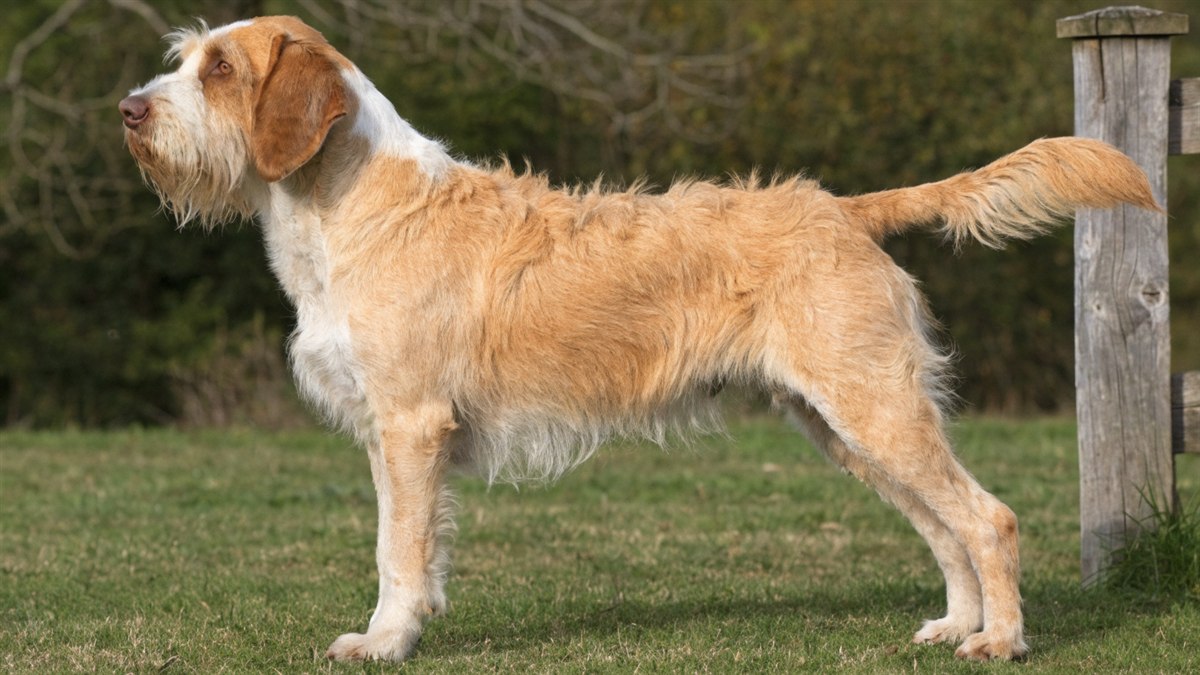
The head is the breed's signature and the standard measures it. Total head length runs about 20 to 25 cm, the muzzle is rectangular and a little longer than the skull, and it carries a bushy moustache and beard. The superciliary arches are very pronounced, which is what produces the heavy overhanging eyebrows every photograph shows. Eyes are large, oval and chestnut brown. Ears are set moderately high, pendulous, medium long and broad, thick at the base and rounded at the tip.
The coat is the other half of the identity, and it matters more in India than anywhere else. FCI-155 describes the hair as long, hard, shaggy, tousled, with a dense undercoat, and the skin as covered with a dense coat. That is a working double coat built for a Bosnian winter, and the standard reinforces it by making hair that is too long, woolly, wavy or curly an eliminating fault. The Finnish Kennel Club translation, approved on 5 April 2018 and carried by all five Nordic Kennel Union clubs, uses the same wording: peitinkarva is long, hard and bristling, with a dense undercoat.
Colour, tail and what the standard rejects
Ground colour can be wheaten yellow, reddish yellow, earthy grey or blackish, with white markings on the head as a star or blaze, under the throat, below the neck, on and under the chest, on the lower legs and at the tail tip, in bicolour or tricolour combinations. The tail is well set on, thick at the base, tapering, reaching the hock or slightly beyond, carried in a slight upward scimitar curve, and very hairy. Nothing in the standard mentions docking, and nothing needs to: this is a natural full tail and it should stay one.
| Item | What FCI-155 specifies |
|---|---|
| Group and section | Group 6 scenthounds, Section 1.2 medium-sized hounds, with working trial |
| Height at withers | 46 to 56 cm, ideal 52 cm; females a little smaller |
| Weight | 16 to 24 kg, ideal 20 kg |
| Proportion | Body length exceeds height at withers by 10 percent |
| Head length | About 20 to 25 cm total |
| Coat | Long, hard, shaggy, tousled, with a dense undercoat |
| Colour | Wheaten yellow, reddish yellow, earthy grey or blackish, with white markings |
| Tail | Reaches the hock or a little beyond, carried in a slight upward curve |
| Voice | Sonorous, high-sounding, sometimes deep-voiced |
The utilisation clause is the sentence an Indian buyer should read twice. FCI-155 defines the breed as a well working scenthound, resistant and persistant, with a sonorous high sounding voice, sometimes deep-voiced. That is a job description, not a temperament note, and the FCI backs it by classifying the breed as subject to a working trial. A Bosnian judge who breeds and shows the dogs puts the working use plainly: the Barak is worked on wild boar, hare and fox, and it also guards the ground it lives on.
20 kg of double-coated mountain scenthound, bred to run all day in a place whose annual mean temperature is 7.89 degrees Celsius. Everything difficult about keeping this breed in India follows from that one sentence.
Three contradictions inside the breed standards that nobody has published
Read FCI-155 and the UKC standard side by side and three plain contradictions appear, and none of the pages ranking for this breed mentions any of them. All three are checkable in under five minutes against the documents themselves.
Contradiction one: the standard both allows and rejects black
FCI-155's colour clause permits a ground colour that is wheaten yellow, reddish yellow, earthy grey or blackish. Its eliminating faults then reject any other colour than those mentioned, but especially chocolate or black. A blackish dog is therefore permitted by one clause and eliminated by another, in the same four-page document.
This is not a translation slip. The German text approved on 24 October 1996 permits schwarzlich in the colour clause and disqualifies Schokoladenbraun oder Schwarz in the same list. The Finnish translation the Nordic Kennel Union clubs use permits mustahko and disqualifies suklaanruskea tai musta. Three languages, three official texts, the same internal contradiction, which means the contradiction is in the standard and not in anybody's translation.
The Bosnian-language rendering of the standard resolves it a fourth way, and that is itself informative. Its colour list runs wheaten yellow, yellow-red, earthy grey and dark grey, with no blackish entry at all, while its disqualifying faults still reject all other colours and especially chocolate and black. Replace blackish with dark grey and the contradiction disappears, which suggests the English, German and Finnish texts are carrying a translation of the original that the local wording never had.
One ranking page has half-noticed it. The Brit breed catalogue writes that the nose may be black or dark reddish-brown but for genetic reasons may not be brown, as stated in the standard that considers another place the chocolate brown coat colour for highly undesirable. That is the only acknowledgement in the ranking set that FCI-155 argues with itself, and it addresses the nose rather than the coat.
The practical consequence shows up in the ring. A Bosnian breed judge reports that in his experience judges increasingly penalise dogs that are yellow or that carry a dark mantle, and that a black mantle is not permitted. A buyer told a dark puppy is standard-correct is being told something the standard does not settle.
Contradiction two: the two recognised standards ask for opposite necks
FCI-155 lists dewlap only slightly pronounced among its important faults, which means the standard wants a visible dewlap and penalises a neck without one. The German text says the same, faulting a wenig ausgepragte Wamme, and the Finnish text faults vahainen loysa kaulanalusnahka. Brit's summary of the serious defects lists only faintly outlined dewlap.
The UKC standard, copyright 2006, describes the neck of the same breed in four words: There is no dewlap. Two recognised registries therefore ask judges to reward opposite necks on the same dog. A Barak that is correct under FCI-155 carries a fault under UKC, and the reverse.
| Feature | FCI-155 | UKC 2006 |
|---|---|---|
| Dewlap | A dewlap that is only slightly pronounced is an important fault | There is no dewlap |
| Height | 46 to 56 cm range, ideal 52 cm | Ideal 20.5 inches for males, no range printed |
| Weight | 16 to 24 kg range, ideal 20 kg | Ideal 44 pounds for males, no range printed |
| Dewclaws | Listed as an important fault | Not mentioned |
| Yellow eyes | Very light eyes are an eliminating fault | Yellow eyes are a disqualification |
| Albinism | Not mentioned | A disqualification |
Note what the UKC conversion does to a buyer. 20.5 inches is 52.07 cm and 44 pounds is 19.96 kg, so UKC has simply converted the FCI ideals, then dropped the ranges. A reader using the UKC page alone has no idea the breed lawfully spans 10 cm and 8 kg.
Contradiction three: dewclaws are faulted, and removing them is illegal in India
FCI-155 lists dewclaws among its important faults, and the German text names Afterkrallen in the same list. In most FCI countries a breeder simply removes them. In India that route is closed. The Prevention of Cruelty to Animals (Dog Breeding and Marketing) Rules 2017, notified as G.S.R. 496(E) on 23 May 2017, state at Second Schedule Part II paragraph 6(8) that there shall be no tail docking, ear cropping, de-barking, de-clawing, branding, dyeing... or any other kind of mutilation of any body part of the pup and any change of appearance by artificial means is strictly forbidden.
An Indian breeder who removes a Barak puppy's dewclaws to satisfy FCI-155 breaks paragraph 6(8) of the Second Schedule. The standard's preference does not override the Rules. Leave the dewclaws on, accept the fault, and keep the nails short instead.
Recognition history: 1955 or 1965, and why every English page says the wrong one
The FCI recognised this breed on 9 April 1955, ten years before the date every English-language page repeats. The FCI's own nomenclature record prints 9 April 1955 as the date of acceptance on a definitive basis, while the FCI's own standard document says the breed was registered on 19 June 1965 under the name Illyrian Hound.
Both statements come from the FCI, and they are ten years apart. The nomenclature record also confirms the dates it uses are month-day-year, because it prints 4/1/1996 for the English standard, which matches the 01.04.1996 stamped on the PDF itself, and 1/15/1973 for the valid standard, which matches the 15.01.1973 printed inside it Federation Cynologique Internationale. So 4/9/1955 reads as 9 April 1955 and is not a transposition.
A Bosnian source resolves the two dates rather than choosing between them. A paper presented at the 1st International Symposium on the state and protection of autochthonous breeds, by Jelena Nikitovic, Admir Alihodzic and Nedim Noga, states that the first breed standard was drawn up in 1955 in Luxembourg, and that the standard in force dates from 1973. Read together, 1955 is when the FCI accepted the breed and first standardised it, and 1965 is when the standard was registered under number 155 as the Illyrian Hound.
Nobody outside Bosnia has printed the 1955 date
Wikipedia says the breed was first recognised by the Federation Cynologique Internationale in 1965. UKC says the Barak was registered with FCI in 1965 under the name of Illyrian Hound. In 1973 the name was changed. Rocadog repeats 1965, and so does Animalia, whose only cited reference is the Wikipedia article. The Finnish Kennel Club translation of the standard also carries only 19 June 1965. Every one of them is copying the standard's own historical summary, and none has opened the FCI database record sitting one click away.
The standard has not been revised in over half a century
FCI-155's date of publication of the official valid standard is 15 January 1973. The 1996, 1996 and 1997 dates against the English, German and Spanish files are translation publication dates, not revisions. That makes the working text of this breed standard more than 52 years old as of 2026.
This is not an accident of neglect that nobody has noticed locally. Admir Alihodzic, a Bosnian kennel judge for hounds who keeps ten Baraks including two conformation champions, states that the Barak is the only breed from the territory of the former Yugoslavia for which a revision of the standard has not yet been carried out, and calls the gap a space for institutional neglect. The symposium paper's formal recommendation is to revise the standard after more than 50 years.
That matters for a reader in India in one very specific way. When a standard is 52 years old, the contradictions inside it never get cleaned up. The blackish-versus-black clash, the absent guidance on temperament testing and the absence of any health or screening language are all artefacts of a document nobody has been able to reopen.
| Date | Event | Source |
|---|---|---|
| 1905 | Austro-Hungarian officer Franc Laska describes and measures 1,036 dogs in his book on hunting in Bosnia and Herzegovina, the first documented record of the breed | Symposium paper reported by Agroklub |
| 9 April 1955 | FCI date of acceptance on a definitive basis; first standard drawn up in Luxembourg | FCI nomenclature record; symposium paper |
| 19 June 1965 | Registered with the FCI under standard number 155 as the Illyrian Hound | FCI-Standard No 155 |
| 15 January 1973 | Date of publication of the official valid standard; name changed to Bosnian Broken-haired Hound called Barak | FCI nomenclature record and standard |
| 1 April 1996 | English translation published | FCI nomenclature record |
| 2006 | Recognised by the United Kennel Club in the Scenthound Group | UKC breed standard |
| 5 April 2018 | Finnish Kennel Club approves the Nordic Kennel Union translation | Suomen Kennelliitto |
The 1905 entry deserves its own line. Alihodzic states that the first written trace of the breed was left by the Austro-Hungarian officer Franc Laska, who in his 1905 book on hunting in Bosnia and Herzegovina described and measured 1,036 dogs, and that this is the first documented record of the Barak. Jelena Nikitovic, whose doctorate is on this breed, says the same thing from the research side: the first morphometric work on the Barak was done in 1905. One qualification belongs with that figure, and no English page carries it. A separate Croatian account of the same book records that Laska's chapter on Bosnian hounds described three varieties at that time, the short-haired, the long-haired and the barak, and that the short-haired line's descendants are today's Yugoslav tricolour hounds while the long-haired variety died out. So the 1,036 are Bosnian hounds of three coat types, not 1,036 Baraks, and only the barak share corresponds to the modern breed. The book itself is Das Waidwerk in Bosnia und der Hercegovina, Klagenfurt 1905. Even so, a survey of a thousand working dogs in 1905 is a stronger origin record than most rare breeds have, and no English page mentions it.
Barak is a Turkish loanword meaning shaggy. The same word names an unrelated Bulgarian breed, the Bulgarian Hound or Bulgarian Barak, which is why stock-photo libraries routinely file pictures of one under the name of the other. If you are shown a photograph captioned Bulgarian Barak, it is not this dog.
Where the name comes from, and the 1683 document behind the breed
The word barak has two competing published etymologies, both traced to the same 1905 source, and the documentary record of the dog itself reaches back to 1683, nearly three centuries before the FCI ever saw it.
Two etymologies, and the honest position is that both are published
One reading is straightforward. A breed-history site states that barak comes from an old Turkish word meaning shaggy, and applies it to the Bulgarian Barak, an unrelated Bulgarian breed carrying the same name. A veterinarian-reviewed breed entry gives the same derivation for that Bulgarian breed.
The Bosnian-language account is different and more specific. Summarising Franc Laska, it says the Turks called the dog barak, a word cognate with brakirac and therefore meaning hound, and adds that in Arabic barak literally means lightning. So one tradition reads the name as a description of the coat and the other as a description of the dog's function and speed.
Bonbeno does not pick between them. Both are published, both trace to the same early-twentieth-century source material, and a reader is better served knowing the question is open than being handed a tidy single answer.
1683, and what Laska actually assembled
The Bosnian account credits Laska with producing a written document about the barak dating from 1683 as evidence of the breed's antiquity, alongside his own measurements of dogs across several Bosnian districts, and records that he described baraks as brave, hard and reliable hounds. The Bosnian symposium report gives the matching figure from the other side: Laska described and measured 1,036 dogs in his 1905 book on hunting in Bosnia and Herzegovina.
Two independent Bosnian sources therefore agree on the same 1905 survey and the same description. The account also credits Professor Avdo Sofradzija, writing in Lovacki list number 12 in 1998, with bringing Laska's work back into circulation, and notes that Laska called the dog the bosanski kostrusavi ker rather than the modern name.
The Bosnian page confirms the 1955 date that English pages miss
The most useful thing on the Bosnian-language page is a single infobox field. It gives the date of recognition by the FCI as 09. 04. 1955, and the standard date as 15. 01. 1973. That is exactly what the FCI's own nomenclature record says, and exactly what the English Wikipedia article does not Wikipedia, Barak hound.
The same infobox gives Section 1.2 and states that the breed takes a working test, again matching the FCI record against the English article's Section 1.1 FCI breeds nomenclature entry Wikipedia, Barak hound. And its height and weight fields read 46 to 56 cm and 16 to 24 kg, matching the standard rather than the English article's 43 to 55 cm and 16 to 27 kg Federation Cynologique Internationale.
Treat that page carefully all the same. It carries a maintenance banner warning that it may not meet the encyclopedia's language standards, and two of its three references are dead links. It is used here only where it agrees with a primary source or reports something the primary sources do not cover.
War, and a Bosnian saying
The Bosnian account records plainly that the breed's numbers were reduced as a result of the war. One English breed page says the same, attributing a large reduction in Barak numbers to the conflict of the 1990s. Put beside the 2019 to 2024 pedigree count of 772 and the single registered kennel, that history explains a lot about why the population is where it is.
The Bosnian saying is that a good barak is worth a hundred ducats, and the breed is described as historically the hunting dog of Bosnian nobles. Set that against today's published puppy price of 200 to 500 euros and the gap between a breed's cultural standing and its market value is the whole conservation problem in one line.
How many Barak hounds exist, counted from registry data rather than guessed
Bosnia and Herzegovina issued 772 Barak pedigrees across 112 litters between 2019 and 2024, and Finland registered 56 Baraks in the ten years to 2025. Those two figures are the only hard population numbers published anywhere, and neither appears on any page currently ranking for this breed.
The Bosnian figures come from the symposium paper, which drew on six years of data held by the kennel associations in Bosnia and Herzegovina and reported 112 litters and 772 pedigrees issued between 2019 and 2024. The paper also states that the breed's registered litters amount to less than 2 percent of the country's registered dog population.
Checking the Bosnian claim against the FCI's own numbers
That 2 percent claim can be verified independently, and it holds. The FCI publishes annual registration statistics supplied by each national canine organisation. For Kinoloski Savez u Bosni i Hercegovini the puppy registrations run 7,475 in 2019, 7,848 in 2020, 8,417 in 2021, 8,217 in 2022, 7,450 in 2023 and 6,607 in 2024. Those six years sum to 46,014 puppies. Against them, 772 Barak pedigrees is 1.68 percent, which sits just under the symposium's stated ceiling and confirms it from a completely separate source.
Do the same with litters. Bosnian litter registrations over the same six years were 1,487, 1,550, 1,647, 1,575, 1,420 and 1,239, a total of 8,918. The Barak's 112 litters are 1.26 percent of that. Roughly one Bosnian pedigree litter in 79 is a litter of the country's only native hunting breed.
| Measure | Barak, 2019 to 2024 | All breeds in Bosnia and Herzegovina | Barak share |
|---|---|---|---|
| Litters registered | 112 | 8,918 | 1.26 percent |
| Pedigrees or puppies registered | 772 | 46,014 | 1.68 percent |
One registered kennel in the whole country
The breeding base is thinner than the pedigree count suggests. Alihodzic states that Bosnia and Herzegovina has exactly one registered kennel, in Vitez, that Serbia has one in Zajecar and North Macedonia one in Skopje, and that everything else is individuals breeding out of affection. His warning is specific: with no systematic selective breeding there is mating between relatives and a loss of coat quality.
That loss-of-coat-quality remark is worth holding onto, because the coarse coat is the trait the breed is named for. A shaggy hound losing its shaggy coat to unmanaged breeding is the clearest sign the population is drifting.
Finland: 56 dogs in ten years, and five years with none
Outside the Balkans the breed is present in Scandinavia, which the symposium report notes as evidence of its working value. Finland lets you count it precisely. The Finnish Hound Association, which is the breed's parent organisation there and covers 43 hound breeds, publishes a registration table by breed and year. Breed 155, karkeakarvainen bosnianajokoira / barak, reads across 2025 to 2016 as none, 8, none, none, 9, none, 22, 1, 16, none.
That is 56 dogs registered in Finland in ten years, with five of those ten years recording no registrations at all. For scale, the Finnish Hound in the same table registered 644 dogs in 2025 alone and 1,584 in 2016.
| Year | Baraks registered in Finland |
|---|---|
| 2025 | 0 |
| 2024 | 8 |
| 2023 | 0 |
| 2022 | 0 |
| 2021 | 9 |
| 2020 | 0 |
| 2019 | 22 |
| 2018 | 1 |
| 2017 | 16 |
| 2016 | 0 |
| Ten-year total | 56 |
The 2024 column sums to exactly its printed total of 1,013 and the 2023 column to exactly 1,223, so the extraction is reading the columns correctly. The 2025 column is the one exception: its printed rows sum to 890 against a printed total of 870, a 20-dog gap in the source itself. The Barak row is unaffected either way, because it prints a clean dash for 2025.
India outranks Bosnia inside the FCI, and the Barak still cannot be titled here
The Kennel Club of India is a full member of the Federation Cynologique Internationale. Kinoloski Savez u Bosni i Hercegovini, the kennel club of the Barak's own country of origin, is only an associate member Federation Cynologique Internationale. That inversion is real, verifiable in two clicks, and published nowhere else.
The FCI's Europe page lists 45 full members, 4 associate members and 3 contract partners. Bosnia and Herzegovina appears in the associate column, with the club's address given as Ulica Vladimira Rolovica 6b, 78000 Banja Luka. India appears under Asia, Africa and Oceania as a full member, with the Kennel Club of India at AA Block, First Street, Anna Nagar, Chennai.
The consequence shows up on the breed's own nomenclature record. FCI-155's country of patronage is the FCI itself, not Bosnia and Herzegovina. Patronage normally sits with the country of origin's kennel club and carries the right to propose changes to the standard. Because Bosnia's club is not a full member, the FCI holds the file. That is the structural reason the 1973 standard has never been revised, and it links directly to the Bosnian complaint that the Barak is the only ex-Yugoslav breed still waiting for one.
What the working-trial rule does to a Barak in India
FCI-155 is classified with working trial FCI breeds nomenclature entry. The Finnish translation states it as kayttokoetulos vaaditaan, a working-test result is required, and the 2025 PLoS ONE paper on Balkan breeds notes in passing that the Group 6 medium-sized scenthounds it studied are breeds for which a working trial is required.
The FCI maintains two separate title routes for exactly this reason. Breeds subject to a working test have one application form for the International Beauty Champion, C.I.B., and a different form for the International Show Champion, C.I.E.; breeds not subject to a working test have only the C.I.B. form. In plain terms, a Barak that never passes a hound working trial can reach C.I.E. and cannot reach C.I.B.
India has no FCI-recognised hound working trial and no live-quarry hunting culture in which one could be run. So an Indian-owned Barak is capped at the show title from the day it is born, regardless of quality. Anyone selling you a Barak on the promise of championship potential is selling you a title that does not exist here.
The Indian registry picture, in the FCI's own numbers
The FCI publishes the Kennel Club of India's annual returns, and they describe a market that surged and then fell hard. Puppy registrations went 43,651 in 2019, 53,890 in 2020, 88,261 in 2021, 73,499 in 2022, 46,466 in 2023, 36,616 in 2024 and 32,219 in 2025. From the 2021 peak to 2025 that is a fall of 56,042 puppies, or 63.5 percent.
| Measure, 2025 | Kennel Club of India | Kinoloski Savez u BiH |
|---|---|---|
| FCI status | Full member | Associate member |
| Puppies registered | 32,219 | 7,048 |
| Litters registered | 7,412 | 1,272 |
| Pure-bred dogs on the studbook | 33,880 | 7,279 |
| CACIB all-breed shows held | 2 | 41 |
| Peak puppy year on record | 88,261 in 2021 | 8,417 in 2021 |
The show column is the one that reframes everything. India registered four and a half times as many puppies as Bosnia in 2025 and held two CACIB all-breed shows against Bosnia's 41 Federation Cynologique Internationale. India ran zero CACIB shows in both 2021 and 2022. A working scenthound in a country with two international shows a year and no hound trials has essentially nothing to do that a registry recognises.
Which registries list the breed at all
Three bodies matter and the rest are noise. The FCI recognises the Barak on a definitive basis as number 155. The United Kennel Club in the United States recognised it in 2006 and places it in the Scenthound Group. The Nordic Kennel Union clubs carry the standard in translation, and the Finnish Hound Association lists it among its 43 breeds Suomen Ajokoirajarjesto. Wikipedia adds the accurate caveat that the breed is not recognised by any other major kennel clubs in the English speaking world, and that minor clubs and internet registries promote it anyway.
Because the breed is genuinely rare, it attracts paid registration services that will issue a certificate for any dog. Only an FCI-member studbook entry or a UKC registration means anything. The FCI's own championship rules require registration in an FCI-recognised studbook plus three complete generations, 14 dogs, on the pedigree.
Barak hound price in India: there is no Indian price, and here is the proof
No Indian puppy price exists for the Barak hound, because no Indian seller has one to sell. The only genuine published price for the breed is its home-country figure of 200 to 500 euros, which the Bosnian symposium report gives for Barak puppies.
Convert that honestly rather than at a rate from memory. The European Central Bank's euro reference rates for 21 August 2026 give 1 euro to 111.9595 Indian rupees. So 200 euros is Rs 22,392 and 500 euros is Rs 55,980. Those are the numbers a Bosnian hunter actually pays.
The Barak costs less at home than a Beagle costs here
Set the Bosnian band beside the nearest thing an Indian buyer can actually walk out with. A published Indian price page gives a Beagle at Rs 30,000 to Rs 40,000 for basic quality, Rs 40,000 to Rs 65,000 KCI registered, and Rs 65,000 to Rs 90,000 and above for champion bloodline. A KCI-registered Beagle in Bengaluru therefore costs more than the top of the Barak's home range, and a champion-bloodline Beagle costs more than triple its bottom.
| Dog | Published price | In rupees | Source |
|---|---|---|---|
| Barak puppy in Bosnia and Herzegovina | 200 to 500 euros | Rs 22,392 to Rs 55,980 at the ECB rate of 21 August 2026 | Symposium paper, Agroklub |
| Beagle, basic quality, India | INR 30,000 to INR 40,000 | Rs 30,000 to Rs 40,000 | Indian listing page |
| Beagle, KCI registered, India | INR 40,000 to INR 65,000 | Rs 40,000 to Rs 65,000 | Indian listing page |
| Beagle, champion bloodline, India | INR 65,000 to INR 90,000 and above | Rs 65,000 to Rs 90,000 plus | Indian listing page |
| Barak in India | None published anywhere | No figure exists | Searched, see below |
Proving the absence rather than asserting it
An empty search result is not evidence unless the search works, so this one was run with a control. A restricted-to-India search for barak hound price and Bosnian coarse haired hound puppy returned no Indian price page at all: the results were an Etsy handbag, Alamy and Adobe Stock photo searches, two auto-generated product-similar-image spam domains and two Justdial category pages. The identical search engine, in the same session, asked for labrador retriever puppy price in india, returned eight working Indian price pages with live figures, including the one used in the table above. The tool works. The listings do not exist.
What Indian search results actually offer you instead
The two Indian results that do rank are worth opening, because they show exactly how a breed with no market still generates pages. Justdial publishes a category page titled Pet Shops For Bosnian Coarse Haired Hound Dog in Jaipur under category id nct-13823025. Read it and it falls apart in five ways.
- Only one of the ten listed shops is in Jaipur. The rest are in Agra, Faridabad, Noida, Delhi, Bikaner, Sirsa, Jhansi, Moradabad and Roorkee.
- Not one shop's own listed categories mentions this breed. They are filed under Labrador, Indian Bully, Birds, Cat, Bolognese and CA Me Mallorqui.
- The customer reviews on the page are about other dogs entirely, including "I have buy Labrador puppy" and "thank you aman bro for giving me so good quality of lab dog".
- The page's own meta description advertises "Pet Shops For German Shepherd Dog" inside a page about the Bosnian Coarse-haired Hound.
- The breed description is generic filler that claims the dog is "adaptable to various living environments, from rural to urban settings", a claim no breed standard or registry supports.
The second Indian result is an Amazon.in listing for a print-on-demand ebook about the breed. Neither result is a dog. Naming that plainly is more useful to a buyer than any invented price band.
If someone does quote you a rupee price, run these three checks
Indian pages for absent breeds routinely publish a foreign price list converted at a single exchange rate and presented as local. The test is arithmetic and takes ten seconds.
- Divide the figure by 84.38. A clean dollar quotient, such as 600 or 1,500, means a converted American list rather than an Indian price.
- Divide it by 74. Some Indian pages used that older rate instead, and the same tell applies.
- Compare against the live rate. The ECB reference rates of 21 August 2026 imply about 95.7 rupees to the dollar, so any page still converting at 84.38 or 74 is republishing an old foreign list rather than pricing anything in India.
One Indian listing site prints Rs 98,999 against whichever puppy is in stock, on pages for breeds it does not stock at all, alongside the recurring Maltipoos Fizey and Samy and a Doxiepoo named Yoki. It divides to 1,173.25 dollars, so it is not even a conversion; it is a rupee-native charm price. If a Barak is ever advertised in India at Rs 98,999, that number tells you about the seller's price template and nothing about the dog.
The honest bottom line for a buyer. Nobody in India sells this breed, the breed's home market prices it below a mid-tier Indian Beagle, and the only lawful route to owning one is covered in the next section. Any rupee price you are shown is an invitation to pay for something the seller does not have.
The only lawful way a Barak reaches India, read from the trade notice itself
To bring a Barak into India lawfully, you import it as your own pet under Directorate General of Foreign Trade Trade Notice No 22/2022-23, dated 19 December 2022, and no other route is open to a private buyer.
The notice sets the classification first. Live mammals other than the listed categories fall under ITC (HS) 01061900, item description "Mammals: Other", with an import policy of Restricted, subject to Policy Condition 6 of the chapter.
Policy Condition 7 then narrows dogs to three purposes, quoted verbatim from the notice. Import of dogs is allowed only for a pet dog with valid pet book and relevant records or documents in the name of importer, for dogs imported by the R&D Organisations for conducting research with the recommendation of CPCSEA, and for the internal security by the Defence and Police Force. Policy Condition 8 closes the remaining gap: import of commercial dogs for breeding or any other commercial activities other than the purposes mentioned above is not permitted.
Paragraph 6 of the notice repeats it as an instruction to officials. Any applications for trading or breeding purposes, or applications made on behalf of some another person or entity, shall be duly rejected.
What that means in practice for one family and one dog
The baggage route exists but it is narrow. Up to two pets may be imported as passenger baggage without DGFT authorisation, and only by a person transferring their residence to India after two years of continuous stay abroad; only cats and dogs qualify under baggage rules. If the stay abroad was under two years, or the animal is not travelling as baggage, DGFT authorisation is required. For more than two pets, authorisation is required in every case and the application goes to the Department of Animal Husbandry and Dairying for examination.
| Requirement | What the notice says |
|---|---|
| Classification | ITC (HS) 01061900, Mammals: Other, Restricted |
| Permitted purposes | Pet dog with valid pet book in the importer's name; R&D with CPCSEA recommendation; Defence and Police internal security |
| Breeding or trading | Not permitted; applications shall be duly rejected |
| Baggage route | Up to two pets, only on transfer of residence after two years of continuous stay abroad |
| Documents | Vaccination Book, Pet Passport or Pet Book; Certificate for Emotional Support; Passport of the Pet |
| Ports | Airports and seaports of Delhi, Mumbai, Chennai, Hyderabad, Bangalore and Kolkata only; DAHD added Kochi for pets arriving under the baggage rules in October 2024 |
| Advance NOC | From the AQCS Regional or Quarantine Officer, seven days before travel, relaxable to three |
| Lead time | Start the authorisation application at least two months before travel |
Paragraph 7 limits entry to the airports and seaports of Delhi, Mumbai, Chennai, Hyderabad, Bangalore and Kolkata, and provides that animals shall also be quarantined at the government quarantine station of those ports for a stipulated period where required. DAHD added a seventh port, Cochin International Airport at Kochi, for pets arriving under the baggage rules in October 2024. Paragraph 8 requires an Advance No Objection Certificate from the Regional Officer or Quarantine Officer of the Animal Quarantine and Certification Service, obtained seven days before travel and relaxable to three, after submitting the DGFT licence copy and a health certificate from a veterinarian in the exporting country, with all prescribed disease testing done abroad and the reports travelling with the animal. The full route is set out in how to import a dog to India.
Why no Indian breeding population can form
Put the trade notice next to the population data and the conclusion is arithmetic rather than opinion. Breeding imports are prohibited outright. The global registered population is tiny, with 772 pedigrees issued in six years in the country of origin and 56 dogs registered in Finland in ten years Suomen Ajokoirajarjesto. And a Barak that does arrive in India arrives as one family's pet, under a notice that forbids using it commercially.
So there is no lawful supply chain, and there is no unlawful one either, because there is nothing to smuggle in volume. That is the real answer to "where can I buy a Barak hound in India", and it is a better answer than a price.
Begin the DGFT application at least two months before you fly, apply against your Importer Exporter Code or the permanent IEC IIHIE0153E for personal-use imports, and route your flight through one of the six ports the DGFT notice names. A pet arriving under the baggage rules can also land at Kochi since October 2024. A double-coated 20 kg hound landing in Chennai in May is a heat problem from the moment the crate opens, so plan the arrival month around the climate section below rather than around your notice period.
What a Barak hound costs to keep in India each month
Budget Rs 6,000 to Rs 12,000 a month for a 20 kg Barak in an Indian metro, built up from published Indian cost bands rather than converted from a foreign figure. That sits at the upper end of the general Indian range because this is a large-eating, heavily-coated, high-energy working dog rather than an average pet.
Start from the Indian baseline. A leading Indian dog-welfare organisation puts the monthly cost of owning a dog in India at Rs 3,000 to Rs 10,000 and beyond, and the annual cost at Rs 25,000 to Rs 80,000 or more, varying by size, breed, city and standard of care. The same source puts quality food for a medium-sized dog at Rs 1,500 to Rs 4,000 a month, and notes that large and working breeds can push that past Rs 5,000.
A Barak sits in the working-breed bracket on food and in the high bracket on parasite control, because it is an outdoor-oriented scenthound that will be in grass and scrub daily.
| Line item | Low | High | Note |
|---|---|---|---|
| Food, working-breed quantity | Rs 3,000 | Rs 5,500 | Above the medium-dog band of Rs 1,500 to Rs 4,000 |
| Tick, flea and worm prevention | Rs 700 | Rs 1,500 | Monthly, not seasonal, given Indian tick pressure |
| Preventive veterinary care, spread monthly | Rs 420 | Rs 670 | From an annual Rs 5,000 to Rs 8,000 |
| Grooming, at home plus occasional professional | Rs 300 | Rs 1,200 | A basic session runs Rs 300 to Rs 2,000 |
| Training or a walker if you work long hours | Rs 0 | Rs 6,000 | A walker costs Rs 3,000 to Rs 6,000 a month |
| Consumables, bedding, toys, replacements | Rs 500 | Rs 1,200 | Higher for a bored, under-exercised hound |
| Realistic monthly total | Rs 4,920 | Rs 16,070 | Rs 6,000 to Rs 12,000 for most households |
The costs that are lumpy rather than monthly
Three Indian figures decide whether a household copes with this breed or not. A one to three day hospitalisation at a good clinic costs Rs 8,000 to Rs 30,000. An orthopaedic intervention runs Rs 30,000 to Rs 80,000. A dental cleaning under anaesthesia costs Rs 3,000 to Rs 8,000. A 20 kg dog bred to run through scrub is more exposed to the first two than a sofa dog is.
Boarding is the other one people forget. A good facility charges Rs 500 to Rs 2,000 a day, so a ten-day trip costs Rs 5,000 to Rs 20,000. With a Barak there is a second problem on top of the price: very few Indian boarding kennels have air-conditioned runs, and a double-coated hound left in an open concrete run in May is at real risk.
Why you cannot use the American cost figure that ranks for this breed
One of the ranking pages does publish costs, and they are American. Wag! gives annual vet bills of 600 to 1,500 dollars for a Barak, food at 1.00 to 1.50 dollars a day, and 30.00 to 45.00 dollars a month. Convert those at the ECB rate for 21 August 2026, which implies about 95.7 rupees to the dollar, and the vet band becomes Rs 57,420 to Rs 143,550 a year and the food band Rs 2,871 to Rs 4,307 a month.
The food number survives the conversion almost intact and lands inside the Indian working-dog range, which is a useful cross-check. The vet number does not: Rs 57,420 to Rs 143,550 a year is far above the Indian preventive-care band of Rs 5,000 to Rs 8,000. Converting an American vet bill into rupees does not tell an Indian owner anything, and a page that does it is not writing for India.
Lifetime cost, stated honestly
Across a 10 to 15 year life the total financial commitment for a dog in India runs roughly Rs 3 lakh to Rs 10 lakh. A Barak belongs near the top of that range on food, parasite control and boarding, and there is no discount available for the one thing that would normally reduce cost, which is a low-maintenance coat.
The first month is its own expense. A starter kit costs Rs 2,000 to Rs 5,000, the first vaccinations, deworming and health check Rs 2,000 to Rs 5,000, and the whole first month before anything unexpected can reach Rs 15,000 to Rs 25,000.
Cooling. If you keep a Barak in Chennai, Mumbai, Kolkata, Delhi or Ahmedabad, the dog needs a cooled room through the hot months, and that is an electricity bill, not a pet expense, which is exactly why owners forget to budget it. Work out what running one room's air conditioning for eight hours a day for five months costs on your tariff, and add it before you decide.
Heat tolerance: Chennai's coldest month is warmer than the Barak's hottest
Heat tolerance rates 1 out of 5, the lowest rating on this site, because the origin climate is not merely cooler than India, it does not overlap with India at all. Vitez in central Bosnia, the town holding the breed's only registered kennel, has an annual mean air temperature of 7.89 degrees Celsius Agroklub.ba, Bosanski ostrodlaki gonic….
The figures below come from NASA POWER's 20-year monthly climatologies for January 2001 to December 2020, built on MERRA-2 reanalysis and queried by explicit latitude and longitude so that no place name can be silently substituted. Each query echoed back its own coordinates and grid elevation, and those are printed beside every row.
| Place | Coordinates and elevation returned | Annual mean | Hottest month | Coldest month | Peak wet-bulb |
|---|---|---|---|---|---|
| Vitez, Bosnia and Herzegovina | 17.791 E, 44.155 N, 1,052 m | 7.89 C | 18.77 C in August | -2.32 C in January | 14.49 C in July |
| Sarajevo | 18.413 E, 43.856 N, 881 m | 8.74 C | - | - | 15.39 C in July |
| Banja Luka | 17.191 E, 44.772 N, 232 m | 11.54 C | - | - | 18.41 C in July |
| Bengaluru | 77.595 E, 12.972 N, 842 m | 23.74 C | 28.37 C in April | 20.22 C in December | 22.66 C in May |
| Pune | 73.857 E, 18.520 N, 636 m | 23.86 C | - | - | 23.56 C in June |
| Delhi | 77.209 E, 28.614 N, 206 m | 25.60 C | 35.88 C in June | 13.61 C in January | 27.74 C in July |
| Kolkata | 88.364 E, 22.573 N, 7 m | 25.81 C | - | - | 27.86 C in June |
| Mumbai | 72.878 E, 19.076 N, 97 m | 26.77 C | 31.19 C in May | 23.19 C in January | 26.55 C in June |
| Ahmedabad | 72.571 E, 23.023 N, 47 m | 27.57 C | - | - | 27.62 C in June |
| Chennai | 80.271 E, 13.083 N, 49 m | 27.95 C | 31.51 C in May | 24.09 C in January | 27.36 C in May |
The two sentences that settle the question
Chennai's coldest month is 5.32 degrees warmer than Vitez's hottest month. January in Chennai averages 24.09 degrees; August in Vitez averages 18.77. There is no month of the year in Chennai that a Barak would recognise as summer at home.
Bengaluru's coldest month is still warmer than Vitez's hottest. December in Bengaluru averages 20.22 degrees against Vitez's August at 18.77. Bengaluru is the mildest large Indian city on this table, and even there the dog never gets a genuinely cool month.
The annual gaps make the same point in one number. Bengaluru runs 15.85 degrees warmer than Vitez on the annual mean, Delhi 17.71 degrees warmer, Mumbai 18.88, Kolkata 17.92, Ahmedabad 19.68 and Chennai 20.06.
Wet-bulb temperature, which is what actually kills a coated dog
Dogs shed heat by panting, and panting is evaporative, so it fails as humidity rises. Wet-bulb temperature captures heat and humidity in one figure, which is why it belongs on a page about a double-coated hound. Vitez peaks at 14.49 degrees wet-bulb in July. Kolkata peaks at 27.86, Delhi at 27.74, Ahmedabad at 27.62, Chennai at 27.36 and Mumbai at 26.55.
Kolkata's peak wet-bulb therefore runs 13.37 degrees above the hardest evaporative conditions this breed evolved in. Bengaluru at 22.66 and Pune at 23.56 are the two mildest options on the table and are still 8.17 and 9.07 degrees above Vitez.
The coat is the reason, and the standard says so
This is not a generalisation about European breeds. FCI-155 specifies hair that is long, hard, shaggy and tousled with a dense undercoat, and skin that is well pigmented and covered with a dense coat. The Finnish translation says the same. A dense undercoat is an insulating layer, and insulation works in both directions.
One ranking page states outright that the breed was destined for permanent possession in an outdoor kennel. That is accurate for Bosnia at 1,052 metres. Applied in Chennai or Ahmedabad it is a heatstroke protocol.
Bengaluru and Pune: possible with real management and an indoor midday routine. Delhi: possible in winter, indoors and cooled from March to October. Mumbai, Kolkata and Chennai: the wet-bulb numbers make year-round outdoor keeping unsafe, and this breed is a poor choice. Ahmedabad: the hardest combination on the table, with a 27.57 degree annual mean and a 27.62 degree peak wet-bulb.
The summer routine that keeps a coated hound alive in an Indian city
To keep a Barak safe through an Indian summer, move all exercise outside the 09:00 to 18:00 window, keep the dog indoors and cooled through the middle of the day, never shave the coat, and treat a rectal temperature at or above 41.0 degrees Celsius as an emergency.
Never shave the double coat, and here is the reason
A dense undercoat traps a layer of air against the skin, and that layer insulates against incoming heat as well as against cold. FCI-155 treats the dense undercoat as a defining feature of the breed and treats a coat that is too long, woolly, wavy or curly as an eliminating fault, so the standard is describing a specific functional coat rather than just a lot of hair. Clip it off and you remove the shade layer, expose thin pigmented skin to direct sun and often get patchy, coarse regrowth.
Brush the undercoat out instead. Removing dead undercoat with a rake improves airflow to the skin, which is what actually cools the dog, without destroying the standing guard coat that blocks the sun.
The daily timetable, written for Indian hours
- Walk before 06:30. Ground temperature, not air temperature, is what burns pads, and tarmac stays hot long after sunset.
- Rest indoors from 09:00 to 18:00 through March to October in the plains, with a fan at minimum and air conditioning in Delhi, Ahmedabad, Chennai, Mumbai and Kolkata.
- Exercise again after 20:00, and keep the second session shorter than the morning one during peak summer.
- Offer water at every stop, and carry it, because a hound following scent will not stop on its own.
- Check pads, ears and groin after every outing, which doubles as the daily tick sweep.
Recognising heat trouble before it becomes heatstroke
Watch for panting that does not settle within a few minutes of stopping, a wide flat tongue with a dark red edge, thick ropey saliva, staggering, vomiting or a dog that lies down and refuses to move. Any of those means stop, get into shade, wet the belly, groin and paws with cool water rather than ice, and get to a veterinarian.
Pour cool water over the belly, inner thighs, armpits and paws, and keep air moving over the wet dog with a fan or a moving vehicle's air conditioning. Do not pack a dog in ice and do not wrap it in a soaked towel, because both trap heat against the body. Then go to a veterinarian even if the dog looks recovered, because heatstroke damages organs after the temperature falls.
Why an Indian summer is harder on this dog than the numbers alone suggest
Two things stack. First, the wet-bulb figures in the previous section mean panting works less well here than anywhere in the breed's range: Kolkata's June peak of 27.86 degrees wet-bulb is 13.37 degrees above Vitez's July peak of 14.49. Second, this is a dog with a genuine drive to keep working past its own comfort. FCI-155 calls it resistant and persistant and the behaviour clause calls it courageous and persistant. A persistent hound on a scent will not self-regulate, so the handler has to.
That combination, high humidity plus a dog that does not quit, is the specific mechanism by which working breeds die of heat in India. The dog is not stupid and it is not weak. It is doing exactly what 120 years of selection told it to do, in a climate where doing it is dangerous.
There is hard evidence that this is the dominant mechanism, and it comes from a country far cooler than India. A VetCompass study reviewed the electronic patient records of 905,543 UK dogs under primary veterinary care in 2016 and identified 1,259 heat-related illness events in 1,222 dogs. Exertional heat-related illness was the predominant trigger at 74.2 percent of the 879 events where a cause was recorded, against 12.9 percent environmental and just 5.2 percent from confinement in a vehicle, and young male dogs had greater odds of the exertional form.
The authors' conclusion is the sentence every owner of a working dog should read: in the UK, exertional heat-related illness affects more dogs, and kills more dogs, than confinement in a hot vehicle. If that is true in Britain, the risk of exercising a persistent double-coated scenthound in Indian heat needs no further argument.
The monsoon is a second problem, not a relief
Indian owners often assume the rains solve the heat problem. For a shaggy double coat they replace it with a skin and ear problem. Annual mean relative humidity at Vitez is already 79.87 percent, so humidity itself is not novel to the breed; what is novel is humidity at 26 degrees rather than at 8. Warm damp trapped under a dense undercoat is the condition every skin and ear organism wants.
The grooming section below sets out the monsoon drying routine, and the Indian health section gives the seasonal data behind it, including a Himachal Pradesh series in which 59.25 percent of canine otitis externa cases fell in the July to August rains.
Temperament and household fit, including who should not get one
The Barak is a lively, courageous and persistant dog by its own standard, and in practice that reads as an affectionate, owner-focused, loud, territorial working hound with a serious prey drive. It suits a rural or semi-rural household with land and time, and it does not suit a flat.
FCI-155 gives the temperament in one line and the expression in another. Behaviour is lively temperament, courageous and persistant dog, and the general appearance clause describes the expression as serious, severe but playful, with the eyes carrying an intelligent and playful expression. Those two notes together describe a dog that is genuinely fun at home and genuinely serious at work, which is a harder combination to live with than either alone.
The guarding streak is real and unusual for a hound
Most scenthounds do not guard. This one does, and two independent sources say so. Brit's breed entry states that the vigour, intuition and vigilance make it a good and reliable watchdog, which between other hounds certainly it is not the rule. Admir Alihodzic, the Bosnian hound judge and breeder, describes it as a dog that guards the territory it lives on well.
In an Indian apartment block that trait is a liability rather than a feature. A guarding hound with a sonorous, high-sounding, sometimes deep voice announces every delivery, every neighbour and every lift arrival.
The temperament note nobody else has published
The researcher who physically handled this breed for a doctorate says something no breed page repeats. Jelena Nikitovic, who spent about four years on the Barak and took morphometric measurements from working dogs, describes the animals she measured as mostly temperamentne, hot-tempered, and says that working around the head of a Barak while taking measurements is not pleasant at all. She also relays the local description of the breed as a hunting dog koji kida, one that tears in.
That is first-hand handling experience from a scientist with no reason to flatter or to frighten, and it is a more useful signal than any five-star trait bar. A stranger putting hands on this dog's head should expect resistance.
With the family, with children, with other animals
With its own people the picture is warm. Brit describes the breed as a nice man's companion, says it gets on well with children, and calls it very dependent on its owner, adding that although it was built for kennel life it is happier in permanent contact with the family. Animalia's entry says it is friendly and affectionate with the family, including children, though that page's only cited reference is Wikipedia and it should be read as folklore rather than evidence.
With other animals the picture is a straightforward function of the job. This is a dog bred to pursue wild boar, hare and fox. One ranking page notes that Baraks usually manage other dogs in the household but that smaller household pets are a problem because of the high prey drive. Treat rabbits, cats, poultry and small pets as a hard constraint rather than a training project.
| Household | Verdict |
|---|---|
| Farm, plantation or large fenced compound in Bengaluru, Pune or the hills | The only Indian setting where this dog can live a normal life |
| Independent house with a walled garden and someone home in the day | Workable with two long exercise sessions and a cooled indoor room |
| Flat or gated apartment, any Indian metro | Not suitable. The voice, the guarding and the exercise load all fail here |
| First-time dog owner | Not suitable. An independent working hound is a poor first dog anywhere |
| Home with rabbits, cats, hens or small pets | Not suitable, because of prey drive |
| Household away 10 hours a day | Not suitable. This is a breed described as very dependent on its owner |
Can you give a 20 kg working scenthound two real outdoor sessions a day, outside daylight heat, every day, for twelve to fourteen years, in a place where nobody complains about a loud dog? If the answer is no, the answer for this breed is no, and no amount of training changes it.
Training a scenthound that was bred to work away from you
To train a Barak, pay for behaviour with food, keep sessions short, and accept that off-lead recall in an unfenced Indian setting is not a realistic goal. This is an intelligent dog with an independent working brain, and the two are not in conflict.
Understand the job first, because the job explains the resistance. FCI-155 defines the breed as a resistant, persistant scenthound that works with a sonorous voice. A hound of this type tracks ahead of the gun and reports back by voice rather than by staying close. Selection has therefore rewarded a dog that keeps going when its handler is out of sight, which is the exact opposite of what a pet-obedience class rewards.
What works
- Food payment, every time, in short five to ten minute blocks rather than long drills.
- Scent games indoors during the hot months, because nose work tires this dog faster than walking does.
- A long line of 10 to 15 metres for every off-property outing until you have proof of recall, which for most owners never arrives.
- A trained quiet cue from week one, rewarding silence rather than punishing noise, because the voice is a selected trait and cannot be suppressed.
- Socialise the puppy deliberately to strangers handling its head, given how the breed's own researcher describes handling it.
What does not work
Correction-based handling fails badly here. A courageous dog that guards its own ground and is described locally as one that tears in does not become compliant under pressure; it becomes defensive Agroklub.ba, Bosanski ostrodlaki gonic -…. Long repetitive obedience sessions also fail, because a hound that has been paid for persistence will simply out-persist your patience.
Assuming recall will hold near livestock or street animals fails too. This dog was selected on wild boar, hare and fox, and Indian streets and field edges are full of moving triggers.
A realistic first-year timeline
| Age | Priority | Realistic outcome |
|---|---|---|
| 8 to 16 weeks | Handling, head touch, crate, name, quiet cue, indoor scent games | Accepts head and ear handling from two or three people |
| 4 to 6 months | Long-line work, loose-lead walking, recall on a line, meeting other dogs | Walks without pulling for short stretches; recall on line only |
| 6 to 12 months | Impulse control around moving animals, settle on a mat, alone-time training | Can settle indoors for an hour; still no free recall |
| 12 to 24 months | Consolidation, adolescent regression management, structured nose work | A manageable adult hound that still needs a lead outside a fence |
There is no working outlet for this dog in India, and that matters
In Bosnia the breed's training question answers itself. The dogs are used in hunting and are required to hold a working test, which Alihodzic notes is prescribed by law as well as by the registry, and the FCI classifies the breed as subject to a working trial. In India there is no equivalent trial, no live-quarry season and only two CACIB all-breed shows in 2025.
So an Indian owner has to invent the outlet. The substitute that actually works is structured scent work: tracking laid trails in a garden or field at dawn, finding hidden food in a room, and mantrailing on a harness and long line. It uses the same brain the breed was built around, it can be done indoors in May, and it tires the dog properly. Walking alone will not.
Feed at least one meal a day out of the dog's nose rather than out of a bowl. Scatter it, hide it, or lay a short trail. Twenty minutes of searching costs you nothing, works during the hours when it is too hot to go outside, and removes most of the barking and destructiveness that under-stimulated hounds produce.
Daily exercise requirement, and what happens without it
A healthy adult Barak needs 90 to 120 minutes of real exercise a day across two sessions, plus nose work, and in Indian cities all of it has to happen before 07:00 and after 20:00 for five months of the year.
The requirement follows from the standard rather than from opinion. FCI-155 describes a resistant, persistant scenthound with long and energetic strides, built with a chest reaching at least to the elbows and a body 10 percent longer than it is tall. That is an endurance frame, and endurance frames need distance.
One ranking page puts the practical requirement bluntly and it matches: daily proper exercise, several outdoor walks, hikes or jogs, vigorous or task-oriented play, and training sessions, with the dog best suited to a house with a fenced yard, and excessive barking listed as the first thing that appears without it.
| Session | Duration | Timing in summer | Content |
|---|---|---|---|
| Morning | 45 to 60 minutes | Before 06:30 | Brisk lead walk with sniffing time, or a long-line field session |
| Midday | 15 to 20 minutes | Indoors | Scent games, food searches, a settle-on-mat session |
| Evening | 45 to 60 minutes | After 20:00 | Lead walk plus structured play or a laid trail |
| Twice weekly | 60 to 90 minutes | Dawn only | A longer hike or a proper tracking session in a fenced or rural area |
What an under-exercised Barak does
The failure mode is predictable and loud. Expect sustained barking, digging, chewing of furniture and doors, escape attempts and reactivity on the lead. A guarding hound with unspent energy in a dense Indian neighbourhood turns into a complaint from the residents' association within weeks.
The cost of that is real money as well as goodwill. An Indian behaviourist assessment and programme runs Rs 3,000 to Rs 10,000, and replacing destroyed furniture and wiring is a genuine line item. Exercise is cheaper than either.
Puppy exercise, with the joints in mind
Do not run a growing Barak on hard surfaces. Keep organised exercise short and frequent while the growth plates are open, build distance gradually after twelve months, and avoid repetitive jumping and stair work in the first year. There is no breed-specific orthopaedic screening data to guide this, which the health section explains, so the conservative approach is the only defensible one.
Tethering a persistent scenthound to a moving vehicle removes its ability to stop when it overheats, and this is a breed selected to keep going. Given peak wet-bulb temperatures of 26 to 28 degrees in Mumbai, Delhi, Kolkata, Ahmedabad and Chennai, that is the single most dangerous exercise habit an Indian owner could adopt with a Barak.
Grooming a shaggy double coat in Indian humidity
To groom a Barak in India, rake the undercoat out two or three times a week, dry the dog completely after every bath and every soaking, clean and dry the pendulous ears weekly, and never shave the coat.
The coat you are managing is specified rather than incidental. FCI-155 calls the hair long, hard, shaggy and tousled, with a dense undercoat, and the German and Finnish texts describe the same double structure Suomen Kennelliitto. The muzzle carries a bushy moustache and beard, and the tail is very hairy. That gives you four separate problem areas in Indian conditions: the undercoat, the beard, the ears and the tail furnishings.
The weekly routine, and why one ranking page's advice is wrong for India
Rocadog tells readers that despite the shaggy coat this is an easy breed to maintain, that Baraks do not shed much, that occasional brushing is enough, and that bathing is not needed very often. For a working dog in a cool Bosnian valley that is defensible. For a dog living at 80 to 90 percent relative humidity through an Indian monsoon it is not, because dead undercoat that is not removed becomes a damp mat against warm skin.
On the clipping question the ranking set and the veterinary advice agree, and this page follows the veterinary version. A veterinarian-authored entry on a comparable coarse-coated hound instructs owners to avoid clipping the coat as the regrowth is often of inferior quality, recommends hand stripping where a tidier outline is wanted, and warns against over-bathing because frequent washing strips the protective oils out of a weatherproof coat.
- Rake the undercoat two to three times weekly with an undercoat rake, working right down to skin level, not just over the top coat.
- Comb the beard and moustache after every meal, because a wet beard in Indian heat sours within a day.
- Check and dry the ears weekly, lifting the leather and drying the inner flap, without flushing water into the canal.
- Dry the whole dog after every bath, swim or monsoon soaking, with towels and a moving-air fan, right down to the skin.
- Sweep for ticks at the same time, over the ears, between the toes, under the collar and in the groin.
Air-drying is northern-climate advice and it does not transfer
Overseas grooming guides routinely say to towel a dog and let it air dry. In an Indian monsoon that leaves a dense undercoat damp for hours in warm air, which is exactly the condition skin and ear organisms want. A cross-sectional Indian study of 2,476 dogs presented at a veterinary clinic in the Palam valley of Himachal Pradesh found 81 cases of otitis externa, a hospital prevalence of 3.27 percent, with 48 of the 81 cases, 59.25 percent, falling in the July to August rains against 18.51 percent in summer, 12.34 percent in winter and 9.87 percent in autumn.
The same study reports moisture accumulation in the ear canal in a third of cases and water entry in 20.98 percent, which are both preventable with a towel and five minutes.
The Palampur paper prints "pendulous ear breed, 53, 69.13 percent" in its predisposing-factors table. 53 of 81 is 65.43 percent, not 69.13, and 53 is also the exact count the same paper gives for bacterial infections at a correctly calculated 65.43 percent, so the row looks like a copy error. The season, breed and age tables all sum correctly to 81, so those are the figures used here.
The ears are the highest-risk part of this dog in India
FCI-155 specifies ears that are moderately high set, medium long, broad and pendulous, quite thick, getting finer and rounded at the tip. A thick pendulous leather over a warm canal is the classic predisposing anatomy, and the Palampur series found pendulous-eared breeds heavily over-represented among its cases.
Dry the flap, do not pour anything into the canal without veterinary advice, and get any head shaking, ear scratching, foul smell or discharge looked at within days rather than weeks. Erythematous canals were visible on otoscopy in 88.8 percent of the Palampur cases, so by the time an owner notices the smell there is usually already inflammation.
The hypoallergenic question, settled
No dog breed is hypoallergenic and this one is not either. Vredegoor and colleagues measured the major dog allergen Can f 1 across 196 dogs of so-called hypoallergenic breeds against 160 control dogs and found the hypoallergenic group came back higher, not lower, at 2.26 against 0.77 micrograms per gram in hair and 27.04 against 12.98 in coat samples, with no difference in airborne allergen, concluding that there is no evidence for the classification of certain dog breeds as being hypoallergenic. FCI-155 says nothing at all about shedding, and one breed page classifies the Barak explicitly as non-hypoallergenic.
Health and lifespan: what is genuinely known, and what is being repeated
No published life expectancy for the Barak hound rests on any study, and no breed health survey exists. That is the honest answer, and it is more useful than the 12 to 15 years several pages print as the breed's life expectancy, because that number turns out to have nothing behind it.
Following the life expectancy claim back to its source
Animalia's breed page prints a life span of 12 to 15 years and lists exactly one reference at the bottom of the page: the Wikipedia article on the Barak hound. Open that Wikipedia article and its traits infobox carries height, weight, coat and colour and no life span field at all, and the body text gives no lifespan either. The figure is cited to a page that does not contain it.
Rocadog prints the same 12 to 15 years and is at least honest about its footing, opening the section with the admission that there is not much information and scientific studies about the breeds health before listing hip and elbow dysplasia, patellar luxation and allergies with no source for any of them. Wag! lists entropion and bloat, also unsourced.
A Bosnian breed library page gives a third figure again, 12 to 14 years, with no source, alongside a list of possible problems comprising hip dysplasia, ear infections, parasites and injuries sustained while hunting. Three pages, three ranges, no study behind any of them.
So the internet's health section for this breed is three numbers with no origin and a handful of conditions with no denominators. Bonbeno publishes no life expectancy for the Barak hound, because there is nothing to publish.
One veterinarian-authored page about a comparable rare Balkan working hound states the underlying problem better than most: the breed has few recognised inherited health problems, and it is not clear whether this is down to genuine hardiness or because they live in rural communities where few records are kept. That is the correct way to hold an absence of health data on any rare working breed, including this one.
Because there is no breed health scheme, ask for the individual dogs' results rather than the breed's reputation. Hip and elbow scores under the FCI scheme on both parents, an eye examination, a patella check and a current health certificate from a named veterinarian. A breeder who answers "the breed is healthy" is telling you they have not tested, because nobody has published anything that would let them know.
The evidence audit: what we searched, what came back, and every control
An absence is only evidence if the search works, so both searches below were run with a control in the same session, and both had their query translations read rather than just their result counts.
A PubMed search for "Bosnian broken-haired hound" OR "Bosnian coarse-haired hound" OR "bosanski ostrodlaki" returns 5 results. PubMed then prints its own warning that two of the three quoted phrases were not found in the phrase index, and shows the translated query collapsing the third term to a bare "bosanski"[All Fields]. That is why the five results include an ethnobotany paper on Bosnian highlanders, a 1966 hepatitis outbreak in Bosanski Petrovac, a 1969 hookworm study at Bosanski Brod and a 1956 biography. Exactly one of the five is about the dog, and it is a population-genetics paper, not a health paper.
The control proves the database is not the problem. Searching "Istrian hound" OR "Posavac hound" OR "Tornjak" in the same session returns 7 results including a genomic characterisation of the Istrian Shorthaired Hound, a Tornjak hip-dysplasia biomarker study, a Posavac Hound thyroiditis case report and a 2025 study of amylase genetics in Balkan breeds. PubMed indexes Balkan breed veterinary literature perfectly well. There simply is none on the Barak's health.
Orthopedic Foundation for Animals: zero rows, with the control shown
OFA's full disease-statistics dump was retrieved live and searched case-insensitively. The retrieval returned 2,225,910 characters of table data. Searching it for LABRADOR returns 109 rows, including LABRADOR RETRIEVER with 9,653 hip evaluations at 93.8 percent normal. Searching the same retrieval for BARAK, BOSNIAN, ISTRIAN and TORNJAK returns zero rows for each.
That is a genuine absence with a working control, and its meaning is narrow. OFA is a voluntary American register, and the entire Balkan hound and shepherd group is missing from it, not just this breed. The correct conclusion is that no OFA hip, elbow, patella or eye figure exists for the Barak, not that the breed has good hips.
| Source | Query | Result | Control run in the same session |
|---|---|---|---|
| PubMed | Barak breed name variants | 5 hits, 1 genuinely about the breed, query translation printed by PubMed itself | Istrian, Posavac, Tornjak returns 7 hits with 4 real veterinary papers |
| OFA disease statistics | BARAK, BOSNIAN, ISTRIAN, TORNJAK | Zero rows for each in a 2,225,910 character retrieval | LABRADOR returns 109 rows with full hip, elbow and patella data |
| Breed club health scheme | Bosnia and Herzegovina | None published; the country's kennel club is an FCI associate member | Not applicable |
What the standard implies, stated as inference rather than data
Two structural notes are worth making, clearly labelled as inference from the standard rather than as prevalence figures. FCI-155 specifies a chest reaching at least to the elbows, which is the deep-chested conformation Wag! is presumably thinking of when it lists bloat, though it cites nothing Wag!, Barak (Bosnian Coarse-haired Hound)…. And FCI-155 makes very light eyes and wall eyes eliminating faults while saying nothing about entropion, so the entropion claim has no standard behind it either.
Because there is no breed scheme, ask for the individual dogs' results rather than the breed's reputation. Hip and elbow scores under the FCI scheme on both parents, an eye examination, a patella check and a current health certificate from a named veterinarian. A breeder who answers "the breed is healthy" is telling you they have not tested, because nobody has published anything that would let them know.
OFA counts change as evaluations are added, and PubMed indexes new papers every week. This audit was run on 23 August 2026, with the sample sizes printed beside every figure so a later reader can see exactly what each number was built on. If a Barak is ever entered into an OFA database, the zero above stops being true, and it should be re-checked rather than quoted.
The two peer-reviewed papers that do contain Barak data, and what they found
Two studies in the world literature carry real measurements from real Baraks, and no page ranking for this breed cites either. One genotyped 30 pedigreed dogs in 2023, the other measured starch-digestion genetics and serum amylase in 14 Baraks in 2025.
The 2023 microsatellite study: high diversity, closest to the Tornjak
Nikitovic and colleagues, publishing in Biochemical Genetics, genotyped 30 dogs, 22 males and 8 females, drawn from different breeders across 17 locations in Bosnia and Herzegovina, all holding a valid pedigree issued by the Kennel Club in Bosnia and Herzegovina so that unrelated animals could be selected. DNA came from hair follicles, and ten microsatellite loci from the commercial StockMarks canine genotyping kit were amplified.
Two findings matter to a buyer. First, the estimated genetic indices showed that the Barak harbors a high genetic variability, which is a wider gene pool than you expect from a breed with one registered kennel in its home country. Second, compared against 15 other breeds, the analysis showed clear differentiation of the Barak with the Tornjak as the closest among those analysed, and the authors conclude that the Barak as we know it today was developed during the formation of most modern breeds.
The authors' warning is the part to carry away. Although the Barak cannot yet be considered an endangered breed thanks to enthusiasts and hunters, the declining population trends impose an urgent need to establish an animal gene bank and in situ conservation programmes. Nikitovic makes the same point in interview, linking the risk to rural depopulation in the districts where the breed is concentrated.
The 2025 amylase study, and why it matters more in India than in Bosnia
In May 2025, Katica and colleagues published a study in PLoS ONE of AMY2B copy number and serum amylase activity across 85 dogs from eight native Balkan breeds. The Barak group, at n = 14, was the joint largest in the study.
AMY2B is the pancreatic amylase gene, and copy number of it is the standard marker for how well a dog lineage digests starch. Across all 85 dogs the mean copy number was 12.4 plus or minus 2.2, with a range of 7.7 to 18.4, and 92 percent of dogs carried at least 10 copies. Breed differences were significant at p = 0.025, with the Istrian Wire-Haired Hound highest at 13.9 plus or minus 1.5 and the Posavatz Hound lowest at 10.8 plus or minus 1.5; the Barak differed significantly from the Posavatz and sat among the highest means, consistently above 10 copies.
Serum amylase activity then produced the headline result. Across the study it ranged 3.3 to 17.8 microkatal per litre with a mean of 8.7 plus or minus 2.6, and interbreed differences were significant at p = 0.004. The Barak had the highest mean serum amylase activity of the eight breeds, at 10.8 plus or minus 3.0 microkatal per litre, significantly above both Istrian breeds at 7.6 plus or minus 2.4 and 6.2 plus or minus 1.3.
| Measure | Value | Where the Barak sits |
|---|---|---|
| Barak sample size | 14 dogs | Joint largest group in the study |
| AMY2B copy number, all dogs | Mean 12.4, range 7.7 to 18.4 | Among the highest breed means, consistently above 10 |
| Lowest breed copy number | Posavatz Hound, 10.8 | The Barak is significantly higher |
| Serum amylase, all dogs | Mean 8.7, range 3.3 to 17.8 microkatal per litre | Barak highest at 10.8 |
| Copy number against amylase activity | No correlation, r = 0.153, p = 0.161 | The two measures do not track each other |
The authors' own conclusion is measured: Balkan dogs have AMY2B copy numbers similar to other European breeds, likely reflecting historical agricultural practices, and no significant correlation was found between copy number and serum amylase activity or glucose levels. Read that caveat with the finding.
The single most common question about feeding an imported breed in an Indian home is whether it can handle a rice-based diet. For this breed the genetics are unusually favourable: the Barak is a high-copy-number, high-amylase dog rather than a wolf-like low-copy lineage. That is a real point in its favour, and it is not a licence to feed roti and dal, because starch tolerance is not the same thing as a complete diet. The feeding section works through what it does and does not permit.
Indian health pressures on a working hound, and the screening Indian law asks for
Three Indian pressures matter more for a Barak than any inherited condition anybody has claimed for the breed: tick-borne disease, otitis externa in the monsoon, and heat. All three are field-dog problems, and this is a field dog.
Tick-borne disease, with Indian denominators
A hound worked or walked in Indian grass and scrub meets ticks constantly, and the Indian data on what they carry is strong. A PCR survey of 525 dogs across India found 261, or 49.7 percent, infected with one or more tick-borne pathogen, with Hepatozoon canis at 30 percent, Ehrlichia canis at 20.6 percent, Mycoplasma haemocanis at 12.2 percent, Anaplasma platys at 6.5 percent, Babesia vogeli at 5.5 percent and Babesia gibsoni at 0.2 percent; potential tick vectors were found on 278 dogs, 53 percent of those examined.
A more recent multiplex-PCR study of 442 dogs in Andhra Pradesh sharpens the picture for owners. 397 of the 442 dogs, 89.81 percent, carried ticks, and all 908 ticks recovered were Rhipicephalus sanguineus sensu lato. Co-infections were found in 56 dogs, 12.67 percent, by PCR against only 9 dogs, 2.00 percent, by microscopy, a false-negative rate for blood-smear examination of 83.92 percent.
That microscopy gap is the practical lesson. If your dog is unwell and the local clinic reports a clean blood smear, the smear has missed roughly five infections in six. Ask for PCR. The same study also identified rural dogs and kennel dogs among the risk factors for overall prevalence, which is precisely how a hound tends to be kept.
- Run year-round tick prevention rather than seasonal, and choose a product with your veterinarian rather than a shop.
- Sweep the dog by hand after every outing, concentrating on the ear leathers, between the toes, under the collar and in the groin.
- Comb the beard and the tail furnishings too, because both are exactly the kind of long hair a tick climbs into.
- Ask for PCR rather than a smear if the dog is febrile, lethargic, pale or bruising easily.
Otitis externa, the pendulous-ear tax in an Indian monsoon
The grooming section covers the routine; the numbers belong here. In the Palam valley series of 2,476 dogs, 81 had otitis externa, an overall hospital prevalence of 3.27 percent, and the seasonal split ran 48 cases in the July to August rains, 15 in summer, 10 in winter and 8 in autumn. Dogs aged one to five years accounted for 41.97 percent of cases, and males for 80.25 percent.
Indian series do not all agree on the peak season, and it would be wrong to present the monsoon peak as settled national fact. This particular series, from a hill district, peaked strongly in the rains, and it also reports that moisture in the canal and water entry between them accounted for a large share of predisposing factors. For a thick pendulous ear on a shaggy dog, that is the mechanism to manage regardless of which month your city peaks in.
Tick-borne disease and otitis develop over weeks. Heatstroke develops in twenty minutes. Given the wet-bulb numbers in the climate section, heat is the one Indian health pressure that can kill a Barak on a single afternoon, and it is the only one entirely within the owner's control.
The screening and breeding rules Indian law actually imposes
India does not leave genetic screening to a breed club. The Prevention of Cruelty to Animals (Dog Breeding and Marketing) Rules 2017, notified as G.S.R. 496(E) on 23 May 2017, set out a mandatory testing list, a minimum sale age and an outright prohibition on close-relative mating.
Second Schedule Part III paragraph 8(10) states that the dogs shall have been tested for genetic defects, including hip dysplasia, progressive retinal atrophy, night blindness, hypothyroidism, entropion, ectropion, overshot, undershot jaw (when incisors do not touch or mesh), wry mouth, two or more missing teeth, unilateral cryptorchid or full cryptorchid males.
Read that list against FCI-155 and two items line up exactly with the standard's own eliminating faults. The standard eliminates dogs showing sign of degeneration of dentition (teeth missing) and of the jaws, which is the law's missing-teeth and jaw entry, and it requires two apparently normal testicles fully descended into the scrotum, which is the law's cryptorchid entry. An Indian breeder who complies with the Rules is therefore already doing part of what the standard asks.
| Provision | What it says |
|---|---|
| Rule 8(1)(a), Conditions for sale | Pups less than eight weeks in age are not sold |
| Rule 8(1)(b) | Dogs over six months are not sold without first being sterilised, unless sold to another licensed breeder |
| Second Schedule Part II para 6(3) | In breeding and incest breeding are prohibited; only out breeding and line breeding are permitted |
| Second Schedule Part II para 6(4) | Female dogs shall not be mated after the age of eight years |
| Second Schedule Part II para 6(6) | No female dog shall be exploited to give birth to more than five litters in her lifespan |
| Second Schedule Part II para 6(8) | No tail docking, ear cropping, de-barking, de-clawing or any other kind of mutilation; strictly forbidden |
| Second Schedule Part II para 6(9) | Breeding to create new breeds of dogs or unusual looks is strictly prohibited |
| Second Schedule Part III para 8(9) | All pups shall be vaccinated starting at seven to eight weeks, usually completed at eighteen weeks |
| Second Schedule Part III para 8(10) | The dogs shall have been tested for the listed genetic defects |
Paragraph 6(3) and why it blocks founding a line here
Paragraph 6(3) prohibits in breeding, which the Rules define as mating between relatives of the second to fourth grade in straight or side line within the first four generations, giving uncle to niece, nephew to aunt, cousin to cousin and grandparent to grandchild as the examples, and prohibits incest breeding between parents and children or brother and sister. Only out breeding and line breeding are permitted.
Now put that beside the population arithmetic. Bosnia issued 772 pedigrees in six years from a base with one registered kennel, and a Bosnian judge already warns that the lack of systematic selective breeding is producing mating between relatives at home. Finland registered 56 dogs in ten years. Any attempt to found an Indian line from the handful of animals that could lawfully arrive here would collide with paragraph 6(3) within two generations. That is not a moral objection, it is a legal one.
The eight-week rule, and where it sits in the document
The minimum sale age lives in Rule 8, Conditions for sale, not in the Second Schedule, and the two number their clauses separately, which is how the provision gets misreported. Rule 8(1)(a) says plainly that every breeder shall ensure that pups less than eight weeks in age are not sold. Separately, Second Schedule Part III paragraph 8(3) requires individual health records for all animals above the age of eight weeks or that have been weaned. Both are real, and they are different paragraph 8s.
FCI-155 lists dewclaws among its important faults. Paragraph 6(8) forbids de-clawing and any other kind of mutilation of any body part of the pup. In India the law wins. Leave them on.
Feeding a 20 kg working hound in India, with the amylase evidence
Feed an adult Barak twice a day on a complete diet built around animal protein, and treat the 2025 amylase finding as permission to include cooked rice rather than permission to feed a rice-based home diet. The breed's ideal weight under the standard is 20 kg.
What the starch evidence does and does not license
The Barak recorded the highest mean serum amylase activity of eight Balkan breeds, at 10.8 plus or minus 3.0 microkatal per litre against a study mean of 8.7, and it sits among the highest AMY2B copy-number means, consistently above 10 copies. In plain terms this is a starch-adapted lineage, not a wolf-like low-copy one, which is genuinely useful for an Indian household whose kitchen runs on rice.
Two caveats travel with that finding and both come from the authors. Copy number and serum amylase activity did not correlate in the study, r = 0.153, p = 0.161, so a high group mean does not predict any individual dog's enzyme profile. And amylase measures starch digestion only; it says nothing about protein quality, calcium to phosphorus ratio, essential fatty acids, taurine or any of the things a home diet usually gets wrong.
A practical Indian bowl
- Base a complete commercial adult food formulated for a medium to large active dog, fed to the label's guidance for 20 kg and then adjusted to body condition.
- Add cooked plain rice or other cooked starch where you want volume or want to stretch cost, which this breed's enzyme profile handles unusually well.
- Add animal protein as the main topper, because starch tolerance is not a protein substitute.
- Skip onion, garlic, heavy masala, cooked bones and anything fried, all of which are the standard Indian home-kitchen risks.
- Feed twice daily at fixed times, because a scenthound that is hungry and bored is a scenthound that barks.
There is an Indian legal floor on feeding frequency worth knowing. The Dog Breeding and Marketing Rules 2017 require, in the Second Schedule Part I, that dogs be supplied with an adequate quantity of wholesome food at suitable intervals of not more than eight hours, suitable for the species and age and served in a safe receptacle. That is written for breeders, and it is a reasonable minimum standard for a pet home too.
Body condition beats any feeding chart
For a breed with no published growth curves and no breed nutrition research, body condition scoring is the only reliable guide. On a correctly conditioned Barak you should feel the ribs easily under a thin fat cover without pressing, see a waist from above and see an abdominal tuck from the side. FCI-155 supports that shape: it specifies a belly that is slightly tucked up and requires broad, muscular back and thigh musculature, with weak musculature listed as an important fault.
That last point deserves emphasis for Indian owners. A dog that cannot exercise in the heat gains fat and loses muscle at the same time, so it can look heavier while actually being weaker. Check muscle over the thigh and the shoulder, not just weight on the scale.
| Stage | Meals per day | Focus | Indian monthly food cost |
|---|---|---|---|
| 8 weeks to 4 months | 4 | Steady growth, never rapid; puppy-appropriate complete food | Rs 2,500 to Rs 4,500 |
| 4 to 12 months | 3 | Lean growth, avoid over-supplementing calcium | Rs 3,000 to Rs 5,500 |
| 12 months to 7 years | 2 | Maintenance at working-breed volume, adjusted to season | Rs 3,000 to Rs 5,500 |
| 7 years and older | 2 | Protein maintained, calories reduced as activity drops | Rs 2,500 to Rs 5,000 |
Those bands sit above the Indian medium-dog food range of Rs 1,500 to Rs 4,000 a month and inside the working-breed range that can pass Rs 5,000, which is where a 20 kg endurance hound belongs.
Feeding around Indian heat
Shift the calorie load to the cool ends of the day in summer, so the main meal follows the evening exercise rather than preceding the hot part of the afternoon. Keep water available in more than one place, and refresh it, because a dog that dislikes warm water drinks less. Given a deep chest reaching at least to the elbows, avoid a single very large meal immediately before or after hard exercise.
There is no breed-specific feeding trial, no published growth standard and no energy-requirement study for the Barak hound, and this section does not pretend otherwise. What it has instead is the standard's ideal weight, the 2025 amylase data on 14 real Baraks, and Indian cost bands. Everything else here is general canine nutrition applied to a 20 kg active dog.
Month by month through a Barak puppy's first year in India
A Barak puppy's first year in India runs on three clocks at once: the vaccination clock set by Indian law, the socialisation clock that closes early, and the heat clock that decides which months are usable outdoors.
Weeks 0 to 8, before the puppy is yours
Indian law fixes the earliest lawful handover. Rule 8(1)(a) of the Dog Breeding and Marketing Rules 2017 requires that pups less than eight weeks in age are not sold. A seller offering a six-week-old puppy is breaking the Rules, and for a hound that needs unusually careful head handling later, those two weeks with the litter are not padding.
Vaccination timing is also set out. The Rules provide that all pups shall be vaccinated starting at seven to eight weeks and usually completed at eighteen weeks. Confirm the first dose has been given and recorded before the puppy travels.
| Age | What matters most | The Indian complication |
|---|---|---|
| 8 to 10 weeks | Settling, crate, name, first vaccinations, gentle head and ear handling every day | Arriving in April or May means the puppy spends its first fortnight indoors |
| 10 to 14 weeks | Socialisation window: people, surfaces, sounds, vehicles, other vaccinated dogs | Dawn and late-evening outings only from March to October |
| 14 to 18 weeks | Vaccination course completed; first lead work; quiet cue introduced | Monsoon arrives; start the dry-the-ears-and-beard habit now |
| 4 to 6 months | Long-line recall, loose lead, tolerating a stranger touching the head | Teething plus heat means short sessions, more indoor scent work |
| 6 to 9 months | Impulse control near moving animals; settle on a mat; alone-time training | Adolescence lands with the post-monsoon humidity |
| 9 to 12 months | Building distance gradually; sterilisation discussion; adult food transition | Cooler months are the only window to build real fitness |
| 12 to 18 months | Consolidation, structured nose work, joint-friendly exercise progression | Second hot season; expect regression and re-train rather than punish |
The socialisation priority that is specific to this breed
Most puppy plans list socialisation generically. For a Barak, put head handling by strangers at the top. The scientist who took morphometric measurements from this breed describes the dogs as mostly hot-tempered and says working around the head is not pleasant. A dog like that needs a veterinarian, a groomer and a stranger to have handled its ears, muzzle and eyes calmly a hundred times before it is a year old.
The second priority is the voice. This is a breed defined by a sonorous, high-sounding, sometimes deep voice, and it also guards Brit breed catalog. Reward silence from week nine. Waiting until the barking is a problem means training against eighteen months of practice.
Growth, joints and the absence of data
There is no published growth curve for this breed and no OFA or breed-club hip data to calibrate against, as the health section sets out. So the conservative approach is the only defensible one: keep the puppy lean, avoid repetitive jumping and stairs in the first year, keep formal exercise short and frequent rather than long, and build distance only after twelve months.
One target is available. The adult should reach the standard's 46 to 56 cm at the withers with an ideal of 52 cm, and 16 to 24 kg with an ideal of 20 kg. A puppy tracking well above that trajectory is being overfed, not growing into a bigger dog.
If you have any control over when a Barak puppy arrives in India, choose October or November. That gives the puppy the whole cool season for its socialisation window and its first fitness building, and it meets its first Indian summer at eight or nine months old with an established indoor routine rather than at ten weeks with none.
Barak hound against the dogs an Indian buyer can actually get
The honest comparison is not Barak against other rare European hounds, because you cannot buy any of them here either. It is Barak against the Beagle, which is the scenthound India actually sells, and against the Indian pariah dog, which is free and locally adapted.
| Breed | Availability in India | Published Indian price | Coat | Heat position | Exercise need |
|---|---|---|---|---|---|
| Barak hound | None. No Indian listing, no lawful breeding import | No Indian price exists; Rs 22,392 to Rs 55,980 equivalent at home | Long, hard, shaggy, dense undercoat | Origin annual mean 7.89 C; rated 1 of 5 | 90 to 120 minutes daily plus nose work |
| Beagle | Widely available and KCI registered | Rs 30,000 to Rs 90,000 and above by tier | Short, dense | Better than the Barak; still a pendulous-eared monsoon risk | 60 to 90 minutes daily plus nose work |
| Indian pariah dog | Free to adopt in every Indian city | Adoption fee only | Short, single | Locally adapted; the best heat position available | 45 to 90 minutes daily |
| Labrador Retriever | Sold in every Indian city | Not verified on this page | Short, dense double | Heaviest otitis load in the Palam valley series, 19 of 81 cases | 60 to 90 minutes daily |
Barak against the Beagle
The Beagle is the closest functional substitute India actually offers: a Group 6 scenthound, nose-driven, vocal, food-motivated and sociable. It is smaller, its coat is short rather than double, and it costs Rs 30,000 to Rs 40,000 at basic quality, Rs 40,000 to Rs 65,000 KCI registered and Rs 65,000 to Rs 90,000 and above for champion bloodline.
Two differences decide it. The Barak guards and the Beagle does not, which Brit specifically flags as unusual among hounds. And the Barak carries a dense undercoat designed for a place whose annual mean is 7.89 degrees, where the Beagle does not. If what you want is a scenthound in India, the Beagle is the version of that idea that can actually live here.
The Beagle is not a free pass on ears. In the Palam valley otitis series, Beagles accounted for 5 of 81 cases, 6.17 percent, and pendulous-eared breeds were heavily over-represented overall. Any drop-eared hound in an Indian monsoon needs the same weekly ear routine.
Barak against the Indian pariah dog
On every practical measure that matters in an Indian home, the pariah wins. It is adapted to the local climate rather than to a Bosnian mountain valley, it is available for an adoption fee in every Indian city, and an Indian welfare organisation states plainly that Indian breed dogs and smaller mixed breeds have lower food and medical costs and are generally healthier and more resilient than pedigreed breeds with known structural or genetic vulnerabilities.
The pariah also gives you the one thing the Barak cannot: a real dog in front of you today, with a visible temperament, rather than an import application and a two-month lead time.
Barak against its own nearest relatives, for completeness
The 2023 microsatellite analysis found the Tornjak to be the Barak's closest relative among 15 breeds compared. The 2025 amylase study sets it beside the Posavatz Hound, the two Istrian hounds, the Serbian Hound, the Serbian Tricolour Hound, the Sharplanina and the Tornjak. None of those is available in India either, and none is in OFA's statistics.
There is one useful borrowed data point, and it must be labelled as borrowed. A 2023 study radiographically categorised 99 Tornjak dogs under the FCI procedure between December 2019 and April 2021 and split them into 51 without hip dysplasia and 48 with mild, moderate or severe dysplasia. That is a case-control recruitment for a biomarker study, not a population prevalence survey, so the 48 in 99 is not a Tornjak dysplasia rate and it is certainly not a Barak one. It is evidence only that hip dysplasia is present and studied in the breed genetically closest to this one.
The look is doing most of the work in this decision, and it is worth saying so. A bearded, eyebrowed, tousled hound is genuinely striking. What you cannot buy separately from the look is the dense undercoat, the guarding, the voice and the 90 to 120 minutes a day. If any of those four is a problem in your home, the look is not worth the other three.
Ten mistakes Indian buyers make with this breed
The most common mistakes Indian buyers make with this breed happen before the dog arrives, and the first four are made by people who never actually get one. The ten common mistakes below are listed in the order they usually occur.
- Paying a deposit against a rupee price. No Indian seller has this breed. A quoted price means the seller is sourcing something else, or nothing. Run the divide-by-84.38 and divide-by-74 checks in the price section before you send money.
- Believing a Justdial category page means local supply. The Jaipur page for this breed lists one Jaipur shop and nine shops in other cities, none of which lists the breed among its own categories, with reviews about Labrador puppies.
- Accepting a rare-breed registry certificate as a pedigree. Only an FCI-member studbook entry or a UKC registration means anything, and FCI championship rules require three complete generations, 14 dogs, on the pedigree.
- Planning to import one to breed from. DGFT Trade Notice 22/2022-23 states that applications for trading or breeding purposes shall be duly rejected, and that import of commercial dogs for breeding is not permitted.
- Assuming a rugged mountain hound handles heat. Vitez has an annual mean of 7.89 degrees, and Chennai's coldest month is 5.32 degrees warmer than Vitez's hottest.
- Shaving the coat for summer. The dense undercoat is a defining feature of the standard and it shades the skin; removing it exposes the dog and often ruins the regrowth.
- Copying the outdoor-kennel advice. One breed page states the dog was destined for permanent possession in an outdoor kennel, which is written for Bosnia at 1,052 metres and is dangerous advice in the Indian plains NASA POWER Climatology API.
- Removing dewclaws to satisfy the standard. FCI-155 faults dewclaws; the Dog Breeding and Marketing Rules 2017 forbid de-clawing and any other mutilation at Second Schedule Part II paragraph 6(8) Ministry of Environment.
- Trusting a clean blood smear. In an Andhra Pradesh study, microscopy missed 47 of 56 co-infections that PCR found, a false-negative rate of 83.92 percent.
- Letting the ears stay damp. Pendulous, thick ear leathers plus Indian humidity is the classic otitis setup, and one Indian series put 59.25 percent of its cases in the July to August rains.
Two mistakes that are really one mistake
Buying this breed for an apartment and buying it as a first dog are the same error wearing two hats. Both assume the breed's temperament is negotiable. It is not. FCI-155 selects for a lively, courageous, persistant dog with a sonorous voice, and the Bosnian sources add guarding and a hot-tempered response to handling Agroklub.ba, Bosanski ostrodlaki gonic -…. Those traits are the breed, not a training defect.
The mistake made by the pages you will read next
Every English page about this dog repeats that it was recognised in 1965, and the FCI's own database says 9 April 1955 Wikipedia, Barak hound. Wikipedia, which ranks first, also places the breed in Section 1.1 large-sized hounds when both the FCI record and the standard say Section 1.2 medium-sized hounds, gives a height range of 43 to 55 cm in its Description that its own infobox contradicts at 46 to 56 cm, and gives a top weight of 27 kg where the standard says 24 kg Federation Cynologique Internationale FCI breeds nomenclature entry.
Those errors then propagate. Rocadog prints 16 to 27 kg, which is the Wikipedia figure rather than the standard's. A breed-spotlight post reproduces a 43 cm lower bound. If you read three pages about this breed and they agree, check whether they agree because they are right or because they copied each other.
Leaving a Barak in a car, a balcony or an uncooled outdoor run in an Indian summer. The wet-bulb figures make evaporative cooling ineffective, and the breed's own standard describes a dog selected to persist rather than to quit. Treat a rectal temperature at or above 41.0 degrees Celsius as an emergency and go to a veterinarian immediately.
Adoption and responsible sourcing when the breed does not exist here
There is no Barak hound rescue in India and there will not be one, because there is no Indian population to rescue from. What is available instead is a shelter dog today, and that is the recommendation this page ends on.
Why no breed rescue exists
Breed rescues form where a breed is oversupplied. This one is undersupplied everywhere. Bosnia issued 772 pedigrees in six years and holds one registered kennel. Finland registered 56 dogs in ten years. Indian breeding imports are prohibited outright. Nothing in those three facts can produce surrendered Baraks in Indian shelters.
If you ever see a dog advertised in India as a Barak hound rescue, treat it as a mislabelled shaggy mixed-breed until a pedigree from an FCI-member studbook says otherwise. That is not cynicism; it is the only reading the population data supports.
What to adopt instead, and why it is a better dog for India
If the appeal is a rugged, weatherproof, medium hound with a serious nose, the Indian pariah dog does the same job in the climate it evolved in. An Indian welfare organisation states that Indian breed dogs and smaller mixed breeds have lower food and medical costs and are generally healthier and more resilient than pedigreed breeds with known structural or genetic vulnerabilities. Adoption fees in India start near nothing against Rs 2,000 for a shelter dog, compared with Rs 1,50,000 or more for a pedigreed puppy from a registered breeder.
If the appeal is specifically the scenthound temperament, a Beagle is available, KCI registered, and priced between Rs 30,000 and Rs 90,000 and above depending on tier. Beagles also turn up in Indian rescue, because unlike the Barak they exist here in numbers.
If you are importing your own dog, source it the way the breed's own experts ask
The people who study this breed have published what responsible sourcing looks like, and it is stricter than most kennel-club guidance. The symposium paper recommends mandatory breeding examinations and mandatory verification of working ability for animals used in breeding, a single accessible breed database, an in situ conservation programme, and revision of the standard after more than 50 years. Nikitovic says the same in interview, adding that inventory of the population must come first.
- Ask for the parents' FCI-scheme hip and elbow results in writing, because no breed scheme and no OFA data exist to fall back on.
- Ask whether both parents have passed a working test, which the breed's own registry classification requires and which Bosnian law also prescribes Agroklub.ba, Bosanski ostrodlaki gonic….
- Ask for a four-generation pedigree from an FCI-member studbook and check for repeated ancestors, given the warnings about relative matings at home.
- Confirm the puppy is at least eight weeks old at handover and vaccinated, which Indian law requires the moment the dog is in India.
- Start the DGFT authorisation at least two months before travel and route through one of the six ports the DGFT notice names.
The conservation argument, put plainly
There is a reason to leave this breed where it is that has nothing to do with your convenience. The 2023 genetics paper concludes that although the Barak cannot yet be considered endangered thanks to enthusiasts and hunters, declining population trends impose the urgent need to establish an animal gene bank and programmes for in situ conservation. A working animal removed from a small, declining, working population to become a pet in a climate it cannot work in is a net loss to the breed.
Adopt an Indian dog. If you want a scenthound specifically, adopt or buy a Beagle. If you already own a Barak and are relocating to India, import it lawfully under Trade Notice 22/2022-23, land in the cool season, and build the indoor summer routine before the first hot month arrives NASA POWER Climatology API.
Barak hound questions Indian buyers actually ask
What is the Barak hound price in India?
There is no Barak hound price in India, because no Indian seller stocks the breed and no Indian listing page publishes a figure for it. In its home country a puppy costs 200 to 500 euros, which is about Rs 22,392 to Rs 55,980 at the European Central Bank reference rate for 21 August 2026.
Can I import a Barak hound to India?
You can import one lawfully only as your own pet, with a valid pet book in your name, under DGFT Trade Notice 22/2022-23. Import for breeding or trading is not permitted and such applications shall be duly rejected, and entry is limited to the ports of Delhi, Mumbai, Chennai, Hyderabad, Bengaluru, Kolkata and, since October 2024, Kochi.
How long do Barak hounds live?
No study has ever measured lifespan in this breed, and the 12 to 15 years several pages print traces back to a page that does not contain it. Bonbeno publishes no lifespan figure for the Barak hound rather than repeating an unsourced number.
Is the Barak hound good for the Indian climate?
No. The breed's home town of Vitez averages 7.89 degrees Celsius a year at 1,052 metres, and Chennai's coldest month at 24.09 degrees is warmer than Vitez's hottest month at 18.77. Heat tolerance rates 1 out of 5, the lowest rating on this site.
How big does a Barak hound get?
FCI-155 gives a height at withers of 46 to 56 cm with an ideal of 52 cm, and a weight of 16 to 24 kg with an ideal of 20 kg. The body must exceed the height at the withers by 10 percent, and females are a little smaller than males.
Are Barak hounds good family dogs?
With their own family they are affectionate, owner-focused and generally good with children, but they guard their territory, they are loud, and they carry a strong prey drive towards small animals. They suit a house with land, not a flat, and they are a poor first dog.
What health problems does the Barak hound have?
Nobody knows, and no page that claims to know has a source. There is no breed health survey, no OFA record in any database, and a PubMed search returns exactly one paper about the breed, on population genetics rather than health.
Is the Barak hound recognised by the Kennel Club of India?
The Kennel Club of India is a full FCI member, so FCI-155 is recognised in principle, but there are no Barak hounds registered in India to apply it to. The breed's own national kennel club in Bosnia and Herzegovina is only an FCI associate member.
How much exercise does a Barak hound need?
Ninety to 120 minutes a day across two sessions, plus nose work. In Indian cities that has to happen before 06:30 and after 20:00 from March to October, with the dog indoors and cooled through the middle of the day.
Do Barak hounds shed a lot?
They carry a long, hard, shaggy outer coat over a dense undercoat, so they shed the undercoat seasonally and need raking two or three times a week in Indian humidity. Pages claiming that occasional brushing is enough are describing a cooler climate than India's.
Is the Barak hound hypoallergenic?
No. A study measuring the major dog allergen Can f 1 across 196 dogs of so-called hypoallergenic breeds against 160 controls found the hypoallergenic group had higher levels, and concluded there is no evidence for classifying any dog breed as hypoallergenic.
Can a Barak hound be shaved in summer?
No. The dense undercoat shades the skin and holds an insulating air layer, and the standard treats it as a defining feature of the breed. Rake the dead undercoat out to improve airflow instead, which cools the dog without exposing pigmented skin to direct Indian sun.
What was the Barak hound bred to hunt?
Wild boar, hare and fox. A Bosnian kennel judge who breeds the dogs names those three quarry species, and the FCI classifies the breed as a working scenthound subject to a working trial, which India has no equivalent of.
How rare is the Barak hound?
Very rare. Bosnia and Herzegovina issued 772 pedigrees across 112 litters between 2019 and 2024 and holds one registered kennel, in Vitez. Finland, the breed's main foothold outside the Balkans, registered 56 dogs in the ten years to 2025, with five of those years at zero.
Which dog should I get instead of a Barak hound in India?
An Indian pariah dog if you want a hardy adaptable dog for free, or a Beagle if you specifically want a scenthound. Beagles are widely available and KCI registered at Rs 30,000 to Rs 90,000 and above, and Indian breed dogs cost less to feed and treat.
What breed of dog is native to Bosnia and Herzegovina?
The Barak, which the FCI lists as the Bosnian Broken-haired Hound called Barak under standard number 155, with Bosnia and Herzegovina as its country of origin. The FCI accepted the breed on a definitive basis on 9 April 1955, registered it in 1965 as the Illyrian Hound, and published the valid standard on 15 January 1973. The closest breed to it in a 2023 microsatellite comparison of 15 breeds was the Tornjak.
What dog breeds have coarse hair?
The Barak is one. FCI-155 calls its hair long, hard, shaggy and tousled over a dense undercoat, with a bushy moustache and beard on the muzzle and a very hairy tail. Its name is a Turkish loanword meaning shaggy, and the unrelated Bulgarian Barak, also called the Bulgarian Hound, carries the same name and a comparable coarse coat, which is why stock-photo libraries file pictures of one under the name of the other.
Compare with similar breeds
Barak hound sits in 1 Bonbeno group. Each one compares it directly against the breeds it is genuinely an alternative to, on the same figures.