
Breed profile
Austrian Black and Tan Hound (Brandlbracke): India Breed Guide
FCI Standard 63, read from the FCI's own PDF, plus the Austrian register counted rather than described, and the citation loop behind this breed's lifespan figure.
Quick answer
The Austrian Black and Tan Hound, or Brandlbracke, is a medium-sized Austrian scenthound registered as FCI-Standard No. 63, Group 6, Section 1.2, standing 48 to 56 cm. No verified price in India exists, and DGFT Trade Notice 22/2022-23 rejects any import for trading or breeding. Nobody has genotyped it for FGF4 chondrodystrophy, and its widely quoted 12 to 14 year lifespan traces to a dead citation. Bonbeno rates it 2 of 5 for heat tolerance.
This guide is general information for Indian pet owners and is not a diagnosis. Consult your nearby vet, a registered veterinarian, before acting on anything you read here, and treat any sudden change in your dog's condition, especially collapse or heavy panting in heat, as urgent.
Austrian Black and Tan Hound at a glance
What the Austrian Black and Tan Hound actually is
The Austrian Black and Tan Hound is a medium-sized Austrian scenthound registered as FCI-Standard No. 63 under the German name Brandlbracke, Vierauegl, in Group 6 Scenthounds and related breeds, Section 1.2 Medium size Scenthounds, with working trial. The FCI accepted it on a definitive basis on 3 September 1954, and the standard in force was published on 10 October 1995 with the English translation dated 18 June 1996. Federation Cynologique Internationale
Read the breed standard rather than the breed pages and one fact reorganises everything else. The FCI utilisation clause does not describe a dog that happens to be loud. It describes a dog whose voice is the job. The clause reads that the breed is a universally popular hunting dog on account of its special suitability for heavy work on high mountains as well as on flat country for hunting by giving tongue and for the tracking of wounded game. The behaviour clause then says it a second time, listing a sensitive nose, giving tongue above all for hare, and tracking firmly and willingly with agreeable temperament.
That double placement matters, because Bonbeno has now built six scenthound guides and the position of the voice inside each standard has been different every time. On the Artois Hound the voice sits in the FCI utilisation clause. On the Ariegeois it sits in the breed club's grading sheet as a scored aptitude. Here it sits in both the utilisation clause and the temperament clause of the same short document, and, as the training section below shows, it also sits on the gate of the Austrian gene pool.
The measurements, and the one the standard refuses to give
FCI-Standard No. 63 gives height at the withers as 48 to 56 cm, split into 50 to 56 cm for dogs and 48 to 54 cm for bitches. It gives no weight at all. There is no weight clause anywhere in the document, which Bonbeno confirmed by extracting the full text of the FCI's own PDF rather than reading a summary of it.
That silence is the origin of a mess. Every weight in circulation for this breed, the 15 to 22 kg on PetsArmy and DogBreedsList and the oddly precise 15 to 22.2 kg on Hundeo, descends from a single dead reference rather than from the standard. Hundeo, Austrian Black and Tan Hound The stray decimal on Hundeo gives the game away, because 22.2 kg is what you get when you convert 49 pounds. Wikipedia carries the same figure twice in opposite directions, converting pounds to kilograms in its infobox and kilograms to pounds in its body text, both from one source. The honest position is that no kennel club publishes a weight for this breed, so Bonbeno publishes none either.
| Clause | What the standard says |
|---|---|
| Breed name printed in the document | BRANDLBRACKE, VIERAEUGL (Austrian Black and Tan Hound) |
| Standard number | FCI-Standard No. 63 |
| Origin | Austria |
| Group and section | Group 6 Scenthounds and related breeds, Section 1.2 Medium size Scenthounds, with working trial |
| Date of the valid standard | 10 October 1995, English translation 18 June 1996 |
| Height at withers | 48 to 56 cm. Dogs 50 to 56 cm, bitches 48 to 54 cm |
| Weight | No weight clause exists in the standard |
| General appearance | Medium size. Strong, long cast, supple body |
| Hair | Smooth hair, close fitting, dense, full, resilient with silky sheen. Length approximately 2 cm |
| Colour | Black with small, clearly defined light to dark fawn markings. The two fawn markings above the eyes must be present |
| Movement | Ground covering, elegant |
| Disqualifying faults | Aggressive or overly shy; under or overshot mouth; more than two missing premolars 1 or 2; any other colour; lack of well defined fawn markings above the eyes |
Vieraeugl, the four-eyed dog
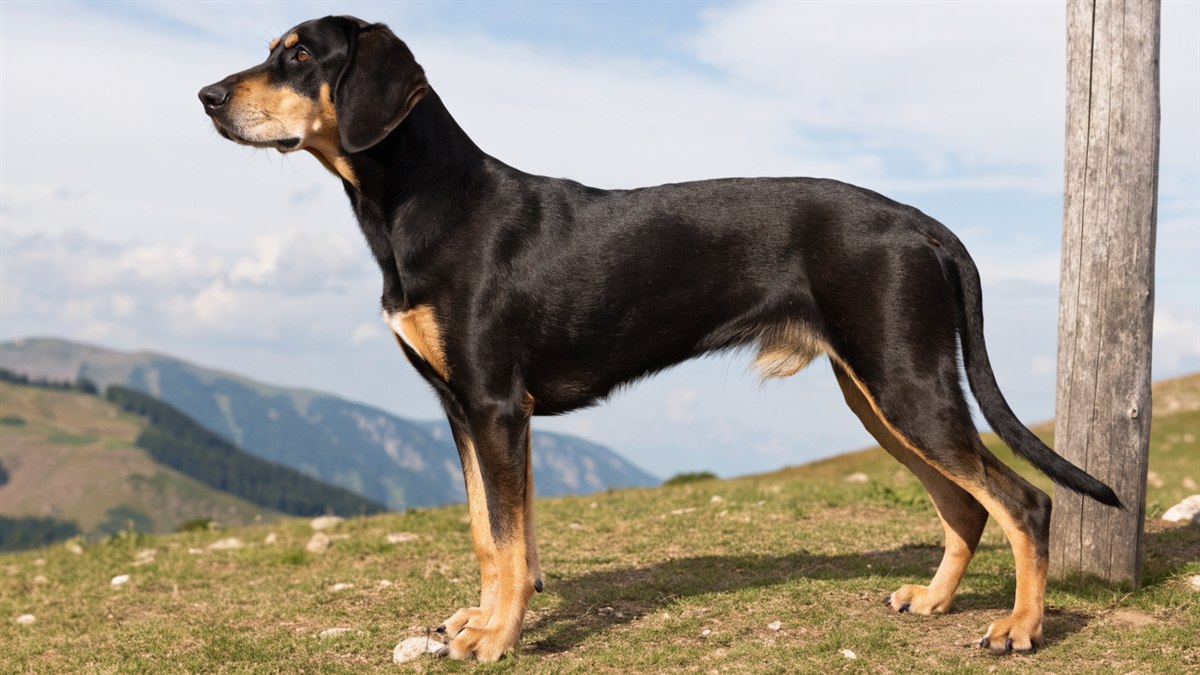
Vieraeugl is Austro-Bavarian dialect for four-eyes, and it names the two fawn markings that sit directly above this hound's eyes. The marking is not decorative. FCI-Standard No. 63 lists lack of well defined fawn markings above the eyes as a disqualifying fault, which places it alongside aggression, shyness and a wrong bite. A black and tan hound without the four-eye marking is not this breed by its own standard.
The rest of the colour clause is equally tight. The dog is black with small, clearly defined light to dark fawn markings, and any other colour is disqualifying. The coat is smooth, close fitting, dense, full and resilient with a silky sheen, at a length of roughly 2 cm. That is a genuinely short single coat, and it is the one feature of this breed that works in India's favour.
History, and why 1884 matters
The Brandlbracke counts as a descendant of the Keltenbracke, the Celtic Hound, and the FCI's own historical summary admits there is no definite authentic history for it until the middle of the 19th century, because no controlled breeding took place before then. The breed has been bred to fixed characteristics laid down in the Austrian studbook since 1883.
The specific date worth knowing is 1884. When the Oesterreichischer Hundezuchtverein was founded that year, the first entry in volume one of the Oesterreichisches Hundestammbuch, number 1, was a Brandlbracke called Bergmann belonging to F. X. Pleban. This breed is entry number one in the Austrian studbook. Nineteenth-century Austrian breeding drew above all on the Kaerntner Brandl, also called Vieraeugl, which is why Carinthian Brandlbracke and Kaerntner Bracke survive as alternative names. Wikipedia, Austrian Black and Tan Hound
Austria once held many valley-specific strains of alpine hound, and most died out in the 19th century. Four native Austrian bracken survive: the Brandlbracke, the Steirische Rauhaarbracke, the Tirolerbracke and the Alpenlaendische Dachsbracke. The last of those is the closest relative Bonbeno has already covered, and it is no longer classed with the running hounds at all but with the scent-trailing Schweisshunde, which is why the Alpine Dachsbracke sits in FCI Group 6 Section 2 while this breed sits in Section 1.2. Federation Cynologique Internationale
The Oesterreichischer Brackenverein, the club that has run this breed's studbook since 1950, is the body that still decides which Brandlbracken breed. Osterreichischer Brackenverein Everything useful about the breed's temperament, health screening and voice comes from that club rather than from any English-language breed page.
A modern job, and a claim Bonbeno could only partly check
Wikipedia states that Austrian Black and Tan Hounds have been used in the detection of emerald ash borer, an invasive beetle, and cites a 2020 paper in Forestry by Hoyer-Tomiczek and Hoch. Bonbeno tried to confirm the breed attribution at source and could not. The paper's open abstract records six dogs trained and five tested, with sensitivity ranging from 73.3 to 100 percent and specificity from 88.9 to 99.8 percent across settings, but the full text sits behind a subscription and names no breeds in the portion Bonbeno could read. The companion open-access paper on the same Austrian research centre's beetle-detection dogs names no breeds either.
So treat that detail as plausible and unverified. It is exactly the kind of claim that propagates because it is charming, and Bonbeno would rather record the limit than repeat it as fact. What is not in doubt is the nose behind it, since the standard's behaviour clause opens with the words sensitive nose.
There is no Indian market for this breed. Bonbeno checked all ten pages ranking for the term and found zero rupee symbols, zero Rs figures, zero INR figures and zero mentions of lakh. Indian import policy separately makes a commercial or breeding import impossible. The price section explains both, with the primary documents.
Austrian Black and Tan Hound price in India
No verified Austrian Black and Tan Hound price in India exists, because there is no Indian market for the breed to price. Across the ten pages ranking for this breed Bonbeno found not one rupee figure of any kind, and Indian import policy independently forecloses the supply chain that would create one.
Start with what is actually on the page you would find. Bonbeno pulled the ranking set and machine-scanned every page for currency. The result is a clean blank. No page carries the rupee symbol, an Rs figure, an INR figure or the word lakh. DogBreedsList, Austrian Black and Tan… 101DogBreeds, Austrian Black and Tan Hound…
That blank is more interesting than it looks. PetsArmy is an Indian domain, and Bonbeno's guides to the Artois Hound and the Ariegeois each found the same publisher printing a rupee band for a breed with no Indian market, in one case a figure the page itself admitted was borrowed from other breeds and in the other a straight currency conversion. For this breed it printed no rupee figure at all. When even the pages that manufacture Indian prices decline to manufacture one, the market signal is unambiguous.
The only prices that exist are foreign, unsourced and contradict each other
Two figures circulate, and they disagree by roughly threefold. DogBreedsList publishes 400 to 600 US dollars. 101DogBreeds publishes 800 to 1,500 US dollars. Wamiz, writing for a UK audience, publishes a purchase band of 400 to 500 pounds. None of the three names a source, a breeder, a transaction or a year.
| Source | Figure published | What it is actually evidence of |
|---|---|---|
| DogBreedsList | 400 to 600 US dollars | An unsourced estimate. No transaction, breeder or year named |
| 101DogBreeds | 800 to 1,500 US dollars | An unsourced estimate roughly 2.5 times the figure above, from the same SERP |
| Wamiz UK | 400 to 500 pounds | A UK-facing estimate, and the UK has no established population either |
| PetsArmy, Indian domain | No price at all | The Indian-domain page declines to publish a rupee figure |
| Royal Canin India | No price at all | An Indian-domain page carrying breed facts and no commercial figure |
| Bonbeno | No Indian figure published | No verified Indian transaction exists to report |
Bonbeno does not average those numbers, and no honest page should. A three-fold spread between two unsourced guesses is not a price range. It is two people estimating.
Indian import law closes the route, and it is worth reading rather than paraphrasing
DGFT Trade Notice No. 22/2022-23, dated 19 December 2022, sets the import policy for dogs, and Bonbeno read the notice in full from the DGFT's own PDF. Under ITC (HS) 01061900 dogs are a Restricted import. Policy Condition (7) permits import of dogs only for three purposes, a pet dog with a valid pet book and relevant records in the name of the importer, dogs imported by R&D organisations with the recommendation of CPCSEA, and dogs for internal security by the Defence and Police Force.
Policy Condition (8) then states that import of commercial dogs for breeding or any other commercial activity other than those purposes is not permitted, and paragraph 6 of the notice states that any applications for trading or breeding purposes, or applications made on behalf of another person or entity, shall be duly rejected. Import is further limited to the airports and seaports of Delhi, Mumbai, Chennai, Hyderabad, Bengaluru and Kolkata and, since October 2024, Kochi airport, with an advance No Objection Certificate from the quarantine officer required seven days before travel. Department of Animal Husbandry… The full route is set out in how to import a dog to India.
Put plainly, a person relocating to India after two or more years abroad can bring their own Brandlbracke home as a pet under baggage rules, and would need an import authorisation from DGFT in most other circumstances. Nobody can lawfully import one to breed or to sell. There is therefore no legal mechanism by which an Indian supply chain for this breed can form.
There is no Indian registry route either
The Kennel Club of India registered 33,880 pure-bred dogs with its studbook in 2025, from 7,412 litters, and its cumulative studbook total stands at 1,425,001 dogs. Bonbeno located no Kennel Club of India registration, breeder or listing for this breed, and Royal Canin India's breed page carries no Indian availability information of any kind. The breed has no American Kennel Club route either, appearing nowhere in the AKC's Foundation Stock Service directory, which Bonbeno verified by loading the full directory and confirming that control breeds such as the Bracco Italiano, Norrbottenspets and Bolognese were present while no Austrian breed was.
What the supply actually looks like, counted rather than described
The real number is small and public. The Oesterreichischer Brackenverein publishes a live register of every Brandlbracke litter, naming the breeder, the dam and the sire. On 20 August 2026 that register held 21 litters in total, of which 14 were marked Welpen vergeben, all puppies allocated, 6 were only planned litters, and exactly one litter had a single unallocated male puppy available anywhere in the world. The breeders sit in Austrian states including Salzburg, Steiermark, Tirol, Kaernten, Oberoesterreich and Niederoesterreich, plus South Tyrol in Italy.
That is what rare means for this breed, expressed as a count rather than an adjective. It is also a live register, so a later reader should re-check it rather than trust this snapshot.
For scale, the Austrian studbook as a whole registered 6,187 pure-bred dogs and 995 litters in 2025 across every breed. Historically the breed is not shrinking. Puppy numbers recorded by the club rose steadily from 1950, with no litters at all registered in 1959 and 1965 and a strong upward trend from 1975, and average surviving litter size increased from 3 puppies in 1950 to 1959, to 5.7 in 2000 to 2009, to 7.0 across 2010 to 2012. Between 2001 and 2011 the Brandlbracke alone accounted for 40 percent of Austrian demand for Bracke puppies.
Bonbeno found no Indian listing offering this breed. Where an Indian site appears to rank for the term, it is a generic breed-information page rather than a sales listing. If you are ever offered an Austrian Black and Tan Hound puppy in India, ask for the Oesterreichischer Brackenverein litter entry naming the dam and sire, and for the DGFT import authorisation. Neither can lawfully exist for a commercial sale. Osterreichischer Brackenverein
Monthly cost of ownership in India
No Indian cost-of-ownership figure for the Austrian Black and Tan Hound exists, because no verified Indian population exists to measure. What Bonbeno can do honestly is set out the cost structure a 48 to 56 cm working scenthound imposes, and mark clearly which lines are breed-specific and which are simply what a medium dog costs in an Indian city.
Three cost lines are genuinely breed-driven for this hound, and the rest are generic. The breed-driven lines are ear care, exercise infrastructure and containment. Everything else, from vaccination to deworming to routine consultation, is what any medium-sized dog costs wherever you live.
The three lines this breed actually changes
- Ear care, recurring. FCI-Standard No. 63 specifies leathers of medium length, set on high, rounded at the tips and hanging flatly. That is pendulous ear carriage, and the largest UK primary-care study of otitis externa found breeds with pendulous ears carried 1.76 times the odds of otitis externa against breeds with erect ears, on a 95 percent confidence interval of 1.48 to 2.10. Budget for ear cleaner as a standing monthly item rather than an occasional one.
- Containment and long lines. This is a hound bred to work a trail away from its handler, and the training section explains why recall is not the answer. A secure boundary and a long line are equipment, not accessories, and replacing chewed or frayed long lines is a real recurring cost.
- Exercise time, which is a cost even when it is free. The FCI classifies this breed as subject to a working trial and describes it as suited to heavy work on high mountains. In Indian conditions that work has to happen in the cool hours, which usually means two walks displaced to early morning and late evening for the life of the dog.
What Bonbeno will not do
Bonbeno will not publish a rupee-per-month figure for this breed. Every Indian monthly cost table you will find for an absent breed is built by taking a Labrador or Beagle budget and relabelling it, and that is not evidence about this hound. The honest statement is that the recurring cost profile resembles that of any active 15 to 25 kg dog in an Indian city, with an above-average ear-care line and an above-average containment line, and that nobody has measured it for this breed because nobody in India keeps one.
One cost is genuinely absent, which is worth saying because it is unusual. This is a short-coated breed with hair of approximately 2 cm, so professional grooming is not part of the budget at all. There is no clipping appointment, no de-matting, and no salon line item across the dog's entire life.
| Cost line | How breed-specific | Why |
|---|---|---|
| Ear cleaning and otitis treatment | High | Pendulous ears carry 1.76 times the odds of otitis externa |
| Long lines, harness, secure boundary | High | A trail hound worked off the handler needs containment rather than recall |
| Professional grooming | None, and it is zero | A smooth 2 cm coat needs no salon at any point |
| Food | Low | Driven by bodyweight, and no kennel club publishes a weight for this breed |
| Vaccination, deworming, tick control | None | Standard for every dog in India |
| Hip screening before any breeding | High if you breed | The breed's own club requires centrally read hip radiography before breeding permission |
Suitability for the Indian climate
Bonbeno rates the Austrian Black and Tan Hound 2 out of 5 for heat tolerance in India. The anatomy is genuinely favourable, a smooth 2 cm single coat over a normal muzzle, and the job the breed is built for cancels most of that advantage, because this is a dog the FCI standard describes as specially suited to heavy work on high mountains.
Reason the rating in both directions, because the two halves point opposite ways and most pages only report one of them.
The half that helps
Three anatomical features work for this dog in Indian heat. The coat is smooth, close fitting and approximately 2 cm long, with no undercoat described anywhere in the standard, which is a very different structure from the dense double coat of its short-legged Austrian cousin. The muzzle is strong with a straight nasal bridge, so this is a normal-muzzled mesocephalic dog with a full airway rather than a brachycephalic one. And the frame is described as strong, long cast and supple rather than heavy, with slim, moderately developed upper thighs.
That combination is close to the best a dog can bring to an Indian summer. Skull shape is the feature most strongly associated with a fatal outcome in heat-related illness, and this breed is on the right side of it.
The half that cancels it
The problem is not the coat. It is what the dog wants to do inside it. In the largest primary-care study of heat-illness triggers, covering 905,543 dogs and 1,259 events, exertion was the trigger in 652 of the 879 events where a cause was recorded, or 74.2 percent, far ahead of environmental heat at 12.9 percent and vehicular confinement at 5.2 percent. Exertional events carried a 7.6 percent fatality rate.
This breed is graded on endurance by its own country's test regulations, which judge Jagddauer, the duration of the hunt, as one of five compulsory elements, and require the dog to possess enough stamina to complete a long-lasting hunt. The club records an average brackade lasting 20 minutes of continuous trailing. A dog selected across generations to keep going is a dog that will not stop itself when it overheats, and exertional heat illness is what happens to dogs that do not stop themselves.
The heat studies quoted here are UK data, and their authors say so plainly. The highest maximum daily wet bulb globe temperature recorded across the entire dataset was 23.1 degrees C, with a median of 16.9 degrees C on days when dogs presented with heat-related illness. Those are cool-season mornings in most of India. The paper itself notes that UK dogs developed heat illness at relatively low ambient temperatures compared with dogs from countries where heat acclimatisation is possible. Treat the mechanism as transferable and the temperatures as not.
City by city, where it differs
| Climate type | Example cities | The binding constraint for this breed |
|---|---|---|
| Hot and humid coastal | Mumbai, Chennai, Kochi | Humid air blunts evaporative cooling, and the ears stay damp. Ear checks become the daily job, not the weekly one |
| Hot and dry | Delhi, Jaipur, Ahmedabad | Peak daytime temperatures make midday exercise unusable for months. Two cool sessions or none |
| Humid subtropical monsoon | Kolkata, Guwahati | Long wet spells plus warmth. The worst combination for a pendulous-eared hound |
| Temperate upland | Bengaluru, Pune, Shillong | The only Indian settings that resemble the breed's working climate, and even here exertion is the risk, not ambient heat |
| Cold upland | Shimla, Manali, Gangtok | Genuinely suitable on temperature. The constraint here is availability, not climate |
Note the honest asymmetry. This breed's climate problem in India is not that it will overheat sitting in a Chennai flat. It is that a hound bred for sustained mountain work, given the sustained work it needs, will overheat doing it. The fix is scheduling rather than air conditioning.
The monsoon question, and a disagreement worth publishing
Bonbeno's gundog cluster reports Indian otitis series peaking in the monsoon. The Indian evidence is not settled on that, and this page will not pretend otherwise. A study of 281 dogs in and around Durg district of Chhattisgarh found an overall otitis externa prevalence of 18.14 percent, with 51 of 281 dogs positive, and recorded the highest seasonal prevalence in summer at 41.18 percent rather than in the rainy season. The same study defined summer as March to June and the rainy season as July to October, and found dogs over five years most affected.
So the practical advice holds in either case, and the mechanism is the same. Warm, humid air trapped inside a flat-hanging ear leather is the risk, whether the humidity arrives with the monsoon or with a coastal summer. Dry the ears after every wash and after any swim, and check them on a schedule rather than when the dog starts scratching.
Temperament and household fit
The Austrian Black and Tan Hound is a friendly, even-tempered working scenthound that its own breed club describes as having good family suitability, and it is simultaneously one of the least suitable breeds imaginable for apartment living in an Indian city. Both statements are true, and the second one is the reason almost no Indian household should want this dog.
Take the temperament evidence in order of quality, because most pages take it in order of convenience.
What the standard requires
FCI-Standard No. 63 asks for a dog that tracks firmly and willingly with an agreeable temperament, and it lists shy temperament as a fault. Aggressive or overly shy behaviour is a disqualifying fault, as is any dog clearly showing physical or behavioural abnormalities. Temperament is therefore not a hope with this breed, it is a written requirement enforced at conformation assessment.
The Austrian club goes further. Aggressive or fearful temperament is an explicit ground for exclusion from breeding in the Oesterreichischer Brackenverein's breeding regulations, and every dog receives a temperament assessment on its conformation sheet alongside the physical evaluation.
The only breed-specific temperament survey that exists
One real survey of this breed's character has been published, and no English page mentions it. Austrian breed-club data recorded Brandlbracken as even-tempered towards people in 85 percent of cases and even-tempered towards other dogs in 74 percent of cases. The Steirische Rauhaarbracke, assessed in the same survey, scored 92 percent and 85 percent respectively.
Read that carefully rather than as a headline. Eighty-five percent even-tempered towards people is good and is not universal, and 74 percent towards other dogs is the lower of the two figures for a reason. This is a pack-worked hound, and dog-to-dog tolerance is a trained and selected outcome rather than a guarantee. That is a more useful number than any adjective, and it is the kind of figure the Artois Hound and Ariegeois pages could not find for their breeds at all.
Why apartment living fails, and it is not about size
A 48 to 56 cm dog fits in an Indian flat easily. The voice does not. This breed's Austrian test regulations require that the Spurlaut, the voice on the trail, comes blow on blow, sustained and audible far off, and specifically instruct judges to watch that the Bracke does not hunt mute. The breed club states that hunting a hare enduringly with a strong voice is the single most important decision point for selecting breeding stock.
So the noise is not a training failure to be corrected. It is the trait the gene pool has been filtered on for over a century, and a dog that lacks it is not bred from. Thierrichter R. Leistungsorientierte… Anyone imagining they will quieten this hound is proposing to undo the breed's entire selection history in one household.
The Prevention of Cruelty to Animals (Dog Breeding and Marketing) Rules, 2017 state at Second Schedule Part II paragraph 5(8) that there shall be no tail docking, ear cropping, de-barking, de-clawing, branding, dyeing, injecting substances to enhance visual appeal, or any other kind of mutilation, and that any change of appearance by artificial means is strictly forbidden. For a breed whose voice is its working purpose, that matters more than for any other. The noise cannot be surgically removed, lawfully, in India.
Who this breed genuinely suits
- Working homes where the dog trails, searches or tracks several times a week and the voice is welcome rather than tolerated
- Rural or semi-rural properties with a secured boundary and neighbours far enough away that sustained baying is not a dispute
- Experienced hound handlers who already accept that a long line is permanent equipment rather than a training phase
- Households with children, since the club reports good family suitability and the standard disqualifies both aggression and overt shyness
Who should not buy one
- Apartment households anywhere in India, because the voice is a selected working trait and shared walls make it a legal and social problem
- First-time dog owners, because the recall problem described in the training section is structural rather than fixable
- Anyone wanting a jogging companion in an Indian summer, given that exertion triggered 74.2 percent of recorded heat-illness events
- Anyone who wants this breed for its looks, since the breed club states plainly that appearance counts only as a pleasant side effect of breeding for work
Training, and the one thing this breed is selected against
To train an Austrian Black and Tan Hound successfully, accept first that its own studbook keeper deliberately weights obedience low in breeding selection. The Brandlbracke's breed warden states that the Bracke aptitudes, the voice on the trail above all, are weighted highly, while obedience is weighted rather low because it does not correlate positively with health and depends more on handling than on genetics.
That single sentence reorganises the whole training question, and Bonbeno has found nothing like it on the five scenthound pages built before this one. Across the cluster, recall has been the defining training problem, and the explanation has always been behavioural, that these dogs work a trail independently of a handler. Here the explanation is documentary. The people who decide which Brandlbracken reproduce have written down that they do not select for obedience, and they have explained why.
What Austria does select for, in writing
The Oesterreichischer Brackenverein's breeding regulations, in force since 9 June 2007, admit a dog to breeding only when it has passed the Gebrauchspruefung, the full working test, and reached the required minimum grades in the Brackier subjects for Spurlaut (voice on the trail), Spurwille (will to follow the trail), Spursicherheit (accuracy on the trail) and Jagddauer (duration of the hunt). The dog must not be gun-shy, and its conformation grade must be at least good.
The aptitude test, taken between 6 and 18 months, judges five elements of the compulsory Brackieren subject. Read them, because they describe exactly the dog you would be living with.
- Art der Suche, the manner of the search. The dog must systematically quarter the ground assigned to it with a low nose and with passion
- Spurwille, will on the trail. A hare or fox trail must be followed with stamina, and a lost trail recovered by casting or circling
- Spursicherheit, accuracy. The dog follows the trail it took up unswervingly and is not drawn off by crossing trails
- Spurlaut, voice on the trail. It must come blow on blow, sustained and audible far off, and judges must watch that the Bracke does not hunt mute
- Jagddauer, duration. The dog must have the stamina to complete a long-lasting hunt
Not one of those five is obedience. Obedience and steadiness to the gun appear separately under Revierfuehrigkeit, and gun-shy dogs are excluded from breeding, but a dog that cannot brackieren, that cannot hunt giving tongue, is not admitted to breeding at all. Since 1 January 1998 Austria has applied one unified test regulation to all Group 6 running hounds nationally, following a study by the Institute for Animal Breeding and Genetics at the University of Veterinary Medicine Vienna.
You are not training against a bad habit. You are training against a trait that a national breed club has spent decades actively selecting for, while explicitly declining to select for the trait you want. Recall is not a skill this breed has been bred to have. Plan containment rather than compliance.
Realistic timelines, and where they come from
The club records that a Brandlbracke performs its first brackade at an average age of 7.6 months, and that the average brackade runs about 20 minutes. That is a real, breed-specific developmental marker and it is the honest answer to when this dog's hunting brain switches on. From roughly seven months a Brandlbracke that picks up a hare line will work it, with voice, for around twenty minutes, whether or not you have finished your recall course.
So the training year splits at that point. Everything you want installed has to be installed before it, and everything after it is management.
| Training goal | Realistic outcome | Why |
|---|---|---|
| Loose-lead walking | Achievable with consistent work | No selection pressure against it; this is ordinary training |
| Sit, down, stay, place | Achievable, and the breed learns fast | The club calls the breed leichtfuehrig, easy to handle, and intelligent |
| Scent work and tracking games | Excellent, and the breed is built for it | Sensitive nose is the first phrase in the standard's behaviour clause |
| Coming away from a live trail off lead | Do not rely on it, ever | Voice and trail-drive are the selected traits; obedience is deliberately weighted low |
| Quiet on command while trailing | Not realistic | Judges are instructed to penalise a Bracke that hunts mute |
| Off-lead freedom in open country | Not realistic in an unfenced Indian setting | A 20-minute self-directed hunt is the breed's normal working mode |
The method that actually works
Train this hound with its nose rather than against it. Give it a formal scent job several times a week, on a long line, and it will train readily, because you are asking it to do the thing it was selected to do. Use food and voice, keep sessions short, and finish while the dog still wants more. The club's own description is of an intelligent, enduring and easily handled working dog with enormous hunting passion, which is a description of a dog that is easy to teach and impossible to override.
One Austrian phrase is worth carrying into any household that keeps this breed. Richard Saurwein's motto for the Brandlbracke was durch Leistung zum Typ, through performance to type. Every part of this dog, including the parts that are inconvenient in a home, exists because it served the work.
Daily exercise requirement
No registry or breed club publishes a daily minute figure for the Austrian Black and Tan Hound, so Bonbeno publishes none. What is documented is an FCI classification that carries a working trial, a utilisation clause describing heavy work on high mountains and on flat country, and a working record of roughly 20 minutes of continuous trailing per hunt. Thierrichter R. Leistungsorientierte…
Those three facts describe a working day, not a park circuit. Royal Canin India, the one Indian-domain page with breed facts, lists Needs a lot of exercise as one of only three key facts it publishes about the breed. That is a fair summary of the evidence and it is as specific as the honest sources get.
Why the nose matters more than the distance
The mistake Indian owners make with trail hounds is treating exercise as mileage. It is not. The standard's behaviour clause opens with a sensitive nose, and the breed's aptitude test scores the manner of the search, the will on the trail and the accuracy on the trail before it scores anything about stamina. Thierrichter R. Leistungsorientierte… A Brandlbracke that has walked five kilometres on pavement without using its nose has been exercised physically and not at all mentally.
Substitute scent work for distance wherever the heat forces you to. Track laying in a garden, food trails through long grass, and finding a hidden article all satisfy this dog in a way a longer walk does not, and they can be done at dawn in twenty minutes rather than an hour.
Scheduling around Indian heat
Split exercise into two cool sessions and treat midday as unusable for most of the Indian year. That advice is not generic caution. Exertion was the recorded trigger in 74.2 percent of heat-illness events in the largest primary-care study of the question, ahead of environmental heat at 12.9 percent, and exertional events carried a 7.6 percent fatality rate. For a breed graded on the duration of its hunt, the risk sits squarely in the activity you are providing rather than in the weather you are sheltering from.
- Walk before sunrise and after dusk through the hot months, and check the ground temperature with the back of your hand before you set out
- Track rather than run, so the dog works at a trailing pace instead of a galloping one
- Carry water on every outing and offer it before the dog looks like it needs it
- Stop the session at the first sign of hard panting, stumbling or a dog that lies down, and cool actively rather than waiting
- Check the ears after any session that involved wet grass or water
One breed-specific note that no ranking page carries. This dog was selected to keep hunting for twenty minutes at a stretch and to be graded on doing so for longer. It will not self-limit in heat the way a less driven dog does. The handler is the brake, and in India the handler has to apply it early.
Grooming and coat care in Indian humidity
To groom an Austrian Black and Tan Hound, brush the smooth coat weekly and treat the ears as the entire real job. The standard describes hair that is smooth, close fitting, dense, full and resilient with a silky sheen, at a length of approximately 2 cm, with no undercoat described anywhere in the document.
That is about as low-maintenance as a working coat gets, and it is one of the few genuinely good pieces of news on this page for an Indian household. There is no clipping, no stripping, no de-matting and no salon appointment at any point in this dog's life. A rubber curry or bristle brush once or twice a week removes dead hair and spreads skin oils, and that is the whole coat routine.
A smooth 2 cm coat is a heat management system, not insulation to be removed. Shaving a short-coated dog exposes skin to direct sun and removes the layer that shades it, and it does not make the dog cooler. The standard specifies a close fitting, dense, resilient coat with a silky sheen, and it exists for a reason.
The ears are the job
FCI-Standard No. 63 specifies leathers of medium length, not too broad, set on high, rounded at the tips and hanging flatly. A flat-hanging leather seals the ear canal, and a sealed canal in Indian humidity traps warmth and moisture. The largest UK primary-care study of canine otitis externa, drawing on a very large clinical cohort, found breeds with pendulous ear carriage carried 1.76 times the odds of otitis externa against breeds with erect ears, on a confidence interval of 1.48 to 2.10, and breeds with V-shaped drop ears carried 1.84 times the odds.
The same study found something worth reporting honestly, because it cuts against the easy assumption. The Hound group as a whole was not a significant predictor of otitis externa, at an odds ratio of 1.23 on a confidence interval of 0.94 to 1.60 that crosses one. It is the ear carriage that carries the risk, not the fact of being a hound. That is a more precise finding than any breed page publishes and it points the owner at the right thing.
An Indian seasonal routine, and an unsettled question
Indian seasonal data on otitis does not point the way most Indian pet content assumes. A study of 281 dogs in and around Durg district, Chhattisgarh, recorded overall otitis externa prevalence of 18.14 percent, with 51 of 281 dogs positive, and found the highest seasonal prevalence in the summer at 41.18 percent rather than in the rainy season, with dogs over five years most affected and the German Shepherd the most commonly affected breed. Other Indian series report a monsoon peak. Bonbeno reports the disagreement rather than resolving it, because both patterns describe the same underlying mechanism of warm, humid air inside a closed canal.
| Task | Frequency | Note |
|---|---|---|
| Brush the coat | Once or twice weekly | Rubber curry or bristle brush. No salon at any point |
| Check the ears | Twice weekly minimum, daily in humid months | Look for odour, redness and head shaking before the dog scratches |
| Dry the ears | After every bath, swim and wet walk | This is the single highest-value habit for this breed |
| Bathe | Only when genuinely dirty | Over-bathing strips a short working coat and wets the ear canal |
| Trim nails | Every three to four weeks | The standard asks for strong black nails and close-fitting arched toes |
| Tick and flea check | After every outing in grass | Standard Indian practice, not breed-specific |
One overseas care instruction does not transfer, and it is worth flagging because Indian pages copy foreign grooming guides wholesale. Advice to towel a dog and let it air dry is written for a European climate. In Indian humidity an ear leather that hangs flat over a damp canal does not air dry, and the moisture simply sits there. Dry inside the ear deliberately, with a soft cloth or vet-recommended drying solution, every time the dog gets wet.
Health risks, screening and lifespan
No peer-reviewed lifespan study, prevalence survey or disease register exists for the Austrian Black and Tan Hound. The 12 to 14 year life expectancy repeated by every page ranking for this breed traces back through one dead citation to a page that never contained the figure and that describes itself as based on Wikipedia. Bonbeno checked that chain end to end, and this section publishes what it found.
The lifespan figure is a citation loop, and here is the audit
English Wikipedia's entire Health section for this breed reads that there are no breed-specific genetic diseases known to affect this breed, which is fairly healthy, and lives up to 12 to 14 years of age. Bonbeno read the article's wikitext directly rather than the rendered page, and that sentence carries exactly one reference, named snautz.de, flagged in the markup with url-status=dead and pointing to an Internet Archive capture dated 3 September 2012. The breed's weight figure is cited to the same reference.
Bonbeno then pulled that exact archived page and machine-checked its visible text. The result is unambiguous. The 2012 capture contains zero occurrences of Jahre (years), Lebenserwartung (life expectancy), kg, Gewicht (weight), Krankheit (disease) or gesund (healthy), and the digits 12 and 14 do not appear anywhere in it. The only figures on the page are the heights, 50 to 56 cm and 48 to 54 cm, which match the FCI standard.
The page also states, in its own footer, that the breed profile is based on the article Brandlbracke from the free encyclopedia Wikipedia. The current live successor page repeats the same self-attribution and still carries no weight, lifespan or health figure.
Wikipedia cites a page that says it is based on Wikipedia, for a claim that page does not make. Every downstream repetition of 12 to 14 years and of no genetic diseases, on Royal Canin India, Dogster, 101DogBreeds, PetsArmy and Hundeo, rests on that loop. Dogster, Austrian Black and Tan Hound Dog… 101DogBreeds, Austrian Black and Tan Hound… PetsArmy (petsarmy.co.in) Hundeo, Austrian Black and Tan Hound Bonbeno therefore publishes no life expectancy for this breed.
Be precise about what this does and does not prove. It does not prove the breed is unhealthy or short-lived. Austrian breeding has been performance-led for well over a century and the club describes the population as healthy, robust and strong in performance and character. What the audit proves is that nobody has measured it, and that the number in circulation was never evidence.
Does this breed carry FGF4 chondrodystrophy? Nobody has tested it
The question is worth asking because the closest relative Bonbeno has covered is a world reference for it. The Alpine Dachsbracke is one of only two breeds worldwide, alongside the Schweizer Niederlaufhund, that still segregates both FGF4 retrogenes. Both are Austrian hounds. So Bonbeno checked whether the Brandlbracke shares that genetics, and the answer has two parts.
First, the direct evidence. Batcher and colleagues genotyped 3,223 additional dogs from 75 different breeds for the FGF4 retrogenes, and a full-text search of that paper returns zero occurrences of Austrian, Brandlbracke or Dachsbracke. Bannasch and colleagues, who measured the morphological effect of the retrogenes directly, named only the Alpine Dachsbracke at 111 dogs and the Schweizer Niederlaufhund at 36, and this breed appears nowhere in that paper either. Bonbeno could not open the University of California Davis veterinary genetics test page, which returned an HTTP 403, and so makes no claim about what that breed list contains. No published allele frequency exists for the Austrian Black and Tan Hound, because nobody has genotyped it.
Second, the morphological evidence, which points clearly in one direction. Chondrodysplasia, the CDPA retrogene, is what produces the shortened limbs of a short-legged breed. FCI-Standard No. 63 asks for legs that are straight and strong, well developed forequarters, well angulated hindquarters with long upper thighs, and movement that is ground covering and elegant, on a dog standing 48 to 56 cm at the withers. The Alpine Dachsbracke standard, by contrast, describes a dog of 34 to 42 cm.
| Alpine Dachsbracke | Austrian Black and Tan Hound | |
|---|---|---|
| Height at withers | 34 to 42 cm | 48 to 56 cm |
| FCI group and section | Group 6, Section 2 | Group 6, Section 1.2 |
| Limbs in the standard | Short-legged by design | Straight and strong, ground covering movement |
| FGF4 retrogenes | Segregates both, one of only two breeds worldwide | Never genotyped. No published data |
| Published CDDY allele frequency | Yes, from 174 genotyped dogs | None exists |
| Useful parental DNA test | Yes, because the allele is still segregating | Unknown, because nobody has looked |
So the honest answer is a plain one. This is a normally proportioned hound, and there is no evidence it carries FGF4 chondrodystrophy, but there is also no test data either way, because no research group has genotyped the breed. A page that told you the breed is free of chondrodystrophy would be asserting more than anybody knows. What can be said is that the standard describes a dog with normal limb proportions, that chondrodystrophy is a visible skeletal phenotype rather than a hidden one, and that a 48 to 56 cm hound with straight strong legs and ground-covering movement does not present the short-legged phenotype the retrogene produces. Brown EA, Dickinson PJ, Mansour T
The one real screening scheme this breed has
Hip dysplasia screening is mandatory for this breed in Austria, and that is genuinely unusual among the rare scenthounds Bonbeno has covered. The Oesterreichischer Brackenverein requires hip radiography for all dogs it represents before a dog receives breeding permission. The radiograph is taken under sedation to precise specifications, and, critically, it is not read by the handler's own vet. Assessment is centralised at a single reading body applying one standardised protocol to every dog in the population.
The club publishes the HD Roentgenuntersuchung Brandlbracke form as a standing download alongside its breeding-intent declaration and litter statistics. That is a functioning screening scheme with a paper trail, which is more than the Artois Hound or the Ariegeois could show. What the club does not publish is the aggregate result, so no dysplasia rate for this breed is in the public domain.
The Prevention of Cruelty to Animals (Dog Breeding and Marketing) Rules, 2017 require at Second Schedule Part III paragraph 8(10) that dogs shall have been tested for genetic defects, including hip dysplasia, progressive retinal atrophy, night blindness, hypothyroidism, entropion, ectropion, overshot and undershot jaw, wry mouth, two or more missing teeth, and cryptorchidism. Two items on that Indian legal list, the bite and missing teeth, are also disqualifying faults in FCI-Standard No. 63, which disqualifies an under or overshot mouth and more than two missing premolars 1 or 2. Austrian selection and Indian law happen to converge on the same checks.
Why there is no OFA table, and why that is a legitimate finding
The Orthopedic Foundation for Animals holds no statistics table for this breed, and its own threshold explains why without any mystery. OFA states that breeds are not included in its statistics tables until a minimum number of individuals have been evaluated, at least 100 evaluations for hips and at least 50 for all other databases. A breed with no AKC route and no North American population does not reach those thresholds. Absence from OFA is a statement about sample size, not about health.
The risks that are real and documented
- Otitis externa, driven by ear conformation rather than by being a hound. Pendulous ear carriage carries 1.76 times the odds against erect ears, 95 percent CI 1.48 to 2.10, while the Hound group itself was not a significant predictor at OR 1.23, CI 0.94 to 1.60
- Exertional heat illness, the dominant mechanism for an active dog in India. Exertion triggered 652 of 879 recorded-cause events, 74.2 percent, with a 7.6 percent fatality rate
- Hip dysplasia, screened for in Austria before breeding permission and named in Indian law, with no published prevalence for this breed
- Age-related severity in heat, since dogs aged 12 years or over carried the greatest odds of severe heat-related illness, OR 5.89 on a 95 percent CI of 2.51 to 13.82
- Trail injuries, the ordinary consequence of a dog working rough ground with a low nose for twenty minutes at a stretch
One further claim needs correcting rather than repeating. PetsArmy states that the breed stands out because it has no documented genetic diseases. No documented genetic disease is not the same as no genetic disease. For a breed that has never appeared in a genotyping panel of 75 breeds and 3,223 dogs, and that has no OFA presence and no published health survey, the absence of documentation is exactly what you would expect whether the breed is unusually sound or simply unstudied.
Bonbeno's own health rating for this breed is 3 out of 5, and it is a rating of the evidence rather than of the dog. A mandatory hip scheme is a genuine positive. A complete absence of prevalence data, lifespan data and genotyping is a genuine unknown.
Feeding and nutrition in India
Feed an Austrian Black and Tan Hound to a body condition score rather than to a chart, because no kennel club publishes a weight for this breed and every weight in circulation is unsourced. With no target weight to feed toward, the dog's ribs and waist are the only reliable instrument you have.
That is not a hedge, it is the direct consequence of the standard. FCI-Standard No. 63 contains no weight clause of any kind, so the 15 to 22 kg circulating on breed pages descends from the same dead reference that produced the lifespan figure rather than from any measurement. Hundeo, Austrian Black and Tan Hound Feeding a dog to a number nobody measured is worse than feeding it to what you can see and feel.
How to read body condition on a smooth-coated hound
This breed is easier to assess than most, because a 2 cm close-fitting coat hides nothing. Run your hands along the ribs and you should feel them easily under a thin layer of covering, without seeing them sharply from across the room. Look down at the standing dog and you should see a waist behind the ribs. Look from the side and the underline should tuck up toward the hindquarters, which fits a standard describing a long cast, supple body with slim upper thighs.
- Check the ribs weekly with your hands rather than monthly with your eyes
- Weigh the dog at the same vet scale every month and record it, so you are tracking your own dog rather than a breed average
- Adjust the portion by roughly ten percent at a time and wait two weeks before judging
- Reduce intake in the hot months when walks shorten, because the calories do not shrink on their own
- Feed working dogs on a split schedule rather than one large meal, and never immediately before or after hard exercise
Life stages
Feed a growing puppy of this size on a large-breed or medium-breed growth diet through to roughly twelve months, keeping the puppy lean rather than fast-growing. That advice matters more than usual here, because hip dysplasia is the one condition the breed's own club screens for before granting breeding permission, and growth rate and rearing conditions are recognised contributors to how severely a polygenic hip trait expresses itself. A lean puppy is the cheapest joint insurance available.
Adults do well on a standard adult maintenance diet, adjusted for actual workload rather than for what the breed is theoretically capable of. An Indian pet Brandlbracke doing two cool-hour walks needs materially less than an Austrian hunting Brandlbracke doing brackades. Senior dogs need the same monitoring plus attention to weight gain, and given that dogs aged 12 or over carried the greatest odds of severe heat-related illness, keeping an old dog lean in India is a heat-safety measure as much as a joint one.
Indian availability
Nothing about this breed requires a specialist diet, which is one of the few genuinely simple things about it. Standard Indian-market complete diets in medium-breed and large-breed formats cover the whole life cycle, and the choice should be driven by what your vet recommends and what you can buy consistently in your city rather than by breed marketing. Consistency matters more than brand, because a hound with a working gut does badly on frequent switching.
Carry water on every outing. A dog selected to trail for twenty minutes at a stretch, in a country where exertion drives 74.2 percent of recorded heat-illness events, needs water offered before it looks like it wants any.
Month by month through the first year
The Austrian Black and Tan Hound's first year has one hard landmark that no other breed page publishes. The Oesterreichischer Brackenverein records that a Brandlbracke performs its first brackade at an average age of 7.6 months, and that a brackade averages about 20 minutes of sustained trailing with voice. Everything you want trained has to be in place before that month, because after it you are managing a working hound.
That figure is the reason this timeline is worth reading rather than skimming. Most breed timelines are generic developmental advice with a breed name attached. This one is anchored to a measured, breed-specific behavioural onset recorded by the body that keeps the studbook.
| Age | What is happening | What you do about it |
|---|---|---|
| Under 8 weeks | The puppy is legally not saleable in India. Rule 8(1)(a) of the Dog Breeding and Marketing Rules 2017 requires that pups less than eight weeks in age are not sold | Walk away from any offer of a younger puppy, wherever it comes from |
| 8 to 12 weeks | Socialisation window. Vaccination usually starts at seven to eight weeks and completes around eighteen weeks under the same Rules | Expose the puppy to surfaces, people, traffic sound and handling. Start ear handling now so checks are never a fight |
| 3 to 4 months | Rapid growth. The nose is already working but the hunting pattern has not switched on | Install recall, lead manners and a settle. This is your only window of real compliance |
| 4 to 6 months | Teething and testing. Independence starts to show | Move all off-lead ambitions onto a long line permanently. Begin structured scent games |
| 6 to 18 months | The Austrian aptitude test window, judging search, trail will, trail accuracy, voice and hunt duration | Give the dog a real scent job. This is when the breed becomes itself |
| Around 7.6 months | Average age of the first brackade. The dog trails and gives tongue for roughly twenty minutes | Expect the voice to arrive and do not try to suppress it. Secure your boundary before this month, not after |
| 8 to 12 months | Adolescent independence at full strength | Keep sessions short and rewarding. Do not test recall against a live trail |
| Around 6 months | Indian law prohibits sale of dogs over six months without prior sterilisation, except to another licensed breeder | Discuss timing with your vet rather than defaulting to a date |
| 12 months and on | Physically mature enough for sustained work, mentally still a young hound | Build duration gradually, and only in cool hours |
The one thing to get right before month seven
Fence, gate and long line. A dog whose breed club selects breeding stock on the ability to hunt a hare enduringly with a strong voice is a dog that will follow a trail out of your garden at around seven and a half months old, and it will not be listening. Thierrichter R. Leistungsorientierte… Owners who install containment before that month keep a manageable dog. Owners who wait until after it spend the next decade chasing one.
A growing dog in an Indian summer needs the same cool-hours discipline as an adult, and less total load. Build duration slowly across the first two years, and remember that exertion, not weather, is the dominant trigger in recorded heat-illness events. Consult your nearby vet on how much sustained exercise is appropriate at each stage.
Head to head against the hounds Indian buyers actually cross-shop
An Indian buyer searching for this breed is almost never choosing between it and another Austrian hound, because neither is obtainable. The realistic comparison is against the scenthounds that are actually available in India, and against the sibling breeds Bonbeno has already documented, so you can see what changes and what does not.
| Austrian Black and Tan Hound | Beagle | Alpine Dachsbracke | Artois Hound | |
|---|---|---|---|---|
| FCI standard | No. 63, Group 6 Section 1.2 | No. 161, Group 6 | No. 254, Group 6 Section 2 | No. 28, Group 6 |
| Height at withers | 48 to 56 cm | 33 to 40 cm | 34 to 42 cm | 53 to 58 cm |
| Weight in the standard | None published | Published | Published | 28 to 30 kg |
| Available in India | No Directorate General of Foreign Trade | Yes, widely | No | No |
| Verified Indian price | None exists | Widely published | None exists | None exists |
| FGF4 chondrodystrophy | Never genotyped | Not a chondrodystrophic breed | Segregates both retrogenes | No data |
| Breed-club hip screening | Mandatory before breeding | Varies by country | Varies | None reachable |
| Voice | Selected trait and a breeding gate | Loud, well documented | Working voice | Working voice |
| Bonbeno heat tolerance rating | 2 of 5 | See the Beagle guide | 2 of 5 | 2 of 5 |
Against the Beagle, the only realistic Indian option
If what attracts you is a friendly, smooth-coated, black and tan scenthound of manageable size, the Beagle is the breed you can actually obtain in India, and it comes with something this breed does not have anywhere in the world: real published health data, a large owner base, and vets who have seen hundreds of them. The Beagle is also smaller, at 33 to 40 cm against 48 to 56 cm. Both are vocal trail hounds, and neither is quiet.
What you give up by choosing the Beagle is nothing an Indian household would miss. What you gain is a dog you can lawfully acquire, insure, treat and rehome.
Against the Alpine Dachsbracke, its closest Austrian relative
These two breeds share a country, a club culture and a working purpose, and they differ on the one axis that has produced real science. The Alpine Dachsbracke is short-legged at 34 to 42 cm and is one of only two breeds on earth segregating both FGF4 retrogenes, which makes a parental DNA test genuinely informative for it. The Brandlbracke is a normally proportioned hound at 48 to 56 cm whose limbs the standard describes as straight and strong, and nobody has genotyped it at all. Batcher K, Dickinson P, Giuffrida M The Austrian thesis literature also notes that the Alpine Dachsbracke is no longer grouped with the running hounds but with the Schweisshunde, which is why the two sit in different FCI sections.
Against the French pack hounds Bonbeno has covered
The Artois Hound and the Ariegeois are the closest comparisons for what this page could and could not find. All three breeds have no Indian market, no Indian price and no lawful commercial import route. Where this breed differs, and differs favourably, is evidence. It has a mandatory hip screening scheme, a published breed-club temperament survey, a measured age of first hunting behaviour and a countable litter register. Osterreichischer Brackenverein The two French breeds had none of those. Rarity does not have to mean an absence of data, and the Austrians have kept better records than most.
Compared with the American Foxhound and the American English Coonhound, the pattern established across the cluster holds here too. Pack and trail hounds are consistently absent from the large companion-dog cohort studies that generate lifespan and disease data, because those studies sample the pet population and these breeds are not in it.
Mistakes Indian buyers actually make with this breed
The commonest mistake with the Austrian Black and Tan Hound in India is believing you have found one. Given that Indian import policy rejects trading and breeding applications outright, and that the entire world register held 21 litters on the day Bonbeno counted it, any Indian offer of this breed deserves scepticism before enthusiasm. Osterreichischer Brackenverein
- Accepting a black and tan dog as this breed. FCI-Standard No. 63 disqualifies any dog lacking the two well defined fawn markings above the eyes, the Vieraeugl marking that names the breed. A black and tan hound without those two spots is not this breed, and black and tan is a common colour pattern across many hounds and crossbreeds.
- Trusting the 12 to 14 year lifespan. That figure traces through a dead citation to a page that never contained it and that says it is based on Wikipedia. Buying a dog on a life expectancy that nobody measured is buying on a rumour.
- Feeding to the 15 to 22 kg figure. The standard publishes no weight at all, so feed to body condition rather than to a number that came from the same broken source.
- Treating the voice as a training problem. The breed club states that hunting a hare enduringly with a strong voice is the most important criterion for selecting breeding stock, and a Bracke that cannot hunt giving tongue is not admitted to breeding. You cannot train out the trait the gene pool was filtered on.
- Assuming de-barking is an option. Second Schedule Part II paragraph 5(8) of the Dog Breeding and Marketing Rules 2017 lists de-barking among procedures that are strictly forbidden.
- Relying on recall off lead. The breed's own warden says obedience is deliberately weighted low in breeding selection, while trail aptitudes are weighted high. Use a long line and a fence.
- Exercising at the wrong hours. Exertion was the trigger in 74.2 percent of recorded-cause heat-illness events, with a 7.6 percent fatality rate for exertional cases. Midday exercise in most Indian cities is the single most dangerous habit an owner of this breed could adopt.
- Ignoring the ears until the dog scratches. Pendulous ear carriage carries 1.76 times the odds of otitis externa against erect ears. By the time a dog is shaking its head, the problem is already established.
- Copying European drying advice. Guidance to towel a dog and let it air dry assumes a European climate. A flat-hanging leather over a damp canal in Indian humidity does not air dry.
- Buying into an unlawful supply chain. Paragraph 6 of DGFT Trade Notice 22/2022-23 states that applications for trading or breeding purposes shall be duly rejected, and Policy Condition (8) prohibits import of commercial dogs for breeding. Any commercial Indian offer of this breed cannot rest on a lawful import.
The verification questions worth asking
Ask for the Oesterreichischer Brackenverein litter entry naming the dam, the sire and the breeder, because the club publishes every litter publicly and you can check it yourself. Ask for the DGFT import authorisation, and read what purpose it was granted for. Ask for the hip screening result, since Austria requires centrally read hip radiography before any dog receives breeding permission. If any of the three cannot be produced, you are not being offered what you think you are being offered.
Adoption and responsible sourcing
No Austrian Black and Tan Hound rescue exists in India, and no Indian shelter Bonbeno could identify has ever listed one. For a reader who came here wanting this specific dog, the honest route is to understand why, and then to consider what is genuinely available and genuinely in need.
The arithmetic makes it clear. On 20 August 2026 the world register held 21 Brandlbracke litters, 14 of them with every puppy already allocated and one with a single unallocated male. A breed produced in those numbers, into a community of Austrian, South Tyrolean and Central European hunters, does not generate a surrender population, and it certainly does not generate one in India where the breed has never lawfully arrived in commerce.
What the Austrian club does instead of rescue
The Oesterreichischer Brackenverein handles placement itself, running the litter register, the breeding-intent declarations and an expression-of-interest form for each of its two breeds. Osterreichischer Brackenverein Placement is into hunting circles at home and abroad, which is the club's stated function. A prospective owner outside that community is not the audience the system is built for, and that is the practical reason the breed does not disperse into general pet ownership.
If what you want is the dog rather than the label
Most people drawn to this breed are drawn to a specific set of qualities, and every one of them is available in India today through adoption. A friendly, hardy, smooth-coated, medium-sized scenthound with a strong nose and an independent streak describes a very large share of the dogs sitting in Indian shelters right now.
- Adopt an Indian Pariah Dog, which is genuinely heat-adapted, low-maintenance and available in every Indian city
- Consider a scent-driven mixed-breed from a municipal shelter, since nose-led dogs are common and rarely recognised as such by adopters
- Verify any purebred rescue claim against the breed standard's disqualifying faults before accepting the label
- Screen the dog for the ear conformation you are taking on, because pendulous ears carry real recurring cost wherever they come from
- Track down a local rescue that does home checks and post-adoption support rather than one that simply hands over a dog
If you are genuinely relocating from Europe
One lawful route into India exists for this breed, and it is narrow. A person transferring residence to India after two or more years of continuous stay abroad may bring up to two pets as passenger baggage without DGFT authorisation, with a valid pet book and records in the importer's name. In most other circumstances, including a stay abroad shorter than two years or a pet not travelling as baggage, an import authorisation from DGFT is required, and applications should be started at least two months before travel. Entry is limited to Delhi, Mumbai, Chennai, Hyderabad, Bengaluru, Kolkata and, since October 2024, Kochi, with an advance No Objection Certificate from the quarantine officer obtained seven days before travel. Department of Animal Husbandry…
If that is you, plan the climate side before you land. A hound bred for heavy work on high mountains, arriving into an Indian summer, needs its exercise rebuilt around cool hours from the first week, and needs its ears watched from the first monsoon. O'Neill DG, Volk AV, Soares T, Church DB
The Dog Breeding and Marketing Rules 2017 prohibit both inbreeding and incest breeding, defined to include uncle to niece, cousin to cousin, and parent to offspring or brother to sister matings, and prohibit breeding to create new breeds or unusual looks. Female dogs may not be mated after the age of eight years. A breed with a small founder base tempts exactly the practices those rules forbid.
Austrian Black and Tan Hound, questions Indian readers actually ask
What is the Austrian Black and Tan Hound price in India?
No verified Austrian Black and Tan Hound price in India exists. Bonbeno scanned all ten pages ranking for this breed and found zero rupee symbols, zero Rs figures, zero INR figures and no mention of lakh, including on the Indian-domain pages. The only prices published anywhere are 400 to 600 US dollars on one site and 800 to 1,500 on another, both unsourced and roughly threefold apart. DGFT Trade Notice 22/2022-23 separately states that import applications for trading or breeding purposes shall be duly rejected, so no lawful Indian supply chain can form.
Does the Austrian Black and Tan Hound carry FGF4 chondrodystrophy?
Nobody has tested it, so nobody knows. Batcher and colleagues genotyped 3,223 dogs from 75 breeds for the FGF4 retrogenes and this breed appears nowhere in that paper, and Bannasch and colleagues named only the Alpine Dachsbracke and Schweizer Niederlaufhund as the two breeds segregating both retrogenes. No published allele frequency exists for the Brandlbracke. What can be said is that FCI-Standard No. 63 describes straight, strong, well developed legs and ground-covering movement on a dog of 48 to 56 cm, which is a normally proportioned hound rather than a short-legged one.
What is the average lifespan and cost to adopt an Austrian Black and Tan Hound?
Bonbeno publishes neither figure, because neither is supported. The 12 to 14 year life expectancy repeated everywhere traces through English Wikipedia to one reference flagged as dead, and the archived page it points to contains no lifespan figure at all and states that it is itself based on Wikipedia. No peer-reviewed lifespan study for this breed exists. There is no adoption cost because no Indian rescue has ever listed one, and the Austrian club places puppies directly into hunting circles.
What common health issues affect Austrian Black and Tan Hounds?
The documented risks are ear infections driven by conformation, exertional heat illness and hip dysplasia. Pendulous ear carriage carries 1.76 times the odds of otitis externa against erect ears, while being a hound was not itself a significant predictor. Austria requires centrally read hip radiography before granting breeding suitability, though it publishes no aggregate result. Claims that the breed has no documented genetic diseases reflect the fact that nobody has studied it rather than evidence of soundness. Consult your nearby vet about screening for any dog you take on.
How large do Austrian Black and Tan Hounds usually get?
FCI-Standard No. 63 gives height at the withers as 48 to 56 cm overall, split into 50 to 56 cm for males and 48 to 54 cm for females. The standard publishes no weight clause at all, which is why every weight in circulation for this breed is unsourced. One page prints 15 to 22.2 kg, and that stray decimal reveals it as a conversion from 33 to 49 pounds rather than a measurement of any dog.
What is the typical temperament of an Austrian Black and Tan Hound?
The standard asks for a dog that tracks firmly and willingly with an agreeable temperament, and disqualifies both aggression and overt shyness. The only breed-specific survey that exists recorded Brandlbracken as even-tempered towards people in 85 percent of cases and towards other dogs in 74 percent of cases. The breed club describes good family suitability alongside enormous hunting passion. The temperament is not the problem with this breed. The voice and the independence are.
Are Austrian Black and Tan Hounds easy to train?
They learn quickly and comply selectively, and the reason is documented rather than anecdotal. The breed warden for the Brandlbracke states that Bracke aptitudes such as the voice on the trail are weighted highly in breeding selection, while obedience is weighted rather low because it depends more on handling than on genetics. Scent work, lead manners and household obedience all train well. Coming off a live trail off lead does not, and a long line is permanent equipment rather than a training phase.
Can they live in apartments?
No Indian apartment is a realistic home for this breed, and size is not the reason. A 48 to 56 cm dog fits a flat comfortably. The obstacle is the voice, which Austrian test regulations require to come blow on blow, sustained and audible far off, and which the breed club treats as the single most important criterion for selecting breeding stock. De-barking is strictly forbidden under the Dog Breeding and Marketing Rules 2017, so the noise cannot be lawfully removed either.
Are they good with kids?
Yes, on the evidence available. The Oesterreichischer Brackenverein describes the breed as having good family suitability, and 85 percent of surveyed Brandlbracken were even-tempered towards people. FCI-Standard No. 63 disqualifies both aggressive and overly shy temperament, so a sound example should be reliable. The practical caveat is physical rather than behavioural, since a muscular working hound that locks onto a scent trail needs an adult holding the lead rather than a child.
How much exercise does an Austrian Black and Tan Hound need daily?
No registry or breed club publishes a daily minute figure, so Bonbeno publishes none. What is documented is an FCI classification carrying a working trial, a utilisation clause describing heavy work on high mountains and on flat country, and a club record of brackades averaging about 20 minutes of sustained trailing. Royal Canin India lists needs a lot of exercise as one of only three key facts. In India, split that across two cool sessions and substitute scent work for distance.
Do Austrian Black and Tan Hounds shed a lot, and how should they be groomed?
Groom this breed by brushing the smooth coat once or twice weekly and treating the ears as the real job. The standard describes hair that is smooth, close fitting, dense, full and resilient with a silky sheen at approximately 2 cm, with no undercoat described anywhere. There is no clipping, no de-matting and no salon appointment at any point in this dog's life. Never shave the coat, because a short working coat shades the skin rather than insulating it.
Is the Austrian Black and Tan Hound good with children and other pets?
With children, yes on the available evidence. With other dogs, the honest figure is lower, since 74 percent of surveyed Brandlbracken were recorded as even-tempered towards other dogs against 85 percent towards people. With small pets, treat the breed as a hunting dog, because it was selected across generations to find and pursue hare and fox with sustained voice. Dog-to-dog tolerance in this breed is a selected and trained outcome rather than a guarantee.
What type of hound is black and tan?
The Austrian one is a medium-sized scenthound. The Austrian Black and Tan Hound, known in German as the Brandlbracke or Vieraeugl, is registered as FCI-Standard No. 63 in Group 6, Section 1.2, medium-sized hounds, at 50 to 56 cm for males and 48 to 54 cm for females, and is used for tracking hare and wounded game at altitude. Vieraeugl is Austro-Bavarian dialect for four-eyes and names the two fawn markings above the eyes, and the standard disqualifies any dog lacking them. It is one of four surviving native Austrian bracken, alongside the Styrian Coarse-haired Hound, the Tyrolean Hound and the short-legged Alpine Dachsbracke.
How long do black and tan hound dogs live?
For this breed, nobody has measured it, and Bonbeno publishes no life expectancy. The 12 to 14 year figure repeated by Royal Canin India, Dogster, 101DogBreeds, PetsArmy and Hundeo traces back through English Wikipedia to one reference flagged as dead, and the archived page it points to contains no lifespan figure at all, no occurrence of the digits 12 or 14, and states that it is itself based on Wikipedia. Every downstream repetition rests on that loop, so buying a dog on that life expectancy is buying on a rumour.
Compare with similar breeds
Austrian Black and Tan Hound sits in 2 Bonbeno groups. Each one compares it directly against the breeds it is genuinely an alternative to, on the same figures.