
Dog breed profile
Alpine Dachsbracke: The Short-Legged Austrian Hound India Cannot Buy
The FCI standard, the FGF4 chondrodystrophy data this breed actually has, and why no Alpine Dachsbracke can lawfully be bred or sold in India.
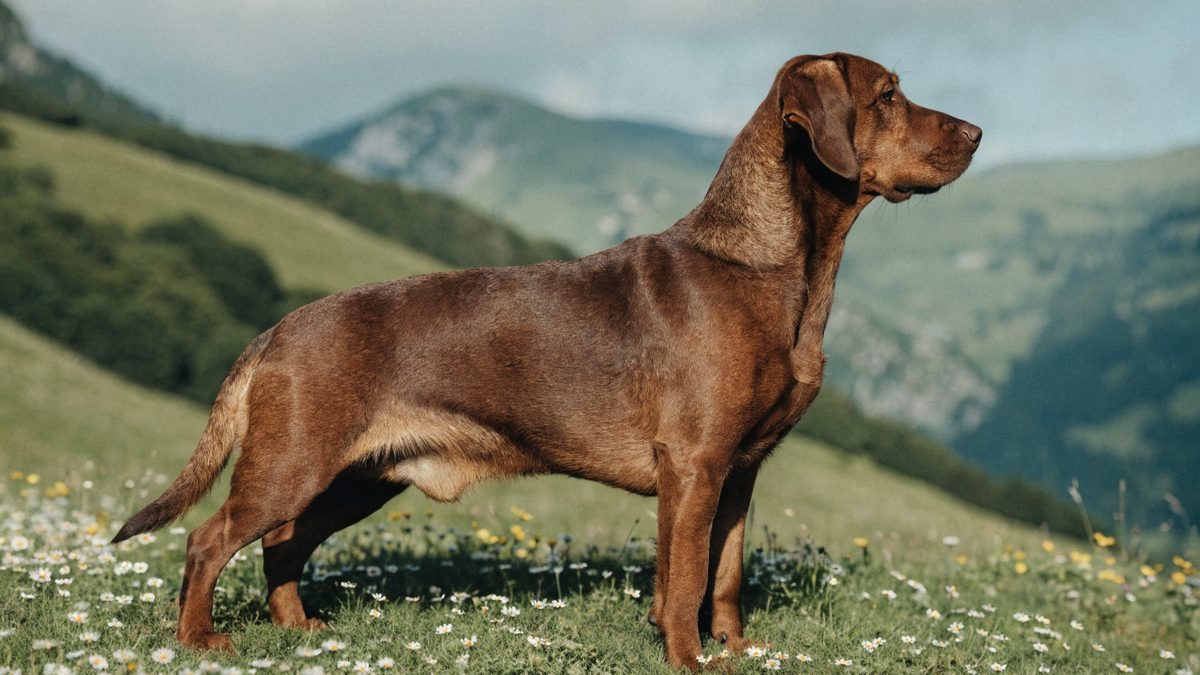
Quick answer
The Alpine Dachsbracke is a short-legged Austrian scenthound registered as FCI Standard No. 254, Group 6, Section 2. It has no Indian market, no KCI route and no lawful import route for breeding. It does carry FGF4 chondrodystrophy, and 174 genotyped dogs put the CDDY allele frequency at 0.59, still segregating, so a parental DNA test is genuinely informative. Bonbeno rates it 2 of 5 for heat tolerance in India.
This guide is general information for Indian pet owners and is not a diagnosis. Consult your nearby vet, a registered veterinarian who has examined the dog, before acting on anything you read here, and treat sudden back pain, dragging limbs or loss of hind-limb coordination as an emergency.
Alpine Dachsbracke at a glance
What the Alpine Dachsbracke actually is
The Alpine Dachsbracke is a short-legged Austrian scenthound registered as FCI Standard No. 254, placed in Group 6, Scenthounds and related breeds, Section 2, Leash (scent) hounds, and subject to a working trial. It is a working hunting dog first and a companion second, bred to follow the blood trail of wounded deer through steep alpine ground and to hunt hare and fox by voice.
Take the numbers from the FCI's own document rather than from a breed-directory summary, because the summaries disagree with it and with each other. The standard sets height at withers at 34 to 42 cm, with an ideal of 37 to 38 cm for dogs and 36 to 37 cm for bitches. A dog under 34 cm or over 42 cm is disqualified. The FCI records the breed as recognised on a definitive basis, country of origin Austria, official authentic language German, with the currently valid standard dated 10 October 1995 and the English translation published on 18 June 1996 Federation Cynologique Internationale.
| Attribute | What the standard says |
|---|---|
| FCI standard number | 254 |
| Group and section | Group 6 Scenthounds and related breeds, Section 2 Leash (scent) hounds, with working trial |
| Country of origin | Austria |
| Definitive FCI acceptance | 1 June 1975 |
| Height at withers | 34 to 42 cm, ideal 37 to 38 cm dogs and 36 to 37 cm bitches |
| Weight | Not specified anywhere in the standard |
| Body proportion | Height at shoulder to length of body, 2 to 3 |
| Chest depth | About half the height at shoulder |
| Coat | Double coat, very thick top coat over a dense undercoat, close fitting over the whole body |
| Ideal colour | Dark deer red, or black with red-brown markings including the Vierauegl head marking |
| Ears | Set on high, hanging broad and smooth, medium length, reaching to the canines |
| Tail | Set on high, brush tail, carried slightly downward, undocked |
Three things in that table matter more than they look. The breed standard gives no weight at all, so every weight figure you will read for this breed comes from a secondary source rather than from the registry. Eukanuba publishes approximately 15 to 18 kg and Wisdom Panel publishes 33 to 40 lb, which is the same range in different units, and both trace back to the same FCI document that does not contain it. Bonbeno reports 15 to 18 kg as the commonly published figure and states plainly that it is not a standard figure.
The second is the coat. The standard specifies a double coat made of a very thick top coat over a dense undercoat, covering the whole body and lying close. Wikipedia's infobox describes the coat as "Dense, short, smooth" and omits the undercoat entirely, even though its own body text quotes the thick top coat and dense undercoat two paragraphs later. Royal Canin's Indian page goes further and lists "Requires minimal grooming" as a key fact. For an Indian reader deciding whether this dog can live in Chennai, the difference between a short smooth coat and a dense double coat is the whole question.
The third is the tail and ears. Both are natural in the standard, which describes a brush tail reaching barely to the ground and broad hanging ear leathers. Nothing in this breed is traditionally cropped or docked, so the Indian legal position on those procedures, which the Prevention of Cruelty to Animals (Dog Breeding and Marketing) Rules 2017 sit alongside, never arises here.
A short-legged breed, not a long-backed one
The Alpine Dachsbracke is a short-legged dog whose body looks long because the legs are short, and that distinction is the single most useful thing on this page. The standard puts the ratio of height at shoulder to length of body at 2 to 3 and says the front legs "appear short in relation to the body";. It appears short-legged because two inserted copies of the FGF4 gene shorten the limbs, not because the spine has been stretched Brown EA, Dickinson PJ, Mansour T. The health section works through what that means, and the difference is not academic, because it changes the advice on stairs, jumping and exercise completely.
Bonbeno's Dachshund guide, Basset Hound guide and Pembroke Welsh Corgi guide carry the same correction with each breed's own numbers.
History, and the name that keeps changing
The breed's documented history starts in the nineteenth century and its name has moved twice since. Crown Prince Rudolf of Habsburg had his gamekeepers from Muerzsteg and Ischl bring Alpine Dachsbracken on hunting trips to Turkey and Egypt in 1881 and 1885. In 1932 the Austrian cynological bodies recognised the "Alpine-Erzgebirgs-Dachsbracke" as the country's third scenthound breed. In 1975 the name changed to "Alpenlaendische Dachsbracke" and the FCI declared Austria the country of origin. In 1991 the FCI moved the breed into Section 2 of the Scenthounds. The Austrian breed club publishes the same sequence in German, describing the breed as a Brackier- und Schweisshund, a dog that both drives game by voice and follows a blood trail, and noting it is increasingly used on wild boar.
Treat competing origin dates with suspicion. A-Z Animals states that "the breed was officially recognized by the Austrian Kennel Club in 1910 and by the German Kennel Club in 1911";, which does not match the FCI's own history section or the Austrian club's Klub Dachsbracke (Austria). Where a directory page and the recognising registry disagree about the registry's own history, the registry wins.
Which registries actually recognise it
Two registries publish a standard for this breed and they are not identical. The FCI is the origin registry. The United Kennel Club in the United States recognised the breed on 1 January 1996 and places it in the Scenthound Group, with the standard last revised on 1 July 2009. Wikipedia says the UKC "use the Fédération Cynologique Internationale breed standard";. Read both documents side by side and that is not quite true.
| Point | FCI Standard 254 | UKC standard |
|---|---|---|
| Breed name used | Alpenlaendische Dachsbracke, English name Alpine Dachsbracke | Alpine Drachsbracke, spelled with an r throughout |
| Height expressed as | 34 to 42 cm, ideal 37 to 38 cm and 36 to 37 cm | Ideal 15 in males and 14 in females |
| Height limit | Disqualifying below 34 cm or above 42 cm | Eliminating fault below 13 in or above 16.5 in |
| Ear length | Medium, should reach to the canines | Should reach nearly to the end of the muzzle |
| Muzzle to skull | Facial region to cranial region, 9 to 10 | Muzzle slightly shorter than the skull |
| Bite | Scissor or pincer bite | Scissors or level bite |
| Disqualifications | Aggression, shyness, weak temperament, missing premolars, height outside range | Cryptorchidism, viciousness or extreme shyness, albinism |
Those are small differences, but a buyer told that one registry simply copies the other is being told something the documents do not support United Kennel Club. The UKC's own page spells the breed "Alpine Drachsbracke", with an r that does not belong in the German word, and has done so since the 1996 copyright line.
The American Kennel Club does not recognise the breed and does not record it even in the Foundation Stock Service. Bonbeno read the full FSS breed directory and the Alpine Dachsbracke is not on it. That absence is not a judgement on the breed. The AKC states that it "only considers adding new breeds to the FSS or its registry upon request", from a breed club or individual fanciers, and requires 40 years of recognition by an acceptable registry with three-generation dogs. FCI recognition dates from 1975, which is 51 years, so the breed would clear that bar. Nobody in the United States has asked.
Alpine Dachsbracke price in India
There is no Alpine Dachsbracke price in India, because there is no Indian market for the breed and Indian law prevents one forming. Bonbeno found no Indian breeder, no Indian listing, no Indian registry entry and no Indian price quotation of any kind. That is the answer, and it is more useful than a number.
Start with the law, because it settles the question before supply or demand get a vote. Under DGFT Trade Notice No. 22/2022-23, dated 19 December 2022, dogs fall under ITC (HS) 01061900 and the import policy is Restricted, subject to Policy Condition 6. Bonbeno read the notice on the DGFT's own server rather than a summary of it. Policy Condition 7 permits the import of dogs for exactly three purposes.
- A pet dog with a valid pet book and relevant records or documents in the name of the importer.
- Dogs imported by R&D organisations for conducting research, with the recommendation of CPCSEA.
- Dogs for internal security by the Defence and Police Force.
Policy Condition 8 then states that the import of commercial dogs for breeding or any other commercial activity outside those purposes is not permitted, and paragraph 6 of the notice puts it beyond argument: "any applications for trading/breeding purposes, or applications made on behalf of some another person/ entity shall be duly rejected";.
A person moving home to India after two years of continuous stay abroad can bring up to two pets in as passenger baggage without DGFT authorisation, and can therefore bring an Alpine Dachsbracke they already own. Nobody can lawfully bring one in to breed from or to sell. Import authorisation is required in every other case, applications go to DAH&D with justification, entry is limited to the six ports the DGFT notice names, Delhi, Mumbai, Chennai, Hyderabad, Bangalore and Kolkata, and an advance NOC must be obtained from the Quarantine Officer seven days before travel. There is no route by which a founding population of this breed enters India legally.
No KCI route either
The Kennel Club of India is the FCI's member body for India and registers a substantial number of dogs each year. FCI's own statistics record 32,219 puppies and 33,880 pure-bred dogs entered in the KCI studbook in 2025, down from a peak of 88,261 puppies in 2021. Those numbers are real and large. Bonbeno found no evidence that any of them were Alpine Dachsbracken, and no Indian show entry, breeder or club for the breed.
Between the import notice and the registry position, the picture is closed rather than merely empty. A breed cannot be registered in India without breeding stock in India, breeding stock cannot lawfully be imported for breeding, and no Indian owner of an imported pet could produce a registrable litter without the sire and dam both being present and registered. Two facts together, not one, are what make this a settled negative.
What Indian search results actually offer you instead
Search "alpine dachsbracke price in india" from an Indian connection and Google does not return a single Indian seller. It returns three things instead, and knowing which is more useful than any price.
| Result type | Example | What it really offers |
|---|---|---|
| A different breed's price page | Dachshund price guides from Supertails, WrapInFur and whatsthecost.in | Indian Dachshund pricing, surfaced because Google matches the shape of the query, not the breed |
| An auto-generated brand shell page | Royal Canin India breed page | Nine sentences, no price, no availability, facts sourced from the FCI, and the same template exists for hundreds of breeds |
| A print-on-demand book listing | An Amazon.in activity book about the breed | A book, not a dog |
The Royal Canin India page deserves a second look because it is the only page on an Indian domain Bonbeno located for this breed. It carries three key facts: "Patient with children and other animals", "Needs a lot of exercise", and "Requires minimal grooming";. The third contradicts the FCI standard it says it sourced from, which specifies a very thick top coat over a dense undercoat. A shell page is not a market.
The only published prices anywhere, and why they are not Indian
One ranking page publishes a purchase price, and it contradicts itself. A-Z Animals lists "Purchase Cost: $800 - $2,500" in its data panel and then answers its own FAQ with "The initial price for an Alpine Dachsbracke is around $1200";. Both are United States figures, neither carries a source, and the same page separately gives the breed's weight as 18 lb in one box and 35 to 42 lb for males in another, and its lifespan as 13 years, 12 to 14 years and "up to 12 years" in three different places.
Converting an unsourced, self-contradicting American figure into rupees would manufacture an Indian price that does not exist, and it would be quoted back at us. There is no Indian price for this breed. If you are ever quoted one, that is information about the seller.
If a seller in India offers you an Alpine Dachsbracke puppy, the realistic possibilities are that the dog is a Dachshund, a Dachshund cross, a Beagle cross, or an unrelated short-legged mixed-breed dog described with a name the buyer cannot check. Ask for the FCI or UKC export pedigree and the DGFT import authorisation, in the seller's name, before anything else. Neither document can be produced for a dog bred in India, because no lawful Indian breeding population exists.
What it would cost to keep one in India
No verified Indian cost figure exists for the Alpine Dachsbracke, because no Indian owner population exists to survey. What can be set out honestly is the cost structure a relocating owner would face, which is the only realistic way this dog arrives in India, plus the two line items this breed changes.
Bonbeno publishes cost figures with a sample size and a collection date, or not at all. For a breed with no Indian owners, there is no sample. Anyone presenting a monthly rupee figure for an Alpine Dachsbracke in India has constructed it from a generic medium-dog template and swapped the breed name in.
The one cost that is specific and knowable
The import itself is the cost that can be described, because the process is documented. A person relocating to India after two years of continuous residence abroad brings up to two pets as passenger baggage without DGFT authorisation. Anyone else needs an import authorisation, applied for on form ANF-2M against an Importer Exporter Code, with the permanent IEC No. IIHIE0153E available for personal, non-trade imports. DGFT advises starting the process at least two months before travel, and an advance No Objection Certificate must be obtained from the Regional or Quarantine Officer at one of the seven permitted ports, seven days before the date of travel and relaxable to three days Department of Animal Husbandry…. Testing prescribed in the health certificate must be done in the exporting country, with all reports accompanying the animal. The full route is set out in how to import a dog to India.
Those are process facts, not prices. Bonbeno does not publish an airline, agent or quarantine quote, because those change constantly and a stale figure is worse than none.
The recurring cost structure, and what this breed changes
- Food. A 15 to 18 kg dog is a modest eater by Indian large-breed standards. This is not where the money goes.
- Preventive veterinary care. Core vaccination, boosters, deworming and year-round tick and flea control. A hunting-bred dog that wants to work its nose in undergrowth meets more ticks than a dog walked on pavement.
- Ear care. Broad hanging ear leathers in Indian humidity make this a monthly line item rather than an occasional one, for reasons the grooming section sets out with the numbers.
- Coat care. A dense double coat needs real attention in a humid climate, and Royal Canin India's "minimal grooming" claim will cost an owner who believes it.
- Spinal risk provisioning. This is the line item that separates this breed from a similarly sized non-chondrodystrophic dog. The health section explains why. Budgeting for it is arithmetic, not pessimism.
- Enrichment that substitutes for hunting. A dog selected to work a blood trail for hours needs a job. In India that means paid scent-work equipment or classes, because there is no alpine forest.
A-Z Animals publishes a lifetime cost of $15,000 to $35,000 and annual veterinary costs of $200 to $300. Those are United States figures on a page that contradicts itself on weight, lifespan and purchase price, and Bonbeno reports them only so a reader who has seen them knows where they came from.
We would rather publish the structure and say we cannot price it than publish a rupee figure nobody measured. When we do publish costs, we state the cities, the sample size and the collection date. See how we test for what a Bonbeno figure is and is not.
One further cost is worth naming because it is invisible until it lands. A DNA panel that covers the four variants relevant to this breed, discussed in the health section, is available from laboratories outside India and is the single highest-value spend an owner or a prospective breeder could make. UC Davis lists its combined chondrodystrophy and chondrodysplasia test at $58 as a single test per animal, or $27 as an additional health test on the same animal, with a turnaround of at least 15 business days. That is a published laboratory price, not an Indian retail price, and shipping a sample from India adds cost the laboratory does not quote.
Can an Alpine Dachsbracke handle the Indian climate
Bonbeno rates this breed 2 out of 5 for heat tolerance in Indian conditions. It is not the worst possible choice, because it is not flat-faced and it is not a giant, but the coat the FCI standard specifies was built for alpine winters and the build puts the dog's body closer to hot ground than most dogs of its weight.
The coat argument, taken from the standard
The standard is unambiguous about the coat. "The double coat consists of very thick top coat and a dense undercoat, which covers the whole body and is close fitting";. That is a cold-and-wet-weather coat, and the Austrian club describes the breed's job as accompanying the Bergjaeger, the mountain hunter, as a robust and weatherproof working dog. Coat that is "too thin or too short" is listed as a fault. Selection has actively pushed this breed towards more insulation, not less.
Colour compounds it. The ideal is dark deer red, and the alternative accepted colour is black with red-brown markings. Indian veterinary guidance lists dark or thick coats among the factors that raise heatstroke risk, because they absorb more solar radiation, and names double-coated breeds specifically as retaining heat.
The ground-clearance argument, which nobody else makes
Here is a calculation you can do from the breed standard and will not find on any ranking page. The standard sets height at withers at 34 to 42 cm and says depth of chest "should be about half the height at shoulder";. That puts the bottom of this dog's chest roughly 17 to 21 cm off the ground. A dog that low is not walking through the air temperature you are feeling at head height. It is walking through the radiant heat coming off the surface.
Indian conditions make that concrete. Asphalt reaches 60 C in direct sun and causes third-degree paw burns within about 30 seconds, and the seven-second test applies: put the back of your hand on the pavement, and if you cannot hold it there comfortably it is too hot. For a dog whose brisket clears that surface by less than a hand's width, the exposure is not limited to the paws. Grass runs 10 to 15 C cooler than asphalt in direct sun, which for this breed is a bigger difference than it is for a tall dog.
| Ambient temperature | General guidance | Alpine Dachsbracke adjustment |
|---|---|---|
| Below 28 C | Normal activity with shade and water | Comfortable. This is the band the breed was built for |
| 28 to 35 C | Shorten walks to 15 to 20 minutes, early morning or late evening only | Treat as the working ceiling. Scent work indoors instead of distance outdoors |
| 35 to 42 C | Outdoor activity contraindicated for any dog | Indoors. Typical North India April to June. Check surface temperature before even a toilet break |
| Above 42 C | Heatstroke possible within 10 to 15 minutes of exposure | Indoor cooling is not optional. Power cuts become a planning problem, not an inconvenience |
Humidity is the part Indian owners underestimate
A 35 C day at 90 percent humidity in coastal Mumbai is more dangerous than a 42 C day at 20 percent humidity in Delhi, because panting works by evaporation and humid air prevents it. Dogs cool almost entirely through respiratory evaporation and a little through the paw pads, and once ambient temperature approaches body temperature those mechanisms fail together. Coastal and monsoon-season cities are the hardest posting for a double-coated dog even when the thermometer looks moderate.
City by city, the practical reading runs like this. Mumbai, Chennai and Kolkata are the hardest, because humidity removes the cooling route rather than merely loading it. Delhi, Jaipur and Ahmedabad are hard for a different reason, a longer stretch of days above 42 C, but the dry air at least lets panting work. Bengaluru and Pune are the most workable large Indian cities for this breed. Anywhere in the Himalayan foothills, Shimla, Manali, Gangtok or Darjeeling, is genuinely suitable, and is the only part of India whose climate resembles what the breed was selected in.
Indian veterinary guidance is explicit that the undercoat provides insulation protecting against both cold and heat, that shaving removes that protection and exposes skin to sunburn, and that regrowth can come back patchy or wrong. Correct hot-weather grooming on this breed means brushing out the dead undercoat so air can move through the coat, which is the opposite of clipping it off. Heatstroke is a veterinary emergency, so consult your nearby vet the same day if your dog shows frantic unproductive panting, brick-red gums, thick ropey saliva or an inability to settle.
One point in the breed's favour deserves stating, because it is why the rating is 2 rather than 1. This is not a brachycephalic dog. The standard calls for a strong muzzle with a facial to cranial ratio of 9 to 10, meaning a normal-length nose and an unobstructed airway. Its panting apparatus works properly, unlike the flat-faced breeds Indian veterinary guidance places in the extremely-high-risk category. A well-managed Alpine Dachsbracke in Pune with air conditioning, dawn walks and no midday exposure is a workable proposition. The same dog on a Chennai balcony in May is not.
Temperament and household fit
The Alpine Dachsbracke is a friendly, fearless, independent working hound that is easy to live with indoors and difficult to live with outdoors. The breed standard asks for an "intelligent and friendly" expression and a "fearless personality", and disqualifies both aggression and overt shyness, so a sound example is genuinely pleasant company.
Temperament is one of the few areas where the ranking pages, the registries and the breed club broadly agree. Wisdom Panel describes the breed as friendly and easygoing, getting on well with children, and enjoying the company of both people and other dogs. Eukanuba rates it good with children, not very combative, not very dominant, good on friendliness and very trainable. Royal Canin India calls it calm, confident, friendly and alert. That is a consistent picture from four independent sources.
Two traits sit underneath the pleasantness and both are working traits rather than faults.
It is independent by design
Eukanuba rates this breed "Very" on independent, which is the highest point on its own scale and sits oddly beside the "Very" it also gives for trainability. Both are true and the tension is the whole story. A dog selected to work a cold blood trail alone, checking and circling to re-find a line the handler cannot smell, has to solve problems without looking back for instructions. That produces a dog that learns quickly and complies selectively, which is exactly the pattern Bonbeno's Beagle guide describes in the scenthound cluster.
In an Indian household that shows up in small ways. The dog will learn a cue in three sessions and then decline it at the moment a smell arrives. It is not being defiant, and punishing it fights several centuries of selection.
It is a vocal breed, whatever the breed-finder charts say
The Alpine Dachsbracke is a vocal dog and this is the single most consequential temperament fact for an Indian flat. The breed's job includes Brackierjagd, driving hare and fox while giving tongue so the hunter can follow the dog by ear. The Austrian club runs a formal Vorpruefung zur lauten Jagd, a preliminary test for hunting with voice, as part of its working calendar. Eukanuba's own text says the dog "has a very keen scenting ability and a good voice which is what makes him a great hunting and tracking dog", and then rates the breed "Quiet" on its noise slider two paragraphs earlier. The text is right and the slider is wrong.
A hound bred to be audible across a forested valley is audible across a housing society. This is not a barking problem that training removes, it is the breed's working voice. Anyone considering this dog in a shared-wall Indian flat should assume neighbour complaints are the likeliest reason the arrangement fails, and should be honest with themselves about that before the dog arrives rather than after.
Prey drive, street cats and street dogs
Wisdom Panel notes that the strong prey drive means Alpine Dachsbracken may chase cats or other small pets, and that a fenced yard matters because they love to follow a scent. In most Indian cities there is no fenced yard, and there is a resident population of free-ranging cats and dogs on the route to every park. A hound locked onto a trail in that environment is a traffic risk and a conflict risk at the same time.
- Good fit. A household in Bengaluru, Pune or a hill station with time for daily scent work, tolerance for a loud dog, and a securely closed front door.
- Poor fit. A high-floor metro flat with shared walls, a working couple out ten hours, or an owner who wants an off-lead park dog.
- Watch item. The breed is friendly with people and reasonably sociable with dogs, but a small resident cat is a genuine question rather than a formality.
A-Z Animals states flatly that the breed "is not a good choice for people who live in apartments" and needs "a large fenced-in yard or one that lives on a farm";. Bonbeno's reading is narrower. Floor area is not the constraint, because a 15 to 18 kg dog fits in a flat comfortably. Noise and outlet are the constraints, and both are about what the household can supply rather than how many square feet it has.
Training an Alpine Dachsbracke
Train an Alpine Dachsbracke on a long line and with food, and treat off-lead recall as a safety rule rather than a training goal. The breed learns fast, and Eukanuba rates it "Very" on trainability, but a hound selected to follow a scent trail independently of its handler will choose the trail. That is the scenthound problem Bonbeno's Beagle guide sets out, and it applies here with one important difference.
The difference: this is a leash hound by classification
The FCI does not merely file this breed under scenthounds. It places it in Group 6, Section 2, Leash (scent) hounds, alongside the Bavarian Mountain Scenthound and the Hanoverian Scenthound. The German-language classification is more explicit still: Sektion 2, Schweisshunde mit Arbeitspruefung, blood-tracking hounds with a working test. The breed's senior discipline is worked at the end of a long tracking line, following the blood of a wounded animal at a walking pace with the handler attached.
That reframes the standard advice. Telling a Beagle owner to keep the dog on a lead is a restriction imposed on a breed built to run free in a pack. Telling an Alpine Dachsbracke owner the same thing is describing the breed's own primary working mode. The long line is not a compromise for this dog. It is the equipment its main job uses.
The complication is that the breed does two jobs, not one. Alongside blood tracking it performs Brackierjagd, driving hare and fox while giving tongue, and the Austrian club runs a separate preliminary test for hunting with voice. In that mode the dog works free, at distance, out of sight, for as long as the line holds. Both modes live in the same dog, and the second one is what removes your recall.
A-Z Animals advises that "it's best to give them exercise off the leash in a safe place" and, elsewhere on the same page, that the breed "may not come back when on a scent";. Only the second statement is safe advice in India. A hound running a trail through Indian traffic, at 40 C, past street dog territory, is exposed to three separate lethal risks at once, and asphalt at 60 C burns paw pads within about 30 seconds. Under the 2017 rules every pup sold in India must be micro-chipped. Treat the microchip as the backstop and the closed gate as the plan.
What actually works
- Pay the nose rather than fighting it. Scent games, a tracking line and buried-food searches use the drive instead of competing with it, and they tire this dog faster than distance walking does.
- Train in short sessions with food. Wisdom Panel's guidance for the breed is short, engaging sessions with positive reinforcement, because holding attention is the constraint.
- Build the long-line habit from week one. A dog that has never been off-lead outdoors does not learn that off-lead is available.
- Teach ear and mouth handling before you need it. This costs ten minutes a week for six weeks and saves a decade of restraint arguments at the vet, for reasons the grooming section explains.
- Work the settle indoors. A hound with nothing to do becomes a hound that tells the whole building about it.
Realistic timelines
| Skill | Start | Realistic outcome |
|---|---|---|
| Name response indoors | Week 1 home | 2 to 3 weeks with food. The easy part |
| Sit, down, settle | Week 1 home | 3 to 6 weeks. Learns quickly, complies selectively |
| Ear handling without protest | Week 1 home | 2 to 4 weeks, and worth more than any trick |
| Toilet training | Week 1 home | 4 to 6 months |
| Loose-lead walking | Month 2 | 6 to 12 months, with permanent maintenance |
| Working a tracking line calmly | Month 3 | 6 to 12 months. This is the breed playing to type |
| Quiet on cue | Month 3 | Partial at best. Giving tongue is the breed's job |
| Reliable off-lead recall | Month 2 | Never treat as reliable |
The working trial that sits behind the standard
One line in the FCI record shapes the whole breed and almost no English-language page explains it. The Alpine Dachsbracke is "Subject to a working trial according to the FCI Breeds Nomenclature", and the German standard specifies the trials in question as the Brackier- und Schweisspruefung. In practice that means a dog cannot take the top conformation titles without proving it can do the job, and the disqualifying-fault list includes "any deviation which will hinder ability to hunt";.
That is why the breed has stayed a working animal rather than splitting into show and field lines, and it is also, indirectly, why the genetics in the health section are unusual. Bannasch and colleagues chose this breed for study precisely because its standard emphasises hunting ability rather than a tightly defined absolute height, which left variation in place that most breeds have bred out.
How much exercise an Alpine Dachsbracke needs
Plan on 60 minutes of daily activity for an adult Alpine Dachsbracke, split across two cool sessions, with at least a third of it spent on scent work rather than distance. Published estimates for the breed sit lower, at 30 to 60 minutes, and Royal Canin India simply says the breed "needs a lot of exercise";. Neither figure comes from a study of this breed, and both understate the mental side.
Do not restrict movement to protect the back
The instinct with any short-legged breed is to keep it still, ban the stairs and carry it everywhere. The largest dataset available points the other way, and this is the most practically important finding on the page. Across 43,517 dogs in the Dog Aging Project, the lifestyle factors associated with reduced odds of owner-reported intervertebral disc disease were higher daily active time, being on a commercial diet, and regular use of a staircase. The factors that raised the odds were being male (OR 1.36), purebred (OR 1.66), toy or small (OR 1.85) and overweight (OR 1.67).
Read that carefully before acting on it. This is a cross-sectional survey, so a dog that already has back problems is a dog whose owner has already removed the stairs, and some of the staircase association is certainly that. Bonbeno's reading is deliberately conservative: the evidence does not support sedentary confinement as a protective strategy, and it does support keeping the dog lean and active. Weight is the lever you fully control, and it moved the odds by 1.67 times in the same dataset.
| Stage | Physical activity | Scent work | Indian timing |
|---|---|---|---|
| 8 to 16 weeks | Short free pottering, no forced walks | 5 minutes, indoors, food scatter | Indoors entirely from March to June |
| 4 to 8 months | 2 walks of 15 to 20 minutes | 10 to 15 minutes daily | Before 7 am and after 8 pm |
| 8 to 14 months | 2 walks of 20 to 30 minutes | 15 to 20 minutes daily | Surface check before every outing |
| Adult | 60 minutes total across 2 sessions | 20 minutes minimum, more in summer | Two cool sessions beat three including one dangerous one |
| Senior | 2 to 3 shorter gentle walks | Unchanged. The nose ages last | Shorter still in heat and humidity |
Scent work is not a substitute, it is the main event
Twenty minutes of tracking tires this dog more than forty minutes of pavement, and it can be done indoors in a Delhi May. That matters more for this breed than for most, because the Indian exercise window is short for half the year. A-Z Animals describes the breed as an independent problem-solver that "often checks, circles, and re-finds the line when scent is lost, instead of looking to the handler immediately";. Give it something to solve.
- Scatter feed part of the daily ration across a room or a balcony instead of using a bowl.
- Lay a short drag trail with a piece of meat and a long line, indoors along a corridor if outdoors is unusable.
- Hide and search for a scented article, building from one room to several.
- Walk on grass or soil where you can, because it is 10 to 15 C cooler than asphalt in sun and better ground for a low dog.
- Skip the midday session entirely from March to June in most of India.
Bonbeno found no published growth-plate closure age, no puppy exercise study and no orthopaedic development data specific to the Alpine Dachsbracke. Rather than borrow a Dachshund or Basset Hound figure and present it as this breed's, the honest position is that the general small-to-medium-breed principle applies: build load gradually, avoid repetitive impact and long forced walks in the first year, and set the specifics with your nearby vet who can examine the individual dog.
Grooming a double coat and drop ears in Indian humidity
Grooming this breed in India is two jobs, and the smaller-looking one matters more. Brush the dense double coat to the skin twice a week, rising to daily when the undercoat drops, and check the ears every single week. The coat is the visible task. The ears are the one that generates veterinary bills.
The coat
Wisdom Panel's guidance is that weekly brushing usually keeps the coat free of loose hair and dirt, with more frequent work during the twice-yearly coat blow. That is reasonable for a temperate climate. In Indian humidity Bonbeno's position is twice weekly as the baseline, because damp undercoat sitting close to the skin is the main driver of hot spots and the standard specifies a coat that is close fitting over the whole body.
Brush to the skin, not across the surface. Surface brushing on a double coat leaves the dead undercoat exactly where it does harm, trapping moisture against skin in a climate where evaporation is already slow. The point of hot-weather grooming on this breed is to open the coat so air moves through it.
Two published claims about this breed's coat care are worth flagging. Royal Canin India lists "Requires minimal grooming"; and Eukanuba lists "Little grooming needed" as a positive. Both are describing coat length rather than coat structure. A short dense double coat sheds less visibly than a long one and needs more work than either page implies, particularly in Mumbai or Kochi.
The ears, and the number nobody applies to this breed
The standard describes ear leathers "set on high without folds, hanging broad and smooth, medium length (should reach to the canines), well rounded at tips";. That is a pendulous ear, and pendulous ears carry a measurable, quantified risk that has never been measured in this breed but has been measured in its conformation class.
In a VetCompass study of a random sample of 22,333 dogs drawn from 905,554 under UK primary veterinary care in 2016, the one-year period prevalence of otitis externa was 7.30 percent (95 percent CI 6.97 to 7.65). Compared with breeds having erect ear carriage, breeds with pendulous ear carriage had 1.76 times the odds (95 percent CI 1.48 to 2.10), and breeds with V-shaped drop ears had 1.84 times the odds.
| Breed or ear type | Odds ratio versus reference | Reference group |
|---|---|---|
| Basset Hound | 5.87 | Crossbred dogs |
| Beagle | 2.54 | Crossbred dogs |
| Golden Retriever | 2.23 | Crossbred dogs |
| Chihuahua | 0.20 | Crossbred dogs |
| V-shaped drop ear carriage | 1.84 | Erect ear carriage |
| Pendulous ear carriage | 1.76 | Erect ear carriage |
| Alpine Dachsbracke | No breed-specific figure exists | Not present in the dataset |
The Alpine Dachsbracke does not appear in the UK VetCompass data, because there are too few of them in UK primary care to analyse. Bonbeno is not claiming this breed carries the Basset Hound's 5.87 odds ratio, and any page that borrows a Basset Hound or Beagle figure and attaches this breed's name to it is inventing data. What can honestly be said is that the conformation-level finding applies, because the standard specifies a broad hanging ear, and that the applicable published figure is 1.76 for pendulous ear carriage generally.
Independent sources describe the same risk qualitatively. Eukanuba lists "Ears can be prone to infection" among the breed's downsides, and A-Z Animals notes the long pendant ears are "excellent for funneling scent but predisposed to ear canal moisture/debris", making routine cleaning and drying a key care requirement. Wisdom Panel puts ear cleanings in the routine care list.
An ear infection in an Indian monsoon is not the same animal as an ear infection in Austria. Warm, moist, poorly ventilated ear canals are the whole mechanism, and June to September in coastal India supplies all three conditions continuously.
The weekly routine that prevents most of it
- Lift both ear leathers and look, every week, in good light. You are looking for redness, discharge, a yeasty smell or head shaking.
- Dry the ears thoroughly after every bath, swim or heavy rain. Water sitting in a covered canal is the single commonest starting point.
- Clean only when there is something to clean, with a product your vet has approved, and never with cotton buds pushed into the canal.
- Brush the coat twice weekly to the skin, and daily through a coat blow.
- Check the belly, armpits and groin weekly for irritation, because those areas sit closest to hot ground on a dog this low.
- Trim nails monthly, since the standard's black nails on tight round feet grow whether the dog walks on soft ground or not.
If the ear is already painful, hot, discharging or the dog is tilting its head, that is a clinical problem rather than a grooming one. Consult your nearby vet rather than starting a cleaner, because cleaning an infected or ruptured ear can make things considerably worse.
Health, FGF4 chondrodystrophy and lifespan
The Alpine Dachsbracke does carry FGF4 chondrodystrophy, it has been genotyped properly, and the numbers are better than for most breeds this rare. Two diseases were first characterised in this breed. What does not exist is any prevalence, surgical or lifespan study, and this section separates those two things carefully because every ranking page collapses them.
Does this breed carry FGF4 chondrodystrophy? Yes, and it was studied on purpose
Short legs in dogs come from two separate inserted copies of the fibroblast growth factor 4 gene. The chromosome 18 insertion, known as CDPA, was described by Parker and colleagues in 2009 and produces the short-legged phenotype that defines at least 19 breeds including the Dachshund, Corgi and Basset Hound. The chromosome 12 insertion, known as CDDY, was described by Brown and colleagues in 2017 and produces short legs plus premature degeneration and calcification of the intervertebral discs, with an odds ratio of 51.23 (95 percent CI 46.69 to 56.20) for intervertebral disc disease.
The Alpine Dachsbracke is not a breed nobody thought to test. It is one of only two breeds in the world that Bannasch and colleagues selected for a dedicated morphometric study precisely because it segregates both retrogenes, meaning individual dogs within the breed carry zero, one or two copies of each. The other is the Schweizerischer Niederlaufhund. The paper explains why: most breed standards are prescriptive about height, so most breeds have been bred to uniformity, but this breed's standard emphasises hunting ability over an absolute height, which left the variation in place.
| Breed | Dogs genotyped | CDDY allele frequency |
|---|---|---|
| Beagle | 12 | 1.00 |
| Dachshund (US and UK) | 257 | 0.98 |
| Dachshund (Swiss) | 136 | 0.94 |
| Bavarian Mountain Hound | 69 | 0.91 |
| Pembroke Welsh Corgi | 51 | 0.81 |
| Basset Hound | 32 | 0.63 |
| Alpine Dachsbracke | 174 | 0.59 |
| Schweizerischer Niederlaufhund | 46 | 0.51 |
| Schweizer Laufhund | 65 | 0.11 |
| All breeds combined | 3,223 | 0.41 |
That row is the answer to the question this page was written to settle. 174 Alpine Dachsbracken were genotyped and the CDDY allele frequency came back at 0.59 Bannasch D, Bellone R. Managing…. The sample is the third largest in the entire table, behind only mixed-breed dogs and the Dachshund. The UC Davis Veterinary Genetics Laboratory separately lists the Alpine Dachsbracke both among breeds appropriate for CDDY and CDPA testing and among the breeds in which the CDDY variant has been found.
An allele frequency of 0.59 means CDDY is still segregating. Some Alpine Dachsbracken carry two copies, some carry one, and some carry none at all. In the Beagle the variant is fixed at 1.00 and in the Dachshund it sits at 0.98, so UC Davis states that where the frequency is 1.0 genetic testing is unnecessary because every dog can be assumed homozygous. In this breed a DNA test on the parents tells you something real, and breeding away from the variant while keeping the short legs is genuinely possible. Almost no other short-legged breed has that option.
A cross-check on that figure, from a second sample
Bannasch and colleagues published genotype counts for 111 Alpine Dachsbracken measured for height at the shoulder. For the chromosome 12 retrogene, 12 dogs carried no copies, 60 carried one copy and 39 carried two. Bonbeno's own arithmetic on those published counts gives 138 CDDY alleles out of 222, which is a frequency of 0.62. That is Bonbeno's calculation rather than a figure either paper prints, and it is offered as a consistency check: two independent samples, 174 dogs and 111 dogs, landing on 0.59 and 0.62. Agreement that close in dog health data is unusual and worth trusting.
The same arithmetic on the chromosome 18 retrogene gives 148 CDPA alleles out of 222, a frequency of about 0.67, from counts of 1 dog with no copies, 72 with one and 38 with two. CDPA is not fixed in this breed either, which again separates it from the Basset Hound, where the same retrogene sits at 1.00.
What each retrogene actually does to the dog
The study measured the effects separately, which nobody had previously been able to do inside a single breed. In the 111 Alpine Dachsbracken, one copy of the chromosome 18 retrogene reduced height at the shoulder by 23.48 percent and two copies by 27.90 percent. One copy of the chromosome 12 retrogene reduced it by 3.21 percent and two copies by 6.13 percent. Across both study breeds the effect ranged from 15.9 to 27.9 percent for the chromosome 18 retrogene and only 3.2 to 10.5 percent for the chromosome 12 one, and the retrogenes together explained about 71 percent of the height variation in this breed. The paper also found that the chromosome 18 retrogene alone influenced the degree of carpal valgus, and the chromosome 12 retrogene alone increased head width. The absolute centimetre figures in that table are model-adjusted rather than raw breed means, so Bonbeno reports the percentage effects and the counts and leaves the adjusted means alone.
The authors then draw the conclusion that matters to a breeder. Because the chromosome 12 retrogene is the one carrying the disc disease and it contributes only about 6 percent of the height reduction, and because homozygous dogs in this breed sat in the middle of the height standard anyway, "reducing or eliminating FGF4L2 from breeds due to its associated significant health concerns and its modest effect on height should be possible, particularly in breeds that segregate FGF4L2". The short legs are almost entirely the safe retrogene. The disc disease is almost entirely the other one.
So this breed has short legs, not a long back
Every ranking page frames the risk the wrong way round. Rover says "their long spines make them prone to back issues";. A-Z Animals says intervertebral disc disease "is especially dangerous for dogs with long backs" and describes a "slightly elongated back" as the mechanism. Wikipedia's description leads on "short legs (although longer than a dachshund's) and a long body";.
The genetics say otherwise. The chromosome 12 retrogene is expressed in the developing limb buds and along the somites and notochord, producing ten times more FGF4 protein than normal in the intervertebral disc, and the resulting degeneration of the nucleus pulposus is present in all the discs at once rather than concentrated in a long lumbar span. In dogs homozygous for CDDY the degenerative phenotype is detectable as early as 10 weeks of age, and is absent in breed-matched dogs without the variant. The back is not long. The legs are short, and the same insertion that shortened them calcified the discs before the puppy was three months old.
That distinction changes the advice. Managing a long back would mean minimising spinal flexion and extension. Managing chondrodystrophy means managing weight, keeping the dog active, and knowing the parents' genotype, which is why the exercise and feeding sections read the way they do. Bonbeno's Dachshund guide and Basset Hound guide carry the same correction with each breed's own data.
What is NOT known: no prevalence, no surgical data, no lifespan study
Having the genotype is not the same as having the disease rate, and Bonbeno will not blur the two. No study has ever measured how many Alpine Dachsbracken actually develop disc disease. The Batcher surgical repository table, which reports surgical IVDD prevalence and median age at surgery for the Dachshund, Basset Hound, Beagle, French Bulldog and Pembroke Welsh Corgi, does not include this breed at all. That study supplied the breed's allele frequency and no outcome data for it. No breed health survey, no insurance morbidity series and no hip, elbow or patella screening dataset for the Alpine Dachsbracke was located.
| Figure | Which breed it describes | Source |
|---|---|---|
| 1.2 percent lifetime owner-reported IVDD, 520 of 43,517 dogs | All dogs in the Dog Aging Project | Wee and Nin |
| 15.3 percent lifetime owner-reported IVDD, 83 of 541 | Dachshund only | Wee and Nin |
| Odds ratio 21.1 for owner-reported IVDD | French Bulldog only | Wee and Nin |
| 15.7 percent overall, 24.4 percent smooth-haired, 7.1 percent wire-haired | Dachshund only, 2,031 dogs | Packer et al. |
| Odds ratio 51.23 for IVDD in CDDY carriers | Across breeds, not breed-specific | Brown et al. |
| Relative risk 5.5 to 15.1 within segregating breeds | Chihuahua at the low end, mixed breed at the high end | Batcher et al. via UC Davis |
| Any prevalence figure at all | Alpine Dachsbracke | Does not exist |
Two further findings from the same body of work are worth knowing, because they apply across breeds rather than to one. In 569 dogs, there was no difference in age at surgery between dogs with one copy and dogs with two, and 75.2 percent of dogs that had disc surgery were chondrodystrophic. Chondrodystrophy is therefore not the only cause of disc herniation, and one copy is enough to matter, because the variant acts dominantly for disc disease even though it is semi-dominant for height.
Two diseases first characterised in this breed
This is where the Alpine Dachsbracke stops being a data-poor rare breed. Two inherited neurological diseases were described in it for the first time, both by Swiss and German groups, and both now have DNA tests.
| Condition | Gene and variant | Inheritance | First described |
|---|---|---|---|
| Spinocerebellar ataxia | SCN8A c.4898G>T, p.Gly1633Val | Autosomal recessive | Letko et al. 2019 |
| Neuronal ceroid lipofuscinosis (NCL8) | Deletion of the entire CLN8 gene | Autosomal recessive | Hirz et al. 2017 |
| Chondrodystrophy and IVDD risk | FGF4 retrogene on chromosome 12 (CDDY) | Dominant for disc disease | Brown et al. 2017, breed frequency Batcher et al. 2019 |
| Hyperuricosuria | Listed on the Wisdom Panel breed panel | Not stated for this breed | No breed-specific primary study located |
SCN8A spinocerebellar ataxia
Letko and colleagues investigated two related litters in which four cases were reported. Neuropathology in two of the dogs showed spongy degeneration with axonal degeneration. Linkage and autozygosity analysis in four cases and eight related controls found a single disease-associated interval on chromosome 27, and whole-genome sequencing of one case against 600 unrelated controls identified a single protein-changing variant inside it, SCN8A c.4898G>T (p.Gly1633Val), predicted deleterious by three separate tools. Perfect segregation with the phenotype was confirmed by genotyping more than 200 Alpine Dachsbracke dogs.
The clinical picture, as recorded by OMIA from the paper, is severe and early. Signs appeared in the four puppies, one male and three females, at about three weeks of age, as soon as their normal littermates began to move in a coordinated way. The affected dogs showed ataxia, tremors, loss of balance and falling, the breeder reported possible visual impairment, and all four were euthanised by 10 to 12 weeks of age. The pedigree traced to a common ancestor on both the maternal and paternal sides, with one male siring the first litter and also being grandsire of the second.
CLN8 neuronal ceroid lipofuscinosis
Hirz and colleagues described two confirmed cases from different litters of the same sire with different dams. A 2-year-old male presented with disorientation, character changes including anxiety and aggressiveness, sudden blindness and reduced food intake, with MRI showing cerebral atrophy, dilation of all cerebral ventricles, thinning of the thalamic intermediate mass and widening of the cerebral sulci. A 1.5-year-old female presented with progressive forebrain disease, fearful reactions, disorientation, seizures and absent menace reactions. Whole-genome sequencing found a homozygous deletion encompassing the entire CLN8 gene, and the dam and a healthy male littermate tested as heterozygous carriers, confirming recessive inheritance.
Both papers describe the same underlying situation: a small, closed, working gene pool in which recessive variants surface through repeated common ancestors. That is the real health risk profile of this breed, and it is a breeding-decision risk rather than a daily-management one.
Three DNA results settle most of this breed's known genetic risk: CDDY and CDPA genotype, the SCN8A ataxia variant, and the CLN8 deletion. Ask to see all three for both parents before anything else. If you already own one of these dogs and see an unsteady gait, tremor, sudden vision loss, seizures, a sudden change in temperament, or back pain, reluctance to jump or weakness in the hind limbs, consult your nearby vet the same day. Early neurological signs and acute disc disease are both time-sensitive, and neither improves by waiting.
Lifespan: no study exists
Bonbeno found no published lifespan study, no veterinary mortality dataset and no breed-club longevity survey for the Alpine Dachsbracke. What circulates instead are three secondary figures that do not agree. Eukanuba publishes "Average, 12 years";. Wisdom Panel publishes 10 to 14 years. A-Z Animals publishes 13 years in one panel, 12 to 14 years in another, and "up to 12 years" in its own FAQ, on the same page.
The honest summary is that a range of roughly 10 to 14 years is the commonly published expectation for a working hound of this size, that none of it rests on a study of this breed, and that a reader should treat any single figure as an estimate rather than a finding. Saying so three times is better than borrowing a Dachshund number once.
One final limitation deserves stating plainly. Every figure on this page comes from Austrian, Swiss, German, UK or US populations. There is no Indian breed-level data of any kind for the Alpine Dachsbracke, no Indian registry entry, no Indian clinical series and no Indian owner survey, because there are no Indian dogs of this breed to study. Indian conditions plausibly change the ear and skin picture considerably, and nobody knows by how much.
Feeding an Alpine Dachsbracke in India
Feed this breed by weighed portion and keep it visibly lean for its whole life, because body weight is the only major disc-disease risk factor an owner fully controls. In a chondrodystrophic dog that is not a cosmetic decision. Overweight dogs carried 1.67 times the odds of owner-reported intervertebral disc disease across 43,517 dogs.
Start from the arithmetic rather than the bowl. A 15 to 18 kg dog eating the ration of a 22 kg dog gains weight invisibly under a dense double coat, and a coat that hides the waistline is exactly the coat this breed has. Weigh the food and weigh the dog. On this breed you cannot judge either by eye.
Body condition is the lever
Body condition should be scored monthly and recorded, not glanced at. You should feel the ribs easily under a thin layer of covering, see a waist from above, and see an abdominal tuck from the side, which the standard describes as moderately tucked up in a correct dog. If you have to press to find ribs on a dog whose brisket already sits 17 to 21 cm off the ground, the weight is going somewhere the spine will feel.
The Dog Aging Project found three lifestyle factors associated with reduced odds of owner-reported disc disease: higher daily active time, being on a commercial diet, and regular use of a staircase. The commercial-diet association is the one to read most cautiously, since a survey cannot separate diet type from the kind of household that feeds it, but it is at least not evidence for the homemade-diet enthusiasm common in Indian pet circles.
| Stage | Approach | Why it matters here |
|---|---|---|
| 8 weeks to 6 months | Small to medium breed puppy formulation, three to four meals daily, weighed | Growth is when body habits form. A fat puppy becomes a fat adult |
| 6 to 12 months | Reduce to two meals, keep visibly lean through adolescence | Appetite outpaces need at exactly the age owners relax |
| Adult | Two weighed meals, ration adjusted down on low-activity days | Every gram above lean condition loads a spine with premature disc degeneration |
| Indian summer | Expect appetite to drop, do not force, do not switch foods to tempt | Persistent inappetence in heat is a veterinary matter, not a fussiness problem |
| Senior | Recalculate the ration downward, keep protein adequate | Activity falls faster than appetite does |
Training treats are the hidden problem
This breed trains on food and needs a great deal of scent work, so the daily treat load is genuinely large. Subtract training food from the day's measured ration rather than treating it as free, which is the same discipline Bonbeno's Beagle guide recommends for a differently food-obsessed hound. Scatter-feeding part of the ration, as the exercise section suggests, solves the enrichment problem and the calorie problem in one move.
- Use a kitchen scale, not a scoop, and write the gram figure on the container.
- Split the ration across two meals rather than one, and never free-feed a scenthound.
- Deduct scent-work and training food from the daily total.
- Reweigh the dog monthly and act on a 5 percent change rather than a 15 percent one.
- Do not buy a joint supplement as spinal insurance. No evidence supports supplements preventing disc disease, and the money buys more real protection as a ramp, a harness and a longer walk.
There is no published feeding trial, no breed-specific caloric requirement and no Indian nutrition data for the Alpine Dachsbracke. Set actual quantities with a registered veterinarian who has examined and weighed your dog, and revisit them after any change in activity or climate. Bonbeno reviews Indian pet food brands separately and tests products first-hand before publishing a verdict. See our testing method for what a Bonbeno food review does and does not claim.
An Alpine Dachsbracke puppy, month by month
The first year of an Alpine Dachsbracke puppy has three fixed points that are specific to this breed rather than generic: the ataxia window closes before the puppy is old enough to leave, the disc phenotype is already present by ten weeks in affected dogs, and the storage disease does not show itself until well after the second birthday. Knowing which is which changes what you can and cannot detect by looking.
The three breed-specific fixed points
| Condition | When signs appear | Can a buyer detect it at collection? |
|---|---|---|
| SCN8A spinocerebellar ataxia | About 3 weeks, as littermates begin coordinated movement | Yes. Affected puppies did not survive past 10 to 12 weeks |
| CDDY disc degeneration | Present in all discs by 10 weeks in homozygous dogs | No. It is invisible without imaging. Only the parents' DNA test tells you |
| CLN8 neuronal ceroid lipofuscinosis | Reported cases presented at 1.5 and 2 years of age | No. It arrives long after purchase, which is why carrier testing matters |
The first row is genuinely reassuring and nobody prints it. A puppy that is walking normally at eight weeks has already passed the point at which SCN8A ataxia would have declared itself, because in the four documented cases signs appeared at roughly three weeks and none of the affected dogs reached twelve weeks. The second and third rows are the opposite, and they are the reason a DNA result from both parents is worth more than any amount of watching the litter play.
Month by month
- 8 to 12 weeks. Home, name, toilet routine, handling. Under the Indian rules a pup under eight weeks cannot lawfully be sold at all, and vaccination typically starts at seven to eight weeks and completes around eighteen weeks. Start ear handling in week one, before there is ever a problem to treat.
- 3 to 4 months. Teething, so mouthing peaks. Socialisation is the priority and the window is closing. Design the exposure around Indian life rather than a forest: lifts, stairwells, security guards, delivery riders, traffic noise, groomers, other dogs on a shared landing.
- 4 to 6 months. Introduce the long line properly and start real scent games. If this stretch falls between March and June, the whole exercise plan moves indoors and to dawn.
- 6 to 9 months. Adolescence, and the nose gets serious. This is when escape attempts start and when any off-lead habit quietly stops working. Indian rules require a dog over six months to be sterilised before sale unless it goes to another licensed breeder, so if you bought younger this is the neutering conversation to have with your vet.
- 9 to 14 months. Peak adolescence and peak selective deafness. Hold the reward-based line. Body condition slips here more often than at any other age.
- 14 to 24 months. Physically finished, mentally settling. A-Z Animals puts full maturity at two years. This is also the window in which CLN8 disease presented in the two documented cases, so a sudden change in temperament, vision or coordination at this age is a veterinary emergency rather than an adolescent phase.
Growth figures, and how little is actually known
There is no published growth chart for this breed. The only figure Bonbeno located anywhere is A-Z Animals stating that puppies weigh 9 pounds at 8 weeks and are fully grown at 2 years, on a page that gives the adult weight as 18 lb in one panel and 35 to 42 lb in another. Bonbeno reports the 9-pound figure as the only one in circulation and does not endorse it. Track your own puppy's curve against its own previous weights instead of against a chart that does not exist.
The socialisation window closes at roughly sixteen weeks, and the vaccination course typically runs to about eighteen weeks. Those two facts overlap and force a decision. Talk to your nearby vet about managed low-risk exposure during that overlap rather than keeping an independent, vocal working hound socially blank until four months old, which is the surest way to produce the reactive adult this breed does not naturally become.
Two more Indian-specific first-year notes. Every pup sold in India must be micro-chipped and must come with a written record of feeding, inoculation and deworming dates plus the attending veterinary practitioner's name and address. And the 2017 rules require an exercise plan, signed by the breeder and the attending veterinarian, for dogs over twelve weeks of age in registered establishments. A breeder who cannot produce any of that is not operating within the rules, whatever breed they claim to be selling.
Alpine Dachsbracke vs Dachshund, Basset Hound and Beagle
For an Indian buyer the comparison is not really a choice, because three of these four breeds are available in India and one is not. What the comparison is genuinely useful for is showing where the Alpine Dachsbracke sits on the two axes that matter, spinal genetics and ear risk, against three breeds an Indian reader can actually meet.
| Alpine Dachsbracke | Dachshund | Basset Hound | Beagle | |
|---|---|---|---|---|
| Available in India | No. No breeder, no KCI entry, no lawful breeding import | Yes, widely | Yes, uncommonly | Yes, widely |
| Published Indian price | None exists | Rs 5,000 to over Rs 1,00,000 across six sources | Rs 20,000 to Rs 2,50,000 across non-overlapping sources | Rs 25,000 to Rs 1,20,000 |
| CDDY frequency, chromosome 12 | 0.59 in 174 dogs | 0.98 in 257 dogs | 0.63 in 32 dogs | 1.00 in 12 dogs |
| Is a CDDY DNA test informative? | Yes. Still segregating | Barely. Near fixed | Yes. Still segregating | No. Fixed, all dogs assumed homozygous |
| Measured disc disease rate | None published | 15.3 percent lifetime owner-reported | 13.89 percent surgical in a genotyped repository | Present but lower than the above |
| Otitis externa odds, UK primary care | Not in the dataset | Not among the 16 elevated breeds | 5.87, the highest of any breed | 2.54 |
| Adult weight | About 15 to 18 kg | Standard about 9 to 12 kg | 20 to 29 kg | 10 to 11 kg |
| Bonbeno heat tolerance rating | 2 of 5 | See the Dachshund guide | 3 of 5 | 3 of 5 |
| Off-lead recall | Never reliable. Also a leash-hound by classification | Unreliable | Unreliable | Never reliable |
Two rows in that table are the ones worth arguing about.
The genetics row favours the breed you cannot buy
On spinal genetics the Alpine Dachsbracke is in a better position than the Dachshund and the Beagle, and roughly level with the Basset Hound. At an allele frequency of 0.59 the disc-disease variant is still segregating, which means a buyer who can obtain parental DNA results has a real lever. In the Beagle it is fixed at 1.00 and UC Davis states that testing is unnecessary because every dog can be assumed homozygous. In the Dachshund at 0.98 there is almost nothing left to select against.
That advantage is theoretical for an Indian reader, because the dog is not obtainable. It is not theoretical for a European breeder, and it is the reason Bannasch and colleagues singled the breed out: reducing or eliminating the chromosome 12 retrogene should be possible in breeds that still segregate it, and it costs only about 6 percent of shoulder height to do so. UC Davis's counselling guidance places breeds above 0.5 in the slowest band, recommending a gradual approach across multiple generations to avoid collapsing breed diversity. At 0.59 the Alpine Dachsbracke sits just inside that band.
The evidence row favours the breeds you can
The honest counterweight is that the Dachshund, Basset Hound and Beagle all have measured disease rates and this breed does not. A Dachshund buyer knows the lifetime owner-reported disc disease figure is 15.3 percent and can weigh that. A Basset Hound buyer knows the ear odds ratio is 5.87. An Alpine Dachsbracke buyer knows the genotype frequency and nothing about the outcome. A known genotype with an unknown phenotype is not the same as a healthy breed, and it should not be sold as one.
Bonbeno's Dachshund guide, Basset Hound guide and Beagle guide carry the full Indian pricing, sourcing and health picture for the three breeds you can actually buy here.
The realistic Indian answer is a Dachshund with tested parents, a Beagle, or an adopted short-legged mixed-breed dog from a shelter. If heat tolerance is your deciding factor, none of these four is the right answer and the Indian Pariah Dog is, because it is the only one of the group adapted to the climate it will actually live in.
Mistakes Indian readers make about this breed
There are no Indian Alpine Dachsbracke owners to make owner mistakes, so this section names the mistakes actually being made in India, which are research mistakes and buying mistakes. Most of them come from believing a page that has never seen the breed standard.
- Believing there is an Indian price. There is not. Every figure you will see is a United States number, an unsourced guess, or a Dachshund price on a page Google served because the query looked similar. A quoted Indian price is information about the seller, not about the breed.
- Assuming a rare breed means an untested breed. This one is the opposite of true. The Alpine Dachsbracke has a CDDY allele frequency measured in 174 dogs, a morphometric study of 111 dogs, an ataxia variant confirmed across more than 200 genotyped dogs, and a storage-disease deletion characterised from whole-genome sequencing Letko A, Dietschi E, Nieburg M Hirz M, Drogemuller M, Schanzer. Many far more popular breeds have less.
- Repeating the long-back explanation. Rover says the long spine causes the back issues and A-Z Animals says an elongated back is the mechanism. The mechanism is an inserted FGF4 copy on chromosome 12 producing ten times the normal protein in the disc, with degeneration present in every disc by ten weeks of age. The breed is short-legged, not long-backed, and the practical advice differs.
- Trusting the height figures on directory pages. Rover states the breed "grows to about 16 to 30 inches in height"; against a standard that disqualifies any dog above 42 cm, which is 16.5 inches. Wikipedia's infobox says 33 to 41 cm while its own body text says 34 to 42 cm. A page that cannot get the height right is not a page to take health advice from.
- Reading "minimal grooming" and believing it. Royal Canin India and Eukanuba both describe grooming as minimal. The standard specifies a very thick top coat over a dense undercoat covering the whole body, and lists a coat that is too thin or too short as a fault. In Indian humidity that is a twice-weekly job plus weekly ear checks.
- Planning to exercise the dog off-lead. A-Z Animals recommends it and, on the same page, says the dog may not come back when on a scent. Only the warning is safe. This is a hound whose senior FCI discipline is literally classified as leash work.
- Restricting all movement to protect the spine. Across 43,517 dogs, higher daily active time and regular staircase use were associated with reduced odds of disc disease, while being overweight raised the odds by 1.67 times. A sedentary, overfed dog is the worst available combination for a chondrodystrophic breed.
- Assuming the FCI and UKC standards are the same document. Wikipedia says the UKC uses the FCI standard. Read them together and they differ on ear length, on how height limits are expressed, on the bite, on the disqualification list, and even on the spelling of the breed name United Kennel Club.
- Treating the breed as a small dog. It is a compact, muscular, sturdy working animal of 15 to 18 kg with the drive of a hunting dog and the voice to match Federation Cynologique Internationale. Its size makes it fit in a flat. Its temperament decides whether that works.
- Confusing it with a Dachshund. Wikipedia notes it is often compared to one and Rover's headline calls it the Dachshund's little-known relative. They share the Dachshund in their ancestry and both carry FGF4 retrogenes, but the CDDY frequency is 0.98 in the Dachshund and 0.59 here, which is a different breeding situation entirely.
Paying a deposit to an Indian seller for a breed that cannot lawfully be bred in India. Under DGFT Trade Notice 22/2022-23 an application to import for breeding or trading "shall be duly rejected", and entry is confined to six ports with prior authorisation. DAHD added a seventh port, Cochin International Airport at Kochi, for pets arriving under the baggage rules in October 2024. There is no lawful domestic supply chain to produce the puppy you are being sold, so verify the export pedigree and the import paperwork in the seller's own name before any money changes hands.
Sourcing responsibly, and the adoption route in India
You cannot responsibly buy an Alpine Dachsbracke in India, and adoption is the only route that puts a dog of roughly this type in an Indian home lawfully. That is the whole answer, and the rest of this section explains what to verify if you are importing one as a relocating owner, and what to do instead if you are not.
If you already own one and are moving to India
This is the realistic path and it is legitimate. A person transferring residence to India after two years of continuous stay abroad may bring up to two pets as passenger baggage without DGFT authorisation, and dogs and cats are the only species permitted under the baggage rules. Everyone else needs an authorisation, applied for on ANF-2M, with the pet book, pet passport and the animal's own passport as mandatory documents.
- Start at least two months before you travel, which is DGFT's own advice.
- Route through one of the seven permitted ports, meaning Delhi, Mumbai, Chennai, Hyderabad, Bengaluru, Kolkata or, from October 2024, Kochi, since no other point of entry is allowed Department of Animal Husbandry….
- Obtain the advance NOC from the Regional or Quarantine Officer seven days before travel, relaxable to three days, after submitting the DGFT licence and a health certificate from a veterinarian in the exporting country.
- Complete all prescribed disease testing in the exporting country and carry the reports with the animal.
- Verify with the airline before booking, since airlines are directed to confirm regulatory compliance before boarding a pet.
If you are buying abroad before relocating
Ask for four things from the breeder, in writing, and treat any refusal as the answer. The DNA results are the part almost nobody asks for and the part that matters most in this breed.
| What to ask for | Why, specifically for this breed |
|---|---|
| CDDY and CDPA genotype for both parents | CDDY is still segregating at 0.59, so unlike in a Beagle the result actually changes the litter's risk Veterinary Genetics Laboratory |
| SCN8A ataxia status for both parents | Recessive, and affected puppies were euthanised by 10 to 12 weeks in the documented cases |
| CLN8 status for both parents | Recessive, and the disease presents at 1.5 to 2 years, long after purchase |
| FCI or UKC registration papers and pedigree | The only two registries publishing a standard for this breed United Kennel Club |
| Working-trial results in the pedigree | The breed is subject to a working trial, and hunting ability is what has kept it sound Klub Dachsbracke (Austria) |
Both documented disease clusters trace back through repeated common ancestors, with the ataxia pedigree showing one male who both sired the first affected litter and was grandsire of the second, and the two NCL cases coming from different litters of the same sire. In a small working population, a coefficient of inbreeding is not paperwork. Ask for it.
What Indian law requires of any breeder here
If anyone in India offers you a puppy of any breed, the Prevention of Cruelty to Animals (Dog Breeding and Marketing) Rules 2017 set the floor. No breeder may carry on breeding without a certificate of registration from the State Board, obtained on a non-refundable fee of five thousand rupees and valid for two years. Pups under eight weeks cannot be sold. Dogs over six months cannot be sold without first being sterilised unless the buyer is another licensed breeder. Every pup sold must be micro-chipped, must not be displayed in a public place for immediate sale, and must come with a receipt recording the microchip number. Breeders are also required to screen prospective purchasers for their ability to care for the breed.
Those rules apply to Indian breeders. There are no Indian Alpine Dachsbracke breeders, so in practice the only way this rulebook becomes relevant is when somebody sells you a different dog under this breed's name.
Adopt instead, and what to look for
The realistic Indian answer is to adopt. Adoption is free or nominal at most Indian shelters and rescue groups, usually includes initial vaccination and sterilisation, and removes the two largest unknowns in a puppy purchase, which are adult temperament and early health history. Short-legged mixed-breed dogs turn up in Indian shelters regularly, and a scent-driven indie dog will happily do every tracking game in the exercise section.
If the specific pull is the working hound temperament rather than the short legs, Bonbeno's Indian Pariah Dog guide covers the breed that is genuinely adapted to Indian heat and is free to adopt, and the Beagle guide covers the closest available scenthound. If it is the short-legged shape, the Dachshund guide and Basset Hound guide cover the two you can buy here, with the health data this breed does not have.
We do not recommend breeders, publish puppy listings or quote live prices as offers. Everything on this page is reported from primary sources so a reader can check it, and the honest conclusion for this breed in India is that there is nothing to buy.
Alpine Dachsbracke questions people actually ask
What is an Alpine Dachsbracke?
The Alpine Dachsbracke is a short-legged Austrian scenthound registered as FCI Standard No. 254 in Group 6, Section 2, Leash (scent) hounds, and subject to a working trial. It stands 34 to 42 cm at the withers and was bred to track wounded deer on a leash in mountain terrain and to drive hare and fox by voice.
How much does an Alpine Dachsbracke cost to own?
No Indian cost figure exists, because there are no Indian owners to survey. The only published purchase prices are American and contradict each other on the same page, quoting 800 to 2,500 dollars in a data panel and around 1,200 dollars in the FAQ below it. Bonbeno will not convert an unsourced figure into rupees.
How long does an Alpine Dachsbracke live?
No lifespan study has ever been published for this breed. Secondary sources give 12 years, 10 to 14 years, and three different figures on one page. A range of roughly 10 to 14 years is the commonly published expectation, but none of it rests on data from Alpine Dachsbracken, so treat any single number as an estimate.
How big do Alpine Dachsbracke dogs get?
The FCI standard sets height at withers at 34 to 42 cm, with an ideal of 37 to 38 cm for dogs and 36 to 37 cm for bitches, and disqualifies anything outside that range. The standard specifies no weight at all, so the widely quoted 15 to 18 kg comes from secondary sources rather than from the registry.
Are Alpine Dachsbrackes good with kids?
Yes, on the available evidence. Wisdom Panel describes them as friendly and easygoing pups that get along well with kids, Eukanuba rates them good with children, and the breed standard disqualifies both aggression and overt shyness. The caution is the strong prey drive around small resident pets rather than around children.
Are Alpine Dachsbrackes aggressive?
No. The FCI standard lists aggressive or overly shy behaviour as a disqualifying fault, alongside weakness in temperament, and asks for an intelligent and friendly expression with a fearless personality. Independent breed sources describe the dog as calm, confident and sociable. Fearless in this standard means unafraid, not combative.
Are Alpine Dachsbrackes good family dogs?
They are good with the family and difficult with the neighbours. The temperament suits a household well, but this is a hound bred to hunt by voice, and the Austrian club runs a formal test for hunting with voice. In an Indian apartment with shared walls the baying, not the dog, is what usually ends the arrangement.
What is an interesting fact about Alpine Dachsbrackes?
It is one of only two dog breeds in the world that scientists chose to study because it segregates both FGF4 retrogenes, meaning individual dogs carry zero, one or two copies of each. That happened because the breed standard prioritises hunting ability over an exact height, leaving genetic variation most breeds have bred out.
Does the Alpine Dachsbracke have IVDD like a Dachshund?
It carries the same variant at a much lower frequency, and nobody has measured the disease rate. The CDDY allele frequency is 0.59 in 174 genotyped Alpine Dachsbracken against 0.98 in 257 Dachshunds. Because it is still segregating, a DNA test on both parents is informative in this breed in a way it is not in a Dachshund or a Beagle.
Can you buy an Alpine Dachsbracke in India?
No. Bonbeno found no Indian breeder, listing, price or registry entry. DGFT Trade Notice 22/2022-23 makes dogs a Restricted import, permits entry only for a pet with a valid pet book in the importer's name, for CPCSEA-recommended research or for Defence and Police use, and states that applications for trading or breeding purposes shall be duly rejected.
Compare with similar breeds
Alpine Dachsbracke sits in 3 Bonbeno groups. Each one compares it directly against the breeds it is genuinely an alternative to, on the same figures.