
Breed profile
Basset Artesien Normand: Breed Guide for India
A French pack hound built low to the ground, definitively recognised by the FCI since 1963, and effectively absent from India. Here is what the standard actually says, and what nobody has tested.
Quick answer
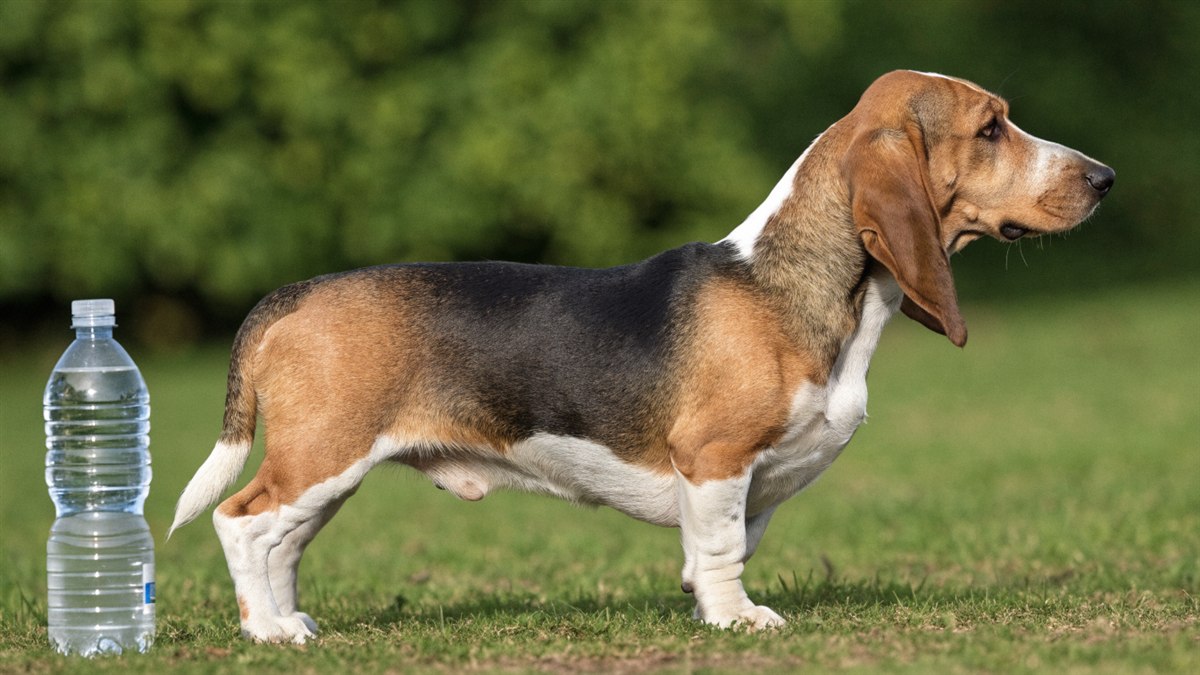
The Basset Artesien Normand is a French scenthound standing 30 to 36 cm and weighing 15 to 20 kg under FCI-Standard 34, recognised on a definitive basis since 1963. It is smaller and lighter than a Basset Hound and its standard disqualifies the bluish mottling that defines the Basset Bleu de Gascogne. No verified Indian price exists, and the breed has never been genotyped for the FGF4 retrogenes behind its short legs.
This page is editorial research, not veterinary advice. No named veterinarian has reviewed it. Every health figure here is cited to its primary source so you can check it, and where no reliable figure exists we say so instead of estimating one. Discuss any diagnosis, screening decision, vaccination schedule or diet change for your own dog with a registered veterinary practitioner who has examined that dog.
Basset Artesien Normand at a glance
What the Basset Artesien Normand actually is
The Basset Artesien Normand is a French small-sized scent hound of FCI Group 6, standing 30 to 36 cm at the withers and weighing 15 to 20 kg, bred to flush rabbit and hare on foot and to give tongue while it works. The FCI has recognised it on a definitive basis since 29 October 1963, so any page telling you it is unrecognised is simply wrong.
Read the standard rather than a summary of it and the breed stops being a vague short-legged hound and becomes a specific animal. FCI-Standard 34, valid from 1 August 2023 in its English translation of 29 August 2023, describes a long dog in relation to its size, well balanced, compact, whose head recalls the nobility of the big Norman hound. The FCI files it in Group 6, scenthounds and related breeds, Section 1.3 for small-sized hounds, with working trial. Its proportions are given as numbers, not adjectives. Height at withers to length of body runs about 5:8, depth of chest to height at withers about 2:3, and length of muzzle to length of skull about 10:10.
The working description explains every one of those numbers. The standard states that the short legs allow the dog to penetrate the most dense vegetation, there where the big dog cannot go, and to flush out the hidden game, and that it tracks and flushes with great determination, driving the game not fast but with perseverance and giving voice. A hunter on foot needs a hound slow enough to follow and loud enough to locate. That is the whole design brief, and it is why this dog is built low and why it is vocal.
The history is a deliberate split between straight legs and crooked legs
The breed exists because two nineteenth-century Frenchmen disagreed about legs. The standard records that controlled breeding of the short haired French Basset began in the 1870s, that Count Le Couteulx of Canteleu fixed a utilitarian type with straight front legs called Artois, and that Mr Louis Lane developed a more spectacular type with crooked front legs called Normand. The name Basset Artesien Normand was adopted only in 1924, and the breed club had been formed in 1910. Wikipedia. Basset Artesien Normand.…
The split was then resolved in favour of the crooked leg, on the record. Leon Verrier took over as club chairman in 1927 at the age of 77 and wanted to strengthen the Norman character of the breed. The 1930 book of standards of hunting dogs quotes the committee of the Societe de Venerie deciding and noting that the Basset Artesien Normand should not be but one stage of transition towards a Norman type, without any trace of Artois. That sentence is the reason the modern standard disqualifies a dog with completely straight forelegs.
The straight-legged parent still exists as a separate breed. The Chien d'Artois is a medium-sized scenthound of Section 1.2, standing 53 to 58 cm and weighing on average 28 to 30 kg, with limbs described as strong and vertical and a dark fawn tricolour coat likened to the coat of the hare or the badger. Its own standard records that the breed nearly vanished after the Second World War and was rebuilt from the beginning of the 1970s. Put the two side by side and the Basset Artesien Normand reads as the Artois hound's colouring set on a body roughly half the height.
Appearance, in the standard's own words
The coat is short and the colour range is narrow. Hair is close, short and smooth without being too fine, and colour is limited to fawn with a black blanket and white, called tricolour, or fawn and white, called bi-colour. In the tricoloured dog the head should be largely covered with tan hair and show a circle of darker hairs on each temple, and the black blanket may be solid black or black with grizzle, reproducing the old characteristic called hare pied or badger pied.
The long ears are the feature people photograph and the feature that causes trouble in India. The standard asks for leathers set as low as possible, never above the line of the eye, narrow at the base, well curled inwards corkscrew fashion, supple, fine, very long, reaching at least the length of the muzzle and preferably ending in a point. A corkscrew-curled leather that long does not ventilate, which matters more in Chennai than in Normandy.
The tail carries an instruction that Indian readers should notice. It is quite long, thick at base, thinning progressively, and at rest its tip must just touch the ground, carried sabre fashion but never falling on the back. The standard then states plainly that it is absolutely forbidden to modify the look of the stern of show dogs. The breed standard and Indian law agree on this point, which is unusual and worth knowing before anyone offers you a docked puppy.
| Item | What the standard says |
|---|---|
| Origin | France |
| Group and section | Group 6 Scenthounds and related breeds, Section 1.3 Small-sized Hounds, with working trial |
| Height at withers | 30 to 36 cm, males and bitches, tolerance plus or minus 1 cm for exceptional subjects |
| Weight | 15 to 20 kg |
| Coat | Close, short and smooth without being too fine |
| Colour | Fawn with black blanket and white (tricolour), or fawn and white (bi-colour) |
| Forelegs | Short, well-boned, half-crooked or a little less than half-crooked, with a sufficient principle of crook visible |
| Ears | Set as low as possible, never above the eye line, curled inwards corkscrew fashion, reaching at least the length of the muzzle |
| Temperament | Excellent nose, melodious voice, outgoing and of very affectionate nature |
| Disqualifying faults | Thirteen listed, including completely straight forelegs, undershot or overshot mouth, and height outside the standard |
Among the thirteen disqualifying faults in FCI-Standard 34 is 'too much black-mottled giving the white a bluish tint'. That bluish mottling is the defining coat of the Basset Bleu de Gascogne. The Basset Artesien Normand standard disqualifies the very colour that makes its neighbour a separate breed, which is the cleanest evidence anywhere that the two are not variants of one dog.
Rarity is part of the description. In France, its home country and the only place with a meaningful population, the Societe Centrale Canine entered 158 puppies in the LOF studbook during 2025, against 79 in 2024. That doubling looks dramatic in percentage terms and remains a tiny number of dogs. In the same table the Basset Hound recorded 703 registrations and the Beagle 3,089. This is a genuinely rare breed even at home, which is the context for everything the rest of this page says about India.
Price in India, and why there isn't one
No verified price in India exists for the Basset Artesien Normand, because no Indian market for the breed exists. We could not find a single rupee figure for this breed on any Indian source we were able to open, including the one page that is titled as a cost-in-India page.
Start with that page, because it is the clearest evidence available. A site called Animal Jankari publishes a page whose H1 reads Basset Artesien Normand Dog Cost In India. Opened and read in full, it carries no rupee figure anywhere in its text. It runs sections on height, weight, life span, temperament, health and feeding, and it links out to tag pages promising the breed for Sale in each Indian state, none of which carry a price or a seller either. A page that is titled after a number and does not contain the number is a template, not a market.
The second piece of evidence is an Indian page that does publish real prices and simply leaves this breed out. Wrap In Fur's Dog Price List in India covers more than fifty breeds with puppy prices and monthly maintenance bands. The Basset Artesien Normand does not appear anywhere on it. An absence from an empty search proves nothing. An absence from a fifty-breed Indian price list that does include the Basset Hound, the Beagle and the Dachshund is a finding.
The third is an Indian pet retailer that built a breed page and could not put anything transactional on it. GoofyTails, which sells pet supplies through Swiggy Instamart, Blinkit, Zepto, Amazon and Big Basket, hosts a Basset Artesien Normand page carrying a size table and general care copy, with no price, no availability statement, no breeder contact and no purchase option. Its table also invents a female height of 28 to 36 cm; FCI-Standard 34 gives one range, 30 to 36 cm, for males and bitches alike.
The overseas figures disagree by four times, so do not average them
Two of the pages ranking for this breed publish puppy prices, and they are not close. Dog Breeds List prints an average of USD 1,200 to 1,500. Petlur prints an average of USD 300 to 500. The top of one range is five times the bottom of the other, for the same breed, in the same currency, on the same search results page. Neither cites a source, neither says which country the figure describes, and neither can be right if the other is.
Petlur's other claims fail a check you can run yourself. It states the breed is Not recognized by FCI. FCI-Standard 34 has been in force since 1 August 2023 and the FCI's own nomenclature records the breed as recognised on a definitive basis since 29 October 1963. Federation Cynologique Internationale.… Petlur also gives a weight of 14 to 18 kg where the standard says 15 to 20 kg, and prints 13 to 15 years in its data box while its body copy says 10 to 12 years. Federation Cynologique Internationale.… A page that contradicts itself within one screen is not a price source.
How to spot a converted price, since you will probably meet one
Divide any rupee figure you are quoted by 84.38 and see whether a round dollar number falls out. Indian breed pages routinely publish a US dollar figure run through one exchange rate and present it as domestic market data, and this site has caught the pattern repeatedly. The arithmetic here is easy to do in advance. USD 300 to 500 becomes roughly Rs 25,300 to Rs 42,200. USD 1,200 to 1,500 becomes roughly Rs 101,300 to Rs 126,600.
| Published overseas figure | Source | Times 84.38 | Status |
|---|---|---|---|
| USD 300 to 500 | Petlur | Rs 25,314 to Rs 42,190 | Conversion, not Indian data |
| USD 1,200 to 1,500 | Dog Breeds List | Rs 101,256 to Rs 126,570 | Conversion, not Indian data |
| No figure published | Animal Jankari, cost-in-India page | Nothing to convert | No Indian price exists |
If someone quotes you a number close to either rupee band, ask which of the two contradictory dollar figures they used. We are not reporting those rupee bands as prices. We are printing them so that you can identify one when it is quoted at you.
There is no lawful route by which a supply chain could form
Indian import law closes the commercial door explicitly. Under ITC (HS) 01061900, mammals other than those separately listed are Restricted, and DGFT Trade Notice 22/2022-23 sets out that import of dogs is allowed only for a pet dog with a valid pet book and records in the name of the importer, for R&D organisations conducting research with the recommendation of CPCSEA, or for internal security by the Defence and Police Force. Policy Condition 8 states that import of commercial dogs for breeding or any other commercial activities other than the purposes mentioned above is not permitted, and paragraph 6 states that any applications for trading or breeding purposes shall be duly rejected.
Entry is also geographically narrow. Import of pet animals is allowed only through the airports and seaports of Delhi, Mumbai, Chennai, Hyderabad, Bengaluru and Kolkata and, since October 2024, Kochi airport, with quarantine where required, and owners are advised to begin the authorisation process at least two months before travel. Directorate General of Foreign Trade A returning resident can lawfully bring their own dog. Nobody can lawfully import one to breed from, which is the step a market would need. The full route is set out in how to import a dog to India.
So the honest answer to the price question has three parts. No Indian price is published. The overseas prices that exist disagree by a factor of four and sit on pages that get checkable facts wrong. No lawful breeding-import route exists to create an Indian supply. If you want a short-legged hound in India, the breed with a real Indian price is the Basset Hound, at Rs 30,000 to Rs 70,000 for a puppy on one published list and around Rs 30,000 to Rs 35,000 on another, rising to Rs 60,000 for a purebred. Dog Breedo. Basset Hound Price in India.…
What it would actually cost to keep one each month
Budget Rs 3,000 to Rs 7,000 a month for a hound of this size in India, then add ear care on top, because that is the figure published for the Basset Hound and no figure has ever been published for the Basset Artesien Normand. We are substituting a related breed's cost band deliberately and saying so, which is different from substituting its health data.
The two Indian sources that publish monthly bands for the Basset Hound do not agree either, and the gap is instructive. Wrap In Fur gives Rs 4,000 to Rs 7,000 a month. Dog Breedo gives Rs 3,000 to Rs 4,000 a month. The overlap is thin and the top of one is nearly double the top of the other, so treat Rs 3,000 as an optimistic floor and Rs 7,000 as a realistic working figure for a 15 to 20 kg dog in a metro.
Why substitute at all, when this page refuses to substitute health data? Because cost of ownership is driven by bodyweight, city and vet rates rather than by breed genetics. A 15 to 20 kg hound eats roughly what another 15 to 20 kg hound eats. Disease risk does not transfer that way, which is why the health section below borrows nothing.
| Source | Puppy price | Monthly maintenance |
|---|---|---|
| Wrap In Fur, Dog Price List in India | Rs 30,000 to Rs 70,000 | Rs 4,000 to Rs 7,000 |
| Dog Breedo, Basset Hound price in India | Around Rs 30,000 to Rs 35,000, up to Rs 60,000 purebred | Rs 3,000 to Rs 4,000 |
| Any source, Basset Artesien Normand | None published | None published |
The line items that are specific to this dog
Four recurring costs are structural rather than optional for a low-slung, long-eared hound.
- Ear cleaning supplies and vet checks. Ears set as low as possible and curled inwards corkscrew fashion need routine attention, not occasional attention. Budget for a veterinary-recommended ear cleaner as a standing monthly item, and expect at least one otitis consultation in a humid year.
- Weight management food. Bodyweight above the breed mean is an established risk factor for heat-related illness, and excess load on a long back is the one variable an owner controls. Measured meals cost no more; the vet visits avoided are the saving.
- Nail trimming. Feet are oval and a little elongated with toes placed firmly on the ground giving maximum support, and a hound that walks on pavement rather than field does not wear nails down evenly.
- Tick and flea prevention. Year-round in most of India rather than seasonal, which is a cost most imported-breed guides written for Europe omit entirely.
One cost that does not appear on any Indian list is the cost of getting the dog at all. Because no lawful breeding import is permitted, the only compliant route to owning this specific breed in India is to bring your own dog in when you relocate, which is a relocation expense rather than a purchase price. That involves DGFT authorisation where the stay abroad was under two years, an advance No Objection Certificate from the Animal Quarantine and Certification Service obtained seven days before travel, and a health certificate from a veterinarian in the exporting country with all test reports accompanying the animal.
The Kennel Club of India is the FCI-affiliated national registry, so FCI-Standard 34 is the applicable standard for this breed in India, and an imported dog is registered through the imported-dog category on its export pedigree and customs paperwork. Registration records parentage. It is not a health certificate and it does not verify that any screening was done.
Suitability for the Indian climate
The Basset Artesien Normand handles Indian heat moderately and Indian humidity badly, and the difference is structural rather than a matter of coat. Its close short smooth coat sheds heat reasonably well, while its very long corkscrew-curled ears and its low ground clearance are the two features that fail here.
Take heat tolerance first, because it is the trait Indian buyers ask about and no global breed site rates. This dog is not brachycephalic and it does not weigh over 50 kg, so it sits outside the two strongest breed-level risk factors identified in the largest primary-care study of canine heat-related illness. That VetCompass study covered 905,543 UK dogs under veterinary care in 2016, identified 395 confirmed heat-related illness events, and put the incidence at 0.04 percent with an event fatality rate of 14.18 percent.
One of its risk factors does apply directly, and it is the one an owner controls. The same analysis found higher bodyweight relative to the breed and sex mean and being over two years of age to be significant risk factors independent of skull shape. An overweight Basset Artesien Normand is therefore at elevated heat risk for a reason that has nothing to do with its face and everything to do with the food bowl.
A UK incidence of 0.04 percent describes UK summers, UK housing and UK veterinary access. It cannot be read across to Nagpur in May. We cite it for its risk factors, which are biological, and not for its incidence, which is climatic. No equivalent Indian heat stroke incidence study for dogs was found.
Ground clearance is the heat problem nobody mentions
A dog built to this standard carries its chest close to the ground by design. FCI-Standard 34 asks for a chest of ovalized section, long, with the brisket sternal line distinctly below the elbows, on legs that are short and half-crooked. On Indian paving in April that puts the whole underside of the dog inside the radiant heat layer rising off the surface, which is exactly the zone a taller dog's body avoids. Walk this breed on grass or unpaved ground where you can, and walk it before sunrise or well after sunset rather than adjusting the route.
Humidity, ears and a Delhi finding worth knowing
Humid coastal air is the harder problem, and it is the ears that carry it. The standard requires leathers set as low as possible, never above the line of the eye, well curled inwards corkscrew fashion, and very long, reaching at least the length of the muzzle. A leather shaped like that lies over the canal and holds warm moist air against it. That is a functional description of the environment in which otitis externa, inflammation of the outer ear canal, starts.
An Indian study gives the risk a sharper edge than a general warning would. Researchers at the University of Delhi, working with an animal care centre in New Delhi, cultured skin and ear swabs from 87 dogs and found evidence of the multidrug-resistant yeast Candida auris in 4 of those 87 dogs with chronic skin infections, three in the ear canal and one on the skin surface. Whole-genome sequencing of six strains from two dogs showed relatedness to Clade I clinical strains. The authors are explicit that transmission routes and clinical significance remain to be investigated, so this is not a claim that your dog will catch it. It is a reason to treat a persistent Indian ear infection as something to culture rather than something to guess at.
City by city, where it actually differs
| City | Dominant stress | What it means in practice |
|---|---|---|
| Chennai, Mumbai, Kochi, Kolkata | Sustained humidity | Ear disease is the year-round management problem. Dry the ears after every wash and every swim, and check them weekly rather than monthly. |
| Delhi, Jaipur, Nagpur, Ahmedabad | Dry extreme heat plus radiant paving | Walk timing and surface choice matter more than coat care. The low chest sits in the hottest air layer. |
| Bengaluru, Pune | Mildest of the major metros | The most workable Indian cities for this breed, with monsoon ear care still required. |
| Guwahati, Siliguri, coastal Kerala | Heavy monsoon plus humidity | Both failure modes at once, and the hardest Indian placement for a dog with these ears. |
None of this makes the breed unkeepable in India. It makes the care routine non-negotiable in a way that a short-coated hound looks like it should not need. The coat will fool you; the ears will not forgive you.
Temperament and who should not get one
The Basset Artesien Normand is outgoing and of very affectionate nature by its own breed standard, and it is also a pack hound with a melodious voice that it was selected to use. Those two sentences describe both why people want one and the single reason most Indian households should not have one.
The standard's temperament clause is short and it is worth quoting in full, because every commercial page paraphrases it into something softer. The dog is gifted with an excellent nose and a melodious voice, persevere but not too fast on the line, permitting his master to fully enjoy the hunting work, and is outgoing and of very affectionate nature. The affection is real and it is listed second, after the nose and the voice.
Timidity is treated as a fault rather than a quirk. FCI-Standard 34 lists timid subjects under behaviour faults, and lists aggressive or overly shy dogs among its thirteen disqualifying faults. A well-bred dog of this breed should approach people readily. A fearful one is not shy for the breed; it is off-standard.
The voice is the deal-breaker in Indian housing
This is a dog engineered to be heard from a distance through dense cover. The standard describes it driving game not fast, but with perseverance and giving voice, and the Basset Hound standard describes the same equipment as a deep melodious voice attached to a pack instinct. A vocal pack hound in a shared-wall flat in Mumbai or a gated tower in Gurugram is a neighbour dispute waiting to be scheduled. Nothing in training removes the voice; management reduces how often it is triggered.
- Suits a ground-floor home or an independent house with a secure garden, an owner at home for much of the day, and a family that wants a calm indoor dog.
- Suits households with children old enough to be taught not to lift the dog under the chest or let it leap off furniture.
- Struggles in a high-rise flat with shared walls, where the voice and the stairs are both problems.
- Struggles with an owner who is out ten hours a day, because a pack-bred hound left alone develops the noise problem you were trying to avoid.
- Struggles as a first dog for someone who wants off-lead park freedom, because the nose overrides recall.
With other animals and with strangers
Pack breeding usually makes a dog that tolerates other dogs well, and the working history sets expectations for small pets honestly. This is a breed whose favourite quarry is the rabbit and which will just as well hunt the hare or the deer. A household with a rabbit, a guinea pig or free-roaming poultry is asking a hunting hound to override several generations of selection. Manage that with separation rather than with optimism.
Strangers are generally not a problem, and that cuts both ways. An outgoing, affectionate hound is a poor guard dog and a good family dog. If you want a deterrent, this is the wrong animal, and the FCI standard tells you so before you buy.
One further point belongs here because it is India-specific. A dog this rare in India will attract attention on every walk, and a friendly hound that lets strangers crowd it is at real risk in traffic-heavy streets when the nose finally commits to something across the road. Fit a well-fitted harness, keep the lead short in public, and treat the dog's own sociability as a hazard to be managed rather than proof of safety.
Training approach, and what this breed genuinely resists
To train a Basset Artesien Normand, train the nose first and accept that off-lead recall will never be fully reliable. This breed does not resist training out of stubbornness; it resists it because scent work outranks your voice in a dog selected for an excellent nose and for perseverance on the line.
Set the expectation correctly and the dog looks cooperative rather than difficult. A hound bred to work at a distance from its handler, giving tongue, was never selected for the tight handler focus a Border Collie was. It was selected for the opposite. Reading ordinary hound independence as defiance is the single most common training error with any Group 6 breed, and it leads owners to escalate corrections against a dog that is not actually refusing.
Five things that work, in order of payoff
- Socialise early and widely. Use the window before sixteen weeks to introduce Indian street sounds, autorickshaws, lifts, tiled floors, monsoon rain and unfamiliar people, because a confident hound is easier to handle than a brave one.
- Feed the training. Food is the currency this breed pays attention to, and a hound that is working for meals is a hound whose weight you are also controlling.
- Train a long-line recall, not a park recall. Use a 10 to 15 metre line for months rather than weeks, and reward the return every single time, without exception.
- Build a scent game on purpose. Hide food, let the dog find it, and put the nose to work on your terms so that it is not only working on its own terms.
- Train a settle on a mat. A calm default indoors is what makes a vocal hound liveable in an Indian flat, and it is trained rather than hoped for.
Realistic timelines
| By | Reasonable expectation |
|---|---|
| 8 to 16 weeks | Name response, toilet routine, handling of ears and feet accepted calmly, crate or bed settled |
| 4 to 6 months | Loose-lead walking on a harness, sit and down reliable indoors, long-line recall started |
| 6 to 12 months | Recall reliable on the long line in low-distraction places, settle on mat holding through doorbells |
| 12 to 24 months | Adult reliability indoors. Off-lead recall in an unfenced Indian public space remains unreliable and should not be attempted |
Two methods to avoid are worth naming. Do not use a bark collar to solve the voice, because the voice is a breed characteristic and suppressing it with discomfort produces a stressed dog rather than a quiet one. Do not train recall by chasing the dog, because a hound that has learned you follow it has learned exactly the wrong lesson.
Ear cropping, tail docking, de-barking and de-clawing are all prohibited in India. The Second Schedule Part II paragraph 6(8) of the Prevention of Cruelty to Animals (Dog Breeding and Marketing) Rules, 2017 states that there shall be no tail docking, ear cropping, de-barking, de-clawing, branding, dyeing or any other kind of mutilation, and that any change of appearance by artificial means is strictly forbidden. De-barking in particular is sometimes suggested for vocal hounds. It is unlawful.
Daily exercise, and what happens without it
Give an adult Basset Artesien Normand 45 to 60 minutes of walking a day, split across two cooler sessions, plus scent work indoors. Short legs do not mean low stamina in a breed whose standard describes it driving game with perseverance, and treating it as a sedentary lapdog produces the weight problem that drives both its heat risk and its spinal risk. Hall EJ, Carter AJ
The design brief argues against the couch. This is a small game hunting dog used for hunting with the gun that hunts as well by itself as in a pack, penetrating dense vegetation where a bigger dog cannot go. A dog built for a day's work in cover needs more than a walk to the gate, and the low centre of gravity that makes it slow does not make it tired.
The counterweight is the back. A long-backed dog in relation to its size, at roughly 5:8 height to length, on short legs, is carrying a longer unsupported span than a square dog of the same weight. That is a mechanical argument for controlling impact even before any genetic argument about discs is made, and the genetic argument for this particular breed has never actually been made, as the health section explains.
What to do, and what to stop
- Do walk twice daily on a harness, early morning and after dark, on grass or unpaved surfaces where you can find them.
- Do use scent games, snuffle mats and find-it exercises indoors, which tire this breed faster than distance does.
- Do allow swimming where clean water is available, then dry the ears thoroughly afterwards.
- Do not allow repeated jumping down from sofas, beds or car boots. Use a ramp or lift the dog with one hand under the chest and one under the hindquarters.
- Do not run this dog alongside a bicycle or on a treadmill, and do not force-march a puppy under twelve months.
- Do not exercise in the middle of an Indian afternoon, whatever the season looks like.
Stairs deserve their own answer
Limit stairs rather than banning them. A dog that climbs a flight twice a day is doing something different from a dog that charges up and down six floors chasing a ball, and the second is the pattern that concentrates repeated flexion and impact on a long spine. In an Indian building with a lift, use the lift. Where the home is on an upper floor without one, carry the dog for the first year while growth plates close, and reassess with your vet after that.
Under-exercise shows up in a specific and predictable order. Weight goes on first, then the voice increases because an under-stimulated pack hound makes its own entertainment, then destructive chewing appears, and only later does the owner notice reluctance to jump or a change in gait that sends them to a vet. Catching the first two saves you from the last one. Weigh the dog monthly on the same scale and write it down, because a 15 to 20 kg dog can gain two kilos before anyone sees it in the mirror.
Grooming and coat care in Indian humidity
Groom the coat in ten minutes a week and give the ears twenty times that attention over a year. The coat of a Basset Artesien Normand is close, short and smooth without being too fine, which makes it the easiest part of the dog; the ears, the cheek folds and the nails are where the real ear care work sits.
Brush weekly with a rubber curry or a bristle brush and the coat looks after itself. There is no undercoat to blow, no feathering to mat, and the standard actively faults hair that is soft, distinctly long or fringed. If a dog sold to you as this breed has a long or wiry coat, you are looking at a different dog or a cross, which is a point the comparison section returns to.
Never shave this breed. A short single coat is already the dog's heat-management system, and removing it exposes skin to Indian ultraviolet without improving cooling. Bathe every four to six weeks, or sooner when the dog has been in a nallah or a monsoon puddle, and use a plain veterinary shampoo rather than anything perfumed.
The ears, which are the whole job
This is where overseas breed-club advice stops transferring. Grooming guidance written in northern Europe or the American Midwest routinely tells owners to towel the dog and let it air dry. In an Indian coastal monsoon, air drying a leather that is set as low as possible, curled inwards corkscrew fashion and long enough to reach the muzzle means leaving a warm wet chamber sealed over the ear canal for hours. Do not follow that instruction here.
- Check both ears weekly, lifting the leather fully and looking at the canal in good light, not just sniffing.
- Clean only when there is visible debris, using a veterinary ear cleaner, and never with a cotton bud pushed into the canal.
- Dry the inside of the leather and the canal opening with cotton wool after every bath, every swim and every soaking walk.
- Lift the ears for ten minutes of airflow daily during the monsoon, which costs nothing and is the single most useful habit for this breed in India.
- Escalate to a vet for cytology or culture when an infection recurs, rather than repeating an over-the-counter drop.
That last point has an Indian evidence base behind it. A Delhi study that cultured ear and skin swabs from 87 dogs recovered the multidrug-resistant yeast Candida auris from four of them, three from the ear canal. Repeatedly treating a resistant organism with the wrong product wastes months. Ask for a swab when a second course fails.
Cheeks, eyes, feet and nails
The standard describes cheeks formed by one or two folds of skin, and it permits the haw of the lower lid to show sometimes without excess while faulting eyes that show too much haw. Wipe the folds dry, and treat a chronically weepy or red lower lid as a veterinary question rather than a breed feature, because ectropion is a named condition rather than a look.
Feet and nails matter more than owners expect on a dog with this build. The standard asks for oval feet, a little elongated, with toes rather close and placed firmly on the ground giving maximum support, and it faults flat feet and splay feet. Overgrown nails change how the foot loads, which on short crooked forelegs changes how the whole front assembly carries weight. Trim every three to four weeks, and take the dog on some abrasive surface walking to help.
Weekly: brush the coat, inspect both ears, check the cheek folds. Fortnightly to monthly: trim nails, brush teeth several times a week throughout. Every four to six weeks: bathe, then dry the ears properly. Daily through the monsoon: lift the ears for airflow. That is the entire routine, and skipping only the last line is what produces most of the ear disease this breed sees in India.
Health, lifespan and the FGF4 question nobody has answered
The most important health fact about the Basset Artesien Normand is that almost nothing has been measured. There is no breed health survey, no lifespan study, no screening scheme and no published FGF4 genotype data for this breed, and the single record in the indexed veterinary literature that names it describes one dog's tumour. National Library of Medicine Every confident health claim you will read about this breed is therefore an inference from other breeds.
Is FGF4 chondrodysplasia fixed, segregating, or untested in this breed?
It is untested. Not fixed, not segregating, untested, and those are three different answers with three different consequences for a buyer. The short legs of this breed have never been genotyped in any published dataset we could find, so nobody can tell you whether every dog carries the retrogene, whether some do, or how many copies. National Library of Medicine
Here is the evidence for that, since an absence has to be earned rather than asserted. The reference dataset on this question is Supplementary Table S1 to Batcher and colleagues' 2019 study of FGF4 retrogenes and intervertebral disc disease, which reports genotype counts and allele frequencies for the 12-FGF4 and 18-FGF4 retrogenes across 3,223 dogs in 74 breed categories. Batcher K et al. Supplementary Table S1… We downloaded that table and read it row by row. The Basset Hound is in it. The Petit Basset Griffon Vendeen is in it. The Basset Artesien Normand is not.
The follow-up study does not fill the gap either. Bannasch and colleagues' 2022 paper on the effects of FGF4 retrogenes on canine morphology worked with 111 Alpine Dachsbracke and 36 Schweizerischer Niederlaufhund dogs, and reports that copy numbers of both retrogenes significantly reduced height at the shoulders and antebrachial length, with the chromosome 18 retrogene having much the greater effect, reducing height by 15.9 to 27.9 percent. That quantifies what the retrogenes do. It says nothing about this breed, which was not among the dogs studied.
The two basset-type breeds that have been genotyped returned opposite profiles, which is precisely why extrapolation fails. Among 32 Basset Hounds, the 12-FGF4 retrogene allele frequency was 0.63 with 3 dogs carrying no copy at all, and the 18-FGF4 frequency was 0.91. Among 10 Petit Bassets Griffons Vendeens, the 12-FGF4 retrogene was completely absent at frequency 0, while the 18-FGF4 retrogene was fixed at 1.00 with all 10 dogs homozygous. Two short-legged bassets, two different genetic routes to short legs. Guessing which one the Basset Artesien Normand resembles is guessing.
| Breed | Dogs genotyped | 12-FGF4 frequency | 18-FGF4 frequency |
|---|---|---|---|
| Basset Hound | 32 | 0.63 | 0.91 |
| Petit Basset Griffon Vendeen | 10 | 0.00 | 1.00 |
| Dachshund (US/UK) | 257 | 0.98 | 0.99 |
| Beagle | 12 | 1.00 | 0.00 |
| Alpine Dachsbracke | 174 | 0.59 | 0.67 |
| Welsh Corgi, Pembroke | 51 | 0.81 | 0.98 |
| All breeds combined | 3,223 | 0.36 | 0.41 |
| Basset Artesien Normand | Not in the dataset | No data | No data |
What we can say is what the breed standard requires, and it is unambiguous about the phenotype while silent about the genotype. FCI-Standard 34 requires forelegs that are half-crooked or a little less than half-crooked, provided there is a sufficient principle of crook visible, and it lists forelegs completely straight among its disqualifying faults. So the shortened, curved forelimb is mandatory in the show ring. The standard nowhere mentions FGF4, chondrodysplasia, disc disease or any screening requirement, and it publishes no life span. A phenotype is fixed by the rules of the ring; the genotype behind it has simply never been counted.
What that means for back problems, honestly bounded
Chondrodystrophic breeds carry a real and well-documented risk of intervertebral disc disease, and this breed is built like them. In a retrospective review across three neurology departments, 68 of 188 Basset Hounds presenting to those departments had confirmed thoracolumbar intervertebral disc extrusion, which is 36.2 percent, and Dachshunds were affected significantly more often still. Basset Hounds presented older, at a median of 87.5 months against 66.5 months for Dachshunds, were more often affected in the midlumbar region between L2 and L5, and were more frequently ambulatory at discharge, with only one Basset Hound presenting paraplegic without nociception against sixteen Dachshunds.
The same abstract reports a Dachshund incidence of 77.4 percent, which does not divide out of its own stated denominators: 154 confirmed cases among 270 Dachshunds is 57.0 percent, not 77.4 percent. The Basset Hound figure does reconcile exactly, at 68 of 188 or 36.2 percent, so we have quoted that one and described the Dachshund comparison only in the direction the authors report as statistically significant. Where arithmetic fails we drop the figure rather than repeat it.
Genotype is not destiny even in the breeds that have been tested, which is worth knowing before anyone sells you a DNA test as an answer. A Finnish study imaged all 546 intervertebral discs of 21 asymptomatic young adult Dachshunds aged 24 to 31 months and found only 2 percent of discs, 11 in total, graded normal on MRI. Retrogene status correlated with calcified discs visible on radiographs, and the authors concluded plainly that the 12-FGF4 retrogene variant did not alone explain the phenotypic variation in disc degeneration. Weight, exercise pattern and luck all sit alongside the gene.
What the indexed literature actually contains on this breed
One paper. A 1990 cytogenetics case report from the Veterinary University of Vienna describes a 9-year-old female Basset Artesian Normand with a mammary adenocarcinoma, in which tumour cells showed a chromosome number of 76 in 95 percent of metaphases along with several structural abnormalities. That is a karyotype from one dog's tumour. It is not breed health data, it does not describe prevalence, and it should not be presented as either.
We are reporting that scarcity as a finding rather than as a failed search. Control queries run in the same PubMed session on the same day returned 134 records for Basset Hound, 87 for intervertebral disc disease dog breed and 17 for FGF4 retrogene dog, so the search tool was working. A title and abstract search on the breed name returned exactly one genuine record, the 1990 case report; the only other hit was a French urology guideline that matched because two of its authors are named Basset and Le Normand.
Life span: four different answers, none of them sourced
No lifespan study exists for this breed, and the commercial pages do not agree on what to print instead. Wisdom Panel gives 13 to 15 years. Dogster gives 12 to 15 years. Dog Breeds List gives 13 to 15 years. Royal Canin India gives 12 to 15 years while attributing its key facts to the FCI, though FCI-Standard 34 contains no lifespan figure at all. Federation Cynologique Internationale.… Petlur prints 13 to 15 years in its data box and 10 to 12 years in its own body copy. Wikipedia gives no lifespan at all. Not one of them cites a study, and this page will not add a seventh guess.
The health issues you can actually act on
Indian law gives you a concrete screening list, which is more useful than a generic breed-risk paragraph. The Prevention of Cruelty to Animals (Dog Breeding and Marketing) Rules, 2017, at Second Schedule Part III paragraph 8(10), requires that dogs used in a registered breeding establishment shall have been tested for genetic defects, including hip dysplasia, progressive retinal atrophy, night blindness, hypothyroidism, entropion, ectropion, overshot, undershot jaw (when incisors do not touch or mesh), wry mouth, two or more missing teeth, unilateral cryptorchid or full cryptorchid males. Two of those map directly onto this breed's own standard: entropion and ectropion speak to the haw that FCI 34 tolerates only without excess, and overshot or undershot mouth is a disqualifying fault in the standard itself. Animal Welfare Board of India. Prevention… Ask any seller to screen for that list and to show you the results.
Beyond that list, manage the three things that are structural rather than genetic. Keep the dog lean, because weight loads a long back and raises heat risk. Keep the ears dry and inspected. Restrict repetitive jumping and stair-charging on a dog built at roughly 5:8 height to length. None of that requires knowing the FGF4 status, which is fortunate, because nobody does.
Feeding, body condition and what is available in India
Feed a Basset Artesien Normand to a body condition score of 4 or 5 out of 9 and weigh it monthly, because on this breed weight is not a cosmetic issue. A 15 to 20 kg dog carrying an extra two kilos is loading a long unsupported back and sitting in the one heat-illness risk category that applies to it. Hall EJ, Carter AJ
Body condition beats the bag's chart every time. Run both hands along the ribs; you should feel them easily under a thin covering, without pressing. Look down from above for a visible waist behind the ribs, and from the side for an abdominal tuck. The FCI standard itself describes a loin slightly tucked up and full flanks, so a dog whose underline runs straight from chest to hindquarters has gained weight rather than developed breed type.
The heat argument is the one most Indian owners have not heard. The VetCompass analysis of 905,543 UK dogs found higher bodyweight relative to the breed and sex mean to be a significant risk factor for heat-related illness independent of skull shape. For a non-brachycephalic dog under 50 kg, weight is effectively the risk factor an owner can move. In an Indian summer that matters more than it does in the climate where the data was collected.
Life-stage feeding
| Stage | Meals per day | What to prioritise |
|---|---|---|
| 8 weeks to 4 months | 4, reducing to 3 | A complete puppy food fed to a lean condition. Do not over-supplement calcium, which does not build better joints |
| 4 to 12 months | 3, reducing to 2 | Steady growth rather than fast growth. Weigh fortnightly and adjust |
| 12 months to 7 years | 2 | Maintenance at body condition 4 to 5 of 9. Treats capped at about a tenth of daily calories |
| 7 years and older | 2 | Watch for weight gain as activity drops, and reassess portions every few months |
Split the ration into two meals for an adult rather than one large bowl. A deep-chested dog of ovalized chest section is better served by smaller volumes, and two meals also give you two daily opportunities to train, which is the currency this breed works for.
What you can actually buy in India
Complete dry and wet diets for a medium adult dog are widely available across Indian metros through veterinary clinics, pet retail chains and quick-commerce platforms, and one of the Indian pages that carries a Basset Artesien Normand article is itself a pet-supply retailer distributing through Swiggy Instamart, Blinkit, Zepto, Amazon and Big Basket. Availability of food is not the constraint for this breed in India. Availability of the dog is.
Three practical Indian notes are worth adding. Store dry food in a sealed container rather than a rolled-open bag, because ambient humidity in coastal cities degrades kibble fast. Provide constant fresh water and change it at least twice daily in summer. Discuss any raw or home-prepared diet with a veterinarian before starting, since an unbalanced home diet is one of the more common causes of preventable deficiency in Indian pet dogs, and this page makes no recommendation on that question.
If a treat represents a tenth of daily calories, then a dog fed four training treats an hour through a one-hour session has spent a substantial part of its day's food on training. Use part of the measured meal as the training reward instead. The dog does not know the difference and the scale does.
The first year, month by month
Plan the first year around three things in order, which are legal age at purchase, the socialisation window that closes near sixteen weeks, and protecting a long back while growth plates are still open. Indian law fixes the first of those: Rule 8(1)(a) of the Dog Breeding and Marketing Rules, 2017 requires every breeder to ensure that pups less than eight weeks in age are not sold.
Two further legal points bear on the first year and are frequently misquoted. The same Rule 8 requires that dogs over six months of age are not sold without first being sterilised, unless the sale is to another licensed breeder. And on vaccination, the Second Schedule states that all pups shall be vaccinated, which can start at the age of seven to eight weeks and is usually completed at the age of eighteen weeks. Your own veterinarian sets the actual schedule for your dog.
| Age | What matters most | What to avoid |
|---|---|---|
| 8 to 10 weeks | Legal earliest purchase age. Settle in, start toilet routine, begin handling ears and feet daily | Buying younger, whatever the seller says. Stairs. Long outings |
| 10 to 16 weeks | The socialisation window. Introduce lifts, tiled floors, autorickshaw noise, rain, strangers, other vaccinated dogs. Vaccination course continues | Isolation until the course finishes, which wastes the window. Forced experiences that frighten the pup |
| 4 to 6 months | Loose-lead walking on a harness. Long-line recall begins. Teething, so provide safe chews | Collar-only walking, which loads the neck on a lead-pulling hound. Jumping off furniture |
| 6 to 9 months | Adolescence, when recall gets worse before it gets better. Keep sessions short and rewarding | Escalating corrections because the dog seems to have forgotten training. It has not |
| 9 to 12 months | Build stamina gradually. Establish the monthly weigh-in habit. Confirm neutering plans with a vet | Repetitive high-impact exercise. Free running on unfenced Indian streets |
| 12 months and beyond | Adult maintenance. Reassess stairs with your vet once growth is complete | Assuming an adult body means an adult brain. Give it another year |
The habits worth building in the first sixteen weeks
Four routines are far easier to establish before four months than after.
- Ear handling. Lift, look inside and touch both leathers daily, paired with food, so that a lifetime of ear inspections is boring rather than a fight.
- Foot handling. Hold each paw and touch the nails daily, long before the first trim.
- Crate or bed settling. A calm default place, which is what makes a vocal hound tolerable in an Indian flat.
- Weighing. Put the pup on the same scale every fortnight and record it, so that adult weight creep is visible when it starts.
Growth plate protection is the one you cannot retrofit. Until roughly twelve months, avoid repeated jumping down from height, avoid forced distance walking and avoid stairs where a lift exists. The relevant geometry is in the standard: a body about 8 units long to 5 units of height, on short legs. The longer the span and the shorter the support, the more a jump costs.
Expect the adult coat and colour to settle over the first year. The standard's tricolour asks for the head largely covered with tan hair with a circle of darker hairs on each temple, and for the black blanket to be solid black or black with grizzle. A pup's markings shift as it grows, so a puppy that looks lightly marked at ten weeks may carry a full blanket at ten months.
Basset Artesien Normand vs Basset Bleu de Gascogne vs Basset Hound
Tell the three apart by colour first, then by height, then by legs. The Basset Artesien Normand is fawn-and-white or tricolour at 30 to 36 cm, the Basset Bleu de Gascogne is slate-blue mottled at 34 to 38 cm, and the Basset Hound is British, taller at 33 to 38 cm and far heavier in bone. Federation Cynologique Internationale.… Federation Cynologique Internationale.… Each of those comes from the breed's own FCI standard, read in full rather than summarised.
The decisive test is a colour that one standard requires and another disqualifies. FCI-Standard 35 defines the Basset Bleu de Gascogne coat as entirely mottled (black and white) giving a slate blue effect, marked or not with more or less extended black patches, and disqualifies any other coat. FCI-Standard 34 lists among the Basset Artesien Normand's disqualifying faults too much black-mottled giving the white a bluish tint. The exact coat that makes one dog correct makes the other dog ineligible. If the white looks blue, you are not looking at a Basset Artesien Normand.
The second test is the legs, and it also runs in opposite directions. FCI 34 requires forelegs half-crooked or a little less than half-crooked, provided there is a sufficient principle of crook visible, and disqualifies forelegs completely straight. FCI 35 says the Basset Bleu's forelegs are strong, with slight torsion may be tolerated up to semi-torsion, and disqualifies frontlegs with more than semi-torsion. So the Artesien Normand must show a crook, while the Bleu de Gascogne merely tolerates one up to a ceiling. The Basset Hound sits differently again: its upper forearm is inclined slightly inwards, but not to such an extent as to prevent free action, and knuckling over is highly undesirable.
| Basset Artesien Normand (FCI 34) | Basset Bleu de Gascogne (FCI 35) | Basset Hound (FCI 163) | |
|---|---|---|---|
| Origin | France | France | Great Britain |
| Height at withers | 30 to 36 cm, tolerance 1 cm | 34 to 38 cm | 33 to 38 cm |
| Weight in the standard | 15 to 20 kg | Not stated | Not stated |
| Coat colour | Fawn with black blanket and white, or fawn and white | Entirely mottled black and white giving a slate blue effect, with tan markings above the eyes | Generally tricolour or lemon and white, but any recognised hound colour |
| Forelegs | Half-crooked or slightly less; completely straight is a disqualification | Slight torsion tolerated up to semi-torsion; more than semi-torsion is a disqualification | Upper forearm inclined slightly inwards; knuckling over highly undesirable |
| Ears | Set as low as possible, never above the eyeline, corkscrew-curled, reaching at least the muzzle length | Fine, curled in, ending in a point, must go beyond the extremity of the nose | Set on low just below the eyeline, reaching only slightly beyond the end of the muzzle, not excessively |
| Eyes | Oval, large, dark; haw may show sometimes without excess | Oval, seem deep set, brown, gentle and a little sad expression | Lozenge-shaped, neither prominent nor deep-set |
| Disqualifying faults listed | Thirteen, including a bluish tint to the white | Eleven, including more than semi-torsion of the front legs | Two, aggression or shyness and physical or behavioural abnormality |
| FGF4 retrogene data | None published; breed absent from Batcher Table S1 | None published; breed absent from Batcher Table S1 | Published: 12-FGF4 frequency 0.63 and 18-FGF4 frequency 0.91 in 32 dogs |
| French registrations 2025 | 158 | 176 | 703 |
Three quick field tests, in the order they settle the question
- Look at the white. Blue or slate mottling means Basset Bleu de Gascogne. Clean white with fawn and black means Basset Artesien Normand.
- Look at the bone and the head. Heavy bone, deep flews, pronounced dewlap and considerable substance mean Basset Hound, which its standard describes as a short-legged hound of considerable substance. The French breed is lighter throughout.
- Measure at the withers. Under 33 cm effectively rules out the Basset Hound, whose range starts there, and a Basset Artesien Normand outside 30 to 36 cm plus tolerance is disqualified by its own standard. Federation Cynologique Internationale.…
Why the confusion exists at all
The three are genuinely related, which is why the distinctions have to be made on documents rather than on impressions. The Basset Hound's own FCI standard records that the Basset was reputedly bred by monks in France in the Middle Ages and that though closely related to the entire family of French Bassets, the breed was developed to perfection in Britain. English breeders then built a more substantial dog, initially crossing with Bloodhounds, while the French bassets stayed lighter-boned and more focused on hunting ability. That is one ancestral population and three destinations.
The registration numbers explain which one you are most likely to actually meet. In the 2025 French studbook the Basset Hound recorded 703 entries, the Basset Bleu de Gascogne 176 and the Basset Artesien Normand 158. In India, only the Basset Hound appears on published price lists at all. A dog offered to an Indian buyer as a Basset Artesien Normand is, on the base rates alone, far more likely to be a Basset Hound, a cross, or a mislabelled listing.
The Chien d'Artois is the straight-legged ancestor rather than a fourth basset. It stands 53 to 58 cm and weighs 28 to 30 kg, sits in Section 1.2 for medium-sized scenthounds, and has limbs described as strong and vertical. It is nearly twice the height of a Basset Artesien Normand. If a seller uses the two names interchangeably, that alone tells you what the listing is worth.
Mistakes Indian buyers and owners actually make
The most expensive mistake with this breed in India happens before the dog arrives, which is paying a rare-breed premium for a dog that is not this breed. Every other mistake on this list is recoverable; that one is not.
1. Believing the listing before checking the coat
A dog offered in India as a Basset Artesien Normand is far more likely to be a Basset Hound, a Basset Hound cross or a mislabelled short-legged dog, simply because those exist here and this breed effectively does not. Check the white for any bluish or slate mottling, which is a disqualifying fault in FCI 34 and the defining colour of the Basset Bleu de Gascogne, and check the bone, because the French breed is markedly lighter than the British one. Federation Cynologique Internationale.… Federation Cynologique Internationale.…
2. Treating a converted dollar price as an Indian price
Divide any rupee figure you are quoted by 84.38 and see whether a round dollar number appears. The two published overseas prices for this breed disagree by roughly four times, at USD 300 to 500 on one ranking page and USD 1,200 to 1,500 on another, so a quoted rupee figure derived from either is doubly unreliable. No genuine Indian price for this breed is published anywhere we could find.
3. Copying overseas grooming advice about air drying
Care guidance written for northern Europe or North America tells owners to towel the dog and let it air dry. Applied to leathers that are set as low as possible, curled inwards corkscrew fashion and long enough to reach the muzzle, in Chennai in August, that instruction leaves a sealed warm wet chamber over the ear canal. Dry inside the leather and the canal opening deliberately, every time.
4. Repeating an over-the-counter ear drop instead of culturing
A Delhi study recovered the multidrug-resistant yeast Candida auris from the ear canals of three dogs in a sample of 87 with chronic skin infection. Where a second course of treatment fails, ask your veterinarian for cytology or culture rather than buying a third bottle. Guessing at a resistant organism costs months and the dog's comfort.
5. Reading short legs as low energy
This is a hunting dog whose standard describes it driving game with perseverance through the densest cover. Owners who treat it as a sedentary breed produce the overweight dog that is simultaneously at greater risk of heat-related illness, which the VetCompass data ties to bodyweight above the breed mean, and under more mechanical load on a long back.
6. Assuming its FGF4 status from a related breed
Nobody knows this breed's FGF4 retrogene status, because it has never been genotyped. The two bassets that have been tested came back opposite, with the Petit Basset Griffon Vendeen fixed for the 18-FGF4 retrogene and carrying none of the 12-FGF4 retrogene, while the Basset Hound carries both and is fixed for neither. Anyone selling you a confident statement about this breed's disc genetics is selling you an inference.
7. Accepting an unlawful puppy or an unlawful procedure
Three provisions get broken routinely in Indian puppy sales and each is checkable. Pups less than eight weeks in age must not be sold, under Rule 8(1)(a). Tail docking, ear cropping, de-barking and de-clawing are strictly forbidden under Second Schedule Part II paragraph 6(8). And father-to-daughter, brother-to-sister and cousin-to-cousin matings within four generations are prohibited under the breeding-technique rules, which permit only out breeding and line breeding.
Overseas clubs for numerically tiny breeds sometimes recommend close matings to manage a narrow gene pool. In India that advice is unlawful. The 2017 Rules define prohibited in breeding to include relatives of the second to fourth grade in straight or side line within the first four generations, naming uncle to niece, nephew to aunt, cousin to cousin and grandparents to grandchildren, and prohibit incest breeding between parents and children or brother and sister. Do not transfer a foreign club's population-management advice to an Indian breeding programme without checking it against these Rules.
8. Letting the dog jump because it is small
A 15 to 20 kg dog is easy to let up onto furniture and easy to let leap off it. On a body roughly 8 units long to 5 units of height, that repeated impact is the avoidable part of a long back's workload. Use a ramp, or lift with one hand under the chest and one under the hindquarters.
Adoption and responsible sourcing
Adopt rather than import, because the realistic Indian options are a basset-type or hound-cross dog in a shelter, not a pedigree Basset Artesien Normand. No Indian rescue we could identify lists this breed, which follows from there being almost no such dogs in the country to surrender. Animal Jankari. Basset Artesien Normand Dog…
Start with what adoption realistically offers. Indian shelters and rescue networks in Mumbai, Delhi, Bengaluru, Chennai, Pune and Hyderabad routinely rehome Indian pariah dogs, hound crosses and occasionally surrendered pedigree dogs including Basset Hounds and Beagles. A short-legged, long-eared, scent-driven dog with much the same care needs is a genuinely achievable adoption in India. A registered Basset Artesien Normand is not.
The care profile transfers even when the pedigree does not. Any long-eared hound cross in an Indian city needs the same weekly ear inspection, the same monsoon drying routine, the same weight discipline and the same acceptance that the nose outranks recall. If those are the things that drew you to this breed, an adopted hound delivers all of them.
If you are determined to source the breed itself
There is exactly one lawful route and it is not a purchase. DGFT Trade Notice 22/2022-23 permits import of a pet dog with a valid pet book and relevant records in the name of the importer, and separately permits import only by R&D organisations with CPCSEA recommendation or for internal security by the Defence and Police Force. Applications made for trading or breeding purposes, or on behalf of another person, shall be duly rejected. So a person relocating to India can bring their own dog. Nobody can lawfully import one to sell you.
The practical constraints on that route are worth stating plainly. Entry is permitted only through Delhi, Mumbai, Chennai, Hyderabad, Bengaluru, Kolkata or, since October 2024, Kochi, with quarantine at the port where required. Directorate General of Foreign Trade Transfer-of-residence relief for up to two pets applies only to a person who has stayed abroad continuously for more than two years, and otherwise a DGFT authorisation is required. An advance No Objection Certificate from the quarantine officer must be obtained seven days before travel, relaxable to three days, alongside a health certificate from a veterinarian in the exporting country with all test reports accompanying the animal. Begin at least two months ahead.
How to verify any seller, for any breed
- Verify the breeder is registered with the State Animal Welfare Board, which the 2017 Rules require of anyone breeding or housing dogs for breeding.
- Check the pup's age against the eight-week minimum in Rule 8(1)(a), and walk away from any seller offering younger.
- Ask to see the genetic-defect testing the Rules require, which names hip dysplasia, progressive retinal atrophy, night blindness, hypothyroidism, entropion, ectropion, jaw defects and cryptorchidism.
- Meet the dam with the litter, on the premises where they are kept, and refuse a handover in a car park or a courier arrangement.
- Reject any docked, cropped or de-barked animal, all of which are prohibited under Second Schedule Part II paragraph 6(8).
- Register an imported dog honestly with the Kennel Club of India on its export pedigree and customs paperwork, remembering that a registration records parentage rather than health.
A pedigree confirms recorded parentage. It does not confirm that a hip was scored, an eye examined or a thyroid tested, and for this breed it certainly does not confirm any FGF4 retrogene status, because no such test result has ever been published for the breed. Ask for the test reports themselves, in the dog's name, with dates.
One closing point on ethics, since this is a breed with 158 puppies registered in its home country in a year. Creating Indian demand for a population that small, in a country where no lawful breeding import exists, pushes buyers toward exactly the mislabelled and unlawful supply this page has spent several sections describing. The honest recommendation is to adopt a hound who needs a home, and to enjoy this breed as something to read about rather than something to order.
Basset Artesien Normand questions Indian readers ask
Is the Basset Artesien Normand recognised by the FCI?
Yes. The Federation Cynologique Internationale recognises it on a definitive basis since 29 October 1963, as Standard 34 in Group 6, Section 1.3, small-sized hounds with working trial. One page ranking for this breed states it is not FCI recognised, which is simply wrong.
What is the difference between a Basset Hound and a Basset Artesien Normand?
Origin, bone and ear length separate them. The Basset Artesien Normand is French, 30 to 36 cm and 15 to 20 kg, with corkscrew-curled ears reaching at least the muzzle length. The Basset Hound is British, 33 to 38 cm, of considerable substance, with heavier bone, deeper flews and a pronounced dewlap.
How much does a Basset Artesien Normand cost in India?
No Indian price exists. An Indian page titled Basset Artesien Normand Dog Cost In India carries no rupee figure anywhere in its text, and the breed is absent from Indian price lists that do cover the Basset Hound, Beagle and Dachshund.
Is the Basset Artesien Normand a rare breed?
Yes, rare even at home. France entered 158 puppies in the LOF studbook during 2025, against 703 Basset Hounds and 3,089 Beagles in the same table. France is the breed's country of origin and the only place with a meaningful population.
How long do Basset Artesien Normands live?
Nobody has measured it. No lifespan study exists for this breed, and the commercial pages print four different unsourced answers, ranging from 10 to 12 years up to 13 to 15 years. One page contradicts itself within a single screen. This guide adds no further guess.
Are Basset Artesien Normands good family dogs?
Yes, and the standard says so directly. FCI-Standard 34 describes the breed as outgoing and of very affectionate nature, and lists timid subjects as a fault and overly shy dogs as a disqualification. A fearful dog of this breed is off-standard rather than typical.
Do Basset Artesien Normands have back problems?
The risk is real but has never been measured in this breed. In a review across three neurology departments, 68 of 188 Basset Hounds had confirmed thoracolumbar disc extrusion, which is 36.2 percent. No equivalent figure exists for the Basset Artesien Normand.
Can you buy a Basset Artesien Normand in India?
No lawful purchase route exists. Under DGFT Trade Notice 22/2022-23, import of commercial dogs for breeding is not permitted and applications for trading or breeding shall be duly rejected. A person relocating to India may bring their own dog. Nobody may lawfully import one to sell.
Is FGF4 chondrodysplasia fixed in the Basset Artesien Normand?
It is untested, which is a different answer from fixed or segregating. The breed does not appear among the 3,223 dogs and 74 breed categories of Batcher's Supplementary Table S1. The Basset Hound and the Petit Basset Griffon Vendeen are in that table. This breed is not.
Can you assume its FGF4 status from the Basset Hound?
No, because the two bassets that have been genotyped came back opposite. Among 10 Petit Bassets Griffons Vendeens the 12-FGF4 retrogene was completely absent at frequency 0.00 while 18-FGF4 was fixed at 1.00. Among 32 Basset Hounds the figures were 0.63 and 0.91.
How well does the Basset Artesien Normand tolerate Indian heat?
Poorly, rated 2 of 5 for Indian conditions. The breed avoids the two strongest risk factors in the largest heat-illness study, since it is neither brachycephalic nor over 50 kg. Its chest sits distinctly below the elbows, putting the whole underside in the radiant heat layer off Indian paving.
How often should the ears be checked in India?
Weekly, lifting the leather fully and looking at the canal in good light. Dry inside the leather after every bath, swim and soaking walk, and lift the ears for ten minutes of airflow daily through the monsoon. Overseas advice to towel the dog and let it air dry does not transfer to an Indian coastal climate.
Why culture a recurring ear infection instead of repeating a drop?
Because resistant organisms are present in Indian dogs. A University of Delhi study cultured swabs from 87 dogs with chronic skin infections and recovered the multidrug-resistant yeast Candida auris from four of them, three from the ear canal. Ask for cytology or culture when a second course fails.
Is tail docking or ear cropping allowed for this breed in India?
No. Second Schedule Part II paragraph 6(8) of the Prevention of Cruelty to Animals (Dog Breeding and Marketing) Rules, 2017 prohibits tail docking, ear cropping, de-barking and de-clawing. FCI-Standard 34 independently states that modifying the look of the stern of show dogs is absolutely forbidden.
How do you tell it apart from a Basset Bleu de Gascogne?
Look at the white. FCI-Standard 35 requires the Basset Bleu's coat to be entirely mottled black and white giving a slate blue effect. FCI-Standard 34 lists too much black-mottling giving the white a bluish tint among the Basset Artesien Normand's disqualifying faults. If the white looks blue, it is not this breed.
Compare with similar breeds
Basset Artesien Normand sits in 1 Bonbeno group. Each one compares it directly against the breeds it is genuinely an alternative to, on the same figures.