
Breed profile
Norman Hound: the extinct French hound the sources disagree about
A large French running hound that died out before France had a studbook, tested against Bonbeno's two-condition rule in its own period rather than in ours.
Quick answer
The Norman Hound is an extinct French scent hound, large and slow, standing 26 to 30 inches, and it cannot be bought at any price in India or anywhere else. It was crossed into Louis XIV's royal white pack around 1700 to slow that pack down. On Bonbeno's two-condition test it was not a breed, because no written standard and no studbook existed for it in its own lifetime. Its extinction date is disputed between published sources.
This page is general information for Indian pet owners and is not veterinary advice. It cannot diagnose or treat any animal and it does not replace an examination. Consult a registered veterinarian near you before acting on anything here, particularly on heat management, parasite control and vaccination timing for your own dog.
Norman Hound at a glance
Norman Hound overview: what the primary documents actually record
The Norman Hound was a large, slow French scent hound standing 26 to 30 inches, prized for a fine powerful voice and for holding a cold scent, and it is extinct. Almost everything else about it is disputed between published sources, and this page prints the disagreements rather than picking one.
Start with what one document says, because the whole English-language account of this dog rests on a 2,963-byte Wikipedia stub with three book references and no online source at all. That stub gives the height as 26 to 30 inches, the colour as a broad range including white, tri-colour and black, and the breed status as extinct. It leaves weight, lifespan and litter size blank. It says the animal was developed from St Hubert Hounds and local hounds from Normandy, that the Normans brought it to England in the 11th century, that both the Bloodhound and the Talbot descended from it, that it took a pack six to eight hours to hunt a stag, that the dogs were unintelligent and lacked initiative, and that by 1875 they were declared extinct.
Bonbeno opened the first of those three references. Sir Walter Gilbey's *Hounds in Old Days* of 1913 is on the Internet Archive as full text, and it was downloaded and searched character by character rather than skimmed. The word Norman appears 13 times in the whole book and Normandy 9 times. What Gilbey actually writes about this dog is short, and it does not match the summary built on it.
Gilbey's own words, from the page the stub cites
Appendix A of Gilbey, *The White Hound of France*, is where the description lives. Gilbey writes that little is known of this Normandy hound; that the Count de Canteleu thinks it was descended from a series of crosses between the St Huberts and other breeds, basing his belief to some extent upon its tricolour coat, black, red (tan) and white; and that it was a large hound, standing between 26 and 30 inches, with a fine powerful voice, a staunch and close hunter, admirable for retrieving a cold scent, but that its chief recommendation as a cross with the White Hounds of Louis XIV lay in the fact that it was slow.
Two things follow immediately. The height in every modern source traces to that one sentence, reported second-hand by Gilbey from Canteleu. And the colour claim in the stub is wider than anything Gilbey gives this dog: he records exactly one colour for it, tricolour. The pure-white-to-pure-black range that the stub prints appears nowhere in Gilbey for the Normandy hound. It does appear in Gilbey, a page or two earlier, as the coat colour range of the King's White Hound, the dog the Normandy hound was crossed *into*, which Gilbey describes as white only in name, with some white, some white spotted with red, some marked with black or dun, some all black.
The stub attributes the broad colour range to Gilbey, Morris and Alderton together. Bonbeno could read Gilbey and could not open Morris 2001 or Alderton 2000, which are print books. So the honest statement is this: the range is absent from Gilbey for this dog, the identical range is present in Gilbey for the neighbouring breed on the same appendix pages, and whether Morris or Alderton independently print it is unknown to us. We do not claim a conflation. We report what we could check.
The passage nobody quotes, on page 84
The decisive sentence sits in Gilbey's main text rather than in the appendix, and no ranking page quotes it. Gilbey writes that the Normandy hound is not noticed by Turbervile; that it does not seem to have been held of much account by the old French hound authorities; and that it is first mentioned as the breed which was crossed with Louis XIV's white hounds to make them slower, towards the end of that king's reign of 1643 to 1715.
Read that against the stub's claim that the Normans brought this breed to England in the 11th century. Gilbey, in the same book, writes that the Norman conquerors of England brought their hounds with them and that there is evidence the breed known as St Huberts or Talbots were the foundation stock of what became the southern hounds. He names St Huberts and Talbots for 1066, and dates the Normandy hound's first appearance to roughly 1700, six hundred years later.
| Source | What it says about the Norman Hound's origin | Date it implies |
|---|---|---|
| English Wikipedia, citing Morris 2001 | Brought to England by the Normans; the Bloodhound and Talbot descended from it | 11th century |
| Gilbey 1913, page 84 | Not noticed by Turbervile, of little account to old French authorities, first mentioned as the cross that slowed Louis XIV's pack | About 1700 |
| FCI Standard 84, Chien de Saint Hubert | William the Conqueror imported Saint Huberts; all-white Talbots came at the same time; these were the basic root stock | 11th century, but a different dog |
| Buchanan-Jardine, reported by David Hancock | The Norman Hound acquired the name Talbot Hound in England, so the two are one animal | 11th century, identity not descent |
| Leighton 1907, page 486 | Appears to have been introduced in the time of Louis XIV | 1643 to 1715 |
Three of those five accounts were read from the document itself in the same week Colonel David Hancock MBE Robert Leighton, The New Book of the Dog. They cannot all be right. The Talbot cannot simultaneously be this dog's descendant, this dog's co-import and this dog under another name.
Appearance and the extinction date: 1875 against a 1907 description
The Norman Hound's stated extinction date of 1875 is contradicted by a major British reference work of 1907 that describes the dog in the present tense and supplies the one measurement every other source lacks. Both are published, both are checkable, and this page prints both.
Robert Leighton's *The New Book of the Dog* of 1907 runs to just over two million characters and is on the Internet Archive as full text. Bonbeno downloaded it and searched it locally on 3 September 2026. Its index carries the line *Norman Hound, 486*. Page 485 lists the Chien Normand among the more important varieties and strains of hounds in France, beside the Chien courant de Vendee, the Chien du Poitou, the Chien de Franche-Comte and those of Artois, Saintonge and Gascogne, and states that the most massive is the Norman hound, with an average height of 29 inches.
Page 486 then gives the fullest physical account of this dog that exists anywhere, and it is written about a living animal.
Leighton 1907 on the Norman Hound's appearance
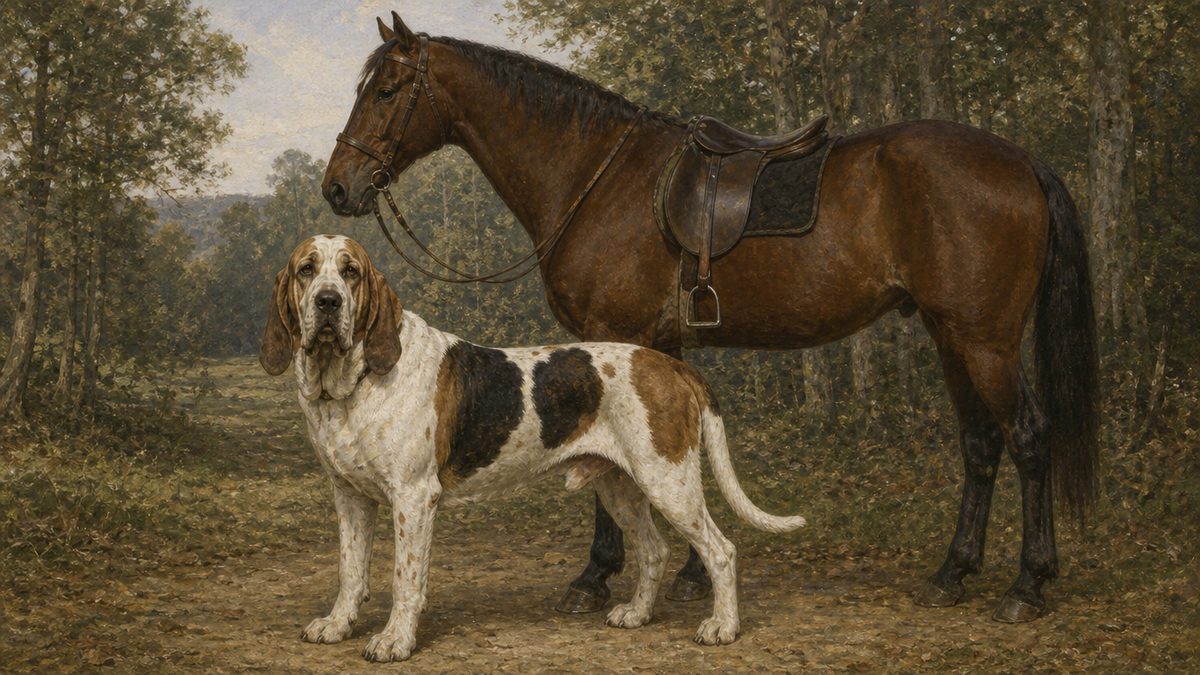
Leighton writes that the Norman Hound, which appears to have been introduced in the time of Louis XIV, is adapted for the pursuit of all kinds of larger game in the French forests. He calls it a heavy, strong dog, somewhat coarse in bone, in shape approaching the Bloodhound rather than the Foxhound. The head is long, the skull broad, the forehead divided by two large frontal bumps. The skin of the head is very loose and wrinkled. The muzzle is coarse, the lips thick and pendulous. The eyes are full and gay and show a good deal of haw. The ears are set on low and are long, thin and velvety, folding inwards. The body is long and heavy, broad and muscular, the neck short in proportion and heavily dewlapped.
Then the two numbers. Leighton gives the short coat as harsh, usually white with large brown, black or grizzle patches, occasionally tricolour with a grizzle saddle. He gives the height as often 29 inches and the weight as about 78 lb, which is roughly 35 kg.
English Wikipedia's infobox leaves weight blank, and so does every aggregator built on it. Leighton's about 78 lb is the only weight any source gives this breed, and it comes from a 1907 reference work rather than from a content farm. Roughly 35 kg on a 29-inch frame reads as a heavy, low-slung, deep-bodied hound rather than a rangy foxhound, which matches everything else in his description.
So when did it actually die out?
The honest answer is that Bonbeno does not know, and neither does anyone else writing about it. English Wikipedia, citing Morris 2001, says the breed was becoming rare by the 18th century as faster hound types replaced it, that in the 1830s only one pack remained, and that by 1875 they were declared extinct. Leighton, writing 32 years after that date, describes the dog in the present tense with a height and a weight, and does not mention that it is gone.
Two readings are available and Bonbeno cannot choose between them from the evidence. Either the 1875 date is wrong, or Leighton was describing a residual population, a reconstructed type or simply repeating an older French source without checking. What is certain is that a page printing 1875 as a settled fact is printing one book's date and hiding the contradiction.
| Source | Height | Weight | Colour given |
|---|---|---|---|
| Gilbey 1913, quoting Canteleu | 26 to 30 in (66 to 76 cm) | Not given | Tricolour: black, red (tan) and white |
| Leighton 1907, page 486 | Often 29 in; average 29 in on p.485 | About 78 lb (~35 kg) | White with large brown, black or grizzle patches; occasionally tricolour with a grizzle saddle |
| English Wikipedia infobox | 26 to 30 in (66 to 76 cm) | Blank | Broad range including white, tri-colour and black |
Note what the table shows about the colour claim. Leighton's account and Gilbey's do not agree with each other either, and neither prints the pure-white-to-pure-black range the modern stub carries. Three sources, three different colour descriptions, and the most-copied one is the least supported.
For anyone building an image of this dog, Leighton's page 486 is the only description detailed enough to work from, which is why Bonbeno's own image brief for this page is drawn from it line by line rather than from any modern summary.
Which modern breeds descend from it? Sixteen FCI standards, read in full
Not one FCI breed standard names the Norman Hound. Bonbeno downloaded sixteen Group 6 standards, extracted them locally with pypdf rather than through any fetch tool's rendering, and searched every one for Norman, Normand, Normandy and Normandie.
The internet says a great deal about what descends from this hound. Wikipedia's extinct-breeds table calls it a large French scenthound from Normandy believed to be one of the ancestors of the Bloodhound. DOGICA's list says that before its extinction the Normand Hound gave rise not only to the Bloodhound but most of the French scenthounds. Those are big claims about lineage, and they are testable, because the breeds in question all have published standards.
So Bonbeno tested them. The sixteen standards downloaded were numbers 21, 24, 25, 28, 30, 34, 84, 219, 220, 282, 290, 316, 322, 323, 324 and 325, covering the Gascon Saintongeois, Poitevin, Billy, Chien d'Artois, Porcelaine, Basset Artesien Normand, Chien de Saint Hubert, the three Francais hounds, the Grand Griffon Vendeen, the Beagle-Harrier, the three Grand Anglo-Francais hounds and the Anglo-Francais de Petite Venerie.
The result, stated plainly
Across all sixteen documents the four search strings appear a combined fourteen times, and every single occurrence is inside Standard 34's own breed name, Basset Artesien Normand. Seven of the sixteen carry a brief historical summary at all, numbers 21, 28, 34, 84, 220, 282 and 323. Nine carry none: 24, 25, 30, 219, 290, 316, 322, 324 and 325. Not one of the seven histories mentions this hound.
That absence matters most where the claim is loudest. The Bloodhound's standard, number 84, traces the breed to black or black-and-tan hounds bred in the Ardennes by the monks of the Abbey of Saint Hubert, says the first Saint Huberts were black, and states that in the 11th century these dogs were imported into England by William the Conqueror, with all-white Talbots introduced at the same time, and that the imported dogs provided the basic root stock. The Norman Hound is not in that account at any point.
The Francais Blanc et Noir, routinely named as a descendant, says its own origin is the Saintonge Hound, that it has no connection with the Saint Hubert, that there is probably a distant ancestry with the white Greffier dogs of the sixteenth century, and that it obtained its standard in 1957. The Grand Anglo-Francais Blanc et Noir says it originates from the Batard Anglo-Saintongeois, a mid-nineteenth-century cross between the Saintongeois and the Foxhound.
A breed standard is a primary source for what the recognising body says, not automatically for the underlying fact. The FCI's silence does not prove the Norman Hound contributed nothing to these lines. It proves that the bodies that write and maintain their standards do not make the claim, which means every page asserting the descent is asserting something no registry supports. On a breed with no genetic data, no studbook and no surviving population, that is as close to a test as the question allows.
The one Norman in the FCI, and why it is not this dog
There is exactly one breed in the whole of FCI Group 6 whose name contains Norman, and it is a running hound only in the loosest sense. The Basset Artesien Normand, standard 34, sits in section 1.3, Small-sized Hounds, at 30 to 36 cm. Its history explains where its Normand half came from, and the answer is not an eleventh-century pack hound.
Standard 34 records that controlled breeding of the short-haired French Basset began in the 1870s; that from bassets of apparently common origin, Count Le Couteulx of Canteleu fixed a utilitarian straight-legged type called Artois while Mr Louis Lane developed a more spectacular crooked-legged type called Normand; that the name Basset Artesien Normand was adopted only in 1924; and that Leon Verrier, who chaired the club from 1927 at the age of 77, wanted to strengthen the breed's Norman character, so the Societe de Venerie committee ruled that the Basset Artesien Normand should be but one stage of transition towards a Norman type, without any trace of Artois.
So the FCI's Normand is a nineteenth-century breeder's line of short-legged bassets, named for a region, not for the large hound this page is about. And the man who fixed the rival Artois type, Le Couteulx de Canteleu, is the same authority Gilbey quotes for the Normandy hound's supposed Saint Hubert descent and whom Standard 28 cites praising the Artois Hound in his *Manuel de Venerie Francaise* of 1890. One nineteenth-century French writer sits behind a large part of what is believed about all of these dogs.
David Hancock lists Normandie among the lost French scenthound breeds, alongside the purebred Saintongeois, the Limiers Francais, the Levesque, the Bresse, the Artois, the du Haut Poitou, the Virelade, the de Franche-Comte and the Gris de St Louis, and says they were mostly subsumed into other packs. Subsumed into packs is a much weaker and much more honest claim than ancestor of most French scenthounds, and it is the one the documents support.
Was it a breed? Bonbeno's two-condition test, applied to its own period
The Norman Hound fails both conditions of Bonbeno's two-condition test, and it fails them by decades rather than narrowly. A breed standard and a studbook must both exist in the animal's own lifetime, and in France neither existed until after this hound was gone.
Bonbeno maintains a page for dog types that are not breeds, and the rule that page applies is simple. A breed has a written standard and a studbook behind it, so that an individual animal can be measured against a document. A type is a description, and many different dogs satisfy it at once, so there is nothing to check against. Both conditions have to be met while the animal exists.
That last clause is not pedantry. It is the trap this site documented on the Old English Bulldog, where the standard usually offered was written thirty years after the sport ended and describes the show dog that replaced the animal rather than the animal itself. A standard written after a dog's extinction is not that dog's standard.
Condition one, a written standard: not met, and not close
France's own federation for hunting with hounds settles this. The Societe de Venerie states that from the fifteenth to the eighteenth century the only running hounds known and recognised in France were the four royal varieties named by Jacques du Fouilloux in *La Venerie* of 1561: the white dogs of the King, the fawns of Brittany, the greys of Saint Louis and the black dogs of the Abbey of Saint Hubert. The Norman Hound is not one of the four.
That matches Gilbey exactly. He wrote that the Normandy hound is not noticed by Turbervile and does not seem to have been held of much account by the old French hound authorities. Two independent sources, one French and modern, one English and from 1913, agree that this dog sat outside the recognised set for the whole period in which recognition existed.
When did French running hounds get standards? The same federation answers that too. It records that from the beginning of the last century, the grouping of running-hound enthusiasts within the Societe de Venerie, working with the Societe Centrale Canine created in 1882, identified the lineages whose characters were constant and transmissible, and that most of these were then given a standard, imprecise but legitimate. A new manual of standards followed in 1951 and an addendum changed the classification in 1957, at which point the anglo-poitevin, anglo-gascon saintongeois and anglo-francais a poil long disappeared from the nomenclature.
So the earliest written standards for this family of dogs date from roughly 1900. The Norman Hound's own stated extinction is 1875, and even Leighton's contested 1907 description sits at the very edge of that. Either way, no standard for it was ever written.
Condition two, a studbook: not met, by ten years exactly
France's studbook has a birth date. The Societe Centrale Canine was created in 1882 out of the Cercle de la Chasse, a section of the Jockey Club, modelled on the English body that had existed since 1874. The first dog entered in the Livre des Origines Francais was registered on 11 March 1885, a wire-haired pointing griffon named Marco, and the thousandth entry followed on 29 March 1889. The LOF itself was not recognised by the French state until 1957, when it was entered in the Ministry of Agriculture's register of genealogical books.
Set that against 1875. France's first studbook entry of any kind was made ten years after the Norman Hound was declared gone. Nothing of this breed could ever have been entered in it.
French hunters were not careless record-keepers. The Societe de Venerie says the veneurs invented the keeping of genealogical documents and that many equipages have maintained their own kennel books unchanged for centuries, and that in the nineteenth century poor communications kept breeding to localised selections with each equipage or hunter holding its own book. A private kennel book is a real record and it is not a public studbook: nobody outside the kennel can check a dog against it, and none for the Norman Hound has been seen by anyone writing about the breed today.
| Condition | Status | Evidence and date |
|---|---|---|
| A written standard existed in the animal's own lifetime | Not met | French running-hound standards begin about 1900; the dog was declared extinct in 1875 and was outside the four recognised royal varieties for the whole of 1500 to 1800 |
| A studbook recorded its individuals | Not met | The first LOF entry was made 11 March 1885, ten years after the stated extinction; only private equipage kennel books existed before that, and none for this hound has been seen |
The verdict is therefore that the Norman Hound was a regional type rather than a kennel club breed. It lived and died unrecognised, and its extinction is a separate fact stacked on top of that. It is worth saying plainly that this is not a criticism of the animal. The dog was real, it worked, and period writers measured it. It simply never became the kind of thing a puppy can be checked against, which is what a buyer needs a breed to be.
The same conclusion was reached on this site for the King's White Hound, the royal pack this dog was crossed into, which fails condition one and meets condition two only weakly. Two French hounds, one page apart in Gilbey, both fail the same test for the same reason: France built its cynological machinery a century after they were gone.
Norman Hound price in India: there is none, and what you are shown instead
There is no Norman Hound price in india, because the dog is extinct and no Indian listing for the name exists. An India-located Google search on 3 September 2026 returned about 115 results and not one seller, against a control search in the same session that returned ten genuine Indian Labrador pages.
Say the absence first, because it is the answer. Nobody in India sells this dog, nobody anywhere does, and any rupee figure attached to the name has been invented. That is worth more to an Indian buyer than a number would be, and this page will not print one.
The absence was earned rather than assumed. The instrument was proved in the same session before the negative was recorded: the control query *labrador retriever price in india*, run at gl=IN and hl=en through the same stealth proxy, returned Mr n Mrs Pet, Wrapinfur, Supertails, Tradeindia, BARF India, AsiaPets and petsworld.in, plus two Indian YouTube price videos, and rendered its own People Also Ask box. The engine was working. It simply had nothing Indian to show for this breed.
What the ten results actually are
The top ten for *norman hound dog* in India hold exactly one page about the animal, and it is the Wikipedia stub. The other nine are a Chris Norman music video, Royal Canin's page for the living Basset Artesien Normand, a Facebook post by a US police officer named Norman, Animalia's Basset Artesien Normand page, a Reddit thread about a painting by an artist named Norman Parker, a Pinterest pin, Brit pet food's Norman Artesien Basset page, a TikTok account for a basset hound called Norman, and an Emirati veterinary library's breed guide.
This is homonym capture rather than a broken search. The engine worked perfectly and the string simply means several other things in the world: a common English forename, a celebrity's Italian Greyhound, a musician, and the second half of a living French breed's name. A reader searching this term hits the same wall, which is why the collision is itself useful content.
Google's own result for the Animalia page reads *Norman Hounds are small, squat dogs with elongated bodies and very short legs*. Bonbeno opened that page. It is about the Basset Artesien Normand, it gives that breed's other names as BAN and Artesian-Norman Hound, and its appearance section actually begins *Artesian Norman Hounds are small, squat dogs...*. Google's snippet dropped the word Artesian. The page is not wrong; the snippet is, and the result is a description of a 30 to 36 cm dog presented under the name of a 66 to 76 cm one. Never read a breed fact out of a snippet.
The name is live in commerce, attached to a different dog
This matters for anyone who does find something for sale. PuppyFinder, a working US marketplace, lists the Bloodhound's alternative names as St Hubert Hound, Chien de Saint-Hubert, Sleuth Hound, Flemish Hound, Ardennes Hound, Brabant Hound, Southern Hound, Norman Hound and Talbot Hound. So a live commercial site treats this name as a synonym for a breed that is not extinct and is freely sold.
If an Indian seller ever does offer you a Norman Hound, that is the most likely thing being offered, with the Basset Artesien Normand second. Ask which breed the papers actually name, in writing, and check the answer against the registry that supposedly issued them. The pedigree claim is where a name confusion turns into money.
Why no lawful Indian supply could form even if the dog existed
India's import restriction on dogs closes the question independently of extinction. Dogs enter under ITC(HS) 01061900 as a Restricted item. DGFT Trade Notice 22/2022-23 permits import only for a pet dog with a valid pet book and records in the importer's name, for R&D organisations with a CPCSEA recommendation, or for internal security by the Defence and Police Force. Paragraph 6 states that any applications for trading or breeding purposes shall be duly rejected, and paragraph 7 limits entry to the airports and seaports of Delhi, Mumbai, Chennai, Hyderabad, Bangalore and Kolkata. DAHD added a seventh port, Cochin International Airport at Kochi, for pets arriving under the baggage rules in October 2024. The full route is set out in how to import a dog to India.
On recognition, the position is equally closed. The FCI's letter N index returns thirteen breeds and none is this one, with Newfoundland, Norfolk Terrier and Norwich Terrier present as in-document controls so the page demonstrably loaded. The letter C index returns 44 breeds, of which six begin Chien, and Chien Normand is not among them. Because India is a full FCI member represented by the Kennel Club of India in Chennai, the KCI issues pedigrees against FCI nomenclature, so no Indian pedigree for this breed can exist either.
| What you find | What it actually is | Useful to a buyer? |
|---|---|---|
| Wikipedia stub | 2,963 bytes, three book references, no online source | Yes, as a starting point only |
| Royal Canin, Brit, Animalia pages | The living Basset Artesien Normand, 30 to 36 cm | Only if you wanted that breed |
| PuppyFinder alternative-names list | The Bloodhound sold under nine names including this one | Yes, as a warning |
| OC Pets breed guide | Care advice for an animal extinct for a century or more | No |
| Any Indian rupee price | Does not exist. None was found | No, and treat any as invented |
What a 35 kg hound actually costs to keep in India, in rupees
A 35 kg hound costs roughly Rs 8,000 to Rs 14,000 a month to keep properly in an Indian metro, and every line below was read live from an Indian provider's own page on 3 September 2026. There is no breed price to quote, but care costs are real, published and checkable, and they are what an Indian reader actually needs.
Leighton's weight of about 78 lb puts this hound at roughly 35 kg, which is the size band that decides almost every recurring cost in India. Food is bought by weight, parasite control is dosed by weight, and boarding is priced by size band. So the figures below are for a 35 kg dog and would be wrong for a 12 kg one.
Vaccination, and a spread worth knowing about
Vetic, a clinic chain with locations across seven metros, prints a seven-visit puppy course on days 30, 45, 60, 75, 90, 105 and 120. On 3 September 2026 its national page priced that course from Rs 6,499, against a struck-through Rs 8,111, and the annual booster from Rs 3,199 against Rs 3,806.
Its Mumbai page, read the same day and listing twelve named Mumbai clinics, priced the identical schedule from Rs 7,199 against Rs 8,691, and the booster from Rs 3,299. That is a Rs 700 gap, about 10.8 percent, on the same chain's same product on the same day, purely by which city page you land on.
The individual vaccine prices are identical on both pages: anti-rabies Rs 699, Puppy DP Rs 849, 9-in-1 DHPPiL Rs 899, Canine Corona Rs 899 and Kennel Cough Rs 1,349. Add up the seven visits at those component prices and the course comes to Rs 8,091, which is within Rs 20 of the national page's own struck-through Rs 8,111. So the package saving is real and the arithmetic is checkable in a minute.
Greater Chennai Corporation charges Rs 50 for a pet dog licence and runs six pet clinics that provide all treatment and anti-rabies vaccination free of cost. It issued 9,115 licences in 2024. Delhi's MCD charges Rs 500 for registration and Rs 500 to renew, with a Rs 100 a month late fee, and its portal records 18,958 certificates issued since 2021 and 71 of 1,006 applications rejected in FY 2026-27. Municipal fees barely move; retail prices move within days.
The monthly lines
Parasite control is the line that Indian owners most often under-budget, and for a hound in a tick belt it is not optional. NexGard Spectra for the 15 to 30 kg band runs Rs 3,308 for three tablets at Supertails, an MRP of Rs 3,375, which is Rs 1,103 a month and covers the tick and flea role together with roundworm and hookworm in one product. A 35 kg dog sits above that band and would need the next pack size, so treat Rs 1,103 as a floor rather than a figure.
Grooming on a short-coated hound is cheap and mostly ear work. Vetic's Delhi price page lists bathing from Rs 934, a haircut from Rs 1,359 and complete bath and styling from Rs 1,869, with add-ons from Rs 99. A short harsh coat needs the bath and not the haircut. Voice of Stray Dogs gives a wider market range of Rs 300 to Rs 2,000 for grooming and Rs 500 to Rs 1,000 for a consultation.
Boarding for a large dog in Bengaluru runs Rs 899 for up to 24 hours at PawSpace, with daycare to ten hours at Rs 799 and up to four hours at Rs 599.
| Line | Monthly cost | Source and basis |
|---|---|---|
| Food, large-breed dry diet | Rs 4,500 to Rs 7,500 | Arithmetic from ~300 to 390 g a day, not a quoted price. Verify grams per day against the pack you buy |
| Tick, flea and worm control | Rs 1,103 and up | Supertails, NexGard Spectra 15 to 30 kg, three tablets Rs 3,308 |
| Vaccination, amortised | Rs 267 to Rs 275 | Vetic annual booster Rs 3,199 national, Rs 3,299 Mumbai, divided by 12 |
| Routine vet, amortised | Rs 250 to Rs 500 | VOSD consultation Rs 500 to Rs 1,000, allowing three to six visits a year |
| Grooming, bath only | Rs 934 to Rs 1,869 | Vetic Delhi, one visit a month |
| Municipal licence, amortised | Rs 4 to Rs 42 | GCC Rs 50 a year in Chennai; MCD Rs 500 a year in Delhi |
| Realistic monthly total | Rs 8,000 to Rs 14,000 | Sum of the rows above, excluding boarding and any illness |
Two honesty notes on that table. The food row is arithmetic rather than a quoted price, because the retail row Bonbeno holds for a 15 kg large-breed bag went stale inside a week and the correct figure depends on the grams per day printed on the pack you actually buy. And the total excludes boarding, which at Rs 899 a night adds Rs 6,300 for a week away, and excludes illness entirely.
The wider point applies to every extinct or unavailable breed on this site. There is no purchase price to research, but there is nothing hypothetical about what a large dog costs to keep in Chennai or Delhi, and those are the numbers a reader can act on.
Climate: Normandy against Chennai, measured rather than assumed
Normandy's climate is 17.15 C cooler than Chennai's across the year, and Chennai's annual mean of 27.95 C sits 10.27 C above the warmest month Normandy ever averages. That gap is why this page rates heat tolerance at 1 of 5, and the rating is an inference from measurements rather than a claim any period source makes.
No historical writer says whether the Norman Hound coped with heat, so Bonbeno will not pretend one does. What can be done is to measure the homeland and the destination on the same instrument and let a reader see the size of the move.
NASA POWER was queried by explicit latitude and longitude on 3 September 2026, and the cell elevation was echoed back and checked against the real town elevation, because POWER returns a grid cell rather than a point. Caen, at 49.1829 N and -0.3707 E, returned a cell at 130.70 m against a real elevation near 25 m, a divergence of about +106 m, which is within the range this project accepts for a lowland site. Rouen, queried separately at 49.4432 N and 1.0999 E, returned a different cell at 118.53 m, so the two Normandy points are genuinely two cells and not one queried twice.
The numbers, side by side
| Place | Annual mean | Warmest month mean | Peak monthly mean daily max | Annual mean humidity |
|---|---|---|---|---|
| Caen, Normandy | 10.80 C | 17.68 C in July | 36.98 C in August | 84.16 percent |
| Rouen, Normandy | 10.44 C | 17.71 C in July | 36.32 C in July | 84.79 percent |
| Bengaluru | 23.74 C | 28.37 C in April | 40.38 C in April | 67.94 percent |
| Pune | 23.86 C | 28.93 C in April | 43.20 C in April | 66.80 percent |
| Delhi | 25.60 C | 35.88 C in June | 48.79 C in June | 45.56 percent |
| Kolkata | 25.81 C | 31.53 C in May | 46.81 C in May | 73.93 percent |
| Mumbai | 26.77 C | 31.19 C in May | 44.91 C in April | 67.39 percent |
| Chennai | 27.95 C | 31.51 C in May | 42.70 C in May | 72.39 percent |
Read the first row against the last. Caen's warmest month averages 17.68 C. Chennai's *coldest* month averages 24.09 C, which is 6.4 C warmer than the hottest month a Norman Hound's homeland ever sees. Bengaluru, the mildest option on the list, still runs 12.94 C above Caen across the year.
The humidity column carries a second, less obvious point. Normandy is genuinely humid, at 84.16 percent annual mean, higher than any Indian city on the table. So this was not a dog adapted to dry air. What it was not adapted to is humidity *and* heat together, which is the Indian coastal combination, and the reason evaporative cooling through panting fails first in Chennai, Kolkata and Mumbai rather than in Delhi.
This is an inference and is labelled as one. Leighton describes a heavy, broad, muscular body, a short heavily dewlapped neck, thick pendulous lips and very loose wrinkled head skin. Heavy body mass raises heat production and lowers surface area per kilogram, which is the mechanism behind the measured risk in large dogs. Hall's Scientific Reports study of 905,543 UK dogs found bodyweight at or above the breed and sex mean carried an odds ratio of 1.42 for heat-related illness, and dogs over 50 kg an odds ratio of 3.42. This breed was never in that model, so the odds ratios are not its own, but the bodyweight factor is the transferable part.
What the exertional finding means for a hound specifically
The most useful heat statistic on this site is about work, not weather. In Hall's *Animals* paper, from the same 905,543-dog cohort, there were 1,259 heat-related illness events in 1,222 dogs, of which 380 had no trigger recorded. Of the 879 events with a recorded trigger, 652 were exertional, which is 74.2 percent, against 113 environmental at 12.9 percent and 46 from vehicular confinement at 5.2 percent.
Exercise, not a parked car, is what puts most dogs in a clinic with heat illness. That is exactly the wrong finding for a breed whose entire working description is six to eight hours of steady pursuit. A dog built to run all day in a 17.68 C July would be doing the single riskiest thing available to it in a 31.51 C Chennai May.
Indian law reaches the same conclusion from the other direction. The Prevention of Cruelty to Animals (Dog Breeding and Marketing) Rules 2017, Second Schedule Part IV paragraph 21(1), bars keeping in outdoor facilities, without the attending veterinary practitioner's written approval, dogs that are not accustomed to the temperatures prevalent in the area, breeds that cannot tolerate them such as long-haired breeds in high temperature locations, and sick, infirm, aged or young animals. A pack hound from a 10.80 C province falls squarely inside the first of those categories.
If a comparable large scent hound is what you want in India, the practical answer is the same one this site gives on every European hound page. Work the dog before sunrise and after sunset, treat the middle of the day as unavailable for ten months of the year in Chennai, and budget for reliable cooling rather than assuming a fan will do.
Temperament: one unflattering sentence is the entire behavioural record
The Norman Hound's whole recorded temperament amounts to one clause in one modern book: that the dogs were said to be unintelligent and to lack initiative. Bonbeno could not open that book, so this page treats the claim as unverified rather than repeating it as fact.
English Wikipedia's stub says the breed was said to be unintelligent and to lack initiative, and attributes it to Morris 2001, page 84. That is a print reference. Bonbeno read Gilbey 1913 and Leighton 1907 in full and neither makes any behavioural claim at all beyond working qualities. So there is exactly one temperament statement in the English literature, it is second-hand, and this page cannot confirm it.
What the period sources do describe is work, and it is consistent between them. Gilbey records a fine powerful voice, a staunch and close hunter, admirable for retrieving a cold scent, and above all slow. Leighton says the dog is adapted for the pursuit of all kinds of larger game in the French forests. The stub adds that a pack usually took between six and eight hours to hunt a stag.
Read the slowness as a job description, not a defect
Being slow was the point, and this is the part every summary loses. Gilbey explains why the breed enters the record at all: the French royal pack of white hounds held its fame until the later years of Louis XIV, when the king grew old, could no longer ride to hounds and wished to follow the chase on wheels. The white hounds were too fast to be followed thus, so to meet the old king's wishes they were crossed with the breed known as Normandy hounds, and this blood entered the royal kennels about the year 1700.
A royal pack was deliberately downgraded so that a carriage could keep up. The Norman Hound was chosen for that job because it was slow and because it held a line closely, which is a description of steadiness rather than of stupidity. Whether that is what Morris means by lacking initiative, Bonbeno cannot say without the book.
Every temperament description of this breed comes from men judging a pack hound in an equipage of thirty or fifty dogs, on a criterion of whether it worked well in company at a stag. None of them was assessing whether the dog was good with children, tolerant of a lift, or safe with a cat. Applying a nineteenth-century venery judgment to a modern Indian household is a category error, and it is one that content farms make constantly by turning working notes into pet-suitability copy.
The behaviour claim that does transfer: voice
The one temperament fact with real household consequences is the voice, and both readable sources agree on it. Gilbey calls it a fine powerful voice; Canteleu's whole recommendation of the breed rests partly on it. French venery prizes voice above almost everything, and the Societe de Venerie's own account of the national hound heritage returns to it repeatedly, noting that the French breeds are valued for great voices.
A large hound bred for hours of continuous tongue in forest is not an apartment animal in Mumbai, Bengaluru or anywhere else with shared walls. That is not a criticism of the dog; it is the single most reliable prediction anyone can make about this breed's fit with Indian urban housing, and it follows from the only trait every source records.
The same reasoning applies to the modern hounds a reader might actually meet. If the appeal here is a big, deep-voiced, scent-driven dog that works steadily rather than fast, the living French hounds carry the same qualities and come with published standards, health guidance and an actual population. The Grand Anglo-Francais Blanc et Noir is one, and its standard records around 2,000 dogs with roughly 200 births a year. Those numbers are small, but they are more than zero, which is what this breed offers.
For an Indian household specifically, the honest recommendation is not a French pack hound at all. It is to look at what a scent-driven, vocal, high-stamina dog needs daily and to ask whether your week contains it, before the breed name matters at all.
Training: what a slow, close-hunting pack hound would resist
No training record exists for the Norman Hound, so this section reasons from the working description that does exist and says so at every step. A dog selected for hours of steady close hunting on a cold line is selected for independent nose work, which is the hardest temperament to recall.
Be clear about the evidential floor first. There is no training manual, no breed club guidance and no modern trainer's account of this dog, because it has not existed for over a century. What follows is inference from the working description in Gilbey and Leighton, and it is labelled as inference throughout. Bonbeno would rather say that plainly than fill the section with generic advice that could have been written about any breed.
The one trait that would have dominated everything
Gilbey's description is of a staunch and close hunter, admirable for retrieving a cold scent. Staunch means it did not give up a line; close means it worked the ground rather than casting wide. Both are selection for a dog that keeps going on its own judgement when the handler cannot help. That is the defining problem of every scent hound and it does not change with the century.
The practical consequence is the one every Bloodhound and Basset owner already knows. A dog on a line is not being disobedient when it ignores you; it is doing the job it was built for. So the honest guidance for any hound of this type in India is to train recall as a lifelong maintenance project rather than a milestone, and never to rely on it near traffic.
What Indian conditions would change
Two things about India would have made this dog harder to train than its homeland did. Heat compresses the usable working day: Chennai's warmest month averages 31.51 C and Delhi's June reaches a monthly mean daily maximum of 48.79 C, so a serious session has to happen before sunrise or after dark. That means training in low light, on a dog whose nose already outranks its eyes, which raises the difficulty of every recall exercise.
Second, scent conditions differ. A cold-scent specialist works best on damp ground in cool air, which is Normandy at 84.16 percent humidity and 10.80 C. Hot dry surfaces destroy a line quickly. A dog bred for the first condition and worked in the second will fail more often, and a dog that fails more often gets less rewarding practice.
The Prevention of Cruelty to Animals (Dog Breeding and Marketing) Rules 2017, Second Schedule Part III paragraph 7, requires that every dog be kept in a clean, healthy and safe environment and be provided with all socialisation opportunities, vaccinations and de-worming necessary to provide maximum mental and physical well-being. Read back verbatim from the gazette PDF. Socialisation is not optional advice in India; it is written into the breeding rules, and any care guidance telling you to keep a puppy away from other dogs runs against it.
The eight-week rule, and why it matters to any hound buyer
Rule 8(1)(a) of the same instrument states that every breeder shall ensure that pups less than eight weeks in age are not sold. That is a Rule, not a Schedule paragraph, and it is worth quoting correctly because it is the single most useful legal fact an Indian puppy buyer can hold. A seller offering a six-week puppy is breaking it.
The reason it belongs in a training section is developmental. Weeks four to twelve are when a puppy's tolerance of novelty is cheapest to build, and a pup removed at six weeks loses two of them with its litter. On a large, independent, nose-driven hound, that loss shows up later as a dog that cannot be handled in a crowd, and it cannot be trained out afterwards at the same cost.
None of this is Norman Hound advice specifically, and this page will not pretend otherwise. It is what applies to any large scent hound bought in India today, which is the only version of this question a reader can actually act on.
Exercise: a six-to-eight-hour working day, and why India cannot supply it
The only quantified statement about this breed's exercise capacity is that a pack usually took between six and eight hours to hunt a stag. That is the workload the dog was selected for, and no Indian city offers a safe window long enough to approach it for most of the year.
English Wikipedia's stub gives the six-to-eight-hour figure, attributing it to Morris and Alderton. It is the closest thing to a performance measurement the breed has. Everything else in the record is qualitative: staunch, close, slow, admirable on a cold line.
Take the number at face value for a moment. A pack that needs six to eight hours to bring a stag to bay is a pack working at a sustainable trot, not a sprint, and doing it across a whole day. Slow does not mean low-stamina. It means the opposite: the dog was chosen because it could keep going at a speed a mounted field, and later a carriage, could follow.
The Indian working window, measured
Here is the constraint, in numbers rather than adjectives. Chennai's warmest month averages 31.51 C with a monthly mean daily maximum of 42.70 C, and its annual mean is 27.95 C. Delhi's June averages 35.88 C with a mean daily maximum of 48.79 C. Kolkata pairs a 46.81 C May maximum with 73.93 percent mean humidity.
Against that, Caen's warmest month averages 17.68 C. A dog bred to work all day at 17.68 C has, in Chennai, roughly the hours between four and seven in the morning and after eight at night, for about ten months of the year. That is perhaps three usable hours a day split across two sessions, on an animal built for six to eight.
| City | Annual mean | Hardest month | Practical guidance |
|---|---|---|---|
| Bengaluru | 23.74 C | April, 28.37 C mean | The mildest Indian option; early morning and evening work is realistic most of the year |
| Pune | 23.86 C | April, 43.20 C max | Similar to Bengaluru; March to May needs the day written off |
| Delhi | 25.60 C | June, 48.79 C max | Lowest humidity at 45.56 percent, which helps panting, but the peak is the worst in India |
| Kolkata | 25.81 C | May, 46.81 C max | Heat plus 73.93 percent humidity is the worst combination for cooling |
| Mumbai | 26.77 C | May, 31.19 C mean | Coastal humidity keeps nights warm, so overnight recovery is poor |
| Chennai | 27.95 C | May, 31.51 C mean | Warmest annual mean; even January averages 24.09 C, above Normandy's July |
In Hall's *Animals* study of 905,543 UK dogs, of the 879 heat-related illness events with a recorded trigger, 652 were exertional, which is 74.2 percent, against 113 environmental at 12.9 percent and 46 from vehicular confinement at 5.2 percent. Exercise is the commonest trigger by a wide margin, and that is in the United Kingdom. Under-exercising a high-stamina hound in India is a welfare problem; over-exercising one in the wrong three hours is a medical emergency.
What a substitute looks like
The gap between three available hours and six to eight required hours cannot be closed with more walking, because the limiting factor is the clock rather than the owner's willingness. It has to be closed with work that is mentally expensive and physically cheap, which for a scent hound means nose work.
Scatter feeding, tracking games on a long line at first light, and searching for a hidden article in a cool room all buy the dog the kind of tiredness a walk does not. This is standard advice for any hound in a hot country and it is the only honest answer available for a breed with a working requirement this large and a climate this hostile.
It also explains why the Indian answer to wanting this dog is usually a different dog. The Indian Pariah Dog evolved here, needs a fraction of the management, and can be adopted free. That is not a consolation prize; on the exercise question specifically it is a better answer for almost every Indian household.
Grooming and coat care: the ears and the wrinkles, not the coat
The Norman Hound's coat needed almost no grooming, because Leighton describes it as short and harsh. The maintenance load sat entirely in the ears, the loose wrinkled head skin and the heavy dewlap, and in Indian humidity those three are where problems start.
Leighton's page 486 is the only source that describes the coat at all. He gives it as short and harsh, usually white with large brown, black or grizzle patches, occasionally tricolour with a grizzle saddle. Gilbey gives no coat description beyond calling the animal tricolour on Canteleu's authority. There is no mention anywhere of a double coat, an undercoat, feathering or seasonal moult, so this page does not claim any.
A short coat of that type is the lowest-maintenance coat a hound can have. Weekly brushing with a rubber curry to lift dead hair is the whole job, and in India that is worth doing outdoors rather than indoors because a short harsh coat sheds bristly hair that works into upholstery.
The ears are the real work
Leighton describes ears set on low, long, thin and velvety, folding inwards. That is the classic architecture for trapping warm moist air against the ear canal, and it is the single feature that makes a European drop-eared hound harder to keep in an Indian monsoon than in its homeland.
The Indian evidence for that risk is thinner than this site would like, and the honest position is to say so. Bonbeno's own literature check found no citable Indian figure in PubMed for canine otitis externa seasonality, so no prevalence number is offered here. What can be said is mechanical rather than statistical: a low-set, long, inward-folding ear on a dog living in Chennai at 72.39 percent annual mean humidity or Kolkata at 73.93 percent has a warmer, wetter ear canal than the same dog would have in Normandy, and the physics of that are not in dispute.
Overseas breed guides routinely tell owners to bathe a hound and let it air dry. That is reasonable in a cool climate and it is poor advice in an Indian monsoon, where a long inward-folding ear will not dry on its own. Dry the ears deliberately after every bath and after any swim, and ask a veterinarian before putting anything into the canal, because a routine cleaner is the wrong choice if the eardrum is already compromised.
Wrinkles, dewlap and the folds nobody budgets for
Leighton describes the skin of the head as very loose and wrinkled, with thick pendulous lips and a heavily dewlapped neck. Every one of those is a fold, and folds hold moisture, food and saliva. In a humid Indian city a facial fold on a heavy-lipped hound needs wiping and drying as routinely as the ears do, and lip folds in particular are where a large drooling hound develops sore, smelly skin fastest.
None of this is expensive. Vetic's Delhi price page lists bathing from Rs 934 and add-ons from Rs 99, against a full haircut at Rs 1,359 that a short-coated hound would never need. Voice of Stray Dogs puts the wider Indian grooming market at Rs 300 to Rs 2,000. A short-coated hound sits at the cheap end of that range, and the money that matters goes on ear and fold maintenance done weekly at home rather than on a salon visit.
One thing you must not do, and it is the law
Whatever a foreign source suggests about improving a hound's appearance, note that the Prevention of Cruelty to Animals (Dog Breeding and Marketing) Rules 2017, Second Schedule Part II paragraph 6(8), forbids tail docking, ear cropping, de-barking, de-clawing, branding, dyeing, injecting substances to enhance visual appeal, surgery to camouflage a defect, any other mutilation, and states that any change of appearance by artificial means is strictly forbidden. That clause was read back verbatim from the gazette PDF rather than from a summary.
For a drop-eared hound the clause rarely bites, since nothing about the breed invites cropping. It matters here because the same rule is the one that catches the ear-taping and appearance-fixing advice that circulates for erect-eared breeds, and because an Indian buyer should know the standard exists before a seller tells them a procedure is normal.
Health and lifespan: zero records, and what that absence is worth
The Norman Hound has no health data of any kind. PubMed returns zero records under seven different name forms against passing controls, no lifespan figure exists in any source, and no screening scheme was ever applied to it. This section reports the absence and then covers what an Indian owner of any large hound actually faces.
Proving an absence takes more than one search, so seven name forms were run through NCBI's E-utilities on 3 September 2026, with the query translation read for every one rather than only the count. *Norman Hound*, *Norman Hounds*, *Normandy Hound*, *Chien Normand*, *Normand Hound* and *Talbot hound* each returned zero records in title and abstract.
The seventh query is the one that settles it. The deliberately broadened *Norman[tiab] AND hound[tiab]*, which drops the phrase entirely and would catch any paper mentioning both words anywhere in a title or abstract, also returned zero, and PubMed raised no phrase warning on it. A broadened query returning nothing is a stronger negative than a strict one, because the engine widened the search on its own and still found nothing.
Controls ran in the same session and passed: *Labrador Retriever[tiab] AND hip dysplasia[tiab]* returned 47, *Basset Hound[tiab]* returned 101 and *Kunming dog[tiab]* returned 5. The instrument worked. The literature is genuinely empty.
English Wikipedia's infobox leaves life span blank. Gilbey gives none. Leighton gives none. No breed club, registry or study has ever produced one. If an aggregator prints 10 to 14 years or any similar band for this dog, it has been generated from a template rather than measured, and the OC Pets library page that ranks for this term is written in exactly that shape, opening with the breed's extinction and then offering what is typical for the breed.
What a nine-year-old related basset actually gave us
There is one genuine veterinary record in the whole Norman family, and it belongs to the living breed rather than this one. PMID 2357690 is a 1990 case report in *Cancer Genetics and Cytogenetics* of cytogenetic studies in a canine mammary tumour, in a nine-year-old female Basset Artesien Normand.
Bonbeno checked whether that is really the only one, because a sibling page on this site says so. Running the breed name unquoted returns two records, and the second, PMID 27595630, is a French urological guideline whose author list includes Basset V and Le Normand L. The breed name is matching two surnames rather than a dog. The sibling page was right, and this is the kind of claim worth testing rather than inheriting.
The health risks that are real for a large hound in India
Since nothing breed-specific exists, what follows is what applies to any 35 kg drop-eared hound living in India, and it is sourced. Tick-borne disease is the dominant one, and the Indian veterinary literature is unambiguous about its scale among dogs presented for testing.
A Kerala survey of 120 dogs tested at veterinary clinics found *Babesia* in 66.7 percent, which is 80 of 120, and *Ehrlichia canis* in 5.0 percent, with the peak before the monsoon between March and May. A West Bengal survey of 584 dogs found *Babesia gibsoni* in 76.54 percent, *Anaplasma* in 55.75 percent, and two or more pathogens in 72.9 percent of all 584 dogs screened.
Both studies sampled dogs brought to veterinary clinics, usually because something was already wrong. They do not describe a random Indian dog population, and 76.54 percent is not the chance your dog has babesiosis. What they do establish is that among dogs tested at Indian clinics these organisms are common enough that year-round tick control is a baseline expense rather than an optional one, which is why the cost table above treats Rs 1,103 a month for NexGard Spectra as a floor.
Heat illness is the second, and it is covered in the climate section above with the exertional finding that 652 of 879 triggered events in a 905,543-dog UK cohort were exercise-related. The third is the ear and fold maintenance covered in grooming. Between them those three account for most of what a large European-type hound will actually be treated for in an Indian metro.
One thing Indian law does not require, and it is worth stating so nobody claims otherwise: there is no patella-testing and no dental requirement anywhere in the 2017 Rules. What Second Schedule Part III paragraph 8(10) does require is that breeding dogs have been tested for genetic defects including hip dysplasia, progressive retinal atrophy, night blindness, hypothyroidism, entropion, ectropion, overshot and undershot jaw, wry mouth, two or more missing teeth and cryptorchidism. The word is *including*, so the list is illustrative rather than closed. Ask any Indian breeder of any large hound to screen for hips and to show you the certificates.
Feeding a 35 kg hound in India: what the weight figure actually buys you
Leighton's about 78 lb is the only weight this breed has, and it is the number every feeding decision would rest on. Roughly 35 kg puts a dog in the large-breed band, which changes the food, the growth curve and the bloat risk, and Indian availability of large-breed diets is good.
Start with why the weight matters more than the height. Feeding is dosed by body mass, not by shoulder height, and English Wikipedia's infobox for this breed leaves weight blank. Leighton's page 486 supplies about 78 lb alongside a height of often 29 inches, which is the only complete size picture anyone has and the reason this page can talk about feeding at all rather than skipping the section.
Thirty-five kilograms on a 29-inch frame is a heavy, deep-bodied build rather than a rangy one. Gilbey's account agrees: a large hound with a fine powerful voice, staunch and close, and Leighton's body description is long, heavy, broad and muscular with a deep chest. Deep-chested and large is the classic gastric dilatation and volvulus shape, which is the one feeding-related emergency worth planning around in any dog of this build.
Life-stage feeding, and the growth trap
The single most consequential feeding decision for a large-breed puppy is not the brand. It is not over-supplementing calcium, and there is good evidence behind that.
Schoenmakers and colleagues fed three groups of Great Dane puppies a control diet, a high-calcium diet, or a high-calcium-and-phosphorus diet from weaning to 17 weeks. The dogs on high calcium without proportionally high phosphorus became hypercalcaemic and hypophosphataemic and had severe disturbances in skeletal development, growth and mineralisation typical of rickets. When the calcium intake was normalised the rickets resolved, but osteochondrotic lesions then became apparent. The high-calcium-and-phosphorus group grew more slowly and showed disturbances resembling osteochondrosis that had only partly resolved after ten weeks back on a normal diet.
A complete large-breed puppy food is already balanced for calcium and phosphorus together, which is the pairing that matters. Adding calcium tablets, powder, extra milk or bone on top of it is the practice the Great Dane study measured, and the damage it caused did not fully reverse. If a seller or a care guide tells you to supplement calcium so a puppy grows bigger or so its ears stand up, that advice is contradicted by controlled feeding trials in giant-breed dogs, and it should be checked with a veterinarian before you act on it.
What it costs to feed 35 kg in India, honestly
A monthly kibble figure is arithmetic, not a quoted price, and this page will not print one as though it were a retail fact. At roughly 300 to 390 grams a day for a 20 to 35 kg dog, a 15 kg bag lasts about 38 to 50 days, which puts a large-breed dry diet in the Rs 4,500 to Rs 7,500 a month range depending on the brand you choose.
Verify the grams per day against the pack you actually buy rather than against that estimate. Bonbeno holds a retail row for a 15 kg large-breed bag that went stale within a week of being recorded, with the same product URL later serving a different pack size at a different price. Retail prices in India move fast; municipal fees do not.
Practical rules for a deep-chested hound in Indian heat
- Split the daily ration into two or three meals rather than one, which is standard advice for deep-chested dogs.
- Leave an hour either side of hard exercise before and after feeding, and remember that hard exercise in India means the pre-dawn or post-sunset session rather than the middle of the day.
- Keep water available continuously and in more than one place, because a 35 kg dog in Chennai at 27.95 C annual mean loses more to panting than the same dog in Normandy at 10.80 C NASA Langley Research Center.
- Weigh the dog monthly rather than judging by eye, since a heavy-boned hound hides weight gain under a broad frame.
- Buy a complete large-breed diet and add nothing to it, per the growth evidence above.
One legal footnote that belongs here. Second Schedule Part III paragraph 8(9) of the 2017 Rules states that all pups shall be vaccinated, which can start at the age of seven to eight weeks and is usually completed at eighteen weeks. That timing lines up with the Vetic schedule quoted in the cost section, which runs its seven puppy visits from day 30 to day 120, and it is worth checking any Indian breeder's claimed vaccination record against both.
First year, month by month, for a large hound bought in India
No Norman Hound puppy has been raised in over a century, so this timeline is built from Indian law, the Indian vaccination schedule an Indian clinic actually publishes, and the growth evidence for large breeds. It applies to any 30 to 40 kg hound bought in India today.
Say what this is before you use it. Every date below comes from a document Bonbeno opened: the Prevention of Cruelty to Animals (Dog Breeding and Marketing) Rules 2017 for the legal points, Vetic's published schedule for the vaccination dates, and the Great Dane feeding trial for the growth guidance. None of it is breed-specific to this extinct hound, and this page will not invent breed-specific milestones it cannot source.
| Age | What happens | Source |
|---|---|---|
| Under 8 weeks | The puppy must not be sold. Rule 8(1)(a) states that every breeder shall ensure pups less than eight weeks in age are not sold | AWBI gazette, read verbatim |
| Day 30 | Puppy DP, the first vaccine, from Rs 849 at Vetic | Vetic published schedule |
| Day 45 | 9-in-1 DHPPiL, from Rs 899 | Vetic published schedule |
| Day 60 | Canine Corona, from Rs 899 | Vetic published schedule |
| Day 75 | 9-in-1 DHPPiL repeat | Vetic published schedule |
| Day 90 | Anti-rabies from Rs 699 plus Corona | Vetic published schedule |
| Day 105 | 9-in-1 DHPPiL repeat | Vetic published schedule |
| Day 120 | Anti-rabies plus Kennel Cough from Rs 1,349, completing the course | Vetic published schedule |
| By 18 weeks | Vaccination usually completed. Second Schedule Part III para 8(9) says vaccination can start at seven to eight weeks and is usually completed at eighteen | AWBI gazette |
| Months 4 to 8 | Peak skeletal growth. Feed a complete large-breed puppy diet and add no calcium | Schoenmakers 2000 |
| Month 6 | Municipal registration where required. Delhi MCD Rs 500, Chennai GCC Rs 50 | MCD and GCC portals |
| Months 8 to 12 | Growth slows. Move to adult food on veterinary advice rather than on a calendar | General large-breed practice |
| Month 12 | First annual booster, from Rs 3,199 nationally or Rs 3,299 in Mumbai | Vetic published schedule |
The two windows that do not come back
Two things in that first year cannot be recovered later, and both are cheap to get right. The first is socialisation. Indian law is explicit that every dog shall be provided with all socialisation opportunities necessary to provide maximum mental and physical well-being, and on a large, independent, nose-driven hound the cost of missing that window shows up as an adult that cannot be handled in a crowd.
That matters because care guidance from elsewhere sometimes says the opposite. Advice to keep a new puppy indoors, away from other dogs and off walks for weeks after purchase is common in some markets, and it collides directly with the Indian requirement. The practical resolution is to socialise deliberately with vaccinated, known dogs and in controlled settings while the course is still running, and to discuss the timing with your own veterinarian rather than following a foreign article.
The second window is skeletal. The Great Dane trial showed that high calcium without proportionally high phosphorus produced rickets-type lesions that resolved when intake normalised, but left osteochondrotic lesions behind. Over-supplementing during months four to eight is the mistake, and it does not fully undo.
Greater Chennai Corporation's six pet clinics provide all treatment and anti-rabies vaccination free of cost, and the licence itself is Rs 50; the corporation issued 9,115 licences in 2024. In Delhi, MCD registration is Rs 500 with a Rs 100 a month late fee, and the portal records 18,958 certificates issued since 2021. A first year run through municipal services and a private clinic only where needed costs a fraction of the Rs 6,499 to Rs 7,199 package route.
What to ask before you take the puppy
- Ask the date of birth in writing and check it against the eight-week rule before money changes hands.
- Ask which vaccines have been given and on which dates, and match them against a published schedule rather than a verbal assurance.
- Ask to see the dam, and ask what hip screening was done, since Part III para 8(10) names hip dysplasia among the defects a breeding dog must have been tested for.
- Ask what the puppy is being fed and get the brand name, so you can keep it constant for the first fortnight.
- Ask what breed the papers actually name, because on this particular search term the name has been attached to at least two other dogs.
Norman Hound against the three dogs it gets confused with
Three living breeds are handed to an Indian searcher under this name, and two of them differ from it by more than 35 cm at the shoulder. The table below sets the extinct hound against the Basset Artesien Normand, the Bloodhound and the Grand Anglo-Francais Blanc et Noir, using each one's own primary document.
The confusion is not hypothetical. Google's top ten for this term in India carries three separate pages about the Basset Artesien Normand. A live US marketplace lists Norman Hound among the Bloodhound's nine alternative names. And DOGICA's extinct-breeds list carries the same animal twice, once as entry 35 linked to Wikipedia and once as entry 83 linked to Wisdom Panel's page for the living basset.
| Norman Hound | Basset Artesien Normand | Bloodhound | Grand Anglo-Francais Blanc et Noir | |
|---|---|---|---|---|
| Status | Extinct, date disputed | Living, FCI 34 | Living, FCI 84 | Living, FCI 323 |
| Height | 66 to 76 cm | 30 to 36 cm | Large, per FCI 84 | Large, per FCI 323 |
| Weight | About 35 kg (Leighton 1907) | 15 to 20 kg (Animalia) | Massive, the most powerful scent hound per FCI | Not compared here |
| Written standard | None ever | Yes, published 01.08.2023 | Yes, text of 12.07.2002 | Yes, drafted 2007 |
| Studbook | None ever | Yes, LOF | Yes | Yes |
| Population | Zero | Small but recorded | International | About 2,000 dogs, ~200 births a year |
| Available in India | No | No Indian listing found | Yes, sold internationally | No Indian listing found |
| Does its standard name the Norman Hound? | Not applicable | No | No | No |
Why the basset confusion is the dangerous one
The Basset Artesien Normand is the breed an Indian searcher is most likely to be shown, and it is the furthest from what they searched for. Animalia gives it 30 to 36 cm at the withers, 15 to 20 kg and a life span of 12 to 15 years, and lists its other names as BAN and Artesian-Norman Hound. The Norman Hound stood 66 to 76 cm and weighed around 35 kg. That is roughly twice the height and twice the weight.
The mechanism that makes the swap invisible is a snippet. Google's result for the Animalia page reads *Norman Hounds are small, squat dogs with elongated bodies and very short legs*, while the page itself says *Artesian Norman Hounds are small, squat dogs...* The engine dropped one word and produced a sentence that reads as a description of the extinct breed. The page is accurate; the snippet is not.
Standard 34's own history explains the naming. From bassets of apparently common origin, Count Le Couteulx of Canteleu fixed a straight-legged type called Artois while Louis Lane developed a crooked-legged type called Normand, and the combined name was adopted only in 1924. So the FCI's Normand is a nineteenth-century breeder's line of short-legged bassets named for a region, not a survival of the large hound. The two share a place name and nothing else that any document establishes.
The Bloodhound comparison, and what the standard says
The Bloodhound is the other substitution, and it is the more defensible one because both are large, heavy, deep-flewed, dewlapped scent hounds and Leighton explicitly says the Norman Hound approaches the Bloodhound in shape rather than the Foxhound. A buyer offered a Bloodhound under this name would at least be getting a similar animal.
What they would not be getting is the descent the name implies. FCI Standard 84 traces the Bloodhound to the Saint Hubert hounds of the Ardennes, says the first were black, and records that William the Conqueror imported them into England in the eleventh century alongside all-white Talbots which together formed the basic root stock. The Norman Hound is absent from that account entirely, and the words Norman, Normand and Normandy appear zero times in the standard.
For an Indian reader, the practical version of this whole section is short. If you want a big, slow, deep-voiced tracking hound, the Bloodhound is the living breed that answers that description and it has a standard, a studbook, screening guidance and a population. If you want the small French basset, that is a different dog and a different budget. What you cannot do is buy the animal this page is about, at any price, from anyone.
What Indian readers get wrong about this breed, and why
Five specific errors circulate about the Norman Hound in English, and each traces to a document that was summarised rather than opened. They are listed here with the primary source that corrects each one, so a reader can check rather than trust.
Mistake one: treating 1875 as a settled extinction date
The 1875 date comes from one modern book, cited by a Wikipedia stub, and it is contradicted by a major 1907 reference work that describes the dog in the present tense with a height and a weight Norman Hound, English Wikipedia. Raw…. Neither source is obviously wrong and Bonbeno cannot adjudicate between them. Writing 1875 as a fact hides a thirty-two-year contradiction that is visible to anyone who opens the second book.
Mistake two: repeating the 1066 origin without checking it
The claim that the Normans brought this breed to England in the eleventh century is the most-copied sentence about it. Gilbey, the stub's own first reference, says the Norman conquerors brought St Huberts or Talbots, and that the Normandy hound is first mentioned around 1700. FCI Standard 84 says independently that William the Conqueror imported Saint Huberts alongside all-white Talbots. Two documents, one from 1913 and one from a registry, attribute that import to different dogs.
Mistake three: assuming the descent claims come from breed clubs
They do not. Bonbeno downloaded sixteen FCI Group 6 standards and extracted them locally with pypdf rather than through any fetch tool's PDF rendering, which has been caught inserting breed names that appear nowhere in a file. Seven of the sixteen carry a historical summary and not one names this hound. The descent claims live on aggregator sites, not in the standards of the breeds making them.
Google's snippet for the Animalia page drops the word Artesian and turns a description of a 30 to 36 cm living basset into what reads as a description of this 66 to 76 cm extinct hound. The page is correct and the snippet is not. This is the same failure in a new form: a snippet is an excerpt chosen for a query, not a sample of the document, and it can both invent and hide. Open the page.
Mistake five: buying anything sold under this name
The name is live in commerce attached to other dogs. PuppyFinder lists Norman Hound among the Bloodhound's alternative names. DOGICA's extinct-breeds list carries the animal twice under two spellings and links one of the two entries to Wisdom Panel's page for the living Basset Artesien Normand. If someone in India offers you this breed, they are offering you something else and the only useful question is which.
The mistake this site is most likely to make
Bonbeno should name its own risk here too. The temptation on a page like this is to publish a lifespan, a temperament profile and a care schedule because readers expect them, and to source them from an aggregator that generated them. That is what the OC Pets library page does: it opens by stating the breed is extinct and then offers what is typical for the breed.
This page has left the lifespan blank, has rated trainability from one unverified sentence and said so, and has built its feeding, exercise and health sections around what is true of any large hound in India rather than around invented breed traits. That is a shorter page than a generated one and it is the honest length.
- Check the date on any extinction claim against a source published after it.
- Open the first reference a Wikipedia stub cites before repeating anything built on it.
- Treat a registry's silence about a descent claim as evidence, since the registry has the strongest reason to make the claim if it were supported.
- Never take a measurement, a colour or a breed name from a search snippet.
- Ask what breed the papers name, in writing, whenever a name has more than one dog attached to it.
Adoption and responsible sourcing: what to do instead
You cannot buy or adopt a Norman Hound, so the useful question is what an Indian reader drawn to this breed should actually do. The answer is adoption of a heat-adapted local dog, or a living hound bought through a verifiable chain, and this section gives the checks for both.
Take the direct route first. If what drew you to this page is the idea of a large, calm, deep-voiced dog that works with its nose, India already has that dog and it is free. The Indian Pariah Dog evolved in this climate rather than being asked to survive it, is hardy in exactly the conditions a European pack hound is not, needs a fraction of the cooling management, and is available from shelters in every metro at no purchase cost.
That is not a consolation recommendation. On the two axes this page has measured, heat and availability, it is straightforwardly the better answer for an Indian household. Everything in the cost section still applies, since vaccination, parasite control, food and municipal registration cost the same whatever the dog's origin, but the purchase price falls to zero and the supply chain is local and checkable.
If you want a living French hound instead
The living French running hounds are a real option and a difficult one in India. France's own federation lists the national set, and the FCI holds 26 French entries in Group 6 across the three size sections, eleven large, ten medium and five small. The federation's own list carries two the FCI's France entries do not, the Briquet de Provence marked as awaiting FCI recognition and the Bruno saint-hubert francais naturalised in 2003, and omits the Basset bleu de Gascogne that the FCI does carry. So even the national and international lists of these breeds do not agree exactly.
None of them has an Indian population that Bonbeno could find. The Grand Anglo-Francais Blanc et Noir's own standard puts the entire breed at about 2,000 dogs with roughly 200 births a year, kept mostly in packs. A breed at that scale does not export to India through any ordinary route.
Dogs enter India under ITC(HS) 01061900 as a Restricted item. DGFT Trade Notice 22/2022-23 permits import only for a pet dog with a valid pet book and records in the importer's name, for R&D organisations with a CPCSEA recommendation, or for internal security by the Defence and Police Force. Paragraph 6 states that any applications for trading or breeding purposes shall be duly rejected, and paragraph 7 limits entry to the airports and seaports of Delhi, Mumbai, Chennai, Hyderabad, Bangalore and Kolkata. Read verbatim from the notice. DAHD added a seventh port, Cochin International Airport at Kochi, for pets arriving under the baggage rules in October 2024. Anyone offering to import a rare hound for you commercially is describing something the notice rules out.
How to verify a seller, whatever the breed
- Ask which breed the pedigree names, in writing, and verify it against the issuing registry rather than against the seller's own paperwork.
- Check the puppy's date of birth against Rule 8(1)(a), which requires that pups less than eight weeks in age are not sold.
- Ask what genetic screening the parents had, since Second Schedule Part III para 8(10) names hip dysplasia among the defects a breeding dog must have been tested for, and the clause's list is illustrative rather than closed.
- Look at where the dogs are actually housed, and remember that Part IV para 21(1) bars keeping dogs unaccustomed to local temperatures in outdoor facilities without the attending veterinarian's written approval.
- Walk away from any seller who quotes a price for a breed with no recognised standard, since there is nothing for the price to be measured against.
A word on the aggregator pages you will meet
Two of the ten results for this term in India are pages of a kind worth naming. Creatures.com maintains breed pages with marketplace, herdbook, profile and breeder modules whose counters read zero for obscure breeds, and DOGICA's lost breeds list carries this animal twice under two spellings with contradictory descriptions. Neither is a source for a fact about this dog, and both rank because nobody else writes these pages.
That is ultimately why this page exists. An extinct breed with no market, no standard and no literature still gets searched, and the pages that meet those searches are generated rather than researched. The honest answer to *what is the Norman Hound* is that it was a large slow French hound recorded between about 1700 and at least 1907, that it never had a standard or a studbook, that its extinction date is disputed, that none of its supposed descendants claims it, and that the name today is attached to two other dogs entirely. A reader who leaves with that is better served than one who leaves with a lifespan and a price.
Norman Hound: the questions Google actually shows, and the ones worth asking
What breed is Kylie Jenner's dog Norman?
Norman was an Italian Greyhound, and Google shows this question above the Norman Hound results because the two names collide. It is worth knowing because it explains why a search for this extinct French scent hound returns a celebrity's small sighthound, a TikTok basset and a musician before it returns anything about the dog itself.
Are basset hounds good dogs?
Google shows this question above the Norman Hound results, and the reason matters more than the answer. The Basset Hound and the Basset Artesien Normand are living short-legged breeds of 30 to 36 cm, while the Norman Hound stood 66 to 76 cm. If you searched this name and are being shown bassets, you are being shown a different animal entirely.
What is the least wanted dog?
Google shows this question on the Norman Hound results page and it has no breed-specific answer, but the honest response for this page is that the Norman Hound was abandoned rather than unwanted. It was crossed away deliberately, first to slow a royal pack down and then to speed it up again, and no source describes anyone trying to preserve it.
What dog is Dogman?
Google shows this question above the Norman Hound results and it is about a film rather than a breed, so it tells you nothing about this hound. It is recorded here verbatim because it is one of the four questions Google actually asks alongside this search, and because it shows how little genuine query volume the breed carries in India.
Is the Norman Hound extinct?
Yes, and the date is disputed. English Wikipedia says the breed was becoming rare by the eighteenth century, that only one pack remained in the 1830s and that it was declared extinct by 1875. But Robert Leighton's The New Book of the Dog of 1907 describes the Norman Hound in the present tense and gives its height and weight, so two published sources disagree by more than thirty years.
What is the Norman Hound price in India?
There is no price, in India or anywhere, because the dog is extinct. An India-located Google search for the name returns no Indian listing at all, against a control search that returned ten genuine Indian Labrador pages in the same session. Any rupee figure you are shown for this breed has been invented.
Was the Norman Hound a real breed?
Not on Bonbeno's two-condition test, which asks whether a written standard and a studbook existed in the animal's own lifetime. France's hunting federation dates written standards for the running hounds to the early twentieth century, and the first entry in France's Livre des Origines was made on 11 March 1885, ten years after the stated extinction. It was a regional type, not a registered breed.
Did the Bloodhound descend from the Norman Hound?
The claim is made and the primary documents do not support it. FCI Standard 84 says the Saint Hubert hounds were imported into England by William the Conqueror in the eleventh century alongside all-white dogs called Talbots, and that these provided the basic root stock. Gilbey says the same, and adds that the Normandy hound is not mentioned in France until about 1700.
How big was the Norman Hound?
Large. Gilbey records it standing between 26 and 30 inches, which is 66 to 76 cm, on the authority of the Count de Canteleu. Leighton gives the height as often 29 inches and the weight as about 78 lb, roughly 35 kg, which is the only weight figure any source supplies and one that English Wikipedia's infobox leaves blank.
Which modern breeds actually descend from the Norman Hound?
Fewer than the internet claims, and possibly none that will say so. Bonbeno downloaded sixteen FCI Group 6 standards and extracted them locally. Seven carry a historical summary and not one of the seven names this hound, including the Bloodhound, the Francais Blanc et Noir and the Grand Anglo-Francais Blanc et Noir, all of which are commonly said to descend from it.
Can I import a Norman Hound into India?
No, and the question cannot arise, but the law is worth knowing anyway. Dogs enter India under ITC(HS) 01061900 as a Restricted item, and DGFT Trade Notice 22/2022-23 permits import only for a pet with a valid pet book in the owner's name, for research with a CPCSEA recommendation, or for Defence and Police use. Applications for trading or breeding are rejected outright.
Is the Norman Hound the same as the Basset Artesien Normand?
No, and confusing them is the commonest error on this search. The Basset Artesien Normand is a living FCI breed, standard number 34, standing 30 to 36 cm, and its Normand half is named after Louis Lane's crooked-legged basset line of the 1870s, not after the large extinct hound. The two differ by more than 35 cm at the shoulder.
Would a Norman Hound have coped with Indian heat?
Almost certainly not, on the numbers. Caen in Normandy averages 10.80 C across the year with 84 percent humidity and a warmest month of 17.68 C, while Chennai averages 27.95 C and Delhi reaches a monthly mean daily maximum of 48.79 C in June. A heavy dewlapped pack hound bred for a cool Atlantic province had no selection pressure for any of that.
Compare with similar breeds
Norman Hound sits in 3 Bonbeno groups. Each one compares it directly against the breeds it is genuinely an alternative to, on the same figures.