
Breed profile
Grand Anglo-Français Blanc et Noir: The Complete India Guide
The largest of the three Grand Anglo-Français breeds, and the only one whose own standard claims 2,000 dogs that the French studbook cannot find.
Quick answer
The Grand Anglo-Francais Blanc et Noir is a large French pack hound, FCI standard 323, standing 65 to 72 cm for males and 62 to 68 cm for females. It is not available in India at any price, has no published health data, and is built for a French climate whose hottest month is cooler than Chennai's coolest.
This page is general information and is not veterinary advice. No published health data exists for this breed, so nothing here can substitute for examining an individual animal. Consult a registered veterinarian about any specific dog, and seek veterinary attention immediately for suspected heatstroke or ear disease.
Grand Anglo-Français Blanc et Noir at a glance
What the Grand Anglo-Français Blanc et Noir actually is
The Grand Anglo-Français Blanc et Noir is a French pack hound recognised by the FCI as standard number 323, in Group 6 Section 1.1 Large-sized Hounds with a working trial, and it is the largest of the three Grand Anglo-Français breeds. Males stand 65 to 72 cm at the withers and females 62 to 68 cm, with a tolerance of plus or minus 1 cm.
Two words in that first sentence do the heavy lifting. Pack hound is not a description of temperament, it is the standard's own stated purpose: FCI-323 gives the utilization as Pack Hound for big game, and it is the only one of the three Grands whose standard says so. The other two are filed simply as scenthound. Federation Cynologique Internationale
Largest needs a caveat that no ranking page gives. The male ceiling of 72 cm does beat the flat 60 to 70 cm both siblings carry, and the male floor of 65 cm sits five centimetres above theirs. But this breed's females top out at 68 cm, so a 70 cm Blanc et Orange male out-measures a 68 cm Blanc et Noir female. The honest claim is that this breed has the tallest males and the only sex-separated height clause of the three, not that every individual is bigger. Federation Cynologique Internationale
Physical characteristics, from the standard rather than from a summary
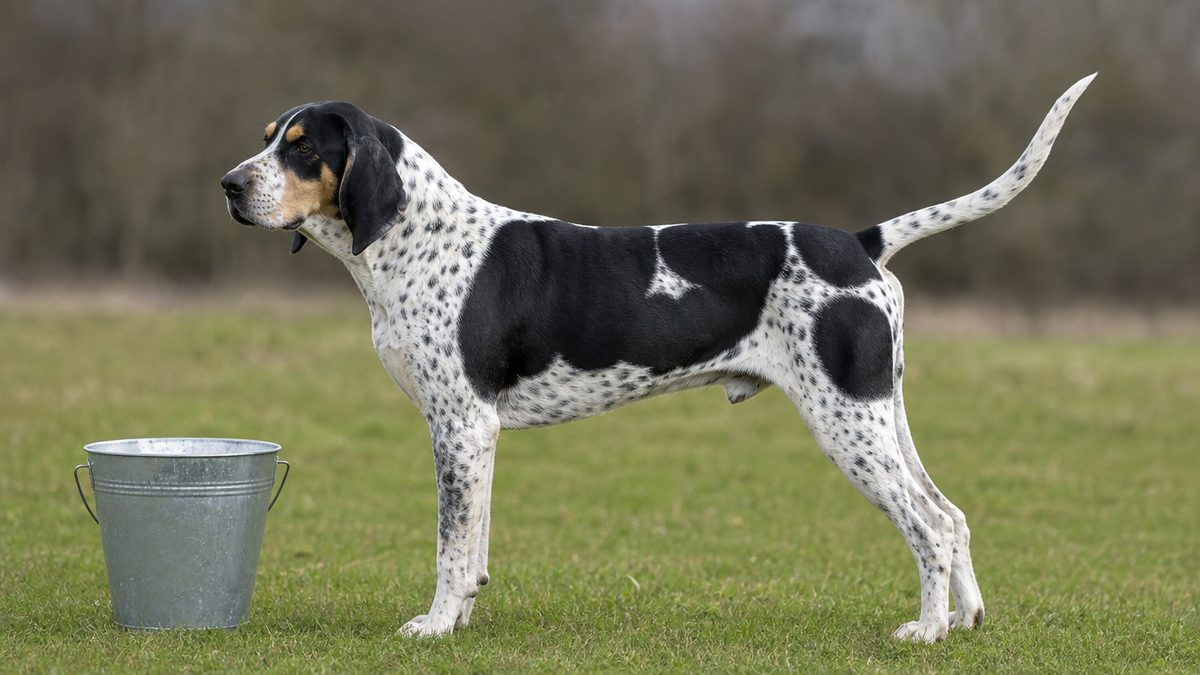
The standard describes a big, rather powerful dog, resistant and robust, with strong bone which is a reminder of his Gascon-Saintongeois origins. Body length from point of shoulder to point of buttock equals height at the withers, and the muzzle is slightly shorter than the skull. The coat is short, quite strong and dense, and the colour is obligatory white and black, with a black mantle, black or bluish speckling, and pale tan only as a dot above each eye, on the cheeks, below the eyes and below the ears. Tiny tan freckles are allowed on the limbs and nowhere else. The roebuck mark on the thigh is described as rather frequent.
The ears are set on rather broad and at eye level, relatively flat where they attach and then curling towards the end, of medium length, with rather pointed tips. The standard gives a physical test for length: pulled forward, they should not reach further than two fingers before the base of the nose leather. Ears that are distinctly curled or too long are a severe fault. That test matters later on this page, because it is the difference between this breed and the ground-scenting hounds whose ears actually touch the ground.
Wikipedia ranks first in India for this breed name and states that its short, double coat is tricolour, black, white and tan. FCI-323 lists a tricolour coat as a disqualifying fault, and describes the hair only as short, quite strong and dense with no mention of a double coat. A dog matching Wikipedia's description would be disqualified under the standard Wikipedia itself links to. Federation Cynologique Internationale
The behaviour clause is short and worth quoting because it is the only temperament text the FCI publishes for any of the three Grands. The breed excels in hunting stag and deer on damp or bushy terrain, and it is a friendly dog, close to humans and easy to manage in the kennels. That last phrase is the standard telling you where it expects the dog to live.
If you arrived here looking for a breed called the Anglo-French Hound, no such breed exists. The name covers four separate FCI breeds, and our Anglo-French Hound hub sets out which is which. The three large ones are this breed, the Grand Anglo-Français Tricolore and the Grand Anglo-Français Blanc et Orange; the fourth and much smaller one is the Anglo-Français de Petite Vénerie, which sits in Section 1.2 at 48 to 56 cm.
The 2,000 dogs that only 45 registrations can account for
The breed's own standard claims roughly 2,000 dogs and about 200 births a year, while the French national studbook recorded 45 registrations in total across 2022 to 2025. Both numbers are real, both come from official sources, and the gap between them is the single most interesting fact about this breed. Societe Centrale Canine Societe Centrale Canine
Start with what each source actually says, because the wording matters more than the arithmetic. FCI-Standard 323, in its Brief Historical Summary, states that the breed presently counts approximately 2000 subjects with around 200 births per year, and that it makes up the packs of twenty or more deer hunts and one stag hunt. That text was drafted in 2007 by Pierre Astié, then president of the Club du Chien d'Ordre, working with Raymond Triquet, and published as the valid standard on 4 November 2008.
The Société Centrale Canine publishes the Livre des Origines Français registration count by breed every year. I downloaded two editions and extracted them with pypdf rather than reading a summary. The 2023 table gives GRAND ANGLO-FRANCAIS BLANC ET NOIR 12 registrations in 2022, 0 in 2023 and 0 confirmations. The 2025 table gives 33 in 2024, 0 in 2025 and 0 confirmations.
| Source | Figure | Period | What it is counting |
|---|---|---|---|
| FCI-Standard 323 | about 2,000 | as at 2007-08 | subjects, meaning dogs alive |
| FCI-Standard 323 | about 200 a year | as at 2007-08 | births |
| SCC studbook | 12 | 2022 | LOF registrations |
| SCC studbook | 0 | 2023 | LOF registrations |
| SCC studbook | 33 | 2024 | LOF registrations |
| SCC studbook | 0 | 2025 | LOF registrations |
| SCC studbook | 45 | 2022 to 2025 | LOF registrations, four-year total |
| SCC studbook | 0 | 2023 and 2025 | confirmations, both years |
Four years of births at the standard's rate would be about 800 puppies. The studbook saw 45. That is 5.6 percent, or one registered dog for every eighteen the standard implies were born. Societe Centrale Canine
First, rule out the boring explanations
The gap is not a truncated table. The same Groupe VI table publishes rows down to a single dog and rows reading zero in both years: CHIEN COURANT D'ISTRIE A POIL RAS at 1 then 0, CHIEN COURANT SERBE at 0 then 2, CHIEN COURANT DE TRANSYLVANIE at 0, 0 and one confirmation. A breed with any registry activity gets a row, so the numbers printed for this breed are the real numbers.
It is not a figure invented by an English-language site either. The Société Centrale Canine's own breed record repeats the FCI claim in French, that the current population is of the order of 2,000 dogs producing around 200 births a year. The registry publishing 45 registrations and the registry publishing 2,000 dogs are the same organisation.
The shape of the numbers is itself evidence
Look at the sequence again: 12, 0, 33, 0. That is not a small breeding population ticking over. It is a registry that sees a batch and then nothing. The same signature appears on the neighbouring French pack breeds in the same table, with POITEVIN at 82 then 0 and FRANCAIS TRICOLORE at 74 then 0, and on this breed's own sibling, the Tricolore, at 65 in 2024 then 0 in 2025. Societe Centrale Canine
Set that against the fourth Anglo-French breed in the same table. The Anglo-Français de Petite Vénerie registered 140, 160, 125 and 147 across the same four years, with 86 and 76 confirmations in the two years reported. It is a smaller hound that individual hunters keep and breed, and it behaves in the studbook exactly as an ordinary breed does: continuous registrations, about half of them confirmed. Societe Centrale Canine
Wikipedia's article reports around 2000 REGISTERED dogs as of 2009. The standard it cites says approximately 2000 subjects. One inserted word converts a population estimate into a registry figure, and that is the root of the confusion: readers then reasonably conclude the studbook must show 2,000 dogs, and it shows 45. Federation Cynologique Internationale
How a French pack hound stays out of the studbook, legally
Pack hounds miss the studbook because French pedigree registration is voluntary and needs two acts a hunting kennel has no reason to perform, while the same dogs are separately and compulsorily registered with the state as a pack. Both halves of that come from primary texts, and together they account for the gap without needing anyone to have miscounted. Republique francaise
The Société Centrale Canine sets out its own rule plainly. To register a dog in the LOF au titre de la descendance, it says, it is not enough that the parents were born LOF. Four things are required: the parents must have passed before a judge who confirms they match the breed standard, the mating must be declared by the breeder, the litter must be registered by the breeder with the SCC, and the dog must be identified by chip or tattoo. The registration only becomes definitive after the dog itself passes a confirmation once its growth is complete.
That first requirement is the choke point. Confirmation is an examination in which the dog is presented to a judge standing and in movement, and the SCC states these examinations are generally held at dog shows or at confirmation sessions organised by the breed club. Its own page describing the exam opens by saying the point of it is to let a dog become a future breeding animal and to have its descendants entered in the Livre des Origines. Societe Centrale Canine, Le LOF
So the chain runs: no judge, no confirmation; no confirmation, no eligible parents; no eligible parents, no registrable litter. A kennel of forty to sixty working hounds that never attends a show never enters the chain at all. The studbook is not failing to see those dogs. They were never presented to it.
The zero confirmations are the tell
This is testable against the table rather than merely plausible. In both years where the SCC reports a confirmation column for this breed, 2023 and 2025, the number of dogs confirmed is zero. Over the same two years the Anglo-Français de Petite Vénerie confirmed 86 of 160 and 76 of 147, rates of 53.8 percent and 51.7 percent, and the Beagle confirmed 1,261 of 4,342 and 822 of 3,089, rates of 29.0 percent and 26.6 percent. A breed that registers occasionally and confirms never is a breed whose dogs are not being taken in front of judges. Societe Centrale Canine
Where the dogs are registered instead
French law does register these animals, twice over, just not through the kennel club. The Arrêté du 18 mars 1982 relatif à l'exercice de la vénerie governs hunting with hounds. Article 4 provides that the dogs of vénerie equipages must compulsorily be identified by tattoo. Article 6 provides that the prefect establishes, for every equipage whose kennel is in the department, an attestation de conformité de la meute, carrying all useful information on the characteristics of the equipage together with the name and address of the person responsible, valid for six years, issued provisionally for one year to a new equipage and renewed for five more once the aptitudes of the pack are confirmed, and delivered after the opinion of the departmental hunters' federation.
Read those two articles together and the popular shorthand is close but not exact. It is not that pack hounds are registered as packs instead of individually. Every dog is individually identified, by tattoo, because the law requires it. What is registered at pack level is the equipage itself, with the prefecture rather than with the studbook, on a six-year certificate. So the dogs exist in state records and are absent from the pedigree register, which is precisely the pattern the two numbers show.
Verified from primary texts: LOF registration requires confirmed parents; confirmation requires presentation to a judge; equipage dogs must be tattoo-identified; every equipage holds a prefectural attestation de meute. Not verified: that any specific Blanc et Noir kennel chose not to register, and how many of the standard's 2,000 dogs sit in which equipage. No French source I could reach publishes an equipage count broken down by hound breed, and the Club du Chien d'Ordre publishes no membership or population figure I could retrieve. Societe Centrale Canine, Le LOF
Does 2,000 dogs in twenty-one packs actually add up?
Yes, and the arithmetic is close enough to be reassuring rather than suspicious. The standard's own claim of twenty or more deer hunts plus one stag hunt, checked against the legal minimum pack sizes and against the national equipage count, produces a population in the low thousands. Republique francaise Societe de Venerie, Sociologie
The Arrêté of 1982 sets what an equipage must be able to put in the field. For the courre of roe deer and fallow deer, an equipage must be able to uncouple twenty chiens courants créancés of specialised breeds served by at least one mounted person. For stag and wild boar the figure is thirty, served by at least two mounted people. Article 5 caps a hunt at a maximum of 60 hounds in action.
Those are dogs put into the field on one day, not dogs owned. A kennel has to carry young stock coming on, brood bitches, dogs resting and dogs retired, so the standing kennel is a multiple of the working pack. Take the standard's twenty-plus deer equipages and one stag equipage as roughly twenty-one packs. Twenty-one packs averaging 95 dogs each would give 2,000; twenty-one packs averaging 40 to 60 dogs, which is nearer the legal working range, gives 840 to 1,260. Republique francaise
| Assumption | Kennel size | Twenty-one packs give |
|---|---|---|
| Legal minimum for a deer pack | 20 | 420 dogs |
| Legal minimum for a stag pack | 30 | 630 dogs |
| Typical working kennel | 40 to 60 | 840 to 1,260 dogs |
| Maximum allowed in one hunt | 60 | 1,260 dogs |
| Needed to reach the standard's 2,000 | 95 | 2,000 dogs |
The honest reading is that 2,000 is at the generous end unless the breed also contributes dogs to mixed packs, which is likely, since French equipages routinely run more than one bloodline. Around 200 births a year across twenty-one kennels is about ten puppies each, or roughly one to two litters per equipage per year, which is an entirely ordinary rate for a kennel maintaining its own numbers. Nothing about the standard's figures is absurd. They are simply not registry figures.
How rare is that within French hunting?
The Société de Vénerie counts 350 equipages in France, with 10,000 practitioners and 100,000 sympathisers, and records that 66 percent of equipages hunt on foot for hare, rabbit and fox. That leaves about 119 mounted equipages hunting the larger game this breed is bred for. Twenty-one of 119 is about 18 percent, so the Blanc et Noir is a real presence in French mounted hunting rather than a curiosity, even though it barely exists in the studbook.
That 18 percent is my own division of two verified figures, not a number either source publishes, and the 119 is derived from a percentage rather than counted. Treat it as an order of magnitude. What it is good for is settling the question a reader actually has, which is whether this is a functioning breed with a job or a nearly-extinct one: the answer is the former, and the studbook simply is not where its existence is recorded.
Grande venerie, written grande vénerie in French, means hunting the large game, stag, roe deer and wild boar, on horseback, as against petite vénerie on foot for fox, hare and rabbit. The Société Centrale Canine describes this breed as a chien de grande et petite vénerie, and the fourth Anglo-French breed carries petite vénerie in its actual name. Federation Cynologique Internationale
How this breed differs from the other two Grands, clause by clause
Beyond colour, the three Grand Anglo-Français standards differ in five clauses and are near-identical in about twenty. I read all three FCI PDFs end to end and set them side by side, and the honest headline is that the documents are far more alike than the breed names suggest. Federation Cynologique Internationale Federation Cynologique Internationale
Take the differences first, because they are real and no ranking page lists them.
| Clause | 322 Tricolore | 323 Blanc et Noir | 324 Blanc et Orange |
|---|---|---|---|
| Utilization | Scenthound | Pack Hound for big game | Scenthound |
| Height at withers | 60 to 70 cm, no sex split, no tolerance | males 65 to 72, females 62 to 68, plus or minus 1 cm | 60 to 70 cm, no sex split, no tolerance |
| Historical summary | none in the document | full paragraph, with population and pack figures | none in the document |
| Behaviour clause | none in the document | present, friendly and easy to manage in kennels | none in the document |
| Breed-specific disqualifications | none beyond FCI boilerplate | frail limbs, severe limb deviation, long feet, tricolour coat | none beyond FCI boilerplate |
That is the whole of it. Every other clause is the same scenthound described in slightly different words: flat broad skull, ears at eye level, straight back, short loin, well-let-down chest, thick round feet, short coat. The general-appearance lines are the only place the standards editorialise about each other, and they do it by comparison rather than measurement. 322 reads solid dog with French predominance, expressing at different degrees the Foxhound origin. 324 reads showing more English blood in his head than his tricolour colleague. 323 reads big, rather powerful, resistant and robust, with strong bone which is a reminder of his Gascon-Saintongeois origins. Federation Cynologique Internationale Federation Cynologique Internationale
The disqualification is the sharpest line between them
FCI-323 disqualifies a tricolour coat. FCI-322 defines the Tricolore by exactly that coat. So the single most decisive clause separating these two breeds is that one of them treats the other's defining feature as grounds for exclusion from the ring. A tan-marked Blanc et Noir is not a poorly-marked Blanc et Noir; under the standard it is out. Federation Cynologique Internationale
The permitted tan on this breed is tightly bounded and worth learning if you are trying to tell the two apart in a photograph. FCI-323 allows a pale tan dot above each eye, pale tan on the cheeks, below the eyes and below the ears, and tiny tan freckles only on the limbs. The roebuck mark on the thigh is common. Anything more, and particularly the bright or copper tan that 322 requires, is the other breed. Federation Cynologique Internationale
Ears are the second reliable separator
The three ear clauses are short and genuinely different. 322 gives leathers of medium length, broadly set at eye level, flat then slightly curled. 324 gives ears set on quite broadly at eye level or slightly above, quite thick, slightly turned in and rather short. 323 gives medium length, curling towards the end, with rather pointed tips and a stated limit of two fingers short of the nose leather. So the Blanc et Orange carries the shortest ear of the three, and this breed carries the most curl and the most pointed tip. Federation Cynologique Internationale Federation Cynologique Internationale
For scale, the fourth Anglo-French breed goes the other way. FCI-325 gives the Petite Vénerie ear as finely attached below the eye level line and reaching at least two fingers past the border of the nose. That is a materially longer, lower-set ear than any of the three Grands, which matters for ear disease and is covered further down this page.
An India-located search on this breed's exact name returned twelve results, of which three were pages about the Grand Anglo-Français Blanc et Orange, a different FCI breed. Wikipedia's article on this breed lists Grand Anglo-Francais Tricolore as an alternative name in its infobox, cites a Société Centrale Canine page for the Tricolore, and offers an external link about the Tricolore. If you are researching this breed, check which of the three each page is actually describing. Wikipedia, Grand Anglo-Francais Blanc et…
The English Foxhound cross: what the standard says and what clubs claim
The standard's own history clause is two sentences long and gives one date range. Everything else about this breed's origins circulates as club and encyclopedia claim, and the two categories should be kept apart because only one of them is checkable.
What FCI-Standard 323 itself asserts
The Brief Historical Summary states that the breed originates from the Bâtard Anglo-Saintongeois, a type which appeared in the middle of the XIXth century and which was the result of crossing between the Saintongeois and the Fox hound. That is the entire documented ancestry: one French hound, one English hound, one date range of roughly the 1850s. The general-appearance clause adds that the bone is a reminder of Gascon-Saintongeois origins, which is the same French stock under its modern name.
Notice what the standard does not say. It names no Poitevin, no other English breed, no individual breeder, and no date for the breed's own recognition as distinct from the Bâtard. It also does not use the word Anglo-Français anywhere in the history clause, only in the breed name itself.
What clubs, encyclopedias and breed sites add
Three claims travel widely and none of them can be checked from a primary source I could reach.
- The 1957 renaming. Wikipedia states that the names of all the various Anglo-French hound breeds and varieties were officially described with the term Anglo-Français in 1957. Its sole reference is an offline book, Clark and Brace, The International Encyclopedia of Dogs, Howell Book House 1995, page 87, which I could not consult. Worldly Dogs offers the same claim with a vaguer date, saying the present name came in the mid-1900s when the Anglo-Français and Chien Français breeds were reclassified, and cites nothing at all. Two sources, one unreachable reference between them.
- Grand does not mean large. The same book, via the same Wikipedia sentence, is the authority for the idea that Grand simply labels a pack used for larger game. It is a plausible claim about the group. It sits awkwardly with this particular breed, whose standard gives the tallest males of the three at 72 cm and is the only one of the three to separate the sexes by height at all.
- A Poitevin in the mix. Wamiz credits a cross of the Gascogne Saintgeanois with the Poitevin and Foxhound. FCI-323 names only the Saintongeois and the Foxhound. The Poitevin belongs to the Tricolore's story, not this one, so this reads as another instance of sibling contamination rather than an independent finding.
Wikipedia, Grand Anglo-Francais Blanc et… Worldly Dogs, Grand Anglo-Francais Blanc et… Wamiz UK, Great Anglo-French White… Federation Cynologique Internationale
The dates that are actually documented
Four are, and they are worth having in one place, because they are the spine of the breed's paper history.
| Date | Event | Source |
|---|---|---|
| mid 19th century | Bâtard Anglo-Saintongeois appears, Saintongeois crossed with Foxhound | FCI-Standard 323 history clause |
| 20 January 1996 | Recognised by the United Kennel Club | UKC breed standard |
| 2007 | Current standard text drafted by Pierre Astié, president of the Club du Chien d'Ordre, with Raymond Triquet | FCI-Standard 323 |
| 4 November 2008 | Official valid FCI standard published | FCI-Standard 323 |
| 12 January 2009 | English translation issued, revised by J. Mulholland with R. Triquet | FCI-Standard 323 |
The UKC date is worth a sentence of its own. The United Kennel Club recognised this breed on 20 January 1996, a full decade before it recognised the Tricolore. For a breed usually described as the obscure one of the three, it was in fact the first of the Grands into an English-language registry.
The UKC text also disagrees with the FCI on a point of conformation, which is unusual enough to flag. Under MUZZLE the UKC reads slightly longer than the skull. FCI-323 reads a little less long than the skull, and states in Important Proportions that the muzzle is slightly shorter than the skull. One of the two published standards for this breed has the proportion inverted. Federation Cynologique Internationale
Price in India: there is no price, and that is the finding
No Grand Anglo-Français Blanc et Noir is offered for sale in India at any price, and the absence is evidenced rather than assumed. A location-matched search returned ten results and not one Indian dog listing, while the same search run for a Labrador Retriever in the same session returned ten Indian puppy-sale pages carrying concrete rupee figures. Mr n Mrs Pet, Labrador Retriever Puppies…
The control matters, because a zero from a search that never ran is not evidence of anything. Here is what the control returned: mrnmrspet.com quoting INR 30,000 to 1,20,000 for a Labrador with a three-tier quality split, plus wrapinfur, supertails, tradeindia, marshallspetzone, dogbreedersbangalore, puppiezo and petsworld, all with prices, all Indian. The search engine, the India location and the commercial index all work. Firecrawl web search, India location
What an Indian searcher is offered instead
Five of the ten results for the breed-plus-price query in India are a hotel. Coastal Grand Anglo French Resorts is a property in Yercaud, Tamil Nadu, and it appears on TripAdvisor, Agoda and three Facebook posts. The rest of the page is a Swedish-language article about the Tricolore, a 2009 Texas A&M thesis matching the phrase grand Anglo-Saxon, a 1941 American financial newspaper matching Credit Anglo-Francais, a Quora answer naming the breed in a list, and a French adoption site with the breed in a dropdown.
That is a more useful answer than a number would be. There is no Indian market, no Indian breeder, no Indian listing, and no Indian price. Anyone who tells you otherwise is either selling a different dog or has not looked.
The number you will meet if you keep looking, and why it is not a price
Indian puppy sites carry template pricing that is unrelated to any particular breed. Puppiezo prints 98,999 rupees, badged Platinum, on at least ten different breed pages: American English Coonhound, Giant Alaskan Malamute, Anatolian Shepherd Dog, Plott Hound, Manchester Terrier, Cesky Terrier, Xoloitzcuintli, Komondor and two individual puppy pages that are both Maltipoos. The same puppy names recur across unrelated breeds, with one called Fizey appearing on six pages and another called Samy on four, so the block is a shared carousel rather than breed-specific stock.
Indian pages routinely publish a US dollar price run through one exchange rate. Divide the rupee figure by 84.38 and see whether a round dollar amount falls out. Applied here, 98,999 divided by 84.38 is 1,173.25, which is not a round dollar figure, so this one is not a converted US price. It is a rupee psychological price point set one rupee under 99,000. Either way it is not this breed's price, because this breed is not sold here.
What the breed costs where it does exist
In France it largely is not sold either, because it moves between equipages rather than through a puppy market. Wamiz, which covers the breed for a UK audience, states plainly under Purchase price that it does not have enough data to set an average price, which is the correct answer and is more honest than most Indian pages manage on breeds that genuinely are traded.
For orientation only, Supertails puts Indian dog prices in 2026 between 2,000 rupees for an indie and more than 1,50,000 rupees for a KCI-registered show dog, and carries no entry for any Anglo-French breed at all. If you want a large, hardy, heat-adapted hound that you can actually buy and verify in India, an Indian native breed such as the Rajapalayam is a real option and this one is not.
Importing one is not a route either
Indian law does not permit importing this breed to buy, breed or sell it. Dogs sit under a Restricted heading in the import policy and are admitted for only three purposes, none of which is acquiring a rare breed.
DGFT Trade Notice 22/2022-23 of 19 December 2022 sets it out. ITC (HS) 01061900, Mammals Other, is Restricted. Policy Condition 7 allows import of dogs only for a pet dog with a valid pet book and relevant records in the name of the importer, for R&D organisations conducting research with a CPCSEA recommendation, or for internal security by the Defence and Police Force. Policy Condition 8 states that import of commercial dogs for breeding or any other commercial activity is not permitted.
Paragraph 6 removes the remaining ambiguity: any applications for trading or breeding purposes, or applications made on behalf of another person or entity, shall be duly rejected. Paragraph 7 limits entry to the airports and seaports of Delhi, Mumbai, Chennai, Hyderabad, Bangalore and Kolkata, with quarantine where required. DAHD added a seventh port, Cochin International Airport at Kochi, for pets arriving under the baggage rules in October 2024. The full route is set out in how to import a dog to India.
- Permitted: bringing your own dog when you move to India, with a pet book in your name, if you are transferring residence after two years of continuous stay abroad.
- Permitted with authorisation: more than two pets in any circumstances, or fewer than two years abroad, or a pet not travelling as passenger baggage.
- Rejected outright: an application to import a dog in order to breed from it or sell it, or an application filed on someone else's behalf.
- Practical timing: the notice itself advises starting the authorisation process at least two months before travel.
Directorate General of Foreign Trade
Combine that with the studbook position and no lawful supply chain can form. There is no Indian population to breed from, no import route for the purpose of breeding, and in the country of origin the dogs that exist are largely outside the pedigree register, so even a lawful personal import would in most cases arrive without a pedigree. Societe Centrale Canine
If you did somehow acquire one, the 2017 Rules still apply
The Prevention of Cruelty to Animals (Dog Breeding and Marketing) Rules, 2017 govern anyone breeding or selling dogs in India, and two of their provisions bite hard on a pack breed. Second Schedule paragraph 6(3) prohibits in breeding, defined as mating between relatives of the second to fourth grade within the first four generations, and incest breeding, defined as mating between parents and children or brother and sister. Only out breeding and line breeding are permitted, under 6(2). A founder population of one or two imported dogs cannot lawfully be expanded in India.
Paragraph 8(10) requires that dogs be tested for genetic defects, naming hip dysplasia, progressive retinal atrophy, night blindness, hypothyroidism, entropion, ectropion, overshot and undershot jaw, wry mouth, missing teeth and cryptorchidism. For a breed with no published screening scheme anywhere in the world, a breeder would have to build that testing from scratch on individual dogs, with no breed baseline to interpret the results against. Orthopedic Foundation for Animals
The same Rules provide at Rule 8 Conditions for sale, sub-rule (1)(a), that pups less than eight weeks in age are not sold, and at 8(1)(b) that dogs over six months are not sold without first being sterilised unless sold to another licensed breeder. A seller offering you a six-week-old puppy of any breed is breaking this rule.
What one would cost to keep in India, honestly bounded
No Indian cost figure exists for this breed, so the only defensible estimate is the published Indian cost of keeping a large dog, with the breed-specific extras named separately. Supertails puts average monthly maintenance in India at 3,000 to 11,000 rupees overall, and 12,000 to 20,000 rupees a month for its largest size band.
A 25 to 30 kg hound sits in that largest band. The table below is a size-band estimate with breed-specific lines added, not a quotation for this breed, and every general figure carries its source.
| Line | Monthly range | Basis |
|---|---|---|
| Food, large size band | 6,000 to 12,000 | Supertails largest-band range, food-dominated |
| Routine veterinary and vaccination | 1,000 to 2,500 | amortised from the general monthly range |
| Tick and flea control, year round | 600 to 1,500 | not optional in India, see the tick-borne data below |
| Ear care consumables | 200 to 500 | breed-specific, see the ears section |
| Grooming | 300 to 800 | short coat, so low |
| Total, ordinary month | 8,100 to 17,300 | sits inside the 12,000 to 20,000 large-band figure once one-offs are added |
Supertails also budgets a first year at 80,000 to 2,00,000 rupees for a dog in general, which is the more useful number for anyone planning, because the first year carries the vaccination course, sterilisation and the initial kit.
Three costs specific to this breed that a size band will not capture
Cooling is a running cost, not a purchase. The climate section below shows why a dog built for a 21 C summer needs managed indoor temperature through an Indian summer. Indian law reaches this directly: the 2017 Rules require ambient and comfortable indoor temperature depending on the breeds housed, and provide at Second Schedule paragraph 21(1) that breeds which cannot tolerate the temperatures prevalent in the area shall not be kept in outdoor facilities unless specifically approved by the attending veterinary practitioner in writing. Budget for the electricity that implies.
Ear disease is the likeliest recurring bill. A pendulous-eared breed in Indian humidity is a foreseeable otitis case, and the Indian data below puts the monsoon monthly case rate at several times the winter rate. A course of treatment is not ruinous; four courses a year, plus cytology, adds up.
Tick-borne disease surveillance is not discretionary. The largest Indian survey found ticks on 278 of 525 dogs, 53 percent, and one or more tick-borne pathogens by PCR in 261 of 525, 49.7 percent. In Mumbai and Delhi the tick-infestation rates were far above the Himalayan sites. A large dog exercised outdoors for two hours a day is exactly the exposure profile that survey describes.
Wamiz prices monthly upkeep of a dog this size at 60 to 100 pounds. It is a British figure for a British climate and is included only to show that the published cost guidance for this breed anywhere in the world assumes no cooling load and no year-round tick pressure. Do not convert it.
One cost you will not have is the purchase price, because there is nothing to purchase. That is not a saving. It means any dog presented to you in India as this breed is something else, and the money would be going on a misidentified animal.
Heat tolerance: the mechanical argument, with the origin climate measured
The Grand Anglo-Français Blanc et Noir has poor heat tolerance in India because Chennai's coolest month is warmer than the breed's home region's warmest month. Queried by explicit coordinates, Saintes in Charente-Maritime averages 21.17 C in August, its hottest month; Chennai averages 24.09 C in January, its coolest. NASA Prediction Of Worldwide Energy…
I used NASA POWER rather than a city-slug climate site, queried by latitude and longitude, and confirmed the coordinates echoed back in the returned JSON so no other place could be served by accident. Saintes was queried at 45.7460 N, 0.6320 W and came back as -0.632, 45.746 at 31.74 m elevation. Saintonge is the region FCI-323 names as the source of the Saintongeois hound this breed was built from. Federation Cynologique Internationale
| Place | Coolest month mean | Warmest month mean | Annual mean | Annual mean RH |
|---|---|---|---|---|
| Saintes, 45.746 N 0.632 W | 5.69 C (Jan) | 21.17 C (Aug) | 13.11 C | 79.67 percent |
| Pune, 18.520 N 73.857 E | 19.62 C (Dec) | 28.93 C (Apr) | 23.86 C | 66.80 percent |
| New Delhi, 28.614 N 77.209 E | 13.61 C (Jan) | 35.88 C (Jun) | 25.60 C | 45.56 percent |
| Chennai, 13.083 N 80.271 E | 24.09 C (Jan) | 31.51 C (May) | 27.95 C | 72.39 percent |
Read the table the mechanical way
A dog does not experience an annual average. It experiences the gap between the temperature its thermoregulation evolved for and the temperature it is standing in. Three comparisons do the work.
- Chennai never gets as cool as Saintonge gets hot. Chennai's coolest month, 24.09 C, runs 2.92 C above the warmest month this breed's home region ever averages, 21.17 C. There is no season in Chennai that resembles a French summer, let alone a French hunting season.
- Delhi's June is 14.71 C above Saintonge's August. 35.88 C against 21.17 C. That is not a hotter version of the same climate, it is a different regime.
- Pune is the only one of the three that overlaps at all. At 636 m, Pune's coolest month averages 19.62 C, which sits 1.55 C below Saintonge's warmest. A Blanc et Noir in Pune would get about three months a year that its physiology recognises. In Chennai it would get none.
NASA Prediction Of Worldwide Energy… NASA Prediction Of Worldwide Energy…
The humidity result is the opposite of what people assume
Saintonge is not dry. Its annual mean relative humidity is 79.67 percent, higher than Chennai's 72.39 percent and much higher than Delhi's 45.56 percent. So the intuitive line that this is a dry-climate breed coming to a humid one is simply wrong, and a page that argued it that way would be arguing from a stereotype rather than from data. NASA Prediction Of Worldwide Energy…
The real difference is that Indian humidity arrives warm. Pune in August averages 90.80 percent relative humidity at a mean air temperature of 23.30 C. Saintes in December averages 90.82 percent at 6.14 C. Essentially identical saturation, 17.16 C apart. Saturated air at 6 C does very little; saturated air at 23 C is a growth medium, and it is the reason the ear problem in the next section is an Indian problem rather than a French one. NASA Prediction Of Worldwide Energy…
Warm saturated air also removes the dog's fallback. Panting sheds heat by evaporating water from the respiratory tract, and evaporation slows as the air approaches saturation. A hound asked to work in a Pune August is therefore hot and has lost most of its cooling margin at the same time.
Wamiz states that this breed is relatively tolerant of hot weather. That page prices upkeep in pounds sterling, so its hot weather is a British summer. Applied to Chennai, where the coolest month is warmer than the breed's origin's hottest, that sentence is actively dangerous, and it is published with no source of any kind. NASA Prediction Of Worldwide Energy…
The heat risk is also the wrong shape in most people's heads. The largest study of the question, covering 905,543 UK dogs, found 1,259 heat-related illness events, and of the 879 with a recorded trigger 74.2 percent were exertional, against 12.9 percent environmental and 5.2 percent from being shut in a vehicle. Heatstroke in a working-bred hound is overwhelmingly something that happens while it is running, not while it is parked.
Ear care: the pendulous-ear load in Indian humidity
A pendulous ear roughly doubles a dog's odds of otitis externa before climate is considered, and Indian warm-season humidity is what turns that predisposition into a recurring bill. The largest study of the question found breeds with pendulous ear carriage had 1.76 times the odds of otitis externa compared with erect-eared breeds.
The O'Neill study is worth stating with its denominators, because most breed pages assert ear risk without any. It drew a random sample of 22,333 dogs from 905,554 under UK primary veterinary care in 2016 and found a one-year period prevalence of otitis externa of 7.30 percent, with a 95 percent confidence interval of 6.97 to 7.65. Pendulous ear carriage carried 1.76 times the odds, 95 percent CI 1.48 to 2.10; V-shaped drop ears carried 1.84 times, CI 1.53 to 2.21. Among named breeds, the Basset Hound topped the list at 5.87 times the odds of a crossbred and the Beagle sat at 2.54.
Where this breed's ear actually sits on that scale
It is a drop ear, but a moderate one, and the standard gives a measurable limit rather than an adjective. Pulled forward, the ear should not reach further than two fingers before the base of the nose leather, and ears that are distinctly curled or too long are listed as a severe fault. That is a shorter ear than a Basset carries and shorter than the Anglo-Français de Petite Vénerie, whose standard requires the leather to reach at least two fingers past the border of the nose.
So the sensible expectation is that this breed sits meaningfully below the Basset's 5.87 and somewhere around the general pendulous-carriage figure of 1.76. That is an inference from ear conformation, not a measured breed odds ratio, because no study has ever measured this breed. Say so rather than borrowing the Basset's number.
Why the Indian version of this problem is worse than the French one
The climate section established that Saintonge and Pune reach almost identical peak humidity, 90.82 percent against 90.80 percent, but 17.16 C apart in air temperature. An ear canal is a closed, poorly ventilated tube; a pendulous leather closes it further. What determines whether that tube grows yeast and bacteria is warmth plus moisture together, and the French version supplies only the moisture. NASA Prediction Of Worldwide Energy…
The Indian data agrees. In the Palampur series, every one of the 81 otitis cases showed secondary bacterial or fungal overgrowth confirmed by cytology, with cocci in 37.03 percent, rods in 28.39 percent, yeast in 16.04 percent and mixed infections in 18.51 percent. Excessive moisture was recorded as a predisposing factor in 20.98 percent of cases.
A practical routine, adjusted for the season
- Check the ear every day in the monsoon and twice a week the rest of the year, lifting the leather and smelling as well as looking.
- Dry the canal after every swim, bath or heavy-rain walk, using a plain dry pad rather than a cotton bud pushed down the canal.
- Clean only when there is something to clean, because the O'Neill authors specifically recommend avoiding overzealous ear-cleaning as a low-harm approach.
- Treat on cytology rather than on guesswork, since the Palampur series found treatment error as a predisposing factor in 11.11 percent of its cases, the second commonest listed after moisture.
O'Neill DG, Volk AV, Soares T, Church DB Nainika and Pardeep Sharma
Care guidance written for European kennels routinely says to towel a hound off and let it air dry. In a French December at 6.14 C mean that is fine. In a Pune August at 23.30 C and 90.80 percent relative humidity, air drying is not drying, because the air the ear is meant to dry into is already saturated. Dry the canal actively, and do not let a pack-kennel routine written for Charente-Maritime decide your monsoon protocol. NASA Prediction Of Worldwide Energy…
Checking the Indian otitis numbers, one division at a time
The most-cited Indian otitis dataset contains an arithmetic error in the row that matters most to this breed, and the correct figure is 56 rather than the printed 53. Everything else in the paper survives the check, which is why the error is worth naming precisely instead of discarding the source.
The study screened 2,476 dogs presented at Palampur, Himachal Pradesh between June 2022 and July 2023, and diagnosed 81 with otitis externa, a hospital prevalence of 3.27 percent. Check it: 81 divided by 2,476 is 3.271 percent. Correct. Every percentage in the paper is stated against that same denominator of 81, which makes the whole thing auditable.
The row that fails
Table 5 prints Pendulous ear breed, n=53, 69.13 percent. Those two numbers cannot both be right. 53 divided by 81 is 65.43 percent. And 69.13 percent of 81 is 55.996, which rounds to 56.
Two independent checks say the percentage is the sound half and the count is the broken half. First, the same table gives erect-eared breeds as 25 at 30.86 percent, and 25 divided by 81 is 30.864 percent, correct. Ear carriage is a two-way split covering the whole sample, and 56 plus 25 is exactly 81, while 53 plus 25 is 78, leaving three dogs with no ear type. Second, 69.13 plus 30.86 is 99.99, which is 100 percent within rounding, so the two percentages already partition the sample.
The paper's own text states that bacterial infections were present in 65.43 percent of cases, and 65.43 percent of 81 is exactly 53, being the 30 cocci plus the 23 rods. The number 53 is real and belongs to the bacteriology, not to ear conformation. It looks to have been carried into the wrong row.
What survives the audit
Nearly everything. The season table checks out completely: rainy July to August 48 at 59.25 percent, summer 15 at 18.51, winter 10 at 12.34, autumn 8 at 9.87, and the four counts sum to 81. The sex table checks out, 65 and 16 at 80.25 and 19.75 percent. The age table checks out, 18, 34, 24 and 5 at 22.22, 41.97, 29.63 and 6.17 percent. The aetiology figures check out: hypersensitivity 37 at 45.67 percent, parasitism 5 at 6.17, immune-mediated 4 at 4.93, hypothyroidism and viral disease 2 each at 2.46, and erythematous canals in 88.8 percent, which is 72 of 81.
Three smaller defects turned up alongside the main one. Table 1 prints 12.43 percent for 10 of 81 and 9.80 percent for 8 of 81, where Table 4 in the same paper prints the identical fractions correctly as 12.34 and 9.87. A paragraph opens with the phrase in a study of 50 cases while every denominator in it is 81. And an ulceration figure of 16.8 percent corresponds to no whole number of dogs out of 81. None of these touches the seasonal or ear-carriage findings.
The seasonal number is stronger than the paper claims
The headline 59.25 percent in the rainy season understates the effect, because the paper's rainy season is only July and August while its winter is four months, December to March. Adjusting for how many month-instances each bucket actually covers in a study running June 2022 to July 2023 gives the rate per month rather than the raw share.
| Season as defined by the paper | Cases | Month-instances in the window | Cases per month |
|---|---|---|---|
| Rainy, July to August | 48 | 3 | 16.0 |
| Summer, April to June | 15 | 4 | 3.75 |
| Autumn, September to November | 8 | 3 | 2.67 |
| Winter, December to March | 10 | 4 | 2.5 |
On that basis the monsoon monthly rate is 6.4 times the winter rate, not the 4.8-fold impression the raw percentages give. For an Indian owner of a pendulous-eared hound, the practical instruction is that July and August are not a slightly worse period, they are the period, and the ear routine should change before the rain starts rather than after the first infection.
Health risks and life expectancy: an honest absence, with controls
No health denominator exists for the Grand Anglo-Français Blanc et Noir anywhere in the world, so every list of this breed's health issues currently on the internet is inference presented as data. Two papers mention an Anglo-French hound in the entire biomedical literature, neither reports a disease prevalence or any breed-specific health issues, and the breed does not appear in the Orthopedic Foundation for Animals statistics tables at all. Both of those absences were tested with working controls before being reported. Orthopedic Foundation for Animals
The literature, and the query that had to be thrown away
A phrase search on PubMed for Anglo-Francais returns exactly one record; a phrase search for Anglo-French hound returns exactly one other; their union returns two and nothing else. Both were opened and both are genuinely about Anglo-French hounds. Controls run in the same session returned Basset Hound 101 records, Labrador Retriever with hip dysplasia 52, Beagle with otitis 13, Braque Francais 5 and English Foxhound 1, so the index does respond to rare French breed names.
One query had to be discarded rather than reported as a zero. Searching the full breed name returns 0, but PubMed's printed query translation shows it converted the French conjunction et into the MeSH subheading etiology, producing a nonsense clause. That zero measures a broken query, not the literature, and the same rewrite inflates a search for Blanc et Noir to 38 irrelevant records. A count from a rewritten query is not evidence in either direction.
Neither of the two genuine papers helps a buyer. The larger one studied 50 Great Anglo-Français Tricolor Hounds, which is the sibling breed, FCI 322, and it is a method-comparison study of two kidney clearance markers reporting no disease prevalence at all. The other is a single case report of a septal myocardial abscess in a seven-year-old Anglo-French hound in France, and neither its title nor its abstract says which of the three Grands the dog was. Lange E and Beaudu-Lange C. Septal…
What that leaves a buyer with
It leaves inference from conformation, and nothing else. The chest is broad and well let down, which is a bloat conformation. The ears are pendulous, which is an otitis conformation. The dog is large and fast-growing, which is a joint-loading conformation. Each of those is a reason to screen, and none of them is a measured prevalence for this breed. Anyone publishing one is publishing a guess. PubMed, National Library of Medicine
Screening data: why there is no row, and what to test anyway
The Grand Anglo-Français Blanc et Noir has no entry in the Orthopedic Foundation for Animals statistics tables, and the reason is published by OFA itself: a breed needs at least 100 hip evaluations, or 50 for any other database, before it appears at all.
OFA publishes screening results by breed. Reaching them took four attempts: a direct fetch of the statistics page returned a JavaScript shell in which even the control terms LABRADOR and BEAGLE returned zero, which is impossible; the advanced-search page failed the same way; the underlying data host refused the connection. A stealth retrieval finally returned the genuine page at 2,225,908 characters, which I saved and searched rather than read.
Controls inside that file: LABRADOR 109 occurrences, BEAGLE 61, BASSET HOUND 45, BRAQUE FRANCAIS 25, HARRIER 14. The file is verified complete against an independent reference row for the Bergamasco. Searched case-insensitively against those working controls, it returns zero occurrences of anglo, zero of venerie, zero of saintongeois, zero of gascon, zero of poitevin, zero of billy and zero of foxhound.
OFA explains the absence in its own words: breeds are not included in the statistics tables until a minimum number of individuals have been evaluated, at least 100 evaluations for hips and at least 50 for every other database. It also states that dogs do not need to be purebred or registered to be evaluated, so registry status is not the barrier. The barrier is that fewer than 100 of these dogs have ever had hips scored by OFA, which is unsurprising for a French kennel breed.
| Breed | Hip evaluations | Normal | Dysplastic |
|---|---|---|---|
| Basset Hound | 286 | 57.7 percent | 39.5 percent |
| Harrier | 416 | 84.4 percent | 14.7 percent |
| Braque Francais | 135 | 97.0 percent | 3.0 percent |
| Grand Anglo-Français Blanc et Noir | no row | no figure | no figure |
Life expectancy: two ranking pages, two ranges, no overlap
Wamiz publishes 9 to 10 years. World Life Expectancy publishes 12 to 15 years. The ranges do not intersect at a single value, and neither page cites anything. World Life Expectancy's entire history section is two sentences copied verbatim from the UKC standard, and that UKC standard publishes no lifespan at all. Bonbeno therefore publishes no life expectancy figure for this breed, because none is evidenced. United Kennel Club
Wamiz lists hip and elbow dysplasia, patellar luxation, cataracts, chronic ear infections, cryptorchidism and gastric torsion as common illnesses of this breed, with no prevalence figure and no citation for any of them. That is a generic deep-chested large-breed list, not a finding about this breed. The one entry with independent support is chronic ear infection, and the support is conformational rather than breed-specific. O'Neill DG, Volk AV, Soares T, Church DB
What a prospective owner should take from this is not that the breed is healthy. Wikipedia's health section says no unusual health problems have been documented and tags itself citation needed, which is the correct epistemic state. Absence of published disease in a breed nobody has studied is absence of study, not absence of disease. Screen the individual dog for hips, elbows, eyes and thyroid, and interpret the results against all-breed baselines, because there is no breed baseline to use. Ministry of Environment
Temperament and household fit: a kennel dog, described by its own standard
FCI-323 calls this breed friendly, close to humans and easy to manage in the kennels, and that final phrase is the whole household-fit answer. It is the only one of the three Grand standards to include a behaviour clause, and the behaviour it describes is that of a dog living among forty others rather than in a flat. Federation Cynologique Internationale
The distinction matters because friendly is doing less work than it appears to. A pack hound is selected for tolerance of other dogs, tolerance of handling and an absence of aggression towards people, because a kennel of sixty animals cannot function otherwise. None of those traits is the same as wanting to live with one family in a two-bedroom apartment.
The Société Centrale Canine is unusually direct about this. Its Anglo-Français breed records carry a Vivre en ville paragraph stating that the Anglo-Français are not adapted to city life, that as pack dogs they live in kennels, and that they need space and exercise. That is the national kennel club of the country of origin telling you not to keep one in a city.
Who this breed suits
- Hunting establishments running a mounted pack on large game, which is the population the breed actually exists in.
- Rural households with secure acreage, other dogs for company, and two hours a day of real exercise available in cool hours.
- Owners who want a large, robust, vocal, independent hound and are untroubled by all four of those adjectives.
- Nobody who is buying on rarity, because the breed cannot lawfully be acquired in India and rarity is not a temperament.
Apartment living is the wrong question in India
Most Indian dog buyers are in flats, so apartment living is usually the first thing a breed page is asked about. For this breed it is a question that does not get as far as being answered, because the animal is not available here. If it were, three of its documented traits would each independently rule out a flat: a working scenthound's daily exercise requirement, a pack hound's voice, and an inherited disposition to follow a scent line away from its handler.
The voice is the one people underestimate. Hounds bred to be tracked by ear across woodland at distance are loud by design, not by accident, and a dog that is loud by design does not become quiet with training. Wamiz records the breed as tending to be very vocal and as having a tendency to run away when a scent takes it, and those are the two observations on that page that are consistent with the standard's own account of what the dog is for. Federation Cynologique Internationale
Children, cats and other dogs
Pack selection cuts in the breed's favour with other dogs and against it with cats. A hound created to hunt roe deer and wild boar in a group of twenty will generally live well with dogs and will treat a small fast-moving animal as quarry. With children, the standard's friendly and close to humans is genuine, but a 25 to 30 kg dog with a working hound's momentum is a physical hazard to a toddler regardless of intent. Worldly Dogs, Grand Anglo-Francais Blanc et…
Every temperament statement above traces to a breed standard, a national kennel club record or a general observation about pack hounds. No behavioural study has ever been conducted on this breed, and with two papers in the entire literature none is likely. Treat the picture as well-grounded inference rather than measurement. Federation Cynologique Internationale
Training: what a pack hound learns and what it declines to learn
To train a Grand Anglo-Français Blanc et Noir, work with the pack instinct and stop expecting recall to beat a fresh scent line. The breed was selected for centuries to run a line independently of its handler, and the trait a hunting kennel prizes is exactly the one a pet owner experiences as disobedience. Wamiz UK, Great Anglo-French White…
The FCI standard gives one clue about trainability and it is a good one: the breed is described as easy to manage in the kennels. Kennel manageability means the dog accepts handling, feeding routines, couples and the discipline of a group. It says nothing about off-lead reliability in open country, and the breed's job description says the opposite.
The four things that train well
- Handling and husbandry. Ear inspection, nail trimming, mouth checks and body handling all take easily, because a kennel dog is handled constantly from puppyhood. Start ear handling in week eight and it never becomes a fight.
- Crate and kennel routine. The breed settles in a defined space more readily than most, and a crate is the single most useful piece of equipment in an Indian summer because it can be the cooled zone.
- Lead work. A hound that has learned to walk in a couple walks well on a lead. Teach it before the dog reaches 25 kg, not after.
- Group manners. Dog-to-dog civility comes close to free. This is the trait that makes the breed pleasant and the trait that makes it useless as a guard.
The one thing that does not
Recall off a live scent. Wamiz records the breed as very independent, notes it can become wilful if the call to follow a scent outweighs its training, and lists a tendency to run away, and those observations line up with the standard's account of a dog that hunts stag and deer on damp or bushy terrain in a group of twenty. Selection for two centuries has favoured the dogs that kept going. Federation Cynologique Internationale
The practical consequence is a rule rather than a technique: this dog is on a lead or behind a fence, always, in any environment where a scent line could take it onto a road. That is not a failure of training. It is the correct management of a working trait, and the FCI classifies the breed with a working trial precisely because the trait is the point.
Indian-specific training constraints
Train in the cool hours or not at all. The climate section put Chennai's coolest month above Saintonge's warmest. Training sessions therefore belong before sunrise and after dark for most of the Indian year, which cuts the available window and means most owners will train less than they intend. Plan short sessions rather than long ones.
Do not use exertion as the discipline. Heat-related illness in dogs is overwhelmingly exertional, 652 of the 879 events with a recorded trigger in the largest study, 74.2 percent, against 12.9 percent environmental. A hound run to tire it out in an Indian afternoon is the exact scenario that study describes.
Socialise to traffic and crowds deliberately. A dog bred to work woodland in a group has no inherited template for an Indian street. Wamiz rates the breed as moderately fearful of strangers and generally disinterested in them, which is workable, but disinterest in a quiet lane is not the same as composure in traffic.
The 2017 Rules require that pups less than eight weeks are not sold, at Rule 8(1)(a). Eight weeks is also the point at which the socialisation window is wide open, so a legally-sold puppy arrives with time in hand. Use it on handling, surfaces, sounds and ear touching rather than on obedience drills.
Exercise needs: the real daily requirement, and what happens without it
This breed needs about two hours of exercise a day, and the requirement is set by what French law expects of it, not by a generic large-dog guideline. An equipage must be able to put twenty hounds into the field for roe deer, or thirty for stag, and a hunt may run up to sixty hounds at once across a day's work.
That legal framing is more useful than any breed-site number, because it describes an actual workload rather than an opinion. A mounted hunt covers ground for hours behind a horse. A dog bred, selected and legally certified for that is not going to be satisfied by two twenty-minute walks around a colony park.
The standard's gait clause says the same thing in conformation terms. Movement is described as effortless, with the preferred gait a supple and extended gallop. A breed whose standard names the gallop as its preferred pace is telling you it needs room to gallop.
| Slot | Duration | What it is for |
|---|---|---|
| Pre-dawn, before 06:00 | 60 to 75 min | the main session, lead or long-line, brisk |
| Midday | 0 min | no exercise; Chennai's May mean is 31.51 C and Delhi's June mean is 35.88 C |
| After dark, after 20:00 | 40 to 50 min | second walk plus scent work |
| Twice a week | add 30 min | off-lead running, in a fully enclosed space only |
| Daily, indoors | 15 min | scent games, which tire a hound faster than distance does |
Scent work is the substitute, not more distance
A scenthound is tired by using its nose, not only by covering ground, and this is the single most useful adaptation for an Indian owner whose outdoor window is two hours of darkness. Hiding food across a room, tracking a dragged scent across a terrace, and searching for a scented article all work indoors, in air conditioning, at any hour. Twenty minutes of nose work displaces a surprising amount of walking.
What happens without it
The failure modes are predictable and all three are documented for this breed. Wamiz records that it can cause significant damage if left without company for longer than it deems appropriate, that it tends to be very vocal, and that it has a tendency to run away. An under-exercised hound in a flat produces all three at once, and in an Indian apartment block the vocal one is what ends the arrangement.
Weight is the quieter failure. Wamiz notes a notable tendency to put on weight and that the diet should be modulated to exercise levels. On a deep-chested 25 to 30 kg dog carrying extra weight in Indian heat, that compounds directly into the heat problem, because a heavier dog generates more metabolic heat and sheds it no faster.
Of the 879 heat-related illness events with a recorded trigger among 905,543 UK dogs, 74.2 percent were exertional and only 5.2 percent involved a vehicle. Young male dogs had the greatest odds of exertional heat-related illness. A young male hound taken for a long run at 09:00 in an Indian April is the highest-risk combination on this entire page. NASA Prediction Of Worldwide Energy…
Grooming: a five-minute coat and a ten-minute ear
To groom this breed, spend almost no time on the coat and almost all of it on the ears and skin folds. FCI-323 describes the hair as short, quite strong and dense, with no undercoat clause and no feathering anywhere on the dog, so the coat itself is among the lowest-maintenance in Group 6.
A rubber curry mitt once or twice a week lifts the dead hair and that is the whole coat routine. The breed sheds moderately rather than seasonally in the way a double-coated northern breed does, and there is nothing to strip, clip or scissor. Anyone quoting you a grooming-salon budget for this dog is quoting you for a different animal.
Wikipedia describes the coat as short and double. FCI-323 says only short, quite strong and dense, and describes the skin as white under white hair and black under black hair. There is no undercoat clause in the standard. It matters in India, because double-coated is the phrase that leads owners to shave a dog in summer, and this breed has no undercoat to shave off. Never clip it. Federation Cynologique Internationale
The ear is the grooming job
Everything in the ears section applies here as routine rather than as treatment. Lift each leather daily through the monsoon, look at the canal opening, and smell it. Dry the canal actively after any wetting. Clean only when there is discharge, since the O'Neill authors specifically recommend avoiding overzealous cleaning. Wamiz, alone among the ranking pages, notes that the ears trap dirt and it must be removed quickly, and that is the one piece of grooming advice on the SERP worth keeping. Wamiz UK, Great Anglo-French White…
Skin, in a climate the breed was not built for
Two conformational details from the standard become grooming tasks in India. The neck tolerates a slight dewlap, and a dewlap is a fold that traps moisture at the throat. The flews are distinctly square and the upper lip overlaps the lower well, which is a lip fold that traps saliva and food. Neither is dramatic on this breed, but in warm saturated air any fold is a candidate for a moist dermatitis, so dry both after meals and after walks in the rain. NASA Prediction Of Worldwide Energy…
The white areas need a different kind of attention. A predominantly white dog under Indian sun burns on the muzzle, the ear tips and any thinly-haired belly skin. Shade is the answer rather than sunscreen, and Indian law happens to agree: the 2017 Rules require, for outdoor facilities, separate outside areas of shade large enough to contain all the animals at once and to protect them from the direct rays of the sun.
Ticks are a grooming step in India, not a seasonal one
Every brush-down is a tick check, and the Indian data explains why. Ticks were found on 278 of 525 dogs in the largest Indian survey, 53 percent, and the split by location was stark, with far higher infestation in the humid lowland cities than at the Himalayan sites. Nearly half the dogs sampled, 261 of 525 or 49.7 percent, carried at least one tick-borne pathogen by PCR. Work through the ears, the neck fold, the axillae, the groin and between the toes.
- Brush twice a week with a rubber mitt, more in shedding periods.
- Check ears daily in July and August, twice weekly otherwise.
- Dry dewlap, lip folds and ear canals after every wetting.
- Inspect for ticks at every brush, year round rather than seasonally.
Feeding: life-stage amounts for a 25 to 30 kg working hound
Feed this breed as a large, deep-chested, high-activity dog, on two meals a day for life, never one. FCI-323 publishes no weight, but the Société Centrale Canine records the breed at around 25 kg and the UKC height figures put a well-conditioned adult in the 25 to 30 kg range. Societe Centrale Canine United Kennel Club
The weight question deserves a flag, because the ranking pages disagree with the registries. Wamiz gives 62 to 66 lb, which is 28.1 to 29.9 kg, and gives the identical figure for both sexes on a breed whose FCI standard is the only one of the three Grands to separate the sexes by height. Take 25 to 30 kg as a range and condition-score the individual dog rather than feeding to a target number. Federation Cynologique Internationale
| Stage | Meals a day | Focus |
|---|---|---|
| 8 to 16 weeks | 4 | large-breed puppy food, controlled calcium, steady not fast growth |
| 4 to 8 months | 3 | keep the puppy lean; fast growth on a big frame loads developing joints |
| 8 to 15 months | 2 | transition to adult food around 12 months, the FCI Group 6 confirmation age |
| Adult | 2 | condition score fortnightly; the breed is noted to put on weight readily |
| Senior | 2 | reduce calories, keep protein up, watch for slowing after heat |
Two meals a day is a safety rule, not a preference
A deep chest is a bloat risk factor, and FCI-323 describes the chest as broad and well let down to the point of the elbow. Gastric torsion is one of the six conditions Wamiz lists for the breed, and although that list carries no denominator, the conformation argument for it stands on its own. Split the daily ration, avoid exercise for an hour either side of a meal, and use a slow feeder if the dog eats fast. Wamiz UK, Great Anglo-French White…
Feeding around Indian heat
Digestion produces heat, so the timing of meals interacts with the climate problem in a way no European feeding guide will mention. Feed the larger meal after the evening walk once the day has cooled, and keep the morning meal light and early. In Delhi, where the June mean is 35.88 C, a full meal at midday adds a metabolic load at the worst possible hour.
Water intake rises sharply in Indian conditions and a hound will not always self-regulate well after exercise. Offer water in small amounts frequently rather than one large bowl immediately after a walk, particularly given the bloat conformation.
Availability in India
Large-breed dry food is widely available in Indian metros and this is one area where the breed presents no special problem. Indian cost guidance puts food as the dominant line in a large dog's monthly budget, and the published range for the largest size band is 12,000 to 20,000 rupees a month all-in. A dog at the top of this breed's weight range sits in that band.
The only sizeable dataset on any Anglo-French breed is a kidney study on 50 Great Anglo-Francais Tricolor Hounds, and three of those 50 had a glomerular filtration rate below 2 mL/min/kg. That is a study population deliberately selected to span various degrees of renal function, so it is not a prevalence finding and says nothing about this breed. It does suggest that a baseline renal panel is a sensible thing to have on file for any Anglo-French hound before you need it.
Month by month through the first year
Plan the first year around three fixed dates: the eight-week legal sale floor, the twelve-month FCI Group 6 confirmation age, and the monsoon. Everything else follows from the fact that this is a large, slow-maturing hound whose ears become a management problem before it is fully grown. Societe Centrale Canine
| Age | What matters | Why |
|---|---|---|
| 8 weeks | earliest lawful purchase | Rule 8(1)(a) of the 2017 Rules bars sale of pups under eight weeks |
| 8 to 12 weeks | daily ear handling, four meals | the ear routine has to be normal before the dog is strong enough to object |
| 12 to 16 weeks | vaccination course completed | the Rules note vaccination starts at seven to eight weeks and usually completes by eighteen |
| 4 to 6 months | no forced running, lead work now | joints on a fast-growing large frame; teach lead manners under 25 kg |
| 6 months | sterilisation decision | 8(1)(b) bars sale of dogs over six months unsterilised except to a licensed breeder |
| First monsoon | switch to daily ear checks | monsoon monthly otitis rate runs about 6.4 times the winter rate |
| 8 to 12 months | adult food, structured scent work | the nose tires the dog when the heat forbids distance |
| 12 months | FCI Group 6 confirmation age | the SCC gives 12 months for Group VI, and this is when growth is judged complete |
| 12 to 15 months | baseline hip, elbow, eye and thyroid screening | no breed baseline exists, so build the individual record early |
The ear window is the part people miss
A puppy that has had its ears lifted, looked into and dried every day since week eight will stand for it at 28 kg. A puppy that first meets the routine when it has its first infection at eight months will fight it for the rest of its life. Given that otitis is the one health risk with real conformational support behind it for this breed, that habit is worth more than any other training you do in the first year. Federation Cynologique Internationale
Growth, joints and heat
Keep the puppy lean. A large-breed puppy carrying extra weight through its growth phase loads developing joints, and the 2017 Rules name hip dysplasia first in their list of genetic defects to be tested for. There is no breed screening data to tell you what this breed's baseline risk is, which is an argument for caution rather than for complacency. Orthopedic Foundation for Animals
Heat management starts on day one and it is a legal matter as well as a welfare one. Second Schedule paragraph 21(1) provides that dogs not accustomed to the temperatures prevalent in the area, and breeds that cannot tolerate them, shall not be kept in outdoor facilities without the attending veterinary practitioner's written approval. A puppy from a lineage bred for a 21.17 C summer, in a Chennai flat, is squarely the case that clause contemplates. NASA Prediction Of Worldwide Energy…
The SCC's confirmation-exam page gives 12 months for the whole of Group VI except the Rhodesian Ridgeback at 15. The table on the same registry's Le LOF page gives 15 months for all of Group 6 and files the Rhodesian Ridgeback under Group 7, where it does not belong. The two pages contradict each other, which is a small illustration of how thinly documented this group is even at its own national registry. Societe Centrale Canine, Le LOF
Head to head against the hounds an Indian buyer can actually get
The honest comparison for an Indian reader is not against the other two Grands, which are equally unavailable, but against the pendulous-eared hounds that are genuinely sold here. On availability, price transparency and published health data, this breed loses every column. Mr n Mrs Pet, Labrador Retriever Puppies…
| GAF Blanc et Noir | Beagle | Basset Hound | Labrador Retriever | |
|---|---|---|---|---|
| Available in India | no listings found | yes, widely | yes | yes, everywhere |
| Published Indian price | none exists | yes | yes | INR 30,000 to 1,20,000 |
| Height | M 65-72, F 62-68 cm | small | low, long | medium-large |
| OFA hip evaluations | no row at all | 1,777 in the register | 286 | very large sample |
| Otitis odds vs crossbred | not measured | 2.54 | 5.87 | not in the top-16 list |
| Lifespan evidence | none, sources conflict 9-10 vs 12-15 | well documented | well documented | well documented |
| Papers in PubMed | 2 for the whole Anglo-French group | many | 101 | very many |
Orthopedic Foundation for Animals O'Neill DG, Volk AV, Soares T, Church DB PubMed, National Library of Medicine Mr n Mrs Pet, Labrador Retriever Puppies… Wamiz UK, Great Anglo-French White… World Life Expectancy
If the appeal is the pack hound, look at the Beagle
The Beagle is the same idea at a quarter of the size and with two centuries of documentation behind it. It is a scenthound bred to hunt in a pack, it is vocal, it is nose-driven, it has drop ears, and it is available, priced and studied. Its otitis odds ratio of 2.54 is higher than this breed's likely figure, so the ear routine on this page applies to it too, but at least the number exists.
If the appeal is size rather than the pack, the comparison that matters is with a breed adapted to the climate. An Indian native sighthound such as the Rajapalayam is a large dog whose ancestors have thermoregulated in this heat for centuries, and it can be seen, verified and acquired lawfully.
And against its own siblings
For completeness, since three of the top twelve Indian search results for this breed are actually about a sibling: the Grand Anglo-Français Tricolore is 60 to 70 cm with a tricolour coat and the only Anglo-French breed with a sizeable study behind it, and the Grand Anglo-Français Blanc et Orange is 60 to 70 cm in white-lemon or white-orange and had no row at all in the SCC studbook in any of the four years examined. The smaller Anglo-Français de Petite Vénerie is the only one of the four with a functioning registry population, at 125 to 160 registrations a year. Federation Cynologique Internationale Societe Centrale Canine Collignon CM, Heiene R, Queau Y
The Basset Hound has 286 OFA hip evaluations behind its 39.5 percent dysplastic rate. The Harrier has 416 behind its 14.7 percent. This breed has no row, because OFA needs 100 hip evaluations before a breed appears at all. That is the difference between a breed you can research and a breed you can only read about. Orthopedic Foundation for Animals
What Indian buyers get wrong about this breed
Five mistakes account for almost everything that goes wrong here, and four of them are made before the dog arrives. Each one below traces to a specific claim on a page currently ranking for this breed's name in India.
- Believing the breed is available. No Indian listing exists. A location-matched search returned a Tamil Nadu hotel, a Swedish page about the wrong breed, a 2009 history thesis and a 1941 financial newspaper, while the same search for a Labrador in the same session returned ten real Indian listings. Anything offered to you here as this breed is something else.
- Paying a template price. Puppiezo prints 98,999 rupees on at least ten unrelated breed pages, from Komondor to Maltipoo, with the same individual puppies recurring across them. Divided by 84.38 it does not resolve to a round dollar figure, so it is not even a converted US price. It is a number, not a valuation.
- Trusting the coat description on the top result. Wikipedia calls this breed's coat tricolour. FCI-323 makes a tricolour coat a disqualifying fault. A buyer using Wikipedia to identify the breed would reject a correct dog and accept its sibling.
- Reading relatively tolerant of hot weather as an Indian statement. Wamiz publishes that line and prices upkeep in pounds sterling. Chennai's coolest month averages 24.09 C, above Saintonge's warmest month at 21.17 C. The sentence is true in Britain and false here.
- Assuming no published health problems means a healthy breed. Two papers exist on the entire Anglo-French group, neither reports a prevalence, and the breed has no OFA row because fewer than 100 hips have ever been scored. That is an absence of study.
Firecrawl web search, India location Puppiezo, an Indian puppy-selling site Wikipedia, Grand Anglo-Francais Blanc et… Federation Cynologique Internationale Wamiz UK, Great Anglo-French White… NASA Prediction Of Worldwide Energy… PubMed, National Library of Medicine Orthopedic Foundation for Animals
Two more that appear after the dog arrives
Shaving the coat in summer. This follows directly from the double coat error. The standard describes short, quite strong and dense hair with no undercoat clause, and a white-and-black dog clipped short in Indian sun burns on the exposed skin. Provide shade instead, which the 2017 Rules require anyway for outdoor housing. Ministry of Environment
Letting the ear routine start with the first infection. Monsoon monthly otitis rates in the Palampur series run about 6.4 times the winter rate once the uneven season lengths are corrected for, and treatment error was itself a predisposing factor in 11.11 percent of cases. Begin ear handling at eight weeks and treat on cytology rather than on the last bottle in the cupboard.
Trying to import one in order to breed from it. DGFT Trade Notice 22/2022-23 states that applications for trading or breeding purposes shall be duly rejected, and the 2017 Rules prohibit the in-breeding and incest breeding that a two-dog founder population would require. Both halves of the plan are unlawful. Ministry of Environment
Adoption and responsible sourcing
You cannot adopt a Grand Anglo-Français Blanc et Noir in India, and you almost certainly cannot buy one either, so the responsible route is to decide what you actually wanted from the breed and adopt that instead. Every element that draws people to this hound is available in a dog already living in an Indian shelter.
Start with the evidence for the absence rather than the assertion. No Indian listing surfaced for the breed in a location-matched search whose control returned ten Indian Labrador listings in the same session. Wamiz, which maintains an adoption module for the breed, reports no adoption profiles for it. And the country of origin keeps its population in hunting equipages that are registered with prefectures rather than sold through a puppy market. Wamiz UK, Great Anglo-French White… Republique francaise
What people actually want, and where to find it
- A large, robust dog. Indian shelters are full of large, hardy dogs whose ancestors have handled this climate for generations, and they arrive already acclimatised rather than needing to be cooled into survival.
- A nose-driven dog. Scent work is a trait, not a pedigree. Indian pariah-type dogs are outstanding at nose games, and the indoor scent routine in the exercise section above works with any of them.
- A dog that is good with other dogs. Shelter dogs that have lived in group kennels have been tested on exactly this, in real conditions, and the shelter can tell you the answer rather than you inferring it from a breed standard.
- Something rare. Rarity is not a quality of a dog. It is a quality of a market, and in this case it is a quality of a French hunting subculture that no Indian household can participate in.
If you are offered one anyway, verify in this order
- Ask for the FCI or SCC pedigree number and check it against the studbook. Given that the breed recorded 45 LOF registrations across four years and zero confirmations in two of them, a genuine registered dog is a rare document, and its absence is the whole answer.
- Check the coat against the disqualification. Obligatory white and black, with pale tan only above the eyes, on the cheeks, below the eyes and ears, and tiny freckles on the limbs. Any real tan saddle or bright copper tan means it is not this breed.
- Check the height against the sex. Males 65 to 72 cm, females 62 to 68 cm, tolerance one centimetre. A 60 cm dog is not this breed whatever the paperwork says.
- Ask which of the three Grands it is and see whether the seller can answer. Three of the top twelve search results confuse them, so many sellers will not know.
- Ask for the import authorisation. A dog lawfully in India from France arrived either as a personal pet under Policy Condition 7 or not lawfully at all.
Societe Centrale Canine Societe Centrale Canine Federation Cynologique Internationale Firecrawl web search, India location Directorate General of Foreign Trade
The reason its numbers do not add up is that its dogs are kept by people who register a working pack with a prefecture and never see the point of a show ring. That is a genuinely different relationship with a dog from the one a directory of pedigrees describes, and it is worth knowing about even though you will never own one. Federation Cynologique Internationale
Questions people actually ask about the Grand Anglo-Français Blanc et Noir
What is the price of a Grand Anglo-Francais Blanc et Noir in India?
There is no price, because the breed is not sold in India. A location-matched search returned no Indian listing at all, while the same search run for a Labrador Retriever in the same session returned ten Indian puppy-sale pages with concrete rupee figures, so the search worked and the absence is real.
Is the Grand Anglo-Francais Blanc et Noir tricolour?
No, and the opposite is true: FCI-Standard 323 lists a tricolour coat as a disqualifying fault. The coat is obligatory white and black, with pale tan permitted only above the eyes, on the cheeks, below the eyes and ears, and as tiny freckles on the limbs. Wikipedia describes this breed's coat as tricolour, which contradicts the standard it links to.
How long does a Grand Anglo-Francais Blanc et Noir live?
Nobody knows, and this page publishes no figure. The two ranking pages that give a life expectancy state 9 to 10 years and 12 to 15 years, ranges that do not overlap at any value, and neither cites a source. The second page's history section is copied from a UKC standard that publishes no lifespan at all.
Why does the breed standard say 2000 dogs when the studbook shows 45?
Because the two count different things. The standard estimates dogs alive; the Societe Centrale Canine counts pedigree registrations. French registration is voluntary and requires parents confirmed by a judge at a show, which a hunting kennel never does, so the pack hounds are registered instead with the prefecture as a meute and identified individually by tattoo.
What is the difference between the three Grand Anglo-Francais breeds?
Colour, plus five clauses. Only 323 is classed as a pack hound for big game rather than a plain scenthound, only 323 gives separate heights by sex at 65 to 72 cm for males and 62 to 68 for females, only 323 carries a history clause and a behaviour clause, and only 323 has breed-specific disqualifications, one of which is a tricolour coat. Every other clause is near-identical.
Can I import a Grand Anglo-Francais Blanc et Noir into India?
Only as your own pet when you move to India, never to buy, breed or sell. DGFT Trade Notice 22/2022-23 makes dogs Restricted, allows import only for a pet with a pet book in the importer's name, for CPCSEA-recommended research, or for Defence and Police use, and states that applications for trading or breeding purposes shall be duly rejected.
Can a Grand Anglo-Francais Blanc et Noir handle Indian heat?
No. Its home region, Saintonge in western France, averages 21.17 C in its hottest month, while Chennai averages 24.09 C in its coolest and Delhi reaches 35.88 C in June. There is no part of the Indian year that resembles a French summer, and one ranking page's claim that the breed is relatively tolerant of hot weather is a British statement priced in pounds sterling.
Do Grand Anglo-Francais Blanc et Noir get ear infections?
The conformation predisposes them. Breeds with pendulous ear carriage have 1.76 times the odds of otitis externa compared with erect-eared breeds, from a UK study of 22,333 dogs. No study has measured this breed specifically, and its ear is shorter than a Basset's, so expect something near the general pendulous figure rather than the Basset's 5.87.
Is the Grand Anglo-Francais Blanc et Noir a rare breed?
Rare in registries, not rare in French hunting. The studbook recorded 45 registrations across four years, but the standard describes the breed filling twenty or more deer packs and one stag hunt, which is roughly 18 percent of France's mounted equipages. It is a working population that a pedigree register largely does not see.
What health tests should a Grand Anglo-Francais Blanc et Noir have?
Hips, elbows, eyes and thyroid, interpreted against all-breed baselines because no breed baseline exists. The breed has no row in the OFA statistics tables, which require at least 100 hip evaluations before a breed appears, and only two papers on the entire Anglo-French group exist in PubMed.
Is a Grand Anglo-Francais Blanc et Noir good in an apartment?
No, and the Societe Centrale Canine says so directly, stating that the Anglo-Francais are not adapted to city life, that as pack dogs they live in kennels, and that they need space and exercise. The breed's own FCI standard describes it as easy to manage in the kennels, which is the household-fit answer in five words.
Is the Grand Anglo-Francais Blanc et Noir the same as the Anglo-French Hound?
No single breed called the Anglo-French Hound exists. The name covers four separate FCI breeds: this one at standard 323, the Grand Anglo-Francais Tricolore at 322, the Grand Anglo-Francais Blanc et Orange at 324, and the much smaller Anglo-Francais de Petite Venerie at 325, which sits in a different section at 48 to 56 cm.
Quelle est la taille d'un grand anglo-français tricolore ?
60 to 70 cm at the withers, with no split by sex and no tolerance, under FCI-Standard 322, and the question arrives in French because that is where the breed's information lives. That is one of the five clauses where the three Grand Anglo-Français standards genuinely diverge: only 323, this Blanc et Noir, gives separate heights by sex at 65 to 72 cm for males and 62 to 68 cm for females with a tolerance of plus or minus 1 cm, while 324, the Blanc et Orange, matches the Tricolore's 60 to 70 cm.
Quel est le prix d'un chien Anglo-Français de Grande Vénerie ?
In India there is no price, because none of these hounds is sold here: a location-matched search returned no Indian listing at all, while the same search run for a Labrador Retriever in the same session returned ten Indian puppy-sale pages with concrete rupee figures, so the search worked and the absence is real. Grande vénerie means hunting the large game, stag, roe deer and wild boar, on horseback, and the French sociology of the sport records that 62 percent of veneurs spend less than 1,000 euros a year on the whole activity, which is the only cost figure this page can verify.
Compare with similar breeds
Grand Anglo-Français Blanc et Noir sits in 1 Bonbeno group. Each one compares it directly against the breeds it is genuinely an alternative to, on the same figures.