
Dog breed profile
Gascon Saintongeois in India: Price, the Two Varieties, and Reality
There is no Gascon Saintongeois market in India, and this page proves it with a working control. It also settles how the Grand and the Petit are actually registered, which is one FCI standard, two varieties, and two different FCI sections inside the same document.
Quick answer
No verified Gascon Saintongeois price in India exists, because there is no Indian market for either variety. An India-region search returns Royal Canin India, two UKC standards and a Rs 5,591 metal sign, while the same tool returns real Indian puppy listings for a Labrador. The breed is FCI-Standard N° 21, one standard with two varieties, the Grand at 65 to 72 cm and the Petit at 56 to 62 cm. Bonbeno rates it 2 of 5 for heat tolerance in India.
This guide is general information for Indian pet owners and is not a diagnosis. Consult your nearby vet, a registered veterinarian, before acting on anything you read here, and treat any sudden change in your dog's condition as urgent.
Gascon Saintongeois traits, rated for Indian conditions
What a Gascon Saintongeois actually is
The Gascon Saintongeois is a French pack scent hound recognised by the FCI as standard number 21 since 10 August 1963, published in two varieties, the Grand at 65 to 72 cm for males and the Petit at 56 to 62 cm, and it is one breed with two sizes rather than two breeds.
Start with the document, because the whole confusion around this dog comes from people not opening it. FCI-Standard N° 21 is a single eight-page document covering both varieties. Its English text is dated 08.08.2023, translated by Jennifer Mulholland in collaboration with Raymond Triquet, and it states that the official language is French. The FCI's own nomenclature record gives the date of acceptance on a definitive basis as 10 August 1963, the country of origin as France, and the date of publication of the official valid standard as 1 August 2023.
The breed standard describes one animal in almost every clause. There is one head, one ear, one eye, one coat, one colour, one fault list and one disqualification list, shared by both varieties. Only five clauses split: utilization, history, general appearance, FCI classification and size. Both varieties are the same elegant, athletic, lightly built hound at two scales.
The temperament clause, which both varieties share
The behaviour clause is a single sentence and it is the most quoted thing about this breed, usually without a source. In the English it reads "Pack hound par excellence, fine-nosed, wide-casting and endowed with a very sonorous voice. Joins the pack instinctively. Calm, affectionate and amenable to orders". The authentic French is "Chien d'ordre par excellence, fin de nez, entreprenant, doté d'une très belle gorge. Il s'ameute d'instinct. Calme, affectueux, se met facilement aux ordres";.
Two French words there are worth keeping. Chien d'ordre is the venery term for a hound of a formal hunt rather than a generic pack dog, and gorge is the venery term for the hound's voice on the line. So the standard is not saying this dog happens to bark. It is grading its voice as a working attribute.
The measurements the standard gives, and the one it refuses
| Variety | Males | Females | Tolerance |
|---|---|---|---|
| Grand (Great) | 65 to 72 cm | 62 to 68 cm | plus or minus 1 cm |
| Petit (Small) | 56 to 62 cm | 54 to 59 cm | plus or minus 1 cm |
There is no weight anywhere in the standard, in French or in English. The French national registry says so out loud: the Société Centrale Canine's own spec card for the breed prints Poids: NP, meaning not specified. Neither UKC standard publishes a weight eitherUnited Kennel Club.
So every weight figure in circulation for this breed is unsourced by construction. Wikipedia publishes 66 to 71 pounds for the Grand and an Indian pet store publishes 30 to 35 kg for males and 25 to 32 kg for femalesGoofyTails, Gascon Saintongeois. Bonbeno publishes no weight for this breed, because no registry ever has.
The markings, which are how you identify it
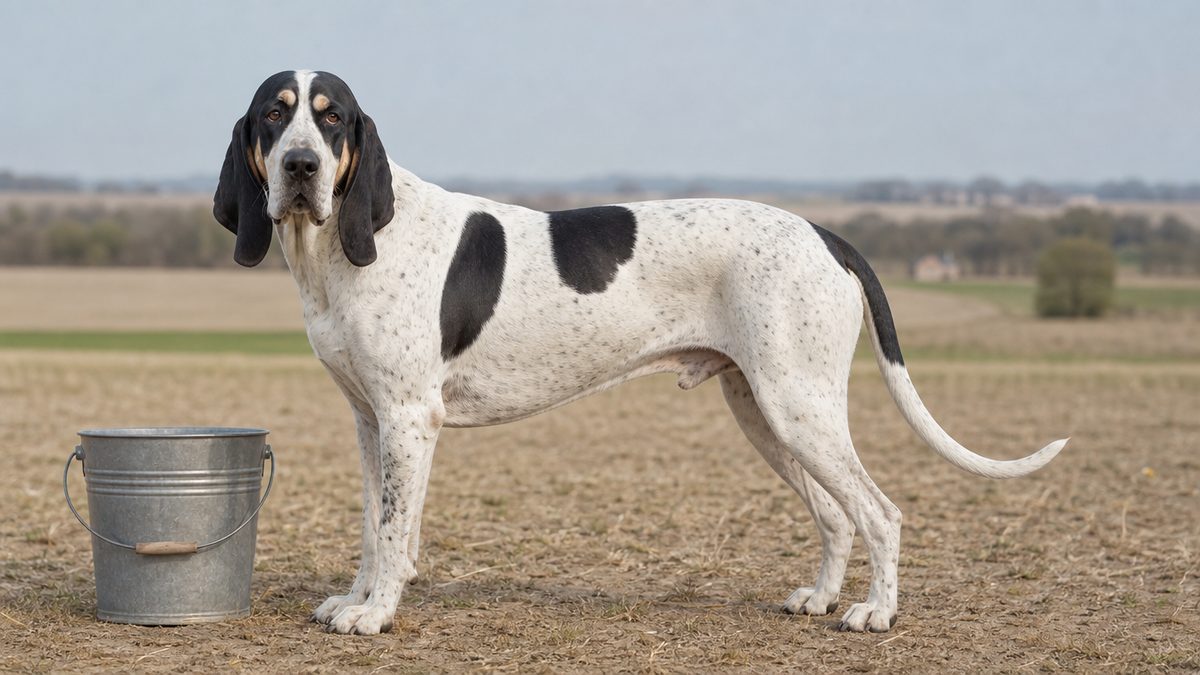
The ground colour is white with black patches, sometimes speckled but not excessively. Two black patches usually sit on either side of the head, covering the ears, surrounding the eyes and stopping at the cheeks, and the cheeks are tan, preferably pale. Two tan marks above the superciliary arches give the eyes what the French calls a *quatroeuillé* or four-eyed look, and there are tan traces inside the ears and speckling along the legs.
One further marking has its own name. At the base of the upper thigh there is sometimes a dead-leaf patch the standard calls the marque de chevreuil, the roe buck mark. Some fawn hairs may appear at the top of the ear, but the head must not read as tricolour, and any coat other than the one the standard describes is a disqualifying fault.
Measure first, because height is the only thing that separates the two varieties. Then look above the eyes for the two pale tan brow spots that make the four-eyed pattern, because their total absence is a listed fault. Then look at the ear set: fine, curled, set BELOW the eye line and long enough to reach at least the tip of the nose. A tricolour-looking head with a saddle rather than head patches is a different breed.
How the two sizes are actually registered, and why the FCI contradicts itself
The Gascon Saintongeois is registered as one breed number with two varieties, and the FCI's own standard puts those two varieties in two different sections while the FCI's own register puts the whole breed in one, which is a contradiction inside a single organisation's documents.
This is the question every page about this breed gets wrong or skips, so here is the answer read directly off the register rather than inferred.
What the standard says
FCI-Standard N° 21 has an FCI-CLASSIFICATION clause that splits in two. It reads, in the English, "Great G.S.: Section 1.1 Large sized scenthounds. With working trial. Small G.S.: Section 1.2 Medium sized scenthounds. With working trial". The authentic French is identical in force: "Grand : Section 1.1 Chiens courants de grande taille. Petit : Section 1.2 Chiens courants de taille moyenne";.
So by its own governing document, the Petit Gascon Saintongeois is a Section 1.2 medium-sized scenthound, in the same subsection as the Ariégeois, the Petit Bleu de Gascogne and the Beagle-Harrier.
What the register says
The FCI's breed record for number 21 fills its Subsection field with a single value, Large-sized Hounds, and lists a separate Varieties block containing exactly two entries, a) Great and b) Small. The Group 6 nomenclature page lists GASCON SAINTONGEOIS (21) once, under Section 1 Scent hounds subsection 1.1 Large-sized Hounds, with the same two-row varieties sub-table.
The Petit therefore appears nowhere in Section 1.2 on the register, even though its own standard places it there.
| Document | Where it places the Petit |
|---|---|
| FCI-Standard 21, English text 08.08.2023 | Section 1.2 Medium sized scenthounds |
| FCI-Standard 21, French authentic text 08.08.2023 | Section 1.2 Chiens courants de taille moyenne |
| FCI nomenclature record for breed 21 | Subsection: Large-sized Hounds, one value for the whole breed |
| FCI Group 6 nomenclature page | Listed once under 1.1 Large-sized Hounds, with a) Great and b) Small beneath |
| Société Centrale Canine breed page | One page for both, no section given |
| Statistiques LOF 2025 | One row, no variety split |
Both statements are official, and Bonbeno publishes the disagreement
There is no way to reconcile these into one answer, and averaging them would be worse than useless. The honest position is that the standard and the register disagree, that the standard is the more specific document and the one a judge works from, and that the register is what a national kennel club indexes against.
A practical reading for a buyer: whichever variety you are looking at, the pedigree will name breed 21 and a variety, not a separate breed. The section number affects which class the dog is shown in, not what it is.
The French studbook registers them as one undifferentiated line
This is the strongest single fact on the question and nobody publishes it. The Société Centrale Canine's Statistiques LOF 2025 table carries a column headed Variétés, and it uses that column: the Setter Anglais is broken into BLANC ET ORANGE at 1,946 registrations and AUTRES COULEURS at 1,847, and the Cocker Spaniel Anglais is split three ways.
The Gascon Saintongeois gets one row and no split: 602 registrations in 2024, 664 in 2025, 275 confirmed, a 41 percent confirmation rate and a 10 percent rise. So the French studbook can break out varieties, does break them out for other breeds, and does not break them out for this one. Nobody in France publishes how many of those 664 dogs were Grand and how many were Petit.
One FCI standard. One breed number, 21. Two varieties, Great and Small, named on the register. Two different FCI sections assigned inside the standard itself, 1.1 for the Grand and 1.2 for the Petit, against a single Large-sized Hounds value on the register. One breed page at the French kennel club. One undifferentiated row in the French studbook. And, separately, two standalone breed standards at the United Kennel Club. They are not two breeds under the FCI, and they are two breeds under the UKC.
The Petit is not simply a small Grand, and the standard says what the difference is
The Petit differs from the Grand in five stated clauses, utilization, history, general appearance, FCI section and size, and is identical to it in every other clause including temperament, head, ears, coat, colour, faults and disqualifications.
The lazy version of this breed says the Petit is a Grand shrunk down. The standard is more precise than that, and the precision is the useful part. Read the two variety-specific clauses side by side.
| Clause | Grand / Great | Petit / Small |
|---|---|---|
| Utilization | Dog used for shooting and sometimes hunting big game but also hare; generally with the pack or alone as a sleuth | Versatile dog used for shooting. Its origins make it a hare specialist but also a good hunter of big game |
| History | Mid-19th century. Count Joseph de Carayon-Latour crossed the last Saintonge hounds with Baron de Ruble's Bleu de Gascogne | Mid-20th century. Hunters of the South West selected the smallest subjects from Grand litters and fixed the variety |
| General appearance | Very well constructed, an impression of strength and elegance, very French in type as to head, coat and expression | Medium sized dog, well proportioned and distinguished |
| FCI section | Section 1.1 Large sized scenthounds | Section 1.2 Medium sized scenthounds |
| Size, males | 65 to 72 cm | 56 to 62 cm |
| Size, females | 62 to 68 cm | 54 to 59 cm |
The origin story is genuinely one of selection, and that is not the whole answer
The Petit's history clause does say the variety came from picking small dogs out of Grand litters. The French is exact: "quelques veneurs du Sud-Ouest sélectionnèrent les plus petits sujets de leurs portées de Grand Gascon Saintongeois et fixèrent cette variété". The verb is *fixèrent*, meaning they fixed it, in the breeder's sense of establishing a type that breeds true. The English softens this to "created".
So historically the Petit is descended from small Grands, and once fixed it stopped being one. A modern Petit is not a runt from a Grand litter; it is a population selected to breed true at 54 to 62 cm.
The real difference is the job, and the standard states it plainly
The Grand's utilization clause says it is used "generally with the pack or alone as a sleuth", and the French says "généralement en meute ou individuellement comme limier";. A limier is a specific venery role: the single hound taken out on a leash before the hunt to find and report the quarry.
The Petit's clause opens differently. It calls the Petit a versatile dog for shooting whose origins make it a hare specialist but which also hunts big game well. So the Grand is a big-game pack hound that can also work alone as a harbourer, and the Petit is a hare specialist that generalises. That is a different working brief, not a smaller one.
The UKC adds an origin claim the FCI does not make
The United Kennel Club's Petit standard tells a different origin story. It says "In essence, the Petit Gascon-Saintongeois is a reduction of the Grand Gascon-Saintongeois, individuals of which were undoubtedly mated with Airegeois and other local Briquet hounds to achieve their present size and type".
The FCI standard says nothing about outcrossing at all, in either languageFédération Cynologique Internationale. The UKC's "undoubtedly" is doing considerable work with no source attached, and it misspells the Ariégeois as Airegeois. Bonbeno reports both accounts and adopts neither, because one is unsourced and the other is silent.
What is identical, which is most of the dog
Everything else in FCI-Standard 21 applies to both varieties without qualification: the important proportions of 10 to 10.5 height-to-length and a muzzle equal to the skull, the behaviour clause, the divergent head lines, the domed narrow skull, the fine curled ears set below the eye line, the oval brown eyes, the sabre tail to the point of the hock, the short tight coat, the whole colour clause, the fault list and the disqualification list.
The FCI's Petit males top out at 62 cm and its Grand females start at 62 cm, so a 62 cm dog is inside both ranges before the plus-or-minus 1 cm tolerance is applied. The French registry's own spec card makes the overlap explicit by printing Grand 62 to 72 cm and Petit 54 to 62 cm, which are the union of each variety's two sex ranges. Height alone does not always decide which variety a dog is registered as, and the pedigree does.
Registry recognition, and a translation error you can measure
Two registries recognise this breed and they organise it differently, with the FCI publishing one standard and two varieties since 1963 and the United Kennel Club publishing two separate breed standards since 1 January 1993, and the FCI's English translation contains an error the French authentic text disproves.
Registry recognition matters to an Indian buyer because the Kennel Club of India is a full FCI member and issues pedigrees against FCI nomenclature. India registered 33,880 pure-bred dogs with the KCI studbook in 2025, down from 89,571 in 2021. So an FCI-recognised breed has an Indian paper route in principle, and this one has no dog to put through it.
The UKC splits what the FCI joins
The United Kennel Club publishes two standards, Grand Gascon-Saintongeois and Petit Gascon-Saintongeois, both recognised on 1 January 1993 and both revised on 1 January 2009United Kennel Club. Read side by side, every clause from Characteristics through Disqualifications is word for word identical between them. Only the History, the first sentence of General Appearance and the Height section differ.
So the UKC has published essentially the same document twice under two breed names, producing two separately registrable breeds where the FCI has one breed with two varieties. That is a real difference in what a pedigree means, not a formatting choice.
| Variety and sex | FCI-Standard 21 | UKC standard | UKC in cm |
|---|---|---|---|
| Grand males | 65 to 72 cm | 25.5 to 28 inches | 64.8 to 71.1 cm |
| Grand females | 62 to 68 cm | 24.5 to 27 inches | 62.2 to 68.6 cm |
| Petit males | 56 to 62 cm | 22 to 24 inches | 55.9 to 61.0 cm |
| Petit females | 54 to 59 cm | 21 to 23 inches | 53.3 to 58.4 cm |
| Tolerance | plus or minus 1 cm on all four | None stated | - |
The ranges nearly agree and do not quite. A 62 cm Petit male is inside the FCI standard and a centimetre above the UKC's 61.0 cm ceiling, and the FCI's plus-one-centimetre tolerance widens that gap to two.
A URL that misspells the breed, and the false absence it produces
Worth recording because it nearly caused an error on this page. The UKC serves its Grand standard at a path reading grand-gascon-saitongeois, missing the letter n, and its own breed-standards index links it that way. A correctly spelled URL returns HTTP 404 with the UKC's own error page.
So anyone checking whether the UKC recognises the Grand by assembling the obvious URL gets a 404 and can conclude, wrongly, that only the Petit is recognised. The absence is in the spelling, not in the register. Read the index, do not guess the path.
The croup: an error in the English translation, provable from the French
French is the authentic language of FCI-Standard 21, which the English text states on its own face. That makes the French governing and the English a rendering of it, and on one clause the rendering is wrong.
The French body clause reads "Croupe : De bonne largeur, légèrement oblique". *Largeur* is width. The English prints "Croup: Of good length, slightly sloping". Width and length are different axes of the same structure, and a judge reading the English is being told to look for something the authentic standard does not ask for.
The error has travelled. Both UKC standards, written in English, print "The croup is fairly long and slightly sloping"; United Kennel Club. That is the FCI English translation's word, not the French original's, which is the signature of a document translated once and then copied.
Two more places the English loses the French
- The skull. The French says the back of the skull is "de forme ogivale prononcée", a pronounced pointed-arch shape. The FCI English renders this as "a pronounced ogival shape", correctly, but both UKC standards render it as "slightly oval in shape", which is a different geometry and a softer requirement.
- The temperament. The French calls the dog entreprenant, meaning enterprising or showing initiative. The FCI English gives "wide-casting", which describes how far the hound ranges rather than whether it takes initiative. Both are plausible working traits and they are not the same trait.
- FCI, definitive since 10 August 1963. Group 6, one standard, two varieties, with working trial. The route the Kennel Club of India would use.
- Société Centrale Canine. One breed page, one studbook row, no variety split, parent club the Club du Bleu de Gascogne, Gascon Saintongeois et Ariegeois.
- UKC, since 1 January 1993. Two separate Scenthound Group breeds.
- AKC. No recognition of either variety, in the main roster or the Foundation Stock Service.
This site builds arguments on breed standards, so a standard that contradicts its own register and a translation that misreports a body measurement are not trivia. Where a French breed's standard is authentic in French, read the French. Where an English page repeats a phrase that turns out to be a translator's choice rather than the original's, say so. Both of those checks cost minutes and both changed what this page says.
Gascon Saintongeois price in India: there is none
No verified Gascon Saintongeois price in India exists, because there is no Indian market for either variety to price, and the only rupee figure an India-region search returns for the name is Rs 5,591 for an aluminium sign.
Put the answer first, because every page ranking for this query buries it or answers a different country's version. Bonbeno found no Indian seller, breeder, rescue or listing offering a Gascon Saintongeois of either variety, and the search that failed to find one was proved to work in the same session on a breed India actually keeps.
What an India-region search for the price actually returns
A Firecrawl web search with location set to India, run on 31 August 2026, returned ten results in this order: Royal Canin India's breed record, the UKC's Petit standard, an Irish retailer's article, an Indian pet-supplies store's breed page, the Brit pet-food catalogue, a Desertcart India listing for a novelty metal sign, Wuuff stating there are currently no available puppies, Wikipedia, Wamiz UK and Animalia.
Not one result offers a dog in India. The Wuuff entry is the most honest thing on the page: a puppy marketplace saying in its own words that it has none.
The only India-domain commerce result is a sign, and it calls the breed a guard dog
Desertcart India lists product 192808897, a "Novelty Decorative Sign Property Protected By Gascon Saintongeois Guard Dog Warning Breed Aluminum Metal Sign 30 x 45cm Yard Fence Sign Gift", at Rs 5,591 with duties and taxes included, sold by Amazon UK and shipped from the UK via Shadowfax and Delhivery.
That is the entire Indian commercial presence of this breed: a fence sign, imported. And the sign is wrong about the dog. FCI-Standard 21 describes an animal that is "Calm, affectionate and amenable to orders" and the UKC calls it "Calm, affectionate and agreeable"; United Kennel Club. Neither registry says one word about guarding.
One methodological note, because it matters. The search snippet for that listing gave Rs 5,601. The live page gives Rs 5,591. Bonbeno fetched the page rather than quoting the snippet, and the two differ by ten rupees. A snippet is not a source.
The control that makes the absence evidence
An absence proves nothing unless the instrument works, so the same tool ran "labrador retriever price in india" in the same session. It returned Supertails, Mr n Mrs Pet with a city-by-city table covering Hyderabad, Bangalore, Delhi, Chennai, Lucknow, Mumbai, Jaipur and Pune, plus YouTube, Quora and PetsWorld, all genuine Indian puppy listingsMr n Mrs Pet, Labrador Retriever Puppies…. The instrument finds Indian dog prices when Indian dog prices exist.
India's benchmark price list confirms it from inside. Supertails' "Dog Price List in India: Top 40 Breeds" contains zero occurrences of Gascon or Saintongeois across its 120,485 characters, against fourteen occurrences of Beagle, eleven of Labrador and four of Dachshund in the same document.
| Source | Figure | What it prices |
|---|---|---|
| Desertcart India | Rs 5,591 | An aluminium fence sign, shipped from the UK |
| Zoomalia (Ireland) | A euro band for a Grand | A European purchase estimate with no Indian relevance |
| Wuuff puppy marketplace | No figure | States it has no puppies of this breed available |
| Royal Canin India | No figure | A breed record with no price and no availability |
| GoofyTails (India) | No figure | A breed page whose own product grid returns Showing -1 Results |
| Supertails Dog Price List in India | No entry | The breed is absent from India's benchmark list |
There is no rupee band here to test, which is itself the finding
Bonbeno routinely catches Indian pages publishing a rupee price that turns out to be a dollar figure divided by one exchange rate, and the test is to divide by 84.38, by 80, by 74 and by 66.67 and see which quotient a seller would actually print. This breed has no Indian rupee band for a dog at all. There is nothing to convert and nothing to catch, and the absence of even a fabricated price measures how far outside the Indian market this hound sits.
Ask which variety, ask for the pedigree number and the issuing registry, and measure the dog. Grand males run 65 to 72 cm and Petit males 56 to 62 cm, both with a one-centimetre tolerance. Then check the head: black patches covering the ears and surrounding the eyes with pale tan cheeks, and two pale tan spots above the eyes. A tricolour dog with a black saddle across the back rather than patches on the head is not this breed, and a mid-sized Indian white-and-black hound with drop ears is very commonly a Pointer or Beagle cross, which is a fine dog and not this one.
How many exist, from the French studbook's own table
France registered 664 Gascon Saintongeois in 2025, up from 602 in 2024, making it the fourth most registered breed in FCI Group VI in France and the only one of the top four to grow that year.
Unlike most rare French hounds, this one is not scarce at home. The Société Centrale Canine's Statistiques LOF 2025 is the primary document and it was read directly from the PDF rather than from any summary of it.
| Breed | 2024 | 2025 | Confirmed 2025 | Conf rate | Change |
|---|---|---|---|---|---|
| Beagle | 3,514 | 3,089 | 822 | 27% | -12% |
| Basset Hound | 798 | 703 | 125 | 18% | -12% |
| Basset Fauve de Bretagne | 800 | 690 | 226 | 33% | -14% |
| Gascon Saintongeois | 602 | 664 | 275 | 41% | +10% |
| Griffon Nivernais | 583 | 571 | 326 | 57% | -2% |
| Griffon Bleu de Gascogne | 453 | 529 | 190 | 36% | +17% |
| Beagle-Harrier | 478 | 440 | 196 | 45% | -8% |
| Petit Bleu de Gascogne | 250 | 234 | 75 | 32% | -6% |
| Ariégeois | 242 | 227 | 131 | 58% | -6% |
| Groupe VI, all breeds | 12,894 | 11,720 | 3,989 | 34% | -9% |
Read the change column
The Gascon Saintongeois rose 10 percent while its whole group fell 9 percent, and it is the only breed in the top four to have gained. Its 664 registrations are 5.7 percent of every Group VI dog registered in France in 2025, and it sits fourth overall behind the Beagle, the Basset Hound and the Basset Fauve de Bretagne, which makes it the second most registered French scent hound in France after the Basset Fauve.
So this is not a vanishing breed. It is a working French pack hound with a real population, kept almost entirely by French hunters, that happens to be invisible outside France.
The confirmation rate says who owns them
Confirmation is the French adult assessment that converts a provisional registration into a full studbook entry. The Gascon Saintongeois confirmed 275 of 664, a rate of 41 percent, against a Group VI average of 34 percent. Recompute it and 275 divided by 664 is 41.4 percent, which is what the table prints.
A confirmation rate above the group average is the signature of a breed owned by people who take their dogs through a formal process, which for a Group VI breed generally means hunters rather than pet buyers. The Ariégeois, at 58 percent on 227 registrations, is higher still and on a much smaller base.
What the number does not tell you
It does not tell you the Grand and Petit split, because the studbook does not publish one. It does not tell you the living population, because the table counts registrations rather than dogs. And it tells you nothing whatever about India, where the breed does not appear in any register.
It is also worth being careful with the word rare. The UKC's Petit standard states that "at this time, the Petit Gascon-Saintongeois is one of the most rare hound breeds in France". That may well be true of the Petit specifically, and the LOF cannot confirm or refute it, because the 664 is not split. A claim about one variety cannot be tested against a number that counts both.
Verified from the LOF 2025 PDF: 602 registrations in 2024, 664 in 2025, 275 confirmed, a 41 percent confirmation rate, a 10 percent rise, fourth place in a Group VI total that fell from 12,894 to 11,720. Not verified: the split between Grand and Petit, the living population of either variety, and the UKC's claim that the Petit is one of France's rarest hounds, which the only available French figure cannot test.
Indian import rules, and why no supply chain can form
Indian law makes a dog a Restricted import and states that applications for trading or breeding purposes shall be duly rejected, so the only lawful way a Gascon Saintongeois of either variety reaches India is in the baggage of an owner who already had it abroad.
The instrument is DGFT Trade Notice No. 22/2022-23 of 19 December 2022, Guidelines for import of Pet Animals. It records ITC (HS) 01061900 Mammals Other as Restricted subject to Policy Condition 6, and its Policy Condition 7 limits dog imports to three categories: a pet dog with a valid pet book in the importer's own name, R&D organisations holding a CPCSEA recommendation, and the Defence and Police Force.
Policy Condition 8 bars the import of commercial dogs for breeding or any other commercial activities, and paragraph 6 states plainly that any applications for trading or breeding purposes shall be duly rejected. Paragraph 7 permits entry only through the airports and seaports of Delhi, Mumbai, Chennai, Hyderabad, Bangalore and Kolkata.
This breed's own supply is unusual, and it does not help
Unlike most breeds on this site with no Indian market, the Gascon Saintongeois is not scarce at source. France registered 664 in 2025. The block is entirely on the Indian side, and it is complete: no Indian breeder can lawfully establish a founding pair, no Indian pet shop can lawfully stock one, and no Indian buyer can lawfully purchase one imported for that purpose.
The one lawful route produces individual dogs, never a market. A person who owned the dog abroad, holds its pet book in their own name, and brings the animal with them when they move to India is importing a pet, not stocking a trade.
Do not conflate the two import routes
Commercial and restricted import policy runs on the DGFT trade notice above. Personal pet import under the baggage rules is a different instrument, resting on the Livestock Importation Act, 1898, and S.O. 4396(E) of 10 October 2024 permits pet dogs and cats through Cochin International Airport, Kochi, under the Animal Quarantine and Certification Station, Chennai. That order adds a port to the pet route. The DGFT notice still names six ports for its own licence route, so the six ports above are reported as the DGFT prints them, and a pet arriving under the baggage rules can land at seven ports today. Both lists are right for their own route, as how to import a dog to India sets out.
Indian breeding law, and one clause that bites this breed specifically
Anyone who lawfully imports one and then contemplates breeding runs into the Prevention of Cruelty to Animals (Dog Breeding and Marketing) Rules, 2017.
- Rule 8(1)(a) requires that pups less than eight weeks in age are not sold. A Rule in the main body of the instrument, not a Schedule paragraph.
- Second Schedule Part II paragraph 6(8) forbids tail docking, ear cropping, de-barking, de-clawing, branding, dyeing and any change of appearance by artificial means. De-barking is the one that matters here, because this breed's standard grades its voice as a working attribute.
- Second Schedule Part III paragraph 8(10) requires that breeding dogs have been tested for genetic defects, including hip dysplasia, progressive retinal atrophy, night blindness, hypothyroidism, entropion, ectropion, overshot and undershot jaw, wry mouth, two or more missing teeth and cryptorchidism.
- Second Schedule Part II paragraph 6(3) prohibits in breeding, defined as breeding between relatives of the 2nd to 4th grade in straight or side line within the first four generations, and incest breeding, defined as mating between parents and children or between brother and sister.
Paragraph 6(3) deserves a moment on a two-variety breed. Nothing in FCI-Standard 21 prohibits crossing the Grand and the Petit, and both are registered under one breed number, so a Grand-to-Petit mating is not an outcross in FCI terms. What paragraph 6(3) constrains is relatedness, not variety, and within a population of 664 annual registrations that share one nineteenth-century founding cross, relatedness is the live question. An Indian breeder would need a pedigree deep enough to demonstrate four clear generations.
Paragraph 8(10) also names overshot and undershot jaw, and FCI-Standard 21 makes prognathism, upper or lower, a disqualifying fault. Here the standard and Indian law agree, which is worth noting because on other breeds they collide.
Note also what the Rules do not contain. Across all fourteen pages the words BAER and deaf appear zero times, and so do patella and luxation. There is no Indian hearing test requirement and no Indian patella grading requirement for any breed.
An Indian listing offering a Gascon Saintongeois puppy is making one of three claims, and all three need documents. Either the dog was imported under a route Indian policy says shall be duly rejected, or it descends from an animal imported as somebody's personal pet, in which case ask to see that pet book and the LOF pedigree, or it is not a Gascon Saintongeois. The third is by far the most likely.
Monthly cost of keeping one in India, if one is here
Budget Rs 7,500 to Rs 16,000 a month for a Grand and Rs 6,000 to Rs 13,000 for a Petit in an Indian city, built from India's published cost benchmarks rather than from any figure attached to this breed, because no such figure exists in any country.
Every number in this section is an Indian benchmark for a dog of the relevant size, not a monthly cost anyone has published for a Gascon Saintongeois. Say that plainly, because the alternative is converting a European figure and presenting it as Indian.
Supertails' Indian price list gives the frame. Monthly upkeep across breeds runs Rs 3,000 to Rs 18,000 depending on breed size and grooming needs, average monthly maintenance runs Rs 3,000 to Rs 11,000, urban Indian households now spend Rs 5,000 or more every month, a Great Dane's food bill alone runs Rs 5,000 to Rs 10,000 a month, and a first year costs Rs 80,000 to Rs 2,00,000.
| Line | Grand, Rs | Petit, Rs | What drives it |
|---|---|---|---|
| Food | 4,500 to 7,500 | 3,000 to 5,500 | A 65 to 72 cm working hound against a 56 to 62 cm one |
| Routine veterinary and preventives | 1,000 to 1,800 | 800 to 1,500 | Monthly year-round tick and flea control, plus deworming |
| Ear care consumables | 400 to 900 | 400 to 900 | Ear leathers reaching the tip of the nose, in Indian humidity |
| Grooming | 0 to 800 | 0 to 800 | A short tight coat needs a brush, not a salon |
| Exercise and enrichment | 600 to 1,800 | 500 to 1,500 | Long lines, scent-work kit, replacement toys |
| Boarding sinking fund | 1,000 to 2,500 | 800 to 2,000 | A vocal hound is refused by some Indian boarding facilities |
| Insurance or self-insurance fund | 800 to 1,500 | 600 to 1,200 | Indian pet insurance is thin, so most owners self-fund |
| Total | 8,300 to 16,800 | 6,100 to 13,400 | Driven by food and ear care, not by grooming |
Two lines run higher for this breed than for a comparable Indian dog
The ear line is the first, and this breed sits high in the risk group by construction. The standard specifies ears that are fine, curled, set below the eye line, and long enough to reach at least the tip of the nose. That is a longer leather than most drop-eared breeds carry.
Breeds with pendulous ear carriage have 1.76 times the odds of otitis externa compared with erect-eared breeds, 95 percent CI 1.48 to 2.10, and V-shaped drop ears 1.84 times, 1.53 to 2.21, in a study drawing a random sample of 22,333 dogs from 905,554 under UK veterinary care. In Indian conditions that is a recurring consumable cost and, in a bad year, a recurring consultation cost.
The tick line is the second. A survey of 525 dogs across four Indian cities found 261, 49.7 percent, infected with at least one canine tick-borne pathogen by PCR, with Hepatozoon canis at 30 percent and Ehrlichia canis at 20.6 percent, and ticks present on 278 of the dogs examined. A hound whose job is to put its nose into undergrowth meets more ticks than a dog that walks on pavement.
The first year, and the line most Indian budgets miss
Take the Indian benchmark of Rs 80,000 to Rs 2,00,000 for a first year including purchase. For this breed the purchase component is undefined, because nothing is lawfully for sale in India. So the honest first-year figure for a dog already here, brought by an owner relocating, is roughly Rs 85,000 to Rs 1,60,000 for a Grand across food, vaccination, neutering, ear care, equipment and preventives, and Rs 70,000 to Rs 1,30,000 for a Petit.
Fencing is the capital line nobody budgets. A pack scent hound that picks up a line will follow it, and Indian residential compounds are rarely built to hold a 30 kg dog with a nose and a reason. Physical containment is the difference between a dog that lives to twelve and a dog that meets traffic.
The rupee ranges here are published Indian benchmarks for dogs of the relevant size, plus two lines lifted by Indian veterinary evidence specific to this breed's ears and this country's ticks. They are not a Gascon Saintongeois cost survey, because none exists anywhere. Treat them as a planning envelope, not a quotation, and get a written estimate from your own vet before you commit.
Heat tolerance in India: Bonbeno rates this breed 2 of 5
Bonbeno rates the Gascon Saintongeois 2 out of 5 for heat tolerance in India, because a large working pack hound bred at an annual mean of 13.11 C meets an annual mean wet-bulb temperature in Chennai that is nearly four degrees above the air temperature of its homeland in its hottest month.
Most breed pages guess at heat tolerance. This one measures it, using NASA POWER climatology queried by explicit latitude and longitude so no place name can be served in error, and comparing wet-bulb rather than air temperature because wet-bulb is what limits a panting animal.
The origin climate, by coordinates, for both halves of the name
This breed is named after two French regions and both were queried. Saintes in the Saintonge, at 45.7460 N, 0.6350 W, returns an annual mean air temperature of 13.11 C, an annual mean relative humidity of 79.67 percent and an annual mean wet-bulb temperature of 11.13 C, with a July mean of 21.13 C and a 17.81 C wet bulb.
Auch in the Gers, in Gascony, at 43.6465 N, 0.5860 E, returns 13.61 C, 75.08 percent humidity and an 11.08 C annual mean wet bulb, with a July mean of 22.55 C and an 18.35 C wet bulb. The two homelands are within half a degree of each other on air temperature and within 0.05 C on wet bulb, so the breed's origin climate is a single number for practical purposes.
| Place | Annual mean air, C | Annual mean humidity, % | Annual mean wet bulb, C | Wet bulb above Saintes, C |
|---|---|---|---|---|
| Saintes, Saintonge (origin) | 13.11 | 79.67 | 11.13 | - |
| Auch, Gascogne (origin) | 13.61 | 75.08 | 11.08 | -0.05 |
| Chennai | 27.95 | 72.39 | 24.94 | +13.81 |
| Kolkata | 25.81 | 73.93 | 22.85 | +11.72 |
| Mumbai | 26.77 | 67.39 | 22.73 | +11.60 |
| Bengaluru | 23.74 | 67.94 | 19.80 | +8.67 |
| Pune | 23.86 | 66.80 | 19.66 | +8.53 |
| Delhi | 25.60 | 45.56 | 18.03 | +6.90 |
The comparison that settles it
Chennai's annual mean wet-bulb temperature is 24.94 C. Saintes' air temperature in July, its hottest month, averages 21.13 CNASA Langley Research Center. So the wet bulb Chennai holds as an ordinary year-round condition sits 3.81 C above the dry-bulb temperature of the breed's homeland at the peak of a French summer. There is no month of the Indian year in which this hound experiences the conditions it was selected in.
Delhi looks mildest on the annual wet-bulb column at 18.03 C, and that column is misleading. Delhi's July wet bulb is 27.74 C, the highest single monthly figure in the table, against Saintes' July wet bulb of 17.81 CNASA Langley Research Center. Delhi's annual average is dragged down by a dry cool winter, and its monsoon is the hardest month in this set for a working dog. Kolkata's May wet bulb of 27.61 C is barely behind it.
One nuance the humidity column shows. Saintes is humid, at 79.67 percent annual mean, more humid than every Indian city in this table except none. Humidity alone is not what makes India hard for this dog. Humidity at 28 C is, and wet bulb is the number that combines the two.
The exercise, not the weather, is what actually kills these dogs
The largest primary-care study of heat-illness triggers found that of 879 events with a recorded trigger, 652, or 74.2 percent, were exertional, against 113 environmental and 46 from vehicular confinement. Exertional heat-related illness, in other words, is not the exotic case; it is the ordinary one. Of the 551 exertional events whose exercise type was specified, 372, or 67.5 percent, followed walking rather than any high-intensity activity.
The Gascon Saintongeois was not among the breeds that study modelled, so no breed odds ratio from it is applied here. One transferable factor does apply. A separate paper on the same 905,543-dog cohort, in Scientific Reports, found that dogs at or above their breed and sex mean bodyweight carried 1.42 times the odds of heat-related illness, 95 percent CI 1.12 to 1.80, and that dogs over 50 kg carried 3.42 times the odds. A Grand at 72 cm is not over 50 kg, but bodyweight relative to the breed mean is entirely within an owner's control, and it is the one lever available.
- Walk before 06:00 and after 20:00, eight months of the year, in every city in the table above.
- Watch the wet bulb, not the thermometer. Delhi in July and Chennai in May are the conditions in this set where a dog cannot cool itself efficiently by panting.
- Keep the dog at or below its breed mean weight, which is the only heat-illness risk factor here that an owner changes directly.
- Never keep the dog in a daytime outdoor run. Second Schedule Part IV paragraph 21 of the 2017 Rules bars keeping dogs that cannot tolerate prevailing local temperatures in outdoor facilities without a vet's written approval.
India's own criterion adds the scale. The IMD declares a heat wave when a station maximum reaches 40 C or more in the plains, heat waves typically run March to June with a peak in May, and northern India averages five to six events a year.
The Gascon Saintongeois gets a 2 rather than a 1 because it is a normal-muzzled dog with a short tight single coat and no described undercoat, and because its homeland at 13.11 C is materially warmer than the origin of several northern hounds Bonbeno rates. It does not get a 3 because the animal's entire purpose is sustained pack work, which the largest study on the subject identifies as the dominant trigger of heat illness. Bonbeno's Ariégeois, Chien Français Blanc et Noir, Chien Français Tricolore, Billy, Artois Hound and Beagle-Harrier pages all rate 2 of 5, and the Grand Anglo-Français Blanc et Noir rates 1, so this rating sits where the cluster sits.
Temperament, and the one thing the Indian internet gets backwards
The Gascon Saintongeois is described by its own standard as calm, affectionate and amenable to orders, an instinctive pack hound with a very sonorous voice, and the single most visible Indian listing for the breed calls it a guard dog, which no registry does.
Both registries describe this dog and they agree with each other, which is not always the case. FCI-Standard 21's behaviour clause reads "Pack hound par excellence, fine-nosed, wide-casting and endowed with a very sonorous voice. Joins the pack instinctively. Calm, affectionate and amenable to orders". The UKC's Characteristics clause, identical on both its standards, reads "An excellent pack dog with a fine nose, wide casting, and endowed with a sonorous voice. Calm, affectionate and agreeable"; United Kennel Club.
Royal Canin India, sourcing from the FCI, gives the character words Determined, Calm, Loving and Obedient. Three independent renderings, one dog.
The guard dog claim, and why it is wrong
The most visible thing an Indian search surfaces for this breed is a Rs 5,591 aluminium sign reading "Property Protected By Gascon Saintongeois Guard Dog";. Nothing in either registry standard supports that. Neither the FCI nor the UKC mentions guarding, protection, territory or suspicion of strangers anywhere in the document, and both make aggression a disqualifying faultUnited Kennel Club.
A pack hound that could not work in a group of twenty to thirty hounds under French venery law would be useless at its job. Selection for that job runs directly against selection for territorial guarding.
Three traits that are real, and what each costs you in India
- The voice is a graded working attribute. The French calls it *gorge* and specifies *une très belle gorge*, a very fine voice, which is the venery term for the hound's cry on the line. A carrying bay bred to be heard across broken country is a nightly complaint in an Indian apartment block, and it is not a behaviour problem to be trained away.
- The nose is the primary sense. *Fin de nez*, fine-nosed, sits first in the temperament clause. A dog navigating an Indian residential street by scent, at 30 kg, on a flexi lead, is a hazard to itself and to whoever is holding it.
- Packing up is instinctive. *Il s'ameute d'instinct*, it joins the pack by instinct. That is excellent news for households with other dogs and it means an under-occupied single dog is working against its own wiring.
Who should not want one in India
Anyone in a flat. Apartment living with a hound selected for voice runs straight into India's Noise Pollution (Regulation and Control) Rules, 2000, which set a residential limit of 55 dB(A) by day and 45 dB(A) at night, define night as 10 p.m. to 6 a.m., and allow a complaint where ambient standards are exceeded by 10 dB(A) or more. De-barking, the only surgical fix, is expressly forbidden here.
Anyone who wants a guard dog, for the reasons above. Anyone without secure fencing. Anyone whose household is empty ten hours a day, because a dog that packs by instinct does not do isolation well. And anyone choosing a first dog, because an independent hound teaches bad habits faster than a beginner corrects them.
Who it does suit
A household with land, other dogs, an owner who can run the dog in the dark for eight months of the year, and no shared walls. That describes a small number of Indian homes and it describes them accurately. Where those conditions exist, both registries and the Indian breed record agree this is a calm, biddable, people-loving animal.
A calm, affectionate, extremely vocal, nose-driven pack hound that wants company and work. The affection is well attested by two registries and an India-facing breed record. The voice and the nose are not flaws to be trained out, because they are the two traits the breed exists for. And it is not a guard dog, whatever the sign says.
Training a hound bred to work ahead of you
Train the Gascon Saintongeois with short food-paid sessions and treat recall as a lifelong management problem rather than a skill you finish, because the standard describes a dog that is amenable to orders and simultaneously enterprising on a scent line.
The standard hands you both halves of the training problem in one clause. The dog is *calme, affectueux, se met facilement aux ordres*, calm, affectionate and easily put to orders, and it is also *entreprenant*, enterprising, and *fin de nez*, fine-nosed. Royal Canin India, working from the same source, lists Enjoys training among its key facts.
So obedience is genuinely easy with this breed. What is not easy is the one thing that matters in an Indian city.
Recall on scent is the exception, and it is the only one that counts
Recall in the presence of a live scent line is where the biddability stops, and the reason is structural rather than moral. A scent line is self-reinforcing, so every second the dog spends following it pays better than anything you are holding. This is a breed whose Grand variety is expressly described as working *individuellement comme limier*, alone as a harbourer, out of sight.
The practical position for an Indian owner is management first and training second.
- Fence the property physically, to a height and depth the dog cannot pass. A hound follows a line under a gate as readily as over a wall.
- Use a long line of 10 to 15 metres for every open-ground outing, for life, in every Indian city. Standard equipment for the breed, not an admission of failure.
- Pay recall with food every single time, at a value that beats a scent, and never call the dog to end something it enjoys.
- Practise recall on scent, not on bare grass. A recall that only works in an empty park has not been tested against the thing it is for.
- Microchip and tag before the first outing, because the first escape is the one nobody planned for.
Session shape, and why short beats long in India
Keep formal sessions to five or eight minutes and run three or four a day. A hound's attention is long in the field and short in the yard, and a twenty-minute obedience block in Indian heat produces a bored dog and an irritated handler. Use scent games as the reward for obedience rather than as a separate activity, which pairs what you want with what the dog already wants.
Socialisation, on an Indian timetable
Socialise the puppy deliberately and early, and understand that the Indian version of the task differs from the French one. An Indian puppy needs calibrated exposure to free-roaming dogs, two-wheeler traffic at close range, crowded market noise, cattle, festival firecrackers and household staff coming and going. A French puppy of this breed needs none of those in that combination, and it needs a kennel of twenty other hounds instead.
Do it in the cool hours, keep sessions short and pleasant, and stop before the puppy tires. Indian law sets one hard date: Rule 8(1)(a) of the 2017 Rules requires that pups less than eight weeks in age are not sold, so a six-week puppy on offer tells you something about the rest of a breeder's practice.
What not to do
Do not use an aversive collar to fix recall. A hound running a line is doing its job, and punishing it teaches the dog that returning to you predicts something unpleasant, which is exactly backwards. Do not try to train the voice away either, and note that de-barking is expressly forbidden in India under Second Schedule Part II paragraph 6(8) of the 2017 Rules.
No published training study exists for this breed, and none is likely, because a breed registering 664 dogs a year in one country does not generate research. What is written above is reasoned from the working role FCI-Standard 21 describes and from the general behaviour of pack scent hounds. Where a claim rests on inference rather than evidence, this page says so rather than dressing it up.
The daily exercise requirement, and the French law that quantifies it
Plan on 90 to 120 minutes a day across two cool-hour sessions with at least a third of it nose work, because French law will not certify a pack for roe deer unless it can uncouple twenty hounds capable of the work, and this breed was selected inside that requirement.
Most breed pages guess at exercise requirements. For a French pack hound there is a legal floor to anchor against, and it is published, current and specific.
The Arrêté du 18 mars 1982, Article 2
The Arrêté du 18 mars 1982 relatif à l'exercice de la vénerie governs hunting with hounds in France. Its Article 2, still in the original text in force since 25 May 1982 while every article around it has been revised twice, requires that for the *chasse à courre* an equipage must be capable of uncoupling:
| Quarry | Minimum hounds | Mounted people required |
|---|---|---|
| Stag and wild boar | 30 | At least two on horseback |
| Roe deer and fallow deer | 20 | At least one on horseback |
| Fox | 10 | At least one on horseback, subject to prefectural dispensation |
| Hare | 6 | None stated |
The same article requires that the hounds be *créancés*, meaning proven and steady on the quarry's line, and of *races spécialisées*, specialised breeds. Relays by car and truck are forbidden, though up to six hounds may be carried in a vehicle during the hunt except in hare venery.
Two further articles that describe this exact breed
Article 5 caps the number of *chiens courants* in action at 60, and it provides that *l'action de faire le bois avec limier*, the act of harbouring the quarry with a limier, requires a validated hunting licence. That is the precise role FCI-Standard 21 assigns to the Grand Gascon Saintongeois, *individuellement comme limier*. French law names the job the breed standard names, and makes it a licensed act.
Article 4 requires that equipage hounds be compulsorily identified by tattoo, and Article 6 provides that the prefect issues an *attestation de conformité de la meute* for every equipage whose kennel is in the department, valid six years, granted provisionally for one year to a new equipage and renewed for five more once the pack's aptitudes are confirmed, after the opinion of the departmental hunters' federation.
The Petit's quarry sets a different legal floor
Read the table against the two varieties. The Grand's utilization clause names big game and the pack, which under Article 2 is a 20 or 30 hound minimum. The Petit's clause names the hare as its origin specialty, and the hare minimum is sixRépublique Française. The French history clause is explicit that the Petit was fixed *au courre du lièvre*.
So the two varieties are legally embedded in packs of different size, which is a real consequence of the difference in job rather than a difference in size alone.
What that translates to in an Indian city
| Session | When | Duration | Content |
|---|---|---|---|
| Pre-dawn | 05:15 to 06:15 | 45 to 60 min | Long line, varied route, at least 20 minutes of free sniffing on a slack lead |
| Midday | Indoors | 10 to 15 min | Scatter feed, snuffle mat, find-it games. No outdoor exposure |
| Post-sunset | 20:30 to 21:30 | 40 to 60 min | Long line again, plus one laid scent trail two or three times a week |
| Weekly | Cool hours | 2 to 3 hours | Peri-urban ground with real cover, on a long line, off pavement |
The midday indoor block is not padding. Nose work exhausts a scent hound far faster than walking does, and it is the only exercise fully available in an Indian afternoon. A dog worked hard on scent in a cool room at noon is calmer at 4 p.m. than one walked in the sun.
The heat arithmetic makes the timing non-negotiable. Of 879 heat-illness events with a recorded trigger, 652, or 74.2 percent, were exertional, and of the 551 exertional events with a specified type, 372, or 67.5 percent, followed a walk. Two hours of vigorous daytime exercise in Chennai, at an annual mean wet bulb of 24.94 C, is the exact protocol that study describes as the dominant cause.
Verified from Légifrance on 31 August 2026: Article 2 requires thirty hounds for stag and wild boar, twenty for roe and fallow deer, ten for fox and six for hare, all créancés and of specialised breeds; Article 5 caps hounds in action at 60 and makes faire le bois avec limier a licensed act; Article 4 requires tattoo identification; Article 6 provides a six-year prefectural attestation. Not verified: any published daily exercise figure in minutes for this breed, because no registry or club publishes one. The 90 to 120 minute range is Bonbeno's own reading, not a quoted figure.
Grooming a short-coated hound in Indian humidity
Brush the Gascon Saintongeois once or twice a week and treat the ears as the actual grooming job, because a leather long enough to reach the tip of the nose over a warm humid canal is the highest-frequency health cost this breed carries in India.
The coat is genuinely easy and the ears genuinely are not. The standard's coat clause is four words long in the French: *Court et serré*, short and tight. The French registry's spec card gives the same, Poil: Court et serré. Royal Canin India lists Requires minimal grooming among its key facts and is right to.
So you groom this breed with a rubber curry or a firm bristle brush once or twice a week, more in a coat change, and you never take it to a salon. There is no stripping, no clipping and no scissoring in a short tight coat, and shaving a working hound for the Indian summer exposes skin that has never been exposed.
The ears carry the risk, and the standard tells you why
FCI-Standard 21 specifies ears that are "Fine and curled, they should reach at least the tip of the nose. Set on below the level of the eye and placed rather backwards". The UKC adds that the leather "must reach at least to the tip of the nose, and is often longer";. That is a long, low-set, curled leather lying over the canal, which is exactly the geometry that traps warm moist air.
The largest UK primary-care study of canine otitis externa drew a random sample of 22,333 dogs from a population of 905,554 under veterinary care and reports a one-year period prevalence of 7.30 percent, 95 percent CI 6.97 to 7.65. Compared with erect-eared breeds, pendulous ear carriage carried 1.76 times the odds, 95 percent CI 1.48 to 2.10, and V-shaped drop ears 1.84 times, 1.53 to 2.21. The Basset Hound, the extreme case, sits at 5.87.
An older North American study of 8,975 dogs across fifteen university teaching hospitals found the same ear effect and added the piece that makes it an Indian problem. Dogs with pendulous ears and heavy ear canal hair had significantly more otitis externa than other ear types at P less than 0.01, and monthly variations in ambient temperature, rainfall and relative humidity explained to a large extent the monthly variation in prevalence. Ear disease is weather-driven, and India supplies the weather.
Which Indian season is worst is genuinely disputed, and this page publishes the dispute
Bonbeno's gundog pages report an Indian otitis series peaking in the monsoon. An Indian series from Durg in Chhattisgarh disagrees. It examined 281 dogs, found 51 positive for otitis externa, a prevalence of 18.14 percent, and recorded seasonal prevalence highest in summer, defined as March to June, at 21 of 51 cases or 41.18 percent, against 17 of 51 or 33.33 percent in the rainy season of July to October.
Both cannot be the general Indian pattern and neither should be presented as settled. What is not disputed is that Indian ear disease is seasonal in both directions and that between them those seasons cover roughly eight months. Ear cleaning for this breed is a year-round weekly routine, not a monsoon precaution.
The drying rule overseas advice keeps getting wrong
Bathe every four to six weeks in an Indian city and after any swim or muddy work. What happens next is what matters. European breed-care advice routinely says to towel a hound off and let it air dry, which is sound at Saintes' annual mean of 13.11 C and actively wrong in an Indian monsoon.
Plug the ears before you bathe, and dry the canal afterwards with a vet-supplied drying agent rather than a cotton bud pushed inside. That single habit is worth more than every other grooming step on this page combined.
- Lift and look, weekly. A healthy canal is pale, dry and odourless. Yeast smells sweet and sour at once.
- Clean only when there is something to clean, with a vet-supplied cleaner, never with a cotton bud inside the canal.
- Dry after every bath and every swim, ears first, before the coat.
- Escalate a head shake that lasts two days. Early otitis is a consultation. Late otitis is a chronic canal.
- Keep the monthly tick preventive running, because 261 of 525 Indian dogs surveyed carried a tick-borne pathogen and the ears are where you notice ticks first.
One or two brushings a week for a short tight coat, a bath every four to six weeks with the ears plugged and dried afterwards, a weekly ear inspection, and a monthly tick preventive that never lapses. There is no salon appointment in this breed's life and there should never be a clipper.
Health problems and lifespan: two papers, no prevalence, no lifespan
Exactly two peer-reviewed papers name the Gascon Saintongeois, a single-dog case report of a nerve sheath tumour and a parasitology trial in which five of ten puppies were of the breed, and neither supports a prevalence claim, while OFA's published statistics carry no row for it and the largest longevity study does not include it.
This is where most breed pages invent, so this one shows its working. Every register below was searched with a control run in the same session.
The two papers, and a search warning that was wrong
PubMed was queried for "Gascon Saintongeois" and returned 2 records with the warning quotedphrasesnotfound, translating the query to "gascon" AND "saintongeois". On this project that warning normally means the result set is noise. Here it was not, and the only way to know was to open both abstracts.
Both records contain the exact phrase. The first is a Canadian Veterinary Journal case report whose abstract opens "A 5-year-old intact male Gascon Saintongeois dog was presented with a 6-month history of coughing, laryngeal paralysis, a deglutition disorder of gradual onset, and left-sided Horner's syndrome", going on to describe an MRI-identified left extra-axial brainstem lesion extending from the medulla to the vagosympathetic trunk and a high grade epithelioid malignant peripheral nerve sheath tumour. The second is a parasitology trial in which a fungal spore blend was given to a group of puppies comprising "five Griffon bleu de Gascogne and five Gascon Saintongeois" shedding eggs of Toxocara canis, Toxascaris leonina, Trichuris vulpis and Ancylostoma caninum.
So the honest count is two records and six dogs. One dog with a tumour and five puppies in a worming trial. Neither establishes anything about breed-level disease risk, and saying that clearly is more useful than either inflating it into a health profile or reporting a false zero.
The methodological point, which cost nothing and changed the answer
PubMed's phrase index did not hold "Gascon Saintongeois", so the search engine reported the phrase as not found. Both returned records contain it anyway. A quotedphrasesnotfound warning is evidence about PubMed's index, not about the literature, and opening the records is what settles it. Controls in the same session returned 126 records for Labrador Retriever hip dysplasia, 122 for Basset Hound dog and 11 for Beagle otitis externa, so the tool was working throughout.
The queries "Grand Gascon Saintongeois" and "Petit Gascon Saintongeois" each returned zero, so no paper distinguishes the varieties.
No OFA row, and the reason
The Orthopedic Foundation for Animals' full disease statistics tables were retrieved as a 2,226,110 character document and searched case-insensitively. The document returns zero occurrences of GASCON, SAINTONGEOIS or GRAND BLEU, against 109 occurrences of LABRADOR, 80 of DACHSHUND, 61 of BEAGLE and 46 of BASSET HOUND in the same file.
State that precisely. There is no row in OFA's published statistics tables, which is not the same as absence from the OFA database. The OFA's own FAQ gives the threshold: a breed is not published until at least 100 evaluations for hips or 50 for other databases exist. A French hunting breed will not cross an American registry's hundred-evaluation floor.
No lifespan, and two India-facing sources that disagree anyway
The largest UK companion-dog longevity study covers 584,734 unique dogs including 284,734 deceased and partitions its estimates across 155 breeds. The Gascon Saintongeois is not among them, which is expected, because those 155 are the breeds the United Kingdom keeps as companions.
So Bonbeno publishes no lifespan figure. Note that the two India-facing pages that do publish one contradict each other: Royal Canin India gives 12-14 years and an Indian pet store gives 10-12 yearsGoofyTails, Gascon Saintongeois. Royal Canin names the FCI as its source, and FCI-Standard 21 contains no life expectancy figure at all, in either languageFédération Cynologique Internationale.
| Register | Gascon Saintongeois | Control in the same session |
|---|---|---|
| PubMed, exact phrase | 2 records, 6 dogs, both genuinely about the breed | Labrador and hip dysplasia, 126 records |
| PubMed, either variety named | 0 records for Grand or Petit | Basset Hound dog, 122 records |
| OFA published statistics | No row | Labrador 109, Dachshund 80, Beagle 61 mentions |
| McMillan 2024 longevity, 155 breeds | Not included | The study's 155 breeds are UK companion breeds |
| Breed club screening scheme | None published | - |
What the ranking pages fill this blank with
An Indian pet store lists hip dysplasia, bloat, hunting-related injuries and ear infections as this breed's health risks, each hyperlinked to its own blog rather than to any source. Two of the four are structurally reasonable and neither is measured. The standard describes a chest that is "Broad and long, reaching the elbow" with ribs slightly rounded and long, which is a deep-chested outline that carries some bloat risk in any breed. And the ear risk is real and quantified above. Neither comes with a percentage, and this page offers none.
Because no breed screening scheme exists, ask the breeder what they personally test and see the certificates. Hips and elbows scored by any recognised scheme, eyes examined, and both testicles descended in a male cover the ground Second Schedule Part III paragraph 8(10) of the 2017 Rules asks about. A breeder who says the breed has no health problems is describing an absence of data, not an absence of disease, and you should say so back to them.
Feeding, and the body shape the standard tells you to aim for
Feed the Gascon Saintongeois to a slightly tucked-up flank and a visible waist, because the standard names that outline and gives no weight, and because bodyweight relative to the breed mean is the one heat-illness risk factor an owner controls outright.
The standard hands you the target without a single gram. It describes a dog with a chest "Broad and long, reaching the elbow", a loin "Well attached, slightly arched, quite muscular and not too long", and a flank "Slightly tucked up", giving an overall impression of strength and elegance in the Grand and a well proportioned distinguished dog in the Petit. Broad chest, arched loin, tucked flank. That is the shape you feed to.
You feed to a shape because you have no number. FCI-Standard 21 publishes no weight in either language, both UKC standards publish none, and the French registry prints Poids: NP Fédération Cynologique InternationaleUnited Kennel ClubSociété Centrale Canine. Wikipedia's 66 to 71 pounds and an Indian store's 30 to 35 kg have no registry behind them. Do not feed to either.
Why body condition is a heat argument here
In the VetCompass work on heat-related illness, dogs at or above their breed and sex mean bodyweight carried 1.42 times the odds of heat-related illness, 95 percent CI 1.12 to 1.80. That figure comes from the Scientific Reports paper on the 905,543-dog cohort and not from the Animals paper, whose comparable exertional figure is 1.30, and the two are different case definitions rather than corrections of each other.
The Gascon Saintongeois is absent from the breed model in either paper, so no breed odds ratio is applied to it here. The transferable point needs no statistic: a heavier dog carries more heat, sheds it more slowly and works just as hard, in a country whose annual mean wet bulb in Chennai is 24.94 C.
Life-stage feeding, on an Indian schedule
| Stage | Meals a day | What to watch |
|---|---|---|
| 8 to 16 weeks | 4 | Steady growth, not fast growth. Avoid over-supplementing calcium in a large-framed pup |
| 4 to 8 months | 3 | Ribs easily felt under a thin fat cover at all times |
| 8 to 14 months | 2 | Growth plates still closing, and later in a Grand than in a Petit. No forced distance running |
| Adult | 2 | A visible waist from above and a tuck from the side, all year |
| Over 8 years | 2 | Reduce calories before the dog gains, not after |
Two Indian-specific practices matter more than the brand. Feed the larger meal after the evening outing rather than before it, because a deep, broad-chested dog exercised on a full stomach is the classic bloat presentation and this standard specifies a broad long chest reaching the elbow. And never feed straight after a hot walk. Let the dog cool, offer water first, and feed twenty to thirty minutes later.
Availability in India, and what to actually buy
There is no breed-specific food for the Gascon Saintongeois and there does not need to be. For a Grand, any complete adult food formulated for an active dog of 28 to 36 kg is appropriate; for a Petit, one for 20 to 27 kg. India stocks plenty of both. The decisions worth making are about feeding time and portion, not about breed labelling.
In an Indian summer many working-built dogs eat less voluntarily, and that is normal. Do not chase intake with toppers. Weigh the dog monthly on the same scale, record it, and act on a trend rather than on a week. Indian households now spend Rs 5,000 or more a month on a pet on average, and food is the largest single component of that.
Ribs easily felt under a thin fat cover, a waist visible from above, and a tuck visible from the side, in August as well as in January. The coat here is short and tight, so unlike a dense-coated breed it will not hide a fat cover, which means the visual check actually works on this dog.
Month by month through the first year
Plan the first year around three fixed points, the eight-week floor Indian law sets on sale, the socialisation window that closes early, and a growth-plate window that runs longer in a Grand than in a Petit.
This timeline assumes a puppy already in India, because there is no lawful route to import one for sale. It is built from Indian legal dates and general canine developmental biology rather than from any breed-specific study, because none exists for this dog.
| Age | What is happening | What you do |
|---|---|---|
| 0 to 8 weeks | With the dam. Indian law bars sale below eight weeks under Rule 8(1)(a) | Refuse any puppy offered earlier, and note what that offer tells you |
| 8 to 10 weeks | Home. Fear responses forming fast | Short pleasant outings in cool hours. Handle the ears daily from day one |
| 10 to 16 weeks | Socialisation window closing | Free-roaming dogs, two-wheelers, market noise, cattle, staff. Calibrated, brief, positive |
| 4 to 6 months | Teething. Recall still reliable | Bank recall now, on scent, before adolescence removes it |
| 6 to 9 months | Adolescence. Recall degrades sharply | Long line goes on and stays on. Do not read the regression as disobedience |
| 9 to 14 months | Growth plates closing, later in a Grand | No jogging, no cycling alongside, no repetitive jumping |
| 14 to 20 months | Physical maturity, later in a Grand than a Petit | Distance work can begin, in cool hours only |
| Any age | Indian ear season runs roughly eight months | Weekly ear check, monthly tick preventive, never lapsing |
Handle the ears from week eight, before there is a problem
This is the single highest-value habit in the whole timeline, and it matters more on this breed than on most, because the standard requires a leather reaching at least the tip of the nose. A dog whose ears have been lifted, looked into and wiped every week since it was eight weeks old is a dog you can treat at home when otitis starts. A dog that first meets an ear cleaner at fourteen months, in pain, learns to fight the procedure for life.
The adolescent recall collapse is normal, and it is not a training failure
Between roughly six and nine months a scent hound's recall gets markedly worse, and the reason is developmental. The nose and the independence are both maturing, and the reward available on a scent line rises faster than anything in your pocket. Owners who respond by punishing get a dog that avoids returning. Owners who respond by managing get their recall back at fifteen to eighteen months.
Manage it with equipment and geography, not confrontation. Long line on, high-value food, short sessions, and no open ground without a barrier for six months. That is the whole intervention.
The two varieties mature on different clocks
A Petit at 56 to 62 cm finishes growing sooner than a Grand at 65 to 72 cm, and the difference is real enough to change what you do at twelve months. Treat the Grand's growth-plate window as running to around fourteen months and the Petit's to around twelve, and where you are unsure, wait. Repetitive high-impact loading on open plates is how a sound dog acquires a joint problem.
The Indian temptation is worse than the French one, because Indian owners are compressing the day's exercise into two cool windows. Resist it. Add nose work, not distance. Scatter feeds, laid trails and find-it games load the brain without loading the joints, and they tire this breed faster than walking does at any age.
Rule 8(1)(a) of the Prevention of Cruelty to Animals (Dog Breeding and Marketing) Rules, 2017 requires that pups less than eight weeks in age are not sold. Note the form of that citation. It is a Rule in the main body of the instrument, not a Second Schedule paragraph, and this site cites the two differently because the document numbers its clauses twice and the confusion has caused real errors elsewhere.
The Gascon Saintongeois against the breeds an Indian buyer actually cross-shops
An Indian buyer drawn to this breed is usually choosing between a white-and-black French pack hound they cannot get and four they can, so the honest comparison is against the Beagle, the Basset Hound, the Dalmatian and the Indian Pariah Dog.
Nobody in India is choosing between a Grand and a Petit Gascon Saintongeois, because neither is available. The real choice is between the idea of this dog and what an Indian household can acquire, so this table compares on the axes that decide the outcome.
| Breed | Height | FCI section | Bonbeno heat rating | Available in India |
|---|---|---|---|---|
| Gascon Saintongeois, Grand | 65 to 72 cm males | 1.1 Large-sized Hounds | 2 of 5 | No. None found, with a working control |
| Gascon Saintongeois, Petit | 56 to 62 cm males | 1.2 by the standard, 1.1 by the register | 2 of 5 | No. Same absence |
| Beagle (161) | 33 to 40 cm desirable | 1.3 Small-sized Hounds | See the Beagle page | Yes, widely, priced city by city |
| Basset Hound (163) | Short-legged | 1.3 Small-sized Hounds | See the Basset page | Yes, and it carries the highest measured otitis odds at 5.87 |
| Dalmatian (153) | Medium | Group 6 Section 3, Related breeds | See the Dalmatian page | Yes, and France registered 636 in 2025 against this breed's 664 |
| Indian Pariah Dog | Varies | Not FCI recognised | The heat-adapted native benchmark | Yes, free, in every Indian shelter |
The Beagle is the substitution most Indian buyers actually make
The Beagle is the same kind of animal at a third of the size: vocal, nose-driven, pack-bred, and genuinely available in India at published pricesShama Hiregange, Dog Price List in India. France registered 3,089 Beagles in 2025 against 664 Gascon Saintongeois, so it outnumbers this breed nearly five to one even in France.
It is also better documented in every direction that matters. The Beagle has an OFA statistics presence, eleven PubMed records on otitis externa alone, and a measured otitis odds ratio of 2.54United States National Library of MedicineDan G. O'Neill, Andrea V. Volk. With a Gascon Saintongeois you get two case-level papers and no prevalence figure for anything.
The honest trade is size and voice. A Grand is roughly twice a Beagle's height and every bit as loud. Anyone rejecting this breed for noise should reject the Beagle for the same reason.
The Basset Hound is the ear warning
If you are considering any drop-eared hound in India, look at the Basset Hound's number. It carries the highest odds of otitis externa of any breed in the largest UK primary-care study, at 5.87, well above the 1.76 that applies to pendulous ear carriage as a class.
That is not an argument against Bassets. It is an argument that ear geometry is a measured, breed-level risk, and it is the axis on which Indian humidity punishes hound owners. The Gascon Saintongeois sits in the 1.76 group, which is better than 5.87 and is not 1.
The Dalmatian is the size comparison that surprises people
The Dalmatian sits in the same FCI Group 6, in Section 3 Related breeds, and France registered 636 in 2025 against this breed's 664, which makes them almost exactly equally common in their shared home group. The difference is that the Dalmatian is kept in India in real numbers and the Gascon Saintongeois is not, which has nothing to do with the dogs and everything to do with who exports them.
The Indian Pariah Dog is the comparison this site keeps making, for a reason
A free, heat-adapted, locally evolved dog with a functioning immune history in exactly the climate you live in is a serious proposition, not a consolation prize. Set it against a French pack hound bred at an annual mean of 13.11 C, unavailable and unimportable, with no lifespan data, no OFA row and no published health schemeOrthopedic Foundation for Animals.
The one thing the Pariah does not give you is the specific worked nose and graded voice of a chien d'ordre. If that is genuinely what you want, the Beagle is the available answer and adopting an Indian dog alongside it is the better one.
Read the availability column first, not the heat column. Four of these can be acquired in India today and the Gascon Saintongeois cannot, in either variety, and no comparison of temperament or coat changes that. If this breed is the only one you want, what you actually want is a working scent hound, and that want is better served by a Beagle from a breeder who health-tests than by waiting for a dog Indian import policy will not admit.
Mistakes Indian buyers actually make with this breed
Six mistakes account for almost everything that goes wrong around the Gascon Saintongeois in India, and the first is treating the Grand and the Petit as though the difference were only size.
None of these is hypothetical. Each maps onto something published on a page currently ranking for this breed's Indian price query, or onto something the documents themselves make likely.
One, treating the two varieties as interchangeable
The standard splits five clauses between them, and the differences are a working brief, a century of separate history, an FCI section and roughly ten centimetres. An Indian pet store's breed page publishes the Grand's heights, adds invented weights, and never mentions the Petit at all, so an Indian reader is shown one variety's measurements as the breed's. Ask which variety, every time.
Two, believing a published weight
Neither the FCI nor the UKC has ever published a weight for this breed, and the French registry prints Poids: NP on its own spec cardUnited Kennel ClubSociété Centrale Canine. Wikipedia's 66 to 71 pounds and an Indian store's 30 to 35 kg are both website figures with no registry behind them. Feed to body condition instead, which the standard describes and a scale does not.
Three, buying the guard dog story
The most visible Indian listing for this breed is a Rs 5,591 metal sign declaring the property protected by a Gascon Saintongeois guard dog. Both registry standards describe a calm, affectionate hound that is amenable to orders, neither mentions guarding anywhere, and both make aggression a disqualifying faultUnited Kennel Club. A dog selected to work civilly in a pack of twenty to thirty hounds under Article 2 of the 1982 Arrêté is not a territorial guard.
Four, letting it off the lead because it seems obedient
This breed genuinely is easy to put to orders, right up to the moment it meets a scent line, at which point selection outranks training. The Grand's own standard describes it working alone as a limier, out of sight. Indian traffic does not offer a second chance. A 10 to 15 metre long line is standard equipment for the life of the dog.
Five, keeping it in a daytime outdoor run through an Indian summer
Second Schedule Part IV paragraph 21 of the 2017 Rules provides that dogs not accustomed to the temperatures prevalent in the area, and breeds that cannot tolerate them, shall not be kept in outdoor facilities unless the practice is specifically approved in writing by the attending veterinary practitioner.
For a working hound from a region whose annual mean is 13.11 C, in a city whose annual mean wet bulb is 24.94 C, that rule is not paperwork. It is the correct answer written into law.
Six, buying it for a flat and then trying to fix the voice
The voice is what the French standard calls *une très belle gorge*, a graded working attribute rather than a habit. India's residential noise limits are 55 dB(A) by day and 45 dB(A) at night, with a complaint available at 10 dB(A) over. De-barking is expressly forbidden under Second Schedule Part II paragraph 6(8) of the 2017 Rules, alongside docking, cropping and de-clawing.
So there is no lawful surgical fix and no realistic training fix for a trait the breed exists to express. The decision is made before the dog arrives, not afterwards.
Every one of these starts with reading a page written for a French, American or generic international reader and applying it unchanged in Chennai or Delhi. Overseas care advice assumes overseas weather, overseas law and overseas availability. Check each instruction against the climate you actually live in and the rules that actually bind you here, and where an overseas source and Indian evidence disagree, the Indian evidence wins.
Adoption and responsible sourcing
Adopt an Indian dog rather than wait for a Gascon Saintongeois, because no Gascon Saintongeois rescue exists in India, no Indian shelter has one, and the nose-driven, vocal, people-loving animal you are picturing is already sitting in an Indian shelter without a pedigree.
Start with the honest position. Bonbeno found no Gascon Saintongeois of either variety available in India through any channel, verified with a control query that returned real Indian listings for a breed India actually keepsMr n Mrs Pet, Labrador Retriever Puppies…. Even the international puppy marketplace that ranks for the breed says in its own words that it has none. There is no Indian rescue network for this breed because there is no Indian population to rescue from.
What to do instead, in order
- Adopt an Indian dog from a shelter in your city. Free, heat-adapted, available today in every metro. Ask the shelter specifically for a nose-driven dog if that is what you want, because shelter staff know their animals.
- Adopt a Beagle or Beagle cross through breed rescue. Indian Beagle rescues exist and are regularly full, largely because people buy a scent hound for a flat and then surrender it. That surrender pattern is this page's warning arriving from the other side.
- If you must buy, buy a breed genuinely bred in India, from a breeder who shows you hip, elbow and eye certificates and lets you meet the dam. Second Schedule Part III paragraph 8(10) of the 2017 Rules names the defects a breeding dog should have been tested for, and it is a reasonable checklist to hold any breeder to.
- Do not attempt to import. DGFT policy states that applications for trading or breeding purposes shall be duly rejected, and a dog acquired around that rule has no lawful paperwork behind it.
How to verify a breeder, whatever the breed
Four checks work everywhere and take one visit. See the dam with the litter, in the place the puppies were raised. Ask for written health certificates and photograph them. Confirm the puppy is at least eight weeks old, which Rule 8(1)(a) requires. And ask what the breeder does if you cannot keep the dog in three years, because a breeder who takes their dogs back is a breeder who is still there in three years.
Add one check for any hound. Ask to hear the parents. A breeder who will not let you hear an adult give voice, in a country where residential noise is capped at 45 dB(A) at night, is not preparing you for the animal.
If a Gascon Saintongeois genuinely does reach you
A small number will, in the baggage of people relocating to India with a dog they already owned, which is the one lawful route. If you are that owner, three things change your dog's odds materially and none is expensive.
- Shift the whole exercise routine before you arrive, not after. Pre-dawn and post-sunset, eight months a year, from day one.
- Start the weekly ear routine immediately, because a dog moving from an 11.13 C wet bulb to a 24.94 C one is meeting new ear conditions on arrival.
- Put a monthly tick preventive in place before the first walk, given that 261 of 525 Indian dogs surveyed carried a tick-borne pathogen.
One more, specific to this breed and easy to forget. Bring the LOF pedigree and the FCI variety designation with you and keep them, because a dog registered as breed 21 variety a) Great is documented in a way an Indian vet, an Indian show secretary or a future buyer can verify, and a dog described only as a French hound is not.
The independence claim, stated plainly
Bonbeno does not sell dogs, does not broker puppy sales and takes no payment from any breeder, marketplace or rescue named or unnamed on this page. The reason this page contains no Indian price for the Gascon Saintongeois is that no verified Indian price exists, and the reason it contains no lifespan figure is that no study has produced one. Where a number would be convenient and is not real, this site leaves the space empty and says why.
There is no Gascon Saintongeois to adopt in India, in either variety, and no lawful way to buy one. The dog people picture when they read about this breed, a calm, affectionate, extremely loud, nose-led animal that wants to live with its people and work outdoors for hours, is genuinely available in Indian shelters right now without a pedigree and without a price. Start there.
Gascon Saintongeois in India: questions people actually search
What is the price of a Grand Gascon Saintongeois?
No verified Indian price exists, because no Indian seller, breeder or rescue offers one. The only rupee figure an India-region search produces for the name is Rs 5,591, and it is for an aluminium fence sign shipped from the UK. India's most-cited dog price list contains zero occurrences of Gascon against fourteen of Beagle.
What is the difference between the Grand and the Petit Gascon Saintongeois?
FCI-Standard 21 splits exactly five clauses between them. Utilization, where the Grand is a big-game pack hound that also works alone as a limier and the Petit is a versatile hare specialist. History, mid-19th century against mid-20th. General appearance. FCI section, 1.1 against 1.2. And size, 65 to 72 cm against 56 to 62 cm for males. Every other clause, including temperament, head, ears, coat and colour, is shared.
Is the Gascon Saintongeois one breed or two?
One breed under the FCI and two under the UKC. The FCI publishes a single standard, number 21, with two varieties named on the register as a) Great and b) Small, and the French studbook records them on one undifferentiated row. The United Kennel Club publishes two separate breed standards, Grand Gascon-Saintongeois and Petit Gascon-Saintongeois, both recognised on 1 January 1993.
How big does a Gascon Saintongeois get?
Grand males run 65 to 72 cm at the withers and females 62 to 68 cm; Petit males run 56 to 62 cm and females 54 to 59 cm, all with a tolerance of plus or minus one centimetre. Note that Wikipedia gives the Grand female as 61 to 66 cm, which matches neither end of the standard's range.
How much does a Gascon Saintongeois weigh?
Nobody publishes a weight, and the French national registry says so on its own spec card, printing Poids: NP for not specified. FCI-Standard 21 gives no weight in French or English and neither UKC standard gives one. Every weight in circulation, including Wikipedia's 66 to 71 pounds and an Indian store's 30 to 35 kg, has no registry behind it.
What is the average life expectancy of a Gascon Saintongeois?
Nobody knows, and Bonbeno publishes no figure. The two India-facing pages that do publish one disagree, with Royal Canin India giving 12 to 14 years and an Indian pet store giving 10 to 12. Royal Canin names the FCI as its source and FCI-Standard 21 contains no life expectancy at all, and the largest UK longevity study, covering 584,734 dogs across 155 breeds, does not include this one.
Is the Gascon Saintongeois a good guard dog?
No, and the most visible Indian listing for the breed says otherwise. Desertcart India sells a metal sign reading Property Protected By Gascon Saintongeois Guard Dog. Neither registry standard mentions guarding, protection or suspicion of strangers anywhere, both describe a calm and affectionate hound amenable to orders, and both make aggression a disqualifying fault.
Are Gascon Saintongeois puppies available?
Not in India, in either variety, and the international marketplace that ranks for the query says so itself. Wuuff states that there are currently no available Gascon saintongeois puppies. In France, where the breed lives, the studbook registered 664 dogs in 2025, essentially all placed among French hunters.
Is the Gascon Saintongeois recognised by the AKC?
No. The American Kennel Club recognises neither variety, in its main roster or its Foundation Stock Service. Two registries do recognise the breed: the FCI as standard number 21 on a definitive basis since 10 August 1963, and the United Kennel Club, which recognised the Grand and the Petit as two separate Scenthound Group breeds on 1 January 1993.
How much exercise does a Gascon Saintongeois need?
No registry publishes a figure in minutes, so treat any page that gives one as guessing. What is published is French law. Article 2 of the Arrêté du 18 mars 1982 requires a pack to be able to uncouple twenty proven hounds for roe deer and thirty for stag and wild boar, and Article 5 caps hounds in action at sixty. Bonbeno's own Indian floor is 90 to 120 minutes a day, split across pre-dawn and post-sunset sessions.
Can I import a Gascon Saintongeois to India?
Only as your own pet, and never for sale or breeding. DGFT Trade Notice 22/2022-23 records dogs as a Restricted import, limits entry to a pet dog with a valid pet book in the importer's own name, R&D bodies with a CPCSEA recommendation and the Defence and Police Force, and states that applications for trading or breeding purposes shall be duly rejected.
Is the Gascon Saintongeois a good apartment dog in India?
No, and the reason is legal as well as practical. The French standard grades the voice as une très belle gorge, a very fine cry, which is a selected working attribute. India's Noise Pollution Rules 2000 set a residential limit of 45 dB(A) at night, and Second Schedule Part II paragraph 6(8) of the 2017 Rules forbids de-barking, so there is no lawful fix for a trait the breed exists to express.
Does the Gascon Saintongeois have known genetic health problems?
None are documented, which is not the same as none existing. Exactly two peer-reviewed papers name the breed, a single-dog case report of a malignant vagus nerve sheath tumour and a parasitology trial in which five of ten puppies were of the breed, and neither supports a prevalence claim. OFA's published statistics tables carry no row for the breed at all, against 109 Labrador mentions in the same file.
Are scent hounds good pets?
This one is, by its own standard, and its voice decides where. FCI-Standard 21's behaviour clause reads pack hound par excellence, fine-nosed, wide-casting and endowed with a very sonorous voice, joins the pack instinctively, calm, affectionate and amenable to orders, and the UKC's Characteristics clause agrees with calm, affectionate and agreeable. Neither registry mentions guarding, protection or suspicion of strangers, and both make aggression a disqualifying fault. The voice is the constraint: India's Noise Pollution Rules 2000 set a residential limit of 45 dB(A) at night and the 2017 Rules forbid de-barking, so an Indian flat is not the place for it.
Compare with similar breeds
Gascon Saintongeois sits in 1 Bonbeno group. Each one compares it directly against the breeds it is genuinely an alternative to, on the same figures.