
Breed profile
Briquet de Provence: The Complete India Guide
One of five French breeds the FCI does not recognise: 53 registrations in 2025, a standard numbered 911, and not one peer-reviewed paper in the world literature.
Quick answer
The Briquet de Provence is a short-coated French scent hound of 50 to 55 cm, recognised by the Societe Centrale Canine under standard 911 and not by the FCI. France registered 53 in 2025, not the 100 or the under-ten that ranking pages print. No Indian price exists and import law bars breeding imports. Heat tolerance rates 3 of 5, because Provence averages 14.21 degrees against Chennai's 27.95.
This page summarises published breed-standard text, registry statistics and peer-reviewed veterinary research for general information. It is not a diagnosis and it is not treatment advice. Consult a registered veterinarian about your own dog before acting on anything here, and treat collapse, unsteadiness or a tongue that turns dusky after exertion in heat as an emergency.
Briquet de Provence at a glance
What the Briquet de Provence actually is
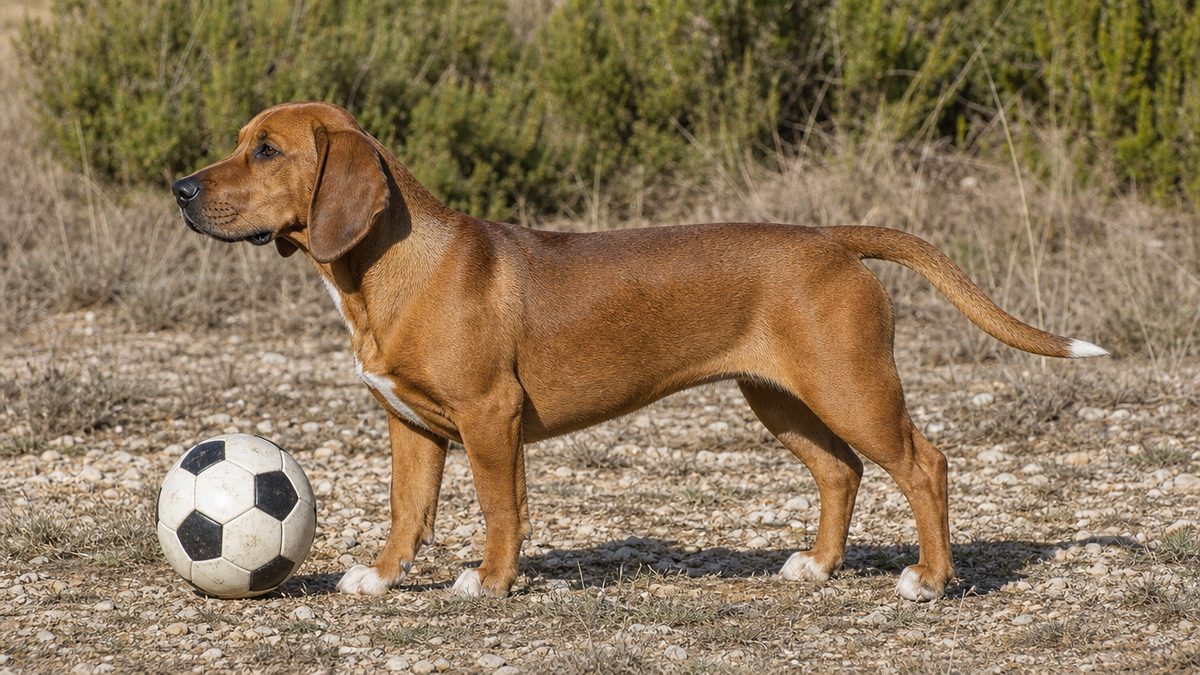
The Briquet de Provence is a medium-sized, short-coated French scent hound of 50 to 55 cm in males and 44 to 50 cm in females, bred in south-eastern France to start and drive hare and wild boar, and recognised by the Societe Centrale Canine under standard number 911 rather than by the Federation Cynologique Internationale.
Read the breed standard first, because almost everything written about this dog in English is downstream of a Wikipedia article rather than of the document itself. The SCC standard, dated 2008, describes a dog of medium size, not too long, solid, with good bone structure, built inside a rectangle so that the body is slightly longer than the height at the withers. The size clause gives 50 to 55 cm for males and 44 to 50 cm for females, with a tolerance of 2 cm either way.
The standard gives no weight at all. The SCC's own breed record prints the weight field as NP, not provided, next to a height range it states as 44 to 55 cm. That matters, because three of the most-read pages on this breed print a weight of 18 to 27 kg as though it came from somewhere.
On physical characteristics the SCC commentary is blunt about proportion. The proportions are very important for compliance with the briquet type, Gerard Thonnat writes: without being too long the body is imperatively rectangular, and the Briquet of Provence is neither slender nor too stocky. That middle setting is the whole point of a briquet, and it is what separates this dog from both a leggy Italian hound and a heavy-bodied one.
The coat is short, and that is unusual for the group
The coat clause is four words long in the original: doux, court et serre, soft, short and tight. Colour is uniform intense fawn, commonly called red, or fawn with black overlay, or fawn with a black mantle, with very limited white permitted at the extremities of the limbs and tail, on the chest, and as a small star on the skull. White patches on the body are an eliminating fault.
Set that against the four Vendeen griffons, which are all rough-coated, and against the Basset Fauve de Bretagne and the Griffon Nivernais, and the Briquet de Provence is one of the few short-coated French hounds of its size. For an Indian reader that is the single most consequential line in the standard, because a short tight coat is easier to keep in humidity than a harsh griffon jacket, and it is the only part of this breed's construction that works in its favour here.
A head built to be told apart from an Italian hound
The head clauses read like a differential diagnosis, and the SCC's illustrated commentary says why. Skull broad, slightly rounded, without wrinkles, equal to or slightly longer than the muzzle; stop little or moderately marked; muzzle straight with the lateral faces almost parallel. Gerard Thonnat, commenting on each clause in the SCC's own English booklet, repeatedly contrasts each point with the Segugio: the Segugio has very little stop, certainly one of the least marked in all hounds; the muzzle should not be slightly arched as in the Segugio; the muzzle must not be tapered as in the Segugio; the Segugio has a narrower forechest and tighter skin.
The ear is the identifying feature. It is attached at eye level or slightly below, the anterior edge rolled outward at the top, widening lower down and slightly rolled inwards, with the tip slightly rounded, and, carried forward, the ear leather must reach the base of the nose. Ears attached clearly below the eyes are an eliminating fault. Thonnat notes that this ear clearly stands out from a French ear, which is longer, twisted and set lower.
Standard 911 in numbers, and the classification line that misleads
Standard 911 sets height, coat, colour, ear, tail and dewclaws, gives no weight, and prints an FCI-style group and section line even though the FCI has never recognised the breed.
Everything below is read straight off the SCC text rather than off a breed site, so each row can be checked against the document in one click.
| Clause | What standard 911 says |
|---|---|
| Height, males | 50 to 55 cm, tolerance 2 cm either way |
| Height, females | 44 to 50 cm, tolerance 2 cm either way |
| Weight | Not given anywhere in the standard |
| Coat | Soft, short and tight |
| Colour | Intense uniform fawn (red), fawn with black overlay, fawn with black mantle |
| Ear | Set at or just below eye level, tip reaches the base of the nose when drawn forward |
| Tail | Set slightly low, carried sabre-fashion in action, below the backline at rest |
| Dewclaws | Absence of dewclaws required; presence is an eliminating fault |
| Classification | Group 6, Section 1.2, medium-sized scent hounds, with working trial |
That last row is worth pausing on. The SCC standard prints an FCI-style group and section line even though the FCI does not recognise the breed, and that formatting is why several French forum pages reproduce a full FCI classification for a dog the FCI has never admitted.
The faults tell you what the breed keeps getting wrong
A standard's fault list is a record of what breeders keep having to correct, and this one is unusually informative for a young breed. The serious faults are a dog that is too light, a pointed or snipey muzzle, yellow eyes, a discoloured nose and ears that are too rolled up. The eliminating faults are an aggressive or fearful dog, lack of type, overshot or undershot bite, depigmentation on the nose or testicles, ears set clearly below the eyes, a muzzle that is too long or arched, a short or atrophied tail, hare feet, a dog crushed on the wrists, presence of a dewclaw, white spots on the body, and a size outside the standard's limits including tolerance.
Read that list against the Segugio comparison and the pattern is obvious. Too light, pointed muzzle, muzzle too long or arched, and lack of type are precisely the features Gerard Thonnat's commentary attributes to Segugio influence in the stock. The fault list is, in effect, a checklist for breeding the outcross back out.
Presence of a dewclaw is an eliminating fault and absence of dewclaws is required in the hindquarters clause. A short or atrophied tail is also an eliminating fault. Both of those are conformation requirements that, if pursued surgically, would breach Second Schedule Part II paragraph 6(8) of the Indian Rules, which forbids any mutilation of any body part of the pup and any change of appearance by artificial means.
The dentition clause is worth one line too, because it is stricter than most. The standard calls for powerful jaws and a very robust, regular and complete dentition, tolerating only the absence of PM1, with a scissor bite and a pincer bite tolerated, and all incisors set square to the jaws. Note that Second Schedule Part III para 8(10) of the Indian Rules separately lists two or more missing teeth among the genetic defects a breeding dog must be tested for.
Who recognises this breed, and who does not
The Societe Centrale Canine recognises the Briquet de Provence and the Federation Cynologique Internationale does not, which makes it one of exactly five French breeds in that position and means no FCI-pattern pedigree for it exists anywhere in the world.
The SCC says so itself. In an article first published on 3 January 2019 and last updated on 18 June 2026, the French kennel club writes that around fifty French breeds are internationally recognised, and then names the exceptions: five French breeds recognised by the Centrale Canine are still not recognised by the FCI, being the Epagneul de Saint-Usuge, the Cursinu, the Briquet de Provence, the Bruno Saint-Hubert Francais and the Berger des Alpes et de Savoie.
That claim checks out against the FCI's own register. Enumerated A to Z, the FCI nomenclature of definitively recognised breeds returns 362 entries, and none of the five appears in it; the separate list of breeds recognised on a provisional basis holds 20 entries, from the Australian Stumpy Tail Cattle Dog to the Macedonian Shepherd Dog Karaman, and none of the five appears there eitherFederation Cynologique Internationale. The absence has a direction, and the direction is never admitted rather than promoted out or removed.
A first pass at the FCI letter pages returned zero breeds for every letter of the alphabet, including B, where the Briquet Griffon Vendeen certainly sits. That was a parsing failure in this session, not a finding, and reporting it would have been an invented absence. Re-parsed against the correct markup, the same 26 pages returned 362 breeds including BRIQUET GRIFFON VENDEEN, CHIEN D'ARTOIS, all four Vendeen griffons and all four Segugio entries, while BEAUCERON returned nothing because the FCI files that dog as BERGER DE BEAUCE. Only after the controls behaved was the Provence absence treated as real.
Standard number 911 is the credential
The SCC issues this breed a standard numbered 911, downloadable from its own breed record, and the document is headed Standard S.C.C (2008) Societe Centrale Canine. FCI standard numbers run to 378 at the top of the provisional list. A number in the nine hundreds is the SCC's own national series, and it is the cleanest single indicator that you are looking at a nationally recognised breed rather than an internationally recognised one.
| Breed | FCI group of its section | LOF 2025 | Share of the five |
|---|---|---|---|
| Bruno Saint-Hubert Francais | Group 6 scent hounds | 159 | 34.3 percent |
| Cursinu | Group 5 spitz and primitive | 153 | 33.0 percent |
| Epagneul de Saint-Usuge | Group 7 pointers | 58 | 12.5 percent |
| Briquet de Provence | Group 6 scent hounds | 53 | 11.4 percent |
| Berger des Alpes et de Savoie | Group 1 sheepdogs | 40 | 8.6 percent |
| Total | 463 | 100 percent |
The Briquet de Provence is fourth of the five. Between them the whole set accounted for 463 registrations in France in 2025.
No anglophone registry carries this breed either
The Royal Kennel Club's register enumerates 227 breeds and neither briquet is among them, which matters because that register does carry six other French scent hounds.
Britain says the same thing independently. The Royal Kennel Club's Breeds A to Z register enumerates 227 breeds across seven groups, of which 39 sit in the Hound group, and neither briquet appears in it. That absence is meaningful rather than a symptom of a short list, because the RKC Hound group does carry six French hounds, namely the Basset Bleu de Gascogne, the Basset Fauve de Bretagne, the Grand Basset Griffon Vendeen, the Petit Basset Griffon Vendeen, the Grand Bleu de Gascogne and the Griffon Fauve de Bretagne, several of them flagged as imported. A register that has room for six rare French scent hounds and no room for this one is telling you something about the size of the breed rather than about British taste. Controls passed in the same retrieval: Beagle, Otterhound and both Basset Griffon Vendeens were returned by the same query that returned nothing for briquet, provence or segugio.
One widely repeated rule about the FCI is wrong here
Wikipedia's article on the FCI states that the body automatically recognises all registered breeds recognised by any of its member kennel clubs. The Societe Centrale Canine is a founder member, it recognises these five breeds, and the FCI recognises none of them, so that rule cannot be right as written. Any page that reasons from it to conclude the Briquet de Provence must be FCI-recognised has reasoned from a false premise.
For an Indian buyer the practical consequence is short. The Kennel Club of India is an FCI member and registers to FCI nomenclatureFederation Cynologique Internationale. A breed the FCI has never admitted has no FCI nomenclature entry, so there is no route by which a KCI pedigree for a Briquet de Provence can be issued. Any Indian kennel club paperwork offered for this breed is describing something else.
So how many registries carry it at all
One. The Societe Centrale Canine is the only kennel club anywhere that Bonbeno could verify as recognising and registering the Briquet de Provence, under standard number 911Societe Centrale Canine. Three separate registers were enumerated to check that, and each enumeration was proved working before its silence was believed.
| Register | Entries enumerated | Briquet de Provence | Control that passed |
|---|---|---|---|
| FCI, definitively recognised breeds | 362 | Absent | Briquet Griffon Vendeen, Chien d'Artois, all four Vendeens and all four Segugios returned |
| FCI, provisionally recognised breeds | 20 | Absent | Segugio Maremmano, Segugio dell'Appennino and 18 others returned |
| The Royal Kennel Club, Breeds A to Z | 227 across seven groups | Absent | Beagle, Otterhound and both Basset Griffon Vendeens returned |
| Orthopedic Foundation for Animals, statistics | 269 breed labels | Absent | Labrador, Basset, Griffon, Beagle and Vendeen all returned |
One further register was attempted and is reported as abandoned rather than as evidence. The American Kennel Club's breed index returned only 32 breed slugs, and the control failed outright because Beagle and Yorkshire Terrier were both missing from that list, so no conclusion about AKC recognition is drawn on this page in either direction. An absence from a list that does not contain the Beagle is a broken query, not a finding.
The word briquet, and the claim that only one breed kept it
FCI-Standard 19 opens by saying the Briquet Griffon Vendeen is the only breed having kept the name Briquet, and that sentence is true only inside FCI nomenclature, because the Briquet de Provence keeps the name, sits eleven rows below the Vendeen in the same French studbook table, and registered 53 dogs in 2025.
Here is the sentence, verbatim from the FCI's own English text of standard 19, dated 18.02.2000: it is the only breed having kept this name Briquet, which means medium-sized dog. Read narrowly, the FCI is right. Enumerate all 362 definitively recognised FCI breeds and exactly one carries Briquet in its name.
Read as a statement about dogs rather than about a filing system, it is wrong, and the counter-example is not obscure. The Societe Centrale Canine's Groupe VI table for 2025 lists BRIQUET GRIFFON VENDEEN at 174 registrations and BRIQUET DE PROVENCE at 53, eleven rows apart on the same page of the same PDF. Both are living, registered, named briquets. One of them is simply not in the FCI's book.
The FCI contradicts itself two standards later
FCI-Standard 28, for the Chien d'Artois, opens its Utilization clause with the words the Artois Hound is a Briquet (small type). So the FCI describes a second recognised breed as being a briquet in the same breath as claiming that only one breed kept the name. The distinction the FCI is drawing is between a name and a type, and it never says so, which is how the sentence has been copied into breed pages for twenty-six years as though it settled something.
Four sources, four different meanings
The more interesting problem is that nobody agrees what briquet means, and every page states its own answer as fact.
| Source | Stated meaning of briquet |
|---|---|
| FCI-Standard 19, English text, 2000 | medium-sized dog |
| SCC standard 911 and SCC breed record | petit chien de chasse, a small hunting dog, attested in French literature from 1440 |
| Wikipedia, English article | mixed dog, in Provencal, cited to the Tresor dou Felibrige |
| Le Figaro, October 2024 | petit morceau, a small piece, in reference to its size |
The SCC is the only one of the four that dates its claim and names where the word appears. Its historical clause says the word briquet, a small hunting dog, appears in French literature from 1440, and that briquets, arising from various crossings, were described by the Comte Le Couteulx de Canteleu in the Manuel de Venerie francaise in 1890Societe Centrale Canine. Note that the SCC calls a briquet small and the FCI calls it medium-sized, about the same word, in the same decade, for dogs in the same section.
Bonbeno takes no position on Provencal philology. What the reader needs is the practical version: briquet is a size-and-function label from French hunting vocabulary, not a family name, which is why two unrelated breeds carry it and a third is described as one. If you are searching for this dog and keep landing on a shaggy tricolour hound from the Vendee, that is the reason.
Searched from India, position 5 for this breed's own name is an Indian pet-food retailer's page about the Briquet Griffon Vendeen, published by a company registered at Okhla Industrial Area Phase 2, New Delhi, and priced in rupees. Justdial goes further: it auto-generates Pet Shops For Briquet Griffon Vendeen Dog pages across Indian cities under category nct-13843501, and Pet Shops For Ariegeois Dog pages under nct-12092130, but has no page for the Briquet de Provence at allJustdial, Pet Shops For Ariegeois Dog. An Indian directory whose breed taxonomy stretches to two obscure French scent hounds still does not contain this one.
How rare it really is, read out of the French studbook
France registered 53 Briquets de Provence in 2025, which ranked the breed thirtieth of the 47 breeds in Groupe VI and made it 0.45 percent of French scent hound registrations that year.
The Societe Centrale Canine publishes the Livre des Origines Francais figures every January, broken out by group and breed. The 2025 table gives the Briquet de Provence 57 registrations in 2024, 53 in 2025 and 22 confirmations, a fall of 7 percent.
The rows sum to the printed total, so the table can be trusted
Before taking any row from a PDF table, check that the rows add to the total the document prints, because an extraction layer can silently drop one. The Groupe VI table for 2025 carries 47 breed rows. Summed independently they give 12,894 for 2024 against a printed total of 12,894, 11,720 for 2025 against a printed 11,720, and 3,989 confirmations against a printed 3,989. The derived confirmation ratio is 34.04 percent against a printed 34 percent, and the derived year-on-year change is minus 9.11 percent against a printed minus 9 percent. Nothing was dropped, so the Briquet row is complete.
| Year | LOF registrations | Source PDF |
|---|---|---|
| 2009 | 2 | Statistiques LOF 2009 |
| 2011 | 3 | Statistiques LOF 2011 |
| 2012 | 0 | Statistiques LOF 2012 |
| 2015 | 12 | Statistiques LOF 2015 |
| 2016 | 3 | Statistiques LOF 2016 |
| 2017 | 41 | Statistiques LOF 2017 |
| 2018 | 36 | Statistiques LOF 2018 |
| 2019 | 37 | Statistiques LOF 2019 |
| 2020 | 9 | Statistiques LOF 2020 |
| 2021 | 43 | Statistiques LOF 2022 |
| 2022 | 75 | Statistiques LOF 2022 |
| 2023 | 61 | Statistiques LOF 2023 |
| 2024 | 57 | Statistiques LOF 2025 |
| 2025 | 53 | Statistiques LOF 2025 |
Each overlapping year cross-checks. The 2024 PDF gives 2023 as 61 and the 2023 PDF gives the same; the 2023 PDF gives 2022 as 75 and the 2022 PDF gives the same; the 2025 PDF gives 2024 as 57 and the 2024 PDF gives the sameSociete Centrale CanineSociete Centrale CanineSociete Centrale Canine. That is three independent confirmations across four documents, which is why the series can be published as a series rather than as a set of single-year snapshots.
Four hundred and thirty-two dogs, ever
Add every published year together and the LOF has recorded roughly 432 Briquets de Provence in total since the breed first appeared in the statistics in 2009, of which 427 were registered from 2015 onwardSociete Centrale CanineSociete Centrale Canine. That is not an annual figure. That is close to the entire pedigree population the breed has ever had, in the only country that registers it.
The breed has no row at all in the 2008, 2010, 2013 or 2014 tables, while the Briquet Griffon Vendeen and the Chien d'Artois both have rows in every one of those years, so the blanks are genuine zeroes rather than extraction failures. Recognition arrived in 2008 and the first two registered dogs appear in the 2009 statistics.
This breed went 3, then 41, then 36, then 37, then 9, then 43, then 75, then 61, then 57, then 53 across ten consecutive yearsSociete Centrale CanineSociete Centrale CanineSociete Centrale Canine. A jump of more than twelvefold and a collapse to nine in a single COVID year are not trends. They are what a national total looks like when a handful of hunting kennels decide whether to breed. Treat any single-year figure for this breed as noise.
One more line in the 2019 table is worth having. That edition breaks each breed into descendants of registered dogs, imports, overseas-territory imports and titre initial entries, which are unpedigreed dogs admitted on type. The Briquet de Provence's 37 registrations that year were 31 descendants, zero imports of any kind, and 6 admitted on titre initial. In 2015, 6 of the 12 registrations were titre initial entries. A breed still recruiting a sixth to a half of its annual intake from outside its own studbook is a breed still being assembled.
Every page ranking for this breed prints a wrong number
Two numbers dominate the search results for this breed and the French studbook contradicts both: Wikipedia says fewer than ten dogs are registered annually and Le Figaro says one hundred, while the LOF recorded 43, 75, 61, 57 and 53 over the five years to 2025.
This is the section that justifies the page existing, so it is worth being precise rather than rhetorical. Each claim below was checked against the primary document it names.
Three of those rows come from editions not otherwise quoted here. The 2011 table gives 3 registrations, the 2018 table gives 36 against 41 the year before with a printed change of minus 12 percent, and the 2013 table carries rows for the Briquet Griffon Vendeen and the Chien d'Artois while carrying none at all for this breedSociete Centrale Canine. That last one is the control that turns a missing row into a genuine zero rather than a failed extraction.
Claim one, fewer than ten a year
Wikipedia's article states that the Briquet de Provence continues to be a rare dog breed, often with less than ten new dogs registered annually with the SCC. Wikipedia's own editors have tagged that sentence citation needed. It has been wrong every year since 2017 except 2020, and in 2022 it was wrong by a factor of seven and a half. Animalia, at position 2 in an Indian search, reproduces the sentence with the same meaning and lists a single reference, the Wikipedia article.
Claim two, one hundred births a year
Le Figaro's breed page, published 15 October 2024, states that the breed is fairly confidential for the moment, with 100 births a year recorded in the LOF. The highest figure the studbook has ever printed for this breed is 75, in 2022, and the year the article was published the LOF recorded 57Societe Centrale Canine. Both errors point away from the truth in opposite directions, which is what happens when nobody opens the source.
| Year | LOF actual | Wikipedia implies | Le Figaro states |
|---|---|---|---|
| 2021 | 43 | under 10 | 100 |
| 2022 | 75 | under 10 | 100 |
| 2023 | 61 | under 10 | 100 |
| 2024 | 57 | under 10 | 100 |
| 2025 | 53 | under 10 | 100 |
Claim three, recognised in 2006
Wikipedia states that the Briquet de Provence was recognized by the SCC in 2006 and cites standard 911 for it. Standard 911 contains the string reconn, the stem of every French word for recognition, zero times. It mentions 2006 exactly once, in the sentence recording that the breed EXPERTISE was carried out by Professor Denis, M. Thonnat and Mme Metans in 2006, and separately records that a second standard was drawn up in 2008 by Mme Metans, M. Bolla, M. Goubie and M. Triquet.
The SCC answers the question in plain English elsewhere. Its illustrated standard-and-comments booklet, in the historical summary, says the breed was recognized by the Societe Centrale Canine in 2008. So the correct year is 2008, and the widely copied 2006 is the year of the assessment that preceded it.
Claim four, the health section
Wikipedia gives this breed a life span of 11 to 13 years and states that no diseases and health conditions are associated with the breed, and labels the reference Societe Centrale Canine. The reference does not point at the Societe Centrale Canine. It points at genodog.frGenodog, Maladies et affections du chien.
The genodog URL for this breed returns a 67,054-character page carrying 452 links to disease articles and no lifespan, no weight and no breed-specific statement of any kind. Fetched in the same session with the same tool, the genodog URL for the Beagle returns a byte-identical page: same 67,054 characters, same 452 links, similarity ratio 1.0000Genodog, Maladies et affections du chien. The route does not filter by breed. Whichever breed you ask for, you get the same unfiltered index, so Wikipedia's lifespan and its no-diseases claim cannot be read off the page they cite for any breed at all.
None of this means the figures are necessarily false. It means they are unsourced. Bonbeno therefore publishes no life expectancy for this breed, and says why in the health sections below rather than quietly repeating a number that traces back to nothing.
The outcross the breed club admits, and the weight nobody can source
The Societe Centrale Canine's own commentary on this standard states that a deliberate outcross with the Segugio had its logic given the breed's numerical weakness, and that the work of blurring Segugio features out of the stock has progressed but must continue.
Very few breed clubs put this in writing. Gerard Thonnat, commenting clause by clause in the SCC's illustrated booklet, writes that the breed is still very confidential, that the number of births places it among rare and therefore vulnerable breeds, and that considering this numerical weakness of the stock, and the fact that they are two dogs of the Mediterranean area with a similar hunting ground and the same function, the punctual outcross with the Segugio had its logic. He then describes the Segugio as a little taller, more slender, thinner, with a drier and elongated head, and adds that these features, as soon as they are present, are clearly identifiable, that the selection work to blur them in the stock has progressed, but that it must be continued.
That is a breed club telling you, in its own standard commentary, that some dogs in the current population carry visible traces of another breed and that removing them is unfinished work. It also explains why almost every head clause in the standard is written as a contrast with the Segugio rather than as a positive descriptionSociete Centrale Canine.
Which Segugio, and how close is it
The FCI recognises four Segugio entries: Segugio Italiano a pelo raso at number 337, Segugio Italiano a pelo forte, the rough-haired variety, at 198, Segugio Maremmano at 361, and Segugio dell'Appennino at 375 on the provisional listFederation Cynologique Internationale. The commentary does not say which, and Bonbeno will not guess. The short-haired Italian Segugio is the closest on paper, and reading its standard beside 911 shows how close the two dogs sit.
| Clause | Briquet de Provence, SCC 911 | Segugio Italiano a pelo raso, FCI 337 |
|---|---|---|
| Height, males | 50 to 55 cm | 52 to 58 cm |
| Height, females | 44 to 50 cm | 48 to 56 cm |
| Weight in the standard | Not given | 18 to 28 kg |
| Coat | Soft, short and tight | Short all over, straight horse-hair texture, dense and close |
| Colour | Intense fawn (red), fawn charbonne, fawn with black mantle | Solid fawn in all nuances, from intense red fawn to washed |
| Quarry | Hare and wild boar | Especially the hare and the wild boar |
| Classification | Group 6, Section 1.2, with working trial | Group 6, Section 1.2, with working trial |
Thonnat's a little taller is exactly right: the Segugio is 2 cm taller at the bottom of the male range and 3 cm taller at the top, and 4 cm taller at the bottom of the female range and 6 cm at the topFederation Cynologique Internationale. Same section, same quarry, same coat type, same colour family.
Where does 18 to 27 kg come from
Three of the most-read pages on this breed print a weight of 18 to 27 kg. Wikipedia gives it, Le Figaro gives it, and Animalia gives itLe Figaro PratiqueAnimalia, All about Briquet de Provence…. Standard 911 gives no weight, and the SCC's own breed record prints the weight field as NPSociete Centrale Canine. The nearest documented weight range in the paperwork of any closely associated breed is the Segugio's 18 to 28 kg.
Bonbeno is not asserting a copy. It is putting four facts next to each other and letting the reader see them: this breed's standard has no weight clause, its national kennel club prints NP, three unsourced pages print 18 to 27 kg, and the breed the club itself names as the outcross has a standard weight of 18 to 28 kg. Treat 18 to 27 kg as a working estimate with no standard behind it, and weigh your own dog rather than a range off a web page.
Animalia states that some have suggested the breed is a cross between the Segugio Italiano and the Petit Bleu de Gascogne, and classifies its breed origin as Crossbreed. The page lists exactly one reference, the Wikipedia article, and that article contains no such parentage claimWikipedia, Briquet de Provence. Half of it happens to point at something real, since the SCC does document a Segugio outcross, but the page cannot have got it from the source it cites.
A breed reassembled twice, eighty years apart
The Briquet de Provence was written down once in 1934, effectively disappeared, and was rebuilt from the 1980s by one man in the Var, which is why its studbook starts in 2009 rather than in the nineteenth century.
The SCC's historical clause is short enough to take whole. The word briquet appears in French literature from 1440. Briquets, arising from various crossings, were described by the Comte Le Couteulx de Canteleu in the Manuel de Venerie francaise in 1890. The Briquet de Provence has long been established in the south-east of France, was well spread at the beginning of the twentieth century, and was the subject of a first standard in 1934 in the work of Heuillet, veterinary surgeon, Tous les chiens, prefaced by Paul Dechambre, professor of zootechnics at the Ecole Nationale Veterinaire d'Alfort. It is cited by Burnand in La Chasse in 1967. The breed was relaunched in the 1980s under the impetus of Monsieur Jacques Bolla. The Club du Briquet de Provence was created in 2003Societe Centrale Canine.
The SCC's English booklet adds the missing sentence and the missing institution: it does not appear in the sources before a first emergence in cynophilia in the 1930s in its area of origin, thanks to the Societe Canine du Midi, when a first standard was established; after a long eclipse, in the 1980s the Briquet of Provence was revived in the Var under the impetus of Jacques Bolla, founder of a club in 2003; the breed was recognized by the Societe Centrale Canine in 2008.
The 1934 standard described a smaller, more varied dog
Thonnat's commentary quotes the earlier text directly, and the differences are real. On size, he notes that the Briquet de Provence can now be taller than in the 1934 standard, which indicated a range of 44 cm to 52 cm, and that the current 55 cm limit should ideally not be exceeded or the briquet conformation would be lost. So the top of the male range moved from 52 cm to 55 cm between the two documents.
On colour the change is larger. In the 1934 standard the single-coloured fawn is not even mentioned; the colours given were fawn with black coat, hare colour, badger colour, often with stockings, and the dogs exhibited in the 1930s were also very varied. Today, Thonnat writes, the uniform intense fawn commonly called red is by far the most common in the stock. The colour that now defines the breed to the eye is the one its first standard omitted.
| Point | 1934 standard, as quoted by the SCC | 2008 standard, number 911 |
|---|---|---|
| Height range | 44 to 52 cm | 50 to 55 cm males, 44 to 50 cm females |
| Solid fawn | Not mentioned | Listed first, and now the commonest colour in the stock |
| Other colours | Hare colour, badger colour, often with stockings | Not permitted |
| Tail | Noted as unfortunately often shortened | Short or atrophied tail is an eliminating fault |
The tail line is the one an Indian reader should notice
Commenting on the tail clause, Thonnat writes that in the 1934 standard it was mentioned that the tail was unfortunately often shortened, and presumes that at the time users shortened the tail at birth because it was often wounded, sometimes severely, by Mediterranean vegetation. In other words the breed has a documented historical docking practice, given a practical justification.
Two things have since closed that door. The 2008 standard makes a short or atrophied tail an eliminating fault, so a docked dog cannot be shown. And in India the Prevention of Cruelty to Animals (Dog Breeding and Marketing) Rules, 2017, Second Schedule Part II paragraph 6(8), state that there shall be no tail docking, ear cropping, de-barking, de-clawing, branding, dyeing, injecting substances to enhance visual appeal, performing a surgery or procedure to camouflage or hide any defect or infirmity, or any other kind of mutilation of any body part of the pup, and that any change of appearance by artificial means is strictly forbidden. Any Indian dog of this type presented with a shortened tail has been altered unlawfully, and the standard would disqualify it anyway.
Briquet de Provence price in India
No Briquet de Provence price in India exists, because no verifiable Briquet de Provence exists in India, and the only published purchase figure for the breed anywhere is Le Figaro's 450 to 650 euros in France.
Start with what is actually on offer. Searched from India, the results for this breed's name resolve into three kinds of page and not one of them is an Indian listing for this dogGoofyTails, Indian pet-food retailer….
- Encyclopaedia pages, led by Wikipedia and Animalia, neither of which sells anything and both of which print an unsourced registration figure.
- Global for-sale shells, where the breed name appears only inside an alphabetical dropdown covering every breed on earth, on sites listing dogs in Europe rather than India.
- A different breed, in the form of an Indian pet-food retailer's Briquet Griffon Vendeen page, registered at Okhla Industrial Area Phase 2, New Delhi, and priced in rupees.
Even the auto-generated Indian pages skip this breed
Justdial builds a Pet Shops For <breed> Dog page for city after city from a breed taxonomy, and that taxonomy is wide. It carries Pet Shops For Briquet Griffon Vendeen Dog under category nct-13843501 across Lucknow, Ahmednagar, Ahmedabad, Delhi, Pune, Bangalore, Vijayawada, Balasore, Tenali and Nagercoil, and Pet Shops For Ariegeois Dog under nct-12092130 across Allahabad, Jalpaiguri, Kolkata, Ludhiana, Surat, Coimbatore, Amritsar, Meerut and JhansiJustdial, Pet Shops For Ariegeois Dog. It carries no page for the Briquet de Provence in any city. When a directory that generates pages for two obscure French scent hounds has not generated one for a third, the third has no Indian demand signal at all.
The only real price is a French one
Le Figaro's breed page states that acquiring a Briquet de Provence costs between 450 and 650 euros, depending on the line and the reputation of the kennels. That is the only published purchase figure Bonbeno could find for this breed in any language. Treat it as a French domestic figure and nothing more, because it describes a market of roughly fifty dogs a year inside one country.
Indian breed pages routinely publish a dollar price run through one exchange rate. Divide any rupee figure by 84.38 and by 74 before believing it. And treat Rs 98,999 as an immediate red flag: it is a recurring house charm price on one Indian listing site, attached to whichever puppy is in stock rather than to a breed, and it divides to 1,173.25 by the first rate and 1,337.82 by the second, so it is not even a conversion. It sits in a carousel beside Rs 92,599, Rs 94,999, Rs 76,499 and Rs 1,20,000, and it has been printed on pages for breeds that site does not stock.
| Question | Honest answer |
|---|---|
| Price of a Briquet de Provence in India | None exists. No verifiable dog, no listing, no Justdial category |
| Published price anywhere | 450 to 650 euros, Le Figaro, France, October 2024 |
| Dogs registered in France, 2025 | 53 |
| Dogs registered in France, all years on record | About 432 since 2009 |
| Recorded imports into France, 2019 | Zero, of any kind |
| Lawful route to import one to India for breeding | None, see the import section |
The scale comparison is the part worth keeping. The Kennel Club of India registered 33,880 pure-bred dogs with its studbook in 2025. France registered 53 Briquets de Provence in the same year. India's registry processes roughly 639 dogs for every single one of this breed entered anywhere in the world. A price is not the missing piece here. The dog is.
If a seller quotes you a price in India for a Briquet de Provence, the useful question is not how much but which dog. Ask for the studbook and the registration number. The only studbook that registers this breed is the French LOF, and a French LOF number can be checked.
One last framing. Read against Indian pedigree-dog prices, 450 to 650 euros looks affordable rather than expensive, and that is exactly the trap. The purchase figure is the smallest number on this page and the only one that cannot be acted on, because the import, quarantine and authorisation process is the real cost and the breeding route is closed outright.
Why no lawful supply of this breed can form in India
Indian import law permits a dog to enter only as a personal pet, for CPCSEA-recommended research, or for Defence and Police use, and states that applications for trading or breeding purposes shall be duly rejected, so no breeding stock of this breed can lawfully arrive.
The governing document is DGFT Trade Notice No. 22/2022-23, dated 19 December 2022, and it is short enough to read yourself. Under ITC (HS) 01061900, Mammals: Other, the import policy is Restricted.
- Policy Condition (7) allows import of dogs only for a pet dog with a valid pet book and relevant records in the name of the importer, for dogs imported by R&D organisations with the recommendation of CPCSEA, or for internal security by the Defence and Police Force.
- Policy Condition (8) states that import of commercial dogs for breeding or any other commercial activities other than those purposes is not permitted.
- Paragraph 6 states that any applications for trading or breeding purposes, or applications made on behalf of some other person or entity, shall be duly rejected.
- Paragraph 7 limits import of pet animals to the airports and seaports of Delhi, Mumbai, Chennai, Hyderabad, Bangalore and Kolkata, with quarantine where required. DAHD added a seventh port, Cochin International Airport at Kochi, for pets arriving under the baggage rules in October 2024.
Put that beside the registry position and the conclusion is arithmetic rather than opinion. The only studbook in the world that registers this breed is the French LOF, which recorded 53 dogs in 2025 and zero imports of any kind in 2019Societe Centrale Canine. The FCI does not recognise the breed, so no FCI-pattern pedigree exists to present anywhereFederation Cynologique Internationale. And Indian law refuses breeding imports outright. There is no lawful path by which a breeding population of Briquets de Provence can be established in India.
The one route that does exist, and what it demands
A person moving to India can bring their own dog. Up to two pets travel as passenger baggage without DGFT authorisation, but only for people transferring residence to India after two years of continuous stay abroad, and only cats and dogs qualify under baggage rules. Authorisation from DGFT is required if the stay abroad was under two years, if the pet is not travelling as baggage, or for more than two pets, and for every temporary import.
The paperwork is specific. Permanent import requires a vaccination book, pet passport or pet book, a certificate for emotional support, and a passport of the pet; temporary import adds a copy of the return ticket or expected date of return and an undertaking from a local host. An Advance No Objection Certificate must be obtained from the Regional or Quarantine Officer of the AQCS at one of the six ports the DGFT notice names, seven days before travel and relaxable to three, after submitting the DGFT licence and a health certificate issued by a veterinarian in the exporting country, with all disease testing done before departure. DGFT advises starting at least two months ahead.
Standard 911 requires absence of dewclaws on the hind feet and lists presence of a dewclaw among the eliminating faults. Indian rule 6(8) of the Second Schedule Part II forbids any other kind of mutilation of any body part of the pup and any change of appearance by artificial means. Removing a dewclaw so a dog meets this standard is exactly the change of appearance that clause prohibits. The standard's short-tail disqualification and the same clause's docking ban point the same way. A conformation requirement written for France is not a defence under an Indian rule.
And the club's own survival strategy is not lawful here
The SCC commentary endorses a punctual outcross with the Segugio to manage a numerically weak stock. In India, Second Schedule Part II para 6(9) states that breeding to create new breeds of dogs or unusual looks shall be strictly prohibited. Second Schedule Part II para 6(2) permits only out breeding and line breeding, and 6(3) prohibits in breeding, defined as breeding between relatives of the second to fourth grade within the first four generations, and incest breeding between parents and children or brother and sister. A gene pool of a few hundred dogs cannot be managed inside those limits without exactly the cross-breed rescue Indian law questions. That tension is the reason to read this page rather than to import this dog.
What a dog of this size and drive actually costs to run in India
Budget for a medium hound of 18 to 27 kg rather than for this breed specifically, because no Indian cost data for the Briquet de Provence exists and inventing one would be worse than saying so.
Bonbeno will not publish a monthly rupee total dressed up as breed-specific. What can be published honestly is the cost structure a 20 kg working scent hound imposes in an Indian city, with each line traceable to something real, and the ranges left wide because that is the truth of Indian pet retail.
| Item | Published range | Note |
|---|---|---|
| Dry dog food, 5 kg bag | Rs 800 to Rs 1,500 | Varies by brand and formula |
| Wet dog food, pack of 12 | Rs 600 to Rs 1,200 | Often sold in value packs |
| Leashes and collars | Rs 250 to Rs 1,000 | Material and design drive the price |
| Grooming kits | Rs 500 to Rs 2,000 | Brushes and nail clippers |
| Supplements | Rs 300 to Rs 1,500 | Vitamins, joint care, wellness |
Those are Justdial's own published Ahmedabad figures and they are approximate by the page's own admission. Read them as a floor for a small dog, not as a bill for a hound.
Where the money actually goes with this type of dog
Four lines dominate, and only one of them is food.
- Food volume. An active 20 to 25 kg hound eats roughly two to three times what a 7 kg apartment dog eats. If a 5 kg bag costs Rs 800 to Rs 1,500 and lasts a small dog a month, budget several bags a month here.
- Ectoparasite control, every month, without a gap. This is the line Indian owners underbudget and it is not optional for a dog that works in vegetation. Tick-borne pathogen prevalence in Indian dogs is high enough that the preventive spend is cheaper than one treated case.
- Containment. A scent hound that cannot be recalled needs a genuinely secure boundary and a long line. This is a capital cost you pay once and regret skipping.
- Veterinary baseline. Annual examination, vaccination, and the additional diagnostics a fever in a hound in India should trigger, which is a blood smear and a PCR panel rather than a wait-and-see.
For this breed the largest single cost is not recurring at all. It is the import process: DGFT authorisation where required, an Advance NOC from the AQCS at one of seven ports, a veterinary health certificate with all disease testing completed in the exporting country, quarantine where required, and a two-month lead time Department of Animal Husbandry…. And that route is only open to a person moving their own already-owned dog to India, not to someone acquiring one. The full route is set out in how to import a dog to India.
What to refuse to budget for
Do not budget a purchase price, because there is nothing lawful to buy. Do not budget coat trimming, because the standard's coat is soft, short and tight and needs none. Do not budget for tail docking or dewclaw removal, both of which are forbidden under Second Schedule Part II paragraph 6(8). And do not accept a quoted cost of ownership figure that arrives attached to a rupee purchase price, because the purchase price is the part that cannot be real.
Heat tolerance: Provence against six Indian cities
Heat tolerance rates 3 out of 5 for the Briquet de Provence, better than any rough-coated French hound and still not good, because its home region in Provence averages 14.21 degrees Celsius a year against 27.95 in Chennai and 27.57 in Ahmedabad.
The figures below come from NASA POWER, queried by explicit latitude and longitude so that no place can be substituted for another, and the coordinates the service returned were checked against the coordinates asked for in every case. Aix-en-Provence was requested at 43.5297, 5.4474 and returned at 43.5300, 5.4470; Chennai was requested at 13.0827, 80.2707 and returned at 13.0830, 80.2710NASA POWER climatology API.
| Location | Annual mean T2M, C | Annual mean RH, percent | Hottest month | That month's mean, C |
|---|---|---|---|---|
| Aix-en-Provence, Bouches-du-Rhone | 14.21 | 70.2 | July | 24.65 |
| Draguignan, Var | 14.21 | 68.6 | July | 24.90 |
| Bengaluru | 23.74 | 67.9 | April | 28.37 |
| Pune | 23.86 | 66.8 | April | 28.93 |
| Delhi | 25.60 | 45.6 | June | 35.88 |
| Kolkata | 25.81 | 73.9 | May | 31.53 |
| Mumbai | 26.77 | 67.4 | May | 31.19 |
| Ahmedabad | 27.57 | 48.3 | May | 35.06 |
| Chennai | 27.95 | 72.4 | May | 31.51 |
Read the first row against the last. The breed's home region averages 14.21 degrees across the year. Chennai averages 27.95NASA POWER climatology API. That is a gap of 13.74 degrees in the annual mean, which is not a seasonal inconvenience, it is a different thermal world.
The single number that makes the point
Provence's hottest month, July, has a mean of 24.65 degrees. Chennai exceeds that in ten months of twelveNASA POWER climatology API. A dog whose selection pressure never included a month hotter than a French July will spend most of the Indian year above the worst its ancestors met.
Humidity turns the screw. Combining mean temperature and mean relative humidity into a wet-bulb figure, the peak monthly value in Provence is 17.86 degrees, against 21.86 in Bengaluru, 22.97 in Pune, 23.35 in Hyderabad, 25.77 in Mumbai, 26.11 in Chennai and Ahmedabad, 26.50 in Delhi and 27.09 in KolkataNASA POWER climatology APINASA POWER climatology APINASA POWER climatology APINASA POWER climatology APINASA POWER climatology APINASA POWER climatology API. Those are derived values, not measured ones, and they are given here only to rank the cities. The ranking is what matters: evaporative cooling from panting is what a dog has, and it is exactly what high wet-bulb air takes away.
Where the coat helps, and where it does not
This is the one construction detail that works in India's favour. The standard's coat is soft, short and tight, with no undercoat clause at all. Set against the four Vendeen griffons, which are harsh and shaggy, or a Basset Fauve de Bretagne, a short tight jacket sheds heat better and dries faster after a monsoon soaking. That is why this page rates heat tolerance 3 rather than the 2 a rough-coated French hound would earn.
It does not make the dog heat-tolerant. Three things still cut against it. The dog is dark fawn to black-mantled, so it absorbs sun. It is built to run and start game, so it generates heat when it works. And the standard describes a dog that is courageous, efficient and resistant, which in practice means it will not stop when it should.
Le Figaro's page states that the breed is capable of resisting cold and heat. That sentence is written for a country whose hottest month averages 24.65 degrees. Read in Chennai, where ten months of the year run hotter than that, it is not advice, it is a category error. Treat every heat claim on a European breed page as a claim about a European summer.
Delhi deserves a separate line because its profile is different in kind. Its annual mean of 25.60 degrees is lower than Chennai's, but its June mean of 35.88 degrees is the highest of the nine and its mean relative humidity of 45.6 percent is the second lowest. Dry heat lets a dog pant effectively for longer and then dehydrates it faster, so the Delhi failure mode is water rather than humidity. Carry more than you think you need.
How to run a Mediterranean hound through an Indian summer
Move every session outside the hot hours, give up the middle of the day from March to June, and cool a dog with water and airflow rather than with ice, because a hound bred to keep working will not tell you it is in trouble.
The scheduling below is built from the city figures rather than from a generic rule, so it differs by city. Take the hottest month for your city from the climate table above and plan backwards from it.
| City | Hardest stretch | Practical rule |
|---|---|---|
| Bengaluru | March to May | Earliest workable of the nine. Dawn and after dark, afternoon given up in April |
| Pune | March to May | Similar to Bengaluru. April mean 28.93 C, so mid-morning is already gone |
| Hyderabad | April to June | Dawn only from April. Peak wet-bulb sits in June |
| Mumbai | April to June, then the monsoon | Heat plus 67 percent mean humidity. Dry the dog actively after every wet walk |
| Kolkata | April to July | The highest peak wet-bulb of the nine at 27.09. The least suitable humid city |
| Chennai | March to July | Ten months above the Provence July mean. Dawn and dark only |
| Delhi | April to June | June mean 35.88 C. Indoors through the middle of the day, no exceptions |
| Ahmedabad | April to June | May mean 35.06 C with low humidity, so dehydration outruns panting |
The five rules that matter
- Walk on the back of your hand. If the pavement is too hot for eight seconds of your own skin, it is too hot for a pad. This applies long after the air has cooled.
- Carry water on every outing, and offer it before the dog asks. A hound working a scent does not self-regulate.
- Cool with tap-temperature water and airflow, wetting the belly, groin, armpits and paws, then moving air across the dog. Iced water and ice packs constrict surface vessels and slow heat loss.
- Never leave the dog in a parked vehicle, at any time of year, in any Indian city.
- Treat collapse as an emergency, and go to a veterinarian rather than managing it at home.
Frantic panting that does not settle when the dog stops, a widening tongue that turns bright red or dusky, thick ropey saliva, an unsteady back end, vomiting or diarrhoea, and a dog that lies down and will not get up. Any of those in an Indian summer means stop, cool, and call a veterinarian. This page is general information and not a substitute for veterinary advice on your own dog.
Substitute nose work for distance
The most useful adaptation for this breed is not shorter walks, it is different ones. This is a dog the standard calls very fine of nose and a very good starter of hare. Twenty minutes of scent work in shade tires it more thoroughly than an hour of pavement, and it generates far less heat because the dog is thinking rather than running. Hide food, lay a drag line in a garden, or work a scent trail across a terrace before sunrise.
The point of scheduling is not to make an Indian summer safe for this dog. It is to make it survivable while you accept that eight months of the year in Chennai are simply not this breed's weather. If that sounds like a lot of management for a dog you cannot lawfully import anyway, that is the honest conclusion of this page.
Temperament and who this breed suits
The standard describes a courageous, efficient, resistant and balanced dog that is gentle by nature, obedient, strongly attached to its owner and sociable with other dogs, which makes it a good household dog and a poor apartment dog for reasons that have nothing to do with aggression.
Standard 911 puts the behaviour clause in two parts and both are useful. The first is character: a courageous, efficient, resistant, balanced dog, gentle by nature, obedient, very attached to its master, sociable with its own kind, lively and fast. The second is function: it takes naturally to wild boar and is prudent in its work, it is very fine of nose, and it is a very good starter of hare.
The SCC's own breed record repeats that language and adds that the dog is often a lead hound that gets noticed for its brick colour and its speed, and that helped by its build it often arrives first at dead gameSociete Centrale Canine. Nothing in the paperwork suggests a difficult dog to live with. It suggests a dog with a job.
Good with people, good with dogs, bad with small animals
On living conditions the French sources converge. Le Figaro says the breed needs access to the outdoors, ideally a fenced garden, so it can let off steam at any time of day, and that an apartment household must compensate with long walks or canicross. PagesJaunes files the same material under mode de vie and reaches the same place. ToutouTrip, which scores breeds for travel suitability, gives this one 7 out of 10 and builds its whole page around transport, accommodation and dog-friendly venues rather than around the dog's own needs.
Three claims recur across the French sources and they agree with each other. Le Figaro says the breed can be gentle and affectionate towards its owners, will cohabit perfectly well with other cats or dogs, and that children will adore playing with it. The standard says sociable with its own kind. Wikipedia describes a friendly, obedient disposition that develops a strong bond with its owner and needs to get along well with other dogs.
Bonbeno accepts the first two and qualifies the third. A dog the standard requires to be a very good starter of hare, and which takes naturally to boar, has a working prey drive. Le Figaro's confidence about cats is a claim about French pet dogs in French gardens. In an Indian context, with free-roaming cats, poultry and small livestock at close quarters, plan for the prey drive rather than against it. Manage it as a feature of the breed, not as a training failure.
| Household | Verdict |
|---|---|
| A house with a genuinely secure fenced yard, in Bengaluru or Pune | The best case that exists in India |
| A multi-dog household | Suits it. Bred to work in company and described as sociable with its own kind |
| A family with children and time for two outings a day | Workable, if the outings are real |
| A high-rise apartment | Not advisable. The voice alone ends it |
| A first-time owner wanting an easy city dog | No. Choose a breed you can actually obtain and recall |
| A household with cats, poultry or rabbits | Manage carefully, and never on trust |
The thing the sources agree on and nobody explains
Every French source describes this dog as very attached to its masterSociete Centrale CanineLe Figaro Pratique. That is a real trait and it has a cost in India, where dogs are more often left alone through a working day than in a French hunting household. A hound that is strongly bonded, under-exercised, and alone in a flat is the exact recipe for the vocality problem described in the next section.
Set against the four Vendeen griffons and most French pack hounds, this is a comparatively biddable dog. Le Figaro states plainly that educating a Briquet de Provence is relatively easy, while requiring you to be both firm and kind. That is a meaningfully different claim from the FCI's warning about the Briquet Griffon Vendeen, whose standard says outright that it is up to his master to make him obey.
The voice: two French sources, two opposite answers
The Societe Centrale Canine calls this breed tres jappant and says it is not sparing of its voice and does not go unnoticed, while Le Figaro says it barks very little when it is not hunting, and an Indian apartment buyer needs to know which to believe.
Here are both, in the words their publishers used. The SCC, describing the breed in its own article on the five non-FCI French breeds, calls it a balanced animal, fine of nose, tres jappant, well voiced, often a lead hound, and adds that it is not economical with its voice and does not go unnoticed, with the parenthetical you hear it. Le Figaro, on the other hand, calls it an excellent companion that barks only very little when it is not hunting.
Vocality is the trait an Indian apartment buyer must settle before anything else, so it gets its own section. A vocal hound is not a training problem to be solved, it is a selection outcome to be planned around.
The standard sits between them and is the most precise of the three. Its behaviour clause specifies a short and regular voice, of grave tone but sometimes higher, and names the type: voix de hurleur, a howler's voice. Wikipedia's version, that the breed has a pronounced hunting voice which it reserves for hunting, reads as an attempt to reconcile the two and is not sourced to either.
Which to believe, and why it matters here
Bonbeno sides with the kennel club, for three reasons that do not require taking anyone's word.
- The SCC is the breed's registry and its description is written by people selecting these dogs, while Le Figaro's page is a general-interest breed profile.
- The standard names a howl, not a bark. Voix de hurleur is a carrying voice bred to be heard across broken country by a hunter who cannot see the dog. A breed selected for audibility is not a quiet breed.
- The two claims are about different situations. A hound in a French house with a garden and a hunting outlet may well be quiet indoors. The same dog under-exercised in a Mumbai flat is the case Le Figaro's sentence was never about.
For an Indian high-rise the practical rating is 4 out of 5 for vocality, and it is the single clearest reason to choose a different breed. A carrying hound voice in a shared-wall building becomes a neighbour complaint, and a neighbour complaint about a dog nobody in the building can identify is a much worse problem than it sounds. Nothing in the standard supports the idea that this dog can be trained silent.
What actually reduces it
Vocality in a scent hound is driven by arousal, boredom and isolation, in that order, and only the last two are inside your control. Two real outings a day, at least one of them nose work rather than distance, and a dog that is not left alone for a nine-hour working day, will cut the noise more than any anti-bark device. A citronella or shock collar on a hound bred for voice is both ineffective and, where it constitutes a device used to suppress natural behaviour, the wrong side of an animal-welfare argument you do not want to be having.
One structural point closes the section. Both sources agree the dog uses its voice when it is workingLe Figaro PratiqueWikipedia, Briquet de Provence. In India, where there is no lawful hunting outlet for a foreign scent hound and no organised petite venerie, the working outlet that keeps a French Briquet de Provence quiet at home does not exist. That is not a training gap. It is a country gap.
Training a scent hound that was bred to work out of sight
Train this breed on a long line for life, put recall training first and never test it off-lead near open ground, because a dog selected to start hare and drive boar is following its nose long before it is following you.
The good news arrives from two directions. Standard 911 describes a dog that is gentle by nature, obedient and very attached to its master, and Le Figaro states that educating a Briquet de Provence is relatively easy, provided you are both firm and kind. Compare that with FCI-Standard 19, which warns about the Briquet Griffon Vendeen that it is up to his master to make him obey. On paper this is the more trainable of the two briquets.
The bad news is structural and no amount of obedience fixes it. The standard requires the dog to take naturally to boar and to be a very good starter of hare, and calls it very fine of nose, lively and fast. Those are not optional traits you can train away. They are the qualifications for the breed.
Recall is the whole programme
Build it in this order, and do not skip a stage because the dog seems reliable.
- Charge a distinct recall cue indoors, paying every single response with food the dog rates highly, for two weeks before you use it anywhere else.
- Move to a garden on a five-metre line, with no scent competition, and keep the payment rate at every repetition.
- Add a fifteen-metre long line and mild distraction, still paying every response. This is the stage most owners rush.
- Introduce scent deliberately, by laying a food trail and calling the dog off it, so that leaving a scent becomes a practised behaviour rather than an emergency.
- Keep the long line permanently in open ground. A hound that has run a line once will run it again.
Socialise early, because the window closes
Use the first sixteen weeks. Indian law helps here rather than hindering: rule 8(1)(a) of the 2017 Rules requires that pups less than eight weeks in age are not sold, and Second Schedule Part III paragraph 8(9) records that vaccination can start at seven to eight weeks and is usually complete at eighteen weeks. That leaves a real window between the pup arriving and full vaccination, and it should be used for carried and controlled exposure rather than wasted waiting.
Socialise deliberately to the specific things an Indian dog meets and a French hunting dog does not: two-wheelers at close range, autorickshaws, construction noise, temple loudspeakers, festival crackers, cattle in the street, and free-roaming dogs. A hound that is confident about all of that is far easier to walk at dawn, which is when you will be walking it for most of the year.
Teach the dog to settle on a mat, to accept being wetted down, and to drink on cue from a carried bottle. All three are ordinary training tasks, and all three are worth more in an Indian April than a perfect heel. A dog that will lie still while you cool it is a dog you can help.
What not to do
Do not use aversive tools on a hound. The breed is described as gentle by nature and prudent in its work, and a dog that is punished for following scent learns to avoid you rather than to avoid the scent. Do not rely on an invisible fence, because a hound in full cry accepts a correction and keeps going. And do not treat a good recall in a park as evidence of a good recall on a hare trail, because those are different behaviours in different states of arousal.
The daily exercise this breed needs, and what happens without it
Plan on ninety minutes a day across two or three sessions, with at least a third of it given to nose work rather than distance, because every source that describes this dog agrees it is energetic, fast and slow to tire.
The sources are unanimous on this one point even where they disagree on everything else. The standard calls the dog lively and fast and resistant. Wikipedia says the breed is energetic and fast and requires considerable exercise, as they do not tire quickly. Animalia files it under very active. Le Figaro says it needs access to the outdoors, ideally a fenced garden, so it can let off steam at any time of day, and that if you live in an apartment you must ensure it can burn energy through long walks or canicross.
| Session | Duration | Content |
|---|---|---|
| Pre-dawn | 40 to 50 minutes | Walk on a long line, with ten minutes of deliberate sniffing built in |
| Midday | 0 minutes from March to June | Indoors. This is not negotiable in Delhi, Ahmedabad, Chennai or Kolkata |
| After dark | 30 to 40 minutes | Second walk, plus scent work in a garden, terrace or corridor |
| Weekly | One longer outing | Only in the cool season, and only where the ground is secure |
Its hunting style is worth understanding because it dictates the exercise. Le Chasseur Francais devotes a section of its breed sheet to exactly this, and the standard supplies the mechanics: a dog that is very fine of nose, a very good starter of hare, that takes naturally to boar and is prudent in its work, running lively and fast. This is a dog that quarters ground, finds a line and drives it, which means the work is intermittent and scent-led rather than steady. A hardy constitution is assumed throughout, and the standard's word for it is resistant.
Twenty minutes of nose work beats an hour of pavement
This is the most useful single adjustment for the breed and it is also the safest one in Indian heat. A dog described as very fine of nose and a very good starter of hare is built to solve scent problems. Scent work tires that dog mentally, costs almost nothing, generates far less body heat than running, and can be done indoors when the air outside is unusable.
- Scatter feeding, tossing the meal into grass or a snuffle mat instead of a bowl.
- Find-it games, hiding a scented object in another room and sending the dog for it.
- Drag trails, dragging a piece of meat across a terrace before dawn and letting the dog work the line an hour later.
- Container searches, hiding food in one of six boxes and paying only the correct find.
What under-exercise looks like in this breed
It does not look like a hyperactive dog bouncing off walls. In a scent hound it looks like four specific behaviours: voice, digging, chewing and escaping. The voice is the one your neighbours notice first, and the escaping is the one that kills the dog, because a hound that clears a boundary in an Indian city is loose in traffic. All four are the same problem wearing different clothes, and the problem is an unemployed nose.
The honest version of this section is that the daily requirement does not fall in April just because the weather makes it harder to deliver. A dog that needs ninety minutes in January still needs ninety minutes in May, and in May you have roughly two usable hours a day to deliver it in. If your schedule cannot produce a pre-dawn walk every day for four months, this is not a workable breed for you, and no amount of garden makes up for it.
One further point about surfaces. This is a dog with strong, rounded feet built for broken Mediterranean country. Indian city pavement is abrasive, hot, and hard on a hound's pads and joints. Where you have a choice, walk on packed earth, park grass or a maidan rather than on concrete, and check the pads weekly.
Grooming a short tight coat in Indian humidity
Grooming load rates 2 out of 5, the lowest of any French scent hound of this size, because the standard's coat is soft, short and tight with no stripping, no clipping and no undercoat management to do.
The whole coat clause is four words in the original French: doux, court et serre. There is no furnishing, no beard, no eyebrow, no harsh outer jacket and no dense undercoat specified anywhere in the standard. Compare the Briquet Griffon Vendeen, whose FCI standard describes a harsh shaggy coat with abundant moustache and pronounced eyebrows and which needs hand-stripping several times a year. On coat care alone, this is the easier dog by a wide margin.
| Task | Frequency | Why |
|---|---|---|
| Rubber curry or hound glove | Twice a week | Lifts dead hair and spreads skin oil. Ten minutes |
| Full-body tick check by hand | Every day the dog has been in vegetation | The single highest-value habit on this page |
| Ear check and dry | After every wet walk, and weekly otherwise | See the next section |
| Nail trim | Every three to four weeks | City pavement wears nails unevenly |
| Bath | Only when actually dirty | Over-bathing strips the coat and irritates skin |
| Clipping or shaving | Never | Removes sun protection and does not cool the dog |
Never shave this dog for the heat
It is the commonest Indian summer mistake made with short-coated imported breeds and it is counterproductive. A dog does not lose meaningful heat through its skin surface the way a person does; it loses it by panting. A clipped coat removes the layer that reflects sun off the skin and it exposes a fawn to black-mantled dog to direct Indian sunlight. Groom the coat, do not remove it.
Dry the dog actively, do not let it air dry
European care guidance routinely says to towel a hound off and let it air dry. That instruction assumes European air. Mean annual relative humidity in the breed's home region runs 70.2 percent at Aix-en-Provence and 68.6 percent in the Var, which is not low, but it sits alongside an annual mean temperature of 14.21 degreesNASA POWER climatology API. Kolkata runs 73.9 percent humidity at an annual mean of 25.81 degrees, and Chennai 72.4 percent at 27.95NASA POWER climatology API. Warm wet air does not dry a coat, it incubates what is living in it.
So towel first, then use a fan or a cool-setting dryer, and pay particular attention to the ear canals, the armpits, the groin and between the toes. A short coat is a genuine advantage here because it dries in minutes rather than hours, but only if you actively cool and dry it rather than leaving it to the weather.
In an Indian context the brush is a diagnostic tool before it is a cosmetic one. Tick infestation was frequently observed among cases in a 2026 southern-India study of 120 clinically affected dogs, and presence of ticks was an identified risk factor for overall tick-borne pathogen prevalence in a 442-dog Andhra Pradesh studyCo-infections of major tick-borne pathogens…. Run your hands over the whole dog every day it has been in grass: ears, neck, armpits, groin, between the toes and around the tail base.
One last point about skin. The standard describes skin that is supple, fairly thick and close-fitting, with very little dewlap, and Thonnat notes that skin laxity remains very moderateSociete Centrale Canine. A tight-skinned, short-coated dog has fewer folds to trap moisture than a heavy-dewlapped hound, which is another small structural point in this breed's favour in a monsoon climate.
The ear the standard specifies, and what it means in a monsoon
This breed's ear is set at or just below eye level and long enough to reach the base of the nose when drawn forward, which is a drop ear over a closed canal and therefore a warm humid pocket for four months of the Indian year.
Get the anatomy right first, because the English-language pages do not. Standard 911 specifies ears attached at eye level or slightly below; at the upper part of the ear the anterior edge is rolled outward; lower down they widen and are slightly rolled inwards; the tip is slightly rounded; and, the ear being carried forward, the tip of the ear leather must reach the base of the nose.
Two of those clauses are missing from the SCC's own English booklet, which describes the set and the rolling but omits both the slightly rounded tip and the reach-to-the-nose measurement. That omission matters, because the reach test is the single measurable thing that separates this ear from a shorter one, and an English-only reader working from the booklet never sees it.
| Breed | Set | Length test |
|---|---|---|
| Briquet de Provence, SCC 911 | At eye level or slightly below | Tip reaches the base of the nose |
| Briquet Griffon Vendeen, FCI 19 | Set low, below the level of the eye | Not reaching the end of the muzzle |
| Segugio Italiano a pelo raso, FCI 337 | At the level of the zygomatic arch or slightly lower | About 70 percent of the length of the head |
So the Provence ear is set higher than the Vendeen's and reaches further. FCI-Standard 19 requires the Vendeen's ear to be set low, below the level of the eye, and NOT reaching the end of the muzzle, while standard 911 requires this breed's ear to be set at eye level or slightly below and to reach the base of the noseFederation Cynologique Internationale. Every page that describes both as a medium-sized drop ear has flattened the one measurement that separates them.
Why the reach matters in India and not in France
A drop ear that covers the canal opening restricts airflow. In a climate whose annual mean is 14.21 degrees, that is a design that works. In Kolkata at 73.9 percent mean humidity, Chennai at 72.4 and Mumbai at 67.4, and with monsoon walks soaking the dog several times a week, the same design becomes a covered, warm, wet canalNASA POWER climatology API.
Bonbeno publishes no otitis prevalence figure for this breed, because none exists for it anywhere. What can be said with confidence is structural: the standard specifies a covered canal, Indian air is warm and wet for months at a time, and warm wet covered canals are where ear disease starts. That is a mechanism, not a statistic, and it is labelled as one.
The routine that actually works
- Lift and look weekly. Healthy is pale, dry and odourless. A yeasty smell is the earliest sign and it precedes the head-shaking by days.
- Dry after every soaking. Towel the pinna, then hold the ear open for a minute so air reaches the canal.
- Do not plug the ear before a bath and then forget it. Plug, wash, remove, dry.
- Never pour water or a home remedy down the canal, and never use a cotton bud inside it.
- See a veterinarian at the first head-shake. An ear infection treated in week one is a different problem from one treated in week four.
Ears attached too low, clearly below the eyes, are an eliminating fault, and ears that are too rolled up are listed among the serious faults. Both are worth knowing, not for showing, but because a lower-set, more heavily rolled ear covers the canal more completely, which is the version of this ear you least want in an Indian monsoon.
What is known about this breed's health, which is almost nothing
No peer-reviewed paper names the Briquet de Provence, no screening register carries it, and no study has measured its lifespan, so the honest position is that this breed's inherited risk is unmeasured rather than low.
This is the section where most rare-breed pages quietly borrow a relative's numbers. Bonbeno will not. Below is exactly what was searched, what came back, and what control was run to prove the search worked.
The published literature
PubMed returns zero genuine records for this breed. A quoted search for the exact phrase returns zero, but that zero cannot be trusted on its own, because PubMed's query translation broke the phrase apart and turned the word de into a drug-effects MeSH clause. Searching instead on the distinctive token, Briquet in title or abstract combined with dog, returns three records, and all three were opened.
| PMID | Title | About this breed? |
|---|---|---|
| 32708682 | Hematological and Biochemical Reference Intervals for 5 Adult Hunting Dog Breeds Using a Blood Donor Database | No. Ariegeois, Bleu de Gascogne, Bracco italiano, Segugio italiano, Briquet Griffon Vandeen |
| 29187176 | Frequency of DEA 1 antigen in 1037 mongrel and purebreed dogs in Italy | No. Briquet Griffon Vendeen |
| 9754548 | Lower motor neuron disease in the Griffon Briquet Vendeen dog | No. Briquet Griffon Vendeen |
Europe PMC, searched separately over full text, also returns zero for this breed. Both databases passed their controls in the same session: PubMed returned 1,107 records for Labrador Retriever and 780 for canine hip dysplasia, and Europe PMC returned 5,943 for Labrador Retriever, 22 for Segugio Italiano and 4 for the Briquet Griffon Vendeen. Two independent databases, both proven working, both returning nothing.
The near miss that shows the gap
One paper comes close enough to be worth naming. Miglio and colleagues established haematological and biochemical reference intervals for five adult hunting breeds from an Italian blood-donor database, using 445 clinically healthy dogs aged 2 to 8, mean age 5.3, comprising 156 Ariegeois, 52 Bleu de Gascogne, 64 Bracco italiano, 123 Segugio italiano and 50 Briquet Griffon Vandeen, and found significant breed-specific differences in twelve analytes. The breed counts sum to 445 and the sex split of 222 females and 223 males sums to 445, so the paper's own arithmetic reconciles.
Read that list again. It contains the Segugio, which the SCC names as this breed's documented outcross, and it contains the other briquetMiglio A, Gavazza A, Siepi D, Bagaglia F. It does not contain the Briquet de Provence. The study that would have been most useful for this dog covered the two breeds standing on either side of it and skipped the dog itself.
It would be easy to present the Segugio italiano reference intervals as a proxy, and it would be wrong. The whole point of Miglio's paper is that breed-specific variation is real enough to change how a laboratory result is read. Borrowing another breed's intervals is the exact error the paper exists to prevent. If your dog needs bloodwork, your veterinarian should interpret it against general canine intervals and the dog's own baseline, not against a hound from a different studbook.
What this means practically is short. Screen for what the dog's build and job predict rather than for a published breed list: joints, ears, eyes, teeth and heart at the annual examination, plus a low threshold for a blood smear and tick-borne PCR panel any time an Indian dog runs a fever.
No screening register in the world carries this breed
The Orthopedic Foundation for Animals publishes statistics for 269 distinct breed labels and the Briquet de Provence is not one of them, so there is no published hip, elbow, eye, thyroid or cardiac figure for this dog anywhere.
OFA's disease-statistics page ships every one of its breed tables inline, and the full retrieval runs to 2,225,910 characters. Searched case-insensitively, it contains provence zero times, briquet zero times, segugio zero times and artois zero times.
A zero from a broken query is not a finding, so the same retrieval was searched for terms that must be present. It returned labrador 109 times, basset 131, griffon 159, beagle 61 and vendeen 65. Two Vendeen breeds do appear as labelled rows, PETIT BASSET GRIFFON VENDEEN and GRAND BASSET GRIFFON VENDEEN, and the dump carries 269 distinct breed labels in total. The page also still prints the string Searching Database, Please wait while the tables are fully present, which is a trap worth knowing about: that string is not evidence the tables failed to load.
So the absence is real and it has a mundane explanation. OFA statistics need a minimum number of evaluations before a breed appears at all, and a breed with roughly 432 registered dogs in history, none of them in North America in any number, will never reach itOrthopedic Foundation for Animals.
What is missing, listed plainly
| Data type | Status |
|---|---|
| Hip dysplasia screening statistics | None. Breed absent from OFA |
| Elbow, patella, cardiac, thyroid, eye statistics | None. Breed absent from OFA |
| Peer-reviewed disease report | None. Zero records in PubMed and Europe PMC |
| Published lifespan study | None found in any language |
| Breed-club health survey | None published that Bonbeno could reach |
| Genetic test panel marketed for the breed | None found |
Rarity is not health
The most common thing said about rare breeds is that they are healthy because nobody has bred them for exaggeration. There is something to that, and it is not what the evidence here shows. What the evidence shows is that nobody has looked. A breed with about 432 registered dogs ever, a documented outcross to another breed to manage numerical weakness, and up to half of a year's registrations entering on titre initial rather than from registered parents, has a gene pool small enough that inherited disease is a live question rather than a settled oneSociete Centrale CanineSociete Centrale Canine.
Wikipedia's flat statement that no diseases and health conditions are associated with the breed should be read in that light, and its source should be read too, since it resolves to a page that returns the identical unfiltered index for the BeagleGenodog, Maladies et affections du chienGenodog, Maladies et affections du chien. An absence of published associations is not an absence of disease.
What Indian law asks for, and cannot get
There is a specific Indian consequence. Second Schedule Part III paragraph 8(10) of the 2017 Rules requires that dogs shall have been tested for genetic defects, including hip dysplasia, progressive retinal atrophy, night blindness, hypothyroidism, entropion, ectropion, overshot and undershot jaw, wry mouth, two or more missing teeth, and unilateral or full cryptorchidism. Those tests can be performed on any dog. What cannot be done is to interpret the results against a breed baseline, because for this breed no baseline exists in any register on earth. An Indian breeder could comply with the letter of 8(10) and still be flying blind.
A hound from one leishmaniasis focus, arriving in another
Provence is one of five French endemic foci where the dog is the reservoir host for Leishmania infantum, and India is in the sustained phase of a kala-azar elimination programme where dogs have now been shown infectious to sand flies, so this is one imported breed whose home-country disease context genuinely matters here.
Almost no breed page has a reason to discuss leishmaniasis. This one does, because the breed's home region is named in the literature.
The French side
A study of 712 Leishmania strains isolated in the south of France between 1981 and 2002 identifies five foci of endemicity, listed west to east as Pyrenees-Orientales, Cevennes, Provence, Cote d'Azur and Corsica. It reports that L. infantum MON-1 is the parasite most frequently found, that MON-1 is the only zymodeme present in dogs, and that dogs act as the reservoir host in all of the foci, with Phlebotomus perniciosus and Phlebotomus ariasi as vectors.
So a hunting hound working scrub in the Var or the Bouches-du-Rhone is, epidemiologically, living inside a canine reservoir population. That is background risk in its own country, and it is the reason French veterinarians in the region screen for it.
The Indian side, which has changed
Indian visceral leishmaniasis is caused by Leishmania donovani, transmitted by Phlebotomus argentipes, and has traditionally been regarded as anthroponotic, meaning humans rather than dogs are the reservoir. That picture is being revised.
- A study in Bihar between 2018 and 2022 performed xenodiagnosis using P. argentipes on 73 dogs with quantitative-PCR-detectable parasitaemia and found that 12 percent, 9 of 73, were infectious to sand flies during winter and rainy seasons. The paper's own arithmetic checks out: 9 divided by 73 is 12.3 percent.
- A multicentric study across seven districts in endemic states, Bihar, Jharkhand and West Bengal, and emerging foci in Kerala and Tamil Nadu, screened 782 domestic animals and found 98 rK39-seropositive, Leishmania DNA by qPCR in 129, of which 81 were confirmed by ITS1-PCR across dogs, goats, cattle and one cat, with 21 sequenced and identified as L. donovani.
- Both papers note that aggressive vector-control has pushed sand flies toward non-human hosts, which is the mechanism that makes canine infection newly relevantInsights into animal reservoir hosts….
Two different parasites and two different vectors are involved, and this page is not claiming a dog imported from Provence would seed Indian kala-azar. What it is saying is narrower and more useful. A dog from a documented canine-reservoir focus should be screened for Leishmania before and after travel, and an Indian dog with chronic weight loss, skin lesions over bony points, nail overgrowth, epistaxis or unexplained kidney signs deserves leishmaniasis on the differential list rather than off it, particularly in Bihar, Jharkhand, West Bengal, and now Kerala and Tamil NaduInsights into animal reservoir hosts…. Discuss it with a registered veterinarian rather than acting on this page.
There is also a straightforward preventive answer that costs almost nothing. Sand flies bite at dusk and through the night, so the same measures that reduce tick exposure, keeping the dog indoors between dusk and dawn and using a veterinarian-selected repellent product, reduce sand fly exposure too. For a hound you were going to walk before dawn and after dark for heat reasons anyway, that schedule needs one adjustment: dawn and dusk are the vector's hours, so favour full darkness and full daylight-but-cool over the twilight edges where you can.
The Indian disease pressure this breed has never met
Tick-borne haemoparasites are the dominant health threat to a working hound in India, with Babesia species found in 66.7 percent of 120 clinically affected dogs in a southern-India study, and a European hound arrives with no exposure history at all.
This is the section that matters most and it is not about the breed. It is about what happens to any 20 kg dog that puts its nose in Indian vegetation. Three Indian studies, from three regions, give the shape of the problem.
| Study | Sample | Key findings |
|---|---|---|
| Southern India, Nov 2023 to Sep 2024 | 120 clinically affected dogs | Babesia species 66.7 percent (80 of 120), with B. gibsoni and B. vogeli co-infection in 76.3 percent of Babesia-positive cases. E. canis 5.0 percent, A. platys 1.7 percent, H. canis 1.7 percent. No Rickettsia found |
| Punjab, 2024 | 719 blood samples | By multiplex PCR: B. gibsoni 8.9 percent, B. vogeli 1.1 percent, E. canis 2.6 percent, H. canis 5.1 percent. Microscopy alone found 5.0, 0.1, 1.4 and 1.0 percent |
| Andhra Pradesh, 2023 | 442 dogs | Co-infection incidence 1.81 percent for four pathogens together, 9.28 percent for the B. gibsoni, B. vogeli and E. canis combination |
Read the Punjab row twice. Microscopy found B. gibsoni in 5.0 percent and multiplex PCR found it in 8.9 percent of the same 719 samples. A negative blood smear in an Indian dog with a fever does not rule out babesiosis, and that single fact is worth more to an owner than any breed-specific health claim on this page.
When the risk peaks, and it is not the monsoon
The southern-India study found the peak in cases during the pre-monsoon season, March to May, with infected dogs more often male and typically one to three years old, and tick infestation frequently observed among cases. The Andhra Pradesh study found incidence lower in the rainy season, especially in dogs with previous acaricidal treatment.
That is worth flagging because the house assumption on many Indian pet pages is that the monsoon is the dangerous season for everything. For tick-borne disease in southern India, two separate published series point at the hot months before the rains insteadCo-infections of major tick-borne pathogens…. For this breed the two risks therefore stack: March to May is simultaneously the worst heat and the peak of tick-borne cases.
What the clinical picture looks like
Affected dogs in the southern-India series showed fever, pallor, splenomegaly, lymphadenopathy and dehydration, with anaemia, thrombocytopenia, leukocytosis, elevated ALT, ALP and bilirubin, and reduced total protein. In plain terms: a hound that goes off its food, looks pale in the gums, and runs a temperature after a week in long grass needs a veterinarian the same day, not on the weekend.
Year-round veterinarian-selected ectoparasite control with no gaps between doses, a daily hands-on tick check after any walk in vegetation, and treating the dog's bedding and yard as part of the tick habitat rather than as clean ground. Acaricidal treatment was associated with lower incidence in the Andhra Pradesh series. Screen early and treat early: this is a category of disease where the cost of a PCR panel is trivial against the cost of a missed diagnosis.
One more Indian climate-and-disease finding is worth having for a puppy. An eight-year series from the Teaching Veterinary Hospital at Madras Veterinary College, Chennai, examined 6,105 suspected cases of canine parvoviral enteritis and diagnosed 4,258, a positivity rate of 69.75 percent, and identified winter and the month of July as periods of higher incidence. The arithmetic checks: 4,258 of 6,105 is 69.75 percent. For a hound puppy in an Indian city, completing the vaccination course before any group exposure is not a formality.
Life expectancy: why this page publishes no number
Bonbeno publishes no life expectancy for the Briquet de Provence, because the two figures in circulation, 11 to 13 years and 12 to 13 years, both trace back to sources that do not contain them.
Two numbers dominate the search results and they look independent. They are not.
| Claim | Published by | Cited source | What that source actually contains |
|---|---|---|---|
| 11 to 13 years | Wikipedia | Labelled Societe Centrale Canine, resolves to genodog.fr | An unfiltered 67,054-character disease index identical to the Beagle page. No lifespan figure of any kind |
| 12 or 13 years on average | Le Figaro | None given | No source cited on the page |
| 11 to 13 years | Downstream copies | Wikipedia | Inherits the same broken chain |
Following the Wikipedia citation back
Wikipedia's Health section is two sentences and both hang on a single reference, named :5 in the article source. The visible label reads Maladies et affections du chien - BRIQUET DE PROVENCE, website Societe Centrale Canine. The URL behind it is genodog.fr.
Retrieved live, that URL returns a page of 67,054 characters containing 452 links to disease articles, an alphabetical dropdown of every breed, and no lifespan, no weight and no statement about any individual breed. The control settles what that means: the same route requested for the Beagle, in the same session with the same tool, returns a byte-identical page, 67,054 characters, 452 links, similarity ratio 1.0000.
The route does not filter by breed at all, so Wikipedia's 11 to 13 years cannot be read off the page it cites for this breed, for the Beagle, or for anything else. The reference is also mis-attributed: it is labelled with the name of the French kennel club and points at a different publisherGenodog, Maladies et affections du chien. Neither observation proves the number false. Both prove it is unsourced, and an unsourced lifespan is exactly the kind of figure that gets copied into a hundred pages and hardens into a fact.
And the primary documents are silent
Standard 911 gives no life expectancy, because breed standards never do. The SCC's illustrated commentary gives none. The SCC breed record gives none. PubMed and Europe PMC return zero records for the breed under controls that both passed. OFA does not carry the breed and therefore publishes no age-at-evaluation data. No life expectancy figure for this dog rests on anything Bonbeno could verify.
What can honestly be said instead
Three things, none of them a number.
- Size predicts longevity better than breed does, and this is a medium dog of 50 to 55 cm with no exaggerated construction, no brachycephaly, no chondrodystrophy and no coat requiring intervention.
- The standard selects for soundness. Too light a dog is a serious fault, and lack of type, prognathism, hare feet and a dog crushed on the wrists are eliminating faults. A working hound standard that disqualifies weak construction tends to produce durable dogs.
- The gene pool is very small, at roughly 432 registered dogs in history with a documented outcross to manage numerical weakness, so any inherited condition present in the founders will be widely sharedSociete Centrale Canine.
Put together: there is no evidence this breed is short-lived, no evidence it is long-lived, and no study that has ever measured it. If you find a page that gives you a confident range, check where it got it. On the evidence available in August 2026, the answer is nowhere.
Feeding a working hound in an Indian climate
Feed to a body condition score of 4 or 5 on the WSAVA nine-point scale rather than to a chart weight, because this breed's own standard gives no weight and the only ranges in circulation are unsourced.
Start from the problem. Standard 911 has no weight clause, the SCC's breed record prints the weight field as NP, and the 18 to 27 kg that Wikipedia, Le Figaro and Animalia all print has no document behind itSociete Centrale CanineWikipedia, Briquet de ProvenceLe Figaro PratiqueAnimalia, All about Briquet de Provence…. So a target weight is the wrong instrument for this breed. Condition scoring is the right one.
Use the nine-point scale, not the mirror
The WSAVA Body Condition Score chart defines an ideal dog as one whose ribs are palpable without excess fat covering, with a waist observed behind the ribs when viewed from above and an abdominal tuck evident from the side. Over ideal starts where ribs are palpable with slight excess fat covering and the waist is discernible but not prominent, and progresses to ribs palpable with difficulty under heavy fat cover with noticeable deposits over the lumbar area and base of the tail.
For a hound this is easier than for most breeds because the standard already describes the outline you are aiming at: the belly slightly tucked up towards the rear but with full flanks, chest well let down to the point of the elbow, and a loin that is strong and well muscled and slightly convex. If you can see that outline, the weight is right whatever the number is.
| Stage | Meals per day | Notes |
|---|---|---|
| 8 to 16 weeks | 4 | Small frequent meals. Complete the vaccination course before group exposure |
| 4 to 6 months | 3 | Growth phase. Do not over-supplement calcium in a medium breed |
| 6 to 12 months | 2 | Transition to adult food on veterinary advice, not on a bag's schedule |
| Adult, working | 2 | Split so the larger meal follows the cooler session, never before it |
| Adult, hot months | 2 | Appetite drops in April to June. Shift calories to the pre-dawn meal |
| Senior | 2 | Reassess condition monthly, since muscle loss reads as weight stability |
Two Indian-specific adjustments
- Never feed immediately before or after hard exercise in heat. For a deep-chested hound the concern is bloat, and the practical rule is a clear hour either side of any strenuous session.
- Water beats food in April. A dog that eats less in the hot months but drinks well and holds condition is behaving normally. A dog that stops drinking is an emergency.
On availability, Indian retail carries the full range of complete dry and wet diets, with published Ahmedabad ranges of Rs 800 to Rs 1,500 for a 5 kg bag of dry food and Rs 600 to Rs 1,200 for a pack of twelve wet meals. A 20 to 25 kg active hound will go through several bags a month, so the food line is a real budget item rather than a rounding error.
There is no published nutritional research on this breed, no breed-club feeding guidance Bonbeno could reach, and no reference intervals against which to interpret its bloodwork, since the one study covering five hunting breeds skipped it. Feed a complete diet appropriate to life stage and activity, score the condition monthly, and let your veterinarian interpret any bloodwork against general canine intervals and your own dog's baseline.
One legal note belongs here rather than in the health section. Rule 8(1)(b) of the 2017 Rules provides that dogs over six months in age are not sold without first being sterilised unless they are being sold to another licensed breeder, and rule 8(1)(e) requires that each pup sold is micro-chipped with a complete record of treatment and vaccination maintained. Both change what an Indian puppy's first year looks like, and both are worth knowing before you agree to buy any dog here.
The first year, month by month, in an Indian household
Plan the first year around three fixed points: the eight-week legal floor on sale, the vaccination course that runs from seven to eighteen weeks, and the socialisation window that closes at about sixteen weeks regardless of what the vaccination schedule is doing.
Two of those three are set by Indian law rather than by convention. Rule 8(1)(a) of the 2017 Rules requires that pups less than eight weeks in age are not sold, and Second Schedule Part III paragraph 8(9) records that all pups shall be vaccinated, which can start at seven to eight weeks and is usually completed at eighteen weeks.
| Age | Focus | Watch for |
|---|---|---|
| 8 to 10 weeks | Arrival. Four meals a day. Crate and toilet routine. Begin recall charging indoors | Legally the earliest a pup may be sold in India |
| 10 to 12 weeks | Carried socialisation to traffic, two-wheelers, autos, crowds and noise, before full vaccination | Do not wait for the last shot to start socialising |
| 12 to 16 weeks | On-ground socialisation as vaccination permits. Handling: ears, feet, mouth, being wetted down | The socialisation window is closing |
| 4 to 6 months | Long-line work begins. Three meals. Teething, so redirect chewing | First hot season. Move all walks to pre-dawn and after dark |
| 6 to 8 months | Recall under mild distraction. Introduce laid scent trails deliberately | Adolescent recall collapse is normal, not a failure |
| 8 to 10 months | Two meals. Extend duration, not intensity, in the cool season | Growth plates still open, so no forced running or stairs work |
| 10 to 12 months | Adult routine of ninety minutes across two or three sessions | Reassess body condition monthly against the WSAVA scale |
The four questions to ask before a pup arrives
These are the questions the 2017 Rules give you the right to ask, and a seller who cannot answer them is telling you something.
- Show me the microchip number. Rule 8(1)(e) requires each pup sold to be micro-chipped with a complete record of treatment and vaccination maintained, and 8(1)(g) requires a receipt retaining the microchip number alongside the purchaser's details.
- Show me the written feeding, inoculation and de-worming details. Rule 8(2) requires the breeder to furnish these in writing along with the name and address of the attending veterinary practitioner.
- Show me the dam's age and litter history. Females may be bred only after their eighteenth month, only one litter a year, never in two consecutive seasons, never more than five litters in a lifetime and never after the age of eight.
- Show me the studbook entry. For this breed that means a French LOF number, because no other studbook in the world registers it.
Pups may not be displayed in public places for the purpose of immediate sale, under rule 8(1)(f), and artificial insemination and rape stands are prohibited under Second Schedule Part II paragraph 5(5). A puppy in a glass box at a market, or a litter produced by artificial insemination, is outside the Rules regardless of what the paperwork says.
One realistic caveat closes this section. Everything above describes how a first year with a dog of this type should be run in India. It does not describe a first year with a Briquet de Provence, because the import rules make acquiring one here effectively impossible. Read this timeline as the plan for the medium scent hound you actually end up with, and the adoption section for what that is likely to be.
Head to head against the breeds you will actually be offered
Against the four dogs an Indian buyer is realistically choosing between, the Briquet de Provence loses on availability to every one of them and wins only on coat maintenance against the rough-coated French hounds.
This table is built from breed standards and registry documents rather than from breed-site adjectives, so every column is checkable.
| Briquet de Provence | Briquet Griffon Vendeen | Segugio Italiano a pelo raso | Beagle | Indian Pariah Dog | |
|---|---|---|---|---|---|
| Height, males | 50 to 55 cm | 50 to 55 cm | 52 to 58 cm | 33 to 40 cm | No published standard, so no height range |
| Weight in the standard | Not given | Not given | 18 to 28 kg | Not given in the FCI standard | No FCI standard |
| Coat | Soft, short and tight | Harsh, shaggy, with undercoat | Short, horse-hair texture | Short and dense | Short |
| Recognised by FCI | No | Yes, standard 19 | Yes, standard 337 | Yes, standard 161 | No |
| Recognised by SCC | Yes, standard 911 | Yes | Not a French breed | Not a French breed | No |
| Registered in France, 2025 | 53 | 174 | Not listed in Groupe VI | 3,089 | Not applicable |
| Grooming load | Low | High, hand-stripping | Low | Low | Very low |
| Heat tolerance, Bonbeno rating | 3 of 5 | 2 of 5 | 3 of 5 | 3 of 5 | 5 of 5 |
| Obtainable in India | No lawful route | No lawful route | No lawful route | Yes, widely | Yes, free from any shelter |
Every figure in that table comes from a standard or a studbook. The Provence heights and coat are from SCC standard 911, the Vendeen's from FCI-Standard 19, the Segugio's from FCI-Standard 337, and the Beagle's desirable minimum of 33 cm and maximum of 40 cm from FCI-Standard 161, whose size clause gives height only and no weightFederation Cynologique InternationaleFederation Cynologique Internationale. The 2025 registration counts are the SCC's Groupe VI table. The Indian Pariah Dog has no published standard, which is why its cells say so rather than carrying a number.
Against the other briquet
The two briquets are the same height and a different dog. The Vendeen is a griffon with a harsh shaggy coat, abundant moustache and pronounced eyebrows, ears set low below the eye line and not reaching the end of the muzzle, and a standard that warns it is up to his master to make him obey. The Provence dog has a soft short tight coat, an ear set at eye level reaching the base of the nose, and a standard that calls it gentle by nature and obedient. In an Indian climate the short coat is a real advantage and the higher biddability is a second one. Neither is obtainable.
In France the Vendeen outregisters it more than three to one, 174 against 53 in 2025. That gap is the whole reason the FCI recognised one and not the other.
Against the Segugio
This is the comparison the SCC's own commentary invites, since it names the Segugio as the outcross and then writes half the head clauses as contrasts with it. The Italian dog is 2 to 6 cm taller depending on which end of which sex you measure, has an ear reaching about 70 percent of the length of the head, and carries a standard weight of 18 to 28 kg where this breed has noneSociete Centrale Canine. For an Indian buyer neither is available, but the Segugio at least has FCI recognition and therefore a theoretical pedigree route.
Against the dogs you can actually get
The Beagle is the medium scent hound an Indian buyer can obtain, and France alone registered 3,089 of them in 2025 against 53 Briquets de Provence. It has the same nose, the same recall problem, the same voice issue in an apartment, a comparable coat, and a real Indian supply chain with real veterinary familiarity behind it.
The Indian Pariah Dog is the honest answer to the climate half of this page. It is the only dog in the table that rates 5 out of 5 for heat tolerance, it is free from any Indian shelter, and it arrives with generations of local disease exposure behind it rather than none. If what attracted you to this breed was a medium, short-coated, athletic, biddable hound, that description fits a great many Indian street dogs sitting in shelters today.
Mistakes Indian buyers make with this breed
The commonest mistake is believing there is a Briquet de Provence to buy in India at all, and the second is accepting a rupee price for one, because both errors start from pages that never opened the French studbook.
Mistake 1: taking the registration numbers on trust
Wikipedia's fewer than ten a year and Le Figaro's one hundred a year cannot both be right, and neither isLe Figaro Pratique. The LOF recorded 43, 75, 61, 57 and 53 across 2021 to 2025Societe Centrale Canine. If a page cannot get a published, downloadable, single-row number right, treat everything else on it as equally unchecked.
Mistake 2: accepting an Indian price
There is no verifiable Briquet de Provence in India and no Indian listing for one, not even an auto-generated Justdial category, which the site does maintain for the Briquet Griffon Vendeen and the AriegeoisJustdial, Pet Shops For Ariegeois Dog. Divide any rupee figure by 84.38 and by 74, and treat Rs 98,999 as a house charm price rather than a breed price. Verify the studbook number before you discuss money at all.
Mistake 3: buying a different breed by accident
The Indian SERP puts an Indian pet-food retailer's Briquet Griffon Vendeen page at position 5 for this breed's own name. Those are two different dogs, and the fastest way to tell them apart is the coat: this breed's is soft, short and tight, the Vendeen's is harsh and shaggyFederation Cynologique Internationale. If the dog you are shown has eyebrows and a moustache, it is not this breed.
Mistake 4: believing the heat claim
Le Figaro says the breed resists cold and heat. Its home region averages 14.21 degrees a year and its hottest month averages 24.65, a figure Chennai exceeds in ten months of twelve. That sentence was written about a French summer. Do not plan an Indian April around it.
Mistake 5: shaving the coat in summer
Clipping a short-coated fawn to black-mantled dog removes the layer between Indian sun and skin and does not improve heat loss, because a dog cools by panting. Groom it, dry it actively after every soaking, and leave it alone.
Mistake 6: trusting the recall
The standard requires the dog to be a very good starter of hare and to take naturally to boar. An off-lead hound near open ground in an Indian city is a dog in traffic. Long line, permanently.
Mistake 7: assuming a rare breed is a healthy one
No screening register carries this breed, no paper names it, and no study has measured its lifespanMiglio A, Gavazza A, Siepi D, Bagaglia F. The one flat health claim in circulation, that no diseases are associated with the breed, is sourced to a page that serves the identical unfiltered index for the BeagleGenodog, Maladies et affections du chien. Unmeasured is not the same as low.
Mistake 8: copying the breed club's own survival strategy
The SCC's commentary endorses a punctual outcross with the Segugio to manage a numerically weak stock. In India, Second Schedule Part II para 6(9) prohibits breeding to create new breeds of dogs or unusual looks, and paragraph 6(3) of the same Part prohibits in breeding within four generations and incest breeding outright. Neither the outcross route nor the tight line-breeding route is comfortably available to an Indian breeder, which is another reason this breed cannot responsibly be established here.
If you want a medium, short-coated, biddable, athletic scent hound in India, that dog exists and it is not this one. It is a Beagle, or a shelter dog of similar build, and the second option is free, heat-adapted and waiting.
Adoption, and the dog to look for instead
Adopt rather than import, because there is no lawful route to acquire a Briquet de Provence in India and the traits that attracted you to it, a medium short-coated athletic scent hound, describe a large share of the dogs sitting in Indian shelters today.
Take the availability question first and finish it. The FCI does not recognise this breed, so no FCI-pattern pedigree exists to present to the Kennel Club of IndiaFederation Cynologique Internationale. The only studbook that registers it recorded 53 dogs in 2025 and zero imports of any kind in 2019Societe Centrale Canine. And DGFT Trade Notice 22/2022-23 states that applications for trading or breeding purposes shall be duly rejected. There is nothing to buy, and nothing lawful to bring in for breeding.
What to look for in a shelter instead
Match the traits, not the name. The things that make this breed appealing are a medium frame, a short easy coat, a working nose, a sociable temperament with other dogs, and real athleticism. Every one of those is common in Indian shelter dogs, and one thing the shelter dog has that this breed cannot have is a lifetime of local heat and local pathogen exposure behind it.
- Ask for a scent-motivated dog. Shelters know which dogs work a food trail and which ignore it. That is the trait you actually want.
- Ask about heat behaviour. A dog that has lived through Indian summers on the street has already demonstrated something no imported hound can.
- Ask for the medical history. Tick-borne disease status, deworming, vaccination and sterilisation.
- Meet the dog twice, once early and once in the heat of the day, and watch how it handles both.
If you are buying rather than adopting, ask these
For any dog, from any Indian seller, the 2017 Rules give you specific rights and a seller's answers tell you what you are dealing with.
| Ask for | Rule |
|---|---|
| Proof the pup is at least eight weeks old | Rule 8(1)(a) |
| The pup's microchip number | Rule 8(1)(e) |
| A receipt retaining the microchip number and your details | Rule 8(1)(g) |
| Written feeding, inoculation and de-worming details plus the attending vet's name and address | Rule 8(2) |
| The dam's age and litter history | Second Schedule Part II paragraph 5 |
| Confirmation of no docking, cropping or dewclaw removal | Second Schedule Part II paragraph 6(8) |
A puppy displayed in a public place for immediate sale is outside rule 8(1)(f), and any dog offered with a docked tail or removed dewclaws has been altered contrary to Second Schedule Part II paragraph 6(8). For this breed specifically, a docked tail is doubly wrong, since standard 911 makes a short or atrophied tail an eliminating fault in its own right.
Bonbeno's position
Bonbeno does not broker sales, does not recommend breeders and does not link puppy listings. This page reports breed standards, registry statistics, peer-reviewed studies and government texts as editorial content. On this breed our advice is unusually simple, because the evidence is unusually one-sided: there is no verified Briquet de Provence in India, no lawful way to create one, no health data on which to base a purchase, and a climate its home region has never approachedNASA POWER climatology API.
Adopt a dog that already lives here. If you specifically want the pedigree scent-hound experience, the Beagle is obtainable, documented, and supported by veterinary familiarity across every Indian city. If what you wanted was the rarity, read this page again: rarity in a dog breed means 432 registered animals in history, a documented outcross to keep the type alive, and not one published study to tell you what they die of.
Briquet de Provence questions, answered from the primary documents
What is the price of a Briquet de Provence in India?
No price in India exists, because no verifiable Briquet de Provence exists in India. There is no Indian listing, and Justdial has not even auto-generated a category page for the breed, although it maintains them for the Briquet Griffon Vendeen and the Ariegeois across dozens of Indian cities. The only published purchase figure anywhere is 450 to 650 euros in France. Divide any rupee figure you are quoted by 84.38 and by 74, and treat Rs 98,999 as a recurring house charm price rather than a breed price.
Is the Briquet de Provence recognised by the FCI?
No. The Federation Cynologique Internationale does not recognise the Briquet de Provence, and the breed appears in neither the 362-entry register of definitively recognised breeds nor the 20-entry provisional list. The Societe Centrale Canine recognises it under standard number 911, and the SCC itself publishes an article naming it as one of exactly five French breeds it recognises that the FCI does not.
How many Briquets de Provence are there?
France registered 53 in 2025 and 57 in 2024, and roughly 432 dogs in total across every year the Societe Centrale Canine has published since 2009. The French Livre des Origines Francais is the only studbook in the world that registers the breed, so that figure is close to the entire pedigree population that has ever existed. Ignore the widely copied claims of fewer than ten a year and of one hundred a year, because the studbook contradicts both.
When was the Briquet de Provence recognised?
In 2008, according to the Societe Centrale Canine's own English standard-and-comments booklet, which states plainly that the breed was recognized by the Societe Centrale Canine in 2008. The widely repeated year of 2006 comes from Wikipedia, which cites standard 911 for it; that document contains no word for recognition at all and mentions 2006 only as the year the breed expertise was carried out by Professor Denis, M. Thonnat and Mme Metans.
What is the difference between a Briquet de Provence and a Briquet Griffon Vendeen?
Coat and ears separate them fastest. The Briquet de Provence has a soft, short, tight coat with no furnishings and ears set at eye level long enough to reach the base of the nose. The Briquet Griffon Vendeen is a rough-coated griffon with an abundant moustache and pronounced eyebrows, and ears set low below the eye line that do not reach the end of the muzzle. They stand at the same height, and France registered 174 Vendeens against 53 Provence dogs in 2025.
How long does a Briquet de Provence live?
No verifiable life expectancy exists for this breed, so Bonbeno publishes none. The 11 to 13 years in circulation is sourced by Wikipedia to a page labelled Societe Centrale Canine that actually resolves to genodog.fr, and that URL returns a byte-identical unfiltered disease index for the Beagle, so the figure cannot be read off it for any breed. Le Figaro's 12 or 13 years carries no source at all, and no lifespan study of this breed has ever been published.
Can a Briquet de Provence handle Indian heat?
Partly, and better than any rough-coated French hound, which is why this page rates heat tolerance 3 out of 5 rather than 2. Its short tight coat sheds heat and dries fast. Against that, its home region in Provence averages 14.21 degrees a year while Chennai averages 27.95, and Provence's hottest month mean of 24.65 degrees is exceeded in ten Chennai months of twelve. Give up the middle of the day from March to June and walk before dawn and after dark.
Is the Briquet de Provence a good family dog?
On temperament, yes. The standard describes a courageous, efficient, balanced dog that is gentle by nature, obedient, very attached to its master and sociable with its own kind, and French sources report it living happily with children and other dogs. On practicality in India, no. It cannot be lawfully obtained here, it is loud enough that an apartment is unsuitable, and its prey drive makes households with cats or poultry a management problem rather than a given.
How much does a Briquet de Provence weigh?
Nobody can tell you from a standard, because standard 911 has no weight clause and the Societe Centrale Canine's own breed record prints the weight field as NP. The 18 to 27 kg that Wikipedia, Le Figaro and Animalia all print carries no source. For context, the Segugio Italiano a pelo raso, the breed the SCC names as this dog's documented outcross, has a standard weight of 18 to 28 kg. Weigh your own dog and score its condition instead.
Does the Briquet de Provence bark a lot?
Yes, and two French sources disagree about it. The Societe Centrale Canine calls the breed tres jappant and well voiced and says it is not economical with its voice and does not go unnoticed. Le Figaro says it barks very little when not hunting. The standard settles the question by specifying a voix de hurleur, a howler's voice of grave tone bred to carry across broken country to a hunter who cannot see the dog.
Can I import a Briquet de Provence to India?
Only as your own existing pet, and never for breeding. DGFT Trade Notice 22/2022-23 makes dogs a Restricted import under ITC (HS) 01061900, permits entry only for a pet dog with a valid pet book in the importer's name, for CPCSEA-recommended research, or for Defence and Police use, and states that applications for trading or breeding purposes shall be duly rejected. Entry is limited to Delhi, Mumbai, Chennai, Hyderabad, Bengaluru, Kolkata and, since October 2024, Kochi.
Does the Briquet de Provence have any known health problems?
None are published, and that is a statement about the literature rather than about the dog. Zero peer-reviewed papers name the breed in PubMed or Europe PMC, both of which passed controls returning 1,107 and 5,943 records for Labrador Retriever. The Orthopedic Foundation for Animals carries 269 breed labels and this is not one of them. With roughly 432 dogs ever registered and a documented outcross to manage a weak gene pool, unmeasured is the honest word rather than healthy.
Is the Briquet de Provence hypoallergenic?
No, and no dog breed is. Vredegoor and colleagues measured Can f 1 across 196 dogs of so-called hypoallergenic breeds against 160 control dogs and found the hypoallergenic group came back higher, not lower, at 2.26 against 0.77 micrograms per gram of hair and 27.04 against 12.98 in coat samples, with no difference in airborne allergen. Standard 911 says nothing about shedding, and this breed is not marketed on the claim in any case.
Are docked tails or removed dewclaws normal for this breed?
Not lawfully in India, and not acceptably under the standard either. The Prevention of Cruelty to Animals (Dog Breeding and Marketing) Rules, 2017, Second Schedule Part II paragraph 6(8), forbid tail docking, ear cropping and any other mutilation or change of appearance by artificial means. Standard 911 separately makes a short or atrophied tail an eliminating fault. Note the standard also requires absence of dewclaws, so removing one to satisfy it would breach that same Indian rule.
What is a rare French dog breed?
The Briquet de Provence is one. The French studbook, the only one in the world that registers it, recorded 53 dogs in 2025 and 57 in 2024, and roughly 432 in total since the breed first appeared in the statistics in 2009. The FCI does not recognise it, so no FCI-pattern pedigree exists, and no verifiable Briquet de Provence exists in India.
Compare with similar breeds
Briquet de Provence sits in 1 Bonbeno group. Each one compares it directly against the breeds it is genuinely an alternative to, on the same figures.