
Breed profile
Briquet Griffon Vendeen: The Complete India Guide
The middle Vendeen griffon: 174 French births a year, a pointed ear no relative shares, and one peer-reviewed disease report in the whole world literature.
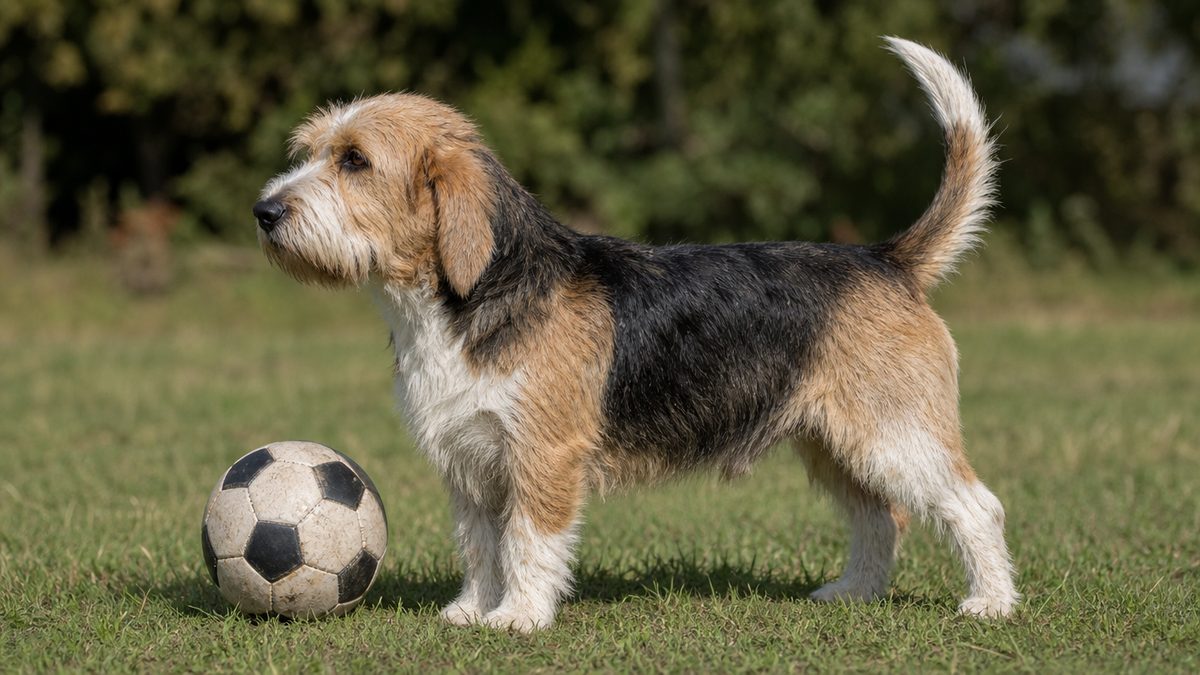
Quick answer
The Briquet Griffon Vendeen is a rough-coated French scent hound of 50 to 55 cm, FCI standard 19, and the only medium-sized hound among the four Vendeen griffons. France registered 174 in 2025. No Indian price exists and Indian import law bars any breeding import. Heat tolerance rates 2 out of 5, because the Vendee averages 12.4 degrees against Chennai's 28.0.
This page summarises published veterinary research, registry screening data and breed-standard text for general information. It is not a diagnosis and it is not treatment advice. Consult a registered veterinarian about your own dog before acting on anything here, and treat a rectal temperature at or above 41.0 degrees Celsius after exertion in heat as an emergency.
Briquet Griffon Vendeen at a glance
What the Briquet Griffon Vendeen actually is
The Briquet Griffon Vendeen is a rough-coated French scent hound of 50 to 55 cm at the withers for males and 48 to 53 cm for females, recognised by the Federation Cynologique Internationale as standard number 19 and accepted on a definitive basis on 2 October 1954.
It sits in FCI Group 6, Section 1.2, Medium-sized Hounds, and it is the only one of the four Vendeen griffons placed there. The other three sit above it and below it: the Grand Griffon Vendeen in Section 1.1 for large hounds, and both the Grand Basset and the Petit Basset in Section 1.3 for small houndsFederation Cynologique InternationaleFederation Cynologique Internationale. That single line of nomenclature is the fastest way to understand the breed. It is the family's middle size, and it has that slot to itself.
The word briquet means a medium-sized dog in French. The FCI standard opens by claiming this is the only breed that has kept the name, a claim the United Kennel Club repeats in its own standardUnited Kennel Club. That was true when the standard was written and is no longer true in the French studbook itself, a point the registry section below sets out with the numbers.
A deliberate reduction of a bigger hound
The breed was made by shrinking the Grand Griffon Vendeen, not by finding a local landrace. Selection dates from before the First World War and is credited to the Comte d'Elva, and the FCI standard describes the result as a harmonious and improved reduction of the Grand Griffon Vendeen, distinguished and rather stocky in its construction. The Comte d'Elva also began the first selections for the Grand Basset Griffon Vendeen at the end of the nineteenth century, looking for subjects with straight legs, so one man's work sits behind two of the four breeds.
Wars nearly ended it twice. The standard records that the type was decimated several times and reappeared at Fontenay le Comte in the Vendee in 1946. English-language accounts credit the show judge Hubert Dezamy with tracing the survivors and rebuilding the breed after the Second World WarAdopt a Griffon, Briquet Griffon Vendeen…. Paul Dezamy fixed the Grand Basset type and Abel Dezamy wrote the separate Petit Basset standard, so the same family name recurs across the groupFederation Cynologique Internationale.
What the standard says it is for
The Briquet is a gun-hunting pack hound for large game. The FCI standard gives its use as a scent hound for hunting with the gun of large game, and also of fox and hare, usually working in a small pack. It records that a team of Briquets won the trophy of France on roe deer in 1995 and that numerous teams are unleashed on wild boar. The breed carries the FCI working-trial requirement, so an international beauty title cannot be completed on looks alone.
Behaviour in the standard is written for the field, not the sofa. The dog is described as fine-nosed, fast, pleasant-voiced, unwilling to refuse bramble, very nimble on rough terrain, and inclined to hunt with its nose to the wind. Temperament gets one sentence that any prospective owner should read twice: the Briquet takes a lot of initiative, has stamina, is robust, must be equally good at working a cold track, at starting game and at driving it, and is a passionate hunter whose obedience is the master's problem to solve.
| Item | What the primary source says |
|---|---|
| FCI standard number | 19, official authentic language French |
| Group and section | Group 6 Scenthounds, Section 1.2 Medium-sized Hounds, with working trial |
| Definitive FCI recognition | 2 October 1954 |
| Official valid standard published | 9 January 1999, English text dated 18 February 2000 |
| Height at withers | Males 50 to 55 cm, females 48 to 53 cm, tolerance 1 cm either way |
| Weight | Not stated anywhere in the standard |
| Coat | Long without exaggeration, sometimes bushy, harsh to the touch, undercoat well furnished |
| Tail | Thick at base, set high, sabre carriage, never sickle, rather short |
| Country of origin | France |
The physical characteristics that matter are the ones a photograph can carry, and the breed catalogues mostly get them right on size and wrong on everything else. Brit's entry reproduces the standard faithfully, giving height at withers as 50 to 55 cm in males and 48 to 53 cm in females with a tolerance of plus or minus 1 cm for both sexes, and describing a rough-coated hound of medium size, relatively sturdy but always proportionate. That is a hardy dog rather than a delicate one, and nothing in the standard asks for refinement: the FCI text wants quarters quite strong but without being heavy, hard pads, tight arched toes and solid nails, and it faults a body that is cylindrical or whippety.
Two things in that table matter more than they look. The standard gives no weight at all, so every kilogram figure printed for this breed online comes from somewhere else. And the current standard was published in January 1999, which makes it more than a quarter of a century old and one of the least revised documents in Group 6.
The four Vendeen griffons, read from the four standards
Four FCI standards describe the Vendeen griffons, and reading all four together is the only reliable way to tell them apart: standard 282 for the Grand Griffon Vendeen, standard 19 for the Briquet, standard 33 for the Grand Basset and standard 67 for the Petit Basset.
Every one of the four is French, every one is in Group 6, every one carries the FCI working-trial requirement, and all four share the identical eight-entry colour list ending in the same four traditional names of hare colour, wolf colour, badger colour and wild boar colourFederation Cynologique InternationaleFederation Cynologique InternationaleFederation Cynologique Internationale. What separates them is height, leg construction, ear length, tail length and stop.
| Feature | Grand Griffon (282) | Briquet (19) | Grand Basset (33) | Petit Basset (67) |
|---|---|---|---|---|
| FCI section | 1.1 Large | 1.2 Medium | 1.3 Small | 1.3 Small |
| Male height | 62 to 68 cm | 50 to 55 cm | 40 to 44 cm | 34 to 38 cm |
| Female height | 60 to 65 cm | 48 to 53 cm | 39 to 43 cm | 34 to 38 cm |
| Sexes given separately | Yes | Yes | Yes | No, one range |
| Weight in the standard | None | None | None | None |
| Ear reaches | Beyond the end of the nose | Not the end of the muzzle | Beyond the end of the nose | Not quite the end of the muzzle |
| Ear tip shape | Elongated oval | A point | Elongated oval | Slight oval |
| Tail length | Rather long | Rather short | Rather long | Rather short |
| Stop | Slightly defined | Well defined | Frontal indentation well defined | Frontal indentation defined |
| Muzzle against skull | Equal length | Practically equal, rather short | Noticeably longer | Much shorter than the Grand Basset |
| Crooked forelegs disqualify | Not listed | Not listed | Yes | Yes |
| Named against another Vendeen | No | Yes, must not recall the Grand | Yes, must not resemble a small Briquet | Yes, muzzle shorter than the Grand Basset |
Ear length and tail length do not follow size
The single most useful line in that table is the ear row, and it does not run in size order. The Grand Griffon Vendeen and the Grand Basset both require leathers long enough to reach beyond the end of the nose. The Briquet and the Petit Basset both require leathers that stop short of the end of the muzzleFederation Cynologique InternationaleFederation Cynologique InternationaleFederation Cynologique Internationale. Tail length splits the same way: long on the Grand and the Grand Basset, short on the Briquet and the Petit Basset.
So the four breeds fall into two pairs, and the pairing crosses the size order. The second-largest breed pairs with the smallest. A photograph with no scale reference is therefore not enough to identify a Vendeen griffon, because the features that are easy to see in a photograph pair the wrong dogs together.
The one feature the Briquet has to itself
The Briquet is the only Vendeen griffon whose ear leathers are required to end in a point. Standard 19 says the leathers are supple, narrow and fine, covered with long hair, ending in a point, well turned inwards, not reaching the end of the muzzle, and set low below the level of the eye. Standards 282 and 33 both say elongated oval, and standard 67 says slight ovalFederation Cynologique InternationaleFederation Cynologique Internationale. That pointed tip is the cheapest single check available, and no ranking page prints it.
Three questions in order will place any Vendeen griffon. Are the legs straight or basset-built? If straight, is the dog nearer 65 cm or nearer 52 cm? If nearer 52 cm, does the ear stop short of the muzzle tip and end in a point? Three yes answers give you a Briquet Griffon Vendeen.
Note also the row on disqualifying faults. Crooked or half-crooked forelegs disqualify a Grand Basset and a Petit Basset and are not listed as disqualifying for either the Grand Griffon or the BriquetFederation Cynologique InternationaleFederation Cynologique InternationaleFederation Cynologique Internationale. That is not an oversight. The two bassets are the chondrodystrophic breeds, so their standards carry the guard against the fault their construction invites, and the two straight-legged breeds do not need it.
Bonbeno reads breed standards side by side wherever two breeds are routinely confused, and the method is the same one used on the two French pointer standards in the Braque Francais Type Gascogne guide: open both official PDFs, diff them clause by clause, and publish the clauses that disagree.
Three of the four standards define the breed by naming a relative
Three of the four Vendeen griffon standards contain a clause that names another Vendeen griffon the dog must not look like, and the Briquet sits in the middle of that chain, penalised for resembling the breed above it while the breed below it is penalised for resembling the Briquet.
Read in order, the chain runs like this. Standard 19 lists among its head faults a head that is too strong, recalling that of the Grand Vendeen. Standard 33 opens its General Appearance by saying the Grand Basset is slightly elongated overall, has straight forelegs, has the structure of a basset, and must not resemble a small Briquet. Standard 67 defines the Petit Basset's muzzle as much shorter than that of the Grand Basset. Only standard 282, the Grand Griffon at the top of the ladder, defines itself without naming a relative.
That is a breed standard written as a set of differences rather than a set of absolutes, and it tells you what actually goes wrong in the breeding shed. A Briquet drifts upward toward the Grand. A Grand Basset drifts upward toward the Briquet. Neither drifts downward. So the pressure on the Briquet is one-directional, and the fault the judge is watching for is coarseness in the head rather than fineness.
Recent genetics shows how thin the Briquet and Grand Basset boundary is
In September 2025 a University of Missouri group published the genetic reason Grand Bassets keep producing tall puppies. Of 47 Grand Basset Griffon Vendeens evaluated, 41 had leg lengths within the breed standard and 6 were significantly taller. None carried the FGF4 retrogene insertion on chromosome 12. Every short-legged dog was homozygous or heterozygous for the chromosome 18 insertion, and all six tall dogs were homozygous for the non-insertion allele.
The authors' conclusion is blunt. Selective breeding on appearance alone has not fixed short-leggedness in the breed, because the non-insertion allele is still being carried. One copy of the insertion is enough to make a dog short-legged, which is why heterozygous carriers look correct and keep passing the tall allele on.
No published study has genotyped a Briquet Griffon Vendeen for FGF4 retrogene insertions. The mechanism above is established in the Grand Basset and is a reasonable explanation for why a tall Grand Basset can be mistaken for a small Briquet, but the Briquet's own genotype has not been measured. Treat it as the best available explanation, not as a tested fact about this breed.
The claim about the name has been overtaken by the studbook
Standard 19 states that the Briquet Griffon Vendeen is the only breed having kept the name briquet, and the French parent club reproduces the same sentence in the original FrenchClub du Griffon Vendeen. The United Kennel Club's history paragraph repeats it in English, and World Life Expectancy has copied that paragraph verbatim onto its own pageWorld Life Expectancy.
The French studbook now says otherwise. The Societe Centrale Canine has recorded registrations for a Briquet de Provence since at least 2016, when three were entered, and in 2025 it registered 53 of them against 174 Briquet Griffon VendeensSociete Centrale Canine. The Briquet de Provence is not FCI-recognised, so the FCI's claim remains technically true inside FCI nomenclature. Inside the French national studbook the breed's own country keeps, it is not true any more, and the standard was published seventeen years before the earliest Briquet de Provence entry this page could find in the published LOF tables.
That matters beyond pedantry. It is a worked example of what happens when a breed standard goes unrevised for twenty-seven years while the register underneath it keeps moving, and it is the reason this page checks every claim against the registry data rather than against another breed page.
The American standard is not the French one translated
Two kennel clubs publish a Briquet Griffon Vendeen standard and they disagree in at least seven checkable places, including the two features that separate the breed from its relatives.
The United Kennel Club recognised the Briquet on 1 January 1996 and last revised its standard on 1 July 2009. The FCI standard in force was published on 9 January 1999, with the English text dated 18 February 2000. Neither is a translation of the other, and a dog can pass one and fail the other.
| Point | FCI standard 19 | UKC standard |
|---|---|---|
| Male height | 50 to 55 cm | 19.5 to 21.5 inches, that is 49.5 to 54.6 cm |
| Female height | 48 to 53 cm | 19 to 21 inches, that is 48.3 to 53.3 cm |
| Size tolerance | 1 cm either way | Half an inch, that is 1.27 cm either way |
| Oversize dog | Disqualifying fault | Eliminating fault only |
| Ear tip | Ending in a point | Not described |
| Tail length | Rather short | Not described |
| Tail carriage limit | Never as a sickle | Never curled over the back |
| Recalling the Grand Vendeen | Listed as a head fault | Not mentioned |
| Dentition | Scissor bite only | A complete set of evenly spaced white teeth |
| Kinky tail | Disqualifying | Not listed |
| Woolly coat | Disqualifying | Not listed, soft or sparse coat is a fault |
| Heterochromia | Disqualifying | Not listed, wall eye alone disqualifies |
| Albinism | Not listed | Disqualifying |
| Cryptorchidism | In the closing note, not a disqualification | Disqualifying |
What the American version dropped
The UKC standard drops both of the Briquet's diagnostic features. It describes the ears as set low, supple, narrow and fine, rolling inward, and not long enough to reach to the nose, with nothing about the pointed tip. It describes the tail as set high, thick at the base, tapering, carried up in saber fashion, but never curled over the back, with nothing about it being rather shortUnited Kennel Club. Those two omissions remove the pointed ear and the short tail, which are exactly the two things that separate a Briquet from a Grand Griffon Vendeen in a photograph.
It also drops the head fault that reads, in the FCI text, too strong, recalling that of the Grand Vendeen. A judge working only from the UKC document has no written instruction to penalise a Briquet that is drifting back toward the breed it was reduced from.
What the American version added
The UKC requires a complete set of evenly spaced white teeth. FCI standard 19 asks only for a scissor bite with incisors set square to the jaws and says nothing about full dentition. A Briquet missing two premolars is faultable in an American ring and unremarked in an FCI one. That distinction becomes an Indian legal question further down this page, because the Indian breeding rules name two or more missing teeth in the list of genetic defects a breeder must test for.
The size arithmetic is worth doing yourself
The UKC ranges are rounded to the half inch, not converted exactly. A male minimum of 19.5 inches is 49.53 cm against the FCI's 50 cm, and a male maximum of 21.5 inches is 54.61 cm against the FCI's 55 cm. Combined with the wider tolerance, a 48.5 cm male sits inside the UKC standard, whose floor is 48.26 cm, and outside the FCI one, whose floor is 49 cm, and the FCI treats size outside the standard as a disqualifying fault while the UKC treats it only as an eliminating fault that costs the dog its placings.
Anyone offered a Briquet with paperwork should ask which registry issued it. A dog registered against the American standard has not been assessed on the pointed ear, the short tail or the Grand Vendeen head fault, and a dog registered against the French standard has not been assessed on dentition. Neither document is wrong. They are simply different tests, and no page currently ranking for this breed tells a reader that.
How rare it really is, from the French studbook
France registered 174 Briquet Griffon Vendeens in 2025, which ranked the breed eighteenth of the 47 breeds in FCI Group 6 in its home country and made it the most numerous of the four Vendeen griffons that year.
The Societe Centrale Canine publishes the Livre des Origines Francais figures every January, broken out by group and breed. The 2025 table gives the Briquet 132 registrations in 2024 and 174 in 2025, a rise of 32 percent, with 57 of those dogs confirmed.
The rows sum to the printed total, so the table can be trusted
Before using any row from a PDF table, check that the rows add up to the total the document prints. The Group VI table for 2025 has 47 breed rows. Summed independently they give 12,894 for 2024 against a printed total of 12,894, 11,720 for 2025 against a printed 11,720, and 3,989 confirmations against a printed 3,989. The derived confirmation ratio is 34.0 percent against a printed 34 percent, and the derived year-on-year change is minus 9.1 percent against a printed minus 9 percent.
Every figure reconciles, so no row was dropped in extraction and the four Vendeen rows below are complete. The four together accounted for 453 of the group's 11,720 registrations in 2025, which is 3.87 percent of French scent hound registrations.
| Year | Briquet | Petit Basset | Grand Griffon | Grand Basset |
|---|---|---|---|---|
| 2016 | 298 | 231 | 159 | 33 |
| 2017 | 272 | 195 | 189 | 48 |
| 2018 | 276 | 243 | 123 | 71 |
| 2019 | 200 | 205 | 158 | 64 |
| 2020 | 226 | 195 | 122 | 60 |
| 2021 | 266 | 257 | 153 | 70 |
| 2022 | 130 | 277 | 148 | 37 |
| 2023 | 217 | 157 | 130 | 69 |
| 2024 | 132 | 134 | 82 | 50 |
| 2025 | 174 | 127 | 107 | 45 |
Two things jump out of that table. The first is the inversion. Outside France the Petit Basset Griffon Vendeen is by far the best known of the four, and it is the only one of the four with a genuine international show following. Inside France, in seven of the last ten years including 2025, the Briquet outregistered itSociete Centrale CanineSociete Centrale Canine. The breed described everywhere in English as the forgotten Vendeen is the one its home country breeds most.
The second is the volatility. The Briquet went 266, then 130, then 217, then 132, then 174 across five consecutive yearsSociete Centrale Canine. A halving and a two-thirds rise in successive years is not a trend, it is a population small enough that one hunting kennel's litter timing moves the national total by fifty percent. Treat any single-year figure for this breed as noise and read the decade.
A closed population with no imports
The 2019 edition of the same series breaks each breed into home-bred descendants, imports and titre initial entries, which are unpedigreed dogs admitted on type. The Briquet's 200 registrations that year were 194 descendants of already-registered dogs, zero imports of any kind, and 6 dogs entered by titre initial. The Grand Basset, by contrast, recorded 2 imports among its 64.
Zero imports in a full year is the number that defines this breed. There is no external population feeding the French one, because there is no meaningful external population. What exists outside France is a handful of working packs, and the register shows nothing coming back.
The Club du Griffon Vendeen publishes the list of breeders who have signed its breeding charter for this breed. As last updated on 3 April 2022 the list held nine names, with signature years running from 1967 to 2010. Their kennels sit in nine different French departments, and not one of the nine is in the Vendee itself. Bonbeno names no breeder and links no litter, but the count is the honest measure of how thin the breed's foundation is.
Briquet Griffon Vendeen price in India
No Briquet Griffon Vendeen price in India exists, because no verifiable Briquet Griffon Vendeen exists in India. Every Indian page that appears to offer one is either an auto-generated shell, a global dropdown, or a listing for a different dog.
That is the honest first line, and the rest of this section evidences it rather than filling the space with a made-up band. When this page searched the breed name with India results on 23 August 2026, Google reported About 129 results for the whole query and returned no Indian breeder, no Indian litter and no Indian price in india page. The Indian results it did return are recorded below, and the first of them is a Justdial category shell. The Indian results that do appear are worth naming individually, because knowing what you are actually being shown is more useful than any number.
What the Indian search results actually are
Justdial serves a page titled Pet Shops For Briquet Griffon Vendeen Dog for city after city, all of them under one national category id, nct-13843501. The Lucknow version and the Mandya version are the same page with the city name swappedJustdial, Pet Shops For Briquet Griffon…. Opening the Mandya page shows ten businesses, and not one of them is in Mandya. They are in Bangalore, Pollachi, Vellore, Thrissur, Kanchipuram, Kottayam twice, Chennai twice and Alappuzha. The categories those businesses are actually listed under include Pet Shops For CA Me Mallorqui Dog and Pet Shops For Blue Headed Pionus Parrot, which is the same template running for a Spanish sheepdog and a South American parrot.
GuavaSure, an Indian pet insurance site, carries Briquet Griffon Vendeen and Briquet Griffon Vendeen cross in its breed eligibility list. That is a global breed dropdown, not evidence that any Briquet is insured in India. The same list carries Grand Basset Griffon Vendeen and dozens of other breeds with no Indian population.
Amazon India sells a print-on-demand guidebook about the breed. Etsy sells mugs and phone cases. Those are the commercial results, and they are the honest answer to what is on offer.
Divide every rupee figure you are shown, twice
Indian pages routinely publish a dollar figure converted at one rate and call it a local price. Divide any rupee number you are quoted by 84.38 and again by 74. A clean round quotient in either case means you are looking at a converted foreign list rather than an Indian market observation.
Run the check on the one Indian dog-price page that does publish city tables. Mr n Mrs Pet lists the Labrador Retriever at INR 30,000 to INR 1,20,000 and prints the identical band for Hyderabad, Bangalore, Delhi, Chennai, Lucknow, Mumbai, Jaipur and Pune. Divided by 84.38 those become 355.5 and 1,422.1 dollars; divided by 74 they become 405.4 and 1,621.6. Neither divides cleanly, so the Labrador band is rupee-native and genuine. It is also identical in every city, which tells you the city table is decoration.
One Indian listing site prints Rs 98,999 as the headline figure on page after page: on its Borzoi page, its Basenji page, its Great Dane page, its Rat Terrier page, its Pomapoo page, its Affenpinscher page and its general individual-pets page, in several cases beside a recurring puppy named FizeyPuppiezo, Buy Basenji Puppies for Sale…. It divides to 1,173.25 dollars at 84.38 and 1,337.82 at 74, so it is not a conversion either. It is a rupee-native charm price attached to whichever puppy is in stock. If anyone quotes it to you for a Briquet, they are quoting a shop's standard number, not this breed. The Briquet does not appear on that site at all.
What a legitimate import would cost, in the only sense that is real
There is no lawful commercial route, which the import law section sets out in full. The only lawful entry is a pet already owned abroad and moved to India with its owner, and that is a relocation cost rather than a purchase price. It runs to airline manifest cargo or excess-baggage charges, an IATA-compliant crate, a rabies titre test, an export health certificate from the origin country, a DGFT import authorisation where the two-year residence condition is not met, and an advance no objection certificate from the Animal Quarantine and Certification Service. None of those figures is a breed price and Bonbeno does not publish them as one.
So the answer to what a Briquet Griffon Vendeen costs in India is that the question has no market behind it. That is not a gap in this page. It is the most affordable piece of information a prospective buyer can be given, because it means any quoted Indian price is a claim about a dog nobody can show you.
Why no lawful supply of this breed can form in India
Indian import law closes the commercial route for this breed completely: dogs sit under ITC(HS) 01061900 as a Restricted item, and DGFT Trade Notice 22/2022-23 states that applications for trading or breeding purposes shall be duly rejected.
The trade notice, dated 19 December 2022 and issued by the Directorate General of Foreign Trade, sets out the position in four clauses that are worth quoting rather than paraphrasing. The tariff line reads Mammals, Other, import policy Restricted, subject to Policy Condition 6 of the chapter.
- Policy Condition 7 allows a dog into India only as a pet dog with a valid pet book and relevant records in the name of the importer, for research by an R&D organisation with a CPCSEA recommendation, or for internal security by the Defence and Police Force.
- Policy Condition 8 states that import of commercial dogs for breeding or any other commercial activities other than those purposes is not permitted.
- Paragraph 6 states that any applications for trading or breeding purposes, or applications made on behalf of another person or entity, shall be duly rejected.
- Paragraph 7 limits entry to the airports and seaports of Delhi, Mumbai, Chennai, Hyderabad, Bangalore and Kolkata, with quarantine at the government station of that port where required. DAHD added a seventh port, Cochin International Airport at Kochi, for pets arriving under the baggage rules in October 2024. The full route is set out in how to import a dog to India.
Those four clauses together mean no Indian kennel can lawfully import founding stock. A breed with 174 births a year in its home country and zero registered imports into that country cannot supply an Indian breeding programme by any other route eitherSociete Centrale Canine.
The one lawful route, and what it demands
A person relocating to India may bring the dog they already own. Up to two pets can enter as passenger baggage without a DGFT authorisation, but only for someone transferring residence to India after two years of continuous stay abroad, and only cats and dogs qualify under the baggage rules. Anything else needs a DGFT import authorisation: fewer than two years abroad, a pet not travelling as passenger baggage, more than two pets, or a temporary import.
The paperwork is specific. The application goes in against the applicant's Importer Exporter Code or against the permanent IEC number IIHIE0153E for personal-use imports, submitted through the DGFT portal under Import Authorisation of Restricted Items. The trade notice advises starting at least two months before travel. An advance no objection certificate must then be obtained from the Regional Officer or Quarantine Officer of one of the six ports the DGFT notice names, after submitting the DGFT licence and a health certificate from the exporting country's veterinarian, seven days before travel and relaxable to three.
If an agent tells you they can arrange a Briquet Griffon Vendeen puppy from France for an Indian buyer, they are describing an application the trade notice says shall be duly rejected, and one made on behalf of another person, which paragraph 6 also names. Bonbeno brokers nothing and recommends nobody, but this is the clause to quote back.
Indian breeding law would bite even if a pair arrived
Suppose two unrelated Briquets did reach India lawfully as relocated pets. The Prevention of Cruelty to Animals (Dog Breeding and Marketing) Rules 2017, notified as G.S.R. 496(E) on 23 May 2017, would then govern any attempt to breed them. The Second Schedule, Part II, paragraph 6 permits only out breeding and line breeding. Paragraph 6(3) prohibits in breeding, which it defines as breeding between relatives of the second to fourth grade in straight or side line within the first four generations, naming uncle to niece, nephew to aunt, cousin to cousin and grandparents to grandchildren, and prohibits incest breeding between parents and children or brother and sister.
A founding population of two dogs reaches cousin-to-cousin matings in the third generation and cannot avoid them after that. Indian law therefore prohibits the only breeding strategy a two-dog foundation permits, which is a second and independent reason the breed cannot establish here. That is a real finding rather than a technicality, and it applies to every numerically tiny imported breed, not only this one.
Other provisions of the same rules apply to any dog bred in India. Rule 8, Conditions for sale, sub-rule 1(a) requires that pups less than eight weeks in age are not sold, and sub-rule 1(b) requires that dogs over six months are not sold without first being sterilised unless the buyer is another licensed breeder.
The quarantine side of that process is run by the Animal Quarantine and Certification Service, which sits under the Department of Animal Husbandry and Dairying and operates stations at Delhi, Mumbai, Kolkata, Chennai, Bengaluru and Hyderabad, the same six cities the trade notice names, and publishes a standard operating procedure for the import of pet dogs together with its quarantine chargesDirectorate General of Foreign Trade.
Monthly cost of ownership for a medium working hound in India
Budget for a medium active hound rather than for a breed price, because the recurring cost of ownership is the only part of the arithmetic that is real here and it is driven by weight, coat and activity rather than by rarity.
The FCI standard gives no weight, so size the budget from height instead. A 50 to 55 cm hound in working condition sits in the same feeding and dosing bracket as a Beagle at the top of its range or a small Labrador, which in Indian retail terms means a 10 to 35 kg medium-breed formula and medium-size parasiticide.
| Cost head | Frequency | What drives it for this breed |
|---|---|---|
| Complete dry or wet food | Monthly | Working-line appetite and 60 to 90 minutes of daily work; a hound fed to a Beagle's ration will gain weight in an Indian flat |
| Ectoparasiticide | Monthly or twelve-weekly | Year-round tick pressure, not seasonal; a harsh coat hides attached ticks |
| Deworming | Quarterly in adults | Ground-scenting dog with a nose in leaf litter and drains |
| Ear cleaning solution | Monthly to weekly | Low-set hair-covered leathers over a warm humid canal |
| Core vaccination boosters | Annual | Standard for any Indian dog |
| Grooming tools | One-off, replaced yearly | Stripping knife or coarse comb, not clippers |
| Veterinary consultations | Two routine plus incidents | Add one extra otitis-directed visit a year in a coastal or monsoon city |
| Insurance | Annual | Breed dropdowns list the breed, but a claim on a dog with no Indian pedigree trail is a conversation to have before you pay |
Two costs specific to a Vendeen griffon
The first is ear care. A drop-eared hound in Chennai or Kolkata is a recurring otitis budget, not an occasional one, and the ear infection section below explains why with Indian data. Assume a cleaning solution as a standing monthly line and at least one course of medicated drops a year in a humid city.
The second is containment. This is a pack hound bred to run a cold line through bramble, and a Briquet that slips a gate in an Indian city is not a dog that returns when called. Fencing, a fitted harness rather than a collar, a long line and a permanent identity tag with a microchip are not optional extras for this breed. They are the reason it can be kept at all.
What is not in the budget
Tail docking and ear cropping are not costs to plan for and never should be, because they are prohibited. The Second Schedule, Part II, paragraph 6(8) of the 2017 rules states that there shall be no tail docking, ear cropping, de-barking, de-clawing, branding, dyeing, injecting substances to enhance visual appeal, performing a surgery or procedure to camouflage or hide any defect or infirmity, or any other kind of mutilation of any body part of the pup, and that any change of appearance by artificial means is strictly forbidden.
The Briquet standard describes a natural undocked tail anyway, thick at the base and rather short, so there is no conflict between the standard and Indian law on this breed. That is not true of every imported breed, and it is worth stating plainly for a reader comparing several.
For a rare imported hound the largest single lifetime cost is usually not food or vet fees. It is the boarding, walking and containment infrastructure needed because there is no local pool of owners, sitters or trainers who have handled the breed. Budget for a good long-line recall trainer in year one and you will spend less in years two to ten.
Suitability for the Indian climate
The Vendee is wetter than Chennai and about fifteen degrees colder, which is the exact combination this breed's harsh double coat was built for and the exact combination no Indian city offers.
Climate figures here come from NASA POWER queried by explicit latitude and longitude, so no place can be substituted by accident, and each query's echoed coordinates are recorded in the citation. La Roche-sur-Yon, the prefecture of the Vendee, returns an annual mean air temperature of 12.42 degrees Celsius and an annual mean relative humidity of 82.4 percent at 44 metres elevation. Fontenay-le-Comte, the town where the Briquet type reappeared in 1946, returns 11.95 degrees and 82.2 percent at 91 metresFederation Cynologique Internationale.
| Place | Annual mean air temp | Annual mean RH | Hottest month and its peak T2M_MAX | Peak monthly wet-bulb |
|---|---|---|---|---|
| La Roche-sur-Yon, Vendee | 12.4 C | 82.4 % | 36.0 C in July | 16.4 C |
| Bengaluru | 23.7 C | 67.9 % | 40.4 C in April | 21.9 C |
| Pune | 23.9 C | 66.8 % | 43.2 C in April | 23.0 C |
| Delhi | 25.6 C | 45.6 % | 48.8 C in June | 26.5 C |
| Kolkata | 25.8 C | 73.9 % | 46.8 C in May | 27.1 C |
| Mumbai | 26.8 C | 67.4 % | 44.9 C in April | 25.8 C |
| Ahmedabad | 27.6 C | 48.3 % | 48.6 C in May | 26.1 C |
| Chennai | 28.0 C | 72.4 % | 42.7 C in May | 26.1 C |
The breed is not naive to humidity, it is naive to heat
Read the humidity column first, because it overturns the usual assumption. The Vendee's annual mean relative humidity of 82.4 percent is higher than every Indian city in the table, including Chennai at 72.4 percent and Kolkata at 73.9 percentNASA POWER, Source Native Resolution…NASA POWER, Source Native Resolution…. A Briquet arriving in India is not meeting damp air for the first time. Its coat evolved in permanently wet Atlantic bramble.
Now read the temperature column. Bengaluru, the mildest large Indian city here, averages 11.3 degrees warmer over the year than the breed's home. Chennai averages 15.5 degrees warmer. The peak monthly wet-bulb temperature, which is the number that actually governs whether an animal can shed heat by evaporation, is 16.4 degrees in the Vendee against 27.1 degrees in Kolkata, a gap of 10.7 degreesNASA POWER, Source Native Resolution….
So the risk this breed carries into India is heat, not damp, and the coat that handles the damp is the same coat that traps the heat. That is why the heat tolerance rating on this page is 2 out of 5 rather than 1 or 3.
City by city
- Bengaluru at 842 metres and Pune at 636 metres are the only two Indian cities in the table where a Briquet could work outdoors for most of the year, and both still need the middle of the day off from March to May.
- Mumbai, Chennai and Kolkata combine high wet-bulb readings with monsoon humidity above 87 percent, which removes evaporative cooling exactly when the dog most needs it; plan walks before sunrise and after dark year round.
- Delhi and Ahmedabad record peak T2M_MAX values near 49 degrees in their hottest month at low humidity, which is survivable for short exposures and lethal for a scenting dog that will not self-regulate; keep the dog indoors from late morning to early evening from April to June.
- Any hill station or Himalayan posting above roughly 1,500 metres is the one Indian setting where this breed is genuinely comfortable, and it is also the setting where its recall problem is most dangerous.
A UK primary-care study of 905,543 dogs identified 395 confirmed heat-related illness events in 2016, an incidence of 0.04 percent with an event fatality rate of 14.18 percent, and it found higher bodyweight relative to the breed and sex mean to be a significant risk factor. Roughly one heat event in seven killed the dog, and that was in a temperate country. A hound working a line will keep working past the point at which it should stop, because the standard's own description of the breed is a passionate hunter with stamina that takes a lot of initiative. In India that trait is the hazard.
Managing a harsh-coated hound through an Indian summer
Manage heat in this breed by controlling when it works rather than by changing what it wears, because the harsh double coat is insulation in both directions and shaving it removes the dog's own shade.
The standard describes hair that is long without exaggeration, sometimes bushy, harsh to the touch, with an undercoat well furnished, and it disqualifies a woolly coat. A coat built like that traps a layer of still air against the skin. In the Vendee that layer keeps Atlantic rain off the skin at 12 degrees. In Chennai it slows the loss of heat the dog is generating.
Never clip a griffon coat
Clipping a harsh double coat does not cool the dog. It removes the outer guard hairs that reflect radiant heat and shade the skin, leaves the soft undercoat behind, and exposes pale skin to Indian ultraviolet. The guard coat also regrows soft and patchy in many harsh-coated breeds, which changes the dog's appearance permanently and, on this breed, would move it toward the woolly coat the standard disqualifies. Strip or comb the coat out instead, which the grooming section covers.
A working schedule for an Indian city
- Walk before sunrise and after full dark from March to October in any plains city, and treat the middle six hours of the day as indoor time.
- Carry water on every outing over twenty minutes, and offer it whether or not the dog asks.
- Wet the ventral surface, the groin, the armpits and the paws rather than pouring water on the back, because water sitting on a harsh outer coat evaporates from the coat and not from the dog.
- Use a fan on a wet dog, because moving air over damp skin is the mechanism that actually works.
- Stop the outing when panting becomes noisy, when the tongue widens and spatulates, or when the dog seeks shade unprompted, and do not wait for staggering.
A dog that is collapsed, disoriented, vomiting or bleeding from the gut after exertion in heat needs cooling started immediately and a veterinarian at once. Begin cool water immersion or continuous dousing plus airflow on the way, and do not delay travel to find a thermometer. The UK primary-care data recorded an event fatality rate of 14.18 percent for confirmed heat-related illness, which is why the response has to be immediate rather than observational.
The bodyweight lever
The one heat risk factor an owner fully controls is condition. The UK study found higher bodyweight relative to the breed and sex mean to be a significant risk factor for heat-related illness on multivariable analysis. Since this breed has no published weight standard at all, the practical control is not a number on a scale but the body condition score: run the nine-point WSAVA chart monthly, aim for a 4 or 5 out of 9, and require ribs that are easily felt with a thin fat cover, a visible waist from above and an abdominal tuck from the side.
An overweight Briquet in Mumbai is carrying two heat penalties at once, its own coat and its own insulation, and it is the only one of the two you can remove.
Temperament, household fit and who should not buy one
The Briquet Griffon Vendeen is a sociable, cheerful, extremely vocal and functionally independent pack hound, which makes it a good family dog in a house with land and a poor one in an Indian apartment.
Start with what the standard says, because it is unusually candid. Behaviour is given as fine nose, fast dog with pleasant voice, does not refuse bramble, very nimble on rough terrain, hunts rather with nose to the wind. Temperament is given as taking a lot of initiative, having stamina, being robust, and needing to be equally good at working a cold track, at starting game and at driving it. Then comes the sentence that decides the household question: the Briquet is a passionate hunter and it is up to his master to make him obey.
That last clause is not a compliment about trainability. It is the standard telling a judge that obedience is not a breed trait and must be supplied by the handler.
Pack dog, not guard dog
Bred to work in small packs, the breed gets on with other dogs and is not described as possessive in any of the sources that describe its characterFederation Cynologique Internationale. The rescue network that handles Vendeen griffons in Europe describes the breed as one that relishes time outdoors with its family, lively and enthusiastic rather than high-strung. Nothing in the standard mentions guarding, suspicion of strangers or protectiveness, and the only behaviour fault listed is a timid subject.
The pleasant voice in the standard is a euphemism. A scent hound bred to be followed by ear across broken country has a carrying bay that it uses when it finds a line, when it is excited, when it is bored and when it is left alone. In a Vendee wood that is the point of the dog. In a Bengaluru apartment block it is a neighbour complaint every evening.
Ideal living conditions
The best living conditions for this breed are a fenced house with a garden, another dog for company, a household that is at home for most of the day, and an owner who will walk it before sunrise. The worst are a high-rise flat, long hours alone, an unfenced compound and a road within scenting distance.
| Household | Verdict | Why |
|---|---|---|
| Fenced independent house with garden | Good | Space to burn energy and a barrier the nose cannot argue with |
| Apartment, any floor | Poor | Carrying hound voice, no off-lead outlet, corridor stimulus all day |
| Home with young children | Good with supervision | Sociable and sturdy, but a hound of 50 cm at the shoulder running flat out will knock over a toddler |
| Home with cats or rabbits | Poor | Bred to start and drive small game; the drive is the breed |
| Multi-dog home | Good | Pack-bred and not possessive |
| First-time dog owner | Poor | Recall is the hardest single skill in dogs and this breed is the hardest version of it |
| Owner away nine hours a day | Poor | Boredom in a scent hound becomes barking, digging and escape |
Who should not buy one
Anyone who wants a dog that comes back should not buy this breed on the strength of its looks. Anyone who lives in a flat should not buy it at all. Anyone in Chennai, Kolkata, Mumbai, Delhi or Ahmedabad should read the climate section before anything else. And anyone in India who has been offered one should read the price and import law sections first, because the dog on offer is almost certainly not this breed.
When this page pulled Google in India on 23 August 2026, the only People Also Ask question the search engine offered for this breed was about the Petit Basset Griffon Vendeen, and three of the six People Also Search For terms named a different Vendeen. If you liked the shaggy tousled look, you may actually want the Petit Basset, which stands 34 to 38 cm rather than 50 to 55 cm, is available in dozens of countries and has real health screening data behind it.
Training a breed whose own standard says obedience is your problem
Train the Briquet Griffon Vendeen on the assumption that it will never be reliably off-lead, and spend the first two years building a recall you can bet a road crossing on rather than a repertoire of tricks.
FCI standard 19 is unusually direct about this. It says the Briquet takes a lot of initiative and that it is up to his master to make him obey. The United Kennel Club puts it even more plainly: the Briquet is a headstrong, robust breed that hunts with stamina and enthusiasm, is a passionate hunter, and is not quick to obey. Two independent registries wrote down the same warning, thirty years apart, in documents that exist to describe a dog's virtues.
The Grand Basset standard, written for the closest relative, adds the note that training implies will and punishment, for which the dog will bear no grudge. Bonbeno does not endorse correction-based training, and modern evidence-based practice does not either, but the clause tells you what these breeders were dealing with: a dog that argues.
Recall is the whole curriculum
Recall training for a scent hound is a different discipline from recall for a retriever. A gundog is bred to check back to a handler. A scent hound is bred to leave the handler, commit to a line and stay on it while the handler follows. Calling a Briquet off a fresh track is asking it to abandon the one job its ancestors were selected for over a century.
- Start in a corridor with no smells and a hungry puppy, and pay every single recall with food for the first six months.
- Move to a long line of ten to fifteen metres before you move outdoors, and keep the line on for the entire first year.
- Never call the dog when you cannot enforce the recall, because a call the dog can ignore teaches it that calls are optional.
- Pay recall higher than the environment: liver or chicken outdoors, not kibble.
- Build a separate emergency cue that is used perhaps twenty times in the dog's life and is paid extravagantly every time.
- Test the recall against a live distraction only after it works against a stationary one, and expect to fail and go back.
What this breed is genuinely good at
Scent work is the obvious answer and it is the right one. A scent hound with the standard's cold-track requirement will take to tracking, mantrailing and nosework faster than almost any other breed, and unlike obedience it uses the drive instead of fighting it. Twenty minutes of scatter feeding in long grass tires this dog more than an hour of walking on pavement.
The breed is also genuinely trainable in the narrow sense of learning fast. What it does not do is comply under distraction. Distinguish the two when you assess a trainer: a trainer who says the dog is stubborn has misread it, and a trainer who says the dog needs the environment managed has understood it.
Socialisation in an Indian city
Socialise early and deliberately, because a hound bred for packs and open country meets none of the Indian city's stimuli in its genes. Free-ranging community dogs, autorickshaw horns, cattle on the road, festival firecrackers and stairwell strangers all need to be introduced calmly during the first sixteen weeks. Note that Rule 8(1)(a) of the 2017 rules prohibits selling a pup under eight weeks in India, so the socialisation window in a legally sold Indian puppy starts in the buyer's home and is already partly spent.
A Briquet on a scent will cross a road without looking. That is not a training failure, it is the dog doing what a century of selection built it to do. The correct answer in India is a harness, a long line and a fenced space, not a better recall cue.
Daily exercise requirement, and what happens without it
Plan on 90 minutes of real work a day for an adult Briquet Griffon Vendeen, split across two or three sessions, with at least a third of it given to nose work rather than distance.
The breed was made to run large game in a small pack across broken country all day. Wikipedia's exercise section records that Briquets were bred to hunt large game and usually worked as a small pack, and the FCI standard notes teams unleashed on wild boar and a team win on roe deer in 1995Federation Cynologique Internationale. Nothing in that job description scales down to a twenty-minute pavement walk.
The one ranking page that gives a figure puts it at at least 90 minutes a day divided between walks and play, with hunting and tracking activities described as ideal. That figure is unsourced, but it matches the breed's construction and matches what the standard describes, so it is a reasonable planning number rather than a measured one. Bonbeno prints it as what it is.
Distance is the wrong currency
An independent registry puts the requirement higher for the family. The Royal Kennel Club's breed card for the Grand Basset Griffon Vendeen, a breed ten centimetres shorter than the Briquet, specifies More than 2 hours per day of exercise, grooming every day, a long coat, and Country rather than town as its setting. If the shorter-legged Vendeen needs more than two hours, 90 minutes for the Briquet is a floor rather than a target.
Two hours of lead walking on a Mumbai pavement will produce a fit, bored, frustrated hound. Twenty minutes of tracking in a park will produce a tired, satisfied one. A scent hound burns more through its nose than through its legs, and mental work is the part of the requirement that is hardest to substitute.
- Scatter feed the whole morning ration into long grass and let the dog find it, which costs nothing and takes twenty minutes.
- Lay a short drag track with a piece of meat and let the dog follow it, extending the age of the track week by week.
- Hide a scented article indoors on hot afternoons, which turns the indoor hours into work rather than confinement.
- Exercise on a fifteen-metre long line in an open field rather than off-lead, which gives running room without a recall gamble.
- Use a flirt pole or a tug session for short bursts when the weather makes long outings unsafe.
The Indian timing constraint
The requirement does not shrink in summer, but the window does. In Chennai, Kolkata and Mumbai the usable outdoor hours from March to October are roughly before 06:30 and after 19:30, which means an owner who cannot walk before sunrise cannot meet this breed's needs there for eight months of the year. In Bengaluru and Pune the window is wider and the elevation helps, but the April afternoon still has to be given upNASA POWER, Source Native Resolution….
What an under-exercised Briquet does
It bays. Then it digs. Then it chews. Then it works out how the gate opens. Escaping is the failure mode that matters, because a scent hound loose in an Indian city is a dog with no reason to come back and every reason to keep going, and it is exposed to traffic, to territorial free-ranging dogs and to heat all at once.
If you cannot commit to 90 minutes a day including a nose-work component, every day, for twelve to fourteen years, in a city where eight of those months restrict you to dawn and dusk, this is not your breed. That is not a soft warning. It is the single most common reason working hounds are surrendered.
Grooming a harsh griffon coat in Indian humidity
Groom this breed by hand-stripping or combing out dead harsh hair every week or two and by never clipping it, because the coat type the standard describes is a self-shedding weatherproof jacket that a clipper permanently ruins.
The standard describes hair that is long without exaggeration, sometimes bushy and harsh to the touch, with a well furnished undercoat, and it specifies that the belly and the inside of the thighs must not be bare and that the eyebrows are well pronounced but do not cover the eye. Faults include a coat insufficiently dense or with fine hair; a woolly coat is a disqualification.
The weekly routine
- Comb through with a coarse metal comb weekly to lift dead undercoat before it mats behind the elbows and under the ears.
- Hand-strip or use a stripping knife on the body two to four times a year to remove blown guard hair, which keeps the texture harsh.
- Tidy hair between the pads and around the anus with scissors, not clippers, so the outline stays natural.
- Check the eyebrows monthly; the standard wants them pronounced but not covering the eye, and overgrown brows in a dusty Indian city carry grit into the conjunctiva.
- Comb the moustache after every meal, because a wet moustache in a humid climate is a fungal culture medium.
Bathe rarely. Every bath softens a harsh coat temporarily and the softening takes weeks to reverse. A working griffon coat sheds mud when dry, so brushing a dry dirty dog beats washing a clean one.
Overseas grooming advice was written for a colder place
Northern European guidance for harsh-coated breeds routinely ends with towel the dog and let it air dry. In the Vendee, where the annual mean is 12.4 degrees, air drying works. In Chennai in August at 72 percent annual mean humidity, or in Mumbai in July when relative humidity reaches 90 percent, a wet double coat against skin does not dry; it stays damp for hours in warm air. Dry this breed actively with a stand dryer or a fan, and dry the ear bases and armpits specifically.
Clipping removes the guard coat that shades the skin, leaves the insulating undercoat behind, and often grows back soft and patchy. On this breed a soft regrown coat also moves the dog toward the woolly coat the FCI standard disqualifies. Indian groomers who default to a summer shave for every long-coated dog need to be told no in advance.
The furnishings the coat depends on are a known gene
The long moustache and pronounced eyebrows that define a griffon head are furnishings, produced by a dominant 167 base pair variant in the 3-prime untranslated region of the R-spondin-2 gene, characterised by Cadieu and colleagues in 2009. A dog with two copies of the non-furnishing allele has an improper coat, meaning short hair on the head, face and legs, and a commercial test costs 58 dollars at the University of California Davis Veterinary Genetics Laboratory.
One correction is needed here, because a search result invites the wrong conclusion. The Briquet Griffon Vendeen appears on that laboratory's page only in the site-wide breed taxonomy list that runs identically at the foot of every test page and includes Wolf, Coyote and Unknown. It is not in the curated Breeds appropriate for testing list on the furnishings test, although the Petit Basset Griffon Vendeen is. So the gene is characterised and the test exists, but no laboratory currently offers it as validated for this breed.
The ears are the breed's biggest Indian health problem
Check and dry this breed's ears weekly from the day it arrives, because a low-set leather covered in long hair over a warm humid canal is the single most predictable ear infection risk a Vendeen griffon carries into India.
The standard requires leathers that are supple, narrow and fine, covered with long hair, ending in a point, well turned inwards, and low-set below the level of the eye. Turned inwards and set below the eye means the pinna lies flat against the head and seals the canal. Covered with long hair means the seal is insulated. That is a good design for keeping bramble and rain out of the ear of a dog working a French wood in November. It is a poor design for Kolkata in August.
What Indian data shows about dog ears
Delhi work published in 2023 found something no owner would guess. Researchers analysed skin and ear swabs from 87 dogs in Delhi and recovered Candida auris, the multidrug-resistant yeast now treated as a global public health threat, from four dogs with chronic skin infections, three of them in the ear canal and one on the skin surface. Whole genome sequencing of six isolates from two dogs showed relatedness to Clade I clinical strains.
Two caveats belong with that figure. The authors report the prevalence as 4.5 percent; 4 divided by 87 is 4.60 percent, so the printed percentage is slightly low. And the dogs sampled were dogs with chronic skin infection presenting to a Delhi animal care centre, not a random population, so this is not a general prevalence in Indian pet dogs. What it does establish is that an Indian dog's ear canal is a habitat where a serious drug-resistant organism has been found and sequenced. A canal that never dries is a canal that invites whatever is around.
The weekly ear routine
- Lift the leather and look inside once a week, in daylight, and note the smell as much as the appearance.
- Dry the canal opening after every swim, bath or heavy rain, and dry it before the coat.
- Plug the ears with cotton wool before bathing, and remove it immediately after.
- Thin, do not shave, the hair on the inner surface of the leather so air can reach the canal.
- Use a veterinary ear cleaner rather than water, oil or a home remedy, and never insert a cotton bud into the vertical canal.
- Treat a head shake, an ear-first tilt or a yeasty smell as an appointment, not as something to watch.
Northern European grooming guidance that says towel the dog and let him air dry assumes a cool climate. In an Indian coastal or monsoon city that instruction leaves a sealed hairy canal warm and wet for hours. Dry the ear bases actively with a fan or a stand dryer on cool. This is the clearest single example on this page of overseas care advice that does not transfer.
What the relatives tell us to expect
There is no ear disease data for the Briquet, because no register carries the breed. There is data for the family. In the Orthopedic Foundation for Animals eye database the Petit Basset Griffon Vendeen ranks eighth of all breeds tested with 14.9 percent abnormal across 752 evaluations, and the Grand Basset ranks seventeenth with 10.9 percent abnormal across 192. Those are eyes rather than ears, but they show that the drop-eared, heavy-browed head of this family carries a real load of head-region findings, and that when a Vendeen breed is actually screened the abnormal rate is not small.
The practical conclusion for India is simple. Budget for ear care as a standing monthly cost, not an occasional one, and choose a veterinarian who will do cytology on a first otitis rather than dispensing drops on sight.
What the ear data actually shows, in the UK and in India
A drop ear roughly doubles a dog's odds of otitis externa, and in India almost six in ten cases present in the two months of the monsoon, which together set the ear-care schedule for this breed.
A UK primary-care study settles the conformation question. O'Neill and colleagues sampled 22,333 dogs at random from 905,554 under veterinary care in 2016 and found a one-year period prevalence of otitis externa of 7.30 percent, with a 95 percent confidence interval of 6.97 to 7.65. Ear carriage was one of the two highest ranked risk factors: compared with erect-eared breeds, breeds with pendulous ear carriage had 1.76 times the odds and breeds with V-shaped drop ear carriage had 1.84 times the odds. The Basset Hound came out at an odds ratio of 5.87 and the Beagle at 2.54 against crossbred dogs. The Briquet's leather is a low-set drop ear covered in long hair, which puts it squarely in the penalised group.
Indian data adds the season. A cross-sectional study at Palampur in Himachal Pradesh screened 2,476 dogs presented between June 2022 and July 2023 and diagnosed otitis externa in 81, a hospital prevalence of 3.27 percent. Cases peaked sharply in the rainy season: 48 of the 81, or 59.25 percent, presented in July and August, against 15 in summer, 10 in winter and 8 in autumn. Excessive moisture was recorded as a predisposing factor in 17 cases and every one of the 81 showed secondary bacterial or fungal overgrowth on cytology.
That study also carries an arithmetic error worth flagging, because the corrected number is the one that matters here. Its table reports pendulous-eared breeds as 53 cases and 69.13 percent; 53 divided by 81 is 65.4 percent. The erect-eared row of 25 cases and 30.86 percent divides correctly, and 25 plus 56 equals the study's 81 while 56 divided by 81 is 69.14 percent. So the count is the typo and the percentage is right: roughly seven in ten Indian otitis cases in that series were in pendulous-eared dogs.
Note where Palampur is. It sits in the Himachal foothills, not on the coast, and it still recorded almost six in ten of its otitis cases in a two-month monsoon window. A drop-eared hound in Mumbai or Kolkata, where mean relative humidity runs 87 to 90 percent through July and August, faces a longer and harder version of the same season.
The UK odds ratio tells you this breed needs weekly ear checks rather than occasional ones. The Indian seasonality tells you when to double them. From late June to early September, look and dry every second day, and book a cytology-led veterinary appointment at the first head shake rather than at the thirdNainika, Sharma P. Otitis externa in Dogs.
Health risks and life expectancy, and what is actually known
Two peer-reviewed papers in the world literature name the Briquet Griffon Vendeen, no screening register carries it, and no study has ever measured its life expectancy, so this section reports what exists rather than borrowing a relative's numbers.
That is an unusual thing for a breed page to say, so here is the search behind it. PubMed queried on 23 August 2026 returns exactly two records that genuinely concern this breed. Control queries run in the same session in the same tool returned 54 records for Labrador Retriever and hip dysplasia, 101 for Basset Hound and 10 for Beagle and otitis, so the database was working.
Paper one, a lower motor neuron disease in two littermates
In 1998 Mandara and Di Meo at the University of Perugia reported two 2-month-old Griffon Briquet Vendeen pups from the same litter with progressive weakness and hind limb paresis. The paraparesis progressed rapidly to extensor paralysis, then involved the forelimbs with flexor paralysis, and the appendicular muscles of all four limbs progressively atrophied. Post-mortem lesions were severe loss of neurons in the ventral horns of the spinal cord, Wallerian degeneration of ventral spinal roots, and peripheral nerve and neurogenic appendicular muscular atrophy, consistent with a progressive lower motor neuron disease.
Two affected littermates is a genetic signal, not a coincidence, and it is the only breed-specific disease report the Briquet has. It has never been followed up, no mutation has been identified and no prevalence has been estimated, so it cannot be screened for. A buyer should nonetheless know that the one disease paper about this breed describes a fatal neurological condition presenting at eight weeks.
Paper two, the only clinical dataset that exists
In 2020 a Perugia group published haematological and biochemical reference intervals for five hunting breeds using a blood-donor database. Of 445 clinically healthy adult client-owned blood donors sampled between January 2015 and January 2017, 50 were Briquet Griffon Vandeen, alongside 156 Ariegeois, 52 Bleu de Gascogne, 64 Bracco italiano and 123 Segugio italiano.
Fifty healthy adults is the largest clinical dataset on this breed anywhere, and it produced breed-specific reference intervals for five analytes. That is directly useful, because it means a laboratory's default canine panel will misread a healthy Briquet.
| Analyte | Briquet interval | Laboratory canine interval | Share of Briquet samples outside it |
|---|---|---|---|
| Monocytes, x10^3/uL | 0.07 to 0.79 | 0.50 to 1.80 | 70 % |
| MCH, pg | 17.4 to 25.2 | 22.1 to 26.5 | 50 % |
| MCHC, g/dL | 28.2 to 37.8 | 34.5 to 38.3 | 40 % |
| Albumin, g/dL | 2.86 to 3.99 | 2.90 to 3.50 | 45 % |
| Platelets, x10^3/L | 126 to 685 | 115 to 423 | 15 % |
| Urea, mg/dL | 15.1 to 61.1 | 20.0 to 40.0 | 35 % |
The monocyte row is the one to show a veterinarian. Seventy percent of samples from healthy Briquets fell outside the laboratory's standard monocyte interval, and the breed's own interval of 0.07 to 0.79 sits almost entirely below the general canine 0.50 to 1.80. A healthy Briquet will therefore look monocytopenic on a default panel. The platelet row runs the other way: the top of the breed interval, 685, is 62 percent above the laboratory ceiling of 423, so a healthy dog can return a count that reads as thrombocytosis.
The authors also note that three of the five breeds, including the Briquet, tended toward lower mean cell volume than published canine intervals, indicating microcytic red cells relative to the general dog population. In India, where microcytosis prompts a hunt for iron deficiency or chronic parasitism, that breed baseline is worth knowing before the workup starts.
Why no screening data exists for this breed
Three national registries hold no screening rows at all for the Briquet Griffon Vendeen and two of them do not list it as a selectable breed, while both Vendeen bassets appear in all three, which makes this a controlled absence rather than a failed search.
The absence was tested rather than assumed. OFA's complete disease-statistics dump, retrieved on 23 August 2026, runs to 2,225,910 characters holding more than ten thousand breed-labelled table rows, and covers every breed in every screening database. A case-insensitive search of that dump returns zero occurrences of BRIQUET and zero of GRAND GRIFFON VENDEEN, against 24 rows for GRAND BASSET GRIFFON VENDEEN and 41 for PETIT BASSET GRIFFON VENDEEN.
The controls run in the same retrieval passed: LABRADOR returned 109 rows, BEAGLE 61, BASSET HOUND 45 and OTTERHOUND 3. Note also that the page still prints the string Searching Database, Please wait while the tables are fully present, so that string is not evidence of a failed load. Separately, OFA's own advanced-search breed list carries GRAND BASSET GRIFFON VENDEEN and PETIT BASSET GRIFFON VENDEEN and does not carry the Briquet at all.
The same holds at the American Kennel Club. Its complete breed selector, which spans every recognised breed plus the Foundation Stock Service, lists Grand Basset Griffon Vendeen and Petit Basset Griffon Vendeen and jumps from Briard to Brittany with no Briquet in between; Brazilian Terrier and Basset Fauve de Bretagne are present in the same list as controls. The reason is arithmetic rather than neglect. OFA's databases are built from evaluations submitted by owners and breeders in North America, and a breed producing 174 registered puppies a year in France and effectively none in North America has nobody to submit them. Being absent from the selectable breed list means no dog of the breed has ever been entered, not that entered dogs scored badly.
What the screened Vendeen relatives actually show
The two Vendeen bassets are screened in North America and their results are not reassuring: 18.9 percent hip dysplasia in one, and the highest primary open angle glaucoma carrier rate of any breed in the other.
The United Kingdom register agrees. The Royal Kennel Club's breed standards index lists Basset Griffon Vendeen (Grand) and Basset Griffon Vendeen (Petit) in the Hound group, alongside Beagle, Basset Hound, Griffon Fauve De Bretagne, Grand Bleu De Gascogne and Otterhound as controls in the same document, and contains no Briquet and no Grand Griffon Vendeen. Three national registries on three continents therefore carry the same two Vendeen bassets and none of them carries this breed.
| Screen | Grand Basset Griffon Vendeen | Petit Basset Griffon Vendeen |
|---|---|---|
| Hips, evaluations | 106 | 849 |
| Hips, dysplastic | 18.9 % (14.2 mild, 3.8 moderate, 0.9 severe) | 12.1 % (10.0 mild, 2.1 moderate, 0.0 severe) |
| Eyes, evaluations | 192 | 752 |
| Eyes, abnormal | 10.9 % | 14.9 % |
| Elbows | Below OFA's reporting threshold | 3.0 % abnormal of 264 |
| Patella | Below OFA's reporting threshold | 4.5 % abnormal of 88 |
| Congenital cardiac | Below OFA's reporting threshold | 98.2 % normal of 169 |
| Primary open angle glaucoma | Not listed | 44.3 % carrier, 2.9 % affected, of 309 |
The glaucoma row is the one that should stop a reader. The Petit Basset Griffon Vendeen ranks first of every breed in OFA's primary open angle glaucoma table, with 52.8 percent normal, 44.3 percent carrier and 2.9 percent affected across 309 evaluations, against an all-breeds figure of 74.4 percent normal, 24.0 percent carrier and 1.6 percent affected across 624.
That is corroborated clinically. A six-year series of breed-society clinics in the United Kingdom examined 366 Petit Bassets by slit-lamp, ophthalmoscopy, tonometry and gonioscopy and found glaucoma in 38 of them, a prevalence of 10.4 percent, with signs from three years of age onward and lens instability preceding raised pressure in 10 of the 38.
The Petit Basset's glaucoma, epilepsy and hip figures are its own. The Briquet is a separate breed with a separate gene pool, and borrowing a cousin's prevalence would be exactly the fabrication this page exists to avoid. Read the family data as a list of things worth watching for, not as this breed's risk profile.
Two more family findings belong on that watch list. Danish work put idiopathic epilepsy in the Petit Basset at 8.9 percent, 42 of 471 dogs, with a mean onset age of 26.3 months, strong clustering within litters, and epilepsy the predominant cause among euthanised dogs at 6 of 45; a later genome-wide association study of 23 affected and 30 unaffected dogs found suggestive loci on chromosomes 13, 24 and 35 but no causal variant. And canine X-linked muscular dystrophy has been confirmed in three related Grand Bassets, two male and one female, destroyed at about two months of age.
One disagreement belongs on the record. The Petit Basset Griffon Vendeen Club of America's own Common Questions page describes primary open angle glaucoma as a severe, blinding eye disease that occurs in a small percentage of the breed, and says the club has been working aggressively to eliminate it. OFA's table ranks the breed first of all breeds tested at 44.3 percent carrier and 2.9 percent affected, and the UK clinic series found clinical glaucoma in 10.4 percent of 366 dogs examinedBedford PGC. Open-angle glaucoma…. A parent club and two independent datasets are describing the same disease in very different language, and a buyer should read the datasets.
The published life span figures have no source behind them
Three life span figures circulate for this breed, 10 to 12, 11 to 13 and 12 to 14 years, they disagree by four years at both ends, and not one of them cites a study, so Bonbeno prints all three and states plainly that the true figure has never been measured.
World Life Expectancy, which ranks ninth for this breed in India, prints LIFE SPAN: 12-14 years. Curafyt, which ranks sixth, answers its own heading What is the average life expectancy with 11 to 13 years. Neither page names a study, a register, a survey or a sample size.
Royal Canin, which ranks fourth for this breed in India, prints an average life expectancy of 10 to 12 years and closes the section with the line: key facts and characteristics sourced from Federation Cynologique Internationale (FCI). FCI standard 19 contains no life expectancy, no weight and no mortality data of any kind. The figure is therefore attributed to a document that does not contain it, which is a stronger failure than simply leaving a number unsourced.
Following the 12 to 14 figure back
The World Life Expectancy page is worth opening properly, because the rest of its content answers the question of where the number came from. Below the life span line the page carries a HISTORY paragraph that reads: Briquet means medium sized dog in French, and this is the only breed to retain that name. The Briquet Griffon Vendeen was recognized by the United Kennel Club January 1, 1996.
That is the United Kennel Club standard's History section, reproduced word for word including the recognition date. So the page's only substantive content is copied from the UKC standard, and the UKC standard contains no life span at all. The 12 to 14 years sits beside borrowed text with nothing behind it.
Why no real figure exists
Life span figures for dog breeds come from three places, and this breed is absent from all three. Insurance and primary-care databases such as VetCompass need thousands of individuals of a breed to produce an estimate. Kennel club health surveys need an active breed club with a member base to survey. Veterinary teaching hospital records need the breed to be present in the catchment. A breed producing 174 registered puppies a year in one country, with nine charter breeders and zero imports, reaches none of those thresholdsClub du Griffon VendeenSociete Centrale Canine.
For household budgeting, plan for a medium working hound: twelve to fourteen years is the right order of magnitude for a 50 cm scent hound and is what the two published figures agree on roughly. Just do not treat it as measured. If a seller quotes a life span for this breed as though it were established, they have read a page, not a study.
The colour and weight claims fail the same test
Two other widely repeated numbers do not survive a check against the standard. The first is weight. Curafyt states plainly that there is no standard weight and then gives an average of 22 to 25 kg; the FCI standard indeed gives no weight, and neither does the UKC standardUnited Kennel Club. Treat 22 to 25 kg as a plausible field observation with no document behind it.
The second is colour. Wikipedia lists white and gray among the breed's colours and Curafyt lists Grey as a colour in its own rightCurafyt, Briquet Griffon Vendeen. The FCI standard's colour list has eight entries and grey is not one of them: black with white spotting, black and tan, black with light tan markings, fawn with white spotting, fawn with black mantle and white spotting, fawn with black overlay, pale fawn with black overlay and white spotting, and pale fawn with black overlay. What the standard does give is four traditional names, hare colour, wolf colour, badger colour and wild boar colour, and wolf colour is what a fawn coat with a black overlay looks like at twenty paces. The grey in the English descriptions is a traditional French colour name read as a literal colour.
The same page also describes the ears as set low, long and covered with fine hair. The standard says the leathers are narrow and fine and covered with long hair, and that they must not reach the end of the muzzle. The adjectives have been swapped, and the effect is to describe the breed's short ear as long, which is the single feature that separates it from the Grand Griffon Vendeen and the Grand Basset.
One useful contrast sits in the United Kingdom. The Royal Kennel Club publishes a life span band for every breed it recognises, and it gives Over 10 years to both the Grand Basset Griffon Vendeen and the Petit Basset Griffon Vendeen, against Over 12 years for the Beagle. The Briquet has no band there because the Royal Kennel Club does not recognise the breed at all, which is the point: a life span band exists where a register exists, and this breed has neither. Note also how much lower the two recognised Vendeens sit than the 12 to 14 years the aggregators print for the Briquet.
Indian health risks that have nothing to do with the breed standard
The three health problems most likely to affect a Briquet Griffon Vendeen living in India are tick-borne blood parasites, heat-related illness and ear disease, and none of them appears in any breed document because none of them is a breed problem anywhere else.
A ground-scenting hound that pushes through vegetation collects ticks, and Indian tick pressure is year-round rather than seasonal. A 2024 molecular survey from Guru Angad Dev Veterinary and Animal Sciences University in Ludhiana tested 719 canine blood samples from Punjab by microscopy and multiplex PCR. PCR prevalence was 8.9 percent for Babesia gibsoni, 5.1 percent for Hepatozoon canis, 2.6 percent for Ehrlichia canis and 1.1 percent for Babesia vogeli, with concurrent infections of Babesia gibsoni with Hepatozoon canis at 0.4 percent, Babesia gibsoni with Ehrlichia canis at 0.4 percent, Ehrlichia canis with Hepatozoon canis at 0.3 percent and Babesia gibsoni with Babesia vogeli at 0.1 percent.
Microscopy found far less than PCR did: 5.0 percent, 1.0 percent, 1.4 percent and 0.1 percent for the same four organisms. That gap is the practical point. A blood smear read in a busy Indian clinic misses roughly half the Babesia gibsoni infections that PCR detects, so a hound with intermittent fever, pallor or unexplained lethargy after tick exposure deserves PCR rather than reassurance from a negative smear. The authors also found breed, sex and location significantly associated with Babesia gibsoni infection.
Why a harsh coat makes tick checks harder, not easier
A harsh double coat with a well furnished undercoat hides an attached tick from sight and from a casual hand. Run fingertips against the lay of the coat weekly, and check the six places ticks actually attach on a scenting dog: inside the ear leather, at the ear base, the eyelids, under the collar, in the armpits and between the toes. Keep a year-round ectoparasiticide rather than a seasonal one, since tick-borne disease pressure in India does not follow a European calendar.
Indian law names the tests this breed has never had
The Second Schedule, Part III, paragraph 8(10) of the Dog Breeding and Marketing Rules 2017 requires that dogs used for breeding shall have been tested for genetic defects, and it names the list: hip dysplasia, progressive retinal atrophy, night blindness, hypothyroidism, entropion, ectropion, overshot and undershot jaw where incisors do not touch or mesh, wry mouth, two or more missing teeth, and unilateral or full cryptorchid males.
Two of those are worth pairing with what the FCI standard already says about this breed. Hip dysplasia is first on the Indian list and there is no OFA hip figure for this breed at all, only the family figures of 18.9 percent dysplastic across 106 Grand Bassets and 12.1 percent across 849 Petit Bassets. And entropion and ectropion sit on the Indian list while FCI standard 19 requires that the conjunctiva must not be apparent, which is the standard's own guard against a loose or rolled eyelid. The Indian rule and the French standard are asking for the same thing from opposite directions.
The missing-teeth clause creates a third alignment. Indian law requires testing for two or more missing teeth; the UKC standard requires a complete set of evenly spaced white teeth; FCI standard 19 asks only for a scissor biteUnited Kennel ClubFederation Cynologique Internationale. An Indian breeder of this hypothetical breed would be held to the American standard's dentition requirement by Indian statute rather than by the breed's own French document.
A hound that escapes will meet India's free-ranging dog population, which is the reservoir for rabies and for much of the tick load. Keep rabies vaccination current and documented, keep a microchip and a visible tag, and treat any bite wound as a rabies exposure question for the veterinarian rather than a wound-care question.
None of this is exotic. It is the ordinary Indian dog health picture, and the reason it belongs on this page is that no overseas Briquet source mentions any of it, because none of it is a problem in the Vendee.
Feeding a working hound with no published weight
Feed this breed to a body condition score rather than to a chart, because the FCI standard gives no weight and the only published weight figure for the breed cites nothing.
The absence of a weight in the standard is a practical problem, not a curiosity. Every commercial feeding guide on an Indian pet food bag is indexed to bodyweight, so an owner reaching for a bag needs a target and the breed document does not supply one. Curafyt gives 22 to 25 kg while stating there is no standard weight. Use that as a bracket, not a target, and let the ribs decide.
Score the dog monthly
The WSAVA nine-point body condition chart is free, is designed to be used by owners, and takes ninety seconds. Aim for 4 or 5 out of 9, which means ribs easily palpable with minimal fat cover, a waist visible from above, and an abdominal tuck visible from the side. Adjust the ration by ten percent and re-score after four weeks rather than changing food.
There is a second reason to be strict here. The UK primary-care heat study found higher bodyweight relative to the breed and sex mean to be a significant risk factor for heat-related illness on multivariable analysis, and heat is this breed's principal Indian hazard.
| Stage | Approximate age | What changes |
|---|---|---|
| Weaning to settling in | 8 to 12 weeks | Four meals a day; keep the breeder's food for two weeks and transition over seven days |
| Fast growth | 3 to 6 months | Three meals a day on a medium-breed puppy formula; do not free feed a hound |
| Slow growth | 6 to 12 months | Two meals a day; watch for a rib cover creeping on as growth slows |
| Adult maintenance | 12 months onward | Two meals a day on a 10 to 35 kg adult formula, ration set by monthly score |
| Working season | Any age | Increase 10 to 20 percent only on days of real work, and drop it back the following week |
| Senior | 8 years onward | Reassess protein and joint support with a veterinarian; do not cut protein by default |
Indian availability
Nothing about this breed needs a specialist diet. A complete medium-breed dry food sized for 10 to 35 kg dogs is widely stocked across Indian retail and online, and it covers the whole life span with a puppy variant and an adult variant. Fresh and home-cooked feeding is workable if it is formulated by a veterinarian rather than assembled from a recipe blog, and the calcium and phosphorus balance during growth is the part that goes wrong.
Two hound-specific feeding cautions
First, scent hounds are food-motivated to a degree that makes free feeding and unmonitored treating dangerous. The same appetite that makes this breed easy to feed with a training reward makes it easy to overfeed by a hundred calories a day without noticing, which is roughly five kilograms in a year on a medium dog.
Second, use the food. Scatter feeding the morning ration into grass converts a meal into twenty minutes of scent work at no cost, which is the cheapest enrichment available for this breed and directly reduces the boredom behaviours described in the exercise section.
Offer cool water freely, especially after exertion in an Indian summer. Ice water and ice cubes are not dangerous, but a dog that gulps a large volume of very cold water after hard work is more likely to vomit it back, so offer moderate amounts frequently rather than a full bowl at once.
Month by month through the first year
Spend the first year of a Briquet Griffon Vendeen on three things only: a recall built on a long line, deliberate urban socialisation, and a heat routine the dog learns before it needs it.
The legal starting point in India is eight weeks. Rule 8, Conditions for sale, sub-rule 1(a) of the 2017 rules requires that pups less than eight weeks in age are not sold, so a puppy offered at six or seven weeks is being offered unlawfully whatever the seller says about early bonding.
| Age | Priority | Specific to this breed |
|---|---|---|
| 8 to 10 weeks | Settle, four meals, core vaccination course begins | Watch for hind-limb weakness; the only breed disease report describes onset at two months in littermates |
| 10 to 16 weeks | Socialisation window, carry the puppy where it cannot walk | Free-ranging dogs, autorickshaws, cattle, stairwells, firecrackers, lifts |
| 12 to 16 weeks | Start recall indoors, pay every repetition | Begin before the nose comes online, because at five months it will not |
| 4 to 6 months | Long-line work outdoors, three meals a day | Introduce a stripping comb so grooming is normal before the adult coat arrives |
| 5 to 7 months | Adult teeth in; check for missing teeth | Indian law names two or more missing teeth in the breeding testing list |
| 6 to 9 months | Two meals, monthly body condition scoring | Growth slows and weight creeps; the heat risk is weight-linked |
| 9 to 12 months | Adult coat, first hand-strip | Never clip; establish the summer schedule now |
| 12 months | Adult formula, recall proofed against distraction | Assume off-lead is still unsafe and plan for that permanently |
The socialisation window is short and partly spent
The sensitive period for social learning in dogs closes around sixteen weeks, and an Indian puppy sold lawfully at eight weeks arrives with half of it already gone. Everything the dog will meet for the rest of its life should be met calmly in those eight weeks: lift doors, marble stairs, ceiling fans, the pressure cooker, the doorbell, a passing herd, the watchman, children in a corridor. Do it in short sessions, pair each with food, and stop before the puppy is overwhelmed.
Vaccination timing is the usual constraint and it should not stop socialisation. Carry the puppy, use a clean sling or a trolley, and visit places rather than surfaces until the course is complete.
Build the heat routine before the first summer
A puppy that grows up walking at 05:45 accepts it. A two-year-old asked to change to 05:45 in April does not. If the dog arrives in the cool season, set the summer schedule from the start rather than shifting to it later, and teach the puppy to settle indoors during the middle of the day while the household is awake and moving.
Progressive hind-limb weakness that spreads to the forelimbs, or muscle wasting across all four limbs in a puppy under six months, needs a veterinary neurology referral rather than rest. The only breed-specific disease report on the Briquet Griffon Vendeen describes exactly that presentation at two months of age in two littermates. Two cases from 1998 do not make a prevalence, and they do make it worth naming.
Finally, keep records from day one. In a breed with no register, no screening programme and no health survey, the only data that will ever exist is what individual owners write down. Photograph the pedigree, record the parents' identifiers, log every clinical event, and keep a copy of any bloodwork so the breed intervals in the health section can actually be used.
Head to head against the breeds an Indian buyer would actually get
Nobody in India cross-shops a Briquet Griffon Vendeen against another Vendeen griffon, because none of them is available; the real comparison is against the medium scent hounds and rough-coated dogs an Indian buyer can genuinely obtain.
The table below sets the Briquet against three breeds that are actually purchasable in India and one that is not, so the reader can see both the substitution and the gap. Height figures for the Vendeens come from the FCI standards; the Beagle comparison uses France's own Group 6 registration data to show scale.
| Breed | Height | Available in India | Heat suitability | The honest catch |
|---|---|---|---|---|
| Briquet Griffon Vendeen | 50 to 55 cm males | No, and no lawful breeding import route | 2 of 5 | 174 births a year worldwide register, no health data, no price |
| Beagle | Not compared here | Yes, widely and cheaply | 3 of 5 | Same nose and same recall problem in a smaller, better documented package |
| Petit Basset Griffon Vendeen | 34 to 38 cm | No | 2 of 5 | Real screening data and it is bad: rank one of all breeds for open angle glaucoma |
| Grand Basset Griffon Vendeen | 40 to 44 cm males | No | 2 of 5 | 18.9 percent hip dysplastic across 106 OFA evaluations |
| Indian pariah or Indie | Varies | Yes, free, from any shelter | 5 of 5 | None, and it is the only entry here bred by the Indian climate itself |
Why the Beagle is the honest substitute
A buyer drawn to the Briquet usually wants a medium, cheerful, tough, nose-driven pack hound. That is a Beagle, and France registered 3,089 of them in 2025 against 174 Briquets, which is 18 times as many in the country where the Briquet is native. The Beagle is available in India, has a documented health picture, has an established price band and has vets who have seen one before.
It also has the same drawbacks. The recall problem, the voice, the food motivation and the tendency to follow a nose across a road are all shared, because they are scent hound traits rather than Briquet traits. Anyone who cannot manage those in a Beagle will not manage them in a Briquet.
Why the Vendeen cousins are not a workaround
The two Vendeen bassets, whose short legs come from the same chondrodystrophy that shapes the Dachshund, are more available internationally, and both come with published problems the Briquet is simply untested for. The Petit Basset ranks first of all breeds in OFA's primary open angle glaucoma table at 44.3 percent carrier and 2.9 percent affected across 309 evaluations, and a UK clinic series found glaucoma in 10.4 percent of 366 dogs examinedBedford PGC. Open-angle glaucoma…. The Grand Basset shows 18.9 percent hips dysplastic across 106 OFA evaluations. Choosing a cousin trades an unknown risk for a known and substantial one.
The comparison that actually matters in India
The Indian pariah dog is 5 of 5 on heat tolerance because it was shaped by the climate the Briquet has to survive rather than one it evolved for. It is free from any shelter, it needs no import authorisation, it carries no unresolved question about lower motor neuron disease, and it does not require a page like this one to explain why it cannot be bought. For most Indian households looking at a rough-coated medium hound, that is the answer, and the adoption section sets out how to act on it.
The Wirehaired Pointing Griffon and the Griffon Nivernais are both rough-coated French breeds with more international presence than the Briquet, and neither is available in India either. There is no version of this coat and this temperament that an Indian buyer can lawfully acquire from a breeder.
Mistakes Indian buyers and owners actually make with this breed
The commonest mistake with the Briquet Griffon Vendeen in India is buying a different dog under its name, and the second commonest is treating a documented rare breed as an automatically expensive one.
Believing an Indian listing
Nothing verifiable is on offer. Every Indian search result for the breed name resolves to an auto-generated category page, a global insurance dropdown, a print-on-demand book or a mugGuavaSure, Pet Breed Eligibility…. If a seller shows you a shaggy tricolour puppy and calls it a Briquet, ask for the FCI or SCC pedigree number of both parents and the import authorisation under which the sire or dam entered India. The paperwork either exists or the dog is not the breed.
Accepting a rupee price without dividing it
Divide any quoted figure by 84.38 and by 74. A round dollar quotient means the price was converted from a foreign list rather than observed in India. And treat Rs 98,999 as an immediate red flag, because one Indian listing site prints exactly that figure across unrelated breed pages including the Borzoi, the Basenji, the Great Dane, the Rat Terrier, the Pomapoo and the AffenpinscherPuppiezo, Buy Basenji Puppies for Sale….
Reading the ears wrong
The most-repeated factual error about this breed online is that its ears are long. The FCI standard requires the opposite: leathers that do not reach the end of the muzzle, ending in a point. A ranking page describes them as set low, long and covered with fine hair, which inverts the one feature that separates the Briquet from the Grand Griffon Vendeen and the Grand Basset, both of whose standards require ears reaching beyond the end of the noseFederation Cynologique InternationaleFederation Cynologique Internationale. A buyer using the wrong description cannot detect the wrong dog.
Shaving the coat for summer
Indian groomers default to a summer clip for any long-coated dog, and on a griffon that is actively harmful. It removes the guard coat that shades the skin, leaves the undercoat behind, and frequently grows back soft, which on this breed moves the dog toward the woolly coat the standard disqualifies. Say no in advance and in writing, because it cannot be undone.
Letting the dog off lead once
Owners who have managed a Labrador or a Golden assume recall transfers. It does not. Both registries wrote the warning into the breed standard: the FCI says it is up to his master to make him obey, the UKC says the breed is not quick to obey. One successful off-lead walk in a park teaches the owner the wrong lesson, and the second one crosses a road.
Ignoring the ear until it smells
A drop-eared hound in a humid Indian city needs a weekly look, not an annual one. Delhi researchers recovered Candida auris, a multidrug-resistant yeast, from the ear canals of three dogs with chronic skin infection among 87 sampled, which is what an undried Indian canal can eventually host.
Assuming rare means healthy
Rarity is not a health claim. It means no register has enough dogs to measure anything, which is exactly the position the Briquet is in: zero rows in OFA against 24 for the Grand Basset and 41 for the Petit Basset, and no life span study of any kind. The relatives that are measured show 18.9 percent hip dysplasia, 8.9 percent epilepsy and a breed ranked first of all breeds for open angle glaucoma. A rare breed with no data is an unmeasured risk, not a safe one.
Ask the seller which of the four Vendeen griffon standards their dog was bred to, and what its ear leathers do at the tip. Anyone genuinely working with this breed answers in a sentence. Anyone who cannot is selling something else.
Adoption, and the only realistic routes to a dog like this
Adopt rather than search for a Briquet Griffon Vendeen in India, because there is no Indian population to rehome from and the traits a buyer is drawn to are available in shelters today.
Bonbeno does not broker sales, recommend breeders or link litters. What follows is the route map, in order of how realistic each option is for a reader in India.
Route one, an Indian shelter dog with the same job description
The reader who wants this breed usually wants a medium, weatherproof, cheerful, nose-driven dog that will walk all day. Indian shelters are full of them. An Indian pariah dog or Indie sits at 5 of 5 for heat tolerance because it was shaped by the climate rather than imported into it, it costs nothing, it needs no DGFT authorisation, and its temperament can be assessed in person before you commit rather than inferred from a French standard written in 1999Federation Cynologique Internationale.
Assess the dog rather than the breed. Walk it, watch it around other dogs, see how it responds to food, and ask the shelter about its history with children and traffic. That is more information than any pedigree gives you.
Route two, a Vendeen griffon rescue abroad
A European rescue network exists specifically for griffons and lists the Briquet Griffon Vendeen alongside the Grand, the two bassets, the Griffon Nivernais, the two Fauve de Bretagne breeds and several Gascogne hounds. The Dutch breed association also maintains a Briquet page, and the French parent club covers all four Vendeens. Those are the places a genuinely committed person would start, and all of them are outside India.
Understand what adopting from them into India involves. A rescue dog is not a pet already owned abroad, so the two-year residence baggage route does not apply, and the import would need a DGFT authorisation with an application that must not be made on behalf of another person or entity. Realistically this route works only for someone already resident in Europe who later relocates to India with the dog.
Route three, wait, and verify hard if you ever do proceed
If a genuine Briquet ever does appear in India, the verification checklist is short and non-negotiable.
- Ask which standard the dog was bred to, FCI 19 or the UKC document, since the two disagree on ears, tail, dentition and disqualificationsUnited Kennel Club.
- Ask for the LOF or foreign studbook numbers of both parents and check them against the issuing registry rather than a photograph of a certificate.
- Ask for the DGFT import authorisation number under which the imported parent entered India, and read paragraph 6 of the trade notice before accepting an explanation.
- Confirm the puppy is at least eight weeks old, which Rule 8(1)(a) requires.
- Ask what genetic-defect testing was done, since the Second Schedule Part III paragraph 8(10) names hip dysplasia, progressive retinal atrophy, night blindness, hypothyroidism, entropion, ectropion, jaw defects, wry mouth, two or more missing teeth and cryptorchidism.
- Look at the ear tips yourself, and at the tail length, before anything else.
What responsible sourcing looks like for a breed this small
In France the entire breed rests on nine breeders who have signed the parent club's breeding charter, with signature dates from 1967 to 2010 and kennels spread across nine departments, none of them in the Vendee. A population that small cannot absorb casual demand. The most responsible thing an Indian reader can do for this breed is to not create a market for it, because a market for a breed with no lawful supply chain produces mislabelled crossbreds, not Briquets.
If you want this dog, go and meet an Indie at your nearest shelter this weekend. If you want this breed specifically, the honest route runs through living in France or the Netherlands first, and there is no shortcut through an Indian seller.
Briquet Griffon Vendeen questions Indian readers actually ask
Is a PBGv a good family dog?
Yes, the Petit Basset Griffon Vendeen is generally a good family dog, and it is a different breed from the Briquet Griffon Vendeen you probably searched for. Google returned this question for the Briquet, which is itself a measure of how badly the four Vendeen griffons are confused. The Petit Basset stands 34 to 38 cm against the Briquet's 50 to 55 cm, and it carries a published health burden the Briquet has never been tested for, including a 44.3 percent carrier rate for primary open angle glaucoma across 309 OFA evaluations.
What is the price of a Briquet Griffon Vendeen in India?
No price exists, because no verifiable Briquet Griffon Vendeen exists in India. Every Indian search result for the breed name resolves to an auto-generated pet-shop category page, a global insurance dropdown, a print-on-demand book or merchandise. Divide any rupee figure you are quoted by 84.38 and by 74, and treat Rs 98,999 as an immediate red flag, because one Indian listing site prints that identical figure across unrelated breed pages including the Borzoi, the Basenji and the Great Dane.
Can I import a Briquet Griffon Vendeen into India?
Only as a pet you already own. Dogs sit under ITC(HS) 01061900 as a Restricted import, and DGFT Trade Notice 22/2022-23 permits entry only for a pet dog with a valid pet book in the importer's name, for R&D with a CPCSEA recommendation, or for Defence and Police use. Paragraph 6 states that any applications for trading or breeding purposes, or applications made on behalf of another person or entity, shall be duly rejected, and entry is limited to six ports. DAHD added a seventh port, Cochin International Airport at Kochi, for pets arriving under the baggage rules in October 2024.
How do you tell a Briquet Griffon Vendeen from a Grand Basset Griffon Vendeen?
Look at the legs first and the ear tips second. The Briquet stands 50 to 55 cm on straight legs; the Grand Basset stands 40 to 44 cm on basset construction. The Briquet's ear leathers end in a point and stop short of the end of the muzzle, while the Grand Basset's end in an elongated oval and must reach beyond the end of the nose. The Grand Basset's own standard states it must not resemble a small Briquet.
How much does a Briquet Griffon Vendeen weigh?
No breed standard states a weight for this breed. Neither the FCI standard 19 nor the United Kennel Club standard gives one, which is unusual and means every weight figure printed online comes from somewhere other than a breed document. One ranking page offers 22 to 25 kg while itself acknowledging there is no standard weight. Feed to a body condition score of 4 or 5 out of 9 rather than to a number.
How long do Briquet Griffon Vendeens live?
Nobody has measured it. Two figures circulate, 12 to 14 years and 11 to 13 years, and neither cites a study, a register or a sample size. The 12 to 14 figure sits on a page whose only other content is the United Kennel Club standard's history paragraph copied word for word, and that standard contains no life span at all. Twelve to fourteen years is a reasonable planning assumption for a 50 cm working hound, but it is an assumption.
Is the Briquet Griffon Vendeen a healthy breed?
Nobody knows, and that is not the same as yes. The Orthopedic Foundation for Animals holds zero rows for this breed in a dump of more than ten thousand breed-labelled rows that carries 41 rows for the Petit Basset Griffon Vendeen and 24 for the Grand Basset. Exactly two peer-reviewed papers name the breed: a 1998 report of fatal lower motor neuron disease in two littermates, and a 2020 study establishing blood reference intervals from 50 healthy adults.
Can a Briquet Griffon Vendeen live in an Indian apartment?
No, and the reason is the voice as much as the exercise. This is a pack hound bred to be followed by ear across broken country, and it bays when it is bored, excited or left alone. Add 90 minutes of daily exercise, no safe off-lead space, and a stairwell full of strangers to announce, and an apartment produces a frustrated dog and a complaining building. A fenced house with a garden is the minimum.
Can a Briquet Griffon Vendeen handle Indian heat?
Poorly, and worse than most owners expect. La Roche-sur-Yon in the Vendee averages 12.4 degrees Celsius a year against 23.7 in Bengaluru and 28.0 in Chennai, and peak monthly wet-bulb temperature runs 16.4 degrees at home against 27.1 in Kolkata. The counter-intuitive part is humidity: the Vendee's annual mean relative humidity of 82.4 percent is higher than any Indian city measured here. The breed is naive to heat, not to damp.
Why does the Briquet Griffon Vendeen have short ears when other French hounds have long ones?
Because ear length in this family does not follow size. The FCI standards require the Grand Griffon Vendeen and the Grand Basset to have leathers reaching beyond the end of the nose, while the Briquet and the Petit Basset must have leathers that stop short of the end of the muzzle. Tail length splits the same way, long in the first pair and short in the second. The Briquet is also the only one of the four whose ear tips must end in a point.
Is the Briquet Griffon Vendeen recognised by the AKC or the Kennel Club of India?
Not by the AKC. The American Kennel Club's complete breed selector, which spans every recognised breed plus the Foundation Stock Service, lists Grand Basset Griffon Vendeen and Petit Basset Griffon Vendeen and jumps straight from Briard to Brittany. The United Kennel Club does recognise the breed, from 1 January 1996, and the FCI has recognised it on a definitive basis since 2 October 1954.
Do Briquet Griffon Vendeens need a lot of grooming?
Less than they look, and with one absolute rule. Comb the harsh coat weekly and hand-strip it two to four times a year to remove dead guard hair. Never clip or shave it, because clipping removes the guard coat that shades the skin, leaves the insulating undercoat behind and often grows back soft, which on this breed moves the dog toward the woolly coat the FCI standard disqualifies. In a humid Indian city, dry the dog actively rather than letting it air dry.
How rare is the Briquet Griffon Vendeen?
France registered 174 in 2025, which ranked eighteenth of the 47 breeds in FCI Group 6 in its own country and made it the most numerous of the four Vendeen griffons that year. The French studbook recorded zero imports of the breed in 2019, against 194 home-bred descendants and six dogs admitted on type. Nine breeders have signed the French parent club's breeding charter for the breed, and none of their kennels is in the Vendee.
Is the Briquet Griffon Vendeen good with children and other dogs?
Yes with both, given supervision and space. The breed was made to work in small packs, gets on with other dogs and is not described as possessive in any breed document, and the only behaviour fault the FCI standard lists is a timid subject. It is not good with cats or rabbits, because the standard requires the dog to be good at starting game and driving it, and that drive is the breed rather than a training failure.
Compare with similar breeds
Briquet Griffon Vendeen sits in 1 Bonbeno group. Each one compares it directly against the breeds it is genuinely an alternative to, on the same figures.