
Breed profile
Petit Basset Griffon Vendeen: the Ear Test, the Glaucoma, and India
The best-documented of the four Vendeen griffons, and the only one with two published disease prevalences behind it, both of them higher than the pages calling it a healthy breed admit.
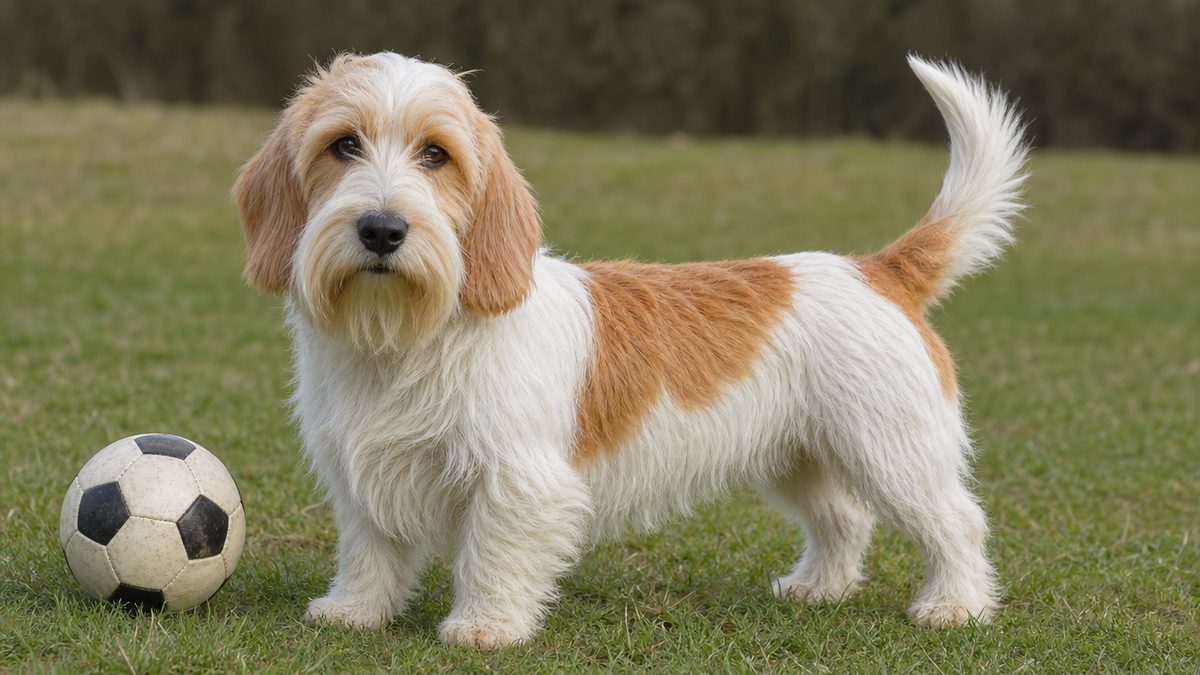
Quick answer
The Petit Basset Griffon Vendeen is a rough-coated French basset-type scent hound, FCI standard 67, standing 34 to 38 cm in one band for both sexes, and a separate breed from the Grand Basset since 4 May 1976. Draw an ear forward: on a Petit it stops short of the muzzle end, on a Grand it passes the nose. Published studies put glaucoma at 10.4 percent and epilepsy at 8.9 percent of the breed. Heat tolerance rates 2 of 5, and no verifiable Indian price exists.
This page summarises published veterinary research, registry screening data and breed-standard text for general information. It is not a diagnosis and it is not treatment advice. Consult a registered veterinarian about your own dog before acting on anything here, treat a rectal temperature at or above 41.0 degrees Celsius after exertion in heat as an emergency, and treat a suddenly cloudy, enlarged or reddened eye in this breed as an ophthalmic emergency rather than something to watch for a few days.
Petit Basset Griffon Vendeen at a glance
What the Petit Basset Griffon Vendeen is
The Petit Basset Griffon Vendeen is a small rough-coated French scent hound, FCI standard 67, standing 34 to 38 cm at the withers in a single band for both sexes, and bred to hunt rabbit through the bramble and scrub of the Vendee on the Atlantic coast of France.
Its own breed standard describes it in one line, and it is the best line written about any breed on this site. "Devil in the country, angel in the house, that's our Basset";. The rest of the same paragraph is a job description: a passionate hunter, the perfect assistant to the hunter with a gun on territory of medium size, a specialist for rabbit, "but no other game escapes from it".
The name is four facts stacked up. Petit means small, basset means low to the ground, griffon means rough-coated, and Vendeen names the department it came from. Read it that way and the dog stops being an unpronounceable curiosity and becomes a description you can check against the animal in front of you.
What the standard actually asks for
Standard 67 asks for a small, active and vigorous hound with a slightly elongated body, a proudly carried tail, a coat hard and long "without exaggeration", and an expressive head whose leathers are well turned inwards, covered with long hair, set below the eye line and explicitly "not too long";. The muzzle is square at its end and "much shorter than that of the Grand Basset". The skin is quite thick and often marbled in tricolour dogs, and there is no dewlap.
| Point | What FCI standard 67 says |
|---|---|
| FCI number | 67, Group 6, Section 1.3 Small-sized Hounds, with working trial |
| Withers height | 34 to 38 cm, one band for both sexes, tolerance 1 cm more or less |
| Weight | No figure at all. The standard prints none |
| Coat | Harsh but not too long, never silky or woolly |
| Ears | Not quite reaching the end of the muzzle, set below the eye line |
| Tail | Set high, rather short, carried sabre fashion |
| Behaviour | Passionate hunter, courageous, likes the bramble and scrub |
| Temperament | Docile but wilful and passionate |
| Country of origin | France. Official authentic language French |
The disqualifying faults are worth reading before you look at a dog. Standard 67 disqualifies an overshot or undershot mouth, heterochromia, a kinky tail, crooked or half-crooked forelegs, a woolly coat, a self-coloured black or white coat, important depigmentation and any size outside the standard. Size outside the standard being a disqualification rather than a fault is the sharpest one, because with the 1 cm tolerance it puts the hard limits at 33 and 39 cm.
Where it came from, in its own standard's words
The breed exists because a bigger dog was being asked to do a smaller dog's work badly. Standard 67 records that "for a long time the Petit Basset Griffon Vendeen had the same standard as the Grand Basset, only the size was different (from 34 to 38 cm). The result in utilization was not very brilliant, because they were semi-crooked and as heavy as the Grand Basset. That is why that M. Abel Dezamy created a separate standard for them";. The Grand Basset's standard credits a different man, Paul Dezamy, with fixing that breed's type at about 43 cm. Two Dezamys, two breeds, two standards.
The standard then quotes Paul Daubigne on what the new breed had to be: "It is no longer a small Vendeen by simple reduction of the height, but a small Basset harmoniously reduced in all his proportions and in its volume, that is naturally endowed with all the moral qualities which presuppose the passion for hunting";. It closes by recording that a team of Petit Bassets won the first edition of France's Cup on rabbit. The breed is a working design with a working record, not a scaled-down show dog.
The FCI classifies this breed as subject to a working trial, exactly as it does the Grand Basset, the Briquet and the Grand Griffon Vendeen. That is a registry fact with a practical edge for a pet owner: the dog you are taking into an Indian flat is registered internationally on the assumption that it hunts.
Why the Petit and the Grand are confused, and who was recognised first
The Petit and Grand Basset Griffon Vendeen are confused because they genuinely were one breed with two sizes until the middle of the last century, and the registries then recognised them in opposite orders, which keeps the story unsettled.
The interbreeding is documented rather than folklore. The American Kennel Club records that "up until the 1970s, the Petit and Grand Basset Griffon Vendeen were interbred" and that litters were evaluated at one year of age to decide which breed a puppy belonged to. VCA Animal Hospitals puts the earlier boundary at the 1950s: "the Griffon Vendeen was considered one breed with two sizes (Grand and Petit) until the 1950s, and the two sizes were still interbred until the 1970s";. Purina India, writing for an Indian audience, still calls them "two varieties of the basset type of Griffon Vendeen" whose cross breeding "wasn't until the 1970s" forbidden.
The registry dates invert depending on which register you read
Here is the part that surprises people, and Bonbeno checked every date off the register itself rather than off another page. The FCI accepted the Grand Basset on a definitive basis on 17 January 1967 and the Petit on 4 May 1976, nine years later Federation Cynologique Internationale. The American Kennel Club did the opposite: it recognised the Petit on 1 December 1990 as its 130th breed and the Grand Basset only in 2018. The United Kennel Club also took the Petit first, in 1992, and the Grand Basset in 1996 United Kennel Club.
| Registry | Petit Basset | Grand Basset | Which came first |
|---|---|---|---|
| FCI, definitive basis | 4 May 1976 | 17 January 1967 | Grand, by nine years |
| American Kennel Club | 1 December 1990, 130th breed | 2018, year only | Petit, by 28 years |
| United Kennel Club | 1992 | 1 January 1996 | Petit, by four years |
| Royal Kennel Club | Standard published | Standard published | Both published |
So there is no single answer to which breed came first, and any page giving you one has picked a register without telling you. In FCI terms the Petit is the younger breed and the youngest of the four Vendeens: the Briquet was accepted on 2 October 1954, the Grand Basset on 17 January 1967, the Grand Griffon Vendeen on 8 April 1969, and the Petit last Federation Cynologique Internationale.
The FCI prints dates as month, day, year. The Petit's own page proves it twice over: its English and French standards are dated 2/14/2001 and its German and Spanish rows read 10/15/1999, and neither 14 nor 15 can be a month. So the acceptance date printed as 5/4/1976 is 4 May 1976, not 5 April. The Grand Basset's page proves the same format even more bluntly with 1/17/1967. Bonbeno re-read all four Vendeen entries on the register directly and agrees with its own earlier Grand Basset guide on every number.
The confusion is measurable in search, today
Google's People Also Ask box for this breed, pulled from India on 31 August 2026, carried four questions and only one of them holds the name together. The second asks how much "a purebred Petit Basset Griffon Vendee" costs, dropping the final n. The third lower-cases petit and basset while capitalising Griffon. The fourth abandons the breed completely and asks "is a Griffon a good family dog", which is a question about a coat texture. The same page's related-entity strip offers the Grand Basset Griffon Vendeen, the Grand Griffon Vendeen, the Briquet Griffon Vendeen and the Basset Fauve de Bretagne, which is the whole family plus one neighbour.
The confusion reaches into the scientific record too. A 2024 UK longevity study lists its row for this breed under a reclassification that folds in the Basset Fauve de Bretagne and the Grand Basset alongside the Petit. The life expectancy section below explains what that does to the number everyone quotes.
Petit against Grand Basset, and the ear test that settles it
Tell a Petit Basset Griffon Vendeen from a Grand Basset by drawing an ear forward along the muzzle: the Petit's leather stops short of the end of the muzzle, and the Grand's must reach beyond the end of the nose. That is a binary test needing no tape measure, and both breeds state it in their own standards.
Read the two documents side by side. FCI standard 67 describes the Petit's ears as "supple, narrow and fine, covered with long hair, ending in a slight oval, turned inwards and not quite reaching the end of the muzzle". FCI standard 33 describes the Grand Basset's as "supple, narrow and fine, covered with long hair and ending in an elongated oval, well turned inwards. Low set, below the eye. They must be able to reach beyond the end of the nose". Draw the ear forward. Short of the muzzle end is a Petit. Past the nose is a Grand.
The fault lists confirm it from the other direction, and this is the detail nobody prints. The Petit's standard faults "leathers set high, long, insufficiently turned in or lacking hair", while the Grand Basset's faults "leathers set high, short, insufficiently turned in or lacking hair";. The same body part is penalised in opposite directions in the two breeds. The French text of standard 67 says the same thing, faulting oreilles "longues";.
| Test | Petit Basset (FCI 67) | Grand Basset (FCI 33) |
|---|---|---|
| Ear drawn forward | Does not quite reach the end of the muzzle | Reaches beyond the end of the nose |
| Ear length faulted for being | Too long | Too short |
| Withers height | 34 to 38 cm, one band for both sexes | 40 to 44 cm males, 39 to 43 cm females |
| Separate bands by sex | No | Yes |
| Muzzle | Much shorter than the Grand Basset's | Noticeably longer than the skull |
| Tail | Rather short | Rather long |
| Skull | Slightly domed | Convex, elongated, without heaviness |
| Named quarry in its own standard | Specialist for rabbit | All furry game, rabbit to wild boar |
| FCI acceptance, definitive | 4 May 1976 | 17 January 1967 |
The height rule is the second clean separator and almost no page prints it either. Standard 67 gives one band, "from 34 to 38 cm", for both sexes. Standard 33 gives males 40 to 44 cm and females 39 to 43 cm Federation Cynologique Internationale. So a listing that quotes one height for both sexes is quoting the Petit's standard, whatever name sits above it, and a listing that quotes two is quoting the Grand's. Bonbeno's Grand Basset Griffon Vendeen guide works the same comparison from the other side.
The ear test is clean under the FCI and blurs across registries
Four registries write four different ear rules for one dog, which is worth knowing before you rely on a single sentence. The FCI stops the Petit's ear short of the muzzle end. The Royal Kennel Club writes a ceiling instead, "not reaching beyond the tip of the nose";. The United Kennel Club writes something closer to a target, "with the leathers reaching almost to the end of the nose";. A dog whose ear reaches exactly to the nose tip therefore passes the Royal Kennel Club, is about right for the UKC, and is longer than FCI 67 asks for.
Bonbeno takes the FCI rule as decisive for an Indian reader, and says why rather than averaging. India is a full FCI member represented by the Kennel Club of India in Chennai, so any pedigree issued here is written against FCI nomenclature and against standard 67. If you are told a dog is a Petit and its ears clear the nose comfortably, the paperwork is the thing to ask for, not a second opinion on the ear.
Against the rest of the family, from the French studbook
| Breed | FCI no. | FCI subsection | Male height | France 2025 |
|---|---|---|---|---|
| Grand Griffon Vendeen | 282 | 1.1 Large-sized Hounds | 62 to 68 cm | 107 |
| Briquet Griffon Vendeen | 19 | 1.2 Medium-sized Hounds | 50 to 55 cm | 174 |
| Grand Basset Griffon Vendeen | 33 | 1.3 Small-sized Hounds | 40 to 44 cm | 45 |
| Petit Basset Griffon Vendeen | 67 | 1.3 Small-sized Hounds | 34 to 38 cm | 127 |
The Petit is the second most numerous of the four at home and the only one falling. French studbook registrations in 2025 were 174 for the Briquet, 127 for the Petit, 107 for the Grand Griffon Vendeen and 45 for the Grand Basset, and the Petit was the only one of the four to lose ground, down 5 percent while the Briquet Griffon Vendeen gained 32 percent. All four together came to 453 dogs, against 571 for a single unrelated French scent hound, the Griffon Nivernais.
Do not separate the two breeds by weight. FCI standard 67 prints no weight at all, and neither does standard 33. The numbers in circulation come from registries and search engines rather than from either standard: the American Kennel Club gives 25 to 40 pounds, the UKC says only that a 15-inch male will weigh no more than about 45 pounds, and Google's Indian knowledge panel prints 15 to 20 kg, whose floor sits 3.7 kg above the AKC's.
Four standards, one dog, and three real disagreements
Four registries publish a breed standard for the Petit Basset Griffon Vendeen and they disagree on colour, on front legs and on coat structure, which means a dog can be correct in one ring and disqualified in another.
This is not a matter of wording. Bonbeno read FCI standard 67, the Royal Kennel Club standard last updated 1 January 2025, and the UKC standard revised 1 July 2009, and compared them clause by clause United Kennel Club. Three of the differences change whether a given dog is acceptable.
1. Colour: a black and tan Petit is standard to the FCI and unacceptable in Britain
The FCI's colour list does not require white. Standard 67 permits black with white spotting, black with tan markings, black with light tan markings, fawn with white spotting, fawn with black mantle and white spotting, fawn with black overlay, pale fawn with black overlay and white spotting, and pale fawn with black overlay, and it disqualifies only a self-coloured black or white coat. The Royal Kennel Club writes the opposite rule: "white with any combination of lemon, orange, sable, grizzle or black markings. Tricolour. Any other colour or combination of colours unacceptable";. The UKC agrees with Britain: "white, with any combination of lemon, orange, tricolor and grizzle markings";.
The American Kennel Club then registers colours Britain rejects. Its own registration table for this breed includes Black & Tan under code 018 and Fawn under code 082, alongside the white-based combinations. So a black and tan Petit Basset Griffon Vendeen is standard to the FCI, registrable with the AKC, and outside the Royal Kennel Club's list entirely.
| Clause | FCI 67 | Royal Kennel Club | UKC |
|---|---|---|---|
| Colour without any white | Permitted, e.g. black and tan, fawn with black overlay | "Any other colour or combination of colours unacceptable" | Not in the list |
| Crooked or half-crooked forelegs | DISQUALIFYING FAULT | Forearms straight; knuckling over highly undesirable | "A slight crook is acceptable" |
| Undercoat | Not mentioned at all | "With thick undercoat" | "The breed is double coated" |
| Body proportion | Slightly elongated body, no ratio given | Length exceeds height about 7:5 | About 50 percent longer than tall |
| Height ceiling with tolerance | 39 cm | 39 cm | 15.5 inches, 39.37 cm, as an eliminating fault |
| Trimming | Not addressed | "Trimming or stylising should be penalised" | "Severely penalized" |
2. Front legs: a disqualification in one register, acceptable in another
The FCI disqualifies what the UKC allows. Standard 67 lists "crooked or half-crooked forelegs" among its disqualifying faults, and the French text confirms it as membres anterieurs tors ou demi-tors Federation Cynologique Internationale. The UKC's standard says "when viewed from the front it is desirable that the forelegs be straight, but a slight crook is acceptable";. A slightly bowed front is therefore the difference between a dog that can never be placed under FCI rules and one that can be shown in the United States without comment. For an Indian buyer holding a Kennel Club of India pedigree written against FCI nomenclature, the FCI rule is the one that binds.
3. Undercoat: the clause that matters most in India
Two registries say this is a double-coated breed and the FCI does not say so at all. Standard 67's entire coat clause reads "harsh but not too long, never silky or woolly";. The Royal Kennel Club adds "with thick undercoat", and the UKC states flatly that "the breed is double coated" and that "the undercoat is shorter and thicker"; United Kennel Club. That is not a trivial difference in Chennai in May. A hard outer layer over a dense undercoat is an insulating system, and a reader who only ever saw the FCI text would not know the dog had one.
Three sources give three shapes for the same dog. The Royal Kennel Club sets length to height at about 7 to 5, which is 1.40. The UKC says approximately 50 percent longer than tall, which is 1.50, measured from a different landmark. VCA Animal Hospitals tells readers the dog "is twice as long as she is tall", which is 2.00 and matches nothing. Bonbeno does not average them. The two registry figures are measured between different points and are close; the third is a description rather than a measurement.
Registry status, and what a Kennel Club of India pedigree would say
The Petit Basset Griffon Vendeen is recognised by the FCI as standard 67 since 4 May 1976, by the American Kennel Club since 1 December 1990, by the United Kennel Club since 1992 and by the Royal Kennel Club, which makes it the best-recognised of the four Vendeen griffons.
The AKC gives this breed a precision it does not give its larger cousin. Its page records the exact date, 1 December 1990, the ordinal, 130th breed, eligibility for the Miscellaneous Class in 1989, entry into Regular Classes on 1 February 1991 and a Westminster debut in 1992. For the Grand Basset the same registry publishes a bare year, 2018. When a registry is that specific about one breed and that vague about its sibling, the specific record is the one to build on.
Popularity has not followed recognition. The AKC's own chart puts the breed at 161 of 210, on an axis running 2015 to 2025. VCA still prints an older figure, 119th of 155, which was true of a smaller roster and is not now. Both are the same story told at different times: a recognised breed that almost nobody registers.
| Breed | FCI | AKC | UKC | Royal Kennel Club |
|---|---|---|---|---|
| Petit Basset Griffon Vendeen | 67, definitive, 4 May 1976 | 1 December 1990, 130th breed | 1992 | Yes, as Basset Griffon Vendeen (Petit) |
| Grand Basset Griffon Vendeen | 33, definitive, 17 January 1967 | 2018 | 1 January 1996 | Yes, as Basset Griffon Vendeen (Grand) |
| Grand Griffon Vendeen | 282, definitive, 8 April 1969 | Not listed | Yes | No standard published |
| Briquet Griffon Vendeen | 19, definitive, 2 October 1954 | Not listed | Yes | No standard published |
The Royal Kennel Club's naming convention, and what it does to a reader
Britain files the breed as Basset Griffon Vendeen (Petit), which demotes the one word that identifies it to a bracketed suffix. That is the Royal Kennel Club's general type-first convention and it uses the same shape for unambiguously separate breeds such as Retriever (Labrador), so it is not a claim that Petit and Grand are one breed. The practical effect on someone scanning an alphabetical index is still that the two sit adjacent under a shared name with the distinguishing word in brackets, which is exactly where a hurried buyer stops reading.
The Royal Kennel Club's own health requirements
Britain asks for two tests before breeding, and one of them is the DNA test. The Royal Kennel Club's good-practice list for this breed names prioritising genetic diversity, the DNA test for primary open angle glaucoma, and eye testing through the BVA, Kennel Club and ISDS eye scheme. It also places the breed in Breed Watch Category 1, meaning judges have no breed-specific points of concern, and in Colour Watch Category 0, meaning there are no non-breed-standard colour registration options at all. Read together, that is a registry saying the dog's conformation is sound and its genetics need work.
What this means in India
India is a full FCI member represented by the Kennel Club of India in Chennai, so a pedigree issued here is written against FCI nomenclature and would name standard 67. That certificate, not a seller's description and not a photograph, is what distinguishes this breed from the Grand Basset on paper. The Kennel Club of India publishes no breed list of its own, so its silence about this breed proves nothing in either direction and is not offered here as evidence.
In the United States the breed is called a petit, in England a griff or a roughie, and in Denmark a griff or a petit, according to the AKC's own page. On an Indian import document you will meet the full FCI name, PETIT BASSET GRIFFON VENDEEN, in capitals and without accents, exactly as the register prints it.
Price in India: no verifiable figure exists, and here is the arithmetic
No trustworthy price in India exists for the Petit Basset Griffon Vendeen, because no Indian supply of the breed could be found and the one India-hosted page carrying a rupee figure contradicts itself within four paragraphs.
Start with what is actually on offer. Mr n Mrs Pet's page for this breed reports "3 Result Found" and then lists a French Bulldog in Chennai, a Bernese Mountain Dog in Delhi and a Border Collie in Ambala, under a sub-heading reading "Similar breeds at other locations", on page 1 of 1. None of the three is a Petit Basset Griffon Vendeen. The page's own meta description promises "KCI registered Petit Basset Griffon Vendeen puppies for sale in India" and its body promises "verified Petit Basset Griffon Vendeen dog breeders near you".
The search works, which is what makes the absence a finding. The same site's Basset Hound page carries a real Indian price table across eight cities and a stated band of ₹75,000 to ₹2,50,000, and the same query pattern for that breed returns Kerala sellers with phone numbers. A control that returns a working Indian market is what turns "no results" into evidence rather than a broken query. One instrument was discarded outright for failing that test: Bing India returned ten results about balloon artists for this breed and ten about industrial steel storage cabinets for the control query labrador retriever, both at HTTP 200 with confident result counts, so nothing at all is concluded here from Bing.
The one Indian page with a rupee figure disagrees with itself
Happypet.care prints two Indian price bands that do not overlap. Its spec card reads "Cost of buying ₹50,000 to ₹1,00,000", repeated four times on the page. Its own body text, in the section headed How Much Does Petit Basset Griffon Vendeen Dog Puppy Cost, reads "on average, one can buy a PBGV puppy from a reputed breeder in India at a price between ₹28,000 and ₹34,000";. The lower band's ceiling sits ₹16,000 below the upper band's floor. A source that cannot hold one price across one page is not a price.
Run the currency tests and print the quotients
Indian pages routinely publish a dollar figure run through one exchange rate, so every rupee number here was divided by three rates. The quotients are printed in full because a reader can check them on a phone.
| Rupee figure | Divided by 84.38 | Divided by 74 | Divided by 66.67 |
|---|---|---|---|
| ₹50,000, spec card floor | 592.56 | 675.68 | 750.00 |
| ₹1,00,000, spec card ceiling | 1,185.11 | 1,351.35 | 1,500.00 |
| ₹28,000, body-text floor | 331.83 | 378.38 | 420.00 |
| ₹34,000, body-text ceiling | 402.94 | 459.46 | 510.00 |
| ₹4,650, stated monthly cost | 55.11 | 62.84 | 69.75 |
| ₹6,600, stated premium monthly | 78.22 | 89.19 | 99.00 |
Read the table honestly and it settles nothing, which is itself the answer. At 84.38 and at 74 not one figure lands on a number a seller would ever print. At 66.67 every figure divides to a round dollar amount, but that proves nothing at all, because 66.67 is 200 divided by 3, so any multiple of 1,000 divides cleanly by construction and all six figures are multiples of 1,000. There is no conversion fingerprint here. These are rupee-native numbers somebody chose, and the page then chose two different sets of them.
The implausibility check the division cannot do
Ask instead whether the figure makes sense as a rupee price, and it does not. The lower band, ₹28,000 to ₹34,000, would make a breed with no Indian supply chain cheaper than a Basset Hound, which the same market prices from ₹75,000. Meanwhile the actual overseas market for this breed runs at 3,000 to 3,500 US dollars nationally on one American listing platform and 1,200 to 2,000 dollars on another Adopt a Pet, Petit Basset Griffon Vendeen…. At 84.38 rupees to the dollar those bands are roughly ₹2.5 lakh to ₹2.95 lakh and ₹1.01 lakh to ₹1.69 lakh, before any freight, quarantine or import authorisation.
The only rupee figures that survive scrutiny under this breed's name are merchandise. An Etsy India listing sells a digital Petit Basset Griffon Vendeen PNG for ₹455. That is a picture file, not a dog.
A page that invents a rupee band for a dog nobody sells in India is doing the reader active harm, because a fabricated number becomes the anchor a buyer negotiates against. The honest statement is that no verifiable price in India exists, that the one Indian page carrying a figure contradicts itself, that neither of its bands shows a conversion signature, and that the overseas market for the breed is several times higher than either. If you are quoted a price in India, ask for the pedigree and the parents' POAG certificates first, and treat the number as unexamined until you have both.
Cost of ownership, and the parts that can honestly be bounded
Recurring costs for a Petit Basset Griffon Vendeen in India can be bounded only in part, because no Indian owner base exists to price against, but the coat, the ears and the eye screening are all predictable and two of them are unusual.
One Indian page does publish a monthly figure, and it is at least internally consistent. Happypet.care gives ₹4,650 to ₹6,600 a month, made up of ₹2,250 to ₹3,000 for food, ₹1,200 to ₹1,800 for health and ₹1,200 to ₹1,800 for grooming. The components add up exactly at both ends, 2,250 plus 1,200 plus 1,200 is 4,650 and 3,000 plus 1,800 plus 1,800 is 6,600, which is more arithmetic discipline than the same page brought to its purchase price. Bonbeno reports the figure as that page's estimate and not as a measured Indian cost, because the health and grooming bands are identical to each other and read as a template rather than as this breed's numbers.
The costs this breed genuinely adds
| Item | What is knowable | Status in India |
|---|---|---|
| POAG DNA test | USD 58 for a single test at UC Davis, USD 27 as an added test on the same animal, USD 5 off for three or more dogs | Mail-in cheek brush, at least 15 business days turnaround |
| Annual eye examination | Parent club asks for dogs aged two and over at regular intervals, by a board-certified ophthalmologist | Veterinary ophthalmologists exist in the metros; cost not published |
| Grooming tools | A metal comb and a stripping approach, not clippers | One-off, low |
| Ear care through the monsoon | Daily checking, drying after every bath and swim | Time rather than money |
| Epilepsy medication if it occurs | Danish study found daily medication, principally phenobarbital, in affected dogs | Lifelong if it starts; no Indian price published |
| Purchase | No verifiable Indian figure exists | Unknown |
The DNA test is the one cost you can quote to the rupee-equivalent yourself, and Bonbeno deliberately does not do the conversion for you. UC Davis's Veterinary Genetics Laboratory publishes the test at 58 US dollars for a single animal, 27 dollars when added to another health test on the same dog, with a 5 dollar discount on three or more dogs, and a turnaround of at least 15 business days. Shipping a cheek brush from India and any customs handling are on top and are not published anywhere Bonbeno could verify, so no total is offered.
What an Indian owner should budget for that a British owner would not
Budget for cooling rather than for heating. This is a dog whose homeland averages 12.42 degrees Celsius across the year, and the climate section below works through what that means in six Indian cities. In practice that is fans or air conditioning through the hot months, walks moved to dawn and after dark, and a willingness to lose the middle of the day for four to six months a year. None of that appears on any published cost card for the breed, and all of it is real.
Bonbeno found no Indian veterinary fee schedule, no Indian insurance quote and no Indian food cost specific to this breed, because there is no Indian population of it to price. Where a figure below is borrowed from a general Indian source rather than from this breed, it says so. Where nothing exists, it says that too rather than filling the row.
Heat tolerance in India, worked from the homeland climate
Heat tolerance for the Petit Basset Griffon Vendeen rates 2 out of 5 in India, because its homeland averages 12.42 degrees Celsius across the year while Chennai averages 27.95, and because the coolest month in four Indian metros is warmer than the warmest month in the Vendee.
The comparison is done from NASA POWER climatologies queried by explicit latitude and longitude, so no city can be substituted for another by a slug. The Vendee point is La Roche-sur-Yon at 46.6706 north and 1.4269 west, and the returned coordinates were checked inside each response.
| Place | Annual mean C | Coolest month mean C | Annual max C | Annual RH percent | Months above 24 C |
|---|---|---|---|---|---|
| Vendee, France | 12.42 | 5.89 | 35.99 | 82.36 | 0 |
| Bengaluru | 23.74 | 20.22 | 40.38 | 67.94 | 4 |
| Pune | 23.86 | 19.62 | 43.20 | 66.80 | 4 |
| Delhi | 25.60 | 13.61 | 48.79 | 45.56 | 7 |
| Kolkata | 25.81 | 17.31 | 46.81 | 73.93 | 8 |
| Mumbai | 26.77 | 23.19 | 44.91 | 67.39 | 10 |
| Chennai | 27.95 | 24.09 | 42.70 | 72.39 | 12 |
The single most useful line in that table is the coolest-month column. The Vendee's warmest month is July at a mean of 19.54 degrees. Chennai's coolest month is January at 24.09, Mumbai's is January at 23.19, Bengaluru's is December at 20.22 and Pune's is December at 19.62 NASA POWER, Source Native Resolution… NASA POWER, Source Native Resolution… NASA POWER, Source Native Resolution…. In all four, the coldest month of the Indian year is warmer than the hottest month of this dog's home. Delhi and Kolkata are cooler in January and then far hotter later, peaking at annual maxima of 48.79 and 46.81 against the Vendee's 35.99 NASA POWER, Source Native Resolution….
The breed is humidity-adapted and heat-naive, which is not the usual story
Humidity is not the new variable here. The Vendee's annual relative humidity is 82.36 percent, higher than every Indian city in the table, including Chennai at 72.39 and Kolkata at 73.93. A dog bred on the Atlantic coast of France is a wet-climate dog. What India adds is not damp, it is temperature, and the coat that copes with wet bramble is the same coat that traps heat.
The coat is why this matters more than the size suggests. Two of the three registries publishing a standard describe an undercoat: the Royal Kennel Club specifies a thick undercoat and the UKC states the breed is double coated with a shorter, thicker undercoat beneath the harsh outer layer United Kennel Club. A hard top coat over a dense undercoat is an insulating system. Add a body carried 34 to 38 cm off Indian paving, which radiates heat upward at midday, and the dog is working against two things at once.
What an Indian page says the ideal weather is, and what that implies
One Indian page prints an ideal weather band for the breed and then does not follow the number through. Happypet.care states an ideal weather range of 10 to 24 degrees Celsius. Applied to NASA POWER's monthly means, the coolest large Indian metro, Bengaluru, spends four months of every year above that ceiling, Delhi seven, Kolkata eight, Mumbai ten and Chennai all twelve. No large Indian city keeps this dog inside its own stated comfort band for a full year.
What the heat evidence does and does not say about this breed
The largest study of canine heat illness in a temperate country is about exercise, not weather. Hall and colleagues, working from 905,543 UK dogs under primary veterinary care in 2016, recorded 1,259 heat-related illness events from 1,222 dogs, of which 879 had a trigger recorded, and 652 of those 879, which is 74.2 percent, were exertional rather than environmental or vehicular. That finding is about the whole cohort and transfers to any dog. Bonbeno does not borrow this paper's breed-specific odds ratios for the Petit Basset Griffon Vendeen, because the breed is not one it modelled.
Bengaluru and Pune: workable, with the walk at dawn and a second one after dark from March to June. Mumbai and Chennai: dawn and dark only, all year, and accept that the middle of the day is indoors. Delhi: indoors from late morning through the afternoon between April and July, when the annual maximum reaches 48.79 degrees. Kolkata: the same, plus daily ear checks through a monsoon that pushes August humidity to 89 percent.
Managing the heat if you keep one anyway
Manage the heat by giving up the middle of the day, combing the undercoat out instead of clipping it, and treating a rectal temperature at or above 41.0 degrees Celsius after exercise as an emergency rather than as tiredness.
- Move the exercise, do not reduce it. This is a working scent hound with a stated requirement of an hour or more a day, and cutting the walk to avoid heat produces a bored, vocal, destructive dog rather than a cool one.
- Comb, never clip. Strip the dead undercoat out weekly with a metal comb so air reaches the skin. Clipping removes the outer layer that reflects sun and leaves the insulating layer behind, which is the opposite of what you wanted.
- Walk on grass or shaded paving. A dog whose chest sits about 35 cm off the ground is in the hottest air column on an Indian street. Press the back of your hand to the surface for five seconds before you set off.
- Watch the pace, not the clock. The exertional finding above means the risk is what the dog does, not only what the thermometer says. A scent hound working a line does not self-regulate.
- Keep water in front of the dog and know the number. A rectal temperature at or above 41.0 degrees Celsius after exertion in heat is an emergency. Cool the dog with room-temperature water and move, do not wait to see if it settles.
The monsoon problem is the ears, not the heat
Ear care is the seasonal task that overseas guidance under-weights. This breed carries low-set drop ears covered in long hair, and the only large owner-reported survey to cover it, the Kennel Club and British Small Animal Veterinary Association purebred health survey of 2004, found aural problems among the three commonest complaint groups across 289 living Basset Griffon Vendeens of both varieties, naming otitis externa, excessive ear wax and ear mites. The parent club's own 2000 survey of 640 dogs put recurrent ear infections second on its list.
British and American grooming guidance assumes a dry ear canal between baths. In Mumbai in July, at 89.6 percent relative humidity, and in Kolkata in September at 89.3 percent, it does not dry. Dry inside the leather after every bath and every swim, lift the ear daily and look, and take a smell or a head-shake seriously in week one rather than week three.
Standard 67 asks for a coat that is harsh but not too long, and faults a coat that is insufficiently dense or fine. So the correct coat for this breed is dense, and a thin one is a fault rather than a lucky break in a hot country. It also asks for eyes surmounted by long forward-standing brows that must not obscure the eye, which is a clause an Indian groomer tempted to tidy the face should read before picking up scissors.
Temperament, and the households this breed does not fit
The Petit Basset Griffon Vendeen is an extrovert, sociable, independent pack hound that suits a busy household with a garden and does not suit an Indian high-rise, because the size fits a flat and the voice does not.
Its own standard is unusually blunt about the split. Under behaviour it asks for a "passionate hunter, courageous, likes the bramble and scrub", and under temperament for a dog "docile but wilful and passionate";. The Royal Kennel Club's version is "happy, extrovert, independent, yet willing to please", and the UKC asks for a dog that is "bold and vivacious in character" with "a good voice, which is used freely"; United Kennel Club. Every one of those documents describes a dog that likes you and has its own plans.
Who this breed suits
- Households with a secure garden. The Royal Kennel Club's card asks for a small to medium garden and rates the breed as suiting a small house rather than a flat.
- Homes with other dogs. It is a pack hound and Purina India records that it "gets on well with other dogs, children and strangers".
- Owners with some prior dog experience. Purina India's need-to-know card says exactly that, along with "some training required".
- Families with older children. VCA recommends older kids rather than toddlers, on activity grounds rather than temperament.
Who it does not suit, and the reason is the voice
Rule the breed out of an Indian apartment on noise. Purina India's own card for this breed reads "very vocal dog", the UKC standard asks for a good voice "used freely", and the Royal Kennel Club describes "a good voice purposefully used"; United Kennel Club The Royal Kennel Club, Breed Standard. A pack hound's bay is engineered to be heard across a valley by a hunter on foot. In a shared-wall building that is not a quirk, it is a complaint from the flat below, and there is no training programme that removes a breed characteristic three registries ask for.
It is also not a guard dog and should not be bought as one. Purina India lists "not a guard dog" explicitly. One Indian page nonetheless lists Protective and Fearless among the breed's top five traits. Nothing in any of the four standards supports that, and a family that buys a scent hound expecting a guard will be disappointed twice over, once by the dog and once by the neighbours.
| Source | Words used |
|---|---|
| FCI standard 67 | Passionate hunter, courageous; docile but wilful and passionate |
| Royal Kennel Club | Happy, extrovert, independent, yet willing to please |
| United Kennel Club | Bold and vivacious; happy, extroverted and independent, yet willing to please |
| Google knowledge panel, India | Extroverted, Friendly, Lively, Happy, Independent, Active |
| Purina India | Fun, extrovert, stubborn, independent and bold; very vocal; not a guard dog |
| An Indian pet site | Energetic, Intelligent, Playful, Protective, Fearless |
Five sources here call the breed independent or stubborn and one calls it protective. Where a description appears in a breed standard it is a design requirement that a judge can penalise a dog for lacking. Where it appears only on a content page it is somebody's impression. Weight them accordingly, and treat protective as the outlier it is.
Training, and the instruction the English standard quietly loses
Train the recall first and treat everything else as secondary, because the breed's own standard in its authentic language asks for exactly that and the English translation replaces it with a generic instruction to obey.
Compare the two official texts of the same clause. The French text of standard 67, which is the authentic version because French is this breed's official language, reads: "C'est un chasseur passionne, qu'il faut des son jeune age, habituer au rappel". The English text, translated by John Miller and Raymond Triquet, renders it as "it's a passionate hunter, that must, from an early age, get used to obeying". Au rappel means to the recall. The specific instruction becomes a general one, and the one command that keeps this dog alive on an Indian road disappears into a virtue.
The same substitution appears in the Grand Basset's standard, by the same two translators. Its French text reads "il faut l'habituer, des son premier age, au rappel" and its English reads "it must, from an early age, be accustomed to obeying"; Federation Cynologique Internationale. Two breeds, one translation choice. Bonbeno's Grand Basset guide reported this on that breed alone; checking the Petit shows it is a family-wide pattern rather than a one-off, which is a small correction upward in how much weight the finding carries.
What the registries say about trainability, and they broadly agree
Expect an intelligent dog that negotiates. The AKC says "PBGVs have a reputation for being hard to train. In fact, they are very intelligent, but they tend to have a mind of their own", and adds that "the trainer must stay one step ahead in keeping his dog entertained and interested";. VCA calls it an "I'll-get-back-to-you-on-that attitude" and warns that no matter how well the dog works at home, "she still won't listen if she's off-leash and discovers the scent of a rabbit";. Purina India has a better name for it, "hound selective deafness";.
A training plan that fits the breed and the country
- Pay in food, every time, for months. A scent hound working against its nose needs a reason, and praise is not one.
- Use a long line for the first year. Ten to fifteen metres, on a harness rather than a collar, so the recall is practised at distance without ever being disobeyed successfully.
- Train in short blocks broken by play. The AKC is explicit that the breed does badly with the same exercise drilled repeatedly.
- Socialise early and wide. Begin socialisation and obedience early, which is what the AKC recommends, and in India that means traffic, autos, crowds, cattle and the building's watchman.
- Accept the ceiling. Assume the recall may never be reliable against a fresh line, and design your walks so it does not have to be.
There is one Indian legal detail worth knowing before a trainer suggests otherwise. The Prevention of Cruelty to Animals (Dog Breeding and Marketing) Rules 2017 forbid de-barking outright, in the Second Schedule Part II paragraph 6(8), alongside docking, cropping and de-clawing. For a breed three registries describe as freely voiced, that closes off the shortcut a frustrated owner might be offered.
This breed is trainable in the sense that it learns quickly and works for food. It is not biddable in the sense that it will abandon a scent because you asked. Those are different properties and the standards describe the second honestly. Build the walk around a long line and a fenced space and the dog is easy. Build it around an expectation of off-lead obedience in an Indian park and it is not.
Daily exercise, and the four published figures that do not agree
Give a Petit Basset Griffon Vendeen at least an hour a day and plan for closer to two, because the four published figures run from up to one hour to two hours and the highest of them comes from the source with the most contact with owners.
| Source | Figure given |
|---|---|
| Royal Kennel Club breed card | Up to 1 hour per day |
| Purina India, need-to-know card | Enjoys walking one to two hours a day |
| Purina India, exercise section on the same page | An hour's exercise or more a day |
| An Indian pet site | 60 to 90 minutes |
| VCA Animal Hospitals | High. Needs to walk every day, plus some running and play |
| American Kennel Club | A very active, curious dog who requires a great deal of exercise |
Purina India contradicts itself on one page, which is worth noticing rather than resolving. Its summary card says one to two hours and its exercise section says an hour or more. Bonbeno takes the union of the published range and plans for the top of it, because under-exercising a scent hound produces the vocal, destructive dog every one of these sources warns about, and over-exercising a structurally moderate small hound produces very little.
The exercise has to include the nose
Walking distance is not the requirement. The AKC records that the breed "has an extraordinary sense of smell and an often irresistible urge to follow scents" and that it "must have plenty of room to wander and explore";. Purina India says the same in plainer words: the dog "loves putting his nose to the ground and following any scents he detects";. Thirty minutes of sniffing a hedge line does more for this dog than an hour of heeling on pavement, and in an Indian summer it can be done at dawn in the shade.
Structure limits, honestly stated
This is a slightly elongated dog on short legs, and the sensible caution is about jumping rather than distance. Bonbeno found no study of intervertebral disc disease in this breed and does not import one from another basset. What the published screening data does show is a hip rate better than the all-breed average, 12.1 percent dysplastic across 849 evaluations against 14.2 percent across 1,712,643, so the breed is a hardy one rather than the fragile animal its shape suggests. Keep repeated jumps off high furniture out of the routine and let the dog run.
Dawn walk of forty-five to sixty minutes with free sniffing on a long line, a short evening walk after dark, one scent game indoors on the hottest afternoons, and one longer weekend outing in a fenced space where the dog can gallop. That satisfies every published figure above, and it moves the whole requirement outside the four months a year when Bengaluru's monthly mean sits above the breed's own stated comfort ceiling.
Grooming a hard coat in Indian humidity, and the shedding claim
Groom a Petit Basset Griffon Vendeen with a metal comb through the whole coat at least weekly, never with clippers, and treat the ears as a separate daily job through the monsoon.
The AKC's description of the coat is the most useful sentence written about it: "it should be harsh and thick, some liken it to the hair of a goat", and "your PBGV should have a complete brushing-out at least weekly. After brushing, you should be able to run a comb through the coat easily";. That comb test is the standard to work to. If the comb snags, the undercoat is packed and the dog is hotter than it needs to be.
| Source | Frequency | On trimming |
|---|---|---|
| American Kennel Club | Complete brushing-out at least weekly | Trimming should be kept to a minimum |
| Royal Kennel Club | More than once a week | Trimming or stylising should be penalised |
| Purina India | Requires grooming every other day | Not addressed |
| United Kennel Club | Not stated | Shown untrimmed; scissoring to shape severely penalised |
| VCA Animal Hospitals | Brush a few times a week | Pull or trim the occasional unruly hair |
Purina India asks for the most, every other day, and it is writing for the most humid readership of the five. In a Mumbai July at 89.6 percent relative humidity or a Kolkata September at 89.3 percent, that is the right instruction, because a hard coat carrying trapped moisture against the skin is where a hot spot starts.
The one instruction not to import from overseas guidance
Do not clip this dog for the Indian summer. Three registries penalise trimming, and the reason is not aesthetic: the harsh outer coat is what protected the dog in bramble and what reflects sun, while the undercoat is the insulating layer. Clipping removes the wrong one. Hand-strip or comb the dead undercoat out instead, and if a groomer in your city has never seen the breed, show them the standard's own words about a natural, untidied appearance United Kennel Club.
Ear care is a daily job, not a grooming step
Lift the ear and look, every day, from June to September. The leathers are set below the eye line, are covered with long hair and fold inwards, which is a design that holds warm moist air against the canal. The parent club's own 2000 survey of 640 dogs listed recurrent ear infections among the commonest owner-reported problems, and the 2004 Kennel Club and BSAVA purebred survey found aural problems among the three commonest complaint groups in 289 living dogs of both varieties. Dry inside the leather after every bath, and never plug the canal with cotton wool pushed deep.
Shedding, and the claim that is simply wrong
This breed sheds and is not hypoallergenic. The Royal Kennel Club's card prints "Sheds Yes", Google's Indian knowledge panel prints "Hypoallergenic No", and Purina India lists "non hypoallergenic breed"; Google Search, query petit basset griffon… Purina India, Basset Griffon Vendeen. On the same Google results page, an AI Mode answer told an Indian searcher the opposite, claiming "low shedding: their rough, wiry coats do not shed heavily";. One Indian page manages three positions at once, printing moderate shedding on its card, low shedding in a benefits list, and sheds moderately in its own FAQ.
The underlying claim is settled and does not need re-researching. Vredegoor and colleagues measured Can f 1 across 196 dogs of so-called hypoallergenic breeds against 160 control dogs and found the hypoallergenic group higher, not lower, concluding that "there is no evidence for the classification of certain dog breeds as being hypoallergenic". A wiry coat holds shed hair in the coat instead of dropping it on the floor. That is a housekeeping difference, not an allergy one, and an Indian buyer paying a premium on the strength of it is being sold something that does not exist.
Google's own related-search strip on the India query for this breed offers "Are petit basset griffon vendeen hypoallergenic" as a suggested query, and the AI answer served above it says low shedding while the knowledge panel beside it says Hypoallergenic No. When one page disagrees with itself, prefer the registry.
Health: a breed called healthy, with two measured diseases behind it
The Petit Basset Griffon Vendeen is described as a healthy breed by its parent club, by the Royal Kennel Club and by a veterinary provider, and the only two published prevalence studies of it found glaucoma in 10.4 percent of dogs and epilepsy in 8.9 percent.
Both halves of that sentence are true and a buyer needs both. The parent club opens its health page with "the PBGV is generally a healthy breed";. The Royal Kennel Club places it in Breed Watch Category 1, meaning no breed-specific points of concern for judges. VCA Animal Hospitals, which is a chain of veterinary hospitals rather than a content farm, tells readers that "the Petit Basset Griffon Vendeen has no major health concerns, but ear infections, hip dysplasia, and some eye problems occasionally crop up";.
Now set the studies beside them. Bedford examined 366 dogs at UK breed-society clinics over a six-year period with slit-lamp biomicroscopy, ophthalmoscopy, tonometry and gonioscopy, and reported that "the prevalence of glaucoma was 10.4 percent (38 dogs)";. Gullov and colleagues studied the Danish Kennel Club population, all 876 dogs registered between 1 January 1999 and 31 December 2008, and estimated epilepsy at 8.9 percent, 42 of 471 respondents, against 1 to 2 percent in the general dog population.
| Claim | Source | Evidence behind it |
|---|---|---|
| No major health concerns | VCA Animal Hospitals | None cited |
| Generally a healthy breed | PBGV Club of America | None cited on the page |
| No points of concern for judges | Royal Kennel Club, Breed Watch Category 1 | Conformation assessment, not disease |
| Glaucoma in 10.4 percent | Bedford 2017, Veterinary Ophthalmology | 366 dogs clinically examined over six years |
| Epilepsy in 8.9 percent | Gullov 2011, J Vet Intern Med | 42 of 471, from a 876-dog national registry |
| J wave in 91 percent | Rudling 2016, J Vet Cardiol | 21 of 23 healthy dogs, 11-breed comparison |
The two positions are reconcilable and the reconciliation is the useful part. A breed can carry no exaggeration a judge would penalise, no brachycephalic airway, no extreme angulation, no giant-breed growth burden, and still carry two common inherited diseases that only show up when somebody counts. Breed Watch measures shape. Bedford and Gullov counted dogs. Buy on the counting.
What the parent club itself lists
The club's own page is more specific than its opening line. It names hypothyroidism, glaucoma, retinal folds, persistent pupillary membranes, hip dysplasia, epilepsy and patellar luxation as reported but not common, and then says the thing that matters: "the one known inherited disorder in PBGVs is primary open angle glaucoma (POAG), for which there is a genetic test";. The AKC's list of recommended tests from the national breed club contains exactly two items, an ophthalmologist evaluation and the POAG DNA test.
Notice what is absent from that list. Hip dysplasia appears in the AKC's own prose about the breed and is not among the two tests the breed club recommends. The screening data below explains why that is a defensible position rather than an oversight.
Roughly one in ten Petit Basset Griffon Vendeens examined in the United Kingdom had glaucoma, and roughly one in eleven in Denmark had epilepsy. Those are the two figures a page calling this breed healthy is leaving out, and they are the two a buyer should ask a breeder about by name.
Primary open angle glaucoma, and why the breed standard is part of the story
Primary open angle glaucoma is the one inherited disorder in this breed with a DNA test, it is caused by an inversion disrupting the ADAMTS17 gene, it is inherited recessively, and a 2019 study found that affected dogs are measurably shorter than clear ones.
The disease is blinding and it is quiet. UC Davis's Veterinary Genetics Laboratory describes affected dogs presenting at three to four years of age with raised intraocular pressure, sometimes followed by partial dislocation of the lens, and adds the detail that matters most to an owner: "pain does not seem to be a common feature so that owners only become aware of the disorder at a later stage when the eye becomes enlarged and/or vision problems are noticed";. By then retinal and optic nerve degeneration has begun.
Bedford's clinical picture matches. Of the 38 affected dogs among his 366, the commonest first sign was raised intraocular pressure in 15 dogs, 39.4 percent; another 13, 34.2 percent, presented with further features including lens subluxation and globe enlargement; and in the remaining 10, 26.3 percent, phacodonesis or lens subluxation appeared before the pressure rose at all. Those counts add to 38 exactly, which is worth checking on any figure of this kind and is a small mark of a sound paper.
The genetics, and one summary Bonbeno could not verify
Forman and colleagues mapped the locus in 2015 using 12 cases and 12 controls and a genotyping-by-exome-sequencing approach, identified an inversion whose breakpoint disrupts ADAMTS17, and showed cryptic splicing by RNA sequencing. Inheritance is autosomal recessive: two copies produce disease, one copy produces a carrier that will not develop it but passes it to half its offspring, and a carrier-to-carrier mating produces on average 25 percent affected puppies.
One widely repeated sentence needs a caveat. UC Davis's page says that Bedford's 2017 study "showed that 38 glaucoma-affected dogs did not have the ADAMTS17 inversion". Bedford's own abstract says the 38 are the glaucoma cases themselves, gives no genotyping, and concludes only that the disease "may be genetically determined in this breed";. Bonbeno could not read the full text and therefore reports the abstract's version and flags the laboratory's gloss as unverified rather than repeating it as fact.
The finding that turns the standard into a health question
Selecting for a short dog may have selected for the disease. Jeanes and colleagues genotyped 233 Petit Basset Griffon Vendeens and 66 Shar Pei for their breed-specific ADAMTS17 mutations and measured every dog at the withers. Adjusted mean withers height came out at 33.49 cm for affected dogs, 34.88 cm for carriers and 34.92 cm for clear dogs, with the difference between affected and clear significant at P equals 0.001. The paper's title states the implication plainly: selection for short stature may have contributed to increased prevalence of glaucoma.
| Genotype | Dogs | Adjusted mean height | 95 percent CI |
|---|---|---|---|
| Affected | 21 | 33.49 cm | 32.78 to 34.19 |
| Carrier | 85 | 34.88 cm | 34.53 to 35.25 |
| Clear | 121 | 34.92 cm | 34.62 to 35.21 |
Two honest notes on that table. The three group sizes add to 227 while the abstract says 233 dogs were genotyped, and the abstract does not explain the six-dog difference, so both numbers are printed here rather than one. And every one of those three means sits below 35 cm against a breed standard that permits up to 38 cm. The measured population lives at the bottom of its own permitted band, which is exactly the pressure the paper describes. In humans, ADAMTS17 mutations cause a Weill-Marchesani-like syndrome whose features include glaucoma, lens dislocation and short stature, so the height link is not a coincidence of dog breeding.
The PBGV Club of America compared dogs in its pedigree database born before and after the test arrived. Of 456 dogs born 2010 to 2015, 240 were clear, 182 carriers and 34 affected. Of 325 born 2016 to 2021, 189 were clear, 134 carriers and 2 affected. Both sets add up exactly. Affected fell from 7.5 percent to 0.6 percent in six years, while the carrier rate held near 40 percent, which the club calls good news because purging carriers "would reduce our gene pool by half with devastating consequences".
Epilepsy, the second measured disease, and why no DNA test exists
Epilepsy was found in 8.9 percent of Danish Petit Basset Griffon Vendeens, roughly four to nine times the rate estimated for dogs generally, with an average onset at 26.3 months, and no DNA test for it exists because the gene has not been found.
The study is a national population study rather than a clinic series. Gullov and colleagues took as their target population all 876 Petit Basset Griffon Vendeens registered with the Danish Kennel Club between 1 January 1999 and 31 December 2008, of which 820 met the inclusion criteria, mailed a screening questionnaire, validated positive and possible-positive responses by telephone interview against a negative control group, and offered clinical investigation to dogs judged positive.
The headline figure is 42 of 471, which is 8.9 percent, and the denominator matters. It is 471 respondents, not the 820 included or the 876 registered, and a page quoting 8.9 percent of 876 dogs would be describing a different number. The paper also reports an average age of onset of 26.3 months, no effect of sex or mode of response, and "a strong litter effect";.
| Measure | Value |
|---|---|
| Registered population, 1999 to 2008 | 876 dogs |
| Met inclusion criteria | 820 dogs |
| Prevalence of epilepsy | 8.9 percent, 42 of 471 |
| Estimate for the general dog population | 1 to 2 percent |
| Average age of onset | 26.3 months |
| Share of euthanasias attributed to epilepsy | 13.3 percent, 6 of 45 |
| Seizure type | Dominated by focal seizures, with and without secondary generalisation |
The euthanasia figure is the one that should change a buyer's questions. Among dogs in that population that were euthanised, epilepsy was the predominant cause, 6 of 45, which is 13.3 percent. That is not a condition managed at the margin. It is the commonest single reason dogs of this breed in that cohort were put down.
The gene has been looked for and not found
There is no epilepsy DNA test for this breed and you should not be offered one. Deschain and colleagues ran the first genome-wide association study for idiopathic epilepsy in the breed, using 30 unaffected and 23 affected dogs and genotyping 170,000 markers, and found suggestive associations on chromosomes 13, 24 and 35 near three strong candidate genes. Sequencing the exons of all three genes then found no sequence variation that could explain the disease. The authors say further studies are needed to identify the cause.
So the only available screen is a pedigree conversation. Ask the breeder for the seizure history of the sire, the dam, both sets of grandparents and any full siblings from earlier litters. The litter effect Gullov reported means that a family history is the strongest signal anyone currently has, and a breeder who has not tracked it is not screening for the breed's second commonest documented problem.
The parent club's own 2000 health survey of 640 dogs listed epilepsy among the five commonest owner-reported conditions and recorded it as treated with daily medication, principally phenobarbital. That is a lifelong daily drug with periodic blood monitoring, and in India it means a vet who is comfortable managing canine epilepsy long term rather than one who sees a seizure once.
The screening data, and the eye registry that contradicts itself by 22.9 points
This is one of the better-screened rare breeds, with published rows in six Orthopedic Foundation for Animals databases, and its eye summary disagrees with its own detail rows by 22.9 percentage points, so neither figure should be quoted alone.
The registry code was read from OFA's own markup rather than guessed. The Petit Basset Griffon Vendeen is filed as PBG, taken from the raw text of OFA's breed selector, which carries 482 breed entries, and confirmed against controls in the same pull including Beagle as BE, Basset Hound as BH and Basset Fauve de Bretagne as BFB. Guessing a code returns another breed's table with nothing that looks wrong.
| Database | Rank | Evaluations | Result | All-breed comparison |
|---|---|---|---|---|
| Primary open angle glaucoma | 1 | 313 | 53.4 % normal, 43.8 % carrier, 2.9 % abnormal | 74.5 / 23.9 / 1.6 across 628 |
| Eyes | 8 | 752 | 85.1 % normal, 14.9 % abnormal | 93.4 % normal across 887,398 |
| Congenital cardiac | 18 | 169 | 98.2 % normal, 1.2 % abnormal | 98.9 % normal across 209,851 |
| Patella | 44 | 88 | 95.5 % normal, 4.5 % abnormal, all grade 1 | 96.5 % normal across 225,794 |
| Thyroid | 49 | 102 | 93.1 % normal | 84.8 % normal across 121,451 |
| Elbow | 106 | 264 | 97.0 % normal, 3.0 % abnormal | 87.8 % normal across 650,254 |
| Hips | 110 | 849 | 86.8 % normal, 12.1 % dysplastic | 84.3 / 14.2 across 1,712,643 |
Two of those rows are genuinely good news. Hips come in at 12.1 percent dysplastic across 849 evaluations, better than the all-breed 14.2 percent, better than the Beagle at 18.5 percent, better than the Grand Basset at 18.9 percent, and dramatically better than the Basset Hound at 39.5 percent of 286. Elbows at 3.0 percent abnormal sit far under the all-breed 12.0 percent. For a long-backed short-legged dog, that is not the profile most people expect.
The hip arithmetic holds, which is worth checking. The 86.8 percent normal is 4.2 excellent plus 56.7 good plus 25.9 fair, summing exactly, and the 12.1 percent dysplastic is 10.0 mild plus 2.1 moderate plus zero severe, also exact. The two halves come to 98.9 rather than 100, so about 1.1 percent, roughly 9 of 849, sits outside the printed categories.
The eye registry contradicts itself, and here is the division
Do not quote OFA's eye summary on its own. The summary line reports 85.1 percent normal across 752 evaluations, which implies about 640 normal dogs. The per-diagnosis detail table, on a near-identical denominator of 751, reports NORMAL at 467 dogs, which divides to 62.2 percent. The gap is 22.9 percentage points, about 173 dogs. The detail row reconciles with its own counts and the summary does not reconcile with the detail row.
Bonbeno checked whether this is a small-sample artefact and it is not. The same gap appears on every breed tested in the same pull: the Grand Basset 89.1 against 154 of 191, which is 80.6 percent; the Basset Hound 91.3 against 329 of 469, which is 70.1; the Beagle 97.5 against 1,002 of 1,420, which is 70.6; and the Labrador Retriever 95.7 against 81,219 of 101,263, which is 80.2. A discrepancy that survives 101,263 evaluations is a property of the two tables, not of any breed. Publish both, quote neither as the rate.
What the detail rows actually name
The single largest finding is not a disease most buyers have heard of. Persistent pupillary membranes, iris to iris, appears in 110 of 751 dogs, which is 14.6 percent, against 4.2 percent in the Grand Basset, 3.7 percent in the Labrador, 2.6 percent in the Basset Hound and 0.8 percent in the Beagle. That one row alone is very nearly the whole 14.9 percent the summary calls abnormal, and there are 32 further named diagnosis rows beneath it, including cataract of unknown significance in 48 dogs and retinal dysplasia folds in 22.
Persistent pupillary membranes were also the single commonest condition owners reported in the parent club's own 2000 survey of 640 dogs. Two independent datasets, one clinical and one owner-reported, put the same finding first. That is the most reliable eye fact this breed has.
The Petit Basset Griffon Vendeen is ranked 1 in OFA's entire primary open angle glaucoma database, and 313 of that database's 628 evaluations, 49.8 percent, are this breed. Its 43.8 percent carrier rate compares with 0.7 percent in the Beagle and zero in the Basset Hound. The counts reconcile exactly: 53.4, 43.8 and 2.9 percent of 313 are 167, 137 and 9 dogs, which sum to 313.
The ECG finding an Indian vet will probably misread
Ninety-one percent of healthy Petit Basset Griffon Vendeens show an electrocardiographic J wave, the highest rate of eleven breeds tested, and the paper that measured it says explicitly that in this breed it is a normal variant and should not be read as cardiac disease.
The study is small, specific and directly useful. Rudling and colleagues at the University of Copenhagen recorded electrocardiograms from 206 healthy dogs across 11 breeds, defining a J wave as a positive deflection of at least 0.1 millivolts at the J point in more than one of the standard limb leads. In the 23 Petit Basset Griffon Vendeens the J wave appeared in 21 dogs, 91 percent with a standard error of 5.9 percent, significantly higher than in seven of the other ten breeds. Across all 206 dogs the rate was 43 percent, 89 dogs.
The authors' conclusion is the sentence to carry to a clinic. "The PBGV had the highest prevalence of J waves and the highest amplitudes compared to 10 other dog breeds. However J waves were also seen in other breeds. Therefore, J waves may be considered a normal variant on the canine electrocardiogram and should not be interpreted as cardiac disease";.
This is a specifically Indian risk. An Indian veterinary cardiologist may never have seen this breed, because there is no measurable Indian population of it. An unexpected deflection on a trace from a dog nobody in the room recognises is exactly the situation that produces an unnecessary work-up, an unnecessary bill and an unnecessary diagnosis. Print the paper's abstract and take it with you.
What the cardiac screening data says
The registry data does not suggest a cardiac breed. OFA's congenital cardiac table gives this breed 98.2 percent normal across 169 evaluations, with 0.6 percent equivocal and 1.2 percent abnormal, against an all-breed 98.9 percent normal and 0.5 percent abnormal across 209,851 evaluations. The breed sits 18th on that table, so its abnormal share is about twice the all-breed figure, on a small denominator. State it that way rather than as either a clean bill or an alarm.
Thyroid is the quiet good news. The breed returns 93.1 percent normal across 102 thyroid evaluations against an all-breed 84.8 percent, even though the parent club lists hypothyroidism among conditions reported in the breed and the club's 2000 owner survey of 640 dogs put it among the five commonest complaints. Owner-reported and laboratory-screened populations are not the same population, and the gap between them is normal rather than suspicious.
English Wikipedia's article on this breed states, with no citation, that "in later years they can develop an eye condition known to mainly effect German Shepherds, called Panis", and separately that the breed is "prone to dislocation of their hips due to their long bodies, short legs". The first sentence misspells the condition and cites nothing. The second is contradicted by the screening data above, where the breed's hip rate is better than the all-breed average. The article has carried a needs-more-citations banner since May 2019.
Life expectancy: one real study, five published bands, and a caveat nobody prints
One genuine cohort study covers this breed, McMillan 2024, which recorded 148 deaths and a median age at death of 13.7 years, and its supplementary tables show that the row is a reclassification covering three breeds rather than the Petit alone.
Take the study first, because it is far better evidence than anything else on offer. McMillan and colleagues, in Scientific Reports, published Kaplan-Meier survival estimates and Cox proportional hazards outputs for 155 recognised purebred groups against a crossbred reference. The row labelled Petite Basset Griffon Vendeen records 148 deaths, a median survival of 13.7 years with a 95 percent confidence interval of 13.2 to 14.0, and a hazard ratio of 0.68 with a confidence interval of 0.58 to 0.79 at p below 0.001. The crossbred reference in the same table has a median of 12.0 years and the Basset Hound 12.5.
The caveat, read out of the paper's own supplementary table
The row is not only this breed. Supplementary Table S5 lists, for each breed included in the survival analysis, the Kennel Club and FCI breeds folded into that label. Against Petite Basset Griffon Vendeen it prints three: Basset Fauve de Bretagne, Basset Griffon Vendeen (Grand) and Petite Basset Griffon Vendeen. Neither the Basset Fauve nor the Grand Basset has a row of its own anywhere in Table S3 or Table S6, which is consistent with them having been folded in here. The same table does the same thing elsewhere, merging Doberman with German Pinscher and American Akita with Japanese Akita Inu.
Bonbeno states this as what the table prints rather than as a certainty. The column is headed Phylogeny Reclassification and its gloss reads "KC and/or FCI breeds included in 'Breed'", which reads as pooling but is not spelled out for the survival analysis specifically. So the honest form of the sentence is: 13.7 years is the median age at death of a group whose label is this breed and whose composition, on the paper's own table, includes two others. That is still the best longevity figure available, and it is more than the Grand Basset Griffon Vendeen guide was able to establish when it reported that no mortality study covered that breed. On this reading the Grand Basset is in McMillan 2024, inside this row.
The two supplementary tables disagree on sample size and agree on deaths
Check both tables and quote the deaths. Table S3 gives the breed 496 in its first numeric column, while Table S6 gives 328 alive, 148 deceased and 476 in total McMillan KM et al. Supplementary Table S5. In S6 the alive and deceased counts add to the total exactly. In S3 the figure matches neither. The death count, 148, is identical in both. So build the sentence on deaths and the median with its interval, name the disagreement, and do not average the two sample sizes.
| Source | Figure | Basis |
|---|---|---|
| McMillan 2024, Scientific Reports | 13.7 years median, 95 % CI 13.2 to 14.0 | 148 recorded deaths, UK veterinary data |
| American Kennel Club | 14 to 16 years | None stated |
| Showsight Magazine | 14 to 16 years | None stated |
| Google knowledge panel, India | 12 to 14 years | None stated |
| VCA Animal Hospitals | 10 to 14 years | None stated |
| Royal Kennel Club | Over 10 years | A banding, not an estimate |
| FCI standard 67 | No figure at all | Standards do not print lifespan |
The unsourced bands run from a floor of 10 to a ceiling of 16, a six-year spread, and none of them cites a cohort Google Search, query petit basset griffon… VCA Animal Hospitals The Royal Kennel Club, Breeds A to Z. Bonbeno does not average them into a seventh number. The measured figure and its confidence interval are the ones to use, with the composition caveat attached.
A hazard ratio of 0.68 against the crossbred reference means dogs in this group died at about two thirds the rate of crossbreds over the study period, and the confidence interval, 0.58 to 0.79, sits entirely below 1. Whatever the label's exact composition, this is a long-lived group of small hounds rather than a fragile one. The health problems in this breed are about sight and seizures, not about longevity.
Feeding a long-backed hound in India
Feed a Petit Basset Griffon Vendeen to a body condition score of 4 or 5 on the nine-point scale rather than to a cup measure, because the breed gains weight easily and the extra load lands on a slightly elongated back and short legs.
The AKC states the risk plainly: "some PBGVs are prone to getting overweight, so watch your dog's calorie consumption and weight level", and warns that too many training treats cause obesity in a breed you have to pay in food to train. Those two instructions pull against each other, and the resolution is to take the training treats out of the daily ration rather than adding them to it.
Score the dog, do not weigh the food
Use the World Small Animal Veterinary Association nine-point body condition score, which is free, illustrated and designed for owners. On that scale you are aiming for 4 or 5 of 9: ribs easily felt with minimal fat covering, a visible waist behind the ribs when viewed from above, and an abdominal tuck when viewed from the side. Run the check monthly with your hands, because a rough coat hides a waistline that a smooth-coated dog would show you.
The body condition score matters more in this breed than in most because of the shape. Standard 67 asks for a body that is slightly elongated with a level topline and a chest reaching to elbow level, and faults a topline that is insufficiently firm. Weight gain in a long-backed dog goes to the middle, and the middle is the unsupported part.
Practical feeding in an Indian household
- Feed at least twice daily, which is what Purina India recommends for the breed, and weigh the food rather than scooping it.
- Keep fresh water constantly available, which both the AKC and Purina India specify, and which matters more in an Indian summer than either was writing for.
- Match the diet to life stage, puppy, adult or senior, and change it with veterinary supervision rather than on a schedule from a foreign page.
- Move the biggest meal to the cool end of the day during the hot months, so the dog is not digesting through the hottest hours.
- Do not free-feed. A pack hound with a food drive and no job will eat what is in front of it.
One caution about Indian pages that publish calorie figures for this breed. The India-hosted page that gives a monthly food cost also gives "puppies 600 kcal, adults 1000 kcal" per day, and about 1.5 to 2 cups of dry food a day, without stating a bodyweight those figures assume. A daily energy figure without a bodyweight is not usable, and a breed whose registries publish weights from 11.3 kg to 20.4 kg spans a wide enough range that the difference is real. Ask your own vet for a figure keyed to your dog's weight and condition score.
Bonbeno found no Indian feeding trial, no Indian brand recommendation and no Indian portion guidance specific to the Petit Basset Griffon Vendeen, because there is no Indian population to study. Any page that gives you one has borrowed it. The transferable parts are the body condition score, twice-daily feeding, constant water and treats taken out of the ration, and those are enough.
The first year, month by month
Plan the first year of a Petit Basset Griffon Vendeen around three things: socialisation before sixteen weeks, a long-line recall started the week the puppy arrives, and an eye and DNA record assembled before you ever need it.
| Age | What to do | Breed-specific reason |
|---|---|---|
| Before collection | Get the POAG status of both parents in writing, or a clear-by-parentage designation | The one inherited disorder with a DNA test; the club says do not buy without documentation |
| 8 weeks | Collection at eight weeks or later | Rule 8(1)(a) of the 2017 Rules requires that pups under eight weeks are not sold in India |
| 8 to 16 weeks | Socialise hard and wide: traffic, autos, lifts, crowds, cattle, other dogs | An independent pack hound that will be walked in Indian streets for a decade |
| 8 to 16 weeks | Start the recall on a five-metre line indoors and in the garden, paid in food every time | The breed's own standard asks for the recall to be taught from the earliest age |
| 3 to 6 months | Introduce the metal comb daily for two minutes, and handle the ears every day | A hard coat and low-set drop ears in a humid country |
| 6 to 12 months | Move the recall to a ten to fifteen metre line in progressively harder places | Assume the recall will fail against a fresh scent line |
| Around 12 months | Baseline eye examination by a veterinary ophthalmologist | Parent club asks for regular checks from two years; a baseline makes later changes readable |
| Any age | Tell any vet doing an ECG about the breed's J wave before the trace is read | 91 percent of healthy dogs of this breed show it |
What to watch for, and when it usually starts
Two conditions in this breed have published onset ages, which is unusually helpful. Epilepsy in the Danish cohort began at an average of 26.3 months, so the risk window opens well after the puppy year and a clear first birthday proves nothing. Glaucoma signs presented from three years of age onwards in Bedford's series, and UC Davis puts initial presentation at three to four years University of California Davis. Both of those are adult-onset problems in a dog you will have had for years.
That is exactly why the baseline eye examination at about a year is worth the money. Raised intraocular pressure is the commonest first sign and it is painless, so the owner is not going to notice it. A pressure reading on file at twelve months turns a later reading into a comparison rather than a guess.
Growth and the size question
Do not panic about height in either direction during the first year. The standard's band is 34 to 38 cm with a 1 cm tolerance, so the hard limits are 33 and 39 cm, and size outside the standard is a disqualifying fault rather than an ordinary one. Real measured populations sit at the bottom of that band: the 233 dogs measured by Jeanes averaged between 33.49 and 34.92 cm depending on genotype. A finished dog at 34 cm is normal for this breed, not small.
Do not accept a docked tail, cropped ears or removed dewclaws. The Prevention of Cruelty to Animals (Dog Breeding and Marketing) Rules 2017, Second Schedule Part II paragraph 6(8), forbids tail docking, ear cropping, de-barking, de-clawing and "any other kind of mutilation of any body part of the pup", and adds that "any change of appearance by artificial means is strictly forbidden". The UKC standard for this breed says dewclaws may or may not be removed. In India that choice is not available.
Indian import law and breeding law, and what they foreclose
Indian import law makes a commercial supply of this breed impossible and Indian breeding law then constrains what anyone who did import one could lawfully do, which together explain why no Indian market for the Petit Basset Griffon Vendeen exists.
Bonbeno read both instruments rather than summarising a summary of them. The import position is DGFT Trade Notice 22/2022-23, dated 19 December 2022. The breeding position is the Prevention of Cruelty to Animals (Dog Breeding and Marketing) Rules 2017, in the machine-readable gazette text.
Import law: three permitted purposes, and breeding is not one
Live dogs enter India as a Restricted item. The trade notice classifies ITC(HS) 01061900, mammals other, as Restricted, and its Policy Condition 7 allows import of dogs only for three purposes: "pet dog with valid pet book and relevant records/documents in the name of importer", dogs imported by research and development organisations with a CPCSEA recommendation, and dogs for internal security by the Defence and Police Force. Policy Condition 8 then states that "import of commercial dogs for breeding or any other commercial activities other than the purposes mentioned above is not permitted";.
Paragraph 6 of the same notice removes any doubt about the application route: "any applications for trading/breeding purposes, or applications made on behalf of some another person/entity shall be duly rejected";. So the lawful pipeline that would create an Indian population of this breed does not exist, and that is the single best explanation for why every Indian listing page for it is empty.
| Route | Condition | Authorisation needed |
|---|---|---|
| Pet, up to two animals, permanent | Owner transferring residence to India after two years of continuous stay abroad; only cats and dogs under baggage rules | None from DGFT if all conditions met |
| Pet, up to two, stay abroad under two years | Or not transported as passenger baggage | DGFT import authorisation |
| More than two animals | Justification examined by DAHD before authorisation | DGFT import authorisation |
| Temporary import | Return ticket, local host undertaking | DGFT import authorisation |
| Research | CPCSEA recommendation | Permitted purpose under Policy Condition 7 |
| Defence and Police | Internal security | Permitted purpose under Policy Condition 7 |
| Breeding or trading | Not permitted; applications shall be duly rejected | Closed |
Two practical details from the notice itself. Entry is allowed only through the airports and seaports of Delhi, Mumbai, Chennai, Hyderabad, Bengaluru and Kolkata and, since October 2024, Kochi airport, with quarantine at the government station where required, and an Advance No Objection Certificate must be obtained from the Regional or Quarantine Officer of that port seven days before travel, relaxable to three days. The notice advises starting the application at least two months before the travel date. The full route is set out in how to import a dog to India.
Breeding law: what the 2017 Rules require and forbid
If a dog does arrive, four provisions of the 2017 Rules bear on this breed directly.
- Rule 8(1)(a) requires that pups less than eight weeks in age are not sold.
- Second Schedule Part III paragraph 8(10) requires that breeding dogs "shall have been tested for genetic defects, including hip dysplasia, progressive retinal atrophy, night blindness, hypothyroidism, entropion, ectropion, overshot, undershot jaw..." The word is including, so the list is illustrative rather than closed, and primary open angle glaucoma is not named in it even though it is the one disorder this breed has a test for.
- Second Schedule Part II paragraph 6(8) forbids tail docking, ear cropping, de-barking, de-clawing, branding, dyeing and "any other kind of mutilation of any body part of the pup", and states that "any change of appearance by artificial means is strictly forbidden".
- Second Schedule Part II paragraph 6(3) prohibits in-breeding, defined as breeding between relatives of the second to fourth grade within the first four generations, and incest breeding, defined as mating between parents and children or between brother and sister.
That last clause is the one to hold against any advice about this breed's gene pool. The parent club's reason for not purging POAG carriers is that removing them would halve the gene pool, and in a numerically small breed the temptation to breed close is real. Indian law removes that option outright within four generations, which for once aligns the legal answer and the genetic one: pair a carrier with an unrelated clear dog rather than tightening the pedigree.
The 2017 Rules contain no patella-testing requirement, no dental requirement and no mention of deafness or BAER testing, so nobody should tell you Indian law mandates any of those. They also do not name primary open angle glaucoma. The clause that binds is paragraph 8(10)'s open list of genetic defects, and the strongest reading for this breed is that a DNA test that exists and is internationally available falls within "including" rather than outside it.
What Indian owners get wrong about this breed
The commonest mistakes with a Petit Basset Griffon Vendeen in India are clipping the hard coat, treating the breed as healthy because three registries say so, skipping the one DNA test that exists, and mistaking a normal electrocardiogram for heart disease.
1. Clipping the coat for the heat
Never clip this coat. All three registries that publish a standard say so in their own words: the Royal Kennel Club penalises trimming or stylising, the UKC requires the dog to be shown untrimmed and says scissoring for shape is to be severely penalised, and the American Kennel Club says trimming should be kept to a minimum United Kennel Club American Kennel Club. The coat is a hard outer layer over a shorter, thicker undercoat, and it was bred to keep bramble out rather than to keep heat in. Strip out the dead undercoat with a comb instead, which is what actually lowers the dog's working temperature.
2. Believing the breed is healthy because the pages say so
VCA Animal Hospitals, a veterinary provider, tells Indian readers that "the Petit Basset Griffon Vendeen has no major health concerns";. The Royal Kennel Club puts the breed in Breed Watch Category 1, meaning no points of concern for judges. The parent club opens its own health page with "the PBGV is generally a healthy breed";. Set beside that, the only two published prevalence studies of the breed found glaucoma in 10.4 percent of 366 dogs and epilepsy in 8.9 percent of 471 Gullov CH, Toft N, Baadsager MM. Both statements can be true at once, because a breed can be free of the structural exaggerations a judge looks for and still carry two common inherited diseases. Buy on the second set of numbers.
3. Buying without the POAG certificate
Ask for the parent's primary open angle glaucoma result by certificate, and walk away without it. The PBGVCA states the position plainly: "You should not buy a PBGV puppy from a breeder who cannot document the POAG status";. This is the only inherited disorder in the breed with a DNA test, the test is sold internationally, and a litter can be clear by parentage when both parents tested clear, so a breeder with nothing to show you has chosen not to screen rather than been unable to.
4. Reading a normal J wave as heart disease
Warn your vet before an electrocardiogram. A Copenhagen study of 206 healthy dogs across 11 breeds found the J wave in 91 percent of Petit Basset Griffon Vendeens, 21 of 23, against 43 percent across all 11 breeds, and concluded that in this breed "J waves may be considered a normal variant on the canine electrocardiogram and should not be interpreted as cardiac disease". An Indian vet who has never seen the breed has no reason to know that. Carry the reference.
5. Trusting a rupee price you found online
Treat any Indian price for this breed as unverified until you have seen the dog's pedigree. The one India-hosted page carrying a purchase figure prints two bands that do not overlap, a spec card reading ₹50,000 to ₹1,00,000 and body text four paragraphs below reading ₹28,000 to ₹34,000. Neither band survives a currency check, and the price section below shows the arithmetic.
6. Letting the dog off lead because the recall works at home
Assume the recall fails on a fresh line. The AKC's own page warns that the dog "will be prone to follow his nose and ignore all else" and should be exercised on a leash outside a fenced area, and Purina India calls the same behaviour "hound selective deafness";. In an Indian city that is not a training failure, it is a road.
7. Skipping ear care through the monsoon
Check and dry the ears daily from June to September. This is a low-set drop-eared breed whose leathers are covered with long hair, and the Royal Kennel Club's own card asks for grooming more than once a week even in a British climate. The Kennel Club and British Small Animal Veterinary Association's 2004 purebred health survey of 289 living Basset Griffon Vendeens of both varieties found aural problems, otitis externa, excessive wax and ear mites, among the three commonest complaint groups reported by owners.
Wanting a small dog because you live in a flat is reasonable. Choosing this one for that reason is not. Purina India's own card for the breed reads Very vocal dog, and a pack hound's voice is engineered to carry across a valley. The size fits an Indian apartment and the voice does not.
Adoption, and responsible sourcing for a breed India does not have
Adopt an Indian dog if what you want is a companion, and treat the Petit Basset Griffon Vendeen as a breed you will almost certainly not find here. No verified Indian breeder, litter or rescue for this breed surfaced in this research, and the lawful routes into the country are narrow.
Start with the honest position. India is a full member of the FCI, represented by the Kennel Club of India in Chennai, so a Kennel Club of India pedigree for this breed would be issued against FCI standard 67 and would be the document that separates it from the Grand Basset on paper. That route exists in principle. What could not be found is any evidence that anyone in India is breeding, importing or rehoming the dog.
What an Indian search actually returns
The Indian listing pages are shells. Mr n Mrs Pet publishes a page headed "Petit basset griffon vendeen Puppies For Sale", promising "KCI-certified Petit Basset Griffon Vendeen Puppies in India", which reports "3 Result Found" and then shows a French Bulldog in Chennai, a Bernese Mountain Dog in Delhi and a Border Collie in Ambala, under the sub-heading "Similar breeds at other locations", on page 1 of 1. Zero of the three are the breed. The same site's sidebar counts real stock accurately when it has any: 650 Shih Tzus, 549 Siberian Huskies, 454 Labrador Retrievers.
The control proves the search works. The same site's Basset Hound page carries a city-by-city rupee table across Hyderabad, Bangalore, Delhi, Chennai, Lucknow, Mumbai, Jaipur and Pune, and an Indian search for that breed also returns sellers with Kerala phone numbers. So when a query for the Petit returns no Indian litter, that is a finding about the breed rather than about the query.
Import law forecloses the commercial route
Nobody can lawfully import this dog into India to breed or sell it. DGFT Trade Notice 22/2022-23 classifies live mammals under ITC(HS) 01061900 as Restricted, and its Policy Condition 7 allows dogs in only for a pet with a valid pet book in the importer's name, for research by an organisation with a CPCSEA recommendation, or for internal security by the Defence and Police Force. Policy Condition 8 says import of commercial dogs for breeding or any other commercial activity is not permitted, and paragraph 6 says applications for trading or breeding purposes "shall be duly rejected";. Entry is limited to the airports and seaports of Delhi, Mumbai, Chennai, Hyderabad, Bengaluru and Kolkata and, since October 2024, Kochi airport.
So the only realistic path is a private owner bringing a dog with them, and even that is bounded. Permanent import as passenger baggage without a DGFT authorisation is open only to a person transferring residence to India after two years of continuous stay abroad, for up to two animals, and the notice advises starting the application at least two months before travel.
The adoption route that actually exists
Adopt from an Indian shelter, and expect an Indian dog. Rehoming networks in Indian cities carry indies and the common imported breeds, and a rough-coated French basset is not among them. If you specifically want a hound that behaves like this one, the Beagle is the small pack scent hound an Indian buyer can genuinely obtain, with the same nose, the same voice and the same recall problem, and the Basset Hound is the basset most Indian vets will actually have seen.
If you are buying abroad, the five things to demand
- A primary open angle glaucoma DNA result for both parents, by certificate number, or a clear-by-parentage designation the breeder can trace.
- An ophthalmologist evaluation. The AKC lists exactly two recommended tests from the national breed club, an ophthalmologist evaluation and the POAG DNA test, and the parent club asks for dogs aged two and over to be checked at regular intervals by a board-certified ophthalmologist Petit Basset Griffon Vendeen Club….
- A seizure history for the sire, the dam and the litter's grandparents. Epilepsy in this breed clusters strongly within litters and there is still no DNA test for it Deschain T, Fabricius J, Berendt M.
- Hip results by certificate. The published rate is better than the all-breed average, so this is a reasonable request rather than a hard one, and Indian law's only screening mandate, Second Schedule Part III paragraph 8(10) of the 2017 Rules, names hip dysplasia first among the genetic defects a breeding dog must have been tested for.
- A natural tail and natural ears. Tail docking, ear cropping and de-clawing are strictly forbidden in India under the Prevention of Cruelty to Animals (Dog Breeding and Marketing) Rules 2017, Second Schedule Part II paragraph 6(8).
A carrier is not a defective dog. The PBGVCA's own July 2026 document notes that about 40 percent of tested dogs still carry the POAG variant and calls that good news, because removing them all "would reduce our gene pool by half with devastating consequences". A carrier bred to a clear dog produces no affected puppies. A breeder who tests and pairs carefully is doing the right thing; a breeder who cannot tell you the status is not.
Petit Basset Griffon Vendeen: questions Indian buyers actually ask
Are Petit Basset Griffon Vendéen good pets?
Yes, for a household with a garden and tolerant neighbours. The Royal Kennel Club describes the breed as happy, extrovert, independent yet willing to please, and Purina India calls it a great family dog that gets on well with other dogs, children and strangers. The disqualifier for most Indian homes is not temperament but volume: Purina India's own card for the breed reads very vocal dog, and three registries ask for a freely used hound voice.
How much does a purebred Petit Basset Griffon Vendée cost?
No verifiable price in India exists. The one India-hosted page carrying a figure prints two bands that do not overlap, a spec card at ₹50,000 to ₹1,00,000 and body text at ₹28,000 to ₹34,000, and neither survives a currency check. Overseas, one American listing platform quotes 3,000 to 3,500 US dollars nationally and another 1,200 to 2,000 dollars, before freight, quarantine and import authorisation.
Are petit basset Griffon vendéens rare?
Yes, and rarer at home than abroad. France registered 127 in 2025, which made it the second most numerous of the four Vendeen griffons but the only one of the four to fall, down 5 percent. In the United States the American Kennel Club ranks it 161st of 210 breeds. In India no verified breeder, litter or rescue for the breed could be found at all.
Is a Griffon a good family dog?
Griffon is a coat description meaning rough-coated, not a breed, so the answer depends on which griffon you mean. Among the four Vendeen griffons alone the sizes run from 34 cm to 68 cm. If you mean this breed, the Petit Basset Griffon Vendeen, it is a sociable family hound with a loud voice and a strong nose that needs an hour or more of exercise a day and a secure garden.
What is the difference between a Petit and a Grand Basset Griffon Vendeen?
Draw an ear forward along the muzzle. On a Petit the leather does not quite reach the end of the muzzle; on a Grand Basset it must reach beyond the end of the nose. The Petit stands 34 to 38 cm in one band for both sexes and the Grand Basset 40 to 44 cm for males and 39 to 43 for females. The Petit has a rather short tail and a much shorter muzzle, and its standard faults ears that are too long while the Grand Basset's faults ears that are too short.
What health problems does a Petit Basset Griffon Vendeen have?
Two conditions have been measured in this breed. A UK study of 366 dogs found glaucoma in 10.4 percent, and a Danish population study put epilepsy at 8.9 percent, 42 of 471, against 1 to 2 percent in dogs generally. Primary open angle glaucoma is the one inherited disorder with a DNA test, and the breed ranks first in the Orthopedic Foundation for Animals glaucoma database with 43.8 percent of 313 tested dogs carrying the variant.
How long do Petit Basset Griffon Vendeens live?
The only cohort study of the breed recorded 148 deaths and a median age at death of 13.7 years, with a 95 percent confidence interval of 13.2 to 14.0 and a hazard ratio of 0.68 against crossbreds. Read it with one caveat: the paper's own supplementary table shows that row covers three breeds folded together. Unsourced published bands range from over 10 years to 14 to 16 years, and none of them cites a cohort.
Do Petit Basset Griffon Vendeens shed, and are they hypoallergenic?
They shed and they are not hypoallergenic. The Royal Kennel Club's card prints Sheds Yes, Google's Indian knowledge panel prints Hypoallergenic No, and Purina India lists the breed as non hypoallergenic. Vredegoor and colleagues measured Can f 1 across 196 dogs of so-called hypoallergenic breeds against 160 controls and found no evidence for classifying any breed as hypoallergenic. A wiry coat holds shed hair rather than dropping it, which is a housekeeping difference.
Is the Petit Basset Griffon Vendeen suitable for Indian apartments?
No, and the reason is the voice rather than the size. At 34 to 38 cm the dog fits a flat physically, but Purina India rates the breed a very vocal dog, the UKC standard asks for a good voice used freely, and the Royal Kennel Club recommends a small house with a small to medium garden rather than a flat. A pack hound's bay is built to carry across a valley.
Can you buy or import a Petit Basset Griffon Vendeen in India?
Importing one to breed or sell is not lawful. DGFT Trade Notice 22/2022-23 classifies live dogs as Restricted and permits entry only for a pet with a valid pet book in the importer's name, for research with a CPCSEA recommendation, or for Defence and Police use, and states that applications for trading or breeding purposes shall be duly rejected. Entry is limited to seven named airports and seaports.
How much exercise does a Petit Basset Griffon Vendeen need?
Plan for an hour a day as a floor and closer to two as a target. The Royal Kennel Club says up to one hour, Purina India says one to two hours on its summary card and an hour or more in its exercise section on the same page, and the AKC calls the breed a very active, curious dog requiring a great deal of exercise. The walk has to include free sniffing on a long line rather than heeling on pavement.
What should an Indian vet know before running an ECG on this breed?
Tell the vet about the J wave first. A Copenhagen study of 206 healthy dogs across 11 breeds found the electrocardiographic J wave in 91 percent of Petit Basset Griffon Vendeens, 21 of 23, against 43 percent across all breeds tested, and concluded that in this breed it may be considered a normal variant and should not be interpreted as cardiac disease.
Compare with similar breeds
Petit Basset Griffon Vendeen sits in 1 Bonbeno group. Each one compares it directly against the breeds it is genuinely an alternative to, on the same figures.