
Breed profile
Grand Griffon Vendeen: The Breed India's Search Results Keep Getting Wrong
The largest and oldest of the four Vendeen griffons, and the one anglophone search results most reliably confuse with a shorter-legged relative.
Quick answer
The Grand Griffon Vendeen is a large rough-coated French pack scent hound, FCI standard 282, standing 62 to 68 cm for males and 60 to 65 cm for females, and the largest and oldest of the four Vendeen griffons. Its standard prints no weight at all. France registered 107 in 2025. No Indian price exists and Indian import law bars any breeding import. Heat tolerance rates 2 out of 5, because the Vendee averages 12.4 degrees against Chennai's 28.0.
This page summarises published veterinary research, registry screening data and breed-standard text for general information. It is not a diagnosis and it is not treatment advice. Consult a registered veterinarian about your own dog before acting on anything here, and treat a rectal temperature at or above 41.0 degrees Celsius after exertion in heat as an emergency.
Grand Griffon Vendeen at a glance
Grand Griffon Vendeen compared with the three breeds it is confused with
The Grand Griffon Vendeen is separated from its three Vendeen relatives by about 22 cm at the withers and by three different FCI subsections, so the comparison below is the fastest way to work out which dog a listing is actually describing.
Read the table by height first. The Grand Griffon Vendeen is a large hound at 62 to 68 cm for males. The Grand Basset Griffon Vendeen is a basset at 40 to 44 cm for males. Those two are not near-neighbours on a size ladder, they are different animals, and the only word separating their names is Basset.
| Breed | FCI standard | FCI subsection | Male height | Accepted definitively | France 2025 registrations |
|---|---|---|---|---|---|
| Grand Griffon Vendeen | 282 | 1.1 Large-sized Hounds | 62 to 68 cm | 8 April 1969 | 107 |
| Briquet Griffon Vendeen | 19 | 1.2 Medium-sized Hounds | 50 to 55 cm | 2 October 1954 | 174 |
| Grand Basset Griffon Vendeen | 33 | 1.3 Small-sized Hounds | 40 to 44 cm | 17 January 1967 | 45 |
| Petit Basset Griffon Vendeen | 67 | 1.3 Small-sized Hounds | 34 to 38 cm | 4 May 1976 | 127 |
Three facts in that table contradict what most English-language pages say. The four breeds sit in three different FCI subsections, not one. The Grand Basset was accepted definitively in 1967, nine years before the Petit in 1976, so the Petit is the youngest of the four in registry terms rather than a later miniaturisation of an older pair Federation Cynologique Internationale. And the Grand Basset, the one breed of the four an American buyer can register with the AKC, is the rarest of the four in France, at 45 registrations in 2025 against this breed's 107.
How to tell a Grand Griffon from a Grand Basset in one look
Look at the legs before anything else. The Grand Griffon Vendeen has ordinary hound legs and stands taller than a Labrador; the Grand Basset has the short, heavy-boned front of a basset and a body the FCI describes as "slightly elongated overall";. If you are looking at a photograph with no scale object in it, the leg-to-body ratio is the only cue that survives, and it is decisive. The Royal Kennel Club calls the Grand Basset "the tallest of the Basset breeds" with "the longest legs of the Basset family", which is true within the bassets and misleading if you read it as tall in general. The UKC gives the Grand Basset 15.5 to 17 inches for males, which is 39.37 to 43.18 cm.
Then check the ears against the nose. Both standards ask the leather to reach beyond the end of the nose when drawn forward, so the ear test does not separate these two. It separates them from the Petit Basset, whose ears must stop short of the end of the muzzle, and from the Briquet, whose ears also fall short. For scale, a study that actually measured 233 Petit Bassets at the withers found means between 33.49 and 34.92 cm depending on genotype, against the 41 cm mean measured in in-standard Grand Bassets and this breed's 62 to 68 cm band.
Against the hounds an Indian buyer can actually obtain
| Grand Griffon Vendeen | Beagle | Basset Hound | |
|---|---|---|---|
| Available in India | No supply chain found | Widely bred | Widely bred |
| Male height | 62 to 68 cm | 33 to 40 cm | 33 to 38 cm |
| Coat | Long, harsh, dense undercoat | Short, smooth | Short, smooth |
| Apartment realism | None | Poor but common | Poor but common |
| Published Indian price | None exists | Yes, widely | Yes, widely |
| OFA statistics row | None, and no breed code | Yes | Yes |
| Peer-reviewed papers on the breed | Zero | Many | Many |
The honest comparison for an Indian reader is not between this breed and the Grand Basset. It is between this breed and a hound you can actually meet, health-screen and take to a vet who has seen one before. On every one of those practical axes the Beagle and the Basset Hound win, and this page says so rather than pretending otherwise. Read the Beagle guide and the Basset Hound guide if a scent hound is what you want.
Every ranking page compares the Grand Basset with the Petit Basset. Almost none compares either with the Grand Griffon Vendeen, which is the breed whose name they share and the breed both descend from. The FCI's own Grand Basset standard says the breed "is derived, like all bassets, from hounds of superior size, in this case the Grand Griffon".
What Indian buyers get wrong about this breed
The commonest mistake with the Grand Griffon Vendeen in India is buying a dog under that name at all, because no verified Indian supply exists and every listing found in testing turned out to be merchandise, a dropdown entry or a different breed.
Mistake 1: assuming the name on the listing describes the dog
Check the height before the name. A seller writing "Grand Basset Griffon Vendeen" and a seller writing "Grand Griffon Vendeen" are naming animals 22 cm apart, and in a country with no established population of either, the name is the least reliable thing on the page. Ask for a photograph of the dog standing beside a chair or a two-litre bottle, and measure the withers height against it.
Mistake 2: trusting an AI answer about this breed
Do not accept an AI summary on this breed without checking which dog it describes. Asked about the Grand Griffon Vendeen on 31 August 2026, Google's own AI Overview answered about the Grand Basset Griffon Vendeen, citing eight sources of which every one was a Grand Basset page. That is not a rare glitch, it is what a thin, contaminated source set produces when an answer engine summarises it.
Mistake 3: reading a European or American care page as Indian advice
Translate every care instruction into your own climate before you follow it. The clearest example sits on an Indian domain: Purina India's page for the Grand Basset says the breed is "not ideally suited to living in towns; the country life is for them" and that "a secure garden is essential", advice written in British English, as the page's own language tag records, and served unchanged to a reader in Mumbai. It is not wrong. It is simply describing a life most Indian buyers cannot offer, and the page never says so.
Mistake 4: exercising a large rough-coated hound on Indian afternoons
Move the work to first light. Exertional heat-related illness, not the hot car, is the commonest trigger of heatstroke in dogs: in a review of 905,543 UK dogs under primary veterinary care in 2016, exertional cases were 74.2 percent of events, against 12.9 percent environmental and 5.2 percent vehicular, and exertional heatstroke killed as readily as vehicular heatstroke did. That study was done in Britain. Its lesson is sharper in a country whose coolest large city still averages 23.7 degrees a year.
Mistake 5: expecting recall to arrive on its own
Train the recall from week eight and keep training it. The FCI standard describes a hound that is "assiduous on the track, does not refuse thorny undergrowth, needs large territories" and calls the temperament "docile, but wilful and passionate, needs to be kept well in hand";. A dog built to follow a boar for hours does not stop because you called. There is no shortcut and no collar that substitutes for the work.
Mistake 6: paying a premium for a supposedly allergy-safe coat
Treat any hypoallergenic claim about this breed as false. "Grand Basset Griffon Vendeen hypoallergenic" is a live Google suggestion on this query, and the evidence settles it: measuring Can f 1 across 196 dogs of so-called hypoallergenic breeds against 160 control dogs, the hypoallergenic group came back higher, at 2.26 against 0.77 micrograms per gram of hair and 27.04 against 12.98 in coat samples, with no difference in airborne allergen, and the authors conclude "There is no evidence for the classification of certain dog breeds as being hypoallergenic". Neither the FCI nor the UKC standard for this breed says anything about shedding at all United Kennel Club.
If you already own a large rough-coated hound in India and are not sure which breed it is, the ear test and the leg length will narrow it, but a Kennel Club of India pedigree is the only document that settles it. India is an FCI full member represented by the KCI in Chennai, so a KCI pedigree is issued against FCI nomenclature and will name the breed by its FCI number.
Adoption, and how to source responsibly when the breed is not here
Adopt rather than import, because no lawful route exists to bring a Grand Griffon Vendeen into India for breeding or sale, and no Indian rescue population of the breed exists to adopt from either.
Start from what is actually available. Searching Indian results for this breed returns no live dogs at all. What is offered under the name is merchandise: a handbook on Amazon India, an etched wine glass, a garden flag, a sweater, and a doormat that is actually printed with a Grand Basset. Two puppy marketplaces list the breed in a dropdown menu, one of them keyed to its FCI number 282, while the animals actually advertised on those pages are a German Shepherd and a Great Dane. An Indian pet retailer's scenthound directory lists the breed too, with an origin of France and a View More link, which is presence on paper rather than in the country. The breed also appears in the University of California Davis Veterinary Genetics Laboratory's dilute coat-colour test breed list, which records which breeds the laboratory will accept a sample from and not that any sample has been sent.
That absence is a finding rather than a failed search. The same session's control query for Labrador Retriever puppies in India returned ten Indian pages carrying real rupee bands, from INR 30,000 to INR 1,20,000 on one city-by-city table alone. The instrument works. It simply finds nothing for this breed.
The adoption route that does exist
Adopt an Indian street dog or a surrendered hound instead. India has no shortage of dogs needing homes, and a mixed-breed Indian dog is already adapted to the heat that will be this breed's central problem. If a rough-coated scent hound is specifically what you want, ask metro shelters to flag surrendered Beagles, which are bred here in numbers and are surrendered in numbers for exactly the reasons this page describes: baying, digging and a recall that was never trained.
For the breed itself, the European griffon rescue networks are the only organised route, and they rehome within Europe. Bonbeno does not broker placements and does not link listings.
If you are offered a puppy under this name in India, verify in this order
- Ask for the KCI registration number and check the breed printed on the certificate against FCI standard 282.
- Measure the puppy's parents, not the puppy. An adult male below 55 cm is not this breed under any registry's standard.
- Ask which of the four Vendeen breeds the seller means, by FCI number. A seller who cannot answer 282 against 33 does not know what they are selling.
- Ask to see the dam on the premises, and ask how many litters she has had.
- Ask for the sale age in writing. Rule 8(1)(a) of the Prevention of Cruelty to Animals (Dog Breeding and Marketing) Rules 2017 requires that pups less than eight weeks in age are not sold.
- Walk away from any seller quoting a price band that matches a figure you can find on an unrelated breed's page on the same site.
What responsible sourcing looks like for a breed with no Indian population
Accept that there is no responsible Indian purchase route for this breed today, and that saying so is the useful answer. A breed with no KCI population, no OFA screening row, no breed code in the OFA registry at all, and zero peer-reviewed veterinary literature cannot be health-screened to any standard an Indian buyer could verify. A seller offering one is either mislabelling another dog or importing outside the rules.
If you want this breed's qualities, a loud, hardy, independent, nose-led hound that wants hours of work, adopt one of the many Beagles and Beagle crosses surrendered in Indian metros every year. You will get the same nose, the same recall problem, a coat that suits the climate far better, and a dog your vet has treated before.
What the Grand Griffon Vendeen is
The Grand Griffon Vendeen is a large rough-coated French pack scent hound of 62 to 68 cm for males and 60 to 65 cm for females, registered as FCI standard 282 and bred to hunt wild boar, stag, roe deer and fox over the Vendee.
Start with the withers height, because it is the fact that settles every other question about this dog. The breed standard gives males 62 to 68 cm and females 60 to 65 cm, with a tolerance of 1 cm either way. That makes it a large hound, taller at the shoulder than most Labradors, and it is the single largest of the four Vendeen griffons by a wide margin.
The standard prints no weight at all. Not a range, not a guide, nothing. Every kilogram figure circulating for this breed comes from somewhere other than the document that defines it, and this page will not invent one.
What the standard actually says it is for
The FCI describes a working animal, not a companion. Its utilisation clause reads "Scenthound used by hunters with or without guns, of large game, stag, roe-deer, wild boar, fox, generally in a pack or individually as a limer", a limer being a hound held on a lead to pick up a cold trail. Royal Canin's breed page renders the same list as deer, roebuck, wild boar and foxes, hunted "typically in a pack or on their own";. Its behaviour clause is blunter still: "Fine nose, has a beautiful voice; assiduous on the track, does not refuse thorny undergrowth, needs large territories".
That last phrase is the whole page in three words. This is a breed whose own defining document states, as a breed characteristic, that it needs large territories. Any Indian buyer reading further should hold that sentence next to their own housing.
Appearance, from the standard rather than from photographs
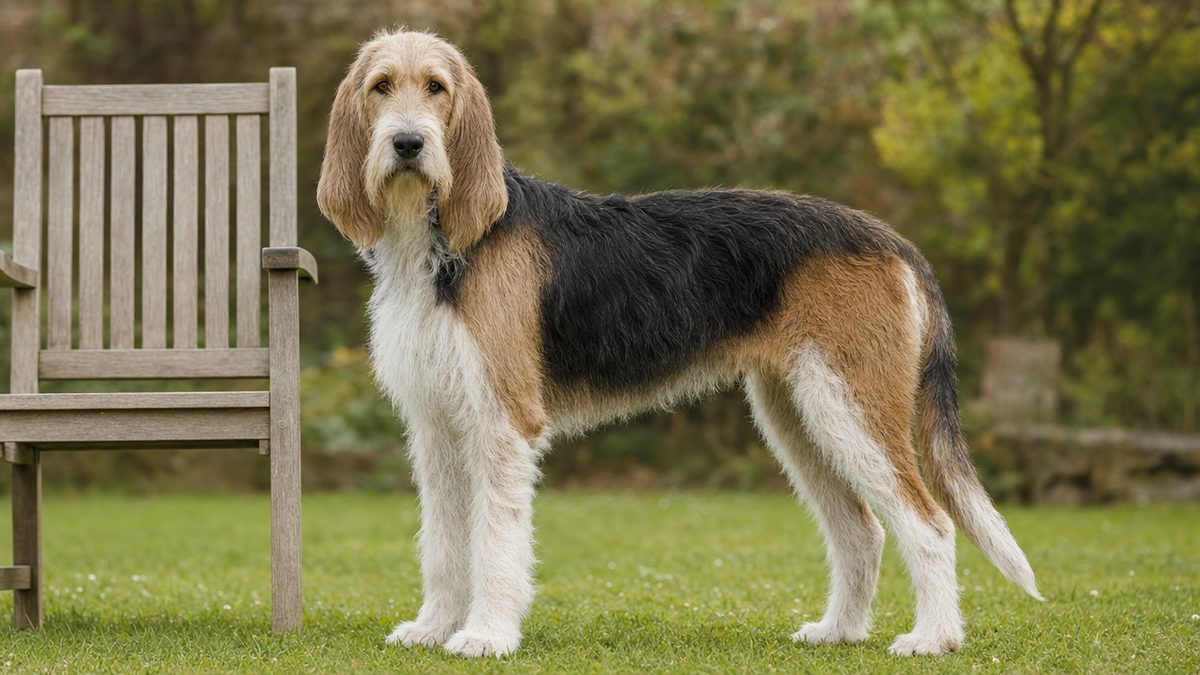
- Coat long without exaggeration, sometimes bushy and harsh, coarse and hard, with a dense undercoat; the belly and inside of the thighs must not be bare.
- Ears low-set below the level of the eye, supple, narrow, fine, covered with long hair, turned inwards, and long enough to reach beyond the end of the nose.
- Eyebrows well pronounced but not covering the eye, and pendulous flews well covered with moustaches, giving the muzzle a square profile.
- Muzzle equal in length to the skull, strong, straight or slightly convex, with a scissor bite.
- Tail thick at the base, set high, carried as a sabre and never as a sickle, rather long, and never docked.
- Skin not too fine and supple, often marbled in tricolour dogs, with no dewlap.
The permitted colours are wider than most sources report: black with white spotting, black and tan, black with light tan markings, fawn with white spotting, fawn with black mantle and white spotting, fawn with black overlay, and pale fawn with black overlay with or without white. The standard also records the traditional French names for these patterns, hare colour, wolf colour, badger colour and wild boar colour. A solid black or solid white coat is a disqualifying fault, as is a woolly coat and any size outside the standard.
History, and why it matters to the family
This is the parent breed of the family, not a scaled-up version of anything. The standard's own historical summary opens "Initially only the Grand Vendeen existed. It was a short-haired variety of Vendeen descending from the Greffier or from the so-called King's white hound", with the translator dating the Greffier to the early 16th century. The Griffon Fauve de Bretagne is named as entering "for an important part" into the Greffier's bloodlines, and the Chien Gris de St. Louis and the Griffon de Bresse are credited with contributing to the Grand Griffon itself.
Every other Vendeen descends from this dog. The FCI's Grand Basset standard states it plainly: the Grand Basset "is derived, like all bassets, from hounds of superior size, in this case the Grand Griffon";. Wikipedia's article, thin as it is, gets this right too, calling the breed "the first of the Vendee griffons to be bred from the Greffier";.
The four Vendeen griffons, and the three FCI sections they occupy
Four separate breeds carry the Vendeen griffon name, and the FCI files them in three different subsections of Group 6 rather than as one size ladder, which is the fact most English-language sources omit.
Read the register rather than the marketing. Taken directly off the FCI's own Group 6 nomenclature page on 31 August 2026, the four breeds are the Grand Griffon Vendeen at number 282 in subsection 1.1 Large-sized Hounds, the Briquet Griffon Vendeen at 19 in 1.2 Medium-sized Hounds, and the Grand Basset at 33 and the Petit Basset at 67, both in 1.3 Small-sized Hounds. All four are recognised on a definitive basis, all four originate in France, all four are subject to a working trial, and all four carry French as their official authentic language.
| Breed | FCI no. | Subsection | Male height at withers | Accepted on a definitive basis |
|---|---|---|---|---|
| Grand Griffon Vendeen | 282 | 1.1 Large-sized Hounds | 62 to 68 cm | 8 April 1969 |
| Briquet Griffon Vendeen | 19 | 1.2 Medium-sized Hounds | 50 to 55 cm | 2 October 1954 |
| Grand Basset Griffon Vendeen | 33 | 1.3 Small-sized Hounds | 40 to 44 cm | 17 January 1967 |
| Petit Basset Griffon Vendeen | 67 | 1.3 Small-sized Hounds | 34 to 38 cm | 4 May 1976 |
The acceptance dates are not in the order anyone expects
The order of FCI acceptance runs Briquet, Grand Basset, Grand Griffon, Petit Basset. The Briquet came first in 1954, the Grand Basset in 1967, this breed in 1969, and the Petit Basset last, in 1976 Federation Cynologique Internationale Federation Cynologique Internationale Federation Cynologique Internationale. So the Grand Basset was recognised nine years before the Petit, and the parent breed of the whole family was recognised fifteen years after the Briquet it fathered. Registry order tracks the paperwork, not the biology.
The FCI prints dates as M/D/YYYY, and reading them as D/M/YYYY moves every date on this page. The register proves its own format: the Grand Basset's entry reads 1/17/1967, and 17 cannot be a month. The German standard rows read 10/15/1999, and 15 cannot be a month. The Group 6 table carries 12/28/1973 for the Billy, 11/17/1978 for the Poitevin and 10/19/1964 for the Porcelaine. So 1/17/1967 is 17 January 1967, and on the FCI's own nomenclature index the provisional register's newest entries, dated 2/11/2026, are 11 February 2026 and not 2 November.
Only the Grand Griffon and the Briquet have an FCI illustration
A small detail worth knowing if you are trying to identify a dog. The FCI nomenclature pages for the Grand Griffon Vendeen and the Briquet each carry a breed illustration alongside the generic surface-anatomy chart. The pages for the Grand Basset and the Petit Basset carry only the anatomy chart, with no picture of the breed at all Federation Cynologique Internationale Federation Cynologique Internationale. The two breeds most often confused with each other are the two the FCI does not illustrate.
The Canadian Kennel Club describes the Grand Basset as "one of the four Vendeen French Hounds", which is the correct framing and is rarer in English sources than it should be. For the medium-sized member of the family, the one that sits between this breed and the bassets at 50 to 55 cm, see the Briquet Griffon Vendeen guide, which covers the same family from the other end.
Six of ten page-one results for this breed describe a different dog
Searching the exact breed name from India returns a page one on which most results are about the Grand Basset Griffon Vendeen, and this section records the measurement rather than merely asserting that confusion exists.
The query was run live on 31 August 2026 against google.com with gl=in and hl=en, and against a separate India-located search index in the same session. Google printed "About 123 results"; for the entire query, which is the first thing worth knowing: the whole visible internet holds roughly a hundred and twenty pages for this breed name.
| Position | Result | Breed the page is about |
|---|---|---|
| 1 | Wikipedia, Grand Griffon Vendeen | Correct |
| 2 | United Kennel Club breed standard | Correct |
| 3 | American Kennel Club breed page | Grand Basset |
| 4 | YouTube, Breed Judging 2025 | Grand Basset |
| 5 | Royal Kennel Club, Basset Griffon Vendeen (Grand) | Grand Basset |
| 6 | Showsight Magazine | Grand Basset |
| 7 | Facebook, Westminster Kennel Club | Petit Basset in the title, Grand Basset in the body |
| 8 | Adopt a Griffon | Correct |
| 9 | Omlet, Basset Griffon Vendeen (Grand) | Grand Basset |
| 10 | Royal Canin | Correct |
Four of ten results are about the breed searched for. Six are about a different Vendeen. Position 7 manages both at once: a Westminster Kennel Club post titled "Meet the Petit Basset Griffon Vendeen" whose body text describes the Grand Basset.
The People Also Ask box contains no question about this breed
Google served four People Also Ask questions on this query, and not one of them is about the Grand Griffon Vendeen. Recorded verbatim, including Google's own capitalisation, they are "What is the temperament of a Grand Basset Griffon Vendeen?", "What is the least wanted dog?", "Is the Brussels Griffon a famous dog?" and "Is a PBGV a good family dog?";. One is about the Grand Basset, one about the Petit, one about an unrelated Belgian toy breed, and one is a generic question with no breed in it.
That last question is worth noting twice, because Bonbeno recorded the identical question, "Is a PBGV a good family dog?", as the single PAA Google served for the Briquet Griffon Vendeen on 23 August 2026. Google is serving the same Petit Basset question across at least two different Vendeen queries.
Google's own AI answered about the wrong breed
The AI Overview for this query opened "The Grand Basset Griffon Vendeen (GBGV) is a happy, outgoing, and affectionate companion with a courageous and independent hunting spirit", and cited eight sources of which every single one was a Grand Basset page. Asked the mirror question, "grand basset griffon vendeen", the same system answered about the Petit Basset, citing seven Petit pages. Two queries, two AI Overviews, each describing the next breed down the size ladder.
The "People also search for" strip tells the same story. Of eight text suggestions on this query, four name a different breed: three name the Grand Basset, including "Grand Basset Griffon Vendeen hypoallergenic", and one names the Petit.
One more measure of how thin the record is: a major English breed directory lists the Grand Griffon Vendeen in its alphabetical index and annotates the entry "photo needed", having no photograph of the breed at all. A buyer cannot verify a rare breed against a source set in which most sources describe a different animal. That is the practical reason this page leads with the register and the standard rather than with temperament adjectives: the registers are the only documents in this topic that cannot be confused with each other, because each breed has a number.
Which registries recognise this breed, and which do not
The Grand Griffon Vendeen is recognised definitively by the FCI as standard 282 and by the United Kennel Club since January 1, 1996, but it appears nowhere in the American Kennel Club's breed list and the Royal Kennel Club publishes no standard for it.
Take each register in turn, and note that every absence below was checked against controls on the same index in the same session.
| Breed | FCI | UKC | AKC | Royal Kennel Club |
|---|---|---|---|---|
| Grand Griffon Vendeen | 282, definitive, 1969 | Yes, 1 January 1996 | Not listed, not even in Foundation Stock Service | No standard published |
| Briquet Griffon Vendeen | 19, definitive, 1954 | Yes | Not listed | No standard published |
| Grand Basset Griffon Vendeen | 33, definitive, 1967 | Yes, 1 January 1996 | Fully recognised 2018 | Yes, as Basset Griffon Vendeen (Grand) |
| Petit Basset Griffon Vendeen | 67, definitive, 1976 | Yes | Fully recognised | Yes, as Basset Griffon Vendeen (Petit) |
The UKC recognised it thirty years ago, with a date written out in full
The United Kennel Club's own standard states "The Grand Griffon Vendeen was recognized by the United Kennel Club January 1, 1996", places it in the Scenthound Group, and carries a revision date of July 1, 2009 with a 1996 copyright. Those dates are spelled out in words, so unlike the FCI's numeric dates there is no format to decode. The UKC's own breed-standards index confirms all four Vendeen griffons sit in its Scenthound Group.
The UKC's height band does not match the FCI's. It gives males 24.5 to 27.5 inches and females 23.5 to 25.5 inches, which converts to 62.23 to 69.85 cm and 59.69 to 64.77 cm. The UKC's male ceiling therefore sits 1.85 cm above the FCI's 68 cm, and its female floor sits below the FCI's 60 cm. The UKC also adds four disqualifications the FCI standard does not carry: unilateral or bilateral cryptorchid, albinism, Dudley nose, and viciousness or extreme shyness.
The AKC does not record this breed at all
The American Kennel Club's complete breed selector, rendered in full on its Foundation Stock Service index, contains Grand Basset Griffon Vendeen and Petit Basset Griffon Vendeen. It contains no Grand Griffon Vendeen and no Briquet Griffon Vendeen. The control matters here: the same selector does list Basset Fauve de Bretagne, Porcelaine, Segugio Italiano, Transylvanian Hound, Hamiltonstovare and Drever, so the instrument is not simply missing rare European hounds. This breed is neither fully recognised nor recorded in Foundation Stock Service.
The Royal Kennel Club publishes two Vendeen standards, and neither is this one
The Royal Kennel Club's complete breed-standards index, across all seven groups, lists Basset Griffon Vendeen (Grand) and Basset Griffon Vendeen (Petit) in the Hound group and no other Vendeen. Again the controls hold: the same Hound table carries Basset Fauve De Bretagne, Basset Bleu De Gascogne, Grand Bleu De Gascogne and Griffon Fauve De Bretagne, so French hounds in general are well represented. The Grand Griffon Vendeen and the Briquet are genuinely absent.
One naming detail from that index feeds directly into the confusion this page documents. The Royal Kennel Club inverts the French word order and files the two breeds as Basset Griffon Vendeen (Grand) and Basset Griffon Vendeen (Petit), demoting the size word to a bracketed suffix. In fairness that is the club's general convention and it uses the same shape for genuinely separate breeds such as Retriever (Labrador) and Spaniel (Cocker), so it is not itself a claim that the two are one breed. The effect on a reader scanning an alphabetical list is still that Grand and Petit read as two sizes of a single entry.
What FCI recognition means for an Indian owner
India is a full FCI member, represented by the Kennel Club of India in Chennai, which is why FCI recognition is the question that matters here rather than AKC or Kennel Club status. A KCI pedigree is issued against FCI nomenclature, so a genuine dog of this breed registered in India would be recorded against standard 282. That is a checkable document, and it is the only one an Indian buyer should accept.
Price in India: there isn't one, and here is the proof
No Grand Griffon Vendeen price in india exists, because no Indian seller was found offering the breed at all, and every Indian result under the name turned out to be merchandise, a dropdown entry or a different dog.
Bonbeno publishes no rupee figure for this breed. That is not a gap in the research, it is the research finding, and the section below shows the working so a reader can repeat it.
What an Indian search for this breed actually returns
Searching Indian results for the breed name plus price and puppy on 31 August 2026 returned ten results and no live dogs. Sorted by what is actually being sold, they were a handbook on Amazon India, an etched wine glass, an American garden flag, a sweater, and a doormat which is printed with a Grand Basset rather than this breed. Two puppy marketplaces appeared, and both list the breed only in a menu: one carries "Grand Basset Griffon Vendeen (033), Grand Griffon Vendeen (282)" in a breed dropdown keyed to FCI numbers while the animal actually advertised on the page is a Great Dane.
The parallel search for the Grand Basset produced the same shape of result: a children's book, a training book priced at ₹1,715 on an Indian import site, a Caroline's Treasures product on Amazon India, digital vector art of the Petit sold through Etsy India, and a Facebook post offering postage stamps at Rs 150 each on which the breed appears. One Bangalore puppy site lists the breed in its filter menu and shows a German Shepherd.
An absence is only evidence if the search works. The same tool, the same India location, the same session: a query for Labrador Retriever puppies in India returned ten Indian pages carrying real rupee bands, including a city-by-city table quoting INR 30,000 to INR 1,20,000 across Hyderabad, Bangalore, Delhi, Chennai, Lucknow, Mumbai, Jaipur and Pune, and separate pages quoting ₹15,000 to ₹40,000 and ₹8,000 to ₹70,000. The instrument works. It finds nothing for this breed because there is nothing to find.
Why no price band can be honestly constructed
There is no figure to convert, average or hedge. Where a rare breed has a contaminated Indian price band, Bonbeno normally shows the arithmetic that exposes it, dividing suspicious rupee figures by 84.38, by 74 and by 66.67 to see whether a dollar list was run through an exchange rate. That test cannot be run here because no Indian rupee figure for this breed was found at all, from any seller, on any page. There is nothing to divide.
The one rupee figure that did surface is instructive rather than useful. Rs 150 per postage stamp sheetlet, and ₹1,715 for a training manual, are the only rupee prices this research turned up under the breed's name. Neither describes a dog.
What a seller offering one in India is probably offering
Assume mislabelling until a pedigree proves otherwise. Given that India has no recorded population, that the AKC does not list the breed and that the Royal Kennel Club publishes no standard for it, a dog offered in India under this name is most likely one of three things: a Grand Basset Griffon Vendeen, whose name shares three of its four words; a rough-coated crossbreed; or a large hound of another breed entirely. The 62 to 68 cm withers height in the breed standard is the fastest way to test the claim, because it is a measurement rather than an opinion.
The breed is rare even at home
France registered 107 Grand Griffon Vendeens in its studbook in 2025, against 82 in 2024, 130 in 2023, 148 in 2022 and 158 in 2019 Societe Centrale Canine Societe Centrale Canine Societe Centrale Canine. France is the breed's home registry and by a wide margin the largest FCI member by annual registrations. Those figures come from the Societe Centrale Canine's own annual statistics, and the extracted rows reconcile exactly against each edition's printed Groupe VI total, so no rows were dropped in the reading. A breed producing about a hundred registered puppies a year in its home country does not have an export surplus, and there is no reason to expect one to reach India. It is a rare dog wherever you stand.
What it would cost to keep, and the parts nobody can price
The recurring cost of a Grand Griffon Vendeen in India cannot be quoted as a monthly rupee figure, because no Indian population exists to price against, but the cost structure is knowable and three items in it are unusually large for this breed.
Bonbeno will not print an invented monthly total. What follows is the structure, with the drivers this breed makes bigger than average, so a reader can price it against local quotes rather than against a number a page made up.
The three costs this breed inflates
- Food volume. A 62 to 68 cm working hound in hard condition eats considerably more than the small and medium breeds most Indian pricing pages are built around, and it is an athlete rather than a sofa dog.
- Cooling. Air conditioning through the Indian hot season is not a luxury for a large dog with a dense undercoat from a 12.4 degree climate; it is the primary risk control, and it lands on the electricity bill every month from March to October.
- Space you have to rent or already own. The standard says the breed needs large territories, and no amount of equipment substitutes for that.
Costs that behave normally
Core preventive care is breed-agnostic and can be quoted locally: the annual vaccination course, deworming, an anti-tick and flea programme, and one or two consultations a year in a healthy adult. Ask your own clinic, because these vary several-fold between an Indian metro and a smaller city and this page has no basis for quoting either.
Grooming is a real line item rather than a token one. A harsh coat with a dense undercoat, a moustache, eyebrows and long-haired drop ears needs regular hand work, and in humid months the ears need checking far more often than a smooth-coated breed's do. Budget either the time or a groomer who understands a harsh coat and will not simply clip it off, because clipping a harsh double coat changes its texture permanently.
The cost that is impossible to bound, and the reason
Veterinary risk cannot be priced for this breed because nobody has measured it. The Orthopedic Foundation for Animals publishes no statistics row for the Grand Griffon Vendeen, and the breed holds no OFA registry code at all, so there is no screening baseline for hips, elbows, eyes, patellae, thyroid or cardiac status to insure against or plan around Orthopedic Foundation for Animals. Peer-reviewed veterinary literature on the breed is likewise absent, as the health section sets out. An Indian owner would be the first person in the country to find out what this breed costs to keep healthy here.
The only Indian rupee figures this research found attached to the breed's name were Rs 150 for a postage stamp sheetlet and ₹1,715 for an imported training book. Publishing a monthly cost of ownership in rupees for a dog with no Indian population would be inventing data, so this page prints the structure and the drivers instead and tells you to price them locally.
Heat tolerance in India, worked from the homeland climate
The Grand Griffon Vendeen rates 2 out of 5 for heat tolerance in India, because its homeland in the Vendee averages 12.4 degrees Celsius a year against 27.95 in Chennai, a gap of 15.53 degrees, and the breed is built to keep working rather than to stop when it overheats.
The figures below come from NASA POWER queried by explicit latitude and longitude, so no other place can be served by mistake, and every response echoed back the coordinates requested. The product is the 20-year Source Native Resolution Climatology covering January 2001 to December 2020.
| Place | Mean air temperature | Gap against the Vendee | Mean relative humidity |
|---|---|---|---|
| La Roche-sur-Yon, Vendee | 12.42 C | - | 82.36 % |
| Chennai | 27.95 C | +15.53 C | 72.39 % |
| Kolkata | 25.81 C | +13.39 C | 73.93 % |
| Delhi | 25.60 C | +13.18 C | 45.56 % |
| Pune | 23.86 C | +11.44 C | 66.80 % |
| Bengaluru | 23.74 C | +11.32 C | 67.94 % |
The single most useful comparison in that table is not in it. Chennai's coolest month is warmer than the Vendee's hottest month. Chennai in January averages 24.09 degrees; La Roche-sur-Yon in July, its peak, averages 19.54 NASA POWER, Source Native Resolution…. There is no month of the Indian year in Chennai that resembles a Vendeen summer. Delhi in June averages 35.88 degrees, which is 16.34 above the Vendee's July.
The humidity finding runs the opposite way to the cliche
This breed is not humidity-naive, and pages that say so are wrong. The Vendee's annual mean relative humidity is 82.36 percent, which is higher than every Indian city measured here: 9.97 points above Chennai, 8.43 above Kolkata, 14.42 above Bengaluru, 15.56 above Pune and 36.80 above Delhi NASA POWER, Source Native Resolution… NASA POWER, Source Native Resolution….
The proof of the point is monthly. The Vendee in December sits at 91.45 percent humidity and 6.35 degrees. Kolkata in August sits at 89.07 percent and 28.24 degrees NASA POWER, Source Native Resolution…. Nearly identical water in the air, about 22 degrees apart. Pune in August reaches 90.80 percent, within a point of the Vendee's wettest month, at 23.30 degrees rather than 6.35.
So the harsh coat evolved wet. What it never evolved for is warm and wet at the same time, which is precisely the combination in which panting works least well, because evaporative cooling depends on the air being able to accept more water. The correct sentence for this breed is not that Indian humidity will trouble it. It is that Indian heat will, and Indian humidity removes the escape route.
Why the risk is behavioural as well as physical
The breed will not self-limit. The standard describes a hound that is "assiduous on the track" and "does not refuse thorny undergrowth", and calls the temperament "wilful and passionate";. Exertional heat-related illness is the dominant form in dogs: reviewing 905,543 UK dogs under primary veterinary care in 2016, exercise was the trigger in 74.2 percent of events, against 12.9 percent environmental and 5.2 percent vehicular confinement, and the odds of death after exertional heatstroke were similar to those after a hot car. A dog that works through discomfort in a British summer is a dog that will work through a Chennai morning.
That British study modelled breeds meeting a threshold of five cases and 5,000 dogs. The Grand Griffon Vendeen is nowhere near that in the United Kingdom and is not in the model, so no breed-specific odds ratio from it applies here. Nor can this breed be placed in the study's over-50-kg risk band, because its FCI standard prints no weight at all. What transfers is the mechanism, not a number attached to this breed.
Managing the heat if you keep one anyway
Manage a Grand Griffon Vendeen in India by moving all work to darkness, cooling the dog by conduction rather than by coat-wetting alone, and treating a rectal temperature at or above 41.0 degrees after exertion as an emergency.
Scheduling, city by city
| City | Annual mean | Hardest months | Realistic plan |
|---|---|---|---|
| Bengaluru | 23.74 C | March to May | The most workable of the five. Dawn work most of the year, afternoon given up March to May. |
| Pune | 23.86 C | April to May | Dawn and after dark. Monsoon humidity at 89 to 91 percent needs ear care, not heat care. |
| Delhi | 25.60 C | May to June | Indoors through the middle of the day April to July. June averages 35.88 C. |
| Kolkata | 25.81 C | April to August | Dawn only in the hot months. August pairs 28.24 C with 89.07 percent humidity. |
| Chennai | 27.95 C | All year | No genuinely cool season exists. January, the coolest month, is warmer than a Vendeen July. |
Cooling that works, and cooling that does not
- Wet the belly, groin, armpits and paws, where blood vessels sit close to the surface, rather than pouring water over a dense harsh coat that will hold it against the skin.
- Use moving air. A fan over a wet dog does most of the work; still air over a wet dog does very little in high humidity.
- Offer cool water continuously and do not restrict it after work.
- Skip ice baths and ice-cold immersion for a conscious overheating dog, and get to a vet.
- Never leave the dog in a parked vehicle, even briefly, and never muzzle a hot dog in a way that restricts panting.
The number to act on
Buy a rectal thermometer and learn the baseline. A normal resting canine temperature sits around 38.3 to 39.2 degrees Celsius. Treat 41.0 degrees or above after exertion in heat as an emergency: begin cooling immediately, wet the dog with tepid water, get air moving over it and drive to a veterinarian while cooling continues. Do not wait to see whether it settles.
Coat management, and what not to do
Do not clip the coat off to keep the dog cool. A harsh outer coat over a dense undercoat is insulation in both directions and it shades the skin; clipping it removes the sun barrier, changes the coat's texture permanently and does not improve heat loss, because dogs do not cool through the skin the way people do. Strip and thin the undercoat instead, keep the dog out of direct sun, and solve the heat with scheduling and air conditioning rather than with scissors.
Heat tolerance 2 out of 5. Not zero, because the breed is a hardy working animal with no brachycephalic airway compromise and it handles a wet climate well. Not 3, because a 15.53 degree gap against Chennai, a dense undercoat and a temperament that refuses to stop are three compounding risks, and the breed has no Indian veterinary track record to fall back on.
Temperament, and the households this breed does not fit
The Grand Griffon Vendeen is docile with its people but wilful, passionate and extremely vocal, and the FCI standard states that it needs large territories, which rules out the apartment living most Indian buyers are planning for.
Take the standard at its word rather than reading temperament off a photograph. The FCI gives two short clauses and both are load-bearing. Behaviour: "Fine nose, has a beautiful voice; assiduous on the track, does not refuse thorny undergrowth, needs large territories." Temperament: "Docile, but wilful and passionate, needs to be kept well in hand";. The UKC renders the same idea as "Docile, but willful and passionate because of its strong hunting instinct, the Grand Griffon Vendeen has to be kept well in hand";.
"A beautiful voice" is a hunting compliment, not a domestic one. A pack hound's bay is designed to carry across a valley so a handler on foot can follow it. In a flat, that same voice is the reason the neighbours complain, and it is used when the dog is bored, excited, alone or has scented something four floors down.
Who this breed genuinely suits
- Households with real outdoor land, securely fenced, in a cooler part of India.
- Owners who want a companion for hours of daily walking and are honest that they will do it at 5 a.m.
- People who like an independent dog with opinions and do not need a biddable one.
- Homes with no close neighbours, or neighbours who have agreed in advance to a hound's voice.
Who should not buy one
- Anyone in an apartment. This is the clearest single disqualifier and it is not negotiable for a breed the standard says needs large territories.
- First-time dog owners. An independent 62 to 68 cm hound with a hard-wired nose is not a starter dog.
- Households wanting a guard dog. Purina's own entry for the closely related Grand Basset says plainly "Not a guard dog", and the same is true here; a friendly pack hound announces visitors and then greets them.
- Anyone who cannot commit to two hours of exercise a day for a decade.
- Families in Chennai, coastal Mumbai or Kolkata who want a dog they can walk in the evening heat.
With children, other dogs and cats
Pack breeding cuts both ways. A hound selected for centuries to work in a group with other dogs and to tolerate handling by strangers at a meet is usually sociable with both, and the standard makes a timid dog a fault and an aggressive one a disqualification. The caution is size and momentum rather than intent: a 65 cm hound in full cry does not notice a toddler in its path. Cats and small pets are the genuine problem, because prey drive on small furred animals is what the breed was built for, and no amount of socialising removes it.
Purina India's page for the Grand Basset, the nearest relative with an Indian-domain page, says the breed is "not ideally suited to living in towns; the country life is for them" and that "a secure garden is essential, as they will be off if they get the scent of small game". That page carries a British English language tag and is served unchanged to Indian readers. The advice is sound. It is simply describing a life most Indian buyers cannot provide, and this page says so where that one does not.
Training a nose-led hound, and what the French standard actually asks for
Train a Grand Griffon Vendeen by building an unbreakable recall from week eight and paying for it with food for the dog's whole life, because the breed is trainable but independent and will always choose a fresh scent over a command it can afford to ignore.
Start with recall and treat everything else as secondary. The one thing that will kill this dog in India is not a fight or a fall, it is following a scent onto a road. The FCI standard's own phrase, "needs to be kept well in hand", is a polite way of saying the dog will leave if you let it.
A translation detail worth knowing, from the family's own paperwork
The FCI standard for the closely related Grand Basset makes the point more precisely in French than in English, and French is the authentic language for all four Vendeen standards. The French text reads "Il faut l'habituer, des son premier age, au rappel", meaning the dog must be accustomed from its earliest age to the recall, a specific named exercise. The English translation flattens that to "be accustomed to obeying" and renders the following word, *sanctions*, as "punishment";.
Two things follow for an Indian owner. The specific instruction the authentic text gives, train the recall, is the single most useful sentence in the family's standards, and the English version loses it. And an English reader could take "its training implies will and punishment" as licence to use aversive methods on a stubborn hound, which is a poor reading of a translated word and a worse training plan. Train the recall, and pay for it.
What works
- Pay high, every time, forever. A hound's recall is a transaction, and boiled chicken beats praise for the entire life of the dog.
- Train at nose level. Scent work, tracking games and food trails give the dog its job and buy you attention you would not otherwise get.
- Use a long line of ten to fifteen metres for months longer than you think necessary, and do not test off-lead freedom near traffic at all.
- Keep sessions short and frequent, because a bored hound disengages rather than argues.
- Socialise hard between weeks eight and sixteen, to city noise, traffic, lifts, autorickshaws and strangers, while the window is open.
What does not work
Repetition drills and correction-based handling both fail on this breed, in different ways. A hound that has been drilled simply stops offering behaviour, and one that has been corrected for following its nose learns to do it further away from you. There is also no equipment fix: no collar substitutes for a trained recall on a dog that was bred to ignore discomfort in thorny undergrowth, which the standard specifically praises it for.
Indian law is relevant to how you train, not only to how you buy. Tail docking, ear cropping, de-barking and de-clawing are all prohibited under the Prevention of Cruelty to Animals (Dog Breeding and Marketing) Rules 2017, so de-barking is not an available answer to a hound's voice, and anyone who offers it is proposing something unlawful.
Expect a reliable recall in a quiet fenced space by six months, a recall that holds against mild distraction by a year, and a recall that holds against fresh game scent, possibly never. Plan your fencing and your lead work on the assumption that the last one does not arrive.
Daily exercise, and what happens without it
A Grand Griffon Vendeen needs two hours or more of daily exercise including real scent work, and without it the breed becomes destructive, vocal and escape-prone rather than merely restless.
Two hours is a floor, not a target. Purina's guidance for the smaller Grand Basset already says the breed "requires plenty of exercise, two hours a day or more, and lots of time outside", and that is a dog 22 cm shorter at the shoulder than this one. A breed the FCI says needs large territories, worked historically on boar and stag in packs, is not satisfied by a lap of a housing society.
What the two hours should contain
- At least one long walk on a long line, at the dog's pace, with permission to sniff. Sniffing is the work, not a delay.
- Twenty to thirty minutes of deliberate nose work: scattered food in grass, a tracking line, a scent trail laid in the morning cool.
- Free running only inside secure fencing, because off-lead freedom in open ground is how these dogs are lost.
- Rest in the heat. In Chennai or Kolkata in April, the two hours must be split across dawn and after dark, not shortened.
The failure mode when the exercise is not delivered
An under-exercised hound does not sulk, it works on your house. The predictable sequence is baying at nothing, digging, chewing skirting and doors, counter-surfing, and then escaping: over, under or through whatever contains it. In an Indian apartment the baying arrives first and it arrives fastest, because the dog is alone, unstimulated and can hear the whole building.
This is the reason apartment living rates 1 out of 5 on this page rather than 2. There is no version of a high-rise flat that provides what the standard describes, and the honest advice is to choose a different breed rather than to try harder.
Growth-stage limits
Do not run a large hound puppy in the heat, and do not run one on hard surfaces at all before the growth plates close. A dog that will finish at 62 to 68 cm carries real weight through open joints for the first year, and forced repetitive exercise, stairs and jumping are the modifiable risks. Free play on soft ground at the puppy's own pace is the right prescription until at least twelve months, and longer in this size bracket.
Grooming a harsh coat and long drop ears in Indian humidity
Groom a Grand Griffon Vendeen by hand-stripping and thinning rather than clipping, brushing through twice a week, and checking the ears every single day in the monsoon, because low-set long-haired drop ears over a humid climate are this breed's most predictable maintenance problem.
Work with the coat the standard describes. It is "long without exaggeration, sometimes bushy and harsh (coarse and hard)" over a dense undercoat, with the belly and inside of the thighs not bare and pronounced eyebrows that do not cover the eye. A woolly coat is a disqualifying fault, which tells you the texture is the point.
The routine
- Brush through twice a week with a slicker and then a metal comb, working down to the skin rather than skating over the top coat.
- Comb the moustache, beard and eyebrows more often than the body, because food, water and dust collect there and the beard sours in humidity.
- Hand-strip or thin the dead undercoat seasonally rather than clipping, to keep the harsh texture the standard requires.
- Check ears daily in the monsoon and at least twice a week the rest of the year.
- Dry the ears properly after every bath and every swim, and never let a dog with this ear type air-dry with damp inside the canal.
- Keep nails short, because a heavy hound with long nails changes its foot placement.
The ear problem, and why overseas advice is wrong here
This is the clearest place where imported care advice fails in India. Breed guidance written for Atlantic France or for Britain routinely says to towel the dog and let it air dry. That is reasonable at 12.4 degrees and it is poor advice in an Indian monsoon, where Pune sits at 89 to 91 percent relative humidity through July and August and Kolkata at 87 to 89 percent NASA POWER, Source Native Resolution…. A low-set, long-haired, inward-turning leather that the standard says must reach beyond the end of the nose is, functionally, a lid over a warm wet canal.
Dry the canal actively. Use a vet-recommended drying solution after water exposure, keep the hair at the ear opening thinned, and look for head-shaking, odour, discharge and heat, which arrive before a dog shows pain. The practical rule for an Indian owner of any drop-eared hound is that ear care is a daily monsoon habit, not a monthly one.
Bathing, ticks and the rest
Bathe rarely and thoroughly rather than often and lightly, because frequent shampooing softens a harsh coat. Between baths, a rubber curry and a comb do more good than water. Tick control is not optional anywhere in India and matters more in a coat this dense: ticks in a harsh double coat are hard to see and easy to miss, so run your hands over the dog after every outing, checking the ear margins, between the toes, the armpits, the groin and under the collar.
Clipping is the commonest grooming mistake made on rough-coated breeds in hot countries, and it is done with good intentions. It does not cool the dog, it removes the sun barrier over the skin, and on a harsh coat it permanently changes the texture so the coat grows back softer and holds more moisture. Thin the undercoat, strip the dead hair, and manage heat with shade, air and scheduling.
Indian import law closes the only route that could create a supply
Indian law permits a Grand Griffon Vendeen to enter the country only as an individual's own pet, and expressly rejects any import application made for trading or breeding, so no lawful supply chain for the breed can form in India.
Two instruments do the work, and they are separate. Read them in order.
The import rule: DGFT Trade Notice 22/2022-23
Dogs sit under ITC(HS) 01061900, the "Mammals: Other" line, with an import policy of Restricted, subject to Policy Condition 6 of that chapter. The notice was issued by the Directorate General of Foreign Trade, Ministry of Commerce and Industry, dated 19 December 2022.
Policy Condition (7) lists the only three permitted purposes, verbatim: "i. Pet dog with valid pet book and relevant records/documents in the name of importer. ii. Dogs imported by the R&D Organisations for conducting research with the recommendation of CPCSEA. iii. For the internal security by the Defence and Police Force." Policy Condition (8) then closes the door: "Import of commercial dogs for breeding or any other commercial activities other than the purposes mentioned above is not permitted";.
The notice is blunter still in its own body text: "It may be noted that any applications for trading/breeding purposes, or applications made on behalf of some another person/entity shall be duly rejected";. Note the second half of that sentence, which is usually dropped when it is quoted: an application made on someone else's behalf is rejected too, which forecloses the obvious workaround.
Entry is limited to seven cities. "Import of pet animals is allowed only through airports and seaports of Delhi, Mumbai, Chennai, Hyderabad, Bangalore and Kolkata";. DAHD added a seventh port, Cochin International Airport at Kochi, for pets arriving under the baggage rules in October 2024. There is no absolute quantity cap, but the threshold sits at two: above two animals a DGFT import authorisation is always required, plus examination by the Department of Animal Husbandry and Dairying. The full route is set out in how to import a dog to India.
Put the import rule next to the registry position and the conclusion is structural rather than rhetorical. India has no recorded population of this breed, so any founding stock would have to be imported. Importing for breeding is expressly not permitted. Between those two facts, no lawful commercial supply of the Grand Griffon Vendeen can form in India, and a seller offering puppies is either mislabelling a different dog or operating outside the Rules.
The breeding rules: the 2017 Rules, cited by their real clause numbers
The Prevention of Cruelty to Animals (Dog Breeding and Marketing) Rules 2017, gazette notification G.S.R. 496(E) of 23 May 2017, govern anyone breeding dogs in India. Four provisions bear on this breed, and the numbering has to be quoted precisely because the document numbers clauses twice: there is a Rule 8 in the body of the Rules and a separate Second Schedule paragraph 8, and the Second Schedule is headed "[See rules 5(2) and 6]".
| Provision | Correct citation | What it says |
|---|---|---|
| Minimum sale age | Rule 8(1)(a), in the body of the Rules | "pups less than eight weeks in age are not sold" |
| In-breeding and incest breeding | Second Schedule Part II para 6(3) | Prohibits relatives of the 2nd to 4th grade within four generations, and parent/child or brother/sister matings |
| Mutilation and appearance | Second Schedule Part II para 6(8) | No tail docking, ear cropping, de-barking, de-clawing, branding, dyeing, and "any change of appearance by artificial means is strictly forbidden" |
| Genetic-defect testing | Second Schedule Part III para 8(10) | Breeding dogs "shall have been tested for genetic defects, including hip dysplasia, progressive retinal atrophy, night blindness, hypothyroidism, entropion, ectropion, overshot, undershot jaw..." |
Para 8(10)'s operative word is including, not "namely", so its eleven-item list is illustrative and a defect is not outside the clause merely because it is unlisted. That matters for a breed with no screening data, because a breeder cannot point at the list and claim nothing applies.
Two absences in the Rules are worth stating, because Indian pages sometimes assert the opposite. Across the whole gazette, "BAER" appears zero times, "deaf" zero times, "patella" zero times, "luxation" zero times and "dental" zero times; "teeth" appears once, inside para 8(10)'s "two or more missing teeth";. The word "hearing" appears once and refers to a legal hearing before an appellate authority, not an auditory test. So Indian law mandates no breed-specific hearing test and no patellar grading, and para 8(10) is the only screening mandate the instrument contains.
Health: what is known, which is almost nothing, and why that is the finding
No health data exists for the Grand Griffon Vendeen, because the breed has no row in the Orthopedic Foundation for Animals statistics tables, holds no OFA registry code at all, and has zero peer-reviewed veterinary papers about it, all three checked against working controls.
This section publishes an absence, and an absence only counts when the instrument is shown to work. Each check below was run with a control in the same session.
OFA: no statistics row, and no breed code either
The Orthopedic Foundation for Animals publishes screening statistics for hundreds of breeds. Searching its complete statistics tables case-insensitively returns zero rows for the Grand Griffon Vendeen and zero for the Briquet Griffon Vendeen. The controls in the same dump returned 109 rows for Labrador Retriever and 46 for Basset Hound, so the tables loaded and the search worked.
The stronger finding is on the breed-code list. OFA's advanced-search page carries a selectable breed for every registry code it holds, and the Grand Griffon Vendeen is not among them: reading the raw markup, the only canine entries containing GRIFFON or VENDEEN are BRUSSELS GRIFFON, GRAND BASSET GRIFFON VENDEEN with code GBG, PETIT BASSET GRIFFON VENDEEN with code PBG, and WIREHAIRED POINTING GRIFFON. So this is not a breed sitting below OFA's publication threshold of 100 hip evaluations. It is a breed OFA does not hold a code for at all, which is categorical absence.
Peer-reviewed literature: zero papers
There is no veterinary literature on this breed. A PubMed search for the exact phrase returned two records, and the query-translation line shows why: PubMed could not match the phrase and searched the words separately, as `("grand"[All Fields] OR "grands"[All Fields]) AND ("griffon"[All Fields] OR "griffons"[All Fields]) AND "vendeen"[All Fields]`. Both records it returned are Grand Basset papers matching on separate words. Controls run in the same session behaved normally, returning 52 records for Labrador Retriever with hip dysplasia and 1 for Basset Hound with intervertebral disc.
Europe PMC full-text search returned four open-access matches, and all four genuinely contain the breed's name without studying it. One is an FCI taxonomy example listing "large-sized hounds (Bloodhound and Grand Griffon Vendeen)". One is an Italian registry table whose entire entry for the breed is the number 2. One is a UK referral table whose cell for the breed is literally a tilde. One mentions it only as an ancestor of the Kromfohrlander. The honest count of papers studying this breed is zero.
What the family's literature does show, and why it does not transfer
Its relatives have been studied and this breed has not, which is worth knowing but must not be borrowed. The Petit Basset Griffon Vendeen is OFA's rank 1 breed of all breeds for primary open angle glaucoma, with 313 evaluations returning 53.4 percent normal, 43.8 percent carrier and 2.9 percent abnormal, and a six-year clinical series of 366 dogs at breed society clinics found a glaucoma prevalence of 10.4 percent, 38 dogs. Idiopathic epilepsy has been measured in the same breed at 42 of 471 responding owners, 8.9 percent, with a later genome-wide association study of 30 unaffected and 23 affected dogs finding only suggestive signals and nothing on exon sequencing. Canine X-linked muscular dystrophy has been reported once in a family of three related Grand Bassets, and lower motor neuron disease once in the Briquet. That second paper is easy to miss in a search, because its title inverts the breed name to "Griffon Briquet Vendeen".
One 2025 genetics paper is worth reading even though it is about the Grand Basset, because it changes how a buyer should read a tall "Basset". Evaluating 47 Grand Bassets, 41 had leg lengths within the breed standard and 6 were significantly taller, and every one of the six tall dogs was homozygous for the non-insertion allele at the chromosome 18 FGF4 retrogene, the variant that shortens basset legs. The short-legged dogs measured 41 cm at the withers on average and the long-legged ones 59 cm. The authors also note that the Petit Basset appears fixed for the insertion while the Grand Basset still segregates the non-insertion allele. So a registered Grand Basset can genuinely be born at 59 cm, which is a real genetic outcome rather than a mislabelled dog, and it is one more reason a name on a listing settles nothing. None of that is this breed's risk profile. Applying a relative's screening figures to an unstudied breed is fabrication wearing a citation, and this page will not do it. What the family data legitimately supports is a screening recommendation, not a prevalence claim.
Absence of data is not evidence of health. For a large deep-chested hound with heavy drop ears, a sensible programme is hip and elbow evaluation on both parents, an annual ophthalmologist examination given the family's eye history, and routine ear and thyroid checks. Ask any seller for the parents' actual certificates, and note that Indian law's only screening mandate, Second Schedule Part III para 8(10), names hip dysplasia, progressive retinal atrophy and night blindness among others.
Life expectancy: no figure exists, and the ones circulating have no source
Bonbeno publishes no life expectancy for the Grand Griffon Vendeen, because no mortality study, registry dataset or breed-club survey covering the breed could be found, and the figures circulating on English pages trace back to nothing.
Follow the citations back and they close on empty. The top-ranking page in the world for this breed, English Wikipedia, is flagged by Wikipedia itself as a stub, carries exactly one reference, the FCI breed standard, and contains no health section, no lifespan, no weight and no temperament section at all. The FCI standard it cites contains no lifespan figure either.
There is no large-cohort mortality study covering the breed, because such studies are built on veterinary or insurance populations and this breed appears in none of them in usable numbers. There is no OFA longevity data, because OFA holds no code for the breed. There is no peer-reviewed paper of any kind.
What relatives report, clearly labelled as relatives
Figures do exist for the Grand Basset and they are not this breed's. Dogs Victoria, publishing against the Dogs Australia standard, gives the Grand Basset an average life span of 12 to 15 years. The American Kennel Club gives the same breed 13 to 15 years. Google's knowledge panel gives it 12 to 14. English Wikipedia's article on the Grand Basset prints the headings "Health" and "Longevity" with nothing whatsoever under either. Three sources, three different bands, and a fourth that raised the question and left it blank, on a breed that at least has a registry population to draw from. For the Grand Griffon Vendeen there is not even a disagreement to report.
A reasonable expectation, labelled as an expectation
Expect a large hound's lifespan and plan for it, without treating that as a measured figure. Across dogs generally, body size is inversely associated with longevity, and a 62 to 68 cm working hound sits in the size class where twelve years is a good outcome. This page states that as a general expectation from canine size-longevity patterns, not as a breed figure, because there is no breed figure to state.
If a page gives the Grand Griffon Vendeen a specific life expectancy, check whether it also gives a source. In this research, every English page carrying a figure either cited nothing or was describing the Grand Basset. A number with no denominator, no cohort and no citation is a guess someone typed, and it propagates because the next writer copies it.
Feeding a large working hound in India
Feed a Grand Griffon Vendeen to a body condition score of 4 or 5 on the nine-point scale rather than to a quantity on a packet, because no breed-specific feeding data exists and body condition is the only measurement that works without one.
Score the dog, do not weigh the food and stop there. The World Small Animal Veterinary Association's nine-point body condition chart is the practical instrument: ribs easily felt under a thin fat cover, a visible waist behind the ribs when seen from above, and an abdominal tuck in profile. Learn it once and use it fortnightly, running your hands over the dog rather than looking, because a harsh dense coat hides condition completely.
Life-stage structure
- Eight weeks to four months: four meals a day, on a large-breed puppy formulation with controlled calcium, because rapid growth in a large frame is the risk to manage.
- Four to seven months: three meals a day, still large-breed puppy food, watching that ribs stay easily palpable through the growth spurt.
- Seven to twelve months: two meals a day, transitioning gradually toward adult food across the second half of the first year.
- Adult: two meals a day, split morning and evening, timed away from the hottest hours and away from hard exercise.
- Senior: two meals a day with the total adjusted downward as activity falls, and joint support discussed with your vet rather than bought off a shelf.
The deep-chest precaution
Split the meals and separate them from exercise. A deep-chested dog of this size sits in the body shape associated with gastric dilatation and volvulus, and while no incidence figure exists for this breed, the standard practice is the same everywhere: two or more smaller meals rather than one large one, no hard exercise for an hour either side of eating, and no gulping from a raised bowl. Learn the signs, which are a distended abdomen, unproductive retching, restlessness and collapse, and treat them as an immediate emergency.
Feeding in Indian heat
Feed on the cool side of the day. Appetite drops in the hot season in most dogs, and a hound that has been resting through the middle of the day genuinely needs less than one that has worked. Move the main meal to the evening, keep water available continuously and in more than one place, and do not add food to compensate for a dog that has stopped eating in the afternoon heat, because that is normal rather than a problem to solve.
Indian availability is not a constraint for this breed's needs. Large-breed puppy and adult formulations from the major brands are widely sold in Indian metros and online, and there is nothing breed-specific this dog requires that an Indian buyer cannot obtain. What matters far more than brand is portion control and body condition, because an overweight large hound in Indian heat carries two risks at once.
Body condition score 4 or 5 out of 9. Below 4 is thin, above 5 is overweight, and every increment above 5 adds heat load to a dog that already cannot shed heat well in this climate. On this breed the score has to be taken by hand, because the coat will make a fat dog look fine and a thin one look normal.
The first year, month by month
Plan a Grand Griffon Vendeen puppy's first year around three deadlines: the socialisation window closing at sixteen weeks, recall training starting the day the puppy arrives, and joint protection lasting past twelve months.
Indian law sets the starting line. Rule 8(1)(a) of the 2017 Rules requires that pups less than eight weeks in age are not sold, so eight weeks is the earliest lawful collection age and a seller offering younger is breaking the Rules.
| Age | Priority | What to do |
|---|---|---|
| 8 to 10 weeks | Settling and vaccination | Complete the core vaccination course with your vet, start deworming, begin house training, and start recall as a game indoors from day one. |
| 10 to 16 weeks | Socialisation, the closing window | Traffic, lifts, autorickshaws, tiled floors, strangers, umbrellas, other vaccinated dogs. This window does not reopen. |
| 4 to 6 months | Recall on a long line | Move recall outdoors onto a ten to fifteen metre line. Pay in food every single time. Do not test off-lead near roads. |
| 6 to 9 months | Adolescence and voice | Expect the recall to get worse before it gets better, and expect baying to start. Do not punish the voice; manage the boredom causing it. |
| 9 to 12 months | Endurance without impact | Build walking distance on soft ground at dawn. No forced running, no stairs work, no jumping from height while plates are open. |
| 12 months and beyond | Adult workload | Move toward the full two hours a day, still avoiding the heat of the day, and keep scent work as the core of it. |
Heat rules that apply from week eight
A puppy thermoregulates worse than an adult, not better. From the day it arrives, walk it at dawn and after dark in the hot months, keep it off hot paving that will burn pads, keep water in front of it constantly, and never leave it in a car or on a balcony. In Chennai and Kolkata that means a summer puppy essentially lives indoors during daylight, and the socialisation window still has to be met inside those constraints, which takes deliberate planning rather than good intentions.
Ears and coat from the start
Handle the ears daily from week eight so that checking them is unremarkable by the time it matters. Teach the puppy to accept a comb through the moustache, eyebrows and ear feathering, to have its feet held and nails clipped, and to stand for a full body check. A 65 cm adult that objects to ear handling is a serious problem; an eight-week puppy that has been handled every day is not.
This timeline assumes a puppy of this breed exists to buy in India, and this research found none. If you are offered one, treat the pedigree and the parents' measured heights as the first two questions, before any of the above becomes relevant.
Grand Griffon Vendeen questions Indian buyers actually ask
What is the temperament of a Grand Basset Griffon Vendéen?
The Grand Basset Griffon Vendeen is a different breed from the Grand Griffon Vendeen, and Google serves this question on searches for both. Its own FCI standard calls it courageous, tenacious and a little stubborn, and the Royal Kennel Club describes it as happy, outgoing, independent and a little stubborn but willing to please with firm handling. The Grand Griffon Vendeen is the larger parent breed at 62 to 68 cm, and its standard calls it docile but wilful and passionate.
What is the least wanted dog?
Google serves this question on searches for the Grand Griffon Vendeen, and no registry publishes a least wanted list. What can be measured is rarity. France registered 107 Grand Griffon Vendeens in 2025 and only 45 Grand Bassets, which makes the Grand Basset the rarest of the four Vendeen griffons in its home country despite being the one American buyers can register.
Is the Brussels Griffon a famous dog?
The Brussels Griffon is an entirely different breed from Belgium and is not related to the Vendeen griffons, and Google serves this question on searches for the Grand Griffon Vendeen only because both names contain the word griffon. The Brussels Griffon is a small companion dog; the Grand Griffon Vendeen is a 62 to 68 cm French pack hound bred for wild boar and stag.
Is a PBGV a good family dog?
PBGV stands for Petit Basset Griffon Vendeen, the smallest of the four Vendeen griffons at 34 to 38 cm, and Google serves this question on searches for at least two other Vendeen breeds. It is a sociable pack hound and its own FCI standard calls it a devil in the country and an angel in the house, but it is vocal, independent and nose-led, and no Indian population of it exists either.
How much do Basset Griffon Vendeens cost?
No verified Indian price exists for any of the four Vendeen griffon breeds. Searching Indian results under these names returns merchandise rather than dogs: a handbook, an etched wine glass, a garden flag, a training manual at 1,715 rupees and postage stamps at 150 rupees each. A control search for Labrador Retriever puppies in the same session returned real Indian bands from 30,000 to 1,20,000 rupees, so the search works and there is genuinely nothing to price.
How big is a Grand Griffon Vendeen?
Males stand 62 to 68 cm at the withers and females 60 to 65 cm, with a tolerance of 1 cm either way, under FCI standard 282. That makes it the largest of the four Vendeen griffons by about 22 cm over the Grand Basset. The standard gives no weight figure at all, so any kilogram range you see for this breed comes from somewhere other than the breed standard.
What is the difference between a Grand Griffon Vendeen and a Grand Basset Griffon Vendeen?
The difference is about 22 cm of leg. The Grand Griffon Vendeen is a large hound at 62 to 68 cm in FCI subsection 1.1, Large-sized Hounds. The Grand Basset Griffon Vendeen is a basset at 40 to 44 cm in subsection 1.3, Small-sized Hounds, with the short heavy-boned front and slightly elongated body of a basset. They are separate FCI breeds with separate standard numbers, 282 and 33.
Is the Grand Griffon Vendeen recognised in India?
India is a full FCI member represented by the Kennel Club of India in Chennai, so the Kennel Club of India issues pedigrees against FCI nomenclature, and the Grand Griffon Vendeen is FCI standard 282 recognised on a definitive basis. That means the breed is recognisable in India in principle. No recorded Indian population of it was found, so in practice a Kennel Club of India pedigree naming standard 282 is the only document that would confirm one.
Can I import a Grand Griffon Vendeen into India?
You can import one only as your own pet, with a valid pet book and documents in your own name, through the airports and seaports of Delhi, Mumbai, Chennai, Hyderabad, Bengaluru and Kolkata and, since October 2024, Kochi airport. DGFT Trade Notice 22/2022-23 states that applications for trading or breeding purposes, or made on behalf of another person or entity, shall be duly rejected, so no lawful commercial supply of the breed can form in India.
Is the Grand Griffon Vendeen good for Indian apartments?
No. Apartment living rates 1 out of 5 for this breed, and the reason is in its own breed standard, which states as a breed characteristic that it needs large territories and praises its beautiful voice. Exercise it for two hours a day at dawn and after dark, and understand that a bored pack hound in a flat bays, digs and escapes. Choose a different breed rather than trying to make this one fit.
Do Grand Griffon Vendeens shed, and are they hypoallergenic?
No dog breed is hypoallergenic, and this one is not an exception. Measuring the major dog allergen Can f 1 across 196 dogs of so-called hypoallergenic breeds against 160 control dogs found the hypoallergenic group higher, at 2.26 against 0.77 micrograms per gram of hair, with no difference in airborne allergen, and the authors concluded there is no evidence for the classification. Neither the FCI nor the UKC standard for this breed mentions shedding at all.
How much exercise does a Grand Griffon Vendeen need?
Two hours a day is the floor, and it must include real scent work rather than only walking. Purina already recommends two hours or more for the Grand Basset, a dog 22 cm shorter at the shoulder. In Indian heat that two hours has to be split across dawn and after dark rather than shortened, because exertional heatstroke is the commonest form of heat-related illness in dogs.
Compare with similar breeds
Grand Griffon Vendeen sits in 1 Bonbeno group. Each one compares it directly against the breeds it is genuinely an alternative to, on the same figures.