
Breed profile
Anglo-Français de Petite Vénerie
Petite describes the quarry, not the dog. What the FCI standard actually says, why three of the pages ranking for this breed show a different one, and why no Indian price for it can exist.
Quick answer
The Anglo-Francais de Petite Venerie is a medium-sized French pack scenthound standing 48 to 56 cm, named for the small game it hunts rather than for its own size. It is not sold in India, no lawful commercial import route exists, and no OFA or breed-club health data exists anywhere. Bonbeno rates it 2 of 5 for heat tolerance in Indian conditions.
This guide is general information for Indian pet owners and is not a diagnosis. Consult your nearby vet, a veterinarian registered under the Indian Veterinary Council Act, before acting on anything you read here, and treat collapse, laboured panting after exercise, a head held tilted or blood in the ear as urgent rather than as something to watch overnight.
Anglo-Français de Petite Vénerie at a glance
What an Anglo-Français de Petite Vénerie actually is
An Anglo-Français de Petite Vénerie is a medium-sized French pack hound that stands 48 to 56 cm at the withers and was bred to hunt small game in a pack. It is a working scent hound, not a companion breed, and almost every other fact on this page follows from that one sentence.
The Fédération Cynologique Internationale recognised the breed on a definitive basis on 26 January 1983 and files it as breed number 325 in Group 6, Scenthounds and related breeds, Section 1.2, Medium-sized Hounds, with working trial. Its country of origin is France and the official authentic language of the breed standard is French.
What the breed standard actually says
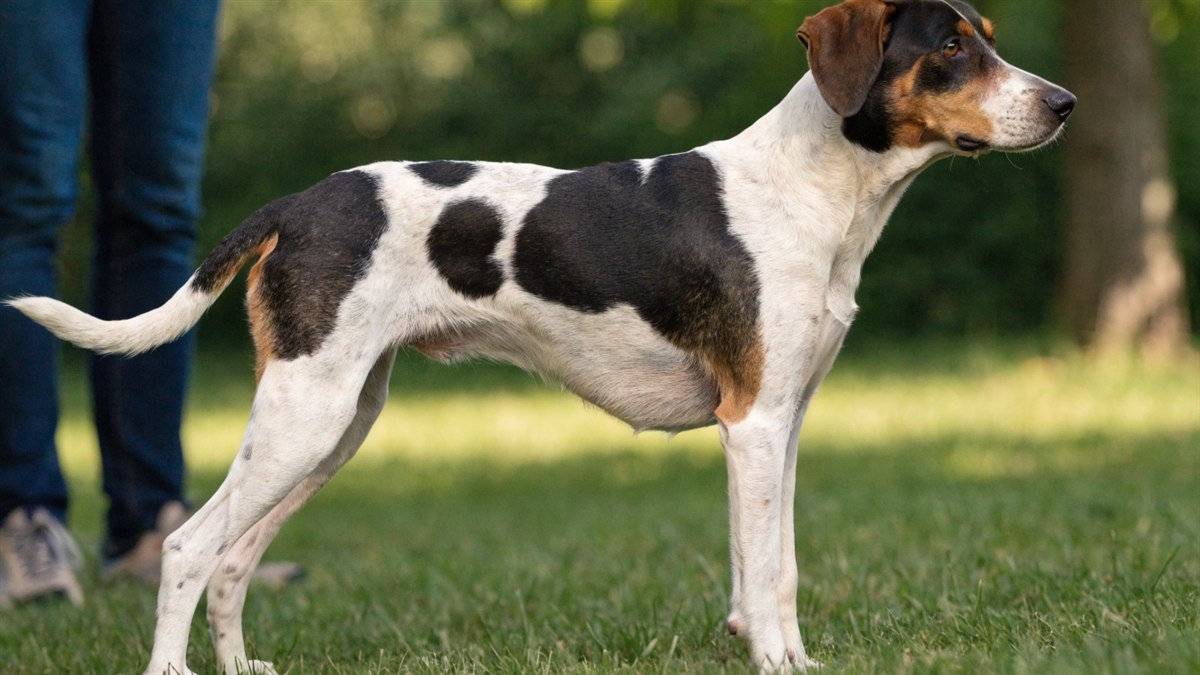
FCI-Standard N° 325 describes a balanced and solidly built dog, but without heaviness, whose profile should lean towards that of a well established French hound. The head is elongated and not too broad, the muzzle moderately elongated and a little pointed, the eyes big and brown with a soft but lively expression, and the neck clean and without dewlap. The ears are the feature a buyer notices first: finely attached below the eye level line, flexible, slightly turned, of medium width, and long enough to reach at least within two fingers of the border of the nose. Those are genuinely pendulous leathers, and in an Indian monsoon they become the single most expensive part of the dog.
The coat is short, dense and smooth. Three colours are permitted and each carries its own nose pigment. Tricolour is white and black with bright tan markings and a black nose. White and black with pale tan markings also takes a black nose. The bicolour is white and orange with a brown, tobacco-coloured nose.
| Point | What the standard says |
|---|---|
| Standard number | FCI-Standard N° 325, English text dated 28.04.1997 |
| Official valid standard published | 26 January 1983 |
| Group and section | Group 6 Scenthounds, Section 1.2 Medium-sized Hounds, with working trial |
| Utilization | Scenthound for hunting small game |
| Height at the withers | 48 to 56 cm, with 2 cm tolerance either way for exceptional subjects |
| Weight | Not given. The standard sets no weight at all |
| Coat | Short, dense and smooth |
| Ears | Set below eye level, reaching at least within two fingers of the nose |
| Colours | Tricolour; white and black with pale tan; white and orange with tobacco nose |
Read that weight row again, because it matters later. No weight appears anywhere in the FCI standard. The Société Centrale Canine, the national kennel club of the country of origin, prints the breed's weight field as NP, not provided. The United Kennel Club standard gives a height and no weight either. Every kilogram figure you will read about this breed online came from somewhere other than a breed standard, and the sources that publish one do not agree with each other.
Where the breed came from
Great Britain and France are the two famous cradles of hounds for the hunt, and this breed is the logical continuation of centuries of exchange between the veneurs of the two countries. The United Kennel Club dates the crossing of English hounds with French hounds to somewhere around the 16th century. The specific crosses behind the modern breed are recorded as the Harrier with the Poitevin, the Porcelaine, the Petit Gascon Saintongeois and the Petit Bleu de Gascogne, and before 1978 the dog was simply called the Petit Anglo-Français.
Recognition came late and grudgingly. The Société Centrale Canine records that the Anglo-Français was long treated as a pariah by many French dog people, and that it took until 1978 for the Centrale Canine to recognise a standard, under the impetus of Dr Emile Guillet and a group of enthusiasts. Royal Canin repeats the same history in English, noting that the breed was caught for centuries in the middle of a disagreement between dog fanciers. FCI recognition followed five years later, in 1983. The United Kennel Club recognised the breed on 1 January 1996 and places it in the Scenthound Group.
What it is used for today
The Société Centrale Canine describes a working dog in current employment rather than a heritage curiosity. Hare hunters, louvetiers and gun hunters all use the breed regularly, and it works on the trail of hare and on the trail of wild boar. Its temperament, in the SCC's words, is energetic, resistant, powerful and fast, with a combative side that makes it back down from nothing, and adaptability that lets it work every kind of terrain.
The Continental Kennel Club is blunter about what that means for a household. It records that these dogs are still bred for the sole purpose of hunting throughout much of the French countryside, which makes them much too instinctual and highly driven for a general companion dog. That is a registry, not a critic, and it is describing the breed in its own studbook.
The American Kennel Club does not recognise this breed, so there is no AKC breed page, no AKC popularity rank and no AKC parent club health panel to quote. If a listing anywhere claims an AKC-registered Anglo-Français de Petite Vénerie, the claim is false on its face.
One more piece of vocabulary before the rest of the page makes sense. A pack hound is a dog selected to work as one voice in a group of twenty or more, taking direction from the trail rather than from a handler. A scent hound is a dog that hunts by nose rather than by sight. This breed is both, and the two together explain the recall problem, the noise, the kennel housing and the total absence of an Indian market.
The name says small game, not small dog
The word petite in this breed's name describes the quarry it hunts, not the size of the dog. FCI-Standard N° 325 states the utilization in four words, scenthound for hunting small game, and then gives a height at the withers of 48 to 56 cm. If you correct nothing else on this page, correct that.
This is the single most useful thing an English reader can learn about the breed, because the mistranslation is not confined to blogs. It sits inside registry-grade sources, it produces height figures that contradict the breed standard outright, and it puts photographs of a different dog at the top of the search results.
What the FCI itself calls the breed in three other languages
The Fédération Cynologique Internationale publishes the standard in four languages, and French is the official authentic one. Look at how the FCI's own translators handled the name.
| Language | Official FCI name | What it says about size |
|---|---|---|
| Français | Anglo-Français de Petite Vénerie | Silent on the dog; petite attaches to vénerie |
| English | Medium-Sized Anglo-French Hound | Medium |
| Deutsch | Mittelgrosser Anglo-Französischer Laufhund | Medium, mittelgross |
| Español | Sabueso Anglo-Francés de Tamaño Mediano | Medium, tamaño mediano |
Three independent translations by the registry that owns the standard, and every one of them says medium. Not one says small. Royal Canin, which states that its key facts come from the FCI, files the breed under Medium-Sized Anglo-French Hound on both its United Kingdom and its India pages and rates the size category as Medium. The United Kennel Club standard opens by calling it a medium sized, well balanced and solidly built hound.
The FCI's own filing system settles it
The FCI does not sort scent hounds by opinion. Section 1 of Group 6 is split into 1.1 Large-sized Hounds, 1.2 Medium-sized Hounds and 1.3 Small-sized Hounds, and every breed sits in exactly one of them. This breed is filed in 1.2, Medium-sized Hounds, alongside the Harrier, the Beagle-Harrier, the Ariégeois and the Porcelaine. The Beagle and the Basset Hound are filed one shelf down, in 1.3 Small-sized Hounds.
Put the two standards side by side and the size question stops being arguable. FCI-Standard N° 161 gives the Beagle a desirable minimum height at the withers of 33 cm and a desirable maximum of 40 cm. FCI-Standard N° 325 gives this breed 48 to 56 cm. The shortest legal Anglo-Français de Petite Vénerie is 8 cm taller at the shoulder than the tallest legal Beagle, and the tallest is 16 cm taller, which is a 40 percent difference in height between the two maxima.
A Beagle stands at about knee height on an adult. This breed stands at roughly mid-thigh. If a seller shows you a dog you could pick up comfortably with one arm, you are not looking at an Anglo-Français de Petite Vénerie.
Petite vénerie is a kind of hunting, and France defines it
Vénerie is hunting with a pack of hounds, and French practice splits it in two. The French Senate's 2023 report on hunting with hounds sets out the distinction in one sentence: grande vénerie is practised on horseback and hunts the stag, the roe deer or the wild boar, and petite vénerie is practised on foot and has for its object the fox, the hare and the rabbit. The division is by quarry and by mode of pursuit. Nowhere in it does the height of the dog appear.
The FCI proves the same point internally, using nothing but its own documents. Compare the utilization lines of two standards from the same family, published by the same registry.
| FCI standard | Breed | Utilization, verbatim | Height at the withers |
|---|---|---|---|
| N° 325 | Anglo-Français de Petite Vénerie | Scenthound for hunting small game | 48 to 56 cm |
| N° 322 | Grand Anglo-Français Tricolore | Scenthound | 60 to 70 cm |
| N° 323 | Grand Anglo-Français Blanc et Noir | Pack Hound for big game | 65 to 72 cm male, 62 to 68 cm female |
| N° 324 | Grand Anglo-Français Blanc et Orange | Scenthound | 60 to 70 cm |
Standard 325 says small game. Standard 323 says big game. That is petite vénerie and grande vénerie written into the registry's own paperwork, and it is the cleanest available proof that the word describes the hunt.
Where the mistranslation still lives
Three failures are visible in the current search results for this breed, and none of them is a small blog.
- A registry publishes the wrong name as an official alias. The Continental Kennel Club lists *Small French-English Hound* under the heading Breed Name Aliases in its own breed standard, even though the same page rates the breed's size as Medium and its history paragraph calls it a medium-sized pack hound. The page contradicts itself in two places.
- A ranking retailer directory prints a height that cannot be right. Care-A-Lot Pet Supply, which appears on the India results for this breed, titles it Small French-English Hound and gives Height: 16 to 18 inches. That is 40.6 to 45.7 cm. The FCI floor is 48 cm before its 2 cm tolerance is applied. The published band does not overlap the breed standard at any point.
- The top informational article illustrates a different breed. Dogster gets the correction right in the text, stating plainly that the petite portion of the name comes from the fact that these dogs hunt small game. Its lead photograph is captioned Great Anglo-French Tricolour Hound and its second is the Great Anglo-French White and Black Hound. Those are FCI 322 and FCI 323, both large-sized hounds standing 60 to 72 cm Fédération Cynologique Internationale.
The Care-A-Lot entry is worth one more paragraph, because the error runs deeper than a wrong number. Its physical description reads: a moderate head with a broad muzzle and flat occiput, a short bridge of the nose, lips extending over the lower jaw and giving the muzzle a somewhat square shape, big brown and dark eyes, a straight neck with a slight dewlap, and colours of white-lemon or white-orange. Now read FCI-Standard N° 324 for the Grand Anglo-Français Blanc et Orange: head quite short and broad, skull rather broad and flat without occipital protuberance, bridge of nose rather short, lips extending over the lower jaw and giving the muzzle some squareness, eyes big brown and dark, neck straight with slight dewlap, colour white-lemon or white-orange. It is the same document.
Standard 325 asks for the opposite dog on three of those points. Its head is elongated, not too broad, its muzzle is moderately elongated and a little pointed, and its neck is clean without dewlap, with dewlap listed among the faults. A page ranking in India for this breed is describing a 60 to 70 cm hound under the name of a 48 to 56 cm one, and then attaching a 16 to 18 inch height that belongs to neither.
And what about Grand
One popular explanation of the family's naming deserves a check rather than a repeat. Wikipedia states that Grand, French for large, does not mean the dogs are especially large but rather that they hunted in large packs. Whatever the historical origin of the word, the claim does not describe the modern breeds. The three Grand Anglo-Français standards set heights of 60 to 70 cm, 65 to 72 cm and 60 to 70 cm, against 48 to 56 cm here Fédération Cynologique Internationale Fédération Cynologique Internationale. Today the Grands really are 12 to 16 cm taller at the shoulder, and Bonbeno prints the disagreement rather than picking the tidier story.
Petite vénerie means hunting hare, rabbit and fox on foot. Grande vénerie means hunting stag, roe deer and wild boar on horseback. The dog in this breed's name is medium-sized in the FCI's own filing, and it is the smallest of the four Anglo-French hounds only in the sense that the other three are large.
Registry recognition, and the studbook numbers nobody quotes
Four registries recognise the Anglo-Français de Petite Vénerie and the American Kennel Club is not one of them. The Société Centrale Canine accepted a standard in 1978, the Fédération Cynologique Internationale recognised the breed on a definitive basis on 26 January 1983 as number 325, the United Kennel Club recognised it on 1 January 1996, and the Continental Kennel Club files it in its Breed Group 7.
That FCI listing matters more than it looks, and it is the one thing that separates this breed from most of the rare hounds Bonbeno has covered. The Kennel Club of India is the FCI's national canine organisation for India, and the FCI publishes its registration statistics. A breed with an FCI number therefore has a theoretical KCI pedigree route in a way that an American coonhound, which appears nowhere in the FCI nomenclature, does not. The route exists on paper. Nothing is travelling down it, and the rest of this section explains why.
How many of these dogs France actually registers
The Société Centrale Canine publishes an annual studbook table by breed, and its Statistiques LOF 2025 gives the real number: 147 Anglo-Français de Petite Vénerie entered the French studbook in 2025, up from 125 in 2024, an increase of 18 percent. Of those, 76 were confirmed, a confirmation rate of 52 percent. Confirmation is the French adult conformation assessment that makes a dog definitively LOF, and a 52 percent rate is unusually high, because most pet owners never bother. On the same page the Beagle's confirmation rate is 27 percent and the Golden Retriever's is 11 percent. That gap is the signature of a working breed whose owners are hunters rather than pet buyers.
The comparison inside Group VI, the French scent hound group, is where the numbers become genuinely surprising.
| Breed | LOF 2024 | LOF 2025 | Change |
|---|---|---|---|
| Beagle | 3,514 | 3,089 | -12 percent |
| Griffon Nivernais | 583 | 571 | -2 percent |
| Beagle-Harrier | 478 | 440 | -8 percent |
| Porcelaine | 326 | 384 | +18 percent |
| Ariégeois | 242 | 227 | -6 percent |
| Anglo-Français de Petite Vénerie | 125 | 147 | +18 percent |
| Grand Anglo-Français Tricolore | 65 | 0 | no registrations |
| Grand Anglo-Français Blanc et Noir | 33 | 0 | no registrations |
| Grand Anglo-Français Blanc et Orange | not listed | not listed | no registrations |
| Group VI total | 12,894 | 11,720 | -9 percent |
Read the bottom half of that table slowly. In a year when the whole French scent hound group fell 9 percent, this breed rose 18 percent and the three Grand Anglo-Français breeds recorded no French studbook registrations at all. The Anglo-Français de Petite Vénerie is now the only Anglo-French hound entering the LOF in numbers. Whatever the mistranslation implies about it being the runt of the family, in registration terms it is the survivor of it.
A discrepancy Bonbeno cannot resolve, so it prints it
Two authoritative documents disagree about the Grand Anglo-Français Blanc et Noir. FCI-Standard N° 323, drafted in 2007 by the president of the Club du chien d'ordre and published in 2008, states that the breed counts approximately 2,000 subjects with around 200 births per year and makes up the packs of twenty or more deer hunts and one stag hunt. The SCC's 2025 studbook table records zero registrations for the same breed.
The likely reconciliation is that working pack hounds are not always entered in the LOF, so a large kennel population can coexist with a near-empty studbook line. Neither document says so, and Bonbeno will not assert a mechanism that no source states. What the pair of figures does establish, beyond argument, is that studbook counts and pack populations are different things for this family of breeds, and any page quoting one as the other is misleading you.
What this means at the Indian end
The Kennel Club of India registered 33,880 pure-bred dogs with its studbook in 2025, down from 38,592 in 2024 and from a 2021 peak of 89,571. It lists 80 member clubs and 342 individual members. There is no Indian breed club for the Anglo-Français de Petite Vénerie, no Indian breeder, and no Indian litter to register.
So the FCI route is real and empty at the same time. To use it, a dog would have to be bred in France by a registered breeder, entered in the LOF, exported with a full export pedigree, imported into India lawfully, and then registered with the KCI as an import. Every step of that chain exists. The first step alone produces 147 puppies a year for a French hunting community of roughly 10,000 veneurs and more than 30,000 working hounds Société Centrale Canine, and those puppies are spoken for inside that community before they are born.
A genuine pedigree for this breed will name the Société Centrale Canine and an LOF number, or the United Kennel Club. It will not name the American Kennel Club, because the AKC does not recognise the breed. Treat any AKC claim as disqualifying and stop the conversation there.
Anglo-Français de Petite Vénerie price in India: there is none
There is no Anglo-Français de Petite Vénerie price in India, because there is no Indian market for the breed to set one. Bonbeno searched for the exact term from an India location on 19 August 2026, opened every result that loaded, and found not one dog of this breed offered for sale anywhere in the country. No Indian page publishes a rupee figure for it either, which is unusual, because Indian price pages usually invent one.
That absence is the answer, and it is more useful than any number would be. What follows is the evidence, so you can check it yourself rather than take our word for it.
What the Indian search results actually contain
Bing India, with country and region set to India, returns about 1,730 results for the query anglo francais de petite venerie price in india. Here is the whole of the first page, in order.
| Position | Domain | What it actually is |
|---|---|---|
| 1 | amazon.in | A German-language dog care ebook about the breed |
| 2 | whatsthecost.in | French Bulldog Price in India 2026: Rs 25,000 to Rs 60,000 |
| 3 | priceinindia.website | A general shopping price-comparison homepage |
| 4 | amazon.in | An English activity and tricks book about the breed |
| 5 | liquorsprices.com | Get Liquors Price List in India 2026, whisky, vodka, rum, beer |
| 6 | pricee.com | Fragrances Price List in India |
| 7 | cheapestinindia.com | Indian shopping search and price history tracker |
| 8 | pricehunt.com | Compare prices and find the best deals in India |
| 9 | antiquitywhisky.in | Latest alcohol price list in India 2026 |
| 10 | amazon.in | The same German ebook, served in the Hindi locale |
Bing itself flags the problem. It prints its own Missing: anglo francais notice against seven of those ten results, meaning it could not match the breed name and fell back on the words price and India. Three of the ten are books. Two are liquor price lists. The nearest thing on the page to a dog price is a French Bulldog. Not one result offers an Anglo-Français de Petite Vénerie, and the first pull found no People also ask box. A rendered Google India result on 18 September 2026 did carry one, 4 questions, none of them about this breed, which the FAQ below records.
Google India could not be checked. A stealth-proxied request for the breed name with gl=in and hl=en returned HTTP 429 and the unusual-traffic interstitial at 18:39:35 UTC on 19 August 2026 rather than a result page, so Bonbeno records no Google finding here rather than a guessed one.
The India-located organic search for the same term returns a cleaner but equally empty picture: Wikipedia first, a YouTube breed profile second, the United Kennel Club standard third, the Continental Kennel Club fourth, a US pet-retailer directory fifth, and an Amazon.in book sixth. The first six results contain three registries, one encyclopedia, one video and one book. They contain zero puppies.
The Indian price list that should have it, and does not
Supertails publishes India's most-cited dog price guide, covering the top 40 breeds with prices, monthly costs and city-wise variation, updated in March 2026. Searched in full, that page contains zero occurrences of the word Anglo, zero occurrences of Vénerie and zero occurrences of Foxhound. India's benchmark price list does not carry a single Anglo-French hound of any kind. Neither do the other Indian price aggregators that rank for the query, because they are not about dogs at all.
The one page on an India-facing domain that covers this breed is Royal Canin India's breed entry, filed under the name Medium-Sized Anglo-French Hound. It carries a size category, a life expectancy and three temperament words. It carries no price, no availability, no breeder and no Indian source of any kind. That page is the entire Indian web presence of this breed, and it is a pet-food company's encyclopedia entry.
What you are actually being offered
When a breed has no market, the search results fill with substitutes. For this breed the substitutes are unusually honest, because nobody has bothered to build a fake listing. You are being offered four things, and none is a dog you can buy in India.
- Books. Three of the ten Bing India results are print-on-demand titles on Amazon.in, one of them in German.
- A different breed's price. The second result is a French Bulldog price page quoting Rs 25,000 to Rs 60,000, matched purely on the words price and India.
- Unrelated price lists. Liquor, fragrances and general shopping comparison sites, all flagged by Bing as missing the breed name.
- An international marketplace with no Indian stock. Wuuff's puppies-for-sale page for the breed explains that price depends on show potential, bloodline and health screenings, and lists nothing in India.
Why Bonbeno prints no rupee figure
We could produce a plausible number in thirty seconds by taking the Beagle's Indian band and adjusting it for size. We will not, and you should distrust any page that has. A price is a record of transactions, and there are no transactions to record. The Beagle has a genuine Indian price band because Indian breeders genuinely sell Beagles; four Indian sources publish detailed bands for it and disagree by Rs 60,000 at the ceiling. That disagreement is informative precisely because there is a real market underneath it. Here there is nothing underneath, so a number would be fiction dressed as research.
The only published purchase context that exists for this breed anywhere is European and vague. Zoomalia, a French pet retailer, publishes a full care article on the breed with feeding quantities and litter sizes and gives no purchase price at all. Even in the country of origin, this dog is not priced as a commodity, because it moves inside hunting equipages rather than through a puppy market.
A seller in India quoting a rupee figure for this breed is selling you something else. Ask for the LOF or UKC registration number, the export pedigree, the DGFT import authorisation and the airway bill. Verify each one independently before any money moves. In practice the paperwork will not exist, because as the next section shows, no lawful route brought that dog here.
Indian import rules, and why no supply chain can form
Indian import rules make a commercial trade in this breed unlawful, and that single fact explains the empty search results better than any market analysis. Dogs are a Restricted import under India's tariff schedule, entry is permitted for exactly three purposes, and breeding and trading are not among them. Read the notice yourself rather than any summary of it, including this one.
The governing document is Trade Notice No. 22/2022-23, Guidelines for import of Pet Animals, issued by the Directorate General of Foreign Trade in the Ministry of Commerce and Industry on 19 December 2022 and signed by Md. Moin Afaque, Deputy Director General of Foreign Trade.
The policy conditions, in the notice's own words
Dogs fall under ITC (HS) 01061900, described as Mammals, Other, with an import policy of Restricted and subject to Policy Condition 6 of that chapter. Two further conditions do the real work.
| Condition | What it permits or forbids |
|---|---|
| Policy Condition 7 (i) | A pet dog with a valid pet book and relevant records or documents in the name of the importer |
| Policy Condition 7 (ii) | Dogs imported by R&D organisations for research, with the recommendation of CPCSEA |
| Policy Condition 7 (iii) | Dogs for internal security by the Defence and Police Force |
| Policy Condition 8 | Import of commercial dogs for breeding or any other commercial activity other than the purposes mentioned above is not permitted |
Paragraph 6 of the notice removes any remaining ambiguity: any applications for trading or breeding purposes, or applications made on behalf of some another person or entity, shall be duly rejected. Not discouraged, not conditional. Rejected.
The one lawful route, in full
That leaves exactly one door, and it is narrow. A permanent import may travel as passenger baggage without a DGFT authorisation only where the person is transferring their residence to India after two years of continuous stay abroad, only cats and dogs qualify under the baggage rules, and only up to two pets. A DGFT import authorisation becomes necessary if the continuous stay abroad was less than two years, or the pet is not travelling as passenger baggage, or the pet cannot be imported under the baggage rules at all. More than two pets always requires an authorisation, and the application is examined on its justifications by the Department of Animal Husbandry and Dairying before any authorisation is granted.
The rest of the process is procedural and unforgiving on timing.
- Documents for a permanent import. A vaccination book, pet passport or pet book; a certificate for emotional support; and the passport of the pet.
- Application. Submitted as ANF-2M of the Foreign Trade Policy against the applicant's Importer Exporter Code, or against the permanent IEC number IIHIE0153E reserved for persons importing goods for personal use not connected with trade.
- Lead time. Pet owners are advised to start the authorisation process at least two months before travel.
- Advance NOC. A No Objection Certificate from the Regional or Quarantine Officer of the Animal Quarantine and Certification Service, obtained seven days before the date of travel, relaxable up to three days depending on circumstances, after submitting the DGFT licence and a health certificate from a veterinarian in the exporting country.
- Ports. Entry is permitted only through the airports and seaports of Delhi, Mumbai, Chennai, Hyderabad, Bengaluru and Kolkata and, since October 2024, Kochi airport, with quarantine at the government quarantine station of those ports where required Department of Animal Husbandry….
Why this ends the question
Put the import policy next to the French studbook numbers and the market becomes impossible rather than merely absent. France produced 147 registered puppies of this breed in 2025 for a hunting community of roughly 10,000 veneurs Sénat de la République française. India permits no commercial or breeding import of dogs at all. Neither end of the chain can supply the other, so the chain never forms.
The practical consequence is worth stating plainly, because it decides everything downstream on this page. The only Anglo-Français de Petite Vénerie that can lawfully be in India is one person's accompanied pet, imported in their own name after two years abroad. That dog cannot be bred from commercially, cannot found a population, and will not produce a second Indian generation. It follows that there is no Indian breeder to buy from, no Indian rescue to adopt from, and no Indian veterinary experience of the breed to draw on.
Nothing here is a moral judgement on wanting the breed. It is a description of the paperwork. If you are returning to India from France or Belgium after two years and already own one of these hounds, the route above is yours and it works. If you are in India now and want to acquire one, there is no lawful way to do it, and the rest of this page is written so you can decide what you actually want instead.
Monthly cost of keeping one in India, if one is here
No Indian monthly cost figure for this breed rests on an actual Indian Anglo-Français de Petite Vénerie, because there are none to survey. What can be reasoned honestly is the cost structure, and it is unusual: this is a dog whose grooming bill is close to zero and whose real spending sits in three places that no Indian pet cost list carries.
Start with the only sourced Indian anchor. Supertails, India's most-cited dog cost guide, puts the average monthly maintenance cost of a dog in India in 2026 at Rs 3,000 to Rs 11,000, and monthly upkeep at Rs 3,000 to Rs 18,000 depending on breed size and grooming needs, with a first-year budget of Rs 80,000 to Rs 2,00,000 including purchase, vaccinations, food, training and supplies. Those bands cover the 40 breeds Indians actually keep. This breed is not among them, so treat them as the shape of the problem rather than its answer.
Where the money does not go
Grooming, first, because it is genuinely cheap. The coat is short, dense and smooth, and weekly brushing is enough to keep it in condition. There is no professional grooming appointment in this dog's life, no clipping, no de-shedding package and no coat product. On a page about a hound in India that is worth saying twice, because it is the one line item where this breed is cheaper than a Golden Retriever or a Shih Tzu.
Food is moderate rather than large. Zoomalia publishes a standard daily ration of 350 grams, dropping to 280 grams for a neutered female and rising to 455 grams for a dog in hunting season or under high physical activity. That is a retailer's feeding guide for a French working dog, not a study, and Bonbeno flags it as such. At Indian dry-food prices it puts this dog in the same food bracket as a Labrador rather than a Great Dane.
Where the money actually goes
Three line items dominate, and only one of them is a recurring bill.
| Line item | Why it exists for this breed | Published Indian figure |
|---|---|---|
| Secure containment | The Société Centrale Canine says the breed loves open space, needs room, can live in a large kennel in a pack, and is unsuited to city life. A scent hound on a trail leaves. | None exists. This is a one-off construction cost, not a monthly one |
| Ear care through the monsoon | The standard asks for leathers reaching nearly to the nose. Pendulous-eared breeds accounted for 69.13 percent of Indian otitis externa cases in a Himachal Pradesh series | None exists for this breed. Budget vet visits, not products |
| Tick-borne disease prevention | Half of Indian dogs surveyed across four cities carried at least one tick-borne pathogen. A dog exercised in vegetation is the exposed case | None exists for this breed |
| Food | 350 g a day standard, up to 455 g on heavy work days, per a French retailer's guide | No breed-specific Indian figure. Supertails' Rs 3,000 to Rs 11,000 all-breed monthly band is the closest anchor |
| Grooming | Short, dense, smooth coat. Weekly brushing | Effectively nil |
| Lawful import | DGFT authorisation, AQCS advance NOC, quarantine where required, airline crate, exporting-country health certificate | No published total. Bonbeno will not estimate one |
Take the ear line seriously, because it is the one that turns into a bill. A Himachal Pradesh hospital series screened 2,476 dogs between June 2022 and July 2023 and diagnosed 81 with otitis externa. The paper attributes most of those cases to pendulous-eared breeds, but its own drop-ear figures do not agree with each other (53 of 81 is 65.4 percent, not the 69.13 percent it prints, and 53 plus its 25 erect-eared cases is 78, not 81), so Bonbeno publishes no drop-ear percentage from it; its seasonal figure does survive a calculator, with 48 of the 81 cases, 59.25 percent, presenting in the July to August rainy season. A much larger North American study of 8,975 dogs found the same pattern from the other direction: dogs with pendulous ears and heavy ear canal hair had significantly more otitis externa than other ear types, and monthly variation in ambient temperature, rainfall and relative humidity largely explained monthly variation in prevalence. India supplies all three of those variables at once for four months a year.
The tick line is the same kind of structural cost. A survey of 525 dogs across four Indian cities found 261, or 49.7 percent, infected with at least one canine tick-borne pathogen, and potential tick vectors present on 278 dogs, 53 percent of those examined. Those are ordinary city dogs. A hound whose exercise requirement can only be met in grass and scrub is the higher-exposure case, not the lower one.
The cost nobody can price
The Société Centrale Canine records, without hedging, that the breed's pack history and selection make it a very noisy animal and that it is a breed unsuited to city life. In India there is no legal shortcut around that. The Prevention of Cruelty to Animals (Dog Breeding and Marketing) Rules, 2017 place de-barking in the same prohibited list as tail docking and ear cropping, and forbid it outright. The residential ambient noise standard is 45 dB(A) Leq between 10 p.m. and 6 a.m., and a neighbour may complain to the designated authority when levels exceed the standard by 10 dB(A) or more.
So the true cost of this breed in an Indian flat is not a monthly number. It is a housing decision made before the dog arrives, and if it is made wrongly the outcome is a rehomed dog rather than a larger bill.
Every competing page that publishes a monthly rupee total for a breed with no Indian population has made it up. We could produce one from the Beagle's figures in a minute and it would look exactly as credible as theirs. The honest statement is that the cost structure above is real and the arithmetic on top of it does not exist yet.
Heat tolerance in India: Bonbeno rates this breed 2 of 5
Bonbeno rates the Anglo-Français de Petite Vénerie 2 of 5 for heat tolerance in Indian conditions, and the two halves of that score point in opposite directions. The anatomy is genuinely well suited to a hot country. The purpose is not, and the published evidence says purpose beats anatomy.
The half that helps: a lean, short-coated, normal-muzzled dog
Read the standard as a thermoregulation document and it reads well. The coat is short, dense and smooth, with no undercoat described anywhere. The build is balanced and solidly built, but without heaviness, which is a lean athletic frame rather than a mass of insulating muscle. The muzzle is moderately elongated, so the dog is mesocephalic, with a full-length nasal passage and a functioning panting apparatus.
That last point carries more weight than the coat does. In the largest primary-care study of canine heat-related illness ever published, covering 905,543 dogs under veterinary care at 886 UK clinics, brachycephalic dogs had greater odds of all three types of heat-related illness compared with mesocephalic dogs. Flat-faced breeds are the population that cannot cool themselves. This hound is firmly on the right side of that line, and it beats a Pug, a French Bulldog or a Shih Tzu in an Indian summer without effort.
On construction alone the breed would score 4 of 5. It does not, and the reason is what the dog is for.
The half that cancels it: this breed exists to run
The same study deconstructed what actually triggers heat illness in dogs, and the answer surprises most owners. Of 1,259 heat-related illness events, 380 had no trigger recorded. Of the remaining 879, 652 events, or 74.2 percent, were exertional, against 113 environmental events at 12.9 percent and just 46 from vehicular confinement at 5.2 percent. Exertional heat-related illness occurred year-round and carried a 7.6 percent fatality rate.
One line buried in the results deserves to be on the front of every Indian breed page. Of the 652 exertional events, the type of exercise was specified for 551. Three hundred and seventy-two of those, 67.5 percent, followed walking, and only 97, 17.6 percent, followed high-intensity activity. Two thirds of exertional heat illness in that dataset was not a dog racing. It was a dog on a walk.
And lean does not save you. Seven breed types showed greater odds of exertional heat-related illness than the Labrador Retriever, and the list is Chow Chow, Bulldog, French Bulldog, Greyhound, English Springer Spaniel, Cavalier King Charles Spaniel and Staffordshire Bull Terrier. The Greyhound is on that list. There is no leaner, shorter-coated, more purpose-built running dog in the domestic species, and it still carried raised odds. Short coat and low body fat are not the protective factors buyers assume they are.
A dog that will not stop is the risk factor. The Société Centrale Canine describes this breed as energetic, resistant, powerful and fast, with a combative side that makes it back down from nothing. A scent hound working a trail is not monitoring its own temperature, and you cannot cool a dog that is still running.
What Indian heat actually looks like
India's heat season is long and the criteria are published. The India Meteorological Department declares a heat wave when a station's maximum temperature reaches at least 40 C in the plains or at least 30 C in hilly regions, and heat waves in India typically run from March to June, in rare cases extending into July, with an average of five to six heat wave events a year over the northern parts of the country and May as the peak month. That is a four-month window in which a running hound simply cannot be exercised in daylight, followed immediately by a monsoon in which humidity blocks the evaporative cooling that panting depends on.
A workable Indian schedule for this breed looks like this, and it is not negotiable in summer.
- Run before first light. The pre-dawn hour is the only genuinely cool window in an Indian plains summer.
- Run again after full dark. Surface temperature, not air temperature, is what burns pads and radiates upward at a dog's height.
- Cancel, do not shorten. On a declared heat wave day, substitute indoor scent work rather than a reduced walk. Two thirds of exertional heat illness followed a walk.
- Carry water and wet the dog, not just offer it. Cool the coat before the dog signals distress rather than after.
- Treat the monsoon as its own problem. High humidity is worse for a panting dog than dry heat at the same temperature, and it is also the ear season.
The kennel question, and an Indian rule almost nobody cites
This breed is conventionally housed outdoors. The Société Centrale Canine says it can live in a large kennel in a pack so that each dog has its own territory, and that apartment living is not made for it. Indian law has something specific to say about that arrangement.
The Prevention of Cruelty to Animals (Dog Breeding and Marketing) Rules, 2017 provide that certain categories of dog shall not be kept in outdoor facilities unless the practice is specifically approved by the attending veterinary practitioner in writing, and the first two categories named are dogs that are not accustomed to the temperatures prevalent in the area or region in question, and dog breeds that cannot tolerate the temperatures prevalent in the area or region. A hound imported from northern France is category one by definition. Where outdoor housing is used, the rules require shelters with a roof, four sides and a floor giving protection from heat and from the direct rays of the sun, plus one or more separate outside areas of shade large enough to hold every dog at once.
Read together, those provisions say that an Indian owner cannot simply put this dog in a run and call it traditional husbandry. The written veterinary sign-off is part of the law, and getting it means a vet has looked at your specific compound in your specific city.
Where in India it would be least bad
Nowhere in the Indian plains is good for this breed in April, May or June. The IMD's own criterion draws the only useful line available: heat wave thresholds are set 10 C lower for hilly regions than for the plains, at 30 C against 40 C. A hill station or a Himalayan-foothill district gives a running hound materially more usable hours in the year than Delhi, Nagpur or Hyderabad does. Coastal cities trade extreme daytime maxima for sustained humidity, which helps the thermometer and hurts the panting.
None of that makes the breed suitable. It makes some Indian places less unsuitable than others, which is a different and much smaller claim.
Temperament, and who should not want one
The Anglo-Français de Petite Vénerie temperament is the best thing about the breed and the least relevant to whether an Indian household should keep one. Every source agrees it is friendly, non-aggressive and good with children. Nobody rejects this dog on temperament, and almost every household that should reject it will do so for reasons that have nothing to do with how nice it is.
What the registries and the country of origin say
The Société Centrale Canine describes the breed in one dense paragraph: energetic, resistant, powerful, fast, with a combative side that makes it back down from nothing, and great adaptive faculties that let it work every kind of terrain. Then it adds an unexpected pairing. The dog is obedient but timid, so its education must remain firm, and it is sociable with children and with other animals, provided those animals are not assimilated to game.
That parenthesis is the whole household-fit question in six words. FCI-Standard N° 325 lists only two disqualifying faults, and both are behavioural: aggressive or overly shy dogs, and any dog clearly showing physical or behavioural abnormalities. A correct specimen of this breed is neither aggressive nor fearful.
The Continental Kennel Club's temperament clause is the most useful English description in print, because it says the quiet part. These dogs are wonderful around people and are highly driven and exceptionally instinctual. They are still bred for the sole purpose of hunting throughout much of the French countryside, which makes them much too instinctual and highly driven for a general companion dog. Paired with a well-suited home and an active owner, some are reported to be even-tempered, intelligent, friendly, eager and people-oriented, so long as there is not anything around to catch the attention of their noses.
The pack, and what it means in an Indian flat
This is a pack hound in the literal sense. Anglo-French and French hound breeds are usually kept in packs of 20 to 100 dogs, and individual hunting hounds of these breeds are not well suited to be pets because they need a great deal of space, exercise and experienced handling. Zoomalia puts the emotional consequence plainly: used to pack life, this dog cannot stand being excluded from its group.
Translate that into an Indian two-bedroom flat with both adults at work. You have a socially dependent pack animal alone for nine hours a day, in a building with shared walls, belonging to a breed the national kennel club of its own country calls very noisy. That is not a training problem you can solve later. It is the wrong animal in the wrong container.
Prey drive is the deal-breaker for most Indian homes
The prey drive here is not a quirk, it is the selected trait, and two independent sources describe the same failure mode. Dogster warns that the strong desire to chase and hunt makes this a dog you would not want in a home with smaller animals such as cats, birds or rodents. Zoomalia states flatly that it does not get along with cats, which it sees more as prey.
Indian households are unusually exposed to this. Free-roaming cats, poultry in semi-rural compounds, pigeons on balconies and squirrels in every garden are all normal Indian background, and none of them reads as background to a hound bred for small game.
Who this breed suits and who it does not
| Household | Fit | Why |
|---|---|---|
| Semi-rural home, walled compound, another dog, an owner who runs | The only good fit | Space, company and a job. The SCC says the breed loves open spaces and needs room |
| Apartment in any Indian metro | No | The SCC states that apartment living is not made for it and calls the breed unsuited to city life |
| Family with young children | Good, on temperament alone | Sociable with children per the SCC, gentle and sweet with children per Dogster Chantelle Fowler |
| Home with a cat, rabbit, poultry or birds | No | Sees them as prey Chantelle Fowler |
| First-time dog owner | No | Needs experienced handling and firm education |
| Elderly or low-mobility owner | No | Zoomalia says its energy makes it not at all suitable for an elderly person |
| Household empty all day | No | Cannot stand being excluded from its group |
| Anyone wanting a guard dog | No | Non-aggressive by breeding, and aggression is a disqualifying fault |
The independent streak, described accurately
Calling this dog independent is correct but often misunderstood. It does not mean aloof or uninterested in people; every source describes an affectionate, people-oriented animal. It means the dog was selected for centuries to make its own decisions on a trail, at distance, without instruction. Dogster records a stubborn streak that can make living alongside them challenging at times, and notes they can be one-track-minded and easily distracted by scents.
You will need to socialise the dog broadly and early to Indian street noise, traffic, crowds, cattle, other dogs and children, because a timid hound in a loud country is a fearful hound. Socialisation is easy in this breed and worth doing properly. What socialisation will not touch is the nose, and that is the next section.
Training: everything is learnable except recall
To train an Anglo-Français de Petite Vénerie, teach every behaviour you want with food and short sessions, give the nose a legitimate daily job, and then treat off-lead recall as a permanent management problem rather than a training milestone. That split is not a counsel of despair. It is the only honest description of a dog selected for three centuries to keep following a line after the human said stop.
Two sources describe the ceiling in almost the same words. Zoomalia records that the breed is obedient and easy to train, needs a firm yet gentle owner to get good results, and tends to run away, especially if it sees or smells game, which is why its environment must be secure. Dogster puts the same point from the training side: these dogs are one-track-minded, easily distracted by scents, may find focusing on anything else difficult, and teaching the recall command can be particularly challenging.
The Continental Kennel Club's phrasing is the most precise of the lot. This is a people-oriented dog, it says, so long as there is not anything around to catch the attention of their noses.
Why recall fails, and why it is not disobedience
This is the third scent hound Bonbeno has covered and the finding has held every time. A scent hound on a trail is not ignoring you and is not being stubborn. It is doing the job it was bred for, which is to work a line independently of a handler, at distance, making its own decisions. The recall cue is competing with a purpose-built neurological system that outranks it, and the trail wins. The American Foxhound and the American English Coonhound reach the same conclusion from American pack hunting; the Beagle reaches it at a third of the size.
This breed adds one wrinkle the American pack hounds do not. The Société Centrale Canine describes it as obedient but timid, and says that its education must nonetheless remain firm. Timid and firm is a narrow lane. Heavy-handed correction on a dog the breed's own kennel club calls timid produces a shut-down hound rather than a reliable one, while no structure at all produces a dog that self-employs. The word the SCC uses is firm, not harsh, and the distinction is the whole training approach.
What actually works
- Pay with food, every time. A hound works for a reward it can smell. Take training treats out of the daily ration rather than adding them to it.
- Keep sessions short and end them early. Five minutes, three times a day, beats one long session with a bored hound.
- Give the nose a legitimate job daily. Zoomalia notes the breed loves games, especially tracking ones, searching for treats or toys. Scatter feeding, hidden-food searches and a short tracking line at home are not enrichment extras. They are the substitute for the work the dog was built to do, and they are also the only exercise available on an Indian heat wave day.
- Train recall to a whistle on a long line, indoors and in a walled space only. Build the behaviour where you can guarantee success. Never call the dog in a situation where it can decide not to come.
- Never let the dog rehearse leaving. One successful bolt teaches more than fifty successful recalls. This is the reason the secure compound is a training tool, not just a fence.
- Socialise early and widely. Indian streets are loud. Take a timid breed to traffic, cattle, crowds, other dogs and children before the socialisation window closes, in short, positive doses.
The timeline nobody can give you
No published training-timeline data exists for this breed, and Bonbeno will not manufacture one. There is no breed-club training curriculum in print, no behavioural study, and no cohort of Indian owners to survey. What can be stated from the sources is the order of difficulty: scenting and tracking need almost no training at all, because the dog arrives able to do them; household manners and general obedience are described as achievable with firm, gentle handling Société Centrale Canine; and recall is the one that stays open for the dog's whole life.
De-barking is prohibited in India. The Prevention of Cruelty to Animals (Dog Breeding and Marketing) Rules, 2017 list de-barking alongside tail docking and ear cropping among procedures that are strictly forbidden. If a trainer or a breeder in India offers to quieten a hound surgically, that is an offer to break the law, and it is a reason to end the relationship rather than negotiate it.
The last practical point is about Indian geography rather than psychology. A hound that slips a collar in Chennai or Pune is not on a French field with a hunt following it. It is on a road, among free-roaming dogs, with no scent-hound culture around it to recognise what it is. Microchipping is required by Indian law at the point of sale for a registered breeder, and for this breed it is the single most valuable thing on the dog after the collar.
Daily exercise needs, and the Indian trap inside them
The exercise needs of an Anglo-Français de Petite Vénerie are high, and no registry publishes a minute figure for the breed. Bonbeno will not invent one. What the sources do say, consistently, is that this is an athletic working dog that needs open space and more than a walk, and in India that requirement collides head-on with the heat.
What the published sources actually commit to
| Source | What it says | Is it a number |
|---|---|---|
| Royal Canin, sourcing the FCI | Needs a lot of exercise, listed as a key fact | No |
| Société Centrale Canine | Loves open spaces, needs room, requires long daily walks in which it can let off steam | No |
| Zoomalia | Needs large open spaces to thrive and run as it wishes; ideally several daily walks; a sporty owner is preferable | No |
| Care-A-Lot | Requires lots of exercise and long daily walks | No |
| Dogster | A minimum of one hour of concentrated exercise daily, and some individuals will need more; swims and runs are suitable substitutes for hunting | Yes, one hour, from a secondary source |
One hour is the only number in print, and it comes from a consumer breed profile rather than a registry or a study. Treat it as a floor with a wide error bar. The structural evidence points higher: the FCI attaches a working trial requirement to this breed's international championship title, which is the registry's way of saying the dog is expected to be able to do a day's work, not a park circuit.
The trap: a walk is not enough, and a walk is what hurts dogs
Here is the bind an Indian owner is actually in, and no other page states it. This breed needs substantially more than a walk to be satisfied. It also lives in a country where 372 of 551 specified exertional heat-illness events, 67.5 percent, followed walking rather than high-intensity activity. The activity level that would be dangerous for an ordinary Indian pet is below the activity level this dog requires.
There is only one resolution, and it is scheduling rather than reduction.
- Two sessions, both outside daylight. Pre-dawn and after full dark, every day, from March to at least June.
- Run rather than walk, in a secure space. A long line in a walled compound, or a fenced ground, gives more work per minute than a leashed street walk and keeps the dog contained.
- Swim where you safely can. Dogster names swimming as a suitable substitute for hunting work, and water removes heat faster than shade does.
- Substitute the nose on heat wave days. Scatter feeding and indoor tracking games tire a scent hound in a way a treadmill never will.
- Add a second dog if the space allows. This is a pack animal that cannot stand being excluded from its group, and canine company does real work here that human company does not.
Apartment living is ruled out by the breed's own kennel club
Most breed pages hedge on apartments. The Société Centrale Canine does not. It states that this dog loves open spaces and needs room, that it can live in a large kennel in a pack so each dog has its own territory, that apartment living is not made for it, and, in a separate sentence, that its pack history and selection make it a very noisy animal, concluding that this is a breed unsuited to city life. Care-A-Lot reaches the same verdict independently: the breed should not live in an apartment or the city and should be kept in kennels in packs, with lots of space to exercise. Zoomalia allows one exception, a flat or city home where the dog can exercise regularly in the countryside, which for most Indian metro households is not an exception at all.
An under-worked scent hound does not sulk. It self-employs. Zoomalia records that the breed tends to run away, especially when it sees or smells game, and that its environment must therefore be secure. Escape and voice are the two symptoms, and in an Indian society compound both of them become somebody else's problem quickly.
One honest caveat on all of the above. Every exercise statement in this section describes the breed in France, in a temperate climate, mostly in working kennels. No Indian owner cohort exists to check it against, and nobody has measured what this dog's requirement looks like when the usable exercise window shrinks to two hours a day for four months of the year. Bonbeno flags that as an unmeasured gap rather than filling it.
Grooming a short-coated hound in Indian humidity
Grooming this breed takes about ten minutes a week for the coat and rather more attention than that for the ears. The coat is the easiest job on this page. The ears are the reason an Indian owner should read this section twice, because the breed standard asks for exactly the ear that Indian monsoon conditions punish hardest.
The coat: genuinely easy
FCI-Standard N° 325 describes hair that is short, dense and smooth, over fine skin without folds and with firm tissues. There is no undercoat in the standard, no furnishings, no feathering and nothing to strip. Weekly brushing keeps the coat in condition, and the breed sheds a moderate amount. Royal Canin's key-facts panel lists the breed as requiring minimal grooming.
For an Indian household that is a real advantage and worth naming. This is a short-coated dog with no grooming salon appointment in its life, no de-matting, no clipping and no seasonal blow-out. Compare that with a Golden Retriever or a Siberian Husky in the same climate and the difference is several thousand rupees a year and a great deal of hair.
One rule carries over from every double-coated breed anyway, and it applies here for a different reason: do not shave the dog. A short, dense coat is a radiation barrier as well as insulation, and a shaved working hound in Indian sun gains sunburn without gaining cooling.
The ears: the whole job
Read the standard's ear clause again. The leathers are finely attached below the eye level line, flexible, slightly turned, of medium width, and long enough to reach at least within two fingers of the border of the nose. That is a long, low-set, pendulous ear lying flat against a warm, moist canal. It is superb for sweeping scent up from the ground and it is a closed, humid box for four months of the Indian year.
Two studies, forty years and two continents apart, say the same thing about that ear.
| Study | Sample | Finding |
|---|---|---|
| Hayes, Pickle and Wilson, Research in Veterinary Science | 8,975 dogs at 15 North American university veterinary teaching hospitals, 1975 to 1978 | Dogs with pendulous ears and heavy ear canal hair had significantly more otitis externa than other ear types, at P less than 0.01. Monthly variation in ambient temperature, rainfall and relative humidity largely explained monthly variation in prevalence |
| Nainika and Sharma, Palam Valley, Himachal Pradesh | 2,476 dogs screened June 2022 to July 2023, 81 diagnosed | 59.25 percent of the 81 cases fell in the rainy season, against an overall hospital prevalence of 3.27 percent. Breed, age, sex and season were all significant risk factors, and cases clustered in dogs aged one to five years, 41.97 percent |
The Indian series is the one to act on, because it was collected in Indian conditions. The rainy season carried 59.25 percent of the year's otitis externa cases in that hospital population, and the study names season itself as a significant risk factor alongside breed, age and sex. Ear type is where the older North American data does the work the Indian series does not: pendulous ears plus heavy ear canal hair carried significantly more otitis externa at P less than 0.01, and erect-eared dogs carried less risk than mongrels. This breed's standard asks for the first ear and not the second.
The care instruction written for another climate
The Société Centrale Canine's health note for this breed is short and, for France, correct: the Anglo-Français de Petite Vénerie has no particular health problem, but as with most dogs that hunt, its eyes and ears must always be checked after the hunt, because they may be irritated. Check after work. That is sound advice in Burgundy.
In an Indian monsoon it is not enough, and the reason is in the Hayes data: the risk driver is not the day's work, it is the month's humidity. A dog that has done nothing at all can develop otitis externa in August. The Indian version of that instruction has to be seasonal rather than event-driven.
- October to May, the dry months. Lift and look at both ears once a week. Smell them. A clean ear has no odour.
- June to September, the monsoon. Check twice a week without waiting for a symptom, because the Indian data puts 59.25 percent of cases in the rainy season.
- After every swim, wash, bath or wet walk, in any month. Dry the inside of the leather and the entrance to the canal. Dogster's grooming note is explicit that owners must dry the ears thoroughly after water exposure to prevent chronic infections.
- Never pour water or a cleaner into an ear you have not looked into. Ask your nearby vet to show you the routine once, then repeat it. A cleaner poured onto a ruptured drum does damage a weekly look would have prevented.
- Go to the vet on head shaking, pawing, odour or discharge. Pruritus, head shaking, ear pain, swelling and purulent discharge were the presenting signs in the Indian series, and early otitis is cheap while chronic otitis with a stenosed canal is not.
The rest of the routine is unremarkable. Nails need trimming on a working-length schedule, teeth need brushing, and eyes should be checked after any session in scrub, exactly as the SCC advises. Ticks are their own problem and belong to the health section, because in India they carry disease rather than merely irritate.
Health problems, screening and lifespan
No breed-specific health data exists for the Anglo-Français de Petite Vénerie. There is no OFA statistics table, no breed-club screening panel, no cohort study and no survivorship dataset, and the published lifespan figure of 11 to 13 years is an estimate rather than a measurement. This section says that three times rather than borrowing a Beagle's numbers once, because a borrowed number is the one thing a reader cannot check.
One English page on this breed states the position better than any registry does. EasyPetMD writes that it does not appear any health studies have been conducted on the Anglo-Français de Petite Vénerie, and that it is therefore impossible to make any definitive statements about the breed's health. That is correct, and it is the honest starting point for everything below.
What does not exist, named one at a time
- No OFA statistics table. The Orthopedic Foundation for Animals publishes no hip, elbow, patella, eye, cardiac or thyroid row for this breed under any spelling.
- No breed-club health panel. The American Kennel Club does not recognise the breed, so there is no AKC parent club and no recommended-test list of the kind every AKC breed carries.
- No health clause in the standard. FCI-Standard N° 325 runs to conformation, faults and two disqualifying faults, and contains no health guidance and no lifespan.
- No cohort study. Pack hounds are absent from the large primary-care datasets that produce real prevalence figures, exactly as they were on Bonbeno's American Foxhound and American English Coonhound pages. A dog kept in a kennel of twenty and treated by a hunt's own vet does not enter a companion-animal record system.
- No Indian data of any kind. No Indian veterinary series contains this breed, because no meaningful Indian population exists to sample.
The OFA absence deserves one sentence of explanation, because absence is routinely misread as evidence of a healthy breed. The OFA does not list a breed at all until a minimum number of dogs have been evaluated, at least 100 evaluations for hips and at least 50 for every other database. The OFA also does not require a dog to be purebred or registered in order to evaluate it, so registration is not the obstacle. Nobody has submitted enough dogs. With 147 registrations a year in the breed's own country, nobody is likely to.
A breed with no published screening data is unmeasured, not proven. Bonbeno rates health robustness 3 of 5 for exactly that reason, and will move the number the day real data exists rather than guessing in either direction.
The health list on every English page is borrowed, and one page admits it
Search this breed's name and you will be shown a tidy list of conditions. Hip dysplasia, elbow dysplasia, cataracts, progressive retinal atrophy, demodicosis and chronic ear infections appear again and again Chantelle Fowler. None of those entries rests on a study of this breed.
EasyPetMD prints the reasoning out loud. Its conditions are listed because skeletal and visual problems have been known to occur in closely-related breeds, with hip dysplasia named as commonly seen in them. That is an inference from cousins, and it is presented as a breed health profile. Dogster is more cautious and reaches a similar place, calling the breed relatively healthy and noting that because it is rare, there are not many reported health conditions of note. Its own tables then list chronic ear infections as a minor condition and eye conditions plus hip and elbow dysplasia as serious ones.
Bonbeno's position on that list is simple. Treat it as a set of hypotheses worth screening for, not as a set of prevalences. A breeder who tells you the breed has a 12 percent hip dysplasia rate has invented the number, because no denominator exists to calculate it from.
Lifespan: three published figures and no survival study
| Source | Published lifespan | What it is based on |
|---|---|---|
| Royal Canin, breed page filed as Medium-Sized Anglo-French Hound | 11 to 13 years | States that its key facts are sourced from the FCI, and FCI-Standard N° 325 gives no lifespan at all |
| Continental Kennel Club | 11 to 13 years | A registry quick-facts panel, with no cited dataset |
| Dogster | 11 to 13 years | A consumer breed profile, published July 2026 |
| Zoomalia, French pet retailer | Around 12 years | A retailer care article, no dataset named |
Three sources agreeing is not three measurements. Royal Canin says plainly that its key facts come from the Fédération Cynologique Internationale, and the FCI document those facts are drawn from contains no lifespan figure. Read the row for what it is, a plausible medium-hound estimate that has been copied sideways. Nobody has followed a cohort of these dogs to death and published the median.
For contrast, the Beagle, the scent hound Indians actually keep, sits inside the large veterinary datasets and can be described with real numbers. This breed cannot. That difference matters more than any single figure on this page, and it is why the Beagle is the sensible cross-shop for an Indian buyer who wants evidence with their dog.
The three risks an Indian owner can actually act on
Where breed data is absent, anatomy and environment still apply, and all three of the following rest on published primary evidence rather than on this breed's reputation.
| Risk | The evidence | What it means here |
|---|---|---|
| Exertional heat-related illness | Of 1,259 heat-related illness events in 905,543 UK dogs under primary care, 652 of the 879 events with a recorded trigger, 74.2 percent, were exertional, against 12.9 percent environmental and 5.2 percent vehicular. Exertional events carried a 7.6 percent fatality rate | The single largest risk on this page. A hound that will not self-limit on a trail, worked in an Indian summer, is the exact profile the study describes |
| Otitis externa | Pendulous ears with heavy ear canal hair carried significantly more otitis externa at P less than 0.01 across 8,975 dogs at 15 North American teaching hospitals. In a Palam Valley series of 2,476 dogs, 81 were diagnosed and 59.25 percent of cases fell in the rainy season | The standard asks for a leather reaching within two fingers of the nose. That ear plus an Indian monsoon is a predictable, seasonal, preventable bill |
| Tick-borne disease | Of 525 dogs surveyed across four Indian cities, 261, or 49.7 percent, carried at least one tick-borne pathogen, and 278, or 53 percent, were infested with ticks at examination | A dog that works scrub and long grass meets more ticks than a flat-dwelling dog does. Year-round prevention, not seasonal |
Two of those three are behavioural rather than genetic, which is the useful news. You cannot screen your way out of them and you can schedule your way out of both. Run the dog in the dark, check the ears twice a week from June to September, and keep tick prevention running through the year.
One transparency note on the Indian ear study. Bonbeno could re-open only its published abstract in August 2026, so the figures above are the ones that abstract prints. Any further breakdown you see attributed to it elsewhere, including case counts by ear type, has not been verified here and does not appear on this page.
India's own rules contain the only screening list that legally attaches to this dog
No breed club sets a screening protocol for the Anglo-Français de Petite Vénerie, but Indian law sets one for every dog bred in India. The Prevention of Cruelty to Animals (Dog Breeding and Marketing) Rules, 2017 require that breeding dogs have been tested for genetic defects, including hip dysplasia, progressive retinal atrophy, night blindness, hypothyroidism, entropion, ectropion, overshot and undershot jaw, wry mouth, two or more missing teeth, and cryptorchidism. That list is the closest thing to a screening panel this breed will ever have in India, and it is enforceable rather than advisory.
The same Rules carry four more provisions worth knowing before anyone breeds or buys.
- In-breeding and incest breeding are prohibited. Only out breeding and line breeding are permitted, and mating between second to fourth grade relatives within four generations is barred by name.
- Female dogs shall not be mated after the age of eight years, with proof of age certified by a veterinary practitioner.
- Tail docking, ear cropping, de-barking, de-clawing and branding are strictly forbidden, along with any change of appearance by artificial means.
- Regular de-ticking shall be practised at the time of grooming, and every dog in a breeding establishment must be vaccinated annually against rabies, preferably also against distemper, parvovirus, leptospirosis and viral hepatitis.
Read the de-barking line next to what this breed is. A pack hound is selected to give tongue, and the Société Centrale Canine calls it a very noisy animal. An owner who finds the voice intolerable has no lawful surgical exit in India. That is a housing decision to make before the dog arrives, not a problem to solve afterwards.
Everything here is general information for Indian owners and is not a diagnosis. Consult your nearby vet, a veterinarian registered under the Indian Veterinary Council Act, before acting on any of it, and treat sudden collapse, laboured panting after exercise, a head held tilted, or blood in the ear as urgent rather than as something to watch overnight.
The last practical point belongs to anyone actually acquiring one of these dogs. Ask the seller for the hip, elbow and eye certificates on both parents by certificate number, and ask which body issued them. In France that would be the Société Centrale Canine's own screening records against an LOF number. If the answer is a photograph of a radiograph with no issuing body and no number, you have no screening at all, whatever the price attached to it.
Feeding: why no weight chart works for this breed
To feed an Anglo-Français de Petite Vénerie correctly you have to feed to body condition rather than to a published weight, because the published weights for this breed disagree with each other by roughly a third of the dog. FCI-Standard N° 325 sets no weight at all, and the sources that do publish one are a retailer and a registry quick-facts panel that are 7 to 11 kg apart.
This is one of the few places where the missing data has a practical consequence rather than a merely editorial one. Feeding charts on a bag of dog food are indexed to adult body weight. If you cannot say what this breed weighs, you cannot read the chart.
The published weights, side by side
| Source | Adult weight published | Status |
|---|---|---|
| FCI-Standard N° 325, the breed standard itself | None. No weight appears anywhere in the document | The authority, and it is silent |
| Société Centrale Canine, the country of origin | Not provided | The national kennel club, also silent |
| Continental Kennel Club | 35 to 44 pounds, roughly 16 to 20 kg | A registry quick-facts panel with no dataset named |
| Care-A-Lot Pet Supply directory | 35 to 44 pounds, roughly 16 to 20 kg | The same pair of numbers, on a page that also prints a height entirely below the FCI minimum |
| Zoomalia, French pet retailer | 27 kg for males, 25 kg for females | Figures that appear in no breed standard |
The spread is the finding. A 16 kg dog and a 27 kg dog are not the same animal, and the gap is wider than the entire body weight of a small terrier. Bonbeno will not average them, because averaging two unsourced numbers produces a third unsourced number that merely looks more confident.
What can be said with the standard in hand is the shape. The dog stands 48 to 56 cm at the withers, is balanced and solidly built but without heaviness, has a chest let down to at least the point of the elbow with long, moderately rounded ribs, and carries a flank that is a little tucked up but without a whippety look. That describes a lean, deep-chested, medium-boned running hound. Anything visibly barrel-bodied is not in condition, whatever the scale says.
Run your fingertips flat along the ribcage without pressing. You should feel each rib easily under a thin cover, the way you feel the knuckles on the back of your own hand. Looking down from above, there should be a clear waist behind the ribs. Looking from the side, the belly should rise from the ribcage to the groin. A working hound that fails all three is overweight even if it matches a published figure.
The one published ration, and how to read it
Only one source publishes an actual daily quantity. Zoomalia gives a standard ration of 350 grams a day, split half in the morning and half in the evening, dropping to 280 grams for a sterilised female and rising to 455 grams for a dog in hunting season or under high physical activity.
Two cautions before anyone weighs that out in Pune. The figure is French, published by a retailer rather than a nutritionist, and it is quoted against the same 27 kg weight the rest of the page disputes. It is also a ration for a dog that is working. An Indian household dog getting an hour of pre-dawn exercise is not in hunting season, and feeding the hunting-season number to a dog doing household exercise is the fastest way to a fat hound.
Use it as a ceiling and a shape rather than as an instruction. The useful parts are the split into two meals and the roughly 30 percent swing between a quiet day and a working one.
What Indian law already requires of anyone feeding a bred dog
India's breeding rules set a standard that is worth reading even if you never breed. Food must be uncontaminated, wholesome, palatable, and of sufficient quantity and nutritive value to maintain the normal condition and weight of the animal, and the diet must be appropriate for the individual animal's age and condition. Food receptacles must be readily accessible, positioned to minimise contamination by excreta, and protected from the rain.
That last clause is quietly Indian. A bowl left in a monsoon-facing balcony spoils kibble in hours, and a hound with a nose this good will eat it anyway.
Availability and cost in India
No breed-specific formula exists for this breed anywhere, and none is needed. A medium to large breed adult food, fed to condition, covers it. The relevant Indian cost anchor is the general one, because there is no breed-specific Indian figure to quote: Supertails puts average monthly dog maintenance in India at Rs 3,000 to Rs 11,000, and monthly upkeep by size at Rs 3,000 to Rs 18,000. Food is a share of that, not the whole of it.
One Indian practicality is worth naming. Royal Canin India carries a breed page for this dog under the name Medium-Sized Anglo-French Hound, which is the only India-facing page the breed has anywhere. It sells no breed-specific product behind it. If a seller points at that page as evidence of an Indian supply chain, the page is a translated European breed entry and nothing more.
Feeding around Indian heat
Two rules follow from what this dog is rather than from what it eats.
- Feed after exercise, not before it, and leave a gap either side. This is a deep-chested hound whose chest reaches at least the point of the elbow. No bloat data exists for the breed, so the two-meal split the one published ration already uses is the sensible default rather than one large bowl.
- Move both meals outside the heat of the day in summer. A dog that runs pre-dawn and after dark should eat around those sessions, not at noon in May, when the India Meteorological Department's heat wave threshold of 40 C in the plains is routinely met.
- Water before food, always, and more of it in the monsoon than you expect. Humidity impairs evaporative cooling in a panting dog, so the water bowl is a thermoregulation tool and not only a drink.
- Take training treats out of the daily ration, not on top of it. A hound that works for food will train beautifully and gain weight quietly while doing so.
Puppy feeding is a different job with different quantities and belongs to the next section, because it is bound to a growth timeline rather than to a maintenance number.
The first year, month by month
The first year with an Anglo-Français de Petite Vénerie puppy in India is governed by three clocks that nobody publishes together: the socialisation window, the Indian legal calendar for vaccination and micro-chipping, and the monsoon. No breed-specific growth chart exists for this dog EasyPetMD, Anglo-Francais de Petite Venerie…, so this timeline is built from Indian rules and from the breed's own selected behaviours rather than from invented weights.
Read the whole timeline before month one rather than during it. Two of the decisions that matter most, the containment build and the household's tolerance for a hound's voice, have to be settled before the puppy arrives.
Before week zero: the lawful route has to already exist
A puppy of this breed cannot lawfully be bred for sale in India, and cannot lawfully be imported for that purpose either. Import of commercial dogs for breeding or any other commercial activity is not permitted, and applications for trading or breeding purposes shall be duly rejected. The only route is a genuine pet relocation, which needs an authorisation process started at least two months before travel, an advance No Objection Certificate from the Animal Quarantine and Certification Service seven days before the date of travel, and entry through one of seven ports Department of Animal Husbandry…. The full route is set out in how to import a dog to India.
If a puppy is being bred inside India, the breeder must hold a certificate of registration from the State Animal Welfare Board before any breeding activity, and in-breeding and incest breeding are prohibited outright.
Weeks 0 to 8: with the breeder, and legally so
Pups less than eight weeks in age shall not be sold. That is not guidance, it is a rule under the Prevention of Cruelty to Animals Act, and a seller who offers a six-week puppy has told you everything you need to know about the rest of their operation.
Vaccination starts in this window. Indian rules record that pups can begin vaccination at seven to eight weeks and are usually completed at eighteen weeks. The breeder must furnish, in writing, details of feeding, the dates of inoculations and de-worming, and the name and address of the attending veterinary practitioner.
Months 2 to 3: arrival, and the window that does not reopen
This is the period that decides what kind of adult you get. The Société Centrale Canine describes this breed as obedient but timid, and says its education must be firm and gentle at the same time. A timid pack hound that meets nothing in its first months becomes a fearful hound on an Indian street, and Indian streets are the loudest environment this breed will ever be asked to accept.
- Socialise deliberately and daily. India's own rules set the benchmark for kennels, at least five hours a day of socialising with people for pups under four months and three hours for adults. A household puppy should not get less than a kennel puppy.
- Cover the Indian list, not a generic one. Traffic horns, autorickshaws, cattle, temple bells, firecrackers, construction noise, lift doors, security guards, delivery riders, and other dogs both on lead and free-roaming.
- Start the ear routine now. Lift both leathers, look, and smell, every single day, so that a monsoon ear check at ten months is boring rather than a fight.
- Handle feet, mouth and ears for the vet. A hound that resists otoscopy is a hound that gets sedated for a routine examination.
- Do not walk on hot ground. Surface temperature, not air temperature, is what damages a young pad.
Micro-chipping falls due here too. Identification of all breeding stock and of pups over three months must be performed by a veterinary practitioner through micro-chipping, and every pup sold must already be micro-chipped with the number recorded on the sale receipt. For a breed with no Indian population, that chip number is the single most useful thing you will ever hold, because it is the only identifier that survives a resale story.
Months 4 to 6: the nose switches on
The scent hound arrives somewhere in here, and it arrives without warning. A puppy that followed you around the garden begins to follow a trail instead, and the recall you thought you had built stops working at exactly the moment it matters. This is the third scenthound Bonbeno has covered and the pattern has held on every one: the dog is not disobeying, it is doing the job it was selected for.
Two practical consequences follow. Build recall only on a long line and only inside a walled space, so the dog never rehearses a successful bolt. And audit the compound now rather than later, at ground level, for the gap under the gate that a determined 20 kg hound will use.
The voice also arrives in this window. The trademark hound bay is not a bark, and a dog that has begun to bay at a squirrel at five months will bay at a cat at eighteen months for considerably longer. India's residential ambient noise standard is 55 dB(A) by day and 45 dB(A) at night, with night defined as 10 p.m. to 6 a.m.. Decide now whether the household and the building can live with that.
Exercise stays modest and frequent rather than long and hard. India's rules use thirty minutes twice a day as a kennel floor; a growing hound needs frequency and variety more than distance, and joints are still closing.
Sterilisation becomes a legal touchpoint at six months, since dogs over six months in age shall not be sold without first being sterilised unless the sale is to another licensed breeder. Timing for your own dog is a veterinary decision rather than a rule.
Months 7 to 9: the first real test
Adolescence in a pack hound looks like selective deafness, and it is the point at which most owners quietly stop letting the dog off lead. That is the correct outcome, arrived at the hard way. Keep the long line, keep paying for recall in food, and give the nose a daily legitimate job so it is not inventing one.
If the dog arrived in October, its first Indian summer lands about here. If it arrived in February, its first monsoon does. Both need the schedule that the [climate](#climate) and [grooming](#grooming) sections set out, and both are harder on an adolescent that wants to run than on a settled adult.
Months 10 to 12: adult schedule, adult risks
By the end of the first year you have a medium-sized working hound of 48 to 56 cm on an adult exercise pattern, and the risk profile stops being about growth and starts being about exertion. The largest primary-care study of canine heat illness found 74.2 percent of triggered events were exertional rather than environmental, and a fit twelve-month-old hound is precisely the dog that will run past its own limit.
There is no published growth curve, no breed weight-for-age table and no breed-club puppy protocol for the Anglo-Français de Petite Vénerie. Every month above is anchored to Indian law, to the socialisation window, or to what the standard and the country of origin say the adult dog is. Bonbeno has not invented a single kilogram figure to fill the gap, and any page that gives you one for this breed has.
One closing comparison, because it is the most useful thing a prospective Indian owner can hear. A Beagle puppy in India comes with a real published price band, a real rescue route, a real breeder pool and real veterinary datasets behind every health decision you will make. This breed comes with none of those. If what you want is the scent hound experience, the first year is far easier to get right with a dog the country already knows.
How it compares to the hounds you can actually get in India
Compared with the scent hounds an Indian buyer can actually acquire, the Anglo-Français de Petite Vénerie is bigger than a Beagle, quieter on paper than a coonhound, and unavailable in every practical sense. The comparison worth making is therefore not which hound is better, it is which hound you can lawfully obtain, evidence, house and afford in an Indian city.
Two comparisons follow. The first is drawn entirely from FCI standards, because the FCI files all three of these breeds in the same group and its own section numbering settles the size argument that half the internet is still having. The second is the one that decides a purchase.
Three FCI scent hounds, three sections, three sizes
| FCI standard | Breed | Section | Utilization, verbatim | Height at the withers |
|---|---|---|---|---|
| N° 303 | American Foxhound | 1.1 Large-sized hounds | Hound | 56 to 63.5 cm dogs, 53 to 61 cm bitches |
| N° 325 | Anglo-Français de Petite Vénerie | 1.2 Medium-sized Hounds | Scenthound for hunting small game | 48 to 56 cm |
| N° 161 | Beagle | 1.3 Small-sized Hounds | Scent Hound | Desirable minimum 33 cm, maximum 40 cm |
Read the middle row against the bottom one. The smallest of the Anglo-French hounds starts 8 cm above where the Beagle's desirable range ends Fédération Cynologique Internationale. Anyone who has been told this is a Beagle-sized dog has been told something the FCI's own filing system contradicts in three places at once, in the section number, in the height and in the official English breed name, Medium-Sized Anglo-French Hound.
One difference inside those three documents is worth a paragraph on its own, because it explains a great deal about what these breeds are. FCI-Standard N° 161 contains a full BEHAVIOUR AND TEMPERAMENT clause, describing a merry hound, bold, with great activity, stamina and determination, alert, intelligent, amiable and of even temperament. FCI-Standard N° 325 contains no behaviour clause at all, and neither does N° 303 Fédération Cynologique Internationale. The companion breed is described as a personality. The two pack hounds are described as bodies, because the pack was expected to supply the temperament.
The comparison that decides a purchase in India
| Breed | Available in India | Evidence base | Voice | Bonbeno heat rating |
|---|---|---|---|---|
| Anglo-Français de Petite Vénerie | No. No commercial or breeding import route, no Indian listing, and 147 studbook registrations a year in its own country | None. No OFA table, no breed-club panel, no cohort study EasyPetMD, Anglo-Francais de Petite Venerie… | A very noisy animal, in its own kennel club's words | 2 of 5 |
| American Foxhound | No, and for the same legal reason | Almost none. The national breed club recommends no health tests | Renowned for a musical voice that carries | 2 of 5 |
| American English Coonhound | No. It is not even in the FCI nomenclature, so no KCI route exists at all | None. No CHIC panel and no cohort study | Maximum. The bay is the working purpose rather than a side effect | 2 of 5 |
| Beagle | Yes. India's most-cited price list covers it, and rescue Beagles exist here in numbers | Full. It sits inside the large primary-care veterinary datasets | High, and a third of the body producing it | Rated on its own page |
| Indian Pariah Dog | Yes, free, in every Indian city | Limited formally, but generations of local selection | Ordinary | Rated on its own page |
The pattern in that table is the whole argument of this page. Three of the five are pack hounds bred to work at distance in front of a hunter, and all three are effectively unavailable in India for the same reason, which is that Indian import policy permits a dog to enter only as a genuine pet, for research with CPCSEA recommendation, or for Defence and Police use, and rejects trading and breeding applications outright.
Where this breed genuinely differs from its two American cousins
Bonbeno has now covered three pack scent hounds, and it would be lazy to pretend they are interchangeable. Four differences are real and sourced.
- It is the only one of the three with a rising studbook. French registrations went from 125 in 2024 to 147 in 2025, up 18 percent, in a year the whole French scent hound group fell 9 percent, while its own Grand Anglo-Français cousins recorded zero.
- It is the smallest of the three, and it is still not small. At 48 to 56 cm it sits a full section below the American Foxhound in the FCI's own classification Fédération Cynologique Internationale.
- Its name is the problem, not its voice. The coonhound page had to explain that the bay is the job. This page has to explain that petite describes the quarry, since the FCI's utilization line reads scenthound for hunting small game and the French Senate defines petite vénerie as hunting fox, hare and rabbit on foot.
- Its country of origin publishes a blunt verdict the American clubs never do. The Société Centrale Canine states that apartment living is not made for this breed and calls it a very noisy animal. American registries hedge. The French one does not.
If what you want is the hound, not this hound
Most people who arrive at this page want a specific experience rather than a specific pedigree. Three honest substitutions cover almost all of them.
- You want a scent hound's nose and independence. Take the Beagle. Same working nose, a third of the size, a real Indian price band, a real rescue route and real veterinary data behind every health decision.
- You want a lean athletic dog that can run in Indian conditions. Take the Mudhol Hound or the Rampur Greyhound, both built for this climate rather than adapted to it, and both with a genuine Indian breeding base.
- You want a dog now, cheaply, that will cope with the weather. Take the Indian Pariah Dog. Free, already acclimatised, already here, and available from any Indian shelter today.
The Anglo-Français de Petite Vénerie is a Foxhound-shaped dog in a Beagle-sized argument, and neither its size nor its availability is what the search results told you.
Ten mistakes Indian buyers make with this breed
The mistakes Indian buyers make with the Anglo-Français de Petite Vénerie start before the dog does, because nine of the ten below are made while reading a search result rather than while keeping a hound. Each one is paired with the source that settles it, so you can check rather than take Bonbeno's word.
1. Reading petite as small
This is the first mistake and it causes several of the others. FCI-Standard N° 325 gives the utilization as scenthound for hunting small game and the height at the withers as 48 to 56 cm, and the FCI's own official English, German and Spanish names for breed 325 all say medium. A US retailer directory ranking on the Indian query publishes 16 to 18 inches, a band lying entirely below the FCI minimum, under the title Small French-English Hound. Believe the standard, not the title.
2. Accepting a rupee price for a breed with no Indian market
No verified Indian price exists for this dog, and India's most-cited price list, covering the top 40 breeds, contains no Anglo-French hound at all. A seller quoting a figure is selling something else. Ask for the LOF or UKC registration number and the DGFT import authorisation before discussing money, because import for trading or breeding purposes is refused by rule.
3. Assuming a medium hound fits an Indian flat
The Société Centrale Canine, the kennel club of the country of origin, states that apartment living is not made for this breed, that it loves open space and needs room. That is not a hedged lifestyle note from a content site, it is the national registry writing about its own national breed. An Indian two-bedroom flat with both adults at work fails on space, on company and on noise at the same time.
4. Treating the voice as a training problem
This is a vocal pack breed and the voice is selected, not accidental. The Société Centrale Canine calls it a very noisy animal, and the trademark hound bay is a documented feature of the breed rather than a fault. India's residential ambient noise standard is 55 dB(A) by day and 45 dB(A) at night, night running from 10 p.m. to 6 a.m.. There is also no surgical exit, because de-barking is strictly forbidden in India alongside tail docking and ear cropping. Decide about the voice before the dog, or do not take the dog.
5. Trusting the health list you were shown
The condition list on every English page for this breed is inferred from related breeds rather than measured in this one, and one of those pages says so in its own words, listing conditions because skeletal and visual problems have been known to occur in closely-related breeds. The OFA holds no statistics row for the breed under any spelling. Screen for the listed conditions by all means. Do not accept a prevalence figure for any of them.
6. Believing recall is trainable to off-lead reliability
It is not, and this is the finding that has held across all three pack scent hounds Bonbeno has covered. A hound on a trail is doing the job it was bred for, and the Continental Kennel Club puts the ceiling plainly, describing a people-oriented dog so long as there is not anything around to distract it. Zoomalia records the breed's tendency to run away, particularly when it sees or smells game. Treat off-lead freedom as a management decision about fencing, not as a training milestone.
7. Judging heat tolerance by the coat
The coat is short, dense and smooth, the muzzle is a normal length, and the dog is lean. All of that helps. It is cancelled by what the dog does. Of 1,259 canine heat-related illness events in a study of 905,543 dogs, 652 of the 879 events with a recorded trigger, 74.2 percent, were exertional rather than environmental, and exertional events killed 7.6 percent of the dogs they affected. A hound bred to run for hours is the dog that trigger describes.
8. Copying French ear advice into an Indian monsoon
The Société Centrale Canine's advice is to check the eyes and ears after the hunt, because they may be irritated. That is correct in France, where the risk is an event. In India the risk is a season: pendulous ears with heavy canal hair carry significantly more otitis externa, and 59.25 percent of the cases in a Palam Valley series of 2,476 screened dogs fell in the rainy season. Check by the calendar from June to September, not only after work.
9. Shaving the coat for summer
A short, dense coat is a barrier against solar radiation as well as insulation, and the standard describes exactly that coat over fine skin without folds. Shaving a working hound in Indian sun removes the barrier and adds sunburn without adding cooling. Cool the dog with water, shade and scheduling instead.
10. Buying from a photograph
Three of the top English-language results for this breed illustrate or describe a different dog. The most substantial informational article corrects the name mistranslation in its text and then runs photographs captioned Great Anglo-French Tricolour Hound and Great Anglo-French White and Black Hound, both of which are separate FCI breeds standing 60 to 72 cm Fédération Cynologique Internationale. A US directory reproduces the Grand Anglo-Français Blanc et Orange description as this breed's own Fédération Cynologique Internationale. If you cannot tell those apart, a seller certainly can.
Every error above comes from treating a rare breed's search results as a market. They are not one. They are a small number of pages copying each other, two registries disagreeing about a name, and an import policy that quietly makes the whole question academic.
One mistake belongs to a different category and deserves naming separately. Buying this breed to make a point about rarity is the worst reason on the list, because the dog pays for it. A pack hound that cannot stand being excluded from its group, kept alone in a flat, under-exercised because the afternoon is 43 C, and silenced by complaint rather than by design, has a poor life in India regardless of what it cost.
Adoption and responsible sourcing in India
You cannot adopt an Anglo-Français de Petite Vénerie in India, because there is no Indian population of the breed to be surrendered, rescued or rehomed. No shelter holds one, no breed rescue exists for it here, and none is likely to, since commercial and breeding imports of dogs are barred and applications for trading or breeding purposes shall be duly rejected. Adoption on this page therefore means something honest rather than something reassuring.
Most breed pages treat adoption as a closing paragraph. On a breed with no market it is the most actionable section on the page, because it is the only one that ends with a dog you can actually bring home.
Why no rescue population can form
Three facts close the loop, and each is checkable.
- No lawful commercial supply. Dogs are Restricted under ITC (HS) 01061900, entry is permitted only for a pet with a valid pet book in the importer's name, for R&D with CPCSEA recommendation, or for Defence and Police use, and commercial breeding imports are not permitted.
- No domestic breeding base. Breeding for sale requires a certificate of registration from the State Animal Welfare Board, and there is no registered Indian breeding stock of this breed to register.
- A small source population even at home. France registered 147 of these dogs in its studbook in 2025, against 33,880 pure-bred dogs registered by the Kennel Club of India in the same year across every breed.
Rescue populations form downstream of markets. Where there is no market, there is nothing to rescue, and a listing claiming otherwise is describing a different dog.
What adoption actually looks like for someone who wanted this breed
Work backwards from what drew you here. Almost everyone arriving at this page wants one of three things, and all three are available in India today, free or nearly so.
| What you wanted | What to adopt instead | Why it works here |
|---|---|---|
| A lean, short-coated, athletic hound that copes with the weather | Indian Pariah Dog | Already acclimatised to Indian heat and monsoon rather than adapted to it, available from any Indian shelter, and free |
| A scent hound's nose, independence and pack sociability | A rescue Beagle | The same working nose in a third of the body, with a real Indian price band, a real breeder pool and full veterinary datasets behind every health decision |
| A distance-running dog for a semi-rural Indian home | Mudhol Hound or Rampur Greyhound | Native Indian running hounds with a genuine domestic breeding base and no import question at all |
None of those is a consolation prize. Two of them are better suited to the Indian climate than the breed this page is about, and all three come with something the Anglo-Français de Petite Vénerie cannot offer an Indian owner, which is a vet who has seen the breed before.
If you are actually relocating with one
A genuine pet relocation is the one lawful route, and it is a paperwork exercise rather than a purchase. A permanent import may travel as passenger baggage without a DGFT authorisation only where the owner is transferring residence to India after two years of continuous stay abroad, and only for up to two pets. Everything else needs an authorisation, an advance No Objection Certificate from the Animal Quarantine and Certification Service obtained seven days before travel, and entry through one of the six ports the DGFT notice names, Delhi, Mumbai, Chennai, Hyderabad, Bangalore or Kolkata. Start at least two months ahead.
Housing has to be settled before the flight rather than after it. Indian rules provide that dogs not accustomed to the temperatures prevalent in the area, and breeds that cannot tolerate them, shall not be kept in outdoor facilities unless the attending veterinary practitioner approves it in writing. A hound that has spent its life in a French kennel is exactly the dog that clause is written about.
The verification checklist, if someone offers you one anyway
Indian law already gives you the questions. A compliant seller can answer all seven without hesitating, and a seller who cannot is either unregistered or selling a different breed.
- Show me your certificate of registration from the State Animal Welfare Board. It must be prominently displayed in the establishment.
- Give me the pup's micro-chip number. Every pup sold must be micro-chipped, with the number recorded on the sale receipt along with the purchaser's name, address and phone number.
- What is the pup's date of birth. Pups less than eight weeks in age shall not be sold.
- Show me the written feeding, inoculation and de-worming record and the attending vet's name and address. The breeder is required to furnish this in writing.
- Name the sire and dam and their micro-chip numbers. Breeders must maintain them, and in-breeding and incest breeding are prohibited.
- Which registry issued the pedigree, and what is the number. For this breed a genuine pedigree names the Société Centrale Canine and an LOF number, or the United Kennel Club. It never names the American Kennel Club, which does not recognise the breed.
- Where is the DGFT import authorisation for the parent stock. There is no lawful commercial route by which breeding stock of this breed reached India.
Indian rules require a breeder to screen prospective purchasers to assess whether they can care for the breed, especially a large one, and meet its grooming, socialising, spatial and veterinary needs. If nobody asks you a single question about your compound, your hours or your building, that is not convenience. It is non-compliance.
Bonbeno's recommendation, stated plainly
Do not try to acquire an Anglo-Français de Petite Vénerie in India. There is no lawful supply chain, no local veterinary familiarity, no breed data to make decisions on, and a kennel club in the country of origin telling you the dog needs open space and is very noisy. Read the page for what the breed is, use it to recognise the mislabelled dog you will be offered, and then adopt one of the three alternatives above.
If a French pack hound is a lifelong ambition rather than a passing search, the honest route runs through France, through the Société Centrale Canine's studbook, through a relocation rather than a purchase, and into a house with a walled compound and neighbours who will forgive a hound its voice.
Anglo-Francais de Petite Venerie questions Indian searchers actually ask
What is the Anglo-Francais de Petite Venerie price in India?
There is no Anglo-Francais de Petite Venerie price in India, because there is no Indian market to set one. India's most-cited dog price list covers the top 40 breeds and contains no Anglo-French hound at all, and the Indian search results for the price query return books, a French Bulldog price page and two liquor price lists. Any rupee figure you are quoted is for a different dog.
Is the Anglo-Francais de Petite Venerie available in India?
No. Dogs are a Restricted import under ITC (HS) 01061900, entry is permitted only for a genuine pet with a valid pet book in the importer's name, for research with CPCSEA recommendation, or for Defence and Police use, and applications for trading or breeding purposes shall be duly rejected. With no lawful commercial route and no Indian breeding stock, no supply chain can form.
Is the Anglo-Francais de Petite Venerie a small dog?
No. It stands 48 to 56 cm at the withers and the FCI files it in Section 1.2, Medium-sized Hounds. The word petite in the name describes the quarry, since the standard's utilization line reads scenthound for hunting small game. The FCI's own official English, German and Spanish names for the breed all translate as medium-sized.
Are These Dogs Good for Families
Yes on temperament and no on practicality for most Indian families. Every source describes an affectionate, non-aggressive hound that is sociable with children, and aggression is a disqualifying fault in the standard. The problem is housing rather than character, because the breed's own kennel club says apartment living is not made for it and calls it a very noisy animal.
Does This Breed Get Along With Other Pets
With other dogs, exceptionally well, because it was bred to live and work in packs of twenty or more. With cats, rabbits, poultry and birds, no. The prey drive is the selected trait rather than a quirk, and published breed sources warn that smaller animals are seen as quarry. An Indian home with a cat or a balcony full of pigeons is the wrong home.
Can an Anglo-Francais de Petite Venerie handle Indian heat?
Only with strict scheduling, and Bonbeno rates it 2 of 5. The short smooth coat and normal muzzle help, but exertion rather than weather triggered 74.2 percent of canine heat-related illness events in a study of 905,543 dogs, and exertional cases carried a 7.6 percent fatality rate. A hound that will not stop running is exactly the dog that statistic describes.
How long does an Anglo-Francais de Petite Venerie live?
Published figures cluster at 11 to 13 years, but no survival study for this breed exists. Royal Canin states that its key facts come from the FCI, and FCI-Standard N 325 contains no lifespan figure at all, so the number is a plausible medium-hound estimate that has been copied between pages rather than a measurement of this breed.
Is the Anglo-Francais de Petite Venerie recognised by the Kennel Club of India?
Not in practice. The breed is recognised by the FCI as standard number 325, and the Kennel Club of India is the FCI's Indian member, so a route exists on paper. The KCI registered 33,880 pure-bred dogs across all breeds in 2025 and no Indian population of this breed exists to register. The American Kennel Club does not recognise it at all.
Can an Anglo-Francais de Petite Venerie live in an Indian apartment?
No, and its own national kennel club says so directly rather than hedging. The Societe Centrale Canine states that apartment living is not made for this breed, that it loves open space and needs room, and that its pack history makes it a very noisy animal. A ground-floor house with a secure walled compound is the only workable Indian fit.
Do Anglo-Francais de Petite Venerie dogs bark a lot?
Yes, and the sound is a bay rather than a bark. Giving tongue on a trail is the working purpose of a pack hound, and the country of origin calls the breed a very noisy animal. India's residential noise standard is 55 dB(A) by day and 45 dB(A) at night, and de-barking is prohibited by law, so there is no surgical remedy.
Can I import an Anglo-Francais de Petite Venerie to India?
Only as a genuine pet during a relocation, never to breed or sell. Up to two pets may enter as passenger baggage without a DGFT authorisation for an owner transferring residence after two years of continuous stay abroad. Everything else needs an authorisation started two months ahead, an advance NOC from the quarantine service seven days before travel, and entry through one of the six ports the DGFT notice names. A pet arriving under the baggage rules can also land at Kochi since October 2024.
What health problems does the Anglo-Francais de Petite Venerie have?
Nobody knows, and that is the honest answer. The OFA publishes no statistics row for the breed, there is no breed-club screening panel and no cohort study, and one English breed page states outright that no health studies appear to have been conducted on it. The conditions usually listed, including hip dysplasia and eye disease, are inferred from closely-related breeds. Consult your nearby vet before acting on any of them.
Can an Anglo-Francais de Petite Venerie be let off the leash?
Not safely outside a walled space. This is a scenthound selected to work a trail independently of a handler, and published sources record its tendency to run away when it sees or smells game. One registry describes a people-oriented dog only so long as there is nothing around to distract it. Treat off-lead freedom as a fencing decision.
Compare with similar breeds
Anglo-Français de Petite Vénerie sits in 2 Bonbeno groups. Each one compares it directly against the breeds it is genuinely an alternative to, on the same figures.