
Dog breed profile
Ariegeois in India: Price, Registries and Reality
There is no Ariegeois market in India, and this page says so with the FCI standard, the French studbook and the import law that explain why. Plus the Ariege Pointer mix-up that reaches the pages quoting prices.
Quick answer
No verified Ariegeois price in India exists, because there is no Indian market for the breed to price. An India-region search returns books about the people of the Ariège, a pony and a liquor price list, and DGFT Trade Notice 22/2022-23 makes dogs a Restricted import whose trading and breeding applications shall be duly rejected. Bonbeno rates the Ariegeois 2 of 5 for heat tolerance.
This guide is general information for Indian pet owners and is not a diagnosis. Consult your nearby vet, a registered veterinarian, before acting on anything you read here, and treat any sudden change in your dog's condition as urgent.
Ariegeois traits, rated for India
What an Ariegeois actually is
An Ariegeois is a medium-sized French pack scent hound that stands 52 to 58 cm at the withers for males and 50 to 56 cm for females, bred in the Ariège department of the French Pyrenees to hunt hare. It is a working hound in current employment, not a companion breed, and almost everything else on this page follows from that one sentence.
The Fédération Cynologique Internationale recognised the breed on a definitive basis on 1 October 1954 and files it as breed number 20 in Group 6, Scent hounds and related breeds, Section 1.2, Medium-sized Hounds, with working trial. Its country of origin is France, the official authentic language of the standard is French, and the FCI's Spanish name for it is Sabueso del Ariège. The Société Centrale Canine recognised a first official French standard in 1912, forty-two years before the FCI accepted it.
What the breed standard actually says
FCI-Standard N° 20 describes the general appearance in six words: light dog, medium size, elegant and distinguished. The utilization clause is longer and more useful, because it tells you what the dog is for. It reads, in the FCI's own English text, that this is a scenthound used for driving game to waiting guns and for coursing, that his medium size and lightness make him a precious auxiliary whether he hunts on his own or in a pack, capable of evolving easily on difficult terrains, and that hare hunting is his favourite type of hunting, though he is also used in tracking roe deer or wild boar.
Read the physical clauses and a heat-country buyer starts to see both the advantage and the problem. The hair is short, fine and dense. The skin is fine and supple, not closely adherent, but not allowing any dewlap, folds or wrinkles. The neck is light, rather thin and long, the chest long and of medium width, the flank flat and slightly drawn up, and the feet are an elongated oval the standard names harefeet. This is a lean running animal described in anatomical terms.
The ears are the clause an Indian owner should read twice. The leathers are fine, supple, curled in, and must be able to reach the onset of the nose without going beyond its extremity, narrow at the base, and set just below the eye level line. Those are genuinely long, low-set, pendulous leathers lying against a warm canal, and in an Indian monsoon they become the most expensive part of the dog.
| Point | What the standard says |
|---|---|
| Standard number | FCI-Standard N° 20, English text dated 03.09.1996, translated by Mrs Peggy Davis |
| Official valid standard published | 24 January 1996 |
| Definitive FCI recognition | 1 October 1954 |
| Group and section | Group 6 Scenthounds, Section 1.2 Medium sized Hounds, with working trial |
| Utilization | Scenthound for driving game to waiting guns and for coursing. Hare hunting is his favourite |
| Height at the withers | Males 52 to 58 cm, females 50 to 56 cm |
| Weight | Not given. The standard sets no weight at all |
| Coat | Short, fine and dense |
| Colour | White with jet black markings, well defined outlines, sometimes mottled, pale tan on the cheeks and above the eyes |
| Ears | Fine, supple, curled in, reaching the onset of the nose, set just below eye level |
| Character | Happy and sociable, easy to train |
| Behaviour | A resounding voice, quick in his plotting, much initiative and enterprise |
Read the weight row again, because it decides an argument later on this page. No weight appears anywhere in FCI-Standard N° 20. The Société de Vénerie's own reproduction of the standard prints a heading reading TAILLE/POIDS, size and weight, and then lists a height and nothing else. The national breed club's reproduction has a TAILLE heading with heights only. Every kilogram figure you will read about this breed came from somewhere other than a breed standard, and the sources that publish one disagree with each other by a factor of five.
Where the breed came from
The FCI's brief historical summary is a single sentence and it names the family. The Ariegeois originates from the Ariège and is the product of a crossing of a Briquet with a chien d'ordre, a scenthound hunting in a pack, which could have been the Bleu de Gascogne or the Gascon Saintongeois. Physically he has kept the typical characteristics of the chien d'ordre, with however less distinction, less size and more lightness.
That is the whole design brief. Take a big Gascony pack hound, keep the nose, the voice and the pack instinct, and take away the mass so the dog can work the dry rocky ground of the Pyrenean foothills. The size difference is not subtle. FCI-Standard N° 22 gives the Grand Bleu de Gascogne 65 to 72 cm for males and 62 to 68 cm for females, and FCI-Standard N° 21 gives the Great Gascon Saintongeois the same 65 to 72 and 62 to 68. The tallest legal Ariegeois is 7 cm shorter at the shoulder than the shortest legal Grand Bleu de Gascogne.
One word in that history is routinely mistranslated, and a ranking page flags it correctly. Briquet is often rendered as Beagle, but it denotes no certain breed at all. It is a French term for medium-sized hounds that are finer-boned, shorter-coupled and more compact than the larger Grand breeds. A page telling you the Ariegeois is part Beagle has mistranslated a category as a breed.
A local Ariège heritage source adds a name the registries do not. It attributes the breed's creation to comte Elie de Vezin, 1835 to 1920, who wanted to perpetuate a family tradition of hunting with hounds and set out specifically to create a dog for hare. Bonbeno reports that as one local source's account rather than as registry-confirmed history, because neither the FCI nor the breed club names him.
The colour, and a French word the English loses
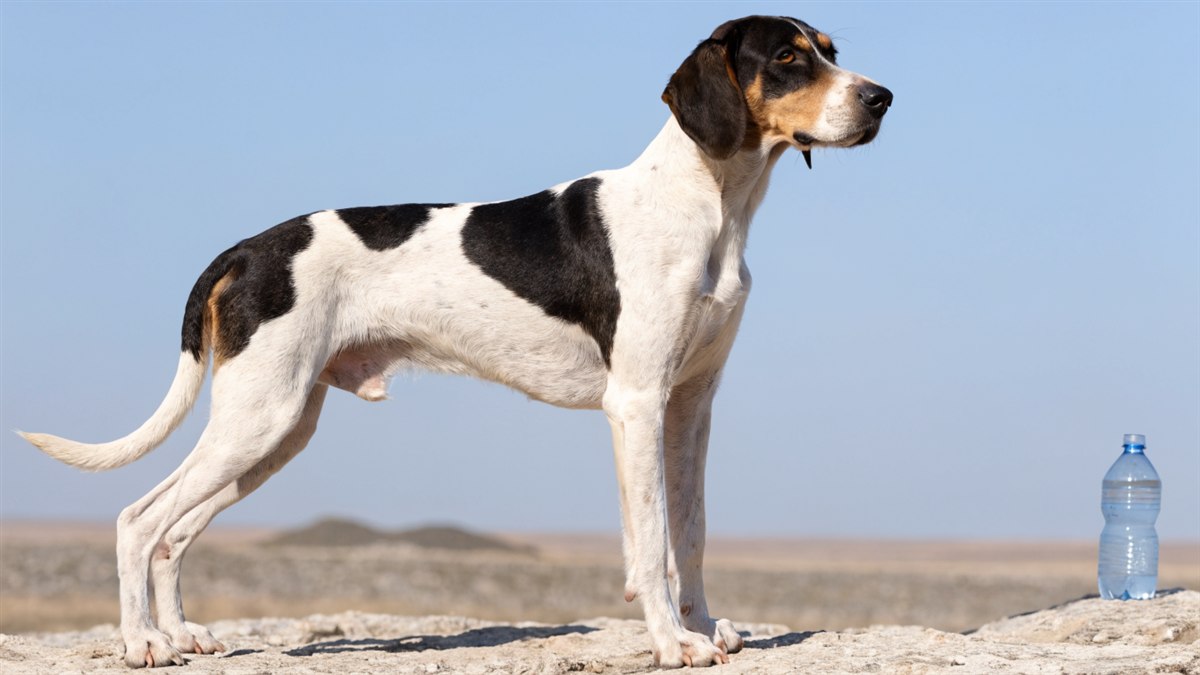
The coat is white with jet black markings whose outlines are well defined, sometimes mottled, with quite pale tan on the cheeks and above the eyes. The French original describes those tan eyebrow spots with a venery word the English translation drops. It says the tan is present on the cheeks and quatroeuillant les yeux, four-eyeing the eyes, because a black-headed hound with two pale tan spots above its eyes appears to have a second pair. That is the single most recognisable marking on the breed and the English standard renders it as above the eyes.
Mottled is worth a sentence too, because it is how you tell this breed from its cousins in a photograph. The Ariegeois is the smallest and lightest of what French houndsmen group as the blue mottled breeds of the Midi, alongside the Grand Bleu de Gascogne and the Grand Gascon Saintongeois. Its ticking is finer and sparser than a Grand Bleu's, so the dog reads as predominantly white where the Grand Bleu reads as slate.
The breed club grades the voice, in writing
The Club du Bleu de Gascogne, Gascon Saintongeois, Ariégeois publishes a working standard alongside the conformation standard, and it grades four aptitudes. The nose is to be powerful and fine. The physique is to be of a fairly fast and sustained pace, enduring. The psyche is to be diligent and tenacious, very much a hunter, easy to put into a pack and to orders. And the voice is to be sonorous, abundant, of rich tonality, well timbred with modulations, and howling.
That is not a warning label, it is a specification, and it makes this a vocal breed by design rather than by accident. This is the third scent hound Bonbeno has covered and the finding has held every time: for a pack hound the voice is the working purpose rather than a side effect, because a handler a kilometre behind the hounds knows what is happening only by listening. The American Foxhound and the American English Coonhound reach the same conclusion from American pack hunting. Here it is written down as a graded aptitude with adjectives attached.
The American Kennel Club does not recognise the Ariegeois, and it is not in the Foundation Stock Service either. The AKC's own FSS list by group names the Porcelaine, the Bavarian Mountain Scent Hound and six other scenthounds in the Hound group, and no Ariegeois anywhere. If a listing claims an AKC-registered Ariegeois, the claim is false on its face.
Two pieces of vocabulary before the rest of the page makes sense. A pack hound is a dog selected to work as one voice among twenty or more, taking direction from the trail rather than from a handler. A scent hound is a dog that hunts by nose rather than by sight. The Ariegeois is both, and the breed club says so plainly by grading it easy to put into a pack. Those two facts together explain the recall problem, the noise, the kennel housing and the complete absence of an Indian market.
The Ariegeois is not the Ariege Pointer, and both mistakes are in print
To tell the two Ariège breeds apart, read the FCI group number and stop reading anything else. The Ariegeois is FCI 20, Group 6 Scenthounds, Section 1.2 Medium sized Hounds. The Braque de l'Ariège, the Ariege Pointing Dog, is FCI 177, Group 7 Pointing Dogs, Section 1.1 Continental Pointing Dogs, type Braque. Different group, different job, different dog.
This matters more than a taxonomy footnote, because the confusion has reached the pages that quote prices. DogBreedsList publishes a puppy price for the Ariegeois and, in the sentence that delivers it, writes: if you do locate an Ariegeois Pointer, you can expect to pay at least $1,000 for a new pup. There is no such animal. There is an Ariegeois and there is an Ariège Pointer, and a buyer following that advice does not know which one is being priced.
The two standards, side by side
| Point | Ariegeois (FCI 20) | Braque de l'Ariège (FCI 177) |
|---|---|---|
| FCI group | Group 6, Scenthounds and related breeds | Group 7, Pointing Dogs |
| FCI section | Section 1.2, Medium sized Hounds | Section 1.1, Continental Pointing Dogs, type Braque |
| Utilization, verbatim | Scenthound for driving game to waiting guns and for coursing | Pointing dog |
| Height, males | 52 to 58 cm | 58 to 65 cm, preferred 61 cm, plus or minus 2 cm |
| Height, females | 50 to 56 cm | 54 to 63 cm, preferred 59 cm, plus or minus 2 cm |
| Definitive FCI acceptance | 1 October 1954 | 28 June 1955 |
| Standard in force | Published 24 January 1996 | Published 10 August 2023 |
| French studbook registrations, 2025 | 227 | 6 |
The height rows are the practical test. The Braque de l'Ariège's preferred size for a male is 61 cm, three centimetres taller than the tallest legal Ariegeois. The jobs differ more than the heights do. A pointing dog quarters ground ahead of a walking gun and freezes when it finds birds. A scent hound puts its nose down, works the line, gives tongue, and keeps going. The registries file them ten group numbers apart for that reason.
The French studbook settles which one you are actually likely to meet. The Société Centrale Canine registered 227 Ariegeois in Group VI in 2025 and 6 Braques de l'Ariège in Group VII, the latter down from 38 the year before. The pointer is the rarer animal by a factor of nearly forty. Neither is in India.
Ask which FCI group the dog is in. Group 6 is the Ariegeois, a hound that bays on a trail. Group 7 is the Braque de l'Ariège, a pointer that stands still and silent when it finds game. A seller who cannot answer that question has not met either breed.
The second conflation: the Gascony family it came from
The Ariegeois descends from the Gascony pack hounds and looks like a scaled-down one, so it is regularly filed as though it were a variety of them. It is not. The FCI gives it its own number, its own standard and its own section, and puts its ancestors one section up.
| Breed | FCI number and section | Height at the withers | What the standard says it does |
|---|---|---|---|
| Ariegeois | 20, Section 1.2 Medium sized Hounds | M 52 to 58 cm, F 50 to 56 cm | Driving game to waiting guns and coursing. Hare is his favourite |
| Grand Bleu de Gascogne | 22, Section 1.1 Large-sized Hounds | M 65 to 72 cm, F 62 to 68 cm | Hunting with the gun, sometimes coursing big game, also hare |
| Great Gascon Saintongeois | 21, Section 1.1 Large sized scenthounds | M 65 to 72 cm, F 62 to 68 cm | Shooting and sometimes hunting big game but also hare |
| Small Gascon Saintongeois | 21, Section 1.2 Medium sized scenthounds | M 56 to 62 cm, F 54 to 59 cm | Versatile shooting dog, a hare specialist by origin |
Two things fall out of that table. First, the Ariegeois is genuinely smaller than everything it came from, including the Small Gascon Saintongeois, whose floor of 56 cm sits above the Ariegeois male's midpoint Fédération Cynologique Internationale. Second, the Grand Bleu de Gascogne's own standard describes exactly the trait the Ariegeois inherited: endowed with a sonorous howling voice, with deep tones, and instinctively a pack hound. The voice came down the family line with the nose.
The registration numbers make the family relationship look different from the usual telling, too. In 2025 the French studbook recorded 664 Gascon Saintongeois, 529 Griffon Bleu de Gascogne, 234 Petit Bleu de Gascogne, 227 Ariegeois, 176 Basset Bleu de Gascogne and 103 Grand Bleu de Gascogne. The ancestor is now rarer in the French studbook than the descendant, at 103 registrations against 227.
The third conflation: an Indian search does not find a dog at all
Search the breed name with a price attached from India and the word Ariégeois resolves to three other things before it resolves to a dog. An India-region search on 20 August 2026 returned, on page one, four separate marketplace listings for Histoire des Ariégeois, a 19th-century history of the *people* of the Ariège, one Flipkart listing for a book about the Ariegeois Pony, which is a horse, and a live share price page for Aegis Logistics Ltd. A people, a pony and a stock ticker. The dog appears nowhere on the page.
That is not a quirk of one engine. It is what happens when a word has four referents and only three of them have an Indian audience.
And the FCI section itself is misprinted by a French authority
The last correction is the one Bonbeno least expected to have to make. Venerie.org, the Société de Vénerie's own technical reference for hunting with hounds, files the Ariegeois under Groupe 6 Section 1.1, Chiens courants de grande taille, large-sized hounds. The FCI's own published document says Section 1.2, Medium sized Hounds. The same venerie.org page then prints the correct heights of 0,52 to 0,58 m and 0,50 to 0,56 m, which are medium-hound heights, immediately under the wrong section heading.
It also dates its text Standard FCI N° 20 / 02.02.1998 / F, where the FCI's current English document is dated 03.09.1996 and the national breed club's French reproduction is dated 24.01.1996 Fédération Cynologique Internationale Club du Bleu de Gascogne. The body clauses differ between the two French reproductions as well: the club's version calls the chest long and of medium width, while venerie.org calls it more developed in height than in width. Bonbeno cannot reconcile those into one document and will not pretend to. What a reader should take from it is simply this: check the figure against the FCI PDF, not against a French page that looks authoritative.
Registry recognition, and the studbook numbers nobody quotes
Three registries recognise the Ariegeois and the American Kennel Club is not one of them. The Société Centrale Canine accepted a first official French standard in 1912, the Fédération Cynologique Internationale recognised the breed on a definitive basis on 1 October 1954 as number 20, and two secondary sources record United Kennel Club recognition, one of them dating it to 1 January 1993 Kate Barrington, Ariegeois, PetGuide.
That FCI listing carries more weight than it looks, and it is the one thing separating this breed from most rare hounds. The Kennel Club of India is the FCI's national canine organisation for India, and the FCI publishes its registration statistics. A breed with an FCI number therefore has a theoretical Kennel Club of India pedigree route in a way that an American coonhound, absent from the FCI nomenclature entirely, does not. The route exists on paper. Nothing travels down it, and this section explains why.
A gap Bonbeno could not close
The United Kennel Club standard could not be read. Every request to ukcdogs.com on 20 August 2026, whether for the breed page, the breed-abbreviations list or the standard PDF, returned HTTP 403 Forbidden, from two different clients. Two secondary pages record UKC recognition and one gives 1 January 1993 as the date Kate Barrington, Ariegeois, PetGuide. Bonbeno prints that as a secondary claim rather than as a verified registry fact, and quotes no UKC height, weight or standard text anywhere on this page, because the document could not be opened. A figure you cannot read is not a source.
How many of these dogs France actually registers
The Société Centrale Canine publishes an annual studbook table by breed, and its Statistiques LOF 2025 gives the real number. 227 Ariegeois entered the French studbook in 2025, down from 242 in 2024, a fall of 6 percent. Of those 227, 131 were confirmed, a confirmation rate of 58 percent.
That confirmation rate is the most revealing number on this page. Confirmation is the French adult conformation assessment that makes a dog definitively LOF, and most pet owners never bother with it. Across the whole of Group VI, the French scent hound group, the average confirmation rate in 2025 was 34 percent. The Beagle, the group's most numerous breed at 3,089 registrations, ran at 27 percent. The Ariegeois at 58 percent is the highest confirmation rate of any Group VI breed registering more than 100 dogs in 2025, ahead of the Griffon Nivernais at 57 percent and the Chien Courant Suisse at 54 percent, and that gap is the signature of a breed whose owners are hunters entering working dogs, not families buying pets.
| Breed | LOF 2024 | LOF 2025 | Confirmed 2025 | Confirmation rate |
|---|---|---|---|---|
| Beagle | 3,514 | 3,089 | 822 | 27 percent |
| Gascon Saintongeois | 602 | 664 | 275 | 41 percent |
| Griffon Nivernais | 583 | 571 | 326 | 57 percent |
| Griffon Bleu de Gascogne | 453 | 529 | 190 | 36 percent |
| Beagle-Harrier | 478 | 440 | 196 | 45 percent |
| Porcelaine | 326 | 384 | 188 | 49 percent |
| Petit Bleu de Gascogne | 250 | 234 | 75 | 32 percent |
| Ariegeois | 242 | 227 | 131 | 58 percent |
| Anglo-Français de Petite Vénerie | 125 | 147 | 76 | 52 percent |
| Grand Bleu de Gascogne | 122 | 103 | 42 | 41 percent |
| Poitevin | 110 | 1 | 0 | not applicable |
| Français Tricolore | 115 | 0 | 0 | no registrations |
| Group VI total | 12,894 | 11,720 | 3,989 | 34 percent |
Read the bottom of that table before the top. In a single year the Poitevin fell from 110 registrations to one, the Français Tricolore and two Grand Anglo-Français breeds recorded no French studbook registrations at all, and the whole scent hound group fell 9 percent. Against that background a 6 percent fall is close to flat. The Ariegeois is not thriving, but it is not collapsing either, and in a group where breeds are going to zero that distinction is the whole story.
It is also worth saying what 227 puppies a year means in practice. It means the entire annual global output of registered Ariegeois would not fill a single mid-sized Indian society's dog population, and every one of those puppies is spoken for inside a French hunting community before it is born. There is no surplus for an export market to draw on, and no export market has formed.
No AKC route, and no Foundation Stock Service route either
The American Kennel Club does not recognise the Ariegeois. That much is unremarkable for a French pack hound. What is worth checking is the AKC's Foundation Stock Service, the recording programme for breeds working toward recognition, because a breed in the FSS has a documented American pedigree path. The AKC's own FSS list by group names 20 Hound-group breeds, including the American Leopard Hound, the Bavarian Mountain Scent Hound, the Hanoverian Scenthound, the Slovensky Kopov and the Porcelaine, which sits in the same FCI section 1.2 as the Ariegeois Fédération Cynologique Internationale. The Ariegeois is not on it. Neither is the Braque de l'Ariège, while three other French Braques are.
No OFA health statistics, and why that is a real finding
The Orthopedic Foundation for Animals publishes breed-level screening statistics that Bonbeno quotes on most imported-breed pages. There is no Ariegeois figure to quote. OFA's breed list and its statistics tables both load through JavaScript that returned nothing to a static fetch on 20 August 2026, so Bonbeno cannot state that the breed is absent from OFA's database and will not guess a breed code, because a guessed OFA code returns a complete and plausible table for a different breed.
What can be stated with confidence is the threshold. OFA's own FAQ says that breeds are not included in the OFA statistics tables until a minimum number of individuals have been evaluated, at least 100 evaluations for hips and at least 50 for all other databases. It also states that OFA does not require dogs to be purebred or registered in order to perform an evaluation. For a breed producing 227 registered puppies a year in one country, almost all of them working hounds in hunting kennels, clearing 100 American hip evaluations is not a realistic proposition. Treat any Ariegeois hip or elbow percentage you see online as unsourced until someone shows you the table.
A genuine pedigree for this breed will name the Société Centrale Canine and carry an LOF number, or name the United Kennel Club. It will not name the American Kennel Club, because the AKC does not recognise the breed in any programme. Treat an AKC claim as disqualifying and end the conversation there.
Ariegeois price in India: there is none
There is no verified Ariegeois price in India, because there is no Indian market for the breed to price. Bonbeno searched the exact term from an India-region search on 20 August 2026, opened every result that loaded, and found not one dog of this breed offered for sale anywhere in the country. One Indian page does publish a rupee band, and the next few paragraphs show you the arithmetic that band is made of.
That absence is the answer, and it is more useful than a number would be. What follows is the evidence, laid out so you can check it yourself rather than take our word for it.
What an Indian search for the price actually returns
Here is the entire first page of an India-region search for the query ariegeois price in india, in order, retrieved on 20 August 2026.
| Position | Domain | What it actually is |
|---|---|---|
| 1 | flipkart.com | A book titled Ariegeois Pony. That is a horse |
| 2 | bseindia.com | The live share price of Aegis Logistics Ltd on the Bombay Stock Exchange |
| 3 | amazon.in | Histoire Des Ariégeois, a 19th-century history of the people of the Ariège |
| 4 | priceinindia.website | A general shopping price-comparison homepage |
| 5 | flipkart.com | Histoire Des Ariegeois again, comte De Foix et Vicomte de Couserans |
| 6 | boldsky.com | Liquor (Alcohol) Prices in India 2026, whisky and beer rates by state |
| 7 | snapdeal.com | Histoire Des Ariegeois, a third marketplace listing of the same book |
| 8 | amazon.in | A fourth edition of the same French history, with etchings by Chauvet |
| 9 | market.todaypricerates.com | Today's mandi rates for vegetables, fruit, eggs and meat |
| 10 | indiagoldrate.co.in | Gold and silver rates across India |
Five of those ten results are books, four of them the same 19th-century French history of a people rather than a dog. One is a horse. One is a listed company's share price. Three are unrelated Indian price lists covering liquor, vegetables and gold. Not one result offers an Ariegeois, and no related-questions box was served, because the engine holds no Indian questions about this breed to show.
The Indian price list that should have carried the breed does not. Supertails publishes India's most-cited dog price guide, covering the top 40 breeds with prices, monthly costs and city-wise variation, updated in March 2026. Searched in full, that page contains zero occurrences of Ariégeois or Ariege under any spelling. India's benchmark price list does not carry this hound, and neither do the aggregators that rank for the query, because they are not about dogs at all.
The one Indian rupee band in print, and the arithmetic inside it
One India-domain page does publish a price. PetsArmy runs a section headed Ariegeois Price in India and Buying Tips, and it states that global prices suggest you'll need to spend between INR 50,628-67,504 for a puppy. Look at those two numbers rather than at the range they describe.
- 50,628 divided by 84.38 is exactly 600.
- 67,504 divided by 84.38 is exactly 800.
- Both ends of the band therefore come from one multiplication of USD 600 to USD 800 by a single exchange rate.
A rupee band that is one currency conversion of a dollar estimate is a conversion, not a price. A price is a record of transactions, and there are no Indian transactions in it. Bonbeno makes no claim about how that figure was produced. It simply points out that the arithmetic is visible on the face of the number, and that a reader can do the division in ten seconds.
Two other statements on the same page deserve checking. It says experts call it a commonly available breed worldwide. The French studbook, the studbook of the country of origin, registered 227 of them in 2025. It also says import means complex rules and that the total cost can run into several lakhs, without naming the trade notice that actually governs the question or the fact that a commercial import is not permitted at all.
Every published price claim, and what each one rests on
| Source | Published price | What it rests on |
|---|---|---|
| PetsArmy, an India domain | INR 50,628 to 67,504 | USD 600 to 800 multiplied by 84.38. No Indian listing, no breeder, no source named |
| DogBreedsList | Average $1,000 to $1,200 | Advice that names the wrong breed, telling you to expect at least $1,000 for an Ariegeois Pointer. The page's entire reference list is one YouTube video |
| Royal Canin India | None | The only India-facing breed record. Carries a size category, a life expectancy and four character words, and no price, availability, breeder or Indian source at all |
| Supertails, India's benchmark list | Not covered | Forty breeds priced. Zero mentions of this one |
| Wikipedia | None | Gives size and history and no price |
| Bonbeno | None | No Indian transactions exist to record |
Why Bonbeno prints no rupee figure
We could produce a plausible number in thirty seconds by taking the Beagle's Indian band and adjusting it upward for size. We will not, and you should distrust any page that has. The Beagle has a genuine Indian price band because Indian breeders genuinely sell Beagles, and Indian sources disagree about that band by tens of thousands of rupees. That disagreement is informative precisely because there is a real market under it. Here there is nothing underneath, so a number would be fiction dressed as research.
The monthly cost structure is a different question and it can be reasoned honestly, so it gets its own section below. What cannot be reasoned is a purchase price, because purchase prices are observations, not deductions.
It is worth noting that even in the country of origin this dog is not priced as a commodity in public. Neither the FCI standard, the national breed club nor the Société de Vénerie publishes a price, because the breed moves inside hunting equipages rather than through a puppy market Société de Vénerie. A dog with a 58 percent adult conformation confirmation rate is a dog being bred for work by people who already own its relatives.
A seller in India quoting a rupee figure for an Ariegeois is selling you something else, most likely a Beagle cross or a white-and-black indie of the right general shape. Ask for the LOF registration number, the export pedigree, the DGFT import authorisation and the airway bill, and verify each one independently before any money moves. In practice the paperwork will not exist, because the next section shows that no lawful route brought that dog here.
Indian import rules, and why no supply chain can form
Indian import rules make a commercial trade in this breed unlawful, and that single fact explains the empty search results better than any market analysis does. Dogs are a Restricted import under India's tariff schedule, entry is permitted for exactly three purposes, and breeding and trading are not among them. Read the notice yourself rather than any summary of it, including this one.
The governing document is Trade Notice No. 22/2022-23, Guidelines for import of Pet Animals, issued by the Directorate General of Foreign Trade in the Ministry of Commerce and Industry on 19 December 2022 and signed by Md. Moin Afaque, Deputy Director General of Foreign Trade.
The import policy, in the notice's own words
Dogs fall under ITC (HS) 01061900, described as Mammals, Other, with an import policy of Restricted, subject to Policy Condition 6 of that chapter. Two further conditions do the real work.
| Condition | What it permits or forbids |
|---|---|
| Policy Condition 7 (i) | Pet dog with valid pet book and relevant records or documents in the name of the importer |
| Policy Condition 7 (ii) | Dogs imported by R&D organisations for conducting research, with the recommendation of CPCSEA |
| Policy Condition 7 (iii) | For the internal security by the Defence and Police Force |
| Policy Condition 8 | Import of commercial dogs for breeding or any other commercial activities other than the purposes mentioned above is not permitted |
Paragraph 6 of the notice removes any remaining ambiguity. Any applications for trading or breeding purposes, or applications made on behalf of some another person or entity, shall be duly rejected. Not discouraged. Not conditional on a fee. Rejected.
The one lawful route, in full
That leaves exactly one door, and it is narrow. A permanent import may travel as passenger baggage without a DGFT authorisation only where the person is transferring their residence to India after two years of continuous stay abroad, only cats and dogs qualify under the baggage rules, and only up to two pets. A DGFT import authorisation becomes necessary if the continuous stay abroad was less than two years, if the pet is not being transported as passenger baggage, or if the pet cannot be imported under the baggage rules at all. More than two pets always requires an authorisation, and the application goes to the Department of Animal Husbandry and Dairying for examination on its justifications before any authorisation is granted.
The rest of the process is procedural and unforgiving on timing.
- Documents for a permanent import. A vaccination book, pet passport or pet book; a certificate for emotional support; and the passport of the pet.
- Application. Submitted as ANF-2M of the Foreign Trade Policy against the applicant's Importer Exporter Code, or against the permanent IEC number IIHIE0153E reserved for persons importing goods for personal use not connected with trade.
- Lead time. Pet owners travelling to India are advised to initiate the authorisation process at least two months in advance of travel dates.
- Advance NOC. A No Objection Certificate from the Regional or Quarantine Officer of the Animal Quarantine and Certification Service, obtained seven days before the date of travel and relaxable up to three days depending on circumstances, after submitting the DGFT licence and a health certificate from a veterinarian in the exporting country.
- Ports. Entry is permitted only through the airports and seaports of Delhi, Mumbai, Chennai, Hyderabad, Bengaluru and Kolkata and, since October 2024, Kochi airport, with quarantine at the government quarantine station of those ports where required.
Seven ports for a country of 1.4 billion people, since DAHD added Kochi for pets arriving under the baggage rules in October 2024. If you are not landing at one of those seven, the question of which breed you are carrying never arises. The full route is set out in how to import a dog to India.
Why this ends the question
Put the import policy next to the French studbook numbers and the market stops being merely absent and becomes impossible. France registered 227 Ariegeois puppies in 2025, of which 131 went on to adult conformation confirmation, in a breed owned almost entirely by hunters. India permits no commercial or breeding import of dogs at all. Neither end of the chain can supply the other, so the chain never forms.
The practical consequence decides everything downstream on this page. The only Ariegeois that can lawfully be in India is one person's accompanied pet, imported in their own name after two years abroad. That dog cannot be bred from commercially, cannot found a population, and will not produce a second Indian generation. It follows that there is no Indian breeder to buy from, no Indian rescue to adopt one from, and no Indian veterinary experience of the breed for a vet to draw on when your dog gets sick.
The second Indian law nobody quotes at this breed
If a dog of this breed did somehow reach India and someone tried to breed from it, a second instrument applies. The Prevention of Cruelty to Animals (Dog Breeding and Marketing) Rules, 2017 require State Animal Welfare Board registration to breed at all, bar the sale of pups less than eight weeks in age, require that each pup sold is micro-chipped, and require every breeder to screen prospective purchasers to ascertain their potential to take proper care of the breed, especially if it is a large one, and to attend to its grooming, socialising, spatial and veterinary needs.
That purchaser-screening clause is unusually relevant here. A pack hound with a graded howling voice going into a metro flat is exactly the placement the rule exists to prevent, and an Indian breeder who made it would be in breach of the rule as well as of good sense.
Nothing here is a judgement on wanting the breed. It is a description of the paperwork. If you are returning to India from France after two years abroad and already own one of these hounds, the route above is yours and it works. If you are in India now and want to acquire one, there is no lawful way to do it, and the rest of this page is written so you can work out what you actually want instead.
Monthly cost of keeping one in India, if one is here
No Indian monthly cost figure for this breed rests on an actual Indian Ariegeois, because there are none to survey. What can be reasoned honestly is the cost structure, and it is unusual: this is a dog whose grooming bill is close to zero and whose real spending sits in three places no Indian pet cost list carries.
Start with the only sourced Indian anchor. Supertails, India's most-cited dog cost guide, puts the average monthly maintenance cost of a dog in India in 2026 at Rs 3,000 to Rs 11,000, monthly upkeep at Rs 3,000 to Rs 18,000 depending on breed size and grooming needs, and a first-year budget at Rs 80,000 to Rs 2,00,000 including purchase, vaccinations, food, training and supplies. It also notes that city-wise prices vary by 15 to 30 percent, with Mumbai and Delhi the most expensive markets. Those bands cover the 40 breeds Indians actually keep. This breed is not among them, so treat them as the shape of the problem rather than its answer.
Where the money does not go
Grooming, first, because it is genuinely cheap. FCI-Standard N° 20 describes hair that is short, fine and dense over fine, supple skin with no folds or wrinkles. There is no undercoat in the standard, no furnishings, no feathering and nothing to strip. Royal Canin's key-facts panel lists the breed as requiring minimal grooming. On a page about a hound in India that is worth naming twice, because it is the one line item where a short-coated hound is dramatically cheaper than a Golden Retriever or a Shih Tzu in the same climate.
Food is moderate rather than large. No published feeding quantity exists for this breed from any registry or breed club, so Bonbeno gives none. What the standard supports is the general shape: a 52 to 58 cm lean working hound with a long chest of medium width sits in roughly the same food bracket as a Labrador Retriever rather than a Great Dane, and considerably above a Beagle.
Where the money actually goes
Three line items dominate, and only one of them is a recurring bill.
| Line item | Why it exists for this breed | Published Indian figure |
|---|---|---|
| Secure containment | A pack scent hound working a line leaves, and its own working standard grades it for initiative and enterprise on the quest | None exists. This is a one-off construction cost, not a monthly one |
| Ear care through the monsoon | The standard asks for leathers reaching the onset of the nose. Pendulous ear carriage carries 1.76 times the odds of otitis externa against erect ears | None for this breed. Budget vet visits rather than products |
| Tick-borne disease prevention | Half of Indian dogs surveyed across four cities carried at least one tick-borne pathogen. A hound exercised in vegetation is the exposed case | None exists for this breed |
| Food | A lean 52 to 58 cm working hound, fed to a working body condition | No breed-specific figure. Supertails' Rs 3,000 to Rs 11,000 all-breed monthly band is the closest anchor |
| Grooming | Short, fine, dense coat with no undercoat described | Effectively nil. No salon appointment in this dog's life |
| Lawful import | DGFT authorisation, AQCS advance NOC, quarantine where required, airline crate, exporting-country health certificate | No published total. Bonbeno will not estimate one |
Take the ear line seriously, because it is the one that turns into a bill. The largest primary-care study of canine otitis externa ever run in the UK sampled 22,333 dogs from a population of 905,554 under veterinary care and found a one-year period prevalence of 7.30 percent. Compared with breeds with erect ear carriage, breeds with pendulous ear carriage had 1.76 times the odds and breeds with V-shaped drop ear carriage 1.84 times the odds of otitis externa. The breeds at the top of that risk list are scenthounds: the Basset Hound at 5.87 times the odds and the Beagle at 2.54.
An older and larger American series found the same thing from the weather side. A retrospective study of 8,975 dogs at 15 North American university veterinary teaching hospitals between 1975 and 1978 found that dogs with pendulous ears and heavy ear canal hair had significantly more otitis externa than other ear types, at P less than 0.01, and produced direct evidence that monthly variations in ambient temperature, rainfall and relative humidity explain to a large extent the monthly variation in prevalence. India supplies all three of those variables at once, for four months a year.
The tick line is the same kind of structural cost. A survey of 525 dogs across four Indian cities found 261, or 49.7 percent, infected with at least one canine tick-borne pathogen, with potential tick vectors present on 278 dogs, 53 percent of those examined. Hepatozoon canis led at 30 percent, followed by Ehrlichia canis at 20.6 percent, and 39 percent of infected dogs carried more than one pathogen at once. Those are ordinary city dogs. A hound whose exercise requirement can only be met in grass and scrub is the higher-exposure case, not the lower one.
The cost nobody can price
The breed club grades this dog's voice as sonorous, abundant, of rich tonality, well timbred with modulations, and howling, and describes a hound that gives voice from the first indices of a line, the voice amplifying as the launch approaches and then staying regular right through the chase. That is not a behaviour problem to be solved later. It is a graded working aptitude, and it does not switch off in a flat in Pune.
In India there is no legal shortcut around it either. The Prevention of Cruelty to Animals (Dog Breeding and Marketing) Rules, 2017 place de-barking in the same prohibited list as tail docking, ear cropping, de-clawing and branding, and forbid all of it strictly. The residential ambient noise standard is 55 dB(A) Leq by day and 45 dB(A) Leq at night, night time being 10 p.m. to 6 a.m., and a neighbour may complain to the designated authority once the level exceeds the standard by 10 dB(A) or more.
So the true cost of this breed in an Indian society flat is not a monthly number. It is a housing decision made before the dog arrives, and if it is made wrongly the outcome is a rehomed dog rather than a larger bill.
Every competing page that publishes a monthly rupee total for a breed with no Indian population has made it up. We could produce one from the Beagle's figures in a minute and it would look exactly as credible as theirs. The honest statement is that the cost structure above is real, and the arithmetic on top of it does not exist yet.
Heat tolerance in India: Bonbeno rates this breed 2 of 5
Bonbeno rates the Ariegeois 2 of 5 for heat tolerance in Indian conditions, and the two halves of that score point in opposite directions. The anatomy is genuinely well suited to a hot country. The purpose is not, and the published evidence says purpose beats anatomy.
The half that helps: a light, short-coated, normal-muzzled dog
Read FCI-Standard N° 20 as a thermoregulation document and it reads well. The general appearance is a light dog, and the word light recurs: the neck is light, rather thin and long, the flank is flat and slightly drawn up, and the whole animal is described as elegant and distinguished rather than powerful. The hair is short, fine and dense with no undercoat described anywhere, and the skin is fine and supple. That is a lean frame carrying minimal insulation.
The muzzle clause matters more than the coat does. The standard puts the nasal bridge straight or slightly arched and the muzzle of equal length with that of the skull. That makes the dog mesocephalic, with a full-length nasal passage and a functioning panting apparatus. In the largest primary-care study of canine heat-related illness ever published, covering 905,543 dogs at 886 UK clinics, brachycephalic dogs had 1.32 times the odds of exertional heat-related illness compared with mesocephalic dogs, with a 95 percent confidence interval of 1.10 to 1.60. Flat-faced breeds are the population that cannot cool itself. This hound is firmly on the right side of that line, and it beats a Pug, a French Bulldog or a Shih Tzu in an Indian summer without effort.
On construction alone the breed would score 4 of 5. It does not, and the reason is what the dog is for.
The half that cancels it: this breed is graded on endurance
The Ariegeois does not merely happen to be athletic. Its national breed club grades the physique as a working standard aptitude, in these words: de train assez rapide et soutenu, endurant, a fairly fast and sustained pace, enduring. The FCI utilization clause adds coursing to the job description and says the dog's lightness lets it evolve easily on difficult terrains. This is a dog selected, graded and bred to keep going.
The same UK study deconstructed what actually triggers heat illness in dogs, and the answer surprises most owners. Of 1,259 heat-related illness events identified from the records of 1,222 dogs, 380 had no trigger recorded. Of the remaining 879, 652 events, or 74.2 percent, were exertional, against 113 environmental events at 12.9 percent and just 46 from vehicular confinement at 5.2 percent. Exertional heat-related illness was three quarters of everything.
One line buried in the results belongs on the front of every Indian breed page. Of the 652 exertional events, exercise type was specified for 551. Three hundred and seventy-two of those, 67.5 percent, followed walking, and only 97, 17.6 percent, followed high-intensity activity. Two thirds of exertional heat illness in that dataset was not a dog racing. It was a dog on a walk.
And lean does not save you. Seven breed types showed greater odds of exertional heat-related illness than the Labrador Retriever, and the list runs Chow Chow at 7.00, Bulldog at 3.73, French Bulldog at 2.96, Greyhound at 2.11, English Springer Spaniel at 1.85, Cavalier King Charles Spaniel at 1.69 and Staffordshire Bull Terrier at 1.56. The Greyhound is on that list. There is no leaner, shorter-coated, more purpose-built running dog in the domestic species, and it still carried more than twice a Labrador's odds. Short coat and low body fat are not the protective factors buyers assume.
A dog that will not stop is the risk factor. The Ariegeois is graded for a sustained pace and endurance by its own breed club, and its working description has it running a line and giving voice for as long as the line lasts. A scent hound working a trail is not monitoring its own temperature, and you cannot cool a dog that is still running.
What Indian heat actually looks like
India's heat season is long and the criteria are published. The India Meteorological Department declares a heat wave when a station's maximum temperature reaches at least 40 C or more in the plains or at least 30 C or more in hilly regions. Heat waves in India typically occur from March to June, and in some rare cases extend till July, with an average of five to six heat wave events every year over the northern parts of the country, and May as the peak month.
That is a four-month window in which a running hound cannot be exercised in daylight at all, followed immediately by a monsoon in which humid air blocks the evaporative cooling that panting depends on. A workable Indian schedule for this breed looks like the list below, and it is not negotiable in summer.
- Run before first light. The pre-dawn hour is the only genuinely cool window in an Indian plains summer.
- Run again after full dark. Surface temperature, not air temperature, burns pads and radiates upward at a dog's height.
- Cancel, do not shorten. On a declared heat wave day, substitute indoor scent work rather than a reduced walk, because two thirds of exertional heat illness followed a walk.
- Cool the dog actively, do not only offer water. Wet the coat before the dog signals distress rather than after.
- Treat the monsoon as its own problem. High humidity is worse for a panting dog than dry heat at the same temperature, and it is also the ear season.
The kennel question, and an Indian rule almost nobody cites
This breed is conventionally housed outdoors in packs in France, and Wikipedia records plainly that it does not adapt well to urban life and is not usually kept as a companion dog. Indian law has something specific to say about the kennel alternative.
The Prevention of Cruelty to Animals (Dog Breeding and Marketing) Rules, 2017 provide that certain categories of dog shall not be kept in outdoor facilities, unless that practice is specifically approved by the attending veterinary practitioner in writing, and the first two categories named are dogs that are not accustomed to the temperatures prevalent in the area or region in question, and dog breeds that cannot tolerate the temperatures prevalent in the area or region. A hound imported from the French Pyrenees is category one by definition. Where outdoor housing is used, the rules require shelters with a roof, four sides and a floor giving protection from heat and from the direct rays of the sun, plus one or more separate outside areas of shade large enough to contain all the animals at once.
Read together, those provisions say that an Indian owner cannot simply put this dog in a run and call it traditional husbandry. The written veterinary sign-off is part of the law, and getting it means a vet has looked at your specific compound in your specific city.
Where in India it would be least bad
Nowhere in the Indian plains is good for this breed in April, May or June. The IMD's own criterion draws the only useful line available: heat wave thresholds are set 10 C lower for hilly regions than for the plains, at 30 C against 40 C. A hill station or a Himalayan-foothill district gives a running hound materially more usable hours in the year than Delhi, Nagpur or Hyderabad does, and the Pyrenean foothills the breed comes from are the closest analogue India has. Coastal cities trade extreme daytime maxima for sustained humidity, which helps the thermometer and hurts the panting.
None of that makes the breed suitable. It makes some Indian places less unsuitable than others, which is a much smaller claim, and it is the only one the evidence supports.
Temperament, and who should not want one
The Ariegeois temperament is the best thing about the breed and the least relevant to whether an Indian household should keep one. FCI-Standard N° 20 puts the character in four words, happy and sociable, easy to train, and every other source agrees. Nobody rejects this dog on temperament, and almost every household that should reject it will do so for reasons that have nothing to do with how nice it is.
What the standard and the country of origin say
The standard splits behaviour from character, and both halves are worth reading. Behaviour: from his origins he is a hardworking dog, being at the same time very good at driving game to the waiting guns and showing proof of much initiative and enterprise. He has a resounding voice and is quick in his plotting. Character: happy and sociable, easy to train.
Two things in that behaviour clause deserve unpacking. Initiative and enterprise is a compliment in a working hound and a warning in a household one: it describes a dog that solves problems on its own, at distance, without asking. And quick in his plotting is the English translator's rendering of the French vite dans sa menée Club du Bleu de Gascogne. The menée is the drive, the phase after the quarry is launched when the pack runs the line. The French says fast in the chase. The English says plotting, which is a translation artefact, and a reader who takes it at face value will imagine a scheming dog rather than a fast one.
The standard is unusually explicit about the failure mode at the other end. Timid subject is listed as a fault under Behaviour, and aggressive or overly shy dogs are a disqualifying fault. A correct specimen of this breed is neither aggressive nor fearful. It is a friendly, energetic, socially competent animal, and the breed club grades it as easy to put into a pack and to orders.
Royal Canin, sourcing its key facts to the FCI, lists the character words Intelligent, Sociable, Resilient and Obedient, notes that the breed enjoys training, and describes it as patient with children and other animals. Its About text calls these hard-working dogs with a cheerful and sociable character underlined by unwavering loyalty.
The pack, and what it means in an Indian flat
This is a pack hound in the literal sense. The FCI utilization clause describes a dog working on his own or in a pack, the breed club grades him as facile à mettre en meute, easy to put into a pack, and venerie.org adds that he rallies easily onto the lead hounds and hunts well in a pack Société de Vénerie. Every source that describes the dog working describes it working alongside other dogs.
Wikipedia states the household consequence in one sentence: the Ariegeois does not adapt well to urban life, and is not usually kept as a companion dog. That is the encyclopedia entry, not a critic's opinion, and it is consistent with the 58 percent adult conformation confirmation rate that says the owners are hunters.
Translate it into an Indian two-bedroom flat with both adults at work. You have a socially dependent pack animal alone for nine hours a day, in a building with shared walls, belonging to a breed whose national club grades its voice as sonorous, abundant and howling. That is not a training problem to be solved later. It is the wrong animal in the wrong container.
Prey drive, and what nobody has published about it
The prey drive here is the selected trait rather than a quirk. The breed club's psyche grade reads appliqué et tenace, très chasseur, diligent and tenacious, very much a hunter. The FCI says hare hunting is his favourite type of hunting, and lists coursing among his uses. A dog bred for three centuries to course hare is a dog with a specific, fast, low-to-the-ground chase response.
Bonbeno will go no further than that, and here is why. No registry, breed club or veterinary source Bonbeno could open says anything about this breed and cats. The consumer pages that assert it are asserting it about scenthounds in general. What can be stated honestly is the shape of the risk: an Indian household contains free-roaming cats, poultry in semi-rural compounds, pigeons on balconies and squirrels in every garden, and a hare-coursing hound has never been asked to ignore any of them. Manage the introduction as though the drive is there, because the selection history says it is, and do not treat any online reassurance about it as evidence.
Who this breed suits and who it does not
| Household | Fit | Why |
|---|---|---|
| Semi-rural home, walled compound, another dog, an owner who runs | The only good fit | Space, canine company and a job. Every source describes a pack dog graded for endurance |
| Apartment in any Indian metro | No | Does not adapt well to urban life, and the voice is a graded aptitude rather than a habit |
| Family with young children | Good, on temperament alone | Happy and sociable per the standard, patient with children per Royal Canin Royal Canin India, breed page Ariegeois |
| Home with a cat, rabbit or poultry | Manage as high risk | Graded très chasseur with hare as its favourite quarry. No breed-specific source addresses cats either way Fédération Cynologique Internationale |
| First-time dog owner | No | A hound graded for initiative and enterprise on the quest needs a handler who has managed one before |
| Household empty all day | No | A pack animal graded as easy to put into a pack is an animal that expects company |
| Anyone wanting a guard dog | No | Non-aggressive by breeding, and aggression is a disqualifying fault |
| Anyone in a society with a noise complaint history | No | The residential night limit is 45 dB(A) Leq and de-barking is prohibited in India Ministry of Environment |
The independent streak, described accurately
Calling this dog independent is correct but routinely misunderstood. It does not mean aloof or uninterested in people; every source describes an affectionate, sociable animal that is easy to put to orders. It means the dog was selected to make its own decisions on a line, at distance, without instruction, and the standard says so approvingly: much initiative and enterprise, and mastery of the delicate phases of the hunt Société de Vénerie.
Socialisation is easy in this breed and worth doing properly. Take a young hound to Indian street noise, traffic, crowds, cattle, other dogs and children early and in short positive doses, because the standard penalises a timid subject as a fault and a fearful hound in a loud country is a miserable animal. What socialisation will not touch is the nose, and that is the next section.
Training: everything is learnable except recall
To train an Ariegeois, teach every behaviour you want with food and short sessions, give the nose a legitimate daily job, and then treat off-lead recall as a permanent management problem rather than a training milestone. That split is not a counsel of despair. It is the only honest reading of a breed whose own standard calls it easy to train and, four lines later, praises it for much initiative and enterprise on the quest.
The paradox in the standard, and what it actually means
FCI-Standard N° 20 gives the character as happy and sociable, easy to train, and the French original reads gai et sociable, facile à mettre aux ordres Club du Bleu de Gascogne. The breed club's working standard extends it to facile à mettre en meute et aux ordres, easy to put into a pack and to orders. Royal Canin, sourcing the FCI, lists Obedient among four character words and notes the breed enjoys training.
So this is a genuinely biddable hound, and Bonbeno is not going to pretend otherwise. What matters is the phrase aux ordres, which is venery vocabulary rather than obedience vocabulary. A hound that is aux ordres responds to the horn and the voice within the framework of the hunt, moving to the lead hounds, holding the pack, coming back to the call at the end of the day. Venerie.org spells that out when it says the dog rallies easily onto the lead hounds and hunts well in a pack. It does not mean a dog that turns off a hot line because a person in a park said its name.
The same document also grades the dog for the opposite quality. On the quest he shows a great spirit of initiative without this harming his application, and he masters the difficult phases of the hunt, the rapproché, the défaut and the forlongé, which are the moments where a hound has lost the line and must work it out alone. A dog graded for solving problems alone at distance is a dog whose default is to keep going.
Why recall fails, and why it is not disobedience
This is the fourth scent hound Bonbeno has covered and the finding has held every time. A scent hound on a trail is not ignoring you and is not being stubborn. It is doing the job it was bred for, which is to work a line independently of a handler, at distance, making its own decisions. The recall cue is competing with a purpose-built neurological system that outranks it, and the trail wins. The American Foxhound and the American English Coonhound reach the same conclusion from American pack hunting, and the Anglo-Français de Petite Vénerie reaches it from the same French tradition.
The Ariegeois adds a wrinkle the bigger pack hounds do not. Its nose is graded puissant et fin, powerful and fine, and its documented working method is to search the night's lines on the ground or on the branches and to begin giving voice as soon as it has raised the first indices. This is a hound that finds work everywhere, including on a Chennai pavement at six in the morning, and that announces the find.
What actually works
- Pay with food, every time. A hound works for a reward it can smell. Take training treats out of the daily ration rather than adding them to it.
- Keep sessions short and end them early. Five minutes three times a day beats one long session with a bored hound, and a breed described as easy to train will absorb a great deal in five-minute pieces.
- Give the nose a legitimate job daily. Scatter feeding, hidden-food searches and a short tracking line at home are not enrichment extras. They are the substitute for the work the dog was built to do, and they are also the only exercise available on an Indian heat wave day.
- Train recall to a whistle on a long line, in a walled space only. Build the behaviour where you can guarantee success, and never call the dog in a situation where it can decide not to come.
- Never let the dog rehearse leaving. One successful bolt teaches more than fifty successful recalls, which is why a secure compound is a training tool rather than just a fence.
- Socialise early and widely. The standard penalises a timid subject as a fault, so build confidence in traffic, cattle, crowds and children before the window closes.
- Teach a settle, deliberately. A pack hound bred to give voice on a find needs a trained alternative behaviour for the moment it finds something, because the Indian residential night noise limit is 45 dB(A) Leq.
The timeline nobody can give you
No published training-timeline data exists for this breed, and Bonbeno will not manufacture one. There is no breed-club training curriculum in print for household obedience, no behavioural study, and no cohort of Indian owners to survey. What the sources do support is an order of difficulty. Scenting and tracking need almost no training at all, because the dog arrives able to do them and graded on how well. Household manners and general obedience are achievable, because both the FCI and the breed club describe a dog that is easy to put to orders. Off-lead recall in an open space stays open for the dog's whole life, because nothing in the breed's selection history ever asked for it.
De-barking is prohibited in India. The Prevention of Cruelty to Animals (Dog Breeding and Marketing) Rules, 2017 list de-barking alongside tail docking, ear cropping, de-clawing and branding among procedures that are strictly forbidden. If a trainer or a breeder in India offers to quieten a hound surgically, that is an offer to break the law, and it is a reason to end the relationship rather than negotiate it.
The last practical point is about Indian geography rather than psychology. A hound that slips a collar in Chennai or Pune is not on a French field with a hunt following it. It is on a road, among free-roaming dogs, with no scent-hound culture around it to recognise what it is. Micro-chipping is required by Indian law at the point of sale from a registered breeder, and identification of all breeding stock and pups over three months must be done by a veterinary practitioner through micro-chipping. For this breed it is the single most valuable thing on the dog after the collar.
Daily exercise requirements, and the Indian trap inside them
The daily exercise requirements of an Ariegeois are high, and no registry, breed club or veterinary source publishes a minute figure for the breed. Bonbeno will not invent one. What the primary sources do commit to is a working grade for endurance, and in India that requirement collides head-on with the heat.
What the published sources actually commit to
| Source | What it says | Is it a number |
|---|---|---|
| FCI-Standard N° 20 | A scenthound for driving game to waiting guns and for coursing, whose lightness lets him evolve easily on difficult terrains | No |
| Breed club working standard | Physique graded de train assez rapide et soutenu, endurant, a fairly fast and sustained pace, enduring | No, but it is a graded aptitude |
| Société de Vénerie | Works the night's lines on ground or branches, masters the rapproché, the défaut and the forlongé, works fairly quickly | No |
| Wikipedia | Hunts alone or in a pack, used both as a courser and for driving game to waiting guns | No |
| PetsArmy, an India domain | Daily sessions of 60 to 90 minutes plus mental stimulation through scent games | Yes, from an unsourced consumer page |
Sixty to ninety minutes is the only number in print anywhere Bonbeno could reach, and it comes from the same page that produced a rupee price by multiplying dollars by an exchange rate. Treat it as a floor with a wide error bar. The structural evidence points higher, because the FCI attaches a working trial requirement to this breed's international championship title, which is the registry's way of saying the dog is expected to complete a day's work rather than a park circuit.
The trap: a walk is not enough, and a walk is what hurts dogs
Here is the bind an Indian owner is actually in, and no other page states it. This breed needs substantially more than a walk to be satisfied, because it is graded on sustained pace and endurance. It also lives in a country where 372 of 551 specified exertional heat-illness events, 67.5 percent, followed walking rather than high-intensity activity. The activity level that would be dangerous for an ordinary Indian pet sits below the activity level this dog requires.
There is one resolution and it is scheduling rather than reduction.
- Two sessions, both outside daylight. Pre-dawn and after full dark, every day, from March to at least June, because that is the IMD's heat wave window.
- Run rather than walk, in a secure space. A long line in a walled compound or a fenced ground gives more work per minute than a leashed street walk and keeps the dog contained.
- Swim where you safely can. Water removes heat faster than shade does, and a lean short-coated hound cools quickly once wet.
- Substitute the nose on heat wave days. Scatter feeding and indoor tracking games tire a scent hound in a way a treadmill never will, and a dog graded for a powerful and fine nose finds them genuinely satisfying.
- Add a second dog if the space allows. This is a breed graded as easy to put into a pack, and canine company does real work here that human company does not.
Apartment living is ruled out by the sources, not by our opinion
Most breed pages hedge on apartment living. The evidence here does not. Wikipedia states that the Ariegeois does not adapt well to urban life and is not usually kept as a companion dog. The breed's national club describes a dog whose working method is to quest widely, give voice on a find and hold it through the chase. The Indian residential noise standard is 55 dB(A) Leq by day and 45 dB(A) Leq at night, and de-barking is prohibited. Those four facts do not leave a flat-shaped gap.
One published claim runs the other way and deserves a direct answer. World Dog Finder states that although these dogs were developed for hunting purposes, large numbers of the Ariege Hounds are becoming a part of everyday family life and have successfully migrated to a more peaceful life. Set that against the French studbook: 227 registrations in 2025, 131 of them confirmed at adult conformation assessment, a 58 percent confirmation rate against a 34 percent group average. A breed converting to pet life produces a falling confirmation rate, because pet owners do not confirm. This one has the highest of any Group VI breed registering more than 100 dogs.
An under-worked scent hound does not sulk. It self-employs. The two symptoms are escape and voice, and in an Indian society compound both of them become somebody else's problem within a week. Neither is a training failure. Both are a housing decision showing up late.
One honest caveat covers everything above. Every exercise statement in this section describes the breed in France, in a temperate climate, mostly in working kennels. No Indian owner cohort exists to check it against, and nobody has measured what this dog's requirement looks like when the usable exercise window shrinks to two hours a day for four months of the year. Bonbeno flags that as an unmeasured gap rather than filling it with a guess.
Grooming a short-coated hound in Indian humidity
Grooming an Ariegeois takes about ten minutes a week for the coat and considerably more attention than that for the ears. The coat is the easiest job on this page. The ears are the reason an Indian owner should read this section twice, because the breed standard asks for exactly the ear that Indian conditions punish hardest.
The coat: genuinely easy
FCI-Standard N° 20 describes hair that is short, fine and dense, over skin that is fine and supple, not closely adherent to the body but not allowing dewlap, folds or wrinkles. There is no undercoat in the standard, no furnishings, no feathering and nothing to strip. Royal Canin's key-facts panel lists the breed as requiring minimal grooming. Weekly brushing with a rubber mitt or hound glove keeps it in condition, and shedding is described as moderate.
For an Indian household that is a real advantage and worth naming. This is a short-coated dog with no salon appointment in its life, no de-matting, no clipping and no seasonal blow-out. Compare it with a Golden Retriever or a Siberian Husky in the same climate and the difference is several thousand rupees a year and a great deal of hair.
One rule carries over from every double-coated breed anyway, and it applies here for a different reason. Do not shave the dog. A short dense coat is a radiation barrier as well as insulation, and the standard already notes that the mucous membranes and the hairless zones are black, which tells you the breed is pigmented for sun on the skin it has, not for skin it does not have. A shaved working hound in Indian sun gains sunburn without gaining cooling.
The ears: the whole job
Read the standard's ear clause again. The leathers are fine, supple, curled in, and must be able to reach the onset of the nose without going beyond its extremity, narrow at the base, and set just below the eye level line. That is a long, low-set, pendulous leather lying flat against a warm canal. It is superb for sweeping ground scent upward and it is a closed, humid box for four months of the Indian year.
Two large studies, thirty-four years and two continents apart, say the same thing about that ear.
| Study | Sample | Finding |
|---|---|---|
| O'Neill and others, Canine Medicine and Genetics, 2021 | 22,333 dogs sampled from 905,554 under UK veterinary care in 2016 | One-year period prevalence of otitis externa 7.30 percent. Breeds with pendulous ear carriage had 1.76 times the odds against erect-eared breeds, and V-shaped drop ears 1.84 times. Basset Hound 5.87, Beagle 2.54 |
| Hayes, Pickle and Wilson, Research in Veterinary Science, 1987 | 8,975 dogs at 15 North American university veterinary teaching hospitals, 1975 to 1978 | Dogs with pendulous ears and heavy ear canal hair had significantly more otitis externa than other ear types, P less than 0.01. Monthly variation in ambient temperature, rainfall and relative humidity explained to a large extent the monthly variation in prevalence |
| Roy, Kashyap and Roy, Durg district, Chhattisgarh, 2018 | 281 dogs examined, 51 positive | Overall prevalence 18.14 percent. Seasonal peak in summer at 21 of 51 cases, 41.18 percent, against 17 of 51, 33.33 percent, in the rainy season. Prevalence rose with age from 5.45 percent under one year (3 of 55) to 28.40 percent at five years and above (23 of 81). The paper's own table prints 5.88 and 45.10 for these bands, but those are shares of its 51 positive cases rather than prevalence among the dogs examined |
A disagreement Bonbeno prints rather than resolves
The Indian data does not say what most Indian care pages assume. The received wisdom is that ear infection is a monsoon problem, and the weather evidence supports that mechanism in general. But the Durg series, collected in central India across a full year, found the highest seasonal prevalence in summer, March to June, at 41.18 percent of cases, with the July to October rainy season second at 33.33 percent.
Bonbeno will not average those into a tidy answer. Two things are consistent with both: the risk is real all year in India rather than confined to one season, and it rises steeply with age, from 5.45 percent under one year to 28.40 percent at five and above. What that means for an owner is that the check has to be routine and year-round rather than triggered by the calendar or by a wet walk.
The care instruction written for another climate
Overseas hound guidance treats ear cleaning as event-driven: check the ears after the day's work, because thorns and grass seed get in. In a French autumn that is correct and sufficient. In India it is not enough, and the reason sits in the Hayes data: the driver is not the day's work, it is the month's temperature, rainfall and humidity together. A dog that has done nothing at all can develop otitis externa in an Indian August, or, on the Durg evidence, in an Indian May.
The Indian version of the instruction has to be seasonal and routine rather than event-driven.
- Lift and look at both ears once a week, all year. Smell them. A clean ear has no odour.
- Check twice a week from March to October. That window covers both the summer peak the Durg series found and the monsoon the weather evidence predicts.
- Dry the inside of the leather after every swim, bath or wet walk, in any month. Water in a canal that is already covered by a long leather does not evaporate.
- Never pour a cleaner into an ear you have not looked into. An inflamed or ruptured canal is made worse by irrigation.
- Go to the vet on head shaking, pawing, odour or discharge. Early otitis externa is cheap and chronic otitis with canal stenosis is not, and prevalence in the Indian series climbed to 28.40 percent in dogs five years and older.
The rest of the routine is unremarkable. Nails need trimming on a working-length schedule, and the standard specifies black pads and nails on harefeet with lean, tight toes, so a nail that is splitting or a toe that is splaying is a departure worth showing a vet. Teeth need brushing. Eyes should be checked after any session in scrub, because a hound that quests through undergrowth collects seeds. Ticks are their own problem and belong to the health section, because in India they carry disease rather than merely irritate.
Health problems and lifespan: an honest blank, three times over
No breed-specific health data exists for the Ariegeois. There is no OFA statistics table, no published breed-club screening scheme, and no peer-reviewed lifespan estimate. Bonbeno is going to say that three times rather than borrow a figure once, because a borrowed number on a page like this is how a myth starts. Consult your nearby vet before acting on anything in this section.
The first blank: no screening statistics
The Orthopedic Foundation for Animals publishes breed-level hip, elbow, patella, eye and cardiac statistics that Bonbeno quotes on most imported-breed pages. There is no Ariegeois figure to quote here, and Bonbeno will not guess a breed code to get one, because a guessed OFA code returns a real, complete, plausible table belonging to a different breed.
The threshold explains why a figure is unlikely to exist. OFA's own FAQ states that breeds are not included in the OFA statistics tables until a minimum number of individuals have been evaluated, at least 100 evaluations for hips and at least 50 for all other databases. A breed producing 227 registered puppies a year in one European country, with no AKC or Foundation Stock Service presence at all, is not a plausible candidate for 100 American hip evaluations. Treat any Ariegeois hip dysplasia percentage you find online as unsourced until someone shows you the table it came from.
The second blank: no breed-club health scheme in print
The Club du Bleu de Gascogne, Gascon Saintongeois, Ariégeois publishes a conformation standard and a working standard grading nose, voice, physique and psyche. Neither document lists a recommended health test, a screening panel or a prevalence estimate. Neither does the FCI standard, which confines itself to conformation faults. So there is no parent-club panel to hand a vet, and no published guidance on what to screen a breeding animal for.
The nearest thing to a health-adjacent clause in the standard is its list of disqualifying faults, which is worth knowing because two of them are structural rather than cosmetic. A dog is disqualified for aggressive or overly shy behaviour, any clear physical or behavioural abnormality, lack of type, serious anatomical malformation, a visible disabling defect, an over- or undershot mouth, light eyes, and any coat other than that scheduled in the standard. Serious anatomical malformation and visible disabling defect are the registry's way of keeping structurally unsound dogs out of the studbook without naming a disease.
The third blank: no study has measured how long they live
Every lifespan figure in circulation for this breed comes from a consumer breed profile, and the profiles disagree.
| Source | Lifespan published | Basis given |
|---|---|---|
| Royal Canin India and UK | 10 to 12 years | Key facts sourced to the FCI, though the FCI standard itself gives no lifespan Royal Canin United Kingdom Fédération Cynologique Internationale |
| DogBreedsList | 10 to 12 years | One reference on the page, a YouTube video |
| 101DogBreeds | 10 to 12 years | None stated |
| PetsArmy, an India domain | 10 to 12 years | None stated |
| World Dog Finder | 12 to 15 years | None stated |
| PetGuide | 12 to 15 years | None stated |
| Peer-reviewed literature | No estimate exists | Bonbeno found none |
That is a five-year spread on a twelve-year animal, which is not a small disagreement. It is the difference between a dog that outlives a school career and one that does not.
For scale, the largest study of companion dog longevity ever published used a dataset of 584,734 unique dogs in the UK, including 284,734 deceased, and partitioned life-expectancy estimates across 155 breeds, body size, sex and cephalic index. One hundred and fifty-five breeds is a large number, and the breeds that reach a dataset like that are the breeds a country keeps as companions. A French working pack hound registering 227 puppies a year in its own country does not enter the UK companion population in numbers, which is precisely why no figure exists. Pack hounds are systematically absent from the large companion-dog cohort studies, and that absence is a feature of how the studies are built rather than a statement about the dogs.
What can honestly be said instead
Three risks can be stated for this breed in India, and each rests on the breed's own anatomy plus Indian data rather than on a borrowed breed profile.
- Otitis externa is the predictable one. The standard requires a long, low-set, curled-in leather reaching the onset of the nose, and pendulous ear carriage carries 1.76 times the odds of otitis externa against erect ears in a study of 22,333 dogs. An Indian hospital series found an overall prevalence of 18.14 percent rising to 28.40 percent in dogs five years and older.
- Tick-borne disease is the Indian one. Of 525 dogs surveyed across four Indian cities, 261, or 49.7 percent, carried at least one tick-borne pathogen, and potential tick vectors were found on 53 percent of dogs examined. Hepatozoon canis led at 30 percent and Ehrlichia canis at 20.6 percent, and 39 percent of infected dogs carried more than one pathogen. A hound exercised in grass and scrub is the high-exposure case.
- Exertional heat illness is the one that kills. Exertional events were 74.2 percent of all recorded-trigger heat-related illness in a study of 905,543 dogs, and 67.5 percent of specified exertional events followed a walk rather than hard exercise. This is a breed graded for a sustained pace and endurance.
What Indian law says a breeding dog must be tested for
There is one published list of tests that would apply to an Ariegeois in India, and it is not a breed-club list. The Prevention of Cruelty to Animals (Dog Breeding and Marketing) Rules, 2017 require that dogs used for breeding shall have been tested for genetic defects, including hip dysplasia, progressive retinal atrophy, night blindness, hypothyroidism, entropion, ectropion, overshot and undershot jaw, wry mouth, two or more missing teeth, and unilateral or full cryptorchidism. The same rules require a consultant veterinary practitioner to examine every dog at a breeding establishment at least once a month, with a written record.
That is a legal minimum for anyone breeding any dog in India, and for a breed with no parent-club panel it is also the most specific screening guidance available.
Nothing in this section is a diagnosis, and nothing here substitutes for an examination. Consult your nearby vet, a registered veterinary practitioner, before acting on any of it, and treat head shaking, ear odour, sudden lethargy, pale gums, unexplained fever or collapse in heat as urgent rather than as something to research first. On a breed with no published health data, your vet's own examination is the best evidence that exists.
Feeding: the breed standard tells you the target body shape
To feed an Ariegeois correctly, feed to a body condition the breed standard already describes rather than to a quantity on a bag. No registry, breed club or veterinary source publishes a daily ration for this breed, so Bonbeno gives none. What the standard does give is unusually specific about what a correctly fed one looks like.
The standard describes a lean dog, and penalises a heavy one
FCI-Standard N° 20 sets the general appearance as a light dog, medium size, elegant and distinguished. The body clauses fill that in. The ribs are long and moderately rounded rather than barrel-sprung. The chest is long and of medium width, let down to elbow level. The flank is flat and slightly drawn up. The neck is light, rather thin and long. The upper thigh is quite long and muscled without excess.
Then comes the clause that no consumer breed page quotes. Under Faults, Body, the standard lists excessive volume. In plain terms, a bulky Ariegeois is a faulty Ariegeois in the eyes of the registry that owns the standard. Very few breed standards say that so directly, and in India, where overfeeding is the commonest single management error in pet dogs, it is the most useful feeding instruction available.
Stand behind the dog and look down. You should see a waist. Look from the side: the flank should be flat and slightly drawn up, not level with the ribcage. Run your hands along the ribs: long, moderately rounded ribs should be easy to feel under a thin covering. If the flank has filled out and the waist has gone, the dog is carrying excessive volume, which the breed standard lists as a fault.
What Bonbeno will not tell you
Bonbeno publishes no gram figure, no calorie figure and no meal count for this breed, because none exists in any primary source. The FCI standard sets no weight at all, and the national breed club's reproduction lists a height and no weight, so there is not even an agreed target mass to calculate a ration from. The published weight claims run from 13 to 18 lbs at 101DogBreeds to 30 kg at a local Ariège source, which is a fivefold spread, and calculating a diet from a fivefold spread is worse than calculating nothing.
Feed a medium-breed adult formula to the body condition described above, weigh the dog monthly, and adjust. That is less satisfying than a number and it is the honest instruction.
Life stages, and the working-dog adjustment
- Puppy, to about twelve months. A growth formula for medium breeds, split across three or four meals a day, moving to two by around six months. Keep the puppy lean through growth rather than pushing size, because a hound bred for a fast sustained pace does not benefit from carrying weight over developing joints.
- Adult, one to seven years. Two meals a day, adjusted to activity. In India the activity varies enormously by season, and the ration should follow it: a dog running two long sessions a day in December needs materially more than the same dog restricted to pre-dawn work in May.
- Senior, from about seven or eight. No breed-specific senior guidance exists. What is known is that otitis externa prevalence in Indian dogs rose to 28.40 percent in dogs five years and older, so an ageing hound needs more veterinary attention rather than simply a different bag.
- Around exercise. Space meals well away from hard work in either direction. No gastric dilatation data exists for this breed, so Bonbeno makes no claim about its risk and simply notes that the standard describes a long chest let down to elbow level and that no source addresses the question.
Indian availability, and the water point
There is no Ariegeois-specific diet sold anywhere, and there is no reason to look for one. Any reputable medium-breed adult formula available in India serves the purpose, and the breed's cost advantage is that it needs nothing exotic. Supertails puts all-breed monthly maintenance at Rs 3,000 to Rs 11,000 in 2026, and a lean 25-ish kilogram working hound with no grooming bill sits inside that band rather than above it.
Water deserves its own sentence on a breed like this. A hound that will keep working in heat is a hound that will keep working past the point where it should have drunk, and the largest heat-illness dataset found that 74.2 percent of recorded-trigger events were exertional. Carry water on every session between March and October, offer it before the dog asks, and treat refusing water on a hot day as a signal rather than as fussiness. Consult your nearby vet if a dog that normally drinks well stops.
One last honest note. Every feeding statement above is reasoned from the breed standard and from general Indian veterinary evidence, not from a breed-specific nutrition study, because no such study exists. Bonbeno flags that rather than dressing the reasoning up as data.
Month by month through the first year
An Ariegeois puppy's first year in India is a legal and climatic problem before it is a developmental one, because no Ariegeois puppy can lawfully be bred for sale in India. This timeline is therefore written for the two readers who can use it: someone bringing a dog in lawfully as an accompanied pet, and someone working out in advance whether they could cope.
One caveat governs everything below. No breed-specific developmental data exists for the Ariegeois. There is no breed-club puppy curriculum, no growth chart and no published weight-for-age series. What follows is built from three things that are documented: Indian law, Indian climate data, and the breed standard's own description of the adult animal. Where a month has no evidence behind it, the table says so.
| Age | What happens | What the sources actually say |
|---|---|---|
| 0 to 8 weeks | With the breeder or the dam. No lawful sale. | Indian rules bar the sale of pups less than eight weeks in age |
| 7 to 8 weeks | Vaccination course begins. | Indian rules state that all pups shall be vaccinated, which can start at the age of seven to eight weeks |
| 8 to 12 weeks | Socialisation window. Short, positive exposure to Indian street noise, traffic, cattle, crowds, children and other dogs. | The standard lists timid subject as a fault and aggressive or overly shy dogs as a disqualifying fault, so confidence is a breed requirement |
| 3 months | Micro-chipping, by a veterinary practitioner. | Indian rules require identification of all breeding stock and of pups over three months by a veterinary practitioner through micro-chipping |
| Up to 18 weeks | Vaccination course completed. | The vaccination course is usually completed at the age of eighteen weeks |
| 4 to 6 months | Lead manners, whistle recall foundation on a long line, weekly ear routine established. | No breed-specific data. Reasoned from a pendulous ear that carries 1.76 times the odds of otitis externa |
| 6 to 9 months | Adolescence. The nose takes over and off-lead reliability drops sharply. | The standard grades the adult for much initiative and enterprise on the quest, and the club grades the nose puissant et fin |
| 9 to 12 months | Approaching adult height. Males head for 52 to 58 cm, females for 50 to 56 cm. | FCI-Standard N° 20 gives those ranges and no weight at all |
| First March to June | The first Indian summer. The single most dangerous period of the dog's life. | IMD heat wave criteria of 40 C in the plains and 30 C in hills, March to June with May the peak |
| 12 months and beyond | In France, adult conformation confirmation becomes possible. | 131 of 227 Ariegeois registered in 2025 were confirmed, a 58 percent rate against a 34 percent group average |
The three months that decide the dog
Eight to twelve weeks is where an Indian Ariegeois is made or lost. The breed standard treats a timid subject as a fault and disqualifies an overly shy dog outright, which means confidence is not optional in this breed, it is a conformation requirement. An Indian street is louder, denser and more chaotic than a French village, and a hound that meets it for the first time at eight months meets it as a threat rather than as background.
Do the exposure in short, positive, deliberately boring doses. Traffic at a distance. Cattle at a distance. A busy market from the far pavement. Other dogs that you already know are stable. Children who have been told how to behave. The goal is a hound that finds India unremarkable, and there is a narrow window in which that is cheap.
The containment audit, at six months
Do this once, properly, before adolescence rather than after. A scent hound graded for initiative and enterprise will test a boundary at around six to nine months, and the first successful escape is the expensive one, because it teaches the dog that leaving works.
- Walk the whole boundary at the dog's eye level. Gaps under gates, drainage channels and loose grille sections are what a hound finds first.
- Check the gate discipline of everyone who uses it, including staff, deliveries and family. A pack hound leaves through an open gate, not over a wall.
- Assume the dog can follow a line out and not find its way back. A hound tracking outward is not navigating home, it is following scent forward.
- Confirm the micro-chip is registered and the contact number on it is current.
- Fit a collar tag with a phone number in addition to the chip. A chip needs a scanner. A tag needs a passer-by.
The first summer, and why it is not a normal summer
A young hound has all the drive of an adult and none of the judgement, in a country where 74.2 percent of recorded-trigger heat-related illness events were exertional and 67.5 percent of specified exertional events followed a walk. India's heat wave season runs March to June, in rare cases into July, with May the peak month and five to six events a year over the north.
Through that window, shift everything to pre-dawn and after full dark, replace daylight exercise with nose work indoors, and cancel rather than shorten on a declared heat wave day. A puppy that learns in its first year that the day is for sleeping and the dark is for running is a much safer adult than one that learns the opposite.
The last note is the honest one. Everything in this section is reasoned rather than measured, because nobody has raised a documented cohort of Ariegeois puppies in Indian conditions and written it up. Bonbeno says so here rather than presenting reasoning as research.
Ariegeois against the breeds an Indian buyer actually cross-shops
If you came here wanting a medium-sized scent hound, the honest comparison starts with availability rather than temperament, because the Ariegeois is unavailable in India and four of the five alternatives below are not. This section puts the breed head to head with what a reader can realistically get.
| Breed | Standard height | Realistically obtainable in India | Bonbeno heat rating | Why you would choose it |
|---|---|---|---|---|
| Ariegeois | M 52 to 58 cm, F 50 to 56 cm | No. 227 French registrations in 2025 and no lawful commercial import | 2 of 5 | You want the specific French hare hound and can bring one in lawfully as your own pet |
| Braque de l'Ariège | M 58 to 65 cm, F 54 to 63 cm | No, and rarer still. 6 French registrations in 2025 | Not rated by Bonbeno | A different breed entirely, a pointing dog in FCI Group 7 |
| Beagle | 33 to 40 cm, FCI Section 1.3 Small-sized Hounds | Yes, widely, with a real Indian price band | See the Beagle page | The scent hound India actually keeps, with the primary-care datasets this breed has never had |
| Grand Bleu de Gascogne | M 65 to 72 cm, F 62 to 68 cm | No. 103 French registrations in 2025, fewer than the Ariegeois | Not rated by Bonbeno | The ancestor. Bigger, heavier, with the same sonorous howling voice written into its standard |
| Anglo-Français de Petite Vénerie | 48 to 56 cm, plus or minus 2 cm | No. 147 French registrations in 2025 | 2 of 5 | The closest analogue in the same FCI section, and the same absent Indian market |
| Indian Pariah Dog | No FCI standard | Yes, free, from any Indian street or shelter | See the Indian Pariah Dog page | Heat-adapted by natural selection in the exact climate you live in |
| Mudhol Hound | Indian sighthound | Yes, from Karnataka | See the Mudhol Hound page | The Indian distance runner, if a running dog is what you actually want |
Against the Beagle, the comparison most readers are really making
Most people who search for a French scent hound in India end up with a Beagle, and the two are not interchangeable. The FCI files the Beagle in Section 1.3, Small-sized Hounds, with a desirable minimum height at the withers of 33 cm and a desirable maximum of 40 cm, and the Ariegeois in Section 1.2, Medium-sized Hounds, at 50 to 58 cm Fédération Cynologique Internationale. The shortest legal Ariegeois bitch is 10 cm taller at the shoulder than the tallest legal Beagle. That is not a size variation, it is a different animal in a different kennel and a different car.
The evidence base differs even more than the size. The Beagle appears in the large UK primary-care datasets with a real odds ratio attached, at 2.54 times the baseline odds of otitis externa. The Ariegeois appears in none of them. If you want a scent hound whose health risks somebody has actually measured, the Beagle is the answer and the Ariegeois is not.
Against its own ancestors, and against the pointer that shares its name
The Gascony hounds are the family the Ariegeois came out of, and every one of them is a bigger dog with the same voice. FCI-Standard N° 22 describes the Grand Bleu de Gascogne as endowed with a sonorous howling voice, with deep tones and instinctively a pack hound, at 65 to 72 cm for males. If the Ariegeois is too loud for your building, the Grand Bleu is louder and 13 to 14 cm taller at both ends of its range. Neither is a flat dog.
The Braque de l'Ariège is not a bigger or smaller version of anything on this page. It is a pointing dog in FCI Group 7, Section 1.1 Continental Pointing Dogs, and it works silently and stands still on game where the Ariegeois works with its nose down and gives tongue. A buyer who confuses them will be surprised by whichever one arrives.
The comparison that matters most, and nobody makes it
The real alternative to a rare imported pack hound is not another rare imported pack hound. It is a dog that already lives in your climate. The Indian Pariah Dog is heat-adapted by natural selection in the exact conditions you are asking a Pyrenean hound to cope with, costs nothing to adopt, and is available in every Indian city today. The Mudhol Hound and the Rampur Greyhound are Indian running dogs bred for open country, if distance work is the part of the Ariegeois that appeals.
None of those is the Ariegeois, and Bonbeno is not pretending otherwise. What they are is obtainable, lawful, adapted and cheap, and on a page whose central finding is that the breed you searched for cannot be got, that combination deserves to be said out loud.
White with sharply outlined black patches and tan eyebrow spots is a common indie coat pattern in India, and it appears in shelters constantly. If what drew you to the Ariegeois is the mottled white-and-black hound look rather than three centuries of hare-coursing selection, you can have the look this week, for nothing, from a rescue.
Mistakes Indian buyers actually make with this breed
Nine mistakes account for almost everything that goes wrong around the Ariegeois in India, and eight of them happen before the dog arrives. Each one below is tied to a specific published claim you can check for yourself.
- Believing a rupee price. The one Indian band in print, INR 50,628 to 67,504, is USD 600 to USD 800 multiplied by 84.38. Divide either end by 84.38 and see for yourself. It records no Indian transaction, because there are none to record.
- Buying the wrong Ariège breed. A ranking page tells buyers to expect at least $1,000 for an Ariegeois Pointer. The Ariegeois is FCI 20 in Group 6 Scenthounds; the Braque de l'Ariège is FCI 177 in Group 7 Pointing Dogs Fédération Cynologique Internationale. Ask which group before anything else.
- Reading medium size as flat size. Royal Canin's size category for the breed is Medium, and buyers hear apartment. The standard's actual heights are 52 to 58 cm and 50 to 56 cm, and Wikipedia states plainly that the breed does not adapt well to urban life.
- Trusting a weight figure. FCI-Standard N° 20 gives no weight at all. Published claims run from 13 to 18 lbs to 30 kg to 25 to 27 kg. A fivefold spread on an unspecified figure is not data.
- Treating heat tolerance as a coat question. The coat helps. The purpose does not. Exertional events were 74.2 percent of recorded-trigger heat illness, and the Greyhound, the leanest short-coated runner there is, still carried 2.11 times the Labrador's odds.
- Treating the voice as a training problem. The national breed club grades the voice as a working aptitude in writing, sonorous, abundant, of rich tonality, well timbred with modulations, howling. You cannot train out a graded selected trait, and de-barking is prohibited in India.
- Doing ear care by event instead of by season. Overseas hound advice says to check the ears after work. The evidence says the driver is the month's temperature, rainfall and humidity together, and an Indian series found otitis externa prevalence rising to 28.40 percent in dogs five years and older.
- Assuming an AKC pedigree exists. The American Kennel Club does not recognise the breed and it is not in the Foundation Stock Service, while the Porcelaine from the same FCI section is. An AKC claim on this breed is disqualifying on its own.
- Believing the breed is commonly available. One India-domain page says experts call it a commonly available breed worldwide, and another says large numbers are becoming part of everyday family life. The French studbook of the country of origin registered 227 in 2025.
The mistake that happens after the dog arrives
There is a tenth, and it is the only one that happens later. Under-exercising a pack hound and then treating the consequences as behaviour problems. A dog graded for a fairly fast and sustained pace and for endurance, restricted to two short leashed walks because the owner discovered how hot Indian afternoons are, does not become calm. It becomes an escape artist and a voice, and both of those land on the neighbours.
The fix is not more training. It is either the right housing from the start, which means space, a secure boundary and canine company, or a different dog. Indian law makes the same point from the other direction: a registered breeder is required to screen prospective purchasers to ascertain their potential to take proper care of the breed, especially if it is a large one, and to attend to its grooming, socialising, spatial and veterinary needs. Spatial needs are named explicitly in the rule.
How to check any Ariegeois claim in five minutes
- Ask for the FCI group number. Group 6 is the hound. Group 7 is the pointer Fédération Cynologique Internationale.
- Ask for the LOF registration number and the export pedigree. A genuine dog of this breed came out of the French studbook, which registered 227 in 2025.
- Ask for the DGFT import authorisation and the AQCS advance NOC. Both are required documents, and no lawful commercial import exists.
- Ask which of the seven permitted ports the dog entered through. Delhi, Mumbai, Chennai, Hyderabad, Bengaluru, Kolkata or, since October 2024, Kochi, and no others Department of Animal Husbandry….
- Ask for the micro-chip number and verify it independently.
- Measure the dog. Males 52 to 58 cm at the withers, females 50 to 56 cm. A 40 cm dog is not this breed whatever the paperwork says.
Every question above has a documentary answer that a genuine owner or importer can produce in a day. Vagueness on any of them is not shyness about paperwork, it is the absence of paperwork, and on a breed with no lawful Indian supply chain that absence is the expected finding rather than the surprising one.
Adoption and responsible sourcing
You cannot adopt an Ariegeois in India, because there is no Indian population for a rescue population to come from. That is a short answer to a real question, and the rest of this section explains what it leaves you with, which is more than it sounds.
The logic is simple and it follows from the import law. Rescue populations are made of surrendered and abandoned pets, and pets come from a breeding population. India permits no commercial or breeding import of dogs, and applications for trading or breeding purposes shall be duly rejected. The only lawful Ariegeois in India is one person's accompanied pet imported in their own name after two years abroad. One dog cannot found a population, and no population means no rescues.
Bonbeno searched for the breed from an India-region search and found books, a pony, a share price and a liquor price list. There was no shelter listing, no breed rescue and no rehoming post, because there is nothing to rehome.
If you are the lawful case
A small number of readers genuinely are the exception: people returning to India from France, Belgium or Switzerland who already own one of these hounds. For you the route in the import-law section above is real and it works. Start the DGFT authorisation at least two months before travel, get the AQCS advance No Objection Certificate seven days before the date of travel, and plan to land at one of the six ports the DGFT notice names.
Plan the arrival month as carefully as the paperwork. Landing a Pyrenean pack hound in Delhi in May puts an unacclimatised dog into the peak of India's heat wave season on day one, and Indian rules already treat dogs not accustomed to local temperatures as a category that cannot be housed outdoors without written veterinary approval. Arrive in November if you have any say in it.
What to adopt instead, and why it is not a consolation prize
If what appealed to you about this breed was the temperament, the look or the athleticism rather than the specific French hunting pedigree, India can supply all three today and for free.
- Temperament. The standard's character clause is happy and sociable, easy to put to orders, non-aggressive, good with people. That describes a very large share of Indian shelter dogs, and shelters can tell you which individuals actually match it because they have lived with them.
- The look. White with sharply outlined black patches and pale tan eyebrow spots is a common Indian coat pattern. The Indian Pariah Dog throws it constantly.
- The athleticism. The Mudhol Hound and the Rampur Greyhound are Indian running dogs bred for open country and for this climate.
- The heat adaptation you cannot buy. An indie has been selected by Indian summers for centuries. No amount of import paperwork buys that.
Responsible sourcing, if you buy any dog in India
The Prevention of Cruelty to Animals (Dog Breeding and Marketing) Rules, 2017 give a buyer a usable checklist for any breed, and a breeder who cannot meet it is operating outside the rules.
- State Animal Welfare Board registration. Ask to see it. Breeding without it is not permitted.
- No pup under eight weeks. The rules bar the sale outright.
- Micro-chipped at sale, with the number on the receipt along with the purchaser's name, address and phone number.
- Written feeding, inoculation and de-worming details plus the name and address of the attending veterinary practitioner.
- Genetic-defect testing of the breeding stock, including hip dysplasia, progressive retinal atrophy, hypothyroidism, entropion, ectropion and cryptorchidism.
- A breeder who screens you. The rules require it, and a breeder who asks you nothing is telling you something.
Bonbeno does not recommend breeders, does not link puppy listings and does not broker sales. The checklist above is the legal floor, not an endorsement of anyone who clears it.
The Ariegeois is a real, documented, working French hound with a graded voice, a 58 percent studbook confirmation rate and no Indian market whatsoever. If you want one and you are lawfully importing your own pet, the route exists. If you are shopping in India, what is being offered to you is a book about the people of the Ariège, a horse, or a different dog.
Ariegeois in India: questions people actually search
What is the Ariegeois price in India?
There is no verified Ariegeois price in India, because no Indian market exists to set one. An India-region search for the price term returns four editions of a French history book, a book about a pony, a stock price and a liquor price list. The one Indian page publishing a rupee band is converting a dollar estimate.
How easy is it to find an Ariegeois in India?
It is not possible through any lawful commercial route. India classifies dogs as a Restricted import, permits entry only for a personal pet in the importer's name, for CPCSEA-recommended research or for Defence and Police use, and states that applications for trading or breeding purposes shall be duly rejected.
Is the Ariegeois the same as the Ariege Pointer?
No. The Ariegeois is FCI-Standard N 20, Group 6 Scenthounds, Section 1.2, at 52 to 58 cm for males. The Braque de l'Ariège, the Ariege Pointing Dog, is FCI-Standard N 177, Group 7 Pointing Dogs, at 58 to 65 cm. They are different breeds with different jobs from the same French department.
How big do Ariegeois dogs typically get?
FCI-Standard N 20 gives a height at the withers of 52 to 58 cm for males and 50 to 56 cm for females, and sets no weight at all. Every kilogram figure in circulation comes from somewhere other than the breed standard, and published claims range from about 6 kg to 30 kg.
What is the average lifespan of an Ariegeois dog?
No peer-reviewed lifespan estimate exists for this breed. Consumer breed profiles publish either 10 to 12 years or 12 to 15 years and none of them names a source, so treat the honest answer as a range of roughly 10 to 15 years with no study behind it.
What is the temperament of an Ariegeois dog?
The FCI standard gives the character in four words, happy and sociable, easy to train, and adds that the dog shows much initiative and enterprise and has a resounding voice. Aggressive or overly shy dogs are a disqualifying fault, and a timid subject is a listed fault.
Are Ariegeois dogs easy to train?
Household training is genuinely easy, because both the FCI standard and the national breed club describe a hound that is easy to put to orders and easy to put into a pack. Off-lead recall in open country is the exception, because the breed is graded for working a line independently at distance.
How much exercise does an Ariegeois dog need daily?
No registry or breed club publishes a minute figure, so Bonbeno gives none. The breed club grades the physique for a fairly fast and sustained pace with endurance, and the FCI attaches a working trial to the breed, which together imply a working requirement rather than a walk.
Do Ariegeois dogs shed a lot and what grooming do they need?
The coat is short, fine and dense with no undercoat described in the standard, shedding is moderate, and weekly brushing is enough. Royal Canin lists the breed as requiring minimal grooming. The ears are the real job, because the standard asks for a long, low-set, curled-in leather.
What health issues should I watch for in an Ariegeois dog?
No breed-specific health data exists, with no OFA statistics table and no breed-club screening scheme. Three risks can be reasoned from the anatomy and Indian evidence: otitis externa from a pendulous ear, tick-borne disease, and exertional heat illness. Consult your nearby vet rather than an online figure.
Is an Ariegeois dog good with children and other pets?
With children, yes on every source: the standard says happy and sociable, and Royal Canin describes the breed as patient with children and other animals. With cats and small pets, no breed-specific source exists, and the breed club grades the dog as very much a hunter with hare as its favourite quarry.
Can an Ariegeois live in an Indian apartment?
No. Wikipedia records that the breed does not adapt well to urban life and is not usually kept as a companion dog, the national breed club grades its voice as sonorous, abundant and howling, and India's residential night noise standard is 45 dB(A) Leq with de-barking prohibited.
Can I import an Ariegeois into India?
Only as your own accompanied pet. A permanent import travels as passenger baggage without DGFT authorisation only for a person transferring residence to India after two years of continuous stay abroad, up to two pets, through one of seven permitted ports, with an AQCS advance No Objection Certificate.
Compare with similar breeds
Ariégeois sits in 2 Bonbeno groups. Each one compares it directly against the breeds it is genuinely an alternative to, on the same figures.