
Breed profile
American Leopard Hound in India: The Merle Question
The name says leopard and the American Kennel Club says sixty percent of them are solid. The United Kennel Club standard says merle in plain words and tells breeders never to double it. Here is what the registries actually record, why no Indian supply chain can form, and why this is not a Catahoula.
Quick answer
The American Leopard Hound is an American treeing scenthound whose leopard coat is genuine merle, and both registries that carry the breed warn in writing against merle-to-merle breeding. It is not sold in India, no FCI listing exists, and Bonbeno rates it 2 of 5 for heat tolerance because it carries a dense double coat and works for hours.
This guide is general information for Indian pet owners and is not a diagnosis. Always consult your nearby registered veterinarian before acting on anything you read here, and treat any sudden change in your dog's condition as urgent.
American Leopard Hound at a glance
What the American Leopard Hound actually is
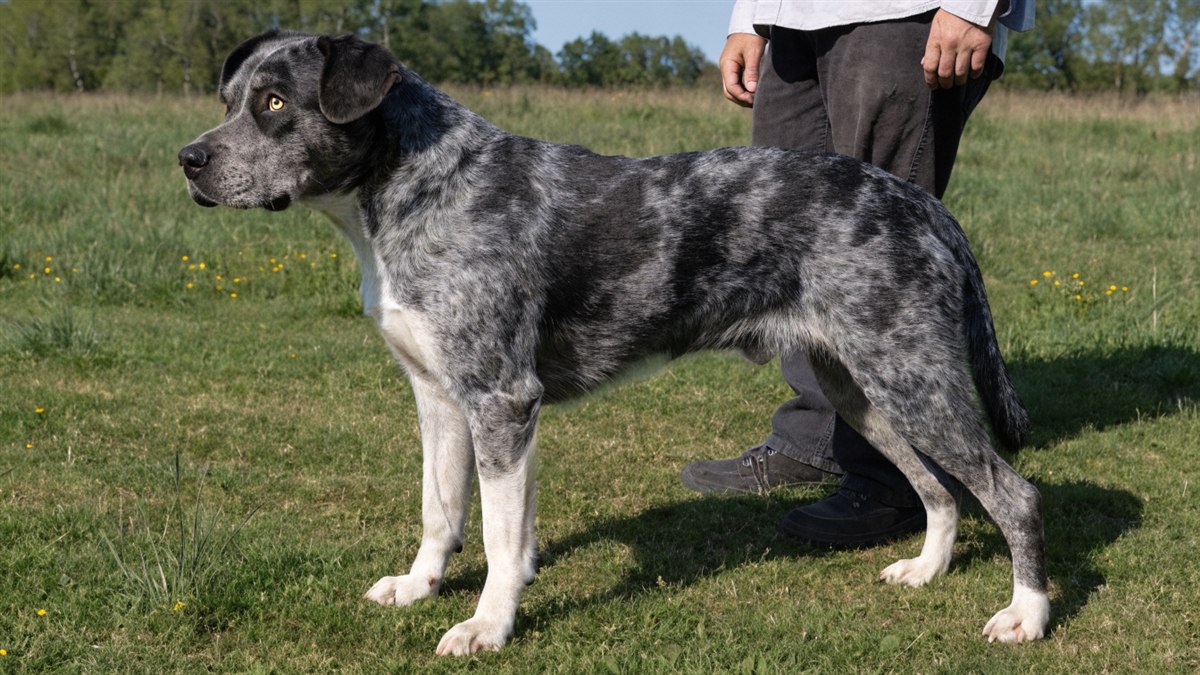
The American Leopard Hound is a powerful, agile tree dog of medium to large size, bred in the American South to trail game on a cold nose and hold it in a tree until the hunter arrives. The United Kennel Club standard puts mature males at 22 to 27 inches and 45 to 75 pounds, and females at 21 to 25 inches and 35 to 65 pounds, and the American Kennel Club gives its life expectancy as 12 to 15 years American Kennel Club.
Start with the name, because it is misleading in two directions at once. Leopard describes a coat pattern that most dogs of the breed do not have. The AKC's own breed page states that the breed comes in three patterns, Solid, Leopard and Brindle, and that sixty percent of all American Leopards are solid-coloured dogs. Hound describes a job the breed only partly does. The UKC classifies it in the Scenthound Group as a Tree Hound, a type defined not by running but by driving game up a tree, alerting the hunter with a distinctive bark, and holding the game there until the hunter arrives.
The UKC standard is short and unusually blunt about what the dog is for. It asks for a body just slightly longer than tall, legs long enough to move quickly and with agility in rough terrain, a broad head with a moderate stop and a heavy muzzle of moderate length, high-set drop ears, a low-set straight tail of any length, and a coat that is dense but close fitting. It then adds the sentence that governs everything else: the American Leopard Hound should be evaluated as a hunting dog, and exaggerations or faults should be penalized in proportion to how much they interfere with the dog's ability to hunt.
The coat is double, and almost every page gets this wrong
This is the single most consequential detail for an Indian reader, and the most-cited free reference on the internet reports it incorrectly. The UKC breed standard says the coat is double and dense, but smooth. The outer coat is rough, and the undercoat is fine and wooly, and explains why: it makes it possible for dogs to work in thick underbrush for long periods after most dogs have given up. The AKC describes the same thing, a smooth, dense, double coat with a rough outer coat and a fine wooly undercoat.
Wikipedia's infobox for the breed records the coat in three words: Short and smooth. The word double does not appear in it, and neither does merle in its colour field, although the article body does mention both a dense short coat and merle further down. That article is flagged by Wikipedia itself as a stub and as relying excessively on primary sources since January 2021. An infobox field is exactly what an answer engine lifts, so the error travels.
A short smooth single coat and a dense double coat with a wooly undercoat are two different animals in a Chennai August. The same VetCompass paper that quantified heat-illness triggers names thick coat alongside brachycephaly and giant body size as an exaggerated conformation that limits a dog's ability to thermoregulate. If you plan around Wikipedia's three words you will under-plan the summer by a wide margin. Read the two registry standards instead, and never shave a double coat to cool a dog down.
Size, in numbers you can act on
| Point | UKC breed standard | AKC breed page | Wikipedia infobox |
|---|---|---|---|
| Height, male | 22 to 27 inches, roughly 56 to 69 cm | 22 to 27 inches | 21 to 27 inches, no sex split |
| Height, female | 21 to 25 inches, roughly 53 to 64 cm | 21 to 25 inches | 21 to 27 inches, no sex split |
| Weight, male | 45 to 75 pounds, roughly 20 to 34 kg | 45 to 75 lbs | 35 to 75 pounds, no sex split |
| Weight, female | 35 to 65 pounds, roughly 16 to 29 kg | 35 to 65 lbs | 35 to 75 pounds, no sex split |
| Coat | Double and dense, outer coat rough, undercoat fine and wooly | Smooth, dense, double coat | Short and smooth |
| Life expectancy | Not stated | 12 to 15 years | Not stated |
| Group | Scenthound Group, Tree Hound type | Hound Group designation | Listed under Hounds, Miscellaneous |
Two registries agree on the numbers and the third source drops the sex split and the undercoat. That is worth knowing before you read anything else about this breed online.
Where it came from
The UKC history is one paragraph and it is honest about the gaps. American Leopard Hounds are believed to be the descendants of dogs brought to the new world by Spanish conquistadors and crossed with native Mexican dogs, and early American settlers brought Leopard dogs from Mexico to hunt bear. The AKC calls the breed one of the oldest of the tree dog breeds in the Americas and says plainly that the exact origins of the American Leopard are unknown.
The registry history is much better documented than the origin story. The Leopard Cur was recognized by UKC on November 1, 1998, and the breed name was changed to American Leopard Hound May 1, 2008. The AKC recorded the breed in its Foundation Stock Service on 19 September 2012 and assigned it the Hound Group designation, without full recognition.
That rename is not cosmetic. It moved a cur into a hound name while leaving the dog in the UKC's Scenthound Group, where the Group 2 description still lists the four Cur breeds separately from the Coonhounds. Read the UKC's own cur paragraph and you are reading this breed's job description: curs were developed by early settlers in the southern and western United States as all-purpose dogs, they are excellent tree dogs used on squirrel, coon, mountain lion and bear, they are used in Louisiana and Texas to hunt wild hogs, and they also serve as stock dogs.
For an Indian reader the useful comparison is not to a Labrador. Bonbeno's American English Coonhound guide covers a racier hound bred to bay at a tree for minutes on end, and the American Foxhound guide covers a pack dog bred to run. This breed sits between them and adds a working brain: the UKC standard credits it with an extreme desire to please, which makes it an easy dog to train. No coonhound standard says anything of the kind.
The merle question, answered from the registries and the genetics
The American Leopard Hound's merle coat is genuinely merle, and that is not an inference. The United Kennel Club breed standard uses the word merle in its opening section and in its Nose clause, and the American Kennel Club registers Merle Markings for the breed under registration code 035 and names double merles on its health page American Kennel Club. Both registries that carry the breed say the same thing. Do not breed merle to merle.
Here is the sentence, quoted in full from the UKC standard, sitting above the History section and before a single word about the dog's build. Though merle is an equally accepted color variation of the American Leopard Hound, it is strongly advised that merles not be bred to merles, because it often results in hereditary problems, to include blindness and deafness.
The AKC puts it in the Health section of its breed page in plainer language. The mating of two merle-colored American Leopards creates the possibility of puppies called double merles. These pups carry a much higher risk of being blind, deaf, or sight or hearing-impaired.
The standard then uses a second term for the same thing in its Colour and Eyes clauses, which is part of why secondary writers get confused. Under Color it lists Leopard spotted: yellow; black (may have brindle or tan trim); brindle; red and blue or mouse color, any of which may also carry white points and a white collar, with no more than one-third white allowed. Under Eyes it says Leopard spotted dogs may have one or both blue eyes or wall eyes, and under Nose it says red merle-coloured dogs have brown or liver coloured noses and pigment. Leopard spotted and merle are the same pattern described twice in one document, and the blue eyes clause is a direct statement of the pigment link.
Neither registry gives a number. The peer-reviewed literature does, and this is where a reference page earns its place.
What merle is, at the gene
Merle is a coat pattern characterised by patches of diluted pigment, inherited in an autosomal, incompletely dominant fashion, and it is caused by a short interspersed element inserted at the intron 10 and exon 11 boundary of the SILV gene, also written PMEL17. The 2006 paper that located it ran a whole-genome scan in Shetland Sheepdogs and then confirmed that the insertion segregates with the merle phenotype in multiple breeds, concluding that SILV is responsible for merle patterning and is associated with impaired function of the auditory and ophthalmologic systems.
The same paper describes the harm without hedging. Dogs carrying one or two copies typically have blue eyes and often exhibit a wide range of auditory and ophthalmologic abnormalities, and in all breeds the double merle genotype can be sublethal and is associated with multiple abnormalities of the skeletal, cardiac, and reproductive systems. Its verdict on breeding is one clause: for these reasons, merle-to-merle breedings are strongly discouraged.
The eight merle dogs sequenced in that founding study came from seven breeds: Shetland Sheepdog, Collie, Border Collie, Australian Shepherd, Cardigan Welsh Corgi, Dachshund and Great Dane. The American Leopard Hound is not among them, and Bonbeno found no published study that has genotyped this breed at the SILV locus. What is established is that both registries carrying the breed call its pattern merle in their own documents and both warn against doubling it American Kennel Club. What is not established is a breed-specific allele profile. Saying so is more useful than pretending otherwise, and it is the reason this page quotes registry text rather than paraphrasing it.
The numbers, from BAER-tested dogs
The best prevalence figures come from a study that put 153 privately owned merle dogs of different breeds and both sexes through brainstem auditory evoked response testing, then genotyped each one as heterozygous or homozygous for the merle allele. The split between single merles and double merles is the whole point of the table below.
| Group | Unilaterally deaf | Bilaterally deaf | What that means in practice |
|---|---|---|---|
| All merles combined | 4.6 percent | 4.6 percent | Roughly one merle dog in eleven carried a hearing deficit of some kind |
| Single merle, genotype Mm | 2.7 percent | 0.9 percent | The ordinary merle-patterned pet, at low but non-zero risk |
| Double merle, genotype MM | 10 percent | 15 percent | One dog in four affected, and the bilateral figure is roughly sixteen times the single merle figure |
The authors report a significant association between hearing status and heterozygous versus homozygous merle genotype, and conclude that dogs homozygous for the merle allele were significantly more likely to be deaf than heterozygotes. They also found no significant association with eye colour or with sex, which matters because the folk rule holds that a blue-eyed merle is the risky one. It is not the eye colour. It is the second copy.
The mechanism is pigment-cell dependent rather than mysterious. A review of hereditary deafness across domestic animals places the merle locus alongside the piebald locus as the two pigment associations behind congenital hereditary deafness in dogs, with cochleo-saccular cochlear pathology, and names PMEL among the genes involved.
Why you cannot solve this by looking at the dogs
The obvious rule, avoid mating two dogs that look merle, is not sufficient, and the reason is a genuine surprise. Merle is not one allele. A 2018 study that genotyped 181 dogs from 14 merle breeds with higher-resolution methods reported six merle alleles, named Mc, Mc+, Ma, Ma+, M and Mh, each associated with distinct coat features and a stratified health-impairment risk. The shortest of them, Mc, is the cryptic merle, which has no apparent effect on the dog's phenotype and passes to the offspring anyway.
Two further findings from that paper should change how anyone plans a mating in a merle breed. First, mosaicism of merle alleles was identified in 30 out of 181 dogs, 16.6 percent, meaning more than one allelic type in the same animal, and minor alleles can be inherited by the offspring just as major ones can. Second, sperm cells appear to be a significant source of germline merle allelic variants, which is the authors' explanation for the unusual genotype and phenotype findings breeders keep reporting in litters. Their recommendation is explicit: implement refined merle allele testing for all dogs of merle breeds.
So a solid-coloured American Leopard Hound is not automatically a safe mate for a merle one. The AKC's sixty percent solid figure means most of the breed looks non-merle, and the cryptic allele means part of that majority is not Langevin M, Synkova H, Jancuskova T. The only way to know is to test, and a laboratory that reports only merle present or absent is not answering the question a merle breeding actually asks.
The disqualification list reads like a double merle screen
Read the UKC standard's disqualifications in one block and something unusual appears. The list carries Deaf, Blind, Albinism, and a dog that is more than one-third white, alongside the ordinary faults like cryptorchidism and an overshot bite. Deafness and blindness are also stated as disqualifications under the Ears and Eyes headings, so the standard names each of them twice.
Now set that against the genetics. Dogs homozygous for merle are described in the founding paper as predominantly white. A one-third white limit, a deafness disqualification and a blindness disqualification, read together, land squarely on the double merle phenotype. Bonbeno does not claim the UKC wrote those clauses for that purpose, because the standard does not say so. It is enough to observe that a judge applying the standard as written will not place a double merle, and that no page in the ranking set notices this.
| Source | Uses the word merle | Warns against merle-to-merle | Gives a figure | Names a test |
|---|---|---|---|---|
| UKC breed standard, revised 1 January 2016 | Yes, in the preamble and the Nose clause | Yes, strongly advised | No | No |
| AKC breed page, read 19 August 2026 | Yes, as Merle Markings code 035 and as double merles in Health | Yes, names the risk of blind, deaf or impaired pups | No | No |
| Clark et al. 2006, PNAS | Yes, throughout | Yes, strongly discouraged | No prevalence figure | Identifies the SILV insertion |
| Strain et al. 2009, J Vet Intern Med | Yes, throughout | Implied by the genotype split | Yes, 15 percent bilateral deafness in MM dogs | BAER |
| Langevin et al. 2018, PLOS ONE | Yes, throughout | Yes, advocates refined testing | 16.6 percent mosaicism in 181 dogs | Refined merle allele length testing |
| The ranking Indian page | Yes, one myth-busting line | Yes, in general terms | No | No |
What a deaf merle dog's life is actually like
The evidence here is more optimistic than the folklore, and an honest page says so rather than leaving a reader who already owns a deaf dog with nothing. An owner survey compared 223 congenitally sensory impaired dogs, including 131 presumed double merles, against 217 sensory normal dogs matched for age, breed, sex and lifetime with owner. The sensory impaired group did not show more heart, skeletal, skin or digestive trouble than the control group, and did not show more aggressiveness, anxiety or attention problems either.
Two findings did go the other way, and both belong here because the study reports them. Neurological trouble was recorded more often in the sensory impaired group, against 3 percent in the sensory normal group, and obsessive-compulsive disorders were reported five times as often, 19 percent against 4 percent. The authors suggest part of the neurological signal may be undiagnosed breed-related drug sensitivity rather than the impairment itself. On communication and activities their results were, in their own word, particularly optimistic: owners adapt their signals and train these dogs successfully.
Never breed a merle to a merle. Test rather than eyeball, because cryptic merle exists. BAER test the litter before it leaves. Do not write off a deaf puppy that has already been born. Those four sentences are the whole of the merle question, and between them they rest on two registry standards and three independent peer-reviewed papers American Kennel Club Strain GM, Clark LA, Wahl JM, Turner AE Langevin M, Synkova H, Jancuskova T Savel S, Sombe P. Discuss any hearing or vision concern with your nearby veterinarian rather than acting on a web page.
Registry recognition, and where the usual rarity measure runs out
Registry recognition for the American Leopard Hound is American, partial, and easy to overstate. The United Kennel Club fully registers it, the American Kennel Club only records it in the Foundation Stock Service, which is record-keeping rather than recognition, and the Federation Cynologique Internationale does not list it at all. Because the Kennel Club of India is an FCI member running on FCI nomenclature, that last absence is what closes the Indian pedigree route Federation Cynologique Internationale Federation Cynologique Internationale.
Every page that touches this breed calls it rare. None of them says how rare, or against what yardstick. The honest answer is that the usual yardstick does not reach this breed, and understanding why tells a buyer more than the adjective ever could.
What Foundation Stock Service actually means
The AKC created the Foundation Stock Service in October 1995 and describes it as an optional record-keeping service for all purebred breeds not currently registrable with the American Kennel Club. The American Leopard Hound has been recorded in it since 19 September 2012, with a Hound Group designation attached.
Three consequences follow, and buyers routinely miss all three.
- Recording is not recognition. The AKC states that recording of a dog in the Foundation Stock Service does not constitute AKC recognition, and separately that recording a dog in FSS does not guarantee eventual full AKC registration.
- FSS breeds compete, but not in regular conformation. They may compete in Open Shows, Companion Events and Performance Events that the AKC determines to be applicable, and a breed must have a breed standard in order to compete at all. Performance eligibility is subject to approval by the AKC's Performance Events Department on review of the historical function of the breed.
- The path onward is long and specific. To request full recognition after entering the Miscellaneous Class, a breed must show growth in registration of litters and dogs to a minimum of 300 dogs with three-generation pedigrees, a minimum of three Judges Education Seminars conducted by the parent club, and at least one year elapsed since entering the Miscellaneous Class.
The AKC's own coonhound article places the breed in that queue in a single sentence: A seventh Coonhound, the American Leopard Hound, is part of the AKC Foundation Stock Service and doesn't yet have full AKC recognition.
The Low Entry Breeds List cannot measure this breed
Bonbeno's American English Coonhound guide and American Foxhound guide both use the AKC's Low Entry Breeds List as the honest way to report rarity, because it is a published document rather than an adjective. That method has a limit, and this breed sits on the far side of it.
The 2026 Low Entry Breeds List, effective 1 March 2026, carries every AKC coonhound and both foxhounds: American English Coonhound, Black and Tan Coonhound, Bluetick Coonhound, Plott Hound, Redbone Coonhound, Treeing Walker Coonhound, American Foxhound and English Foxhound. The American Leopard Hound is not on it, and neither is the Catahoula Leopard Dog.
That absence is not evidence the breed is common. The list exists as a reference for judges pursuing educational experiences to meet the minimum requirements to apply to the AKC for additional breeds, and for the requirements to advance to regular status in permit breeds. It counts entries in regular AKC conformation. An FSS breed is not eligible for regular conformation, so it cannot generate low entries, so it cannot appear on the list American Kennel Club. The measure runs out before the breed does.
Bonbeno's rule for a Foundation Stock Service breed is to report the registry position and the date rather than a popularity rank. The American Leopard Hound has been recorded in FSS since 19 September 2012 and carries no AKC breed ranking, because breeds without full recognition do not appear in the AKC's registration statistics at all. Fourteen years in a record-keeping service is a more informative fact than the word rare, and a reader can verify it in one click.
The FCI does not list it, which closes the Indian route
Bonbeno read the full FCI Group 6 nomenclature, Scent hounds and related breeds, section by section on 19 August 2026. The United States appears exactly once, in Section 1.1 Large-sized Hounds, with two breeds: the American Foxhound, number 303, accepted 2 November 1979, and the Black and Tan Coonhound, number 300. There is no American Leopard Hound anywhere in Group 6, and no Catahoula Leopard Dog either.
That matters in India for a structural reason rather than a snobbish one. The Kennel Club of India is an FCI member whose annual statistics the FCI publishes, and KCI registration runs on FCI nomenclature. A breed absent from the nomenclature has no standard for a KCI judge to apply and no column in the studbook to sit in.
| Registry | Status | Name used | Group |
|---|---|---|---|
| United Kennel Club | Fully registered since 1 November 1998 | Leopard Cur until 2008, American Leopard Hound since | Scenthound Group, Tree Hound type |
| American Kennel Club | Foundation Stock Service since 19 September 2012, not recognised | American Leopard Hound | Hound Group designation only |
| Federation Cynologique Internationale | Not listed at all | Not applicable | Not applicable |
| Kennel Club of India | No route, because KCI runs on FCI nomenclature and the breed is absent from it | Not applicable | Not applicable |
| Orthopedic Foundation for Animals | Selectable in the breed picker, zero rows in the published statistics tables | AMERICAN LEOPARD HOUND | Not applicable |
How thin the Indian pedigree world is anyway
One set of figures from the FCI's own statistics page puts the question in scale. In 2025 the Kennel Club of India recorded 32,219 puppies and 33,880 pure-bred dogs in its studbook, down from a 2021 peak of 89,571 pure-bred dogs, and it reported 342 individual members and 80 member clubs for the entire country. It ran 126 CAC all-breed shows that year and listed 28 FCI judges.
A breed needs a parent club, a standard, judges trained on that standard and a breeding population before it can be registered anywhere. India has 342 individual KCI members across a country of more than a billion people, and no FCI standard for this breed to be judged against Federation Cynologique Internationale. No realistic path exists by which an American Leopard Hound becomes registerable in India.
American Leopard Hound price in India
There is no American Leopard Hound price in India, because there is no Indian market and no lawful way for one to form. Indian import policy makes dogs a Restricted item and bars commercial and breeding imports outright, and the breed has no FCI listing, which closes the Kennel Club of India route as well Federation Cynologique Internationale. Bonbeno found no published Indian price band for this breed from any source, and will not borrow one from the Catahoula or from a coonhound.
Say the honest thing first and then evidence it. Three separate checks return the same answer, and the third one is genuinely funny.
Check one, the import rules
Directorate General of Foreign Trade Trade Notice No. 22/2022-23, dated 19 December 2022, sets out the import policy for pet animals. Under ITC (HS) 01061900, mammals, other, the import policy is Restricted, subject to Policy Condition 6 of the chapter. Policy Condition 7 then limits dog imports to three purposes and no others: a pet dog with valid pet book and relevant records in the name of the importer, dogs imported by R&D organisations for research with the recommendation of the CPCSEA, and dogs for internal security by the Defence and Police Force.
Policy Condition 8 closes the fourth door. Import of commercial dogs for breeding or any other commercial activities other than the purposes mentioned above is not permitted. Paragraph 6 of the same notice repeats it as an instruction to officials: any applications for trading or breeding purposes, or applications made on behalf of some other person or entity, shall be duly rejected.
Two operational details in the same notice matter more to a real person than the policy language does, and the sibling guides in this cluster did not surface them.
- The two-year rule. Permanent import of up to two pets is allowed as passenger baggage without a DGFT authorisation only to persons transferring their residence to India after two years of continuous stay abroad, and only cats and dogs can be imported under the baggage rules. If your continuous stay abroad was under two years, an import authorisation from DGFT is required.
- More than two pets changes everything. For more than two animals, an import authorisation from DGFT is required and, before it is granted, applications must be submitted for examination based on justifications along with supporting documents to the Department of Animal Husbandry and Dairying. That is the clause that stops a returning owner quietly becoming a founder population.
- The ports are fixed at seven. Import of pet animals is allowed only through the airports and seaports of Delhi, Mumbai, Chennai, Hyderabad, Bengaluru and Kolkata and, since October 2024, Kochi airport, with quarantine at the government station of those ports where required.
- Start two months early. Pet owners travelling to India are advised to initiate the import authorisation application process at least two months in advance of travel, and the Advance No Objection Certificate from the AQCS Regional or Quarantine Officer must be obtained seven days before the date of travel, relaxable up to three days.
A returning resident may bring their own American Leopard Hound to India on a valid pet book in their own name. Nobody may import one to sell, and nobody may import a pair to breed. With no breeding stock in the country and no lawful way to establish any, no supply chain can form, so no Indian price can exist. Anyone offering to arrange a commercial import is describing something the trade notice says shall be duly rejected.
Check two, the pedigree route
Even a lawfully imported dog runs into paperwork. The Kennel Club of India's own checklist for registering a dog as import status requires the export pedigree in original, the airway bill in original from the country of import to the final destination, the air ticket in original, the boarding pass, the DGFT licence, the customs clearance document, the quarantine clearance document, the pet passport, and an affidavit duly notarised.
Read that list against the DGFT notice and the loop closes. The airway bill, the air ticket and the boarding pass are documents that only exist if a person physically flew with the dog. The DGFT licence is the document the notice says will be refused for trading or breeding The Kennel Club of India. Then the export pedigree itself has to come from a registry KCI accepts, and the FCI, whose nomenclature KCI runs on, does not list this breed at all.
Check three, what the Indian search results actually contain
Bonbeno pulled the India-targeted results for this query on 19 August 2026 and opened them. Not one of them sells this breed. The rupee figures on page one are real, and they are the prices of merchandise.
| Result | What it looks like | What it actually is |
|---|---|---|
| Etsy, positions 1 and 12 | American Leopard Hound listings displaying rupee prices in the results, Rs 2,006 and Rs 3,351 | Apparel and stained-glass art. Those two figures, as displayed in the India-located results on 19 August 2026, are the only rupee amounts on page one for this query, and both are merchandise prices rather than dog prices |
| Good Dog, position 3 | Catahoula Leopard Dog puppies for sale, path /catahoula-leopard-dog/in | A United States page. The /in path is the state of Indiana, not India. The page title reads 25 cute Catahoula Leopard Dog puppies for sale in Indiana, the location field reads Indiana, and it quotes a national price of 900 to 1,250 US dollars for a breed that is not this one |
| Facebook, positions 4 and 6 | American Leopard Hound posts | United States hobbyist posts. The result snippet for one advertises a male at 400 US dollars, described as UKC and PKC performance eligible. Neither is an Indian seller |
| AKC, position 8 | The registry breed page | Real and authoritative, written for an American buyer, carrying no Indian price and never claiming to |
| DogWellness, position 9 | An Indian-domain breed guide | The only .in domain on page one. Bonbeno read the article in full. It carries no rupee figure, no Indian import law, no Indian climate content and no Indian availability statement anywhere in a piece its own metadata puts at an eleven minute read, and it runs Amazon affiliate links |
| YouTube, Lancaster Puppies, Puppies.com, Eurovetgene, positions 2, 5, 10 and 11 | Assorted | A video, two United States puppy directories, and a European DNA-test catalogue that merely lists the breed name |
So the answer to what an American Leopard Hound costs in India is not a number and not a range. It is that the top rupee figure on the page is a t-shirt, the top directory result is for the American state of Indiana and is selling a different breed, and the one Indian website that ranks has written nothing about India.
What Bonbeno will not do
Bonbeno will not publish a plausible-looking figure by taking a Catahoula band and adjusting it, and will not scale up a Beagle or Basset Hound price for size. The Catahoula is a different breed with a different registry history, a different group, a different coat and a different white limit, and the American price a US directory quotes for it, 900 to 1,250 dollars nationally, describes a market that exists there and not here. Converting it into rupees would be inventing an Indian market out of an American one.
Your route is the pet-book route, not a purchase. Confirm you meet the two-year continuous stay abroad test if you want to travel without a DGFT authorisation, start the process at least two months before you fly, plan for one of the seven permitted ports, and arrange the AQCS advance NOC in the seven-day window before travel Department of Animal Husbandry…. Keep the airway bill, the air ticket and the boarding pass in original if you ever intend to apply to KCI. That is the only lawful way an American Leopard Hound arrives in India, and it is a relocation rather than a transaction. The full route is set out in how to import a dog to India.
What it costs to keep one in India, if one is here
Keeping a 20 to 34 kg working hound in an Indian city costs what any large breed costs, and India's most-cited price guide puts the large-breed monthly total at Rs 8,000 to Rs 14,000 in 2026, with a first-year budget of Rs 80,000 to Rs 2,00,000 including purchase, vaccinations, food, training and supplies. This breed then adds three line items that guide does not carry, and removes one it does.
No Indian source publishes a cost of ownership for this breed specifically, and none can, because there is no Indian owner base to survey. What follows is the honest construction: the published Indian large-breed structure, plus the additions this particular dog forces, minus the purchase price that does not exist.
The published Indian baseline
Supertails compiles its figures from breeder networks, KCI data and India market surveys, and publishes monthly totals by size band. A large male American Leopard Hound at 45 to 75 pounds sits in the large-breed column, and a heavier one at the top of the range brushes the giant column.
| Size band | Published monthly total | Applies to this breed |
|---|---|---|
| Small | Rs 4,000 to Rs 8,000 | No |
| Medium | Rs 6,000 to Rs 10,000 | No |
| Large | Rs 8,000 to Rs 14,000 | Yes, this is the working figure for a 20 to 34 kg hound |
| Giant | Rs 12,000 to Rs 20,000 | Only at the very top of the male range, and only if the dog is genuinely worked |
Treats and toys alone run at Rs 600 to Rs 1,200 a month in the large-breed column, and for a food-motivated working dog that line is training currency rather than indulgence. The guide also notes that city-wise prices vary by 15 to 30 percent, with Mumbai and Delhi the most expensive markets, which applies to recurring costs as much as to purchase.
Three additions nobody costs
Each of these follows directly from the breed's job description rather than from an owner's preference.
- Containment, bought once and properly. The AKC states that as a scenthound this breed tends to follow its nose and wander off, and recommends a fenced yard. The UKC standard describes a dog with cat-like feet, large tough pads and the agility to move quickly in rough terrain. In an Indian society compound that means a boundary secure at ground level and at height, a long line for every walk, and a harness the dog cannot back out of.
- BAER testing and genetic testing. For a merle breed these are not optional extras. Refined merle allele testing is what the 2018 allele study recommends for every dog of a merle breed, and BAER is the test that detects unilateral deafness a puppy will otherwise hide Strain GM, Clark LA, Wahl JM, Turner AE. Budget these before you budget a designer collar.
- Tick and ectoparasite control, at Indian intensity. PCR screening of 525 dogs across four Indian cities found 49.7 percent carrying at least one tick-borne pathogen, with Hepatozoon canis at 30 percent and Ehrlichia canis at 20.6 percent, co-infection in 39 percent of cases, and Rhipicephalus or Haemaphysalis ticks on 278 of the dogs examined, which is 53 percent. A dense double coat over a dog that pushes through undergrowth is a tick magnet, and this is a monthly cost, not an annual one.
The line item that disappears
Strip the purchase price out entirely. Supertails advises budgeting Rs 80,000 to Rs 2,00,000 for a first year in India including purchase, and its own price range runs from about Rs 2,000 for an indie dog to over Rs 1,50,000 for a KCI-registered show-quality dog. For this breed there is nothing lawful to purchase, so that entire allocation moves to training, containment, testing and the flight, if a relocation is what brings the dog here.
For most imported breeds Bonbeno argues that Indian buyers overspend on acquisition and underspend on training. For this breed the argument is settled by law rather than by advice, because the acquisition line cannot lawfully exist. Put the money into a secure boundary, a genuine trainer, refined merle testing and a monthly tick programme, and you have covered every risk this page identifies.
One structural point on food before the feeding section covers it in full. The AKC notes that some dogs of this breed are prone to getting overweight, so calorie discipline matters more than brand choice, and a hound that cannot be exercised properly through an Indian April and May will gain weight in exactly the season when extra weight is most dangerous Hall EJ, Carter AJ, O'Neill DG.
Heat tolerance in India, rated 2 of 5
Bonbeno rates the American Leopard Hound 2 of 5 for heat tolerance in Indian conditions, and the two halves of that score pull hard in opposite directions. The build is genuinely good, because a lean, normal-muzzled, hard-conditioned athlete sits on the right side of the largest measured risk factor for heat illness. The coat and the behaviour pull it back down, because this is a double-coated dog with a wooly undercoat that exists to work for hours, and the largest study of triggers found exertion, not weather, behind 74.2 percent of events.
The half that is in the breed's favour
Start with what the evidence actually blames. Reviewing the de-identified records of 905,543 dogs under UK primary veterinary care in 2016, researchers identified 1,259 heat-related illness events in 1,222 dogs, and found that brachycephalic dogs had greater odds of all three types of heat-related illness compared with mesocephalic dogs. Flat-facedness is the single largest anatomical risk in that dataset.
This breed is the opposite of flat-faced. The UKC standard asks for a heavy muzzle of moderate length, slightly shorter than the skull, with the planes of skull and muzzle parallel, a deep body with the brisket to the elbow, and a dog presented in hard, muscular condition. There is no shortened airway and no exaggeration anywhere in the document. On the axis where Bonbeno rates the Pug at the bottom of the scale, this dog scores well.
The UKC standard goes further and makes a direct claim: the American Leopard Hound is noted for stamina and the ability to withstand all extremes of temperature. The AKC repeats it, saying that as an especially tough breed they also fare exceptionally well in extreme weather, both hot and cold. Every secondary page copies that line. Bonbeno takes it seriously and then tests it, because a claim written for the Ozarks is not a claim about Chennai.
The half that pulls the score down
Three things push against the registry claim, and the first one is the coat.
- The coat is double, with a wooly undercoat. The UKC standard says so explicitly, and gives the working reason: it lets the dog push through thick underbrush long after other dogs give up. The AKC agrees. The same VetCompass paper that quantified triggers names thick coat, alongside brachycephaly and giant body size, as an exaggerated conformation limiting a dog's ability to thermoregulate. A coat built for brush and cold is not a coat built for 42 degrees.
- The breed at the top of the exertional list is the most double-coated dog in the study. In that paper's final multivariable model for exertional heat-related illness, seven breeds had higher odds than the Labrador Retriever: Chow Chow, Bulldog, French Bulldog, Greyhound, English Springer Spaniel, Cavalier King Charles Spaniel and Staffordshire Bull Terrier. Five of those are the flat-faced or small dogs you would predict. The Chow Chow is not. It is a mesocephalic dog with a heavy double coat, and it heads the list.
- Exertion, not weather, is the dominant trigger. In the same dataset, exertional heat-related illness accounted for 74.2 percent of events, followed by environmental heat at 12.9 percent and vehicular confinement at 5.2 percent. The authors' plain conclusion is in their title: in the UK, exertional heat-related illness affects more dogs, and kills more dogs, than confinement in a hot vehicle.
Put those three together with the job description and the score follows. A dog selected to trail on a cold nose for hours does not self-limit, and the one thing that most reliably produces an exertional case is a dog that keeps going after the handler would have stopped.
These are United Kingdom figures from 2016, drawn from a general primary-care population rather than from working dogs, and the authors themselves note that referral studies including military and police dogs show a different breed mix. They cannot be transplanted onto an Indian May. What transfers is the ranking of triggers and the naming of thick coat as a thermoregulatory handicap. In India both dials are turned up at once, which is why the rating lands at 2 rather than 3. It does not land at 1 because the skull and the build are genuinely on the right side of the biggest risk factor.
What an Indian heat season actually looks like
The World Health Organization's India page sets out the India Meteorological Department criteria and the season. Heat waves typically occur from March to June, occasionally extending into July, and on average five to six heat wave events occur every year over the northern parts of the country. A heat wave is considered when the maximum temperature of a station reaches at least 40 degrees Celsius for the plains and at least 30 degrees Celsius for hilly regions. Single events can last weeks and occur consecutively.
The coastal criterion is the one Indian owners under-weight. For coastal stations a heat wave may be described when the maximum temperature departure is 4.5 degrees Celsius or more from normal, provided the actual maximum is 37 degrees Celsius or more, and the peak month of the heat wave over India is May. A humid 37 degree day on the coast is harder on a panting double-coated dog than a dry 42 degree day inland, because panting is an evaporative system and humidity is what blunts it.
| City band | Pattern | Practical verdict |
|---|---|---|
| Delhi NCR, Jaipur, Lucknow, Chandigarh, Patna | Five to six heat wave events a year over northern India, plains threshold 40 C | Hardest. From March to June the dog gets pre-dawn and late-night work only, and nothing that raises core temperature between 9 a.m. and 7 p.m. |
| Chennai, Mumbai, Kolkata, Kochi, Bhubaneswar | Coastal heat wave criterion triggers at 37 C with a 4.5 C departure | Deceptive. The numbers look survivable and evaporative cooling does not work. The undercoat holds heat and the humid window is long rather than seasonal |
| Bengaluru, Pune, Hyderabad plateau | Milder maxima with a real diurnal swing | The best mainland fit. Early morning and night work is comfortable for most of the year |
| Shimla, Dehradun, Gangtok, Shillong, Ooty | Hilly regions, where the IMD heat wave threshold is 30 C rather than 40 C | Genuinely suitable on climate alone, and the one place in India where the UKC's all extremes of temperature claim is defensible |
Six rules for an Indian summer with this breed
- Move all work to the dark. Pre-dawn and post-sunset, every day, from March to June. This is not a preference, it is the whole plan.
- Never shave the double coat. The undercoat is insulation in both directions and shaving it removes the dog's own management of solar gain while doing nothing for the panting that actually cools it.
- Watch surface temperature, not air temperature. A road that has been in the sun since noon is still hot at nine at night, and the UKC standard's large, tough, well cushioned pads will let the dog keep walking on it long past the point of injury.
- Stop the dog, because the dog will not stop itself. A trailing hound on a scent is doing the one thing it was selected to keep doing. Set a timer rather than reading the dog.
- Treat the groomer and the vet visit as a heat risk too. The VetCompass paper found undergoing treatment at a veterinary practice or grooming parlour was the fourth most common trigger for heat-related illness events with a known cause, with a fatality rate similar to exertional and vehicular cases.
- Learn the signs and act on the first one. Any collapse, disorientation, brick-red gums or a dog that stops responding to its name after exercise is an emergency. Cool first, then travel, and call your nearby veterinarian on the way.
Temperament, and who should not want one
The American Leopard Hound is an intelligent, biddable, family-oriented working dog with an enormous prey drive, and the combination is what makes it both easier and harder than a coonhound. The UKC standard names an extreme desire to please and requires dogs that stay under the voice control of the handler even on a cold track, while disqualifying viciousness or extreme shyness outright. The AKC describes a breed that is loving and affectionate toward their family and extremely protective of children.
Read those two documents together and a clear picture forms. This is not an aloof, self-directed hound that tolerates people. It is a dog that wants a partner and gets frustrated without one.
What the standards actually require
The UKC Characteristics clause is short enough to quote almost in full. The American Leopard Hound is an all-purpose tree dog, noted for stamina and the ability to withstand all extremes of temperature, noted for its extreme desire to please, which makes it an easy dog to train, able to handle a cold track and still be under the voice control of the handler, open trailers with a very strong desire to stay on track, and excelling in the ability to hold game at bay without getting injured. Viciousness or extreme shyness is a disqualification.
Three phrases in that paragraph are the whole temperament brief. Open trailer means the dog gives voice while working a scent, which is where the noise comes from. Very strong desire to stay on track is the recall problem stated politely. Hold game at bay without getting injured describes a dog that confronts something large and dangerous and does not back off, which is a quality you want in a bear hunt and have to manage in a residential lane.
Who this breed genuinely suits in India
- A ground-floor household with a real compound, walled, gated, and secure at the base as well as at height.
- Someone who is home. This is a dog that bonds hard to a family and does badly with long solitary stretches, which is the same trait the AKC describes as affectionate and protective read from the other side.
- An owner who will exercise the dog before sunrise for four months of the year, because that is what an Indian March to June demands of a double-coated working hound.
- A hill-station or plateau household more than a coastal one, for the reasons the climate section sets out.
Who should not want one
- Anyone in a flat. A dog of this size and drive in a 2 BHK is a welfare problem before it is a noise problem.
- Anyone who wants a first dog. The prey drive, the strength and the containment requirement all assume experience.
- Anyone with free-roaming cats, rabbits or poultry nearby. The UKC standard describes a breed used on raccoon, bear and cougar and bred to hold game at bay, and that instinct does not distinguish a street cat from quarry.
- Anyone buying for the coat. This is the merle-collecting instinct that produces double merle litters, and it is the single most dangerous reason to want this breed.
The prey drive is the temperament problem, not aggression
Indian owners of imported hunting breeds consistently report the same surprise: the dog is gentle with the family and completely unmanageable around wildlife. This breed is described by its own registry as versatile on raccoon, bear, bobcat, cougar, squirrel and any other tree-minded game. In an Indian city the equivalents are macaques, street cats, squirrels and the occasional mongoose, and every one of them will start a chase.
The management is boring and it works. Long line on every walk outside a secured compound, no off-leash time in unfenced space, a reliable stop cue trained before a reliable recall, and daily scent games that give the nose a legitimate job. That last one is not enrichment fluff. A cold-nosed dog that is never allowed to use its nose will find something else to do with the day, and the AKC's own advice is that indoor activities like hide-and-seek count as real exercise for this breed.
Bonbeno's American English Coonhound guide rates trainability at 2 of 5 and the American Foxhound guide does the same, because both breeds were selected to work independently at distance. This breed was selected to work with a handler, and its own standard says so. That is a real, documented difference and it is the strongest argument anyone can make for the American Leopard Hound over a coonhound.
Training an American Leopard Hound, and the one thing it resists
Train this breed the way you would train a biddable working dog, not the way you would train a coonhound, because both registries describe a dog that wants instruction. The UKC standard says the extreme desire to please makes it an easy dog to train, and the AKC says they are eager to please and therefore easy to train. The one thing it resists is being called off a scent, and that is a management problem rather than a training failure.
This is the section where the sibling guides in Bonbeno's scenthound cluster and this page genuinely diverge. For the coonhounds, recall is the defining training problem and no amount of work fully solves it. For this breed the picture is more hopeful and the honest framing is different: the dog will learn, and it will still leave if you give it the chance.
Why the biddability is real
Two independent registry documents make the same claim in different words, which is stronger evidence than one document making it twice. The UKC standard, written by the registry that runs the hunts, records that these dogs can handle a cold track and still be under the voice control of the handler. That is a working observation about a dog under load, not a marketing line. The AKC adds that the breed is known for stamina, focus and agility, and that as a scenthound they also tend to follow their nose and wander off, so it is important for them to be trained to listen and react to commands.
Notice the structure of the AKC sentence. It does not say the dog cannot be trained. It says training is important because the dog will otherwise wander. That is a different diagnosis from the one every coonhound page offers.
A realistic Indian training timeline
| Age | Priority | Why it matters here |
|---|---|---|
| 8 to 16 weeks | Socialise hard, in short sessions, before the heat of the day | The UKC standard disqualifies extreme shyness, and an Indian street environment is loud, crowded and unpredictable |
| 3 to 5 months | Name response, hand-target, a marker word, crate and long line | Every later cue is built on these four, and the long line is the containment habit you will need for life |
| 4 to 7 months | A stop cue before a recall cue | A dog that stops mid-chase is safer than a dog that returns after a chase. Train the brake first |
| 6 to 12 months | Structured scent work three or four times a week | Gives the cold nose a legitimate job indoors, which is what makes an Indian summer survivable |
| 9 to 15 months | Loose-lead walking on a harness the dog cannot back out of | A 30 kg dog that has learned to pull will out-pull most handlers on a monkey sighting |
| 12 to 24 months | Proof everything in new places, at low arousal first | The AKC notes the breed will follow its nose and wander off, so proofing outdoors is where the real work is |
Three methods that work, and one that does not
- Pay with food and pay often. A dog the AKC describes as prone to getting overweight is a dog that values food, and that is training currency. Weigh the day's ration and train out of it rather than adding treats on top.
- Use scent as the reward, not just as the exercise. A find-it game after a correct recall turns the nose from the competition into the payment.
- Train the emergency stop separately from the recall. Two different cues, two different reward histories, both proofed on a long line before either is trusted off it.
- Do not train through aversives to solve prey drive. A dog bred to hold game at bay without getting injured has a high pain threshold under arousal, and a correction that does not work at low arousal will not start working at high arousal.
A merle breed produces deaf puppies more often than a non-merle one, and a unilaterally deaf dog often goes undetected for years. Deaf dogs train perfectly well on hand signals, and the largest owner survey of sensory impaired dogs found their owners were capable of adapting their behaviour so as to communicate with and train them effectively. What changes is the safety plan: a deaf dog never goes off lead outside a secure boundary, and a vibrating collar is a cue marker rather than a correction. Confirm any suspected hearing loss with your nearby veterinarian and ask for a BAER referral.
Daily exercise needs, and what happens without them
Plan for 90 minutes of real work a day, split across two sessions, plus daily scent work indoors. The AKC calls this an energetic breed whose options include play time in a preferably fenced backyard or walks several times a day, and says plainly that as a hunting breed with energy to spare, American Leopards would do best as part of an active, rural family. In an Indian city that is a warning, not a description.
The registry evidence on exercise is indirect but consistent. The UKC standard is built around stamina: a body bred for endurance, faults to be penalised to the degree they detract from that goal, legs long enough for rough terrain, and a coat that lets the dog keep working after others quit. That is a specification for hours, not for a lap of the society compound.
What 90 minutes should contain
- A 40 to 50 minute pre-dawn session, on a long line, on varied ground, with sniffing allowed rather than hurried. Sniffing is the work.
- A 30 to 40 minute post-sunset session, ideally including some hill or stair work if the neighbourhood has any.
- 15 to 20 minutes of structured scent work indoors, split into two or three short sets. Hide a scented article, let the dog find it, pay it well.
- One longer outing a week where the dog gets to work a genuine trail somewhere safe and enclosed, if such a place exists near you.
The AKC's list of options is worth reading as a hierarchy rather than as alternatives. It names play time in the backyard, walks several times a day, indoor activities like hide-and-seek and chasing a ball rolled along the floor, teaching new tricks, and training for dog sports like agility, obedience and rally. In an Indian summer the indoor half of that list becomes the main event for four months.
What happens without it
Under-exercised working dogs do not become calm. They become inventive. Expect boundary patrolling and barking at every passer-by, digging along the compound wall, destructive chewing, and escalating attempts to get out of the gate. The escape attempt is the one that matters, because a dog with this prey drive that clears a boundary in an Indian city is at risk from traffic, from street-dog conflict and from being lost, and it has a nose that will take it several kilometres before it looks up.
When the heat closes the outdoor window, replace distance with difficulty rather than replacing exercise with nothing. Scatter feeding in a towel, a three-room find-it game, a snuffle mat, and teaching one genuinely hard new behaviour a week will take more out of this dog than a slow walk in 38 degrees, and none of it raises core temperature the way running does. This is the single most useful adaptation an Indian owner of a working breed can make, and it costs nothing.
One caution about swimming, which every Indian owner of a hot dog reaches for. This breed has drop ears set high and wide at the base over a dense coat, and Indian veterinary data on otitis externa records water entry as a predisposing factor in 20.98 percent of cases and moisture accumulation in the ear canal in 33.33 percent. Swim the dog if you have clean water, then dry the ears properly rather than letting them air dry.
Grooming a double-coated hound in Indian humidity
Groom this breed weekly with a brush, check the ears twice a week, and never shave the coat. The AKC's guidance is a weekly brushing plus the occasional bath, with regular nail trimming, ear checks and tooth brushing. That advice is written for an American climate, and exactly one part of it needs rewriting for India: the ears.
The coat itself is genuinely low-maintenance. The UKC standard describes a coat that is double and dense but smooth, with a rough outer coat and a fine wooly undercoat, and disqualifies excessively long hair and silky or wavy hair. There is no trimming, no stripping and no clipping in this breed's grooming plan.
The weekly routine
- Brush once a week, twice during the seasonal shed, with a slicker or a rubber curry. The undercoat comes out in sheets when it goes.
- Bathe when the dog is actually dirty, not on a schedule. Over-bathing a double coat strips the outer guard hairs that keep water off the skin.
- Trim nails monthly. The AKC notes the breed's strong, fast-growing nails should be trimmed regularly with a clipper or grinder to avoid overgrowth, splitting and cracking.
- Brush the teeth several times a week. No breed-specific dental data exists here, so the general rule stands.
The ears, which is where the overseas advice fails
Overseas care guidance says to check the ears regularly to avoid a buildup of wax and debris which can result in an infection. Correct as far as it goes, and the Indian evidence says the frequency and the seasonality both need to change.
A cross-sectional study at Palampur screened 2,476 dogs presented to the veterinary clinics between June 2022 and July 2023 and diagnosed 81 with otitis externa, a hospital prevalence of 3.27 percent. The season-wise breakdown is the finding that matters for a drop-eared dog in India.
| Season | Cases | Share of all cases |
|---|---|---|
| Rainy, July to August | 48 | 59.25 percent |
| Summer, April to June | 15 | 18.51 percent |
| Winter, December to March | 10 | 12.34 percent |
| Autumn, September to November | 8 | 9.87 percent |
Nearly six in ten cases fell in a two-month window, and the authors attribute it to increased humidity favouring microbial growth. The ear-type split in the same study is just as direct: 69.13 percent of cases occurred in breeds with pendulous ears, against 30.86 percent in erect-eared breeds. Moisture accumulation in the ear canal was noted in 33.33 percent of cases and water entry in 20.98 percent, and excessive moisture was recorded as a predisposing factor in 17 of the 81 dogs.
This breed has drop ears, short to medium in length, wide at the base and set high, over a coat with a wooly undercoat. It sits on the wrong side of every one of those numbers.
Check the ears twice a week from June to September rather than once a fortnight, dry them actively after every bath and every swim rather than letting them air dry, and treat a head shake, a paw at the ear or a foul smell as a same-week veterinary visit rather than something to watch. Those were the presenting signs the Palampur study screened on. Do not pour a home remedy into an ear you have not had looked at, because the same study found treatment errors in 11.11 percent of cases, and consult your nearby veterinarian before using any ear preparation.
Ticks are a grooming job in India, not a seasonal one
Brushing a double-coated dog in India is also the tick check. PCR screening of 525 dogs across four Indian cities found Rhipicephalus, most commonly, or Haemaphysalis ticks on 278 of the dogs examined, which is 53 percent, and 49.7 percent of the dogs carried at least one tick-borne pathogen. Work through the coat with your fingers along the neck, behind and inside the ears, in the armpits and between the toes every time you brush, because a wooly undercoat hides a tick that a short single coat would not.
The pathogens those ticks carry are not trivial. Hepatozoon canis was found in 30 percent of the dogs, Ehrlichia canis in 20.6 percent, Mycoplasma haemocanis in 12.2 percent, Anaplasma platys in 6.5 percent and Babesia vogeli in 5.5 percent, and 39 percent of infected dogs carried more than one. The authors' own advice to Indian veterinary practitioners is that finding one pathogen raises the potential for multiple infections.
Health issues, screening and lifespan
The honest summary is that one health risk in this breed is well quantified and everything else is unmeasured. The quantified one is merle-linked sensory impairment, and the figures come from other breeds because no study has genotyped this one Clark LA, Wahl JM, Rees CA, Murphy KE. The unmeasured part is everything else: the Orthopedic Foundation for Animals carries zero rows for the American Leopard Hound across its entire published statistics set, and no published cohort study or breed health survey exists.
Bonbeno will state the blanks three times rather than fill them once with another breed's numbers. That is the whole discipline of a rare-breed health section.
Blank one, OFA has no data on this breed
Bonbeno parsed the complete set of OFA disease-statistics ranking tables on 19 August 2026 and searched every one of them. The string AMERICAN LEOPARD does not appear anywhere in the published tables. The string LOUISIANA CATAHOULA LEOPARD appears 37 times across them, carrying real figures such as a hip evaluation row of 969 dogs at 18.1 percent dysplastic and an elbow row of 236 dogs at 3.8 percent. Those are the Catahoula's numbers and they belong to the Catahoula. Bonbeno will not lend them to this breed, because a different breed's screening data is not evidence about this one.
OFA's own FAQ explains why, and the explanation is a threshold rather than a judgement. Breeds are not included in the OFA statistics tables until a minimum number of individuals have been evaluated. For hips, each breed must have at least 100 evaluations in the database. For all other databases, there must be at least 50. The breed is selectable in OFA's own CHIC breed picker, so it exists in the system, and it has not reached the evaluation count that would put a number next to its name Orthopedic Foundation for Animals.
Absence is a legitimate finding and it is not the same as health. It means nobody has counted.
Blank two, there is no breed-club screening panel published by the AKC
For fully recognised breeds the AKC publishes the health tests the national parent club recommends. The American Leopard Hound's AKC page carries no such list. Its Health section says only that most American Leopard Hounds are healthy dogs, that prospective owners should work with a responsible breeder who can educate them about specific health concerns within the breed, that good breeders use genetic testing of their breeding stock, and then the double merle warning. The breed contact given on the page is a single named individual with a personal email address.
That is what a Foundation Stock Service breed looks like from the health side. There is no panel to point a buyer at, so the buyer has to specify the tests themselves.
Blank three, there is no lifespan study
The AKC gives a life expectancy of 12 to 15 years on its breed page, which is unusually good for a 20 to 34 kg dog and is an estimate rather than a study. For scale, the largest published UK longevity analysis covered 584,734 dogs across 155 breeds and put median survival at 12.5 years overall, 12.7 years for purebred dogs and 12.0 years for crossbreds. The American Leopard Hound is not one of those 155 breeds, and Bonbeno found no cohort study, insurance dataset or breed health survey that reports a lifespan for it.
So the honest statement is that the AKC's 12 to 15 years is the only published figure, that it sits above the all-breed median, and that no independent data confirms it.
The one risk that is genuinely quantified
Everything in the merle section above applies here. The short version, in numbers: BAER testing of 153 merle dogs found 15 percent of double merles bilaterally deaf and 10 percent unilaterally deaf, against 0.9 percent and 2.7 percent for single merles. Merle and double merle dogs also carry documented ophthalmologic risk, and the double merle genotype is associated in the literature with skeletal, cardiac and reproductive abnormalities as well.
| Test | On whom | Why it applies to this breed |
|---|---|---|
| Refined merle allele testing at SILV | Both parents, before mating | Six alleles exist, cryptic merle is invisible, and mosaicism was found in 16.6 percent of a genotyped merle cohort |
| BAER hearing test | Every puppy in the litter | Unilateral deafness is undetectable by observation and was present in 10 percent of double merles tested |
| Veterinary ophthalmologist examination | Both parents, and any merle puppy | Merle and double merle dogs show a documented range of ophthalmologic abnormalities |
| Hip evaluation | Both parents | No breed data exists, and hip dysplasia is on the list of genetic defects Indian breeding rules require breeding dogs to be tested for |
| A general veterinary health certificate | Both parents | Indian rules require a veterinary practitioner to certify a breeding dog as healthy at least ten days before mating |
India's own breeding rules, and the gap in them
The Prevention of Cruelty to Animals (Dog Breeding and Marketing) Rules, 2017 govern anyone breeding dogs in India, and two of their clauses are strikingly relevant to a merle breed.
The first is a prohibition. Breeding to create new breeds of dogs or unusual looks shall be strictly prohibited. A merle-to-merle mating undertaken to produce a more strikingly patterned puppy is, on any plain reading, breeding for unusual looks.
The second is a list, and its omission is the point. The Rules require that breeding dogs shall have been tested for genetic defects, including hip dysplasia, progressive retinal atrophy, night blindness, hypothyroidism, entropion, ectropion, overshot, undershot jaw, wry mouth, two or more missing teeth, unilateral cryptorchid or full cryptorchid males. Deafness is not on that list, and neither is BAER testing or any pigment-locus test. India's own genetic-defect list, written in 2017, does not reach the risk that defines this breed.
The same Rules require a breeder to register with the State Animal Welfare Board on a five thousand rupee fee, valid two years, after an inspection by a team including a veterinary practitioner; permit breeding only from healthy mature dogs that have reached eighteen months, certified healthy by a veterinary practitioner at least ten days before mating; limit a female to one litter a year and no more than five litters in a lifetime; require that pups less than eight weeks in age are not sold; require every pup sold to be micro-chipped with a complete record of treatment and vaccination; and prohibit tail docking, ear cropping, de-barking and any procedure to camouflage or hide a defect or infirmity. Those are useful questions to ask any Indian breeder of any breed.
What Indian conditions add on top
Two Indian environmental pressures apply to this dog regardless of its genetics. Tick-borne disease is the first, at 49.7 percent of 525 dogs carrying at least one pathogen and 39 percent of those carrying more than one. Ear disease is the second, concentrated in the rains at 59.25 percent of cases and concentrated in pendulous-eared breeds at 69.13 percent. Neither is breed-specific and both hit this dog harder than they hit a short-coated erect-eared one.
Nothing on this page is a diagnosis, and a rare breed with no published health data is exactly the situation where a general practice veterinarian's judgement matters more than a web page. Take any sudden lameness, collapse after exercise, head shaking, cloudiness of the eye or unexplained change in behaviour to your nearby registered veterinarian promptly, and tell them the dog is a merle-patterned breed with no established screening panel, because that changes what they look for.
Feeding an American Leopard Hound in India
Feed to body condition rather than to a chart, because the AKC's only breed-specific nutrition warning is that some dogs of this breed are prone to getting overweight, so watch calorie consumption and weight level. In India that warning bites hardest between March and June, when a double-coated working hound cannot be exercised properly and its ration usually is not cut to match.
The AKC's nutrition guidance for this breed is the generic registry paragraph: a high-quality dog food, whether commercially manufactured or home-prepared with a veterinarian's supervision and approval, appropriate to the dog's life stage, with treats counted because too many cause obesity, and clean fresh water available at all times. There is no breed-specific feeding research to add to it, and Bonbeno will not invent any.
Life-stage feeding, adapted to the Indian year
| Stage | Meals a day | The Indian adjustment |
|---|---|---|
| 8 weeks to 4 months | 4 | Feed in the cool parts of the day. A puppy that will not eat at 2 p.m. in May is not fussy, it is hot |
| 4 to 9 months | 3 | Growth food for a medium to large breed. Do not free-feed a food-motivated hound |
| 9 to 18 months | 2 | This is when the summer weight goes on, because outdoor work has been cut and the bowl has not |
| Adult, 18 months onward | 2 | Weigh the ration. Cut it by roughly ten percent through the four hottest months and restore it when work resumes |
| Senior, from about 8 years | 2 | Reassess with your veterinarian. A 12 to 15 year life expectancy means a long senior phase |
Body condition beats the bag
Run your hands along the ribs weekly. You should feel each rib easily under a thin layer of cover, with a visible waist from above and a clear tuck-up from the side. The UKC standard calls for slight to moderate tuck-up and asks that these dogs be presented in hard, muscular condition, which is a useful reference point for what the correct outline looks like. If the waist disappears, cut the ration before you change the food.
Weight is not a cosmetic issue for this breed in this climate. In the VetCompass heat study, exertional heat-related illness accounted for 74.2 percent of the events with a recorded trigger, and a dog carrying extra weight generates more heat doing the same work. Summer weight gain and summer heat risk compound each other.
Practical Indian notes
- Water availability is not optional in an Indian summer. Two bowls, refilled, in different rooms, plus a bottle on every walk.
- Do not feed a full meal immediately before or after hard exercise. No breed-specific gastric data exists for this dog, but the general large-breed caution stands and costs nothing to follow.
- Count everything. Training treats, chews and the roti someone gives the dog at lunch all belong in the daily total for a breed the AKC flags as prone to weight gain.
- Take diet changes to a veterinarian, not to a forum. The AKC's own phrasing puts home-prepared diets under veterinary supervision and approval, and that is the right standard. Consult your nearby veterinarian before changing a growing dog's diet.
Households that feed a measured ration out of a bowl and train out of a second measured portion end up with lean, motivated dogs. Households that free-feed and then treat separately end up with heavy, unmotivated ones. For a food-driven breed in a climate that limits exercise for a third of the year, that single habit is worth more than any brand decision.
The first year, month by month
Plan the first year around three things in this order: the hearing test, the containment, and the heat calendar. A merle-breed puppy should be BAER tested before it leaves the breeder, a working-hound puppy needs a boundary before it needs a bed, and an Indian puppy born in October will meet its first heat wave at about six months old World Health Organization India.
Every figure below that concerns the breed comes from the two registry documents. Everything that concerns India comes from Indian sources. Where neither exists, the timeline says so.
Before the puppy comes home
- Ask for the parents' merle allele test results, not a colour description. Six merle alleles exist and cryptic merle is invisible.
- Ask for the litter's BAER results in writing. Unilateral deafness cannot be spotted by watching a puppy.
- Confirm the puppy is at least eight weeks old. Indian rules require that pups less than eight weeks in age are not sold.
- Confirm micro-chipping and the vaccination record. Indian rules require every pup sold to be micro-chipped with a complete record of treatment and vaccination maintained, and the breeder to give the purchaser written details of feeding, inoculation dates, de-worming and the attending veterinary practitioner's name and address.
- Fix the boundary before the dog arrives. A cat-footed, agile tree dog will test it in the first fortnight.
Months one to twelve
| Age | What is happening | What you do |
|---|---|---|
| 8 to 10 weeks | Settling, four meals a day, vaccination course under way | Short, positive socialisation outings in the cool hours. Begin crate and name work. Confirm the BAER result if it was not supplied |
| 10 to 14 weeks | Fear periods, rapid learning | Meet surfaces, sounds, lifts, two-wheelers, watchmen and delivery riders. Do not flood the puppy. The UKC standard disqualifies extreme shyness, and this window is where that is prevented |
| 3 to 4 months | Teething, testing boundaries | Long line habit starts now, every walk. Introduce a find-it game so the nose gets a legitimate job early |
| 4 to 6 months | Growth spurt, three meals a day | Loose-lead work on a harness. Begin the stop cue. Weekly body-condition check, because this is when the ration starts outrunning the exercise |
| 6 to 8 months | Adolescent independence, prey drive switches on | Assume recall is gone and rebuild it on the line. First deliberate proofing around squirrels and cats, at distance |
| 8 to 10 months | Coat thickening, seasonal shed may begin | Twice-weekly brushing and the twice-weekly ear check become permanent. In the rains, treat any head shake as a vet visit |
| 10 to 12 months | Near adult height, still filling out | Two structured sessions a day plus indoor scent work. Move to two meals. Hip evaluation timing is a conversation to start with your veterinarian |
| 12 to 18 months | Mental maturity lags physical maturity | Proof every cue in new places. Do not relax containment because the dog seems settled. This is the age most working-breed escapes happen |
The Indian heat calendar, overlaid on that
Indian heat waves typically run March to June, occasionally into July, with May the peak month, and northern India sees five to six events a year on average. Map your puppy's birth month onto that and the plan changes.
- A puppy born September to November meets its first heat wave at four to nine months, in the middle of its growth spurt. Move all exercise to pre-dawn from mid-March and cut the ration by about ten percent.
- A puppy born February to April does its socialisation window in the heat, which is the hardest case. Socialise indoors and at dawn, and accept that outings will be shorter than the textbook says.
- A puppy born June to August does its first months in the rains, which is the ear-disease season. Nearly six in ten Indian otitis externa cases fell in July and August in the Palampur series. Start the ear routine on day one.
Book the BAER test if the breeder did not do it. A unilaterally deaf dog behaves like a hearing dog with poor recall, and owners routinely spend a year training a problem that was never a training problem. Ten percent of BAER-tested double merles in the largest merle study were unilaterally deaf. Ask your nearby veterinarian for a referral to a centre that runs the test.
American Leopard Hound vs Catahoula Leopard Dog vs American English Coonhound
The American Leopard Hound and the Catahoula Leopard Dog are two different breeds, in two different United Kennel Club groups, with two different recognition dates, two different coats and two different white limits. Both are frequently described as the same dog by Indian and American secondary sources, and even Wikipedia carries a hatnote redirecting readers between them Wikipedia, American Leopard Hound. This section separates them using nothing but the registries' own documents.
Start with the group placement, because it settles the argument on its own. The UKC's Breed Group Designations page lists the American Leopard Hound under Scenthound Breeds, in Group 2, alongside the coonhounds and the curs. It lists the Louisiana Catahoula Leopard Dog under Herding Dog Breeds, in Group 6, alongside the Australian Shepherd and the Border Collie. One registry, two groups, no ambiguity.
The full head-to-head, from each breed's own standard
| Point | American Leopard Hound | Louisiana Catahoula Leopard Dog |
|---|---|---|
| UKC group | Scenthound Group, Tree Hound type | Herding Dog Group |
| UKC recognition | 1 November 1998 as the Leopard Cur, renamed 1 May 2008 | 1 January 1995 |
| UKC standard last revised | 1 January 2016 | 1 January 2008 |
| Coat | Double and dense, outer coat rough, undercoat fine and wooly | Single coat, short to medium, lying flat and close to the body |
| Height | Male 22 to 27 in, female 21 to 25 in | Ideal male 24 in, female 22 in, two inches either way |
| Weight | Male 45 to 75 lb, female 35 to 65 lb | 50 to 95 lb, in proportion to height |
| AKC life expectancy | 12 to 15 years | 10 to 14 years |
| Does the standard use the word merle | Yes, with a written warning against merle-to-merle breeding | No. It names a Leopard pattern, a Patchwork pattern, solids and brindles |
| White limit | Disqualification above one third white | Serious fault at 70 percent or more, disqualification at 90 percent or more, or a solid white head |
| Deafness | Disqualification | Disqualification, unilateral or bilateral |
| Blindness | Disqualification | Not listed as a disqualification |
| AKC merle registration | Merle Markings, one code, 035 | Four separate merle colours: Blue Merle 050, Red Merle 276, White Merle 311, Yellow Merle 436 |
| State recognition | None | Official State Dog of Louisiana, bill signed by the governor on 9 July 1979 |
| OFA published statistics rows | Zero, across every table | Appears 37 times, including a 969-dog hip row |
Two rows in that table deserve unpacking, because they are the ones that change a decision.
The coat row decides the Indian question
The Catahoula standard says the breed has a single coat, short to medium in length that lies flat and close to the body, with texture ranging from smooth to coarse. The American Leopard Hound standard says the coat is double and dense, with a rough outer coat and a fine wooly undercoat. For a country where thick coat is named in the heat literature as a thermoregulatory handicap, that single row is the most decision-relevant difference between the two breeds.
The merle row decides the health question
The Catahoula standard never uses the word merle. It describes a Leopard pattern with a base colour and contrasting spots, a Patchwork pattern, solids and brindles, and it says explicitly that because of the breed's name, many people assume that all Catahoulas have the so-called leopard markings and blue eyes, when in fact the breed is noted for its many and unusual coat colours and patterns. The American Leopard Hound standard does use the word merle, and carries the warning.
The AKC then goes the other way. It registers four separate merle colours for the Catahoula, Blue Merle, Red Merle, White Merle and Yellow Merle, and only a single Merle Markings code for the American Leopard Hound. So one registry names merle in the leopard hound's standard and not the Catahoula's, and the other registry gives the Catahoula four merle colour codes and the leopard hound one marking code. Read either registry alone and you will get the relationship wrong.
This is the through-line nobody draws. The AKC says sixty percent of all American Leopards are solid-coloured dogs. The UKC Catahoula standard says people wrongly assume all Catahoulas have leopard markings and blue eyes. Two breeds named for a pattern, and both registries go out of their way to say the pattern is not the norm. If the spots are why you want the dog, you are shopping for the least reliable feature either breed has, and you are one step from the merle-to-merle mating both registries warn against.
Against the coonhound an Indian reader may also be considering
| Point | American Leopard Hound | American English Coonhound | American Foxhound |
|---|---|---|---|
| AKC status | Foundation Stock Service since 2012, not recognised | Recognised 2011 | Recognised 1886 |
| FCI listing | None | None | Number 303 |
| On the 2026 AKC Low Entry list | No, because FSS breeds cannot appear on it | Yes | Yes |
| Coat | Double, with a wooly undercoat | Hard protective hair of medium length | Close, hard hound coat |
| Merle in the standard | Yes, with a warning | No | No |
| Trainability, Bonbeno rating | 4 of 5 | 2 of 5 | 2 of 5 |
| Heat tolerance, Bonbeno rating | 2 of 5 | 2 of 5 | 2 of 5 |
| Indian market | None | None | None |
The pattern across all three is the same and it is worth stating plainly. No American treeing or trailing hound has an Indian market, none of them is heat-tolerant here, and the differences between them are differences of degree in training and coat rather than differences in whether an Indian buyer can lawfully get one. Read the American English Coonhound guide if voice is your concern and the American Foxhound guide if pack living is.
If what you actually want is a hardy, heat-adapted, athletic dog that is available in India, the honest recommendation is a different animal entirely. Bonbeno's Indian Pariah Dog guide covers a short-coated, genuinely heat-tolerant dog with a real Indian supply of animals needing homes, and the Mudhol Hound guide and Rajapalayam guide cover Indian breeds with working drive and no import problem.
Nine mistakes Indian buyers make with this breed
Most of the mistakes below come from reading a page written for an American reader and applying it in Chennai. The rest come from the name. Each one is paired with the source that corrects it.
- Believing the coat is short and smooth. Wikipedia's infobox says exactly that, and both registry documents say the coat is double and dense with a fine wooly undercoat American Kennel Club. Plan the Indian summer from the registries, not the infobox.
- Taking the all extremes of temperature line at face value. The UKC standard does say it, and the AKC repeats it. It was written about American conditions and it says nothing about humidity. Exertion drove 74.2 percent of heat-illness events in the largest study of triggers, and the breed heading that study's exertional list was the heavily double-coated Chow Chow.
- Buying for the spots. Sixty percent of the breed is solid-coloured, so most puppies will not have them, and chasing the pattern is what produces merle-to-merle matings.
- Assuming a non-merle-looking dog is a safe mate. Cryptic merle exists as a distinct allele, and merle mosaicism was found in 16.6 percent of a genotyped merle cohort. Test, do not look.
- Skipping the BAER test because the puppy responds to sound. A unilaterally deaf dog responds to sound. Ten percent of BAER-tested double merles in the largest merle study were unilaterally deaf and would have looked normal.
- Confusing the breed with the Catahoula Leopard Dog. Different UKC group, different recognition year, different coat, different white limit, different AKC colour codes American Kennel Club.
- Treating a rupee figure found online as an Indian price. The rupee figures on page one of the India-targeted results are the prices of a t-shirt and a piece of art, and the top directory result is a page for the American state of Indiana selling a different breed.
- Assuming an importer can arrange one. Import of commercial dogs for breeding or any other commercial activity is not permitted, and applications for trading or breeding purposes shall be duly rejected.
- Letting the ears air dry after a bath or a swim. Overseas care guidance says to check the ears regularly and stops there. In India 59.25 percent of otitis externa cases in one series fell in July and August, 69.13 percent were in pendulous-eared breeds, and water entry was a predisposing factor in 20.98 percent. Dry the ears actively, every time.
Almost every error on this list starts with reading one page instead of two. The UKC standard and the AKC breed page disagree with the popular sources on the coat, on the pattern frequency and on the merle warning, and they agree with each other. Two registry documents take ten minutes to read and they are both free American Kennel Club.
Adoption and responsible sourcing
The realistic route to an American Leopard Hound in India is not adoption and not purchase. It is relocation, on a valid pet book, in the owner's own name. For everyone else, the honest advice is that the dog you actually want is available here in large numbers, and it is not this breed.
Bonbeno covers adoption on every breed page as a real section rather than as a disclaimer, and for a breed with no Indian population the section has to be built differently.
There is no Indian rescue pipeline for this breed
A breed rescue exists where a breed exists. With no lawful commercial import route, no breeding stock and no KCI registration pathway, there is no population to surrender and therefore no rescue Federation Cynologique Internationale. Anyone in India advertising an American Leopard Hound rescue is either mislabelling a mixed-breed dog or advertising something that does not exist.
That second possibility is worth taking seriously rather than dismissing. Indian shelters do take in merle-patterned and spotted mixed-breed dogs, and a dog that looks like this breed is far more likely to be a local mix than an imported hound. Adopting that dog is a good decision. Believing it is an American Leopard Hound is not, and it changes nothing about the dog's needs.
If you are relocating with your own dog
- Check the two-year test. Permanent import of up to two pets as passenger baggage without a DGFT authorisation is available only to persons transferring residence to India after two years of continuous stay abroad.
- Start at least two months before travel. That is the notice's own advice, and the authorisation route runs through ANF-2M with the vaccination book or pet passport attached.
- Plan for one of the seven ports. Delhi, Mumbai, Chennai, Hyderabad, Bengaluru, Kolkata and, since October 2024, Kochi, with quarantine at the government station where required Department of Animal Husbandry….
- Get the advance NOC in the window. Seven days before travel from the Regional or Quarantine Officer of the AQCS, relaxable up to three days, after submitting the DGFT import licence and a health certificate from a veterinarian in the exporting country.
- Keep every original document. If you ever intend to register the dog with KCI, the checklist demands the export pedigree, airway bill, air ticket and boarding pass in original, plus the DGFT licence and a notarised affidavit.
If you are buying abroad and intend to bring the dog later
Ask the breeder for four documents and treat the absence of any of them as a refusal. The parents' refined merle allele test results, the litter's BAER results, an ophthalmologist examination on both parents, and hip evaluations on both parents Strain GM, Clark LA, Wahl JM, Turner AE Clark LA, Wahl JM, Rees CA, Murphy KE. A breeder of a merle breed who cannot produce the first two is not a breeder you want, whatever country they are in.
Ask one behavioural question as well: was this litter bred merle to merle. Both registries advise against it in writing, so a breeder who did it anyway has told you something about how they read their own standard American Kennel Club.
What to adopt instead, and why it is not a consolation prize
If the reason you want this breed is that you want an intelligent, athletic, biddable dog that can work in Indian conditions, the honest answer is that India already has better options and they are free.
- The Indian Pariah Dog is short-coated, genuinely heat-adapted, and available in every Indian city from shelters and street rescues.
- The Mudhol Hound is an Indian working sighthound with real drive and a real supply.
- The Rajapalayam is an Indian breed with the guarding instinct many buyers are actually looking for.
- A shelter mix with a good nose will take to scent work exactly as happily as a pedigree hound, and scent work is the enrichment this whole page keeps recommending.
Bonbeno does not sell dogs, does not broker sales and does not accept payment from breeders. This page has named no breeder, linked no listing and quoted no live price, because a reference that does those things stops being a reference. Where a figure exists, we print it with its source. Where one does not, as here, we say so.
American Leopard Hound questions Indian buyers actually ask
What is the American Leopard Hound price in India?
No price exists, because no market exists. Bonbeno found no published Indian price band for this breed from any source. The only rupee figures on page one of the India-targeted results are the prices of a t-shirt and a piece of stained-glass art on Etsy, and the top puppy-directory result is a United States page for the state of Indiana selling a different breed entirely.
Are American Leopard Hounds the same as Catahoula Leopard Dogs?
No, they are separate breeds in separate United Kennel Club groups. The American Leopard Hound sits in the Scenthound Group and was recognised on 1 November 1998 as the Leopard Cur. The Louisiana Catahoula Leopard Dog sits in the Herding Dog Group and was recognised on 1 January 1995. The leopard hound has a double coat, the Catahoula a single one, and their white-colour disqualifications differ by a wide margin.
Can you breed two merle American Leopard Hounds?
You should not, and both registries carrying the breed say so in writing. The UKC standard states that it is strongly advised that merles not be bred to merles because it often results in hereditary problems, to include blindness and deafness. The AKC names the resulting puppies double merles and says they carry a much higher risk of being blind, deaf, or sight or hearing-impaired.
Are all American Leopard Hounds merle?
No, and most of them are not. The American Kennel Club's own breed page states that the breed comes in three patterns, Solid, Leopard and Brindle, and that sixty percent of all American Leopards are solid-coloured dogs. Buying this breed for the spots means shopping for the least common feature it has, and it is the impulse that produces merle-to-merle matings.
Is the American Leopard Hound recognised by the AKC?
Not fully. It has been recorded in the AKC Foundation Stock Service since 19 September 2012 with a Hound Group designation. The AKC states that recording a dog in FSS does not constitute recognition and does not guarantee eventual full registration. FSS breeds may enter Open Shows, Companion Events and applicable Performance Events, but not regular AKC conformation.
Are American leopard hounds rare?
Rare enough that the usual American yardstick cannot measure it. The AKC's 2026 Low Entry Breeds List carries all six recognised coonhounds and both foxhounds, and does not carry the American Leopard Hound, because a Foundation Stock Service breed is not eligible for regular conformation and therefore cannot generate low entries at all. Fourteen years in FSS is the honest figure.
What health problems do American Leopard Hounds have?
One is quantified and the rest are unmeasured. Merle-linked deafness is the quantified risk, at 15 percent bilateral and 10 percent unilateral deafness in BAER-tested double merles against 0.9 and 2.7 percent in single merles. Beyond that, the Orthopedic Foundation for Animals holds zero published rows for this breed, no cohort study exists, and the AKC lists no parent-club health panel.
Do American Leopard Hounds shed?
Yes, and more than the popular description suggests. The UKC standard describes a coat that is double and dense with a rough outer coat and a fine wooly undercoat, and the AKC agrees. Wikipedia's infobox records the coat as short and smooth, which understates both the shedding and, more importantly for India, the insulation. Brush weekly and twice weekly through the seasonal shed.
Are American Leopard Hounds hypoallergenic?
No. No dog breed is genuinely hypoallergenic, and a double-coated seasonal shedder is at the opposite end of that spectrum. The UKC standard describes a dense double coat with a wooly undercoat, which sheds heavily when it goes. Anyone with a significant dog allergy should rule this breed out rather than plan around it.
Can American Leopard Hounds live in apartments?
Bonbeno rates apartment suitability 1 of 5, so no. The AKC says this energetic hunting breed with energy to spare would do best as part of an active, rural family, and recommends a preferably fenced yard. A 20 to 34 kg tree dog with a large prey drive and an open trailing voice is a welfare problem in a shared-wall flat before it is a neighbour problem.
How much exercise does an American Leopard Hound need?
Plan for about 90 minutes of real work a day across two sessions, plus 15 to 20 minutes of indoor scent work. In India that has to move to pre-dawn and after dark from March to June, because heat waves typically run March to June with May the peak month and northern India averages five to six events a year.
Are American Leopard Hounds difficult to train?
No, and this is where the breed genuinely beats its coonhound neighbours. The UKC standard credits it with an extreme desire to please that makes it an easy dog to train, and says these dogs can work a cold track and still stay under the voice control of the handler. Recall off leash remains a management problem, because the AKC notes they tend to follow their nose and wander off.
Do American Leopard Hounds bark a lot?
They give voice on a trail by design. The UKC standard calls them open trailers, and the UKC classifies the breed as a Tree Hound, a type defined by the ability to alert the hunter with a distinctive bark and hold game in the tree until the hunter arrives. Expect less sustained baying than an American English Coonhound and considerably more noise than a companion breed.
Is the American Leopard Hound good with children?
The AKC describes the breed as loving and affectionate toward their family and extremely protective of children, and the UKC standard disqualifies viciousness or extreme shyness outright. Supervision still applies, because a hard-conditioned 30 kg dog moving at speed will knock a toddler over without any intent at all.
Are American leopard hounds good family dogs?
For an active, rural family, yes, on the AKC's own description. The AKC calls the breed loving and affectionate toward their family and extremely protective of children, and the UKC standard disqualifies viciousness or extreme shyness outright. The same AKC page says that as a hunting breed with energy to spare it would do best as part of an active, rural family with a preferably fenced yard, and the UKC calls it an open trailer that gives voice on a trail by design, which is why Bonbeno rates apartment suitability 1 of 5 for an Indian flat.
Compare with similar breeds
American Leopard Hound sits in 2 Bonbeno groups. Each one compares it directly against the breeds it is genuinely an alternative to, on the same figures.