
Dog breed profile
Dalmatian in India: Price, Urate Stones and Full Breed Guide
What a Dalmatian costs in India, why every single one of them carries the urate stone gene, why up to 30 percent are born deaf, and why a blue-eyed Dalmatian is a disqualified dog under the standard India's own kennel club answers to.
Quick answer
The dalmatian price in india runs Rs 15,000 to Rs 2,50,000 in 2026, with published sources disagreeing by more than sixteen times for the same breed. Bonbeno rates the Dalmatian 3 of 5 for heat tolerance. Every Dalmatian is homozygous for the SLC2A9 defect that causes urate stones, and up to 30 percent of the breed is born deaf in one or both ears, so a BAER test matters more than any price.
This guide is general information for Indian pet owners and is not a diagnosis. Always consult a registered veterinarian near you before acting on anything you read here, and treat any sudden change in your dog's condition as urgent.
Dalmatian at a glance
What a Dalmatian actually is
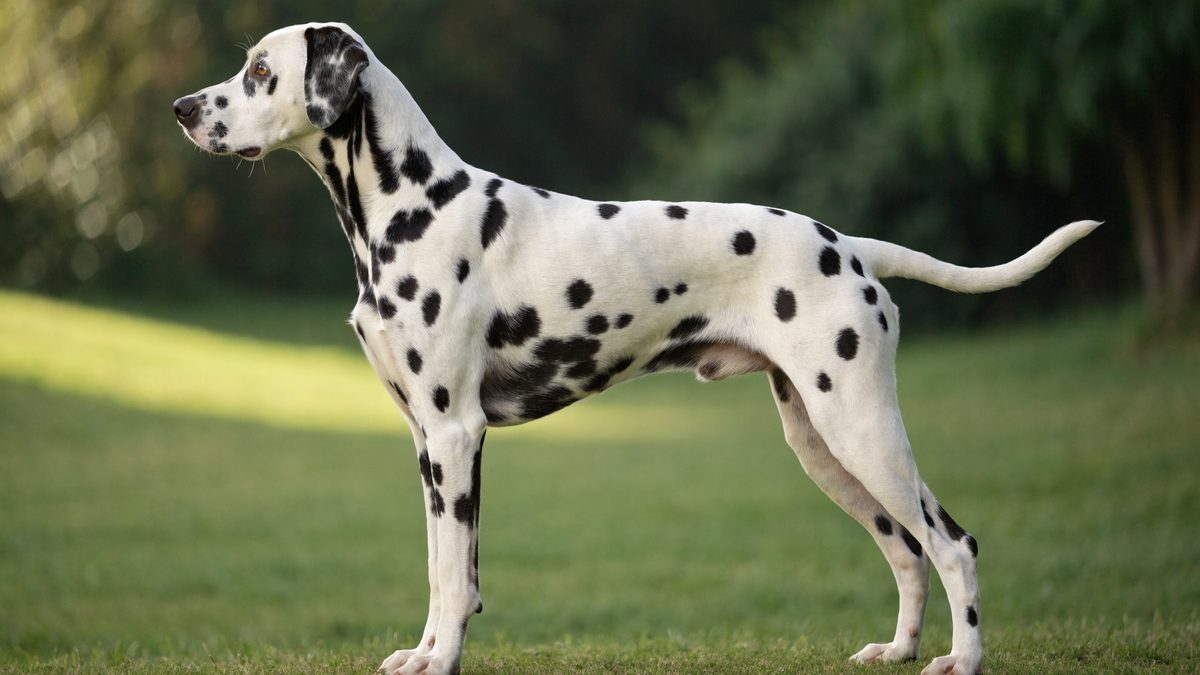
A Dalmatian is a medium-sized, short-coated, spotted coach dog built to trot beside a horse-drawn carriage for hours, and two inherited traits came along with the spots. Every Dalmatian alive excretes uric acid instead of allantoin, and the breed carries the highest documented rate of congenital deafness of any dog. Both facts are settled science. Neither appears on the Indian pages ranking for this query.
The Dalmatian is recognised by two different breed standards, and Indian buyers are usually shown the wrong one. Under the American Kennel Club standard, approved on 11 July 1989, desirable height at the withers is 19 to 23 inches, any dog or bitch over 24 inches is disqualified, and the body length from forechest to buttocks roughly equals the height at the withers. Under FCI-Standard N 153, valid from 13 October 2010, males stand 56 to 62 cm and females 54 to 60 cm. The AKC also publishes a working range of 19 to 24 inches and 45 to 70 pounds on its breed page.
Which standard applies in India is not a technicality. The Kennel Club of India is listed by the Federation Cynologique Internationale as a Full member, at Nr 28, AA Block, First Street, Anna Nagar, Chennai. So the standard that governs a KCI-registered Dalmatian in India is the FCI one, and the two documents disagree on something that matters enormously to a buyer.
| Point | AKC standard, 1989 | FCI-Standard N 153, 2010 |
|---|---|---|
| Height | 19 to 23 in desirable, over 24 in disqualified | Males 56 to 62 cm, females 54 to 60 cm |
| Blue eyes | Permitted. 'Eye color is brown or blue, or any combination thereof' | DISQUALIFYING FAULT, along with heterochromia and a partially blue iris |
| Deafness | Not listed as a disqualification | DISQUALIFYING FAULT |
| Patches | Disqualification | Disqualifying fault, listed as monocle or patching elsewhere |
| Lemon, orange or blue spots | Disqualification, only black or liver allowed | Disqualifying fault |
| Long coat | Not named | Disqualifying fault, wirehaired or longhaired |
Read the right-hand column again. Under the standard the Indian kennel club answers to, a blue-eyed Dalmatian is disqualified and a deaf one is disqualified. Indian sellers advertise blue-eyed and rare-colour Dalmatians as premium stock. They are selling a dog that the applicable breed standard rejects, and, as the health section shows, one carrying roughly three times the risk of bilateral deafness.
The coat, and a correction
The Dalmatian coat is short, dense, fine and close fitting, neither woolly nor silky, and it is sleek and glossy. The FCI puts it the same way, short, shiny, hard and dense all over the body. This matters because one of the Indian marketplace pages ranking on page one for this query tells buyers that Dalmatians have dense, curly coats needing trimming every four to six weeks to prevent matting. That is wrong against both published standards. A Dalmatian has nothing to trim. If a seller or groomer tells you otherwise, they have not read a breed standard.
The ground colour is pure white with dense black spots or liver-brown spots, and spots run from the size of a dime to the size of a half-dollar. The FCI is more precise, preferring spots of 2 to 3 cm in diameter in the black variety and around 2 cm in the brown. Colour and markings carry 25 of the 100 points in the AKC scale, the single heaviest weighting in the standard. The breed has been judged on its coat pattern more than on anything else for over a century, and that fact turns out to explain the urate problem.
The hyperuricosuria trait was probably fixed in the Dalmatian through selection for a more distinctive spotting pattern, and the locus sits close to a modifier of spot size. The breed's own foundation says the same thing from the other direction, that some low-uric-acid backcross dogs show fewer, smaller or frosty spots. Judges rewarded the spots. The stones came with them.
History, and the demand cycle
The Dalmatian is a coach dog, bred to guard horses and coaches, and some of that protective instinct remains. The FCI records the earliest evidence in Croatian church chronicles and paintings from the 16th to 18th centuries, including an altar painting in Veli Losinj dated 1600 to 1630, with Thomas Pennant naming the breed 'Dalmatian' in 1771 and the first official standard following the formation of the Dalmatian Club in England in 1890. The Kennel Club records the Regency-period role plainly, a status symbol trotting alongside horse-drawn carriages, and later running ahead of horse-drawn fire engines to clear the route.
Then Disney happened, and the consequences are measured. Analysing 48,598,233 American Kennel Club puppy registrations from 1946 to 2003, Harold Herzog found the Dalmatian ran one of the nine sharpest boom-and-bust cycles in registry history. Annual registrations went from 8,170 puppies in 1985 to 42,816 in 1993, then fell 97 percent within a decade, the steepest descent in popularity of any breed in AKC history. A later PLoS ONE analysis of 87 dog movies confirmed that several releases of and sequels to 101 Dalmatians appear among the largest movie-associated trend changes on record.
That is the pattern India is now running about twenty-five years late. The breed is marketed here on the film, on the spots and on the look, and the pages selling it do not mention the two conditions the breed is genuinely defined by.
Dalmatian price in india
A Dalmatian puppy costs Rs 15,000 to Rs 2,50,000 in India in 2026 according to the pages currently ranking for this query, a spread of more than sixteen times for the same breed. The useful fact is not the range. It is that the published sources disagree wildly with each other, two of them disagree with themselves inside a single page, and none of them prices the two things that actually determine what this dog costs you.
Bonbeno read every page on the first page of the Google India results for 'dalmatian price in india' on 15 August 2026 and put their published figures side by side. Read them together and the market's honesty problem is obvious.
| Source | Headline range | Pet or basic quality | KCI registered | Show or champion line |
|---|---|---|---|---|
| Mr n Mrs Pet | Rs 35,000 to Rs 2,50,000+ | Rs 35,000 to Rs 75,000 | Rs 75,000 to Rs 1,50,000 | Rs 1,50,000 to Rs 2,50,000 |
| Wrap In Fur | Rs 20,000 to Rs 80,000 | Rs 20,000 to Rs 35,000 | Rs 35,000 to Rs 55,000 | Rs 55,000 to Rs 80,000+, imported Rs 80,000 to Rs 1,50,000+ |
| Premium Pet House | Rs 20,000 to Rs 1,00,000 in body text, Rs 30,000 to Rs 70,000 in its own spec table | Not separated | Not separated | Not separated |
| Happy Pet | Rs 20,000 to Rs 60,000 in the badge, Rs 20,000 to Rs 90,000 in the body | Not separated | Not separated | Not separated |
| PatMyPets | Rs 20,000 to Rs 30,000 in its spec table, Rs 50,000 to Rs 60,000 in its own city table | Not separated | Not separated | Not separated |
| AsiaPets | Rs 15,000 to Rs 40,000 | Not separated | Not separated | Not separated |
| Marshalls Petzone | Rs 20,000 to Rs 25,000 across India | Not separated | Not separated | Not separated |
| ExportersIndia, Jamhar Kennel, Pune | Rs 15,000 to Rs 55,000 per piece, listed at Rs 15,000 | Not separated | Not separated | Not separated |
Three things stand out. First, the top-ranked page starts its basic tier at Rs 35,000, which is above the top of the entire range published by Marshalls Petzone Marshalls Petzone. Second, the KCI-registered tier is quoted at Rs 75,000 to Rs 1,50,000 by one page and at Rs 35,000 to Rs 55,000 by another, a gap of Rs 95,000 on the same certificate Wrap In Fur, Dalmatian Dog Price in India…. Third, two pages contradict themselves. PatMyPets prints an average price of Rs 20,000 to Rs 30,000 in its specification table and Rs 50,000 to Rs 60,000 in its city table on the same page. Premium Pet House prints Rs 30,000 to Rs 70,000 in its table and Rs 20,000 to Rs 1,00,000 three paragraphs later.
City by city, and why the city tables are near-worthless
| City | Wrap In Fur | Premium Pet House | PatMyPets |
|---|---|---|---|
| Delhi | Rs 25,000 to Rs 70,000 | Rs 35,000 to Rs 95,000 | Rs 50,000 |
| Mumbai | Rs 30,000 to Rs 80,000 | Rs 30,000 to Rs 90,000 | Rs 50,000 |
| Bangalore | Rs 25,000 to Rs 75,000 | Rs 35,000 to Rs 95,000 | Rs 50,000 |
| Hyderabad | Rs 22,000 to Rs 65,000 | Rs 34,000 to Rs 90,000 | Rs 50,000 |
| Chennai | Rs 22,000 to Rs 60,000 | Rs 32,000 to Rs 90,000 | Rs 60,000 |
| Kolkata | Rs 20,000 to Rs 55,000 | Rs 35,000 to Rs 95,000 | Rs 60,000 |
| Pune | Rs 25,000 to Rs 70,000 | Rs 35,000 to Rs 80,000 | Rs 50,000 |
The Wrap In Fur and Premium Pet House city figures never overlap at the bottom in four of the seven cities, and PatMyPets publishes a single flat number per city with no range at all Premium Pet House PatMyPets, Dalmatian Information, Pictures. Meanwhile the top-ranked marketplace publishes the identical band, Rs 35,000 to Rs 2,50,000, for Hyderabad, Bangalore, Delhi, Chennai, Lucknow, Mumbai, Jaipur and Pune, which tells you the city breakdown is a template rather than a price observation. Nobody is auditing any of these numbers. Treat every city table on this query as marketing furniture.
Two video results sit on page one of the Google India SERP for this query. Their titles advertise Dalmatian puppies at Rs 6,000 and at Rs 7,500 with a Rs 1,000 booking deposit. Bonbeno records these as observed SERP results, not as verified transactions, and does not link them. What they show is that the advertised floor for this breed in India is well under half the lowest figure any article publishes. A Dalmatian at Rs 6,000 has not been BAER tested, has not had its parents screened, and almost certainly has no KCI registration.
What KCI registration actually buys you
KCI registration certifies pedigree, not health. The Kennel Club of India publishes a litter registration form, a single dog registration form, a transfer-of-ownership form, prefix and affix registration and a tariff sheet revised from 1 April 2024. India's kennel club is an FCI Full member, so the paperwork places a dog in a stud book that is internationally recognised. What it does not do is tell you whether the puppy can hear, or whether its sire and dam were ever screened for anything.
That is the gap the price conversation on this breed keeps missing. The AKC's national breed club recommends exactly two health tests for a Dalmatian, a hip evaluation and a baer test. The Kennel Club goes further and lists a DNA test for hyperuricosuria, elbow testing, BAER hearing testing including litter screening, hip testing, and, newly recognised in October 2025 and applying from July 2026, a test for disproportional dwarfism. None of the Indian price pages mentions a single one of these.
| Item | Published Indian price coverage | What it tells you |
|---|---|---|
| KCI registration | Priced explicitly by two of eight sources | Pedigree documented in the Indian stud book. Says nothing about health. |
| BAER hearing test on the puppy | Not mentioned by any Indian page reviewed | The only objective way to know the puppy is not unilaterally or bilaterally deaf |
| Hyperuricosuria DNA test | Not mentioned by any Indian page reviewed | Distinguishes an ordinary high-uric-acid Dalmatian from a low-uric-acid backcross dog |
| Hip evaluation on the parents | Not mentioned by any Indian page reviewed | One of only two tests the AKC parent club recommends |
| Eye colour | Marketed as a premium feature | Blue eyes are a disqualifying fault under FCI-Standard N 153 and carry roughly three times the bilateral deafness rate Dalmatian Club of America |
The honest summary is short. A Dalmatian in India costs whatever the seller says, because there is no auditable market. What you can control is what you demand before paying. A BAER certificate for the individual puppy, a hyperuricosuria result for both parents, and a KCI number you can verify with the Chennai office are worth more than any price tier on any of these pages.
The real monthly cost of a Dalmatian in India
Published Indian estimates put the monthly cost of keeping a Dalmatian at Rs 3,550 to Rs 12,000, and every one of those estimates leaves out the urinary monitoring the breed specifically needs. Add the Dalmatian-only lines and the honest floor rises. The purchase price is the smallest number in this section.
Start with what the ranking pages publish, because their disagreement is instructive on its own.
| Source | Total per month | Food | Health | Grooming | Training |
|---|---|---|---|---|---|
| Wrap In Fur | Rs 4,000 to Rs 12,000 | Rs 2,000 to Rs 5,000 | Rs 500 to Rs 2,500 | Rs 300 to Rs 1,000 | Rs 500 to Rs 2,000 |
| Happy Pet | Rs 3,550 basic, Rs 5,400 premium | Rs 2,250 to Rs 3,000 | Rs 600 to Rs 1,200 | Rs 700 to Rs 1,200 | Not stated |
| Mr n Mrs Pet | Rs 5,000 to Rs 10,000 | Not separated | Not separated | Not separated | Not separated |
| Premium Pet House | Not totalled | Rs 1,500 to Rs 3,000 | Rs 5,000 to Rs 10,000 a year | Rs 1,500 to Rs 3,000 per professional session | Rs 5,000 to Rs 7,000 |
Two of those four price training at up to Rs 7,000 a month, which alone is more than one page's entire monthly total. Take the published spread as a rough Rs 3,500 to Rs 12,000 band and understand that it describes a generic medium dog, not this one.
The lines only a Dalmatian owner pays
Every Dalmatian is homozygous for the hyperuricosuria variant, so urinary monitoring is not optional and it is not occasional. The Minnesota Urolith Center's published protocol for a dog with the genetic variant is a urinalysis every three to six months to keep urine pH above 7 and urine specific gravity at 1.020 or lower, plus medical imaging every six to twelve months to catch recurrent stones while they are still small enough to remove without surgery. The Dalmatian Club of America Foundation's research partner puts it more bluntly, that owners are often encouraged to have a urinalysis several times a year, and that cheap pH strips let you test first-morning urine at home.
| Line item | Frequency | Why |
|---|---|---|
| Urinalysis | Every 3 to 6 months for life | Adjust pH above 7 and specific gravity to 1.020 or lower |
| Urine pH strips at home | Weekly, first-morning sample | Risk rises when pH falls to 5.0 to 5.5 |
| Abdominal imaging | Every 6 to 12 months | Urate stones are often radiolucent and hard to see on plain radiographs |
| Prescription low-purine diet | Daily, lifelong if the dog forms stones | These diets are prescription-only and obtained through your veterinarian |
| Allopurinol | Daily, if prescribed | Carries a risk of xanthine stone formation, so it is not a set-and-forget drug |
| Hyperuricosuria DNA test | Once, before purchase, on both parents | USD 58 as a single test at UC Davis, USD 27 added to another health test on the same animal |
| BAER test | Once, on the puppy at 5 to 7 weeks | The only reliable way to detect unilateral deafness |
Bonbeno found no published Indian price for either a BAER test or a canine hyperuricosuria DNA panel, and we are not going to invent one. What we can say is that BAER facilities are concentrated in veterinary teaching hospitals rather than general practices, which is true internationally as well as here, and that many owners have to travel a significant distance to reach one. Budget for a trip, not just a fee.
The number that dwarfs everything else
One surgical episode resets your budget. Among Dalmatians that form stones, the recurrence rate after removal is 33 to 50 percent. Removal options run from medical dissolution through laser lithotripsy and cystoscopic-assisted cystotomy to open surgery, and in a male with a urinary obstruction that cannot be relieved by flushing the stones back into the bladder, the surgical answer is a scrotal urethrostomy, a permanent new opening behind the os penis. Medical dissolution alone succeeds in only about one-third of cases, reduces stones to a removable size in about half, and in the remaining third the uroliths actually grow, usually because of xanthine formation on allopurinol.
Take the published Rs 3,500 to Rs 12,000 monthly band as your baseline. Then add quarterly urinalysis and annual imaging as fixed costs rather than optional ones, and hold a contingency for a single urinary emergency. A Dalmatian bought at Rs 20,000 without a BAER certificate or parental hyperuricosuria results is not a cheap dog. It is an unpriced risk.
One more Indian line item deserves naming. This is an athletic breed with a genuine daily exercise requirement, and in most Indian cities that means either a compound you already own or paid access to somewhere safe to run at 6 am. Nobody costs that, and for a flat-dwelling owner it is often the difference between a manageable dog and an unmanageable one.
Heat tolerance in Indian conditions
Bonbeno rates the Dalmatian 3 of 5 for heat tolerance, which is genuinely better than a Husky or a Saint Bernard and genuinely worse than the Indian pages claim. The short coat helps. What the ranking pages miss entirely is that Indian heat attacks this breed through a second route nobody names, dehydration concentrating urine that is already loaded with uric acid.
Take the coat argument first, because it is half right. The Dalmatian coat is short, shiny, hard and dense, with no insulating undercoat of the kind an Arctic breed carries. That is a real advantage over a double-coated dog in an Indian summer, and it is why Bonbeno does not rate this breed 1 of 5 the way we rate the Siberian Husky. The Kennel Club lists coat length as short and confirms the breed suits town or country.
Now take the conditions. On 25 April 2026 the India Meteorological Department reported maximum temperatures of 40 C to 44 C across large parts of northwest, central and peninsular India, with the day's highest reading of 44.5 C at Sri Ganganagar in Rajasthan, and temperatures running 5 C or more above normal in several regions. The same bulletin flagged hot and humid conditions over Odisha, West Bengal, Tamil Nadu and Andhra Pradesh, warm night conditions across the northern plains, and above-normal heatwave days for April to June 2026. One Indian breed page publishes an ideal weather range of 15 C to 30 C for this dog. Most of India sits outside that range for most of the year.
| Claim | Who publishes it | What the evidence supports |
|---|---|---|
| Adaptable to Indian climate, listed as a pro | Wrap In Fur | Partly. The short coat helps, but IMD records 40 C to 44 C maxima across much of India |
| Ideal pets for warm and humid climates | Premium Pet House | Overstated. All dogs are at risk of heatstroke and dogs cool mainly by panting |
| Ideal weather 15 C to 30 C | Happy Pet | Consistent with the sources, and incompatible with most Indian summers |
| Heat exposure risks dehydration and heat exhaustion | Wrap In Fur | Correct, and the one heat point the ranking set gets right |
The second route, and why it is the important one
Heat harms a Dalmatian twice. The first route is the one every page describes, straightforward heat stress. The second route is specific to this breed, and no Indian page mentions it. Urate stone formation depends not only on how much uric acid the dog excretes but on how concentrated the urine is and how long it sits in the bladder. The Minnesota Urolith Center's own management target is a urine specific gravity of less than 1.020, achieved if necessary by feeding canned food or adding water to meals. Purina's research summary is blunt, adequate hydration is essential to avoid urinary stones, and acidic urine that sits in the bladder encourages the formation of urate stones.
Now picture a Delhi summer. A 44 C afternoon, a dog panting for hours, an owner out of the house for nine hours, and a bladder that has not been emptied since 8 am. You have simultaneously concentrated the urine and extended its dwell time. Those are the two non-genetic risk factors for urate stones, stacked, in the ordinary Indian working week. This is why water intake and toilet access are clinical interventions for this breed and not general good advice.
If your Dalmatian is dehydrated in an Indian summer, its urine specific gravity is climbing away from the sub-1.020 target the urolith specialists set, its urine is sitting longer, and it is doing the two things most strongly associated with urate stone formation. Fresh water in at least two rooms, wet food or water added to kibble, and a mid-day toilet break are not luxuries here.
The practical Indian summer routine
- Walk before 7 am and after 8 pm from March to October, because the day peaks in the late afternoon around 3 to 5 pm rather than at noon
- Test the pavement with the back of your hand for ten seconds, and if you cannot hold it there, it is too hot for paws
- Hydrate the dog before, during and after every outing, carrying water and a collapsible bowl
- Exercise lightly for the first two weeks of hot weather, because dogs are at higher risk in early summer before they have acclimatised
- Keep the dog indoors with a fan or air conditioning in extreme temperatures and high humidity
- Never leave the dog in a parked car, where the interior can rise 40 degrees Fahrenheit in an hour with most of that rise in the first 15 to 30 minutes
Know the early signs. Heavy panting, seeking shade, whining, reluctance to play and drooling mean the dog is overheating, and the response is cool air, water and a fan immediately. Difficulty breathing, bloody diarrhoea, vomiting, weakness, confusion, seizures or collapse mean heatstroke, and that is an emergency.
Monsoon and the rest of the year
The monsoon shifts the problem rather than solving it. A short-coated dog dries fast, which is an advantage over a heavy-coated breed, but Indian coastal humidity keeps skin damp under a collar and behind the ears. Brush weekly as the Kennel Club recommends and dry the ears and skin folds after rain. The one climate zone where this breed is genuinely comfortable in India is the hill stations and the north in winter, and even there the exercise requirement does not fall.
Temperament and who should not buy one
The Dalmatian's published temperament is stable and outgoing yet dignified, with shyness recorded as a major fault. In practice you are getting a reserved, high-drive coach dog that is aloof with strangers, bonded hard to its own people, and carrying a marked hound instinct. It is a poor fit for a small Indian flat, an absent owner or a first dog.
The two standards describe the same dog from different angles. The AKC calls the temperament stable and outgoing yet dignified and makes shyness a major fault. The FCI calls it pleasant, friendly, not shy or hesitant, free from nervousness and aggression, lively, kind, loyal, independent and easy to train, and adds that the Dalmatian likes water and outdoor activities and has a marked hound instinct. That last clause is not decorative. The FCI classifies the breed in Group 6, Scenthounds and related breeds, Section 3.
A scenting drive changes what off-lead means in an Indian city. A dog that has locked onto a trail across four lanes of traffic is not being disobedient. It is doing what its group classification says it does.
What the AKC parent club's description actually says
The AKC's breed description is more guarded than the Indian marketing copy. The Dal was originally bred to guard horses and coaches and some of the old protective instinct remains. Reserved and dignified, Dals can be aloof with strangers and are dependable watchdogs, while with their preferred humans they are bright, loyal and loving house dogs and strong, athletic partners for runners and hikers. Compare that with the Indian listing page that sells the breed as protective, loyal and an excellent watchdog with no mention of aloofness at all.
The first-time-owner question, where the sources split
| Source | Verdict |
|---|---|
| Wrap In Fur | Yes, if prepared for an active lifestyle |
| Happy Pet | Yes, for owners willing to meet the exercise and training needs |
| Premium Pet House | No. High-energy and often stubborn, requires prior experience |
| PatMyPets | No. This breed can be difficult to properly care for and is not recommended as a first dog |
| Bonbeno | No, in an Indian metro flat. Yes, for an experienced runner with a compound, a garden and a mid-day toilet break |
Bonbeno's verdict tracks the two Indian sources that say no, and it tracks the Kennel Club, which lists the ideal home as a large house with a large garden. A 2 BHK on the fourth floor with both adults working full days is the wrong home, and it is the wrong home twice over, because the missed mid-day toilet break is a urate risk factor rather than just an inconvenience.
Children, and the honest caveat
This is a strong, fast dog that plays hard. Indian pages that flag the risk are right to do so, one noting that Dalmatians are energetic enough to accidentally knock small toddlers down, another advising against leaving a Dalmatian unsupervised with children under ten. Supervise, and give the dog its exercise before it interacts with small children rather than after.
The behaviour question nobody in India asks
If your Dalmatian seems unusually calm about noise, get it tested rather than congratulating yourself. Bilaterally deaf dogs sleep more soundly than expected and are unbothered by loud or unusual noises that agitate other animals, and owners frequently miss it because the dog responds normally to visual cues and reads body language well. In a country where Diwali, weddings and traffic horns test every dog's noise tolerance, a Dalmatian that ignores fireworks is a dog worth booking a BAER appointment for.
Deaf dogs are at higher risk of trauma, particularly from vehicles and from aggressive attacks by other dogs, they are harder to train, and being unable to detect auditory communication they may behave abnormally with other dogs and attract aggression as a result. A unilaterally deaf dog usually lives a normal life but may not respond to a noise when lying with its hearing ear against the ground. In Indian street conditions, an off-lead deaf Dalmatian is a serious risk to itself.
Finally, take the separation-anxiety claim on one ranking page with care. It states flatly that Dalmatians are not the kind of dogs that develop separation anxiety. Bonbeno found no veterinary source supporting a breed-level exemption, and the same page elsewhere warns that an under-exercised Dalmatian becomes irritable and destructive. Socialise early and widely, and do not assume the breed self-manages being left alone all day.
Training a Dalmatian, and the hearing question first
Before you decide your Dalmatian is stubborn, rule out deafness. Between 18 and 30 percent of the breed is affected in one or both ears, unilaterally deaf dogs are usually indistinguishable from hearing ones, and a dog that cannot locate your voice looks exactly like a dog ignoring it. Everything else in this section assumes you have that answer.
The published sources disagree on trainability, and the disagreement is worth showing rather than averaging.
| Source | Published position |
|---|---|
| FCI-Standard N 153 | Lively, kind, loyal, independent and easy to train |
| PatMyPets | Strong desire to please, simple to train with positive reinforcement, but often sidetracked |
| Mr n Mrs Pet | Quick learners, eager to please, respond well to consistent training |
| Wrap In Fur | Relatively easy with consistency, but lists stubbornness as a con |
| Premium Pet House | Often stubborn and independent, difficult to train effectively, training an adult is harder still |
The pattern across the table is consistent even where the verdicts are not. Every source that describes difficulty attributes it to independence and distractibility rather than to low intelligence, and every source recommends the same method, positive reinforcement with food rewards, praise and play, started young Premium Pet House.
Why hearing status must come first
A unilaterally deaf dog hears, but it cannot tell you where the sound came from. The Dalmatian Club of America Foundation describes these dogs as often indistinguishable from bilaterally hearing dogs and notes that they may be directionally challenged. In a recall exercise in an Indian park, a directionally challenged dog that sprints away from your voice reads as defiance. It is anatomy.
Bilaterally deaf puppies need additional training and special consideration for placement. UFAW notes deaf dogs are more difficult to train and that the welfare consequences often follow from the handling, for example being confined or never allowed off the lead. None of that means a deaf Dalmatian cannot be a good dog. It means you need to know, and you need to plan for hand signals rather than voice cues from week one.
Ask the breeder for the puppy's baer test result. BAER, the brainstem auditory evoked response, is the standard hearing test, ethical breeders run it between 5 and 7 weeks with 7 weeks preferred for accuracy, and sedation is usually not needed. If the breeder does not know what BAER stands for, that answer is itself the information you came for.
A realistic Indian training timeline
| Age | Priority | Note |
|---|---|---|
| 5 to 7 weeks | BAER test at the breeder | 7 weeks preferred for accurate results |
| 8 to 12 weeks | Home, toilet routine, name, handling | The typical purchase window in India |
| 8 to 16 weeks | Socialise to people, traffic, other dogs, cats, children | Early socialisation is treated as essential across the ranking set |
| 3 to 6 months | Lead manners, recall on a long line, crate and car | Do not trust recall off-lead near Indian traffic given the marked hound instinct |
| 6 to 12 months | Impulse control, settle on a mat, alone-time training | The breed becomes destructive when bored |
| 12 to 24 months | Build distance work and stamina gradually | Joints and bones are not fully developed until about two years |
One training goal specific to this breed
Train a reliable on-cue toilet break, and train yourself to give it. Urine that sits in the bladder for long periods is an independent contributor to urate stone formation, and Dalmatians should have ample opportunities to urinate. A dog that will urinate on request, on a balcony pad if needed at 3 pm in a Chennai May, is doing preventive medicine. No general obedience curriculum will tell you that, because it is true of almost no other breed.
Two practical Indian notes to close. Hire help early if you hire it at all, because training an adult Dalmatian is materially harder than training a puppy, and published Indian trainer costs run Rs 5,000 to Rs 7,000 a month. And keep sessions in the cool hours, because a dog worked at 2 pm in an Indian summer is not learning, it is surviving.
Exercise, and what happens without it
The Kennel Club puts the Dalmatian's requirement at more than two hours a day, the highest band it publishes. In India that has to fit before 7 am and after 8 pm for roughly eight months of the year. If you cannot commit to that, do not buy this breed, because under-exercising it is not merely unkind, it removes one of the three things the breed's own foundation names as protective against urate stones.
The published requirement varies, and the variation matters because the low figure is the one Indian buyers tend to quote.
| Source | Stated requirement |
|---|---|
| The Kennel Club | More than 2 hours per day |
| Premium Pet House | At least 2 hours every day |
| PatMyPets | Roughly 2 hours per day, about 1 hour for puppies |
| Happy Pet | 60 to 90 minutes |
Three of the four cluster at two hours or more, and Bonbeno rates daily exercise need 5 of 5 on that basis. The outlier at 60 to 90 minutes is roughly half the Kennel Club figure. If you plan on the outlier and get the Kennel Club dog, you will have a destructive animal within a year, which is precisely what one ranking page lists as the consequence of boredom.
Why this breed needs it more than most
The Dalmatian was built to trot beside a carriage. The AKC standard states plainly that in keeping with its historical use as a coach dog, gait and endurance are of great importance, and describes a breed capable of great endurance combined with a fair amount of speed. The breed page calls it a strong, active athlete with great stamina and a good partner for runners and hikers. The FCI adds that the Dalmatian likes water and outdoor activities. This is a working endurance dog, not a companion breed with a walk requirement bolted on.
The Dalmatian Club of America Foundation states that most Dalmatians never form stones or have a blockage as long as a low purine diet, adequate water consumption and necessary exercise are provided, and as long as males are not neutered before 18 months of age. Exercise appears in that list beside diet and water. Skipping it is not just a behaviour decision.
Fitting two hours into an Indian day
- Split the load. One 60 to 75 minute session before 7 am and one 45 to 60 minute session after 8 pm beats a single long outing in the heat
- Use water where you can. The breed likes water and swims well, and a pool session substitutes for road work without cooking the paws PatMyPets, Dalmatian Information, Pictures
- Build distance slowly until two years old, because joints and bones are not fully developed before then
- Keep the dog on lead near traffic. The FCI records a marked hound instinct and classifies the breed with the scenthounds
- Add mental work on days you cannot get outside, because the breed creates its own projects when bored
- Give a mid-day toilet break regardless of exercise, because bladder dwell time is a urate risk factor
Apartment reality
The Kennel Club lists the ideal home as a large house with a large garden. The Indian ranking set is split on flats, with one page rating the breed apartment friendly as Highly in its specification table and then running a section headed 'Not The Best Apartment Dogs' further down the same page, and another rating apartment suitability as moderate with daily outdoor exercise. Bonbeno rates apartment suitability 2 of 5. A ground-floor flat with a compound and a committed runner works. A high-rise with a lift, two working adults and no garden does not.
The failure mode is predictable and it is documented across the ranking set. An under-exercised Dalmatian becomes irritable, destructive and, per one Indian source, obese. In an energetic breed carrying a lifelong urinary predisposition, obesity and inactivity are not cosmetic problems.
Grooming a short-coated dog in Indian humidity
Grooming a Dalmatian takes about ten minutes a week. The Kennel Club puts the requirement at once a week and the coat length at short. The only genuinely difficult parts in India are the shedding, which is year-round, and the skin, which reacts to humid coastal conditions. There is nothing to clip and nothing to strip.
Start with the correction, because the top-ranked page in India for this query gets the coat wrong. It tells buyers that Dalmatians have dense, curly coats needing trimming every four to six weeks to prevent matting and to keep them cool in Indian weather. Both published breed standards say otherwise. The AKC calls the coat short, dense, fine and close fitting, neither woolly nor silky, sleek and glossy. The FCI calls it short, shiny, hard and dense all over the body. A short-coated dog with no undercoat does not mat and does not need trimming. If a groomer quotes you a Rs 3,000 trim for a Dalmatian, you are buying nothing.
What the sources actually recommend
| Source | Brushing | Bathing |
|---|---|---|
| The Kennel Club | Once a week | Not specified |
| Premium Pet House | A few times a week, daily to control shedding | Once a month, or every 4 to 6 weeks |
| PatMyPets | Daily, curry comb or flicker brush | Twice every two weeks |
| Wrap In Fur | Regular brushing, sheds throughout the year | Not specified |
| Happy Pet | Regular, moderate shedding | Included in the hygiene checklist |
The honest reading is that once a week meets the breed's needs and daily brushing is a shedding-management choice rather than a coat-health requirement Premium Pet House. Brush outdoors if you can, because Dalmatian hairs are short, stiff and white and they weave into upholstery.
The Indian-specific parts
- Ears attract ticks, and tick pressure in most Indian cities is year-round rather than seasonal, so check the ear leather and the base of the ear every time you brush
- Skin allergies are recurrent in this breed across food, contact and inhalant triggers, and Indian dust and mildew load both of the latter Premium Pet House
- Dry the dog properly after monsoon walks, because damp skin under a collar in humid coastal air is where infections start
- Do not change shampoo often, since Dalmatian skin is described as sensitive across the Indian ranking set
- Trim nails once or twice a month, and take the dog to a vet or groomer if you cannot do it yourself
Published Indian grooming costs run Rs 300 to Rs 1,000 a month and Rs 700 to Rs 1,200 a month, against Rs 1,500 to Rs 3,000 for a single professional session. For a breed the Kennel Club grooms once a week, home supplies costing under Rs 1,500 once are enough The Kennel Club (Royal Kennel Club). Spend the difference on the urinalysis schedule instead.
One myth deserves puncturing. Dalmatians are frequently sold in India as low-odour and low-shedding. They shed all year, they are explicitly not hypoallergenic, and no source in the ranking set claims otherwise Mr n Mrs Pet, Dalmatian Puppies For Sale…. A white-haired dog on dark Indian upholstery is a visible, permanent fact of ownership.
Health, urate stones and deafness
Two inherited conditions define this breed and both are testable before you buy. Every Dalmatian on earth is homozygous for a defect in the SLC2A9 gene and excretes uric acid instead of allantoin, which is why urate stones and urinary obstruction are breed-defining risks. And the Dalmatian has the highest reported prevalence of congenital sensorineural deafness of any dog breed. Neither appears on the Indian pages ranking for this query.
1. Hyperuricosuria, the condition every Dalmatian has
Allantoin is the end product of purine catabolism in all mammals except humans, great apes and one breed of dog, the Dalmatian. Hyperuricosuria and hyperuricaemia is a simple autosomal recessive trait for which all Dalmatian dogs are homozygous, caused by a missense mutation in SLC2A9 together with two promoter mutations that reduce expression of one isoform. In a Dalmatian, urate reabsorption in the kidney is lost entirely and urate excretion equals or exceeds the glomerular filtration rate, while a non-Dalmatian dog with artificially raised serum uric acid clears it at only about a third of the Dalmatian rate.
Cornell states the practical consequence, that Dalmatians are the most commonly affected breed with a nearly 100 percent risk of carrying this mutation, though not all Dalmatians go on to develop stones. The Minnesota Urolith Center says the same in a single line, most Dalmatians are positive for this mutation. The Dalmatian Club of America Foundation quantifies the gap between an ordinary Dalmatian and a low-uric-acid backcross dog, at 10 to 20 times more urate in the urine.
How many actually form stones, and the sources disagree
| Estimate | Source |
|---|---|
| About 10 percent of Dalmatians form stones | Purina Pro Club, reporting University of Tennessee research funded by the DCA Foundation |
| Some reports indicate as many as one-quarter to one-third | Same source, citing the range in the literature |
| Other sources suggest 5 to 10 percent of the breed | Same source |
| Number affected is not known | Stated plainly by the same research summary |
Bonbeno does not average those. The honest position is that somewhere between 5 percent and a third of Dalmatians form stones, that the true figure is unknown, and that the reason some homozygous dogs form stones and others never do is the active research question. What is not uncertain is who the stones happen to.
Of 7,560 Dalmatian uroliths analysed by the Minnesota Urolith Center between 1981 and 2000, 95 percent were composed of urate, and 97 percent of the Dalmatians with urate uroliths were male. Female Dalmatians made up just 3 percent, and diagnosis in a female is roughly 30 times less likely than in a male. Males obstruct because stones lodge where the urethra narrows over the os penis, and an untreated urinary obstruction can be fatal.
The scale of the breed's excess risk has been quantified. Dalmatians are reportedly 229 times as likely as other breeds to have a urolith composed of urate, with Bulldogs about 16 times as likely, and the mean age at which Dalmatian urate uroliths are submitted for analysis is 4.2 years. That figure is the one to hold on to. It is not that Dalmatians get a common problem slightly more often. It is a different order of risk.
Most stone-forming dogs begin at around four years of age, and among Dalmatians that form stones the recurrence rate after removal is 33 to 50 percent. Learn the signs now, because in a male this becomes an emergency fast. Straining to urinate, frequent small volumes, accidents indoors, blood in the urine and reduced appetite are the early picture. A large firm bladder, abdominal pain, vomiting and lethargy mean obstruction, and that is a same-hour trip to a vet.
Management, and a dosing disagreement worth knowing about
| Element | Minnesota Urolith Center | University of Tennessee via Purina Pro Club |
|---|---|---|
| Allopurinol | 5 to 7 mg/kg every 24 hours, or divided every 12 hours | 15 mg/kg every 12 hours, reported as more effective than the often-cited 10 mg/kg every 8 hours |
| Urine pH target | Adjust to greater than 7 | Ideally neutral at 7.0, with risk from 5.0 to 5.5 |
| Urine specific gravity | 1.020 and lower, using canned food or added water | Increase urine volume |
| Diet | Low purine and low protein foods producing neutral to alkaline urine | Purine-restricted, low protein, increasing urine volume |
| Other drugs | Potassium citrate at 75 mg/kg every 12 to 24 hours if pH is consistently below 6.5 | Not specified |
| Monitoring | Urinalysis every 3 to 6 months, imaging every 6 to 12 months | Urinalysis several times a year, home pH strips on first-morning urine |
The allopurinol gap is large and Bonbeno is not going to reconcile it. Take the table to your own veterinarian and let them choose. What both agree on is that allopurinol is a xanthine oxidase inhibitor and that suppressing uric acid raises xanthine, so the drug carries a real risk of xanthine stone formation and is never a set-and-forget prescription Purina Pro Club, Research Aims To Determine…. Of the 7,068 uroliths from male Dalmatians in the Minnesota series, 50 were already xanthine.
The Dalmatian Club of America Foundation states that early neutering decreases urethral diameter and can contribute to blockage, and that most Dalmatians never form stones or obstruct as long as a low purine diet, adequate water consumption and necessary exercise are provided, and as long as males are not neutered before 18 months of age. Indian shelters and clinics routinely advise sterilising at six months. For a male Dalmatian specifically, raise this with your vet before you neuter, because the anatomy argument is breed-specific and the general advice was not written for a dog that excretes uric acid.
The LUA backcross, and what NY papers do and do not mean
There is a documented fix, and India should know it exists. In 1973 Dr Robert Schaible bred a male Pointer, the only non-Dalmatian ever used, to a female Dalmatian to introduce the normal low-uric-acid genetics into the breed. The AKC registered two fifth-generation puppies in 1981, a 1984 Dalmatian Club of America vote opposed it and the AKC rescinded the registrations, the project was revived in 2005, a 2006 members' poll supported continuing, a formal request followed in 2009, and descendants of the backcross were eventually accepted into the AKC stud book with registration numbers beginning NY Dalmatian Club of America Foundation.
Two cautions follow. First, an NY prefix on a registration number does not by itself mean a dog is low uric acid, because as LUA dogs are bred to ordinary Dalmatians both types are produced. Only the DNA test settles it. Second, some LUA dogs show fewer, smaller or frosty spots, which is why the show world resisted, and it is the clearest evidence available that the spots and the stones travel together on the chromosome.
The test itself is straightforward. Hyperuricosuria is inherited as a simple autosomal recessive with three results, N/N normal, N/HU carrier and HU/HU affected, and UC Davis prices it at USD 58 as a single test or USD 27 added to another health test on the same animal, with puppies testable from three weeks old and a turnaround of at least 15 business days. The Kennel Club lists the HUU DNA test among its Best Practice screening for the breed. The AKC's recommended tests for the Dalmatian are a hip evaluation and BAER testing, and notably do not include HUU, which is one more reason an Indian buyer should look at the FCI and Kennel Club guidance rather than the American list alone.
Popular accounts date the identification of the SLC2A9 mutation to 2006 and to 2009. The primary paper, Bannasch and colleagues in PLoS Genetics, was received on 12 August 2008 and published on 7 November 2008. Bonbeno uses the primary publication date.
2. Congenital deafness, the highest documented rate of any breed
The Dalmatian is the breed with the highest reported prevalence of congenital deafness, reaching as high as 30 percent in the United States, split as 8 percent bilateral and 22 percent unilateral. Congenital sensorineural deafness results from loss of the hearing receptors in the first three to four weeks after birth and is permanent. Mechanically, it follows degeneration of the stria vascularis, the blood supply to the cochlea, which itself appears to follow the absence of pigment-producing melanocytes Science for Animal Welfare (UFAW). The Dalmatian is homozygous for the extreme white piebald allele, which is exactly what produces the white ground colour the breed is judged on.
| Study and population | Total affected | Unilateral | Bilateral |
|---|---|---|---|
| Lewis et al, 8,955 UK puppies BAER-tested 1992 to 2019 | 17.8% | 13.4% | 4.4% |
| Strain et al and Holliday et al, USA | About 30% | 22% | 8% |
| Wood and Lakhani, UK review | 18% | 13% | 5% |
| Muhle et al, Germany | 16.5% | 9.4% | 7.1% |
| Strain phenotype series, 5,333 dogs, via DCA | 29.9% | 21.9% | 8.0% |
| Hughes phenotype series, 1,046 dogs, via DCA | 21.7% | 17.9% | 3.8% |
UFAW summarises the whole literature as 18 to 30 percent affected with 3 to 8 percent deaf in both ears. The Dalmatian Club of America Foundation's own working figure is that somewhere around 10 percent of Dalmatian puppies are born bilaterally deaf. Take the range, not a point estimate. The direction is unambiguous and the numbers are large.
Blue eyes, and the number Indian sellers do not publish
Here is the finding that should change an Indian purchase decision. In Strain's phenotype series of Dalmatians grouped by eye colour, brown-eyed dogs were 6.5 percent bilaterally deaf across 4,650 animals, while dogs with two blue eyes were 18.5 percent bilaterally deaf across 146 animals. Famula's series found 6 percent against 20 percent. Lewis and colleagues found a genetic correlation of +0.6 between blue irises and congenital sensorineural deafness. UFAW records that the proportion of affected dogs is lower in countries whose breed standard excludes blue-eyed Dalmatians.
Now set that beside the standards. FCI-Standard N 153, the standard that applies to a KCI-registered dog in India, makes blue eyes, heterochromia and a partially blue iris disqualifying faults, and makes deafness a disqualifying fault too. The AKC standard permits blue eyes outright. The Dalmatian Club of America strongly recommends breeders use only brown-eyed, bilaterally hearing dogs and that bilaterally deaf dogs should never be bred.
It is disqualified under the standard India's own kennel club answers to Federation Cynologique Internationale, it carries roughly three times the bilateral deafness rate of a brown-eyed dog in the largest published phenotype series, and its parents were bred against the parent club's explicit recommendation. If a seller quotes you extra for blue eyes, they are charging you a premium for a fault.
The patch problem
There is a marking that predicts better hearing, and the breed standard disqualifies it. Dalmatian puppies born with a pigmented coat patch have a lower prevalence of congenital sensorineural deafness than those without one, and Lewis and colleagues measured the genetic correlation between a pigmented head patch and CSD at minus 0.86, one of the strongest associations in the paper. UFAW states the tension explicitly, that such dogs are less likely to be deaf and that, unfortunately, having a patch is considered a fault in the breed standard. Patches are a disqualification under the AKC standard and a disqualifying fault under the FCI standard Federation Cynologique Internationale. A patched puppy in an Indian litter is likely to be sold cheap as a pet-quality reject. On hearing alone, it is the better bet.
How to screen, and what screening can and cannot achieve
BAER is the objective test and it is what you ask for by name. Ethical breeders run it between 5 and 7 weeks, with 7 weeks preferred for accuracy, sedation is usually unnecessary, and every Dalmatian puppy should be tested before going to a new home. A noise is delivered to each ear in turn and the brain's response is picked up by electrodes on the skin. Household tests such as stamping or clapping do not work, because normal puppies sometimes fail them and unilaterally deaf puppies almost always pass them Strain GM, Louisiana State University….
Be realistic about what breeding to hearing dogs achieves. Breeding only BAER-tested bilaterally hearing dogs is the right policy and it is what the Dalmatian Club of America recommends, but Wood and Lakhani showed it can at best reduce unilateral deafness to below 15 percent and total deafness to below 4 percent. Heritability estimates range from 0.21 to about 0.75 across studies, and the mode of inheritance is still not resolved. Deaf puppies can and do come from two hearing parents. There is no carrier test.
The encouraging part is that selection works. Across 8,955 UK BAER results from 1992 to 2019, Lewis and colleagues found significant improving phenotypic and genetic trends, equivalent to breeders avoiding the 4 to 5 percent of animals with the highest genetic risk. That is what a functioning screening culture looks like. India does not have one yet.
The genetics are also moving. A 2022 genome-wide meta-analysis pooling three major global Dalmatian populations identified a single well-defined genome-wide significant risk haplotype for congenital sensorineural deafness on canine chromosome 20, in the vicinity of the MITF gene that encodes the extreme-white coat pattern. Sixty-two percent of bilaterally deaf dogs were homozygous for the risk haplotype, and animals homozygous for it were ten times more likely to be bilaterally deaf. The same paper records why this matters practically, that bilaterally deaf dogs are frequently euthanised. A commercial DNA test does not exist yet, because the underlying causative variants have still not been pinned down. Until one arrives, BAER remains the only answer a buyer can act on.
3. Everything else
- Hip dysplasia, which is one of only two tests the AKC parent club recommends and which the Kennel Club covers through the BVA/KC hip scheme
- Elbow dysplasia, covered by the BVA/KC elbow scheme in the Kennel Club's Best Practice list
- Disproportional dwarfism, DD-PRKG2, a new DNA test recognised in October 2025 and applied to the breed's Best Practice guidelines from July 2026
- Skin allergies across food, contact and inhalant triggers, reported consistently across the Indian ranking set Premium Pet House
- Iris sphincter dysplasia, an ocular disorder reported in the breed though not exclusive to it
- Urate stones from a portosystemic liver shunt rather than the SLC2A9 variant, which is a different disease with different treatment and no genetic test Minnesota Urolith Center
Life expectancy, where the published figures diverge
| Source | Figure |
|---|---|
| Geraz et al, Portuguese national registry, 1,019 Dalmatians | 10.22 years at birth, 9.97 males, 10.56 females |
| American Kennel Club | 11 to 13 years |
| The Kennel Club | Over 12 years |
| Happy Pet, India | 10 to 13 years |
| Mr n Mrs Pet, India | 11 to 13 years |
| PatMyPets, India | 11 to 16 years in its table, 10 to 13 in its body text |
The only figure in that table drawn from a national registry rather than a breed description is the Portuguese one, and it is the lowest, at 10.22 years with a 95 percent confidence interval of 9.64 to 10.79. For context, longevity estimates for an average domestic dog vary between 10.0 and 13.7 years depending on the population studied, and that same study carries a Dalmatian row: median survival 13.2 years, with a 95 percent confidence interval of 13.0 to 13.3 years, from 1,443 recorded deaths, and a hazard ratio of 0.77 (0.73 to 0.81) against the crossbred group at p<0.001. That is the largest measured Dalmatian sample anywhere and it sits about three years above the Portuguese registry figure, so print both and name the difference in method rather than choosing between them. Life expectancy data for Dalmatians in India does not exist. Nobody has published a series, so any Indian page quoting a lifespan is quoting a foreign estimate without saying so.
Feeding a Dalmatian in India
Feed a Dalmatian for its kidneys, not for its coat. The specialist protocols are consistent, low purine and low protein foods that produce neutral to alkaline urine, with enough water in the meal to hold urine specific gravity below 1.020. That single instruction is the difference between an ordinary dog-food decision and a breed-specific one, and no Indian page ranking for this query gives it.
The purine problem is dietary as well as genetic. Purines are common organic compounds that form part of DNA and RNA, and a dog either produces them internally or takes them in through food. In an ordinary dog, purine metabolism ends in water-soluble allantoin. In a Dalmatian it ends in uric acid, which crystallises as urate. Every extra gram of purine-dense protein is therefore a larger load on a system that cannot clear it.
| Source | Dietary instruction |
|---|---|
| Minnesota Urolith Center | Low purine and low protein foods producing neutral to alkaline urine. Feed canned therapeutic food or add water to reach a urine specific gravity below 1.020 |
| Cornell Riney Canine Health Center | A low-protein diet is the mainstay of prevention after stone removal. These diets are prescription-only and obtained through your veterinarian |
| University of Tennessee via Purina Pro Club | A purine-restricted, low-protein diet that increases urine volume, with pH the most effective lever |
| Dalmatian Club of America Foundation | Low purine diet, adequate water consumption and necessary exercise, and no neutering of males before 18 months |
| American Kennel Club | Kidney stones are present in the breed, and your breeder or vet can tell you what to feed to avoid the problem |
The Indian gap, stated plainly
The Minnesota Urolith Center names specific therapeutic diets for dogs with the genetic variant, including Hill's u/d, Derm Complete, z/d low-fat hydrolysed soy and hydrolysed vegetarian formulations. Bonbeno cannot tell you which of those are reliably stocked in Indian cities, because no source publishes that, and we are not going to guess. Ask your veterinarian which prescription urinary diet they can actually source in your city before you buy the puppy, not after.
Bonbeno also found no published purine table for Indian dog foods or Indian home-cooked dog diets. That matters, because home cooking is the norm in a large share of Indian households and the protein sources that are cheapest here are not necessarily the lowest in purine. The correct move is not to guess from a foreign list. It is to keep total protein moderate, keep urine dilute, and let a urinalysis tell you whether what you are feeding is working Purina Pro Club, Research Aims To Determine….
The urolith protocol explicitly allows feeding canned therapeutic food or adding water to food to reach a urine specific gravity below 1.020. In an Indian summer that is the single cheapest intervention available to you. Wet the kibble. It raises water intake without asking the dog to drink more, and it directly targets the concentration mechanism behind urate stones.
Life-stage feeding, and what the Indian sources say
| Age | Premium Pet House | PatMyPets |
|---|---|---|
| Under 2 months | Free feeding acceptable | Not separated |
| 2 to 6 months | Four meals a day | Three to four meals a day while growing |
| 6 to 12 months | Maximum three meals a day | Three to four meals a day while growing |
| Over 12 months | Two meals a day | Two meals a day |
Both Indian schedules agree on the shape, four meals dropping to three and then to two by the first birthday PatMyPets, Dalmatian Information, Pictures. On macronutrients, one Indian page recommends limiting protein to about 18 percent and fat to 10 to 12 percent, which is at least directionally consistent with the low-protein instruction from the veterinary sources. Another publishes daily energy figures of roughly 1,200 kcal for puppies and 1,000 kcal for adults and warns that Dalmatians are voracious eaters needing portion control to prevent obesity.
Published Indian food budgets run Rs 1,500 to Rs 3,000 a month, Rs 2,250 to Rs 3,000 and Rs 2,000 to Rs 5,000. A prescription urinary diet will sit at or above the top of that range. Feed for the disease you know the dog has rather than for the number you hoped to spend.
Body condition and the water bowl
Keep the dog lean. The AKC standard describes a breed that is strong and sturdy in bone but never coarse, with a moderate tuck-up and a short, muscular, slightly arched loin. If you cannot feel the ribs easily under a thin fat layer, the dog is carrying weight it does not need, and weight makes the two-hour exercise requirement harder to meet in Indian heat.
Finally, treat the water bowl as medical equipment. Fresh water in more than one room, refilled at least twice a day in summer, carried on every walk with a collapsible bowl, and a mid-day toilet break so the dog is not holding concentrated urine for nine hours. Hydrate first, then everything else.
Dalmatian puppy timeline, week by week to two years
A Dalmatian's hearing status is decided before you ever meet the puppy. Congenital sensorineural deafness develops in the first three to four weeks of life and is permanent, and the breed does not go deaf with age the way other dogs can. That single fact reorders the whole first-year plan around one appointment at the breeder's, not yours.
| Age | What is happening | What you do |
|---|---|---|
| Birth | Puppies are born plain white with no spots at all | Nothing. You are not involved yet, and that is the point. |
| 12 to 16 days | The ear canals open | Ask the breeder how many puppies are in the litter and note it for later |
| 2 to 4 weeks | Spots begin appearing at two to three weeks and most are visible by about four weeks. In affected puppies the cochlear degeneration is under way | Ask for the parents' hyperuricosuria results and hip evaluations now |
| 3 weeks | Old enough for a DNA sample | UC Davis recommends waiting until puppies are at least three weeks old before HUU testing |
| 5 to 7 weeks | The critical window. BAER is run here, with 7 weeks preferred for accurate results | Demand the baer test certificate for your individual puppy, not for the litter in aggregate |
| 6 to 8 weeks | First core vaccinations, distemper, parvovirus, hepatitis, leptospirosis | Collect the vaccination card. Check the dates against the vet's stamp |
| 8 to 12 weeks | The normal purchase window in India | Selling puppies younger than eight weeks is a documented red flag |
| 10 to 12 weeks | Second round of core vaccinations | Begin socialisation as your vet clears it, and start the toilet routine |
| 14 to 16 weeks | Rabies vaccination | Introduce the car, the lift, traffic noise and other dogs |
| 4 to 6 months | Growth, and the start of real training | Lead manners, recall on a long line, and a first baseline urinalysis |
| 6 to 12 months | Adolescence. Boredom-driven destruction appears here | Hold the exercise routine, keep sessions in cool hours |
| About 16 months | Full adult size reached | Reassess feeding volume against body condition |
| 18 months | The earliest age the breed foundation supports neutering a male | Discuss timing with your vet, citing urethral diameter |
| About 2 years | Joints and bones are fully developed | Only now build long-distance running and demanding sport |
| About 4 years | Most Dalmatians that form stones begin around this age | Keep the urinalysis schedule running. This is why it exists |
The three certificates that matter, in order
Get the BAER result first. It is the only one that cannot be obtained later without cost and hassle, it is the only one that changes how you will train the dog from day one, and it is the one Indian sellers are least likely to have. Ask for the individual puppy's result, because a breeder can honestly say the litter was tested while the puppy in front of you is the one that failed.
Get the parents' hyperuricosuria status second. Ordinary Dalmatians are all HU/HU, so a result of anything other than HU/HU on a parent tells you the line touches the low-uric-acid backcross programme, which is useful information rather than a defect Dalmatian Club of America Foundation. Get the parents' hip evaluations third, since hips are one of only two tests the AKC parent club recommends.
UFAW's guidance for buyers is direct. Either buy a puppy that has already been BAER tested, or buy on a written guarantee that the puppy can be returned to the breeder if it fails the test after purchase. Hearing cannot be judged by watching a puppy in a room, because unilaterally deaf puppies almost always pass casual tests and some hearing puppies fail them when excited.
Two things Indian buyers get told that are wrong
First, that a quiet puppy is a calm puppy. In this breed a puppy that does not startle at noise should be screened, not praised. Second, that you can tell a good Dalmatian by its spots. Spot pattern is unique to each dog and continues developing throughout life, and the strongest published relationship between markings and health runs the wrong way for the show ring, since a pigmented patch predicts better hearing while being a disqualification under both standards American Kennel Club Federation Cynologique Internationale.
One last piece of sequencing. Do the paperwork before the emotion. Ask for the KCI number, verify it with the Chennai office, and confirm the litter registration exists. Once the puppy is in your car, every one of these checks becomes a conversation you will not have.
Dalmatian against the breeds Indian buyers cross-shop
Compared on a single national registry, the Dalmatian outlives the Labrador Retriever, the Beagle, the Boxer and the Rottweiler and falls short of the Dachshund and the Golden Retriever. Compared on inherited risk, it is the only one of that group where every single individual carries the disease-causing variant.
Most breed comparisons stitch together lifespan figures from different studies with different methods, which makes them useless. The table below does not. Every figure comes from one study of the Portuguese national companion-dog registry, using the same method for every breed, so the differences are real rather than artefacts.
| Breed | Dogs in study | Life expectancy at birth |
|---|---|---|
| Dachshund | 1,281 | 10.98 years |
| Golden Retriever | 2,167 | 10.97 years |
| Poodle | 4,116 | 10.85 years |
| English Pointer | 1,493 | 10.78 years |
| Brittany Spaniel | 7,903 | 10.28 years |
| Dalmatian | 1,019 | 10.22 years |
| Labrador Retriever | 13,263 | 9.77 years |
| Crossbreed | 83,970 | 9.48 years |
| Rottweiler | 3,406 | 9.30 years |
| Boxer | 3,432 | 9.15 years |
| Beagle | 4,064 | 9.06 years |
Read the Dalmatian row against the Labrador row. On this registry the Dalmatian lives about five months longer than a Labrador Retriever and about fourteen months longer than a Beagle Geraz H, Severo M, Niza-Ribeiro J et al. The Dalmatian's reputation as a fragile breed is not borne out by longevity data. Its problem is not how long it lives. Its problem is what it carries.
Inherited risk, compared honestly
| Breed | Hyperuricosuria | Congenital deafness |
|---|---|---|
| Dalmatian | Nearly 100 percent risk of carrying the mutation, all dogs homozygous | The highest reported prevalence of any breed, 18 to 30 percent Science for Animal Welfare (UFAW) |
| Bulldog | Risk allele frequency 0.16, about 3 percent of the population estimated hyperuricosuric, and about 16 times as likely as other breeds to form a urate urolith | Piebald gene present, prevalence not established |
| Black Russian Terrier | Risk allele frequency 0.51, about 27 percent of the population estimated hyperuricosuric | Not reported |
| Labrador Retriever | Listed among breeds appropriate for HUU testing | Not reported |
| German Shepherd | Listed among breeds appropriate for HUU testing | Not reported |
| English Setter, English Cocker Spaniel, Australian Cattle Dog, Bull Terrier | Not reported | About one third to one half the Dalmatian rate |
| Beagle | Not reported | Piebald gene present, prevalence not established |
Two things fall out of that table. Hyperuricosuria is not unique to Dalmatians, and a buyer looking at a Bulldog or a German Shepherd should ask the same DNA question Cornell University College of Veterinary…. But the Dalmatian is the only breed where the answer is known in advance, because every one of them is homozygous. And on deafness the Dalmatian is not merely among the worst, it is the documented worst.
The India-specific comparison
Against a Siberian Husky, the Dalmatian is the better heat proposition. A short, dense, close-fitting single coat with no insulating undercoat is a real advantage in a 44 C Indian April Press Information Bureau, which is why Bonbeno rates the Dalmatian 3 of 5 for heat tolerance rather than 1 of 5. Against an Indian Pariah Dog, it is the worse proposition on almost every Indian metric, cost, heat, urinary risk and deafness risk, and the Pariah is free to adopt.
Against a Boxer or a Rottweiler, the Dalmatian wins on longevity by around a year on the Portuguese registry and loses on the certainty of its inherited urinary risk. Against a Golden Retriever, it sheds comparably, needs more daily exercise at the Kennel Club's more-than-two-hours band, and carries a lower coat burden in Indian humidity.
The right question is not which breed lives longest. It is which breed's main risk you can manage in your own home. A Dalmatian's risk is managed with water, a low purine diet, toilet access, exercise and a quarterly urinalysis Dalmatian Club of America Foundation. Every one of those is a routine you control. If you cannot commit to those five things, no other comparison on this page matters.
What Indian owners get wrong with this breed
Nine mistakes account for most of the avoidable harm done to Dalmatians in India, and seven of them happen before the dog is a year old. Each one below is traced to a source rather than to opinion, and each has a specific fix.
1. Buying without a BAER certificate
This is the biggest one. Between 18 and 30 percent of Dalmatians are affected in one or both ears, and unilaterally affected dogs pass every household hearing test you can improvise. The fix is a written BAER result for the individual puppy, run at 5 to 7 weeks, or a written return guarantee if you test after purchase.
2. Paying extra for blue eyes
Blue eyes are a disqualifying fault under the FCI standard that governs KCI-registered dogs Federation Cynologique Internationale, the parent club recommends breeding only brown-eyed dogs, and blue-eyed Dalmatians run roughly three times the bilateral deafness rate of brown-eyed ones. Paying a premium for blue eyes is paying extra for a documented risk factor.
3. Rejecting a patched puppy
A pigmented head patch has a genetic correlation of minus 0.86 with congenital sensorineural deafness, which means patched puppies are substantially less likely to be deaf. Both standards disqualify the patch Federation Cynologique Internationale. If you are buying a pet rather than a show dog, the patched puppy in the litter is the one to look at first.
4. Neutering a male at six months
Standard Indian sterilisation advice is six months. For a male Dalmatian, early neutering decreases urethral diameter and can contribute to blockage, which is why the breed foundation advises against neutering males before 18 months. Given that 97 percent of Dalmatians with urate uroliths are male, this is not a small detail. Discuss timing with your vet using the breed-specific argument.
5. Feeding a high-protein or organ-heavy home diet
Purines come from DNA and RNA in food as well as from the dog's own metabolism, and every specialist source calls for low purine and low protein feeding that produces neutral to alkaline urine Purina Pro Club, Research Aims To Determine…. A cheap, protein-dense homemade Indian diet is exactly the wrong input for a dog that cannot convert uric acid into allantoin.
6. Treating hydration as optional in summer
Urine concentration and bladder dwell time are independent contributors to urate stone formation, the management target is a urine specific gravity below 1.020, and Indian maxima ran 40 C to 44 C across much of the country in April 2026. A dehydrated Dalmatian left alone from 9 am to 6 pm is running both risk factors at once.
7. Booking a grooming trim
The top-ranked Indian page for this query tells buyers the breed has dense curly coats needing trimming every four to six weeks. Both breed standards describe a short, dense, close-fitting coat Federation Cynologique Internationale and the Kennel Club puts grooming at once a week. There is nothing to trim, and paying Rs 1,500 to Rs 3,000 a session for it is money that belongs in the urinalysis budget.
8. Under-exercising, then blaming the dog
The Kennel Club requirement is more than two hours a day, and the Indian outlier figure of 60 to 90 minutes is roughly half of it. Under-exercised Dalmatians become destructive, irritable and obese, and lose one of the three protective factors the breed foundation names against stones.
9. Buying on the film
The Dalmatian went from 8,170 AKC registrations in 1985 to 42,816 in 1993 and then fell 97 percent within a decade, the steepest descent of any breed in registry history. Herzog's analysis of 48.6 million registrations names the boom-and-bust pattern for what it is, social contagion, and notes plainly that lifestyle mismatches are among the most common reasons owners give for relinquishing a pet. Buying a spotted dog because it looks like a film is how that cycle starts.
Get the BAER certificate. Skip the blue eyes. Consider the patched puppy. Delay neutering a male. Feed low purine. Keep water available and give a mid-day toilet break. Skip the trim. Commit to two hours a day. And buy the dog rather than the film.
One correction that applies to the whole list. None of these mistakes is exotic, and none requires a specialist to avoid. They are avoidable with five questions at the breeder's door and one recurring appointment with your vet. What makes them common in India is that the pages ranking for this query do not tell anyone to ask.
Adoption, rescue and responsible sourcing
Adopting an adult Dalmatian removes both of the breed's big unknowns at once. You can have hearing tested at any age after about five weeks, and an adult past four years with no stone history has already passed the age at which most stone-formers start. That is a materially lower-risk animal than a puppy, and almost nobody in India frames it that way.
Start with why adult Dalmatians come up for rehoming at all. Herzog's analysis of 48,598,233 AKC registrations documents the mechanism directly, that individuals who choose a puppy through social contagion often find the grown dog is not suited to their living situation, that lifestyle problems are among the most common reasons owners give for relinquishment, and that such mismatches increase the likelihood a dog's life ends in a shelter. The movie effect on breed popularity runs up to ten years after release, and across the ten largest effects on record more than 800,000 additional dogs were registered in the decade following release than pre-release trends predicted.
That is the supply side of Dalmatian rescue in every country that has had a Dalmatian boom. India is early in its version of that cycle, which means the adult dogs are coming.
What India does not publish
Bonbeno found no breed-wise shelter or relinquishment statistics for India. Nobody publishes how many Dalmatians enter Indian rescue, how many are surrendered for exercise-related reasons, or how many are surrendered after a urinary emergency. Any page that gives you an Indian figure for this is guessing. The honest statement is that the scale is unknown, and that the international pattern gives good reason to expect it to grow.
Deaf Dalmatians, and a difficult conversation held honestly
Bilaterally deaf Dalmatians exist in every litter-producing population, at somewhere around 10 percent of puppies by the breed foundation's own working figure. What happens to them is contested. Strain records that it has frequently been recommended, including historically by the Dalmatian Club of America, that bilaterally deaf puppies be euthanased by breeders, and then states the counter-argument in the same paragraph, that there is considerable controversy on this point and that many people have successfully raised deaf dogs. UFAW records simply that many breeders have deaf puppies euthanased.
Bonbeno's position is that a bilaterally deaf Dalmatian is rehomeable to the right household and is not rehomeable to the wrong one. The breed foundation says such puppies need special consideration for placement and additional training. UFAW is specific about the risks, higher trauma from vehicles and from aggressive attacks by other dogs, and greater difficulty in training. In Indian street conditions, that means a securely fenced space, hand-signal training from day one, and never off-lead near traffic. If you can provide those, a deaf Dalmatian is a good dog. If you cannot, say so before you adopt rather than after.
How to verify a breeder or a rescue in India
One of the pages ranking for this query publishes a genuinely useful red-flag list, and it deserves credit rather than criticism. Its warning signs are extremely cheap puppies against market prices, no vaccination or deworming records, refusal to show the puppy's parents, dirty or overcrowded breeding conditions, selling puppies younger than eight weeks, no KCI registration where registration is claimed, and pressure to pay immediately. A marketplace page adds the same advice from the other direction, that you should buy from home-bred litters or trusted sources and never from puppy mills or puppy farms.
Bonbeno adds four breed-specific checks that no Indian page carries.
- Ask to see the individual puppy's BAER result, dated between 5 and 7 weeks
- Ask for both parents' hyperuricosuria genotype, reported as N/N, N/HU or HU/HU
- Ask for both parents' hip evaluation, since hips are one of only two tests the AKC parent club recommends for the breed
- Ask for the KCI registration number and verify it directly with the Kennel Club of India rather than accepting a printed certificate
The top-ranked page for this query answers the buy-or-adopt question by calling adoption a noble choice suited to people open about breeds who prefer indies, then concludes that buying from a responsible breeder is the best path for a purebred Dalmatian. That framing comes from a business that sells puppies. Bonbeno does not sell or broker animals, and our answer is different. For most Indian households, an adult rescue Dalmatian with a known hearing status is the lower-risk purchase.
The genuinely cheaper alternative
If the appeal is an athletic, short-coated, heat-adapted dog for an Indian city, the Indian Pariah Dog does that job with none of the hereditary urinary risk and none of the deafness prevalence, and adoption is free or nominal across Indian shelters. Choosing a Dalmatian should be a decision about wanting this specific dog, its coach-dog stamina, its dignity, its spots and its particular medical baggage, made with the numbers in front of you. That is a reasonable thing to want. Wanting it uninformed is what fills shelters ten years later.
Dalmatian questions Indians actually search
How much is a Dalmatian puppy in India?
Published Indian figures run from Rs 15,000 to Rs 2,50,000 and above, and the sources disagree with each other by more than sixteen times for the same breed. The top-ranked marketplace quotes Rs 35,000 to Rs 75,000 for basic quality, Rs 75,000 to Rs 1,50,000 for KCI registered and Rs 1,50,000 to Rs 2,50,000 for champion bloodlines. No Indian price includes a BAER hearing test or a hyperuricosuria DNA result, which are the two things worth paying for.
Which dog is 20 crore price in India?
No Dalmatian sells anywhere near Rs 20 crore in India, and Bonbeno found no verified transaction at that level for this breed. Published Dalmatian prices top out at Rs 2,50,000 and above for champion bloodlines. Crore-level figures that appear in Indian media generally describe one-off status purchases of rare imported dogs rather than a market rate for any breed, and no auditable Indian price register exists to confirm them.
Which dog under 3000?
No responsibly bred Dalmatian falls under Rs 3,000, and the lowest published figure for the breed in India is Rs 15,000. Under Rs 3,000 the realistic and honest option is adoption of an Indian Pariah Dog or another indie from a shelter, which is usually free or a nominal fee. Any imported breed advertised in that band should be treated as a warning about how the litter was bred.
Which dog costs 50 crore?
No dog breed has a market price of Rs 50 crore, and no Dalmatian has ever been reported at that level. The highest published Dalmatian band in India is Rs 1,50,000 to Rs 2,50,000 for champion bloodlines. Figures in the crore range circulate as individual claims about rare imported dogs bought as status purchases, and none of them represents a price you could go out and pay for a Dalmatian.
Do all Dalmatians get bladder stones?
No, but all Dalmatians carry the gene. Every Dalmatian is homozygous for the SLC2A9 variant that causes hyperuricosuria, so all of them excrete uric acid instead of allantoin. Published estimates of how many actually form stones range from 5 to 10 percent up to a quarter or a third of the breed, and the true figure is not known. Males account for 97 percent of Dalmatian urate stone cases.
Are Dalmatians deaf?
Between 18 and 30 percent of Dalmatians are affected in one or both ears, with roughly 3 to 8 percent deaf in both. In 8,955 UK puppies BAER-tested between 1992 and 2019 the overall prevalence was 17.8 percent, split as 13.4 percent unilateral and 4.4 percent bilateral. The Dalmatian has the highest reported prevalence of congenital sensorineural deafness of any dog breed, and it is permanent from the first weeks of life.
What is a BAER test and when should it be done?
BAER stands for brainstem auditory evoked response, and it is the objective hearing test for dogs. A sound is delivered to each ear in turn and the brain's response is recorded through electrodes on the skin, usually without sedation. Ethical Dalmatian breeders run it between 5 and 7 weeks of age, with 7 weeks preferred for accuracy, and every puppy should be tested before it goes to a new home.
Are blue-eyed Dalmatians rare and expensive?
Blue eyes are not a premium feature and should not carry a premium price. Under FCI-Standard N 153, the standard that governs a KCI-registered dog in India, blue eyes and a partially blue iris are disqualifying faults. In the largest published phenotype series, blue-eyed Dalmatians were 18.5 percent bilaterally deaf against 6.5 percent for brown-eyed dogs, and the parent club recommends breeding only brown-eyed animals.
Can a Dalmatian survive Indian heat?
Yes, better than any double-coated breed, and Bonbeno rates the Dalmatian 3 of 5 for heat tolerance. The short, dense, close-fitting coat helps. The specific Indian danger is dehydration, because concentrated urine and long bladder dwell time are the two non-genetic drivers of urate stone formation. Keep water available, add water to food, walk before 7 am and after 8 pm, and give a mid-day toilet break.
How much exercise does a Dalmatian need daily?
The Kennel Club puts it at more than two hours a day, the highest band it publishes, and two Indian sources agree at around two hours. One Indian page publishes 60 to 90 minutes, roughly half the Kennel Club figure. The breed foundation lists exercise alongside a low purine diet and adequate water as one of the three things that keep most Dalmatians from ever forming stones.
When should I neuter my male Dalmatian?
Not at six months, which is the standard Indian advice. The Dalmatian Club of America Foundation states that early neutering decreases urethral diameter and can contribute to blockage, and advises against neutering males before 18 months of age. Since 97 percent of Dalmatian urate stone cases occur in males and obstruction can be fatal, raise this breed-specific point with your veterinarian before you book the surgery.
What should I feed a Dalmatian in India?
Feed low purine and low protein food that produces neutral to alkaline urine, and add water to the meal or feed canned food so urine specific gravity stays below 1.020. Prescription urinary diets are available only through a veterinarian, so ask which one your vet can actually source in your city before you buy the puppy. Bonbeno found no published purine table for Indian dog foods.
How long do Dalmatians live?
Published figures disagree. A Portuguese national registry study of 1,019 Dalmatians reports life expectancy at birth of 10.22 years, males 9.97 and females 10.56. The American Kennel Club publishes 11 to 13 years and the Kennel Club publishes over 12 years. No Indian lifespan data exists for this breed, so any Indian page quoting a number is repeating a foreign estimate without saying so.