
Breed profile
Istrian Shorthaired Hound in India: Price, FCI 151 and the Hyphen That Hides the Evidence
The older-documented of Croatia's two Istrian hounds, the only Croatian native breed with a published genome study, and a dog whose own official English name returns zero in the medical literature.
Quick answer
No verified Istrian Shorthaired Hound price in India exists, because no Indian breeder, seller or rescue offers the breed. An India-region search returns an Etsy cookie cutter, while the same tool returned an eight-city rupee table for the Labrador. FCI-Standard 151 sets the breed at 49 to 53 cm for males with a 1 to 2 cm coat and no weight clause, and Croatia counted 680 breeding animals in 2025.
This guide is general information for Indian pet owners and is not a diagnosis. Consult a registered veterinarian before acting on anything you read here, and treat any sudden change in your dog's condition as urgent. Nothing on this page substitutes for an examination, and the heat, ear and urate guidance in particular should be adapted to your own dog by your own vet.
Istrian Shorthaired Hound traits, rated for India
What an Istrian Shorthaired Hound actually is
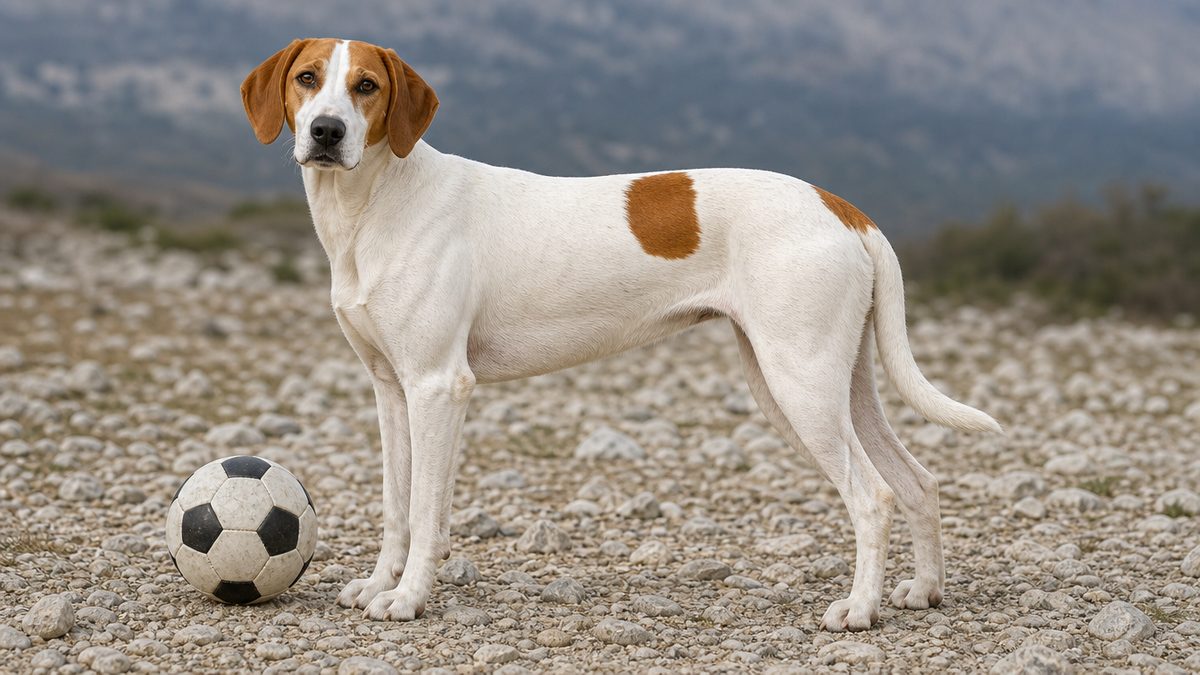
The Istrian Shorthaired Hound is a medium-sized Croatian scent hound standing 49 to 53 cm at the withers for males and 47 to 51 cm for females, snow-white with orange markings, carrying a hard, dense, shiny coat 1 to 2 cm long, and registered by the Federation Cynologique Internationale as FCI-Standard No. 151.
Take the numbers from the standard first, because most pages about this breed do not. FCI-Standard 151 heads its clause SIZE AND WEIGHT and then gives height at the withers only: males 49 to 53 cm, females 47 to 51 cm, with differences of plus or minus 3 cm tolerated in animals of excellent type and conformation. There is no weight figure anywhere in the document. The German text, which the FCI record names as the official authentic language, prints the same figures: Ruden 49 bis 53 cm, Hundinnen 47 bis 51 cm Federation Cynologique Internationale.
The breed standard files the dog in Group 6 Scenthounds and related breeds, Section 1.2 Medium sized scenthounds, with working trial, and gives Croatia as the country of origin. The utilization clause describes a hound with lots of stamina particularly fitted for hare, fox and boar hunting that can also be used as a tracking leash hound.
The appearance clauses that matter
The general-appearance clause asks for a dog of noble appearance with a hound-like strong body, slender and elegant without any coarseness, and specifies short, fine hair of snow-white colour with orange markings on the head and body. The colour clause then sets a limit almost nobody quotes: the total amount of orange marking must not exceed one third of the whole body, the markings must be clearly separated spots, and they must not become uneven or paler towards their edges.
The ears are pendulous, thin, lying close to the head with the front edge touching the skull, set at eye level, shaped as an isosceles triangle with a rounded tip, and long enough to reach the labial commissure when drawn towards the nose. The tail is set as a continuation of the croup, sabre shaped and carried below the topline, reaching the hock or below.
| Field | What the standard says |
|---|---|
| FCI number | 151 |
| Group and section | Group 6, Section 1.2 Medium sized scenthounds, with working trial |
| Country of origin | Croatia |
| Official authentic language | German |
| Height, males | 49 to 53 cm, plus or minus 3 cm tolerated |
| Height, females | 47 to 51 cm, plus or minus 3 cm tolerated |
| Weight | Not given |
| Coat | Hard, dense, shiny, lying close to the body, 1 to 2 cm |
| Colour | Snow white with orange markings, at most one third of the body |
| Ears | Dropped, thin, set at eye level, reaching the labial commissure |
| Voice | Strong and melodic |
| Standard in force from | 3 November 2014 |
| Accepted on a definitive basis | 2 April 1955 |
Fifteen disqualifying faults, and the three that decide identity
The standard lists fifteen disqualifying faults. Three of them do the work of telling this breed from its wire-haired sibling and from a mismarked dog: coat on the body longer than 2.5 cm, presence of a third coat colour, and red, chestnut brown or lemon yellow markings or any other coat colour not in the standard. Short-legged dogs of achondroplastic type, blue eyes, a wholly unpigmented nose and a tail carried in a ring are also disqualifying.
FCI-Standard 151 disqualifies lemon yellow markings. The United Kennel Club standard for the same breed permits Solid white, or white with LEMON patches or ticking, and permits a solid white dog with no markings at all, which the FCI clause does not describe. A dog registered as correctly coloured by one registry can be disqualified by the other. Royal Canin's India page calls the colour lemon-orange, splitting the difference between the two.
Every name this breed has, and the hyphen that hides its only genome study
This breed carries at least eight names across five languages, and searching the wrong one returns zero results from a database that holds its whole-genome characterisation.
Enumerate the names before you search anything. The FCI register prints the Croatian name ISTARSKI KRATKODLAKI GONIC as the primary form, with ISTRIAN SHORT-HAIRED HOUND as the English translation, CHIEN COURANT D'ISTRIE A POIL RAS in French, KURZHAARIGE ISTRIANER BRACKE in German and SABUESO DE ISTRIA DE PELO CORTO in Spanish. English pages add the unhyphenated Istrian Shorthaired Hound and the diacritic-stripped istarski kratkodlaki gonic, and the Croatian literature also uses the older collective istarski gonic and the pre-war trade name hrvatski brakirci.
| Name form searched | Records returned | What that means |
|---|---|---|
| Istrian Shorthaired Hound | 2 | Both genuinely name the breed |
| Istrian Short-haired Hound (the FCI's own English name) | 0 | A false absence created by a hyphen |
| Istrian hound | 4 | The widest genuine set, including both breeds |
| Istrian dog breed | 3 | Same records, no new ones |
| Istarski kratkodlaki gonic | 0 | PubMed discarded kratkodlaki as a phrase not found |
| kratkodlaki | 0 | Not in the phrase index |
| Segugio istriano | 0 | Genuine zero |
| Istrianer Bracke | 1,361 | A rewrite, not literature: Bracke alone is a surname |
| Labrador Retriever hip dysplasia (control) | 126 | Instrument working |
| Beagle otitis externa (control) | 11 | Instrument working |
| Croatian dog breeds (control) | 7 | Instrument working |
Why the 1,361 result is worse than the zero
A zero at least looks like an answer. Istrianer Bracke returned 1,361 records, which reads like a well-studied breed until you read the query translation line PubMed prints alongside it. It reported Istrianer as a phrase not found, discarded it, and searched Bracke alone, a Belgian surname. The top results are an mpox ophthalmic-disease cohort in South Kivu, a Belgian bariatric-surgery study and a myasthenia gravis model in rats. A big number attached to an obscure breed is evidence of a rewrite, not of a literature.
What the four genuine records actually are
- PMID 33139624, Genomic Characterization of the Istrian Shorthaired Hound, Animals 2020, the only whole-genome study of any Croatian native dog breed.
- PMID 40315231, a 2025 PLoS ONE paper on AMY2B copy number in eight Balkan breeds, which includes 14 short-haired and 7 wire-haired Istrian hounds and is the only paper that measures both breeds side by side.
- PMID 28877731, a 2017 Acta Veterinaria Scandinavica case report of hypoluteoidism in a four-year-old Istrian Shorthaired Hound bitch in Sardinia.
- PMID 36229562, a 2023 study of genetic diversity in the Bosnian Barak, which surfaces on Istrian queries because the two breeds share a literature and a history.
Four papers is not much. It is also four more than an English page reporting a zero would have found, and one of them is a 220,000-marker genome study. Enumerate the names first, then search each one, then read the titles that come back.
For the Istrian Coarse-haired Hound it is the common English name that returns zero and the FCI's own name, Istrian Wire-haired Hound, that returns two. So the two breeds fail on opposite spellings: this one on the official form, its sibling on the popular one. Any research on either breed that searched only one name has under-counted.
Registry recognition, and a date three official sources cannot agree on
The FCI recognised the Istrian Shorthaired Hound on a definitive basis on 2 April 1955 as standard number 151, but the Croatian Kennel Club dates recognition to 1949 and the first published standard to 1973, and both bodies are quoting real events.
Read the FCI record first. It gives the date of acceptance on a definitive basis as 4/2/1955, the date of publication of the official valid standard as 11/3/2014, country of origin CROATIA, breed status Recognized on a definitive basis, official authentic language German, and the breed as subject to a working trial. The FCI prints dates month first, which this record proves on its own face: its language-standard fields read 5/29/2015, 2/16/2018 and 6/14/2018, and 29, 16 and 14 cannot be months. So 4/2/1955 is 2 April 1955 and 11/3/2014 is 3 November 2014.
Three independent documents confirm the 1955 date in words rather than in digits. The English standard's own historical summary states that the first Standard for the Short-haired Istrian Hound was published by the FCI on the 2nd of April 1955. The German text prints am 02.04.1955. And the Croatian Ministry of Agriculture's gene bank states that the FCI published the first standard 02. travnja 1955. The 3 November 2014 standard date is confirmed the same way, as 3. studenoga 2014.
Where 1949 and 1973 come from
The Croatian Kennel Club's own breed page says the breed was recognised by the FCI as early as 1949, that the standard was adopted in 1955 and that the first standard was published in 1973. English Wikipedia repeats two of those three, saying the FCI accepted the breed in 1949 but the first standard was not published until 1973. Neither is careless. The Croatian Kennel Club's own 65-year history article, published in June 2020 to mark 1955 to 2020, sets out the sequence.
| Date | Event | Source |
|---|---|---|
| 2 June 1939 | Yugoslav hound standards announced for adoption at the FCI assembly in Stockholm | Croatian Kennel Club history |
| 8 July 1939 | Standards and working rules adopted in Ljubljana | Croatian Kennel Club history |
| 14 September 1948 | FCI assembly at Bled accepts the standards of the new Yugoslavia's hounds, including both Istrian breeds | Croatian Kennel Club history |
| 1949 to 1951 | Croatian hound reviews held in the Littoral, Dalmatia and, from 1950, Istria | Croatian Kennel Club history |
| 20 March 1955 | FCI assembly in Luxembourg internationally verifies the Yugoslav hound standards submitted in 1948 | Croatian Kennel Club history |
| 2 April 1955 | FCI accepts the Istrian Shorthaired Hound on a definitive basis as standard 151 | FCI record; both standard texts; Croatian gene bank |
| 15 January 1973 | FCI publishes the CORRECTED standards 151 B and 152 B, verifying changes made in 1968 | Croatian Kennel Club history |
| 3 November 2014 | Current standard adopted | FCI record; standard text; Croatian gene bank |
| 29 May 2015 | Current English translation published | FCI record |
So 1948 is when the standard was accepted at Bled, 1955 is when it was verified and the breed formally recognised, and 1973 is when a corrected standard was published as 151 B after 1968 amendments. The Croatian Kennel Club's 1949 is a year of national reviews, not of FCI recognition, and the 1973 date describes a revision rather than a first publication. Bonbeno publishes 2 April 1955, because three primary documents state it in words, and records the other two dates rather than deleting them.
Croatia, Slovenia, and the five years the FCI listed a region as a country
Between 1996 and 1999 the FCI listed the country of origin of both Istrian hounds as ISTRA, a peninsula rather than a state, because Croatia and Slovenia could not agree on whose breeds they were.
Between 1993 and 1994 Slovenian cynologists asked the FCI to register both Istrian hounds and the Posavac as Slovenian native breeds. At Graz in March 1996 the FCI proposed that the Posavac be Croatian and the Istrian hounds be joint Croatian-Slovenian, which the Croatian Kennel Club refused. On 12 November 1996 the FCI General Committee decided to enter ISTRA, that is Istria, as the country of origin, with the FCI itself holding patronage of the standard for five years, and published that in its nomenclature on 20 November 1997. The FCI General Assembly in Mexico on 30 May 1999 recognised Croatia as the home country, published in the systematics of 23 February 2001, with standards published on 10 April 2002 over an original dated 25 October 2000. English Wikipedia dates the resolution to 2003, citing a Croatian news report of 13 April 2003. Both accounts describe the same long argument; the 1999 assembly is the decision and 2003 is the tail of it.
Which registries list the breed, and what that means in India
Three bodies matter. The FCI recognises the breed on a definitive basis as 151. The United Kennel Club in the United States recognised it in 2006 and places it in the Scenthound Group. The Croatian Kennel Club is the studbook of record in the country of origin. India is a full FCI member represented by the Kennel Club of India, which issues pedigrees against FCI nomenclature, so FCI recognition effectively answers the Indian recognition question. That does not mean a dog exists here to register.
The FCI record for this breed gives the official authentic language as German, and the English standard's translation line reads Official language (DE), which agrees. But the German text of the SIBLING breed, standard 152, declares Offizielle Originalsprache (EN), naming English as the original for a Croatian breed whose FCI record says German. The German text of standard 151 declares no original language at all. Three documents, three different accounts of which language is authentic.
Which Istrian hound is older, and what the cynological record actually says
On the documentary record the short-haired hound is the older of the two, because the art and the studbook both reach further back for it, but the cynological literature is explicit that the two were one breed differing only in coat until the twentieth century split them.
Start with the pictures, because both FCI standards do. Standard 151's historical summary reaches back to a capital column in the Franciscan monastery in Dubrovnik showing four dogs, dated 1327 to 1348, carved by master Mihoje Brajkov of Bar in the late Romanesque style. It then names a 1474 painting in the cemetery chapel beside the village of Beram in Istria, and a 1476 altar painting in the church of St Francis in Zadar in whose lower left corner an ancestor of today's Istrian hound appears. Finally it cites the 1719 manuscript of Bishop Petar Bakic of Dakovo, which states that breeding of the Istrian Hound was already known before the fourteenth century.
The wire-haired standard's summary is thinner by roughly 150 years. Its earliest description is the same 1719 Bakic manuscript, and its earliest picture is an undated one in the cathedral of St Mark in Makarska. On the standards' own evidence, therefore, the short-haired dog has the older visual record and the two share their oldest written one.
The Croatian Kennel Club adds a height from 1719
Croatia's kennel club, writing with the two lead authors of the 2020 genome study, gives more detail than either standard. It names the 1474 Beram work as a fresco in the Chapel of St Mary at Beram near Pazin painted by master Vincent of Kastav, and says it shows a short-haired white brachoid dog with yellow-red markings alongside prick-eared dogs. It adds a Titian painting of the first half of the sixteenth century showing two hounds, one of which strongly resembles the Istrian hound, and a mid-eighteenth-century painting in the historical museum in Porec of an elderly noblewoman with a white short-haired dog carrying a round reddish-yellow mark in the middle of its forehead. Most usefully, it reports that Bakic's 1719 Latin document describes the dog's height as about 48 cm, which sits one centimetre under the modern standard's female floor.
1905: the first survey measured 1,036 hounds and split them by coat alone
The first systematic study of Balkan hounds was made by the Austrian brakologist Franz B. Laska, an officer living in Sarajevo, who published Die Waidwerk in Bosnien und der Hercegovina in Graz in 1905. Laska measured 443 short-haired, 307 long-haired and 286 wire-haired hounds, a total of 1,036 dogs, described them all under the single name bosanski gonic, and divided them only by coat length. The same study also described the hounds of Istria and Dalmatia.
Two things follow that matter for this pair. First, the coat-based division the FCI now uses to keep breeds 151 and 152 apart is not a modern convenience; it is the original taxonomy of the region's first surveyor. Second, Laska recorded a third coat, long-haired, in 307 dogs, which has no breed today at all. The same 1,036-dog figure reaches Bonbeno's Barak Hound page from an entirely separate Bosnian source, which is a useful independent confirmation. What that page describes as the first documented record of the Barak is more precisely a survey of three coat types under one breed name, of which only the 286 wire-haired dogs correspond to the modern Barak.
1944: one breed, differing only in coat
Dr Ivan Lovrencic, the Slovenian brakologist who founded the Klub ljubitelja brakov in Ljubljana on 22 May 1924, wrote a study titled Istarski brak in 1944. In it he stated that Istria in earlier centuries had, besides wire-haired hounds, also short-haired ones, of which the most numerous were white dogs with orange-red markings, the purest in breed and the best for hunting hares. And he emphasised that all white dogs with orange-red markings on the ears were ONE BREED which differed only in coat.
That sentence is the most useful thing anyone has written about this pair, and no English page carries it. It also cuts against the common assumption that the wire-haired dog is a later derivative of the short-haired one: Lovrencic's own phrasing treats the wire-haired coat as the given and the short-haired as the addition.
The short-haired hound has the older documentary record: a fourteenth-century carving, two fifteenth-century paintings and a 1719 description against the wire-haired breed's 1719 description alone. It was also formally recognised four days earlier, on 2 April 1955 against 6 April. What Bonbeno does NOT conclude is that the short-haired hound is the ancestor of the wire-haired one. The 1944 cynological literature says they were one population separated by coat, the 1905 survey treated coat length as the only division, and no genetic study has ever tested the two against each other.
How many exist, and two official Croatian sources that disagree by a factor of 22
Croatia's Ministry of Agriculture counted 680 breeding animals across 91 registered owners in 2025 and classifies the breed as endangered, while the 2020 genome study put the effective population size at 109.
The Croatian state publishes this breed's numbers every year, which is more than most popular breeds get anywhere. The animal gene bank of the Ministarstvo poljoprivrede lists the breeding population, the effective population size Ne and an FAO 2013 endangerment class for each of Croatia's seven native dog breeds Hrvatski kinoloski savez.
| Year | Owners | Males | Females | Ne | FAO class |
|---|---|---|---|---|---|
| 2020 | not given | 1,500 | 1,000 | 2,400.00 | Endangered |
| 2021 | not given | 1,400 | 900 | 2,191.30 | Endangered |
| 2022 | not given | 1,400 | 900 | 2,191.30 | Endangered |
| 2023 | not given | 500 | 200 | 571.43 | Endangered |
| 2024 | 97 | 450 | 190 | 534.38 | Endangered |
| 2025 | 91 | 500 | 180 | 529.41 | Endangered |
Every printed Ne reproduces exactly from the census formula 4NmNf divided by (Nm plus Nf). For 2025 that is 4 times 500 times 180, divided by 680, which is 529.41, matching the printed value to the decimal. For 2024 it is 534.375, printed as 534.38. The table is internally consistent, and that check is worth doing before quoting any government population figure.
The 2023 drop is a counting change, not a collapse
The recorded population falls from 2,300 animals in 2022 to 700 in 2023, a 70 percent fall in one year, and owner counts appear only from 2024 onwards. Bonbeno does not read that as a real collapse. A breed does not lose seven dogs in ten inside twelve months and hold a stable FAO class while doing so. The far likelier reading is that the register moved from an estimate to a counted list of registered breeding animals when owner recording began. The honest statement is that the 2025 figure of 680 animals in 91 owners' hands is a counted one, and that the pre-2023 figures are not comparable with it.
109 against 2,400, and why both are right
The 2020 genome study reports an effective population size of 109 from SNP data and 111.24 from genealogical data, and treats the close agreement between the two as confirmation that the pedigree records are accurate. The gene bank reports Ne of 2,400.00 for the same breed in the same year. That is a 22-fold gap, and neither figure is wrong.
They measure different things. The gene bank's Ne is a demographic census statistic computed from the sex ratio of breeding animals, so it rises with headcount. The study's Ne is estimated from linkage disequilibrium across a 220,000-marker array and from pedigree inbreeding rates, so it measures how much genetic diversity the population actually behaves as if it has. Quote whichever you need, name which one it is, and never average them.
The one figure that describes puppies
The 2020 study records 862 Istrian Shorthaired Hound puppies born in 2019, registered by the Croatian Kennel Club, and states that the number of puppies descending from the breed is constantly decreasing and that no official cynotechnical management programme exists, so population structure depends entirely on individual breeders' decisions. That is the closest thing to an annual production figure this breed has, and it is six years old.
The same Croatian register classifies the Istrian Coarse-haired Hound as CRITICAL rather than endangered, on 150 breeding animals held by 20 owners in 2025, against this breed's 680 animals and 91 owners. The Posavac Hound sits between them at 400 animals and 110 owners. Of Croatia's three scent hounds this one is the most numerous by a wide margin, and it is still counted as endangered by its own government.
Istrian Shorthaired Hound price in India
No verified Istrian Shorthaired Hound price in india exists, because no Indian breeder, seller, marketplace or rescue offers the breed, and Bonbeno will not convert a foreign figure into rupees and present the arithmetic as an Indian market.
Say the negative first, because it is the answer to the query. Three India-region searches on 31 August 2026 returned not one rupee figure attached to this breed, and not one Indian seller, breeder or rescue. The same tool, in the same session, with the same India location, returned a full eight-city rupee price table for the Labrador Retriever. The absence is real and it has been tested against a working control.
What the ranking pages quote instead, and in which currency
| Source | Figure quoted | Currency | What it prices |
|---|---|---|---|
| Wamiz | 600 to 900 | Pounds sterling | Purchase price of a puppy, UK market |
| Wag | 600 to 1,500 a year | US dollars | Annual cost of ownership, US market |
| Embark | 199 reduced to 139 | US dollars | A DNA test kit, not a dog |
| PetGuide | 1,249 reduced from 1,499.99 | US dollars | A promotional product placement, not a dog |
| Flipkart | None displayed | Not applicable | A paperback book |
| Any Indian source | None found | Not applicable | Nothing |
Not one of those is an Indian price, and two of them are not prices for a dog at all. A page that turned the Wamiz figure into rupees would be inventing an Indian market, and Indian breed-price tables built exactly that way are a documented problem. This site does not add to them.
What a comparable Indian price looks like, for scale only
For a reader who wants a sense of scale rather than a quote, the Labrador control gives it. Four Indian sources price one common breed at ₹30,000 to ₹1,20,000, at ₹15,000 to ₹40,000, at ₹8,000 to ₹70,000 and at ₹20,000 to ₹40,000 in Delhi. Those four ranges disagree by a factor of fifteen at the top end for a breed India keeps in enormous numbers. If Indian price reporting is that loose for a Labrador, any single figure produced for a breed with no Indian population at all would be worthless.
The cost that is real, and that this page does quote
Breed price and care cost are different questions, and only one of them is unanswerable here. Indian vaccination, consultation, deworming, food and boarding costs are real, published and sourceable, they apply to any 20 kg dog living in India, and the monthly cost section below quotes them with sources. A reader who cannot buy this breed can still budget accurately for a dog of its size.
Croatia holds roughly 680 breeding animals of this breed across 91 registered owners, and its own Ministry of Agriculture calls that endangered. India's import policy rejects applications made for breeding or trading purposes outright. There is no exporting surplus and no lawful importing purpose, so no commercial supply chain can form. An Indian price for this breed would be evidence of something going wrong, not of a market maturing.
What an Indian search actually offers you instead
An India-region purchase query for this breed returns a cookie cutter, a fondant stamp, a paperback with no named author and three Facebook threads about Indian sighthounds. Flipkart product page
Naming what is actually on offer is more useful than any price, so here it is result by result. The query Istrian hound puppies for sale India price rupees breeder returned, at position one, an Etsy India listing for an Istrian Hound Dog Cookie Cutter and Fondant Stamp. Position two was Pinterest. Positions three, four and ten were Facebook posts in which an auto-pasted sentence beginning The Istrian Short-haired Hound is a breed of dog from Istria in Croatia sits inside discussions of the Caravan Hound and the Mudhol Hound, two entirely different Indian sighthounds.
The number one result for the sibling breed is a book
Search the coarse-haired sibling's name with an India location and the first organic result is a Flipkart product page. The product is titled COMMUN Istrian Coarse-Haired Hound (English, Paperback, unknown). Its author field reads unknown. Its imprint is Commun. Its dimensions are 6 mm by 229 mm by 152 mm and it weighs 150 grams, and its own image path contains the folder name book. No price is shown and the buying control reads Notify Me. India's largest marketplace has an Istrian hound listing, and it is a 150-gram paperback that is out of stock.
Three tells that a result is not an Indian offer
- A currency symbol that is not the rupee. Wamiz quotes pounds and Wag quotes dollars, and both rank on an India-region query because nothing Indian exists to outrank them.
- A price attached to a product rather than an animal. Embark's 199 dollars reduced to 139 is a DNA test kit; PetGuide's 1,249 dollars is a promotional placement. Both sit on breed pages and both read as breed prices at a glance.
- A breed page with a different breed in the thread. The Facebook results carry correct sentences about this breed pasted into conversations about the Caravan Hound. The sentence is accurate and the context is somebody else's dog.
What Bonbeno could not check
One result claimed that dogs of this breed have been born in India. It sits inside a Facebook group post behind a login wall, in the same cluster of threads where an encyclopedia sentence has been pasted into discussions of unrelated Indian breeds. Bonbeno could not open it and makes no claim either way. It is recorded here rather than quietly dropped, because a reader searching the same term will see it too.
You cannot buy this breed in India today, and an honest page says so in the first line rather than burying it under a converted price. That is not a gap in this guide. It is the single most useful thing the guide can tell an Indian reader, because it stops a deposit going to somebody selling a photograph.
Indian import rules, and the heat clause that this coat escapes
India classifies dogs as a Restricted import and permits entry only for a personal pet, for CPCSEA-recommended research or for the Defence and Police forces, so an Istrian Shorthaired Hound can lawfully reach India only as somebody's relocating pet.
The instrument is DGFT Trade Notice No. 22/2022-23, Guidelines for import of Pet Animals. It records ITC (HS) 01061900, Mammals: Other, with an import policy of Restricted. Policy Condition (7) allows import of dogs only for a pet dog with a valid pet book and records in the name of the importer, for R&D organisations with a CPCSEA recommendation, and for internal security by the Defence and Police Force. Policy Condition (8) states that import of commercial dogs for breeding or any other commercial activity is not permitted, and paragraph 6 states that applications for trading or breeding purposes, or made on behalf of another person, shall be duly rejected.
Entry is permitted only through the airports and seaports of Delhi, Mumbai, Chennai, Hyderabad, Bengaluru and Kolkata and, since October 2024, Kochi airport, with quarantine at the government station of those ports where required, and owners are told to begin the authorisation process at least two months before travel. The full route is set out in how to import a dog to India.
The heat clause, and why it reads differently for each Istrian breed
The Prevention of Cruelty to Animals (Dog Breeding and Marketing) Rules, 2017 contain an outdoor-housing provision written for exactly this problem. It is Second Schedule Part IV paragraph 21(1), not a Rule: the Rules themselves stop at Rule 13, so any citation reading Rule 21 is wrong by construction, and the string Rule 21 appears zero times in the gazette.
Paragraph 21(1) reads that the following categories of dogs shall not be kept in outdoor facilities unless specifically approved in writing by the attending veterinary practitioner: (i) dogs that are not accustomed to the temperatures prevalent in the area or region in question; (ii) dog breeds that cannot tolerate the temperatures prevalent in the area or region in question, such as long-haired breeds in high temperature locations; and (iii) sick, infirm, aged or young animals.
Sub-clause (ii) names long-haired breeds, and at 1 to 2 cm this breed is not one. Sub-clause (i) still reaches it squarely. A dog fixed in a place whose annual mean wet-bulb temperature is 12.29 C is by any reading not accustomed to the temperatures prevalent in Chennai, where it is 24.94 C NASA Langley Research Center. Its wire-haired sibling, with a 5 to 8 cm topcoat, is caught by both sub-clauses.
The rest of the 2017 Rules that touch this breed
- Rule 8(1)(a) requires that pups less than eight weeks in age are not sold, and Rule 8(1)(b) that dogs over six months are not sold without first being sterilised unless sold to another licensed breeder.
- Second Schedule Part II paragraph 6(8) forbids tail docking, ear cropping, de-barking, de-clawing, branding, dyeing and any other mutilation, and forbids any change of appearance by artificial means. Neither Istrian standard describes a cropped ear or docked tail, so this clause creates no conflict here, unlike for several European breeds.
- Second Schedule Part III paragraph 8(10) requires breeding dogs to have been screened for genetic defects including hip dysplasia, progressive retinal atrophy, night blindness, hypothyroidism, entropion, ectropion, overshot and undershot jaw, wry mouth and missing teeth. FCI-Standard 151 states that this breed's eyelids must not show signs of entropion or ectropion, so Indian law and the breed standard ask for the same eyelids.
- Second Schedule Part III paragraph 8(9) requires that all pups be vaccinated starting at seven to eight weeks and usually completed by eighteen weeks, which sets the floor for the puppy timeline below.
- Across the whole gazette the strings patella, luxation, BAER and deaf each appear zero times, so there is no Indian patella-grading or hearing-test requirement to satisfy.
Bonbeno has not checked whether the 2024 notification adding Cochin International Airport for personal pet imports under the Livestock Importation Act 1898 changes the six-port list in the DGFT notice, because that notice is a different instrument under different law. If you need the current port list for either route, read that route's own document rather than this page.
Monthly cost of keeping a 20 kg hound in India, if one were here
Budget roughly ₹6,000 to ₹12,000 a month for a 20 kg short-coated hound in an Indian metro once food, preventives, vet visits and boarding are counted, with a first year that carries ₹2,500 to ₹4,800 of vaccination on top at a private clinic.
There is no Indian purchase price for this breed, but there is a real Indian monthly cost for a dog of its size, and that is the number a reader can actually use. FCI-Standard 151 publishes no weight, so this section works from the United Kennel Club's figure of about 40 pounds, roughly 18.14 kg, for an adult male, and rounds to 20 kg United Kennel Club.
Vaccination, where Indian sources disagree by a factor of ten
| Item | Private clinic | Government hospital |
|---|---|---|
| Anti-rabies vaccine | ₹400 to ₹900 | Free, or ₹50 to ₹100 |
| Core puppy vaccine, parvovirus and distemper | ₹700 to ₹1,500 | ₹100 to ₹300 |
| Imported vaccine, Vanguard or Nobivac | ₹1,000 to ₹3,000 per shot | Rarely stocked |
| Annual combined core booster | ₹800 to ₹2,000 | ₹150 to ₹400 |
| Complete 6 to 16 week puppy series | ₹2,500 to ₹4,800 | ₹200 to ₹500 |
A second Indian source puts vaccination at ₹300 to ₹1,200 per shot on average. Between the two, the same shot is quoted anywhere from ₹50 at a government clinic to ₹3,000 for an imported vaccine at a private one, a sixtyfold spread. Anti-rabies vaccination is often free during municipal drives. Where sources disagree this widely, quote the range and name the setting rather than publishing a single average.
The monthly line items
| Line item | Typical monthly range | Note |
|---|---|---|
| Food, mid-range dry plus fresh toppers | ₹3,000 to ₹6,000 | Scales with weight; a working hound at real exercise eats at the top |
| Tick and flea preventive | ₹500 to ₹1,200 | Not optional in India, see the health section |
| Monthly deworming or quarterly, averaged | ₹150 to ₹400 | Puppies need it far more often |
| Vaccination, annual booster spread monthly | ₹70 to ₹250 | ₹800 to ₹2,000 a year at a private clinic |
| Routine vet consultation, averaged | ₹300 to ₹800 | Two to three visits a year for a healthy adult |
| Grooming | ₹0 to ₹500 | A 1 to 2 cm coat needs a brush, not a salon |
| Boarding or day care, if used | ₹500 to ₹3,000 | Highly city dependent |
That is a ₹6,000 to ₹12,000 band for an ordinary month, and the honest caveat is that only the vaccination rows carry a published Indian source. The food, preventive, boarding and consultation ranges are Bonbeno's editorial estimate for a 20 kg dog in an Indian metro, presented as an estimate rather than as a sourced figure.
The two costs this breed adds that a Labrador does not
First, cooling. A hound bred where the annual mean wet-bulb temperature is 12.29 C, kept in a city where it is 24.94 C, will need indoor cooling through the hot months rather than as a treat, and that is an electricity cost rather than a pet cost. Second, exercise substitution. A dog selected to search 300 to 500 metres from its handler cannot get its work in a Mumbai park at 3 pm, so the realistic answer is early-morning and late-evening walking plus paid day care or scent work, and that is the line most likely to blow the budget.
An adopted Indian Pariah Dog costs nothing to acquire, needs the same vaccination schedule at the same published prices, and does not need the cooling budget. If the monthly figure above is the constraint, that is the comparison that matters.
Heat tolerance in India: Bonbeno rates this breed 2 of 5
Chennai's coldest month is muggier than Istria's hottest, which is the single clearest way to state this breed's Indian heat problem.
Put the two places side by side. NASA POWER, queried by explicit latitude and longitude so no place name could resolve to the wrong location, gives the Istrian cell an annual mean air temperature of 14.63 C, an annual mean relative humidity of 75.37 percent and an annual mean wet-bulb temperature of 12.29 C, peaking at 20.76 C in July and falling to 4.07 C in January. Chennai gives an annual mean of 27.95 C and an annual mean wet bulb of 24.94 C, peaking at 27.36 C in May and falling only to 21.77 C in January NASA Langley Research Center.
Chennai's January wet bulb of 21.77 C exceeds Istria's July wet bulb of 20.76 C by 1.01 C. The coolest month in the Indian city is more thermally demanding than the hottest month in the breed's homeland. The gap in annual means is 12.65 C. No amount of short coat closes that.
| Place | Annual mean air temp | Annual mean wet bulb | Wet bulb, hottest month |
|---|---|---|---|
| Istria, Pazin and Pula cell | 14.63 C | 12.29 C | 20.76 C in July |
| Buzet, inland Istria | 13.14 C | 10.80 C | 19.64 C in July |
| Chennai | 27.95 C | 24.94 C | 27.36 C in May |
| Kolkata | 25.81 C | 22.85 C | 27.86 C in June |
| Mumbai | 26.77 C | 22.73 C | 26.55 C in June |
| Delhi | 25.60 C | 18.03 C | 27.74 C in July |
| Bengaluru | 23.74 C | 19.80 C | 22.66 C in May |
| Pune | 23.86 C | 19.66 C | 23.56 C in June |
| Shillong | 17.96 C | 16.22 C | 21.63 C in July |
The nearest thing India has to an Istrian climate
Shillong is the closest, and it is still warmer. Its annual mean of 17.96 C is 3.33 C above the Istrian cell and its annual mean wet bulb of 16.22 C is 3.93 C above. Its warmest month averages 22.38 C, against Istria's 24.40 C in August, so its summers are actually milder; what it lacks is Istria's winter, where the January mean is 5.59 C against Shillong's 10.74 C NASA Langley Research Center. Of India's big cities Bengaluru and Pune are the least hostile on wet bulb, at 19.80 C and 19.66 C, and both are still more than seven degrees above the origin.
A grid-cell warning that changes what this section can claim
NASA POWER returns a grid cell, not a point, and this breed's homeland is a case where that matters. Pazin, 42 km inland at about 291 m, and Pula on the coast at about 30 m returned byte-identical monthly series, both at a cell elevation of 106.66 m. They are one cell. So the figures above describe Istria as a single averaged place and cannot distinguish the cooler inland karst from the warmer coast. Buzet, only 19 km further north, did land in a separate cell at 256.47 m and came back 1.49 C colder, which shows the real internal variation the shared cell hides.
The same check caught two bigger errors that this page does not lean on. The Ucka massif returned a cell elevation of 666 m against a real summit of about 1,401 m, so its 9.14 C annual mean is roughly 4.8 C too warm at a 6.5 C per 1,000 m lapse rate and a corrected estimate of about 4.4 C is labelled here as an estimate. Makarska, the Dalmatian town whose cathedral the wire-haired standard cites, returned a cell elevation of 539 m against a real 10 m, so its 12.62 C is roughly 3.4 C too cold and the corrected estimate is about 16.1 C. India's plains cities were fine: Delhi, Chennai, Mumbai, Bengaluru, Pune and Kolkata all returned cell elevations within 84 m of the real city.
What the heat evidence actually supports
There is no breed-specific heat study for either Istrian hound. The transferable finding is from Hall 2020 in Scientific Reports, which analysed 905,543 UK dogs under primary veterinary care in 2016, identified 395 confirmed heat-related illness events, and found significant risk from higher bodyweight relative to the breed and sex mean and from being over two years of age, with an event fatality rate of 14.18 percent. The companion paper in Animals, a different study on the same cohort, found that exertional heat-related illness was the predominant trigger at 74.2 percent of events, ahead of environmental at 12.9 percent and vehicular confinement at 5.2 percent.
Neither Istrian breed appears in either model, so no odds ratio is imported here. What transfers is the general finding, and it is the wrong general finding to ignore for this dog: exertion, not a parked car, is what kills dogs by heat, and this is a breed selected for stamina at speed over stony ground.
Work the dog by wet bulb, not by air temperature. A 33 C Delhi afternoon in May at 23 percent humidity is survivable for a fit dog; a 30 C Chennai morning in August at 72 percent humidity is not, because evaporative cooling is what a dog has and humidity is what takes it away. Walk before sunrise and after dark through the hot months, carry water, and cool the dog with water on the belly and paws rather than with ice.
Temperament, and the one word that separates it from its sibling
FCI-Standard 151 calls this breed lively, gentle, docile, obedient, neither nervous nor aggressive, devoted to its owner and wary of strangers, and its sibling's standard calls that breed even-tempered with a stern expression.
The two standards were written together and published on the same day, so the differences between their temperament clauses are deliberate rather than accidental. This breed's reads: of lively temperament, gentle, docile, obedient, neither nervous nor aggressive, devoted to his owner, wary of strangers, with a voice that is strong and melodic and an eye expression described as intelligent. Standard 152's reads: gentle, even temperament, with a stern expression, devoted to his owner, with a voice of medium tone that also has deeper sounds.
Croatia's kennel club says the same thing from the field rather than from the ring. It describes the short-haired hound as a very temperamental and recognisable breed, and the wire-haired one as having a more moderate temperament than the short-haired Istrian. Two independent Croatian documents, one a breed standard and one a working description, separate the pair the same way.
What lively means in a flat
It means voice and distance. The Croatian working description records that this hound searches terrain systematically in concentric circles about 300 to 500 metres from the handler, follows game at 100 to 500 metres while staying in constant contact, and has a high and ringing voice. That is a dog whose default working radius is longer than most Indian residential blocks and whose selected trait is being audible from the other end of it.
The 2020 genome study is unusually direct about where that came from. Its selective-sweep analysis found the strongest signals near genes associated with cognitive performance and behaviour, including DGKB and RGS14 and in the proximity of LMAN2, rather than near anything governing appearance. Croatia's kennel club draws the obvious conclusion, that breeders steered this breed towards behavioural traits over centuries. A dog whose measurable selection history is behavioural is not a blank slate.
Who this breed suits, and who it does not
- Suits a household with a securely fenced compound, an adult prepared to walk before sunrise, and neighbours far enough away that a hound voice is not a legal problem.
- Suits an owner who wants an affectionate dog that is genuinely devoted to its person; both the standard and Croatia's kennel club use that language, and the FCI adds gentle and docile.
- Does not suit apartment living. Wamiz's own breed page rates the breed poorly for flats, and the working description explains why in terms of radius and voice.
- Does not suit a home with free-roaming small pets. This is a hound selected to pursue hare, fox, marten and wild boar, and prey drive of that kind is not trained out.
- Does not suit a first-time owner who wants a dog that switches off. Wary of strangers plus lively plus a 500-metre working radius is a management job, not a temperament flaw.
No behaviour study of either Istrian breed exists anywhere. Every temperament statement on this page traces to two breed standards and one working description from the Croatian Kennel Club, all of them written by people with an interest in the breed. That is the best evidence available and it is not the same as a C-BARQ dataset. Treat it as the registry's description rather than as measurement.
Training a hound that was bred to work 500 metres away from you
Train recall first and everything else second, because this breed's own standard calls it easy to train for hunting and its working description has it operating 300 to 500 metres from the handler by design. Hrvatski kinoloski savez, Moj pas portal
The standard's exact words are that the breed is easy to train for hunting and very popular with huntsmen due to its excellent hunting abilities. Read that carefully. It says easy to train for hunting, which is not the same as biddable in a city. What the breed offers is a strong working partnership at distance, and what it does not offer is a dog that stays within twenty metres because you would prefer it to.
The four things worth training, in order
- Recall on a long line, for months before it is trusted off one. The working radius this breed was selected for is 300 to 500 metres and the terrain it was selected for is stony scrub where scent is lost quickly, so it learned to keep searching rather than to return.
- A settle on a mat. A dog with a high and ringing voice needs a trained off-switch more than it needs another trick.
- Handling for ears, mouth and feet. Pendulous ears in Indian humidity need weekly inspection, and a dog that resents being handled will not get it.
- Scent games as the default enrichment. This is the one activity that uses what the breed actually is, costs nothing, and can be run indoors at 2 pm in June when walking is unsafe.
Socialisation, and what Indian conditions add
The standard describes a dog that is wary of strangers. That is a working trait in a Croatian farmyard and a liability in an Indian apartment lobby, so socialise early and deliberately: lifts, delivery riders, security guards, autorickshaws, other people's dogs on a lead, and children who approach without asking. Do it in cool hours, in short sessions, and never after a hot walk.
Do the vaccination arithmetic before you plan any of it. Indian law requires that all pups be vaccinated starting at seven to eight weeks and usually completed by eighteen weeks, and the practical consequence is that a puppy's socialisation window and its vaccination course overlap. Carry the puppy to novel places rather than walking it there, and use enclosed private ground rather than a public park until the course is finished.
What this breed resists
Two things, reliably. It resists being called off a scent, because a hound that gave up a line was not bred from. And it resists repetition without a reason; a dog whose strongest selection signals sit near genes for cognitive performance does not need the twentieth repetition of a sit. Short sessions, high-value food, and a genuine job beat drilling.
Expect a reliable indoor settle by four to six months, a reliable long-line recall by nine to twelve months, and an off-lead recall in a distracting outdoor environment that is honestly never guaranteed. Croatian handlers do not work these dogs off a whistle and a hope; they work them in country where the dog is supposed to be 400 metres out and audible.
How much exercise this breed actually needs, and when it can get it in India
Give this breed at least 90 minutes a day in two cool-hour sessions, because the FCI subjects it to a working trial and describes a hound with lots of stamina, and no registry publishes a minute count.
No breed club, registry or study publishes an exercise requirements figure for this breed, so any number is an editorial judgement and should be labelled one. Bonbeno's floor is 90 minutes a day, split, based on what the breed is documented to do rather than on a guess. Its FCI classification carries a working trial, its utilization clause describes a hound with lots of stamina fitted for hare, fox and boar, and its working description has it searching in concentric circles 300 to 500 metres from the handler over karst Federation Cynologique Internationale Hrvatski kinoloski savez, Moj pas portal.
The Indian scheduling problem, stated as numbers
In Chennai the annual mean wet bulb is 24.94 C and the May peak is 27.36 C. In practice that removes roughly 09:00 to 18:00 from the exercise day for eight months of the year. The workable window is before sunrise and after dark, which in most Indian cities means 05:30 to 07:00 and 20:00 to 22:00. A household that cannot commit to both of those is not a household this breed fits.
| Session | Duration | What it is for |
|---|---|---|
| Pre-dawn walk, daily | 45 to 60 minutes | Aerobic base, at a real pace, on a long line |
| Evening walk, daily | 30 to 45 minutes | Second aerobic session plus sniffing time |
| Scent work, three or four times a week | 15 to 20 minutes | Indoors or on a balcony; uses the trait the breed was selected for |
| Long outing, once a week | 2 hours plus | Open ground outside the city, early morning only |
| Hot-season substitution, daily in summer | 20 to 30 minutes | Indoor scent games replacing the second walk entirely |
Why scent work is not a consolation prize here
Croatia's kennel club describes hounds working on a complex scent picture before switching to an individual scent once the game is found, and classes trails as fresh under one hour, young at one to three hours, old at three to six hours and cold beyond six. A dog built for that gets more out of twenty minutes of finding hidden food in a flat than out of forty minutes of walking on a lead past parked cars. In the Indian hot season it is the only honest way to keep a hound's head busy.
What happens without it
The same things that happen with any under-exercised working hound, and one that is specific: the voice. A hound with a strong, melodic, carrying voice and nothing to do uses it. In a Croatian village that is background noise. In an Indian apartment block it is a complaint to the housing society, and it is the most common reason working breeds are rehomed here.
Hall 2020 in Animals found exertional heat-related illness to be the predominant trigger at 74.2 percent of events, ahead of environmental at 12.9 percent and vehicular confinement at 5.2 percent, and the companion Scientific Reports paper found an event fatality rate of 14.18 percent across 395 confirmed events. Neither Istrian breed was in either model, so no breed figure applies, but the direction of the finding is the one that matters for a stamina hound in an Indian summer: it is the exercise, not the parked car, that does the damage.
Grooming a 1 to 2 cm coat in Indian humidity
Groom this breed with a rubber curry brush twice a week and spend the saved time on its ears, because the coat is the easy half of the job and the pendulous ear is the hard half.
The coat length clause makes this the lowest-maintenance coat in the Croatian hound group. FCI-Standard 151 gives the hair as hard, dense, shiny and lying close to the body at 1 to 2 cm, occasionally a little longer on the back of the thighs and the underside of the tail, which it tolerates but does not desire. There is no undercoat clause, no furnishing, no beard and no eyebrow, all of which its wire-haired sibling has.
The routine
- Brush twice a week with a rubber curry or a hound glove. That is the whole coat job. Expect year-round shedding rather than a seasonal blow.
- Bathe rarely, roughly every six to eight weeks or when genuinely dirty, with a mild shampoo. A short hard coat sheds dirt on its own.
- Dry the ears every single time, and after every swim or monsoon walk. This is the part that matters.
- Check the skin at every brush. The standard notes greyish-black or brownish pigment mottles visible through the white coat, which is normal and permitted, so learn what your dog's normal mottling looks like before you have to tell it from something else.
- Watch the white. A snow-white dog with thin skin over sparse hair is a sunburn candidate in India, particularly on the belly, the muzzle and any pink nose leather the standard tolerates.
Why the ears are the real grooming task
This breed's ears are dropped, thin, lying close to the head with the front edge touching the skull, set at eye level, and long enough to reach the labial commissure. That is a sealed, warm, humid canal by design. In the UK primary-care dataset, breeds with pendulous ear carriage carried 1.76 times the odds of otitis externa against breeds with erect ears, 95 percent CI 1.48 to 2.10, and breeds with V-shaped drop ears 1.84 times, against a one-year period prevalence of 7.30 percent across 22,333 dogs. Neither Istrian breed appears in that study, so only the class figure transfers.
India adds humidity to that baseline. Mumbai runs 89.56 percent relative humidity in July and 90.36 percent in August, and Pune 90.80 percent in August. The overseas grooming advice to towel a dog and let it air dry does not transfer to an Indian monsoon, and it is the one piece of imported care guidance most worth ignoring here. Dry inside the ear leather with a soft cloth, do not push anything into the canal, and see a vet at the first head shake or smell rather than at the third.
One advantage this coat has over its sibling's
A 1 to 2 cm coat dries in minutes. Standard 152's 5 to 8 cm wiry topcoat over a dense undercoat does not, and in an Indian monsoon a coat that stays damp against the skin is a skin problem waiting to happen. Of the two Istrian breeds, this is unambiguously the easier one to keep clean and dry in India, and that is a genuine, if narrow, advantage.
Lift both ear leathers and look and smell. Run both hands over the whole dog against the lie of the coat, feeling for ticks in the ear folds, the armpits, the groin and between the toes. Check the eyelids, because both entropion and ectropion are named in the Indian genetic-defect testing clause and both are disqualifying signs under the breed standard. Five minutes, once a week, catches almost everything this breed is likely to give you.
Health risks and lifespan: what is known, which is very little
No breed-specific health problems are documented for the Istrian Shorthaired Hound and no study publishes its lifespan, so the real risks for an Indian owner are the ones its ears, its colour and its destination country create.
Say the size of the evidence first. Four peer-reviewed papers name this breed anywhere, one of them is a single case report, and none of them measures the prevalence of any disease. There is no entry in the Orthopedic Foundation for Animals browse-by-breed selector, which listed the Labrador control and eight other Balkan and Italian breeds in the same retrieval. There is no breed-club screening scheme. A page that listed hip dysplasia and epilepsy here would be describing dogs in general, not this breed.
Lifespan: three numbers, none of them this breed's
Royal Canin's India site gives 12 to 15 years and credits the Federation Cynologique Internationale, and gives the wire-haired sibling 11 to 12 years on the same credit line. Neither FCI standard contains a life expectancy figure Federation Cynologique Internationale. The UK all-breed baseline, from 30,563 dogs that died between January 2016 and July 2020, is 11.23 years at age zero, with females at 11.41 and males at 11.07. The largest UK breed study, covering 584,734 dogs, tabulates 155 breeds and neither Istrian hound is among them. Bonbeno therefore publishes no lifespan for this breed and says why.
The ear, which is the one risk the conformation guarantees
The ears are pendulous, thin, set at eye level and long enough to reach the labial commissure, which makes a warm sealed canal. In 22,333 UK dogs the one-year period prevalence of otitis externa was 7.30 percent, and breeds with pendulous ear carriage carried 1.76 times the odds of it against erect-eared breeds, 95 percent CI 1.48 to 2.10. Neither Istrian breed is in that study, so the class figure is all that transfers. Indian humidity is the multiplier: Mumbai runs 90.36 percent relative humidity in August and Pune 90.80 percent.
Tick-borne disease, where India is the harder country by a wide margin
| Measure | India, 525 dogs, PCR | Croatia, 435 dogs, serology |
|---|---|---|
| Carrying at least one pathogen | 261 of 525, 49.7 percent | 112 of 435, 25.74 percent |
| Ehrlichia canis | 20.6 percent | 0.46 percent |
| Hepatozoon canis | 30 percent | Not in the panel |
| Babesia species | 5.5 and 0.2 percent | Babesia canis 20.00 percent |
| Anaplasma platys or phagocytophilum | 6.5 percent | 6.21 percent |
The two surveys used different methods and different pathogen panels, so they are not strictly comparable and this page does not treat them as if they were Vladimir Mrljak, Josipa Kules. One contrast survives that caveat: Ehrlichia canis was found in 20.6 percent of Indian dogs and 0.46 percent of Croatian ones, roughly forty-five times the rate. And the Croatian study found seropositivity to Babesia canis 4.57 times higher in mixed or hunting dogs than in indoor companion dogs, p below 0.001. A working hound in India would sit at the top of both risks at once. Tick prevention here is not an optional line item.
The urate question, which is genuinely unresolved
Professor Mario Bauer's group at the Veterinary Faculty in Zagreb reported a large correspondence in physiological uric acid concentrations between the Istrian hound and the Dalmatian, and the 2020 genome paper lists that urate metabolic pathway among the reasons close relatedness had been proposed. That same genome paper then rejects the relatedness on the genetics. Rejecting a shared ancestry does not reject a shared metabolic finding, and no one has retested the urate result. If it holds, it would matter clinically, because a Dalmatian-type purine metabolism raises urate urolithiasis risk. Bonbeno reports both findings and claims neither as settled.
Second Schedule Part III paragraph 8(10) of the 2017 Rules requires breeding dogs to have been tested for genetic defects including hip dysplasia, progressive retinal atrophy, night blindness, hypothyroidism, entropion, ectropion and jaw defects. FCI-Standard 151 independently requires that this breed's eyelids show no sign of entropion or ectropion, so the law and the standard ask for the same eyelids. Across the whole gazette the words patella, luxation, BAER and deaf appear zero times, so no Indian patella grade or hearing test is required.
What is not known, and how the gaps were checked
Every absence claimed on this page was tested with a control that succeeded in the same session, because an unproven absence is a broken query rather than a finding.
This section exists so a reader can audit the negatives rather than trust them. Three instruments were used and one of them broke.
| Claim | Control run in the same session | Verdict |
|---|---|---|
| No PubMed record under the FCI's hyphenated English name | Labrador Retriever hip dysplasia returned 126; Beagle otitis externa returned 11 | Absence is real, and is a property of the hyphen |
| No PubMed record under either native Croatian name | Croatian dog breeds returned 7 | Absence is real; PubMed also discarded kratkodlaki and ostrodlaki as unindexed |
| No Indian seller, breeder, rescue or rupee price | Labrador Retriever puppy price in india returned an eight-city rupee table | Absence is real |
| No entry in OFA's browse-by-breed selector | Labrador Retriever present in the same retrieval, with eight other Balkan and Italian breeds | Absence is real and specific to this breed |
| No figure from OFA's disease-statistics tables | Labrador control ALSO returned zero from a 49,169-byte shell | INSTRUMENT BROKEN. No claim made either way |
| No People Also Ask box on any India query | The Labrador control query returned a full India result set | Absence is real |
The OFA row is the important one. A direct retrieval of the disease-statistics page returned a 49 KB shell in which the Labrador control also returned zero, which is impossible for a breed with over a hundred published rows. When a control fails the same way the query did, the instrument is broken and nothing has been learned. Bonbeno therefore makes no claim about this breed's OFA statistics and reports only what the working breed-selector retrieval showed. OFA's own published threshold is 100 hip evaluations, or 50 for its other databases, before a breed appears at all.
Two figures this page deliberately does not print
- A lifespan. Royal Canin's India pages give 12 to 15 years for this breed and 11 to 12 for its sibling, both credited to the FCI, which publishes neither. Two coat variants of one dog have been given ceilings three years apart with no source behind either.
- A weight. Wikipedia's 18 kg is the UKC's figure for a male, not the FCI's, and FCI-Standard 151 has no weight clause at all United Kennel Club. The UKC's standard for the wire-haired sibling likewise supplies an ideal average weight of about 44 pounds under a heading the FCI leaves empty.
Where the three Croatian hounds sit against each other
| Breed | FCI number | Breeding animals | Registered owners | Ne | FAO class |
|---|---|---|---|---|---|
| Istrian Shorthaired Hound | 151, accepted 2 April 1955 | 680 | 91 | 529.41 | Endangered |
| Istrian Coarse-haired Hound | 152, accepted 6 April 1955 | 150 | 20 | 139.33 | Critical |
| Posavac Hound | 154, accepted 8 April 1955 | 400 | 110 | 391.00 | Endangered |
The three acceptance dates fall on 2, 6 and 8 April 1955 in FCI number order, with Bosnia's Barak following on 9 April as number 155. Every effective population size in that table reproduces from the census formula on the register's own counts Banka gena domacih zivotinja Banka gena domacih zivotinja. This breed is the most numerous of the three by a wide margin and its government still calls it endangered.
Better population genetics than most popular breeds and almost no clinical data at all. A 48-dog genome study on a 220,000-marker array, a 520-dog pedigree, an annual state census with a published effective population size, and then nothing on disease prevalence, nothing on lifespan and no screening scheme. That is an unusual shape for a breed profile and it is worth stating plainly rather than papering over.
Feeding a working scent hound in India, and one gene worth not over-reading
Feed this breed to a body condition score rather than to a number on a bag, because no registry publishes its weight and the only breed-specific nutrition finding it has is about a starch gene that did not predict enzyme activity.
Start from the problem that FCI-Standard 151 has no weight clause, so there is no published adult weight to calculate a ration from. The United Kennel Club's figure of about 40 pounds for an adult male, roughly 18 kg, is the only registry weight in existence and it is the UKC's, not the FCI's. For the wire-haired sibling the same registry gives about 44 pounds, roughly 20 kg, under a heading the FCI leaves empty. Weigh your own dog and feed to condition.
The one nutrition study that names both Istrian breeds
A 2025 PLoS ONE paper measured AMY2B copy number, the pancreatic amylase gene that governs starch digestion, across 85 dogs of eight native Balkan breeds, including 14 Istrian Short-Haired Hounds and 7 Istrian Wire-Haired Hounds. Copy number ranged 7.7 to 18.4 with a mean of 12.4, and differed significantly by breed at p equal to 0.025.
| Breed | n | AMY2B copies | Serum amylase, microkatal per litre |
|---|---|---|---|
| Istrian Wire-Haired Hound | 7 | 13.9, the highest of the eight | 6.2, the lowest of the eight |
| Istrian Short-Haired Hound | 14 | Not the extreme either way | 7.6 |
| Bosnian Barak | 14 | Not the extreme either way | 10.8, the highest of the eight |
| Posavatz Hound | 13 | 10.8, the lowest of the eight | Not the extreme either way |
| All eight breeds | 85 | 12.4 mean, range 7.7 to 18.4 | 8.7 mean, range 3.3 to 17.8 |
Do not read a diet off that table. The paper's own correlation analysis found no significant association between copy number and serum amylase activity, r of 0.153 at p equal to 0.161, nor between copy number and glucose, and the breed with the most copies had the least enzyme activity. The authors conclude that other factors influence enzyme levels. With seven wire-haired dogs and fourteen short-haired ones, these are small samples, and the useful takeaway is the opposite of a marketing claim: a high starch-digestion gene count does not license a rice-heavy bowl.
What that means for an Indian bowl
- Do not build the diet around rice or roti on the strength of a gene count. Balkan hounds sit in the normal European range for AMY2B, which is a statement about ancestry, not a feeding instruction.
- Split the daily ration into two meals and never feed immediately before or after a hot-weather walk. Deep-chested hounds are the body shape gastric dilatation is associated with, and no study has measured it in this breed.
- Feed the working sessions, not the calendar. A hound doing 90 minutes in cool hours needs materially more than the same dog kept on 20 minutes through the Indian hot season.
- Keep the dog lean. Hall 2020 in Scientific Reports found higher bodyweight relative to the breed and sex mean to be a significant risk factor for heat-related illness across 905,543 UK dogs, which is the single most transferable nutrition finding for any imported breed living in India.
- Water at every session, and more of it than a European guide will suggest, because the humidity that blunts evaporative cooling also raises intake.
Life-stage notes
Puppies feed three to four times daily to about six months, then twice. Indian law sets the vaccination frame that surrounds weaning, requiring pups to be vaccinated from seven to eight weeks with the course usually complete by eighteen weeks. Adults hold two meals a day for life. Older dogs of a stamina breed lose condition over the top line first, so watch the spine and the hips rather than the ribs alone.
Run both hands flat along the ribcage. You should feel each rib easily under a thin cover, without seeing them from across the room. Look down from above for a visible waist behind the ribs, and from the side for an abdominal tuck. FCI-Standard 151 asks for an underline that rises gently from the sternum to the flanks to show a slight tuck up, so the standard and the body condition score agree with each other on this breed.
The first year, month by month
Plan the first year around two Indian constraints the European guides do not have: a vaccination course that Indian law times from seven weeks, and a hot season that removes most of the day from a puppy's exercise calendar. NASA Langley Research Center
The legal floor comes first. Indian law requires that pups less than eight weeks in age are not sold, and that all pups be vaccinated starting at seven to eight weeks with the course usually completed by eighteen weeks. A private clinic will charge ₹2,500 to ₹4,800 for the complete 6 to 16 week series and a government hospital ₹200 to ₹500.
| Age | What happens | The Indian variable |
|---|---|---|
| 8 weeks | Earliest lawful sale age in India. Home, crate, routine | Ask for the FCI number on the pedigree: 151, not 152 |
| 8 to 10 weeks | Core vaccination begins; first deworming | ₹400 to ₹900 for anti-rabies at a private clinic |
| 10 to 14 weeks | Socialisation window; carry the puppy to novel places | Do it before 08:00 and after 19:00 only |
| 14 to 18 weeks | Vaccination course completes | Public parks become reasonable after this, not before |
| 4 to 6 months | Indoor settle trained; long-line recall started | Indoor scent games replace the second walk in summer |
| 6 months | Teeth through; two meals a day; sterilisation decision | Rule 8(1)(b) bars sale over six months without sterilisation |
| 6 to 9 months | Growth spurt; keep impact low; no forced running | Tick prevention becomes a year-round cost, not seasonal |
| 9 to 12 months | Adult exercise load phased in over weeks, not days | Only in cool hours; wet bulb, not air temperature, sets the limit |
| 12 months | Adult height reached; 49 to 53 cm for a male | Voice is now fully adult and carries |
The three things to get right before six months
- Ear handling. A puppy that lets you lift and dry both ear leathers without a fight is a dog you can protect from otitis externa for twelve years. Start in week one.
- Heat literacy. Teach yourself, not the dog. Learn to read humidity alongside temperature before the first summer, because a 30 C Chennai morning at 72 percent humidity is more dangerous than a 33 C Delhi afternoon at 23 percent.
- A settle with the voice off. This breed is vocal by selection and its standard specifies a strong and melodic voice, so an off-switch trained at four months costs far less than one attempted at eighteen.
What growth looks like
An adult male stands 49 to 53 cm at the withers and a female 47 to 51 cm, with plus or minus 3 cm tolerated in dogs of excellent type. Height is largely reached by twelve months in a medium breed; frame and muscle fill for several months after. FCI-Standard 151 also asks that height to the elbow be about 50 percent of height at the withers and that the body be longer than tall, so a leggy, unfinished-looking nine-month-old is normal rather than alarming.
The only lawful route into India for this breed is a personal pet import by an owner relocating with their own dog, on a valid pet book in that owner's name, applied for at least two months ahead and entering through one of seven named ports. Applications made for trading or breeding purposes shall be duly rejected. Anyone offering to arrange a puppy import for you is offering something the notice says will be refused.
The two Istrian hounds, head to head, with a test you can run with a ruler
Coat length separates the two Istrian hounds and nothing else reliably does, because the two FCI standards set disqualifying coat limits that do not overlap while setting height ranges that almost entirely do. Federation Cynologique Internationale
Measure the body coat. Under 2.5 cm and the dog is a short-haired hound; over 3 cm and it is a wire-haired one. FCI-Standard 151 gives the coat as hard, dense, shiny and lying close to the body at 1 to 2 cm, and disqualifies any coat on the body longer than 2.5 cm. FCI-Standard 152 gives the topcoat as wiry, harsh, slightly wavy, dull and 5 to 8 cm long, and disqualifies a coat shorter than 3 cm as firmly as it disqualifies one longer than 12 cm. Both standards were published on the same day, 3 November 2014 Federation Cynologique Internationale.
That leaves a half-centimetre of no-man's-land between 2.5 cm and 3 cm in which a snow-white orange-marked Croatian hound is disqualified in both breeds at once. It is a curiosity rather than a practical problem, but it is the clearest possible proof that the pair is defined by a ruler and not by a photograph.
| Feature | Short-haired, FCI 151 | Wire-haired, FCI 152 |
|---|---|---|
| Body coat length | 1 to 2 cm | 5 to 8 cm |
| Coat disqualified at | Longer than 2.5 cm | Longer than 12 cm or shorter than 3 cm |
| Coat texture | Hard, dense, shiny, lying close | Wiry, harsh, slightly wavy, dull, standing off |
| Moustache and beard | Not mentioned | Required, dense, on the muzzle |
| Eyebrows | Not mentioned | Bushy, with longish wiry hair |
| Undercoat | Not mentioned | Present, denser in winter |
| Height, males | 49 to 53 cm | 50 to 54 cm |
| Height, females | 47 to 51 cm | 48 to 52 cm |
| Height tolerance | Plus or minus 3 cm | Plus or minus 3 cm |
| Weight in the standard | None given | None given |
| Eye expression | Intelligent | Serious |
| Temperament clause | Lively, gentle, docile, obedient, wary of strangers | Gentle, even, with a stern expression |
| Voice | Strong and melodic | Medium tone with deeper sounds |
| Skin | Thin | Medium thickness |
| Body length | Exceeds height at the withers | CLEARLY exceeds height at the withers |
| FCI acceptance | 2 April 1955 | 6 April 1955 |
Height cannot tell them apart, and the arithmetic shows why
Apply each standard's own tolerance and the ranges collapse into each other. A short-haired male may legally stand 46 to 56 cm once the plus or minus 3 cm is applied, and a wire-haired male 47 to 57 cm Federation Cynologique Internationale. The overlap is 47 to 56 cm, which is ten of the eleven centimetres the short-haired breed can span. A 52 cm snow-white hound with orange markings could be either breed, and no measuring stick held against the withers will settle it. Ear set, ear length, colour, markings, tail carriage and country of origin are word for word or nearly word for word identical in the two documents.
Colour will not identify either Istrian breed, because the colour clause is nearly word for word identical in the two standards, right down to the one-third limit on orange markings and the disqualification of a third colour. Height will not separate them either. The two digits printed on the pedigree do: 151 is the short-haired breed and 152 is the wire-haired one. If a seller cannot produce a number, they cannot tell you which breed they are selling.
How this breed compares with the hounds India actually keeps
Against the scent hounds an Indian buyer can genuinely get, the Istrian Shorthaired Hound is a medium-sized dog with no Indian price, no Indian breeding population and no breed-specific health dataset, competing with a Beagle that has all three.
| Breed | Height, males | Coat | Otitis externa odds vs crossbred | Available in India |
|---|---|---|---|---|
| Istrian Shorthaired Hound | 49 to 53 cm | Hard, close, 1 to 2 cm | No breed figure; 1.76 as a pendulous-eared class | No |
| Beagle | 33 to 40 cm | Smooth | 2.54 | Yes, widely, with published rupee prices |
| Basset Hound | 33 to 38 cm | Smooth | 5.87, the highest measured of any breed | Yes |
| Dalmatian | Larger, 54 to 61 cm | Short and hard | Not separately modelled | Yes |
| Indian Pariah Dog | Varies | Short | Not separately modelled | Yes, free to adopt |
The comparison that matters most for an Indian household is not with the wire-haired sibling but with the Beagle, because the Beagle is the scent hound India actually keeps. It is smaller, it is sold in every metro with published prices, and it carries 2.54 times the odds of otitis externa against crossbred dogs, against 5.87 for the Basset Hound Dan G. O'Neill, Andrea V. Volk. Neither Istrian breed appears anywhere in that study, so only the pendulous-eared class figure of 1.76 transfers to them, and it transfers to both equally.
Where the Dalmatian fits, and where it does not
The Dalmatian is Croatia's other white spotted hound and the two breeds have been linked for decades. Earlier work suggested close relatedness on three grounds: sixteen microsatellite loci, a shared urate metabolic pathway observed in Istrian Shorthaired Hound individuals, and a lemon-spot colour pattern. The 2020 genome study rejects the relationship, finding only a very distant genetic link between them and placing the Dalmatian's origin alongside the Dachshund instead. Croatia's own kennel club states the same conclusion on its breed page. The urate finding, from Professor Mario Bauer's group at the Veterinary Faculty in Zagreb, is not withdrawn by that, and the health section below treats the two findings as the unresolved pair they are.
Mistakes readers make with this breed, starting with the hyphen
The commonest mistake with this breed is a research error rather than a care error: searching its official name and concluding that nothing has been published about it.
1. Searching the FCI's own English name and finding nothing
The FCI calls this dog the Istrian Short-haired Hound, with a hyphen. Search PubMed for that exact string and it returns zero records. Drop the hyphen to Istrian Shorthaired Hound and the same database returns two, one of which is the only whole-genome characterisation any Croatian native dog breed has ever had. Controls run in the same session returned 126 records for Labrador Retriever hip dysplasia and 11 for Beagle otitis externa, so the search worked and the zero was a property of the spelling. A zero on one name is not a zero. It is a zero on one name. Search every form a breed has before you conclude anything about the literature.
2. Trusting Wikipedia's height and weight
English Wikipedia gives an ideal height of 50 cm and a weight of about 18 kg, sourced to a UKC page that has been dead since January 2009. FCI-Standard 151 gives 49 to 53 cm for males and 47 to 51 cm for females, and its SIZE AND WEIGHT clause contains no weight at all. The 18 kg is a real figure from the current UKC standard, which says an adult male will weigh about 40 pounds, but it is the UKC's figure and not the FCI's, and flattening two sexed ranges into one 50 cm number produces a figure that appears in no document.
3. Reading Royal Canin's life expectancy as an FCI figure
Royal Canin's India site gives this breed an average life expectancy of 12 to 15 years and gives the wire-haired hound 11 to 12 years, and both pages carry the line that key facts and characteristics are sourced from the Federation Cynologique Internationale. Neither FCI standard contains a life expectancy figure of any kind Federation Cynologique Internationale. Two breeds separated only by coat have been given ceilings three years apart, and the body credited with both publishes neither.
4. Assuming a rare breed has no data behind it
This is the mistake that costs the most, because the opposite is true here. Croatia's Ministry of Agriculture publishes the effective population size of this breed every year, along with owner counts and an FAO endangerment class. A 2020 paper genotyped 48 dogs on a 220,000-marker array, reconstructed a 520-dog pedigree and reported an inbreeding coefficient of 0.42 percent. That is more published population genetics than most popular breeds carry. It is simply not in English on any page that ranks for the breed.
5. Buying the coat argument backwards for India
The short coat looks like the heat-tolerant option of the two, and in one narrow sense it is: at 1 to 2 cm this dog is not a long-haired breed and paragraph 21(1)(ii) of the Second Schedule, which names long-haired breeds in high temperature locations, does not obviously reach it. That is a legal distinction, not a physiological one. A short coat over pink skin does not confer heat tolerance; the breed was fixed where the annual mean wet-bulb temperature is 12.29 C, and Chennai's is 24.94 C NASA Langley Research Center. Buying this breed because it looks cooler than its sibling is buying a difference that a hot Indian afternoon will not respect.
6. Expecting a house dog
Croatia's kennel club describes a very temperamental breed that searches terrain systematically in concentric circles 300 to 500 metres from its handler, follows game at 100 to 500 metres, and has a high and ringing voice. The FCI standard calls the voice strong and melodic and the temperament lively. Baying is the working trait this breed was selected for over centuries, and the 2020 genome scan found its strongest selection signals near genes associated with cognitive performance and behaviour rather than near anything to do with looks. In an Indian apartment that voice is the neighbour's problem before it is yours.
There is no verified Indian price for this breed because there is no Indian supply. If somebody offers you an Istrian Shorthaired Hound puppy in India, the first question is not what it costs. It is which FCI number the pedigree carries, which studbook issued it, and how the dog lawfully entered the country, given that Indian import rules reject applications made for breeding or trading purposes outright.
Adoption and honest sourcing, and why the answer for India is a different dog
Adopt an Indian dog instead, because no Istrian Shorthaired Hound is available to adopt or buy anywhere in India and no lawful route exists to create a supply. Directorate General of Foreign Trade
Start with what the search actually returns. Three India-region searches on 31 August 2026 produced no Indian breeder, no Indian seller, no Indian rescue and no rupee figure for this breed. The purchase-intent query returned an Etsy listing for an Istrian Hound cookie cutter and fondant stamp at position one, Pinterest at two, and three Facebook threads in which a pasted encyclopedia sentence about this breed sits inside a discussion of the Caravan Hound and the Mudhol Hound. The Labrador Retriever control, run in the same session with the same India location, returned an eight-city rupee price table. The instrument worked. The breed is genuinely unavailable here.
Why no supply can lawfully form
Two facts close the door together. India's import policy classifies dogs under ITC (HS) 01061900 as Restricted, permits import only for a pet dog with a valid pet book in the importer's own name, for R&D organisations with a CPCSEA recommendation, or for the Defence and Police forces, and states in terms that applications for trading or breeding purposes shall be duly rejected. And Croatia holds a breeding population the state itself calls endangered, counted at 680 animals across 91 registered owners in 2025. There is no exporting surplus and no lawful importing purpose. A commercial supply chain cannot form between those two facts.
The route that is real, if you genuinely want this breed
- Move the dog, not the trade. The one lawful route is a personal pet import by an owner relocating to India, with a valid pet book and records in that owner's own name, applied for at least two months before travel and entering through Delhi, Mumbai, Chennai, Hyderabad, Bengaluru, Kolkata or, since October 2024, Kochi Department of Animal Husbandry….
- Buy in Croatia, from a registered owner, on a Croatian pedigree. The Croatian Kennel Club is the studbook of record, and the state gene bank counts 91 registered owners of this breed Hrvatski kinoloski savez.
- Verify the FCI number on the pedigree before anything else. 151 is this breed and 152 is its wire-haired sibling.
- Check the coat with a ruler, not with a photograph. Over 2.5 cm on the body and the dog is not this breed under its own standard.
- Ask what working assessment the dog or its parents hold. Both Istrian breeds are subject to a working trial under FCI nomenclature, which is part of what the breed is.
The honest Indian answer
Adopt an Indian Pariah Dog. It costs nothing, it is available in every Indian city today, and it is the only dog in this comparison that evolved in the climate it will live in. If you want the scent-hound temperament specifically, the Beagle is genuinely available here, and Indian rescues rehome Beagles and Beagle crosses regularly, including retired laboratory dogs. If you want an Indian hound with the same working history, the Mudhol Hound, the Rajapalayam and the Chippiparai are native breeds with real Indian breeding populations and published Indian price ranges.
What adoption of this breed would look like in Croatia
Even at home it is not a pet-shop breed. Croatia's kennel club describes it as a working hound bred for the karst, and the 2020 study collected its samples at hunting competitions and shows rather than from companion homes Ivona Djurkin Kusec, Ivica Boskovic. Wikipedia's own summary states plainly that the breed is still kept in its homeland and nearby areas for hunting, not as a pet. Anyone rehoming one is rehoming a dog selected for stamina, independence and voice.
If a verified Indian rupee price for this breed ever appears, backed by a named seller and an FCI-recognised pedigree naming standard 151, this page will carry it with the source. Until then it carries no price, because the alternative is to convert a euro or dollar figure into rupees and present the arithmetic as an Indian market. Several Indian breed-price tables are built exactly that way, and this site does not add to them.
Istrian Shorthaired Hound questions Indian readers actually ask
What is the Istrian Shorthaired Hound price in India?
There is no verified Istrian Shorthaired Hound price in India, because no Indian breeder, seller, marketplace or rescue offers the breed. Three India-region searches returned no rupee figure at all, while a Labrador Retriever control run in the same session returned an eight-city rupee price table, so the absence was tested rather than assumed.
What is the difference between the Istrian Shorthaired Hound and the Istrian Coarse-haired Hound?
Coat length, and almost nothing else. The short-haired breed carries a hard shiny coat of 1 to 2 cm and is disqualified over 2.5 cm; the wire-haired breed carries a dull wiry coat of 5 to 8 cm and is disqualified under 3 cm. Their height ranges overlap across ten of eleven centimetres once each standard's tolerance is applied.
Which Istrian hound is older?
The short-haired breed has the older documentary record, reaching back to a Dubrovnik carving of 1327 to 1348 and paintings of 1474 and 1476, where the wire-haired breed's earliest description is the same 1719 manuscript. It was also recognised four days earlier, on 2 April 1955. Croatian cynology holds that the two were one breed differing only in coat.
How much does an Istrian Shorthaired Hound weigh?
FCI-Standard 151 publishes no weight at all; its clause is headed SIZE AND WEIGHT and then gives height only. The 18 kg figure that circulates online comes from the United Kennel Club standard, which says an adult male will weigh about 40 pounds. Wikipedia prints it as though it were the FCI's figure.
How long do Istrian Shorthaired Hounds live?
No study publishes a life expectancy for this breed. Royal Canin's India site gives 12 to 15 years and credits the Federation Cynologique Internationale, but no FCI standard for either Istrian breed contains a lifespan figure of any kind. The UK all-breed baseline from 30,563 deaths is 11.23 years.
Is the Istrian Shorthaired Hound good for Indian weather?
No. The breed was fixed where the annual mean wet-bulb temperature is 12.29 C, and Chennai's is 24.94 C, so Chennai's coldest month is more thermally demanding than Istria's hottest. Bonbeno rates its heat tolerance 2 of 5, and the short coat changes that rating less than owners expect.
Can I import an Istrian Shorthaired Hound to India?
Only as your own relocating pet. India classifies dogs as a Restricted import and permits entry for a pet dog with a valid pet book in the importer's own name, for CPCSEA-recommended research, or for the Defence and Police forces. Applications made for trading or breeding purposes shall be duly rejected.
How rare is the Istrian Shorthaired Hound?
Croatia's Ministry of Agriculture counted 500 males and 180 females across 91 registered owners in 2025 and classifies the breed as endangered. Its wire-haired sibling is classified critical on 150 animals held by 20 owners. Croatian registrations recorded 862 puppies born in 2019 and the figure is falling.
Is the Istrian Shorthaired Hound related to the Dalmatian?
Only distantly, on the best evidence available. Earlier work suggested close relatedness from microsatellites, a shared urate metabolic pathway and a lemon-spot pattern, but the 2020 genome study found only a very distant genetic link and placed the Dalmatian's origin alongside the Dachshund instead. The urate finding is not withdrawn by that.
Does the Istrian Shorthaired Hound have health problems?
None are documented as breed-specific, and that is a statement about the evidence rather than about the dog. Four peer-reviewed papers name the breed, one being a single Sardinian case report of hypoluteoidism. There is no OFA entry, no screening scheme and no prevalence estimate for any condition.
Does the Istrian Shorthaired Hound bark a lot?
Yes, by design. FCI-Standard 151 specifies a voice that is strong and melodic, and Croatia's kennel club describes it as high and ringing. Giving tongue on a line is the working trait the breed was selected for over centuries, not a training failure, and it is the main reason the breed suits apartment living badly.
Is the Istrian Shorthaired Hound recognised by the Kennel Club of India?
Indirectly. India is a full FCI member represented by the Kennel Club of India, which issues pedigrees against FCI nomenclature, so the breed's FCI recognition as standard 151 effectively answers the Indian recognition question. That does not mean any dog exists in India to register.
Compare with similar breeds
Istrian Shorthaired Hound sits in 1 Bonbeno group. Each one compares it directly against the breeds it is genuinely an alternative to, on the same figures.