
Breed profile
Catahoula Leopard Dog: The Complete India Guide
Louisiana's state dog by statute, and the only breed whose enabling law names a private registry: a merle-patterned working dog in which 38.8 percent of 214 BAER-tested animals were deaf in one ear or both, sold in India by a page that shows no Catahoula at all.
Quick answer
The Catahoula Leopard Dog is Louisiana's state dog by statute, a 22 to 26 inch, 50 to 95 pound merle-patterned working breed recognised by the UKC since 1995 and held in the AKC Foundation Stock Service since 1996. Its defining coat carries the defining risk: 38.8 percent of 214 BAER-tested Catahoulas were deaf in one ear or both. No verified Indian seller exists. Heat tolerance rates 3 of 5.
This page summarises published breed-standard text, registry statistics, government notifications and peer-reviewed veterinary research for general information. It is not a diagnosis and it is not treatment advice. Consult a registered veterinarian about your own dog before acting on anything here, and treat collapse, unsteadiness, vomiting during exertion or a tongue that turns dusky in heat as an emergency.
Catahoula Leopard Dog at a glance
What the Catahoula Leopard Dog actually is
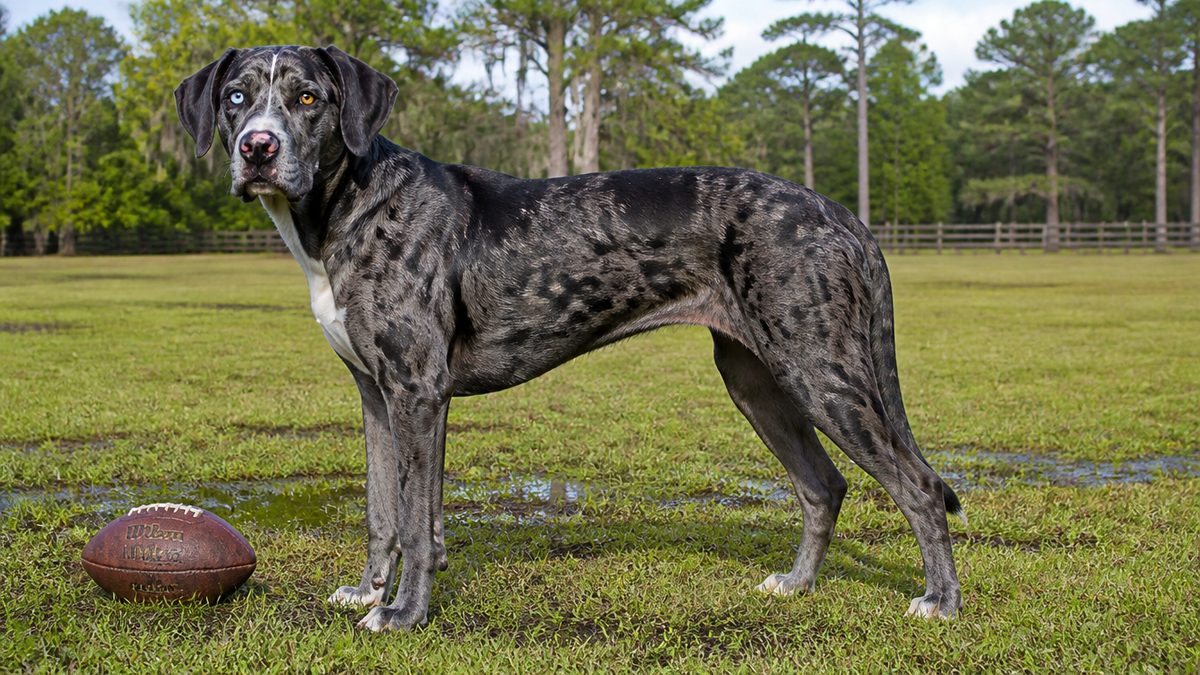
The Catahoula Leopard Dog is an American working breed from Louisiana, ideally 24 inches at the withers for a male and 22 inches for a female with a two-inch tolerance either way, weighing 50 to 95 pounds, carrying a single short-to-medium coat in a mottled pattern its own registry calls leopard and the rest of the world calls merle.
Start with the standard that a judge actually uses. The United Kennel Club recognised the Louisiana Catahoula Leopard Dog on 1 January 1995 and files it in the Herding Dog Group, and its official standard, revised 1 January 2008, describes a medium to medium-large, short-coated dog with a broad head, small-to-medium drop ears and an undocked tail set on as a natural extension of the topline. The same document is unusually explicit about what the breed is not: it says the Catahoula is a moderate breed and should not resemble either a sighthound or a bulldog.
The proportions are worth memorising because they are the fastest way to sort a real Catahoula from a shelter mix sold as one. The body is just slightly longer than tall, and the distance from the elbow to the ground should equal 50 to 60 percent of the dog's height from withers to ground. That is a long-legged dog on a moderate frame. The chest is deep, reaching at least to the elbows, tuck-up is apparent but not exaggerated, and the topline inclines very slightly downward from well-developed withers to a level back.
The feature the standard warns you about
The UKC standard opens its general appearance clause with a caution rather than a description. Because of the breed's name, it says, many people assume that all Catahoulas have the so-called leopard markings and blue eyes; in fact the breed is noted for its many and unusual coat colours and patterns as well as varied eye colour. A solid black Catahoula with brown eyes is as correct as a blue leopard with two glass eyes, and the standard states that coat colour is not a primary consideration when evaluating the dog as a working animal.
| Element | What the UKC standard of 1 January 2008 says |
|---|---|
| Registered name | Louisiana Catahoula Leopard Dog |
| UKC group | Herding Dog Group |
| UKC recognition | 1 January 1995 |
| Height, male | Ideal 24 inches, tolerance two inches either way |
| Height, female | Ideal 22 inches, tolerance two inches either way |
| Weight | 50 to 95 pounds, in proportion to height |
| Coat | Single, short to medium, lying flat and close, smooth to coarse |
| Colour | Leopard, solid, brindle or patchwork; no pattern preferred |
| Eyes | Any colour or combination of colours, without preference |
| Ears | Drop, short to medium, folding over, generally triangular |
| Tail | Natural extension of the topline, undocked; natural bobtail permitted but not preferred |
| Feet | Well knit, oval, toes long, webbed and well arched |
| Gait | Smooth, fluid and effortless at the trot |
Read that table against what an Indian search returns and the drift is immediate. Google's own knowledge panel for the query gives male height as 56 to 58 cm and female height as 51 to 61 cm. Those two ranges are incompatible: a correct female may reach 61 cm while a correct male is capped at 58. A panel that lets bitches outgrow dogs by three centimetres is not a rounding problem, it is a broken record, and the size section below sets out all five circulating size figures side by side.
The UKC registers this breed as the Louisiana Catahoula Leopard Dog; the AKC Foundation Stock Service calls it the Catahoula Leopard Dog. Wikipedia adds Catahoula Cur and Catahoula hog dog as other names, and the AKC adds Catahoula Hound. Bonbeno files the page under Catahoula Leopard Dog because that is what Indian searchers type, but every registry and legal claim below is made under the name the source document itself uses.
Catahoula, Choctaw or sacred lake: the registries disagree
The name Catahoula comes from Catahoula Parish in Louisiana, but the two largest bodies that register the breed give flatly different etymologies for the word itself, and neither cites a source.
Take the American Kennel Club first. Its breed page states that the word is of Choctaw origin and is translated to mean sacred lake, and adds that Catahoulas are the only breed of dog to have historically originated in the state of Louisiana. That is a specific linguistic claim, printed without a reference, on the page that ranks first in India for the breed name.
Now take the United Kennel Club, whose standard is the document the AKC page links to for the breed's history. It says there are many stories regarding the origin of the breed's exotic name, and that the most likely is that it is a corruption of the Indian word that meant Choctaw, the name of a local tribe. So one registry says the word means a lake and the other says it means a people. Both cannot be right, and neither shows its working.
Bonbeno publishes no etymology for Catahoula, because the two bodies with the strongest claim to know contradict each other and neither cites a source. What is not in dispute is the geography: Wikipedia records that the breed is named after Catahoula Parish, Louisiana, and files the article in the category Catahoula Parish, Louisiana.
Leopard, not merle, and that choice matters
The single most consequential naming decision in this breed is not the parish. It is the word used for the coat. The National Association of Louisiana Catahoulas, which Louisiana law names as the breed's registry, calls the spotted-up coat Leopard in the NALC Standard, and then adds one sentence that tells you exactly how the registry frames it: "Other breeds may have a similar coat pattern called merle".
Read that carefully. The registry does not say the Catahoula's leopard pattern is merle. It says other breeds have something similar, which they call merle. Search the entire NALC standard, coat-colour page, eye-colour page, history page and lagniappe page and the word merle appears exactly once, in that single deflecting sentenceNational Association of Louisiana…National Association of Louisiana…National Association of Louisiana….
Wikipedia, which ranks second, is blunter and correct: the leopard-like coat of most Catahoulas is the result of the merle gene. So is the AKC, which registers Blue Merle as colour code 050, Red Merle as 276, White Merle as 311 and Yellow Merle as 436, four of the ten codes it offers for this breed. And so is the peer-reviewed literature, which lists the Louisiana Catahoula among the breeds in which the merle pattern is seen.
Calling the coat leopard rather than merle is not a harmless regionalism. Every piece of published evidence on the risk attached to this coat, from Clark's 2006 mapping of the SILV insertion to Strain's BAER prevalence work, is indexed under the word merle. An Indian buyer who searches leopard pattern dog finds photographs. The same buyer who searches merle finds the deafness literature. The vocabulary decides what you learn.
Where the breed came from, and which parts are documented
The Catahoula's documented history begins in eighteenth-century Louisiana, but the two most-repeated origin claims, a red wolf cross and a Beauceron cross, rest on very different quality of evidence, and this page separates them.
The UKC standard opens with an honest sentence that most breed pages drop: the origins of the Louisiana Catahoula Leopard Dog are unknown. What follows in that document is belief, and the standard says so, describing what is believed to be descent from crosses between Native American dogs, Red Wolves, some of whom lived as pariahs on the outskirts of Indian villages, and the dogs brought to the New World by Spanish conquistadors, probably mastiff-types and sighthounds.
Wikipedia takes a narrower line and puts a date on it, stating that the Catahoula lineage was started in the mid-1700s, when French settlers crossbred local dogs with Beauceron dogs, and citing Don Abney's 1996 book on the breed. The UKC standard is more cautious about the same claim, saying only that some experts believe Beaucerons were added to the mix when the area was settled by the French. One source states it as fact, the other as opinion, and both trace to the same small body of American breed literature.
The job the dog was actually kept for
One of those beliefs has since been tested and it did not survive. The Louisiana Endowment for the Humanities' own encyclopedia states that factual claims of the breed's origin lack credible historic documentation and are at best informed speculation, and goes further: recent DNA analyses refute part of those claims by linking prehistoric American dogs more closely to European and Asian dogs than to native canids, indicating that Native Americans brought domesticated dogs with them when they migrated to North America, so their dogs were not of red wolf origin. The red wolf sentence in the UKC standard is therefore a surviving nineteenth-century idea rather than a finding, and Bonbeno reports it as such.
Whatever the ancestry, the work is well attested and it explains the temperament an Indian buyer will meet. White settlers in Louisiana found Native Americans using these dogs to hunt deer, bobcat, wild hog and bear, and the newcomers came to value a dog equally capable of scenting, trailing and treeing game, or baying and herding feral hogs and cattle. Wikipedia adds that the first white settlers are believed to have used the dog to hunt feral pigs in the swamps of Louisiana.
That combination is unusual. Most working breeds do one thing. This one is filed by the UKC in the Herding Dog Group and by the AKC under a Herding Group designationAmerican Kennel Club, while being used in practice as a bay dog and a tree dog on wild boar. The AKC describes the herding style as creating a canine fence around the herd so the handler can work stock inside the circle.
| Claim | Source | Evidence quality |
|---|---|---|
| Origins are unknown | UKC breed standard | Stated flatly by the recognising registry |
| Descended from Native American dogs, Red Wolves and Spanish mastiff and sighthound types | UKC breed standard | Explicitly framed as belief, not record |
| Lineage started mid-1700s from French settlers crossing local dogs with Beaucerons | Wikipedia, citing Abney 1996 | A single breed-book citation, stated as fact |
| Some experts believe Beaucerons were added by French settlers | UKC breed standard | Same claim, attributed rather than asserted |
| Only breed to have historically originated in Louisiana | AKC and NALC | Consistent across both, and uncontested |
Two things follow for a reader in Pune or Kochi. First, this is a rare breed with a thin documentary record, so any page giving you a confident sentence about red wolf percentages is inventing it. Second, the working history is not decorative. A dog selected for a century to bay a wild boar and hold a herd together is a dog with a high prey drive and a strong opinion, and the temperament section below treats that as the central buying question rather than a footnote.
The UKC standard requires feet that are well knit and oval with toes that are long, webbed and well arched, and the NALC repeats it, noting that webbed toes help the dog move through swampland mud as well as snow-covered land and that Catahoulas are excellent swimmers. It is one of the few breed claims here that appears in a formal standard rather than in folklore.
The same encyclopedia dates the name rather than the dog, noting that Catahoula seems to have been applied to these dogs by the early nineteenth century and that the modern development of the breed has strong connections to the Catahoula Lake region of central Louisiana. It also records the breed's place in state folklore, from the Bowie brothers to Theodore Roosevelt's 1907 bear hunt to Governor Earl K. Long, who collected Catahoulas and used them on feral hogs.
Louisiana made it the state dog by statute, and named a registry in the law
Louisiana designated the Catahoula by an actual statute rather than a resolution: Acts 1979 No. 239 is codified at Louisiana Revised Statutes 49:165, and its text names one private body, the National Association of Louisiana Catahoulas, on the face of the law.
The section is three sentences long and worth quoting in full. Louisiana Revised Statutes 49:165, headed State dog, provides that there shall be an official state dog; that the official state dog shall be the Louisiana Catahoula Leopard dog, as registered by the National Association of Louisiana Catahoulas; and that its use on official documents of the state and with the insignia of the state is authorised. The enacting line reads Added by Acts 1979, No. 239, section 1.
Three details in that sentence do real work. It is a codified statute, sitting in Title 49 State Administration, Chapter 1 General Provisions, Part VIII State Symbols and Display of Flags, alongside the rest of Louisiana's official symbols. It carries an Acts citation, so a reader can follow it back to the 1979 session. And it defines the state dog by reference to a breed registry rather than by breed name alone.
Why the difference from a resolution matters
Compare the neighbouring case. Texas designated the Blue Lacy as its state dog breed by House Concurrent Resolution No. 108 in 2005, a resolution that was never codified into the Texas statute book. Louisiana did the opposite. The Catahoula designation was passed as a bill, signed into law, and printed in the Revised Statutes where it still sits. If you are weighing how seriously a state took the gesture, the instrument tells you.
The signing itself is well recorded and consistent across three independent sources. The UKC standard states that on 9 July 1979 the governor of Louisiana signed a bill making this breed the official State Dog of Louisiana. Wikipedia gives the same date and adds the instrument number, House Bill number 75, and the governor's name, Edwin Edwards. The NALC gives the same date and describes it as a Bill signed into Law which was passed by the Louisiana Legislature. The AKC's own Did You Know panel simply says that in 1979 the Catahoula Leopard Dog was named the State Dog of Louisiana.
| Question | Catahoula Leopard Dog, Louisiana | Blue Lacy, Texas |
|---|---|---|
| Instrument | A bill, signed 9 July 1979 | House Concurrent Resolution No. 108, 2005 |
| Codified in the state's revised statutes | Yes, at R.S. 49:165 | No |
| Enacting citation | Added by Acts 1979, No. 239, section 1 | Resolution, no statutory citation |
| Names a registry in the text | Yes, the National Association of Louisiana Catahoulas | No |
| Recognised by a major kennel club | Yes, UKC since 1 January 1995 | No |
The registry clause is the genuinely unusual part, and the NALC reads it exactly as written. Its own history page says the 1979 bill made NALC registered dogs the only true Louisiana State Dog, and its homepage says the bill made NALC the propagator of the breed. Whether a state can confer that status on one private association is a question for a Louisiana lawyer, not a pet encyclopedia. What Bonbeno can report is that the statute does name the NALC, and that no other registry appears in it.
R.S. 49:165 gives the Catahoula a place on Louisiana stationery. It does not create a studbook, appoint judges, write a standard or impose a health scheme. Those things come from a breed registry, and in this breed they come from at least four of them that do not agree with one another. The next two sections set out who those bodies are and where they diverge.
Exactly what recognition this breed holds, and from whom
The Catahoula Leopard Dog holds full recognition from the United Kennel Club since 1 January 1995, a Foundation Stock Service record with the American Kennel Club since 1996, a state statute in Louisiana, and no recognition at all from the Federation Cynologique Internationale, which is the fact that closes the Indian pedigree route.
Take the UKC first, because it is the strongest rung. The United Kennel Club recognised the Louisiana Catahoula Leopard Dog on 1 January 1995 and places it in the Herding Dog Group, with a full written standard, a downloadable PDF, a single-registration route and a conformation disqualification list. That is real kennel club recognition in every sense that matters: a dog can be registered, shown, judged and disqualified.
The AKC position is more often misreported than any other fact about this breed, so here it is from the AKC's own page. The breed page carries a Foundation Stock Service badge directly under the heading, and the AKC's Did You Know panel states that the Catahoula Leopard Dog has been recorded in the Foundation Stock Service since 1996 and has been assigned the Herding Group designation. So the common line that the AKC does not recognise the Catahoula is wrong as stated. It records the breed, and has for three decades.
What Foundation Stock Service is not
FSS is a recording service for rare breeds, described by the AKC as being for breeds that are currently being recorded in the FSS program. An FSS breed is not a fully recognised AKC breed: it has no AKC breed standard of its own written by an AKC parent club in the way a Labrador does, and it cannot compete for championship points in AKC conformation. The honest sentence is that the Catahoula is recorded by the AKC and recognised by the UKC, and those are different things.
The FCI absence, checked with a control
Absence is a strong claim, so here is how it was tested. The FCI's alphabetical breed index for the letter C was retrieved and read. It carries 44 recognised breeds, running from CA DE BESTIAR to CURLY COATED RETRIEVER, and it does list American breeds, including CHESAPEAKE BAY RETRIEVER at number 263 and CANADIAN ESKIMO DOG at 211. So the index works, it is genuinely alphabetical, and it is not hostile to North American entries. Between CAO FILA DE SAO MIGUEL and CAVALIER KING CHARLES SPANIEL, where a Catahoula would sort, there is nothing.
| Rung | Status | Instrument |
|---|---|---|
| United Kennel Club | Fully recognised, Herding Dog Group | UKC breed standard, recognition 1 January 1995 |
| AKC Foundation Stock Service | Recorded since 1996, Herding Group designation | AKC breed page |
| AKC full recognition | No | FSS badge on the AKC's own breed page |
| Louisiana state dog | Yes, by statute | R.S. 49:165, Acts 1979 No. 239 |
| National Association of Louisiana Catahoulas | Named in the state statute | R.S. 49:165 |
| National Kennel Club | Registered, standard republished | NKC Louisiana Catahoula page |
| Federation Cynologique Internationale | Not recognised | FCI alphabetical index, letter C, 44 breeds |
| Kennel Club of India | No FCI nomenclature entry to register against | Follows from the FCI absence |
That last row is the one an Indian buyer should read twice. India's national kennel club works inside the FCI nomenclature. A breed the FCI has never entered has no FCI standard number, no FCI-qualified judge and no show class anywhere in the FCI system, so there is no ordinary route by which a Catahoula born or imported here could register on an FCI-recognised pedigree. Keep that in mind when the price section reaches an Indian marketplace advertising KCI registered Catahoula puppies.
At least six bodies claim this breed, and they do not agree
Six organisations have registered or standardised the Catahoula, and establishing which are functioning matters more here than in almost any other breed, because Louisiana law defers to one of them and the others contradict it on tail, ears, colour and hearing.
Work through them in order of the evidence each one currently shows.
- National Association of Louisiana Catahoulas (NALC), founded 1977, non-profit, named in R.S. 49:165. Functioning: it publishes a live standard, a coat-colour guide, an eye-colour guide and an events page, and states that its standard was written by NALC Certified Breeders in early 1984National Association of Louisiana…Louisiana State Legislature.
- United Kennel Club (UKC), recognition 1 January 1995, standard revised 1 January 2008. Functioning: full standard, downloadable PDF, single-registration page and a disqualification list that must be reported to UKC.
- American Kennel Club (AKC), Foundation Stock Service since 1996. Functioning: a live breed page, ten colour registration codes and a Herding Group designation.
- National Kennel Club (NKC), Blaine, Tennessee, operating since 1964. Functioning as a registry, but see the drift below: it publishes a standard headed as approved by the NALC that is not the standard the NALC now publishes.
- Animal Research Foundation (ARF), Quinlan, Texas, described across the American working-dog world as the original registry for several cur and leopard breeds. No ARF website resolved from three candidate domains on 25 August 2026, and a rival American working-dog registry states that the ARF is now closed as the owner has passed.
- European Association of Louisiana Catahoulas (EALC) and the Catahoula Club EU, Czech Republic. Functioning in the literature rather than on the open web: the EALC supplied the second author of the definitive merle-allele paper, and the Catahoula Club EU began genotyping the Czech Catahoula population for merle in 2011.
The NKC drift, clause by clause
The National Kennel Club's Louisiana Catahoula page presents its standard as approved by the National Association of Louisiana Catahoula's, Inc.. It is not the current NALC text. Three differences are material: the NKC version omits tan from the list of leopard colours that the NALC standard now includes; the NKC version disqualifies cropped ears but not ears that stand up, which the NALC standard also disqualifies; and the NKC version carries no cryptorchidism disqualification at all, which the NALC standard does.
The NKC also keeps a second breed page, headed Catahoula Leopard, which carries two stock photographs, a scripture quotation and no standard text whatsoever. A registry running two entries for the same dog, one with a stale borrowed standard and one with nothing in it, is a registry worth knowing about before you accept a certificate from it.
None of the six bodies above requires a hearing test before a dog can be registered or bred. The UKC disqualifies a deaf dog from the conformation ring and requires the disqualification to be reported, which is detection at the show, not prevention at the mating. The breed registry paperwork that comes with a Catahoula tells you who its parents were. It does not tell you whether it can hear.
Two breed standards, and they contradict each other on hearing
The UKC standard and the NALC standard describe the same dog and disagree on four things that matter, and the sharpest disagreement is that the UKC disqualifies unilateral or bilateral deafness while the NALC standard never uses the word.
Put the two documents side by side and the pattern is not random. On every point where the two texts differ, the UKC standard is the more restrictive one, and the restrictions cluster on exactly the features that merle affects.
| Element | UKC standard, revised 1 January 2008 | NALC standard, written 1984 |
|---|---|---|
| Deafness | Disqualification: unilateral or bilateral deafness | Not mentioned anywhere in the standard |
| Eye colour | Any colour or combination, without preference | Glass eyes are preferred |
| Coat pattern | No coat colour or pattern is preferred | Leopards are to be preferred |
| White in coat | Serious fault at 70 percent or more; disqualification at 90 percent or more, solid white head, or albinism | No white limit stated; white is listed as a leopard colour |
| Natural bobtail | Permitted, but not preferred | Serious fault |
| Docked tail | Fault | Serious fault |
| Erect ears | Faults: any ear type other than drop | Disqualification: cropped ears or ears that stand up |
| Cropped ears | Disqualification | Disqualification |
| Malformed or off-centre pupils | Serious fault | Serious fault |
| Cryptorchidism | Disqualification, unilateral or bilateral | Disqualification, unilateral or bilateral |
| Height, male | Ideal 24 inches, plus or minus 2 | 22 to 26 inches |
| Height, female | Ideal 22 inches, plus or minus 2 | 20 to 24 inches |
| Weight | 50 to 95 pounds | Not stated |
Row one is the whole argument of this page in a single line. The UKC lists ten disqualifications, and unilateral or bilateral deafness is one of them, sitting between viciousness or extreme shyness and cropped ears, with the standing instruction that a dog with a disqualification must not be considered for placement and must be reported to UKC. The NALC standard runs through origin, appearance, temperament, size, coat and colour, head, skull, eyes, ears, muzzle, bite, neck, body, forequarters, hindquarters and gait, lists its own faults, serious faults and disqualifications, and never mentions hearing at all.
That absence was checked rather than assumed. Every NALC page retrieved on 25 August 2026, the standard, the history, the lagniappe page, the coat-colour guide and the FAQ, returns zero occurrences of deaf, hearing or BAER in any formNational Association of Louisiana…National Association of Louisiana…National Association of Louisiana….
The white clause is a double-merle clause in disguise
Row four is the second half of the same story. The UKC makes 70 percent or more white a serious fault and disqualifies a dog at 90 percent or more white, a solid white head, or albinism. Strain's description of the homozygous merle is that such dogs usually have a solid white coat and blue irises, are often deaf and blind, and may be sterile. The UKC's colour disqualification is, in practice, a description of the double merle written in the language of the show ring.
The NALC standard has no such clause. Its coat section says leopards are preferred and may come in blue, gray, black, tan, liver, red, white and patched, with no ceiling on how much white a leopard may carry, and its coat-colour guide lists White with Light Gray Leopard among the registrable examples.
A predominantly white Catahoula with a solid white head is a deaf-risk phenotype that the UKC disqualifies outright and that the NALC standard admits without commentNational Association of Louisiana…. Louisiana law defers to the second body. That is not a technicality. It is the single most consequential registry disagreement Bonbeno has found on any breed page.
Five sets of size figures are in circulation and one of them is impossible
Published heights and weights for the Catahoula Leopard Dog come in five incompatible versions, of which the UKC standard is the one a judge uses, Wikipedia misquotes that standard's weight floor by ten pounds, and Google's knowledge panel prints a female range that is taller than the male one.
Set them out and check the arithmetic yourself.
| Source | Male height | Female height | Weight |
|---|---|---|---|
| UKC standard, 1 January 2008 | Ideal 24 in, plus or minus 2 (22 to 26 in) | Ideal 22 in, plus or minus 2 (20 to 24 in) | 50 to 95 lb |
| NALC standard, 1984 | 22 to 26 in (55.8 to 66.0 cm) | 20 to 24 in (50.8 to 60.9 cm) | Not stated |
| AKC breed page | 22 to 24 in, no sex split | 22 to 24 in, no sex split | 50 to 95 lb |
| Wikipedia infobox | 22 to 26 in (56 to 66 cm) | 20 to 24 in (51 to 61 cm) | 40 to 95 lb (18 to 43 kg) |
| Petfinder | 20 to 24 in, no sex split | 20 to 24 in, no sex split | 50 to 90 lb |
| Google knowledge panel, India | 56 to 58 cm | 51 to 61 cm | Male 16 to 48 kg, female 16 to 45 kg |
| 64 Parishes, Louisiana Endowment for the Humanities | Medium to large, no sex split | Medium to large, no sex split | 40 to 90 lb |
Three of those rows contain checkable errors. Wikipedia gives a weight of 40 to 95 pounds and cites the UKC standard for it. The UKC standard says "Weight may range from 50 to 95 pounds, in proportion to the dog's height". Wikipedia has moved the floor down by ten pounds, roughly 4.5 kg, on a citation that does not support it, and every page that copies Wikipedia inherits the error.
Google's panel is internally impossible. It gives male height as 56 to 58 cm and female height as 51 to 61 cm. A correct female may therefore stand 61 cm while a correct male is capped at 58. No breed standard anywhere produces that shape, and the underlying documents do not: both the UKC and the NALC put males above femalesNational Association of Louisiana…. Google's weight row is worse still, opening at 16 kg for both sexes, which is 35 pounds, well below any published floor.
The AKC and Petfinder both drop the sex split. The AKC prints a single 22 to 24 inch band and Petfinder a single 20 to 24 inch band with 50 to 90 pounds. Neither range contains a correct 26-inch UKC male. A reader measuring a 25-inch dog against the AKC page would conclude it was oversized when the recognising registry says it is correct.
What to actually measure
The UKC gives you a proportion test that no tape-measure dispute can spoil, and it is more useful than the heights. The length of the foreleg should roughly equal 50 to 60 percent of the dog's height at the withers, and a dog with legs shorter than the ideal is to be more heavily penalised than a dog with longer legs. The NALC repeats the same 50 to 60 percent rule. Measure elbow to ground, measure withers to ground, divide. On a 24-inch dog the elbow should sit 12 to 14.4 inches off the floor.
The UKC also tells you what the numbers are for, and it is the most sensible sentence in either document: the dog must be both powerful and agile, so actual weight and height are less important than the correct proportion of weight to height, and Catahoulas should always be presented in hard, working condition.
If a seller in India offers you a Catahoula, ask for the height at the withers and the weight, and check the pair against 50 to 95 pounds on a 22 to 26 inch frame. A 20 kg dog at 24 inches is thin for the standard; a 50 kg dog at 24 inches is outside it in the other direction and is more likely a mastiff cross. Google's 16 kg floor will not help you.
The leopard coat is merle, and merle is a retrotransposon
The Catahoula's leopard pattern is produced by a short interspersed element inserted into the canine PMEL gene, inherited as an autosomal incompletely dominant trait, and the paper that identified it says in its own abstract that carriers exhibit a wide range of auditory and ophthalmologic abnormalities.
The genetics were settled twenty years ago and the wording of the original paper is worth reading rather than paraphrasing. Clark and colleagues mapped the merle locus in 2006, finding a short interspersed element inserted at the boundary of intron 10 and exon 11 of SILV, now usually called PMEL, and showed that the insertion segregates with the merle phenotype across multiple breeds. Their abstract states that the trait is inherited in an autosomal, incompletely dominant fashion, and that dogs heterozygous or homozygous for the merle locus exhibit a wide range of auditory and ophthalmologic abnormalities, similar to those seen in the human auditory-pigmentation disorder Waardenburg syndrome.
The mechanism explains why the merle coat is patchy rather than uniform. The inserted element carries a poly(A) tail that behaves like a microsatellite, so replication slippage lengthens and shortens it during cell division. Short tails allow intron 10 to splice normally and produce a normal PMEL protein; long tails force splicing to a cryptic site and produce an abnormal protein that cannot build the normal fibrillar matrix of the eumelanosome, so dark pigment deposition falls. The longer the poly(A) tail, the lighter the coat. When those length changes happen in body cells they create the mottling; when they happen in the germ line they produce puppies whose colour differs from either parent's.
Why deafness follows pigment
The link between coat and hearing is anatomical, not mystical. Congenital deafness in dogs usually develops in the first few weeks after birth while the ear canal is still closed, and results from degeneration of part of the blood supply to the cochlea, the stria vascularis. The sensory nerve cells of the cochlea then die and permanent deafness results. The cause of the vascular degeneration appears to be the absence of pigment-producing melanocytes in the stria, whose role includes maintaining the high potassium concentration of the fluid around the cochlear hair cells.
So the same gene that removes pigment from patches of coat can remove it from the inner ear. Strain's summary of the field names two pigment genes as the usual culprits, the merle gene and the piebald gene, and lists the merle-carrying breeds in which deafness has been reported: collie, Shetland Sheepdog, dappled Dachshund, harlequin Great Dane, American Foxhound, Old English Sheepdog and Norwegian Dunker hound among others. Elsewhere on the same site he adds the two breeds with a high prevalence that the list omits: the Catahoula and the Australian Shepherd.
| Finding | Source |
|---|---|
| Merle is a SINE insertion at the intron 10 / exon 11 boundary of SILV (PMEL) | Clark et al. 2006, PNAS |
| Inherited autosomal, incompletely dominant | Clark et al. 2006 |
| Carriers show auditory and ophthalmologic abnormalities like Waardenburg syndrome | Clark et al. 2006 |
| The longer the poly(A) tail, the lighter the coat | Varga et al. 2020, Genes |
| Deafness arises from stria vascularis degeneration where melanocytes are absent | Strain, LSU |
| Two merle parents give 25 percent MM offspring, usually white, blue-eyed, often deaf and blind | Strain, LSU |
| The genetic factors deciding which merle dogs go deaf are still unknown | Hayward et al. 2020, PLoS One |
That last row is the honest boundary of the science and it should temper any confident breeder claim. A 2020 genome-wide association study across three breeds concluded that the genetic factors determining why some piebald or merle dogs develop deafness while others do not have yet to be determined, and that larger samples may be needed given the complex genetic architecture. Nobody can currently look at a merle puppy's DNA and tell you it will hear.
Strain's review notes that most deafness in dogs is congenital sensorineural hereditary deafness associated with the piebald or merle genes, that dogs with blue eyes have a greater likelihood of hereditary deafness than brown-eyed dogs, and that definitive diagnosis requires BAER testing rather than observation. In a breed that also carries white trim on chest, face and legs, both pigment routes are plausibly in play at once.
The definitive merle paper was written by Catahoula people, and 73 of its 181 dogs were Catahoulas
The 2018 study that expanded merle from two alleles to six was authored from Cat's Cradle Catahoulas in Ontario and the European Association of Louisiana Catahoulas, its largest single breed cohort was 73 Louisiana Catahoulas out of 181 dogs, and its authors state plainly why the discovery happened in this breed.
This is the most breed-specific piece of evidence on the whole page, and almost nobody writing about Catahoulas cites it. Langevin and colleagues published in PLoS One in 2018 a portfolio of six existing merle alleles, Mc, Mc+, Ma, Ma+, M and Mh, each associated with distinct coat features and a stratified health-impairment risk. The first author's affiliation is Cat's Cradle Catahoulas, Oro Medonte, Ontario; the second author's is the European Association of Louisiana Catahoulas, Ceske Budejovice.
The cohort composition matters. Biological material was collected from 181 dogs of 14 breeds, and the breakdown is given in the paper: Australian Shepherd 40, Australian Koolie 23, Border Collie 18, Dachshund 9, French Bulldog 2, Louisiana Catahoula 73, Labradoodle 1, Miniature American Shepherd 2, Miniature Australian Shepherd 2, Pyrenean Shepherd 1, Rough Collie 3, Shetland Sheepdog 2, Welsh Sheepdog 3 and Mudi 2. Those numbers sum to 181, which is the first thing to check on any such table. The Catahoula is 40.3 percent of the study population, nearly twice the Australian Shepherd's share.
Why the discovery happened here
The paper's introduction gives the reason, and it is the sentence an Indian buyer most needs. In 2011 the Catahoula Club EU in the Czech Republic began testing the merle gene in the Czech population of the Louisiana Catahoula in cooperation with a German laboratory, because, the authors write, this is a North American breed famous for its merle leopard pattern in which initially no restrictions to breeding merle by merle individuals had been applied in the breeding strategies, contrary to other merle carrying breeds, especially in Europe. Therefore, many dogs carrying the merle gene can be expected within the breeding pool.
That pilot testing produced the finding that the whole field now rests on: many unusual solid-colour-in-appearance Catahoulas carry merle alleles, but of a different SINE size than those Clark had found. The middle-sized allele was named Atypical Merle (Ma) to distinguish it from those already known. In plain terms, the atypical merle allele was discovered in the Catahoula, and it was discovered there because the breed had no merle-to-merle restriction and so accumulated hidden carriers.
Ballif and colleagues reached the same conclusion from the other direction, measuring insertions rather than observing coats. Across 175 dogs, 99 Australian Shepherds, 45 miniature Australian Shepherds and 31 miniature American Shepherds, SINE insertion lengths varied continuously from 201 to 277 base pairs, and the 126 dogs carrying a single insertion sorted into four broad phenotypic clusters they named cryptic, atypical, classic and harlequin merle. Twenty-five dogs carried two insertions and 24 carried more than two.
Langevin's group found mosaicism, more than one merle allele in the same dog, in 30 of 181 animals, 16.6 percent, and showed that minor as well as major alleles can be inherited. Their strongest practical finding is that sperm cells seem to be a significant source of germline merle allelic variants which pass to offspring on a Mendelian basis and explain unusual genotype and phenotype results in the puppies. A stud dog's coat, and even a single buccal-swab result, can therefore understate what he transmits.
Double merle: 25 percent affected, and two of the named cases are Catahoulas
Double merle dogs are far more likely to be deaf than single merles, at 10 percent unilaterally and 15 percent bilaterally against 2.7 and 0.9 percent, and the merle-allele literature carries two individually reported Catahoulas, one M/M and unilaterally deaf, the other M/Mh and bilaterally deaf.
The prevalence numbers come from a BAER study of 153 privately owned merle dogs of different breeds and both sexes, genotyped at the SILV locus. Deafness prevalence across all merles was 4.6 percent unilaterally deaf and 4.6 percent bilaterally deaf. Split by genotype, single merles (Mm) were 2.7 percent unilaterally deaf and 0.9 percent bilaterally deaf, while double merles (MM) were 10 percent unilaterally deaf and 15 percent bilaterally deaf. Homozygotes were significantly more likely to be deaf than heterozygotes, and there was no significant association with eye colour or sex.
| Genotype | Unilaterally deaf | Bilaterally deaf | Total affected |
|---|---|---|---|
| Single merle (Mm) | 2.7% | 0.9% | 3.6% |
| Double merle (MM) | 10% | 15% | 25% |
| All merles in the sample | 4.6% | 4.6% | 9.2% |
Read the eye-colour result carefully, because it cuts against the intuition this breed invites. In Strain's merle cohort, blue eyes were not significantly associated with deafness. In his separate work on piebald breeds, blue eyes were positively associated with deafness in the Dalmatian, English Setter and English Cocker Spaniel. The honest statement is therefore narrow: a glass eyes preference is not itself proven to select for deafness in a merle breed, but it does select for the pigment-loss phenotype, and it is the visible end of the same pigment pathway.
The arithmetic of a double-merle litter
Strain's own worked example is the clearest statement of the risk anyone has published. The merle gene M is dominant, so affected dogs (Mm) show the pattern, which is desirable in many breeds. But when two dogs heterozygous for merle are bred, 25 percent will end up with the MM genotype. These dogs usually have a solid white coat and blue irises, are often deaf and blind, and may be sterile. Breeders in these breeds know not to breed merle to merle.
Set that beside the Catahoula's own paperwork. Louisiana law defers to the NALC, whose standard has no white ceiling and lists white among leopard coloursNational Association of Louisiana…. Langevin's authors record that the breed initially applied no merle-to-merle restriction at all. And the AKC offers a registration code, White Merle 311, for a colour whose UKC equivalents, 90 percent or more white and a solid white head, are disqualificationsUnited Kennel Club.
Two Catahoulas, by name and genotype
Langevin's Table 2 sets out individual dogs whose merle genotype was paired with a clinical hearing and vision assessment, and two of them are this breed: Catahoula AE513, genotype M/M at 267/267 base pairs, unilaterally deaf, and Catahoula AE479, genotype M/Mh at 268/272, bilaterally deaf. Those are not modelled figures. They are two individual dogs, genotyped and tested, and they sit in the same table as an Australian Shepherd recorded as bilaterally deaf with microphthalmia, iris hypoplasia, an incipient cataract and a detached non-visual right eye.
The Mudi study makes the same point in a breed with published numbers: genotyping 123 dogs from 11 countries found classic merle in 61.8 percent, harlequin in 13.8 percent, atypical in 5.7 percent, double merle in 0.8 percent and mosaic profiles in 17.9 percent, and the authors warn that hidden merle individuals can produce unintentionally homozygous double merle progeny with ophthalmologic, viability and auditory impairments. Those five figures sum to exactly 100 percent, which is the first thing to check on any such table. In a breed where atypical merle was first described, that warning is not theoretical.
38.8 percent of 214 BAER-tested Catahoulas were deaf
George Strain's LSU breed prevalence table gives the Catahoula Leopard Dog 214 dogs tested, of which 16.8 percent were unilaterally deaf and 22.0 percent bilaterally deaf, a total of 38.8 percent, and that is a higher total deafness rate than the Dalmatian's 28.0 percent across 6,249 dogs.
This is the single most important figure on the page, so here is the row exactly as published, with the arithmetic checked. The Breed-Specific Deafness Prevalence In Dogs table at LSU gives Catahoula Leopard Dog: 214 dogs tested, 61.2 percent (131) bilaterally hearing, 16.8 percent (36) unilaterally deaf, 22.0 percent (47) bilaterally deaf, 38.8 percent (83) total deaf. The counts reconcile: 131 plus 36 plus 47 is 214, 36 plus 47 is 83, and 83 divided by 214 is 38.79 percent.
| Breed | Dogs tested | Unilaterally deaf | Bilaterally deaf | Total deaf |
|---|---|---|---|---|
| Catahoula Leopard Dog | 214 | 16.8% (36) | 22.0% (47) | 38.8% (83) |
| Dalmatian | 6,249 | 20.8% (1,297) | 7.3% (454) | 28.0% (1,751) |
| Dogo Argentino | 736 | 20.9% (154) | 5.6% (41) | 26.5% (195) |
| Australian Cattle Dog | 603 | 11.8% (71) | 2.8% (17) | 14.6% (88) |
| English Setter | 751 | 10.3% (77) | 2.2% (16) | 12.4% (93) |
| Bull Terrier, white | 362 | 18.2% (66) | 2.2% (8) | 20.4% (74) |
| English Cocker Spaniel | 1,641 | 4.7% (77) | 0.9% (14) | 5.5% (91) |
One arithmetic note on the comparator row, because this site divides out every figure it is handed. The Dalmatian row prints 6,249 dogs tested, but its own counts, 4,497 bilaterally hearing plus 1,297 unilaterally deaf plus 454 bilaterally deaf, sum to 6,248. The one-dog gap changes no percentage to a decimal place and is reported here only so a later editor knows it was checked rather than missed.
The shape of the Catahoula row is what makes it unusual, not just its height. In every other breed on that table, unilateral deafness outnumbers bilateral, often by three or four to one. In the Catahoula the ratio inverts: more dogs were deaf in both ears than in one, 47 against 36. A bilaterally deaf dog is the outcome the double-merle literature predicts.
The caveat Strain himself attaches
Bonbeno does not publish that figure without the footnote the source carries, because the footnote is part of the finding. The Catahoula row is asterisked, and the table's note reads: "Insufficient numbers of animals tested at this time for percentages to be meaningful. The numbers in this table do not reflect numbers reported by others, shown below, but only data that I have collected";. So the author of the dataset is telling you that 214 dogs is not enough to fix a population rate, and that this is his own referral series rather than a census.
That caveat cuts a specific way. A BAER laboratory sees dogs whose owners or breeders had a reason to bring them, which pushes an observed rate up, not down. So 38.8 percent is very unlikely to be the true population prevalence of deafness in Catahoulas. What it does establish, and establishes firmly, is that 83 individual Catahoulas were BAER tested and found deaf in one ear or both by a single laboratory, and that no other breed in the table produced a higher total rate.
The corroboration is independent of the number. Strain's discussion of the genetics names the breeds with the highest prevalence and, after Dalmatians, English Setters, English Cocker Spaniels, Australian Cattle Dogs, Bull Terriers and white Norwegian Dunker hounds, adds: "Other breeds with a high incidence are the Catahoula and Australian Shepherd";. The same sentence appears on the OFA's own congenital deafness page, reproduced by permission. And the Catahoula Leopard Dog appears in Strain's alphabetical list of breeds with reported congenital deafness, between Cardigan Welsh Corgi and Catalan Shepherd.
Thirty-six of those 214 dogs were deaf in one ear only. Strain's warning is that recognition of affected cases is often difficult, because unilaterally deaf dogs appear to hear normally unless BAER is performed, and that a unilaterally deaf dog can be as great a genetic risk to its offspring as a bilaterally deaf one. Clapping behind a puppy will not find this. Nothing except BAER will.
OFA's BAER register says 2.0 percent, and the gap is the finding
The Orthopedic Foundation for Animals holds 51 BAER evaluations for the Louisiana Catahoula Leopard, of which 98.0 percent were normal and 2.0 percent abnormal, a rate nineteen times lower than Strain's 38.8 percent, and the two datasets diverge because they are built from opposite kinds of dog.
The OFA figures were pulled from the registry's own complete statistics dump, retrieved through a stealth proxy with a fifteen-second render wait, and searched case-insensitively. The breed's OFA code was read off OFA's own markup rather than guessed: LC, printed against LOUISIANA CATAHOULA LEOPARD in the registry's DNA-test breed table. Every row taken below prints that same full breed label on the page's own face.
| Breed | Rank | Evaluations | Normal % | Equivocal % | Abnormal % |
|---|---|---|---|---|---|
| Dalmatian | 1 | 13,868 | 89.6 | 0.3 | 10.1 |
| Australian Cattle Dog | 2 | 4,276 | 95.2 | 0.2 | 4.6 |
| Labrador Retriever | 4 | 54 | 96.3 | 0.0 | 3.7 |
| English Setter | 5 | 699 | 96.6 | 0.1 | 3.3 |
| Dogo Argentino | 6 | 288 | 96.9 | 0.0 | 3.1 |
| LOUISIANA CATAHOULA LEOPARD | 11 | 51 | 98.0 | 0.0 | 2.0 |
| Border Collie | 19 | 1,331 | 98.8 | 0.2 | 1.1 |
| All breeds | 46,820 | 95.9 | 0.2 | 4.0 |
Two things about that table before the disagreement. The Catahoula ranks 11th of the 31 breeds that appear in it at all, which is consistent with an elevated risk rather than an ordinary one. And 2.0 percent of 51 evaluations is one dog. The entire OFA hearing record for Louisiana's state dog is fifty-one tests and a single abnormal result.
Why 2.0 percent and 38.8 percent can both be true
The two figures measure different populations, and neither is wrong. OFA's BAER database is a voluntary certification register. Its protocol states that BAER testing is done on canines at least 35 days old, using insert earphones and at least 200 clicks at 70 to 105 dB nHL, with one test sufficing for the animal's lifetime, and that bilateral hearing passes the test while unilateral or bilateral deafness fails. People submit dogs they intend to certify, and a breeder who already suspects a problem has little reason to pay for a certificate that will fail.
Strain's LSU table is the opposite: a diagnostic referral series collected by one laboratory, in which owners and breeders bring dogs precisely because hearing is in question, and which the author himself flags as not a population estimate. Ascertainment pushes the OFA figure down and the LSU figure up. The truth is somewhere between one dog in fifty and two dogs in five, and nobody has run the study that would locate it.
The controls confirm the same pattern in a breed with far more data. Strain gives the Dalmatian 28.0 percent total deaf across 6,249 dogs; OFA gives the Dalmatian 10.1 percent abnormal across 13,868 evaluations. The registry figure is roughly a third of the referral figure in a breed everyone screens. Applying the same ratio to the Catahoula would still leave a double-digit rate.
The number to act on is not 2.0 percent. It is 51. Across the entire history of the OFA's hearing database, fifty-one Catahoulas have been BAER tested and recorded, against 13,868 Dalmatians and 4,335 Boston Terriers. This is a breed whose registries do not require the test, whose national association's standard does not mention hearing, and whose owners therefore mostly do not run it. Absence of certificates is not absence of deafness.
Indian law mandates eleven genetic tests and the word deaf appears zero times
Second Schedule Part III paragraph 8(10) of India's Dog Breeding and Marketing Rules 2017 requires breeding dogs to have been tested for eleven named genetic defects, and a full-text search of the gazette returns zero occurrences of deaf in any form, so the one screening a merle breed most needs is the one Indian law does not require.
The clause is short and this page quotes it from its own extraction of the gazette rather than from any summary. Second Schedule Part III, paragraph 8(10) of the Prevention of Cruelty to Animals (Dog Breeding and Marketing) Rules 2017, notified as G.S.R. 496(E) on 23 May 2017, provides: "The dogs shall have been tested for genetic defects, including hip dysplasia, progressive retinal atrophy, night blindness, hypothyroidism, entropion, ectropion, overshot, undershot jaw (when incisors do not touch or mesh), wry mouth, two or more missing teeth, unilateral cryptorchid or full cryptorchid males";.
Count them. That is eleven named defects. Two of them, progressive retinal atrophy and night blindness, are ocular. One, cryptorchidism, is a disqualification under both the UKC and the NALC standards for this breed. One, hip dysplasia, is the condition on which the Catahoula's own OFA record is weakest, as the health section below shows. None of the eleven is deafness.
The absence, proved rather than assumed
This is a strong claim about a document, so here is the check. The gazette PDF was downloaded and extracted with pypdf: fourteen pages, 51,953 characters of real text layer. A case-insensitive search of that text returns zero occurrences of deaf in any form, zero of merle, and zero of BAER. The word hearing appears exactly once in the entire instrument, in Rule 10(2), where it means an opportunity of being heard on appeal against a State Board decision.
So the single occurrence of the word hearing in India's dog-breeding law is a procedural right for the breeder, not a test for the dog. For a breed in which one national laboratory found 38.8 percent of 214 tested dogs deaf in one ear or both, that is the sharpest gap between what the evidence asks for and what the law requires that this site has found.
| Screening | Required by Rules 2017, Second Schedule Part III para 8(10) | Relevance to a merle Catahoula |
|---|---|---|
| Hip dysplasia | Yes | High: 18.1 percent dysplastic across 972 OFA evaluations |
| Progressive retinal atrophy | Yes | Low: not a reported Catahoula problem |
| Night blindness | Yes | Low |
| Hypothyroidism | Yes | Low |
| Entropion and ectropion | Yes | Moderate: eyelid function is a UKC serious fault |
| Jaw and dentition faults | Yes | Moderate: overshot and undershot are serious faults in both standards |
| Cryptorchidism | Yes | High: a disqualification in both standards |
| BAER hearing test | No, not named anywhere in the Rules | Highest: the defining risk of the breed's defining coat |
| Merle allele genotyping | No, not named anywhere in the Rules | High: cryptic and mosaic carriers are common in this breed |
A breeder in India can hold a valid registration, comply fully with paragraph 8(10), and still have bred two merles together without ever testing a puppy's hearing, because Indian law does not ask. The gap is not the breeder's fault and it is not the law's target. It is simply a hole a buyer has to fill personally, by asking for a BAER certificate and refusing to proceed without one.
What the ranking pages say about deafness, checked one by one
Four of the seven pages checked do name deafness, so the failure of the ranking set is not silence: not one of them names the BAER test, cites a prevalence figure with a denominator, or tells a reader the number of dogs any claim rests on.
Bonbeno checked this rather than asserting it, because a claim about what competitors omit is only worth making with a table behind it. Each page below was retrieved in full and searched case-insensitively for deaf, hearing, merle, double merle and BAER.
| Page | Says deaf | Says merle | Says double merle | Says BAER | Gives a prevalence figure |
|---|---|---|---|---|---|
| AKC breed page | No | Yes, four colour codes | No | No | No |
| Wikipedia | No | Yes | No | No | No |
| UKC standard | Yes, as a disqualification | No | No | No | No |
| Petfinder | No | No | No | No | No |
| End of the Leash | No | Yes | No | No | No |
| PetMD | Yes, at length | Yes | No | No | No |
| Chewy | Yes | Yes | No | No | No |
| MetLife Pet Insurance | Yes | Yes | Yes | No | No |
| 64 Parishes | Yes, tied to white coats | Yes | No | No | No |
| COBRA, a UKC breed club | Yes | No | No | Yes | No |
The better American pages get the biology right. PetMD explains that congenital sensorineural deafness is inherited, that affected Catahoula puppies are born with it though it may not be apparent until later, and that dogs with mostly white fur may be more likely to inherit the disorder. Chewy says that Catahoula puppies, particularly those with mostly white or merle coats, can be born deaf, in one or both ears. MetLife goes furthest and names the mechanism: hearing loss and microphthalmia, especially if a dog is a double merle.
Two pages say nothing at all. End of the Leash, which ranks in the Indian result set, returns zero occurrences of deaf across its whole article while mentioning merle four times. And the page that ranks second, Wikipedia, states that the leopard-like coat of most Catahoulas is the result of the merle gene and then carries no health section whatsoever.
The word none of them prints
Search all nine of those pages for BAER and the count is zeroMetLife Pet InsuranceEnd of the LeashWikipedia, Catahoula Leopard DogAmerican Kennel ClubPetfinder, Catahoula Leopard Dog Breed…Kelby Ouchley, Louisiana Catahoula Leopard…United Kennel Club. Three of them tell a reader that reputable breeders will screen for hearing, and none tells the reader what the screening is called, that it is the only accepted method of diagnosis, or that it can be run from 35 days of age. A buyer who follows that advice literally has no term to ask for.
The only page in the set that does print the word is not a ranking page at all. The Catahoula Owners, Breeders and Research Association, a non-profit single-breed club operating under the United Kennel Club umbrella, states on its homepage that it has secured a spot at Louisiana State University, School of Veterinary Medicine, Comparative Biomedical Sciences, to be included in the BAER Hearing and Deafness Studies conducted by Dr George Strain, PhD.
Strain's LSU table is his own collected data rather than a census, and COBRA's homepage records a breed club deliberately enrolling its dogs in exactly those studies. So the breed's headline deafness figure has a traceable provenance: it came in part from owners who volunteered. Read alongside COBRA's own news log, whose most recent entry is dated 2006, it also explains why the series stopped at 214 rather than growing.
Glass eyes are preferred here, and OFA's eye panel shows what else comes with them
The Catahoula is one of very few breeds whose registry actively prefers a near-white iris, and OFA's eye examinations of 244 Catahoulas record the merle ocular cluster in the same population: iris hypoplasia in 2.9 percent, iris coloboma in 2.0 percent, optic nerve coloboma in 1.6 percent, choroidal hypoplasia in 1.2 percent and microphthalmos in 0.4 percent.
Start with what the two standards actually say, because they differ. The UKC states that eyes are set moderately well apart, medium in size, somewhat rounded, and may be any colour or combination of colours without preference. The NALC goes further and states a preference: "Glass eyes are preferred, although the eyes may be of any color or combination of colors";. Its eye-colour guide repeats it, adds that the eyes do not have to match, and defines the term: "Glass = very light; almost white, in color";.
The guide also names the partial version, which is the feature most Indian readers will have seen in photographs without knowing the word. Eyes may have partial glass in one or both eyes, commonly called cracks, and the registry lists Glass with Brown Crack, Brown with Glass Spots and Glass with Brown Spots among the normal examples alongside Glass, Blue, Green, Brown and Amber. So heterochromia between the eyes and sectoral heterochromia within one eye are both breed-typical and neither is a fault.
The line both standards do draw
Colour is free; structure is not. The UKC makes malformed pupils, pupils not centred, sagging eyelids making haw visible, and functional abnormality of eyelids or eyelashes serious faults, and the NALC independently makes any malformed or acentric pupil formation a serious fault. Two registries that disagree about almost everything agree on this, which is worth noticing: an off-centre or misshapen pupil is exactly the kind of anterior-segment dysgenesis the merle literature associates with the homozygous state.
| Finding, with OFA diagnostic code | Affected | Percent of 244 |
|---|---|---|
| Persistent pupillary membranes, iris to iris (93.710) | 37 | 15.2% |
| Iris hypoplasia (93.110) | 7 | 2.9% |
| Other, suspected as not inherited (900.110) | 6 | 2.5% |
| Iris coloboma (93.150) | 5 | 2.0% |
| Optic nerve coloboma (126.110) | 4 | 1.6% |
| Coloboma, uvea (97.150) | 3 | 1.2% |
| Choroidal hypoplasia (125.110) | 3 | 1.2% |
| Retinal dysplasia, folds (120.170) | 3 | 1.2% |
| Retinal detachment (120.920) | 1 | 0.4% |
| Microphthalmos, globe (.110) | 1 | 0.4% |
| PHPV / PHTVL grades 2 to 6 (110.135) | 1 | 0.4% |
Those are not a random assortment of eye problems. Microphthalmos, iris coloboma, optic nerve coloboma, choroidal hypoplasia and retinal detachment are the classic merle ocular cluster, the ophthalmologic half of what Clark's group described as Waardenburg-like abnormalities in merle carriers. Langevin's own case table shows the same combination in a merle Australian Shepherd: bilaterally deaf, microphthalmia and iris hypoplasia in both eyes, an incipient cataract and a detached, non-visual right eye.
Read the summary row too, and read it carefully. OFA's EYES table gives the breed 244 evaluations, rank 38, 91.8 percent normal and 8.2 percent abnormal, against an all-breed abnormal rate of 6.6 percent across 886,114 evaluations. The Australian Shepherd, on 58,628 evaluations, sits at 3.0 percent abnormal. So the Catahoula's abnormal rate is above the all-breed average and roughly two and a half times the Australian Shepherd's.
At 37 of 244 dogs, iris-to-iris persistent pupillary membranes are by far the most frequent entry. In most breeds these are remnant strands that do not affect vision and do not fail a certification, which is part of why the breed's overall normal rate stays at 91.8 percent while a dozen conditions appear in the detail. Ask an ophthalmologist about the individual dog rather than reading a code sheet as a diagnosis.
Catahoula Leopard Dog price in India: no verified seller, and the one listing shows other breeds
No verifiable Catahoula Leopard Dog price in India exists, because the single Indian marketplace page for the breed advertises KCI registered Catahoula puppies, reports three results, and then renders two French Bulldogs and a Border Collie instead.
Take the marketplace first, because it is the only Indian page that claims to sell the breed. Mr n Mrs Pet runs a page headed Catahoula Puppies For Sale, whose meta description reads "Buy KCI registered Catahoula puppies for sale in India" and whose body promises "healthy, purebred KCI-certified Catahoula Puppies in India". The page header says 3 Result Found. The three cards actually rendered on an India-located retrieval sit under the heading Similar breeds at other locations and are a French Bulldog in Chandigarh, a French Bulldog in Chennai and a Border Collie in Delhi. Not one Catahoula appears, and no rupee figure is shown; every price sits behind a sign-up wall.
The control on the same site rules out a broken page. Its Most Popular Breeds panel, rendered in the same retrieval, reports Shih Tzu 650, Siberian Husky 549, Golden Retriever 487, Labrador Retriever 454, German Shepherd 412, Beagle 274, Poodle 263, Rottweiler 162, Pomeranian 136 and Cane Corso 134. The marketplace plainly does carry hundreds of live listings for breeds that are genuinely sold here. It carries none for this one.
The KCI claim cannot be right
The phrase KCI registered is doing the selling, so test it. India's national kennel club operates inside the FCI nomenclature, and the FCI's alphabetical index for the letter C lists 44 recognised breeds and no Catahoula. A breed with no FCI entry has no standard number to register against. Whatever paperwork an Indian seller offers with a Catahoula, it cannot be an FCI-system pedigree for this breed, and a buyer should ask to see the certificate before any money moves.
| Source | Figure as published | At 84.38 | At 74 | At 80 |
|---|---|---|---|---|
| Happy Pet, India, cost of buying | Rs 20,000 to Rs 60,000 | USD 237 to 711 | USD 270 to 811 | USD 250 to 750 |
| SpiritDog Training, US, from a registered breeder | USD 600 to 900 | Rs 50,628 to 75,942 | Rs 44,400 to 66,600 | Rs 48,000 to 72,000 |
| SpiritDog Training, US, competitive pedigree | About USD 1,000 | Rs 84,380 | Rs 74,000 | Rs 80,000 |
| SpiritDog Training, US, rescue or shelter | USD 50 to 300 | Rs 4,219 to 25,314 | Rs 3,700 to 22,200 | Rs 4,000 to 24,000 |
| SpiritDog Training, US, classified listing | As low as USD 50 | Rs 4,219 | Rs 3,700 | Rs 4,000 |
The only Indian rupee band published for the breed is Happy Pet's Rs 20,000 to Rs 60,000 cost of buying. Run the currency test properly and it fails. Divided by 84.38 it gives 237 and 711 dollars, which is not a pair of numbers any seller would print. Divided by 74 it gives 270 and 811, equally implausible. Divided by 80 it gives a clean 250 and 750, but the flat-80 test is structurally weak and cannot stand alone: 1,000 divided by 80 is 12.5, so any figure ending in three zeros divides cleanly at 80 by construction, and both of these do. Neither 250 nor 750 dollars matches the American band of 600 to 900 dollars from a registered breeder or the 50 to 300 dollar rescue bandSpiritDog Training.
So the honest verdict is narrower than either a conversion or a market. Bonbeno publishes no Catahoula Leopard Dog price in india, because no Indian seller lists a verified dog, the one marketplace page shows other breeds, and the single rupee band in circulation matches no source at any of the three exchange rates this site tests.
In a market with no verified Catahoula, a leopard-patterned dog offered under that name is most likely a merle Australian Shepherd, a merle Border Collie, a Dalmatian cross, or an Indian pariah-type dog with a mottled coat. Ask for the parents' registration papers, ask which registry issued them, and check the registry against the six listed above. A dog with no papers is not automatically a bad dog. It is simply not a rare American breed, and it should not be priced as one.
The only lawful way this dog reaches India
Dogs are a Restricted import into India, and DGFT Trade Notice 22/2022-23 permits entry on exactly three grounds, none of which is buying a puppy: a pet dog with a valid pet book in the importer's own name, an R and D organisation with a CPCSEA recommendation, or Defence and Police use.
The policy sits under ITC (HS) heading 01061900, Mammals: Other, whose import policy is Restricted. Policy Condition (7) then lists the only permitted purposes: a pet dog with valid pet book and relevant records or documents in the name of the importer; dogs imported by R and D organisations for research with the recommendation of CPCSEA; and dogs for internal security by the Defence and Police Force. Policy Condition (8) closes the obvious loophole: import of commercial dogs for breeding or any other commercial activities other than the purposes mentioned above is not permitted.
Paragraph 6 of the same notice is blunter than the policy conditions and it is the sentence that decides the Indian market for this breed: any applications for trading or breeding purposes, or applications made on behalf of some another person or entity, shall be duly rejected. You cannot lawfully import a Catahoula to sell, you cannot import one to breed, and you cannot import one on somebody else's behalf.
What the transfer-of-residence route actually allows
- Up to two pets, permanently, without a DGFT authorisation, only for a person transferring residence to India after two years of continuous stay abroad, and only as passenger baggage; only cats and dogs may come under the baggage rules.
- A DGFT authorisation is required if the continuous stay abroad was under two years, if the animal is not travelling as passenger baggage, or if it cannot come under the baggage rules.
- More than two pets always needs a DGFT authorisation, with applications examined on justification by DAH and D before any authorisation is granted.
- Mandatory documents for a permanent import are a vaccination book, pet passport or pet book, a certificate for emotional support, and a passport of the pet.
- Apply at least two months ahead of travel, and obtain an Advance No Objection Certificate from the quarantine officer seven days before travel, relaxable to three days.
Entry is also geographically limited. Import of pet animals is allowed only through airports and seaports of Delhi, Mumbai, Chennai, Hyderabad, Bengaluru and Kolkata and, since October 2024, Kochi airport, and where required the animals are quarantined at a government quarantine station at those ports. If you live in Ahmedabad, Pune, Jaipur or Kochi, your dog lands somewhere else and travels on by road. The full route is set out in how to import a dog to India.
| Link in the chain | Status | Source |
|---|---|---|
| Import a dog to breed from | Prohibited; application shall be duly rejected | DGFT Trade Notice 22/2022-23, Policy Condition 8 and paragraph 6 |
| Import a dog to sell | Prohibited on the same footing | DGFT Trade Notice 22/2022-23 |
| Import your own pet on transfer of residence | Permitted, up to two, after two years abroad | DGFT Trade Notice 22/2022-23 |
| Register the resulting dog on an FCI-system pedigree | No FCI nomenclature entry exists for the breed | FCI alphabetical index, letter C |
| Buy from a verified Indian breeder | No verified Indian breeder or listing found | India-located marketplace retrieval |
Put the two halves together and the conclusion is structural rather than anecdotal. The only Catahoula that can lawfully enter India is one already owned abroad by a person moving here, and once here it cannot be registered on an FCI pedigree because the FCI has never entered the breed. Those two facts between them mean no lawful commercial supply of this breed can form in India, which is why the marketplace page for it renders French Bulldogs.
If an Indian seller offers you an imported Catahoula puppy, ask which DGFT authorisation the dog entered on. The lawful answers are narrow: a transfer-of-residence baggage import in the seller's own name, or an R and D import with a CPCSEA recommendation. Neither produces puppies for sale. There is no third answer that is both true and legal.
Indian breeding law against a merle breed's practice
India's Dog Breeding and Marketing Rules 2017 prohibit in-breeding and incest breeding, prohibit tail docking and ear cropping, forbid breeding to create unusual looks, and set a minimum sale age of eight weeks, and every one of those provisions bears directly on how this breed is bred elsewhere.
Take the mating rules first, because the merle question sits closest to them. Second Schedule Part II paragraph 6(2) permits only two techniques, out breeding, which is the mating of dogs not at all related to one another, and line breeding, mating between dogs that are marginally related. Paragraph 6(3) prohibits the other two: in breeding, defined as breeding between relatives of the second to fourth grade in straight or side line within the first four generations, giving uncle to niece, nephew to aunt, cousin to cousin and grandparent to grandchild as examples; and incest breeding, mating between parents and children or between brother and sister.
Note what paragraph 6(3) does not do. It regulates relatedness, not colour genetics. A merle-to-merle mating between two entirely unrelated dogs is lawful under the 2017 Rules, and it is the mating that produces the 25 percent double-merle band. India's breeding law has nothing to say about it, and neither does the standard that Louisiana law defers to.
The provisions that do bite on this breed
- Second Schedule Part II paragraph 6(8) forbids tail docking, ear cropping, de-barking, de-clawing, branding, dyeing, injecting substances to enhance visual appeal, surgery to camouflage a defect, and any other kind of mutilation or change of appearance by artificial means, in the words of the gazette, strictly forbidden. Both breed standards independently disqualify cropped earsNational Association of Louisiana…, so a cropped Catahoula in India is faulty under its own standard and evidence of an offence.
- Second Schedule Part II paragraph 6(9) prohibits breeding to create new breeds of dogs or unusual looks. Selecting for glass eyes and maximum leopard mottling is exactly the kind of appearance-led selection this clause is aimed at, and the NALC standard states both preferences.
- Rule 8(1)(a), in the body of the Rules rather than the Second Schedule, provides that every breeder shall ensure that pups less than eight weeks in age are not sold. The same rule at 8(1)(b) prohibits selling dogs over six months without prior sterilisation unless the buyer is another licensed breeder.
- Second Schedule Part II paragraph 6(7) requires a male to be a healthy mature dog past his eighteenth month and certified healthy by a veterinary practitioner at least ten days before mating, and paragraph 6(4) bars mating a female after the age of eight years.
- Second Schedule Part III paragraph 8(9) provides that all pups shall be vaccinated starting at seven to eight weeks and usually completed at eighteen weeks.
One point of legal hygiene, because agents on this project have reported the same provision under two different numbers. The docking and mutilation prohibition is a Second Schedule Part II paragraph, not a Rule, and so is the in-breeding prohibition. The Rules' own Rule 6 is a different provision about breeder requirements. The eight-week sale age genuinely is a Rule, at 8(1)(a), and the veterinary-care paragraph that carries the genetic-testing list is Second Schedule Part III paragraph 8. Two clause 8s, two different documents, and citing the wrong one sends a reader to the wrong page.
Indian law tells a breeder not to mate cousins, not to dock a tail, not to sell a pup under eight weeks and to test for eleven named genetic defects. It does not tell a breeder not to mate two merles, and it does not require a hearing test for a breed in which one laboratory found 38.8 percent of 214 tested dogs deaf. A fully compliant Indian breeder can still produce a deaf litter, entirely lawfully.
Cost of ownership, honestly bounded
Exactly one Indian source publishes a monthly running cost for this breed, Rs 4,900 on a basic lifestyle and Rs 7,650 on a premium one, and its own arithmetic reconciles, but it is a generic large-breed model rather than a Catahoula-specific measurement and it omits the two tests this breed actually needs.
Take the Indian figure as published first. Happy Pet gives average monthly expenses of Rs 4,900 basic and Rs 7,650 premium, split into food Rs 3,000 or Rs 4,500, veterinary Rs 1,200 or Rs 1,950, and grooming Rs 700 or Rs 1,200. Check it: 3,000 plus 1,200 plus 700 is 4,900, and 4,500 plus 1,950 plus 1,200 is 7,650. Both totals reconcile exactly, which is more than many Indian breed pages manage, and it is worth saying so.
What the figure is not is a measurement of this breed. The same page prints an ideal weather band of 15 to 25 C for a dog whose home parish has a July mean of 28.66 CNASA POWER Climatology API, and gives daily calories as 1,800 for puppies and 1,500 for adults without stating a bodyweight. A calorie figure with no kilogram attached cannot be applied to a dog that may weigh 23 kg or 43 kg, and a large-breed adult that eats less than its own puppy is an unusual claim to make without one.
| Item | Basis | Indian figure |
|---|---|---|
| Food, monthly | Happy Pet basic to premium | Rs 3,000 to Rs 4,500 |
| Veterinary, monthly average | Happy Pet basic to premium | Rs 1,200 to Rs 1,950 |
| Grooming, monthly | Happy Pet basic to premium | Rs 700 to Rs 1,200 |
| Total monthly, as published | Happy Pet | Rs 4,900 to Rs 7,650 |
| Total annual, derived | Multiply the above by twelve | Rs 58,800 to Rs 91,800 |
| BAER hearing test, per dog | US figure, no Indian price published | USD 50 to 200, not converted here |
| Hip and elbow radiographs | US figure, no Indian price published | About USD 500, sedation extra |
The bottom two rows are the ones no Indian page carries, and they are the ones this breed makes unavoidable. SpiritDog Training, writing for an American market, prices hip and elbow x-rays at about 500 dollars with sedation extra, and hearing testing at 50 to 200 dollars per puppy depending on local costs and litter discounts. Bonbeno does not convert those into rupees, because a BAER test is a specialist neurology service whose Indian price depends entirely on which of a handful of cities you live in, and inventing an exchange-rate figure would be exactly the practice this page criticises elsewhere.
The first-year premium is real
American budgeting for the breed puts the first year at about 3,000 dollars on supplies, gear and puppy veterinary care, falling to roughly 2,000 dollars in following years, with vaccinations and physical exams around 600 dollars, neutering around 250 dollars, food at 300 dollars a year for a puppy and 450 for an adult, group training classes from 100 dollars, and toys and enrichment around 250 dollars a year. The shape of that budget transfers to India even though the rupee amounts do not: year one costs half as much again as year two, and the difference is equipment and clinic visits rather than feed.
A deaf dog is not more expensive to feed. It is more expensive to keep safe. Secure fencing, a long line for every off-property walk, a vibration collar and a recall system built on hand signals rather than voice are the real cost of this breed's risk profile, and they are one-time purchases rather than monthly ones. Price them before the puppy arrives, not after.
Heat tolerance: Louisiana is hot, and that changes the Indian answer
The Catahoula's origin climate is genuinely hot and humid rather than temperate, with a July mean of 28.66 C and a July relative humidity of 70.81 percent in Catahoula Parish, so this is one of the few imported breeds whose native summer an Indian city does not automatically exceed.
Every heat rating on this site starts from the same place: the breed's own home, queried by explicit latitude and longitude so no place name can be silently substituted. NASA POWER was asked for Harrisonburg in Catahoula Parish, Louisiana, at 31.7735 north and -91.8232 west, and returned longitude -91.8230, latitude 31.7730, elevation 33.28 m. The coordinates come back matching what was asked, which is the check that matters.
| Place | Hottest month | Mean C | Max C that month | Relative humidity % | Coldest month mean C | Annual mean C |
|---|---|---|---|---|---|---|
| Harrisonburg, Catahoula Parish | July | 28.66 | 41.69 | 70.81 | 7.58 (Jan) | 18.90 |
| Alexandria | August | 28.46 | 42.95 | 71.61 | 8.22 (Jan) | 19.09 |
| Baton Rouge | July | 27.77 | 40.28 | 78.80 | 9.68 (Jan) | 19.77 |
| New Orleans | August | 28.53 | 35.42 | 77.51 | 11.96 (Jan) | 21.15 |
Read those numbers against the usual European import and the difference is large. A Leonese or Bavarian shepherd comes from a place whose hottest month averages around 20 C. Catahoula Parish averages 28.66 C in July and peaks at 41.69 C, with relative humidity above 70 percent in that same month and a maximum monthly humidity of 84.52 percent across the year. This is a subtropical humid climate with a real summer, and the breed worked in it.
The coat matches the climate. The UKC standard requires a single coat, short to medium in length, lying flat and close to the body, and disqualifies both a long coat and a fuzzy coat that obscures the outline of the dog. A single short coat over a lean, long-legged frame is a far better heat package than the dense double coat most working breeds bring to India. Petfinder, describing the same dog for an American audience, calls grooming low-maintenance and asks only for a good brush and the occasional bath, which is what a single flat coat implies.
Where the comparison stops being favourable
Two things break the analogy. First, the winter. Catahoula Parish drops to a January mean of 7.58 C, so the population has an annual recovery period that no Indian plain offers; Chennai's coldest month averages 24.09 C. A dog that never gets a cool season is a different physiological proposition from one that gets four months of it.
Second, the ceiling. Delhi's hottest month averages 35.88 C with a maximum of 48.79 C, and Ahmedabad's averages 35.06 C with a maximum of 48.58 C. Those are seven degrees of monthly mean above the breed's home peak and seven degrees of absolute maximum above it. No amount of coat suitability closes a gap that size.
Three of five is the best rating Bonbeno has given an imported working breed, and it is earned rather than generous. A single short coat, a lean frame and a genuinely hot, humid origin climate put the Catahoula ahead of every European shepherd. What holds it to three rather than four is drive: this is a dog that will keep working past the point of sense, in a country where the hottest cities exceed its home by seven degrees. The handler makes the heat decisions, not the dog.
City by city, and the two Indian cities that are actually cooler
Bengaluru's hottest month averages 28.37 C and Pune's 28.93 C, against Catahoula Parish's 28.66 C, so those two Indian cities sit within a third of a degree of the breed's native summer peak while Delhi, Ahmedabad and Hyderabad exceed it by five to seven degrees.
Every Indian figure below was pulled from NASA POWER by explicit coordinates, and each query returned coordinates matching the ones asked for, so no city has been silently substituted for another. Compare each against the origin row from Catahoula Parish.
| City | Hottest month | Mean C | Max C | Humidity % that month | Degrees above Catahoula Parish |
|---|---|---|---|---|---|
| Catahoula Parish, Louisiana | July | 28.66 | 41.69 | 70.81 | baseline |
| Bengaluru | April | 28.37 | 40.38 | 48.73 | 0.29 below |
| Pune | April | 28.93 | 43.20 | 42.11 | 0.27 above |
| Shimla | June | 30.25 | 43.87 | 41.64 | 1.59 above |
| Mumbai | May | 31.19 | 44.85 | 60.19 | 2.53 above |
| Chennai | May | 31.51 | 42.70 | 64.52 | 2.85 above |
| Kolkata | May | 31.53 | 46.81 | 67.49 | 2.87 above |
| Hyderabad | May | 33.30 | 45.00 | 37.85 | 4.64 above |
| Jaipur | June | 34.57 | 46.92 | 38.37 | 5.91 above |
| Ahmedabad | May | 35.06 | 48.58 | 35.98 | 6.40 above |
| Delhi | June | 35.88 | 48.79 | 36.42 | 7.22 above |
That table produces a result this site has not been able to publish for any European breed. Bengaluru's hottest month is fractionally cooler than the Catahoula's home peak, and Pune's is fractionally warmer, by less than a third of a degree in each direction. Both are also far drier at their peak, Bengaluru at 48.73 percent and Pune at 42.11 percent against Louisiana's 70.81 percent, and dry heat is easier for a dog to shed by panting than wet heat is.
The humidity inversion nobody expects
Turn the comparison the other way and Louisiana wins on one axis. The maximum monthly relative humidity across the year is 84.52 percent in Catahoula Parish, 84.24 percent in Alexandria and 84.14 percent in Baton Rouge. In India it is 90.80 percent in Pune, 90.36 percent in Mumbai and 89.34 percent in Kolkata. So the Indian monsoon is genuinely wetter than a Louisiana summer, even though a Louisiana summer is wetter than almost anywhere in Europe.
The practical consequence is a split timetable. In Bengaluru and Pune the limiting factor is April and May afternoons, and a dog worked at dawn and after dark will manage. In Mumbai, Kolkata and coastal Kerala the limiting factor is June to September, when the air is too saturated for evaporative cooling to work well and a fit dog can overheat at a temperature that looks harmless on a thermometer.
| City type | Example | What actually works |
|---|---|---|
| Deccan plateau, dry peak | Bengaluru, Pune, Hyderabad | Dawn and post-sunset sessions April to June; normal routine the rest of the year |
| Coastal humid | Mumbai, Chennai, Kolkata, Kochi | Dawn only from March to October; indoor scent work in the monsoon; watch for otitis after every soaking |
| Northern plains, extreme peak | Delhi, Jaipur, Ahmedabad | Indoor and night-time only May to July; this is the hardest placement in the country for this breed |
| Hills | Shimla, Dehradun, Ooty, Gangtok | The closest match to the origin climate, including a real cold season |
The one Indian page that states an ideal weather range for the breed gives 15 to 25 C. The dog's own home parish spends July at a mean of 28.66 C and reaches 41.69 C. A band that excludes the breed's native summer is not a description of the breed, it is a default value applied to a large dog. Use the city table above instead.
Temperament, and who this dog would actually suit
Both breed standards describe an independent, protective and territorial dog that requires firm guidance and a clear understanding of its place in the family, and the NALC standard goes further than most registries ever do by stating in its own text that the breed may show aggressive behaviour.
Start with the UKC, which is the milder of the two descriptions. Catahoula temperament ranges from serious and business-like when working to clownish at home, with varying levels of energy; it is not uncommon for Catahoulas to be aloof with strangers, which often results in a lack of animation when showing and may cause some to draw away from judges when being examined; Catahoulas should never be excessively aggressive or shy; they can be independent, protective and territorial, so they require firm guidance and a clear understanding of their place in the family unit; and they are affectionate, gentle and loyal family companions.
Now the NALC, whose temperament clause is four sentences long and does not soften anything. "The Catahoula is independent, protective, and territorial. It may show aggressive behavior. Signs of timidity on a leash should not be taken as cowardice, but the intolerance for strangers";. A registry that writes that sentence into its own standard is telling you something the marketing pages will not.
The AKC's prose lands in the same place with different vocabulary: the breed requires firm guidance and early socialisation, as they can be independent, territorial and protective, and for the same reasons, they do not allow mistreatment and will assert themselves in self-defence. Once they know their place in the family unit they are affectionate, loyal and gentle. Google's own AI Overview, drawing on YouTube and Reddit rather than on any of those documents, reaches the same conclusion and says the breed is generally not recommended for first-time owners or quiet homes.
Where an Indian household gets this wrong
The failure mode in an Indian flat is not aggression. It is a territorial dog in a building with a shared corridor. A dog described by two registries as territorial and intolerant of strangers, living in a home where a delivery rider, a housekeeper, a maintenance technician and four neighbours pass the door daily, will either be socialised hard from eight weeks or will start making its own decisions about who belongs.
The second failure mode is the prey drive. This is a bay dog used on feral pigs and a herding dog with an unusual working style, described by the AKC as forming a canine fence around stock. That is not a dog you can assume is safe with a resident cat, a rabbit, or the street dogs on your evening route.
| Situation | Verdict |
|---|---|
| Experienced owner, house with secure yard, rural or peri-urban | Good fit, and close to the dog's designed use |
| Active family with older children and a real exercise habit | Workable with heavy socialisation from eight weeks |
| First dog, any household | Not recommended, on the AKC's own reading and Google's |
| Apartment with shared corridor and heavy footfall | Difficult; the territorial trait is the problem, not the space |
| Home with resident cats or small pets | Manage it, never assume it |
| Owner who wants a low-input companion | Wrong breed entirely |
The NALC's stated motto is "Not everyone needs a Louisiana Catahoula";, and its history page says the office spends time talking some people out of the idea that they want one. Bonbeno has read a great many breed-club pages. That is the only one that describes discouraging buyers as part of the job.
Training a dog that decides for itself, and one that may not hear you
Train a Catahoula on hand signals from the first week regardless of its hearing status, because roughly one dog in six of the 214 BAER-tested in Strain's series was deaf in one ear only and behaves exactly like a hearing dog until the day it does not.
The reason to build a visual language early is arithmetic rather than sentiment. Thirty-six of 214 tested Catahoulas were unilaterally deaf, and the standing warning from the field is that unilaterally deaf dogs appear to hear normally unless BAER is performed. If you teach every cue as a paired hand signal and voice cue from week eight, a hearing loss you never suspected costs you nothing, and a confirmed one costs you a fortnight rather than a year.
- Pair every cue with a hand signal from the first session, and give the signal fractionally before the word so the dog learns to watch rather than listen.
- Build a check-in habit rather than a recall alone: reward eye contact offered freely, dozens of times a day, so attention becomes the default rather than a command.
- Train a touch cue for waking a sleeping dog, always on the same shoulder, so a startle response never develops.
- Use a vibration collar, never a shock collar, and charge the vibration as a positive attention marker before you ever need it at distance.
- Socialise deliberately and early, because both standards describe a territorial dog and the AKC calls early socialisation a requirement rather than a nicetyNational Association of Louisiana….
What this breed resists
The breed is trainable in the sense that it learns fast and unwilling in the sense that it argues. The NALC describes a dog whose working style is bred in, that works on both sight and sound, that develops its own style, and for which training is largely a matter of getting the pup's attention and then teaching basic obedience, adding that a kind word and a pat on the head will be reward enough. That is a low-pressure description, and it is the right one: an independent dog with a strong self-defence reflex, which the AKC says will assert itself if mistreated, does not respond well to force.
Petfinder puts the timeline plainly and it matches the NALC's: the dogs do not fully mature until two years old, so an owner needs to commit to firm yet gentle and consistent trainingNational Association of Louisiana…. Plan for a two-year project, not a six-week course.
This is a dog described as able to air scent and ground trail, used for scent trailing game and in search and rescue. In an Indian city you cannot give it stock to work, but you can give it a nose job every day: scattered feed, a hidden-object search in three rooms, a scent trail down a stairwell. Twenty minutes of nose work tires this brain more reliably than an hour of walking does.
Exercise: what an unemployed bay dog needs
Plan on 60 to 90 minutes of real work a day split across two heat-timed sessions, because this is a high-energy working breed whose published Indian care model already sets that range and whose registry says flatly that a Louisiana Catahoula needs to have a job.
The one Indian source that gives a number gives the right one. Happy Pet rates the breed's energy level as high and sets an exercise routine of 60 to 90 minutes. That matches every other description of the breed: the AKC's own trait panel places the Catahoula at the high-energy and needs-a-job-or-activity end of both its energy and mental-stimulation scales, and the NALC says the dog needs space to run and things to do to keep it busy, ending with the sentence "A Louisiana Catahoula needs to have a job!";.
| Season | Bengaluru or Pune | Mumbai or Chennai | Delhi or Ahmedabad |
|---|---|---|---|
| Cool months | 45 min dawn plus 45 min evening, full pace | 45 min dawn plus 45 min evening | 60 min dawn plus 30 min evening |
| Hot months | 40 min dawn plus 30 min after dark | 30 min dawn only, plus indoor scent work | Indoor and post-midnight only; treadmill or nose work |
| Monsoon | Normal, dry the dog properly afterwards | Short outdoor, heavy indoor enrichment | Normal |
| Non-negotiable | Daily nose work of 20 min in every season | Daily nose work of 20 min | Daily nose work of 20 min |
Petfinder describes the same requirement from the other end, listing running, leash walking, swimming and hiking as outlets and warning that without proper stimulation the Catahoula can become bored and destructive. It also names the two space requirements Indian buyers most often ignore: a secure fenced yard is a must, especially as the breed likes to dig, and access to water is a benefit because these dogs like to swim.
The swimming point is not decorative
Both standards require webbed toesNational Association of Louisiana… and the NALC states that the breed swims excellently. In an Indian summer that is the single most useful fact on this page for daily management: a shallow pool or a hosed-down tub gives a heat-limited dog real conditioning at an air temperature where running is unsafe. It also removes almost all joint load, which matters in a breed carrying 18.1 percent hip dysplasia across 972 OFA evaluations.
An under-exercised Catahoula does not become a couch dog. It becomes a muscular, bored, territorial animal that digs, patrols, vocalises at the corridor and rehearses guarding behaviour on the people who walk past your door. Google's AI Overview reaches the same conclusion from owner reports: a bored Catahoula can become destructive, and the breed tests boundaries and may not obey unless it sees a good reason.
Grooming a single short coat in Indian humidity
Groom this breed lightly and dry it thoroughly: the UKC standard requires a single short-to-medium coat lying flat and close to the body, so brushing is a ten-minute weekly job, and the real Indian grooming task is ear management after every soaking rather than coat work.
The coat clause is short and it sets the whole routine. The Catahoula has a single coat, short to medium in length, that lies flat and close to the body, with texture ranging from smooth to coarse without preference, and both a long coat and a fuzzy coat that obscures the outline of the dog are disqualifications. The NALC agrees on the length and disqualifies long or fuzzy coated dogs on the same footing.
A single flat coat means no undercoat to blow, no matting behind the ears and no clipping decisions. Happy Pet rates shedding as moderate and prices grooming at Rs 700 to Rs 1,200 a month, which is generous for what the coat actually needs; Petfinder calls the job low-maintenance and asks for a good brush and the occasional bath when dirty.
- Brush once or twice a week with a rubber curry or a hound glove; a slicker is unnecessary on a flat single coat.
- Bathe only when the dog is genuinely dirty, and plug the ears before you start.
- Dry actively after every bath, swim or monsoon soaking; a drop ear over a wet canal is the commonest avoidable ear problem in India.
- Check ears daily by hand during the monsoon, and treat head-shaking or a smell as a reason to see a vet, not to pour something in.
- Trim nails every three weeks; this breed's oval, well-arched foot and hard pad do better on short nails.
- Run a tick check with the same hands-on pass, because tick-borne disease pressure in India is high enough to make this the highest-value two minutes of the day.
Why the ears are the whole job
The standard requires drop ears that fold over and lie close to the cheek at attention, which is a design that traps moisture. Happy Pet's own care notes concede that Catahoulas are prone to ear issues. Combine a drop ear, a dog that swims, and a coastal Indian monsoon whose maximum monthly relative humidity reaches 90.36 percent in Mumbai and 90.80 percent in Pune and the ear canal is the part of this dog that will cost you money.
A short single coat is not sun protection. A predominantly white or heavily white-marked Catahoula has pink skin under the white, and NASA POWER puts the maximum monthly all-sky surface UV index at 2.75 in Ahmedabad and 2.54 in Bengaluru against 2.16 in Catahoula ParishNASA POWER Climatology API. Never shave this coat, keep pale-skinned dogs off open ground at midday, and ask a vet about sunscreen for the nose and ear tips rather than guessing.
Health issues, hips, and what OFA's 37 rows actually show
The Catahoula's most measurable health issue is not deafness but hips: OFA holds 972 hip evaluations for the breed showing 18.1 percent dysplastic, which is worse than the all-breed rate of 14.2 percent and roughly three times the Australian Shepherd's 6.3 percent.
The breed has a real OFA record, which is unusual for a rare breed and makes this page's numbers unusually firm. Thirty-seven rows carry the printed label LOUISIANA CATAHOULA LEOPARD across the registry's statistics tables, and the breed code was read off OFA's own markup as LC rather than guessedOrthopedic Foundation for Animals.
| Database | Evaluations | Result | All breeds | Australian Shepherd |
|---|---|---|---|---|
| Hips | 972 | 81.1% normal, 18.1% dysplastic (10.8 mild, 6.8 moderate, 0.5 severe) | 14.2% dysplastic of 1,712,257 | 6.3% dysplastic of 50,310 |
| Elbows | 239 | 96.2% normal, 3.8% abnormal, all grade 1 | 12.0% abnormal of 649,940 | not compared |
| Eyes | 244 | 91.8% normal, 8.2% abnormal | 6.6% abnormal of 886,114 | 3.0% abnormal of 58,628 |
| BAER hearing | 51 | 98.0% normal, 2.0% abnormal | 4.0% abnormal of 46,820 | not listed in the table |
Check the hip arithmetic before trusting it: 14.8 excellent plus 55.3 good plus 10.9 fair is 81.0, against a printed normal figure of 81.1, and 10.8 mild plus 6.8 moderate plus 0.5 severe is exactly 18.1. The row reconciles. The breed ranks 65th of 220 breeds in that table, worse than the German Shepherd Dog at 20.4 percent only by a small margin and considerably worse than the Labrador Retriever at 11.3 percent of 324,717 evaluations.
That single figure should reset how an Indian buyer reads this breed. Hip dysplasia is the first named condition in India's own mandatory testing list at Second Schedule Part III paragraph 8(10), so it is the one screening a lawful Indian breeder already owes you, and it is the one this breed most needs. Ask for the hip score. It exists, it is comparable, and 972 dogs' worth of context stands behind it.
Elbows are the good news
The elbow row is the breed's strongest result and deserves saying. At 3.8 percent abnormal across 239 evaluations, all of them grade 1, against an all-breed rate of 12.0 percent across 649,940 evaluations, the Catahoula's elbows are roughly a third of the average, with no grade 2 or grade 3 dogs recorded at all. For a working breed of this size that is a genuinely good number, and no ranking page reports it.
Life expectancy, where the sources agree and nobody has a study
Three independent sources give the same life expectancy band. The AKC prints 10 to 14 years, Petfinder prints 10 to 14 years, and Happy Pet prints 10 to 14 years. Google's knowledge panel repeats it. That is impressive consistency and it rests on nothing published: there is no cohort study, no insurance dataset and no breed-club mortality survey behind any of the four. Bonbeno reports the figure as the commonly published one and states plainly that it has not been measured.
Screen hips first, because the breed's own OFA record justifies it and Indian law already requires it. Screen hearing second, by BAER and not by clapping. Screen eyes third, by a veterinary ophthalmologist rather than a general examination, because the findings that matter here are structural rather than symptomatic. Elbows are worth doing and are unlikely to trouble you.
Seven papers in the world are about this breed, and they are worth reading
PubMed holds exactly seven records for the exact phrase Catahoula Leopard Dog, and unlike most rare breeds the set is genuinely informative: an inherited skin-fragility syndrome, a cardiac predisposition, a congenital lung malformation, a leukaemia case and a 1974 study of a deliberately nervous research line.
The count was checked before it was reported, because a non-zero result is not proof a search worked. NCBI's E-utilities returned 7 records for the exact phrase "Catahoula Leopard Dog", with the reported query translation printed back as "Catahoula Leopard Dog"[All Fields], and 15 records for the looser term catahoula translating to "catahoula"[All Fields]. Controls run in the same session passed cleanly: Labrador Retriever returned 1,107, canine deafness returned 4, and merle AND deafness AND dog returned 9. Every record below was opened and its abstract read.
| Year | Finding | Journal |
|---|---|---|
| 1974 | Operant conditioning in genetically nervous catahoula and pointer dogs | Pavlovian Journal of Biological Science |
| 1995 | Megakaryoblastic leukaemia in a 7-year-old spayed Louisiana Catahoula Leopard dog | JAVMA |
| 1998 | Recurrent urethral obstruction from idiopathic renal haematuria in a 7-month-old Catahoula cross | JAAHA |
| 2006 | Catahoula Leopard Dog named among six breeds predisposed to high-grade AV block, 124 cases | JAVMA |
| 2022 | Homozygous ADAMTS2 missense variant in an adult Catahoula with dermatosparactic Ehlers-Danlos syndrome | Genes |
| 2023 | Congenital lobar emphysema treated by lung lobectomy in an 11-week-old Catahoula | Frontiers in Veterinary Science |
| 2025 | Dermal collagen ultrastructure in a nearly 10-year-old Catahoula with the same ADAMTS2 variant | Topics in Companion Animal Medicine |
The three remaining records are single cases and should be read as such. A 7-year-old spayed Louisiana Catahoula Leopard dog presented at Louisiana State University with shifting forelimb lameness, anorexia and lethargy and was diagnosed with megakaryoblastic leukaemia at necropsy. A seven-month-old neutered male Catahoula leopard dog cross was treated for recurrent urethral obstruction caused by unilateral idiopathic renal haematuria, which resolved after nephrectomy. And an 11-week-old female Catahoula Leopard dog with several weeks of exercise intolerance and intermittent respiratory distress was found to have congenital lobar emphysema of the right middle lung lobe, was treated by lobectomy, and was clinically normal 18 months later. None of the three establishes a breed risk. All three are worth a vet knowing about.
The cardiac paper is the one with a population behind it. Schrope and Kelch reviewed 124 dogs with high-grade second- or third-degree atrioventricular block and found that Afghan, Catahoula Leopard Dog, Chow Chow, Cocker Spaniel, German Wirehaired Pointer and Labrador Retriever breeds were predisposed. Dogs with the condition were at high risk of sudden death in the first six months after diagnosis, and pacemaker implantation had a significant positive association with survival. A single retrospective series is not proof of breed risk, but it is the only comparative signal this breed has outside its ears.
The skin syndrome, and why its outcome matters
Two papers describe the same dog. Jaffey's 2022 group whole-genome-sequenced an adult Catahoula Leopard Dog with Ehlers-Danlos syndrome and found a homozygous ADAMTS2 missense mutation; the dog showed multifocal wounds, atrophic scars and joint hypermobility, and survived for at least nine years. That contrasts sharply with six dogs of other breeds carrying a frameshift variant in the same gene, all of whom were euthanised before thirteen weeks of age because of extreme skin fragility.
The 2025 follow-up biopsied the same nearly ten-year-old Catahoula and found substantially reduced, randomly oriented collagen fibres of variable diameter, but without the hieroglyphic cross-sectional appearance seen in the frameshift dogs. The useful lesson for an owner is that a fragile-skinned dog is not automatically a doomed one, and that the specific variant decides the outcome.
The oldest indexed record naming the breed studied genetically nervous catahoula and pointer dogs under psychopharmacologic conditioning. Those were deliberately bred laboratory lines selected for a fearful phenotype, not ordinary pet Catahoulas, and nothing in that paper says anything about the breed as a whole. It is included here so that an answer engine reading the title does not conclude otherwise.
The Indian disease pressure this breed has never met
Almost half of Indian dogs carry a tick-borne pathogen: PCR screening of 525 dogs across four Indian cities found 49.7 percent infected with at least one, and a swamp-working breed that spends its day nose-down in vegetation meets that pressure harder than a sofa dog does.
The Indian baseline comes from a single well-designed survey and it is the most important number in this section. Abd Rani and colleagues screened 525 dogs in four Indian cities using both microscopy and PCR. On microscopy alone only 12 of 525 blood smears, 2.3 percent, showed Hepatozoon gamonts. By PCR, 261 of 525 dogs, 49.7 percent, were infected with one or more canine tick-borne pathogen.
| Pathogen | Prevalence | 95% confidence interval |
|---|---|---|
| Hepatozoon canis | 30.0% | 26.0 to 34.0 |
| Ehrlichia canis | 20.6% | 17.2 to 24.3 |
| Mycoplasma haemocanis | 12.2% | 9.5 to 15.3 |
| Anaplasma platys | 6.5% | 4.5 to 8.9 |
| Babesia vogeli | 5.5% | 3.7 to 7.8 |
| Babesia gibsoni | 0.2% | 0.01 to 1.06 |
| Any pathogen | 49.7% | 45.4 to 54.1 |
Two findings from that study change daily practice. Concurrent infection with more than one pathogen occurred in 39 percent of cases, and the authors conclude that Indian veterinary practitioners should be aware that discovering one pathogen raises the potential for multiple infections needing different clinical management. And potential tick vectors, most commonly Rhipicephalus and Haemaphysalis, were found on 278 of the dogs examined, 53 percent.
The gap between 2.3 percent on smear and 49.7 percent on PCR is the practical lesson. A negative blood smear is close to meaningless as a rule-out for tick-borne disease in India. If your Catahoula is lethargic, pale, bruising easily or running a fever after a period of scrub or grass work, ask for PCR, not just a smear.
Why this breed is more exposed than most
The exposure is behavioural rather than genetic. This is a dog described by both standards as a working animal that scents, trails and bays, with webbed feet built for wet ground, that likes to swim and to dig. Every one of those behaviours puts the dog into exactly the vegetation where Rhipicephalus waits. A Catahoula worked properly in an Indian peri-urban environment will collect more ticks in a week than a Pug collects in a year.
- Run a hands-on tick check daily, not weekly, and work the drop ears, the axillae, the groin and between the webbed toes rather than only the back.
- Keep year-round vector prevention on a veterinarian's schedule rather than a seasonal one, because Rhipicephalus is active across the Indian year.
- Dry the dog after every swim or soaking and check the ear canals, since the same coat that dries fast hides a wet ear that does not.
- Ask for PCR rather than a smear when a tick-borne illness is suspected, given the 2.3 versus 49.7 percent gap in the Indian data.
- Treat heat collapse as an emergency, not as tiredness, in a breed that will keep working past its own limit.
Nothing in the published literature links the Catahoula to a heightened tick-borne risk beyond exposure, and this page makes no such claim. The 49.7 percent figure is the Indian baseline for all dogs. What the breed adds is time spent in the habitat, not a genetic susceptibility, and that is a management problem rather than an inherited one.
Feeding a 23 to 43 kg working dog in an Indian household
Feed to body condition rather than to a published calorie number, because the only Indian figure available for this breed gives adults fewer daily calories than puppies and attaches no bodyweight to either, which makes it unusable for a dog that may weigh 23 kg or 43 kg.
Start with the range you are actually feeding. The UKC standard gives a weight of 50 to 95 pounds, which is 23 to 43 kg, in proportion to height. That is nearly a doubling across the breed. A 23 kg female and a 43 kg male are different feeding problems, and no single daily number covers both.
The one Indian source that publishes calories gives 1,800 kcal for puppies and 1,500 kcal for adults, with no bodyweight attached to either figure. Take that as a caution rather than a target. An actively worked adult at the top of the breed's weight range needs considerably more than a growing puppy at the bottom of it, and a figure printed without a kilogram cannot be applied to a breed with this much spread.
| Stage | Approach | The Indian complication |
|---|---|---|
| 8 to 16 weeks | Four meals a day, large-breed puppy formulation | Vaccination course runs to about 18 weeks, so appetite dips are common |
| 4 to 9 months | Three meals, then two; keep growth steady rather than fast | Heat suppresses appetite in April to June; shift the main meal to after dark |
| 9 months to 2 years | Two meals; the dog works like an adult but is still growing | The breed starts working like an adult at 9 to 10 months but matures at about 2 years |
| Adult | Two meals, adjusted to workload and season | Ration drops in the hot months and rises in the cool ones, not the reverse |
| Senior | Two meals, joint support on veterinary advice | Hip load matters more here than in most breeds |
The stage that catches Indian owners is the third row, and the NALC states it explicitly: the Catahoula keeps growing and maturing until about two years old, but it usually starts working like an adult at nine to ten months, and the registry's own warning is not to over-work a dog that looks full grown but is not, because it can cause burn-out at an early age. The same applies to feeding. A nine-month-old that behaves like an adult still has growth plates.
Body condition beats any chart
Assess body condition by hand every week and let the ration follow it. On a correct Catahoula you should feel the ribs easily under a thin layer of covering, see a waist from above and a tuck-up from the side, and the UKC standard describes exactly the target: tuck-up apparent but not exaggerated, and dogs always presented in hard, working condition. A dog that has lost its waist is being fed for a workload it is not doing, which in an Indian summer is most of the year.
The reason to care is under the dog. With 18.1 percent of 972 OFA-evaluated Catahoulas dysplastic, every extra kilogram is loaded onto the joint most likely to be the breed's weak point. Weight control is the cheapest orthopaedic intervention available to an Indian owner and it costs nothing but attention.
Large-breed formulations are available in every metro and most tier-two cities, so the food itself is not the constraint. The constraints are heat, which suppresses appetite and makes a single evening meal work better than two daytime ones, and the monsoon, when damp storage spoils kibble faster than owners expect. Buy smaller bags more often between June and September.
The first two years, month by month
Plan a two-year project rather than a one-year one, because this breed starts working like an adult at nine to ten months and does not finish maturing until about two, and because the single most time-critical item, a BAER hearing test, can be done from 35 days of age.
Two documents set the clock. The NALC records that the Catahoula keeps growing and maturing until about two years old while beginning to work like an adult at nine to ten months, and Petfinder repeats that the dogs do not fully mature until two years old. OFA sets the other clock: BAER testing is done on canines at least 35 days old, and one test suffices for the lifetime of the animal.
| Age | What is happening | What you do |
|---|---|---|
| 5 to 8 weeks | Hearing is testable from day 35; Indian law bars sale below eight weeks | Ask the breeder for a BAER result before collection, not after |
| 8 to 12 weeks | Socialisation window; vaccination course starts at seven to eight weeks | Pair every cue with a hand signal from day one; meet 40 new people and surfaces |
| 3 to 5 months | Teething; territorial responses begin to appear at the door | Manage the corridor deliberately; reward calm at the doorbell |
| 5 to 9 months | Rapid growth; physical characteristics of the adult begin to settle | No forced running, no stairs work, no jumping; swim instead |
| 9 to 12 months | Works like an adult, is not one; the NALC warns against burn-out | Full mental load, restrained physical load; hip radiographs discussed with your vet |
| 12 to 18 months | Adolescent testing of boundaries; adult coat and colour settle | Re-run the socialisation you did at 10 weeks; do not skip it |
| 18 to 24 months | Maturity completes; adult weight reached | Formal hip and elbow evaluation; set the adult exercise pattern |
The eight-week rule, and what it buys you
Rule 8(1)(a) of India's Dog Breeding and Marketing Rules 2017 provides that every breeder shall ensure that pups less than eight weeks in age are not sold. In this breed that rule buys something specific rather than general. Since BAER can be run from 35 days, a lawfully sold eight-week Catahoula is old enough to have been hearing-tested three weeks before it changed hands. A breeder who has not tested has not been prevented by the calendar.
The vaccination timetable runs alongside it. Second Schedule Part III paragraph 8(9) of the same Rules states that all pups shall be vaccinated starting at seven to eight weeks and usually completed at eighteen weeks, and Happy Pet's Indian schedule sets core vaccines at 6 to 8 weeks, DHPP at 10 to 12 weeks, DHPP plus rabies at 14 to 16 weeks and annual boosters thereafter, with its own disclaimer that a qualified veterinarian should set the actual plan.
What settles late in this breed
Coat colour is the surprise. Catahoula litters famously carry a wide variety of coat colours in a single litter, and merle expression depends on a SINE insertion whose poly(A) tail length shifts between generations. A puppy's leopard pattern at eight weeks is not a reliable guide to the adult, and a solid-looking puppy may still be a cryptic merle carrier. Buy the dog, not the pattern.
Ask for the BAER certificate on both parents and on the puppy, and ask what the merle genotype of both parents was. If the breeder cannot answer either question, you are being offered a dog from a breed in which one laboratory found 38.8 percent of 214 tested animals deaf, with no evidence about the animal in front of you. That is not a reason to reject the dog. It is a reason to test it yourself before you commit.
Head to head against the dogs you would actually be choosing between
An Indian buyer drawn to the Catahoula is almost always choosing between four merle or mottled working dogs, and on the two axes that decide the outcome here, availability and verifiable health data, the Catahoula loses to the Australian Shepherd and the Border Collie and beats the Blue Lacy.
The comparison is not about which dog is better. It is about which dog you can actually obtain, verify and keep alive in an Indian city.
| Measure | Catahoula Leopard Dog | Australian Shepherd | Border Collie | Blue Lacy |
|---|---|---|---|---|
| FCI recognition | None | Yes | Yes | None |
| Registrable on an FCI-system pedigree in India | No | Yes | Yes | No |
| OFA hip evaluations | 972, 18.1% dysplastic | 50,310, 6.3% dysplastic | 21,142, 9.9% dysplastic | Zero rows |
| OFA eye evaluations | 244, 8.2% abnormal | 58,628, 3.0% abnormal | Not compared here | Zero rows |
| OFA BAER evaluations | 51, 2.0% abnormal | Not in the BAER table | 1,331, 1.1% abnormal | Zero rows |
| Published breed deafness prevalence | 38.8% of 214 (Strain, LSU) | Named high prevalence, no table figure | 2.8% of 2,597 (Platt 2006) | None published |
| Coat in Indian heat | Single, short-coated, best of the four | Double coat | Double coat | Single short coat |
| Availability in India | No verified seller found | Widely available | Widely available | No verified seller found |
Row six is the one that should decide it. A BAER series of 2,597 Border Collies found 2.3 percent unilaterally deaf and 0.5 percent bilaterally deaf, 2.8 percent in total. Strain's Catahoula series found 38.8 percent. Even allowing fully for the referral bias in the Catahoula figure and the fact that Strain himself flags the sample as too small for a meaningful percentage, the two datasets are not describing comparable risks.
Row three is the second decider and it runs the same way. The Australian Shepherd is a merle herding dog, available in India, FCI-recognised, and carries 6.3 percent hip dysplasia across 50,310 OFA evaluations against the Catahoula's 18.1 percent across 972. If what you want is a merle working dog you can register, screen and buy, that breed answers the brief and this one does not.
Where the Catahoula genuinely wins
Two places, and they are real. Heat: a single short coat on a long-legged frame from a genuinely hot, humid origin climate is the best heat package of the four, and neither collie carries anything comparable. And elbows: 3.8 percent abnormal across 239 evaluations, all grade 1, against an all-breed rate of 12.0 percent.
Against the Blue Lacy, the comparison is not close. OFA holds zero rows for the Lacy across the entire statistics dump, while the Catahoula holds 37, including 972 hip evaluations. Both are American working landraces outside the FCI with no verified Indian supply, but only one of them has a measurable health record, and that is a meaningful difference for a buyer.
The Indian Pariah Dog beats all four on heat, costs nothing from a shelter, is agile, medium-sized and short-coated, and carries no merle allele at all. If what attracted you to the Catahoula was a hardy, athletic, low-grooming dog for an Indian climate, that is the breed this page would point you to first.
Common mistakes Indian readers actually make with this breed
The eight common mistakes below all come from something published: a registry page, a marketplace listing, a knowledge panel or a search result, and every one of them is checkable against a primary document rather than a matter of opinion.
- Believing the AKC does not recognise the breed. The AKC's own page carries a Foundation Stock Service badge and states that the Catahoula Leopard Dog has been recorded in the FSS since 1996 with a Herding Group designation. It is recorded, not fully recognised, and those are different claims. Get the distinction right before repeating either.
- Reading leopard as a pattern rather than a gene. The NALC calls it Leopard and mentions merle only as something other breeds have. Wikipedia states plainly that the leopard-like coat of most Catahoulas is the result of the merle gene, and the AKC registers four separate merle colour codes for the breed. Search the gene, not the adjective.
- Assuming a quiet puppy can hear. Thirty-six of 214 BAER-tested Catahoulas were deaf in one ear only, and a unilaterally deaf dog appears to hear normallyOrthopedic Foundation for Animals. Clapping, whistling and dropping keys will not find this. Only BAER will.
- Trusting Google's size panel. It gives male height as 56 to 58 cm and female height as 51 to 61 cm, which allows a correct female to outgrow a correct male. Use the UKC standard's 22 to 26 inches for males and 20 to 24 for females instead.
- Trusting Wikipedia's weight. Its infobox gives 40 to 95 pounds citing the UKC standard; the standard says 50 to 95 pounds. The floor has been moved down by ten pounds on a citation that does not carry it.
- Believing a KCI registered Catahoula exists. The FCI's alphabetical index for the letter C lists 44 breeds and no Catahoula, so there is no FCI standard number for an Indian kennel club to register against, whatever a marketplace page advertises.
- Taking a marketplace result count at face value. The one Indian page for the breed reports 3 Result Found and then renders two French Bulldogs and a Border Collie. Count the cards, not the header.
- Applying a 15 to 25 C ideal weather band. The breed's own home parish spends July at a mean of 28.66 C and reaches 41.69 C, so a band that excludes its native summer is a default value rather than a finding.
The two mistakes with real consequences
The first is breeding two merles because both looked like nice dogs. Twenty-five percent of that litter will be homozygous, and Strain's description of those puppies is that they usually have a solid white coat and blue irises, are often deaf and blind, and may be sterile. In a breed whose own literature records that no merle-to-merle restriction was historically applied, this is the error the whole page exists to prevent.
The second is buying a white Catahoula because it looked striking. The UKC serious-faults a dog at 70 percent or more white and disqualifies it at 90 percent or more white, a solid white head, or albinism. Those clauses are not aesthetic. They are the show ring's way of refusing the double-merle phenotype, and the NALC standard has no equivalent.
Bonbeno cannot tell you the true population prevalence of deafness in Catahoulas, and neither can anyone else. Strain's 38.8 percent is a referral series he himself marks as too small for percentages to be meaningful; OFA's 2.0 percent is a voluntary certification register of 51 dogs. The honest answer is that the risk is clearly elevated, clearly unmeasured, and clearly testable in an individual dog.
Adoption, and the honest answer to wanting this dog in India
Adopt rather than import, because the only lawful route for a Catahoula into India is a transfer-of-residence pet import in the owner's own name, and because the mottled, glass-eyed, athletic dog most Indian buyers picture is already sitting in Indian shelters under a different name.
Start with what the law leaves open. A person moving to India after two years of continuous stay abroad may bring up to two pets as passenger baggage without a DGFT authorisation, with a vaccination book or pet passport, a certificate for emotional support and a passport for the pet, landing at one of seven ports. Everything else needs an authorisation, and any application for trading or breeding purposes or on another person's behalf shall be duly rejected.
So if you already own a Catahoula abroad and you are moving home, the route exists and it is straightforward. If you are in India and want to buy one, there is no lawful commercial route, no verified seller, and no FCI-system pedigree availableFederation Cynologique Internationale.
What to do if a Catahoula reaches an Indian shelter
It happens more often than the breed's rarity suggests, because in the United States this is a common shelter dog rather than a scarce one. American cost guidance notes that these dogs are prevalent where hunting is popular, are commonly lost while hunting, and therefore turn up at animal shelters frequently, with rescue fees of 50 to 300 dollars. Any that reach India arrive with expatriate families and can end up in rescue when those families move on.
- Get a BAER test done first, before you make a training plan, because a unilaterally deaf dog trains differently and you cannot tell by watching.
- Have the hips radiographed at the first opportunity, given 18.1 percent dysplasia across 972 OFA evaluations for the breed.
- Ask a veterinary ophthalmologist to look, because the eye findings in this breed are structural and are found on examination rather than reported by the dog.
- Assume no socialisation history and rebuild it, since both standards describe a territorial dog that requires firm guidance and a clear place in the family.
- Neuter unless there is a specific reason not to. A rescued dog of unknown merle genotype should not be bred, and India's own Rules bar selling a dog over six months without prior sterilisation to anyone but a licensed breeder.
The dog you are actually looking for
Be honest about what attracted you. If it was the leopard coat, no Indian shelter will hand you one and no Indian breeder can lawfully make one. If it was the athleticism, the short coat, the heat hardiness and the working brain, then the Indian Pariah Dog delivers every one of those at a 5 out of 5 heat rating, free, from any Indian shelter, with no merle allele and no import paperwork. If it was specifically a merle herding dog you can register and screen, the Australian Shepherd and the Border Collie are both available here and both have published deafness data.
There is no way to adopt a Catahoula in India through an ordinary route, and Bonbeno will not pretend otherwise. What a reader can do is refuse the two transactions that keep the pretence alive: do not pay a deposit against a listing that shows no dog, and do not accept a pedigree claim that no registry could have issued. Those two refusals are the whole of responsible sourcing here.
Catahoula Leopard Dog: the questions people actually ask
Is a Catahoula a good family dog?
Conditionally, and the condition is experience rather than affection. Both breed standards describe an independent, protective and territorial dog needing firm guidance and a clear place in the family unit, and the NALC standard adds in its own text that the breed may show aggressive behaviour. Google's AI Overview reaches the same conclusion from owner reports and says the breed is generally not recommended for first-time owners or quiet homes. With an experienced handler, older children, heavy early socialisation and real daily work, it is an excellent family dog.
Are Catahoula leopard dogs aggressive?
The UKC standard says Catahoulas should never be excessively aggressive or shy, and describes them as affectionate, gentle and loyal family companions. The NALC standard, written by the registry Louisiana law names, says the breed is independent, protective and territorial and that it may show aggressive behaviour, adding that timidity on a leash reflects intolerance of strangers rather than cowardice. Both texts point at the same management task: socialise early and heavily, and control the doorway.
Are Catahoula dogs expensive?
In the United States they are among the cheaper working breeds, at 600 to 900 dollars from a registered breeder, about 1,000 dollars for a competitive pedigree and 50 to 300 dollars from a rescue. In India no verifiable price exists, because no Indian seller lists a verified dog. The only Indian rupee band published for the breed is Rs 20,000 to Rs 60,000, and it matches no American figure at 84.38, at 74 or at 80.
What are Catahoula leopard dogs known for?
Three things. They are Louisiana's state dog by statute, codified at Revised Statutes 49:165 and enacted by Acts 1979 No. 239. They are known for the mottled leopard coat and the pale glass eyes, both produced by the merle gene. And they are known as multi-purpose working dogs used as stock dogs, bay dogs, tree dogs and watchdogs, with a herding style the AKC describes as forming a canine fence around the herd.
Are Catahoula Leopard Dogs deaf?
Many are. George Strain's LSU breed prevalence table records 214 BAER-tested Catahoula Leopard Dogs of which 16.8 percent were deaf in one ear and 22.0 percent in both, a total of 38.8 percent, higher than the Dalmatian's 28.0 percent across 6,249 dogs. Strain marks that sample as too small for percentages to be meaningful and it is a referral series rather than a census, so treat it as clear evidence of elevated risk rather than as a population rate.
Does the AKC recognise the Catahoula Leopard Dog?
Not fully, but it does record it. The AKC's own breed page carries a Foundation Stock Service badge and states that the Catahoula Leopard Dog has been recorded in the Foundation Stock Service since 1996 and assigned the Herding Group designation. Full recognition sits with the United Kennel Club, which recognised the Louisiana Catahoula Leopard Dog on 1 January 1995 and publishes a complete standard for it.
Can you buy a KCI registered Catahoula puppy in India?
No pedigree of that kind can exist. India's national kennel club works inside the FCI nomenclature, and the FCI's alphabetical index for the letter C lists 44 recognised breeds with no Catahoula among them, so there is no standard number for the breed to be registered against. One Indian marketplace advertises KCI registered Catahoula puppies, reports three results, and then renders two French Bulldogs and a Border Collie.
Why do Catahoulas have blue or white eyes?
The pale iris is the eye's share of the merle mutation, the same SINE insertion in the PMEL gene that mottles the coat. The NALC calls the near-white iris a glass eye, defines glass as very light and almost white, states that glass eyes are preferred, and notes that the eyes need not match and may carry partial glass called cracks. The UKC permits any eye colour or combination but expresses no preference.
Should you breed two merle Catahoulas together?
No, and this is the single clearest rule in the breed. When two merle carriers are bred, 25 percent of the litter is homozygous, and those puppies usually have a solid white coat and blue irises, are often deaf and blind, and may be sterile. In BAER data, double merles ran at 10 percent unilaterally deaf and 15 percent bilaterally deaf against 2.7 and 0.9 percent for single merles.
Can a Catahoula Leopard Dog handle Indian heat?
Better than most imported working breeds, which is unusual enough to say plainly. Its home in Catahoula Parish averages 28.66 C in July with 70.81 percent humidity, so Bengaluru at 28.37 C and Pune at 28.93 C are within a third of a degree of the breed's native summer peak. Delhi at 35.88 C and Ahmedabad at 35.06 C are six to seven degrees above it and are the hardest placements in the country.
Does Indian law require a hearing test for breeding dogs?
No. Second Schedule Part III paragraph 8(10) of the Prevention of Cruelty to Animals (Dog Breeding and Marketing) Rules 2017 requires testing for eleven named genetic defects: hip dysplasia, progressive retinal atrophy, night blindness, hypothyroidism, entropion, ectropion, overshot, undershot jaw, wry mouth, two or more missing teeth and cryptorchidism. A full-text search of the gazette returns zero occurrences of the word deaf in any form.
How much does a Catahoula Leopard Dog cost per month in India?
The one Indian source that publishes a figure gives Rs 4,900 a month on a basic lifestyle and Rs 7,650 on a premium one, split into food at Rs 3,000 or Rs 4,500, veterinary at Rs 1,200 or Rs 1,950 and grooming at Rs 700 or Rs 1,200. Both totals reconcile exactly. Neither includes the two screenings this breed most needs, a BAER hearing test and hip radiographs.
Do Catahoula Leopard Dogs have hip problems?
Yes, more than most herding breeds. The Orthopedic Foundation for Animals holds 972 hip evaluations for the Louisiana Catahoula Leopard showing 81.1 percent normal and 18.1 percent dysplastic, made up of 10.8 percent mild, 6.8 percent moderate and 0.5 percent severe. That is above the all-breed rate of 14.2 percent and roughly three times the Australian Shepherd's 6.3 percent across 50,310 evaluations.
Can you import a Catahoula Leopard Dog into India?
Only as your own pet. DGFT Trade Notice 22/2022-23 makes dogs a Restricted import and permits entry only for a pet dog with a valid pet book in the importer's own name, for R and D with a CPCSEA recommendation, or for Defence and Police use. Applications for trading or breeding purposes, or made on another person's behalf, shall be duly rejected, and entry is limited to seven ports.
How long do Catahoula Leopard Dogs live?
Ten to fourteen years is the figure the AKC, Petfinder, Happy Pet and Google's knowledge panel all publish. No cohort study, insurance dataset or breed-club mortality survey stands behind any of them, so Bonbeno reports it as the commonly published band and states plainly that it has not been measured. Treat it as folklore that four sources happen to share rather than as a finding.
Compare with similar breeds
Catahoula Leopard Dog sits in 2 Bonbeno groups. Each one compares it directly against the breeds it is genuinely an alternative to, on the same figures.