
Breed profile
Carea Leones: The Complete India Guide
Leon's sheep-driving dog, legally the Perro Leones de Pastor since 2016: one of very few breeds anywhere whose government standard both permits a merle coat and disqualifies deafness, and a dog no Indian buyer can lawfully import to breed.
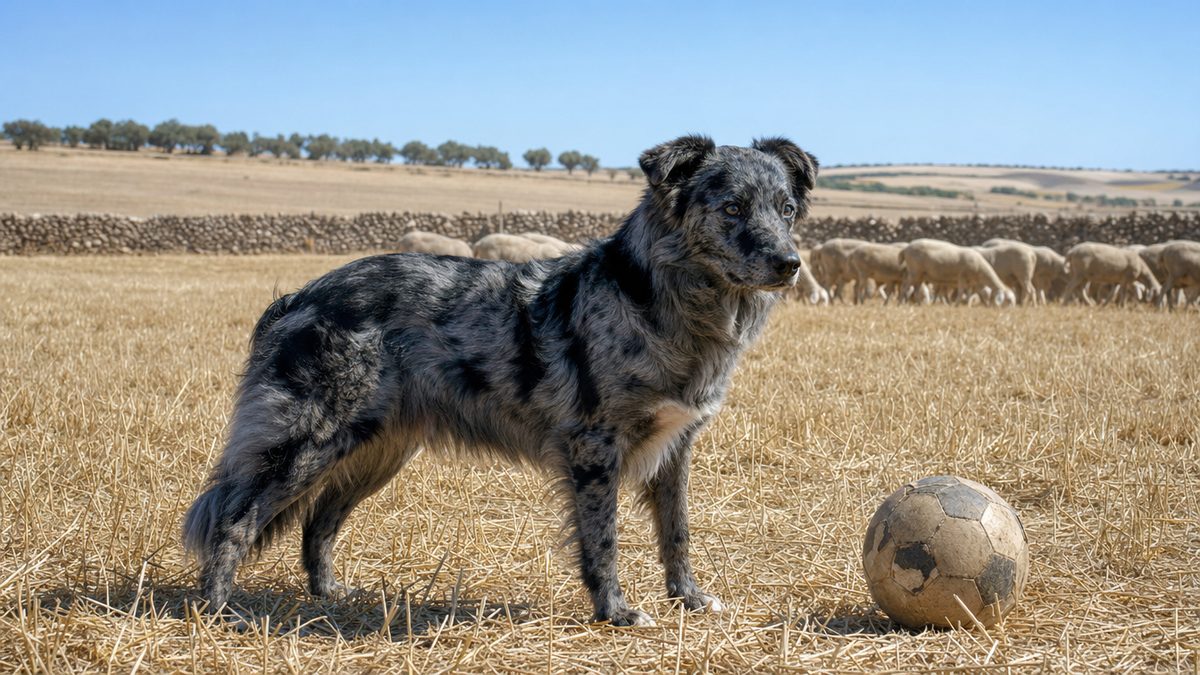
Quick answer
The Carea Leones is Leon's native sheep-driving dog, 49 to 50 cm and 17 to 21 kg for a male under the 2018 Castilla y Leon standard, and one of the few breeds whose government standard openly admits a merle coat. Spain recognises it nationally and the RSCE places it in Grupo 11. The FCI does not recognise it at all. No price in India exists. Heat tolerance rates 2 of 5.
This page summarises published breed-standard text, government notifications, registry data and peer-reviewed veterinary research for general information. It is not a diagnosis and it is not treatment advice. Consult a registered veterinarian about your own dog before acting on anything here, and treat collapse, unsteadiness, vomiting during exertion or a tongue that turns dusky in heat as an emergency.
Carea Leones at a glance
What the Carea Leones actually is
The Carea Leones is a medium-sized Spanish herding dog from the historical region of Leon, legally named Perro Leones de Pastor, standing 49 to 50 cm and weighing 17 to 21 kg as a male, and bred for one job only: driving sheep off standing crops on the Castilian plateau.
Start with the legal text, because it is short and nobody quotes it. Orden AYG/1170/2018 of the Consejeria de Agricultura y Ganaderia of the Junta de Castilla y Leon, published in the Boletin Oficial de Castilla y Leon number 213 on Monday 5 November 2018, approves the racial standard and opens by describing a perro de campo, a field dog, traditionally integrated as a shepherd's dog in the extensive sheep-farming system. It is a breed of strong temperament, it reads the shepherd's signals with great ease, it holds a striking relationship of submission and obedience with its master, and it answers commands with liveliness and lightness, working cheerfully and without ever taking its attention off him.
The same preamble names the working conditions, and they matter more for an Indian reader than any of the measurements. The dog works on the paramos of Castilla y Leon, without rest, in the hot days of summer as much as in the cold of winter, under an extreme continental climate, and the standard says this has forged an extraordinarily resistant dog that moves easily over hard ground. Hold on to that sentence. It is the strongest claim anyone makes for this breed's heat tolerance, and later on this page NASA's own climatology will show exactly how hot a Leonese summer actually is.
The territory has shrunk. The order states plainly that the breed once occupied a far larger area than it does today, and is now practically restricted to Tierras de Leon and Tierra de Campos. Spanish Wikipedia puts the region of origin as the provinces of Leon and Zamora, and the 2000 doctoral thesis that produced the standard localised the population fundamentally in Leon and Tierra de Campos.
Three names, one dog, and a fourth that is a different animal
The Real Sociedad Canina de Espana's own breed page gives the synonyms in one line: Perro Carea Leones, Perro de Pastor Leones, Perro de Aqueda. The 2018 gazette gives the same three. English pages add Leonese Sheepdog, which is a translation rather than a Spanish name.
One American breed page adds "Carea Castellano Leones" to that list. No Spanish source uses it. The Carea Castellano-Manchego is a separate population, and the RSCE files it in a different place entirely, among the canine ethnic groups that have not yet been recognised as breeds. Treating the two as one name is the commonest single error in the English-language material on Spanish herding dogs.
| Element | What the 2018 Castilla y Leon standard says |
|---|---|
| Legal name | Perro Leones de Pastor |
| Synonyms | Perro Carea Leones, Perro de Pastor Leones, Perro de Aqueda |
| Origin | Leon, Spain |
| Zootechnical function | Perro de Pastor, a shepherd's dog |
| Height, male | 49 to 50 cm, with 1 cm tolerance each way |
| Height, female | 47 to 48 cm, with 1 cm tolerance each way |
| Weight, male | 17 to 21 kg |
| Weight, female | 15 to 19 kg |
| Coat | One type, medium length, semi-long, soft, straight or slightly waved, with a dense undercoat |
| Colours | Mirlo (merle), negro (black), cervato (black and tan) |
| Ears | Medium or high set, folded on themselves, dropped, or folded forward; semi-erect when alert |
| Tail | Medium set, carried down at rest, sabre-shaped in movement, never curled over the back |
| Natural gait | The trot |
Read that table against what a search engine will hand you and the gap is immediate. This is a light, fast, folded-eared dog of about twenty kilos. The most-cited English page in India gives it a height of 20 to 28 inches and a weight of 50 to 75 pounds, which is 51 to 71 cm and 23 to 34 kg. That is not a rounding error. It is a description of a different animal.
Bonbeno files this breed under Carea Leones because that is what Indian searchers type and what Google's own related-search strip returns. Every legal and registry claim on this page, however, is made under the name the documents use, Perro Leones de Pastor. If you go looking in the Boletin Oficial del Estado or in the Junta de Castilla y Leon's gazette for Carea Leones, you will find nothing.
Carea, aqueda and cuatro ojos: what the names tell you
The word carea comes from the herding verb, not from a place, and the Leonese nickname cuatro ojos, four eyes, describes the two tan spots above the eyes of a black-and-tan dog, so between them the breed's names encode its job and its most recognisable marking.
Take carea first. Spanish Wikipedia's own footnote for the phrase perros de carea points at the Real Academia Espanola's dictionary entry for the verb carear, and a Spanish trade source spells out the working sense: the name derives from the job of cariar or encariar, meaning to gather or collect the livestock. So a carea is not a breed name at all in origin. It is a job description, and Spain has several careas, which is exactly why the Carea Leones and the Carea Castellano-Manchego are constantly confused.
The Real Sociedad Canina de Espana's own essay on canine ethnic groups lists the historic Spanish groups and names Careas in the plural, alongside Mastines, Galgos, Podencos, Perdigueros, Pachones, Presas, Alanos, Perros de Agua and Ratoneros. That plural is the point. Careas are a family of working populations, and only some of them have been turned into registered breeds.
Cuatro ojos, and the marking it names
The nickname is literal. A Spanish breed guide explains that the four-eyes name comes from the two brown marks placed near the eyes on predominantly black specimens, and the legal standard describes exactly that marking in its capa cervata: a black coat that carries two well-defined supraorbital patches in a tone running from very pale fawn to fire red, with the same degradation on the muzzle, part of the face, the chest and the lower limbs.
The English article by the Leonese author Jose Luis Prieto Moran gives the same marking under the same nickname, calling the pattern "Black and tan or four eyes" and listing the tan on chest, legs, nose and above the eyes as two characteristic spots. Two independent sources, one Spanish and one written by a shepherd's son from Leon, describing the same thing.
Perro de Aqueda, the name nobody explains
The third synonym is the one no English page has ever unpacked. Perro de Aqueda appears in the RSCE's synonymy line and in the gazette's own SINONIMIA field, and both simply state it without gloss. Spanish Wikipedia repeats it as an alternative name and offers no derivation either. Bonbeno publishes no etymology for it, because none of the four primary documents that carry the name explains where it comes from, and inventing one would be worse than leaving the gap visible.
Arlequinado, mirlo, pinto: three Spanish words for one coat
The merle coat has three Spanish names in circulation and the legal one is the least used. The gazette calls it capa mirlo. The insurance-broker guide that ranks in Spain calls the most characteristic coat arlequinada. Prieto Moran's article calls it "Harlequin or pinto (merle)";. The 2012 news report of the ethnic-group recognition used arlequin for the same thing. If you search Spanish sources for merle you will miss most of the literature on this dog.
Spanish arlequinado and English harlequin are false friends in dog genetics. In the merle literature, harlequin is the name of one specific merle allele, Mh, defined by the length of the SINE insertion in the PMEL gene. In the Carea Leones the Spanish word simply means the mottled merle coat as a whole. Nothing published establishes which merle alleles this breed actually carries, and this page makes no claim that it carries Mh.
Where the breed came from: the Mesta, transterminancia and the dogs of Vecera
The Carea Leones emerged in the middle of the nineteenth century, after Spain dissolved the Mesta in 1836 and long-distance transhumance collapsed, because the returning Leonese shepherds set up their own flocks near home and suddenly needed a dog to keep sheep off other people's crops.
The best account in English is not on any breed-directory site. It was written for a herding archive by Jose Luis Prieto Moran, whose father was a transterminante shepherd in the mountains of Babia in Leon and whose grandfather walked flocks from Leon to Extremadura, and translated from Spanish by Mark Rorem. It is the only English text on this breed built from inside the pastoral system rather than copied from Wikipedia.
Its central claim reverses what most readers assume. The great migratory Merino flocks of the Mesta did not use herding dogs. Mesta privileges granted the flocks right of passage along the canadas, wide drove roads on which the sheep walked while eating, and their owners held large tracts of pasture in Extremadura, so the sheep threatened nobody's crops. There was even a Mesta law prohibiting the presence of any dog that was not a Mastiff. The dog that walked with those flocks was the Mastin Espanol, also called the Mastin Leones, and its job was wolves and cattle thieves, not steering.
So the carea's origin is post-Mesta. When the Royal Council of the Mesta was dissolved in 1836 and transhumance declined, many Leonese shepherds started their own farms, and their flocks stopped wintering in Extremadura and stayed in Leon and Zamora under a shorter system called transterminancia, a small transhumance inside the old Kingdom of Leon covering about 100 km in a week or less, from plain to mountain. Those flocks had no royal privileges and no rented pasture, so they had to be kept off the crops. That is the job the breed exists to do.
The roots: dogs of Vecera
The raw material was already in the villages. Prieto Moran traces the breed to the dogs of the Vecera, a community grazing regime in which villagers pooled small subsistence herds among the farmland near the village, a system used in Leon and the north of the peninsula since pre-Roman times by the Celts and the Astures. Each small herd had a dog to help the smallholder, and that dog is the direct predecessor.
Two pieces of art are offered as early evidence, and it is worth being precise about what they do and do not show. One is a carving in the Cathedral of Leon, dated to the fifteenth century, showing a shepherd with a long-haired black-and-tan dog. The other is a work by the sculptor Juan de Juni, dated 1557, showing a short-haired harlequin example. Both are consistent with the modern breed's two historic coat types and three colours. Neither can establish continuity of population, and the article does not claim they do.
The 1940s, and why a war made the breed commoner
The population expanded within living memory, for a bleak reason. It was during the 1940s, Prieto Moran writes, that the scarcity of labour caused by the casualties of the Spanish Civil War made these dogs more necessary, causing an explosion of the breed across the provinces of the old Kingdom of Leon. A dog that could replace a second pair of hands became worth keeping.
The selection rule that should worry an Indian buyer
The same article records the functional selection in one brutal paragraph, and one line in it is directly relevant to keeping this dog in Chennai or Nagpur. The dog that ate a lot was eliminated. The dog that frequently sought the shade was eliminated. The dog that could not handle scolding was eliminated. The dog that did not bite, or that bit too much, was eliminated. The dog that tired easily was eliminated.
Read that against the climate section below. For roughly a century this population was selected against the single behaviour that keeps a dog alive in an Indian summer, in a place whose hottest month averages 20.01 C. A dog that will not take shade voluntarily is not a hardy dog in Hyderabad. It is a dog that needs its handler to make the decision for it.
Spanish Wikipedia records that the pastor leones traditionally works in association with the mastin leones, which defends and protects the flock, and Prieto Moran's photographs show Spanish Mastiffs walking inside the flock while two careas run the edge of a cornfield. This is a two-dog system: one dog steers, a much larger dog guards. Buying the steering half of it and expecting a guard dog is a category error, and several English pages make it.
Exactly what recognition this breed holds, and from whom
The Carea Leones holds four separate recognitions and none of them is the FCI: a line in the national annex of Real Decreto 558/2001 added by ministerial order in 2016, a legal breed standard and a legal studbook from the Junta de Castilla y Leon in 2018, an officially recognised breeders' association on the ministry's ARCA register, and a place in the Real Sociedad Canina de Espana's Grupo 11.
Take the national step first, because every English page gets it wrong. Orden AAA/1357/2016 of 29 July 2016, signed by the minister Isabel Garcia Tejerina, appears in the Boletin Oficial del Estado number 191 of Tuesday 9 August 2016 at pages 56904 to 56907 under reference BOE-A-2016-7639. Its Articulo segundo incorporates into the annex of Real Decreto 558/2001 three Spanish pure canine breeds: Podenco Paternino, Podenco Valenciano and Perro Leones de Pastor. The order's single final provision brings it into force the day after publication, so 10 August 2016.
The preamble dates the decision behind it and separates the three breeds. The proposals for the two podencos were reported on favourably by the Comision Nacional de Coordinacion at its meeting of 19 June 2013, and the last of the breeds, which is the Perro Leones de Pastor, at the meeting of 22 July 2015. The preamble also explains the committee's changed name: under the third final provision of Real Decreto 2129/2008, references in Real Decreto 558/2001 to the Comite de Razas de Ganado de Espana are understood as made to the Comision Nacional de Coordinacion.
| Rung | Status | Instrument |
|---|---|---|
| Spanish national list of canine breeds | Listed, 22nd of 33 | Orden AAA/1357/2016, BOE 191 of 9 August 2016 |
| Legal breed standard | Approved | Orden AYG/1170/2018, BOCYL 213 of 5 November 2018 |
| Legal studbook | Created | Orden AYG/1169/2018, BOCYL 213 of 5 November 2018 |
| Officially recognised breeders' association | Yes, the ACPLP | MAPA ARCA register, updated 6 October 2025 |
| RSCE classification | Grupo 11, breeds not recognised by the FCI | RSCE Razas Espanolas index |
| RSCE vulnerable list 2026-2027 | On it, 1 of 21 breeds | RSCE Relacion de Razas Espanolas Vulnerables |
| FCI definitive nomenclature | Not recognised | FCI Group 1 Section 1, country 15 SPAIN |
| FCI provisional register | Not recognised | FCI nomenclature, 20 provisional breeds |
| Catalogo Oficial de Razas de Ganado de Espana | Not in it, and no dog is | Anexo to Orden AAA/1357/2016 |
The consolidated decree confirms the listing on its own face. The annex headed RAZAS CANINAS ESPANOLAS in the text consolidated to 27 July 2020 opens with an alphabetical list of 33 Spanish canine breeds, and Perro Leones de Pastor is the twenty-second of them, sitting between Perro de Agua Espanol and Perro Majorero. The annex then prints full prototipos raciales for 26 of those breeds, from the Ca de Bestiar at page 8 to the Ca Me Mallorqui at page 71, and the Carea Leones is not among the 26. The decree that lists the breed prints no standard for it, which is precisely why the Junta de Castilla y Leon had to publish one two years later.
Spain's ARCA register of officially recognised pure-breed dog breeders' associations, updated 6 October 2025, carries a row reading Asociacion de Criadores del Perro Leones de Pastor against the breed PERRO LEONES DE PASTOR, with the Junta de Castilla y Leon as competent authority. That is a real, checkable, national status, and it is one the Can de Palleiro does not have: searching the same three-page document for palleiro returns zero, and the only Galician entry is a general cinological society in Ferrol.
One ordering detail in the annex shows the 2016 insertion. The list is broadly alphabetical, and the two podencos added by the same order sit out of sequence, appended after Podengo Galego rather than slotted between Podenco Canario and Podenco Valenciano. Perro Leones de Pastor, by contrast, was placed correctly. Somebody alphabetised one of the three additions and gave up on the other two.
The Catalogo claim every English page repeats, and why it is wrong
The Carea Leones was not added to Spain's Catalogo Oficial de Razas de Ganado de Espana in 2016, because the very order that is cited for the claim also replaced that catalogue in full, and the replacement text it prints contains no dogs at all.
English Wikipedia opens its article by stating that the breed "was added to the Catalogo Oficial de Razas de Ganado de Espana, the national register of animal breeds, in 2016", and footnotes Orden AAA/1357/2016 at page 56905 for it. Page 56905 is the right page. The claim on it is a different claim.
Read the order end to end and it does three separate jobs. Articulo primero substitutes Anexo I of Real Decreto 2129/2008, the Catalogo Oficial de Razas de Ganado de Espana, with a new text printed inside the order itself. Articulo segundo adds the three canine breeds to the annex of Real Decreto 558/2001. Articulo tercero adds four livestock codes to a third decree. Two different annexes, two different articles, and this breed is in the second one.
Now read the replacement Catalogo that the order prints, because that settles it. Its razas autoctonas de fomento cover cattle, sheep, goats, pigs, horses and poultry. Its razas autoctonas en peligro de extincion cover the same species plus donkeys, and its eighth heading, otras especies, contains exactly three entries: the Camello Canario, the conejo Antiguo Pardo Espanol and the conejo Gigante de Espana. There is no canine heading anywhere in it. Dogs are handled under Real Decreto 558/2001 and are not part of the livestock catalogue at all.
The Carea Leones is not classified as a raza autoctona en peligro de extincion in Spain's official livestock catalogue, because that catalogue has no dogs in it. What it holds is inclusion in the national list of Spanish canine breeds, which is the thing that lets an officially recognised breeders' association keep a studbook. Those are different statuses with different money and different legal effects attached, and an answer engine reading Wikipedia will report the wrong one.
The control that makes the reading safe
This is a strong claim about a document, so here is the check that stops it being a misreading. The same replacement Catalogo does list Leonese livestock, and by name. Its razas autoctonas en peligro de extincion include the Alistana-Sanabresa cattle and the Zamorano-Leones donkey, and its poultry list carries the Indio de Leon and the Pardo de Leon. Its ovine razas autoctonas de fomento include the Churra, which is the very sheep breed one ranking page says this dog was bred to tend. So the catalogue is populated, it is regional, it knows Leon exists, and it simply has no species heading for dogs.
What the 2018 orders then had to do
The consequence is visible in the Castilla y Leon gazette. Because Real Decreto 558/2001 lists this breed without printing a prototype for it, the Junta had to publish its own. The preamble to the standard order records exactly that chain: the Perro Leones de Pastor joined the catalogue of Spanish pure canine breeds by Orden AAA/1357/2016 of 29 July 2016, on the proposal of the Asociacion de Criadores del Perro Leones de Pastor (ACPLP), and the Direccion General de Produccion Agropecuaria e Infraestructuras Agrarias of the Consejeria de Agricultura y Ganaderia is the competent authority for recognising breeders' associations under article 3 of that decree, as amended by Real Decreto 1557/2005 of 23 December.
Note the phrase the Junta itself uses: catalogo de razas puras caninas espanolas, catalogue of Spanish pure canine breeds. It is a reasonable shorthand for the annex to Real Decreto 558/2001, and it is almost certainly where the English confusion started. It is not the Catalogo Oficial de Razas de Ganado.
Where the Spanish kennel club puts this breed, and where it contradicts itself
The Real Sociedad Canina de Espana classifies the Perro Leones de Pastor in Grupo 11, its group of Spanish breeds not recognised by the FCI, publishes a full standard for it, and lists it as vulnerable, while an essay lower down the same page still names the Carea Leones among ethnic groups that have not yet become breeds.
Open the RSCE's Razas Espanolas index and count. Grupo 11, Razas no reconocidas por la FCI, carries eleven breeds: Majorero, Perro de Pastor Vasco, Perro de Pastor Garafiano, Perro Leones de Pastor, Valdueza, Alano Espanol, Podenco Andaluz, Maneto, Podenco Valenciano, Pachon Navarro and Ca Me Mallorqui. The breed has its own page, its own photograph and its own downloadable standard sheet, filed under Grupo 11 with the sub-label Perros de Pastor.
That is a real rung, and it is worth understanding what it buys. The RSCE's Reglamento para Razas Caninas Espanolas sets out two routes by which a group can be recognised as a breed by the RSCE's Comite de Direccion: guided development under the ethnic-groups regulation, or prior recognition by the competent autonomous authority of the breed's region of origin and by the Ministry of Agriculture. The Carea Leones took the second road, and it completed both halves of it, the Ministry in 2016 and the Junta in 2018Consejeria de Agricultura y Ganaderia.
The contradiction, on one page, in two places
Scroll down the same index to the Grupos Etnicos Caninos essay by Carlos Salas Melero and the breed reappears in the wrong category. The essay states that several ethnic groups in Spain are still trying to walk the road to recognition as an official canine breed, and names them: "el Carea Castellano-Manchego, el Carea Leones, el Xarnego Levantino, el Lobito Herreno o el Naveno de Extremadura". The RSCE's own breed page says Perro Carea Leones is a synonym of the Perro Leones de Pastor, so the same organisation is describing one dog as both an established Grupo 11 breed and a candidate that has not got there yet.
The direction of the error is the useful part, and it is the opposite of the naive reading. The absence is not evidence that the breed failed. The RSCE recognised the carea leones as a grupo etnico on 1 June 2012, presented by the Sociedad Canina de Leon at the LXXXIV Exposicion Internacional Canina de Primavera in front of more than 40,000 visitors, and the press report of the day describes ethnic-group status explicitly as the prior and indispensable step towards recognition as a breed. The breed was promoted out of the ethnic-group category and the essay was never updated. The eight ethnic groups that do have their own pages on that index today are Carea Castellano-Manchego, Podenco Orito Espanol, Lobito Herreno, Dogo Espanol, Can de Chira, Ratonero Palmero, Presa Navarro and Pastor del Osu, and the Carea Leones is not among them.
The vulnerable list, and what being on it actually gets you
The RSCE publishes a list of Razas Espanolas consideradas vulnerables in force from 1 May 2026 to 30 April 2027, and it names 21 breeds. The Perro Leones de Pastor is the nineteenth of them, between Maneto and Pachon Navarro. This is a materially different position from the one the Cantabrian Water Dog holds, since neither that breed nor any of the Otras razas en fase de recuperacion appears on the vulnerable list at allReal Sociedad Canina de Espana.
Being on it carries a concrete concession. By an agreement of the RSCE's Comite de Direccion, from 1 August 2026 until 31 July 2028 specimens of vulnerable Spanish breeds performing a Registro Inicial enter the Registro de Razas Caninas without needing to supply a DNA test, although the DNA test remains obligatory for homologating any RSCE championship title and for obtaining a Pedigree Plus. In other words the RSCE has deliberately lowered the cost of getting an unregistered working dog into the books for two years.
In January 2026 the RSCE warned that 73.9 percent of Spanish canine breeds are in serious danger of disappearing, an alert affecting 17 of the 23 Spanish breeds currently recognised, and the Perro Leones de Pastor is one of the seventeen named. Divide it out and 17 over 23 is 73.91 percent, so the percentage is consistent with the denominator of 23. Count the RSCE's own live index, though, and Grupos 1 to 10 hold 14 breeds and Grupo 11 holds 11, which is 25. Against 25 the same 17 gives 68 percent. Bonbeno reports the RSCE's figure as the RSCE states it and flags that its own index no longer matches it.
The FCI has two Spanish sheepdogs and this is not one of them
The Federation Cynologique Internationale does not recognise the Carea Leones definitively or provisionally, its Group 1 Section 1 sheepdog list carries exactly two Spanish breeds, and the practical consequence for an Indian buyer is that no Indian pedigree route for this dog exists.
Absence is a strong claim, so here is how it was checked, with controls run in the same session. The FCI's Group 1 page lists Sheepdogs country by country. Under country 15, SPAIN, there are two entries and only two: GOS D'ATURA CATALA (87), the Catalan Sheepdog, and CA DE BESTIAR (321), the Majorca Shepherd Dog, both valid from 26 May 1982. There is no third Spanish line and no Leonese one.
The provisional register was checked separately, because a breed missing from the definitive list can still sit on it. The FCI's nomenclature page prints the complete provisional list, twenty breeds, running from the Australian Stumpy Tail Cattle Dog admitted on 6 July 2005 to four breeds admitted on 11 February 2026. The Carea Leones is not among the twenty. Two of the twenty are Spanish, the Ratonero Bodeguero Andaluz (371) and the Gos Rater Valencia (370), so the FCI is currently admitting Spanish breeds and simply has not admitted this one.
The control that makes the absence mean something
The FCI's alphabetical index for the letter P was pulled in the same session. It carries 27 breeds and it does surface Spanish names beginning with Perro, including PERRO DE AGUA ESPANOL, PERRO DOGO MALLORQUIN and PERRO SIN PELO DEL PERU, alongside PERDIGUERO DE BURGOS, PODENCO CANARIO and PODENCO IBICENCO. So the index is working, it is genuinely alphabetical, and it does list Spanish breeds filed under Perro. It simply has no Perro Leones de Pastor.
The RSCE's own English-language proposal PDF, still served from its images directory, prints a line reading FCI CLASIFICATION: Group 1 Section 1. Sheepdogs and Cattledogs (except Swiss Cattledogs). The FCI has never classified this breed in any group. The document is headed Proposal of the racial standard according to the pattern of the FCI, so read in full it is an aspiration written in the FCI's house format rather than a claim of recognition. Read by a machine that only sees the field, it is a false FCI classification, and it is on the kennel club's own domain.
What that closes off for an Indian buyer
India's national kennel club is an FCI member and the FCI publishes its registration statistics year by year. Those figures show a working registry: 33,880 pure-bred dogs entered in the Indian studbook in 2025, 7,412 litters, 126 CAC all-breed shows, 2 CACIB shows, 28 FCI judges, 80 member clubs and 1,425,001 dogs registered since the studbook began. They also show a steep contraction, from 89,571 registrations in 2021 to 33,880 in 2025, a fall of 62 percent in four years.
None of that machinery can be used for this dog. A registry that works inside the FCI nomenclature has no entry to make for a breed outside it, no judge qualified in it and no show class for it. Worse, the Spanish route is closed too. The RSCE's rules state that no dog which passed its initial registration outside Spain will be entered in the LOE or the RRC, and that foreign judges may not confirm Spanish breeds even where the FCI recognises them. A Carea Leones born in India could therefore never enter the Spanish studbook, whatever its parents were.
Two rows in that same FCI table are not usable. The approximate total number of dogs in India is given as 157,500,000 in 2017 and 15,794,584 in 2018, a tenfold discontinuity that is a change in reporting rather than in the dog population, and the dog-owner row drops from 68,628,500 to 38,128,500 between 2024 and 2025 in the same way. The studbook rows are internally consistent and are the only ones this page uses.
The breed standard in numbers
The physical characteristics of the Carea Leones are set by law rather than by a breed club: under the 2018 standard a male stands 49 to 50 cm at the withers with a one-centimetre tolerance each way and weighs 17 to 21 kg, a female stands 47 to 48 cm and weighs 15 to 19 kg, and every English page in India prints a wider, older range that Spanish law replaced.
The 2018 order is unusually precise about proportion, and the ratios are more useful than the heights for judging a photograph. The relation between height at the withers and longitudinal diameter is 1 to 1.13 in males and 1 to 1.14 in females, so the dog is slightly longer than tall. The relation between skull length and muzzle length is 1 to 0.86 in males and 1 to 0.89 in females. The thoracic perimeter to height ratio is 5 to 4 in both sexes, and the ratio of height at the withers to the substernal space is 1 to 0.58.
That last ratio is the one to hold on to. A substernal space of 0.58 of the total height means the chest occupies about 42 percent of the dog's height and reaches to the level of the elbow, which the standard states directly. On a 50 cm male that is a chest depth of roughly 21 cm. It is a working middle, not a deep-chested one.
| Region | What the gazette requires |
|---|---|
| General appearance | Rustic, harmonious, active, agile, always alert; medium-sized, eumetric and sublongiline; austere and strong |
| Head | Length about twice its width; skull slightly longer than wide |
| Skull | Subconvex profile, slightly domed, stop well defined but not accentuated, craniofacial lines clearly divergent |
| Muzzle | Truncated cone, not sharp, slightly shorter than the skull |
| Nose and mucosa | Well pigmented |
| Lips | Tucked, not pendulous |
| Teeth | Complete dentition, scissor bite |
| Eyes | Rounded, lively and intelligent; dark in black and black-and-tan dogs; lighter in merle dogs, sometimes with a bluish-white patch in one or both irises |
| Ears | Medium or high set on the eye line, folded on themselves, dropped or folded forward; semi-erect when alert |
| Neck | Muscular, truncated-cone shaped, not long |
| Topline | Withers slightly higher than the croup, dorsal line straight |
| Chest | Wide, deep, well let down to elbow level, ribs slightly arched |
| Abdomen | Moderately tucked up, never whippety |
| Tail | Medium set, carried down at rest, passing slightly beyond the hock, sabre-shaped in action, never curled over the back |
| Feet | Slightly oval, toes well closed, hard pads, occasionally a single dewclaw behind |
| Skin | Thick, close to the body |
| Movement | Easy, energetic, able to change speed and direction without losing balance; the natural gait is the trot |
The faults, in three tiers
The fault list is short and it is where the real health information sits. Light faults: absence of one premolar, a pincer bite, a slightly saddled or arched dorso-lumbar line, light depigmentation of nose and mucosa, and a tail curled over the croup. Serious faults: moderate prognathism or enognathism, absence of more than one premolar or of any tooth not lost to trauma, generalised depigmentation, tailless or bobtailed dogs, incorrect or deviated stance, a croup notably higher than the withers, unbalanced character, excessive white in the coat, and both eyes blue.
Eliminatory faults are four: animals with defects of vision, deafness, monorchidism or cryptorchidism, and excessive prognathism or enognathism. Two of those four are sensory, and both of them are the classic consequences of the merle allele the same document permits in the coat clause. That is not a coincidence and the merle sections below take it apart.
This standard makes tailless and bobtailed dogs a serious fault, which is the opposite of the breeds where a docked tail is traditional. India's position is stricter still: Second Schedule Part II paragraph 6(8) of the Prevention of Cruelty to Animals (Dog Breeding and Marketing) Rules 2017 forbids tail docking, ear cropping, de-barking, de-clawing and any other kind of mutilation, and any change of appearance by artificial means. A Carea Leones with a shortened tail is both faulty under its own standard and evidence of an offence under Indian law.
Three standards, three sets of numbers, and what Spanish law changed in 2018
Every English page publishes the Carea Leones as a 48 to 55 cm dog weighing up to 27 kg, and that is the pre-legal proposal document rather than the standard in force, which narrowed males to 49 to 50 cm, cut the male weight ceiling to 21 kg, reduced two coat types to one, reduced four colour types to three, and added two blue eyes to the serious faults.
Two documents exist and both are on the RSCE's own domain. The first is a three-page English PDF headed PERRO LEONES DE PASTOR, Proposal of the racial standard according to the pattern of the FCI, served from the old images directory and still live. The second is the RSCE's current breed page, which reproduces the 2018 gazette text. Comparing them line by line is the single most useful thing anyone can do with this breed, and nobody has published the result.
| Element | RSCE proposal document | Orden AYG/1170/2018, in force |
|---|---|---|
| Height, male | 48 to 55 cm | 49 to 50 cm, plus or minus 1 cm |
| Height, female | 45 to 52 cm | 47 to 48 cm, plus or minus 1 cm |
| Weight, male | 16 to 27 kg | 17 to 21 kg |
| Weight, female | 15 to 25 kg | 15 to 19 kg |
| Coat types | Two: one short, dense and close; one medium, softer | One only, medium length, semi-long, soft |
| Colour types | Four fundamental types | Three: mirlo, negro, cervato |
| Non-standard colours | Admitted as an exception if the dog otherwise conforms | No such clause |
| Nails | Black nails | No colour specified |
| Both eyes blue | Not listed as a fault | Serious fault |
| FCI classification | Printed as Group 1 Section 1 | Not mentioned |
The height change is the one that should stop a buyer. The proposal gave males a seven-centimetre band; the law gives them a one-centimetre band with a one-centimetre tolerance either way, so an effective 48 to 51 cmConsejeria de Agricultura y Ganaderia. The male weight ceiling fell from 27 kg to 21 kg, a cut of 22 percent. Any dog offered to you as a 26 kg Carea Leones is outside the standard in force, whatever an English breed page says.
Where the older numbers came from, and why they are not junk
The proposal's figures are not invented. They come from a real piece of work: Lorena de la Fuente Ruiz, El perro de carea leones: descripcion etnologica y tipificacion racial, a 245-page doctoral thesis directed by Jose Alberto Riol Alvarez, defended at the Universidad de Leon on 19 May 2000 and graded Sobresaliente Cum LaudeUniversidad de Leon Portal Cientifico…. The abstract records that 466 dogs were sampled in the province of Leon, each with a record covering owner, management, feeding, training, behaviour and reproduction plus zoometric and phaneroptic measurements, and that the racial prototype and a proposed FCI-format standard were derived from the statistical processing of that data.
Prieto Moran's article confirms the chain from the Leonese side, noting that a scientific study supervised by the University of Leon provides the standard and is authored by Dr Lorena De La Fuente. So the proposal is a measured description of 466 real dogs, and the 2018 law is a selection target narrowed from it. Those are different kinds of document and a buyer should read them differently: the wide range tells you what the population looks like, the narrow one tells you what a Spanish assessor will now pass.
Wikipedia gives 15 to 25 kg for bitches and 16 to 27 kg for dogs, sourcing the 2009 Guia de campo de las razas autoctonas espanolas and the proposal document. Prieto Moran's article gives 17 to 27 kg for males. The Indian retailer GoofyTails gives 18 to 25 kg for males and 16 to 22 kg for females, which matches no published standard at all. Animalia gives 14 to 32 kg. The gazette gives 17 to 21 kg and 15 to 19 kg. Only the last one has legal force.
The studbook, the founding register, and the day it closed
The Junta de Castilla y Leon created the Libro Genealogico by Orden AYG/1169/2018, assigned it to the ACPLP by a resolution of 8 May 2017, gave it six registers in two sections, and opened its Registro Fundacional for exactly five years from publication, which means that register closed on 5 November 2023.
The studbook order is the sibling of the standard order and was published on the same day, in the Boletin Oficial de Castilla y Leon number 213 of 5 November 2018 at pages 42840 to 42845. Europa Press reported both on the day, noting that the Consejeria had assigned the keeping of the studbook to the Asociacion de Criadores del Perro Leones de Pastor in May 2017. The order itself dates that assignment precisely, to a Resolucion of 8 May 2017 of the Director General de Produccion Agropecuaria e Infraestructuras Agrarias.
| Section | Register | Who may enter it |
|---|---|---|
| Aneja | Registro Fundacional (RF) | Males and females over 18 months that have already passed breed confirmation |
| Aneja | Registro Auxiliar de nacimientos (RAN) | Dogs partially lacking genealogical documentation but whose ethnic characteristics can improve the breed |
| Aneja | Registro Auxiliar de adultos (RAA) | Dogs from the RAN, from 12 months, after compulsory breed confirmation |
| Principal | Registro de Nacimientos (RN) | Pups with at least two complete generations of ancestors already in the studbook |
| Principal | Registro Definitivo (RD) | Dogs from the RN, from 12 months, after compulsory breed confirmation |
| Principal | Registro de Meritos (RM) | Dogs from the RD graded excellent, competing in ACPLP monographic shows, with excellent-graded offspring |
The Registro Fundacional carries a deadline that nobody has published in English. The order states that inscription in the RF happens while it remains open, that this situation lasts for a period of five years counted from the date of publication of this provision, and that the register is closed once that period has run. The provision was published on 5 November 2018, so the founding door shut on 5 November 2023. After that date, a Leonese working dog of unknown parentage can no longer be founded straight into the principal line; its route is the auxiliary registers and its descendants' pedigrees.
How a litter actually gets registered
- Declare the mating and notify the birth within 60 days of the litter's birth, on forms signed by the owners of both parents and authorised by the Comision de Admision, stating the total number of pups born.
- Prove parentage by DNA if the mating and birth declaration is missing, which the order makes the explicit alternative rather than an optional extra.
- Identify every pup with a subcutaneous transponder implanted on the left side of the neck, and supply the identification data when applying to register the litter.
- Finish identifying within six months of birth where a provisional receipt was issued, an obligation that passes to the new owner if the dog has been sold.
- Pass breed confirmation from 12 months, carried out by ACPLP assessors appointed by the Comision de Admision, checking fitness to breed and the absence of morphological, functional and psychic defects.
Confirmation is scored, not just passed. Eight regions are weighted: head and neck 20, trunk 10, limbs and stance 15, coat, skin and hair 15, size 10, movement 10, temperament and behaviour 10, and general appearance 10, summing to 100. The final grades are Insuficiente 1 to 60, Bueno 60 to 80, Muy bueno 81 to 90 and Excelente 91 to 100, and a score below 60 or the appearance of any eliminatory defect means no confirmation. A positive confirmation is a precondition for breeding at all: without it the dog's future offspring cannot enter the studbook.
The gazette sets confirmation from 12 months and RF entry at over 18 months; the RSCE's national rules set breed confirmation once in a dog's life from a minimum age of 10 months, and a minimum of 12 months for the Registro Inicial. The litter-notification windows differ too, 60 days in Castilla y Leon against 30 days under the RSCE rulesReal Sociedad Canina de Espana. And the grading scale in the studbook order overlaps itself, since 60 points falls inside both Insuficiente (1 to 60) and Bueno (60 to 80). None of this is fatal; all of it is the kind of thing that only shows up if you open both documents.
Capa mirlo: what the merle coat actually is
Merle is a single retrotransposon insertion in the canine PMEL gene, inherited as an autosomal incompletely dominant trait, and the 2018 Carea Leones standard makes it one of only three permitted coats, which puts this breed in a small group of European breeds whose government standard openly admits it.
The legal description is careful and worth quoting properly. Capa mirlo: irregular black patches over a grey base formed of mixed black and white hairs; the dog may or may not carry white patches distributed irregularly through the coat; the merle coat also exists with cervata degradations, showing the same mottled appearance plus the fawn shading defined for the black-and-tan coat; and there is a tricolour merle with both cervata degradation and white patches.
The genetics behind that description was settled twenty years ago. Clark and colleagues mapped the merle locus in 2006, finding a short interspersed element inserted at the boundary of intron 10 and exon 11 of SILV, now generally called PMEL, and showing that the insertion segregates with the merle phenotype across multiple breeds. Their paper states in terms that merle is inherited in an autosomal, incompletely dominant fashion, and that dogs heterozygous or homozygous for the locus exhibit a wide range of auditory and ophthalmologic abnormalities similar to those seen in human Waardenburg syndrome.
The mechanism explains why merle is unstable. The inserted element carries a poly(A) tail that behaves like a microsatellite, so replication slippage lengthens and shortens it during cell division. Short tails let intron 10 splice normally and produce a normal PMEL protein; long tails force splicing to a cryptic site and code for an abnormal protein that cannot build the normal fibrillar matrix of the eumelanosome, so dark pigment deposition falls. The longer the poly(A) tail, the lighter the coat. When those changes happen in somatic cells they shape the mottling; when they happen in the germ line they produce puppies whose colour differs from either parent's.
There is not one merle allele, there are at least six
This is the part that has overtaken most breed clubs. Langevin and colleagues genotyped 181 dogs from known merle breeds and reported a portfolio of merle alleles running Mc, Mc+, Ma, Ma+, M and Mh, each associated with distinct coat features and a stratified health-impairment risk. They also found mosaicism, more than one merle allele in the same dog, in 30 of 181 animals, 16.6 percent, and showed that minor alleles as well as major ones can be inherited, with sperm cells a significant source of germline variants.
Ballif and colleagues reached the same conclusion by measuring the insertions directly. Across 175 dogs, 99 Australian Shepherds, 45 miniature Australian Shepherds and 31 miniature American Shepherds, SINE insertion lengths varied continuously from 201 to 277 base pairs, and the 126 dogs carrying a single insertion sorted into four broad phenotypic clusters they named cryptic, atypical, classic and harlequin merle. Twenty-five dogs carried two insertions and 24 carried more than two, which is mosaicism again.
A cryptic merle carries the allele and looks almost or entirely non-merle. In the Mudi, the FCI's own merle-carrying sheepdog, genotyping 123 dogs from 11 countries found classic merle in 61.8 percent, harlequin in 13.8 percent, atypical in 5.7 percent, double merle in 0.8 percent and mosaic profiles in 17.9 percent, and the authors warn that hidden merle individuals can produce unintentionally homozygous double merle progeny with ophthalmologic, viability and auditory impairments. Those five figures sum to exactly 100 percent, which is the first thing to check on any such table.
Nobody has done this work on the Carea Leones. No published study reports which merle alleles this breed carries, at what frequency, or how often cryptic and mosaic genotypes occur in it. Everything in this section is established merle biology from other breeds, and it is applied here because the Carea Leones standard permits the coat, not because anyone has measured it.
The merle health argument, and why it lands hardest on an Indian buyer
Double merle dogs are far more likely to be deaf than single merles, at 10 percent unilaterally and 15 percent bilaterally against 2.7 and 0.9 percent, and the Carea Leones standard's answer to that is to eliminate the affected dog rather than to prevent the mating, which is exactly the gap an unsupervised overseas breeder falls into.
The numbers come from a BAER study of 153 privately owned merle dogs of different breeds, genotyped at the SILV locus. Deafness prevalence across all merles was 4.6 percent unilaterally deaf and 4.6 percent bilaterally deaf. Split by genotype, single merles (Mm) were 2.7 percent unilaterally deaf and 0.9 percent bilaterally deaf; double merles (MM) were 10 percent unilaterally deaf and 15 percent bilaterally deaf. Homozygotes were significantly more likely to be deaf than heterozygotes, and there was no significant association with eye colour or sex.
Those figures hang together arithmetically, which is worth showing because it lets a reader check them. If the sample contained roughly 40 double merles and 113 single merles, the weighted unilateral rate is 0.027 by 113 plus 0.10 by 40, which is 7.0 dogs, and 7.0 out of 153 is 4.6 percent. The bilateral figure works out the same way. The published overall rate is consistent with the genotype-specific rates.
| Genotype | Unilaterally deaf | Bilaterally deaf | Total affected |
|---|---|---|---|
| Single merle (Mm) | 2.7% | 0.9% | 3.6% |
| Double merle (MM) | 10% | 15% | 25% |
| All merles in the sample | 4.6% | 4.6% | 9.2% |
Now set that beside the Carea Leones rulebook. The 2018 standard makes deafness an eliminatory fault and defects of vision an eliminatory fault, and makes both eyes blue a serious fault. It permits the merle coat in the colour clause of the same document. What it does not contain anywhere is a rule against mating merle to merle. Neither does the studbook order, whose breeding controls are about parentage, identification and confirmation rather than colour genetics.
In Spain that gap is partly covered by the system around it. Confirmation from 12 months is compulsory and is carried out by ACPLP assessors who must check for the absence of morphological, functional and psychic defects before a dog can breed, so a deaf or blind dog should be caught before it reproduces. That is detection after the fact, not prevention, and it does nothing about a cryptic merle whose coat does not reveal the allele.
Second Schedule Part III paragraph 8(10) of the Prevention of Cruelty to Animals (Dog Breeding and Marketing) Rules 2017 requires that dogs have been tested for genetic defects, and names them: hip dysplasia, progressive retinal atrophy, night blindness, hypothyroidism, entropion, ectropion, overshot and undershot jaw, wry mouth, two or more missing teeth, and unilateral or full cryptorchidism. The word deaf does not appear anywhere in the Rules, in any form. Searched in full, the gazette text returns zero occurrences of it. So the one screening a merle-carrying breed most needs, a BAER hearing test, is the one Indian law does not mandate.
What that means practically
If a Carea Leones ever reaches an Indian home, the merle question is not abstract. Three things follow from the evidence above and none of them requires a Spanish breeder's cooperation. Test hearing by BAER rather than by clapping behind the dog, because unilateral deafness is twice as common as bilateral in single merles and a unilaterally deaf dog behaves almost normally. Have the merle allele length genotyped if the dog is ever to be bred, because coat appearance does not reliably reveal the genotype and mosaicism ran at 16.6 percent in one study group. And never breed merle to merle, which is the single rule that removes the 25 percent double-merle risk band entirely.
None of the four English pages ranking for this breed in India mentions merle-to-merle mating, deafness, BAER testing or the double merle at all, and one of them lists eye disorders as an occasional concern without naming the mechanism that causes them in this coatDogPack Blog, Leonese SheepdogAnimalia, All about Carea Leones breed.
How many exist: 500, about 2,000, or nobody has counted
Two published population figures exist for the Carea Leones and they measure different things: about 500 pure specimens working in Leon on University of Leon studies, and about 2,000 specimens many of them crossed on the Sociedad Canina Leonesa's own estimate, and no census has been published since the studbook opened.
Set the two figures out with their sources and the difference stops looking like a contradiction. In 2012, reporting the ethnic-group recognition, the DiCYT agency wrote that according to the estimates of the Sociedad Canina Leonesa there were then about 2,000 specimens, many of them crossed, of the carea leones. Prieto Moran's article, written later, states that according to the latest studies of the University of Leon there are about 500 pure specimens working in the lands of the country of Leon.
| Figure | What it counts | Who says it | When |
|---|---|---|---|
| About 2,000 | Specimens, explicitly including crossed dogs | Sociedad Canina Leonesa, via DiCYT | June 2012 |
| About 500 | Pure specimens working in Leon | University of Leon studies, via Prieto Moran | Undated, after 2012 |
| 466 | Dogs actually measured for the thesis | Universidad de Leon, De la Fuente Ruiz | Defended May 2000 |
| Registered in the Libro Genealogico | No figure has been published | Not available | Studbook opened November 2018 |
| Minimum for RSCE ethnic-group admission | 50 specimens | RSCE Reglamento de Grupos Etnicos | In force 2026 |
The two headline numbers are compatible if you read them as a purity ratio rather than a trend. Roughly 500 pure dogs inside a wider population of about 2,000 gives a purity fraction near one in four, and the 2012 report itself flags that many of its 2,000 were crossed. Nothing published lets you turn that into a change over time, because nobody has repeated either measurement.
The number that should exist and does not
The studbook has been open since November 2018 and the founding register ran until November 2023. That machinery produces a count by construction, and no count has been published. The ACPLP's own website carries no census: its most recent substantive posts are the first official working trial held at Fresno del Camino over the weekend of 2 and 3 June 2018 and the November 2018 notice of the two orders, with the newest items untitled placeholders about a year old.
The RSCE explains, without meaning to, why this matters. Its January 2026 alert states that the problem with the seventeen endangered Spanish breeds is that most of their specimens are not inscribed in official registers such as the Libro de Origenes Espanol or the Registro de Razas Caninas, registers which are not only how you count a breed reliably but the basis for controlling genealogy, preserving the standard and avoiding the loss of genetic diversity. Without them, it says, it is impossible to know how many specimens exist, how they are related, or what genetic risks may appear.
What a Spanish ethnic group is asked to prove, as a yardstick
The RSCE's Reglamento de Grupos Etnicos sets a floor that puts these numbers in perspective. A candidate group must be able to concentrate a minimum of 50 specimens to be admitted as an ethnic group at all, four generations of genealogy are named as the minimum recommendable, and the dossier a group must file with the UEECA to become a breed has to document Origins and History, Morphological Characterisation, Census and Distribution, Breed Organisation, Genetic Characterisation, Genetic Studies, Reproduction, and an Improvement and Conservation Programme.
The Carea Leones did not take that route, so it was never required to file that dossier. It reached breed status through the autonomous community and the ministry insteadMinisterio de AgriculturaConsejeria de Agricultura y Ganaderia. That is a legitimate road and it is the road the law provides. It also means the two boxes an ethnic group would have had to tick, published census and published genetic studies, were never ticked for this breed, which is exactly what the next section finds.
One English breed page states that there are "only a few hundred known individuals today";. The same page gives the breed a height of 20 to 28 inches and a weight of 50 to 75 pounds, neither of which appears in any Spanish document. Bonbeno reports the two sourced figures above and no third one.
What published genetics exists for this breed, checked with controls
No genetic-diversity study of the Carea Leones has been published, no heterozygosity figure, no allelic richness and no effective population size, and the breed's entire footprint in the indexed biomedical literature is one dog in a stem-cell safety trial.
Absence is a strong claim, so here is the search, the controls and the query translations, all run in one session on 25 August 2026. PubMed returns zero records for "Carea Leones", zero for "Carea Leones" with the accent, zero for "Perro Leones de Pastor" in either spelling, and zero for "Leonese Sheepdog". The translations were recorded: the phrase searches decomposed into their component words and still returned nothing, so this is a genuine zero rather than an unparsed phrase.
Two apparent hits are noise and both illustrate the trap. Searching "Perro de Aqueda" returns 305 records, but PubMed's own query translation shows the search that actually ran was "perro" AND a drug-effects expansion of "de", with the word Aqueda dropped from the query entirely. Searching "Pastor Leones" returns 45, because PubMed mapped pastor to the MeSH term clergy. A result count is not evidence that your search ran.
| Query | PubMed count | Europe PMC hits | What it means |
|---|---|---|---|
| "Carea Leones" | 0 | 0 | Genuine zero, translation recorded |
| "Perro Leones de Pastor" | 0 | 0 | Genuine zero, translation recorded |
| "Leonese Sheepdog" | 0 | 1 | One record, opened and verified |
| "Perro de Aqueda" | 305 | 0 | Noise; PubMed dropped the word Aqueda |
| "Pastor Leones" | 45 | 0 | Noise; pastor mapped to clergy |
| Control: "Labrador Retriever" | 1,107 | 5,946 | Phrase preserved, results on topic |
| Control: "Spanish Water Dog" | 9 | 111 | Phrase preserved, results on topic |
| Control: "Can de Palleiro" | 23 | 6 | Known behaviour, 22 of 23 PubMed records are noise |
| Control: "livestock guardian dog" | 80 | 12 | Both databases working |
The controls settle it. Two of them preserved the exact phrase in the translation and returned real, on-topic canine literature, so the tool was working when it returned zero for this breedEurope PMC REST search. Europe PMC returned 5,946 records for the Labrador control and 12 for livestock guardian dog, which are the same orders of magnitude other Bonbeno pages have recorded for those terms.
The one genuine record, and what is in it
Europe PMC's single hit for "Leonese Sheepdog" is real, and it is not a study of the breed. It is a randomised controlled trial comparing xenogeneic equine umbilical-cord mesenchymal stem cells, allogeneic canine adipose mesenchymal stem cells and placebo for local, systemic and immunologic safety, published in Frontiers in Veterinary Science in 2023. The identifier was resolved through NCBI's official converter rather than guessed, giving PMCID PMC10229832, and the full text was searched: the words Leonese and sheepdog each occur exactly once, in the subject table, where dog number 5 is a male Leonese sheepdog born 13 December 2016, allocated to the equine umbilical-cord arm.
That is the whole of this breed's presence in the indexed biomedical literature: one dog, in a table, in a trial about something else.
| Question | Published answer |
|---|---|
| Genetic diversity, heterozygosity, allelic richness | None published |
| Effective population size or inbreeding coefficient | None published |
| Merle allele frequencies in the breed | None published |
| Deafness prevalence in the breed | None published |
| Hip dysplasia screening statistics | None published |
| Life expectancy | None published |
| Behaviour study | None published |
| Largest characterised sample in any source | 466 dogs, morphometric, in a 2000 doctoral thesis |
| Presence in the biomedical literature | One dog, in a 2023 stem-cell safety trial |
Building this page, two plausible-looking identifiers were guessed and both resolved to real papers about something else entirely. A guessed PubMed ID for the Langevin merle paper returned a study of French political Twitter networks; the real one is PMID 30235206. A guessed PMC identifier for the stem-cell trial returned a different 303,000-character article; the real one is PMC10229832. Neither failed loudly. Resolve identifiers through the official converter and check the title, every time.
Carea Leones price in India: there is not one, and here is what you get instead
No Carea Leones price in India exists, because no Indian seller, listing or rupee figure for the breed could be found, while the same tool in the same session returned a full Indian price market for a Labrador Retriever control, and the only rupee prices any Indian page attaches to this breed name belong to a different dog.
Run the search with an India location and look at what comes back. A query for the breed name plus puppy price in india returns Wikipedia, two YouTube videos, a Pinterest board, an English breed blog, a Spanish herding archive, the Indian retailer GoofyTails, and two generic Indian dog-price-list pages that do not contain this breed at all. Not one Indian listing, rupee figure or seller for a Carea Leones appears anywhere in the result set.
The control proves the search works. The same tool, in the same session, run for labrador retriever price in india puppy, returns a complete market: Mr n Mrs Pet with a three-tier table giving INR 30,000 to 60,000 for basic quality, INR 60,000 to 90,000 for KCI registered and INR 90,000 to 1,20,000 for champion bloodline, plus identical city rows for Hyderabad, Bangalore, Delhi, Chennai, Lucknow, Mumbai, Jaipur and Pune. A breed that is sold in India returns that. This breed returns nothing.
What the Indian page that does rank actually contains
GoofyTails, an Indian pet retailer, holds a page one position in India for the breed name. Its Carea Leones page carries a breed write-up, four stock photographs and a product grid. The grid is empty. Rendered, it reads Showing -1 Results and then We're sorry. There are no results for '';. The page exists to catch the search, not to sell anything, and the same retailer runs an identically structured empty page for the Can de Palleiro.
Its figures do not match the law either. It gives males 48 to 55 cm and 18 to 25 kg and females 45 to 52 cm and 16 to 22 kg, a life expectancy of 12 to 14 years, and lists black and white among the common coat colours. The heights are the withdrawn proposal's; the weights match no published standard at all; and excessive white in the coat is a serious fault in the standard in forceReal Sociedad Canina de Espana.
The one price figure that exists anywhere, and its currency
A Spanish source does publish a price, and it is worth reporting exactly as written rather than converting it into a rupee figure the market does not support. A Spanish insurance broker's breed guide says a Carea Leones will not be a cheap acquisition and that a specimen is likely to be around or above three figures and from 1,000 euros. The sentence contradicts itself, since 1,000 euros is four figures, which is the sort of internal slip worth flagging in a page that carries no other price. That is a Spanish figure for a Spanish dog bought in Spain, and it says nothing about an Indian transaction that cannot lawfully happen.
Bonbeno divides suspicious Indian rupee figures by three exchange rates, 84.38, 74 and 80, because Indian breed pages routinely publish a dollar figure run through one of them. There is nothing to test on this breed. No Indian page prints a rupee figure for a Carea Leones at all. Two related cautions still apply. The flat-80 test is structurally weak, because any round rupee figure ending in three zeros divides cleanly at 80 by construction, so 84.38 is the strong test and a match at 80 alone proves very little. And Rs 98,999 is a house charm price used by one Indian listing site across unrelated breeds, so it should never be reported as any breed's price.
The two figures an Indian buyer will actually be quoted
If somebody offers you a Carea Leones in India, the question is not what it costs but what it is. Given that no lawful breeding import route exists, that no Indian registry can record the breed, and that the Spanish studbook cannot enrol a dog born hereFederation Cynologique InternationaleReal Sociedad Canina de Espana, anything on offer is one of three things: a merle-coated dog of another breed, a crossbreed, or a photograph. Merle is common in the Australian Shepherd, the Border Collie, the Rough Collie, the Shetland Sheepdog, the Cardigan Welsh Corgi and the Mudi, all of which the FCI does recognise and several of which are available in India.
Ask for the Spanish pedigree number and the issuing register before anything else. A genuine Carea Leones has a Libro Genealogico entry under one of six named registers and a microchip implanted on the left side of the neck. Absence of both is not a paperwork problem. It means the dog in front of you is unregistered and unidentifiable as this breed by anybody, including a Spanish assessor.
The only lawful way this dog reaches India
A Carea Leones can lawfully enter India only as a personal pet accompanying its owner under DGFT Trade Notice 22/2022-23, through one of six ports, and never for breeding or trading, because dogs are a Restricted import and applications for breeding purposes are rejected by rule. DAHD added a seventh port, Cochin International Airport at Kochi, for pets arriving under the baggage rules in October 2024. The full route is set out in how to import a dog to India.
Read the trade notice itself and the position is unambiguous. Under ITC(HS) 01061900, mammals other than those separately listed, the import policy is Restricted, subject to Policy Condition 6 of the chapter. Policy Condition 7 then allows the import of dogs only for three purposes: a pet dog with a valid pet book and relevant records in the name of the importer; dogs imported by R&D organisations with the recommendation of CPCSEA; and dogs for internal security by the Defence and Police Force.
Policy Condition 8 closes the commercial door explicitly: import of commercial dogs for breeding or any other commercial activities other than the purposes mentioned above is not permitted. Paragraph 6 of the notice repeats it operationally, stating that any applications for trading or breeding purposes, or applications made on behalf of another person or entity, shall be duly rejected.
| Situation | Requirement |
|---|---|
| Up to two pets, transferring residence | Allowed as passenger baggage without DGFT authorisation, only for a person transferring residence to India after two years of continuous stay abroad |
| Up to two pets, stay abroad under two years | DGFT import authorisation required |
| Pet not carried as passenger baggage | DGFT import authorisation required |
| More than two pets | DGFT import authorisation required, examined by DAH&D on justification |
| Temporary import | DGFT import authorisation required in every case |
| Breeding or trading | Application shall be duly rejected |
| Permitted entry points | Airports and seaports of Delhi, Mumbai, Chennai, Hyderabad, Bangalore and Kolkata only; DAHD added Kochi for pets arriving under the baggage rules in October 2024 |
| Advance NOC | From the Regional or Quarantine Officer (AQCS), seven days before travel, relaxable to three |
| Lead time | Begin the authorisation process at least two months before travel |
Three documents are mandatory for a permanent import: the vaccination book, pet passport or pet book; a certificate for emotional support; and the passport of the pet. A temporary import adds a copy of the return ticket or expected date of return, and an undertaking from a local host or relative accepting liability under the Foreign Trade (Development and Regulation) Act 1992 if the owner fails to take the animal back. Applications go in against the importer's own IEC, or against the permanent IEC number IIHIE0153E for persons importing goods for personal use.
Why the two rules interlock into a dead end
Take the three facts together and the supply question answers itself. You cannot lawfully import a Carea Leones to breed from. You cannot register its offspring with an Indian registry, because the Indian kennel club works inside the FCI nomenclature and this breed is not in it. And you cannot enter a dog born in India into the Spanish books either, because the RSCE will not admit any dog that passed its initial registration outside Spain into the LOE or the RRC, and foreign judges may not confirm Spanish breeds.
That is not an obstacle a determined buyer can work around. It is the absence of a route, and it is the reason this page carries no price rather than a low one.
An Indian family that lives in Spain, acquires a confirmed Carea Leones there, keeps it for the required period and then transfers residence to India after two years of continuous stay abroad can bring the dog with them as passenger baggage without a DGFT authorisation, through one of the seven named ports, with an advance AQCS NOC Department of Animal Husbandry…. That is the whole of it. Everything else requires an authorisation, and anything that mentions breeding is refused by rule.
Indian breeding law against a merle breed's rulebook
India's Dog Breeding and Marketing Rules 2017 are stricter than the Spanish studbook rules on inbreeding, mating age and mutilation, and looser on exactly one point that matters most for this breed, because they mandate testing for eleven named genetic defects and never mention deafness.
Start with what India permits. Second Schedule Part II paragraph 6(2) of the Prevention of Cruelty to Animals (Dog Breeding and Marketing) Rules 2017 permits two breeding techniques: out breeding, the mating of dogs not related at all, and line breeding, mating between dogs marginally related, chosen for special attributes. Paragraph 6(3) prohibits two: in breeding, defined as mating between relatives of the 2nd to 4th grade in straight or side line within the first four generations, naming uncle to niece, nephew to aunt, cousin to cousin and grandparents to grandchildren; and incest breeding, mating between parents and children or between brother and sister.
That four-generation window is stricter than anything in the Castilla y Leon studbook order, which controls parentage, identification and confirmation but sets no relatedness limit at all. For a breed whose pure population may be around 500 dogs, the practical consequence is severe: an Indian breeder working legally could not use the close matings a small gene pool normally relies on to fix type.
| Question | Castilla y Leon studbook order | India, Rules 2017 |
|---|---|---|
| Minimum breeding age, female | Not specified; confirmation from 12 months | Eighteenth month, plus a vet's health certificate at least ten days before mating |
| Minimum breeding age, male | Not specified; confirmation from 12 months | Eighteenth month, plus a vet's health certificate at least ten days before mating |
| Litters per year | Not specified | One only |
| Lifetime litters | Not specified | Not more than five |
| Gap between litters | Not specified | Twelve months from the previous whelping |
| Upper age for a breeding female | Not specified | Not mated after eight years |
| Artificial insemination | Paternity may be verified by DNA | Prohibited, along with rape stands |
| Close relative matings | No relatedness limit stated | In breeding within four generations and incest breeding prohibited |
| Docking, cropping, mutilation | Bobtail is a serious fault in the standard | Strictly forbidden |
| Sale age | Not specified | Pups under eight weeks not sold |
| Deafness testing | Deafness is an eliminatory fault at confirmation | Not mentioned anywhere in the Rules |
The docking and mutilation clause deserves its own sentence because this breed is one where it bites. Second Schedule Part II paragraph 6(8) forbids tail docking, ear cropping, de-barking, de-clawing, branding, dyeing, injecting substances to enhance visual appeal, performing surgery to camouflage or hide any defect or infirmity, or any other kind of mutilation of any body part of the pup and any change of appearance by artificial means. A Carea Leones has naturally folded ears and a long sabre tail, so there is nothing about the breed that invites cropping. The clause matters as a test: a shortened tail on a dog sold as this breed is both a serious fault under the Spanish standard and evidence of an offence here.
Paragraph 6(9) adds a rule that closes a door some rare-breed enthusiasts try to open. Breeding to create new breeds of dogs or unusual looks shall be strictly prohibited. Crossing an imported merle dog into an Indian population to produce a carea-looking animal is precisely what that sentence forbids.
Rule 8(1)(a), and which paragraph 8 you are reading
The Rules number clauses twice, and it matters when quoting them. Rule 8, Conditions for sale, sub-rule (1)(a) provides that every breeder shall ensure that pups less than eight weeks in age are not sold, and (1)(b) that dogs over six months are not sold without first being sterilised unless sold to another licensed breeder. That is a Rule. Separately, the Second Schedule Part III paragraph 8, Veterinary care, is a schedule paragraph, and its sub-paragraph (10) carries the genetic-defect testing list. Citing one as the other sends a reader to the wrong text.
Second Schedule Part III paragraph 8(10) requires testing for hip dysplasia, progressive retinal atrophy, night blindness, hypothyroidism, entropion, ectropion, overshot and undershot jaw, wry mouth, two or more missing teeth, and unilateral or full cryptorchidism. Searched in full, the gazette contains no occurrence of the word deaf in any form. For a breed whose own legal standard eliminates deaf dogs and permits a merle coat, that is the one screening Indian law leaves entirely to the owner's conscience. Book the BAER test yourself.
Cost of ownership, honestly bounded
No Indian cost figure specific to the Carea Leones exists, because no verified dog of the breed is kept in India, so the only defensible approach is to price a 17 to 21 kg medium-coated working dog against a published Indian cost guide for a comparable breed and to name every place the two differ.
Two things are known and they bracket the problem. The dog's legal adult weight is 17 to 21 kg for a male and 15 to 19 kg for a female, which is the band that drives food, drug dosing and boarding rates in India. And no Indian retailer stocks anything specific to the breed, since the one Indian page that ranks for it returns an empty product grid. So every rupee below is a category cost for a dog of that size, not a breed cost.
| Cost line | What decides it for this breed | Source of the requirement |
|---|---|---|
| Food | 17 to 21 kg adult male, active working build, no giant-breed growth phase | Legal standard weight |
| Ectoparasite control | Non-negotiable and year-round; 53 percent of dogs in a 525-dog Indian survey carried ticks | Indian tick-borne disease survey |
| Grooming | One medium semi-long coat with dense undercoat and fringing; brushing, never clipping | Legal standard coat clause |
| Hearing screen | BAER test, once, and again before any breeding, because merle is permitted | Merle deafness prevalence data |
| Hip screening | Required of breeders by Indian law, and the breed has no OFA statistics of its own | Rules 2017, Second Schedule Part III para 8(10) |
| Cooling | Fans, shade discipline and timing changes; a dog selected against seeking shade | Leon climatology and breed history |
| Registration | None available; no Indian registry can record the breed | FCI nomenclature and KCI statistics |
The one line with a hard Indian number behind it is parasite control, and it is the line most Indian owners underspend. A PCR survey of 525 dogs across four Indian cities found potential tick vectors, most commonly Rhipicephalus and Haemaphysalis, on 278 dogs, 53 percent of those examined. Whatever a Spanish shepherd spends on ticks, an Indian owner spends more, all year, and it is the difference between a manageable dog and an emergency.
The costs that do not transfer from a Spanish working home
- Feed a working dog on a Spanish farm and much of it comes off the farm. Feed the same dog in a Mumbai flat and every calorie is bought, at Indian premium-food prices for a 17 to 21 kg adult.
- Groom a dense-undercoated dog through an Indian monsoon and the brushing frequency rises, because a wet undercoat that is never fully dried is where skin trouble starts.
- Screen for the two conditions Indian law names that this breed's own standard also treats as disqualifying, hip dysplasia and progressive retinal atrophy, and add the hearing test the law does not name.
- Exercise ninety minutes a day of a dog whose natural gait is the trot, which in most Indian cities means two sessions timed around the heat rather than one convenient walk.
- Verify nothing, because there is nothing to verify against: no Indian registry entry, no breed club, no health scheme and no rescue network exists for this breed here.
Several Indian pages will give you a neat first-year figure for any breed you name. For this one, a total would have to be assembled from a breed that is not here, prices no Indian retailer quotes for it, and a purchase that cannot lawfully happenFirecrawl web search run with location…. Bonbeno publishes the cost structure and the one Indian figure that is real, and leaves the total blank rather than inventing a number a reader could act on.
Heat tolerance: how far Leon actually is from India
Leon's hottest month averages 20.01 C and its annual mean is 10.82 C, so the breed's home town is 17.13 C cooler across the year than Chennai, and the standard's claim that this dog works through hot summers has to be read against a summer that most Indian cities would call a pleasant winter.
The 2018 order makes an explicit heat claim, and it is the strongest thing anyone says for this breed's climate range: work on the meseta, without rest, in the hot days of summer as much as the cold of winter, under an extreme continental climate, has forged an extraordinarily resistant dog. That is true on its own terms. The question is what a Leonese summer is.
NASA's POWER climatology, queried by explicit coordinates and returning longitude -5.567, latitude 42.599 and an elevation of 915.64 m, gives Leon an annual mean air temperature of 10.82 C, a hottest month of July at 20.01 C, and a coldest month of January at 2.97 C. The nearby provincial capitals sit slightly warmer: Valladolid runs 12.49 C annually with a July mean of 22.41 C, and Zamora 12.39 C with 22.25 C.
| Month | Leon | Chennai | Bengaluru | Pune | Delhi |
|---|---|---|---|---|---|
| January | 3.0 | 24.1 | 21.1 | 19.9 | 13.6 |
| February | 3.5 | 25.6 | 23.5 | 22.7 | 17.4 |
| March | 6.3 | 28.4 | 26.8 | 26.2 | 23.6 |
| April | 9.1 | 30.5 | 28.4 | 28.9 | 30.4 |
| May | 12.7 | 31.5 | 27.0 | 28.8 | 35.0 |
| June | 17.4 | 30.6 | 24.3 | 25.6 | 35.9 |
| July | 20.0 | 29.7 | 23.5 | 23.9 | 32.3 |
| August | 19.8 | 29.0 | 23.3 | 23.3 | 29.8 |
| September | 16.4 | 28.3 | 23.1 | 23.4 | 28.3 |
| October | 11.7 | 27.4 | 22.5 | 22.9 | 25.2 |
| November | 6.2 | 25.8 | 21.1 | 21.1 | 20.1 |
| December | 3.3 | 24.4 | 20.2 | 19.6 | 15.2 |
| Annual mean | 10.8 | 28.0 | 23.7 | 23.9 | 25.6 |
Read the table by the row that matters. Leon's hottest month, July, averages 20.01 C. Every one of Chennai's twelve months is hotter than that, the coolest being January at 24.09 CNASA POWER Climatology API. So is every month in Mumbai, where the coolest is January at 23.19 C, and every month in Hyderabad, where the coolest is December at 20.76 C. Bengaluru clears it in twelve months of twelve too, though December at 20.22 C only just does. Pune fails in exactly two months, December at 19.62 C and January at 19.90 C, and Delhi and Jaipur fail in three winter months each.
The maxima, which is where a dog dies
Annual means understate the risk, so look at what the same dataset gives for the maximum. Leon's highest monthly maximum is 37.59 C in August. That is genuinely hot, and it is the number the standard's summer claim rests on. Against it: Chennai peaks at 42.70 C in May, Bengaluru at 40.38 C in April, Pune at 43.20 C in April, Hyderabad at 45.00 C, Kolkata at 46.81 C, Jaipur at 46.92 C, Ahmedabad at 48.58 C and Delhi at 48.79 C in June.
The difference between a Leonese peak and a Delhi peak is 11.2 C, and it arrives on top of a dog whose annual baseline is 14.8 C cooler. The gap is not a matter of acclimatisation over a season. It is a different thermal envelope.
The breed's own selection history makes heat worse rather than better. In the account written from inside the Leonese pastoral system, the functional selection that produced this dog is described bluntly, and one of the criteria is that the dog that frequently sought the shade was eliminated. A dog with weak self-preservation about shade, in a place where shade was rarely the difference between living and dying, is a dog whose owner in Nagpur or Vijayawada has to make the call for it. Do not wait for this breed to ask.
Bonbeno rates heat tolerance 2 out of 5 for the Carea Leones. It is a light, lean dog with a shorter coat than most European shepherds, which is worth one point more than a heavy double-coated northern breed. It is also a dog from a 10.82 C annual mean, with a dense undercoat, a working drive that overrides fatigue, and a selection history that stripped out shade-seekingConsejeria de Agricultura y GanaderiaJose Luis Prieto Moran, CAREA LEONES.
City by city, and the humidity inversion nobody expects
Leon is more humid across the year than Chennai, at 72.76 percent against 72.39 percent, but its wet season is winter and its driest month is August, so an Indian year hands this breed heat and humidity together in exactly the months its home gives it heat and dryness.
The humidity figure surprises people, so take it slowly. NASA POWER gives Leon an annual mean relative humidity of 72.76 percent, wettest in January at 87.81 percent and driest in August at 55.79 percent. Chennai's annual mean is 72.39 percent, wettest in November at 82.33 percent and driest in June at 64.37 percent. So Leon is fractionally the more humid place across the year, and Chennai never gets as dry as a Leonese August.
The shape is what differs, and the shape is what matters. Leon is wet when it is cold and dry when it is warm. India, for most of the country, is wet when it is warm. A Carea Leones has a dense undercoat evolved for cold damp and warm dry. Pune in August is 23.3 C at 90.8 percent humidity, and Mumbai in July and August is 26.6 C and 26.1 C at 90.4 percent and 90.4 percent. That combination does not occur anywhere in the Leonese year.
| City | Annual mean C | Hottest month C | Peak max C | Verdict for a Carea Leones |
|---|---|---|---|---|
| Leon, Spain (the origin) | 10.8 | 20.0 (Jul) | 37.6 | Reference point |
| Gangtok, Sikkim | 7.5 | 13.6 (Jul) | 22.3 | The only Indian location in this set that is cooler than home |
| Shimla, Himachal Pradesh | 21.2 | 30.3 (Jun) | 43.9 | Grid-cell figure; the real town is far higher and cooler |
| Bengaluru, Karnataka | 23.7 | 28.4 (Apr) | 40.4 | Workable at dawn and after dark, nine months a year |
| Pune, Maharashtra | 23.9 | 28.9 (Apr) | 43.2 | Workable in winter, monsoon humidity is the limit |
| Ooty grid cell, Tamil Nadu | 23.5 | 27.4 (Apr) | 40.3 | Grid-cell figure; the real hill station is far cooler |
| Delhi | 25.6 | 35.9 (Jun) | 48.8 | Four to five months of the year are indoor months |
| Kolkata | 25.8 | 31.5 (May) | 46.8 | Heat and humidity together for most of the year |
| Mumbai | 26.8 | 31.2 (May) | 44.9 | No month cooler than the dog's hottest month |
| Ahmedabad | 27.6 | 35.1 (May) | 48.6 | Among the hardest in this set |
| Chennai | 28.0 | 31.5 (May) | 42.7 | No month cooler than the dog's hottest month |
NASA POWER serves MERRA-2 grid cells, not towns, and in mountains the cell elevation can be wildly different from the town's. The Shimla query returned an elevation of 897.65 m against a town that sits near 2,200 m; the Gangtok query returned 3,239.61 m against a town near 1,650 m; the Ooty query returned 784.64 m against a hill station near 2,240 m. So the Gangtok row is colder than the real town and the Shimla and Ooty rows are warmer. They are recorded here with their returned elevations so a reader can see the distortion instead of trusting a smoothed number.
Ultraviolet, and the one place merle changes the answer
The same dataset gives an all-sky surface UV index. Leon's annual mean is 1.05, peaking at 2.15 in July. Bengaluru's annual mean is 2.08, almost exactly double, Ooty's grid cell 2.01 and Chennai's 1.95, and Ahmedabad peaks at 2.75 in May. A dog from a 1.05 annual UV environment moving to a 2.08 one is a real change in exposure.
For most coats that is a footnote. For a merle one it is worth a sentence, because merle works by reducing eumelanin deposition in the affected patches, and the paler areas of a merle coat sit over less-pigmented skin. The legal standard protects the parts that matter most by requiring the nose and mucous membranes to be well pigmented and treating generalised depigmentation as a serious fault, so a correctly-bred dog has a dark nose. What it does not do is anything about pale belly and flank skin under a diluted patch. Keep a merle dog out of the eleven-to-four sun in the pre-monsoon months and do not shave the coat, which is the layer doing the shading.
One line of the climate argument runs the other way and should be said. This is a hardy dog by construction, with hard pads described as resistant to all types of terrain, and an Indian city surface is not the problem here. Temperature is.
Temperament, and who this dog would actually suit
The Carea Leones is described in law as a dog of strong temperament with an innate disposition for herding, great capacity for attention and learning, tireless at work and permanently focused on its owner, and every published description adds one caution: it is reserved with strangers unless it was raised among people.
The legal text is short enough to quote whole. Section 3 of the standard, Comportamiento y caracter, reads that the dog possesses an innate disposition for the demands of herding, a great capacity for attention and learning, is tireless in its work and is always attentive to its owner. The preamble adds the phrase that carries the most information: it is a breed of strong temperament, it interprets the shepherd's signals with great ease, and it maintains a very striking relationship of submission and obedience with its master.
The RSCE's English proposal renders the same clause and adds the caveat the gazette leaves out: "Indefatigable while working and always alert for its owner, sometimes shy with the unknown people". Spanish Wikipedia says the same thing in Spanish, that the dogs are very attached to the owner, always attentive to his orders, submit well to discipline, and are on occasion somewhat huraño, surly, with strangers.
The one temperament observation from inside the system
Prieto Moran's account is the only one that separates the trait from its cause. The Carea Leones, he writes, is a dog closely bonded to its owner, and without adequate socialisation shows a lack of confidence and even surliness with strangers, something not seen with those raised among people, which show themselves receptive and sociable and become a great pet. That is a claim about rearing, not about the breed being unfriendly, and it is the single most useful sentence anyone has written about living with one.
There is also a hardness that no companion-dog page mentions. The shepherds of Leon valued and preferred dogs "that had a good mouth" and would not hesitate to grip the cattle when needed, a trait that entered the breed's genetics, and the article calls the dog brave and stubborn with livestock. A dog bred to grip a ewe that will not move is not a dog you leave unsupervised around a toddler who runs.
| Trait | Legal standard | Prieto Moran | English breed pages |
|---|---|---|---|
| Attachment to owner | Always attentive to its owner | Closely bonded, submits well to orders | Loyal and devoted |
| Trainability | Great capacity for attention and learning | Great capacity for learning and willingness to work | Highly trainable |
| With strangers | Not addressed | Surly without socialisation, sociable if raised among people | Reserved without socialisation |
| Grip on livestock | Not addressed | Valued for a good mouth, will grip when needed | Not mentioned |
| Guarding | Not a guarding breed; the mastiff guards | The mastin guards, the carea steers | Sometimes described as a protective watchdog |
| Alone at home | Not addressed | Not addressed | Described as craving companionship |
The guarding line in that table is where the English material drifts furthest. The pastoral system this dog comes from is a two-dog system, in which the mastin leones defends and protects the flock and the carea moves it. One American social post found in the Indian search results describes the breed as a "Proud Canary-Guardian of the Mountains" with a thick double coat that sheds heavily. There is no Canary Islands connection at all, and the guarding job belongs to a different, much larger dog.
An owner who wants a loyal, biddable, medium-sized dog and can give it real work would get on well with a Carea Leones. An owner who wants a low-effort family pet, or a guard dog, or a dog that will settle in a small flat with two short walks, would not. And nobody in India can act on either conclusion, because the dog is not lawfully obtainable here. The temperament section on this page exists so that a reader can recognise what they are being sold when somebody offers them one.
Training a dog bred to read a shepherd
Train a Carea Leones by giving it a job and a handler to watch, because the standard describes a dog with an innate disposition to herding, great capacity for attention and learning, and a striking relationship of submission to its owner, and the failure mode is boredom rather than defiance.
The training brief writes itself out of the legal text. This is a dog that interprets the shepherd's signals with great ease and answers commands with liveliness and lightness, working cheerfully and without ever taking its attention off him. What that describes is a dog whose default state is watching you. If you give it nothing to watch for, it will find something.
There is no behaviour study of this breed. None exists in PubMed or Europe PMC under any of its namesEurope PMC REST search, and the sibling Galician breed's 377-dog C-BARQ study has no counterpart here. So everything below is inferred from the standard, from the breed's working history and from what the breed's own confirmation test measures, and it is labelled as such rather than dressed up as evidence.
What the confirmation test actually rewards
The studbook order tells you exactly which qualities a Spanish assessor weights, and that is the closest thing to a temperament rubric this breed has. Of 100 points, temperament and behaviour carry 10, alongside head and neck 20, trunk 10, limbs and stance 15, coat, skin and hair 15, size 10, movement 10 and general appearance 10. The confirmation exists to check fitness to breed and the absence of morphological, functional and psychic defects, and unbalanced character is a serious fault under the standard.
- Socialise early and deliberately, because the one published observation from inside Leon is that surliness with strangers appears in dogs not raised among people and does not appear in those that are.
- Train recall before anything else, because a herding dog that reads movement will read a scooter, a cow and a child running the same way, and this one was selected for a willingness to grip.
- Feed the eyes, not the legs. The natural gait is the trot and the dog covers distance without apparent effort, so distance alone will not tire it. Problem-solving will.
- Test hearing before you blame the dog. In a breed where merle is permitted and deafness is an eliminatory fault, a puppy that ignores you from one side may not be stubborn.
- Keep sessions short and varied, because a dog whose whole selection history rewarded reading a handler will disengage from drilling faster than it will from work.
Timelines an Indian owner should plan for
Two rulebooks give real ages and they are the only hard dates available. Under the Castilla y Leon studbook, a dog is assessed for breed confirmation from 12 months, and entry to the founding register required a dog over 18 months that had already passed it. Under Indian law, no dog of either sex may be bred before its eighteenth month, and a veterinary health certificate is required at least ten days before mating. So the working assumption is a dog that is physically and mentally assessable at a year and not a breeding animal until eighteen months.
The breed's first official working trial was held over the weekend of 2 and 3 June 2018 at Fresno del Camino, organised by the local junta vecinal with a village association and the Ayuntamiento de Valverde de la Virgen, before either the standard or the studbook had been gazetted. Working trials came first and paperwork second, which is unusual and healthy. India has no herding trial circuit and no sheep to work, so the single activity this breed was built around is the one an Indian owner cannot offer it.
Exercise: what a carea needs when there is no flock
Plan on about ninety minutes a day across two sessions for a Carea Leones, weighted towards nose work and problem-solving rather than distance, because the standard names the trot as the natural gait and describes a dog that covers great distances without apparent effort.
The clue is in the gait clause. Movement is easy, energetic and typical of a shepherd's dog, able to change speed and direction without losing balance or harmony, and its natural gait is the trot, covering great distances without apparent effort. A trotting dog is an endurance machine. You will not tire it by walking further, and in most of India you cannot try, because the hours when a long walk is safe are narrow.
So split the day. Two sessions timed around the heat, one before the sun is up properly and one after dark, are the practical shape in Chennai, Hyderabad, Ahmedabad or Delhi, where the peak monthly maximum runs from 42.70 C to 48.79 C. In Bengaluru and Pune the shoulders of the day are longer, and in December and January in Pune the whole day is workable, because those two months are the only ones in this set that run cooler than the dog's own hottest monthNASA POWER Climatology API.
| Activity | Share of the time | Why it works for this breed |
|---|---|---|
| Scent work and search games | About a third | Loads the brain without loading the thermal budget |
| Trotting walk on varied ground | About a third | Matches the natural gait and the hard pads described in the standard |
| Shaping, tricks, obstacle problems | About a fifth | Feeds the attention and learning the standard singles out |
| Controlled recall and impulse work | The rest | The single most important skill in a dog selected to grip livestock |
| Long fast running in daylight heat | None | The failure mode, not the goal |
What happens without it, on the evidence there is
There is no published behaviour study of this breed, so the honest answer is that nobody has measured what an under-exercised Carea Leones doesEurope PMC REST search. What can be said is what the breed was built to do, and what the ranking pages predict. An American breed page says that without enough outlets they may resort to herding family members or pacing the yard, and recommends at least an hour a day. An Indian retailer's page says apartment living is generally not recommended unless extensive exercise and mental stimulation are provided, and that the dog can become destructive if bored. Neither is a study; both are consistent with the standard's description of a tireless dog permanently watching its handler.
The Indian constraint the Spanish sources never had to think about
A Spanish shepherd's dog exercises by working, in daylight, at 20 C. An Indian owner is doing something structurally different: creating artificial work, in the dark, for a dog whose whole purpose was to be useful. That is why the nose-work share above is a third rather than a token. Scent games run indoors on a tiled floor at 26 C do more for this dog than a hot walk, and they can be run in the monsoon, when Pune sits at 90.8 percent humidity in August and Mumbai at 90.4 percent in July.
Stop the session and cool the dog if the panting turns loud and open-mouthed with a wide flared tongue, if the gait becomes unsteady, if the dog stops responding to a recall it knows, if it vomits during exertion, or if the tongue and gums turn dusky rather than pink. Wet the coat down to the skin with cool water, get air moving over it, and go to a veterinarian. A dog selected against seeking shade will not stop on its own, which is exactly why the handler has to.
Grooming a semi-long coat in Indian humidity
Groom a Carea Leones two or three times a week with a stiff brush and never clip it, because the legal standard describes one type of hair, medium in length, semi-long and soft, over a dense undercoat, with fringing on the backs of the legs, the chest, the belly and the tail.
The coat clause is the shortest useful description you will find. One single type of hair, of medium length, semi-long, soft, straight or with slight waves. Shorter on the face and on the front of the limbs. Fringes on the back of the limbs, on the chest, on the belly and on the tail. With a dense undercoat as befits a dog that works in cold winters. The skin is thick and close to the body.
It is a double coat in the ordinary sense, one outer length over a dense undercoat, and the difference from the older document is worth noting because it changes the grooming advice. The RSCE's proposal described two hair types, one short, dense and stuck to the skin and one medium and softer. The 2018 law recognises only the second. If somebody offers you a short smooth-coated dog as a Carea Leones, that is a coat the standard in force no longer describes.
- Brush two or three times a week with a stiff bristle brush and a comb through the fringing, and daily during a seasonal drop, because the fringes on the chest, belly and backs of the legs are where mats start.
- Dry the dog actively after every soaking rather than letting it air-dry. This is the single instruction where overseas care advice, written for northern Europe, does not transfer to an Indian monsoon.
- Check for ticks by hand every day in tick season, running fingers through the fringing, behind the folded ears and between the toes. In a 525-dog Indian survey, ticks were found on 53 percent of the dogs examined.
- Screen the folded ear canal weekly, because ears carried folded on themselves or forward hold warmth and moisture in a way that erect ears do not.
- Refuse a summer clip. The undercoat is the insulation that keeps radiant heat off the skin, and shaving it removes the dog's own shade in a country with roughly double Leon's annual UV.
The ears, which are the real grooming job
This breed's ear carriage is unusual and it creates a specific Indian problem. The standard sets the ears medium or high on the eye line and describes them as folded on themselves, dropped, or folded forward, semi-erect when the dog is alert. Prieto Moran's article puts it more visually: they should not fall excessively low like a cocker's or a setter's, nor stand upright and pointed like a wolf's or a German Shepherd's, but fold about halfway up and fall in a triangular or rose shape.
A half-folded ear is the worst of both worlds for ventilation in a humid climate: it covers the canal without being long enough to flap air through it. Weekly inspection, drying after swimming or rain, and never pouring water into the ear during a bath are the whole of the routine. Head-shaking, a smell, or a dog that resents having one side of its head touched are the three signs to act on.
The RSCE's live breed page describes the feet as having black nails and hard pads resistant to all terrain. The gazette says only hard nails and pads, with no colour. The RSCE page also adds the word siempre, always, to the cervata coat's two supraorbital spots, where the gazette says only that the coat presents them. Two small additions on the kennel club's own page that are not in the law it reproduces, and both would fail a dog a Spanish assessor would pass.
Health: what the standard disqualifies and what nobody has measured
The Carea Leones has no published health survey, no screening statistics and no life expectancy figure, so the only breed-specific health information that exists is the four eliminatory faults in its own legal standard, two of which are sensory and both of which point at the merle allele the same document permits.
Take the standard's own list first, because it is the only breed-specific health document in existence. Eliminatory: animals with defects of vision; deafness; monorchidism or cryptorchidism; excessive prognathism or enognathism. Serious: moderate prognathism or enognathism, missing teeth not lost to trauma, generalised depigmentation of nose and mucosa, taillessness or bobtail, incorrect stance, a croup notably higher than the withers, unbalanced character, excessive white in the coat, and both eyes blue.
Read that list as a health document rather than a show document and it is unusually informative. Vision defects and deafness are the two classic consequences of the merle allele. Both eyes blue and excessive white are the two phenotypes most strongly associated with a double dose of it. A standard that permits merle and then eliminates exactly what merle causes is a standard written by people who knew what they were dealing with.
One point of vocabulary before the table, because it decides what a reader searches for. English breed pages list this dog's health issues as hip dysplasia, joint injuries and eye disordersDogPack Blog, Leonese Sheepdog, which is the generic herding-breed list applied without measurement. The health issues the breed's own lawmakers wrote down are narrower and better evidenced, and they are the four eliminatory faults above.
| Question | Published answer | Source of the answer |
|---|---|---|
| Breed health survey | None exists | PubMed and Europe PMC, five name variants, with controls |
| OFA hip or elbow statistics | None; the breed is not in OFA's breed picker | OFA CHIC Browse By Breed |
| Deafness prevalence in this breed | Never measured | PubMed and Europe PMC |
| Life expectancy | No sourced figure exists | See below |
| Merle allele frequencies | Never measured | PubMed and Europe PMC |
| What the breed's own standard eliminates | Vision defects, deafness, cryptorchidism, excessive jaw fault | Orden AYG/1170/2018 |
| What Indian law requires a breeder to test | Eleven named defects, not including deafness | Rules 2017, Second Schedule Part III para 8(10) |
The OFA absence, with the control that makes it mean something
The Orthopedic Foundation for Animals holds screening statistics for hundreds of breeds, so its silence is worth checking properly rather than assuming. OFA's CHIC Browse By Breed picker was retrieved through a stealth proxy with a fifteen-second render wait, and it contains no CAREA, no LEONESE and no PERRO LEONES entry under any spelling.
The control is the important half. The same picker does carry Spanish breeds in quantity, including SPANISH WATER DOG, SPANISH MASTIFF, SPANISH GREYHOUND, CATALAN SHEEPDOG, MAJORCA SHEPHERD DOG, PERRO DE PRESA CANARIO, PYRENEAN MASTIFF, IBIZAN HOUND, CA DE BOU, ALANO, BASQUE SHEPHERD, GOS RATER VALENCIA and VALENCIAN TERRIER, and it carries the controls LABRADOR RETRIEVER and BERGAMASCO. So a list that includes non-FCI Spanish breeds like the Alano and the Basque Shepherd has simply never been asked about this one.
Life expectancy, and why this page prints none
Four figures circulate and not one of them is traceable. A Spanish insurance guide says the life expectancy is around 12 to 13 years. An Indian retailer says 12 to 14. An American breed page says 10 to 12. A YouTube description recorded in the Indian search results says around 13 or 14. None cites a study, no study exists, and the 2018 gazette and the 2000 thesis abstract carry no lifespan at all.
Bonbeno therefore publishes no life expectancy for the Carea Leones. Four unsourced numbers spanning ten to fourteen years are not a range; they are four guesses, and averaging them would manufacture a fifth.
Second Schedule Part III paragraph 8(10) of the Rules 2017 names hip dysplasia and progressive retinal atrophy among the genetic defects a breeder's dogs must have been tested for. This breed's own legal standard makes defects of vision an eliminatory fault. So on eye disease the two rulebooks point the same way, and a buyer has a clear ask: a current ophthalmological certificate. On hips there is no breed statistic to compare against, because OFA has never held one.
The Indian disease pressure this breed has never met
Half the dogs in a 525-dog Indian survey carried at least one tick-borne pathogen, and a Carea Leones arriving from a region with a 10.82 C annual mean has no population history with Hepatozoon, Ehrlichia or Babesia at all, so parasite control is the single largest health difference between keeping this dog in Leon and keeping it in India.
The Indian numbers are specific and they are the ones to plan around. A survey combining microscopy and PCR across four Indian cities screened 525 dogs. On microscopy alone, Hepatozoon gamonts were seen in just 12 of 525, 2.3 percent. By PCR, 261 of 525 dogs, 49.7 percent, were infected with one or more canine tick-borne pathogen. Divide it out and 261 over 525 is 49.71 percent, so the published percentage is exactly what the counts give.
| Pathogen | Prevalence |
|---|---|
| Hepatozoon canis | 30% |
| Ehrlichia canis | 20.6% |
| Mycoplasma haemocanis | 12.2% |
| Anaplasma platys | 6.5% |
| Babesia vogeli | 5.5% |
| Babesia gibsoni | 0.2% |
| Any pathogen | 49.7% |
| Concurrent infection with more than one | 39% of cases |
| Dogs carrying ticks on examination | 278 of 525, 53% |
Two lines in that table change how an owner behaves. First, the gap between microscopy and PCR: 2.3 percent against 49.7 percent. A negative blood smear is not a negative result, and an Indian veterinarian who finds nothing on a slide has not ruled tick-borne disease out. Second, co-infection ran at 39 percent of cases, and the authors conclude that Indian practitioners should be aware that finding one pathogen raises the likelihood of others, which may need different clinical management.
Why a Leonese dog is a naive host
The relevant vectors are Rhipicephalus and Haemaphysalis species, found on 53 percent of the dogs examined. A dog whose entire ancestry worked on the Castilian meseta, at an annual mean of 10.82 C with the driest months in high summer, has no population-level exposure to that pressure. Nothing in the breed's history selected for resistance to it, because nothing in Leon presented it at that intensity.
The practical shape of the response is simple and it is not optional. Year-round ectoparasite control on veterinary advice, a daily hands-on tick check through the fringing on the chest, belly and backs of the legs where this coat holds them, and a low threshold for asking for PCR rather than a smear when a dog is off colour, lethargic, feverish or pale.
The one thing nobody can tell you
There is no Indian clinical experience with this breed, because there are no verified Carea Leones in India. That means no Indian veterinarian has a breed baseline for it, no Indian laboratory has reference values for it, and the trace-element and haematology reference work that exists for other Spanish breeds does not include it. A vet treating one would be treating a 17 to 21 kg medium-coated working dog with no breed data at all, which is a workable position provided everybody knows that is what is happening.
Test hearing by BAER once as a puppy, because merle is permitted in this breed and unilateral deafness hides. Screen eyes by a veterinary ophthalmologist, because progressive retinal atrophy is named in Indian law and vision defects are eliminatory in the standard. Radiograph hips at the age your vet advises, accepting that there is no breed statistic to compare against. And keep ectoparasite control running all twelve months, not seasonally.
Feeding a 17 to 21 kg working dog in an Indian household
Feed a Carea Leones to the body condition its own standard describes, a moderately tucked abdomen that is never whippety over a chest reaching the elbow, because the breed has no published nutritional research and the only defensible target is the shape the gazette specifies for an adult of 17 to 21 kg.
The standard gives you a shape rather than a calorie figure, and the shape is more useful. The trunk is strong, muscled and well proportioned; the chest is wide, deep and well let down to the level of the elbow; the ribs are slightly arched; and the abdomen is moderately tucked up, never whippety. The hindquarters carry large, well-developed muscles but must not look excessively voluminous. That describes a fit working dog with a visible waist and no ribcage on display.
Two numbers bound the target. Adult weight is 17 to 21 kg for a male and 15 to 19 kg for a female. Growth finishes late for a herding dog of this size, and the two rulebooks that matter place their gates at 12 and 18 months, with confirmation from a year and breeding not before eighteen months in either Spain or India. Feed for steady growth to a year, not for size.
| Stage | What changes | The check that matters |
|---|---|---|
| 8 to 16 weeks | Three or four meals a day, complete puppy food | Weekly weight gain and formed stools |
| 4 to 8 months | Three meals, watch growth rate not final size | Ribs easily felt, waist visible from above |
| 8 to 12 months | Two meals; the frame fills out slowly | No sudden gain; joints are still setting |
| 12 to 18 months | Two meals; assessable for confirmation from 12 months | Weight tracking towards the standard's band |
| Adult | Two meals, adjusted to the season and the work | Body condition first, bag chart second |
| Indian summer months | Feed at the cool ends of the day | No large meal immediately before or after exertion |
| Senior | Same protein, less energy, joints monitored | Muscle held, fat lost, not the reverse |
The figure this page will not lift
One American breed page gives a specific feeding number and it should not be copied. It says a healthy adult Leonese Sheepdog weighing around 60 pounds, which is 27 kg, typically requires 1,200 to 1,400 calories daily. The legal standard's heaviest permitted male is 21 kg. A calorie figure built on a body weight 29 percent above the standard's ceiling is not a rounding error, and applying it to a real dog would produce exactly the overweight animal the standard's abdomen clause rules out.
Indian availability, honestly
Nothing here is breed-specific and that is the point. Complete diets for a medium-sized, high-activity adult dog are widely sold in India and the breed's requirements sit squarely inside that category. The one Indian retailer whose page ranks for this breed name carries no products against it at all, returning an empty grid, which is a fair reflection of the market: there is no Carea Leones food because there are no Carea Leones.
This breed has no published nutritional study, no breed-specific reference intervals and no Indian clinical baselineEurope PMC REST search. Use the standard's body condition description as the target, weigh the dog monthly, and change the food quantity rather than the food brand when the shape drifts. Where the target and the bag chart disagree, the target wins.
The first eighteen months, against two rulebooks
Two legal documents set every hard date in a Carea Leones puppy's first eighteen months, the Castilla y Leon studbook order in Spain and the Dog Breeding and Marketing Rules 2017 in India, and where they differ the Indian dates are the ones that bind an Indian household.
| Age | Spain, Orden AYG/1169/2018 | India, Rules 2017 |
|---|---|---|
| Birth | Mating and birth declared within 60 days, on forms signed by both parents' owners | Litter records kept by the breeder |
| First weeks | Pups identified by transponder on the left side of the neck | Individual health records from eight weeks or weaning |
| 7 to 8 weeks | Not addressed | Vaccination may start, usually completed by eighteen weeks |
| 8 weeks | Not addressed | Sale below eight weeks prohibited, Rule 8(1)(a) |
| Up to 6 months | Identification must be completed within six months of birth | Health records accompany the animal on transfer |
| 6 months | Not addressed | Sale above six months requires prior sterilisation unless to a licensed breeder |
| 10 months | RSCE national rules allow breed confirmation from this age | Not addressed |
| 12 months | Breed confirmation by ACPLP assessors; entry from RAN to RAA and from RN to RD | Not addressed |
| 18 months | Registro Fundacional entry required a dog over 18 months, before that register closed | No dog of either sex may be bred before its eighteenth month |
| 18 months plus 10 days | Not addressed | Veterinary health certificate required at least ten days before any mating |
Read the table for the two places the rulebooks disagree, because those are where an owner gets caught. The litter declaration window is 60 days in Castilla y Leon and 30 days under the RSCE's national rules. The confirmation age is 12 months in the Castilla y Leon order and a minimum of 10 months under the RSCE's rulesReal Sociedad Canina de Espana. Neither conflict matters in India, where no studbook entry is possible. Both matter enormously if you are buying from Spain and want to know whether the paperwork you are being shown is real.
What to do in each block, for a dog that will live in India
- 8 to 16 weeks. Socialise hard and deliberately, because the one observation from inside Leon is that surliness with strangers appears only in dogs not raised among people. Book the BAER hearing test in this window if the dog is merle or has a merle parent.
- 4 to 6 months. Start recall in earnest. A dog selected to grip livestock and read movement will be reading traffic and children by six months.
- 6 to 9 months. Establish the two-session, heat-timed exercise pattern now, before the first full Indian summer. The dog will not learn to ask for shade later.
- 9 to 12 months. Move to two meals, hold body condition against the standard's moderately tucked abdomen, and begin the veterinary conversation about hip radiographs.
- 12 to 18 months. The frame finishes. This is the window a Spanish assessor would score across eight weighted regions, and a useful private checklist even where no confirmation is available.
- 18 months. The earliest lawful breeding age in India, and the point at which the merle question becomes urgent rather than academic.
The prohibition on selling pups under eight weeks is Rule 8, Conditions for sale, sub-rule (1)(a) of the Prevention of Cruelty to Animals (Dog Breeding and Marketing) Rules 2017. It is not in the Second Schedule, which has its own separate paragraph 8 headed Veterinary care. Anyone offering a six-week-old puppy of any breed in India is offering to break that rule in front of you, and it is the cheapest single test of a seller there is.
Head to head against the dogs you would actually be choosing between
An Indian buyer drawn to the Carea Leones is really choosing between a merle herding dog they cannot get and four they can, so the useful comparison is against the FCI-recognised merle sheepdogs and against the Indian breeds that solve the same brief in this climate.
The pull is usually the coat. Merle is what makes people stop on a photograph of this breed, and merle is not rare in dogs an Indian buyer can actually reach. The FCI's own Group 1 nomenclature lists merle explicitly as a recognised variety of the Mudi (238), under the Hungarian name cifra, and Group 1 also holds the Australian Shepherd (342), the Collie Rough (156), the Collie Smooth (296) and the Shetland Sheepdog (88), all of which carry merle populations.
| Breed | Size | FCI status | Available in India | Heat tolerance |
|---|---|---|---|---|
| Carea Leones | 49 to 50 cm, 17 to 21 kg (male) | Not recognised | No lawful route | 2 of 5 |
| Mudi | FCI 238, merle a listed variety | Definitively recognised | Registrable if imported as a pet | Not rated here |
| Australian Shepherd | FCI 342, merle common | Definitively recognised since 26 March 2009 | Present in India | Not rated here |
| Border Collie | FCI 297, merle occurs | Definitively recognised since 24 June 1987 | Present in India | Not rated here |
| Catalan Sheepdog | FCI 87, one of only two Spanish sheepdogs | Definitively recognised since 26 May 1982 | Registrable route exists | Not rated here |
| Indian Pariah Dog | Medium, short-coated | Not applicable | Free from any Indian shelter | 5 of 5 |
Three of those rows change the decision entirely. If the attraction is the merle coat and a herding brain, the Australian Shepherd and the Border Collie deliver both, are inside the FCI nomenclature, and can therefore be registered, shown and health-tested through an Indian kennel club that handled 33,880 studbook registrations in 2025Federation Cynologique Internationale. If the attraction is a Spanish sheepdog specifically, the Catalan Sheepdog is one of exactly two Spain has inside FCI Group 1 Section 1.
And if the attraction is a medium, agile, biddable dog that can actually work outdoors in an Indian April, the honest answer is not European at all. The Indian Pariah Dog is the only entry in that table whose thermal envelope matches the country it lives in, and it costs nothing.
Against the Spanish breeds it is most confused with
| Breed | How it differs | Where Spain files it |
|---|---|---|
| Carea Castellano-Manchego | A different carea population entirely, often merged with this one by name | RSCE ethnic group, not a breed |
| Can de Palleiro | Galician, larger, wolf-coloured, erect ears, no merle | National annex and RSCE Otras razas |
| Cantabrian Water Dog | A curly-coated water dog, not a herder | National annex and RSCE Otras razas |
| Mastin Espanol | The flock guardian the carea works alongside, far larger | FCI recognised |
The first row is the one that catches people. An American breed page lists "Carea Castellano Leones" as an alternate name for this breed, which fuses two distinct populations into one. The RSCE files the Carea Castellano-Manchego among its canine ethnic groups, with its own page, separate from the Grupo 11 breeds. They are not the same dog and their paperwork is not at the same stage.
Every dog in the first table except the Carea Leones can be bought, registered, health-screened and insured in India today. This one can be imported as a personal pet by a family transferring residence from Spain and by nobody else. Where a buyer wants a merle herding dog and cannot get this one, the substitution is easy and the welfare argument favours it, because the substitute arrives with a health scheme, a registry and a breed club behind it.
Mistakes Indian readers actually make with this breed
The commonest error is believing a Carea Leones is obtainable in India, and the next four all come from reading a withdrawn breed standard, an unsourced size range, a guarding claim that belongs to a different dog, and a merle coat treated as a colour rather than as a health variable.
1. Taking the size from an English page
Every English source in the Indian result set prints a size the law replaced in 2018. Wikipedia gives 48 to 55 cm and up to 27 kg from the proposal document; Animalia gives 45 to 58 cm and 14 to 32 kg with no source at all; DogPack gives 51 to 71 cm and 23 to 34 kg; the Indian retailer gives yet another pair of weight bands. The gazette gives 49 to 50 cm and 17 to 21 kg for a male. If you assess a dog against the wrong number, a crossbreed passes.
2. Expecting a guard dog
The pastoral system this dog belongs to uses two dogs, and the guarding half is the mastin leones, a far larger animal. A social post surfaced in the Indian search results calls the Carea Leones a "Proud Canary-Guardian of the Mountains";, which is wrong twice over: it is not a guardian and it has nothing to do with the Canary Islands. Buying a twenty-kilo sheep-driving dog as a property guard is a mismatch that ends badly for the dog.
3. Treating merle as a colour choice
Merle is a permitted coat in this breed's legal standard and a health variable in every study of itClark, L.A., Wahl, J.M., Rees. Double merles ran at 10 percent unilaterally deaf and 15 percent bilaterally deaf in a 153-dog BAER study, against 2.7 and 0.9 percent for single merles. A buyer who picks the prettiest merle puppy in a merle-to-merle litter, without a hearing test, is buying into the 25 percent band.
4. Believing the FCI classification printed on a kennel club's own PDF
The RSCE's English proposal document prints FCI CLASIFICATION: Group 1 Section 1. The FCI's Group 1 Section 1 page lists exactly two Spanish breeds and this is not one of them, and its twenty-breed provisional register does not include it eitherFederation Cynologique Internationale. A field in a proposal is not a status.
5. Reading the Wikipedia sentence about the livestock catalogue
Wikipedia says the breed was added to the Catalogo Oficial de Razas de Ganado de Espana in 2016. The order it cites added the breed to a different annex, the list of Spanish canine breeds under Real Decreto 558/2001, and the replacement livestock catalogue printed in the same order contains no dogs at all. An answer engine repeating that sentence gives a reader the wrong legal status, and the difference decides what protections and what public money attach.
6. Asking Google and believing the answer box
Search the breed name from India and Google's People also ask box returns four questions, none of them about this breed: What is the Kyi Leo dog breed? Which dog is known as the wolf killer? Which dog breed looks like a lion? What dog can be left alone all day?. Its AI Overview for the query answers about the Kyi-Leo, a Lhasa Apso and Maltese cross created in 1950s San Francisco, and gives that dog's height, weight, coat and history. The whole query returns About 117 results. That is what a genuinely obscure breed looks like from India, and it is the reason this page had to go to the gazettes.
Paying an Indian seller for a Carea Leones. There is no lawful breeding import route, no Indian registry entry available, no Spanish studbook route for a dog born here, and no Indian listing of the breed exists in a location-set search that returned a full market for a Labrador control in the same sessionMr n Mrs Pet, Labrador Retriever Puppies…. Anything offered under this name in India is something else with a Spanish label on it.
Adoption, and the honest answer to wanting this dog
You cannot adopt a Carea Leones in India, because none is verifiably here, so the useful advice splits in two: what to check if somebody offers you one anyway, and which dogs actually deliver what drew you to this one.
Take the verification first, because it is short and it settles most cases in a single question. A genuine Carea Leones has an entry in the Libro Genealogico of Castilla y Leon under one of six named registers, a transponder implanted subcutaneously on the left side of the neck, and a breed confirmation carried out from 12 months by an ACPLP assessor appointed by the Comision de Admision. Ask for the register name and the microchip number. There is no informal version of this paperwork.
- Verify the studbook register by name. RF, RAN, RAA, RN, RD and RM are the only six that exist, and the founding register RF closed five years after 5 November 2018.
- Register is not a thing you can do here afterwards. No Indian registry can record this breed, because the Indian kennel club works inside the FCI nomenclature and the FCI does not list it.
- Screen the import paperwork, not the puppy. Dogs are a Restricted import and applications for breeding or trading purposes shall be duly rejected, so a commercially imported breeding animal cannot exist lawfully.
- Test the seller against Rule 8(1)(a) by asking the puppy's date of birth. Under eight weeks and the sale itself is prohibited.
- Adopt instead, from an Indian shelter, if what you actually want is a medium, biddable, agile dog. That option is available today and it is the only one in this section that is.
What Spain is doing about the breed, and why it matters here
The recovery effort is real and it is small. The breed sits on the RSCE's vulnerable list for 2026-2027, one of 21, and among the 17 breeds the RSCE named in January 2026 as being in serious danger of disappearing, 73.9 percent of the Spanish total on its own count. The RSCE's stated diagnosis is not that the dogs are gone but that they are unregistered, and its remedy is to make initial registration easier, waiving the DNA requirement for vulnerable Spanish breeds entering the Registro de Razas Caninas between 1 August 2026 and 31 July 2028Real Sociedad Canina de Espana.
It has also commissioned the thing this breed most obviously lacks. The RSCE is running a genetic study with Wisdom Panel across the whole national territory, aimed at obtaining scientific information on the genetic diversity and health of the native breeds, and explicitly at laying the groundwork for populations and ethnic groups that are not yet recognised. If that study reports, it will be the first genetic characterisation this breed has ever hadEurope PMC REST search.
Where the breed's future is actually decided
Not in a pedigree office. The Carea Leones exists because Leonese flocks needed steering, and the 2018 order records that its current function is the management of sheep in extensive and semi-extensive systems, on a territory already reduced to Tierras de Leon and Tierra de Campos. Spanish Wikipedia states the risk directly: without a recovery plan the breed's future is threatened by the unstoppable reduction in the number of grazing sheep flocks and by the growing spread of foreign breeds, which could lead to the substitution, crossbreeding or absorption of the carea leones.
That is the reason an Indian reader should care about a dog they cannot have. Absorption by imported breeds is how a working population disappears, and the fastest way to help it disappear is to create overseas demand for a look, unregistered, in countries with no route to record what was bred.
If you want a merle herding dog in India, adopt or buy an Australian Shepherd or a Border Collie, both FCI-recognised and both registrable hereFederation Cynologique Internationale. If you want a Spanish sheepdog, the Catalan Sheepdog is one of only two Spain has inside the FCI. If you want a dog that can work outdoors in an Indian summer, the Indian Pariah Dog is free, hardy, short-coated and waiting in every shelter in the country.
Carea Leones: the questions people actually ask
What is the Kyi Leo dog breed?
The Kyi-Leo is a small companion dog created in 1950s San Francisco by crossing a Lhasa Apso with a Maltese, and it has nothing to do with the Carea Leones. Google returns this question, and an AI Overview about that dog, when you search the Carea Leones from India, which is a name collision rather than an answer.
Which dog is known as the wolf killer?
Google surfaces this question against the Carea Leones name and it belongs to a different animal. In the Leonese system the dog that faced wolves was the Mastin Espanol, also called the Mastin Leones, a far larger flock guardian, while the carea steered the sheep and never fought predators.
Which dog breed looks like a lion?
Nothing about the Carea Leones is leonine, and the name is geographic rather than descriptive. Leones simply means from Leon, the historical region and province in north-western Spain the breed comes from, and the Latin word for lion in the Kyi-Leo's name is what pulls this question into the result set.
What dog can be left alone all day?
Not this one. The legal standard describes a dog that is tireless at work and always attentive to its owner, with a striking relationship of submission to its master, and one English breed page reports that extended isolation leads to boredom or anxiety. Ninety minutes of daily work and company is the realistic requirement.
What is the price of a Carea Leones in India?
There is no price, because there is no verified Carea Leones in India. A search for the breed name plus puppy price, run with an India location, returned no Indian seller, listing or rupee figure, while a Labrador control in the same session returned a full market from INR 30,000 to INR 1,20,000.
Is the Carea Leones recognised by the FCI?
No, neither definitively nor provisionally. FCI Group 1 Section 1 lists exactly two Spanish sheepdogs, the Gos d'Atura Catala and the Ca de Bestiar, both valid from 26 May 1982, and the twenty-breed provisional register does not include the Carea Leones under any of its names.
How big is a Carea Leones?
Under the standard in force a male stands 49 to 50 cm at the withers and weighs 17 to 21 kg, and a female stands 47 to 48 cm and weighs 15 to 19 kg, with a one-centimetre height tolerance each way. Every English page prints a wider range that Spanish law replaced in 2018.
Is the merle coat in a Carea Leones dangerous?
Merle itself is permitted in the legal standard, and the risk is concentrated in double merles. In 153 BAER-tested merle dogs, single merles were 2.7 percent unilaterally and 0.9 percent bilaterally deaf, while double merles were 10 percent and 15 percent. Never breed merle to merle, and test hearing by BAER.
How long does a Carea Leones live?
Nobody knows, and this page publishes no figure. Four unsourced numbers circulate, 10 to 12, 12 to 13, 12 to 14 and around 13 or 14 years, and no gazette, thesis, government page or peer-reviewed paper carries a life expectancy for the breed at all.
Can a Carea Leones handle Indian heat?
Poorly, and it will not tell you when to stop. Its home town averages 10.82 C across the year with a hottest month of 20.01 C, which is cooler than every single month in Chennai and Mumbai, and the breed's own selection history removed the dogs that sought shade.
Is the Carea Leones the same as the Carea Castellano Manchego?
No. They are separate populations at different administrative stages. The Perro Leones de Pastor sits in the RSCE's Grupo 11 as a recognised Spanish breed, while the Carea Castellano-Manchego is filed among the RSCE's canine ethnic groups, which have not yet been recognised as breeds.
Can I import a Carea Leones to India?
Only as a personal pet accompanying you, and never to breed from. Dogs are a Restricted import under ITC(HS) 01061900, and DGFT Trade Notice 22/2022-23 states that applications for trading or breeding purposes shall be duly rejected, with entry limited to six named ports. DAHD added a seventh port, Cochin International Airport at Kochi, for pets arriving under the baggage rules in October 2024.
Does the Carea Leones have hip dysplasia?
Nobody has measured it in this breed. The Orthopedic Foundation for Animals holds no statistics for it and does not carry it in its breed picker, although that picker does list thirteen other Spanish breeds. Indian law separately requires breeders to have tested for hip dysplasia in any dog they breed.
Why do they call it the four eyes dog?
Cuatro ojos describes the two well-defined tan spots above the eyes of a black-and-tan Carea Leones, which read as a second pair from a distance. The legal standard requires those two supraorbital patches in the capa cervata, in a tone running from very pale fawn to fire red.
Compare with similar breeds
Carea Leones sits in 2 Bonbeno groups. Each one compares it directly against the breeds it is genuinely an alternative to, on the same figures.