
Breed profile
Can de Palleiro: The Complete India Guide
Galicia's native farm dog, named after the outdoor straw rick it slept beside: about 2,400 alive, four published census figures that nobody has reconciled, and a home town more humid across the year than Chennai.
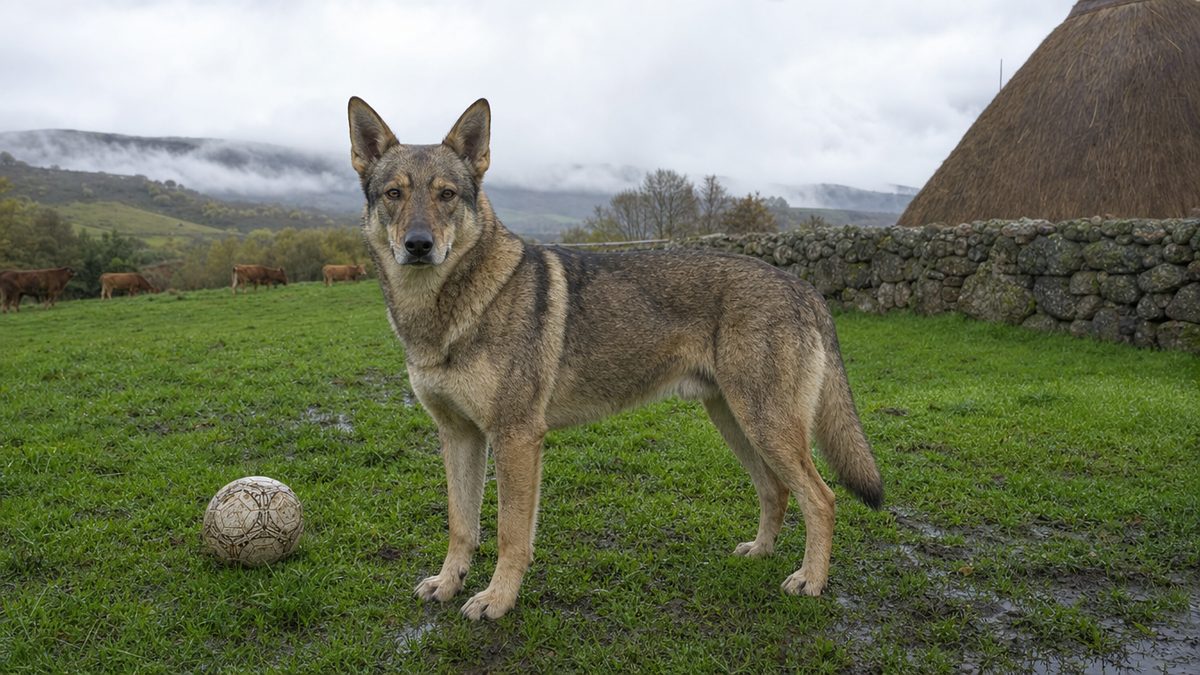
Quick answer
The Can de Palleiro is Galicia's native farm dog, 59 to 65 cm and 30 to 38 kg for a male, wolf-like, dense-coated and bred to herd cattle and guard the house. About 2,400 exist, almost all in one Spanish region. No price in India exists because no lawful breeding import does. Heat tolerance rates 2 of 5, since Santiago de Compostela averages 13.38 C a year against Chennai's 27.95 C.
This page summarises published breed-standard text, government notifications, registry data and peer-reviewed veterinary research for general information. It is not a diagnosis and it is not treatment advice. Consult a registered veterinarian about your own dog before acting on anything here, and treat collapse, unsteadiness, vomiting during exertion or a tongue that turns dusky in heat as an emergency.
Can de Palleiro at a glance
What the Can de Palleiro actually is
The Can de Palleiro is Galicia's native farm dog, a medium-sized, wolf-like herding dog and guard dog of 59 to 65 cm and 30 to 38 kg for a male, recognised by the Xunta de Galicia in 2001, added to Spain's national list of canine breeds later that same year, and recognised by the Federation Cynologique Internationale not at all.
Four census figures describe this breed better than any adjective, and no page anywhere has set them side by side. Galicia's own breed magazine reported 984 dogs registered at 31 December 2016. The Xunta's press office reported 925 registered in 2017 and 1,775 by June 2021. The peer-reviewed behaviour study published that November gives the same 1,775, describing it as unpublished studbook data. And in December 2025 the club president put the census at about 2,400, against a stated target of 5,000 needed to leave official endangered status.
Those numbers do not simply contradict each other. Three of them rise steadily and one, the 984 of December 2016, sits above the 925 given for 2017. The Xunta's own arithmetic settles which one it used: it claims growth of almost 92 percent over four years, and 1,775 divided by 925 is 1.919, a rise of 91.9 percent, while 1,775 divided by 984 gives only 80.4 percent. Neither source defines whether it is counting living dogs or cumulative registrations, so this page reports both and resolves neither.
The short version for an Indian reader
- No price in India exists, because no verifiable Can de Palleiro exists in India. A search for the breed name plus price, run with an India location, returned no Indian seller, listing or figure of any kind.
- No lawful breeding import is possible. Dogs are a Restricted import in India and applications for trading or breeding purposes shall be duly rejected.
- Heat tolerance rates 2 of 5. Santiago de Compostela averages 13.38 C across the year and its hottest month, August, averages 19.25 C, which is cooler than the coolest month of Chennai, Mumbai, Bengaluru, Pune or AhmedabadNASA POWER Climatology API.
- The health record is nearly empty. No screening register in the world carries this breed, and no life expectancy study of it has ever been published.
A working farm dog, not a show breed
The Galician standard describes a dog of the Indo-European trunk, rustic and sturdy, of lupoid type, straight profile, eumetric, medium size, around 60 to 62 cm at the withers, mesodolichomorphic, harmonious in proportion and strong in constitution, with fairly wide bones as a mark of its rusticity. Its job is stated in one line: a shepherd and guard dog, versatile, since it goes with the cows driving and guarding them and also looks after the house.
The Real Academia Galega carries the breed in its normative dictionary of the Galician language, which is unusual for any dog. Under the headword can it defines can de palleiro as a dog of appearance similar to the wolf, robust constitution and medium size, recognised as a Galician native breed, and gives the usage example that a can de palleiro helped him look after the cows. It also records a second name that no English page carries, can palleiran.
| Breed | In the Spanish national annex | FCI status |
|---|---|---|
| Can de Palleiro | Yes, since August 2001 | Not recognised |
| Perdigueiro Galego | Yes, since August 2001 | Not recognised |
| Podengo Galego | Yes, since August 2001 | Not recognised |
| Can Guicho or Quisquelo | Yes, since August 2001 | Not recognised |
All four went in together, in the same ministerial order, alongside one Andalusian breed. Twenty-five years later the Andalusian one, the Ratonero Bodeguero Andaluz, is provisionally recognised by the FCI as number 371; all four Galician breeds remain outside it.
English Wikipedia states that the breed was recognised by royal decree in 2001 and that it received national recognition by royal decree in May of that year. Royal Decree 558/2001 of 25 May 2001 does not name it. The Comite de Razas de Ganado de Espana admitted five canine breeds on 18 June 2001, three weeks after that decree, and a ministerial Orden of 2 August 2001 inserted them into its annex. The instrument was an order, not a decree, and the month was August, not May.
Why the name matters more than it looks
Palleiro means an outdoor cone of straw, not a barn, so the breed's name records that this dog slept outside in the rain in one of the wettest corners of Europe, and that single fact explains its coat, its hardiness and most of its trouble in India.
Go to the Galician dictionary rather than an English gloss. The Real Academia Galega, which sets the norm for the Galician language, defines palleiro as a heap of straw or dry grass in the shape of a cone, made on the threshing floor in such a way that it does not get wet in the rains. It is a rick standing in the open, built with its own shape as the roof. Its listed synonyms are meda and palleira.
English pages translate the word as haystack, which is close, or as hayloft, which is not. The peer-reviewed behaviour study says the dogs slept in the hayloft; Wikipedia calls the palleiro the haystack where the breed traditionally sleepsWikipedia, Can de Palleiro. A hayloft is inside a building. The Galician word the breed is named after is explicitly outdoors, and the standard says the same thing in its coat clause: the hair is thick, close and dense, more so in winter, because this is an animal that usually lives beside the house but always outside, with the livestock or in the palleiro.
What sleeping outdoors in Galicia actually means
Santiago de Compostela averages 82.23 percent relative humidity across the year and 90.63 percent in January, on NASA POWER's MERRA-2 climatology queried by explicit coordinates that came back at longitude -8.546, latitude 42.880, elevation 226.66 m. Inland at Lugo, at 522 m, January averages 92.07 percent. This breed was selected, without anybody planning it, by whether a dog could sleep against a wet straw cone through a Galician winter and still work cattle in the morning.
That is where the coat comes from, and it is why an Indian buyer should read the word rustic in the standard as a description of function rather than a compliment. The Galician text calls the dog rustic and sturdy, of lupoid type, with fairly wide bones as a mark of that rusticity.
Five names the Xunta calls incorrect
English Wikipedia lists can do gando, can das vacas, can da casa, can lobo and lobeiro as Other names for the breed. The Xunta's own technical sheet lists exactly those five under the heading Outras denominacions incorrectas, other incorrect names. The distinction is not pedantry. Can lobo means wolf dog and can das vacas means cow dog, and both are what Galician villagers called any farm dog of that shape, registered or not.
Meanwhile the one alternative name that is normative appears in no English source at all. The Real Academia Galega gives can palleiran as a synonym of can de palleiro, with its own dictionary entry and the usage example that somebody has a can palleiran to guard the house.
Where the breed comes from, in the standard's own words
The standard opens with a short history and it is worth reading, because it names the relatives. The dog is described as of the Indo-European trunk, its agriotype being the principal ancestor of the peasant dogs of Central Europe, accompanying the pre-Celtic Atlantic, Central European and Nordic peoples through the successive waves of invasion, Celts, Suevi, Visigoths and Normans, that populated the north-western Atlantic slope of the Iberian peninsula. It shares a common origin with the Belgian, Dutch and Picardy shepherds, with the Castro Laboreiro and with the German shepherd, and the text adds plainly that it has very frequently been crossed with the last of those.
Of the relatives the Galician standard names, the Portuguese Cao de Castro Laboreiro sits just across the Minho river and is FCI-recognised as number 170. If you want a documented, internationally judged version of roughly this animal, that is the one to read. It is also the cheapest way to see how much a published FCI standard adds that a regional gazette standard does not.
The breed standard in numbers
The official Galician prototipo racial gives males 59 to 65 cm and 30 to 38 kg, females 57 to 63 cm and 25 to 33 kg, with a flat broad skull, high-set erect ears, a thick low-carried tail and a chest girth exceeding the height at the withers by one quarter.
Read the standard printed in the Diario Oficial de Galicia on 11 May 2001, not a summary of it. It runs as Annex II of the Orde of 26 April 2001, it is short, and it is unusually direct about what the dog is for. Every physical figure below is quoted from that gazette, cross-checked against the typeset official PDF and against the identical prototype reprinted in Spain's Real Decreto 558/2001, because the secondary descriptions of this breed disagree with each other and with the standardReal Decreto 558/2001, de 25 de mayo.
| Clause | What the standard says |
|---|---|
| Height at withers | Males 59 to 65 cm, females 57 to 63 cm |
| Weight | Males 30 to 38 kg, females 25 to 33 kg |
| General appearance | Around 60 to 62 cm at the withers, lupoid type, straight profile, eumetric, mesodolichomorphic |
| Head | Length about 4/10 of the height at the withers, shaped like a horizontal pyramid, dense bone |
| Skull | Flat and broad, superciliary arches softly marked, orbital sockets barely apparent |
| Stop | The fronto-nasal depression is not very evident |
| Eyes | Medium size, lively expression, from dark chestnut in black coats to honey or yellow |
| Ears | High set, large and erect, with a slightly open placement |
| Neck | Muscular, forming a 45 degree angle with the horizontal, no dewlap |
| Chest | Long and deep, its girth exceeding the height at the withers by one quarter |
| Tail | Thick, high set, abundant dense hair, raised in movement but never curled over the croup |
| Coat | Thick, close and very dense, more so in winter |
| Colour | Usually uniform: sands, cinnamons, chestnuts, fawns and even blacks, plus the wolf-coloured banded coat |
The chest measurement is the one to check on a real dog
One clause in this standard is a hard number an owner can measure, and it is the chest. The Galician text says the chest girth exceeds the height at the withers by a quarter, printed as the fraction one quarter in the official gazette PDF and as 1/4 in the national reprintReal Decreto 558/2001, de 25 de mayo. For a 62 cm male that means a chest girth near 77 cm. It is a useful field check because it is the clause that separates this dog from the leggier German shepherd it has so often been crossed with.
What the standard disqualifies
The disqualifying list is short, specific and medical rather than cosmetic. Psychic anomalies. Instability or imbalance of character. Extreme timidity or extreme aggression without provocation. Epilepsy. Monorchidism and cryptorchidism. Hip dysplasia. Progressive retinal atrophy. Incorrect closure of the dental arcades, prognathism and enognathism. Absence of more than two premolars. Albinism. Pied dogs, white coats or coats with large white markings. Blue iris.
Separately, the standard lists as defects, one rank below disqualifying, lameness of the limbs, ablations or mutilations of the ears and tail, absence of teeth through extraction, and eye trauma with loss of vision. A Galician judge is therefore instructed to mark a cropped ear or a docked tail down as a defect in the dog in front of him.
Very few breed standards anywhere list hip dysplasia and progressive retinal atrophy as outright disqualifications rather than as things to screen for. This one does. India's Prevention of Cruelty to Animals (Dog Breeding and Marketing) Rules 2017 require, at Second Schedule Part III paragraph 8(10), that dogs be tested for genetic defects including hip dysplasia, progressive retinal atrophy, night blindness, hypothyroidism, entropion, ectropion and overshot or undershot jaw. Two documents written twenty-eight hundred miles and sixteen years apart converge on the same two conditions, which tells you what to screen for if you ever meet this breed.
The sentence the Xunta added to its own legal standard
Compare the live Xunta breed page against the gazette it reproduces and one clause has grown: the ear description now ends by saying that mutilation and loss of ear-tip carriage are frequent, from fights with other dogs in the area, and that sentence appears in no version of the law.
Four official texts of this standard exist and three of them are identical on the ears. The Galician gazette of 11 May 2001, the Spanish edition of the same order, the typeset official PDF and the national reprint in Real Decreto 558/2001 all say the same thing and stop there: the ears are of high insertion, large and erect, with a slightly open placementXunta de GaliciaXunta de GaliciaReal Decreto 558/2001, de 25 de mayo.
The Consellería do Medio Rural's live technical sheet continues the sentence. In Galician it reads that the ears are of high insertion, large and erect, with a slightly open placement, mutilation and the loss of verticality at the tips being frequent, owing to their fights with other dogs of the area. The Spanish edition of the same page carries the identical addition.
| Document | Ear clause ends with |
|---|---|
| DOG 91, 11 May 2001, Galician | a slightly open placement |
| DOG 91, 11 May 2001, Spanish | a slightly open placement |
| Official DOG typeset PDF | a slightly open placement |
| Real Decreto 558/2001 annex | a slightly open placement |
| Xunta live ficha tecnica, both languages | plus mutilation and loss of verticality at the tips, from fights with other dogs |
Why an Indian reader should care about one added sentence
It describes something Indian law forbids a breeder to cause. The 2017 Rules state at Second Schedule Part II paragraph 6(8) that there shall be no tail docking, ear cropping, de-barking, de-clawing, branding, dyeing, injecting substances to enhance visual appeal, performing a surgery or procedure to camouflage or hide any defect or infirmity, or any other kind of mutilation of any body part of the pup, and that any change of appearance by artificial means is strictly forbidden. The Xunta's sentence is not describing cropping; it is describing torn ears from dog fights in a free-roaming rural population. But a reader who meets a Palleiro-type dog with a folded ear tip should know that the breed's own government page treats it as common damage, and that the same breed's legal standard lists ablations or mutilations of the ears and tail as a defect.
The club's own page has drifted too
The breed club reproduces the standard on its website with two small changes that a careful reader will trip over. Where the gazette says the head is shaped like a horizontal pyramid, the club says a truncated pyramid, which is a different solidConsellería de Agricultura. Where the gazette rejects pied individuals, using the Spanish word pios, the club writes that white individuals or those with large white markings are unacceptable. Neither change is sinister and both are the kind of drift a volunteer transcription accumulates over twenty years, but if you are checking a dog against a written standard, check it against the gazette.
And the national reprint quietly dropped the history
Spain's Real Decreto 558/2001 annex prints the Can de Palleiro prototype from the words 1. Caracteristicas generales onwards. The Galician original opens with two sections the national text does not carry: A, a brief historical summary naming the breed's relatives, and the area of origin and dispersion listing the municipalities where the surviving dogs were found. So the national document, which is the one most easily found in Spanish, is the version with the history removed.
Ranking pages describe a double coat with a good undercoat. The gazette standard says only that the hair is thick, close and very dense, more so in winter, and never uses the word undercoat at all. Animalia tags the breed as having both short and long fur simultaneously and says common colours include black, sand and similar hues with occasional white spots. Large white markings are a disqualifying fault in the standard, so that last phrase inverts the law it is describing.
Who recognised this breed, and on which exact date
Recognition came in two steps and neither was a royal decree: the Xunta de Galicia approved the standard and created the studbook by an Orde of 26 April 2001, and the Spanish state added the breed to its national annex by a ministerial Orden of 2 August 2001.
Start with the Galician instrument, because it is the one that actually created this breed as an administrative object. The Orde of the Consellería de Agricultura, Gandaría e Política Agroalimentaria of 26 April 2001 was published in the Diario Oficial de Galicia number 91 on Friday 11 May 2001 at page 6.325, and signed by the conselleiro Juan Miguel Diz Guedes. Its single article approves two things: the specific regulation of the Libro Xenealóxico of the Can de Palleiro breed as Annex I, and the breed standard as Annex II. It came into force the day after publication.
The preamble explains why the Xunta went looking. Under the Plan de Mellora Gandeira de Galicia, after a period of documentation, study and prospection of the Galician countryside in search of animals of the canine species, the existence was confirmed of a canine population commonly called by breeders the Can de Palleiro, made up of specimens sharing characteristics similar to each other and different from other breeds already described. The same preamble names the cause of the decline: emigration through the last century, and the return of emigrants with improved means, which brought in foreign breeds that largely displaced the native ones.
The Spanish step, and the mistake the English internet repeats
Spain acted three months later, and by a different kind of instrument. The Comité de Razas de Ganado de España met on 18 June 2001 and proposed and admitted five canine breeds. The Orden of 2 August 2001, published in the Boletín Oficial del Estado number 193 on 13 August 2001 across pages 30424 to 30430, then inserted them into the annex of Real Decreto 558/2001, with their racial prototypes. Its single article names them: Ratonero-Bodeguero Andaluz, Perdigueiro Galego, Podengo Galego, Can de Palleiro, Can Guicho.
| Date | What it actually is |
|---|---|
| 26 April 2001 | The Galician Orde approving the standard and creating the studbook |
| 11 May 2001 | Publication in the Diario Oficial de Galicia, in force the next day |
| 25 May 2001 | Real Decreto 558/2001, which does not name the breed |
| 18 June 2001 | The Comite de Razas de Ganado meeting that admitted five canine breeds |
| 2 August 2001 | The ministerial Orden that inserted the breed into the national annex |
| 13 August 2001 | Publication in the Boletin Oficial del Estado, in force the next day |
English Wikipedia compresses all of that into a single wrong sentence, saying the breed was recognised by royal decree in 2001 and that it received national recognition by royal decree in May the same year, footnoting Real Decreto 558/2001 for it. That decree is dated 25 May 2001, three weeks before the committee meeting that admitted the breed, and its original annex could not have contained a breed the committee had not yet considered. The consolidated version of the decree does print the Can de Palleiro prototype today, at page 59, but that consolidation runs to a last modification of 27 July 2020 and shows the annex as amended, not as enacted.
The preamble of the Orden of 2 August 2001 says the five breeds must be incorporated into the annex of Real Decreto 558/2000, while its operative article correctly says 558/2001. The error is in the Boletín Oficial del Estado text itself. It is harmless, and it is the kind of detail that only appears if somebody actually opened the document.
Who holds the studbook, and what changed in 2015
The Xunta de Galicia owns the Libro Xenealóxico, not the breed club, and a second Orde of 7 December 2015 cut the studbook from six registers to four and lowered the founding-register age from 24 months to 18.
Annex I of the 2001 Orde is explicit about ownership, and it is the single most misunderstood fact about this breed. The Libro Xenealóxico is defined as the register, file or computerised system in which purebred Can de Palleiro dogs are inscribed, with mention of their ancestors, descendants and the merits received in their morphological, reproductive and working assessments, the responsible and competent body being the Consellería, which may delegate the management of it to organisations officially recognised for that purpose. Ownership, inspection and intervention remain with the Consellería in every case.
The delegation happened. The Club de la Raza Can de Palleiro was founded as a non-profit on 2 February 2002 and has been recognised by the Xunta since 6 February 2004 as the sole collaborating entity for the recovery, improvement, selection, promotion, diffusion and management of the studbook. The Xunta's 2021 press release repeats that it is the only association officially recognised by the Xunta for the recovery programme and for managing the studbook.
What the 2015 order actually did
The Comisión Reitora of the studbook met in extraordinary session on 4 December 2014 and unanimously approved a rewrite of number 3 of Annex I, which the Consellería do Medio Rural enacted by the Orde of 7 December 2015, published in the Diario Oficial de Galicia number 238 on 15 December 2015 at page 46899 and signed by the conselleira Ángeles Vázquez Mejuto. No English page mentions it.
| Element | 2001 order | 2015 order |
|---|---|---|
| Registers | Six, in two sections | Four, in two sections |
| Annexed section | Auxiliary Births, Founding, Auxiliary Adults | Founding (RF), Auxiliary (RA) |
| Principal section | Principal Births, Definitive, Merits | Definitive (RD), Merits (RM) |
| Founding register age | Over 24 months | Over 18 months |
| Definitive register pedigree | Parents, grandparents and great-grandparents registered | Parents, 4 grandparents and 8 great-grandparents registered |
Two changes matter for a small population. Dropping the founding-register age from 24 months to 18 lets a dog of unknown parentage enter the gene pool six months earlier, after passing breed confirmation, which in a breed recovering from near extinction is a deliberate widening of the funnel. And spelling out 4 grandparents and 8 great-grandparents makes the Definitive register a three-generation-complete pedigree requirement in explicit numbers rather than by implication.
The club describes three registers, the gazette names four
The club's own page says that by agreement of the Comisión Rectora the studbook consists of three registers, Fundacional, which it states is provisionally closed, Auxiliar and Definitivo. The 2015 Orde names four, adding the Rexistro de Méritos for adult dogs already in the Definitive register that stand out significantly for morphology, genetics and work. That is not a contradiction so much as a merits register with nobody currently in it being left off a public summary, but a reader comparing the two documents should know which one is the law.
How a dog actually gets registered
- Declare the mating and the birth within 30 days of the litter arriving, on forms signed by the owners of both parents and authorised by the Comisión Reitora, stating the total number of pups born.
- Register the litter within six months of birth, the deadline the breeder carries.
- Identify every pup with a transponder implanted under the skin on the left side of the neck, meeting ISO 11784 and readable by an ISO 11785 reader, or failing that a tattoo on the inner face of the right ear.
- Pass breed confirmation at 18 months, without which the dog cannot breed and its offspring cannot enter the studbook.
- Collect the pedigree from the state, not the club. The Director of the Centro de Recursos Zooxenéticos issues the official pedigrees by delegation and sends them to each owner.
Alongside the register restructure, the club records that from 2015 adults must pass an Apto para a reprodución certification, fit for reproduction, before their offspring can be inscribed. Combined with the confirmation-at-18-months rule in the gazette, that means no Can de Palleiro can legitimately breed in Galicia without a state-appointed assessor having looked at it first.
Where the Spanish registries actually put this breed
Spain lists the Can de Palleiro in three places and treats it differently in each: the national annex names it as a Spanish canine breed, the Real Sociedad Canina de España files it under other breeds in recovery rather than among its own, and the ministry's ARCA register of recognised breeders' associations does not name it or its club at all.
The national annex is the strongest of the three. Real Decreto 558/2001's annex lists 33 Spanish canine breeds and the Can de Palleiro is among them, with its full racial prototype printed at page 59 of the consolidated text. That is genuine national recognition and it is why the breed can hold a Spanish studbook at all.
The Real Sociedad Canina de España is where it gets interesting. The RSCE's Razas Españolas index runs through FCI Groups 1, 2, 3, 5, 6, 7, 8 and 10, then a Grupo 11 headed Razas no reconocidas por la FCI, breeds not recognised by the FCI, which carries eleven breeds including the Majorero, the Perro de Pastor Vasco, the Pastor Garafiano, the Perro Leonés de Pastor, the Valdueza, the Alano Español, the Podenco Andaluz, the Maneto, the Podenco Valenciano, the Pachón Navarro and the Ca Mè Mallorquí. The Can de Palleiro is in none of them.
It appears instead at the bottom of the page, under a block headed Otras razas, introduced by the sentence that the Spanish breeds detailed below are in the phase of recovery and that their racial prototypes may be consulted in the official bulletins of the corresponding autonomous communities. Under GALICIA it lists Can de Palleiro, Can Guicho or Quisquelo, Perdigueiro Galego and Podengo Galego.
| Register | Is the Can de Palleiro in it |
|---|---|
| Annex to Real Decreto 558/2001 | Yes, one of 33 Spanish canine breeds, with its prototype |
| RSCE Razas Espanolas, Grupos 1 to 11 | No |
| RSCE Otras razas en fase de recuperacion | Yes, under GALICIA, pointing readers to the DOG |
| RSCE Grupos Etnicos Caninos | No |
| ARCA list of RD 558/2001 breeders associations | No, and neither is its club |
| ARCA census database | No, because ARCA holds no canine census at all |
The ARCA absence, with the controls that make it mean something
The Ministerio de Agricultura publishes, through its ARCA system, a Relación de organizaciones y asociaciones de criadores de perros de raza pura reconocidas oficialmente conforme al Real Decreto 558/2001, last updated 6 October 2025. Searching that document for palleiro returns zero hits. Searching it for Galicia returns exactly one, and it is not the breed club: the Asociación Cinológica Cultural y Deportiva Expogal of Ferrol, listed for all integrated breeds, with the Xunta de Galicia as competent authority.
The controls run in the same document, on the same day, show the list is working. It carries 43 rows of competent authorities and it does name regional breed clubs by breed: eight mentions of Mallorquí, covering the Ca Mè, the Ca Rater, the Ca de Bestiar and the Ca de Bou clubs under the Govern de les Illes Balears, and four of Euskal, covering the Basque shepherd association under the Gobierno del País Vasco. So a register that names the Balearic, Canarian and Basque breed clubs individually does not name the Galician one.
And why there is no ARCA census figure for any dog
ARCA's Buscador de Datos Censales holds 2,841 census records, and its species selector offers Aviar, Bovino, Caprino, Equino Asnal, Equino Caballar, Otras Especies, Ovino and Porcino. There is no canine option. That is the reason every published population figure for this breed comes from the Xunta or from the breed club rather than from a national database, and it is worth knowing before you go looking for one.
The RSCE's own text argues that an ethnic group becomes a breed only through planned selection, a written standard, generation-by-generation registration and demonstrable stability over at least three generations. By that yardstick a breed whose Definitive register requires parents, four grandparents and eight great-grandparents is doing exactly the work the RSCE describes. The Ca Mè Mallorquí was moved into Grupo 11 with a photograph uploaded in June 2025, so the door is not closed.
The FCI has two Spanish sheepdogs and this is not one of them
The Fédération Cynologique Internationale does not recognise the Can de Palleiro definitively or provisionally, its Group 1 sheepdog nomenclature lists exactly two Spanish breeds, and the practical consequence for an Indian buyer is that no Indian pedigree route for this dog exists.
Absence is a strong claim, so here is how it was checked, with controls run in the same session. The FCI's Group 1 page lists Sheepdogs country by country. Under country 15, SPAIN, there are two entries and only two: GOS D'ATURA CATALÀ (87), the Catalan Sheepdog, and CA DE BESTIAR (321), the Majorca Shepherd Dog, both valid from 26 May 1982. There is no third Spanish line, and no Galician one.
The provisional register was checked separately, because a breed missing from the definitive list can still sit on it. The FCI's nomenclature page prints the complete provisional list, twenty breeds, running from the Australian Stumpy Tail Cattle Dog admitted on 6 July 2005 to four breeds admitted on 11 February 2026. The Can de Palleiro is not among the twenty.
The control that makes the absence mean something
The FCI's alphabetical index for the letter C was pulled in the same session. It carries 44 breeds and it does surface Iberian dogs whose names begin with Ca and Cão, including CA DE BESTIAR, CÃO DA SERRA DE AIRES, CÃO DE CASTRO LABOREIRO, CÃO DE GADO TRANSMONTANO and CÃO FILA DE SÃO MIGUEL. So the index is working, it is genuinely alphabetical, and it does list the Portuguese neighbour the Galician standard names as a relative. It simply has no Can de Palleiro.
One of the 2001 five did make it out
The five breeds Spain added to its national annex together in August 2001 have since diverged sharply. The Ratonero-Bodeguero Andaluz is now on the FCI's provisional list as RATONERO BODEGUERO ANDALUZ (371), the Andalusian Terrier, provisionally recognised on 3 September 2024. The other four, all Galician, remain outside.
| Breed | Region | FCI status in August 2026 |
|---|---|---|
| Ratonero-Bodeguero Andaluz | Andalusia | Provisionally recognised, number 371, since 3 September 2024 |
| Can de Palleiro | Galicia | Not recognised |
| Perdigueiro Galego | Galicia | Not recognised |
| Podengo Galego | Galicia | Not recognised |
| Can Guicho or Quisquelo | Galicia | Not recognised |
A ranking page assigns it an FCI group anyway
Animalia, which ranks on page one in India for the breed name, prints an FCI group of Sheepdogs and Cattledogs and an FCI section of Sheepdogs on its Can de Palleiro page. Neither exists. The page's only listed reference is the English Wikipedia article, which correctly says nothing about the FCI at all. An answer engine reading that page will report an FCI classification for a breed the FCI has never classified, which is precisely the failure this page exists to correct.
India is listed among the FCI's members and contract partners, under Asia, Africa and Oceania. An Indian national kennel club works inside the FCI nomenclature, so a breed outside that nomenclature has no Indian pedigree route, no Indian show class and no Indian judge qualified in it. Put that beside the import position and the supply question answers itself: a dog you cannot lawfully import for breeding and cannot register once it arrives is not a breed with an Indian market, it is a breed with an Indian search result.
The population census, and why four sources give four numbers
The Can de Palleiro census has risen from 984 registered dogs at the end of 2016 to about 2,400 in December 2025, against a target of 5,000 that the breed club says is needed to leave official endangered status, and the one figure that breaks the sequence is worth naming rather than smoothing over.
Set the published figures out in order and the shape is clear. Ladridos reported 984 registered at 31 December 2016, quoting the club's vice-president. The Xunta's press office gave 925 registered in 2017 and 1,775 by June 2021. The behaviour study published five months later gives the same 1,775, describing it as unpublished studbook data. And in December 2025 the club president put the census at about 2,400.
| Date | Figure | Who says it |
|---|---|---|
| 31 December 2016 | 984 registered | Ladridos, quoting the club vice-president |
| 2017 | 925 registered | Xunta de Galicia press office |
| June 2021 | 1,775 | Xunta de Galicia press office |
| November 2021 | 1,775 in the herd book | Muniz de Miguel et al., Animals, unpublished data |
| December 2025 | About 2,400 | Club president Daniel Conde, in Ladridos |
| Target | 5,000 | The club, as the threshold to leave endangered status |
The one figure that does not fit, and how to test it
984 at the end of December 2016 is higher than 925 for 2017, which read literally would mean the population fell. Neither source defines whether it is counting living dogs or cumulative studbook entries, so the honest answer is that the two are measuring different things and nobody has said which. The Xunta's own arithmetic tells you which figure it worked from. It claims growth of almost 92 percent over four years, and 1,775 divided by 925 gives 1.919, a rise of 91.9 percent. Against 984 the same 1,775 is a rise of only 80.4 percent. So the 92 percent claim is internally consistent with 925 and inconsistent with 984, which is as far as the published record lets you go.
The December 2025 report adds a second check that holds. It says the census has risen by 1,000 in the last six years, which puts roughly 1,400 dogs in 2019, sitting between the 925 of 2017 and the 1,775 of 2021Xunta de Galicia.
How many live outside Galicia
In April 2017, of the near-thousand registered dogs, 37 lived outside Galicia. They were spread across Andalusia, Catalonia, the Balearics, the Basque Country, the Canaries, Asturias, Aragon, Madrid, Castilla y Leon, Castilla-La Mancha and the Valencian Community, and some had gone further, to Germany, Norway, the Netherlands and Portugal. By December 2025 requests were coming mainly from Catalonia, Madrid and Andalusia, and also from European countries and from South America, many from families of Galician origin who had emigrated. The first litter born in Sweden had by then been assessed remotely, with photographs and video.
What the recovery programme costs
The Conselleria do Medio Rural has held a collaboration agreement with the breed club since 2017 and renewed it in June 2021 with a budget of 60,000 euros, tripling the previous figure, paid as 15,000 euros in each of 2021, 2022, 2023 and 2024. In December 2025 the club described an annual Xunta subsidy of about 20,000 euros to stabilise and recover the breed, and put its own membership at about 330. That is the whole financial machinery behind a national breed, and at current exchange it is comfortably less than what a single litter of imported show puppies changes hands for in Delhi.
In December 2025 the Club de la Raza Can de Palleiro was certified to ISO 9001 after an audit by Applus+, passing at the first attempt, and describes itself as the first canine club in Spain and in Europe to hold it. Whatever you think of quality-management standards, it is an unusual thing for a volunteer breed club with 330 members to have gone and got, and it is a real signal about how this one operates.
What is genuinely known about this breed's genetics
No published measure of the Can de Palleiro's genetic diversity exists, no heterozygosity figure, no allelic richness and no effective population size, and the largest genotyped set of the breed in the literature is 17 dogs used as a reference panel in a wolf study.
Start with what is real. In 2017 a team studying wolf-dog hybridisation across roughly 5,000 square kilometres of the north-west Iberian Peninsula collected 332 wolf-like scats in a single breeding and pup-rearing season and typed them with mitochondrial DNA and 18 ancestry informative markers. Their reference panel was 250 Iberian wolves and 230 dogs, and the paper states that the dog reference panel was increased with an additional set of 17 Can de Palleiro breed samples, an autochthonous Galician breed also used as herding dogs.
That is a revealing role for a breed to play. The Can de Palleiro was added to the panel because it is the local dog most likely to be genetically confused with a wolf in exactly that landscape, which is the same reason Galician villagers call any such dog can lobo and the Real Academia Galega defines the breed as a dog of appearance similar to the wolf. The study identified 130 genotypes, of which 67 were wolves and 7 were hybrids, three backcrossed to dog and four to wolf, giving a 5.6 percent rate of introgression into the wolf population.
What does not exist, checked with controls
Europe PMC's exact-phrase search for the breed name returns six records. Opened one by one, they are the 2021 behaviour study, a special-issue editorial that merely cites it, a 2026 canine plasma trace-element reference-interval paper, a 2025 retrospective on patellar desmopathy after cruciate surgery, a 2026 review of canine olfaction and the 2017 wolf-hybridisation paperMuñiz de Miguel, S., Diéguez, F. J.Larrán, B., López-Alonso, M. et al.Pacheco, C., López-Bao, J. V., García. Not one is a study of the breed's genetic diversity. The controls run in the same session confirm the search works: Labrador Retriever returns 5,945 records and livestock guardian dog returns 12.
PubMed illustrates the opposite trap and it is worth showing. Searching the exact phrase there returns a count of 23, which looks like coverage until you read the query translation, which shows PubMed collapsed the phrase into a search for the single word palleiro. Opening all 23 records settles it: 22 of them are not about the dog at all. The bulk are Latin American rheumatology and Argentine cardiology papers carrying an author named Palleiro, and the rest include a study of aborted Opuntia cactus fruits and one on aluminium fractionation in the sediments of Galicia's Upper Mero basin. Exactly one of the 23, PMID 34827931, is about the breedMuñiz de Miguel, S., Diéguez, F. J..
| Question | Published answer |
|---|---|
| Genetic diversity, heterozygosity, allelic richness | None published |
| Effective population size | None published |
| Largest genotyped set in the literature | 17 dogs, as a reference panel |
| Behaviour | One study, 377 dogs, 2021 |
| Clinical reference intervals | n = 3 inside a 140-dog pooled study, no breed-specific figure |
| Life expectancy | None published |
What the breed does instead of published genetics
The absence of papers does not mean the absence of DNA work. The club signed a collaboration agreement with the public company Xenética Fontao SA on 16 July 2003 for genetic studies and paternity determination, and the 2001 order already empowered the Comisión Reitora to resort to paternity verification through the corresponding tests. By December 2025 the club described a genetic DNA control on every member of every litter, alongside a home visit, a check on feeding and an ethological behaviour test, with any pup showing aggression declared unfit for breeding.
There are also hard limits on how much any one dog can contribute to the gene pool. As a rule, females may have four litters in their lifetime and no more than 30 puppies, and males five and 35. For a population of about 2,400 that is a deliberate flattening of the founder effect, and it is stricter than anything Indian law imposes on a licensed breeder.
Animalia states that in 1999 only 20 purebred dogs were found and that breeders increased the number eightfold over the next nine years. Its only listed reference is the English Wikipedia article, which contains neither figure. No gazette, Xunta page, club chronology or paper in the literature carries it either. It may be true; it is simply not sourced anywhere that can be checked, so Bonbeno publishes no founding-population figure for this breed.
Price in India: there isn't one, and here is the proof
No price in India exists for the Can de Palleiro because no verifiable Can de Palleiro exists in India, and the usual tests for a fake Indian price cannot even be run on this breed, because there is no Indian rupee figure attached to it anywhere to test.
A search for the breed name together with price in india, run through a search tool with an India location on 24 August 2026, returned no Indian seller, no Indian listing, no Indian marketplace and no rupee figure of any kind. What it returned was two YouTube videos, an American breed-information site, a Pinterest board, an Etsy metal wall-sign listing, a Reddit thread, a Quora thread, a pilgrimage forum and a Facebook group.
That zero means something only because the control passed. The same tool, in the same session, with the same India location, was asked for Labrador Retriever puppy price in india and returned a full Indian purchase market: multiple Indian marketplaces with city-by-city price grids for Hyderabad, Bangalore, Delhi, Chennai, Lucknow, Mumbai, Jaipur and Pune. A search that can find an Indian Labrador market and cannot find an Indian Palleiro market is telling you about the market, not about itself.
The one Indian page, and what is behind it
GoofyTails, an Indian pet retailer, does carry a Can de Palleiro breed page, and it ranks. Scroll past the prose and the page's own product grid returns the line We're sorry. There are no results for ''. It is a breed article bolted to a shop that has nothing to sell for this breed, which is the standard shape of Indian rare-breed pages. Its figures have drifted too: it gives a female weight of 25 to 35 kg where the gazette says 25 to 33 kg, and a life expectancy of 12 to 15 years for a breed with no published life expectancy at all.
The tests that could not be run
Indian pages for absent breeds usually publish a rupee figure that turns out to be a dollar price converted at a single rate, and this site has caught that repeatedly. Neither test applies here, and the reason is worth stating plainly: there is no Indian rupee figure for this breed to divide. Nobody has bothered to invent one, which is itself the strongest available evidence that no Indian demand exists for a dog that has never been here.
How a Can de Palleiro is actually obtained, in Galicia
There is no ordinary purchase market in Galicia either, and that is the more interesting half. The club states that the breeding system is not based on professionalisation but on selective family breeding by many altruistic Galician families, that it does not believe in the concept of a dog farm, that the breeders are private individuals, and that the club keeps the books in which every litter is registered. Families join a waiting list, and generally travel to Galicia themselves to collect the dog.
| Colour | Share of the breed | Reported wait |
|---|---|---|
| Marelos, yellow | More than 60 percent | About 5 months for a male, 3 to 4 for a female |
| Alobados, wolf-coloured | About 30 percent | 7 to 8 months |
| Black | About 10 percent | Almost two years |
| Chocolate | Newly appearing in some litters | Not established |
Read that table as a supply schedule rather than a colour chart. A wait of almost two years for a black puppy from a population of roughly 2,400 dogs is what a genuinely rare breed looks like from the inside, and it is why no exporter is going to build a channel to India for it.
This page found no published purchase price for a Can de Palleiro in any currency, in Galician, Spanish or English. The club describes an allocation system with a waiting list and not a price list. Bonbeno therefore publishes no figure rather than converting one from a marketplace that does not exist. If you see a rupee price for this breed on an Indian site, treat it as a placeholder attached to whatever puppy is actually in stock.
The only lawful way a Can de Palleiro reaches India
One route exists and it is narrow: an Indian resident who already owns the dog abroad may bring it in as a pet with a valid pet book in the importer's name, and every commercial, breeding or agent-mediated application is rejected outright under DGFT Trade Notice 22/2022-23.
Read the trade notice rather than a summary of it. Trade Notice No. 22/2022-23, dated 19 December 2022 and signed by Md. Moin Afaque, Deputy Director General of Foreign Trade, sets out the import policy for pet animals. Under ITC (HS) 01061900, Mammals, Other, the import policy is Restricted, subject to Policy Condition 6 of the chapter.
Policy Condition 7 then narrows it to three purposes, and only three. A pet dog with a valid pet book and relevant records or documents in the name of the importer. Dogs imported by R&D organisations for conducting research, with the recommendation of the CPCSEA. And dogs for internal security by the Defence and Police Force. Policy Condition 8 closes the door behind it: import of commercial dogs for breeding or any other commercial activities other than the purposes mentioned above is not permitted.
The clause that ends the breeding conversation
Paragraph 6 of the notice is one sentence and it decides the question. Any applications for trading or breeding purposes, or applications made on behalf of some another person or entity, shall be duly rejected. Two things follow. No Indian breeder can lawfully import a founder pair. And no agent can lawfully apply on your behalf, which removes the intermediary that would normally make a rare-breed import happen.
| Requirement | Detail |
|---|---|
| Policy status | Restricted under ITC (HS) 01061900 |
| Baggage route, up to two pets | Allowed without DGFT authorisation only to persons transferring residence to India after two years of continuous stay abroad |
| More than two pets | DGFT import authorisation required, application examined by DAH&D |
| Temporary imports | DGFT import authorisation required in every case |
| Documents | Vaccination book or pet passport or pet book, certificate for emotional support, passport of the pet |
| Lead time | Begin the application at least two months before travel |
| Ports | Delhi, Mumbai, Chennai, Hyderabad, Bangalore and Kolkata only; DAHD added Kochi for pets arriving under the baggage rules in October 2024 |
| Advance NOC | From the Regional or Quarantine Officer (AQCS), seven days before travel, relaxable to three |
The port restriction matters more than it looks for a dog from Galicia. A Palleiro would fly from Santiago or Porto through a European hub into one of those six cities, or into Kochi since October 2024, and where required the animal is quarantined at the government quarantine station of that port for a stipulated period. For a breed selected to live outdoors at 13 C annual mean, an unplanned summer quarantine at a Chennai or Delhi facility is the single riskiest hour of the whole journeyNASA POWER Climatology API. The full route is set out in how to import a dog to India.
And a second law waiting at the other end
Suppose the dog arrives. Anyone thinking of breeding from it in India meets the Prevention of Cruelty to Animals (Dog Breeding and Marketing) Rules 2017. Second Schedule Part II paragraph 6(2) permits only out breeding and line breeding; paragraph 6(3) prohibits in breeding, defined as mating between relatives of the second to fourth grade in straight or side line within the first four generations, and incest breeding between parents and children or brother and sister. Rule 8(1)(a) forbids selling pups under eight weeks of age, and Rule 8(1)(b) forbids selling a dog over six months without sterilisation unless the buyer is another licensed breeder.
Those rules collide with the arithmetic of founding a rare breed from one imported pair, which is exactly the collision the Galician club avoids by keeping 2,400 dogs and capping any one female at four litters and 30 pups.
You can lawfully import a Can de Palleiro to India only if it is already your own pet and you are moving home. You cannot lawfully import one to breed, you cannot ask an agent to import one for you, and once it is here you cannot register it with an Indian kennel club, because the breed is outside the FCI nomenclature that Indian registration works withinFédération Cynologique Internationale.
Cost of ownership, honestly bounded
Bonbeno publishes no monthly rupee total for the Can de Palleiro, because no verified Indian cost figure for this breed exists and borrowing a Labrador's would be an invention, so what follows is the cost structure a 30 to 38 kg outdoor-bred working dog forces on an Indian household, item by item.
Three things fix the cost of this dog and none of them is the purchase price. The first is mass. The standard puts a male at 30 to 38 kg and a female at 25 to 33 kg, which is Labrador to German shepherd territory, so food, dosed parasiticides, anaesthesia and boarding all sit in that bracket. The second is parasite pressure, which in India is not a discretionary line. The third is heat management, which for this breed is the item most Indian budgets leave out.
| Item | Why it is not optional for this breed |
|---|---|
| Year-round tick and flea control | 49.7 percent of 525 dogs across four Indian cities carried a tick-borne pathogen by PCR, and ticks were found on 53 percent |
| Dosing by weight | Every parasiticide, anaesthetic and antibiotic is dosed on 25 to 38 kg, not on a 10 kg dog |
| Cooling, not air conditioning alone | A dog bred at 13.4 C annual mean needs shade, airflow and water it can lie in, plus a routine that moves work to dawn and dark |
| Two real walks a day | A herding dog and guard dog that is under-exercised becomes a fence-patrolling, barking liability rather than a calm one |
| Hip and eye screening | The breed's own standard disqualifies hip dysplasia and progressive retinal atrophy, and Indian law mandates testing for both |
| Import authorisation and quarantine | A DGFT authorisation begun two months ahead, plus quarantine at one of seven ports where required |
The one cost figure that is actually documented
The public cost of keeping this breed alive is known, and it is small. The Consellería do Medio Rural budgeted 60,000 euros across 2021 to 2024, paid at 15,000 euros a year, and the club described an annual subsidy of about 20,000 euros in December 2025Miguel Pele, El can de palleiro consigue la…. Divide the later figure across a census of about 2,400 dogs and Galicia is spending roughly 8 euros per registered dog per year to hold a breed back from extinction. That is the entire public machinery, and it is a useful sense of scale before anyone treats this dog as a luxury import.
What the Galician model costs a family instead of money
The club's system substitutes obligation for price. Every member of every litter gets a DNA control, a home visit, a check on how it is being fed and an ethological behaviour test, and the club stays in direct contact with owners of dogs that leave Galicia because it is an endangered breed. Registration then requires the dog to pass breed confirmation at 18 months before it can breed. An Indian owner would be inside none of that, which removes the support and the accountability at the same time.
Where a cheaper answer is also a better one
If the appeal is a hardy, medium-sized, short-to-medium-coated, intelligent guarding dog that lives outdoors and works, an Indian pariah dog delivers it for the cost of a vaccination course and is already adapted to the climate you actually have. It is the most affordable honest substitute on this page, and it is the one this breed's own profile keeps pointing at: rustic, functionally selected, never bred for looks. See the adoption section for how to do that properly.
This site normally publishes a monthly rupee range and shows where sources disagree. For this breed there are no Indian sources to disagree. Every rupee figure that could be printed here would have to be borrowed from a different breed and relabelled, which is the exact failure the page criticises in others. When a verifiable Indian cost survey covering this weight class exists, it will be added and cited.
Heat tolerance: the humidity is not the problem, the temperature is
Heat tolerance rates 2 out of 5, because Santiago de Compostela's hottest month averages 19.25 C while every single month of the year in Chennai, Mumbai, Bengaluru, Pune and Ahmedabad is hotter than that, and the surprise in the data is that Galicia is more humid across the year than any of them.
Every figure here comes from NASA POWER's MERRA-2 monthly climatology, queried by explicit latitude and longitude so that no service can hand back a different place by accident. The Galician query returned longitude -8.546, latitude 42.880, elevation 226.66 m for Santiago de Compostela, and longitude -7.556, latitude 43.012, elevation 522.34 m for inland Lugo. The Indian queries each returned their own coordinates and elevations.
The comparison that flips the usual argument
Indian breed pages almost always warn that an imported European dog will struggle with Indian humidity. For this breed that is backwards. Santiago de Compostela averages 82.23 percent relative humidity across the year. Kolkata averages 73.93, Chennai 72.39, Bengaluru 67.94, Mumbai 67.39, Pune 66.80, Shimla 50.32, Ahmedabad 48.32 and Delhi 45.56. Not one Indian city in the set is as humid across the year as the town this dog comes from. Inland Lugo reaches 92.07 percent in January.
So a Can de Palleiro is not naive about wet air. It is naive about warm air. Santiago's hottest month, August, averages 19.25 C. Chennai's coolest month averages 24.09 C, Mumbai's 23.19 C, Bengaluru's 20.22 C, Pune's 19.62 C and Ahmedabad's 19.93 C. In all five of those cities, twelve months out of twelve are hotter than the hottest month this breed was selected in.
| Place | Annual mean temperature | Months hotter than 19.25 C | Annual humidity |
|---|---|---|---|
| Santiago de Compostela | 13.38 C | Reference | 82.23 percent |
| Chennai | 27.95 C | 12 of 12 | 72.39 percent |
| Mumbai | 26.77 C | 12 of 12 | 67.39 percent |
| Ahmedabad | 27.57 C | 12 of 12 | 48.32 percent |
| Bengaluru | 23.74 C | 12 of 12 | 67.94 percent |
| Pune | 23.86 C | 12 of 12 | 66.80 percent |
| Kolkata | 25.81 C | 10 of 12 | 73.93 percent |
| Delhi | 25.60 C | 9 of 12 | 45.56 percent |
| Shimla grid cell | 21.15 C | 7 of 12 | 50.32 percent |
| Gangtok grid cell | 7.45 C | 0 of 12 | 73.79 percent |
Why the coat makes it worse than the numbers alone
The standard describes hair that is thick, close and very dense, more so in winter, on an animal that lives outside beside the house. That is insulation selected across centuries by whether a dog could sleep against a wet straw rick through a Galician January. Insulation works in both directions, and a dog carrying it in Chennai in May, at a monthly mean of 31.51 C, is wearing a winter coat it cannot take off.
Never shave it. Clipping a dense working coat removes the layer that also blocks solar gain and does nothing for evaporative cooling, because dogs do not sweat through skin. What works is shade, moving air, water the dog can lie in, and a schedule that puts every walk before sunrise and after dark from March to October.
NASA POWER reports on a coarse grid, so a hill-station figure describes a large cell rather than the town. The Shimla query returned an elevation of 897.65 m against a town that sits nearer 2,200 m, and the Gangtok query returned 3,239.61 m against a town nearer 1,650 m. Read both hill rows as the shape of the mountain, not as a street-level reading, and treat the plains cities, which sit within a few tens of metres of their true elevation, as the reliable half of the table.
City by city: where in India this dog could actually live
Only the Indian hills come close to Galicia, and the ranking is straightforward: the eastern Himalayan belt is cooler than Galicia year round, the western hills work for five months, the Deccan plateau cities are workable with the afternoon given up, and the coastal plains never match a single Galician month.
Take the reference figure and compare it honestly. Santiago de Compostela runs at 13.38 C annual mean, with its coolest month at 8.47 C and its hottest at 19.25 C, so this dog's entire lived experience of heat is a band roughly between 8 and 20 degrees. Nothing on the Indian plains overlaps that band for more than a few weeks.
- Gangtok and the eastern Himalaya. The grid cell returned an annual mean of 7.45 C with a July peak of 13.60 C, so every month is cooler than Santiago's hottest. On temperature alone this is the one part of India that would suit the breed, and its 73.79 percent annual humidity is not far off Galician air either.
- Shimla and the western Himalaya. Seven of twelve months in the returned cell run hotter than 19.25 C, with a June peak of 30.25 C and annual humidity of 50.32 percent. Workable in winter and shoulder seasons, hard from April to September, and much drier than the coat expects.
- Delhi. Nine months hotter, a June mean of 35.88 C and May humidity of 23.38 percent. The combination of extreme dry heat and a dense coat is the worst pairing on this list.
- Bengaluru and Pune. Every month hotter than Santiago's hottest, but the annual means, 23.74 C and 23.86 C, are the mildest of the plains set. Practically this means dawn and evening work all year and no midday exercise from March to May.
- Kolkata. Ten months hotter, and the monsoon months push humidity to 89.34 percent, above anything Galicia sees except its own January. Warm and wet together is the combination that produces skin and ear trouble in a dense coat.
- Chennai and Mumbai. Twelve months hotter, Chennai peaking at 31.51 C in May and Mumbai at 31.19 C, with Mumbai's August humidity at 90.36 percent. There is no season in either city that resembles a Galician summer.
- Ahmedabad. Twelve months hotter and a May mean of 35.06 C on 36 percent humidity. Dry, extreme and the least suitable of the plains cities.
The routine that makes the difference
The breed's own working pattern helps here more than any gadget. The standard says the habitual movement is the walk, changing to trot or gallop without effort when the work requires it. That is a dog built for long, low-intensity ground coverage rather than bursts, and low-intensity ground coverage is exactly what you can still do at 5.30 in the morning in Pune in April. Convert distance into nose work and sniffing games and you tire the dog without generating the heat load that a run generates.
| Setting | Workable window | What to change |
|---|---|---|
| Eastern Himalayan hills | All year | Nothing on heat; watch monsoon skin and ears instead |
| Western Himalayan hills | October to March fully | Dawn and dusk only from April to September |
| Bengaluru, Pune | All year at dawn and after dark | No midday exercise March to May, shade and water always |
| Delhi, Ahmedabad | November to February | Indoors through the middle of the day April to June |
| Chennai, Mumbai, Kolkata | Dawn and dark only, all year | Treat the whole midday period as off limits |
Heat stroke in a thick-coated dog moves fast. Treat frantic panting that will not settle, a dark red or dusky tongue, unsteadiness, vomiting during exertion, or collapse as an emergency: stop, move the dog into shade and moving air, wet it with cool water, especially the belly, groin and paws, and get to a veterinarian at once rather than waiting to see whether it settles.
Temperament, measured rather than asserted
One peer-reviewed study has ever measured this breed's behaviour, and it found a dog markedly less afraid, less excitable and less prone to separation problems than the general Galician dog population, markedly more inclined to chase, and no more aggressive towards strangers once the comparison is adjusted properly.
The study collected C-BARQ questionnaires on 377 dogs, 177 Can de Palleiros and 200 general-population dogs of which a third were mixed breeds, at the Rof Codina Veterinary Teaching Hospital in Lugo, and ran a Socially Acceptable Behaviour test on a further sample of 32 dogs, 19 of them Palleiros. It states plainly that no previous research on the behaviour of this breed had been published.
| Trait | General population | Can de Palleiro |
|---|---|---|
| Owner-directed aggression | 0.30 | 0.06 |
| Stranger-directed aggression | 0.54 | 0.72 |
| Dog-directed aggression | 1.03 | 1.30 |
| Dog-directed fear | 0.95 | 0.51 |
| Stranger-directed fear | 0.56 | 0.33 |
| Non-social fear | 1.13 | 0.70 |
| Separation-related problems | 0.80 | 0.49 |
| Excitability | 1.91 | 1.45 |
| Trainability | 2.59 | 2.87 |
| Chasing | 1.40 | 2.32 |
The adjustment that changes the story
Raw scores are not the finding, and this is where most write-ups of the study go wrong. When breed was assessed in a multivariate model alongside age, age at acquisition, sex, neutering status, whether the owner had previously owned dogs and the dog's activity pattern, no difference remained for stranger-directed aggression, dog-directed aggression, familiar-dog aggression, stranger-directed fear, attachment and attention seeking, or energy. The higher raw aggression scores were explained by who owns these dogs, not by the breed.
What survived adjustment was this. Owner-directed aggression 0.18 times lower, p = 0.033. Dog-directed fear 0.43 times lower, p = 0.001. Non-social fear 0.42 times lower, separation-related problems 0.35 times lower, both p below 0.001. Excitability 0.48 times lower, p = 0.002. Trainability 2.56 times higher and chasing 3.81 times higher, both p below 0.001.
The direct behaviour test agreed
Of the 32 dogs that took the Socially Acceptable Behaviour test, two Palleiros were withdrawn for welfare reasons after showing extreme fear, so the breed is not uniformly bold. Among the rest, when the dogs met an unfamiliar sound, 69.2 percent of the general-population dogs showed the avoidance strategy against 26.3 percent of the Palleiros. When approached by unfamiliar people staring at them, 23.0 percent of the general-population dogs showed postures compatible with extreme fear and none of the Palleiros did.
What the standard says, and where it agrees
The Galician standard describes a shepherd and guard dog, versatile, a guardian of proverbial intelligence with a strong character, reserved with strangers, brave and willing to bite, showing great fidelity to its owner and becoming gentle and calm with the people of the house. It then adds the instruction that matters: the psychic stability and balance of this animal must be looked after in the extreme, promoting the selection of balanced and sufficiently socialised specimens. A loyal breed with a written instruction to breed for temperament is unusual, and the measured low owner-directed aggression is consistent with it.
The Palleiros were recruited through the breed club and the comparison dogs through social media, so the two groups differ in ways the authors adjusted for and a reader should still know: the Palleiros averaged 38.8 months against 65.6, only 13.6 percent were neutered against 31.5 percent, 20.9 percent were in households doing agility, cycling, walking or herding against 5.5 percent, and 88.1 percent of their owners had owned dogs before against 65.5 percent. These are club-connected, actively worked, mostly entire young dogs. That is a real population, but it is not a random sample of the breed.
Training: the most trainable and the most predatory finding in the same study
Train this breed on the two measured facts about it, that it scores 2.56 times higher than the general dog population on trainability and 3.81 times higher on chasing, which together describe a dog that learns fast and will pursue anything that runs unless you build the recall first.
Both figures come from the same adjusted model and both are strongly significant, p below 0.001 in each case. Neither is a marketing adjective. The C-BARQ trainability factor covers how readily a dog obeys, learns quickly, responds to correction and ignores distraction; the chasing factor covers the tendency to pursue cats, squirrels, birds and other small animals when given the opportunity.
The study's own discussion explains why both appear together in a herding dog. Most herding breeds strongly express predatory motor patterns such as stalking, while the later parts of the hunting sequence are developed differently between herding types, and the paper concludes that the breed appears to be a working animal with guarding and especially herding characteristics.
What to teach, in the order that works
- Build recall before anything else, on a long line, from week nine, and keep the line on for months. A 3.81-fold chasing tendency is not a training failure to be corrected later, it is a starting condition to be planned around.
- Socialise deliberately with dogs, because the measured low dog-directed fear cuts both ways: a dog that is not frightened of other dogs will not defer to them either.
- Teach a settle on a mat early. Excitability scores 0.48 times the general population, so the raw material is there, and it is the single most useful behaviour in an Indian flat.
- Use the trainability rather than testing it. Harsh handling on a breed selected for psychic stability wastes the one thing the standard tells breeders to protect.
- Train stock manners if you have livestock, and manage rather than trust the dog around free-roaming cats and backyard poultry, which is where the chasing score lands in Indian conditions.
Realistic timelines
| Age | What is realistic |
|---|---|
| 8 to 16 weeks | Name, lead, crate, handling, first recall on a line, wide social exposure |
| 4 to 6 months | Reliable sit, down, settle on mat, loose-lead walking in quiet places |
| 6 to 12 months | Recall proofed around movement; expect a guarding voice to appear and shape it early |
| 12 to 18 months | Adult judgement arrives; in Galicia this is when breed confirmation is required before breeding |
| 18 months onward | Working tasks, tracking or herding work; the mind needs a job more than the body needs distance |
The guarding voice, and the Indian flat
The standard describes a dog that both drives and guards cattle and also looks after the house, reserved with strangers and willing to bite. In a Galician farmyard that behaviour is the job. In an Indian apartment corridor with a stream of unfamiliar delivery riders, domestic staff and neighbours it becomes the complaint. The adjusted study found no breed-level difference in stranger-directed aggression once ownership factors were accounted for, which is reassuring, but it also found that the raw scores were higher, and raw scores are what a neighbour experiences.
The breed club puts every member of every litter through an ethological behaviour test, and any pup showing signs of aggression is declared not fit to be a breeding animal. From 2015 an adult must additionally hold an Apto para a reproducion certification before its offspring can be inscribed. India's 2017 Rules require a great deal of a licensed breeder but contain no equivalent temperament gate.
Exercise: ninety minutes, and most of it should be nose work
Plan on about ninety minutes a day across two sessions for an adult Can de Palleiro, weighted towards scent and problem-solving rather than distance, because the standard describes a dog whose habitual gait is the walk and whose real load is mental, and because in Indian heat distance is the part you cannot safely deliver.
The standard is specific about how this dog moves. Its movements are agile and strong, and the habitual movement is the walk, changing to trot or gallop without effort if the work requires it. That is a description of endurance at low intensity, the pattern of a dog that spends a day beside cattle rather than one that sprints. The measured energy score, 2.52 against 2.25 for the general population in raw terms, lost significance once ownership factors were adjusted for, which fits: this is a moderately energetic dog whose owners tend to be active people.
What ninety minutes should contain
- Thirty to forty minutes of walking, split morning and night, at the dog's pace with time to sniff rather than a forced march.
- Twenty minutes of scent work, scattering food in grass, hiding a toy indoors, or a simple tracking line. This tires a herding dog faster than running does and generates almost no heat.
- Fifteen minutes of training or problem solving, which on a breed scoring 2.56 times the general population on trainability is genuinely enjoyable for both ends of the lead.
- Free movement in a secure space, because a 3.81-fold chasing score makes an unfenced Indian park a poor place to let this dog off a line.
- One longer outing a week in a cool window, on soft ground, once the dog is over eighteen months.
The heat constraint, quantified
This is where the Indian schedule diverges from a Galician one. A Galician owner can walk this dog at any hour in August, when the monthly mean is 19.25 C. A Chennai owner has no month below 24.09 C and a Bengaluru owner none below 20.22 C. In practice that means the whole exercise plan moves to the two ends of the day for eight months of the year in most Indian cities, and the shortfall has to be made up mentally rather than physically.
| Age | Physical | Mental |
|---|---|---|
| 8 to 16 weeks | Short, frequent, self-paced; no stairs, no forced walks | Handling, novelty, food puzzles |
| 4 to 8 months | Two walks of 20 to 25 minutes on soft ground | Daily short training, scatter feeding |
| 8 to 14 months | Build towards two 30 minute walks; still no repetitive running | Scent games, recall proofing |
| 14 months onward | Full 90 minutes split across two sessions | A weekly job: tracking, herding, or structured search |
| 8 years onward | Same frequency, shorter and slower | Keep the nose work, it lasts longest |
What happens without it
An under-exercised guarding herder does not become lazy, it becomes vigilant. The predictable failure mode is a dog that patrols a boundary, barks at every passer-by and rehearses the guarding behaviour until it becomes the default rather than the exception. The study's finding of low separation-related problems, 0.35 times the general population, is a real advantage here, but it describes dogs in Galician households with land, not dogs left alone in a flat with nothing to do.
If you have livestock, use the dog. The Xunta records that a 2017 Galician aid scheme for dogs that protect and defend livestock names the Can de Palleiro, and the breed's whole selection history is stock work. In an Indian smallholding context, a dog that walks with cattle at dawn, guards the yard and comes in for the middle of the day is doing almost exactly what the standard describes.
Grooming a dense coat in Indian humidity
Grooming this breed takes about ten minutes a day and a stiff brush, because the standard describes a coat that needs no stripping, no clipping and no salon, and the one structural advantage it has over almost every imported breed on this site is an erect ear that ventilates instead of trapping moisture.
The coat clause is one sentence. The hair is thick, close and very dense, more so in winter, because this is an animal that usually lives beside the house but always outside, with the livestock or in the palleiro. The skin clause adds that the skin tends to be thick, without flaccidity, adhered to the body and the head. Nothing in the standard calls for shaping, hand-stripping or trimming of any kind, and no coat length is specified in centimetres.
The ear is the good news, and it is worth saying plainly
The standard specifies ears of high insertion, large and erect, with a slightly open placement. An erect ear leaves the canal open to moving air. Almost every imported breed Indian buyers cross-shop against this one, the Labrador, the Golden Retriever, the Cocker Spaniel, carries a heavy drop ear that seals the canal, and monsoon otitis in those breeds is a predictable annual event. A Can de Palleiro's ear is not a moisture trap, which removes the commonest Indian coat-related veterinary bill before it starts.
That advantage has a caveat and the Xunta itself supplies it. The Consellería's live technical sheet adds to the legal ear clause that mutilation and loss of verticality at the tips are frequent, from fights with other dogs in the area. A folded or damaged ear tip loses the ventilation, so an ear that has been torn should be checked more often than an intact one.
The routine, in order of how much it matters
- Hands-on tick check every single day, over the whole dog, ears, groin, between the toes and under the collar. Ticks were found on 53 percent of 525 dogs examined across four Indian cities, which makes this the highest-value five minutes in the routine.
- Brush two or three times a week with a stiff brush, daily during coat change, working right down to the skin rather than skimming the top.
- Dry the dog actively after every soaking. Towel first, then moving air. Leaving a dense coat to air-dry in Indian humidity is how a hot spot starts, and it is the one piece of European grooming advice that does not transfer.
- Bathe only when actually dirty. Frequent shampooing strips a working coat that is doing a weather job.
- Never clip or shave it. The coat blocks solar gain as well as cold, dogs do not cool through their skin, and a clipped double coat can grow back patchy.
What the ranking pages get wrong about the coat
English pages describe a double coat with a good undercoat and disagree with each other about its length. Animalia tags the breed as having both short fur and long fur simultaneously, and describes a thick coarse coat complemented by a good undercoat. GoofyTails calls it dense, weather-resistant and medium in length. The gazette standard uses none of those words: it says thick, close and very dense, more in winter, and stops. Where a written standard is silent, say so rather than filling the gap.
| Breed | Ear carriage | Practical Indian grooming load |
|---|---|---|
| Can de Palleiro | Erect, high set | Brush, daily tick check, active drying, no clipping |
| German Shepherd | Erect | Similar brushing, heavier seasonal shed |
| Labrador Retriever | Drop | Less brushing, but routine ear management in the monsoon |
| Indian pariah dog | Erect | Lowest of all, short single coat |
There is no trimming pattern, no show clip and no stripping schedule anywhere in the Galician standard or the national reprintReal Decreto 558/2001, de 25 de mayo. If somebody quotes you a salon package for this breed, they are selling you a Labrador's schedule with a different name on it.
Health: what the standard disqualifies and what nobody has measured
The Can de Palleiro's own standard disqualifies hip dysplasia, progressive retinal atrophy and epilepsy outright, which tells you exactly what to screen for, and beyond that the health record is close to empty: no screening register carries the breed, and no life expectancy has ever been published.
Start with what the law says a Galician judge must exclude. The disqualifying list names psychic anomalies, instability or imbalance of character, extreme timidity or aggression without provocation, epilepsy, monorchidism and cryptorchidism, hip dysplasia, progressive retinal atrophy, incorrect closure of the dental arcades, absence of more than two premolars, albinism, pied dogs and coats with large white markings, and a blue iris.
Read that as a screening list rather than a show-ring list. A standard that puts two specific inherited diseases among its disqualifications is telling breeders where the population's known risk sits. It also lines up precisely with Indian law: Second Schedule Part III paragraph 8(10) of the Prevention of Cruelty to Animals (Dog Breeding and Marketing) Rules 2017 requires that dogs be tested for genetic defects including hip dysplasia, progressive retinal atrophy, night blindness, hypothyroidism, entropion, ectropion and overshot or undershot jaw.
| Condition | Galician standard | Indian law, Second Schedule Part III para 8(10) |
|---|---|---|
| Hip dysplasia | Disqualifying | Testing mandatory |
| Progressive retinal atrophy | Disqualifying | Testing mandatory |
| Epilepsy | Disqualifying | Not named |
| Monorchidism and cryptorchidism | Disqualifying | Not named |
| Hypothyroidism | Not named | Testing mandatory |
| Entropion and ectropion | Not named | Testing mandatory |
No screening register carries this breed, and here is the control
The Orthopedic Foundation for Animals publishes inline statistics tables covering every breed it holds data on. Retrieved in full, the page runs to 2,225,910 characters and was searched case-insensitively. Palleiro returns zero. Galician returns zero. In the same file, in the same retrieval, Labrador returns 109 rows and Bergamasco returns a complete row reading 35, 105, 75.2, 11.4, 50.5, 13.3, 24.8, 14.3, 7.6, 2.9, so the tables are present and the search works.
The absence is not peculiar to this breed. Catalan returns zero and Castro returns zero in the same file, so the Gos d'Atura Català and the Cão de Castro Laboreiro, both FCI-recognised, are missing tooFédération Cynologique Internationale. OFA is an American register fed by American submissions, and European regional working breeds simply do not reach it in numbers. Bonbeno therefore publishes no hip or elbow percentage for the Can de Palleiro rather than borrowing a German shepherd's.
Two published life expectancies, neither of them sourced
Animalia gives a life expectancy of 10 to 12 years and GoofyTails gives 12 to 15GoofyTails, Can de Palleiro. Animalia's only listed reference is the English Wikipedia article, which contains no life expectancy at all, and GoofyTails lists no reference. No gazette, Xunta page, club document or paper in the literature carries a figure either. So two ranking pages give two different unsourced numbers with a three-year spread and no traceable origin, and this page gives none.
The nearest thing to clinical data
One 2026 study did include the breed. A reference-interval study of twelve trace elements in canine plasma enrolled 140 healthy dogs, and its breed table records Can de Palleiro, Galician Shepherd, at n = 3, alongside 86 mixed-breed dogs and six Labradors. The intervals it publishes are pooled across all 140 dogs and no breed-specific figure is reported, so it establishes that the breed exists in a Spanish clinical population and nothing further about the breed itself.
For most breeds this section would carry prevalence percentages. For this one the truthful position is that the breed's own standard names three inherited conditions worth screening for, that no register anywhere publishes a rate for any of them in this breed, and that a buyer should ask for hip radiographs and an eye examination from the parents rather than for a certificate that does not exist. Consult a veterinarian rather than a breed page about any individual dog.
The Indian disease pressure this breed has never met
Half of all dogs tested across four Indian cities carried a tick-borne pathogen, and a Can de Palleiro arriving from Galicia has no acquired exposure to any of them, so year-round tick control is the single highest-value health decision an Indian owner of this breed would make.
The numbers come from a PCR survey of 525 dogs across four Indian cities. On microscopy alone only 12 of the 525, 2.3 percent, showed Hepatozoon gamonts. By polymerase chain reaction 261 of 525 dogs, 49.7 percent, were infected with one or more canine tick-borne pathogen. That gap between 2.3 percent by smear and 49.7 percent by PCR is itself worth knowing, because a negative blood smear at an Indian clinic is not a negative result.
| Pathogen | Prevalence |
|---|---|
| Hepatozoon canis | 30 percent |
| Ehrlichia canis | 20.6 percent |
| Mycoplasma haemocanis | 12.2 percent |
| Anaplasma platys | 6.5 percent |
| Babesia vogeli | 5.5 percent |
| Babesia gibsoni | 0.2 percent |
| Any pathogen | 49.7 percent |
| More than one pathogen | 39 percent of infected cases |
| Ticks found on the dog | 53 percent of dogs examined |
Rhipicephalus and Haemaphysalis ticks were the vectors found, on 278 of the dogs examined. A dense coat makes them harder to find, not less likely to attach, which is why the daily hands-on check in the grooming section matters more for this breed than for a short-coated one.
What changes for a dog with no exposure history
A Galician-bred dog arrives immunologically naive to all six of those pathogens. That is not a reason to panic and it is a reason to plan. Practical consequences, in order.
- Start parasite prevention before arrival, not after. Agree the protocol with an Indian veterinarian and have it in place from day one rather than after the first tick is found.
- Ask for PCR, not just a smear, if the dog is lethargic, febrile, pale or bruising easily. The survey's own microscopy caught 2.3 percent against a PCR figure of 49.7 percent.
- Expect co-infection. Thirty-nine percent of infected cases carried more than one pathogen, so one positive result does not close the question.
- Treat the environment as well as the dog, because a yard that suits a guarding herder also suits Rhipicephalus.
- Keep the vaccination and deworming schedule an Indian veterinarian sets, not the one the exporting country used.
Heat illness is the acute risk, not a chronic one
The chronic risks on this page are all inherited or parasitic. The acute risk is thermal, and it is the one that kills within an hour. A dog selected in a place whose hottest month averages 19.25 C, carrying a coat described as very dense, is at the wrong end of every heat-stress variable in an Indian summerConsellería de Agricultura. Build the routine in the climate section, do not improvise it in May.
And a legal point that protects the dog
If anyone offers to modify this dog's appearance, refuse and cite the rule. India's 2017 Rules state at Second Schedule Part II paragraph 6(8) that there shall be no tail docking, ear cropping, de-barking, de-clawing, branding, dyeing, injecting substances to enhance visual appeal, performing a surgery or procedure to camouflage or hide any defect or infirmity or any other kind of mutilation of any body part of the pup, and that any change of appearance by artificial means is strictly forbidden. The breed's own standard agrees, listing ablations or mutilations of the ears and tail among its defects.
GoofyTails lists elbow dysplasia among the breed's likely problems. Elbow dysplasia appears nowhere in the Galician standard, nowhere in the national reprint and nowhere in the literature for this breedReal Decreto 558/2001, de 25 de mayoEurope PMC REST search. It is a reasonable thing to screen for in any 30 to 38 kg dog, but it should not be presented as a known breed problem when no source establishes it.
Feeding: judge the dog, not the bag
Feed a Can de Palleiro to a body condition the standard already describes, an abdomen that is short and slightly rising to the flank folds on a chest whose girth exceeds the height at the withers by a quarter, and treat every printed feeding chart as a starting guess to be corrected by what you can feel over the ribs.
This breed has no published nutritional research, so anyone quoting gram amounts for it is quoting a generic large-breed table with a Galician name attached. What does exist is a written description of the correct shape. The standard specifies a chest that is long and deep, its girth exceeding the height at the withers by one quarter, with strong ribs that are neither flattened nor pronounced, and an abdomen that is short and slightly ascending to the folds of the belly. That is a moderate tuck-up on a deep chest, not a racing outline and not a barrel.
The body condition test that replaces a chart
- Run your palm flat along the ribs. You should feel each rib under a thin cover, the way you feel your knuckles through the back of your hand. If you have to press, the dog is carrying too much.
- Look from above. A waist should be visible behind the ribs, without the hips standing out.
- Look from the side. The belly line should rise gently from the deep chest to the flank, matching the standard's short, slightly ascending abdomen.
- Weigh monthly and record it. A male should settle between 30 and 38 kg and a female between 25 and 33 kg, and the direction of travel matters more than the absolute number.
- Adjust by 10 percent at a time, never more, and give any change three weeks before judging it.
Life stages, and the one that matters most
| Stage | Priority |
|---|---|
| 8 weeks to 6 months | Large-breed puppy food, four meals falling to three, never fed to maximum growth |
| 6 to 14 months | Two meals, kept lean; rapid growth on a heavy frame is the classic route to joint trouble |
| 14 months to 7 years | Adult maintenance, two meals, adjusted to the season and the real workload |
| 7 years onward | Same protein, fewer calories, watch for the slow drift upward |
| Working or breeding females | Raised intake in the last third of pregnancy and through lactation, on veterinary advice |
Keeping a growing large-breed puppy lean is the single most useful thing an owner can do about the one inherited condition this breed's own standard disqualifies. Hip dysplasia is heritable, but its expression is strongly influenced by growth rate and body mass, and a puppy fed to grow as fast as possible is being pushed in the wrong direction.
Indian practicalities
Three things differ here from Galicia. Meals should sit at the cool ends of the day, because a large meal followed by exercise in heat is a bad combination for any deep-chested dog. Water needs to be available in more than one place and changed often, since a dog that will not drink warm water will simply drink less. And storage matters: kibble left open in coastal humidity goes rancid and grows mould far faster than it does in a Galician pantry, so buy smaller bags more often rather than a sack at a discount.
The Galician model includes a step no Indian buyer will get by default. The club states that every member of every litter is visited at home and its feeding checked, alongside a DNA control and a behaviour test. That is a breed club doing what a good vet would do, and in India the equivalent has to be arranged rather than inherited.
The single published study containing Can de Palleiro clinical samples is a 2026 reference-interval paper on twelve trace elements in canine plasma, with three Palleiros among 140 healthy dogs and no breed-specific result reported. So there is no evidence of any breed-specific mineral requirement, deficiency or sensitivity, and anyone selling a breed-specific supplement for this dog is selling a story.
The first eighteen months, month by month
A Can de Palleiro puppy runs on a Galician regulatory calendar as much as a developmental one: the litter must be declared within 30 days of birth, registered within six months, microchipped to ISO 11784, and assessed for breed confirmation at 18 months before it can ever breed.
Most breed timelines describe teeth and growth plates. This one has a second track running alongside, because the studbook imposes hard dates and an Indian owner should understand them even if they will never be inside the systemConsellería do Medio Rural.
| Age | The dog | The Galician studbook |
|---|---|---|
| Birth to 30 days | Eyes and ears open, first movement, litter weighed | Mating and birth must be declared within 30 days on forms signed by both parents' owners |
| 4 to 8 weeks | Weaning, littermate learning, first novel surfaces and sounds | Identification data prepared for every pup |
| 8 weeks | Earliest lawful sale age in India under Rule 8(1)(a) | Microchip in the left side of the neck to ISO 11784, or a tattoo in the right ear |
| 8 to 16 weeks | The socialisation window: people, dogs, traffic, surfaces, handling | Litter must be registered within six months of birth |
| 4 to 6 months | Adult teeth, first guarding voice, recall built on a long line | Registration deadline falls here |
| 6 to 12 months | Growth plates still open, no repetitive running, no jumping | Nothing due |
| 12 to 18 months | Adult coat thickens, judgement settles, chasing drive peaks | Breed confirmation required at 18 months, and Apto para a reproducion before breeding |
The socialisation window is the one that cannot be redone
The standard itself instructs breeders to promote the selection of balanced and sufficiently socialised specimens, which is unusually explicit for a breed standard. The measured behaviour data supports the payoff: none of the Palleiros tested showed postures compatible with extreme fear when approached by unfamiliar people staring at them, against 23.0 percent of general-population dogs. Two of the 32 dogs in that test were withdrawn for extreme fear, both Palleiros, so the outcome is not automatic.
In an Indian city the socialisation list is different from a Galician one and worth writing down: lift doors, marble floors, horns, generators, delivery riders in helmets, hospital corridors, autorickshaws, street dogs behind gates, and the sound of the monsoon on a metal roof.
What Indian law adds at the start of the timeline
Two provisions bite in the first six months. Rule 8(1)(a) of the 2017 Rules requires that pups less than eight weeks in age are not sold, and Rule 8(1)(b) requires that dogs over six months are not sold without first being sterilised, unless they are being sold to another licensed breeder. Second Schedule Part II paragraph 6(8) forbids docking, cropping and any other mutilation, so a puppy of this breed must arrive with its natural ears and tail, which is also what its own standard requiresXunta de Galicia.
How Galicia handles a puppy that leaves
The club's practice is instructive whether or not you can access it. Every member of every litter gets a genetic DNA control, a home visit, a check on feeding and an ethological behaviour test, and a pup showing signs of aggression is declared unfit as a future breeding animal. For dogs leaving Galicia the club keeps direct contact with the owners, and for the first litter born in Sweden the assessments were done remotely with photographs and video of the dog in different positions and exercises.
The 2015 Orde made 18 months the age at which a dog must pass breed confirmation for both the Auxiliary and the Definitive register, and lowered the Founding register's minimum age from 24 months to 18. It is a sensible number for an owner too: this is a slow-maturing 30 kg working dog, and expecting adult judgement much before eighteen months sets the dog up to fail.
Head to head against the dogs an Indian buyer would actually consider
Nobody in India chooses between a Can de Palleiro and another breed, because only one of them is obtainable, so the useful comparison is against the four dogs that deliver parts of what this one offers and can actually be had here.
The Galician standard itself names the relatives, which makes the comparison set easy to build honestly. It describes a common origin with the Belgian, Dutch and Picardy shepherds, with the Castro Laboreiro and with the German shepherd, and adds that the breed has very frequently been crossed with the German shepherd.
| Breed | Recognition | Size | Available in India | Heat tolerance |
|---|---|---|---|---|
| Can de Palleiro | Galician and Spanish, not FCI | 59 to 65 cm, 30 to 38 kg male | No verified dog, no lawful breeding import | 2 of 5 |
| German Shepherd | FCI 166, definitive | 60 to 65 cm male | Widely, with a real Indian market | 2 of 5 |
| Cao de Castro Laboreiro | FCI 170, definitive | Portuguese cattle dog, the nearest relative | Effectively no | Not rated here |
| Gos d'Atura Catala | FCI 87, definitive, valid from 26 May 1982 | Spanish sheepdog | Effectively no | Not rated here |
| Indian pariah dog | No kennel club standard needed | Medium, short single coat | Free from any Indian shelter | 5 of 5 |
Against the German Shepherd, the honest comparison
This is the comparison that matters, because the German shepherd is both the nearest available dog and, by the standard's own admission, the breed the Palleiro has most often been crossed with. The German shepherd is FCI-recognised as number 166 and is registrable in India through the FCI system that an Indian kennel club works within. It is roughly the same height. It carries a comparable coat and comparable heat limits.
What the Palleiro would add, on the measured evidence, is a lower excitability score, lower non-social fear, lower separation-related problems and higher trainability than the general dog population, on a frame the standard describes as strong-boned and rustic rather than angulated for a show ring. What it subtracts is every form of documentation: no FCI standard, no Indian pedigree, no screening register row and no published life expectancyOrthopedic Foundation for Animals.
Against the Indian pariah dog, which wins on the numbers
If the appeal of this breed is the honest part, a functionally selected, medium-sized, weatherproof, intelligent farm dog that guards a house and works outdoors, then the Indian pariah dog is the same argument with the climate solved. It is short-coated, it is medium-sized, it is adapted to exactly the temperatures the climate section shows this breed was never selected for, and it is free.
That is not a consolation prize. The Real Academia Galega's definition of the Can de Palleiro is a dog of wolf-like appearance, robust constitution and medium size that helped somebody look after the cows. Read that description without the place name and it fits a great many Indian village dogs, which is the point: this breed is what happens when a region decides its ordinary farm dog is worth writing down.
Every other breed in the table above can be seen, met and assessed in person somewhere in India. The Can de Palleiro cannot, on the evidence in the price section, so any comparison you read between this breed and another is a comparison of documents rather than of dogs. This page is one too. It simply says so.
Mistakes Indian readers actually make with this breed
The commonest mistake with the Can de Palleiro in India is not a care mistake, it is a buying mistake: paying a premium for a wolf-like puppy described as a rare Galician breed, when no verifiable Can de Palleiro exists in the country and no lawful route brought one here.
1. Believing an Indian listing exists
A search for this breed plus price, run with an India location, produced no Indian seller, listing or rupee figure at all, while a Labrador control run in the same session produced a full Indian price market. If somebody offers you a Can de Palleiro puppy in India, the questions to ask are which DGFT authorisation the parents entered on, and under which of the three permitted purposes in Policy Condition 7. There is no fourth answer.
2. Trusting the FCI classification on a ranking page
Animalia prints an FCI group and an FCI section for this breed. The FCI recognises it neither definitively nor provisionally, and Group 1 Section 1 lists exactly two Spanish breeds, neither of them GalicianFédération Cynologique Internationale. Anyone using that page to argue that an Indian pedigree is available is using a false premise.
3. Repeating a life expectancy that has no source
Two ranking pages give two different figures, 10 to 12 years and 12 to 15 years, neither traceable to any document. Nothing in the gazette, the Xunta pages, the club chronology or the literature carries a life expectancy for this breed. A three-year spread between two unsourced numbers is not a range, it is two guesses.
4. Shaving the coat for the Indian summer
The standard describes hair that is thick, close and very dense, more so in winter, on a dog that lives outdoors. Clipping it removes a barrier to solar gain without adding evaporative cooling, because dogs do not cool through the skin. The correct interventions are shade, moving air, water to lie in, and moving every walk to the ends of the day, which the climate sections set out city by city.
5. Reading the aggression scores without the adjustment
The raw C-BARQ scores show the breed higher than the general dog population on stranger-directed aggression, 0.72 against 0.54, and on dog-directed aggression, 1.30 against 1.03. Both differences vanished once the model adjusted for age, sex, neutering, previous dog ownership and activity pattern. Quoting the raw figure to condemn the breed and quoting only the adjusted figure to defend it are the same error in opposite directions.
6. Assuming Indian humidity is the problem
Santiago de Compostela averages 82.23 percent relative humidity across the year, which is higher than Kolkata at 73.93, Chennai at 72.39 and Mumbai at 67.39NASA POWER Climatology API. This dog is not naive about wet air. It is naive about warm air, and the fix is a heat plan rather than a dehumidifier.
7. Thinking a rescue mission is a good reason to import
The instinct to help an endangered breed by owning one is understandable and, applied to this breed from India, it is backwards. Galicia holds about 2,400 dogs inside a managed programme with DNA controls, home visits, behaviour tests and lifetime litter caps of four litters and 30 pups per female. A dog removed from that system to an Indian household with no register, no breed assessor and no club contract subtracts from the gene pool rather than adding to it.
A wolf-coloured, erect-eared, 30 kg dog in India is very much more likely to be a German shepherd cross than a Can de Palleiro, and the standard itself notes that the Galician breed has very frequently been crossed with the German shepherd, so even in Galicia that appearance is not proof. Ask for the microchip number and the studbook register it sits in; the 2001 order requires an ISO 11784 transponder in the left side of the neck for every registered dog.
Adoption, and the honest answer to wanting this dog
Adopt an Indian dog instead, because the Can de Palleiro cannot be lawfully imported to India for breeding, cannot be registered here once it arrives, and is already inside a Galician conservation programme that works better without exports it cannot follow up.
Take the wish seriously first. What people want when they read about this breed is a functionally selected working dog: hardy, medium-sized, wolf-like, intelligent, deeply attached to its household, wary of strangers, happy outdoors and bred for what it does rather than how it looks. That is a good thing to want, and India has it.
Where to look in India, in order
- Municipal and NGO shelters in your own city. Indian pariah dogs are the closest living equivalent to what the Galician standard describes, selected by function over centuries in the climate you actually have.
- Rural and farm-dog rehoming, if you have land or livestock. A dog that already knows cattle and already tolerates the local temperature is worth more than any imported pedigree.
- Breed-specific rescue for the German shepherd and its crosses, which is where most Indian wolf-like large dogs in need of homes actually sit.
- Foster before you adopt, which lets you test the guarding voice against your building, your neighbours and your gate before it becomes permanent.
- Ask about temperature history. A dog raised in a hill town and rehomed to Chennai needs the same heat plan this page sets out for an imported breed.
If you live in Spain or Europe and genuinely want this breed
The route exists and it is not a shop. The Club de la Raza Can de Palleiro is the only entity recognised by the Xunta to collaborate on the recovery programme and to manage the studbook, and families join a waiting list and generally travel to Galicia to collect the dog themselvesMiguel Pele, El can de palleiro consigue la…. Waits run from about three to four months for a yellow female to nearly two years for a black puppy. Every pup gets a DNA control, a home visit, a feeding check and a behaviour test, and dogs that leave Galicia stay in contact with the club.
That is a breed club doing conservation rather than sales, and it is the reason the census has roughly doubled since 2017Miguel Pele, El can de palleiro consigue la….
Verify before you commit, wherever you are
| Check | What a genuine answer looks like |
|---|---|
| Microchip | An ISO 11784 transponder in the left side of the neck, readable on an ISO 11785 reader |
| Studbook entry | A named register: Fundacional, Auxiliar, Definitivo or Meritos |
| Pedigree issuer | Issued by the Director of the Centro de Recursos Zooxeneticos, by delegation, not by a private seller |
| Breed confirmation | Passed at 18 months, plus Apto para a reproducion before the parents bred |
| Ears and tail | Natural, undocked and uncropped; mutilation is a defect in the standard and illegal in India |
| Indian import | A DGFT authorisation under one of the three permitted purposes, in the importer's own name |
If a seller cannot answer the first three, the dog is not a registered Can de Palleiro whatever it looks like. If a seller in India cannot answer the last one, the import was not lawful.
Nothing, and that is the honest answer. The Can de Palleiro is being brought back by about 330 club members, a Xunta subsidy of roughly 20,000 euros a year and a system of altruistic family breeding that the club explicitly contrasts with professionalised dog farming. It does not need Indian buyers. What India needs is the same idea applied at home, which is why this site keeps pointing readers who admire the Palleiro towards the Indian dogs already living on their street.
Can de Palleiro: the questions people actually ask
What is the price of a Can de Palleiro in India?
There is no price, because there is no verified Can de Palleiro in India. A search for the breed name plus price, run with an India location, returned no Indian seller, listing or rupee figure, while a Labrador control in the same session returned a full Indian price market.
Is the Can de Palleiro recognised by the FCI?
No. The FCI recognises it neither definitively nor provisionally. Its Group 1 Section 1 sheepdog list carries exactly two Spanish breeds, the Gos d'Atura Catala and the Ca de Bestiar, both valid from 26 May 1982, and the twenty-breed provisional register does not include it.
How long does a Can de Palleiro live?
Nobody knows, and this page publishes no figure. Two ranking pages give 10 to 12 years and 12 to 15 years, neither traceable to any source, and no gazette, government page, club document or peer-reviewed paper carries a life expectancy for the breed at all.
How many Can de Palleiro dogs are there?
About 2,400 were censused in December 2025, up from 1,775 in June 2021 and 925 in 2017, with the breed club aiming at 5,000 as the threshold to leave official endangered status. Almost all of them live in Galicia.
Can a Can de Palleiro survive in Indian heat?
Only in the hills without serious management. Santiago de Compostela's hottest month averages 19.25 C, and every month of the year in Chennai, Mumbai, Bengaluru, Pune and Ahmedabad is hotter than that, on NASA POWER climatology queried by explicit coordinates.
What does Can de Palleiro mean?
It means haystack dog, but more precisely than the English translation suggests. The Real Academia Galega defines a palleiro as a cone-shaped heap of straw or dry grass built on the threshing floor so that rain runs off it, which is outdoors rather than in a barn.
Is the Can de Palleiro aggressive?
Not towards its own household. Owner-directed aggression scored 0.18 times the general dog population. Raw scores were higher for stranger-directed and dog-directed aggression, but both differences disappeared once age, sex, neutering, previous dog ownership and activity were adjusted for.
Can I import a Can de Palleiro to India?
Only as your own pet, with a valid pet book in your name, and generally when transferring residence after two years abroad. Import for breeding or trading is not permitted, and applications made for those purposes or on behalf of another person shall be duly rejected.
Can de Palleiro vs German Shepherd, what is the difference?
Documentation, mostly. Both are around 60 cm and wolf-like, and the Galician standard admits the two have very frequently been crossed. The German Shepherd is FCI 166 and registrable in India; the Can de Palleiro has no FCI standard, no Indian pedigree route and no screening register data.
Does the Can de Palleiro shed a lot?
Yes, seasonally. The standard describes hair that is thick, close and very dense, more so in winter, on a dog that lives outdoors year round. Brush two or three times a week and daily during coat change, and never clip or shave the coat for Indian summers.
Is the Can de Palleiro a good family dog?
Within an active household with outdoor space, yes. The standard describes a dog that is gentle and calm with the people of the house, and the behaviour study found low owner-directed aggression, low excitability and low separation-related problems, but a very high chasing drive around small animals.
Where can I buy a Can de Palleiro?
Not through a shop anywhere. In Galicia families join a waiting list run by the breed club, which describes selective family breeding rather than professional kennels, and generally travel there to collect the dog. Waits run from three months to nearly two years depending on coat colour.
Compare with similar breeds
Can de Palleiro sits in 3 Bonbeno groups. Each one compares it directly against the breeds it is genuinely an alternative to, on the same figures.