
Breed profile
Cantabrian Water Dog: The Complete India Guide
Spain's newest listed dog breed, from the fishing ports of the Cantabrian coast: 21 dogs in the only genetic study, no kennel club anywhere, and an all-white coat facing an Indian sun more than twice as strong as the one it evolved under.
Quick answer
The Cantabrian Water Dog is a white, curly-coated Spanish water dog, 42 to 45 cm and 15 to 17 kg for a male, bred to work from fishing boats on the Cantabrian coast. Spain added it to its list of canine breeds in February 2012, and no kennel club anywhere recognises it. No Indian price exists, because import for breeding is refused outright. Heat tolerance rates 2 of 5 and sun tolerance 1 of 5.
This page summarises published breed-standard text, government notifications, registry data and peer-reviewed veterinary research for general information. It is not a diagnosis and it is not treatment advice. Consult a registered veterinarian about your own dog before acting on anything here, and treat collapse, unsteadiness, vomiting during exertion, a tongue that turns dusky in heat, or any new crusted or ulcerated lesion on an unpigmented nose or belly as reasons to seek veterinary attention promptly.
Cantabrian Water Dog at a glance
What the Cantabrian Water Dog actually is
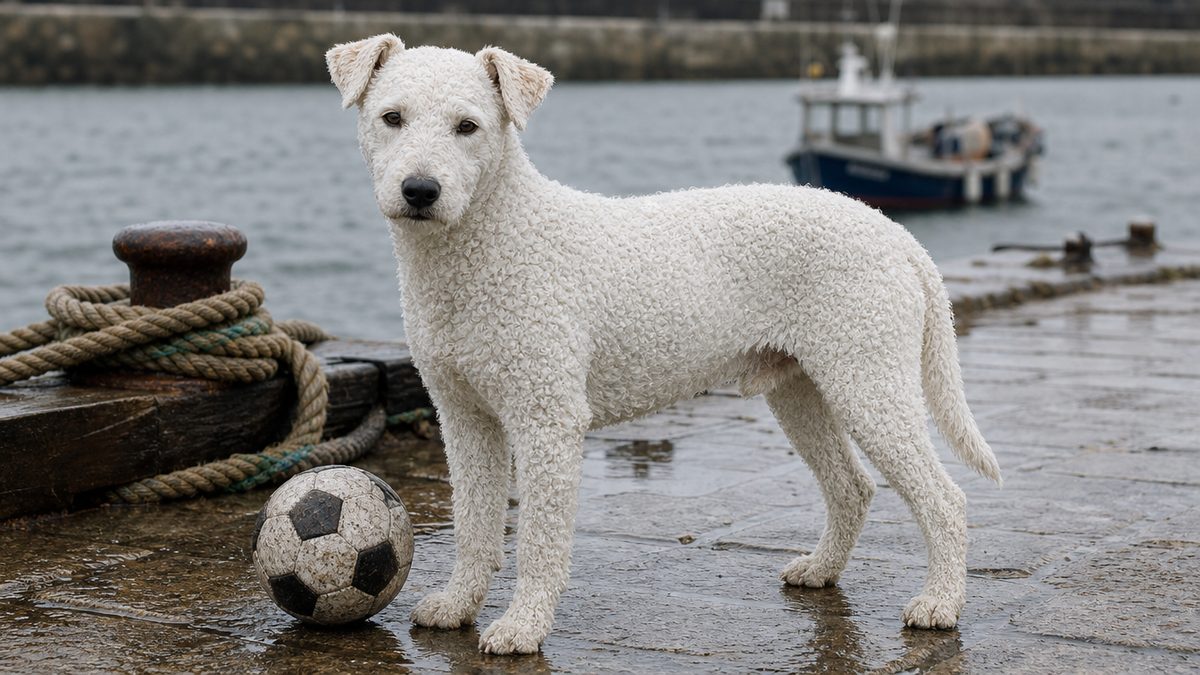
The Cantabrian Water Dog is a small-to-medium, always-white, curly-coated Spanish dog from the fishing ports of the Cantabrian coast, entered on Spain's national list of Spanish canine breeds by ministerial order in February 2012 and recognised by no kennel club anywhere in the world.
Start with what the documents say, because almost nothing written about this breed in English comes from one. The Perro de Agua del Cantabrico is a water dog, in the working sense: it worked from traineras, the rowed inshore boats of the Cantabrian coast, retrieving fish that fell or escaped from the nets, carrying mooring ropes from boat to quay, killing rats aboard, watching the moored vessel in port, spotting surface shoals and going into the sea after men who had fallen in. A fishermen's guild account from Llanes records that the dog took a share of the daily catch alongside each fisherman, and that the youngest crewman or the cabin boy was responsible for looking after it.
The dog is white. That is not decoration. The breed association's own account says the colour is functional, because much of the work happened at night and a white dog stays visible in dark water, and the same page describes the fishermen's clip, cut a lo leon, which cleared hair from around the eyes for underwater vision and off the hindquarters for swimming while leaving the coat long over the thorax to protect the lungs.
The one-line answer to the question everyone actually asks
This is not the Spanish Water Dog and it is not a variety of it. The Federation Cynologique Internationale recognises exactly one Spanish entry in Group 8, Section 3, Water Dogs, and that entry is the Perro de Agua Espanol, number 336, valid from 1 October 2019. The Cantabrian dog is nowhere in that section, and its own breed standard is published by a private association in Santander rather than by any kennel club. A single genetic study exists, and it places the Cantabrian population exactly as far from the Spanish Water Dog as from the Barbet and the Poodle Mendez, S., Dunner, S., Garcia, J.A..
| Measure | Cantabrian Water Dog | Spanish Water Dog (FCI 336) |
|---|---|---|
| Males, height at withers | 42-45 cm | 44-50 cm, 2 cm tolerance |
| Females, height at withers | 40-43 cm | 40-46 cm, 2 cm tolerance |
| Males, weight | 15-17 kg | 18-22 kg |
| Females, weight | 12-14 kg | 14-18 kg |
| Colour | White only | White, black or chestnut solid; white bicolours |
| Ears | High set, semi-erect in action | Set at medium height, triangular, drooping |
| Tail | Natural; taillessness disqualifies | Docking at the 2nd to 4th caudal vertebra |
| FCI status | Not recognised | Group 8, Section 3, number 336 |
Those columns come from two documents you can open. The Cantabrian figures are the association standard's; the Spanish Water Dog figures are FCI-Standard 336 and the identical Spanish text printed inside Real Decreto 558/2001Real Decreto 558/2001, de 25 de mayo. The weight ranges do not overlap at all in males, and overlap at exactly one value, 14 kg, in females.
Searched from India on 25 August 2026, Google's AI Overview for cantabrian water dog answers with a Spanish Water Dog profile assembled from the American Kennel Club, PDSA, Wisdom Panel, BorrowMyDoggy, Reddit and two YouTube videos, none of which mentions this breed. Three of the four People Also Ask questions on that page are about the Spanish Water Dog or about Indian dog prices.
For an Indian reader the practical position is short. No lawful route exists to buy one here, the price in india does not exist as a number, and the traits that make this a hardy dog on a wet northern coast are the same traits that make it a difficult dog in Chennai or Kochi. The rest of this page works through the evidence for each of those claims, in order, from the gazette to the climate data.
Perro de lanas, merlucero, txurikos: what the names tell you
The breed carries at least four names in circulation, and the oldest of them, perro de lanas or wool dog, is the one that appears in nineteenth-century Spanish literature, long before anybody proposed it as a breed.
Read the names in order of age. Perro de lanas, wool dog, is what the Cantabrian ports called the animal until well into the twentieth century, and the breed's own historians use that name for every pre-modern reference. Jose Maria de Pereda, born in Polanco in 1833, published Sotileza in 1885 out of his memories of Santander's fishing quarter, and the association quotes his line about a boy who seemed to be of the nature of the perros de lanas, because the moment he saw the sea he looked for a pretext to throw himself into it.
The 2011 government-commissioned report lists the literary appearances year by year, and the list is longer than a rare breed usually manages. It runs from Pereda's De tal palo, tal astilla in 1880 through Emilia Pardo Bazan's La Tribuna in 1883, Benito Perez Galdos's Lo prohibido in 1884, Leopoldo Alas Clarin's La Regenta in 1884-1885, Sotileza in 1885, Fortunata y Jacinta in 1886-1887 and on to Pio Baroja's El Laberinto de las sirenas in 1923.
Merlucero, and the name nobody outside the Basque Country reports
Merlucero means hake dog, from merluza, and it is the name English pages copy from Wikipedia without explanation. It records the fishery the dog worked in rather than anything about the dog. The name English pages do not carry is Txurikos, the whites, which the association's standard gives as the Basque Country's name for the breed. That single word is a useful reminder that the population was never confined to the modern autonomous community of Cantabria: the Spanish Wikipedia article and the association both describe it as running along the coast from eastern Asturias to western BizkaiaAsociacion Perro de Agua del Cantabrico.
The club president makes the same point in a 2023 interview, saying the dog was named for the Cantabrian Sea rather than for the region of Cantabria, and pointing to a monument in Bermeo in Bizkaia and to Asturian paintings as evidence that the animal belongs to the whole northern coast.
- Perro de lanas: the historic name, used in Spanish literature from at least 1880.
- Perro de agua del Cantabrico: the administrative name, used by the 2012 ministerial order.
- Merlucero: hake dog, a fishery nickname carried by English pages without a source.
- Txurikos: the whites, the Basque name, recorded in the association standard and in no English page.
A breed with four names and no kennel club is exactly the kind of dog an Indian listing site will invent a page for. If you ever see any of these four names on an Indian site, the name is the only real thing on the page. There is no verified Cantabrian Water Dog in India to attach it to.
One dated artefact is worth knowing, because it is the earliest photograph the association itself publishes. Its homepage credits a picture taken by Julio Duque and published in the newspaper ABC on 15 August 1920. The government report adds an early twentieth-century photograph of the dogs at the Machina La Monja in the port of Santander and a mural painted in 1960 in the plenary chamber of Santander's town hallAsociacion Amigos del Perro de Agua del….
The breed standard in numbers
The governing text is the Asociacion Perro de Agua del Cantabrico's own standard, and it sets males at 42-45 cm and 15-17 kg, females at 40-43 cm and 12-14 kg, with white the only permitted colour.
Take the numbers from the standard itself rather than from any breed page. The association's published text gives height at the withers as 42 to 45 cm for males and 40 to 43 cm for females, and weight as 15 to 17 kg for males and 12 to 14 kg for females. It then sets hard limits: a male above 47 cm or below 40 cm is disqualified, and a female above 45 cm or below 38 cm is disqualified.
Those are the physical characteristics the breed is judged on, and they are the figures every ranking page gets wrong. Keep them beside you for the rest of this page, because three separate sections turn on whether a printed number matches this text or the Spanish Water Dog'sFederation Cynologique Internationale.
| Clause | Males | Females |
|---|---|---|
| Ideal height at withers | 42-45 cm | 40-43 cm |
| Disqualifying height | over 47 cm or under 40 cm | over 45 cm or under 38 cm |
| Weight | 15-17 kg | 12-14 kg |
| Bicostal diameter | 17-20 cm | 16-19 cm |
| Head length, guide figure | about 20 cm nose to occiput | in proportion to body |
The proportions are stated as ratios rather than as measurements, which makes them checkable against a photograph. Body length must not exceed height at the withers by more than 10 percent. Chest depth is about 50 percent of height at the withers. Face to skull is 1:1, skull length to skull width is 1:1, head length to muzzle length is 2:1, and height to neck length is 5:2.
Coat, colour and the 15 percent rule
The coat is described as tight curls of the same length on the head and ears as on the body, over an abundant undercoat, with both the outer layer and especially the inner layer waterproof. The standard warns that as the coat grows it forms plates of hair, so a loose coat has to be kept fairly short. That is a double coat doing a specific job, and it is the single most important physical fact for any Indian owner.
Colour is white, with the nose, mouth and eyelids black or brown. Sand-coloured markings are tolerated on the ears and around the eye provided they do not exceed 15 percent of the size of the head; sand markings on the body or limbs are a disqualifying fault. So the flat claim that the dog is white is very nearly right, but the standard is more precise than the English pages that repeat it.
- Disqualifying: blue eyes, albinism, sand markings on body or limbs, taillessness, a smooth coat, dewclaws on the limbs.
- Disqualifying: pronounced over- or undershot bite, badly fitting jaws, monorchidism, cryptorchidism, several missing teeth.
- Serious fault: unpigmented nose or mucous membranes, incorrect ear set, incomplete dentition, incorrect limb alignment.
- Required: complete dentition, a regular scissor bite, well developed interdigital webbing, white nails.
The standard disqualifies dewclaws on the limbs and it disqualifies taillessness. In India, removing a dewclaw to satisfy the first would be prohibited: Second Schedule Part II paragraph 6(8) of the Prevention of Cruelty to Animals (Dog Breeding and Marketing) Rules 2017 forbids any other kind of mutilation of any body part of the pup and any change of appearance by artificial means. The second clause is the opposite of the Spanish Water Dog's, which requires docking.
One number is missing from the standard and from every association document: there is no life expectancy figure anywhere in it. Two ranking pages print 12 to 14 yearsDogPack Blog, Cantabrian Water Dog. Neither cites anything for it, and Animalia's only listed reference is the English Wikipedia article, which contains no lifespan at allWikipedia, Cantabrian Water Dog.
Exactly what recognition this breed holds, and from whom
The Cantabrian Water Dog holds one thing and one thing only: a line in the annex of Real Decreto 558/2001 listing the Spanish canine breeds, added by Orden AAA/251/2012 of 9 February 2012, published in the Boletin Oficial del Estado on 15 February 2012.
Open the order and the sequence becomes exact. Orden AAA/251/2012, signed by Miguel Arias Canete on 9 February 2012, appears in Boletin Oficial del Estado number 39 of Wednesday 15 February 2012, at pages 13452 to 13455, under reference BOE-A-2012-2254. Its Articulo segundo reads, in full, that there is incorporated into the annex of Real Decreto 558/2001 the Spanish pure canine breed Perro de Agua del Cantabrico. Its single final provision states that the order enters into force the day after publication, which is 16 February 2012.
The order's own preamble dates the decision behind it. It records that the proposal to include this breed was reported on favourably by the Comision Nacional de Coordinacion at its meeting of 24 March 2011. The ministry's annual report for 2011 says the same thing in different words, noting that the Comision held three meetings that year and that it also approved the canine breed Perro de Agua del Cantabrico for inclusion in the list of Spanish canine breeds.
| Date | What it actually is | Who says it |
|---|---|---|
| 22 March 2011 | The date the newspaper gave for the committee decision | El Diario Montanes, copied by Spanish Wikipedia |
| 24 March 2011 | The Comision Nacional de Coordinacion meeting that reported favourably | The order's own preamble |
| 9 February 2012 | The date the order was signed by Arias Canete | Boletin Oficial del Estado |
| 15 February 2012 | The date the order was published | Boletin Oficial del Estado |
| 16 February 2012 | Entry into force, the day after publication | The order, and the breed association's own banner |
The two-day gap is worth naming because it has travelled. El Diario Montanes reported on 1 May 2011 that the breed could be considered independent since last 22 March. Spanish Wikipedia carries 22 March 2011 to this day and cites that article for it. Animalia, ranking second in India, repeats 22 March 2011 in English. The gazette says 24 March 2011, and the gazette is the record of the meeting.
The committee's name changed, which is why the sources disagree about who decided
Both Wikipedias credit the decision to the Comite de Razas of the Ministerio de Medio Ambiente y Medio Rural y MarinoWikipedia, Perro de agua del Cantabrico. The order explains why that is half right. Under the third final provision of Real Decreto 2129/2008, references made in Real Decreto 558/2001 to the Comite de Razas de Ganado de Espana are understood as made to the Comision Nacional de Coordinacion created by that later decree. So the body that acted in March 2011 was legally the Comision, constituted in 2009, wearing an older name in the press.
What the association itself claims, and why it is right
Every page on the breed club's site carries the banner Raza reconocida oficialmente el 16 de febrero de 2012, recognised officially on 16 February 2012Asociacion Perro de Agua del Cantabrico. That is neither the signature date nor the publication date, and at first glance it looks like a fifth wrong answer. It is not. It is the date the order took effect under its own final provision, and it is the most defensible single date of the five.
Because the breed sits in the annex of Real Decreto 558/2001, a breeders' association can be officially recognised to keep its studbook. One is. Spain's ARCA register of officially recognised pure-breed dog breeders' associations, updated 6 October 2025, lists the Asociacion Amigos del Perro de Agua del Cantabrico against the breed PERRO DE AGUA DEL CANTABRICO, with the Gobierno de Cantabria as competent authority. That is a real, checkable status, and it is the whole of the breed's official standing.
What the 2012 order did not do
The same order that put this breed on the list of Spanish canine breeds also replaced Spain's Catalogo Oficial de Razas de Ganado in full, and the replacement text prints no dogs at all, so the breed is not in the livestock catalogue and never was.
Read Orden AAA/251/2012 to the end and it does three separate jobs. Articulo primero replaces Anexo I of Real Decreto 2129/2008, the Catalogo Oficial de Razas de Ganado de Espana, with a new text printed inside the order. Articulo segundo adds this breed to the annex of Real Decreto 558/2001. Articulo tercero adds a horse code and reclassifies a cattle breed in a third decree.
Now read the replacement Catalogo the order prints. Its razas autoctonas de fomento cover cattle, sheep, goats, pigs, horses and poultry. Its razas autoctonas en peligro de extincion cover the same species plus donkeys, and its eighth heading, otras especies, contains exactly one entry, the Camello Canario. There is no canine species heading anywhere in the Catalogo. Dogs are handled under Real Decreto 558/2001 and not under the livestock programme at all.
The Cantabrian Water Dog is not classified as a raza autoctona en peligro de extincion in Spain's official livestock catalogue, because that catalogue has no dogs in it. Its status is inclusion in a list of Spanish canine breeds, which opens the door to an officially recognised breeders' association and a studbook. Those are different things, and the difference decides what public money and what legal protections attach.
The annex prints breed standards for 26 breeds and prints none for this one
This is the sharpest fact in the whole recognition question and no page reports it. The consolidated text of Real Decreto 558/2001, last modified 27 July 2020, has an annex headed RAZAS CANINAS ESPANOLAS. That annex opens with an alphabetical list of 33 Spanish canine breeds, and Perro de Agua del Cantabrico is the twentieth of them, sitting between Perdiguero de Burgos and Perro de Agua Espanol. The annex then prints full prototipos raciales, breed standards, clause by clause, for 26 of those breeds, from the Ca de Bestiar at page 8 to the Ca Me Mallorqui at page 71.
The Cantabrian Water Dog is not among the 26. The decree that lists it prints no standard for it. By contrast the Can de Palleiro has its prototype printed at page 59 and the Ca Me Mallorqui at page 71. So the control works: the document does print standards for other regional Spanish breeds admitted at other dates, and simply has none for this one.
- Listed: yes, as one of 33 Spanish canine breeds in the annex of Real Decreto 558/2001.
- Standard printed in the Real Decreto: no, unlike 26 of the other breeds on the same list.
- In the Catalogo Oficial de Razas de Ganado de Espana: no, and no dog is.
- Officially recognised breeders' association: yes, one, competent authority Gobierno de Cantabria.
There is a typographic tell in the annex worth a sentence, because it is the kind of thing that shows a document was edited rather than written. Every one of the other 32 entries in that alphabetical list ends with a full stop. The line Perro de Agua del Cantabrico does not. That is exactly what an insertion made eleven years after the original text looks like.
Where the standard actually lives
The Real Sociedad Canina de Espana tells readers that the breed prototypes for the breeds in its Otras razas block can be consulted in the official bulletins of the corresponding autonomous communities. For this breed, no such publication could be found. A site-restricted search of boc.cantabria.es for the breed name returned nothing, while the same operator on the same host in the same session returned six results for perro and six for ganaderia raza autoctona, including Cantabria's own native-breed aid schemes and its classification of the Pasiega cattle breed. The search works; the document does not surface. The club president told a Spanish magazine in 2023 that the standard was recognised in 2011 and is in the possession of the Cantabrian government, which is a description of a document held rather than gazetted. The text this page quotes throughout is the association's own, published on its own website.
Where the Spanish kennel club actually puts this breed
The Real Sociedad Canina de Espana lists the Cantabrian Water Dog under Otras razas, as a breed en fase de recuperacion, and does not place it in Grupo 8 with the Spanish Water Dog or in Grupo 11 with the breeds it recognises but the FCI does not.
Open the RSCE's Razas Espanolas index and count the blocks. Grupo 8, Perros Cobradores de Caza, Perros Levantadores de Caza y Perros de Agua, contains exactly one breed, the Perro de Agua Espanol. Grupo 11 is headed Razas no reconocidas por la FCI and contains eleven: Majorero, Perro de Pastor Vasco, Perro de Pastor Garafiano, Perro Leones de Pastor, Valdueza, Alano Espanol, Podenco Andaluz, Maneto, Podenco Valenciano, Pachon Navarro and Ca Me Mallorqui. The Cantabrian Water Dog is in neither.
It appears further down, under a heading the English internet has never quoted. The block reads that the Spanish breeds detailed below are en fase de recuperacion, in the process of recovery, and lists them by region: GALICIA gives Can de Palleiro, Can Guicho o Quisquelo, Perdigueiro Galego and Podengo Galego; BALEARES gives Ca Rater Mallorqui; ANDALUCIA gives Podenco Paternino; PAIS VASCO gives Villano de las Encartaciones; and CANTABRIA gives Perro de Agua del Cantabrico.
Animalia, ranking second in India for this breed, states that it is recognized by the Royal Canine Society of Spain as a variety of the Spanish Water Dog. The RSCE's own live index, last modified 6 August 2026, says otherwise on every count: not in Grupo 8, not a variety, not in Grupo 11, and filed instead among breeds in recovery whose standards belong to their autonomous communities.
Where the variety claim actually comes from
Something real sits under that wrong sentence, and both a newspaper and a government report record it. In 1992 an application was made to the Real Sociedad Canina de Espana for recognition of the Perro de Agua del Cantabrico as a variety of the Perro de Agua Espanol. It was an application, it was for a variety rather than a breed, and it did not produce recognition. Nineteen years later the argument was won at a different door, in a ministry rather than a kennel club, and as a separate breed rather than as a variety.
The RSCE's own doctrine on what a breed is
The same index carries an essay by Carlos Salas Melero that is unusually blunt about the category this dog occupies. It distinguishes a grupo etnico, a canine population sharing traits fixed by functional selection in a geographical area, from a raza in the modern sense, and states that turning the first into the second requires an agreed standard, individuals registered generation by generation in a studbook, and demonstrated inheritance of the defining characters across at least three generations. It then says plainly that it is not a matter of recovering a breed, but of selecting an ethnic group to create a breed.
That is the RSCE describing its own Otras razas block, and it is the honest frame for this dog. The breed has a written standard and a studbook with a rule requiring three generations of pedigree before a full entry, so it is doing precisely the work the essay describes. It has not finished it.
One more list it is not on
The RSCE publishes a list of Razas Espanolas consideradas vulnerables in force from 1 May 2026 to 30 April 2027, naming 21 breeds including the Alano Espanol, the Pachon Navarro, the Galgo Espanol and the Majorero. Neither the Perro de Agua del Cantabrico nor the Perro de Agua Espanol is on it. Read that carefully rather than as a verdict on security: the vulnerable list carries a concession on DNA testing for initial RSCE registrations, so it is a list of breeds inside the RSCE's registry, and none of the Otras razas breeds appears on itReal Sociedad Canina de Espana.
The FCI has seven water dogs and this is not one of them
The Federation Cynologique Internationale does not recognise the Cantabrian Water Dog, definitively or provisionally, and its Group 8 Section 3 lists seven water-dog breeds from seven countries with exactly one Spanish entry.
Absence is a strong claim, so here is the document it comes from. The FCI's Group 8 page, Retrievers, Flushing Dogs and Water Dogs, sets out Section 3, Water Dogs, country by country. There are seven entries and each names a country, a breed number and a validity date.
| Country | Breed | FCI number | Valid from |
|---|---|---|---|
| France | Barbet (French Water Dog) | 105 | 21 February 2006 |
| Ireland | Irish Water Spaniel | 124 | 13 March 2001 |
| Italy | Lagotto Romagnolo (Romagna Water Dog) | 298 | 30 September 2019 |
| Portugal | Cao de Agua Portugues | 37 | 4 November 2008 |
| Spain | Perro de Agua Espanol | 336 | 1 October 2019 |
| Netherlands | Wetterhoun | 221 | 8 June 2023 |
| United States | American Water Spaniel | 301 | 14 February 1995 |
Spain has one line in that table, and it is the Perro de Agua Espanol. There is no second Spanish entry and no Cantabrian entry anywhere in Group 8. The control that makes the absence mean something is the table itself: it is populated, correctly formatted, and it does list small national water dogs from six other countries, including breeds admitted as recently as 2023. It simply has no Cantabrian Water Dog.
What that closes off for an Indian buyer
India's national kennel club is an FCI member, and the FCI publishes its registration statistics year by year. Those figures show a working registry: 33,880 pure-bred dogs entered in the Indian studbook in 2025, 7,412 litters, 28 FCI judges, 80 member clubs and 1,425,001 dogs registered since the studbook began. They also show a steep contraction, from 89,571 registrations in 2021 to 33,880 in 2025, a fall of 62 percent in four years.
None of that machinery can be used for this dog. An Indian registry that works inside the FCI nomenclature has no entry to make for a breed that is not in the nomenclature, no judge qualified in it and no show class for it. That is not an obstacle a determined buyer can work around. It is the absence of a route.
Two rows in that same FCI table are not usable. The approximate total number of dogs in India is given as 157,500,000 in 2017 and 15,794,584 in 2018, a tenfold discontinuity that is a change in how the figure was reported rather than a change in the dog population. The dog-owner row drops from 68,628,500 to 38,128,500 between 2024 and 2025 in the same way. The studbook rows are internally consistent and are the ones this page uses.
One comparison is worth drawing. The Barbet, which the Cantabrian population's own scientists name as its likely common ancestor, took until 2006 to reach definitive FCI status, and the Wetterhoun until 2023Mendez, S., Dunner, S., Garcia, J.A.. Recognition of a small national water dog is slow but not impossible. This breed has not begun that process at international level.
Diffing the two standards: the head is where they part
Set the association's standard beside FCI-Standard 336 clause by clause and the head separates the two dogs more sharply than the size does, because three head clauses are direct opposites rather than differences of degree.
Work through the head from the back forwards. On the skull, the Cantabrian standard says ligeramente abombado, slightly domed, with the external occipital protuberance marked. FCI-336 says the Spanish Water Dog's skull is flat with only a slightly marked occipital crest, and the Spanish text inside Real Decreto 558/2001 says the same thing in the same wordsReal Decreto 558/2001, de 25 de mayo. Those are not two descriptions of one head.
On overall profile, the Cantabrian standard calls the dog subconvexilineo with a tendency to rectilinear; FCI-336 calls the Spanish Water Dog's profile rectilinear without qualificationFederation Cynologique Internationale. The government report puts the occipital difference plainly: very marked in the Cantabrian, little marked in the Spanish.
The ears are the checkable difference
This is the clause a photograph can settle. The Cantabrian standard requires ears with a high insertion, very mobile and semi-erect in action, not passing much beyond the lacrimal, the inner corner of the eye. FCI-336 requires ears set at medium height, triangular and drooping. The 2011 report measures the gap: the Cantabrian ear reaches the lacrimal, the Spanish ear is longer and reaches to within 3 to 4 cm of the nose, and the Cantabrian ear sits higher and further back where the Spanish sits at eye level.
| Clause | Cantabrian Water Dog | Spanish Water Dog (FCI 336) |
|---|---|---|
| Skull | Slightly domed, occipital protuberance marked | Flat, occipital crest only slightly marked |
| Profile | Subconvex tending to rectilinear | Rectilinear |
| Ears | High set, very mobile, semi-erect in action | Set at medium height, triangular, drooping |
| Ear length | Reaches the lacrimal | Reaches 3-4 cm from the nose |
| Iris | Dark chestnut; green tolerated in brown-pigmented dogs | Hazel to chestnut, harmonising with the coat |
| Blue eyes | Disqualifying | Not named |
| Nails | Must be white | Of varied colours |
One ratio, two different sentences, in the same report
The 2011 report states the head ratio twice and words it differently each time. On page 16 it says the relation between skull length and skull width is 1/1 in the Cantabrian and 2/3 in the Spanish. On page 20 the heading reads relation between muzzle length and skull width, again 1:1 against 2/3. The two sentences do not describe the same measurement.
The arithmetic in the report's own Table 1 rescues the Cantabrian figure either way. Across 48 measured dogs the mean skull length is 9.7 cm, the mean skull width 9.1 cm and the mean muzzle length 9.2 cm. Skull length to skull width is 1.07 to 1; muzzle length to skull width is 1.01 to 1. Both round to 1:1, so the Cantabrian claim holds under either reading, and the inconsistency is in the wording rather than the data. Say so rather than quoting one sentence and hiding the other.
The two official texts of the Spanish Water Dog standard do not agree on that ratio either. The Spanish text printed in Real Decreto 558/2001 reads longitud del hocico / longitud de la cabeza = 2/3, muzzle length over head length. The FCI's English translation of the same standard reads length of muzzle / length of skull = 2/3. Head and skull are not the same measurement, and a judge working from the English text is applying a different proportion from one working from the Spanish.
Diffing the two standards: the foot, the coat and the tail
Below the neck the two standards diverge on three things that matter functionally: the Cantabrian foot spreads further when it swims, its coat does not cord, and its tail must be left alone where the Spanish Water Dog's must be cut.
The foot is the most interesting measurement in the whole file, and no English page has ever reported it. The 2011 government report measured how much the surface area of the foot increases when the toes spread for swimming, and gave four figures: the Cantabrian front foot increases by 67.21 percent and the hind foot by 68.01 percent, against the Spanish Water Dog's 62.61 percent and 55.60 percent.
Read the hind-foot pair again, because that is where the gap is. 68.01 against 55.60 is a difference of 12.41 percentage points, and the Cantabrian's hind-foot spread is 1.22 times the Spanish dog's. For a dog whose recorded job was to swim out to a man in the water, that is the kind of difference that would show. The Cantabrian standard requires webbed feet, membranas interdigitales bien desarrolladas, and every one of the 48 dogs measured had webbing running to the ends of the toesMendez, S., Dunner, S. et al., Historia.
The coat: cords or no cords
FCI-336 says the Spanish Water Dog's hair is always curly and woolly, curly when short, and can form cords when long, with clipping admitted and a recommended show maximum of 12 cm. The 2011 report sets the Cantabrian against exactly that clause: it has an abundant undercoat and does not form cords when long. The association standard describes the same thing from the other side, warning that as the coat grows it forms plates of hair, so keeping a loose coat means keeping it short.
That distinction is the practical one for a curly coat in a hot country. A coat that cords is a coat you can leave in ropes. A coat that mats into plates is a coat you have to clip.
The tail, and the one clause Indian law reverses
This is the sharpest legal difference between the two breeds. FCI-336 says of the Spanish Water Dog's tail: set at medium height, docking must be done at the height of the 2nd to the 4th caudal vertebra. The Spanish text inside Real Decreto 558/2001 says the same, la cola debe amputarse de la segunda a la cuarta vertebra coxigea. Both note that some individuals are born with a naturally shortened tail.
The Cantabrian standard requires the opposite. The tail is medium set, carried gaily, covered with the same curls as the body, carried low at rest, reaching comfortably to the hocks and elbowed at its midpoint, and the text states flatly that tailless dogs are not admitted, with anurism listed among the disqualifying faults.
Second Schedule Part II paragraph 6(8) of the Prevention of Cruelty to Animals (Dog Breeding and Marketing) Rules 2017 states that there shall be no tail docking, ear cropping, de-barking, de-clawing, branding, dyeing, injecting substances to enhance visual appeal, performing a surgery or procedure to camouflage or hide any defect or infirmity or any other kind of mutilation of any body part of the pup, and that any change of appearance by artificial means is strictly forbidden. An Indian breeder following FCI-336 to the letter would be breaking that rule. The Cantabrian standard raises no such conflict, because it demands the tail be left alone.
The pages ranking for this breed in India get the tail wrong in both directions. DogZone describes an in-between length tail carried high and slightly curved. DogPack says tails are typically left natural, which is right, but pairs it with a weight range of 40 to 50 pounds, 18 to 23 kg, that is the Spanish Water Dog's and not this dog's. When a page has one clause from each standard, it is describing neither dog.
What the one genetic study actually found
One genetic study of this breed exists, Mendez et al. 2011, and it found a clear genetic differentiation of the Cantabrian population from every other water dog tested at a mean FST of 0.13, while placing it exactly as far from the Spanish Water Dog as from the Barbet and the Poodle.
The design is small and it is stated openly. Twenty-one microsatellite markers from the International Society of Animal Genetics panel were typed on 21 randomly chosen Cantabrian dogs and on 108 dogs of five related breeds: the Spanish Water Dog, the Portuguese Water Dog, the Barbet, the Caniche and the Lagotto Romagnolo. The five comparison samples were 27, 14, 20, 24 and 23 dogs, which sum to 108, and the whole panel to 129. The Barbet, Caniche and Romagnol genotypes came from Gregoire Leroy's doctoral work; the two Iberian breeds came from the Complutense's own genetics service.
| Population | Dogs | Expected heterozygosity | Observed heterozygosity | Alleles per locus | FIS |
|---|---|---|---|---|---|
| Perro de Agua del Cantabrico | 21 | 0.68 | 0.71 | 5.7 | -0.02, not different from 0 |
| Perro de Agua Espanol | 27 | 0.72 | 0.65 | 6.0 | 0.07 |
| Perro de Agua Portugues | 14 | 0.65 | 0.60 | 4.8 | 0.09 |
| Barbet | 20 | 0.70 | 0.72 | 5.4 | -0.03, not different from 0 |
| Caniche | 24 | 0.72 | 0.60 | 6.0 | 0.18 |
| Perro de Agua Romagnol | 23 | 0.65 | 0.67 | 5.2 | -0.02, not different from 0 |
Three of the six populations came out apparently in Hardy-Weinberg equilibrium, and the Cantabrian is one of them, alongside the Barbet and the Romagnol. The other three showed significant inbreeding, which the authors attribute to genetic subdivision within those breeds. So on this evidence the Cantabrian population's genetic diversity is not the weak point a reader would expect from a small, geographically confined dog: its observed heterozygosity of 0.71 is the highest of the six after the Barbet's 0.72.
The distance table, and the sentence everyone quotes without the numbers
Global Wright statistics came out at FIT 0.17 with a 95 percent interval of 0.15 to 0.20, FST 0.13 with an interval of 0.11 to 0.15, and FIS 0.05 with an interval of 0.03 to 0.07. Breed identity therefore explains 13 percent of the total genetic diversity measured.
| Comparison | FST | Reading |
|---|---|---|
| Cantabrian vs Spanish Water Dog | 0.12 | Equal-first closest |
| Cantabrian vs Barbet | 0.12 | Equal-first closest |
| Cantabrian vs Caniche | 0.12 | Equal-first closest |
| Cantabrian vs Portuguese Water Dog | 0.13 | Slightly further |
| Cantabrian vs Romagnol | 0.16 | Furthest |
| Barbet vs Caniche | 0.09 | The closest pair in the whole matrix |
| Cantabrian, mean to all others | 0.13 | Same mean as the Spanish Water Dog |
That first block of three identical values is the finding, and it is the reason this page exists. The Cantabrian population is exactly as far from the Spanish Water Dog as it is from a French breed and a French-Belgian breed. The Spanish Water Dog is further from the Barbet, at 0.14, than the Cantabrian is. Every value in the matrix differs from zero at p = 0.01, so the separation is real; the point is that it is not a special separation.
The authors state the conclusion in exactly those terms: the Perro de Agua del Cantabrico appears as far from, or as close to, the Perro de Agua Espanol as it does from the Barbet and the Caniche. English pages paraphrase that sentence and drop the three numbers that make it mean something.
What the genetics does not settle
The study answers whether the Cantabrian population is genetically distinguishable, and it answers yes; it does not answer whether that distinction is of a kind that makes a separate breed, and its own authors say so in the report's closing pages.
Three limits deserve stating, and none of them is a criticism of the data. The first is sample size: 21 dogs from a population then censused at 1,216. The second is who paid. The work was carried out under a collaboration agreement between the Gobierno de Cantabria's Consejeria de Desarrollo Rural, Ganaderia, Pesca y Biodiversidad and the Universidad Complutense de Madrid, and the article states its objective openly: to analyse the population's relative position and degree of genetic isolation in order to look for a possible justification of its official recognition as a canine breedMendez, S., Dunner, S. et al., Historia.
A regional newspaper described the same arrangement from the political end, reporting that the Consejeria had signed an agreement with the Complutense genetics laboratory two years earlier so as to have a scientific study backing the candidacy presented by its own Directorate General of Livestock. The study was commissioned by the party seeking the split. That does not make the FST values wrong. It does mean the reader should see the framing.
The clustering result cuts both ways
The third limit is in the Bayesian clustering, and it is the part nobody reports. When the model is run assuming two ancestral populations, the Cantabrian and the Spanish Water Dog land in the same cluster, both at 0.98, and the report says in plain words that at two origins the Iberian water dogs appear in one group and the remaining breeds in the otherMendez, S., Dunner, S. et al., Historia.
| Assumed clusters | Cantabrian | Spanish Water Dog | Same cluster? |
|---|---|---|---|
| Two | 0.98 in cluster 2 | 0.98 in cluster 2 | Yes |
| Four | 0.97 in cluster 3 | 0.89 in cluster 1 | No |
| Six | 0.89 in cluster 4 | 0.88 in cluster 6 | No |
The report adds that the Romagnol is the first breed to separate, at three clusters, and the Spanish Water Dog the next, at four. So the two Iberian dogs come apart only once you have already asked the model for four or more origins. A reader is entitled to know that the separation is resolution-dependent, and that at the coarsest resolution the two are one thing.
The report's closing section opens by saying that behind the formal recognition of a breed there are objective arguments and others that are less so, and that the difficulty is always how much weight each carries. It then argues the reverse of the usual complaint: that Spain's autonomous communities are often blamed for splitting single breeds, but that the Spanish Water Dog may be a case of the opposite, a single breed assembled from populations of very different origin in which the Cantabrian population's original characters were lost to the dominance of the southern populations.
One more detail sits in the individual-level results and is worth carrying. Of the 21 Cantabrian dogs analysed, exactly one appears to share an important proportion of its genome with the Portuguese population. In a founder pool that small, one animal is nearly five percent of the sample.
Beyond this one study there is nothing. PubMed returns zero records for Perro de Agua del Cantabrico, zero for Cantabrian Water Dog and zero for perro de agua cantabrico, with the query translation recorded for each; in the same session it returned 9 records for Spanish Water Dog, 24 for Lagotto Romagnolo and 1,107 for Labrador Retriever. Europe PMC returned zero, zero and zero for the same three terms and 111, 232 and 5,946 for the same three controls. The controls prove the searches ran. The zero is real.
The 48 dogs that were actually measured, and how far they sit from the standard
Forty-eight Cantabrian Water Dogs were measured on 24 variables for the 2011 report, and the results show a population that matches its standard on colour and feet and departs from it on ears, eyes, noses and bites.
This table is the single richest piece of data on the breed and no English page has used it. The mean height at the withers across 48 dogs was 42.3 cm, 42.8 cm in males and 41.1 cm in females. Mean weight was 15.0 kg, 16.1 kg in males and 12.8 kg in females. Set those against the standard and the male mean sits at the bottom of its own 42 to 45 cm band, while the male mean weight sits in the middle of 15 to 17 kg.
Sex explains a lot of the variation in mass and very little in frame. The report gives the percentage of each character's variability attributable to sex: 41 percent for weight, 31 percent for thoracic girth, 31 percent for wrist circumference, 29 percent for head circumference, 26 percent for skull length, 24 percent for body length and only 13 percent for height at the withers. Croup width came out at zero, meaning no measurable sexual dimorphism at all.
| Character | Measured population | What the standard says |
|---|---|---|
| Coat colour | White, 100 percent | White only |
| Interdigital webbing | To the ends of the toes, 100 percent | Well developed webbing required |
| Nail colour | White, 100 percent | Nails must be white |
| Topline | Level, 100 percent | Straight |
| Ear carriage | Drooping 67 percent, semi-erect 33 percent | High set, semi-erect in action |
| Bite | Scissor 81 percent, prognathism 19 percent | Regular scissor bite required |
| Nose pigment | Brown 57, black 24, unpigmented 19 percent | Black or brown; unpigmented is a serious fault |
| Eye colour | Dark brown 62, honey 24, black 10, blue 5 percent | Dark chestnut; blue eyes disqualify |
| Tail set | Medium 62, low 24, high 14 percent | Medium insertion |
| Croup | Sloping 86 percent, straight 14 percent | Rounded and sloping |
Four rows in that table are the finding. Two thirds of the measured population carried drooping ears where the standard calls for semi-erect ears. Nearly one dog in five carried a bite fault. Nearly one in five carried an unpigmented nose, which the standard lists as a serious fault. One in twenty carried blue eyes, which the standard disqualifies outrightAsociacion Perro de Agua del Cantabrico.
It does not mean the standard is wrong or the dogs are not the breed. It means the standard is a target written for a population that has not yet been selected to it, which is exactly what the Real Sociedad Canina de Espana's own doctrine says happens when an ethnic group is being turned into a breed. Practically, it means a photograph of a Cantabrian Water Dog with drooping ears is not proof of a crossbred dog, and a page that describes drop ears is describing two thirds of the real population while contradicting the written standard.
The exclusion percentages everyone quotes, and the clause that qualifies them
The famous figures are these: measured against the Spanish Water Dog standard, 75 percent of Cantabrian males and 38 percent of females fall outside on height at the withers, and 91 percent of males and 80 percent of females fall outside on weight. Weight is doing the heavy lifting there, and the reason is arithmetic. The Spanish male band is 18 to 22 kg with no tolerance clause, against a Cantabrian male mean of 16.1 kgMendez, S., Dunner, S. et al., Historia.
The height figure deserves one qualification the sources do not give. FCI-336 admits a maximum deviation of 2 cm in both sexes provided the dog stays balanced, which drops the effective male floor to 42 cm and the female floor to 38 cm. Apply the tolerance and the height exclusion softens considerably; apply the standard's printed band alone and it does not. Both readings are defensible from the text, and this page reports the ambiguity rather than picking the more dramatic number.
How many exist, and why the two published figures are not comparable
Two population figures circulate for this breed, 1,216 and about 270, and both are correct because they count different things: 1,216 is a regional chip-registry count from February 2009 and 270 is the number of dogs entered in the breed's own studbook by mid-2023.
The 1,216 figure is a real census with a municipality-by-municipality table behind it, printed in the 2011 government report. It is the count held in the RACIC, the Cantabrian regional animal registry of the Consejeria de Desarrollo Rural, Ganaderia, Pesca y Biodiversidad, in February 2009Mendez, S., Dunner, S. et al., Historia. The table lists 66 municipalities and its printed total is 1216. Summed row by row the 66 entries come to exactly 1,216, so the table is internally consistent.
| Municipality | Dogs | Share of the census |
|---|---|---|
| Santander | 500 | 41.1 percent |
| Torrelavega | 93 | 7.6 percent |
| Camargo | 77 | 6.3 percent |
| Pielagos | 59 | 4.9 percent |
| Santa Cruz de Bezana | 52 | 4.3 percent |
| Santona | 52 | 4.3 percent |
| These six together | 833 | 68.5 percent |
Two things follow from that distribution. The breed is overwhelmingly a city dog now: Santander alone holds 41.1 percent of the census, and six municipalities hold 68.5 percent between them. And the tail is very thin, with 15 of the 66 municipalities holding exactly one dog each. The report describes the distribution as clearly associated with coastal municipalities, which is broadly right but not wholly, since inland Campoo towns such as Reinosa, Valdeolea and Molledo appear in the table too.
The studbook number, and what it is a number of
In June 2023 the club president told a Spanish canine magazine that a little over 270 dogs are entered in the breed's studbook, adding that some have already died and others are past breeding age. That is the LOPAC, the Libro de Origenes del Perro de Agua del Cantabrico, kept by the Asociacion Amigos del Perro de Agua del Cantabrico. It counts pedigree entries since the book opened, not living dogs.
So the two numbers are not a contradiction and neither is a population estimate for 2026. The honest summary is that a regional chip registry held 1,216 animals of this type in February 2009, that a regional newspaper reported the Consejeria's estimate as approximately 1,200 in 2011, and that the breed's own pedigree register had passed 270 entries by mid-2023Jose Luis Perez, Larga vida al perro de…Miguel Pele, De grumete a mascota. No later census has been published.
| Figure | Date | What it counts | Source |
|---|---|---|---|
| 1,216 | February 2009 | Animals in Cantabria's RACIC registry | Consejeria de Desarrollo Rural, via the 2011 report |
| about 1,200 | May 2011 | Consejeria estimate reported in the press | El Diario Montanes |
| more than 270 | June 2023 | Cumulative entries in the LOPAC studbook | Club president, revista LADRIDOS |
| 43 | June 2023 | Members of the breed club | Club president, revista LADRIDOS |
Forty-three members is a very small breed club, and the president's own description of its pace is that they are doing things slowly but, he believes, well. The club runs judge-training courses, a national show at Santona, and has begun developing working tests at sea. It has also asked for a semen bank to preserve the breed in the future, and takes genetic advice from Francisco Javier Canon, the Complutense professor who is the corresponding author of the 2011 studyMendez, S., Dunner, S., Garcia, J.A..
Two exports are on the record. The club reports colonies of its dogs in England and in Catalonia, taken there for temperament because the dogs were used to being constantly among people. Neither is India, and no Indian import has ever been reported by the club, the government or the press.
Cantabrian Water Dog price in India: there is not one, and here is what you get instead
No Cantabrian Water Dog price exists in India because no Cantabrian Water Dog is sold in India, and an India-located search for the breed name plus price returns craft merchandise rather than a single dog listing.
Run the search and read what actually comes back. On 25 August 2026, an India-located search for the breed name plus price india puppy for sale returned ten results and not one of them offered the dog. What it offered was an Etsy India page of Water Dog Christmas merchandise, a needle-felted Spanish Water Dog sculpture, an eBay sticker with item number 315558674119, a printed poster, a litter-registration dropdown on a British registry's website, and two American breed blogs.
The control in the same session settles what a real Indian market looks like. The query labrador retriever price in india puppy returned Mr n Mrs Pet with a city-by-city table quoting INR 30,000 to INR 1,20,000 across Hyderabad, Bangalore, Delhi, Chennai, Lucknow, Mumbai, Jaipur and Pune, a Supertails guide quoting Rs 8,000 to Rs 70,000, a trade listing at Rs 15,000, and three more Indian retailers. The search works. There is simply nothing to find for this breed.
| Item | Price shown | Divided by 84.38 | By 74 | By 80 |
|---|---|---|---|---|
| Water Dog Christmas item, sale price | Rs 236 | 2.80 | 3.19 | 2.95 |
| Same item, original price | Rs 473 | 5.61 | 6.39 | 5.91 |
| Etsy listing carried beside the breed tag | Rs 531 | 6.29 | 7.18 | 6.64 |
| Needle-felted water dog sculpture | Rs 540 | 6.40 | 7.30 | 6.75 |
| Printed breed poster, sale price | Rs 3,527 | 41.80 | 47.66 | 44.09 |
| Same poster, original price | Rs 7,055 | 83.61 | 95.34 | 88.19 |
This site runs three exchange rates over any suspicious rupee figure, because Indian pages routinely publish dollar prices converted at 84.38, at 74 or at a flat 80. Run all three over those six figures and none of them resolves to a round dollar amount. These are genuinely rupee-denominated craft prices from a marketplace's own currency conversion, not a converted dog price list. That is a small finding, but it is the correct one: there is no imported American price list hiding behind these numbers, because there is no price list at all.
Rs 98,999 is a recurring house price point on one Indian listing site, attached to whichever puppy is in stock and printed on pages for breeds that site does not stock at all. It is not a converted dollar figure; it divides to 1,173.25 dollars at 84.38. If you ever see Rs 98,999, or any of its neighbours around Rs 92,599 and Rs 94,999, beside this breed's name, you are looking at a template, not an animal.
How thin the Indian internet on this breed really is
Two counts printed on the search results themselves put a scale on it. Google's own header for the breed name searched from India reads About 173 results, for the entire query. And Dreamstime, ranking tenth, advertises that it holds 7 authentic Cantabrian Water Dog stock photos. A breed with a three-figure global index and seven stock photographs does not have an Indian retail market waiting to be discovered. A third signal is the state of the ranking set itself: the Dog Scanner breed page that ranks for the Spanish-language query returns HTTP 404, Page not found, on its English edition.
A tighter search shape confirms it. The query combining the breed name with India, puppies, price and four Indian listing-site names returned zero results, while the identical query with Labrador Retriever substituted returned the Mr n Mrs Pet marketplaceMr n Mrs Pet, Labrador Retriever Puppies…. Zero with a working control is evidence. Zero on its own would not be.
So the answer to what a Cantabrian Water Dog costs in India is that the question has no answer, and the reason is not scarcity of information. It is the import law, which the next section sets out, combined with the absence of any registry that could paper a pedigree here.
The only lawful way this dog reaches India
One route exists and it is narrow: a Cantabrian Water Dog can enter India only as the personal pet of the person importing it, with a valid pet book in that person's own name, and any application made for breeding or trading purposes is rejected outright.
The governing text is Trade Notice No. 22/2022-23 of the Directorate General of Foreign Trade, dated 19 December 2022 and addressed to all international airlines, all Indian embassies and consulates abroad, and pet owners. It sets out the import policy for ITC (HS) 01061900, Mammals: Other, which covers pet cats and dogs. The policy is Restricted.
Policy Condition (7) allows the import of dogs for exactly three purposes: a pet dog with a valid pet book and relevant records in the name of the importer; dogs imported by research and development organisations with a recommendation from the Committee for the Purpose of Control and Supervision of Experiments on Animals; and dogs for internal security by the Defence and Police Force. Policy Condition (8) adds that the import of commercial dogs for breeding or any other commercial activity outside those purposes is not permitted.
Paragraph 6 of the trade notice is the sentence that closes the market. Any application for trading or breeding purposes, or made on behalf of another person or entity, shall be duly rejected.
- Establish that the dog is your own pet, with a pet book and records in your own name, and not somebody else's animal you are fetching.
- Check the two-year rule: import as passenger baggage without DGFT authorisation is available only to a person transferring residence to India after two years of continuous stay abroad, for up to two pets, under CBIC Circular No. 15/2013-Customs of 8 April 2013.
- Apply for DGFT import authorisation if the stay abroad was under two years, if the pet is not travelling as baggage, or if the baggage rules do not otherwise apply.
- Start at least two months before travel, which is the notice's own recommendation.
- Obtain an Advance No Objection Certificate from the Regional or Quarantine Officer of the entry port, submitting the DGFT licence and the exporting country vet's health certificate.
- Enter through one of seven ports only: Delhi, Mumbai, Chennai, Hyderabad, Bengaluru, Kolkata or, since October 2024, Kochi, with quarantine at the government station where required.
That list is the whole route, and it is drawn line by line from the notice. It is a route for one family moving one dog. It is not a supply chain, and it cannot become one, because the clause that would allow a supply chain is the clause that says such applications are rejected.
Combine the import position with the registry position and the conclusion is not that the breed is hard to get in India. It is that no lawful route to a supply exists. Breeding imports are refused by the DGFT, and there is no Indian pedigree register that could enrol the breed, because the Kennel Club of India works inside an FCI nomenclature that does not contain itFederation Cynologique Internationale. Anything offered to you in India under this name is therefore something else.
What you would be joining at the Spanish end
Even the lawful route runs into a small supply. The breed club had 43 members in 2023 and reports that it cannot keep up with requests for puppies, all of them for companion homes. Litters are inspected by an appointed litter inspector within thirty days of birth, and a litter reared in inadequate conditions is not registered at all. A buyer in India would be applying, from outside the European Union, to a club that already has a waiting list at home.
The breed club's own rules against Indian breeding law
Five of the Cantabrian club's breeding rules would be unlawful in India, and the widest gap is artificial insemination, which the club permits and is building a semen bank around, and which India's 2017 Rules prohibit outright.
This comparison has never been made and it decides whether an Indian household could ever register or breed this dog lawfully here. The Asociacion Amigos del Perro de Agua del Cantabrico published its Reglamento de cria and its LOPAC studbook regulation on 20 March 2012, ratified by its general assembly on 18 June 2012Asociacion Amigos del Perro de Agua del…. India's Prevention of Cruelty to Animals (Dog Breeding and Marketing) Rules 2017 were notified as G.S.R. 496(E) on 23 May 2017. Set them side by side.
| Question | APAC rule | Indian 2017 Rules | Conflict? |
|---|---|---|---|
| Minimum age of the sire | Nine months at mating | Eighteenth month, Second Schedule Part II para 5(7) | Yes |
| Minimum age of the dam | Twelve months at mating | Eighteenth month, para 5(2) | Yes |
| Maximum age of the dam | Under ten years | Not mated after eight years, para 6(4) | Yes |
| Interval between litters | Four months since the last whelping | Twelve months, one litter a year, paras 5(4) and 5(5) | Yes |
| Artificial insemination | Permitted, with certification; frozen semen allowed | Prohibited, para 5(5) | Yes |
| Lifetime litters | Not limited | Five, para 5(6) | Stricter in India |
| Consanguinity | First and second degree prohibited | To the 4th grade within four generations, para 6(3) | Stricter in India |
| Docking or cropping | Not permitted; taillessness disqualifies | Strictly forbidden, para 6(8) | No |
Read the artificial insemination row twice, because it is the one that matters most. Second Schedule Part II paragraph 5(5) of the Indian Rules states that only one litter shall be produced in one year and that artificial or unnatural techniques such as artificial insemination and rape stands shall not be used to impregnate dogs. The Spanish club's regulation devotes a full clause to artificial insemination, permits it where it improves the health of the breed or preserves or increases the gene pool, sets a frozen-semen donor age limit of under eleven years, and the club has formally asked for a semen bank to preserve the breedAsociacion Amigos del Perro de Agua del…Miguel Pele, De grumete a mascota.
For a breed with a few hundred registered animals, frozen semen is the standard way of holding open a narrow gene pool. An Indian breeder cannot use it. That is not a technicality: it means the single most important conservation instrument in this breed's plan is unavailable in India, and it is one more reason no lawful Indian population of this dog can form.
The litter-frequency rows compound the same problem. The club's only spacing rule is that a litter is not registered if the dam's previous whelping was less than four months earlier, unless maternity DNA testing proves both litters are hers. Indian law requires twelve months between whelpings, permits only one litter a year, forbids litters in two consecutive breeding seasons and caps a bitch at five litters in her lifetime. A Spanish breeding plan transplanted unaltered would breach three of those four.
Inbreeding and screening: where India is stricter than the breed club
Indian law reaches further than the Cantabrian club on inbreeding and demands one health test the club has never required, so a mating that clears the Spanish rulebook can still be unlawful here.
Start with consanguinity, because this is the rare case where a rare breed's club is close to Indian law rather than in conflict with it. The club prohibits matings between dogs related in the first or second degree outright, and refuses a breeding certificate to any dog carrying 1-1, 1-2, 2-1 or 2-2 consanguinity in its pedigree. That is a real rule with a registration consequence attached, and it is more than several parent clubs of rarer breeds manage.
Indian law still reaches further. Second Schedule Part II paragraph 6 lists four breeding techniques and permits two. Out breeding, the mating of dogs not at all related, and line breeding, mating between dogs marginally related and chosen for particular attributes, are allowed. In breeding and incest breeding are prohibited. In breeding is defined as breeding between relatives of the 2nd to 4th grade in straight or side line within the first four generations, and the Rules name the examples: uncle to niece, nephew to aunt, cousin to cousin, grandparents to grandchildren. Incest breeding is mating between parents and children or between brother and sister.
That prohibition lives in the Second Schedule Part II paragraph 6(3), not in a Rule 6. The Rules' own Rule 6 is a different provision about the requirements breeders and establishments must meet; what it does is make the Second Schedule binding. Anyone who looks up Rule 6(3) expecting the inbreeding clause will not find it there.
The screening bar, and the test India adds
The club's health bar for breeding is specific and it is enforced through the pedigree rather than through advice. A dog must be officially diagnosed free of hip and elbow dysplasia, hold at least two Excellent gradings in the Young, Open or Veteran classes at club monographic shows, and be twelve months old before a certificate as recommended or fit for breeding is issued. Mild dysplasia, grade C, is the ceiling for a breeding animal; a C dog may be mated only to an A or a B; D and E dogs are not used.
The certificate is refused outright to dogs with severe or moderate hip or elbow dysplasia, to monorchid or cryptorchid dogs, to dogs with blue eyes, to dogs whose teeth are unmistakably crowded or displaced by two millimetres or more, and to dogs with caries or a listed pattern of missing teeth. The breeding regulation adds progressive retinal atrophy, epilepsy, congenital deafness or blindness, cleft palate, harelip and albinism to the exclusions, and bars dog dealers and high-volume producers from breeding under club patronage at all.
| Condition | Named by the club | Named by India's Part III para 8(10) |
|---|---|---|
| Hip dysplasia | Yes, graded A to E | Yes |
| Progressive retinal atrophy | Yes, excluded from breeding | Yes |
| Elbow dysplasia | Yes, must be clear | Not named |
| Hypothyroidism | Not named | Yes |
| Night blindness | Not named | Yes |
| Entropion and ectropion | Not named | Yes |
| Overshot or undershot jaw, wry mouth | Yes, as a fault | Yes |
| Two or more missing teeth | Yes, with a listed pattern | Yes |
| Cryptorchidism | Yes | Yes |
Hypothyroidism is the row to note. India names it in the mandatory testing clause; the club names it nowhereAsociacion Amigos del Perro de Agua del…Asociacion Amigos del Perro de Agua del…. Any Indian breeder would have to add a thyroid panel that the Spanish programme has never asked for, and would have no breed baseline to read the result against, because no thyroid data for this breed exists anywhereNCBI PubMed E-utilities esearch….
One last provision cuts against the whole idea of developing the breed abroad. Second Schedule Part II paragraph 6(9) states that breeding to create new breeds of dogs or unusual looks shall be strictly prohibited. A breed still being screened and selected towards its own written standard, as the Real Sociedad Canina de Espana describes this one, is doing exactly the work that clause was written to stop happening in India.
Cost of ownership, honestly bounded
No Indian cost figure exists for this breed because no Indian dog exists to cost, so the only honest approach is to take a published Indian cost structure for a comparable dog and adjust the lines that body weight and coat type actually change.
Start with what can be cited. An Indian pet retailer's 2026 cost guide for the Labrador Retriever puts routine monthly upkeep at Rs 6,000 to Rs 12,000 and total first-year cost at Rs 79,000 to Rs 1,76,000, itemising food at Rs 2,500 to Rs 5,000 a month, grooming at Rs 500 to Rs 1,500 a month, routine veterinary care at Rs 4,000 to Rs 10,000 a year, first-year vaccinations at Rs 3,000 to Rs 8,000, microchipping at Rs 800 to Rs 2,000 and neutering at Rs 8,000 to Rs 18,000. That is a retailer's guide rather than a study, and this page treats it as a market benchmark and not as a measurement.
Now adjust for the animal. A Cantabrian male weighs 15 to 17 kg and a female 12 to 14 kg. A Labrador is roughly twice that. Food is the line that scales with body condition and body weight, so on the same brands the food line roughly halves. Vaccination, microchipping, sterilisation and routine veterinary care do not scale with weight and stay where they are.
| Line | Indian benchmark for a Labrador | Direction for this breed | Why |
|---|---|---|---|
| Food | Rs 2,500-5,000 a month | Roughly halves | About half the body weight |
| Grooming | Rs 500-1,500 a month | Rises | A coat that must be clipped, not brushed |
| Vaccination, first year | Rs 3,000-8,000 | Unchanged | Dose and schedule, not size |
| Sterilisation | Rs 8,000-18,000 | Slightly lower | Smaller dog, shorter procedure |
| Tick and flea prevention | Inside routine vet care | Rises, and is not optional | Indian tick-borne disease pressure |
| Sun protection | Not a line at all | New line | An all-white, often unpigmented dog |
| Hip and elbow radiographs | Not a line for a pet | New line if you ever breed | The club requires both, under sedation |
Two of those rows exist only because of this specific dog. The grooming line rises because the coat forms plates rather than cords, so it has to be clipped short instead of brushed out. The sun-protection line is new because the dog is white, and 19 percent of the measured population carried an unpigmented nose. Veterinary reviews of ultraviolet-induced skin disease in pets recommend shade, indoor confinement at peak ultraviolet and sunscreen on sparsely haired sites such as the nose and belly, with non-nanoparticle zinc oxide the safest option when ingestion can be prevented.
Import is the largest unknown. Trade Notice 22/2022-23 sets out the DGFT authorisation, the Advance No Objection Certificate, quarantine at one of six ports and a two-month lead time, but it publishes no fee schedule, and airline crate, veterinary certification and quarantine charges vary. DAHD added a seventh port, Cochin International Airport at Kochi, for pets arriving under the baggage rules in October 2024. This page prints no import figure because no published figure exists. Treat any number you are quoted as a quotation, not a price. The full route is set out in how to import a dog to India.
One last point on affordability. It is tempting to read a rare European breed as expensive and a village dog as affordable, and for this breed the comparison is meaningless, because one side of it has no market. If cost is what is driving your choice, the honest comparison is between an Indian Pariah Dog from a shelter and a Labrador Retriever from a screened Indian breeder, and both of those have published Indian price ranges you can checkMr n Mrs Pet, Labrador Retriever Puppies….
Heat tolerance: how far this dog's home actually is from India
Santander averages 14.57 degrees Celsius across the year and its hottest month averages 20.73, so in Kochi every single month of the year is hotter than the hottest month this breed's home port has ever known.
The comparison uses NASA POWER's MERRA-2 monthly climatology, queried by explicit latitude and longitude so that no place name can resolve to the wrong town, with the returned coordinates checked against the query. Santander came back at longitude -3.810, latitude 43.462, elevation 172.33 metres. Annual mean temperature 14.57 C. Warmest month August at 20.73 C. Coolest month February at 9.36 C.
| City | Annual mean | Coolest month | Gap to Santander's hottest month, 20.73 C |
|---|---|---|---|
| Santander, Cantabria | 14.57 C | 9.36 C, February | reference |
| Kochi | 27.31 C | 25.91 C, August | plus 5.18 C |
| Panaji, Goa | 27.44 C | 26.34 C, January | plus 5.61 C |
| Visakhapatnam | 27.42 C | 23.60 C, January | plus 2.87 C |
| Chennai | 27.95 C | 24.09 C, January | plus 3.36 C |
| Mumbai | 26.77 C | 23.19 C, January | plus 2.46 C |
| Kolkata | 25.81 C | 17.31 C, January | minus 3.42 C |
| Delhi | 25.60 C | 13.61 C, January | minus 7.12 C |
| Pune | 23.86 C | 19.62 C, December | minus 1.11 C |
| Bengaluru | 23.74 C | 20.22 C, December | minus 0.51 C |
The fourth column is the one to read. In Kochi, Goa, Visakhapatnam, Chennai and Mumbai, the coolest month of the year is still hotter than the hottest month in this dog's home city. There is no season in which the animal gets a break, which is the specific problem for a double coat built to hold body heat in a wet Atlantic winter.
Bengaluru is the interesting case. Its coolest month, December at 20.22 C, is half a degree below Santander's August, and its annual mean of 23.74 C is the second lowest of the ten cities queried. On temperature alone Bengaluru and Pune are the only mainland options that give the dog anything resembling a cool season, and the difference is still 9.17 C and 9.29 C of annual mean respectively.
Shimla was queried and the result is not usable. NASA POWER returned an elevation of 897.65 metres for the grid cell, where the town itself sits above 2,000 metres, so the half-degree cell is averaging the valley rather than the hill station. Its numbers, an annual mean of 21.15 C and a June mean of 30.25 C, describe country the dog would never live in. This page therefore draws no conclusion about Himalayan hill stations from gridded data, and says so rather than publishing a figure that would flatter the breed.
What the temperature gap means in practice
Chennai's annual mean is 13.38 C above Santander'sNASA POWER Climatology API. A dense, waterproof, plated coat over an abundant undercoat is an insulating system designed to keep an animal warm while wet in water that is cold for most of the year. In Chennai it is the same insulating system working against the dog for twelve months.
That is why this page rates heat tolerance at 2 out of 5 rather than 1. The dog is not a Siberian sled breed; it is a medium, athletic, short-legged animal with plenty of surface area for its mass, and clipping the coat short is both permitted by the standard and standard practice in its homeland. With a clipped coat, air conditioning, dawn exercise and water access, a Cantabrian Water Dog in Bengaluru or Pune is a manageable proposition. In coastal Kerala or Tamil Nadu it is not.
Humidity is not this dog's problem, and that surprises people
Santander runs a 76.71 percent annual mean relative humidity, which is higher than Chennai, Kolkata, Goa, Mumbai, Bengaluru, Pune and Delhi, so a Cantabrian Water Dog arrives in India already adapted to damp air; what it has never met is damp air at 27 degrees.
The figure is easy to get wrong because it runs against intuition. NASA POWER's climatology for Santander gives an annual mean relative humidity of 76.71 percent, with a minimum monthly mean of 72.04 percent in September and a maximum of 79.89 percent in January. That is a spread of 7.85 percentage points across a whole year. The air on that coast is humid every single month and barely varies.
| City | Annual mean RH | Wettest month | Driest month | Spread |
|---|---|---|---|---|
| Kochi | 78.83 percent | 89.44, August | 62.59, February | 26.85 points |
| Santander, Cantabria | 76.71 percent | 79.89, January | 72.04, September | 7.85 points |
| Visakhapatnam | 76.09 percent | 85.02, August | 68.56, March | 16.46 points |
| Kolkata | 73.93 percent | 89.34, September | 54.98, March | 34.36 points |
| Panaji, Goa | 73.75 percent | 87.79, August | 60.07, January | 27.72 points |
| Chennai | 72.39 percent | 82.33, November | 64.37, June | 17.96 points |
| Bengaluru | 67.94 percent | 81.01, October | 43.53, March | 37.48 points |
| Mumbai | 67.39 percent | 90.36, August | 44.45, February | 45.91 points |
| Pune | 66.80 percent | 90.80, August | 38.94, March | 51.86 points |
| Delhi | 45.56 percent | 74.90, August | 23.38, May | 51.52 points |
Only Kochi is more humid than Santander across the year. Seven of the nine Indian cities are drier on the annual mean, and Delhi is drier by 31 percentage pointsNASA POWER Climatology API.
So what does change
Two things, and both are about the shape of the year rather than its average. The first is the swing. Santander moves 7.85 points across twelve months; Pune moves 51.86, Mumbai 45.91 and Bengaluru 37.48. A coat and a skin that have never experienced a 50-point annual humidity cycle will experience one in Pune, from 38.94 percent in March to 90.80 percent in August.
The second is the pairing with heat. Mumbai in August sits at 90.36 percent relative humidity and 26.05 degrees; Pune at 90.80 percent and 23.30 degrees; Kochi at 89.44 percent and 25.91 degrees. Santander's wettest month, January, pairs 79.89 percent with 9.64 degrees. High humidity at ten degrees dries slowly and grows little. High humidity at twenty-six degrees is a different environment against a dog's skin.
The association's standard says both the outer layer and, above all, the inner layer of hair are waterproof, and warns that as the coat grows it forms plates of hair. A waterproof plated coat is designed to keep water out and body heat in. In a monsoon month at 90 percent humidity it also keeps moisture next to the skin once the dog is wet, and it will not air-dry the way a smooth coat does. That is the mechanism to manage, and it is why the grooming section on this page says clip rather than brush.
One piece of overseas care advice needs qualifying before you copy it. A British veterinary breed page on this dog advises that it is undesirable to bathe the animal unless essential, because bathing strips the natural oils that waterproof the coat. In a British climate that is sound. In an Indian monsoon city, where the dog will get soaked anyway and where the coat will not dry on its own, the useful instruction is not to avoid water but to dry the dog actively afterwards, ears included, and to keep the coat short enough that air reaches the skin.
The white coat and the Indian sun: the risk nobody has written about
This is an all-white dog, nearly one in five of the measured population has an unpigmented nose, and seven of the nine Indian cities checked have an annual mean ultraviolet index higher than the single sunniest month Santander ever sees.
Take the three facts in order. First, the coat: white is the only colour the standard admits, and all 48 dogs measured for the 2011 report were whiteMendez, S., Dunner, S. et al., Historia. Second, the pigment: 19 percent of those dogs had an unpigmented nose and 5 percent had unpigmented mucous membranes. Third, the club's own view of its main health problem, given by its president in 2023: the biggest problem these dogs can have is pigmentation, being low in it, as with the light brown noses, which can be low in melanin and suffer more problems with the sun.
| City | Annual mean UV index | Peak month | Annual mean against Santander |
|---|---|---|---|
| Santander, Cantabria | 0.88 | 1.73, July | reference |
| Bengaluru | 2.08 | 2.54, April | 2.36 times |
| Kochi | 2.04 | 2.50, March | 2.32 times |
| Chennai | 1.95 | 2.40, April | 2.22 times |
| Panaji, Goa | 1.92 | 2.50, April | 2.18 times |
| Mumbai | 1.79 | 2.53, May | 2.03 times |
| Visakhapatnam | 1.79 | 2.33, April | 2.03 times |
| Pune | 1.75 | 2.51, May | 1.99 times |
| Kolkata | 1.54 | 1.99, May | 1.75 times |
| Delhi | 1.36 | 2.06, May | 1.55 times |
Read the third column against Santander's peak. Santander's sunniest month, July, averages a UV index of 1.73. Seven of the nine Indian cities have an annual mean above that figure, meaning their average day is sunnier than the sunniest month this breed's home port experiences. Bengaluru, which looked like the kindest city on temperature, is the harshest on ultraviolet at 2.36 times Santander's annual mean. Cumulative sun exposure, rather than any single hot afternoon, is what the veterinary literature links to skin disease in unpigmented dogs, and an annual mean is exactly the right way to measure it.
The study that puts a number on the risk
A life-span study of 991 beagles kept in outdoor pens in a high-altitude, high-sunshine environment measured exactly this. Solar dermatosis was diagnosed in 363 of the 991 dogs, an incidence of 36.6 percent, and it was restricted to the sparsely haired, non-pigmented abdominal skin. Across the same population there were 175 haemangiomas, haemangiosarcomas or squamous cell carcinomas of the skin, of which 129 occurred in dogs with solar dermatosis and 46 in dogs without.
The rates that follow are the point. Of the dogs with solar dermatosis, 93, or 26 percent, had at least one of those three tumours; of the 628 dogs without it, 44, or 7 percent, did. That is a 3.7-fold difference, and the correlation was significant at p below 0.001, strongest for the malignant tumours.
A 2026 veterinary review states the general position plainly: ultraviolet light is a recognised risk factor for dermal haemangiosarcoma in dogs and for dermal squamous cell carcinoma in dogs and cats, the tumours typically develop in sparsely haired or hairless regions such as the nose and the ventrum, and they cause substantial local disease often needing repeated surgery. A 193-dog series of dermal squamous cell carcinoma found histopathological actinic change in 38 percent of cases.
The 2026 review's own recommendations are indoor confinement during peak ultraviolet hours, shade, sun-protective clothing, and sunscreen as an additional strategy applied to sparsely haired sites such as the nose and belly. It finds sunscreens containing non-nanoparticle zinc oxide appear safe for dogs when ingestion is prevented or minimised, and says the safety of organic ultraviolet filters remains unclear because the data are limited. For a white dog with a possibly unpigmented nose in Bengaluru or Kochi, that is not optional care. Ask your veterinarian before applying anything, because a dog will lick its own nose.
This is the single strongest argument against the breed in India, and it is entirely absent from every page currently ranking. DogZone's health section says there are few if any records of the diseases most prevalent in this breed, which is honest. DogPack names hip dysplasia and progressive retinal atrophy without a source and never mentions the sun at all. Neither page was written for a country where the average day is twice as bright as this dog's home.
Temperament, and who this dog would actually suit
The standard describes an intelligent, active, cheerful dog with a great capacity for learning, calm in repose and very active at work, and it names courage, willingness to work, liveliness, intelligence and enjoyment of water as the qualities that must take priority in selection.
Read the standard's temperament clause carefully, because it is a selection instruction rather than a description. Courage, good disposition to work, liveliness, intelligence, enjoyment of water and above all general quality must have priority at the moment of selecting and breeding the Cantabrian Water Dog, and timidity or aggression are not desirable in the breed. The clause then adds two words that matter: extraordinary swimmer and diver.
That is a working temperament written by people who still expect the dog to go into the sea. What it does not contain is any of the language a companion buyer looks for. There is no clause about children, none about other dogs, none about guarding, and none about being left alone. A club that runs judge courses and is writing sea-work tests plainly believes it has a trainable dog, and the standard's own learning clause says so, but belief is not evidence.
What is actually known about behaviour
Almost nothing, and that has to be said clearly. No behavioural study of this breed exists. PubMed and Europe PMC both return zero records under every name variant, with working controls in the same sessionEurope PMC REST search. Contrast that with the sibling breed pages on this site: the Can de Palleiro has a published C-BARQ study of 377 dogs behind its temperament section. This breed has a standard, a club and no data.
One observation comes from the club rather than a study, and it is worth carrying because it is specific and it explains an export. The president says colonies of these dogs exist in England and in Catalonia, and that people come for them because of the character, because they were used to always being among people. A dog bred to live on a working boat with a crew is a dog bred for constant human proximity. Read that as a warning about separation as much as a compliment.
- Suits a household where somebody is home most of the day and the dog is included rather than kennelled.
- Suits an owner who will swim the dog, because water is written into the selection criteria rather than added as a hobby.
- Suits a first-time owner less well than the marketing suggests, because there is no behavioural evidence base to set expectations against.
- Suits an Indian apartment only with an honest exercise plan, since the standard selects for a dog that is very active when working.
DogZone tells you the breed has a high prey drive because of its rat-catching history and so may not suit a home with cats. DogPack tells you they can be reserved around strangers, that herding instincts might occasionally appear, and gives them a moderate prey-drive rating. Neither cites anything, the herding claim belongs to the Spanish Water Dog rather than this one, and the standard contains no clause on prey drive at allFederation Cynologique Internationale.
The one temperament trait you can rely on is the one the standard disqualifies for: unbalanced character, manifest timidity or manifest aggression are eliminating faults, and a dog carrying them cannot be bred under the clubAsociacion Amigos del Perro de Agua del…. That is a floor, not a profile, and it is all the written record supports.
Training a dog with a standard and no evidence base
Train this breed the way you would train any bright working water dog, because there is no breed-specific evidence to train it any other way, and be honest that every trainability claim you will read about it is an assertion rather than a finding.
The written record on training is one clause. The standard calls the dog intelligent, active, cheerful and elegant, with a great capacity for learning, and says it appears calm and settled but becomes very active when working. That is the whole of it. There is no published behavioural study, no trainability ranking, and no breed surveyEurope PMC REST search.
So the useful advice is structural. The club's own activities tell you what the breed is being selected to do now: it runs courses to train breed judges, holds a national contest at Santona, and has begun developing and explaining working tests at sea to members and supporters. A breed whose club is building water tests is a breed that will take to retrieving work, and retrieving is the easiest way to give an intelligent dog a job in an Indian city.
The Indian constraint nobody writes into a training plan
Heat sets your timetable before temperament does. In Chennai every month of the year averages above 24 degrees and the coolest month is still hotter than Santander's hottestNASA POWER Climatology API. A dense-coated dog learning a new behaviour in 30-degree afternoon heat is a dog learning that training is uncomfortable. Two short sessions, one before sunrise and one after dark, will outperform one long session at any hour a working adult finds convenient.
- Start recall on a long line near water before you ever let the dog swim off-lead, because the standard selects for enjoyment of water and you will not out-argue that.
- Build a reliable settle indoors, since a dog bred to live among a boat crew does not self-soothe when left.
- Teach handling early: ears, feet between the toes, and the nose, all of which you will be checking daily in India.
- Condition the dog to a hose, a towel and a dryer in the first month, because drying is a lifelong routine in a monsoon city.
- Add scent games and retrieves rather than distance running, so mental work carries the load the weather takes away.
Rule 8(1)(a) of India's Dog Breeding and Marketing Rules 2017 states that pups less than eight weeks in age are not sold. Note which of the two numbered eights that is: it is Rule 8, Conditions for sale, not the Second Schedule's paragraph 8 on veterinary care. That means the most important part of the socialise window happens at the breeder's, and it is a question you ask before you commit rather than a job you inherit.
One correction to the ranking set. DogPack says the breed excels in obedience, agility and even search and rescue, and that early socialisation and obedience training are important to curb any stubborn tendencies. There is no search and rescue record for this breed and no documented stubbornness. Those sentences read as a general working-dog template with the breed name pasted in, which is exactly what a page with no primary sources produces.
Exercise: what a fishing dog needs when there is no boat
Plan on 60 to 90 minutes a day split into two sessions, most of it before sunrise or after dark in an Indian summer, and make water or nose work the core of it rather than pavement walking.
No published figure exists for this breed's daily requirement, so any number you read is an estimate, including this one. What can be sourced is the shape of the work it was bred for. The dog retrieved fish from the water, carried mooring ropes between boat and quay, went in after men overboard, killed rats aboard and watched the vessel in port. That is short, intense, intermittent effort with long waits, not endurance running.
The standard's own gait clause matches: the walk is regular, the trot energetic and lively, and fore and hind limbs move in planes parallel to the body axis. Compare FCI-336, which says the Spanish Water Dog's preferred gait is the trot. Neither is a galloping breed.
| Session | When | What | Why |
|---|---|---|---|
| Morning, 30-45 minutes | Before sunrise | Brisk walk plus recall and retrieve work | Coolest hours of the Indian day |
| Evening, 20-30 minutes | After dark | Scent games, find-it, structured play | Surface heat has dropped |
| Twice a week | Any cool hour | Swimming where clean water is safely available | The one activity the breed is actually selected for |
| Daily, 10 minutes | Indoors | Training, puzzle feeding, handling practice | Mental load when weather blocks the physical |
| Never | 10:00 to 16:00 | Sustained outdoor exercise | Peak ultraviolet and peak heat together |
That last row is not a stylistic preference. Seven of the nine Indian cities checked have an annual mean ultraviolet index above Santander's sunniest month, and the peak months in Bengaluru, Mumbai, Pune, Goa and Kochi all run at 2.4 or aboveNASA POWER Climatology API. An all-white dog exercising through the middle of an Indian day is accumulating exactly the exposure that the beagle study linked to solar dermatosis on unpigmented skin.
Swimming, and the two honest cautions
Swim the dog if you can, because the breed's whole selection history points that way and because water exercise removes the heat problem. Two cautions apply in India. Ears first: the standard requires high-set semi-erect ears, but 67 percent of the measured population carried drooping ears, and a drooping ear over a wet ear canal in 90 percent August humidity is the classic setup for otitisNASA POWER Climatology API. Dry the ears every time.
Feet second, and this is specific to this breed. Every dog in the measured sample had interdigital webbing running to the ends of the toes, and the 2011 report measured the hind foot's area increasing by 68.01 percent when it spreads to swim. A fully webbed foot holds grit, sand and water between the toes. Check and dry between the toes after every swim, and after every monsoon walk.
Urban Indian lakes and tanks are not the Bay of Biscay. Choose clean, moving water where you can see the bottom, avoid standing water in the weeks after heavy rain, and rinse the dog with clean water afterwards. A coat whose inner layer is waterproof holds whatever it was last soaked in against the skin.
Grooming a coat that plates rather than cords
Clip this coat short and keep it short, because the standard itself warns that as the hair grows it forms plates rather than the cords a Spanish Water Dog makes, and a plated waterproof coat in Indian humidity is a skin problem waiting to start.
The standard's coat clause is the instruction. The hair forms tight curls, the same length on the head and ears as on the body, over an abundant undercoat, and as it grows it forms plates of hair, so to keep a loose coat it will have to be kept rather short. Both the outer and, above all, the inner layer are waterproof.
That single sentence separates this dog's grooming from every other water dog's. FCI-336 says the Spanish Water Dog's hair is curly when short and can form cords when long, with a recommended maximum show length of 12 cm. The 2011 report sets the two side by side and states that the Cantabrian has abundant undercoat and does not form cords when long. Cords can be left. Plates must be cut off.
The clip the fishermen actually used
The breed's own historical grooming is documented and it is a functional clip, not a fashion. The association records that the coat was cut a lo leon, in the lion style, to free the eyes of hair so the dog could see underwater and to free the hindquarters for better swimming, while leaving the hair long over the thorax to protect the lungs. In India the first two purposes still make sense and the third does not, because a thick thoracic blanket is exactly what you do not want over a dog's chest in Chennai.
- Clip the whole coat short and evenly rather than brushing it out, and do it on a schedule rather than when it mats.
- Check ears daily and dry them after every swim, bath or soaking, because two thirds of the population carries a drooping ear.
- Check between the toes after every outing, because the webbing runs to the toe tips and traps grit.
- Check the nose and belly weekly for redness, scaling or thickening, which is where solar damage shows on unpigmented skin.
- Keep nails short; the standard requires white nails, which makes the quick easy to see.
The hypoallergenic claim, answered
Two pages ranking for this breed contradict each other on it. DogPack files the dog under article tags reading For Allergies and That Don't Shed and rates shedding as low. Animalia tags the same breed non-hypoallergenic. The standard itself says nothing about shedding at all.
The evidence settles it against the marketing. The study that measured Can f 1 allergen in the hair and homes of different dog breeds is titled, in the authors' own words, lack of evidence to describe any dog breed as hypoallergenic. A curly, low-shed coat is a coat that keeps its dander rather than one that produces less of it. If someone in your household is allergic, this breed is not a solution, and no breed is.
DogPack instructs that this coat should not be brushed and should be trimmed annually. The first half is defensible; the second is not, in a country where the coat plates faster in humidity and where a dog clipped once a year spends nine months of it under a mat. Clip on a schedule your groomer sets from the coat, not from the calendar.
Health: what is known, which is very little, and what the club screens for anyway
No health survey, no prevalence study and no lifespan figure exists for the Cantabrian Water Dog, and the breed appears in no line of the Orthopedic Foundation for Animals database, so the only hard evidence about its health is what its own club refuses to breed from.
Three searches, each with controls, define the emptiness. PubMed returns zero records for all three name variants while returning 9 for Spanish Water Dog, 24 for Lagotto Romagnolo and 1,107 for Labrador Retriever in the same session. Europe PMC returns zero, zero and zero against 111, 232 and 5,946 for the same controls. And the OFA's complete disease-statistics dump, 2.2 million characters holding every breed and every disease table, contains no case-insensitive match for cantabri anywhere, while returning 109 hits for Labrador, 57 for Lagotto, 41 for Barbet and 35 for Spanish Water.
That last absence has a stated threshold behind it. OFA's own tables print the line no individual breeds have had 50 or more individuals tested wherever a disease has no qualifying breed, so 50 evaluations is the floor for appearing at all in most databases. A breed with roughly 270 lifetime studbook entries, almost all in one Spanish region, was never going to clear it.
What the club will not breed from
The Reglamento de cria is the only breed-specific health document that exists, and it is more specific than most parent clubs manage. Dogs with eliminating faults cannot be used for breeding, and it names them: aggressive temperament, congenital deafness or blindness, cleft palate, harelip, important jaw malformations, pronounced dental defects, progressive retinal atrophy, epilepsy, cryptorchidism, monorchidism, albinism, severe hip dysplasia after examination, and incorrect coat colours.
The studbook regulation adds the grading rule. A dog needs an official diagnosis free of hip and elbow dysplasia to earn a breeding certificate, mild dysplasia grade C is the maximum permitted in a breeding animal, a C dog may be mated only to an A or a B, and D and E dogs are not used. Hip radiography is voluntary for a pet owner who simply wants the grade on the pedigree, and compulsory for anyone who wants to breed.
| Breed | Test | Evaluations | Result |
|---|---|---|---|
| Spanish Water Dog | Hips | 437 | 77.1 percent normal, 21.5 percent dysplastic |
| Barbet | Hips | 433 | 88.2 percent normal, 11.3 percent dysplastic |
| All breeds combined | Hips | 1,711,996 | 84.3 percent normal, 14.2 percent dysplastic |
| Spanish Water Dog | Progressive retinal atrophy | 245 | 78.0 normal, 21.6 carrier, 0.4 abnormal |
| Barbet | Progressive retinal atrophy | 142 | 77.5 normal, 22.5 carrier, 0.0 abnormal |
| Spanish Water Dog | Thyroid | 259 | 82.2 normal, 10.8 compatible with autoimmune thyroiditis |
| Spanish Water Dog | Elbows | 159 | 99.4 percent normal |
Those are the Spanish Water Dog's and the Barbet's numbers, not this breed's, and this page will not borrow them as a substitute. They are printed here for one reason: the club's screening rules name hip dysplasia, elbow dysplasia and progressive retinal atrophy, and the two populations the genetics places closest carry meaningful rates of exactly those threeOrthopedic Foundation for Animals. A breeder who screens for them is screening for the right things. Nobody knows this breed's own rates, and a page that quotes a percentage for them is making it up.
One more silence is worth naming: there is no life expectancy figure in the standard, the studbook regulation, the breeding regulation or the 2011 government reportAsociacion Amigos del Perro de Agua del…Asociacion Amigos del Perro de Agua del…Mendez, S., Dunner, S. et al., Historia. Two ranking pages print 12 to 14 years without a sourceDogPack Blog, Cantabrian Water Dog. This page prints none, and that is the correct outcome rather than a gap.
The club's own summary, from its president, is that this is a healthy dog with no notable problems, that the studies carried out found no notable physical problem in the breed, and that the one thing to watch is pigmentation and its consequences in the sun. Given how little has been measured, treat that as the impression of the people who know the dogs best rather than as a health record.
The Indian disease pressure this breed has never met
Half the dogs in a four-city Indian survey carried at least one tick-borne pathogen, which is a category of risk that does not exist on the Cantabrian coast and which no breed page written in Europe will prepare you for.
The benchmark study screened 525 dogs across four Indian cities by PCR and by blood smear. Two hundred and sixty-one of them, 49.7 percent with a confidence interval of 45.4 to 54.1, were infected with one or more canine tick-borne pathogen. Ticks, most commonly Rhipicephalus and Haemaphysalis, were found on 278 of the dogs examined, or 53 percent. Concurrent infection with more than one pathogen occurred in 39 percent of positive cases.
| Pathogen | Prevalence | 95 percent confidence interval |
|---|---|---|
| Hepatozoon canis | 30.0 percent | 26.0 to 34.0 |
| Ehrlichia canis | 20.6 percent | 17.2 to 24.3 |
| Mycoplasma haemocanis | 12.2 percent | 9.5 to 15.3 |
| Anaplasma platys | 6.5 percent | 4.5 to 8.9 |
| Babesia vogeli | 5.5 percent | 3.7 to 7.8 |
| Babesia gibsoni | 0.2 percent | 0.01 to 1.06 |
| Any of the above | 49.7 percent | 45.4 to 54.1 |
The picture has not improved. A 2026 study of 216 dogs in northern India found canine babesiosis in 12.5 percent by microscopy and 27.78 percent by PCR, with Babesia vogeli the predominant species at 22.22 percent and Babesia gibsoni at 5.55 percent. Haemoglobin, total erythrocyte count, packed cell volume and platelet count were all significantly reduced in infected dogs, and B. gibsoni cases were more anaemic and more thrombocytopenic than B. vogeli cases.
The same 2026 study found that microscopy caught less than half of what PCR found, 12.5 percent against 27.78 percent. A dog with a dense white curly coat is a dog whose ticks you will not see on a casual look, and whose early infection a routine smear may miss. Year-round tick-borne disease prevention is not a seasonal nicety here; it is the single highest-value veterinary spend on this dog in India.
What to ask your vet for, and when
- Put the dog on a year-round tick preventive chosen by your veterinarian, not a seasonal one.
- Part and check the coat weekly to the skin, especially between the toes, inside the ears, and under the collar.
- Ask for PCR rather than smear alone if the dog is lethargic, febrile, pale or bruising easily, because smear misses cases.
- Treat any single positive as a reason to test for the others, since 39 percent of positive Indian dogs carried more than one pathogen.
- Keep a baseline haematology result from a healthy month, so a later drop in platelets or packed cell volume is readable.
Two other Indian pressures deserve a line each. Vaccination is on a fixed legal schedule here: Second Schedule Part III paragraph 8(9) of the 2017 Rules states that all pups shall be vaccinated starting at the age of seven to eight weeks and usually completed by eighteen weeks. And the same Rules require an indoor housing facility to be capable of controlling temperature and maintaining humidity levels, which is the Indian legislature acknowledging in a breeding regulation exactly what this page argues in its climate sections.
Feeding a 15 kg working dog in an Indian household
Feed to body condition rather than to a chart, because the breed's own standard gives a target weight of 15 to 17 kg for males and 12 to 14 kg for females and no feeding guidance exists beyond that, and split the ration so no gap exceeds eight hours.
The only numbers you can anchor to are the standard's. A male should carry 15 to 17 kg on a 42 to 45 cm frame; a female 12 to 14 kg on 40 to 43 cm. The measured population came in at a mean of 16.1 kg for males and 12.8 kg for females, so the real dogs sit comfortably inside the written range. If your dog is at 19 kg, it is not a large example of the breed; it is overweight.
The legal floor in India is set out in the 2017 Rules and it is worth knowing even for a pet home. Second Schedule Part I paragraph 4 requires an adequate quantity of wholesome food at suitable intervals of not more than eight hours, suitable for the species and age, served in a safe receptacle, and an adequate supply of fresh clean drinking water available at all times. Two meals a day for an adult meets the interval requirement; one does not.
| Stage | Meals a day | Target | What to watch |
|---|---|---|---|
| 8 to 16 weeks | 4 | Steady growth, no rapid gain | Loose stool during the vaccination course |
| 4 to 8 months | 3 | Ribs easily felt, waist visible from above | Overfeeding through the fast-growth window |
| 8 to 18 months | 2 | Approaching 15-17 kg males, 12-14 kg females | Weight gain after neutering |
| Adult | 2 | Hold the standard's weight range | Summer appetite drop is normal, sustained loss is not |
| Senior | 2 or 3 smaller | Maintain muscle, not fat | Slower recovery from heat and exercise |
The India-specific parts
Three adjustments matter here and nowhere in Spain. First, water: a hardy dog with a waterproof plated coat loses heat mainly by panting, so free access to clean water is a heat-management measure and not merely a legal requirement. Second, timing: feed the larger meal at the cooler end of the day, and never immediately before the one exercise session the weather allows. Third, appetite: a genuine seasonal dip in summer is expected in a dense-coated dog and does not need correcting with richer food, which simply adds weight the dog then carries through the heat.
No published feeding study, nutrient requirement or diet-related disease record exists for this breedEurope PMC REST search. Feed a complete food formulated for a medium-sized active adult dog, from a brand your veterinarian is happy with, and judge it by body condition, coat and stool rather than by the claim on the bag.
One last practical note on the coat. Because this coat is clipped rather than brushed out, you lose the weekly hands-on session in which most owners first notice weight change. Weigh the dog monthly instead, on the same scale, and write it down. On a 15 kg animal, a kilogram is nearly seven percent of body weight and it will not be obvious under curls.
The first eighteen months, against two rulebooks
This breed's first eighteen months are unusually well documented, because the club's studbook regulation sets dated obligations from day five and India's 2017 Rules set separate ones from week eight, and the two do not line up.
Almost every other rare breed has to have its puppy timeline inferred. This one has a written one, because the Asociacion Amigos del Perro de Agua del Cantabrico put dates in its studbook rules. Where an Indian owner sits, the club's calendar and the Indian legal calendar both apply, and the Indian one is stricter at the start and the Spanish one stricter at the end.
| Age | What happens | Which rulebook |
|---|---|---|
| Day 1 to 5 | Birth notified to the club with date, number and sex of pups | APAC studbook rule |
| By day 30 | Litter inspector visits and checks number, sex, rearing, hygiene, habitat and the dam's condition | APAC studbook rule |
| Week 7 to 8 | Vaccination course begins | India, Second Schedule Part III para 8(9) |
| Week 8 | Earliest lawful sale in India; pups under eight weeks are not sold | India, Rule 8(1)(a) |
| Week 18 | Vaccination course usually completed | India, Second Schedule Part III para 8(9) |
| By month 6 | Registration in the LOPAC studbook, extendable to month 12 with a surcharge | APAC studbook rule |
| Month 6 | Sale after six months requires prior sterilisation unless the buyer is a licensed breeder | India, Rule 8(1)(b) |
| Month 12 | Earliest hip radiograph; earliest breeding certificate; earliest founding-register entry | APAC studbook rule |
| Month 18 | Earliest lawful breeding age in India for either sex | India, Second Schedule Part II paras 5(2) and 5(7) |
Two rows deserve a second look. The litter inspection is a real enforcement step rather than a courtesy: the regulation says that where a litter is found not to be reared in the proper conditions of health, hygiene and care, the inspector records it and the litter is not registered. And the founding register, the Registro Inicial, is how a dog of unknown pedigree enters the book at all, requiring a minimum age of twelve months and a recognition test conducted exclusively by breed-specialist judges, with a transponder fitted before entry.
What an Indian owner should actually do in that window
- Weeks 8 to 16: complete the vaccination course on your veterinarian's schedule and begin year-round tick prevention on the same visit.
- Weeks 8 to 16: handle ears, feet between the toes and nose daily, so the checks this breed needs for life are routine before they matter.
- Month 3 to 4: introduce the clippers and the dryer while the coat is still short and the puppy is easy to hold.
- Month 4 onward: fix exercise to the cool ends of the day permanently, rather than treating it as a summer adjustment.
- Month 6: weigh monthly against the standard's adult targets of 15 to 17 kg for males and 12 to 14 kg for females.
- Month 12: if the dog will ever be bred, radiograph hips and elbows now, since the club requires both to be clear before a certificate is issued.
The club allows a dog to be bred from twelve months and a sire from nine; India requires eighteen months for both sexesMinistry of Environment. If you ever inherit a breeding recommendation from the Spanish side, the Indian floor is the one that binds you. That six-to-nine month difference is the single most likely place for a well-meaning owner to break the law without noticing.
Head to head against the dogs you would actually be choosing between
Set the Cantabrian Water Dog beside the five breeds an Indian buyer realistically compares it with and the pattern is stark: it is the only one of the six with no international registration, no Indian route, no screening data and no price.
Every figure in this table comes from a document opened for this page, and the comparison breeds are the ones the search results, the genetics and the Indian market actually put next to this dog.
| Breed | FCI status | OFA hips: evaluations, percent dysplastic | Available in India? |
|---|---|---|---|
| Cantabrian Water Dog | Not recognised | Absent from every OFA table | No lawful route |
| Spanish Water Dog | Group 8, number 336 | 437, 21.5 percent | Rare, but registrable through the FCI system |
| Barbet | Group 8, number 105 | 433, 11.3 percent | Rare, but registrable |
| Portuguese Water Dog | Group 8, number 37 | 12,058, 12.1 percent | Rare, but registrable |
| Poodle | Group 9 | 42,283, 11.6 percent | Widely available |
| Labrador Retriever | Group 8, number 122 | 324,662, 11.3 percent | The most available breed in India |
| All breeds combined | reference | 1,711,996, 14.2 percent | reference |
Two readings follow. The Spanish Water Dog's hip figure, 21.5 percent dysplastic across 437 evaluations, is markedly worse than the all-breed rate of 14.2 percent across 1.7 million, and the Poodle and the Labrador Retriever both sit better than the all-breed average. And the Cantabrian row is not a good score; it is no score, which is a different and more uncomfortable thing.
| Breed | Male weight | Coat handling | Sun risk in India |
|---|---|---|---|
| Cantabrian Water Dog | 15-17 kg | Clips; plates rather than cords | High: white only, 19 percent unpigmented noses |
| Spanish Water Dog | 18-22 kg | Clips or cords | Varies: white, black or chestnut permitted |
| Barbet | not compared here | Clips | Varies by colour |
| Portuguese Water Dog | not compared here | Clips or cords | Varies by colour |
| Poodle | not compared here | Clips | Varies by colour |
| Labrador Retriever | not compared here | Sheds; brush | Varies by colour |
The rows marked not compared are deliberate. This page has opened FCI-Standard 336 and the Cantabrian association standard and can quote both; it has not opened the Barbet, Portuguese Water Dog, Poodle or Labrador standards, so it prints no size figures for them rather than filling the cells from memoryAsociacion Perro de Agua del Cantabrico.
The traits people say they want from this breed, a medium-sized, curly, water-loving, people-oriented dog, are available in India today in a Poodle or a well-bred Labrador Retriever, both with published Indian prices, screening data behind them and a registry that will paper the pedigreeOrthopedic Foundation for Animals. Choosing one of those is not settling. It is choosing the version of the dog you can actually verify.
One comparison this page will not make is a price one, because five of the six have Indian price ranges and the sixth does not exist here. A published Indian guide puts a pet-quality Labrador at Rs 15,000 to Rs 25,000 and a Kennel Club of India registered one at Rs 25,000 to Rs 45,000. The Cantabrian Water Dog column would be blank, and a blank cell is the honest answer.
Mistakes Indian readers actually make with this breed
Every mistake on this list comes from a specific page that ranks for this breed in India, and each one is checkable against a document, so treat this section as a list of claims to verify rather than a list of opinions.
1. Taking the Spanish Water Dog's numbers by mistake
The most common error and the easiest to catch. DogPack gives this breed a weight of 40 to 50 pounds, 18 to 23 kg, which is the Spanish Water Dog's male range and 3 kg above this breed's maximum, and a colour list of black, brown and white in solid or bicolour patterns, which is the Spanish Water Dog's colour clause almost word for wordFederation Cynologique Internationale. Animalia gives a withers height of 50 to 51 cm, above the 47 cm at which the association standard disqualifies a male.
2. Believing Google's own answer
Searched from India on 25 August 2026, the AI Overview for this breed returns a Spanish Water Dog profile built from six sources, none of which is about the Cantabrian dog, and three of the four People Also Ask questions on that page name the Spanish Water Dog or ask about Indian dog prices. If the answer engine substitutes the breed, a listing site will too.
3. Copying overseas coat advice unaltered
A British veterinary page advises against bathing this dog unless essential, to preserve the oils that waterproof the coat. An American page says to trim the coat annually and not to brush it. In a Pune August at 90.80 percent relative humidity, a plated waterproof coat trimmed once a year is a skin problem, and the dog will be soaked regardless of whether you choose to bathe it.
4. Assuming the humidity is the problem
It is not. Santander's annual mean relative humidity of 76.71 percent is higher than Chennai's, Mumbai's, Bengaluru's, Pune's, Kolkata's, Goa's and Delhi's. The heat is the problem, and so is the sun. Owners who prepare for damp and not for ultraviolet have prepared for the wrong thing.
5. Reading drop ears as a crossbreed
The standard requires high-set, semi-erect ears, but 67 percent of the 48 dogs measured for the government report carried drooping ears. In this breed the standard is a target the population has not been selected to yet, which is precisely what the Real Sociedad Canina de Espana says happens while an ethnic group is being turned into a breed.
6. Buying the allergy claim
One ranking page tags the breed For Allergies and That Don't Shed; another tags it non-hypoallergenic; the standard says nothing about sheddingAnimalia, All about Cantabrian Water Dog…Asociacion Perro de Agua del Cantabrico. The measurement study of Can f 1 across breeds is titled, by its own authors, lack of evidence to describe any dog breed as hypoallergenic.
7. Planning to breed from an imported dog
Paragraph 6 of DGFT Trade Notice 22/2022-23 states that any application for trading or breeding purposes shall be duly rejected, and Policy Condition (8) says the import of commercial dogs for breeding is not permitted. Separately, the artificial insemination the Spanish club permits and is building a semen bank around is prohibited in India by Second Schedule Part II paragraph 5(5) Asociacion Amigos del Perro de Agua del…Miguel Pele, De grumete a mascota.
There is no verified Cantabrian Water Dog in India, no Indian registry that can enter one, and no Indian price for one. Anything offered under this name, at any price, is something else. Verify the breed by asking for the exporting country's pedigree, the LOPAC registration number and the DGFT import authorisation, in that order, before any money moves.
Adoption, and the honest answer to wanting this dog
You cannot adopt a Cantabrian Water Dog in India because there are none to adopt, and the useful version of the question is what you actually wanted from the breed and which Indian dog already offers it.
Say the position plainly first. No Cantabrian Water Dog has been reported in India by the breed club, by the Spanish government or by the Indian press, the breed cannot be entered in any Indian registry, and its import for anything other than a personal pet is refusedFederation Cynologique InternationaleDirectorate General of Foreign Trade. There is therefore no rescue population, no breed-specific rescue, and no waiting list to join here.
The club's own exports are two colonies, in England and in Catalonia, and it reports that it cannot keep up with domestic requests for puppies. A family in India would be applying, from outside the European Union, to a 43-member club with a home waiting list and a studbook of roughly 270 lifetime entriesAsociacion Amigos del Perro de Agua del….
What people actually want when they search this breed
Google's related searches for the term, captured from India, are price, for sale, puppy, vs spanish water dog, hypoallergenic and size. Strip out the two that this page has already answered and what remains is a want for a medium, curly, white, water-loving, people-attached dog. Three of those five are available to you today.
- Adopt an Indian shelter dog and apply this page's sun and tick advice, which is not breed-specific and matters for any white or pale-coated dog in India.
- Choose a Poodle if the curly, clipped, low-shed coat is the point, since it is available here and has 42,283 OFA hip evaluations behind it.
- Choose a Labrador Retriever if water work and biddability are the point, with published Indian prices and screening dataOrthopedic Foundation for Animals.
- Read the Can de Palleiro and Ca Me Mallorqui pages if what draws you is the Spanish regional-breed story rather than this particular dog.
- Read the Barbet page if you want the recognised breed the genetics places closest to this one.
Indian adoption is a real route with real numbers behind it. A published Indian guide gives shelter adoption fees of Rs 500 to Rs 3,000, typically including vaccination, deworming and neutering, and names CUPA in Bangalore, Friendicoes in Delhi and Welfare of Stray Dogs in Mumbai among the organisations to contact. Against a Rs 79,000 to Rs 1,76,000 first year for a purchased medium dog, that is the cheapest part of a decade-long commitment, and the rest of the bill is identical either way.
Contact the Asociacion Amigos del Perro de Agua del Cantabrico, which is the officially recognised breeders' association for this breed under Real Decreto 558/2001, with the Gobierno de Cantabria as its competent authority. Ask for the LOPAC pedigree, the hip and elbow gradings, and the parents' breeding certificates, all of which the club's own rules require to exist. That is what a legitimate purchase of this rare breed looks like, and it happens in Cantabria.
One closing point about endangered and unrecognised breeds generally. A dog that is genuinely scarce is not made less scarce by an Indian buyer wanting one; it is made more fragile, because every export removes an animal from a coastal gene pool of a few hundred that a semen bank has been requested to protect. Wanting this dog is a reasonable thing. Bringing one to Chennai is not the way to help it.
Cantabrian Water Dog: the questions people actually ask
Is a Spanish Water Dog a good pet?
That is the question Google asks alongside this breed, and it is about a different dog. The Spanish Water Dog is FCI breed 336, 44 to 50 cm and 18 to 22 kg in males, and its standard still requires the tail to be docked at the second to fourth caudal vertebra, a procedure India's 2017 Rules strictly forbid. The Cantabrian Water Dog is a separate, smaller, always-white breed whose standard disqualifies taillessness.
Which dog is 20 crore price in India?
No dog has a verified 20 crore price in India, and this question appears in Google's People Also Ask box for the Cantabrian Water Dog only because the search engine cannot match the breed to any Indian price data. There is no Indian price for this breed at all: an India-located search returned stickers, a felt sculpture and a poster, and no dog.
Which animal is called a water dog?
Water dog is a working group rather than a single animal, and the Federation Cynologique Internationale recognises seven of them in Group 8 Section 3: the Barbet, the Irish Water Spaniel, the Lagotto Romagnolo, the Portuguese Water Dog, the Spanish Water Dog, the Wetterhoun and the American Water Spaniel. The Cantabrian Water Dog is not among them.
Are Spanish water dogs cuddly?
This question is again about the Spanish Water Dog rather than the Cantabrian one, and Google returns it because its own AI Overview for this breed answers with a Spanish Water Dog profile. For the Cantabrian breed the only sourced temperament claim is its club's, that the dogs were exported for character because they were used to being constantly among people.
What is the price of a Cantabrian Water Dog in India?
There is no price, because there is no Cantabrian Water Dog in India. An India-located search for the breed name plus price returned no Indian seller and no rupee figure attached to a dog, while a Labrador control in the same session returned a full Indian price market with a city-by-city table. Import for breeding is refused outright.
Is the Cantabrian Water Dog recognised by the FCI?
No. The Federation Cynologique Internationale lists seven water dogs in Group 8 Section 3, from seven countries, and Spain's single entry is the Perro de Agua Espanol, number 336, valid from 1 October 2019. The Cantabrian Water Dog appears nowhere in the group, which also means no Kennel Club of India registration is possible.
Is the Cantabrian Water Dog just a Spanish Water Dog?
The two are genetically distinguishable but not dramatically so. The only study on the question, using 21 microsatellite markers on 21 Cantabrian dogs, measured an FST of 0.12 between the two, which is exactly the same distance it measured between the Cantabrian dog and the Barbet, and between it and the Caniche. At two inferred ancestral clusters the two Iberian breeds fall into the same group.
Cantabrian water dog vs spanish water dog: what is the difference?
Size, colour, ears, coat and tail. The Cantabrian is 42 to 45 cm and 15 to 17 kg in males against 44 to 50 cm and 18 to 22 kg; it is white only against white, black or chestnut; its ears are high set and semi-erect against medium set and drooping; its coat plates rather than cords; and its tail must be left natural where the Spanish standard requires docking.
Is the Cantabrian Water Dog hypoallergenic?
No, and no breed is. Two pages ranking for this breed disagree with each other, one tagging it for allergies and low shedding and the other tagging it non-hypoallergenic, while its own standard says nothing about shedding. The study that measured Can f 1 allergen across breeds is titled, by its authors, lack of evidence to describe any dog breed as hypoallergenic.
How many Cantabrian Water Dogs are there?
Two figures exist and they count different things. Cantabria's regional animal registry held 1,216 animals of this type across 66 municipalities in February 2009, and the breed's own studbook had passed 270 lifetime entries by June 2023, in a club with 43 members. No later census has been published.
What is the Cantabrian Water Dog size?
Males stand 42 to 45 cm at the withers and weigh 15 to 17 kg; females stand 40 to 43 cm and weigh 12 to 14 kg. A male over 47 cm or under 40 cm is disqualified. When 48 dogs were actually measured the mean came out at 42.3 cm and 15.0 kg, so the real population sits at the lower end of its own written range.
How long do Cantabrian Water Dogs live?
Nobody has published a figure and this page will not invent one. The breed standard, the studbook regulation, the breeding regulation and the 2011 government report all contain no life expectancy. Two ranking pages print 12 to 14 years with no source, and one of them cites only a Wikipedia article that gives no lifespan at all.
Can a Cantabrian Water Dog live in Chennai or Kochi?
Badly. Chennai's coolest month averages 24.09 C and Kochi's 25.91 C, both hotter than the hottest month this dog's home city ever sees, so there is no cool season anywhere in the year. Add an annual UV index more than twice Santander's on an all-white dog and coastal south India is the hardest place in the country to keep one.
Why is the Cantabrian Water Dog always white?
The breed's own account says the colour is functional: much of the work was done at night, and a white dog stays visible in the dark water of the Bay of Biscay. The standard admits white only, tolerating sand markings on the ears and around the eye up to about 15 percent of the head, and all 48 dogs measured for the 2011 government report were white.
Compare with similar breeds
Cantabrian Water Dog sits in 1 Bonbeno group. Each one compares it directly against the breeds it is genuinely an alternative to, on the same figures.