
Breed profile
Rastreador Brasileiro: The Breed the FCI Deleted and Then Put Back
A Brazilian scent hound bred from the American Foxhound for the Brazilian climate, recognised by the FCI in 1967, lost to the register after a collapse in the 1970s, and restored to definitive recognition as standard 275.
Quick answer
The Rastreador Brasileiro is a large Brazilian scent hound, and it is recognised by the FCI today. Its record is number 275 in Group 6, its breed status reads Recognized on a definitive basis, and it appears in the live Group 6 index as the Brazilian Tracker. It was first recognised on 1 September 1967, lost to the register after a collapse in the 1970s, and restored after Brazilian breeding resumed in 2000. There is no Rastreador Brasileiro price in India, because no Indian supply exists.
This page reports registry documents, one FCI annual report, published Indian veterinary literature and Indian legal texts. No breed-specific health study, screening scheme or lifespan figure exists for this breed, and this page publishes none. Nothing here is a diagnosis or a treatment plan for any individual animal. Consult your nearby vet about any dog you are offered under this name, and have a veterinarian examine it in person before you act on anything written here.
Rastreador Brasileiro at a glance
What the Rastreador Brasileiro is
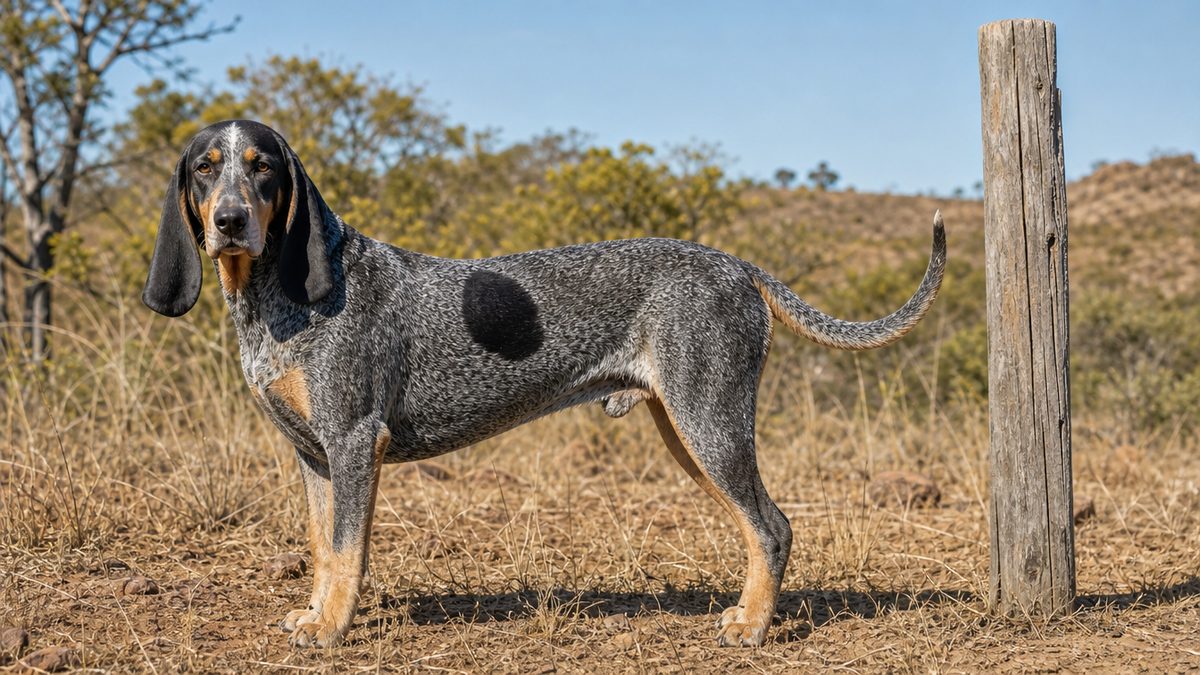
The Rastreador Brasileiro is a large Brazilian scent hound, standing 60 to 65 cm at the withers in males and weighing 26 to 33 kg, recognised by the Federation Cynologique Internationale as standard 275 in Group 6, Section 1.1, Large-sized Hounds.
Its English name is the Brazilian Tracker, and the FCI files it in four languages, as Pisteur Bresilien in French, Brasilianischer Laufhund in German and Rastreador Brasileno in Spanish, all published on the same date. The utilisation clause is one line: a hunting dog used for flushing and cornering prey animals.
The standard's own general appearance paragraph does more work than most, and it is worth quoting because it contains the claim this whole page is built around. The breed is strong, rustic, cheerful, lively without being aggressive, has a privileged sense of smell and ability to hunt, and is very resistant and persistent, able to run for hours in rough terrain under high temperatures, without much difficulty.
Almost no breed standard on this site says anything about temperature. This one opens its history by stating that the breed was developed by genetic selection from the American Foxhound with the aim of adjusting its functional characteristics and its ADAPTATION TO THE BRAZILIAN CLIMATE. So heat tolerance is not a marketing claim attached afterwards; it is what the country of origin says the selection was for. That is testable against climate data, and this page tests it.
The name is a job description, and the older name is a sound
*Rastreador* means tracker. The FCI standard says the breed carries that name because of its proven hunting qualities, and that it is the evolution of the older URRADOR BRASILEIRO, the Brazilian Howler, with physical characteristics fitting life in the Brazilian countryside. A howler is a hound that gives voice on the trail, which tells you what living with one sounds like.
English Wikipedia gives the alternative name differently, as Urrador or Urrador Americano, explaining Americano as a reference to the North American coonhound in the bloodlines. The FCI's own document says Brasileiro. Where a registry and an encyclopedia disagree on a breed's own historical name, this page follows the registry and prints both rather than quietly choosing.
What it looks like, in one paragraph
The signature is the coat. The standard's first colour listed is fully mottled black and white, giving a slate blue colouring effect, with or without fawn or black markings anywhere on the body, and it also permits bicolour and tricolour. The head is mesocephalic, triangular and slightly elongated, with skull and muzzle of equal length and a moderate stop. The ears are long enough that, pulled forward without effort, they reach the tip of the muzzle without exceeding it.
Three faults are disqualifying and they define the outline as much as the description does. A pronounced stop, a curly tail and bones too light all disqualify, as do short or butterfly-shaped ears. So the dog is a substantial, long-eared, sabre-tailed hound with a flat-planed head, and anything domed, curly-tailed or light-boned is not it.
One more figure matters for a reader picturing the dog. Body length to height is 10:9 and the muzzle to skull ratio is 1:1, which together produce a slightly long, level animal rather than a square one. This is a working outline, not a show silhouette, and the standard says so by making every severe fault turn on whether the departure hinders the dog's ability to work.
Recognition status, and the sentence every other page gets wrong
The Rastreador Brasileiro is recognised by the FCI right now, on a definitive basis, as breed number 275. Every English page calling it an extinct breed is describing a state it left. The register itself is the fastest way to see that, and reading it takes one fetch.
Breed record 275 was read field by field in this session. It gives Group 6, Scent hounds and related breeds; Section, Scent hounds; Subsection, Large-sized Hounds; country of origin BRAZIL; official authentic language English; not subject to a working trial; and, in its own words, BREED STATUS: Recognized on a definitive basis.
| Field | What the record says |
|---|---|
| Breed number | 275 |
| Group | n 6, Scent hounds and related breeds |
| Section and subsection | Scent hounds, Large-sized Hounds |
| English name | BRAZILIAN TRACKER |
| Date of acceptance on a definitive basis | 9/1/1967, that is 1 September 1967 |
| Date of publication of the official valid standard | 9/4/2019, that is 4 September 2019 |
| Date of publication of the standard, all four languages | 11/27/2020, that is 27 November 2020 |
| Official authentic language | English |
| Country of origin | BRAZIL |
| Breed status | Recognized on a definitive basis |
| Working trial | Not subject to a working trial |
| Occurrences of Cancelled or provisional on the record | Zero |
The FCI prints dates as M/D/YYYY and this record proves its own format without any outside knowledge. The standard's publication date reads 11/27/2020, and 27 cannot be a month, so the first field is the month for this table. That makes 9/1/1967 the first of September rather than the ninth of January, and 9/4/2019 the fourth of September. A recognition date in the future would be impossible, which is a second free check on any date a register prints.
How this record was found, since the FCI's server hides retired numbers
The FCI nomenclature server resolves a breed page on the trailing number and ignores the name in the URL entirely, which is a documented trap on this project because a guessed number returns a real, complete page for a different dog. So no number was guessed here. Records 1 to 400 were probed directly and the breed name printed inside each returned page's own title was read back, and record 275 answered with RASTREADOR BRASILEIRO.
Ten requests timed out during that scan and were retried individually rather than counted as absences, which matters: records 96 and 128 came back on retry as the Rafeiro do Alentejo and the King Charles Spaniel. A timeout is a fact about a network, not a fact about a register.
The control that makes the status claim safe
A record answering at HTTP 200 is not by itself proof a breed is current, because this server also answers for records that are no longer in any list. The decisive check is the live group index, and the breed is in it. The FCI's Group 6 page carries BRAZILIAN-TRACKER-275 as its second entry, directly after the Bloodhound, with the Bloodhound at 84, the Beagle at 161, the Basset Hound at 163, the American Foxhound at 303, the Dalmatian at 153 and the Rhodesian Ridgeback at 146 all present on the same fetch as in-document controls.
It is also correctly absent from the provisional register, which holds 20 breeds including the Buldogue Campeiro at 374 and the Cao de Gado Transmontano at 368. Definitive and provisional are different states, and this breed holds the higher one.
The national register, and a date it disagrees with itself on
Brazil's national body, the Confederacao Brasileira de Cinofilia, files the breed under group 6, Sabujos e Rastreadores, and prints Padrao FCI No 275 beside it, which is a genuine FCI number rather than the internal filing this site sees so often from national bodies. The proof that it is genuine is that the CBKC leaves the FCI number field empty for its own Grupo 11 breeds, so the body distinguishes the two cases in its own markup.
The CBKC does contradict itself on one date, and it is worth publishing rather than smoothing. Its list index prints the standard as 03/09/2013, while the standard PDF the same page links is headed 27/11/2020 and marked updated 15 December 2020 Confederacao Brasileira de Cinofilia. Two documents from one body, one index seven years behind the file it serves.
History, in four states rather than the usual two
The Rastreador Brasileiro's history runs through four distinct states, and almost every page about it collapses them into one word, extinct. Separating them is the only way the register and the popular account can both be true.
The FCI standard tells the first and second states in two sentences. The breed was developed by genetic selection based on the American Foxhound, explicitly contrasted with breeds originating from interracial crossings, by the Brazilian breeder Osvaldo Aranha Filho, as the evolution of the old Urrador Brasileiro. It was first recognized by FCI on September 1, 1967, suffering a major setback from the 70s to the year 2000 when its breeding was resumed.
| State | When | The document that establishes it |
|---|---|---|
| Created and recognised | 1 September 1967 | FCI record 275 and Standard 275, which give the acceptance date and the breeder |
| Collapse | The 1970s to 2000 | Standard 275's own phrase, a major setback, and secondary sources reporting extinction in 1973 |
| Removed from the nomenclature | Date not established | No FCI document reached by this page dates the removal. It is inferred from the 2019 language of putting the breed BACK |
| Restored to definitive recognition | 2019 to 2020 | The 2019 Annual Report's two commission decisions, the official valid standard of 4 September 2019, and the standard published 27 November 2020 |
Searched across all 7 pages and 7,738 extracted characters of FCI Standard 275, the word extinct occurs ZERO times. What the FCI writes instead is a major setback, an old breed, breeding resumed, and re-activated. That is not a quibble about vocabulary. A breed that was reduced to almost nothing and then rebuilt from surviving stock is a different thing from a breed that died out and was recreated from other breeds, and the FCI's own wording supports the first reading. The extinction claim in English-language sources is not sourced to any FCI document.
The document nobody cites, and it is the FCI's own
The mechanism of the restoration is recorded in the FCI 2019 Annual Report, a 92-page PDF extracted here with pypdf to 197,969 characters, and no page ranking for this breed cites it. Two separate commissions acted in the same year, and both are minuted.
The Scientific Commission, whose annual meeting was held in Lisbon on 17 and 18 May 2019 with a joint session with the Standards Commission on the 18th, recorded that it accepted to add an old breed Rastreador Brasileiro (Confederacao Brasileira de Cinofilia) back to the list of breeds accepted on definitive basis, noting that the breeding programme for this old breed has been re-activated and that the Brazilian canine organisation has asked to put the breed back in the list of FCI breeds.
The Standards Commission, in its own activity report signed by its president Jorge Nallem, wrote separately and more bluntly: We suggest GC to reintroduce the Rastreador Brasileiro in FCI nomenclature. The General Committee acted, and the official valid standard carries the date 4 September 2019.
What this page cannot establish, said plainly
No FCI document reached here dates the removal. The register records acceptances, not deletions, and the annual report describes putting the breed back without saying when or by what act it left. So the third state in the table above rests on inference from the FCI's own language of return, which is strong evidence that a removal happened and no evidence at all about when.
That gap is worth stating rather than filling. A page that prints a confident deletion date for this breed has taken it from a secondary source that did not have one either, and this site has been caught before publishing a date that existed nowhere in the record. Treat the removal date as unverified, and treat the 1973 extinction year that circulates in English sources the same way, because no FCI document carries either figure.
Rastreador Brasileiro price in India
There is no Rastreador Brasileiro price in India, and unusually for a rare breed there is not even a fabricated one to correct. An Indian search for the breed returns the FCI's own registry record and encyclopedia entries, with no Indian selling host in the result set at all.
The Google India pull for rastreador brasileiro dog returned About 118 results, led by a knowledge panel, the FCI's own breed record ranking organically, English Wikipedia, two breed-directory sites, a pedigree platform, the Brazilian kennel club and three YouTube videos. That composition is the finding. A breed with an Indian market has Indian classifieds and pet-store hosts in its result set, and this one has none.
The 118 figure proves nothing on its own, and this site has corrected pages that argued from result counts. A printed count moves by tens of percent on a fixed query inside a single session. What evidences an absent Indian market is composition: a registry record and two encyclopedias ranking on page one, three video results filling space that written coverage would otherwise occupy, and zero Indian selling hosts anywhere in the set.
What any rupee figure for this breed would actually be
If a figure does appear, work through it in this order before believing a single digit of it.
- Divide by 84.38, then by 80, then by 74, and read the quotient. A clean landing on 800 or 1,500 dollars means a foreign asking price was converted and relabelled Indian.
- Check the currency behind the symbol, because Brazil writes R$ with a full stop for thousands, so R$ 2.000 is two thousand reais and not two.
- Confirm the host country, since the same Rs abbreviation carries the Pakistani rupee on South Asian listings.
- Confirm the listing is for a live animal of this breed and not a template page that exists identically for every breed on that site.
- Ask whether the seller can name the register the pedigree sits on, which for this breed is the CBKC and through it the FCI.
Point five is the one that has teeth here, and it is the difference between this breed and most rare imports. A Rastreador Brasileiro has a real studbook behind it. Its pedigree should trace to the Confederacao Brasileira de Cinofilia, which is Brazil's FCI member and which files the breed under FCI number 275. A seller who cannot name that is not selling this breed.
The import position, read from the instrument
India treats live dogs as a restricted import, and the channel that exists is a personal pet import for an owner relocating with the animal rather than a commercial one for breeding or sale. So even a genuine CBKC-pedigreed dog has no lawful route into Indian commerce.
The separate question of the 2024 list has a clean answer for this breed. The Department of Animal Husbandry and Dairying letter of 12 March 2024, reproduced in full inside the customs instruction of 14 March 2024, names 24 comma-separated categories. This breed is named in none of them, and unlike most rare-breed pages that conclusion is safe, because the four undefined category words in that list are Terriers, Mastiffs (boerbulls), Wolf dogs and Canario, and not one of them reaches a large scent hound on any reading. The Goa Legislative Assembly's answer of 7 August 2024 reproduces the same list independently, which is the cheapest second check available.
No Indian law in force today bans owning, breeding or selling any dog breed. The Karnataka High Court quashed the March 2024 circular on 10 April 2024 and the Delhi High Court set it aside that month, and the Union has since told the courts that the quashed circular has lost its effect entirely. The instrument was never an Act, a rule or a notification; it was a D.O. letter from a Joint Secretary reproduced in a customs instruction. Always read the list from that instruction rather than from a court's recital, because a judicial reproduction of it is abridged and drops entries including the undefined category words.
Cost of ownership in India for a 30 kg hound
A 30 kg short-coated hound costs a knowable amount to keep in India even when the breed itself has no Indian price. Anti-rabies vaccination starts at Rs 699 and the 9-in-1 at Rs 899 at one national clinic chain, both read live on 9 September 2026.
Every figure below was opened at the vendor's own page on 9 September 2026 and is quoted with the vendor named, so a reader can check it and a later editor can see whether it has moved. Prices move; municipal fees rarely do.
| Item | Rupees | Source and scope |
|---|---|---|
| Anti-rabies vaccination | From Rs 699 | Vetic clinic chain, national price page |
| 9-in-1 DHPPiL vaccination | From Rs 899 | Vetic, same page |
| Canine corona vaccination | From Rs 899 | Vetic, same page |
| Full-body bath and blow dry | From Rs 934 | Vetic grooming Delhi, listed against Rs 1,099 |
| Haircut package, 120 minutes | From Rs 1,359 | Vetic grooming Delhi, listed against Rs 1,599 |
| Boarding, up to 4 hours | Rs 599 | PawSpace, Bengaluru home boarding |
| Boarding, daycare to 10 hours | Rs 799 | PawSpace, Bengaluru |
| Boarding, overnight to 24 hours | Rs 899 | PawSpace, festive rates 25 to 30 percent higher, food extra |
| Pet dog registration, Delhi | Rs 500 | MCD portal, renewal Rs 500, late fee Rs 100 per month |
| Pet animal licence, Chennai | Rs 50 | Greater Chennai Corporation, 9,115 issued in 2024 |
| Microchipping, one Chennai clinic | Rs 1,250 | SKS Veterinary Hospital's own transacted rate |
No monthly food total and no lifetime cost appear here. A monthly figure is arithmetic performed on a bag price and a feeding guide rather than a price anyone quotes, and a lifetime figure needs a life expectancy this breed does not have. What can be said is the shape of the commitment: one Indian sanctuary's cost guide frames it as a ten to fifteen year financial commitment beginning the moment the dog crosses your threshold, and contrasts about Rs 80,000 for a breeder puppy with about Rs 500 to adopt.
The three costs that scale with a working hound specifically
Parasite control comes first and it is dosed by weight, so a 30 kg dog needs the top of the common band. Combined monthly cover exists in India as a single tablet in weight-banded presentations including 15 to 30 kg, and deworming runs at one tablet per 10 kg, so this dog takes three where a small breed takes one.
Boarding is the second, and a large vocal hound is refused by more Indian operators than a small companion dog is. PawSpace's Bengaluru card runs Rs 599 hourly to Rs 899 overnight for dogs against Rs 499 to Rs 649 for cats, with festive rates 25 to 30 percent higher and food charged separately.
Grooming is the third and it is the cheapest thing about this breed. A short, close, hard-textured coat needs no professional cut, so the Rs 1,359 haircut package is simply not a line item here, and even the Rs 934 bath is optional. Budget the saving into ear care instead.
Registration, which owners of working breeds skip most
Delhi charges Rs 500 for a new pet dog registration and the same to renew, with a Rs 100 per month late fee after a one-month grace period tied to the expiry of the anti-rabies vaccination certificate, so the vaccination and the registration are one schedule rather than two. Greater Chennai Corporation charges Rs 50 and issued 9,115 pet animal licences during 2024.
Chennai also runs municipal pet clinics providing all treatment and anti-rabies vaccination free of cost, which materially changes a first-year budget in that city. Microchipping at one Chennai clinic's own transacted rate is Rs 1,250, and the same clinic records a one-day drive at Rs 599. For a hound that will follow a scent through a gate, a microchip is not optional equipment.
Heat tolerance and the Indian climate, tested rather than assumed
The Rastreador Brasileiro has the strongest heat-tolerance case of any imported breed on this site, and it is the only one where the breed's own standard makes the claim explicitly. Its homeland's peak wet bulb reaches 23.94 C at Cuiaba and 23.41 C at Palmas, above Bengaluru's 21.86 C and Pune's 22.97 C.
Start with what the standard asserts, because it is unusual. FCI 275 says the breed was developed with the aim of adjusting its functional characteristics and its adaptation to the Brazilian climate, and that the dog is very resistant and persistent, able to run for hours in rough terrain under high temperatures, without much difficulty. A standard is a claim by a country of origin rather than a measurement, so the right response is to test it.
The figures below come from NASA POWER's 2001 to 2020 climatology, queried by explicit latitude and longitude with the model's own cell elevation echoed back and checked against each place's real elevation. Every Brazilian and Indian point used here is lowland or plateau, and every cell landed within about 115 m of the real elevation, so none of them is the mountain-cell failure this model has elsewhere.
| Place | Annual mean C | Annual RH % | Hottest month | Peak wet bulb C |
|---|---|---|---|---|
| Palmas, Tocantins, Brazil | 26.42 | 68.86 | September, 29.45 | 23.41 (November) |
| Cuiaba, Mato Grosso, Brazil | 26.62 | 67.42 | September, 29.54 | 23.94 (December) |
| Goiania, Goias, Brazil | 23.10 | 69.26 | September, 26.27 | 21.02 (December) |
| Bengaluru | 23.74 | 67.94 | April, 28.37 | 21.86 (May) |
| Pune | 23.86 | 66.80 | April, 28.93 | 22.97 (June) |
| Hyderabad | 26.10 | 60.30 | May, 33.30 | 23.35 (June) |
| Nagpur | 26.91 | 55.84 | May, 36.73 | 25.41 (June) |
| Mumbai | 26.77 | 67.39 | May, 31.19 | 25.77 (June) |
| Chennai | 27.95 | 72.39 | May, 31.51 | 26.11 (May) |
| Delhi | 25.60 | 45.56 | June, 35.88 | 26.50 (July) |
| Kolkata | 25.81 | 73.93 | May, 31.53 | 27.09 (June) |
Most imported breeds on this site come from places 6 to 9 degrees of wet bulb below an Indian summer, and the honest verdict is that the heat is outside anything the population has met. Here the homeland sits INSIDE the Indian range. Cuiaba's 23.94 C peak wet bulb is above Hyderabad's 23.35, above Pune's 22.97 and well above Bengaluru's 21.86, and Palmas at 26.42 C annual mean is warmer on average than every Indian city on this table except Chennai and Nagpur. The gap to Chennai is about 2.2 degrees of wet bulb and to Kolkata about 3.2, which is the narrowest this site has recorded for a non-Indian breed.
Where the argument stops, and why the rating is 4 rather than 5
Three qualifications hold the rating down and all three are real. First, the standard's heat claim is the country of origin's assertion and no study measures it. Second, Kolkata at 27.09 C and Delhi at 26.50 C are still above anything the Brazilian points reach, so the wettest and hottest Indian cities remain outside the breed's experience. Third, heat tolerance is a property of a population, and this population went through a bottleneck severe enough that the FCI called it a major setback.
Get the Indian months right, because this site has corrected pages that did not. Bengaluru peaks in April and is coolest in December. Pune peaks in April and is coolest in December. Delhi peaks in June. Chennai, Mumbai and Kolkata genuinely do peak in May. Note also that the Brazilian points peak in September, before the rains, which is the opposite half of the year from an Indian summer.
The heat risk that still applies, quantified
Good heat tolerance is not immunity, and the one large study of the problem shows how the injury actually arrives. Roughly one dog in seven that develops heat-related illness dies of it, and about three quarters of recorded cases are exertional rather than environmental.
Good heat tolerance is not immunity, and the one large study of the problem measures how the risk actually arrives. UK primary-care records for 905,543 dogs in 2016 identified 395 confirmed heat-related illness events, an incidence of 0.04 percent with a 95 percent confidence interval of 0.04 to 0.05, and an event fatality rate of 14.18 percent, confidence interval 11.08 to 17.96.
The companion paper looked at triggers. Of 1,259 events from 1,222 dogs, 380 had no trigger recorded, leaving 879 with one, of which 652, or 74.2 percent, were exertional, against 113 environmental and 46 from vehicular confinement. And of the 551 exertional events where the exercise was specified, 372, or 67.5 percent, followed an ordinary walk.
Three quarters of heat illness in that cohort was exertional, and this is a breed selected to run for hours. Good thermal tolerance and a very high exercise requirement combine into a specific Indian hazard: an owner who trusts the breed's reputation and works the dog through a Chennai May. The correct reading of the data is that the dog can take more heat than most imports and that the activity it needs is exactly the activity that causes the injury. Move the work to before sunrise, carry water, and consult your nearby vet about a heat protocol before the season rather than during it.
One transferable risk factor applies although the breed was never modelled. Dogs at or above their breed and sex mean bodyweight carried 1.42 times the odds, confidence interval 1.12 to 1.80. A 33 kg male at the top of a 26 to 33 kg band sits in that group by definition. No breed-specific odds ratio is claimed here, because importing one onto a breed the authors never studied would be fabrication wearing a citation.
Temperament and who should not buy one
The Rastreador Brasileiro's own standard describes a quiet and balanced dog, attached to its owner, self-confident, intrepid and docile, without being shy or aggressive. The reason most Indian households should still say no is exercise, not character.
The behaviour clause explains itself rather than just labelling the dog, which is unusual and useful. It says the breed should behave calmly because they hunt in pairs, trios and packs, or even alone as a scent dog. A dog selected to work shoulder to shoulder with other dogs and with handlers cannot afford to be reactive, so the calmness is a working requirement rather than a marketing adjective.
The standard backs that with its fault list. Aggressive or overly shy is a disqualifying fault, alongside any dog clearly showing physical or behavioural abnormalities. A registry that disqualifies both ends of the reactivity range is describing a breed meant to be neutral.
Docile is not the same as biddable, and the difference matters in India. A hound bred to follow a trail alone for hours will, on a scent, stop hearing you. That is not disobedience and it is not fixable by training it out; it is the trait the breed exists for. Plan for a fenced space, a long line and a recall you have proofed for months, and assume that an unfenced Indian street is not a place this dog can be off lead.
The voice, which is in the older name
The breed's ancestor is named in the standard as the Urrador Brasileiro, the Brazilian Howler. Scent hounds give tongue on a trail by design, and that is what the name records. In a detached rural property that is a feature. In an Indian apartment block with shared walls it is the single complaint that ends most placements of hounds, and it is worth being honest about before rather than after.
One secondary description worth weighing against the standard comes from a breed directory, which calls the dog lively and cheerful, very sociable with people, without much vocation for guarding but excellent as an alarm dog. That is consistent with the standard's picture and with the type, and it is the correct expectation to set: this is not a guarding breed and should not be bought as one.
Socialisation, and the honest limit on advice here
Any large dog in India needs early and continuous exposure to traffic, strangers, other dogs and street noise, and the window closes early. What this page will not do is hand you a breed-specific developmental schedule, because no published behavioural data exists for this breed at all and inventing one would be padding. Socialise on the general large-breed timetable, and let the individual dog rather than the internet tell you where it is difficult.
Training a scent hound, and what it resists
To train a Rastreador Brasileiro, build recall and a settled line-of-sight relationship before the nose takes over, because a hound working a trail is not being disobedient when it stops responding. Trainability is rated 3 out of 5 here, inferred from the standard's temperament clause rather than measured.
The standard gives you the raw material. The dog is self-confident, intrepid, docile and calm because it works in company. That is a cooperative animal, and cooperative animals train well on structure and reward. What no standard can give you is off-scent reliability, which is where every hound is difficult.
- Build recall first and keep building it, because everything else in a hound's education rests on it.
- Use a long line for the first year rather than trusting an off-lead recall you have not proofed against a live scent.
- Give the nose a job daily, through scent games or track-laying, so the drive has a legal outlet.
- Train early in the day from March onward, since the sessions that matter are the long ones and those are the ones heat curtails.
- Book a professional assessment before the dog reaches adult weight rather than after.
Part IV of the Second Schedule to the Prevention of Cruelty to Animals (Dog Breeding and Marketing) Rules 2017 requires separate housing for a vicious or aggressive dog and FORBIDS the use of sedation to control behaviour. That closes the shortcut some Indian owners of large dogs reach for. Separately, Second Schedule Part III paragraph 8(10) lists the genetic defects a breeding dog must have been tested for, including hip dysplasia and progressive retinal atrophy, and the word including makes that list illustrative rather than closed.
One point of Indian law runs the breed's way rather than against it, and it is worth recording because so few pages on this site can say it. This breed's standard mandates no cropped ears, no docked tail and no exaggerated feature, and its disqualifying faults are all functional. So nothing in FCI 275 asks a breeder to do anything paragraph 6(8) of the 2017 Rules prohibits, which is a cleaner position than most molossoid or terrier standards manage.
Daily exercise requirement, the real reason to say no
The Rastreador Brasileiro needs hours of work a day, not a walk, and in India those hours have to fit into a window at either end of the day. Exercise need is rated 5 out of 5 here, and it is the single dimension that disqualifies this breed for most Indian homes.
The requirement comes straight from the standard's own words. The dog is able to run for hours in rough terrain, and its gait clause asks for fluid, agile, firm movement with good ground coverage and wide balanced steps, noting that a level firm topline on the move is very important for the dog's work. That is a description of an endurance animal.
| City | Hot-season window | What to cut | The number behind it |
|---|---|---|---|
| Bengaluru | Before 7.30 am and after 6 pm | Only the April afternoon | Peak wet bulb 21.86 C, BELOW the breed's homeland |
| Pune | Before 7.30 am and after 6 pm | Only the April afternoon | Peak wet bulb 22.97 C, still below Cuiaba's 23.94 |
| Hyderabad | Before 6.30 am and after 7 pm | All midday work, April to June | Peak wet bulb 23.35 C, level with the homeland |
| Nagpur | Before 6 am only | Everything else, April to June | May mean 36.73 C, the hottest on this page |
| Mumbai | Before 6.30 am | Evening work in June and July | Peak wet bulb 25.77 C in June |
| Chennai | Before 6 am only | All evening work in May | Peak wet bulb 26.11 C, about 2.2 C above the homeland |
| Kolkata | Before 6 am only | All work once monsoon humidity sets in | Peak wet bulb 27.09 C, the highest here |
| Delhi | Before 6 am, and after 9.30 pm in dry heat | Midday and afternoon, April to July | June mean 35.88 C, peak wet bulb 26.50 C in July |
Bengaluru and Pune are the two Indian cities where this breed's exercise requirement and the climate are genuinely compatible, because both sit below the homeland's peak wet bulb. That is a rare sentence on this site and it is the honest one. Everywhere else the schedule above is a compromise between what the dog needs and what the afternoon allows.
Second Schedule Part IV paragraph 21(1) of the 2017 Rules bars keeping certain dogs in outdoor facilities without the attending veterinary practitioner's WRITTEN approval, naming dogs not accustomed to local temperatures and breeds that cannot tolerate the temperatures prevalent in the region, such as long-haired breeds in high temperature locations. A short-coated dog from a hot country is the least likely animal on this site to be caught by that clause. It still applies to an individual dog newly arrived and not yet acclimatised, which is exactly what an imported dog is in its first Indian summer.
The failure mode without the work is predictable and it is not aggression. An under-exercised hound of this size becomes vocal, destructive and a fence-tester, and the Urrador in its ancestry tells you which of those arrives first.
Grooming, and the ears that need the real attention
To groom a Rastreador Brasileiro, run a rubber curry mitt over it once a week and spend the time you save on its ears, because the standard requires ears long enough to reach the tip of the muzzle. Grooming load is rated 1 out of 5, the easiest thing about the breed.
The coat clause is short and it settles the question. The hair is short, smooth, very close to the body, dense and a little hard to the touch. That is a self-maintaining working jacket. No stripping, no clipping, no de-matting, and no professional grooming appointment is needed at all, which is why the Rs 1,359 haircut package quoted earlier is not a line in this breed's budget.
Colour matters for one practical Indian reason. The mottled black and white coat that gives the slate blue effect hides ticks less well than a solid dark coat does, which is a genuine advantage in a country where tick-borne disease is the main parasitic threat to dogs. Check anyway, daily, in season.
The ears are the whole job
The standard requires ears that are long, low-set, flexible, with rounded tips, hanging close to the head and almost lacking in erectile capacity, long enough that when pulled forward they reach the tip of the muzzle without exceeding it. A long, low, close-hanging ear over a warm humid ear canal is the classic setup for otitis externa, and India supplies the humidity for four months a year.
Breed clubs in temperate countries routinely tell owners to towel a dog and let it air dry. That is sound in a dry summer and poor advice in an Indian monsoon, where a damp ear canal under a heavy hanging ear is the commonest route into infection. Dry these ears actively after every bath and every swim, plug them before bathing, and check them weekly rather than monthly between June and September. Consult your nearby vet at the first head shake or smell rather than waiting to see whether it settles.
What Indian law forbids doing to this dog's appearance
Nothing in this breed's standard asks for a surgical alteration, which puts it on the right side of Indian law without any effort. Second Schedule Part II paragraph 6(8) of the 2017 Rules states that there shall be no tail docking, ear cropping, de-barking, de-clawing, branding, dyeing, injecting substances to enhance visual appeal, or any procedure to camouflage a defect, and that any change of appearance by artificial means is strictly forbidden.
Two of those bite here even so. De-barking is the one an owner of a howling hound might be offered in India, and it is prohibited outright. And a curly tail is a disqualifying fault in this breed, which creates exactly the temptation paragraph 6(8) exists to close: a seller correcting a tail surgically to pass as breed type would be breaking the rule twice over Ministry of Environment. Verify a natural tail rather than assuming one.
Health problems, life span and three registries that hold nothing
No health data exists for the Rastreador Brasileiro. There is no screening scheme, no OFA row, no lifespan study and no published literature of any kind, and each of those absences was tested with a control that passed rather than assumed. Evidence quality on health is the weakest part of an otherwise well-documented breed.
Start with the orthopaedic registry, because a large hound's hips are the first thing a buyer asks about. OFA's complete disease-statistics dump was retrieved through a rendering proxy and saved to disk as 2,232,076 characters, then searched rather than read. RASTREADOR, BRAZILIAN and TRACKER all return zero, while LABRADOR returns 109, BULLDOG 170 and BEAGLE 61 on the same file.
OFA publishes a breed only once it has 100 hip evaluations, or 50 for its other databases. So the right phrasing is that this breed has no row in OFA's published statistics tables, not that it is absent from the OFA database. For a breed with a few hundred dogs concentrated in rural Brazil, no American orthopaedic registry would ever hold it, and that says nothing about its hips in either direction. Note also that the OFA page still prints Searching Database, Please wait even while the tables are fully present, so that string is not evidence a search failed.
The nearest usable comparison is the other Brazilian breed in the same dump. The Fila Brasileiro hips row gives 228 evaluations, 67.5 percent normal and 32.5 percent dysplastic, and the arithmetic closes, because its mild, moderate and severe components of 19.7, 9.6 and 3.1 sum to 32.4. That column check is why the figure is quoted at all. It is a different breed of a different type and it is printed here as calibration, not as this breed's rate.
Life span, and why this page prints no number
The largest UK longevity study's breed table was downloaded and parsed namespace-aware from the OOXML for this page. It carries 345 rows, and Rastreador, Brazilian Tracker and Tracker all return zero across every column. The in-document controls passed on the same file: Foxhound, American Foxhound, Black and Tan Coonhound, Beagle and Brazilian Terrier are all present.
So there is no life expectancy figure for this breed and this page publishes none. Any lifespan you see quoted for a Rastreador Brasileiro has been borrowed from a related hound or invented, and a borrowed one would be doubly wrong here because the source breeds are American and British rather than Brazilian.
The literature, searched properly and genuinely empty
PubMed returns nothing for this breed under any name, and the search was run the way this project requires. "Rastreador Brasileiro"[tiab] returns 0 with PubMed's own quotedphrasesnotfound warning, so an unquoted retry was run as the rule demands: Rastreador Brasileiro unquoted was BROADENED by PubMed itself into Rastreador in all fields AND brasileiro or brasileiros, and still returned 0.
A broadened query returning zero is a stronger negative than a strict one, because the engine widened the net on its own and still caught nothing. "Brazilian Tracker"[tiab] returns 0 and "Urrador Brasileiro"[tiab] returns 0. The bare Rastreador[tiab] returns 2, and both were opened rather than counted: PMID 33822693 is a Spanish-language respirator-strap paper and PMID 31618371 is a nursing Tracer Methodology review, so neither concerns a dog.
Controls in the same session came back sane, which is what makes the zero worth reporting: Labrador Retriever hip dysplasia returned 126, Bulldog with Brazil returned 5 and Brasileiro with dog returned 4. The instrument works and the literature does not exist.
What a dog of this type would actually meet in India
The health risks worth planning for are Indian rather than breed-inherited, and for a large short-coated dog living outdoors they are heat, ticks and ears. Two 2026 molecular studies map the tick-borne picture across West Bengal and southern India Venugopal V, Deepa PM, Muhasin Asaf VN.
Neither study concerns this breed, and they are cited for the setting rather than for a prevalence attributed to the dog. What they establish is that canine haemoprotozoa are widespread enough across two very different Indian regions to justify a year-round plan rather than a seasonal one, and that molecular diagnosis is now the standard against which older prevalence figures should be read Venugopal V, Deepa PM, Muhasin Asaf VN.
- Cover for ticks every month of the year, not through the monsoon alone, using a weight-banded combined product.
- Deworm on a veterinarian's schedule at one tablet per 10 kg, which is three for a 30 kg dog.
- Screen for tick-borne disease at the first sign of lethargy, pale gums or a fever rather than treating empirically.
- Check ears weekly between June and September, because a long hanging ear in a humid month is this breed's likeliest complaint.
- Vaccinate on the core schedule, with anti-rabies from Rs 699 and the 9-in-1 from Rs 899 at a national chain.
This page reports registry documents, an FCI annual report, Indian legal texts and published Indian veterinary literature. It contains no health data for this breed because none exists anywhere. Nothing here is a diagnosis or a treatment plan for any individual animal, and no figure on this page should be used to decide whether a dog needs seeing. Consult your nearby vet about any dog you are offered under this name, and have a veterinarian examine it in person before you act on a single line written here.
The one inherited risk a buyer should ask about anyway
Ask about hip dysplasia even though no registry holds the breed, because Indian law makes it a question a breeder should already have answered. Second Schedule Part III paragraph 8(10) of the 2017 Rules lists the genetic defects a breeding dog must have been tested for, and hip dysplasia is the first item on it, alongside progressive retinal atrophy, night blindness, hypothyroidism, entropion, ectropion, overshot and undershot jaw and cryptorchidism.
The clause opens with the word including, so the list is illustrative rather than closed, and a defect being unlisted does not put it outside the clause. For a breed with no screening scheme, that gazette clause is the only leverage an Indian buyer has, and it is worth quoting to a seller.
Feeding an endurance hound in India
To feed a Rastreador Brasileiro, work from the bag's guide against the dog's real weight, split it across two meals, and expect the ration to move with the season rather than staying fixed. Males run 26 to 33 kg and females 21 to 30 kg, so the range across the breed is wide enough that a single figure would mislead.
This page publishes no monthly rupee food figure, and the reason is arithmetic rather than research. A monthly total is a calculation performed on a bag price and a feeding guide, not a price a vendor quotes, and for a breed whose adult weight spans 12 kg the calculation would need a denominator the buyer has not got yet.
- Feed two measured meals a day by weight rather than by scoop, because a deep-chested hound eating one large meal is a bloat risk.
- Weigh the dog monthly and write it down, since a mottled coat over a lean frame hides condition change.
- Assess body condition by hand weekly, targeting 4 or 5 out of 9, with ribs felt under light pressure and no fat cover.
- Withhold food and heavy water for an hour either side of hard work, on the same bloat reasoning.
- Raise the ration in the cool months when the dog can actually work, and cut it in April and May when the window shrinks.
Dogs at or above their breed and sex mean bodyweight carried 1.42 times the odds of heat-related illness in the largest study of the problem, with a 95 percent confidence interval of 1.12 to 1.80. For a breed whose whole selling point is running under high temperatures, that is the number to act on, and the usable version is a hand-assessed body condition score rather than a scale reading. A dog you can feel the ribs on carries less heat risk into an Indian May, and this is a breed that will happily work itself past its own limit.
Growth needs the same restraint as any large breed, so feed to a slow steady curve rather than to the top of the bag's range and do not add calcium on top of a complete food. A veterinarian should set the target curve, because a puppy that could finish anywhere between 21 and 33 kg cannot be grown to a table.
Month by month through the first year
A hound puppy's first year runs on three tracks at once in India: recall before the nose matures, growth without haste, and municipal compliance. The third is the one owners skip and the first is the one that decides whether the dog can ever be trusted loose.
| Age | Priority | The Indian specific |
|---|---|---|
| Before 8 weeks | Do not take the puppy | Rule 8(1)(a) of the 2017 Rules prohibits the sale of pups under eight weeks outright |
| 8 to 12 weeks | Core vaccination, socialisation window open | 9-in-1 from Rs 899; start traffic, strangers and street noise now |
| 12 to 16 weeks | Anti-rabies, municipal registration | Anti-rabies from Rs 699; Delhi registration Rs 500, Chennai licence Rs 50 |
| 4 to 6 months | Recall on a long line, every day | Move all sessions before 7 am from March onward |
| 6 to 9 months | Nose work as a formal outlet | Scent games indoors during the hot afternoons rather than skipping the day |
| 9 to 12 months | Microchip, boarding trial, year-round parasite plan | Microchipping about Rs 1,250 at one Chennai clinic; tick cover every month |
The eight-week line is a Rule rather than a Second Schedule paragraph, and the distinction matters if you ever quote it. Rule 8(1)(a) is the sale-conditions provision and it prohibits selling pups under eight weeks. Walk away from any litter offered earlier, whatever the breed and whatever the story attached.
Registration belongs in the first four months. Delhi ties its renewal grace period to the expiry of the anti-rabies certificate and charges Rs 100 per month late after it, so the two dates are one schedule. Chennai's Rs 50 licence is cheap enough that deferring it makes no sense, and the city's municipal clinics vaccinate free.
For a scent hound, the first year is a recall project with a dog attached. Everything else can be corrected later. A hound that reaches twelve months without a proofed recall, in a country with unfenced streets and free-roaming dogs, is a dog that will spend its life on a lead, and for an animal built to run for hours that is a welfare problem rather than a training one.
Head to head against the breeds an Indian buyer would cross-shop
Anyone drawn to this breed in India is choosing between a dog they cannot get and several they can. The table sets the Rastreador Brasileiro against the two other FCI Group 6 hounds common here and against Brazil's other three recognised breeds.
| Breed | Registry status | Peak wet bulb of homeland | Obtainable in India |
|---|---|---|---|
| Rastreador Brasileiro | FCI 275, definitive, Group 6 | 23.41 to 23.94 C, Brazilian interior | No Indian supply of any kind |
| Beagle | FCI 161, definitive, Group 6 | Temperate British | Yes, one of the commonest breeds in India |
| Dalmatian | FCI 153, definitive, Group 6 | Temperate Adriatic | Yes, widely available |
| Rhodesian Ridgeback | FCI 146, definitive, Group 6 | Southern African | Yes, present in India |
| Fila Brasileiro | FCI 225, definitive, Group 2 | Brazilian | Named as entry 4 on the quashed 2024 list |
| Terrier Brasileiro | FCI 341, definitive, Group 3 | Brazilian | No Indian supply |
| Buldogue Campeiro | FCI 374, provisional since 2025 | Southern Brazilian highland | No Indian supply |
| Buldogue Serrano | CBKC Grupo 11 only, no FCI number | 18.0 to 18.3 C, southern Brazilian highland | No Indian supply |
Two rows in that table make the argument this page exists to make. The Buldogue Campeiro holds a provisional FCI number, 374, granted in 2025, while this breed holds a definitive one granted in 1967 and restored in 2019 Federation Cynologique Internationale. And the Buldogue Serrano holds no FCI number at all, sitting in the CBKC's Grupo 11, which that body labels in its own tabs as breeds recognised only by the CBKC.
So Brazil has four FCI breeds and a national tier below them, and this breed is not merely in the top tier, it is in the top tier twice, having been admitted, lost and readmitted. That is a distinction almost no breed anywhere holds.
The realistic Indian answer to wanting a scent hound is the Beagle, which is FCI 161, widely available here, a fraction of the size to exercise, and already served by Indian veterinary and boarding infrastructure. The realistic answer to wanting a large tracking dog is the Rhodesian Ridgeback. And the realistic answer to wanting a big hunting breed that is adapted to the climate it will live in is an Indian one. None of them is this dog, and all of them exist.
For a reader who came here from the Atlantic side of this story, the Terceira Mastiff is the instructive contrast. It was a landrace with no standard and no register, it collapsed in the same decade this breed did, and it is gone. This breed had a standard and a national body willing to petition for it, and it came back.
Mistakes people make with this breed
The commonest mistake is repeating that the breed is extinct, which was true and is not. The five below are the ones the ranking pages and the search results actively encourage.
- Calling it extinct, when the FCI's own record reads Recognized on a definitive basis and the breed sits in the live Group 6 index.
- Assuming a breed absent from popular lists is absent from the register, when the register is one fetch away and ranks on page one for its own name.
- Reading the FCI's dates as day-first, when the same record prints 11/27/2020 and 27 cannot be a month.
- Treating good heat tolerance as permission to work the dog in an Indian afternoon, when three quarters of heat illness is exertional.
- Buying on the reputation rather than the exercise requirement, which is the dimension that actually rules the breed out for most homes.
The mistake this page had to correct in its own brief
This page was commissioned on the premise that the Rastreador Brasileiro's FCI record would be a cancelled one, on the model of another breed whose retired record still answers at HTTP 200. That premise was wrong and the record settles it: the strings Cancelled and provisional appear zero times on record 275, and the breed status line reads Recognized on a definitive basis. The correction is recorded here rather than quietly absorbed, because the wrong version is what every ranking page carries too.
A naming mistake that has hardened into two encyclopedias
The breed's ancestor is given as Urrador Brasileiro in the FCI's own standard and as Urrador Americano in English Wikipedia, which explains the Americano as a reference to the North American coonhound in the bloodlines. Both readings are internally sensible, since the standard does say the breed was selected from the American Foxhound. Only one of them is in a registry document, and this page follows that one while printing the other.
Three of the ten organic results for this breed on an Indian search are YouTube videos, and one is a Facebook post. That composition is what a breed with a current registry standard and almost no written English coverage looks like, and it is why this page leans on primary documents rather than on the ranking set. When the best-informed English-language statement about a breed is a social media post, the register and the standard are not merely better sources, they are the only ones.
Adoption and responsible sourcing
Adopt in India rather than pursuing this breed, because no lawful commercial route brings it here and no Indian breeder holds it. If the appeal is a large, hardy, heat-tolerant working dog, that animal already exists in Indian shelters.
Be clear about what an Indian offer under this name can be. It can be a mislabelled hound of another type, a dog genuinely imported by a relocating owner under the personal pet route, or a listing for an animal nobody has. There is no fourth possibility, because India permits no commercial import of dogs for breeding or sale and no Indian selling host appeared anywhere in this breed's search results.
If somebody does offer you one, work down this list
- Ask which register the pedigree sits on, and expect the Confederacao Brasileira de Cinofilia and FCI number 275, or nothing.
- Ask to see the export pedigree and the import paperwork, since a lawful route here is a personal pet import rather than a sale.
- Check the dog against the standard: long ears reaching the muzzle tip, a moderate stop, a sabre tail and a mottled coat.
- Refuse any dog with a curled tail, a pronounced stop or short ears, all of which are disqualifying faults in this breed.
- Refuse any pup under eight weeks outright, which Rule 8(1)(a) of the 2017 Rules prohibits.
- Have a veterinarian examine the animal before money changes hands, and treat a refusal as the answer.
Point three is unusually useful for this breed because the standard's disqualifying faults are so specific. A pronounced stop, a curly tail, short or butterfly ears, bones too light and an under or overshot bite all disqualify. A mislabelled dog will almost always fail two of those at a glance, which makes this one of the easier rare breeds to sanity-check without expertise.
The adoption route that works here
Adopt a large short-coated Indian dog. Every metro named on this page has rescues placing 25 to 35 kg dogs with the stamina, the nose and the tolerance for Indian heat that people want from an imported working breed, at a fraction of the cost and with none of the legal complexity. One Indian cost guide puts the gap starkly, at around Rs 80,000 for a breeder puppy against about Rs 500 to adopt, before either dog has cost a rupee to keep.
Greater Chennai Corporation's municipal pet clinics provide all treatment and anti-rabies vaccination free of cost, which makes an adopted dog's first year materially cheaper in that city than anywhere else on this page. Register the dog, microchip it at about Rs 1,250 at one Chennai clinic's own transacted rate, and put it on year-round parasite cover, and the running cost of ownership becomes a known quantity rather than a guess.
The Rastreador Brasileiro is the clearest case this site has found of why a written standard and a national body matter. Two breeds on opposite sides of the Atlantic collapsed in the same decade. One had no standard, no studbook and no club to speak for it, and it is gone. This one had a standard, a number, and a national organisation that asked the FCI in writing to put it back, and in 2019 two FCI commissions agreed. That is not a story about dogs being saved by luck. It is a story about paperwork, and it is the most useful thing a rare-breed page can tell a reader.
Rastreador Brasileiro questions people actually ask
Is the Rastreador Brasileiro extinct?
No, and the FCI's own register says so. Breed record 275 reads Recognized on a definitive basis, and the breed appears in the live FCI Group 6 index as the Brazilian Tracker. The word extinct does not appear once in FCI Standard 275, which says instead that the breed suffered a major setback from the 70s to the year 2000, when its breeding was resumed.
What is the most famous dog in Brazil?
Not this one, on any measure. The Fila Brasileiro is the internationally best known Brazilian breed and the only one named on the 2024 Indian customs list, and the Brazilian street dog known as the vira-lata caramelo is far more famous at home than any pedigree breed. The Rastreador Brasileiro returned About 118 results on an Indian search, which is what genuine obscurity looks like.
How much does a Fila Brasileiro dog cost?
Bonbeno publishes no Indian price for the Fila Brasileiro on this page, because that breed has its own guide and because any rupee figure needs testing against the conversion and house-price-point traps first. What is worth knowing here is the legal position: the Fila Brasileiro is entry 4 on the list reproduced in the March 2024 customs instruction, and that circular was quashed by the Karnataka High Court in April 2024.
What is the least wanted dog?
No such ranking exists in any document worth citing, and Bonbeno does not publish one. What can be measured is registry presence, and by that measure this breed came about as close to disappearing as a recognised breed can: it was accepted by the FCI in 1967, effectively vanished for three decades, and needed two FCI commissions in 2019 to recommend putting it back.
What is Brazil's national animal?
Brazil has no single officially designated national animal, and this page will not invent one. Brazil does have four FCI-recognised native dog breeds, which is a checkable fact: the Fila Brasileiro at 225, the Rastreador Brasileiro at 275, the Terrier Brasileiro at 341 and the Buldogue Campeiro at 374, the last of these provisional since 2025.
What is the Rastreador Brasileiro price in India?
There is none. No Indian breeder, importer, kennel or classifieds listing carries this breed, and India treats live dogs as a restricted import with no commercial channel for breeding or sale. An Indian search for the breed returns the FCI's own record and Brazilian and English encyclopedia entries, with no Indian selling host in the result set at all.
Can a Rastreador Brasileiro handle Indian heat?
Better than almost any imported breed, on the evidence. Its own FCI standard says it runs for hours in rough terrain under high temperatures and that adaptation to the Brazilian climate was the selection goal. NASA POWER puts its homeland's peak wet bulb at 23.41 C in Palmas and 23.94 C in Cuiaba, above Bengaluru and Pune and about 2.2 C below Chennai. Exercise need, not heat, is the reason to say no.
What was the Urrador Brasileiro?
The Urrador Brasileiro, the Brazilian Howler, is the older Brazilian hound type that FCI Standard 275 names as the thing this breed evolved from. English Wikipedia instead gives the alternative name as Urrador Americano, referring to the North American coonhound in the bloodlines. The FCI's own document says Brasileiro, and where a registry and an encyclopedia disagree this page follows the registry and prints both.
How big is a Rastreador Brasileiro?
Males stand 60 to 65 cm at the withers and weigh 26 to 33 kg, females 56 to 63 cm and 21 to 30 kg, with a tolerance of about 1 cm on height. The standard files it under large-sized hounds and sets body length to height at 10:9. Bones too light is a disqualifying fault, so this is a substantial dog rather than a rangy one.
What colour is a Rastreador Brasileiro?
Its signature colour is fully mottled black and white producing a slate blue effect, with or without fawn or black markings anywhere on the body. The standard also allows bicolour and tricolour, and permits fawn markings on the head, chest, belly, limbs and tail in every colour. The mottling is fine ticking rather than solid patches, which is why the dog reads as blue at a distance.
Does the Rastreador Brasileiro have health problems?
Nobody knows, and that is the honest answer rather than an evasion. The breed returns zero rows in OFA's full statistics dump against Labrador 109 and Bulldog 170 as controls, zero rows in the largest UK longevity study's 345-breed table, and zero PubMed records under every name form including one PubMed itself broadened. Consult your nearby vet rather than any breed-level claim.
Is the Rastreador Brasileiro banned in India?
No dog breed is banned in India today. The March 2024 circular that listed 24 categories was quashed by the Karnataka High Court on 10 April 2024 and set aside by the Delhi High Court that month, and the Union has since told the courts it has lost its effect entirely. The list never named this breed, and none of its undefined category words, Terriers, Mastiffs, Wolf dogs and Canario, reaches a scent hound.
Is the Rastreador Brasileiro a good family dog?
It is a good-tempered dog and a poor household fit for most Indian families. Its standard describes a quiet, balanced, self-confident and docile animal that is neither shy nor aggressive and works calmly in packs. The problem is not temperament, it is that a large hound bred for hours of continuous running needs work that an Indian apartment or a short evening walk cannot supply.
How long does a Rastreador Brasileiro live?
No life expectancy figure exists for this breed and this page publishes none. It is absent from the largest UK longevity study's breed table, which lists 345 breeds and includes the Foxhound, the American Foxhound and the Beagle as controls. Any lifespan number you see quoted for this dog has been borrowed from a related breed or invented outright.
Compare with similar breeds
Rastreador Brasileiro sits in 1 Bonbeno group. Each one compares it directly against the breeds it is genuinely an alternative to, on the same figures.