
Breed profile
Terceira Mastiff: Extinct Since the 1970s, and What Exists Now
An extinct Azorean fighting and cattle dog, absent from every register including its own national club's list of unrecognised Portuguese breeds, with one private recovery project working from nine founder dogs.
Quick answer
The Terceira Mastiff is extinct. Its own island neighbour's FCI standard calls it the now extinct Terceira Dog, Portugal has considered it extinct since the 1970s, and it appears in no register anywhere, including the Portuguese Kennel Club's own published list of Portuguese breeds the FCI does not recognise. There is no Terceira Mastiff price in India because there is no Terceira Mastiff.
This page reports registry documents, historical sources and one recovery project's own published account, alongside Indian legal and veterinary material. No health data of any kind exists for this breed, because no population of it exists to study. Nothing here is a diagnosis or a treatment plan, and nothing here should be read as guidance for an individual animal. Consult your nearby vet about any dog you are offered under this name, and have a veterinarian assess it before you act on anything on this page.
Terceira Mastiff at a glance
What the Terceira Mastiff was
The Terceira Mastiff was a working catch and guard dog on one Azorean island, and it is extinct. English Wikipedia files it as a landrace rather than a breed, Portuguese sources date its loss to the 1970s, and the Federation Cynologique Internationale's own live standard for a neighbouring breed calls it the now extinct Terceira Dog English Wikipedia, Terceira Mastiff.
Its Portuguese name is Cao de Fila da Terceira, and it is also called the Rabo Torto, twisted tail. Terceira is one of the nine Azores islands, roughly 1,500 km west of Lisbon in the mid-Atlantic, and it is the only island where this dog is recorded as having existed. The word *fila* names a function rather than a shape. It describes a dog that grips and does not let go.
The single most important fact about this animal is one that no ranking page states, and it comes from the people currently trying to bring it back. Their own history page says the breed did not represent a phenotype but a function, what would now be called a function breed, so that any large mastiff or bull type that could hold a cow was a Fila da Terceira, and no two surviving photographs show the same dog.
A function breed has no breed standard, no closed studbook and no fixed appearance, so almost every figure a breed page would normally give does not exist for this animal. There is no verified weight, no coat-care schedule, no lifespan study and no screening scheme, because there was never a defined population to measure. Where this page gives a number, it names the single document it came from and says how old that document is. Where no number exists, it says so rather than borrowing one from a relative.
Two dogs went by one name, and the twisted tail belongs to only one of them
The recovery project separates two historical types and dates them, which is the clearest account anywhere. The older amastinado or mastiff type came from Spanish bobtail mastiffs crossed with bull dogs and carried an ordinary tail, shorter and bushier than a mastiff's; it is the type photographed at the Lisbon exhibitions of 1937 and 1942. The later bull type appeared only after English Bulldogs with corkscrew tails reached the island in the 17th or 18th century, and it is the one that earned the name Rabo Torto.
That sequence matters because the twisted tail is the breed's whole popular identity and it is the younger half of the story. The project states plainly that Filas da Terceira always existed on the island but that twisted-tailed dogs only date from the arrival of the English bulldog, and it points at the 1937 photographs, where the tails are perfectly normal, as its evidence.
The island's geography did the work a studbook usually does
Terceira is dominated by four large stratovolcanoes and numerous monogenetic cones, and before modern roads that terrain isolated villages from one another. The recovery project reads the population structure straight off the map, arguing that people in one village bred their dogs among the neighbourhood and rarely with dogs from distant parts of the same island, which favoured the isolation of local types inside one name. That is a description of a landrace, and it is why the animal never became a breed standard in the ordinary sense.
The dog was used for handling cattle and for defending the island against attack, particularly by pirates, and the island's history explains why there was something to defend. Terceira was the seat of the Portuguese monarchy in exile during the succession crisis of 1580, held out against Spanish forces until the landing of 1583, and was fought over again in the civil war of 1828 to 1834.
What it left behind, which is more than what it was
The Terceira dog matters mainly through its descendants, and three living breeds trace to it. English Wikipedia names it as an ancestor of both the Saint Miguel Cattle Dog and the Fila Brasileiro English Wikipedia, Terceira Mastiff. The recovery project goes further and splits the inheritance by type: the older mastiff type went to Brazil with Azorean emigrants and contributed to the Fila Brasileiro, while the twisted-tail bull type is the direct ancestor of the Campeiro Bulldog and the Serrano Bulldog of southern Brazil.
So the emigration that killed the dog on Terceira is the same event that preserved its genes in Santa Catarina and Rio Grande do Sul. The project quotes Dr Joao Batista Gomes, author of the first book on the Fila Brasileiro, describing an almost wholesale embarkation of the island's canine population, after which the breed at home was so degenerated that it would end by dying out.
What the dog looked like, and where the descriptions disagree
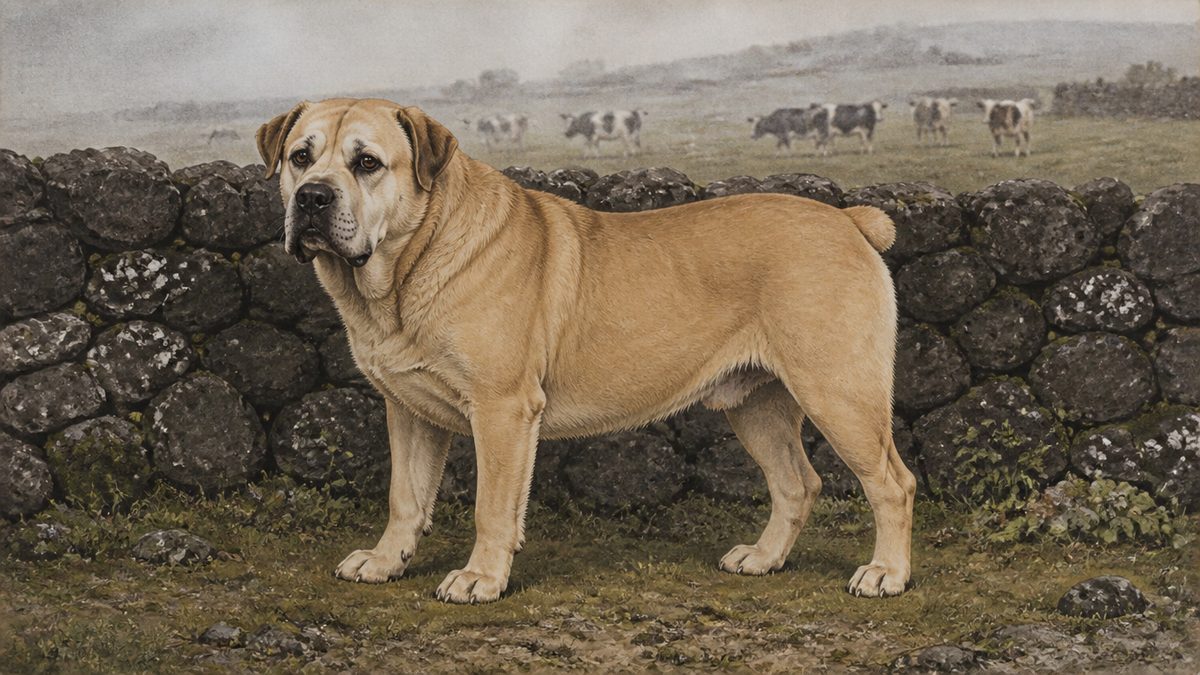
Two descriptions of the Terceira Mastiff survive and they agree on a medium, heavy, yellowish bull-and-mastiff dog with a naturally irregular tail. They disagree about brindle, and the disagreement is worth publishing rather than resolving, because neither source is a breed standard and no third document can settle it.
The fuller description is a 1960 account by Dr Joao Batista Gomes, quoted at length on the recovery project's history page. It gives a rectangular body, a maximum height of 60 cm, very reinforced joints, a short neck with hanging skin, a voluminous almost square head but less so than the English Bulldog's, a well-opened mouth with strong canines and molars, a pendulous upper lip, a black palate, a black muzzle that is not pushed in and lacks the Bulldog's deep fronto-nasal furrow, drop ears that are sometimes twisted, and deep-set eyes.
The second is Eva-Maria Kramer's 2009 German breed guide, which is the only source English Wikipedia has for the animal's physical description. It gives a height of about 55 cm, a short smooth coat, and a colour of fawn or yellow, always with a light mask. For calibration, the FCI's standard for the surviving sister breed on the next island describes its general appearance in three words, robust and hardy, and gives its utilisation as simply cattle dog. That is a register's language for a dog of this build, and it is the nearest thing to a standard description this type will ever get.
| Attribute | Gomes, 1960 | Kramer, 2009 | Status |
|---|---|---|---|
| Height | Maximum 60 cm | About 55 cm | Two figures, neither from a standard |
| Weight | Not given | Not given | No weight exists for this breed |
| Coat | Neither short nor too long | Short and smooth | Mild disagreement |
| Colour | Rarely sooty, generally yellowish, sometimes white-patched or striped | Fawn or yellow, always with a light mask | Agree on yellow, disagree on brindle |
| Mask | Not mentioned | Always a light mask | One source only |
| Head | Voluminous, almost square, less so than the English Bulldog | Not described | One source only |
| Tail | Naturally irregular in direction, from the first coccygeal vertebrae | Innately short and corkscrew-like | Agree, and both say NATURAL |
| Ears | Drop, sometimes twisted | Not described | One source only |
| Nose | Black muzzle, black palate | Black, brown or even pink | Wikipedia's version is tagged citation-needed |
Kramer records red, black and BRINDLE individuals as usually considered impure, while Gomes's 1960 account allows a striped coat as an occasional variant. Both agree the ordinary dog was yellow or fawn. An earlier draft of this page's image brief chose brindle, reasoning from the Saint Miguel Cattle Dog's standard, which requires a coat that is ALWAYS brindled. That was an inference from a different breed's document and it has been withdrawn. The two sources that actually describe this dog both make yellow the default and brindle the exception.
The twisted tail is a vertebral trait, not a knife
Gomes attributes the tail to an irregularity in the arrangement of the first coccygeal vertebrae, the same mechanism as the English Bulldog's, which produced a tail with a tendency to irregular direction and which is why the islanders called these dogs rabos tortos. That is a congenital screw tail. It is not a docked tail, and an Indian reader needs the distinction, because tail docking is forbidden outright by Indian law while a naturally short tail is simply what the dog was born with.
The recovery project supplies an uncomfortable footnote on the same trait. It reports that a line of yellow or reddish Saint Miguel dogs known locally as *caes da terra* still carries the natural bobtail, and that Sao Miguel breeders amputate the tail flush at birth to hide what they regard as a genetic defect. The historical breed's defining feature is being surgically erased in its surviving sister population, by people who consider it a fault.
How much of this to trust
Treat every figure above as unverified in the registry sense, because none of it comes from a register. Kramer 2009 is a general breed encyclopedia rather than a study of this dog, Gomes was writing in 1960 about a population already collapsing, and English Wikipedia tags two of its four appearance claims as needing citations and carries a notability warning template dated February 2020. Portuguese Wikipedia, the fullest article in the ranking set, is itself flagged as a stub and rests on the same three books.
Recognition status, checked at four registers
No registry anywhere holds the Terceira Mastiff, and the most telling absence is not the international one. Portugal's own kennel club maintains a published category for national breeds the FCI does not recognise, and this breed is not in it either.
Bonbeno's two-condition test asks whether a breed has a written standard and a register that keeps its pedigrees generation to generation. Here both conditions fail, and they have never been met. Every check below was run in this session against the register's own document, with in-document controls.
| Register | What it holds | Terceira Mastiff | In-document control |
|---|---|---|---|
| FCI Group 2, definitive | 53 breeds | Absent | Saint Miguel Cattle Dog 340, Rafeiro of Alentejo 96, Fila Brasileiro 225, Mastiff 264 all present |
| FCI provisional register | 20 breeds | Absent | Buldogue Campeiro 374, Cao de Gado Transmontano 368 both present |
| CPC, Portuguese breeds recognised by the FCI | 9 breeds | Absent | Saint Miguel Cattle Dog and Alentejo Mastiff both present |
| CPC, Portuguese breeds NOT recognised by the FCI | 2 breeds | Absent | Algarve Barrocal Dog and Terceira Cattle Dog both present |
The Portuguese Kennel Club list is the decisive one and nobody uses it. The CPC publishes its national breeds in two explicitly labelled halves, Portuguese breeds recognized by the FCI and Portuguese breeds not recognized by the FCI, and this breed appears in neither, while the separate Terceira Cattle Dog appears in the second. A national body that maintains a category built for exactly this situation, and does not place the breed in it, has given a considered verdict rather than committed an oversight.
The CPC's non-FCI half contains the TERCEIRA CATTLE DOG, which is the Barbado da Terceira. That is a different, living, long-coated herding breed from the same island, with a national standard first written in 2004 and revised in 2017, and a census of about 665 dogs in 2025. The Terceira Mastiff was a short-coated molossoid catch dog and it is gone. Bonbeno keeps them on separate pages, and a search result offering you a Terceira dog in India is far more likely to concern the Barbado.
What the FCI itself says, in a document about another breed
The strongest single sentence on this breed's status sits inside somebody else's standard. FCI Standard 340, the Saint Miguel Cattle Dog, dated 20 June 2007 and current, opens its Brief Historical Summary with a cattle dog originating in the island of Saint Miguel in the Azores, also known as the Cow Dog, and then states that its history is linked to that of the now extinct Terceira Dog.
That was re-extracted here with pypdf rather than taken from a rendering, which turned out to matter. The document is 317,212 bytes, 6 pages and 5,788 extracted characters, and the words Terceira, historical and extinct each occur exactly once, all inside that one paragraph. A rendered markdown version of the same PDF obtained in this session omitted the entire Brief Historical Summary, so a page built on the rendering would have missed the only FCI sentence that exists about this animal.
The one recognition claim in the ranking set, and what supports it
A hobbyist molosser site claims the Fila da Terceira was officially recognised by the Portuguese Kennel Club in the early 1900s and lost that status by the 1950s. No document was produced for that claim in this session, the CPC's own current list does not carry the breed in either half, and Italian Wikipedia states directly that neither the FCI nor the local CPC ever officially recognised it. Treat the claim as unsupported rather than as disproved, and note that a 1937 and 1942 appearance at Lisbon exhibitions is a show entry rather than a register entry.
One further absence is worth recording because it is the kind other pages get wrong. The breed does not appear in Portugal's national registry study of ten top Portuguese breeds by life expectancy, nor in the 2026 genomic survey of Portuguese native breeds, which lists eleven breeds and gives census sizes for each Blaschikoff L, Serra O, Simoes F, Ginja C. Those are absences from studies of living populations, so they carry no information about recognition. They simply confirm there is nothing to sample.
The recovery project, and what it actually holds
One private Portuguese project is attempting to rebuild the breed, and it publishes its founding stock openly. It began with 6 bitches and 3 dogs, three of the nine are not Azorean at all, and the project states that a standard will be written only once a number of uniform specimens is achieved.
This is the single most useful page in the whole ranking set and no English-language source reads it. The account is candid, which is why it is worth quoting rather than summarising.
| Founder | Count | Origin as stated |
|---|---|---|
| Mastiff-type bobtail bitches | 3 | Azores |
| Twisted-tail bitch | 1 | Azores |
| Bull-type twisted-tail dogs | 2 | Azores |
| Dogue de Bordeaux bitch | 1 | Outcross, added deliberately |
| Spanish Mastiff bitch, old working lines | 1 | Outcross, added deliberately |
| English Bulldog crossed with American Bulldog, twisted tail | 1 | Outcross, added deliberately |
| Total | 9 | 6 bitches and 3 dogs, the project's own arithmetic |
The project explains the outcrosses rather than hiding them. It says these breeds are the original phenotypes behind the Fila da Terceira on one side, and that they are there to keep the functional gripping of cattle on the other. Its plan is to cross the two phenotypes first, then separate the twisted-tail offspring from the rest, keeping both the bull head and the mastiff head while fixing the twisted and bobbed tails, which it names as the breed's distinguishing mark.
The founder describes being told by a friend that he owned extremely rare bitches of the old breed, going to see them, and finding that despite their very short bobbed tails they were in reality SAO MIGUEL TYPE bobtail bitches of a kind that still turns up on Sao Miguel, where not many years ago about a third of litters carried that tail. He publishes that instead of claiming the find. Anyone assessing a dog offered under this name in any country should note how easily an experienced enthusiast on the ground mistook one for the other.
What the project says about a standard
There is no standard, and the project says so. Its Estalao da Raca page names the two historical descriptions it is working from and states that a new standard will be written when a number of uniform specimens is achieved. That is the correct order of operations for anyone rebuilding a population, and it is also the reason no page, including this one, can print a height range, a weight range or a colour list for a living animal under this name.
The project also accepts reservations for puppies, subject to a contract giving it control over the animals in order to preserve the future of the breed. So dogs are being placed while the population is still nine founders deep and no standard exists. Verify that before treating any offer as a purchase of a Terceira Mastiff.
This is not the first attempt, and the earlier ones failed
Two prior recoveries are recorded. The Portuguese government supported an attempt in the 1960s which failed after disagreement between officials and breeders, leaving the animal's future to farmers and enthusiasts, and by the 1970s it was declared extinct. A second attempt in the 1990s, by the zootechnician Andre Oliveira, is described by the current project as unsuccessful, and it notes Dogue de Bordeaux blood visible in one of his last bitches, in the coat, the general aspect and the red nose.
So the current programme is the third attempt in sixty years, and the second of the three to reach for a Dogue de Bordeaux. That is worth stating plainly rather than reading as a criticism. It is simply what rebuilding from an extinct base looks like when the base is gone.
Terceira Mastiff price in India
There is no Terceira Mastiff price in India, and there is no Terceira Mastiff price anywhere, because the animal does not exist to sell. The Indian commercial query for its name returns a sportswear brand, which is the cleanest illustration of the problem a buyer faces here.
Run the name through an Indian search and the instrument works perfectly while the answer is useless. Fila is a shoe and clothing brand in India before it is a Portuguese word for a gripping dog, so a price query for this breed ranks amazon.in and footlocker.co.in ahead of anything canine. That is homonym capture, not a broken search, and it means no amount of query refinement will surface an Indian market that is not there.
The informational shapes behave completely differently and prove the point from the other side. The native-name query cao de fila da terceira returned About 135 results on Google India, a genuine Portuguese-language result set led by Portuguese Wikipedia, the recovery project's own site and a Portuguese public petition to save the breed. A search engine reaching for Portuguese petitions to answer an Indian query is telling you where this subject lives, and it is not in Indian commerce.
The 135 figure is not evidence of anything and this site has corrected pages that argued from result counts. A printed count moves by tens of percent on a fixed query inside one session and cannot measure demand. What evidences the absence here is composition: Portuguese encyclopedias, a campaign petition and one hobbyist project on the informational shapes, and general Indian retail selling footwear on the commercial shape. No Indian host in any of the three result sets carries a page for this dog.
What any rupee figure offered for this breed would actually be
Every rupee band you are shown for this name will be one of four things, and none of them is a price you can act on. Work through them in order before you believe a number.
- Divide the figure by 84.38, then by 80, then by 74. A clean quotient means a foreign asking price was converted and relabelled as Indian.
- Read the quotient for plausibility. A conversion landing on 800 or 1,500 dollars is a converted list; one landing on 6,875 is rupee-native and arbitrary.
- Check the host country behind the Rs. The same abbreviation carries the Pakistani rupee, and Brazilian pages write R$ with a full stop for thousands, which matters here because the breed's descendants are Brazilian.
- Confirm the listing is for a live animal of this breed rather than a template page that exists identically for every breed on that site.
Step four is the one that catches people on an extinct animal, because a listing does not need to be dishonest to be wrong. Directory sites generate one page per breed per city automatically and fill them from a generic business list, so a page can exist for a dog that has been gone for fifty years and still look like local commerce.
The import position, read from the instrument and not from a court's summary
India treats live dogs as a restricted import, and the channel that exists is a personal pet import for an owner relocating with the animal rather than a commercial one for breeding or sale. Separately, the Department of Animal Husbandry and Dairying letter of 12 March 2024, reproduced in full inside the customs instruction of 14 March 2024, names 24 comma-separated categories to be prohibited for import, breeding and sale. Entry 15 is the bare undefined phrase Mastiffs (boerbulls).
That word reaches this animal on its face, and the honest thing is to say so rather than to search the list for the string Terceira, find nothing, and clear it. This site has already had to correct pages that cleared a wolfdog line the entry Wolf dogs plainly reached and three terriers the bare word Terriers plainly reached. The Goa Legislative Assembly's answer of 7 August 2024 reproduces the same central list independently, which is the cheapest available second check on the text.
No Indian law in force today bans owning, breeding or selling any dog breed. The Karnataka High Court quashed the March 2024 circular on 10 April 2024 and the Delhi High Court set it aside that month, and the Union has since told the courts that the quashed circular has lost its effect entirely. The instrument was never an Act, a rule or a notification; it was a D.O. letter from a Joint Secretary, reproduced in a customs instruction. Read the list from the customs instruction itself rather than from a court's recital of it, because the Karnataka judgment reproduces the list ABRIDGED and drops several entries including the undefined category words.
For this breed the whole question is academic in the most literal sense. There is nothing to import, no register to import it from, and no breeder in India who could lawfully sell it if there were. The price in india is not high, low or unknown. It does not exist.
Cost of ownership in India for a dog of this size
A 40 kg short-coated guarding dog costs a rupee-denominated amount to keep in India whatever its breed, and those figures are real and sourceable even when a breed price is not. Anti-rabies vaccination starts at Rs 699 and the 9-in-1 at Rs 899 at one Indian clinic chain, read live on 9 September 2026.
This section exists because the honest answer to a price question on an absent breed is a care cost, not a purchase price. Every figure below was opened at the seller's own page on 9 September 2026 and is quoted with the vendor named, so a reader can check it and a later editor can see when it moved.
| Item | Rupees | Source and scope |
|---|---|---|
| Anti-rabies vaccination | From Rs 699 | Vetic clinic chain, national price page |
| 9-in-1 DHPPiL vaccination | From Rs 899 | Vetic, same page |
| Canine corona vaccination | From Rs 899 | Vetic, same page |
| Full-body bath and blow dry | From Rs 934 | Vetic grooming, Delhi, listed against Rs 1,099 |
| Haircut package, 120 minutes | From Rs 1,359 | Vetic grooming, Delhi, listed against Rs 1,599 |
| Boarding, up to 4 hours | Rs 599 | PawSpace, Bengaluru home boarding |
| Boarding, daycare to 10 hours | Rs 799 | PawSpace, Bengaluru |
| Boarding, overnight to 24 hours | Rs 899 | PawSpace, Bengaluru, festive rates 25 to 30 percent higher, food extra |
| Pet dog registration, Delhi | Rs 500 | MCD portal, renewal also Rs 500, late fee Rs 100 per month |
| Pet animal licence, Chennai | Rs 50 | Greater Chennai Corporation, 9,115 issued in 2024 |
| Microchipping, one Chennai clinic | Rs 1,250 | SKS Veterinary Hospital's own transacted rate |
No monthly food total appears here. A monthly figure for a 40 kg dog is arithmetic performed on a bag price and a feeding guide, not a price anybody quotes, and this breed has no verified weight to do the arithmetic on. The same applies to a lifetime cost. What can be said is the shape of the commitment rather than its total, and one Indian sanctuary's own cost guide puts it at a ten to fifteen year financial commitment beginning the moment the dog crosses your threshold, whether the dog cost Rs 80,000 from a breeder or Rs 500 to adopt.
The costs that scale with size, and why they matter more here
Three lines on that table scale with bodyweight rather than with breed, and a molossoid puts you at the top of every one of them. Parasite control is dosed by weight, so a 40 kg dog needs the largest tablet band of a combined product such as NexGard Spectra, sold in India in a 15 to 30 kg presentation for dogs and above. Deworming is dosed at one tablet per 10 kg, so a heavy dog takes four tablets where a Pug takes one.
Boarding is the third. A large guarding dog is refused by more Indian boarding operators than a small companion dog is, and the ones that accept it charge the same rate card while asking more questions. PawSpace's Bengaluru rates run Rs 599 hourly to Rs 899 overnight for dogs, against Rs 499 to Rs 649 for cats, with festive-season rates 25 to 30 percent higher and food charged separately.
What registration actually costs, and why it is not optional
Municipal registration is cheap and it is the line Indian owners of guarding breeds skip most often. Delhi charges Rs 500 for a new pet dog registration and the same to renew, with a Rs 100 per month late fee after a one-month grace period tied to the anti-rabies vaccination certificate. Greater Chennai Corporation charges Rs 50 and issued 9,115 pet animal licences in 2024.
Chennai also runs municipal pet clinics that provide all treatment and anti-rabies vaccination free of cost, which materially changes the first-year cost of ownership for anyone in that city. A registered, microchipped dog is a dog that comes back, and for a 40 kg dog with a guarding history that matters more than it does for a lapdog.
Heat tolerance and the Indian climate
The Azores are mild, wet and almost seasonless, and nothing in that description prepares a heavy molossoid for an Indian plains summer. Angra do Heroismo on Terceira peaks at an August mean of 22.77 C with a peak wet bulb of 20.13 C, against 26.11 C in Chennai and 27.09 C in Kolkata.
Those figures come from NASA POWER's 2001 to 2020 climatology, queried by explicit latitude and longitude with the model's own cell elevation echoed back and checked against the real one. The Azorean cell is good: Angra do Heroismo returned 14.11 m against a real elevation near 40 m, an error of about 26 m, which is well inside what this model manages on a small island. Wet bulb is computed by the Stull method from mean temperature and mean relative humidity, and every figure below is a mean rather than an extreme.
| Place | Annual mean C | Annual RH % | Hottest month | Peak wet bulb C |
|---|---|---|---|---|
| Angra do Heroismo, Terceira | 18.27 | 80.13 | August, 22.77 | 20.13 (August) |
| Ponta Delgada, Sao Miguel | 18.46 | 79.56 | August, 22.91 | 20.09 (August) |
| Bengaluru | 23.74 | 67.94 | April, 28.37 | 21.86 (May) |
| Pune | 23.86 | 66.80 | April, 28.93 | 22.97 (June) |
| Hyderabad | 26.10 | 60.30 | May, 33.30 | 23.35 (June) |
| Mumbai | 26.77 | 67.39 | May, 31.19 | 25.77 (June) |
| Chennai | 27.95 | 72.39 | May, 31.51 | 26.11 (May) |
| Delhi | 25.60 | 45.56 | June, 35.88 | 26.50 (July) |
| Kolkata | 25.81 | 73.93 | May, 31.53 | 27.09 (June) |
Terceira runs 80.13 percent annual relative humidity. That is HIGHER than Kolkata's 73.93, Chennai's 72.39 and Mumbai's 67.39, and far higher than Delhi's 45.56. So the reflex claim that Indian humidity will finish an Atlantic breed is not merely unsupported, it is inverted. This dog came from a wetter place than any Indian city on the table. What it never met is heat, and the honest way to frame the risk is wet-bulb load, which combines the two, rather than damp air on its own.
A seasonless homeland is its own problem
Terceira barely has seasons. Its hottest month is August at 22.77 C and its coolest is March at 15.22 C, a spread of about seven and a half degrees across the entire year. Note that the coolest month is March rather than January, which is the maritime lag, and it is counter-intuitive enough to be worth stating outright.
A population selected inside a seven-degree annual band has no physiological experience of a Delhi June at 35.88 C, a Chennai May at 31.51 C, or a monsoon of any kind. The wet-bulb gap is about six degrees to Chennai and nearly seven to Kolkata. Bengaluru at 21.86 C and Pune at 22.97 C are the two workable Indian cities, and Bengaluru is genuinely close, 1.73 C above the homeland's August peak.
Get the months right, because this site has corrected pages that did not. Bengaluru peaks in April and is coolest in December. Pune peaks in April and is coolest in December. Delhi peaks in June. Chennai, Mumbai and Kolkata genuinely do peak in May, so a May label is not automatically an error.
The heat risk, quantified from the one study that measured it
UK primary-care records for 905,543 dogs in 2016 identified 395 confirmed heat-related illness events, an incidence of 0.04 percent with a 95 percent confidence interval of 0.04 to 0.05, and an event fatality rate of 14.18 percent, confidence interval 11.08 to 17.96. Roughly one dog in seven that develops heat illness dies of it.
The companion paper looked at triggers in the same cohort. Of 1,259 events from 1,222 dogs, 380 had no trigger recorded, leaving 879 with one, of which 652, or 74.2 percent, were exertional, against 113 environmental at 12.9 percent and 46 from vehicular confinement at 5.2 percent. The detail an Indian owner needs sits one level down. Of the 652 exertional events, 551 specified the exercise, and 372 of those, 67.5 percent, followed an ordinary walk rather than hard exercise.
Two thirds of exertional heat illness followed a WALK. Not a run, not a game, not a working session. That is the number to carry into an Indian summer, because it means the risk is not confined to strenuous activity and a 6 pm walk in Chennai in May is exactly the scenario the data describes. Walk before sunrise, carry water, and turn back on the dog rather than on the clock. Consult your nearby vet about heat protocols before the hot season rather than during it.
One transferable risk factor applies even though this breed was never modelled. Dogs at or above their breed and sex mean bodyweight carried 1.42 times the odds of heat-related illness, confidence interval 1.12 to 1.80. A heavy dog of a heavy type sits in that band by construction. This page claims no breed-specific odds ratio, because importing one onto an animal the authors never studied would be fabrication wearing a citation. The rated heat tolerance for this dog is the lowest on this site, and it is an inference from build and homeland rather than a measurement.
Temperament, read from the function rather than from a standard
No temperament clause exists for the Terceira Mastiff, because no standard was ever written. What exists is a description of the job, and the job was to grip cattle, hold large game and guard property, which is a demanding brief in any household and an unsuitable one in most Indian homes.
The sources are consistent on what the dog was for. It was developed for handling cattle and for defending the island against attack, and its name announces the temperament: *fila* names a dog that bites and does not release. English Wikipedia files it under catch dogs and records its employment as a house guardian.
One detail in the 1960 description is worth reading slowly, because it explains the selection rather than merely labelling it. Gomes records a slightly undershot bite as functional, on the reasoning that it avoids cutting the animal and permits a stronger hold. A jaw shape selected for holding a cow without injuring it is a statement about work, and it is the sort of thing a temperament adjective flattens away.
Second Schedule Part III paragraph 8(10) of the Prevention of Cruelty to Animals (Dog Breeding and Marketing) Rules 2017 lists the genetic defects a breeding dog must have been tested for, and the list expressly includes undershot jaw where the incisors do not touch or mesh. A reconstruction programme that selects for a functional undershot bite is selecting for something Indian law names as a defect to be screened against. That collision is not hypothetical, because paragraph 6(9) reaches the programme as well.
Who this dog would suit, if it existed
Nobody in an Indian flat, and that is not a close call. A dog selected to guard property and to grip stock needs a fenced rural or peri-urban property, work or a substitute for it, and a handler who has raised a large protective breed before. Every trait rating on this page for household fit is 1 out of 5, and each one is labelled as an inference from the function rather than as an observation of temperament, because no living population exists to observe.
The reconstruction stock sharpens the point rather than softening it. A programme built on a Dogue de Bordeaux, a working-line Spanish Mastiff and an English Bulldog crossed with an American Bulldog, selected explicitly to retain gripping of cattle and large game, is producing dogs with a serious working brief and no settled temperament. The project's own description of old working Spanish mastiffs as 50 to 60 kg animals, agile and without fear, is a fair warning about what the founder stock brings.
Socialisation, and the honest limit on advice here
Any large guarding dog needs early and continuous exposure to people, traffic, other dogs and the ordinary chaos of an Indian street, and the window for that work closes early. But a page cannot responsibly hand an owner a socialise-by-week-twelve schedule tuned to a breed nobody has observed. The generic advice for a molossoid guardian applies; the breed-specific version does not exist, and pretending otherwise is where most content about rare dogs goes wrong.
Read the reconstruction's parent breeds instead, because they are real, documented and already on this site. The Dogue de Bordeaux and the Spanish Mastiff both have standards, both have literature, and between them they describe most of what a first-generation dog from this programme would be.
Training a reconstruction, and what it would resist
To train a dog from this programme, treat it as a first-generation working molossoid of unsettled type rather than as a breed with known handling. The project's stated goal is to keep the functional gripping of cattle and large game, so the behaviour it is selecting for is exactly the behaviour a pet owner most needs to manage.
Nobody can train to a breed profile that does not exist. What can be said is what the programme is deliberately preserving, and it says so in one sentence: the plan is to fix the twisted and bobbed tails as the distinguishing mark, but above all the functionality of guarding and gripping cattle or large game, which is what made these dogs a legend. Read that as a handling forecast rather than as marketing.
- Establish recall before anything else, because a gripping dog that will not return is a liability rather than a training problem.
- Build impulse control on moving objects early, since heel-height movement is the exact stimulus this type was selected to act on.
- Manage arousal rather than punishing it, because selection for holding produces persistence and not aggression.
- Introduce strangers on the handler's terms daily, given a documented history of guarding property and people.
- Book a professional assessment before the dog reaches adult weight, not after.
Trainability is rated 2 out of 5 on this page and even that is an inference. Nothing was ever published about how the historical dog took instruction, and a first-generation cross of a Dogue de Bordeaux, a Spanish Mastiff and a bulldog cross is not a predictable animal. Anyone offered such a dog should expect to train the individual in front of them rather than the breed described on a website, and should have a plan for the case where the dog turns out harder than advertised.
What Indian law says about managing a difficult guarding dog
Two provisions of the 2017 Rules bear on this directly and both are worth knowing before a dog arrives. Part IV of the Second Schedule requires separate housing for a vicious or aggressive dog, and it forbids the use of sedation to control behaviour. That closes off the shortcut some Indian owners of large guarding dogs reach for, and it means behavioural management has to be actual management.
The second is the one that reaches the whole reconstruction. Second Schedule Part II paragraph 6(9) reads, in full: Breeding to create new breeds of dogs or unusual looks shall be strictly prohibited. A programme whose published plan is to cross two phenotypes and then fix a twisted tail as a distinguishing mark is, on the face of that clause, doing both halves of what it prohibits.
Daily exercise requirement
A dog of this type needs real daily work rather than a walk around a block, and in India that work has to happen in a narrow window at either end of the day. Exercise need is rated 4 out of 5 here, inferred from the working brief rather than measured, and labelled as an inference.
The historical dog worked cattle on rough volcanic terrain and guarded property, and the reconstruction is being bred to keep that capacity. Neither activity is met by a lead walk. Plan for a long morning session, a shorter evening one, and daily mental work such as scent games or structured obedience, because a guarding molossoid without a job invents one.
| City | Hot-season window | What to cut | Why |
|---|---|---|---|
| Chennai | Before 6 am only | All evening exercise, May to July | Peak wet bulb 26.11 C in May, six degrees above the homeland |
| Kolkata | Before 6 am only | All exercise once the monsoon humidity sets in | Peak wet bulb 27.09 C in June, the highest on this page |
| Delhi | Before 6 am, and after 9 pm in dry heat | Midday and afternoon, April to July | June mean 35.88 C, peak wet bulb 26.50 C in July |
| Mumbai | Before 6.30 am | Evening work in June and July | Peak wet bulb 25.77 C in June |
| Bengaluru | Before 7 am and after 6.30 pm | Only the April afternoon peak | Peak wet bulb 21.86 C, the closest Indian city to the homeland |
| Pune | Before 7 am and after 6.30 pm | Only the April afternoon peak | Peak wet bulb 22.97 C, workable most of the year |
The exercise itself is where the danger sits, which is counter-intuitive and worth repeating. In the UK cohort, 372 of 551 specified exertional heat-illness events, 67.5 percent, followed a walk rather than intense activity. So a heavy dog on an ordinary evening walk in an Indian May is precisely the scenario the largest study of the problem describes, and the correct response is to move the walk rather than to shorten it.
Second Schedule Part IV paragraph 21(1) of the 2017 Rules bars keeping certain dogs in outdoor facilities without the attending veterinary practitioner's WRITTEN approval, naming among them dogs not accustomed to local temperatures and breeds that cannot tolerate the temperatures prevalent in the region, such as long-haired breeds in high temperature locations. This is a short-coated type, so the long-haired illustration does not catch it. The category above it does, on any honest reading, for a dog whose homeland's hottest month averages 22.77 C being kennelled outdoors in Chennai.
Grooming, and the tail question Indian law settles
To groom a short-coated molossoid in India, work weekly with a rubber curry mitt and pay attention to skin folds and ears rather than to coat length. Grooming load is rated 1 out of 5 here, which is the easiest thing about this animal and also one of the few ratings that is not badly uncertain.
Both surviving descriptions give a short coat, Kramer as short and smooth, Gomes as neither short nor too long on the mastiff type, so the reconstruction stock's grooming needs are simply those of a short-coated large dog Cao de Fila da Terceira recovery project. A weekly rubber mitt, a bath when actually dirty, nails every three to four weeks and ears checked weekly covers it. A commercial full-body bath and blow dry at an Indian clinic chain starts at Rs 934 in Delhi against a listed Rs 1,099, and a 120-minute haircut package at Rs 1,359, so professional grooming is an occasional convenience for this coat rather than a monthly necessity.
Two Indian adjustments matter more than the brushing. First, ear care through the monsoon, because a heavy-headed dog with drop ears traps moisture and warm wet air is the setting canine otitis externa prefers. Second, skin-fold hygiene on any dog carrying bulldog ancestry, which the reconstruction stock does by design.
Overseas breed clubs routinely tell owners to towel a dog and let it air dry, which is sound advice in a temperate climate and poor advice in an Indian monsoon, where a damp ear canal in a humid month is the commonest route into otitis. Dry the ears actively, plug them before bathing, and check them weekly rather than monthly between June and September. Consult your nearby vet at the first head shake rather than waiting for a smell.
The twisted tail, and the two things India forbids
This breed's signature is a twisted tail that is congenital, not surgical. Gomes attributes it to an irregularity in the arrangement of the first coccygeal vertebrae, giving a tail with a tendency to irregular direction, which is what earned the islanders' name rabo torto. That distinction is not academic in India.
Second Schedule Part II paragraph 6(8) of the 2017 Rules states that there shall be no tail docking, ear cropping, de-barking, de-clawing, branding, dyeing, injecting substances to enhance visual appeal, performing a surgery or procedure to camouflage or hide any defect or infirmity or any other kind of mutilation of any body part of the pup, and any change of appearance by artificial means is strictly forbidden.
Read that against what the recovery project reports happening on the neighbouring island. It records Sao Miguel breeders amputating the natural bobtail flush at birth to hide what they treat as a genetic defect in the yellow *caes da terra* line. In India that practice would be caught twice over by paragraph 6(8), once as tail docking and again as a procedure to camouflage or hide a defect. So if you are ever shown a dog of this type in India, verify the tail is natural rather than assuming it, and understand that a docked tail on an Indian-bred pup is a legal problem as well as a welfare one.
Ears are the same story in miniature. Neither description of the Terceira dog mentions cropping, and the practice is prohibited by the same clause. Any Indian dog of molossoid type presented with cropped ears has been altered in a way the Rules forbid outright.
Health problems, life span and what no study can tell you
No health data exists for the Terceira Mastiff, and that is a statement about the world rather than about this page's research. There is no lifespan study, no screening scheme, no OFA row and no breed-club survey, because there has been no population to study since the 1970s. Evidence quality is rated 1 out of 5 here, the lowest on this site.
The absence was checked rather than assumed. The largest UK longevity study's breed table, Supplementary Table S5 of McMillan 2024, was downloaded and parsed namespace-aware from the OOXML in this session. It carries 345 rows under the header Breed, Included in Survival Analysis, Phylogeny Reclassification, Phylogeny Abbreviation, KC Group, FCI Group, Body Size and Cephalic Index, and Terceira returns zero, Barbado returns zero and Azore returns zero across all of them.
The in-document controls passed on the same file, which is what makes the absence worth reporting. Labrador Retriever, Whippet, Rafeiro of Alentejo, Estrela Mountain Dog, Portuguese Water Dog, Portuguese Sheepdog, Portuguese Podengo and Fila Brasileiro are all present. So the search works and the breed is genuinely not there.
Of the six Portuguese breeds that DO appear in McMillan's Table S5, only the Portuguese Water Dog carries a Y in the Included in Survival Analysis column. The Rafeiro of Alentejo, the Estrela Mountain Dog, the Portuguese Sheepdog, the Portuguese Podengo and the Fila Brasileiro all carry N, meaning they were named in the table and excluded from the survival analysis. So a page that quotes a McMillan median for any of those five is quoting a figure that table does not contain. Bonbeno records this here because it applies well beyond this breed.
The nearest real life expectancy figures, and why they are not this dog's
Portugal's national registry study computed life expectancy at birth for its ten top breeds, and two of them are useful comparators for a heavy Azorean molossoid. The Terceira Cattle Dog, which is the Barbado, sits at 8.62 years on 104 registry dogs, confidence interval 7.78 to 9.46, with males at 8.16 and females at 8.92. The Alentejo Mastiff sits at 8.03 years on 3,486 dogs.
| Breed | Registry dogs | Life expectancy at 0 | 95% CI |
|---|---|---|---|
| Portuguese Water Dog | 384 | 10.85 | 9.80 to 11.89 |
| Portuguese Pointing Dog | 2,560 | 9.23 | 8.84 to 9.61 |
| Terceira Cattle Dog (Barbado) | 104 | 8.62 | 7.78 to 9.46 |
| Castro Laboreiro Dog | 810 | 8.44 | 7.71 to 9.16 |
| Alentejo Mastiff | 3,486 | 8.03 | 7.73 to 8.33 |
| Portuguese Sheepdog | 435 | 7.93 | 7.35 to 8.51 |
| Terceira Mastiff | 0 | No figure exists | Absent from the study |
Do not read any of those numbers as this breed's life span. They belong to living breeds with registries, and importing one onto an extinct landrace would be exactly the substitution this site refuses. They are printed here so a reader can see the range a Portuguese working molossoid actually occupies, which is roughly eight to nine years rather than the twelve to fifteen that content farms print for breeds they know nothing about.
Parasites on the islands and in India, which is the one health figure that transfers
A 2024 survey of Azorean dogs found gastrointestinal parasites in 53 percent of 205 dogs screened, and that figure transfers to an Indian reader better than any breed-specific claim could, because it describes a dense dog population in a warm humid climate rather than a breed.
A 2024 survey sampled faeces from 205 dogs across Sao Miguel and Terceira and found an overall gastrointestinal parasite prevalence of 53 percent, 108 of 205 dogs screened. On Terceira specifically the figure was 40 of 101 dogs, against 68 of 104 on Sao Miguel. The species breakdown across both islands was Ancylostomatidae hookworms 42.4 percent, *Trichuris vulpis* 17.6 percent, *Toxocara canis* 12.7 percent and *Cystoisospora* 4.4 percent, with one *Angiostrongylus vasorum* case.
Two qualifications belong with that figure and the authors state both. The samples came mainly from kennels and catteries rather than from pet homes, and the authors attribute the high prevalence partly to that and partly to what they call the peculiar climatic conditions in this insular territory, with mild temperature and high relative humidity. So it describes a dense, under-dewormed population in a humid climate, which is a useful analogue for parts of India and not a figure about this breed.
The Indian parasite picture a dog of this type would actually meet
India's burden is different in kind rather than merely in degree, because the tick-borne haemoprotozoa are the ones that kill. Two 2026 molecular studies map it, one across West Bengal and one across southern India Venugopal V, Deepa PM, Muhasin Asaf VN. Both were published in the same journal in the same year by different teams, and neither concerns this breed, which is why they are cited for the setting rather than for a prevalence attributed to the dog.
The practical consequence for an Indian owner of any large short-coated dog is a year-round parasite plan rather than a seasonal one. Combined monthly cover exists in India as a single tablet, dosed by weight, with a 15 to 30 kg presentation for larger dogs, and deworming is dosed at one tablet per 10 kg. Have a veterinarian screen for tick-borne disease at the first sign of lethargy or pale gums rather than treating empirically.
This page reports registry documents, historical descriptions, one recovery project's own account of itself and published Indian veterinary literature. It contains no health data for this breed because none exists. Nothing here is a diagnosis or a treatment plan for any individual animal. Consult your nearby vet about any dog you are offered under this name, and have a veterinarian assess it in person before you act on a single line of this page.
One inherited-risk note that does transfer, and one that does not
The Azorean sister breed carries a documented drug-sensitivity risk worth knowing about. A 2022 Portuguese study of 105 dogs, 23 of them Barbado da Terceira, identified the MDR1 4-bp deletion in the Barbado da Terceira for the first time, and the paper notes in its methods that although the Barbado is not a recognized breed by the FCI it is classified by the Clube Portugues de Canicultura as a Group 1 breed. That is a herding-lineage mutation and there is no reason to expect it in a molossoid, so it is recorded here as a fact about the neighbour rather than transferred.
The genetics that might once have said something about the Terceira dog were never collected. A 2005 mitochondrial study characterised four Portuguese autochthonous breeds in fine detail, and a 2026 whole-genome survey covered eleven Portuguese native breeds with census sizes for each Blaschikoff L, Serra O, Simoes F, Ginja C. Neither includes this animal, because by the time anyone was sequencing Portuguese dogs there was nothing left on Terceira to sample.
Feeding a heavy molossoid in India
To feed a dog of this type, work from the bag's feeding guide against the dog's actual weight, split the ration across two meals, and adjust downward when the hot season shortens the exercise. This page publishes no monthly rupee food figure, because a monthly total for this animal would be arithmetic on a weight that no document supplies.
The gap is real and worth naming. Kramer gives a height of about 55 cm and Gomes a maximum of 60 cm, and neither gives a weight Cao de Fila da Terceira recovery project. A page that prints a daily gram figure for this breed has invented the denominator. What is knowable is the range the reconstruction stock sits in, and the project describes the working Spanish mastiffs it drew on as 50 to 60 kg dogs.
- Feed two measured meals a day by weight rather than by scoop, because a deep-chested heavy dog eating one large meal is the classic bloat setup.
- Weigh the dog monthly and record it, since a short fawn coat hides two kilos on a large frame easily.
- Assess body condition by hand every week, targeting 4 or 5 out of 9, ribs felt under light pressure without a fat cover.
- Withhold food and heavy water for an hour either side of hard exercise, on the same bloat reasoning.
- Adjust the ration down in April and May, when the exercise window shrinks and the calorie need falls with it.
Bodyweight at or above the breed and sex mean carried 1.42 times the odds of heat-related illness in the largest study of the problem, confidence interval 1.12 to 1.80. For a dog with no breed mean to measure against, the usable version of that finding is a body condition score assessed by hand. A dog you can feel the ribs on is a dog carrying less heat risk into an Indian May, and that is the whole argument.
Growth is the other place a heavy type needs care, and Indian conditions add a wrinkle. A large-breed puppy grown too fast carries a well-known orthopaedic cost, so feed to a slow steady curve rather than to the top of the bag's range, and do not supplement calcium on top of a complete food. A veterinarian is the right person to set the target curve for a dog whose adult weight nobody can predict from a standard, because this one has none.
Month by month through the first year
The first year for a large guarding dog runs on three tracks at once, socialisation, growth and legal compliance, and in India the third one is the track owners skip. This timeline is written for a heavy molossoid puppy generally, because no breed-specific developmental data exists for this animal.
| Age | Priority | The Indian specific |
|---|---|---|
| Before 8 weeks | Do not take the puppy | Rule 8(1)(a) of the 2017 Rules prohibits the sale of pups under eight weeks outright |
| 8 to 12 weeks | Core vaccination begins, socialisation window open | 9-in-1 from Rs 899 at a clinic chain; start street sounds, traffic and strangers now |
| 12 to 16 weeks | Anti-rabies, municipal registration | Anti-rabies from Rs 699; Delhi registration Rs 500, Chennai licence Rs 50 |
| 4 to 6 months | Recall and impulse control before size arrives | Move all training to before 7 am from April onward |
| 6 to 9 months | Adolescent guarding behaviour appears | Professional assessment now, not after the dog reaches adult weight |
| 9 to 12 months | Microchip, boarding trial, adult parasite plan | Microchipping about Rs 1,250 at one Chennai clinic; year-round tick cover, not seasonal |
The eight-week line is a Rule rather than a Second Schedule paragraph, and the difference matters if you ever have to cite it. Rule 8(1)(a) of the Prevention of Cruelty to Animals (Dog Breeding and Marketing) Rules 2017 is the sale-conditions provision and it genuinely prohibits selling pups under eight weeks. Walk away from any litter offered earlier, whatever the breed and whatever the story.
Registration belongs in the first four months rather than the second year. Delhi ties its renewal grace period to the expiry of the anti-rabies vaccination certificate and charges Rs 100 per month late after that, so the vaccination date and the registration date are one schedule rather than two. Chennai's Rs 50 licence is cheap enough that there is no reason to defer it, and the city's municipal pet clinics vaccinate free.
A puppy from a nine-founder recovery programme is not a pedigree purchase and should not be treated as one. There is no studbook, no standard, no health testing regime and no predictable adult size or temperament, and the project itself says a standard will only be written once uniform specimens exist. Anyone acquiring such an animal is joining an experiment. That can be an honourable thing to do in the country running it, with the club that runs it, and it is not something to do by mail order into India.
Head to head against the living relatives
Every dog a buyer could actually obtain instead of a Terceira Mastiff is one of its descendants or one of its reconstruction's parents, and all six are on this site with real standards behind them. The comparison below is the practical version of this page's argument.
| Breed | Relationship | Registry status | Obtainable in India |
|---|---|---|---|
| Terceira Mastiff | The subject | No register anywhere, extinct since the 1970s | No, and not by any route |
| Saint Miguel Cattle Dog | Named descendant, neighbouring island | FCI 340, definitive since 2007 | No Indian supply, but the breed exists |
| Barbado da Terceira | Same island, different breed entirely | CPC national standard 2004, revised 2017, not FCI | No, and commonly confused with this one |
| Fila Brasileiro | Descendant via the mastiff type | FCI 225, definitive, Group 2 | Named in the 2024 Indian customs list, entry 4 |
| Campeiro Bulldog | Descendant via the twisted-tail type | FCI 374, provisional since 6 August 2025 | No Indian supply |
| Dogue de Bordeaux | Reconstruction outcross | FCI 116, definitive, Group 2 | Yes, present in India |
| Spanish Mastiff | Reconstruction outcross | FCI 91, definitive, Group 2 | Rare in India |
The Campeiro row is the one worth pausing on, because it shows the alternative history. The recovery project describes the Campeiro Bulldog and the Serrano Bulldog of southern Brazil as direct descendants of the twisted-tail line of the Fila da Terceira, preserved by Azorean emigration to Santa Catarina and Rio Grande do Sul. The Campeiro is now on the FCI's provisional register as standard 374, admitted on 6 August 2025, alongside nineteen other breeds.
Terceira's dog was a function rather than a phenotype, was never written down, went to Brazil with its owners, and is gone. Sao Miguel's dog was written down, first by the Portuguese Kennel Club and then by the FCI as standard 340, and survives with a studbook. The difference is not that one animal was better. It is that somebody wrote a standard for one of them and kept a register while a population still existed. That is what this whole page is about, and it is the most useful thing an extinct breed can teach a reader.
For an Indian buyer drawn to the type rather than to the name, the Cane Corso and the Rafeiro do Alentejo are the living molossoids with real documentation, and the Rajapalayam is the large Indian guarding breed that is actually adapted to the climate it will live in. None of them is this dog. All of them exist.
Mistakes Indian buyers make with an extinct breed
The commonest mistake is treating an extinct landrace as a rare breed, because rare implies obtainable and extinct does not. The five below are the ones the ranking pages and the search results actively encourage.
- Confusing it with the Barbado da Terceira, which is a living long-coated herding breed from the same island with about 665 dogs and a national standard.
- Reading an FCI classification into it because its descendants have one, when the FCI has never held this breed in either its definitive or its provisional register.
- Accepting a rupee price from a listing that ranked on the word fila, which in India names a sportswear brand before it names a dog.
- Assuming a docked tail is the breed's twisted tail, when the historical trait is congenital and docking is prohibited outright in India.
- Treating a reconstruction puppy as a pedigree purchase, when the programme itself says no standard will be written until uniform specimens exist.
The mistake this page nearly made itself
An earlier draft of this page's image brief specified a brindle dog. That looked reasonable, because the closest living relative's FCI standard requires a coat that is always brindled. It was still wrong. Both descriptions that actually concern the Terceira dog make the ordinary coat yellow or fawn, and Kramer records brindle individuals as usually considered impure. Reasoning from a relative's standard is exactly how a wrong fact enters an encyclopedia, and the correction is recorded here rather than quietly applied.
The mistake the research tooling nearly made
One more is worth publishing because it is a method warning rather than a buyer warning. A rendered markdown conversion of FCI Standard 340 obtained in this session omitted the entire Brief Historical Summary, which is the only sentence in any FCI document that mentions this breed. Extracting the same PDF directly with pypdf recovered it, at 6 pages and 5,788 characters, with Terceira occurring exactly once. A page built on the rendering would have concluded the FCI says nothing about this animal, which is the opposite of the truth.
Portugal has two nationally recognised breeds the FCI does not hold, and a 2026 genomic survey gives both a census: the Terceira Cattle Dog at about 665 dogs and the Algarve Barrocal Dog at about 596, both marked Not recognized internationally in the same table. Those are rare breeds. They have standards, registers, censuses and living animals. Set them beside a breed with none of those things and the difference between rare and extinct stops being a matter of degree.
Adoption and responsible sourcing
Adopt rather than chase this name, because there is no Terceira Mastiff to source and every Indian offer under it is something else. The dogs that need homes in India already have the guarding presence, the size and the short coat that draw people to this type, and they are adapted to the climate.
Start from what an offer under this name can actually be. There are only four possibilities and none of them is the breed. It can be a mislabelled dog of another molossoid type, a dog from the Portuguese reconstruction programme, an auto-generated directory page for an animal nobody stocks, or a listing that ranked on the word fila and is selling footwear.
If somebody offers you one, work down this list
- Ask which register the pedigree sits on, and expect the honest answer to be none, because none exists.
- Ask whether the dog comes from the Portuguese recovery programme, which places dogs under a contract giving the project control over them.
- Check the tail is naturally short rather than docked, since docking is prohibited by paragraph 6(8) of the 2017 Rules.
- Check the ears are natural, since cropping falls under the same clause.
- Refuse any pup under eight weeks outright, which Rule 8(1)(a) prohibits.
- Ask a veterinarian to examine the animal before money changes hands, and treat any refusal as the answer.
The legal position on the programme itself is the part nobody states. Second Schedule Part II paragraph 6(9) prohibits breeding to create new breeds of dogs or unusual looks strictly, and paragraph 6(3) prohibits in-breeding, defined as breeding between relatives of the second to fourth grade within the first four generations, and incest breeding between parents and children or brother and sister. A programme working from 6 bitches and 3 dogs cannot avoid mating within four generations, and its stated aim is to fix a distinguishing tail.
This is not a claim that the Portuguese project is breaking Portuguese law, which is a different jurisdiction with different rules. It is a statement about what would happen if the same programme were run in India. Both clauses would reach it, and the second one would reach it from generation one, because a nine-dog founder base has no way to satisfy a four-generation outbreeding requirement. Enforcement is a separate question from what the text says, and an Indian reader considering importing this project's stock should have both facts.
The adoption route that actually works in India
Adopt a large short-coated dog from an Indian rescue. Every metro named on this page has rescues placing 25 to 40 kg dogs with the deterrent presence and the trainability people want from a guarding molossoid, at a fraction of the cost, with a climate fit this type does not have and none of the legal complexity. One Indian cost guide puts the difference starkly, at around Rs 80,000 for a breeder puppy against about Rs 500 to adopt, before either dog has cost you anything to keep.
Greater Chennai Corporation's municipal pet clinics provide all treatment and anti-rabies vaccination free of cost, which makes an adopted dog's first year materially cheaper in that city than anywhere else on this page. Register the dog, microchip it at about Rs 1,250 at one Chennai clinic's own transacted rate, and put it on year-round parasite cover, and the running cost of a rescue molossoid in India is a known quantity rather than a guess.
The only place a Terceira Mastiff could ever exist again is Terceira, and the only people working on it are one Portuguese project and the signatories of a public petition. Neither needs Indian buyers. What the whole story argues for, and what this page would rather a reader take away than a shopping list, is that a landrace with no standard and no register is a landrace one generation of emigration away from being gone. Sao Miguel's dog got written down. Terceira's did not.
Terceira Mastiff questions people actually ask
What is a Terceira Mastiff?
The Terceira Mastiff is an extinct Portuguese dog landrace from Terceira island in the Azores, also called the Cao de Fila da Terceira or Rabo Torto, twisted tail. It was a working catch and guard dog for cattle rather than a registered breed, and English Wikipedia files it as a landrace and an extinct dog breed rather than as a breed with a standard.
Are Terceira Mastiffs extinct?
Yes. The Federation Cynologique Internationale's own standard 340, for the Saint Miguel Cattle Dog, says in its Brief Historical Summary that its history is linked to that of the now extinct Terceira Dog, and that sentence is live in the current document. Portuguese and English encyclopedia entries both date the extinction to the 1970s, after a Portuguese government recovery attempt in the 1960s failed.
Where does the Cao de Fila da Terceira dog come from?
The Cao de Fila da Terceira comes from Terceira island in the Azores, a mid-Atlantic Portuguese archipelago about 1,500 km west of Lisbon, and English Wikipedia records Terceira as the only island where this dog ever existed. It was built there from Iberian bobtail mastiffs crossed with bull-type dogs brought by settlers, and the island's volcanic terrain kept village populations apart.
Is the Terceira Mastiff the same as the Barbado da Terceira?
No, and they are not even the same kind of dog. The Barbado da Terceira, which the Portuguese Kennel Club calls the Terceira Cattle Dog, is a living long-coated herding breed with a national standard and a census of about 665 dogs in 2025. The Terceira Mastiff was a short-coated molossoid catch dog and it is gone.
What is the rarest mastiff?
Rarity has a floor of zero and this is one of the few molossoids that reached it. For a living comparison inside the same country, Portugal's two nationally recognised but internationally unrecognised breeds carry censuses of about 665 and 596 dogs, which is what a genuinely rare surviving breed looks like on paper. The Terceira Mastiff has no census because it has no population.
What is the most aggressive mastiff?
No publishable ranking of aggression by breed exists and Bonbeno does not print one. What the documents support here is narrower: the historical Terceira dog was selected to grip cattle and guard property, and a 1960 description records a slightly undershot jaw as functional for holding without cutting the animal. Selection for gripping is a statement about work, not a temperament score.
What is the 1 biggest dog in the world?
Not this one. The only height figure attached to the Terceira Mastiff is about 55 cm, from a 2009 German breed guide, and the fullest historical description gives a maximum of 60 cm. Both put it in the medium range, closer to a Saint Miguel Cattle Dog at 50 to 60 cm than to any giant breed, so the mastiff in its English name describes type rather than size.
What dog costs $1 million dollars?
This page cannot source any dog sale at that price and publishes no figure it cannot trace to the document it came from. For this breed the answer is exact rather than approximate: no Terceira Mastiff has been sold at any price since the 1970s, because none exists. Any Indian listing using the name is selling a different dog.
Which dog went extinct?
Many, and this is one of them. English Wikipedia's extinct dog navigation box carries roughly sixty entries and the Terceira Mastiff sits among them, beside the Alaunt, the Bullenbeisser, the Cordoba fighting dog, the Dogo Cubano, the Old English Bulldog and the Toy Bulldog in the mastiff group alone. Bonbeno already publishes guides to several of them.
What are 11 dog breeds that no longer exist?
Lists of this shape circulate widely and none is authoritative, because no registry maintains a register of extinctions. English Wikipedia's own list names the Kuri, the Talbot, the Molossian hound, the Cordoba fighting dog, the Hawaiian Poi Dog, the Paisley Terrier, the Braque Dupuy, the Saint John's water dog, the Bullenbeisser, the Salish Wool Dog and the Terceira Mastiff among many others.
What are 10 extinct dog breeds?
Any ten drawn from the same list will do, and the choice tells you more about the list-maker than about dogs. Bonbeno's own extinct-breed guides include the Braque Dupuy, the Chiribaya Dog, the Cumberland Sheepdog, the King's White Hound, the Norman Hound, the Old Welsh Grey Sheepdog and the Staghound, and this page adds the Terceira Mastiff to them.
What is the most recent dog breed to go extinct?
Nobody can answer that from a document, because registries record admissions and not extinctions. The Terceira Mastiff's own date, the 1970s, comes from a 2009 German breed guide rather than from any register, and the Portuguese Kennel Club marks the loss only by omission, listing every other Portuguese breed in two labelled halves and this one in neither.
What is the Terceira Mastiff price in India?
There is none, and the search results that appear to give one are ranking on the words. The commercial query for the native name returns Indian shopping sites selling FILA sportswear, because fila is a shoe brand in India before it is a Portuguese word for a gripping dog. No Indian breeder, importer or registry holds this animal.
Can I import a Terceira Mastiff into India?
No, on two separate grounds. There is nothing to import, since no register anywhere holds the breed. And India treats live dogs as a restricted import with no commercial channel for breeding or sale, so even the reconstruction project's dogs could not lawfully be brought in and sold here. Consult your nearby vet and the quarantine authority before acting on any offer.
Is the recovery project's dog a Terceira Mastiff?
Not yet, on the project's own account. It states that it began with 6 bitches and 3 dogs, that three of the nine are a Dogue de Bordeaux bitch, a Spanish Mastiff bitch and an English Bulldog crossed with an American Bulldog, and that a standard will be written only once a number of uniform specimens is achieved. That is a breeding programme in progress, described honestly by the people running it.
Compare with similar breeds
Terceira Mastiff sits in 3 Bonbeno groups. Each one compares it directly against the breeds it is genuinely an alternative to, on the same figures.