
Breed profile
Spanish Mastiff in India: Price, Heat, Health and Registry
A Spanish flock guardian that starts at 77 cm and has no upper size limit, carries no weight figure in either of its two official standards, and has never been measured for lifespan.
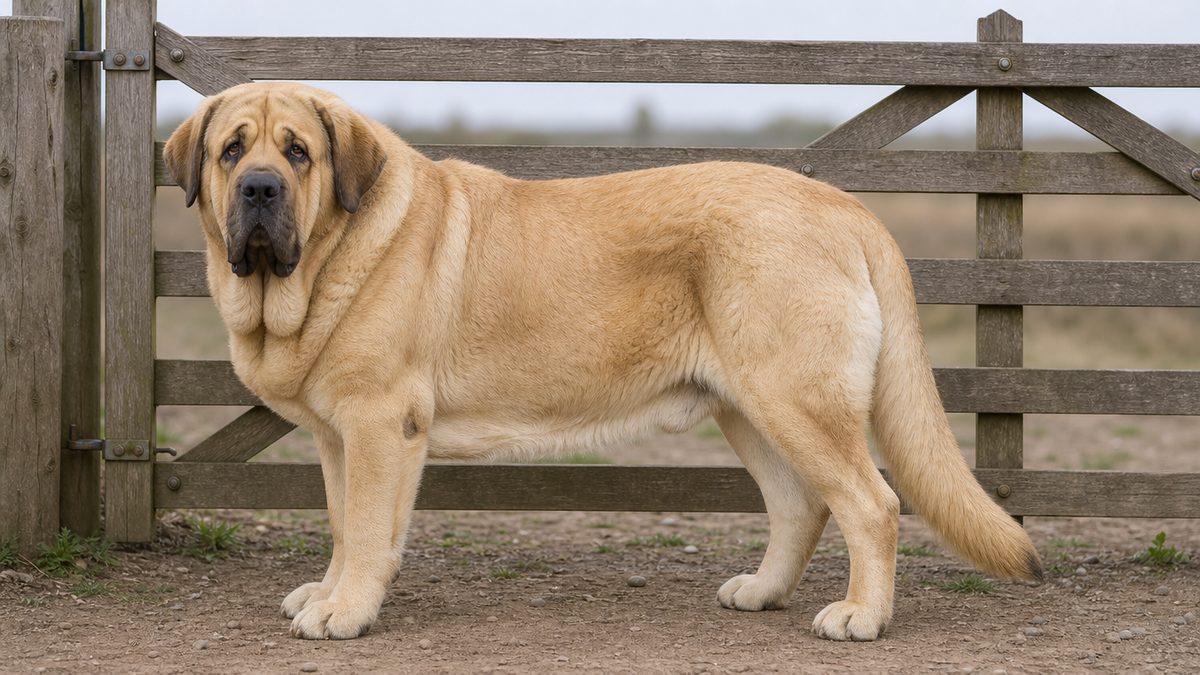
Quick answer
No verifiable Spanish Mastiff price in India exists. The breed has no Indian supply chain, and the two pages ranking first for the query are a Spanish language teaching site and a page whose title promises a price it never gives. What is real and checkable is the standard, the Spanish national annex, the club hip screening scheme, and Indian care costs, and those are what this page publishes instead.
This page is reference information, not veterinary advice. The Spanish Mastiff has no published breed health survey anywhere, so almost everything here is reasoning from its size and its coat rather than from measured breed data. Talk to your nearby vet before acting on any of it, and take a giant deep-chested dog that is retching unproductively to a veterinary surgeon the same hour.
Spanish Mastiff traits, rated for India
What the Spanish Mastiff is, according to its own two standards
The Spanish Mastiff is a very large Spanish livestock guardian, recognised by the Federation Cynologique Internationale as standard 91 on a definitive basis since 13 November 1954, and listed by name in the annex to Spain's Real Decreto 558/2001 as one of 33 Spanish canine breeds.
Two official documents describe this breed, and this page reads both. The first is FCI standard 91, published in its current form on 30 August 2002 against an official valid standard dated 26 May 1982. The second is the racial prototype printed inside the annex to Real Decreto 558/2001, which begins at page 17 of the consolidated Spanish text. The FCI record names Spanish as the official authentic language, so where the two disagree the Spanish text governs.
Both numbers were read off the FCI's own group index rather than off an assembled URL, because on fci.be the trailing number in a link decides which breed you get and the name in the path is ignored. Group 2's index lists MASTIN ESPANOL (91) directly above MASTIN DEL PIRINEO (92), and the record that opens under 91 prints MASTIN ESPANOL on its own face. That check matters for Indian readers for a second reason: the FCI's members register lists India as a full member represented by the Kennel Club of India, so FCI recognition is effectively the answer to the India recognition question, and the Kennel Club of India publishes no breed list of its own to check against.
They agree on the numbers, which is worth saying plainly because this site more often finds the opposite. Both give a minimum height at the withers of 77 cm for males and 72 cm for females, both say those heights should be amply exceeded, and both name over 80 cm for males and over 75 cm for females as the desirable figures. The Spanish edition of the FCI standard prints the identical clause under TAMANO.
There is no upper size limit, and there is no weight anywhere
The standard sets a floor and then removes the ceiling. Its own words are that there is no upper limit of size, with the largest specimens most highly thought after provided they stay in harmonious proportions. That is unusual, and it is the single most important fact for an Indian buyer, because every recurring cost on this page is priced by the kilogram.
Neither official text prints a weight. Searching the FCI standard for the string kg returns zero in the English edition and zero in the Spanish edition, and the word peso appears zero times in the Spanish text. The Spanish annex prototype likewise closes with a clause headed X. Talla, giving heights only. Anyone quoting a weight for this breed is quoting something other than its standard.
| Figure in circulation | Where it is published | What the official documents actually say |
|---|---|---|
| Weight 65 to 120 kg | English Wikipedia infobox, footnoted in the same infobox to FCI standard 91 | FCI 91 contains no weight clause and the string kg zero times, in either language. The RD 558/2001 prototype gives heights only |
| Height over 80 cm males, over 75 cm females | English Wikipedia infobox | Those are the standard's DESIRABLE figures. The minima are 77 cm and 72 cm, and Wikipedia does not carry them |
| Height 28 to 35 inches | Kanimall, an Indian breed page | 28 inches is 71.1 cm, which is 5.9 cm below the standard's own minimum for males |
| Male weight 185 to 220 pounds | Kanimall | No weight exists in either official text to compare it against |
| Lifespan 10 to 11 years | Kanimall | No lifespan has ever been measured for this breed. See the health section |
Wikipedia's infobox has taken the standard's desirable heights and presented them as the breed's height, dropping the actual minima, and has added a 65 to 120 kg weight range that appears in neither official document. That is the ordinary way a standard gets damaged in transit: a tolerance or a preference is folded into a range, and the resulting numbers appear in no document at all.
What the breed was built to do
The FCI standard states the job in its own utilization clause, and it is more specific than most. The breed accompanied the seasonal movement of livestock, especially the Merino flocks, at the time of the Mesta, defending them from wolves and other predators along the route between pastures and in all seasons. That is transhumance, and it is why the dog is built as a rectangular, hypermetric, deep-chested animal rather than a sprinter.
The behaviour clause matters as much as the physical one. Both texts call the dog rustic, affectionate, kind and noble, and very determined in front of dangerous animals and strangers, especially when defending farms or cattle. The FCI adds that one can see a dog sure of himself, dosing out his strength because he is aware of his enormous power. That is a description of independent judgement, not of obedience.
One clause differs between the two official texts, and it is a real difference rather than a translation slip. The Spanish national prototype adds, inside the temperament clause itself, that excessively timid, cowardly and unbalanced specimens must be discarded for breeding. The FCI text handles the same trait as a show fault instead, listing unbalanced temperament, excessive timidity or exaggerated aggressiveness among its serious faults and aggressive or overly shy among its disqualifying ones. Spain writes it as a breeding exclusion; the FCI writes it as a ring penalty.
Spanish Mastiff price in India, and why this page gives none
There is no verifiable Spanish Mastiff price in India, and the two pages that rank for the query demonstrate why rather than answering it. Bonbeno publishes no rupee figure for this breed, because no figure exists that survives being opened.
Start with what actually ranks. The first result for spanish mastiff price in india on a working search engine is spanishtogo.app, a Spanish-language teaching site. Its menu carries Beginner, Intermediate, Advanced, Quizzes, Printable, Courses and Enroll Now. Its page opens by teaching the reader a phrase: start with precio del Mastin Espanol, add en India, combine to say precio del Mastin Espanol en India. Its category is Uncategorized, its adjacent posts are Spanish Market 2018 and Spanish Mission Tile, and its related links are Hotels Near Spanish Consulate San Francisco and Gwinnett Tech Spanish Classes.
Only then does it supply a price, and the price is generic. It says you can expect to pay between INR 50,000 to INR 1,00,000 or more from a reputable breeder. It names no breeder, no city, no litter and no source, and every other sentence on the page would read identically for any breed. It is a page about a Spanish phrase that happens to contain two rupee numbers.
Running the division tests on that band
Divide both ends and the result is inconclusive in a specific way. Rs 50,000 divided by 84.38 is 592.56 and Rs 1,00,000 divided by 84.38 is 1,185.11, neither of which is a price a seller would print. At a flat 80 they give exactly 625 and 1,250, but that test is weak by construction, because any rupee figure ending in three zeros divides cleanly at 80. At 74 they give 675.68 and 1,351.35. So this band is not a demonstrably converted dollar list. It is more likely rupee-native and arbitrary, which is a different defect and needs saying differently.
The second Indian page is worse in a way that is easy to miss. Kanimall's article is titled Spanish Mastiff Dogbreed, Size, Weight, Puppies, Price in India, it ranks for the query, and its body contains no rupee figure at all. A title promising an Indian price is not a page containing one. What it does contain is a height of 28 to 35 inches, whose floor sits 5.9 cm below the standard's own minimum, and a male weight of 185 to 220 pounds for a breed whose standards print no weightFederation Cynologique Internationale.
Run spanish mastiff dog and spanish mastiff price in india on Bing India and both return ten Spanish-language-learning results, under an identical count of 1,11,000 for two genuinely different queries. In the same session the control query labrador retriever dog returned 52,300 results and ten real Labrador pages. The engine was working; the token spanish was doing the damage. That is the same mechanism that puts a Spanish course provider at the top of an Indian dog-price query, and it means this breed's Indian search results are contaminated at the source.
What a thin market actually looks like
Composition evidences a thin market, not a result count. Three things point the same way here. The only Indian listing pages for the breed are generic marketplace shells that sell whatever is in stock, the two top informational results are a language course and a page with no price, and no Indian club, registry or breeder record names the breed anywhere this research could reach. A rare breed with no lawful import route for purchase cannot form a supply chain, and the import section below shows why that route does not exist.
One further reason to distrust any Indian figure you find for this breed is that it is expensive to be wrong about. This is a dog with no upper size limit whose recurring costs scale with mass. A buyer who anchors on a purchase price has budgeted for the smallest number they will ever pay.
What a Spanish Mastiff costs to keep in India, priced by the kilogram
Keeping a Spanish Mastiff in India costs more than keeping any ordinary large dog, because almost every recurring line is sold in weight bands and this breed starts at the top band and has no ceiling. The purchase price, which nobody can verify, is the least important number on this page.
Work the deworming line first, because it is the clearest illustration. Drontal Plus sells at Rs 754 for six tablets against an MRP of Rs 838, which is Rs 125.67 per tablet, and it is dosed at one tablet per 10 kg of bodyweight. A 20 kg dog therefore needs two tablets, about Rs 251 a dose. A Spanish Mastiff of about 80 kg needs eight, about Rs 1,005 a dose. That is the same product, the same shelf and a four-fold difference driven purely by the animal.
Parasiticides behave the same way, and here the arithmetic breaks rather than scaling. The commonly quoted Indian NexGard Spectra pack is the 15 to 30 kg presentation at Rs 3,308 for three tablets, roughly Rs 1,103 a month. That pack does not cover this breed at any weight it will ever reach. Any monthly parasite figure you see quoted for an Indian dog is almost certainly the mid-size pack, so treat it as a floor rather than an estimate.
| Line | Published Indian figure | What it looks like for a Spanish Mastiff |
|---|---|---|
| Anti-rabies, single | Rs 699 at a Vetic clinic; Rs 100 at a Goa government veterinary hospital inclusive of certificate | Unchanged. Vaccine dose is not weight-banded |
| 9-in-1 DHPPiL | From Rs 899 at a Vetic clinic; Rs 600 at a Goa government hospital | Unchanged, and the 3.3x spread between delivery models matters more than the breed |
| Kennel cough | Rs 1,349 | Unchanged, and worth doing before any boarding stay |
| Deworming | Rs 125.67 per Drontal Plus tablet, one per 10 kg | About Rs 1,005 a dose at 80 kg, against Rs 251 at 20 kg |
| Bathing | From Rs 934 at Vetic Delhi | Expect the top weight band, and expect a giant coated dog to need a two-person handling surcharge |
| Complete bath and styling | From Rs 1,869 | Same, and most Indian salons will not have a bath large enough |
| Overnight boarding, 24 hours | Rs 899 at PawSpace Bengaluru | Large and giant tiers price above this, and many facilities cap the size they accept |
| Municipal registration | Rs 500 in Delhi, Rs 50 in Chennai | Unchanged. Delhi registers pet dogs and has issued 18,958 certificates since 2021 |
Vaccination pricing is where an Indian owner can genuinely save money without cutting corners, and the spread is large. The same 9-in-1 vaccine is Rs 600 at a Goa government veterinary hospital inclusive of the vaccine and the certificate, from Rs 899 at a Vetic clinic, and from Rs 1,999 through a vet-at-home service that also charges a Rs 699 visit fee. Anti-rabies runs from Rs 100 to Rs 1,199 across those same three routes. That is a 3.3 times spread on one identical vaccine and about a twelve times spread on rabies, and it is a function of the delivery model rather than of the drug.
The costs nobody prices until they arrive
- Anaesthesia and surgery, which are dosed and monitored by weight, and where a giant patient needs more drug, more staff and more recovery space
- Transport, because a dog of this size does not fit an Indian ride-hailing car and most clinics have no trolley rated for it
- Flooring and gates, because 80 kg leaning on a standard Indian balcony grille is a structural question rather than a training one
- Cooling, because air conditioning for the hours this dog cannot be outside is a monthly electricity line and not a one-off purchase
- Emergency surgery for gastric dilatation volvulus, which in a deep-chested giant is a same-hour operation at a private Indian hospital
Boarding is the line most likely to fail outright rather than merely cost more. PawSpace Bengaluru publishes hourly care to four hours at Rs 599, daycare to ten hours at Rs 799 and overnight boarding to twenty-four hours at Rs 899. Those are ordinary-dog rates; large and giant tiers price above them, and many Indian facilities cap the size of dog they will accept at all. Registration is the opposite case, being flat and cheap: Delhi charges Rs 500 to register a pet dog and Rs 500 to renew, with a Rs 100 per month late fee, and has issued 18,958 certificates since 2021.
Microchipping is now a live cost in at least one Indian city. A Chennai veterinary hospital publishes its own transacted price of Rs 1,250 under the Greater Chennai Corporation microchipping mandate, and Chennai's pet licence itself is Rs 50. Chennai also runs six municipal pet clinics that provide treatment and anti-rabies vaccination free of cost, which is a more useful fact for most readers than any breed price.
Can a Spanish Mastiff handle the Indian climate
A Spanish Mastiff cannot handle the Indian climate without permanent, active management, and the gap is about sixteen degrees. Its homeland's hottest month averages 20.01 C. Delhi's averages 35.88 C.
The homeland figure comes from a point query rather than a place-name lookup, so it cannot silently return another town. NASA POWER at latitude 42.599, longitude -5.567, over Leon in Castilla y Leon, gives an annual mean of 10.78 C, a hottest month of July at 20.01 C and a coolest of January at 2.97 C. The cell elevation the model reports back is 915.64 m against a real city elevation near 838 m, an overstatement of 77.6 m, which is about half a degree on the standard lapse rate. That difference is stated here rather than hidden, because a wrong homeland baseline corrupts this comparison exactly as badly as a wrong Indian one.
The wintering end of the historic transhumance route is warmer and still nothing like India. At Caceres in Extremadura the annual mean is 15.83 C and the hottest month is July at 27.27 C, on a cell reported at 382.84 m against a real 459 m. So even the hot end of this dog's ancestral year sits about eight degrees below Delhi's peak month.
| Place | Cell elevation | Annual mean | Hottest month and mean | Peak wet bulb |
|---|---|---|---|---|
| Leon, Spain | 915.64 m | 10.78 C | July, 20.01 C | 14.57 C, July |
| Caceres, Spain | 382.84 m | 15.83 C | July, 27.27 C | 17.22 C, July |
| Delhi | 206.37 m | 25.57 C | June, 35.88 C | 26.50 C, July |
| Chennai | 48.95 m | 27.94 C | May, 31.51 C | 26.11 C, May |
| Mumbai | 97.15 m | 26.77 C | May, 31.19 C | 25.77 C, June |
| Kolkata | 7.35 m | 25.80 C | May, 31.53 C | 27.09 C, June |
| Bengaluru | 841.72 m | 23.74 C | April, 28.37 C | 21.86 C, May |
| Pune | 635.99 m | 23.86 C | April, 28.93 C | 22.97 C, June |
Read the wet-bulb column rather than the air temperature if you only read one. Wet bulb is the number that decides whether panting can still shed heat, and Leon peaks at 14.57 C in July while every Indian plains city on that table peaks between about 22 and 28 C. Bengaluru and Pune are the two least hostile Indian cities for this breed, and they are still seven degrees of wet bulb above anything the dog was shaped by.
Why the size itself is the risk factor
Body mass is the part of the heat risk that is actually measured. Hall 2020, in Scientific Reports, found that dogs over 50 kg carried 3.42 times the odds of heat-related illness compared with the Labrador Retriever, with a confidence interval of 1.54 to 7.57, and that a bodyweight at or above the breed and sex mean carried 1.42 times the odds, 1.12 to 1.80. A Spanish Mastiff is over 50 kg by construction. It is not separately modelled in that paper, so it falls into the other purebred category rather than having a breed-specific figure, and this page claims only the transferable weight finding.
The trigger split from the companion paper is the practical half. Hall 2020, in Animals, recorded 1,259 heat-related illness events from 1,222 dogs; 879 of those events had a recorded trigger, and 652 of those 879, or 74.2 percent, were exertional rather than caused by a hot car or a hot room. Most heatstroke happens because somebody exercised the dog. For a heat-sensitive giant in an Indian city that is the whole management problem in one sentence.
Second Schedule Part IV paragraph 21(1) of the Prevention of Cruelty to Animals (Dog Breeding and Marketing) Rules 2017 bars keeping certain dogs in outdoor facilities without the attending veterinary practitioner's written approval, and its second category is dog breeds that cannot tolerate the temperatures prevalent in the area or region in question, such as long-haired breeds in high temperature locations. A dense-coated 80 cm Spanish guardian in an Indian summer is the clearest case that clause describes.
One disagreement worth publishing
The largest study that lists this breed classifies its skull in a way the standard does not support. McMillan 2024's supplementary Table S5 gives the Spanish Mastiff a cephalic index of Brachycephalic and a body size of Large. FCI 91 describes a muzzle that is moderately rectangular seen from above, tapering gradually towards the nose, in no case pointed, with the relation between skull length and muzzle length set at 3 to 2. A 3 to 2 ratio is not what most readers picture when they read brachycephalic. Both statements are on the record and this page prints both, because if the classification is right the breed's heat risk is worse than its coat alone suggests, and if it is wrong the coat is the whole story.
Spanish Mastiff temperament and who should not buy one
The Spanish Mastiff is a calm, independent guardian that makes its own decisions, which is exactly what makes it wrong for most Indian households. Its standard describes a dog aware of its own power and dosing it out accordingly, and that is a temperament to respect rather than to admire from a listing photograph.
Take the description from the documents rather than from breed marketing. Both official texts call the dog rustic, affectionate, kind and noble, and very determined when facing dangerous animals or strangers, particularly when it is defending farms or cattleReal Decreto 558/2001, de 25 de mayo. The FCI adds the line that does the most work: in his behaviour one can see a dog sure of himself, determining his strength because he is aware of his enormous power.
A livestock guardian is not a guard dog in the sense Indian buyers usually mean, and the difference is not a matter of how protective the dog is. A guard dog is directed by a handler. A livestock guardian was left alone with a flock for weeks and rewarded for deciding, on its own, which approaching thing was a threat. That instinct does not switch off in a gated society in Gurugram, and it does not distinguish a delivery rider from a wolf without a great deal of deliberate socialisation.
The bark is a structural problem in an Indian flat
The standard describes the voice as a specification, not a quirk. It reads that his bark is raucous, low pitched and deep, very sonorous, and audible from a considerable distance. That was the point of the dog: a bark that carried across a valley. In a Mumbai tower or a Bengaluru apartment block it is a neighbour dispute waiting to happen, and it is the most common reason large guardian breeds are surrendered in Indian cities.
- Choose another breed, if this is your first dog. An independent 80 kg guardian with no measured behaviour data is not a learning animal
- Choose another breed, if you live in a flat. The size, the bark and the heat management together need ground-floor space with shade
- Choose another breed, if the household has toddlers. Nothing about the temperament is the problem; the mass is
- Choose another breed, if you want a dog that obeys quickly. This one weighs up the instruction first
- Consider one only if you have secured rural or semi-rural ground, genuine shade, cooling for the hot months and previous experience of a guardian breed
Aggression towards other dogs is the trait most often understated in Indian write-ups, and the standards handle it carefully rather than denying it. The FCI text disqualifies dogs that are aggressive or overly shy and lists exaggerated aggressiveness among its serious faults. The Spanish national prototype goes further and instructs that excessively timid, cowardly and unbalanced specimens be discarded for breeding altogether. A breed whose own national text has to write that rule is a breed where temperament varies, and where you cannot assume the dog in front of you is the dog in the standard.
Everything in this section comes from two breed standards and from what livestock guardian dogs do generally. There is no published behavioural survey of the Spanish Mastiff. By contrast a Galician breed, the Can de Palleiro, does have one, published in Animals in 2021, which shows the research is possible and simply has not been done here. Treat temperament claims about this breed, including these, as description rather than measurement.
How to train a Spanish Mastiff, and what it will refuse
To train a Spanish Mastiff, build the relationship before you ask for obedience, keep sessions short, and accept that the dog will pause to evaluate every instruction. It was selected for centuries to work without a handler present, so compliance was never the trait being bred for.
Start socialisation the week the puppy arrives and treat it as the main project of the first year. A guardian breed's default is to categorise novelty as potential threat, so the work is not teaching commands, it is building a large library of people, surfaces, vehicles, sounds and other dogs that the dog has already filed as ordinary. In an Indian city that library needs to include auto-rickshaws, delivery riders, temple bells, construction noise, cattle in the road and firecrackers.
Use calm repetition and food, and stop before the dog is bored. This breed does not offer the eager repetition a Labrador does, and drilling it produces refusal rather than fluency. Three short sessions of five minutes across a day beat one long one, and a dog that walks away has told you the session ended two minutes ago.
The three behaviours that actually matter at this size
- Loose-lead walking, taught before the puppy passes 25 kg, because no adult human out-pulls an 80 kg dog and the window closes fast
- A settle on a mat, so the dog has a default behaviour when visitors arrive rather than an opinion
- A reliable recall away from other dogs, which is the single behaviour that keeps a guardian breed out of trouble in an Indian park
Do not train through corrections or dominance frameworks with this breed. A dog that is aware of its own power, as its own standard puts it, will meet escalation with escalation, and at this mass the outcome is not recoverable. The workable relationship is one where the dog volunteers cooperation because nothing has ever made cooperation unpleasant.
Realistic timelines look nothing like a retriever's. Expect house training in four to eight weeks, a usable settle by four months, loose-lead walking that survives distraction by eight to ten months, and a genuinely reliable recall somewhere between eighteen months and two years. Guardian breeds mature slowly, and a Spanish Mastiff is mentally adolescent well past the point at which it is physically enormous.
Exertional heat illness accounted for 652 of the 879 heat-related illness events with a recorded trigger in Hall 2020, which is 74.2 percent. Training is exercise. In Chennai or Delhi that means the work happens before about 7 am and after about 8 pm from March to October, and indoor sessions on air-conditioned floors in between.
Daily exercise a Spanish Mastiff actually needs
A Spanish Mastiff needs about 45 to 60 minutes of steady low-intensity movement a day plus space to patrol, and it needs that split across the two coolest parts of an Indian day. This is a walking dog and a standing dog, not a running dog.
The standard tells you the gait to aim for. It names the trot as the preferred gait, which must be harmonious and powerful without any tendency to lateral rolling, and it rules out ambling. A breed judged on a sustained trot is a breed built for covering ground slowly all day, which is what a flock guardian does. It is not built for sprints, ball chasing or stairs.
Under-exercise shows up as weight, boredom barking and door guarding rather than as the frantic behaviour an under-exercised working gundog produces. Over-exercise in a growing puppy shows up much later, as joint disease, and it is the more expensive mistake of the two.
Growth-stage limits, which matter more here than in any other section
- Restrict forced exercise entirely until about 4 months, and let the puppy self-limit on soft ground
- Restrict stairs, jumping down from furniture and vehicles, and slippery floors for the whole first year
- Restrict lead walks to roughly five minutes per month of age, twice a day, until about 12 months
- Restrict any running alongside a bicycle or a person until the growth plates have closed, which in a giant breed can be 18 months or later
- Restrict all of it further in heat, because a giant breed reaches its thermal limit long before its muscular one
Mental work substitutes for physical work better in this breed than in most. Scatter feeding, a slow bowl, a patrol route around a fenced garden and simple scent games occupy a guardian's mind without loading its joints or its heat budget. In the Indian summer those become the primary activity rather than the supplement.
Swimming is the one high-value option where it is available, because water carries both the load and the heat. It is rarely available in Indian cities for a dog this size, and it should never be improvised in an untreated tank.
Grooming a Spanish Mastiff in Indian humidity
Groom a Spanish Mastiff twice a week with a slicker and an undercoat rake, dry it completely after every wash, and never shave it. The coat is a dense double coat that insulates against heat as well as cold, and the folds of the double dewlap are where Indian humidity does its damage.
Know what the coat actually is before deciding how to handle it. The standard describes hair that is dense, thick, of medium length, smooth, and distributed over the whole body down to the interdigital spaces, and it distinguishes two types on the same dog: a covering coat on the back and a protecting type over the ribcage and the flanks, shorter on the legs and longer and silky on the tail. A wavy, curly or excessively long coat is a serious fault.
Never shave that coat for the Indian summer. The undercoat is what holds a layer of still air against the skin, and removing it exposes thin, pink, pigment-poor skin to direct sun while destroying the dog's own insulation. The standard describes the skin as elastic, thick, abundant and pink coloured with darker pigmented areas, which is skin that burns. Rake the dead undercoat out instead, which achieves the cooling a shave is supposed to and does not damage the coat.
The dewlap is the Indian problem
The double dewlap is a breed requirement and a humidity trap. Both official texts require an amply developed double dewlap on a thick, loose-skinned neckReal Decreto 558/2001, de 25 de mayo. In Chennai or Kolkata in July, folded skin that stays damp between a drooling mouth and a wet coat is a textbook site for skin fold dermatitis and secondary yeast infection. Wipe the folds daily in the monsoon, dry them properly and look at what you are drying.
| Task | Dry season, roughly November to February | Hot season, March to June | Monsoon, July to October |
|---|---|---|---|
| Brushing | Twice a week, slicker and rake | Three times a week during coat drop | Three times a week, and check for damp matting behind the ears |
| Undercoat raking | As needed | Weekly, this is the cooling intervention | Weekly, and dry the coat fully afterwards |
| Bathing | Every 6 to 8 weeks | Every 4 to 6 weeks | Only when genuinely dirty, and dry completely before the dog lies down |
| Dewlap and lip folds | Wipe twice a week | Wipe daily, drool volume rises with panting | Wipe and dry daily without exception |
| Ear checks | Weekly | Weekly | Every two to three days, and plug the ears before any bath |
| Nails and feet | Monthly, including the hair between the pads | Monthly | Monthly, and check between the toes for softened skin |
Plug the ears before washing and dry them afterwards, and treat overseas grooming advice that says to towel the dog and let it air dry as advice written for another climate. Indian otitis case series consistently point at bathing without ear protection and at monsoon humidity, and a heavy drop-eared dog with a thick coat is the worst-case ear anatomy in that weather.
Budget for the size when using a salon. Vetic's Delhi list starts bathing at Rs 934 and a complete bath and styling at Rs 1,869, with add-ons from Rs 99. Those are starting prices for ordinary dogs. Expect the top weight band, expect a handling surcharge, and expect several salons to decline the dog outright.
Spanish Mastiff health, and the data that does not exist
The honest summary of Spanish Mastiff health is that almost nothing about it has been measured. There is no breed health survey, no obtainable OFA statistics row, and no median lifespan in the scientific literature, and the eight papers in PubMed that name the breed include not one study of its health.
Establish the absence properly before building on it. A PubMed search run on 9 September 2026, with the control query Labrador retriever hip dysplasia returning 126 records in the same session, gives 8 records for "Spanish Mastiff"[tiab], with a clean unrewritten query translation and no collapse into an author search. Native-name forms return zero. Every one of the eight was then resolved individually rather than as a batch, and read.
| PMID | What it actually is | Is it a breed health study |
|---|---|---|
| 33004047 | Szatmari 2020, a case report of one imported dog with a false positive heartworm antigen test | No, a single-animal case report |
| 11380017 | Lucena 2001, hepatic cirrhosis in a five-month-old male Spanish mastiff | No, a single-animal case report |
| 9360468 | Gonzalez 1997, an immunohistochemical study of a non-invasive canine thymoma | No, a single-animal case report |
| 38570155 | Sanz 2024, canine leishmaniosis progression across breeds | No, the breed appears as one of many |
| 30801867 | Valverde 2019, computer-assisted sperm motility across six breeds | No, reproductive physiology |
| 27751991 | Soler 2017, dog sperm head morphometry | No, reproductive physiology |
| 2077947 | Aguera 1990, muscle fibre morphometry in three dog muscles | No, comparative anatomy |
| 2240583 | Aguera 1990, fibre populations in dog muscles of different function | No, comparative anatomy |
One of the eight is worth a line for a different reason. Valverde 2019 measured sperm swimming parameters across 37 dogs of six breeds including the Spanish Mastiff, and concluded that all eight kinematic parameters differed significantly between breeds and that results cannot be extrapolated from one breed to another. That is a small finding about semen analysis and a large one about method, and it is the closest thing this breed has to a warning against borrowing another breed's numbers.
Two of those eight are still worth an Indian reader's attention, because they are directly transferable even though neither describes breed risk.
The heartworm test result every Indian owner should know about
Szatmari 2020 reports an asymptomatic Spanish mastiff of about five years, recently imported to the Netherlands from Spain, referred for heartworm therapy after microfilariae showed on a screening blood test. Antigen tests for Dirofilaria immitis on three different kits all came back negative. Heat treatment of two of those samples, which current guidance recommends to unmask blocked antigen, turned both positive. Real-time PCR then showed the circulating microfilariae were Acanthocheilonema dracunculoides, not heartworm at all. Three monthly moxidectin spot-on treatments cleared both the antigen and the Knott's test.
That matters in India because India is heartworm country and heat-treated antigen testing is in routine use. The paper's own conclusion is that heat treatment of an initially negative sample can produce a false positive if the dog carries A. dracunculoides. Ask your vet whether a positive came from a heat-treated sample and whether the microfilariae were speciated, if a screening test surprises you.
Liver disease in a puppy, and the Indian angle nobody draws
Lucena 2001 describes a five-month-old male Spanish mastiff presented in severe hepatic failure, unresponsive to fluids, plasma expanders, antibiotics and diuretics, euthanised at the owner's election, and found on necropsy to have ascites and severe cirrhosis with extensive periacinar necrosis. The paper notes that cirrhosis is rare in young dogs and that the usual causes are circulatory disturbance, hereditary metabolic disorders or poisoning, naming aflatoxicosis specifically.
Aflatoxin is a real and recurring Indian pet-food hazard, arising from mould on maize and groundnut in humid storage. One case report is not evidence of breed risk, and this page does not claim it is. It is a reason to buy food you can trace, to keep sacks sealed and dry through the monsoon, and to discard anything that smells musty.
What the breed club screens for, which is more than the literature offers
AEPME, the Spanish breed association, keeps the breed's Libro Genealogico by delegation and runs a published hip dysplasia scheme. It was officially recognised for that purpose by a Resolucion of 23 June 2005 of the Junta de Castilla y Leon, under article 7 of Real Decreto 558/2001. Its scheme reads as follows. Dogs graded A, B or C from twelve months are recognised as fit for breeding. A dog graded D must be re-radiographed after eighteen months to settle the question. The club recommends strongly against breeding from a dog graded E, and recommends crossing only A or B where possible.
Two details make that scheme genuinely useful rather than decorative. Results are published on the club's own website, including historic results for dogs that no longer exist, so a buyer can look up a parent. And the accepted evaluating centres are the Veterinary Faculty of the University of Leon and entities authorised by the Real Sociedad Canina de Espana, so the grade means something specific. The club states in its own introduction that it holds the Libro Genealogico for the breed, which is why a Spanish Mastiff pedigree question goes to AEPME before it goes to the national kennel club.
Second Schedule Part III paragraph 8(10) of the Prevention of Cruelty to Animals (Dog Breeding and Marketing) Rules 2017 requires that dogs used for breeding shall have been tested for genetic defects, including hip dysplasia, progressive retinal atrophy, night blindness, hypothyroidism, entropion, ectropion, overshot, undershot jaw, wry mouth, two or more missing teeth and cryptorchidism. The word is including, so the list is illustrative rather than closed. On hips, Indian law and the Spanish breed club are asking for the same document.
Why no lifespan is published here
The one large study that lists this breed excludes it. McMillan 2024's supplementary Table S5 carries a Spanish Mastiff row whose Included in Survival Analysis flag reads N, with a phylogeny abbreviation of SPMA, a KC Group of NA and a body size of Large. An N flag is a verdict, not an oversight: the breed was considered and not included, so it has no median survival figure and no hazard ratio in that dataset. Indian and international pages quoting 10 to 11 or 10 to 12 years for the breed cite nothing at all. Bonbeno publishes no lifespan for this dog.
The Orthopedic Foundation for Animals could not be read either, and that is an instrument failure rather than an absence. Its disease-statistics page returned HTTP 200 with 1,752 characters of visible text ending in the string Searching Database, Please wait, and a LABRADOR control returned zero rows on the same fetch. No OFA figure is published on this page, in either direction.
The Indian risks that are measured, even though they are not breed-specific
Tick-borne disease is the Indian health problem most likely to affect this dog, and Indian data exists. A survey of 584 dogs in West Bengal found Babesia gibsoni in 76.54 percent and two or more pathogens in 72.9 percent of the 584 dogs screened. An Odisha series of 178 dogs found Ehrlichia canis in 56 of 178, or 31.46 percent, with 75 percent of infected dogs weighing over 20 kg and 79 percent carrying a tick history. Both sampled dogs presented at veterinary clinics rather than random populations, so read them as clinic caseloads and not as national prevalence.
Gastric dilatation volvulus deserves its own line for this breed even without breed data, because the anatomy is the risk factor. A deep-chested giant that eats one large meal and then moves is the classic presentation, and in India the practical constraints are travel time and the availability of an out-of-hours surgical theatre. Unproductive retching, a distended abdomen and restlessness in a dog this size is a same-hour emergency.
Feeding a Spanish Mastiff in India
Feed a Spanish Mastiff to a lean body condition on a large or giant-breed growth food through the first eighteen months, split into at least two meals a day, and weigh the food rather than scooping it. Slow, lean growth is the single most valuable thing an owner of a giant puppy controls.
Body condition beats any feeding chart. Score the dog by hand once a week. You should feel ribs easily under a thin fat covering, see a waist from above and a tuck from the side, and never need to press to find a rib. A giant puppy carrying extra weight is loading joints that will not finish forming for another year, and the cost of that shows up as lameness rather than as a number on a scale.
Portion by weighed grams against the manufacturer's chart for the dog's projected adult weight, then adjust every fortnight by what you feel rather than by what the bag says. A dog with no upper size limit in its standard has no reliable adult weight to plan against, so the feedback loop matters more here than in a breed with a published range.
Meal structure, because of the bloat risk
- Split the daily ration into two meals for an adult and three or four for a puppy, rather than one large meal
- Rest the dog for at least an hour either side of a meal, with no walk, no play and no stairs
- Slow a fast eater with a slow bowl or by scattering the kibble, because gulping air is part of the mechanism
- Serve at floor level unless a vet has advised otherwise, since raised bowls have not been shown to help
- Keep clean water available at all times, and expect intake to rise steeply in the Indian summer
Watch calcium and energy density during growth specifically. Over-supplementing calcium or feeding a rich adult food to a giant puppy accelerates growth, and accelerated growth is the mechanism behind several developmental orthopaedic problems in large breeds. Use a food formulated for large or giant-breed puppies and do not add a calcium supplement unless your own vet has asked for one.
Storage is a genuine Indian variable
Buy food you can trace and store it as though it will spoil, because in an Indian monsoon it will. Aflatoxin from mould on maize and groundnut is a real hazard in humid storage, and aflatoxicosis is one of the causes Lucena 2001 names for cirrhosis in a young dog. Keep the sack sealed, keep it off the floor, decant into an airtight container, buy pack sizes you will finish in a few weeks and throw away anything that smells musty.
Feeding costs scale like everything else here. A dog that may pass 80 kg eats roughly four times what a 20 kg dog eats, and the practical consequence is that premium food for this breed is a five-figure annual line in most Indian cities. That is worth knowing before the puppy arrives rather than after.
Spanish Mastiff puppy timeline, month by month
A Spanish Mastiff's first year is a growth-management project rather than a training one, and two of its milestones are set by Indian law rather than by the breeder. No puppy may lawfully be sold below eight weeks, and vaccination is expected to start at seven to eight weeks and finish around eighteen weeks.
Both of those come from the gazette rather than from custom. Rule 8(1)(a) of the Prevention of Cruelty to Animals (Dog Breeding and Marketing) Rules 2017 requires that pups less than eight weeks in age are not sold. Second Schedule Part III paragraph 8(9) states that all pups shall be vaccinated, which can start at the age of seven to eight weeks and is usually completed at the age of eighteen weeks. A seller offering a six-week-old puppy is breaking a rule, not doing you a favour.
| Age | What matters most | What to avoid |
|---|---|---|
| 8 to 10 weeks | Legal earliest sale. Settle in, start the vaccination course, begin handling every part of the body daily | Any purchase below eight weeks, and any stairs at all |
| 10 to 16 weeks | The core socialisation window. Aim for a new person, surface or sound every day, in the cool hours | Waiting for vaccination to finish before socialising, which wastes the window |
| 16 to 18 weeks | Vaccination course completes around 18 weeks. First proper lead work on soft ground | Long walks. Five minutes per month of age, twice a day, is the ceiling |
| 4 to 6 months | Loose-lead walking taught while you still outweigh the dog. Deworming moves to an adult dosing band | Forced exercise, jumping down from height, slippery floors |
| 6 to 9 months | Adolescent guarding behaviour appears. Reinforce the settle, keep introducing novelty | Treating early guarding as cute, which is how a 30 kg dog learns a habit it keeps at 80 kg |
| 9 to 12 months | Growth slows but does not stop. Body condition check weekly by hand | Switching to adult food too early, and adding any calcium supplement |
| 12 months | Hip radiograph. AEPME grades from twelve months and re-radiographs a grade D at eighteen | Breeding decisions before a hip grade exists |
| 12 to 24 months | Mental maturity arrives long after physical size. Recall becomes reliable in this window | Assuming the dog is finished because it looks finished |
Get the hip radiograph even if you never intend to breed. It is the only screening result that exists for this breed anywhere, the club's own thresholds give it meaning, and knowing at twelve months that a dog has dysplastic hips changes how you manage its exercise for the next decade.
A puppy born in a Delhi winter meets its first June at about six months, carrying a coat it has never had to shed and no experience of managing itself in heat. Move the whole routine into the cool hours before March, not after the first bad day.
Spanish Mastiff against the breeds Indian buyers cross-shop
Indian buyers looking at a Spanish Mastiff are usually choosing between four or five very large guardians, and on the two things that decide the outcome in India, availability and heat, the Spanish Mastiff is the weakest of them. It is the only one on this table with no measured lifespan and no Indian supply.
| Breed | Registry status | Measured lifespan | Coat and heat load | Available in India |
|---|---|---|---|---|
| Spanish Mastiff | FCI 91, definitive 1954; in the RD 558/2001 annex | None. Flagged N, not included, in McMillan 2024 | Dense medium double coat, homeland peak month 20.01 C | No lawful purchase route, and no verifiable price |
| Pyrenean Mastiff | FCI 92, definitive 1954; also in the RD 558/2001 annex | None published | Longer, denser coat, same Spanish highland origin | Effectively absent |
| Tibetan Mastiff | FCI 230, definitive | None in McMillan's included set | Very heavy double coat, Himalayan origin | Yes, with a real Indian market and real prices |
| Presa Canario | FCI 346, definitive | None published | Short coat, Canary Islands origin, much lower coat burden | Occasionally, with an unresolved Indian legal history |
| Bully Kutta | No FCI standard | None published | Short coat, and native to this heat | Yes, widely, in the subcontinent |
| Rajapalayam | Kennel Club of India breed | None published | Short single coat, bred in Tamil Nadu | Yes, and adoptable |
Notice what that table does not contain: a lifespan for any of them. Giant guardian breeds are systematically under-measured, and the honest reading is that nobody can tell you which of these lives longest. Where a page gives you a confident lifespan for a breed in this group, check what it cites.
If it is the look you want
The Tibetan Mastiff is the closest available substitute in India for the impression a Spanish Mastiff makes, and it carries the same heat problem, arguably worse. The Bully Kutta is the closest substitute on size and function that is actually adapted to this climate, and the Rajapalayam is the closest one you can meet in person in India this month.
If it is the job you want
Ask what the dog is for before you choose. A livestock guardian is the right answer only if you have livestock, or ground that a dog needs to patrol independently. For a household that wants presence and deterrence in a city, a smaller and better-documented breed does the job with a fraction of the heat risk, the cost and the legal complication. For a household that wants a companion, almost anything on this site is a better answer than an 80 kg dog with no health baseline.
Mistakes Indian owners make with giant guardian breeds
The five mistakes below are the ones that actually cause harm with a Spanish Mastiff in India, and four of them are made before the dog arrives. None of them is about training.
- Buying on a price they found online, when the top-ranking price page for this breed is a Spanish language course and the second contains no price at all
- Shaving the coat for summer, which removes the insulation, exposes pink skin to direct sun and makes the heat problem worse rather than better
- Exercising in the wrong hours, which is how 74.2 percent of the heat-illness events with a recorded trigger in Hall 2020 happened
- Feeding a giant puppy for fast growth, which converts a food decision into an orthopaedic one that shows up two years later
- Treating a livestock guardian as a guard dog, and then being surprised when it makes its own decision about a delivery rider
The price mistake is the one worth spelling out. A buyer who has anchored on Rs 50,000 to Rs 1,00,000 from a language-learning site has anchored on a number with no provenance, and has usually budgeted nothing for the recurring costs that actually decide whether the dog is well kept. Deworming alone runs about Rs 1,005 a dose at this size against roughly Rs 251 for an ordinary medium dog.
Two mistakes that are specifically Indian
Keeping the dog outdoors through the summer is the first, and it is the one Indian law addresses directly. Second Schedule Part IV paragraph 21(1) bars outdoor housing, without the attending veterinary practitioner's written approval, for dogs not accustomed to local temperatures, for breeds that cannot tolerate them such as long-haired breeds in high temperature locations, and for sick, infirm, aged or young animals. A Spanish guardian in an Indian summer sits inside two of those three categories at once.
Skipping tick prevention in the belief that an indoor dog is safe is the second. Indian clinic series find Babesia and Ehrlichia at high rates in dogs presented for testing, with 72.9 percent of 584 West Bengal dogs screened carrying two or more pathogens and 31.46 percent of 178 Odisha dogs positive for Ehrlichia canis. A thick double coat hides ticks far better than a short one does, which is a grooming problem before it is a medical one.
There is no breed health survey for the Spanish Mastiff, so no page, including this one, can tell you what this breed dies of or how long it lives. If that uncertainty is not acceptable to you, that is a good reason to choose a better-documented breed rather than a reason to trust a confident figure you find elsewhere.
Adoption, sourcing and the Indian import position
You cannot lawfully import a Spanish Mastiff into India in order to buy one, and there is no Indian breeding population to buy from either. That leaves two honest routes, and the better of them is adopting a dog that is already here.
Read the import rule from the instrument rather than from a forum. The Directorate General of Foreign Trade's own FAQ states that the import policy for pet dogs and cats is restricted and permitted only with a DGFT authorisation, under ITC(HS) code 01061900. It then lists the permitted purposes exhaustively: research by R&D organisations with a CPCSEA recommendation, internal security by the Defence and Police Force, a therapy or emotional support dog with a medical certificate, and a dog that has been the applicant's own pet for at least two years where the applicant is transferring residence to India after two years of continuous stay abroad.
Then it closes the door in one sentence. Dogs for commercial purposes like breeding or as a gift or for other purposes are not allowed to be imported, and new born puppies are not allowed. Import for pets is otherwise allowed without authorisation only to a person shifting residence permanently to India under the customs baggage rules, capped at two pets, and only through the airports and seaports of Delhi, Mumbai, Chennai, Hyderabad, Bengaluru and Kolkata and, since October 2024, Kochi airport Department of Animal Husbandry…. The full route is set out in how to import a dog to India.
Page one of the DGFT FAQ says new born puppies are not allowed. Page two says new born puppies of less than 7 months are not to be allowed. Those are different rules and the document carries both. If a young dog's age is load-bearing for your application, ask the Regional Authority which line governs rather than assuming.
Put those two facts together and the conclusion is simple. There is no lawful commercial import route, and no established Indian breeding population that this research could evidence. Any Indian seller offering Spanish Mastiff puppies is therefore either selling something else, selling an unverifiable pedigree, or operating outside the import rules. This site does not link puppy listings and does not recommend breeders, and on this breed it would have nothing to link even if it did.
What to do instead
- Adopt a large Indian dog. Shelters in every Indian metro hold big, robust, heat-adapted dogs whose maintenance costs a fraction of this breed's
- Consider the Indian Pariah Dog, which is adapted to this exact climate and needs no cooling budget
- Consider the Rajapalayam or the Kombai, if you want an Indian guarding breed with a short coat
- Register the dog you do get. Delhi charges Rs 500 and has issued 18,958 pet dog certificates since 2021; Chennai charges Rs 50 and runs six free municipal clinics
- Ask any seller of any breed for the hip radiograph and the vaccination record, because Indian law already requires both of a breeder
If you are genuinely committed to this breed and are moving to India from Spain with your own dog, the route exists and it is the transfer-of-residence one. That needs proof of two years of continuous stay abroad, an advance No Objection Certificate from the Animal Quarantine and Certification Service regional officer at the port of entry, obtained seven days before travel and relaxable to three, and a health certificate from a veterinarian in the exporting country. Plan the arrival for the cool months, not for June.
One last note on where the breed's own records live, because a rarity claim needs to name its register, and for this breed there is more than one. The Real Sociedad Canina de Espana publishes a table of the official genealogical books of Spanish breeds, and the Mastin Espanol row names two authorised associations rather than one: the Sociedad Canina Leonesa and the Asociacion Espanola del Perro Mastin Espanol, both under the Junta de Castilla y Leon as authorising government. That is unusual on that table, where most breeds have a single keeper, and it means a Spanish Mastiff registration figure quoted from either association alone is a partial count.
AEPME's own figures illustrate the point. Its 2022 breeding programme reports a membership of 443 and a member-reported census of 2,783 dogs, gathered from what members told territorial delegates, rather than a national total. Set that beside a second authorised studbook keeper and it becomes clear that no single number describes this breed's population. Any statement about how rare the Spanish Mastiff is, including a statement on this page, is a statement about a particular register on a particular date.
Spanish Mastiff questions Indian buyers actually ask
How much does a Spanish Mastiff cost?
No verifiable Spanish Mastiff price in India exists. The top-ranking page for that query is a Spanish language teaching site whose Rs 50,000 to Rs 1,00,000 band names no breeder, no city and no source, and the second is an Indian breed page whose title promises a price and whose body contains no rupee figure at all. Bonbeno publishes no price for this breed.
Is the Spanish Mastiff recognised in India?
Yes, indirectly. India is a full Federation Cynologique Internationale member represented by the Kennel Club of India, so the FCI's definitive recognition of standard 91 is the operative answer to the India recognition question. The Kennel Club of India publishes no breed list of its own, so an absence there is an instrument limit rather than a finding.
How big does a Spanish Mastiff get?
The standard sets a floor, not a range. Males must reach at least 77 cm at the withers and females 72 cm, and both documents say those heights should be amply exceeded, with males over 80 cm and females over 75 cm preferred. There is no upper limit of size at all, and neither official text prints a weight.
What is the lifespan of a Spanish Mastiff?
Nobody has measured it. The breed is listed in McMillan 2024's supplementary Table S5 with the inclusion flag N, meaning it was not included in the survival analysis, so it has no median survival figure. Indian and international pages quoting 10 to 12 years cite nothing, and Bonbeno publishes no lifespan for this breed.
Can a Spanish Mastiff survive Indian heat?
Badly, and the arithmetic is stark. The hottest month in Leon, in the breed's core homeland, averages 20.01 C. Delhi's hottest month averages 35.88 C and Chennai's 31.51 C. That is a dog carrying a dense double coat into air about 16 C hotter than anything its ancestors met.
Is the Spanish Mastiff a good guard dog?
It is a livestock guardian rather than a guard dog, and the difference matters. The standard describes a dog that is determined in front of dangerous animals and strangers when defending farms or cattle, and that is sure of himself because he is aware of his enormous power. That is a dog that decides for itself, which is not what most Indian buyers mean by a guard dog.
Are Spanish Mastiff ears cropped?
No, and two separate instruments forbid it. Cropping of the ears and docking of the tail are both listed as serious faults in FCI standard 91, and in India Second Schedule Part II paragraph 6(8) of the Prevention of Cruelty to Animals (Dog Breeding and Marketing) Rules 2017 forbids tail docking, ear cropping, de-barking and de-clawing outright.
What health tests does a Spanish Mastiff need?
Hip radiographs, and its own breed club runs the scheme. AEPME accepts grades A, B and C from twelve months as fit for breeding, requires a grade D dog to be re-radiographed at eighteen months, and recommends against breeding from grade E dogs at all. Indian law separately requires breeding dogs to have been tested for hip dysplasia under Second Schedule Part III paragraph 8(10).
Can you import a Spanish Mastiff into India?
Not to buy one. India's pet import policy is restricted and permits import only with a Directorate General of Foreign Trade authorisation, for research with CPCSEA recommendation, for Defence and Police use, as a therapy or emotional support animal, or as your own pet of at least two years when you transfer residence. Dogs for commercial purposes like breeding are not allowed to be imported.
How much does a Spanish Mastiff cost to keep in India per month?
Everything scales with body mass, and this is a breed with no upper size limit. Deworming a dog of about 80 kg needs eight Drontal Plus tablets at about Rs 1,005 a dose, against roughly Rs 251 for a 20 kg dog. Vaccination, grooming and boarding are priced by weight band too, and the top band is usually where a Mastin starts.
Is the Spanish Mastiff rare?
It is uncommon outside Spain and effectively absent from India, but be careful how that is measured. Its own breed club, AEPME, keeps the Spanish studbook by delegation and reports 2,783 dogs from 443 members, which is a member-reported census rather than a national total. A rarity claim built on any single register is a claim about that register.
Why does searching for this breed return Spanish lessons?
Because the word Spanish hijacks the query. On Bing India, both spanish mastiff dog and spanish mastiff price in india returned ten Spanish-language-learning results and an identical result count, while a Labrador control returned genuine Labrador pages in the same session. The engine was healthy; the token was the problem.
Is a Spanish Mastiff a good family dog?
For a rural household with land and experience, it can be; for most Indian homes, no, and the reason is not temperament. Both official standards call the dog rustic, affectionate, kind and noble, and very determined in front of dangerous animals and strangers, and the FCI adds that one can see a dog sure of himself, dosing out his strength because he is aware of his enormous power. That is a calm, independent guardian that makes its own decisions rather than an obedient companion. A household with toddlers should choose another breed because of the mass, since males start at 77 cm with no upper limit, and the standards handle aggression towards other dogs by disqualifying it rather than denying it. No published behavioural survey of the breed exists, so treat every temperament claim, including this one, as description rather than measurement.
Compare with similar breeds
Spanish Mastiff sits in 1 Bonbeno group. Each one compares it directly against the breeds it is genuinely an alternative to, on the same figures.