
Breed profile
Pyrenean Mastiff in India: Price, Climate, Health and Registry
A very large Spanish flock guardian with a 1954 FCI standard, no weight figure anywhere in it, and no measured lifespan in the scientific literature.
Quick answer
No verifiable Pyrenean Mastiff price in India exists, because the breed has no Indian market and no Indian page about it. Every one of the top ten results for the query is about a different dog, usually the Great Pyrenees or the Tibetan Mastiff. The breed holds FCI standard 92, recognised definitively on 15 November 1954, and it is named in no Indian breed restriction Bonbeno could find.
This page is reference information, not veterinary advice. The Pyrenean Mastiff is a giant, deep-chested dog, and gastric dilatation-volvulus in such a dog is a same-hour surgical emergency. Much of the health data other breeds have simply does not exist for this one, which makes your own veterinarian more important here, not less. Consult a registered veterinary practitioner before acting on anything you read, and go to an emergency veterinary hospital immediately if your dog is retching without producing vomit or its abdomen is distending.
Pyrenean Mastiff traits, rated for Indian conditions
What the Pyrenean Mastiff is, and what FCI standard 92 says
The Pyrenean Mastiff is a very large Spanish livestock guardian from Aragon, holding FCI standard number 92 on a definitive basis since 15 November 1954, which makes it one of the older definitive entries in the FCI register.
The FCI files it in Group 2, Section Molossian type, Subsection Mountain type, with Spain as the country of origin, Spanish as the official authentic language, and no working trial. The Spanish name on the register is Mastin del Pirineo; Pyrenean Mastiff is the English name for the same record.
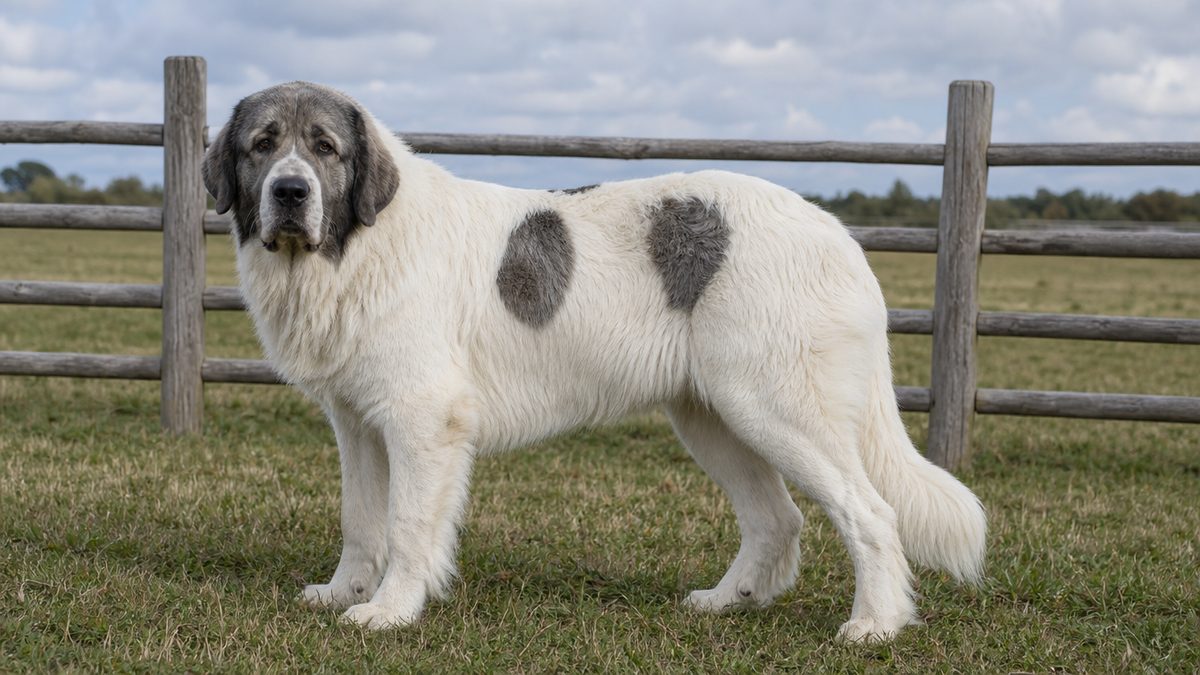
The dog itself is massive by the standard's own account: "That of a very large dog, above average size and of medium proportions. Harmonious, emphatically strong and muscular. Firm bone structure. Coat not exaggerated in length. In spite of his size, must not give the impression of being heavy or sluggish". The last clause matters, because a slow, heavy-looking specimen is a departure from the standard rather than the type.
The standard is blunt about the job. Under Utilization it reads: "Guard and defense. Previously, the Pyrenean Mastiff was used for defense against beasts of prey, in particular against wolf and bear. Nowadays he is an excellent guard for country estates and their owners as he is easily trained";. This is a livestock guardian built to walk with flocks on transhumance and to stand between them and predators, which is a different job from holding cattle or guarding a yard.
Proving the dates, from each document separately
FCI dates are ambiguous unless the format is proved from the document being read, and the FCI writes dates two different ways across its own documents. Bonbeno proved each independently rather than assuming a house style.
The web register prints M/D/YYYY, and this record proves it three times over on its own face. It shows the standard publication as 8/30/2002, the valid standard as 5/26/1982, and definitive acceptance as 11/15/1954. In every one of those the second field is 30, 26 or 15, and none can be a month, so the second field is the day. The dates therefore read 30 August 2002, 26 May 1982 and 15 November 1954.
The standard PDF prints D.M.YYYY, and it proves that on its own face too, from the opposite direction. It carries two dates, 30.08.2002 in the header and 26.05.1982 in the body, and in both the FIRST field exceeds 12 and so cannot be a month. Read alone, each document gives the same two dates, which is the point of proving the format twice.
Register against standard: they agree
Registers and standards can contradict each other, so Bonbeno checked. On every field the two documents share they agree: publication of the valid standard (26 May 1982 both ways), publication of the current text (30 August 2002 both ways), the authentic language (Spanish on the register, "Official language (ES)" on the standard), and the classification (Group 2, Molossian, Mountain type, without working trial) FCI-Standard N° 92. The standard prints no acceptance date at all, so the 1954 date cannot be cross-checked against it and Bonbeno does not pretend otherwise.
One genuine translation difference is worth recording, because Spanish governs. The English size clause reads "When quality is equal, the bigger dog is always preferred"; the authentic Spanish reads "siendo siempre mas valiosos, a igualdad de proporciones, los ejemplares de mayor alzada", which is at equal proportions, not at equal quality. The Royal Kennel Club's version has inherited the English wording, "When of equal quality, larger dog preferred", so the translator's shift has propagated onward.
"Mastin del Pirineo" is one of 33 breeds in the Anexo to Real Decreto 558/2001, Spain's official register of native canine breeds, sitting alongside the Mastin Espanol and the Presa Canario. This is a state instrument, distinct from the FCI standard, and it is the right document to cite for Spanish national recognition.
The number 81, and how three registries describe this dog differently
The breed standard states no weight at all, and the figure 81 travels across three documents changing from a desirable height floor to an ideal height to a body mass in kilograms.
This is the single most useful thing Bonbeno can tell a buyer about this breed, because almost every figure circulating for it comes from somewhere other than the governing standard.
The standard gives a floor, not a range, and no weight
FCI 92's size clause reads in full: "There is no upper height limit. When quality is equal, the bigger dog is always preferred. Lower limit: Dogs: 77 cm. Bitches: 72 cm. It is, however, desirable that all dogs should exceed the lower limit considerably. Dogs should be above 81 cm, bitches 75 cm";. So 77 cm is a minimum, 81 cm is a desirable to exceed, and there is no maximum.
The standard also contains no weight figure whatsoever. Bonbeno searched both texts: "kg" and "weight" occur zero times in the English, and "Kg" and "peso" occur zero times in the authentic Spanish. Two independent documents, two independent zeros. The Royal Kennel Club standard states no weight either. Any confident weight range you meet for this breed was written by somebody, not measured against a standard.
| Source | Male height | Female height | Weight |
|---|---|---|---|
| FCI standard 92 | Minimum 77 cm, desirable above 81 cm, no upper limit | Minimum 72 cm, desirable above 75 cm | Not stated |
| Royal Kennel Club standard | Minimum 77 cm, no upper size limit | Minimum 72 cm | Not stated |
| Royal Kennel Club breed page | "Ideal height for males is 81 cm" | "around 73.5 cm" | Not stated |
| American Kennel Club | 30 to 31 inches, so 76.2 to 78.7 cm | 28 to 30 inches, so 71.1 to 76.2 cm | 120 to 190 pounds, so 54 to 86 kg |
| Google knowledge panel | 77 cm | 71 cm | 81 kg |
Three problems visible in that table
The Royal Kennel Club contradicts itself. Its breed standard sets 77 cm as a minimum with no upper limit and states no ideal, while its own Breeds A to Z page for the same breed says "Ideal height for males is 81 cm (32 in)"; The Royal Kennel Club. A floor to exceed and an ideal to hit are different instructions to a breeder.
The AKC's ceiling sits below the FCI's desirable floor. The AKC gives males a maximum of 31 inches, which is 78.7 cm, while the FCI standard says males should be above 81 cm and sets no maximum at all. A dog meeting the FCI's stated preference would be off the top of the AKC's range.
Google's panel prints 81 as a mass. It gives "Mass: 81 kg" and heights of 77 cm and 71 cm. The 81 that the FCI states as a height in centimetres has become a weight in kilograms. Its female height of 71 cm is also one centimetre below the standard's 72 cm minimum, so the panel describes a bitch that would fail the standard.
The Royal Kennel Club's Pyrenean Mastiff breed-standard page carries a link labelled "Breed Watch information related to this breed" which resolves to the Portuguese Water Dog page. Registry websites carry errors like any others. Read the document, not the navigation around it.
Bonbeno's position is that the FCI's Spanish text governs, because the FCI's own record names Spanish as the authentic language for standard 92. On that basis this is a dog with a 77 cm floor, a preference for more, no ceiling, and no published weight.
Pyrenean Mastiff price in India: there is no market and no page
No verifiable Pyrenean Mastiff price in india exists, and the reason is not a thin market but an absent one: not a single result in Google's Indian top ten for this query is about this breed.
Bonbeno opened all ten organic results on 8 September 2026 and checked the status code and title of each. Here is what an Indian buyer searching this term actually gets.
| Position | Domain | Breed the page is actually about |
|---|---|---|
| 1 | puppiezo.com | Great Pyrenees |
| 2 | basilpetcare.com | Most-expensive-breeds listicle |
| 3 | petsworld.in | Tibetan Mastiff |
| 4 | instagram.com | Tibetan Mastiff |
| 5 | mrnmrspet.com | Tibetan Mastiff |
| 6 | quora.com | Tibetan Mastiff |
| 7 | hindustantimes.com | Most-expensive-breeds listicle |
| 8 | facebook.com | Tibetan Mastiff |
| 9 | discover.hubpages.com | Costliest-breeds listicle |
| 10 | instagram.com | Tibetan Mastiff |
Ten results, zero about the breed. Google is substituting two other dogs wholesale because no Indian publisher has written about this one. That is a stronger finding than any price would have been, and it is the thing a buyer most needs to know.
Name what you are actually being offered
The page ranking first is a Great Pyrenees sales listing quoting "Rs 35,000 to Rs 45,000 or more";. The Great Pyrenees is a different breed. If you search this term and buy from the first result, you will buy a different dog from the one you searched for, at a price attached to that different dog.
That same page carries a second tell. Its quoted range is Rs 35,000 to Rs 45,000, while its own live inventory tiles on the same page show animals at Rs 98,999, Rs 92,599, Rs 94,999, Rs 1,20,000 and Rs 76,499. The stock contradicts the price claim on the same screen. Note the Rs 98,999 in particular: it is a recurring house price point that this project has now tracked across many breed pages on Indian listing sites, attached to whichever puppy is in stock rather than to any breed.
Why no lawful supply chain can form
Import for breeding or sale is barred. DGFT Trade Notice 22/2022-23 makes dogs a Restricted import under ITC(HS) 01061900, permits entry only for a pet dog with a valid pet book in the importer's name, for CPCSEA-recommended research, or for Defence and Police use, and states that applications for trading or breeding purposes "shall be duly rejected". Entry is limited to seven ports: Delhi, Mumbai, Chennai, Hyderabad, Bengaluru, Kolkata and, since October 2024, Kochi Department of Animal Husbandry…. The full route is set out in how to import a dog to India.
So there is no legal route by which a commercial Pyrenean Mastiff population could be established in India, and there is no Indian page reporting one. A rare breed with no import route and no domestic breeding base has no price, and Bonbeno will not invent one.
Divide it by 84.38, by 74 and by 80. If it divides cleanly at 84.38 or 74 it is probably a converted US dollar price. If it only divides at 80, remember that any figure ending in three zeros does so by construction, so look at the quotient: a plausible seller's price like 500 or 1,500 suggests conversion, while something like 5,625 suggests the rupee figure was simply made up.
Indian legal status: this breed is named in no instrument
No Indian instrument Bonbeno could find names the Pyrenean Mastiff, and unlike most giant guardians it was not caught by the 2024 circular on any reading of the list.
Owners of giant guardians in India have spent two years asking whether their breed is affected by the March 2024 restriction. For this breed the answer is unusually clean, and Bonbeno established it by searching the instruments rather than by reading press summaries.
| Document | Search term | Occurrences |
|---|---|---|
| CBIC Instruction 05/2024-Customs, which reproduces the circular's full list | Pyrenean | 0 |
| CBIC Instruction 05/2024-Customs | Pirineo | 0 |
| CBIC Instruction 05/2024-Customs | Mastin | 0 |
| Karnataka High Court judgment, W.P. 8409/2024, 49,740 characters | Pyrenean | 0 |
| Goa state identified-breeds list, February 2026 | Pyrenean | 0 |
| AWBI advisories register, current to 11 August 2026 | any later breed instrument | 0 |
The one entry that could be mistaken for this breed is "Mastiffs (boerbulls)";, and the circular glosses it itself: boerbulls are Boerboels, a South African breed that also appears in the same list by its own name. Reading "Mastiffs" as covering every breed with mastiff in its English name would sweep in a dog the drafters plainly were not describing, and the parenthesis is there to prevent exactly that.
The central position, for completeness
Nothing is in force in any case. The 12 March 2024 circular was stayed by the Karnataka High Court on 19 March 2024, quashed by it on 10 April 2024, and set aside by the Delhi High Court on 16 April 2024, the Delhi bench directing the Centre to publish a draft and invite written objections before issuing any final notification. The Department then issued its own public notice on 2 May 2024 saying the 12 March proceedings "shall not be enforced until further orders" and inviting comments by 1 June, and told the Bombay High Court on 24 January 2025 that it was "not acting on" the circular pending those objections. The Animal Welfare Board of India's advisories register, current to 11 August 2026, carries no replacement instrument on dog breeds.
The Karnataka court was explicit that this is not the end of the matter. Its order paragraph (iii) reads: "The quashment of the Circular will not come in the way of the Government acting in accordance with law, bearing in mind the observations made in the course of the order";. So a future instrument could name breeds this one did not. The Pyrenean Mastiff's absence from the 2024 list is a fact about that list, not a guarantee about the next one.
Goa is the one Indian state Bonbeno could verify as having legislated, and its Animal Husbandry Directorate identified five breeds: Pitbull, Rottweiler, Malinois, Cane Corso and Dogo Argentino. This breed is not among them. So the honest statement is that the central position is what Bonbeno verified, one state list was checked and does not name it, and no other state or municipal list naming it could be confirmed.
What does bind you, whatever the breed
Three things apply to this dog regardless of any breed list.
- Municipal registration. Delhi's MCD charges Rs 500 to register a pet dog with a Rs 100 per month late fee, and Greater Chennai Corporation charges Rs 50 for a pet licence Greater Chennai Corporation.
- The outdoor-housing heat clause. Second Schedule Part IV paragraph 21(1) bars keeping in outdoor facilities, without the attending veterinary practitioner's written approval, dogs not accustomed to local temperatures and "dog breeds that cannot tolerate" them. For a long-coated mountain breed in an Indian plain this is the clause that matters most.
- Your housing society's own rules, which are not centrally published and bind you whatever the Union government does. Get permission in writing before the dog arrives.
Real Decreto 287/2002, Spain's potentially-dangerous-dogs decree, names eight breeds in its Anexo I and "Pirineo" returns zero occurrences. Its second, characteristics-based limb specifies short hair and a height at withers of 50 to 70 cm, and this breed has a 6 to 9 cm coat and a 77 cm floor, so it falls outside that description too.
Cost of ownership: budget for coat, bulk and cooling
Budget between Rs 1,00,000 and Rs 1,90,000 a year for an adult Pyrenean Mastiff in an Indian metro, with grooming and cooling costing more than they would for any short-coated breed of the same size.
There is no purchase price to report, but Indian running costs are real, published and checkable, and they scale with a dog that starts at 77 cm and has no upper size limit.
| Line | Published figure | Annual estimate |
|---|---|---|
| Anti-rabies vaccination | Rs 699 per dose | Rs 699 |
| 9-in-1 DHPPiL booster | Rs 899 per dose | Rs 899 |
| Kennel cough | Rs 1,349 per dose | Rs 1,349 |
| Tick, flea and worm control | Rs 1,103 per month at 15-30 kg, and this dog is far heavier | Rs 16,000 or more |
| Deworming tablets | Rs 125.67 per tablet, one per 10 kg | Rs 3,000 to Rs 5,000 |
| Grooming, bath plus de-shedding | Bathing from Rs 934, haircut from Rs 1,359, add-ons from Rs 99 | Rs 12,000 to Rs 20,000 |
| Municipal registration, Delhi | Rs 500 new, Rs 500 renewal | Rs 500 |
| Boarding when you travel | Rs 130 to Rs 900 per night in Bengaluru, most at Rs 500-800 | Rs 7,000 to Rs 16,000 for 20 nights |
| Food, large-breed dry | arithmetic, not a quoted price | Rs 85,000 to Rs 1,30,000 |
The grooming line is where this breed separates from a short-coated giant. A dense coat of 6 to 9 cm on the topline, longer on the shoulders, neck, belly, back of legs and tail, needs real maintenance in Indian humidity, and a professional de-shed on a dog this size is not a quick job.
The parasite line is a floor rather than a figure. The Rs 1,103 monthly product is dosed for 15 to 30 kg and this dog is well above that, so price the pack that matches the actual bodyweight. The food line is arithmetic rather than a quoted price, and retail bags move fast enough that one of five retail figures in Bonbeno's own reference pack went stale within days, so re-price the bag you intend to buy.
The line most owners forget is electricity
A long-coated mountain breed in an Indian plain needs cooling for months at a time, and that is a running cost. If your plan depends on air conditioning, be aware that BESCOM load-shedding through March to May is a documented Bengaluru problem, and that a boarding kennel may or may not have generator backup for its cooling. Ask before you book.
Greater Chennai Corporation runs six pet clinics providing treatment and anti-rabies vaccination free of cost, and issued 9,115 pet licences in 2024 at Rs 50 each. Municipal provision is uneven but real, and worth checking before assuming private-clinic prices.
Heat tolerance: the widest homeland gap on this site
The Pyrenean Mastiff has the poorest heat tolerance of any breed Bonbeno has measured, because its homeland runs an annual mean of 10.25 C against Chennai's 27.95 C and it carries a dense coat of 6 to 9 cm.
Bonbeno queried NASA POWER by explicit latitude and longitude across the breed's Aragonese homeland and six Indian cities, echoing the model's cell elevation at every point and comparing it against the real elevation. Unlike the Canary Islands, the Aragonese points resolved properly: all four returned distinct grid cells rather than collapsing into one.
| Place | Cell elevation vs real | Annual mean temp | Annual humidity | Peak wet bulb |
|---|---|---|---|---|
| Jaca, Huesca | 1,025 m vs 820 m, +205 m | 10.25 C | 72.05 percent | 14.67 C in July |
| Huesca city | 506 m vs 488 m, +18 m | 13.75 C | 66.65 percent | 17.38 C in July |
| Zaragoza | 369 m vs 200 m, +169 m | 14.93 C | 64.47 percent | 18.03 C in July |
| Upper Gallego valley cell | 847 m vs 1,305 m, -458 m | 10.32 C | 78.51 percent | 15.10 C in July |
| Delhi | 206 m vs 216 m, -10 m | 25.60 C | 45.56 percent | 26.50 C in July |
| Mumbai | 97 m vs 14 m, +83 m | 26.77 C | 67.39 percent | 25.77 C in June |
| Chennai | 49 m vs 6 m, +43 m | 27.95 C | 72.39 percent | 26.11 C in May |
| Kolkata | 7 m vs 9 m, -2 m | 25.81 C | 73.93 percent | 27.09 C in June |
| Bengaluru | 842 m vs 920 m, -78 m | 23.74 C | 67.94 percent | 21.86 C in May |
| Pune | 636 m vs 560 m, +76 m | 23.86 C | 66.80 percent | 22.97 C in June |
Read the last column. Wet bulb combines heat and humidity into the number that describes how hard it is for a dog to shed heat, and the gap here is the widest Bonbeno has published. Jaca peaks at 14.67 C; Chennai peaks at 26.11 C and Kolkata at 27.09 C. That is a gap of eleven to twelve and a half degrees. Even Bengaluru at 21.86 C, the mildest Indian metro on the table, sits more than seven degrees above the breed's homeland peak.
That makes this the most heat-sensitive breed on this site, and the rating is derived from the measurement rather than from an impression. Compare the Presa Canario, whose homeland peaks at 20.58 C, or the Cane Corso and Neapolitan Mastiff from Mediterranean Italy. This breed's homeland is nearly six degrees cooler again in the wet-bulb measure.
Note also that the homeland is not especially dry. Jaca runs 72.05 percent annual humidity, close to Chennai's 72.39 and above Mumbai, Pune and Bengaluru. So the problem is not damp air and never was. The problem is heat, and heat carried under a dense coat by a dog whose standard sets no upper size limit.
Two honest caveats about these numbers
The Huesca city cell is the most trustworthy of the four Spanish points, missing the real elevation by only 18 m. Jaca's cell sits 205 m too high, which makes it read slightly colder than the town, and the upper Gallego cell sits 458 m too low, which makes it read about three degrees warmer than the valley it represents. Bonbeno labels that fourth row as a valley cell rather than naming a town for it, because POWER cannot resolve the town. The Indian cells are all within 83 m and are sound.
Size makes it worse, and the mechanism is exercise
Bodyweight is an independent heat-illness risk factor. In 905,543 UK dogs, being at or above the breed and sex mean bodyweight carried an odds ratio of 1.42 for heat-related illness and dogs over 50 kg carried an odds ratio of 3.42, confidence interval 1.54 to 7.57, with case fatality of 14.18 percent. A dog of this size sits in that band by definition.
The trigger is not what most owners expect. On the same cohort, 652 of the 879 events with a recorded trigger were exertional, which is 74.2 percent, against 113 environmental and 46 from vehicular confinement. Walking the dog is the dominant mechanism, so walk timing is a clinical decision rather than a preference.
Second Schedule Part IV paragraph 21(1) of the Dog Breeding and Marketing Rules 2017 bars keeping in outdoor facilities, without the attending veterinary practitioner's written approval, dogs "that are not accustomed to the temperatures prevalent in the area or region in question" and "dog breeds that cannot tolerate" them. A long-coated mountain breed in an uncooled outdoor kennel through an Indian summer is the clearest case that clause describes.
Temperament: the calm counterpart, and what the two standards say
The Pyrenean Mastiff is a calm, noble, good-natured guardian that its standards describe as friendly towards people and aware of its own strength, and it guards deliberately rather than reflexively.
Two standards describe this dog and they agree on the substance while differing in emphasis, which is worth showing rather than blending.
The FCI text reads: "Friendly towards humans, calm, noble and very intelligent, at the same time courageous and proud towards strangers from whom he never backs away. In his behaviour towards other dogs, he is good natured and aware of his superior strength".
The Royal Kennel Club text reads: "Friendly towards people, calm, noble and intelligent. Courageous and confident towards strangers, never backing away. Good-natured towards other animals, and aware of his great size. Can and will guard and protect only when necessary".
That last sentence is the breed in one line, and it is the RKC's own addition. This is a dog that assesses before it acts. A flock guardian that reacted to everything would be useless on a mountain, because the flock moves through weather, other animals and other people all day.
What that means in an Indian household
The temperament is genuinely gentle and the size genuinely is not. A dog with a 77 cm floor and no ceiling can injure a child by turning around, and the honest risk here is accident rather than aggression. Supervise on that basis rather than on a fear of the breed.
It is also an independent thinker. A guardian bred to make decisions alone on a hillside will make decisions alone in your home, which is why the standard's "easily trained" should be read as biddable rather than as compliant. It will do what you ask when it agrees the request makes sense.
- Suits a private ground-floor property with real space and a household that is home a lot.
- Suits an owner who wants a rustic, low-drama guardian rather than a reactive one.
- Does not suit an Indian flat, a first-time owner, or a household that cannot cool the dog for months at a time.
- Does not suit anyone who wants a dog that can be exercised on a normal daytime schedule.
Article 4(l) of Real Decreto 558/2001 requires an officially recognised Spanish breeders' association to admit for reproduction only animals that have passed the socialisation tests for their breed. Temperament screening sits inside the conditions for keeping the studbook, which is a stronger arrangement than most countries have.
Training: build cooperation early, because you cannot out-muscle this dog
To train a Pyrenean Mastiff, do the work in the first year while the dog is still liftable, because an independent guardian that outweighs you settles disagreements by simply not moving.
The FCI standard calls the breed "easily trained" and it is genuinely trainable, but a flock guardian's default is to assess rather than to comply. Training this breed is about building a habit of cooperation, not about establishing control you could never physically enforce.
- Socialise hard between three and sixteen weeks, covering lifts, watchmen, delivery riders, traffic, children and other dogs while the puppy is small.
- Train loose-lead walking before the dog reaches 40 kg, because after that you are negotiating rather than teaching.
- Teach a settle on a mat, which is the single most useful behaviour for a guardian in a household with visitors.
- Practise full-body handling weekly, including the hind dewclaws and the coat behind the ears, so grooming and veterinary examination are routine.
- Condition a basket muzzle as neutral equipment in the first six months, so it is available if you ever need it.
Two prohibitions worth knowing before a breeder suggests them
Do not remove the dewclaws, and here the standard is on the same side as the law. The Royal Kennel Club standard states "Dewclaws single, double or absent. Double dewclaws preferable", so removing them makes the dog less correct against the standard. Second Schedule Part II paragraph 6(8) of the Dog Breeding and Marketing Rules 2017 separately prohibits de-clawing and any "change of appearance by artificial means". Leave them and check between them for matting and grass seeds.
Do not crop the ears or dock the tail either. The authentic Spanish standard says of the ears "No deben ser amputadas", they must not be amputated, and lists both "Amputacion en orejas" and "amputacion en la cola" among its severe faults. Paragraph 6(8) prohibits both procedures in India. Standard and statute agree completely on this breed, which is not always the case.
FCI standard 346 for the Presa Canario permits erect cropped ears "in countries were cropping is allowed" and lists the presence of a dewclaw as a minor fault. Standard 92 does the opposite on both points. Two Spanish molossoids, two opposite positions on the same procedures.
Exercise: less than you think, and only in the dark
Give an adult Pyrenean Mastiff two short walks a day totalling 45 to 60 minutes, taken before sunrise and after dark, because a flock guardian's real work is patrolling and waiting rather than covering distance.
This breed does not need the mileage its size suggests. A livestock guardian walks with a flock at grazing pace and then lies down watching it, which is a low-intensity, all-day pattern rather than an athletic one. Trying to satisfy it with distance in Indian conditions is how owners cause harm.
The evidence points the same way. Exertional heat illness accounted for 652 of the 879 UK events with a recorded trigger, which is 74.2 percent, and this breed sits in the over-50 kg band that carried a 3.42 odds ratio Hall EJ, Carter AJ. There is no version of a midday Indian walk that is safe for this dog between March and October in most of the country.
- Walk before sunrise and after full dark, and test the pavement with the back of your hand first.
- Cap each session at 20 to 30 minutes and shorten sharply as the wet bulb rises.
- Exercise the mind instead on hot days, with scent work, food puzzles and short training sessions indoors.
- Carry water on every outing and offer it midway rather than at the end.
- Stop immediately at a widened tongue, a changed gait or a dog that lies down.
Growth changes the rules for the first eighteen months. A dog that will finish above 77 cm should not be doing forced road walking, stairs or repetitive fetch while its growth plates are open, particularly one whose breed shows 34.6 percent hip dysplasia on OFA's tables. Free movement on soft ground beats structured exercise at that age.
Even Bengaluru, the mildest metro on the climate table at a 21.86 C peak wet bulb, sits more than seven degrees above this breed's homeland peak. Genuine Indian hill stations come closer, but check the actual elevation and climate of the specific town rather than assuming altitude solves it.
Grooming: the coat is the daily work of owning this dog
Brush a Pyrenean Mastiff at least twice a week, line-brushing to the skin, and dry it actively after every wetting, because a dense 6 to 9 cm coat in Indian humidity is where this breed's problems start.
The standard specifies the coat precisely: "Dense, thick and of moderate length. The ideal medium length, measured on middle section of topline, should be 6 to 9 cm. The coat is longer on the shoulders, neck, under belly, at the back of legs as well as on the tail. On the plume, the texture is not as bristly as elsewhere on the body. The coat should bristly, not woolly in texture". The Royal Kennel Club standard gives the same 6 to 9 cm figure.
That is a serious double coat on a very large dog, and Indian humidity is its enemy. Damp trapped against the skin under a dense coat is how hot spots and skin infection begin.
| Task | Frequency | Cost |
|---|---|---|
| Line-brush to the skin, whole coat | Twice weekly minimum, more in shedding season | Nil after the tools |
| Check and clear the hind dewclaws | Weekly | Nil |
| Bath | Every 6 to 8 weeks | Bathing from Rs 934 |
| Professional de-shed | Twice a year | Add-ons from Rs 99 upward |
| Ear plug before bathing, dry after | Every bath | Nil |
| Active drying after any wetting | Every time | Nil |
Where overseas grooming advice fails in India
Breed-club grooming guidance written in Europe routinely says to towel the dog and let it air dry. In an Aragonese autumn that is fine. In an Indian monsoon it is how you get an ear infection, and published Indian veterinary series name bathing without plugging the ears as a common cause of canine otitis. Groom on the assumption that nothing air-dries here: plug the ears before the bath, and dry actively afterwards, working down to the skin on the neck, chest and behind the ears.
Do not shave the coat to cool the dog. A dense double coat insulates in both directions and provides sun protection, and a shaved giant guardian in Indian sun is worse off, not better. Remove dead undercoat by brushing instead, which is what actually improves airflow, and manage heat with shade, water, timing and cooling.
The standard describes thick, relatively loose skin and a "distinct double dewlap";. Loose skin plus a long coat plus Indian humidity is a combination that hides moisture. Part the coat and look at the skin weekly rather than relying on how the outside looks.
Health: one real dataset, and a great deal of nothing
The Pyrenean Mastiff shows 34.6 percent hip dysplasia across 104 OFA evaluations and 100 percent normal cardiac results across 57, and beyond those two rows there is almost no measured health data for this breed at all.
The health issues that can actually be evidenced for this breed come down to two OFA rows, which is unusual and worth stating before the numbers. Most giant-guardian pages list a dozen conditions; this one lists what has been counted.
Bonbeno read the rows out of OFA's own statistics tables rather than assembling a query URL, and ran a Labrador control in the same retrieval which returned the expected 109 rows.
| Screen | Evaluations | Result | Breakdown |
|---|---|---|---|
| Hips | 104 | 34.6 percent dysplastic, 63.5 percent normal | Excellent 12.5, Good 36.5, Fair 14.4; Mild 21.2, Moderate 11.5, Severe 1.9 |
| Basic cardiac | 57 | 100.0 percent normal | Equivocal 0.0, Abnormal 0.0 |
| Elbows | no published row | Below OFA's threshold | Not absent from the database, absent from the published table |
Two things about that table need saying carefully. The hip dysplasia figure is real and it is bad: 34.6 percent, with 21.2 mild, 11.5 moderate and 1.9 severe, which sums exactly to 34.6. But the normal grades sum to 63.4 against a printed 63.5, a 0.1 rounding discrepancy which Bonbeno reports rather than smoothing.
And 104 evaluations is a small denominator, barely over OFA's publication threshold of 100 hip evaluations. Compare the Presa Canario's 458. A percentage built on 104 dogs moves when a handful more are added, so publish it with its denominator attached and re-check it before relying on it.
The elbow row does not exist, and that is not reassurance
The breed has no row in OFA's published elbow statistics table, which lists 166 breeds. That means fewer than the required number of elbow evaluations have been submitted, not that the breed's elbows are sound. Writing "no reported elbow dysplasia" would be a straightforward misreading of a publication threshold as a health finding. Ask a breeder for elbow scores regardless.
The cardiac row is genuinely encouraging but thin: 57 evaluations, all normal, which is a real result on a small sample. Neither this breed nor the Presa Canario appears in OFA's 237-row eye registry table, so there is no eye data either way.
A registry trap worth knowing
OFA holds two codes for this breed and they disagree. The advanced-search markup carries `MLP` under the name "PIRINEOS MASTIFF", with an empty group field and no statistics row anywhere in the 222 published tables, and `PMF` under "PYRENEAN MASTIFF", which is the populated one. An agent finding `MLP` first and stopping would report that the breed has no OFA data at all. The fragment "MASTIN" returns zero in both the statistics dump and the markup, so a Spanish-language search finds nothing either.
Second Schedule Part III paragraph 8(10) requires that breeding dogs "shall have been tested for genetic defects, including hip dysplasia" and ten further named conditions, and Rule 8(1)(a) prohibits sale of pups under eight weeks. Hip dysplasia is the first item on that statutory list and the one real number this breed has. Ask to see the results.
Why this page carries no lifespan figure
No measured life expectancy exists for the Pyrenean Mastiff, and Bonbeno publishes none rather than borrowing another breed's median, because the breed appears in neither the longevity literature nor PubMed at all.
This is the most important section on the page, and it is about an absence. An absence is only worth publishing if it was earned, so here is the testing.
The largest lifespan study does not contain this breed
McMillan 2024 analysed 584,734 United Kingdom dogs including 284,734 deceased, and is the study every giant-guardian page quotes. Bonbeno searched its full text and the string "Pyrenean" returns zero occurrences. In-document controls in the same search returned Labrador 3, Caucasian Shepherd 2, Cane Corso 2 and Presa 2. The search works, and the absence is therefore a property of the paper rather than of the query.
That matters because the temptation is obvious. The sibling Presa Canario page carries a median of 7.7 years from that same study. Transferring it here, or averaging it with the Neapolitan Mastiff's 9.3, would produce a confident-looking number describing no measured population. Bonbeno does not do it.
PubMed holds nothing either, across five names and seven controls
| Query | Records |
|---|---|
| "Pyrenean Mastiff"[tiab] | 0 |
| "Pyrenean Mastiffs"[tiab] | 0 |
| "Pyrenees Mastiff"[tiab] | 0 |
| "Mastin del Pirineo"[tiab] | 0 |
| "Mastin del Pirineo"[tiab] with accent | 0 |
| CONTROL: "Labrador Retriever"[tiab] | 1,109 |
| CONTROL: "Great Pyrenees"[tiab] | 33 |
| CONTROL: "Pyrenean Mountain Dog"[tiab] | 8 |
| CONTROL: "Spanish Mastiff"[tiab] | 8 |
| CONTROL: "Presa Canario"[tiab] | 4 |
Five name forms, five zeros, every one carrying a quotedphrasesnotfound warning rather than a silent rewrite. The controls are the point: the instrument returns 33 records for the Great Pyrenees, 8 for the Pyrenean Mountain Dog and 8 for the Spanish Mastiff, all neighbouring breeds, and still returns zero for this one. That is an earned absence, not a broken query.
So the AKC's stated life expectancy of 10 to 12 years rests on something other than published research. It may well be right. It is simply not a measurement, and this page will not repeat it as one.
Bloat: the size band transfers, the breed figure does not
Gastric dilatation-volvulus is the emergency a deep-chested giant faces, and again no study has measured it in this breed. The two prospective cohorts that produced the standard figures covered 1,914 and 1,637 dogs across eleven breeds, and the Pyrenean Mastiff is not one of them: they were the Akita, Bloodhound, Collie, Great Dane, Irish Setter, Irish Wolfhound, Newfoundland, Rottweiler, Saint Bernard, Standard Poodle and Weimaraner.
What transfers is bodyweight, not breed. Those studies found 26 cases per 1,000 dog-years in giant breeds over 45 kg against 23 in large breeds of 23 to 45 kg, with 30 of 105 affected dogs dying, which is 28.6 percent. A dog starting at 77 cm at the withers is in the giant band. The husbandry findings transfer too: increasing age, a first-degree relative with GDV, faster eating and a raised feeding bowl all raised risk, with roughly 52 percent of giant-breed cases attributed to the raised bowl.
Retching without producing vomit, a distending abdomen, restlessness and drooling in a deep-chested giant is gastric dilatation-volvulus until a veterinarian says otherwise. Nothing at home helps. Find your nearest 24-hour surgical hospital and drive the route once, before you need it.
Indian owners should add the tick-borne load that applies to every dog here. In a West Bengal survey of 584 dogs screened at veterinary clinics, Babesia gibsoni was found in 76.54 percent and Anaplasma in 55.75 percent, with 72.9 percent of the 584 dogs screened carrying two or more pathogens. Those are clinic caseload figures rather than population prevalence, and a long coat makes tick checks harder rather than easier.
Feeding: slow the meal, floor the bowl, grow the dog slowly
Feed an adult Pyrenean Mastiff two or three measured meals a day from a floor-level bowl with a slow-feeder, and grow the puppy deliberately slowly, because both of this breed's known risks worsen with speed and weight.
Every feeding decision here is a risk decision. Three of the four modifiable bloat risk factors happen at the bowl, and bodyweight is an independent heat-illness risk factor.
- Split the daily ration into two or three meals rather than one.
- Slow the eating speed with a slow-feeder or snuffle mat, because faster eating raised GDV risk.
- Keep the bowl on the floor, because a raised feed bowl was associated with about 52 percent of giant-breed GDV cases.
- Rest the dog either side of meals rather than walking it straight out.
- Weigh the food rather than scooping it, and weigh the dog monthly through growth.
Growth is the whole game in a breed with no upper size limit
A standard that says "there is no upper height limit" and "the bigger dog is always preferred" creates real pressure to push a puppy. Resist it. With 34.6 percent hip dysplasia on OFA's tables, a fast-grown giant is a joint problem being built in real time. Use a large-breed puppy formulation with controlled calcium and energy density, feed to body condition rather than to a chart, and accept a leaner-looking yearling.
Keep the adult lean too. Being at or above the breed and sex mean bodyweight carried an odds ratio of 1.42 for heat-related illness, rising to 3.42 above 50 kg. In Indian conditions, every extra kilogram on this breed is paid for in heat.
On availability, large-breed dry foods are widely stocked in Indian metros and a 15 kg bag is the practical unit. Bonbeno gives no monthly rupee figure as a quoted price, because retail bags move quickly enough that one of five retail figures in its own reference pack went stale within days. Price the bag you intend to buy and divide by the grams per day on the pack.
A heavily-coated dog under Indian heat drinks a great deal and dehydrates while looking comfortable, because the coat hides the effort. Put down multiple shaded water points, refresh them daily, and watch intake as a heat indicator rather than trusting how the dog looks.
The first year, month by month
Plan the first year around four things: the socialisation window, the vaccination course, deliberate slow growth, and the heat plan that has to be working before the first hot season.
| Age | What matters | What it costs |
|---|---|---|
| Before purchase | Written housing-society permission; confirm the breed against FCI 92, not against a Great Pyrenees; ask for both parents' hip scores | Nil, and worth more than the rest of this table |
| 8 to 10 weeks | Home, vet check, start the vaccination course, begin coat and dewclaw handling | Anti-rabies Rs 699, puppy DP Rs 849 |
| 10 to 16 weeks | The socialisation window. Lifts, watchmen, riders, traffic, children, other dogs | 9-in-1 Rs 899, kennel cough Rs 1,349 |
| 4 to 6 months | Loose-lead walking while still liftable; muzzle conditioning; municipal registration | MCD Delhi Rs 500 or Chennai GCC Rs 50 |
| 6 to 9 months | Deliberate slow growth. No forced road work or stairs. Free movement on soft ground | Large-breed puppy food |
| 9 to 12 months | Twice-weekly line-brushing established as routine; book baseline hip imaging | Imaging quoted locally |
| First hot season | Cooling plan tested before it is needed, including a power-cut fallback | Electricity, and it is not trivial |
The first row is the one that prevents the most damage. Confirming the breed matters unusually here, because the top Indian search result for this breed sells a Great Pyrenees and Indian listings mix the two constantly. The quick check is the mask: a Pyrenean Mastiff always carries a defined facial mask, and a Great Pyrenees typically does not.
The last row is the one owners postpone. Test the cooling arrangement before March rather than during it, and have a fallback for a power cut, because BESCOM load-shedding through March to May is a documented Bengaluru problem.
A 30 kg six-month-old that tolerates having its feet, ears, hind dewclaws and hips handled becomes an 80 kg adult a veterinarian can examine. One that does not becomes an animal that needs sedation for a routine check. Ten minutes a week now is the cheapest investment on this page.
Pyrenean Mastiff against the breeds it gets confused with
The Pyrenean Mastiff is confused with three other dogs in Indian search, and the differences are checkable: the Great Pyrenees has no mask, the Tibetan Mastiff is a different standard entirely, and the Presa Canario is the short-coated Spanish alternative.
Google returns two of these breeds instead of this one, so telling them apart is a practical need rather than trivia.
| Pyrenean Mastiff | Great Pyrenees | Presa Canario | Tibetan Mastiff | |
|---|---|---|---|---|
| Facial mask | Always, and required | Typically none | Always black | None |
| Coat | Dense, 6 to 9 cm on topline | Long double coat | Short, no undercoat | Long double coat |
| Height | 77 cm floor, no ceiling | Smaller than this breed | Males 61 to 66 cm | See the Tibetan Mastiff page |
| Weight in the standard | Not stated at all | Stated elsewhere | 45 to 57 kg males | See the Tibetan Mastiff page |
| PubMed records | 0 across five name forms | 33 | 4 | Not tested here |
| In McMillan 2024? | No | Not tested here | Yes, 7.7 years | Not tested here |
| Named in the 2024 Indian circular? | No | No | As "Canario" | No |
| Ranks in India for this query? | No page exists | Position 1 | n/a | Six of the top ten |
The two Spanish giants, side by side
The Presa Canario is the genuine alternative if what you want is a Spanish guardian that can cope better with Indian heat. It is short-coated, smaller, and sits in the FCI's Mastiff-type subsection rather than the Mountain type. It also carries far worse measured health figures, at 40.0 percent hip dysplasia across 458 evaluations and a 7.7-year median lifespan, and an Indian legal history that remains unresolved because the circular named "Canario".
So the trade is real and it runs both ways. The Pyrenean Mastiff gives you a calmer temperament, a cleaner legal record and better cardiac numbers, and takes away almost all the health evidence and any hope of heat tolerance. The Presa Canario gives you data and heat workability, and takes away legal certainty.
If the requirement is a large guardian that copes with Indian conditions, an Indian pariah-type dog from a shelter is free, heat-adapted, legally unambiguous and needs no import route. It is the honest answer for most of the households that search this breed.
What Indian buyers get wrong with this breed
Five mistakes account for most of the harm here, and the first one happens before any money changes hands.
1. Buying a different breed
The commonest error is not a care mistake, it is an identity mistake. Every one of the top ten Indian results for this query is about another dog, and the first is a Great Pyrenees sales page Puppiezo, 'Great Pyrenees Puppies For Sale…. Check for the mask, check the paperwork names Mastin del Pirineo or Pyrenean Mastiff, and check it against FCI standard 92.
2. Believing a weight range
The breed standard states no weight in either of its languages, and the Royal Kennel Club's states none either FCI-Standard N° 92, MASTIN DEL PIRINEO The Royal Kennel Club. Any seller quoting you a precise weight range is quoting something other than the standard, and the widely-repeated 81 is a height in centimetres in the document that originated it, not a mass in kilograms.
3. Reading the missing elbow row as good news
The breed has no row in OFA's published elbow table because too few evaluations have been submitted, not because its elbows are sound. Treat a publication threshold as a gap in knowledge, and ask the breeder for the scores that OFA has not aggregated.
4. Underestimating the heat, because the dog looks calm
A homeland peak wet bulb of 14.67 C against Chennai's 26.11 C is the widest gap Bonbeno has published, and a calm dog under a dense coat does not signal distress early. Exertional heat illness accounted for 74.2 percent of UK events with a recorded trigger, so the walk is the risk.
5. Buying the raised bowl
Raised feeders are sold in India as a giant-breed necessity. In the prospective cohort, a raised feed bowl was associated with approximately 52 percent of GDV cases among giant breeds. Keep the bowl on the floor and buy a slow-feeder instead.
Removing the hind dewclaws makes the dog less correct against the Royal Kennel Club standard, which prefers double dewclaws, and is prohibited in India by Second Schedule Part II paragraph 6(8) The Prevention of Cruelty to Animals. So is cropping the ears, which the authentic Spanish standard lists among its severe faults.
Adoption and responsible sourcing
Adopt rather than buy, and if you buy, buy against documents, because this breed has no Indian market, no verifiable price, and a search result that will hand you a different dog.
Bonbeno does not recommend breeders, does not link puppy listings and does not broker sales. What it can do is tell you what to verify.
The adoption route
Purebred Pyrenean Mastiffs are effectively absent from Indian shelters, because they are effectively absent from India. What Indian rescue does hold is large, long-coated guardian-type dogs surrendered between one and three years old, usually when a household discovered what the size and the coat actually cost. If you have the ground, the budget and the cooling for a giant guardian, that is where the need is, and you can adopt one through a registered shelter this month.
For most households reading this page, an Indian pariah-type dog is the better answer outright: adapted to the climate, no import question, no legal ambiguity, and no coat that has to be managed through a monsoon.
If you buy, this is the document list
- Papers that name the breed correctly as Pyrenean Mastiff or Mastin del Pirineo against FCI standard 92, not "Pyrenean" alone, which is how Great Pyrenees puppies get sold under this name.
- Kennel Club of India pedigree papers for both parents with numbers you can check, since India is an FCI member body and the breed holds a definitive FCI standard.
- Hip scores for both parents, because paragraph 8(10) requires breeding dogs to have been tested for genetic defects "including hip dysplasia" and this is the one screen with real breed data Orthopedic Foundation for Animals.
- Elbow scores for both parents, precisely because OFA publishes no aggregate for this breed.
- The breeder's registration under the Dog Breeding and Marketing Rules 2017, and proof the puppy is at least eight weeks old as Rule 8(1)(a) requires.
- Import paperwork if an imported line is claimed, given that trading and breeding applications "shall be duly rejected" under the DGFT notice.
Walk away from a puppy with cropped ears or removed dewclaws, from a seller who cannot produce parental hip scores, from anyone quoting a confident rupee price for a breed with no Indian market, and from a listing that cannot show you a defined facial mask.
A seller who says "I do not have this breed, I have Great Pyrenees" is being straight with you and is worth more than one who agrees with whatever you asked for. The absence of this breed in India is the finding, and a seller who confirms it is confirming the research on this page.
Pyrenean Mastiff questions, including the ones Google actually asks
Which dog costs 20 crore?
Google returns this question for the Pyrenean Mastiff, and the answer is a Caucasian Shepherd named Cadabom Hayder owned by a Bengaluru breeder, reported from 2023 onward. Treat it as a publicity figure rather than a transaction: the reporting describes an offer and a valuation, not a completed sale. It has nothing to do with the Pyrenean Mastiff, and the fact that it surfaces here shows that Indian giant-guardian search is dominated by one price story rather than by breed information.
Are Pyrenean Mastiffs aggressive?
No, and the breed standards say so explicitly. The Royal Kennel Club standard describes a dog that is "Friendly towards people, calm, noble and intelligent", "Good-natured towards other animals, and aware of his great size", and one that "Can and will guard and protect only when necessary". The FCI standard adds that it is "Friendly towards humans, calm, noble and very intelligent". This is a measured flock guardian, not a confrontational breed.
Is Great Pyrenees available in India?
Yes, and this question is the single most useful thing in Google's box, because the Great Pyrenees is a different breed that Indian sellers offer under Pyrenean names. The page ranking first in India for "pyrenean mastiff price in india" is a Great Pyrenees sales page quoting Rs 35,000 to Rs 45,000. The Pyrenean Mastiff is FCI standard 92 and the Great Pyrenees is a separate breed with no facial mask. Check which dog you are actually being offered.
Is a mastiff a friendly dog?
It depends entirely on which mastiff, and the word covers breeds with very different temperaments. Within the FCI's Group 2 Molossian section alone, the Mountain type that holds the Pyrenean Mastiff and the Mastiff type that holds the Presa Canario were bred for different jobs. The Pyrenean Mastiff's standard describes a calm dog that guards only when necessary; the Presa Canario's standard describes a dog that "can be suspicious of strangers". Read the specific standard, not the category.
What is the Pyrenean Mastiff price in India?
No verifiable figure exists, and Bonbeno publishes none. Not one of the top ten Indian results for the query is even about this breed: position one is a Great Pyrenees sales page and most of the rest are Tibetan Mastiff pages. No page in the set quotes a Pyrenean Mastiff price in rupees at all. With no Indian market and no lawful commercial import route, there is no price to report.
How long does a Pyrenean Mastiff live?
No measured figure exists for this breed. Bonbeno searched the full text of McMillan 2024, the largest UK longevity study at 584,734 dogs, and "Pyrenean" returns zero occurrences against in-document controls of Labrador 3, Cane Corso 2 and Presa 2. The American Kennel Club prints 10 to 12 years, but that figure appears in no study Bonbeno could find and the FCI standard states no lifespan. Bonbeno declines to transfer another breed's median onto this one.
How much does a Pyrenean Mastiff weigh?
The breed standard does not say. Bonbeno searched both the English and the authentic Spanish texts of FCI standard 92: "kg" and "weight" occur zero times in the English, and "Kg" and "peso" occur zero times in the Spanish. The Royal Kennel Club standard states no weight either. The AKC prints 120 to 190 pounds, which is 54 to 86 kg, and that figure comes from somewhere other than the governing standard.
Is the Pyrenean Mastiff banned in India?
No, and unlike most giant guardians it was never named. Bonbeno searched the full breed list in CBIC Instruction 05/2024-Customs, which reproduces the 12 March 2024 circular verbatim: "Pyrenean", "Pirineo" and "Mastin" each return zero occurrences, and the only mastiff-type entry is "Mastiffs (boerbulls)", which the document itself glosses as boerbulls. The Karnataka judgment returns zero for "Pyrenean" too, and Goa's five-breed state list does not name it.
Does the Pyrenean Mastiff have hip problems?
Yes. Of 104 Pyrenean Mastiff hip evaluations published by OFA, 34.6 percent were graded dysplastic and 63.5 percent normal, with 21.2 percent mild, 11.5 percent moderate and 1.9 percent severe. The breed has no row at all in OFA's published elbow table, which means it has not reached the 100-evaluation threshold there rather than that its elbows are sound. Ask any breeder for both scores regardless.
Can a Pyrenean Mastiff survive Indian heat?
Badly, and it is the worst-matched breed on this site for Indian conditions. Its homeland at Jaca in the Aragonese Pyrenees runs an annual mean of 10.25 C with a peak wet bulb of 14.67 C, against Chennai at 27.95 C and a 26.11 C peak wet bulb. That is a wet-bulb gap of more than eleven degrees, carried by a dog under a 6 to 9 cm coat with no upper size limit. Only a genuine hill station comes close.
Can a Pyrenean Mastiff have its dewclaws removed in India?
No, and here the breed standard and Indian law want the same thing. The Royal Kennel Club standard states "Dewclaws single, double or absent. Double dewclaws preferable", so removing them makes the dog less correct, not more. Second Schedule Part II paragraph 6(8) of the Dog Breeding and Marketing Rules 2017 separately prohibits de-clawing and any "change of appearance by artificial means". Leave them, and check between them for grass seeds and matting.
Is the Pyrenean Mastiff the same as the Great Pyrenees?
No. They are two separate breeds from the same mountain range, and confusing them is the commonest error in Indian listings. The Pyrenean Mastiff is FCI standard 92 from Aragon in Spain, always carries a defined facial mask, and stands at a minimum of 77 cm. The Great Pyrenees, also called the Pyrenean Mountain Dog, is a different standard and is typically all white without a mask. PubMed holds 33 papers naming the Great Pyrenees and zero naming the Pyrenean Mastiff.
Compare with similar breeds
Pyrenean Mastiff sits in 1 Bonbeno group. Each one compares it directly against the breeds it is genuinely an alternative to, on the same figures.