
Breed profile
Fila Brasileiro: the Indian owner's guide to a legally loaded guard breed
What the current FCI standard really says about strangers, which bans are actually in force, and what the breed costs and needs in an Indian climate.
Quick answer
The Fila Brasileiro price in India runs from about Rs 30,000 to Rs 1,50,000 on the one Indian page that publishes a band, and that band is unsourced and its floor is implausibly low for an imported 50 kg mastiff. The breed is legal to own in India today, because the 2024 circular that named it was quashed and set aside, but it is banned outright in the United Kingdom, Denmark and Norway, and barred from import into New Zealand.
This page is editorial reference, not veterinary advice. Nothing here can substitute for examining an individual dog, and a breed with a documented 37.9 percent hip dysplasia rate and a published case of arrhythmogenic cardiomyopathy needs a real clinical relationship, not a web page. Consult a registered veterinarian before acting on any health, feeding, breeding or exercise decision, and seek emergency veterinary care immediately if a dog shows a distended abdomen with unproductive retching, laboured breathing, collapse, or a rectal temperature above 40 degrees Celsius.
Fila Brasileiro at a glance
What the Fila Brasileiro is, and what FCI 225 records
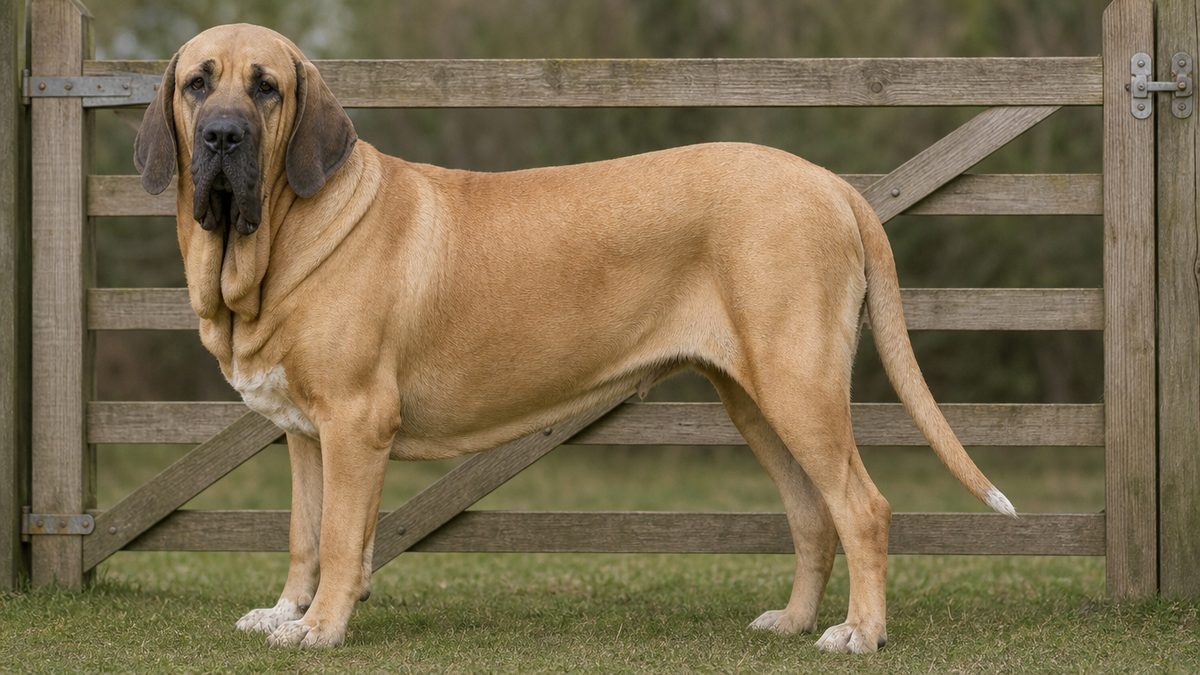
The Fila Brasileiro is a very large Brazilian molossoid guard and cattle breed, 65 to 75 cm at the withers for males and at least 50 kg, recognised by the Federation Cynologique Internationale on a definitive basis since 1 January 1960 as standard number 225 in Group 2, Section 2.1, Molossian, Mastiff type.
Start with the registry record, because almost every claim about this breed can be checked against it. The FCI nomenclature entry prints the breed name on its own face as FILA BRASILEIRO (225), gives Brazil as the country of origin, records the date of acceptance on a definitive basis as 1 January 1960, names English as the official authentic language, and dates the official valid standard to 29 September 2016. Its stated utilisation is one word: Watch Dog. It carries no working trial.
Those five facts matter to an Indian reader more than they look. India is a full FCI member represented by the Kennel Club of India, so a pedigree issued in India runs against FCI nomenclature, and a Fila Brasileiro is therefore a registrable breed here with a standard a buyer can read. The authentic-language line matters too, because the English text is the one that governs: any Portuguese, French or German version is a translation, and where they diverge, the English wins.
The dog the standard describes
FCI-Standard No 225 of 04.10.2016 opens by calling the breed typically a molossoid, with powerful bones and a rectangular, compact structure that is nonetheless harmonious and well-proportioned, and adds that it displays, together with a massive body, a great amount of concentrated agility which is easily perceived. The proportions are specific: the muzzle is slightly shorter than the skull, and body length measured from the point of the sternum to the point of buttock exceeds height at the withers by 15 percent. That last figure was 10 percent in the 2004 text, so the modern Fila is deliberately a longer dog than the one described two decades ago.
| Item | Males | Females |
|---|---|---|
| Height at withers | 65 to 75 cm | 60 to 70 cm |
| Weight | Minimum 50 kg, no maximum stated | Minimum 40 kg, no maximum stated |
| Body length against height | Exceeds height at the withers by 15 percent | Exceeds height at the withers by 15 percent |
| Height below the minimum | Disqualifying fault under 65 cm | Disqualifying fault under 60 cm |
The head is the breed's signature. Seen from above it resembles a trapezoid into which a pear shape is inserted; the stop is practically non-existent from the front; the upper lip is thick and pendulous and the lip edges form a deep inverted U. Ears are large, thick, pendant and V-shaped, falling over the cheeks or folded back as a rose ear. The standard specifically permits drooping lower eyelids, saying that due to the loose skin many individuals present them and that this is not considered a fault as such, because the detail accentuates the melancholic expression which is typical of the breed. Hold on to that sentence. It reappears later on this page as a collision with Indian law.
Skin, topline and the camel's pace
Three features make a Fila unmistakable in the flesh. The skin is thick and loose over the whole body, forming pronounced dewlaps at the throat that often extend to the brisket and abdomen. The croup is set a little higher than the withers, so the topline rises from front to back, and a croup lower than the withers is a disqualifying fault. And the breed moves at the pace, a two-beat lateral gait the standard calls the camel's pace, in which the legs on each side move back and forth as a pair; a dog not walking at camel's pace is disqualified. Pacing is a movement fault in almost every other breed, which is why judges unfamiliar with the Fila mark it down.
Colour was narrowed sharply in the current text. The 2016 standard permits brindle, fawn and black, with or without a black mask, and allows white only on the feet, chest and tip of tail. The 2004 standard had said instead that any solid colours are permitted except the disqualifying ones. Dogs that are white, mouse-grey, dappled, black and tan or blue are disqualified, as are cropped ears and docked tails.
The standard sets a minimum weight and no maximum. A male Fila starts at 50 kg and goes up. Before anything else on this page, work out whether your home, your gate, your lift, your car and the people who visit you can accommodate that.
The temperament clause, quoted in full from the current standard
The current FCI temperament clause names a natural aloofness towards strangers and then requires the dog to accept handling anyway, and the second half of that sentence is the part almost every page about this breed leaves out.
Here is the whole BEHAVIOUR/TEMPERAMENT section of FCI-Standard No 225 of 04.10.2016, in the authentic English, with nothing removed.
Courage, determination and outstanding braveness are part of its characteristics. With its owners and family it is docile, obedient and extremely tolerant with children. Its loyalty is proverbial, insistently seeking the company of its master. It displays a calm disposition, distinctive self-assurance and self-confidence, remaining unperturbed by strange noises or circumstances. An unsurpassed guardian of properties, it also instinctively indulges in big game hunting and cattle herding. While one of its characteristics is a natural aloofness towards strangers especially in its own territory, it must be susceptible to controlled handling, especially in the show ring.
Read that last sentence twice. It is a conditional, not a warning. The standard concedes the aloofness, restricts it to strangers and especially to the dog's own territory, and then imposes an obligation that runs the other way: the dog must be susceptible to controlled handling. A Fila that cannot be handled is not meeting its own breed standard.
What changed in 2016, and it changed in one direction
The 2004 standard said something shorter and looser. Its temperament section read that one of its characteristics is its aloofness towards strangers, and then moved straight on to the calm disposition sentence. There was no handling requirement of any kind. So the FCI did not merely restate the breed's suspicion in 2016; it added a positive obligation that had not existed before, and it placed that obligation in the show ring specifically.
| Element | FCI 225, 02.04.2004 | FCI 225, 04.10.2016 |
|---|---|---|
| Aloofness | One of its characteristics is its aloofness towards strangers | A natural aloofness towards strangers especially in its own territory |
| Handling | Not mentioned | It must be susceptible to controlled handling, especially in the show ring |
| Aggression | Aggressive or overly shy, an eliminating fault | Aggressive or overly shy, a disqualifying fault |
| Timidity | Apathy and timidity, a very serious fault | Apathy and timidity, a serious fault |
| Fault tiers | Faults, serious, very serious, eliminating | Faults, serious, disqualifying |
The fault schedule matters as much as the prose. In both versions, Aggressive or overly shy is the first entry in the top disqualification tier, alongside any dog clearly showing physical or behavioural abnormalities. That is the FCI's answer to the question of how far the aloofness may go. Aloof is required; aggressive is disqualifying; and the two are distinguished by whether the dog can be handled.
The FCI's own teaching document says the same thing
The FCI publishes a breed-specific education presentation for the Fila, prepared with the Confederacao Brasileira de Cinofilia and running to 142 slides. Bonbeno extracted its full text. It describes the character as suspicion or distrust towards strangers, states that apathy and timidity are considered very serious faults, and states that aggressive or overly shy dogs are extremely disapproved and are considered eliminating faults. Its own Judging the breed section covers skin, croup height and movement, and instructs that a Fila must be moved in a loose lead. The word ojeriza does not appear anywhere in it, and the word touch appears exactly once, in the sentence about the tail not touching the back.
The Brazilian translation diverges, and says so
The Confederacao Brasileira de Cinofilia publishes the Portuguese text, and it prints a disclaimer on its own cover page saying the translation exists only to help those who do not command the FCI's official languages. Its temperament line reads that the breed is characterised by aversao a estranhos, sendo de manejo controlado particularmente em pista de exposicao, which is aversion to strangers, being of controlled handling particularly in the show ring. Two divergences from the authentic English are worth flagging. The CBKC list of eliminating faults reads Agressividade para com seu dono, aggression towards its owner, where the English says simply Aggressive; and the CBKC adds a serious fault the English does not carry at all, sensibilidade negativa ao tiro, negative sensitivity to gunshot.
The English. FCI 225 names English as the official authentic language, so where the CBKC translation and the FCI text disagree, the FCI text governs, and it disqualifies aggression without limiting it to aggression towards the owner.
Ojeriza and the do-not-touch rule: where they actually come from
The ojeriza clause and the instruction that a judge must not touch a Fila Brasileiro come from a Brazilian registry outside the FCI, not from FCI Standard 225, and Bonbeno checked four separate FCI and CBKC documents to establish that.
This is the most repeated claim about the breed and it is misattributed almost everywhere. The usual formulation is that the FCI standard describes ojeriza, a documented hostility to strangers, and instructs judges not to touch the dog. Bonbeno opened four documents to test it: the current 2016 FCI standard, the superseded 2004 FCI standard, the CBKC Portuguese rendering of the current standard, and the FCI's own 142-slide breed education deck. The word ojeriza appears in none of them, and none of them contains any instruction about judges not touching the dog FCI-Standard No 225, FILA BRASILEIRO Confederacao Brasileira de Cinofilia Federation Cynologique Internationale….
Where the clause does exist, word for word
The Sociedade Brasileira de Cinofilia, SOBRACI, is a Brazilian canine registry that is not an FCI member and publishes its own standards. Its Fila Brasileiro standard, approved by its president Osmir de Moraes Bastos, contains both halves of the famous claim. Under Temperamento it reads: Nao oculta sua ojeriza a estranhos, nem sua tradicional meiguice, obediencia e fidelidade aos donos e seus familiares. It does not conceal its ojeriza towards strangers, nor its traditional affection, obedience and loyalty to its owners and their family.
Como resultado de seu temperamento, nas exposicoes nao permite ser tocado pelo juiz (um estranho) e, se o atacar, nao deve tal reacao ser considerada falta, mas apenas confirmacao de seu temperamento. In English: as a result of its temperament, at shows it does not permit itself to be touched by the judge (a stranger) and, if it attacks him, such a reaction must not be considered a fault, but merely confirmation of its temperament.
That is the do-not-touch rule in its actual home, and the same SOBRACI text goes further than any FCI document does. It requires a temperament test compulsory at shows after twelve months of age, in which the dog's attack must be delivered on an ascending diagonal in front of the handler. It requires a blank-cartridge gunshot test, never fired within five metres. And among its general disqualifications it lists, at number twelve, temperamento sem reacao positiva ao ataque, a temperament without a positive reaction to the attack.
Two standards, two different dogs
The SOBRACI standard is not a translation of the FCI one. It differs on measurements as well as behaviour, which is the clearest proof that they are separate documents rather than two versions of the same one.
| Item | FCI 225, 2016 | SOBRACI |
|---|---|---|
| Height, males | 65 to 75 cm | 65 to 70 cm |
| Height, females | 60 to 70 cm | 60 to 65 cm |
| Colour | Brindle, fawn and black only | Includes light silver grey and white with large brindle patches |
| Judge handling | Must be susceptible to controlled handling | Does not permit itself to be touched by the judge |
| Attacking the judge | Aggressive is a disqualifying fault | Not a fault, merely confirmation of its temperament |
| Gunshot test | Not mentioned | Compulsory at shows after twelve months |
Note that colours SOBRACI permits, such as light silver grey and white with large brindle patches, are colours the FCI standard disqualifies outright. A dog can therefore be a correct Fila under one document and a disqualified one under the other.
What actually happens in an FCI ring
Ring practice sits between the two texts, and the best account of it comes from Modern Molosser, whose 2025 piece on judging the breed was written for judges taking foreign assignments. It defines ojeriza as a Portuguese term that literally translates as grudge or spite, and describes it as a dislike of strangers that is more proactive than just being aloof. It reports that at FCI shows the breed is typically judged from a distance of five to six feet, with the handler showing the bite, lifting the dewlap, extending the ear to the tip of the nose, lifting the skin over the shoulders and topline, holding the tail to the hock and, for males, presenting the testicles in the palm of the hand. It also explains why the breed will never be recognised by the American Kennel Club, which requires that all dogs submit calmly to a breed-specific exam.
So the honest position is a three-part one. The convention of judging the Fila at arm's length is real and well documented. It is not in the FCI standard. And the FCI standard's current text pulls in the opposite direction, requiring that the dog be susceptible to controlled handling, especially in the show ring. An Indian buyer told that the breed standard forbids strangers from touching the dog is being handed a rule from a registry that does not issue their pedigree.
It decides what your vet can do. A dog bought on the belief that no stranger may touch it will not be trained to accept examination, restraint or a muzzle, and will then need sedation for routine work. A dog raised to the FCI's actual requirement of controlled handling can be examined, treated and boarded. The distinction is the difference between a manageable 50 kg dog and an unmanageable one.
Which countries ban the Fila Brasileiro, read from the instruments
Four bans on the Fila Brasileiro were confirmed by opening the legal instrument itself: possession bans in the United Kingdom, Denmark and Norway, and an importation ban in New Zealand.
Lists of countries that ban this breed circulate widely and almost none of them cite a law. Bonbeno checked four, in each case reading the instrument on the official legislation site rather than a summary, and reports only what those four say. Other countries and sub-national jurisdictions may also restrict the breed; this page does not claim the list is complete, it claims these four are verified.
United Kingdom: designated since 12 August 1991
The Dangerous Dogs Act 1991 applies of its own force to the pit bull terrier and the Japanese tosa, and section 1(1)(c) lets the Secretary of State designate further types by order. That power was used almost immediately. The Dangerous Dogs (Designated Types) Order 1991, S.I. 1991 No. 1743, was made on 25 July 1991, laid before Parliament the next day, and came into force on 12 August 1991. Its article 2 designates dogs of the following types, being types appearing to be bred for fighting or to have the characteristics of types bred for that purpose, namely any dog of the type known as the Dogo Argentino, and any dog of the type known as the Fila Braziliero. The misspelling is the statute's own, and it is still the operative wording.
The consequences under section 1 are wide. No person may breed or breed from such a dog, sell or exchange it or offer it for sale, make or offer a gift of it, allow it in a public place without being muzzled and kept on a lead, or abandon it or allow it to stray. Possession itself was prohibited from an appointed day, which was fixed as 30 November 1991, subject to exemption schemes. Contravention is a summary offence carrying up to six months imprisonment or a fine not exceeding level 5, or both. The Act extends to England, Wales and Scotland.
Denmark: one of thirteen prohibited breeds
Denmark's consolidated Dog Act, LBK nr 329 af 02/03/2021, states at section 1 a that possession and breeding of the following dogs is prohibited, and then lists thirteen breeds. Fila brasileiro is number four, after the pitbull terrier, tosa inu and American Staffordshire terrier, and before the dogo argentino, American bulldog, boerboel, kangal, the three ovtcharkas, tornjak and sarplaninac. Subsection 2 extends the prohibition to crosses in which the named dogs appear, and subsection 3 prohibits commercial import.
Section 1 b is the enforcement provision and it is blunt: dogs kept or imported in breach of section 1 a are put down by the police. Where there is doubt about a dog's breed, the police may require the keeper to document it, and if adequate documentation is not produced within a police-set deadline the dog is treated as having been kept in breach. There is one narrow escape route at section 1 b(6), allowing the police in special cases to order the dog exported from Denmark instead of destroyed, where the dog originated abroad, the keeper can reasonably be assumed not to have known it was prohibited, and it was not imported commercially.
Norway: keeping, breeding, importing and even semen
Norway's Forskrift om hunder of 20 August 2004 opens at section 1 with a prohibition that is broader than most: it is forbidden to keep, breed or import dangerous dogs, or to import semen or embryos from dangerous dogs. Five types are then named, and fila brasileiro is letter c, between the American Staffordshire terrier and the toso inu. The prohibition applies to mixtures in which one or more of these appear, irrespective of the mixing ratio.
Norway grandfathered dogs lawfully held before the regulation, but on strict terms. Section 3 says such dogs may be kept, and may be brought back into the country after foreign travel, subject to two conditions: they cannot be used in breeding, sold or rehomed, and they must carry identification linking them to a registration certificate showing they were bred, imported or kept before the regulation was adopted. Breach of either condition removes the protection. Section 4 provides that dogs bred, imported or kept in breach may be euthanised or ordered out of the realm by decision of the police.
New Zealand: an import ban plus compulsory muzzling
New Zealand does not prohibit possession but closes the border and constrains the dogs already there. Schedule 4 of the Dog Control Act 1996, headed Breed and type of dog subject to ban on importation and muzzling, was added on 1 December 2003 and lists four breeds in Part 1: Brazilian Fila, Dogo Argentino, Japanese Tosa and Perro de Presa Canario, with the American Pit Bull Terrier as the single entry in Part 2. Section 30A(1) provides that no person may import into New Zealand any dog that belongs wholly or predominantly to one or more breed or type listed in Schedule 4, with a fine not exceeding 3,000 dollars on conviction. Section 33C requires a territorial authority to classify as menacing any dog it has reasonable grounds to believe belongs wholly or predominantly to a Schedule 4 breed.
These four instruments are the reason relocation is the decisive question for this breed. A Fila cannot lawfully move with you to Britain, Denmark or Norway, and cannot be imported into New Zealand at all. Two of the four provide for the dog to be destroyed rather than returned. Ask the ten-year question before you buy, not after.
The Indian legal position: the 2024 circular and what survived it
No Indian law in force today bans owning, breeding or selling a Fila Brasileiro, because the circular that named the breed was quashed by the Karnataka High Court on 10 April 2024, set aside by the Delhi High Court, and abandoned in practice by the Centre before the Bombay High Court in January 2025.
The instrument was a circular, not a rule, and that proved fatal to it. Circular D.O.V-11/1/2024-Anlm_Dadf of 12 March 2024 issued from the Department of Animal Husbandry and Dairying after a Delhi High Court order of 6 December 2023 directed the Union to decide a law firm representation seeking a ban. The Karnataka High Court reproduced the circular in full, which is how Bonbeno read it rather than relying on press summaries.
Is the Fila Brasileiro on the list? Yes, and it is entry four
The circular records that an Expert Committee identified the following breeds of dogs as ferocious which are dangerous for human life, and then lists: breeds (including mixed and cross breeds) like Pitbull Terrier, Tosa Inu, American Staffordshire Terrier, Fila Brasileiro, Dogo Argentino, American Bulldog, Boerboel, Kangal, Central Asian Shepherd Dog (ovcharka), Caucasian Shepherd Dog (ovcharka), South Russian Shepherd Dog (ovcharka), Tornjak, Sarplaninac, Japanese Tosa and Akita, Akbash dog Moscow Guard dog, Cane corso and every dog of the type commonly known as a Ban Dog (or Bandog). The Fila Brasileiro is the fourth name in that sentence. Whatever else is disputed, its presence is not.
How many breeds were on it? The count is genuinely disputed
Bonbeno has not seen the circular itself, only reproductions, and the reproductions disagree. Resolving the Karnataka High Court's reproduced text entry by entry gives 19 names, with Tosa Inu and Japanese Tosa appearing separately for the same dog. The Hindu's report of the same judgment prints a longer list resolving to 25, adding Mastiffs, Rottweiler, Terriers, Rhodesian Ridgeback and Wolf Dogs. Press consensus settled on 23. Anyone stating a single figure with confidence is quoting a summary rather than a document.
| Date | Court | Outcome |
|---|---|---|
| 10 April 2024 | High Court of Karnataka | Circular quashed in Writ Petition No. 8409 of 2024 |
| 16 April 2024 | High Court of Delhi | Circular set aside |
| 24 January 2025 | High Court of Bombay | Centre states it is not acting on the circular at present |
Why the Karnataka court struck it down
The reasoning matters because it shapes what could come next. Justice M. Nagaprasanna held that the Union had recorded an undertaking before the Delhi High Court to hear all the stakeholders and that it is an admitted fact that none of them are heard; that the composition of the Expert Committee was not in consonance with the Rules framed under the Prevention of Cruelty to Animals Act, 1960; and that in the teeth of the statute, the Government of India could not have imposed a sweeping ban, a breed specific ban, by way of a circular. The order is short: the writ petition is allowed and the circular of 12 March 2024 stands quashed.
The court also left a door open, and the door is the reason this page does not describe the position as settled. Its summary of findings states that the obliteration will not come in the way of the Union of India bringing in an amendment to any of the Rules framed under the Prevention of Cruelty to Animals Act, 1960, after following due process of law, and that in the event of the re-birth of what is now obliterated, the stakeholders shall be heard. A properly made Rule, after consultation, could lawfully do what the circular could not.
The Delhi High Court set the circular aside on 16 April 2024. On 24 January 2025 the Centre told a Bombay High Court bench of Chief Justice Alok Aradhe and Justice Bharati H Dangre that at present it is not acting on the March 2024 circular, in a public interest litigation brought by the NGO Animal Rescue Trust. Three courts, one abandoned instrument.
What Indian law does still say about this dog
Two live obligations survive and both bite on this breed specifically. Second Schedule Part II para 6(8) of the Prevention of Cruelty to Animals (Dog Breeding and Marketing) Rules 2017 forbids tail docking, ear cropping, de-barking and de-clawing outright, which matches the FCI standard's own disqualification of cropped ears and docked tails. And Second Schedule Part III para 8(10) requires that breeding dogs shall have been tested for genetic defects, including hip dysplasia, progressive retinal atrophy, night blindness, hypothyroidism, entropion, ectropion, overshot, undershot jaw (when incisors do not touch or mesh), wry mouth, two or more missing teeth, unilateral cryptorchid or full cryptorchid males.
Ordinary cruelty law applies too. Section 11(1)(n) of the Prevention of Cruelty to Animals Act, 1960 covers organising or keeping any place for animal fighting, though the penalties under section 11(1) are very small, a first offence drawing a fine of ten to fifty rupees.
Owning a Fila Brasileiro in India is lawful today. It was never criminal even while the circular stood, because the circular directed local bodies not to issue licences and permits rather than creating an offence. And the position is provisional: Karnataka expressly preserved the Union's ability to make a proper Rule after consultation.
Fila Brasileiro price in India, and why the published band is unreliable
The only Fila Brasileiro price in India that any Indian page publishes is Rs 30,000 to Rs 1,50,000, it names no source, and its floor is roughly a quarter of the cheapest published United States price converted at current rates.
Only one Indian page prints a band at all. HappyPet, holding position one on the India result set for the target term, states that the average cost of a Fila Brasileiro varies between Rs 30,000 and Rs 1,50,000 in India, and gives no basis for either number. Every other Indian result either sells leads without showing a price or is a breeder listing with no figure. There is no second Indian source to compare against, which is itself the finding: a breed this rare has no Indian price consensus because it has no Indian price data.
Running the conversion tests on every rupee figure
Indian breed pages routinely publish dollar figures run through one exchange rate and presented as rupees, so Bonbeno tests every rupee number it finds. Ten figures from that page were divided by the four rates this site has caught in circulation. Not one of the ten divides cleanly at 84.38, the strong test, and not one divides cleanly at 74.
| Figure | Rupees | At 84.38 | At 80 | At 74 | At 66.67 |
|---|---|---|---|---|---|
| Purchase, low | 30,000 | 355.53 | 375.00 | 405.41 | 449.98 |
| Purchase, high | 1,50,000 | 1,777.67 | 1,875.00 | 2,027.03 | 2,249.89 |
| Monthly, basic | 4,900 | 58.07 | 61.25 | 66.22 | 73.50 |
| Monthly, premium | 7,650 | 90.66 | 95.62 | 103.38 | 114.74 |
| Food, basic | 3,000 | 35.55 | 37.50 | 40.54 | 45.00 |
| Food, premium | 4,500 | 53.33 | 56.25 | 60.81 | 67.50 |
| Vet, basic | 1,200 | 14.22 | 15.00 | 16.22 | 18.00 |
| Vet, premium | 1,950 | 23.11 | 24.38 | 26.35 | 29.25 |
| Grooming, basic | 700 | 8.30 | 8.75 | 9.46 | 10.50 |
| Grooming, premium | 1,200 | 14.22 | 15.00 | 16.22 | 18.00 |
Three figures produce whole numbers at 80 and three at 66.67, and neither result means anything. Rs 1,000 divided by 80 is 12.50, so any rupee figure ending in three zeros divides cleanly at 80 by construction, and any figure divisible by 200 does the same at 66.67. The quotients settle it. No seller anywhere prices a mastiff puppy at 375 dollars or 1,875 dollars. These are rupee-native numbers, arbitrary rather than converted, which is a different problem from a converted list and needs saying differently.
Is the band plausible as a rupee price at all?
The high end is plausible and the low end is not. Published United States prices for the breed, from two separate sources, are 1,500 to 3,500 dollars from health-tested parents and 1,000 to 2,000 dollars from breeders The Spruce Pets, Fila Brasileiro. Converted at 84.38 that is roughly Rs 1,26,600 to Rs 2,95,300 and Rs 84,400 to Rs 1,68,800. So the Indian page's top figure of Rs 1,50,000 sits inside the American range, while its floor of Rs 30,000 is about 355 dollars, which is less than a quarter of the cheapest American figure for a breed that must be imported or bred from imported stock.
| Source | Currency | Low | High | Low at Rs 84.38 | High at Rs 84.38 |
|---|---|---|---|---|---|
| HappyPet, India | INR | 30,000 | 1,50,000 | n/a | n/a |
| Lancaster Puppies, US | USD | 1,500 | 3,500 | 1,26,570 | 2,95,330 |
| The Spruce Pets, US | USD | 1,000 | 2,000 | 84,380 | 1,68,760 |
That gap is the useful part of this section. An Indian buyer offered a Fila Brasileiro at Rs 30,000 should not conclude they have found a bargain. They should ask what they are actually being offered, because at that price a genuine imported-lineage Fila does not add up, and the answer is more often a large brindle crossbreed than a fraud with paperwork.
Rs 98,999 is a house price point used across one Indian listing network and attached to whichever puppy is in stock, including breeds the site does not stock. If you see it quoted as a Fila Brasileiro price anywhere, it is the carousel's number and not the breed's.
One more caution on price direction. Because the breed is genuinely scarce here, an honest Indian figure would be driven by import cost, not by breeder margin, and import is expensive and constrained: dogs sit at ITC(HS) 01061900 as a Restricted item, entry is permitted through only seven ports, and DGFT states that applications for trading or breeding purposes shall be duly rejected Department of Animal Husbandry…. Any price band that ignores that structure is describing a market that does not exist. The full route is set out in how to import a dog to India.
What Indian listings for this breed actually contain
Search for a Fila Brasileiro for sale in India and the largest classified platform returns a page that says 3 Result Found and then shows a Border Collie, a Shiba Inu and a Newfoundland, which is the clearest available evidence that the online market for this breed is a lead funnel rather than a listing.
This section exists because a price is worthless without knowing what is behind it. Bonbeno opened the three Indian pages that rank for buying this breed and read what they actually render, rather than what their titles promise.
The classified platform: three results, none of them the breed
The Mr n Mrs Pet page is titled Fila Brasileiro Puppies for sale in India At Best Prices and its meta description promises KCI registered Fila Brasileiro puppies for sale in India. Its body copy states that the site provides healthy, purebred KCI-certified Fila Brasileiro Puppies in India from verified Fila Brasileiro dog breeders near you. Under the heading Fila brasileiro Puppies For Sale it prints 3 Result Found. The three cards that follow sit under a subheading reading Similar breeds at other locations, and they are a Border Collie in Bhubaneswar, a Shiba Inu in Kochi and a Newfoundland in Hyderabad. Zero Filas.
Every price on that page is behind a sign-up wall: the buttons read View Price and route to a registration form. The enquiry form asks for a budget in six bands from 10,000-20,000 up to 150,000-plus and a purpose from a dropdown including Security Purpose and Gift. So the page is not a listing of dogs that exist. It is a mechanism for collecting a buyer's budget and phone number against a breed name, and the breed name is doing the search-engine work while the inventory is something else.
The breed guide: a template with the breed name substituted in
The page ranking first for the price query carries a heading reading Prerequisites to pet a Fila Brasileiro. That phrasing is a template default with a slug substituted into it, and it is one of the recurring seams this site uses to tell an assembled page from a written one. The page's internal contradictions confirm it. Its Top 5 Traits list includes Aggressive, while its FAQ answers Is the Fila Brasileiro a good family dog with Yes, they are loyal and friendly and make great additions to families. Its spec card reads Shedding Level: High Shedding, while its grooming copy says the coat is soft and short, and overall low-maintenance.
The factual error matters more than the contradictions. That page's FAQ asks Is the Fila Brasileiro banned and answers Yes, the Fila Brasileiro is banned in many countries, including India. India is wrong, and has been since the Karnataka High Court quashed the circular on 10 April 2024. A page ranking first in India for a breed's price, telling Indian buyers their prospective dog is illegal, is a live consumer-information problem rather than a trivia point.
The one Indian source with real dogs behind it
DogsIndia, the country's oldest dog directory, is the only Indian result that shows named, contactable Fila breeders with photographs of specific animals. It carries five listings: two in Coimbatore in Tamil Nadu, one in West Bengal, one contactable on a Telugu-states number and one in Chennai. Their claims include KCI registered sire and dam, Brazilian imports, and a dam descended from direct Brazil import parents. So a real supply chain exists, unlike most rare breeds on this site.
Read the dates, though, because the directory prints them. The listings were first posted between January 2019 and June 2023, and each carries its own renewal date. Four of the five are past it, one since January 2020, one since July 2020 and one since September 2024. Only one listing carries a renewal date still ahead. The honest reading is a small southern network that was more active five years ago than it is now.
One correction to that page's own breed description
The same directory's breed summary states that the Fila weighs 4150 kgs and is about 61-76 cms tall, and that it comes in a variety of colours. The first figure is a mangled 41 to 50 kg, and both numbers conflict with the standard, which sets a minimum of 50 kg for males and 40 kg for females and a height of 65 to 75 cm for males. The colour claim was true of the 2004 standard, which permitted any solid colour except the disqualifying ones, and stopped being true in 2016, when the FCI narrowed the breed to brindle, fawn and black.
Count the animals, not the results. A page that reports a result count and then renders other breeds is telling you its inventory is empty. Then check whether the headings name your breed in a form a human would type, or in a form a template would fill. Both checks take under a minute and neither requires trusting the page.
Monthly cost of ownership in India, honestly bounded
Budget for a Fila Brasileiro the way you would budget for a 50 kg dog, not for the Rs 4,900 to Rs 7,650 monthly expenses the one Indian page publishes, because that figure omits containment, which is this breed's largest recurring cost.
Start with what is published, then say what it misses. The single Indian page carrying monthly expenses gives Rs 4,900 for a basic lifestyle and Rs 7,650 for a premium one, broken down as food Rs 3,000 to Rs 4,500, veterinary Rs 1,200 to Rs 1,950 and grooming Rs 700 to Rs 1,200. Those numbers are internally consistent, they are rupee-native rather than converted, and they carry no stated basis whatsoever. Bonbeno reports them because they are the only published Indian figures, not because they are reliable.
Where that budget breaks for this breed
Three costs are missing and all three are structural rather than optional.
- Containment. A dog whose standard describes it as an unsurpassed guardian of properties and names aloofness towards strangers in its own territory needs a boundary that works, not a gate that latches. Fencing, a self-closing gate and a controlled front-door arrangement are a one-time cost that no monthly figure captures, and skipping them is how a guarding breed becomes an incident.
- Orthopaedic contingency. At 37.9 percent of 742 OFA hip evaluations dysplastic and 32.5 percent of 228 elbow evaluations abnormal, roughly one Fila in three carries a joint problem, and in a 50 kg dog that means imaging, long-term analgesia or surgery rather than a supplement.
- Emergency capacity for bloat. Gastric dilatation-volvulus risk rises with body size and with a deep chest, and the classic breed-risk study found large and giant breeds carry the burden. Surgery is a five-figure rupee event on a weekend night, and the household needs to know in advance which hospital can do it.
A more honest food line
The published food figure of Rs 3,000 to Rs 4,500 a month is the one most likely to be low. A male Fila starts at 50 kg by the standard's own minimum and has no stated maximum, so the daily intake is being estimated for a dog considerably larger than the Indian average pet. Work the number the other way: price the specific food you intend to feed per kilogram, multiply by the daily ration the manufacturer specifies for the dog's actual adult weight, and multiply by thirty. That calculation, done honestly for a 55 kg dog, does not usually land at Rs 3,000.
| Line | Published, basic | Published, premium | Bonbeno's note |
|---|---|---|---|
| Food | Rs 3,000 | Rs 4,500 | Estimated for an unstated bodyweight. Recalculate for 50 kg plus |
| Veterinary | Rs 1,200 | Rs 1,950 | Routine only. No orthopaedic or emergency provision |
| Grooming | Rs 700 | Rs 1,200 | Reasonable for a short coat, but skin-fold and ear care is owner work |
| Containment | Not listed | Not listed | The largest one-time cost for a territorial guarding breed |
| Insurance or emergency fund | Not listed | Not listed | Bloat surgery and hip management are the two foreseeable large bills |
| Training | Not listed | Not listed | Professional help with handling and visitor management is not optional here |
The cost nobody quotes: cooling
In most Indian cities this breed needs managed indoor temperature for part of the year, and that is an electricity cost rather than a pet cost, which is why it never appears in a pet budget. It is real. A 50 kg dog whose ancestral climate averages 20.25 degrees Celsius, kept in a city averaging 27.95, will spend the hot months indoors. Budget for the fan or the air conditioner running in the room the dog actually uses, not for the whole house.
Take the published Rs 7,650 premium figure as a floor rather than a ceiling, add a monthly transfer into an emergency fund sized to one bloat surgery, and treat fencing and training as purchase costs alongside the puppy. A household that cannot carry that is not being priced out by the dog; it is being warned by the arithmetic.
Heat tolerance tested: the Brazilian origin does not mean tropical
The Fila Brasileiro is not a heat-adapted breed, because its Minas Gerais homeland sits near a thousand metres and averages 20.25 degrees Celsius against Chennai's 27.95, at almost identical humidity.
Brazil is a tropical country, so the assumption is automatic and it deserved a test rather than an inference. Bonbeno queried NASA POWER by explicit latitude and longitude for the 2001 to 2020 climatology, checked the coordinates returned against the coordinates requested for every location, and compared annual mean air temperature, relative humidity and wet-bulb temperature. Wet-bulb is the figure that matters for a dog, because a panting animal cools by evaporation, and evaporation stops working as wet-bulb rises regardless of what the thermometer says.
| Location | Elevation m | Air temp C | Relative humidity pct | Wet-bulb C | Peak month wet-bulb C |
|---|---|---|---|---|---|
| Belo Horizonte, Minas Gerais | 1,000 | 20.25 | 73.9 | 17.41 | 19.43 in January |
| Uberaba, Minas Gerais | 795 | 22.23 | 71.2 | 19.11 | 20.94 in January |
| Sao Paulo | 790 | 19.63 | 80.2 | 17.61 | 20.21 in February |
| Bengaluru | 842 | 23.74 | 67.9 | 19.80 | 21.86 in May |
| Pune | 636 | 23.86 | 66.8 | 19.66 | 22.97 in June |
| Hyderabad | 495 | 26.10 | 60.3 | 20.96 | 23.35 in June |
| Delhi | 206 | 25.60 | 45.6 | 18.03 | 26.50 in July |
| Ahmedabad | 47 | 27.57 | 48.3 | 20.15 | 26.11 in June |
| Mumbai | 97 | 26.77 | 67.4 | 22.73 | 25.77 in June |
| Kolkata | 7 | 25.81 | 73.9 | 22.85 | 27.09 in June |
| Chennai | 49 | 27.95 | 72.4 | 24.94 | 26.11 in May |
Read the humidity column, because that is the surprise
Belo Horizonte and Chennai run at essentially the same relative humidity, 73.9 percent against 72.4, and Kolkata is identical to Belo Horizonte at 73.9. So the Fila's homeland is genuinely humid. What it is not, is hot. The gap between Belo Horizonte and Chennai is 7.7 degrees Celsius of air temperature and 7.53 degrees of wet-bulb. This is a humid, temperate highland dog, and the entire difficulty of keeping it in India is the temperature rather than the moisture.
That result is different from the pattern this site found on the Cimarron Uruguayo, whose homeland turned out to be both cooler and considerably more humid than Chennai. The Fila's homeland matches Indian coastal humidity almost exactly and simply sits eight degrees cooler. So the correct label for this breed is humidity-tolerant and heat-sensitive, not tropical. The practical consequence is that a Fila will cope with a Mumbai monsoon better than a dry-country breed will, and will struggle with a Chennai April worse than its Brazilian passport suggests.
City by city, what this actually means
Rank the Indian cities by wet-bulb rather than by temperature and the picture reorders itself usefully.
- Bengaluru and Pune, wet-bulb 19.80 and 19.66. The closest Indian match to Uberaba's 19.11, and the two cities where a Fila can live a fairly normal outdoor life with dawn and dusk exercise.
- Hyderabad and Ahmedabad, 20.96 and 20.15. Workable annually, but with a genuinely hard April to June: Ahmedabad's June wet-bulb of 26.11 is above anything the breed's homeland ever reaches.
- Delhi, 18.03 annual but 26.50 in July. The lowest annual wet-bulb of any Indian city here and the second highest peak, because a dry winter drags the average down while the monsoon spikes it. An annual figure is actively misleading for Delhi.
- Mumbai and Kolkata, 22.73 and 22.85, with a Kolkata June peak of 27.09. Restricted exercise for four to five months, indoors and cooled through the worst of it.
- Chennai, 24.94 annually, which is 7.53 above the origin and higher than every other Indian city on the list. There is no cool season to recover in.
The bodyweight evidence, and what may not be borrowed
The Fila Brasileiro is absent from the largest primary-care study of canine heat illness, and this page will not import its breed-specific odds ratios onto a breed the authors never studied. A search of the full text of Hall, Carter and O'Neill's 2020 paper returns zero occurrences of Fila. The reason is the UK ban: the breed has been an unlawful type in Britain since 1991, so it is effectively absent from British primary veterinary care.
What does transfer is the bodyweight finding, which is not breed-specific. In that study's final model for exertional heat-related illness, dogs at or above the mean adult bodyweight for their breed and sex had 1.30 times the odds of exertional heat illness compared with dogs below it, 95 percent confidence interval 1.09 to 1.55. And in the model where adult bodyweight replaced breed type, dogs of 50 kg or more carried 2.21 times the odds of exertional heat illness against dogs under 10 kg, 95 percent confidence interval 1.02 to 4.79. A male Fila is above 50 kg by the standard's own minimum, so the second of those applies to essentially every adult male of the breed.
Managing a 50 kg dog through an Indian summer
Manage the heat by controlling exertion rather than by controlling the thermostat, because in the largest study of canine heat illness 652 of the 879 events with a recorded trigger were exertional, which is 74.2 percent, against 113 environmental and 46 from vehicular confinement.
The evidence is unambiguous about where the danger sits, and it is not where most owners look. Hall, Carter and O'Neill reviewed the records of 905,543 dogs under primary veterinary care at 886 UK VetCompass clinics in 2016 and identified 1,259 heat-related illness events from 1,222 dogs. Of those, 380 events, or 30.2 percent, had no trigger recorded. Of the remaining 879 events with a recorded trigger, 652 were exertional, which is 74.2 percent, followed by environmental heat illness at 113 events or 12.9 percent and vehicular confinement at 46 events or 5.2 percent, with a further 40 under the care of a clinic or groomer, 24 from building confinement and 4 from blanket entrapment. Those six categories sum exactly to 879.
Exertional heat illness in that study carried a 7.6 percent fatality rate and occurred year round, not only in summer. For an Indian owner the lesson is that the parked car is the famous risk and the walk is the real one.
One counterintuitive finding for very large dogs
Something worth knowing before you plan around ambient heat: in that dataset none of the dogs weighing 50 kg or over was reported with environmental heat illness at all, and the odds ratio for the 50 kg band in the environmental model is zero. The same weight band carried 2.21 times the odds in the exertional model. So for a breed whose males start at 50 kg, the giant-dog heat risk documented in that study is a working-and-walking risk rather than a sitting-in-the-garden risk. That is not a reason to relax about ambient temperature. It is a reason to be strict about what the dog is asked to do.
A practical Indian routine
- Move the dog before 08:00 and after 19:00 from March to June in most of the country, and year round in Chennai. Walk on the shaded side and check the surface with the back of your hand before you set off.
- Cap intensity, not just duration. A Fila at a slow walk for fifty minutes is safer than the same dog running for fifteen, because exertion is the trigger the data actually identifies.
- Ban the ball game with visitors. Guests throw things for large dogs and do not know the rules. This is the single commonest way an Indian household produces an exertional event.
- Keep water in more than one place, and offer it before the walk rather than only after.
- Learn the emergency threshold. A rectal temperature above 40 degrees Celsius with collapse, disorientation or laboured breathing is a veterinary emergency, and cooling should start on the way rather than at the clinic.
Skin folds, dewlaps and the monsoon
The Fila's heat problem and its skin problem are the same problem in different seasons. The standard calls the thick loose skin one of the most important breed characteristics, forming pronounced dewlaps at the throat that often extend to the brisket and abdomen, and notes that some individuals carry a fold at the sides of the head and at the withers running down to the shoulders. Every one of those folds holds moisture in an Indian monsoon.
The ear is the specific worry. This is a large, thick, pendant, V-shaped ear that falls over the cheek, and pendulous ear carriage is an independent risk factor for otitis externa: a UK primary-care study of the condition found breeds with pendulous ears had 1.76 times the odds of otitis externa against breeds with erect ears, 95 percent confidence interval 1.48 to 2.10. Indian seasonal data adds a wrinkle worth knowing, because it does not point where you would expect. A Durg series that screened 281 dogs and found 51 positive, an overall prevalence of 18.14 percent, recorded the highest prevalence in summer at 21 of 51 cases or 41.18 percent, against 17 cases or 33.33 percent in the rains and 13 or 25.49 percent in winter.
So the Indian evidence on ear disease is not settled in one direction, and this page will not pretend otherwise. What is settled is the routine: dry the ear canal and the throat folds after every bath and after rain, do not let a wet Fila air dry, and check the folds weekly rather than monthly.
Do not shave a Fila to cool it. The coat is short, smooth, dense and close to the body, and it is the dog's sun barrier. And do not rely on a fan alone in a room above 30 degrees with high humidity, because moving hot wet air past a panting dog does very little.
Temperament and who should not buy this breed
The Fila Brasileiro suits a household with a walled ground-floor property, few unannounced visitors and an owner who will train handling from week eight, and it suits almost nobody else in urban India.
Take the standard at its word and the household requirement writes itself. With its owners and family the FCI describes the breed as docile, obedient and extremely tolerant with children, and says its loyalty is proverbial, insistently seeking the company of its master. Inside the family, this is a soft dog that wants to be in the room with you. The difficulty is the boundary of that family, because the same clause names a natural aloofness towards strangers, especially in its own territory. Protective is the polite word Indian sellers use for this; territorial is the accurate one, and the two lead to different households.
The Indian household problem
An average Indian home is a high-traffic environment for strangers in a way that a Brazilian farm is not. A daily domestic worker, a cook, a laundry collection, a milk delivery, food and parcel couriers, a tuition teacher, the building electrician, the water can, extended family arriving without calling first. Each of those is a stranger arriving on the dog's own territory, which is the exact situation the standard singles out. This is not a management detail. It is the central design question of keeping a Fila in an Indian city.
The consequence is that a Fila needs an architecture, not just training. A gate a courier does not open. A door the dog is not behind when it opens. A room or run the dog goes to on a cue before anyone comes in. Households that manage this breed well in India have built that structure; households that fail with it have a large dog and an open door.
What the standard rules out, in both directions
The FCI standard does not permit the breed to be either dangerous or nervous, and it says so in its fault schedule. Aggressive or overly shy heads the disqualifying faults, alongside any dog clearly showing physical or behavioural abnormalities. Apathy and timidity are listed among the serious faults. Its own breed education material repeats both, calling apathy and timidity highly disapproved and aggressive or overly shy dogs extremely disapproved and eliminating faults.
So a Fila that lunges at a vet is not exhibiting breed type. It is exhibiting a disqualifying fault. Sellers who present reactivity as authenticity are describing the SOBRACI standard, which treats an attack on a judge as merely confirmation of its temperament, and not the FCI standard under which an Indian pedigree is issued.
Who should not buy one
- Anyone in an apartment. A 50 kg territorial dog in a lift lobby meets a stranger several times a day, and there is no version of that which is fair to either party.
- First-time dog owners. The breed's training problem is impulse control around visitors, which is the hardest thing to teach and the least forgiving to get wrong.
- Households that cannot control the front door. If people let themselves in, this is the wrong dog.
- Anyone buying for status. A dog on the UK, Danish and Norwegian prohibited lists is a serious animal, and the ban lists are not a marketing feature.
- Anyone who may relocate to a country where the breed is prohibited, because the dog cannot follow and two of those jurisdictions provide for destruction rather than return.
Children, and the sentence people quote out of context
The standard's phrase extremely tolerant with children is real and it is also conditional. It sits in the clause about the dog's own owners and family, immediately before the clause about strangers. Your child is family. Your child's friend arriving to play is a stranger on the dog's territory. Households with school-age children who host other children need a plan for that specific moment, and the plan should be physical separation rather than supervision, because supervision fails at the speed a 50 kg dog moves.
Whether the household will do handling work every week for the dog's whole life. The standard requires the dog to be susceptible to controlled handling, and that is a trained skill rather than a temperament that arrives on its own. Families who keep it up have a manageable Fila at eight years old. Families who stop at eighteen months do not.
Training a Fila Brasileiro, and what it resists
To train a Fila Brasileiro, spend the first year on handling and visitor management rather than on obedience, because the standard already describes the breed as docile and obedient with its owners and the thing it resists is being touched by people it does not know.
Set the goal correctly and the training plan is obvious. The FCI standard says the dog is docile, obedient and extremely tolerant with children with its owners and family, and separately requires that it must be susceptible to controlled handling, especially in the show ring. Read together, those two sentences say that sit and recall are not the problem and that being examined by a stranger is. So the training curriculum for this breed is a handling curriculum.
The first sixteen weeks decide the next ten years
Socialise deliberately and early, and be specific about what you are socialising for. The target is not a dog that loves everyone. The target is a dog that stands still while an unfamiliar person in a mask, in a coat, with a stethoscope, touches its ears, opens its mouth, lifts a paw, runs a hand along its spine and takes its temperature. Build that as a rehearsed sequence with food, in short repetitions, in different rooms and with different people, from the week the puppy comes home.
- Weeks 8 to 12. Pair handling with food daily. Ears, mouth, feet, tail, flank. Add a second handler in week ten and a third in week twelve.
- Weeks 12 to 16. Introduce the muzzle as a food-delivery device before it is ever needed. A muzzle trained now is a muzzle the dog wears calmly at eight years old in a clinic.
- Weeks 16 to 24. Rehearse the doorbell. Cue the dog to a mat or a room, open the door to a helper, reward, close. Do it a hundred times with people the dog knows before you do it once with a courier.
- Six to twelve months. Add duration and distraction. Handling by a real vet at a non-appointment visit is worth more than any class.
- Twelve months onward. Maintain. This is the step households skip and it is the one that fails.
What the breed genuinely resists
Three things, and none of them is intelligence. First, repetition without purpose: this is a watch dog by the FCI's own utilisation line, not a sport breed, and it switches off when drilled. Second, correction from a stranger, which will be read as exactly what the standard says it will be read as. Third, being asked to accept a person entering its territory unannounced, which is not a training failure so much as a request the dog was bred to refuse.
The practical answer to the third is to change the situation rather than the dog. Move the dog before the door opens. Every experienced handler of the breed does the same thing, which is why the FCI's own education material says a Fila must be moved in a loose lead and why ring practice keeps the judge five to six feet away and lets the handler do the physical presentation Denise Flaim, The Untouchables.
Methods to avoid, and one legal one
Avoid protection or bite sport with this breed in a domestic Indian setting. The dog does not need to be taught to guard, and formal bite work in the hands of an amateur trainer converts a manageable dog into a liability. Note also that Indian law is not neutral here: section 11(1)(n) of the Prevention of Cruelty to Animals Act 1960 covers organising or keeping any place for animal fighting, and section 11(1)(m)(ii) covers inciting an animal to fight or bait another animal.
Avoid de-barking too, and not only on welfare grounds. Second Schedule Part II para 6(8) of the 2017 Rules names de-barking alongside tail docking, ear cropping and de-clawing among the procedures that are strictly forbidden. A large guarding dog that barks is functioning correctly, and the answer is a boundary the dog cannot see through rather than surgery.
Expect basic obedience inside three months, reliable door management by nine to twelve months with daily practice, and calm veterinary handling only if you have rehearsed it monthly since week eight. Nothing about this breed is fast, and the one milestone that cannot be recovered later is early handling.
Daily exercise requirement, and what happens without it
A Fila Brasileiro needs sixty to ninety minutes of low-intensity movement daily, split across the two cool ends of an Indian day, and the intensity cap matters more than the total because exertion is what actually causes heat illness in large dogs.
Begin with what the breed was for, because it sets the gait rather than the distance. The FCI records its utilisation as Watch Dog, and describes a dog that instinctively indulges in big game hunting and cattle herding, moving with long and elastic feline-like strides whose principal characteristic is the pace. A pacing gait is an energy-saving one. This is a patrol animal built for endurance at low speed, not a dog that needs to be run.
The FCI's own breed education material adds a detail worth copying at home: movement is the key to find out a real balanced dog, and a Fila must be moved in a loose lead. A tight lead changes the gait and, in a 50 kg dog, changes who is in control.
The cap, and the number behind it
Set an intensity ceiling before you set a duration. In the largest primary-care study of heat-related illness in dogs, 652 of the 879 events with a recorded trigger were exertional, which is 74.2 percent, against 113 environmental and 46 from vehicular confinement. Exertional events in that study occurred year round and carried a 7.6 percent fatality rate. For a male Fila, which starts at 50 kg by the standard's own minimum, the same paper puts the 50 kg and over bodyweight band at 2.21 times the odds of exertional heat illness against dogs under 10 kg, 95 percent confidence interval 1.02 to 4.79 FCI-Standard No 225, FILA BRASILEIRO.
| Season | Morning | Evening | Intensity |
|---|---|---|---|
| November to February | 40 to 50 minutes from 06:30 | 30 to 40 minutes after 18:00 | Walk, with short controlled trotting on grass |
| March to June | 30 to 40 minutes before 07:00 | 30 minutes after 19:30 | Walk only. No fetch, no stairs, no running |
| Monsoon | 40 minutes, surface permitting | 30 minutes | Walk. Dry the ears and throat folds afterwards |
| Chennai, year round | Treat every month as March to June | After 19:30 | Walk only, with indoor cooled rest between |
What under-exercise actually produces
It does not produce a hyperactive dog. It produces a heavy, stiff, bored guarding animal, and each of those three words carries a cost. Heavy, because the breed has a minimum weight and no maximum, and excess mass on a breed with 37.9 percent OFA hip dysplasia across 742 evaluations is a joint problem waiting to present. Stiff, because a large molossoid that lies down for twenty-two hours a day loses the muscle that stabilises those joints. Bored, because a dog with nothing to patrol will invent something to guard, and the invented targets are usually the gate, the delivery, and the neighbour.
Growth-stage restrictions
Restrict impact loading through the first eighteen months, which is longer than most owners expect and is dictated by the breed's size rather than by fashion. Avoid stairs as an exercise, avoid jumping down from height, avoid forced running alongside a bicycle, and avoid long walks on concrete during the fastest growth months. Swim if you have safe access to clean water, because it is the only way to build muscle on a giant breed without loading the joints.
Do not use a weighted vest, a treadmill or drag work on this breed. Those are the tools that follow a guard-dog purchase into the wrong hands, and on a dog with a one in three joint-dysplasia rate and a documented arrhythmogenic cardiomyopathy case they are simply reckless Belerenian G, Donati PA, Rodriguez CD.
Stop the session the moment the dog's pant changes to a wide, flat, deep-chested effort with the tongue spatulate, or the moment it slows and drops behind you. In a breed this size that is not tiredness, it is early heat load, and the correct response is shade, water and cooling rather than encouragement.
Grooming a Fila Brasileiro in Indian humidity
Groom a Fila Brasileiro in about ten minutes a week with a rubber curry on the coat, and spend most of the remaining effort on the loose skin, because the throat dewlaps, the head folds and the drooping lower eyelids the standard permits are all moisture traps in an Indian climate.
The coat itself is the easy part. FCI 225 describes the hair as short, smooth, dense and close to the body, in brindle, fawn or black, with or without a black mask. A rubber curry twice a week lifts the dead coat, and that is the whole coat routine. Note that the Indian page ranking for this breed contradicts itself here, printing Shedding Level: High Shedding on its spec card and calling the coat overall low-maintenance in its text a few lines later. Both can be true at once: a short dense coat sheds continuously and takes very little brushing.
The skin is the actual job
The standard is emphatic that the loose skin is not incidental. It calls the thick, loose skin over the whole body one of the most important breed characteristics, chiefly at the neck forming pronounced dewlaps that many times extend to the brisket and abdomen, and notes that some individuals present a fold at the sides of the head and at the withers running down to the shoulders. Every one of those is a warm, dark, poorly ventilated space, and in a Mumbai or Kolkata monsoon it stays damp for days.
- Throat dewlaps. Lift and dry after every bath and after rain. Check weekly for redness, odour or a sticky film.
- Head and withers folds, on individuals that carry them. Same routine, and the fold at the withers is the one owners forget because they cannot see it from the front.
- Lower eyelids. The standard permits drooping lower eyelids and calls them not a fault as such. A drooping lid holds dust, and in Indian cities dust is a year-round load. Wipe with plain water and a clean cloth, outward from the inner corner.
- Ears. Large, thick, pendant and V-shaped, falling over the cheeks. This is the highest-risk site on the dog.
Ears, and where the overseas advice does not transfer
Pendulous ear carriage is an independent risk factor rather than folklore: a UK primary-care study found breeds with pendulous ears had 1.76 times the odds of otitis externa against breeds with erect ears, 95 percent confidence interval 1.48 to 2.10. Overseas grooming guidance for short-coated breeds routinely says to towel the dog and let it air dry. That instruction is written for a temperate climate and it does not transfer to an Indian monsoon, where the ear canal simply does not finish drying.
The Indian seasonal evidence is genuinely mixed and this page publishes the disagreement rather than resolving it. A Durg study screening 281 dogs found 51 positive for otitis externa, an overall prevalence of 18.14 percent, and recorded the highest seasonal prevalence in summer at 21 of 51 cases or 41.18 percent, against 17 cases or 33.33 percent in the rains and 13 or 25.49 percent in winter. Other Indian series have reported a monsoon peak. What both agree on is that the Indian ear load is high and seasonal, so the routine matters more than the season you assign it to.
A weekly and monthly schedule
| Task | Frequency | Note |
|---|---|---|
| Rubber curry over the coat | Twice weekly | Five minutes. More often during the two heavy sheds |
| Dewlap and fold check | Weekly, and after every soaking | Lift, dry, look and smell. Odour precedes visible inflammation |
| Ear check and dry | Weekly, and after every bath or rain | Never leave a pendant ear to air dry in the monsoon |
| Eye wipe | Two to three times weekly | Outward from the inner corner, plain water, clean cloth |
| Nails | Every three to four weeks | Strong dark nails on a 50 kg dog. Start in puppyhood or you will not manage it later |
| Bath | Every four to six weeks | More often risks stripping the coat. Dry the folds and ears completely |
Do not let anyone crop the ears, dock the tail, de-claw or dye the coat. Second Schedule Part II para 6(8) of the 2017 Rules forbids all four by name, together with injecting substances to enhance visual appeal and any change of appearance by artificial means. The FCI standard independently disqualifies cropped ears and docked tails.
Health risks, screening and what the data actually shows
The Fila Brasileiro's dominant documented health problem is joint dysplasia: the Orthopedic Foundation for Animals records 37.9 percent of 742 hip evaluations as dysplastic and 32.5 percent of 228 elbow evaluations as abnormal, and beyond those two tables the published evidence on this breed is thin.
Two real datasets exist for this breed and one large one deliberately excludes it. Bonbeno pulled the OFA disease-statistics tables on 27 August 2026 as a raw dump and searched them case-insensitively, running a LABRADOR control in the same session which returned 109 rows, so the absence of any further Fila entry is a finding rather than a broken query. The Fila Brasileiro appears in exactly two of the roughly 222 disease tables: hips and elbows.
| Database | Evaluations | Normal pct | Abnormal pct | Rank among all breeds | Sub-grades |
|---|---|---|---|---|---|
| Hips | 742 | 56.1 | 37.9 dysplastic | 18th worst | Mild 23.7, moderate 12.4, severe 1.8 |
| Elbows | 228 | 67.5 | 32.5 abnormal | 10th worst | Grade 1 19.7, grade 2 9.6, grade 3 3.1 |
Both rows reconcile against themselves, the cheap check this site always runs. On hips, 23.7 plus 12.4 plus 1.8 equals 37.9, exactly the dysplastic figure. On elbows, 19.7 plus 9.6 plus 3.1 equals 32.4 against a printed 32.5, which is rounding. Both samples clear OFA's own inclusion thresholds of 100 evaluations for hips and 50 for the other databases, so neither is a small-numbers artefact.
Read the severity split, because it is the practically useful part. Of the 37.9 percent dysplastic hips, most are mild at 23.7 percent and only 1.8 percent are severe. A breed with a high dysplasia rate skewed towards mild grades is one where weight control, muscle and sensible early exercise genuinely change outcomes.
Lifespan: no study covers this breed
There is no life expectancy figure for the Fila Brasileiro and this page will not invent one. The largest breed-longevity dataset available is a life expectancy table covering 155 breeds drawn from 584,734 UK dogs, and it does not list the Fila at all: a search of that published breed table for Fila returns zero occurrences. The reason is the ban rather than the biology, because the breed has been an unlawful type in Britain since 12 August 1991. Popular guides that print a life expectancy of 9 to 11 years are quoting each other.
What that table does give is the comparison class. Mastiff 9.0 years across 1,840 dogs, Neapolitan Mastiff 9.3 across 367, Bloodhound 9.3 across 134, Cane Corso 8.1 across 202, Presa Canario 7.7 across 144 and Bullmastiff 10.2 across 2,188. A giant molossoid is a short-lived dog, and a prospective owner should plan around that neighbourhood without pretending it is a Fila figure.
The published clinical literature is three papers
A PubMed search run on 27 August 2026 with in-session controls, Labrador Retriever with hip dysplasia returning 126 records and Bergamasco with dog returning 13, retrieved seven records for the breed name after PubMed split the phrase, of which three are genuinely about Fila Brasileiros. That is the whole clinical literature.
- Left-dominant arrhythmogenic cardiomyopathy in a Fila Brasileiro dog, Open Veterinary Journal 2022. A single case: syncope and irregular rhythm, premature ventricular complexes, an increased left ventricular end-diastolic diameter with preserved fractional shortening, and postmortem cardiomegaly with fibroadipose replacement of the septum and both ventricles. The authors state the condition had not previously been described in veterinary medicine.
- Kinky tails in Fila Brasileiros, Berliner und Munchener Tierarztliche Wochenschrift 1981, a German brief report by W. Wegner, and the only paper anywhere addressing a breed-specific conformational defect.
- Dermatobia hominis in a dog imported from Brazil to Romania, Parasites and Vectors 2020. Larvae extracted from nodules on a four-month-old male Fila Brasileiro, identified as L3 Dermatobia hominis with 98.81 percent nucleotide similarity to Brazilian isolates.
One case report does not establish a breed predisposition and this page does not claim it does. It does establish that the condition has been seen in the breed, which is worth a cardiac auscultation at every annual visit and an echocardiogram if a murmur, arrhythmia or syncope appears.
What the FCI itself names, and what Indian law requires
The FCI's own breed education document lists four health problems under Problems to take into account: cancer, dilated cardiomyopathy, ectropion, and gastric dilatation and torsion. Two of those four have direct Indian legal consequences, covered in the next section, and one of them, gastric dilatation-volvulus, is the classic large-and-giant-breed emergency whose risk rises with body size and chest depth.
Hip radiographs and elbow radiographs of both parents, with identification on the film. Cardiac auscultation, and an echocardiogram in any line with a syncope history. An eye examination for entropion and ectropion. Indian law requires genetic-defect testing of breeding dogs under Second Schedule Part III para 8(10) of the 2017 Rules, and hip dysplasia, entropion and ectropion are all named in that clause.
Indian health context: the eyelid clause, ticks and bloat
Two Indian-specific health issues shape this breed here: the FCI standard permits a drooping lower eyelid that Indian law names as a genetic defect breeding dogs must be tested for, and India's tick-borne disease pressure hits a large outdoor guarding dog harder than an indoor pet.
Start with the collision, because it is the sharpest thing on this page after the ban question. FCI 225 states that due to the loose skin, many individuals present drooping lower eyelids which are not considered a fault as such, and adds that the detail accentuates the melancholic expression which is typical of the breed. A drooping lower eyelid is ectropion. Second Schedule Part III para 8(10) of the Prevention of Cruelty to Animals (Dog Breeding and Marketing) Rules 2017 reads, verbatim, that the dogs shall have been tested for genetic defects, including hip dysplasia, progressive retinal atrophy, night blindness, hypothyroidism, entropion, ectropion, overshot, undershot jaw (when incisors do not touch or mesh), wry mouth, two or more missing teeth, unilateral cryptorchid or full cryptorchid males.
So the breed standard describes as typical and non-faulty a trait that Indian law lists among the genetic defects a breeding dog must have been tested for. The FCI's own education material independently names ectropion among the breed's health problems. That is not a contradiction an owner has to resolve, but it is one a breeder does, and an Indian buyer is entitled to ask how the kennel handles it. The word in the clause is including, so the list is illustrative rather than closed, and nothing in it excuses an untested eye.
Ectropion care in an Indian city
Manage a drooping lid the way you would manage any exposed conjunctiva in a dusty climate. Wipe outward from the inner corner two or three times a week with plain water and a clean cloth, and never with a shared towel. Watch for a change in discharge from clear to mucoid, for squinting, and for the dog rubbing the eye on furniture. Recurrent conjunctivitis in a lid-affected dog is a reason for a veterinary examination rather than another course of over-the-counter drops.
Ticks, and why a guarding dog is exposed
Tick-borne disease is one of the genuine differences between keeping this breed in India and keeping it anywhere the ban lists were written. A survey of canine tick-borne diseases across Indian cities established the baseline for the country, and later work on dogs and ticks from Tamil Nadu confirmed the pathogen range in the south, which is precisely where India's Fila listings are concentrated DogsIndia, Fila Brasileiro. A dog that patrols a compound at dawn and dusk, lies on soil, and pushes through boundary vegetation has a materially higher exposure than a dog walked on pavement.
- Use a year-round acaricide programme chosen with your vet rather than a seasonal one, because Indian tick activity is not confined to one season.
- Check the dog physically, and check the dewlap folds, the ear base and between the toes, which are exactly the places a loose-skinned breed hides a tick.
- Treat the environment as well as the dog. Kennels, cracks in compound walls and the gaps under gates are where the population actually lives.
- Investigate lethargy, pale gums, fever or unexplained bruising promptly, rather than waiting to see whether it passes.
Bloat, and the Indian logistics of it
Gastric dilatation-volvulus is the emergency this breed's size and chest shape point to, and the classic breed-risk study established that incidence rises with body size in large and giant breeds. The FCI's own education material lists gastric dilatation and torsion among the breed's health problems. What makes it an Indian issue specifically is logistics: the window is measured in hours, and in most Indian cities the number of clinics able to do abdominal surgery at 2 am is small and not evenly distributed.
So the preparation is administrative rather than medical. Identify, before you need it, the nearest facility that does emergency abdominal surgery overnight, save the number, know the route, and know how you would move a 50 kg dog into a vehicle alone. Feed two or three smaller meals rather than one large one, and do not exercise hard within an hour either side of a meal.
A distended, tight abdomen with unproductive retching, restlessness, drooling and a dog that cannot settle is a surgical emergency in a deep-chested giant breed. Do not wait for the morning appointment. This is also why the medical disclaimer at the top of this page names that exact combination.
One last India-specific note on import health. The only Fila Brasileiro in the world literature to arrive in a new country as an import came with parasites: a four-month-old male taken from Brazil to Romania carried Dermatobia hominis larvae in skin nodules, and the authors' own conclusion was that travel history is an important part of the veterinary anamnesis and that dogs imported from tropical regions should have a thorough check of the body surface for nodules. An Indian buyer receiving a dog from Brazilian lines should ask their vet to do exactly that.
Feeding a Fila Brasileiro through its life stages in India
Feed a Fila Brasileiro to a lean body condition on a large-breed formulation split across two or three meals a day, and treat controlled growth as the single most important nutritional decision, because this is a breed where one dog in three carries a hip or elbow problem.
Set the target first. The FCI standard gives a minimum weight of 50 kg for males and 40 kg for females and sets no maximum at all, which means the standard offers no ceiling to feed towards. The ceiling has to come from body condition instead: ribs easily felt under a thin fat cover, a visible waist from above, and an abdominal tuck from the side. On a loose-skinned breed that is harder to judge by eye than on a smooth-coated one, so use your hands rather than a photograph.
Puppy: grow it slowly, on purpose
Fast growth is the enemy in a giant breed with this joint profile. OFA records 37.9 percent of 742 Fila hip evaluations as dysplastic and 32.5 percent of 228 elbow evaluations as abnormal, and while genetics sets the risk, growth rate and body condition influence how it presents. Feed a large-breed puppy formulation with a controlled calcium level rather than an all-life-stages food, follow the manufacturer's guidance for the projected adult weight rather than the current one, and resist adding calcium supplements, which do harm rather than good in a growing giant breed. Weigh the food.
| Stage | Meals per day | Focus |
|---|---|---|
| 8 weeks to 4 months | 4 | Large-breed puppy food. Controlled growth. Weigh portions |
| 4 to 9 months | 3 | Continue large-breed puppy food. Watch for a rapid growth spurt and slow it |
| 9 to 18 months | 2 to 3 | Transition to adult food towards the later end. Body condition, not a target weight |
| Adult | 2 to 3 | Never one large meal. Split feeding lowers the practical bloat risk |
| Senior, from about 6 years | 2 to 3 | Reduce calories, maintain protein, add joint support on veterinary advice |
Bloat shapes the feeding routine more than the ingredients do
Gastric dilatation-volvulus risk in large and giant breeds is the reason a Fila is never fed one big meal a day. Split the ration across two or three meals, leave an hour either side of a meal before or after exercise, and do not let the dog gulp: a slow-feeder bowl is a cheap intervention with a real mechanism behind it. The FCI's own breed education material names gastric dilatation and torsion among the health problems to take into account for this breed.
Indian availability and cost reality
Large-breed formulations from the major international brands are widely available in Indian metros and increasingly in tier-two cities, and that is what most Fila owners here will feed. The cost question is the honest one. The single Indian page publishing monthly figures gives food at Rs 3,000 to Rs 4,500, which is an estimate for an unstated bodyweight. Do the arithmetic for your own dog: take the price per kilogram of the food you intend to feed, take the manufacturer's daily gram ration for the dog's projected adult weight, and multiply by thirty. For a 55 kg dog on a mid-range large-breed kibble, that calculation usually lands well above Rs 4,500.
Heat and appetite
Expect appetite to fall in the hot months, and let it. A Fila that eats less in a Chennai May is behaving sensibly, and the correct response is to move the main meal to the cool end of the day rather than to tempt the dog with richer food. Water matters more than food in that period. Put water in more than one place, change it twice daily, and watch intake as a health signal rather than only as a hydration one, because a sudden increase or drop in drinking in a large dog is worth a veterinary conversation.
No calcium supplement in a growing giant breed, no cooked bones at any age, and no bulk raw feeding without genuine veterinary supervision. Nothing on this page is a substitute for a diet plan made for your individual dog by a registered veterinarian, and a breed with a documented cardiac case report and a one in three joint-dysplasia rate is not one to experiment on.
The first year, month by month
Plan a Fila Brasileiro's first year around two deadlines: the socialisation and handling work that must be done before sixteen weeks, and the growth-plate protection that runs to eighteen months.
Nothing in this timeline is optional in a breed whose standard requires the adult dog to be susceptible to controlled handling and whose adult males start at 50 kg. The window for the first requirement closes early; the window for the second stays open long after the dog looks grown.
Weeks 8 to 12: the legal and the behavioural start
The puppy should not have left its litter before eight weeks, because Rule 8(1)(a) of the Prevention of Cruelty to Animals (Dog Breeding and Marketing) Rules 2017 provides that pups less than eight weeks in age are not sold. From the day it arrives, begin daily handling: ears, mouth, feet, tail and flank, paired with food. Introduce the crate or a dedicated room as the place the dog goes on cue before the door opens, because that cue is the household's whole visitor strategy later. Vaccination in this window typically begins with distemper and parvovirus, on a schedule your veterinarian sets.
Weeks 12 to 16: the deadline nobody gets back
Add people. Not many people at once, and not chaotic ones. The target is a large number of short, calm, food-paired meetings with different adults, in different clothing, in different rooms. Introduce the muzzle now as a food-delivery tube rather than as a restraint, months before it is needed. This is also the point to have the puppy handled by a vet at a non-appointment visit, so that the clinic is not permanently associated with a needle. A Fila that misses this window can be managed later; it cannot be re-made.
| Age | Focus | Protect against |
|---|---|---|
| 8 to 12 weeks | Daily handling, crate cue, first vaccines | Isolation, and any handling that frightens |
| 12 to 16 weeks | Structured socialisation, muzzle conditioning, vet visit with no procedure | Missing the window. It does not reopen |
| 4 to 6 months | Loose-lead walking, doorbell rehearsal, teething | Stairs as exercise, jumping down from height |
| 6 to 9 months | Growth spurt. Recalculate food to projected adult weight | Rapid weight gain, hard surfaces, long forced walks |
| 9 to 12 months | Adolescent boundary testing. Maintain handling weekly | Stopping the handling work because the dog seems settled |
| 12 to 18 months | Gradual increase in duration, never in impact | Running with a bicycle, weighted work, jumping sports |
4 to 9 months: the growth months
This is where a giant-breed puppy is made or damaged. Keep the dog lean, keep the exercise low-impact, and keep the surfaces soft where you can. Given that the breed's OFA record shows 37.9 percent of 742 hip evaluations dysplastic and 32.5 percent of 228 elbow evaluations abnormal, the joints being loaded through this period are statistically likely to be imperfect in one dog in three. Ask your vet when radiographs make sense for your individual dog rather than waiting for a limp.
Adolescence in this breed arrives with a specific flavour. The territorial component of the temperament, which the standard locates especially in its own territory, is often the thing that switches on around eight to twelve months. Owners frequently describe a friendly puppy that suddenly starts announcing the gate. That is the breed appearing on schedule, not a behaviour problem, and the response is management and continued handling rather than correction.
9 to 18 months: hold the line
Two things go wrong here and both are owner behaviour. The first is stopping the weekly handling work because the dog has become easy. The second is increasing exercise intensity because the dog now looks like an adult. It is not one: a giant breed's growth plates close late, and the dog will still be filling out at two years. Increase duration, keep the intensity flat, and keep the heat rule absolute, because the same bodyweight band that this dog now sits in carries 2.21 times the odds of exertional heat illness in the primary-care data.
At twelve months, can a person your dog has never met put a hand on its head, look in its ear and lift a paw, on a loose lead, in your presence? If yes, the year worked. If no, book a behaviour professional now rather than at three years old, when the dog weighs 50 kg and the habit is set.
Fila Brasileiro compared with the breeds Indian buyers cross-shop
Compare the Fila Brasileiro against the four molossoids an Indian buyer actually considers and two things separate it: it is the only one of the five with a ban in force in three European countries, and it has the second worst hips of the group on real OFA samples.
The cross-shopping set is predictable. A buyer looking for a very large territorial guard dog in India ends up choosing between the Fila Brasileiro, the Cane Corso, the Boerboel, the Dogue de Bordeaux and the Neapolitan Mastiff, usually on a photograph and a price. The table below puts the numbers side by side, and every hip figure comes from the same OFA table pulled on the same day, so the comparison is like for like rather than assembled from five different websites.
| Breed | OFA hips, percent dysplastic | Sample | OFA hip rank | Named on the 2024 Indian circular |
|---|---|---|---|---|
| Dogue de Bordeaux | 57.2 | 1,013 | 5th worst | No |
| Neapolitan Mastiff | 49.5 | 277 | 9th worst | No |
| Boerboel | 39.3 | 713 | 15th worst | Yes |
| Fila Brasileiro | 37.9 | 742 | 18th worst | Yes |
| Cane Corso | 37.2 | 3,865 | 20th worst | Yes |
Read that table the way a buyer should. The Fila's 37.9 percent sits almost exactly on the Cane Corso's 37.2 percent, so anyone who has been told the Fila is a hardier or more primitive dog than the Corso is being sold a story the screening data does not support. The Dogue de Bordeaux is meaningfully worse at 57.2 percent, and it is the breed most often shown to Indian buyers as a Fila lookalike.
Where the Fila differs from the Corso, which is the real choice
The Cane Corso is the practical alternative for most Indian buyers, and the differences are legal and social rather than orthopaedic. The Corso is not designated under the UK Dangerous Dogs Act, is not on the Danish prohibited list of thirteen breeds and is not on Norway's list of five, while the Fila is on all three Bekendtgorelse af lov om hunde Forskrift om hunder (Hundeforskriften). If there is any prospect of the household relocating to Britain, Denmark, Norway or New Zealand, that single row decides the question, because a Fila cannot lawfully go with you and a Corso can.
The second difference is what the breed standard asks for. FCI 225 names a natural aloofness towards strangers, especially in its own territory, as a breed characteristic, and then requires the dog to accept controlled handling anyway. That is a specific and demanding brief. It is not the same as a Corso's guarding instinct, and it should not be bought by someone who wants a large dog that greets guests.
Lifespan cannot be compared, and that is worth knowing
No lifespan comparison is honest for this breed, because the Fila Brasileiro is absent from the only dataset large enough to matter. The Dogs Trust table accompanying the 2024 Scientific Reports longevity study covers 155 breeds drawn from 584,734 UK dogs, and a search of that table for Fila returns nothing at all. What it does contain is the neighbourhood: Mastiff 9.0 years across 1,840 dogs, Neapolitan Mastiff 9.3 across 367, Bloodhound 9.3 across 134, Cane Corso 8.1 across 202 and Bullmastiff 10.2 across 2,188. Every popular site that prints 9 to 11 years for the Fila is quoting a number with no study under it.
There is a reason for the absence and it is circular. The dataset is British, and the Fila has been an unlawful type in Britain since 12 August 1991, so almost no Fila Brasileiro has been recorded in UK primary veterinary care in three decades. The ban that makes the breed notorious is the same ban that erased the evidence base a buyer would want.
Ask which of these five the seller also stocks. A seller who offers the Fila, the Corso and the Boerboel interchangeably is selling a look, not a breed, and the three sit in different legal positions. Then ask for the hip score of both parents. A breed at 37.9 percent dysplastic is one where a breeder without radiographs is guessing.
Mistakes Indian owners make with a Fila Brasileiro
Indian owners make six recurring mistakes with this breed, and the first one is believing a web page that says the Fila Brasileiro is banned in India, because that belief pushes the purchase underground where no paperwork exists.
Every mistake below has a documentary source behind it, either a ranking page that prints the error or a primary document that contradicts the common practice. None of them is a matter of opinion.
1. Believing the breed is illegal here
The page currently ranking first in India for this breed's price answers its own FAQ question with Yes, the Fila Brasileiro is banned in many countries, including India. The first half is true and the second half stopped being true on 10 April 2024, when the Karnataka High Court quashed the circular that named the breed. An owner who thinks the dog is contraband will not register it, will not insure it, will avoid the vet after a bite incident and will not ask a breeder for pedigree papers. The false ban does more practical harm than the real one.
2. Buying a photograph instead of a dog
Search Fila Brasileiro puppies for sale in India and the largest classified platform returns a page headed Fila brasileiro Puppies For Sale that reports 3 Result Found and then renders a Border Collie in Bhubaneswar, a Shiba Inu in Kochi and a Newfoundland in Hyderabad. Not one Fila. A buyer who enquires through that page is entering a lead funnel, not a listing. Ask for the specific animal, its parents, and its registration number before any money moves.
3. Cropping the ears or docking the tail
Some Indian owners still ask for cropped ears on guarding breeds, and with this breed the request is wrong twice over. FCI 225 lists cropped ears or docked tail among its disqualifying faults, so a cropped Fila cannot be shown. Indian law is blunter. Second Schedule Part II para 6(8) of the Prevention of Cruelty to Animals (Dog Breeding and Marketing) Rules 2017 reads that there shall be no tail docking, ear cropping, de-barking, de-clawing, branding, dyeing, injecting substances to enhance visual appeal, performing a surgery or procedure to camouflage or hide any defect or infirmity or any other kind of mutilation of any body part of the pup and any change of appearance by artificial means is strictly forbidden.
4. Exercising the dog in the middle of an Indian day
The single largest primary-care study of canine heat illness found that of 879 events with a recorded trigger, 652 were exertional, which is 74.2 percent, against 113 environmental and 46 from vehicular confinement. Owners plan around parked cars and forget that the dangerous thing is the dog working. For a breed whose standard sets a minimum weight of 50 kg for males, that finding is the whole exercise policy: move the dog before eight in the morning and after seven in the evening, and never let a guest throw a ball for it at three in the afternoon.
5. Socialising too late, or not at all
The commonest training failure is treating the standard's aloofness as a reason to skip socialisation. It is the reason to do more of it, and earlier. The FCI's current text does not stop at aloofness: it requires that the dog must be susceptible to controlled handling, especially in the show ring. An owner who never teaches a Fila to be examined, muzzled and led past strangers has a dog that cannot be treated by a vet, boarded, or moved through an Indian street safely.
6. Skipping hip and elbow radiographs because the puppy looks sound
A Fila puppy always looks sound. The OFA table records 37.9 percent of 742 Fila Brasileiro hip evaluations as dysplastic and 32.5 percent of 228 elbow evaluations as abnormal. Those are the odds an Indian buyer takes on when a breeder cannot produce radiographs of the sire and dam. Indian law is on the buyer's side here: Second Schedule Part III para 8(10) of the 2017 Rules requires that breeding dogs shall have been tested for genetic defects, including hip dysplasia, progressive retinal atrophy, night blindness, hypothyroidism, entropion, ectropion, overshot, undershot jaw, wry mouth, two or more missing teeth and cryptorchidism.
Buying a Fila and then relocating is the one error that cannot be fixed afterwards. Britain, Denmark and Norway all prohibit possession, and Denmark's law says plainly that dogs kept or imported in breach are put down by the police. Norway allows dogs lawfully held before its 2004 regulation to be kept, but bars their sale, rehoming and use in breeding. Decide about this breed with a ten-year view of where the household will live.
Adoption and responsible sourcing of a Fila Brasileiro in India
To adopt or source a Fila Brasileiro responsibly in India, start from the fact that no breed-specific rescue exists for it here, then verify a breeder against the four documents Indian law and the registries actually produce, rather than against a photograph.
Adoption first, because it is the route almost nobody describes for this breed. There is no Fila Brasileiro rescue in India, no national breed club running a rehoming list, and no surrender register. What does exist is the ordinary Indian rescue ecosystem: municipal shelters, city-level rescue groups and veterinary practices that hold surrendered dogs. A 50 kg guarding molossoid that has outgrown a flat is exactly the animal those groups end up with, and they rarely have the space to hold it, so a serious enquirer who can offer a walled ground-floor home is genuinely useful to them.
Ask a shelter three questions before taking on an adult of this type. What is the surrender reason, in the owner's own words. Has the dog bitten, and if so what were the circumstances. Can the dog be handled, muzzled and led by someone it has never met. That third question is the breed's specific one, because the FCI standard itself sets the bar: the dog must be susceptible to controlled handling, especially in the show ring. A dog that fails it at the shelter will fail it at your vet.
What the Indian supply chain actually looks like
India's oldest dog directory carries five named Fila Brasileiro listings, and reading their dates is more informative than reading their claims. The listings sit in Coimbatore in Tamil Nadu twice, in West Bengal, in the Telugu states and in Chennai. Their first-posted dates run from January 2019 to June 2023, and four of the five are past their own printed renewal dates, one of them since January 2020. Only one listing carries a renewal date still in the future. So the honest picture is a small, southern, ageing supply chain rather than an active market.
Two of those listings make claims that are checkable and worth checking. One states that the sire and dam are KCI registered with an impeccable pedigree and that the dogs are Brazilian imports; another names a dam descended from direct Brazil import parents. Both claims can be tested on paper, and both should be, because India is a full FCI member represented by the Kennel Club of India, so a KCI pedigree is issued against FCI nomenclature and the Fila Brasileiro is FCI standard 225 with definitive status.
The four documents to ask for, in order
- Registration papers naming the sire and dam, with registration numbers you can quote back to the registry rather than a photograph of a certificate.
- Hip and elbow radiograph reports for both parents, with the dog's identification on the film. Indian law expects genetic-defect testing of breeding dogs under Second Schedule Part III para 8(10), and this is the breed where it matters most.
- Import paperwork, if an import is claimed. A lawful pet import runs on a DGFT authorisation, a pet book in the importer's name and an AQCS No Objection Certificate at one of the seven named ports, and any application for trading or breeding purposes shall be duly rejected Department of Animal Husbandry….
- A written date of birth, because Rule 8(1)(a) of the 2017 Rules requires that pups less than eight weeks in age are not sold.
Refuse the sale if the seller answers any of these with a photograph. The template-driven Indian breed pages that rank for this term contain no verification step at all: the position-one page's own list of things to know before buying or adopting a Fila Brasileiro says research, connect, explore, engage, health check and prepare, and names not one document.
The ethics an Indian buyer should weigh
Weigh three things before you adopt or buy this breed. The first is that a Fila is a dog other countries have decided cannot be safely kept at all, and the reasoning in those instruments is worth reading rather than dismissing: the UK order designates it as a type appearing to be bred for fighting or to have the characteristics of types bred for that purpose. The second is that the Karnataka High Court, while striking down the Indian circular, was explicit that responsible pet ownership must emerge as a sine qua non to pet ownership and that owners should be accountable for the entire treatment of a victim injured by their dog, including damages. The third is that this dog's original work in Brazil was the pursuit and capture of escaped enslaved people, a history the FCI's own education material records plainly. None of that makes ownership wrong. All of it makes an unconsidered purchase wrong.
There are perhaps a handful of genuine Fila Brasileiro litters in India in any given year. That scarcity is the buyer's friend, not a reason to hurry: a breed with this few dogs has a small enough community that a real breeder can be asked about, and a seller who cannot be asked about is a seller to leave alone. Nothing on this page is a recommendation of any breeder, and Bonbeno takes no payment from any of them.
Fila Brasileiro questions Indian owners actually ask
What is the Fila Brasileiro price in India?
One Indian page publishes a band of Rs 30,000 to Rs 1,50,000 for a Fila Brasileiro, and it names no source for either end. The floor is implausible for an imported mastiff: the cheapest US published band for the breed is 1,500 to 3,500 dollars, which converts to roughly Rs 1,26,600 to Rs 2,95,300 at 84.38. Treat any Indian figure below a lakh as unexplained rather than as a bargain.
Is the Fila Brasileiro banned in India?
No. A March 2024 central circular named the Fila Brasileiro among breeds to be prohibited for import, breeding and sale, but the Karnataka High Court quashed that circular on 10 April 2024, the Delhi High Court set it aside on 16 April 2024, and the Centre told the Bombay High Court in January 2025 that it is not acting on it. No Indian law in force today bans owning this breed.
How much exercise does a Fila Brasileiro need?
A Fila Brasileiro needs sixty to ninety minutes of low-intensity movement daily, split between early morning and late evening in most Indian cities. Cap the intensity rather than the distance: in the largest study of canine heat illness, 652 of the 879 events with a recorded trigger were exertional, which is 74.2 percent, so walking is safer than any game that makes a 50 kg dog run.
Is the Fila Brasileiro banned?
Yes in four jurisdictions Bonbeno verified from the law itself, and no in India. It is a designated type under the United Kingdom Dangerous Dogs Act 1991, prohibited in Denmark and Norway, and barred from importation into New Zealand. India is not on that list, because the 2024 circular naming the breed was quashed and set aside in April 2024.
Which countries ban the Fila Brasileiro?
Four confirmed from the instruments themselves. The United Kingdom designated the breed under the Dangerous Dogs Act 1991 with effect from 12 August 1991, Denmark prohibits possession and breeding under section 1 a of the Dog Act, Norway prohibits keeping, breeding and importing under the 2004 dog regulation, and New Zealand bans its importation under the Dog Control Act 1996.
Does the FCI standard really say judges must not touch a Fila Brasileiro?
No, and the current standard says close to the opposite. FCI-Standard 225 of 04.10.2016 states that while a natural aloofness towards strangers is one of its characteristics, the dog must be susceptible to controlled handling, especially in the show ring. The do-not-touch instruction lives in a different, non-FCI Brazilian standard.
What does ojeriza mean in a Fila Brasileiro?
Ojeriza is a Portuguese word usually rendered as grudge or spite, used in the breed community for an active dislike of strangers that goes beyond aloofness. It does not appear in the FCI standard in any version Bonbeno could open, nor in the CBKC translation, but it does appear verbatim in the standard published by SOBRACI, a Brazilian registry outside the FCI.
Is the Fila Brasileiro good in Indian heat?
Less than its Brazilian origin suggests. Its Minas Gerais homeland is high country: NASA POWER gives Belo Horizonte an annual mean of 20.25 degrees Celsius and a wet-bulb of 17.41, against Chennai's 27.95 and 24.94 at nearly the same humidity. The breed is humidity-tolerant and temperate-adapted, not heat-adapted, so Indian plains summers are a real management problem.
How bad is hip dysplasia in the Fila Brasileiro?
Bad, and it is one of the few figures on this breed built on a real sample. The Orthopedic Foundation for Animals records 37.9 percent of 742 Fila Brasileiro hip evaluations as dysplastic, which ranks the breed 18th worst of every breed in the table, and 32.5 percent of 228 elbow evaluations as abnormal, which ranks 10th worst.
How long do Fila Brasileiros live?
No lifespan study covers this breed. The largest UK breed-longevity dataset, covering 155 breeds and 584,734 dogs, does not include the Fila Brasileiro at all, while it does report the Mastiff at 9.0 years, the Neapolitan Mastiff at 9.3 and the Bullmastiff at 10.2. Popular guides quote 9 to 11 years for the Fila with no study behind the number.
Is the Fila Brasileiro a good family dog?
For the family inside the house, the standard describes it as docile, obedient and extremely tolerant with children. The difficulty is everyone else. A dog whose standard names aloofness towards strangers in its own territory is a poor fit for Indian households with daily domestic staff, deliveries, tuition visitors and extended family arriving unannounced.
Can I import a Fila Brasileiro into India?
Only as your own pet, not to breed or sell. Dogs sit at ITC(HS) 01061900 as a Restricted import, and DGFT Trade Notice 22/2022-23 permits entry only for a pet dog with a valid pet book in the importer's name, for R and D with CPCSEA recommendation, or for Defence and Police use, and states that applications for trading or breeding purposes shall be duly rejected.
Are the Fila Brasileiro's ears cropped?
No, and cropping them would be doubly wrong. FCI 225 lists cropped ears or a docked tail as a disqualifying fault, and Indian law separately forbids the procedure: Second Schedule Part II para 6(8) of the Prevention of Cruelty to Animals (Dog Breeding and Marketing) Rules 2017 says there shall be no tail docking, ear cropping, de-barking or de-clawing.
How much does a Fila Brasileiro cost per month in India?
The one Indian page publishing monthly expenses gives Rs 4,900 basic and Rs 7,650 premium, split as food Rs 3,000 to 4,500, veterinary Rs 1,200 to 1,950 and grooming Rs 700 to 1,200. Those figures divide cleanly by no common exchange rate, so they appear to be rupee-native, but they carry no stated basis and no allowance for the fencing this breed actually needs.
What is the difference between a Fila Brasileiro and a Dogue Brasileiro?
The Fila Brasileiro is an FCI-recognised breed with standard number 225 and definitive status since 1960. The Dogue Brasileiro is a separate, much newer Brazilian bulldog-type breed that does not hold FCI recognition. They differ in size, in registry status and in the legal exposure that follows from being on international ban lists.
Where did the Fila Brasileiro come from?
Tradition says English Mastiff, Bloodhound and English Bulldog, and the FCI's own breed education document repeats exactly that. A 2026 mitogenomic study of one pedigree-certified Brazilian Mastiff found its closest maternal-line matches were the Schipperke, Walker Hound, Tibetan Spaniel, Bolognese and Great Pyrenees instead, and concluded the origins are more complex than traditionally assumed.
Compare with similar breeds
Fila Brasileiro sits in 1 Bonbeno group. Each one compares it directly against the breeds it is genuinely an alternative to, on the same figures.