
Breed profile
Dogue Brasileiro: what recognises it, and what it would need in India
A 1978 Bull Terrier and Boxer cross, recognised in Brazil and nowhere else, with a breed standard that permits two procedures Indian law forbids outright.
Quick answer
The Dogue Brasileiro is a Brazilian guarding breed created in 1978 from a Bull Terrier and Boxer cross, recognised only by the Confederacao Brasileira de Cinofilia, which files it in Group 11, breeds not recognised by the FCI. Bonbeno found it in neither the FCI definitive nomenclature nor the provisional register. It has no Indian market, no Indian price and no listings, and its own standard permits ear cropping and tail docking, both of which Indian law forbids.
This page is editorial reference, not veterinary advice. The Dogue Brasileiro has no published health data of its own, no screening register entry and no lifespan study, so nothing here can substitute for examining an individual dog. Consult a registered veterinarian before acting on any health, feeding, breeding or exercise decision, and seek emergency veterinary care immediately if a dog shows a distended abdomen with unproductive retching, laboured breathing, collapse, or a rectal temperature above 40 degrees Celsius.
Dogue Brasileiro at a glance
What the Dogue Brasileiro is
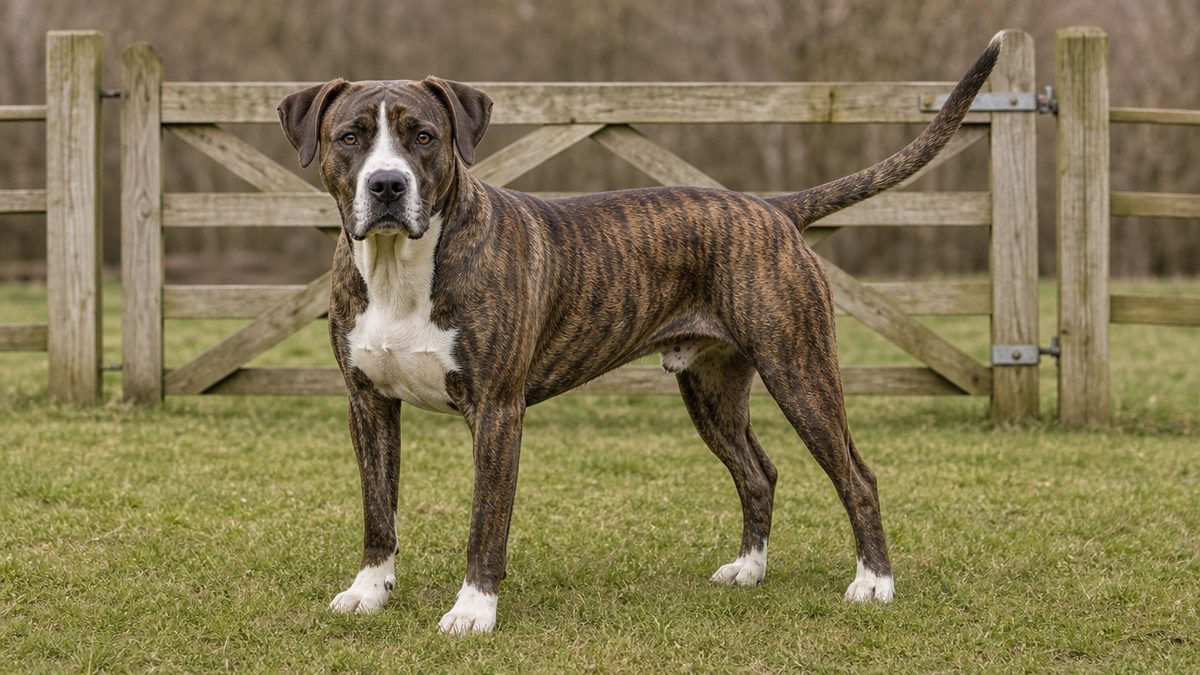
The Dogue Brasileiro is a medium-sized Brazilian guarding breed of 54 to 60 cm and 29 to 43 kg for males, created in 1978 from a Bull Terrier crossed with a Boxer, and recognised by the Confederacao Brasileira de Cinofilia as standard NR04 in its Group 11 of breeds the FCI has not taken.
This is one of the youngest recognised dog breeds anywhere, and its origin is unusually well dated because a single person recorded it. Pedro Pessoa Ribeiro Dantas was a Bull Terrier breeder in Caxias do Sul, in the highlands of Rio Grande do Sul in Brazil's far south. In 1978 a neighbour asked him to mate one of his Bull Terrier males to her Boxer female. He kept a brindle female puppy from the litter, named her Tigresa, and found her more agile, more balanced and physically stronger than either parent breed while lacking the extreme conformation of the modern Bull Terrier.
He repeated the cross, gathered reports from the other puppy buyers, and built a line from roughly eighty first-generation Bull Terrier and Boxer crosses, originally called the Bull Boxer. A small number of American Staffordshire Terrier crosses were tried in one generation and then abandoned, after which the studbook was closed. The Brazilian Bull Boxer Club was founded in 1986 with Dantas as its president, and the CBKC accepted the breed at the end of the 1990s.
The dog in the standard
The CBKC standard opens by describing a dog of solid, massive appearance that is not lean, but equally not stocky or disproportionately heavy, giving an impression of agility and strength with very strong, long, marked muscles suggesting great power and drive, on strong bone. Read against the Fila Brasileiro's standard, which asks for a massive body with powerful bones, the emphasis here is on athleticism rather than mass.
| Item | Males | Females |
|---|---|---|
| Height at withers | 54 to 60 cm, preferably 58 cm | 50 to 58 cm, preferably 56 cm |
| Weight | 29 to 43 kg, preferably 39 kg | 23 to 39 kg, preferably 33 kg |
| Body length against height | Exceeds height at the withers by about 7 percent | Exceeds height at the withers by about 7 percent |
| Chest depth | About 50 percent of the height at the withers | About 50 percent of the height at the withers |
| Coat length at the withers | Short up to 2.5 cm, or medium up to 4.7 cm | Short up to 2.5 cm, or medium up to 4.7 cm |
Those proportions do real work. A body only seven percent longer than the height at the withers makes this a near-square dog, where the Fila Brasileiro's standard specifies fifteen percent and produces a visibly rectangular one. And a chest depth of half the height at the withers is a moderate figure, not the elbow-deep chest of the giant molossoids.
Head, skin and coat
The head is of medium length and relatively deep in the cranial region, with a light stop seen from either the front or the side, a visible median groove and a slightly furrowed forehead that gives the dog a serious expression when alert. The muzzle is of medium length and straight, with a very strong, well-defined jaw. Eyes are almond-shaped, moderately small, well separated, honey to dark brown, with tight eyelids that must not show the conjunctiva.
Two features distinguish it from every other Brazilian molossoid at a glance. The neck is devoid of dewlaps, and the skin over the body, while thick and relatively loose, must show no trace of dewlaps anywhere. Colour is unrestricted: any colour, variation or combination of colours is accepted without any restriction, which is why brindle, brindle-and-white, black-and-tan and solid dogs all appear in the breed.
Bull Boxer is the breed's original name and is still used in Brazil, including by its own club. It should not be confused with the English designer cross of the same name, which is a Staffordshire Bull Terrier and Boxer mix and is not a registered breed anywhere.
What recognises the Dogue Brasileiro, checked register by register
The Confederacao Brasileira de Cinofilia recognises the Dogue Brasileiro nationally and the Federation Cynologique Internationale does not, and the CBKC's own standard settles it in six words on its classification line.
Recognition claims about this breed are made constantly and evidenced almost never, so Bonbeno opened four registers rather than four articles. The result is unambiguous in both directions.
The CBKC recognises it, and says exactly what that means
The breed standard is CBKC Padrao NR04, with a publication date for the valid official standard of 25.01.2001 and a page footer reading Atualizado em 23 de marco de 2015. Its classification line is the sentence that answers the whole question, and it is printed on the document's own face.
CLASSIFICACAO CBKC: Grupo 11 - Racas Nao Reconhecidas pela FCI. In English: CBKC classification, Group 11, Breeds Not Recognised by the FCI.
The CBKC's website is organised the same way. Its Group 11 filter is published under a tab headed FCI: Nao reconhecidas, and it lists 19 breeds, of which seven are Brazilian: Buldogue Serrano, Dogue Brasileiro, Monster Bull, Ovelheiro Gaucho, Pastor da Mantiqueira, Veadeiro Nacional and Veadeiro Pampeano. The Dogue Brasileiro entry there carries the same 25/01/2001 date as its standard.
The FCI does not, on either register
Two separate checks, each with a control that proves the query worked.
| Register | Entries seen | Control present | Dogue Brasileiro |
|---|---|---|---|
| Definitive nomenclature, letter D | 25 breeds | Dogo Argentino 292 and Dogue de Bordeaux 116 | Absent |
| Definitive nomenclature, letter B | 42 breeds | Buldogue Campeiro 374 under its Portuguese name | Absent |
| Breeds recognised on a provisional basis | 21 breeds | Buldogue Campeiro 374, recognised 6 August 2025 | Absent |
The letter B check matters because the FCI files breeds under the name used in the country of origin, so a Portuguese-named Brazilian breed can sit under an unexpected letter. Buldogue Campeiro appears there under B rather than under C, which proves the register does carry Portuguese names and that an absence under D is not a filing artefact Federation Cynologique Internationale Federation Cynologique Internationale.
How many Brazilian breeds does the FCI recognise?
Four, and this is worth stating precisely because a 2026 peer-reviewed paper gets it wrong. The CBKC's own Brazilian-breeds page separates four breeds carrying FCI standard numbers from seven filed under Group 11.
| Breed | FCI standard | Standard dated | FCI group |
|---|---|---|---|
| Buldogue Campeiro | 374, provisional | 10/07/2025 | 2 |
| Fila Brasileiro | 225, definitive | 04/10/2016 | 2 |
| Terrier Brasileiro | 341, definitive | 06/09/2013 | 3 |
| Rastreador Brasileiro | 275, definitive | 03/09/2013 | 6 |
A mitogenomic study published in Genetics and Molecular Biology in 2026 opens by stating that Brazil has two dog breeds recognized by the Federation Cynologique Internationale, the Brazilian Terrier and the Brazilian Mastiff. Against the registers that is incomplete: it omits the Rastreador Brasileiro, definitively recognised as 275, and the Buldogue Campeiro, taken provisionally in August 2025 Federation Cynologique Internationale. Bonbeno reports the disagreement rather than choosing between them, and notes that the paper's own subject matter is genetics rather than nomenclature.
What this means for an Indian owner
It means there is no pedigree route. India is an FCI member country represented by the Kennel Club of India, so Indian pedigrees are issued against FCI nomenclature, and a breed absent from that nomenclature has no number for an Indian pedigree to reference. A Brazilian dog of this breed carries a CBKC pedigree and, per Brazilian practice, a Bull Boxer Club pedigree alongside it, and neither converts into an Indian registration.
Recognised nationally is not recognised internationally, and CBKC-recognised is not FCI-recognised even though the CBKC is an FCI member. Any page that blurs those is describing a different legal and registry reality from the one an Indian buyer would face.
The breed standard's temperament clause and its championship test
The Dogue Brasileiro standard asks for a dog that is serious to strangers and gentle to its owner, and then backs that up with something almost no breed standard has: a compulsory character appraisal without which no dog can take a championship.
The temperament clause is short and unusually balanced for a guarding breed. Bonbeno translates it from the CBKC text rather than paraphrasing it.
An active, attentive and observant dog, of serious expression to strangers and gentle towards its owner. Balanced, apt to discipline, yet fearless when provoked or under command. It must not give gratuitous demonstrations of aggression, particularly in front of other dogs.
Two things in that clause are worth noticing. The permission to be fearless is conditioned twice, on provocation or on command, and the prohibition on gratuitous aggression is aimed specifically at other dogs. That is a narrower licence than the guarding-breed standards this site has read elsewhere, and it is enforced by a test rather than left as prose.
The character appraisal, which is not optional
The standard's working-trial line reads that for the championship, a Character Appraisal Test is required. No dog of this breed takes a Brazilian championship without passing it, and the standard prints the protocol in full. Its stated purpose is to conserve the firm and trustworthy temperament of the breed, preserving the balance of its nervous system in a constant, routine and compulsory way.
- The handler walks the dog on lead and the dog must allow strangers to approach within the lead's radius without trying to attack them, remaining indifferent or friendly. The handler may refuse the approach of anyone who has already acted as a decoy or who behaves in a hostile way.
- A decoy with a sleeve provokes the dog, which must react without any retreat and bite the sleeve firmly. The decoy releases the sleeve three to six seconds after the bite.
- The dog must release the sleeve within a maximum of four seconds and drive at the decoy, held back by the handler. A dog that does not bite the sleeve but tries effectively and firmly to take the decoy directly is also passed.
- Approval requires two different judges on two different occasions, at least thirty days apart.
The Grand Champion version adds obedience and neutrality work: forty seconds of loose heeling with no tension on the lead, forty seconds at a trot with repeated changes of direction, a one-minute stay at a minimum of ten metres while strangers call the dog from a distance, blank cartridge fire to which the dog must respond with defence initiative or indifference but not fear, a surprise attack from a concealed decoy, and finally the judge approaching in a friendly manner, at which the dog must show no aggression at all.
Two details that show the standard's own thinking
The standard bans prong collars outright for these tests, allowing a leather or nylon collar in place of a link choke, and it notes that dogs must be in perfect health and hygiene with the judge empowered to call a veterinarian to remove any animal that could infect the others. It also disqualifies dogs that show aggression to other dogs when unprovoked.
And it makes a claim about outcomes that is worth quoting because it is the breed's central argument. The standard records that in twenty-one years of breeding, despite being efficient as a guard, not a single undesirable attack on people could be lamented, and attributes that to the temperament testing the breed has undergone throughout those years. That is the breeder body's own assertion rather than an independent study, and Bonbeno reports it as such. No published research on this breed exists to test it: PubMed returns zero records against in-session controls that returned 126 and 13.
Why the test matters more than the description
Every guarding breed standard says the dog should be balanced. Very few make a championship conditional on demonstrating it, in front of two judges, a month apart, including a friendly approach the dog must accept. For an Indian reader the relevance is not that they will ever enter this test, but that it is the only formal behavioural filter the breed has, and a dog acquired outside the system that runs it has not been through anything comparable.
The character appraisal is decoy-based protection work, not animal fighting, and the two are legally distinct in India. Section 11(1)(m)(ii) of the Prevention of Cruelty to Animals Act 1960 addresses inciting an animal to fight or bait another animal. Nothing in this protocol involves a second animal. That said, an amateur running sleeve work on a guarding dog in an Indian residential setting is creating risk, not managing it.
Indian law and this breed: the cropping clause
The Dogue Brasileiro standard permits ear cropping and tail docking as options, and Indian law forbids both outright, which is the sharpest collision between a breed standard and Indian law on this site.
Take the two texts in order. The CBKC standard describes the ears as being of insertion slightly above the line of the eyes, optionally operated, semi-short, in isosceles triangles, and states that if intact they should be semi-drop with a fronto-lateral fall. On the tail it says the tail is thick, of medium insertion, carried above the back line when the dog moves, and optionally operated, in which case the remaining length is about twenty percent longer than the dog's head, while an intact tail is eighty percent longer.
Operada is the Portuguese term the standard uses for both, and it means surgically altered. So the breed standard treats a cropped ear and a docked tail as equally correct alternatives to natural ones.
There shall be no tail docking, ear cropping, de-barking, de-clawing, branding, dyeing, injecting substances to enhance visual appeal, performing a surgery or procedure to camouflage or hide any defect or infirmity or any other kind of mutilation of any body part of the pup and any change of appearance by artificial means is strictly forbidden.
The collision is complete. An Indian breeder following this breed's own standard on ears and tail would be doing something the Rules describe as strictly forbidden. Where a standard offers a procedure as an option and Indian law bans it, the option simply does not exist here, and any Indian image of this breed should show natural ears and a natural undocked tail.
What the same Rules require of a breeder
Two further provisions apply to any breeding of this dog in India, and they matter more for a breed with no screening register than for one that has data. Second Schedule Part III para 8(10) requires that the dogs shall have been tested for genetic defects, including hip dysplasia, progressive retinal atrophy, night blindness, hypothyroidism, entropion, ectropion, overshot and undershot jaw, wry mouth, two or more missing teeth and cryptorchidism. The word is including, so the list is illustrative. And Rule 8(1)(a) provides that pups less than eight weeks in age are not sold.
The 2024 circular does not name this breed
The March 2024 central circular on ferocious breeds is the first thing an Indian reader will want checked, and the answer is clean. The list as reproduced verbatim in the Karnataka High Court's judgment names the Pitbull Terrier, Tosa Inu, American Staffordshire Terrier, Fila Brasileiro, Dogo Argentino, American Bulldog, Boerboel, Kangal, three ovcharkas, Tornjak, Sarplaninac, Japanese Tosa, Akita, Akbash, Moscow Guard dog, Cane corso and the Ban Dog. The Dogue Brasileiro appears nowhere in it. Its sibling breed the Fila Brasileiro does, as the fourth name.
That circular was in any case quashed by the Karnataka High Court on 10 April 2024, set aside by the Delhi High Court, and the Centre told the Bombay High Court on 24 January 2025 that at present it is not acting on it. So no Indian breed-specific restriction touches this dog, either as a matter of the list or as a matter of the instrument's status.
For completeness, the same is true internationally, and Bonbeno checked four instruments rather than asserting it. The United Kingdom's designation order names only the Dogo Argentino and the Fila Braziliero as the types added under the Dangerous Dogs Act 1991. Denmark's Dog Act prohibits thirteen named breeds at section 1 a, and the Dogue Brasileiro is not among them. Norway's dog regulation names five types it is forbidden to keep, breed or import, and the Dogue Brasileiro is not among them either. New Zealand's Dog Control Act bans the importation of four named breeds and one type in Schedule 4, and again the breed does not appear.
In every one of those four instruments the Fila Brasileiro does appear, which makes the comparison exact rather than rhetorical: the two Brazilian breeds an Indian buyer confuses sit on opposite sides of every breed-specific law Bonbeno could open. The Dogue Brasileiro is a breed almost nobody outside Brazil has had to legislate about.
Import, and why it closes the question
Even with no ban, the breed cannot lawfully enter India as stock. Dogs sit at ITC(HS) 01061900 as a Restricted item under Policy Condition 6, and DGFT Trade Notice 22/2022-23 sets out Policy Condition 7, permitting import only for a pet dog with a valid pet book and records in the importer's name, for R and D organisations with a CPCSEA recommendation, or for internal security by the Defence and Police Force. Policy Condition 8 states that import of commercial dogs for breeding or any other commercial activity other than those purposes is not permitted, and the notice adds that any applications for trading or breeding purposes shall be duly rejected.
Import of pet animals is allowed only through the airports and seaports of Delhi, Mumbai, Chennai, Hyderabad, Bengaluru and Kolkata and, since October 2024, Kochi airport, with quarantine at the government station of those ports where required, and an Advance No Objection Certificate from the AQCS Regional or Quarantine Officer Department of Animal Husbandry…. Owners are advised to start the authorisation process at least two months before travel.
Dogue Brasileiro price in India: there isn't one
There is no Dogue Brasileiro price in India because there is no Indian market for the breed, and Bonbeno established that with a control search rather than by failing to find one.
An absence is a strong claim, so it has to be earned. Two searches were run in the same session, in the same tool, restricted to India, phrased identically apart from the breed name.
| Query | Indian listing pages returned | What actually came back |
|---|---|---|
| Dogue Brasileiro puppies for sale India price rupees KCI breeder | 0 | A 1928 Brazil Kennel Club photograph post, a Pinterest pin for Lhasa Apso puppies carrying the breed name as a sidebar tag, and a Brazilian page about the most expensive dog sold in Brazil |
| Labrador Retriever puppies for sale India price rupees KCI breeder | 6 | Six genuine Indian listing and guide pages with rupee bands, including a Chennai kennel and a national classifieds platform |
The control returning six real results is what makes the zero meaningful. A search that returns nothing because it was never properly run is evidence of nothing; a search that returns six results for one breed and none for another, in the same session, is a finding.
There is no Indian content page either
The second check was for Indian editorial coverage rather than listings. An India-located search for this breed's price returned, in order, a Fila Brasileiro breed guide at position one, two generic Indian dog price lists, a Fila Brasileiro listing page, an Amazon India listing for a book about the Fila Brasileiro, a most-expensive-breeds article, and English Wikipedia. Not one Indian page about the Dogue Brasileiro exists in that result set. The search engine's own behaviour is informative: asked for this breed, it substitutes the Fila.
Why no price can honestly be constructed
This site has documented several mechanisms by which fake Indian prices appear: a dollar figure divided by a single exchange rate, a dollar figure with the symbol stripped and the digits presented as rupees, and rupee-native numbers invented outright. All three produce a figure. None of them produces information.
Bonbeno could convert a Brazilian price, and will not. Converting a foreign price and printing it as an Indian one is exactly the fabrication mechanism this site exists to expose, and the arithmetic would be worse than usual here because the two structural costs that would dominate an Indian acquisition, import authorisation and quarantine, are not in a Brazilian price at all.
What an Indian buyer would actually be quoted, if anyone quoted anything
For scale rather than for this breed, the Indian market prices a well-documented imported breed like the Labrador Retriever from roughly the low tens of thousands of rupees to over a lakh, with KCI registration and champion bloodline as the two things that move the number. This is a rare breed even in Brazil and effectively unknown outside it, and a breed with no FCI number cannot carry KCI registration at all, because Indian pedigrees are issued against FCI nomenclature and the Dogue Brasileiro is absent from it Federation Cynologique Internationale. So the single largest price driver in the Indian pedigree market is unavailable to this breed by construction.
Ask three questions before anything else. What is the dog's registration number and which registry issued it. Where did the sire and dam come from, with import paperwork if a Brazilian import is claimed. And why is a breed with no Indian presence suddenly available to you. On the evidence on this page, a dog offered in India as a Dogue Brasileiro is far more likely to be a large brindle crossbreed than the registered Brazilian breed described here.
One last honest note about this page's own limits. Because there is no Indian market, this page carries no rupee price band, and it will score lower on India specificity than a page about a breed you can actually buy here. That is the correct outcome. The only ways to raise it would be to convert a foreign figure or to repeat an invented one, and both would make the page worse while making the score better.
Cost of ownership, bounded by what is actually knowable
No Indian cost figure exists for the Dogue Brasileiro, so this section describes the cost structure a 39 kg short-coated guarding dog imposes in India rather than inventing a monthly total for a breed nobody here keeps.
Every cost line below is driven by two facts from the breed standard: a preferred adult weight of 39 kg for males and 33 kg for females, and a short harsh coat of up to 2.5 cm at the withers with no skin folds and no dewlaps. Those two facts pull the budget in opposite directions.
Where this breed is cheaper than its relatives
Grooming is the lowest cost on this site for a guarding breed. There are no throat dewlaps to dry, no facial folds to clean and no drooping eyelids to manage, because the standard requires a neck devoid of dewlaps, skin with no trace of dewlaps anywhere, and tight eyelids that must not show the conjunctiva. Set against a Fila Brasileiro, whose standard makes pronounced dewlaps a defining characteristic and expressly permits drooping lower eyelids, that removes an entire recurring maintenance task and its associated veterinary risk.
Food is also materially cheaper. A 39 kg dog eats considerably less than a 50 kg-plus one, and the difference compounds over a decade. Anyone budgeting from a Fila page should reduce the food line rather than copy it.
Where it is not cheaper
- Containment. This is a guarding breed by its standard's own stated utilisation, so a working boundary and a controlled front door are not optional. That cost is set by your property, not by the dog's size.
- Training. The breed's own registry makes a character appraisal compulsory for a championship, which tells you how seriously its home country treats behavioural handling on this dog. Professional help is a real line item.
- Emergency capacity. A deep-chested dog of this size sits in the population where gastric dilatation-volvulus risk rises with body size in large and giant breeds, and abdominal surgery on short notice is a five-figure rupee event in most Indian cities.
- Orthopaedic contingency. The breed has no screening register of its own, so a buyer has no prior probability to plan against. Its two founding breeds give a range rather than an answer: the Boxer at 12.7 percent hip dysplastic across 7,714 OFA evaluations, the Bull Terrier at 7.5 percent across 133.
The cost line unique to this breed
Acquisition, and it dominates everything else. Because the breed cannot be imported into India as breeding stock, the only lawful route for an Indian household is to already own the dog abroad and bring it in as a personal pet under DGFT Trade Notice 22/2022-23, which requires an authorisation in most cases, an Advance No Objection Certificate from the AQCS at one of six named ports, health certification and testing done in the exporting country, and possible quarantine. DAHD added a seventh port, Cochin International Airport at Kochi, for pets arriving under the baggage rules in October 2024. That is a process with a two-month lead time by the notice's own advice, and its cost is administrative and logistical rather than a puppy price. The full route is set out in how to import a dog to India.
The cooling line nobody budgets
Add electricity. The breed's home city averages 17.13 degrees Celsius against Chennai's 27.95, so a Dogue Brasileiro kept in most Indian plains cities will need managed indoor temperature for a large part of the year. That is not a pet cost in anyone's spreadsheet and it is a real one, and it is a smaller bill for a 39 kg dog than for a 55 kg one only because the dog is easier to cool, not because it needs cooling less.
Take a Boxer's Indian running costs as the base, since it is the closest available breed on size, coat and build and is genuinely available here. Then add containment, training and an emergency fund sized to one bloat surgery. Do not start from a Fila budget, which is built for a dog twenty kilograms heavier with three moisture traps on its head.
Heat tolerance tested against the origin climate
The Dogue Brasileiro is a humidity-adapted subtropical highland dog rather than a tropical one, because the city where it was created averages 17.13 degrees Celsius at 82.06 percent humidity, which is 10.82 degrees cooler and nearly ten points more humid than Chennai.
Brazil is a tropical country and this breed is not from the tropical part of it. Caxias do Sul sits in the highlands of Rio Grande do Sul, Brazil's southernmost state, at a latitude closer to Uruguay than to the Amazon. Bonbeno queried NASA POWER by explicit latitude and longitude for the 2001 to 2020 climatology, checked the coordinates returned against those requested for every location, and compared air temperature, relative humidity and wet-bulb temperature. Wet-bulb is the figure that matters for a panting animal, because evaporative cooling stops working as it rises no matter what the thermometer reads.
| Location | Air temp C | Relative humidity pct | Wet-bulb C | Peak month wet-bulb C |
|---|---|---|---|---|
| Caxias do Sul, Rio Grande do Sul | 17.13 | 82.06 | 15.38 | 19.28 in January |
| Porto Alegre, Rio Grande do Sul | 19.32 | 81.82 | 17.58 | 21.62 in February |
| Bengaluru | 23.74 | 67.94 | 19.80 | 21.86 in May |
| Pune | 23.86 | 66.80 | 19.66 | 22.97 in June |
| Delhi | 25.60 | 45.56 | 18.03 | 26.50 in July |
| Ahmedabad | 27.57 | 48.32 | 20.15 | 26.11 in June |
| Hyderabad | 26.10 | 60.30 | 20.96 | 23.35 in June |
| Mumbai | 26.77 | 67.39 | 22.73 | 25.77 in June |
| Kolkata | 25.81 | 73.93 | 22.85 | 27.09 in June |
| Chennai | 27.95 | 72.39 | 24.94 | 26.11 in May |
One methodological note, because it would otherwise look like corroboration. Bento Goncalves was queried as a third origin point and NASA POWER returned the identical grid cell to Caxias do Sul, so it is not a second independent reading and is excluded from the table rather than presented as one.
Read the humidity column
The origin is more humid than any Indian city here. Caxias do Sul runs at 82.06 percent relative humidity against Kolkata's 73.93 and Chennai's 72.39, and Delhi at 45.56 is less than half as humid. So the breed is not moisture-intolerant. What it has never encountered is heat: the gap to Chennai is 10.82 degrees Celsius of air temperature and 9.56 degrees of wet-bulb.
That combination, cooler and wetter than India, is the same pattern this site found on the Cimarron Uruguayo, and it makes geographic sense: Caxias do Sul is roughly 29 degrees south, in the same subtropical band as Uruguay. The practical translation is that a Dogue Brasileiro will handle a Mumbai monsoon's moisture better than a dry-country breed would, and will find an Indian pre-monsoon summer harder than its Brazilian passport suggests.
City by city, ranked by wet-bulb
- Bengaluru at 19.80 and Pune at 19.66 are the closest Indian analogues to Porto Alegre's 17.58, and are the two cities where this breed could live a fairly normal outdoor life on a dawn and dusk routine.
- Delhi's 18.03 annual figure is misleading and should not be used alone. Its July peak is 26.50, the second highest here, because a dry winter drags the annual mean down while the monsoon spikes it.
- Hyderabad at 20.96 and Ahmedabad at 20.15 are workable annually with a genuinely hard March to June.
- Mumbai at 22.73 and Kolkata at 22.85 mean restricted exercise for four to five months, with Kolkata peaking at 27.09 in June, 7.81 degrees above the origin's own peak.
- Chennai at 24.94 is the hardest, and has no cool season in which the dog recovers.
What the heat evidence permits, and what it does not
The Dogue Brasileiro is absent from the largest primary-care study of canine heat illness, and this page will not borrow its breed-specific odds ratios for a breed the authors never studied. What transfers is the general finding, which is not breed-specific: of the 879 heat-illness events with a recorded trigger in that study, 652 were exertional, which is 74.2 percent, against 113 environmental and 46 from vehicular confinement. Exertional events occurred year round and carried a 7.6 percent fatality rate.
The bodyweight bands also transfer, and they place this breed differently from its giant relatives. A 39 kg male sits in the 30 to 40 kg band rather than the 50 kg and over one, and dogs at or above the mean adult bodyweight for their breed and sex carried 1.30 times the odds of exertional heat illness, 95 percent confidence interval 1.09 to 1.55. So keeping this dog lean is a heat intervention, not just an orthopaedic one.
Control exertion, not just ambient temperature. Move the dog before 08:00 and after 19:00 from March to June across most of India and year round in Chennai, cap intensity rather than duration, and do not let a visitor start a game with it in the afternoon. On the evidence, that single habit prevents three quarters of the heat events that reach a vet.
Temperament and household fit
The Dogue Brasileiro suits a household that wants a medium-sized alert guard dog and will run structured socialisation, and its standard is unusually explicit that gratuitous aggression, particularly towards other dogs, is not part of the breed.
Start from the standard rather than from the marketing. It describes an active, attentive and observant dog, serious in expression towards strangers and gentle towards its owner, balanced and apt to discipline yet fearless when provoked or under command, and adds that it must not give gratuitous demonstrations of aggression, particularly in front of other dogs. Loyal and protective are the words Brazilian material reaches for; the standard itself is more precise, and every clause in that sentence is conditioned. The dog is permitted to be fearless when provoked or commanded, and is not permitted to be reactive on its own initiative.
The urban design brief
This breed was built for a job that most guarding molossoids were not: guarding in a city. Its own promotional description in Brazil calls it the urban guardian, and the design shows in the numbers. At 54 to 60 cm and a preferred 39 kg for males it is a flat-compatible size, unlike a 50 kg-plus Fila Brasileiro FCI-Standard No 225, FILA BRASILEIRO. The coat is short and needs nothing. There are no dewlaps and no drooping eyelids, so nothing about the dog's construction is high-maintenance in a humid city.
The limiting factor in an Indian household is therefore not the dog's size or grooming. It is the volume of strangers. A dog whose standard asks for a serious expression to strangers will form an opinion about a daily domestic worker, a courier, a milk delivery, a tuition visitor and an unannounced relative. The management question is the same as for any guarding breed, and the physical constraints are milder because this is a compact dog rather than a giant one.
Dog-to-dog behaviour, where the standard is strictest
This is the clause worth reading twice, because it cuts against the reputation both founding breeds carry. The standard singles out other dogs as the context in which gratuitous aggression is unacceptable, and the Grand Champion appraisal states that dogs showing aggression to other dogs when unprovoked will not be approved. So the breeder body has been selecting explicitly against dog aggression for decades, using a pass or fail test.
That does not make it a dog park dog. A Bull Terrier and Boxer cross is a powerful animal with high arousal, and the honest expectation is a dog that can be neutral around other dogs with work, not one that is automatically social.
Who should not take one on
- Anyone who cannot control the front door. The size is manageable; the arrival of strangers is the whole problem.
- First-time owners looking for a low-effort guard dog. The breed's own registry does not believe temperament is automatic, which is why it tests for it.
- Households that want a dog to greet visitors. Serious to strangers is the standard's own phrase and it means what it says.
- Anyone attracted to the cropped-ear look. That appearance is unlawful to produce in India, and it is the wrong reason to choose a dog in any case.
- Anyone in Chennai, Kolkata or coastal Ahmedabad who cannot provide cooled indoor space for several months a year.
Children
The standard says gentle towards its owner and nothing about children. English Wikipedia's article shows a photograph captioned dogues and children, and the breed's Brazilian material presents it as a family guardian. That is claim, not evidence, and there is no study on this breed of any kind. Treat it the way you would treat any powerful guarding dog with a child in the house: physical separation as the plan rather than supervision as the plan, and a rehearsed routine for the moment another child arrives to play.
Its standard records that in twenty-one years of breeding, despite being efficient as a guard, not a single undesirable attack on a person could be lamented, and credits the compulsory temperament testing for it. That is the breeder body's own assertion about its own dogs, published in 2001, with no independent verification available. It is worth knowing and it is not evidence.
Training approach and what this breed resists
To train a Dogue Brasileiro, build neutrality towards strangers first and obedience second, because the breed's own championship test rewards a dog that stands still while an unfamiliar judge approaches in a friendly manner.
The training goal is written into the breed's assessment protocol, which is a luxury most breeds do not give you. The Grand Champion appraisal requires forty seconds of loose heeling with no tension on the lead, forty seconds at a trot with repeated direction changes, a one-minute stay at ten metres or more while strangers call the dog from a distance, tolerance of blank cartridge fire without fear, a reaction to a surprise attack, a release on command within four seconds, and at the end an approach by the judge in a friendly manner at which the dog must show no aggression whatsoever.
Read that list as a curriculum rather than as a sport. Heeling, a distance stay under social distraction, noise neutrality, and an accepted friendly approach are exactly the four things a guarding dog needs in an Indian city, and the arousal work in the middle is the part a pet home should leave out.
The first sixteen weeks
- Weeks 8 to 12. Daily handling paired with food: ears, mouth, feet, tail, flank. Add a second and third handler in the same period. Introduce the cue that sends the dog to a mat or a room before the door opens.
- Weeks 12 to 16. Socialise deliberately, with structured meetings with calm unfamiliar adults, short and food-paired. Condition a muzzle as a food-delivery device months before it is ever needed. Take the puppy to a vet for a visit with no procedure attached.
- Weeks 16 to 24. Rehearse the doorbell a hundred times with people the dog knows before you rehearse it once with a courier. Build the distance stay from two metres upward.
- Six to twelve months. Noise habituation, done gently and never with the blank-cartridge intensity the breed's own test uses. Firecrackers are the Indian version of that test and they arrive whether you plan for them or not.
- Twelve months onward. Maintain the handling work weekly for life. This is the step households drop and the one that fails.
What the breed resists
Three things. Repetition without purpose, because half the ancestry is Bull Terrier and the breed switches off when drilled. Correction from a stranger, which will be read exactly as the standard says it will. And being asked to accept an unannounced arrival into its own territory, which is not a training failure but the job the dog was selected for. The answer to the third is architecture, not obedience: move the dog before the door opens.
Protection sport, and the Indian caution
The breed is described in Brazil as a protection sport dog as well as a guard dog, and its championship path runs through sleeve work Confederacao Brasileira de Cinofilia. Two things should be said plainly to an Indian reader. First, decoy protection work is legally distinct from animal fighting: section 11(1)(m)(ii) of the Prevention of Cruelty to Animals Act 1960 concerns inciting an animal to fight or bait any other animal, and section 11(1)(n) concerns organising or keeping a place for animal fighting, neither of which describes a person in a sleeve.
Second, and more practically, an amateur running bite work on a powerful guarding dog in an Indian residential setting is manufacturing liability rather than managing it. The breed does not need to be taught to guard. If you want the discipline, do it under a competent trainer with a real protocol, or do not do it at all.
Equipment, with one rule from the standard itself
The breed's own appraisal protocol bans prong collars outright, permitting a leather or nylon collar in place of a link choke. That is the breeder body's own equipment rule for its own dogs under test conditions, and it is a reasonable floor for a pet home. Use a flat collar or a well-fitted harness and a fixed lead. De-barking is not an option in India in any case, since Second Schedule Part II para 6(8) of the 2017 Rules names it among the procedures strictly forbidden.
Basic obedience inside three months. Reliable door management by nine to twelve months with daily practice. Calm veterinary handling only if you have rehearsed it monthly since week eight. Nothing here is fast, and early handling is the only milestone that cannot be recovered later.
Daily exercise requirement
A Dogue Brasileiro needs sixty to ninety minutes of daily movement in two sessions, and in India both of them belong at the cool ends of the day, because exertion rather than ambient heat is what puts dogs in front of a vet.
The standard sets the expectation on movement rather than on distance. It asks for movement that is fluent, with force and agility, with the feet moving parallel and good flexion including at the stifles. That describes an athletic dog, and half its ancestry is Boxer, so the honest requirement is higher than for the heavier Brazilian molossoids.
The intensity cap, and the number behind it
Set a ceiling on effort before you set a target on time. In the largest primary-care study of canine heat-related illness, of the 879 events with a recorded trigger, 652 were exertional, which is 74.2 percent, against 113 environmental at 12.9 percent and 46 from vehicular confinement at 5.2 percent. Those events occurred year round, not only in summer, and exertional cases carried a 7.6 percent fatality rate. In an Indian climate that finding converts directly into a rule: walk the dog, do not run it, and never let a visitor start a game in the afternoon.
| Season | Morning | Evening | Intensity |
|---|---|---|---|
| November to February | 40 to 50 minutes from 06:30 | 40 minutes after 18:00 | Brisk walk with short controlled trotting on grass |
| March to June | 30 to 40 minutes before 07:00 | 30 to 40 minutes after 19:30 | Walk only. No fetch, no stairs, no running |
| Monsoon | 40 minutes, surface permitting | 30 minutes | Walk. Dry the ears afterwards even though there are no folds |
| Bengaluru or Pune | Closest Indian match to the origin climate | Normal outdoor routine feasible | Trotting acceptable outside the hottest weeks |
| Chennai | Treat every month as March to June | After 19:30 only | Walk only, with cooled indoor rest between |
Mental load matters more than mileage
A guarding dog with nothing to guard will find something. This breed's own championship protocol is built around impulse control under provocation, distance stays and recall under social distraction, which are all mentally demanding and physically cheap. Twenty minutes of that work does more for a bored Dogue Brasileiro than an extra kilometre would, and it can be done indoors during the hot months when outdoor exercise has to be cut.
Scent work, a food-dispensing routine, and a rehearsed place cue on a mat are the three easiest substitutes during an Indian summer. All three are also directly useful, because the place cue is the same behaviour that manages the front door.
Growth-stage restriction
Restrict impact loading through the first fifteen to eighteen months. Avoid stairs as an exercise, jumping down from height, running alongside a bicycle, and long walks on concrete during the fastest growth months. The breed has no orthopaedic screening data of its own, so a buyer has no prior probability to plan against, and the founding breeds bracket the risk rather than resolving it: the Boxer at 12.7 percent hip dysplastic across 7,714 OFA evaluations and the Bull Terrier at 7.5 percent across 133. Caution costs nothing.
What under-exercise produces
Not hyperactivity, but three specific problems. Weight gain on a breed whose standard sets a preferred 39 kg and whose founding breeds are both muscular, which loads joints nobody has screened. Loss of the muscle that stabilises those joints. And a redirected guarding drive that fixes on the gate, the neighbour and the delivery, which is the behavioural failure that ends with a complaint rather than with a vet visit.
Stop the session when the pant becomes wide, flat and deep-chested with a spatulate tongue, or when the dog slows and drops behind you. In a 39 kg dog in Indian heat that is early heat load, not tiredness, and the response is shade, water and cooling rather than encouragement. A rectal temperature above 40 degrees Celsius with collapse or disorientation is an emergency.
Grooming in Indian humidity, and why this one is easy
Groom a Dogue Brasileiro in about five minutes a week, because its standard requires a short harsh coat, a neck free of dewlaps, skin with no trace of dewlaps anywhere and tight eyelids, which removes every moisture trap that makes molossoid coat care difficult in India.
This is the least demanding coat this site has covered on a guarding breed, and the reason is written into the standard rather than being a matter of luck. The coat is described as short, up to 2.5 cm at the withers, or medium, with the hair at the withers not exceeding 4.7 cm, and in both cases dense, glossy and harsh. A rubber curry twice a week is the entire coat routine. Colour is irrelevant to care: any colour, variation or combination is accepted without restriction, so brindle, brindle-and-white, black-and-tan and solid dogs are groomed identically.
The three things this breed does not have
- No throat dewlaps. The standard requires a neck devoid of dewlaps and skin showing no trace of them anywhere on the body. That removes the single largest recurring moisture trap on a molossoid in an Indian monsoon.
- No drooping eyelids. The standard requires tight eyelids that must not show the conjunctiva, which is the direct opposite of the Fila Brasileiro's standard, where drooping lower eyelids are explicitly not considered a fault.
- No facial folds. The forehead is described as slightly furrowed rather than wrinkled, and the head carries no pendulous skin.
Put together, that means the Indian humidity problems this site documents repeatedly on molossoids, damp skin folds, macerated dewlaps and dust-loaded exposed conjunctiva, largely do not apply here. It is a genuine practical advantage and it is worth stating for a reader choosing between Brazilian breeds.
The ears still need attention
The one remaining risk is the ear, and it is smaller than in the pendant-eared breeds but not zero. A natural Dogue Brasileiro ear is semi-drop with a fronto-lateral fall, set slightly above eye level, so the canal is partly covered rather than fully hooded. Pendulous ear carriage is an established independent risk factor for otitis externa, with a UK primary-care study finding breeds with pendulous ears at 1.76 times the odds against breeds with erect ears, 95 percent confidence interval 1.48 to 2.10. A semi-drop ear sits between the two.
Indian seasonal data on ear disease is genuinely mixed and this page publishes the disagreement rather than settling it. A Durg series screening 281 dogs found 51 positive for otitis externa, an overall prevalence of 18.14 percent, with the highest seasonal prevalence in summer at 21 of 51 cases or 41.18 percent, against 17 cases or 33.33 percent in the rains and 13 or 25.49 percent in winter. Other Indian series report a monsoon peak. What both agree on is that the load is high and seasonal.
So the routine is simple and non-negotiable regardless of which season is worst where you live: check and dry the ear canal weekly, and after every bath and every soaking. Overseas grooming guidance for short-coated breeds routinely says to towel the dog and let it air dry, and that instruction is written for a temperate climate. It does not transfer to an Indian monsoon, where an ear canal does not finish drying on its own.
A weekly schedule
| Task | Frequency | Note |
|---|---|---|
| Rubber curry over the coat | Twice weekly | Three minutes. More during the two heavy sheds |
| Ear check and dry | Weekly, and after every bath or rain | The only real risk site on this dog |
| Eye check | Weekly | Tight lids by the standard, so a wipe is usually enough |
| Nails | Every three to four weeks | Cat feet by the standard. Start in puppyhood |
| Teeth | Two to three times weekly | Indian law sets no dental requirement, so this is entirely on the owner |
| Bath | Every six to eight weeks | More often strips a harsh coat. Dry the ears completely |
Crop the ears, dock the tail, de-claw or dye the coat. Second Schedule Part II para 6(8) of the 2017 Rules names all four by name alongside injecting substances to enhance visual appeal, and says any change of appearance by artificial means is strictly forbidden. The breed standard's permission for cropping and docking has no effect in India.
Health: what is known, and how little that is
The Dogue Brasileiro has no health data of its own, established with controls in three separate databases, so the health issues attributed to it anywhere are inferred from its two founding breeds rather than measured.
Absence is a strong claim, so each one below was tested with a control in the same session and the same tool. All three came back the same way.
| Database | Control run | Control result | Dogue Brasileiro |
|---|---|---|---|
| OFA disease statistics | LABRADOR | 109 rows returned | Zero rows |
| PubMed, NCBI E-utilities | Labrador Retriever AND hip dysplasia | 126 records | Zero records |
| PubMed, second control | Bergamasco AND dog | 13 records | Zero records |
| Breed longevity table, 155 breeds | Boxer and Bull Terrier both present | Present | Absent |
So there is no screening percentage, no lifespan estimate, no disease prevalence and no case report for this breed anywhere Bonbeno could reach PubMed, NCBI E-utilities esearch Dogs Trust, life expectancy table for 155…. That is the honest headline and it should be the first thing a prospective owner is told.
The founding breeds, presented as what they are
The nearest available evidence is the two breeds the Dogue Brasileiro was made from in 1978. These are not this breed's figures and must not be quoted as though they were, but for a breed derived from a closed studbook of Bull Terrier and Boxer crosses they bracket the plausible range better than nothing does.
| Breed | Evaluations | Normal pct | Dysplastic pct | Mild | Moderate | Severe |
|---|---|---|---|---|---|---|
| Boxer | 7,714 | 85.6 | 12.7 | 9.4 | 2.8 | 0.4 |
| Bull Terrier | 133 | 89.5 | 7.5 | 6.8 | 0.8 | 0.0 |
| Labrador Retriever, for scale | 324,743 | 87.5 | 11.3 | 6.5 | 4.0 | 0.8 |
Both rows reconcile: 9.4 plus 2.8 plus 0.4 is 12.6 against a printed 12.7, and 6.8 plus 0.8 plus 0.0 is 7.6 against a printed 7.5, in each case rounding. Note the Bull Terrier sample is only 133 evaluations, which clears OFA's 100-evaluation hip threshold but barely, so that figure is far less stable than the Boxer's. On elbows the Boxer records 1.1 percent abnormal across 1,784 evaluations, while the Bull Terrier does not appear in the elbow table at all.
India adds one category of health issues that no breed register captures, because it is environmental rather than inherited. Tick-borne disease pressure here is documented across Indian cities and falls hardest on a dog that patrols a compound at dawn and dusk, lies on soil and pushes through boundary vegetation. A year-round acaricide programme chosen with your vet, rather than a seasonal one, is the single most useful preventive step an Indian owner of any guarding breed takes.
The useful reading is that neither founding breed is an orthopaedic disaster. Both sit near or below the Labrador's 11.3 percent, and far below the Fila Brasileiro's 37.9 percent across 742 evaluations. A cross of two moderate breeds is not automatically moderate, but there is no reason from the parent data to expect the Fila's problem here.
What to screen anyway
Indian law answers this question without needing breed data. Second Schedule Part III para 8(10) of the Prevention of Cruelty to Animals (Dog Breeding and Marketing) Rules 2017 requires that breeding dogs shall have been tested for genetic defects, including hip dysplasia, progressive retinal atrophy, night blindness, hypothyroidism, entropion, ectropion, overshot and undershot jaw, wry mouth, two or more missing teeth and cryptorchidism. That list applies to every breeding dog in India regardless of whether its breed has a register.
Two health issues are worth adding on structural grounds rather than on breed evidence. Gastric dilatation-volvulus, because risk rises with body size in large and giant breeds and a 39 kg deep-chested dog is in that population. And cardiac auscultation at every annual visit, because Boxer ancestry makes a heart worth listening to even in the absence of any breed-specific finding.
Lifespan, and the number not to repeat
A figure of approximately 13 years circulates for this breed. It traces to an archived breeder website, and the Wikipedia article carrying it flags that source as unreliable in its own markup. There is no study. The life expectancy table covering 155 breeds and 584,734 UK dogs does not include the breed. Bonbeno prints no life expectancy for the Dogue Brasileiro, and a page that does is repeating a breeder's estimate as a finding.
With no register and no literature, the parents' radiographs and a full veterinary examination are the only health evidence that will ever exist for an individual dog of this breed. A seller who cannot produce them is not withholding data; there is none to withhold except what they choose to generate.
Feeding and nutrition
Feed a Dogue Brasileiro to a lean body condition against a preferred adult weight of 39 kg for males and 33 kg for females, split across two or three meals a day, and let the body condition rather than the scale set the ration.
This is one of the few breeds where the standard gives you a target rather than a floor. It sets males at 29 to 43 kg with a preference for 39 kg and females at 23 to 39 kg with a preference for 33 kg, and adds that heights and weights must be proportional to each other. A preferred figure is more useful than a minimum, because it tells you what the breeders themselves are selecting for.
Use it as a sanity check, not as a prescription. Ribs easily felt under a thin fat cover, a visible waist from above and an abdominal tuck from the side remain the real test, and on a short-coated dog with no loose skin those are unusually easy to see and feel here.
Life stages
| Stage | Meals per day | Focus |
|---|---|---|
| 8 weeks to 4 months | 4 | Large-breed puppy food with controlled calcium. Weigh portions |
| 4 to 9 months | 3 | Continue large-breed puppy food. Slow any rapid spurt |
| 9 to 15 months | 2 to 3 | Transition to adult food. Body condition, not a target weight |
| Adult | 2 to 3 | Never one large meal, on bloat-risk grounds |
| Senior, from about 7 years | 2 to 3 | Fewer calories, protein maintained, joint support on veterinary advice |
Feed a large-breed puppy formulation rather than an all-life-stages food, because a dog heading for 39 kg is a large breed even though it is not a giant one. Add no calcium supplement. In a growing dog of this size supplementary calcium does harm rather than good, and this breed has no orthopaedic screening data behind it to reassure anyone who gets that decision wrong.
Bloat shapes the routine
Gastric dilatation-volvulus risk rises with body size in large and giant breeds, which is the reason a dog of this size is never fed one large daily meal. Split the ration across two or three meals, leave an hour either side of a meal before or after exercise, and slow a fast eater with a slow-feeder bowl. In India the additional variable is logistics: know before you need it which clinic in your city does emergency abdominal surgery overnight, and how you would move a 39 kg dog into a vehicle by yourself.
Indian availability and heat
Large-breed formulations from the major international brands are widely stocked in Indian metros and increasingly in tier-two cities, so nothing about feeding this breed is logistically difficult here. What differs from its home climate is appetite. The breed's origin city averages 17.13 degrees Celsius; most Indian plains cities run eight to eleven degrees warmer. Expect intake to fall in the hot months and let it, moving the main meal to the cool end of the day rather than tempting the dog with richer food.
Water is the more important variable in that period. Put it in more than one place, change it twice daily, and treat a sudden change in drinking, up or down, as a health signal worth a veterinary conversation rather than a hydration detail.
Weight control is a heat intervention here
One number links this section to the climate section. In the largest primary-care study of canine heat illness, dogs at or above the mean adult bodyweight for their breed and sex carried 1.30 times the odds of exertional heat-related illness compared with dogs below it, 95 percent confidence interval 1.09 to 1.55. On a breed whose own standard names a preferred weight, keeping the dog at or slightly under that preference is doing two jobs at once.
No calcium supplement in a growing dog, no cooked bones at any age, and no bulk raw feeding without genuine veterinary supervision. A breed with zero published health data is not a breed to run nutritional experiments on, and nothing here substitutes for a diet plan made for your individual dog by a registered veterinarian.
The first year, month by month
Plan a Dogue Brasileiro's first year around one deadline that closes and one that stays open: the socialisation and handling window that shuts before sixteen weeks, and growth-plate protection that runs to about fifteen to eighteen months.
Two things make this timeline slightly different from the giant guarding breeds. The dog is smaller, so the growth window is shorter and the physical management easier. And the breed's own registry publishes what a finished adult should tolerate, which gives you an unusually clear target to train towards.
Weeks 8 to 12
The puppy should not have left its litter before eight weeks, and in India that is a legal floor rather than a convention: Rule 8(1)(a) of the Prevention of Cruelty to Animals (Dog Breeding and Marketing) Rules 2017 provides that pups less than eight weeks in age are not sold. From day one, pair daily handling with food across ears, mouth, feet, tail and flank, and establish the cue that sends the dog to a mat or a room before the front door opens. Vaccination typically begins with distemper and parvovirus on a schedule your veterinarian sets.
Weeks 12 to 16, the window that does not reopen
Add people, calmly and often. The goal is not a dog that loves everyone; the standard asks for a serious expression towards strangers and that is fine. The goal is a dog that will stand still while an unfamiliar person touches its ears, opens its mouth and lifts a paw. That is exactly the behaviour the breed's Grand Champion appraisal tests at the end, when the judge approaches in a friendly manner and the dog must show no aggression at all. Condition a muzzle now, as a food-delivery device, months before it is needed.
| Age | Focus | Protect against |
|---|---|---|
| 8 to 12 weeks | Daily handling, place cue, first vaccines | Isolation, and any handling that frightens |
| 12 to 16 weeks | Structured socialisation, muzzle conditioning, a vet visit with no procedure | Missing the window, which does not reopen |
| 4 to 6 months | Loose-lead walking, doorbell rehearsal, teething | Stairs as exercise, jumping down from height |
| 6 to 9 months | Growth spurt. Recalculate food against the 39 kg preferred adult weight | Rapid weight gain, hard surfaces, long forced walks |
| 9 to 12 months | Adolescent boundary testing. Guarding behaviour switches on | Stopping the weekly handling work because the dog seems settled |
| 12 to 18 months | Increase duration, never impact | Bicycle running, weighted work, jumping sports |
4 to 9 months
Keep the dog lean and the surfaces soft. The breed has no orthopaedic screening register of its own, so nobody can tell you the odds you are managing, and the founding breeds only bracket them at 12.7 percent hip dysplastic for the Boxer across 7,714 evaluations and 7.5 percent for the Bull Terrier across 133. In the absence of a number, caution is free.
This is also the period when Indian heat first becomes an owner's problem for a growing dog. A puppy will keep going long past the point where it should stop, and the heat evidence says exertion is what causes three quarters of the illness that reaches a vet. Cut sessions short in March to June and add mental work indoors instead.
9 to 12 months, when the breed appears
Expect the guarding behaviour to switch on somewhere in this window. Owners of guarding breeds describe the same thing repeatedly: a friendly puppy that suddenly starts announcing the gate. In this breed that is the standard arriving on schedule, since it asks for a dog of serious expression to strangers, and the correct response is management plus continued handling rather than correction.
The specific risk in an Indian home is the domestic routine. A dog that met the cook and the cleaner at ten weeks and has been meeting them daily since is fine. A dog that meets a new one for the first time at eleven months has a problem, and the fix is a rehearsed introduction rather than an expectation of tolerance.
Can a person your dog has never met put a hand on its head, look in its ear and lift a paw, on a loose lead, with you present? That is the breed's own standard for a finished adult, borrowed from its championship appraisal. If the answer is no at twelve months, book a behaviour professional now rather than at three years old.
Dogue Brasileiro against the Fila and the Campeiro Bulldog
Compare the three Brazilian molossoids and the Dogue Brasileiro is the smallest, the newest and the only one with no FCI standing at all, and its standard asks for the opposite skin and eyelids to the Fila's.
Indian buyers meet these three as a blur of brindle Brazilian guard dogs. They are not interchangeable, and the differences are checkable in three documents: this breed's CBKC standard, the Fila Brasileiro entry in the FCI nomenclature, and the FCI provisional register that carries the Campeiro Bulldog.
| Item | Dogue Brasileiro | Fila Brasileiro | Campeiro Bulldog |
|---|---|---|---|
| FCI status | None. Absent from both registers | Definitive, standard 225, since 1960 | Provisional, standard 374, since 2025 |
| CBKC group | Group 11, not recognised by the FCI | Group 2 | Group 2 |
| Standard dated | 25 January 2001 | 4 October 2016 | 10 July 2025 |
| Height, males | 54 to 60 cm | 65 to 75 cm | 51 to 58 cm |
| Weight, males | 29 to 43 kg | Minimum 50 kg, no maximum | No figure in the standard |
| Skin | Thick, loose, no trace of dewlaps | Thick, loose, pronounced dewlaps | Modest dewlap |
| Eyelids | Tight, must not show conjunctiva | Drooping lower lids permitted | Not a feature |
| Muzzle | Medium length, straight | Slightly shorter than the skull | Short, about a quarter of the skull |
| Cropping and docking | Permitted as options by the standard | Disqualifying fault | Docking a disqualifying fault |
| Created | 1978, Caxias do Sul | Named in Sao Paulo in the 1930s | Southern Brazil, cattle work |
Against the Fila: nearly opposite dogs
The Fila Brasileiro is the one an Indian reader is most likely to confuse this breed with, and the two standards contradict each other on the features that matter. FCI 225 makes thick loose skin one of the most important breed characteristics, forming pronounced dewlaps at the throat, and expressly permits drooping lower eyelids as typical rather than faulty. The Dogue Brasileiro's standard requires skin that is thick and relatively loose but without any trace of dewlaps, a neck devoid of dewlaps, and tight eyelids that must not show the conjunctiva.
That is not a stylistic difference. It is the difference between a dog with three moisture traps on its head and neck and a dog with none, which in an Indian monsoon changes the entire grooming and skin-care burden. It is also a twenty-kilogram difference: a male Fila starts at 50 kg with no upper limit, while a male Dogue Brasileiro tops out at 43 kg Confederacao Brasileira de Cinofilia.
Against the Campeiro Bulldog: the registry gap
The Campeiro Bulldog is the useful comparison because it shows what recognition looks like when it happens. The FCI took the Buldogue Campeiro onto its provisional register as standard 374 on 6 August 2025, which means CACIB ineligibility for now but FCI-logo pedigrees and eligibility for FCI titles. The Dogue Brasileiro is on neither register, and has been a CBKC breed since a standard dated 2001 without moving. The contrast is visible inside the CBKC's own document set: its Fila Brasileiro standard is published as a translation of an FCI text and carries the number 225 on its cover, while its Dogue Brasileiro standard carries a CBKC number and a Group 11 classification line Confederacao Brasileira de Cinofilia.
The two dogs are also built differently. The Campeiro is a short-muzzled cattle bulldog; the Dogue Brasileiro has a straight medium-length muzzle and was made for urban guarding. If your interest is a brachycephalic-risk question, that is the Campeiro's page, not this one.
What none of the three gives an Indian buyer
None of the three has an Indian lifespan figure, and only the Fila has screening data. The Dogue Brasileiro has no OFA entry, no lifespan study and zero PubMed records PubMed, NCBI E-utilities esearch. The Fila has 742 OFA hip evaluations at 37.9 percent dysplastic. On evidence available to a buyer, the Fila is the best documented of the three and the Dogue Brasileiro the least. The Boxer and the Bull Terrier, this breed's two founders, are both better documented than any of the three.
If you want a Brazilian guarding breed you can actually register in India, the Fila is the one with an FCI number and a KCI pedigree route. If you want a medium-sized athletic guard dog you can buy here with real health data behind it, the honest answer is a Cane Corso or a Boxer rather than any of these three, and if size is the appeal then the Dogue de Bordeaux is the cautionary comparison at 57.2 percent OFA hip dysplasia.
Mistakes made about this breed, and by whom
The commonest mistakes about the Dogue Brasileiro are made by the pages describing it rather than by owners, because almost nobody keeps one outside Brazil, and the largest of them is stating its recognition status without opening a register.
Five errors recur, and each one is checkable against a document Bonbeno opened.
1. Saying it is recognised by the FCI
It is not, on either register. The FCI's definitive nomenclature under D lists 25 breeds including the Dogo Argentino at 292 and the Dogue de Bordeaux at 116, and no Dogue Brasileiro. The provisional register lists 21 breeds including the Buldogue Campeiro at 374, and no Dogue Brasileiro. The confusion comes from a true statement said loosely: the breed is recognised by the CBKC, and the CBKC is an FCI member, which is not the same thing as FCI recognition of the breed.
2. Saying it is recognised by nobody
This is the opposite error and English Wikipedia makes both at once. Its infobox states the breed status as not recognized as a breed by any major kennel club, while its own body text, two paragraphs later, says it has official Brazilian recognition by the CBKC where it belongs to Group 11. The CBKC is Brazil's FCI member and its Group 11 is a real register with published standards, so the infobox is wrong and the body is right.
3. Citing a CBKC link that serves a different breed
The single live CBKC link in the English Wikipedia article points at padrao-raca_221.pdf as the Dogue Brasileiro breed standard. That URL returns HTTP 200 and serves a complete, correctly formatted Shar Pei standard, FCI No 309 of 09/08/1999 Wikipedia, Dogue Brasileiro. The real Dogue Brasileiro standard is padrao-raca_2.pdf, and Bonbeno identified it by reading the breed name printed inside the document rather than by trusting the number.
4. Repeating the 13-year lifespan
A life expectancy of about 13 years circulates widely for this breed. Its source is an archived breeder website, and the Wikipedia article that carries the claim flags that source as unreliable in its own markup. There is no study. The breed does not appear in the life expectancy table covering 155 breeds and 584,734 UK dogs. Bonbeno prints no lifespan for this breed, which is the honest outcome.
5. Assuming a Brazilian breed handles Indian heat
Brazil is a tropical country and this dog is not from the tropical part of it. Caxias do Sul, where the breed was made, averages 17.13 degrees Celsius at 82.06 percent relative humidity, with an annual wet-bulb of 15.38 degrees, against Chennai's 27.95 degrees, 72.39 percent and a wet-bulb of 24.94. That is 10.82 degrees cooler air and 9.56 degrees lower wet-bulb. The breed is humidity-adapted and heat-sensitive, and treating it as a hot-climate dog because it is Brazilian would be a serious welfare error.
And one mistake an Indian buyer could actually make
Buying a large brindle crossbreed sold under this name. There is no Dogue Brasileiro supply chain in India: a listing search returned nothing about the breed while an identically phrased control for the Labrador Retriever returned six real Indian listing pages in the same session. So anything offered here under this name is, on the available evidence, something else. A Bull Terrier crossed with a Boxer in an Indian backyard is genetically the same first-generation cross Pedro Ribeiro Dantas started with in 1978, but it is not a registered dog of a breed with forty-eight years of selection behind it.
Following the breed standard on ears and tail. It permits both cropping and docking as options, and Second Schedule Part II para 6(8) of the Prevention of Cruelty to Animals (Dog Breeding and Marketing) Rules 2017 forbids both outright in India Confederacao Brasileira de Cinofilia. The standard is not a defence.
Adoption and responsible sourcing
You cannot adopt or buy a Dogue Brasileiro in India, because none exists here, and the useful advice for an Indian reader is therefore what to do instead and how to verify a dog if you ever meet one.
Start with the finding, not the disappointment. A listing search restricted to India returned no page offering this breed, while an identically phrased control search for the Labrador Retriever returned six genuine Indian listing pages with rupee bands in the same session. There is also no Indian content page about the breed at all: an India-located search for its price returned a Fila Brasileiro page in position one, generic dog price lists, an Amazon listing for a book about a different breed, and English Wikipedia.
Why no lawful supply chain can form
Two facts close the loop, and both are documentary. The first is the import rule. Dogs sit at ITC(HS) 01061900 as a Restricted item, and DGFT Trade Notice 22/2022-23 permits entry only for a pet dog with a valid pet book in the importer's name, for research with a CPCSEA recommendation, or for Defence and Police use, adding that any applications for trading or breeding purposes shall be duly rejected. So nobody can lawfully import this breed into India to breed or sell it.
The second is the pedigree route. India is an FCI member country represented by the Kennel Club of India, so an Indian pedigree runs against FCI nomenclature. The Dogue Brasileiro is on neither the FCI definitive nomenclature nor the provisional register Federation Cynologique Internationale, so there is no FCI number for an Indian pedigree to be issued against. Between the import rule and the absent nomenclature entry, a lawful Indian market for this breed cannot form, and that is a structural answer rather than a temporary one.
What is actually available to an Indian reader
Three honest alternatives, in descending order of how well documented they are.
- A Boxer. One of the two founding breeds, widely available in India, and with real screening data behind it: 12.7 percent hip dysplastic across 7,714 OFA evaluations and 1.1 percent elbow abnormal across 1,784.
- A Cane Corso. A larger guarding molossoid with 3,865 OFA hip evaluations behind it, a genuine Indian supply chain, and no international ban list attached to it.
- An Indian rescue dog. A medium-sized adult from a city rescue costs nothing, arrives with a known temperament history, and needs the home more than any imported breed does.
If you meet one abroad, the four checks
Should you encounter the breed in Brazil or through an expatriate posting, the verification is straightforward because the CBKC publishes everything.
- Ask for a CBKC pedigree naming the sire and dam. A dog of this breed without one is a Bull Terrier and Boxer cross, which is what the breed was in 1978 and is not what it is now.
- Ask whether the parents passed the character appraisal. It is not optional for a championship, and it is the only formal behavioural filter this breed has.
- Ask for hip radiographs. The breed has no screening register of its own, so the parents' films are the only orthopaedic evidence that will ever exist for that dog.
- Check the ears and tail. A cropped or docked dog cannot lawfully be produced in India, and if you intend to bring the dog here you should understand that its appearance reflects a procedure Indian law forbids.
The ethics of wanting a breed that is not here
Two things are worth weighing. The first is that this breed was designed for a specific job in a specific climate: an urban guardian for southern Brazil, where the annual mean is 17.13 degrees Celsius. Importing that design into Chennai or Ahmedabad asks the dog to do its job in conditions it was never selected for. The second is that the founder's own claim for the breed, recorded in its standard, is that in twenty-one years of breeding not one undesirable attack on a person could be lamented, a claim resting on a compulsory character test. A dog acquired outside that testing system is not the dog that claim describes.
This page exists so that an Indian reader searching for this breed gets a real answer rather than a fabricated price. The answer is that the Dogue Brasileiro is a genuine, nationally registered Brazilian breed with a published standard and a compulsory temperament test, and that it is not obtainable in India. Bonbeno recommends no breeder, links no listing and takes no payment from anyone.
Dogue Brasileiro questions worth answering properly
Is the Dogue Brasileiro recognised by the FCI?
No. Bonbeno checked both FCI registers directly. The breed does not appear in the definitive nomenclature under D, where the Dogo Argentino and Dogue de Bordeaux both do, and it does not appear on the provisional register, where the Buldogue Campeiro sits as number 374. The CBKC itself files the breed under a page headed FCI: Nao reconhecidas.
What recognises the Dogue Brasileiro then?
The Confederacao Brasileira de Cinofilia, Brazil's FCI member kennel club, recognises it nationally. Its standard is CBKC Padrao NR04, published 25 January 2001 and updated 23 March 2015, and the standard's own classification line reads Grupo 11 - Racas Nao Reconhecidas pela FCI, which is the CBKC's group for breeds the FCI has not taken.
What is the Dogue Brasileiro price in India?
There is no Dogue Brasileiro price in India, because there is no Indian market. A search for listings returned nothing about the breed, while an identically phrased control search for the Labrador Retriever returned six Indian listing pages with rupee bands in the same session. Any rupee figure quoted for this breed is invented.
What is the difference between a Dogue Brasileiro and a Fila Brasileiro?
Almost everything except the country. The Fila is FCI standard 225 with definitive recognition since 1960, stands 65 to 75 cm and weighs at least 50 kg, and carries heavy loose skin and pronounced throat dewlaps. The Dogue is CBKC-only, stands 54 to 60 cm at 29 to 43 kg, and its standard requires a neck free of dewlaps and tight eyelids showing no conjunctiva.
How is the Dogue Brasileiro different from the Campeiro Bulldog?
The Campeiro Bulldog is an FCI provisionally recognised breed, number 374 since 6 August 2025, a short-muzzled cattle bulldog from southern Brazil. The Dogue Brasileiro holds no FCI status at all, has a straight medium-length muzzle rather than a short one, and was created for urban guarding rather than cattle work.
Where did the Dogue Brasileiro come from?
From one accidental litter. A Bull Terrier breeder named Pedro Pessoa Ribeiro Dantas in Caxias do Sul, Rio Grande do Sul, mated one of his Bull Terrier males to a neighbour's Boxer female in 1978, kept a brindle female puppy, and built a line from repeated Bull Terrier and Boxer crosses originally called the Bull Boxer.
Are Dogue Brasileiro ears cropped?
The breed standard permits it, and Indian law forbids it. The CBKC standard says the ears are optionally operated, semi-short, in isosceles triangles, and if intact must be semi-drop, and it permits an optionally docked tail. Second Schedule Part II para 6(8) of the Prevention of Cruelty to Animals (Dog Breeding and Marketing) Rules 2017 states there shall be no tail docking or ear cropping.
Is the Dogue Brasileiro banned in India?
No, and it is not named on the 2024 circular either. The March 2024 central circular listed the Fila Brasileiro among the breeds it targeted, but the Dogue Brasileiro appears nowhere in the list as reproduced in the Karnataka High Court judgment. That circular was in any case quashed on 10 April 2024 and the Centre told the Bombay High Court in January 2025 that it is not acting on it.
How long does a Dogue Brasileiro live?
No study says. The breed is absent from the largest breed-longevity dataset, a life expectancy table covering 155 breeds and 584,734 UK dogs, and it has no screening register entry anywhere. A figure of about 13 years circulates, sourced to an archived breeder website that Wikipedia itself flags as unreliable, and Bonbeno will not restate it as a fact.
Does the Dogue Brasileiro have health data?
None of its own. The Orthopedic Foundation for Animals holds no Dogue Brasileiro record, established against a LABRADOR control returning 109 rows in the same pull, and PubMed returns zero records against controls that returned 126 and 13. What exists is data on the two founding breeds: the Boxer at 12.7 percent hip dysplastic of 7,714 evaluations and the Bull Terrier at 7.5 percent of 133.
Can I import a Dogue Brasileiro into India?
Only as your own pet. Dogs sit at ITC(HS) 01061900 as a Restricted import, and DGFT Trade Notice 22/2022-23 allows entry only for a pet dog with a valid pet book in the importer's name, for R and D with CPCSEA recommendation, or for Defence and Police use, adding that applications for trading or breeding purposes shall be duly rejected. Entry is limited to seven named ports.
Is the Dogue Brasileiro a good guard dog?
That is the only job its standard gives it. Utilisation is recorded as Guarda, guarding, and a Brazilian championship requires a character appraisal in which the dog must accept strangers approaching on lead without attacking, then react firmly to a decoy with a sleeve, then release on command within four seconds.
Are Brazilian mastiffs good dogs?
This page does not rate the Fila Brasileiro's temperament, but its record is worth knowing before you choose one. It is FCI standard 225 with definitive recognition since 1960, stands 65 to 75 cm at 50 kg or more with heavy loose skin and throat dewlaps, is the only Brazilian guarding breed with an FCI number and a KCI pedigree route, and is also the best documented: 742 OFA hip evaluations at 37.9 percent dysplastic. It was named in the UK's 1991 designation order and as the fourth name on India's quashed March 2024 circular.
Why are dogo argentinos illegal?
They are illegal to possess in the United Kingdom, where the designation order made under the Dangerous Dogs Act 1991 added exactly two types, the Dogo Argentino and the Fila Braziliero, to the pit bull terrier and Japanese tosa named in the Act. In India the breed was listed on a central circular of March 2024, but the Karnataka High Court quashed that circular on 10 April 2024 and the Centre told the Bombay High Court in January 2025 that it is not acting on it, so no Indian ban is in force.
Compare with similar breeds
Dogue Brasileiro sits in 1 Bonbeno group. Each one compares it directly against the breeds it is genuinely an alternative to, on the same figures.