
Breed profile
Mantiqueira Shepherd (Pastor da Mantiqueira): The India Guide
Brazil's newest recognised herding breed, read off the CBKC's own standard NR23 rather than off the pages that copy a height and a weight from a different registry without saying so.
Quick answer
No mantiqueira shepherd price in india exists, because no Indian seller lists the breed and importing a dog to breed from is prohibited outright. Brazil's CBKC recognised the Pastor da Mantiqueira in 2022 under standard NR23, filed in Grupo 11 for breeds the FCI does not hold, so an Indian buyer cannot obtain an FCI pedigree for one. The standard gives 48 cm at the withers for both sexes and no weight at all.
This page reports published breed-standard, registry and veterinary evidence and is not a diagnosis. No peer-reviewed study has examined this breed, no screening scheme covers it, and no published life table includes it, so nothing here can substitute for examining an individual dog. Consult a registered veterinarian before acting on any health, feeding, exercise or vaccination decision, and take any dog showing collapse, laboured breathing, sudden lameness or a rectal temperature above 40 C to a veterinarian the same day.
Mantiqueira Shepherd at a glance
What the Mantiqueira Shepherd is, from the document that recognises it
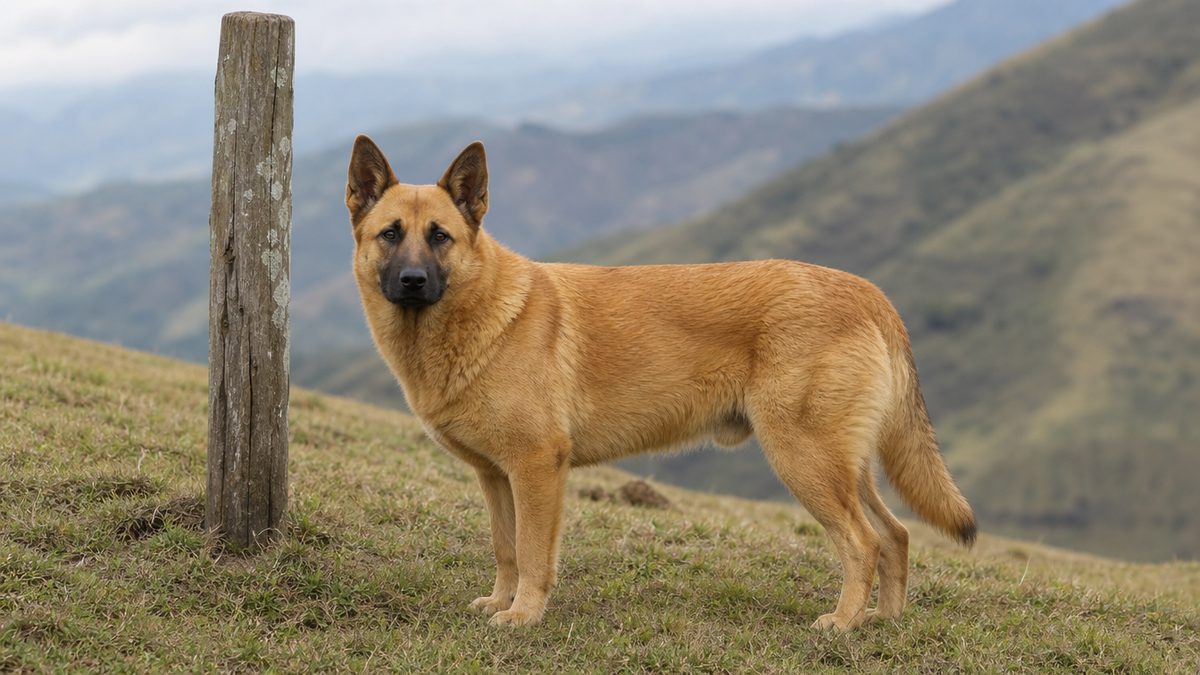
The Mantiqueira Shepherd is a medium-sized Brazilian cattle-herding dog from the Serra da Mantiqueira, recognised by the Confederação Brasileira de Cinofilia in 2022 under standard NR23. Its own standard gives a desired height of 48 cm at the withers for males and females alike, no weight figure at all, and four separate coat varieties.
Start with the document, because almost nothing else about this breed online starts there. The CBKC's Padrão Oficial da Raça PASTOR DA MANTIQUEIRA, standard NR23, published 10 September 2022 and updated three days later, states the country of origin as Brazil, the year of CBKC recognition as 2022, and the utilisation as *pastoreio, guarda e companhia*, herding, guarding and companionship, in that order. It is classified in Grupo 11, Raças Não Reconhecidas pela FCI, subject to a working trial, and signed by Fábio Amorim as President of the CBKC and Ricardo Torre Simões as Technical Director.
The nickname is the part everyone repeats and it is genuine. The standard itself records the breed as *também conhecido como "Policialzinho"*, little policeman, and both Wikipedias carry it Wikipédia em português.
The size figure, and why it is not the one you have read
The CBKC standard's TAMANHO E PESO section reads, in full, that the desired height at the withers is on average 48 cm for males and females, with limits of minus 5 cm and plus 5 cm, and that weight should be *proporcional ao tamanho do cão*, proportional to the dog's size and sufficient to guarantee its health and working dexterity. So the recognised range is 43 to 53 cm, a single figure covers both sexes, and no weight exists in the standard at all.
Every English-language page prints 53 cm and up to 25 kg instead. Those are the America Latina Kennel Clube's numbers, taken from a different standard that gives height *em até* 53 cm for males with females slightly smaller, and an ideal maximum of 25 kg so as not to compromise the animal's agility. Reprinting a ceiling as an average makes the breed look larger than the body that recognised it says it is.
Four coats, not three
The CBKC standard describes the coat as of variable length, short, medium or long, smooth or curly, dense and of good texture over a soft dense undercoat giving good protection against the weather, and then sets out four lettered varieties.
| Variety | What the standard describes |
|---|---|
| A, pelo longo | Short on head and lower legs, long and smooth over the body, forming a collar and mane at the neck and forechest, culottes on the rear thighs and a flagged tail. Thick hair protects the ear canal opening |
| B, pelo médio | The same pattern at half the length, with the collar and mane optional rather than required |
| C, pelo curto | Short over the whole body but with an undercoat, ear-canal protection preferred rather than required, longer hair on the rear thighs and enough tail hair to form a fringe |
| D, pelo crespo | Curled hair along the body, with the rear edge of the forearm still long and straight, no curl on the nasal bridge or forehead, and often no visible tail fringe |
Wikipedia gives three, folding the curly coat in with the short one. That matters in India more than it sounds, because the grooming load and the heat load differ sharply between variety A and variety C, and a buyer who does not know four exist cannot ask which one they are being offered.
A Mantiqueira Shepherd is a 43 to 53 cm double-coated Brazilian herding dog, recognised nationally since 2022 and internationally not at all, with four coat varieties, no published weight, no published lifespan and no peer-reviewed literature of any kind.
One phrase in the classification line carries more weight than it looks. The standard files the breed as *sujeito a prova de trabalho*, subject to a working trial, which means working ability is part of what the breed is judged on rather than an optional extra. Read alongside the disqualifying fault for *sem aptidão o trabalho*, lack of working aptitude, it tells you that breed recognition here was granted to a functional dog and not to a look.
Mantiqueira Shepherd recognition, register by register
The Mantiqueira Shepherd is recognised by Brazil's national kennel club and by nobody outside Brazil. That distinction is the whole answer for an Indian buyer, because the Kennel Club of India registers imported dogs against FCI nomenclature and the FCI does not hold this breed on either of its registers.
Take the national layer first, because it is the layer the ranking pages skip. The Confederação Brasileira de Cinofilia is Brazil's full FCI member, listed in the FCI's own members register at its Rio de Janeiro address. It recognised the Pastor da Mantiqueira in 2022 and publishes standard NR23 for it. A national body that is itself an FCI member can and does recognise breeds the FCI has never seen, and it files them separately.
The CBKC's own standard is explicit about that separation. The cover page carries the parenthetical "(Raça ainda não reconhecida pela FCI)", breed not yet recognised by the FCI, and the classification line reads Grupo 11 - Raças Não Reconhecidas pela FCI. The recognising body is telling you the international position in its own document, which is more than any secondary page does.
The FCI check, run with in-document controls
The FCI's alphabetical index for the letter M lists eleven breeds, from Macedonian Shepherd Dog Karaman 378 through Mastiff 264, Mastino Napoletano 197, Maltese 65 and Mudi 238, and the Mantiqueira Shepherd is not among them. The letter P index lists twenty-seven, including Pug 253, Puli 55, Pumi 56 and Perro sin Pelo del Perú 310, and no Pastor da Mantiqueira. The provisional register holds twenty entries and does not hold it either.
A plain fetch of any FCI index returns a chrome-only shell with zero breeds on it, so a naive check reports every breed as absent, the Labrador included. All three indexes were therefore read through a JavaScript-rendering fetch, and each was confirmed to have rendered by finding known breeds on the returned page: the Mastiff and the Mudi on M, the Pug and the Puli on P, and the Brazilian Buldogue Campeiro 374 on the provisional list. The Perro sin Pelo del Perú 310 was checked a second way, by opening its standard PDF and confirming the breed name printed inside it.
The Buldogue Campeiro shows the route out
One Brazilian breed has made the journey and it is worth naming, because it defines what recognition would actually require. The Buldogue Campeiro sits on the FCI's provisional register as standard 374, admitted on 6 August 2025, and its CBKC standard carries an FCI header rather than a Grupo 11 one. Provisional recognition means pedigrees carry the FCI logo and the dogs are eligible for FCI titles though not for the CACIB. Bonbeno's Campeiro Bulldog guide works that through.
| Body | Holds the breed | Under what | In-document control |
|---|---|---|---|
| CBKC, Brazil's FCI member | Yes | Standard NR23, Grupo 11, recognised 2022 | Brazil listed as an FCI full member |
| SOBRACI, Brazil | In process | Group 06, breeds in the recognition process | Its own URL path names the group |
| ALKC, America Latina Kennel Clube | Yes | Published breed standard with its own measurements | Standard text served under the breed name |
| FCI, definitive register | No | Absent from letters M and P | Mastiff 264, Mudi 238, Pug 253, Puli 55 |
| FCI, provisional register | No | Absent from all 20 entries | Buldogue Campeiro 374, a Brazilian breed |
| Kennel Club of India | No | Registers against FCI nomenclature as a full FCI member | India listed as an FCI full member |
For an Indian reader the consequence is concrete rather than abstract. The Kennel Club of India's own checklist for registering a dog with import status requires an export pedigree in original alongside a DGFT licence, customs clearance, quarantine clearance and a pet passport. A CBKC Grupo 11 pedigree is a real document issued by a real FCI member body, and it is not an FCI pedigree, so it will not convert. India is a full FCI member represented by the KCI in Chennai, which is exactly why the FCI's register answers the Indian question.
One further check was run on the letter P index, because an absence read off a list is only as good as the list. The Perro sin Pelo del Perú's own standard PDF, FCI 310 dated 26 October 2021 with the official valid standard published 15 September 2021, was fetched and extracted, and its first page prints PERRO SIN PELO DEL PERÚ. The index links to real standards, so the Mantiqueira Shepherd's absence from it is an absence from the register rather than an artefact of a broken page.
Grupo 11 is a real register, and here is what else is in it
The CBKC's Grupo 11 holds Brazilian breeds the FCI does not recognise, and it is populated rather than nominal. Five other standards were opened and every one prints GRUPO 11 on its own face: the Ovelheiro Gaúcho NR05, Dogue Brasileiro NR04, Veadeiro Pampeano NR07, Buldogue Serrano NR11 and Veadeiro Nacional NR29.
This section exists because the standard PDFs on the CBKC's site are served from numbered files that correspond to nothing a reader can guess, and because English Wikipedia has been caught citing the wrong number for other Brazilian breeds. The method used here is the only safe one: read the file number out of the CBKC's own markup, then confirm the breed name printed inside the returned document.
The CBKC's breeds index carries 248 breed options, each with a `data-idcbkc` attribute, and the Pastor da Mantiqueira appears as `value="292" data-idcbkc="23"`. That attribute was proven to be the standard's PDF number by checking it against all 30 breed cards rendered on the same page, which agreed in 30 cases out of 30 and disagreed in none. Fetching `padrao-raca_23.pdf` then returns a document whose own first page reads PASTOR DA MANTIQUEIRA.
What the same method returns for the neighbouring numbers
Six more numbered standards were fetched the same way and extracted with pypdf.
| Breed | File number | Standard | Group printed on the document |
|---|---|---|---|
| Ovelheiro Gaúcho | 1 | NR05 | Grupo 11 |
| Dogue Brasileiro | 2 | NR04 | Grupo 11 |
| Veadeiro Pampeano | 9 | NR07 | Grupo 11 |
| Buldogue Serrano | 12 | NR11 | Grupo 11 |
| Pastor da Mantiqueira | 23 | NR23 | Grupo 11 |
| Veadeiro Nacional | 29 | NR29 | Grupo 11 |
| Buldogue Campeiro | 8 | FCI header, no NR number | FCI, and provisional standard 374 |
| Rastreador Brasileiro | 15 | FCI Standard 275 of 27/11/2020 | FCI Grupo 6 |
Two things follow. Grupo 11 is not a waiting room with one dog in it, it is the CBKC's standing national register for Brazilian breeds without international status, and the Mantiqueira Shepherd shares it with at least five others. And the NR numbers are standard numbers, not file numbers: NR23 sits in file 23 by coincidence, while NR05 sits in file 1 and NR07 in file 9. Anyone assembling a CBKC URL from an NR number will fetch a different breed's standard, at HTTP 200, with nothing to warn them.
The Ovelheiro Gaúcho is worth naming for a second reason. Its standard is the one file that Bonbeno had already located independently for the Gaucho Sheepdog page, and finding it again at file 1 through the `data-idcbkc` route is what confirms the method rather than merely asserting it.
Writing that a breed is unrecognised because the FCI does not list it is the single commonest error on rare-breed pages, and on this breed it is simply wrong. The Mantiqueira Shepherd is recognised, by the same national body that represents Brazil at the FCI, under a numbered standard signed by that body's president. What it lacks is international status, and those are different claims.
Three Brazilian registries, three different dogs
The CBKC, SOBRACI and the ALKC all publish a Pastor da Mantiqueira standard and they do not describe the same animal. They disagree on height, on weight, on the breed's commonest colour and on whether dropped ears are a light fault or a disqualification, and no page anywhere sets the three side by side.
This is the page's central finding, so here is the comparison first and the discussion after.
| CBKC standard NR23 | SOBRACI | ALKC | |
|---|---|---|---|
| Status | Recognised 2022, Grupo 11 | Group 06, breeds in the recognition process | Published breed standard |
| Height | 48 cm desired, both sexes, minus 5 to plus 5 cm | Not given | Up to 53 cm males, females slightly smaller |
| Weight | None. Proportional to size | Not given | Ideal maximum 25 kg |
| Coat varieties | Four, lettered A to D | Variable length, long to short, no named varieties | Not itemised |
| Colours | Black, white, azulego, mantado, dourado, black mask permitted | Azulego, black, white to cream | Not itemised in the text read |
| Azulego means | Mosqueado preto e branco, black-and-white speckled | Base amarela com pelos pretos interpolados, yellow base with black hairs | Not defined |
| Dropped ears | Disqualifying fault | Light fault | Not stated |
| Dentition | Perfect complete scissor bite, prognathism disqualifies | 42 teeth, 20 upper and 22 lower, missing teeth other than P1 eliminates | Not stated |
| Missing P1 premolars | Not separately addressed | Moderate to serious fault | Not stated |
The colour disagreement is the sharpest one
Azulego is the colour Brazilian sources agree is the most common in the breed, and the two registries define it as two different dogs. The CBKC standard's colour list reads *preto, branco, azulego (mosqueado preto e branco), mantado, dourado*, glossing azulego as black-and-white speckled. SOBRACI's record defines it as *base amarela com pelos pretos interpolados*, a yellow base with interpolated black hairs, and Portuguese Wikipedia follows SOBRACI, describing the result as a matt yellowish or usually greyish dog, sometimes bluish.
Both descriptions can produce a grey-looking dog at a distance, which is presumably how the disagreement has survived. Up close they are not the same coat, and a buyer told a puppy is azulego has been told nothing until they ask which registry's azulego is meant.
Where the internet's numbers actually come from
English Wikipedia's infobox gives height 53 cm at the withers and weight up to 25 kg, cites only SOBRACI and the ALKC, and names three coat varieties. SOBRACI gives no height and no weight at all, so both figures must come from the ALKC, where 53 cm is a ceiling for males and 25 kg is an ideal maximum. Wikipedia has converted two upper bounds into the breed's typical size, and the pages that copy Wikipedia have inherited it.
A Brazilian veterinary pharmacy's article splits the difference again, giving 48 to 53 cm for both sexes and an average weight near 25 kg. That range is the union of the CBKC's midpoint and the ALKC's ceiling, which is a fourth figure set produced by averaging two others rather than by measuring dogs.
This page follows CBKC standard NR23 throughout, because that is the standard of the body that recognised the breed and represents Brazil at the FCI. Where the ALKC or SOBRACI differ, the difference is stated rather than averaged. Averaging three standards would produce a dog that exists in none of them, which is exactly how the 53 cm figure got loose in the first place.
History and origins, and the ancestry nobody can source
The Mantiqueira Shepherd's history and origins are a selection story rather than a foundation story. The CBKC standard says the dogs arose over time from crosses between dogs brought by immigrants, then were refined by breeding the best herding animals together. Which immigrant breeds those were is unsourced, and Portuguese Wikipedia flags its own leading theory as citation-needed.
The recognising standard's own history section is short and worth quoting in substance. It says the dogs arose over time from crosses between dogs brought by immigrants, that after selecting the animals most suited to the work the breed was refined by mating the best herding examples, and that this produced dogs described as *rústicos, ágeis, resistentes e livres de doenças*, rustic, agile, resistant and free of disease. Animals that did not suit herding were used for companionship and house guarding, and still are.
It also explains what the dog is for, which is the part that transfers worst to an Indian flat. The Serra da Mantiqueira *muitas das vezes apresenta um difícil acesso, dificultando o trabalho do peão*, often presents difficult access that hampers the herdsman's work, and the dog exists to work sheep, horses and especially cattle on ground a mounted man cannot easily reach.
Four competing ancestries, none of them documented
Portuguese Wikipedia sets out the theories and, unusually, marks its own weakest claims. It states that no historical sources have yet been found showing precisely which breeds contributed, and that whatever the European ancestors were, they reached the Serra da Mantiqueira in the twentieth century.
| Claimed ancestor | Origin of the claim | Evidence |
|---|---|---|
| Belgian Shepherd and Dutch Shepherd | Portuguese Wikipedia's first theory, from appearance and herding aptitude | Marked *carece de fontes*, citation needed, on the page itself |
| Pastor garafiano, Pastor basco, Can de Palleiro | Portuguese Wikipedia's preferred theory, Spanish breeds arriving during the Iberian Union | Argued from physical similarity, no source cited |
| Cão da Serra da Estrela | Portuguese Wikipedia, a possible Portuguese contribution | Stated as possible, no source cited |
| Police-type German Shepherd, the *policiais* | Both Wikipedias, offered to explain the nickname policialzinho | Described as widely believed, not documented |
| "Dogs brought by immigrants" | CBKC standard NR23 | The recognising body names no breed at all |
Notice what the recognising standard does not do. It names no ancestor breed, which is the honest position for a landrace refined by working selection, and it is the position this page adopts. A classified listing in Espírito Santo describes the breed as *um primo do pastor alemão e do Pastor Belga*, a cousin of the German Shepherd and the Belgian Shepherd, which is a seller repeating as fact the theory the encyclopedia flags as unsourced.
Where the dogs actually are
Portuguese Wikipedia gives the breed's distribution municipality by municipality, and the list is worth having because it is the closest thing to a population map that exists. The Serra da Mantiqueira spans São Paulo, Minas Gerais and Rio de Janeiro, and the greatest incidence is in Minas Gerais, with Virgínia, Passa Quatro, Marmelópolis, Delfim Moreira, Itajubá, Piranguçu, Brasópolis, Gonçalves, Paraisópolis and Santa Rita do Sapucaí among the named towns, then a smaller distribution in São Paulo at Monteiro Lobato, São Bento do Sapucaí and Campos do Jordão.
Portuguese Wikipedia's *risco de extinção* section argues the breed is increasingly threatened for two reasons: cattle in the Serra da Mantiqueira are being replaced by agriculture so the dogs are used less, and tourism is drawing incomers who bring foreign breeds that cross with them. No population survey, census or registration count is cited for either limb, so treat it as a plausible argument rather than a measured status.
Mantiqueira Shepherd price in India
No mantiqueira shepherd price in india exists, because no Indian seller lists the breed and no lawful route exists to import one for breeding. Brazilian prices do exist, and the most useful thing this section can do is show them in the currency they are actually quoted in and explain why converting them would be the error.
An India-targeted search for the breed name plus price and puppy terms returned exactly one result, a Pinterest ideas page, and no Indian listing of any kind. The control settles that the search worked: the identical query form for a Labrador Retriever in the same tool in the same session returned ten Indian pages carrying real rupee bands, including Mr n Mrs Pet's stated average of INR 30,000 to INR 1,20,000 with a city-by-city table. A second control, on a different instrument, agrees: a labrador retriever price in india query on Bing India returned About 28,600 results and ten Indian breed-price pages in the same session, while all three Mantiqueira query forms returned on-topic Brazilian and encyclopedic results and no Indian seller at all. There is nothing to find because nothing is here.
R$ is not Rs, and that is a trap waiting for this breed
Brazilian prices are quoted in reais, written R$, which is one character away from the Rs an Indian page uses for rupees. Brazilian number formatting compounds it, because a full stop is the thousands separator: R$ 2.000 is two thousand reais, not two. Any page that lifts a Brazilian figure and prints it as an Indian one will be wrong twice over, once on the currency and once on the decimal.
Bonbeno publishes no rupee conversion of any Brazilian figure on this page. A converted foreign price is not an Indian price, and presenting one as though it were is the specific fabrication this site exists to catch. The Brazilian figures below are Brazilian figures.
| Figure | Where | What it describes | Usable as an Indian price |
|---|---|---|---|
| R$ 2.000 | OLX Brasil, advertisement 1523884144, Serra, Espírito Santo | One classified listing for a puppy, posted by a seller trading as an electronic security company | No |
| R$ 5.500 | Mercado Livre, top result under a Mantiqueira search | A Pastor Alemão, a German Shepherd, not this breed at all | No |
| No figure | DrogaVET, in a section headed Preço do Pastor da Mantiqueira | Four bullet points about what to consider, then a pitch for compounded medicines | No |
| No figure | Estância Canil, Brazil's self-described largest breeder | A contact form and a frequently asked questions block, no published price | No |
| A live Mantiqueira Shepherd puppy in India | Nowhere found | No listing exists | No figure exists |
The ranking Brazilian page has a price section with no price in it
DrogaVET is a Brazilian veterinary compounding pharmacy and its breed article ranks in the top three for the breed term. It carries a section headed Preço do Pastor da Mantiqueira whose entire content is that prices vary by kennel, lineage, working or show standard and region, followed by four bullets on what to consider and a paragraph recommending the pharmacy's own compounded medicines. A price heading with no number under it is the honest shape of this market, and it is worth noticing rather than filling in.
What the one listing that does carry a number actually is
Mercado Livre, Brazil's largest marketplace, is the clearer warning. Its results page for *lindos filhotes pastor da mantiqueira* leads with a Pastor Alemão male at R$ 5.500, a German Shepherd listed under the Mantiqueira's own breed term. The Portuguese Bing result set does the same thing with a different dog, surfacing an OLX offer for a Pastor de Shetland. Substitution is happening in the breed's home market, in Portuguese, on the largest platforms available, which is worth knowing before trusting anything offered under the name at four thousand miles' distance.
The single OLX advertisement, read in full on 2 September 2026, prices a Pastor da Mantiqueira puppy at R$ 2.000 in Colina de Laranjeiras, Serra, Espírito Santo. The seller trades under the name Jj Seguranca Eletronica, an electronic security business, and the description calls the breed a cousin of the German Shepherd and the Belgian Shepherd. Espírito Santo is not one of the three states the Serra da Mantiqueira runs through, so the one priced dog on the open market is being sold outside the breed's range by a seller in an unrelated trade.
OLX's own safety notice on that page is better advice than anything the listing says. It states that animals sold must be vaccinated, microchipped, dewormed and authorised for sale with a *laudo*, and tells buyers to check that the advertiser holds a CNPJ and a CNAE for breeding or selling domestic animals.
Why no Indian price can form
India's import rules close the supply side. DGFT Trade Notice 22/2022-23 makes dogs Restricted under ITC(HS) 01061900, and Policy Condition 7 permits import only for a pet dog with a valid pet book and records in the importer's name, for R&D organisations with the recommendation of CPCSEA, or for internal security by the Defence and Police Force. Policy Condition 8 states that import of commercial dogs for breeding or any other commercial activity is not permitted, and paragraph 6 provides that applications for trading or breeding purposes *shall be duly rejected*. Entry is limited to the airports and seaports of Delhi, Mumbai, Chennai, Hyderabad, Bengaluru and Kolkata and, since October 2024, Kochi airport Department of Animal Husbandry…. No lawful founding stock means no Indian litters, and no Indian litters means no price. The full route is set out in how to import a dog to India.
Almost certainly a German Shepherd cross, a Belgian Malinois cross or an Indian pariah type with erect ears and a golden coat. Brazil's own largest classifieds site returns a German Shepherd as the top result under this breed's name, and a Pastor de Shetland under the Portuguese search term, so the substitution is happening in the breed's home market before it ever reaches India.
What a dog this size actually costs to keep in India
The monthly cost of keeping a 20 to 25 kg working dog in an Indian metro runs roughly Rs 5,000 to Rs 10,000, and the first year is dominated by the vaccination course. None of these figures is a Mantiqueira Shepherd price, because none exists. They are published Indian rates for a dog of this size, which is the number an Indian reader can use.
Size first, because the cost follows it. The CBKC standard gives 43 to 53 cm at the withers and no weight, and the ALKC gives an ideal maximum of 25 kg, so the costs below are worked for roughly 20 to 25 kg. A dog at the CBKC's 43 cm floor will eat noticeably less.
Vaccination, the largest first-year line
Vetic, a chain running more than 50 clinics across seven Indian metros, publishes a rate card. The four-visit puppy course starts at Rs 6,499 and the annual booster starts at Rs 3,199, with single doses from Rs 699 for anti-rabies, Rs 849 for puppy DP, Rs 899 for the 9-in-1 DHPPiL, Rs 899 for canine corona and Rs 1,349 for kennel cough. Every one of those is a promotional floor from one chain, because the phrase on each line is "Starts at".
Home vaccination is the cheaper route in the three southern metros that have it. Easzo Pets lists a home visit from Rs 799 for members and Rs 999 otherwise, with a first-puppy package including a DHPPi L4 dose, deworming and the visit at Rs 1,299 for members against Rs 1,499 for non-members. The schedule Indian vets follow is core doses from 6 to 8 weeks, repeated every 3 to 4 weeks until at least 16 weeks, with anti-rabies from around 12 weeks.
Deworming, worked from a unit price
Drontal Plus sells at Rs 754 for a strip of six tablets against an MRP of Rs 838, which is Rs 125.67 a tablet, and the tablet is dosed at one per 10 kg of bodyweight. A 20 to 25 kg Mantiqueira-sized dog therefore takes two to three tablets, so Rs 251 to Rs 377 a deworming, or roughly Rs 1,000 to Rs 1,500 a year on a quarterly schedule.
| Line | Published figure | Per month | Source |
|---|---|---|---|
| Annual booster | From Rs 3,199 | Rs 267 | Vetic rate card |
| Deworming, quarterly | Rs 251-377 per dose | Rs 84-126 | Drontal Plus unit price |
| Consultation, routine | Rs 500-1,000 per visit | Rs 83-167 at two visits a year | One data point, see the caution below |
| Food, dry, 20-25 kg working dog | Roughly 300-390 g a day | Rs 4,000-7,000 | Worked from Indian retail per-kg prices |
| Boarding, if you travel | Rs 899 per 24 hours, Bengaluru | Rs 150 at two weeks a year | PawSpace |
| Municipal registration, Delhi | Rs 500 new and Rs 500 renewal | Rs 42 | MCD |
| Municipal licence, Chennai | Rs 50 | Rs 4 | Greater Chennai Corporation |
Boarding is the line owners of a working breed underestimate. PawSpace in Bengaluru charges Rs 899 for overnight boarding up to 24 hours, Rs 799 for daycare to ten hours and Rs 599 for up to four hours. A herding dog that needs two hours of work a day does not do well in a kennel run, so ask what exercise is included before you book.
The Rs 500 to 1,000 consultation band and the Rs 1,500 to 3,000 core-vaccination band are published byte-identically by a dog sanctuary and by a general insurer. Two unrelated organisations agreeing exactly on two separate quantities is evidence that one copied the other rather than two confirmations, so this page counts it as a single data point and prefers a named clinic chain's own rate card wherever one exists.
Municipal costs are small, real and worth paying. Delhi's MCD charges Rs 500 for a new pet-dog registration and Rs 500 to renew, with a late fee of Rs 100 per month and a one-month grace period tied to the anti-rabies certificate. The Greater Chennai Corporation issues a pet licence on payment of Rs 50 and issued 9,115 of them during 2024.
Mantiqueira Shepherd heat tolerance in India, tested against measured data
This breed comes from cool, wet, high Brazilian cattle country and its own standard requires the undercoat that makes Indian summers hard. The NASA POWER cell over its core working towns averages 18.9 C across the year at a wet bulb of 16.4 C. Chennai averages 28.0 C at a wet bulb of 24.0 C, a gap of 7.6 wet-bulb points.
Every figure here comes from NASA POWER's Source Native Resolution Climatology, queried by explicit latitude and longitude, with the returned coordinates and the grid cell's own elevation checked against each place's real elevation. Wet-bulb values are computed from the returned air temperature and relative humidity using Stull's approximation, published in the *Journal of Applied Meteorology and Climatology* in 2011. Two of the Brazilian points cannot be taken at face value and the next section says which and why.
The towns queried are the ones Portuguese Wikipedia names as holding the largest populations of the breed, which is the only distribution map that exists for it.
| Place | Cell elevation m | Mean air temp C | Mean RH percent | Annual wet bulb C | Gap vs the Mantiqueira cell |
|---|---|---|---|---|---|
| Itamonte and Passa Quatro, one shared cell | 1,028 | 18.9 | 79.5 | 16.4 | - |
| Campos do Jordão and Itajubá, one shared cell | 1,079 | 18.5 | 80.1 | 16.1 | -0.3 |
| São Lourenço | 1,080 | 19.1 | 77.5 | 16.3 | -0.1 |
| São Paulo | 790 | 19.6 | 80.2 | 17.2 | +0.8 |
| Pune | 636 | 23.9 | 66.8 | 19.4 | +3.0 |
| Bengaluru | 842 | 23.7 | 67.9 | 19.5 | +3.1 |
| Delhi | 206 | 25.6 | 45.6 | 17.8 | +1.4 |
| Mumbai | 97 | 26.8 | 67.4 | 22.2 | +5.8 |
| Kolkata | 7 | 25.8 | 73.9 | 22.3 | +5.9 |
| Chennai | 49 | 28.0 | 72.4 | 24.0 | +7.6 |
The annual means look closer than they are, and the reason is worth stating plainly. Brazil's highland climate is mild and even, running from a January mean of 21.5 C down to a July mean of 15.1 C in the Itamonte cell, and it is humid all year at 77 to 83 percent. India's climate is seasonal and extreme, and the annual mean hides the months that matter.
So the honest verdict is narrower than a simple yes or no. A short-coated variety C dog in Bengaluru or Pune, worked in the cool hours, is heat-tolerant enough to live a normal life, and the breed's reputation as hardy is genuine in the sense its standard means it, which is resistance to weather rather than resistance to tropical heat. A long-coated variety A dog in Chennai, Mumbai or Kolkata is a different proposition, and no amount of rusticity substitutes for a wet bulb below 24 C.
| Place | Worst month | Mean air temp C | Mean RH percent | Mean wet bulb C |
|---|---|---|---|---|
| Itamonte and Passa Quatro cell | January | 21.5 | 82.7 | 19.3 |
| Campos do Jordão and Itajubá cell | January | 21.2 | 83.2 | 19.1 |
| São Paulo | February | 22.4 | 82.9 | 20.2 |
| Kolkata | June | 29.9 | 80.4 | 27.1 |
| Delhi | July | 32.3 | 62.7 | 26.5 |
| Chennai | May | 31.5 | 64.5 | 26.1 |
| Mumbai | June | 28.7 | 79.5 | 25.8 |
| Pune | June | 25.6 | 80.3 | 23.0 |
| Bengaluru | May | 27.0 | 63.8 | 21.9 |
Kolkata's June is 7.8 wet-bulb points above the worst month the Mantiqueira produces, and Delhi's July is 7.2 above it. Bengaluru's May, the mildest Indian worst month here, is still 2.6 points above it. Even the Deccan cities that suit most imported breeds best are running a summer this dog's home range never sees.
The coat is the problem, and it is a standard requirement
The CBKC standard requires the coat to be dense and of good texture over a *subpelo macio e denso*, a soft dense undercoat giving good protection against the weather, and it makes insufficiency or absence of coat or undercoat a disqualifying fault. A judge in Brazil will penalise the dog for having less coat than the standard wants, and that is exactly the dog that would cope better in Chennai. The breed cannot be selected out of the problem without ceasing to be the breed.
The long-coated variety A carries a mane and collar at the neck and forechest, culottes on the rear thighs and a flagged tail, and Indian law has a clause aimed at exactly that dog. Second Schedule Part IV paragraph 21(1) of the Dog Breeding and Marketing Rules 2017 bars keeping in outdoor facilities, without the attending veterinary practitioner's written approval, dogs not accustomed to local temperatures and breeds that cannot tolerate them, *such as long-haired breeds in high temperature locations*.
On heat illness itself, the largest study available found that of 879 events with a recorded trigger in a cohort of 905,543 UK dogs, 652, or 74.2 percent, were exertional rather than a dog left in a vehicle. Its companion paper on the same cohort with a different case definition gives 395 confirmed events, an incidence of 0.04 percent and a case fatality of 14.18 percent. Neither paper studied this breed, so no odds ratio here is the Mantiqueira's. The transferable finding is that the risk is created by the work you ask the dog to do, which for a herding breed is the whole point of owning one.
Two pairs of Brazilian towns returned one climate each
NASA POWER returns a grid cell rather than a point, and in the Serra da Mantiqueira one cell covers towns that differ by hundreds of metres in altitude. Campos do Jordão at 1,628 m and Itajubá at 842 m came back byte-identical from a single cell at 1,078.97 m, so neither figure is that town's.
Publishing a climate comparison without this check is how a page ends up telling an Indian reader that a Brazilian mountain town is warmer than it is. Every point here was queried by explicit latitude and longitude with the cell's own elevation echoed back and compared against the town's real elevation. Three of the eight Brazilian points failed that check and one failed spectacularly.
| Place | Cell elevation m | Real elevation m | Error m | Usable at face value |
|---|---|---|---|---|
| Itamonte | 1,028.19 | 1,090 | -62 | Yes |
| Passa Quatro | 1,028.19 | 920 | +108 | Yes, same cell as Itamonte |
| São Lourenço | 1,080.34 | 953 | +127 | Yes |
| Itajubá | 1,078.97 | 842 | +237 | Marginal |
| Campos do Jordão | 1,078.97 | 1,628 | -549 | No, same cell as Itajubá |
| Pico da Bandeira summit | 838.83 | 2,892 | -2,053 | No |
| São Paulo | 790.19 | 760 | +30 | Yes |
| Delhi | 206.37 | 216 | -10 | Yes |
| Chennai | 48.95 | 6 | +43 | Yes |
| Mumbai | 97.15 | 14 | +83 | Yes |
| Kolkata | 7.35 | 9 | -2 | Yes |
| Bengaluru | 841.72 | 920 | -78 | Yes |
| Pune | 635.99 | 560 | +76 | Yes |
The Indian plains are fine, with every one of the six metros landing within 83 m of its real elevation, so those cells genuinely describe those cities. The Brazilian highlands are not, and the error runs in both directions within a single cell, which is what makes it undetectable without the elevation echo.
The Pico da Bandeira reading is the worst error found in this session
The cell covering the Pico da Bandeira summit reports an elevation of 838.83 m for a peak that stands at 2,892 m, an error of 2,053 m. That is the second-largest single-point elevation error Bonbeno has recorded anywhere. The returned annual mean of 20.1 C is a plausible-looking number for a Brazilian highland, which is precisely the danger: nothing about the temperature says it is describing a valley floor two kilometres below the mountain it was asked about. No figure from that point is used on this page.
The correction applied, stated as an estimate
Air temperature falls with elevation at roughly 6.5 C per 1,000 m. Campos do Jordão sits 549 m above its cell, so its real annual mean is about 3.6 C colder than the cell's 18.5 C, near 15.0 C. That is an estimate and is labelled as one. It also strengthens rather than weakens the argument in the climate section, because the coldest genuine town in the breed's range is further from Chennai than the cell suggested, not closer.
The baseline this page actually uses
The Itamonte and Passa Quatro cell at 1,028 m is the one used as the breed's working-altitude baseline, for two reasons. Both towns fall within 108 m of the cell's stated elevation, and both are named in Portuguese Wikipedia's list of the municipalities holding the largest populations of the breed. Using a cell that describes two real breed towns is better than using one that describes neither.
If two places you query come back identical to the decimal, you have queried one cell twice and cannot use them to distinguish anything. That happened twice here, and it happened in the same session on a Bolivian pair 510 m apart in altitude, so it is a property of mountainous terrain rather than of Brazil.
Temperament and household fit
The Mantiqueira Shepherd is a working herding dog first and a companion second, and its own standard says so in the order it lists the breed's uses. Expect an alert, courageous, intensely busy dog with real stock sense, real suspicion of strangers and no off switch that anyone has bred into it.
The standard's temperament clause is unusually direct. It describes *um cão de trabalho árduo, cheio de vitalidade, sempre pronto para a ação*, a hard-working dog full of vitality and always ready for action, and then lists the qualities: *esperto, alerta, responsável, inteligente, corajoso, ágil, resistente e de bom senso de rebanho*, clever, alert, responsible, intelligent, courageous, agile, resistant and with good stock sense. It adds that when the job requires it, the dog *trabalha distante do seu dono*, works at a distance from its owner.
SOBRACI's record puts the same dog in economic terms, calling them very rustic, active and fast, with good instincts binding them strongly to the herd, and describing them as a low-cost and practically indispensable working tool for the cattleman of the Serra da Mantiqueira. That is a description of a piece of farm equipment with a heartbeat, and it is meant admiringly.
The two disqualifying temperament faults
The CBKC standard disqualifies a dog for aggressiveness or excessive timidity, for any sign of physical or behavioural anomaly, and, third, for lack of working aptitude, *sem aptidão o trabalho*. SOBRACI likewise eliminates excessively timid or aggressive dogs. A breed that disqualifies a dog for not wanting to work is telling you what the breed is for, and an Indian buyer who wants a calm indoor companion is not the reader those clauses were written for.
Guarding, and the nickname
The CBKC lists the utilisation as *pastoreio, guarda e companhia*, and the nickname policialzinho, little policeman, comes from the same instinct. Brazilian sources describe a dog that is protective and can show a certain distrust of strangers, which is useful for guarding property and needs balancing with early socialisation and positive training. In an Indian apartment block, where a dog meets strangers in a lift several times a day, that instinct is a liability unless it is worked on deliberately from eight weeks.
| Household | Verdict | Why |
|---|---|---|
| Farm or large rural property with livestock | Excellent fit | The job the standard describes, and the only setting where the disqualifying working-aptitude clause makes sense |
| Experienced owner doing daily dog sport, house with a yard | Workable | Agility, tracking and herding-style work substitute for the job, and the dog is highly trainable |
| Metro apartment, working owner, two short walks | Poor fit | A dog bred to work a mountainside at a distance from its handler, given a corridor |
| First dog, first-time owner | Poor fit | High drive, high intelligence and stranger suspicion is a demanding combination to get wrong |
| Household wanting a guard dog only | Caution | The guarding comes free with a herding drive that still has to be met every single day |
Training a dog that learns faster than you can plan for
Train a Mantiqueira Shepherd by giving it a job and then teaching it, in that order. Every Brazilian source agrees the breed is exceptionally trainable, and the Brazilian dog press singles it out as excellent to train, which is a strength and a warning in equal parts.
The standard supplies the raw material: clever, alert, responsible, intelligent and possessed of good stock sense, working at a distance from its owner when the work demands it. Brazilian veterinary writing describes a dog that learns commands easily, has a strong herding instinct, and needs physical and mental stimulation to avoid boredom and destructive behaviour. Read the second half of that sentence as the price of the first.
Four things to build first, in order
- A job, before any obedience. Scent work, a herding-ball game, a structured search routine or canicross gives the drive somewhere to go. A dog with a job trains easily; a dog without one trains you.
- Recall at distance, on a long line, because the standard describes a dog bred to work away from its handler and a strong recall is the only thing that makes that safe on an Indian street.
- A settle, taught deliberately as a behaviour rather than hoped for. This breed does not have an off switch by default and one has to be installed.
- Stranger neutrality, worked in lifts, corridors and gates from eight weeks, because the guarding instinct the CBKC lists second among the breed's uses will otherwise fill the gap on its own.
Herding instinct in a city has one specific failure mode worth naming: the dog herds children, joggers and two-wheelers. That is not aggression and it is not a fault in the dog, it is the behaviour it was bred for arriving in the wrong place. Redirect it onto an object early, and never let it be practised on a person.
What Indian law says about the equipment you may be offered
The Dog Breeding and Marketing Rules 2017 say nothing about training methods, but Second Schedule Part II paragraph 6(8) prohibits de-barking alongside tail docking, ear cropping and de-clawing, and forbids *any change of appearance by artificial means*. If a trainer proposes a surgical answer to a vocal herding dog, that clause is the answer.
Expect basic obedience inside a fortnight on a dog this trainable, a reliable settle to take two to three months of daily work, stranger neutrality to keep improving for two years, and the herding drive never to go away. A Mantiqueira Shepherd that lies down calmly in a busy room after ninety minutes of real work that morning is a fully trained one.
The daily exercise requirement, and the hours it has to happen in
A Mantiqueira Shepherd needs at least 90 minutes of real work a day, split into two sessions, and in most of India both have to happen in the cool hours. The standard makes lack of working aptitude a disqualifying fault, which is the clearest statement any breed standard can make about exercise.
This is the section where an honest page has to be discouraging. The breed exists because a mounted herdsman could not reach parts of the Serra da Mantiqueira and needed a dog that could. The gait clause asks for movement that is *fluente, suave e incansável*, flowing, smooth and tireless, with minimal lift of the feet and the impression of great propulsion and speed. A dog built and judged for tirelessness does not become tired on a 20-minute walk.
Why the timing binds harder than the distance
Indian ultraviolet and heat both peak in the middle of the day. Monthly mean UV indices over Chennai, Mumbai and Kolkata run between 11.79 and 13.84 through March, April and May, which is above the World Health Organization's threshold of 11 for its extreme category, and the WHO reports the index as the maximum during the four-hour window around solar noon, which in India falls between noon and 2 p.m.. Add a wet bulb of 26 to 27 C in the worst month and the middle of the day is not available for exertion.
The largest heat-illness study found that of 879 events with a recorded trigger, 652 or 74.2 percent were exertional. For most breeds that is a caution. For a breed whose standard disqualifies a dog that will not work, it is a scheduling constraint that governs the entire ownership.
| Season | Morning session | Evening session | Middle of the day |
|---|---|---|---|
| February to May | Before sunrise, 45-60 min of real work | After full dark, 30-45 min | Indoors, scent games only |
| Monsoon | Early, 45 min, and dry the coat properly afterwards | After dark, 45 min | Indoors, check between the toes and under the mane |
| October to January | Soon after sunrise, 60 min | After sunset, 45 min | Shaded outings acceptable in the north and on the Deccan |
What happens without it
An under-worked herding dog in a flat becomes a barker, a patroller and a resource guarder, and then a surrender. Brazilian veterinary writing says the same thing more politely, warning that without physical and mental stimulation the breed shows *tédio e comportamentos destrutivos*, boredom and destructive behaviour. That is the single most predictable outcome on this page.
Indoor substitutes that genuinely work are scent searches for a hidden toy, feeding the whole daily ration through a snuffle mat or a food puzzle, and short shaping sessions two or three times a day. Stair work in an air-conditioned block is real exercise for a fit adult dog. Fetch on tile is not, because a dog this fast will hurt a stifle on a polished floor.
One behavioural note belongs here rather than in training. A herding dog's prey drive is the raw material the herding behaviour is built from, and in a city it points at cats, two-wheelers and joggers rather than at cattle. On an Indian street that turns a scheduling problem into a safety one, so the long line stays on until the recall is genuinely reliable in the dark, which is when this dog will be doing most of its running.
Grooming four different coats in Indian humidity
Grooming load depends entirely on which of the four CBKC coat varieties your dog carries, and the range is wide. The short coat, variety C, is a weekly job. The long coat, variety A, carries a mane, a collar, culottes and a flagged tail, and in an Indian monsoon that is daily work.
The standard requires a dense coat of good texture over a soft, dense undercoat, and disqualifies a dog for insufficiency or absence of coat or undercoat. So every variety, including the short one, carries an undercoat by definition. There is no low-coat version of this breed to look for.
| Variety | What it carries | Indian brushing load | Monsoon risk points |
|---|---|---|---|
| A, long | Mane, collar, culottes, flagged tail, thick ear-canal hair | Daily in humid months | Behind the ears, under the mane, the culottes, between the toes |
| B, medium | The same pattern at half length, collar and mane optional | Every second day | Behind the ears, the culottes |
| C, short | Short over the body with an undercoat, longer rear thighs, tail fringe | Twice a week | Between the toes, the tail fringe |
| D, curly | Curls along the body, straight long hair on the rear forearm edge, often no tail fringe | Every second day, and check for mats at the skin | The curl traps moisture against the skin |
The ear-canal detail that matters in an Indian monsoon
The standard specifies for varieties A and B that *a entrada do canal auditivo é protegida por pelos espessos*, the entrance to the ear canal is protected by thick hair, and for variety C that this protection is preferred. That hair is doing a real job in a cold wet Brazilian highland. In an Indian monsoon the same hair holds water against a warm ear canal for hours after a bath or a walk.
The overseas advice to towel a dog and let it air dry does not transfer here. Dry the dog properly, dry inside the ear flap, and do not bathe without a plan for getting the undercoat dry, because a dense undercoat that stays damp in 80 percent humidity is where hot spots and yeast start.
A routine that works
- Brush to the schedule in the table, working down to the skin rather than over the top coat, because a slicker that only touches the guard hairs leaves the undercoat matting underneath.
- Bathe every three to four weeks in humid months and less often in dry ones, with a soap-free veterinary shampoo, and dry fully every time.
- Check between the toes, behind the ears and under the tail after every monsoon walk.
- Never shave the double coat to cool the dog down. It removes the insulation that keeps heat out as well as in, exposes skin that has never seen an Indian ultraviolet index of 13, and the standard treats absence of coat as a disqualifying fault.
- Trim nails on a schedule. The standard asks for short strong nails and thick robust pads, which is a working foot rather than a show one.
Ask which of the four varieties the litter is, and ask to see both parents. A curly-coated or long-coated puppy in Chennai is a materially different commitment from a short-coated one, and the seller may not have thought about it, because in the Serra da Mantiqueira the difference barely matters.
Health, screening and life expectancy: an empty evidence base
No peer-reviewed study has ever examined this breed, no screening scheme covers it, and no published life table includes it. Six name forms returned zero PubMed records against three controls that passed in the same session, so the absence is measured rather than assumed.
The literature search was run through NCBI E-utilities on 2 September 2026 and every query is reproducible. "Mantiqueira Shepherd" quoted and unquoted, "Pastor da Mantiqueira" quoted and unquoted, "cao pastor da mantiqueira" and "Mantiqueira dog" all returned zero, as did Policialzinho.
Three controls, and two traps that fired
An absence only counts when the instrument is proved working, so three controls were run in the same session: Labrador retriever hip dysplasia returned 126, Fila Brasileiro returned 7 including a left-dominant arrhythmogenic cardiomyopathy case report in a Fila, and Brazilian dog breed genetic diversity returned 5. PubMed can find Brazilian breed literature. It cannot find any for this one.
Two of PubMed's documented failure modes fired during the search and neither changed the answer. The unquoted Pastor da Mantiqueira was silently rewritten into an author search, the translation line reading `(pastor, da[Author] OR pastor da[Author]) AND "Mantiqueira"[All Fields]`, which is exactly the artefact that makes a zero look like a finding when it is not. And "Pastorzinho caipira" collapsed to `"caipira"[All Fields]` and returned 20 records about caipira chickens, aquaponic lettuce and Brazilian artisanal cheese. The zeros survive both, because the broadened unquoted forms also returned zero, and a broadened query that still finds nothing is a stronger negative than a narrow one.
The 69 records that are not about a dog
The bare word Mantiqueira returns 69 PubMed records, and every title was read back rather than counted. They cover new frog and insect species from the Serra da Mantiqueira, black-fronted titi monkeys, southern muriquis surveyed by thermal drone, Atlantic cloud-forest carbon stocks, the volatile composition of Chardonnay sparkling wines, a Mantiqueira breed of dairy cattle and a Mantiqueira potato cultivar. Zero of the 69 concern the dog. A large result count for an obscure name is evidence of a homonym, not of a literature.
| Question | What exists | Verdict |
|---|---|---|
| Life expectancy | No figure in any of the three Brazilian standards. A veterinary pharmacy's article gives 12 to 14 years citing nothing | Unknown. Bonbeno publishes no lifespan |
| Hip and elbow screening | No breed scheme, no published statistics anywhere | Unknown. Screen the individual dog |
| Inherited eye disease | No data of any kind | Unknown |
| Peer-reviewed papers | Zero across six name forms with three passing controls | A measured zero |
| Breed-club health testing | The CBKC standard's only health note is that only clinically and functionally healthy dogs of typical conformation should be bred from | A principle, not a programme |
| Merle-associated deafness and blindness | Not studied in this breed, and the CBKC disqualifies merle colour outright | Structurally avoided by the standard |
The one health provision the standard does contain, and it is a good one
CBKC NR23 lists cor merle among its disqualifying colours, alongside brindle, piebald and diluted colours. Merle is the coat pattern whose double dose is associated with deafness and ocular defects across several breeds, so a standard that excludes it removes the risk of merle-to-merle breeding from the breed by construction. That is a stronger welfare provision than most standards carry and no page mentions it.
The Indian half, which is real and measurable
Tick-borne disease is the health risk that will actually meet an Indian dog of this size. Four recent Indian series, all sampling dogs presented at veterinary clinics rather than random populations, found *Ehrlichia canis* in 51 of 442 dogs by PCR in Andhra Pradesh, in 56 of 178 in Odisha where 75 percent of the infected dogs were over 20 kg and 79 percent had a tick history, *Babesia* in 80 of 120 in Kerala with a pre-monsoon peak from March to May, and *Babesia gibsoni* in 76.54 percent of 584 dogs in West Bengal, where 72.9 percent carried two or more pathogens. Those are clinic caseloads, so they overstate population prevalence.
The Odisha figure is the one that lands hardest here, because a Mantiqueira Shepherd at the ALKC's 25 kg ceiling sits inside that over-20 kg group, and a dense double coat is harder to check for ticks than a short one.
The temptation on a rare-breed page is to call the dog robust because nothing bad has been published about it. Nothing has been published about it at all. The CBKC's own history section says selection produced dogs *livres de doenças*, free of disease, which is a claim about working selection on a mountain farm rather than a screening result, and it is not transferable to a dog living in a Pune flat.
Feeding a working dog that is not working
Feed a Mantiqueira Shepherd to its actual workload rather than to its breed, because in India that workload will be a fraction of what the standard assumes. A 20 to 25 kg adult in city life needs roughly 300 to 390 g of dry food a day, and the commonest error will be feeding a working ration to a dog doing two walks.
The standard gives no weight, only that it should be proportional to size and sufficient for health and working dexterity, which is a fitness instruction rather than a number. The ALKC's ideal maximum of 25 kg is set explicitly so as not to compromise the animal's agility. Both bodies are telling you the same thing: this dog is meant to be lean.
- Weigh the daily ration rather than scooping it, and split it into two meals for a deep-chested working breed.
- Score body condition monthly by hand, feeling for ribs under a dense coat rather than looking for them, because a double coat hides two kilograms easily.
- Adjust downward in the hot months, when appetite and activity both drop, rather than leaving the ration where it was in January.
- Feed the main meal after the evening walk, not before it, on a dog that will be running.
- Use part of the ration for training and scent games rather than adding treats on top, which is the cheapest way to give a bored herding dog a job.
What that costs in India
At Indian retail prices for a premium dry food, roughly Rs 636 a kilogram at the 15 kg bag size, a 20 to 25 kg dog eating 300 to 390 g a day costs about Rs 5,700 to Rs 7,450 a month. Treat that as arithmetic rather than a quoted price, and check the grams per day printed on your own pack before budgeting from it, because feeding guides differ by brand and by formulation.
Deworming is the other consumable and its arithmetic is clean. Drontal Plus at Rs 754 for six tablets is Rs 125.67 a tablet, dosed at one per 10 kg, so a 20 to 25 kg dog costs Rs 251 to Rs 377 a deworming.
Feeding through the Indian seasons
Appetite falls in April and May across most of India and that is normal. What is not normal is a dog that stops eating and is also dull or lame, because those are early signs of both heat stress and tick-borne disease, and the Kerala series put the *Babesia* peak in exactly those pre-monsoon months of March to May. Keep water in more than one room, and treat two days of appetite loss as a reason to see a veterinarian rather than to change the food.
Month by month through the first year
Plan a Mantiqueira Shepherd puppy's first year around three things: a socialisation programme that starts the week it arrives, a job that grows with the dog, and an exercise schedule built for Indian daylight rather than Brazilian. The vaccination course is the same as any Indian puppy's and it is the largest single first-year cost.
Indian law fixes the earliest handover date. Rule 8(1)(a) of the Dog Breeding and Marketing Rules 2017 requires that *pups less than eight weeks in age are not sold*, and a breeder offering a younger puppy has told you something about the rest of their practice. A Brazilian kennel advertising itself as the country's largest breeder of the breed publishes a frequently asked questions block covering exactly this, the age and health protocol at handover, so the question is a normal one to ask.
| Age | Veterinary | Work and training | Coat and body |
|---|---|---|---|
| Weeks 6-8 | Core vaccination starts, typically the puppy DP dose | Stays with the litter until eight weeks minimum | Identify which of the four coat varieties it is |
| Weeks 8-12 | Second and third doses on the vet's schedule, first deworming | Household socialisation, handling, name and settle | Daily brushing habit begins, whatever the coat |
| Weeks 12-16 | Anti-rabies from around 12 weeks, course completed by 16 to 18 weeks | Controlled outdoor socialisation at dawn and dusk, lifts and gates included | First monsoon, if it falls here. Dry properly every time |
| Months 4-6 | Deworming quarterly from here | Recall on a long line, first scent games, first redirect of herding behaviour onto an object | Adult coat starts coming through on the long and curly varieties |
| Months 6-9 | Discuss neutering timing with your own vet | Sessions lengthen, but keep impact low while growth plates are open | First full Indian summer. Schedule moves to dark hours |
| Months 9-12 | Annual booster due at about one year | Adult workload of 90 minutes a day in two sessions | Adult double coat established |
Vaccination costs are published and predictable. Vetic's four-visit puppy course starts at Rs 6,499, with single doses from Rs 699 for anti-rabies and Rs 899 for the 9-in-1, while home vaccination through Easzo Pets starts at Rs 799 for members and Rs 999 otherwise. Indian vets run core doses from 6 to 8 weeks, repeated every 3 to 4 weeks until at least 16 weeks, with anti-rabies from around 12 weeks.
The window that decides the adult dog
Between eight and sixteen weeks is when stranger neutrality is either built or lost, and on a breed the CBKC lists as a guarding dog it will not build itself. In an Indian apartment that window is free: the puppy meets strangers in the lift, at the gate and on the stairs several times a day. Make each one a calm, brief, rewarded event rather than an ambush, and the guarding instinct arrives later as discrimination instead of suspicion.
Do not dock the tail or crop the ears. Second Schedule Part II paragraph 6(8) of the Dog Breeding and Marketing Rules 2017 forbids both, and the CBKC standard independently disqualifies a dog for absence of tail whether from birth or by cutting, and for ears held artificially erect. And do not shave the coat before the first summer. The undercoat this breed is judged on insulates against heat as well as cold, and skin that has never seen sun meets an Indian ultraviolet index above 11.
Mantiqueira Shepherd against the herding dogs an Indian buyer can actually get
The Mantiqueira Shepherd loses every practical comparison in India on availability rather than quality. An Australian Shepherd and a German Shepherd deliver the same working brief with an FCI standard, a KCI route and real screening data behind them, and an Indian pariah dog delivers rusticity in the climate it evolved in.
The honest comparison for this breed is not against other Brazilian dogs, because an Indian buyer cannot get any of them either. It is against the herding and working breeds already here.
| Breed | International standard | KCI route | Screening data | Obtainable in India |
|---|---|---|---|---|
| Mantiqueira Shepherd | None. CBKC NR23, Grupo 11 only | No | None of any kind | No |
| Australian Shepherd | FCI 342 | Yes | Extensive, including MDR1 | Yes |
| German Shepherd | FCI 166 | Yes | Extensive hip and elbow schemes | Yes, widely |
| Belgian Shepherd | FCI 15 | Yes | Yes | Yes, in the metros |
| Fila Brasileiro | FCI 225 | Yes | Limited, one case-report literature | Rarely |
| Indian Pariah Dog | Not applicable | Not applicable | None, but no closed gene pool either | Free, everywhere |
The Australian Shepherd is the closest match on the working brief. It is a medium herding dog of similar size and drive, it holds FCI standard 342, it is bred in India, and it has a documented inherited-disease profile a buyer can screen against. Everything a buyer wants from a Mantiqueira Shepherd is available in a dog whose papers mean something in India.
The German Shepherd deserves naming for a different reason. It is the breed the Mantiqueira is repeatedly sold as a relative of, both by Portuguese Wikipedia's citation-needed first theory and by an OLX seller calling it *um primo do pastor alemão* OLX Brasil, classified listing "Pastor da…. If that relationship is what appeals, the relative itself is available with paperwork.
The Brazilian comparison, for completeness
Two Brazilian breeds do hold FCI standards, and the difference is instructive. The Fila Brasileiro is FCI 225 and the Brazilian Terrier is FCI 341, so both could in principle be registered with the KCI against an export pedigree. The Campeiro Bulldog is midway, holding FCI provisional standard 374 since 2025, and the Gaucho Sheepdog sits exactly where the Mantiqueira does, in CBKC Grupo 11 under standard NR05.
That progression is the useful frame. A Brazilian breed's route to an Indian buyer runs Grupo 11, then FCI provisional, then FCI definitive, and the Mantiqueira Shepherd is at the first step of three, three years after national recognition.
And the local option nobody offers you
Against an Indian Pariah Dog, the Mantiqueira loses on every axis an Indian household experiences. The pariah is free, locally adapted, single-coated for the climate, available in every Indian city and carries no import problem. What the Mantiqueira offers instead is a specific working temperament with 2022 national recognition behind it, and in India that recognition buys nothing at all.
What buyers get wrong about this breed
Five errors recur across every page that covers the Mantiqueira Shepherd, and each has a specific document behind the correction. Four of them are inherited from a single unattributed Wikipedia infobox.
1. Quoting 53 cm and 25 kg as the breed's size
Those are the America Latina Kennel Clube's numbers and they are both upper bounds: height *em até* 53 cm for males with females slightly smaller, and an ideal maximum of 25 kg. The body that recognised the breed gives a desired average of 48 cm for both sexes with a five-centimetre tolerance either way, and no weight at all. English Wikipedia prints the ALKC's ceilings as the breed's typical size without naming the registry, and everything downstream has copied it.
2. Saying the breed has three coat varieties
The CBKC standard sets out four, lettered A long, B medium, C short and D curly, each with its own paragraph. Wikipedia gives three. The missing one is the curly coat, and in Indian humidity it is the variety with the highest grooming and skin-check load, so the omission costs a buyer something real.
3. Treating azulego as a settled colour
The CBKC glosses azulego as *mosqueado preto e branco*, black-and-white speckled. SOBRACI defines the same word as a yellow base with interpolated black hairs, and Portuguese Wikipedia follows SOBRACI, describing the result as matt yellowish or greyish. A puppy described as azulego has not been described until you ask whose azulego is meant.
4. Repeating the German Shepherd ancestry as fact
Portuguese Wikipedia marks its Belgian and Dutch Shepherd theory *carece de fontes*, citation needed, on its own page, and offers the Iberian route as more probable without a source for that either. The CBKC standard names no ancestor breed at all, saying only that the dogs arose from crosses between dogs brought by immigrants. A seller on OLX nonetheless describes the breed as a cousin of the German Shepherd and the Belgian Shepherd, as settled fact.
5. Believing a lifespan nobody measured
The 12 to 14 years circulating for this breed traces to a Brazilian veterinary compounding pharmacy's content-marketing article, which gives the figure and cites nothing. None of the three Brazilian standards contains a life expectancy, and PubMed holds zero records on the breed against three passing controls. Bonbeno publishes no lifespan for this dog, which is the honest answer rather than a gap.
Buying a dog offered locally as a Mantiqueira Shepherd. There is no lawful route by which one could have reached India for breeding, no register here that would recognise it, and no test that could confirm it. Brazil's own largest marketplace returns a German Shepherd as the top result under this breed's name, so the substitution is already happening at the source.
Adoption, and what to do instead
No Mantiqueira Shepherd rescue exists in India and no Mantiqueira Shepherd is available here. The responsible routes are an FCI-recognised herding breed obtained with paperwork you can verify, or an Indian dog that needs a home, and both are better outcomes than pursuing an import that cannot lawfully happen.
The legal position removes the option people spend months on. Dogs are Restricted under ITC(HS) 01061900, import is permitted only for a pet dog with a valid pet book and records in the importer's name, for CPCSEA-recommended research or for Defence and Police use, and any application for trading or breeding purposes *shall be duly rejected*. Even the permitted personal route needs an import authorisation applied for at least two months before travel, and entry only at Delhi, Mumbai, Chennai, Hyderabad, Bengaluru, Kolkata or, since October 2024, Kochi Department of Animal Husbandry….
The paperwork then fails separately and for a more interesting reason. Registering an imported dog with the Kennel Club of India requires an export pedigree in original, a DGFT licence, customs clearance, quarantine clearance and a pet passport. The CBKC does issue pedigrees for this breed, which is more than most rare breeds can say, but it issues them under Grupo 11, a national group the FCI does not recognise. A dog would arrive as a pet with a Brazilian document that means nothing to the Indian register.
If it is the working temperament you want
Buy an Australian Shepherd or a German Shepherd from a breeder who will show you hip and elbow scores for both parents, and ask to see the KCI registration before money changes hands. Both breeds hold FCI standards, both are bred in India, and both give you the medium herding drive the Mantiqueira offers with a health history you can actually read.
If it is the rusticity you want
Adopt an Indian Pariah Dog. It is the landrace answer to the same brief, shaped by the climate it will live in rather than by a Brazilian mountain range, and every Indian city has shelters full of them. Register the dog once it is home: Delhi's MCD charges Rs 500 and the Greater Chennai Corporation Rs 50.
If you are in Brazil, or buying from there
OLX's own safety notice on the one listing found for this breed is the best short checklist available. It states that animals sold must be vaccinated, microchipped, dewormed and authorised for sale with a *laudo*, and tells buyers to verify that the advertiser holds a CNPJ and a CNAE for breeding or selling domestic animals. Ask a Brazilian breeder for the CBKC pedigree by number, and ask which of the four coat varieties the litter is.
Verifying any dog offered to you as a Mantiqueira Shepherd
- Ask for the CBKC registration number and check it against the CBKC, because a Grupo 11 pedigree is a real document and an unverifiable claim of one is not.
- Ask how the dog entered India, and for the DGFT authorisation and quarantine clearance by number.
- Ask which coat variety, A, B, C or D, and see both parents, because the four differ in what they will cost you in an Indian summer.
- Check the tail and ears yourself. A docked tail or artificially erect ears disqualify the dog under its own standard and are prohibited under Indian law.
- Walk away from any seller who answers the first two questions with a photograph.
Do not try to obtain a Mantiqueira Shepherd in India. There is no lawful supply chain, no Indian register that will recognise the dog, no published health data of any kind and no Indian veterinary experience of the breed. This is a genuinely interesting national breed with a real standard, three years old as a recognised breed and still finding its own registries' agreement, and the honest place to meet one is a farm in Minas Gerais.
Mantiqueira Shepherd questions worth asking before you look for one
What is the Mantiqueira Shepherd price in India?
No Mantiqueira Shepherd price in India exists. No Indian marketplace lists the breed, a Labrador control search in the same session returned ten Indian pages carrying real rupee bands, and India prohibits importing a dog for breeding, so no Indian supply and therefore no Indian price can form.
Is the Mantiqueira Shepherd a recognised breed?
Yes, nationally. The Confederação Brasileira de Cinofilia recognised the Pastor da Mantiqueira in 2022 and publishes standard NR23 for it, filed in Grupo 11, the group for breeds the Fédération Cynologique Internationale does not recognise. The standard says so on its own cover.
How big is a Mantiqueira Shepherd?
The recognising registry gives a desired height of 48 cm at the withers for males and females alike, with limits of minus 5 and plus 5 cm, so 43 to 53 cm. It gives no weight at all, only that weight should be proportional to the dog's size and sufficient for health and working dexterity.
Why do other websites say 53 cm and 25 kg?
Because those are the America Latina Kennel Clube's figures, not the CBKC's. The ALKC standard says height up to 53 cm for males with females slightly smaller, and an ideal maximum of 25 kg so as not to compromise agility. English Wikipedia reprints both without naming the registry.
How many coat varieties does the breed have?
Four in the CBKC standard, which names them A long coat, B medium coat, C short coat and D curly coat, each described separately. Wikipedia and most secondary pages give three, folding the curly coat in with the short one.
What colour is azulego?
Two registries define it differently, which is the sharpest disagreement on this breed. The CBKC standard glosses azulego as mosqueado preto e branco, black-and-white speckled. SOBRACI defines the same word as a yellow base with interpolated black hairs, giving a matt yellowish or greyish dog.
How long does a Mantiqueira Shepherd live?
Nobody has measured it. No breed standard from any of the three Brazilian registries gives a life expectancy, and the 12 to 14 years circulating online traces to a veterinary pharmacy's marketing article that cites nothing. Bonbeno publishes no lifespan for this breed.
Is there any health research on this breed?
None at all. Six name forms returned zero PubMed records on 2 September 2026, against three controls that passed in the same session, and the 69 records for the bare word Mantiqueira are about a mountain range, a dairy cattle breed and a potato cultivar rather than a dog.
Can a Mantiqueira Shepherd be registered with the Kennel Club of India?
No. India is a full FCI member represented by the Kennel Club of India, the FCI holds no Mantiqueira Shepherd on either its definitive or provisional register, and the KCI's own import checklist requires an export pedigree in original, which the CBKC issues under a group the FCI does not recognise.
Would a Mantiqueira Shepherd cope with Indian heat?
Badly in most of India. Its home cell in the Serra da Mantiqueira averages 18.9 C at a wet bulb of 16.4 C, against Chennai's 28.0 C and 24.0 C, and the CBKC standard requires a soft dense undercoat and disqualifies any dog whose undercoat is insufficient or absent.
Is the breed endangered?
Portuguese Wikipedia says it is increasingly threatened, on two grounds: cattle in the Serra da Mantiqueira are being replaced by agriculture so the dogs are used less, and tourism is bringing in foreign breeds that cross with them. No population survey is cited for either claim.
What does policialzinho mean?
Little policeman, in Portuguese. Both Wikipedias and the CBKC standard record the nickname, and Portuguese Wikipedia suggests it comes from older Brazilian working dogs called policiais, a police-used German Shepherd type, though it flags the descent claim itself as unsourced.
O Pastor da Mantiqueira é bravo?
Not by its standard, which disqualifies a dog for aggressiveness or excessive timidity, and SOBRACI's record likewise eliminates excessively timid or aggressive dogs. What the CBKC standard does describe is a hard-working dog full of vitality and always ready for action: clever, alert, responsible, intelligent, courageous, agile, resistant and with good stock sense, and it also disqualifies a dog for lack of working aptitude. Expect real suspicion of strangers and a herding instinct that, in a city, lands on children, joggers and two-wheelers.
Qual é o preço do Pastor da Mantiqueira?
In Brazil, the one priced open-market listing read in full on 2 September 2026 asks R$ 2.000, two thousand reais, for a puppy in Serra, Espírito Santo, a state outside the breed's own range, from a seller trading as an electronic security business. Mercado Livre's top result under the breed term is a German Shepherd at R$ 5.500. In India there is no price at all, because no Indian marketplace lists the breed and the commercial import route is closed.
O que é o Pastor da Mantiqueira?
A medium-sized Brazilian cattle-herding dog from the Serra da Mantiqueira, recognised by the Confederação Brasileira de Cinofilia in 2022 under standard NR23. Its standard gives a desired height of 48 cm at the withers for both sexes with limits of 5 cm either way, no weight figure, and four coat varieties, long, medium, short and curly. It names no ancestor breed, saying only that the dogs arose from crosses between dogs brought by immigrants, and cattlemen nickname it policialzinho, little policeman.
Compare with similar breeds
Mantiqueira Shepherd sits in 2 Bonbeno groups. Each one compares it directly against the breeds it is genuinely an alternative to, on the same figures.