
Breed profile
Brazilian Terrier: The Complete India Guide
A 10 kg Brazilian terrier with a naturally short or long tail, an inbreeding problem at home, and an origin climate cooler than Bengaluru.
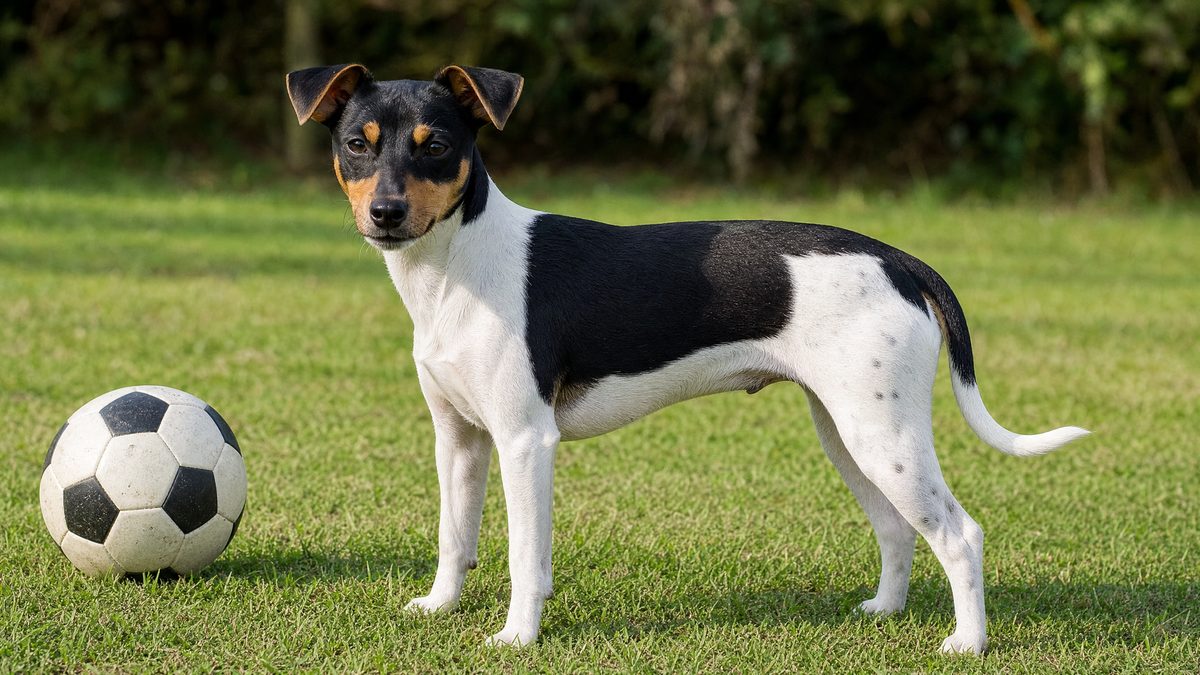
Quick answer
The Brazilian Terrier is a 10 kg short-coated terrier from Brazil, FCI standard 341, whose current standard describes a tail that is naturally short or long and never mentions docking. No Indian price exists and no lawful breeding import route exists either. Heat tolerance rates 3 out of 5, because São Paulo averages 19.6 °C a year, cooler than every Indian city measured.
This page summarises published veterinary research and breed-club screening data for general information. It is not a diagnosis and it is not treatment advice. Consult a registered veterinarian about your own dog before acting on anything here, and treat a rectal temperature at or above 41.0 °C as an emergency.
Brazilian Terrier at a glance
What the Brazilian Terrier is, and what the breed standard says
The Brazilian Terrier is a square, short-coated, 10 kg terrier from Brazil, recognised by the Fédération Cynologique Internationale as breed number 341 in Group 3, Section 1, Large and medium-sized Terriers, and it is one of only two Brazilian breeds the FCI recognises alongside the Fila Brasileiro.
FCI-341 sets the size precisely. Males stand 35 to 40 cm at the withers, females 33 to 38 cm, and weight is given as approximately 10 kg. The dog is described as square, meaning the body length from shoulder to the tip of the iliac is roughly equal to the height at the withers, with a firm but not heavy structure and clean curved lines. The head is triangular seen from above, the ears are set laterally and carried half-pricked with the folded tip falling towards the outer eye corner, and a fully erect ear is a disqualifying fault.
The coat is the part that matters most for an Indian reader. FCI-341 calls it short-haired, smooth, fine but not soft, laid close to the skin, and dense enough that you cannot see skin through it, finer on the head, ears, under the neck and on the inner forequarters. There is no undercoat in the description, and a thinning coat that shows the skin is listed as a fault. This is a genuine short coat, not a double coat pretending to be one.
Colour, and why the blue and isabella dogs matter
The ground colour is predominantly white with black, blue, brown or isabella markings, and the standard requires tan markings above the eyes, on both sides of the muzzle, and inside and on the edge of the ears. The head must always carry black, blue, brown or isabella markings in the frontal region and on the ears. In practice that produces a tricolour dog, which is how Google's own knowledge panel and the ranking pages describe it. Eye colour follows coat colour: the blue variety has bluish grey eyes, the brown variety brown, green or blue, and the isabella variety may add amber from light to dark.
The blue and isabella dogs are dilute, and dilution carries a specific skin risk covered in the grooming section. The Finnish breed club's breeding programme names colour dilution alopecia as a disease of the breed's blue and isabella dogs and notes it has also been seen in black tricolours.
History, and one recently corrected story
FCI-341 tells the origin story in two paragraphs. Young Brazilians studying in European universities in the 19th and early 20th centuries returned married, their wives brought small terrier-type dogs, the families went back to their farms, the little dog crossed with local dogs, and the phenotype fixed within a few generations; the move of farming families into the great urban centres then changed its environment a second time. That is why the breed is also called Fox Paulistinha, the little São Paulo fox, and why Wikipedia files it under Symbols of São Paulo.
A 2026 mitogenomic study is the first to test that story with sequence data rather than repeat it. Fontenelle and colleagues at the Federal University of Rio de Janeiro sequenced one pedigree-certified Brazilian Terrier and one Brazilian Mastiff, assembled their complete mitochondrial genomes, and found the Brazilian Terrier's closest mitogenomic matches were the Australian Shepherd, Miniature Dachshund, Rottweiler, Cairn Terrier and Shetland Sheepdog, not the Jack Russell Terrier the folk history names. The authors conclude the genetic origins of both Brazilian breeds are more complex than traditionally assumed, and they analysed a partial MLPH sequence in the Brazilian Terrier to document the coat-dilution variants. One dog is one dog, and the authors say so, but it is the only sequence evidence that exists.
| Item | What FCI-341 states |
|---|---|
| Breed number and group | 341, Group 3 Terriers, Section 1 Large and medium-sized Terriers, without working trial |
| Country of origin | Brazil |
| Official authentic language | English |
| Height | Males 35 to 40 cm, females 33 to 38 cm |
| Weight | Approximately 10 kg |
| Coat | Short-haired, smooth, fine but not soft, laid close to the skin |
| Tail | Naturally short or long, low set, not curled over the back |
| Utilisation | Hunting dog for small game, guard dog and companion |
| Disqualifying faults | Aggressive or overly shy, physical or behavioural abnormalities, flat croup, overshot or undershot bite, fully erect ear |
A Facebook post ranking on page one of Google India for brazilian terrier opens by describing a breed developed from Mastiffs, Bloodhounds and Bulldogs that guarded plantations. That is the Fila Brasileiro, the other FCI-recognised Brazilian breed, printed under a Brazilian Terrier headline. If a listing, a video or a social post describes a large guarding molosser, you are not reading about this dog.
The tail: what FCI-341 says, what the ranking pages say, and what Indian law says
FCI-341 as published on 28 September 2022 says the tail is "Naturally short or long", and the word docked does not appear anywhere in the document, which matters in India because tail docking is prohibited here.
The full clause reads: "TAIL : Naturally short or long. In the latter case it does not reach below the hock. Vigorous and low set, happily carried and, when long, in a gentle curve, not curled over the back."; Read the whole standard and you will not find docking, amputation, or a caudal vertebra anywhere in it. The croup entry independently confirms the natural set, describing a slightly sloping, well developed and muscled croup with a low set tail.
The three other official language versions say the same thing, which rules out a translation artefact. The German text reads "RUTE: Kann angeboren kurz oder lang sein", literally the tail can be congenitally short or long. The French reads "QUEUE : Naturellement courte ou longue";. Both then repeat the hock limit and the gentle curve. Congenitally is the operative word: the standard is describing a dog born short-tailed, not a dog cut short.
The 2007 standard did prescribe docking, and that is where the ranking pages are stuck
The superseded FCI-341 of 6 June 2007 reads very differently: "TAIL : In the country of origin customarily docked but it can be naturally short or long; in the latter case, it does not reach below the hock. Low set, short, docked at the joint between the second and the third caudal vertebra. Natural tail : Short, not reaching to hocks, low set, of good strength, carried gaily, not curled over the back."; That version made docking the default and the natural tail the alternative, and it specified the exact vertebra. The 2022 revision deleted the docking sentence entirely and promoted the natural tail to the only description.
This is the opposite of the pattern this site found on the Braque du Bourbonnais, where the standard still prescribes docking as the default and English-language pages dropped the natural-bobtail sentence. Here the standard moved first and the English-language pages did not follow. Wikipedia's Appearance section still states that "A docked tail, narrow chest, flat triangular skull and a well balanced body are the most common characteristics", a sentence carrying no citation on an article that has carried a needs-more-citations banner since December 2014. Dogbreedslist.info prints the same sentence almost word for word, and its only listed reference for the page is a YouTube video. One unsourced sentence, copied, is the entire English-language evidence that this breed is docked.
Tail docking is prohibited in India, and here is the clause
Paragraph 6(8) of the Second Schedule, Part II of the Prevention of Cruelty to Animals (Dog Breeding and Marketing) Rules 2017, notified as G.S.R. 496(E) on 23 May 2017, reads: "There shall be no tail docking, ear cropping de-barking, de-clawing, branding, dyeing, injecting substances to enhance visual appeal, performing a surgery or procedure to camouflage or hide any defect or infirmity or any other kind of mutilation of any body part of the pup and any change of appearance by artificial means is strictly forbidden."; The missing comma after "ear cropping" is in the gazette text as printed.
Say which numbering you are quoting, because this document numbers clauses twice. The Second Schedule is headed "[See rules 5(2) and 6]", Part II is headed "GENERAL REQUIREMENTS TO BE ADHERED TO BY BREEDERS", and the docking prohibition sits as sub-paragraph (8) under paragraph 6, Common breeding techniques. It is not Rule 8, which is a separate provision on conditions for sale.
A short tail on a Brazilian Terrier in India should be a natural bobtail or nothing. Since the current standard describes only the natural tail, a breeder has no standard-based reason to dock, and Indian law forbids it outright. If a seller offers a docked puppy, they have broken paragraph 6(8) and told you something about how they run the rest of their operation.
One line for anyone commissioning artwork, buying a puppy or writing about the breed in India. The correct picture of a Brazilian Terrier shows an undocked dog. Either a natural long tail carried low in a gentle curve and stopping above the hock, or a natural bobtail, and never a blunt surgical stump, because an undocked animal is the only version of this breed that may lawfully be bred and kept here.
The natural bobtail is real, it is a T-box mutation, and two bobtails must never be bred together
The Brazilian Terrier's natural bobtail is caused by the T-box transcription factor mutation in the T gene, the same C189G variant found across many short-tailed breeds, and because the homozygous state appears to be lethal the Finnish Kennel Club has banned bobtail to bobtail matings in this breed since 2008.
The Finnish breed club states the mechanism plainly. Mating two bobtailed (T-box mutation) dogs together is prohibited by Finnish Kennel Club board decision 7/08, and in Brazilian Terriers the bobtail is caused by the T-box mutation, with tail length varying from tailless to about two thirds of a normal tail as a result of the mutation. A dog described as merely short-tailed is therefore genotypically bobtail, and the club lists three forbidden combinations, bobtail to bobtail, bobtail to short, and short to short, requiring that where one parent carries the mutation the other must be genotypically long-tailed.
That rule comes from a real finding rather than caution. Hytönen and colleagues investigated the T gene mutation in 23 breeds beyond the Pembroke Welsh Corgi, covering 360 dogs of which 156 were naturally short-tailed. In the 17 breeds carrying C189G there was a perfect correlation between the mutation and the short-tail phenotype, six breeds carried neither C189G nor any other coding mutation in T, and no dog of any breed was found homozygous for C189G, which the authors read as evidence that the homozygous condition is lethal. They also measured the cost: in the Swedish Vallhund, litter size fell 29 percent when both parents were short-tailed. The underlying variant was first described in 2001, when the canine T-box transcription factor T was shown to fail to bind its DNA target, producing the short-tail phenotype.
How to tell a natural bobtail from a docked tail
Four checks separate the two, and the first is decisive.
- Run the gene test. A commercial test for the T-box mutation exists and the Finnish club recommends using it to establish genotype where the phenotype is ambiguous.
- Look at the whole litter. A T-box litter contains a spread of tail lengths from almost absent to two thirds normal, because the mutation does not produce one uniform stump. A docked litter is uniform, because the knife was.
- Feel for kinks. A dog with the natural bobtail mutation often has kinks in the tail too, since the same mutation that removes caudal vertebrae also deforms them; the club is explicit that tail kinks in natural bobtails are not the fault they would be in a long-tailed dog.
- Ask for the birth record. Under Indian law the breeder must keep a full record of every litter previously produced, so a breeder who cannot produce one has a second problem beyond the tail.
The bobtail is not entirely free of consequence
A 2026 Canadian Veterinary Journal study is the most recent attempt to price the natural bobtail, and its finding is worth carrying even though it studied other breeds. Berg and colleagues reviewed standardised ventrodorsal pelvic radiographs from 1,679 dogs screened through the Norwegian Kennel Club's hip dysplasia programme, 744 Brittany dogs and 935 Danish-Swedish Farmdogs, and looked for lumbosacral transitional vertebra alongside tail phenotype. Lumbosacral transitional vertebra prevalence was 47.8 percent in Brittany dogs and 14.9 percent in Danish-Swedish Farmdogs, while the natural bobtail phenotype occurred in 26.7 percent of Brittany dogs and 11.0 percent of Danish-Swedish Farmdogs. Bobtailed Brittanys had significantly increased odds of being positive for a transitional vertebra, with an odds ratio of 2.04 and a 95 percent confidence interval of 1.47 to 2.85, strongest in stump-tailed individuals; in Danish-Swedish Farmdogs the association was weaker and did not reach significance, at an odds ratio of 1.66 with a confidence interval of 0.99 to 2.76.
No equivalent study exists in the Brazilian Terrier, and this page does not borrow another breed's prevalence as if it were this one's. What the study establishes is that the T-box bobtail is a vertebral-development mutation with effects that do not stop at the tail, which is a reason for a buyer to prefer a long-tailed puppy where one is available and to ask what the breeder screens for.
The natural bobtail gives an Indian owner something valuable, a lawful way to own a short-tailed dog of this breed. A gene test on the parents settles the question in advance, and it also settles the legal one, because a documented T-box genotype is proof nothing was cut.
Who registers this breed, and how big the home studbook really is
The Brazilian Terrier is fully recognised by the FCI, registered in large numbers by the Confederação Brasileira de Cinofilia at home, recorded in the American Kennel Club's Foundation Stock Service since May 2023, and absent from any Indian registry route.
Read the FCI record directly and the dates are unambiguous. The nomenclature page for TERRIER BRASILEIRO (341) gives provisional acceptance on 10 March 1995, acceptance on a definitive basis on 21 May 2007, English as the official authentic language, publication of the official valid standard on 14 May 2022 and publication of the current standard document on 28 September 2022, with breed status recorded as Recognized on a definitive basis and no working trial. Confirming the breed name printed inside the returned document matters on this site, and the standard PDF itself is headed "FCI-Standard N° 341, TERRIER BRASILEIRO (Brazilian Terrier)";.
The FCI profile understates the home population badly, and this is the most useful thing this section can tell you. The CBKC's own studbook, sent to researchers in April 2022, contains 24,101 dogs born between 1978 and 2022, of which 12,517 were females and 11,584 were males, born across many Brazilian states and registered in every coat colour the breed permits. Those two figures add exactly to 24,101. Registrations peaked in 2021 at 1,235 dogs, the previous high being 1,129 in 2003, and the recent five-year average runs at about 860 dogs a year.
Set that against the CBKC's total output and the scale becomes readable. The CBKC registered 79,755 puppies in 2025 and has registered 3,915,969 pure-bred dogs since its studbook was created. At roughly 860 registrations a year the Terrier Brasileiro is about one percent of the Brazilian studbook, which is a small share of a very large registry rather than a rare breed at home. The breed also holds its own in the show ring: the CBKC's live national ranking carries a TERRIER BRASILEIRO class with five placed kennels, headed by Nutreal Fox on 465 points, and CBKC lists Terrier Brasileiro among the Group 3 Terriers whose standards it publishes.
The AKC and the Indian position
The American Kennel Club records the Brazilian Terrier in its Foundation Stock Service, which it entered in May 2023, and the AKC page reproduces the FCI measurements converted to imperial: males 13.7 to 15.7 inches, females 12.9 to 14.9 inches, weight 22 lbs, life expectancy 12 to 14 years. Those height figures are the FCI's 35 to 40 cm and 33 to 38 cm converted, and 22 lbs is 10 kg converted, so the AKC entry is not independent evidence of size. Foundation Stock Service is a recording service, not full recognition, so there is no AKC breed standard and no AKC conformation championship for this dog.
India has no route at all. The Kennel Club of India registered 32,219 puppies in 2025 and 1,425,001 pure-bred dogs since its studbook began, across 80 member clubs. Neither the KCI site nor dogsindia.com, the long-running Indian breed directory, returns a single mention of the Brazilian Terrier, and Mr n Mrs Pet, whose Labrador Retriever page publishes a city-by-city price table for eight Indian cities, returns a 404 for a Brazilian Terrier page. Absent a KCI-recognised breed club and absent any lawful commercial import route, no Indian pedigree pipeline can form.
| Registry | Status of the Brazilian Terrier | Scale of the registry |
|---|---|---|
| FCI | Recognised definitively since 21 May 2007, provisional from 10 March 1995, standard 341 | Global federation, standard published in four languages |
| CBKC, Brazil | National breed, 24,101 dogs in the studbook 1978 to 2022, about 860 registrations a year | 79,755 puppies registered in 2025, 3,915,969 since inception |
| AKC, United States | Foundation Stock Service since May 2023, no full recognition | Recording service only |
| Kennel Club of India | No listing, no breed club, no published standard found | 32,219 puppies registered in 2025, 1,425,001 since inception, 80 member clubs |
The gene pool: 24,101 dogs on paper, an effective population size of 35
The Brazilian Terrier's gene pool is the single most important fact about the breed, because the CBKC's own commissioned study found a mean inbreeding coefficient of 12.3 percent and an effective population size of 35, both of which sit in the range the FAO uses to describe populations at high risk of extinction.
The study is a final research report by Fabiana Michelsen de Andrade, a geneticist at UFRGS, produced with CBKC support and published in the CBKC's own technical library in September 2023. It analysed the studbook the CBKC supplied in April 2022, covering 24,101 dogs born from 1978 to 2022; birth dates were available for 23,272 of them after 83 impossible dates were deleted and 829 dogs were found to have no date at all.
Inbreeding
Mean inbreeding across the whole population was 0.123, or 12.3 percent. The report compares that with published values for other breeds from the same kind of pedigree data and the gap is large: 2.4 percent for the English Labrador Retriever, 3.5 percent for the English Golden Retriever, 3.3 percent for the English German Shepherd, and 7.3 percent for the English rough Collie, against 12.3 percent here. Among Brazilian populations the same group found 0.80 percent in one German Shepherd registry and 17.1 percent of dogs inbred in the Brazilian Labrador, against 83.8 percent of Brazilian Terriers carrying an inbreeding coefficient above zero.
The reference population, meaning the 6,771 dogs born in the last seven years who are plausibly still breeding, is worse rather than better. Mean inbreeding there is 15.8 percent, peaking at 17.3 percent in 2020, more than 90 percent of current breeding dogs are inbred, every dog born in 2022 had an inbreeding coefficient above zero, and the proportion above the 10 percent welfare threshold ran between 70 and 90 percent across 2015 to 2022. Five dogs in the studbook exceeded 50 percent, which the report calls typical of populations heading for extinction.
Effective population size
Effective population size measures the genetic size of a population rather than its head count, and the FAO treats values below 100 as threatened and below 50 as high extinction risk. The report's year-by-year figures for the total population run 69 in 2018, 48 in 2019, 19 in 2020, 19 in 2021 and 20 in 2022, a five-year mean of 35 against a mean of about 860 registrations a year. Those five values do sum to 175, and 175 divided by 5 is 35, so the arithmetic checks out. For the reference population the figures are 39, 32, 38, 42 and 56, averaging 41.4 against about 846 registrations a year.
| Parameter | Whole population | Reference population, last 7 years |
|---|---|---|
| f, real number of founders | 1,004 | 219 |
| fe, effective number of founders | 63.7 | 32.8 |
| fa, effective number of ancestors | 50.7 | 10.9 |
| f divided by fe, loss of founder genetics | 15.76 | 6.7 |
| fe divided by fa, bottleneck indicator | 1.25 | 3.0 |
Read the last row first. A ratio near 1 means no bottleneck, and the reference population's 3.0 against the whole population's 1.25 means the bottleneck has tightened recently, not eased. The concentration figures make it concrete: one male born in 1996 accounts for 7.3 percent of the whole breed's genetics, five dogs account for 25 percent, and 21 dogs account for half the genetic variability of a studbook holding more than 20,000 animals. In the reference population only four dogs account for that same half.
Two further findings belong in a buyer's head. Since 1994 fewer than 25 percent of dogs born each year have been bred from, against an ideal near 50 percent, which the report says is probably driving significant loss of genetic material. And 1,117 females produced more than four litters, with 28 producing more than ten across their lives, a number the report itself calls alarming. Note that Indian law would prohibit that pattern outright: Second Schedule Part II para 6(4) of the 2017 Rules bars mating a female after eight years of age, and Part II paragraph 5(3) forbids producing litters in two consecutive breeding seasons.
A puppy imported to India comes from this population, not from a separate one. The right questions to a breeder are the inbreeding coefficient of the proposed mating, the MPS VII genotype of both parents, and whether either parent carries the T-box bobtail. All three are answerable in writing before money moves.
Brazilian Terrier price in India: there isn't one, and here is the proof
No Indian puppy price exists for the Brazilian Terrier, because no Indian seller stocks the breed, and every rupee figure that surfaces against the name belongs to a T-shirt, a doormat, a DNA kit or an auto-generated dropdown menu.
Start with the searches, and with the control, because an absence is only evidence if the search worked. A location-restricted search for price in India terms against this breed returned no Indian listing page for it. The same tool, in the same session, run on labrador retriever puppy price in india returned a full Mr n Mrs Pet page publishing INR 30,000 to INR 1,20,000 for a Labrador, broken into basic quality at INR 30,000 to 60,000, KCI registered at INR 60,000 to 90,000, champion bloodline at INR 90,000 to 1,20,000, and a city table covering Hyderabad, Bangalore, Delhi, Chennai, Lucknow, Mumbai, Jaipur and Pune. The control returns a priced page. The breed query does not. That is a real absence.
The same site's Brazilian Terrier URL returns a 404. Mr n Mrs Pet publishes per-breed price pages for the Labrador and the Yorkshire Terrier, so the template exists; it simply has no page for this dog. Google's own India SERP for the breed reported about 144 results for the entire query.
Every rupee figure that does appear, and what it is actually attached to
Searching the breed name together with the rupee sign returns nine results and not one is a dog. The list runs to an Etsy Brazilian terrier mom shirt at Rs 2,211, an easyDNA India breed test at Rs 12,600 whose panel happens to include the breed, an Amazon India doormat at a list price of Rs 13,619 whose product description carries an A to Z breed list, a Bookswagon title at Rs 975, a Goofy Tails terrier blog with an empty cart showing Rs 0.00, and three social posts. ThePetNest's dog-training pages for Ahmedabad and Kochi and its rehoming page all carry the breed inside an alphabetical dropdown that runs Brazilian Terrier, Briard, Brittany, Broholmer, Bruno Jura Hound, which is a form control rather than an inventory.
One sentence recurs across the social results and deserves naming: "Brazilian Terrier Lively and alert, perfect for active households in tropical climates." It appears verbatim on a Facebook post headed Top 8 Most Popular Dog Breeds in India, on an Instagram collection headed Cheapest Dog Breeds In India, on another headed Expensive Dog Breeds In India, and on a third post about countries with the highest dog populations. The same line cannot describe both the cheapest and the most expensive breeds in India. It is syndicated filler, and its climate claim is examined and rejected later on this page.
Run both conversion tests before you believe any rupee figure
This site divides suspicious Indian prices by 84.38 and by 74, because Indian pages routinely publish a dollar price run through one exchange rate. There is nothing here to divide, which is the point, but the arithmetic still tells you what a fabricated Indian price for this breed would look like. The only published international figure is dogbreedslist.info's average of USD 800 to 1,000, with the note that a puppy costs about USD 800 from a decent breeder of pet-quality dogs.
| Published USD figure | Divided at 84.38 | Divided at 74 |
|---|---|---|
| USD 800 | Rs 67,504 | Rs 59,200 |
| USD 1,000 | Rs 84,380 | Rs 74,000 |
| Rs 98,999, the recurring house figure | USD 1,173.25 | USD 1,337.82 |
Rs 98,999 has now been caught on eleven pages of one Indian listing site, attached to whichever puppy is in stock rather than to any breed, and it appears on pages for breeds that site does not stock at all. It divides to 1,173.25 dollars at 84.38 and 1,337.82 at 74, neither of them a round dollar amount, so it is not even a conversion. It is a rupee-native charm price. Never accept Rs 98,999 as this breed's price, or as any breed's price.
Ask for the KCI registration number, the parents' pedigree, and the DGFT import authorisation under which the parents entered India. There is no lawful commercial breeding import route for dogs into India, so a genuine Indian-bred litter of this breed would need documented parents who arrived as somebody's personal pets. Nobody has produced that documentation.
The only lawful way this dog reaches India, read from the trade notice itself
One lawful route exists, and it is a personal pet arriving with its owner: DGFT Trade Notice No. 22/2022-23 of 19 December 2022 classifies live dogs as a Restricted import and states that applications for trading or breeding purposes shall be duly rejected.
The trade notice sets the tariff line first. Live dogs fall under ITC(HS) 01061900, Mammals, Other, with an import policy of Restricted, subject to Policy Condition 6 of that chapter. Policy Condition 7 then permits the import of dogs for exactly three purposes: a pet dog with a valid pet book and relevant records in the name of the importer, dogs imported by research and development organisations with a CPCSEA recommendation, and dogs for internal security by the Defence and Police forces. Policy Condition 8 adds that import of commercial dogs for breeding or any other commercial activity outside those purposes is not permitted, and paragraph 6 of the notice repeats that applications for trading or breeding purposes, or made on behalf of another person or entity, shall be duly rejected.
That is why there is no Brazilian Terrier market in India, and no lawful way to start one. Even a well-intentioned Indian breeder cannot import a founding pair, because importing dogs to breed from is the exact application the notice rejects.
What a private import actually involves
Six specific requirements shape the process, and the timeline is the one people miss.
- Establish the route. Up to two pets enter as passenger baggage without DGFT authorisation only for a person transferring residence to India after two years of continuous stay abroad; authorisation is required if the stay was under two years, if the pet does not travel as baggage, or if more than two animals are involved.
- Start early. The notice advises owners to begin the import authorisation application at least two months before travel.
- File under ANF-2M. The application goes through the DGFT portal under Import Authorisation of Restricted Items, against the applicant's own Importer Exporter Code or the standing personal-use IEC IIHIE0153E.
- Carry the documents. A vaccination book, pet passport or pet book, a certificate for emotional support and the pet's passport are listed as mandatory for a permanent import.
- Enter through one of seven ports. Entry is allowed only through the airports and seaports of Delhi, Mumbai, Chennai, Hyderabad, Bengaluru and Kolkata and, since October 2024, Kochi airport, with quarantine at the government station where required Department of Animal Husbandry…. The full route is set out in how to import a dog to India.
- Obtain the advance NOC. A No Objection Certificate from the Regional or Quarantine Officer of the AQCS must be obtained seven days before travel, relaxable to three days, after submitting the DGFT licence and the exporting country's veterinary health certificate, with all disease testing done in the exporting country.
Set that against the purchase price and the arithmetic answers itself. The dog itself sits at USD 800 to 1,000 in the only published band, which converts to roughly Rs 67,500 to Rs 84,400 at 84.38. Long-haul airfreight for a crated 10 kg dog, export testing, quarantine and the paperwork comfortably exceed that. The transport, not the terrier, is the expensive part.
If you are already moving to India from a country where the breed exists, and you already own the dog, this is a straightforward if slow process. If you are in India and want to buy one, there is no route that does not depend on somebody else's transfer of residence, and anyone telling you otherwise is describing something the trade notice says will be rejected.
What a Brazilian Terrier costs to keep in India each month
No verified Indian cost survey exists for this breed, so this section prices the dog by what it is, a 10 kg short-coated terrier, and names every figure's source rather than inventing a monthly total.
Say the limitation first. Bonbeno has found no Indian veterinary practice, retailer or owner survey publishing running costs for a Brazilian Terrier, because there is no Indian population to survey. Quoting a rupee-per-month total here would be invention. What can be priced honestly is the cost structure, and one Indian figure that genuinely exists.
The one Indian rupee figure that is real
EasyDNA India sells a KnowYourDog Genetic and Breed Test at Rs 12,600, and its panel of more than 400 breeds includes the Brazilian Terrier by name. The array analyses around 700,000 markers, covers single-gene disease detection, and reports physical traits including short tail, with results in four to six weeks. For this breed specifically a broad panel is not a novelty purchase. It is the cheapest way to verify what you actually have, and it is the tool that separates a natural bobtail from a docked one.
The cost structure, item by item
| Item | Frequency | What sets the cost, and the source |
|---|---|---|
| Food | Monthly | Body weight. At approximately 10 kg this is a small-breed feeding load, roughly a quarter of what a Labrador eats |
| Core vaccination and deworming | Annual and quarterly | Indian law requires every dog to be provided the vaccinations and de-worming necessary for mental and physical health |
| Tick and flea prevention | Monthly, year round | Tick-borne haemoparasites are common in Indian dogs; a Punjab survey of 719 dogs found Babesia gibsoni in 8.9 percent by PCR |
| Genetic screening | Once | Rs 12,600 for a 400-plus breed panel including this breed |
| MPS VII carrier test | Once, on the parents | A specific test exists because a GUSB variant segregates in the breed |
| Grooming | Weekly, at home | A short coat needs a rubber curry and nothing else; professional grooming is optional |
| Air conditioning or cooling | Seasonal | Set by your city's summer, examined in the climate section |
| Import and quarantine | Once, if applicable | DGFT authorisation, seven permitted ports, AQCS NOC and quarantine Department of Animal Husbandry… |
Three things push the total up in India and one pushes it down. Tick prevention is a year-round cost here rather than a seasonal one, cooling is a real line item in Delhi or Chennai, and any imported dog carries a one-off transport bill that dwarfs its purchase price. Against that, the coat costs almost nothing: a short coat with no undercoat needs no clipper, no de-shedding appointment and no monthly salon visit.
For this breed the highest-value spend is diagnostic rather than cosmetic. A parental MPS VII test and a T-box genotype cost less than one emergency abdominal ultrasound and answer the two questions that actually determine whether a litter is sound.
The nearest honest benchmark, a same-size terrier that India does sell
Since no Indian figures exist for this breed, the closest legitimate anchor is the Jack Russell Terrier, a terrier of similar drive and slightly smaller size that India does sell. An Indian retailer publishes monthly food at Rs 1,200 to Rs 1,800, veterinary care at Rs 300 to Rs 750 a month excluding emergencies, and grooming at Rs 700 to Rs 1,200, alongside a purchase band of Rs 20,000 to Rs 35,000 rising to Rs 40,000 or Rs 50,000 for champion bloodlines. A Brazilian Terrier is a few centimetres taller, so food sits at the upper end of that band and grooming sits below it, because a short coat needs no salon.
Those Jack Russell figures pass both conversion tests, which is worth showing because it demonstrates the tests working in the affirmative. Rs 20,000 divided by 84.38 is 237.02 dollars and divided by 74 is 270.27, while Rs 35,000 gives 414.79 and 472.97. None of the four is a round dollar amount, so this is a rupee-native price list written by somebody in India rather than an American list run through one exchange rate.
Heat tolerance: the origin climate is milder than almost every Indian city
The Brazilian Terrier rates 3 out of 5 for heat tolerance in India, because its conformation is genuinely favourable but its home climate is not tropical: São Paulo sits at 790 m with an annual mean of 19.6 °C, which is 8.3 °C cooler than Chennai.
This is the rating most likely to be over-claimed, so start with the evidence rather than the intuition. A short-coated terrier from Brazil sounds heat-adapted, and one syndicated Indian social-media line says exactly that, calling the breed perfect for active households in tropical climates. The breed's actual home is not a tropical climate.
Every figure below comes from a single source on a single methodology, NASA POWER's 2001 to 2020 monthly climatology, queried by explicit latitude and longitude so no place can be substituted for another. Each response returns the coordinates and elevation it answered for, which is the internal check: São Paulo came back at 790 m, Goiânia at 807 m, Belo Horizonte at 1,000 m and Bengaluru at 842 m, all correct for those cities, so the points are right.
| City | Annual mean air temp | Hottest month mean | Peak monthly max | Peak wet-bulb temp | Annual RH percent |
|---|---|---|---|---|---|
| São Paulo, Brazil, 790 m | 19.6 | 22.4 in February | 38.6 | 20.7 | 80 |
| Porto Alegre, Brazil | 19.3 | 24.6 in February | 39.4 | 22.3 | 82 |
| Belo Horizonte, Brazil, 1,000 m | 20.2 | 22.3 in October | 37.6 | 19.9 | 74 |
| Goiânia, Brazil, 807 m | 23.1 | 26.3 in September | 41.5 | 21.6 | 69 |
| Rio de Janeiro, Brazil | 23.3 | 25.8 in February | 37.9 | 24.1 | 81 |
| Bengaluru, India, 842 m | 23.7 | 28.4 in April | 40.4 | 22.7 | 68 |
| Pune, India, 636 m | 23.9 | 28.9 in April | 43.2 | 23.6 | 67 |
| Delhi, India | 25.6 | 35.9 in June | 48.8 | 27.7 | 46 |
| Kolkata, India | 25.8 | 31.5 in May | 46.8 | 27.9 | 74 |
| Hyderabad, India | 26.1 | 33.3 in May | 45.0 | 24.4 | 60 |
| Mumbai, India | 26.8 | 31.2 in May | 44.9 | 26.6 | 67 |
| Ahmedabad, India | 27.6 | 35.1 in May | 48.6 | 27.6 | 48 |
| Chennai, India | 27.9 | 31.5 in May | 42.7 | 27.4 | 72 |
| Helsinki, Finland | 6.4 | 17.6 in July | 27.9 | 15.8 | 86 |
What the table actually says
Three readings matter. São Paulo is cooler than every Indian city in the table, by 8.3 °C against Chennai on annual mean and by 9.1 °C on hottest-month mean, 22.4 against 31.5. Two of the breed's three main breeding regions, São Paulo and Belo Horizonte, sit at 790 m and 1,000 m, so altitude is doing the work. The third, Rio Grande do Sul, is cooler still in winter: Porto Alegre's July mean is 13.6 °C.
The second reading is the wet-bulb column, and it is the one that matters for a panting animal. A dog sheds heat by evaporating water from its airways, and evaporation slows as wet-bulb temperature rises. São Paulo's peak monthly wet-bulb is 20.7 °C. Chennai's is 27.4 °C, Delhi's 27.7 °C and Kolkata's 27.9 °C. That is a 7 °C gap in the exact variable that determines whether panting still works.
The third reading is the one that saves the rating from being simply bad. Bengaluru at 23.7 °C and Pune at 23.9 °C sit almost exactly where Goiânia at 23.1 °C and Rio de Janeiro at 23.3 °C sit. Brazilian Terriers are bred in both those Brazilian cities. So this breed does live, work and reproduce in a climate equivalent to the Deccan plateau. It does not live in a climate equivalent to coastal Chennai or a Delhi June.
What the dog itself brings
Four conformational points count in the breed's favour, and they are why the rating is 3 rather than 2. The muzzle is a truncated cone that tapers gradually, so this is a mesocephalic dog with a full airway rather than a brachycephalic one. The coat is short, fine and close-lying with no undercoat described. Body mass is about 10 kg, giving a high surface-area-to-mass ratio. And the build is lean and muscular rather than heavy, so there is little insulating fat.
Against that, a single-coated white-ground dog carries a real sunburn risk on thin-coated areas, and the standard's own colour description puts white over most of the body. The breed is heat-tolerant relative to a Golden Retriever and heat-sensitive relative to a Rajapalayam, and both halves of that sentence are true at once.
Bengaluru, Pune, Shillong and the hill stations: comfortable, comparable to Goiânia. Hyderabad and inland Maharashtra: workable with a summer routine. Chennai, Mumbai and Kolkata: manageable only with air conditioning and a hard rule against midday exercise, because the wet-bulb gap against São Paulo is about 7 °C. Delhi and Ahmedabad in May and June: this dog should not be outdoors between 10am and 5pm.
The summer routine that actually prevents heatstroke
Exercise, not a parked car, is what kills dogs in the heat, so the single highest-value change an Indian owner makes is moving this terrier's walks and its games to the cool ends of the day.
The evidence for that is unusually clean. Hall, Carter and O'Neill reviewed the de-identified primary-care records of 905,543 UK dogs in 2016 through the VetCompass programme and identified 1,259 heat-related illness events in 1,222 dogs. Exertional heat-related illness was the predominant trigger at 74.2 percent of the 879 events where a cause was recorded, environmental heat accounted for 12.9 percent, and confinement in a vehicle for 5.2 percent. The odds of death after vehicular heat illness were statistically similar to those after exertional heat illness, with an odds ratio of 1.47 that did not reach significance at p equal to 0.492. In other words, the dog that dies is usually the one that was running, not the one in the car.
Two risk patterns from the same study transfer directly. Young male dogs had greater odds of exertional heat illness, and older dogs and those with respiratory compromise had the greatest odds of environmental heat illness; brachycephalic dogs had greater odds of all three types compared with mesocephalic dogs. A Brazilian Terrier is mesocephalic, which removes the largest single risk multiplier, and it is a young, high-drive, male-skewed exercise risk, which restores much of it.
The temperature that changes the plan
A 2026 revision of the VetCompass clinical grading tool, validated on 422 emergency heat-illness cases treated during 2023 after evaluation on 364 cases from 2022, added a new critical temperature criterion of 41.0 °C or above to both the Moderate and Severe grades, and moved dyspnoea from Mild to Moderate. The revised tool discriminated fatal outcomes better than the original, with an area under the ROC curve of 0.79 and a 95 percent confidence interval of 0.74 to 0.84, against 0.72 for the original. A rectal temperature of 41.0 °C or higher, or laboured breathing that does not settle, is an emergency, not a wait-and-see.
The routine
- Walk before 7am and after 7pm from March to June in Delhi, Ahmedabad, Chennai and Kolkata, where the hottest-month mean sits between 31.5 and 35.9 °C.
- Test the pavement with the back of your hand for five seconds before every walk; a Chennai May afternoon reaches a monthly maximum of 42.7 °C air temperature and asphalt runs far hotter.
- Move the terrier games indoors in summer, because scentwork, a flirt pole in an air-conditioned room and food puzzles satisfy the same drive without the exertional load that caused 74.2 percent of heat illness events.
- Wet the dog rather than the floor, soaking the coat through to the skin, since a short coat with no undercoat lets evaporative cooling reach the body instead of sitting on top of it.
- Watch the humid months separately, because Mumbai in June and Pune in July run relative humidity near 80 to 90 percent, and panting works badly there even when the thermometer looks moderate.
One more thing follows from the coat. Never shave a Brazilian Terrier to cool it down. The standard describes a coat dense enough that skin does not show through, and a thinning coat that reveals skin is listed as a fault, which tells you the coat is doing a job. Removing it on a predominantly white dog exposes thin skin to Indian sun.
Overseas breed pages describe an outdoor farm terrier that patrols all day. That description was written for a São Paulo winter where the July mean is 15.9 °C. In an Indian May the same routine is the exertional pattern that VetCompass found in three quarters of heat illness cases. Keep the drive, move the hours.
Temperament and household fit, including who should not buy one
FCI-341 describes the temperament in nine words, "Restless, alert, active and keen; friendly and gentle to friends, suspicious of strangers", and every practical consequence for an Indian household follows from that last clause.
The standard is unusually direct here, and it treats character as a health matter: aggressive or overly shy dogs are a disqualifying fault, as is any dog clearly showing physical or behavioural abnormalities. The Finnish breed club expands the working brief. Because the Brazilian Terrier was originally a working terrier it must be tough, persistent and brave, and capable of independent work such as ratting or hunting small game; guard-dog sharpness belongs in the character, but the dog must not be too sharp, must not go for a perceived threat, and should guard and defend by barking only.
The club's owner health surveys asked about sociability with people and with dogs, cheerfulness, timidity, reserve, nervousness, aggression, fearfulness and trainability. Most dogs came back social with both people and dogs while also reserved, cheerful and quick to learn, but the surveys and show critiques both found timidity, fearfulness and some aggression in the population, and the club names those as traits breeders must watch. That is a breed club publishing its own weak spot, which is worth more than a marketing page saying the breed is perfect with everyone.
The prey drive is the deciding factor in an Indian home
This is a ratting terrier and the drive is not decorative. Its hunting instinct is described as the strongest among average terriers, and the breed is explicitly not to be trusted with other small animals. In Brazil the breed is still used to hunt armadillo, quail and cavy, and is valued as a ratter and a herder. An Indian household with a rabbit, a hamster, budgerigars or a free-roaming cat should read that as a hard constraint rather than a training project.
Barking, and what that means for apartment living
Apartment living is possible for this breed and it is not easy. The dog is a barking guard by design, and one ranking source rates it two stars out of five for apartment friendliness, noting it is very active indoors and does best with at least an average-sized yard. Indian flats put a suspicious-of-strangers terrier within earshot of a lift lobby, a corridor and a stairwell, which is a doorbell every few minutes. The dog can be taught what to ignore, but a household that cannot tolerate a vocal dog for the first year should choose differently.
| Household | Verdict | Why |
|---|---|---|
| Active family with children over eight, house with a yard | Good fit | Affectionate and gentle with its own people, high play drive, robust for its size |
| Flat with a working couple, dog alone 9 hours | Poor fit | Restless and active by standard description; separation and barking both worsen |
| Home with small pets | Not recommended | Strongest prey drive among average terriers, not to be trusted with small animals |
| First-time owner wanting a calm companion | Poor fit | Needs a consistent handler or becomes wilful and determined |
| Sport or agility home | Excellent fit | Suited to agility, obedience, tracking and rubble search, and Brazil fields a world championship agility team with the breed |
| Toddler household | Handle with care | Spirited nature suits older children who understand gentle handling |
One point on strangers deserves its own line, because Indian homes are busier than the ones this breed was bred for. A house with a daily cook, a maid, a driver, a milk delivery and a security guard presents a suspicious-of-strangers dog with five novel humans a day. Socialise deliberately for that: have each regular visitor feed the puppy by hand during its first sixteen weeks, and the dog learns the household staff are family rather than intruders.
Buy this breed if you want a small, clever, vocal dog that treats your family as its pack and everyone else as a question, and if you have the time to answer that question for it several hundred times.
One word the ranking pages reach for is worth testing. The breed is repeatedly called hardy, and for a 10 kg dog that is broadly fair: it is a farm-bred ratter with a sound muzzle, moderate angulation and no exaggerated feature, and one care guide summarises it as energetic, alert and quick to learn with a need for regular mental and physical stimulation. Hardy does not mean unbreakable, though. A hardy dog with a one-third carrier rate for a lethal recessive and an inbreeding coefficient of 12.3 percent is hardy in build and fragile in pedigree, and only the second of those two facts costs money.
Training: highly trainable, genuinely independent, and what the breed resists
The Brazilian Terrier is one of the more trainable terriers, learning commands and tricks fast enough that Brazil used it as a circus dog, but it was bred to work independently and it resists repetition, harshness and anything that looks pointless.
The intelligence is documented rather than claimed. The AKC records that the breed was used for a long time as a circus dog because of its intelligence and trainability, and that it has been honoured with a Brazilian Post postage stamp. The Finnish club reports the dogs as very quick to learn and agile, well suited to agility, and notes that Brazil fields a world championship agility team with the breed; obedience trials, tracking trials and rubble search all suit it, and the only formal limit in Finland is that the breed has no service-dog trial rights. Brit's breed catalogue describes a very lively, vivacious, extremely clever and agile dog with a sovereign bearing typical of terriers.
The independence is the other half. A working terrier bolting a rat under a Brazilian farm building was rewarded for deciding things by itself, and that circuitry does not switch off for a sit-stay. Without a firm, consistent and confident handler this breed becomes wilful and determined.
What works, in order
- Train in short sets. Three sessions of four minutes beat one of twelve, because a keen and restless dog by standard description switches off before a long session ends.
- Pay in food, early and often. Hand-feed the day's ration through training in the first six months rather than putting it in a bowl.
- Give the drive a legal outlet. Flirt pole, scentwork boxes and a dig pit convert ratting instinct into a behaviour you control instead of one that finds your sofa.
- Proof the recall against motion. A dog with the strongest prey drive among average terriers will not recall off a squirrel unless you paid for that specifically.
- Teach a quiet cue from week one. Reward silence after two barks rather than punishing the barking, because the alarm bark is what the breed was kept for.
What it resists
Four things reliably fail with this breed. Repetition past the third rep, because the dog decides it has answered. Correction-based handling, because a dog with guard sharpness that is also capable of timidity, per its own club's surveys, becomes either defensive or shut down. Training in Indian afternoon heat, because a session at 35 °C is exertion and exertion caused 74.2 percent of heat illness events in the largest study available. And any plan that assumes the dog will simply grow out of barking at the doorbell.
Realistic timelines
| Age | Realistic milestone |
|---|---|
| 8 to 16 weeks | Name, sit, hand target, crate, and 30-plus positive introductions to household staff and visitors |
| 4 to 6 months | Reliable recall in a closed space, loose lead in a quiet lane, quiet cue emerging |
| 6 to 12 months | Adolescent regression arrives; recall around distractions gets worse before it gets better |
| 12 to 18 months | Recall proofed around motion, and the dog is ready for agility foundation work |
| 18 months plus | Competition-capable in agility, obedience or scentwork if the foundation was laid |
Move all outdoor training to before 7am and after 7pm from March to June. Indoor scentwork in an air-conditioned room is not a compromise for this breed, it is a better use of its brain than another lap of the colony road.
Daily exercise requirement, and what happens when it is not met
Plan on 60 to 90 minutes of real activity a day split across two or three sessions, because this breed rates four out of five for exercise needs and becomes destructive and restless when kept indoors without an outlet.
The requirement is set by what the dog is rather than by its size. FCI-341 opens the temperament description with "Restless, alert, active and keen", and describes the movement as elegant, free, short and quick. Ranking sources rate exercise needs at four stars out of five and note that the breed needs both physical and mental activity, that long daily walks are the best option, and that a common tendency is becoming destructive and restless if kept indoors. The Finnish club's list of suitable activities is the practical version: agility, obedience trials, tracking trials and rubble search.
The split that works in India
- Morning, before 7am, 30 to 40 minutes. A brisk walk with sniffing time, plus five minutes of recall or trick work at the end.
- Midday, indoors, 10 to 15 minutes. Scentwork with three boxes, a snuffle mat or a food puzzle, all of which tire a terrier faster than a walk does.
- Evening, after 7pm, 30 to 40 minutes. Off-lead in a secure space if you have one, or a long line and a flirt pole if you do not.
- Twice a week, add a problem. A dig pit, a new scent trail or an agility tunnel gives the independent working brain something to solve.
Note what is missing from that list. Long-distance running alongside a bicycle in an Indian summer is exactly the exertional pattern that produced 74.2 percent of heat-related illness events in a study of 905,543 dogs, and young male dogs carried the greatest odds of it. A 10 kg dog with a high surface-to-mass ratio loses heat well at 22 °C and badly at 35 °C, and Delhi's June mean is 35.9 °C.
What under-exercise looks like
Four behaviours show up first, and all four are commonly misread as disobedience. Digging at the sofa or the balcony pots, which is a ratting terrier working with no rats. Barking at every corridor noise, because an unspent guard dog raises its threshold detection downwards. Chewing skirting boards and shoes. And a recall that gets steadily worse, because the walk stopped being interesting enough to compete with anything else.
Indian monsoon weeks remove outdoor exercise for days at a time in Mumbai, Pune and Kochi, where June to September relative humidity runs 80 to 91 percent. Have an indoor programme ready before the rain starts, because a restless terrier with four days of unspent energy is where the destructive behaviour begins.
Grooming a short coat in Indian humidity
Grooming this breed takes five minutes a week with a rubber curry brush, and the real work in India is not the coat at all: it is ticks, ears, and the skin risk that comes with the dilute coat colours.
The coat is genuinely low-maintenance. FCI-341 describes it as short-haired, smooth, fine but not soft and laid close to the skin, and the AKC rates grooming needs accordingly American Kennel Club. A weekly rubber curry in the direction of the coat lifts dead hair, and that is the whole routine. Never shave this dog for the heat, because the standard treats a thinning coat that shows skin as a fault, which tells you the coat is protecting something.
Colour dilution alopecia, and why the blue and isabella dogs need watching
The standard permits black, blue, brown and isabella markings, and the two dilute colours carry a specific risk. The Finnish breed club describes colour dilution alopecia in the breed as a colour-linked skin disorder affecting dogs with dilute colours, blue and isabella: affected dogs are born normal, and from around two to three years of age the skin becomes scaly and the coat thins in patches, particularly over the back and flanks, with small papules appearing from secondary bacterial infection and hair regrowing poorly over the years. White and tan areas stay normal and only the diluted areas are affected; the club notes the disease also occurs in black tricolours and cannot be ruled out in brown tricolours, and that diagnosis is confirmed by skin biopsy.
That interacts badly with Indian conditions. Scaly, thinning, secondarily infected skin in 80 percent relative humidity is a harder problem than the same skin in a São Paulo winter. If you are choosing between a blue puppy and a tricolour puppy for an Indian home, the tricolour is the lower-risk choice.
Ticks, ears and monsoon humidity
Tick control is the highest-value grooming task in India and it belongs in the weekly brush. A multiplex PCR survey of 719 dogs in Punjab found Babesia gibsoni in 8.9 percent, Hepatozoon canis in 5.1 percent, Ehrlichia canis in 2.6 percent and Babesia vogeli in 1.1 percent, all tick-transmitted. An earlier study by the same group on 200 dogs found Hepatozoon canis in 23.5 percent by PCR against 1.0 percent by microscopy, which is the more useful number for an owner: microscopy misses most of it. Run your fingers over the ears, between the toes, under the collar and in the groin every week.
The ears need a different rule from a drop-eared breed. This dog's ears are carried half-pricked with only the folded tip falling down, so the canal is partly open rather than sealed. That is an advantage in monsoon humidity, and it is not a licence to ignore them. Dry the ear flaps after every bath and after any swim, and never flush a canal with water. Overseas grooming guides that say to towel a dog and let it air dry were written for temperate climates; in an Indian monsoon, dry the dog properly instead.
The hypoallergenic question, answered
No dog breed is hypoallergenic and this one is not either. Vredegoor and colleagues measured Can f 1 across 196 dogs of so-called hypoallergenic breeds against 160 control dogs and found the hypoallergenic group came back higher, not lower, at 2.26 against 0.77 micrograms per gram in hair and 27.04 against 12.98 in coat, with no difference in airborne allergen; the authors concluded there is no evidence for the classification of certain dog breeds as hypoallergenic. FCI-341 says nothing about shedding at all. A short coat is easier to clean up after. It is not an allergy solution.
Rubber curry over the whole body, tick sweep of ears, toes, collar line and groin, a look at the eyes for stray lashes, a nail check, and a glance at the flanks of any blue or isabella dog for early scaling. That is the entire grooming programme for this breed in India.
Health risks, screening and life expectancy, with the denominators
One inherited disease dominates this breed's health picture, mucopolysaccharidosis VII, and it is worth knowing that almost a third of the population carries the mutation and that a genetic test exists to keep two carriers apart.
Mucopolysaccharidosis VII, the breed-defining disease
Hytönen and colleagues at the University of Helsinki described the disease in the Brazilian Terrier in PLoS One in 2012. Affected puppies presented severe skeletal deformities within the first month of life, and radiographic and histological work identified delayed ossification and spondyloepiphyseal dysplasia. Pedigree analysis suggested an autosomal recessive disorder, and a genome-wide association study using 22K SNP arrays in seven cases and eleven controls found a single association near the centromeric end of chromosome 6 with genome-wide significance after permutation at p equal to 0.033, the affected dogs sharing a 13 Mb homozygous region containing more than 200 genes.
Targeted next-generation sequencing of that locus revealed a fully segregating missense mutation, c.866C>T, causing a p.P289L change in a conserved functional domain of beta-glucuronidase, GUSB. The mutation was confirmed in a population of 202 Brazilian Terriers at p equal to 7.71 times ten to the minus 29, and the authors note that MPS VII currently lacks an efficient treatment and that, since almost one third of the Brazilian Terrier population carries the mutation, breeders benefit from a genetic test.
The Finnish breed club puts the carrier rate at 25 to 30 percent of the Finnish population and sets the breeding rule: two carriers must never be mated, and a carrier must not be removed from breeding, because removing a quarter of the dogs from a breed with this gene pool would narrow it further. The club maintains a worldwide list of MPS-tested dogs and of dogs free by descent. Affected puppies show small stature, an abnormal brachycephalic skull shape and failure of limb ossification, typically becoming visible at around two weeks as the litter starts to walk, and the disease almost always leads to death or euthanasia before rehoming age.
Eyes: 403 dogs examined over 20 years
The Finnish club reports cumulative eye-examination results for 403 dogs screened between 1997 and 2016, which is the only screening denominator this breed has anywhere.
| Finding | Dogs affected | Percent of 403 |
|---|---|---|
| Distichiasis | 55 | 13.6 |
| Persistent pupillary membrane | 11 | 2.7 |
| Cataract, hereditary | 9, plus 2 posterior polar | 2.2 |
| Vitreous degeneration | 7, plus 3 marked suspicious | 1.7 |
| PHTVL/PHPV | 2, one grade 1 and one grade 2 to 6 | 0.5 |
| Trichiasis | 2 | 0.5 |
| Progressive retinal atrophy | 0 | 0.0 |
Read the last row carefully. Every one of the 403 dogs examined was healthy for progressive retinal atrophy. That is a genuinely good result, and it is also a reminder that the MyDogDNA research team reported carriers of canine multifocal retinopathy, cmr1, in the breed in October 2013, so a clear eye examination is not the same as a clear genotype.
Knees: 181 dogs examined
Patellar luxation is screened in Finland and the results are reassuring. Of 181 dogs examined between 2011 and 2015, 171 scored 0/0, which is 94.5 percent; 7 dogs scored grade 1, which is 3.9 percent; 2 scored grade 2, which is 1.1 percent; none scored grade 3; and one patella required surgical correction. Those five figures sum to 181. The club's breeding target is that the combined patella score of a mating pair should not exceed two.
The Finnish club states plainly that the breed does not belong to PEVISA, Finland's compulsory hereditary-defect control programme, so no hip screening is mandated and none is reported. OFA holds nothing either, and that absence was tested rather than assumed, as the next section explains.
What the health registers do not hold, and how that was checked
The Brazilian Terrier returns zero rows across the whole of OFA's disease statistics, and that is a verified absence rather than a failed search, because four control breeds returned data from the same retrieval in the same session.
OFA's Disease Statistics page ships all of its statistics tables inline, covering every breed and every database it maintains, from hips, elbows and patellae through to more than 200 DNA-based tests. Retrieved in full on 23 August 2026, that page ran to 2,225,910 characters. A case-insensitive search for BRAZILIAN across the whole of it returned zero matches.
An absence is only worth publishing if the search is proved, so four controls were run against the same retrieved text. LABRADOR returned 109 matches. JACK RUSSELL returned 51. RAT TERRIER returned 30. Most usefully, FILA BRASILEIRO, the other FCI-recognised Brazilian breed, returned two rows including a hip row reading 742 evaluations with 37.9 percent dysplastic, which decomposes as 23.7 plus 12.4 plus 1.8. A Brazilian breed is in the dump. This Brazilian breed is not.
Two known traps were checked as well. The string "Searching Database, Please wait." is printed on the page even when the tables have loaded, and it appeared here alongside the complete tables, so it is not evidence of a failed load. Breed names in the dump are capitalised, so the searches above were run case-insensitively, which is why LABRADOR resolves rather than returning a manufactured zero.
OFA does not publish a breed in its statistics until enough evaluations accumulate, conventionally 100 hip evaluations or 50 for its other databases. This page could not locate that threshold sentence on the OFA pages it retrieved on the day, so the claim here rests on the observation rather than the rule: the breed has no OFA row of any kind, in any database, including all five mucopolysaccharidosis panels OFA lists. Given that MPS VII is this breed's defining disease, the absence of a Brazilian Terrier row in OFA's MPS VII database is a useful measure of how few of these dogs are tested through American channels.
The published literature, opened and checked
A PubMed search on the exact phrase "Brazilian Terrier" returns three records, and all three were opened. One is the 2012 MPS VII paper. One is the 2026 mitogenomic study of the two Brazilian breeds. The third is a 2019 Theriogenology study from São Paulo State University at Botucatu on congenital malformations in neonatal dogs, which studied 178 litters and 803 newborns and lists the Brazilian Terrier among the fifteen breeds in which malformations were recorded.
That third paper carries an arithmetic problem worth flagging. Its abstract states that the total rate of neonates presenting malformations was 6.7 percent (64/803), but 64 divided by 803 is 8.0 percent, not 6.7 percent. The paper's other ratios do divide out correctly, including 44/178 as 24.7 percent of litters, 44/803 as 5.4 percent mortality, 44/64 as 68.7 percent of deaths among affected neonates, 23/803 as 2.8 percent for cleft palate and 12/803 as 1.5 percent for hydrocephaly. This page therefore uses the breed's inclusion in the fifteen-breed list and none of the disputed percentage.
The unquoted search "Brazilian Terrier" returns seven records because PubMed expands Brazilian into a people-and-place term, and four of those seven are COVID-19 and oncology papers with no canine content at all. A control search in the same session, "Labrador Retriever" with hip dysplasia, returned 54 records, so the database was working. The honest count is three genuine records for this breed in the peer-reviewed literature.
Life expectancy
Life expectancy is given as 12 to 14 years by the AKC and by the ranking breed databases, and no study, no insurance dataset and no breed-club mortality survey stands behind that figure. Treat it as a reasonable expectation for a healthy 10 kg terrier rather than as measured data for this breed, because nobody has measured it.
Indian health pressures, and the screening the law asks for
Indian law mandates genetic screening for a list of defects that does not include this breed's one serious inherited disease, and it does include one, progressive retinal atrophy, that 403 screened Brazilian Terriers were all clear of.
Paragraph 8(10) of the Second Schedule, Part III of the Dog Breeding and Marketing Rules 2017 reads: "The dogs shall have been tested for genetic defects, including hip dysplasia, progressive retinal atrophy, night blindness, hypothyroidism, entropion, ectropion, overshot, undershot jaw (when incisors do not touch or mesh), wry mouth, two or more missing teeth, unilateral cryptorchid or full cryptorchid males." That is Part III, Health related requirements, and it sits under paragraph 8, Veterinary care, which is a different paragraph 8 from Rule 8, Conditions for sale.
| Defect named in paragraph 8(10) | Position in the Brazilian Terrier |
|---|---|
| Progressive retinal atrophy | All 403 Finnish dogs examined 1997 to 2016 were clear |
| Hip dysplasia | No data exists anywhere, no PEVISA requirement, no OFA row Orthopedic Foundation for Animals |
| Hypothyroidism | Not reported as a breed problem in the club's disease chapter |
| Two or more missing teeth | A real breed issue; P1 and P2 absences in both jaws are the commonest, and undershot is the commonest bite fault |
| Unilateral or full cryptorchidism | A real breed issue, and always excluding from breeding under the club's rules |
| Mucopolysaccharidosis VII | Not named in the Rules at all, despite carrier rates near one third |
The practical conclusion is short. Complying with Indian law is not the same as screening this breed properly. A breeder can satisfy paragraph 8(10) in full and still mate two MPS VII carriers, because the Rules were written before the mutation was published and name no breed-specific test Hytönen MK, Arumilli M, Lappalainen AK.
Tick-borne disease is the dominant local pressure
The exposure profile in India is different from Finland's or Brazil's, and ticks lead it. A multiplex PCR survey of 719 dogs in Punjab found Babesia gibsoni in 8.9 percent, Hepatozoon canis in 5.1 percent, Ehrlichia canis in 2.6 percent and Babesia vogeli in 1.1 percent, with concurrent infections of Babesia gibsoni and Hepatozoon canis in 0.4 percent. Microscopy in the same study found only 5.0, 1.0, 1.4 and 0.1 percent respectively, so routine blood-smear screening underestimates the true burden by a factor of roughly two to five.
An earlier study by the same laboratory shows the gap even more starkly. In 200 dogs, microscopy detected Hepatozoon canis in 1.0 percent while multiplex real-time PCR detected it in 23.5 percent, alongside Babesia gibsoni at 8.0 percent and Ehrlichia canis at 3.5 percent. If your dog is lethargic, anaemic or febrile and the smear is negative, that is not a clean result. Ask for PCR.
Vaccination, deworming and the monsoon
The Rules require that all pups be vaccinated starting at seven to eight weeks with the course usually completed at eighteen weeks, and that every dog be provided the vaccinations and de-worming necessary for mental and physical well-being. In Indian conditions add a monthly ectoparasiticide year-round rather than seasonally, because the Punjab studies found no significant seasonal association for most of the haemoparasites they detected.
Before any Brazilian Terrier puppy changes hands, ask for the MPS VII genotype of both parents, the T-box genotype of both parents, and a current eye certificate. None of the three is required by Indian law. All three are cheap next to the alternative, and the MPS VII one prevents a puppy that will not reach rehoming age.
Feeding a 10 kg working terrier in India
Feed to body condition rather than to a chart, because a Brazilian Terrier is a lean, square, muscular dog of about 10 kg whose correct outline is visible rather than covered.
The standard sets the target shape. FCI-341 describes a slender, well balanced dog with a firm but not very heavy structure, a chest reaching to the level of the elbows, well arched ribs, and an underline slightly curved and rising to the rear but not extremely tucked up. Weight is given as approximately 10 kg, and the 2007 edition phrased the same figure as a maximum of 10 kg. A dog whose ribs cannot be felt through a short coat is overweight, and on this breed that is easy to see and easy to fix.
Use the WSAVA nine-point body condition score rather than the bathroom scale as your primary tool, scoring monthly and adjusting the ration by about 10 percent when the score moves off 4 or 5. Weight matters more here than on most small breeds, because the two joint problems the breed does show, patellar luxation at 5.5 percent of 181 screened dogs and the vertebral consequences of the bobtail mutation, both get worse with load.
Life stages
| Stage | Meals per day | What to watch |
|---|---|---|
| 8 weeks to 4 months | 4 | Growth curve and stool quality; a puppy that is not gaining needs a vet, not more food |
| 4 to 8 months | 3 | Adolescent appetite swings; keep ribs easily felt |
| 8 to 12 months | 2 or 3 | Switch to adult food towards 12 months for a small breed |
| 1 to 7 years | 2 | Body condition score monthly; use part of the ration for training |
| 7 years and older | 2 | Muscle mass and dental condition; missing P1 and P2 teeth are common in the breed |
Indian specifics
- Buy small-breed formulas, not breed-specific ones. Royal Canin India publishes a Brazilian Terrier breed page but no breed-specific diet for it, which is honest of them; a quality small-breed adult food fits a 10 kg terrier perfectly well.
- Store food against the monsoon. Decant kibble into an airtight container and keep it off the floor, because 80 to 91 percent relative humidity in a Pune or Mumbai July spoils an open bag quickly.
- Move the main meal to the evening in summer. Digestion generates heat, and a heavy meal before a hot afternoon adds load to a dog already managing a wet-bulb temperature near 27 °C in Chennai or Delhi.
- Keep water in two places. A terrier that has been barking at the corridor for an hour drinks more than one that has not.
- Use food as the training currency. Hand-feeding a portion of the daily ration through short sessions solves the attention problem and the weight problem at the same time.
Do not free-feed. A restless, food-motivated working terrier with a full bowl available all day gains weight quietly under a short coat and loses the training leverage that makes this breed easy to live with.
Month by month through the first year
Plan the first year around three deadlines that Indian law and Indian climate set for you: no puppy leaves its litter before eight weeks, vaccination starts at seven to eight weeks and finishes around eighteen weeks, and the socialisation window closes long before the first Indian summer does.
| Age | What should be happening | What to watch |
|---|---|---|
| 0 to 8 weeks, with the breeder | Litter stays together; Indian law prohibits selling a pup under eight weeks under Rule 8(1)(a) | MPS VII signs appear from around two weeks as the litter starts to walk: small stature, a rounded skull, and limbs that will not straighten |
| 8 to 10 weeks, homecoming | First vaccinations, which the Rules say start at seven to eight weeks | Settle, crate, house training; do not walk outdoors before the course is under way |
| 10 to 16 weeks | Socialisation window; 30-plus positive introductions including every regular household visitor | Timidity and fearfulness are documented in the breed, so nervous puppies need more exposure, not less |
| 16 to 18 weeks | Vaccination course completes around eighteen weeks | First outdoor walks; start monthly tick prevention now |
| 4 to 6 months | Recall foundation, lead manners, quiet cue | Teething; the breed has a known tendency to missing P1 and P2 teeth, so count them |
| 6 to 9 months | Adolescence; recall gets worse before it gets better | Patella check at the next vet visit; the Finnish screening baseline is 94.5 percent normal knees |
| 9 to 12 months | Switch to adult food; begin agility foundation on flat ground | Adult coat settles; on a blue or isabella dog, watch the flanks for early scaling |
| 12 months plus | Full-height jumping, competition work, adult exercise load | First full Indian summer as an adult; apply the heat routine from March |
The Indian summer complication
A puppy born in November reaches its socialisation window in December and January, which are the two easiest months of the Indian year for outdoor exposure. A puppy born in February reaches the same window in March and April, when Delhi is already averaging a monthly maximum of 42.7 °C and Chennai 41.6 °C. The second puppy needs its socialisation moved indoors and into early mornings, and it needs more of it, not less, because the alternative is a fearful adult in a breed that already shows timidity.
One legal point that Indian buyers rarely know. Rule 8(1)(b) requires that dogs over six months of age are not sold without first being sterilised, unless the sale is to another licensed breeder. A seller offering an eight-month-old entire puppy to a pet home is outside the Rules, whatever else they tell you.
The Rules require the breeder to record breed, name and number, microchip number, sex, colour and markings, date of birth, and the names and microchip numbers of sire and dam, and to keep individual health records for every animal above eight weeks, with the health record accompanying the animal on transfer of ownership. Ask for all of it in writing before money moves.
Brazilian Terrier against the breeds an Indian buyer can actually get
The real comparison in India is not between terriers, it is between a dog with no lawful supply chain and three dogs that have one, so the table below scores availability first and temperament second.
The Jack Russell Terrier is the honest cross-shop. It is the breed the folk history names as the Brazilian Terrier's ancestor, ranking pages describe the Brazilian Terrier's temperament as very similar to it, and India sells it: an Indian retailer publishes a city price table running Rs 25,000 to Rs 80,000 in Bangalore, Rs 30,000 to Rs 70,000 in Mumbai, Rs 28,000 to Rs 65,000 in Delhi and Rs 25,000 to Rs 60,000 in both Kolkata and Chennai. Note that the 2026 mitogenomic study did not find the Jack Russell among the Brazilian Terrier's closest mitogenomic matches, so the ancestry claim is folk history rather than settled science.
| Breed | Available in India | Size and coat | Documented screening | Verdict for an Indian home |
|---|---|---|---|---|
| Brazilian Terrier | No. No KCI listing, no Indian price page, and DGFT rejects breeding imports | 35 to 40 cm, about 10 kg, short single coat | 403 eyes and 181 knees in Finland, zero OFA rows, MPS VII test available | Excellent dog, unobtainable lawfully |
| Jack Russell Terrier | Yes, with published city prices in five metros | Smaller, short or rough coat | 51 rows in OFA's statistics | The nearest realistic substitute |
| Rat Terrier | Rarely, and usually mislabelled | Similar size, short coat | 30 rows in OFA's statistics | Same drive, same heat position, easier to verify |
| Fila Brasileiro | Occasionally, as the other Brazilian breed | Large guarding molosser, nothing like this dog | 742 hip evaluations, 37.9 percent dysplastic | Frequently confused with this breed in Indian search results |
| Indian pariah dog | Yes, free, from any shelter | Similar size range, short coat, locally adapted | None formalised, but the population is not inbred | The lowest-risk small active dog in India |
Where the Brazilian Terrier genuinely wins
Three things separate it from the alternatives when you can get one. Its screening record, thin as it is, is transparent: a breed club publishing 403 eye examinations, 181 patella examinations and its own carrier rate for a lethal recessive is more disclosure than most breeds offer. Its one serious inherited disease has a definitive genetic test with a published mutation, so it is preventable rather than merely known. And its conformation is unusually sound for a small breed, with a full muzzle, moderate angulation and a standard that disqualifies both aggression and shyness.
Where it loses
Two things count against it heavily in India. The gene pool is in worse condition than any of the alternatives, with a mean inbreeding coefficient of 12.3 percent and an effective population size of 35, both worse than the published English figures for the Labrador at 2.4 percent and the Golden Retriever at 3.5 percent. And there is no lawful way to buy one here, which makes every other consideration academic.
The realistic path is not a purchase. It is either an existing owner relocating to India with the dog under transfer of residence, or choosing a Jack Russell Terrier or an Indian pariah dog that gives you the same small, clever, high-drive companion without the import problem.
Ten mistakes Indian buyers make with this breed
Nine of the ten mistakes below come from believing something a ranking page said, and the tenth comes from believing a price, so every item names the specific claim and the specific correction.
- Believing the tropical-climate line. A syndicated sentence calls the breed perfect for active households in tropical climates. Its home city of São Paulo has an annual mean of 19.6 °C at 790 m, which is 8.3 °C cooler than Chennai.
- Accepting a docked tail as normal. The current FCI-341 of 28 September 2022 says the tail is naturally short or long and never mentions docking, and paragraph 6(8) of the Second Schedule Part II prohibits tail docking in India outright.
- Paying any rupee price at all. There is no Indian supply chain and no lawful route to build one, because DGFT Trade Notice 22/2022-23 rejects applications for trading or breeding purposes. Rs 98,999 in particular is a house price point that appears on pages for breeds the seller does not stock.
- Skipping the MPS VII parental test. Almost a third of the population carries the GUSB c.866C>T variant, the disease has no efficient treatment, and affected puppies rarely reach rehoming age.
- Mating two short-tailed dogs. Bobtail to bobtail is banned in Finland under board decision 7/08, and no dog in a 360-dog study was homozygous for the mutation, which suggests the homozygous state is lethal.
- Shaving the coat for the heat. FCI-341 lists a thinning coat that shows skin as a fault, and shaving a predominantly white dog exposes thin skin to Indian sun.
- Treating a negative blood smear as a clean tick screen. In 200 Punjab dogs, microscopy found Hepatozoon canis in 1.0 percent while PCR found it in 23.5 percent.
- Under-socialising against household staff. A breed described as suspicious of strangers, in a home with a daily cook, driver and delivery rounds, needs those people to become family during the first sixteen weeks.
- Letting the dog loose with small pets. This is described as having the strongest hunting instinct among average terriers and as not to be trusted with other small animals.
- Exercising at midday. Exertion, not a hot car, caused 74.2 percent of heat-related illness events in a study of 905,543 dogs, and young male dogs carried the greatest odds.
The two mistakes that come from the ranking pages themselves
Two errors on this list are not the reader's fault. The docked-tail sentence travels intact from Wikipedia, whose article has carried a needs-more-citations banner since December 2014, to dogbreedslist.info, whose only reference for its Brazilian Terrier page is a YouTube video, and neither page has noticed that FCI-341 changed Dogbreedslist.info, Brazilian Terrier. Wikipedia also links a CBKC standard PDF that now returns a 404.
The size figures drift too. Dogbreedslist.info publishes 14 to 16 inches and 15 to 20 pounds, which is 36 to 41 cm and 7 to 9 kg, against FCI-341's 35 to 40 cm for males, 33 to 38 cm for females and approximately 10 kg Fédération Cynologique Internationale. The same page files the breed under Type: Cross Breed and leaves every year of its popularity ranking blank. When a page cannot agree with the standard on height, do not trust it on health.
Every other item here is recoverable. Mating two MPS VII carriers is not, because the puppies that result are affected from birth and the disease has no cure. If you take one thing from this page, take the test.
Adoption and responsible sourcing
No Brazilian Terrier rescue exists in India because no Indian population exists to rescue, so the honest advice is to adopt an Indian dog of similar type and to reserve the import route for people already moving here with the dog they own.
Prove the absence before you accept it. Searches for the breed in Indian for-sale and rehoming contexts return auto-generated dropdown menus rather than animals, while the same searches for the Labrador Retriever return a Mr n Mrs Pet page with a full city-by-city price table for eight Indian cities and a Supertails page with a five-metro table for the Jack Russell Terrier Supertails, Jack Russell Terrier Price…. The searches work. The dog is not there.
Where the breed does have a placement route
Finland is the country with the second-largest population after Brazil, and its breed club runs a puppy-placement service alongside its breeding committee, its quarterly member magazine and its worldwide list of MPS-tested dogs. Brazil has the largest population, with about 860 CBKC registrations a year and a national breed council under the CBKC's Conselho Cinotécnico. Both routes end at the same Indian border problem, because bringing a dog in still requires transfer of residence or a DGFT authorisation.
Verifying a breeder, wherever they are
- Ask for the MPS VII genotype of both parents, in writing, from a laboratory named on the certificate.
- Ask for the T-box genotype of both parents, because a bobtail to bobtail mating is prohibited in the breed's largest European population.
- Ask for the coefficient of inbreeding of the specific mating, not of the breed, given a breed mean of 12.3 percent and 15.8 percent among current breeding dogs.
- Ask for eye certificates, since the club's own screening covers 403 dogs and distichiasis was found in 13.6 percent of them.
- Ask which registry the litter is recorded with, and check the number against the CBKC or the FCI member body rather than against the breeder's own website.
- Walk away from a docked puppy, both because the standard no longer describes one and because Indian law forbids the procedure.
What Indian law requires of anyone selling you a dog
Four provisions of the 2017 Rules apply to every Indian sale regardless of breed. Pups under eight weeks may not be sold, under Rule 8(1)(a). Dogs over six months may not be sold without prior sterilisation unless the buyer is another licensed breeder, under Rule 8(1)(b). Breeders must maintain individual records including microchip numbers for the dog and both parents. And a consultant veterinary practitioner must examine every dog at the establishment at least once a month, with records kept. A seller who cannot produce those records is not a breeder, whatever the website says.
The Indian alternative worth taking seriously
Indian shelters and street rescues are full of small, short-coated, locally adapted dogs with the same energy, the same intelligence and none of the import problem. An Indian pariah dog costs nothing to adopt, carries no 12.3 percent breed inbreeding load, is already acclimatised to the wet-bulb temperatures that this page shows are 7 °C above the Brazilian Terrier's home range, and needs a home today Andrade FM de, Investigação da estrutura…. That is not a consolation prize. For most Indian households it is the better dog.
This page reports published prices and registry data as editorial content. It does not broker sales, recommend breeders or link puppy listings. If you already own a Brazilian Terrier and are relocating to India, the import section sets out the lawful route. If you are shopping for one from inside India, there isn't one.
Brazilian Terrier questions Indian buyers actually ask
Are Brazilian terriers good family dogs?
Yes for active families with children over about eight, and no for households with small pets. FCI-341 describes the breed as friendly and gentle to friends but suspicious of strangers, and its hunting instinct is described as the strongest among average terriers, so rabbits, birds and hamsters are a hard constraint rather than a training project.
How much does a Brazilian Terrier cost?
No Indian price exists, because no Indian seller stocks the breed and DGFT rejects import applications made for breeding or trading purposes. The only published international band is USD 800 to 1,000, which converts to roughly Rs 67,500 to Rs 84,400 at 84.38. Treat any rupee quote for this breed as a warning sign.
What is the temperament of a Brazilian Terrier?
FCI-341 gives it in nine words: restless, alert, active and keen, friendly and gentle to friends, suspicious of strangers. The Finnish breed club adds that it must be tough, persistent and brave enough to work independently, and that it should guard by barking rather than by going for a perceived threat.
How long do Brazilian terriers live?
Twelve to fourteen years is the figure the AKC and the breed databases publish, and no study, insurance dataset or breed-club mortality survey stands behind it. Treat it as a reasonable expectation for a healthy 10 kg terrier rather than as measured data for this specific breed, because nobody has measured it.
Is the Brazilian Terrier's tail docked or naturally short?
Naturally short or long, according to the current FCI-341 published on 28 September 2022, which does not mention docking anywhere. The superseded 2007 standard did prescribe docking at the joint between the second and third caudal vertebra, and the English-language pages still repeating that a docked tail is normal have not noticed the standard changed.
Is tail docking legal in India?
No. Paragraph 6(8) of the Second Schedule, Part II of the Prevention of Cruelty to Animals (Dog Breeding and Marketing) Rules 2017, notified as G.S.R. 496(E), states that there shall be no tail docking, ear cropping, de-barking, de-clawing or any other kind of mutilation, and that any change of appearance by artificial means is strictly forbidden.
Can a Brazilian Terrier handle Indian heat?
Partly. Its conformation helps, since it is mesocephalic, short-coated and about 10 kg, but its home is not tropical: São Paulo averages 19.6 °C a year at 790 m, which is 8.3 °C cooler than Chennai, and its peak wet-bulb temperature is nearly 7 °C lower. Bengaluru and Pune match its home range. Chennai and Delhi do not.
Can I buy a Brazilian Terrier in India?
Not lawfully. DGFT Trade Notice 22/2022-23 classifies dogs as a Restricted import, permits entry only for a pet with a valid pet book in the importer's name, for CPCSEA-recommended research or for Defence and Police use, and states that applications for trading or breeding purposes shall be duly rejected. Entry is limited to seven ports.
What is MPS VII in the Brazilian Terrier?
Mucopolysaccharidosis VII is an autosomal recessive skeletal disease caused by a GUSB missense mutation, c.866C>T causing p.P289L, confirmed in a population of 202 Brazilian Terriers. Affected puppies show severe skeletal deformities within the first month, there is no efficient treatment, and almost a third of the population carries the mutation.
Is the Brazilian Terrier hypoallergenic?
No, and no breed is. Vredegoor and colleagues measured Can f 1 in 196 dogs of so-called hypoallergenic breeds against 160 controls and found the hypoallergenic group higher, not lower, concluding there is no evidence for classifying any dog breed as hypoallergenic. FCI-341 says nothing about shedding at all.
Can a Brazilian Terrier live in an apartment?
Yes with work, no by default. The breed is rated two stars out of five for apartment friendliness, it is very active indoors, and it is a barking guard by design. An Indian flat puts a suspicious-of-strangers terrier within earshot of a lift lobby, so a quiet cue and daily indoor scentwork are not optional extras.
How is the Brazilian Terrier different from a Jack Russell Terrier?
It is taller, at 35 to 40 cm against a smaller Jack Russell, and it is available in India while the Brazilian Terrier is not. The folk history calls the Jack Russell an ancestor, but a 2026 mitogenomic study did not find it among the Brazilian Terrier's closest mitogenomic matches.
Does the Brazilian Terrier have hip dysplasia?
Nobody knows, and that is the honest answer. The breed is not part of Finland's PEVISA hereditary-defect control programme so no hip screening is mandated there, and it returns zero rows across the whole of OFA's disease statistics while control breeds in the same retrieval returned dozens.
Why should two short-tailed Brazilian Terriers never be bred together?
Because the natural bobtail comes from a T-box mutation whose homozygous state appears to be lethal. No dog among 360 tested across 23 breeds was homozygous for C189G, litter size fell 29 percent in one breed when both parents were short-tailed, and the Finnish Kennel Club banned the mating in 2008.
Compare with similar breeds
Brazilian Terrier sits in 1 Bonbeno group. Each one compares it directly against the breeds it is genuinely an alternative to, on the same figures.