
Breed profile
Small Međimurje Dog: Croatia's Seventh Native Breed
A 28 to 33 cm Croatian farmyard ratter that its own state counts in a gene bank at 70 breeding females and 50 males, classifies as critical, and recognises through a kennel-club decision rather than an FCI number.
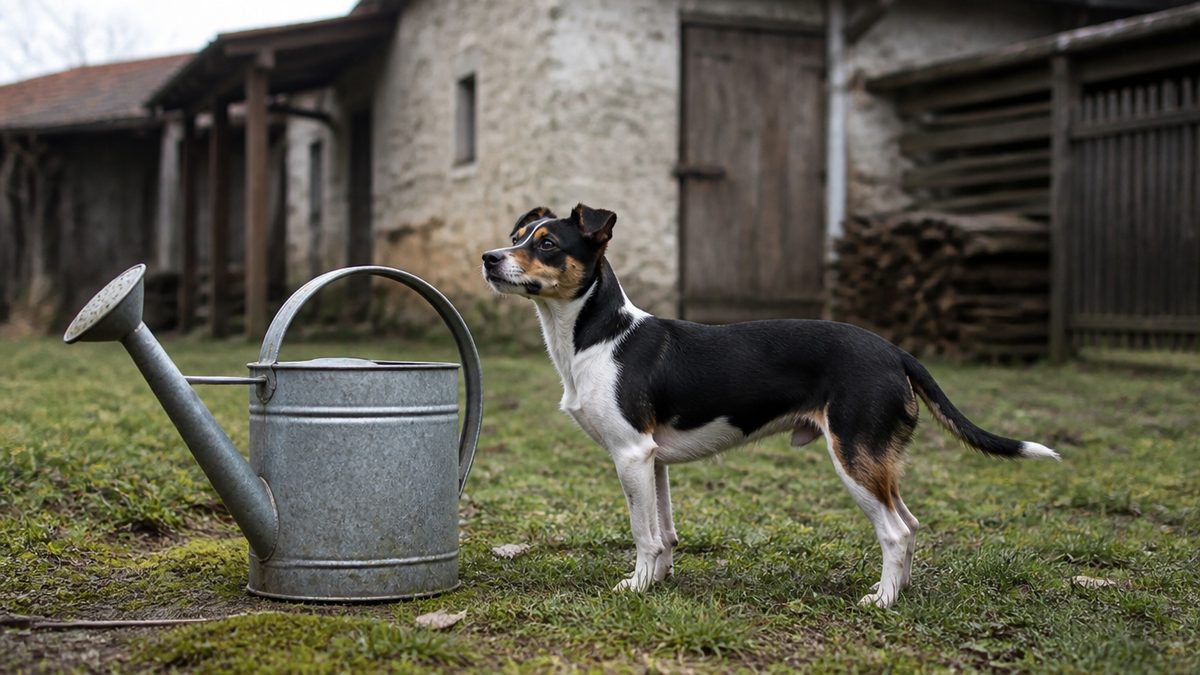
Quick answer
The small Medimurje dog, written Mali međimurski pas in Croatia and nicknamed Međi or Štakoraš, is a 28 to 33 cm farmyard guard and ratting breed. The Croatian Kennel Association recognised it as the country's seventh native breed on 30 December 2010, and Croatia's state gene bank records an effective population of 116.67 from 70 females and 50 males, classified critical. The FCI does not hold it.
This page reports published research and Indian veterinary literature for general information. It is not a diagnosis and not a treatment plan for your dog. Consult your nearby vet before acting on anything here, particularly on parasite control and heat management.
Small Međimurje Dog traits, rated for Indian conditions
What the Small Međimurje Dog is
The Small Međimurje Dog, or Mali međimurski pas, is a 28 to 33 cm Croatian farmyard guard and ratting breed recognised by the Croatian Kennel Association on 30 December 2010 as the country's seventh native breed, and not recognised by the FCI.
This is the rare rare-breed page where the best sources are official and specific. Croatia's Ministry of Agriculture publishes an annual report on its national programme for indigenous and endangered domestic animal breeds, and this dog has an entry in it, with numbers.
The report was retrieved as a 13.3 MB PDF and extracted directly to 34 pages and 82,861 characters of real text, so nothing below is taken from a summary.
What the state record says about the dog
Section 5.9.7 of that report records that the small Međimurje dog is assumed to have been bred in north-western Croatia for over a hundred years in the role of a guard dog in rural yards, and that recognition of the first breed standard came in 2010. Its stated purpose is one phrase: guard dog.
On characteristics the report lists liveliness, mobility, intelligence, obedience, persistence and perseverance in work, incorruptibility, attachment and cordiality. On appearance it gives a harmoniously built small dog of medium body build, of the lupoid type, of proud bearing, with a generous and lively gait and a rectangular body, coloured bicolour and tricolour with various patterns, and a coat that is short, hard and straight.
Incorruptibility is an unusual word to find in a state breed description, and it is a compliment about a guard dog rather than about a pet. Taken together the list describes a rustic farmyard dog rather than a companion: the qualities named are the ones farmyard work selects for, and none of them is about appearance.
| Attribute | Value | Source |
|---|---|---|
| Local names | Međi, and Štakoraš meaning ratter | Google knowledge panel and Croatian usage |
| Height at withers | 28 to 33 cm | Croatian sources and the Indian SERP snippet |
| Purpose | Guard dog in rural yards, and hunting harmful rodents | Croatian Ministry of Agriculture |
| Coat | Short, hard and straight | Croatian Ministry of Agriculture |
| Colour | Bicolour and tricolour with various patterns | Croatian Ministry of Agriculture |
| Type | Lupoid, rectangular body, proud bearing | Croatian Ministry of Agriculture |
| Recognised | 30 December 2010, HKS Executive Board decision | Croatian Ministry of Agriculture |
| FCI status | Not recognised | Janeš et al. 2019, and Bonbeno's own FCI sweep |
Because the English-language pages on this breed are thin and two of the four ranking in India returned 404 when asked for directly. Every substantive figure on this page comes from a Croatian government report or a Croatian peer-reviewed paper, both opened and extracted rather than summarised.
The recognition question, settled by a Croatian state table
Croatia recognises seven indigenous dog breeds, and its own Ministry of Agriculture proves six of them with an FCI standard number and the seventh with a Croatian Kennel Association decision, which is the cleanest statement of this breed's status anywhere.
The table in question lists each recognised indigenous breed alongside its proof of indigenousness, its year of recognition, its effective population size and its FAO endangerment category. Read down the proof column and the answer is immediate.
| Breed | Proof of indigenousness | Year | Effective population | FAO category |
|---|---|---|---|---|
| Dalmatinski pas | FCI Standard No. 153, 07.04.1995 | 1995 | 88.89 | Critical |
| Hrvatski ovčar | FCI Standard No. 277, 31.01.1969 | 1969 | 129.23 | Critical |
| Tornjak | FCI Standard No. 355, 23.11.2017 | 2017 | 149.33 | Critical |
| Istarski kratkodlaki gonič | FCI Standard No. 151, 02.04.1955 | 1955 | 571.43 | Endangered |
| Istarski oštrodlaki gonič | FCI Standard No. 152, 6.4.1955 | 1955 | 123.08 | Critical |
| Posavski gonič | FCI Standard No. 154, 08.04.1955 | 1955 | 342.86 | Endangered |
| Mali međimurski pas | Croatian Kennel Association, Executive Board decision, 30.12.2010 | 2010 | 116.67 | Critical |
Six FCI numbers and one kennel-club decision, printed in one column by the state itself. No English-language page carries that table, and it settles in a single glance what a paragraph of hedging usually fails to.
The FCI numbers were checked independently, and all six resolve
Bonbeno did not take those numbers on trust. Enumerating the FCI nomenclature server across records 1 to 400 and reading each page's own title back, all six returned the right Croatian breed: 153 DALMATINSKI PAS, 277 HRVATSKI OVCAR, 355 TORNJAK, 151 ISTARSKI KRATKODLAKI GONIC, 152 ISTARSKI OSTRODLAKI GONIC and 154 POSAVSKI GONIC.
That is a six-for-six cross-check between a Croatian government document and the FCI's own register, which validates the table and the method at the same time. And no record anywhere in the 400 carries the name Međimurje under any spelling.
Note in passing what those titles reveal: the FCI register names breeds in their own language, so a searcher looking for 'Dalmatian' or 'Croatian Sheepdog' in that register finds nothing at all. An English-language absence check on the FCI would have manufactured six false absences here before reaching this breed.
Two more registers, checked with controls
The Royal Kennel Club's Breeds A to Z, read at HTTP 200 with anchor tags deliberately kept because on an A-Z index the breed names are the anchors, holds neither this breed nor the Croatian Sheepdog, with ten in-document controls returning. The Orthopedic Foundation for Animals holds a CROATIAN SHEEPDOG entry in its breed list but no Međimurje entry, and returns zero statistics rows for either Orthopedic Foundation for Animals disease….
That last detail is worth separating carefully, because it is a distinction this project has had to correct on other pages. The Croatian Sheepdog holds an OFA breed code and has no published statistics row, which is a different state from being absent from the OFA altogether. This breed is absent altogether.
A gene bank is not a kennel club. Croatia's Ministry of Agriculture is counting this dog as agricultural genetic heritage alongside its cattle, sheep, donkeys and bees, which is a completely different kind of recognition from a show register and arguably a more serious one. Check the state, not only the cynological body.
Bonbeno's two-condition test, applied to a national breed
To count as a breed on this site an animal needs a written breed standard and a studbook. The Small Međimurje Dog has both, held by a national kennel body and backed by a state conservation programme, so the verdict is breed.
This is the only one of Bonbeno's five verdicts that this cluster of pages reaches positively, and it is worth showing why the evidence clears the bar here when it does not for the Sardinian or Patagonian cases.
| Condition | Verdict | Evidence |
|---|---|---|
| A written breed standard | Yes | Croatia's Ministry of Agriculture records that recognition of the first breed standard came in 2010, and the Croatian Kennel Association holds it |
| A studbook | Yes | The breed is registered and counted, with an effective population size of 116.67 published annually by the state gene bank and a share of 7.2 percent of Croatia's recognised indigenous dog population |
| Recognised by a national body? | Yes, and dated | Croatian Kennel Association Executive Board decision of 30 December 2010, cited as the proof of indigenousness in the state table |
| Recognised by the state? | Yes, separately | Listed among seven indigenous dog breeds in the national programme for indigenous and endangered domestic animal breeds, with an FAO endangerment category |
| Recognised by the FCI? | No | Absent from records 1 to 400 with all six of Croatia's FCI breeds returning as controls |
| Is the population genetically characterised? | Yes | Janeš et al. 2019 identified six mitochondrial haplotypes across haplogroups A, B and C from 160 sequences |
| Formal verdict | Breed | A nationally recognised breed with a standard, a register, a state conservation listing and a published genetic characterisation, which happens not to hold an FCI number |
What was considered and rejected
- Breed in formation was rejected. That verdict fits a population whose national body has started but not completed recognition, as with the Cane Fonnese in Italy's open supplementary register. Croatia completed this one in 2010 and has been counting the dogs ever since.
- Type was rejected outright. A type has no standard and no register. This dog has both plus a state gene-bank entry with a published effective population size.
- Register without standard was rejected, because the standard exists and its recognition date is recorded by the state.
- Brand was rejected. Međimurje is a Croatian county, owned by nobody, and no trademark is involved.
Why FCI recognition is not the test
This page files the breed positively while acknowledging the FCI holds nothing, and that combination is the point. The FCI is one federation. It is not the definition of a breed, and treating it as one would mean telling a Croatian farmer that the dog his country counts in a national gene bank, with a standard and a register and a recognition date, is not a breed.
The useful question for a buyer is never which international federation approves, but which document defines the animal and which register holds it. Here both answers are Croatian, both are dated, and both are checkable.
Three pages in this cluster examine unregistered working dogs. The Patagonian Sheepdog has no standard and no register anywhere, and is filed as a type. The Cane Fonnese has both, in Italy's open supplementary register, with recognition in progress, and is filed as a breed in formation. This dog completed the same journey in 2010 and is filed as a breed. Same test, three different answers, each naming its deciding document.
The population figures, and how the columns were recovered
Croatia publishes an effective population size of 116.67 for this breed, and the head-count columns behind it can be recovered by arithmetic as 70 breeding females and 50 males Bonbeno's own arithmetic recovery….
This is the most concrete rarity figure on any of the five pages in this cluster, and it took a small piece of forensic work to make usable, which is worth showing because the method generalises.
The state report prints a three-number head count per breed. Extracted from the PDF, those numbers arrive without resolvable column headers, so the raw reading for this breed is 70, 50, 11 and nothing tells you which is which. Publishing that would be guessing.
The arithmetic that identifies the columns
Effective population size for a two-sex population is conventionally four times the number of males times the number of females, divided by their sum. Testing that formula against the printed Ne values resolves the columns immediately.
| Breed | Head-count figures printed | Formula applied | Result | Ne printed by the state |
|---|---|---|---|---|
| Mali međimurski pas | 70, 50 | 4 x 50 x 70 / 120 | 116.67 | 116.67 |
| Dalmatinski pas | 50, 40 | 4 x 40 x 50 / 90 | 88.89 | 88.89 |
| Posavski gonič | 200, 150 | 4 x 150 x 200 / 350 | 342.86 | 342.86 |
Three of three reproduce exactly. That identifies the first column as breeding females and the second as breeding males, and it means this page can state with confidence that Croatia's 2023 national programme counted 70 breeding females and 50 breeding males of this breed.
The third number, 11, is not resolved by this method and this page does not guess at it. An honest empty cell is worth more than a filled one that was inferred.
What the numbers mean in context
The FAO endangerment category the state assigns is critical. Among Croatia's seven indigenous dog breeds, four of the seven carry that classification and this is one of them, alongside the Dalmatian, the Croatian Sheepdog and the Istrian Wire-haired Hound.
The breed accounts for 7.2 percent of the total population of Croatia's recognised indigenous dogs. Those shares sum across the seven breeds to 100.1 percent, which is rounding rather than error, and the fact that they close is itself a check that the figures were read correctly.
Almost no rare breed anywhere publishes a breeding-animal count. This one does, annually, through a national gene bank, in a document with a named ministry, named editors and named authors. When a page tells you a breed is rare, ask what number it is quoting. This page can tell you: seventy females and fifty males.
History, and what the genetics can and cannot say about it
The Small Međimurje Dog has been bred in north-western Croatia for over a hundred years as a farmyard guard, and a 2019 mitochondrial study is the only genetic characterisation it has Janeš M, Brajković V, Držaić I, Zorc M.
Croatia's state report is careful with its own history claim, and the care is worth copying. It says the breed is *assumed* to have been bred in north-western Croatia for over a hundred years in the role of a yard guard dog, and that recognition of the first breed standard came in 2010. An assumption marked as an assumption in a government document is more trustworthy than a confident century elsewhere.
The peer-reviewed paper says the same thing in the same register: the breed has been bred for over a hundred years in Međimurje, a region in the northern part of Croatia. Neither source reaches further back, and neither claims antiquity.
The mitochondrial study, and what it found
Janeš and colleagues analysed the mitochondrial DNA control region across 160 sequences 551 base pairs long, comparing this breed against 115 samples from widely distributed dog breeds. They identified eight haplotypes in the whole dataset, of which this breed carries six, distributed across all three of the main worldwide canine haplogroups: haplogroup C, where haplotype H3 is the most frequent in the breed, haplogroup A with haplotypes H2, H5 and H7, and haplogroup B with H4 and H6.
Read that carefully rather than as a headline. Carrying six haplotypes across all three major haplogroups is a sign of maternal diversity rather than of a narrow founder base, which is encouraging for a population of 120 breeding animals. It is not a claim about age, and the authors make none.
What they do say is that the results correspond to other mitochondrial studies of native dog breeds, and that for better genetic description and optimal future breeding management, further analyses of the nuclear genome are recommended. That recommendation is the practical finding for a critically classified breed.
One tempting connection this page will not make
Croatian archaeology offers an obvious hook and it does not reach this breed. Mihelić and colleagues analysed seven crania and ten lower-jaw halves of Early Bronze Age dogs from the Vučedol site in eastern Slavonia and concluded they were a dolichocephalic type corresponding to a smaller dog breed, in the first place a type of Croatian sheepdog or Hungarian Mudi.
That is a real finding about small Croatian dogs four thousand years ago, and it names two other breeds rather than this one. Connecting it to the Small Međimurje Dog would be exactly the move this site exists to catch: an ancient artefact, a modern breed, and an inference in between that nobody made.
Over a hundred years in north-western Croatia, assumed rather than documented, per the Croatian state's own careful wording, with a standard from 2010 and a genetic characterisation from 2019. That is a modest history, honestly told, and it is worth more than a millennium nobody can evidence.
Small Medimurje Dog price in india, and the emptiest search on this site
No Indian price exists, and this breed produced the starkest market result across the five pages in this cluster: eight results, eight generic puppy marketplaces, zero mentions of the breed.
The check was run through an instrument proved in the same session, with a Labrador Retriever control returning eight genuine Indian listings carrying real rupee ranges from named Indian sellers. The tool works.
Asked for this breed under both its English and its Croatian name, the engine returned eight results and every one was a generic Indian puppy-marketplace homepage or breeder directory. Not one named the breed. Not one carried a rupee figure attached to it. There was no merchandise, no substituted breed, and no converted foreign price.
Why that is a cleaner result than it looks
Across this cluster of five breeds, four produced some form of contamination. The Xoloitzcuintle returned Etsy prints under a title reading 'Buy Xoloitzcuintli Dogs Online In India'. The Techichi returned eight Chihuahua results. The Sardinian Shepherd Dog returned German Shepherd sellers matched on the token 'Shepherd Dog', plus an Etsy poster. The Patagonian Sheepdog returned a print-on-demand handbook and a Rs 289 silhouette pack.
This one returned nothing at all attached to the breed. The engine simply dropped the name and served the generic category, which means the commercial index holds no document anywhere connecting this breed to India. For a reader, that is the cleanest possible signal.
| Breed | What came back instead of a price |
|---|---|
| Xoloitzcuintle | Etsy prints at Rs 1,295 and Rs 802, plus one advertisement whose body text described a Toy Poodle |
| Techichi | Eight results, all about the Chihuahua |
| Sardinian Shepherd Dog | Five German Shepherd or Anatolian Shepherd results, plus one Etsy poster |
| Patagonian Sheepdog | An Amazon print-on-demand handbook and a Rs 289 digital silhouette pack |
| Small Međimurje Dog | Eight generic Indian puppy marketplaces, none naming the breed |
Why no supply chain forms
The population is 120 breeding animals in one Croatian county, classified critical by its own state. There is no FCI number, so no FCI-nomenclature pedigree can be issued, which is the route Indian pedigrees run through as a full FCI member country. A critically endangered national breed with no international pedigree route does not develop an export market, and it should not.
Ask which register holds the dog and what its Croatian registration number is, then ask how it left a population of 120 breeding animals classified as critical. Those two questions end the conversation honestly, and they are the same two questions worth asking about any breed sold in India as rare and foreign.
Monthly cost of ownership for a small dog in India
A small short-coated dog costs roughly Rs 3,000 to Rs 6,000 a month to keep properly in an Indian metro, and this breed's coat makes it one of the cheapest possible dogs to maintain.
No purchase price exists, but the Indian running costs are real and apply to any small short-coated dog, so they are the useful figures for a reader whose interest ends in owning something similar.
| Item | Published price | Source |
|---|---|---|
| Anti-rabies vaccine, single | Rs 699 | Vetic clinic price list |
| 9-in-1 DHPPiL | Rs 899 | Vetic clinic price list |
| Kennel cough | Rs 1,349 | Vetic clinic price list |
| Bath, Delhi | from Rs 934 | Vetic grooming, Delhi |
| Haircut, Delhi | from Rs 1,359, and not needed for this coat | Vetic grooming, Delhi |
| Monthly parasite cover | about Rs 1,103 in the 15 to 30 kg band, less for a small dog | Supertails NexGard Spectra listing |
| Boarding, 24 hours, Bengaluru | Rs 899 | PawSpace Bengaluru |
| Consultation | Rs 500 to 1,000 | VOSD, counted as one data point |
| Delhi municipal dog registration | Rs 500 | MCD Delhi portal |
| Chennai pet licence | Rs 50 | Greater Chennai Corporation |
| Microchipping, Chennai | Rs 1,250 | SKS Veterinary Hospital |
Two caveats travel with that table. VOSD's consultation and vaccination ranges are published byte-identically by a large general insurer, so two organisations agreeing to the rupee on two separate quantities is evidence of copying rather than corroboration, and this page counts them once. And the Vetic figures are promotional floors from a single chain that quotes different course prices on different city pages.
Where this coat saves money
The Rs 1,359 haircut line simply does not apply to a short, hard, straight coat Vetic Pet Clinic Delhi grooming price list. Combined with a small dog's low food requirement, that puts this type at the cheap end of Indian dog ownership, and it is one of the genuine practical arguments for a small smooth-coated dog in an Indian city.
Boarding is the line that does not scale down. A Bengaluru operator publishes an overnight stay to 24 hours at Rs 899, and most Indian facilities price per animal rather than per kilogram, so a 5 kg dog costs what a 30 kg dog costs.
The free option is worth naming again. The Greater Chennai Corporation runs six municipal pet clinics providing all treatment and anti-rabies vaccination free of cost, and issued 9,115 licences in 2024 against a Rs 50 fee. Delhi charges Rs 500 to register and Rs 500 to renew, with a Rs 100 monthly late fee, and reports 71 of 1,006 applications rejected this financial year. Microchipping runs about Rs 1,250 at a named Chennai clinic.
Municipal fees rarely move; retail prices move within weeks. Treat the registration rows as reliable and re-price everything else before you budget on it.
Suitability for the Indian climate
Continental Croatia is more humid than most Indian metros at 77.39 percent annual relative humidity, so damp is not this breed's problem; heat is, with Čakovec peaking in July at 22.51 C against Delhi's June mean of 35.88 C.
Every point below was queried by explicit latitude and longitude with the grid-cell elevation NASA POWER returns echoed against the real elevation, because POWER returns a cell rather than a point.
| Place | Cell elevation vs real | Annual mean | Annual humidity | Hottest month | Peak wet bulb |
|---|---|---|---|---|---|
| Čakovec, Međimurje | 248.67 m vs ~164 m, +85 m | 10.69 C | 77.39 percent | July, 22.51 C | July, 17.49 C |
| Zagreb | 195.32 m vs ~158 m, +37 m | 10.97 C | 78.72 percent | July, 22.79 C | July, 17.88 C |
| Bengaluru | 841.72 m vs ~920 m, -78 m | 23.74 C | 67.84 percent | April, 28.37 C | May, 21.86 C |
| Pune | 635.99 m vs ~560 m, +76 m | 23.86 C | 66.68 percent | April, 28.93 C | June, 22.97 C |
| Mumbai | 97.15 m vs ~14 m, +83 m | 26.77 C | 67.28 percent | May, 31.19 C | June, 25.77 C |
| Delhi | 206.37 m vs ~216 m, -10 m | 25.57 C | 45.51 percent | June, 35.88 C | July, 26.50 C |
| Chennai | 48.95 m vs ~6 m, +43 m | 27.94 C | 72.39 percent | May, 31.51 C | May, 26.11 C |
| Kolkata | 7.35 m vs ~9 m, -2 m | 25.80 C | 73.84 percent | May, 31.53 C | June, 27.09 C |
Both Croatian cells are usable at plus 85 m and plus 37 m, so the figures can be read as the towns rather than as averaged terrain.
The humidity finding, which inverts the usual argument
Čakovec runs 77.39 percent annual relative humidity and Zagreb 78.72 percent, both higher than Mumbai at 67.28, Bengaluru at 67.84, Pune at 66.68, Chennai at 72.39 and Kolkata at 73.84. So the reflex claim that Indian humidity would trouble a continental European dog is simply wrong here. This breed comes from a genuinely damp place.
The problem is heat, and specifically the combination. Čakovec's peak wet bulb is 17.49 C in July. Kolkata's is 27.09 C in June. That is a gap of nearly ten degrees in the measure that describes the thermal load an animal actually has to shed.
Where this breed does better than most European imports
Three things work in its favour and they are worth stating, because most European breeds get an unqualified no on this site. The coat is short, hard and straight rather than a double working coat. The dog is small at 28 to 33 cm, and small dogs shed heat faster relative to their mass. And Hall and colleagues found bodyweight at or above the breed and sex mean carried an odds ratio of 1.42 for heat-related illness, rising to 3.42 over 50 kg, so being light is protective.
Bengaluru and Pune, both peaking in April rather than May and running the lowest wet bulbs in the table, are the two Indian cities where a dog of this type would be least constrained.
Delhi peaks in June rather than May, and Bengaluru and Pune peak in April and are coolest in December rather than January. Care advice built around a single national hot month is wrong for at least three large Indian cities, and it is the reason this table names a month per city instead.
Temperament, from a state description rather than a breed club
Croatia's national programme lists liveliness, mobility, intelligence, obedience, persistence and perseverance in work, incorruptibility, attachment and cordiality as this breed's characteristics, which describes a working yard dog rather than a companion.
That list is unusual for two reasons. It comes from an agriculture ministry rather than a breed club, so it has no commercial reason to flatter, and it puts work qualities before household qualities.
Read in order, the emphasis is clear: liveliness and mobility first, then intelligence and obedience, then persistence and perseverance in work, then incorruptibility, and only then attachment and cordiality. A guard and ratting dog is being described by what it does before what it is like to live with.
What incorruptibility means in a guard dog
It is the quality of not being won over. A yard dog that can be befriended by anyone offering food is not doing its job, and a state document listing incorruptibility among a breed's defining characteristics is telling you the dog was selected to stay suspicious.
For an Indian household that is the single most important sentence on this page's temperament. A small alert guard dog in a shared building, with domestic staff, deliveries and neighbours arriving constantly, will announce all of them, and that is the breed working correctly rather than failing.
Who this dog would suit in India, if any existed
- Suits an independent house with a yard, an owner who wants a small watchful dog and accepts barking as the job.
- Suits a household that can give a busy small dog real mental work, since persistence in work is on the state's own list.
- Does not suit a shared apartment building, because the alerting is the breed rather than a training failure.
- Does not suit anyone wanting a small dog that greets visitors, which is the opposite of incorruptibility.
Italy's register describes the Cane Fonnese as fundamentally hostile toward strangers. Croatia's ministry describes this dog as lively, intelligent, obedient and cordial, with incorruptibility in the middle of the list. Two guard breeds, two state descriptions, and a real difference in degree that a buyer should notice: one announces, the other defends.
Training a small working guard
Croatia's state description lists obedience and intelligence among this breed's defining characteristics, so the training problem is not compliance but channelling a busy, alert small dog's job instinct.
An obedient, intelligent, persistent small dog that was selected to guard a yard and kill rats is an easy dog to teach and a hard dog to bore safely. Those two facts define the training plan.
- Socialise broadly and early, because a small guard breed that finds the world alarming becomes a reactive dog, and small reactive dogs are routinely tolerated until they are not.
- Train an interrupt and a settle above all else, since the behaviour that needs managing is alerting rather than disobedience.
- Protect the dog from being teased at a gate or a window, which is how yard-guard instincts turn into frustration barking.
- Screen the environment rather than relying on obedience alone: manage where the dog is when visitors arrive, and the training has less work to do.
The ratting instinct, which needs an outlet
Štakoraš means ratter, and a dog selected for killing rodents has a strong, specific motor pattern that does not switch off in an apartment. Scent games, snuffle work and puzzle feeders genuinely satisfy it. A cushion does not, and a bored ratter will find its own target.
Indian timing
The socialisation window overlaps the vaccination course, whose per-vaccine Indian prices run from Rs 699 for anti-rabies to Rs 1,349 for kennel cough at one national chain. For a guard-type breed the behavioural cost of waiting is high, so plan carried, controlled exposure and discuss the schedule with your nearby vet rather than deciding alone.
Everything on this list is easier at 5 kg than at 35 kg. A small alert dog can be physically managed at a gate, carried away from a situation and rehearsed safely in ways a livestock guardian cannot. If a watchful dog is what an Indian household wants, small is the sensible size.
Daily exercise requirement
A small working yard dog needs 45 to 60 minutes of daily activity split across two or three outings plus real mental work, and in most Indian cities that moves to dawn and after dark from March to June.
Croatia's own description names liveliness, mobility and persistence in work, which is a dog with a working tempo rather than a lap dog's. A yard dog patrols, investigates and hunts rodents all day at low intensity, and an Indian apartment supplies none of that by default.
| City | Hardest month | Mean that month | Peak wet bulb |
|---|---|---|---|
| Delhi | June | 35.88 C | 26.50 C in July |
| Ahmedabad | May | 35.06 C | 26.11 C in June |
| Hyderabad | May | 33.30 C | 23.35 C in June |
| Kolkata | May | 31.53 C | 27.09 C in June |
| Chennai | May | 31.51 C | 26.11 C in May |
| Mumbai | May | 31.19 C | 25.77 C in June |
| Pune | April | 28.93 C | 22.97 C in June |
| Bengaluru | April | 28.37 C | 21.86 C in May |
For a small dog the pavement is the acute hazard rather than the air, because a 30 cm dog walks with its whole body in the superheated layer just above Indian tarmac and its pads are in direct contact with it. Check every surface with the back of your hand before setting out.
Exertion is the trigger
Hall and colleagues confirmed 395 heat-related illness events across 905,543 UK dogs and found exertion rather than vehicle confinement to be the dominant trigger. The protective news for this type is that bodyweight at or above the breed and sex mean carried an odds ratio of 1.42, rising to 3.42 over 50 kg, so a light dog sits at the favourable end of that finding.
Indoor work counts, and for this breed it counts double
Scent games and puzzle feeding substitute for a hot-afternoon walk better in a ratting breed than in almost any other type, because the motor pattern being satisfied is searching rather than running. That is a genuine advantage in an Indian summer and it is the main practical recommendation of this section.
Twenty-five minutes at dawn, twenty-five after dark, and two ten-minute scent sessions indoors during the hot hours. That satisfies a small working dog through an Indian April in Bengaluru or a Delhi June without ever asking it to exert itself in the heat.
Grooming, which is the easiest on this site
The Small Međimurje Dog's coat is short, hard and straight, so the entire grooming routine is a weekly rubber curry and a bath every six to eight weeks.
Croatia's state record gives the coat in four words and that is genuinely all the description needed: short, hard and straight. Colour is bicolour and tricolour with various patterns, which varies per dog and changes nothing about the care.
This is the lowest grooming load of the five breeds in this cluster and one of the lowest on the site. In Indian terms that matters more than it sounds, because coat is where Indian humidity does most of its damage to imported breeds.
| Task | Frequency | Indian note |
|---|---|---|
| Rubber curry | Weekly | Removes more from a short hard coat than a bristle brush does |
| Bathing | Every 6 to 8 weeks, from Rs 934 at a Delhi salon or free at home | Over-bathing is the commoner error on a short coat |
| Drying | Thoroughly, and it takes minutes | The one real advantage of a short coat in a Mumbai August |
| Haircut | Never | The Rs 1,359 line does not apply to this coat at all |
| Ear checks | Weekly and after every soaking | Ear problems cluster in the monsoon months on Indian pages for most breeds |
| Nail trimming | Fortnightly | A light dog wears nails down slowly on pavement |
| Full tick check by hand | Weekly, and this is the point | A short coat makes this fast and reliable |
The Delhi price list gives bathing from Rs 934 and complete bath and styling from Rs 1,869, with a haircut from Rs 1,359 that this breed never needs.
The Indian advantage of a short hard coat
A double coat holds monsoon damp against the skin for hours and is the reason hot spots and ear trouble cluster in July and August for many imported breeds. A short hard flat coat dries in minutes and lets you see and feel the skin underneath, which makes the weekly tick check genuinely reliable rather than a hopeful rummage.
Work by hand along the ears, between the toes, under the collar and around the tail base every week. In a country where one Indian series found 72.9 percent of 584 screened dogs carrying two or more tick-borne pathogens, that is the highest-value ten minutes in this dog's week, and a short coat makes it ten minutes rather than thirty.
Health issues, life expectancy and an honest empty record
No breed-specific health data, screening scheme or life expectancy exists for the Small Međimurje Dog, and the only genetic work is the 2019 mitochondrial study Janeš M, Brajković V, Držaić I, Zorc M.
State the absences precisely, because a specific absence is a finding and a vague one is nothing.
- Screen results: none. The OFA holds no entry for the breed and returns zero rows for Medimurje in its 12,047-row statistics dump, while controls returned 109 rows for the Labrador, 170 for the Bulldog and 61 for the Beagle.
- Life expectancy: unmeasured. McMillan and colleagues' Table S5 lists 345 breeds including many considered and excluded, and carries no Medimurje row at all, so the breed was never in that UK dataset's frame.
- Clinical literature: none. PubMed returns zero for every form of the breed's name against 1,109 for the Labrador control in the same session.
- Genetic characterisation: one paper, on mitochondrial variability, which reports diversity rather than disease.
The lifespan absence is the one worth stating carefully, because McMillan and colleagues' UK longevity study publishes its breed-level detail in supplementary tables rather than in the article body, so a reader checking the main text alone would wrongly conclude that many breeds were missing from it. Table S5 lists 345 breeds including those the study considered and rejected, and it carries no Medimurje row at all, which means this breed was never in that dataset's frame rather than having been weighed and excluded.
The OFA absence is expected rather than alarming, and its own threshold explains why: a breed needs at least 100 hip evaluations, and 50 for every other database, before it appears at all. A breed with 120 breeding animals in one Croatian county will never reach that.
What the population size implies, marked as an implication
An effective population of 116.67 is small, and small populations carry elevated risk of expressing recessive disease over time. The mitochondrial finding cuts the other way, since six haplotypes across all three major haplogroups indicates real maternal diversity rather than a narrow founder base.
Those two observations are not in conflict and neither is a health measurement. The paper's own recommendation is the sensible reading: further nuclear genome analysis is needed for optimal future breeding management. Mitochondrial diversity describes the maternal lines only.
One finding that applies to any small dog in India
Redondo and colleagues analysed 55,019 anaesthetics, 54,542 after exclusions, with an overall mortality of 0.69 percent, and found that after adjusting for ASA physical status most between-breed differences disappeared, with the authors concluding that they largely reflected case severity. That is a useful frame for any owner facing an elective procedure: ask about the dog's ASA status rather than its breed, and consult your nearby vet.
As generated. Twelve to fifteen years is the template default for a small dog and it appears on pages about this one. Nobody has measured it. An honest empty cell is worth more than a number with no study behind it.
The Indian health risks that would actually apply
Tick-borne disease is what an Indian owner of any small yard dog should plan for first, and published Indian series report it at levels overseas guidance does not prepare owners for Venugopal V, Deepa PM, Muhasin Asaf VN.
For a breed with no clinical literature, the risks that would shape its Indian life are Indian rather than genetic, and this is the section that would be identical whichever small dog you owned.
| Study | Where | Dogs tested | Finding |
|---|---|---|---|
| Shil et al. 2026 | West Bengal | 584 | Babesia gibsoni 76.54 percent, Anaplasma 55.75 percent, 72.9 percent of the 584 screened carrying two or more pathogens |
| Venugopal et al. 2026 | Kerala | 120 | Babesia in 80 of 120 tested, Ehrlichia canis 5.0 percent, peak before the monsoon in March to May |
| Chakraborty et al. 2024 | Odisha | 178 | Ehrlichia canis in 56 of 178, 31.46 percent; 75 percent of infected dogs over 20 kg; 79 percent had a tick history |
The framing caveat is mandatory: these studies sampled clinically suspected dogs or clinic caseloads rather than random populations, so the correct reading is 'among dogs tested at veterinary clinics';. A figure of 76.54 percent is not any individual dog's risk.
Two details are worth carrying for a small yard dog specifically. The Kerala series found infection peaking before the monsoon in March to May rather than during it, which inverts what most Indian owners assume. And the Odisha series found 75 percent of Ehrlichia-infected dogs were over 20 kg, which is a size band this breed sits well below, though 79 percent of infected dogs had a tick history and a yard dog spends its life where ticks are.
Monthly parasite cover is therefore the highest-value line in this dog's Indian budget, at around Rs 1,103 for the 15 to 30 kg band and less for a small dog.
Heat and the law
Second Schedule Part IV paragraph 21(1) of India's Dog Breeding and Marketing Rules 2017 bars keeping in outdoor facilities, without the attending veterinary practitioner's written approval, dogs not accustomed to local temperatures and breeds that cannot tolerate them. A yard dog is by definition an outdoor dog, so for this breed in particular that clause would be the first legal question an Indian owner faced.
Daily hand checks along the ears, between the toes, under the collar and around the tail base. On a short-coated small dog they take five minutes and they catch what the monthly tablet is there to back up.
Feeding a small working dog in India
Feed a 28 to 33 cm working dog to body condition in two meals, and weigh the food rather than eyeballing it, because a twenty percent overfeed on a small dog is invisible and enormous.
No published weight range exists for this breed, only a height of 28 to 33 cm, so there is no chart to feed toward and the dog in front of you is the target.
Life stages
- Puppy, to six months. Three to four small meals daily on a complete small-breed growth food, and never a long gap, because small puppies drop their blood sugar faster than large ones.
- Adolescent, six to twelve months. Two meals. Weigh portions, since a working small dog looks lean when it is correct.
- Adult. Two meals daily, adjusted seasonally, with intake typically falling from March to June in most Indian cities.
- Senior. Two meals with protein maintained, and an annual dental conversation with your nearby vet, because small breeds accumulate dental disease faster.
Feed training rewards from the daily ration rather than in addition to it. For a busy, food-motivated working dog in a household that trains often, this is the difference between a lean dog and an overweight one, and the arithmetic is unforgiving at 5 kg.
One thing not to buy
A joint supplement bought to prevent hip dysplasia. The OFA states plainly that hip dysplasia is a polygenic inherited disease, that a high-calorie diet during rapid growth may exacerbate changes in hips that are already dysplastic but will not create hip dysplasia, and that there is no evidence in the scientific literature that supplements such as vitamin C prevent it. Feed a growing puppy moderately instead, which costs nothing.
Multiple bowls, changed twice daily, offered before and after every outing. It is the cheapest and most effective thing an Indian owner does between March and June, for any dog of any size.
Month by month through the first year
A small guard-type puppy's first year is dominated by socialisation breadth and by teaching an off switch early, because the alerting instinct arrives on its own.
| Age | Priority | Indian note |
|---|---|---|
| 8 to 10 weeks | Home, vaccination course begins, deworming | Anti-rabies Rs 699, 9-in-1 Rs 899 at one national chain |
| 10 to 16 weeks | Socialisation breadth, especially to visitors and doorways | Carried and controlled exposure; plan it with your vet |
| 3 to 4 months | House training on a fixed schedule | Monsoon weeks are where this most often slips |
| 4 to 6 months | Monthly parasite cover begins; settle and interrupt trained | About Rs 1,103 per month in the 15 to 30 kg band, less for a small dog |
| 6 to 9 months | Guarding and alerting emerge; manage rather than suppress | This is the month owners of guard-type breeds most often panic |
| 9 to 12 months | Municipal registration and microchipping | Delhi Rs 500, Chennai Rs 50, microchip about Rs 1,250 |
| 12 months | Annual booster and first adult health check | Free at Greater Chennai Corporation's six municipal clinics |
The decision that matters most
Socialising to arrivals specifically. A yard guard puppy that learns before sixteen weeks that people coming through a gate are ordinary will alert and settle. One that does not will alert and escalate, and in an Indian building with constant arrivals that difference decides whether the dog is manageable.
What a responsible source shows you
- Verify the mother on the premises with the litter, and watch her reaction to the person handling her.
- Compare the puppy against its littermates rather than against a chart, because no reliable growth chart exists for this breed.
- Screen what can be screened locally, since no registry certificate exists: a patella check and a general examination by your own vet.
- Adopt the position that any paperwork will be Croatian rather than FCI, which is correct for this breed and not a warning sign.
Rule 8(1)(a) of the Dog Breeding and Marketing Rules 2017 provides that pups less than eight weeks in age are not sold. That is a Rule rather than a Second Schedule paragraph, and it applies to every breed. A seller offering a younger puppy is breaking it.
Head to head against the breeds it is compared with
This breed is cross-shopped against the Croatian Sheepdog and other small European farm dogs, and the differences are in registry status and size rather than in job Izvješće o provedbi Nacionalnog programa….
| Breed | FCI status | Effective population in Croatia | FAO category | Job |
|---|---|---|---|---|
| Small Međimurje Dog | Not recognised | 116.67 | Critical | Yard guard and ratter |
| Croatian Sheepdog | FCI 277 since 1969 | 129.23 | Critical | Herding |
| Dalmatian | FCI 153 since 1995 | 88.89 | Critical | Carriage and companion |
| Tornjak | FCI 355 since 2017 | 149.33 | Critical | Livestock guardian |
That table contains a fact worth sitting with. All four of those Croatian breeds are classified critical by their own state, and the FCI-recognised Dalmatian has the smallest effective population of the four at 88.89. International recognition and population health are separate axes, and the most famous Croatian breed in the world is the rarest of them at home.
The Croatian Sheepdog is the closest comparison and the useful one for a reader, because it is the same country, the same conservation programme and the same critical category, with an FCI number and forty-one more effective breeding animals. The Tornjak shows the journey completing recently, with FCI 355 granted in 2017.
Comparison across this cluster
Against the other unregistered or partly registered breeds Bonbeno has examined here, this one is the furthest along. The Patagonian Sheepdog has no standard and no register anywhere. The Sardinian Shepherd Dog has both, in an open supplementary register, with recognition in progress. This dog completed national recognition in 2010 and has a state conservation entry with published numbers.
The Indian comparison
There is none available, so the honest advice is to look at what a small alert Indian dog can do. Indian street and village dogs guard yards, kill rodents and tolerate the climate natively, and an Indian shelter will have small watchful adults whose temperament you can assess directly rather than infer from a state document about a dog on another continent.
Showing that a breed's fame, its FCI number and its population health vary independently. Croatia's most internationally famous dog has its smallest effective population, and its least famous has more breeding animals than the Dalmatian does. That is worth knowing before anyone chooses a dog on reputation.
Mistakes made about this breed
Five errors recur, and three of them are search failures caused by the breed's own name Google India search results page for 'small….
- Concluding the breed is unrecognised because the FCI does not hold it. Croatia recognised it in 2010 and counts it in a national gene bank, which is recognition by two separate arms of one state.
- Searching PubMed for Medimurje and reading the 23 records as a literature. All 23 concern the Croatian county, not the dog.
- Trusting a large result count from a rewritten query. Medjimurje dog returned 404,677 records because PubMed discarded the breed name and searched dog alone.
- Reading the People also ask box as breed information. All four questions Google returned were generic small-dog questions, because the name begins with a size adjective.
- Quoting a lifespan or a weight. Neither has been published, and both appear on pages about this breed.
The sixth mistake, which this page nearly made
Connecting the Vučedol Bronze Age dogs to this breed. Mihelić and colleagues identified those crania as a smaller dolichocephalic type corresponding in the first place to a Croatian sheepdog or Hungarian Mudi, and they name neither this breed nor anything like it. An ancient site in the same country is not evidence about a modern breed from a different region, and the temptation to bridge that gap is exactly how breed antiquity claims are manufactured.
How to verify this page in ten minutes
- Verify the state figures by opening the Croatian Ministry of Agriculture's national programme report and finding the dog table.
- Compare the proof-of-indigenousness column across the seven breeds, which settles the recognition question at a glance.
- Screen the FCI numbers in that column by probing the FCI register by number, where all six resolve to the right Croatian breed.
- Groom your own arithmetic: apply four times males times females over their sum to the head counts and watch the printed effective population sizes reproduce.
A breed called Small Međimurje Dog defeats English search three ways at once: small makes it a size query, Međimurje is a county, and the diacritic on the d means an ASCII search misses the Croatian sources entirely. That is not a fact about the dog. It is a fact about searching, and it is why the state documents were worth the trouble.
Adoption and responsible sourcing
Nothing can be adopted or bought in India, and with 70 breeding females and 50 males left in a critically classified population, the responsible position is to leave them in Croatia.
This is the clearest case in the cluster for saying so. A breed with 120 breeding animals, classified critical by its own state, in the middle of a conservation programme that explicitly exists to keep it alive, is not a breed to source from abroad.
What to do instead
- Adopt a small alert dog from an Indian shelter, where the type is common and the temperament is visible in an adult rather than predicted from a document.
- Verify vaccination and deworming records in writing before the dog comes home.
- Protect the arrangement with municipal registration, Rs 500 in Delhi or Rs 50 in Chennai, and a microchip at about Rs 1,250 at a named Chennai clinic SKS Veterinary Hospital, Chennai.
- Feed and budget the same either way, since food, parasite cover and vaccination cost what they cost regardless of how the dog arrived.
The legal floor applies whatever you choose. Pups under eight weeks may not be sold in India under Rule 8(1)(a), ear cropping and tail docking are forbidden under Second Schedule Part II paragraph 6(8), and outdoor housing of a breed that cannot tolerate local temperatures needs the attending veterinary practitioner's written approval under Second Schedule Part IV paragraph 21(1).
What this page is for
Nobody in India will own this dog. What the page offers instead is the best worked example on this site of checking a breed's status through a state document rather than a kennel club, and of recovering a table's meaning by arithmetic when the extraction loses its headers.
It also offers a genuinely uncommon thing: a hard, current, official rarity number. Not rare, not very rare, not endangered as an adjective. Seventy breeding females and fifty breeding males, counted by a ministry, published annually, classified critical.
When a cynological body has nothing to say about a breed, check the state. Ministries, agriculture departments, gene banks, conservation programmes and postal authorities all recognise breeds, and none of them appears in a kennel club's index. On this dog the state had a standard date, a recognition instrument, a population count and an endangerment category, and the kennel clubs of the world had nothing at all.
Small Međimurje Dog questions, answered from Croatian documents
What is the best small medium size dog?
There is no measured answer, and this question appeared here only because the breed's English name begins with the word small, so Google parsed the query as a size question. For the record, Bonbeno does not name a best breed at any size, because temperament varies far more within breeds than between them. What can be said about this particular small dog is that Croatia's own state programme lists obedience, intelligence, liveliness and persistence in work among its characteristics.
What are the 10 smallest dog breeds?
Bonbeno will not publish a ranked list it has not measured, and this question reached this page through the same size-word confusion as the one above. The relevant figure for this breed is that it stands 28 to 33 cm at the withers, which places it firmly among small dogs without being a toy. Its own state record describes it as harmoniously built and small, of medium body build, of the lupoid type, with a rectangular body.
What is the no. 1 lazy dog?
Not this one, and that is the useful answer. Croatia's national programme describes the Small Međimurje Dog with the words liveliness, mobility, intelligence, obedience, persistence and perseverance in work, incorruptibility, attachment and cordiality. Those are the characteristics of a working farmyard guard and ratter rather than a companion bred for the sofa, and any Indian household should expect a dog that wants a job.
What is the cutest midsize dog?
A matter of taste rather than of evidence, and Bonbeno does not rate breeds on appearance. This question is the fourth of four in a People also ask box in which not one question concerned the breed searched for, which is itself worth knowing: a name beginning with a size adjective gets parsed as a size query, and the searcher gets answers about small dogs in general rather than about the dog they asked about.
Is the Small Međimurje Dog a recognised breed?
Yes, nationally, and no, internationally, and the Croatian state document makes the distinction visible. Croatia's Ministry of Agriculture lists seven recognised indigenous dog breeds, and for six of them the proof of indigenousness is an FCI standard number: Dalmatian 153, Croatian Sheepdog 277, Tornjak 355, Istrian Short-haired Hound 151, Istrian Wire-haired Hound 152 and Posavac Hound 154. For the seventh, this breed, the proof is a decision of the Croatian Kennel Association Executive Board dated 30 December 2010.
How many Small Međimurje Dogs are there?
Croatia's own gene-bank report gives an effective population size of 116.67 and classifies the breed as critical under the FAO 2013 categories. Behind that figure sit 70 breeding females and 50 breeding males, which Bonbeno recovered by arithmetic: the standard formula four times males times females divided by their sum gives exactly 116.67, and the same formula reproduces the Dalmatian's printed 88.89 and the Posavac Hound's 342.86.
What is the Small Medimurje Dog price in india?
None exists, and the search result is unusually stark. Asked for prices in India through an instrument proved by a passing Labrador control in the same session, the engine returned eight results and every one was a generic Indian puppy-marketplace homepage or breeder directory carrying no mention of this breed at all. No rupee figure of any kind is attached to it anywhere in India, not even merchandise.
What was the Small Međimurje Dog bred for?
Guarding rural yards and killing rodents, which is why its local nickname is Štakoraš, meaning ratter. Croatia's state report records that the breed is assumed to have been bred in north-western Croatia for over a hundred years in the role of a guard dog in rural yards, and gives its purpose in one word: guard dog. Google's own knowledge panel adds the second half of the job, hunting harmful rodents.
Is there any genetic research on this breed?
Yes, one dedicated peer-reviewed study. Janeš and colleagues analysed the mitochondrial control region across 160 sequences of 551 base pairs and found the breed carries six haplotypes distributed across all three of the main worldwide canine haplogroups, A, B and C, with haplotype H3 in haplogroup C the most frequent. The authors recommend further nuclear genome analysis for optimal future breeding management, which matters for a population this small.
Could a Small Međimurje Dog live in India?
On coat and size, better than most European breeds: it is 28 to 33 cm with a short, hard, straight coat, and continental Croatia already runs 77.39 percent annual humidity, which is higher than Mumbai or Bengaluru. On heat, less well: Čakovec peaks in July at 22.51 C against Delhi's June mean of 35.88 C. The bigger obstacle is availability, since none exist here, and the second is that a yard guard dog in a shared Indian building means barking.
What health data exists for this breed?
None specific to it. The Orthopedic Foundation for Animals holds no entry for the breed and returns zero rows for Medimurje in its 12,047-row statistics dump, while controls returned 109 rows for the Labrador. PubMed returns zero for every form of the breed's name. McMillan and colleagues' Table S5 lists 345 breeds and carries no Medimurje row. The honest answer is that no lifespan, no screening data and no disease prevalence has ever been published for this dog.
Why does searching for this breed in PubMed return results about a Croatian county?
Because Međimurje is a county before it is a dog. "Medimurje"[tiab] returns 23 records and all 23 concern the region rather than the breed. Two other forms fail differently: Medjimurje dog was silently rewritten to just dog and returned 404,677 records with a quotedphrasesnotfound warning, and "Mali medimurski pas" collapsed to mali AND pas and returned 20 unrelated records. Read the query translation line, because a large count is evidence of a rewrite rather than of a literature.