
Breed profile
Griffon Nivernais: What Was Actually Rebuilt, and What India Adds
A French wild-boar hound rebuilt twice, whose own breed standard contains a clause written for countries like India, and whose French national kennel club says plainly that it is more heat-sensitive than a short-coated dog.
Quick answer
The Griffon Nivernais is a shaggy French wild-boar hound, FCI standard 17, standing 55 to 62 cm for males and 53 to 60 cm for females. Its own standard says the breed seemed to have disappeared at the French Revolution and was recreated a century later from surviving local dogs given Vendeen, Foxhound and Otterhound blood. France registered 571 in 2025, more than all four Vendeen griffons combined. Heat tolerance rates 2 of 5, and no verifiable Indian price exists.
This page summarises published breed-standard text, national kennel club guidance, registry statistics and government texts for general information. It is not a diagnosis and it is not treatment advice. Consult a registered veterinarian about your own dog before acting on anything here, treat a rectal temperature at or above 41.0 degrees Celsius after exertion in heat as an emergency, and treat a bloated, retching, restless dog after a meal as a suspected gastric dilatation and volvulus needing immediate surgical assessment rather than overnight observation.
Griffon Nivernais at a glance
What the Griffon Nivernais is
The Griffon Nivernais is a shaggy French scent hound, FCI standard 17, standing 55 to 62 cm for males and 53 to 60 cm for females, used mainly in small packs to hunt wild boar in the Nivernais of central France.
Its standard opens with the job and nothing else. "Scent hound used mainly for shooting of wild boar, generally in a pack but also individually";. The FCI files it in Group 6, Section 1.2 Medium-sized Hounds, with a working trial attached, which means the register itself assumes the dog works.
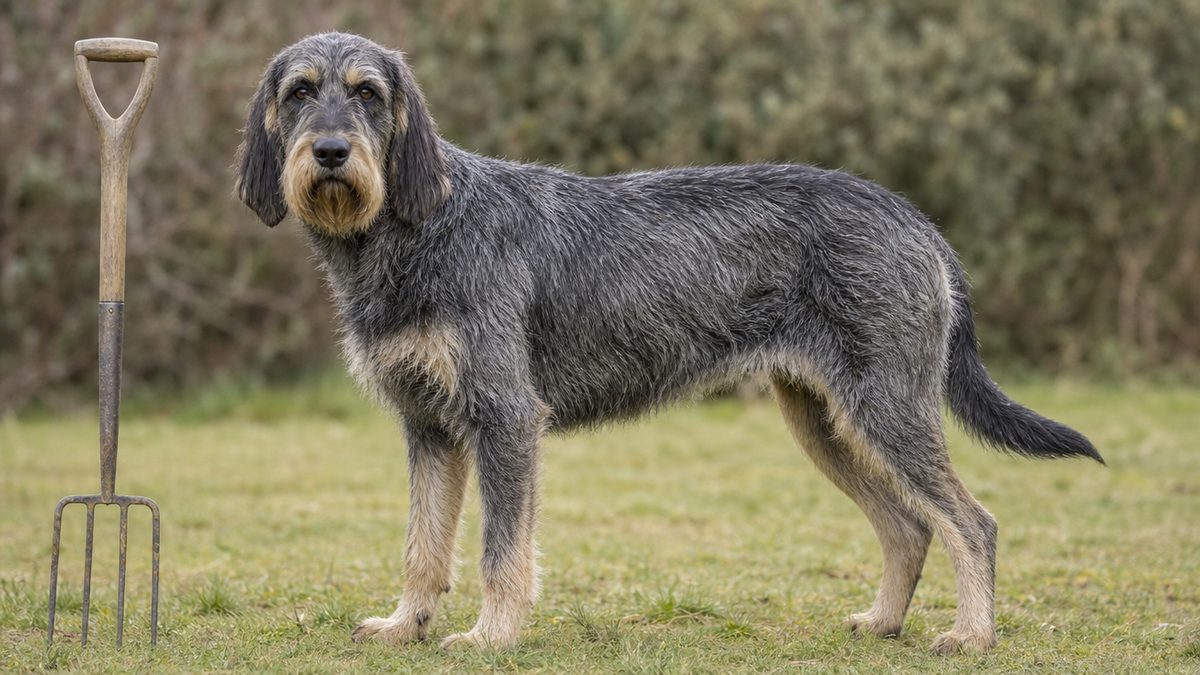
The general-appearance clause is one of the better paragraphs in the FCI corpus. It asks for a dog "with a hard and tousled coat, very well typed, robust, very hardy and shaggy. Dry in limbs and muscles, destined to provide length of work rather than speed; slightly sad in aspect but in no way nervous";. The French uses one word the English cannot carry, Barbouillaud, a regional term for the smeared, daubed look of the face under its beard and eyebrows.
| Point | What FCI standard 17 says |
|---|---|
| FCI number | 17, Group 6, Section 1.2 Medium-sized Hounds, with working trial |
| Withers height | Males 55 to 62 cm, females 53 to 60 cm |
| Weight | No figure at all. The standard prints none, and nor does the French national kennel club |
| Proportion | Body length slightly greater than height at the shoulder; skull and muzzle the same length |
| Ears | Set in line with the upper level of the eye, half-long, reaching the root of the nose |
| Coat | Long, shaggy and bushy, strong enough and rough, never woolly or curly |
| Colour | Always darkened, hair tips darker than the base; never orange |
| Teeth | Complete set; absence of the first premolars is not penalised |
| Country of origin | France. Official authentic language French |
| Accepted by the FCI | On a definitive basis, 15 December 1959 |
The colour clause, which is the breed's signature
This dog is defined by a hair, not by a pattern. Standard 17 says the coat is "always darkened, i.e., the hair always has the ends darker than the base (black overlay)", that the darkened tip "can take on a blue aspect", and that scattered white hairs give shades running from light grey to wild boar grey. It then names three traditional combinations: fawn very slightly overlaid with black, which is hare coat; sand overlaid with black, which is wolf grey; and fawn overlaid with blue, which is blue grey. Tan markings on the eyebrows, cheeks, chest, leg ends and under the tail are common in puppies and usually fade with age.
English Wikipedia reverses that clause while citing it. Its appearance section says "the coat is agouti, with each hair darker at the base than the tip", which is the opposite of what the standard prints in both its languages Federation Cynologique Internationale Federation Cynologique Internationale. If you are checking a puppy's coat against a description, check it against the standard.
The disqualifying faults, which are short and strict
Standard 17 has almost no ordinary fault list and a long disqualification list. Its FAULTS section contains exactly one enumerated item, "Behaviour: Timid subject". Its DISQUALIFYING FAULTS then cover aggression or extreme shyness, physical or behavioural abnormalities, lack of type, an overshot or undershot mouth, wall eyes or heterochromia, a kinked tail, a solid black, golden wheat or orange coat, a clearly outlined tricolour, white feet, important depigmentation, height outside the standard, an invalidating defect, and the presence of dewclaws except where their removal is outlawed.
The French call it chien de pays, dog of the region, and the Continental Kennel Club records the same alias. The FCI standard uses the phrase itself when describing the recreation of the breed. It is worth knowing because a French pedigree, a French forum thread and an old French print may all use it instead of the registered name.
The revival: what was actually rebuilt, and from what
The Griffon Nivernais was rebuilt from surviving local dogs rather than created from other breeds, and five published sources give five different accounts of when and from what, so this page prints them side by side and says which two to believe.
Take the two French sources first, because French is the breed's authentic language and one of them is the national kennel club. FCI standard 17 records that the breed may descend from Gallic hounds, the Canis Segusius, and from the grey Saint Louis dogs; that it was much appreciated for 200 years up to the reign of Louis XI; that Francis I abandoned it in the royal packs in favour of white hounds; that certain Nivernais noblemen kept it up to the French Revolution of 1789, "when the breed seemed to have disappeared"; and that "a century later, the Griffon Nivernais, often called dog of the region, was recreated from subjects nevertheless conserved in that cradle of origin of the breed";.
Read that sentence carefully, because it is the whole answer. The breed was not reconstructed from other breeds. It was recreated from dogs that had survived locally, and the standard's next sentence adds what was then poured in: "at the end of the XIXe century and the beginning of the XXe, these dogs received new blood from the Griffon Vendeen, the Fox Hound and then from the Otterhound". Survivors as the base, three outcrosses on top.
The Societe Centrale Canine tells the same story with more dates and one extra ancestor. It says the breed descends from the Segusian dogs of the Gauls and from the Grey Dog brought back from the East by Saint Louis after the eighth crusade in the middle of the thirteenth century, and that after the Revolution it was recreated from subjects conserved in the cradle of the breed "after having received blood from the Vendeen, the FoxHound then the Otterhound";. The ordering differs slightly from the FCI's, the substance does not.
| Source | When it disappeared | When it was rebuilt | From what |
|---|---|---|---|
| FCI standard 17 | "Seemed to have disappeared" at the Revolution, 1789 | "A century later" | Subjects conserved in the breed's cradle, then Vendeen, Foxhound, Otterhound blood |
| Societe Centrale Canine | Same, at the Revolution | "A century later" | Subjects conserved in the cradle, after receiving Vendeen, FoxHound then Otterhound blood |
| English Wikipedia | "After the French Revolution" | "Beginning in 1925" | "Based on the Grand Griffon Vendeen", plus Otterhound and Foxhounds |
| Continental Kennel Club | "Thought to be extinct by the late 1800s" | Not dated | A small number of the last remaining Nivernais hounds, plus Griffon Vendeen, Otterhound and French Foxhounds |
| United Kennel Club | Not described as a disappearance | "After the French Revolution" | Renewed interest in a local type; "originally known as the Griffon-Vendeen-Nivernais" |
Two of those five are wrong in checkable ways. Wikipedia dates the reconstruction to 1925, which is the year the breed CLUB was founded, not the year the rebuilding began, and it makes the Grand Griffon Vendeen the base rather than an outcross, citing a 1995 encyclopedia rather than either French source. The Continental Kennel Club puts the extinction scare "by the late 1800s", which is the period the FCI describes as the recreation, moving the crisis a century forward.
The UKC contributes the one detail the French sources omit, and it is a good one. It records that the breed was "originally known as the Griffon-Vendeen-Nivernais";. That former name carries the Vendeen outcross in it, which is why the confusion with the Vendeen griffons has a real historical root rather than being only a similarity of coat.
What is documented is that the breed's presence collapsed around the French Revolution, that dogs survived locally in the Nivernais, that a rebuilding effort about a century later used those survivors with Vendeen, Foxhound and Otterhound blood, and that a club followed in 1925. What is NOT documented in any source Bonbeno could open is how many founder dogs there were, who owned them, or in what year the first litter was bred. Every page that gives you a founder count is going beyond its sources, and this one will not.
The second collapse, which only the French record
The Griffon Nivernais nearly went under twice, and the second time is documented in one sentence on the French national kennel club's website and in no English source found: the war and the occupation cut the numbers, the club fell half asleep, and it was put back on the rails in 1969.
Here is the sentence, from the Societe Centrale Canine's own breed page: "the Griffon Nivernais club was created in 1925 under the presidency of the Vicomte d'Anchald. With the war and the occupation, numbers fell, and the club, in half-sleep, was put back on the rails in 1969";. That is a second near-loss, a named first president, and a specific relaunch year, none of which appears on any English page about the breed that Bonbeno could find.
It also reframes what kind of breed this is. A dog whose organised support collapsed twice and was rebuilt twice, most recently within living memory, is not an unbroken ancient line. It is a modern reconstruction with a long name, and the 2004 standard is the current settlement of what that reconstruction should look like.
What the numbers look like now
| Year | Griffon Nivernais | Adult confirmations | All four Vendeen griffons |
|---|---|---|---|
| 2021 | 670 | not published in this table | 746 |
| 2022 | 564 | 323 | 592 |
| 2023 | 509 | not published in this table | 573 |
| 2024 | 583 | 273 | 398 |
| 2025 | 571 | 326 | 453 |
The series shows a dip and a recovery rather than a decline. Registrations fell from 670 in 2021 to 509 in 2023, a drop of 24 percent, then rose 15 percent to 583 in 2024 and eased 2 percent to 571 in 2025 Societe Centrale Canine Societe Centrale Canine. Note what the last column does over the same period. In 2021 and 2022 the four Vendeen griffons together still outnumbered the Nivernais, 746 against 670 and 592 against 564. From 2024 the position reverses and widens, 583 against 398 and then 571 against 453. The Nivernais did not grow; the Vendeens shrank.
The confirmation rate is the more interesting column. Of 571 dogs registered in 2025, 326 went on to adult confirmation, which is 57 percent, against 46 percent for the Petit Basset Griffon Vendeen and 39 percent for the Grand Griffon Vendeen in the same table. Confirmation is the step at which a French dog is examined as an adult and admitted definitively to the studbook, so a high rate points to dogs being bred by people who intend to use and show them rather than to sell them on.
One caution about the 2019 edition of the same statistics. It uses a different column layout from the 2022, 2024 and 2025 editions, so Bonbeno does not quote a 2019 figure here rather than guess which column means what. The four years above come from tables whose headers were read directly and whose 47 scenthound rows sum exactly to both printed column totals, 11,720 for 2025 and 12,894 for 2024.
A breed that registers roughly 500 to 670 dogs a year in one country and almost none anywhere else is not endangered and is not available. Those are different facts and most pages collapse them. The Griffon Nivernais has a stable working population in France, a handful of dogs in a few neighbouring countries, and no presence in India at all.
Griffon Nivernais against the breeds it is confused with
Tell a Griffon Nivernais from the Vendeen griffons by the ear set and the colour: the Nivernais carries its ears at eye level and is always black-overlaid grey, while every Vendeen sets its ears BELOW the eye line and comes in white-marked and tricolour patterns the Nivernais standard disqualifies.
Two clauses do almost all the work. FCI standard 17 sets the Nivernais ear "in line with the upper level of the eye" and asks for a coat that is "always darkened", with the hair tips darker than the base, and "never orange";. The Petit Basset Griffon Vendeen's standard sets its leathers "well set below the level of the eye" and permits fawn with white spotting and tricolour. A grey shaggy hound with ears hung at eye level is a Nivernais; a white-and-orange one with ears hung low is not.
Colour is the harder rule of the two, because the Nivernais standard turns it into a disqualification. Standard 17 disqualifies a coat that is solid black, golden wheat coloured, orange, or "tricoloured with clearly outlined lively colours", and disqualifies white feet. Tricolour with clear boundaries is precisely what a correct Vendeen looks like. So the two families are not merely different, they are mutually disqualifying on colour.
| Breed | FCI no. | Subsection | Male height | France 2025 |
|---|---|---|---|---|
| Griffon Nivernais | 17 | 1.2 Medium-sized Hounds | 55 to 62 cm | 571 |
| Briquet Griffon Vendeen | 19 | 1.2 Medium-sized Hounds | 50 to 55 cm | 174 |
| Grand Griffon Vendeen | 282 | 1.1 Large-sized Hounds | 62 to 68 cm | 107 |
| Petit Basset Griffon Vendeen | 67 | 1.3 Small-sized Hounds | 34 to 38 cm | 127 |
| Grand Basset Griffon Vendeen | 33 | 1.3 Small-sized Hounds | 40 to 44 cm | 45 |
The numbers upend the usual telling. One Griffon Nivernais year, 571 registrations in France in 2025, outnumbers all four Vendeen griffons put together, which came to 453. The Briquet Griffon Vendeen shares this breed's exact FCI subsection, 1.2 Medium-sized Hounds, and is registered at less than a third of its rate. The breed usually described as the rare reconstructed one is the most numerous French rough-coated hound of the five.
Against the Grand Griffon Vendeen, the closest in size
The size overlap is real and the separator is again colour and ear set. The Grand Griffon Vendeen stands 62 to 68 cm for males under its own standard, FCI 282, against the Nivernais at 55 to 62, so a large Nivernais and a small Grand Griffon meet at exactly 62 cm Federation Cynologique Internationale Federation Cynologique Internationale. At that point look at the ear line and the coat: eye-level ears and an agouti grey coat with no clear white for the Nivernais, low-set ears and a white-marked or clearly tricoloured coat for the Vendeen.
Four standards, four different dogs
| Clause | FCI 17 | UKC | Continental Kennel Club |
|---|---|---|---|
| Male height | 55 to 62 cm | 21.5 to 24.5 in, 54.61 to 62.23 cm | 21 to 25 in, 53.34 to 63.5 cm |
| Female height | 53 to 60 cm | 20.5 to 23.5 in, 52.07 to 59.69 cm | 21 to 24 in, 53.34 to 60.96 cm |
| Size tolerance | None in the authentic French text | Three quarters of an inch, 1.91 cm, either end | None stated |
| Weight | None given | None given | 49 to 55 lb, 22.2 to 24.9 kg, both sexes |
| Ear length | Reaching the root of the nose | Long enough to reach the nose | To approximately the point of the nose but never beyond |
| Bite | Scissors, sometimes level; overshot or undershot DISQUALIFIES | Scissors or level; overshot or undershot disqualifies | Level, scissor OR REVERSE-SCISSOR permitted |
| Dewclaws | Presence is a DISQUALIFYING fault, except where removal is outlawed | A fault, front and rear, with no exemption | Not addressed |
| Wrong colour | Solid black, wheaten, orange, clear tricolour and white feet all DISQUALIFY | The same colours are only FAULTS; albinism alone disqualifies | Black-based agouti shades described, no disqualification list |
Read the bite row twice. The FCI disqualifies an undershot mouth outright, and the Continental Kennel Club expressly permits a reverse-scissor bite, which is a mild undershot placement, requiring only that "contact must be made between the top and bottom incisors"; Continental Kennel Club. India's own screening clause, Second Schedule Part III paragraph 8(10) of the 2017 Rules, names "undershot jaw (when incisors do not touch or mesh)" among the genetic defects a breeding dog must have been tested for, and that parenthetical means a reverse-scissor bite with contact is probably outside it. Bonbeno flags the collision rather than resolving it, because no Indian ruling on the point was found.
Standard 17 is unusually direct about the job: "scent hound used mainly for shooting of wild boar, generally in a pack but also individually". The French national kennel club adds that its courage and initiative let it be used successfully in small numbers on wild boar. This is not a general-purpose country dog that happens to hunt. It is a specialist, and the FCI attaches a working trial to the breed.
The English standard is not the French standard, and one difference matters
The English translation of FCI standard 17 adds a one centimetre size tolerance that the authentic French text does not contain, on a standard where height outside the limits is a disqualifying fault, and it drops three other passages the French carries.
Bonbeno checked this twice, with two independent extractions of both PDFs, because it is the kind of claim that is easy to make and easy to get wrong through a parser dropping a line. Both extractions agree.
The English size clause reads: "Height at withers: Male: from 55 to 62 cm. Female: from 53 to 60 cm. With a tolerance of 1 cm more or less". The French size clause reads: "Hauteur au garrot : Males : de 55 a 62 cm. Femelles : de 53 a 60 cm", and then goes straight into the faults section. There is no tolerance sentence in the authentic text.
That is not a stylistic difference. Both versions list "height outside the limits defined by the standard" among the DISQUALIFYING faults. So a 63 cm male is inside the English document's band and outside the French one's, and the French is the version that governs, because standard 17 states that the official authentic language is French Federation Cynologique Internationale.
| Passage | French, authentic | English translation |
|---|---|---|
| Size tolerance | Absent | "With a tolerance of 1 cm more or less" ADDED |
| Gait | "Le chien couvre assez de terrain", the dog covers enough ground | Sentence DROPPED |
| Withers | "Il se fond harmonieusement avec le cou", it blends harmoniously into the neck | Sentence DROPPED |
| Commencement | "Ce standard entrera en vigueur a partir de septembre 2004" | Sentence DROPPED |
| Temperament | "Excellent rapprocheur", a technical term for the hound that works out the line | "Excellent at approaching", which is not what the term means |
| Schooling | "Facile a creancer dans la voie de cet animal", easy to school onto that quarry's line | "Can easily be taught hunting that game" |
The last two rows are translation losses rather than errors. A rapprocheur is the hound that finds and unravels the line at the start of a hunt, and creancer means to school a hound onto one quarry and off the others. Both are precise French hunting terms with no one-word English equivalent, and both describe what this breed is for. An English reader of standard 17 loses the entire job description twice over.
A control, and why it matters
The same two translators, John Miller and Raymond Triquet, produced the English texts of the Vendeen griffon standards, and there the divergence runs the other way. FCI standard 67 asks in French that the young dog be accustomed au rappel, to the recall, and the English renders that as "get used to obeying". In standard 17 the French itself says the master must know how to make the dog obey, so the English "obey" here is faithful. That control matters: it shows the recall-to-obedience substitution on the Vendeen pages is a real divergence in those documents rather than a habit of these translators.
Read the authentic-language version whenever a figure or a rule is load-bearing, and read the English for comprehension. The nomenclature entry names the authentic language on every breed's page. For this breed it is French, and the French text is one sentence stricter on size than the English one every foreign buyer reads.
The dewclaw clause, written for countries like India
FCI standard 17 makes the presence of dewclaws a disqualifying fault and then exempts countries where removing them is forbidden by law, which is the clearest example on this site of a breed standard anticipating exactly India's legal position.
Here is the clause in both official languages. The English disqualifying-faults list reads "Feet: Dewclaws, except in countries where their removal is outlawed". The authentic French reads "Presence d'ergots, sauf dans les pays ou il est interdit par la loi d'en faire l'ablation"; Federation Cynologique Internationale. The exemption is in the standard itself, not in a national addendum.
India is such a country on the strongest available reading. The Prevention of Cruelty to Animals (Dog Breeding and Marketing) Rules 2017, Second Schedule Part II paragraph 6(8), states that "there shall be no tail docking, ear cropping de-barking, de-clawing, branding, dyeing, injecting substances to enhance visual appeal, performing a surgery or procedure to camouflage or hide any defect or infirmity or any other kind of mutilation of any body part of the pup and any change of appearance by artificial means is strictly forbidden". Removing a dewclaw removes a body part.
Bonbeno states the limit of that reading honestly. The Rules name de-clawing, which in strict usage means removing claws rather than removing a digit, and no Indian judgment or circular specifically addressing dewclaw removal was found in this research. The catch-all covering "any other kind of mutilation of any body part of the pup" plainly reaches it, and that is the reading a breeder here should work to, but it is a reading rather than a decided point.
| Standard | Dewclaws | Exemption for national law |
|---|---|---|
| FCI 17, English and French | Presence is a DISQUALIFYING fault | Yes, expressly, for countries where removal is outlawed |
| United Kennel Club | "Fault: Dewclaws" on both fore and hind legs | None stated |
| Continental Kennel Club | Not addressed in the standard text | Not applicable |
So the UKC, which recognised the breed on 1 January 1995, faults dewclaws front and rear and offers no carve-out at all. A dog bred lawfully in India would carry a fault under the UKC's document and none under the FCI's. Since a Kennel Club of India pedigree is written against FCI nomenclature, the FCI's exemption is the one that applies here.
Why the clause exists at all
Rear dewclaws are common in French pack hounds and were traditionally removed. The FCI's drafting choice was to keep the disqualification, because a working boar hound catching a dewclaw in bramble is a real injury, while writing an explicit exemption rather than forcing breeders in prohibiting countries to break the law. Whether or not you accept that reasoning, the drafting is unusually thoughtful and it is worth an Indian reader knowing that the document already accounts for them.
If you ever acquire this breed in India, keep the dewclaws, keep them trimmed short so they cannot catch, and keep a copy of standard 17's disqualifying-faults list. Nobody can require their removal here, the standard exempts you, and paragraph 6(8) of the 2017 Rules forbids the procedure.
Registry status, and what it means in India
The Griffon Nivernais is recognised by the FCI as standard 17 since 15 December 1959, by the United Kennel Club since 1 January 1995 and by the Continental Kennel Club, and it is absent from the American Kennel Club's register entirely, including its Foundation Stock Service.
The FCI number was read off the register's own alphabetical index rather than guessed, because an assembled FCI URL resolves on its trailing number and will serve another breed's page without erroring. The index for the letter G links this breed at GRIFFON-NIVERNAIS-17, and the entry returned carries the breed name on its own face Federation Cynologique Internationale.
| Registry | Status | Date | Group |
|---|---|---|---|
| FCI | Recognised on a definitive basis, standard 17 | 15 December 1959 | Group 6, Section 1.2 Medium-sized Hounds, with working trial |
| United Kennel Club | Recognised | 1 January 1995 | Scenthound Group |
| Continental Kennel Club | Recognised, with its own standard | Not stated | Breed Group 7, Scenthounds and Related Breeds |
| American Kennel Club | Not listed, including in Foundation Stock Service | n/a | n/a |
| Kennel Club of India | No breed list published; pedigrees issue against FCI nomenclature | n/a | Would name FCI standard 17 |
The United Kennel Club's complete breed-standards index was read in full for this page, and it lists the Griffon Nivernais in its Scenthound Group alongside all four Vendeen griffons. The AKC absence was checked against controls rather than asserted. The AKC's complete breed selector, which covers every recognised breed and every Foundation Stock Service breed, lists no Griffon Nivernais while listing comparably rare European scent hounds including the Basset Fauve de Bretagne, Porcelaine, Segugio Italiano, Transylvanian Hound, Hamiltonstovare, Drever, Hanoverian Scenthound and Bavarian Mountain Scent Hound. So the register does carry obscure French and central European hounds, and this one is not among them.
The date to notice is 1959. The FCI accepted this breed on a definitive basis on 15 December 1959, which is five years after the Briquet Griffon Vendeen in 1954, eight before the Grand Basset in 1967 and seventeen before the Petit Basset in 1976 Federation Cynologique Internationale Federation Cynologique Internationale. A breed most English pages describe as recently reconstructed was in the definitive register before three of the four Vendeens.
The standard is young even though the recognition is old
The current standard is from 2004 and that is unusually recent. Standard 17's valid text was published on 24 March 2004 and its English and French versions are dated 2 April 2004, against 9 January 1999 for all four Vendeen griffons. The French version closes with a line the English drops: "this standard shall come into force from September 2004";. So the document describing this dog is five years younger than the documents describing its neighbours, which is worth knowing when comparing how much detail each contains.
What a Kennel Club of India pedigree would say
India is a full FCI member represented by the Kennel Club of India in Chennai, so any pedigree issued here is written against FCI nomenclature and would name standard 17. The Kennel Club of India publishes no breed list of its own, so nothing can be read off its silence in either direction, and this page does not offer that silence as evidence of anything.
Do not build an FCI URL from a breed name and a guessed number. On fci.be the trailing number decides which document you get and the name in the address is ignored, so an invented address returns another breed's complete, correct-looking page. This breed's number, 17, was taken from the register's own index of breeds beginning with G, and the returned page prints GRIFFON NIVERNAIS (17) at the top.
Price in India: none exists, and what the rupee figures are actually attached to
No price in India exists for the Griffon Nivernais, and the only rupee figures returned under the breed's name are craft downloads, a 1931 engraving and a postage stamp.
Etsy India publishes a page headed "Buy Griffon Nivernais Online In India" carrying 241 listings. Of the first eight results, three are patterns for the mythical griffin, the eagle-lion, one is a Brussels Griffon crochet pattern, two are Wirehaired Pointing Griffon artwork, and only two name this breed at all: a printable wall-art poster at ₹586, reduced from ₹1,173, and a 1931 antique hunting print at ₹6,873.
That is the whole Indian market. The most expensive Griffon Nivernais you can buy in India is a ninety-five-year-old picture of one, and the search that finds it also returns three mythical griffins and two other breeds, which is the same collapse of griffon into a coat description that Google's own People Also Ask box performs on this query.
| Result | What it is | Rupee figure |
|---|---|---|
| Etsy India, printable wall-art poster | A digital download naming the breed | ₹586, reduced from ₹1,173 |
| Etsy India, 1931 antique hunting print | A paper print of the breed | ₹6,873 |
| Etsy India, three top results | Crochet and 3D-print patterns for the mythical griffin | ₹282 to ₹423 |
| eBay, from Thane | A 1999 Burkina Faso postage stamp depicting the breed | Not read |
| An Indian listing site | Breed name in the selector; visible stock was a Great Dane | None shown |
| An Indian Bangalore puppy page | Breed name in the selector; visible stock was a German Shepherd | None shown |
| An Indian rehoming site | Breed name in the rehoming dropdown | None shown |
The control, which is what makes this a finding
An Indian search does return an Indian market when one exists. The same kind of query for the Basset Hound returns a city-by-city rupee table across Hyderabad, Bangalore, Delhi, Chennai, Lucknow, Mumbai, Jaipur and Pune, with a stated band and named sellers. So the absence of a Griffon Nivernais price is a fact about the breed rather than an artefact of the search.
There is nothing here to run a currency test against, and Bonbeno says that rather than manufacturing something to test. On the sibling Vendeen pages there was at least a contaminated rupee band to divide by 84.38, by 74 and by 66.67; here no Indian source states a purchase price for the breed at all. A page that produced one would be inventing it.
What the breed costs where it exists
No published French purchase price was found either, which is consistent with a working breed sold within a hunting community rather than through a market. The Societe Centrale Canine runs a puppies-of-the-breed page and a breeders-of-the-breed page, neither of which publishes prices. Bonbeno does not broker sales, does not link listings and will not estimate a figure from a neighbouring breed.
Ask for the pedigree before the price. A Kennel Club of India pedigree is written against FCI nomenclature and would name standard 17, and there is no lawful commercial import route that would put a litter of this breed in an Indian kennel. A seller with a rupee figure and no pedigree is selling you something else with a French name on it.
Cost of ownership, and what can honestly be bounded
Recurring costs for a Griffon Nivernais in India cannot be bounded from Indian data, because no Indian population exists to price, but the coat, the ears, the food volume and the exercise are all predictable from the breed's own documents.
Bonbeno found no Indian veterinary fee schedule, no Indian insurance quote, no Indian food cost and no Indian grooming price specific to this breed. That is not a gap in the research, it is the consequence of a breed with no Indian presence, and any page that gives you a monthly rupee figure for it has borrowed one from another dog.
| Item | What the sources support | Knowable in India? |
|---|---|---|
| Food volume | A 55 to 62 cm working hound; the French national club feeds once daily with a rest period, or twice on veterinary advice | Volume yes, cost not published for this breed |
| Grooming tools | A brush and a stripping comb; no clipping | One-off, low |
| Grooming frequency | The French club says three to four times a year; an Indian retailer says two to three times a week | The Indian figure is the workable one |
| Ear care | Long hair, pendant ears; the French club advises plucking the hair and using a cleaning product | Time rather than money, daily in the monsoon |
| Exercise | High. A working boar hound bred for length of work rather than speed | Time, and lost middays for months of the year |
| Health screening | No registry publishes any for this breed and no DNA test exists for it | Nothing mandated, nothing available |
| Purchase | No verifiable figure in India or France | Unknown |
One published care instruction that costs money to follow badly
The ear advice is worth pausing on. The Societe Centrale Canine says that, like all long-haired drop-eared dogs, the ears need good hygiene "by plucking them and applying a cleaning product";. Routine plucking of ear canal hair is contested in current veterinary practice, because it can irritate the canal in a dog that is not already affected, and it is not a procedure to hand to an untrained groomer. Ask your own vet whether to pluck this dog's ears before booking it, especially in a humid Indian city where an irritated canal will not stay dry.
What an Indian owner would spend that a French one does not
Budget for cooling and for grooming labour. The Nivernais averages 11.04 degrees Celsius across the year at its home point, and no large Indian city keeps a monthly mean below the Nivernais' hottest month for more than a few weeks. Add a long shaggy coat that the French national club believes needs attention three or four times a year and that an Indian humidity level will mat in a fortnight, and the two recurring costs specific to this dog in India are electricity and a groomer who understands hand-stripping.
No Indian page publishing a monthly cost for this breed was found. That is unusual and it is honest: the Indian pages that rank for it publish breed descriptions and no numbers. Where a figure does not exist, this page prints no figure rather than an average of other dogs.
Heat tolerance in India, worked from the homeland climate
Heat tolerance for the Griffon Nivernais rates 2 out of 5 in India, because the Nivernais averages 11.04 degrees Celsius across the year while Chennai averages 27.95, and because its own national kennel club states that griffons are more sensitive to heat than short-coated dogs.
Start with the sentence nobody translates. The Societe Centrale Canine writes that, accustomed to living outdoors, the breed "stands up very well to cold and humid climates", and then: "like all griffons, it is more sensitive to heat than its short-coated relatives";. That is the French national kennel club naming heat as this coat type's weakness, in its own breed file, and it appears in no English page found on this query.
The climate comparison is done from NASA POWER climatologies queried by explicit latitude and longitude, so no city can be substituted for another by a slug. The homeland point is Nevers in the Nievre at 46.9896 north and 3.1590 east, and the returned coordinates were checked inside the response.
| Place | Annual mean C | Coolest month mean C | Annual max C | Annual RH percent | Months above 20.03 C |
|---|---|---|---|---|---|
| Nevers, the Nivernais | 11.04 | 2.57 | 41.42 | 81.10 | 0 |
| Bengaluru | 23.74 | 20.22 | 40.38 | 67.94 | 12 |
| Pune | 23.86 | 19.62 | 43.20 | 66.80 | 10 |
| Delhi | 25.60 | 13.61 | 48.79 | 45.56 | 9 |
| Kolkata | 25.81 | 17.31 | 46.81 | 73.93 | 10 |
| Mumbai | 26.77 | 23.19 | 44.91 | 67.39 | 12 |
| Chennai | 27.95 | 24.09 | 42.70 | 72.39 | 12 |
The last column is the one to read. The Nivernais' warmest month is July, at a mean of 20.03 degrees. Chennai, Mumbai and Bengaluru spend all twelve months above that figure, Kolkata and Pune ten, and Delhi nine NASA POWER, Source Native Resolution… NASA POWER, Source Native Resolution… NASA POWER, Source Native Resolution… NASA POWER, Source Native Resolution… NASA POWER, Source Native Resolution…. In the three of those cities where an imported dog is most likely to live, there is no month of the year as cool as the hottest month at home.
The surprise in the peak column, and why it does not rescue the breed
This is not a mild-summer place, which makes the point sharper rather than weaker. The Nivernais is inland and continental, and its recorded annual maximum is 41.42 degrees, which is 1.04 degrees HIGHER than Bengaluru's 40.38 NASA POWER, Source Native Resolution…. So the dog's homeland does see genuine heat. What it does not see is duration: not one month there averages above 20 degrees, and the annual mean sits at 11.04. India does not offer this breed a hotter day than it has met. It offers it a hotter year.
Humidity is not the new variable either. The Nivernais runs 81.10 percent annual relative humidity, above every Indian city in the table, and its wettest month, December, averages 92.9 percent. A dog bred in a wet continental valley is not humidity-naive. The combination it has never met is warm and wet at once, which is precisely a Mumbai or Kolkata monsoon.
What the heat evidence says, and what it does not
The largest study of canine heat illness in a temperate country is about exertion rather than weather. Hall and colleagues, working from 905,543 UK dogs under primary veterinary care in 2016, recorded 1,259 heat-related illness events from 1,222 dogs, of which 879 had a trigger recorded, and 652 of those 879, which is 74.2 percent, were exertional rather than environmental or vehicular. That is a whole-cohort finding and it transfers. Bonbeno does not borrow that paper's breed-specific odds ratios for the Griffon Nivernais, because it is not a breed the study modelled.
Bengaluru and Pune: workable, with a dawn walk and a second after dark, and the middle of the day given up from March to June. Mumbai and Chennai: dawn and dark only, all year, with the coat combed out weekly and the ears checked daily through the monsoon. Delhi: indoors from late morning to late afternoon from April to July, when the annual maximum reaches 48.79 degrees. Kolkata: the same, plus daily ear checks through a monsoon that pushes September humidity to 89.3 percent.
Managing the heat and the monsoon
Manage this breed in India by moving the work to the cool ends of the day, combing the shaggy coat out weekly rather than four times a year, and treating a rectal temperature at or above 41.0 degrees Celsius after exertion as an emergency.
- Move the exercise, do not cut it. This is a hound bred for length of work rather than speed, and an under-worked one becomes destructive rather than calm.
- Comb weekly here, whatever the French figure says. The coat is long, shaggy and bushy, and dead undercoat trapped against the skin in Indian humidity is where a hot spot starts.
- Never clip it. The harsh outer layer is the sun barrier and the bramble armour; removing it leaves the insulating layer behind, which is exactly backwards.
- Watch the pace rather than the thermometer. The exertional finding above means the risk is what the dog does, and a scent hound working a line does not self-regulate.
- Know the number. A rectal temperature at or above 41.0 degrees Celsius after exertion in heat is an emergency. Cool the dog with room-temperature water and move.
The monsoon job is the ears
Lift the ear and look, daily, from June to September. This breed carries pendant ears set at eye level, covered in long hair and turned slightly inward at the tip, which is a design that holds warm moist air against the canal. An Indian retailer writing for the breed lists ear infections among its likely problems and prone-ness to them among its disadvantages, which is a reasonable inference from the ear shape even though no study of this breed supports it. Dry inside the leather after every bath and after every swim.
The French advice here needs adapting rather than copying. The Societe Centrale Canine says to keep the ears clean "by plucking them and applying a cleaning product";. Ask your own vet whether plucking is right for your dog before doing it, because in a canal that is not already affected it can cause the irritation it is meant to prevent, and in a Mumbai July at 89.6 percent humidity an irritated canal does not dry out.
The other monsoon job is the belly and the thighs
The standard tells you where to look. It requires that "the belly and the inside of the thighs shouldn't be hairless", so a correct dog of this breed carries hair in exactly the places that stay wet on a walk through wet grass. Dry those areas, check them for redness weekly, and do not let a groomer solve the problem by shaving them, which would breach the standard and remove the dog's sun protection at the same time.
The shaggy coat is genuine protection against thorn, scrub and sun, and the standard says so: the breed particularly enjoys difficult terrain and thickets. If you walk this dog in Indian scrub the coat is doing a job. The trade is that it must be combed out often enough to keep air moving to the skin, which is a weekly task here rather than a seasonal one.
Temperament, and the household this breed does not fit
The Griffon Nivernais is a balanced, non-aggressive, strongly independent pack hound, and its own national kennel club says plainly that it is not suited to city life, still less to an apartment.
That verdict is not an opinion piece, it is the French national kennel club's own breed file. The Societe Centrale Canine writes: "although it can adapt to all situations, it is an active dog that likes to live in a pack and to expend itself. The Griffon Nivernais is not suited to life in town, still less in an apartment";. An Indian retailer writing for the same breed reaches the same conclusion independently, listing "not well suited to apartment living" among its disadvantages.
The standard's own temperament clause is a working description. It asks for a dog that is "excellent at approaching and very good hunter, courageous when holding firm without being reckless", whose "courage and initiative allow it to be used successfully in small packs for hunting wild boar", and which "shows itself occasionally to be obstinate and independent";. Holding firm means standing to a boar at bay. That is a specific kind of courage and it is not a house-dog trait.
| Source | Words used |
|---|---|
| FCI standard 17 | Courageous at bay without being reckless; occasionally obstinate and independent; slightly sad in aspect but in no way nervous |
| Societe Centrale Canine | Balanced; neither timid nor fearful; above all not aggressive towards people; calm and obedient in the kennel; a pronounced sense of hierarchy |
| United Kennel Club | Courageous but not reckless; can be stubborn and independent; a sorrowful expression but not timorous |
| Continental Kennel Club | Sociable yet independently thinking; even-tempered; steady and confident in the field |
| Royal Canin India | Confident, independent; a little headstrong; obedience training is essential |
Two phrases worth reading twice
The French club says the dog is "calm and obedient in the kennel". That is a description of a dog housed in a kennel with its packmates, not of a dog in a flat, and it should not be read as a claim about how it behaves alone indoors. The same page adds that, living most often in a pack, the breed "has a pronounced sense of hierarchy" and calls it a dominant that the owner must know how to make obey "gently but firmly";.
Bonbeno flags the dominance framing rather than repeating it. Dominance-based accounts of dog behaviour have been out of favour in behavioural science for two decades, and the practical instruction underneath, that this dog needs consistent handling from an early age, stands without the theory. Take the instruction and leave the label.
Who it suits
- Households with land or reliable access to open country, which is what a hound built for length of work rather than speed actually needs.
- Homes with other dogs, since this is a pack-bred breed with a strong social structure.
- Owners with prior dog experience, which every source here implies and Royal Canin India states as obedience training being essential.
- People who are not looking for a guard dog. The French club's own line is that the breed is above all not aggressive towards people.
There is no Indian city in which this breed is a sensible choice for a flat, and the breed's own national kennel club says so before any Indian argument is made. If you live in an apartment in Mumbai, Bengaluru, Delhi or Chennai, this page's honest advice is that the Griffon Nivernais is a dog to admire rather than to acquire.
Training a boar hound, and the two French words the English loses
Train a Griffon Nivernais from its earliest age and build everything around the recall, because both official texts of its standard say the owner must know how to make it obey from its youngest age, and because a boar hound on a line does not stop for a voice.
The standard is unusually candid about the difficulty. It says that although the dog "can easily be taught hunting that game, it shows itself occasionally to be obstinate and independent, and its master should know how to make it obey starting at its youngest age";. The authentic French says the same thing, "son maitre devra savoir le faire obeir des son plus jeune age", so unlike the Vendeen standards there is no translation gap here.
The two words the English does lose describe what the training is for. Rapprocheur, rendered as "excellent at approaching", is the technical term for the hound that finds and unravels the line at the start of a hunt, and creancer, rendered as "taught hunting that game", means schooling a hound onto one quarry and off every other. Those two jobs are the breed's entire purpose, and they explain why its default setting is to leave you and follow a scent.
A training plan that fits the breed and the country
- Start at eight weeks and pay in food. A hound working against its nose needs a reason, and praise is not one.
- Use a long line for the whole first year. Ten to fifteen metres on a harness, so the recall is practised at distance and never disobeyed successfully.
- Socialise wide and early. In India that means traffic, autos, crowds, cattle, street dogs, lifts and the building's watchman, all before sixteen weeks.
- Give the nose a legal job. Scent games, tracking a dragged toy, food searches in the flat during the hours when it is too hot to walk. The Continental Kennel Club describes a dog that enjoys the challenge of difficult terrain, and an under-stimulated one invents its own.
- Accept the ceiling. Assume the recall may never be reliable against a fresh line on a large, confident, boar-bred hound, and design the walk so it does not have to be.
One Indian legal detail before a trainer offers a shortcut. The Prevention of Cruelty to Animals (Dog Breeding and Marketing) Rules 2017 forbid de-barking outright, in the Second Schedule Part II paragraph 6(8), alongside docking, cropping and de-clawing. A pack hound bays, and there is no lawful way to remove that here.
It is not a nervous or a suspicious dog. The standard asks for a dog slightly sad in aspect but "in no way nervous", and the French national kennel club says it is neither timid nor fearful and above all not aggressive towards people. A confident, non-fearful dog is easier to socialise in a noisy Indian street than an anxious one, and this breed's difficulty is independence rather than fear.
Daily exercise, and what the breed was built to do
Give a Griffon Nivernais at least two hours a day including scent work, because the standard describes a dog built to provide length of work rather than speed and every secondary source rates its exercise requirement at the top of its scale.
The standard's phrasing is the requirement. It asks for a dog "dry in limbs and muscles, destined to provide length of work rather than speed";. That is a stamina animal, not a sprinter, and stamina animals are not satisfied by a short fast outing.
| Source | What it says |
|---|---|
| FCI standard 17 | Built to provide length of work rather than speed |
| Societe Centrale Canine | An active dog that likes to live in a pack and to expend itself |
| Continental Kennel Club | Exercise requirement rated at the working-dog end of its own scale |
| An Indian retailer | High exercise requirements; long daily walks, hiking, running, tracking games, scent work |
| Royal Canin India | Obedience training is essential; confident and independent |
None of them publishes a number of minutes, which is honest of them, so Bonbeno gives a floor rather than borrowing one. Two hours a day, split across a dawn outing and an after-dark outing in most Indian cities, with at least half of it spent letting the dog use its nose on a long line rather than heeling on pavement. Below that, in a breed this size with this drive, you are storing up a problem.
The exercise has to include the nose, and in India that is the easy part
Scent work is the one requirement an Indian summer cannot take away from you. When the middle of the day is unusable outdoors, a dragged-scent trail through the flat, a food search in a cardboard maze or a tracking game on a balcony all satisfy the part of this dog that a walk does not. The standard describes a dog with a very good nose that particularly enjoys difficult terrain and thickets. An obstacle course indoors is not the Morvan, but it is work.
What happens without it
The failure mode is noise and destruction, not obesity. An Indian retailer's own disadvantages list for the breed names frequent barking or baying while tracking and a strong prey drive leading to chasing, and a vocal hound in an Indian apartment block is a complaint from the flat below rather than a quirk. A bored 60 cm pack hound in an Indian apartment block will find something to bay at, and the Rules forbid the surgical answer.
Ninety minutes at dawn with free sniffing on a long line, forty-five minutes after dark, one scent game indoors on the hottest afternoons, and one longer weekend outing somewhere fenced where the dog can gallop. That satisfies the breed's own description of itself and it moves nearly all of the work outside the four months when Bengaluru's monthly mean sits above the Nivernais' hottest month.
Grooming: the fortyfold disagreement between France and India
Groom a Griffon Nivernais weekly in India, not three or four times a year, because the French national kennel club's figure was written for a kennel-kept pack hound in a cold wet climate and does not survive an Indian monsoon.
Here are the two instructions in full. The Societe Centrale Canine says the breed is "very easy to maintain, a simple brushing and currying three to four times a year is enough to maintain its coat and eliminate the dead hair";. An Indian pet retailer's page for the same breed says "brushing two to three times per week", with occasional hand-stripping to maintain coat texture. Royal Canin's India page splits the difference at "requires moderate grooming";.
Between four times a year and two and a half times a week there is a factor of roughly forty, and the reason is climate rather than carelessness. The French figure describes a dog living outdoors in the Nievre, where the annual mean is 11.04 degrees Celsius and the coat sheds and self-clears through a cold winter. Take the same coat to a Mumbai July at 26.6 degrees and 89.6 percent humidity and the dead undercoat stays in, mats against the skin and stops air reaching it.
| Source | Frequency | Written for |
|---|---|---|
| Societe Centrale Canine | Brushing and currying three to four times a year | A kennel-kept pack hound in central France |
| Royal Canin India | Requires moderate grooming | A general audience; no frequency given |
| An Indian pet retailer | Two to three times per week, with occasional hand-stripping | An Indian household |
| Bonbeno's own reading | Weekly comb-through minimum, more in the monsoon | An Indian household in 60 to 90 percent humidity |
What the standard says the coat must be, and what that forbids
The coat clause constrains what a groomer may do. Standard 17 asks for hair that is "long, shaggy, and bushy, strong enough and rough (in any case neither woolly nor curly)", requires that "the belly and the inside of the thighs shouldn't be hairless", and asks for well-pronounced eyebrows that do not cover the eye, a slight beard on the chin and an ear covered enough in hair. Nothing there permits clipping, shaving the belly or tidying the face, and all three are what an Indian groomer unfamiliar with rough-coated hounds is likely to reach for in June.
Hand-stripping is the technique that fits. Pull the dead outer hairs and comb the dead undercoat out, rather than cutting live coat, which preserves the harsh texture the standard asks for and actually lets air reach the skin. A clipped rough coat grows back softer and denser, which is worse in heat, not better.
Shedding, and the claim nobody should make
This breed sheds and no dog is hypoallergenic. An Indian retailer's page says the breed "sheds lightly throughout the year", which is a fair description of a harsh coat that holds its dead hair rather than dropping it, and is not an allergy claim. If anyone extends it into one, the evidence is settled: Vredegoor and colleagues measured Can f 1 across 196 dogs of so-called hypoallergenic breeds against 160 control dogs and found no evidence for classifying any breed as hypoallergenic. A coat that holds shed hair is a housekeeping difference, not a medical one.
Of everything in the French national kennel club's breed file, the grooming frequency is the single line an Indian owner should not copy. It is written for a different climate and a different housing arrangement, and following it here produces a matted, hot, skin-sore dog. Everything else on that page, the heat sensitivity, the city verdict, the feeding warning, transfers directly and is worth more than most English pages about the breed.
Health: what is documented, which is almost nothing
Almost nothing is documented about this breed's health, because it has no OFA registry code, no row in any OFA statistics table, no place in the largest canine longevity study and exactly one PubMed record, and the honest response is to say so rather than to borrow another breed's problems.
Take the absences one at a time, each with a control, because an unproven absence is not evidence.
| Dataset | Griffon Nivernais | Controls that passed in the same session |
|---|---|---|
| OFA breed registry codes, 482 entries | Absent | Beagle BE, Basset Hound BH, Basset Fauve de Bretagne BFB, Porcelaine POR, Otterhound OH, Segugio Italiano SIT |
| OFA published statistics, 291 tables | No row in any registry | Beagle, Basset Hound, Labrador and both Basset Griffon Vendeens all return rows |
| McMillan 2024 longevity study | Listed and marked N, not included in the survival analysis | Basset Hound Y; Petit Basset Griffon Vendeen Y |
| PubMed, exact phrase | Phrase not indexed; 1 record for griffon AND nivernais | Otterhound 2 records, Basset Hound 101 |
| PubMed, Nivernais alone | 9 records, 8 of which are French hospital or historical papers | Same session, same tool |
| AKC register including Foundation Stock Service | Absent | Basset Fauve de Bretagne, Porcelaine, Hamiltonstovare, Drever, Transylvanian Hound all listed |
The single PubMed record is worth naming precisely, because it is the entire peer-reviewed literature on this breed. Botto and colleagues describe a calcaneal chondroplastic-like technique for repairing superficial digital flexor tendon luxation in three dogs, of which one was "a Griffon Nivernais with medial SDF tendon luxation following self-mutilation of the IV toe";. That is one animal in a surgical technique report. It tells you nothing about the breed.
McMillan 2024's supplementary Table S5 is the cleanest statement of the position. It lists the Griffon Nivernais, marks it N for not included in the survival analysis, gives its Kennel Club group as not applicable, its FCI group as scent hounds and related breeds, its body size as medium and its cephalic index as mesocephalic. The breed was considered and there was no data.
The contrast that makes the point
Compare a French griffon that has been studied. The Petit Basset Griffon Vendeen has a UK clinical series putting glaucoma at 10.4 percent of 366 dogs and a Danish population study putting epilepsy at 8.9 percent, 42 of 471 Gullov CH, Toft N, Baadsager MM. Neither of those existed until somebody counted. Nobody has counted anything in the Griffon Nivernais, and the difference between the two breeds is not health, it is attention.
What the sources that do say something actually say
The two official sources both say the same thing in different words. The French national kennel club calls it "a rustic dog with no particular pathology, provided it is regularly wormed and vaccinated";. English Wikipedia states, correctly, that "no unusual health problems or claims of extraordinary health have been documented for this breed";. Both are statements about the record rather than about the dogs.
One Indian page goes further than its evidence. A retailer's health list for the breed names hip dysplasia, gastric dilatation-volvulus, hypothyroidism, obesity, ear infections and progressive retinal atrophy. Of those six, one is supported by a source specific to this breed, and the rest are the standard list attached to any medium-sized drop-eared hound. Bonbeno reports which one below rather than repeating the list.
The right sentence about this breed's health is: nothing is known, because nobody has measured it. That is not the same as healthy, and it is not the same as unhealthy. It means a buyer cannot ask for a screening certificate that exists, and must instead ask about the parents and grandparents directly and get answers in writing.
The one health risk with a named source, and it comes from France
Gastric dilatation and volvulus is the only health risk for this breed named by an official source, and the warning arrives inside the French national kennel club's feeding advice rather than in a health section.
Here is the passage. The Societe Centrale Canine writes that the meal, whose ration varies with age and activity, "is given generally once a day with its packmates, preferably in the evening", and then: "health and upkeep: the meal must be followed by a period of rest, to avoid gastric dilatations and torsions. Always with this aim, the vet may advise feeding it twice";. That is the French national kennel club naming bloat as the reason for its own feeding protocol.
It is a plausible risk for the shape. Standard 17 asks for a chest "descending as much as possible to the elbow" with "a long thorax, becoming wider towards the last ribs", which is the deep-chested conformation associated with gastric dilatation and volvulus across breeds. Bonbeno does not attach a prevalence figure, because none exists for this breed.
What to do about it in an Indian household
- Feed twice a day rather than once. The French club's own text offers this as the veterinary alternative, and an Indian household has no kennel routine to enforce the alternative safely.
- Enforce a rest period after every meal. No walk, no play, no stairs for an hour. This is the club's stated reason for the protocol, not a folk rule.
- Never feed immediately after hard exercise in heat. Let the dog cool and settle first, which in an Indian summer means the meal follows the dawn walk by a clear gap.
- Know the signs. A restless dog with a distended abdomen, unproductive retching and drooling after a meal is a surgical emergency within hours, not something to watch overnight.
- Have the emergency number before you need it. Identify a clinic in your city that operates out of hours and can do abdominal surgery, and keep the number on the fridge.
The rest of the health advice, and its limits
The same page's positive claim is narrow and worth quoting exactly: the breed is "a rustic dog with no particular pathology, provided it is regularly wormed and vaccinated";. Deworming and vaccination are the two conditions, and in India both matter more than in France because the parasite burden is higher and rabies is endemic. A hound that works in scrub, drinks from standing water and meets other dogs is at the top of the exposure range for both.
There is no DNA test to ask for. No breed-specific genetic test exists for the Griffon Nivernais anywhere Bonbeno could find, no registry publishes a screening scheme for it, and India's own Second Schedule Part III paragraph 8(10) requirement, that breeding dogs "shall have been tested for genetic defects, including hip dysplasia, progressive retinal atrophy, night blindness, hypothyroidism, entropion, ectropion" and more, would have to be met with generic tests rather than breed-specific ones.
Ask for the sire's and dam's ages, their cause of death if they have died, whether any close relative has bloated, and hip scores if the breeder happens to have them. None of that is mandated for this breed and none of it will come as a certificate from a registry. A breeder who can answer those four questions from memory is keeping records, which is the best signal available for a breed nobody screens.
Life expectancy: three published bands, no study, and one misattribution
No cohort study covers the Griffon Nivernais, three sources publish life expectancy bands running from 10 to 14 years, and one of them attributes its figure to the FCI, which publishes no lifespan for this breed at all.
Start with the absence, because it is checkable. McMillan 2024, the largest study of companion dog longevity, lists this breed in its supplementary table of breeds considered and marks it N, not included in the survival analysis. Its scent-hound neighbours the Basset Hound and the Petit Basset Griffon Vendeen are both marked Y and both have medians in the results tables. So the breed was looked for and there were not enough dogs in UK veterinary records to model it.
| Source | Figure | Basis given |
|---|---|---|
| Royal Canin India | 12 to 14 years | Page states key facts are sourced from the FCI |
| Continental Kennel Club | 12 to 14 years | None stated |
| An Indian pet retailer | 10 to 14 years | None stated |
| FCI standard 17 | No figure at all | Breed standards do not print lifespan |
| Societe Centrale Canine | No figure at all | Its breed card gives size, weight and coat only |
| McMillan 2024 longevity study | Not modelled | Breed marked N, not included in the survival analysis |
The Royal Canin India row is the one to look at twice. That page carries the line "source: key facts and characteristics sourced from Federation Cynologique Internationale (FCI)" directly beneath its breed-specifics block, and that block includes "Avg life expectancy: 12-14 years";. FCI standard 17 contains no life expectancy, and neither does the FCI's nomenclature entry for the breed Federation Cynologique Internationale. So a figure is being attributed to a source that does not publish it, on a page served to Indian readers.
Bonbeno does not average the three bands into a fourth number. Two of them agree at 12 to 14 and one runs to 10, and none of them cites a cohort, a denominator or a study. What can honestly be said is that this is a moderately constructed medium-sized working hound with no brachycephalic airway, no extreme angulation and no giant-breed growth burden, and that dogs of that description commonly live into their low teens. That is a reasonable expectation, not a measurement, and this page labels it as one.
Why the absence is likely to persist
Longevity studies work off national veterinary records, and a breed registering roughly 500 to 670 dogs a year in one country will not reach the inclusion thresholds those studies use anywhere else. Unless the French veterinary profession runs its own cohort on French hunting hounds, there is no obvious route to a measured figure for this breed. A reader should expect the unsourced bands to keep circulating and should keep discounting them.
Check whether the page giving it also gives a cohort, a denominator or a citation. In this research every source carrying a figure for the Griffon Nivernais cited nothing, and one cited a body that publishes no figure. A number without a study behind it is an estimate somebody typed, and it propagates because the next writer copies it rather than because anyone measured anything.
Feeding a deep-chested working hound in India
Feed a Griffon Nivernais twice a day to a body condition score of 4 or 5 on the nine-point scale, enforce a rest period after every meal, and adjust the ration to the work rather than to a printed cup measure.
The French national kennel club's protocol is the starting point and it needs one change for India. It says the ration varies with age and activity, that the meal is generally given once a day with the dog's packmates and preferably in the evening, that the meal must be followed by a period of rest to avoid gastric dilatations and torsions, and that a vet may advise feeding twice with the same aim. Take the second option. A single large evening meal is a kennel routine, and an Indian household without a kennel is better served by two smaller meals and an enforced rest after each.
Score the dog, do not weigh the food
Nobody publishes a weight for this breed, so a weight-based ration table is not available even in principle. FCI standard 17 gives no weight and the Societe Centrale Canine's card prints "Poids: NP", not specified Societe Centrale Canine. That makes the body condition score the only usable instrument. Use the World Small Animal Veterinary Association nine-point chart and aim for 4 or 5: ribs easily felt under minimal fat, a waist visible from above, an abdominal tuck from the side.
A shaggy coat hides all three of those, which is the practical catch. Run the check with your hands rather than your eyes, monthly, and do it after a comb-through so the coat is not bunched. The standard asks for a dog "dry in limbs and muscles", so a correct Griffon Nivernais looks lean, and an owner used to smoother breeds may read a correct dog as underfed.
Practical feeding through an Indian year
- Two meals a day, with an hour of rest after each. The bloat reason is the French club's own, not a folk rule.
- Move the larger meal to the cool end of the day so the dog is not digesting through the hottest hours.
- Feed to the work, not the calendar. A hound doing two hours of scent work needs more than the same dog kept indoors through a Chennai May.
- Constant fresh water, and more of it than the same dog would drink in France.
- Take training treats out of the ration rather than adding them, because this is a food-motivated breed you will be paying to train.
One caution about ration figures circulating for this breed. The two secondary sources that publish a weight disagree with each other, at 49 to 55 pounds and at 20 to 30 kg, and neither cites the standard, which gives none. Any daily-calorie figure built on either of those inherits the disagreement. Ask your own vet for a number keyed to your dog's measured weight and its condition score.
Bonbeno found no Indian feeding trial, no Indian brand guidance and no Indian portion figure specific to the Griffon Nivernais, because there is no Indian population to study. The transferable parts are twice-daily feeding, the post-meal rest, the body condition score and constant water. Everything else on this subject that you will read about the breed has been borrowed from another dog.
The first year, month by month
Plan the first year of a Griffon Nivernais around socialisation before sixteen weeks, a long-line recall begun the week the puppy arrives, and a feeding routine built from the start around the bloat warning its own national kennel club gives.
| Age | What to do | Breed-specific reason |
|---|---|---|
| Before collection | Ask for the parents' ages, any family history of bloat, and hip results if they exist | No registry publishes screening data for this breed, so the pedigree conversation is the only screen |
| 8 weeks | Collect at eight weeks or later | Rule 8(1)(a) of the 2017 Rules requires that pups under eight weeks are not sold in India |
| 8 weeks | Confirm the dewclaws are intact | The FCI disqualifies dewclaws except where removal is outlawed, and India forbids the removal |
| 8 to 16 weeks | Socialise hard: traffic, autos, lifts, crowds, cattle, street dogs | A confident non-fearful pack hound that will be walked in Indian streets for a decade |
| 8 to 16 weeks | Start the recall on a five-metre line, paid in food every time | Both official texts say the master must make the dog obey from its youngest age |
| From week one | Two meals a day with an enforced rest after each | The French national kennel club's own reason is gastric dilatation and torsion |
| 3 to 6 months | Introduce the comb daily for two minutes and handle the ears every day | A long shaggy coat and pendant ears in a humid country |
| 6 to 12 months | Move the recall to a ten to fifteen metre line in progressively harder places | Assume the recall fails against a fresh line on a boar-bred hound |
| Around 12 months | Measure the dog at the withers and record it | Height outside the standard is a disqualifying fault, and the French text grants no tolerance |
Growth and the height question
Measure and record, because the size rule on this breed is stricter than the English document suggests. The authentic French text gives males 55 to 62 cm and females 53 to 60 cm with no tolerance, while the English translation adds one centimetre either way, and both list height outside the standard among the disqualifying faults. The UKC allows three quarters of an inch either end and the Continental Kennel Club runs from 21 to 25 inches for males, so a 63 cm male is out under the French text and in under two of the other three.
What to watch for, and when
There are no published onset ages for anything in this breed, which is itself the finding. No study reports a first-appearance age for any condition here, because no study reports any condition here. What that means practically is that a clear first year proves nothing and a normal-looking adult proves nothing, and the owner's job is to keep records rather than to watch for a named disease at a named age.
The one thing to establish early is a baseline. Ask for a full physical, a weight and, if your vet suggests it, hip radiographs at the age they recommend, and keep the file. In a breed with no screening scheme, your own dog's record is the only data that will ever exist about it.
Do not accept a docked tail, cropped ears or removed dewclaws. The Prevention of Cruelty to Animals (Dog Breeding and Marketing) Rules 2017, Second Schedule Part II paragraph 6(8), forbids tail docking, ear cropping, de-barking, de-clawing and any other kind of mutilation of any body part of the pup, and adds that any change of appearance by artificial means is strictly forbidden. And note Rule 8(1)(b): dogs over six months are not to be sold without first being sterilised, unless sold to another licensed breeder.
Indian import law and breeding law, and what they foreclose
Indian import law makes a commercial supply of the Griffon Nivernais impossible, and Indian breeding law then settles two questions the breed's own standard leaves open, on dewclaws and on what a breeding dog must be tested for.
Bonbeno read both instruments directly rather than summarising a summary. The import law is DGFT Trade Notice 22/2022-23 of 19 December 2022. The breeding law is the Prevention of Cruelty to Animals (Dog Breeding and Marketing) Rules 2017, whose gazette text was extracted here as a 14-page PDF and searched clause by clause to verify each quotation below.
Import law: three permitted purposes, and breeding is not one
Live dogs enter India as a Restricted item. The trade notice classifies ITC(HS) 01061900, mammals other, as Restricted, and Policy Condition 7 allows dogs in only for three purposes: a "pet dog with valid pet book and relevant records/documents in the name of importer", dogs imported by research and development organisations with a CPCSEA recommendation, and dogs for internal security by the Defence and Police Force. Policy Condition 8 then states that "import of commercial dogs for breeding or any other commercial activities other than the purposes mentioned above is not permitted";.
Paragraph 6 removes the remaining ambiguity: "any applications for trading/breeding purposes, or applications made on behalf of some another person/entity shall be duly rejected";. So the pipeline that would create an Indian population of this breed does not exist, which is the simplest explanation for why every Indian listing page for it holds a dropdown entry and no dog.
| Route | Condition | Authorisation needed |
|---|---|---|
| Pet, up to two animals, permanent | Owner transferring residence to India after two years of continuous stay abroad; only cats and dogs under baggage rules | None from DGFT if all conditions are met |
| Pet, up to two, stay abroad under two years | Or not transported as passenger baggage | DGFT import authorisation |
| More than two animals | Justification examined by DAHD before authorisation | DGFT import authorisation |
| Temporary import | Return ticket and a local host undertaking | DGFT import authorisation |
| Research | CPCSEA recommendation | Permitted purpose under Policy Condition 7 |
| Defence and Police | Internal security | Permitted purpose under Policy Condition 7 |
| Breeding or trading | Not permitted; applications shall be duly rejected | Closed |
Two practical details from the notice itself. Entry is allowed only through the airports and seaports of Delhi, Mumbai, Chennai, Hyderabad, Bengaluru and Kolkata and, since October 2024, Kochi airport, with quarantine at the government station where required, and an Advance No Objection Certificate must be obtained from the Regional or Quarantine Officer of that port seven days before travel, relaxable to three days. The notice advises beginning the application at least two months before the travel date. The full route is set out in how to import a dog to India.
Indian breeding law, and the clauses that bear on this breed
Indian breeding law settles two questions FCI standard 17 leaves to national rules, forbidding the removal of this breed's dewclaws and listing the genetic defects a breeding dog must have been tested for, none of which has a test specific to the Griffon Nivernais.
- Second Schedule Part II paragraph 6(8) states that "there shall be no tail docking, ear cropping de-barking, de-clawing, branding, dyeing, injecting substances to enhance visual appeal, performing a surgery or procedure to camouflage or hide any defect or infirmity or any other kind of mutilation of any body part of the pup and any change of appearance by artificial means is strictly forbidden". That is the clause that engages FCI standard 17's dewclaw exemption.
- Second Schedule Part III paragraph 8(10) requires that "the dogs shall have been tested for genetic defects, including hip dysplasia, progressive retinal atrophy, night blindness, hypothyroidism, entropion, ectropion, overshot, undershot jaw (when incisors do not touch or mesh), wry mouth, two or more missing teeth, unilateral cryptorchid or full cryptorchid males". The word is including, so the list is illustrative, and none of these has a breed-specific test for the Griffon Nivernais.
- Rule 8(1)(a) requires that "pups less than eight weeks in age are not sold", and Rule 8(1)(b) that "dogs over six months in age are not sold without first being sterilised, unless they are being sold to another licensed breeder".
- Second Schedule Part II paragraph 6 permits only out breeding and line breeding, and prohibits in breeding, defined as breeding between relatives of the second to fourth grade within the first four generations, and incest breeding, between parents and children or brother and sister.
That last clause matters for a breed rebuilt twice from small numbers. A population reconstructed from surviving local dogs and revived again after the war is exactly the kind that tempts a breeder to tighten the pedigree, and Indian law closes that option within four generations. Anyone breeding this dog here would have to import unrelated stock through the pet route rather than line-breed what is available.
What Indian law does not contain
Three things people will tell you are required are not. Searching the gazette text for this page found the word patella zero times, the word BAER zero times and the word deaf zero times, so there is no Indian patella-grading requirement, no mandated hearing test and no dental requirement beyond paragraph 8(10)'s reference to two or more missing teeth. Anyone citing an Indian legal duty to grade this breed's patellae is inventing it.
Indian breeding law and this breed's own standard agree on dewclaws, which is unusual. Paragraph 6(8) forbids removing them, and FCI standard 17 disqualifies their presence "except in countries where their removal is outlawed". A Griffon Nivernais in India keeps its dewclaws lawfully and without penalty in the ring, and nobody needs to choose between the two documents.
What an Indian owner would get wrong about this breed
The commonest mistakes with a Griffon Nivernais in India would be following French grooming guidance written for a kennel-kept pack, feeding the single evening meal the same guidance recommends, treating the breed as healthy because nobody has studied it, and assuming a shaggy grey coat means a cold-adapted dog that will simply cope.
1. Grooming three or four times a year
The French national kennel club's own instruction does not transfer to India. The Societe Centrale Canine says the breed is very easy to maintain and that "a simple brushing and stripping three to four times a year is enough to maintain its coat and remove the dead hair";. An Indian pet retailer writing for the same breed says brushing two to three times per week. That is roughly a fortyfold difference, and the French figure was written for a dog living outdoors in a kennel in a country whose wettest month averages 92.9 percent humidity at 3.2 degrees Celsius. In a Mumbai July at 89.6 percent humidity and 26.6 degrees, a long shaggy coat carrying dead undercoat is a mat and then a hot spot. Groom weekly here and treat the French figure as a description of a different climate.
2. Feeding one meal a day
Do not copy the single evening meal without the rest of the sentence. The same national kennel club page recommends the meal be "given generally once a day with its packmates, preferably in the evening", and then immediately warns that "the meal must be followed by a period of rest, to avoid gastric dilatation and torsion" and that "with the same aim, the vet may advise feeding it twice";. For a deep-chested hound in an Indian household without a kennel routine, the twice-daily option is the safer default, and the rest period after eating is not optional.
3. Assuming no published problems means no problems
Absence of evidence here is genuinely absence of evidence. There is no OFA registry code for this breed, no row in any of OFA's 291 published statistics tables, no place in the largest canine longevity study, and exactly one PubMed record naming it, which is a single dog inside a three-dog surgical case series Orthopedic Foundation for Animals McMillan KM et al. Supplementary Table S5 Botto R, Sassaroli S, Pennasilico L. Wikipedia states the position correctly for once: "no unusual health problems or claims of extraordinary health have been documented for this breed";. That is not a clean bill of health. It is silence.
4. Reading the grey coat as cold-weather insulation only
The coat cuts both ways and the French say so. The Societe Centrale Canine writes that, used to living outdoors, the breed "stands up very well to cold and humid climates", and then adds the sentence no English page carries: "like all griffons, it is more sensitive to heat than its short-coated relatives";. That is the French national kennel club naming heat sensitivity as a property of the whole griffon group, and it applies before any Indian-specific argument is made.
5. Buying on a weight the standard does not contain
No official document gives this breed a weight. FCI standard 17 prints none, and the Societe Centrale Canine's own breed card prints "Poids: NP", not specified Societe Centrale Canine. Two secondary sources nonetheless publish one: the Continental Kennel Club gives 49 to 55 pounds for both sexes and an Indian retailer gives 22 to 30 kg for males and 20 to 28 kg for females GoofyTails, Griffon Nivernais. Those two bands barely overlap. A figure that neither the standard nor the national club will state is not a specification you should be sold against.
6. Letting a boar hound off lead in an Indian park
Assume the recall fails on a line. The standard describes a dog with a very good nose that particularly enjoys difficult terrain and thickets, and that "shows itself occasionally to be obstinate and independent";. The French national club is blunter: "his love of hunting often makes him stubborn and independent when he gives himself to his passion";. A 60 cm hound following a scent across an Indian road is not a training failure, it is a traffic incident.
Do not let anyone remove the dewclaws to satisfy a show standard. FCI standard 17 makes the presence of dewclaws a disqualifying fault and then exempts "countries where their removal is outlawed". India's Prevention of Cruelty to Animals (Dog Breeding and Marketing) Rules 2017 forbid de-clawing and "any other kind of mutilation of any body part of the pup" in the Second Schedule Part II paragraph 6(8). The standard has already written the exemption for you.
Adoption, and sourcing a breed India does not have
Adopt an Indian dog, because no verified Indian breeder, litter or rescue of the Griffon Nivernais surfaced in this research, and every Indian listing page found for the breed turned out to be a dropdown entry in a form rather than a dog.
Start with what India actually holds. A search for this breed with an Indian location returns a marketplace that sells prints of it, an eBay listing for a 1999 Burkina Faso postage stamp depicting it, and three Indian listing or rehoming sites whose breed selectors contain the name while their visible stock is a Great Dane, a German Shepherd and nothing at all. A name in a dropdown is a database row, not a puppy.
The control proves the query works. The same kind of Indian search for the Basset Hound returns a working market with a city-by-city rupee table across Hyderabad, Bangalore, Delhi, Chennai, Lucknow, Mumbai, Jaipur and Pune. So when a Griffon Nivernais search returns craft listings and form fields, that is a fact about the breed's presence in India rather than about the search.
Why no commercial supply can form
Import law closes the route before any of this matters. DGFT Trade Notice 22/2022-23 classifies live dogs under ITC(HS) 01061900 as Restricted, and its Policy Condition 7 admits dogs only as a pet with a valid pet book in the importer's name, for research with a CPCSEA recommendation, or for Defence and Police use. Policy Condition 8 states that import of commercial dogs for breeding or any other commercial activity is not permitted, and paragraph 6 says applications for trading or breeding purposes "shall be duly rejected";. There is no lawful pipeline that would put this dog in an Indian kennel to sell.
The adoption route that exists
Adopt locally and expect an Indian dog. Indian rehoming networks carry indies and the common imported breeds, and a French wild-boar hound is not among them. If what attracts you is the working scent hound, the Beagle is the pack hound an Indian buyer can genuinely obtain, and the Basset Hound is the hound most Indian vets will have handled. If what attracts you is the shaggy grey coat and the rustic look, be honest that this is an aesthetic preference and that no Indian supply exists to serve it.
If you are buying abroad, what to ask
- A pedigree naming FCI standard 17. India is a full FCI member represented by the Kennel Club of India in Chennai, so a pedigree issued here is written against FCI nomenclature and would name that standard.
- Natural dewclaws. They are lawful in India and the FCI standard exempts countries where removal is outlawed, so there is no show reason and no legal room to have them taken off.
- Collection at eight weeks or later. Rule 8(1)(a) of the 2017 Rules requires that pups less than eight weeks in age are not sold.
- A hip and eye record if the breeder has one. Nothing is mandatory for this breed anywhere, because no registry publishes screening data for it, but India's Second Schedule Part III paragraph 8(10) names hip dysplasia, progressive retinal atrophy, night blindness, hypothyroidism, entropion and ectropion among genetic defects a breeding dog must have been tested for.
- An honest answer about the parents' temperament with strangers and stock. This is a pack-bred boar hound, and the French national club describes it as calm and obedient in the kennel, which is not the same as calm in a flat.
This is not a dying breed needing rescue by foreign buyers. French studbook registrations ran 670 in 2021, 564 in 2022, 509 in 2023, 583 in 2024 and 571 in 2025, which is a working population with a dip and a recovery rather than a collapse. The Griffon Nivernais is doing better at home than three of the four Vendeen griffons. The right response from India is interest, not importation.
Griffon Nivernais: the questions Google actually asks, answered honestly
What is the least wanted dog?
There is no single answer, and this question appears in Google's People Also Ask box for the Griffon Nivernais without being about it. On the same results page Google's own AI answer named the Cirneco dell'Etna, Finnish Spitz, Cesky Terrier and Azawakh, citing Rover.com, Quora and The Scotsman rather than any registry. A measurable version exists: in the 2025 French scenthound studbook, the Poitevin, the Harrier and the Styrian Coarse-haired Hound each registered exactly one dog, against 571 for the Griffon Nivernais.
What dog is known as the heartbreak breed?
Bonbeno found no authoritative source that defines a heartbreak breed, and will not invent one. This question appears in Google's People Also Ask box on the Griffon Nivernais query because Google could not generate questions about the breed, not because it relates to it. Nothing in FCI standard 17, in the Societe Centrale Canine's breed file or in either American standard describes the Griffon Nivernais in those terms.
What is the rarest Dutch dog breed?
Bonbeno did not research Dutch breeds for this page and will not guess an answer. The question sits in Google's People Also Ask box for a French breed, which is itself the finding: on a query for the Griffon Nivernais, Google served four questions and not one named the breed, and one asked about a different country's dogs entirely. Answering it properly would need Dutch studbook registration data, which this research did not gather.
How long does a Griffon dog live?
Griffon means rough-coated rather than naming one breed, so the answer depends which griffon you mean. For the Griffon Nivernais, three sources publish bands of 12 to 14 years and 10 to 14 years and none cites a cohort, while the largest canine longevity study lists the breed and marks it as not included for want of data. For contrast, the Petit Basset Griffon Vendeen does appear in that study, with a median age at death of 13.7 years on 148 recorded deaths.
Is the Griffon Nivernais a rare breed?
Rare outside France and not rare inside it. French studbook registrations ran 670 in 2021, 564 in 2022, 509 in 2023, 583 in 2024 and 571 in 2025, which is more than all four Vendeen griffons combined in each of the last two years. Outside France the breed is recognised by the United Kennel Club and the Continental Kennel Club, is absent from the American Kennel Club including its Foundation Stock Service, and has no verifiable presence in India at all.
Was the Griffon Nivernais really extinct?
No, and the difference matters. FCI standard 17 says the breed only "seemed to have disappeared" at the French Revolution and that a century later it was recreated from subjects nevertheless conserved in its own cradle, then given Griffon Vendeen, Foxhound and Otterhound blood. It was rebuilt from survivors plus outcrosses, not created from other breeds. English Wikipedia's account, dating the reconstruction to 1925 and basing it on the Grand Griffon Vendeen, does not match either French source.
How big is a Griffon Nivernais?
Males stand 55 to 62 cm at the withers and females 53 to 60 cm under FCI standard 17. The authentic French text gives no tolerance around those figures while the English translation adds one centimetre either way, and height outside the standard is a disqualifying fault in both. Neither the FCI nor the French national kennel club publishes a weight for the breed at all; the two secondary sources that do disagree with each other.
What health problems does a Griffon Nivernais have?
Nothing is documented, which is not the same as nothing existing. The breed has no OFA registry code, no row in any OFA statistics table, no place in the largest canine longevity study and one PubMed record, which describes a single dog inside a three-dog surgical case series. The only health risk named by an official source is gastric dilatation and torsion, which the French national kennel club raises inside its feeding advice as the reason for a rest period after meals.
Can a Griffon Nivernais live in an apartment in India?
No, and its own national kennel club says so before any Indian argument is made. The Societe Centrale Canine writes that the breed is not suited to life in town, still less in an apartment, because it is an active dog that likes to live in a pack and to expend itself. Add the same page's statement that griffons are more heat-sensitive than short-coated dogs, and an Indian high-rise is the worst available fit.
Should a Griffon Nivernais have its dewclaws removed?
Not in India, and the breed standard already says so. FCI standard 17 lists the presence of dewclaws as a disqualifying fault and then exempts countries where their removal is outlawed. India's Prevention of Cruelty to Animals (Dog Breeding and Marketing) Rules 2017, Second Schedule Part II paragraph 6(8), forbids de-clawing and any other kind of mutilation of any body part of the pup, so a dog bred here keeps its dewclaws lawfully and without penalty.
How much does a Griffon Nivernais cost in India?
No price exists. The only rupee figures returned under this breed's name in India are craft downloads and pictures: a printable poster at ₹586 and a 1931 antique hunting print at ₹6,873 on Etsy India, plus a 1999 postage stamp on eBay. Three Indian listing and rehoming sites carry the breed name in a dropdown and show a Great Dane, a German Shepherd and nothing at all. A control search for the Basset Hound returns a working Indian market with a city-by-city price table.
How much grooming does a Griffon Nivernais need in India?
Weekly here, not the three to four times a year the French national kennel club recommends. That figure was written for a kennel-kept pack hound in a region averaging 11.04 degrees Celsius across the year, and an Indian pet retailer writing for the same breed says two to three times a week. Comb the dead undercoat out, hand-strip rather than clip, and never shave the belly or thighs, which the standard requires not to be hairless.
Compare with similar breeds
Griffon Nivernais sits in 1 Bonbeno group. Each one compares it directly against the breeds it is genuinely an alternative to, on the same figures.