
Breed profile
Petit Bleu de Gascogne Price in India: The Honest Answer
The breed named small is the taller of the FCI's two medium blue Gascony hounds. Here is what the standards, the French studbook, the 2025 genetics paper and the only Indian listing actually say.
Quick answer
No verified Petit Bleu de Gascogne price in India exists. The one rupee figure attached to the breed, Rs 30,000 in Bengaluru, sits in a category where four of six archived advertisements name a pit bull. FCI-Standard No. 31 sets males at 52 to 58 cm with no weight clause, making the breed taller than the Griffon Bleu de Gascogne despite being the one called small, and on 11 November 2025 it gained its first peer-reviewed disorder, in one dog.
This page reports published veterinary research and breed-standard documents. It is not veterinary advice and it cannot diagnose your dog. The one peer-reviewed disorder described in this breed rests on a single dog, so nothing here tells you what is wrong with yours. If your dog shows head tremors, hind-limb weakness, night-vision loss, weight loss or a change in behaviour, see a registered veterinarian in person the same week rather than reading further.
Petit Bleu de Gascogne traits, rated for India
What the Petit Bleu de Gascogne actually is
The Petit Bleu de Gascogne is a French pack scenthound recognised by the Federation Cynologique Internationale as breed number 31, standing 52 to 58 cm at the withers in males and 50 to 56 cm in females, filed under Group 6, Section 1.2 Medium sized hounds, and subject to a working trial.
Its standard describes a medium sized hound, well proportioned and distinguished, with a fine nose, a beautiful voice, a calm and affectionate character, and the note that it works well in a pack and obeys orders easily. The authentic French text puts that pack clause more precisely: il s'ameute bien, using the venery verb for a hound that joins and holds together with the rest of the pack, which the FCI's English flattens into works well in a pack.
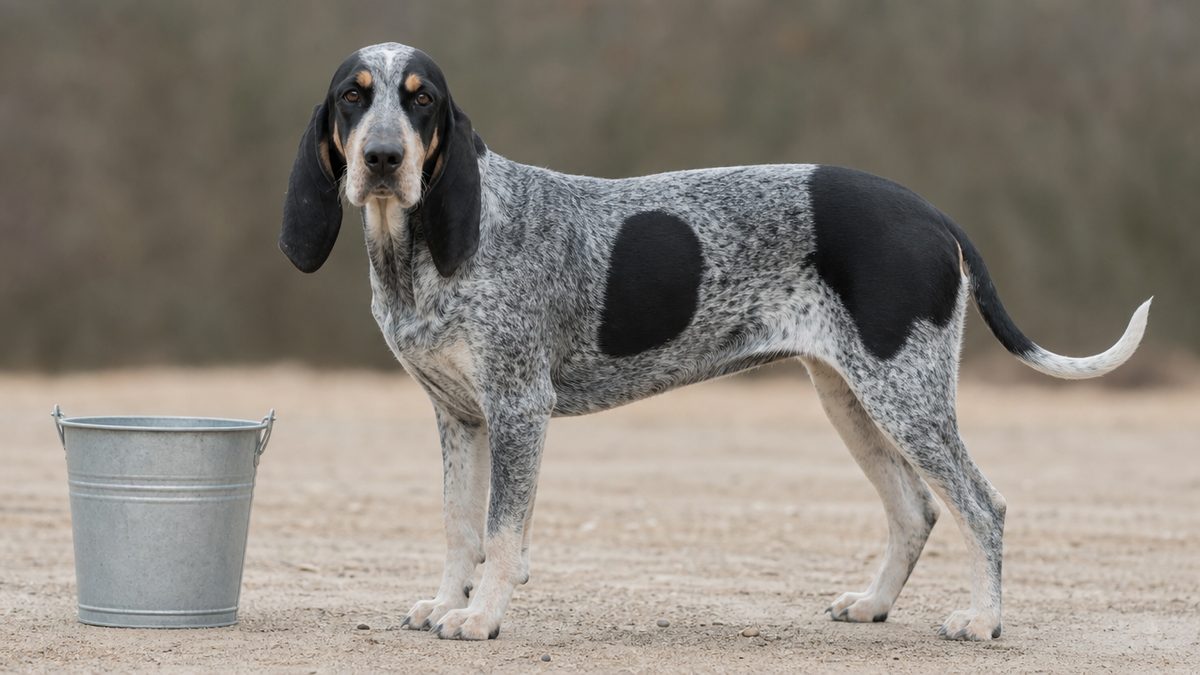
Its coat is short, semi-thick and dense, entirely mottled black on white to give a slate blue effect, with two black patches covering the ears and surrounding the eyes that stop at the cheeks and do not meet on top of the skull, leaving a white interval in which a small black oval spot is frequently found. Two tan markings above the superciliary arches give the eyes what the standard calls a quatreoeuille, four-eyed, effect. The ears are moderately fine, curled in, and should at least reach the extremity of the nose.
Where it came from, in its own standard's words
The FCI's historical summary is one sentence and it has not changed in thirty years: the breed is a voluntary reduction in size of the Great Gascony Blue, certainly going back to the origin of this breed and linked directly to the utilization. That exact sentence appears word for word in the archived 1996 English standard. The utilization it is linked to is stated a paragraph earlier: a multipurpose hound used for hunting with the gun, sometimes for coursing, whose favourite game is the hare but which is also well adapted for big game.
The UKC tells the same story from the other end, describing a trail hound of moderate speed created after the demise of the wolf and successfully used to hunt deer, fox and hare, and stating outright that the standard for the Petit Bleu is essentially the same as that of the Grand Bleu but with shorter lines and a reduction in size.
How many of these dogs exist
France registered 234 Petit Bleu de Gascogne puppies in 2025, down from 250 in 2024, a fall of 6.4 percent. That is 2.00 percent of France's 11,720 Group 6 scenthound registrations for the year. Within its own family the Petit sits second: the Griffon Bleu took 529, the Petit 234, the Basset Bleu 176 and the Grand Bleu 103, so the Petit is 22.5 percent of a four-breed family that totals 1,042 dogs a year.
Only 75 of the 234, or 32.05 percent, were confirmed at a breed assessment, against a Group 6 average of 34 percent. Both of those percentages reproduce from their own counts, which is the first thing Bonbeno checks on any published figure.
This dog is not small. It stands taller than the Griffon Bleu de Gascogne at both ends of its range, and the FCI files both breeds under the identical subsection, Medium sized hounds Federation Cynologique Internationale. Everything else on this page follows from that.
The Petit is not the small one, and that misnaming is the whole story
The Petit Bleu de Gascogne is the taller of the FCI's two medium blue Gascony hounds. FCI-Standard 31 gives males 52 to 58 cm and FCI-Standard 32 gives the Griffon Bleu 50 to 57 cm, so the breed named small out-measures its neighbour by 2 cm at the floor and 1 cm at the ceiling Federation Cynologique Internationale.
Bonbeno's own sibling pages on the Grand Bleu de Gascogne and the Griffon Bleu de Gascogne reported that no English page tells readers the Petit is not the small one. That claim is wrong and this page corrects it. English Wikipedia says it twice, in its opening paragraph and again in its Appearance section, and calls the breed a medium-large size dog. GoofyTails, an Indian pet-supplies store, labels the breed Medium in its own size table. Bonbeno takes the corrected version because it read both documents, and a page that repeats a house line its own sources contradict is worth less than one that fixes it.
What genuinely no page says is the sharper fact underneath. Set the two Section 1.2 breeds side by side and the height ranges are almost the same dog.
| Measure | Petit Bleu (FCI 31) | Griffon Bleu (FCI 32) | Verdict |
|---|---|---|---|
| Male height | 52 to 58 cm | 50 to 57 cm | Petit taller at both ends |
| Female height | 50 to 56 cm | 48 to 55 cm | Petit taller at both ends |
| FCI subsection | 1.2 Medium sized hounds | 1.2 Medium sized hounds | Identical |
| Coat | Short, semi-thick, dense | Hard, rough and shaggy | The only reliable difference |
| Ear requirement | At least reach the nose tip | Reach the nose base, not beyond | Petit's ears longer |
Counted honestly, the male ranges combine to span 50 to 58 cm, an 8 cm band, of which 52 to 57 cm is shared, a 5 cm band. Counted by whole-centimetre marks it is six shared marks out of nine. A sibling page recorded this as six of eight centimetres, which is neither figure; Bonbeno prints the arithmetic instead so you can check it. The females behave identically, combining to 48 to 56 cm with 50 to 55 cm shared.
The FCI cannot settle on an English name either
Three FCI documents give this breed three different English names, and every one of them contains the word small.
- SMALL GASCONY BLUE, the heading of the 1996 English standard.
- Small blue Gascony, the parenthetical name on the 2023 English standard.
- SMALL BLUE GASCONY, the English name on the current nomenclature record.
Each of those documents also files the breed under medium. The 2023 standard's General Appearance clause opens Medium sized hound and the record's Subsection field reads Medium-sized Hounds. So the contradiction is not between the FCI and the rest of the internet. It is inside single FCI documents, two paragraphs apart.
What Petit was ever meant to mean
Two accounts circulate and the standard supports both. The size account says Petit marks a reduction from the Grand, which the FCI's own history states in terms and which the only India-facing breed page repeats. The game account says petite chasse is French venery for the hunt after small game, which is Wikipedia's reading citing Clark and Brace's International Encyclopedia of Dogs, and which the standard also supports by naming the hare as the favourite quarry.
Neither account is wrong. What is wrong is the inference an Indian buyer draws from either, which is that a Petit Bleu de Gascogne will fit in a flat. A 58 cm male stands at an adult's knee and the standard grants no upper tolerance at all.
Registry recognition, and the FCI record that is clean
The FCI recognises the Petit Bleu de Gascogne on a definitive basis, accepted 23 October 1963, with the standard in force published 1 August 2023 and the four language texts dated 29 August 2023. Bonbeno read those values out of the record's own raw markup rather than from any extraction.
That matters for an Indian reader for one reason. The Kennel Club of India is the FCI's member organisation for India, so the KCI issues pedigrees against FCI nomenclature and the FCI answer effectively is the India answer. The breed is recognised. Nothing about recognition prevents an Indian from owning one; import policy does that, and the import section below sets out the two documents that close it.
Reading the FCI's dates without getting the month wrong
The FCI prints dates as month/day/year and this family proves its own format. Breed 31 reads 10/23/1963, breed 32 reads 9/30/1963 and breed 35 reads 10/30/1963 Federation Cynologique Internationale. There is no 23rd or 30th month, so the first field is the month and the acceptance date here is 23 October 1963. All four Bleu de Gascogne breeds were admitted within 81 days of each other in 1963, which is the strongest single piece of evidence that the FCI treated them as one recognition event.
The record this page was asked to re-check, and the verdict
A sibling page found that the FCI contradicts itself on breed 32, the Griffon Bleu de Gascogne: its nomenclature record dates the standard in force to 1/24/1996 while the PDF that same record links states 01.08.2023 in its own header. Records 31 and 35 were named as clean controls. Bonbeno re-checked record 31 independently on 31 August 2026 and it is still clean. Its date of publication of the official valid standard reads 8/1/2023, and the linked PDF's header reads 01.08.2023. The two agree Federation Cynologique Internationale.
Bonbeno also re-pulled record 32 in the same session and reproduced the contradiction exactly, from its own retrieval: 1/24/1996 in the record against 01.08.2023 in the PDF, with all four of its language standards dated 8/29/2023 Federation Cynologique Internationale. So the sibling finding holds and this page adds the mechanism it was missing.
24 January 1996 is not a Griffon date. It is the date the WHOLE family's standards were published: the archived 1996 Petit Bleu standard prints DATE OF PUBLICATION OF THE ORIGINAL VALID STANDARD 24.01.1996, and the Grand Bleu's current standard, never reissued, still prints 24.01.1996 today. The FCI reissued three of the four in 2023 and updated the date field on two of them. The Griffon's field was left holding the old family-wide date. That is a stale field, not an invented one.
What the 2023 reissue actually changed
Almost nothing, and Bonbeno can say so because it diffed the two texts rather than reading only the current one. Against the archived 1996 English standard, the 2023 text keeps the size clause, the temperament clause, the historical summary and the colour clause word for word. Three things did move.
- The classification gained numbers. 1996 reads Scenthounds, Section Medium sized hounds. 2023 reads Group 6 Scenthounds, Section 1.2 Medium sized hounds.
- The fault preamble gained a welfare test. 1996 ends in exact proportion to its degree. 2023 adds and its effect upon the health and welfare of the dog.
- ELIMINATING FAULTS was renamed DISQUALIFYING FAULTS, and a typographical error entered. The 1996 text reads physical or behavioural abnormalities. The 2023 text reads physical of behavioural abnormalities.
That last one is small but it dates precisely, and it is worth knowing that the same translator's four Bleu de Gascogne standards render the single French phrase Tare invalidante reperable four different ways: Visible disabling (invalidating) defect on breed 22, Visible disabling defect on breed 31, Visibling disabling defect on breed 32 and Visible disabling effect on breed 35 Federation Cynologique Internationale Federation Cynologique Internationale Federation Cynologique Internationale. The Petit's is the only one of the four that renders it correctly, in a document that mistypes a different line.
The United Kennel Club recognises it too
The UKC recognised the Petit Bleu de Gascogne in January 1991, the same month it recognised the Grand and the Griffon, and its current standard is the revision of 1 January 2009. Bonbeno located the standard through the UKC's own index rather than by assembling a URL, because a guessed registry URL that returns 404 proves nothing except that the guess was wrong. The UKC does not, however, agree with the FCI about how tall this dog is, which the next section takes apart.
How tall is a Petit Bleu de Gascogne, and why two registries disagree
A Petit Bleu de Gascogne male stands 52 to 58 cm under the FCI and 55.88 to 60.96 cm under the UKC, so the two registries disagree by up to 3.88 cm at the floor and 2.96 cm at the ceiling United Kennel Club. The females almost agree. The males do not agree at all.
The UKC prints its size clause in inches: males 22 to 24 inches, females 20 to 22 inches, measured at the point of the withers, with a stated tolerance that a deviation of one inch above the height requirement will be accepted if character, proportion and quality are evident. Converted at 2.54 cm to the inch, those become the figures in the table below. Bonbeno converted them itself rather than quoting a secondary conversion.
| Sex | FCI 31 | UKC (inches) | UKC converted | Gap at floor | Gap at ceiling |
|---|---|---|---|---|---|
| Males | 52 to 58 cm | 22 to 24 in | 55.88 to 60.96 cm | 3.88 cm | 2.96 cm |
| Males with UKC tolerance | 52 to 58 cm | up to 25 in | up to 63.50 cm | 3.88 cm | 5.50 cm |
| Females | 50 to 56 cm | 20 to 22 in | 50.80 to 55.88 cm | 0.80 cm | 0.12 cm |
Read the male rows and the consequence is not academic. A 53 cm male is a correct Petit Bleu de Gascogne in Europe and 2.88 cm below the American floor. A 60 cm male is correct in the United States and 2 cm over the European ceiling. The same dog is either right or wrong depending on which side of the Atlantic the judge learned the breed.
The tolerance takes the Petit within touching distance of the Grand
The UKC's one-inch allowance carries a legal male to 25 inches, which is 63.50 cm. FCI-Standard 22 sets the Grand Bleu de Gascogne's male floor at 65 cm. So the tallest UKC-legal Petit Bleu de Gascogne stands 1.5 cm short of the shortest FCI-legal Grand Bleu de Gascogne. Two breeds with separate FCI numbers, separate 1963 acceptance dates and separate standards can, at their extremes, be the same dog to the centimetre.
Compare that against the sibling finding on the Grand Bleu, where the UKC and FCI female ranges differ by up to 3.23 cm Federation Cynologique Internationale. The disagreement on the Petit's males, 3.88 cm, is wider. It also runs in one direction: every UKC bound sits above its FCI counterpart, which is what makes the breed drift upward in American hands rather than simply blur.
No registry publishes a weight, and three sources publish one anyway
FCI-Standard 31's SIZE clause contains height and nothing else. There is no weight clause anywhere in the six-page document. The UKC standard likewise prints no weight. Neither does the 1996 standard, and English Wikipedia leaves its weight, maleweight and femaleweight template fields empty, which is unusually honest for that article series.
Three unsourced figures fill the vacuum. An Indian retailer prints 22 to 27 kg for males and 20 to 25 kg for females. A working-dog database says the breed will weigh up to 26 kg. Neither cites a standard, because there is no standard to cite.
One peer-reviewed paper records the bodyweight of a named individual Petit Bleu de Gascogne: 16.4 kg, at 22 months of age. That dog had a body condition score of 2 out of 9, muscle atrophy of all four limbs and a progressive neurodegenerative disease, and was euthanized a month later. It is a sick dog's weight. Quoting it as a breed weight would be exactly the kind of laundering this page exists to stop.
The practical answer for an Indian owner is to stop looking for a number and use a body condition score instead. Feed to a 4 or 5 out of 9, ribs easily felt under a thin fat cover with a visible waist from above, and the absence of a published weight stops mattering.
Petit Bleu de Gascogne price in India
No verified Petit Bleu de Gascogne price in India exists. Exactly one rupee figure is attached to the breed anywhere on the Indian internet, Rs 30,000 on a Bengaluru classified, and the archived category that listing sits in shows four of its six advertisements naming a pit bull in the seller's own title Firecrawl web search with location set….
Start with the absence, because it is the finding. India's most-cited dog price list, Supertails' 40-breed table dated 9 March 2026, contains zero occurrences of Gascogne, zero of Gascon, zero of Bleu and zero of Basset, against 14 occurrences of Beagle, 11 of Labrador and 9 of Golden Retriever. Bonbeno searched all 127,047 characters of that page case-insensitively. The word petit occurs six times and every one of them is inside appetite or competitor.
The one rupee figure, traced
An India-located search for this breed's price on 31 August 2026 returned ten results, and only the fifth offered a dog: a Petzlover listing headed Buy Petit Bleu de Gascogne Puppy in Bengaluru, KA for Rs 30,000. The live page returns HTTP 403 behind a CAPTCHA wall, so Bonbeno did not read it and will not quote a number off a search snippet. The Internet Archive holds the category page it belongs to.
| Ad title as the seller typed it | Price | Location |
|---|---|---|
| Very nice | 30,000 INR | Bengaluru, Karnataka |
| Pit bull open stud | 12,000 INR | Karnal, Haryana |
| Pitbull on sale | 20,000 INR | New Delhi, Delhi |
| Pit bull for adoption | 30,000 INR | Patna, Bihar |
| Puppies for sale 45days female100% | 7,500 INR | Sunam, Punjab |
| pittbull female 6 month in chandi | 18,000 INR | Chandigarh |
Four of six titles name a pit bull. The 30,000 rupee Bengaluru ad carries the numeric id 473970 in its archived URL, and that is the same id in the live 2026 URL a search engine serves today, so the figure being presented in 2026 as a Petit Bleu de Gascogne price in India is a classified that was already sitting in this category in January 2023.
Divide the figures and see what the arithmetic says
Bonbeno runs four exchange-rate tests on any suspicious Indian price, because Indian pages routinely publish a dollar figure converted into rupees and presented as a local market rate. Here is every quotient, printed rather than summarised.
| Rupee figure | at 84.38 | at 74.00 | at 80.00 | at 66.67 |
|---|---|---|---|---|
| Rs 7,500 | 88.88 | 101.35 | 93.75 | 112.49 |
| Rs 12,000 | 142.21 | 162.16 | 150.00 | 179.99 |
| Rs 18,000 | 213.32 | 243.24 | 225.00 | 269.99 |
| Rs 20,000 | 237.02 | 270.27 | 250.00 | 299.99 |
| Rs 30,000 | 355.53 | 405.41 | 375.00 | 449.98 |
Not one figure divides to a whole number of dollars at 84.38 or at 74. Four appear to divide cleanly at 66.67 and five at 80, and both of those are worthless here: 66.67 is 200 divided by 3, and 80 divides 1,000 into 12.5, so any multiple of 1,000 passes both tests by construction. Five of these six figures are multiples of 1,000 and the sixth is a multiple of 500. The two informative rates, 84.38 and 74, both return non-round quotients on every row.
So these are not converted dollar prices. They are round rupee numbers typed by Indian sellers, which is exactly what you would expect if they are what their own titles say they are: pit bull advertisements. Supertails' published Indian band for an American Pit Bull Terrier is Rs 20,000 to Rs 1,50,000, and Rs 7,500 to Rs 30,000 sits at and below the bottom of it, which is where informal classified pricing normally lands.
Bonbeno will not print Rs 30,000 as the Petit Bleu de Gascogne price in India, and it will not convert the 1,000 to 1,500 US dollar figures that circulate for this family into rupees to fill the gap. The honest answer is that no Indian market exists to price, and the useful answer is what a dog of this size costs to keep here, which the next two sections give in sourced rupees.
What Indian sellers are actually offering under this breed name
Indian listing sites publish a category page for this breed and fill it with whatever a seller typed. Bonbeno proved that with controls: the same site's Sakhalin Husky category holds Siberian Husky advertisements without exception, and its Aidi category holds one listing whose entire title is a dictionary definition.
This matters more than the price, because it tells an Indian reader what will arrive if they respond to a listing. Run the control first, then read the breed category.
Control one: a nearly extinct Japanese sled dog
The Sakhalin Husky is reduced to a handful of dogs worldwide. Petzlover's India category for it, archived 29 March 2023, carries at least eighteen listings, and the seller-written titles include Husky blue eyes, Blue eyes heavy bone male husky for sale, Top quality saibarn Husky male puppy available, Hussy odd eyes and 4 Huskies 1 Month old 2 Male Blue eyes, priced from 5,000 INR to 60,000 INR with three rows reading 35 INR. Every one is a Siberian Husky advertisement. Not one is a Sakhalin Husky.
Control two: a Moroccan livestock guardian
The same site's Aidi category, archived 9 February 2023, carries a single listing, and its entire title reads characterized by having or containing a direct object. That is the dictionary definition of the word transitive. It is not a dog.
So what does the Petit Bleu de Gascogne category contain
Six listings, four of which name a pit bull in the seller's own title, one headed Very nice and one headed Puppies for sale 45days female100%. Given the two controls, the correct reading is that this category is a property of the site's template rather than of the breed. The category's own Similar Breeds sidebar reinforces it, offering the Tahltan Bear Dog, the Ryukyu Inu and the Serbian Mountain Hound, which is a list of breeds an Indian buyer will not find either.
The rest of page one is not selling dogs at all
The India-region result set for this breed's price on 31 August 2026 is worth listing, because its shape is the answer.
- Positions 1 and 4 are the same paperback milestone journal, on Amazon.in and eBay. The top India result for a dog price query is a blank notebook.
- Position 2 is a Facebook post about Basset Bleu de Gascogne puppies, a different breed.
- Position 6 is a DogBreedsList page about the Basset Bleu de Gascogne.
- Position 7 is a United States listings page for the Petit Basset Griffon Vendeen in Ventura, California, matched on the word Petit.
- Position 8 is the UC Davis Veterinary Genetics Laboratory's hyperuricosuria test page, matched on the word Price.
- Positions 3, 9 and 10 are breed-information pages, one of them an Indian store's.
Three of ten results are about a different breed, two are a notebook and one is a genetics test unrelated to the dog. That is what a search engine returns when a commercial query has no commercial answer behind it, and the plain reading is that this scent hound is simply unavailable in India through any channel a buyer can verify.
The absence is not a gap in Bonbeno's research either. It is the answer. The control query for a Labrador, run in the same tool in the same session, returned six Indian marketplaces with full rupee tables, so the instrument was working.
GoofyTails, a pet-supplies store registered in Okhla Industrial Area Phase 2, New Delhi, publishes a genuine breed record with FCI-Standard 31's heights reproduced exactly and the size correctly labelled Medium. It adds a weight and a life expectancy that appear in no standard, and its health list names bloat, which belongs to the Grand Bleu de Gascogne. Use it for the heights and nothing else.
Indian import law, and why no lawful supply chain can form
You cannot lawfully import a Petit Bleu de Gascogne into India to breed or sell it. DGFT Trade Notice 22/2022-23 classifies dogs under ITC (HS) 01061900 as Restricted and states in paragraph 6 that any applications for trading or breeding purposes shall be duly rejected.
Bonbeno downloaded that notice as a five-page PDF and extracted 6,639 characters of real text with pypdf, so the clauses below were read rather than summarised. The notice is dated 19 December 2022 and issued from Vanijya Bhawan, New Delhi, to all international airlines, all Indian embassies and consulates abroad, and pet owners concerned.
- Policy Condition (7) permits dog imports for exactly three purposes: a pet dog with a valid pet book and relevant records in the importer's own name; dogs imported by R and D organisations with a recommendation from CPCSEA; and internal security by the Defence and Police Force.
- Policy Condition (8) states that import of commercial dogs for breeding or any other commercial activities other than those purposes is not permitted.
- Paragraph 6 states that any applications for trading or breeding purposes, or applications made on behalf of some another person or entity, shall be duly rejected.
- Paragraph 7 limits entry to the airports and seaports of Delhi, Mumbai, Chennai, Hyderabad, Bangalore and Kolkata. DAHD added a seventh port, Cochin International Airport at Kochi, for pets arriving under the baggage rules in October 2024. The full route is set out in how to import a dog to India.
Read those together and the position is not ambiguous. A person relocating to India with a dog they already own can bring it. A person who wants to start breeding Petit Bleu de Gascognes in India cannot lawfully acquire founder stock, and an application saying so gets rejected on its face.
A 2024 notification adds Cochin International Airport for personal pet imports under the Livestock Importation Act 1898. Whether that changes this notice's own six-port list is a separate question against a different instrument, and Bonbeno has not checked it. This page therefore states the DGFT notice's list as the DGFT notice's list and claims nothing beyond it.
The domestic side: what the 2017 Rules require of anyone breeding here
Bonbeno extracted the Prevention of Cruelty to Animals (Dog Breeding and Marketing) Rules, 2017 from the gazette itself, 14 pages and 51,953 characters, and listed every numbered provision. The Rules run 1 to 13 and stop there. Everything numbered above 13 belongs to the Second Schedule, which opens See rules 5(2) and 6 and runs paragraphs 1 to 30 across four Parts: Part I paragraphs 1 to 4, Part II 5 to 6, Part III 7 to 9, and Part IV, Housing facilities and manner of housing dogs, 10 to 30. There is no paragraph 31.
That structure matters because two provisions bite on this breed specifically, and both are commonly miscited.
- Rule 8, Conditions for sale, sub-rule (1)(a) requires that pups less than eight weeks in age are not sold, and (1)(b) that dogs over six months are not sold without first being sterilised unless sold to another licensed breeder. This is a Rule, and it is numbered 8.
- Second Schedule Part II paragraph 6(8) forbids tail docking, ear cropping, de-barking, de-clawing, branding, dyeing and any other kind of mutilation. This is a Schedule paragraph, not Rule 6(8), and citing it as a Rule sends a reader to a different provision.
- Second Schedule Part IV paragraph 21(1), Outdoor housing facilities, bars keeping in outdoor facilities, without the attending veterinary practitioner's written approval, dogs not accustomed to local temperatures, breeds that cannot tolerate them such as long-haired breeds in high temperature locations, and sick, infirm, aged or young animals. The string Rule 21 appears zero times in the gazette, so any page citing it that way is citing a provision that does not exist.
Bonbeno's sibling pages on the Grand and Griffon Bleu de Gascogne recorded a disagreement with the Gascon Saintongeois page over that last citation. That disagreement is settled and this page does not reopen it. The correct form is Second Schedule Part IV paragraph 21(1), and Bonbeno verified it from its own extraction of the gazette on 31 August 2026.
The de-barking prohibition is the one an Indian buyer of this breed should read twice, because this dog's own breed club grades its voice as a scored working aptitude and describes it with the word hurleur, howler. A neighbour complaint in an Indian apartment block has no lawful surgical answer.
What a dog this size costs to keep in India, in sourced rupees
Budget Rs 3,000 to Rs 18,000 a month for a dog in India, which is Supertails' published range by breed size and grooming need, and Rs 80,000 to Rs 2,00,000 for the first year including purchase, vaccinations, food, training and supplies. Those figures apply to any 25 kg short-coated hound living here, and they are the only Indian money on this page that is real.
There is no Indian price for this breed, so the useful question is the running cost, not the purchase cost. Every figure below comes from a document Bonbeno opened, and where a government rate card and a private clinic disagree, both are printed.
| Item | Government rate | Private-clinic rate | Source |
|---|---|---|---|
| Consultation / out-door ticket, pet animal | Rs 30 | Rs 200 to Rs 700 | Chandigarh AH; Sploot |
| Anti-rabies vaccination | Rs 30 | Rs 200 to Rs 500 per dose | Chandigarh AH; Sploot |
| Core combination shot, DHPP or DHPPiL | Rs 50 to Rs 300 | Rs 500 to Rs 1,200 per dose | Sploot |
| Leptospirosis, billed separately | not listed | Rs 150 to Rs 400 | Sploot |
| Kennel cough, Bordetella | not listed | Rs 500 to Rs 900 | Sploot |
| Full puppy core series | a few hundred rupees | Rs 1,800 to Rs 4,500 | Sploot |
| Stool test | Rs 10 | not listed | Chandigarh AH |
| Blood or urine test | Rs 20 | not listed | Chandigarh AH |
| Minor operation | Rs 50 | not listed | Chandigarh AH |
| Major operation | Rs 100 | not listed | Chandigarh AH |
| Castration | Rs 20 | not listed | Chandigarh AH |
| Monthly upkeep, all in | not applicable | Rs 3,000 to Rs 18,000 | Supertails |
The government column is not a rounding of the private one, it is an order of magnitude below it. The Directorate of Animal Husbandry, Chandigarh Administration publishes an anti-rabies vaccination fee of Rs 30 and a pet out-door ticket of Rs 30. A private Indian clinic charges Rs 200 to Rs 500 for the same rabies dose plus a Rs 200 to Rs 700 consultation that is not always bundled. On the two figures a first-time owner most often pays, the government route is roughly one tenth the cost.
Sploot's guide says government hospitals and NGO clinics run sometimes free for rabies, or Rs 50 to Rs 300 for core vaccines. Chandigarh's own published card charges Rs 30 for anti-rabies, which is below Sploot's stated floor. Neither is wrong; a national estimate and one state's rate card are different things. Check your own state's card before assuming either.
What the cheap column actually buys
Read the Chandigarh card's own annotations before treating Rs 30 as a bargain. Its X-ray fee is listed at Rs 30 per film with the parenthetical Radiology wing not functioning printed beside it. A published price is not a delivered service. For a breed whose only documented disorder is diagnosed by MRI and post-mortem histology, the government route covers vaccination and routine care and does not cover the thing you would actually need.
Food, the largest recurring line
Supertails puts food for a large Labrador at Rs 2,500 to Rs 5,000 a month. A 20 to 27 kg hound eats less than a 30 kg Labrador, so plan the lower half of that band, and add for the fact that a working scenthound in a hot climate needs its calories delivered in the cool hours rather than at midday. Total Indian monthly upkeep of Rs 3,000 to Rs 11,000 is Supertails' own average maintenance range, and a medium hound with a low-maintenance coat sits at the cheap end of it.
Where the money goes for this breed specifically
- Ear care, not grooming. The coat is a ten-minute weekly job. The ears reach past the nose tip and carry 1.76 times the odds of otitis externa that erect ears do.
- Tick prevention, year round. A survey of 525 Indian dogs found 261, or 49.7 percent, carrying at least one tick-borne pathogen. That is a monthly cost, not an annual one.
- Space or exercise substitutes. The one India-facing breed page states plainly that apartment living is generally not recommended and that secure fencing matters because of the scent drive. Fencing is a capital cost most Indian buyers do not budget.
- Adoption instead. Indian shelter fees run Rs 0 to Rs 3,000 and typically include vaccinations, deworming and microchipping.
City matters too. Supertails reports Indian prices varying 15 to 30 percent by city with Mumbai and Delhi the most expensive markets, and the Kennel Club of India's own registrations have fallen 62.2 percent from their 2021 peak to 33,880 in 2025, so the formal pedigree market that would set a benchmark price is shrinking rather than growing.
Heat tolerance in India, city by city
Rate the Petit Bleu de Gascogne 2 out of 5 for heat tolerance in India. Its short smooth coat and long normal muzzle start it well, and its working drive and its origin climate cancel most of that: Auch in Gascony records an annual mean wet-bulb temperature of 11.08 C against Chennai's 24.94 C, a gap of 13.86 C NASA Langley Research Center.
Bonbeno queries NASA's POWER climatology by explicit latitude and longitude and checks the geometry the API sends back against the coordinates it sent, so no place name can silently resolve to the wrong city. Wet bulb is the figure that matters for a dog, because it is the temperature that survives evaporation, and a panting dog is an evaporative cooler.
| Place | Annual mean air temp | Annual mean wet bulb | Peak monthly wet bulb | Gap vs Auch |
|---|---|---|---|---|
| Auch, Gascony (origin) | 13.61 C | 11.08 C | 18.35 C (July) | - |
| Bengaluru | 23.74 C | 19.80 C | 22.66 C (May) | +8.72 C |
| Pune | 23.86 C | 19.66 C | 23.56 C (June) | +8.58 C |
| Delhi | 25.60 C | 18.03 C | 27.74 C (July) | +6.95 C |
| Mumbai | 26.77 C | 22.73 C | 26.55 C (June) | +11.65 C |
| Kolkata | 25.81 C | 22.85 C | 27.86 C (June) | +11.77 C |
| Chennai | 27.95 C | 24.94 C | 27.36 C (May) | +13.86 C |
Read the peak column rather than the annual one when you are deciding whether to keep this dog. Delhi's annual wet bulb of 18.03 C looks moderate and its July peak of 27.74 C is worse than Chennai's May. Delhi's dry heat is the trap: its annual mean relative humidity is 45.56 percent, so panting works better there than on the coast, right up until the monsoon arrives and it stops working in the hottest month of the year.
Why the drive matters more than the coat
This is a dog selected to keep going. Its own breed club grades its physique as de train moyen et soutenu, tres endurant, a medium and sustained pace, very enduring, and describes it as a specialiste de la difficulte, a specialist in the hard parts of a line, which moderates its speed. The UKC calls it a trail hound of moderate speed that hunts in a leisurely, methodical manner with tremendous endurance. Endurance is the risk factor here, not speed.
The largest study of the question found that in 905,543 UK dogs under primary veterinary care in 2016, 652 of the 879 heat-illness events with a recorded trigger, 74.2 percent, were exertional rather than environmental at 12.9 percent or vehicular at 5.2 percent. A companion paper on the same cohort, using a different case definition, put the 2016 incidence at 0.04 percent with an event fatality rate of 14.18 percent, and identified higher bodyweight relative to the breed and sex mean as a risk factor.
Neither Hall paper models the Petit Bleu de Gascogne. It is far below their inclusion thresholds and it appears in neither breed list Emily J. Hall, Anne J. Carter and Dan G.…. The transferable finding is the exertional share and the bodyweight-above-breed-mean factor, both of which are class-level. The over-50 kg odds ratio does not apply to a dog of this size and Bonbeno does not quote it here.
What Indian law says about keeping this dog outdoors
Second Schedule Part IV paragraph 21(1) of the 2017 Rules bars keeping in outdoor facilities, without the attending veterinary practitioner's written approval, dogs that are not accustomed to local temperatures, breeds that cannot tolerate them such as long-haired breeds in high temperature locations, and sick, infirm, aged or young animals. The illustrative example names long-haired breeds, which describes the Griffon Bleu de Gascogne rather than this one. The first limb, dogs not accustomed to the temperatures prevalent in the area, describes an imported Petit Bleu exactly.
Practical rules for an Indian owner
- Walk before 06:30 and after 19:30 from March to June in the plains, and treat any midday outing as a medical decision.
- Substitute scent work for distance in the hot months. A nose game in a cool room satisfies this dog better than a hot walk does.
- Never shave the coat. It is short and semi-thick already and shaving removes sun protection without improving cooling.
- Dry the ears after every wash. An Indian series in Durg found otitis externa peaking in summer at 41.18 percent of cases against 33.33 percent in the rains, and named excessive moisture from swimming or bathing as a cause.
- Keep tick prevention running year round, because 49.7 percent of 525 surveyed Indian dogs carried a tick-borne pathogen.
That Durg finding disagrees with the Indian monsoon-peak series Bonbeno cites elsewhere on this site, and Bonbeno publishes the disagreement rather than choosing. For an owner the practical consequence is the same either way: this breed's ears reach past its nose tip and need checking through both seasons.
Temperament, and who should not buy this dog
The Petit Bleu de Gascogne is calm and affectionate, obeys orders easily and works well in a pack, in the words of its own FCI standard, and it is also a graded howler that its national breed club scores for a sonorous, abundant, deep and low voice Club du Bleu de Gascogne.
Take those two sentences together and you have the household problem in miniature. This is a friendly, biddable, socially easy dog with a voice selected over centuries to carry across a valley. The FCI's behaviour clause reads: fine nose, intent in his way of hunting, endowed with a beautiful voice, works well in a pack, character calm and affectionate, obeys orders easily. The UKC adds that the breed is of even temperament, essentially friendly, with some individuals very outgoing and others somewhat reserved, but never shy or vicious, and makes aggression towards other hounds and people a fault.
The voice is a scored aptitude, not a training failure
The Club du Bleu de Gascogne publishes a separate STANDARD DE TRAVAIL alongside the conformation standard, and it grades four aptitudes. The voice entry reads sonore, abondante, de tonalite profonde et grave, bien timbree avec des modulations tres caracteristiques, hurleur. That last word means howler, and it is listed as a quality rather than a fault. A dog bred against that specification for generations does not become quiet because it now lives in a Pune flat.
The same document describes a hound that gives voice from the first indices of a line and keeps giving it through the drive. In hunting terms that is the point of the animal. In an Indian apartment block with shared walls it is a neighbour dispute waiting to happen, and Indian law removes the surgical shortcut: Second Schedule Part II paragraph 6(8) forbids de-barking outright.
Household fit, honestly
| Situation | Verdict | Why |
|---|---|---|
| Independent house with a securely fenced plot | Good fit | Scent drive needs a physical boundary, not a verbal one |
| Family with children | Good fit | Standard requires calm and affectionate; aggression is a fault |
| Home with other dogs | Good fit | Bred to work in a pack and graded on doing so |
| Home with cats or poultry | Caution | Hare is the standard's named quarry |
| Apartment, any Indian metro | Poor fit | Graded howler, high exercise need, no lawful de-barking |
| First-time owner working full days | Poor fit | Under-exercised, this dog bays and roams rather than sulking |
English Wikipedia states flatly that in general dogs bred to be pack hunting dogs do not make good pets. Bonbeno does not go that far, because the FCI, the UKC and the breed club all describe an affectionate, biddable animal and none of them describes an unsuitable one. The honest version is narrower: a pack hound is a poor pet in the wrong home and a good one in the right home, and the variable is space and exercise rather than the dog's character.
The trait the standards will not tell you about
Both registries describe the temperament of a working hound in a working context. Neither publishes a separation-anxiety note, a noise-sensitivity note or a guide to how the dog behaves alone in a flat for nine hours, because neither was written with that in mind. Where a breed standard is silent, Bonbeno says it is silent rather than inventing a rating. What can be said with a source is that the club grades the breed as facile a mettre en meute et aux ordres, easy to put into a pack and to orders, and as applique et tenace, applied and tenacious. Tenacity in a house is what most owners experience as stubbornness.
Training a Petit Bleu de Gascogne, and the one thing it will not learn
Train everything except off-lead recall on a live scent line, and train that as management rather than obedience. The breed's own club grades it as facile a mettre en meute et aux ordres, easy to put to orders, and simultaneously as applique et tenace, tres chasseur, applied, tenacious and very much a hunter.
Those two gradings are not in tension in the field, where the dog is meant to hold a line while responding to the hunter. They are in tension in a Bengaluru park, where the line leads over a wall. The FCI standard's own phrasing is obeys orders easily, and the French authentic text reads se met facilement aux ordres, which is closer to settles readily to orders. Neither clause promises recall off a scent.
What the working standard tells a pet owner
The club's behaviour description is the most useful training document in existence for this breed, and no English page reproduces it. It describes an excellent rapprocheur that searches night scent lines on the ground or on the branches, gives voice from the first indices and through the drive, shows initiative during the quest to speed up the launch, and masters the rapproche, the defaut and the forlonge, the three hardest phases of a hunt.
Translate that out of venery and you get a training brief. This dog is bred to solve a scent problem on its own initiative, without waiting for instruction, and to keep announcing what it has found. A recall cue competes against a behaviour the animal was selected to perform independently, which is why the honest answer is a long line and a fence rather than a better cue.
A realistic timeline
| Age | Focus | Realistic outcome |
|---|---|---|
| 8 to 16 weeks | Socialisation, handling, ear handling, crate | Accepts ear cleaning without a fight, which pays for itself for ten years |
| 4 to 6 months | Name, lead manners, settle on a mat | Reliable indoors, unreliable outdoors on a scent |
| 6 to 12 months | Long-line work, scent games, impulse control | Recall reliable on a clean field, not on a live line |
| 12 to 24 months | Duration, quiet cue, alone-time | Voice manageable in context, never eliminated |
| 2 years on | Maintenance and scent work | A settled, biddable house dog with a fence |
Note the first row. Rule 8(1)(a) of the 2017 Rules requires that pups less than eight weeks in age are not sold, so a lawfully acquired Indian puppy arrives at eight weeks at the earliest and the socialisation window is already partly spent. Do not let a seller shorten it.
Methods that work and one that does not
- Pay with food and scent. A hound that is bred to follow a nose will work for a nose game more reliably than for a ball.
- Train the quiet cue on a stimulus you control. Reward the pause between bays rather than punishing the bay itself, because the bay is a selected trait.
- Use a long line for the first two years. Management is the technique, not a substitute for one.
- Socialise with other dogs early. This is a pack breed graded on rallying to other hounds, and it is one of the few things that comes free.
- Do not use aversives to stop baying. You are punishing the dog for doing the thing it was bred to do, and the standard makes a timid subject a fault.
The one Indian-specific adjustment is scheduling. Train in the cool hours, because a hot dog stops learning before it stops moving, and 74.2 percent of recorded-trigger heat-illness events in the largest study were exertional.
Daily exercise requirement, and what happens without it
Give a Petit Bleu de Gascogne 75 to 105 minutes of daily exercise split across two or three outings in the cool hours, with scent work substituted for distance from March to June. No registry publishes a minute figure, so that is Bonbeno's own floor and it is labelled as such.
What the registries do publish is the job. The FCI subjects this breed to a working trial, which is a registry requirement rather than a duration. The breed club grades the physique as de train moyen et soutenu, tres endurant, a medium and sustained pace, very enduring. The UKC describes tremendous endurance and a hound that hunts in a leisurely, methodical manner. The India-facing store page says the breed has high exercise requirements and recommends long daily walks or runs, tracking and scent games, hiking and interactive play, without giving a number.
None of that translates into minutes on its own. Bonbeno's 75 to 105 minute figure is derived, not cited: it sits between the 60 to 90 minutes this site records for the shorter-legged Basset Bleu de Gascogne and the 90 to 120 minutes it records for the much larger Grand Bleu de Gascogne, which is where a 52 to 58 cm hound with a sustained rather than fast gait belongs.
What under-exercise looks like in this breed
It does not look like a quiet, depressed dog. The store page names the failure modes directly: the breed can be vocal while tracking and may wander when following scents, and secure fencing is important because of the strong scent drive. An under-exercised pack hound bays more and roams more, so the two symptoms an Indian owner notices first are a neighbour complaint and a dog that has left the compound.
Splitting the day around Indian heat
| Slot | March to June, plains | July to September | October to February |
|---|---|---|---|
| Morning | 45 min before 06:30 | 40 min, skip if lightning | 50 to 60 min, any time before 09:00 |
| Evening | 30 min after 19:30 | 35 min after 19:00 | 40 min after 18:00 |
| Indoors | 20 min scent game at midday | 20 min scent game | optional |
| Weekend | One long cool-hour outing | Trail walk on a long line | Full 2 hour hike |
The reason to move the morning walk before 06:30 in the plains is arithmetical. Delhi's peak monthly wet bulb is 27.74 C in July and Chennai's is 27.36 C in May, against 11.08 C annual mean at the breed's origin. Bengaluru and Pune, at 841.72 m and 635.99 m, peak at 22.66 C and 23.56 C, which is why they are the two Indian cities where this dog's exercise need is genuinely meetable outdoors for most of the year.
For a breed graded as an excellent rapprocheur that searches night lines on the ground and on the branches, twenty minutes of hidden-food searching in a cool room does more for the dog's head than forty minutes of hot pavement does for its legs. Use it deliberately in the hot months rather than as a fallback.
Grooming in Indian humidity: ten minutes of coat, and all the ears
Brush a Petit Bleu de Gascogne once or twice a week and spend the rest of your grooming time on its ears. FCI-Standard 31 gives the coat in five words, short, semi-thick and dense, and gives the ears as leathers moderately fine, curled in, that should at least reach the extremity of the nose.
The coat is the easy part and the cheapest thing about the breed. A rubber mitt or a bristle brush twice a week removes what sheds, and the India-facing store page recommends weekly brushing, occasional bathing as needed, regular ear cleaning, routine nail trimming and regular dental care, describing shedding as light to moderate through the year. There is no salon requirement and no clipping schedule, which is the single largest cost difference between this breed and its rough-coated relative, the Griffon Bleu de Gascogne, whose coat is hard, rough and shaggy.
Never shave it
The standard describes a short, semi-thick, dense coat. Shaving a coat like that removes sun protection and does not improve evaporative cooling, because a dog cools by panting rather than through skin. An Indian groomer who offers a summer shave for a short-coated hound is selling a service the dog does not need.
The ears are the whole job
This breed's ears are required to reach at least to the tip of its nose. In a UK primary-care study of 22,333 dogs, breeds with pendulous ear carriage carried 1.76 times the odds of otitis externa of breeds with erect ears, 95 percent confidence interval 1.48 to 2.10, against a one-year period prevalence of 7.30 percent across all dogs. No Bleu de Gascogne breed appears anywhere in that paper, so the class-level pendulous-ear figure is the only transferable one and Bonbeno does not dress it up as a breed figure.
The Indian evidence sharpens when the risk falls. A series in Durg, Chhattisgarh examined 281 dogs and found 51 positive for otitis externa, an overall prevalence of 18.14 percent, with the season-wise split running summer 21 cases at 41.18 percent, rainy 17 at 33.33 percent and winter 13 at 25.49 percent. Those counts sum to 51 and those percentages sum to 100.00, so the table reconciles. The paper names excessive moisture from swimming or bathing, and improper ear cleaning, as causes.
The Durg series peaks in summer, at 41.18 percent. Another Indian series this site cites elsewhere peaks in the monsoon. Both are real Indian data and Bonbeno prints both rather than choosing the convenient one. For an owner of a dog whose ears touch the ground the practical answer is identical either way: check and dry them through both seasons, not just the rains.
An ear routine that fits Indian conditions
- Lift and look every second day from March to September, every third day otherwise. You are looking for redness, odour and dark discharge.
- Dry after every wash and every swim. Plug the ears before bathing and dry the canal opening afterwards, because moisture is the named mechanism.
- Clean only when needed, with a veterinary ear cleaner. Over-cleaning is itself listed as a cause in the Durg series.
- Handle the ears from eight weeks. A dog that accepts ear handling at four months is a dog you can treat at four years without sedation.
- Escalate early. A Chandigarh government veterinary out-door ticket costs Rs 30 and a private consult Rs 200 to Rs 700 Garima Kaushal, Dog Vaccination Cost…. Neither is a reason to wait a week.
One further Indian adjustment: in humid coastal air the ear canal never dries on its own, so a mitt-dry after a wash is not optional in Mumbai, Chennai or Kolkata the way it might be in Pune. Nails, teeth and tick checks round out the routine. Given that 261 of 525 surveyed Indian dogs, 49.7 percent, carried at least one tick-borne pathogen, the weekly brush is also the weekly tick check, and on a dog with ears this long the fold behind the ear is the first place to look.
The 2025 genetic finding: one dog, two genes, and what it does and does not mean
On 11 November 2025 the Petit Bleu de Gascogne acquired its first named genetic disorder in the peer-reviewed literature: a neuronal ceroid lipofuscinosis-like disease in one dog, associated with homozygous missense variants in AP3B1 and TRAPPC9. Before that date the breed had zero papers of its own.
The paper is Then, Welly, Bullock, Chevallier and Katz, published in *Genes* 16(11):1370, from Bla Stjarnans Djursjukhus in Molndal, Orebro University, the Canine Genetics Laboratory at the University of Missouri and INSERM at the Ecole Nationale Veterinaire d'Alfort. Bonbeno read the full open-access text rather than the abstract, and read it before attributing anything, because the whole value of this section is getting the denominators right.
What happened to the one dog
The proband was a single intact purebred female Petit Bleu de Gascogne in Sweden, bought at 8 weeks from a breeder, one of nine littermates. Her course, in the paper's own order:
- About 5 months: intermittent brief episodes of head bobbing.
- 12 months: pronounced loss of appetite; by 18 months she was quite emaciated and resistant to walking outside.
- Following months: hind-limb weakness, anxiety and hallucinatory episodes, lip smacking, and vision loss beginning in dim light and progressing into bright light.
- 22 months: ataxia and muscle atrophy of all four limbs, severely impaired balance, head tremors at rest and on movement, hypersensitivity to touch, reduced menace response. Body weight 16.4 kg, body condition score 2 out of 9. Routine blood chemistry and blood cell analyses showed no abnormalities.
- 23 months: euthanized as the neurological signs progressed.
MRI showed generalised ventricular enlargement, diffuse widening of the cerebral sulci and cerebellar folia, a diffusely thinned cortex and poor grey-white differentiation, with no space-occupying lesion. Post-mortem, autofluorescent inclusions immunolabelling for the subunit c protein of mitochondrial ATP synthase were found in cerebellar cortex, cerebral cortex, retina and cardiac muscle. That combination is the signature of the neuronal ceroid lipofuscinoses.
One littermate had already been euthanized with similar signs before the study began, and no samples from it survived. So the paper describes one investigated dog and one probable second case in the same litter.
The genetics, with the numbers attached
Whole-genome sequencing found the proband homozygous for 20,399 variants against the reference genome. Filtering through the family, then against a control cohort of 387 dogs including 383 of other breeds, left 41 candidates and then 10. Two of those ten, missense variants in AP3B1 and TRAPPC9, encode proteins that sort and transport cargo through the Golgi apparatus to lysosomes, which is what made them the candidates.
| Genotype | AP3B1 | TRAPPC9 |
|---|---|---|
| Variant homozygous | 3 | 1 |
| Heterozygous | 17 | 14 |
| Reference homozygous | 21 | 26 |
| Total genotyped | 41 | 41 |
Three unaffected dogs were homozygous for the AP3B1 variant and one for the TRAPPC9 variant, and none of them was ill. Only the proband carried both in the homozygous state. The authors' chi-square for the genotype-phenotype association is 468 with p below 10 to the minus 5, and their stated hypothesis is that the disease involves the combined influence of the two variants rather than either alone.
From Table 3, Bonbeno computes the variant allele frequency across those 41 unaffected dogs as 28.0 percent for AP3B1 and 19.5 percent for TRAPPC9. That is Bonbeno's arithmetic from the paper's counts, not a figure the paper prints, and it is labelled as such. The authors make the same point in words, warning that each of the two variants is relatively common individually in the cohort they were able to evaluate.
What the evidence base does not contain, and what must not be borrowed
The Petit Bleu de Gascogne has exactly one peer-reviewed paper of its own, no row in OFA's published statistics tables, no published median life expectancy and no breed-club screening scheme that Bonbeno could verify. That is the honest state of the evidence and this section refuses to fill it with a neighbour's numbers.
Start with the literature count, proved with controls. A PubMed search for this breed on 31 August 2026 returned exactly one record, the 2025 genetics paper. The family name returned four records in total, of which one names the Grand Bleu, one names five Griffon Bleu puppies and one names an unqualified Bleu de Gascogne. Controls run in the same session returned 126 records for Labrador Retriever hip dysplasia, 122 for Basset Hound dog and 11 for Beagle otitis externa, so the instrument was working.
Every query fired PubMed's quotedphrasesnotfound warning and was rewritten into AND-ed all-fields terms, with the French word de expanded into a drug-effects MeSH subheading, so these are not phrase searches and Bonbeno opened every returned record rather than trusting the count.
The bloat finding belongs to a different breed
Evans and Adams' UK survey names the Grand Bleu de Gascogne among the breeds at greatest risk of both gastric dilatation-volvulus mortality and morbidity, alongside the bloodhound, German longhaired pointer, Neapolitan mastiff, otterhound, Irish setter and Weimaraner. The Petit Bleu de Gascogne appears nowhere in it. The Grand stands 65 to 72 cm and the Petit 52 to 58 cm Federation Cynologique Internationale, so this is not one breed in two sizes and a deep-chested-giant risk factor does not carry across on the strength of a shared name.
The only India-facing breed page nonetheless lists bloat among this breed's health concerns, with no figure and no source. That is how a finding launders from one breed to another: a real study, a shared family name, a page that drops the qualifier.
No OFA row, and the reason is published
Bonbeno retrieved OFA's full disease-statistics tables on 31 August 2026 as a 2,226,110-character document holding 113,680 table cells and searched it case-insensitively. It returns zero occurrences of GASCOGNE, GASCONY, GASCON and BLEU, against 109 of LABRADOR, 132 of BASSET, 61 of BEAGLE, 41 of BLOODHOUND and 3 of OTTERHOUND.
The controls carry the argument. A direct unrendered fetch of the same URL returned a 49,168-character shell with zero occurrences of LABRADOR, which is what a broken retrieval looks like; the rendered retrieval returns 109, so the absence is real. And the Otterhound, a comparably rare hound, does hold rows, with 644 hip evaluations at 50.2 percent normal, so rarity alone is not the explanation.
OFA publishes the actual threshold: a breed is not included in the statistics tables until a minimum number of individuals have been evaluated, at least 100 for hips and at least 50 for every other database. So the correct wording is no row in OFA's published statistics tables, not absent from the OFA database, and Bonbeno uses the former.
No published lifespan
McMillan and colleagues' 2024 study of 584,734 UK dogs including 284,734 deceased partitions longevity across 155 breeds. Those 155 are the breeds the United Kingdom keeps in numbers, and a breed registering 234 puppies a year in France is not among them. Bonbeno read the abstract and did not obtain the supplementary breed tables for this page, so this page publishes no median life expectancy for the Petit Bleu de Gascogne at all. The 10 to 13 years an Indian retailer prints has no study behind it.
The clinical dataset that will not say which breed it measured
One paper does publish new haematology and biochemistry reference intervals for a Bleu de Gascogne. Miglio and colleagues analysed 445 blood-donor dogs of five hunting breeds at Perugia, including 52 Bleu de Gascogne, and used that name unqualified throughout, in a paper that names the Ariegeois and the Briquet Griffon Vandeen precisely.
That is 11.69 percent of the reference population attached to a name that covers four separately numbered FCI breeds spanning 34 cm to 72 cm at the withers. A veterinarian in India handed those intervals cannot tell whether the donors were bassets, Petits, Griffons or Grands. This is the clinical cost of the family's naming confusion, and it lands hardest on the Petit for a specific reason: the Petit is the one of the four whose name most misleads about its size, so it is the one a clinician is likeliest to mentally file as a small dog when reading a reference interval built partly from it.
India does mandate genetic testing before breeding. Second Schedule Part III paragraph 8(10) of the 2017 Rules requires that dogs shall have been tested for genetic defects including hip dysplasia, progressive retinal atrophy, night blindness, hypothyroidism, entropion, ectropion, overshot and undershot jaw, wry mouth, two or more missing teeth and cryptorchidism. Searched across all fourteen gazette pages, the words neuronal, ceroid and lipofuscinosis appear zero times, as do patella, luxation, BAER and deaf. So a breeder complying fully with Indian genetic testing law would not screen for the one disorder published in this breed. The clause's word is including, so the list is illustrative rather than closed, but no Indian instrument names this disease.
Feeding a Petit Bleu de Gascogne in India
Feed to a body condition score of 4 or 5 out of 9 rather than to a target weight, because neither the FCI nor the UKC publishes a weight for this breed and every printed figure is unsourced.
That is not a dodge, it is the only defensible instruction. FCI-Standard 31's SIZE clause contains height alone across six pages. An Indian retailer prints 22 to 27 kg for males and 20 to 25 kg for females with no source, and a working-dog database prints up to 26 kg Firecrawl web search with location set…. Feeding a dog to somebody's guess is worse than feeding it to your hands.
The body condition test, done properly
- Ribs: easily felt under a thin covering of fat, without pressing.
- Waist: clearly visible from above, behind the ribs.
- Abdominal tuck: visible from the side.
- Frequency: score monthly, on the same day, and write it down.
- Adjust by 10 percent of the daily ration at a time, then re-score in three weeks.
There is one reason to take scoring seriously with this specific breed. The one clinically documented Petit Bleu de Gascogne in the literature presented with a body condition score of 2 out of 9 at 22 months, having lost appetite at 12 months and become emaciated by 18, and her routine blood chemistry was normal throughout. Weight loss with normal bloods was the earliest measurable sign of a serious neurological disease. A monthly score is the cheapest early-warning system an owner has, and it costs nothing.
Life stages
| Stage | Meals per day | Focus | Indian note |
|---|---|---|---|
| 8 to 16 weeks | 4 | Growth food, steady weight gain | Arrives at 8 weeks at the earliest by law |
| 4 to 8 months | 3 | Growth food, avoid rapid gain | Watch loose stools in the monsoon |
| 8 to 14 months | 2 | Transition to adult | Move the main meal to the cool hours |
| 14 months to 7 years | 2 | Maintenance, score monthly | Feed after exercise, not before |
| 7 years on | 2 | Adjust for reduced activity | Re-score every month, not every season |
The Indian column is where this differs from an imported feeding guide. A working hound in Chennai, where the annual mean wet bulb is 24.94 C, should be eating its main meal in the cool part of the day, and it should not be exercised on a full stomach in the heat.
Availability and cost
Everything this breed needs is sold in India. Supertails puts food for a large Labrador at Rs 2,500 to Rs 5,000 a month and total monthly upkeep at Rs 3,000 to Rs 18,000 by size and grooming need, with average maintenance at Rs 3,000 to Rs 11,000. A 20 to 27 kg hound with a wash-and-wear coat sits at the lower half of both ranges, because the grooming component of that range is what pushes it upward and this breed has almost none.
There is no breed-specific formula for a Petit Bleu de Gascogne and there should not be. A good medium-breed adult food fed to a 4 or 5 out of 9 is the whole answer, and any Indian seller marketing a Bleu de Gascogne formula is marketing a label.
The first year, month by month
Plan the first year around three fixed dates: eight weeks, when Indian law first permits a sale; sixteen weeks, when the core vaccination series usually completes; and five months, which is when the only documented disease in this breed first showed itself in the one dog it has been described in Garima Kaushal, Dog Vaccination Cost… Annika Then, Ruth Welly, Garrett Bullock.
| Age | Health | Training and handling | Indian note |
|---|---|---|---|
| 8 weeks | First DHPPiL, Rs 500 to Rs 1,200 at a private clinic | Home, crate, ear handling | Rule 8(1)(a): no lawful sale below this age |
| 10 to 12 weeks | Second DHPPiL, deworming | Name, lead introduction | Keep social exposure controlled until the series ends |
| 12 to 16 weeks | First rabies, Rs 200 to Rs 500 private or Rs 30 at a Chandigarh government institution | Handling, grooming, nail work | Carry the vaccination card to every visit |
| 14 to 16 weeks | Third DHPPiL; series total Rs 1,800 to Rs 4,500 | Settle on a mat, alone-time in short doses | Start tick prevention if not already |
| 4 to 6 months | Body condition score monthly | Long-line recall work begins | Move walks to before 06:30 in the plains |
| 5 to 7 months | Watch for head bobbing or tremor | Impulse control, scent games | See the note below |
| 6 to 9 months | Discuss neutering timing with your vet | Duration and quiet cue | Monsoon: dry ears every second day |
| 9 to 12 months | First annual booster planning | Maintain the long line outdoors | Re-score condition monthly |
Why five to seven months is on the list
In the single Petit Bleu de Gascogne described in the veterinary literature, the first sign was intermittent brief episodes of head bobbing beginning at approximately five months of age. Appetite loss followed at twelve months and visible emaciation by eighteen, with routine blood chemistry normal at every point. That is one dog, and one dog is not a prevalence, but it is the only clinical timeline this breed has and it costs nothing to know it.
The paper's authors write that the disease in the proband is quite rare in the breed, if not unique, and that no other dog they recruited in Sweden or France showed similar signs. Three of 41 unaffected dogs carried the AP3B1 variant in the homozygous state and stayed healthy. Head bobbing in a five-month-old puppy is far likelier to be something ordinary. It is still worth a vet visit.
Two Indian-specific first-year jobs
The first is ear conditioning. A dog whose ears reach its nose tip and which lives where an otitis series peaks in summer at 41.18 percent will need its ears handled for the rest of its life. Teach that in the first four months and you never fight about it again.
The second is heat conditioning, which mostly means not doing things. Do not build a young dog's stamina in an Indian summer. In the largest study of canine heat illness, 652 of the 879 events with a recorded trigger, 74.2 percent, were exertional, and a puppy that has learned it may run in the heat is a two-year-old that will.
Third, and least glamorous: keep the paperwork. A Chandigarh government veterinary institution issues a health certificate at Rs 50 per animal and an export certificate at Rs 100. Anyone who ever needs to move this dog between states or countries will need those, and a vaccination card with dates, brands and batch numbers is the document that makes them issuable.
How the Petit Bleu de Gascogne compares with the dogs an Indian buyer can actually get
Compare the Petit Bleu de Gascogne against a Beagle before you compare it against its own relatives, because the Beagle is the one you can buy. Supertails' 2026 price list gives the Beagle at Rs 15,000 to Rs 60,000 and prints the word Beagle fourteen times, while the words Gascogne, Gascon, Bleu and Basset each appear zero times in the same document.
The table below sets the four Bleu de Gascogne breeds beside the two hounds Indians genuinely keep. Every height comes from the FCI standard named in the row, read as a PDF rather than from a summary. Every registration count comes from the Societe Centrale Canine's 2025 studbook table. No weight column appears, because not one of the four FCI standards contains a weight clause at all Federation Cynologique Internationale Federation Cynologique Internationale Federation Cynologique Internationale.
| Breed | FCI no. | FCI section | Male height | Coat | 2025 French registrations |
|---|---|---|---|---|---|
| Grand Bleu de Gascogne | 22 | 1.1 Large-sized | 65 to 72 cm | Short, quite thick | 103 |
| Petit Bleu de Gascogne | 31 | 1.2 Medium sized | 52 to 58 cm | Short, semi-thick | 234 |
| Griffon Bleu de Gascogne | 32 | 1.2 Medium sized | 50 to 57 cm | Hard, rough, shaggy | 529 |
| Basset Bleu de Gascogne | 35 | 1.3 Small sized | 34 to 38 cm | Short, semi-thick | 176 |
| Beagle | 161 | 1.3 Small sized | 33 to 40 cm | Short, dense | 3,089 |
| Basset Hound | 163 | 1.3 Small sized | 33 to 38 cm | Short, smooth | 703 |
Read the table down the height column and the breed names stop making sense. The one called Petit stands 52 to 58 cm. The one called Griffon stands 50 to 57 cm. The Petit is the taller of the two at both ends, by 2 cm at the floor and 1 cm at the ceiling, and the FCI files both under the identical subsection, 1.2 Medium sized hounds Federation Cynologique Internationale. So a buyer told that one is small and one is medium has been told nothing true.
What actually separates the Petit from the Griffon
Coat texture separates them, and only coat texture. FCI-Standard 31 gives the hair as short, semi-thick and dense. FCI-Standard 32 gives it as hard, rough and shaggy, a little shorter on the head where the eyebrows, quite bushy, do not cover the eyes. Put the two dogs side by side at 55 cm each and the only reliable difference you can see is whether the coat is smooth or wiry.
There is a second, subtler test in the ear clauses, and it runs the opposite way to the size. The Petit's leathers should at least reach the extremity of the nose. The Griffon's must reach the beginning of the nose without going beyond its extremity. The Grand Bleu's must reach beyond the extremity of the nose. So ear length runs Grand, then Petit, then Griffon, in a family where height runs Grand, Petit, Griffon, Basset.
Against the two hounds India stocks
The Beagle is the honest comparison for an Indian buyer, and it wins on every practical axis. It is 33 to 40 cm rather than 52 to 58 cm, it registered 3,089 French puppies in 2025 against the Petit Bleu's 234, and it has a real Indian price band. Read the Beagle page if you want a scenthound you can actually shortlist this month.
The Basset Hound is the other one Indians keep, and it is the breed to think about if you want the family's ear problems without its size. It carries the highest breed odds ratio for otitis externa of any breed in a 22,333-dog UK primary-care study, 5.87 times crossbred dogs, and no Bleu de Gascogne breed appears anywhere in that paper.
Do not treat the four Bleu de Gascogne breeds as sizes of one dog. They hold four separate FCI numbers, they were accepted on four separate dates in 1963, and the only clinical dataset that exists for any of them, a 52-dog blood-donor reference-interval study, never records which of the four it measured. A vet applying those intervals cannot tell whether the donors were 36 cm bassets or 70 cm Grands.
What Indian buyers get wrong about the Petit Bleu de Gascogne
The first mistake is believing the name. Petit means small, and this dog is not small: FCI-Standard 31 puts males at 52 to 58 cm, files the breed under Medium sized hounds, and describes it as a medium sized hound in its own General Appearance clause.
Mistake 1: assuming Petit means a small dog
A 58 cm male Petit Bleu de Gascogne stands taller than most Labradors at the shoulder. The word survives from French venery, where petite chasse means the hunt for small game rather than a small dog, which is why English Wikipedia records that Petite does not necessarily refer to the size of the dogs and the UKC calls the breed a trail hound of moderate speed created after the demise of the wolf, used on deer, fox and hare. The FCI's own history supports the size reading too, calling the breed a voluntary reduction in size of the Great Gascony Blue. Both readings are defensible. Neither makes it a small dog.
Mistake 2: taking a rupee listing at face value
The single Indian rupee figure attached to this breed anywhere is Rs 30,000, on a Bengaluru classified. Read the archived category that listing sits in and four of its six advertisements name a pit bull in the seller's own title. Rs 20,000 to Rs 1,50,000 is Supertails' published Indian band for an American Pit Bull Terrier, and the six ads run Rs 7,500 to Rs 30,000, which sits at the bottom of it. Nothing about that price describes a French scenthound.
Mistake 3: believing the breed has no health issues
Every page that says so was written before 11 November 2025. On that date Then and colleagues published a neuronal ceroid lipofuscinosis-like disorder in a Petit Bleu de Gascogne in the journal *Genes*. English Wikipedia's health section still reads that no unusual health problems have been documented for this breed, and its own footer records that the page has not been edited since 23 October 2021. The Indian store page calls the breed generally healthy and hardy and lists bloat, which is documented in the Grand Bleu de Gascogne and not this one.
Mistake 4: over-reading that same paper
One dog is not a prevalence figure. The paper describes a single affected proband and genotypes 41 unaffected dogs, of which three were homozygous for the AP3B1 variant alone and one for the TRAPPC9 variant alone, with none affected. Its authors write that the disease in the proband is quite rare in the breed, if not unique. A page that turns that into a breed-wide risk has fabricated a statistic out of a case report.
Mistake 5: trusting a published weight
No registry publishes one. FCI-Standard 31 has a SIZE clause containing height only, and the UKC standard prints no weight at all. An Indian retailer nonetheless prints 22 to 27 kg for males and 20 to 25 kg for females with no source, and a working-dog database says the breed will weigh up to 26 kg. The only measured bodyweight for a named individual of this breed that Bonbeno could find in peer-reviewed literature is 16.4 kg, and it belongs to a 22-month-old bitch with a body condition score of 2 out of 9 and muscle atrophy of all four limbs. That is a sick dog's weight, not a breed weight, and it must never be quoted as one.
Mistake 6: planning to import one
You cannot import this dog to breed or sell it. DGFT Trade Notice 22/2022-23 classifies dogs under ITC (HS) 01061900 as Restricted and states that any applications for trading or breeding purposes shall be duly rejected. The only lawful route is a personal pet import with a valid pet book in the importer's own name.
Do not walk a 55 cm working scenthound at noon in an Indian summer because it looks keen. Chennai's annual mean wet-bulb temperature is 24.94 C against 11.08 C at Auch in Gascony NASA Langley Research Center, and in a 905,543-dog UK study exertional heat illness accounted for 652 of the 879 events with a recorded trigger, 74.2 percent, more than environmental and vehicular causes combined. This is a dog that keeps working when it should stop. That is the whole problem.
Adopting, and what to do instead of hunting for a Petit Bleu de Gascogne in India
Adopt an Indian dog instead, because there is no Petit Bleu de Gascogne to adopt in India and no lawful route to create one. Supertails puts Indian adoption fees at Rs 0 to Rs 3,000 covering vaccinations, deworming and microchipping, against Rs 80,000 to Rs 2,00,000 for a purchased puppy's first year.
Bonbeno searched for this breed in India on 31 August 2026 with an India-located search and a working control. One of ten page-one results offered a dog of the breed, and that listing sits behind a CAPTCHA wall in a category where four of six archived advertisements name a pit bull Petzlover, Petit Bleu de Gascogne For Sale…. The control query for a Labrador returned six Indian marketplaces with full rupee tables in the same session, so the instrument was working.
Why no Indian supply chain can form
Two documents close the question between them. DGFT Trade Notice 22/2022-23 makes dogs a Restricted import, permits entry only for a pet dog with a valid pet book in the importer's name, for R and D with a CPCSEA recommendation, or for the Defence and Police forces, and states that trading and breeding applications shall be duly rejected. The Kennel Club of India registers against FCI nomenclature as the FCI's Indian member, and its studbook has fallen from 89,571 pure-bred dogs in 2021 to 33,880 in 2025, a drop of 62.2 percent. A breed with 234 registrations in its own country will not appear inside a shrinking Indian studbook by accident.
If a seller offers you one anyway
- Ask for the FCI pedigree number and check it names breed 31, not 22, 32 or 35. Four breeds share the words Bleu de Gascogne and they are separately numbered.
- Measure the dog at the withers. Under 50 cm it is not a Petit Bleu de Gascogne under either standard, and under 40 cm you are looking at a basset or a Beagle.
- Feel the coat. Hard, rough and shaggy is the Griffon Bleu de Gascogne, a different breed with a different FCI number.
- Check the pup's age against the law. Rule 8(1)(a) of the 2017 Rules requires that pups less than eight weeks in age are not sold.
- Walk away from any dog with a docked tail or cropped ears. Second Schedule Part II paragraph 6(8) forbids docking, cropping, de-barking, de-clawing, branding and dyeing outright.
The de-barking trap, specifically
This breed's own national club grades its voice as a scored working aptitude: sonore, abondante, de tonalite profonde et grave, bien timbree avec des modulations tres caracteristiques, hurleur, that last word meaning howler. A seller who offers you a quiet one has either mis-sold you a different dog or had it de-barked, and de-barking is prohibited in India under Second Schedule Part II paragraph 6(8).
What to adopt instead
Adopt an Indian pariah dog if you want a hardy, heat-adapted, low-cost dog with a real local support network. Choose a Beagle if the scenthound nose is what you actually want and you are prepared to buy rather than adopt. Neither choice asks you to import a dog that Indian import policy will not let you import, or to pay a pit bull price for a French hound that is not in the box.
Indian shelter adoption fees typically cover vaccinations, deworming and microchipping. Compare that against a private-clinic core puppy series at Rs 1,800 to Rs 4,500 and the arithmetic is not close.
Petit Bleu de Gascogne: questions Indian buyers actually ask
How much is a Petit Bleu de Gascogne puppy in India?
No verified Indian price exists for this breed. India's most-cited dog price list, covering 40 breeds, contains zero occurrences of Gascogne, Gascon, Bleu or Basset. The single rupee figure attached to the breed anywhere is a Rs 30,000 Bengaluru classified, and the archived category it belongs to shows four of six advertisements naming a pit bull in the seller's own title.
Is the Petit Bleu de Gascogne a small dog?
No. FCI-Standard 31 sets males at 52 to 58 cm and females at 50 to 56 cm, files the breed under Section 1.2 Medium sized hounds, and opens its General Appearance clause with the words medium sized hound. A 58 cm male stands at an adult's knee. The word Petit survives from French venery and from the breed's descent as a reduction in size of the much larger Grand Bleu de Gascogne.
What is the difference between the Petit Bleu and the Griffon Bleu de Gascogne?
Coat texture, and effectively nothing else. The FCI files both under Section 1.2 Medium sized hounds, and the Petit is actually the taller of the two at 52 to 58 cm against the Griffon's 50 to 57 cm for males. The Petit's coat is short, semi-thick and dense; the Griffon's is hard, rough and shaggy. Height cannot tell them apart and the coat can.
How tall is a Petit Bleu de Gascogne?
It depends which registry you ask, which is itself the finding. The FCI gives males 52 to 58 cm and females 50 to 56 cm. The UKC gives males 22 to 24 inches, which is 55.88 to 60.96 cm, plus a one-inch tolerance carrying a legal male to 63.50 cm. The male floors differ by 3.88 cm. The females almost agree.
How much does a Petit Bleu de Gascogne weigh?
Neither the FCI nor the UKC publishes a weight for this breed, and the FCI's SIZE clause contains height alone across six pages. An Indian retailer prints 22 to 27 kg for males and 20 to 25 kg for females with no source. The only measured bodyweight for a named individual in the literature is 16.4 kg, and that dog had a body condition score of 2 out of 9 and a terminal neurological disease, so it is not a breed weight.
How long does a Petit Bleu de Gascogne live?
Bonbeno could not verify a median life expectancy for this breed and therefore publishes none. The largest UK longevity study covers 155 breeds from a dataset of 584,734 dogs, and a breed registering 234 puppies a year in France is not among them. The 10 to 13 years an Indian retailer prints has no study behind it.
Is the Petit Bleu de Gascogne a healthy breed?
The evidence is thin and it changed on 11 November 2025, when a neuronal ceroid lipofuscinosis-like disorder was published in one Petit Bleu de Gascogne, linked to homozygous variants in AP3B1 and TRAPPC9. That is one dog against 41 unaffected dogs genotyped, and the authors call it quite rare in the breed, if not unique. There is no OFA row and no published lifespan. Pages saying no unusual health problems have been documented were written before that date.
Does the Petit Bleu de Gascogne get bloat?
Nobody has measured it in this breed. The UK survey that ranks Bleu de Gascogne bloat risk names the Grand Bleu de Gascogne, a 65 to 72 cm breed with a different FCI number, and the Petit appears nowhere in it. An Indian store page lists bloat among this breed's concerns with no figure and no source, which is how a finding migrates between breeds on a shared name.
Can a Petit Bleu de Gascogne live in an apartment in India?
It is a poor fit and the reason is the voice rather than the size. This breed's own national club grades its voice as sonorous, abundant, of deep and low tonality and howling, as a scored working aptitude. De-barking is prohibited in India under Second Schedule Part II paragraph 6(8) of the 2017 Rules, so there is no lawful surgical fix. The only India-facing breed page says apartment living is generally not recommended.
Can you import a Petit Bleu de Gascogne into India?
Only as your own pet. DGFT Trade Notice 22/2022-23 classifies dogs under ITC (HS) 01061900 as Restricted, permits import only for a pet dog with a valid pet book in the importer's name, for R and D with a CPCSEA recommendation, or for the Defence and Police forces, and states that applications for trading or breeding purposes shall be duly rejected. Entry is limited to seven ports.
How much does it cost per month to keep a dog like this in India?
Budget Rs 3,000 to Rs 18,000 a month, which is the published Indian range by breed size and grooming need, and Rs 80,000 to Rs 2,00,000 for a first year. A short-coated 20 to 27 kg hound sits at the lower half of both, because grooming is what pushes the upper end and this breed has almost none.
How hot is too hot for a Petit Bleu de Gascogne?
Treat any outing above roughly 22 C wet bulb as a medical decision for a dog whose ancestors were fixed where the annual mean wet bulb is 11.08 C. Chennai's annual mean is 24.94 C, Delhi peaks at 27.74 C in July and Bengaluru peaks at 22.66 C in May. Exertional heat illness, not hot cars, accounted for 652 of 879 recorded-trigger events in the largest study.
Is the Petit Bleu de Gascogne recognised in India?
Yes, by the route that matters. The Kennel Club of India is the FCI's member organisation for India and issues pedigrees against FCI nomenclature, and the FCI recognises the breed on a definitive basis as number 31, accepted 23 October 1963. Recognition is not the obstacle. Import policy and the absence of any Indian breeding population are.
Are Grand Bleu de Gascognes good pets?
In the right home, on the same terms as the Petit. The UKC states that the Petit's standard is essentially the same as that of the Grand Bleu but with shorter lines and a reduction in size, and both registries describe the family as calm, affectionate, friendly and biddable, working well in a pack. The Grand is the 65 to 72 cm original, registered just 103 times in France in 2025, and it is the breed the UK bloat survey names. A pack hound is a poor pet in the wrong home and a good one in the right one; the variable is space, exercise and a voice bred to carry across a valley.
What type of dog is Bleu?
A Bleu de Gascogne is a French pack scenthound, and the name covers four separate breeds with four FCI numbers, all accepted on separate dates in 1963: the Grand Bleu at 65 to 72 cm, the Petit Bleu at 52 to 58 cm for males, the Griffon Bleu with a rough coat, and the short-legged Basset Bleu. The blue is an effect rather than a pigment: a short dense coat entirely mottled black on white to give a slate-blue look, with two black patches over the ears and eyes and tan spots above the brows for the four-eyed expression.
Compare with similar breeds
Petit Bleu de Gascogne sits in 1 Bonbeno group. Each one compares it directly against the breeds it is genuinely an alternative to, on the same figures.