
Breed profile
Gończy Polski Price in India: The Honest Answer
A medium Polish scenthound that three separate websites sell under three different breeds' descriptions. Here is what the FCI standard, the 193-dog eye study and the Indian climate data actually say.
Quick answer
No verified Gonczy Polski price in India exists, and no Indian seller, marketplace or breed page carries the breed at all. FCI-Standard No. 354 sets males at 55 to 59 cm with no weight clause, the FCI files it as a Medium hound where three other sources call it Large, and a 193-dog Polish study found retinal lesions in 8.3 percent. Bonbeno rates it 2 of 5 for heat tolerance in India.
This page reports published veterinary research and breed-standard documents. It is not veterinary advice and it cannot diagnose your dog. The eye findings below come from one Polish study of 193 dogs and describe a population, not your animal. If your dog is bumping into furniture in dim light, squinting, tearing, or has a cloudy eye, book an ophthalmic examination with a registered veterinarian rather than reading further.
Gończy Polski traits, rated for India
What the Gończy Polski actually is
The Gończy Polski, or Polish Hunting Dog, is a Polish pack scenthound recognised by the Federation Cynologique Internationale as breed number 354, standing 55 to 59 cm at the withers in males and 50 to 55 cm in females, filed under Group 6, Section 1.2 Medium sized hounds, and subject to a working trial.
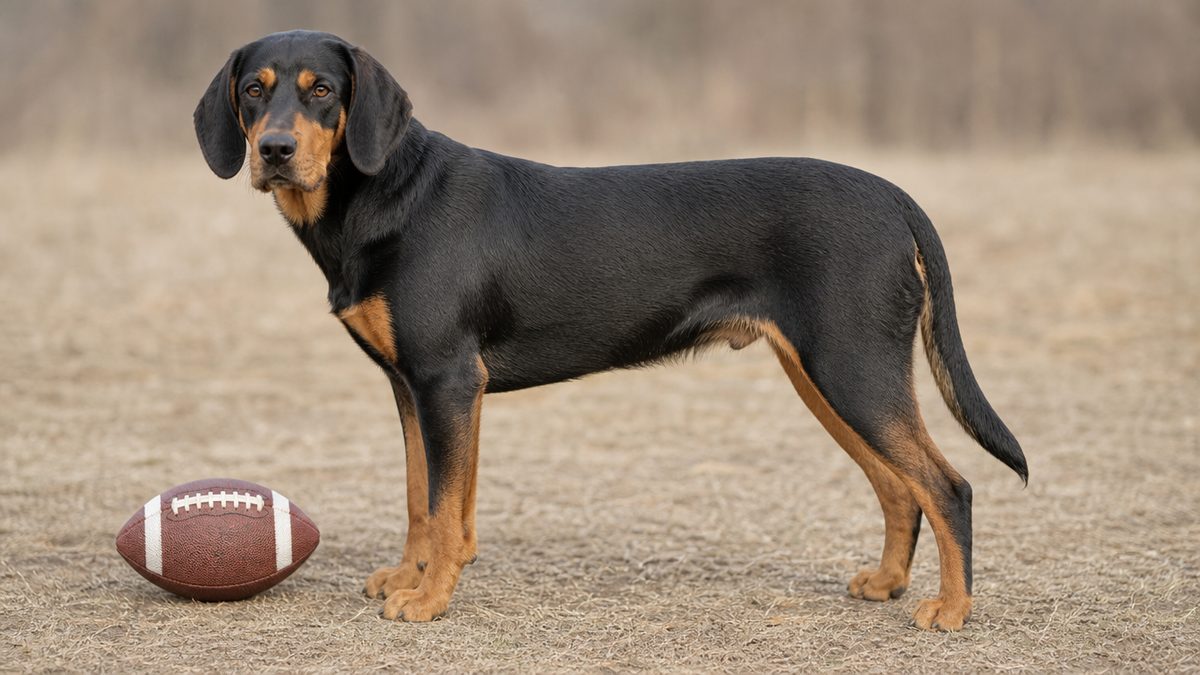
Its standard describes a lithe dog of compact construction with a rectangular 9:10 build, bone that is strong but not heavy, and a build implying a great aptitude for mobility and an obvious disposition to resist difficult working conditions in mountainous regions. Its stated job is hunting boar and deer, with occasional use on fox and hare in the mountainous region of Southern Poland.
The temperament clause is unusually specific for an FCI standard. It reads stable and gentle, truly courageous and able even to demonstrate proof of bravery, intelligent and easy to educate, not aggressive but remaining wary towards strangers, and adds that to its qualities as a hunting dog must be added those of an excellent guardian. It then describes the voice: during the hunt he gives voice with a characteristic melody in various intonations, a higher pitch for the females.
The coat clause everyone abbreviates
FCI-354's hair clause is two sentences and both matter. On the body the hair is harsh, lying close to the skin, with an abundant undercoat, more in winter, less in summer. On the head and ears the hair is short and soft. Three ranking pages compress that to the single word Short The Royal Kennel Club, Breeds A to Z Eukanuba, Breed Finder, which drops the undercoat, and the undercoat is the clause an Indian reader needs.
Colour is black and tan with the tan well distinct from the black and very intense, brown or chocolate and tan, or red. Tan markings sit over the eye, on the muzzle, on the front of the neck, on the forechest, on the lower limbs, behind and inside the thighs, around the anus and under the tail, and small white marks on toes and chest are permitted. The Royal Kennel Club's breed-standard colour list matches exactly: Black and Tan, Brown and Tan, Red.
A documented history rather than a legend
This breed's FCI history names its sources, which is rare. It cites Jan Szytier's *Poradnik Mysliwych* of 1819, W. Kozlowski's 1821 description and illustrations in the magazine *Sylwan* distinguishing the heavier Polish brach from the lighter Polish scent hound, and Ignacy Bogatynski's *Nauka Lowiectwa* of 1823 to 1825, which the FCI says could be used as the first breed standard. It then names the cynologist Jozef Pawuslewicz, 1903 to 1979, who hunted with the dogs in Podkarpacie, wrote the first breed standard and had them officially registered by the Polish Cynological Association.
A separate account fills in the modern dates. The Polish Kennel Club's Scientific Council developed a preliminary breed standard in October 1984, built on zoometric measurements first performed in 1968 and repeated in 1982. The standard was acknowledged and given preliminarily approved status at the 2006 Euro Dog Show in Poznan, and final FCI approval followed on 7 November 2017.
Three websites publish three different Polish breeds under this breed's name, and the two that describe a dog correctly disagree with each other about whether it is medium or large Look4dog.com, Dog breeds, Scent hounds Eukanuba, Breed Finder The Royal Kennel Club, Breeds A to Z. Before anything else, get the FCI number: this breed is 354.
Three Polish breeds are sold under this one name
Three separate websites publish three different Polish breeds under the name Polish Hunting Dog, and Bonbeno read all three pages on 31 August 2026. The breeds substituted are the Ogar Polski, the Polski Owczarek Nizinny and the Polish Mountain Dog, and none of them is FCI breed 354.
| Page | Name it also gives the breed | What that name actually is | Where the error sits |
|---|---|---|---|
| English Wikipedia | the Polish Hound | Ogar Polski, FCI 52, a Large-sized scent hound | The article's first sentence and Overview |
| look4dog.com | the Polski Owczarek Nizinny or PON | Polish Lowland Sheepdog, an FCI Group 1 herding breed | The opening line of a page selling puppies |
| Eukanuba Breed Finder | the Polish Mountain Dog | Polish Tatra Sheepdog, a livestock guardian | The whole Temperament section |
Case one: Wikipedia calls it the Polish Hound
The English article opens: the Gończy Polski, also known as the Polish Hound or the Polish Hunting Dog, is a rare breed of scent hound indigenous to Poland. Its Overview then calls it a smaller variety of the more common Polish Hound. Polish Hound is the FCI's own English name for breed 52, the Ogar Polski, which the register files under Section 1.1 Large-sized Hounds while filing breed 354 under Section 1.2 Medium-sized Hounds Federation Cynologique Internationale Federation Cynologique Internationale.
The article refutes itself at the bottom of its own page. Its navigation box, Dogs originating in Poland, lists five breeds, among them Polish Hound and Polish Hunting Dog as separate entries. The header and the footer of one document disagree, and the header is the part search engines quote.
Case two: a breeder marketplace calls it a sheepdog
Look4dog.com files its page under Scent hounds and runs a Polish Hunting Dog breeders directory from it. Its description opens: the Polish Hunting Dog, also known as the Polski Owczarek Nizinny or PON, is a versatile and intelligent dog breed. The Polski Owczarek Nizinny is the Polish Lowland Sheepdog, a shaggy Group 1 herding dog that looks nothing like a black and tan scent hound. This is a page selling dogs.
Case three: a pet-food brand switches breeds mid-page
Eukanuba's Breed Finder entry is the clearest example of an assembled page rather than a written one. Its Breed standards block is broadly right: Poland, heights of approximately 55 to 59 cm and 50 to 55 cm, and a markings list lifted almost verbatim from FCI-Standard 354 Federation Cynologique Internationale. Its Temperament section, one heading later, reads: The Polish Mountain Dog is energetic and loving... A good herding dog and excellent flock guardian.
The Polish Mountain Dog is the Polish Tatra Sheepdog, a white livestock guardian. Two consecutive sections of one page describe two unrelated breeds, and the split falls exactly where a template would fill a standards block automatically and a human would paste a temperament paragraph. The page is also headed Large Breed, where the FCI files the dog as medium.
The consequence for a buyer
Two of these three pages are commercial. A seller listing found on an India-region query switches names inside its own advertisement, offering a Polish Hunting Dog in Tymbark at 647 US dollars and then describing the litter as Polish Hound puppies. If the seller cannot hold the name steady across two sentences, the buyer has no way to know which of two FCI breeds is in the box, and the two differ by up to 6 cm at the withers and by an entire colour clause Federation Cynologique Internationale.
Ask for the FCI breed number and ask for the colour. Number 354 with a black and tan, brown and tan or red coat is a Gończy Polski. Number 52 with a dark saddle over the nape is an Ogar Polski Federation Cynologique Internationale. Neither question depends on measuring the dog, which is what makes them usable over a phone.
Registry recognition: eleven years provisional, and an English original
The FCI recognises the Gończy Polski on a definitive basis as breed 354, but it did so only on 7 November 2017, after accepting the breed on a provisional basis on 10 November 2006. That is 4,015 days, or 10.99 years, spent provisional.
Bonbeno read those dates out of the record's own raw markup rather than from any extraction, and the record proves its own date format: its four language standards are dated 11/23/2017, and there is no 23rd month, so the field order is month, day, year. Pages that say the breed was recognised in 2017 are giving you the second half of an eleven-year process and dropping the first.
| Field | Gończy Polski (354) | Ogar Polski (52) |
|---|---|---|
| Subsection | 1.2 Medium-sized Hounds | 1.1 Large-sized Hounds |
| Provisional acceptance | 10 November 2006 | none recorded |
| Definitive acceptance | 7 November 2017 | 29 January 1965 |
| Standard in force published | 7 November 2017 | 3 November 2014 |
| Language texts dated | 23 November 2017 | 27 May 2015 (EN) |
| Official authentic language | English | English |
| Working trial | Subject to one | Subject to one |
The authentic language is English, for a Polish breed
FCI-Standard 354 records Official language: EN and credits the translation to Jennifer Mulholland and Raymond Triquet, and the nomenclature record's authentic-language field reads English Federation Cynologique Internationale. That is unusual: for most national breeds the authentic text is in the country of origin's language, which is why Bonbeno routinely checks a French or Italian original against the FCI's English.
Here there is no original to check against. The Ogar Polski's standard does the same thing, crediting the translation to Zwiazek Kynologiczny w Polsce and marking Official language (EN) Federation Cynologique Internationale. So this is Polish kennel-club practice rather than an anomaly for one breed, and the practical consequence is that the English text is not a translation to be double-checked; it is the standard.
One artefact of that survives in the register. The FCI translates the breed's name into French as CHIEN COURANT POLONAIS and into German as POLNISCHER JAGDHUND, but its Spanish entry reads GONCZY POLSKI, untranslated.
British recognition arrived in April 2024
The Kennel Club announced on 26 March 2024 that the Polish Hunting Dog would be recognised with effect from 1 April 2024, classified in the Hound Group on the Imported Breed Register, taking the club's roster to 223 breeds. The previous breed to be recognised was the Pyrenean Sheepdog (Smooth Faced) in 2021. The announcement noted that until an interim breed standard was published the breed could not compete at licensed breed shows; the Royal Kennel Club's breed page now links a published interim standard.
That timing matters for one thing on this page. The largest UK canine longevity study covers 155 breeds and was published on 1 February 2024, two months before this breed entered the British register. Nobody should expect a British lifespan figure for it yet, and this page publishes none.
What recognition means for an Indian buyer
The Kennel Club of India is the FCI's member organisation for India, so the KCI issues pedigrees against FCI nomenclature and the FCI answer is effectively the India answer. Breed 354 is recognised, so a lawfully imported dog could in principle be registered. Recognition is not the obstacle. Import policy is, and the import section below sets out the instrument that closes it.
How big is a Polish Hunting Dog, and why four sources disagree
A Gończy Polski male stands 55 to 59 cm and a female 50 to 55 cm, both from FCI-Standard 354's own SIZE clause, which contains height and nothing else. Four sources nonetheless place the breed in four different size classes.
| Source | Size class given | Heights given | Weight given |
|---|---|---|---|
| FCI-Standard 354 and record | Medium sized hounds (Section 1.2) | 55 to 59 cm / 50 to 55 cm | None at all |
| Royal Kennel Club | Medium-Large | not published on the page | not published |
| Eukanuba Breed Finder | Large Breed | approx 55 to 59 cm / 50 to 55 cm | 20 to 25 kg |
| English Wikipedia | medium-sized, and a smaller variety of a larger breed | 55 to 59 cm / 50 to 55 cm | 22 to 26 kg |
The heights agree everywhere they are printed. The size class and the weight are where the sources diverge, and neither of those comes from the standard, because the standard states one and omits the other.
The overlap with the Ogar Polski, in numbers
FCI-Standard 52 gives the Ogar Polski's males 56 to 65 cm and females 55 to 60 cm. Set against this breed's 55 to 59 cm and 50 to 55 cm, the arithmetic is:
- Males: combined span 55 to 65 cm, a 10 cm band, of which 56 to 59 cm is shared, a 3 cm band. Any male between 56 and 59 cm satisfies both standards.
- Females: combined span 50 to 60 cm, of which only 55 cm itself is shared. The females separate almost cleanly where the males do not.
- Consequence: the FCI files a 58 cm dog as a Medium hound under one number and as a Large hound under another, and the classification depends on which breed the pedigree says it is rather than on the dog.
No standard publishes a weight, and one study weighed 193 dogs
FCI-354 has no weight clause. FCI-52 has a weight line that says only that weight should be proportional to height at withers and the whole conformation, which is not a number Federation Cynologique Internationale. Wikipedia prints 22 to 26 kg and Eukanuba prints 20 to 25 kg, both without a source and both narrower than reality.
The Lublin ophthalmology study weighed its whole cohort and records the range plainly: the 193 Polish Hunting Dogs examined weighed 12 to 37 kg, aged from 3 months to 12 years, none neutered. The lower bound includes puppies, so it is not an adult range, but the upper bound of 37 kg sits 11 kg above the highest published figure. Feed to a body condition score rather than to either printed band.
The Royal Kennel Club is the only registry that publishes an exercise figure for this breed, and it is more than 2 hours per day, alongside Size of home Large house and Size of garden Large garden. The FCI publishes no minute count for any hound. Where a registry does state one, Bonbeno uses it and says whose it is.
Gończy Polski price in India
No verified Gończy Polski price in India exists, and unlike most absent breeds this one has no rupee figure attached to it at all, not even a wrong one. Two India-located searches on 31 August 2026 returned no dog of the breed anywhere in India.
Start with the price list, because it is the document Indian buyers and answer engines actually quote. Supertails' 40-breed table dated 9 March 2026 contains zero occurrences of Polish and zero of Gończy, against 14 occurrences of Beagle and 11 of Labrador, searched case-insensitively across all 127,047 characters of the page. Its only hounds are Indian: the Mudhol Hound at Rs 3,000 to Rs 15,000 and the Rajapalayam at Rs 5,000 to Rs 20,000.
What the India-region search actually returned
The result set is the finding, so here it is in order.
| Position | Domain | What it is |
|---|---|---|
| 1 | etsy.com | An Etsy India market page. Top item a sticker at Rs 471 |
| 2 | en.wikipedia.org | The article that calls the breed the Polish Hound |
| 3 | amazon.in | A 116-page trick-training paperback |
| 4 | royalkennelclub.com | The Imported Breed Register entry |
| 5 | ckcusa.com | A United States registry unrelated to the FCI |
| 6 | dog.eukanuba.eu | The page whose Temperament section describes a flock guardian |
| 7 | instagram.com | A Crufts 2025 Discover Dogs post |
| 8 | scrumbles.co.uk | A UK dog-food brand's breed guide |
| 9 | amazon.in | The same paperback as position 3 |
| 10 | animalia.bio | A breed aggregator |
Two of the ten results are the same book. One is a sticker. Not one offers a dog, and not one carries a rupee price for an animal. The only rupee figure on the whole page belongs to the sticker. On the evidence of both queries this breed is simply unavailable in India through any channel a buyer can verify.
The second query, combining both of the breed's names with puppies, for sale, india, price, breeder and kci, returned a Hungarian marketplace, a European breeder directory, a German breeder listing, four generic Indian puppy marketplaces that matched on the words India and KCI rather than on the breed, a Polish seller in Tymbark quoting 647 US dollars, look4dog.com and a Polish-language Facebook kennel post.
The one foreign price, and why it is not converted here
The Tymbark listing quotes 647 US dollars. Bonbeno does not convert it. Multiplying a foreign asking price by an exchange rate and printing the result as an Indian price is the single most common fabrication on Indian breed pages, and this site has documented converted dollar lists published as rupee market rates at three different exchange rates. A price is a market fact, not an arithmetic one, and there is no Indian market here to be a fact about.
The same listing is also unusable for a second reason. Its own text switches breed names between sentences, offering a Polish Hunting Dog and then describing Polish Hound puppies. A price is worth nothing when the seller has not settled which of two FCI breeds is for sale.
Bonbeno will not print a rupee price for this breed, will not convert the 647 dollar Polish listing, and will not borrow a band from a comparably sized Indian hound and present it as this breed's. The honest answer is that no Indian market exists to price. The useful answer is what a 20 to 30 kg hound costs to keep in India, which the cost section below gives in sourced rupees.
Nobody in India covers this breed, and that is checkable
No India-facing website carries a breed page for the Gończy Polski. India's most complete scent hound index lists more than forty breeds and contains zero occurrences of Polish and zero of Gończy.
That index is worth naming because it is genuinely thorough. Published by a Delhi pet-supplies retailer, it covers the American English Coonhound, the Anglo-Francais de Petite Venerie, Barak, the Basset Artesien Normand, all four Bleu de Gascogne breeds, the Gascon Saintongeois, the Griffon Nivernais, the Hanover Hound, the Istrian Shorthaired Hound, the Otterhound, the Petit Basset Griffon Vendeen, the Poitevin, the Posavac Hound and the Styrian Coarse-Haired Hound, each with a dedicated page. A site that finds room for the Poitevin and omits both Polish scent hounds has made an editorial choice, and that choice tracks Indian demand.
Bonbeno also tried two candidate breed-page URLs on the same domain and both returned HTTP 404. That proves only that the guesses were wrong, which is why the evidence above rests on the zero count inside a document Bonbeno read in full rather than on a missing page.
The demand side, measured
- No Indian price list carries it. Zero occurrences of Polish and Gończy across a 40-breed table that names 14 Beagles and 11 Labradors.
- No Indian marketplace lists it. The four Indian puppy sites that surfaced matched on the words India and KCI, not on the breed.
- No Indian breed page describes it. The only India-facing result on either query was an Etsy sticker market and an Amazon paperback.
- The Indian studbook is shrinking. KCI registrations fell from 89,571 in 2021 to 33,880 in 2025, down 62.2 percent, with 32,219 puppies across 7,412 litters in 2025.
Where the breed does exist
Poland, principally, and now Britain. The breed's own home population is small enough that its genetics have been studied for that reason: two identified progenitors, 1,947 descended animals and 27 founders, with a mean pedigree inbreeding coefficient of 0.1151 and a population mean kinship of 0.1198. Those figures come from Goleman and colleagues' 2019 study in *Livestock Science*, which Bonbeno confirmed exists through Crossref and OpenAlex but could not obtain in full, so they are reported here at second hand as quoted by the 2021 ophthalmology paper, which Bonbeno did read in full.
Britain admitted the breed to the Imported Breed Register on 1 April 2024, taking the Kennel Club's roster to 223 breeds. The Royal Kennel Club's own health guidance for it recommends exactly one thing before breeding, prioritising genetic diversity, and offers no breed-specific DNA package. That is a registry saying, in its own words, that the population size is the problem it can see.
English Wikipedia states that in 2015 there were 1,342 Gończy Polski dogs registered in Poland, 432 of them registered with the Polish Kennel Club for breeding, citing Goleman et al. 2019. Bonbeno could not obtain that paper and the 2021 study it did read does not repeat those two figures. They are reported here as Wikipedia's attribution rather than as verified counts, and nothing on this page rests on them.
Indian import law, and the domestic rules that would apply
You cannot lawfully import a Gończy Polski into India to breed or sell it. DGFT Trade Notice 22/2022-23 classifies dogs under ITC (HS) 01061900 as Restricted and states in paragraph 6 that any applications for trading or breeding purposes shall be duly rejected.
Bonbeno downloaded that notice as a five-page PDF and extracted 6,639 characters of real text with pypdf, so the clauses below were read rather than summarised. It is dated 19 December 2022 and addressed to all international airlines, all Indian embassies and consulates abroad, and pet owners concerned.
- Policy Condition (7) permits dog imports for three purposes only: a pet dog with a valid pet book and relevant records in the importer's own name; dogs imported by R and D organisations with a CPCSEA recommendation; and internal security by the Defence and Police Force.
- Policy Condition (8) states that import of commercial dogs for breeding or any other commercial activities other than those purposes is not permitted.
- Paragraph 6 states that any applications for trading or breeding purposes, or applications made on behalf of some another person or entity, shall be duly rejected.
- Paragraph 7 limits entry to the airports and seaports of Delhi, Mumbai, Chennai, Hyderabad, Bangalore and Kolkata.
So a family relocating from Poland or Britain with their own dog can bring it, on a pet book in their own name. Nobody can lawfully acquire breeding stock, which is why the absence documented above is structural rather than a matter of demand catching up.
A 2024 notification, S.O. 4396(E) of 10 October 2024, adds Cochin International Airport, Kochi, for pet dogs and cats arriving under the baggage rules, under the Livestock Importation Act 1898. That is a different instrument from the DGFT notice, which still names six ports for its own licence route, so a pet arriving under the baggage rules can land at seven ports today and a licence-route import plans on the DGFT's six. Both lists are right for their own route, as how to import a dog to India sets out.
What the 2017 Rules would require of an Indian breeder
Bonbeno extracted the Prevention of Cruelty to Animals (Dog Breeding and Marketing) Rules, 2017 from the gazette itself, 14 pages and 51,953 characters, and listed every numbered provision. The Rules run 1 to 13 and stop there. Everything numbered above 13 is a Second Schedule paragraph: the Schedule opens See rules 5(2) and 6 and runs 1 to 30 across four Parts, Part I paragraphs 1 to 4, Part II 5 to 6, Part III 7 to 9, and Part IV, Housing facilities and manner of housing dogs, 10 to 30. There is no paragraph 31.
Three provisions bite on this breed specifically.
- Second Schedule Part III paragraph 8(10) requires that dogs shall have been tested for genetic defects, including hip dysplasia, progressive retinal atrophy, night blindness, entropion, ectropion, hypothyroidism, overshot and undershot jaw, wry mouth, two or more missing teeth and cryptorchidism. Four of those eleven are eye conditions, and a Polish study found PRA in 3 of 193 dogs of this breed and entropion in 1 Ireneusz Balicki.
- Second Schedule Part II paragraph 6(8) forbids tail docking, ear cropping, de-barking, de-clawing, branding, dyeing and any other kind of mutilation. FCI-Standard 354 describes the rear pastern as short without dewclaws, so a breeder tempted to produce that surgically would be breaking this clause Federation Cynologique Internationale.
- Second Schedule Part IV paragraph 21(1), Outdoor housing facilities, bars keeping in outdoor facilities, without the attending veterinary practitioner's written approval, dogs not accustomed to local temperatures, breeds that cannot tolerate them such as long-haired breeds in high temperature locations, and sick, infirm, aged or young animals. The string Rule 21 appears zero times in the gazette, so any page citing it that way is citing something that does not exist.
The first of those three is the striking one, and it inverts the usual direction of travel. India's mandatory pre-breeding testing list is stricter than the breed's home country's, because the authors of the Lublin study state plainly that Polish Hunting Dogs are currently not subject to any additional health-related breeding requirements, whether screening schemes, veterinary or DNA, and that it is not mandatory to examine hereditary diseases in Polish breeds before introducing them into kennels. An Indian breeder complying with paragraph 8(10) would screen for two conditions this breed is documented to carry that a Polish breeder is not obliged to look for.
What a dog this size costs to keep in India, in sourced rupees
Budget Rs 3,000 to Rs 18,000 a month for a dog in India, which is the published Indian range by breed size and grooming need, and Rs 80,000 to Rs 2,00,000 for a first year including purchase, vaccinations, food, training and supplies. Those figures apply to any 20 to 30 kg hound living here.
There is no Indian price for this breed, so the monthly cost of keeping one is the useful question. Every figure below comes from a document Bonbeno opened, and where a government rate card and a private clinic disagree, both are printed.
| Item | Government rate | Private-clinic rate | Source |
|---|---|---|---|
| Consultation / out-door ticket, pet animal | Rs 30 | Rs 200 to Rs 700 | Chandigarh AH; Sploot |
| Anti-rabies vaccination | Rs 30 | Rs 200 to Rs 500 per dose | Chandigarh AH; Sploot |
| Core combination shot, DHPP or DHPPiL | Rs 50 to Rs 300 | Rs 500 to Rs 1,200 per dose | Sploot |
| Leptospirosis, billed separately | not listed | Rs 150 to Rs 400 | Sploot |
| Kennel cough, Bordetella | not listed | Rs 500 to Rs 900 | Sploot |
| Full puppy core series | a few hundred rupees | Rs 1,800 to Rs 4,500 | Sploot |
| Stool test | Rs 10 | not listed | Chandigarh AH |
| Blood or urine test | Rs 20 | not listed | Chandigarh AH |
| Minor operation | Rs 50 | not listed | Chandigarh AH |
| Major operation | Rs 100 | not listed | Chandigarh AH |
| Health certificate, per animal | Rs 50 | not listed | Chandigarh AH |
| Monthly upkeep, all in | not applicable | Rs 3,000 to Rs 18,000 | Supertails |
The gap between the two columns is an order of magnitude, not a rounding. The Directorate of Animal Husbandry, Chandigarh Administration publishes an anti-rabies vaccination fee of Rs 30 and a pet out-door ticket of Rs 30, against Rs 200 to Rs 500 for the same rabies dose plus a Rs 200 to Rs 700 consultation at a private Indian clinic.
Sploot's national guide says government hospitals and NGO clinics run sometimes free for rabies, or Rs 50 to Rs 300 for core vaccines. Chandigarh's own published card charges Rs 30 for anti-rabies, below Sploot's stated floor. A national estimate and one state's rate card are different things. Check your own state's card before assuming either.
The eye examination this breed actually needs, and what it costs
This is the line most Indian owners will not have budgeted, and for this breed it is the important one. A Polish study of 193 dogs found retinal lesions in 8.3 percent, cataract in 2.6 percent and progressive retinal atrophy in 1.6 percent, and its authors recommend that Polish Hunting Dogs undergo periodic ophthalmological examination. Neither Poland nor the Royal Kennel Club requires one.
Bonbeno could not source a published Indian rate for a veterinary ophthalmic examination or for slit-lamp biomicroscopy, and does not invent one. What can be said with a source is the shape of the problem: a Chandigarh government institution charges Rs 30 for the visit and prints its X-ray fee at Rs 30 per film with the annotation Radiology wing not functioning. A published price is not a delivered service, and specialist ophthalmic equipment sits well outside a Rs 30 rate card.
Where the rest of the money goes
- Food. Supertails puts a large Labrador's food at Rs 2,500 to Rs 5,000 a month and average all-in maintenance at Rs 3,000 to Rs 11,000. A 20 to 30 kg hound with a wash-and-wear coat sits mid-band.
- Ear care. Hanging low-set triangular ears carry a class-level otitis risk, and Indian humidity does the rest.
- Tick prevention, year round. 261 of 525 surveyed Indian dogs, 49.7 percent, carried at least one tick-borne pathogen.
- Space. The Royal Kennel Club specifies a large house and a large garden and more than 2 hours of exercise a day. In an Indian metro that is a rent decision before it is a dog decision.
- Adoption instead. Indian shelter fees run Rs 0 to Rs 3,000 including vaccinations, deworming and microchipping.
City matters too. Supertails reports Indian prices varying 15 to 30 percent by city with Mumbai and Delhi dearest, and the Kennel Club of India's registrations have fallen 62.2 percent from their 2021 peak, so the formal pedigree market that would benchmark any of this is contracting rather than expanding.
Heat tolerance in India, and the claim that this dog adapts to most climates
Rate the Gończy Polski 2 out of 5 for heat tolerance in India. Its working region records an annual mean wet-bulb temperature of 6.00 C against Chennai's 24.94 C, a gap of 18.94 C, and its standard specifies an abundant undercoat that thickens in winter Federation Cynologique Internationale.
A pet-food brand's breed page tells Indian readers the opposite. Its Good to know list reads, in full: Makes a wonderful family pet and companion; Excels as a guardian; No trimming or stripping required; Adapts to most climates; Little grooming needed; Must have daily physical activity and mental stimulation; Does best with acreage; Can be noisy. That list was written for a European reader and it does not transfer.
Bonbeno queries NASA's POWER climatology by explicit latitude and longitude and checks the geometry the API returns against the coordinates it sent, so no place name can silently resolve to another city. Wet bulb is the figure that matters for a dog, because it is the temperature that survives evaporation and a panting dog is an evaporative cooler.
| Place | Annual mean air temp | Annual mean wet bulb | Peak monthly wet bulb | Gap vs Sanok |
|---|---|---|---|---|
| Sanok, Podkarpackie (working region) | 7.66 C | 6.00 C | 16.32 C (July) | - |
| Warsaw | 8.64 C | 6.64 C | 17.11 C (July) | +0.64 C |
| Lublin (site of the eye study) | 8.44 C | 6.50 C | 17.02 C (July) | +0.50 C |
| Bengaluru | 23.74 C | 19.80 C | 22.66 C (May) | +13.80 C |
| Pune | 23.86 C | 19.66 C | 23.56 C (June) | +13.66 C |
| Delhi | 25.60 C | 18.03 C | 27.74 C (July) | +12.03 C |
| Mumbai | 26.77 C | 22.73 C | 26.55 C (June) | +16.73 C |
| Kolkata | 25.81 C | 22.85 C | 27.86 C (June) | +16.85 C |
| Chennai | 27.95 C | 24.94 C | 27.36 C (May) | +18.94 C |
18.94 C is the largest origin-to-Chennai wet-bulb gap Bonbeno has recorded for any hound on this site. The French scenthound pages built in the same week run about 13.9 C, because Gascony is temperate. Podkarpackie is not temperate; Sanok's January minimum air temperature in the same climatology is -26.98 C, and Lublin's is -31.32 C.
The undercoat is the clause that matters
FCI-Standard 354 says the body hair is harsh and lying close to the skin with an abundant undercoat, more in winter, less in summer. A summer coat calibrated to a Polish July, where the peak monthly wet bulb is 16.32 C, is not a summer coat for a Chennai May at 27.36 C NASA Langley Research Center. Three ranking pages describe the coat as simply Short and drop the undercoat entirely The Royal Kennel Club, Breeds A to Z Eukanuba, Breed Finder, which is how a European care note becomes an Indian mistake.
Exertion, not sunshine, is what kills
In 905,543 UK dogs under primary veterinary care in 2016, 652 of the 879 heat-illness events with a recorded trigger, 74.2 percent, were exertional, against 12.9 percent environmental and 5.2 percent vehicular. A companion paper on the same cohort put the 2016 incidence at 0.04 percent with an event fatality rate of 14.18 percent and named higher bodyweight relative to the breed and sex mean as a risk factor.
That matters here because the Royal Kennel Club prescribes more than 2 hours per day for this breed, and FCI-354 describes a dog built with an obvious disposition to resist difficult working conditions. The dog will keep going. The owner has to stop it.
Neither Hall paper models the Gończy Polski, which is far below their inclusion thresholds and appears in neither breed list Emily J. Hall, Anne J. Carter and Dan G.…. The transferable findings are the exertional share and the bodyweight-relative-to-breed-mean factor, both class-level. The over-50 kg odds ratio does not apply to a 20 to 30 kg dog and Bonbeno does not quote it here.
Practical rules for an Indian owner
- Split the Royal Kennel Club's two hours across before 06:30 and after 19:30 from March to June in the plains.
- Substitute scent work for distance in the hot months. A nose game in a cool room satisfies this dog better than a hot walk does.
- Never shave the coat. It is harsh and close-lying by design, and stripping the undercoat removes insulation against heat as well as cold.
- Bengaluru and Pune, at 841.72 m and 635.99 m, peak at 22.66 C and 23.56 C wet bulb and are the only Indian cities where this dog's exercise requirement is meetable outdoors for most of the year.
- Keep tick prevention running year round: 49.7 percent of 525 surveyed Indian dogs carried a tick-borne pathogen.
Indian law reaches this directly. Second Schedule Part IV paragraph 21(1) of the 2017 Rules bars keeping in outdoor facilities, without written veterinary approval, dogs that are not accustomed to the temperatures prevalent in the area or region in question. An imported Polish scent hound in a Chennai summer is the textbook case that clause describes.
Temperament, and who should not buy this dog
The Gończy Polski is stable and gentle, truly courageous, intelligent and easy to educate, not aggressive but wary towards strangers, and its FCI standard adds that to its qualities as a hunting dog must be added those of an excellent guardian.
That guardian clause is unusual in a scenthound standard and it is the single most useful sentence about living with this dog. Most Group 6 breeds are described as pack animals that are indifferent to strangers. This one is described as wary of them and good at watching a property, which changes what an owner should expect at the gate.
The voice clause is equally specific. FCI-354 records that during the hunt he gives voice with a characteristic melody in various intonations, a higher pitch for the females. The Ogar Polski's standard makes the same sex distinction in the opposite words, calling the voice lower pitched in the male and higher in the female and describing it as giving tongue. Both breeds are bred to be heard across a valley.
Household fit, honestly
| Situation | Verdict | Why |
|---|---|---|
| Independent house with a large fenced garden | Good fit | The Royal Kennel Club specifies a large house and a large garden |
| Family with children | Good fit | Standard requires stable and gentle, not aggressive |
| Home wanting a watchdog too | Good fit | The standard names guardian qualities explicitly |
| Home with cats or poultry | Caution | Bred on boar, deer, fox and hare |
| Apartment, any Indian metro | Poor fit | More than 2 hours daily, a carrying voice, no lawful de-barking |
| First-time owner working full days | Poor fit | Under-exercised, this dog bays and roams |
English Wikipedia says the opposite of the last two rows, describing the breed as suitable for various living environments, from spacious yards to apartment living. That sentence is sourced to a content site, not to a registry, and it sits in the same paragraph as the claim that the breed has an innate inclination towards dominance, which appears in no standard. FCI-354 says stable, gentle and easy to educate. Bonbeno takes the standard.
The voice, and the Indian legal consequence
There is no lawful surgical answer to a barking complaint in India. Second Schedule Part II paragraph 6(8) of the 2017 Rules prohibits de-barking outright, alongside docking, cropping, de-clawing, branding and dyeing. A vocal breed whose standard specifies a characteristic melody in various intonations is a breed you either give space to or do not buy.
What the standards do not tell you
Neither registry publishes a separation-anxiety note, a noise-sensitivity rating or guidance on nine hours alone in a flat, because neither was written with that in mind. Where a standard is silent, Bonbeno says so rather than inventing a rating. What can be said with a source is that the Royal Kennel Club describes a breed that appreciates lots of exercise to keep it in great physical and mental condition and files it as needing a large house and a large garden, and that a pet-food brand's own list warns the breed can be noisy and does best with acreage even while telling readers it adapts to most climates.
Training a Gończy Polski, and the one thing it will not learn
Train everything except off-lead recall on a live scent line, and manage that with a long line and a fence rather than a better cue. FCI-Standard 354 calls the breed intelligent and easy to educate, which is true indoors and on a clean field.
The standard's phrasing is worth reading twice: intelligent and easy to educate, not aggressive but remaining wary towards strangers. Easy to educate is a genuine advantage and it is not a promise about recall. A hound bred to hold a boar line across mountain terrain is solving a problem that a recall cue interrupts.
A realistic timeline
| Age | Focus | Realistic outcome |
|---|---|---|
| 8 to 16 weeks | Socialisation, handling, ear and eye handling, crate | Accepts an ophthalmoscope later without sedation |
| 4 to 6 months | Name, lead manners, settle on a mat, stranger introductions | Reliable indoors, wary at the gate by design |
| 6 to 12 months | Long-line work, scent games, impulse control | Recall reliable on a clean field, not on a live line |
| 12 to 24 months | Duration, a quiet cue, alone-time in doses | Voice manageable in context, never eliminated |
| 2 years on | Maintenance, scent work, guardian manners | A settled house dog with a fence and a job |
The first row is set by law as well as by ethology. Rule 8(1)(a) of the 2017 Rules requires that pups less than eight weeks in age are not sold, so a lawfully acquired Indian puppy arrives at eight weeks at the earliest and part of its socialisation window is already spent. Do not let a seller shorten it.
Handling for the eye examination, specifically
This is the training job that is unique to this breed and no page mentions it. The one real health study on the Gończy Polski used slit lamp biomicroscopy, ophthalmoscopy and tonometry on 193 dogs, and its authors recommend that the breed undergo periodic ophthalmological examination. Tonometry means touching an instrument to the surface of the eye on a conscious dog. A puppy taught from eight weeks to accept a hand around its muzzle, a light in its eye and a still head for ten seconds is a dog that can be screened annually for a decade without chemical restraint.
Methods that work and one that does not
- Pay with food and scent. A hound bred to follow a nose will work for a nose game more reliably than for a ball.
- Train the quiet cue on a stimulus you control. Reward the pause between barks rather than punishing the bark, which is a selected trait.
- Use a long line for the first two years. Management is the technique, not a substitute for one.
- Socialise with strangers deliberately. The standard says wary of strangers, so the default without work is suspicion rather than neutrality.
- Do not use aversives on the voice or on the wariness. Both are in the standard, and the same standard makes an overly shy dog a disqualifying fault.
The one Indian-specific adjustment is scheduling. Train in the cool hours, because a hot dog stops learning before it stops moving, and 74.2 percent of recorded-trigger heat-illness events in the largest study were exertional.
Daily exercise requirement, and what happens without it
Give a Gończy Polski more than two hours of exercise a day, which is the Royal Kennel Club's own published figure for the breed, split across the cool ends of the Indian day.
That figure is worth flagging because most rare-breed pages on this site have to derive an exercise floor rather than cite one. Here a registry states it: Exercise, more than 2 hours per day, alongside Size of home Large house and Size of garden Large garden. The FCI publishes no minute count for any hound, and a pet-food brand's page says only that the breed must have daily physical activity and mental stimulation and does best with acreage.
The standard explains why the figure is high. FCI-354 describes a build implying a great aptitude for mobility and an obvious disposition to resist difficult working conditions in mountainous regions, gaits that should be effortless and energetic, fluid and harmonious, with long reaching and free movement especially on the trot. The Royal Kennel Club adds that the traditional function is hunting boar, singly or in packs, in forested and mountainous terrain.
Two hours in an Indian summer is not two hours in a British one
| Slot | March to June, plains | July to September | October to February |
|---|---|---|---|
| Morning | 55 min before 06:30 | 50 min, skip if lightning | 70 min before 09:00 |
| Evening | 40 min after 19:30 | 45 min after 19:00 | 50 min after 18:00 |
| Indoors | 25 min scent work at midday | 25 min scent work | optional |
| Weekend | One long cool-hour outing | Trail walk on a long line | Full 2 to 3 hour hike |
The reason to move the morning slot before 06:30 is arithmetical rather than cautious. Delhi's peak monthly wet bulb is 27.74 C in July and Chennai's is 27.36 C in May, against 16.32 C in a Polish July at Sanok. The same two hours in the same dog is a different physiological load.
What under-exercise looks like
Not a quiet dog. A pet-food brand's own list of things to know about the breed includes can be noisy and does best with acreage in the same eight lines that call it a wonderful family pet. The failure modes an Indian owner meets first are a neighbour complaint about the voice and a dog that has followed a scent out of the compound, which is why the Royal Kennel Club's large-garden requirement is a fence requirement in practice.
For a breed whose standard describes it working boar and deer lines over difficult ground, twenty-five minutes of hidden-food searching in a cool room does more for the dog's head than forty minutes of hot pavement does for its legs. Use it deliberately from March to June rather than as a fallback.
Grooming in Indian humidity: a harsh coat, an undercoat and hanging ears
Brush a Gończy Polski once a week and pay attention to its undercoat and its ears rather than its coat length. FCI-Standard 354 gives the body hair as harsh and lying close to the skin with an abundant undercoat, more in winter and less in summer.
The Royal Kennel Club's own characteristics block agrees on the workload: Grooming once a week, Coat length Short, Sheds Yes. A pet-food brand adds that no trimming or stripping is required and little grooming is needed. On the labour question all three sources are right, and this is a genuinely low-maintenance coat.
They are wrong on the description, and the difference is the undercoat. Short describes what you see. Harsh, close-lying, with an abundant undercoat describes what is under it, and in an Indian summer the undercoat is the part that traps heat against the skin. Three ranking pages print Short and drop the second half of the clause The Royal Kennel Club, Breeds A to Z Eukanuba, Breed Finder.
Never shave it
A harsh close-lying coat with a dense undercoat protects against sun as well as cold. Shaving removes the guard layer, exposes skin that has never seen direct Indian sun, and does not improve cooling, because a dog cools by panting rather than through its skin. What does help is thorough de-shedding: brush the undercoat out properly at the seasonal turn rather than clipping the coat off.
The ears are the recurring job
FCI-354 describes the ears as hanging, light, triangular of medium length, set low at the level of the horizontal line of the eyes, broad at the base, with well rounded tips, carried slightly forward, and covered in short silky hair. In a UK primary-care study of 22,333 dogs, breeds with V-shaped drop ear carriage carried 1.84 times the odds of otitis externa of erect-eared breeds, 95 percent confidence interval 1.53 to 2.21, and pendulous ears 1.76 times, against a one-year period prevalence of 7.30 percent across all dogs.
No Polish scent hound appears anywhere in that paper, so only the class figure transfers, and assigning this breed to the drop-ear class on the strength of the standard's hanging triangular clause is Bonbeno's judgement rather than the paper's. Bonbeno says so rather than presenting 1.84 as a breed figure.
The Indian evidence sharpens the seasonality. A series in Durg, Chhattisgarh examined 281 dogs and found 51 positive for otitis externa, an overall prevalence of 18.14 percent, splitting summer 21 cases at 41.18 percent, rainy 17 at 33.33 percent and winter 13 at 25.49 percent. Those counts sum to 51 and those percentages sum to 100.00, so the table reconciles. The paper names excessive moisture from swimming or bathing, and improper cleaning, as causes.
The Durg series peaks in summer, at 41.18 percent. Another Indian series this site cites elsewhere peaks in the monsoon. Both are real Indian data and Bonbeno prints both rather than choosing the convenient one. For an owner of a low-set drop-eared hound the practical answer is the same either way: check and dry the ears through both seasons.
A weekly routine that fits Indian conditions
- Brush once a week, twice at the seasonal coat turn, working the undercoat out rather than skimming the guard hair.
- Lift and look at the ears every second day from March to September, every third day otherwise.
- Dry after every wash and every swim, because moisture is the named mechanism in the Indian series.
- Combine the brush with a tick check. 261 of 525 surveyed Indian dogs, 49.7 percent, carried a tick-borne pathogen, and on a drop-eared dog the fold behind the ear is the first place to look.
- Look at the eyes while you are there. Cloudiness, squinting or a dog hesitating in dim light are the signs the Lublin study's cataract and PRA cases presented with.
In humid coastal air the ear canal never dries on its own, so a mitt-dry after a wash is not optional in Mumbai, Chennai or Kolkata the way it might be in Pune.
The 193-dog eye study, and why the abstract gets it wrong
One real health dataset exists for the Gończy Polski: an ophthalmic examination of 193 dogs published in PLoS ONE on 5 November 2021, which found retinal lesions in 8.3 percent, cataract in 2.6 percent and progressive retinal atrophy in 1.6 percent.
The paper is Balicki, Goleman and Balicka, from the Department and Clinic of Animal Surgery and the Department of Animal Ethology and Wildlife Management at the University of Life Sciences in Lublin, with a co-author at the University of Veterinary Medicine and Pharmacy in Kosice. Bonbeno read the full open-access text from the PMC deposit rather than the abstract, and the difference between those two documents is the point of this section.
The cohort
193 Polish Hunting Dogs: 101 females and 92 males, aged between 3 months and 12 years, weighing 12 to 37 kg, none of them neutered. Examinations used slit lamp biomicroscopy, ophthalmoscopy and tonometry to the standard protocol for hereditary eye disease, with spectral-domain optical coherence tomography for the dogs with SARDS and PRA and electroretinography in the SARDS case. For a breed with 27 founders, 193 examined dogs is a substantial fraction of the population.
Table 1, which is the number set to quote
| Finding | Dogs | Percent of 193 |
|---|---|---|
| Retinal lesion | 16 | 8.3 |
| Cataract | 5 | 2.6 |
| Progressive retinal atrophy | 3 | 1.6 |
| Iris coloboma | 3 | 1.6 |
| Distichiasis | 2 | 1.0 |
| Retinal dysplasia | 2 | 1.0 |
| Dermoid | 1 | 0.5 |
| Entropion | 1 | 0.5 |
| Eversion of the nictitating membrane | 1 | 0.5 |
| SARDS | 1 | 0.5 |
Every percentage in that table reproduces from 193: 16 divided by 193 is 8.29, 5 is 2.59, 3 is 1.55, 2 is 1.04 and 1 is 0.52. The table is internally sound.
The abstract is not
The paper's own abstract reads: retinal dysplasia, distichiasis and entropion in 1 dog (1%). Table 1 gives distichiasis in 2 dogs at 1 percent, retinal dysplasia in 2 dogs at 1 percent and entropion in 1 dog at 0.5 percent, three separate rows with two different counts and two different percentages. The abstract also omits eversion of the nictitating membrane, 1 dog at 0.5 percent, entirely.
That matters because the abstract is what every downstream page will quote. PubMed serves it, search engines index it and answer engines summarise it. Anyone citing this study from its abstract is publishing two wrong counts and a missing finding. Quote Table 1.
A second discrepancy, in the Results text
The Results paragraph records retinal lesions in 16 dogs, 8.3 percent of the study population, and then gives the split as 8 cases of unilateral and 7 cases of bilateral retinal lesions, which sums to 15. Table 2 lists sixteen dogs individually. One case is unaccounted for between the split and the total. Bonbeno reports the discrepancy rather than repeating either figure as though it were clean, and uses the 16 that both the table and the sentence's own opening give.
What the cases looked like
Retinal lesions were found in 10 male and 6 female dogs aged between 5 months and 10 years, presenting as discoloration of the tapetal fundus, patchy increased reflectivity in the discoloured region, and strongly pigmented foci with adjacent hyper-reflective foci. Of the five cataract cases, three dogs aged 3, 4 and 8 years had immature bilateral nuclear and cortical cataract; two aged 9 and 10 had mature bilateral cataract with impaired vision, a negative menace response, no tracking, and difficulty on an obstacle course under both dim and bright light.
That last detail is the one an owner can use. A ten-year-old dog failing an obstacle course in good light as well as poor light is a dog whose cataract has gone past the stage where an owner would notice only night-time hesitancy.
What the evidence base does not contain, and what must not be borrowed
The Gończy Polski has exactly one peer-reviewed paper of its own, no row in OFA's published statistics tables, no published median life expectancy and no mandatory screening scheme in its home country. That is the honest state of the evidence.
Start with the literature count, proved with controls and with the query rewrite read rather than ignored. A PubMed search for Gonczy Polski on 31 August 2026 returned 0 records. A search for Polish Hound returned 0, and PubMed's translation shows why the count is meaningless on its own: it expanded Polish into the MeSH term industrial oils.
A search for Polish Hunting Dog returned 11 records, and this is exactly the trap a raw count sets. Opening all eleven titles shows that one is about this breed, the 2021 ophthalmology paper. The other ten are a wind-farm and game-mammal study, grey wolf hybridisation, Czechoslovakian Wolfdog genomics, an international working-dog genetic survey, toxic-metal biomonitoring, a nutrition review on oral health, tick-borne encephalitis immunisation in border guards, occupational allergy from laboratory animals, an exercise-hyperthermia physiology paper and a 1970s Polish tularemia note. Controls in the same session returned 126 records for Labrador Retriever hip dysplasia and 11 for Beagle otitis externa, so the instrument was working.
The working-dog survey does not transfer
One of those eleven records does include Polish dogs. Shaffer and colleagues tested 304 dogs including 58 Polish law-enforcement animals, found 29 percent to be carriers of a genetic mutation and 6 percent at risk of a debilitating inherited condition, and named the at-risk dogs as Labrador Retrievers with exercise-induced collapse, Bloodhounds with degenerative myelopathy, and German Shepherd dogs with degenerative myelopathy or leukocyte adhesion deficiency type III. No Polish Hunting Dog appears anywhere in it. A survey that includes a country is not a survey that includes a breed.
No OFA row, and the reason is published
Bonbeno retrieved OFA's full disease-statistics tables on 31 August 2026 as a 2,226,110-character document holding 113,680 table cells and searched it case-insensitively. It returns zero occurrences of POLISH HUNTING, zero of GONCZY and zero of POLISH HOUND, against 33 occurrences of POLISH LOWLAND SHEEPDOG, 1 of POLISH TATRA SHEEPDOG and 109 of LABRADOR.
Those controls do two jobs. They prove the retrieval worked, because a direct unrendered fetch of the same URL returned a 49,168-character shell with zero LABRADOR hits. And they show the absence is specific: two of the five Polish FCI breeds hold OFA rows and neither Polish scent hound does. Note which two do hold rows. The Polish Lowland Sheepdog is the breed a puppy marketplace confuses with this one, and the Polish Tatra Sheepdog is the breed a pet-food brand's temperament section describes Eukanuba, Breed Finder.
OFA publishes the threshold: a breed is not included in its statistics tables until a minimum number of individuals have been evaluated, at least 100 for hips and at least 50 for every other database. So the correct wording is no row in OFA's published statistics tables, not absent from the OFA database.
No published lifespan
McMillan and colleagues' 2024 study of 584,734 UK dogs including 284,734 deceased partitions longevity across 155 breeds. It was published on 1 February 2024, two months before this breed entered the British register on 1 April 2024, so it cannot contain it. Bonbeno read the abstract, did not obtain the supplementary tables, and publishes no median life expectancy for this breed at all.
Two unsourced figures circulate instead. Eukanuba prints an average of 12 to 14 years and Wikipedia prints 10 to 13, sourced to a content site. The Royal Kennel Club, more carefully, says only over 10 years.
The screening gap, and why India's rule is stricter
The Lublin authors state plainly that Polish Hunting Dogs are currently not subject to any additional health-related breeding requirements, whether screening schemes, veterinary or DNA, and that at present it is not mandatory to examine hereditary diseases in Polish breeds before introducing them into kennels. The Royal Kennel Club's pre-breeding guidance lists exactly one item, prioritising genetic diversity, and it offers no breed-specific DNA package.
Second Schedule Part III paragraph 8(10) of the 2017 Rules requires that dogs shall have been tested for genetic defects, including progressive retinal atrophy, night blindness, entropion and ectropion. The Lublin study found PRA in 3 of 193 Polish Hunting Dogs and entropion in 1. So an Indian breeder complying with paragraph 8(10) would screen for two documented conditions that a Polish breeder is under no obligation to look for. The clause's word is including, so its list is illustrative rather than closed.
The population argument the registries make
Both registries that comment on this breed's health point at the same thing, and it is not a disease. The Royal Kennel Club recommends prioritising genetic diversity and nothing else. The Lublin paper reports, from Goleman and colleagues' 2019 pedigree and microsatellite study, 27 founders, two identified progenitors from whom 1,947 animals descend, a polymorphic information content of 0.5552, a mean pedigree inbreeding coefficient of 0.1151 and a population mean kinship of 0.1198 Malgorzata Goleman, Ireneusz Balicki. Bonbeno could not obtain the 2019 paper itself and reports those figures at second hand, labelled, from the 2021 study it did read in full.
Feeding a Gończy Polski in India
Feed to a body condition score of 4 or 5 out of 9 rather than to a target weight, because FCI-Standard 354 publishes no weight at all and the two figures that circulate come from pages that also misname the breed Eukanuba, Breed Finder.
The one measured figure is a range from a real cohort rather than a target: the 193 dogs in the Lublin ophthalmology study weighed 12 to 37 kg, aged from 3 months to 12 years. That includes puppies at the bottom, so it is not an adult band, but its top sits 11 kg above the highest published guess. Any single number you feed to would be somebody's estimate.
The body condition test, done properly
- Ribs: easily felt under a thin covering of fat, without pressing.
- Waist: clearly visible from above, behind the ribs.
- Abdominal tuck: visible from the side.
- Frequency: score monthly, on the same day, and write it down.
- Adjust by 10 percent of the daily ration at a time, then re-score in three weeks.
There is a breed-specific reason to keep the score honest at the top end. Hall and colleagues found that higher bodyweight relative to the breed and sex mean was a significant risk factor for heat-related illness in 905,543 UK dogs. In a country where the wet-bulb gap against this breed's home region reaches 18.94 C, a dog carrying two extra kilos is carrying a documented risk factor rather than a cosmetic problem NASA Langley Research Center.
Life stages
| Stage | Meals per day | Focus | Indian note |
|---|---|---|---|
| 8 to 16 weeks | 4 | Growth food, steady gain | Arrives at 8 weeks at the earliest by law |
| 4 to 8 months | 3 | Growth food, avoid rapid gain | Watch loose stools through the monsoon |
| 8 to 14 months | 2 | Transition to adult | Move the main meal to the cool hours |
| 14 months to 7 years | 2 | Maintenance, score monthly | Feed after exercise, never before |
| 7 years on | 2 | Adjust for reduced activity | Re-score monthly, and check the eyes |
The last row earns its place. Two of the five cataract cases in the Lublin study were dogs aged 9 and 10 with mature bilateral cataract and impaired vision. A senior dog eating less may be a senior dog that cannot find its bowl in a dim Indian corridor, and that is a five-second thing to check before changing the food.
Availability and cost
Everything this breed needs is sold in India. Supertails puts food for a large Labrador at Rs 2,500 to Rs 5,000 a month, total monthly upkeep at Rs 3,000 to Rs 18,000 by size and grooming need, and average maintenance at Rs 3,000 to Rs 11,000. A 20 to 30 kg hound whose coat needs a weekly brush sits in the middle of the first band and the lower half of the second, because grooming is what pushes those ranges upward.
There is no breed-specific formula for a Gończy Polski and there should not be. A good medium-breed adult food fed to a 4 or 5 out of 9 is the whole answer, and any seller marketing a Polish Hunting Dog formula is marketing a label.
The first year, month by month
Plan the first year around three fixed dates: eight weeks, when Indian law first permits a sale; sixteen weeks, when the core vaccination series usually completes; and the first ophthalmic examination, which nobody will require of you and which this breed's only real study recommends Garima Kaushal, Dog Vaccination Cost… Ireneusz Balicki.
| Age | Health | Training and handling | Indian note |
|---|---|---|---|
| 8 weeks | First DHPPiL, Rs 500 to Rs 1,200 at a private clinic | Home, crate, ear and muzzle handling | Rule 8(1)(a): no lawful sale below this age |
| 10 to 12 weeks | Second DHPPiL, deworming | Name, lead introduction, light near the eyes | Keep social exposure controlled until the series ends |
| 12 to 16 weeks | First rabies, Rs 200 to Rs 500 private or Rs 30 at a Chandigarh government institution | Stranger introductions, grooming, nails | Carry the vaccination card to every visit |
| 14 to 16 weeks | Third DHPPiL; series total Rs 1,800 to Rs 4,500 | Settle on a mat, alone-time in short doses | Start tick prevention if not already |
| 4 to 6 months | Body condition score monthly | Long-line recall work begins | Move walks to before 06:30 in the plains |
| 5 to 7 months | First ophthalmic examination | Impulse control, scent games | See the note below |
| 6 to 9 months | Discuss neutering timing with your vet | Duration and a quiet cue | Monsoon: dry the ears every second day |
| 9 to 12 months | Annual booster planning | Maintain the long line outdoors | Re-score condition monthly |
Why an eye examination sits in the first year
The Lublin study found retinal lesions in dogs as young as 5 months and diagnosed them across an age range of 5 months to 10 years. Its authors recommend periodic ophthalmological examination for the breed. Neither Poland nor the Royal Kennel Club requires one, so nobody will prompt you The Royal Kennel Club, Breeds A to Z.
Bonbeno could not source a published Indian rate for a veterinary ophthalmic examination and does not invent one. What is sourceable is that the same examination protocol used in the study, slit lamp biomicroscopy, ophthalmoscopy and tonometry, needs a dog that will hold still, which is why the handling column above starts at eight weeks.
In 193 dogs, PRA was found in 3 and SARDS in 1. Those are low numbers and most Gończy Polski puppies will never develop either. The reason to examine is that the two conditions India's own Second Schedule Part III paragraph 8(10) names, progressive retinal atrophy and night blindness, are exactly the ones an owner cannot see coming without an ophthalmoscope.
Two Indian-specific first-year jobs
The first is heat conditioning, which mostly means not doing it. Do not build a young dog's stamina toward the Royal Kennel Club's two hours during an Indian summer. In the largest study of canine heat illness, 652 of the 879 events with a recorded trigger, 74.2 percent, were exertional, and a puppy that learns it may run in the heat becomes a two-year-old that will.
The second is paperwork. A Chandigarh government veterinary institution issues a health certificate at Rs 50 per animal and an export certificate at Rs 100. Anyone who ever moves this dog between Indian states or out of the country will need those, and a vaccination card with dates, brands and batch numbers is what makes them issuable.
How the Gończy Polski compares with the Ogar Polski and the hounds India stocks
Compare the Gończy Polski against the Ogar Polski first, because those two are the breeds actually confused with each other, and their male height ranges overlap between 56 and 59 cm Federation Cynologique Internationale.
The table below sets both Polish scent hounds beside the hounds an Indian buyer can genuinely reach. Every height comes from the FCI standard named in the row, downloaded from the register's own link and read with pypdf rather than taken from a summary. No numeric weight column appears, because neither Polish standard contains one.
| Breed | FCI no. | FCI section | Male height | Coat | Colour |
|---|---|---|---|---|---|
| Ogar Polski (Polish Hound) | 52 | 1.1 Large sized | 56 to 65 cm | Medium length, thick, hard, dense undercoat | Dark saddle and tan only |
| Gończy Polski (Polish Hunting Dog) | 354 | 1.2 Medium sized | 55 to 59 cm | Harsh, close-lying, abundant undercoat | Black and tan, brown and tan, or red |
| Petit Bleu de Gascogne | 31 | 1.2 Medium sized | 52 to 58 cm | Short, semi-thick, dense | Mottled black and white |
| Beagle | 161 | 1.3 Small sized | 33 to 40 cm | Short, dense | Any recognised hound colour |
| Basset Hound | 163 | 1.3 Small sized | 33 to 38 cm | Short, smooth | Any recognised hound colour |
Read the top two rows together and the size classes stop separating the breeds. A 58 cm male is inside FCI-Standard 354's range of 55 to 59 cm and inside FCI-Standard 52's range of 56 to 65 cm at the same time Federation Cynologique Internationale. The FCI files one under Large-sized Hounds and the other under Medium-sized Hounds, and their register entries sit in different subsections of the same Group 6 page. Height cannot tell them apart in the overlap.
What does separate them
- Colour. The Ogar Polski's standard permits dark saddle and tan only, with black or dark grey hair forming a saddle over the nape. The Gończy Polski's permits black and tan, brown and tan, or red, and describes no saddle. A red Polish scent hound is a Gończy Polski.
- Build. FCI-354 specifies a lithe dog of compact construction with a rectangular 9:10 build and bone that is strong but not heavy. The historical sources it cites already distinguished the heavier Polish brach from the lighter Polish scent hound in the 17th century.
- Female height. Ogar Polski females run 55 to 60 cm and Gończy Polski females 50 to 55 cm, meeting at exactly one centimetre. The females separate where the males do not.
- Recognition history. The Ogar Polski was accepted on a definitive basis on 29 January 1965. The Gończy Polski was accepted provisionally on 10 November 2006 and definitively on 7 November 2017 Federation Cynologique Internationale.
Against the two hounds India actually keeps
Neither Polish breed has an Indian market and both Indian-available hounds do. India's most-cited price list gives the Beagle at Rs 15,000 to Rs 60,000 and prints the word fourteen times, while Polish and Gończy each appear zero times. The Basset Hound is the other pendulous-eared hound Indians keep, and it carries the highest breed odds ratio for otitis externa in a 22,333-dog UK study.
The closest structural comparison on this site is not a Polish dog at all. The Petit Bleu de Gascogne sits in the same FCI subsection, Section 1.2 Medium sized hounds, carries no weight clause in its standard either, and has the same problem of a name that misdescribes its size.
The FCI files this breed as Medium. The Royal Kennel Club's breed page says Medium-Large. Eukanuba's page is headed Large Breed. Wikipedia calls it medium-sized in its Overview and a smaller variety of the more common Polish Hound in the sentence above it. When four sources disagree about a measurement that both standards state in centimetres, read the standard.
What buyers get wrong about the Gończy Polski
The first mistake is buying the wrong breed. Three separate websites publish three different Polish breeds under the name Polish Hunting Dog, and two of them sell dogs or dog food from the same page Look4dog.com, Dog breeds, Scent hounds Eukanuba, Breed Finder.
Mistake 1: treating Polish Hound and Polish Hunting Dog as one name
They are two FCI breeds with two numbers, two sections and two standards. English Wikipedia's article on this breed opens by calling it the Polish Hound, then calls it a smaller variety of the more common Polish Hound, while the navigation box at the foot of the very same article lists Polish Hound and Polish Hunting Dog as separate breeds. Ask any seller for the FCI number. 354 is this breed. 52 is the other one.
Mistake 2: believing the coat is short
Wikipedia's infobox says Short. The Royal Kennel Club's characteristics block says Short. Eukanuba says Short The Royal Kennel Club, Breeds A to Z Eukanuba, Breed Finder. FCI-Standard 354 says the body hair is harsh, lying close to the skin, with an abundant undercoat, more in winter, less in summer. Short is half the clause, and it is the half that does not matter in India. The undercoat is the half that does.
Mistake 3: taking a published weight as a fact
FCI-Standard 354 has no weight clause anywhere in its seven pages. Wikipedia prints 22 to 26 kg and Eukanuba prints 20 to 25 kg with the qualifier standards may vary. The only measured figure Bonbeno could find is a range, not a mean: the 193 dogs in the Lublin ophthalmology study weighed 12 to 37 kg. That is a wider spread than either published band, and it is the only number here that came from weighing dogs.
Mistake 4: quoting the eye study from its abstract
The abstract of Balicki 2021 reads that retinal dysplasia, distichiasis and entropion were found in 1 dog, at 1 percent. Its own Table 1 gives distichiasis in 2 dogs at 1 percent, retinal dysplasia in 2 dogs at 1 percent and entropion in 1 dog at 0.5 percent, and lists eversion of the nictitating membrane in 1 dog, which the abstract leaves out entirely. Every Table 1 percentage divides correctly out of 193; the abstract's does not. Anyone citing the abstract is citing the wrong numbers.
Mistake 5: believing it adapts to most climates
A pet-food brand's Good to know list says exactly that. The breed's working region records an annual mean wet-bulb temperature of 6.00 C at Sanok in Podkarpackie and a January minimum of -26.98 C, against Chennai's annual mean wet bulb of 24.94 C NASA Langley Research Center. A dog whose standard specifies more undercoat in winter is not a dog that adapts to a Chennai May.
Mistake 6: assuming the home country screens for the diseases
It does not. The Lublin authors state that Polish Hunting Dogs are currently not subject to any additional health-related breeding requirements, whether screening schemes, veterinary or DNA, and that it is not mandatory to examine hereditary diseases in Polish breeds before introducing them into kennels. The Royal Kennel Club's own pre-breeding recommendation for the breed lists exactly one item, prioritising genetic diversity, and offers no breed-specific DNA package. A pedigree is not an eye certificate.
Do not build a young dog's stamina in the heat because the Royal Kennel Club says more than 2 hours per day. That figure was written for a British climate. In the largest study of canine heat illness, 652 of the 879 events with a recorded trigger, 74.2 percent, were exertional rather than environmental or vehicular. Split the two hours across the cool ends of the day and substitute scent work for distance from March to June.
Adopting, and what to do instead of hunting for a Gończy Polski in India
Adopt an Indian dog instead, because no Gończy Polski is offered anywhere in India and no lawful route exists to import one for breeding. Supertails puts Indian adoption fees at Rs 0 to Rs 3,000 covering vaccinations, deworming and microchipping.
Bonbeno ran two India-located searches for this breed on 31 August 2026 with a working control. Neither returned a single dog of the breed anywhere in India: the best-ranked result on the price query was an Etsy sticker at Rs 471, and two of the ten results were the same trick-training paperback on Amazon.in. The control query for a Labrador returned six Indian marketplaces with full rupee bands in the same session, so the instrument was working.
The absence goes deeper than the search results
- India's most-cited dog price list covers 40 breeds and contains zero occurrences of Polish and zero of Gończy, against 14 of Beagle and 11 of Labrador. Its only hounds are the Mudhol Hound and the Rajapalayam, both Indian.
- India's most complete scent hound index, published by a Delhi pet-supplies retailer, lists more than forty scent hound breeds by name, including four Bleu de Gascogne breeds and the Poitevin, and contains zero occurrences of Polish and zero of Gończy.
- The Kennel Club of India registers against FCI nomenclature as the FCI's Indian member, and its studbook has fallen from 89,571 pure-bred dogs in 2021 to 33,880 in 2025, a drop of 62.2 percent. A breed admitted to the British register only in April 2024 is not about to appear in a shrinking Indian one.
Why no supply chain can form
DGFT Trade Notice 22/2022-23 makes dogs a Restricted import under ITC (HS) 01061900, permits entry only for a pet dog with a valid pet book in the importer's own name, for R and D with a CPCSEA recommendation, or for the Defence and Police forces, and states in paragraph 6 that any applications for trading or breeding purposes shall be duly rejected. Somebody relocating to India with their own dog can bring it. Nobody can lawfully import founder stock.
If a seller offers you one anyway
- Ask for the FCI breed number and check it reads 354. Breed 52 is the Ogar Polski, a different dog Federation Cynologique Internationale.
- Look at the colour. A saddle marking points to the Ogar Polski; black and tan, brown and tan or red points to this breed Federation Cynologique Internationale.
- Feel the coat against the standard: harsh and close-lying with an abundant undercoat, short and soft only on the head and ears.
- Ask for an ophthalmic examination certificate, not a pedigree. Neither Poland nor the Royal Kennel Club requires one, so the seller has no default to fall back on The Royal Kennel Club, Breeds A to Z.
- Check the pup's age against Rule 8(1)(a) of the 2017 Rules, which requires that pups less than eight weeks in age are not sold.
One dewclaw warning, specific to this standard
FCI-Standard 354's hindquarters clause describes the rear pastern as short without dewclaws. A puppy born with rear dewclaws would fall outside that description, and a breeder tempted to remove them in India would run into Second Schedule Part II paragraph 6(8), which prohibits de-clawing and any other kind of mutilation outright. Where a standard describes an anatomy Indian law will not let you create surgically, the standard loses.
What to adopt instead
Adopt an Indian pariah dog if you want a hardy, heat-adapted, low-cost dog with a real local support network. Choose a Beagle if you specifically want a scent hound and are prepared to buy rather than adopt. Both choices avoid asking Indian import policy for something it will not give.
Indian shelter adoption fees typically include vaccinations, deworming and microchipping. A private-clinic core puppy series alone runs Rs 1,800 to Rs 4,500, so the adoption fee often costs less than the vaccinations it includes.
Gończy Polski: questions buyers actually ask
How much is a Gończy Polski puppy in India?
No verified Indian price exists, and unlike most absent breeds this one has no rupee figure attached at all. India's most-cited dog price list covers 40 breeds and contains zero occurrences of Polish and zero of Gonczy. Two India-located searches returned no dog of the breed anywhere in India; the highest-ranked result was an Etsy sticker at Rs 471.
Is the Gończy Polski the same as the Polish Hound?
No. They are two FCI breeds with two numbers, two sections and two standards. The Gonczy Polski is breed 354, filed under Section 1.2 Medium-sized Hounds. The Ogar Polski, whose FCI English name is Polish Hound, is breed 52, filed under Section 1.1 Large-sized Hounds. English Wikipedia's first sentence conflates them while its own navigation box lists them separately.
How big is a Polish Hunting Dog?
FCI-Standard 354 gives males 55 to 59 cm and females 50 to 55 cm at the withers, and files the breed as a medium sized hound. Four sources give four different size classes: the FCI says Medium, the Royal Kennel Club says Medium-Large, Eukanuba says Large Breed, and Wikipedia calls it medium-sized in one paragraph and a smaller variety of a larger breed in the one above.
How much does a Gończy Polski weigh?
The FCI standard publishes no weight at all across its seven pages. Wikipedia prints 22 to 26 kg and Eukanuba prints 20 to 25 kg, neither citing a standard. The only measured figure is a range from a real cohort: the 193 dogs in the Lublin ophthalmology study weighed 12 to 37 kg, from three-month-old puppies to twelve-year-olds. Feed to a body condition score instead.
How long does a Polish Hunting Dog live?
Bonbeno could not verify a median life expectancy and publishes none. The largest UK longevity study covers 155 breeds and was published on 1 February 2024, two months before this breed entered the British register, so it cannot contain it. Eukanuba prints 12 to 14 years and Wikipedia 10 to 13, neither from a study; the Royal Kennel Club says only over 10 years.
Does the Polish Hunting Dog have eye problems?
One study of 193 dogs at Lublin found retinal lesions in 16 dogs at 8.3 percent, cataract in 5 at 2.6 percent, progressive retinal atrophy in 3 at 1.6 percent and iris coloboma in 3 at 1.6 percent, with the authors recommending periodic ophthalmological examination. Quote that table rather than the paper's abstract, which mis-states three counts and omits one finding entirely.
Is the Polish Hunting Dog recognised by the Kennel Club?
Yes, with effect from 1 April 2024, classified in the Hound Group on the Imported Breed Register, taking the club's roster to 223 breeds. The previous breed recognised was the Pyrenean Sheepdog, Smooth Faced, in 2021. The FCI recognised the breed provisionally on 10 November 2006 and definitively on 7 November 2017, an interval of 4,015 days.
Can a Gończy Polski live in an apartment?
It is a poor fit. The Royal Kennel Club specifies a large house, a large garden and more than 2 hours of exercise per day, and the FCI standard describes a dog that gives voice with a characteristic melody in various intonations. De-barking is prohibited in India under Second Schedule Part II paragraph 6(8) of the 2017 Rules, so there is no lawful surgical fix for a neighbour complaint.
Does the Polish Hunting Dog adapt to hot climates?
No, and the page telling Indian readers it adapts to most climates is a pet-food brand's breed finder. Its working region records an annual mean wet-bulb temperature of 6.00 C against Chennai's 24.94 C, a gap of 18.94 C, and its FCI standard specifies an abundant undercoat that thickens in winter. Bonbeno rates it 2 of 5 for heat tolerance in India.
How much exercise does a Polish Hunting Dog need?
More than 2 hours per day, which is the Royal Kennel Club's published figure and one of very few registry exercise numbers available for any rare hound. In India split it across before 06:30 and after 19:30 from March to June, and substitute indoor scent work for distance, because 74.2 percent of recorded-trigger heat-illness events in the largest study were exertional.
Can you import a Gończy Polski into India?
Only as your own pet. DGFT Trade Notice 22/2022-23 classifies dogs under ITC (HS) 01061900 as Restricted, permits import only for a pet dog with a valid pet book in the importer's name, for R and D with a CPCSEA recommendation, or for the Defence and Police forces, and states that applications for trading or breeding purposes shall be duly rejected. Entry is limited to seven ports.
What does it cost per month to keep a dog like this in India?
Budget Rs 3,000 to Rs 18,000 a month, the published Indian range by breed size and grooming need, and Rs 80,000 to Rs 2,00,000 for a first year. A 20 to 30 kg hound with a once-a-week coat sits mid-band. Government veterinary institutions in Chandigarh charge Rs 30 for a pet consultation and Rs 30 for an anti-rabies shot, against Rs 200 to Rs 700 and Rs 200 to Rs 500 privately.
Does India require genetic testing before breeding this dog?
Yes, and its list is stricter than Poland's. Second Schedule Part III paragraph 8(10) of the 2017 Rules requires testing for genetic defects including progressive retinal atrophy, night blindness, entropion and ectropion. The authors of the one study on this breed state that Polish Hunting Dogs are subject to no additional health-related breeding requirements at all and that hereditary-disease examination is not mandatory for Polish breeds.
What is a polski dog?
Polski is simply Polish, and the dog searched under it is usually the Gończy Polski, the Polish Hunting Dog, a pack scenthound recognised by the FCI as breed 354, standing 55 to 59 cm in males and 50 to 55 cm in females, filed in Group 6, Section 1.2 Medium-sized Hounds and subject to a working trial. The word also attaches to three other FCI breeds that ranking pages sell under this one's name: the Ogar Polski, which is the Polish Hound, breed 52; the Polski Owczarek Nizinny, the Polish Lowland Sheepdog; and the Polish Tatra Sheepdog.
What dog breed is from Poland?
Five breeds, by the FCI's own register and by the navigation box on Wikipedia's Dogs originating in Poland list: the Gończy Polski or Polish Hunting Dog, breed 354; the Ogar Polski or Polish Hound, breed 52; the Polski Owczarek Nizinny or Polish Lowland Sheepdog, a Group 1 herding breed; the Polish Tatra Sheepdog, a livestock guardian; and the Polish Greyhound. Only two of the five hold rows in the OFA's published health statistics, and neither of the two scent hounds does.
Are Polish Hounds good family dogs?
First check which dog is meant, because Polish Hound is the FCI's English name for the Ogar Polski, breed 52, not for this breed. For the Gończy Polski the standard requires a dog that is stable and gentle, truly courageous, intelligent and easy to educate, not aggressive but wary towards strangers, and it adds the qualities of an excellent guardian, so a family with children and an independent house with a large fenced garden are good fits. An apartment in any Indian metro is a poor fit: more than 2 hours of exercise daily, a carrying voice, and no lawful de-barking.
Compare with similar breeds
Gończy Polski sits in 1 Bonbeno group. Each one compares it directly against the breeds it is genuinely an alternative to, on the same figures.