
Breed profile
Polish Greyhound Price in India: the Weight Nobody Can Source
A 70 to 80 cm Polish sighthound bred to course wolves. Its own breed standard states no weight, in either the English text or the authentic German one, and every page that sells you a number invented it somewhere.
Quick answer
No Indian page quotes a Polish Greyhound price in India for an actual Polish Greyhound. Every rupee figure on Google India's first page belongs to another breed, and Google's AI Mode prints Rs 1,50,000 to Rs 3,00,000 that divides by exactly 75.00 into a round dollar range it made up. Plan for heat instead: this is a 70 to 80 cm coursing sighthound from a country whose July mean is 20.62 C.
This page reports published veterinary literature, registry statistics and breed-standard text. It is not veterinary advice and it cannot diagnose your dog. Only one peer-reviewed paper in the world literature studies this breed, so anything you read here about its health is thinner evidence than a common breed's. Heat collapse, sudden lameness, pale gums or a distended abdomen in a deep-chested sighthound are emergencies. Consult your nearby vet before acting on anything on this page, and go to a registered veterinarian rather than a web page whenever your dog is unwell.
Polish Greyhound at a glance
What the Polish Greyhound is, and what its breed standard actually says
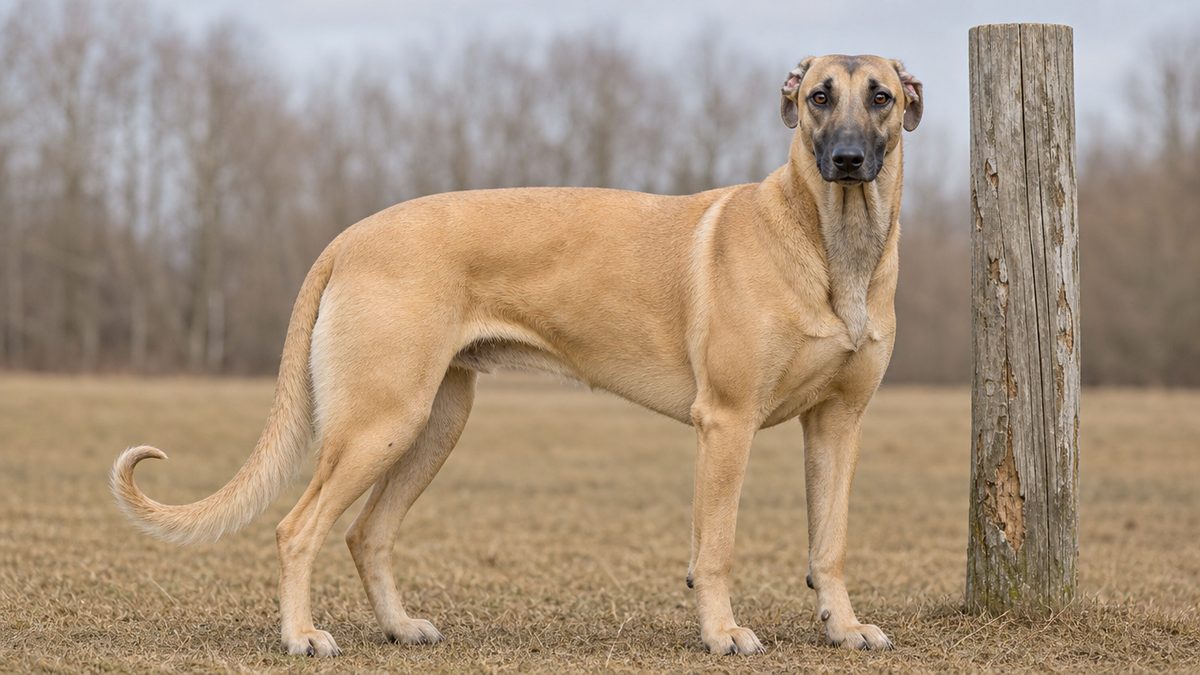
The Polish Greyhound is a large short-haired sighthound from Poland, held by the FCI as breed standard 333 in Group 10, Section 3, and bred to course hare, fox, roe deer, bustard and wolf. Its native name is Chart Polski, and it is not a Greyhound variant, which is the single most useful thing an Indian reader can know about it. Wikipedia's own lead says the same thing in one line, that despite its name it is not a direct relative of the Greyhound dog, and Google reprints that sentence at the top of the Indian result page while still filling the panel below it with Greyhound questions.
Start with the number that is missing. The breed's FCI number is read here from the FCI's own letter index, which files it under C as CHART POLSKI and links it as breed 333, because an FCI URL assembled from a guessed number returns a complete and correct page for whichever breed owns that number. The standard at that number gives an ideal height of 70 to 80 cm at the withers for males and 68 to 75 cm for females, then stops. There is no weight clause, no kilogram range, and no weight guidance of any kind. Bonbeno checked the authentic German text as well, because the FCI record names German as the standard's official language rather than Polish, and the German is equally silent: it prints the same two height bands under GROSSE and no Gewicht line at all. The United Kennel Club, which recognised the breed on 1 January 1996, goes one better: its standard carries a section literally headed Height and Weight that gives 27.5 to 31.5 inches for males and 26.5 to 29.5 inches for females and then simply ends, with no weight in it.
Two registries describe this breed in detail and neither states a weight. Every kilogram figure you will read for the Chart Polski, including the ones on the first page of Google, is somebody's estimate presented as a specification. Bonbeno prints no weight for this breed for that reason.
Size and weight, and how badly the web handles it
Google India demonstrates the problem on a single result page. Its knowledge panel for this breed gives Height female 68 to 75 cm and male 70 to 80 cm, matching the standard exactly, and then gives Weight: Female 27 to 31 kg, Male 27 to 31 kg, an identical weight band for two sexes whose heights differ by five centimetres at both ends. On the same page, Google's AI Mode answers the question with males 70 to 95 pounds (32 to 43 kg) and females 60 to 80 pounds (27 to 36 kg), and gives male height as 27 to 32 inches, which is 68 to 81 cm and wrong at both ends against the standard's 70 to 80. Two Google surfaces, one query, one render, three incompatible answers, for a breed whose governing document states no weight.
| Source | Male height | Female height | Weight given |
|---|---|---|---|
| FCI Standard 333, English | 70 to 80 cm | 68 to 75 cm | None |
| FCI Standard 333, German (authentic) | 70 to 80 cm | 68 to 75 cm | None |
| UKC standard, section headed Height and Weight | 27.5 to 31.5 in (69.9 to 80.0 cm) | 26.5 to 29.5 in (67.3 to 74.9 cm) | None |
| Google knowledge panel | 70 to 80 cm | 68 to 75 cm | 27 to 31 kg both sexes |
| Google AI Mode, same page | 68 to 81 cm | 68 to 75 cm | 32 to 43 kg male, 27 to 36 kg female |
The parts of the standard that are unusually specific
Where the standard declines to give a weight it is startlingly precise about everything else, and the detail is worth knowing because it is how you tell a real Chart Polski from a large lurcher. Body length to height at withers must be 10.2 to 10.3 against 10. Head length to height at withers is 37 to 39 against 100 in males and 36 to 38 in females. The frontal furrow has a desirable depth of 5 mm. The width between the hip bones is 12 to 14 percent of the height at withers, and the distance from elbow to ground is about 54 percent of it.
- Muzzle blunt, not pointed. The standard says it tapers so gently that it looks blunt for a sighthound, and a fine pointed nose is a listed fault.
- Ears at eye level, three carriages allowed. Folded back against the neck, roof shape, or fully erect when excited. Ears lying flat against the sides of the head are a fault.
- Eyes large, almond, obliquely set. Small eyes with a triangular lid aperture are a disqualifying fault, which is unusual specificity for a disqualification.
- All colours permitted. The UKC puts it in one word: colour is immaterial.
- Tail sickle-curved or ringed at the tip, carried low at rest, and never curled over the back.
The temperament clause is four adjectives long and every one matters to a buyer: self-assured, confident, reserved and brave. The standard adds that in action the dog reacts quickly and brutally. That is not marketing copy. It is a warning about prey drive, written by the people who wrote the breed.
One more oddity, verified by extracting both PDFs rather than reading either rendering. The English document's header reads 01.10.1999/EN and its body gives the date of publication as 01.10.1999, but the running footer on every page of the English text reads 01.01.1999, nine months earlier. The authentic German document prints 01. 10. 1999 in both places and carries no such contradiction FCI-Standard Nr. 333. Nothing important turns on it, but it is a fair measure of how much editorial attention this breed's paperwork receives.
History and origin: a 13th century record and a rejected pedigree
The Chart Polski's history and origin are attested in Polish literature from the 13th century, and its own FCI standard traces it to Asiatic sighthounds of Saluki type rather than to any western breed. The standard also takes the unusual step of naming and rejecting a rival theory.
The rejected theory belongs to the Russian author Sabaniejew, who held that the Chart Polski resulted from crossing the Greyhound with the Borzoi. The FCI standard rebuts it on a date: the Borzoi was unknown before the reign of Ivan the Terrible in the sixteenth century, so it cannot be an ancestor of a dog documented in Poland three hundred years earlier. Breed standards very rarely argue with a named scholar, and this one does it in the second sentence of its history.
The standard's own account of what the dog was for is worth quoting in full, because it is the only place a buyer will see the job description: a hunting dog not only for hare, fox, roe deer and bustard, but also for the wolf. Wolf hunting is the part that shapes everything else about the animal. It is why the standard insists the dog is definitely stronger and less fine in shape than other short-haired sighthounds, why it demands powerful jaws, and why it explains the strong frame as the product of hunting in the difficult conditions of the Polish climate.
The near-extinction, and the year the books opened
The modern breed is a reconstruction, and the peer-reviewed account of it is unusually blunt. Goleman and colleagues, writing in Animals in 2021, record that it was very difficult to recreate the breed after the Second World War, as there were only a few individuals left, which were mostly in the hands of poachers. That single clause explains why the founder base is as narrow as the genetics section of this page shows.
The dates that follow are precise. By a resolution of 25 January 1981, the Plenum of the Main Board of the Polish Kennel Club decided to open the Preliminary Book for the Polish Greyhound, and Malgorzata Szmurlo was made responsible for documentation and breeding development. Based on the literature and iconography, the breed standard was drawn up the same year. So the pedigree book for this breed is younger than most people reading this page.
The 1981 standard was written from literature and iconography rather than from a surviving population, because a surviving population barely existed. The FCI standard makes the same point from the other side, noting that drawings and paintings of the breed are noticeably unvarying and that this uniformity shows the original type held up to the end of the nineteenth century.
Three different years for the same recognition
Ask when the FCI recognised this breed and you get three answers from three good sources. The FCI's own record gives provisional acceptance on 13 June 1989 and definitive acceptance on 1 March 2001. Goleman 2021, peer-reviewed, states that the breed was fully recognised by the FCI in 1988 and entered under number 333. Neither matches the other, and 1988 precedes even the provisional date.
| Source | Date given | What kind of recognition it describes |
|---|---|---|
| FCI breed record 333 | 13 June 1989 | Provisional acceptance |
| FCI breed record 333 | 1 March 2001 | Definitive acceptance |
| Goleman 2021, Animals 11(2):353 | 1988 | Described as full recognition |
| Polish Kennel Club resolution | 25 January 1981 | Opening of the Preliminary Book, not FCI recognition |
Bonbeno does not pick one. The FCI register is the authority on FCI dates and its two dates are internally consistent with each other, so a page that has to choose should choose those. But a peer-reviewed paper written by researchers at a Polish university, one of whom is a veterinary clinician, is not a source to wave away, and the 1988 date has been repeated widely enough that a reader will meet it. Print both, and note that the FCI's own dates leave twelve years between provisional and definitive acceptance, which is a long probation and a fact about the breed's fragility rather than about anybody's record keeping.
For an Indian reader the practical consequence is simple. Because India is a full FCI member represented by the Kennel Club of India, and the KCI issues pedigrees against FCI nomenclature, FCI status effectively answers the question of whether this breed can hold an Indian pedigree at all. It can. Whether any dog in India has ever done so is a different question, and the answer appears to be no.
Polish Greyhound price in India: every rupee figure on page one belongs to another dog
There is no Polish Greyhound price in India, because there is no Indian market in Polish Greyhounds. Bonbeno pulled the Indian first page for this exact query on 8 September 2026 and checked all ten results: not one of them prices a Polish Greyhound.
| Position | Site | What it actually is |
|---|---|---|
| 1 | mrnmrspet.com | English Greyhound listings. Rs 90,000 to Rs 3,50,000+ |
| 2 | weenect.com | Polish Greyhound, but priced in United States dollars |
| 3 | facebook.com | A video titled 'Indian Greyhound Dog' |
| 4 | wamiz.co.uk | Polish Greyhound, upkeep priced in pounds sterling |
| 5 | happypet.care | Its English Greyhound page. Rs 25,000 to Rs 60,000 |
| 6 | amazon.in | A book about the breed, Rs 1,283, not a dog |
| 7 | youtube.com | Rampur Greyhound, an Indian breed |
| 8 | quora.com | A thread on English Greyhound breeders in India |
| 9 | discover.hubpages.com | Top 20 Indian dog breeds, Rs 2,000 to Rs 15,000 bands |
| 10 | youtube.com | Rampur Greyhound price video |
Four rows deserve naming individually, because each is a different way for a commercial search result to be useless to the person who typed the query.
The page ranking first does not carry the breed at all
Mr n Mrs Pet ranks first in India for this term and quotes Rs 90,000 to Rs 3,50,000+, tiered as Rs 90,000 to Rs 1,50,000 basic, Rs 1,50,000 to Rs 2,50,000 KCI registered, and Rs 2,50,000 to Rs 3,50,000 champion bloodline. Every one of those figures is for an English Greyhound. The site's own breed dropdown runs to roughly three hundred entries, from Affenpinscher to Yorkshire Terrier, and includes the Greyhound, the Italian Greyhound, the Rampur Hound, the Mudhol Hound and the Pashmi Hound. The Chart Polski and the Polish Greyhound are not in it.
Its city table is worth a second look too. Eight cities are listed, Hyderabad, Bangalore, Delhi, Chennai, Lucknow, Mumbai, Jaipur and Pune, and the price printed against every single one is the identical Rs 90,000 to Rs 3,50,000. A city price table with no city variation is a template, not a market observation.
The same page's FAQ answers 'Do Greyhound require professional grooming?' with 'Greyhound have dense, curly coats that need trimming every 4 to 6 weeks to prevent matting', while its own body copy two screens earlier says 'Their short coats shed minimally and require very little grooming'. A second seam sits in the FAQ below it, which offers 'purebred and vaccinated Greyhound puppies online through our verified and responsible Corgi breeders'. Both are template text left unswapped, and they are the clearest available evidence that the copy is assembled rather than written.
The Indian breed directory returns a hard 404
happypet.care ranks fifth on this query through its English Greyhound page, which quotes Rs 25,000 to Rs 60,000. Bonbeno requested its Polish Greyhound path directly. It returns HTTP 404 with the site's own not-found artwork and the line 'Our doggo tried really hard'. So the Indian directory ranking for the query does not hold the breed either.
An answer engine says no price exists, then prints one
Google India's AI Mode is the most instructive result of the lot. Asked the quoted query, it answers that Polish Greyhounds are extremely rare in India and that there is no standard commercial market price or active local breeder network for them, which is correct. It then prints, in the next block, an estimated total cost of Rs 1,50,000 to Rs 3,00,000+ (2,000 to 4,000 US dollars+).
Run the arithmetic on that pair and the mechanism is visible in one line. 1,50,000 divided by 2,000 is exactly 75.00. 3,00,000 divided by 4,000 is exactly 75.00. Both ends of the rupee band are a flat 75-to-1 conversion of a dollar band, and the dollar band itself carries no source. The single citation the engine attaches to the passage is a PawSpace article titled 'Dog Price in India 2026, Top 40 Breeds';, which is a list of the forty most common breeds in India and cannot contain a breed with no Indian presence.
| Rupee figure | Whose price it is | at 84.38 | at 80.00 | at 75.00 | at 74.00 |
|---|---|---|---|---|---|
| Rs 1,50,000 | Google AI Mode, this breed | 1,777.67 | 1,875.00 | 2,000.00 | 2,027.03 |
| Rs 3,00,000 | Google AI Mode, this breed | 3,555.34 | 3,750.00 | 4,000.00 | 4,054.05 |
| Rs 90,000 | Mr n Mrs Pet, English Greyhound | 1,066.60 | 1,125.00 | 1,200.00 | 1,216.22 |
| Rs 3,50,000 | Mr n Mrs Pet, English Greyhound | 4,147.90 | 4,375.00 | 4,666.67 | 4,729.73 |
| Rs 25,000 | happypet.care, English Greyhound | 296.28 | 312.50 | 333.33 | 337.84 |
| Rs 60,000 | happypet.care, English Greyhound | 711.07 | 750.00 | 800.00 | 810.81 |
Read that table two ways. The two AI Mode figures resolve to a clean 2,000 and 4,000 dollars at a single flat rate, which is the signature of a generated conversion rather than an observed price. The Mr n Mrs Pet and happypet figures do not resolve cleanly at any of the four rates and are rupee-native numbers, genuinely typed by somebody pricing Indian dogs. They are simply for the wrong breed.
The honest bottom line for a buyer: there is no verifiable Polish Greyhound price in India, Bonbeno will not convert a European price into rupees to manufacture one, and anyone quoting you a figure should be asked which dog they have actually seen. The two overseas guides that do price the breed price it in their own currencies, at 660 to 2,500 US dollars in one case and 80 to 120 pounds a month of upkeep in the other. Neither is an Indian figure and neither becomes one by division.
Cost of ownership in India for a 70 to 80 cm sighthound
The cost of ownership for this breed in India is calculable even though the purchase price is not, because vaccination, parasite control, grooming, boarding and municipal registration are published Indian figures that apply to any 30-odd kilogram dog living here. Those are the numbers worth planning against.
Take vaccination first. Vetic, a chain running more than fifty clinics across seven Indian metros, publishes a puppy core course starting at Rs 6,499 and an annual booster starting at Rs 3,199 on its national page, with single vaccines at Rs 699 for anti-rabies, Rs 849 for puppy DP, Rs 899 for the nine-in-one DHPPiL, Rs 899 for canine corona and Rs 1,349 for kennel cough. Read those as one chain's promotional floors rather than a market average, and note that the course price differs between that chain's own city pages while the per-vaccine prices do not.
| Item | Published figure | Source |
|---|---|---|
| Puppy core vaccination course | from Rs 6,499 | Vetic, national page |
| Annual booster | from Rs 3,199 | Vetic, national page |
| Anti-rabies, single dose | Rs 699 | Vetic |
| Nine-in-one DHPPiL | Rs 899 | Vetic |
| Consultation | Rs 500 to Rs 1,000 | VOSD, treated as one data point |
| NexGard Spectra, 15 to 30 kg, per month | Rs 1,103 | Supertails, Rs 3,308 for three tablets |
| Bath, professional | from Rs 934 | Vetic Delhi grooming |
| Boarding, overnight to 24 hours | Rs 899 | PawSpace Bengaluru |
| Delhi MCD pet dog registration | Rs 500 | MCD Delhi, dogs only |
| Chennai GCC pet licence | Rs 50 | Greater Chennai Corporation |
The parasite line is the one that scales with the dog
A Chart Polski sits in the 15 to 30 kg NexGard Spectra band at the light end and above it at the heavy end, and that single product covers the tick, flea, roundworm and hookworm role together. Supertails lists three tablets at Rs 3,308 against an MRP of Rs 3,375, which is Rs 1,103 a month. For a dog at the top of the breed's height range you move into the next weight band and the monthly figure rises with it. Budget parasite control as the largest recurring veterinary line for this breed, ahead of vaccination.
Tick control is not optional in India and the literature says why. A West Bengal series of 584 dogs screened at veterinary clinics found Babesia gibsoni in 76.54 percent and Anaplasma in 55.75 percent, with 72.9 percent of the 584 dogs screened carrying two or more pathogens. A southern Indian series of 120 dogs found Babesia in 66.7 percent, that is 80 of 120, with a pre-monsoon peak from March to May. Both sampled dogs presented at clinics rather than a random population, so read them as a description of the caseload a vet sees and not as a prevalence for every dog in the street. Even read conservatively they make year-round acaricide a fixed cost.
Municipal costs, which are small and durable
Delhi's Municipal Corporation charges Rs 500 to register a pet dog and Rs 500 to renew, with a Rs 100 per month late fee, and it publishes its own counters: 18,958 pet dog certificates issued since 2021, and 71 of 1,006 applications rejected in FY 2026-27. Greater Chennai Corporation licenses pet animals at Rs 50, issued 9,115 licences in 2024, and runs six municipal clinics that provide treatment and anti-rabies vaccination free of cost. Those free municipal clinics are a better piece of information for most Indian owners than any private rate card.
Boarding is where a large sighthound costs more than its weight suggests, because the dog needs a run rather than a kennel. PawSpace Bengaluru publishes hourly care to four hours at Rs 599, daycare to ten hours at Rs 799 and overnight to 24 hours at Rs 899. A wider Indian range of Rs 500 to Rs 2,000 a day is published by VOSD. For this breed, ask what exercise the facility actually provides before comparing prices, because a coursing dog crated for a week comes home a different animal.
This section quotes no monthly total. A single headline figure for 'the cost of ownership' would have to assume a food brand, a city, a clinic and a body weight, and this breed's own standard states no weight to work from. Add the lines above that apply to you instead. Indian breed sites that print a tidy monthly band are usually reprinting a preset row shared across unrelated breeds.
Heat tolerance in India: the homeland is colder at its hottest than Chennai is at its coolest
A Polish Greyhound's heat tolerance is poor for the Indian plains, and the cleanest way to show it is to put the two climates side by side. Bonbeno queried NASA POWER by explicit latitude and longitude for both and echoed back the model cell elevation on every point, because the cell is not always the town.
Warsaw sits at 52.2297 N, 21.0122 E. The POWER cell for that point reports an elevation of 125.44 m against a real city elevation near 113 m, an error of about 12 m, so the cell genuinely describes the place. It returns an annual mean of 8.64 C, a July mean of 20.62 C, a January mean of minus 3.97 C and an annual relative humidity of 79.45 percent. Krakow's cell reads 307.33 m against a real 219 m, an 88 m overshoot, and returns 8.67 C annual and 20.00 C in July. Poznan's cell is within 27 m and returns 9.09 C annual, 20.17 C in July.
| Place | Cell elevation | Annual mean | Hottest month | Coolest month |
|---|---|---|---|---|
| Warsaw, Poland | 125.44 m | 8.64 C | July, 20.62 C | January, minus 3.97 C |
| Krakow, Poland | 307.33 m | 8.67 C | July, 20.00 C | January, minus 3.29 C |
| Delhi | 206.37 m | June, 35.88 C | January, 13.61 C | |
| Chennai | 48.95 m | May, 31.51 C | January, 24.09 C | |
| Mumbai | 97.15 m | May, 31.19 C | January, 23.19 C | |
| Bengaluru | 841.72 m | April, 28.37 C | December, 20.22 C | |
| Pune | 635.99 m | April, 28.93 C | December, 19.62 C | |
| Kolkata | 7.35 m | May, 31.53 C | January, 17.31 C |
Warsaw's hottest month averages 20.62 C. Chennai's coolest month averages 24.09 C. This dog's homeland, at its hottest, is three and a half degrees cooler than Chennai is at its coldest. There is no month anywhere on the Indian plains that resembles a Polish summer, let alone a Polish winter.
Why the risk is exertional rather than ambient
A short-haired sighthound sheds heat better than a long-coated guardian, and the coat is genuinely not this breed's problem. The problem is what the dog is for. Hall and colleagues, working the VetCompass 2016 cohort of 905,543 UK dogs, recorded 1,259 heat-related illness events from 1,222 dogs. Of the 879 events with a recorded trigger, 652 were exertional, which is 74.2 percent, against 113 environmental and 46 from vehicular confinement. The companion paper on the same cohort, using a narrower case definition and 395 confirmed events, reports an incidence of 0.04 percent and a fatality rate of 14.18 percent.
Those two papers are constantly conflated because they share authors, a year and a cohort, so name which one you are reading. The relevant transferable finding for a large dog is from the Scientific Reports paper: dogs over 50 kg carried odds of 3.42 (1.54 to 7.57) for heat-related illness, and dogs at or above their breed and sex mean bodyweight carried odds of 1.42 (1.12 to 1.80). A Chart Polski is not in either model, because no UK cohort holds enough of them, so the bodyweight factor is the only part that transfers and the breed itself was never studied.
What this means city by city
- Delhi. The worst case. Peaks in June at 35.88 C, not May, and drops to 13.61 C in January. The winter is the only usable coursing season and it is short.
- Chennai, Mumbai, Kolkata. Warm and humid year round, with no cool season worth the name. Chennai never drops below a 24.09 C monthly mean.
- Bengaluru and Pune. The two most workable Indian cities for this breed, and the two most often described wrongly. Bengaluru peaks in April at 28.37 C and is coolest in December at 20.22 C; Pune peaks in April at 28.93 C and is coolest in December at 19.62 C. Neither peaks in May.
- Hill stations. Frequently recommended for cold-climate breeds and frequently mis-measured, because satellite grid cells in mountains can miss the town's real altitude by a kilometre or more. Bonbeno quotes no hill-station figure on this page for that reason.
Indian law reaches this directly, and the clause is worth knowing before anyone houses a large dog outdoors. The Second Schedule, Part IV, paragraph 21(1) of the Prevention of Cruelty to Animals (Dog Breeding and Marketing) Rules, 2017 bars keeping in outdoor facilities, without the attending veterinary practitioner's written approval, dogs not accustomed to local temperatures, dog breeds that cannot tolerate the temperatures prevalent in the area or region in question, such as long-haired breeds in high temperature locations, and sick, infirm, aged or young animals. The clause names long coats as its example, which this breed does not have, but the operative words are the first limb: a dog not accustomed to local temperatures. A sighthound reconstructed in Poland since 1981 is exactly that.
The practical rule is unglamorous. Gallop this dog at first light and after dark, never in the middle of an Indian day, and treat a hot afternoon walk as a genuine risk rather than a compromise. A heat-sensitive working animal does not tell you it is overheating until it stops.
Temperament: reserved by standard, and what that means in an Indian flat
The Polish Greyhound's temperament is written into its breed standard in four words, self-assured, confident, reserved and brave, with the added note that in action it reacts quickly and brutally. An aloof adult that ignores your guests is this breed working correctly.
That matters in India more than it does in Poland, because Indian homes run on visitors. Domestic staff, deliveries, extended family, building security and neighbours' children are all daily traffic in a way they are not in a Warsaw apartment. A breed whose governing document specifies reserve will not become a doorstep greeter, and trying to make it one by flooding it with strangers produces avoidance rather than friendliness.
Note carefully what the standard does not say. It does not say guarding, it does not say suspicious, and it does not say protective. Aggressive or overly shy dogs are a disqualifying fault under the FCI standard, and the UKC disqualifies viciousness or extreme shyness in the same terms. Reserve and aggression are different things and the standard treats them as opposites: one is required and the other ends a show career.
Prey drive is the temperament trait that decides everything
The breed's own utilization clause lists hare, fox, roe deer, bustard and wolf. A dog selected for three centuries to close with a wolf has a prey drive that no amount of household socialisation removes. In Indian conditions the practical consequences are specific and they are not theoretical.
- Free-roaming dogs are a trigger, not a social opportunity. India has a large street-dog population and a sighthound at full gallop reads a running dog the way it reads a hare.
- Cats, poultry and goats are at genuine risk, including household ones the dog has known since puppyhood, because chase is released by movement rather than by unfamiliarity.
- Traffic is the real killer. A coursing dog that breaks lead in an Indian street is running at close to full speed within three strides and is not recallable in that state.
- Monkeys and cattle change the picture in many Indian cities, and neither is a safe animal for a large dog to engage.
Anyone who wants an off-lead dog, anyone in a household with free-roaming cats or poultry, anyone without access to securely fenced open ground, and anyone whose main daily walk is along an unfenced Indian road. None of that is a criticism of the dog. It is a description of what a wolf-coursing sighthound is.
With its own family the picture is different and quieter than the standard's clipped adjectives suggest. Sighthounds are typically undemanding indoors, sleep a great deal, and attach closely to a small number of people. That is the trade a buyer is actually making: an easy, quiet, low-maintenance housemate in exchange for a hard ceiling on where it can safely be let off a lead.
With children the honest answer is that no published evidence exists for this breed specifically, because no behavioural study has ever included it. What can be said is structural: a 70 to 80 cm dog moving fast in a small space is a collision risk regardless of intent, and a sighthound's thin skin over the hips and hocks tears more easily than a thick-coated breed's. Supervise on both counts.
Training a Chart Polski: what works, and the one thing that never finishes
To train a Polish Greyhound, work with short reward-based sessions and accept from the start that recall training against a moving target will not reliably finish. Everything else about this breed trains normally. Recall under chase does not, and no method changes that.
The standard describes a self-assured, confident dog that reacts quickly and brutally in action. Read that as a training brief rather than a character sketch. A self-assured dog cooperates when cooperating is worth its while and disengages when it is not, which is why compulsion works badly here and why a sighthound trained by force usually just becomes harder to catch.
The order to teach things in
- Lead manners first, before anything else, because a 35 kg dog that pulls is unmanageable in Indian street conditions and because the lead is this breed's only reliable safety system.
- Muzzle conditioning second. A basket muzzle is normal equipment for coursing breeds worldwide and is worth teaching as a happy thing at eight to twelve weeks rather than as an emergency measure at two years.
- Recall to a whistle third, built in a fenced space with no distractions, then in progressively harder places, on the understanding that you are raising the ceiling rather than removing it.
- Handling and restraint fourth, so that a vet can examine the dog. Sighthounds are needle-shy more often than most and Indian clinics are busy places.
- Settle on a mat fifth, which is what makes a large dog liveable in an Indian flat with visitors coming and going.
Do not train this breed in the middle of an Indian day. That is not a welfare nicety, it is a practical point about learning: a dog that is thermally stressed does not consolidate anything, and the exertional heat risk documented in the UK cohort is highest in exactly the short bursts of effort a training session produces. Train at first light. Repeat after dark.
Socialisation, and the Indian version of it
Socialise deliberately and early, but socialise to the things this dog will actually meet, which in an Indian city means autorickshaws, temple bells, firecrackers, cattle, monkeys, street dogs at a distance, building watchmen and lift doors. A standard European socialisation checklist misses most of that. The window closes at around sixteen weeks and no amount of adult work reopens it fully.
Firecracker exposure deserves its own line for any Indian owner. Diwali and wedding season produce sustained noise at close range in residential areas, and a fear response established in a reserved breed is very durable. Plan the puppy's first festival season deliberately rather than hoping.
A well-trained Chart Polski will recall reliably in a fenced field, usually in a quiet park, and sometimes when a squirrel is moving. It will not recall off a hare, a cat or a running street dog. Owners who plan around that ceiling keep their dogs. Owners who believe they have trained past it eventually find out on a road.
There is no working-trial requirement behind this breed to lean on, unlike its Polish compatriot the Ogar Polski. The FCI files the Chart Polski as not subject to a working trial, while the Polish Hound is subject to one. So the coursing instinct here has never been formally tested for by the registry, and a buyer cannot read anything about a given dog's drive from its pedigree.
Exercise needs: two walks is maintenance, and a gallop is the requirement
A Polish Greyhound's exercise needs are met by roughly two hours of daily activity, of which the important part is not the walking but regular access to a securely fenced space large enough to reach full gallop. Lead walk it twice a day and you have a sound dog. Let it run properly two or three times a week and you have a settled one.
The standard describes the breed at work as fast, very skilful and untiring, and the gait clause asks for a long, ground-covering stride at the walk and the trot with correct angulation front and rear. That is a description of a dog built for sustained ground coverage as well as sprint, which is unusual among short-haired sighthounds and is part of what the standard means by calling it stronger and less fine than the others.
A realistic Indian weekly plan
| When | What | Why it matters |
|---|---|---|
| Daily, first light | 45 to 60 minutes on lead, brisk | The only window in most Indian cities where a large dog can work without heat load |
| Daily, after dark | 30 to 45 minutes on lead | Second session keeps a sighthound's weight and muscle without adding daytime heat risk |
| Two or three times a week | Free gallop in fenced ground | Sprint is what this dog is for. Without it the muscle tone the standard describes does not develop |
| Weekly | Lure work or a long line on open ground | Satisfies the chase sequence safely and is the closest lawful substitute for coursing |
| Never | Midday exercise between 11am and 4pm | Exertional heat-related illness accounted for 652 of 879 triggered UK events |
Coursing itself is worth addressing directly because it is the breed's historical function and because Indian readers will meet the word. Live coursing is not a lawful recreation to organise in India, and Bonbeno does not suggest it. The FCI runs sighthound racing and lure coursing as formal disciplines under its own regulations, and lure coursing behind an artificial lure is the version that satisfies the instinct without involving quarry. That is the direction any Indian owner of a coursing breed should be looking.
Under-exercise looks like this
- Weight gain, quickly. A sighthound carrying condition is the single most common presentation of an under-exercised one, and the standard's whole outline depends on the dog being lean.
- Fence testing and escape. A frustrated coursing dog leaves. Indian compound walls are usually low enough that a 75 cm sighthound clears them without effort.
- Destructive chewing indoors, which is boredom rather than anxiety in most cases and resolves when the gallop returns.
- Loss of the muscle definition the standard calls for, because the musculature it describes as distinctly visible is built by sprinting rather than by walking.
Growth is the one period where more exercise is wrong. A large breed's growth plates close late, and forced running, stair work and long walks on hard surfaces before about fourteen months add joint risk without adding fitness. Free play on soft ground, in short bursts the puppy chooses to stop, is the right dose until then.
Grooming in Indian humidity: the easiest coat on this site
Grooming a Polish Greyhound takes about ten minutes a week. The coat is short-haired and springy to the touch, rather harsh, not wire-haired and not silky, and the FCI standard names no undercoat anywhere in the coat clause. There is nothing to strip, nothing to scissor and nothing to blow out.
The standard describes coat of variable length over the body, longer on the withers, shorter on the sides, shortest on the sternum and legs, sparser and more delicate on the abdomen, and longest at the buttocks and along the underside of the tail where it forms modest breeches and a brush. That is a practical description, not a show one: the long bits are where a coursing dog needs protection and the short bits are where it needs to shed heat.
What to actually do, weekly
- Brush with a rubber curry mitt once a week, five minutes, which lifts dead hair and is the entire coat routine.
- Check the thin skin over the hips, hocks and elbows every week. Sighthound skin tears where other breeds bruise, and an Indian compound wall or a thorn scrub does it easily.
- Inspect between the toes after every run on rough or dry ground, because grass seeds and thorns lodge there and abscess fast in humid conditions.
- Wipe the ears dry after any bath or swim rather than letting them air dry, which matters more in an Indian monsoon than it does in Poland.
- Trim nails every three weeks. A sighthound's oval, tight, well-arched foot loses its shape when the nails get long, and the standard calls splayed feet a fault.
The coat is already short and its main job in India is protection against sun and abrasion, not insulation. Clipping a thin-coated dog with pale skin underneath exposes it to sunburn on the flanks and belly, which is a real presentation in Indian summers on white and fawn dogs. Sunblock on the nose bridge and ear tips of a light-coloured dog is more useful than any clip.
Bathing is where an Indian routine diverges from a European one. In Polish conditions a monthly bath is generous. In an Indian city with humid monsoon months, road dust and a dog that sweats through its feet, a fortnightly bath with a mild dog shampoo is reasonable, and the important part is drying rather than washing. Vetic's Delhi grooming page lists bathing from Rs 934 and a complete bath and styling from Rs 1,869, though for this coat the styling half is simply not needed.
Shedding is moderate and continuous rather than seasonal, which is what a coat with no described undercoat does. There is no blown coat twice a year to plan around. What there is, in Indian conditions, is year-round fine hair that sticks to upholstery, and a weekly ten-minute brush controls most of it.
One claim to dispose of. Nobody markets this breed as hypoallergenic, and if anybody does, the evidence is settled against them for every breed. Vredegoor and colleagues measured Can f 1 across 196 dogs of so-called hypoallergenic breeds against 160 controls and found the hypoallergenic group came back higher, not lower, concluding there is a lack of evidence to describe any dog breed as hypoallergenic. A short coat sheds visibly less hair. It does not shed less allergen.
Health problems and life expectancy: three registries and one paper, and what each does not have
The honest summary of this breed's health problems is that almost nothing has been measured. One peer-reviewed paper in the world literature names the Polish Greyhound, there is no row in the OFA published statistics tables, and the largest UK longevity dataset excluded the breed by name. Bonbeno prints what each source actually says, including the gaps.
Life expectancy: no breed-specific figure exists
McMillan and colleagues published the largest UK companion-dog longevity analysis in Scientific Reports in 2024, covering 155 purebred breeds. Bonbeno downloaded the study's supplementary tables directly from the publisher rather than reading the article body, because the playbook lesson here is that a breed's absence from the main text proves nothing. Supplementary Table S5, which is where inclusion is adjudicated, lists 'Polish Greyhound' with flag N and no reclassification, alongside 'Polish Hound' and 'Polish Hunting Dog', also N. Flag N means the authors considered the breed and excluded it. It was not merged into another breed's row and it is not filed under a different name.
So there is no McMillan median for this dog. The life expectancy figures of 10 to 12 years that circulate on breed-directory pages, including Google's own knowledge panel, trace to no study that names this breed. Treat them as the general expectation for a large sighthound rather than as a measurement. For scale, McMillan's Table S3 gives the English Greyhound a median of 11.5 years (11.4 to 11.6) from 3,964 dogs and 3,025 deaths, and the Polish Lowland Sheepdog 13.2 years from 83 dogs and 24 deaths. Those are what a real breed row looks like, and this breed has none.
OFA: a breed code, and no published statistics
Bonbeno read the Orthopedic Foundation for Animals breed codes out of OFA's own checkbox markup rather than guessing them, because a guessed OFA code returns a real and complete table for a different breed. The Chart Polski holds OFA code CP. Bonbeno then searched OFA's full disease-statistics dump case-insensitively and found zero rows for CHART POLSKI, against in-session controls returning 109 hits for LABRADOR, 93 for GREYHOUND, 62 for BORZOI and 32 for SALUKI.
OFA requires 100 hip evaluations, or 50 for its other databases, before a breed appears in the published statistics at all. So the correct statement about this breed is 'no row in OFA's published statistics tables', not 'absent from the OFA database'. The difference matters: the breed is registrable and screenable in the United States, and simply too few dogs have been screened.
| Instrument | Result for the Chart Polski | Control run in the same session |
|---|---|---|
| PubMed, quoted and tiab-scoped | 1 record, PMID 33572519 | Labrador Retriever tiab, 1,109 |
| PubMed, 'Chart Polski' quoted | 0 records | as above |
| PubMed, 'Polish Sighthound' quoted | 0 records | as above |
| OFA statistics dump | 0 rows, though code CP exists | LABRADOR 109, GREYHOUND 93, BORZOI 62 |
| McMillan 2024 Table S5 | Listed, flag N, considered and excluded | Labrador and Whippet both flag Y |
What the breed's own club actually watches for
The one useful health sentence about this breed in the peer-reviewed record comes from Goleman 2021, and it is specific: due to the small number of individuals and a small gene pool, various defects, probably genetically determined, are beginning to appear in the breed, and the Club of the Polish Greyhound, part of the Polish Kennel Club, therefore began to monitor the breed for diseases such as congenital eye defects or hip dysplasia. That is a statement of what the people closest to the breed decided to screen for, which is more informative than any inherited figure Bonbeno could otherwise offer.
Two further risks are structural rather than breed-specific and apply to any large deep-chested sighthound. Gastric dilatation-volvulus is a surgical emergency in deep-chested dogs and a distended, tight abdomen with unproductive retching needs a vet within the hour, not the morning. And sighthounds as a group have characteristically low resting thyroid readings that are normal for the type, which matters in India because the Dog Breeding and Marketing Rules 2017 list hypothyroidism among the genetic defects a breeding dog must have been tested for. A vet unfamiliar with sighthound physiology can read a normal sighthound thyroid panel as disease.
That same clause, Second Schedule Part III paragraph 8(10), names the tests Indian law expects of a breeding dog: the dogs shall have been tested for genetic defects, including hip dysplasia, progressive retinal atrophy, night blindness, hypothyroidism, entropion, ectropion, overshot, undershot jaw (when incisors do not touch or mesh), wry mouth, two or more missing teeth, unilateral cryptorchid or full cryptorchid males. The word is 'including', so the list is illustrative rather than closed. Note that the two conditions the breed's own club monitors, eye defects and hip dysplasia, both appear in it.
Bonbeno publishes no prevalence percentage for any inherited condition in this breed, because none has been measured. A page that gives you one has borrowed it from another sighthound. Consult your nearby vet about screening before breeding from any dog of this breed, and ask specifically for hip radiographs and an eye examination, because those are the two things the breed's own custodians decided were worth watching.
The one paper: 912 dogs, 872 of them inbred, and an effective population size of 21.76
Exactly one peer-reviewed paper in the world literature studies the Polish Greyhound, and it is a population-genetics study rather than a clinical one. Because it is the only evidence there is, this page gives it a section of its own.
Goleman, Balicki, Radko, Rozempolska-Rucinska and Zieba published 'Pedigree and Molecular Analyses in the Assessment of Genetic Variability of the Polish Greyhound' in Animals in January 2021. They analysed the pedigree records of every Polish Greyhound entered in the Polish pedigree books since they opened, which is 912 dogs, and separately genotyped 235 living dogs from cheek swabs across a panel of 21 short tandem repeat markers.
| Measure | Value | What it means for a buyer |
|---|---|---|
| Dogs in the pedigree books | 912 | The entire recorded breed since 1981 |
| Of those, inbred | 872 | 95.6 percent of every dog ever registered |
| Mean inbreeding coefficient | 11.8% | Roughly the level of a half-sibling mating, as a breed average |
| Founders identified | 83 | 27 of them with both parents unknown |
| Effective population size (Ne) | 21.76 | The number that matters. Conservation genetics treats 50 as critical |
| Ne to N ratio | 0.135 | Only about one dog in seven contributes genetically as a founder would |
| Gene diversity | 0.862 | From the mean kinship matrix |
| Population mean kinship | 0.138 | Any two dogs picked at random are related at roughly cousin level |
| Founder genome equivalent | 3.61 | The breed's diversity is equivalent to about 3.6 unrelated founders |
| Mean litter size | 5.969 | Range 2 to 16 |
| Intergeneration interval | 5.1 years (SE 0.25) | Slow turnover, which slows both damage and repair |
| Projected inbreeding rise | 2.56% per complete generation | If the current breeding programme continues unchanged |
The paper argues with itself, and that is worth knowing
The study's Simple Summary states that the narrow gene pool necessitated mating relatives, resulting in the appearance of various genetic diseases in the breed. Its Abstract, describing the molecular results, states that the FIS inbreeding coefficient across the 21 markers was negative with a mean of minus 0.018, and concludes that these values suggest a low level of inbreeding in the examined breed as well as the avoidance of mating related animals. Those two passages point in opposite directions, in one paper, about one population.
Both can be true and the resolution is in the method. Pedigree analysis measures accumulated relatedness across the whole recorded history of the breed, which is where the 872 of 912 and the 11.8 percent come from. The molecular FIS measures whether the dogs alive now are being deliberately paired with relatives, and a negative FIS says breeders are actively avoiding it. So the breed is heavily inbred as an inheritance and is currently being managed carefully. The projection of 2.56 percent per complete generation is the paper's own warning that careful management inside a pool this small still loses ground.
An effective population size of about 50 is the level at which conservation genetics starts treating a closed population as at risk of inbreeding depression, and 21.76 is well under half of it. That is the single most important fact about this breed and no ranking page on the Indian first page mentions it. It is also the reason a buyer should ask a breeder for a coefficient of inbreeding on the specific mating rather than a general assurance.
The paper also supplies the breed's population history in a sentence, which is the missing context for the numbers: it was very difficult to recreate the breed after the Second World War, as only a few individuals remained and those were mostly in the hands of poachers. A breed rebuilt from a handful of dogs in the 1980s cannot have a broad founder base, and 83 founders with 27 of unknown parentage on both sides is what that looks like forty years on.
For an Indian buyer none of this is academic. If you ever import a dog of this breed, the pedigree it carries is drawn from a pool of a few hundred living animals worldwide, and the sensible questions are the coefficient of inbreeding for that specific mating, the hip and eye status of both parents, and how many generations separate the sire and dam. Those are answerable questions and a serious breeder will have them.
Feeding a large sighthound in India, without a weight to work from
Feed this breed to body condition rather than to a chart, because the breed standard gives no weight to build a chart from. Ribs easily felt under a thin covering, a visible waist from above and a clear abdominal tuck from the side is the target, and on a sighthound it looks leaner than most owners expect.
Sighthounds carry less body fat than other breeds of the same height, and the last two or three ribs being faintly visible on a fit Chart Polski is normal rather than a sign of underfeeding. Well-meaning relatives and occasionally vets unfamiliar with the type will tell you the dog is thin. The FCI standard's own outline depends on it: it calls for a distinctly visible musculature, a tucked-up underline and a lean frame, and lists heaviness as a fault.
Life-stage feeding
| Stage | Meals per day | What matters most |
|---|---|---|
| 8 to 16 weeks | 4 | A large-breed puppy formulation with controlled calcium. Do not free-feed |
| 4 to 8 months | 3 | Growth is fastest here and overfeeding now buys joint problems later |
| 8 to 14 months | 2 | Keep the puppy visibly lean through the growth-plate window |
| 14 months to 7 years | 2 | Feed to condition. Split meals and rest before and after any gallop |
| 7 years and older | 2 | Protein stays high for muscle maintenance; watch kidney values on annual bloodwork |
Never feed a deep-chested dog immediately before or after hard exercise. Split the daily ration into two meals, leave at least an hour after eating before any running, and at least half an hour after running before feeding. Gastric dilatation-volvulus kills fast and this body shape is the classic one for it.
What is actually available in India
Large-breed dry food is widely stocked in India and the practical constraint is storage rather than supply. A 15 kg bag in an Indian summer, in a humid coastal city, goes rancid and grows mould faster than the same bag in Europe. Buy smaller bags more often, decant into an airtight container, keep it off the floor and out of direct sun, and throw out anything that smells sharp. That single habit does more for an Indian dog's gut than any brand choice.
Water is the other Indian-specific line. A large sighthound exercised at first light in Chennai or Kolkata will drink heavily afterwards, and gulping a large volume at once after exertion is itself a bloat risk factor. Offer water in measured amounts over twenty minutes rather than leaving a full bucket after a run.
On raw feeding, Bonbeno takes no position beyond a practical one: Indian cold-chain reliability varies a great deal by city and by supplier, and a raw diet is only as safe as the coldest point in its journey. If you feed raw, buy from a supplier who can tell you the chain, and be stricter about it in the monsoon.
Body condition, not the bag's chart, decides the ration. Weigh the dog monthly on the same scale, photograph it standing square from the side and above every month, and adjust by ten percent at a time. For a breed with no published weight standard, your own trend line is the only reliable reference you will ever have.
The first year, month by month, in Indian conditions
A Polish Greyhound puppy's first year in India is governed by three clocks: the vaccination schedule, the socialisation window that closes near sixteen weeks, and the growth plates that stay open until about fourteen months. The heat calendar sits on top of all three.
| Age | What happens | The Indian complication |
|---|---|---|
| 8 weeks | Legal minimum age of sale in India under Rule 8(1)(a). Core vaccination course begins | A puppy offered below eight weeks is being sold unlawfully. Walk away |
| 8 to 12 weeks | Socialisation at full speed. Muzzle and lead conditioning start | Carry the puppy in public until the course finishes. Street-dog contact is a real disease risk |
| 12 to 16 weeks | Course completes. First supervised ground contact outdoors | Do all of it before 8am. A 14-week puppy has no heat regulation to speak of |
| 4 to 6 months | Recall foundations in a fenced space. Adult teeth erupt | Monsoon skin and ear checks become weekly, not monthly |
| 6 to 9 months | Legs lengthen faster than the body fills. Looks gangly and is | Resist adding roadwork. Growth plates are open and Indian pavements are hard |
| 9 to 12 months | First real sprints on soft ground, self-limited | Never in the middle of the day, in any Indian city, in any month |
| 12 to 14 months | Growth plates close. Structured exercise can begin | Hip screening conversation with your vet starts here |
The eight-week rule is law, not etiquette
Rule 8(1)(a) of the Prevention of Cruelty to Animals (Dog Breeding and Marketing) Rules, 2017 requires every breeder to ensure that pups less than eight weeks in age are not sold. The same Rule 8 also requires that dogs over six months in age are not sold without first being sterilised, unless they are being sold to a registered breeder. Both are enforceable requirements on the seller, and a seller who breaches the first will usually be casual about everything else too.
First: what is the coefficient of inbreeding for this specific mating, and how many generations back was it calculated? A breed with an effective population size of 21.76 makes that a live question rather than a formality. Second: what are the hip and eye results for both parents? Those are the two things the breed's own club decided to monitor.
Growth in a large sighthound is the part Indian owners most often get wrong, usually with good intentions. The instinct is to build a fast dog by running it, and running a puppy on hard ground before the plates close does the opposite. Free play on grass or sand, in bursts the puppy chooses to end, is the whole prescription until about fourteen months. Stairs, jumping down from furniture and long lead walks on concrete all belong to the second year.
Plan the first monsoon and the first festival season deliberately. A puppy that meets its first Diwali at four months with no preparation, in a reserved breed, can carry the noise phobia for life. Start desensitisation recordings at low volume in the second month you own the dog, and have a quiet interior room set up before the week itself.
Chart Polski against the sighthounds Indian buyers actually cross-shop
An Indian buyer searching for this breed is almost always choosing between four dogs in practice: the Polish Greyhound, the English Greyhound, the Saluki and one of the Indian sighthounds. The table below puts the sourced figures side by side, and the honest conclusion for most Indian readers is that this breed is not the winner.
| Polish Greyhound | English Greyhound | Saluki | Rampur Greyhound | |
|---|---|---|---|---|
| Height, males | 70 to 80 cm (FCI 333) | About 71 to 76 cm | 58 to 71 cm (FCI 269) | About 56 to 76 cm |
| Weight in its FCI standard | None stated | Not stated in FCI 158 | Not stated in FCI 269 | No FCI standard |
| FCI standard number | 333 | 158 | 269 | None |
| Papers naming the breed in PubMed | 1 | Hundreds | Dozens | Very few |
| Rows in OFA published statistics | None (holds code CP) | Present, 408 hip evaluations | Present | None |
| McMillan 2024 median lifespan | No row, flag N | 11.5 years (11.4 to 11.6) | No row | No row |
| Available in India | No evidence of any | Yes, widely listed | Occasionally | Yes, native |
| Published Indian price | None exists | Rs 90,000 to Rs 3,50,000 | Varies | Rs 8,000 to Rs 35,000 reported |
Two rows in that table carry most of the decision. The OFA and McMillan rows say that if something goes wrong with a Polish Greyhound, neither you nor your vet has a breed baseline to compare it against. The English Greyhound has 408 hip evaluations in OFA's published statistics showing 97.1 percent normal and 2.2 percent dysplastic, and a McMillan median of 11.5 years built on 3,025 deaths McMillan 2024 Supplementary Table S3. The Chart Polski has neither number and cannot get one until far more dogs are screened.
The Borzoi question, settled by the standard itself
Buyers routinely assume the Chart Polski is a Borzoi crossed with a Greyhound, and the breed's own standard rejects that in print. The FCI text names the Russian author Sabaniejew as the source of the claim and argues that it is impossible, because the Borzoi was unknown before the reign of Ivan the Terrible in the sixteenth century while the Chart Polski is attested in Poland from the thirteenth. It is one of very few breed standards anywhere that argues a point of history against a named scholar.
The comparison that actually matters in India
Set the imported sighthounds against the Indian ones for a moment. An Indian buyer who wants a large, fast, muscular coursing dog can obtain a Rampur Greyhound or a Mudhol Hound domestically, legally, at a fraction of the cost, in a body already adapted to the climate the dog will live in. Google's own AI Mode reaches the same conclusion when asked about this breed's Indian price, suggesting local sighthounds at Rs 8,000 to Rs 35,000 as the practical alternative. That part of its answer is sound even though the rupee band it invented for the Polish Greyhound is not.
Nothing this page has found suggests the Chart Polski is a bad dog. It is a strongly built, sound, hardy coursing sighthound with an unusually detailed standard and a temperament that suits a quiet household. What it is not is available in India, documented well enough for a vet to work from, or adapted to a climate where the coolest month beats its homeland's hottest.
The Polish Hound comparison is worth one line because the two breeds are constantly listed together as 'Polish breeds' and they could hardly be less alike. The Ogar Polski is a 56 to 65 cm scent hound with a dense soft undercoat, pendulous ears and a folded dewlap, filed by the FCI in Group 6 with a working trial. Everything that makes this breed manageable in Indian heat, a short single coat and a lean frame, the Ogar Polski does not have.
Mistakes Indian buyers make with this breed, and the search results that cause them
The commonest mistake with this breed in India is not a training error. It is buying a different dog by accident, because every commercial search result for the Polish Greyhound points at another breed.
- Buying an English Greyhound believing it is a Polish one. The first and fifth results in India are English Greyhound pages and neither carries the Chart Polski at all. If a seller can show you a dog today, in India, it is not this breed.
- Trusting an AI answer's rupee band. Google's AI Mode says no Indian market price exists and then prints Rs 1,50,000 to Rs 3,00,000, both ends of which divide by exactly 75.00 into round dollars. A generated conversion is not a price.
- Believing a published weight. No registry states one. Google's own knowledge panel and Google's own AI Mode give different weights on the same result page.
- Assuming a short coat means heat tolerance. The coat is the one thing that is not the problem. The gallop is, and 74.2 percent of triggered UK heat-illness events were exertional.
- Letting a coursing sighthound off lead in an open Indian space. The standard describes a dog that reacts quickly and brutally in action, on a quarry list that includes wolf.
- Skipping the muzzle. Basket-muzzle training is normal for coursing breeds and is far easier to teach at ten weeks than after the first incident.
- Exercising a puppy hard before fourteen months, which trades adult soundness for nothing at all.
- Reading a normal sighthound thyroid panel as hypothyroidism, which matters because Indian breeding rules list hypothyroidism among the defects a breeding dog must be tested for.
How to verify a seller's claim in five minutes
A reader can verify most claims about this breed without leaving their phone, and the checks are the same ones this page ran.
| Claim you are told | How to check it | What you will find |
|---|---|---|
| A weight in kilograms, quoted as the breed standard | Open FCI Standard 333 and search it for kg | No weight in the English or the German text |
| An Indian price quoted confidently | Ask which specific dog, where, and when | The published rupee bands all belong to the English Greyhound |
| KCI-registered Polish Greyhound puppies available | Ask for the pedigree number and the sire and dam names | The FCI route exists in principle; no Indian dogs are evidenced |
| A lifespan of 10 to 12 years, sourced to a study | Search McMillan 2024 Table S5 for the breed | Listed with flag N. No median exists |
| Hip scores quoted from OFA | Search OFA's statistics for CHART POLSKI | Zero rows, against passing controls for four other breeds |
If a page selling you a breed contradicts itself about that breed's coat within two screens, the copy is assembled from a template and none of its numbers should be trusted. The page ranking first in India for this query says Greyhounds have short coats needing very little grooming in its body copy and dense curly coats needing trimming every four to six weeks in its FAQ, and offers its Greyhound puppies through 'verified and responsible Corgi breeders'. Look for that seam on any breed page.
One mistake belongs to the search engine rather than the buyer, and it is worth naming because it will keep happening. Three of the four questions in Google India's People also ask panel for 'polish greyhound dog' are about the English Greyhound: what the number one lazy dog is, whether a Greyhound is friendly, and how expensive a Greyhound is. The engine is not confused about the words. It is answering from the corpus that exists, and for this breed that corpus is mostly about a different dog. This page answers all four questions as Google asked them, and says which breed each answer is about.
Adoption, responsible sourcing and what the law actually permits in India
The realistic route to a Polish Greyhound in India is not purchase but adoption of a sighthound that is already here, because Indian import policy does not permit bringing a dog in to buy, sell or breed from, and no Indian breeder of this breed is evidenced anywhere.
The import position, stated plainly
Dogs sit under a Restricted heading in India's import policy. The lawful routes are a pet accompanying its owner with a valid pet book in the importer's name, research use with a CPCSEA recommendation, and defence or police use, and applications for trading or breeding purposes are rejected. Entry is limited to a named list of ports. The practical consequence for this breed is straightforward: a commercial supply chain for the Chart Polski cannot lawfully form in India, which is a better explanation for the empty search results than any theory about demand.
A returning resident relocating from Poland with their own registered dog is a different case and is exactly what the pet route exists for. If that is you, work from the current instrument for the pet route rather than from the commercial one, because the two have different law behind them and different port lists, and confirm the requirements with the Animal Quarantine and Certification Station before you book anything.
What Indian breeding law requires of anyone who does breed here
If a Chart Polski ever is bred in India, the Prevention of Cruelty to Animals (Dog Breeding and Marketing) Rules, 2017 apply in full, and three provisions matter most for this breed.
- Second Schedule Part II paragraph 6(3) prohibits two of the four named mating techniques: in breeding, defined as breeding between relatives of the 2nd to 4th grade in straight or side line within the first four generations, and incest breeding, defined as mating between parents and children or between brother and sister. Only out breeding and line breeding are permitted.
- Second Schedule Part III paragraph 8(10) requires that breeding dogs have been tested for genetic defects, including hip dysplasia, progressive retinal atrophy, night blindness and hypothyroidism among others.
- Second Schedule Part II paragraph 6(8) forbids tail docking, ear cropping, de-barking, de-clawing and any change of appearance by artificial means. Nothing in this breed's standard calls for any of those, which makes it one of the easier breeds to produce lawfully in India.
Paragraph 6(3) prohibits in-breeding within four generations, and Goleman 2021 records that 872 of the 912 Polish Greyhounds ever registered are inbred, with a projected 2.56 percent rise per complete generation under the current programme. A breed maintained internationally by close breeding cannot be propagated in India the way it is propagated at home, because Indian law prohibits the technique its small gene pool relies on. That is a genuine tension and no Indian page mentions it.
The adoption route that is actually open
India has no Polish Greyhound rescue because India has no Polish Greyhounds. What it does have, in quantity, is sighthound-type dogs in need of homes, and a reader who wants this shape of dog can have it.
- Indian sighthounds in rescue. Rampur Hounds, Mudhol Hounds, Chippiparai, Kanni and Kombai turn up in shelters across Rajasthan, Karnataka, Tamil Nadu and Uttar Pradesh, and they are already adapted to Indian heat.
- Ex-racing and retired coursing dogs, which arrive already accustomed to kennel routine and to muzzle work.
- Indian pariah dogs of sighthound build, which are common, free, robust and the single best-adapted large dog available in India.
- Municipal and NGO shelters, several of which cost nothing beyond vaccination. Greater Chennai Corporation's six pet clinics provide treatment and anti-rabies vaccination free of cost.
Whichever route you take, register the dog. Delhi charges Rs 500 for pet dog registration and has issued 18,958 certificates since 2021, rejecting 71 of 1,006 applications in FY 2026-27. Greater Chennai Corporation charges Rs 50 and issued 9,115 licences in 2024. Both are trivial sums against the cost of owning a large dog, and both give the animal a paper identity that matters if it is ever lost, which for a coursing sighthound in an Indian city is not a remote possibility.
Bonbeno does not recommend breeders, link puppy listings or quote live prices as offers. If you decide this is your breed and you are in a position to source one properly from its country of origin, the questions that matter are the ones this page has already named: the coefficient of inbreeding for the specific mating, the hip and eye status of both parents, and how the breeder plans to manage a gene pool with an effective population size of 21.76.
Polish Greyhound questions Indian buyers actually ask
Is the Polish Greyhound a large dog?
Yes. The FCI standard gives an ideal height of 70 to 80 cm at the withers for males and 68 to 75 cm for females, which makes it one of the tallest sighthounds the FCI holds and taller than the English Greyhound it is confused with. The standard also permits dogs above the ideal size provided the typical morphology is kept, so a 82 cm male is not automatically faulted.
What is the no. 1 lazy dog?
Google returns this question on Polish Greyhound searches because sighthounds have a reputation for sleeping, and the reputation is half right. A coursing sighthound is genuinely inactive indoors and does spend most of the day lying down, but that is recovery from short violent effort, not low exercise needs. This breed is a poor choice for anyone who wants a dog that needs no gallop at all.
Is a Greyhound a friendly dog?
The English Greyhound is generally described as gentle and quiet, but this question is about a different breed from the Polish Greyhound. The FCI standard for the Chart Polski puts the word reserved into the temperament clause itself, alongside self-assured, confident and brave, so aloofness with strangers is breed type here rather than a fault. Aggression and extreme shyness are both disqualifying.
How expensive is a Greyhound dog?
Indian listing sites quote Rs 90,000 to Rs 3,50,000 for an English Greyhound, tiered as Rs 90,000 to Rs 1,50,000 basic, Rs 1,50,000 to Rs 2,50,000 KCI registered and Rs 2,50,000 to Rs 3,50,000 champion bloodline, with the identical range printed for all eight cities listed. Those figures are for the Greyhound, not the Polish Greyhound, and no Indian page prices the Polish Greyhound at all.
How much does a Polish Greyhound cost in India?
No Indian seller publishes a price for this breed, so the honest answer is that there is no Indian market price to quote. Google's AI Mode prints Rs 1,50,000 to Rs 3,00,000 in the same answer that says no standard commercial market price exists, and both ends of that band divide by exactly 75.00 into a round dollar range, which is arithmetic rather than an observation of any Indian transaction.
How much does a Polish Greyhound weigh?
Nobody can source a weight for this breed from its own standard, because neither the FCI's English text nor the authentic German one states one, and the UKC prints a section headed Height and Weight that contains only height. Google's knowledge panel says 27 to 31 kg for both sexes and Google's AI Mode, on the same result page, says 27 to 36 kg for females and 32 to 43 kg for males. Treat every published weight as somebody's estimate.
Can a Polish Greyhound live in Indian heat?
Not comfortably on the plains, and the risk is exertional rather than ambient. Warsaw's July mean is 20.62 C against Chennai's coolest month at 24.09 C, so India is warmer year round than this dog's homeland is at its hottest. Hall 2020 found 652 of the 879 UK heat-illness events with a recorded trigger, 74.2 percent, were exertional, and a coursing sighthound is built to produce exactly that kind of effort.
How long do Polish Greyhounds live?
No breed-specific lifespan study exists. McMillan 2024, the largest UK longevity dataset, lists the Polish Greyhound in Supplementary Table S5 with flag N, meaning the authors considered the breed and excluded it, so it has no row and no median. Secondary sites print 10 to 12 years, which traces to no study that names this breed.
Is the Polish Greyhound related to the Greyhound?
Not directly, and its own breed standard says so at length. The FCI text states the breed probably goes back to Asiatic sighthounds of Saluki type and explicitly rejects the Russian author Sabaniejew's claim that it resulted from crossing the Greyhound with the Borzoi, on the ground that the Borzoi was unknown before the reign of Ivan the Terrible in the sixteenth century.
Can I import a Polish Greyhound into India?
Only as your own pet, not to buy or breed from. Dogs sit under a Restricted heading in India's import policy and entry is allowed for a pet accompanying its owner with a valid pet book, for research with CPCSEA recommendation, or for defence and police use, while applications for trading or breeding purposes are rejected. Nobody can lawfully set up a commercial supply chain for this breed in India.
Are Polish Greyhounds rare?
Yes, and there is a number behind it. Goleman 2021 analysed every Polish Greyhound in the Polish pedigree books since they opened in 1981 and found 912 dogs in total, of which 872 were inbred, with an effective population size of 21.76. An effective population size in the twenties is well below the level conservation genetics treats as safe for a closed population.
Does the Polish Greyhound need a lot of exercise?
Yes, and walking does not cover it. This is a dog the FCI standard describes as fast, very skilful and untiring in the hunt, historically used on hare, fox, roe deer, bustard and wolf. Two long lead walks a day keep it sound but not satisfied, and it needs regular access to a securely fenced space large enough to reach full gallop.
Compare with similar breeds
Polish Greyhound sits in 1 Bonbeno group. Each one compares it directly against the breeds it is genuinely an alternative to, on the same figures.