
Breed profile
Bluetick Coonhound in India: The Ticking, the Nose, the Voice
A cold-nosed American scenthound whose registries cannot agree how big it should be. What five breed standards actually say, what OFA's evaluation counts show, why the parent club recommends no health test at all, and why no lawful Indian supply chain exists.
Quick answer
The bluetick coonhound is a 25 to 36 kg American scent hound bred in Louisiana to work a cold trail at night and bay at the tree, so its voice is the job rather than a fault. No Indian rupee price for the breed could be found on any page, the FCI does not recognise it, and Bonbeno rates it 3 of 5 for heat tolerance in India.
This guide is general information for Indian pet owners and is not a diagnosis. Always consult your nearby registered veterinarian before acting on anything you read here, and treat any sudden collapse in heat, or a painful or foul-smelling ear, as urgent.
Bluetick Coonhound at a glance
What a Bluetick Coonhound actually is
A Bluetick Coonhound is a large American scent hound bred in Louisiana to work a cold trail at night and bay at the tree until the hunter arrives. The blue is not a pigment. It is dense black ticking laid over a white ground, which reads as navy at a distance.
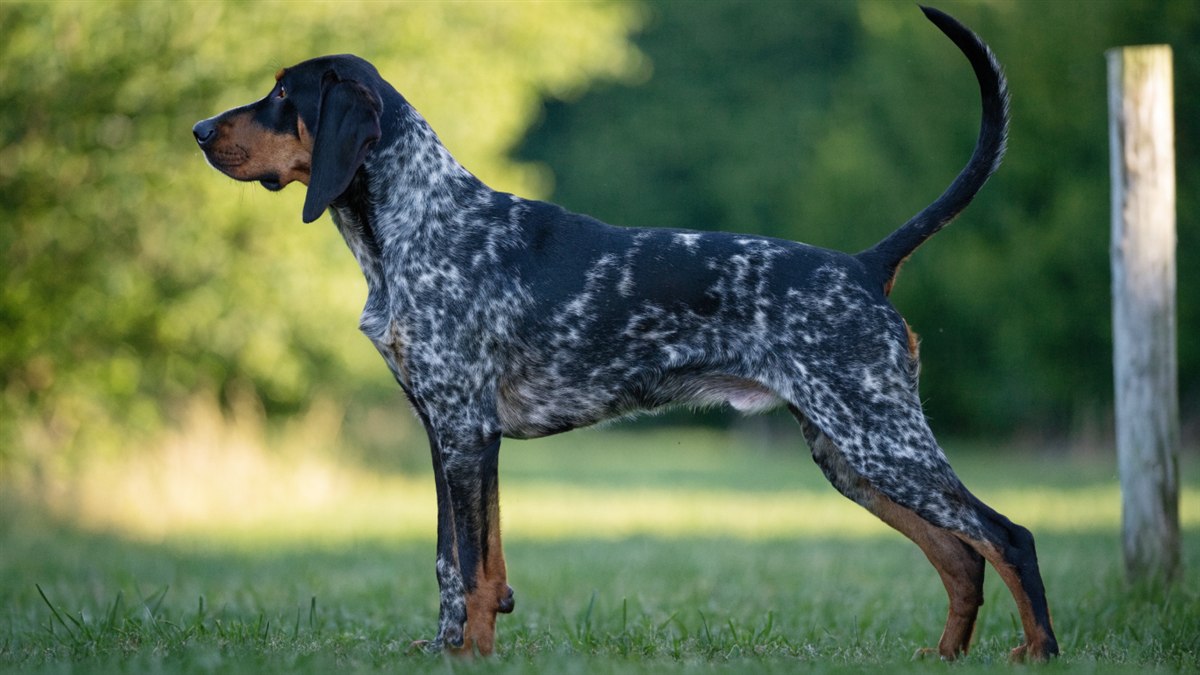
The colour is the name and the name is a description of the coat pattern. Both the AKC and the UKC standards ask for "a dark blue, thickly mottled body, spotted by various shaped black spots on back, ears and sides", with the head and ears predominantly black, and both state that there should be more blue ticking than white in the body coat. Tan markings over the eyes, on the cheeks, chest and below the tail are permitted but not required, and so is red ticking on the feet and lower legs. A dog with no tan at all is correct. So is one with tan. That single clause is why two Blueticks in the same photograph can look like different breeds.
The UKC adds a sentence the AKC leaves out. It says red "may be eliminated as to the desire of the breeder, as well as the amount of black on the body and the tan head coloring", which hands the breeder discretion the AKC text does not. The AKC instead closes the colour clause with four flat words, "No other colors allowed", and makes any other colour a disqualification alongside albinism.
Size, in the two registries that print numbers
The AKC, the UKC and Dogs Australia all give the same figures: males 22 to 27 inches at the withers and 55 to 80 pounds, females 21 to 25 inches and 45 to 65 pounds United Kennel Club Dogs Australia (Australian National Kennel…. Converted, that is a male of 25 to 36.3 kg and a female of 20.4 to 29.5 kg. Hold on to the 36.3 kg ceiling. It decides two arguments later on this page, one about ears and one about heat.
The breed is one of the few scent hounds whose standard prints a weight range at all. The Black and Tan Coonhound, the American English Coonhound, the Redbone and the Treeing Walker all say only that weight should be in proportion to height American Kennel Club American Kennel Club American Kennel Club. Having a printed number is useful, because it lets an owner check a real dog against the breed rather than against an adjective.
Construction: lean, deep-chested, downhill
The standards describe an athletic dog built to cover ground for hours. The AKC asks for "considerable depth" of body extending well down toward the elbow rather than excessive width, a chest girth of 26 to 34 inches in males, long well-sprung ribs, a moderate tuck-up, and a topline that slopes downward slightly from withers to hips. The leg from elbow to ground is roughly half the height at the withers. The feet are round and cat-like. The head measures 9 to 10 inches from occiput to nose in males, the skull is broad and slightly domed, the stop is prominent, and the muzzle is long, broad, deep and square in profile.
That last group of clauses matters more in India than anywhere the standard was written. A prominent stop and a long deep square muzzle describe a normal-muzzled dog with a full-length airway, which is the opposite of the conformation that dominates heat-illness case series. The short-coated jacket is "medium coarse and lying close to the body, appearing smooth and glossy", explicitly "not rough or too short".
The cold nose, and what the phrase means
"Cold nose" means the dog can work a scent trail that is already hours or days old, not that its nose is cool to the touch. Dogs New Zealand's own breed history says the Grand Bleu de Gascogne was "too slow on the trail to please the American hunter but, when bred to American hounds, it increased their coldtrailing ability and their endurance", and describes the modern Bluetick as "an intelligent, cold-nosed hunter that trees hard and long";. The AKC's coonhound rulebook carries the same history text.
The trade-off is written into the breed's own founding story. Dogs New Zealand records that Bluetick breeders split from the English Coonhound breeders because they "didn't want to follow the trend toward producing a hot-nosed, faster hunter" and were "proud of their larger, cold-nosed and resolute, if slower hounds";. A dog selected for hours of patient, low-speed, nose-down work is a dog that will follow a scent across a Bengaluru arterial road without lifting its head.
This is a 25 to 36 kg hound selected for four generations to leave you, follow a smell, and tell the whole neighbourhood about it. Everything else on this page follows from that sentence.
Five registries publish a standard, and two big ones publish nothing
Five bodies publish a Bluetick Coonhound standard: the United Kennel Club, the American Kennel Club, Dogs Australia, Dogs New Zealand and the AKC's own coonhound rulebook. The Federation Cynologique Internationale, the Royal Kennel Club and the Canadian Kennel Club publish nothing for this breed, and all three publish one for the Black and Tan Coonhound.
The kennel club history is short and datable. The UKC registered Blueticks as English until 1946, when, "at the request of the Bluetick fanciers, UKC began registering Blueticks as a separate breed";. The AKC came sixty years later: approved for the Miscellaneous Class at the November 2007 board meeting effective 1 July 2008, eligible for AKC registration from 30 December 2009, and eligible to compete in the Hound Group from 1 January 2010, as the AKC's 162nd breed.
The FCI does not recognise it, and this is checkable in one page
The FCI's Group 6 nomenclature, Section 1.1 Large-sized hounds, lists exactly two breeds under United States of America: American Foxhound (303) and Black and Tan Coonhound (300). There is no Bluetick entry anywhere in Group 6. That absence is worth stating carefully, because this site has been careful before about what an FCI listing means. The FCI's Black and Tan standard, No. 300, is the AKC's own text reformatted, down to the phrase "extend naturally well beyond the tip of the nose" and the publication date of 30 January 1991, which is the AKC standard's effective date. So for the Black and Tan, counting the AKC and the FCI as two registries overstates the evidence. For the Bluetick the question does not arise, because the FCI has no text of its own or anyone else's.
The Royal Kennel Club's breed standards index lists Black & Tan Coonhound (Imp) in the Hound group and no Bluetick. The Canadian Kennel Club's Hound group lists Coonhound (Black & Tan) and no Bluetick. Three of the world's largest registries recognise one coonhound each, and it is not this one.
The Kennel Club of India
The Kennel Club of India is the FCI's Indian member, and its registration volumes are published by the FCI. KCI registered 32,219 puppies in 2025, down from a peak of 88,261 in 2021, against a cumulative studbook that passed 1.35 million dogs by 2023. Because the FCI does not recognise the Bluetick Coonhound, there is no FCI standard for a KCI judge to judge it against and no FCI breed number for it to be registered under. Any Indian listing that offers a purebred "KCI registered" Bluetick is describing a document Bonbeno could find no route to.
Low entry everywhere it is recognised
The AKC's 2026 Low Entry Breeds List, dated 12 January 2026 and effective 1 March 2026, includes the Bluetick Coonhound, and also the Black and Tan Coonhound, the American English Coonhound, the Redbone Coonhound, the Treeing Walker Coonhound and the Plott Hound. Every AKC coonhound is a low entry breed. The Bluetick's AKC popularity rank has sat between 121 and 140 every year from 2015 to 2022. This is a working breed with a small show population even in its own country.
The parent club is the National Bluetick Coonhound Association, recognised by the AKC in 2018 National Bluetick Coonhound Association. Its published site carries a breed standard, a mission statement, a code of ethics, by-laws, a newsletter, an events page and a breeders list. It carries no health page and no health-testing page. That is not an oversight, as the next section on health shows.
| Body | Bluetick standard | Black and Tan standard | Checked how |
|---|---|---|---|
| United Kennel Club | Yes, revised 1 Jan 2016 | Yes | Standard read in full |
| American Kennel Club | Yes, effective 1 Jul 2008 | Yes | Official standard PDF read in full |
| Dogs Australia (ANKC) | Yes, adopted May 1994, page updated 24 Mar 2017 | Not checked here | Standard read in full |
| Dogs New Zealand | Yes, DNZ No 421, 1 Mar 2006 | Not checked here | Standard read in full |
| FCI | No | Yes, Standard No. 300 | Group 6 nomenclature list read |
| Royal Kennel Club | No | Yes, Black & Tan Coonhound (Imp) | Breed standards index read |
| Canadian Kennel Club | No | Yes, Coonhound (Black & Tan) | Hound group listing read |
The five standards do not describe the same dog
Dogs New Zealand's official Bluetick Coonhound standard allows a male to 76 cm and 45.4 kg. The AKC disqualifies any male over 27 inches, which is 68.6 cm. A dog that is correct in Auckland is thrown out of the ring in New York, and no ranking page mentions it.
Four of the five texts are close relatives. Dogs Australia's standard is the AKC text almost word for word, including "Dewclaws are removed" and the half-moon tail, although its History and Temperament fields are printed blank. The UKC text shares most of its anatomy clauses with the AKC. The breed standard published by Dogs New Zealand is a genuinely different document with different numbers.
The size gap is 9.1 kg wide at the top
Dogs New Zealand asks for males 61 to 76 cm (24 to 30 inches) and females 58 to 71 cm, with males weighing 25 kg to 45.4 kg (55 to 100 lb) and females 20.4 to 38.6 kg. Its only size fault is "Very Serious Fault: Undersized";. The AKC and Dogs Australia disqualify males under 22 inches or over 27 inches, and the UKC makes the same measurements an Eliminating Fault rather than a disqualification United Kennel Club. So the New Zealand text describes the heavier old-fashioned type as the breed, while the American and Australian texts exclude it.
For an Indian reader this is not trivia. A 45 kg dog and a 30 kg dog are different animals to feed, to walk in May, to lift into a car and to medicate. The two figures also fall either side of the bodyweight band that carries the highest ear-infection odds in the largest UK primary-care dataset, which the ears section works through.
The tail clauses contradict each other outright
The AKC says the tail is "Carried high with a forward half-moon curve" and that in motion the dog "carries his head and tail well up";. The UKC says the tail is "Carried gaily, slight curve or parallel to ground, but not turned forward over the back", and its General Appearance clause says that in motion "the Bluetick's natural position of the head and tail in motion is parallel to the ground; the tail is not curled over the back";. One registry requires a forward curve over the back. The other forbids it. Dogs New Zealand takes a third position, "carried high in a sabre-like curve";.
One clause is unlawful to follow in India
The AKC and Dogs Australia standards both state, under Hindquarters, "Dewclaws are removed"; Dogs Australia (Australian National Kennel…. The UKC standard says nothing about dewclaws and Dogs New Zealand lists "Fault: Hind dewclaws", which penalises their presence without instructing anyone to cut them off Dogs New Zealand. India's Prevention of Cruelty to Animals (Dog Breeding and Marketing) Rules, 2017, Second Schedule Part II paragraph 6(8), forbids "tail docking, ear cropping de-barking, de-clawing, branding, dyeing... or any other kind of mutilation of any body part of the pup and any change of appearance by artificial means";. An Indian breeder who follows the AKC's dewclaw instruction is breaking that rule. Paragraph 6(9) separately prohibits "breeding to create new breeds of dogs or unusual looks".
| Clause | AKC and Dogs Australia | UKC | Dogs New Zealand |
|---|---|---|---|
| Male height | 22 to 27 in, outside is a disqualification | 22 to 27 in, outside is an eliminating fault | 24 to 30 in, undersize a very serious fault |
| Male weight | 55 to 80 lb (25 to 36.3 kg) | Ideal 55 to 80 lb | 55 to 100 lb (25 to 45.4 kg) |
| Female height | 21 to 25 in | 21 to 25 in | 23 to 28 in |
| Ears | Set low, reach well towards the end of the nose | Attached slightly below top of skull, reach well towards the end of the nose | Set below top of skull, extend almost to end of nose |
| Tail in motion | Carried high with a forward half-moon curve | Slight curve or parallel to ground, not turned forward over the back | Carried high in a sabre-like curve |
| Chest girth, male | 26 to 34 in | 26 to 34 in | 26 to 35 in |
| Dewclaws | Dewclaws are removed | Silent | Fault: hind dewclaws |
| Voice | Medium bawl or bugle, changing to a steady chop and a steady coarse chop at the tree | Bawl, squall, chop or bugle, with a distinct changeover on tree | Medium bawl or bugle, changing to a steady chop |
| Colour discretion | No other colors allowed | Red may be eliminated as the breeder desires | Absence of tan and of black spots is permissible |
| Deafness and blindness | Not mentioned | Both are disqualifications | Not mentioned |
The UKC is the only one of the five that disqualifies a deaf or blind dog, and the only one that disqualifies viciousness or extreme shyness outright. If you are choosing which text to hold a breeder to, that is a meaningful difference in what the registry is willing to refuse.
The voice is the job, and the sport pays points for it
A Bluetick Coonhound bays because being heard at distance is the work. The AKC's own coonhound rules award 100 strike points to the dog declared struck first and 125 tree points to the dog declared treed first, and award nothing at all for silence.
Read the standards on this and the picture is unambiguous. The AKC standard's Characteristics clause says the Bluetick "should be a free tonguer on trail, with a medium bawl or bugle voice when striking and trailing, which may change to a steady chop when running and a steady coarse chop at the tree";. The UKC version is wider still, listing "a bawl, squall, chop or bugle voice when striking and trailing, with a distinct changeover on tree of bawling, chopping, or combination of both";. The dog is required to make four distinguishable kinds of noise on demand.
The scoring system, printed
The AKC's Regulations for Coonhound Bench Shows, Field Trials, Nite Hunts and Water Races, amended to October 2021, set the scoring out plainly. A nite hunt is a timed night competition judged on sound alone. Strike points run 100 for the dog declared struck first, then 75, 50 and 25. Tree points run 125 for the dog declared treed first, then 75, 50 and 25. A dog declared treed must "remain treed for a period of five (5) minutes", which means five minutes of continuous barking at a tree while a judge times it.
Seven breeds are eligible to compete: Black and Tan Coonhound, Bluetick Coonhound, American English Coonhound, Plott Hound, Redbone Coonhound, Treeing Walker Coonhound and American Leopard Hound. The sport this breed exists inside pays more for the tree call than for the strike, and the tree call is the loud one.
How loud, and for how long
Bonbeno found no measured decibel figure for the breed and does not publish one. What the sources support is the shape of the behaviour rather than a number. The AKC rates barking level near the top of its scale and describes underemployed coonhounds "serenading the neighbors with loud, mournful music". Dogbreedslist.info, the page holding position 1 in India for the price term, rates Barking Tendencies 5 of 5 and marks it "Frequent". Petful rates Barking and Howling 5 of 5, its highest score on the page. Dogs New Zealand notes that "Each Bluetick Coonhound has a distinct voice that is recognisable to their owner", which is the point of the trait: it exists so a handler can identify his dog in the dark from several hundred metres away.
Dogbreedslist.info rates Barking Tendencies 5 of 5 on the same page where it rates Watchdog Ability 1 of 5, on the stated ground that "This dog will not likely bark and alert its owners when an intruder is present." Both statements cannot be true. Bonbeno reports the disagreement rather than picking the convenient half.
The honest summary is that this is a vocal breed by design, not by accident, and that the voice is not a training problem to be solved. It can be reduced by exercise, scent work and company. It cannot be removed, and the Indian Rules forbid the surgical route anyway: paragraph 6(8) names de-barking alongside docking and cropping as strictly forbidden.
What a baying hound means in an Indian flat
India's residential noise limit is 45 dB(A) Leq at night, and night is defined as 10 p.m. to 6 a.m. A dog bred to be identifiable by voice across a dark forest is being asked to live inside that number, in a building where the neighbour's wall is your wall.
The Noise Pollution (Regulation and Control) Rules, 2000, notified as S.O. 123(E) on 14 February 2000, set ambient limits by zone. A residential area is 55 dB(A) Leq in the day and 45 dB(A) Leq at night, day meaning 6 a.m. to 10 p.m. and night meaning 10 p.m. to 6 a.m. A silence zone, which is any area within 100 metres of a hospital, an educational institution or a court, is 50 by day and 40 at night.
Those numbers are ambient standards for an area, not a per-dog offence, and Bonbeno is not going to pretend otherwise. What they do is tell you what the surrounding legal expectation is. A hound whose working brief is to be heard through trees at night is a poor fit for a rule written to keep a residential block under 45 decibels between 10 p.m. and 6 a.m.
Apartment living: what the ranking pages actually say
The page ranking first in India for the price term scores apartment living 1 out of 5 and states plainly, "The Bluetick is not recommended for apartment life. They are relatively inactive indoors and will do best with at least a large yard";. Petful says the same in different words: "Bluetick Coonhounds are typically inactive indoors, making them less suited for apartment living";. The AKC's own care copy assumes "a securely fenced yard";. Three independent sources, none of them Indian, agree.
The Indian version of the problem is worse than the American version for a reason none of them mention. The American objection is that the dog is bored in a flat. The Indian objection is that a flat in Mumbai, Bengaluru or Delhi shares walls, a lift lobby and often a stairwell with several other households, and that the dog will be indoors during the hours when it most wants to be outdoors, because those are the cool hours, which are also the night hours the noise rules protect.
The five practical mitigations, in order of effect
- Exhaust the nose before the day starts. A 40 minute scent game indoors tires this breed more than an hour of pavement walking, because the nose is the organ that gets bored.
- Split exercise around the heat, not around your convenience. A hound that gets its work at 5.30 a.m. and 8.30 p.m. is quieter at 2 p.m. than one walked once at noon.
- Give it a room with a view of nothing. Baying is often triggered by movement outside a window, and a hound at a balcony grille in a busy colony has a trigger every ninety seconds.
- Never leave it alone for a full working day. Petful scores Tolerate Being Alone 2 of 5, and a bored coonhound alone in a flat is the exact scenario the AKC describes as serenading the neighbours.
- Talk to the neighbours before the dog arrives, not after the first complaint. This is the cheapest of the five and the one people skip.
Bonbeno's honest position is that this breed suits an independent house with a walled compound in a low-density area, and that in a shared apartment block it is a standing dispute waiting for a trigger. If you live in a flat and you want a scent hound, the Beagle is smaller, quieter on the AKC's own scale, and actually available in India, and the page linked in our Beagle guide gives real Indian price bands for it.
The ear clause, and what the UK evidence does and does not say
Every Bluetick standard asks for a low-set, thin ear that reaches well towards the end of the nose. That is a pendulous ear, which the largest UK primary-care study associates with 1.76 times the odds of otitis externa, but it is materially shorter than the Black and Tan's, and the breed's own weight range sits below the highest-risk band.
Take the clauses in order. The AKC says ears are "set low and devoid of erectile power. Should be thin with a slight roll, taper well towards a point, and reach well towards the end of the nose when pulled forward. Well attached to head to prevent hanging or backward tilt";. The UKC says the ears are "attached slightly below top of skull, but set low enough on head to be devoid of erectile power", then repeats the reach-towards-the-nose test. Dogs New Zealand says "Set below top of skull. Thin and Tapered at ends. Extend almost to end of nose when drawn out. No erectile motion";.
Now put the Black and Tan next to it. That standard says the ears "extend naturally well beyond the tip of the nose and are set at eye level or lower", and it goes further, telling judges to "Penalize ears that do not reach the tip of the nose";. The Bluetick's ear is required to reach the nose. The Black and Tan's is required to pass it. That is a real conformational difference between the two breeds, and it is the single most useful thing on this page for a buyer choosing between them.
The UK numbers, with their denominators
O'Neill and colleagues followed a random sample of 22,333 dogs drawn from 905,554 dogs under UK primary veterinary care in 2016 at 784 VetCompass clinics. They identified 1,631 otitis externa cases in that sample, a one-year period prevalence of 7.30 percent (95% CI 6.97 to 7.65). Dividing out: 1,631 of 22,333 is 7.30 percent, so the headline figure checks.
In the multivariable model, breeds with pendulous ears had 1.76 times the odds of otitis externa compared with breeds with erect ear carriage (95% CI 1.48 to 2.10), and breeds with V-shaped drop ears had 1.84 times the odds (95% CI 1.53 to 2.21). The descriptive counts behind the pendulous row are 395 cases against 3,752 non-cases, which is a crude prevalence of 9.5 percent, against 220 cases and 3,898 non-cases in the erect group, a crude 5.3 percent. The adjusted odds ratio and the crude ratio point the same way, which is reassuring.
The weight band this breed actually falls in
The same study modelled adult bodyweight in bands against a base of under 10 kg. Dogs of 30.0 to under 40.0 kg had 2.05 times the odds (95% CI 1.69 to 2.48). Dogs of 40.0 kg or more had 2.35 times the odds (95% CI 1.80 to 3.07). An adult male Bluetick under the AKC, UKC and Dogs Australia standards weighs 55 to 80 pounds, which is 25 to 36.3 kg, so a big male sits in the 30 to 40 kg band at 2.05 and never reaches the 2.35 band at all. A female at 45 to 65 pounds is 20.4 to 29.5 kg, which lands at 1.65 or 1.59 depending on where in the range she falls.
This is where the New Zealand standard changes the answer. A male bred to DNZ No 421 may weigh up to 45.4 kg, which does cross into the 40 kg band and its 2.35 odds ratio. An Indian buyer offered an "old-fashioned" or "American Blue Gascon" type Bluetick is being offered a dog in a higher ear-risk weight band than the standard American type, and nobody is going to tell him that at the point of sale.
Two things the study does not say
First, the Bluetick Coonhound is not in it. This is a UK primary-care population and the breed is not recognised by the Royal Kennel Club. The odds ratios above apply to ear carriage and bodyweight as conformation classes, not to this breed as a named breed, and Bonbeno will not dress a class estimate up as a breed estimate.
Second, the Hound group as a whole did not show a significant increase. In the univariable table, Kennel Club Hound group dogs had 1.26 times the odds against breeds not recognised by the Kennel Club, with a confidence interval of 0.97 to 1.64 and a P value of 0.083, on 71 cases against 727 non-cases. Gundogs, at 1.49, were significant. Hounds were not. The two hound breeds that drive the popular story are extremes rather than the group: the Basset Hound at 5.87 times the odds and a 28.81 percent prevalence, and the Beagle at 2.54 and 14.72 percent.
A Bluetick Coonhound has a conformation associated with roughly 1.8 times the ear-infection odds of an erect-eared breed, on a bodyweight that adds about twice the odds of a dog under 10 kg. It is not a Basset Hound, and its ear is shorter than a Black and Tan's. Weekly inspection is warranted. Panic is not.
Indian ear data, and one printed number that cannot be right
Three published Indian series disagree about which season is worst for canine otitis externa, and one of them prints a pendulous-ear count that does not divide into its own percentage. Working out which half is wrong takes two minutes and changes what the paper says.
Start with the arithmetic problem, because it is the reason this section exists. Nainika and Sharma screened 2,476 dogs at Palampur, Himachal Pradesh, between June 2022 and July 2023 and diagnosed otitis externa in 81, a hospital prevalence of 3.27 percent. That checks: 81 divided by 2,476 is 3.27 percent.
Their Table 5 then lists predisposing factors. It gives "Pendulous ear breed" as n = 53 and 69.13 percent, and "Erect ear breed" as n = 25 and 30.86 percent. Divide the first one out and it fails. 53 of 81 is 65.43 percent, not 69.13 percent. Now check the other half: 25 of 81 is 30.864 percent, which matches the printed 30.86 exactly. And 69.14 plus 30.86 is 100. So the percentage column is internally consistent and the count column is not.
Which number is wrong, and where it came from
Work backwards from the percentage. 69.13 percent of 81 is 55.996, so the count the percentage implies is 56. Test it: 56 plus 25 is 81, which is exactly the number of cases in the study. 53 plus 25 is 78, which leaves three cases unaccounted for and unexplained. So the printed count of 53 is the error and 56 is the value the rest of the paper requires.
The source of the mistake is on the same page. The paper reports that "Bacterial infections were present in 65.43%", with cocci in 30 of 81 cases and rods in 23 of 81. Thirty plus 23 is 53, and 53 of 81 is 65.43 percent. The bacterial total has been copied into the pendulous-ear row of the table. That is a transcription slip with a traceable origin, not a fabrication, and the correct reading of the study is that 56 of 81 otitis cases, 69.1 percent, were in dogs the authors classified as pendulous-eared.
A bigger problem than the typo
The same paper's Table 1 is headed "Breed-wise prevalence" and reports Labrador Retriever 19 cases at 23.45 percent, German Shepherd 12 at 14.81 percent and Pomeranian 10 at 12.43 percent. Those are shares of the 81 cases, not prevalence in each breed, because the paper never reports how many Labradors were presented. Two of the printed figures are also slightly wrong: 10 of 81 is 12.35 percent, not 12.43, and the Pug's 8 of 81 is 9.88 percent, not the printed 9.80. Correcting all three makes the column sum to 100.
Why it matters: a case-share table tells you which breeds are common in that clinic, not which breeds are at risk. The Guwahati study proves the point. Barua and colleagues screened 5,312 dogs at Assam Agricultural University between 1 August 2019 and 31 July 2020 and found 112 positive, an overall prevalence of 2.11 percent, and they published the denominators. By case share, Labrador led at 16.07 percent (18 of 112). By true prevalence, Labrador was 1.73 percent (18 of 1,042) and the highest figures belonged to Pomeranian at 9.52 percent (4 of 42) and Boxer at 9.09 percent (2 of 22). The two Indian papers rank the same breeds in opposite orders, and the whole difference is the denominator.
Pomeranian 4 of 42 and Boxer 2 of 22 are real prevalences, but they rest on two and four dogs. Bonbeno reports them because the paper does, and flags that a four-case estimate carries an enormous confidence interval. The stable finding in Guwahati is the ear-conformation split: 73 of 112 cases (65.19 percent) in pendulous-eared dogs against 39 (34.81 percent) in erect-eared, which divides out correctly and is significant at p = 0.0013.
The season nobody agrees on
Three Indian series, three answers, and part of the disagreement is that they define the seasons differently. Palampur reports a rainy-season peak of 59.25 percent of cases, with rainy defined as July to August only. Guwahati reports a monsoon peak, June to September, at 3.77 percent prevalence (47 of 1,248 presented) against a pre-monsoon low of 0.74 percent. Roy and colleagues at Durg, Chhattisgarh, screened 281 dogs over July 2016 to June 2017, found 51 positive at 18.14 percent, and reported the highest figure in summer at 41.18 percent of cases (21 of 51) against 33.33 percent in the rainy season (17 of 51). Their summer runs March to June and their rainy season runs July to October.
| Series | Dogs screened | Cases | Prevalence | Worst season as reported |
|---|---|---|---|---|
| Palampur, Himachal Pradesh, 2022 to 2023 | 2,476 | 81 | 3.27% | Rainy, July to August, 59.25% of cases |
| Guwahati, Assam, 2019 to 2020 | 5,312 | 112 | 2.11% | Monsoon, June to September, 3.77% prevalence |
| Durg, Chhattisgarh, 2016 to 2017 | 281 | 51 | 18.14% | Summer, March to June, 41.18% of cases |
For a Bluetick owner the practical reading is that the wet months are the higher-risk months in the north east and the hills, that the pre-monsoon heat may matter as much in central India, and that neither finding excuses skipping an ear check in the other half of the year. The AKC's own care copy for this breed says the low-hanging ears "should be checked daily", which is stronger advice than the weekly clean Petful recommends Lacoste K. Bluetick Coonhound Breed….
Bluetick Coonhound price in India: no figure exists
No published Bluetick Coonhound price in India could be found in rupees, on any Indian marketplace, on any Indian breed page, or on any of the pages ranking for the price term in India. That is the finding, and it was tested with a control before it was written down.
The control matters, because a search that returns nothing because it was never run is not evidence of anything. Running "labrador retriever price in india" through the same tool, in the same session, with the same India localisation, returned eight Indian pages carrying rupee figures, including Mr n Mrs Pet's tiered bands of INR 30,000 to 60,000 for basic quality, INR 60,000 to 90,000 for KCI registered and INR 90,000 to 1,20,000 for champion bloodline. The query works. The absence for the Bluetick is real.
What the Indian marketplaces actually return
Mr n Mrs Pet publishes a Black and Tan Coonhound page. Its Bluetick Coonhound URL redirects to "404 Page Not Found";. Breed n Breeder returns HTTP 200 for its Bluetick path and serves a generic breed-selector page whose own dropdown does not contain the breed. JustDial auto-generates neighbourhood pages titled "Top Pet Shops For Bluetick Coonhound Dog" that list ordinary pet shops with no breed-specific stock and no price. Etsy ranks third in India for the price term, selling a Bluetick Coonhound crochet pattern.
Puppiezo is the interesting one, because it does publish a page headed "Buy Bluetick Coonhound Puppies Online in India at Best Prices", with a spec card giving height 22 to 25 inches, weight 25 to 35 kg, life expectancy 10 to 12 years and exercise 60 minutes per day. Under the heading Available Bluetick Coonhound Puppies For Sale, on the day of the pull, it displayed eight puppies: a Maltipoo at Rs 98,999, two Poodles at Rs 92,599, a Cane Corso at Rs 94,999, a Goldendoodle at Rs 1,20,000, a second Maltipoo at Rs 98,999, a Rottweiler at Rs 76,499 and a Doxiepoo at Rs 98,999. Not one of the eight was a Bluetick Coonhound. The site's own footer lists the breeds it actually stocks, and no coonhound appears in it.
Bonbeno's Black and Tan Coonhound guide recorded Puppiezo listing a Redbone Coonhound at Rs 98,999. On 21 August 2026 the same Rs 98,999 was the displayed price of a Maltipoo and of a Doxiepoo on the Bluetick page. Rs 98,999 looks like a house price point attached to whatever puppy is in stock, not a price for any breed. Treat it as a tier, not a valuation.
Running the 84.38 test
Indian pages routinely publish "prices" that are a US dollar figure run through one exchange rate, and this site has caught it three times at exactly 84.38 rupees to the dollar. There is no rupee Bluetick price to test, so the test was run on the Puppiezo house figures instead. Rs 98,999 divided by 84.38 is 1,173.25 dollars. Rs 92,599 is 1,097.40. Rs 94,999 is 1,125.85. Rs 76,499 is 906.60. Rs 1,20,000 is 1,422.14. None of those resolves to a round dollar amount, so those are genuine rupee price points that happen to end in 999 and 499, not converted dollars. The test came back negative, which is worth saying out loud.
The US prices, and what they would be in rupees
Four published US sources give four different answers, and one of them disagrees with itself. Bonbeno reports the spread rather than averaging it.
| Source | Figure as published | At 84.38 rupees to the dollar |
|---|---|---|
| Dogbreedslist.info | Average $300 to $1,200; "on average... $600"; "most puppies can be found between $400 and $1,200" | Rs 25,314 to Rs 1,01,256, average Rs 50,628 |
| Adopt a Pet | $500 to $2,000 from a breeder; around $300 to adopt | Rs 42,190 to Rs 1,68,760; adoption about Rs 25,314 |
| Petful FAQ, answer one | $300 to $1,200 for "a Bluetick Coonhound" | Rs 25,314 to Rs 1,01,256 |
| Petful FAQ, answer three | $500 to $1,500 for "Bluetick Coonhound puppies" | Rs 42,190 to Rs 1,26,570 |
| Good Dog | $1,000 to $1,500 nationally | Rs 84,380 to Rs 1,26,570 |
Petful's own page says a Bluetick Coonhound costs 300 to 1,200 dollars and that Bluetick Coonhound puppies cost 500 to 1,500 dollars, two answers three questions apart in the same FAQ block. Dogbreedslist.info opens with a 300 dollar floor and then says most puppies are found between 400 and 1,200. Adopt a Pet's ceiling of 2,000 dollars is more than six times Dogbreedslist's floor.
The rare and unavailable status is the honest headline. The rupee conversions above are printed so a reader can sanity-check any figure an Indian seller quotes, not because they represent a market. There is no Indian market for this breed to have a price in, and the next section explains why one cannot lawfully form.
Why no lawful Indian supply of this breed can form
India classifies live dogs as a Restricted import and permits them only for three named purposes, none of which is trade or breeding. Combine that with the absence of any FCI or KCI route for the breed and no lawful supply chain can form, which is why the price search comes back empty.
The governing text is Trade Notice No. 22/2022-23, issued by the Directorate General of Foreign Trade on 19 December 2022 under file no. 01/89/180/200/AM-02/PC-2[A]/Part-I/E-31445. Bonbeno read the notice itself rather than a summary of it.
Its first table sets the import policy. Mammals under ITC (HS) 01061900 are Restricted. Policy Condition (7) permits the import of dogs "only for the following specific purposes": a pet dog with a valid pet book and relevant records in the name of the importer; dogs imported by R and D organisations for research with the recommendation of CPCSEA; and dogs for internal security by the Defence and Police Force. Policy Condition (8) states that "Import of commercial dogs for breeding or any other commercial activities other than the purposes mentioned above is not permitted";.
Paragraph 6 removes the remaining doubt in one sentence: "any applications for trading/breeding purposes, or applications made on behalf of some another person/entity shall be duly rejected";. Paragraph 7 limits entry to "airports and seaports of Delhi, Mumbai, Chennai, Hyderabad, Bangalore and Kolkata", six ports in total, with quarantine where required. DAHD added a seventh port, Cochin International Airport at Kochi, for pets arriving under the baggage rules in October 2024. The full route is set out in how to import a dog to India.
The one narrow door, and how narrow it is
A returning resident may bring in up to two pets as passenger baggage without a DGFT authorisation, but only "to persons transferring their residence to India after two years of continuous stay abroad". Anything else needs a DGFT authorisation applied for through the Import Management System, with the pet book, an emotional-support certificate and the pet's passport, and the notice advises starting at least two months before travel. An advance No Objection Certificate must also be obtained from the Regional or Quarantine Officer of the entry port, seven days before travel and relaxable by up to three days.
So the only lawful route into India for a Bluetick Coonhound is a family that already owns one abroad, has lived abroad continuously for more than two years, and is moving home. That route produces individual dogs. It does not produce a supply, and it certainly does not produce puppies for sale.
The registry side closes the other door
The FCI publishes no Bluetick standard, so the Kennel Club of India has no FCI number to register one under Federation Cynologique Internationale. A breeder inside India therefore cannot produce KCI-registered Bluetick Coonhound puppies, and an importer cannot lawfully bring breeding stock in. Between the two facts there is no legal path from a Bluetick in Louisiana to a Bluetick puppy for sale in Pune.
What Indian law would demand of a breeder who tried anyway
The Prevention of Cruelty to Animals (Dog Breeding and Marketing) Rules, 2017 apply to anyone breeding dogs in India. Rule 8(1)(a) provides that "pups less than eight weeks in age are not sold" and Rule 8(1)(b) that dogs over six months are not sold without first being sterilised unless sold to another licensed breeder. In the Second Schedule, paragraph 6(2) permits only out breeding and line breeding, and paragraph 6(3) prohibits in breeding, defined as "breeding between relatives of the 2nd to 4th grade in straight or side line within the first four generations e.g. uncle to niece, nephew to aunt, cousin to cousin, grandparents to grandchildren", and incest breeding between parents and children or brother and sister.
Paragraph 8(10) of the Second Schedule, Part III, requires that "The dogs shall have been tested for genetic defects, including hip dysplasia, progressive retinal atrophy, night blindness, hypothyroidism, entropion, ectropion, overshot, undershot jaw..., wry mouth, two or more missing teeth, unilateral cryptorchid or full cryptorchid males". Note what that means for this breed. Indian law requires a hip dysplasia test before breeding. The breed's own American parent club recommends none. The health section takes that up.
Health, with the evaluation counts printed beside the percentages
The Bluetick Coonhound appears in exactly two of OFA's screening tables. Its hip row shows 146 evaluations and 17.1 percent dysplastic. Its eye row shows 85 evaluations and 3.5 percent abnormal. Its AKC parent club recommends no health test at all.
These figures come from OFA's Disease Statistics by Breed page, retrieved on 21 August 2026 and read from the printed row labelled BLUETICK COONHOUND rather than from a breed code. A live register moves, so the counts are published beside the percentages and the retrieval date is stated, which lets any later editor tell whether the numbers have drifted.
Hips
The hip row reads: rank 69, 146 evaluations, 80.8 percent normal, of which 15.8 percent excellent, 52.1 percent good and 13.0 percent fair, and 17.1 percent dysplastic, of which 13.7 percent mild, 2.1 percent moderate and 1.4 percent severe. The internal arithmetic is consistent to rounding: 15.8 plus 52.1 plus 13.0 is 80.9 against a printed 80.8, and 13.7 plus 2.1 plus 1.4 is 17.2 against a printed 17.1. Normal plus dysplastic is 97.9, so the remaining 2.1 percent is the borderline grade, which OFA does not print as a column in this table.
One hundred and forty six evaluations is a small denominator, and it is a self-selected one. These are dogs whose owners paid to radiograph them at 24 months or older, which is the certification age OFA requires. Breeders who screen are usually the more careful ones, so the true breed figure is more likely worse than 17.1 percent than better.
| Breed | Evaluations | Normal % | Dysplastic % | Severe % |
|---|---|---|---|---|
| Basset Hound | 286 | 57.7 | 39.5 | 1.7 |
| Redbone Coonhound | 124 | 75.0 | 24.2 | 0.0 |
| Beagle | 1,776 | 79.3 | 18.5 | 0.1 |
| Bluetick Coonhound | 146 | 80.8 | 17.1 | 1.4 |
| Black and Tan Coonhound | 985 | 82.4 | 16.0 | 0.4 |
| Labrador Retriever | 324,642 | 87.5 | 11.3 | 0.8 |
Read that table with the denominators in view. The Bluetick sits between the Beagle and the Black and Tan on the percentage, but on 146 dogs against 1,776 and 985. The Redbone's 24.2 percent rests on 124 dogs and its severe column is a flat zero, which on that sample size means only that no severe case has been submitted.
Everything the breed is absent from
OFA's own FAQ states the rule: "Breeds are not included in the OFA statistics tables until a minimum number of individuals have been evaluated. For hips, each breed must have at least 100 evaluations in the database. For all other databases, there must be at least 50";. So an absence has a meaning. It means fewer than fifty Bluetick Coonhounds have ever been submitted to that database.
Checked against the same retrieval, the breed is absent from the elbow table (169 breeds listed), the patella table (176), the thyroid table (131), the advanced cardiac, basic cardiac and congenital cardiac tables, the dentition table, the BAER hearing table and the shoulder table. Every one of those tables was confirmed to contain the Labrador Retriever, so the search was working when it reported the Bluetick missing.
The contrast with the sibling breed is stark. The Black and Tan Coonhound carries 985 hip, 307 elbow, 478 eye, 54 thyroid, 116 basic cardiac and 131 congenital cardiac evaluations. Only three coonhounds appear anywhere in the tables at all: the Black and Tan, the Bluetick and the Redbone. The American English Coonhound, the Treeing Walker Coonhound and the Plott Hound returned zero matches across the entire dump, case-insensitively.
Under "Recommended Health Tests From the National Breed Club", the AKC's Bluetick Coonhound page prints one line: "No recommended health tests." The National Bluetick Coonhound Association's own website carries a breed standard, a mission statement, a code of ethics, by-laws, a newsletter and a breeders list, and no health page. Meanwhile India's Dog Breeding and Marketing Rules 2017 require a hip dysplasia test before breeding. So an Indian breeder following Indian law would screen more than the American parent club asks for. Ministry of Environment
The eye panel, item by item, on 85 dogs
Eighty-five Bluetick Coonhounds have been examined under OFA's Companion Animal Eye Registry, and 96.5 percent were normal. The detailed findings are small counts on a small sample, and every one of them divides out correctly.
The summary eye row reads: rank 152, 85 evaluations, 96.5 percent normal, 0.0 percent breeder option, 3.5 percent abnormal. That is a better normal rate than the Labrador Retriever's 95.7 percent on 101,167 evaluations and better than the Basset Hound's 91.3 percent on 471, though on a fraction of the sample.
OFA also publishes per-diagnosis tables, and the Bluetick appears in eleven of them, always against the same denominator of 85 tested. Every count and percentage below was divided out before it was written down.
| Finding, with OFA's own code | Affected | Percent |
|---|---|---|
| Normal (Other .000) | 72 | 84.7 |
| Retinal dysplasia, folds (Fundus 120.170) | 3 | 3.5 |
| Other, suspected as not-inherited (Other 900.110) | 3 | 3.5 |
| Distichiasis (Eyelids 25.110) | 2 | 2.4 |
| Persistent pupillary membranes, iris to iris (Uvea 93.710) | 2 | 2.4 |
| Persistent pupillary membranes, endothelial opacity no strands (Uvea 93.760) | 2 | 2.4 |
| Dystrophy, epithelial or stromal (Cornea 70.700) | 1 | 1.2 |
| Cataract, significance unknown (Lens 100.210) | 1 | 1.2 |
| Incipient cataract, equatorial cortex (Lens 100.313) | 1 | 1.2 |
| Retinal dysplasia, geographic (Fundus 120.180) | 1 | 1.2 |
| Other, suspected as inherited (Other 900.100) | 1 | 1.2 |
Seventy-two of 85 is 84.7 percent, three of 85 is 3.5 percent, two of 85 is 2.4 percent and one of 85 is 1.2 percent. All eleven rows check. Note that the 84.7 percent normal in the detail table is lower than the 96.5 percent normal in the summary row, because the summary row counts a dog as normal unless it has a finding OFA treats as a failure, while the detail table records every observation including ones judged not inherited.
What to do with numbers this small
Two dogs with distichiasis out of 85 is not a prevalence estimate you should plan around. It is a signal that the finding exists in the breed and is not common in the screened population. The two useful sentences an Indian buyer can take from this table are that no single eye condition dominates the breed, and that the largest single category after normal is retinal dysplasia folds at three dogs, which is a developmental finding usually detected at the puppy examination.
Indian law lists progressive retinal atrophy and night blindness among the genetic defects a breeding dog must be tested for. Neither appears in the Bluetick's OFA eye panel at any count. That is not proof they never occur. It means that among the 85 Blueticks examined by a veterinary ophthalmologist and submitted to OFA, none was recorded with either.
If you own one in India, the practical panel
- Hip radiographs at 24 months, because that is the age OFA certifies from and the one screen with a real breed figure behind it.
- An annual ophthalmologist examination, which in India realistically means a referral centre in a metro rather than a general practice.
- A thyroid panel if the dog is lethargic or gaining weight, since India's own Rules name hypothyroidism and OFA has no breed data to reassure you with.
- Ear examination weekly all year and after every swim or bath, which is the screen that will actually change this dog's life.
Lifespan, and the two papers that name this breed
The entire indexed medical literature naming the Bluetick Coonhound consists of two single-animal case reports, both about the trachea. There is no cohort study of the breed's lifespan, and the 11 to 12 year figure every page repeats rests on registry estimate rather than on data.
Searching PubMed for "Bluetick Coonhound" returns two records. PubMed reported its own query translation as "bluetick"[All Fields] AND "coonhound"[All Fields], so both were opened and checked rather than counted. They are "Computed tomographic findings in a Bluetick Coonhound with a longitudinal thoracic tracheal tear", Veterinary Radiology and Ultrasound, March 2020, and "Acute tracheal compression in a large breed dog due to a dorsal tracheal membrane abscess", Journal of Veterinary Emergency and Critical Care, 2015 National Center for Biotechnology…. Both describe one animal.
Searching "bluetick" alone returns nine, and opening them shows the extra seven are noise: a hookworm resistance survey, an oclacitinib laboratory study, two implantable-defibrillator engineering papers, a study of UK weight-management blogs, and a 1992 blastomycosis case series. That is what a rewritten query looks like from the outside, which is why the records were opened.
The controls, run in the same session
Absence is a strong claim, so it was earned. "Labrador Retriever AND hip dysplasia" returned 54 records in the same tool, in the same session. "Black and Tan Coonhound" returned three, so the index does surface rare coonhounds. "Globoid cell leukodystrophy AND dog" returned 72, so the subject terms work. Against those three working controls, the finding stands: no breed-level study of the Bluetick Coonhound exists in PubMed, on lifespan, prevalence, longevity or anything else.
The Krabbe disease claim, checked
Petful's health section lists "Globoid-cell leukodystrophy, or Krabbe disease (a fatal neurological degeneration)" among the breed's potential health problems. Its published reference list is the AKC breed page, the UKC standard, a general-interest dog encyclopaedia and a self-published owner's manual, none of which is a source for a specific hereditary neurological disease.
Two checks were run. "Globoid cell leukodystrophy AND coonhound" returns zero PubMed records, against 72 for the same disease and "dog";. And OFA's GLOBOID CELL LEUKODYSTROPHY table contains three breeds and no coonhound: Cairn Terrier on 134 evaluations, Irish Setter on 158 and West Highland White Terrier on 112, with an all-breeds row of 423. Bonbeno's position is that the claim is unsupported by the indexed literature and by the screening data, that no Bluetick has been recorded as tested, and that a reader should not pay a premium or refuse a dog on the strength of it.
Lifespan: four sources, one number, no study
The AKC gives 11 to 12 years. Dogs New Zealand gives 11 to 12. Dogbreedslist.info gives 11 to 12. Petful gives 11 to 12. The Indian listing page, Puppiezo, is the only outlier at 10 to 12. Four of the five agree, which looks like corroboration and is not: three of the four cite the AKC, directly or through a chain, and none of them cites a cohort.
So Bonbeno publishes 11 to 12 years as the figure the registries state, and states plainly that no published survival study of this breed underlies it. On a page whose whole method is denominators, that distinction is the point. A number four sites repeat is not a number four sites measured.
Use it to plan, not to predict. Eleven to twelve years is what the registries say the breed lives, and it is the right horizon for budgeting a dog's care. It tells you nothing about whether your particular dog reaches it, and no study exists that would.
Coonhound paralysis, ticks, and bloat in Indian conditions
Coonhound paralysis is named for exposure, not for the breed, and its trigger does not live in India. The disease pressure a Bluetick would actually meet here is tick-borne, and one Indian survey found half the dogs it tested carrying at least one tick-borne pathogen.
Start with the disease that carries the breed's name in it. Coonhound paralysis, or acute polyradiculoneuritis, is an inflammation of nerve roots and peripheral nerves, and one of its causes is an immune reaction to raccoon saliva. Asked directly whether certain breeds are more susceptible, VCA's clinical sheet answers: "There are no breeds that are more likely than others to develop these symptoms spontaneously. Any dog breed that tends to have contact with raccoons is potentially susceptible";.
The name is about the job, not the genotype. Signs appear seven to fourteen days after contact through a bite or scratch, progress over four to five days and can take up to ten days to reach maximum, with decreased reflexes, decreased muscle tone and, in severe cases, chest muscle involvement and laboured breathing. The bark may be altered or lost, and most affected dogs can still wag their tails. Raccoons are a North American species. A Bluetick in Chennai is not going to meet one, and the idiopathic form, which can occur without raccoon contact, is not breed-linked.
What it would actually meet here
Abd Rani and colleagues surveyed 525 dogs across four Indian cities using PCR alongside microscopy. 261 of the 525, or 49.7 percent (95% CI 45.4 to 54.1), were infected with at least one tick-borne pathogen. That divides out exactly. The individual figures were Hepatozoon canis 30 percent, Ehrlichia canis 20.6 percent, Mycoplasma haemocanis 12.2 percent, Anaplasma platys 6.5 percent, Babesia vogeli 5.5 percent and Babesia gibsoni 0.2 percent, with concurrent infection by more than one pathogen in 39 percent of cases. Ticks, most often Rhipicephalus, were found on 278 of the dogs examined, which is 53 percent.
Microscopy alone found Hepatozoon gamonts in only 12 of 525 smears, 2.3 percent, against the PCR total of 49.7 percent. That gap is the practical lesson for an Indian owner of any nose-down, undergrowth-working dog: a clear blood smear at a general practice is weak reassurance, and if your dog is unwell after tick exposure, ask what test was actually run.
A Bluetick is close to the worst-case exposure profile for this. It works with its head at ground level in vegetation, for long periods, by preference, and it has ears that trap what it walks through. Year-round tick control is not optional for this breed in India, and the ear check and the tick check are the same two-minute job.
Bloat, and the honest limit of what is known
The AKC's own care copy for the breed says: "Any deep-chested dog may be susceptible to bloat, a sudden and life-threatening condition where the stomach distends and can also twist, cutting off blood supply to organs. Owners should educate themselves as to the symptoms";. The Bluetick standard does describe a deep-chested dog, asking for "considerable depth" extending well down toward the elbow and a chest girth of 26 to 34 inches in males.
What does not exist is a breed-specific incidence figure. There is no OFA screen for it, no Indian series that names the breed, and no PubMed record. Bonbeno therefore publishes the mechanism and the warning signs and no number, rather than borrowing a figure from a related breed.
- Feed two or three smaller meals rather than one large one, and never immediately before or after hard exercise.
- Watch for a distended abdomen, unproductive retching, restlessness and drooling, in that order, and treat any of them as an emergency.
- Know which clinic near you is open at 2 a.m. before you need it, because bloat does not wait for morning.
- Discuss preventive gastropexy with your veterinarian if the dog is being neutered anyway, and accept that the evidence for it in this specific breed does not exist.
The medical disclaimer at the foot of this page is not decoration. Nothing here is a diagnosis, and a hound that collapses in the heat or has a painful ear needs a veterinary examination the same day.
Heat tolerance in India, rated 3 of 5, and the reasoning
Bonbeno rates the Bluetick Coonhound 3 out of 5 for heat tolerance in India, one point higher than we rated the Black and Tan, and the reason is the origin climate. Louisiana is subtropical and humid, so three of the seven Indian cities checked are actually cooler than the breed's home on peak wet bulb temperature.
The rating is built from four things the standards describe and one dataset, and the method is stated so a reader can disagree with it. Everything below uses NASA POWER's Source Native Resolution Climatology, a 20-year monthly climatology covering January 2001 to December 2020, queried by explicit latitude and longitude so that no city can be served by accident.
Where the breed comes from, climatically
Dogs New Zealand's history says the breed "originated in the Louisiana bayous and the Ozark Mountains in the southern USA in the early 1900's";. Taking Baton Rouge, Louisiana, at 30.45 north and 91.19 west, POWER gives a peak monthly wet bulb temperature of 25.50 degrees C in July, a peak monthly maximum air temperature of 41.54 degrees C in June, and relative humidity between 75.6 and 84.1 percent in every month of the year. This is not a cool-climate breed. It was built in a place that is hot and permanently humid.
| Place | Peak wet bulb, degrees C | Month | Difference vs Baton Rouge | Peak air temperature, degrees C |
|---|---|---|---|---|
| Kolkata | 27.86 | June | +2.36 | 46.81 |
| Delhi | 27.74 | July | +2.24 | 48.79 |
| Chennai | 27.36 | May | +1.86 | 42.70 |
| Mumbai | 26.55 | June | +1.05 | 44.91 |
| Baton Rouge, Louisiana | 25.50 | July | origin | 41.54 |
| Hyderabad | 24.44 | June | -1.06 | 45.00 |
| Pune | 23.56 | June | -1.94 | 43.20 |
| Bengaluru | 22.66 | May | -2.84 | 40.38 |
That table is the reason this page disagrees with its own sibling. Bonbeno's Black and Tan Coonhound guide found Indian peak wet bulb running 4.6 to 5.9 degrees above the origin in four of six cities and rated that breed 2 of 5. For the Bluetick, whose origin is one of the most humid summer climates in the United States, the gap is 1.05 to 2.36 degrees in the four cities that exceed it, and Hyderabad, Pune and Bengaluru are 1.06 to 2.84 degrees cooler than the origin on the same measure. A hound bred for a Louisiana August is not meeting an unfamiliar kind of weather in Pune.
Where the argument turns against the dog
Wet bulb is not the whole story, and the dry-bulb column is where India is genuinely harsher. Baton Rouge's peak monthly maximum is 41.54 degrees C. Delhi's is 48.79, Kolkata's 46.81, Hyderabad's 45.00 and Mumbai's 44.91. Even Bengaluru, the coolest city in the table on wet bulb, reaches 40.38. Those are POWER's monthly maxima rather than average daily highs, and they describe the peak the dog would have to survive rather than the day it would usually live through.
The conformation arguments cut both ways too. In favour: a prominent stop and a long, broad, deep, square muzzle mean a full-length airway and unimpaired panting, and the coat is a single short jacket "lying close to the body", not a heavy double coat. Against: the body coat is dark, with head and ears predominantly black, so solar gain is real, and the dog is 25 to 36 kg, which is a poor surface-area-to-mass ratio for shedding heat.
What the heat-illness data says about a dog like this
Hall and colleagues studied 905,543 UK dogs under primary veterinary care in 2016 and identified 395 confirmed heat-related illness events, an incidence of 0.04 percent with an event fatality rate of 14.18 percent. Forty percent of the incident cases, 158 of 395, occurred in July. Nine breeds carried higher odds than the Labrador Retriever, and the list is Chow Chow, Bulldog, French Bulldog, Dogue de Bordeaux, Greyhound, Cavalier King Charles Spaniel, Pug, English Springer Spaniel and Golden Retriever. No scent hound appears on it.
The study's two conformation findings both place the Bluetick in the lower-risk half. Dogs with a brachycephalic skull shape were at greater risk, and this breed is not brachycephalic. Dogs weighing over 50 kg were at greater risk, and this breed's ceiling is 36.3 kg under the AKC and UKC standards, or 45.4 kg under Dogs New Zealand's Dogs New Zealand. The one risk factor that does apply is bodyweight relative to the breed and sex mean, which is to say a fat Bluetick, and that one is entirely within the owner's control.
Three, not four, because the dog is dark, it is large, its exercise requirement is high, and its instinct is to keep working past the point where it should stop. Three, not two, because the origin climate is genuinely humid and subtropical, the skull is normal, the coat is short, and three of seven Indian cities checked are cooler than home on peak wet bulb. This is a breed that can live in Bengaluru or Pune with sensible timing, and one that will struggle through a Delhi or Kolkata summer.
What one would cost to keep in India each month
Budget Rs 8,000 to Rs 14,000 a month for a large dog in urban India, and treat that as the floor for this breed rather than the middle. India's most-cited price list does not carry a single coonhound in its 40 breeds, so no breed-specific Indian cost figure exists.
Supertails publishes the most-cited Indian dog cost breakdown, updated 9 March 2026, and it is honest about its own method: "All prices sourced from breeder networks, KCI data, and India market surveys";. Its 40-breed price table contains no Bluetick Coonhound, no Black and Tan Coonhound and no coonhound of any kind. The nearest comparable entry is the Beagle at Rs 15,000 to Rs 60,000, classified Medium.
The large-breed column, which is the right one for this dog
At 25 to 36 kg an adult Bluetick sits in the same bracket as a Labrador or a German Shepherd, so the Large Breed column applies.
| Cost category | Large breed, as published | Bluetick adjustment |
|---|---|---|
| Dry or wet food | Rs 4,000 to Rs 6,000 | Top of range. A working-line hound at 36 kg eats like a Labrador that never stops moving. |
| Routine vet visits | Rs 1,000 to Rs 2,000 | Add for ear reviews. A recurring otitis case is several consultations a year. |
| Vaccinations | Rs 1,800 per year | As published, about Rs 150 a month. |
| Grooming | Rs 500 to Rs 1,200 | Bottom of range. A short close coat needs a hound glove, not a salon. |
| Training, six months | Rs 3,000 to Rs 8,000 | Top of range or beyond. Recall on a live scent needs professional help early. |
| Treats and toys | Rs 600 to Rs 1,200 | Top of range, because scent games are the mental work this dog needs. |
| Flea, tick and deworming | Rs 500 to Rs 800 | Above range. Year-round tick cover is not negotiable for a nose-down hound. |
| Monthly total, as published | Rs 8,000 to Rs 14,000 | Rs 10,000 to Rs 16,000 is the realistic planning figure. |
Supertails also gives a first-year budget of Rs 80,000 to Rs 2,00,000 including purchase, vaccinations, food, training and supplies, and notes that city prices vary by 15 to 30 percent with Mumbai and Delhi the most expensive markets.
Supertails' TL;DR says monthly upkeep costs Rs 3,000 to Rs 18,000. Its body text says the average monthly maintenance cost "varies between Rs 3,000 and Rs 11,000". Its own table tops out at Rs 20,000 for a giant breed. Three ranges, one page. Bonbeno uses the table, because the table shows its working.
Four costs this breed adds that a Labrador does not
- Fencing. Every source that describes this dog says it must be contained, and a 36 kg hound following a scent will test a compound wall. Budget this once, before the dog arrives.
- Ear care as a recurring line, not an occasional one. Cleaner, drying solution and the vet reviews that come with a breed conformation carrying roughly 1.8 times the ear-infection odds.
- Cooling. Two summers of running a fan or a cooler for a dark, 30 kg dog through a Delhi May is a real electricity cost, and it is the honest price of the heat rating on this page.
- Emergency reserve. Deep-chested dogs and bloat mean you want Rs 40,000 to Rs 60,000 reachable at 2 a.m. rather than a card you have to argue with.
The purchase price is not in that budget, because there is no Indian purchase price. The price in india for this breed is a number that does not exist, which the price section works through in full.
Temperament, and who this hound actually suits
Every registry describes a friendly, outgoing, non-aggressive dog with an enormous prey drive and an independent head. The temperament is not the problem. The nose, the voice and the recall are the problem, and none of them is a behaviour fault.
The UKC asks for a dog "willing to be hospitable to both men and dogs which are around them" and disqualifies viciousness or extreme shyness outright, which is the strongest temperament sanction in any of the five texts. Dogs New Zealand's temperament clause is two words and a sentence: "Intelligent, pleasing. An equally fine companion for a day at home or a night of hunting";. The AKC describes "a sweet and affectionate charmer" who is "relentless, bold, and single-minded" in pursuit of quarry, and says the breed craves affection and is "deeply devoted to those who provide it";.
The prey drive is the deciding trait
The AKC states it flatly: "Blueticks have tremendous prey drive", and warns that "Neglected, underemployed coonhounds with no outlet for their hardwired impulses can develop problem behaviors". Dogs New Zealand goes further and says the breed "should not be trusted with non-canine pets as their hunting instinct is too strong";. Petful says supervision is necessary around other animals and that the dog should be kept in a secure area or on a leash.
For an Indian household this has one concrete consequence that nobody spells out. A great many Indian homes share space with cats, with poultry, with a resident colony of squirrels, or with community dogs on the lane outside. A hound selected for a hundred years to pursue small mammals through undergrowth is not going to unlearn that in a training class.
Independent, not stubborn
The distinction matters because it changes what you do about it. A scent hound working a cold trail two hundred metres ahead of its handler is doing a job that requires it to make its own decisions. That is what the standards mean when the AKC calls the breed "single-minded" and Petful calls it "independent and strong-willed"; Lacoste K. Bluetick Coonhound Breed…. Dogbreedslist.info rates Trainability 4 of 5 and calls training "moderately easy", while Dogs New Zealand rates Trainability "Very low" on the same breed Dogs New Zealand. Bonbeno's reading is that the dog learns quickly and complies selectively, which is a different thing from either rating.
Who this breed suits, and who it does not
- Suits: a household with a walled compound, a person at home for most of the day, tolerant neighbours, and an appetite for scent work as a daily activity.
- Suits: an owner who wants an affectionate, undemanding, non-guarding dog and is genuinely relaxed about noise.
- Does not suit: a shared apartment block, a first-time owner, a household with cats or small pets, or anyone who wants a dog that walks off lead.
- Does not suit: a household that is out ten hours a day. Petful scores Tolerate Being Alone 2 of 5, and a bored coonhound is a loud coonhound.
- Does not suit: anyone buying for protection. Dogbreedslist rates Watchdog Ability 1 of 5, and the AKC lists no guarding role at all.
The standards also make one promise that holds up well in an Indian family home. Every text describes an athletic, friendly dog with no aggression clause against people, and Petful rates Very Good With Kids 5 of 5. If a Bluetick becomes a problem in an Indian household, the cause will be noise, escape or heat, not temperament.
How to train a Bluetick Coonhound, and what it will refuse
To train a Bluetick Coonhound, pay it for behaviour it can do while its nose is busy, and accept that off-lead recall on a live scent is not achievable at any training budget. Everything else is negotiable.
Start with what the sources agree on. The AKC's whole training paragraph for the breed is one sentence: "As with all breeds, early socialization and treats can be very useful aids in training a Bluetick";. Petful adds that training "requires consistency, positive reinforcement, and early socialization due to their independent and strong-willed nature";. Dogbreedslist warns that coonhounds without enough mental and physical work "may become high strung and even destructive";.
The one thing to accept before you start
Dogbreedslist puts the recall problem plainly: "Do not let this breed run free off of its lead unless in a safe, secure area. Coonhounds have a tendency to follow their noses, and if they catch wind of a scent, they may wander off for hours following it", and adds that "They have no road sense at all";. Petful says the same in different words. The AKC's own exercise copy assumes a lead or a fence.
In an Indian city this is not a training aspiration, it is a safety rule. A hound on a live trail crossing a Hyderabad service road at 6 a.m. is a dead hound. This dog does not go off lead outside a fenced compound, ever, regardless of how well it has been trained. Say that to yourself once before buying, not once after.
The seven-step plan that actually works here
- Socialise from week eight to week sixteen, hard. Indian streets contain autorickshaws, cattle, firecrackers and community dogs, and a hound that has met all of them by four months is a different animal at two years.
- Train the nose deliberately rather than fighting it. Ten minutes of hidden-treat searching gives you a calm dog and a currency you can pay with.
- Teach a rock-solid lead walk before you teach anything clever, because a 30 kg dog that pulls when it smells something will pull you into traffic.
- Pay for engagement, not obedience. Reward the dog for checking in with you while sniffing, which is the behaviour that keeps it near you.
- Use food, not correction. There is no evidence that a harsher approach improves a scent hound, and a frightened hound bays more, not less.
- Book a professional early if the recall or the noise is going worrying. Rs 3,000 to Rs 8,000 for six months is the published Indian range for large-breed training.
- Keep sessions short and end while the dog is still interested, because an independent breed that gets bored simply leaves the conversation.
What you cannot train away
The voice is the first thing. It is written into all five standards as a required working behaviour, and a nite hunt scores 100 points for a strike call and 125 for a tree call. You can reduce baying by exhausting the dog, giving it company and removing window triggers. You cannot make a Bluetick a quiet breed, and the surgical shortcut is forbidden in India by Second Schedule paragraph 6(8).
The second is the trailing itself. Dogs New Zealand describes a "cold-nosed hunter that trees hard and long" with "the ability and endurance to stay on the most intricate track";. That is the dog. Asking it not to trail is asking it not to be a Bluetick Coonhound.
Daily exercise, and the two hours of the day that decide everything
A Bluetick Coonhound needs 60 to 90 minutes of daily work, split into an early-morning session and a late-evening one, because in most Indian cities the middle of the day is not usable for a dark 30 kg hound for four to six months of the year.
The published requirement is consistent across sources. Puppiezo's Indian spec card says 60 minutes per day and rates energy High. Dogbreedslist rates Exercise Needs 5 of 5 and says "Daily vigorous exercise is needed, which includes a long, brisk daily walk";. Petful marks exercise needs HIGH and calls the breed "an active and energetic working dog that requires rigorous daily exercise to prevent negative behaviors";. The AKC recommends play in a securely fenced yard, long walks on a lead, and canine sports such as agility and tracking.
The Indian timing problem, in numbers
Take Delhi. NASA POWER's climatology gives a peak monthly maximum air temperature of 48.79 degrees C in June and a peak wet bulb of 27.74 degrees C in July. Take Chennai: 42.70 degrees C peak air temperature in May and a wet bulb of 27.36. Take Bengaluru, the mildest city checked: still 40.38 degrees C peak air temperature in April. Those are extremes rather than daily averages, but they define the days on which walking this dog at noon is dangerous rather than merely uncomfortable.
So the schedule is not a preference. Walk before 6.30 a.m. and after 8 p.m. from March to June in most of India, and check the pavement with the back of your hand before you set out, because a surface too hot for your palm for five seconds is too hot for a paw pad.
| Slot | Duration | What it is for |
|---|---|---|
| Early morning, before 6.30 a.m. | 35 to 45 min | The main lead walk, at the dog's pace, allowing sniffing |
| Mid-morning, indoors | 10 min | Scent game. Hidden treats across three rooms |
| Afternoon | 0 min | Rest. In summer this slot is non-negotiable |
| Evening, after 8 p.m. | 25 to 35 min | Second lead walk, or fenced free running if you have a compound |
| Twice a week, evening | 20 min extra | Tracking practice or a long-line session in a safe enclosed space |
What happens without it
The failure mode is specific and predictable. The AKC describes underemployed coonhounds "serenading the neighbors with loud, mournful music";. Dogbreedslist warns of a high-strung and destructive dog. In an Indian apartment those two failure modes arrive together, and they arrive within about three weeks of the exercise dropping off.
One counterweight is worth knowing. Both Dogbreedslist and Petful describe the breed as "relatively inactive indoors", and the AKC notes it enjoys "snoozing at their owner's feet"; Lacoste K. Bluetick Coonhound Breed… American Kennel Club. A properly exercised Bluetick is a quiet, flat, sleepy dog in the house. The switch between the two states is the daily hour, and there is no way to skip it.
Frantic panting that does not settle, a wide flat tongue, bright red gums, staggering, or a dog that lies down and refuses to move. Get it into shade, wet the paws, ears, belly and groin with cool not iced water, and go to a veterinarian. Hall and colleagues recorded a 14.18 percent fatality rate among UK heat-related illness events, in a country with a much milder summer than India's.
Grooming a short-coated hound in Indian humidity
Grooming a Bluetick Coonhound takes about fifteen minutes a week with a hound glove, and the ears take longer than the coat. In Indian humidity the ear routine is the whole job, and the coat is almost an afterthought.
The coat the standards describe is easy. It is "medium coarse and lying close to the body, appearing smooth and glossy", explicitly "not rough or too short";. The AKC recommends weekly brushing with a medium-bristle brush, a rubber grooming mitt or a hound glove, and says the breed "requires only an occasional bath, unless they've gotten into something especially messy";. Dogbreedslist rates Grooming 1 of 5, Low Maintenance, and rates Shedding Level 3 of 5, Moderate. Puppiezo's Indian spec card prints Shedding: YES.
Note that nobody claims this is a hypoallergenic breed, and nobody should. The evidence on that question is settled and negative across breeds, and a short-coated dog that sheds moderately is not an allergy-safe dog.
The ear routine, which is the real work
The AKC's care copy for this breed says the "low-hanging ears should be checked daily for any signs of infection";. Petful says to clean the ears at least once a week "due to the breed's tendency for ear infections", and to check ears and paws for debris and insects after any trip through vegetation. Given the conformation evidence and the Indian monsoon data, Bonbeno's position is that a daily look and a weekly clean is the right combination.
- Lift the ear leather and look, every day. You are checking for redness, a brown or yellow discharge, a smell, and whether the dog flinches.
- Clean weekly with a veterinary ear cleaner, not with cotton buds, water or coconut oil. Fill, massage the base, let the dog shake, wipe the visible part only.
- Dry the ear canal after every bath and every swim. This is the single highest-value habit for this breed in India.
- Increase to twice weekly through the monsoon, because two of the three Indian series that report seasons put their peak in the wet months.
- Stop and see a veterinarian if there is a smell, a head tilt or pain, because at that point you are treating an infection rather than preventing one.
The overseas advice that does not transfer
Care guidance written for a temperate climate routinely says to towel a dog off and let it air dry. In an Indian monsoon that is a mistake, because ambient relative humidity does the opposite of drying an ear canal. NASA POWER's climatology gives Mumbai a relative humidity of 89.6 percent in July and 90.4 percent in August, and Pune 89.1 and 90.8 percent in the same months. Kolkata sits at 87.0 and 89.1 percent. Air will not dry a pendulous ear in those conditions. Dry the ear actively, and never plug an ear with cotton wool and leave it in.
The rest of the routine is short. Nails trimmed regularly, because the AKC notes that overly long nails cause pain and gait problems. Teeth brushed regularly, which the AKC also names. Coat brushed once or twice a week with a hound glove, which for a dog that sheds moderately mostly means less hair on your floor rather than any benefit to the dog. Bathing stays occasional, and every bath ends with the ears dried.
Feeding to a body condition, not to a number on a bag
Feed a Bluetick Coonhound to a visible waist and easily felt ribs, in two or three meals a day, and check the weight monthly. On this breed the target is a lean dog, because both of the risks that matter most in India get worse with every extra kilogram.
The AKC's nutrition advice for the breed is deliberately unspecific and correct: a high-quality food appropriate to the life stage, whether commercial or home-prepared with veterinary supervision, with an eye on calories because "some dogs are prone to getting overweight";. What no source gives is a gram figure, and Bonbeno will not invent one, because a 25 kg female and a 36 kg male on different activity levels do not eat the same amount.
Why lean matters more on this breed than on most
Two separate pieces of evidence point the same way. In the UK otitis data, adult bodyweight bands rise steadily with ear-infection odds, and the step from 25 to under 30 kg (1.59) to 30 to under 40 kg (2.05) is the step a Bluetick crosses when it gains four or five kilograms. In the UK heat-illness data, the risk factor that survived the multivariable model was bodyweight relative to the breed and sex mean, meaning a heavy individual within its own breed. A fat Bluetick in Chennai is carrying both risks at once.
Hips are the third argument. OFA notes that while hip dysplasia is inherited rather than caused by diet, "a high caloric diet during the rapid growth phase may exacerbate changes in dysplastic hips", and that reduced caloric intake in immature animals genetically predisposed to it may lessen the pathological changes. On a breed with 17.1 percent dysplastic hips on 146 evaluations, that is a reason to keep a growing puppy lean rather than plump.
The practical routine
- Two meals a day for an adult, three for a puppy under six months, and never a single large meal, because a deep-chested dog and one big meal is the classic bloat setup.
- No hard exercise for an hour either side of a meal, which in India means the meal fits between the walk slots, not into them.
- Weigh monthly. A vet clinic weighing scale is free and takes two minutes, and it catches a two kilogram drift before it becomes six.
- Feed to the ribs, not the bowl. You should feel the ribs easily under a thin fat cover and see a waist from above.
- Fresh water available at all times, which the AKC names explicitly and which matters more in an Indian summer than anywhere the advice was written.
Indian availability and cost
Large-breed dry food for a dog this size runs Rs 4,000 to Rs 6,000 a month on India's most-cited cost breakdown, and Bonbeno's view is that a working-type hound at the top of the weight range sits at the top of that band. Every major large-breed formula sold in India is suitable in principle. What matters far more than the brand is the quantity, and the quantity is set by the dog in front of you, not by the chart on the sack.
One Indian-specific note on treats. Scent games are the mental work this breed needs, and scent games run on food. Subtract the training treats from the daily ration rather than adding them to it, or the dog gains weight during exactly the period you are trying to tire it out.
The first year, month by month, on an Indian calendar
The first year of a Bluetick Coonhound in India has three fixed points: the socialisation window closes around sixteen weeks, the first hot season arrives whatever month the puppy was born, and hip radiographs cannot be certified until twenty-four months.
Under Indian law a pup cannot lawfully be sold before eight weeks. Rule 8(1)(a) of the Dog Breeding and Marketing Rules 2017 provides that "pups less than eight weeks in age are not sold", and the Second Schedule adds that all pups shall be vaccinated starting at seven to eight weeks, usually completed by eighteen weeks. Any seller offering a six-week puppy is breaking that rule, and that alone is enough to walk away.
| Age | What matters most | What to do |
|---|---|---|
| 8 to 12 weeks | The socialisation window is open and short | Meet traffic, lifts, stairs, cattle, other dogs, crowds and rain. Start the daily ear look now so it is normal by six months. |
| 12 to 16 weeks | Vaccination course completes around 18 weeks | Keep socialising within veterinary advice. Begin lead manners indoors before the dog is strong enough to pull. |
| 4 to 6 months | Body is growing fast and the nose is switching on | Short walks only, no forced running, no stairs work. Introduce hidden-treat scent games as the main tiring activity. |
| 6 to 9 months | First hot season, whenever it falls | Move all exercise before 6.30 a.m. and after 8 p.m. Watch for heat signs. Do not shave the coat. |
| 9 to 12 months | Adolescence, and the recall stops working | Long line only, never off lead outside a fence. Expect regression and keep paying for engagement. |
| 12 months | Adult weight roughly reached | Weigh and record. A male should be tracking toward 25 to 36 kg, not past it. |
| 18 months | Legal minimum breeding age in India | Rule note only. The Second Schedule requires eighteen months for both sexes, and Bonbeno does not encourage breeding this breed in India. |
| 24 months | Hip certification becomes possible | Radiograph and submit. This is the one screen with a real breed figure behind it. |
The three mistakes that get made in months four to nine
The first is over-exercising a growing large-breed dog because it seems tireless. It is tireless. Its growth plates are not. Keep walks short and let the scent games do the tiring.
The second is skipping the ear routine because a puppy's ears look clean. The point of starting at eight weeks is not the cleaning, it is that a dog which has had its ears handled every day since it arrived will let a veterinarian examine them at four years old without sedation.
The third is shaving the coat before the first summer. The coat described in the standards is a single short close jacket, not an insulating double coat, and removing it exposes dark skin to Indian sun without improving heat loss.
Given the import position set out earlier on this page, a Bluetick Coonhound puppy born in India is very hard to account for lawfully. Before any of this timeline applies, read the adoption section and ask the questions in it. A dog whose provenance you cannot verify is a dog whose parents were never screened for anything.
How it compares to the hounds you can actually get in India
The honest comparison for an Indian buyer is not Bluetick against Redbone. It is Bluetick against the scent hounds that have an Indian price, an Indian supply chain and a KCI route, because only one column of this table describes a dog you can lawfully buy here.
Every figure below was read from the same OFA retrieval on 21 August 2026, the same UK otitis paper and the same Indian price list, so the columns are comparable to each other rather than assembled from different sources Hiregange S. Dog Price List in India.
| Bluetick Coonhound | Black and Tan Coonhound | Beagle | Basset Hound | Labrador Retriever | |
|---|---|---|---|---|---|
| OFA hip evaluations | 146 | 985 | 1,776 | 286 | 324,642 |
| Dysplastic hips | 17.1% | 16.0% | 18.5% | 39.5% | 11.3% |
| OFA eye evaluations | 85 | 478 | 1,423 | 471 | 101,167 |
| Eyes normal | 96.5% | 96.7% | 97.5% | 91.3% | 95.7% |
| OFA elbow evaluations | None, below threshold | 307 | 409 | None, below threshold | 148,525 |
| UK otitis odds vs crossbred | Not in the study | Not in the study | 2.54 | 5.87 | 1.64 |
| UK otitis prevalence | Not in the study | Not in the study | 14.72% | 28.81% | Not in the top group |
| Indian price, published | None found | None found | Rs 15,000 to Rs 60,000 | Not in the 40-breed list | Rs 8,000 to Rs 80,000 |
| FCI recognition | No | Yes, Standard No. 300 | Yes | Yes | Yes |
| Bonbeno heat rating | 3 of 5 | 2 of 5 | See our Beagle guide | See our Basset guide | See our Labrador guide |
Reading that table honestly
The Bluetick is not an unhealthy breed on the evidence available. Its hip figure is better than the Beagle's and its eye figure is a fraction behind. What it lacks is evidence: 146 hip evaluations against the Beagle's 1,776, no elbow data, no thyroid data, no cardiac data, no place in the UK primary-care dataset and two single-animal case reports in PubMed. A buyer choosing a Beagle is choosing a known quantity. A buyer choosing a Bluetick in India is choosing an unknown one.
The Black and Tan Coonhound is the closest genuine alternative and it is better documented on every axis: more OFA data, an FCI standard, a Royal Kennel Club standard, a Canadian Kennel Club listing, and a parent club with a published health panel. It is also a bigger dog with a longer ear, which our Black and Tan Coonhound guide rates 2 of 5 for heat against this page's 3 of 5.
What Indian buyers should cross-shop instead
- For a scent hound with an Indian price and apartment-compatible size, the Beagle at Rs 15,000 to Rs 60,000, with the caveat that its own UK otitis odds are 2.54 and it is not quiet either.
- For a large, nose-led dog bred for this climate, the Rampur Greyhound or the Mudhol Hound, both Indian breeds with erect or semi-erect ears.
- For the closest documented coonhound, the Black and Tan Coonhound, which at least has a standard three major registries publish.
- For a sibling with almost no documentation at all, the American English Coonhound, which does not appear in OFA's tables in any database.
- For the extreme case of the pendulous ear, the Basset Hound, at 5.87 times the odds of otitis and 39.5 percent dysplastic hips.
The comparison that decides it for most Indian readers is simpler than any of the above. Four of the five breeds in that list can be bought in India from a seller who can show you a KCI registration. The Bluetick Coonhound cannot, and no amount of health data changes that.
Mistakes Indian buyers make with this breed
The commonest mistake is buying a dog nobody in India can lawfully supply, from a page that is displaying a Maltipoo. The rest follow from underestimating the nose, the voice and the ear.
1. Believing a listing that has no dog behind it
Puppiezo's page is headed "Buy Bluetick Coonhound Puppies Online in India at Best Prices" and displays eight available puppies, none of which is a Bluetick Coonhound. Breed n Breeder serves a live page for the breed whose own dropdown does not list it. Mr n Mrs Pet 404s. JustDial auto-generates "Pet Shops For Bluetick Coonhound Dog" pages for neighbourhoods. Before you pay a deposit, ask the seller to show you the dam and the sire, in person, on the same day.
2. Paying a rupee price derived from a dollar one
Indian pages routinely convert a US figure and print it as a local price. Bonbeno ran the 84.38 test on every rupee figure it could find near this breed and none of them resolved to a round dollar amount, so no fake conversion was detected this time. Run it yourself on anything you are quoted: divide by 84.38 and see whether you get 300, 600, 800, 1,200 or 1,500.
3. Buying a bigger dog than the standard describes
"Old-fashioned", "American Blue Gascon" and "Gascon type" all describe a heavier animal. Dogs New Zealand's standard permits males to 45.4 kg, against 36.3 kg under the AKC and UKC American Kennel Club. A heavier dog crosses into the 40 kg band, where UK primary-care odds of otitis externa rise from 2.05 to 2.35, and it is a harder animal to keep cool.
4. Treating the voice as a training failure
It is not. Five standards require it and the sport pays 125 points for the loudest version of it. India's residential night noise limit is 45 dB(A) Leq between 10 p.m. and 6 a.m.. If you cannot live with the first fact inside the second, do not buy the breed.
5. Letting the dog off lead "just once"
Dogbreedslist states that coonhounds "have no road sense at all" and may follow a scent for hours. There is no Indian city in which a loose 30 kg hound on a trail is a survivable situation. Long line, or fence, or lead. There is no fourth option.
6. Following overseas care advice on the ears
Guidance written for a temperate climate says to towel the dog and let it air dry. Indian July and August relative humidity runs 87 to 91 percent in Mumbai, Pune and Kolkata on NASA POWER's climatology, so air will not dry a pendulous ear canal. Dry the ears actively after every bath and every swim.
7. Following the AKC standard's dewclaw instruction
The AKC and Dogs Australia texts both say "Dewclaws are removed"; Dogs Australia (Australian National Kennel…. Second Schedule paragraph 6(8) of India's 2017 Rules forbids de-clawing and "any other kind of mutilation of any body part of the pup". A breeder in India who follows the American clause is breaking Indian law.
8. Assuming no recommended tests means no risk
The AKC page prints "No recommended health tests" for this breed. That is a statement about what the parent club asks for, not about the dog's hips, and the same registry publishes an OFA row showing 17.1 percent dysplastic on 146 evaluations. Ask for hip results anyway.
9. Shaving the coat for summer
The coat is a single short close jacket, not a double coat. Shaving it exposes dark skin to Indian sun and removes nothing that was trapping heat.
Adoption, and how to source responsibly if you still want a hound
Adopt rather than import, because in India a Bluetick Coonhound is far more likely to reach you as a rehomed adult or a look-alike mix than as a legally imported puppy, and because there is no lawful route to a puppy in the first place.
Petful is honest about the American position: "There are many Bluetick Coonhounds available for adoption across the United States, although most are mixed breeds";. Adopt a Pet gives a US adoption fee of around 300 dollars against 500 to 2,000 dollars from a breeder. In India neither figure applies, because the population that would supply either does not exist here.
What you are likely to be offered instead
Three things, and it is worth knowing which is which. First, a mixed-breed Indian dog with ticking, which is a common and perfectly good dog that is not a Bluetick Coonhound. Second, an auto-generated listing page that carries the breed name and no animal, of which this page has documented four Breed n Breeder… Mr n Mrs Pet, request… JustDial, Top Pet Shops For Bluetick…. Third, and rarest, a genuine imported dog belonging to a family that moved back to India, which is the only lawful route the DGFT notice permits.
Eight questions to ask any Indian seller
- Show me the dam and the sire today, in the place where the puppies live. A refusal ends the conversation.
- Where did the parents come from, and on what import authorisation? Ask to see it, because Policy Condition (8) forbids commercial import for breeding.
- What is the KCI registration number? There is no FCI standard for this breed, so ask what document they mean and read it.
- How old is the puppy, in weeks? Under eight is unlawful under Rule 8(1)(a).
- Have the parents been hip-scored, and by whom? Second Schedule paragraph 8(10) requires a hip dysplasia test before breeding in India.
- Have the parents had an ophthalmologist examination? India's Rules name progressive retinal atrophy and night blindness.
- Are you registered as a breeder with the State Animal Welfare Board? The 2017 Rules require it.
- What happens if I cannot keep the dog? A breeder with no answer is a breeder with no responsibility.
The better route for most Indian readers
If what you want is a large, affectionate, nose-led dog that suits this climate, an Indian shelter can give you one this week and an Indian breed can give you a dog that was built for 42 degrees. Bonbeno's Indian Pariah Dog guide covers the healthiest and cheapest option in the country, and the Rampur Greyhound and Mudhol Hound pages cover the large Indian hounds. None of those requires an import authorisation, a registry that does not recognise the breed, or a seller who cannot show you the parents.
And if you specifically want a coonhound, adopt the decision to wait rather than the first listing that names one. A page that offers Bluetick Coonhound puppies and displays a Maltipoo is telling you exactly what it has in stock.
Bluetick Coonhound questions Indian buyers actually ask
How expensive are Bluetick Coonhounds?
In India, no published rupee price for a Bluetick Coonhound could be found on any marketplace, breed page or search result, and a control query for a Labrador in the same session returned eight Indian price pages, so the absence is real. US sources give $300 to $2,000, which at 84.38 rupees to the dollar is roughly Rs 25,000 to Rs 1,69,000.
What's the expected price for a Bluetick Coonhound?
Published US figures disagree by more than six times. Dogbreedslist gives $300 to $1,200 with a $600 average, Adopt a Pet gives $500 to $2,000 from a breeder, Petful gives $300 to $1,200 in one FAQ answer and $500 to $1,500 in another on the same page, and Good Dog gives $1,000 to $1,500. None of these is an Indian price.
Is the Bluetick Coonhound's nose really cold?
Cold nose is a hunting term, not a temperature. It means the dog can follow a trail that is already hours or days old rather than only a fresh one. Dogs New Zealand's breed history describes the breed as cold-nosed and slower than the hot-nosed English Coonhounds its breeders deliberately split away from in the 1940s.
What's the difference between a Bluetick and Redtick Coonhound?
The blue is dense black ticking over a white ground and the red is red ticking, and the redtick pattern belongs to the American English Coonhound rather than to a separate redtick breed. Watch the trap: the American English standard also permits "blue and white ticked", so a blue-ticked dog can lawfully be an American English Coonhound and not a Bluetick at all.
When does a Bluetick Coonhound change color?
Bluetick puppies are often born with far more white than they carry as adults, and the ticking develops over the first weeks and months so the coat darkens toward the mottled blue the standards ask for. Bonbeno found no dated source giving a specific week for that change and does not publish one.
Is the Bluetick Coonhound the Right Dog for You?
It suits a household with a walled compound, someone home most of the day, tolerant neighbours and an appetite for daily scent work. It does not suit a shared apartment, a first-time owner, a home with cats, or anyone who wants a dog that walks off lead, because recall on a live scent is not achievable at any training budget.
How Friendly Is the Bluetick Coonhound?
Very friendly with people and other dogs, and unsuitable around small pets. The UKC standard requires a dog willing to be hospitable to both men and dogs and disqualifies viciousness or extreme shyness outright, while Dogs New Zealand warns the breed should not be trusted with non-canine pets because the hunting instinct is too strong.
How to Adopt a Bluetick Coonhound
In India, adopt an available shelter dog rather than chasing this breed, because no lawful route to a Bluetick puppy exists here. If you find one advertised, ask to see the dam and sire in person, ask for the import authorisation, and check the puppy is at least eight weeks old, which Rule 8(1)(a) of the 2017 Rules requires.
Is the Bluetick Coonhound recognised by the FCI or the Kennel Club of India?
No. The FCI's Group 6 nomenclature lists only two American breeds in Section 1.1, the American Foxhound and the Black and Tan Coonhound, and carries no Bluetick entry. Because the Kennel Club of India is the FCI's Indian member, there is no FCI standard or breed number for a KCI registration to rest on.
How big does a Bluetick Coonhound get?
Under the AKC, UKC and Dogs Australia standards a male stands 22 to 27 inches and weighs 55 to 80 pounds, which is 25 to 36.3 kg, and a female is 21 to 25 inches and 45 to 65 pounds. Dogs New Zealand's official standard allows males to 30 inches and 100 pounds, or 45.4 kg, for the same breed.
Can a Bluetick Coonhound handle Indian heat?
Better than most imported hounds, and Bonbeno rates it 3 of 5. The breed comes from Louisiana, whose peak monthly wet bulb temperature of 25.50 degrees C is higher than Bengaluru, Pune or Hyderabad on the same dataset. Delhi, Kolkata, Chennai and Mumbai are all warmer than home, and the dry-bulb extremes are far higher everywhere in India.
Do Bluetick Coonhounds get ear infections?
The conformation carries elevated risk. In the largest UK primary-care study, breeds with pendulous ear carriage had 1.76 times the odds of otitis externa compared with erect-eared breeds, on 22,333 dogs with a one-year prevalence of 7.30 percent. A Bluetick's ear reaches the nose rather than passing it, so it sits below a Black and Tan or a Basset Hound.
What health tests should a Bluetick Coonhound have?
The AKC parent club recommends none, which the AKC breed page prints as a single line. Bonbeno recommends hip radiographs at 24 months, an annual ophthalmologist examination and a thyroid panel if symptoms appear, and notes that India's own breeding Rules require a hip dysplasia test before any dog is bred.
How long do Bluetick Coonhounds live?
Registries state 11 to 12 years, and the AKC, Dogs New Zealand, Dogbreedslist and Petful all give that figure while one Indian listing page says 10 to 12. No published cohort study of this breed exists, and PubMed carries only two records naming it, both single-animal case reports about the trachea.
Do Bluetick hounds bark a lot?
Yes, and the volume is the working purpose rather than a fault. The AKC's coonhound regulations award 100 points to the first dog declared struck and 125 to the first declared treed, and a treed dog must bark for five continuous minutes while a judge times it. India's residential night noise limit is 45 dB(A) Leq.
Are Bluetick Coonhounds good dogs?
Yes, on temperament, and every registry agrees: the UKC requires a dog hospitable to both men and dogs and disqualifies viciousness or extreme shyness, the AKC calls it a sweet and affectionate charmer deeply devoted to those who provide affection, and Petful rates it 5 of 5 with kids. What makes it hard to keep is not temperament but the tremendous prey drive, the voice and the recall: it should not be trusted with non-canine pets, it walks on a lead for life, and a bored coonhound is a loud one.
Why is it called a Bluetick Coonhound?
Because the name describes the coat and the job. The blue is not a pigment: both the AKC and UKC standards ask for a dark blue, thickly mottled body, which is dense black ticking laid over a white ground that reads as navy at a distance, with more blue ticking than white and the head and ears predominantly black. Coonhound records its work, a large American scent hound bred in Louisiana to work a cold trail at night and bay at the tree until the hunter arrives.
Compare with similar breeds
Bluetick Coonhound sits in 2 Bonbeno groups. Each one compares it directly against the breeds it is genuinely an alternative to, on the same figures.