
Breed profile
Chien Francais Blanc et Noir: The Complete India Guide
France's other black and white pack hound: 135 studbook entries in eighteen years, a standard that disqualifies its own sibling's colour, and no lawful way to buy one in India.
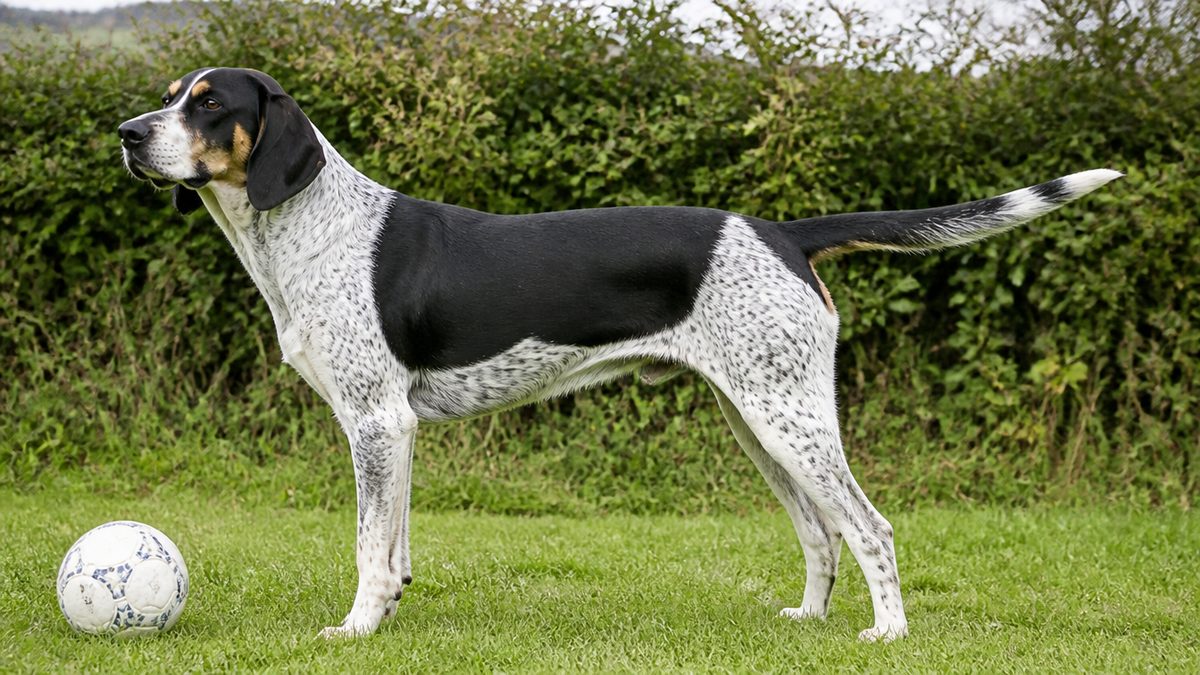
Quick answer
The Chien Francais Blanc et Noir is a large French pack hound of 65 to 72 cm, FCI standard 220, bred from the Saintonge Hound to hunt big game in packs. It differs from its two Chien Francais siblings on far more than colour, including foot shape, chest shape and ear set. France registered 135 in eighteen years. No Indian price exists and import law bars any breeding import. Heat tolerance rates 2 of 5, because the Saintonge averages 13.11 degrees against Chennai's 27.95.
This page summarises published veterinary research, registry screening data and breed-standard text for general information. It is not a diagnosis and it is not treatment advice. Consult a registered veterinarian about your own dog before acting on anything here, and treat a rectal temperature at or above 41.0 degrees Celsius after exertion in heat as an emergency.
Chien Francais Blanc et Noir at a glance
What the Chien Francais Blanc et Noir actually is
The Chien Francais Blanc et Noir is a large French pack hound of 65 to 72 cm at the withers for males and 62 to 68 cm for females, recognised by the Federation Cynologique Internationale as standard number 220 and accepted on a definitive basis on 15 December 1959.
It sits in FCI Group 6, Section 1.1, Large sized Hounds, and it carries the working-trial requirement, so an international beauty title cannot be completed on looks alone. The breed standard in force was published on 4 November 2008 and the English translation is dated 12 January 2009, revised by J. Mulholland with Raymond Triquet.
The FCI gives its use in four words: Pack Hound for big game. The French original is Chien de meute pour gros gibier. That single line does more work than any temperament paragraph, because it tells you the animal was selected to run in a group of twenty to sixty dogs, out of sight and out of reach, for hours.
A Saintonge hound rebuilt in the nineteenth century
The standard's history clause is unusually specific for Group 6. It says the breed evolved from the Saintonge Hound, whose origins are uncertain, that it has no connection with the Saint Hubert, and that there is probably a distant ancestry with the famous white Greffier dogs of the sixteenth century. The present type appeared in the second half of the nineteenth century and was later influenced by cross-breeding with the Poitevin and the Gascon-saintongeois. It obtained its standard in 1957Federation Cynologique Internationale.
The same clause then does something almost no FCI standard does. It publishes a population. The French text reads that the cheptel is currently about two thousand dogs, giving birth to 300 to 400 subjects each year. Royal Canin's French page reproduces the figure verbatim. The registry section below tests that number against the French studbook, and the two do not agree by a factor of more than a hundred.
The 2007 text was drafted by Pierre Astie, president of the Club du Chien d'Ordre, with Raymond Triquet. That club was created in 1978 by Dr Emile Guillet, sits inside the Societe Centrale Canine, and is responsible for every breed used in French hunting with hounds.
| Item | What the primary source says |
|---|---|
| FCI standard number | 220, official authentic language French |
| Group and section | Group 6 Scenthounds, Section 1.1 Large sized Hounds, with working trial |
| Definitive FCI recognition | 15 December 1959 |
| Official valid standard published | 4 November 2008, English text dated 12 January 2009 |
| Utilisation | Pack Hound for big game |
| Height at withers | Males 65 to 72 cm, females 62 to 68 cm, tolerance 1 cm either way |
| Weight | Not stated anywhere in the standard |
| Coat | Short, quite strong and dense |
| Colour | Obligatory white and black; a tricolour coat is a disqualifying fault |
| Country of origin | France |
Two rows there matter more than they look. The standard gives no weight at all, so every kilogram figure printed for this breed comes from somewhere else. The Societe Centrale Canine's own breed page supplies one, environ 30 kg, and that is the only weight with a registry behind it. Google's knowledge panel prints 27 to 32 kg for both sexes, which no standard supports and which gives a 68 cm bitch the same weight range as a 72 cm dog.
The other is the colour line. White and black is not a preference here, it is the definition, and the physical characteristics clause makes the alternative a disqualification rather than a fault. That is the hinge on which the next three sections turn.
The three Chien Francais breeds, read from the three standards
Colour is the smallest of the differences between the three Chien Francais breeds, and reading FCI standards 220, 219 and 316 side by side shows they disagree on ear set, foot shape, chest shape, muzzle proportion, size floor, size tolerance and even on what the dog is for.
Anyone can tell you the Blanc et Noir is black and white, the Tricolore is tricolour and the Blanc et Orange is orange and white. That is where every page on the internet stops. The three official documents go a great deal further, and the differences below are all taken directly from the FCI PDFsFederation Cynologique InternationaleFederation Cynologique Internationale.
| Feature | Blanc et Noir (220) | Tricolore (219) | Blanc et Orange (316) |
|---|---|---|---|
| Utilisation | Pack Hound for big game | Pack Hound for big game | Scenthound |
| Definitive FCI acceptance | 15 December 1959 | 15 December 1959 | 1 February 1982 |
| Standard in force published | 4 November 2008 | 1 August 2023 | 1 February 1982 |
| Male height | 65 to 72 cm | 62 to 72 cm | 62 to 70 cm, one range |
| Female height | 62 to 68 cm | 60 to 68 cm | 62 to 70 cm, one range |
| Size tolerance | 1 cm either way | None stated | 2 cm on the maximum only |
| General appearance | Distinguished, balanced build | Elegant, sufficiently boned and muscled | Distinguished, impression of being rustic |
| Skull | Slightly domed, rather narrow | Very slightly domed, quite developed | Slightly domed, occipital crest barely marked |
| Superciliary arches | May be slightly prominent | Not mentioned | Must not be prominent |
| Stop | Slightly pronounced | More accentuated than the Poitevin | Well marked |
| Muzzle against skull | Rather long compared to the skull | Straight, rather long | Almost equal in length to the skull |
| Ear set | At eye level | At eye level | Slightly below eye level |
| Ear reach | At least the base of the nose leather | Preferably to the nose, or within two fingers | About two fingers from the nose |
| Chest | More deep than broad | Deep and well let down | Broad |
| Ribs | Long and more flat than round | Long and not too flat | Rounded |
| Feet | Rather long, lean and resistant | Lean | Hare-feet |
| Tail | Thick at root, carried relatively high | Quite long, carried high and elegantly | Long |
| Behaviour clause | Present, one full paragraph | Absent | Absent |
| History clause | Present, with a population figure | Absent | Absent |
| Severe-fault tier | Yes, a separate list of seven | No, one flat list | No, one flat list |
| Breed-specific disqualifications | Frail limbs, limb deviation, round feet, tricolour coat | None beyond the FCI boilerplate | None beyond the FCI boilerplate |
The answer to the question everybody asks
No, the three breeds do not differ only on colour, and the claim is easy to refute with the documents open. Standard 316 asks for a broad chest with rounded ribs and hare-feet; standard 220 asks for a chest deeper than it is broad, ribs more flat than round, and long lean feet, and it disqualifies a round foot outright. Those are two different animals underneath the coat, and they would move differently at a gallop.
The muzzle line separates them again. The Blanc et Noir's muzzle is rather long compared with the skull. The Blanc et Orange's is almost equal to itFederation Cynologique Internationale. A scent hound head with a long muzzle and one with a square balanced head are not interchangeable, and the Blanc et Noir's severe-fault list exists precisely to stop its head shortening.
Look at the feet first. Hare-feet mean Blanc et Orange. Then look at the chest from the front: narrow and deep is Blanc et Noir, broad is Blanc et Orange. Then look at the ear set against the eye line: at the eye is 220 or 219, below the eye is 316. Colour is the last check, not the first, because colour is the one thing a photograph always gets right and the one thing every website already tells you.
The three standards are not comparable documents
Comparing the three Chien Francais breeds fairly is harder than it looks, because the three standards were written 41 years apart and only one of them contains a temperament clause, a history clause or a proportions clause.
Standard 316 for the Blanc et Orange has not been revised since the day the breed was accepted. The FCI nomenclature entry gives 1 February 1982 as both the date of acceptance on a definitive basis and the date of publication of the official valid standard. Forty-four years have passed and the text has not moved. Standard 219 for the Tricolore was reissued on 1 August 2023, with the English translation dated 6 October 2023. Standard 220 sits between them at 4 November 2008.
Only one of the three tells you what the dog is like
FCI-Standard 220 carries a BEHAVIOUR / TEMPERAMENT heading and fills it: these dogs are very appreciated by many deer hunts for fine noses, diligence, seriousness and throat, and it is a friendly dog, close to humans and easy to manage in the kennels. Standards 219 and 316 have no such heading at all. Neither document contains one word about the breed's characterFederation Cynologique Internationale.
That matters for a buyer far more than colour does. Every temperament claim you will read about the Tricolore or the Blanc et Orange has been supplied by somebody other than the FCI, because the FCI never wrote one. The Societe Centrale Canine fills the gap with a paragraph it prints identically on all three breed pages, which is honest of it but is not breed-specific evidenceSociete Centrale CanineSociete Centrale Canine.
Only one of the three tells you where it came from
Standard 220 has a BRIEF HISTORICAL SUMMARY naming the Saintonge Hound, the Greffier dogs, the Poitevin and the Gascon-saintongeois, and dating the standard to 1957. Standards 219 and 316 have no history clause whatsoeverFederation Cynologique Internationale. For those two breeds the only registry account of origin is the SCC's own page, which says the Tricolore was created in 1957 from crosses between Anglo-Francais tricolores bred back to French type, with retrempes from the Poitevin, the Billy and perhaps the Bleu de Gascogne, and had its standard officially recognised in 1965. For the Blanc et Orange the SCC offers one sentence: it descends from old French breeds, and the Billy is found in its origins.
The SCC dates the Tricolore's creation to 1957 and traces it to Anglo-Francais tricolores, that is to dogs already carrying English Foxhound blood. Standard 219 then lists among its faults any apparent trace of English hound blood, especially in the head. The breed was made from the cross and is now penalised for showing it. This is not a contradiction the FCI hides; it is simply what happens when a type is bred back toward a national ideal, and it is worth knowing before anyone tells you the three breeds are interchangeable.
The weight the standards refuse to give
None of the three FCI standards states a weightFederation Cynologique InternationaleFederation Cynologique Internationale. The SCC supplies one for two of them and explicitly declines for the third. Its Blanc et Noir page says environ 30 kg, its Blanc et Orange page says environ 30 kg, and its Tricolore page prints NP, non preciseSociete Centrale Canine. So the French kennel club has published a weight for two of the three and refused to guess for the third, which is a more careful position than most breed sites take.
For an Indian reader the practical consequence is simple. Size this dog from height and body condition, not from a number you read online, and use the nine-point WSAVA body condition score, where ribs are easily palpable with minimal fat covering and the waist is easily noted from above.
Read the French, because the English translations moved things
The FCI's official authentic language for all three breeds is French, and the English texts are translations rather than originals. Two of them shifted meaning. Standard 316's French opens its head clause with TETE: Assez large, moyennement allongee, where large in French means broad; the English renders it as Quite large, moderately elongated, which tells an English reader the head is big rather than wideFederation Cynologique Internationale. The same document's loin clause reads Rein: Generalement vousse, dit harpe, using the venery term harpe, and the English flattens it to Loin: Normally arched.
Standard 220's severe-fault list shows the reverse, an English translation that narrows the French. The French says Toute trace de sang anglais dans la tete, any trace of English blood in the head. The English renders it as Any indication of English Foxhound blood in the head, naming a breed the French text does notFederation Cynologique Internationale. The addition is probably correct in substance, since the Anglo-Francais breeds descend from the Foxhound cross, but it is an addition.
Two of the three standards police each other by name
Standard 220 disqualifies a tricolour coat and standard 219 faults a smoky head that indicates crossing with the White and Black Hound, so the Blanc et Noir and the Tricolore are each written partly as a defence against the other.
Read the two fault lists together and the relationship is unmistakable. FCI-Standard 220's DISQUALIFYING FAULTS list ends with two words: Tricolour coat. The French original is equally blunt, Robe tricolore, sitting under DEFAUTS ENTRAINANT L'EXCLUSION.
Standard 219 answers in its own fault list. The English text reads: any apparent trace of English hound blood, especially in the head. Smoky coloured heads which indicate cross-breeding with the White and Black Hound and all other colours than those above mentioned. The French is the same, Tetes fumees qui denotent un croisement de blanc et noir.
What that tells you about how the breeds actually behave
A breed standard that names a sibling breed as a fault is telling you which way the population drifts. The Blanc et Noir drifts toward tricolour, because tan is present in it already: standard 220 permits small tan markings on the limbs, a pale tan dot above each eye, pale tan on the cheeks, below the eyes, below the ears and at the base of the tail, plus the roebuck mark on the thigh. That is a great deal of tan on a dog whose name insists it is only white and black, and the disqualification exists because the line between permitted tan points and a tricolour coat is a judgment call.
The Tricolore drifts the other way. A tricolour with a smoky head reads as Blanc et Noir influence, so the judge is asked to penalise a head that has gone grey rather than a coat that has gone tan.
A Chien Francais Blanc et Noir photographed in good light shows tan above the eyes, on the cheeks, under the ears and at the tail root, which most people will call tricolour on sight. It is not. The standard permits every one of those markings by name and disqualifies only a tricolour coat, meaning a spread tan the dog wears rather than points it carries. If you are shown a dog and told it must be a Tricolore because it has tan on its face, the person telling you has not read either document.
The Blanc et Orange names nobody
Standard 316 contains no clause naming any other breed. Its fault list runs to faulty conformation, a thin or too long muzzle, an overshot or undershot mouth, light eyes, a curved or deviated tail, depigmentation, and coat colours other than those mentioned, particularly black or red hair. That last item is the closest it comes, and it is a colour rule rather than a breed name.
Reading the three together, only one of the three Chien Francais standards defines itself defensively against a named relative in both directions, and it is 220. Bonbeno reads sibling standards side by side wherever two breeds are routinely confused, using the same method applied to the two French pointer standards in the Braque Francais type Gascogne guide and to the four Vendeen griffons in the Briquet Griffon Vendeen guide: open every official PDF, diff them clause by clause, and publish the clauses that disagree.
Standard 220 against standard 323: the mirror-image disqualification
The Chien Francais Blanc et Noir and the Grand Anglo-Francais Blanc et Noir share an identical height range, an identical coat description and an identical publication date, and the cleanest thing separating them is that one disqualifies a round foot while the other disqualifies a long one.
These two are the pair most often confused, and with reason. Both are French, both sit in Group 6 Section 1.1 with a working trial, both give males 65 to 72 cm and females 62 to 68 cm with a tolerance of 1 cm, both were published on 4 November 2008, and both were drafted by Pierre Astie's committee with Raymond Triquet. A measuring stick and a colour chart cannot tell them apart.
| Point | Chien Francais Blanc et Noir (220) | Grand Anglo-Francais Blanc et Noir (323) |
|---|---|---|
| Origin in the standard | The Saintonge Hound | The Batard Anglo-Saintongeois, Saintongeois crossed with the Foxhound |
| General appearance | Distinguished, balanced build | Big, rather powerful, resistant and robust, strong bone |
| Head | Rather long, never heavy or coarse | Strong, rather short, skull and muzzle lines parallel |
| Muzzle against skull | Muzzle rather long compared to the skull | Muzzle slightly shorter than the skull |
| Skull | Slightly domed, rather narrow | Rather flat and broad |
| Superciliary arches | May be slightly prominent | Prominent |
| Stop | Slightly pronounced | Well defined |
| Ear length | Reach at least the base of the nose leather | Must not reach further than two fingers before the nose leather |
| Ear tips | Not described | Rather pointed |
| Neck | Quite long and strong | Strong, rather short |
| Chest | More deep than broad | Broad and well let down |
| Ribs | Long and more flat than round | Moderately rounded |
| Forequarters | Strong and rather flat | More round than flat |
| Feet | Rather long, lean and resistant | Thick and big, rather round |
| Foot disqualification | Round feet | Long feet |
| English blood in the head | A severe fault | Not faulted; it is the breed's origin |
| Births claimed per year | 300 to 400 | Around 200 |
The two lists are written as exact opposites
Standard 220 lists Feet: Round among its disqualifying faults. Standard 323 lists Feet: Long among its disqualifying faultsFederation Cynologique Internationale. Both disqualify a tricolour coat. Both disqualify frail limbs and severe limb deviation. The only structural item on which the two lists differ is the foot, and they differ by inversion.
That is the most useful single fact on this page for anyone shown a black and white French hound. A long lean foot on a 68 cm dog is correct for one breed and disqualifying for the other. Nothing else on either dog is as binary.
The English cross runs the other way too
Standard 220's severe faults open with the head: any indication of English Foxhound blood in the head, given as a skull too voluminous and a muzzle short and not sufficiently square at the end when seen from the side. Standard 323 describes exactly that head as correct, because its breed was made from the Foxhound cross. So the fault the Blanc et Noir is penalised for is the type the Grand Anglo-Francais is bred toward.
Bonbeno already holds a full guide to the Foxhound-crossed breed, including the equipage arithmetic behind its own population claim, so this page cross-links rather than repeats it. See the Grand Anglo-Francais Blanc et Noir guide, and the Grand Anglo-Francais Tricolore and Anglo-Francais de Petite Venerie guides for the rest of the group.
The American standard is not the French one translated
Two kennel clubs publish a Chien Francais Blanc et Noir standard and they disagree in at least ten checkable places, including both disqualifications that separate this breed from its closest relatives.
The United Kennel Club recognised the breed on 1 January 1996 and publishes it in the Scenthound Group. The FCI standard in force was published on 4 November 2008 with the English text dated 12 January 2009. Neither is a translation of the other, and a dog can pass one and fail the other.
| Point | FCI standard 220 | UKC standard |
|---|---|---|
| Male height | 65 to 72 cm | 25.5 to 28 inches, that is 64.8 to 71.1 cm |
| Female height | 62 to 68 cm | 24.5 to 26.5 inches, that is 62.2 to 67.3 cm |
| Size tolerance | 1 cm either way | None stated |
| Head | Rather long, never heavy or coarse | Rather imposing and quite long |
| Ear reach | At least the base of the nose leather | Reaching to the nose |
| Dentition | Not mentioned at all | A complete set of evenly spaced white teeth, scissors bite |
| Tail length | Not described | Rather long |
| Tail carriage | Carried relatively high | Carried elegantly |
| Coat texture | Short, quite strong and dense | Short, harsh and dense |
| English Foxhound blood in head | A severe fault | Not mentioned |
| Tricolour coat | Disqualifying | Not listed |
| Round feet | Disqualifying | Not listed |
| Albinism | Not listed | Disqualifying |
| Cryptorchidism | In the closing note, not a disqualification | Disqualifying |
The American version dropped both defining disqualifications
The UKC standard's entire disqualification list is three items: unilateral or bilateral cryptorchid, viciousness or extreme shyness, and albinism. It does not disqualify a tricolour coat and it does not disqualify a round foot. Those are exactly the two clauses that separate this breed from the Chien Francais Tricolore and from the Grand Anglo-Francais Blanc et NoirFederation Cynologique Internationale. A judge working only from the American document has no written instruction to reject either.
It also drops the severe fault reading any indication of English Foxhound blood in the head, so nothing in the UKC text pushes back against the drift toward the Anglo-Francais typeUnited Kennel Club.
What the American version added, and where it got it
The UKC describes the tail as quite thick at the root, rather long, and carried elegantly. FCI-220 says only that the tail is quite thick at its root and carried relatively high, with no length at all. The words rather long and carried elegantly do appear in an FCI document, just not this one: standard 219 for the Tricolore gives the tail as quite long, carried high and with elegance. The Brit breed catalogue reproduces the same imported clause, calling the tail strong at the root, rather long, carried elegantly. Two independent English-language sources have given this breed its sibling's tail.
The UKC also requires a complete set of evenly spaced white teeth. FCI-220 says nothing about dentition anywhere; it faults only an overshot or undershot jaw, and does so as a severe fault rather than a disqualificationUnited Kennel Club. That distinction becomes an Indian legal question further down this page, because the Indian breeding rules name two or more missing teeth among the genetic defects a breeder must screen for.
A dog registered against the American standard has not been assessed on the tricolour disqualification, the round-foot disqualification or the Foxhound head fault. A dog registered against the French standard has not been assessed on dentition or albinism. Neither document is wrong. They are different tests, and no page currently ranking for this breed name tells a reader that they exist in parallelFederation Cynologique Internationale.
How rare it really is, read out of the French studbook
France registered 135 Chien Francais Blanc et Noir in the eighteen years from 2008 to 2025 combined, against 1,137 Chien Francais Tricolore and 13 Chien Francais Blanc et Orange over the same period.
The Societe Centrale Canine publishes the Livre des Origines Francais figures every January, broken out by group and breed. Eighteen editions were retrieved for this page and every Groupe VI table was extracted with pypdf rather than through any summarising layer, because an extraction layer can silently drop a rowSociete Centrale Canine.
The rows sum to the printed total, so the table can be trusted
Before taking any row from a PDF table, check that the rows add to the total the document prints. The Groupe VI table for 2025 carries 47 breed rows. Summed independently they give 12,894 for 2024 against a printed total of 12,894, 11,720 for 2025 against a printed 11,720, and 3,989 confirmations against a printed 3,989. The derived confirmation ratio is 34.04 percent against a printed 34 percent, and the derived year-on-year change is minus 9.11 percent against a printed minus 9 percent. Nothing was dropped, so the three Chien Francais rows are complete.
The 2019 edition can be checked a second way, because it splits every breed into descendants, imports and titre initial admissions. Its Groupe VI total of 14,953 resolves as 14,279 descendants plus 106 imports plus 568 titre initial, which sums exactly.
| Year | Blanc et Noir | Tricolore | Blanc et Orange |
|---|---|---|---|
| 2008 | 39 | 122 | 3 |
| 2009 | 30 | 98 | 1 |
| 2010 | 15 | 116 | 1 |
| 2011 | 20 | 167 | 2 |
| 2012 | 6 | 48 | 1 |
| 2013 | 2 | 92 | 0 |
| 2014 | 2 | 85 | 0 |
| 2015 | 0 | 0 | 0 |
| 2016 | 0 | 0 | 0 |
| 2017 | 20 | 98 | 1 |
| 2018 | 0 | 32 | 0 |
| 2019 | 0 | 0 | 0 |
| 2020 | 0 | 62 | 0 |
| 2021 | 0 | 28 | 0 |
| 2022 | 0 | 74 | 0 |
| 2023 | 0 | 0 | 0 |
| 2024 | 1 | 115 | 4 |
| 2025 | 0 | 0 | 0 |
| Total | 135 | 1,137 | 13 |
Each overlapping year cross-checks against a second document. The 2025 edition gives 2024 as 1 for the Blanc et Noir and the 2024 edition gives the same; the 2024 edition gives 2023 as zero and the 2023 edition gives the same; the 2018 edition gives 2017 as 20 and the 2017 edition gives the sameSociete Centrale CanineSociete Centrale CanineSociete Centrale CanineSociete Centrale Canine.
The early years come from single-column editions that print one total per breed, and they are the years in which the breed still registered consistently: 15 in 2010, 20 in 2011 and 6 in 2012Societe Centrale CanineSociete Centrale Canine. The 2020 edition is the one that shows the pattern most clearly, because it lists the Tricolore at 62 and the Poitevin at 60 for that year while carrying no Blanc et Noir row at all.
The zeros are real zeros, not missing rows
A blank could mean a dropped row rather than a genuine nil, so the 2016 edition settles it. That table prints an explicit zero against each of the three breeds by name rather than omitting them. Where a breed is absent from a table entirely, as the Blanc et Noir is from the 2015, 2019, 2022 and 2023 editions, other Groupe VI breeds appear normally in the same table, so the absence is the SCC's own nil returnSociete Centrale CanineSociete Centrale Canine.
The registrations that do occur are almost all unpedigreed admissions
The 2013 and 2014 editions carry the column split, and it is revealing. Both Blanc et Noir entries in 2013 were titre initial admissions, that is unpedigreed dogs accepted on type, with zero descendants of registered parents. The same is true of both 2014 entries, and of all 92 Tricolore registrations in 2013 and all 85 in 2014Societe Centrale Canine.
This breed went 20, then 0, then 0, then 0, then 0, then 0, then 0, then 1, then 0 across nine consecutive years. That is not a population collapsing and recovering. It is a batch process: a hunt presents a group of dogs for admission in one year and presents none for the next six. Any single-year figure for any of these three breeds is noise, and the eighteen-year total is the only number worth quoting.
The two thousand dogs the studbook cannot see
FCI-Standard 220 claims about 2,000 living dogs and 300 to 400 births a year, and the French studbook records 135 registrations in eighteen years, and both numbers are correct because they count different things.
The gap is a factor of roughly 267 on the annual figure, so it cannot be a rounding difference or a bad year. The explanation is a chain of French primary texts that no English breed page consults, and it is the single most important thing to understand about this breedSociete Centrale Canine.
Where these dogs are registered instead
French law registers pack hounds, just not through the kennel club. The Arrete du 18 mars 1982 relatif a l'exercice de la venerie governs hunting with hounds. Article 4 requires that the dogs of venerie equipages be compulsorily identified by tattoo. Article 6 provides that the prefect issues, for every equipage whose kennel is in the department, an attestation de conformite de la meute carrying all useful information on the equipage plus the name and address of the person responsible, valid for six years, granted provisionally for one year to a new equipage and renewed for five more once the aptitudes of the pack are confirmed, and delivered after the opinion of the departmental hunters' federation.
So every dog is individually identified by tattoo because the state requires it, and the pack itself is certified with the prefecture rather than with the studbook. The dogs exist in government records and are absent from the pedigree register. That is exactly the pattern the two numbers show.
The law also tells you how big a pack has to be
Article 2 of the same text sets minimum pack sizes by quarry. An equipage must be able to uncouple 30 hounds of specialised breeds served by at least two mounted people for stag and wild boar, 20 for roe deer and fallow deer, 10 for fox, and 6 for hare. Article 5 caps the number of hounds in action at 60.
Standard 220 says this breed is very appreciated by many deer hunts, and the French names the quarry precisely: equipages de chevreuil, roe deer packs. Roe deer is the 20-hound minimum. So 2,000 dogs of all ages spread across packs of the legal minimum size would fill about 100 packs, and across packs of a realistic 40 to 60 working hounds it would fill roughly 33 to 50.
That is a bound rather than a count, and it is worth checking against the federation's own figures. The Societe de Venerie reports 350 equipages in France, 10,000 practitioners and 100,000 sympathisers, and states that 66 percent of equipages hunt hare, rabbit and fox on foot. Two thirds hunting small game on foot leaves roughly a third, near 119 packs, for the mounted big-game hunts that use large hounds, and that is shared with the Poitevin, the Gascon Saintongeois, the Griffon Nivernais, the three Grand Anglo-Francais breeds and the Tricolore. Thirty-three to fifty packs of Blanc et Noir inside that pool is tight but not impossible.
Verified from primary texts: equipage dogs must be tattoo-identified, every equipage holds a six-year prefectural attestation, the legal pack minimum for roe deer is 20 hounds and the maximum in action is 60, France has 350 equipages of which 66 percent hunt small game on foot, and the LOF recorded 135 Blanc et Noir in eighteen yearsSociete Centrale Canine. Not verified: how many equipages actually run this breed. The Club du Chien d'Ordre publishes no membership or population figure at all, only its officers and its mission. Nobody should present the 2,000 as a counted census; it is the club's own estimate, printed in a standard drafted by that club's president.
Wikipedia turns the estimate into something it is not
The English Wikipedia article states that in 2009 there were approximately 2000 of the breed registered through the Federation Cynologique Internationale. Three things are wrong with that sentence. The standard says the cheptel is about two thousand dogs, which is a population estimate and not a registration count. The FCI does not register dogs at all; national kennel clubs do. And the French studbook recorded 30 Blanc et Noir in 2009. The number is real, the framing is not, and it is the framing that every downstream site has copied.
Every page ranking for this breed prints something it cannot support
Auditing the pages Google returns for this breed name in India finds a wrong breed group, a wrong FCI attribution, two flatly opposite answers on guarding, a placeholder photograph and a life expectancy that none of its cited sources contains.
Google reported About 119 results for the whole query on 25 August 2026, which is the first thing worth knowing: this is a query with almost nothing behind it. The pages that do rank were opened and checked against the primary documents.
Royal Canin credits the FCI for a figure the FCI does not publish
Royal Canin's French page gives Esperance de vie moyenne 12 to 15 years and states, under the same block, Source: faits et caracteristiques cles provenant de la Federation Cynologique Internationale. FCI-Standard 220 contains no life expectancy of any kind, in either languageFederation Cynologique Internationale. The same page says the breed's natural vigilance earns it an excellent reputation as a guard dog, and lists Fait un excellent chien de garde among its highlights. The standard says the opposite kind of thing: friendly, close to humans and easy to manage in the kennels.
Two ranking pages give opposite answers on guarding and on other dogs
The Brit breed catalogue says of this breed that as a security guard and a vigorous defender you cannot count on it. Royal Canin says it makes an excellent guard dog. The FCI standard says nothing at all about guarding. A reader who opens two of the top pages gets two opposite answers and no citation from either.
Brit goes further and states that perfect compatibility with other dogs, typical for a pack hound, is not typical for this breed, and that it tends to behave dominantly and aggressively toward other dogs. A dog that behaved that way could not work in a legally mandated pack of at least twenty hounds, and the standard describes an animal easy to manage in the kennelsFederation Cynologique Internationale.
Puppies.com files a Group 6 pack hound in the Sporting group
Puppies.com gives Breed Group: Sporting, adult weight 60 to 70 lbs and adult height 24 to 28 inches. The FCI places the breed in Group 6 Scenthounds and the UKC in the Scenthound GroupUnited Kennel Club. The 24-inch floor is 61 cm, below the FCI's 62 cm female minimum, and the single range erases the sex split that both standards state. The page also carries the internal contradiction that the dog will quickly pose a threat to other small animals and neighbouring pets, and, four paragraphs later, that it will get along well with children and small animals. Its breed photograph is the site's own placeholder file, so it is selling a breed it has no picture of.
The 12 to 15 years everyone prints comes from nowhere
World Life Expectancy publishes LIFE SPAN: 12-15 years, and its entire history section is the UKC standard's history paragraph copied word for word, down to the recognition dateUnited Kennel Club. The site states its own sources: AnAge, UMICH, Max Planck, PanTHERIA, Arkive, UKC and AKC. The UKC standard carries no life span. The AKC does not recognise the breed. AnAge, PanTHERIA and the Max Planck longevity databases hold species records rather than dog-breed records. None of the named sources can be the origin of the figure, and it matches Royal Canin's 12 to 15 exactly.
Searching the breed name from India returns Royal Canin's Great Anglo-French White and Black Hound page, the English Wikipedia article on the Grand Anglo-Francais Blanc et Noir, and a third site publishing standard 220's sex-split height table under the Grand Anglo-Francais name. All three are FCI-323, not FCI-220Google Search, query chien francais blanc…. Google's own People also search for strip then offers Grand Anglo-Francais Blanc et Noir, Chien Francais Tricolore, Chien Francais Blanc et Orange and Grand Anglo-Francais Tricolore, so four of the four suggested breeds are not the one searched for.
Chien Francais Blanc et Noir price in India
No Chien Francais Blanc et Noir price in India exists, because no Chien Francais Blanc et Noir exists in India, and the only things the breed name will actually buy you here are a paperback, a poster and a hoodie.
That is the honest first line, and the rest of this section evidences it rather than filling the space with an invented band. Searching the breed name with price, India, puppy and for sale, from an India location on 25 August 2026, returned no Indian breeder, no Indian litter and no Indian price in india page. What it returned was a Flipkart listing for a print-on-demand activity book about the breed, an eBay etched glass item, an Etsy poster, a Bermudian dropshipper's zip hoodie and a woodworking pattern.
The control proves the search was working
A zero is worthless without a control, so the identical search was run for a breed that certainly is sold here. Labrador retriever price in india puppy returned ten dense Indian commercial results with real bands, in the same tool, in the same session. The tool was working. The absence is the finding.
Divide every rupee figure you are shown, twice, and treat 84.38 as the real test
Indian pages routinely publish a dollar figure converted at one rate and present it as a local price. Divide any rupee number you are quoted by 84.38 first, and by 74 second. A clean round quotient means you are looking at a converted foreign list rather than an Indian market observation.
Run the check on the one Indian dog-price page that does publish city tables. Mr n Mrs Pet lists the Labrador Retriever at INR 30,000 to INR 1,20,000 and prints the identical band for Hyderabad, Bangalore, Delhi, Chennai, Lucknow, Mumbai, Jaipur and Pune. Divided by 84.38 those become 355.53 and 1,422.14 dollars; divided by 74 they become 405.41 and 1,621.62. Neither divides cleanly, so the band is rupee-native and genuine. It is also identical in all eight cities, which tells you the city table is decoration rather than data.
| Rupee figure | Divided by 84.38 | Divided by 74 | Divided by 80 | Verdict |
|---|---|---|---|---|
| 30,000 | 355.53 | 405.41 | 375.00 | Rupee-native |
| 60,000 | 711.07 | 810.81 | 750.00 | Rupee-native |
| 90,000 | 1,066.60 | 1,216.22 | 1,125.00 | Rupee-native |
| 1,20,000 | 1,422.14 | 1,621.62 | 1,500.00 | Rupee-native |
| 98,999 | 1,173.25 | 1,337.82 | 1,237.49 | Charm price, no rate fits |
The 80 column in that table is the reason the flat-80 test must never be run alone. Every one of those four Labrador figures ends in three zeros, and 1,000 divided by 80 is 12.5, so a figure ending in three zeros divides cleanly at 80 by pure construction. All four look like a conversion at 80 and none of them is one. 84.38 is the strong test, and all four fail it.
One Indian listing site prints Rs 98,999 as the headline figure across page after page, attached to whichever puppy is in stock, on breeds it does not stock at all. It divides to 1,173.25 dollars at 84.38, 1,337.82 at 74 and 1,237.49 at 80, so it is not a conversion at any rate in circulation. It is a rupee-native charm price. If anyone quotes it to you for a Chien Francais Blanc et Noir, they are quoting a shop's standard number rather than this breed, which that site does not carry.
So the answer to what a Chien Francais Blanc et Noir costs in India is that the question has no market behind it. That is not a gap in this page. It is the most useful thing a prospective buyer can be told, because it means any quoted Indian price is a claim about a dog nobody can show you.
Why no lawful supply of this breed can form in India
Indian import law closes the commercial route completely: dogs sit under ITC(HS) 01061900 as a Restricted item, and DGFT Trade Notice 22/2022-23 states that any applications for trading or breeding purposes shall be duly rejected.
The trade notice, dated 19 December 2022, was extracted here directly with pypdf rather than summarised, and it sets the position out in clauses worth quoting rather than paraphrasing. The tariff line reads Mammals, Other, import policy Restricted, subject to Policy Condition 6 of the chapter.
- Policy Condition 7 allows a dog into India only as a pet dog with a valid pet book and relevant records in the name of the importer, for research by an R&D organisation with a CPCSEA recommendation, or for internal security by the Defence and Police Force.
- Policy Condition 8 states that import of commercial dogs for breeding or any other commercial activities other than those purposes is not permitted.
- Paragraph 6 states that any applications for trading or breeding purposes, or applications made on behalf of another person or entity, shall be duly rejected.
- Paragraph 7 limits entry to the airports and seaports of Delhi, Mumbai, Chennai, Hyderabad, Bangalore and Kolkata, with quarantine at the government station of that port where required. DAHD added a seventh port, Cochin International Airport at Kochi, for pets arriving under the baggage rules in October 2024.
Those four clauses together mean no Indian kennel can lawfully import founding stock. A breed with 135 studbook entries in eighteen years in its home country cannot supply an Indian breeding programme by any other route either.
The one lawful route, and what it demands
A person relocating to India may bring the dog they already own. Up to two pets enter as passenger baggage without a DGFT authorisation, but only for someone transferring residence to India after two years of continuous stay abroad, and only cats and dogs qualify under the baggage rules. Anything else needs a DGFT import authorisation: fewer than two years abroad, a pet not travelling as passenger baggage, more than two pets, or a temporary import.
The paperwork is specific. The application goes in against the applicant's Importer Exporter Code, or against the permanent IEC number IIHIE0153E for personal-use imports, through the DGFT portal under Import Authorisation of Restricted Items. The notice advises starting at least two months before travel. An advance no objection certificate must then be obtained from the Regional Officer or Quarantine Officer of one of the six ports the DGFT notice names, after submitting the DGFT licence and a health certificate from the exporting country's veterinarian, seven days before travel and relaxable to three.
If an agent tells you they can arrange a Chien Francais Blanc et Noir puppy from France for an Indian buyer, they are describing an application the trade notice says shall be duly rejected, and one made on behalf of another person, which paragraph 6 also names. Bonbeno brokers nothing and recommends nobody, but this is the clause to quote back.
Indian breeding law would bite even if a pair arrived
Suppose two unrelated dogs did reach India lawfully as relocated pets. The Prevention of Cruelty to Animals (Dog Breeding and Marketing) Rules 2017, notified as G.S.R. 496(E) on 23 May 2017, would then govern any attempt to breed them. Rule 6 makes the Second Schedule binding on every breeder. Second Schedule Part II paragraph 6(2) permits only two techniques, out breeding and line breeding. Paragraph 6(3) prohibits in breeding, defined there as breeding between relatives of the second to fourth grade in straight or side line within the first four generations, naming uncle to niece, nephew to aunt, cousin to cousin and grandparents to grandchildren, and prohibits incest breeding between parents and children or brother and sister.
A founding population of two dogs reaches cousin-to-cousin matings in the third generation and cannot avoid them afterwards. Indian law therefore prohibits the only breeding strategy a two-dog foundation permits, which is a second and independent reason the breed cannot establish here.
Other provisions of the same rules apply to any dog bred in India. Rule 8, Conditions for sale, sub-rule 1(a) requires that pups less than eight weeks in age are not sold, and sub-rule 1(b) that dogs over six months are not sold without first being sterilised unless the buyer is another licensed breeder. Second Schedule Part II paragraph 6(8) forbids tail docking, ear cropping, de-barking and de-clawing outright, and Part III paragraph 8(10) requires that dogs be tested for genetic defects including hip dysplasia, progressive retinal atrophy, night blindness, hypothyroidism, entropion, ectropion, overshot and undershot jaw, wry mouth, two or more missing teeth and cryptorchidism.
For context on how small the Indian pedigree world is in any case, the Kennel Club of India registered 33,880 pure-bred dogs across all breeds in 2025 and held two CACIB all-breed shows that year.
What a 30 kg working hound costs to run in India
Budget this breed as a 30 kg high-drive hound rather than as a rare import, because the recurring cost of ownership is the only part of the arithmetic that is real and it is driven by weight, activity and ear care rather than by rarity.
The FCI standard gives no weight, so size the budget from height and from the only registry figure available. The Societe Centrale Canine publishes environ 30 kg for this breed. A 30 kg dog at 65 to 72 cm, worked hard, sits in the large-breed bracket for food, in the 25 to 40 kg band for most Indian parasiticides, and in the large-dog tier for boarding and grooming.
| Cost head | Frequency | What drives it for this breed |
|---|---|---|
| Complete dry or wet food | Monthly | A 30 kg frame plus 90 minutes of daily work; the SCC's own note is that this dog needs space and exercise, and an under-exercised one gains weight fast |
| Ear cleaning solution | Fortnightly, weekly in monsoon | Leathers that reach the nose leather and lie flat against the skull; the largest Indian series found drop-eared dogs at 47.72 percent of otitis cases |
| Tick and flea preventive | Monthly | A working hound in Indian vegetation meets Babesia gibsoni at 8.9 percent by PCR in one Punjab survey |
| Core vaccination and boosters | Annual after the puppy course | Standard for any dog; the 2017 Rules require vaccination from seven to eight weeks, usually completed by eighteen weeks |
| Deworming | Quarterly | Higher exposure than a house dog because of nose-to-ground work |
| Veterinary consultation | As needed | Ear recheck cycles dominate; expect more visits in July to October |
| Long line, harness, crate | Replaced yearly | A 30 kg hound on a scent destroys light equipment |
| Boarding or day care | Per trip | Charged at the large-dog tier, and a baying hound is refused by some facilities |
Bonbeno publishes no rupee figure for any of those heads on this page, and that is deliberate. No Indian owner of this breed exists to survey, no Indian retailer stocks a breed-specific product, and inventing a monthly total from a comparable breed would be exactly the substitution this site refuses. Price the heads yourself against a Labrador or a Beagle of similar weight, then add the ear budget, which is the one line this breed genuinely inflates.
The cost that is not money
The heaviest cost of this breed in an Indian city is not rupees, it is space and time. Ninety minutes a day, split, with a real off-lead or long-line outlet, is not optional for a dog whose standard requires it to work a track for hours. The Societe Centrale Canine's own living-conditions note for the breed is one sentence long and answers the question completely: their habitat is the kennel, they need space and exercise.
If a dog of any breed is sold to you in India below eight weeks of age, the seller is in breach of Rule 8(1)(a) of the Prevention of Cruelty to Animals (Dog Breeding and Marketing) Rules 2017, and a dog over six months must be sterilised before sale unless the buyer is another licensed breeder under Rule 8(1)(b). Neither is a fee, but both are conditions a lawful transaction has to meet, and a seller who does not know them is telling you something about the rest of their operation.
Heat tolerance: the Saintonge against eight Indian cities
Heat tolerance rates 2 out of 5 for this breed, because every one of the eight Indian cities measured here has an annual mean temperature higher than the hottest month of the region the breed comes from.
The origin measurement was taken at Saintes, in the Charente-Maritime, the heart of the old Saintonge from which FCI-220 traces the breed. NASA POWER was queried by explicit latitude and longitude so that no place-name lookup could return the wrong town, and the service echoed the coordinates back as -0.632, 45.746 at 31.74 m elevation. A second French point was taken at Poitiers, in the Poitou whose hound was crossed into the breed, echoing 0.34, 46.58 at 133.84 m.
| Place | Annual mean T2M | Coolest month | Warmest month | Annual mean RH2M |
|---|---|---|---|---|
| Saintes, Saintonge | 13.11 C | January 5.69 C | August 21.17 C | 79.67 percent |
| Poitiers, Poitou | 11.90 C | not queried | July 20.59 C | 80.86 percent |
| Bengaluru | 23.74 C | December 20.22 C | April 28.37 C | 67.94 percent |
| Pune | 23.86 C | December 19.62 C | April 28.93 C | 66.80 percent |
| Delhi | 25.60 C | January 13.61 C | June 35.88 C | 45.56 percent |
| Kolkata | 25.81 C | January 17.31 C | May 31.53 C | 73.93 percent |
| Hyderabad | 26.10 C | not queried | May 33.30 C | 60.30 percent |
| Mumbai | 26.77 C | not queried | April 30.73 C | 67.39 percent |
| Ahmedabad | 27.57 C | not queried | May 35.06 C | 48.32 percent |
| Chennai | 27.95 C | January 24.09 C | May 31.51 C | 72.39 percent |
The comparison that settles it
Saintes reaches a monthly mean of 21.17 C in August and never goes higher. Bengaluru's annual mean is 23.74 C, Pune's 23.86 C, Delhi's 25.60 C, Kolkata's 25.81 C, Hyderabad's 26.10 C, Mumbai's 26.77 C, Ahmedabad's 27.57 C and Chennai's 27.95 CNASA POWER, Source Native Resolution…NASA POWER, Source Native Resolution…NASA POWER, Source Native Resolution…NASA POWER, Source Native Resolution…NASA POWER, Source Native Resolution…NASA POWER, Source Native Resolution…NASA POWER, Source Native Resolution…. Every one of the eight sits above the breed's warmest month, as an annual average.
Chennai makes the point most sharply. Its coolest month, January at 24.09 C, is 2.92 C warmer than the hottest month the Saintonge experiences. In Chennai this dog would never in its life meet a month as cool as a French August.
Humidity is not the problem, and that is the surprise
Saintes averages 79.67 percent relative humidity across the year, which is higher than every Indian city measured here, including Chennai at 72.39 percent and Kolkata at 73.93 percentNASA POWER, Source Native Resolution…NASA POWER, Source Native Resolution…. This is a hound from a genuinely damp place, and its standard describes a coat of short, quite strong and dense hair rather than a heat-shedding one.
What changes in India is the temperature at which that humidity arrives. Saintes hits its most humid month in December, at 90.82 percent relative humidity and a mean of 6.14 C. Pune hits 90.80 percent in August, at 23.30 CNASA POWER, Source Native Resolution…. The same humidity, 17.16 degrees warmer. Mumbai does the same thing at 90.36 percent and 26.05 C in August, 19.91 degrees warmer than the French December that matches it.
A dog sheds heat by evaporating water from its airway. Ninety percent humidity at 6 C costs it nothing, because it is not trying to shed heat. Ninety percent humidity at 26 C removes most of the mechanism at exactly the moment the dog needs it. That is the whole of the Indian heat problem for this breed in one sentence, and it is why Pune and Mumbai, which look mild on the temperature column, are harder on a working hound in August than Delhi isNASA POWER, Source Native Resolution…NASA POWER, Source Native Resolution….
Running a pack hound through an Indian summer
Manage this breed's heat risk by controlling exercise rather than by worrying about parked cars, because the largest study of the question found exertion, not confinement, to be the dominant trigger of canine heat-related illness.
Hall, Carter and O'Neill reviewed the de-identified records of 905,543 dogs under primary veterinary care in the United Kingdom in 2016 and identified 1,259 heat-related illness events in 1,222 dogs. Exertional heat-related illness was the predominant trigger at 74.2 percent of the 879 events where a cause was recorded, followed by environmental at 12.9 percent and vehicular confinement at 5.2 percent. Young male dogs had the greater odds of exertional heat-related illness. The authors' own summary is that in the UK, exertional heat-related illness affects more dogs, and kills more dogs, than confinement in a hot vehicle.
Read that against a breed whose standard requires it to be robust, to work a cold track, to start game and to drive it, in a country where the coolest month in Chennai is warmer than the hottest month at homeNASA POWER, Source Native Resolution…NASA POWER, Source Native Resolution…. The risk profile for a Chien Francais Blanc et Noir in India is almost entirely the 74.2 percent category, and it is the category the owner controls completely.
A city-by-city schedule, built from the measured months
| City | Hardest window | What the schedule has to look like |
|---|---|---|
| Chennai | March to June, mean 28.4 to 31.5 C | Dawn and after dark only, all year; there is no cool season to fall back on |
| Kolkata | April to June, mean up to 31.5 C, then 89 percent humidity in September | Two split sessions in winter, dawn only from March, indoors midday June to September |
| Delhi | May to July, mean up to 35.9 C | Genuine winter work December to February, then dawn-only March to October |
| Mumbai | April and May by heat, July to September by humidity at 90 percent | Short sessions year round; the monsoon is the harder half, not the easier one |
| Ahmedabad | April to June, mean up to 35.1 C | The most extreme summer of the eight; treat May as indoors-only in daylight |
| Hyderabad | April and May, mean up to 33.3 C | Dawn work most of the year, full sessions only December to February |
| Pune | April and May by heat, August at 91 percent humidity | The best of the eight for a working hound, and still nothing like the origin |
| Bengaluru | March and April, mean up to 28.4 C | The mildest of the eight; give up the afternoon and the rest is workable |
The rules that actually reduce risk
- Move the work, do not shorten it. A hound that gets 30 minutes instead of 90 finds its own outlet, and the outlet is usually the neighbours' hearing.
- Use nose work to replace distance. Twenty minutes of tracking in shade costs a fraction of the heat load of twenty minutes of running and tires the dog more.
- Carry water and offer it before the dog asks. A hound on a scent does not self-regulate; the standard describes an animal that keeps going, which is precisely the trait that makes exertional heat illness a breed risk.
- Wet the coat down at the neck, chest and inner thighs rather than the back. The standard notes the skin is white under white hair and black under black hair, with blue patches on the belly and inner thighs, and those thin-coated areas are where cooling actually works.
- Stop at the first change in gait. The FCI describes the preferred gait as a supple and extended gallop; a dog whose gallop shortens has already lost thermal headroom.
- Treat a rectal temperature at or above 41.0 C after exertion in heat as an emergency and go to a veterinarian rather than waiting to see whether it settles.
European guidance for smooth-coated pack hounds assumes an animal that lives outdoors in a kennel and cools passively overnight. Both French registry sources say exactly that: their habitat is the kennel. In a Chennai or Mumbai August the overnight recovery a French kennel provides does not exist, because the night-time minimum stays high and humidity peaks at 89 to 90 percentNASA POWER, Source Native Resolution…. An Indian keeper has to supply that recovery mechanically, with airflow and shade, rather than assuming the climate will do it.
Temperament and who this breed suits
The FCI describes a friendly dog, close to humans and easy to manage in the kennels, and that single sentence is the only registry-level temperament statement any of the three Chien Francais breeds has.
FCI-Standard 220's BEHAVIOUR / TEMPERAMENT clause reads in full: these dogs are very appreciated by many deer hunts for the following qualities, fine noses, diligence, seriousness and throat. It is a friendly dog, close to humans and easy to manage in the kennels. The French names the same four qualities as finesse de nez, application, serieux and gorge.
Gorge is the word most English pages lose. It is the venery term for the voice a hound gives on the line, and it is listed here as a selected quality rather than a tolerated side effect. This breed was bred to be loud on purpose, because a mounted hunt a kilometre away has to know where the pack is.
The Societe Centrale Canine adds what the FCI leaves out
The SCC's own breed page carries a behaviour paragraph the standard does not: these dogs are resistant and hardy, able to sustain several hours of driving at a good pace; well voiced, fine of nose, sure on the change, they pack up well; their work is meticulous; they hunt roe deer and red deer; they must feel the authority of their master, accepted as the pack leader.
That last clause is the one a prospective owner should read twice. The French kennel club is saying that this dog needs a person it recognises as the leader of its pack, which is a different relationship from the one a companion breed asks for. It is also the same paragraph the SCC prints on the Tricolore and Blanc et Orange pages, so treat it as a group description rather than as breed-specific evidenceSociete Centrale Canine.
Sure on the change, which tells you about the prey drive
Sur dans le change means the hound stays on the animal it started and does not switch to a fresh one that crosses the line. It is a compliment about discipline within a hunt. It is not a statement that the dog ignores prey, and nobody should read it that way. A hound selected to start game and drive it will chase a cat, and no amount of socialise work removes that.
| Household | Verdict | Why |
|---|---|---|
| Rural property with acreage and other dogs | Good fit | The pack structure and the space both exist |
| Indian apartment | Wrong dog | The registry's own note is that the habitat is the kennel; the voice is a selected trait |
| Home with cats or rabbits | Wrong dog | Selected to start and drive game; this is the breed, not a training failure |
| Household with small children | Depends entirely on management | The standard calls it friendly and close to humans and says nothing about children; a 30 kg hound on a scent does not watch where it is going |
| Single-dog household | Poor fit | Bred to live and work in groups of twenty to sixty |
| First-time dog owner | Poor fit | Recall against a live scent is the hardest problem in dog training and this breed presents it at full strength |
Puppies.com says this breed is generally excellent with children of all ages and gets along well with other pets, and on the same page says it will quickly pose a threat to other small animals and neighbouring pets. Brit says it behaves dominantly and aggressively toward other dogs. Royal Canin says it makes an excellent guard dog. The FCI standard supports none of the three and says only that the dog is friendly, close to humans and easy in the kennel. Where the sources disagree this page prints the disagreement rather than picking the most convenient one.
Can it live in an Indian flat? The French kennel club already answered
No, this breed cannot reasonably live in an Indian flat, and the clearest statement of that comes from the Societe Centrale Canine itself, whose living-in-town note for the breed reads in full: their habitat is the kennel, they need space and exercise.
Most breed pages hedge this question. The French kennel club does not. Under the heading Vivre en ville, which is literally living in town, the SCC prints one sentence for this breed: Leur habitat est le chenil. Il leur faut de l'espace et de l'exercice. It prints the identical sentence on the Tricolore and Blanc et Orange pagesSociete Centrale Canine.
A national registry answering its own living-in-town question with the kennel is not a soft recommendation. It is the closest thing to an official position that exists for this breed, and it comes from the country that keeps almost all of them.
Three separate reasons, each sufficient on its own
- Voice. Gorge, the hound's voice on the line, is listed among the four qualities French deer hunts value in the breed. A carrying bay bred to be heard across a kilometre of broken country is a nightly complaint in an apartment block, and it is not a behaviour problem to be trained away because it is the trait the breed was selected for.
- Exercise volume. The standard requires an animal robust enough to work for hours; the SCC says it needs space and exercise; and French law will not certify a pack for roe deer unless it can uncouple twenty hounds capable of the workRepublique Francaise. Ninety minutes across two or three sessions is a floor, not a target.
- Nose. Fine nose is the first quality the standard names. A dog navigating an Indian residential street by scent, at 30 kg, on a flexi lead, is a hazard to itself and to whoever is holding it.
What a genuinely workable Indian setup looks like
A farmhouse or a peri-urban plot with real fencing, a second dog for company, an owner who runs the dog before dawn and after dark for eight months of the year, and a shaded, ventilated outdoor run for the daytime. That is the setup this breed's own registry describes, translated into an Indian climate, and it is achievable for a small number of Indian households. What is not achievable is a two-bedroom flat with a park across the road.
Readers who want a scent hound and live in a flat are better served by a smaller, quieter, far more available breed. The Beagle presents the same nose and the same recall problem at a third of the weight and is genuinely obtainable in India, and the Indian Pariah Dog is free from any Indian shelter and built for this climate rather than against it. Bonbeno would rather send a reader to a different breed than help them keep the wrong one badly.
Training a hound bred to work out of earshot
Train this breed by managing the environment rather than by expecting obedience under scent, because the standard selected an animal that works independently for hours and the French registry says plainly that it must accept its owner as pack leader.
Start from what the two registry sources actually claim. The FCI values fine nose, diligence, seriousness and voice, and calls the dog friendly, close to humans and easy to manage in the kennels. The SCC adds that the dog's work is meticulous, that it packs up well, and that it must feel the authority of its master, accepted as the pack leader. Neither says biddable, neither says eager to please, and neither mentions obedience.
One ranking page does say the breed is characterised by considerable intelligence and relatively easy trainability, and then immediately says early socialisation must start at an early age focused on its undesirable trait, requiring consistency and the appropriate authority of an owner who must be the sole leader of the pack, stern, forceful and always fair. Those two sentences describe different dogs, and the second one is closer to the registry material.
What works
- Build the recall on food and on a long line before the dog is ever off one, and keep the long line for life in any unfenced Indian space.
- Pay the dog for checking in rather than for coming when called, because a check-in is a behaviour the dog offers and a recall is one you interrupt a scent to demand.
- Give the nose a job every day. Scatter feeding, tracking a dragged article and simple find-it games satisfy the drive the standard describes and cost almost nothing.
- Train in short sessions before the day heats up, since a dog working at 28 C is already spending its attention on thermoregulation.
- Socialise deliberately with other dogs, which is the one social task this breed finds easy, and manage rather than train around cats and poultry.
- Crate train early. A hound that has never learned to settle indoors is unmanageable in an Indian household during the four hottest months.
What does not work
Expecting an off-lead recall against a live scent will not work, and no method changes that. Punishing the voice will not work either, because gorge is a selected trait rather than an unwanted behaviour. Repeating a cue the dog is ignoring simply teaches it that the cue is optional.
A realistic timeline
| Age | Realistic goal | What is not yet realistic |
|---|---|---|
| 8 to 16 weeks | Name, crate, house training, handling of ears and feet | Anything under distraction |
| 4 to 6 months | Long-line recall in a quiet space, loose-lead walking on pavement | Recall near livestock or free-roaming dogs |
| 6 to 12 months | Settling indoors on cue, reliable check-ins, first tracking games | Off-lead reliability of any kind |
| 12 to 18 months | Solid long-line work, sustained tracking, calm around other dogs | Recall off a fresh scent line |
| 18 months onward | A managed adult that can be trusted within a fence and on a line | A dog that can be trusted off-lead in open ground |
Indian law sets its own timeline for anyone who intends to breed. Second Schedule Part II paragraph 5(2) of the 2017 Rules permits breeding only from normal, healthy, mature female dogs that have reached their eighteenth month, certified healthy by a veterinary practitioner, and paragraph 6(4) prohibits mating a female after the age of eight years. Those are not training milestones, but they are the dates that matter if anyone tells you an Indian-bred litter of this breed is on the way.
The daily exercise requirement, and the law that quantifies it
Plan on 90 minutes a day across two or three sessions, at least a third of it nose work, because French law will not certify a roe-deer pack unless its hounds can uncouple twenty strong and run for hours, and this breed was selected inside that requirement.
Most breed pages guess at exercise needs. For this breed there is a legal floor to anchor against. The Arrete du 18 mars 1982 requires an equipage hunting roe deer or fallow deer to be able to uncouple twenty hounds of specialised breeds served by at least one mounted person, thirty for stag and wild boar, and caps the number of hounds in action at sixty. FCI-220 names roe deer packs specifically as the breed's employer.
A hunt on horseback covers ground for hours. The SCC says these dogs are able to sustain several hours of driving at a good pace. That is the animal you are budgeting time for, and no Indian city walk approximates it.
Ninety minutes, split, with a third of it on the nose
| Session | Duration | Content |
|---|---|---|
| Pre-dawn | 40 to 50 minutes | Long-line walking with sniffing allowed, plus 10 minutes of tracking a dragged article |
| Midday | 0 minutes outdoors | Indoors, shaded, with airflow; a food-dispensing puzzle if the dog is restless |
| After dark | 30 to 40 minutes | Second walk, scatter feeding in grass, recall practice on the line |
| Weekly extra | One longer session | A fenced field or a rural track where the dog can move at pace before the heat builds |
Twenty minutes of genuine tracking tires this dog more thoroughly than an hour of pavement, and it does so at a far lower heat load, which matters when the annual mean in every Indian city measured here exceeds the breed's hottest month at homeNASA POWER, Source Native Resolution….
What happens without it
An under-exercised hound of this type bays, digs, chews and escapes, in roughly that order. The voice comes first because it is the cheapest outlet and the one the dog is best at. The digging and the escaping follow, and a 30 kg dog with a nose will clear or undermine most Indian compound walls given a reason.
Weight gain follows too, and it is the quiet failure mode. Score the dog monthly on the nine-point WSAVA scale rather than by eye. Ideal is 4 or 5, where the ribs are easily palpable with minimal fat covering, the waist is easily noted from above and the abdominal tuck is evident. At 6 the ribs are palpable with slight excess fat and the waist is discernible but not prominent, which is where a bored Indian hound sits within a year.
Exertional heat-related illness accounted for 74.2 percent of the 879 heat events with a recorded trigger in a UK population of 905,543 dogs, against 5.2 percent for vehicular confinement, and young males carried the greatest odds. In an Indian summer the exercise this breed requires and the exercise that endangers it are the same activity. That is not an argument for less exercise; it is an argument for moving all of it into the two coolest hours of the day.
A five-minute coat and a ten-minute ear
Groom this breed in five minutes a week with a rubber curry and a cloth, and spend the rest of the grooming budget on the ears, because the coat is the easiest thing about the dog in India and the ears are the hardest.
FCI-Standard 220 describes the coat in six words: short, quite strong and dense. The French is ras, assez fort et serreFederation Cynologique Internationale. The SCC repeats it. There is no undercoat clause, no furnishing clause and no length clause anywhere in the document, because there is nothing to say.
The UKC calls the same coat short, harsh and dense. Harsh and quite strong are not the same claim, and the difference matters to anyone deciding what brush to buy: assez fort describes a firm hair, not a wire one. Use a rubber curry or a hound glove, weekly, and a damp cloth afterwards. Nothing else is required.
What Indian humidity actually changes
Very little, on the coat. A short dense hound coat dries fast, sheds year-round at a low level, and does not mat. What Indian conditions change is the skin underneath and the ear canal, and the standard tells you where the thin-coated areas are: the skin is white under white hair and black under black hair, with sub-cutaneous patches of blue or pale blue on the belly and the inner thighs. Those are the areas to check after every wet-season walk, because they are the last to dry.
- Brush weekly with a rubber curry, more often during the two seasonal sheds.
- Bathe only when the dog is genuinely dirty, using a plain dog shampoo, and never more than monthly without a veterinary reason.
- Dry actively after every bath and after every soaking, with a towel and airflow, rather than letting a 30 kg dog air-dry in 90 percent humidity.
- Plug the ears before any bath. Water entering a drop ear is the commonest avoidable cause of otitis in Indian practice.
- Check the belly and inner thighs for damp dermatitis in July to October, when Mumbai and Pune both sit at 90 percent relative humidityNASA POWER, Source Native Resolution….
- Clip nails fortnightly. The standard asks for feet that are rather long, lean and resistant, and a long foot on a hard Indian surface wears unevenly.
The one piece of overseas advice not to copy
Northern-hemisphere guidance for smooth-coated hounds routinely says to towel the dog and let it air dry. That is correct in a French autumn at 14 C and 80 percent humidity, where evaporation is slow but the dog is not warm and the ear canal does not become an incubator. It is wrong in an Indian monsoon, where the largest Indian dataset found 41.87 percent of otitis externa cases presenting in the rainy season against 25.30 percent in summer. Dry this breed actively, and dry the ears first.
For this breed the honest split is roughly ten percent coat and ninety percent ears. If you are buying one product, buy a veterinary ear cleaner rather than a brush.
The ear the standard specifies, and what a monsoon does to it
FCI-220 requires ears set at eye level, slightly curled, and long enough to reach at least the base of the nose leather when pulled forward, which is the exact anatomy that the largest Indian otitis series identifies as the highest-risk ear type.
The ear clause is short and precise. Set at eye level, slightly curled; when pulled forward, they should reach, at least, the base of the nose leather. The French is Attachees a hauteur de la ligne de l'oeil, legerement tournees; etendues vers l'avant, elles atteignent au minimum la naissance de la truffeFederation Cynologique Internationale. Short and flat ears are a severe fault, so the standard actively selects against a shorter leather.
That is a drop ear that covers the canal completely, lies against a warm skull, and extends past the muzzle. In French terms it is correct. In Indian terms it is a closed, humid tube for four months of the year.
What the evidence says about drop ears
Two independent datasets point the same way. In the United Kingdom, O'Neill and colleagues found pendulous ears in 395 of the otitis externa cases, 24.22 percent, against 3,752 of the non-cases at 18.12 percent, an odds ratio of 1.76 with a 95 percent confidence interval of 1.48 to 2.10 and a p-value below 0.001. The same table gives V-shaped drop ears 1.84 with a confidence interval of 1.53 to 2.21, so a drop-eared hound carries the same order of risk as a pendulous-eared one, which the authors call a novel finding of the study.
In India, the Bengaluru series found drop-eared dogs accounted for 481 of 1,008 otitis externa cases, 47.72 percent, against 244 intermediate at 24.21 percent and 283 prick at 28.07 percent, with a chi-square of 26.4368 and p below 0.00001.
The season is the other half of the problem
The same Bengaluru series split its 1,008 cases by season and found the rainy season carrying 41.87 percent, winter 32.83 percent and summer 25.30 percent. Its authors attribute the rainy-season peak to increased humidity, temperature and moisture altering the microenvironment of the ear canal.
Match that against the climate figures for this breed's likely Indian homes. Mumbai runs 90 percent relative humidity in July and August, Pune 89 to 91 percent from July to September, and Kolkata 87 to 89 percent from July to SeptemberNASA POWER, Source Native Resolution…NASA POWER, Source Native Resolution…. The ear the standard requires meets its worst conditions for a full quarter of the Indian year.
| When | What to do | Why |
|---|---|---|
| Before every bath | Plug both canals | Water entering the canal is the avoidable trigger |
| After every wet walk, July to October | Dry the leather and the canal opening with a soft cloth | Rainy season carries 41.87 percent of Indian cases |
| Weekly, June to October | Clean with a veterinary ear cleaner and lift the leather to air the canal | Reduces the humid, closed microenvironment |
| Fortnightly, November to May | Same routine at half frequency | Winter still carries 32.83 percent of cases |
| At the first head shake or odour | Veterinary examination, not a home remedy | Otitis in this ear type recurs and progresses if under-treated |
A five-minute weekly ear routine in the monsoon does more for a Chien Francais Blanc et Noir in India than any grooming, feeding or supplement decision on this page. The anatomy is fixed by the standard, the climate is fixed by geography, and the only variable an owner controls is whether the canal is dried and airedChaudhary M, Mirakhur KK. Non-descript….
Checking the Indian otitis numbers, one division at a time
The Bengaluru otitis series is arithmetically clean in every table it prints, which is why this page uses it, and a smaller Indian series in circulation is not, which is why this page does not.
Any figure quoted as n of N at X percent should be divided out before it is trusted. Running that check across the Bengaluru dataset takes a few minutes and it passes everywhere.
| Claim | Components | Derived | Printed | Match |
|---|---|---|---|---|
| Dogs screened | 56,965 retrospective plus 19,196 current | 76,161 | 76,161 | Yes |
| Otitis cases | 733 plus 275 | 1,008 | 1,008 | Yes |
| Overall prevalence | 1,008 of 76,161 | 1.32 percent | 1.33 percent | Yes, to two places |
| Share of ear-disease cases | 1,008 of 1,921 | 52.47 percent | 52.47 percent | Yes |
| Drop-ear cases | 349 plus 132 | 481, or 47.72 percent of 1,008 | 47.72 percent | Yes |
| Ear types summed | 481 plus 244 plus 283 | 1,008 | 1,008 | Yes |
| Age groups summed | 140, 312, 192, 274, 90 | 1,008 | 1,008 | Yes |
| Sexes summed | 578 male plus 430 female | 1,008 | 1,008 | Yes |
| Breed rows summed | 202 to 16 across thirteen breeds | 1,008 and 100.00 percent | 1,008 | Yes |
Nine independent checks, nine passes. The dataset is internally consistent, which is the strongest thing that can be said about a paper without repeating the study.
The series this page declines to use, and why
A smaller Indian cross-sectional study from the Palam Valley of Himachal Pradesh circulates widely and reports pendulous-ear breeds as a predisposing factor in 53 cases at 69.13 percent. Divide it out. If 69.13 percent is correct, the denominator is 76.7, and 53 of 81 is 65.43 percent, not 69.13. For 69.13 percent of 81 the count would have to be 56. The number and the percentage cannot both be right, and this page uses the larger, arithmetically clean Bengaluru series instead.
That is not a claim that the Palampur study is worthless. It is a transcription-level discrepancy in one row, the kind that survives peer review routinely. But when two Indian series are available and one of them fails its own arithmetic in the exact row you want to quote, the choice is easy.
One flag on the Bengaluru paper, in fairness
The methods section gives the study period as December 2010 to November 2022 and then prints the retrospective window as 1.12.2022 to 31.05.2022, which runs backwards and is plainly a typographical slip for 2010. It does not touch any count, and every count reconciles, but a reader should know it is there rather than discover it later.
The Bengaluru breed table is led by non-descript dogs at 20.03 percent and Labrador Retrievers at 18.35 percent, followed by Shih-Tzu, Pug, German Shepherd and Golden Retriever. Those rankings track the Indian pet population rather than breed risk, and the authors say so. The ear-type table is the one that isolates anatomy, and it is the one this page relies on.
What is known about this breed's health, which is almost nothing
No peer-reviewed study anywhere names the Chien Francais Blanc et Noir, no screening register carries it, and this page publishes that absence rather than borrowing another breed's numbers and relabelling them.
PubMed was searched through the E-utilities interface so that the query translation could be inspected, and controls were run in the same session. A phrase search for the breed name returned zero records. The translation shows PubMed shattering the phrase into separate All Fields terms and mapping et to the etiology MeSH subheading, and even that broadened AND-query returned nothing.
The controls prove the search worked, and one of them shows the trap
Labrador Retriever dog returned 1,781 records. Petit Basset Griffon Vendeen returned 12, with a clean phrase translation and every visible record genuinely about that breed, including its epilepsy and open-angle glaucoma literature. So PubMed both works and can find a rare French hound by name. The absence is real.
A search for the shorter string Chien Francais returned 4 records, which looks like coverage and is not. The translation collapsed to chien AND francais across all fields, and the four hits are Global Burden of Disease papers and a multiple sclerosis machine-learning study, surfaced on author surnames. A non-zero count is not evidence; opening the records is.
| Query | Count | Genuine records about the breed |
|---|---|---|
| "Chien Francais Blanc et Noir" | 0 | 0 |
| "French White and Black Hound" | 0 | 0 |
| "Francais Blanc et Noir" | 0 | 0 |
| "Chien Francais" | 4 | 0, all author-name noise |
| "Francais Tricolore" | 0 | 0 |
| "Francais Blanc et Orange" | 0 | 0 |
| "chien d'ordre" | 0 | 0 |
| "Petit Basset Griffon Vendeen" (control) | 12 | 12 |
| Labrador Retriever dog (control) | 1,781 | control passed |
The nearest relatives appear only incidentally
Searching outward from the breed finds the French pack hounds turning up as case material rather than as study subjects. Anglo-Francais AND dog returns one record, a pharmacokinetics study comparing creatinine and iohexol clearance in 50 Great Anglo-Francais Tricolor Hounds with various degrees of renal function. Gascon Saintongeois returns two incidental case reports and Griffon Nivernais one surgical technique paper.
So the entire world literature on the French pack-hound group amounts to a handful of papers in which these dogs happen to be the animals available, and none of them is about the Chien Francais Blanc et Noir.
An absence of published disease is not evidence of health. It is evidence that nobody has looked. A breed with 135 studbook entries in eighteen years, living almost entirely in working kennels rather than in veterinary-insured pet homes, generates no dataset for anyone to analyse. Treat this breed's health as unmeasured rather than good, and screen as though the risks of a large deep-chested drop-eared hound apply, because structurally they do.
No screening register in the world carries this breed
The Orthopedic Foundation for Animals lists more than four hundred breeds in its own selector, including the Porcelaine and the Grand Bleu de Gascogne, and carries no entry for any of the three Chien Francais breeds.
OFA's Browse By Breed page was retrieved live with a stealth proxy and a fifteen-second render wait, so that the selector was fully populated before it was read. The list is long and it is not restricted to popular breeds; it contains entries as obscure as Saint-Usuge Spaniel, Gos Rater Valencia and Blods Divenne.
The absence is sharply drawn, because the controls are French pack hounds
OFA's selector carries Porcelaine, Grand Bleu de Gascogne, Basset Bleu de Gascogne, Basset Fauve de Bretagne, Grand Basset Griffon Vendeen, Petit Basset Griffon Vendeen, English Foxhound, Harrier, Otterhound, Bavarian Mountain Scent Hound, Hanoverian Hound, Segugio Italiano and Transylvanian Hound, plus five French pointing and spaniel breeds including Braque Francais and Braque Francais Pyrenees.
It carries no Chien Francais of any colour, no Francais Blanc et Noir, no French White and Black Hound, no Grand Anglo-Francais of any colour, no Poitevin, no Billy, no Chien d'Artois, no Gascon Saintongeois and no Griffon Nivernais. The Porcelaine is itself a French pack scent hound, so the register plainly accepts this kind of dog. It simply has never received one of these.
A site-restricted search for the breed name on ofa.org returned zero results in the same session, while a control search restricted to the same domain for Labrador Retriever hip dysplasia statistics returned ten dense results including OFA's own statistics tablesOrthopedic Foundation for Animals. Both routes agree.
The American Kennel Club does not carry it either, and its list was checked the same way
The AKC's Foundation Stock Service page ships the site's complete Select A Breed selector, covering every AKC group plus the Foundation Stock Service and Miscellaneous classes. It carries Porcelaine, Grand Basset Griffon Vendeen, Petit Basset Griffon Vendeen, Basset Fauve de Bretagne, Hanoverian Scenthound, Bavarian Mountain Scent Hound, Harrier, Otterhound, English Foxhound, Segugio Italiano, Transylvanian Hound, Braque Francais Pyrenean, Braque du Bourbonnais, Braque Saint-Germain, Blue Picardy Spaniel, French Spaniel and Pont-Audemer Spaniel.
It carries no Chien Francais of any colour, no Grand Anglo-Francais, no Anglo-Francais, no Poitevin, no Billy, no Gascon Saintongeois and no Griffon Nivernais. The register that recognised the Porcelaine, a French pack scent hound of comparable obscurity, has never admitted this one. So the breed's recognition position is FCI definitive as standard 220, UKC recognised since 1 January 1996, and absent from both American health and pedigree registers.
What that means practically
There is no breed-average hip score to compare a dog against, no elbow figure, no patella figure, no thyroid figure and no eye figure. Anyone quoting one for this breed has taken it from a relative. Bonbeno will not do that, and neither should a seller.
| Test | Why for this breed | Legal status in India |
|---|---|---|
| Hip radiograph | A 30 kg working dog at 65 to 72 cm; no breed baseline exists | Named in Second Schedule Part III para 8(10) |
| Elbow radiograph | Same structural argument as hips | Not named |
| Eye examination | Progressive retinal atrophy and night blindness are named in Indian law | Named in para 8(10) |
| Thyroid profile | Hypothyroidism is named in Indian law for every breeder | Named in para 8(10) |
| Dentition count | Two or more missing teeth is a named defect, and the UKC standard requires a full mouth | Named in para 8(10) |
| Eyelid conformation | Entropion and ectropion are named in Indian law | Named in para 8(10) |
| Ear cytology at first sign | Drop ear plus Indian monsoon; the highest-frequency real problem | Not named |
Second Schedule Part III paragraph 8(10) of the 2017 Rules requires that dogs be tested for genetic defects including hip dysplasia, progressive retinal atrophy, night blindness, hypothyroidism, entropion, ectropion, overshot and undershot jaw, wry mouth, two or more missing teeth and cryptorchidism. Neither the FCI nor the UKC standard for this breed requires any health test at allUnited Kennel Club. On paper, an Indian breeder of this breed would be held to a higher screening bar than a French one.
Bloat: the one measured risk that genuinely transfers
Gastric dilatation-volvulus is the risk most worth taking seriously in a deep-chested 30 kg hound, and the nearest breed to this one with real published data, the Grand Bleu de Gascogne, tops both the mortality and the morbidity lists in the largest UK pedigree survey.
Evans and Adams analysed the 2004 purebred dog health survey for gastric dilatation-volvulus. Their dataset held 15,881 dogs of 165 breeds that had died in the previous ten years, and GDV was the cause of death in 65 breeds. It killed 389 dogs, 2.5 percent of all deaths reported with a 95 percent confidence interval of 2.2 to 2.7, at a median age at death of 7.92 years. Among 36,006 live dogs of 169 breeds, 48 breeds had experienced at least one GDV episode; there were 253 episodes in 238 live dogs, at a median age at first diagnosis of five years.
The breed rankings are the part that matters here. Breeds at greatest risk of GDV mortality were the Bloodhound, the Grand Bleu de Gascogne, the German Longhaired Pointer and the Neapolitan Mastiff. Breeds at greatest risk of GDV morbidity were the Grand Bleu de Gascogne, the Bloodhound, the Otterhound, the Irish Setter and the Weimaraner. The authors conclude that sixteen breeds, mainly large or giant, carry increased risk.
Why the Grand Bleu de Gascogne is the right comparison and still not this breed
The Grand Bleu de Gascogne is a large French pack scent hound in FCI Group 6 Section 1.1, the same section as the Chien Francais Blanc et Noir, at a comparable height. It is the closest measured relative available. It also tops both GDV lists in that survey, which is a strong signal about the body shape rather than about one breed.
But it is a different breed, and this page will not print its figure as though it belonged to the Chien Francais Blanc et Noir. What can be said is structural and it comes from the standard itself: FCI-220 asks for a chest more deep than broad, reaching the point of the elbow, with ribs long and more flat than round. That is the classic deep-and-narrow conformation associated with GDV risk across the literature, and it is the very clause that separates this breed from the broad-chested, round-ribbed Blanc et Orange.
What an Indian owner should actually do
- Feed two or three smaller meals rather than one large one.
- Leave a gap of at least an hour between feeding and hard exercise, in both directions.
- Slow the eating rate with a puzzle bowl, since a working hound of this drive eats fast.
- Learn the signs before you need them: unproductive retching, a distending abdomen, restlessness, drooling and collapse.
- Know which nearby veterinary hospital operates after midnight, because GDV is a surgical emergency measured in hours and the median age at first diagnosis in that survey was five years, well inside a normal working life.
- Discuss prophylactic gastropexy with a veterinarian if the dog is ever under anaesthesia for another reason.
No study has measured GDV, or anything else, in the Chien Francais Blanc et Noir. Everything above is a structural inference from the standard's own chest clause plus a measured figure from the nearest comparable breed, and it is labelled as such. It is offered because a large deep-chested hound owner who has never heard of bloat is in real danger, not because the number transfers.
Life expectancy: why this page publishes no number
Bonbeno publishes no life expectancy for the Chien Francais Blanc et Noir, because the only figure in circulation is 12 to 15 years, it appears on at least two sites, and both attribute it to sources that demonstrably do not contain it.
Start with what the primary documents say. FCI-Standard 220 contains no life expectancy in either the English or the French textFederation Cynologique Internationale. Neither does standard 219 nor standard 316Federation Cynologique Internationale. The UKC standard contains none. The Societe Centrale Canine's breed page prints size, weight, coat, history, behaviour and living conditions, and no longevity figure at all.
Following the number back to nothing
Royal Canin's French page gives Esperance de vie moyenne 12 to 15 years, and the block above it states that its key facts and characteristics come from the Federation Cynologique Internationale. The FCI standard has no such figure, so the attribution cannot be right.
World Life Expectancy gives LIFE SPAN: 12-15 years for the same breed. Its sibling pages carry the site's own sources statement: AnAge, UMICH, Max Planck, PanTHERIA, Arkive, UKC and AKC. The UKC standard has no life span. The AKC's own breed selector, which spans every group plus the Foundation Stock Service and Miscellaneous classes, does not contain the breed at all. AnAge, PanTHERIA and the Max Planck longevity resources are comparative-biology databases of species records rather than dog-breed records. None of the seven named sources can be the origin.
So two sites publish the identical band, each credits a different authority, and neither authority contains it. That is a closed loop with nothing inside it, and this page will not add a third repetition to the chain.
| Site | Figure published | Source credited | Does that source contain it |
|---|---|---|---|
| Royal Canin France | 12 to 15 years | Federation Cynologique Internationale | No; FCI-220 has no life expectancy clause |
| World Life Expectancy | 12 to 15 years | AnAge, UMICH, Max Planck, PanTHERIA, Arkive, UKC, AKC | No; UKC has none, AKC does not list the breed, the rest are species databases |
| FCI-Standard 220 itself | None | Primary document | Not applicable |
| UKC standard | None | Primary document | Not applicable |
| Societe Centrale Canine breed page | None | Primary registry | Not applicable |
What can honestly be said instead
A large hound of 30 kg would be expected, on general canine size-longevity patterns, to live shorter than a small breed and longer than a giant one. That is a statement about size, not about this breed, and it is as far as the evidence goes. The one relevant measured figure that exists anywhere near this dog is a median age at death of 7.92 years from gastric dilatation-volvulus in the UK pedigree survey, and that is a cause-specific figure for the dogs GDV killed rather than a breed life expectancy.
A breed page that prints 12 to 15 years looks more complete and is less true. Bonbeno's rule is that where no reliable figure exists the page says so, and this is a clean case: the primary documents are silent, the secondary sources cite authorities that contradict them, and no study has ever followed a cohort of this breed. If a seller quotes you a life expectancy for this breed, ask which document it comes from.
The Indian disease pressure this breed has never met
A hound bred in western France has no evolutionary or veterinary history with Indian tick-borne haemoparasites, and a working dog with its nose in vegetation is the highest-exposure lifestyle available.
Singh and colleagues screened 719 canine blood samples in Punjab with both microscopy and a multiplex PCR assay. By PCR, Babesia gibsoni was found in 8.9 percent, Hepatozoon canis in 5.1 percent, Ehrlichia canis in 2.6 percent and Babesia vogeli in 1.1 percent. Concurrent infections were also detected: B. gibsoni with H. canis in 0.4 percent, B. gibsoni with E. canis in 0.4 percent, E. canis with H. canis in 0.3 percent and B. gibsoni with B. vogeli in 0.1 percent.
The gap between the two methods is the practical lesson. Microscopy found B. gibsoni in 5.0 percent and H. canis in 1.0 percent, against 8.9 and 5.1 percent by PCR. A negative blood smear is not a clean bill of health in an Indian dog with a fever and a tick history, and for H. canis microscopy missed four fifths of what PCR detected.
The authors also report that breed, sex and location were significantly associated with B. gibsoni infection. That is a Punjab dataset covering Indian breeds and imported companion breeds; it contains no French pack hound, because none exists here to sample.
Why this breed's job makes it worse
The standard describes a dog that works with its nose down, through vegetation, for hours, and that must not refuse cover. Every one of those is a tick-exposure multiplier. A Labrador on a paved evening walk and a scent hound quartering scrub are not running the same risk, and a monthly preventive is not optional for the second one.
- Use a veterinary tick preventive on a strict monthly schedule rather than seasonally, because Indian tick pressure does not stop.
- Do a full tick check after every session in vegetation, working the ear folds, the axillae, the groin and between the toes.
- Treat the environment as well as the dog; the kennel or the run is where the life cycle completes.
- Ask for PCR rather than accepting a negative smear when a dog presents with fever, lethargy, pallor or a low platelet count.
- Keep vaccination and deworming current; the 2017 Rules already require pups to be vaccinated from seven to eight weeks, usually completed by eighteen weeks.
Stacking the three Indian risks together
For this breed in India the risk profile is unusually easy to state, because all three top items are consequences of the same working anatomy rather than of inherited disease.
| Risk | Driver | Owner control |
|---|---|---|
| Otitis externa | Drop ear plus monsoon humidity; 47.72 percent of 1,008 Indian cases were drop-eared, 41.87 percent presented in the rainy season | High: a weekly five-minute routine |
| Exertional heat illness | A dog selected not to stop, in a country whose coolest city month exceeds the origin's warmest | High: move the exercise, do not cut it |
| Tick-borne haemoparasites | Nose-down work in vegetation; 8.9 percent B. gibsoni by PCR in one Punjab survey | High: monthly preventive plus environmental control |
| Gastric dilatation-volvulus | Deep narrow chest specified by the standard itself | Moderate: feeding management and rapid recognition |
| Inherited disease | Unmeasured; no register, no study, no cohort | Low: screen anyway, expect no breed baseline |
Every risk above is one an Indian small-animal veterinarian sees weekly in other breeds. That is genuinely reassuring: an owner of this breed would not need specialist care, only consistent care. The unusual part is not the diseases, it is that nobody has ever counted them in this particular dogOrthopedic Foundation for Animals.
Feeding a 30 kg working hound in an Indian climate
Feed this breed as a large active dog on a complete large-breed diet, split into two or three meals, and steer entirely by body condition score rather than by any published weight, because the standard gives none.
The only weight with a registry behind it is the Societe Centrale Canine's environ 30 kg. Neither FCI-220 nor the UKC standard states oneUnited Kennel Club. So a feeding chart keyed to breed weight is not available, and the correct instrument is the nine-point WSAVA body condition score.
Aim for a 4 or a 5. At those scores the ribs are easily palpable with minimal fat covering, the waist is easily noted when viewed from above, and the abdominal tuck is evident. At a 6 the ribs are palpable with slight excess fat and the waist is discernible but not prominent. At a 3 the ribs are easily palpated and may be visible with no palpable fat, with the tops of the lumbar vertebrae visible.
| Stage | Meals per day | What to watch |
|---|---|---|
| 8 to 16 weeks | Four | Steady growth on a large-breed puppy formula; avoid over-supplementation of calcium |
| 4 to 8 months | Three | Fastest growth phase; keep the pup lean at a 4, since a heavy large-breed puppy stresses developing joints |
| 8 to 18 months | Two or three | Transition to adult food late, around 15 to 18 months for a large breed |
| Working adult | Two or three | Ration follows workload, and workload in India collapses from April to June; cut the ration with the season, not after the weight gain |
| Senior | Two or three | Recheck condition monthly; muscle loss on a hound reads as fitness until it is not |
Two Indian-specific adjustments
The first is seasonal. This dog's exercise has to be cut hard for the hottest four months in most Indian cities, and a ration that suited 90 minutes a day will put weight on a dog getting 40. Drop the ration when the schedule drops, not three months later when the waist has goneNASA POWER, Source Native Resolution….
The second is bloat management, which is a feeding decision more than a medical one for a deep-chested hound. Split the daily ration, slow the eating rate, and separate feeding from hard exercise by at least an hour in both directions. The nearest measured relative in body shape tops both GDV lists in the largest UK pedigree survey, and the median age at first diagnosis there was five years.
Water, and why it is a bigger item than it sounds
A 30 kg hound working in Indian heat loses water fast and is bad at asking for it, because the standard selected a dog that keeps going. Offer water before every session, at every break and immediately after, and carry it on any walk longer than twenty minutes from April onward. Exertional heat-related illness was the trigger in 74.2 percent of heat events in the largest study of the question, and dehydration is the pathway.
There is no breed-specific diet for a Chien Francais Blanc et Noir, no published nutritional requirement, and no evidence base for any supplement targeted at it, because no study has ever examined the breed. A complete large-breed food from a manufacturer that runs feeding trials, plus fresh water and honest portion control, is the whole answer.
The first year, month by month, in an Indian household
Plan the first year around three fixed points: the eight-week legal floor on sale, the monsoon that will arrive during the socialisation window, and the fact that off-lead reliability is not a first-year goal for this breed.
This timeline is written for a hypothetical Indian keeper, because no Indian litter of this breed exists and none can lawfully be produced. It is included because the structure applies to any large drop-eared scent hound an Indian reader might actually acquire, and because a page that skips it leaves the reader with nowhere to go.
| Age | Priority | The Indian-specific part |
|---|---|---|
| 0 to 8 weeks | With the dam and litter; no lawful sale before eight weeks under Rule 8(1)(a) | Ask the seller to state the date of birth in writing; a seller who does not know the eight-week rule is telling you something |
| 8 to 12 weeks | Home, crate, name, house training, first vaccinations from seven to eight weeks | Start ear handling on day one; this is the single habit that pays for twelve years |
| 12 to 16 weeks | Socialisation window: surfaces, sounds, traffic, other dogs, handling by strangers | If this lands in June to September, do it in the cool hours and accept fewer, shorter, better outings |
| 4 to 6 months | Long-line recall, loose-lead walking, vaccination course completed by around eighteen weeks | First monsoon: fortnightly ear cleaning becomes weekly; the rainy season carries 41.87 percent of Indian otitis cases |
| 6 to 9 months | Settling on cue indoors, first tracking games, calm greetings | First hot season: cut sessions, move them to dawn and after dark, watch the gait for early heat signs |
| 9 to 12 months | Sustained long-line work, second dog introductions if that is the plan | Recheck body condition monthly against the WSAVA nine-point scale as growth slows and the ration must come down |
| 12 to 18 months | Transition to adult food; hip and elbow screening once growth plates close | Indian law names hip dysplasia, PRA, night blindness, hypothyroidism, entropion, ectropion and dentition among the defects a breeder must have tested for |
The three things that will go wrong if you let them
- The ear, if handling is not conditioned in the first month at home. A 30 kg adult that resents ear examination in an Indian monsoon is a recurring veterinary problem rather than a five-minute weekly job.
- The recall, if the puppy is ever allowed off-lead in open ground and discovers that leaving works. Assume a long line for the whole first year and most of the second.
- The weight, if the ration is not cut when the Indian summer cuts the exercise. Score monthly against the WSAVA chart rather than judging by eye.
A puppy born in spring reaches its 12-to-16-week socialisation window in the monsoon in most of India. That is not a reason to skip it. It is a reason to plan indoor socialisation deliberately: car rides, visitors, different flooring, handling by several people, and short outings between showers. A hound that has not met the world by sixteen weeks is a harder adult, and this breed is already the harder end of the scale.
Head to head against the hounds you can actually get in India
Compare this breed against the scent hounds an Indian buyer can genuinely obtain, because the honest comparison is not between three French pack breeds but between an unobtainable dog and the ones a shelter or a lawful seller can supply this month.
The table below sets the Chien Francais Blanc et Noir beside its two Chien Francais siblings, its Foxhound-crossed counterpart, and the two hounds an Indian household is realistically choosing between.
| Breed | Height | Available in India | Heat tolerance | The deciding difference |
|---|---|---|---|---|
| Chien Francais Blanc et Noir | 65 to 72 cm males, 62 to 68 cm females | No; 135 French studbook entries in 18 years and no lawful import route | 2 of 5 | A pack hound whose own registry says its habitat is the kennel |
| Chien Francais Tricolore | 62 to 72 cm males, 60 to 68 cm females | No; 1,137 French entries in 18 years | 2 of 5 | The most numerous of the three at home, and the only one with a 2023 standard |
| Chien Francais Blanc et Orange | 62 to 70 cm, one range for both sexes | No; 13 French entries in 18 years, the rarest by an order of magnitude | 2 of 5 | Broad chest, round ribs and hare-feet; a differently built dog, not a recoloured one |
| Grand Anglo-Francais Blanc et Noir | 65 to 72 cm males, 62 to 68 cm females | No | 2 of 5 | Identical size and colour; separated by the round-foot against long-foot disqualification |
| Beagle | Small scent hound, widely kept in India | Yes, readily and lawfully | 3 of 5 | The same nose and the same recall problem at roughly a third of the weight |
| Indian Pariah Dog | Medium, variable | Yes, free from any Indian shelter | 5 of 5 | Built for this climate rather than against it, and needs no import authorisation |
If the appeal is the nose
Choose the Beagle. It is a scent hound of the same family with the same tracking drive and the same recall difficulty, at a size an Indian flat can absorb, and it is genuinely available. Bonbeno's Beagle guide covers the Indian price spread and the heat management in detail.
If the appeal is the look
The white-and-black hound silhouette is available in India in other forms, and the closest lawful equivalent is a shelter dog with hound ancestry. If it is specifically the French hound type that appeals, the Basset Hound offers the drop ear and the voice in a smaller frame, with the important caveat that its ear care load in an Indian monsoon is at least as heavy as this breed's.
If the appeal is a big active dog for a rural property
Choose the Indian Pariah Dog or a Rajapalayam. Both are adapted to Indian heat rather than fighting it, both are lawfully and cheaply obtainable, and neither carries the 14.84 degree gap between origin climate and Chennai that this breed does.
Every page ranking for this breed compares it to nothing, or compares it to the wrong dog. Three of the first fifteen Indian results are about the Grand Anglo-Francais Blanc et Noir rather than this breed. The comparison that actually helps an Indian reader is not Blanc et Noir against Tricolore, it is Blanc et Noir against a dog they can lawfully bring home, and on that comparison the French hound loses on every axis except romance.
What Indian buyers get wrong about this breed
The commonest mistake is believing you have found one, because three of the first fifteen Indian search results describe a different FCI breed and Google's own suggestion strip offers four breeds none of which is this one.
1. Assuming the dog you were shown is this breed
Position 3 and position 4 in the Indian result set are Royal Canin's and Wikipedia's pages for the Grand Anglo-Francais Blanc et Noir, FCI-323, and a third site publishes standard 220's sex-split height table under the Grand Anglo-Francais name. The two breeds share an identical height range and an identical colour. Ask for the foot: a round foot disqualifies this breed and a long foot disqualifies the otherFederation Cynologique Internationale.
2. Treating tan markings as proof of a Tricolore
Standard 220 permits small tan marks on the limbs, a pale tan dot above each eye, pale tan on the cheeks, below the eyes, below the ears and at the base of the tail, plus the roebuck mark on the thigh, and separately disqualifies a tricolour coat. A correctly marked Blanc et Noir carries a great deal of tan. Tan points are not a tricolour coat.
3. Believing a quoted Indian price
There is no Indian market for this breed, and the only Indian retail results for the name are a book, a poster and a hoodie. Any rupee figure quoted to you is either a converted foreign number or a shop's house price. Divide it by 84.38 first and by 74 second, and remember that any figure ending in three zeros divides cleanly at 80 by construction and proves nothing.
4. Reading the 2,000 dogs as availability
FCI-Standard 220 says the breed numbers about 2,000 dogs with 300 to 400 births a year, and that is a club estimate of animals in working equipages, not a supply of puppies for sale. The French studbook recorded 135 registrations in eighteen years. English Wikipedia converts the estimate into 2,000 dogs registered through the FCI, which is not what the standard says and not something the FCI does.
5. Copying overseas ear advice
European guidance for smooth hounds says to towel dry and let the dog air. In an Indian monsoon that is how otitis starts. The Bengaluru series put 41.87 percent of 1,008 cases in the rainy season and found drop-eared dogs at 47.72 percent of all cases. Plug the ears before a bath and dry the canal actively afterwards.
6. Worrying about hot cars and not about the walk
Exertional heat-related illness was the trigger in 74.2 percent of the 879 heat events with a recorded trigger in a UK population of 905,543 dogs, against 5.2 percent for vehicular confinement. For a breed selected not to stop, in a country where the coolest Chennai month is warmer than the warmest French one, the danger is the exercise itselfNASA POWER, Source Native Resolution….
7. Planning a flat and a park
The Societe Centrale Canine answers its own living-in-town question for this breed in one sentence: their habitat is the kennel, they need space and exercise. The voice is a selected trait, not a training failure.
DGFT Trade Notice 22/2022-23 states that any applications for trading or breeding purposes, or applications made on behalf of another person or entity, shall be duly rejected, and that import of commercial dogs for breeding or any other commercial activity is not permitted. An agent offering to source a French pack hound for an Indian buyer is describing a transaction the notice names twice as one that will be refused.
Adoption, and the dog to look for instead
Adopt rather than chase this breed, because no Chien Francais Blanc et Noir can lawfully be bought in India and the qualities that draw people to it are available this week from an Indian shelter.
Start from the legal position. The only lawful way a dog of this breed enters India is with an owner relocating here who already owns it, and even that requires either two years of continuous residence abroad with the dog travelling as passenger baggage, or a DGFT import authorisation obtained at least two months in advance through one of seven named ports Department of Animal Husbandry…. Nobody is importing one for you, and applications made on behalf of another person are refused by name. The full route is set out in how to import a dog to India.
What to look for in a shelter instead
The traits that make this breed appealing are a good nose, a strong voice, sociability with other dogs, stamina and a friendly attachment to peopleSociete Centrale Canine. Every one of those is common in Indian shelter dogs of hound and mixed hound ancestry, and they come with a decisive advantage: the dog in front of you is already adapted to the climate it will live in.
- Ask the shelter which dogs are described as vocal and nose-driven; those are the ones a hound person will enjoy and most adopters return.
- Look for a dog that greets other dogs easily, because the pack sociability is the trait hardest to train and easiest to select for.
- Meet the dog twice, on separate days, and walk it both times before deciding.
- Prefer an adult over a puppy if you want to know what you are getting; size, coat and temperament are already settled.
- Budget for the same ear routine described above if the dog has drop ears, because the Indian evidence on ear type is about anatomy rather than breed.
If you are buying any dog in India, these are the checks
- Confirm the pup is at least eight weeks old, which Rule 8(1)(a) of the 2017 Rules requires.
- Ask whether the breeder is registered with the State Animal Welfare Board, which Rule 6 and the Second Schedule make a condition of lawful breeding.
- Ask to see the dam on the premises, and to see where the litter is actually kept.
- Ask which genetic-defect tests were done, naming hip dysplasia, progressive retinal atrophy, night blindness, hypothyroidism, entropion, ectropion, dentition and cryptorchidism, all of which Part III paragraph 8(10) names.
- Walk away from any seller who has docked a tail or cropped an ear; Part II paragraph 6(8) forbids both outright.
- Walk away from any seller quoting a price for a breed with no Indian population, and from Rs 98,999, which is a listing site's recurring house figure rather than any breed's price.
This site does not broker sales, recommend breeders, accept payment for placement or link puppy listings. It reports breed standards, registry statistics, peer-reviewed studies and government texts as editorial content. For this breed the editorial conclusion is unusually simple: there is nothing to buy, nothing lawful to import, and a great deal to admire in the documents. Read the standards, enjoy the history, and adopt a dog that can live comfortably where you liveDirectorate General of Foreign Trade.
Chien Francais Blanc et Noir questions Indian readers actually ask
Quelle est la race de chien de chasse noir et blanc ?
Several French hunting breeds are black and white, which is exactly why this question is the one Google asks. The Chien Francais Blanc et Noir, FCI standard 220, and the Grand Anglo-Francais Blanc et Noir, FCI standard 323, share an identical height range of 65 to 72 cm for males and 62 to 68 cm for females, an identical white and black coat, and the same publication date of 4 November 2008. The reliable separator is the foot: standard 220 disqualifies a round foot, standard 323 disqualifies a long one.
Quelle est la race d'un chien noir et blanc ?
Google's own answer to this question names the Border Collie, the Dalmatian, the Boston Terrier, the Landseer Newfoundland and the Spitz or Husky, and does not name the Chien Francais Blanc et Noir at all, even when the query that produced the question was the breed name itself. Colour is not a breed, and for this breed in particular the tan points that standard 220 permits above the eyes, on the cheeks and under the ears mean a correctly marked dog does not look purely black and white.
Quelle est la race d'un petit chien blanc et noir ?
Whatever it is, it is not this one. The Chien Francais Blanc et Noir stands 65 to 72 cm at the withers for males and 62 to 68 cm for females and weighs around 30 kg, which places it among the largest scent hounds the FCI recognises. Google surfaces this question against the breed name because the query reads to it as a colour description rather than as a breed, which is the clearest measure of how thin the search results for this dog are.
Quel est un nom de chien blanc et noir ?
Google asks this alongside the breed name, and the snippet it pulls from one French retail page in the same result set answers with dog names rather than breed information, suggesting Oreo, Domino, Tux, Panda and Zorro. That is what the first page for this breed largely consists of: name lists, stock photography, a print-on-demand book and pages about a different FCI breed. Google reported About 119 results for the entire query.
What is the price of a Chien Francais Blanc et Noir in India?
No price exists, because no dog of this breed exists in India. Searching the breed name with price, India, puppy and for sale from an India location returned no Indian breeder and no Indian litter, only a Flipkart activity book, an Etsy poster, an eBay etched glass item and a hoodie. The same search run for a Labrador Retriever in the same session returned ten dense Indian commercial results with real price bands, so the search tool was working and the absence is the finding.
Can I import a Chien Francais Blanc et Noir into India?
Only as a pet you already own. DGFT Trade Notice 22/2022-23 places dogs under ITC(HS) 01061900 as Restricted, allows entry only for a pet with a valid pet book in the importer's name, for R&D with a CPCSEA recommendation, or for Defence and Police use, and states that any applications for trading or breeding purposes, or applications made on behalf of another person or entity, shall be duly rejected. Entry is limited to seven ports.
How long does a Chien Francais Blanc et Noir live?
Nobody knows, and this page publishes no figure. FCI standard 220 contains no life expectancy in either language, the UKC standard contains none, and the Societe Centrale Canine breed page contains none. The 12 to 15 years you will find online appears on at least two sites; Royal Canin credits it to the FCI, which does not publish it, and World Life Expectancy credits it to seven databases, none of which holds a record for this breed.
What is the difference between the three Chien Francais breeds?
Far more than colour. The Blanc et Orange has hare-feet, a broad chest and rounded ribs, while the Blanc et Noir has long lean feet, a chest deeper than broad and ribs more flat than round, and disqualifies a round foot outright. The Blanc et Orange also sets its ears below eye level where the other two set them at eye level, and its muzzle is almost equal to its skull where the Blanc et Noir's is longer. Only standard 220 has a temperament clause, a history clause or a severe-fault tier.
Is the Chien Francais Blanc et Noir a good family dog?
It is a large pack hound whose own national registry answers the living-in-town question with one sentence: their habitat is the kennel, they need space and exercise. The FCI standard calls it friendly, close to humans and easy to manage in the kennels, and says nothing at all about children. A 30 kg hound selected to start and drive game is not a cat-compatible or small-pet-compatible animal, and its voice is a deliberately selected trait rather than a training problem.
How rare is the Chien Francais Blanc et Noir?
The French studbook recorded 135 registrations across the eighteen annual editions from 2008 to 2025, against 1,137 for the Chien Francais Tricolore and 13 for the Chien Francais Blanc et Orange. Nine of those eighteen years show zero. FCI standard 220 separately claims a population of about 2,000 dogs with 300 to 400 births a year, which is a club estimate of working pack dogs rather than a registration count, and both numbers can be true because they count different things.
Can a Chien Francais Blanc et Noir handle Indian heat?
Poorly, and heat tolerance rates 2 out of 5. Saintes in the breed's home Saintonge averages 13.11 degrees Celsius across the year and peaks at a monthly mean of 21.17 degrees in August. Every Indian city measured here has a higher annual mean than that August peak, from Bengaluru at 23.74 to Chennai at 27.95. Chennai's coolest month, January at 24.09 degrees, is 2.92 degrees warmer than the hottest month this breed's region ever sees.
What health problems does the Chien Francais Blanc et Noir have?
None are documented, because nobody has looked. PubMed returns zero genuine records for the breed name while returning 12 for the Petit Basset Griffon Vendeen and 1,781 for the Labrador Retriever in the same session, and OFA's own breed selector carries Porcelaine and Grand Bleu de Gascogne but no Chien Francais of any colour. Treat the breed as unmeasured rather than healthy, and manage the three risks its anatomy and job create: ear disease, exertional heat illness and tick-borne infection.
Does the Chien Francais Blanc et Noir bark a lot?
Yes, and it was bred to. The FCI standard lists gorge, the hound's voice on the line, as one of the four qualities French deer hunts value in the breed, alongside a fine nose, diligence and seriousness. A carrying bay designed to be heard by a mounted hunt across broken country is not a behaviour that can be trained out, which is the single clearest reason this breed does not suit an Indian apartment.
How much does a Chien Francais Blanc et Noir weigh?
No FCI standard states a weight for any of the three Chien Francais breeds. The Societe Centrale Canine publishes environ 30 kg for the Blanc et Noir and the Blanc et Orange and explicitly prints NP, not specified, for the Tricolore. Google's knowledge panel gives 27 to 32 kg for both sexes, which no standard supports and which assigns a 68 cm bitch the same range as a 72 cm dog. Size this breed by body condition score rather than by any published number.
Is the Chien Francais Blanc et Noir recognised by the AKC or the Kennel Club?
The FCI recognises it on a definitive basis as standard 220, accepted on 15 December 1959, in Group 6 Section 1.1 with a working trial requirement. The United Kennel Club recognised it on 1 January 1996 and publishes its own standard, which differs from the FCI text in at least ten checkable places and drops both disqualifications that separate this breed from its relatives. It appears in neither the AKC's full breed selector, which covers every group plus the Foundation Stock Service, nor OFA's breed list, though both carry the Porcelaine.
Why do the ears matter so much for this breed in India?
Because the standard requires exactly the ear type that Indian data identifies as highest risk. FCI-220 asks for ears set at eye level, slightly curled, reaching at least the base of the nose leather, and faults short flat ears. The largest Indian series, 1,008 otitis externa cases from 76,161 dogs at Bengaluru, found drop-eared dogs at 47.72 percent of cases against 24.21 percent intermediate and 28.07 percent prick, and put 41.87 percent of all cases in the rainy season.
Compare with similar breeds
Chien Francais Blanc et Noir sits in 1 Bonbeno group. Each one compares it directly against the breeds it is genuinely an alternative to, on the same figures.