
Breed group guide
Anglo-French Hound: the four FCI breeds behind one name
Four FCI breeds share this name and no standard. Here is which is which, what the French studbook actually records, and why none of them reaches India.
Quick answer
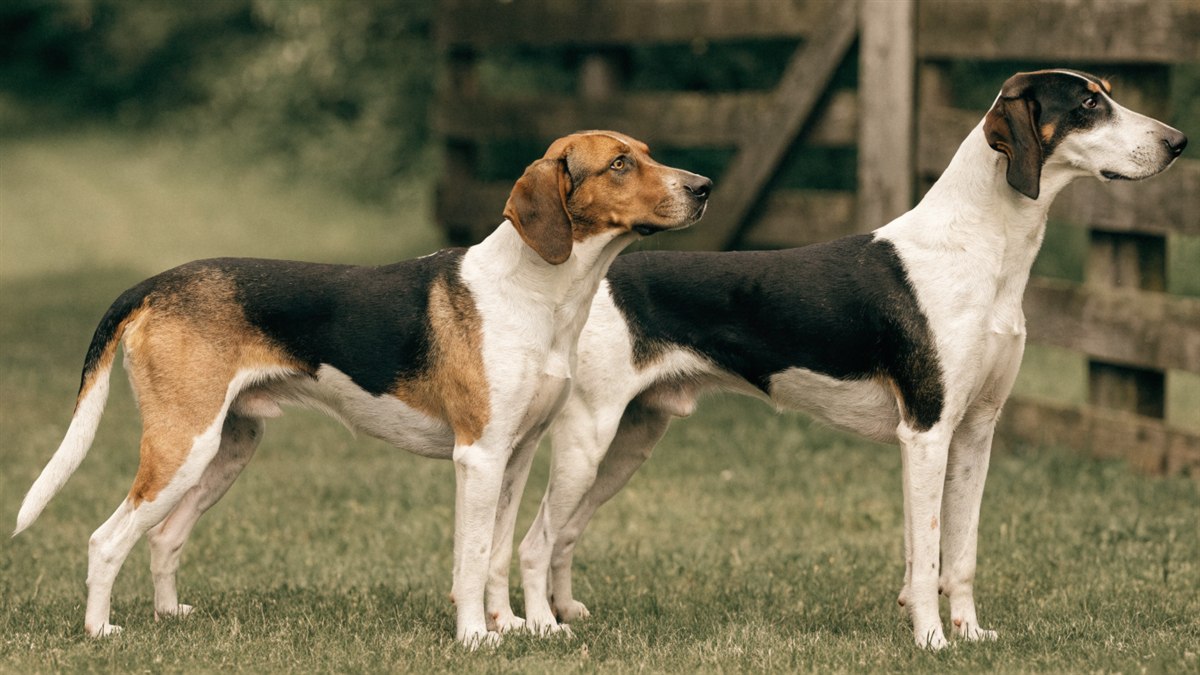
Anglo-French Hound is not a single breed. The name covers four French breeds recognised by the FCI, standards 322, 323 and 324 for the three Grand Anglo-Francais and standard 325 for the Anglo-Francais de Petite Venerie. They share a breed club and a job, not a standard, and their heights run 48 to 72 cm. None of the four is registrable, purchasable or adoptable in India.
This guide is general information for Indian pet owners and is not a diagnosis. Consult a veterinarian registered under the Indian Veterinary Council Act before acting on anything you read here, and treat collapse, laboured panting after exercise, a head held tilted, a foul smell from an ear or blood in the ear canal as urgent rather than as something to watch overnight.
Anglo-French Hound at a glance
Anglo-French Hound names four breeds, not one dog
Anglo-French Hound is not a breed. The name covers four separate breeds recognised by the Federation Cynologique Internationale under four separate standard numbers, and no FCI standard anywhere is titled simply Anglo-French Hound. Read that sentence before you read any price, any weight or any temperament claim attached to the term.
The four sit in FCI Group 6, Scent hounds and related breeds, all of them from France, all of them carrying CACIB and a working trial. Their official English names, which is where the confusion starts, all contain the words Anglo-French Hound.
| FCI standard | French name | Official English name | FCI section | Nomenclature date |
|---|---|---|---|---|
| 322 | Grand Anglo-Francais Tricolore | Great Anglo-French Tricolour Hound | 1.1 Large-sized Hounds | 27/01/1983 |
| 323 | Grand Anglo-Francais Blanc et Noir | Great Anglo-French White and Black Hound | 1.1 Large-sized Hounds | 04/11/2008 |
| 324 | Grand Anglo-Francais Blanc et Orange | Great Anglo-French White and Orange Hound | 1.1 Large-sized Hounds | 01/08/2023 |
| 325 | Anglo-Francais de Petite Venerie | Medium-Sized Anglo-French Hound | 1.2 Medium-sized Hounds | 26/01/1983 |
Three of the four sit in Section 1.1 and one sits in Section 1.2, so the group does not even occupy a single section of the nomenclature it belongs to. That matters more than it sounds. FCI sections are size classes, and a classification body that considered these four one thing would not have split them across two.
Which one is the page you just read about
Every page ranking for this term describes exactly one of the four and titles itself with the group name. Royal Canin's page is headed Medium-Sized Anglo-French Hound and is about breed 325. Brit's page carries the same English name and the same breed. The United Kennel Club's page is about breed 322 and calls it the Great Anglo-Francais Tricolor Hound. Wisdom Panel's page is also breed 322. Open two of them and you have read about two different dogs, 12 to 22 cm apart at the withers, with no page telling you so.
Bonbeno already publishes a full guide to one of the four. If breed 325 is the dog you actually mean, read the Anglo-Francais de Petite Venerie profile instead, which carries its standard, its studbook numbers and its Indian heat rating in detail. This page is about the group, the differences between its members, and the fact that the group is a naming convention rather than a breed.
A wider family sits behind the four
The Anglo-Francais breeds are the crossed half of a seven-breed French family. The other three are the Chien Francais Blanc et Noir, the Chien Francais Blanc et Orange and the Chien Francais Tricolore, which carry no Anglo prefix because they are the older French lines rather than the Foxhound crosses. Those three also hold FCI numbers, 220, 316 and 219, and sit in the same Section 1.1 alongside the Grands.
Bonbeno will not print a single height, weight, lifespan or temperament figure for the Anglo-French Hound, because there is no animal for such a figure to describe. Where the four differ, the differences are tabulated. Where they genuinely share something, that is said and sourced. Any page that gives you one set of numbers under this name has silently chosen one of four breeds and not told you which.
The four standards compared clause by clause
Read the four standards side by side and the group falls apart on size, on ear, on colour and on purpose. Every figure below comes from the FCI standard PDF for that breed, with the breed name confirmed printed inside the document before any number was taken from it.
Start with size, because it is the clause a buyer feels first. The three Grands stand 60 to 72 cm at the withers and the Petite Venerie stands 48 to 56 cm Federation Cynologique Internationale Federation Cynologique Internationale Federation Cynologique Internationale. At the extremes that is a 24 cm gap between a 48 cm hound and a 72 cm hound, which is roughly the difference between a Beagle and a Great Dane bitch in the same conversation.
| Breed | Height at the withers | Utilization as printed | Coat colour required |
|---|---|---|---|
| Grand Anglo-Francais Tricolore (322) | 60 to 70 cm | Scenthound | Tricolour, black blanket or spread black patches, bright or copper tan |
| Grand Anglo-Francais Blanc et Noir (323) | Males 65 to 72 cm, females 62 to 68 cm, tolerance 1 cm | Pack Hound for big game | Obligatory white and black. A tricolour coat is a disqualifying fault |
| Grand Anglo-Francais Blanc et Orange (324) | 60 to 70 cm | Scenthound | White-lemon or white-orange, orange not too dark tending to red |
| Anglo-Francais de Petite Venerie (325) | 48 to 56 cm, tolerance 2 cm for exceptional subjects | Scenthound for hunting small game | Tricolour, or white and black with pale tan, or bicolour white and orange with a tobacco nose |
Colour is not a preference in this group, it is the discriminator. Standard 323 lists a tricolour coat under disqualifying faults, alongside aggression and physical abnormality. So a dog that would be a correct Grand Anglo-Francais Tricolore is, in the white and black ring, a disqualification. Two of the four breeds are separated by a fault clause rather than by anything a vet could measure.
The ear clause differs on every single one
Each standard writes the ear differently, and the differences are mechanical rather than cosmetic. Standard 322 asks for leathers of medium length, broadly set at eye level, flat then slightly curled. Standard 323 asks for a set-on at eye level, relatively flat then curling, of medium length, and adds an upper limit, that when pulled forward the leathers should not reach further than two fingers before the base of the nose leather, with rather pointed tips. Standard 324 asks for ears set on quite broadly at eye level or slightly above, quite thick, slightly turned in and rather short.
Standard 325 goes the other way. It requires leathers finely attached below the eye level line, flexible, slightly turned, of medium width, and reaching at least by two fingers the border of the nose. So the smallest of the four is the only one set below the eye, and the only one with a written minimum length rather than a maximum. On the standards' own wording, the Petite Venerie carries the most enclosing ear carriage in the group, not the least. That inverts the assumption most readers arrive with, and it is the single most useful thing in this section for anyone thinking about Indian humidity.
Two clauses exist on only one of the four
Standard 323 is the only one of the four that carries a Brief Historical Summary, an Important Proportions clause and a Behaviour and Temperament clause. The other three have none of those three headings at all Federation Cynologique Internationale Federation Cynologique Internationale. That is why every temperament description you will read about these dogs traces back to the same place, and it is not a shared standard.
Standard 324's General Appearance describes a dog showing more English blood in his head than his tricolour colleague. That single phrase is the only cross-reference between any two of the four documents. Four standards, published across forty years, and one sentence connecting them.
Is there a shared Anglo-French Hound standard? No, and here is what is shared instead
No shared standard exists. The FCI publishes four separate documents with four different translators, four different publication dates spanning 1983 to 2023, and no common text. What the four genuinely share is a breed club, a description written by that club's registry, and a job.
Take the documents first. Standard 322 was translated by Mrs Peggy Davis with an English text dated 18.06.1996 over a standard published 27.01.1983. Standard 323 was revised by J. Mulholland with R. Triquet, English text 12.01.2009 over a standard published 04.11.2008, and its own text credits the 2007 drafting to M. Pierre Astie, President of the Club du chien d'ordre. Standard 324 is Peggy Davis brought up to date by Dr J.-M. Paschoud, English text 6.10.2023 over a standard published 01.08.2023. Standard 325 is Peggy Davis again, English text 28.04.1997 over a standard published 26.01.1983 Federation Cynologique Internationale Federation Cynologique Internationale Federation Cynologique Internationale. Four authors, four dates, forty years apart at the ends.
What the country of origin does share
The Societe Centrale Canine, the French kennel club, writes one description of the Anglo-Francais and pastes it onto each breed page. The Comportement paragraph on the Grand Anglo-Francais Tricolore page, the Blanc et Noir page and the Blanc et Orange page is the same text, in each case about L'Anglo-Francais rather than about the individual breed Societe Centrale Canine. It reads that English blood brought the construction, the bone and the vigour, French blood the nose and the voice, and that the Anglo-Francais is a hunting fanatic, resistant, courageous, powerful, fast and tenacious, whose education must be firm.
The Vivre en ville paragraph is likewise identical across all three, and it is blunt. Les Anglo-Francais ne sont pas adaptes a la vie en ville. Chiens de meute, ils vivent en chenil. Il leur faut de l'espace et de l'exercice Societe Centrale Canine. Anglo-French hounds are not suited to city life, they are pack dogs, they live in a kennel, and they need space and exercise. That is the registry of the country of origin saying, in one sentence and about all of them at once, that this is not a house dog.
All four are also registered by the same breed club, the Club du Chien d'Ordre, which the Societe Centrale Canine names on each of the three Grand breed pages Societe Centrale Canine. A chien d'ordre is a pack hound bred to hunt in an organised pack, and that shared club is the closest thing to a shared definition the group has.
Where even the shared source contradicts itself
The Societe Centrale Canine gives the Grand Anglo-Francais Blanc et Noir a weight of environ 25 kg for a dog standing 62 to 72 cm, and gives the Grand Anglo-Francais Blanc et Orange a weight of 30 a 35 kg for a dog standing 60 to 70 cm Societe Centrale Canine. The taller breed is given the lighter weight, by the same registry, on pages updated the same day. The Tricolore page records the weight as NP, not provided.
None of those three weights appears in any FCI standard, because not one of the four standards states a weight at all Federation Cynologique Internationale Federation Cynologique Internationale Federation Cynologique Internationale. Neither does any of them state a life expectancy. So every weight and every lifespan you will see quoted for an Anglo-French Hound comes from somewhere other than the breed standard, and on the registry's own pages two of those numbers cannot both be right.
There is no single Anglo-French Hound breed. There are four FCI breeds, numbers 322, 323, 324 and 325, sharing a country, a breed club, a job and a naming convention, and sharing no standard, no measurement clause, no weight and no lifespan. Anyone who tells you the Anglo-French Hound stands a certain height has chosen one of four and not said which.
Where the name came from, and what Grand and Petite Venerie actually mean
The Anglo-Francais label marks a cross, not a breed. Every source agrees the name was applied to French hounds that had been crossed with the english foxhound, and the most-repeated account puts the renaming in 1957. Two of the three naming claims that circulate can be tested against the standards, and one of them does not survive the test.
The standard account says the names replaced older names in 1957, when it was decided to append Anglo-Francais to the names of all the French hounds that had been crossed with English Foxhounds. Bonbeno cannot verify that date. The claim rests on a single offline reference, Clark and Brace, The International Encyclopedia of Dogs, Howell Book House 1995, page 87, and no FCI standard, no Societe Centrale Canine page and no registry document Bonbeno opened states a 1957 renaming. Treat the year as widely repeated rather than as established.
The crossing itself is much better attested. Standard 323's own Brief Historical Summary says the breed originates from the Batard Anglo-Saintongeois, a type that appeared in the middle of the nineteenth century as the result of a cross between the Saintongeois and the Foxhound. The Societe Centrale Canine dates the first crosses very probably to the sixteenth century and the peak of the type to the late nineteenth century under the grands maitres veneurs. Wisdom Panel puts the Tricolore's creation in France in the 1800s from English Foxhounds crossed onto native scent hounds from the west of France.
The Grand claim, tested against the nomenclature
The most-copied claim about this group is that Grand does not mean the dogs are especially large, but rather that they hunted in large packs. That may well be true as etymology, and it is also cited to the same unverifiable 1995 page. What a reader must not take from it is that the Grands are ordinary-sized dogs.
The FCI's own nomenclature settles the practical question. All three Grands are filed in Section 1.1, large-sized Hounds, and the Petite Venerie is filed in Section 1.2, Medium-sized Hounds. The size clauses match the filing exactly, at 60 to 72 cm against 48 to 56 cm Federation Cynologique Internationale Federation Cynologique Internationale Federation Cynologique Internationale. So whatever the word meant to the veneurs who chose it, in the classification that governs these breeds today Grand tracks size and the difference is 12 to 16 cm at the withers.
The Venerie half is about the hunt, and it checks out
De Petite Venerie refers to dogs used on smaller game such as rabbits and hares, not to the size of the dog. That claim, unlike the other two, can be checked against a government source. The French Senate's 2023 report on hunting with hounds defines venerie as hunting an animal only with the help of a pack of dogs trained for it and specialised on a single animal, and it splits the practice in two. La grande venerie is practised on horseback for stag, roe deer and wild boar. La petite venerie is practised on foot for fox, hare and rabbit.
Now read the utilization clauses again. Standard 323 gives Pack Hound for big game, which is grande venerie. Standard 325 gives Scenthound for hunting small game, which is petite venerie Federation Cynologique Internationale. The Societe Centrale Canine calls the Blanc et Noir a chien de grande et petite venerie, working both. The names describe the hunt, the hunt describes the dog, and the whole group is organised around a French field sport that has roughly 400 equipages and 10,000 veneurs.
Anglo-Francais de Moyenne Venerie is sometimes advertised, and it appears to have been invented in North America. It holds no FCI number, appears nowhere in the Group 6 nomenclature, and if an Indian seller offers you one you are being offered a name rather than a registered breed.
French studbook numbers for all four, and why three of them read zero
The French studbook registered 147 Anglo-Francais de Petite Venerie in 2025, 0 Grand Anglo-Francais Tricolore, 0 Grand Anglo-Francais Blanc et Noir, and carries no row at all for the Grand Anglo-Francais Blanc et Orange. Those zeros are real, they are not evidence that three breeds have died out, and the reason is worth more than the numbers.
The Livre des Origines Francais is the official French studbook, and the Societe Centrale Canine publishes the full table by breed and FCI group every year. Bonbeno read the 2023 and 2025 editions directly, which between them cover four consecutive years.
| Breed | 2022 | 2023 | 2024 | 2025 | Four-year total |
|---|---|---|---|---|---|
| Anglo-Francais de Petite Venerie (325) | 140 | 160 | 125 | 147 | 572 |
| Grand Anglo-Francais Tricolore (322) | no row | no row | 65 | 0 | 65 |
| Grand Anglo-Francais Blanc et Noir (323) | 12 | 0 | 33 | 0 | 45 |
| Grand Anglo-Francais Blanc et Orange (324) | no row | no row | no row | no row | 0 |
| Beagle, for calibration | 6,101 | 4,342 | 3,514 | 3,089 | 17,046 |
| Whole of FCI Group VI in France | 16,153 | 13,508 | 12,894 | 11,720 | 54,275 |
Read the Beagle row first, because it is what a familiar number looks like. France registered 3,089 Beagles in 2025. It registered 147 Anglo-Francais de Petite Venerie the same year, which is one for every 21 Beagles, and it registered no Grand Anglo-Francais of any colour at all. Across four years the Beagle total is 17,046 and the three Grands together total 110.
The zeros are a registration artefact, and the standard proves it
Standard 323 states that the Grand Anglo-Francais Blanc et Noir presently counts approximately 2,000 subjects with around 200 births per year, making up the packs of twenty or more deer hunts and one stag hunt. The Societe Centrale Canine repeats the same figures in French on its own breed page. Do the arithmetic. Around 200 births a year over four years is roughly 800 puppies. The LOF recorded 45 registrations for that breed in the same four years Societe Centrale Canine, which is about 5.6 percent of them.
That gap is the finding. French pack hounds are bred inside hunting equipages for work, and the great majority are simply never entered in the studbook as individuals. A LOF count for a chien d'ordre measures paperwork, not population. The Societe Centrale Canine says as much in its own way when it describes these dogs as pack dogs that live in a kennel rather than as household animals.
The lumpiness confirms it. The Grand Anglo-Francais Tricolore carried no row in 2022 or 2023, then 65 registrations in 2024, then zero again in 2025 Societe Centrale Canine. A breed does not appear from nothing and vanish again in three years. A kennel entering one batch of paperwork does exactly that.
One breed genuinely has nothing
The Grand Anglo-Francais Blanc et Orange is the exception, and it is worth stating carefully. It carries no row in either the 2023 or the 2025 table, meaning no registrations and no confirmations in 2022, 2023, 2024 or 2025 Societe Centrale Canine. Its FCI standard was freshly republished on 01.08.2023, with a new English translation dated 6.10.2023. So the FCI updated the paperwork for a breed that its country of origin has not registered a single individual of in four years.
France registers a puppy at birth and confirms the adult separately, so the LOF prints both. In 2025 the Anglo-Francais de Petite Venerie shows 76 confirmations against 147 registrations, which the table rounds to 52 percent, and 76 of 147 is 51.7 percent. The Beagle shows 822 of 3,089, printed as 27 percent, and 822 of 3,089 is 26.6 percent. A working pack breed confirms at roughly twice the rate of a companion breed, because confirmation is what a working kennel needs and a pet owner mostly does not.
Anglo-French Hound price in india: there is no price, and here is what you are actually shown
No Anglo-French Hound has a price in india, because no Anglo-French breed is traded here. A search for the term from an Indian location returns ten results and not one of them is a dog. Bonbeno ran a control in the same session to prove the search works, and it does.
Search anglo french hound price in india with location set to India and the commercial results are a Kindle book on Amazon.in, a second Amazon.in book about the Great Anglo-French Tricolour Hound, an eBay UK paperback, two Etsy phone cases printed with a Great Anglo-French Hound illustration, and a stock-vector page. The organic results are Wikipedia, a breed-list site and two Facebook posts. Not one listing offers a puppy.
That absence is earned rather than assumed. The same search tool, in the same session, run on labrador retriever price in india, returned Indian listing pages immediately, including one publishing an average of 30,000 to more than 1,20,000 rupees split into Basic quality at 30,000 to 60,000 rupees, KCI Registered at 60,000 to 90,000 rupees and Champion Bloodline at 90,000 to 1,20,000 rupees, with the same band repeated for Hyderabad, Bangalore, Delhi, Chennai, Lucknow, Mumbai, Jaipur and Pune. The instrument finds Indian puppy listings when Indian puppy listings exist.
98,999 rupees is a shop price point, not a valuation of any breed. One Indian puppy-selling site prints it three separate times on a single Anatolian Shepherd page, alongside 92,599 rupees twice, 94,999 rupees, 120,000 rupees and 76,499 rupees, every one badged Platinum, and prints the identical 98,999 rupees on its Double Coat German Shepherd page for a completely different dog. The number attaches to whatever puppy is in stock. If it is ever quoted to you for an Anglo-French hound, it tells you about the seller's pricing template and nothing about the dog.
Run the 84.38 test on any rupee figure you are given
Indian pages routinely publish a US dollar figure run through one exchange rate and call it an Indian price, and this site has caught it at exactly 84.38 rupees to the dollar three times. Divide the number and see whether a round dollar amount falls out. Do it with the figures above and none of them resolves.
| Rupee figure printed | Divided by 84.38 | Round dollar amount? |
|---|---|---|
| 98,999 | 1,173.25 | No |
| 94,999 | 1,125.85 | No |
| 92,599 | 1,097.40 | No |
| 76,499 | 906.60 | No |
| 1,20,000 | 1,422.14 | No |
So these are not converted dollar prices. They are Indian charm prices, ending in 999, 599 and 499, set by a shop rather than derived from anything. Both diagnoses point the same way. Neither a converted dollar figure nor a shop price point tells you what a particular breed is worth, and for a breed with no Indian population neither could.
What a legitimate Indian price would have to look like
For calibration, India's most-cited price page puts 2026 dog prices between 2,000 rupees for an indie or native dog and over 1,50,000 rupees for a KCI-registered show-quality dog. A genuine Anglo-French price would have to sit somewhere on that scale and be backed by a KCI registration, an FCI-recognised pedigree from the Societe Centrale Canine, and a lawful import. None of those three exists for these breeds in India, which is the subject of the next section.
Bonbeno reports published prices as editorial content and does not broker sales, recommend breeders or link listings. On this breed group there is nothing to report, and that is the honest answer rather than a gap.
Indian law closes both routes at once, so no supply chain can form
Two Indian instruments between them make a lawful Anglo-French trade impossible. Import law blocks bringing one in to breed or sell, and the breeding rules prohibit the exact practice that created these breeds in the first place. Read both before you believe any offer.
Take the border first. Dogs enter India under ITC (HS) 01061900, which is classified Restricted. Policy Condition 7 of the governing trade notice allows dog imports for only three purposes, a pet dog with a valid pet book and records in the name of the importer, dogs imported by R&D organisations with a CPCSEA recommendation, and dogs for internal security by the Defence and Police Force. Policy Condition 8 states that import of commercial dogs for breeding or any other commercial activity outside those purposes is not permitted, and paragraph 6 of the same notice says that any applications for trading or breeding purposes shall be duly rejected.
Paragraph 7 limits entry to the airports and seaports of Delhi, Mumbai, Chennai, Hyderabad, Bangalore and Kolkata, with quarantine at the port where required. DAHD added a seventh port, Cochin International Airport at Kochi, for pets arriving under the baggage rules in October 2024. So the only lawful way an Anglo-French hound reaches India is in the hands of a person who already owned it abroad and is moving here, through one of seven ports, with a pet book in their own name. That route produces individual animals. It cannot produce a breeding population. The full route is set out in how to import a dog to India.
The 2017 Rules prohibit the thing that made this group
Now the domestic side, and this is the clause nobody quotes. Paragraph 6(9) of Part II of the Second Schedule to the Prevention of Cruelty to Animals (Dog Breeding and Marketing) Rules, 2017 provides that breeding to create new breeds of dogs or unusual looks shall be strictly prohibited. The Anglo-Francais breeds exist because nineteenth-century French breeders deliberately crossed English Foxhounds onto French hounds to make new breeds Wisdom Panel, Grand Anglo-Francais…. An Indian breeder who set out to repeat that programme here would be doing precisely what paragraph 6(9) forbids.
The same paragraph 6 also settles how a registered Indian breeder may mate dogs at all. Sub-paragraph 6(2) permits only out breeding, the mating of dogs not at all related to one another, and line breeding, mating between dogs marginally related to each other. Sub-paragraph 6(3) prohibits in breeding and incest breeding outright. A tiny imported founder population cannot be managed inside those limits, because a handful of related dogs leaves nothing to out-cross to.
| Gate | What it requires | Status for this breed group |
|---|---|---|
| Import purpose | Pet book in the importer's own name, or CPCSEA research, or Defence and Police use | Only the personal-pet route is open. Trading and breeding applications shall be duly rejected |
| Port of entry | Delhi, Mumbai, Chennai, Hyderabad, Bengaluru, Kolkata or, since October 2024, Kochi, with quarantine where required | Open, but only for an individual accompanied animal |
| Breeding programme | Out breeding and line breeding only, no in breeding, and no breeding to create new breeds | A founder group small enough to import cannot be bred lawfully |
| Registration | KCI registration for a pedigree an Indian buyer can check | The Kennel Club of India registered 33,880 dogs across all breeds in 2025, and no Anglo-Francais route is published |
The registry context matters for scale. The Kennel Club of India registered 33,880 pure-bred dogs with its studbook in 2025, down from a peak of 89,571 in 2021. A national studbook shrinking by 62 percent in four years is not about to absorb four French pack breeds that their own country registers in single or double digits.
If someone in India offers you an Anglo-French hound, one of four things is true. They are selling a different breed under a French name, they are selling a crossbreed, they are running an auto-generated page that exists identically for every breed on the FCI list, or they are proposing an import that the trade notice says shall be duly rejected. Ask for the FCI standard number they mean, 322, 323, 324 or 325, and watch what happens.
What one would cost to keep in India, bounded honestly
No Indian owner cost exists for these breeds, because no Indian population exists to survey. What can be bounded is the cost of keeping a 25 to 35 kg working pack hound in an Indian city, using published Indian cost bands for a dog of that size and adding the two line items this group forces on you.
Start from the published Indian ladder. Monthly upkeep for a dog runs 3,000 to 18,000 rupees depending on size and grooming needs, average monthly maintenance sits between 3,000 and 11,000 rupees, and a first year should be budgeted at 80,000 to 2,00,000 rupees. The largest size band in that source totals 12,000 to 20,000 rupees a month against 4,000 to 8,000 rupees for the smallest. All three Grands sit in the largest band by height, and the Petite Venerie sits a band below Federation Cynologique Internationale.
| Line item | Monthly rupees | Why this group changes the number |
|---|---|---|
| Food for a 25 to 35 kg working dog | 4,000 to 10,000 | A hound worked hard eats at the top of the band, and a hound not worked at all still eats at the bottom of it |
| Routine veterinary care | 1,000 to 3,000 | No Indian vet has seen this breed group, so first consultations run longer |
| Tick and flea prevention | 500 to 1,000 | Non-negotiable, not optional. See the tick data below |
| Ear care supplies | 200 to 500 | A weekly routine on a drop-eared hound, twice weekly through the monsoon |
| Grooming | 500 to 1,200 | Short coat, so this is the one line the group makes cheaper |
| Training and secure fencing amortised | 2,000 to 5,000 | Recall on a scenthound is a fencing problem before it is a training problem |
| Realistic monthly total | 8,200 to 20,700 | Consistent with the published large-dog band of 12,000 to 20,000 rupees |
The tick line is the one Indian owners underfund
Parasite prevention is not a discretionary line for a dog kept outdoors in India. A survey of 525 dogs across four Indian locations found 261 of them, 49.7 percent, infected with one or more tick-borne pathogen by PCR, with ticks visible on 278 dogs, 53 percent. Divide it out and both figures hold, at 261 of 525 and 278 of 525. The commonest pathogen was Hepatozoon canis at 30 percent, followed by Ehrlichia canis at 20.6 percent, and 39 percent of infected dogs carried more than one pathogen at once.
The geography inside that study is the part that matters for a kennel-housed pack hound. Tick infestation ran at 80 percent of 162 dogs in Mumbai and 75.3 percent of 162 in Delhi, against 17 percent of 101 in Sikkim and 11 percent of 100 in Ladakh. The four counts sum to 525. Warm and humid means ticks, and a dog housed in an outdoor run in a coastal Indian city is in the 80 percent bracket by default.
The 49.7 percent figure comes from a population that was 77 percent strays and 23 percent shelter dogs, not owned pets on year-round prevention. It is not the risk faced by a well-managed household dog. It is the pathogen pressure present in the environment, which is exactly the number you want when you are deciding whether to fund prevention.
Two costs Bonbeno will not estimate are the purchase price and the import. There is no Indian price to quote, and an import for anything other than a personal pet move is not lawful, so any figure would be invented.
Heat tolerance in India: Bonbeno rates this group 2 of 5
Bonbeno rates the Anglo-French hounds 2 of 5 for heat tolerance in Indian conditions. The rating is not about the coat, which is short on all four. It is about the gap between the climate these dogs were built in and the climate they would be asked to run in, and that gap can be stated as a number.
One source, one method, and the coordinates printed so anyone can repeat it. Bonbeno queried NASA's Prediction Of Worldwide Energy Resources climatology by explicit latitude and longitude on 23 August 2026, for monthly mean air temperature at two metres and monthly mean relative humidity. The origin point is Saintes in Charente-Maritime at 45.7460 N, 0.6320 W, the Saintonge country whose hound is named in standard 323's own history as one half of the founding cross. Querying by coordinates rather than by place name matters, because a slug can silently serve you the wrong town and a latitude cannot.
| Location and coordinates | Warmest month mean | Coolest month mean | Annual mean | Annual mean humidity | Warm-and-humid months |
|---|---|---|---|---|---|
| Saintes, Charente-Maritime, France, 45.7460 N 0.6320 W | 21.17 C in August | 5.69 C in January | 13.11 C | 79.67% | 0 of 12 |
| Chennai, Tamil Nadu, 13.0827 N 80.2707 E | 31.51 C in May | 24.09 C in January | 27.95 C | 72.39% | 7 of 12 |
| New Delhi, 28.6139 N 77.2090 E | 35.88 C in June | 13.61 C in January | 25.60 C | 45.56% | 1 of 12 |
One line does the whole argument. Chennai's coolest month is warmer than the French origin's hottest month, by 2.92 C. January in Chennai averages 24.09 C. August in Saintes averages 21.17 C. A dog whose entire breed history happened below 21.2 C would meet nothing that cool in Chennai in any month of the year. Delhi is the other shape of the same problem: its June mean of 35.88 C runs 14.71 C above the French maximum.
Humidity is not the difference, and saying so is honest
Anglo-French country is damp. Saintes has a higher annual mean relative humidity than Chennai does, at 79.67 percent against 72.39 percent. So the ear-and-skin argument on this page cannot rest on humidity alone, and any page telling you these dogs come from a dry climate is wrong. What India adds is not moisture, it is heat on top of moisture. Saintes never gets a month that is both above 20 C and above 70 percent humidity. Chennai gets seven.
The purpose is what pulls the rating down to 2
Construction alone would score better. All four standards describe a short coat, a normal-length muzzle and an athletic frame without heaviness Federation Cynologique Internationale Federation Cynologique Internationale Federation Cynologique Internationale, so none of these dogs is on the wrong side of the brachycephalic line that the largest primary-care study of canine heat illness identifies, where brachycephalic dogs had greater odds of all three types of heat-related illness compared with mesocephalic dogs.
The same study explains why that is not enough. Reviewing 905,543 dogs under UK veterinary care, it found 1,259 heat-related illness events from 1,222 dogs. Of the 879 events with a trigger recorded, 652, or 74.2 percent, were exertional, against 113 environmental events at 12.9 percent and 46 from vehicular confinement at 5.2 percent. Divide them out and all three hold against 879. Heat illness in dogs is overwhelmingly something that happens while the dog is working, and these are dogs bred to work until the quarry stops.
India's own heat calendar closes the window further. The India Meteorological Department declares a heat wave when a station's maximum reaches at least 40 C in the plains or at least 30 C in hilly regions, heat waves typically run March to June and in rare cases into July, northern India averages five to six events a year, and May is the peak month. That is a four-month block in which a pack hound cannot be run in daylight, followed by a monsoon in which the humidity blocks the evaporative cooling that panting depends on.
The rating is not 1 of 5 because the anatomy genuinely helps. A short-coated, normal-muzzled, lean hound will cool better than a Pug or a French Bulldog in the same Indian afternoon. It is not 3 or 4 because the dog will not stop when it is hot, and because the hilly-region heat wave threshold of 30 C sits 9 C above the warmest monthly mean this group evolved under NASA Prediction Of Worldwide Energy…. Anatomy helps. Purpose cancels it.
Long-eared scenthound ear load in Indian humidity
All four Anglo-French breeds carry a drop ear over the canal, and drop ears cost you. The largest primary-care study of canine ear disease puts pendulous ear carriage at 1.76 times the odds of otitis externa compared with erect ears, and the Indian seasonal pattern loads that risk into the months an Indian owner relaxes.
Start with the standards, because the risk is written into them. Standard 322 asks for leathers of medium length set broadly at eye level, flat then slightly curled. Standard 323 asks for the same set-on, curling towards the end, capped so the leathers do not reach further than two fingers before the base of the nose. Standard 324 asks for ears quite thick, slightly turned in and rather short. Standard 325 asks for leathers attached below the eye level line and reaching at least by two fingers the border of the nose Federation Cynologique Internationale Federation Cynologique Internationale Federation Cynologique Internationale. Not one of the four permits an erect ear.
The UK evidence attaches a number to that. A VetCompass random sample of 22,333 dogs, drawn from 905,554 dogs under primary veterinary care in 2016, found a one-year period prevalence of otitis externa of 7.30 percent, with a 95 percent confidence interval of 6.97 to 7.65. Compared with breeds carrying erect ears, breeds with pendulous ear carriage had 1.76 times the odds (1.48 to 2.10) and breeds with V-shaped drop ear carriage had 1.84 times the odds (1.53 to 2.21) of otitis externa. Both intervals sit clear of 1, so the effect is real rather than noise.
The smallest of the four carries the biggest ear problem
Read the ear clauses as engineering and the ranking inverts. Standard 323 sets a maximum ear length, stopping the leather two fingers short of the nose. Standard 324 calls the ear rather short. Standard 325 sets a minimum, requiring the leather to reach at least two fingers past the border of the nose, and it is the only one of the four attached below the eye line Federation Cynologique Internationale. A longer leather hung lower covers more of the canal opening and ventilates less of it. On the standards' own wording the 48 to 56 cm Anglo-Francais de Petite Venerie has the most enclosing ear carriage in the group, and the 65 to 72 cm Blanc et Noir has the least.
Indian seasonality moves the risk into the cool months
The most detailed recent Indian series screened 2,476 dogs presented to the veterinary clinics at Palampur, Himachal Pradesh between June 2022 and July 2023 and diagnosed otitis externa in 81, a hospital prevalence of 3.27 percent. Divide it out and 81 of 2,476 is 3.271 percent, so the headline holds. Its season table splits those 81 cases into 48 in the rainy months of July and August at 59.25 percent, 15 in summer at 18.51 percent, 10 in winter at 12.34 percent and 8 in autumn at 9.87 percent. The four counts sum to 81 and every percentage divides out.
Nearly six ear infections in ten arrived in a two-month window. For an Indian owner that is counter-intuitive, because the monsoon is when the temperature finally drops and the dog seems comfortable. It is also when the canal under a drop ear stops drying between wettings.
| Where the dog lives | Warm-and-humid months a year | Ear checks Bonbeno recommends |
|---|---|---|
| Saintes, the origin climate | 0 | Weekly, which is what the overseas advice assumes |
| New Delhi | 1 | Weekly, moving to twice weekly through August |
| Chennai and the humid coast | 7 | Twice weekly for seven months of the year, weekly for the rest |
Overseas club and registry guidance is written for a climate where air dries things, and Saintes never records a month that is simultaneously above 20 C and above 70 percent humidity. Chennai records seven. Towel a drop-eared hound and leave it, and in an Indian monsoon you have made a warm sealed canal rather than dried one. Plug the ears before any bath, dry the canal and the fold under the leather deliberately afterwards, and treat a head shake as a reason to see a veterinarian rather than a reason to pour something in.
One thing to keep straight. The Palampur figures are proportions of cases, not per-breed risk, because the paper does not publish how many dogs of each breed were among the 2,476 screened. The UK study is the one with a proper population denominator, and it is the one that supports the 1.76 odds ratio.
The Indian ear series everyone quotes has a broken number in it
One figure in the most-quoted Indian otitis series is arithmetically impossible, and Bonbeno divided out every percentage in the paper before using any of them. The paper says 69.13 percent of cases occurred in breeds with pendulous ears while its own table prints the count as 53. Fifty-three of 81 is 65.43 percent, not 69.13 percent. Both cannot be true.
Work out which one is wrong rather than dropping both, because the paper answers the question against itself. Bonbeno checked this independently against the full text rather than inheriting the conclusion from another page on this site.
- The percentage is right and the count is wrong. To produce 69.13 percent from a denominator of 81 you need 56 cases. Fifty-six of 81 is 69.1358 percent, and this paper truncates rather than rounds, so it prints 69.13. Fifty-three of 81 gives 65.4321 percent.
- The other half of the pair confirms it. The same table gives erect ear breed as 25 cases at 30.86 percent, and 25 of 81 is 30.8642 percent, which checks. Now add. Fifty-six plus 25 is exactly 81, the study's own denominator. Fifty-three plus 25 is 78, and three cases go missing.
- The stray 53 is traceable inside the same paper. The aetiology paragraph states that bacterial infections were present in 65.43 percent, and 53 of 81 is 65.4321 percent. The same table's secondary-cause rows give cocci-associated 30 and rod-associated 23, and 30 plus 23 is 53. So 53 is the paper's bacterial-infection count, pasted into the pendulous-ear row, whose true value is 56.
The safe reading is that 56 of the 81 cases, or 69.13 percent, occurred in pendulous-eared breeds. Never quote 69.13 percent alongside the number 53, because they cannot both be true.
Three more figures that do not reconcile
| What the paper prints | Where it appears | What the count actually gives |
|---|---|---|
| Pendulous ear breed, 53, 69.13% | Table 5, predisposing factors | 53 of 81 is 65.43%. The percentage needs 56 |
| Pomeranian 10 and Mongrel 10 at 12.43% | Table 1, breed-wise | 10 of 81 is 12.345%, which truncates to 12.34. The season table prints 12.34 for the same count |
| Pug 8 at 9.80% | Table 1, breed-wise | 8 of 81 is 9.876%, which truncates to 9.87. The season table prints 9.87 for the same count |
| Moisture accumulation in 33.33% of cases | Aetiology prose | 33.33% of 81 needs 27 cases, and no row anywhere in the paper shows 27 |
| Ulceration in 16.8% of cases | Clinical signs prose | 16.8% of 81 is 13.6 cases. No whole number of cases produces 16.8% |
| In a study of 50 cases of Otitis externa | Aetiology opening line | Every fraction that follows is over 81. There is no 50-case subgroup in the paper |
In each of the two breed-table rows the season table is correct and the breed table is not, for the identical count. That is a transposition and a typing slip rather than fabricated data. The 33.33 percent moisture figure has no count behind it at all, while the neighbouring 20.98 percent is anchored to a real row of 17 excessive-moisture cases, and 17 of 81 is 20.9876 percent. Bonbeno uses the 17 and drops the 33.33 percent.
Everything else reconciles with a denominator of 81, and that is worth saying plainly. The 3.27 percent hospital prevalence, all four season rows, all four age rows, both sex rows, hypersensitivity at 37, parasitism at 5, immune-mediated disease at 4, hypothyroidism and viral disease at 2 each, aural polyps at 6, treatment error at 9, fungal at 13, cocci at 30, rods at 23 and mixed infection at 15 all divide out, and the eleven breed rows sum to exactly 81. This is a usable Indian dataset with a handful of typographical faults, not a fabricated one. The fix is to check the arithmetic, not to discard the source.
Why this belongs on an Anglo-French page rather than only on a Basset page. Every ranking page for this breed group is written overseas, and the moment an Indian writer wants Indian ear evidence there are very few series to reach for. This one gets quoted constantly, the broken figure travels with it, and a reader who sees 53 and 69.13 percent side by side on two different sites has no way to know which number to believe. Now they do.
Health issues and life expectancy: two papers, 51 dogs, and no screening data at all
The entire published veterinary literature on the Anglo-French breeds is two papers covering 51 dogs between them, and neither one is a prevalence study. No FCI standard states a life expectancy, no orthopaedic register carries any of the four, and Bonbeno will not borrow a related breed's numbers to fill the space.
Take the literature first, with the search proved before the absence is reported. A PubMed union query for Anglo-Francais or Anglo-French hound returns exactly two records, and Bonbeno opened both to confirm they are about these dogs rather than about something the index rewrote the query into. Controls run in the same session returned Basset Hound at 101 records, Labrador Retriever with hip dysplasia at 54, Beagle with otitis at 10, Braque Francais at 5 and English Foxhound at 1. The index responds to rare French breed names, so two is a real count.
| Study | Dogs | What it measured | What it does not establish |
|---|---|---|---|
| Collignon et al. 2012, Am J Vet Res, PMID 23106473 | 50 | Creatinine against iohexol plasma clearance as estimates of glomerular filtration rate, in Great Anglo-Francais Tricolor Hounds with various degrees of renal function | Nothing about how common kidney disease is in the breed. The dogs were selected for varied renal function to test a method |
| Lange and Beaudu-Lange 2009, J Small Anim Pract, PMID 19527425 | 1 | A septal myocardial abscess in a seven-year-old male great Anglo-French hound with renal failure and urinary infection, which progressed to a fistula and killed the dog | Nothing at all about breed risk. It is a single case report, and the authors present it as the first description of a septal myocardial abscess in any dog |
Both papers involve renal disease, and it would be easy and wrong to read a kidney predisposition out of that. The 2012 study deliberately recruited dogs across a spread of renal function because it needed that spread to compare two measurement methods, so its population is selected rather than representative. The 2009 report is one dog. Two papers, one of them designed around the finding, is a coincidence worth naming and not a risk factor worth publishing.
What the 2012 study does give is the only real denominator this breed group has. Across 50 Great Anglo-Francais Tricolor Hounds, iohexol plasma clearance averaged 3.4 plus or minus 0.8 mL/min/kg against creatinine at 3.0 plus or minus 0.7, the two agreed to within 0.6 mL/min/kg for 34 of the 50 dogs, which is 68 percent, and three dogs had a glomerular filtration rate below 2 mL/min/kg.
No orthopaedic screening data exists, and the search was proved
The Orthopedic Foundation for Animals publishes its full statistics tables inline, covering every breed and every database. Bonbeno retrieved the whole set on 23 August 2026, roughly 2.2 million characters, and searched it case-insensitively. It returns zero occurrences of anglo, zero of venerie and zero of foxhound.
That zero is earned. The same retrieval returns LABRADOR 109 times, BEAGLE 61, BASSET HOUND 45, HARRIER 14 and BRAQUE FRANCAIS 25. The Braque Francais control matters most, because it is a rare French breed with only 135 hip evaluations on file, so the dump plainly does hold rare French breeds when they qualify. OFA's own threshold explains the absence: a breed is not included in the statistics tables until it has at least 100 hip evaluations, or at least 50 for every other database.
| Breed | Hip evaluations | Normal % | Dysplastic % |
|---|---|---|---|
| Braque Francais | 135 | 97.0 | 3.0 |
| Harrier | 416 | 84.4 | 14.7 |
| Beagle | 1,777 | 79.3 | 18.5 |
| Basset Hound | 286 | 57.7 | 39.5 |
| All breeds combined | 1,711,996 | 84.3 | 14.2 |
| Any Anglo-Francais breed | not listed | not listed | not listed |
Not one of the four FCI standards states a lifespan Federation Cynologique Internationale Federation Cynologique Internationale Federation Cynologique Internationale. Royal Canin prints an average life expectancy of 11 to 13 years under the heading Medium-Sized Anglo-French Hound and says its key facts are sourced from the FCI, but the FCI standard for that breed contains no life expectancy clause to source it from, and in any case that page is about breed 325 alone. Bonbeno therefore publishes no lifespan for this group. A missing number is a finding. A borrowed one is a fabrication.
Live registers move, so treat every count above as a reading taken on 23 August 2026 rather than as a fixed property. OFA evaluations accumulate month by month, and a percentage without its sample size beside it cannot be checked later by anyone.
Temperament and household fit: the registry says these are not house dogs
The French kennel club answers the household question for all four breeds at once, in one sentence, and the answer is no. Anglo-French hounds are not suited to city life, they are pack dogs, they live in a kennel, and they need space and exercise. That is the country of origin's own text, printed identically on three separate breed pages.
The shared temperament description is equally direct. English blood brought the construction, the bone and the vigour, French blood brought the nose and the voice, and the Anglo-Francais is a hunting fanatic, resistant, courageous, powerful, fast and tenacious, whose education must be firm Societe Centrale Canine. Read the phrase about French blood bringing la gorge carefully, because gorge in venerie means the hound's voice on a line. Being vocal is a selected trait here, not a training failure.
Only one of the four standards carries a Behaviour and Temperament clause at all. Standard 323 says the breed excels in hunting stag and deer on damp or bushy terrain, that it is a friendly dog, close to humans and easy to manage in the kennels. Notice the setting of that praise. Easy to manage in the kennels is a statement about pack husbandry, not about a dog on a sofa in a Mumbai flat.
Pack size is the fact that decides everything else
These breeds are kept in packs of 20 to 100 dogs, and individual hunting hounds are described as not well suited to be pets because they need a great deal of space, exercise and experienced handling. France runs roughly 400 equipages for the sport these dogs exist to serve, and standard 323 records its breed as making up the packs of twenty or more deer hunts and one stag hunt. A dog selected for 250 generations to work inside a crowd of other dogs is not the same animal as a dog selected to live with one family.
| Household | Verdict | The clause behind it |
|---|---|---|
| Indian apartment | Unsuitable | Not adapted to city life, pack dogs that live in a kennel and need space and exercise |
| Urban house with a small garden | Unsuitable | Same clause. A garden is not the space this means, and a scenthound leaves a garden the moment it finds a line |
| Rural or semi-rural compound with secure fencing and daily hours of running | Possible, if the heat is managed | The only setting in which the exercise clause can honestly be met |
| First-time dog owner | Unsuitable | Education must be firm, and experienced handling is named as a requirement |
| Home with other dogs | Good | Bred to work in packs of 20 to 100 and described as getting along well with other dogs |
| Home with children | Generally good | Described as friendly, close to humans and getting along well with people and kids |
The noise question, answered honestly
A pack scenthound is noisy by design. Voice is one of the two things the French half of the cross contributed, and a hound gives tongue on a line because that is how a handler on a horse a kilometre away knows where the pack is. In a French forest that is the point. In an Indian residential building it is a complaint from the flat below, and the temptation that follows is the one thing an owner must not act on.
Paragraph 6(8) of Part II of the Second Schedule to the Prevention of Cruelty to Animals (Dog Breeding and Marketing) Rules, 2017 strictly forbids de-barking, alongside tail docking, ear cropping, de-clawing, branding, dyeing and any other kind of mutilation of any body part of the pup, and any change of appearance by artificial means. If a dog's voice is a problem you cannot live with, the answer is not to buy the dog. There is no lawful surgical exit.
All four standards list aggressive or overly shy dogs as a disqualifying fault, so a nervous or sharp Anglo-French hound is a departure from every one of the four written types rather than a breed characteristic Federation Cynologique Internationale Federation Cynologique Internationale Federation Cynologique Internationale. If you meet one, the dog is badly bred or badly reared, and both are reasons to walk away.
Training: everything is learnable except recall off a live scent
Train an Anglo-French hound by accepting one limit first. A pack scenthound working a line stops responding to you, and no amount of obedience work removes that, so secure containment does the job that recall cannot. The registry of the country of origin puts it in three words. Education must be firm.
The scent drive is not incidental, it is the half of the animal that French breeding contributed. The Societe Centrale Canine describes French blood as having brought the nose and the voice to the cross, and the breeds are prone to wandering off when following a scent, so it is best to keep them on a lead or in an enclosed area when they are not hunting. That is a US genetics company and a French kennel club arriving at the same conclusion from opposite directions.
A realistic Indian training order
- Fence first, train second. Build and check the boundary before the puppy arrives, not after the first escape. A hound that has once self-rewarded by following a line for two kilometres has learned something you cannot unteach.
- Long line for the first year, without exception. Use a 10 to 15 metre line in open ground so the dog experiences distance without experiencing freedom. Off-lead work in Indian public space is not a training stage this group reaches.
- Train in the dark half of the day. Two usable windows exist in an Indian plains summer, before first light and after full dark, because heat waves run March to June and in rare cases into July. Book training around the thermometer rather than around your calendar.
- Pay with food, not with praise alone. A dog bred to work for the pack and the quarry is not naturally handler-focused, and the currency has to be worth interrupting a scent for.
- Socialise to traffic and crowds early. The origin environment is a kennel and a forest, so an Indian street is a completely novel category and has to be introduced deliberately.
- Teach a settle, not a stay. A pack hound left with nothing to do invents work, and in a house that work is usually vocal.
What the standards will and will not tell you
Standard 323 describes its breed as easy to manage in the kennels, and that is the only trainability statement in any of the four documents. The other three standards contain no behaviour clause at all Federation Cynologique Internationale Federation Cynologique Internationale. So anyone quoting a trainability score for the Anglo-French Hound is quoting an aggregator rather than a standard, and the underlying claim comes from one breed's kennel-management note.
Overseas advice about managing a small population sometimes recommends practices Indian law prohibits. Under paragraph 6(2) and 6(3) of Part II of the Second Schedule to the 2017 Rules, only out breeding and line breeding are permitted, while in breeding and incest breeding are prohibited outright. Rule 8(1)(a) separately requires that pups less than eight weeks in age are not sold. Any Indian source offering you a seven-week-old puppy of any breed is describing an unlawful sale.
One honest limit on this section. No trainer in India has a caseload of Anglo-French hounds, because the studbook figures in the country of origin run to double digits and no Indian population exists. Everything above is inferred from what the standards and the registry say these dogs are for, and it should be read that way.
Daily exercise: the requirement is a pack's requirement, not a walk
The exercise requirement for these breeds is the one written into the sport they serve. A hound in grande venerie runs behind mounted hunters after stag, roe deer or wild boar across a whole day, and standard 323 gives its preferred gait as a supple and extended gallop. No Indian walking routine substitutes for that.
Put concrete numbers on the gap. France runs about 400 equipages and 10,000 veneurs, and packs of these breeds are kept 20 to 100 dogs at a time Wikipedia, Anglo-Francais and Francais. Standard 323's breed makes up the packs of more than twenty deer hunts and one stag hunt. The unit of exercise in that world is a hunting day, several times a week, in a group, over rough ground, in a temperate climate.
What an Indian owner can actually deliver
Two hours of hard aerobic work a day is the honest floor for any of the three Grands, and 90 minutes for the Anglo-Francais de Petite Venerie, split across the two windows the Indian climate leaves open. That is Bonbeno's estimate rather than a published figure, and it is derived from the working role rather than from any study, so treat it as a planning number.
| Season | Morning window | Evening window | What to substitute |
|---|---|---|---|
| November to February | 05:30 to 08:00, the longest usable window of the year | 17:30 to 20:00 | Nothing. This is when the year's real conditioning happens |
| March to June, the heat wave season | Before first light only | After full dark only | Cancel rather than shorten on a declared heat wave day. Indoor scent games instead |
| July to September, the monsoon | Short and early | Short and late | Humidity blocks evaporative cooling, so cut duration even when the thermometer falls. Dry the ears afterwards, every time |
| October | Widening again | Widening again | Rebuild distance gradually rather than resuming last winter's load |
The heat calendar is published, not a matter of opinion. The India Meteorological Department declares a heat wave at 40 C in the plains or 30 C in hilly regions, the season runs March to June and in rare cases into July, northern India averages five to six events a year and May is the peak. Four months of the year are effectively closed to daylight running for this group.
What happens without it
Under-exercised pack hounds do not become calm, they become inventive. Expect fence testing, digging, sustained baying, and the specific failure mode that ends these placements in India, which is a dog that clears a boundary on a scent and is gone. The registry's own line covers the whole risk in nine words. They need space and exercise.
Of 879 canine heat-related illness events with a recorded trigger in a study of 905,543 dogs, 652 were exertional, which is 74.2 percent, against 113 environmental at 12.9 percent and 46 from vehicular confinement at 5.2 percent. Heat kills working dogs while they are working. A breed whose written purpose is an extended gallop after big game is the exact population that statistic describes, and the fact that the coat is short changes nothing about it.
Grooming a short-coated pack hound in Indian humidity: the coat is easy, the ears are not
Coat care for all four Anglo-French breeds takes about ten minutes a week, because every one of the four standards specifies a short coat and none describes an undercoat, feathering or a skin fold. The grooming work on this group is almost entirely ear carriage management, and that work is not optional in India.
The coat clauses are nearly interchangeable. Standard 322 gives hair short, more or less strong. Standard 323 gives short, quite strong and dense. Standard 324 gives short and not too thick. Standard 325 gives short, dense and smooth Federation Cynologique Internationale Federation Cynologique Internationale Federation Cynologique Internationale. Standard 325 adds a skin clause that is genuinely good news in a humid climate, describing the skin as fine, without folds, with firm tissues, and it lists loose skin tissue as a fault.
So the routine is a rubber curry mitt twice a week, a full check of the skin under the elbows and between the toes after every wet walk, and nail trimming every three to four weeks. Bathing should be occasional rather than scheduled, because a short-coated hound with no fold has very little that needs washing and a great deal that needs staying dry.
The ear routine, week by week
- Lift and look, twice a week from November to February, and twice a week minimum through the monsoon. You are checking for redness, smell, discharge and heat.
- Plug the ears before any bath and dry the canal afterwards. Never towel a drop-eared hound and leave it to air dry in an Indian monsoon, because Chennai records seven months a year that are simultaneously above 20 C and above 70 percent humidity and Saintes records none.
- Dry the fold under the leather separately from the canal. They are two different wet surfaces and a towel over the top reaches neither.
- Do not clean an ear that already hurts. Treatment error accounted for 9 of 81 cases in the Palampur series, which is 11.11 percent. A painful ear needs an otoscope before it needs a solution.
- Book the extra checks for July and August, not for May. Forty-eight of 81 Indian ear cases in that series, 59.25 percent, fell in those two rainy months.
Two grooming decisions Indian law makes for you
Nothing about this group's appearance may be altered. Paragraph 6(8) of Part II of the Second Schedule to the 2017 Rules strictly forbids tail docking, ear cropping, de-barking, de-clawing, branding, dyeing, injecting substances to enhance visual appeal, any other kind of mutilation and any change of appearance by artificial means. None of the four standards calls for a docked tail or a cropped ear in any case, so a lawfully kept Anglo-French hound in India looks exactly like the standard describes Federation Cynologique Internationale.
Paragraph 6(9) of the same Part adds that breeding to create new breeds of dogs or unusual looks is strictly prohibited. That reaches further than it looks. Standard 323's coat clause makes a tricolour coat a disqualifying fault, and an Indian breeder chasing a colour that a standard disqualifies would be breeding for looks in exactly the sense paragraph 6(9) prohibits.
Grooming is the single line item where an Anglo-French hound costs less than the Indian average. Published Indian monthly grooming bands run 1,500 to 3,000 rupees for a small heavily coated dog and 500 to 1,200 rupees for a large short-coated one. A short coat with no fold sits at the bottom of that. Spend the difference on ear supplies and tick prevention, where this group actually needs it.
Feeding: no weight chart works for this group, and the registry shows why
Feed an Anglo-French hound to body condition rather than to a chart, because no reliable target weight exists for any of the four breeds. Not one of the four FCI standards states a weight, and the two weights the French kennel club does publish contradict each other.
Check the sources yourself. Standards 322, 323, 324 and 325 give height at the withers and nothing else, with no weight clause anywhere in any of the four documents Federation Cynologique Internationale Federation Cynologique Internationale. The Societe Centrale Canine fills the gap on two of its three Grand pages and records the third as NP, not provided.
| Breed | Height per the FCI standard | Weight published by the SCC | Weight in the FCI standard |
|---|---|---|---|
| Grand Anglo-Francais Blanc et Noir | 65 to 72 cm males, 62 to 68 cm females | Environ 25 kg | None stated |
| Grand Anglo-Francais Blanc et Orange | 60 to 70 cm | De 30 a 35 kg | None stated |
| Grand Anglo-Francais Tricolore | 60 to 70 cm | NP, not provided | None stated |
| Anglo-Francais de Petite Venerie | 48 to 56 cm | Not published on the same page format | None stated |
The taller breed carries the lighter published weight, by the same registry, on pages updated the same day Societe Centrale Canine. A 62 to 72 cm hound at 25 kg and a 60 to 70 cm hound at 30 to 35 kg cannot both be typical. So any Indian feeding calculator that asks you for the breed's target weight is being fed a number that its own registry does not agree with.
Feed to the ribs instead
- Feel the ribs weekly with a flat hand. You want to feel them easily under a thin layer, without seeing them from across the room.
- Look for a waist from above and a tuck from the side. Standard 325 asks for a flank quite full and a little tucked up but without a whippety look, which is a written description of correct condition.
- Split the daily ration across two meals for an adult, three or four for a growing puppy. A deep-chested running hound should never be fed immediately before or after hard work.
- Adjust seasonally, not annually. A hound that cannot be exercised from March to June needs less food in those months, and Indian owners routinely keep the winter ration through the summer.
- Weigh the dog monthly and write it down. With no breed target to aim at, the only useful reference point is that individual dog's own trend.
Indian cost and availability
Food is the largest single line in the Indian budget for a dog this size. Published Indian bands put dry or wet food at 4,000 to 6,000 rupees a month for a large dog and 6,000 to 10,000 rupees for the largest band. Large-breed adult and large-breed puppy formulations are widely stocked in Indian metros, so nothing about this group is hard to source. There is no Anglo-French specific diet, no breed-specific formulation, and no published nutritional research on any of the four, which follows from there being only two papers on the group in the entire indexed literature.
The three Grands finish at 60 to 72 cm, which puts them in large-breed growth territory where over-feeding a puppy is a joint problem rather than a cosmetic one Federation Cynologique Internationale. Bonbeno cannot quote a breed hip-dysplasia rate, because the OFA holds no entry for any Anglo-French breed and its inclusion threshold is 100 hip evaluations Orthopedic Foundation for Animals, FAQs. Manage growth conservatively on the general large-breed principle rather than on a breed number that does not exist.
The first year month by month, on an Indian calendar
Three jobs fill the first year of any pack scenthound, and the Indian calendar decides when each can happen. Get socialisation done before sixteen weeks, build the ear routine from week one, and hold the boundary until the nose matures. Indian law sets the starting line at eight weeks.
Rule 8(1)(a) of the Prevention of Cruelty to Animals (Dog Breeding and Marketing) Rules, 2017 requires every breeder to ensure that pups less than eight weeks in age are not sold. Paragraph 8(9) of Part III of the Second Schedule adds that all pups shall be vaccinated, which can start at the age of seven to eight weeks, and paragraph 8(3) requires individual health records for all animals above the age of eight weeks. A seller offering a six-week-old puppy is breaking the first of those, and that alone ends the conversation.
| Age | The job | The Indian complication |
|---|---|---|
| 8 to 10 weeks | Settle in, start vaccination, begin lifting and checking both ears daily | Arrive in the cool season if you can choose. A July arrival means the ear routine starts in the worst month of the year |
| 10 to 16 weeks | Socialisation window. Traffic, lifts, crowds, other dogs, handling of ears and feet | Only two usable outdoor windows a day from March to June. Do the rest indoors and in the car |
| 4 to 6 months | Long-line work begins. Name, recall games at short distance, four meals dropping to three | Ear checks move to twice weekly before the first monsoon, when Indian ear cases peak |
| 6 to 9 months | Boundary testing starts. Fence the property properly now, not later | Keep walks short and off hot ground. Surface temperature burns pads long before air temperature looks dangerous |
| 9 to 12 months | Adolescence. Recall gets worse as the nose matures, not better | This is when Indian placements fail. A hound that clears a boundary on a line does not come back on its own |
| 12 to 18 months | Two meals a day, adult exercise built up gradually | Full adult load only once both the growth plates and the weather allow it, which for most of India means from November |
The three things that matter most
- Handle the ears from day one. A dog whose leathers have been lifted daily since eight weeks tolerates ear treatment for life. A dog that first meets an otoscope at two years with a painful ear does not, and treatment error was 9 of 81 cases in the Palampur series.
- Build the fence before the adolescence. Recall on a scenthound following a line is the one thing training does not deliver, and containment is the substitute.
- Do the socialisation in the dark half of the day. The window closes at about sixteen weeks whatever the weather does, so a puppy arriving in April in Delhi has a materially harder start than one arriving in November.
Under the 2017 Rules, only normal, healthy, mature female dogs that have reached their eighteenth month may be bred and must be certified healthy by a veterinary practitioner at least ten days beforehand, no female may be bred in two consecutive seasons, only one litter may be produced in one year, and no female may produce more than five litters in her lifetime. Every one of those is a question you can ask in writing, and the answers are checkable against the dam's own records.
Head to head against the scenthounds you can actually get in India
Compare the Anglo-French breeds against the scenthounds an Indian buyer can genuinely obtain and the gap is not temperament, it is evidence. The three breeds below all carry a French studbook figure, an orthopaedic dataset with a real denominator and a published literature. The Anglo-French breeds carry none of the three.
| Breed | FCI no. | Height | French LOF 2025 | OFA hip evaluations | PubMed records | Obtainable in India |
|---|---|---|---|---|---|---|
| Grand Anglo-Francais Tricolore | 322 | 60 to 70 cm | 0 | not listed | 2 for the whole group | No |
| Grand Anglo-Francais Blanc et Noir | 323 | 62 to 72 cm | 0 | not listed | 2 for the whole group | No |
| Grand Anglo-Francais Blanc et Orange | 324 | 60 to 70 cm | no row for four years | not listed | 2 for the whole group | No |
| Anglo-Francais de Petite Venerie | 325 | 48 to 56 cm | 147 | not listed | 2 for the whole group | No |
| Beagle | 161 | small-sized hound | 3,089 | 1,777 at 79.3% normal | 10 on otitis alone | Yes, widely |
| Basset Hound | 163 | small-sized hound | 703 | 286 at 57.7% normal | 101 | Yes |
| Braque Francais, a rare French comparator | Group 7, two types | medium to large | 623 Pyrenees type, 35 Gascogne type | 135 at 97.0% normal | 5 | No, but it clears the OFA threshold |
The Braque Francais row is the one that settles the argument about rarity. It is a French breed, it is rare, and it still appears in the OFA statistics with 135 hip evaluations at 97.0 percent normal. Rarity alone does not keep a breed out of the data. Being a working pack hound that is never individually registered does.
If what you actually want is a scenthound in India
Three routes are open, and all three come with data an Anglo-French buyer cannot get. The Beagle is the scenthound India actually keeps, with 1,777 OFA hip evaluations behind it at 79.3 percent normal and 18.5 percent dysplastic. The Basset Hound is the cautionary comparison, at 286 evaluations, 57.7 percent normal and 39.5 percent dysplastic, and the drop-eared breed this site treats as the worst case for Indian ear management. The Bloodhound carries the most extreme ear leather of any recognised breed and the fullest working of the Indian ear evidence on this site.
The heat-tolerant native alternative
If the appeal is a lean running hound rather than a French pedigree, India has heat-tolerant options that arrive already acclimatised. The Indian Pariah Dog is the native landrace, free to adopt, and evolved in exactly the climate that makes an Anglo-French hound a management problem. The Mudhol Hound is the Indian distance runner if what you want is a dog that can genuinely work in Indian heat. Neither needs an import authorisation that the trade notice says shall be duly rejected.
Two other pack hounds this site covers
Bonbeno also profiles the American Foxhound, which is FCI 303 and the same problem in an American accent, and the Black and Tan Coonhound, a large drop-eared pack scenthound with the same Indian availability answer. If you have arrived here from a page about one specific Anglo-French breed, the Anglo-Francais de Petite Venerie guide is the detailed one.
Every column above except height is a measure of how much anyone knows about the breed, not of how good the dog is. A Grand Anglo-Francais Tricolore in a French equipage is very probably a sound, healthy, capable animal. What a buyer in Chennai cannot do is verify that, price it, screen it, or find a veterinarian who has seen one. That is the whole difference between these rows.
Nine mistakes Indian readers make with this breed name
Most of the errors around this term are errors of identity rather than of care, because a reader who does not know the name covers four breeds cannot get anything downstream right. These are the nine Bonbeno saw while researching this page.
- Treating Anglo-French Hound as one breed. It names four FCI breeds, numbers 322, 323, 324 and 325, and no standard is titled Anglo-French Hound. Every downstream number depends on which of the four you mean.
- Reading a height off a page that did not say which breed it described. Royal Canin, Brit and Wisdom Panel each describe one breed under the group name Wisdom Panel, Grand Anglo-Francais…. The gap between the smallest and largest is 24 cm at the withers Federation Cynologique Internationale.
- Believing Grand does not mean large. The etymological claim rests on one offline 1995 encyclopedia page. The FCI files all three Grands in Section 1.1 Large-sized Hounds and the Petite Venerie in Section 1.2 Medium-sized Hounds.
- Accepting 98,999 rupees, or any rupee figure, as this breed's price. One Indian seller prints 98,999 rupees three times on a single Anatolian Shepherd page and again on a German Shepherd page. It is a shop price point attached to whatever puppy is in stock.
- Assuming a rare breed can be imported to breed from. Policy Condition 8 does not permit import of commercial dogs for breeding, and applications for trading or breeding purposes shall be duly rejected. Second Schedule Part II para 6(9) separately prohibits breeding to create new breeds or unusual looks.
- Copying overseas ear advice unchanged. Guidance written for a place with zero warm-and-humid months a year does not transfer to a city with seven. Never let a drop-eared hound air dry in an Indian monsoon.
- Relaxing about the ears when the temperature drops. Forty-eight of 81 Indian otitis cases, 59.25 percent, fell in July and August. The comfortable season is the dangerous one for a drop ear.
- Quoting 69.13 percent alongside the number 53. The Palampur paper prints both and they contradict each other, because 53 of 81 is 65.43 percent and 69.13 percent requires 56. Several Indian pages repeat the pair without noticing.
- Thinking a short coat means the dog handles Indian heat. Of 879 heat-related illness events with a trigger recorded in 905,543 dogs, 652, or 74.2 percent, were exertional. A short-coated hound that will not stop running is the population that statistic is about.
The one mistake that costs a dog its life
Under-fencing is the failure that ends these placements. A scenthound bred to work a line in a pack of twenty to a hundred dogs is not going to check in with you when it finds one, and Indian traffic does the rest. Build the boundary before the puppy is nine months old, because the nose matures faster than the recall does.
Auto-generated Indian breed pages exist for the full FCI list, including breeds that have never entered the country, and they carry a price, a weight and a temperament score for animals nobody here has seen. Test any such page in ten seconds by asking it which FCI standard number it means. A page describing the Anglo-French Hound with a single height and a single weight has silently picked one of four breeds, or has invented an average of dogs that are 24 cm apart.
Adoption and responsible sourcing: what to do instead
No Anglo-French hound is available to adopt in India, and none is available to buy lawfully either. What is available is the thing most people searching this term actually want, which is a large, hardy, sociable scenthound, and India has those in shelters right now.
Start with why the rescue route is empty rather than merely unsearched. A breed with no Indian population produces no Indian surrenders. French studbook registrations for the three Grands total 110 across four years and the Blanc et Orange carries no row at all Societe Centrale Canine. The only lawful import route is a personal pet move by someone who already owned the dog abroad. Between those two facts there is no population in India for a shelter to receive.
If you meet a dog someone calls an Anglo-French hound
- Ask which FCI standard number they mean. The four are 322, 323, 324 and 325. A seller who cannot answer is not selling what they say they are.
- Ask for the export pedigree from the Societe Centrale Canine. These are French breeds registered through the LOF and the Club du Chien d'Ordre. A pedigree that is not from the SCC is not a pedigree for these breeds.
- Ask for the DGFT import authorisation or the pet book in the importer's own name. Those are the only lawful routes in.
- Check the colour against the standard. A tricolour coat is a disqualifying fault for the Grand Anglo-Francais Blanc et Noir, so a tricolour dog sold as that breed is either mislabelled or not registrable.
- Ask the dog's age in weeks. Pups less than eight weeks in age may not be sold in India.
- Walk away from anything you cannot verify. There is no downside. Nothing about this group is time-limited or scarce in a way that should rush you.
The three things to adopt instead
The Indian Pariah Dog is the closest honest match for most people who searched this term. It is a medium, short-coated, athletic, sociable, low-maintenance dog that already tolerates Indian heat, is free to adopt from any Indian shelter, and needs no import authorisation. Where the appeal is specifically the nose, an Indian shelter will usually have hound-type crosses that work a scent as keenly as any pedigree.
Where the appeal is a large sighthound-style runner, the Mudhol Hound and the Rampur Greyhound are Indian breeds developed for Indian conditions, and both are obtainable here. Where the appeal is the drop-eared scenthound specifically, the Beagle is widely rehomed in India and carries 1,777 OFA hip evaluations behind it.
Anglo-French Hound is a naming convention covering four FCI breeds that share a country, a club and a job, and share no standard, no weight and no lifespan. None of them is registrable, purchasable or adoptable in India, the entire published literature on all four is two papers covering 51 dogs, and no orthopaedic register carries any of them. If you came here to buy one, there is nothing to buy. If you came here to find out what the name means, that is now settled.
Anglo-French Hound questions, answered from the standards
Is the Anglo-French Hound a single breed?
No. Anglo-French Hound is a naming convention covering four separate breeds recognised by the Federation Cynologique Internationale, standards 322, 323, 324 and 325, and no FCI standard anywhere is titled simply Anglo-French Hound. They share a country, a breed club and a job, and they share no standard.
How many Anglo-French breeds are there?
Four carry the Anglo-Francais name. They are the Grand Anglo-Francais Tricolore at 322, the Grand Anglo-Francais Blanc et Noir at 323, the Grand Anglo-Francais Blanc et Orange at 324, and the Anglo-Francais de Petite Venerie at 325. Three more French hounds sit in the same family without the Anglo prefix.
What is the difference between a Grand Anglo-Francais and an Anglo-Francais de Petite Venerie?
Size and quarry. The three Grands stand 60 to 72 cm and are filed by the FCI as Large-sized Hounds, while the Petite Venerie stands 48 to 56 cm and is filed as a Medium-sized Hound. Grande venerie is mounted hunting of stag, roe deer and wild boar. Petite venerie is hunting on foot after fox, hare and rabbit.
What is the Anglo-French Hound price in India?
There is no price, because no Anglo-French breed is traded in India. A search for the term from an Indian location returns two books, two phone cases and a stock-vector page, and no puppy listing at all, while the same tool returns real Indian listings for a Labrador in the same session.
Is 98,999 rupees a fair price for an Anglo-French Hound puppy?
No, and treat that number as a warning sign. One Indian seller prints 98,999 rupees three times on a single Anatolian Shepherd page and again on a German Shepherd page for a completely different dog. It is a shop price point attached to whatever puppy is in stock, and it does not divide out to any round dollar figure either.
Can you import an Anglo-French Hound to India?
Only as your own pet if you already owned it abroad. Dogs enter India as a Restricted item, imports are allowed for three purposes only, commercial breeding imports are not permitted, and the trade notice states that any applications for trading or breeding purposes shall be duly rejected.
How big is an Anglo-French Hound?
The question has four answers, which is the problem with the name. Standard 322 gives 60 to 70 cm, standard 323 gives 65 to 72 cm for males and 62 to 68 cm for females, standard 324 gives 60 to 70 cm, and standard 325 gives 48 to 56 cm. No breed standard in the group states a weight at all.
How long does an Anglo-French Hound live?
Bonbeno publishes no life expectancy for this group, because none of the four FCI standards states one. Royal Canin prints 11 to 13 years under the Medium-Sized Anglo-French Hound heading and says its facts come from the FCI, but the FCI standard for that breed contains no lifespan clause to source it from.
What health problems does the Anglo-French Hound have?
Nobody knows, and that is the honest answer. The entire indexed literature on all four breeds is two papers covering 51 dogs, neither of which measures prevalence, and the Orthopedic Foundation for Animals holds no entry for any of the four because none reaches its threshold of 100 hip evaluations.
Do Anglo-French Hounds get ear infections in India?
Expect to manage the risk actively, because all four standards specify a drop ear over the canal. Breeds with pendulous ear carriage carry 1.76 times the odds of otitis externa compared with erect-eared breeds, and in one Indian series 48 of 81 canine ear cases, 59.25 percent, arrived in July and August alone.
Are Anglo-French Hounds good in Indian heat?
Bonbeno rates the group 2 of 5 for heat tolerance. The anatomy helps, because all four are short-coated and normal-muzzled, but the purpose cancels it. Chennai's coolest month averages 24.09 C against 21.17 C in the warmest month of the French origin climate, and 74.2 percent of triggered canine heat illness is exertional.
Is the Anglo-French Hound recognised by the Kennel Club of India?
No Anglo-Francais registration route is published by the Kennel Club of India, which registered 33,880 pure-bred dogs across all breeds in 2025, down from 89,571 in 2021. The United Kennel Club in the United States does recognise the Great Anglo-Francais Tricolor Hound, which it accepted in 2006.
Compare with similar breeds
Anglo-French Hound sits in 1 Bonbeno group. Each one compares it directly against the breeds it is genuinely an alternative to, on the same figures.