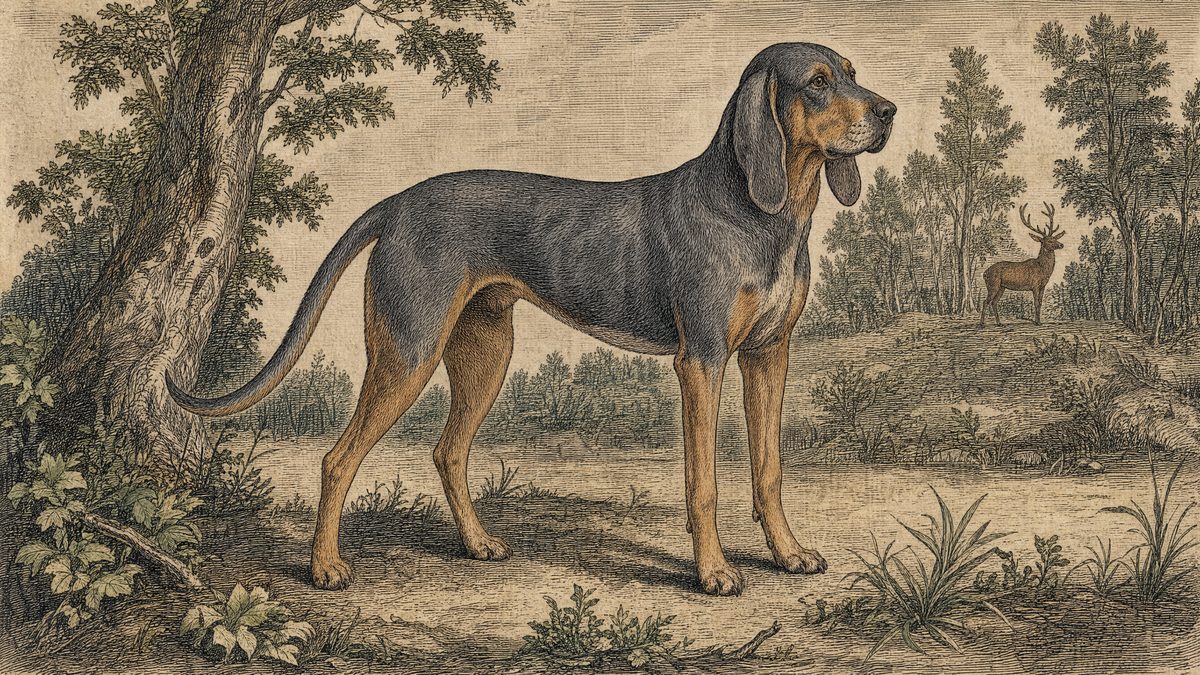
Chien-gris: France's Extinct Grey Saint Louis Hound, and Why You Cannot Buy One
No kennel club anywhere recognises this breed, no living population exists, and the king and the master of venery who actually hunted with the pack wrote things about it that no modern breed page repeats. Here is what the primary sources say.
By Bonbeno EditorialVeterinary review: Dr. Ashish J., MVScUpdated 26 August 202662 min read
Quick answer
The chien-gris is extinct and has been for centuries, so no Indian price exists and no puppy of this breed can be bought anywhere. Also called the Gris de Saint-Louis or Grey Saint Louis Hound, it made up the royal packs of France from about 1250 to 1470. No kennel club lists it. Exactly two living FCI standards, the Griffon Nivernais and the Grand Griffon Vendeen, still name it as an ancestor.
Health information notice
This guide summarises historical hunting texts, kennel-club registry records, Indian import law, published veterinary literature and satellite climate data as general information for Indian pet owners. It is not a diagnosis and it is not treatment advice. Consult a registered veterinarian near you before acting on anything you read here, and treat collapse, laboured panting that will not settle, or a suspected heat stroke as an emergency.
The lowest rating available, and it is the only trait on this page taken from a primary source rather than inferred. Jacques du Fouilloux, in 1561, lists among the reasons princes could take little pleasure in the chiens gris that 'ilz craignent les chaleurs', they fear the heat. Turbervile's 1575 English version says 'they feare heate'. The same passage says they fear neither cold nor water. A hound selected in a country with an annual mean of 11.04 C, by men who already thought it heat-sensitive there, has nothing to offer an Indian household.
Availability in India1 of 5
Zero. The breed is extinct, so there is no supply chain to have, and Indian import law would block one anyway. Three Indian dog-price lists carrying 1,256 rupee figures between them print no chien-gris price at all.
Registry recognition1 of 5
None anywhere. Absent from the FCI definitive register under both C and G, absent from the twenty breeds on the FCI provisional register, absent from the AKC hound list and from the Royal Kennel Club's breed-standard index. It survives only as a named ancestor inside two other breeds' standards.
Evidence quality2 of 5
Unusually good history, no biology at all. Two sixteenth-century royal sources describe the working dog in detail and a 1575 English translation preserves them. Against that there is no measurement, no skeleton series, no DNA, no health survey and no verified lifespan. The 9 to 11 years printed by four separate sites traces to nothing.
Monsoon tolerance1 of 5
Untested and untestable, but the origin climate says everything. Nevers records 2.08 mm of rain a day across the year at 81.10 percent mean humidity, spread evenly, with a wettest month of 2.55 mm a day. Mumbai's July averages 26.90 mm a day at 90 percent humidity. Nothing in this lineage ever met that.
Grooming demand2 of 5
Genuinely unknown, and the wire coat every modern page describes is not in either primary source. Charles IX and du Fouilloux describe colour and build in detail and say nothing about a rough coat, a beard or a moustache. English Wikipedia flags this too. If the grey hounds were smooth, the whole griffon ancestry story rests on a coat nobody recorded.
Trainability2 of 5
Headstrong by every account that exists. Charles IX calls them 'Chiens enragez' and says you have to break your neck and legs to hold them. Du Fouilloux calls them opiniastres and de mauvaise creance, stubborn and untrustworthy, prone to running the change. Both say they answer to their own master's voice and horn above all.
What a Chien-gris actually was, and why you cannot buy one
The chien-gris was a large French scent hound that made up the royal packs of France from about 1250 to 1470, and it is an extinct breed with no living population and no entry in any register. Its other names are Gris de Saint-Louis, Grey Saint Louis Hound and, in English hunting books, dun hound. Everything reliable about it comes from three books written between 1561 and 1674.
Start with the status, because it decides everything else on this page. English Wikipedia files the chien-gris under extinct dog breeds and states that it 'formed part of the royal packs of France, which were composed, from about 1250 till 1470, exclusively of hounds of this type'. French Wikipedia says the same and adds that by the nineteenth century individuals had become practically impossible to find. Maison Goyard, which sells a pet carrier named after the dog, puts it more bluntly than any breed site does: 'a breed that dates back to medieval times but no longer exists today';.
Where it sat among the French hounds
The Societe de Venerie, France's own hunting-with-hounds federation, describes four royal varieties rather than one. From the fifteenth to the eighteenth century the only running hounds known and recognised in France were the chiens blancs du Roy, the fauves de Bretagne, the gris de Saint-Louis and the black hounds 'anciens de l'Abbaye Saint Hubert en Ardenne', and du Fouilloux's La Venerie of 1561 sets out all four in detail. Charles IX, writing a decade later, counts only three, folding the white hounds and the greffiers together. So even the two sixteenth-century French sources disagree about how many kinds of royal hound there were.
The origin story, and how far to trust it
Charles IX credits Saint Louis, Louis IX, with bringing the breed to France from captivity on crusade. In his own words, having learned that there was 'une race de Chiens en Tartarie qui estoient fort excellents pour la chasse du Cerf', the king contrived to bring a pack back with him, and 'ceste race de Chiens sont ceux que l'on appelle gris, la vieille et ancienne race de cette couronne';. The Societe de Venerie repeats it with a careful conditional, that Louis IX 'aurait ramene' the dog from the Seventh Crusade in the thirteenth century. English Wikipedia is more sceptical still, noting that 'old writers on hunting liked to ascribe an ancient and remote origin to their hounds';.
Treat the Tartary story as a sixteenth-century claim about a thirteenth-century event, written down roughly 300 years after the fact by a king with a reason to flatter his own kennel. It is what the primary source says. It is not evidence of where the dogs came from.
What this page will not do
It will not give you a price, a lifespan, a breed standard or a temperament score for this dog, because none of those exist. Four sites publish all four anyway. Where a number is available we print it and say who published it; where it is not, we say so and leave it out.
One more framing point matters before the detail. This was a pack animal in the strict sense. Du Fouilloux describes hounds that recognise their own master's voice and horn above every other huntsman's, and that will not follow a packmate whose voice they judge unreliable. Nothing in either source describes a house dog, a companion or a guard. Petlur's spec card nonetheless records the breed's purpose as 'Companionship';.
What Charles IX and du Fouilloux actually wrote
Two sixteenth-century French sources describe this dog from direct experience, and both are readable online in full. Charles IX devotes Chapter IX of La Chasse Royale to 'le naturel des Chiens gris', and Jacques du Fouilloux devotes Chapter 4 of La Venerie to 'la complexion et nature des Chiens gris'. Between them they give build, colour, nose, hunting style and temperament, and they disagree on two of those five.
Charles IX opens with build. 'Les Chiens gris sont grands Chiens, hauts sur iambes et d'oreilles, ceux qui sont de la vraye race sont de couleur de poil de lievre, ils ont l'eschine large et forte, le iarret droict, et le pied bien forme';. In plain English: they are big dogs, high on the leg and in the ear, and the true ones are the colour of a hare's coat, with a broad strong back, a straight hock and a well-formed foot. That is the closest thing to a breed standard this animal will ever have, and it gives no measurement at all.
The nose, and the sentence every modern page skips
The king then says the thing nobody quotes. 'Mais ils n'ont pas le nez si bon que les noirs, cela est cause que leur facon de chasser est toute differente';. They do not have so good a nose as the black Saint Hubert hounds, and that is why their whole way of hunting is different: being extremely fast and short of scenting power, they hunt 'a grandes randonnees loin des voyes', in wide casts far off the line, keeping each other in sight.
Du Fouilloux, ten years earlier, gives the colour in more detail and adds the working faults. 'Les meilleurs de toute la race, sont ceux qui sont gris sur l'eschine, estans quatrouillez de rouge, et les jambes de mesme poil, comme de la couleur de la jambe d'un Lievre';. The best are grey along the spine, quartered with red, with legs of the same colour as a hare's leg. Some carry near-black grey over the back with legs streaked red and black, and those, he says, are excellent. The over-silvered ones with pale fawn legs are neither as fast nor as vigorous.
Grey on the spine, quartered red, legs like a hare's leg
Nose
Not so good as the black hounds
Not rated; they overrun the line
Coat texture
Not mentioned
Not mentioned
Suited to
The King's own pack
Gentlemen, because they will hunt any quarry
Heat
Not mentioned
They fear the heat
That table is the honest summary of everything known from a source that saw the dog. Note the two blanks in the coat-texture row. Neither king nor master of venery mentions a rough or wire coat, and English Wikipedia flags the same absence, suggesting the rough coats 'were acquired later through interbreeding with indigenous French hounds';.
Note also the split on suitability. Charles IX writes as an owner of the royal pack. Du Fouilloux writes that the grey hounds were what the Kings of France and the Dukes of Alencon used 'anciennement', in former times, and that they are now most convenient for gentlemen because they will hunt whatever you put them on. By 1561 the royal fashion had already moved on, and the man writing the standard textbook of French venery says so.
The 1561 sentence that decides this breed for India
Du Fouilloux says the chiens gris fear the heat, and that single clause is the most decision-relevant thing ever written about this dog for an Indian reader. The exact words are 'aussi qu'ilz craignent les chaleurs', and they appear in the list of reasons why princes could take little pleasure in the breed.
Here is the passage in full, from Chapter 4 of La Venerie. 'Les Princes n'en peuvent tirer du plaisir pour beaucoup de raisons, dont l'une est, par ce qu'ilz craignent grandement la foule des piqueurs, et le bruit, d'autant qu'ilz sont Chiens ardans, et de grand cueur, qui se mettent hors d'halene au cry et bruit des hommes, aussi qu'ilz craignent les chaleurs, et n'ayment pas une beste qui ruse et tournoye';.
Three complaints sit in that sentence. The hounds panic at the crowd and noise of mounted huntsmen and blow themselves out at the shouting; they fear the heat; and they dislike quarry that doubles and turns. The middle one is the one that transfers.
The same line, in English, in 1575
George Turbervile translated du Fouilloux into English fourteen years later and rendered the clause without softening it. 'Another cause is, that they feare heate, and doe not greatly esteeme a chace whiche doubleth or turneth before them';. So the claim exists in two languages, in two printed books, from the sixteenth century, and it has never appeared on an English-language breed page for this dog.
Set that against what the ranking pages tell an Indian reader. Petlur's Weather and Climate field reads, in full, 'Tolerates warm and cold weather';. That is the opposite of the only primary source that addresses the question.
What du Fouilloux says the breed did tolerate
The same chapter is generous about cold and water. 'Ilz sont Chiens de grand'peine, ne craignans le froid ne les eaux';. They are dogs of great endurance, fearing neither cold nor water. Turbervile again matches: 'They are houndes of great trauell, fearing neither colde nor water';. So the record is not a general complaint about a soft dog. It is specific. Cold, fine. Rain and rivers, fine. Heat, no.
There is a within-source control for this too, which is what makes the reading solid rather than convenient. In the same book, du Fouilloux describes the white hounds as descended from North African dogs that 'ne laissent a courir pour quelque chaleur qu'il face', which Turbervile renders as dogs 'which gyue not ouer their chace for any heate that is';. The author distinguishes a heat-hardy hound from a heat-sensitive one inside the same volume. He was not applying a stock phrase.
Why this matters more here than anywhere else
Almost every heat rating on this site is our own inference from an origin climate. This one is not. A sixteenth-century French master of venery, writing about a dog he hunted with in a country whose annual mean is 11.04 C, listed heat sensitivity as a reason to prefer something else. If the breed were somehow revived tomorrow, that is the first line an Indian buyer should read.
Hare colour, and the wire coat nobody recorded
The one appearance detail both royal sources agree on is hare colour, and the one every modern page adds is a wire coat that appears in neither. Charles IX writes that the true race is 'de couleur de poil de lievre'; du Fouilloux writes that the legs are 'comme de la couleur de la jambe d'un Lievre'. Neither mentions coat texture at all.
Hare colour is not a vague word in French venery. It is a specific description of banded, agouti hair that reads grey at a distance and warm brown up close, and it survives in modern French standards as a named colour. FCI Standard 17 for the Griffon Nivernais lists among its coat descriptions 'the fawn very slightly overlaid with black (hare coat)', alongside 'sand overlaid with black (wolf grey)' and 'fawn overlaid with blue (blue grey)';. FCI Standard 282 for the Grand Griffon Vendeen gives the same vocabulary: 'Traditional name: hare colour, wolf colour, badger colour or wild boar colour';.
So the colour term used for a hound in 1561 is still a live technical term in two current standards, and both of those standards happen to be the two that name the chien-gris as an ancestor. That is a genuine thread of continuity, and it is worth more than any of the invented spec-card colours.
What the sources give you, in order of confidence
Grey along the spine, with the four quarters and legs red or tan, as the colour of a hare's leg. Du Fouilloux, and Turbervile's English matches word for word.
A darker variant, near-black over the back with legs streaked and flecked red and black, which du Fouilloux rates 'bons par excellence'.
An over-silvered variant with pale fawn legs tending to white, which he rates as neither as fast nor as vigorous.
Large, high on the leg, long-eared, with a broad strong back, straight hock and well-formed foot. Charles IX only.
Long-nosed rather than short-faced, which is the one modern welfare-relevant inference the sources support, and it matters because brachycephalic dogs carry roughly three times the odds of a fatal outcome once heat-related illness begins.
The wire coat, and where it probably came from
Every modern page describes a wire coat, and the primary sources do not. Dog Breed Info says the coat was 'medium length, wiry' with longer hair under the chin 'giving the dog a beard or goatee';. PetPaw says the wire coat on the face 'may have formed a mustache and goatee';. English Wikipedia notes the same gap this page found by reading the texts: the rough coats 'were not mentioned by Charles IX or du Fouilloux', and may have been acquired later through interbreeding with indigenous French hounds.
The Grand Griffon Vendeen standard suggests where the rough-coated element actually entered. It names two contributors to the Grand Griffon: the 'Chien Gris de St. Louis' and the 'Griffon de Bresse', and it is the Bresse griffon that carries the Segusian, rough-coated ancestry in that sentence. If that reading is right, the wire-coated look is the Bresse dog's contribution and the chien-gris supplied colour, size and drive.
Petlur, meanwhile, resolves the question by asserting both. Its spec card lists Coat as 'Wiry' and, four fields later, Coat Texture as 'Smooth';. A page that contradicts itself inside one table is not evidence for either answer.
Four published size ranges, and not one of them agrees
Four pages publish an adult size for this breed and no two of them match, while two contradict themselves inside a single page. No source with a measurement exists, so every figure below is an assertion rather than a record.
Look at the PetPaw rows first. Its spec card gives males and females alike as 38 to 46 cm and 22 to 45 kg, while its own Description section on the same page says the dog 'probably stood between 20 and 27 inches tall at the shoulder and weighed between 50 and 100 pounds';. Twenty inches is 51 cm. The floor of the prose sits five centimetres above the ceiling of the card.
The spec card is also physically implausible on its own terms. A dog of 38 to 46 cm at the withers carrying 45 kg would be built like a Bullmastiff on Basset legs. Nothing in either primary source describes that animal; Charles IX describes the opposite, a tall dog high on the leg.
Petlur contradicts itself the other way
Petlur's card says 20 to 27 inches, 58 to 88 pounds, while its Description says the breed 'typically stands between 18 and 22 inches tall at the shoulder'. Two ranges, one page, overlapping by four inches at one end and disagreeing at the other. Neither is sourced.
Where the only defensible figure comes from
PetPaw's prose gives the one line of reasoning anybody offers: the breed 'is usually described as being roughly equivalent in size to a Saint Hubert Hound';. That inference is at least traceable, because Charles IX says the grey hounds were large and preferred by the kings to the Saint Huberts, 'which were said to be only of medium size';. So the sources support larger than a Bloodhound, and nothing more precise than that.
How to read any size claim for this breed
If a page gives you a centimetre range for the chien-gris, ask which measurement it came from. There is no skeleton series, no standard, no breed club and no surviving pack. The honest answer is a large hound of unrecorded height, and every page that gives you a decimal is filling in a blank.
How the Chien-gris became an English breed by mistranslation
The dun hound of English hunting literature is the chien-gris under a translated name, and following the chain from 1561 to 1674 shows exactly how a French pack hound acquired an English identity it never had. Three books, three stages, and by the third the attribution has vanished.
Stage one is du Fouilloux, 1561, writing in French about French dogs. Chapter 4 opens: 'LES CHIENS gris sont ceux desquelz se servoyent anciennement les Roys de France, et les Ducz d'Alencon';.
Stage two is George Turbervile, 1575, translating the whole book into English. He renders chien-gris as 'dunne hound' rather than grey-hound, presumably to avoid collision with the sighthound already called a greyhound, and English Wikipedia makes the same reading. Crucially, Turbervile keeps the French possessive intact: 'OVr dunne houndes are suche as auncientlye our Kynges of Fraunce, and Dukes of Alencon did most esteeme';. An English reader in 1575 was being told about 'our Kings of France'.
Stage three, where the attribution disappears
Nicholas Cox reprinted the material in The Gentleman's Recreation in 1674 under the heading 'Of the DUN HOUND', and the French kings are gone. 'THese are good for all Chases, and therefore of general use. The best coloured are such as are dun on the Back, having their four quarters tann'd, or of the complexion of a Hare's Legs';. Compare that with Turbervile's 'The best of the race are such as be dunne on the backe, having their foure quarters redde or tanned, and the legs of the same coloure, as it were the coloure of a Hares legs';. It is the same sentence with the provenance stripped out.
The same description through three books, 113 years apart George Turbervile
Source
Year
Name used
Kings of France named?
Jacques du Fouilloux, La Venerie
1561
Chiens gris
Yes, and the Dukes of Alencon
George Turbervile, The Noble Arte of Venerie
1575
Dunne hound
Yes, as 'our Kynges of Fraunce'
Nicholas Cox, The Gentleman's Recreation
1674
Dun hound
No
English Wikipedia draws the conclusion this page can now confirm from the texts themselves: Turbervile did not make clear that his book was a translation, later English writers such as Cox relied on him, and 'it is quite possible that the dun hound was never a significant animal in British hunting';.
This matters beyond trivia. It is the earliest documented case of what the modern breed pages do to this dog. A description is copied, the source is dropped, and the copy becomes evidence for a claim the original never made. In 1674 it produced an English breed. In 2026 it produces a spec card giving an extinct hound a litter size, a walking distance and an office-friendly rating.
Recognition status, register by register, each one checked
No kennel club anywhere recognises the chien-gris, and this section names each register and what was checked in it rather than asserting a blanket absence. Five registers were opened directly and the breed appears in none of them.
The full C list, 44 breeds, looking for Chien-gris beside Chien d'Artois and Chien de Saint Hubert
Absent
FCI definitive nomenclature, letter G
The full G list, 24 breeds, looking for Gris de Saint-Louis beside Griffon Nivernais
Absent
FCI provisional register
All 20 provisionally recognised breeds, highest number 378
Absent
FCI Group 6, scent hounds
The complete group listing including all French entries
Absent
American Kennel Club
The full breed dropdown printed on the Hound Group page
Absent
The Royal Kennel Club
The complete breed-standard index across all seven groups
Absent
Two of those six registers deserve naming individually, because they are the ones an English-speaking reader checks first. The American Kennel Club prints its complete breed list as a dropdown on every group page, and the chien-gris is not in it. The Royal Kennel Club publishes its breed-standard index across all seven groups on a single page, and it is not there either. Both lists were read in full rather than searched from outside, which matters because a search box can return nothing for a breed that is present under another name.
The FCI check needed two letters rather than one, because the FCI files breeds under their native names. A Chien-gris would sit under C, alongside Chien d'Artois at number 28 and Chien de Saint Hubert at 84; a Gris de Saint-Louis would sit under G, alongside Griffon Nivernais at 17 and Grand Griffon Vendeen at 282. Both lists were read in full. Neither carries it.
The provisional register deserves its own line, because a rare breed is far more often provisionally recognised than absent altogether. The FCI currently lists twenty breeds on a provisional basis, the newest four dated 11 February 2026, and none is this one.
The claim that a French kennel club recognised it in 1885
Petlur's History section states that 'the Chien-gris was recognized as a breed by the French Kennel Club in 1885';. Two things are wrong with that sentence. The Societe de Venerie dates the Societe Centrale Canine to 1882, while a separate French source dates the founding to 1881, so the sources disagree by a year but neither says 1885. And the SCC's own Griffon Nivernais club page describes the chien-gris as a breed that had already seemed to disappear at the French Revolution, with the last representatives crossed a century later to make the Griffon Nivernais. A body founded in the 1880s did not recognise a breed that had gone by 1789.
There is also no Kennel Club of India route, which matters for the Indian reader. The FCI lists the Kennel Club of India, based in Chennai, as its full member body for India, so the KCI works inside the same nomenclature checked above. A breed absent from the FCI definitive and provisional registers therefore has no standard for a KCI judge to apply and no pedigree the KCI could issue. So a chien-gris in India would be unrecognised twice over, once internationally and once at home.
The direction of the absence
Absence from a register can mean promoted out, never admitted, or removed. This one is the second. The chien-gris predates every register on this page by centuries, so it was never a candidate for recognition rather than a failed one. Saying it is 'not recognised' is true but slightly misleading; nothing has existed to recognise since long before the first stud book was opened.
The two living standards that still name this dog
Exactly two of the twenty-six French scent hound standards published by the FCI name the Chien Gris de Saint-Louis in their official history, and finding that out took extracting and searching all twenty-six rather than trusting a summary. The two are the Griffon Nivernais at number 17 and the Grand Griffon Vendeen at number 282.
Every French breed in FCI Group 6 was downloaded as its published English standard, text-extracted, and searched for the strings 'gris de st', 'gris de saint', 'chien gris', 'grey saint' and 'saint louis'. Twenty-six standards were checked, covering all eleven large-sized, ten medium-sized and five small-sized French entries in the group. Two returned a hit.
Griffon Nivernais, FCI 17, and its careful hedge
The Griffon Nivernais standard says the breed 'may have descended from Gallic hounds (Canis Segusius) used by the Gauls, and from the grey Saint Louis dogs', that it was much appreciated for 200 years up to Louis XI's reign, and that it was then 'abandoned in the royal packs by Francis I who preferred white hounds';. Certain Nivernais noblemen kept it to the French Revolution, when the breed seemed to disappear, and a century later it was recreated from surviving stock, later taking blood from the Griffon Vendeen, the Foxhound and the Otterhound. The club was founded in 1925.
Note the modal. 'May have descended' is a hedge, and the FCI chose it deliberately. Where a standard is confident it says so.
Grand Griffon Vendeen, FCI 282, and its flat assertion
The Grand Griffon Vendeen standard is not hedged. 'The Chien Gris de St. Louis and the Griffon de Bresse (descendant of Segusian ancestors) brought as well their contribution to the creation of the Grand Griffon';. Same subject, same registry, two different confidence levels, published a little over four years apart. That gap is itself information: the FCI does not have one settled position on where this dog went.
The Billy row is worth keeping because it is the one people assume. The Billy is a nineteenth-century French pack hound often linked to old royal strains, and its FCI standard, read in full, contains no historical summary at all beyond utilisation and classification. It does not name the chien-gris and it does not name anything else.
The Societe Centrale Canine's own Griffon Nivernais club page goes further than either standard, calling the chien gris de Saint-Louis 'le principal ancetre du Griffon Nivernais' while also noting it is sometimes credited with the Weimaraner, and adding the dry aside 'comme quoi, tout est possible', which is the French kennel club's own way of raising an eyebrow.
When it actually went, and who says what
The chien-gris did not die on a date, it faded across roughly three centuries, and the published accounts disagree about every stage. Setting them side by side is more useful than picking one, because the disagreement is the honest state of the record.
The royal packs were composed exclusively of hounds of this type
Fell from royal favour
FCI Standard 17
Abandoned in the royal packs by Francis I, who preferred white hounds
Fell from royal favour
SCC Griffon Nivernais club
In vogue 200 years, to Louis XI's reign, then abandoned by Francois I for the Chien Blanc
Still in use, 1561
Du Fouilloux
Now most convenient for gentlemen, who can hunt any quarry with them
Still a living race, 1560s
Charles IX
One of only three races of running hound in France
Seemed to have disappeared, 1789
SCC club page and FCI 17
Kept by Nivernais noblemen until the Revolution, then apparently gone
Practically impossible to find, 19th c.
Le Couteulx de Canteleu, via Wikipedia
Like the Saint Hubert, virtually unfindable through mixed breeding and the Revolution
Definitely extinct by the mid-1800s
Dog Breed Info
Asserted, with no source given
The sharpest conflict is between rows two and four. Both the FCI standard and the French kennel club's club page say Francis I, who reigned from 1515 to 1547, dropped the breed from the royal packs. Yet du Fouilloux, publishing in 1561, describes the chiens gris as a live working type he expects his readers to own, and Charles IX, writing in the 1560s or early 1570s, treats them as one of three races currently in France.
Both can be true. Leaving a royal pack is not the same as ceasing to exist, and du Fouilloux says exactly that when he writes that the greys are what the Kings of France used 'anciennement' and are now suited to gentlemen. A breed can lose its patron and survive in private kennels for two more centuries, which is what the Nivernais account describes.
What the nineteenth-century account rests on
The claim that the breed became practically unfindable in the nineteenth century traces to one source, Baron Jean-Emmanuel Le Couteulx de Canteleu's La Venerie Francaise of 1858, cited by both the English and French Wikipedia articles. That is a named, dated, printed authority and a serious one, since the Societe de Venerie still lists Le Couteulx de Canteleu among the reference authors of French venery. We could not obtain a machine-readable copy of the 1858 text in this session, so we report it as Wikipedia's citation rather than as a passage we read.
What we did not do
We did not pick a single extinction date and present it as fact. Dog Breed Info's 'by the mid 1800s the breed was most definitely extinct' is the most confident sentence in the ranking set and the least supported. The defensible statement is narrower: the breed left the royal packs in the first half of the sixteenth century, survived in private hands into the eighteenth, and had become unfindable by the mid-nineteenth.
Chien-gris price in India, and what is actually being sold
There is no chien-gris price in India, because the breed is extinct and nothing can be sold under its name. That is the whole answer to the query, and it is worth more than any range, because the pages that do give you a figure are giving you a figure for something else.
Three of India's largest published dog price lists were checked directly, in the same session, with a control. Supertails' Dog Price List in India 2026 carries 693 rupee figures and 18 mentions of the Labrador; Wrapinfur's 50-plus-breed list carries 333 rupee figures and 24 Labrador mentions; PawSpace's Top 40 Breeds list carries 230 rupee figures and 10 Labrador mentions. The strings 'chien' and 'gris' appear zero times on all three. The Labrador control proves the fetch and the search worked.
So there is no Indian rupee figure for this breed to test. On almost every rare-breed page on this site the price section runs a currency check, because Indian listing sites routinely publish a US dollar figure converted at a single rate. Here there is nothing to convert, which is itself the cleanest possible evidence that no Indian market has ever existed for this dog, not even a fabricated one.
What the India query actually returns
Search 'chien gris price in india' from an Indian location and the results are almost entirely a handbag. Maison Goyard's Chien Gris is a luxury pet carrier designed to hold dogs of 2 to 3 kg, and resellers list it at £1,424.99 and €1,480. Goyard's own product copy explains the name, and does so more honestly than the breed sites: the Chien Gris 'refers to the grey dog, also known as the Gris de Saint Louis, a breed that dates back to medieval times but no longer exists today. The Gris was one of the dogs in France's royal packs and was introduced by King Saint Louis'.
The commercial intent behind the query is therefore being served correctly by the SERP, and incorrectly by the dog pages. A buyer looking for a puppy finds a bag. A buyer looking for a bag finds a bag. Only the breed pages pretend there is an animal at the end of it.
The one page that does price it
Petlur's spec card lists Price (Avg.) as 'Unavailable', which is correct, and then prints a Daily Cost of 20 to 30 dollars and a Monthly Cost of 50 to 100 dollars a few fields lower. Both figures are in US dollars on a page returned for an Indian query, and they cannot both be true, which the next section takes apart.
If anyone quotes you a price
Any seller quoting a chien-gris price in rupees is selling a different dog. There is no register that can issue a pedigree, no breed club to verify a parent, and no lawful import route. Bonbeno does not broker puppy sales and does not link listings; this section reports published figures as editorial content only.
Running the currency tests when there is no rupee figure to test
The standard currency check cannot run here, and explaining why is more useful than skipping it. Indian rare-breed pages routinely publish a dollar figure passed through one exchange rate, and the test is to divide every rupee value by 84.38, then 74.00, then 80.00, and see which rate produces round dollar amounts. This breed has no rupee value anywhere, so there is nothing to divide.
What can be tested is the dollar figure that does exist, and it fails on its own arithmetic before any currency question arises.
Three pairs of fields, three internal contradictions, on one card. A page whose daily and monthly costs differ by a factor of six is not reporting a cost. It is filling a template.
The tell that settles it
Petlur's Eye Color Possibilities field reads 'Gris, Bleu, Marron, Vert, Jaune, Or, Argent';. Those are French words: grey, blue, brown, green, yellow, gold, silver. An English-language page listing a dog's eye colours in untranslated French, including gold and silver, is not describing an observed animal. It is emitting an unmapped field from a data source, and the same French word 'Gris' reappears at the head of the Coat Color Possibilities list beside Silver, Charcoal, Blue, Black and White.
Once that is visible, the rest of the card reads differently. Purpose: Companionship, for a royal stag and boar hound. Office Friendly: Yes. Friendly with First Time Owners: Yes. Detection, Sniffer or Security Dog: Not really, for a scent hound. Popularity/Rank: 317. Hypoallergenic: No. Every one of those is a generated value for an animal nobody has seen in centuries.
What to do with a rupee figure if one ever appears
Divide by 84.38. If the answer is a round dollar number, the figure is a converted US price, not an Indian one.
Divide by 74.00. A second rate in wide circulation on Indian breed-price tables, and the one that catches the largest converted lists.
Divide by 80.00 last, and distrust it. Any rupee figure ending in three zeros divides cleanly at 80 by construction, so treat a match there as evidence only when the quotient is also a price a seller would print.
Check which rows refuse to divide. On a converted table, the only figures that fail are usually the local breeds a human typed in by hand.
Check the source page's other numbers. If its daily and monthly costs contradict each other, as Petlur's do, no figure on it is worth converting.
Monthly cost in India for a hound of this size, if one existed
A dog of the size the sources describe would cost between Rs 6,000 and Rs 14,000 a month in India, and the two Indian sources that publish large-breed budgets disagree most sharply about grooming. This section prices the animal Charles IX describes rather than the animal a spec card invents, and it is a hypothetical throughout.
Take the size band first. Dog Breed Info puts the breed at 25 to 43 kg, which straddles the large and giant bands used by Indian cost tables. That is the closest thing to a defensible working figure, and it is unsourced, so read the numbers below as the cost of a large Indian hound rather than the cost of this breed.
The grooming row is the disagreement worth naming. Supertails puts large-breed grooming at Rs 500 to Rs 1,200 a month; Wrapinfur puts it at Rs 1,000 to Rs 3,000. Wrapinfur's floor sits at Supertails' ceiling, so the two Indian sources do not overlap in the middle of their ranges at all. For a rough-coated hound in Indian humidity, assume the higher figure.
First-year totals also differ. Supertails advises budgeting at least Rs 80,000 to Rs 2,00,000 for the first year including purchase, vaccinations, food, training and supplies. Wrapinfur puts a large breed's first year at Rs 75,000 to Rs 3,00,000 plus. Both exclude emergencies, and neither includes the tick-borne disease workup this page argues for.
The three lines an Indian hound budget usually misses
Cooling. A fan is not enough for a 40 kg dog in a Chennai May, and running an air conditioner through the hot months is a real line item neither Indian source includes.
Tick prevention, year-round rather than seasonal. Indian tick pressure does not switch off, and a PCR panel costs more than a smear.
Exercise displacement. A hound that cannot be walked between 9 am and 6 pm for four months needs indoor work, and enrichment for a scent hound is a recurring cost rather than a one-off toy.
Read this as a hypothetical
Every figure above is the cost of a large Indian dog, taken from two published Indian sources. None of it is a chien-gris cost, because there is no chien-gris to cost. We publish it because a reader arriving on this page is usually budgeting for a big hound, and that budget is real even when the breed is not.
Could a Chien-gris handle the Indian climate? The numbers say no
A chien-gris would not handle the Indian climate, and this is the rare case where the heat tolerance rating rests on a primary source rather than on inference. The breed was selected in a country whose annual mean is 11.04 C by men who already called it heat-sensitive there, and the coldest month in three of India's four largest cities sits above the hottest month in its homeland.
The origin climate was queried by explicit latitude and longitude rather than by place name, so no wrong-city document could be served by accident. NASA POWER at longitude 3.16, latitude 46.99, the Nivernais that FCI Standard 17 names as the Griffon Nivernais's cradle, returns an annual mean of 11.04 C, a July mean of 20.03 C and a January mean of 2.57 C, with annual mean relative humidity of 81.10 percent. Fontainebleau, the royal hunting forest nearer Paris, returns an almost identical 11.10 C annual mean and a July mean of 19.70 C.
Read the fourth column against the second. Chennai's coolest month averages 24.09 C, which is 4.06 C warmer than the hottest month the Nivernais has ever averaged. Mumbai's coolest month, at 23.19 C, is 3.16 C warmer. Bengaluru's coolest month, 20.22 C, is a fifth of a degree warmer than the Nivernais's hottest. For three Indian cities out of five, the coldest month of the year is a hotter month than this breed's homeland ever gets.
The one Indian city with a genuine cool season
Delhi is the exception, and it is a partial one. Its January mean of 13.61 C sits well below the Nivernais July, so a heat-sensitive European hound would have roughly ten weeks of workable weather. It pays for that with a June mean of 35.88 C and a climatological maximum of 48.79 C, the highest of any city on this page. A dog that manages Delhi in January would face the sharpest annual swing in India.
Pune sits in between, with a December mean of 19.62 C, just under the Nivernais's July. Its August relative humidity of 90.80 percent then removes most of the benefit, because evaporative cooling from panting is what a dog has instead of sweating, and it works badly at high humidity.
Why this rating is unusually firm
Most heat ratings on this site are our reading of an origin climate. This one has a witness. Du Fouilloux listed heat sensitivity as a reason princes preferred other hounds, in a country with an annual mean of 11.04 C. The rating is 1 out of 5, and the primary source, not the thermometer, is why.
The rain this lineage never met, and the humidity that would matter more
The chien-gris had no monsoon experience of any kind, and the rainfall gap is larger than the temperature gap. Its homeland records 2.08 mm of rain a day spread evenly through the year; Mumbai's July averages 26.90 mm a day, roughly thirteen times as much, concentrated into four months.
The Nivernais rainfall pattern is the flattest on this page. Its wettest month, May, averages 2.55 mm a day, and its driest, February, 1.70 mm. The difference between the wettest and driest month is under a millimetre a day. There is no wet season and no dry season, just persistent damp, which is why the annual mean humidity of 81.10 percent looks high without being a monsoon figure.
Delhi's annual rainfall, at 2.06 mm a day, is almost identical to the Nivernais's 2.08, and that similarity is misleading in the most instructive way. Delhi delivers its water in one burst, 7.00 mm a day in July with humidity climbing from 23 percent in May to 75 percent in August. The Nivernais delivers the same annual total as a steady drizzle. Two identical annual figures, two completely different problems for a coat.
Why humidity matters more than rain for this dog
Panting is evaporative, so a dog cools less efficiently as the air gets wetter. That is why Mumbai and Pune are harder for a heavy-coated dog than Delhi despite lower peak temperatures: Mumbai runs 90 percent relative humidity through July and August at a mean of about 27 C, and Pune reaches 91 percent in August. A dog that can shed heat in a Delhi May at 23 percent humidity may not manage a Mumbai August at 90.
For a rough-coated hound, the monsoon adds a second problem the sources cannot help with. Wet ears, wet undercoat and a dog that will not dry in ambient air are the standing conditions of an Indian July, and any overseas grooming advice that says to towel a hound and let it air dry is advice written for a country where the air is a dryer. In an Indian monsoon it is not.
What can and cannot be said here
No chien-gris has ever experienced a monsoon, so nothing in this section is a measured breed response. What is measured is the origin climate, and it contains nothing resembling an Indian wet season. Treat this as a statement about the environment the breed was selected in, not a prediction about an individual dog.
Temperament, from the two men who actually hunted them
Both royal sources describe a headstrong, fast, noise-shy pack hound that bonds hard to one handler and is difficult to stop once running, and neither describes anything resembling a family companion. Modern pages call it affectionate, friendly and loyal. Those words appear in no primary source.
Charles IX is the blunter of the two. Of the grey hounds at the uncoupling he writes that most often 'ils s'en vont comme s'ils chassoient sans auoir rien deuant eux, et seulement leur furie les transporte', they go off as if hunting with nothing in front of them, carried away by their own fury. When they run the change he says 'ce sont Chiens enragez, car il se faut rompre le col et les jambes pour les tenir', these are mad dogs, you have to break your neck and your legs to hold them.
Du Fouilloux gives the same picture with more nuance. They are 'opiniastres, de mauvaise creance, et subjectz a prendre le change, a cause de l'ardeur et folie qu'ilz ont', stubborn, untrustworthy and prone to switching quarry through sheer ardour and folly. He also records the trait a modern trainer would care about most: 'sur tout veulent cognoistre leur maistre, et principalement sa voix, et sa trompe, et feront pour luy quelque chose plus que pour tous les autres'. Above all they want to know their master, especially his voice and his horn, and will do more for him than for anyone else.
The social detail nobody quotes
Du Fouilloux adds an observation about the pack itself that is worth its own line. 'Ilz ont une malice entr'eux, qu'ilz cognoissent bien a la voix de leurs compaignons s'ilz sont seurs ou non, car s'ilz sont menteurs, ilz n'iront pas voluntiers a eux';. They know from a packmate's voice whether it is reliable, and they will not readily go to a liar. That is a description of a dog reading other dogs, and it is the most sophisticated behavioural claim in either text.
Stubborn, hard to stop, prone to running the change
Charles IX and du Fouilloux
Yes, both
Bonds to one handler's voice and horn
Du Fouilloux
Yes
Panics at crowd noise and blows itself out
Du Fouilloux
Yes
Affectionate, caring, friendly, loyal
Petlur spec card
No
Very friendly with an affectionate personality
Dog Breed Info
No
No record of its temperament exists
PetPaw
Half right, and it prints a card anyway
PetPaw is the interesting row. Under 'In 5 Words' and again under Temperament it states plainly that 'Chien-gris is now extinct and there was no record of its temperament', which is closer to honest than any other page manages. It then publishes a characteristics panel with rated bars for Friendliness, Trainability, Watchdog and Health Issues on the same page. Both statements cannot be true.
Dog Breed Info hedges in the other direction, saying the breed was 'very friendly with an affectionate personality' and then, one sentence later, 'because this dog is extinct, not much else is known about the temperment of the Chien-gris';. If nothing else is known, the first sentence has no basis either.
Training a hound that answers to a horn
Training advice for this breed can only be reconstructed from two sixteenth-century handling passages, and both say the same thing: work quietly, do not crowd them, and build everything on one handler's voice. Du Fouilloux gives an explicit method, which is more than most extinct breeds leave behind.
Here is the method, in his own words. 'Au partir du descouple ilz les doyvent piquer le plus froidement qu'ilz pourront, avec peu de bruit, a cause qu'ilz sont ardans, et outrepassent les routes ou voyes de la beste qu'ilz courent';. At the uncoupling, ride on as coolly as possible with little noise, because they are hot-headed and overrun the line. Huntsmen should not close on them until they see the hounds running straight, nor at a check, and must avoid crossing them for fear of turning them back.
Turbervile's English is clearer for a modern reader: 'At the fyrst vncoupling of them, they must followe and encourage them as temperately as maye be, and with verie little noyse, for that they are hote, and doe quickly ouershoote the tracke or path of the chace which they vndertake';.
Four principles that survive translation
Keep arousal low at the start. Both texts say the failure mode is over-arousal at the moment of release, not disobedience later.
Use one voice. Du Fouilloux says they want above all to know their master, especially his voice and his horn, and will work harder for him than for anyone else. Multiple handlers dilute the only lever the breed offers.
Do not crowd. They fear the throng of huntsmen and blow themselves out on the shouting, so pressure makes the problem worse rather than better.
Expect to lose them on a turn. Both sources say they overshoot and run the change. Charles IX adds that only old hounds who have grown wise stop doing it, which is a note about maturity rather than method.
That last point is the one an Indian owner of any hardheaded hound should take. Both sixteenth-century sources agree that experience, not correction, is what fixes overrunning. Charles IX writes that if the change breaks and these are not old dogs accustomed to hunting, and so grown wise, they will chase it with no way of stopping them.
What this means for a modern scent hound in India
Nothing above can be applied to a chien-gris, because there is none to train. It transfers cleanly to a Beagle, a Bloodhound or an Indian pariah dog with a strong nose, and the transferable core is simple. Train recall before the nose switches on, use one handler's voice as the primary cue, work in the cool hours so arousal and heat load do not stack, and treat a dog that has locked onto a scent as temporarily deaf rather than disobedient. The Bloodhound guide covers the same problem in a breed you can actually own.
The honest limit of this section
Two passages of sixteenth-century field advice are not a training programme. They are the only training advice that exists for this breed, they are specific, and they are internally consistent across two independent authors. That is worth publishing. It is not worth extrapolating into a puppy curriculum.
The daily exercise requirement, and the number that was invented
No verified exercise requirement exists for this breed, and the two figures in circulation contradict each other on the same page. What the primary sources describe is a pack hound worked to exhaustion over open country for a day at a time, which is a job description rather than a walk length.
Charles IX describes the working pattern in enough detail to infer the load. The grey hounds hunt 'a grandes randonnees loin des voyes', in wide sweeps far off the line, keeping each other in sight, and if a stag runs straight 'ils le prendront et bien viste', they will take it and quickly. Du Fouilloux adds that they are 'Chiens de grand'peine', dogs of great labour, and that once they feel a beast tiring they will never leave it until it is dead.
That is a description of a mounted hunt lasting hours across country, not a suburban walk. It also explains why they blew themselves out at the shouting: a dog running at that intensity has no thermal headroom left.
The two modern numbers, and why they cannot both hold
Petlur prints a Recommended Walk Mileage Per Week of 30 miles and, in the field beside it, Minutes of Activity Per Day of 30 to 60 minutes. Thirty miles a week is about 6.9 km a day. Covering 6.9 km in 30 minutes needs 13.8 km per hour; in 60 minutes it needs 6.9 km per hour. The first is a fast run for a human handler and the second is a very brisk walk. As a walking requirement the pair is incoherent, and neither figure is attributed to anything.
Dog Breed Info takes the honest route and gives no number at all, saying only that the breed 'would have needed a considerable amount of exercise' and would not have done well in an apartment with no backyard. PetPaw declines outright: 'Chien-gris is now extinct and there was no record of its exercise & training requirements';.
What an Indian owner should take from this
Assume a working pack hound's needs, not a companion's. Every primary description is of sustained work, and nothing in either text describes a dog that settles.
Split the day around the heat. In Chennai, where the coolest month averages 24.09 C, a large hound's exercise window is dawn and after dark for most of the year.
Count scent work as exercise. For a nose-led dog, twenty minutes of tracking in a corridor is worth more than an hour of pavement, and it does not add heat load in the same way.
Never make up the deficit at midday. Heat-related illness in UK dogs peaked at a median ambient temperature of 16.9 C, which is a cool Indian morning.
Why we publish no figure
Bonbeno does not print an exercise number for this breed because none was ever recorded. Any page that gives you minutes per day for a dog extinct before the stopwatch was invented has made it up, and the two Petlur fields that contradict each other are the proof.
Grooming and coat care, on a coat nobody wrote down
Grooming advice for the chien-gris cannot be sourced, because the two men who described the dog never described its coat texture. Every brushing schedule on the internet for this breed is an inference from later griffon breeds, and this section says which inferences are defensible and which are not.
The gap is real and it is documented. Charles IX gives colour, build, ear carriage and foot shape and never mentions coat. Du Fouilloux gives three colour patterns in detail and never mentions coat texture either. English Wikipedia states the same finding: the rough coats 'were not mentioned by Charles IX or du Fouilloux';. A machine search of the University of Toronto transcription of du Fouilloux's chapters on hounds returns zero occurrences of 'griffon', zero of 'barbe' and zero of 'moustache', against 153 occurrences of 'Chiens' and 19 of 'chaleur', so the search was working.
The single occurrence of 'poil rude' in that text is about coarse hair under the belly as a general sign of hardiness in any hound, not about the grey hounds' jacket.
Brush occasionally, bath when necessary, check for burs after a hunt
Unstated
PetPaw
Short to medium, quite wiry, moustache and goatee
'No record of its grooming and care'
Contradicts its own description
Petlur
Coat: Wiry. Coat Texture: Smooth
2 to 3 times per week, six named tools
Contradicts itself in one table
Petlur's tool list is worth reading for what it reveals: slicker brush, pin brush, undercoat rake, shedding blade, nail clippers and grooming scissors. That is a generic large-dog kit, not a kit chosen for a described coat, and it is prescribed alongside a Coat Texture field that says Smooth.
The transferable advice, for a rough-coated hound in India
If you keep any wire-coated or rough-coated hound in India, the useful rules do not come from this breed at all. Hand-strip rather than clip a wire jacket, because clipping softens it and a soft coat holds water. Dry the dog properly after any wet walk, especially inside the ears, rather than towelling it and letting it air dry, which is standard advice in northern Europe and poor advice in an Indian monsoon where the air will not do the work. Check between the toes and under the elbows after fieldwork, since a coarse coat hides grass seed and ticks equally well.
The honest position
We rate grooming demand 2 out of 5 and label it unmeasurable. If the grey hounds were smooth-coated, as the silence in both sources allows, then the entire griffon-ancestor story rests on a coat nobody wrote down, and every brushing schedule published for this breed describes a different dog.
Health and lifespan: what is actually known, which is nothing
No health data exists for the chien-gris, no lifespan was ever measured, and no screening scheme has ever covered it. Four sites publish a life expectancy of 9 to 11 years and none of them cites a source, which makes that figure the most repeated unsupported number on this breed's internet.
Start with what would have to exist for a lifespan figure to be real. A breed lifespan comes from a mortality dataset, an insurance database or a breed-club survey, and all three require a registered population, a stud book and living dogs. The chien-gris has never had any of them. It predates the first stud book by centuries and it is absent from every register checked for this page.
Where 9 to 11 years comes from
Nowhere traceable. Dog Breed Info lists Life Expectancy as 'About 9-11 years', PetPaw's spec card gives 'Life Span 9 - 11 Years', and Petlur's card gives 'Lifespan 9-11 years';. The three figures are identical to the year. PetPaw prints its 9 to 11 on the same page where it says four separate times that no record of the breed survives. The same three pages also print an identical litter size of 4 to 6 puppies, and Petlur adds a gestation duration of 60 to 64 days, which is simply the gestation of any dog.
Identical unattributed numbers across three sites is the signature of copying, not of measurement. Bonbeno publishes no life expectancy for this breed.
Screening data, and why there is none
There is no OFA entry, and there could not be. The Orthopedic Foundation for Animals requires a minimum of 100 hip evaluations, or 50 for its other databases, before a breed appears in its statistics at all. A breed with no living dogs cannot generate one evaluation, let alone a hundred. Any page presenting a hip or elbow dysplasia rate for the chien-gris has invented it.
Dog Breed Info is at least explicit about the guesswork: 'this dog is extinct therefore there are no proven records of their health issues although because they were an active hunting breed, they most likely would have had issues regarding knees, hips, and joint pain';. That is a reasonable inference honestly labelled, and it is the best sentence on the subject anywhere in the ranking set. It is still an inference.
The three-times rule
A page with no lifespan study, no screening data and no standard should say so three times rather than borrow once. There is no verified lifespan for the chien-gris. There is no screening data for the chien-gris. There is no health survey for the chien-gris. Nothing on this page substitutes a related breed's numbers to fill those gaps.
What would actually threaten a large hound in India
The two health risks that would matter most for a 25 to 43 kg working hound in India are heat-related illness and tick-borne disease, and both are measurable in living dogs even though this breed leaves nothing to measure. This section prices the risk for the animal the sources describe, using Indian and comparable data.
Take heat first, because the primary source already flagged it. A VetCompass study of UK primary-care records found that the median ambient temperature on days when dogs presented with heat-related illness was 16.9 C. That is below the Nivernais's July mean of 20.03 C and far below every Indian month on this page. UK dogs were reaching a vet in conditions an Indian owner would call a pleasant winter morning.
Bodyweight matters within that dataset. Compared with dogs under 10 kg, dogs of 10 to under 20 kg had 2.71 times the odds of severe heat-related illness (95 percent CI 1.17 to 6.28) and dogs of 20 to under 30 kg had 2.41 times the odds (0.99 to 5.87). In raw counts, 8 of 141 dogs under 10 kg progressed to severe disease against 19 of 141 in the 20 to 30 kg band. A hound of the size described here sits in or above that band.
One structural feature works in the breed's favour. Charles IX describes a long-muzzled hound, and the same study found brachycephalic dogs carried roughly three times the odds of a fatal outcome once heat-related illness began, compared with mesocephalic dogs. A long nose is the single best anatomical defence a dog has against Indian heat, and this one had it.
Tick-borne disease, and why the routine smear is not enough
Indian tick pressure is the second risk, and it is the one an owner can act on. In a Kerala study of 150 dogs, PCR targeting the 18S rRNA gene detected Babesia gibsoni in 47.3 percent of animals while light microscopy detected it in 26.67 percent. That is 71 dogs against 40 out of the same 150, so the routine blood smear missed roughly four in ten infections that PCR found. The authors report anaemia and thrombocytopenia as the significant haematological changes in chronic infection.
For a working hound pushed through Indian cover, that gap is the practical point. Ask for a PCR panel rather than accepting a negative smear, especially in a dog with unexplained anaemia, a low platelet count or a fever that keeps returning.
Walk before 8 am and after sunset for any dog over 25 kg from March to June in most of India.
Treat panting that will not settle as an emergency, not as a dog that needs water.
Keep tick prevention running all year, because Indian tick seasons do not close the way European ones do.
Ask for PCR, not just a smear, when tick-borne disease is suspected in a dog with anaemia or thrombocytopenia.
Read the disclaimer above this page
Nothing here is a diagnosis. Heat stroke and severe babesiosis are both emergencies and both are survivable when treated early. Consult a registered veterinarian near you rather than acting on a breed page.
The rabies claim Charles IX repeated, and why it matters here
Charles IX records that rabies never took the grey hounds, and that claim is false and worth naming in an Indian guide. His words are 'dict-on que la rage ne les accueille iamais', it is said that rabies never takes hold of them, and he prints it in the same paragraph as the Tartary origin story.
The full sentence sits at the end of Chapter VII, immediately after the account of Saint Louis bringing the pack from Tartary: 'Ceste race de Chiens sont ceux que l'on appelle gris, la vieille et ancienne race de cette couronne, et dict-on que la rage ne les accueille iamais';. The king is careful to attribute it, 'dict-on', it is said, rather than asserting it himself. Sixteenth-century royal hunting literature is full of this kind of hedged marvel and this is a mild example.
The same book, four chapters later, gives a long practical passage on rabies in hounds generally, describing which dogs it takes and how, which shows the author was not naive about the disease. He simply passed on a claim about one race that he had heard.
Why an Indian page should not let it pass
No dog breed is resistant to rabies, and in India that is not an abstract correction. An ICMR-funded national survey of 78,807 households across 60 districts in 15 states, conducted between 2 March 2022 and 26 August 2023, estimated 5,726 human rabies deaths a year in India, with a 95 percent uncertainty interval of 3,967 to 7,350. The same survey estimated 9.1 million animal bites a year nationally, of which 76.8 percent were from dogs.
The follow-through numbers are the ones a dog owner should read twice. Among people bitten by a dog, 323 of 1,576, or 20.5 percent, received no anti-rabies vaccination at all, and 615 of the 1,253 who started a course, 49.1 percent, did not finish it.
Vaccinate every dog you keep, complete every post-exposure course you start, and treat no breed as immune. A sixteenth-century king hedged this claim with 'it is said'. Four hundred and fifty years later, a country recording 5,726 rabies deaths a year cannot afford to repeat it unhedged.
Feeding, and the one thing the sources do tell us
No feeding record survives for the chien-gris, but Charles IX gives one relevant instruction: badly fed, badly kennelled hounds fall ill, and he names poor feeding as a direct cause. Everything else published as a feeding schedule for this breed is generated, and one page contradicts itself twice inside three fields.
The one source-backed statement is a warning rather than a ration. Charles IX writes that a particular form of madness comes to old hounds and to those broken and worn from running too much, 'et principalement quand ils sont mal couchez, traitez et nourris', and principally when they are badly bedded, badly handled and badly fed. Condition follows husbandry, and thinness precedes illness. That is a sixteenth-century body-condition observation and it is still correct.
The modern figures, and why they fail
Petlur gives an Avg. Daily Food of '2.5 to 4 cups of high-quality dry food a day, divided into two meals' and then, in the field immediately below, Cups Per Day: 1.5 cups. Those two fields cannot both describe the same dog. The page then prices that food at 20 to 30 dollars a day and 50 to 100 dollars a month, which is a third contradiction stacked on the first two.
Convert the daily figure for context. Twenty dollars a day at 84.38 rupees is about Rs 1,688 a day, or roughly Rs 50,600 a month, which is between three and six times what two published Indian sources say a large dog costs to keep in total. The monthly figure of 50 dollars converts to about Rs 4,219, which is below the Indian large-breed food line alone. The card's own two numbers bracket the truth from both sides without touching it.
What a hound of this size would actually need in India
Both Indian sources agree that food is roughly half a large dog's monthly budget, and Wrapinfur states it outright: for most owners food is the largest recurring expense. A dog at the top of Dog Breed Info's 25 to 43 kg range would sit at the boundary between the large and giant bands, so budget nearer Rs 6,000 a month for food than Rs 3,000.
Feed to body condition, not to a cup count, which is the modern form of the advice Charles IX gives about badly fed hounds.
Split into two meals for any deep-chested hound, which is standard veterinary advice for reducing bloat risk in large breeds.
Move the main meal away from the heat in Indian summers, so digestion and thermal load do not stack in the same hours.
Do not feed immediately before or after hard exercise, which matters more for a hound that runs itself out than for a dog that paces itself.
What we will not print
Bonbeno gives no cup count for the chien-gris. No feeding trial, no ration and no body-weight series exists for this breed. The Indian figures above are for a large living dog, and the only breed-specific statement is the one Charles IX actually wrote about husbandry and condition.
The first year, and why no month-by-month timeline can be honest here
No chien-gris puppy timeline can be written from evidence, because no chien-gris puppy has existed for centuries and no developmental record was ever kept. What can be published is what the sources say about young hounds, and what a first year would look like for a large hound in India.
Charles IX gives the only developmental observation in either text, and it is about maturity rather than months. Young grey hounds run the change and cannot be stopped; only 'vieux Chiens qui ayent accoustume de chasser, et qui par cela soient deuenus sages', old dogs accustomed to hunting and grown wise by it, hold their line when the change breaks. Du Fouilloux, writing about the white hounds rather than the grey, notes that dogs of that race are not at their best until about three years old.
So the one inference the sources support is that this was a slow-maturing working type where judgement arrived with experience. That is the opposite of a twelve-month curriculum.
What is published instead
Three pages print a litter size of 4 to 6 puppies and Petlur adds a gestation of 60 to 64 days and a breeding frequency of once a year. None is sourced, and all three are generic canine figures. PetPaw publishes photographs captioned as a Chien-gris puppy and as a mother with her pup, for a breed whose own page says no record survives.
A real first-year plan, for a large Indian hound
First-year priorities for any large scent hound in an Indian household Thangaraj JWV et al.
Period
Priority
Why it matters in India
Weeks 8 to 12
Core vaccination course and first deworming
Rabies vaccination is the single highest-value intervention in a country estimating 5,726 human rabies deaths a year
Weeks 8 to 16
Socialisation to traffic, crowds and building noise
Both sources describe a hound that panics at crowd noise; the window closes early
Months 3 to 6
Recall built before the nose fully switches on
A scent hound that has locked on is temporarily deaf, not disobedient
Months 4 to 9
Year-round tick prevention established
PCR found Babesia gibsoni in 47.3 percent of 150 Kerala dogs against 26.67 percent by smear
Months 6 to 12
Heat routine fixed before the first summer
UK dogs presented with heat illness at a median ambient 16.9 C, below any Indian month
Months 9 to 18
Growth-appropriate exercise, no forced distance
Large breeds finish growing late; the sources describe judgement arriving with age
Nothing in that table is breed-specific and the page does not pretend otherwise. It is the plan for a large scent hound in India, which is the animal a reader arriving here is usually thinking about.
Why this section is short
A rare-breed page should be shorter where the evidence is thinner, not padded to match a popular breed. There is no puppy data for the chien-gris. Two sentences of sixteenth-century observation about maturity are what exists, and we have printed both.
The spec card, field by field, and how to spot a generated one
One ranking page publishes a complete spec card for this breed, and reading it field by field shows exactly how a generated profile is assembled. The tell is not any single wrong value; it is that the fields contradict each other and that one of them is in the wrong language.
The decisive field is Eye Color Possibilities, which reads 'Gris, Bleu, Marron, Vert, Jaune, Or, Argent';. Those are French words: grey, blue, brown, green, yellow, gold, silver. An English-language page listing eye colours in French, including gold and silver, is emitting an unmapped database field rather than describing an animal. The same untranslated 'Gris' then reappears at the head of the Coat Color Possibilities list.
Correct, and contradicted by the History section on the same page
Description
A cross between the Greyhound and the French Bulldog
Chronologically impossible; the French Bulldog is a nineteenth-century breed
History
Recognised by the French Kennel Club in 1885
The SCC dates from 1881 or 1882 and never listed this breed
History
The breed has become popular again in recent years
Contradicts its own Group field
Purpose
Companionship
A royal stag and boar pack hound
Coat / Coat Texture
Wiry / Smooth
The two fields contradict each other
Eye Color Possibilities
Gris, Bleu, Marron, Vert, Jaune, Or, Argent
Untranslated French, and gold and silver eyes
Weather & Climate
Tolerates warm and cold weather
Du Fouilloux says they fear the heat
Office Friendly
Yes
For a breed extinct before offices existed
Detection, Sniffer or Security Dog
Not really
For a scent hound
Daily Cost / Monthly Cost
$20-$30 / $50-$100
Off by a factor of six to twelve
Avg. Daily Food / Cups Per Day
2.5 to 4 cups / 1.5 cups
The two fields contradict each other
The Greyhound and French Bulldog claim deserves its own line because it has already propagated. Asked for this breed's price in India, an AI search summary repeated the sentence back verbatim as fact. A generated spec card is now feeding an answer engine, which is precisely the failure a cited encyclopaedia exists to stop.
Four checks that catch a generated profile in under a minute
Creatures.com shows the same machinery from a different angle. Its page is titled 'Chien-Gris Dog: Breed Facts, Prices & Breeders', and the page itself reports no listings, no herdbook records, no profiles and no breeders, while offering a Dog Gestation Calculator and a button to get an alert when a chien-gris listing goes live. Its colour field lists 58 values including Albino, Harlequin, Blue Merle and Blue Tick, which is the site's entire dog-colour vocabulary applied wholesale to a grey hound. To its credit, its prose is the most responsible in the ranking set: it says no living registered population is known, and warns readers to be wary of claims that a modern puppy is a pure Chien-Gris.
Divide the daily cost by the monthly cost. If thirty days at the daily rate does not land near the monthly figure, no cost on that page is real.
Read two related fields against each other. Coat against Coat Texture, food ration against cups per day, walk distance against minutes of activity.
Look for an untranslated field. A colour list, a country or a group name in the wrong language is the clearest single sign of a generated record.
Check whether the page contradicts its own status field. A card that says Extinct and then says the breed is popular again has two authors, and neither of them is a source.
Why we name the sites
Bonbeno names Dog Breed Info, PetPaw, Creatures and Petlur throughout this page, with links, because a reader should be able to verify every claim we make about them in one click. None of them is dishonest. All of them have published numbers for an animal nobody has measured, and an encyclopaedia's job is to say which numbers those are.
Chien-gris against the hounds that actually exist
Comparing the chien-gris head to head means comparing a breed with no standard against four that have one. The table below sets the extinct grey hound beside the two living breeds whose FCI standards name it, one French pack hound whose standard does not, and the two dogs an Indian household can genuinely bring home. Sizes come from the standards themselves; Indian prices come from published Indian price lists.
Read the first column as a status column rather than a size column. Four of these six dogs have a written breed standard you can download and check. The chien-gris has none, and never did, because the concept of a written standard postdates it by roughly three centuries.
The extinct grey hound against five living reference points, with sizes taken from the published standards FCI breeds nomenclature
Breed
Register status
Height at withers
Available in India
Published Indian price
Chien-gris
Unrecognised, extinct, no standard has ever existed
No standard. Sources give 51-68 cm and 38-46 cm and do not agree
No
None published
Griffon Nivernais
FCI 17, definitive, Group 6 Section 1.2
Males 55-62 cm, females 53-60 cm
No
None published
Grand Griffon Vendeen
FCI 282, definitive, Group 6 Section 1.1
Males 62-68 cm, females 60-65 cm
No
None published
Billy
FCI 25, definitive, Group 6 Section 1.1
Dogs 60-70 cm, bitches 58-62 cm
No
None published
Beagle
FCI 161, definitive, Group 6 Section 1.3
Standard-defined small hound
Yes, widely
Rs 15,000 to Rs 40,000
Indian pariah dog
Landrace, no FCI number
Varies, typically 46-64 cm
Yes, in every shelter
Rs 0 to Rs 2,000 adoption fee
Two of those five living breeds carry the chien-gris in their official history and three do not. FCI Standard 17 says the Griffon Nivernais 'may have descended from Gallic hounds (Canis Segusius) used by the Gauls, and from the grey Saint Louis dogs';. FCI Standard 282 is firmer, saying the 'Chien Gris de St. Louis' and the Griffon de Bresse 'brought as well their contribution to the creation of the Grand Griffon';. The Billy standard, read in full, names the Cerise, the Larye and the Montemboeuf nowhere and the chien-gris nowhere either.
Why the Beagle is the honest cross-shop
The Beagle is the substitution an Indian buyer should actually make, because it is the only scent hound with a real Indian supply chain. Wrapinfur puts a Beagle puppy at Rs 15,000 to Rs 40,000 with a monthly cost of Rs 3,500 to Rs 7,000, against a Labrador at Rs 15,000 to Rs 50,000. Nothing in that table is a griffon, and nothing in it is grey, but it is a nose-led pack dog that will do the one job the chien-gris was famous for, which is following a line with its head down and its voice up. Read our Beagle guide before you commit, because the noise is the part Indian apartment buyers underestimate.
The Griffon Nivernais is the closest thing to a living chien-gris, and it is not available here. Its own standard describes a hard, tousled, rough-coated dog of 55 to 62 cm with a slight beard, bred for wild boar in thick cover, and warns that it 'shows itself occasionally to be obstinate and independent';. That is a working temperament for French undergrowth, not for a Mumbai flat, and it does not appear in any Indian price list we could find.
The comparison that actually matters
Every dog in that table except one has a monthly cost, a vet within reach and a rescue network in India. If the appeal of the chien-gris is a large, grey, hare-coloured hound with a nose and a voice, an Indian pariah dog from a shelter delivers the working brain, the heat tolerance and the price, and you can meet one this weekend.
Ten things people get wrong about the Chien-gris
The commonest mistake is treating this dog as a live option, and the other nine all follow from believing a spec card that was generated rather than researched. Each item below names the claim, the page that makes it, and what the primary source or the register actually says.
Believing it is endangered rather than extinct. A widely shared social post calls the breed endangered and says only a few dogs remain. No register anywhere holds a single entry, and the FCI, AKC and Royal Kennel Club lists were all checked directly. Endangered means a small living population under management. This is not that.
Taking 9 to 11 years as its life expectancy. Dog Breed Info, PetPaw and Petlur all print 9 to 11 years, and none of them cites anything. Nobody measured the lifespan of a dog that died out before veterinary record-keeping. Treat the number as unsourced.
Repeating the litter size of 4 to 6 puppies. The same three pages print the same litter size, again with no source. Petlur goes further and adds a gestation of 60 to 64 days and 'once a year'. Those are generic dog figures, not breed data.
Calling it a sighthound. Dog Breed Info writes that 'compared to other sighthounds, the Chien-gris was more delicately built'. Charles IX files it as one of three races of chiens courans, running hounds, and describes it hunting by scent and voice. It is a scent hound.
Assuming it had a superb nose. PetPaw calls the griffon group 'known for their keen noses' in the same section where it copies the line that the grey hounds 'did not have such good noses'. Charles IX is explicit: they have not so good a nose as the black hounds, which is exactly why they cast wide and overran the line.
Treating the wire coat as documented. Neither Charles IX nor du Fouilloux mentions a rough coat, a beard or a moustache, and English Wikipedia says so plainly. The wire-coated image comes from later griffon breeds, not from the sources.
Reading photographs of it. PetPaw publishes seven photographs, including a puppy and a bitch with her litter, for a breed its own text says left no record. Whatever those dogs are, they are not this breed.
Thinking the Goyard bag is a coincidence. The luxury house sells a pet carrier called the Chien Gris and states in its own copy that the name refers to 'the grey dog, also known as the Gris de Saint Louis, a breed that dates back to medieval times but no longer exists today'. On the Indian commercial query, that bag outranks every dog page.
The one that costs money
If a seller offers you a chien-gris puppy at any price, in India or anywhere else, the dog in front of you is a different animal. Nothing has been bred under this name for centuries and no registry can issue a pedigree for it. Walk away and report the listing.
Adoption, and what to do instead in India
Adopting a chien-gris is impossible, so the useful question is what an Indian household should adopt instead when the appeal is a large, hare-coloured, nose-led hound. The answer is a shelter dog, and the reasoning below is practical rather than moral.
Start with the legal position, because it settles the import question before you spend anything. Dogs sit under ITC (HS) 01061900 as a Restricted item, and DGFT Trade Notice 22/2022-23 allows import for only three purposes: a pet dog with a valid pet book in the importer's own name, research by an organisation with a CPCSEA recommendation, and internal security use by the Defence and Police forces. Paragraph 6 of the same notice states that 'any applications for trading/breeding purposes, or applications made on behalf of some another person/entity shall be duly rejected'. Even if a breeding population existed abroad, no lawful commercial route into India exists.
Entry is also limited to seven places. Paragraph 7 confines pet imports to the airports and seaports of Delhi, Mumbai, Chennai, Hyderabad, Bangalore and Kolkata, with quarantine where required, and paragraph 5 advises starting the import authorisation at least two months before travel. DAHD added a seventh port, Cochin International Airport at Kochi, for pets arriving under the baggage rules in October 2024. The full route is set out in how to import a dog to India.
What to adopt instead, ranked by how well it answers the appeal
An Indian pariah dog, for heat and price. Supertails lists an indie adoption at Rs 0 to Rs 2,000 against Rs 35,000 to Rs 80,000 for a Golden Retriever puppy in Delhi. The pariah is the only dog on this page selected for Indian summers rather than despite them. Our Indian pariah dog guide covers what to check at the shelter.
A Mudhol Hound, for the working-hound temperament. India's own registered hound has a written standard and a documented breeding programme, which is exactly what the chien-gris lacks. See the Mudhol Hound guide.
A Rajapalayam, for size in a hot climate. A large, ancient, heat-adapted Indian breed with a real provenance trail. Read the Rajapalayam guide before you commit to the coat-colour genetics.
A Beagle from a rescue, for the nose and the voice. Beagles turn up in Indian rescue regularly, often after apartment complaints about noise, which tells you what to plan for.
Five checks before you adopt any large hound in India
Confirm the dog has been treated for tick-borne disease, or ask for a PCR rather than a smear, because in one Kerala series microscopy found Babesia gibsoni in 40 of 150 dogs while PCR found it in 71.
Confirm rabies vaccination and get the certificate, in a country recording an estimated 5,726 human rabies deaths a year.
Budget honestly: two Indian sources put a large dog at Rs 6,000 to Rs 14,000 a month, and both exclude emergencies.
Plan the summer before you take the dog home, not in April, since heat-related illness in UK dogs peaked at a median ambient temperature of 16.9 C, well below any Indian month.
Ask the shelter to let you walk the dog at 2 pm once. A dog that will not settle in the afternoon heat is telling you something no spec card will.
Where the chien-gris actually survives
It survives in two FCI standards, in three sixteenth and seventeenth-century hunting books, and in the name of a handbag. That is a real historical legacy and it is worth reading about. It is not a dog you can adopt, and no honest page should imply otherwise.
Chien-gris questions people actually ask
Is the Chien-gris extinct?
Yes. The chien-gris is an extinct breed with no living population and no entry in any register. English Wikipedia files it under extinct dog breeds, and Maison Goyard's own product copy calls it a breed that dates back to medieval times but no longer exists today. We checked the FCI definitive register under C and G, the FCI provisional register, the AKC hound list and the Royal Kennel Club breed-standard index. It appears in none of them.
What is the price of a Chien-gris in India?
There is no price in India, because there is nothing to sell. Three of India's largest published dog-price lists, Supertails, Wrapinfur and PawSpace, carry 1,256 rupee figures between them and none is attached to this breed. A Labrador control returned 18, 24 and 10 mentions on the same three pages in the same session, so the search worked. What ranks for the query instead is a Goyard pet carrier called the Chien Gris.
Is the Chien-gris Right For You?
It cannot be, because you cannot get one. PetPaw asks this question and answers it honestly on the same page: Chien-gris is now extinct and there was no record of its characteristics. If what appeals to you is a large, hare-coloured, nose-led hound, an Indian pariah dog from a shelter costs Rs 0 to Rs 2,000 and is adapted to the heat this breed was said to fear.
What makes the Chien-gris Unique?
Two things that no other extinct hound can claim. It has a first-hand description written by a reigning king, Charles IX, in La Chasse Royale, and it is named as an ancestor inside two breed standards the FCI still publishes today, the Griffon Nivernais at number 17 and the Grand Griffon Vendeen at number 282. Twenty-four other French scenthound standards do not mention it.
How often can the Chien - gris have a litter?
Never, because the breed is extinct. The page that prints this question answers it with once a year, alongside a gestation of 60 to 64 days and a litter size of 4 to 6 puppies. None of those figures is sourced and all three are generic canine values. The same page also lists the breed's eye colours in untranslated French.
What did the Chien-gris look like?
Large and hare-coloured, on the only two accounts that exist. Charles IX describes big dogs high on the leg and in the ear, the colour of a hare's coat, with a broad strong back and a straight hock. Du Fouilloux describes grey along the spine, quartered with red, with legs the colour of a hare's leg. Neither mentions a wire coat, a beard or a moustache, which every modern page adds.
What is the lifespan of a Chien-gris?
Unknown, and the 9 to 11 years you will see everywhere is unsourced. Dog Breed Info, PetPaw and Petlur all print exactly 9 to 11 years and none cites anything. A breed life expectancy requires a registered population and a mortality dataset, and this breed has never had either. Bonbeno publishes no lifespan figure for it.
Is the Chien-gris recognised by any kennel club?
No kennel club anywhere recognises it. The FCI lists nothing under C or G in its definitive nomenclature and nothing among the twenty breeds on its provisional register, the newest four dated 11 February 2026. The AKC breed list and the Royal Kennel Club breed-standard index do not carry it either. One page claims the French Kennel Club recognised it in 1885, which is impossible on both dates and facts.
What breeds descended from the Chien-gris?
Two breeds name it in their official FCI standards. Standard 17 says the Griffon Nivernais may have descended from Gallic hounds and from the grey Saint Louis dogs, and Standard 282 says the Chien Gris de St. Louis brought its contribution to the creation of the Grand Griffon Vendeen. All twenty-six French Group 6 standards were extracted and searched to establish that only those two mention it. The Weimaraner claim is repeated by the French kennel club's own club page with visible scepticism.
Why is the Chien-gris called a dun hound in English?
Because George Turbervile translated it that way in 1575, and later English writers copied him without the attribution. Turbervile rendered chien-gris as dunne hound, presumably to avoid confusion with the greyhound, and kept the phrase our Kings of France intact. Nicholas Cox reprinted the same description in 1674 with the French kings removed, which is how a French pack hound acquired an English identity it never had.
Could a Chien-gris survive in the Indian climate?
Almost certainly not, and this is the one heat rating on our site backed by a primary source rather than inference. Jacques du Fouilloux wrote in 1561 that the chiens gris fear the heat, in a country whose annual mean is 11.04 C. Chennai's coolest month averages 24.09 C, which is 4.06 C above the hottest month the Nivernais ever averages, and Bengaluru's coolest month roughly matches it.
Can I import a Chien-gris into India?
No, on two independent grounds. There is no living population to import, and Indian law would block a commercial import anyway. Dogs are a Restricted item under ITC (HS) 01061900, and DGFT Trade Notice 22/2022-23 allows entry only for a pet dog with a valid pet book in the importer's own name, for CPCSEA-recommended research, or for Defence and Police use. Applications for trading or breeding purposes are duly rejected.
Did the Chien-gris have a good nose?
Charles IX says no, and he kept the pack. He writes that the grey hounds have not so good a nose as the black Saint Hubert hounds, which is why they hunted in wide casts far off the line and overran a turn. The Societe Centrale Canine's Griffon Nivernais club page describes the same dogs as fine-nosed, so the French kennel club and the sixteenth-century king directly contradict each other on this point.
Is the Goyard Chien Gris bag named after the dog?
Yes, and the luxury house states the breed's status more plainly than most breed sites do. Goyard's own copy says the name refers to the grey dog, also known as the Gris de Saint Louis, a breed that dates back to medieval times but no longer exists today, and that the Gris was one of the dogs in France's royal packs. On the Indian commercial query, the bag outranks every dog page.
What breed of dog is grey?
The Chien-gris was named for it, and it is extinct. Charles IX wrote that the true grey hounds were the colour of a hare's coat, and du Fouilloux, ten years earlier, described the best of the race as grey along the spine, quartered with red, with legs the colour of a hare's leg, plus a darker near-black variant he rated excellent. That hare colour survives as a named coat in two living FCI standards, the Griffon Nivernais and the Grand Griffon Vendeen, which are the two breeds whose standards still name the chien-gris as an ancestor.
How much is a goyard dog bag?
Resellers list Goyard's Chien Gris pet carrier at £1,424.99 and €1,480, and it is designed to hold dogs of 2 to 3 kg. Goyard's own product copy explains the name more honestly than most breed sites do, stating that Chien Gris refers to the grey dog, also known as the Gris de Saint Louis, a breed that dates back to medieval times but no longer exists today. On the Indian commercial query for this breed, the bag outranks every dog page.
Compare with similar breeds
Chien-gris sits in 2 Bonbeno groups. Each one compares it directly against the breeds it is genuinely an alternative to, on the same figures.
Bonbeno is an independent pet reference for India. We do not sell pet food, products or animals, and we do not broker puppy sales. Price ranges here are reported from published sources as editorial content and are not offers.