
Breed profile
Austrian Pinscher: The Complete India Guide
FCI Standard 64, read from the FCI's own PDF, the Austrian register counted rather than described, and an audit of what the circulating lifespan, weight and rarity figures actually rest on.
Quick answer
The austrian pinscher is a stocky Austrian farm and yard dog registered as FCI-Standard No. 64, Group 2, Section 1.1 Pinscher, standing 42 to 50 cm with a thick double coat. No verified price in India exists, and DGFT Trade Notice 22/2022-23 rejects any import for trading or breeding. Its widely quoted 12 to 14 year lifespan has no source, and Wikipedia's claim that no health data exist is contradicted by a 2009 Vienna university study. Bonbeno rates it 2 of 5 for heat tolerance.
This guide is general information for Indian pet owners and is not a diagnosis. Consult your nearby vet, a registered veterinarian, before acting on anything you read here, and treat any sudden collapse, heavy panting or refusal to move in the heat as an emergency rather than as something to watch overnight.
Austrian Pinscher at a glance
What the Austrian Pinscher actually is
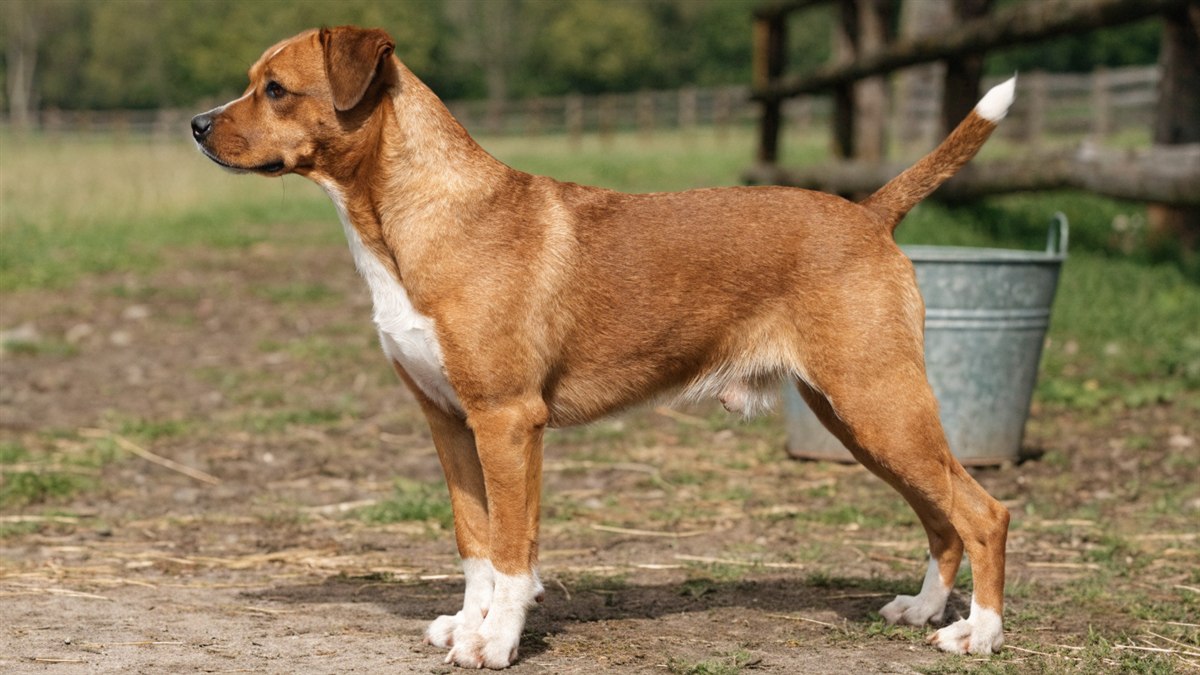
The Austrian Pinscher is a stocky, medium-sized Austrian farm and yard dog registered as FCI-Standard No. 64 in Group 2, Section 1.1 Pinscher, standing 42 to 50 cm at the withers and carrying a thick double coat. Its listed utilization is watch and companion dog, and the standard states that its hunting instinct is only slightly developed. It is not a small Dobermann, it is not a heavier German Pinscher, and it is not a rough-coated dog, whatever three of the ranking pages say.
Everything in this section comes from documents Bonbeno opened and read. FCI-Standard No. 64 was downloaded as the FCI's own PDF and extracted in full; the breed name printed on page one of that document reads OSTERREICHISCHER PINSCHER (Austrian Pinscher), which is the check that stops an agent from taking figures off a correctly-named URL that serves a different dog. The nomenclature entry was read as raw HTML from fci.be rather than through a summariser.
The registry position, exactly
The FCI accepted the breed on a definitive basis on 4 September 1954, and its current official valid standard was published on 25 March 2003, with the English translation by Elke Peper dated 5 May 2003. Federation Cynologique Internationale The breed sits in Group 2, Pinscher and Schnauzer, Molossoid and Swiss Mountain and Cattledogs, in the section for Pinscher and Schnauzer type and the subsection Pinscher, and it is not subject to a working trial. Its official authentic language is German and its country of origin is Austria.
One small date is worth noticing because it places the breed in its own national context. Austria's other rare native, the Austrian Black and Tan Hound, was accepted definitively by the FCI on 3 September 1954, one day earlier. The two breeds went through the same door in the same week and have had very different afterlives since.
| Clause | What the standard actually says |
|---|---|
| Standard number | FCI-Standard No. 64, Group 2, Section 1.1 Pinscher, without working trial |
| Origin | Austria |
| Utilization | Watch and companion dog |
| General appearance | Stocky dog of medium size with lively and bright expression |
| Height at withers | 42 to 50 cm. Males 44 to 50 cm, bitches 42 to 48 cm |
| Weight | No weight clause exists anywhere in the document |
| Proportions | Height at withers to body length 9 to 10. Muzzle length to skull length 4 to 6 |
| Head | Pear-shaped, broad and rounded cranial region, pronounced frontal furrow, well marked stop |
| Ears | Button ear (folded ear), small, set on high |
| Tail | High set, strong, of medium length and densely covered with hair. No docking clause |
| Coat | Thick double coat. Outer coat short to medium-long, thick, smooth and close-lying. Undercoat thick and short, buttocks slightly trousered |
| Colour | Russet gold (semmelgelb), brownish yellow, stag-red, black with tan-coloured markings |
| White markings | Chest patch, muzzle, neck, throat, nape, feet and tip of tail. Lack of white markings is not a fault |
| Temperament | Assertive, lively, alert, playful, devoted to familiar people, suspicious towards strangers, an incorruptible guard. Hunting instinct only slightly developed |
| Disqualifying faults | Aggressive or overly shy. Physical or behavioural abnormalities. Undershot, overshot |
The standard prints no weight, and that matters
FCI-Standard No. 64 has a SIZE clause and it contains height only. There is no weight line, no ideal-weight range and no upper limit anywhere in the six-page document. Compare the two German relatives, whose standards both print a weight in the same position: the German Pinscher standard gives 14 to 20 kg and the Miniature Pinscher standard gives 4 to 6 kg, each under a heading that reads SIZE AND WEIGHT. Federation Cynologique Internationale The Austrian document's heading reads SIZE, and it stops at the withers.
That single absence explains most of the numbers circulating online, and Bonbeno traced where they came from instead. The full audit is in the health section below, but the short version is that the widely-published 12 to 18 kg belongs to a document written in 1925 and superseded three times since, and the 11.8 to 18.1 kg on the second-ranking page is 26 to 40 pounds converted. Hundeo, Austrian Pinscher
History, and what the standard does and does not admit
The standard's own historical summary is four sentences long. It states that the Austrian Pinscher descends from the ancient Austrian country pinschers that were still widespread in the second half of the 19th century as modest, versatile farm dogs; that systematic pure breeding began in 1921; that on 16 October 1928 the breed was recognised by the Austrian Kennel Club as Osterreichischer kurzhaariger Pinscher, the Austrian Shorthaired Pinscher; and that in 2000 it was renamed Osterreichischer Pinscher.
Read that list again and notice what is missing. The standard says nothing at all about the collapse and rebuilding of the breed. An FCI brief historical summary is capable of carrying that story when the registry chooses to: Bonbeno's Artois Hound guide established, by reading FCI-Standard No. 28 directly, that the Artois Hound's presumed post-war loss and its rebuilding from the beginning of the 1970s are written into the standard's own historical summary, with the individuals responsible named in it. FCI-Standard No. 64 carries no equivalent passage. Anybody who wants this breed's reconstruction documented has to leave the standard and go to the breed club and the university, which is exactly what Bonbeno did.
The Klub fur Osterreichische Pinscher states plainly that in the 1970s there was only a single breeding-fit stud dog left in the world, Diokles von Angern, and that the close cooperation of a few committed breeders in the following years saved the breed from extinction. The 2009 Vienna thesis dates and counts the same collapse: only 55 puppies were registered between 1948 and 1954, and only 43 between 1954 and 1972. None of that appears in FCI-Standard No. 64.
The rebuild is the more interesting half of the story. The surviving stud was mated to an unregistered Landpinscher bitch, a country pinscher of the old farm type with no pedigree, and the club argues that this is precisely why the breed came through in reasonable health rather than as a genetic bottleneck curiosity. From 1979 to 1983 Brigitte Mangold's kennel vom Schildbach produced four litters totalling 29 puppies, and from 1983 the Netherlands, Denmark and Germany began breeding the dog as well.
The studbook is still open, and that is unusual
The Landpinscher project has run alongside pure breeding from the beginning and it is still running. Dogs that match the breed standard in temperament and appearance but hold no pedigree are mated with each other, and their descendants can be entered into the studbook once they have matched the Austrian Pinscher type in appearance, temperament and health across three generations, because the studbook can still be opened for such new entries as required. The club states the purpose in one line: keeping the breed healthy and genetically diverse.
Most pedigree breeds slammed their studbooks shut a century ago. This one did not, and a reader comparing breeds should weight that heavily, because an open studbook is the single most effective structural defence a small population has against inherited disease. It is also the reason the Austrian Pinscher's story reads differently from the Dobermann, a breed assembled quickly from a closed and much-used pool.
Where it stands with the other registries
The breed is recognised in Austria by the Osterreichischer Kynologenverband, the Austrian Kennel Club, founded in 1909, which is the umbrella body for around 100 Austrian dog associations and roughly 500 affiliated clubs and is the only Austrian umbrella that is an FCI member. Internationally it is FCI recognised on a definitive basis.
Outside that, the picture thins fast. Bonbeno searched the American Kennel Club's Foundation Stock Service breed directory and found no Austrian Pinscher entry, while the same directory page names the Affenpinscher, the Doberman Pinscher, the German Pinscher and the Miniature Pinscher. Wikipedia states that the United Kennel Club recognised the breed in 2006, but cites a book published in 1995 for that claim, and the UKC's own page returned HTTP 403 to Bonbeno on two separate tools. This guide therefore publishes no UKC figure at all, rather than repeating a claim it could not open.
There is no Kennel Club of India route either. The KCI registered 33,880 pure-bred dogs with its studbook in 2025, against a total of 1,425,001 since the studbook's creation, and the Austrian Pinscher is not among the breeds it handles. For an Indian reader that is not a footnote, it is the whole practical answer, and the price section below deals with it directly.
Austrian Pinscher price in India
There is no verified Austrian Pinscher price in India, because there is no Indian market for the breed to price. Exactly one page anywhere publishes a rupee figure, and that page states in the same sentence that the figure is not an Indian price. Indian import law separately forecloses the supply chain that would create one.
Say the useful thing first, because a reader who has just typed this breed into a search box deserves the answer in one line rather than after eight hundred words of temperament copy. You cannot buy an Austrian Pinscher in India, no Indian breeder exists, the Kennel Club of India does not register the breed, and nobody can lawfully import one to sell you. What follows is the evidence for each of those four statements.
The only rupee figure in existence confesses in its own sentence
PetsArmy, on the Indian domain petsarmy.co.in, is the sole page ranking for this breed that prints a rupee number. Under an H3 heading reading Price range in different cities, its text reads that the exact prices of Austrian Pinschers in Indian cities are hard to pin down, that buyers should be ready to pay much more than for common breeds, and that the extreme rarity of Austrian Pinschers pushes their prices higher, to Rs 70,000 to Rs 130,000 based on what people pay internationally.
Read that carefully. A heading promising city-by-city Indian prices is followed by an admission that Indian city prices cannot be pinned down, and then by a band the page itself attributes to international prices. No Indian city figure appears anywhere on the page. The number is a conversion wearing an Indian costume, and its own author says so.
Running the 84.38 test on it, and reporting honestly that it does not fire
Bonbeno divides every suspicious rupee figure by 84.38, because Indian breed pages routinely publish a dollar figure run through one exchange rate, and this site has caught that at exactly 84.38 three separate times. Run on this band the test comes back negative. Rs 70,000 divided by 84.38 is 829.58 and Rs 130,000 divided by 84.38 is 1,540.65, and neither is a round dollar amount.
So the arithmetic points somewhere slightly different, and it is worth showing rather than hiding. Divide by the source band instead. Rs 70,000 divided by 800 is exactly 87.50, and Rs 130,000 divided by 1,500 is 86.67. Both sit at roughly Rs 87 to the dollar. The band those two divisions imply, 800 to 1,500 US dollars, is precisely the band published by World Deer, another page in the same ranking set. The ratio matches too: 130,000 over 70,000 is 1.857, and 1,500 over 800 is 1.875. An Indian reader is being shown an American guess at a 2026 exchange rate.
In the sentence immediately before the rupee band, PetsArmy writes that Miniature Pinschers in India cost between Rs 15,000 and Rs 50,000. That is a real Indian market figure for a real Indian breed, and it belongs to the Miniature Pinscher, which is a 25 to 30 cm, 4 to 6 kg toy dog under FCI-Standard No. 185. It is not the Austrian Pinscher, which is a 42 to 50 cm double-coated farm dog under a different standard. Borrowing a related breed's number to fill an empty column is the commonest failure on rare-breed pages, and here you can watch it happen in two consecutive sentences.
What the international sources say, and how far apart they are
Once you leave India the figures do not converge, they scatter. Four pages in the ranking set publish a purchase price and no two agree.
| Source | Figure published | What it is sourced to |
|---|---|---|
| PetsArmy (India) | Rs 70,000 to Rs 130,000 | The page's own words, based on what people pay internationally |
| DogBreedsList | 400 to 600 US dollars | No source cited |
| World Deer | 800 to 1,500 US dollars, average 1,200 | No source cited |
| Wamiz (UK) | 500 to 1,000 pounds | No source cited |
| FCI-Standard No. 64 | No price. Standards do not set prices | Not applicable |
| Klub fur Osterreichische Pinscher | No price published anywhere on the club site | The club lists breeders and litters, not prices |
The two US bands are nearly fourfold apart at the bottom end, 400 dollars against 1,500 dollars, and neither carries a citation. That spread is not a market, it is a set of guesses. Bonbeno publishes the disagreement rather than averaging it, because an average of two unsourced numbers is a third unsourced number with a false air of authority.
Indian import law closes the supply chain, and Bonbeno read the notice
DGFT Trade Notice No. 22/2022-23, dated 19 December 2022, sets India's import policy for pet animals, and Bonbeno downloaded and extracted the notice in full from the Directorate General of Foreign Trade's own PDF rather than summarising a summary. Under ITC (HS) 01061900, Mammals: Other, the import policy is Restricted.
Policy Condition (7) allows the import of dogs only for three purposes, listed verbatim in the notice: a pet dog with a valid pet book and relevant records or documents in the name of the importer; dogs imported by R&D organisations for conducting research with the recommendation of CPCSEA; and dogs for internal security by the Defence and Police Force. Policy Condition (8) then states that the import of commercial dogs for breeding or any other commercial activities other than those purposes is not permitted.
Paragraph 6 of the same notice is the sentence that settles the question for any Indian buyer. It reads that any applications for trading or breeding purposes, or applications made on behalf of some another person or entity, shall be duly rejected. Import is further limited to the airports and seaports of Delhi, Mumbai, Chennai, Hyderabad, Bengaluru and Kolkata and, since October 2024, Kochi airport, and an advance No Objection Certificate must be obtained from the Regional Officer or Quarantine Officer seven days before travel, relaxable to three days. Department of Animal Husbandry…
- Bringing your own dog home is lawful. A person transferring residence to India after two years of continuous stay abroad may import up to two pets as passenger baggage without a DGFT authorisation.
- Everything else needs paperwork. An import authorisation from DGFT is required if the stay abroad was under two years, if the pet is not travelling as baggage, or for more than two animals, with applications examined by DAH&D.
- Buying to resell is not on the list. No route exists for a commercial import, and applications for trading or breeding are to be rejected outright.
- Start early. The notice advises owners to begin the import authorisation process at least two months before travel.
Put those two facts side by side. The Kennel Club of India does not register the breed, and no lawful commercial import route exists. Directorate General of Foreign Trade Between them they mean no Indian supply chain for this breed can form, which is why the price band you are being quoted has to be imported along with the imaginary dog.
What the real supply looks like, counted rather than described
The breed club publishes its own register, so rarity here can be counted instead of asserted. On 20 August 2026 the Klub fur Osterreichische Pinscher listed 14 breeding kennels in Austria. Six of them carried a 2026 litter notice, one was planning a litter for autumn 2026, one was planning 2027, two stated explicitly that no litter was planned for 2026, and four carried no litter note at all. The club's litter register on the same day showed eight litters carrying a 2026 date, spread across Austria, Germany and the Netherlands, plus one from 2025.
For scale, Arche Austria, the Austrian association for the preservation of rare domestic breeds, recorded that in Austria 6 to 12 breeding animals produce between 20 and 40 puppies annually, and that roughly 200 Austrian Pinschers live in Austria with about the same number abroad. The club's current estimate is a little over a thousand dogs worldwide, half of them in Austria. Both numbers describe the same reality from different decades: this is a breed whose entire annual global output would fit in a single Indian pet shop's monthly turnover.
That is the honest ceiling on any price discussion. A few dozen puppies a year, allocated through a club register in German, to buyers in a handful of European countries, with no export pipeline to India and no legal import route for one. The correct number to publish for the Austrian Pinscher price in India is not a range. It is that no such price exists.
Monthly cost of ownership in India
Bonbeno publishes no monthly rupee figure for the Austrian Pinscher in India, because no Indian owner population exists to survey and every number that could be printed here would be a guess dressed as research. What this section gives instead is the cost structure, ranked by which line items this particular breed drives up and which it drives down, so a reader can price it against a dog they can actually buy.
That refusal is the finding, not a gap. Two of the ranking pages carry a cost section, and neither has an Indian owner behind it. World Deer publishes an average purchase figure of 1,200 US dollars under a Cost of Ownership heading. PetsArmy's only rupee running figure, Rs 15,000 to Rs 50,000, is the Miniature Pinscher's Indian purchase price, not anybody's monthly cost. A page that invents a monthly total for a breed with no Indian dogs is not being helpful, it is being confident.
What the standard and the club imply about size, and therefore about feed
Feed is the largest recurring line for almost every dog, and it scales with bodyweight. FCI-Standard No. 64 prints no weight at all, so the honest anchor is the breed club's own published figure: usually 14 to 20 kg, at most 25 kg, on a frame of 42 to 50 cm. Federation Cynologique Internationale That places the Austrian Pinscher in the same feed bracket as a Beagle at the light end and well under a German Shepherd at the heavy end.
Do not use 12 to 18 kg for this calculation just because it is the number on most pages. That band comes from Emil Hauck's 1925 breed characteristics, which also specified a height of 35 to 50 cm and a tail that is as a rule docked short, both superseded. Feeding a 2026 dog off a 1925 weight table will under-feed a working-built adult.
The five line items this breed actually changes
| Line item | Direction | Why, mechanically |
|---|---|---|
| Grooming and coat care | Down, then up in shedding season | A thick double coat over a thick short undercoat needs no clipping, no stripping and no salon, so the baseline is near zero. The cost arrives twice a year as time, not money, when the undercoat blows |
| Tick and ectoparasite prevention | Up, and non-negotiable in India | A dense undercoat is a better tick habitat than a single smooth coat. A PCR survey of 525 dogs across four north Indian cities found 261, or 49.7 percent, infected with at least one tick-borne pathogen. Year-round prevention is a fixed cost here, not seasonal |
| Orthopaedic screening | Up if you ever breed, optional if you do not | The only breed-specific study found hip dysplasia and patellar luxation at prevalences it called breeding-relevant. Indian law separately makes a hip dysplasia test mandatory before a registered breeder may sell. |
| Cardiac workup | Situational | The same study recorded heart disease across 23 of the 178 dogs whose owners answered that question, which the thesis tabulates as 13.0 percent. An auscultation at the annual visit costs almost nothing and is the sensible default |
| Cooling and hot-weather management | Up, and higher than for a smooth-coated dog | Fans, shade, timing walks and water are running costs in an Indian summer for any double-coated dog. This is dealt with in full in the climate section below |
Import cost is a process cost, not a price
If an Austrian Pinscher ever reaches India it will be because somebody moved house, not because somebody bought one. That route carries real steps and real time, all of them documented in DGFT Trade Notice 22/2022-23, and none of them carrying a fee the notice discloses. Budget the time rather than guessing the money.
- Confirm the route. Two years of continuous stay abroad and no more than two pets, and no import authorisation is needed under baggage rules.
- Assemble the documents. Vaccination book or pet passport or pet book, certificate for emotional support, and the pet's passport, for a permanent import.
- Apply two months out. The notice advises starting the import authorisation process at least two months before travel where an authorisation is required.
- Get the health certificate abroad. Disease testing prescribed in the health certificate must be conducted in the exporting country, with all test reports accompanying the animal.
- Book the advance NOC. Obtain it from the Regional or Quarantine Officer at one of the seven permitted ports, seven days before travel.
- Land at a permitted port. Delhi, Mumbai, Chennai, Hyderabad, Bengaluru, Kolkata or, since October 2024, Kochi, and no others, with quarantine at that port where required. Department of Animal Husbandry…
What owners of this breed actually spend money on, from the one survey that exists
The Vienna thesis asked 188 Austrian Pinscher owners across Austria, Germany, the Netherlands, Denmark and other European countries why they had or had not put their dog through each screening test, and the answers are unusually informative about where the money goes.
Cost was almost never the barrier. Of the owners who had not had a hip radiograph done, only 4 named cost, against 49 who said the dog was not going into breeding, 21 who thought the examination pointless and 12 who cited anaesthetic risk. For the elbow radiograph, 7 named cost against 49 who said the dog would not breed. For the cardiac ultrasound, 6 named cost against 41.
Across every screening test in that survey, the dominant reason for skipping it was that the dog was not intended for breeding. That logic is defensible for a breeder and wrong for a pet owner, because a hip radiograph tells you how to exercise the dog you already have, not only whether to breed it. If you keep any medium-sized double-coated working breed, treat orthopaedic imaging as a diagnostic tool you may need, and ask your nearby vet when it would change your management.
One further structural cost applies only to breeders and is worth knowing because it shapes what a legitimate Indian seller would have to do. The 2017 Rules require a registered breeder to keep a consultant veterinary practitioner available, to have every dog medically examined at least once every month with a written record, and to maintain individual health records for every animal above eight weeks of age. Anyone offering you a rare imported breed without those records is not operating inside the Rules, whatever the paperwork looks like.
Suitability for the Indian climate
Bonbeno rates the Austrian Pinscher 2 out of 5 for heat tolerance in Indian conditions, and the rating is built from two clauses in its own breed standard rather than from adjectives. The coat clause reads thick double coat, with an undercoat described as thick and short. The size clause puts a 42 to 50 cm dog inside that coat. Insulation plus mass is the problem; a normal muzzle is the one thing working in the dog's favour.
The mechanical case, clause by clause
A dog sheds heat three ways that matter in India: panting, which is evaporative; conduction to a cooler surface; and radiation from thinly-covered skin. A double coat interferes with the last two and leaves the whole burden on the first. FCI-Standard No. 64 specifies an outer coat that is short to medium-long, thick, smooth and close-lying, over an undercoat that is thick and short, with the buttocks slightly trousered. That is a cold-and-wet weather system. Arche Austria describes the same coat as weatherproof, which is exactly the point: it was selected on Austrian farmyards to keep a dog working through alpine winters.
Now put that next to the two German Pinschers, because this is the comparison that makes the rating legible. FCI-Standard No. 184 gives the German Pinscher hair that is short and dense, smooth, close and shiny without bald patches, and mentions no undercoat anywhere in the document. FCI-Standard No. 185 gives the Miniature Pinscher word-for-word the same clause, again with no undercoat. Of the three Pinscher breeds in FCI Group 2, Section 1.1, only the Austrian one is double-coated.
The Austrian Pinscher is the hardiest-looking and most rustic of the three Pinschers, and it is the least suitable of the three for an Indian summer. The German Pinscher and the Miniature Pinscher carry a single short coat with no undercoat; the Austrian Pinscher carries a thick double coat with a thick undercoat. Federation Cynologique Internationale Federation Cynologique Internationale Rustic means built for a hard climate, and the hard climate it was built for was cold.
The one clause that helps
The head saves it from a rating of 1. FCI-Standard No. 64 sets the ratio of muzzle length to skull length at 4 to 6 and calls for a strong muzzle with a straight nasal bridge. A muzzle two-thirds the length of the skull is a full-length airway, and a full-length airway is a working evaporative cooler. This is not a cosmetic point. In the largest primary-care study of heat-related illness in dogs, drawing on 905,543 dogs under care at 886 UK clinics, brachycephalic dogs carried 1.32 times the odds of exertional heat-related illness compared with non-brachycephalic dogs, on a confidence interval of 1.10 to 1.60. The Austrian Pinscher sits on the safer side of that line.
Size helps a little too, in both directions. A 14 to 20 kg body heats more slowly than a 5 kg one and cools more slowly as well, and it is light enough that a person can physically lift it into a cool room. Neither effect is large enough to move the rating.
The risk is what you do with the dog, not the parked car
Indian heat advice fixates on cars, and the evidence says the fixation is misplaced. The same UK study identified 1,259 heat-related illness events across 1,222 dogs in a single year. Of the 879 events where a trigger was recorded, 652, or 74.2 percent, were exertional, 113, or 12.9 percent, were environmental, and only 46, or 5.2 percent, involved vehicular confinement. Nearly three quarters of heat casualties happened because the dog was doing something.
That finding lands hard on this breed specifically, because the Austrian Pinscher is not a low-energy dog. The breed club describes a very active dog that drives livestock independently, and the second-ranking page tells buyers it needs daily walks of at least 1.5 hours. Hundeo, Austrian Pinscher A double-coated 45 cm farm dog walking 1.5 hours at two in the afternoon in Nagpur is the exact scenario that produces 74.2 percent of the cases.
| Condition | What it does to a double coat | What to change |
|---|---|---|
| Dry summer heat, Delhi, Jaipur, Nagpur | Panting works, but the undercoat traps a warm boundary layer against the skin | Walk before sunrise and after dark. Shade and airflow beat cold water |
| Humid heat, Chennai, Mumbai, Kolkata | Evaporative cooling loses efficiency as humidity rises, so panting returns less heat per breath | Cut duration, not just intensity. Treat a humid 32 degrees as harder than a dry 38 |
| Monsoon | A thick undercoat holds water for hours and dries slowly against the skin | Towel to the skin, not just the topcoat. This is the highest-value habit for this breed in India |
| Milder plateau cities, Bengaluru, Pune | The coat is closest to workable here, and this is the only part of India where the breed is a sensible fit | Still avoid midday exertion in April and May |
| Hill stations, Shimla, Ooty, Gangtok | The coat performs as designed | Normal management. Watch ticks rather than heat |
Never shave the coat, and what to do instead
Shaving a double coat is the single most common and most damaging response to an Indian summer, and it makes the dog hotter, not cooler. The undercoat and the outer coat do different jobs. Clipping removes the outer guard hairs that shade the skin and reflect radiant heat, leaves the dense undercoat behind as a fluffy insulating mat, and exposes skin that has never seen direct sun. The standard specifies both layers deliberately.
- Brush the undercoat out rather than cutting the topcoat off. An undercoat rake twice a week through shedding season removes the layer that is actually trapping heat.
- Give the dog a cool surface. Conduction to stone, tile or a damp mat works when panting is struggling in humidity.
- Move air. A fan makes evaporative cooling from the tongue and paw pads more effective, which is the mechanism the dog is relying on.
- Wet the belly, groin and paws, where the coat is thinnest and blood vessels are close to the surface, rather than soaking the back where water sits on the topcoat.
- Stop before the dog wants to. A guarding breed with a job will keep working past the point where it should have stopped.
Heavy or noisy panting that does not settle in shade, bright red gums, unsteadiness, vomiting, or a dog that lies down and refuses to move are emergencies. Move the dog into shade and moving air, wet the belly and legs with cool rather than iced water, and consult your nearby vet the same hour rather than waiting to see if it passes. Consult your nearby vet before starting any hot-weather routine for a dog with a known heart murmur, because the breed's own health survey recorded cardiac findings.
The honest summary for an Indian buyer is short. In Ooty or Gangtok this dog is fine. In Bengaluru or Pune it is manageable with disciplined walk timing. In Chennai, Mumbai, Delhi or Nagpur you would be managing a cold-climate coat against the weather for the animal's whole life, and there is no version of that which is fair to the dog.
Temperament and household fit
The Austrian Pinscher is a suspicious, vocal, strongly bonded yard guard dog that was selected to announce every stranger and to stay home while doing it. FCI-Standard No. 64 describes it as assertive, lively, alert, playful and especially devoted and friendly with people familiar to him, and towards strangers suspicious and an incorruptible guard. Everything difficult about living with this breed follows from that second sentence.
The standard adds one more clause that shapes daily life more than any other: his hunting instinct is only slightly developed. Arche Austria makes the same point in stronger terms, calling the Austrian Pinscher the only indigenous non-hunting breed in Austria. Historically that was the entire commercial logic of the dog. Only the sovereign and the nobly born held hunting rights, so a farm dog that hunted was a liability to its owner, and the only quarry it was permitted and indeed required to take were rats and mice, which is where the Austrian nickname Rattler comes from. Arche Austria, Verein zur Erhaltung…
The breed club warns about cities, and one ranking page says the opposite
This is the disagreement that matters most for an Indian reader, and it is worth quoting both sides. The Klub fur Osterreichische Pinscher writes that the Austrian Pinscher possesses what is called desirable mistrust, that strangers must earn his trust before they belong, and that in the countryside this is usually no problem but in urban residential density it is not always the ideal starting point for neighbourly harmony. The club also states that every stranger is first reported as an intruder with barking, because the dog wants to be sure everything is above board.
Hundeo, meanwhile, answers its own FAQ question on apartment living with a yes, saying the Austrian Pinscher can live in an apartment with sufficient outdoor exercise. Both statements can be true, and only one of them is useful. The dog can physically live in a flat. The question an Indian buyer in a Mumbai or Bengaluru apartment block is actually asking is whether the neighbours will survive it, and on that the breed's own club is the more candid witness.
A breed selected for centuries to bark first at anyone who enters the property does not stop doing that because the property is now the fourteenth floor. In an Indian apartment, the property boundary a guard dog defends becomes the front door of a shared corridor, and the intruder becomes the delivery rider, the domestic help, the neighbour and the lift. That is not a training problem you solve, it is a mismatch between what the dog was bred to do and where you have put it.
What it is genuinely good at
Once past the guarding, the reports are consistently warm and they come from more than one source. The club describes a dog that goes through fire for its people once it has taken them into its heart, and notes that many Austrian Pinschers cannot get enough of being stroked and scratched. Arche Austria describes a playful, affectionate dog, friendly with familiar people and therefore a popular family dog, and adds that it is often used as a sport dog because of its agility.
On children both sources agree with a condition attached. Arche Austria calls it a popular family dog, and the club states that Austrian Pinschers get on excellently with children provided the children observe canine courtesy rules. Klub fur Osterreichische Pinscher (KOP) That caveat is doing real work in an Indian household with visiting cousins. This is a dog with strong opinions about its territory and its people, not a Labrador that tolerates being climbed on.
The other consistent finding is loyalty to place. The club states that a Pinscher should be faithful to its family and its house, meaning it does not tend to stray or to poach. In an Indian context that is a genuine advantage, because a dog that stays inside the compound gate on its own account is a dog at much lower risk from traffic and from street conflict.
A temperament figure nobody has published
The 2009 Vienna study asked 188 Austrian Pinscher owners why their dog had been neutered, and the answer table contains a number that is quietly reassuring. Of 73 neutering events recorded, 38 were for contraception, 9 for cancer prevention, 4 for excessive sex drive, 4 for cryptorchidism, 2 for pyometra, 1 for prostate disease, 12 for other reasons and 3 unstated. The count recorded for aggression was zero.
That is one survey, in Europe, of owners who chose to answer, and it is not a temperament test. But in a breed whose standard lists aggressive or overly shy as a disqualifying fault, and in a population of 188 dogs of which 78.7 percent were pets rather than breeding stock, not one owner named aggression as the reason for a surgical intervention. Set that against the volume of guarding language on every breed page and it suggests the noise is the issue, not the bite.
Who should and should not get this breed
| Household | Verdict | Why |
|---|---|---|
| A farmhouse, plot or independent house with a compound wall, in a hill or plateau city | The only genuinely good fit | The dog gets a boundary to patrol, a job, and a climate its coat can handle |
| A large flat in a dense Indian apartment block | Poor fit | The club itself flags urban density as a problem for neighbourly harmony |
| A first-time dog owner | Poor fit | Hundeo, one of the more careful ranking pages, states that this breed needs an experienced owner and prior dog experience |
| A home with frequent visitors, staff and deliveries | Poor fit | Every arrival is announced as an intruder by design, not by accident |
| A household with small children and no adult supervision | Conditional | The club's endorsement is conditional on children observing canine courtesy rules |
| A household with cats, rabbits or birds | Conditional | Hunting instinct is only slightly developed under the standard, but the breed's traditional job was killing rats and mice Arche Austria, Verein zur Erhaltung… |
| An active owner wanting a sport dog | Good fit | Arche Austria names agility, tracking, flyball, dogdancing and obedience as things the breed takes to |
One line from the Arche Austria page deserves to end this section because it is unusually honest for an organisation promoting a breed it wants preserved. It states that despite all its positive qualities, the Austrian Pinscher is not everybody's dog, and that it shows its best only alongside a positive human-dog relationship and the chance to live out the needs that are particular to it. Nobody who socialises this dog properly, gives it a boundary and gives it work will be disappointed. Anybody who buys it as a compact rustic ornament will be.
Training, and the two things this breed will resist
To train an Austrian Pinscher, give it a job with a beginning and an end, and accept that two behaviours will never fully switch off because both are what the breed was selected for. It will announce strangers, and it will make decisions without consulting you. Everything else is trainable, and the evidence says trainable to a high level.
Start with what the registry does and does not test, because it explains the material you are working with. FCI-Standard No. 64 places the Austrian Pinscher in Group 2 without working trial. There is no standardised aptitude test a dog must pass before it can breed, unlike the Austrian scenthounds in Group 6, where the Austrian Black and Tan Hound is selected on its ability to work a cold track. What the standard does select on is temperament in a blunt sense: aggressive or overly shy is a disqualifying fault.
So the breed has been kept stable in character without being narrowed by a single work test. That is why the reported picture is broad rather than specialist. Arche Austria states that from obedience training through tracking, agility, flyball and dogdancing, a great deal can be taught to this all-rounder, and that the breed is increasingly used as a sport dog because of its nimbleness.
Resistance one, the announcing
The barking is not a fault to be trained out, it is the function. The club states that every stranger is first reported as an intruder with barking, because the dog first wants to be sure that everything is above board. The standard calls it an incorruptible guard. A breed that has been selected for two centuries to do this does not stop because a trainer asks nicely.
What does work is changing what counts as an event rather than trying to delete the response.
- Teach an off switch, not silence. Reward the dog for stopping after two or three barks and coming to you. The announcement is allowed; the ten-minute follow-up is not.
- Make routine arrivals boring. Deliveries, domestic staff and the milk delivery should be paired with the dog going to a mat and getting fed there, every single time, from week nine.
- Do not reward the bark by arriving. If you come to the gate every time the dog sounds off, you have taught it that barking summons the pack leader, which is a promotion.
- Manage the sightlines. A dog that can see the whole corridor or street will patrol it. Blocking the view is more effective than any command.
Resistance two, the independence
The second thing this breed resists is doing what it is told when it can see a better answer. The club describes a dog that drives cattle into the byre or out to pasture skilfully and independently. That word is the whole training brief. A stock dog that had to be told each step would have been useless on a small Austrian holding, so independent judgement was selected in, deliberately, for generations.
Hundeo puts the practical consequence bluntly and Bonbeno agrees with it: this breed needs an experienced owner, and consistent training with prior dog experience matter. A first-time owner in an Indian city will read the independence as disobedience and escalate, which is the worst possible response to a dog that was bred to make its own calls.
An independent, territorial, environmentally alert dog with only a slightly developed hunting instinct is a much better recall prospect than a scenthound, but it will still choose the interesting thing over you if you have never paid for the choice. Build recall on food, in a closed compound, before the dog is sixteen weeks old, and keep paying for it for the animal's whole life. In Indian conditions a reliable recall is also a heat-safety tool, because it is how you stop a working dog that has decided it is not finished.
A realistic timeline
| Age | Focus | Realistic expectation |
|---|---|---|
| 8 to 12 weeks | Socialise hard and wide. Indian street sounds, autos, cattle, crowds, umbrellas, lifts | The window closes fast. Indian law forbids the sale of a pup under eight weeks, so a legitimately-sourced pup arrives with litter learning intact |
| 12 to 16 weeks | Recall on food, mat settle, handling for grooming and ear checks | Recall will look brilliant and is not yet real |
| 4 to 6 months | Arrivals protocol. Loose lead. Introduce the undercoat rake before it is needed | Guarding behaviour begins to appear. Do not punish it, redirect it |
| 6 to 12 months | Proof recall against distraction. Start a sport if you want one | The independence becomes obvious. This is when first-time owners give up |
| 12 to 24 months | Consolidate. Add tracking, agility or obedience work | Adult guarding settles into a pattern. Arche Austria names these as the breed's natural sports |
| Lifelong | Maintain the off switch and the recall | Both decay without practice in a breed this self-directed |
One Indian legal point about how you train
Two provisions of the Prevention of Cruelty to Animals (Dog Breeding and Marketing) Rules, 2017 bear on training and handling, and Bonbeno extracted the gazette text and searched it rather than relying on any summary. Second Schedule Part II, paragraph 6(8) states that there shall be no tail docking, ear cropping, de-barking, de-clawing, branding, dyeing, injecting substances to enhance visual appeal, performing a surgery or procedure to camouflage or hide any defect or infirmity, or any other kind of mutilation of any body part of the pup, and that any change of appearance by artificial means is strictly forbidden.
The word to notice there is de-barking. For a breed whose defining trait is announcing strangers, and for an owner in an Indian apartment under pressure from neighbours, surgical de-barking is exactly the shortcut that gets suggested. It is prohibited outright. So is any docking, which matters here because Emil Hauck's 1925 breed characteristics for this dog stated that the tail is as a rule docked short, while the current FCI standard specifies a natural tail of medium length densely covered with hair. Federation Cynologique Internationale The modern standard and Indian law agree; a hundred-year-old document does not, and it is still being quoted.
Daily exercise requirement
No registry, breed club or study publishes a daily exercise figure for the Austrian Pinscher, so Bonbeno publishes none of its own. What can be sourced is the shape of the requirement rather than its length, and the shape is unusually clear: a sturdy, hardy, ground-covering trotter that needs distance and a job, not sprints and not a park circuit.
One number is in print and it is worth naming with its provenance attached. Hundeo answers its own FAQ by stating that the Austrian Pinscher needs plenty of exercise and that daily walks of at least 1.5 hours plus active play keep it balanced. That figure carries no citation on the page and appears on no registry or club document Bonbeno opened. Treat it as one publisher's estimate, not as a standard.
What the standard's gait clause actually tells you
FCI-Standard No. 64 has one line on movement and it is more informative than any minute count. It calls for flowing and harmonious movement covering a lot of ground. A ground-covering trot is the gait of an animal built to be efficient over distance at moderate speed, which is what a farm dog patrolling a holding and moving stock does all day. It is not the gait of a sprinter and it is not the gait of a dog that will be satisfied by twenty minutes of fetch.
The body clauses agree. The standard specifies strong bone, well-muscled straight forelegs on a broad front, a long, deep, broad, barrel-shaped chest with a well developed forechest and strong tight chest muscles, and well angulated hindquarters. That is a working chassis with the lung room to use it.
The club's own description completes the picture. It calls the Austrian Pinscher a very active and movement-loving dog that drives livestock into the byre or out to pasture skilfully and independently, and a reliable, incorruptible watchman even when its farmyard is now a flat or a detached house. The word to hold on to there is the club's own concession: even when its farmyard is now a flat.
Structure, not duration, is the answer in India
Two Indian constraints reshape the requirement, and neither is about how many minutes the dog needs. The first is heat. In the largest primary-care study of the question, 652 of the 879 heat-related illness events with a recorded trigger, or 74.2 percent, were exertional. Exercise is the single largest cause of heat casualties in dogs, which means that for this breed, in this country, when you exercise matters more than how long.
The second is surface. A double-coated dog whose paws are the main radiator it has left in still, humid air should not be walked on tarmac that has been in the sun since eleven. That is a physical burn risk before it is a cooling problem.
| Slot | What to do | Why |
|---|---|---|
| Before sunrise, daily | The long one. Steady trotting pace, lead or long line, 40 to 60 minutes | Matches the standard's ground-covering gait and lands before ambient heat builds |
| After dark, daily | Second walk, shorter, plus a sniffing or search game | Splits the load so no single session runs long in heat |
| Midday, every day | Nothing outdoors. Frozen food toy, scent game or training indoors | Exertional heat illness is 74.2 percent of recorded triggers |
| Two to three sessions a week | A real job. Tracking, agility, obedience or rally, run early or indoors | Arche Austria names exactly these as the breed's natural outlets |
| Weekly | A long slow outing on soft ground if the weather allows | Soft ground protects joints in a breed with recorded lameness |
| Monsoon | Same load, plus dry the undercoat to the skin afterwards | A thick undercoat holds water long after the topcoat looks dry |
A caution from the breed's own survey about how hard to push
The only breed-specific health survey that exists recorded lameness as the single most common finding of any kind. Thirty-two of the 188 dogs surveyed had a recorded lameness, which the thesis tabulates as 20.9 percent, with 14 in the forelimb, 11 in the hindlimb and 18 of unknown cause. Alongside those, 16 dogs had recorded hip dysplasia, 11 patellar luxation and 6 elbow dysplasia.
One entry in the same study's miscellaneous table is worth quoting because it is the only sport-injury datapoint that exists for this breed anywhere: a single case of arthrosis in the toe joints, recorded by the owner as attributable to agility. One case in 188 dogs is not a warning against agility. It is a reminder that a stocky 42 to 50 cm dog with a documented musculoskeletal profile should be conditioned into a jumping sport rather than dropped into one.
An under-exercised guard dog does not become calm, it becomes a better guard dog. The energy goes into the one outlet the breed already has, which is patrolling and announcing. Owners who report an unbearably vocal Austrian Pinscher in a flat are usually describing a dog with a full tank and nothing to do with it. Fix the exercise and the job before you conclude the barking is a temperament problem.
The honest bottom line is that Bonbeno cannot tell you the breed's exercise requirement in minutes, because nobody has measured it and the one published figure is unsourced. What can be said with sources is that this is a working farm dog with a distance gait, a stock-driving history, a documented aptitude for canine sports, and a coat that makes Indian daytime exercise dangerous. Plan the week around that and the number will take care of itself.
Grooming and coat care in Indian humidity
To groom an Austrian Pinscher, rake the undercoat out twice a week, dry it to the skin after every wetting, and never take clippers to it. FCI-Standard No. 64 specifies a thick double coat, with an outer coat that is short to medium-long, thick, smooth and close-lying, over an undercoat that is thick and short, and the buttocks slightly trousered. Two layers means two jobs, and the ranking set gets this badly wrong.
The shedding claim on the second-ranking page is the opposite of the truth
Hundeo answers its own FAQ question, does the Austrian Pinscher shed a lot, with the statement that the Austrian Pinscher sheds very little to not at all and is considered relatively allergy-friendly. The same page's opening paragraph describes the dog as having a wiry weather-resistant coat.
Both statements fail against the standard. FCI-Standard No. 64 describes a coat that is smooth and close-lying, not wiry, and it describes a thick undercoat, which is the structure that produces heavy seasonal shedding in every breed that has one. PetsArmy, in the same ranking set, states the opposite of Hundeo and gets it right: Austrian Pinschers shed more heavily than German Pinschers, which lose minimal fur. That difference is exactly what the two standards predict, because the German Pinscher's coat clause specifies short and dense, smooth, close and shiny hair with no undercoat mentioned at all.
Allergy-friendly and low-shedding are the two phrases that sell dogs to Indian apartment families, and this is the one breed page where both are printed about a double-coated animal. A buyer who chooses this dog on that basis will meet a full undercoat blow in their first spring, in a flat, in the heat, and the two commonest responses are to shave the dog or to rehome it. Neither is a good outcome. The coat clause is one sentence in a public PDF and it settles the question.
The actual routine
Arche Austria describes body care for this breed as simple, adding that only the long-stock-haired specimens need somewhat more intensive attention. That is consistent with the standard's own range of short to medium-long outer coat. For most dogs the work is small and regular; for the longer-coated individuals it is small, regular and slightly longer.
| Task | Frequency | Note |
|---|---|---|
| Rake the undercoat | Twice weekly, daily in a shedding blow | An undercoat rake or slicker. This is the whole job, and it is what actually reduces heat load |
| Brush the outer coat | Weekly | A bristle brush spreads skin oils along a close-lying coat |
| Dry to the skin | After every bath, rain and wet walk | A thick undercoat holds water for hours. Towel down to skin, then air with a fan |
| Check the ears | Twice weekly, more in humid months | A folded button ear partly covers the canal. Look for odour, redness and head shaking |
| Tick and flea check | After every outing on grass, year round | 49.7 percent of 525 dogs surveyed across four north Indian cities carried at least one tick-borne pathogen |
| Bathe | Only when genuinely dirty | Over-bathing a double coat strips oils and soaks the undercoat, which then has to dry |
| Trim nails | Every three to four weeks | The standard calls for close-knit feet with strong nails |
| Clip the coat | Never | See the climate section. Shaving a double coat makes a dog hotter, not cooler |
The button ear, placed precisely against the evidence
The standard gives this breed a button ear, described as a folded ear, small and set on high. That is a distinct structure from both the erect ear and the hanging hound leather, and it is worth placing carefully rather than assuming.
The largest primary-care study of canine otitis externa in the UK, covering 22,333 dogs, found a one-year period prevalence of 7.30 percent on a confidence interval of 6.97 to 7.65. Against breeds with erect ear carriage, breeds with pendulous ear carriage carried 1.76 times the odds of otitis externa on a confidence interval of 1.48 to 2.10, and breeds with V-shaped drop ears carried 1.84 times the odds on a confidence interval of 1.53 to 2.21.
That study did not measure button ears as a separate category, so Bonbeno publishes no odds ratio for this breed and will not invent one. What the anatomy says is that a small, high-set ear whose tip folds forward sits between the two measured groups: the canal is not sealed by a long hanging leather, but it is not open to airflow the way a fully erect ear is either. Manage it as an intermediate risk, which in practice means checking rather than ignoring.
The Indian seasonal question is not settled, and both answers are published here
Indian pet writing assumes an ear-infection peak in the monsoon, and the Indian data does not straightforwardly agree. A study of 281 dogs presented at veterinary hospitals in and around Durg district, Chhattisgarh, found 51 dogs positive for otitis externa, an overall prevalence of 18.14 percent, and reported the highest seasonal prevalence in the summer rather than the rains, with dogs over five years most affected and the German Shepherd the most commonly affected breed.
Other Indian series report a monsoon peak. Bonbeno reports the disagreement rather than resolving it, because both describe the same mechanism: warm, humid air held inside a partly closed canal. In an Indian household the practical instruction is the same either way, which is to check the ears through both seasons rather than only when it rains.
There is no clipping, no hand-stripping, no de-matting and no salon appointment at any point in this dog's life, and the breed's own conservation association describes body care as simple. Of every recurring cost an Indian owner faces with this breed, grooming is the one that costs time rather than money. Spend that time on the undercoat and the ears and you have covered almost the whole of it.
Health risks, screening and lifespan
Bonbeno publishes no lifespan figure for the Austrian Pinscher, because no study of the breed's life expectancy exists and the 12 to 14 year figure repeated across the ranking set carries no source on any page that prints it. What does exist is a single 2009 diploma thesis at the Veterinarmedizinische Universitat Wien, and it contradicts both the ranking pages and the breed's own club. This section reports it in full.
Everything below is general information drawn from a published university thesis, registry documents and peer-reviewed literature. It is not a diagnosis and it is not a treatment plan. Prevalence figures describe a surveyed European population in 2009, not your dog. If your dog is lame, has a heart murmur, is having seizures, or is panting heavily in the heat, consult your nearby vet the same day, and ask a registered veterinary practitioner before acting on any screening decision in this section.
The number one ranking page's health section has no source and is untrue
English Wikipedia's entire Health section for this breed is one sentence: no data have been collected on the breed's health, but good health is a stated objective of the breed restoration breeding in Austria. It carries exactly one citation, to Arche Austria, whose live URL is dead and which the article links through an Internet Archive capture dated 31 May 2011.
Bonbeno pulled that exact archived page and machine-checked its visible text. It contains zero occurrences of Lebenserwartung, Gesundheitsdaten, keine Daten, Jahre, Krankheit, Erkrankung or Patella. The page is about rarity, husbandry and the breeding project. It says nothing whatsoever about health data having or not having been collected. The claim's only citation does not contain the claim.
Worse, the claim is false and had already been false for years when it was written. In October 2009 Katharina Wetzstein submitted a diploma thesis at the Veterinarmedizinische Universitat Wien titled Osterreichischer Pinscher: Krankheitsprofil und Einfluss des Inzuchtkoeffizienten auf die Wurfgrosse, supervised by A. Univ. Prof. Dr. Irene Sommerfeld-Stur. It analysed 146 litters drawn from the studbook of the Osterreichischer Kynologenverband and the records of the Klub fur Osterreichische Pinscher, and 188 owner questionnaires returned at a response rate of 48.79 percent from owners in Austria, Germany, the Netherlands, Denmark and other European countries. Data have been collected on this breed's health. They have simply never been read by anyone writing about it in English.
The lifespan figure, traced
The 12 to 14 year life expectancy is published by Hundeo, World Dog Finder, DogBreedInfo, DogBreedsList, PetsArmy, Wamiz and World Deer. DogBreedInfo, Austrian Shorthaired Pinscher… DogBreedsList, Austrian Pinscher, Price PetsArmy (petsarmy.co.in) Wamiz UK, Austrian Pinscher: Price World Deer, Austrian Pinscher: Temperament Not one of those pages attaches a source to it. It cannot have come from Wikipedia, because Wikipedia publishes no lifespan for this breed at all. It cannot have come from the FCI, because breed standards do not carry longevity clauses and No. 64 does not. DogBreedsList prints both 12 to 14 years and 12 to 15 years on the same page, which is what a figure looks like when nobody is checking it.
So Bonbeno publishes no life expectancy for the Austrian Pinscher. What it can publish is the only longevity data that exists, which comes from the same Vienna survey.
| Age band | Dogs reported |
|---|---|
| 0 to 8 weeks | 3 |
| 8 weeks to 5 years | 4 |
| 5 to 10 years | 3 |
| Over 10 years | 13 |
| Total deaths reported | 23 |
Thirteen of the 23 dogs whose deaths were reported lived past ten years. That is a banded distribution from a small self-selected European sample, not a life expectancy, and Bonbeno will not convert it into one. The recorded causes were tumour in 8 dogs, malformation in 4, road accident or poisoning in 3, other in 7, and unstated in 1. For context on the living population, the 188 surveyed dogs averaged 6.31 years of age with a standard deviation of 4.00 and a median of 5.5 at the time of the study.
The breed club and the university disagree, and both positions belong on the page
The Klub fur Osterreichische Pinscher states its position clearly. Under a heading on health it writes that given the historical development to a minimal stock of breeding dogs one might fear health consequences from line breeding or even inbreeding, that fortunately those concerns are superfluous, and that Austrian Pinschers are as a rule robust, healthy dogs which usually see the vet only for vaccination or worming appointments. Arche Austria takes the same line, stating that the Austrian Kurzhaarpinscher should be robust and healthy.
The Vienna thesis, surveying that same club's dogs and their European relatives, reached a different conclusion. Its own summary states that the following diseases occurred at increased or breeding-relevant prevalence: diseases of the musculoskeletal system, specifically hip dysplasia, elbow dysplasia and patellar luxation; cryptorchidism; and heart disease, specifically aortic and pulmonic stenosis, valve defects, cardiomegaly and cardiac insufficiency. It further reported an apparent familial accumulation for persistent pupillary membrane and for epilepsy.
Both are published here without adjudication. The club is describing everyday veterinary contact for a pet dog, which is a fair description. The thesis is describing what turns up when you send a questionnaire to 385 owners and count what comes back. They are not the same question, and a buyer deserves both answers.
One page in the ranking set gets the shape of this right, without saying how it knows. DogZone's Health section carries exactly two condition headings, Hip Dysplasia and Cardiac Disease, which are two of the three groups the Vienna thesis independently identified as occurring at breeding-relevant prevalence. The same page publishes an 11 kg to 18 kg weight for a breed whose standard prints no weight at all. Bonbeno notes the agreement because a page that only catalogues the ranking set's errors is not auditing it, and this one landed on the right two conditions.
The numbers, with an arithmetic warning attached
Before the table, one methodological point that Bonbeno found by dividing the figures out rather than taking them on trust. The thesis computes its percentage column as cases divided by non-cases, not as cases divided by all respondents. For hip dysplasia it records 16 cases, 169 non-cases and 3 no-answers, totalling 188, and prints 9.5 percent, which is 16 divided by 169. Divided by the 185 dogs whose owners answered, the same 16 cases give 8.6 percent. Both numbers are honest; they answer slightly different questions. The raw counts below are the safest thing to quote, and they are what Bonbeno leads with.
| Finding | Cases | As tabulated by the thesis |
|---|---|---|
| Lameness, any cause | 32 | 20.9 percent |
| Lameness, forelimb | 14 | 8.3 percent |
| Lameness, hindlimb | 11 | 6.4 percent |
| Lameness, unknown cause | 18 | 10.8 percent |
| Hip dysplasia | 16 | 9.5 percent |
| Patellar luxation | 11 | 6.3 percent |
| Elbow dysplasia | 6 | 3.4 percent |
| Spinal spondylosis or arthrosis | 4 | 2.2 percent |
| Osteochondrosis dissecans | 1 | 0.5 percent |
| Panosteitis | 0 | 0.0 percent |
| Cryptorchidism, of 92 males | 7 | 7.6 percent |
| Heart disease, all forms | 23 | 13.0 percent |
| Cardiac insufficiency | 6 | 3.5 percent |
| Cardiomegaly or cardiomyopathy | 5 | 2.9 percent |
| Heart valve defect | 4 | 2.3 percent |
| Aortic stenosis | 2 | 1.1 percent |
| Pulmonic stenosis | 1 | 0.6 percent |
| Epilepsy or epileptiform seizures | 6 | 3.4 percent |
| Persistent pupillary membrane | 4 | 2.2 percent |
| Eye disease, all forms | 9 | 5.1 percent |
| Eczema | 8 | 4.6 percent |
| Allergy | 3 | 1.7 percent |
| Tumours, all forms | 10 | 5.5 percent |
| Mammary tumour | 0 | 0.0 percent |
Two entries deserve a second look. Panosteitis at zero and mammary tumour at zero in a survey of 188 dogs are genuinely uncommon results and are worth reporting precisely because a page that only prints the bad findings is not reporting, it is arguing. And the single largest finding is not a named disease at all but lameness, in 32 dogs, of which 18 had no cause identified.
Inbreeding, litter size and effective population size
The second half of the thesis is a population study, and it produced the clearest result on the page. Across 146 litters born between 1993 and 2008, the mean inbreeding coefficient calculated over ten generations was 13.92 percent for the litters, 11.20 percent for the sires and 14.95 percent for the dams, with the highest litter value at 35.35 percent and 13 litters at an assumed zero.
Splitting those litters at the founding of the KÖP at the end of 2002 shows what a deliberate breeding policy did. From 1993 to 2002 there were 93 litters worldwide, averaging 5.72 puppies born and 5.29 reared, at a mean litter inbreeding coefficient of 17.14 percent. From 2003 to 2008 there were 53 litters, averaging 6.28 born and 6.15 reared, at a mean litter coefficient of 8.28 percent. The fall in inbreeding was significant for litters and sires at p below 0.001 and for dams at p equal to 0.008, and the rise in puppies reared was significant at p equal to 0.027.
The two are causally linked, and the thesis quantifies the link. Higher inbreeding was associated with smaller litters, at Spearman correlations of minus 0.243 for puppies born at p equal to 0.003 and minus 0.283 for puppies reared at p below 0.001. The regression coefficients put a price on it: each percentage point of inbreeding cost between 0.047 and 0.080 puppies, and among litters already above 6 percent the cost rose to between 0.115 and 0.133 puppies per point.
| Period | Sires | Dams | Effective population size | Mean inbreeding coefficient, 10 generations |
|---|---|---|---|---|
| 1993 to 1996 | 16 | 21 | 36.42 | 13.39 percent |
| 1997 to 1999 | 20 | 23 | 42.79 | 12.95 percent |
| 2000 to 2002 | 15 | 17 | 31.88 | 13.82 percent |
| 2003 to 2005 | 17 | 20 | 36.76 | 12.46 percent |
| 2006 to 2008 | 19 | 23 | 41.62 | 7.80 percent |
That table is the real measure of how endangered this breed is, and it is far more informative than the word rare. An effective population size in the thirties and forties is small by any conservation standard, and it held there for fifteen years while the inbreeding coefficient nearly halved, which is the signature of careful mate selection rather than of a growing gene pool. The thesis is candid about a limitation that cuts against its own numbers: pedigree completeness over ten generations ranged only from 15.20 to 22.96 percent, so the true inbreeding coefficients are underestimates.
The club's own figure completes it. Between 2003 and 2008, as of February 2009, 171 puppies were born within the KÖP at a mean inbreeding coefficient of 3.486 percent, under a policy of mating recommendations based on the offspring's coefficient, no excessive use of individual sires and no repeated litters.
Screening: what this breed's owners actually do
The survey also recorded whether each dog had been screened, and the answer is that most had not.
| Examination | Done | Share of 188 dogs |
|---|---|---|
| KOP club examination, heart auscultation plus patella | 59 | 31.4 percent |
| Hip radiograph | 44 | 23.4 percent |
| Cardiac ultrasound | 26 | 13.8 percent |
| Elbow radiograph | 18 | 9.6 percent |
Fewer than one dog in four had ever had a hip radiograph, in a breed whose largest single finding was lameness. The club runs a screening examination covering heart auscultation and patellar luxation, and under a third of surveyed dogs had been through it. That is the gap between a stated commitment to robust health and the evidence base needed to defend it.
Two registry blanks, reported carefully
The Orthopedic Foundation for Animals publishes breed-level orthopaedic statistics and states its own inclusion threshold plainly: breeds are not included in the OFA statistics tables until a minimum number of individuals have been evaluated, at least 100 evaluations for hips and at least 50 for all other databases. Bonbeno attempted to read the OFA statistics tables and could not: the page returned no breed rows to this session, and control queries for breeds known to be listed also returned nothing, which means the tool failed rather than the breed being absent. This guide therefore makes no claim about whether the Austrian Pinscher appears in OFA's tables. An unproven absence is a broken query, not a finding.
The American Kennel Club check did work. Bonbeno searched the AKC's Foundation Stock Service breed directory and found no Austrian Pinscher entry, while the same page names the Affenpinscher, the Doberman Pinscher, the German Pinscher and the Miniature Pinscher, and control names known to be listed returned matches. The breed has no AKC route.
How this maps onto Indian law, and the surprise result
Indian law has more to say about this breed's specific health profile than any Indian breed page does. Bonbeno extracted the gazette text of the Prevention of Cruelty to Animals (Dog Breeding and Marketing) Rules, 2017 and searched it directly. Second Schedule Part III, paragraph 8(10) states that dogs shall have been tested for genetic defects, including hip dysplasia, progressive retinal atrophy, night blindness, hypothyroidism, entropion, ectropion, overshot and undershot jaw, wry mouth, two or more missing teeth, and unilateral cryptorchid or full cryptorchid males.
Read that against the thesis's three named condition groups. Hip dysplasia is on the mandatory Indian testing list. Cryptorchidism is on the mandatory Indian testing list. Overshot and undershot jaw are on it too, and FCI-Standard No. 64 makes undershot and overshot disqualifying faults for this breed. Two of the three things the only study of this breed found, and one of its three disqualifying faults, are things an Indian registered breeder is legally required to test for before sale.
Bonbeno checks every rare breed's club guidance against the 2017 Rules, because a parent club managing a tiny population sometimes recommends matings India forbids. This one does not. Second Schedule Part II, paragraph 6(3) prohibits in breeding, defined as mating between relatives of the second to fourth grade in straight or side line within the first four generations, and prohibits incest breeding between parents and children or brother and sister, permitting only out breeding and line breeding. The KOP's published strategy is mating by lowest offspring inbreeding coefficient, avoidance of popular sires, no litter repeats, and an open studbook that admits phenotype-matched country pinschers after three generations. Wetzstein K. Osterreichischer Pinscher Every one of those pushes in the same direction Second Schedule Part II paragraph 6(3) does. An Indian reader following this club's guidance would be following Indian law.
One last point on the open studbook, because it is the strongest health argument this breed has. The club states that the last purebred stud dog remaining in the 1970s was mated to a Landpinscher bitch that was not overbred and matched the pinscher type, and argues that the opposite of the fashionable-breed pattern therefore happened: the genetic potential was not driven from zero to a hundred in the shortest possible time, and breeding stayed small enough to remain surveyable and controllable. Whether or not you accept the club's optimism about outcomes, the mechanism is real, it is still running, and no closed-studbook breed has access to it.
Feeding and nutrition in India
To feed an Austrian Pinscher, work from body condition rather than from a target weight, because its breed standard prints no weight to aim at and every weight circulating online is either a hundred years old or a pound conversion. Feed a dog selected for centuries on a thin farm ration, and expect it to gain on a modern commercial one.
There is no target weight in the standard, so use body condition
FCI-Standard No. 64 has a SIZE clause containing height only, 42 to 50 cm at the withers, with no weight line anywhere in the document. That is unusual and it changes how you feed. The German Pinscher standard gives 14 to 20 kg and the Miniature Pinscher standard gives 4 to 6 kg, both under a heading reading SIZE AND WEIGHT, so an owner of either has a number to check against. An Austrian Pinscher owner does not.
The nearest usable anchor is the breed club's own, which puts weight usually between 14 and 20 kg and at most 25 kg. Do not use 12 to 18 kg, which is what most pages print: that band comes from Emil Hauck's 1925 breed characteristics, a document that also set height at 35 to 50 cm with most dogs around 40 cm and specified a docked tail, and which was superseded in 1928, 2000 and 2003. Federation Cynologique Internationale Feeding a modern 48 cm dog to a 1925 ceiling will keep it thin, and feeding it to a Hundeo 18.1 kg figure that is really 40 pounds converted has no more logic behind it.
Run your fingertips along the dog's flank with flat pressure. You should feel each rib the way you feel your own knuckles through the back of your hand, without pressing. Look down from above for a visible waist behind the ribs, and from the side for an upward tuck of the belly, which FCI-Standard No. 64 describes as slightly tucked up. If the waist has gone, cut the daily ration by ten percent and reassess in three weeks. Ask your nearby vet to score body condition at the annual visit and to tell you the number, so you have a baseline to work from.
This breed was selected on a sparse ration, and it matters
Two independent sources describe the same historical feeding regime. Arche Austria states that because only sparse food was often offered to it on the farms, the Austrian Kurzhaarpinscher became an excellent rat and mouse hunter. A breed description of the dog quoted in the Vienna thesis calls it robust and undemanding in keeping and feeding, the typical versatile farmer's dog as it proved itself over the centuries.
That is a selection history for metabolic efficiency. A farm dog that thrived on scraps and whatever it caught is a dog whose descendants gain weight easily on measured commercial food fed twice a day. Treat undemanding as a warning rather than as a convenience.
The consequence is not cosmetic. The only health survey of this breed found lameness in 32 of 188 dogs, hip dysplasia in 16 and patellar luxation in 11. Bodyweight is the single largest modifiable input into joint loading in any dog, and in a breed with that profile it is the highest-value thing an owner controls.
Life-stage feeding
| Stage | Approach | Breed-specific note |
|---|---|---|
| 8 weeks to 4 months | Four meals a day, a complete growth food for medium breeds | Indian law forbids the sale of a pup under eight weeks, so a legitimate pup arrives weaned and eating solids |
| 4 to 6 months | Three meals a day | Growth is the wrong time to over-supply. Rapid growth loads developing joints in a breed with recorded hip and elbow findings |
| 6 to 12 months | Two meals a day, transition to adult food towards the end | Watch the waist weekly. This is when the metabolic efficiency starts to show |
| 1 to 7 years | Two meals a day, portion set by body condition not by bag chart | Neutering cuts requirement. In the Vienna survey 70 of 188 dogs, 37.2 percent, were neutered |
| 7 years and older | Two meals, reassess portion, add joint monitoring | Thirteen of the 23 deaths reported in the survey were of dogs over ten, so plan for a long senior phase |
Three Indian adjustments
- Move the meals away from the heat. Feed the main meal after the evening walk once the day has cooled. A full stomach plus exertion plus a double coat is the wrong combination, and exertional events account for 652 of the 879 heat-related illness cases with a recorded trigger, or 74.2 percent.
- Water is the actual nutrient in summer. A double-coated dog relies almost entirely on evaporative cooling, and evaporative cooling costs water. Multiple bowls, refilled and cooled, in more than one room.
- Keep the ration honest in a low-activity month. Indian summers force exercise down for weeks at a time. If the walks halve in May, the food has to come down with them or the dog finishes the season heavier than it started.
Foods to leave out
The list here is not breed-specific and it does not need to be. Chocolate, grapes and raisins, onions, garlic, xylitol-sweetened products, cooked bones and heavily salted or spiced human food are all off the menu for any dog in any country. What is worth adding for Indian households specifically is the habit of leftover roti and rice with the day's sabzi, which is where the onion and the salt actually arrive. If you feed home food, agree the recipe with a registered veterinary practitioner rather than assembling it from what is left over, and consult your nearby vet before adding any supplement, particularly a joint supplement in a breed with a documented musculoskeletal profile.
One thing this breed does not need is a specialist diet. Nothing in the standard, the club material or the Vienna survey points to a breed-specific dietary sensitivity, and the survey recorded allergy in only 3 of 188 dogs and eczema in 8. A good complete medium-breed food, fed to condition, is the whole answer.
Month by month through the first year
An Austrian Pinscher puppy's first year has three fixed points that are specific to this breed rather than generic: the socialisation window, the arrival of guarding behaviour in adolescence, and a testicular descent check that three separate documents converge on. Everything else follows the normal medium-breed pattern, and the first Indian summer is the one seasonal event to plan around.
Set the starting conditions honestly. This is a breed producing roughly six puppies per litter, in eight or so litters a year worldwide, allocated through a German-language club register in Austria, Germany and the Netherlands. Klub fur Osterreichische Pinscher The realistic Indian reader of this section is somebody who has moved back from Europe with a dog, not somebody who bought one in Pune.
Weeks 0 to 8, before the puppy is yours
Nothing about this window is negotiable in India. Rule 8, Conditions for sale, at sub-rule (1)(a) of the Prevention of Cruelty to Animals (Dog Breeding and Marketing) Rules, 2017 states that every breeder shall ensure that pups less than eight weeks in age are not sold. Bonbeno quotes Rule 8(1)(a) here specifically, and not the Second Schedule paragraph 8 on veterinary care, because this document numbers clauses twice and the two are commonly confused.
Vaccination timing is written into the same Rules. Second Schedule Part III, paragraph 8(9) states that all pups shall be vaccinated, which can start at the age of seven to eight weeks and is usually completed at the age of eighteen weeks. Ask any seller for the record, and read the dates on it.
In the litter itself the population figures give a benchmark. Between 2003 and 2008 Austrian Pinscher litters averaged 6.28 puppies born and 6.15 reared, a survival gap of well under one puppy per litter. A litter reported as much smaller than that is worth asking about, because the same study found smaller litters were significantly associated with a higher inbreeding coefficient.
| Age | What is happening | What you do |
|---|---|---|
| 8 to 10 weeks | Puppy arrives, weaned, vaccination course begun | Four meals a day. Start the arrivals protocol on day one, before there is anything to fix |
| 10 to 12 weeks | Peak socialisation window | Autos, cattle, lifts, crowds, umbrellas, monsoon noise, all paired with food. This is the highest-leverage fortnight of the dog's life |
| 3 months | Vaccination course continuing to about 18 weeks | Introduce the undercoat rake and ear handling now, while it is still a game |
| 4 months | Teething, three meals a day | Recall on food inside a closed compound. Check both testicles have descended in a male |
| 5 to 6 months | Growth still fast, joints still soft | No forced running, no stairs drilling, no jumping sport yet. Two meals a day from about six months |
| 6 to 8 months | Guarding behaviour appears. Barking at arrivals begins in earnest | Redirect, do not punish. The club describes this as the breed announcing every stranger as an intruder |
| 8 to 10 months | Adolescence. Recall degrades, independence asserts itself | Go back to paying for recall. This is where first-time owners conclude the dog is stubborn |
| 10 to 12 months | First full Indian summer for a spring puppy | Move all exercise to before sunrise and after dark. Rake the undercoat hard |
| 12 months | Adult food, adult routine, sport conditioning can begin | Ask your nearby vet whether hip and patella imaging would change how you manage this individual dog |
The descent check, and why three documents point at it
This is the one first-year check that is genuinely specific to the Austrian Pinscher, and no page ranking for the breed mentions it.
- The standard requires it. FCI-Standard No. 64 closes with the note that male animals should have two apparently normal testicles fully descended into the scrotum.
- The breed's own survey found it at a real rate. Of 92 male Austrian Pinschers surveyed in the Vienna study, 7 were cryptorchid, which the thesis tabulates as 7.6 percent, and cryptorchidism was one of only three condition groups the study named as occurring at breeding-relevant prevalence.
- Indian law makes it a mandatory pre-sale test. Second Schedule Part III, paragraph 8(10) of the 2017 Rules lists unilateral cryptorchid or full cryptorchid males among the genetic defects for which dogs shall have been tested.
Four of the 73 neutering events recorded in that survey were performed because of cryptorchidism, which is the practical downstream consequence. Check at every routine visit through the first year and raise it with your nearby vet if one or both testicles have not descended by six months, because a retained testicle is a surgical decision and not a wait-and-see one.
What the ears and coat do, and what Bonbeno will not guess about
The adult standard is clear: a button ear, described as a folded ear, small and set on high. Arche Austria describes the same structure as a semi-erect kinked ear. What neither document gives is a week-by-week developmental schedule, and Bonbeno will not invent one. If a puppy's ear carriage worries you, the person to ask is the breeder who has seen the line before, and after them your vet.
The coat follows the same rule. The standard specifies a thick double coat with a thick short undercoat in the adult, and the club notes that longer-coated individuals exist and need slightly more attention. Arche Austria, Verein zur Erhaltung… Expect the adult coat to arrive and the first real shedding blow with it. Nothing published anywhere dates that transition for this breed, so do not trust a page that gives you a week number for it.
Socialise the puppy to Indian arrivals, hard, before sixteen weeks. Delivery riders, domestic staff, security guards, neighbours, the lift, the gate. This breed will spend its life deciding who belongs, and the list it builds in its first four months is the list it works from at eight years old. Every other problem on this page is easier to manage than a guarding breed that decided at twelve weeks that strangers are a threat.
Austrian Pinscher against the German Pinscher, the Miniature Pinscher and the Dobermann
The Austrian Pinscher is a distinct breed from the German Pinscher, the Miniature Pinscher and the Dobermann, and the three cleanest tests are structural rather than historical: it is the only one of the four that is rectangular rather than square by clause, the only one with a double coat, and the only one whose standard permits white markings. All three differences are printed in the FCI standards themselves, which Bonbeno read as PDFs.
Start with the documents, because their dates tell you something
All four breeds sit in FCI Group 2, Pinscher and Schnauzer, Molossoid and Swiss Mountain and Cattledogs, in the Pinscher and Schnauzer type section. Federation Cynologique Internationale Federation Cynologique Internationale That shared shelf is the source of most of the confusion, and the paperwork clears it up quickly.
The German Pinscher standard, No. 184, and the Miniature Pinscher standard, No. 185, carry the same date of publication of the official valid standard: 06.03.07. Federation Cynologique Internationale They were issued the same day and they read like it. Both give hair that is short and dense, smooth, close and shiny without bald patches. Both allow exactly two colour varieties, self-coloured deer red through to dark red-brown, and lacquer black with red or brown markings. Both specify a natural tail with a sabre or sickle carriage sought after. Federation Cynologique Internationale And No. 185 opens its general appearance paragraph by describing the Miniature Pinscher as a reduced image of the German Pinscher without the drawbacks of a dwarfed appearance. Bonbeno's Miniature Pinscher guide works through that finding in full: the Min Pin is a small German Pinscher, not a small Dobermann.
The Austrian Pinscher's document is not part of that family. FCI-Standard No. 64 was published on 25 March 2003, four years earlier, translated by a different person from a different original, and it shares almost none of that wording. Its general appearance clause reads stocky dog of medium size with lively and bright expression, which is the opposite of elegant and square.
| Clause | Austrian Pinscher, No. 64 | German Pinscher, No. 184 | Miniature Pinscher, No. 185 |
|---|---|---|---|
| Official valid standard | 25.03.2003 | 06.03.07 | 06.03.07 |
| Origin | Austria | Germany | Germany |
| Utilization | Watch and companion dog | Watch and Companion Dog | House and Companion Dog |
| General appearance | Stocky dog of medium size | Smooth-haired, elegant and square build | A reduced image of the German Pinscher, elegant square build |
| Build proportion | Height to body length 9 to 10, so rectangular | Square | As square as possible |
| Height at withers | 42 to 50 cm. Dogs 44 to 50, bitches 42 to 48 | 45 to 50 cm, both sexes | 25 to 30 cm, both sexes |
| Weight | No weight clause exists | 14 to 20 kg | 4 to 6 kg |
| Coat | Thick double coat, thick short undercoat, buttocks slightly trousered | Short and dense, smooth, close and shiny. No undercoat mentioned | Short and dense, smooth, close and shiny. No undercoat mentioned |
| Ears | Button ear (folded ear), small, set on high | Drop ears, set high, V-shaped | Prick ears, or drop ears set high and V-shaped |
| Tail | High set, strong, medium length, densely covered with hair | Natural, sabre or sickle carriage sought after | Natural, sabre or sickle carriage sought after |
| Colours | Russet gold (semmelgelb), brownish yellow, stag-red, black with tan markings | Self-coloured deer red to dark red-brown, or lacquer black with red or brown markings | The same two varieties as the German Pinscher |
| White markings | Permitted on chest, muzzle, neck, throat, nape, feet and tail tip. Absence is not a fault | Not permitted. Two even, clearly separated chest triangles in the black and tan variety | Not permitted |
| Hunting instinct | Standard states it is only slightly developed | Not addressed | Not addressed |
Three tests you can apply to a photograph
- Is it square or rectangular? FCI-Standard No. 64 fixes the ratio of height at withers to body length at 9 to 10, which is a dog measurably longer than it is tall. Both German standards call for a square build. Federation Cynologique Internationale
- Is there white on it? The Austrian standard lists white on the chest patch, muzzle, neck, throat, nape, feet and tip of tail, and states that a lack of white markings is not a fault. Neither German standard permits white anywhere.
- What colour is it? Russet gold, the semmelgelb that gave the breed its old Austrian nickname Semmelhund, does not exist in the German Pinscher or Miniature Pinscher standards at all. A pale sandy-yellow Pinscher is Austrian.
The founders drew this distinction themselves, in 1925
The strongest evidence that these are separate breeds is that the people who created the Austrian one said so at the time, in writing, and Bonbeno found the text quoted in the Vienna thesis. Emil Hauck's 1925 breed characteristics for the Osterreichischer kurzhaariger Pinscher specified that black-and-tan and chocolate-coloured animals were to be eliminated from breeding, specifically so that the breed could easily be distinguished from Schnauzer and Bracke crosses, from Herrenrattler, from oversized smooth-haired Miniature Pinschers, and above all from the German smooth-haired Pinschers.
A separate passage in the same thesis explains the name itself. The Austrian type was called Rattler locally, but that word denoted the job of ratting rather than a breed, so a name was needed that separated this sturdier type from its finer relatives, namely the Herrenrattler, the German smooth-haired medium-sized Pinscher and the Zwergrattler. Because Pinscher then implied a rough or shaggy dog, the breed was finally named Osterreichischer Kurzhaarpinscher.
Hauck's 1925 exclusion list names the German Pinscher, the Dobermann Pinscher and the Miniature Pinscher explicitly. The Austrian breed was defined, from its first written standard, as the thing those three were not.
The modern standard does not maintain Hauck's exclusion. FCI-Standard No. 64 lists black with tan-coloured markings among the permitted colours, which is exactly the pattern the 1925 document wanted eliminated to keep the breed distinguishable from the German Pinscher and the Dobermann. Wetzstein K. Osterreichischer Pinscher So a black-and-tan Austrian Pinscher is correct today and would have been culled from the breeding programme a century ago. The other three tests, build, white markings and russet gold, still work.
The German Pinscher origin claim, and what the standard actually says
Two ranking pages state that the breed was made by crossing German Pinschers with local Austrian dogs. Wikipedia writes that the breed was developed from an old type of pinscher found on farms in the Austrian countryside, a mixture of German Pinschers and the local dogs, citing Clark and Brace's International Encyclopedia of Dogs of 1995. PetsArmy repeats it as breeders created the Austrian Pinscher by mixing German Pinschers with local Austrian dogs.
FCI-Standard No. 64 says something different and shorter. Its historical summary states only that the Austrian Pinscher descends from the ancient Austrian country pinschers that were widespread still in the second half of the 19th century, being modest, versatile farm dogs. It names no German breed at any point. The Vienna thesis describes Hauck locating those country pinschers across Lower and Upper Austria, Styria, Carinthia, Carniola, the Littoral and the island of Brioni, and it records the 1925 policy of breeding away from German Pinscher markings.
Bonbeno does not have access to the 1995 encyclopedia and so takes no position on what it says. What can be stated is that the claim does not come from the breed standard, and that the breed's founding document was written to make the distinction sharper rather than to record a crossing.
The Dobermann comparison, and an Indian legal point
The Dobermann sits in the same FCI group but is a much larger dog with a different job, and the connection people make is visual rather than genetic. The one difference that matters for an Indian owner is legal rather than structural. The Dobermann is a traditionally cropped and docked breed, and Second Schedule Part II, paragraph 6(8) of the 2017 Rules states that there shall be no tail docking, ear cropping, de-barking, de-clawing, branding, dyeing or any other kind of mutilation, and that any change of appearance by artificial means is strictly forbidden.
No such conflict arises with the Austrian Pinscher. Its standard already asks for a natural, high-set tail of medium length densely covered with hair, and a natural folded button ear. There is nothing on this dog that anyone would be tempted to cut, which is one small point in its favour that no other page makes.
What an Indian buyer should actually compare it against
The head-to-head above answers an identity question. It does not answer the buying question, because none of these four is a realistic purchase for most Indian readers and the Austrian Pinscher is not a purchase at all. If what appealed to you was a medium-sized, sturdy, territorial yard guard that stays home and does not need a groomer, the honest shortlist is domestic.
| Breed | Why it fits the same brief | Bonbeno guide |
|---|---|---|
| Indian Pariah Dog | A medium, short-coated, heat-adapted territorial guard that is free to adopt and needs no import paperwork. The closest functional match to an Austrian farm pinscher that exists in India | Indian Pariah Dog |
| Rajapalayam | An Indian guarding breed with a real standard and a real domestic population | Rajapalayam |
| Indian Spitz | Small, alert, vocal, established in Indian homes for decades, and actually obtainable | Indian Spitz |
| Miniature Pinscher | If it was the Pinscher look you wanted rather than the farm dog job. Single coated, and it does have an Indian market | Miniature Pinscher |
| Austrian Black and Tan Hound | If it was the rare Austrian angle. Equally unobtainable in India, and Bonbeno documented why | Austrian Black and Tan Hound |
Mistakes Indian buyers actually make with this breed
The commonest mistake with the Austrian Pinscher in India is paying for one, because no dog can lawfully be sold to you here. The next seven are all downstream of believing something a ranking page printed without a source, and each one is checkable against a document in under a minute.
1. Paying a rupee price for a dog that cannot lawfully be sold in India
Rs 70,000 to Rs 130,000 is the only rupee band in print for this breed, it appears on one page, and that page states in the same sentence that it is based on what people pay internationally. There is no Indian breeder, the Kennel Club of India does not register the breed, and DGFT Trade Notice 22/2022-23 states that any applications for trading or breeding purposes shall be duly rejected. Directorate General of Foreign Trade Anyone quoting you a price for an Austrian Pinscher in India is selling you a different dog, or nothing at all.
2. Believing it sheds very little and is allergy-friendly
Hundeo's own FAQ says the Austrian Pinscher sheds very little to not at all and is considered relatively allergy-friendly. FCI-Standard No. 64 specifies a thick double coat with a thick, short undercoat. PetsArmy, on the same search page, says the opposite of Hundeo and matches the standard, noting the breed sheds more heavily than German Pinschers. Buy on the wrong one of those and your first spring in a Bengaluru flat will be a surprise.
3. Shaving the coat for the Indian summer
This is the mistake that follows mistake two, and it is the one that harms the dog. A double coat is two systems: outer guard hair that shades skin and reflects radiant heat, and undercoat that insulates. Clipping removes the first and leaves the second. Rake the undercoat out instead, which is the layer actually trapping heat, and which the standard describes as thick and short.
4. Reading Wikipedia's health section as reassurance
Wikipedia states that no data have been collected on the breed's health. Its only citation for that, an Arche Austria page archived in 2011, contains no reference to health data of any kind, and Bonbeno machine-checked it. A 2009 Vienna diploma thesis collected data on 188 dogs and 146 litters and named hip dysplasia, elbow dysplasia, patellar luxation, cryptorchidism and heart disease as occurring at breeding-relevant prevalence. No data collected is not the same as no problems found, and here it is not even true.
5. Skipping hip imaging because the dog is not for breeding
In the Vienna survey, only 44 of 188 dogs, 23.4 percent, had ever had a hip radiograph, and the dominant reason given for skipping it was that the dog was not going into breeding, named by 49 owners against only 4 who cited cost. That reasoning is right for a breeder and wrong for a pet owner. An image of a lame dog's hips changes how you exercise it for the next decade. Consult your nearby vet about whether imaging would change management for your individual dog rather than deciding on breeding intent.
6. Feeding to a weight from 1925
The 12 to 18 kg band on most pages comes from Emil Hauck's 1925 breed characteristics, which also gave a height of 35 to 50 cm with most dogs around 40 cm. The current standard sets 42 to 50 cm and prints no weight at all. The breed club's own current figure is usually 14 to 20 kg and at most 25 kg. Feed to body condition, not to any of the three.
7. Punishing the barking
Every stranger is announced as an intruder by design, and the club says so plainly. Punishment teaches an alert dog that the arrival of a stranger predicts something unpleasant, which makes the guarding worse rather than quieter. Reward the stop, not the silence. And note that the surgical shortcut is illegal in India: Second Schedule Part II, paragraph 6(8) of the 2017 Rules names de-barking among the procedures that are strictly forbidden.
8. Buying it as a compact apartment guard
The breed club itself warns that in urban residential density this dog's desirable mistrust is not always the ideal starting point for neighbourly harmony. It also states that the breed is not everybody's dog and shows its qualities only with the chance to live out its own needs. When a breed's own promoters put that in writing on a page designed to attract owners, take it seriously.
9. Confusing it with the two German Pinschers and paying accordingly
The three tests are in the standards and take a minute. The Austrian Pinscher is rectangular at a 9 to 10 height-to-length ratio while both German breeds are square; it has a double coat while both German breeds have a single one; and its standard permits white on the chest, muzzle, neck, throat, nape, feet and tail tip while neither German standard permits white anywhere. Federation Cynologique Internationale Federation Cynologique Internationale A seller who cannot tell you which of the three FCI standard numbers their dog is bred to, 64, 184 or 185, has answered the question.
10. Exercising it in the Indian afternoon
Of the 879 heat-related illness events with a recorded trigger in the largest primary-care study of the question, 652, or 74.2 percent, were exertional, against 46, or 5.2 percent, from vehicular confinement. The parked car gets the awareness campaigns; the afternoon walk does the damage. For a double-coated 42 to 50 cm dog with a farm dog's willingness to keep going, that ratio is the single most important number on this page.
Ask for three documents. The Osterreichischer Kynologenverband pedigree or the Klub fur Osterreichische Pinscher litter entry naming the dam and sire. Osterreichischer Kynologenverband The DGFT import authorisation, or proof of a transfer-of-residence baggage import. And the FCI standard number the dog is bred to, which must be 64. If any of the three is missing, walk away, because none of them can lawfully exist for a commercial sale into India.
Adoption and responsible sourcing
There is no Austrian Pinscher to adopt in India, and there almost certainly never will be, because a breed of roughly a thousand living dogs worldwide does not generate a rescue population in a country it has never entered. The useful version of this section is therefore two things: what responsible sourcing looks like where the breed actually exists, and what to adopt in India instead.
The only legitimate route, and where it runs
The Klub fur Osterreichische Pinscher is the gatekeeper for this breed and it operates in the open. Its site carries a breeder overview by country, a mating register, a litter register and a Pinschervermittlung, a placement listing for dogs needing new homes. Klub fur Osterreichische Pinscher Every listed breeder is stated to meet the breeding requirements of the FCI and the Osterreichischer Kynologenverband.
On 20 August 2026 that structure held 14 Austrian kennels, of which six had announced a 2026 litter, one was planning autumn 2026, one was planning 2027, and two stated no litter planned for 2026. The litter register showed eight litters carrying a 2026 date, in Austria, Germany and the Netherlands. Kennels also exist in Denmark, Norway, Switzerland and Czechia. That is the entire global supply, and it is a waiting list, not a market.
What responsible breeding looks like in this breed specifically
This is worth reading even if you will never own one, because it is a model for how a small population should be managed and most rare-breed clubs do not do it this well.
- Matings are chosen on the offspring's inbreeding coefficient, not on show wins. The club's stated aim is conservation breeding under population-genetic criteria.
- Popular sires are deliberately avoided. No excessive use of individual stud dogs, which is the single commonest way a small breed loses diversity.
- Litters are not repeated. The same pair is not bred again, which spreads parentage across more individuals.
- The studbook is still open. Unregistered country pinschers that match the standard in appearance, temperament and health can enter the studbook after three generations under the Landpinscher project.
- It worked, and it is measurable. Mean litter inbreeding fell from 17.14 percent across 93 litters in 1993 to 2002, to 8.28 percent across 53 litters in 2003 to 2008, while puppies reared per litter rose significantly.
Bonbeno checks every rare breed's club guidance against Indian law, because a club managing a tiny gene pool sometimes recommends matings India prohibits. Second Schedule Part II, paragraph 6(3) of the 2017 Rules bans in breeding, meaning matings between relatives of the second to fourth grade within the first four generations, and bans incest breeding between parents and children or siblings, permitting only out breeding and line breeding. Every element of the KOP's published strategy pulls in the same direction as that rule. An Indian breeder following this club's method would be complying with the Rules, not breaching them.
If somebody in India offers you one
Treat it as a mislabelling problem until proven otherwise. The realistic candidates for what is actually being offered are a red or fawn Indian dog of no fixed breed, an oversized Miniature Pinscher, a German Pinscher cross, or an auto-generated listing page that exists identically for every breed name in the site's database. Bonbeno found no Indian listing offering this breed at all; the Indian domain that ranks for it is a breed-information page, not a sales listing.
| Ask for | What a real answer looks like | What it proves |
|---|---|---|
| FCI standard number | 64 | Not 184, which is the German Pinscher, and not 185, which is the Miniature Pinscher |
| Pedigree | An Osterreichischer Kynologenverband pedigree, or one from another FCI member registry | The OKV is the studbook holder and the only Austrian umbrella that is an FCI member |
| Litter entry | A KOP litter entry naming the dam, the sire and the kennel | The club publishes every litter, so an unlisted litter is a red flag |
| Import paperwork | A DGFT import authorisation, or a transfer-of-residence baggage import after two years abroad | No commercial import route exists, and applications for trading or breeding are to be rejected |
| Age | Eight weeks minimum | Rule 8(1)(a) of the 2017 Rules forbids the sale of pups under eight weeks |
| Health records | Individual records, monthly veterinary examination log, genetic-defect testing | Required of every registered breeder under the 2017 Rules |
If the seller cannot produce the first four, there is no lawful transaction available to them, whatever the paperwork looks like. Verify before you pay, not after.
What to adopt in India instead
The honest recommendation is the one that would disappoint a seller and serve the reader. Almost everything that makes the Austrian Pinscher appealing as a household dog is available in India, free, from a shelter, in an animal already adapted to the climate you live in.
The Indian Pariah Dog is a medium-sized, territorial, alert, short-coated yard dog that stays home, announces arrivals, needs no groomer and has spent thousands of years being selected by Indian heat rather than by an Austrian winter. That last point is not sentiment, it is the whole argument of the climate section above turned around. Where the Austrian Pinscher's thick undercoat is a liability here, an Indian dog's coat is the correct equipment.
If you want something with a written standard and a domestic breeding population, the Rajapalayam and the Kombai are Indian guarding breeds with real histories and real dogs. If the small alert watchdog was the appeal, the Indian Spitz has been doing that job in Indian homes for generations. And if it was specifically the Pinscher look, the Miniature Pinscher is single-coated, legally obtainable, and has an actual Indian market with published prices Bonbeno has compared across five sources.
If you adopt an Indian dog of no fixed breed that turns out to be territorial, vocal, independent and devoted to exactly four people, most of this guide still applies to you. The training section on announcing and independence, the climate section on exertional heat risk, and the feeding section on body condition were written from documents, not from breed folklore, and they transfer. The parts that do not transfer are the double coat and the specific inherited findings, and on both counts the Indian dog is better off.
Austrian Pinscher questions, answered from documents
How long does a Austrian Pinscher live?
Nobody knows, and Bonbeno publishes no figure. The 12 to 14 year life expectancy on seven ranking pages carries no citation on any of them, no peer-reviewed lifespan study of this breed exists, and Wikipedia publishes no lifespan for it at all. The only real longevity data is from a 2009 Vienna survey, which recorded 23 deaths: 3 under eight weeks, 4 between eight weeks and five years, 3 between five and ten years, and 13 over ten years.
How much does a Austrian Pinscher weigh?
The FCI breed standard prints no weight at all. Its size clause gives height only, 42 to 50 cm at the withers. The 11.8 to 18.1 kg published by Hundeo is 26 to 40 pounds converted, which is what the two stray decimals reveal. The 12 to 18 kg elsewhere comes from a 1925 document superseded three times since. The breed club's own current figure is usually 14 to 20 kg and at most 25 kg.
Does the Austrian Pinscher shed a lot?
Yes, and one ranking page says the opposite. FCI-Standard No. 64 specifies a thick double coat with a thick, short undercoat, which is the structure that produces heavy seasonal shedding in every breed that has one. Hundeo's FAQ states the breed sheds very little to not at all and is relatively allergy-friendly, while PetsArmy on the same search page correctly notes it sheds more heavily than the single-coated German Pinscher.
Can a Austrian Pinscher live in an apartment?
Physically yes, sensibly no, and the breed's own club is the better witness. The Klub fur Osterreichische Pinscher writes that in urban residential density this dog's desirable mistrust is not always the ideal starting point for neighbourly harmony, and that every stranger is first announced as an intruder with barking. In an Indian apartment block the strangers are the delivery rider, the domestic help, the neighbour and the lift.
How much exercise does a Austrian Pinscher need?
No registry, club or study publishes a figure, so Bonbeno publishes none. Hundeo's unsourced estimate is at least 1.5 hours of daily walks plus active play. What the standard does say is that movement should be flowing and harmonious, covering a lot of ground, which describes a distance trotter rather than a sprinter. In India, structure the week around timing rather than duration.
Is the Austrian Pinscher suitable for beginners?
No. Hundeo, one of the more careful ranking pages, states the breed needs an experienced owner and that consistent training with prior dog experience matter. The breed club describes a dog that drives livestock independently and challenges every stranger, which a first-time owner will read as disobedience and escalate. That is the worst possible response to a dog bred to make its own decisions.
What is the temperament of a Austrian Pinscher?
The standard describes it as assertive, lively, alert, playful and especially devoted and friendly with people familiar to him, and towards strangers suspicious and an incorruptible guard, with a hunting instinct that is only slightly developed. Notably, in a survey of 188 owners recording 73 neutering decisions, the count given for aggression as the reason was zero.
What grooming needs do Austrian Pinschers have?
Rake the undercoat twice a week, brush the outer coat weekly, dry to the skin after every wetting, check the folded button ears twice weekly, and never clip the coat. Arche Austria describes body care for this breed as simple, noting only that longer-coated individuals need somewhat more attention. There is no salon appointment at any point in this dog's life.
Are Austrian Pinschers prone to excessive barking?
Yes, and it is the function rather than a fault. The breed club states that every stranger is first reported as an intruder with barking because the dog wants to be sure everything is above board, and the FCI standard calls it an incorruptible guard. Train an off switch after two or three barks rather than trying to delete the response. Surgical de-barking is strictly forbidden in India under the 2017 Rules.
What is the Austrian Pinscher price in India?
There is none. The only rupee band in print, Rs 70,000 to Rs 130,000 on PetsArmy, is described in the same sentence as being based on what people pay internationally, and it maps onto another page's 800 to 1,500 US dollar guess at roughly Rs 87 to the dollar. The Kennel Club of India does not register the breed and DGFT Trade Notice 22/2022-23 states that import applications for trading or breeding shall be duly rejected.
Is the Austrian Pinscher the same as a German Pinscher or a Miniature Pinscher?
No, and three clauses in the standards settle it. The Austrian Pinscher is rectangular, with a height to body length ratio of 9 to 10, while both German breeds are square. It has a thick double coat with an undercoat, while both German standards specify a single short coat. And its standard permits white on the chest, muzzle, neck, throat, nape, feet and tail tip, which neither German standard allows anywhere.
Can you import an Austrian Pinscher to India?
Only as your own pet, and only in narrow circumstances. DGFT Trade Notice 22/2022-23 makes dogs a Restricted import, permits entry only for a pet dog with a valid pet book in the importer's name, for R&D with CPCSEA recommendation, or for Defence and Police use, and states that applications for trading or breeding purposes shall be duly rejected. Entry is limited to seven ports and needs an advance quarantine No Objection Certificate. The full route is set out in how to import a dog to India.
How rare is the Austrian Pinscher?
Counted rather than described, on 20 August 2026 the breed club listed 14 Austrian breeding kennels and eight litters carrying a 2026 date worldwide. The club estimates a little over a thousand living dogs, half in Austria. The Vienna study calculated an effective population size of 41.62 for 2006 to 2008, built from 19 sires and 23 dams, which is small by any conservation standard.
Is the Austrian Pinscher a healthy breed?
The breed club and the only university study of it disagree, and Bonbeno publishes both. The club states that concerns are superfluous and these are robust dogs that usually see the vet only for vaccination or worming. The 2009 Vienna thesis, surveying 188 dogs, found hip dysplasia in 16, patellar luxation in 11, elbow dysplasia in 6, cryptorchidism in 7 of 92 males and heart disease in 23, and named those groups as occurring at breeding-relevant prevalence. Consult your nearby vet about screening for your own dog.
Compare with similar breeds
Austrian Pinscher sits in 2 Bonbeno groups. Each one compares it directly against the breeds it is genuinely an alternative to, on the same figures.