
Breed profile
Lithuanian Hound: Price in India, FCI Status and Real Facts
Lithuania's only native breed, read off its own kennel club's register and its own veterinary literature rather than off the pages that copy each other.
Quick answer
The Lithuanian Hound price in India cannot be quoted, because no verified Indian listing for a live dog exists and no lawful route to import one for breeding does either. The breed is Lithuania's only native dog, it holds a national standard published by the Lithuanian Kennel Club on 12 October 2019, and the FCI's Standards Commission examined it on 9 August 2026 without it yet appearing in either FCI register.
This page reports published veterinary evidence and is not a diagnosis. Only one clinical study of this breed exists anywhere, so nothing here can substitute for examining an individual dog. Consult a registered veterinarian before acting on any health, feeding or vaccination decision, and take any dog showing collapse, laboured breathing or a rectal temperature above 40 C to a veterinarian immediately.
Lithuanian Hound at a glance
What the Lithuanian Hound is
The Lithuanian Hound is a medium-sized black and tan scent hound and the only dog breed Lithuania has. It stands 58 to 64 cm at the withers in males and 53 to 59 cm in females under its national standard, it was bred to drive deer, elk and wild boar to a line of waiting guns, and it is rare enough that a hundred of them in one show ring counted as a national event.
Start with the job, because everything else on this page follows from it. The Lithuanian Kennel Club standard describes a dog whose purpose is to find fresh tracks or the animal itself inside a driven block, raise it from its bed, force it to move, follow it while giving tongue, stop a wounded animal and bay over a dead one. That is a driving hound working large game in forest, not a companion breed with a hunting past. The same document notes it is equally useful on hare, fox and roe deer, is used on duck, and is particularly valued as a blood-tracking dog for finding wounded game.
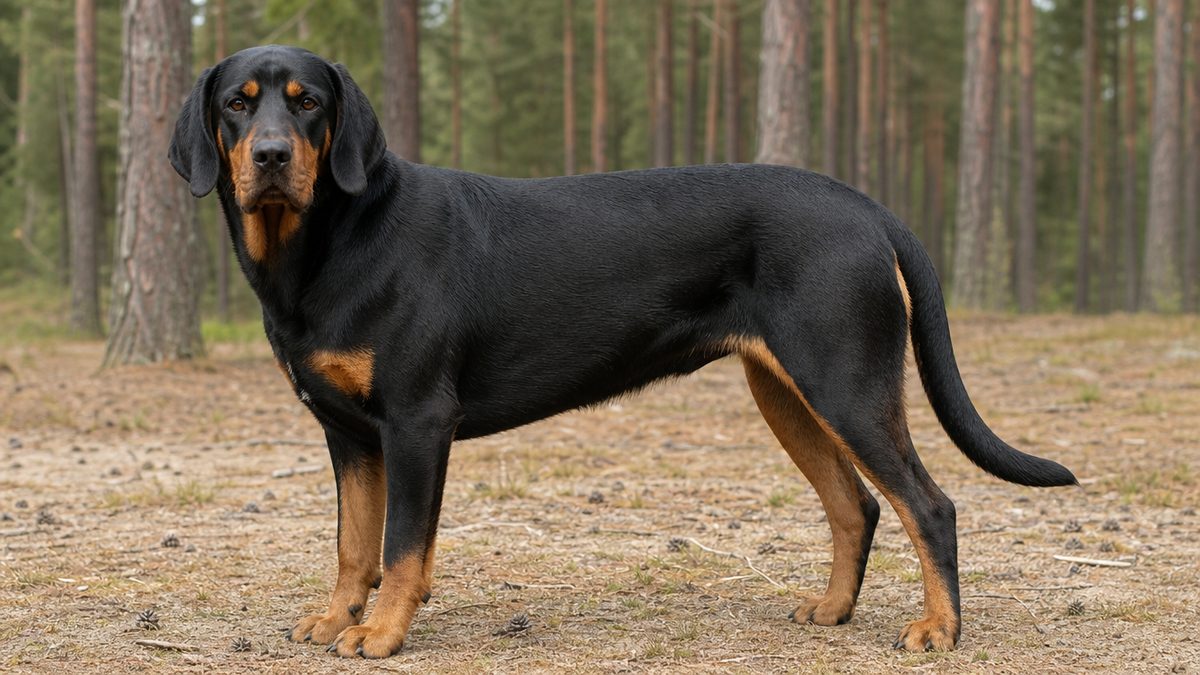
The look is uniform to the point of severity. The coat is black with dark tan on the muzzle, eyebrows, chest, belly, the inside of the legs and the underside of the tail base, and the standard demands a clear, visible boundary between the two colours rather than a blurred blend. Hair is dense and glossy, up to 5 cm on the back, neck and tail and short on the legs and ears, with a black undercoat. Ears are triangular with rounded tips, a little over half the length of the head, and lie flat against the cheeks. The tail is sabre-shaped, thick at the base, carried below the back line and never at more than 30 degrees above it.
History and origins, from a 1541 court case
The breed's documented history and origins begin with a lawsuit. The Lithuanian Hound is first mentioned in 1541, in a court case brought by a forester from Hrodna over a brown hound taken from his yard, and hunting with skalikai in Lithuania is attested in the Lithuanian Statute of 1566, which lists eleven groups and breeds of dog. Hounds appear again in the Statute of 1588. The Lithuanian Kennel Club's own English summary adds that Tatars resettled in Lithuania at the end of the fourteenth century brought coarse-haired and long-haired hounds with them, and that St Hubert blood probably entered the pool in the fifteenth or sixteenth century, with Curlandish and Russian hounds following in the seventeenth.
Nineteenth-century writers described up to five distinct local hound types in Lithuania, differing in size and quarry, with the large ones called ogars used on deer, and all of them black and tan. Almost everything known about them comes from Russian hunting literature, principally Sabaneyev's book on hunting dogs, because Lithuania published almost nothing of its own.
What killed it, and it was not the war alone
Two collapses matter, and Indian readers should note the second one, because it is the one that nearly finished the breed. The Lithuanian Kennel Club's own account is blunt about the first: Germany realised in time that national breeds must be protected, and Lithuanian Hounds got no such support, receiving no state status, no cultural-heritage designation, no exhibition and no club in the interwar period. Worse, a law adopted in 1935 restricting hunting with tall hounds, which is the same pressure that produced the short-legged Latvian and Estonian Hounds, almost eliminated them as hunting dogs outright.
The Second World War then reduced an already small pure population, and restoration only began when the cynologist Z. Gostautas started work in 1957 to 1958, finding surviving dogs in Samogitia around Telsiai. One detail from that account is worth keeping: because these hounds were never used as guard dogs and were kept only by hunters, they escaped the indiscriminate crossing that hit other Lithuanian dogs.
Lithuanian public writing uses three forms, lietuviu skalikas, Lietuvos skalikas and lietuviskas skalikas, and the Lithuanian Kennel Club has published a terminology piece arguing that the people who actually work the breed call it lietuviu skalikas and that the synonyms are an unwanted variation. If you search in Lithuanian, search all three.
Where the Lithuanian Hound actually stands with the FCI, as of September 2026
Recognition for the Lithuanian Hound is national only, and it is in motion. Bonbeno read the FCI's own registers on 2 September 2026 and the breed is in neither of them. Three weeks earlier, on 9 August 2026, the FCI's Standards Commission sent a judge to Lithuania to examine more than a hundred of these dogs in one ring, and that is the first step of the process that could change the answer.
What the FCI's own registers say
Bonbeno opened the FCI's alphabetical nomenclature index for the letter L rather than assembling a breed URL, because on fci.be the trailing number in an address decides which document you get and the breed name is ignored. The index returns eight breeds, from Labrador Retriever through Lagotto Romagnolo, Lakeland Terrier, Lancashire Heeler, Landseer, Lapinporokoira and Leonberger to Lhasa Apso. There is no Lietuviu skalikas and no Lithuanian Hound. The Labrador Retriever's presence at number 122 is the control that proves the index rendered.
The provisional register is the one that matters for a breed on this path, because it is where a national breed sits while it works towards definitive acceptance. It currently holds exactly twenty breeds, from the Macedonian Shepherd Dog Karaman at 378 down to the Australian Stumpy Tail Cattle Dog at 351, and it contains no Lithuanian entry. Its four newest members were admitted on 11 February 2026.
The detail that makes this breed different from the Greek ones
Lithuania is not standing outside the FCI. The federation's membership page lists fifty-two European full and associate members, and Lithuania is among them. Its own member record names Lietuvos Kinologu Draugija of Visoriu Street 8, Vilnius, as a full member. India appears on the same list, represented by the Kennel Club of India in Chennai, also a full member. So this is a fully paid-up national kennel club whose only native breed the international body has never listed, which is a different situation from a breed whose country has no seat at the table.
The club also flagged the evaluation before it happened, which is worth knowing if you want to follow the process rather than take a page's word for it. Its announcement said that the head of the FCI's dog standards commission, the international judge Petru Muntean of Romania, was coming to Lithuania, and described the 9 August assessment as a very important, special evaluation before the FCI officially recognises the breed and enters it on the list of provisionally recognised breeds. That is the club stating its own expected outcome in advance, and it matches what the FCI's provisional register would mean.
And the Lithuanian club is scrupulous about saying so. Its published standard carries a line reading FCI klasifikacija (norima), which translates as FCI classification, desired: Group VI, hounds and related breeds, section 1.2, medium-sized hounds, with field trials. That single parenthesis is the whole difference between honest national practice and the pattern Bonbeno documented on three Greek breeds, where the Kennel Club of Greece prints a flat FCI Classification row on standards for breeds the FCI has never granted. Read quickly, both look the same. One of them tells you it is an aspiration.
What happened at Druskininkai on 9 August 2026
On Sunday 9 August 2026, at the Druskininkai CACIB international all-breed show, 108 Lithuanian Hounds were entered in a special breed evaluation, out of a total entry of roughly fifteen hundred dogs. The Lithuanian hunting magazine Medzioklė reports the same event with more than a hundred dogs assessed, most of them graded Excellent.
The two people who mattered were Petru Muntean of Romania, an FCI international all-breed judge and member of the Standards Commission, and Thomas Uneholt of Sweden, a member of the Science Commission. Muntean examined every dog present, studied the breed standard and the archival documents the breeders had laid out, and concluded that the Lithuanian Hound is a real, clearly formed breed conforming to the standard set for it.
| Step | Status as of 2 September 2026 |
|---|---|
| Breed evaluation by the FCI Standards and Science Commissions | Done, 9 August 2026 at Druskininkai |
| Report by the two commissions | Awaited |
| FCI General Committee vote | Awaited |
| FCI General Assembly decision, Austria, during the World Dog Show | Scheduled for next year |
| Entry on the FCI provisional register | Not present |
| Entry on the FCI definitive register | Not present |
Note the word the Lithuanians themselves use throughout: dalinis pripazinimas, partial recognition. Following the FCI Standards Commission's rules, the breed would first be entered on the list of provisionally recognised breeds, not the definitive one. Even a successful outcome next year leaves it where the Estonian Hound has sat since 2019.
The Lithuanian Kennel Club's own article carries no printed year, and its image folder says 2025. Three independent things settle it as 2026. The breeder Mantas Milinavicius is quoted saying he registered his kennel in 2012 and promised recognition within ten years, and that the promise came four years late, which is 2026. The show photographer's gallery is titled DRUSKININKAI CACIB Druskininkai 2026 Day 3 and dated 9th August, 2026. And Medzioklė opens its report with the date written out in full.
What the 2019 breed standard says, and where the ranking pages disagree with it
The current breed standard was published by the Lithuanian Kennel Club on 12 October 2019, and almost nothing written about this breed in English reflects it. The size and weight figures circulating online come from an older document, and one much-repeated claim about coat colour is now the opposite of what the standard says.
Bonbeno read the standard in Lithuanian on the club's own site. It runs to the conventional headings, general appearance, character, head, skull, foreface, jaws and teeth, eyes, ears, neck, body, tail, limbs, skin and muscles, gait, coat, size, then four graded fault lists, and it closes with the standard testicle note. It was prepared by Mantas Milinavicius and approved by the LKD Council. It carries a publication date and no standard number, which is what you would expect of a national standard that has never been given an FCI number.
Size and weight, and the six centimetres nobody has updated
The standard gives height at the withers as 58 to 64 cm for males and 53 to 59 cm for females, and it gives no weight at all. Now compare what an Indian buyer will actually find. English Wikipedia's infobox prints 52 to 60 cm and 48 to 55 cm, sourced to the breed club's older page, and adds a weight of 24 to 30 kg from a Lithuanian consumer blog. Animalia repeats both figures, and its entire reference list is one item, the Wikipedia article. Dog Breed Info Center prints 53 to 61 cm and 27 to 32 kg.
The older heights are not invented. They are Vytautas Klovas's figures in the Visuotine lietuviu enciklopedija, the Lithuanian state encyclopedia, published in 2018 and last revised in 2022. Klovas is not a random source either: he wrote the breed's first standard. What has happened is simply that the club raised the minima in 2019 and the English-language internet has not noticed.
| Source | Male height | Female height | Weight |
|---|---|---|---|
| Lithuanian Kennel Club standard, 12 Oct 2019 | 58-64 cm | 53-59 cm | Not stated |
| Visuotine lietuviu enciklopedija (Klovas) | 52-60 cm | 48-55 cm | Not stated |
| Wikipedia and Animalia | 52-60 cm | 48-55 cm | 24-30 kg |
| Dog Breed Info Center | 53-61 cm | 53-61 cm | 27-32 kg |
Two things follow for a buyer. A male measuring 55 cm is inside every figure on the internet and below the floor of the standard his breeder is meant to be working to. And the weight bands quoted everywhere are somebody's estimate, because the document that defines the breed declines to give one. Where the sources disagree, Bonbeno follows the 2019 standard and says which figure came from where rather than averaging them.
The white spot claim is now backwards
Wikipedia and Animalia both state that the official standard allows a small white spot on the chest but not on the toes. The 2019 standard lists under eliminating faults: white patches, a patch or band on the chest or the neck, patches on the toes or paws or anywhere else on the body. A white chest spot is no longer tolerated, it is disqualifying. If you are shown a black and tan hound with a white chest flash and told the standard permits it, the person telling you that is reading a document from before 2019.
The rest of the eliminating faults, which are unusually strict
- Aggressive character, which is the first item on the list and rules the dog out entirely
- The absence of any single tooth, with all 42 required and a scissor bite, though a level bite is accepted once the dog passes seven years
- Any eye colour outside the standard's dark, dark brown or brown
- An incorrect bite, whether overshot or undershot
- White patches anywhere, as above
- An atypical tail shape, specifically a strongly curled tail
Note the dentition rule, because it inverts a collision this site has documented elsewhere. Indian law's genetic-defect clause names two or more missing teeth among the defects a breeding dog must have been tested for. The Lithuanian standard is stricter than Indian law here: one missing tooth eliminates the dog from the ring, while the Rules only bite at two.
Where the standard and Indian law actually collide
The hind legs are described as being without rudimentary toes, which is the standard's way of saying without dewclaws. That is a problem the moment the breed reaches India, because paragraph 6(8) of the Second Schedule to the Prevention of Cruelty to Animals (Dog Breeding and Marketing) Rules, 2017 states, in the gazette text Bonbeno extracted itself, that there shall be no tail docking, ear cropping, de-barking, de-clawing, branding, dyeing, injecting substances to enhance visual appeal, or any other kind of mutilation of any body part of the pup, and that any change of appearance by artificial means is strictly forbidden.
So a puppy born with hind dewclaws stays as it is. This is the same seam the Greek Harehound page found from the other direction, where FCI standard 214 makes hind dewclaws a disqualifying fault while Indian law forbids removing them. Two national hounds, two continents, one clause.
The standard's tolerance rule is asymmetric and tells you what the club is worried about. Being up to 2 cm OVER the stated height is a minor deviation. Being UNDER the stated height is listed as a serious fault, with no tolerance offered at all. In a breed rebuilt from a handful of survivors, size loss is the drift the club is guarding against.
How rare the Lithuanian Hound is, and the number everybody gets wrong
There are a few hundred Lithuanian Hounds, and the most quoted figure about the breed's collapse is misdated by roughly a quarter of a century. Wikipedia says the population fell to 78 individuals after World War II. The paper it cites says 1974, and says something different about what was counted.
What the cited paper actually says
Bonbeno downloaded Jareckaite's 2001 paper from the Lithuanian veterinary journal Veterinarija ir Zootechnika and extracted it with pypdf rather than reading a summary of it. The sentence in question reads, in translation: in 1974, when the organisation of hunting-dog breeding began, there remained only 78 dogs resembling Lithuanian Hounds, most of which had no pedigree documents.
Two things are wrong with the version in circulation. The date is 1974, not the late 1940s. And the count is of dogs that looked like the breed, most of them undocumented, gathered at the start of an organised programme, not of 78 registered Lithuanian Hounds. That is a census of raw material, and it is a bleaker figure than the one being repeated, because it means that nearly two decades after Gostautas began restoration work in 1957, and eight years after a provisional standard existed, the country could find only 78 candidate animals and could paper almost none of them.
The same paper credits the restoration to the cynologist enthusiasts Z. Gostautas, V. Morkunas and A. Penkauskas, and states that V. Klovas prepared the first breed standard. Dog Breed Info Center, independently and with its own garbles, also places the crisis in the mid-1970s, saying that many good dogs were killed by boar during the 1976 to 1977 hunting season. Two sources, one Lithuanian and one American, both point at the 1970s. Only Wikipedia points at the war.
The trajectory, with dates attached
| Year | Figure | What was counted | Source |
|---|---|---|---|
| 1966 | Provisional standard adopted | A breeding group begins to be formed | Lithuanian Kennel Club |
| 1974 | 78 | Dogs resembling the breed, mostly undocumented | Jareckaite 2001 |
| 1981 | 62 | Entries at the first breed exhibition | Wikipedia, citing Lietuvos rytas |
| 1987 | about 350 | Registered and documented dogs | Tarybu Lietuvos enciklopedija |
| 1988 | Permanent standard approved | Selection work formalised | Lithuanian Kennel Club |
| 1998 | about 150 | Individuals | Tamosiunas and Klovas, Didysis suo |
| 2008 | 260 | Known pedigree population in the registry | Kucinskiene et al. 2008 |
| April 2024 | 52 | Entries, regional show at Pakevis | Breed club |
| July 2024 | 59 | Entries, club show at Baisiogala | Breed club |
| August 2026 | 108 | Entries, FCI evaluation at Druskininkai | Lithuanian Kennel Club |
Read the last three rows carefully, because they are the only recent hard numbers anyone publishes and they are not a population estimate. They are show entries Lietuvos kinologu draugija. A show entry undercounts the population, since most hunting dogs never enter a ring, and 108 at a single event where the breed knew an FCI commissioner was watching is a mobilisation rather than a census. What it does establish is a floor and a direction: at least 108 living, owned, presentable dogs of this breed existed in Lithuania in August 2026, roughly double the turnout at either 2024 show.
A rare breed also has a genetics problem, and this one has been measured
The Lithuanian Veterinary Academy studied the breed's pedigrees with the ENDOG program and published the result in 2008. Restricting the analysis to dogs whose ancestry was known from registration records gave a known population size of 260 individuals, a mean inbreeding coefficient of 2.09 percent and mean relatedness of 6.74 percent.
Those averages sound comfortable, and the detail beneath them does not. Individual inbreeding coefficients in that population ranged from 0.00 to 28.13 percent, and relatedness from 0.38 to 17.59 percent. The authors state flatly that the newest generation was 100 percent produced by mating related individuals, and that both figures tend to increase in following generations. Wikipedia quotes the 2.09 and 6.74 correctly and omits the range, the 260 and the 100 percent, which is where the story is.
India's own rules speak to exactly this. Paragraph 6(3) of the Second Schedule to the 2017 Rules prohibits two named mating techniques: in-breeding, defined as breeding between relatives of the second to fourth grade within the first four generations, and incest breeding between parents and children or brother and sister. A breed whose newest generation was entirely bred from related animals could not lawfully be reproduced in India by the methods that produced it in Lithuania.
Lithuanian Hound price in India
There is no Lithuanian Hound price in India, and this time there is not even a fake one. An India-located search on 2 September 2026 returned twenty organic results across the head term and the price query, and not one was a listing for a live dog anywhere in India. The single India-facing result attached to the breed is a paperback.
What the search actually returns
The price query's Indian results are a YouTube video, an American breed-information page, a second YouTube video, Wikipedia, an encyclopedia aggregator, a marketplace shell with no listings, a puppy directory, an Indian article about a different breed's price entirely, an Amazon.in book, and a HubPages table of prices for twenty Indian breeds that does not mention this one. That is the whole India-facing supply picture for the Lithuanian Hound.
To prove the instrument was working rather than simply returning nothing useful, the control query labrador retriever puppy price in india was run in the same tool in the same session. It returned ten Indian pages carrying real rupee bands, including Supertails at Rs 8,000 to Rs 70,000 for a Labrador puppy. The search works. The market is absent.
The one India-facing listing is a book
The Amazon.in result is titled Lithuanian Hound Activities, Lithuanian Hound Tricks, Games and Agility. Bonbeno opened it: it is a Paperback by Owen Duncan, filed by Amazon under Pets and Animal Care, described as written for admirers, fans and owners of this wonderful breed. It is a training journal. The price element did not render on the fetch, so this page prints no rupee figure for it, because quoting a number nobody could read is how a fabricated price is born.
That restraint is deliberate and it is worth stating. The sibling Greek Harehound page found the same pattern, an Indian rupee figure that turned out to belong to a training workbook rather than a dog. Here the same trap exists and Bonbeno simply could not confirm the number, so the number is not on this page.
The currency tests, and why there was nothing to test
Indian breed pages routinely publish a foreign price list converted at one rate and present it as a local market, and this site divides every suspicious rupee figure by the four rates that have been caught doing it: 84.38, 80.00, 74.00 and 66.67. Applied here, there was nothing to divide. No page in the Indian result set quotes a rupee price for a Lithuanian Hound puppy at all. That is a cleaner outcome than a converted list, and it is worth reporting as such rather than manufacturing an analysis.
Two of those rates are weak tests anyway and readers should know why before trusting any page that uses them. 1,000 divided by 80 is 12.5, so any rupee figure ending in three zeros passes the 80 test by construction. And 66.67 is 200 divided by 3, so any multiple of 200 divides tidily. The strong test is 84.38, and a match at 80 alone means only that somebody wrote a round number.
A search engine that answered a question nobody asked
One more thing happened while this page was being researched and it is worth publishing, because a reader running the same searches will hit it. Bing India, queried directly, returned result sets with nothing to do with the breed. The query lithuanian hound price in india with the India country parameter came back HTTP 200 with the correct page title and About 11,300 results, and then ten results about a Louisiana Court of Appeal case, Denise Taylor versus Robert Neill Jr, followed by court-record lookup services. The bare query lithuanian hound came back with About 66 results and ten pages about the internet slang term rule 34.
The control settles what that means. Labrador retriever price in india, run on the same endpoint in the same session, returned About 46,700 results and ten genuine Indian Labrador pages. The instrument was working and both breed queries were substituted. So a result count and a plausible page title prove nothing on their own, and none of the absence claims on this page rest on those Bing results. They rest on the India-located search whose own control passed and whose ten results were genuinely about the breed.
Import rules are why no Indian price can form
The supply side is closed by law rather than by chance, and Bonbeno extracted the instrument itself rather than summarising a summary. DGFT Trade Notice No. 22/2022-23 of 19 December 2022 lists dogs at ITC(HS) 01061900, Mammals, Other, as Restricted. Policy Condition 7 permits import only for three purposes: a pet dog with a valid pet book and relevant records in the name of the importer, dogs imported by R and D organisations with the recommendation of the CPCSEA, and dogs for internal security by the Defence and Police Force.
Policy Condition 8 then states that import of commercial dogs for breeding or any other commercial activities other than the purposes mentioned above is not permitted, and the notice adds that applications for trading or breeding purposes shall be duly rejected. Paragraph 7 restricts pet imports to the airports and seaports of Delhi, Mumbai, Chennai, Hyderabad, Bangalore and Kolkata, with an advance No Objection Certificate required from the quarantine officer at the chosen port. DAHD added a seventh port, Cochin International Airport at Kochi, for pets arriving under the baggage rules in October 2024. The full route is set out in how to import a dog to India.
Put those two facts together with the previous section and the conclusion is not a judgement, it is arithmetic. A breed with roughly a few hundred living animals, all in one country, cannot lawfully send founding stock to an Indian breeder. Without founding stock there are no Indian litters. Without Indian litters there is no price. What a Lithuanian Hound has in India is not a market value. At most it has an owner.
Ask for the import paperwork in a named person's name, because there is no other lawful route by which the parents could be in India. Then look at the dog. A black and tan medium hound in India is overwhelmingly likely to be a black and tan Indian pariah dog, a Rottweiler cross or a Beagle cross, all of which are perfectly good dogs and none of which is this breed. The tell is size: a Lithuanian Hound male stands 58 to 64 cm, taller than a Beagle by a wide margin and leaner than a Rottweiler.
What a dog this size would cost to keep in India each month
Running a 30 kg hound in an Indian city costs roughly Rs 6,500 to Rs 14,500 a month, and every figure below is an Indian care cost for a dog of that weight rather than anything specific to this breed. There is no Lithuanian Hound cost data because there are no Lithuanian Hounds here, but vaccination, deworming, food and boarding prices are real, published and apply to any hound of this size.
One methodological note first, because it is the difference between a useful page and a fabricated one. Bonbeno will not convert a European price into rupees and call it an Indian cost. What follows is built from Indian sources quoting Indian prices, and where the breed itself changes a line, that is said explicitly.
The first year, which is the expensive one
A full puppy vaccination course in India runs about Rs 3,000 to Rs 6,000 across all visits, with a single anti-rabies shot at Rs 300 to Rs 600 and a DHPPi or seven-in-one dose at Rs 500 to Rs 1,200. Most of a visit's cost is the vaccine plus a consultation or injection charge of roughly Rs 300 to Rs 800 on top. The annual booster afterwards, one DHPPi plus one rabies, comes to about Rs 1,000 to Rs 2,000. Those figures are from a vet-reviewed Indian schedule last reviewed in July 2026, and they are typical ranges rather than fixed rates.
That guide makes one comparison worth repeating to anyone tempted to skip a dose. A parvo hospital stay in India can run Rs 15,000 to Rs 50,000. The entire first-year vaccine bill is smaller than the cheap end of one hospitalisation.
Monthly cost, line by line
| Line | Typical monthly range | What drives it |
|---|---|---|
| Food, mid-range dry diet | Rs 3,500 - Rs 6,500 | A 30 kg working-built hound eats more than the label's sedentary figure |
| Preventives: tick and flea, deworming | Rs 600 - Rs 1,400 | Tick pressure is the reason this line is not optional in India |
| Routine vet, amortised annual | Rs 400 - Rs 800 | Booster plus one consultation, spread across twelve months |
| Grooming | Rs 0 - Rs 400 | A short-coated dog needs a mitt, not a salon |
| Boarding or day care, occasional | Rs 800 - Rs 3,000 | Higher for a vocal hound many facilities will not take |
| Consumables, leads, bedding, toys | Rs 400 - Rs 1,000 | Chew-destroying scent hound, so budget the upper end |
| Contingency for one unplanned consultation | Rs 800 - Rs 1,400 | Skin and ear problems in the monsoon |
| Total | Rs 6,500 - Rs 14,500 | Bengaluru and Pune at the lower end, Mumbai and Delhi at the upper |
Two lines on that table are breed-specific rather than generic, and they move in opposite directions. Grooming is close to free, because a short-coated dog with a rubber mitt twice a week needs nothing a salon can sell you. Boarding is harder and dearer, because a hound bred for a voice that carries across a forest block is not welcome at every facility, and the ones that take it will charge accordingly.
The cost line this breed adds that no other page mentions
There is a real, breed-specific cost here and it comes out of the veterinary literature rather than a price list. The one clinical study of Lithuanian Hounds analysed the actual ration these dogs were being fed in Lithuania and found it delivered 0.18 g of calcium against a 7.92 g requirement and zero international units of vitamin D against a 210 IU requirement for a resting 30 kg dog. Only one of the fifteen dogs studied was getting a mineral and vitamin supplement.
That matters in India more than it did in Lithuania, because the Indian default for a large dog is exactly the diet described: grain, with offal once a week. If you feed this breed the way its own country largely fed it, you will reproduce that deficiency, and correcting it with a complete commercial food or a properly formulated supplement is the difference between the Rs 3,500 and the Rs 6,500 end of the food line. Do not treat that as an upsell. It is the single most evidence-backed spending decision on this page.
These are Indian care costs for a dog of this size and coat type, assembled from published Indian figures. They are not observed costs of keeping a Lithuanian Hound, because Bonbeno could find no verified Lithuanian Hound in India to observe. Treat them as a planning envelope for any 30 kg short-coated hound, and expect your own city and clinic to move them.
Lithuanian Hound heat tolerance in India, and why the usual argument does not apply here
The Lithuanian Hound has the worst heat tolerance of any hound Bonbeno has measured. Its homeland at Vilnius averages 6.41 C across the year at an annual wet bulb of 5.1 C, while Chennai averages 27.95 C at 24.0 C. That is an 18.9 point wet-bulb gap. What makes this breed unusual is that humidity is not the problem: Vilnius is more humid than any Indian city in the table.
Every figure in this section comes from NASA POWER's Source Native Resolution Climatology, queried by explicit latitude and longitude, with the coordinates and the cell elevation the service returned checked against the town underneath them. Wet-bulb values are computed from the returned air temperature and relative humidity with the Stull approximation, published in the Journal of Applied Meteorology and Climatology, which is valid for relative humidities between 5 and 99 percent and air temperatures between minus 20 and 50 C, with a mean absolute error under 0.3 C. Every reading below sits inside that envelope, including Vilnius in January at minus 6.50 C and 96.84 percent.
The elevation check matters and it passed everywhere. NASA POWER returns a grid cell rather than a point, and in mountains the cell can miss the town beneath it by more than a kilometre. Here the worst divergence was 83 m, at Mumbai, and Vilnius came back at 152 m against a city near 112 m. These are plains, and the cell is the town.
| Place | Mean air temp C | Mean RH percent | Annual wet bulb C | Wet-bulb gap vs Vilnius |
|---|---|---|---|---|
| Vilnius, Lithuania, cell 152 m | 6.41 | 86.4 | 5.1 | - |
| Telsiai, Samogitia, cell 111 m | 6.39 | 87.0 | 5.1 | 0.0 |
| Druskininkai, Lithuania | 7.01 | 84.6 | 5.5 | +0.4 |
| Bengaluru | 23.74 | 67.9 | 19.5 | +14.4 |
| Pune | 23.86 | 66.8 | 19.4 | +14.3 |
| Delhi | 25.60 | 45.6 | 17.8 | +12.7 |
| Mumbai | 26.77 | 67.4 | 22.2 | +17.1 |
| Kolkata | 25.81 | 73.9 | 22.3 | +17.2 |
| Chennai | 27.95 | 72.4 | 24.0 | +18.9 |
Read the humidity column, because it overturns the usual story
Almost every cold-climate breed page on this site, and every Mediterranean one, ends up making the same argument: the dog comes from somewhere dry, panting works well there, and Indian humidity removes the evaporative headroom. That argument does not apply to this breed. Vilnius sits at 86.4 percent relative humidity across the year and Telsiai at 87.0 percent, which is higher than Chennai's 72.4, Kolkata's 73.9, Bengaluru's 67.9, Mumbai's 67.4, Pune's 66.8 and far higher than Delhi's 45.6.
This is a hound bred in a cold, wet, humid forest. It is entirely accustomed to working in air that is nearly saturated. What it has never met is warmth. Vilnius in January averages minus 6.50 C at 96.84 percent humidity and December minus 3.43 C, and the mean rises above 15 C in only three months of the year. The limiting factor for a Lithuanian Hound in India is not the moisture, which it knows, but the temperature that comes with it, which it does not.
The summer it does know, and how far short it falls
The breed is not a stranger to a hot day. Vilnius in July averages 18.62 C, and the hottest readings the climatology holds are 31.27 C in July and 35.05 C in August. Both of those are period extremes rather than routine afternoons, which is the point: the homeland has touched 35 C, it has never lived at it. What it has never met is a hot season. July is the only month whose mean wet bulb reaches 16.1 C, and it is followed immediately by an August at 15.1 C and a September that drops away.
| City | Worst month | Mean air temp C | Mean RH percent | Mean wet bulb C | Points above Vilnius July |
|---|---|---|---|---|---|
| Vilnius | July | 18.62 | 79.0 | 16.1 | - |
| Kolkata | June | 29.90 | 80.4 | 27.1 | +11.0 |
| Delhi | July | 32.27 | 62.7 | 26.5 | +10.4 |
| Chennai | May | 31.51 | 64.5 | 26.1 | +10.0 |
| Mumbai | June | 28.66 | 79.5 | 25.8 | +9.7 |
| Pune | June | 25.63 | 80.3 | 23.0 | +6.9 |
| Bengaluru | May | 26.97 | 63.8 | 21.9 | +5.8 |
Kolkata in June is the single most hostile month for this dog anywhere in the table, and it is not the hottest one. Delhi in May averages 35.05 C at 23.38 percent humidity, which is brutal air and a wet bulb of only 20.4 C. Delhi in July averages 32.27 C at 62.72 percent, cooler air and a wet bulb of 26.5 C. For most breeds this site covers, that inversion is a warning that the monsoon is worse than the summer. For a humid-adapted hound it is closer to a straight temperature reading, and both numbers are far outside anything in its history.
Kolkata's June is the number to hold on to, because it is 11.0 points above the hardest month this breed's ancestors ever worked. Pune's June, the mildest of the Indian worst months in the table, is still 6.9 points above it. There is no Indian metro where this dog's summer resembles anything in its evolutionary history.
City by city, and where in India this breed could actually live
Bengaluru and Pune are the least bad large Indian cities for a Lithuanian Hound and neither is suitable, both sitting more than fourteen wet-bulb points above the homeland. The Indian hill states are the only places where its summer would resemble anything in its history, and even there its winter would not.
- Bengaluru is the least bad large Indian city at an annual wet bulb of 19.5 C, and it is still 14.4 points above the homeland, so treat it as difficult rather than suitable
- Pune runs a fraction cooler on the annual figure at 19.4 C but has a harder June, at a wet bulb of 23.0 C against Bengaluru's worst of 21.9 C
- Delhi is workable from December to February, when the wet bulb sits between 7.6 and 10.4 C, and dangerous from May to September
- Mumbai holds a wet bulb above 24 C for four consecutive months and never drops below 16.6 C, so there is no recovery season
- Kolkata is the hardest posting in the table, at 26.6 C or above in May, June, July and August
- Chennai should be treated as unsuitable, because its wet bulb exceeds 21 C in every single month of the year
- The hill states, Himachal, Uttarakhand, Sikkim and the Nilgiris, are the only Indian places where this dog's summer would resemble anything in its evolutionary history
One qualification on the hill stations, because this site has been caught by it before. NASA POWER returns a grid cell, and in mountainous terrain the cell's mean elevation can miss the town beneath it by well over a kilometre, which throws the temperature out by several degrees in either direction. The plains readings on this page were all checked and all passed. Any hill-station figure you see quoted for an Indian breed page, including on this site, should be checked against the town's real elevation before you act on it.
There is a second reason to be careful about the hills. A Lithuanian Hound in Ooty or Shimla would have a survivable summer and a winter far milder than home, which sounds ideal until you remember what the dog is for. Indian hill stations are small, densely settled and surrounded by protected forest where a driving hound cannot lawfully work. You would be housing the animal comfortably and giving it nothing to do, which for this breed is its own welfare problem.
The India Meteorological Department does not treat a day as a heat wave until the maximum temperature reaches at least 40 C in the plains or 30 C in hilly regions, grades it severe when the departure from normal reaches 7 C or more, and declares one outright whenever the actual maximum reaches 45 C irrespective of the normal. Delhi's monthly record high exceeds 40 C in seven months of the year and reaches 48.79 C in June. Vilnius's highest reading in the same climatology is 35.05 C, in August. A dog bred where 35 C is the record is being asked to live where 45 C triggers a formal declaration.
How to keep a Lithuanian Hound alive in Indian heat
Manage this breed for exertional heatstroke first, because that is what the evidence says kills working dogs, and manage the calendar second. The UK's largest study of heat-related illness found exertion to be the predominant trigger by a wide margin, and this is a hound whose entire purpose is sustained exertion.
What the evidence actually says about how dogs overheat
The VetCompass programme reviewed the clinical records of 905,543 UK dogs under primary veterinary care in 2016 and identified 1,259 heat-related illness events from 1,222 dogs. Exertional heat-related illness was the predominant trigger at 74.2 percent of events, followed by environmental at 12.9 percent and vehicular confinement at 5.2 percent. Note that those three figures sum to 92.3 rather than 100, because a substantial share of the events carried no recorded trigger and the percentages are computed on the events that did. Do not read 74.2 percent as three quarters of 1,259.
The authors' own conclusion is the sentence that matters for a hound owner: in the UK, exertional heat-related illness affects more dogs, and kills more dogs, than confinement in a hot vehicle. The companion paper on the same cohort put the 2016 incidence at 0.04 percent with an event fatality rate of 14.18 percent, and identified higher bodyweight relative to the breed and sex mean as a significant risk factor alongside breed, age over two years and a brachycephalic skull.
Two of those transfer directly. This breed is not brachycephalic and is well under the 50 kg band, so those risk factors do not apply. Bodyweight above the breed mean does apply, and it is the one thing an owner controls. A Lithuanian Hound carrying two extra kilograms in Chennai has moved itself into a measured risk category for no benefit whatsoever.
The daily rules, which are about the clock more than the thermometer
- Walk before sunrise and after full dark, and accept that this is not a seasonal adjustment but the permanent schedule from March to October in most Indian cities
- Cool the dog before it is hot, not after, by wetting the belly, groin, armpits and paws with plain tap water rather than ice, because vasoconstriction from ice slows heat loss
- Carry water on every outing and offer it every fifteen minutes, since a scent hound working a trail will not stop to ask
- Watch the tongue rather than the panting rate, because a tongue that widens, flattens and hangs further out than usual is the earliest visible sign
- Stop the session the first time the dog breaks its rhythm, lags, or lies down without being asked, and treat that as an emergency rather than tiredness
- Never let a dog with a strong nose off-lead in unfamiliar Indian ground in daylight, because a hound on a trail will run itself into heatstroke and will not hear you
The threshold to act on is specific. A rectal temperature above 40 C in a dog that has been exercising, together with collapse or laboured breathing, is a veterinary emergency and not something to manage at home. Start cooling on the way to the clinic rather than waiting until you arrive.
Indian law is on your side here, and most owners do not know it
Paragraph 21(1) of the Second Schedule to the Prevention of Cruelty to Animals (Dog Breeding and Marketing) Rules, 2017, headed Outdoor housing facilities, states in the gazette text that the following categories of dogs shall not be kept in outdoor facilities unless that practice is specifically approved by the attending veterinary practitioner in writing: dogs that are not accustomed to the temperatures prevalent in the area or region in question, dog breeds that cannot tolerate those temperatures, such as long-haired breeds in high temperature locations, and sick, infirm, aged or young animals.
Read the first limb rather than the second, because that is the one that catches this breed. A Lithuanian Hound is short-coated, so the long-haired example does not describe it. But a dog whose homeland averages 6.41 C is, by any reasonable reading, not accustomed to the temperatures prevalent in Chennai. Under this paragraph a registered breeding establishment could not lawfully kennel one outdoors in an Indian plains city without written veterinary approval.
This provision is a Second Schedule paragraph, not a Rule. The 2017 Rules stop at Rule 13, and Bonbeno's own extraction of the 14-page gazette confirms that the string Rule 21 appears zero times in it, while paragraph 21 sits in Part IV between paragraph 20, Fire detection and extinguishers, and the housekeeping paragraphs. Several Indian pages cite this clause as Rule 21, which sends anyone who looks it up to a provision that does not exist.
The three months a year this breed would actually enjoy
Be honest about the arithmetic. In Delhi, the wet bulb sits between 7.6 C and 10.4 C in January and February and reaches 8.7 C in December. Those three months are genuinely comfortable for a dog from Vilnius, and they are close to a Lithuanian May. In Bengaluru the best months, January and December, sit at 16.4 C and 16.9 C, which is a Lithuanian July all year round. In Chennai there is no such month. Plan the dog's working life around the three good months and the dog's survival around the other nine.
Temperament, and who should not buy this breed
The Lithuanian Hound is calm, trusting, extremely enduring and genuinely friendly with its household, and it is also loud, driven and entirely governed by its nose. Its own standard makes aggressive character an eliminating fault, so a Lithuanian Hound that threatens people is a breeding failure rather than a breed trait.
The standard's character clause is unusually warm for a working document. It describes dogs that are calm, trusting, very enduring, with an excellent nose and voice, and simultaneously very active, energetic, mobile and persistent, intelligent, with high intellect and good orientation, cheerful and well-disposed. It ends by naming what separates them from other scent hounds: variation of voice, and well-developed orientation in the hunting ground. The Lithuanian state encyclopedia's entry, written by the man who drafted the first standard, gives essentially the same list and adds that they need a considerable physical workload.
The voice, which is the real household problem
This is a vocal breed and the volume is a deliberate breeding objective rather than a defect. Lithuanian hunters value it specifically for a melodious voice with sharp modulation when it strikes the fresh track of small or large game, and the standard says the dog reports the direction of the drive by baying loudly. That is precisely engineered to carry a kilometre through forest.
In a Mumbai or Bengaluru apartment block, the same trait is a written complaint. Do not buy this breed expecting to train the voice out of it. You can teach a settle and you can prevent boredom barking, but you cannot remove the thing the breed was selected for over four centuries.
Prey drive, and what it means for cats and traffic
The prey drive is high and it is aimed at large game. This is a hound bred to raise elk, deer and wild boar from cover and pursue them, and to hold a wounded boar in place until the hunter arrives. A dog with that instruction set will not reliably recall off a moving trail, and Indian streets contain a great deal that moves.
The household picture is better than the street picture. The breed's own book states plainly that Lithuanian Hounds are not at all aggressive towards humans, that they love and respect their owners, and that they suit families and get along with all family members including children and with other animals such as cats. That is the breeders' account rather than a behavioural survey, and no behavioural survey of this breed exists, so treat it as informed testimony and socialise the dog properly anyway.
Independent, but not aloof
Call this breed independent rather than stubborn. It was bred to work a long way from its handler and to make its own decisions about a trail, so it will do that. But it is not a dog that ignores people. The book describes hounds that are sensitive, that shut down entirely if you raise your voice, and whose only wish when they have upset you is to come back and be near you. It stays alert to its handler while working out of sight, which is exactly the combination a driven hunt needs.
Who should not buy one
- Anyone in an apartment, because of the voice rather than the floor area
- Anyone who cannot commit two long daily sessions in darkness for eight months of the year
- Anyone who wants a dog that can be trusted off-lead in an unfenced Indian environment
- First-time owners who have read that this breed is a sighthound and expect a quiet, low-maintenance runner
- Anyone in Chennai or Kolkata, where the climate section gives no month of relief
- Anyone who wants a guard dog, since the standard eliminates aggressive character and the breed was never used for guarding
Dog Breed Info Center, holding position two or three in India for the head term, opens its temperament paragraph with the sentence that the Lithuanian Hound is an impressive sighthound. It is a scent hound, and the same page's own description says so implicitly by talking about trailing. If you buy on the strength of that page expecting a sighthound's temperament, a nose-led pack dog is going to surprise you.
Training a Lithuanian Hound, and the one rule its own breeders insist on
Train this breed after exercise, never before, and never by raising your voice. Its own breeders state that Lithuanian Hounds are energetic to the point that they cannot keep still, and can only be trained once they have been physically tired out first, after which they learn commands quickly and follow them well.
That is an unusually specific piece of guidance and it comes from the people who own the national population. The breed's book, published by Vilnius University Press, says the hounds are clever, easy to train and good at following commands, but that this takes time and patience, and that patience is especially needed because they are energetic and cannot keep still. They can be trained only by exhausting them physically before the session, since only then are they able to settle and focus.
The same passage adds the constraint that matters more than any technique. Lithuanian Hounds are sensitive dogs and the voice tone should never be raised. If you get angry and start shouting, the dog will get frustrated, abandon its work and not resume it, because its only wish will be to stay with you and reduce your anger. A handler who corrects loudly will get a dog that stops working rather than a dog that works better.
What this breed learns fast, and what it will resist
| Task | Difficulty | Why |
|---|---|---|
| Household manners, crate, settle | Easy once tired | Described as following commands as well as service dogs in some cases |
| Lead manners on a structured walk | Moderate | Achievable, but only with a nose-off route and prior exercise |
| Recall in a fenced, familiar space | Moderate | Reliable when nothing is trailing |
| Recall off a live scent trail | Do not attempt to rely on it | Bred for four centuries to keep going and report by voice |
| Quiet on cue | Hard | The voice is a selected trait, not a fault |
| Repetitive obedience drilling | Counterproductive | The book notes they become bored of repeating the same command |
| Blood trailing and tracking work | Very easy | The standard calls them especially receptive to wounded-game search training |
Give it a nose job, not an obedience career
The standard describes a dog that is especially receptive to training for wounded-game search and follows a blood trail excellently, which is why they are used as blood-tracking dogs in Lithuania. That is the lever an Indian owner should pull. Scent games, tracking, find-the-hidden-food and formal nosework satisfy this dog in a way that heel work never will, they can be run indoors during the nine bad months, and they exhaust a hound faster than distance walking does.
Socialisation, on the Indian schedule
Socialise early and socialise around the heat. The window that matters closes long before the vaccination course finishes, and the Indian vaccination schedule runs core doses from six to eight weeks with the final booster at or after sixteen weeks. That leaves a genuine conflict: you need the puppy meeting the world before it is fully protected, and you need it off unknown ground until about a week after the last dose.
The workable compromise is to carry the puppy, to invite vaccinated adult dogs to your own home, and to do the exposure in the cool hours. A dark-coated puppy on hot Indian ground at four in the afternoon is being socialised and cooked at the same time.
The Lithuanian breed club runs a working class at its shows for which a working certificate is compulsory, alongside champion and club-champion classes. If you are ever offered a dog from Lithuanian lines, ask whether its parents held that certificate. It is the only objective evidence anywhere that a given line still does the job the standard describes.
How much exercise a Lithuanian Hound actually needs
Two long sessions a day, both in darkness for most of the Indian year, plus daily scent work. This is an athletic driving hound whose own literature describes dogs capable of working more than ten hours at a stretch, and the Indian heat removes almost all of the hours in which that work is safe.
The requirement comes straight out of the job description. The standard has this dog covering a driven block to find fresh tracks, raising game from its bed, forcing it to move, then following while giving tongue until the animal reaches the guns. The breed's own history records that the Lithuanian government of the 1930s thought hunting with strong, fast hounds was harmful to game, and that some hunters proposed replacing them with dachshunds because the hounds were over-ambitious and could work for more than ten hours, chasing animals right out of the block. That is the stamina you are buying.
The realistic Indian schedule
| Season | Morning | Evening | Indoors |
|---|---|---|---|
| Indian winter, roughly December to February | 60-75 min walk with off-lead time in a fenced space | 45-60 min walk | Optional |
| Pre-monsoon, March to May | 45 min before sunrise only | 45 min after full dark | 20-30 min scent work, mandatory |
| Monsoon, June to September | 30-40 min before sunrise | 30-40 min after dark, watching the wet bulb | 30-45 min scent work and puzzle feeding |
| Post-monsoon, October to November | 50-60 min | 45 min | Optional |
Notice what the table does not contain. There is no midday walk in any season outside the Indian winter, and in Kolkata or Chennai there is arguably no safe daylight session at all from March to October. If that schedule does not fit your life, this is not your breed, and no amount of garden compensates, because a lean working hound needs distance and variety rather than space.
What happens without it
- Sustained barking, which in this breed is the default expression of unmet need and the fastest route to a housing-society problem
- Destructive chewing, since a bored scent hound is a strong-jawed animal with nothing to do
- Escape attempts, because a hound that cannot work a trail on a lead will go and find one
- Weight gain, which is the one measured heat-illness risk factor an owner controls, since higher bodyweight relative to the breed and sex mean was a significant risk factor in the UK data
- Reactivity on lead, which is frustration rather than aggression and which the standard's eliminating fault for aggressive character does not cover
The last point deserves emphasis in an Indian context. An under-exercised hound that lunges at street dogs is not showing the aggressive character the standard eliminates. It is showing an athletic animal with nowhere to put its energy, and the fix is the schedule above rather than a correction collar.
Grooming a short-coated hound in Indian humidity
Coat care for a Lithuanian Hound takes about five minutes twice a week. The ears take longer and matter more. This is a short-coated black and tan dog with a black undercoat, and in Indian humidity the ear that lies flat against the cheek is the maintenance item, not the hair.
The standard describes the coat as dense and glossy, reaching up to 5 cm on the back, neck and tail, short on the legs and ears, with an undercoat the same black as the topcoat. Wikipedia and Animalia give it as 3 to 5 cm, citing a Lithuanian newspaper rather than the standard. Either way this is a wash-and-wear dog by Indian standards.
The whole coat routine
- Rubber curry mitt twice a week, five minutes, working against the lie of the hair then with it
- Daily quick mitt during the two seasonal moults, when a short black coat still sheds enough to coat a sofa
- Bath only when actually dirty, roughly every six to eight weeks, with a plain non-medicated shampoo unless a vet says otherwise
- Nails every three weeks, and note that the standard calls for black nails and well-developed black pads, so a light nail is a colour fault rather than a health problem
- Never clip or shave the coat, because a black undercoat is insulation in both directions and removing it exposes dark skin to Indian sun
The ears, and why the standard makes them a problem here
The standard requires ears set a little above the eye line, triangular with rounded tips, a little more than half the length of the head, with the front part of the ear lying close against the head and cheeks. That is a design for a forest dog pushing through cover: it keeps debris out. In a humid Indian summer it also keeps air out, and a warm, dark, poorly ventilated ear canal is where trouble starts.
Bonbeno has to be careful here. There is no published otitis prevalence figure for this breed, in India or anywhere, because there is no published disease survey of this breed at all. What can be said is structural: a pendulous, close-lying ear reduces canal ventilation, and Indian monsoon humidity in the cities where a dog like this might live runs to 89.6 percent in Mumbai in July, 90.8 percent in Pune in August and 89.1 percent in Kolkata in August. Manage the ear on that basis rather than on a prevalence number nobody has measured.
- Lift and look inside both ears every second day, which takes ten seconds and is the whole early-warning system
- Dry the ear canal entrance after every bath, swim or heavy rain, using cotton wool rather than a cotton bud
- Plug the ears before bathing, or bathe from the neck down and clean the head separately
- Take a head shake, a smell, a head tilt or scratching to a vet rather than reaching for a shop-bought ear drop, because treating the wrong organism makes the next infection harder
- Do not clean a healthy ear on a schedule, since over-cleaning strips the canal and causes the problem it is meant to prevent
Ticks, which are a grooming job in India
In India the twice-weekly grooming session is also the tick check, and on this breed it is easy: a short black coat hides very little once you run a hand against the lie. Work the ears, under the collar line, the armpits, the groin and between the toes, which are the four places a scent hound working ground cover collects them. The reason this matters is in the health sections below, and it is the single largest infectious risk this breed would meet in India.
A solid black dog in Indian sun absorbs more radiant heat than a light-coloured one of the same build, which compounds a heat problem this breed already has in full. It is one more reason the walks move to darkness rather than to a shadier route.
What is not known about this breed, and how that was proved
The Lithuanian Hound has no peer-reviewed literature indexed in PubMed, no breed code at the Orthopedic Foundation for Animals and no published lifespan study. Those are three strong claims, so each was tested against a control that succeeded in the same session rather than asserted from an empty search box.
PubMed, searched five ways
Bonbeno searched PubMed through the E-utilities interface in five name forms and recorded the query translation each time, because a result count on its own tells you nothing about what was actually searched. The phrase Lithuanian Hound returned zero records, and the engine had already broadened it on its own to Lithuanian people OR Lithuanians OR Lithuanian AND hound OR hounds. A broadened query that still returns nothing is a stronger negative than a narrow one. The plural Lithuanian Hounds returned zero. Lithuanian Scenthound and Lithuanian Scent Hound returned zero.
The two forms that returned anything are instructive rather than useful, and they are a clean example of a trap this site keeps meeting. The native name lietuviu skalikas came back with four records, because PubMed silently discarded skalikas and searched lietuviu on its own. Opening all four settles it: a cross-cultural validation of Lithuanian spondyloarthropathy questionnaires, a paper on auxology and the ethnogenesis of Lithuanians, a study of Lithuanian pharmacists at the turn of the twentieth century, and a note on the 150th birth anniversary of a Latvian historian of medicine. All four are in Medicina, Kaunas, and none is about a dog. The bare word skalikas returned zero with no rewrite at all.
The control passed in the same session on the same endpoint: Labrador Retriever AND hip dysplasia returned 126 records. So the instrument works, and the honest finding is that the veterinary literature on this breed consists of the Lithuanian journal papers cited on this page and nothing indexed in PubMed.
The Orthopedic Foundation for Animals, read from raw markup
Bonbeno pulled OFA's browse-by-breed checkbox list from the page's raw markup rather than from an extraction summary, because a structured extraction of that page has previously invented breed codes wholesale. The list holds 435 canine entries, of which 27 carry the word HOUND, including obscure ones such as the Colombian Fino Hound and the Bavarian Mountain Scent Hound.
There is no Lithuanian entry, no Latvian entry and no Estonian entry. The Labrador Retriever resolves to code LR in the same pull, which is the control that proves the list rendered. So there is no OFA hip, elbow, eye or cardiac dataset to screen a Baltic hound against, and any page telling you the breed is free of hip dysplasia is telling you that nobody has looked.
What that adds up to
| Evidence type | What exists | Control that passed |
|---|---|---|
| Indexed peer-reviewed literature | None in PubMed across five name forms | Labrador and hip dysplasia, 126 records |
| National-journal literature | Two papers in Veterinarija ir Zootechnika, 2001 and 2008 | Both downloaded and extracted directly |
| Orthopaedic screening database | No breed code among 435 canine entries | Labrador Retriever, code LR |
| Breed standard | One, national, dated 12 October 2019 | Published on the club's own site |
| Lifespan study | None | UK life tables exist but exclude this breed |
| Inherited-disease survey | None | Not applicable |
| Population census | None current; last documented figure 260 in 2008 | Show entries used as a floor |
That table is the reason this page carries a health-robustness rating of three out of five and calls it unverified. Three is not a judgement that the breed is averagely healthy. It is a placeholder built on body type and size, because the evidence to place it anywhere else does not exist.
Lithuanian Hound health, and the single study that exists
There is exactly one clinical study of this breed's health anywhere in the world, it examined 15 dogs in Lithuania in 2008, and its most useful finding is about food rather than genetics. There is no inherited-disease survey, no OFA statistics row, no lifespan study and no published life expectancy that rests on data.
What the one study measured, on 15 dogs
The Lithuanian Veterinary Academy examined 15 Lithuanian Hounds aged one to nine years, collecting blood from the cephalic vein at breeders' premises and at breed shows. All the dogs were clinically healthy and dewormed, and faecal examination found no helminth eggs. Two haematological patterns stood out and both are normal for the type of dog rather than signs of disease.
| Analyte | Reference range | Mean and standard error | Verdict |
|---|---|---|---|
| Total protein, g/l | 54.0-75.0 | 56.0 plus or minus 0.4 | Within range, close to the floor |
| Alkaline phosphatase, IU/l | up to 100 | 50.0 plus or minus 10.0 | Within range |
| Urea, mmol/l | 3.3-8.3 | 4.2 plus or minus 0.9 | Within range |
| Calcium, mmol/l | 2.3-3.0 | 2.1 plus or minus 0.3 | Below the reference floor |
| Phosphorus, mmol/l | 0.7-1.6 | 0.8 plus or minus 0.2 | Within range, near the floor |
| Magnesium, mmol/l | 0.6-1.3 | 0.89 plus or minus 0.2 | Within range |
The haemoglobin was high, with a mean of 18.57 g/dl, and the erythrocyte count low, at a mean of 5.40 times ten to the twelfth per litre. The authors explain this as the normal profile of hunting and racing dogs, which need to supply oxygen quickly and for long periods, and note that a high haemoglobin also rises when the spleen contracts under fright or stress. All the dogs showed a left shift in the leukocyte formula with many young and band neutrophils, which the authors attribute to the stress of an unfamiliar environment, strange people and the blood draw itself rather than to infection.
A discrepancy inside the paper, stated rather than smoothed over
The paper is not internally consistent about which minerals were low, and a reader quoting it should know that. Its English abstract says that lower levels of calcium, phosphorus and magnesium were influenced by an unbalanced feeding regimen. Its own results section says that a reduced calcium level was observed, that phosphorus, although it reached the lower limit, met the norm, and that magnesium met the norm in all the dogs tested. Its conclusions then name calcium and phosphorus.
Check it against the table above and only calcium is actually outside the range the authors themselves cite. Phosphorus at 0.8 sits above a 0.7 floor and magnesium at 0.89 sits comfortably inside 0.6 to 1.3. So the finding that survives is the calcium deficiency, and Bonbeno reports the other two as the paper's own overstatement rather than repeating them.
Two clinical observations nobody else has published
The same study recorded eosinophil counts that were frequently raised, with a mean of 5.47 percent and a wide spread, and stated plainly that establishing the cause would require full immunological investigation that was not done. It also recorded eye watering not caused by any pathology of the eyeball or the eyelids, appearing very often after the first vaccinations and continuing for a couple of months, and more frequent in spring and summer.
Those are the only two breed-associated clinical observations in existence, they rest on 15 dogs, and neither has been followed up in the eighteen years since. Treat them as leads for a vet rather than as a breed disease list, and treat this section's health rating as unverified for exactly that reason.
Life expectancy, which nobody has measured
No life expectancy figure for the Lithuanian Hound rests on data. Dog Breed Info Center prints 12 to 14 years with no source attached, and Bonbeno does not repeat it as a breed figure. For population scale rather than for this breed, the UK life tables built from 30,563 dogs that died between 1 January 2016 and 31 July 2020 give a life expectancy at age 0 of 11.23 years, 95 percent confidence interval 11.19 to 11.27, with females at 11.41 and males at 11.07. The breed does not appear in that study and no reader should treat 11.23 as its number.
The one breed-internal signal available is procedural. The Lithuanian breed club opens its veteran show class at eight years of age, and the 2026 evaluation at Druskininkai awarded a best veteran. That tells you dogs of this breed routinely reach and pass eight in sound enough condition to be shown, and it tells you nothing at all about the median.
The Indian disease pressure this breed would actually meet
Tick-borne disease is the largest infectious risk a scent hound faces in India, and it is measured. A national survey of 525 dogs found that 261 of them, 49.7 percent, carried at least one tick-borne pathogen. That is the risk profile a ground-working hound walks into, and it has nothing to do with the breed's genetics.
Bonbeno has to be explicit about what this section is. There is no Indian veterinary literature on the Lithuanian Hound, because there are no Lithuanian Hounds in India. What follows is the disease pressure any medium-sized, ground-scenting, outdoor-working dog would meet here, applied to a breed whose working style maximises exposure.
Tick-borne disease, with real Indian numbers
A survey of canine tick-borne diseases in India tested 525 dogs by PCR and found 261 of 525, or 49.7 percent with a 95 percent confidence interval of 45.4 to 54.1, positive for one or more pathogen. Check the arithmetic yourself: 261 divided by 525 is 0.4971, so the percentage reproduces from its own counts.
| Pathogen | Prevalence | 95 percent confidence interval |
|---|---|---|
| Any tick-borne pathogen | 49.7 percent | 45.4 - 54.1 |
| Hepatozoon canis | 30 percent | 26.0 - 34.0 |
| Ehrlichia canis | 20.6 percent | 17.2 - 24.3 |
| Anaplasma platys | 6.5 percent | 4.5 - 8.9 |
| Babesia vogeli | 5.5 percent | 3.7 - 7.8 |
One methodological detail from that paper is worth carrying into a vet's consulting room. By microscopy alone, only Hepatozoon gamonts were detected, in 12 of 525 samples, a prevalence of 2.3 percent. PCR found thirteen times as much Hepatozoon as the blood smear did. If your dog is tested for tick-borne disease on a smear and comes back clean, that is a much weaker negative than it looks.
Why this breed sits at the top of that exposure curve
- It works with its nose at ground level, which is where questing ticks wait
- It pushes through undergrowth by design, since the standard's close-lying ears exist to keep debris out of the canal in exactly that terrain
- It covers large areas rather than staying on paths, so a single outing samples far more ground than a lead walk
- It is black, which makes an attached tick harder to spot at a glance than on a light coat
- Its ears lie flat against the cheeks, giving ticks a warm, sheltered attachment site an owner has to lift the ear to find
None of that is a reason not to keep the breed. It is a reason to make the tick preventive non-negotiable rather than seasonal, and to run the check into every grooming session as described above. In an Indian city, a monthly preventive at roughly Rs 600 to Rs 1,400 a month across preventives generally is cheap against the treatment cost of ehrlichiosis.
The rest of the Indian picture
Parvovirus and distemper are the two diseases that kill Indian puppies most often, and they kill fastest in the weeks before the vaccination course finishes. That matters more for this breed than for most, because an imported or rehomed hound puppy arriving in India is likely to have an unclear vaccination history and a strong drive to put its nose on unknown ground. Assume zero protection until an Indian vet has restarted the course.
Rabies is the one dose with legal weight in India, and housing societies, boarders, groomers and travel paperwork will all ask for a current certificate. For a hound that will meet street dogs on early-morning walks, it is also the dose with the clearest practical case.
Paragraph 8(10) of the Second Schedule to the 2017 Rules requires that dogs shall have been tested for genetic defects, including hip dysplasia, progressive retinal atrophy, night blindness, hypothyroidism, entropion, ectropion, overshot and undershot jaw, wry mouth, two or more missing teeth, and unilateral or full cryptorchid males. The word is including, so the list is illustrative rather than closed. For this breed the clause is currently unmeetable in any meaningful way, because no breed-specific screening scheme, reference population or OFA database exists to compare a result against.
Feeding a Lithuanian Hound in India, and the deficiency its own country measured
Feed this breed a complete diet and do not improvise it, because the one nutritional analysis of Lithuanian Hounds anywhere found the traditional ration delivering 0.18 grams of calcium against a 7.92 gram requirement and no vitamin D at all. The diet it described, grain with offal once a week, is almost exactly the Indian home-cooked dog dinner.
This is the most directly transferable finding on the whole page, and no other page about this breed mentions it. The Lithuanian Veterinary Academy analysed the actual ration being fed to the dogs in its 2008 study: 300 g of barley, oat and wheat groats plus 300 g of offal, meaning bones, liver, stomachs and lungs, for a resting hound averaging 30 kg. Offal was given only once a week, so the analysis was run twice, with and without it.
| Nutrient | Requirement | With offal | Without offal |
|---|---|---|---|
| Metabolisable energy, kJ | 7,050.0 | 5,308.0 | 4,150.0 |
| Protein, g | 135.0 | 76.2 | 30.6 |
| Fat, g | 39.0 | 18.8 | 8.3 |
| Carbohydrate, g | 279.0 | 642.3 | 636.3 |
| Fibre, g | 24.0 | 15.0 | 15.0 |
| Calcium, g | 7.92 | 0.18 | 0.14 |
| Phosphorus, g | 6.6 | 3.53 | 2.81 |
| Potassium, g | 6.6 | 2.81 | 2.1 |
| Magnesium, g | 0.33 | 0.98 | 0.93 |
| Iron, mg | 39.6 | 41.1 | 23.4 |
| Vitamin A, IU | 3,000.0 | 660.0 | 0.0 |
| Vitamin D, IU | 210.0 | 0.0 | 0.0 |
| Vitamin E, mg | 60.0 | 19.2 | 19.2 |
Read the calcium row twice. On the better of the two days, the ration supplied 0.18 g against a requirement of 7.92 g, which is about one forty-fourth of what the dog needed. Vitamin D was zero on both days. Protein on an offal-free day was 30.6 g against a requirement of 135 g, under a quarter. Meanwhile carbohydrate ran at more than double requirement, at 642.3 g against 279.0 g, because the ration was mostly cereal. Only one of the fifteen dogs studied received any supplementary minerals or vitamins.
That is what produced the below-range serum calcium in the health section. The authors are explicit: because no kidney-disease signs were found, the low serum calcium is attributed to the deficient diet rather than to disease.
Why this lands harder in India than in Lithuania
The Indian default for a large dog is rice or roti with a little meat or curd, and the same grain-heavy, calcium-poor, vitamin-D-free profile falls straight out of it. An Indian owner feeding a hound this way is reproducing, without knowing it, the exact deficiency a Lithuanian veterinary faculty documented in this breed's home population. The paper is not evidence that Lithuanian Hounds have a calcium disorder. It is evidence that a traditional ration in a country of hunters left a working dog badly short, and the Indian version of that ration is no better.
What to feed instead
- Feed a complete commercial dry or wet food formulated to a recognised nutritional standard, which removes the entire calcium and vitamin D question in one decision
- If you cook at home, do it on a written formulation from a veterinary nutritionist, not on a blog recipe, and expect a calcium supplement to be part of it
- Split the daily ration into two meals for a deep-chested dog, and leave at least an hour either side of hard exercise
- Feed to body condition rather than to the label, because a working-built hound at rest in an Indian flat needs less than the bag suggests and one out hunting needs far more
- Weigh the food rather than scooping it, since a scoop of a dense food and a scoop of a light one differ by hundreds of kilojoules
- Keep water available constantly and in more than one place, which matters more here than in Vilnius for obvious reasons
Body condition is a heat decision, not a vanity one
Keeping this dog lean is not cosmetic in India. The UK's largest heat-illness study identified higher bodyweight relative to the breed and sex mean as a significant risk factor for heat-related illness across 905,543 dogs. A Lithuanian Hound is already at the wrong end of the climate argument in every Indian city; carrying extra weight moves it further for nothing.
Score body condition by hand every fortnight rather than by eye. You should feel the ribs easily under a thin layer with light pressure, see a waist from above and a tuck from the side. On a short black coat the outline flatters, so the hand is more reliable than the mirror.
If your vet asks whether this breed has any known nutritional peculiarity, the answer is that the only published analysis found a traditional ration delivering 0.18 g of calcium against a 7.92 g requirement and 0 IU of vitamin D against 210 IU, in fifteen dogs of which one was supplemented. That is a diet finding rather than a breed metabolism finding, and saying so precisely is more useful than saying the breed is prone to deficiency.
The first year with a Lithuanian Hound, month by month
Plan the first year around three constraints: the Indian vaccination calendar, the socialisation window that closes before it, and the heat that removes most of the usable daylight. A Lithuanian Hound puppy is easy to live with early and demanding from about five months, when the nose comes online properly.
One legal point before the timeline. Rule 8(1)(a) of the Prevention of Cruelty to Animals (Dog Breeding and Marketing) Rules, 2017 requires that pups less than eight weeks in age are not sold, and the same Rule adds that dogs over six months are not sold without first being sterilised unless the buyer is another licensed breeder. That is a genuine Rule rather than a Second Schedule paragraph, and any seller offering a six-week puppy is breaking it before you have paid.
| Age | What matters most | What to avoid |
|---|---|---|
| 0-8 weeks | With the litter. First deworming at 2 to 3 weeks. Sale before 8 weeks is unlawful in India | Any seller willing to hand the pup over early |
| 8-11 weeks | Home. First and second DHPPi doses. Carry-based socialisation, indoors, cool hours only | Unknown ground, strange dogs, any daytime outing |
| 12-16 weeks | Third DHPPi plus first anti-rabies. Handling, grooming mitt, ear checks, crate | Assuming the pup is protected before the 16-week dose lands |
| 16-20 weeks | Final booster completed. About a week later, real-world walks begin, before sunrise and after dark | Long walks on hard surfaces, forced exercise, stairs |
| 5-7 months | The nose switches on. Start scent games and tracking. Lead manners become a project | Off-lead in anything unfenced, from now on and permanently |
| 7-9 months | Adolescent testing. Keep sessions short and never raise your voice, which shuts this breed down | Repetitive obedience drilling, which bores them |
| 9-12 months | Growth plates closing. Build duration slowly. Two long sessions daily in cool hours | Running on tarmac at noon in any month between March and October |
| 12-18 months | Physical maturity. Full working stamina arrives. The breed club's junior class runs 9 to 18 months | Treating a physically mature dog as mentally mature |
The socialisation and vaccination conflict, stated plainly
The Indian core schedule runs the first DHPPi at six to eight weeks, boosters every three to four weeks, the first anti-rabies from about twelve weeks and the final dose at or after sixteen weeks, with the pup kept off unknown ground until roughly a week after that. The behavioural window in which novelty is easily accepted has largely closed by then.
Resolve it by moving the world to the puppy rather than the puppy to the world. Carry it, invite fully vaccinated adult dogs into your home, run surface, sound and handling exposure indoors, and take it in a car to sit and watch a street from a lap. That satisfies both requirements and it is the single highest-value fortnight of work you will do with this breed.
What changes at five months
Owners of scent hounds describe the same moment: a biddable puppy becomes a dog with a job it invented for itself. In this breed the standard names the trait exactly, well-developed orientation in the hunting ground and a voice that reports the trail. From about five months, expect a dog that stops answering its name mid-scent and starts giving tongue at things you cannot smell.
Two responses work. Give the drive an outlet daily, through tracking or find-it games rather than more walking. And accept the permanent rule now rather than after an incident: this dog does not go off-lead in unfenced Indian ground, at any age, however good its recall looks in the garden.
If a puppy is born with hind dewclaws, the Lithuanian standard describes hind legs without them and an Indian breeder might be tempted to remove them. Paragraph 6(8) of the Second Schedule forbids de-clawing outright. Have that conversation before the litter is born rather than after, and if a breeder tells you it is routine, that is a reason to walk away.
Lithuanian Hound compared with the hounds you can actually get in India
The useful comparison is not with other rare European hounds, because none of them is available here either. It is with the Estonian Hound, which shows what the next step on the FCI ladder looks like, and with the breeds an Indian buyer could actually bring home tomorrow.
Every cell in the table below was read off the register named in the last column on 2 September 2026, not copied from an aggregator. Where a cell says none, that means Bonbeno read the relevant index in full and the breed was not in it.
| Breed | FCI | UKC | AKC FSS | OFA code | Available in India |
|---|---|---|---|---|---|
| Lithuanian Hound | Neither register; evaluated 9 Aug 2026 | None | None | None | No verified listing |
| Estonian Hound | Provisional, standard 366, since 4 Sep 2019 | None | None | None | No |
| Latvian Hound | Neither register | None | None | None | No |
| Hamiltonstovare | Not checked on this page | Scenthound group | Hound group | Not checked | No |
| Beagle | Not checked on this page | Scenthound group | Fully recognised, not FSS | Not checked | Yes, widely |
| Labrador Retriever | Definitive, standard 122 | Gun Dog group | Fully recognised, not FSS | LR | Yes, Rs 8,000 to Rs 70,000 |
The Estonian Hound is the comparison that actually teaches something
Estonia and Lithuania are neighbours with parallel histories, and both produced a scent hound that shrank under the same 1930s pressure against tall hounds. One of them is on the FCI provisional register, admitted as Eesti Hagijas, standard 366, on 4 September 2019. The other was still being examined by an FCI commissioner in August 2026. Seven years separate two very similar breeds on the same ladder, and that gap is the single best answer to anyone asking how long recognition takes.
It is worth noting what recognition would and would not change for an Indian buyer. Provisional FCI recognition would make the breed eligible for FCI titles and would put the FCI logo on its pedigrees, but it would not make the dog eligible for the CACIB, and it would not create an Indian supply, because India's import policy is the binding constraint rather than the pedigree.
The three Baltic hounds all sit outside every register but their own
This is a finding worth stating on its own. The United Kennel Club's Scenthound group holds 79 breeds, including eleven French hounds, six Nordic ones, the Serbian, Serbian Tricolour, Posavaz, Montenegrin Mountain, Istrian Coarse-Haired and Istrian Short-Haired hounds, the Hellenic Hound, the Polish Hound and the Transylvanian Hound. It contains no Baltic hound at all: no Lithuanian, no Latvian, no Estonian. The American Kennel Club's Foundation Stock Service roster carries none of the three either, and OFA has a breed code for none of them.
So the pattern is not about this breed being obscure. Registries that reach deep into rare continental Europe stop at the Baltic. Only Estonia has broken that, once, and only provisionally.
If what you want is the dog rather than the flag
Be honest with yourself about what attracts you. If it is the black and tan scent hound look, the Beagle is available across India and the sibling page carries real Indian prices. If it is a lean, hardy, heat-adapted running dog, the Indian Pariah Dog is free, better suited to every city in the climate table, and needs adopting rather than importing. If it is a working hound with a job, the Mudhol Hound is India's own, lawful to buy and adapted to the ground it works.
The AKC roster is currently inconsistent with itself, which is why the Lithuanian Hound's absence from it was checked against the list rather than the headline. The page is marked Revised 9/1/26, and the AKC writes dates month first, so that is 1 September 2026, one day before this page was researched. It states there are currently 88 breeds in the FSS program, and its own group headings read 17, 20, 20, 4, 2, 8 and 18, which sum to 89. A sibling page on this site recorded the Herding group at 17 and a reconciling 88 on 31 August 2026, so a breed appears to have been added and the headline total not updated. The absence of any Baltic hound holds either way, because it was read from the lists themselves.
Mistakes Indian buyers and owners make with this breed
The commonest mistake is buying a dog that is not this breed, because in India the odds that a black and tan hound offered as a Lithuanian Hound actually is one are close to zero. The second commonest is trusting a body figure that the breed's own kennel club replaced in 2019.
1. Believing there is an Indian Lithuanian Hound at all
An India-located search on 2 September 2026 returned no listing for a live dog of this breed anywhere in the country, and the control query for a Labrador in the same session returned ten Indian pages with real prices. India's import policy permits dogs only as an owner's pet with a pet book in their own name, for CPCSEA-recommended research, or for Defence and Police use, and states that applications for trading or breeding purposes shall be duly rejected. There is no lawful path by which an Indian litter of this breed could exist.
2. Measuring against the wrong standard
If you do meet a dog claimed to be this breed, the height check is the fastest test you have, and most owners run it against the wrong numbers. The current standard says 58 to 64 cm for males and 53 to 59 cm for females. Wikipedia, Animalia and the Lithuanian state encyclopedia all still print 52 to 60 and 48 to 55 Klovas V. lietuviu skalikas. Visuotine…. A seller quoting the lower figures is either working from a pre-2019 document or has never seen the standard.
3. Trusting a white chest spot
Two of the top-ranking pages in India state that the standard allows a small white spot on the chest. Under the 2019 standard a patch or band on the chest or neck is an eliminating fault, alongside patches on the toes, paws or anywhere else. This is a case where the internet is not merely out of date but exactly inverted.
4. Reading a marketplace shell as a market
One India-ranking page for this breed's price query is a marketplace whose Lithuanian Hound section prints four separate empty counters: no active listings, no herdbook records, no public profiles and no breeders found. Its featured listings on that page are an animal in Iowa, a blue pullet in Texas, which is a chicken, and a dog in Tennessee. Its colour list for the breed runs to more than seventy options including albino, blue merle, harlequin, leucistic and piebald, for a dog whose standard permits exactly one colour and eliminates white patches. The page title promises Breed Facts, Prices and Breeders and the page carries no price, no breeder and no dog.
5. Repeating the 78 figure without its date
If you tell people this breed fell to 78 dogs after the Second World War, you are repeating an error that starts at Wikipedia and runs through everything downstream of it. The cited paper says 1974, and says 78 dogs resembling Lithuanian Hounds, most without pedigree documents. The correction matters because it changes the story from a wartime loss to a slow post-war neglect that the restoration programme was still fighting nearly two decades in.
6. Underestimating the voice and overestimating the recall
Two related failures, and both end with a rehomed dog. Owners assume a calm, friendly, trusting hound will be quiet, when the standard prizes a modulated voice that reports the trail across a driven block. And they assume that a dog which recalls perfectly in the garden will recall off a scent, which four centuries of selection say it will not.
7. Feeding it the way its own country largely did
The traditional Lithuanian ration for these dogs delivered 0.18 g of calcium against a 7.92 g requirement and no vitamin D at all, and the Indian grain-plus-scraps default reproduces the same shape. Feed a complete diet, or a home diet formulated by a veterinary nutritionist, and treat that as the first decision rather than the last.
8. Walking it in Indian daylight
The homeland's annual mean is 6.41 C and its hottest month reaches a mean wet bulb of 16.1 C. Delhi in July sits at 26.5 C. Exertional heat illness was the predominant trigger in the largest study of the subject and it kills more UK dogs than hot cars do. A midday walk with this breed in an Indian summer is not a small mistake.
If a seller in India produces a black and tan hound, a confident story and a price, nothing on this page will change their mind. What it can do is give you the two questions that end the conversation. Ask for the import documentation in a named person's name, since there is no other lawful route. Then measure the dog against 58 to 64 cm and check the chest for white.
Adoption, sourcing and what Indian law permits
You cannot adopt a Lithuanian Hound in India, because there are none here to adopt. What you can do is adopt the dog that actually suits the climate, and if you are set on this breed, understand that the only lawful route into India runs through your own relocation with a pet book in your name.
The honest answer about sourcing
Start with what the law permits, because it settles most of the question. DGFT Trade Notice 22/2022-23 makes dogs Restricted under ITC(HS) 01061900 and allows import for three purposes only: a pet dog with a valid pet book and relevant records in the importer's name, dogs imported by an R and D organisation with CPCSEA recommendation, and dogs for internal security by the Defence and Police Force. Import of commercial dogs for breeding or any other commercial activity is not permitted, and applications for trading or breeding purposes shall be duly rejected.
So the only realistic path is that somebody moves to India and brings their own dog. That import runs through the airports and seaports of Delhi, Mumbai, Chennai, Hyderabad, Bengaluru and Kolkata and, since October 2024, Kochi airport, with an advance No Objection Certificate from the quarantine officer at the chosen port, and quarantine where required Department of Animal Husbandry…. It cannot generate a second dog for sale, and any Indian breeder who claims otherwise is describing something the notice explicitly prohibits.
How to verify a dog if you are ever offered one
- Ask to see the import documentation in a named person's name, since there is no other lawful route by which the parents could be in India
- Measure the dog, because a male outside 58 to 64 cm or a female outside 53 to 59 cm does not meet the standard its country published in 2019
- Check the chest and neck for any white patch or band, which the 2019 standard makes an eliminating fault
- Count the teeth, since all 42 are required and the absence of any single tooth eliminates the dog
- Look for a clear, visible boundary between the black and the tan rather than a blurred blend, which the standard treats as a serious fault or worse
- Ask whether the parents held a working certificate, which is the Lithuanian club's own objective marker and the only one that exists
- Verify the pedigree with the Lithuanian Kennel Club directly rather than with the seller, and note that no FCI pedigree for this breed exists to check because the FCI does not list it
Why paperwork will not exist even when the dog is genuine
This is the part that surprises buyers. A genuine Lithuanian Hound today carries a national pedigree from the Lithuanian Kennel Club and nothing else. Because the FCI lists the breed in neither register, its pedigrees do not carry the FCI logo, which is a benefit that begins only at provisional recognition. Anyone showing you an FCI pedigree for a Lithuanian Hound in 2026 is showing you a document that should not exist.
The dogs you can adopt instead, and why the case is strong
Every argument on this page points the same way for an Indian household. The climate section gives no Indian metro where this breed's summer resembles its history, the price section shows no lawful supply, and the evidence section shows no health data to screen against. Meanwhile India has hounds that were selected on this ground, in this heat, by people who needed them to work.
- The Indian Pariah Dog is free, is available in every city on the climate table, and is the single best-adapted dog in this comparison for Indian heat
- The Mudhol Hound is India's own working hound, lawful to buy, and suited to the terrain it was bred on
- The Beagle is the black and tan scent hound most Indian buyers are actually picturing, is widely available, and has real published Indian prices
- A shelter adult of any hound type gives you a known adult size, a known temperament and a known noise level, which a puppy of a breed with no Indian precedent cannot
If you adopt rather than import, you also step outside the entire chain of problems this page has documented: no misdated population figure, no superseded height, no marketplace shell, no unverifiable pedigree, and no dog living nine months a year in a climate its ancestors never met.
What would actually help this breed
Nothing an Indian buyer does will help the Lithuanian Hound, and that is worth saying plainly because rare-breed pages often imply the opposite. A population of a few hundred dogs with a newest generation entirely bred from related animals is helped by Lithuanian breeders widening the gene pool, by the FCI process concluding, and by the working certificate staying meaningful. It is not helped by demand from a country it cannot lawfully be exported to.
If you want to follow this properly rather than shop for it, watch two things. The FCI Standards and Science Commissions' report on the 9 August 2026 evaluation, and the FCI General Assembly in Austria next year, where partial recognition is to be decided. Bonbeno checked both FCI registers on 2 September 2026 and will re-check them. If the breed appears, this page changes.
Lithuanian Hound questions Indian buyers ask
What is the Lithuanian Hound price in India?
There is no Lithuanian Hound price in India, because no verified listing for a live dog of this breed anywhere in India could be found on 2 September 2026. India's import policy also bars importing dogs for breeding or any other commercial purpose, so no domestic litter and therefore no market can lawfully form. Treat any rupee quote as a claim about a different dog until the seller shows import paperwork in a named person's name.
Is the Lithuanian Hound recognised by the FCI?
Not yet. Bonbeno read the FCI's own letter L index and its twenty-breed provisional register on 2 September 2026 and the breed appears in neither. What did happen is that on 9 August 2026 the FCI's Standards Commission representative Petru Muntean and Science Commission member Thomas Uneholt examined more than a hundred of these dogs at Druskininkai. The commissions' report, a General Committee vote and a General Assembly decision in Austria next year still lie ahead.
How big is a Lithuanian Hound?
The Lithuanian Kennel Club standard of 12 October 2019 gives 58 to 64 cm at the withers for males and 53 to 59 cm for females, and gives no weight at all. Beware the older figures still circulating online: Wikipedia and Animalia print 52 to 60 cm and 48 to 55 cm, which come from Vytautas Klovas's entry in the Lithuanian state encyclopedia and sit six centimetres below the current male floor.
Can a Lithuanian Hound survive the Indian climate?
Only in the hills, and only with real management. NASA POWER gives Vilnius an annual mean of 6.41 C and an annual wet bulb of 5.1 C, against 27.95 C and 24.0 C for Chennai. That is an 18.9 point wet-bulb gap, the widest Bonbeno has measured for any hound. Bengaluru and Pune at annual wet bulbs of 19.5 C and 19.4 C are the least bad large cities, and both still sit more than fourteen points above the homeland.
Are Lithuanian hounds rare?
Nobody publishes a current census, and the honest answer is a few hundred. The last documented count is Kucinskiene et al. 2008, which put the known pedigree population at 260 individuals. The nearest thing to a live measure is show attendance: 52 dogs at Pakevis in April 2024, 59 at Baisiogala in July 2024 and 108 in one ring at Druskininkai on 9 August 2026.
Did the Lithuanian Hound really drop to 78 dogs after the Second World War?
No, and this is the most repeated error about the breed. Wikipedia says the population decreased to 78 individuals after World War II and cites Jareckaite 2001. Bonbeno extracted that paper: it says that in 1974, when hunting-dog breeding began to be regulated, there remained only 78 dogs resembling Lithuanian Hounds, most of them without pedigree documents. The decade is wrong and so is the description.
What health problems does the Lithuanian Hound have?
Nobody knows, because no inherited-disease survey exists. PubMed holds zero records across five name forms against a Labrador control returning 126 in the same session, the OFA carries no breed code for it among 435 canine entries, and there is no published lifespan study. The single clinical paper, on 15 dogs, found blood morphology within physiological range and serum calcium below the reference floor because of a deficient home ration.
How long does a Lithuanian Hound live?
No lifespan figure for this breed rests on data. Dog Breed Info Center prints 12 to 14 years with no source attached, and Bonbeno does not repeat it. For scale rather than for this breed, the UK life tables covering 30,563 dogs that died between 2016 and 2020 give a life expectancy at age 0 of 11.23 years across all dogs. The breed club's own show schedule opens its veteran class at eight years.
Is the Lithuanian Hound good in an apartment?
Poorly suited, and the reason is the voice rather than the size. Lithuanian hunters value this dog specifically for a melodious bark with sharp modulation that carries across a driven block, which is exactly what a housing society will complain about. The breed's own book disputes the folk belief that these hounds cannot live indoors, and says nothing to suggest they are quiet.
What does the Lithuanian Hound standard say about dewclaws, and does that matter in India?
The 2019 standard describes the hind legs as being without rudimentary toes, which is a description of dewclaws. It matters in India because paragraph 6(8) of the Second Schedule to the Prevention of Cruelty to Animals (Dog Breeding and Marketing) Rules, 2017 forbids de-clawing outright, alongside tail docking, ear cropping and de-barking. A breeder removing dewclaws to meet the standard would be breaking Indian law.
Which registries recognise the Lithuanian Hound?
One does, and it is Lithuania's own. The Lithuanian Kennel Club, listed by the FCI as the full member for Lithuania, publishes a complete national standard. The United Kennel Club's Scenthound group holds 79 breeds including eleven French hounds and six Nordic ones, and no Baltic hound at all. The American Kennel Club's Foundation Stock Service roster carries no Lithuanian, Latvian or Estonian entry.
Is a Lithuanian Hound inbred?
The one study that measured it found a mean inbreeding coefficient of 2.09 percent and mean relatedness of 6.74 percent across a known population of 260 dogs, which sounds mild until you read the range. Individual inbreeding coefficients ran from 0.00 to 28.13 percent, and the authors state that the newest generation was 100 percent produced by mating related individuals, with both figures tending to rise in later generations.
Can I import a Lithuanian Hound to India?
Only as your own pet, never for breeding. DGFT Trade Notice 22/2022-23 classes dogs as Restricted under ITC(HS) 01061900 and permits import only as a pet dog with a valid pet book in the importer's name, for research with CPCSEA recommendation, or for Defence and Police use. Import of commercial dogs for breeding is not permitted, and applications for trading or breeding purposes shall be duly rejected.
What does it cost per month to keep a dog this size in India?
Between about Rs 6,500 and Rs 14,500 a month for a 30 kg hound, depending on city and on what you feed. That figure is built from real published Indian care costs rather than from any Lithuanian Hound listing, because none exists. A full puppy vaccination course runs Rs 3,000 to Rs 6,000 and the yearly booster afterwards about Rs 1,000 to Rs 2,000.
What is the national dog of Lithuania?
The Lithuanian Hound, which is the only dog breed Lithuania has: a medium-sized black and tan scent hound bred to drive deer, elk and wild boar to a line of guns. Its national standard is dated 12 October 2019 and its pedigrees come from the Lithuanian Kennel Club alone, because the FCI lists it in neither register. The club's own history records that it received no state status, no cultural-heritage designation and no club in the interwar period, and on 9 August 2026 an FCI Standards Commission judge examined 108 of them in one ring.
Are hound dogs a good pet?
This one is calm, trusting, extremely enduring and genuinely friendly with its household, and its standard makes aggressive character an eliminating fault. It is also loud, driven and entirely governed by its nose: hunters prize a melodious, sharply modulated bark that carries across a driven block, a dog that recalls perfectly in the garden will not recall off a scent, and the breed's own book says it can be trained only after being exhausted physically first. A good companion for a household with land and time, a poor one for a housing society.
Compare with similar breeds
Lithuanian Hound sits in 1 Bonbeno group. Each one compares it directly against the breeds it is genuinely an alternative to, on the same figures.