
Indian breed profile
Changkhi Dog: India's Newest Registered Native Breed
The livestock guardian of the Changpa nomads of the Changthang plateau, and the fifth dog breed India has ever registered. Officially recognised in 2025, and still almost entirely undescribed.
Quick answer
The changkhi dog is a livestock guardian of the Changthang plateau in Ladakh and India's fifth registered native dog breed. ICAR-NBAGR registered it on 6 January 2025 under accession number INDIA_DOG_3800_CHANGKHI_19005, gazette-notified on 15 April 2025. It is not sold commercially in India, no published price exists, and its heat tolerance rates 1 out of 5.
This guide is general information for Indian pet owners and is not a diagnosis. Consult your nearby vet, a registered veterinarian, before acting on anything you read here, and treat any sudden change in your dog's condition as urgent.
Changkhi dog traits, rated for Indian conditions
What the Changkhi dog is
The Changkhi is a livestock guardian dog of the Changthang plateau in Ladakh, kept by Changpa nomadic pastoralists to guard sheep and goats from snow leopards, wild animals and other predators. It is the fifth dog breed India has ever registered, and ICAR-NBAGR gave it the accession number INDIA_DOG_3800_CHANGKHI_19005 with a home tract recorded simply as Ladakh.
Everything else on this page follows from that job description. This is a dog bred to live outdoors on a cold high altitude desert, walk with a migrating herd of pashmina goats, and decide for itself whether the shape moving at the edge of the herd at 2 a.m. is a threat. It was never bred to be a companion animal in a warm city, and the distance between those two lives is the largest single thing an Indian reader needs to hold on to.
The names, and why the spelling matters when you search
The breed answers to at least three written forms and they do not return the same search results. ICAR-NBAGR's register spells it Changkhi. The one readable descriptive source in the academic literature calls it the Changthangi dog, adding that it is "locally known as Changkhi". The characterisation paper that the registration rests on is indexed under the hyphenated Chang-khi. The root is the place: Changthang is the plateau, a Changpa is a person of the Changthang, and the Changthangi goat and Changthangi sheep are the animals this dog exists to protect Changthangi (Pashmina goat), Wikipedia.
Search on one spelling and you will conclude the breed is barely documented. Search on all three and you will conclude it is barely documented, which is the correct answer, but you will at least have seen the registry entry.
| Attribute | Detail | Source |
|---|---|---|
| Type | Livestock guardian and watch dog for a nomadic herding system | ICAR-NBAGR |
| Home tract | Ladakh (UT), concentrated in the Changthang areas bordering China | ICAR-NBAGR, IntechOpen Sheikh F. D., Status of World's Unique… |
| Kept by | Changpa nomadic pastoralists | IntechOpen |
| Guards | Sheep and goats, including Changthangi pashmina goats | ICAR-NBAGR, IntechOpen Sheikh F. D., Status of World's Unique… |
| Against | Snow leopard, Tibetan wolf, other predators | ICAR-NBAGR, IntechOpen Sheikh F. D., Status of World's Unique… |
| Registered by ICAR-NBAGR | Yes. INDIA_DOG_3800_CHANGKHI_19005 | ICAR-NBAGR register |
| Date of registration | 6 January 2025, 12th meeting of the Breed Registration Committee, New Delhi | NBAGR Newsletter |
| Gazette notification | DARE, [No. 1689(S.O.1720 (E) (April 15, 2025)] | NBAGR Newsletter |
| Recognised by the FCI | No, neither definitively nor provisionally | FCI nomenclature Federation Cynologique Internationale |
| Recognised by the Kennel Club of India | No published recognition. The KCI site publishes no breed list at all | Kennel Club of India |
| Height and weight | NOT PUBLISHED. No official figure exists | See the size section below |
| Litter size | NOT PUBLISHED. The circulating figure belongs to a different breed | See the corrections section below |
| Population | NOT PUBLISHED. The circulating figure belongs to a different species | See the corrections section below |
| Lifespan | NOT PUBLISHED. No survival data exists for this breed | See the health section below |
Four of the fourteen rows say NOT PUBLISHED. That is not Bonbeno failing to find the data. It is the actual state of the record for a breed the Government of India registered and gazette-notified in 2025. A page that fills those four rows with confident numbers has invented them, and the corrections section below shows exactly where two of those inventions came from.
The two circulating figures that belong to other animals
Two numbers are attached to the Changkhi across the search results, and neither is about the Changkhi. Both are paragraph-boundary errors, where a summariser has read a list of Ladakhi livestock and carried a figure down from the entry above. Bonbeno downloaded both source documents and extracted the text itself, so the paragraph boundaries below can be checked rather than trusted.
Correction 1: the population of 3,000 to 4,000 is the Ladakhi donkey
The claim that 3,000 to 4,000 Changkhi dogs survive in Leh district traces to the IntechOpen chapter on Ladakh's animal genetic resources. In that chapter the numbered list runs Purig sheep, Malra goat, Chumurti-like horse, Ladakhi donkey, Changthangi dog. Item 5 ends: "The lack of use of this species for domestic purpose has made it a stray animal resulting in reduction in its number. The present population is estimated to be around 3000 to 4000 in Leh district." Item 6 then begins: "Changthangi dog: The Changthangi dog locally known as Changkhi is medium size hunting dog";.
The population sentence closes the donkey entry. Read in context it is unambiguous, because it is about an animal that has become a stray after being replaced by motor transport, which is a description of the Ladakhi donkey and not of a working guardian dog. The Changthangi dog entry that follows it carries no population figure whatsoever. That matters more than it looks, because the same chapter gives a number for every other piece of threatened germplasm in the same list. Purig sheep are put at 200 to 300 and described as at the verge of extinction, Malluk sheep at 600 to 700, Malra goat at 700 to 800, and the Chumurti-like horse at 100 to 150. The author gave a figure wherever he had one. He gave none for the dog.
An earlier working draft of this section attributed the 600 to 700 figure to the Purig sheep. Re-reading the chapter's own text shows 600 to 700 belongs to the Malluk sheep and the Purig sheep figure is 200 to 300. Bonbeno corrected it before publication and records the correction here, because a page whose whole argument is that other people attach figures to the wrong animal has to hold itself to the same test.
Correction 2: the litter size of 4 to 8 is the Gaddi dog
The claim that the Changkhi's litter size varies from 4 to 8 traces to ICAR-NBAGR's own newsletter, where the ten newly registered breeds are described one after another. The Gaddi entry reads in full: "Gaddi dog is distributed in the Chamba, Kangra, Kullu, Mandi, Lahaul Spiti and Kinnaur districts of Himachal Pradesh. It is named after the Gaddi tribe who is associated with the migratory farming since ages. It is mainly reared as guarding dog. The litter size varies from 4-8." The very next paragraph is the Changkhi entry.
So the litter figure belongs to Himachal Pradesh's Gaddi dog, which Bonbeno covers on the Himalayan Sheepdog page. Applying it to a Ladakhi breed is not a rounding error. Litter size is the arithmetic at the centre of any conservation argument about a rare landrace, and borrowing it from a different breed in a different state produces a confident conclusion about population recovery built on nothing.
What ICAR-NBAGR actually published, in full
The Bureau's entire published descriptor for this breed is two sentences. It is reproduced verbatim here because its brevity is the finding.
"Changkhi dog is native of Ladakh (UT). Changkhi dog is used as watch dog to guard their livestock including sheep and goat from snow leopard, wild animals and other predators, and also for their safety.";
Now compare that with the other nine breeds registered on the same day. Manah buffalo gets a daily milk yield of around 1.75 kg. Chaugarkha goat gets adult body weights of 27 kg and 24 kg. Karkambi pig gets a litter size of 2 to 10 and body weights of 45 kg and 43 kg. Tripureswari duck gets a body weight of 1.199 kg at 12 months and annual egg production of 70 to 101. Ladakhi yak gets 250 kg and 183 kg. Ladakhi donkey gets 82 kg and 78 kg. Gaddi dog gets a litter size of 4 to 8.
Count them and seven of the ten carry a figure. The Changkhi is one of three that carry none, alongside the Bundelkhandi goat, described only as medium sized, black in colour, well adapted and able to cover long distances while grazing, and the Kheri sheep, described only as tall, majestic-looking, able to walk long distances and well adapted to harsh climatic conditions.
An earlier working draft of this section stated that the Changkhi was the only one of the ten breeds with no number attached. Re-reading the newsletter shows the Bundelkhandi goat and the Kheri sheep also carry no figure, so the correct statement is one of three. Bonbeno caught it before publication and prints the correction rather than quietly editing it, for the same reason as the Purig sheep correction above.
The distinction that survives that correction is still the one that matters. The Changkhi is the only dog of the ten with no figure, and its sibling registration the same morning, the Gaddi, got a litter size. Bonbeno's reading is that the Bureau published what each application file supported and no more, which is the correct behaviour for a registry, and that the gap in the public record for this breed is a gap in the underlying characterisation work rather than an oversight in the newsletter.
How big is it, and what colour? The published descriptions contradict each other
There is no breed standard for the Changkhi, and the two published descriptions of its size disagree flatly. This is a live disagreement rather than a resolved one, and no ranking page prints it.
| Source | Type of source | What it says |
|---|---|---|
| ICAR-NBAGR newsletter | The registering authority | "watch dog". No size word, no measurement, no coat colour |
| IntechOpen chapter, Sheikh 2022 | Peer-reviewed book chapter by a Ladakh-based scientist | "medium size hunting dog", "thought to be a descendent of Tibetan Mastiff breed of dog from Tibet", "very loyal to their masters" |
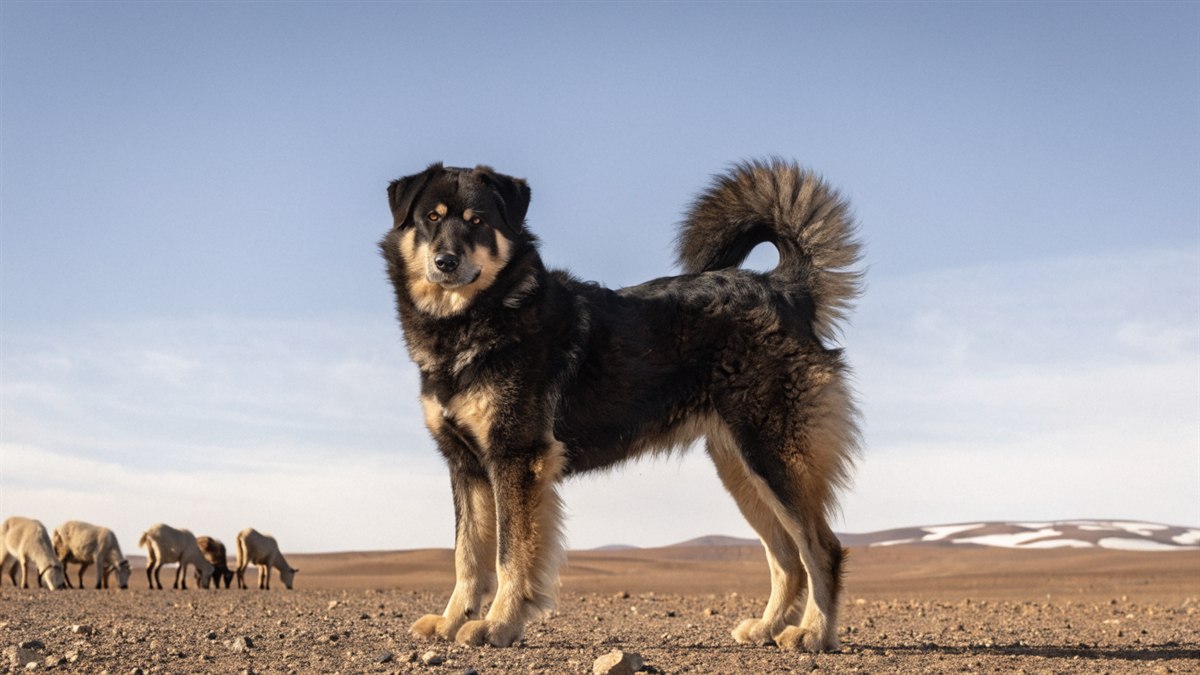
| Krishi Jagran | Indian farming news outlet | "a large, powerfully built breed", "a dense double coat, mostly black or dark brown, with lighter shades or markings in tan, grey, or cream", broad head framed by bushy fur "resembling a lion's mane" |
| The Tribune | National newspaper | "a watchdog that protects livestock such as sheep and goats from snow leopards and other predators". No size, no coat description |
| Characterisation paper | The study the registration rests on | Could not be opened. Returns HTTP 403 |
A medium sized dog and a large, lion-maned dog are not the same animal. One of those two descriptions is wrong, or they are describing different individuals within a variable landrace, and nobody has published the measurements that would settle it. Bonbeno publishes no height and no weight for this breed, because there is no measured figure to publish. If you see one quoted with confidence, ask which document it came from.
On coat colour there is only one source. Krishi Jagran describes a thick, insulating double coat, mostly black or dark brown, with lighter tan, grey or cream markings around the chest, legs and face, a broad head framed by bushy fur resembling a lion's mane, triangular drooping ears, strong legs and a bushy tail that curls slightly upwards or sideways. That is a plausible description of a Himalayan guardian landrace and it is consistent with the dark double-coated dogs of the region, but it is one uncited paragraph in a farming news article and Bonbeno reports it as exactly that.
The one detailed description of this dog is illustrated with an AI-generated image
Open the Krishi Jagran article and read the caption under its photograph. The credit line reads "(Image Credit: ChatGPT)";. That is the page's own published attribution, not an inference, and it is the single most useful thing to know about the only detailed physical description of the Changkhi in circulation.
Bonbeno makes no claim about how the article's text was produced, because we cannot know. What we can state is what is on the page. The description cites no source, no measurement and no study, it is the only place the "large, powerfully built" and "lion's mane" wording appears, it contradicts the one peer-reviewed description on record, and the illustration beside it is credited to a generative model rather than to a photographer in Ladakh. Weigh it accordingly, and weigh every downstream page that copied it accordingly too.
For a breed with photographs, standards and measurements, one loosely-sourced description is noise. For a breed whose entire published physical record is two paragraphs, a description that cannot be traced to an observation is half the record. Bonbeno will not print a height, a weight or a coat standard for the Changkhi until a measured source can be opened and read.
The Tibetan Mastiff descent claim, and how much weight it can carry
One source says the Changkhi is "thought to be a descendent of Tibetan Mastiff breed of dog from Tibet";. Note the hedge in the original. It says thought to be, it cites no genetic study, and no genetic study of this breed has been published. Geographic plausibility is real, because Changthang borders Tibet and the herding cultures on both sides of that line share ancestry, but plausibility is not evidence.
There is a reason to take the general idea of a Tibetan-Plateau origin seriously even so, and it is genetic work on a different breed. Sequencing of the Tibetan Mastiff found that two loci, EPAS1 and HBB, show introgression from the Tibetan gray wolf and strong positive selection in the Tibetan Mastiff genome, and that this introgression is what let dogs living in hypoxic environments acquire local adaptation quickly. Any dog that has worked at 4,500 metres for centuries needs a version of that solution. Nobody has yet looked for it in the Changkhi.
The tool to look now exists in India. ICAR-NBAGR reports designing and validating a high-density SNP array, Axiom_Shwaan, for Indian dog breeds, intended for genome-wide association studies, detection of selection signatures and diversity analysis. A registered breed with a named accession number and a national dog array is, for the first time, a tractable research subject rather than a folk category.
Where Changthang is, and why the geography is the breed
Changthang is a cold high altitude desert on the eastern edge of Ladakh, running to the Chinese border. The IntechOpen chapter puts Ladakh's altitude at 11,000 to 16,000 ft above sea level with temperatures ranging from +40 degrees C in summer to minus 40 degrees C. That upper figure is the chapter's own and it sits well above the India Meteorological Department record for Leh, which is 36.6 degrees C, so treat the +40 as a regional rhetorical maximum rather than a measurement.
The concrete numbers are more useful. Leh town sits at 3,513 m and records a July mean maximum of 33.4 degrees C, a January mean minimum of minus 13.1 degrees C, an all-time low of minus 28.6 degrees C, and annual precipitation of 34.8 mm. Thirty-four millimetres of rain a year is desert. The Changthang pastures where the Changkhi actually works are higher and colder than Leh. Leh district as a whole covers about 12,000 sq km and held 133,487 people at the 2011 Census, a density of 11 people per sq km.
The Changpa are the people who use this dog. India recorded 2,661 Changpa at the 2011 Census, and among the Ladakh Changpa those who remain nomadic are known as Phalpa and move their herds from the Hanle Valley to the village of Lato. Read that population figure next to the dog's. The community that maintains this breed is smaller than a single Delhi apartment block's worth of buildings, and its migration routes into Tibet were closed after the Chinese takeover.
The animal the dog is guarding
The Changkhi's economic purpose is pashmina. The Changthangi or Changra goat produces the fibre sold internationally as cashmere, roughly three quarters of Indian pashmina production comes from these goats, and the wool generates more than 8 million US dollars a year. The goats stand 49 to 52 cm and weigh about 20.37 kg for males and 19.75 kg for females, and they endure temperatures down to minus 20 degrees C. Ladakh held 219,198 Changthangi goats, 67,521 Changthangi sheep and 18,877 yak in 2019.
So the working arithmetic is roughly this. A small number of dogs, kept by a community of a few thousand people, guards a quarter of a million animals that carry a multi-million-dollar fibre industry, across a treeless plateau containing snow leopards and Tibetan wolves. That is the Changkhi's actual job, and it explains why the breed's registration was worth doing even before anyone measured a single dog.
The ICAR-NBAGR registration, read from the primary documents
ICAR-NBAGR registered the Changkhi dog on 6 January 2025 at the 12th meeting of the Breed Registration Committee in New Delhi, and the Department of Agricultural Research and Education gazette-notified it on 15 April 2025 under [No. 1689(S.O.1720 (E) (April 15, 2025)]. Its accession number is INDIA_DOG_3800_CHANGKHI_19005 and its home tract is recorded as Ladakh.
Breed registration in India is a documentary act, not a kennel club show classification, and understanding the difference is the whole point of this section. ICAR-NBAGR registers animal genetic resources. It is the apex documentation body for India's indigenous livestock, poultry and dog populations, and the Breed Registration Committee that approves entries is headed by the Deputy Director General (Animal Science) of ICAR.
How to read an accession number
Every element of INDIA_DOG_3800_CHANGKHI_19005 carries information, and reading it is the fastest way to verify that a claimed registration is real.
- INDIA names the country holding the genetic resource.
- DOG names the species. Comparable entries in the same batch read BUFFALO, DONKEY, DUCK, GOAT, PIG, SHEEP and YAK.
- 3800 is the state or union territory code. The Ladakhi yak and Ladakhi donkey registered on the same day carry the same 3800, which is how you confirm the code is Ladakh.
- CHANGKHI is the registered breed name, which is why that spelling is the one to search on.
- 19005 is the species series and the sequence number. 19 is the dog series, and 005 makes this the fifth dog breed on it, after Rajapalayam 19001, Chippiparai 19002, Mudhol Hound 19003 and Gaddi 19004.
That last element is the fact most worth carrying away. The accession number itself tells you the Changkhi is India's fifth registered dog breed, and you can verify the whole sequence on one page of the Bureau's own register.
| Breed | Home tract | Accession number |
|---|---|---|
| Rajapalayam | Tamil Nadu | INDIA_DOG_1800_RAJAPALAYAM_19001 |
| Chippiparai | Tamil Nadu | INDIA_DOG_1800_CHIPPIPARAI_19002 |
| Mudhol Hound | Karnataka | INDIA_DOG_0800_MUDHOL HOUND_19003 |
| Gaddi | Himachal Pradesh | INDIA_DOG_0600_GADDI_19004 |
| Changkhi | Ladakh | INDIA_DOG_3800_CHANGKHI_19005 |
Five breeds. That is the complete list, and three of the five are Tamil Nadu or Karnataka sighthounds. Until January 2025 not one Himalayan or Trans-Himalayan guardian breed was on it. The Gaddi and the Changkhi went on together, which is why the two registrations are usually reported in the same sentence, including in the trade coverage of the batch.
The batch itself is worth one line of context, because it shows what company the Changkhi is keeping. Ten breeds went on the register that morning across nine states: Manah buffalo from Assam, Gaddi dog from Himachal Pradesh, Tripureswari duck from Tripura, Chaugarkha goat from Uttarakhand, Bundelkhandi goat from Uttar Pradesh and Madhya Pradesh, Karkambi pig from Maharashtra, Kheri sheep from Rajasthan, and the Changkhi dog, Ladakhi donkey and Ladakhi yak from Ladakh FFOODS Spectrum, ICAR-NBAGR registers 10…. Ladakh contributed three of the ten. India's total stood at 230 registered indigenous breeds afterwards, of which five are dogs.
The route to that list is open to anyone, which is worth knowing if you work with an undocumented Indian breed. The Bureau's Director describes the process plainly: any citizen can apply for breed registration by submitting a pro forma, the Breed Registration Cell screens applications, an expert committee with one NBAGR member and one from the relevant species institute conducts on-ground verification, and the proposal then goes to the Breed Registration Committee chaired by the Deputy Director General (Animal Sciences). NBAGR was authorised for breed registration in 2008 and registered its first breed in 2010.
What the registration does and does not give the breed
Registration is worth having and it is routinely oversold. Here is the honest split.
| Registration DOES | Registration does NOT |
|---|---|
| Put the breed on the national record of animal genetic resources, with a permanent accession number | Create a breed standard describing height, weight, coat or structure. None exists |
| Trigger a gazette notification by DARE, giving the breed a legal-record existence | Confer kennel club recognition. The KCI publishes no breed list at all |
| Open the door to state development programmes. The Bureau's Director says he has written to the state governments concerned asking them to launch development programmes for these breeds | Confer FCI recognition. The Changkhi appears on neither the definitive nor the provisional FCI lists Federation Cynologique Internationale |
| Make the breed a defined unit for genomic work, which the Axiom_Shwaan dog SNP array now makes practical | Establish a population count, a health survey, a lifespan figure or a pedigree registry. None of these exist for this breed |
| Signal official recognition that this is a distinct indigenous population and not a stray dog | Protect any individual dog in law. Ladakh's Animal Birth Control drives do not distinguish breed |
The timeline, which took longer than anyone planned
The characterisation work behind the registration started at Krishi Vigyan Kendra Leh, run by Sher-e-Kashmir University of Agricultural Sciences and Technology of Kashmir, in collaboration with ICAR-NBAGR Karnal. Writing in 2022, the project's own account says the process began "in the year 2021 and it will be completed by the end of the year 2024";. The Breed Registration Committee approved the Changkhi on 6 January 2025, which is six days past that self-imposed deadline and, for Indian agricultural research, effectively on schedule.
Institutionally this is a Ladakh story. ICAR lists four Krishi Vigyan Kendras in the union territory, one of them at Nyoma in Changthang itself, established in 2013. Nyoma is inside the breeding tract. The centre closest to the dogs is the one that could actually do the fieldwork.
Open nbagr.res.in/geese-dog and read the Dog table. Five rows, and the fifth is Changkhi, Ladakh, INDIA_DOG_3800_CHANGKHI_19005. Then open the NBAGR Newsletter for January to June 2025 and find the breed table on page 3 and the descriptor on page 4. You do not need to take Bonbeno's word for any figure on this page, and you should not take any other page's word either.
The characterisation study nobody has read
The registration rests on a characterisation study, and Bonbeno could not open it. A ResearchGate record exists for a paper titled "Characterization of Chang-khi Dog Breed: An unexplored unique Canine genetic resource of Ladakh", and the record returns HTTP 403 Forbidden. It has no entry Bonbeno could find in OpenAlex or Crossref, which means no DOI to resolve and no publisher copy to fall back on.
Figures do circulate in search snippets attributed to that paper, including a sample size and a count of morphometric traits. Bonbeno publishes none of them. A figure from a document nobody has opened is a figure nobody has checked, and the two corrections in the overview section above show precisely how confident, well-formatted, completely wrong numbers get attached to this breed. If the paper becomes readable, Bonbeno will read it and update this page with what it actually says.
The honest summary of the official record is therefore short. India registered this breed, gave it a number, notified it in the gazette, and published two sentences about it. That is genuinely more than the Bakharwal Dog of Jammu and Kashmir has, which is not registered at all. It is a great deal less than a reader deciding anything practical about a dog needs.
The working Changkhi and Ladakh's free-ranging dogs are not the same animal
Distinguishing the working Changkhi from Ladakh's free-ranging dog population is the single most consequential thing this page does, because the same union territory that just got its indigenous guardian breed registered is simultaneously running one of India's largest dog population control drives. Around 25,000 free-ranging dogs are estimated across Ladakh, and a Changkhi working a Changthang herd is not one of them, even though a photograph of the two would look similar.
Get this distinction wrong and everything downstream goes wrong. Conservation biologists writing about Ladakh's dogs are describing an ecological problem. ICAR-NBAGR registering the Changkhi is describing a genetic resource worth conserving. Both are correct, about different dogs, and almost no published page holds both thoughts at once.
What the free-ranging dog literature actually documents
The Ladakh free-ranging dog evidence base is unusually good for an Indian conservation question, and none of it is about the Changkhi.
- Density. A study in Changthang Wildlife Sanctuary recorded up to 310 free-ranging dogs per 100 sq km at Hanle and 61 per 100 sq km at Tso Moriri, far exceeding the densities of native carnivores.
- Diet. Scat analysis from the same work found 74.29 percent of the diet was livestock and 13.06 percent came from wild species, including birds, rodents and the Tibetan wild ass, or kiang.
- Subsidy. These dogs are sustained by human food waste, principally from army camps, labour camps and tourist sites, and when those settlements close seasonally the dogs travel 15 to 20 km looking for food.
- Displacement of native carnivores. Free-ranging dogs compete with and displace snow leopards, Eurasian lynx and Pallas's cat, and one Pallas's cat was reported killed by dogs at Anley on 6 January 2025 ETV Bharat, Feral Dogs In Ladakh Pose….
- Breeding with wolves. Interbreeding between feral dogs and wild wolves has been observed in parts of Ladakh and Spiti, and the suspected dog-wolf hybrid is locally known as kheb-shang.
The scale of the ecological effect is not in question. What is missing from that literature is any attempt to separate an owned, working, herd-attached guardian dog from an unowned, waste-subsidised, pack-living dog.
One source does supply the criterion, and it settles the question in the Changkhi's favour. Mongabay's report on the small cats work states the operational definition plainly: "A dog that is not under supervision is considered a free-ranging dog, particularly in the context of protected areas";. Supervision is the test. A Changkhi walking with a Changpa herd is supervised, owned and fed, so by the working definition used in the conservation literature itself, it is not a free-ranging dog. That single sentence is the strongest defence a Changkhi owner has, and it comes from the reporting on the study that produced the alarming density figures in the first place.
Nothing else in the literature draws the line. The Down To Earth analysis of why the Animal Birth Control programme is failing does not distinguish herders' dogs from strays, the Changthang Wildlife Sanctuary density work counts dogs rather than classifying them by ownership, and Ladakh's Chief Wildlife Warden describes free-ranging dogs as the main threat to small wild cats without reference to breed or working status.
The distinction the policy literature does draw
One Indian institutional source does draw it, and its conclusion runs the opposite way to the popular framing. The Shiv Nadar Centre of Excellence for Himalayan Studies issue brief on stray dogs in Ladakh lists among its formal policy recommendations: "Support traditional herding systems and expand the use of guardian dogs to reduce livestock vulnerability";. It also states that effective management requires coupling sterilization with improved food waste management and support for traditional practices like the use of guardian dogs.
The best-evidenced Indian policy document on Ladakh's dog crisis names working guardian dogs as part of the SOLUTION, not part of the problem. A registered indigenous guardian breed kept with a herd, fed by its owner and not living on camp waste, is doing the job that reduces the incentive to keep livestock in ways free-ranging dogs can exploit. Conflating the two is not just imprecise, it argues against the intervention the evidence supports.
The comparative literature agrees on where feral dogs come from
Work from elsewhere in the Himalaya identifies the origin of feral populations explicitly. In the Pangi and Lahaul valleys of Himachal Pradesh, where 12 percent and 6.7 percent of respondents respectively reported livestock losses to feral dogs, food dumping sites were identified as hotspots for infestation, and abandoned guard dogs and dogs habituated to the wild were identified as key contributors.
Read that sentence carefully, because it contains the actual mechanism. The feral dog problem is downstream of guardian dogs being abandoned, not of guardian dogs being kept. A working system with owned, fed, herd-attached dogs is the state the feral population is a decay product of. That is the strongest argument for taking the Changkhi's registration seriously as a conservation measure rather than as a piece of cultural heritage paperwork.
How to tell them apart in the field
There is no genetic test in routine use and no pedigree registry, so the practical distinction is behavioural and contextual rather than morphological. Bonbeno sets out the working criteria below, drawn from what the sources describe rather than from any published protocol, and labels them as such.
| Criterion | Working Changkhi | Free-ranging or feral dog |
|---|---|---|
| Where it is | With a herd, at a rebo camp, or at a Changpa household | Near a settlement, army or labour camp, tourist site, road or dump |
| What it eats | Fed by its owner | Human food waste, then livestock and wildlife Ladon P. and Dolma P. |
| Social unit | Single dog or small group attached to one herd and one family | Packs. Village headmen report packs making it difficult for women shepherds to graze livestock |
| Relationship to livestock | Guards it against snow leopard and Tibetan wolf Sheikh F. D., Status of World's Unique… | Preys on it. 74.29 percent of scat contents were livestock |
| Ownership | Owned, named, and part of a pastoral system | Unowned. Targeted by Animal Birth Control drives |
| Official status | A registered indigenous breed with an accession number | No breed status. Managed as a population, not as a genetic resource |
The honest caveat is that these categories leak. A guardian dog that is abandoned becomes a free-ranging dog, which is exactly what the Himachal Pradesh work found. A free-ranging dog around a Changthang village may well carry Changkhi ancestry. Without the genomic work that Axiom_Shwaan now makes possible, nobody can currently say how much of Ladakh's free-ranging dog population is genetically Changkhi, and Bonbeno will not guess.
The numbers on Ladakh's dog population, including where they disagree
Published counts for Ladakh's free-ranging dogs disagree substantially, and any page quoting one confident figure has not compared them.
| Source | Figure | Note |
|---|---|---|
| Shiv Nadar issue brief | About 25,000 across the union territory; 9,000 to 10,000 in Leh | Compiled from news reporting, not a survey |
| Down To Earth, Patil | "Official guess" of 25,000 to 30,000 | The author calls it a guess in his own text |
| Down To Earth field counts, 2019 to 2022 | 47 dogs per km on some routes, and one route at 72 adult dogs per km | Encounter rate, not a population estimate |
| Changthang Wildlife Sanctuary study | 310 per 100 sq km at Hanle, 61 per 100 sq km at Tso Moriri | Spatially explicit capture-recapture, the most rigorous method of the four |
One published percentage does not survive a check
The issue brief states that Leh's 9,000 to 10,000 stray dogs are "equivalent to nearly 30% of the human population in the region". Divide it out. Leh district held 133,487 people at the 2011 Census, so 10,000 dogs is 7.5 percent of the district, not 30 percent. The figure only works for Leh town, whose 2011 population was 30,870, where 9,000 to 10,000 dogs is 29 to 32 percent and the brief's wording is exactly right.
So the statistic is sound and the geographic label is loose. Bonbeno flags it because the 30 percent figure is the one most likely to be lifted into a headline, and lifted at district scale it overstates the density by a factor of four. Read it as a Leh town figure.
Sterilisation numbers disagree too
Three sources give three different sterilisation totals for the same programme. The issue brief says about 26,684 dogs have been sterilised since 2013. The Animal Husbandry Department at Leh is reported as saying 27,823 dogs were sterilised between 2015 and 2024. Down To Earth's account gives 8,500 neutered between 2013 and 2021 under the ordinary Animal Birth Control programme plus 8,000 in the first year of a Mission Mode campaign launched on 14 August 2021.
The third does not reconcile with the first two, and the gap is large. What all three agree on is that the programme is not reaching the coverage the arithmetic requires: the Mission Mode campaign achieved 30 percent coverage against a target of 75 percent in six months, while population control requires sterilising approximately 90 percent of a dog population for at least 10 years. Central funding moved the wrong way over the same period, from Rs 24.4 lakh in 2018-19 to Rs 4.03 lakh in 2020-21, with nothing allocated thereafter.
Where the primary study sits, and why Bonbeno quotes it at one remove
The Changthang density and scat figures above all trace to one paper, Mahar, Bhatia and Sharma in Animal Conservation, and Bonbeno could not open it. The publisher's page returns HTTP 403 from this environment. Both figures are therefore quoted here from the two sources that cite them and that Bonbeno did read in full, the Shiv Nadar issue brief and Mongabay's report on the small cats work, which agree with each other on 310 and 61 per 100 sq km. Where a page cannot reach the primary source it should say so, and this page says so twice.
The kiang, which is where the seasonal mechanism is clearest
The most concrete published account of how these dogs switch from waste to wildlife concerns the kiang, the Tibetan wild ass. Tsewang Namgail of the Snow Leopard Conservancy describes military and tourist camps mushrooming in Ladakh because of border tensions, dogs living on their leftover food, and many camps closing in the autumn, after which "the dogs then turn on local wildlife like kiang to satisfy their hunger". They harass herds and particularly attack foals, and a pack can bring down a full-grown stallion.
The same interview places the pastoral system in the middle of that picture rather than outside it. Demand for pashmina is high, and kiang "get into the crosshairs of pashmina herders since they compete for the same forage as the goats";. A Changthang valley in autumn therefore contains a herder, a pashmina goat, a kiang competing for the same grass, and a pack of dogs that has just lost its food subsidy. The guardian dog is the only one of those with a defined job.
Publishing the disagreement: not every native carnivore is being displaced
One recent study complicates the displacement story and Bonbeno prints it rather than tidying it away. Work in Spiti Valley in Himachal Pradesh sampled red foxes across a natural gradient of village dog density, using a cue-based foraging experiment and camera traps. The authors report that foxes only increased vigilance in response to simulated dog presence at high-dog-density sites, that temporal overlap between foxes and dogs was low across the gradient in winter, and that fox relative abundance actually increased with dog density, which they describe as "indicating a potential lack of apparent top-down effects by dogs";.
Their camera arrays recorded 48 fox detections at high-dog-density sites, 43 at medium and 20 at low, between 15 March and 15 April 2024. The same paper notes densities reaching 300 free-ranging dogs per 100 sq km across the Indian Trans-Himalaya, so this is not a low-pressure landscape.
This is Spiti and not Ladakh, and a red fox is not a Pallas's cat. What it establishes is that the effect of free-ranging dogs on native carnivores is species-specific and behaviourally mediated rather than uniform, and a generalist mesocarnivore can persist through partitioning and vigilance. Anyone arguing about Ladakh's dogs from a single displacement narrative should read it, in either direction.
None of this is an argument against Animal Birth Control. It is an argument that the pressure on Ladakh's pastoral system will not ease soon, which makes a functioning guardian dog more valuable to a Changpa household, not less.
Changkhi dog price in India, and why there isn't one
There is no published Changkhi dog price in India, and there is no commercial market for the breed. Bonbeno searched India-scoped for the breed name, its alternate spellings and price-modified variants of both, and found no price page, no puppy listing, no breeder advertisement and no city-wise price table. For an Indian breed page that is unusual enough to be the finding rather than a gap.
Start with the most important sentence here. Real Changkhi dogs are working animals living with Changpa herding families on the Changthang plateau, a community India counted at 2,661 people in 2011. That is not a population running a puppy trade. If someone in Delhi, Mumbai or Chandigarh offers you a Changkhi puppy, the first question is not the price. It is how a dog from a nomadic herding system 1,000 km away reached a plains city, and what document proves the dog is what the seller says it is.
Why no price exists, in four steps
- Supply sits inside a working system. These dogs are functional equipment for guarding a herd against snow leopard and Tibetan wolf. A herder who sells his guardian has to replace it before the next predation event, which is a poor trade at any price.
- There is no pedigree to sell. Registration by ICAR-NBAGR records a breed, not individual animals. There is no stud book, no pedigree certificate and no breed standard, so nothing a seller could hand you would verify anything.
- The name is brand new and unpoliced. The breed was gazette-notified in April 2025 and still does not appear on Wikipedia's List of dog breeds from India, the standard English reference table. A name with official prestige and no verification infrastructure is exactly the kind of name that gets attached to unrelated puppies.
- Demand has not formed yet. Unlike the Bakharwal, the Gaddi or the Tibetan Mastiff, the Changkhi has no consumer search economy. There are no price aggregator pages for it, which is itself evidence that no meaningful volume of Indians are trying to buy one.
Bonbeno found no legitimate Changkhi sales channel in India. Any current advertisement is most likely one of four things: a Tibetan Mastiff or Tibetan Mastiff cross sold under a newly newsworthy name; a Himalayan Sheepdog or Gaddi type from Himachal Pradesh; a large local free-ranging dog from Ladakh, of which there are around 25,000; or an auto-generated listing page that exists identically for every breed name. Bonbeno does not link listings, does not recommend breeders and does not broker sales.
The price division check, and why it does not apply here yet
On other Indian breed pages Bonbeno routinely divides suspicious rupee figures by 84.38, because Indian pages regularly publish a US dollar price run through one exchange rate and present it as a local market rate. That check has caught fabricated pricing on several breeds. On the Changkhi there is nothing to divide, because no rupee figure has been published at all.
Keep the technique for when the pricing pages arrive, and they will. The moment a registered Indian breed acquires a search audience, price pages follow, and the first ones will be generated rather than researched. When you see the first Changkhi price table, run three tests. Divide each figure by 84.38 and see whether it resolves to a round dollar amount. Check whether the same site publishes an identically structured table for twenty other breeds. And check whether any city in the table is in Ladakh.
For an Indian breed, this section is about availability, not purchase
Bonbeno's house position on Indian breeds is that the price section covers adoption and availability rather than a purchase market, because most Indian breeds are not sold through the channels imported breeds use. On the Changkhi that is not a stylistic choice, it is the only accurate description available.
| Route | Realistic? | What Bonbeno found |
|---|---|---|
| Buying from a registered breeder | No | No breeder of this breed was found. Breeders must in any case register with the state Animal Welfare Board under the 2017 Rules |
| Buying from an online listing | No, and not advisable | No genuine listing found. Any that appear should be assumed to be another breed until proven otherwise |
| A pup from a Changpa herding family | Only inside the pastoral system | These are working placements between herding households, not retail transactions. Nothing Bonbeno found suggests an outward trade |
| A government or institutional programme | Not yet | ICAR-NBAGR's Director has asked state governments to launch development programmes for the newly registered breeds. Nothing has been published for the Changkhi specifically |
| Adopting a Ladakhi free-ranging dog | Yes, and it is a real option | Around 25,000 free-ranging dogs live in Ladakh and the adoption route is covered in full in the adoption section below |
Bonbeno publishes no price for the Changkhi dog. Not a range, not an estimate, not a placeholder. When a verifiable Indian transaction record exists we will report it with its source and its date, and until then the honest answer to "what does a Changkhi cost in India" is that nobody is selling one.
Monthly cost of owning a Changkhi dog in India
No monthly cost figure has ever been published for the Changkhi dog, in rupees or in any other currency, by any source Bonbeno could open. There is no breeder quoting maintenance, no aggregator table, no owner survey and no government costing. This section therefore does two things instead of inventing a budget. It reports the one published set of Indian numbers that actually bears on a guardian dog's economics, which is what a herding household loses when it has no guardian, and it names the cost lines a plains household would carry that nobody has priced.
What a guardian dog is worth, in the only Indian numbers that exist
The best Indian evidence for the value of a working guardian is a livestock-mortality survey run around Leh, and it is worth reading closely because it is the only place a rupee figure attaches to this problem at all. Researchers from WWF-India surveyed 114 households across 16 villages within a 40 km radius of Leh town, recording every livestock death between January 2016 and March 2017.
| Cause | Deaths | Share of deaths | Share of economic loss |
|---|---|---|---|
| Extreme weather and natural events | 94 to 96 | 34.04 percent | 35.26 percent |
| Snow leopard | 67 | 23.76 percent | 24.58 percent |
| Disease | 53 to 55 | 18.79 percent | 23.55 percent |
| Free-ranging dogs | 42 | 14.89 percent | 12.95 percent |
| Wolf | 24 | 8.51 percent | 3.66 percent |
| Total | 282 | 100 percent | US $52,911 (INR 34,39,215) |
Two of those rows are the Changkhi's job description. Snow leopards and wolves together took 91 of the 282 animals and 28 percent of the money. Across 114 households and 15 months that is a total loss of US $52,911, which works out at roughly US $464 of livestock per household over the period. A guardian dog does not have to prevent much of that to pay for its own food.
Where the guardian actually has to stand, which is not where you would guess
The same survey records where each predator killed, and the answer redraws the job. Snow leopards killed more livestock inside traditional corrals, 59.70 percent, than out in the pastures, 28.36 percent. Wolves did the opposite, killing 83.33 percent of their livestock in the pastures and none at all inside a corral. Free-ranging dogs killed 57.14 percent of their victims in the immediate vicinity of the village and 40.48 percent inside corrals, and only 2.38 percent out on open pasture.
Read those three lines together and the picture is not the postcard one. The romantic image of a guardian dog is a lone dog on an open pasture facing down a snow leopard. The measured reality around Leh is that most of the killing happens at or near the pen, at night and in the village, and that two of the three predators concentrate there. That is where a guardian earns its keep, and it is also the single strongest reason a Changkhi is a poor fit for a household with no livestock to stand over.
Depredation was also highest in winter, 53.70 percent of all predation events, and highest by time of day in the afternoon, 58.70 percent, which the authors link to livestock being left to graze unattended while people worked in the fields. Unattended is the operative word. The cost of not having a dog is a function of how often nobody is watching.
One secondary figure does not reproduce from the primary table
The Shiv Nadar issue brief summarises this study as showing that in peri-urban Leh stray dogs account for about 13 percent of reported livestock deaths, "an average loss of Rs.3,984 (USD 48) per household";. The 13 percent is right, and it is the share of economic loss rather than the share of deaths, which is 14.89 percent.
The per-household rupee figure does not reproduce. The paper's own table puts the dog-attributed loss at US $6,850.77, and it states its conversion rate as 1 USD to 65 INR in 2017. Divide that across 114 surveyed households and you get US $60 per household, which is about Rs 3,900 at the paper's own rate, not US $48. The gap is an exchange-rate artefact, since Rs 3,984 at roughly 83 to the dollar gives US $48. Bonbeno quotes the paper's own numbers rather than the restatement, and flags the difference so that a reader who meets the Rs 3,984 figure elsewhere knows what it is built on.
The cost structure inside the Changpa system
Inside its home tract the Changkhi is not a line item, it is infrastructure, and its cost scales with the herd rather than with the dog. The clearest published statement of that comes from a villager in Anley in eastern Ladakh, who told ETV Bharat that thirty to forty years ago 99 percent of the local population were nomads and livestock rearers, that today only 20 to 30 percent remain, and that "in the past, we used to have three dogs per family, but now, with fewer livestock, we no longer keep many dogs".
That sentence is the most useful single piece of information anyone has published about the Changkhi's numbers, and it is not a number. Guardian dogs per household track livestock per household. As the herding economy contracts, the dogs go, and the population of a landrace maintained entirely by working households falls without anyone counting it.
The veterinary side of that system is thin by design. The published characterisation of the Gaddi dog, the Changkhi's sibling registration from the same day, records that shepherds usually do not follow a strict vaccination or deworming schedule and that housing is not provided. Bonbeno flags that as a description of the Gaddi's traditional rearing system in Himachal Pradesh and not as a Changkhi finding, because no equivalent study of the Changkhi can be read. It does establish that a Himalayan guardian's traditional maintenance cost is close to zero in cash and high in labour.
The cost lines a plains household would carry, none of which anyone has priced
If a Changkhi were kept as a pet outside Ladakh, the monthly cost would be dominated by items that no dog-price page lists. Each of the five below is real, recurring and, in the fourth case, potentially very large.
- Cooling that runs for six months. A dense double coat built for a plateau where the hottest month still drops to 15.9 degrees C at night does not switch off in a Delhi May. Air conditioning becomes an electricity bill from March to October and it is the largest hidden cost of keeping this dog below the hill line.
- Coat work through a monsoon the coat has never met. Leh receives 34.8 mm of precipitation a year. New Delhi receives 774.4 mm, of which 443 mm falls in July and August alone. Budget for an undercoat rake, a comb that reaches skin, and a groomer who will not reach for a clipper.
- Year-round rabies and parasite cover. Ladakh's own dog-bite caseload went from 2,165 in 2022 to 2,569 in 2023 and 4,078 in 2024. A large outdoor dog that meets other dogs needs its rabies schedule and its tick and flea control kept current without exception, wherever it lives.
- Emergency capacity for heat. Across 905,543 UK dogs under primary veterinary care, heat-related illness carried an event fatality rate of 14.18 percent, 95 percent CI 11.08 to 17.96. Money set aside for one unplanned emergency visit is a cost of keeping a heavily coated dog in a hot country, not a contingency.
- Secure containment. A territorial livestock guardian needs a physical boundary rather than a latch. That is a one-time construction cost, and first-time owners usually discover it in month three.
What Bonbeno will and will not publish
Bonbeno publishes no monthly cost figure for the Changkhi dog. We have not collected one, no credible source has, and the honest alternatives are all worse. Copying a Tibetan Mastiff budget would import the wrong dog's food volume and the wrong dog's grooming bill. Copying a generic large-breed table would launder a template into a reference figure. Publishing an estimate we could not source would be the same failure this page exists to document.
What we will say is directional and defensible. This is a large, heavily coated, climate-mismatched working animal with no health registry, no breeder network and no product ecosystem behind it in India. In every category that carries cash cost, food volume, coat care, cooling and veterinary risk, it sits at the expensive end, and the further from Changthang you live the wider that gap becomes.
If cost is a real constraint, the Indian Pariah Dog is the direct answer and the comparison is not close. It is adapted to Indian heat, needs no cooling budget, has a short coat that needs no professional grooming, and is free to adopt. Almost every rupee in the list above is a rupee spent keeping a Trans-Himalayan animal comfortable somewhere it was never built for.
Heat tolerance in Indian conditions, rated 1 out of 5
Rate the Changkhi dog's heat tolerance at 1 out of 5, the bottom of the Bonbeno scale, and rate its cold tolerance at 5. This is a thick double-coated livestock guardian from a cold high altitude desert where the hottest month still falls to 15.9 degrees C at night and the whole year delivers 34.8 mm of precipitation. Every feature that lets it work at 4,500 m makes it worse off in an Indian plains city, and the mechanism is straightforward enough to check yourself.
Start with the honest caveat. No study has measured body temperature, panting rate or heat-related illness in a Changkhi, in India or anywhere else. There is no thermal work on this breed at all. The rating below is a mechanical argument built on the climate the breed comes from, the climate a plains buyer would move it to, and the veterinary literature on heat-related illness in dogs generally. Bonbeno states which parts are measured and which parts are reasoning.
The climate the Changkhi is built for, in numbers
Changthang is a cold high altitude desert, and the nearest station with a long normals record is Leh at 3,513 m. The Changthang pastures where the breed works sit higher and colder than Leh, so read these figures as the mild end of the breed's home range.
| Measure | Leh (1951-2020 normals) | New Delhi Safdarjung (1991-2020 normals) |
|---|---|---|
| Hottest month, mean daily maximum | 28.5 degrees C (July) | 39.9 degrees C (May) |
| Hottest month, mean daily minimum | 15.9 degrees C (July) | 27.7 degrees C (June) |
| Coldest month, mean daily minimum | minus 13.1 degrees C (January) | 7.5 degrees C (January) |
| Record high | 36.6 degrees C | 47.2 degrees C at Safdarjung |
| Annual precipitation | 34.8 mm | 774.4 mm |
| Wettest two months | Not a monsoon climate | July 209.7 mm plus August 233.1 mm |
Delhi's average June night is warmer than Leh's average July day. New Delhi's mean daily minimum in June is 27.7 degrees C. Leh's mean daily maximum in July, the hottest month of its year, is 28.5 degrees C. A Changkhi in Changthang sheds its accumulated heat every night of its life. A Changkhi in Delhi never gets the night off, from April to September, for its entire life.
The mechanical reasoning behind the 1
A dog has one significant route for dumping heat, evaporation from the respiratory tract through panting. It has almost no functional sweating. Four things stack against this breed on that single route, and the fourth is specific to a desert animal.
- Insulation works in both directions. A dense undercoat does not know which way heat is travelling. It slows the escape of the dog's own metabolic heat exactly as well as it slows the entry of cold, and the dog produces that heat continuously whether the air outside is minus 20 or plus 42.
- Body mass loads the dice against a large dog. Heat production scales with mass while the skin and airway surface available to shed it does not scale as fast. The largest primary-care dataset available shows the effect directly: dogs over 50 kg had 3.42 times the odds of heat-related illness, 95 percent CI 1.54 to 7.57, compared with dogs under 10 kg. No published weight exists for the Changkhi, so Bonbeno cannot place it on that scale, and the two published descriptions of its size flatly disagree.
- Humidity switches the panting route off. Evaporative cooling depends on the moisture gradient between the airway and the air. Leh's air carries almost no water. Mumbai, Chennai, Kolkata and coastal Kerala in June collapse that gradient, so a dog panting hard in humid air does the work without getting the cooling. Delhi presents the other failure mode, a gradient that still works against an ambient temperature so high the dog gains heat faster than it can shed it.
- A desert coat has never met rain. Thirty-four millimetres of precipitation a year is the environment this coat evolved a drying strategy for. Delhi's July and August alone deliver 443 mm. A dense undercoat that stays damp against skin for eight weeks is a skin and ear problem before it is a heat problem, and Indian coat disease is a humidity problem before it is a genetics problem.
Cold tolerance, by exactly the same reasoning, is where this breed is outstanding. Leh records an all-time low of minus 28.6 degrees C and a January mean daily minimum of minus 13.1 degrees C, and the goats the dog guards endure temperatures down to minus 20 degrees C. No Indian climate is cold enough to trouble a Changkhi.
The closest structural analogue in the veterinary data is the Chow Chow
Since nothing has been measured on the Changkhi, the useful question is which measured breed most resembles it functionally. The answer is not the brachycephalic group everyone reaches for. It is the heavy double-coated group, and in the UK primary-care dataset that group is led by a breed that is not short-faced at all.
Across 905,543 dogs at 886 UK clinics in 2016, researchers confirmed 395 heat-related illness events in 390 dogs. Incidence was 0.04 percent, 95 percent CI 0.04 to 0.05, and 40 percent of all incident cases, 158 of 395, fell in July. The breed with the highest incidence of heat-related illness in the entire dataset was the Chow Chow, at 0.50 percent, 95 percent CI 0.21 to 1.16, ahead of the Bulldog at 0.42 percent. In the multivariable model the Chow Chow carried 16.61 times the odds of heat-related illness compared with the Labrador Retriever, 95 percent CI 6.21 to 44.44.
The Chow Chow is a mesocephalic dog with a very dense double coat. It topped that table without the airway penalty that explains the Bulldog and the Pug. Bonbeno does not transfer the Chow Chow's numbers to the Changkhi and does not claim the two are comparable dogs. What the finding establishes is narrower and still decisive: a heavy double coat alone, with no muzzle problem at all, was enough to produce the highest heat-related illness incidence of any breed in a dataset of nearly a million dogs.
The other risk factors in the same model are worth carrying into daily care. Dogs whose bodyweight was at or above the mean for their breed and sex had 1.42 times the odds, 95 percent CI 1.12 to 1.80, and dogs aged 12 years or over had 1.75 times the odds of dogs under two, 95 percent CI 1.14 to 2.70. Keeping the dog lean is a heat-safety control, not a cosmetic one.
Recognising heat stroke, and what to do in the first ten minutes
Purina India's guidance names two higher-risk groups for heat stroke, short-faced breeds and dogs with heavy coats, giving Huskies and Newfoundlands as its examples of the second. A Changkhi belongs squarely in that second group under every published description of its coat.
- Warning signs to act on. Severe panting, difficulty breathing, severe salivating, vomiting, diarrhoea, a raised temperature of 40.5 degrees C or above, blood in the urine, nose bleeds, and ultimately collapse and coma.
- Move first, then cool. Get the dog into shade or air conditioning before anything else.
- Cool with cool water, not cold. Spray or sponge the body and use a fan to move air over the wet coat.
- Stop cooling at 39.4 degrees C. Continuing past that risks tipping the dog into hypothermia.
- Get veterinary attention regardless. Heat-related illness carried an event fatality rate of 14.18 percent in the UK dataset, and a dog that looks recovered can still deteriorate. Consult your nearby vet the same day.
What happens to a Changkhi taken to a plains city
This is the question the page turns on, and the honest answer is a sequence rather than a single event. Nothing dramatic happens on day one, which is exactly why the mistake keeps getting made.
| Stage | What the owner sees | What is actually happening |
|---|---|---|
| First winter, November to February | The dog looks magnificent and settles well | A Delhi January night at 7.5 degrees C is mild by Changthang standards but well within what the coat handles. Nothing is wrong yet, and this is when the owner concludes the climate objection was overblown. |
| First spring, March to April | Heavy shedding, restlessness, seeking cold floors | The moult is triggered but the cue is wrong. A coat cycle keyed to a Changthang photoperiod and temperature curve does not clear in time for a plains April. |
| First summer, May to June | Panting at rest, refusing walks, appetite drop, lethargy | The dog is carrying a continuous thermal deficit, because the overnight minimum no longer lets it unload. This is the stage at which many owners reach for a clipper, which makes it worse. |
| Monsoon, July to September | Skin trouble, hot spots, ear infections, smell | Humidity has both cut the panting route and turned the undercoat into a permanently damp layer against skin, in a coat that evolved where 34.8 mm falls in a whole year. |
| Any single hot exertion, any month | Collapse | A guardian in drive does not self-regulate, so the handler has to. The recorded event fatality rate for heat-related illness is 14.18 percent. |
Note what the table does not contain: a dramatic first-day failure. The plains do not kill this dog quickly. They wear it down across years, and the owner attributes each stage to something else.
The reverse question, which nobody has answered either
There is a second altitude question and it deserves an honest non-answer. Sequencing of the Tibetan Mastiff found introgression from the Tibetan gray wolf at two loci, EPAS1 and HBB, under strong positive selection, which is how dogs living in hypoxic environments acquired local adaptation quickly. Any dog working at 4,500 m needs a version of that solution, and nobody has yet looked for it in the Changkhi.
So what happens when a dog carrying a high altitude oxygen-transport adaptation is brought to sea level has not been measured in this breed, and Bonbeno will not guess at it. What can be said is that the heat problem above is well evidenced and the hypoxia-reversal question is not, so do not let speculation about the second distract from the first.
| Location | Verdict |
|---|---|
| Changthang: Hanle, Korzok, Nyoma, Chushul, Tso Moriri | The breed's native environment and the only place it has a job. No objection at all. |
| Leh, Kargil, Nubra, Zanskar | Well within range. Shade and water in July and August, nothing more. |
| Hill towns: Manali, Shimla, Srinagar, Gangtok, Dharamshala | Workable, and getting slightly harder each decade as Himalayan summers warm. |
| Jammu, Chandigarh, Dehradun, Dhauladhar foothills | Difficult. Summer becomes a managed problem for four to five months. |
| Delhi, Punjab, Rajasthan, Uttar Pradesh plains | Livable only inside an air-conditioned home with a disciplined routine, and few households sustain that for a decade. |
| Mumbai, Chennai, Kolkata, Hyderabad, Bengaluru, coastal India | Bonbeno does not recommend this breed here under any care regime. |
Move both walks into the cool hours, before 7 AM and after 8 PM, and test the road surface with the back of your hand first. Never shave the double coat, because the undercoat is what slows radiant heat gain and shields skin from direct sun. Keep the dog lean, since bodyweight at or above the breed and sex mean was an identified risk factor. Give it a cool hard floor with a fan moving air across it, which does more for a double-coated dog than any bed. Learn the warning signs and act on the first one.
Temperament and household fit
The published temperament record for the Changkhi dog is one adjective and one phrase. ICAR-NBAGR calls it a watch dog used to guard livestock and "also for their safety", meaning the herders' own, and the one peer-reviewed description available says the dogs are "very loyal to their masters";. There is no temperament survey, no breed-club questionnaire, no behavioural study and no Indian bite dataset broken out by breed. Everything below is either those two sources or clearly-labelled reasoning from what livestock guardian dogs are bred to do.
What the job selects for, which is the best guide available
A livestock guardian is not a herding dog and the difference is the whole personality. A herding dog moves stock on a handler's instruction and is selected for responsiveness. A guardian lives with the stock, works mostly at night, and is selected for the opposite trait: the willingness to make a decision alone, in the dark, without being told. The Changkhi's registered job description, guarding sheep and goats from snow leopard, wild animals and other predators, is that second job exactly.
Six behavioural consequences follow from that job, and they hold across guardian breeds worldwide well enough to be worth stating even where this breed has not been studied.
- Independent rather than biddable. A dog bred to act without instruction does not check in for permission, and does not stop doing so because you would prefer it did.
- Alert on a long timescale. Guardian vigilance is measured in nights, not in minutes. The dog is on duty when you are asleep and that is when it makes noise.
- Protective of a territory and a group, not of a command. The dog defends what it has decided is its charge. Nobody appoints that charge for it.
- Loyal to its own household and reserved with everyone else. The IntechOpen description of loyalty to masters is the flip side of wariness toward people outside the family.
- Sized against the predator, not against a room. Whatever its actual measurements, this dog was kept because it could face a Tibetan wolf.
- Slow to mature. Guardian breeds generally take longer than sporting or herding breeds to settle into adult judgement, which lengthens every timeline in the training section below.
The six points above are guardian-breed reasoning, not Changkhi findings. Bonbeno publishes no claim that this breed is good with children, safe with cats, tolerant of visitors, easy with other dogs or suitable for a first-time owner, because there is no evidence for or against any of those statements. A page that gives you confident answers to those questions has invented them.
The one description that disagrees, and why to discount it
Krishi Jagran's account describes the Changkhi as calm and composed, maintaining a majestic presence and standing proud when guarding livestock, with sharp-set dark brown eyes reflecting intelligence and focus. That reads as a portrait rather than an observation, it cites no source, and as the overview section sets out, the article's own image carries the credit "(Image Credit: ChatGPT)";. Bonbeno does not treat it as behavioural evidence.
What Ladakh's own dog conflict tells you about living with a large dog there
There is one contemporary account of what large dogs mean socially in the breeding tract, and it is about free-ranging dogs rather than Changkhi. Jigmet Rabgay, the village headman of Korzok in eastern Ladakh, describes packs that "move in packs, making it difficult for women shepherds to graze their livestock", that intermingle with the animals and cause distress, and that chase livestock until sheep are lost in the mountains.
Read alongside the guardian's job, that is the argument for the breed rather than against it. The dogs causing that distress are unowned and unsupervised. The dog that stands between a herd and them is the working, owned, fed one. The same landscape produces both, and the difference is entirely about whether a household is managing the animal.
Household fit, stated plainly
| Situation | Verdict | Why |
|---|---|---|
| A Changpa or Ladakhi herding household with livestock | The only fully supported use | This is the system the breed exists inside and the one every source describes Sheikh F. D., Status of World's Unique… |
| A working farm or high altitude holding with stock and space | Plausible, unproven | The job transfers. Nothing else about the breed has been characterised for a non-Changthang setting |
| A house with a compound in a hill town | Possible, with reservations | Climate works. Sourcing does not, because no verifiable supply exists |
| A plains city house with a garden | Not recommended | Delhi's average June night is warmer than Leh's average July day Climate of Delhi, Wikipedia |
| An apartment anywhere in India | No | A territorial guardian in a shared corridor of strangers, with no territory and no job |
| A first dog | No | An independent guardian breed with no training literature, no breed club and no rescue network to fall back on |
Ask what the dog is going to guard. If the answer is livestock, this is the animal the Changpa have selected for that purpose over generations. If the answer is nothing, you are asking a working guardian to spend a decade with no job, in a climate it did not evolve for, with no verifiable pedigree behind it and no vet in your city who has seen the breed. Consider the Indian Pariah Dog or the Himalayan Sheepdog instead, depending on which half of that answer matters more to you.
Training a Changkhi dog, and what it resists
To train a Changkhi, train the situation rather than the dog, because no training literature exists for this breed and the instinct you are working around was selected over generations. There is no published protocol, no breed club curriculum, no Indian trainer with a documented Changkhi caseload, and no obedience-titling record anywhere. What follows separates what the sources establish from what is reasoning about livestock guardian dogs in general, and it says which is which every time.
The traditional system is bonding, not obedience
In the pastoral system the Changkhi comes from, a guardian is not taught commands. It is raised with the stock it will later defend, so that the herd becomes the thing it treats as its own. The dogs are described as being used by nomads as watch guard dogs for livestock on open pasture lands, which is a placement rather than a course of instruction.
The closest readable account of how a Himalayan guardian is actually kept comes from the Gaddi dog's published characterisation, and Bonbeno labels it as Gaddi rather than Changkhi. Shepherds in Himachal Pradesh usually do not follow a strict vaccination or deworming schedule, and housing is not provided. The dog lives with the flock. Nothing about the traditional system resembles a training class, and importing one into a plains household changes the animal's whole context.
The five things this breed type predictably resists
Each of these is guardian-breed reasoning applied to the Changkhi's documented job, not a measured Changkhi finding. Treat them as the places to spend your effort rather than as diagnoses.
- Recall while working. A dog selected to commit to a decision at the edge of a herd at 2 AM is a dog that has been selected against abandoning that decision when called. Build recall on a long line and keep it, because it will never be as reliable as it is in a retriever.
- An off switch on the alarm. Guardian barking is the job, not a fault. You can shape when and where, and you cannot delete it. In a shared building you will lose that argument.
- Sharing territory with unfamiliar dogs. Territorial guardians and casual dog-park socialising are a poor match, and in India the added factor is that free-ranging dogs are part of the environment almost everywhere.
- Handling by strangers. A dog reserved with people outside its household will not enjoy a busy grooming salon or a crowded waiting room. Book quiet slots, socialise deliberately from the start, and teach cooperative handling early.
- Being left with nothing to guard. A guardian with no charge invents one, and what it invents is usually the gate, the stairwell or the delivery rider.
Realistic timelines, and why they are longer than the internet says
| Period | Priority | What to expect |
|---|---|---|
| 8 to 16 weeks | Socialisation and handling | The window that costs the most to miss. Introduce surfaces, sounds, vehicles, people and calm adult dogs. Teach the puppy to accept being touched all over. |
| 4 to 8 months | Loose-lead walking, long-line recall, crate and vet handling | Growth is fast and joints are soft. Train little and often. Do not force distance work. |
| 8 to 18 months | Boundary rules and impulse control | Territorial behaviour typically appears here and surprises owners who thought the puppy was easy. This is when the guardian starts to show. |
| 18 months to 3 years | Consolidation | Guardian breeds generally mature late. Judgement improves through this stretch and adolescence can regress before it improves. |
| Lifelong | Management | Structure, containment and a job. You maintain the arrangement rather than finishing the training. |
What Indian law fixes for you before training starts
Three provisions of the Prevention of Cruelty to Animals (Dog Breeding and Marketing) Rules 2017 bear directly on how a puppy of any breed reaches you, and Bonbeno quotes the clause it actually read in the gazette text.
- Rule 8(1)(a): every breeder shall ensure that "pups less than eight weeks in age are not sold". A seller offering a six-week puppy is breaking the rule, whatever breed it is called.
- Rule 8(1)(b): dogs over six months in age are not to be sold without first being sterilised, unless the sale is to another licensed breeder.
- Second Schedule Part II, para 6(8): tail docking, ear cropping, de-barking, de-clawing, branding, dyeing, injecting substances to enhance visual appeal and "any other kind of mutilation of any body part of the pup and any change of appearance by artificial means is strictly forbidden". There is no Changkhi standard calling for any of these, and it would be unlawful to follow one if there were.
One more provision is worth knowing before anyone starts describing a Changkhi "type". Second Schedule Part II, para 6(9) prohibits breeding to create new breeds of dogs or unusual looks. A registered indigenous breed with no written standard is exactly the situation in which somebody starts selecting for a look, and the Rules close that door.
Rule 3 of the same Rules prohibits breeding dogs without registration, and Rule 13 stops a local authority granting any licence to a breeding establishment unless the breeder holds a certificate of registration from the State Animal Welfare Board. Ask to see that certificate. For the Changkhi specifically, Bonbeno found no registered breeder of the breed at all, which means the honest answer to "where do I train my Changkhi puppy" starts with a much harder question about where the puppy came from.
If you are training a Ladakhi dog you adopted rather than a verified Changkhi
This is the likelier situation and it deserves a plain answer. A dog adopted from Ladakh may carry guardian ancestry, may carry none, and nobody can currently tell you which, because there is no pedigree registry and the genomic work that could answer it has not been done on this population. Train the dog in front of you. Monitor how it responds to livestock, to strangers and to other dogs, and let the individual set the programme rather than a breed label that cannot be verified.
Daily exercise, space and living conditions
Exercise a Changkhi dog by giving it ground to patrol rather than a distance to cover, because the working baseline is a dog that moves with a migrating herd all day and stays alert all night. No published figure exists for this breed's daily energy requirement, so this section sets out what the working animal actually does, what the surrounding landscape demands of dogs in general, and the one numerical floor Indian law does put in writing.
The working baseline is migration, not a walk
Among the Ladakh Changpa, the households that remain nomadic are known as Phalpa, and they move their herds from the Hanle Valley to the village of Lato. A guardian attached to that household covers the same ground as the herd, on foot, at altitude, over a treeless plateau, and then works the night at the camp. That is the activity level the breed was selected against, and no urban routine reproduces it.
The scale of movement dogs achieve in this landscape is documented for the free-ranging population rather than for Changkhi, and it is still instructive. When army, labour and tourist settlements close seasonally, the dogs sustained by their food waste travel 15 to 20 km looking for food. Dogs in Changthang are not short-distance animals.
What Indian law puts in writing, and who it binds
The Prevention of Cruelty to Animals (Dog Breeding and Marketing) Rules 2017 contain the only numerical exercise and socialising floor written into Indian law for dogs. It binds establishments, not private households, and Bonbeno reports it as a useful yardstick rather than as a rule you personally must meet.
- Exercise: the Second Schedule Part IV, para 24(6)(d) lists "exercising for at least thirty minutes twice per day" among the acceptable ways of providing the opportunity for exercise.
- Socialising: para 24(6)(e) sets socialising with people at intervals equalling at least three hours per day for an adult dog and five hours per day for pups under four months.
- Who it applies to: para 24(1) addresses commercial kennels, commercial breeders, traders, dealers and exhibitors, who must develop, document and follow a written exercise plan signed by the breeder and the attending veterinarian.
- Forced exercise: para 24(8) addresses swimming, treadmills and carousel-type devices, and para 24(4)(b) leaves frequency, method and duration to the consultant veterinary practitioner.
Two half-hour sessions a day is a floor written for a kennel. For a large guardian breed in a household it is the starting point of the conversation, not the answer, and in an Indian summer it is a floor you can only meet before dawn and after dark.
Space, containment and tethering
A territorial guardian needs a physical boundary. The 2017 Rules describe what a competent one looks like, again in the context of establishments: where dogs are kept on tethers the area must be enclosed by a perimeter fence high enough to keep unwanted animals out, constructed so that other dogs of equal or greater size cannot go through it, under it or over it, and any tether must be at least three times the length of the dog measured from the tip of the nose to the base of the tail, with wire, flat chains and chains with sharp edges or rusty links prohibited.
In an Indian context the perimeter clause is the operative one, because the animals a boundary has to exclude are real. Ladakh alone holds an estimated 25,000 free-ranging dogs, and a fence that keeps a guardian in also keeps packs out.
| Setting | Workable? | The binding constraint |
|---|---|---|
| Changpa herding camp on the plateau | Yes, this is the design case | None. The dog has a herd, a territory and a night shift |
| Ladakhi village house with livestock and a walled compound | Yes | None significant |
| Hill-town house with a fenced garden | Workable | Boredom. A guardian with nothing to guard adopts the gate |
| Plains house with a garden | Marginal | Heat. You can only walk it in the dark for five months of the year |
| Apartment, any Indian city | No | No territory, constant strangers, no cool ground, and alarm barking that is the job rather than a fault |
| Rooftop or balcony confinement | No | Direct sun on a dense double coat, and no escape route from radiant heat |
What happens without enough of it
An under-exercised guardian does not become calm, it becomes a guardian with spare capacity. Expect the same list every under-worked large breed produces, sharpened by the territorial drive this one was selected for.
- Boundary patrolling that escalates. Fence-running, gate-charging and reacting to every passer-by, because the dog has appointed the boundary as its herd.
- Night barking. Guardian vigilance with nothing to guard turns into alarm at every sound, and in shared housing that ends the arrangement.
- Destructive chewing and digging. Standard displacement behaviour in a large dog with unused capacity.
- Weight gain, which is a heat-safety problem here. Bodyweight at or above the mean for breed and sex carried 1.42 times the odds of heat-related illness in the largest primary-care study available, 95 percent CI 1.12 to 1.80.
- Reactivity toward other dogs. A frustrated territorial dog that meets free-ranging dogs on a lead walk learns the wrong lesson quickly.
Patrol beats distance for this breed type. A secure boundary to walk, a predictable routine, a place to lie where it can see the approach, and something to be responsible for will do more than an extra kilometre on a lead. If you live below the hill line, walk before 7 AM and after 8 PM, check the road surface with the back of your hand, and drop the session entirely on a bad day rather than pushing through it.
Grooming a desert double coat in Indian humidity
Groom a Changkhi dog by brushing the double coat down to the skin and never clipping it, because the single most important fact about this coat is where it came from. It formed in a place that receives 34.8 mm of precipitation in a year. Move that coat to New Delhi and it meets 443 mm in July and August alone, which is nearly thirteen times its home tract's entire annual rainfall, in two months. Everything difficult about grooming this breed in India follows from that one comparison.
What the coat is, on the record
There is one published description of the Changkhi's coat and it is the same Krishi Jagran article the overview section flags. It describes a thick, insulating dense double coat, mostly black or dark brown, with lighter shades or markings in tan, grey or cream around the chest, legs and face, and a broad head framed by bushy fur around the neck and shoulders. That article's own illustration carries the credit "(Image Credit: ChatGPT)";, so Bonbeno reports the description and does not treat it as a measured record.
What is better established is the environment. ICAR-NBAGR records the breed working outdoors in Ladakh guarding livestock against snow leopard and other predators, and Leh's January mean daily minimum is minus 13.1 degrees C with an all-time low of minus 28.6. A dog that sleeps out through that has a serious undercoat whether or not anyone has measured it.
Never clip a double coat, and here is the mechanism
The undercoat is not a jumper the dog would be better off without. It traps still air, and still air is what slows heat moving in either direction. Removing it does three things at once, all bad in an Indian summer.
- It removes the shield against radiant heat. A dark dog in direct Indian sun absorbs a great deal of energy at the coat surface. The undercoat is what stops that reaching skin.
- It exposes skin that has never seen sun. Sunburn and subsequent skin trouble on a clipped back is a common and entirely avoidable outcome.
- It does not improve panting. Evaporation happens in the respiratory tract, not through the coat, so shaving does not touch the route that actually cools a dog. It changes how the dog looks and how the owner feels.
The one legitimate exception is a veterinary one. If a vet needs to clip for a wound, a hot spot or a surgical site, that is treatment, not grooming. Consult your nearby vet before anyone reaches for a clipper for any other reason.
A working brushing routine
| Season | Brushing | The specific risk |
|---|---|---|
| Winter, November to February | Twice a week, to the skin | Least demanding period. Use it to build tolerance for handling |
| Spring moult, March to May | Daily, with an undercoat rake | Dead undercoat trapped against skin. A coat cycle keyed to a Changthang photoperiod does not clear neatly in a plains spring |
| Monsoon, June to September | Every day, plus dry the dog completely | Damp undercoat held against skin for weeks. This is the season that produces hot spots, smell and ear trouble |
| Post-monsoon, October | Three times a week | Check the whole dog for the skin damage the monsoon started |
Guardian and northern-breed care advice written for a dry cold climate routinely says to towel a dog and let the coat air dry. In Changthang, where the whole year brings 34.8 mm of precipitation, that instruction is sound. In an Indian monsoon it leaves a dense undercoat damp against skin for hours in warm, humid air. Dry this coat actively, dry the ears, and dry the areas a towel misses: behind the elbows, the groin, under the tail and the ruff at the neck.
Ears, feet and skin folds
The Krishi Jagran description gives the breed triangular drooping ears, and Bonbeno treats that as unverified. If your dog has drop ears, the ear canal holds warmth and moisture and India's monsoon supplies both. Check ears weekly, more often in the wet months, and treat head shaking, scratching or an unfamiliar smell as a reason to see a vet rather than to buy a cleaner.
Feet matter for a different reason. This is a dog whose paws evolved on gravel steppe at freezing temperatures, and Indian tarmac in May is a different surface entirely. Test the road with the back of your hand before every walk.
Parasites are a year-round job, not a seasonal one
Tick and flea control is continuous in most of India, and a dense coat makes ticks harder to find rather than less likely to attach. Work through the coat with your fingers at every brushing session and check the places ticks prefer: inside the ears, around the neck under the ruff, between the toes, in the groin and under the tail.
The exposure question is larger for this breed than for most, because a Ladakhi dog lives in a landscape that holds an estimated 25,000 free-ranging dogs, and any dog with contact at that scale needs its parasite control and its rabies schedule kept current without exception.
Finding a groomer who will not clip
In a metro, the practical problem is that a salon which has never seen the breed will default to the shortest safe option. Say no to clipping in advance, ask what tools they will use on an undercoat, and if the answer is a clipper, groom the dog yourself. A rake, a slicker and a wide comb plus twenty minutes a day will beat a monthly appointment for a coat like this one.
Health risks, screening and lifespan
No lifespan figure, no disease prevalence study and no screening scheme exists for the Changkhi dog. Bonbeno searched for all three and found none, and publishes none. What does exist is a set of risks that attach to this dog because of where it lives and what it is built like, plus one screening list that Indian law already applies to every breed. This section covers those, and it flags every place where the honest answer is that nobody has looked. Consult your nearby vet, a registered veterinarian, before acting on anything here.
| Health question | What is published |
|---|---|
| Average lifespan | Nothing. No survival data of any kind exists for this breed |
| Inherited disease prevalence | Nothing. No prevalence study has been conducted |
| Hip or elbow screening statistics | Nothing. The breed appears in no screening database Bonbeno could search |
| Cause-of-death data | Nothing |
| Litter size and reproductive data | Nothing. The circulating 4 to 8 figure is the Gaddi dog's Sankhyan V., Thakur R. |
| Genetic or genomic study | Nothing published on this breed. A national dog SNP array now exists |
| Heat-related illness in this breed | Nothing measured, though the general canine evidence is strong |
Seven blank rows is the finding. It is also the reason Bonbeno rates health robustness on this page as provisional rather than confident: a functional landrace with no show-ring exaggeration and centuries of hard selection is likely to be structurally sound, but likely is not the same as measured, and nobody has measured it.
The screening list Indian law already mandates
There is exactly one screening requirement that applies to a Changkhi in India, and it is legal rather than breed-specific. The Second Schedule Part III, para 8(10) of the Prevention of Cruelty to Animals (Dog Breeding and Marketing) Rules 2017 requires that dogs "shall have been tested for genetic defects, including hip dysplasia, progressive retinal atrophy, night blindness, hypothyroidism, entropion, ectropion, overshot, undershot jaw (when incisors do not touch or mesh), wry mouth, two or more missing teeth, unilateral cryptorchid or full cryptorchid males";.
That list is worth reading twice, because it is the only screening standard anyone can hold a breeder of this dog to. It is also broad and generic rather than tailored to any breed, so treat it as a floor. If a seller cannot show you results against that list, they are not meeting the rule that already binds them.
Rabies and bite exposure, which is the live risk in the home tract
The dominant documented health risk around a dog in Ladakh is not an inherited condition. It is the dog population itself. Ladakh's Integrated Disease Surveillance Programme figures record 2,165 dog bite cases in 2022, 2,569 in 2023 and 4,078 in 2024. Reported human deaths from dog attacks include a 79-year-old woman killed in Rantaksha village, Zanskar in March 2023, with earlier fatal incidents in Spituk and Saspol, and a Ladakhi conservation figure counts five human lives lost to attacks in the union territory.
For an owner, three things follow. Keep the rabies schedule current without exception. Keep tick and flea control continuous, because contact with unowned dogs is unavoidable in this landscape. And treat any bite wound on your dog, however minor, as a veterinary matter rather than something to clean at home.
Veterinary access in the breeding tract is itself a health risk
A breed's health outcomes depend on what care is reachable, and in Ladakh that is thin. The IntechOpen chapter's own recommendations state that both the Animal Husbandry Department and the Sheep Husbandry Department lack basic facilities such as an animal disease diagnostic laboratory and treatment facilities, and that they should be strengthened. That is a Ladakh-based scientist writing about his own union territory.
The institutional footprint is four Krishi Vigyan Kendras, at Leh established in 1994, Kargil in 2004, Nyoma in Changthang on 5 June 2013 and Padam in Zanskar on 6 July 2017. Nyoma sits inside the breeding tract, which matters for research access, but a KVK is an agricultural extension centre and not a referral hospital. A Changthang household with a sick guardian is a long way from a diagnostic laboratory.
Heat is the risk this dog carries out of its home range
The climate section sets out the mechanism in full. The short version for a health context is that heat-related illness in dogs carried an event fatality rate of 14.18 percent, 95 percent CI 11.08 to 17.96, across 905,543 dogs under primary veterinary care, that dogs over 50 kg had 3.42 times the odds of dogs under 10 kg, and that the highest breed incidence in that dataset belonged to the Chow Chow at 0.50 percent, a heavily coated mesocephalic breed rather than a short-faced one.
None of those figures is a Changkhi figure and Bonbeno does not present them as one. They establish the direction of risk for a heavily coated large dog in a hot country, which is the situation any Changkhi outside Ladakh is in.
The hypoxia question, and why it is genuinely open
Dogs that work above 4,000 m need an oxygen-transport solution, and the only one described in a Himalayan breed is genetic. Sequencing of the Tibetan Mastiff found introgression from the Tibetan gray wolf at EPAS1 and HBB under strong positive selection, which is how dogs in hypoxic environments acquired local adaptation quickly. That is a Tibetan Mastiff finding and Bonbeno labels it as one. Whether the Changkhi carries anything similar has not been investigated.
The practical corollary for an owner is honest ignorance. Nobody has published what happens to a high altitude adapted dog moved to sea level, in this breed or any other Indian one, so Bonbeno makes no claim about it in either direction. The measured risk of moving this dog south is thermal, and that one is well documented.
The tool that could close all seven blank rows
ICAR-NBAGR has designed and validated a high-density SNP array for Indian dog breeds called Axiom_Shwaan. More than 23 million raw SNPs were detected, from which 629,597 high-quality SNPs were selected for the array, giving an average inter-marker spacing of 3.8 kb, and it was validated by genotyping 186 dogs across 11 breeds or populations. The Bureau describes it as a tool for genome-wide association studies, detection of selection signatures, diversity analysis and breed improvement.
What that means for this page is concrete. A breed with a registered name and an accession number is now a defined unit that a national array can be pointed at. The Gaddi dog, registered on the same day, already has a published whole-genome resequencing study with functional annotation of its variants. There is no scientific obstacle to the Changkhi getting the same treatment, only the absence of anyone doing it yet.
We will not print a Changkhi lifespan, a Changkhi disease list or a Changkhi screening recommendation borrowed from the Tibetan Mastiff, the Gaddi, the Bakharwal or any other Himalayan guardian. Those are different populations with different histories and different published evidence, and substituting one for another is exactly the failure the corrections in the overview section document. Where no figure exists, this page says so and stops. Consult your nearby vet about screening, vaccination and any change in your dog's condition, and treat a sudden collapse in heat as an emergency.
Feeding, body condition and what is actually available in India
Feed a Changkhi dog on a complete, life-stage-appropriate diet and keep it lean, because leanness is a heat-safety control for this breed rather than a cosmetic one. No feeding study, no energy requirement and no published traditional ration exists for the Changkhi. Not one source Bonbeno opened describes what a Changpa household actually feeds its guardian dogs, which is a real hole in the record and worth stating before anything else in this section.
What the sources do and do not say about the traditional diet
The Changpa economy is livestock. For many Changpa, rearing animals and consuming and selling their produce, meaning milk and its products, hair and meat, is the only means of livelihood. Ladakh held 219,198 Changthangi goats, 67,521 Changthangi sheep and 18,877 yak at the last figures the IntechOpen chapter reports. What the dogs eat inside that system is not recorded anywhere Bonbeno could read, so this page will not describe it.
The one adjacent data point comes from the Gaddi dog's characterisation study, and Bonbeno labels it Gaddi rather than Changkhi: shepherds in Himachal Pradesh do not follow a strict vaccination or deworming schedule and do not provide housing. A traditional Himalayan guardian is maintained cheaply and informally. That tells you the system is not a commercial-feed system, and nothing more.
The rule Indian law states, which is short and sensible
The Prevention of Cruelty to Animals (Dog Breeding and Marketing) Rules 2017 set a plain feeding standard in the Second Schedule Part IV, para 25. Food shall be uncontaminated, wholesome, palatable and of sufficient quantity and nutritive value to maintain the normal condition and weight of the animal, and the diet shall be appropriate for the individual animal's age and condition. Food receptacles must be accessible, sited to minimise contamination by excreta, protected from rain and made of a durable material that can be cleaned and sanitised.
Those clauses bind establishments rather than households, but the last one is worth borrowing outright in an Indian monsoon. A feeding bowl left where rain reaches it is a bowl that grows things.
Body condition is a heat control on this breed
Keep the dog lean and check its body condition score with your hands rather than your eyes, monthly, at the same point in the month. The reason is specific rather than general. In the largest primary-care study of heat-related illness available, dogs whose bodyweight was at or above the mean for their breed and sex carried 1.42 times the odds of heat-related illness, 95 percent CI 1.12 to 1.80, and dogs over 50 kg carried 3.42 times the odds of dogs under 10 kg, 95 percent CI 1.54 to 7.57.
For a heavily coated large dog in India, every extra kilogram is metabolic heat the coat then has to let out. There is no published Changkhi weight to target, so use condition rather than a number: ribs easily felt under a light covering, a visible waist from above, and a tuck from the side.
Homemade diets are the most common Indian mistake, and the evidence is blunt
Home-cooked feeding is the default in a great many Indian households, and the best available assessment of it is not encouraging. Researchers with the Dog Aging Project assessed the nutritional completeness of 1,726 homemade diets described by owners of dogs enrolled in the project, entering each recipe's ingredients into a formulation tool compliant with FDA and AAFCO recommendations. Only 6 percent of those homemade diets had the potential to be nutritionally complete, and the lead author notes that because the study did not capture exact ingredient amounts, the true share could be lower still.
That figure is not about Indian kitchens specifically and Bonbeno does not claim it is. It is about the difficulty of the task. If you cook for your dog, work from a formulation prepared by a veterinary nutritionist, follow it exactly, and treat nothing in it as a filler you can leave out.
Untested novel diets carry a documented risk too
The other direction of error is the boutique commercial diet. In a multicentre study of 24 golden retrievers diagnosed with taurine deficiency and dilated cardiomyopathy, 23 of the 24 were being fed diets that were grain-free, legume-rich or both, and none of those diets had been feeding-trial tested using AAFCO procedures. Twenty-three of the 24 improved on their echocardiographic measures after a diet change and taurine supplementation.
That study is about golden retrievers and Bonbeno labels it as such. What transfers is the principle rather than the number: a diet that has not been through a feeding trial is an experiment, and a large slow-maturing guardian breed is a poor subject for one.
Life stage, in the absence of breed data
| Stage | Priority | The specific Indian risk |
|---|---|---|
| 8 weeks to 6 months | A large-breed puppy formulation, split across three or four meals | Overfeeding a fast-growing large-breed puppy. Growth speed is not a goal |
| 6 to 18 months | Controlled growth, two meals | Adolescent weight gain that the owner reads as filling out |
| 18 months to 7 years | Adult maintenance, adjusted to actual workload | A guardian with no job on a working dog's ration |
| 7 years and older | Reassess condition and joints with your vet | Dogs aged 12 or over carried 1.75 times the odds of heat-related illness, 95 percent CI 1.14 to 2.70 |
| Any stage, hot months | Water available everywhere, all the time | A dog that will not drink enough is a dog whose only cooling route is already compromised |
Availability, which is a real constraint in the home tract
In a metro, large-breed complete food is easy to buy and the problem is choosing well. In Leh, Kargil and Changthang the supply chain is long, seasonal and weather-dependent, and a household several hours from Leh is not running a monthly delivery of imported kibble. That is a practical argument for a diet built on what is locally and reliably available, formulated properly, rather than on a premium product that arrives when the road is open.
Feed a complete diet appropriate to age and condition, weigh the dog and score its body condition on a schedule rather than by impression, and keep it at the lean end because heat risk rises with weight. If you cook at home, get the recipe formulated by a veterinary nutritionist, since only 6 percent of surveyed homemade diets were potentially complete. Consult your nearby vet before making any diet change on a growing puppy or an older dog.
Changkhi puppy: month by month through the first year
Raise a Changkhi puppy on the legal and developmental milestones that apply to every Indian dog, because no growth curve, no weight-by-age table and no breed-specific rearing guide exists for this one. Bonbeno publishes no expected weight at any month, and any page that prints one for the Changkhi has copied it from another breed. What this section gives instead is the timeline that is actually defensible: what Indian law requires at each point, what the developmental window demands, and where a guardian breed diverges from an ordinary large dog.
Before any of the timeline below applies, settle a harder question. Bonbeno found no registered breeder of this breed, no stud book, no pedigree certificate and no breed standard Kennel Club of India, official website. ICAR-NBAGR registration records a breed, not an individual animal, so nothing a seller can hand you verifies that a given puppy is a Changkhi. Read the price and adoption sections before you read this one.
Weeks 0 to 8: the puppy should still be with its dam
Rule 8(1)(a) of the Prevention of Cruelty to Animals (Dog Breeding and Marketing) Rules 2017 requires every breeder to ensure that "pups less than eight weeks in age are not sold";. That is the clause, and it is not advisory. A seller offering a six-week or seven-week puppy is in breach of it regardless of what the breed is called, and early separation costs the puppy exactly the social learning a guardian breed needs most.
Two related requirements sit in the same document. Individual health records must be maintained for all animals above eight weeks of age, or that have been weaned, or that have been treated with a medical procedure, whichever comes first, and health records must accompany the animal on transfer of ownership. Ask for them.
Weeks 7 to 18: the vaccination course
The Rules describe the course plainly. All pups shall be vaccinated, "which can start at the age of seven-eight weeks, and are usually completed at the age of eighteen weeks";. Annual vaccination thereafter is a separate requirement in the same schedule. In Ladakh specifically the rabies component is not a formality: dog bite cases in the union territory ran to 4,078 in 2024.
Discuss the schedule and the timing of the final dose with your nearby vet, because the point at which a puppy can safely meet unknown dogs depends on it and on where you live.
Weeks 8 to 16: the window that costs the most to miss
This is the period that determines how much of an adult guardian's wariness is manageable. Indian law's own yardstick for establishments is instructive here: socialising with people at intervals equalling at least five hours per day for pups less than four months of age, against three hours for adults. That is a legal floor for a kennel, and it tells you what the drafters thought a young puppy needs.
- Introduce surfaces, sounds and vehicles in short, positive sessions rather than long outings.
- Teach handling before you need it. Ears, feet, mouth, tail and belly, every day, so a vet visit is not the first time anyone has touched them.
- Meet calm, vaccinated adult dogs, not crowds of unknown ones. A guardian breed learns dog manners from good examples, not from volume.
- Start the coat routine now. A dog that accepts an undercoat rake at ten weeks is a dog you can groom for fifteen years.
- Keep sessions short in heat. A puppy has a worse surface-to-mass ratio than an adult and less judgement about stopping.
One housing rule belongs here too: the Rules provide that pups under four months of age shall not be housed in the same primary enclosure with adult dogs other than their dam or foster dam.
Months 4 to 12, and the thing nobody warns Indian owners about
| Age | What to work on | What tends to go wrong |
|---|---|---|
| 4 to 6 months | Lead manners, long-line recall, crate and car, continued handling | Owners increase exercise distance because the puppy looks sturdy. Joints are still soft |
| 6 months | Decision point on neutering with your vet | Rule 8(1)(b) prohibits selling a dog over six months without prior sterilisation, except to another licensed breeder. That is a sale rule, not veterinary advice for your dog |
| 6 to 9 months | Boundary rules and impulse control | Territorial behaviour appears and the owner reads it as a training failure rather than as the breed arriving |
| 9 to 12 months | Consolidation, quiet exposure, no shortcuts | First full Indian summer. Below the hill line this is where a heavy coat and an adolescent dog collide |
| First monsoon, whenever it falls | Daily coat work and active drying | A desert-adapted undercoat staying damp for weeks, in a climate delivering more rain in two months than Leh sees in a decade Climate of Delhi, Wikipedia |
The first year finishes with an adolescent, not an adult. Guardian breeds generally mature late, judgement continues improving well past twelve months, and the training section's eighteen-month to three-year window is where the dog you will actually live with appears.
It should not contain an expected weight at three months, a predicted adult height, a litter size, or a growth chart. None of those numbers exists for the Changkhi. The two figures most often attached to this breed are a Ladakhi donkey population and a Gaddi dog litter size ICAR-National Bureau of Animal Genetic…, which is precisely how a confident-looking puppy guide about this breed gets written.
Changkhi vs Gaddi, Bakharwal, Himalayan Sheepdog and Tibetan Mastiff
Compare the Changkhi with the other Himalayan guardians on what is published about each, because that is the axis where the differences are real and checkable. Every figure in the Tibetan Mastiff and Gaddi columns below belongs to that breed and is printed here as a labelled contrast. Bonbeno does not transfer any of it to the Changkhi, and the whole point of the second table is to show how much thinner the Changkhi's own record is than any of its neighbours'.
Recognition status, side by side
| Breed | ICAR-NBAGR registration | FCI recognition | Home tract |
|---|---|---|---|
| Changkhi | Yes, INDIA_DOG_3800_CHANGKHI_19005, 6 January 2025 | No, neither definitive nor provisional Federation Cynologique Internationale | Ladakh, Changthang plateau |
| Gaddi (covered on the Himalayan Sheepdog page) | Yes, INDIA_DOG_0600_GADDI_19004, 6 January 2025 | No | Chamba, Kangra, Kullu, Mandi, Lahaul Spiti and Kinnaur, Himachal Pradesh |
| Bakharwal Dog | No. Not registered | No | Jammu and Kashmir, Pir Panjal |
| Himalayan Sheepdog | See the Gaddi row. The names overlap in popular use | No | Himalayas of India and Nepal |
| Tibetan Mastiff | No. It is not an Indian indigenous breed | Yes, FCI standard 230 | Tibetan Plateau |
Two of those five are on India's national register and both went on together on the same January morning. That is the entire Himalayan guardian representation in a register of 230 Indian breeds, of which only five are dogs.
The table that actually matters, which is how much has been published
Put the Changkhi next to the Gaddi and the difference is not one of size or coat. It is that one of them has a research programme and the other has a 403 error.
| Evidence | Changkhi | Gaddi |
|---|---|---|
| Phenotypic characterisation study | One record, returns HTTP 403, absent from OpenAlex and Crossref OpenAlex works API | Published and open access, Indian Journal of Animal Sciences 92(10) |
| Whole-genome work | None published | Whole-genome resequencing with functional annotation of variants, Frontiers in Animal Science, 2026 |
| Coat description from a study | None. The only detailed description is a farming-news article illustrated with an AI-generated image | Predominantly black with occasional white marking on the feet, tail or trunk |
| Build description from a study | None. Two sources disagree between "medium size" and "large, powerfully built"; Krishi Jagran, Changkhi Dog Registered… | Harmonious build, medium stature, moderately long robust muscular body, massive arched neck |
| Reproductive data | None | Age at first estrus 12 to 18 months, breeding season September to November, 8 to 12 whelpings in a lifetime, litter size 4 to 8 |
| Rearing practice recorded | None | Shepherds usually follow no strict vaccination or deworming schedule, and housing is not provided |
| ICAR-NBAGR descriptor length | Two sentences, no number of any kind | Four sentences, including a litter size |
The Gaddi's litter size of 4 to 8 is not a stray figure in a newsletter. It is a measured result in a peer-reviewed characterisation study of the Gaddi dog, published in 2022 by a team at CSK Himachal Pradesh Agricultural University, which is where ICAR-NBAGR's newsletter sentence traces back to. That closes the loop on Correction 2 from the overview section: the number is real, it was properly obtained, and it is about a dog in Himachal Pradesh.
The Tibetan Mastiff contrast, labelled as a contrast
The Tibetan Mastiff is the breed the Changkhi is most often compared to, partly because one source calls the Changkhi "thought to be a descendent of Tibetan Mastiff breed of dog from Tibet" with no genetic study behind the hedge. Here is what a fully described Trans-Himalayan guardian looks like, so you can see the size of the gap.
- A written standard with measurements. The FCI standard gives males 66 cm and females 61 cm at the withers, and the American Kennel Club gives males 40 to 70 kg and females 30 to 55 kg. The Changkhi has no standard and no measurement at all.
- Published genomics. Analysis found introgression from the Tibetan gray wolf at EPAS1 and HBB under strong positive selection, which is how dogs living in hypoxic environments acquired local adaptation quickly. A 2020 analysis attributes the EPAS1 allele in Himalayan wolves and dogs to a deeply diverged ghost canid population.
- International recognition. FCI standard number 230, with everything a definitive recognition brings: judges, shows, a written type and a pedigree infrastructure. The Changkhi appears on neither the definitive nor the provisional FCI list Federation Cynologique Internationale.
None of those three numbers is a Changkhi number and none should ever be printed as one. They are here to make one point: when an Indian listing offers you a large black double-coated Himalayan dog under the newly newsworthy name Changkhi, the animal in front of you is far more likely to be one of the breeds in this section than the registered landrace of Changthang.
Which of these should an Indian buyer actually consider
| If you want | Look at | Why |
|---|---|---|
| A guardian for livestock in Ladakh | The Changkhi, sourced inside the pastoral system | It is the animal the Changpa selected for exactly this and the only place a real one exists |
| A guardian for livestock in Himachal Pradesh | The Gaddi, via the Himalayan Sheepdog page | A registered breed with a published characterisation study behind it |
| A Himalayan guardian for a hill property | The Bakharwal Dog or the Gaddi | Both are real, both are documented at least in part, and neither is being sold under a brand-new name |
| A large impressive double-coated dog for a city | Reconsider the requirement | Every breed in this section is a cold-climate working animal and every one of them suffers below the hill line |
| A dog that will thrive anywhere in India | The Indian Pariah Dog | Adapted to Indian heat, short-coated, free to adopt, and available in every city |
Mistakes Indian owners and Indian writers actually make with this breed
The commonest mistake with the Changkhi dog is not a care error, it is a sourcing error, because for now far more people are writing about this breed than keeping one. The eight below are ordered by how much damage each does, and every one of them is documented somewhere in the current search results for this breed rather than invented for a listicle.
1. Quoting the population figure that belongs to a donkey
The claim that 3,000 to 4,000 Changkhi survive in Leh district is the last sentence of the Ladakhi donkey entry in the IntechOpen chapter, immediately above the Changthangi dog entry, which carries no population figure at all. Bonbeno extracted the chapter and quotes the paragraph boundary in the overview section. If you see that figure, the writer read a list and lost their place.
2. Quoting the litter size that belongs to the Gaddi
The claim that the Changkhi's litter size varies from 4 to 8 closes the Gaddi dog paragraph in ICAR-NBAGR's newsletter, immediately above the Changkhi paragraph. It is a measured Gaddi result from a 2022 characterisation study of the Gaddi dog in Himachal Pradesh. The Changkhi paragraph contains no number of any kind.
3. Publishing morphometric figures from a paper nobody has opened
Figures circulate in search snippets attributed to a Changkhi characterisation paper, including a sample size and a count of morphometric traits. That record returns HTTP 403 Forbidden and has no entry in OpenAlex or Crossref OpenAlex works API. Bonbeno could not open it and therefore publishes none of its numbers. A figure quoted from a document nobody has read is a figure nobody has checked.
4. Treating one AI-illustrated article as the breed description
The only detailed physical description of the Changkhi in circulation appears in a farming-news article whose own image credit reads "(Image Credit: ChatGPT)", cites no source, and contradicts the one peer-reviewed description on record by calling a "medium size" dog "large, powerfully built"; Sheikh F. D., Status of World's Unique…. Almost every downstream page describing this breed's lion's mane traces to it.
5. Assuming registration means a breed standard exists
ICAR-NBAGR registers animal genetic resources, not show classifications. Registration gives the breed an accession number and a gazette notification ICAR-National Bureau of Animal Genetic…. It does not create a height, a weight, a coat standard, a stud book or a pedigree certificate, and the Kennel Club of India publishes no breed list at all, its site currently carrying a notice describing a temporary arrangement while a new website is deployed. Nothing a seller hands you verifies an individual dog.
6. Buying a "Changkhi" in a plains city
Bonbeno found no legitimate Changkhi sales channel anywhere in India. A dog advertised under this name in Delhi, Mumbai or Chandigarh is most likely a Tibetan Mastiff or Tibetan Mastiff cross, a Gaddi or Himalayan Sheepdog type, a large Ladakhi free-ranging dog from a population estimated at 25,000, or a listing page auto-generated for every breed name. A newly registered breed name with official prestige and zero verification infrastructure is exactly what gets attached to unrelated puppies.
7. Moving the dog south and then shaving it
Both halves of that are mistakes and the second is a response to the first. Delhi's mean daily minimum in June, 27.7 degrees C, is warmer than Leh's mean daily maximum in July, 28.5 degrees C Leh, Wikipedia, carrying the India…, so a Changkhi below the hill line never gets a night to unload heat. Clipping the double coat does not fix that, because cooling happens through panting rather than through the coat, and it removes the layer that shields skin from radiant heat and sun.
8. Confusing the working guardian with a free-ranging dog, in either direction
This one runs both ways and both directions cause harm. Treating every large Ladakhi dog as a Changkhi inflates a landrace's numbers with animals nobody has verified. Treating a working, owned, herd-attached guardian as a stray puts it in the path of a population-control programme that does not distinguish breed. The operational criterion the conservation literature itself uses is supervision: "A dog that is not under supervision is considered a free-ranging dog";. Apply that test rather than looking at the dog.
Mistakes 1 to 4 are the same failure in different clothes: a figure or a description is lifted from a source that was never opened, or was opened and misread by one paragraph. That is not carelessness peculiar to this breed. It is what happens when a newly newsworthy name meets an almost empty evidence base, and it will get worse as search interest grows. Check the paragraph the figure sits in before you repeat it, and divide out every percentage you are handed.
Adoption, responsible sourcing and what to do instead
Adopt rather than buy, because for the Changkhi dog there is nothing to buy. Bonbeno found no breeder, no listing, no rescue and no waiting list for this breed anywhere in India. What Ladakh does have is roughly 25,000 free-ranging dogs and an Animal Birth Control programme that has been running since 2013, and adopting from that population is a real, defensible and locally useful decision that this section covers properly rather than as a footnote.
Why there is no Changkhi to buy
The supply side does not exist and the reasons are structural rather than temporary. Real Changkhi are working animals inside Changpa herding households, a community India counted at 2,661 people in 2011. Placements between herding families are working arrangements, not retail transactions. There is no stud book, no pedigree certificate and no breed standard Kennel Club of India, official website, so nothing could verify a puppy even if one were offered. And the direction of travel in the home tract is downward: a villager in Anley reports that households once kept three dogs per family and now keep few, because the livestock they guarded have gone.
Adopting a Ladakhi dog, which is the honest route
A dog adopted in Ladakh may or may not carry Changkhi ancestry, and nobody can currently tell you which, because no pedigree registry exists and the genomic work that could answer it has not been done on this population. Adopt for the dog rather than for the label. What you can rely on is that the dog is adapted to that climate, that it is local, and that removing one animal from an unmanaged population is a measurable good in a landscape where the programme meant to manage it is not keeping up.
That last point is worth evidencing rather than asserting. About 26,684 dogs have been sterilised in Ladakh since 2013 by the Department of Animal and Sheep Husbandry, and the Animal Husbandry Department at Leh has been reported as putting the figure at 27,823 between 2015 and 2024. Against that, the Mission Mode campaign launched on 14 August 2021 achieved 30 percent coverage against a declared target of 75 percent in six months, while modelling work indicates that substantial population reduction requires sterilised dogs to be maintained at approximately 90 percent of the population for at least 10 years. Central funding for the Animal Birth Control and immunisation scheme fell from Rs 24.4 lakh in 2018-19 to Rs 4.03 lakh in 2020-21, with nothing allocated thereafter.
Ladakh's administration launched a five-pronged action plan in May 2023 covering sterilisation teams, ear-tagging of sterilised dogs, shelters, improved food waste management and an animal helpline. Colour-coded collars for neutered and vaccinated dogs were introduced in Leh in March 2024. A collar or an ear tag on a Ladakhi dog is therefore information: it tells you the animal has been through the programme.
How to verify a dog you are told is a Changkhi
You cannot verify it, and a page that pretends otherwise is not helping you. What you can do is establish what the animal is not, and refuse anything that fails these checks.
- Ask where the dog was born, by village. A Changkhi comes from Changthang. Korzok, Hanle, Nyoma, Chushul and Tso Moriri are inside the tract. A vague answer of "Ladakh" or "the Himalayas" is not one.
- Ask for the breeder's State Board registration certificate. Rule 3 of the 2017 Rules prohibits breeding dogs without registration, and Rule 13 stops a local authority licensing an establishment without it. Bonbeno found no registered breeder of this breed.
- Ask for health records. They must be maintained for animals above eight weeks and must accompany the animal on transfer of ownership.
- Check the age against the law. Rule 8(1)(a) prohibits the sale of pups under eight weeks.
- Refuse any dog with a docked tail or cropped ears. Both are strictly forbidden under the Second Schedule Part II, para 6(8), and their presence tells you what kind of operation you are dealing with.
- Treat an accession number on a certificate as meaningless. INDIA_DOG_3800_CHANGKHI_19005 identifies the breed on a national register. It says nothing whatsoever about an individual dog, and a seller printing it on paperwork is using a real number to do a job it cannot do.
The conservation route, which is not a puppy
If what you actually want is for this breed to survive, buying one would not help even if you could. The evidence points the other way, and unusually for a conservation question, the recommendation is explicit. The Shiv Nadar Institution's issue brief on Ladakh's stray dogs lists among its formal policy recommendations: "Support traditional herding systems and expand the use of guardian dogs to reduce livestock vulnerability", and states that effective management requires coupling sterilisation with improved food waste management and support for traditional practices like the use of guardian dogs.
Comparative work in Himachal Pradesh identifies where the feral population comes from, and it is the same point from the other end. In the Pangi and Lahaul valleys, where 12 percent and 6.7 percent of respondents respectively reported livestock losses to feral dogs, food dumping sites were identified as infestation hotspots and abandoned guard dogs were named among the key contributors. The feral problem is downstream of guardian dogs being abandoned, not of guardian dogs being kept.
- Buy the pashmina, not the dog. Changthangi wool generates more than US $8 million a year and roughly three quarters of Indian pashmina production comes from these goats. The herding economy is what keeps the guardian dogs employed.
- Support non-lethal livestock protection. A solar-powered electric fence piloted at Liker village in the Sham belt of Leh district in December 2024 reportedly prevented further dog incursions and offers a scalable humane model.
- Support waste management near camps. Free-ranging dogs in Changthang are sustained by food waste from army, labour and tourist settlements, and travel 15 to 20 km when those settlements close.
- Support the characterisation work. A registered breed with an accession number and a validated national dog SNP array is a tractable research subject. The Gaddi, registered the same day, already has a published genome.
If you are outside Ladakh and want a dog now
Adopt an Indian street dog. The Indian Pariah Dog is adapted to Indian heat, needs no cooling budget, carries a short coat that survives a monsoon, is available in every Indian city and is free. Nearly 35 million of India's estimated 60 million dogs are free-ranging, so the supply of dogs needing homes is not the constraint anywhere in this country.
If you specifically want a Himalayan guardian and you live somewhere one can reasonably be kept, read the Bakharwal Dog and Himalayan Sheepdog pages before you go looking, because both breeds have more published record behind them than this one and both face the same sourcing problem in a milder form.
Bonbeno does not sell animals, does not broker puppy sales, does not link listings and does not recommend breeders. We report published prices and availability as editorial content. On the Changkhi there is nothing to report, and we would rather say that clearly than fill the gap with a number.
Changkhi dog: questions people actually arrive with
What is the Changkhi dog?
The Changkhi is a livestock guardian dog of the Changthang plateau in Ladakh, kept by Changpa nomadic pastoralists to guard sheep and goats from snow leopards, wild animals and other predators. ICAR-NBAGR registered it in 2025 as India's fifth native dog breed.
Is the Changkhi an officially recognised Indian dog breed?
Yes. ICAR-NBAGR registered the Changkhi on 6 January 2025 at the 12th meeting of the Breed Registration Committee, and the Department of Agricultural Research and Education gazette-notified it on 15 April 2025. Its accession number is INDIA_DOG_3800_CHANGKHI_19005 and its home tract is Ladakh.
What is the Changkhi dog price in India?
There is no published Changkhi dog price in India. Bonbeno found no breeder, no puppy listing, no price aggregator page and no city-wise table for this breed. Real Changkhi are working animals inside Changpa herding households, and no commercial market exists.
How many Changkhi dogs are left?
Nobody has counted them and no population figure has been published. The figure of 3,000 to 4,000 that circulates online belongs to the Ladakhi donkey, whose entry sits immediately above the Changthangi dog entry in the source chapter it comes from.
What is the Changkhi dog's litter size?
No litter size has been published for the Changkhi. The circulating figure of 4 to 8 closes the Gaddi dog paragraph in ICAR-NBAGR's newsletter, immediately above the Changkhi paragraph, and traces to a 2022 characterisation study of the Gaddi dog in Himachal Pradesh.
Is the Changkhi a Tibetan Mastiff?
No, and no genetic study has tested the relationship. One peer-reviewed chapter says the Changkhi is thought to be a descendant of the Tibetan Mastiff, but it hedges the claim and cites no genetic work. Geographic plausibility is not evidence of descent.
How big is a Changkhi dog?
Nobody has published a height or a weight, and the two available descriptions disagree flatly. One peer-reviewed source calls it a medium size dog, while an Indian farming news article calls it large and powerfully built with a lion's mane. Bonbeno publishes no measurement.
Can a Changkhi dog live in Delhi or Mumbai?
Bonbeno does not recommend it. New Delhi's mean daily minimum in June is 27.7 degrees C, which is warmer than Leh's mean daily maximum in July at 28.5 degrees C, so a heavily coated dog never gets an overnight window to unload heat.
What is the Changkhi dog's lifespan?
No lifespan figure exists for this breed. There is no survival study, no cause-of-death data and no owner survey, in India or anywhere else. Any page quoting a Changkhi lifespan has borrowed it from another breed or invented it outright.
Is a Changkhi the same as a Ladakhi street dog?
No, and the criterion is supervision rather than appearance. Conservation reporting defines a dog that is not under supervision as a free-ranging dog. A Changkhi walking with a Changpa herd is owned, fed and supervised, so it falls outside that definition.
Is the Changkhi recognised by the Kennel Club of India or the FCI?
No to both. The Changkhi appears on neither the FCI's definitive breed list nor its provisional list, and the Kennel Club of India publishes no breed list at all, its site currently carrying a notice about a temporary arrangement while a new website is deployed.
Can I adopt a Changkhi dog?
Not as a verified Changkhi, because no rescue, registry or pedigree exists for the breed. You can adopt a Ladakhi dog, and around 25,000 free-ranging dogs live in the union territory, but nobody can currently tell you what ancestry any individual carries.
Which dog breeds are registered by ICAR-NBAGR?
Five, in accession order: Rajapalayam, Chippiparai, Mudhol Hound, Gaddi and Changkhi. Three are Tamil Nadu or Karnataka sighthounds, and the Gaddi and Changkhi were both registered on 6 January 2025 as the first Himalayan and Trans-Himalayan guardians on the list.
Why does the Changkhi have no breed standard?
Because ICAR-NBAGR registers animal genetic resources rather than show classifications. Registration gives a breed an accession number and a gazette notification, not a height, a weight, a coat standard, a stud book or a pedigree certificate. No kennel club has written one either.
Compare with similar breeds
Changkhi sits in 3 Bonbeno groups. Each one compares it directly against the breeds it is genuinely an alternative to, on the same figures.