
Indian breed profile
Kanni Dog: Price, Care and Full Breed Guide
Tamil Nadu's black-and-tan coursing hound, once sent with a bride as her guardian, counted at roughly 3,000 animals by the state's own data, and argued over for decades as to whether it is a breed at all or a colour of the Chippiparai.
Quick answer
Kanni dog prices in India run from Rs 3,000 to Rs 30,000 depending on which published source you read, and the spread is that wide because no verified market exists for the breed. The Kanni is a rare indigenous sighthound from southern Tamil Nadu, traditionally black and tan, bred for coursing hare. It stands 64 to 74 cm, weighs 16 to 22 kg, and lives roughly 14 to 16 years. Tamil Nadu's own animal husbandry data puts the whole population at about 3,000 dogs.
This guide is general information for Indian pet owners and is not a diagnosis. Always consult a registered veterinarian near you before acting on anything you read here, and treat any sudden change in your dog's condition as urgent.
Kanni at a glance
What the Kanni is
The Kanni is a rare indigenous South Indian sighthound found in Tamil Nadu, with a native breeding tract around villages in the Tirunelveli, Virudhunagar and Thoothukudi districts. The name means pure in Tamil, given to the breed for its loyalty and purity of heart, and it is also called the Maiden's Beastmaster.
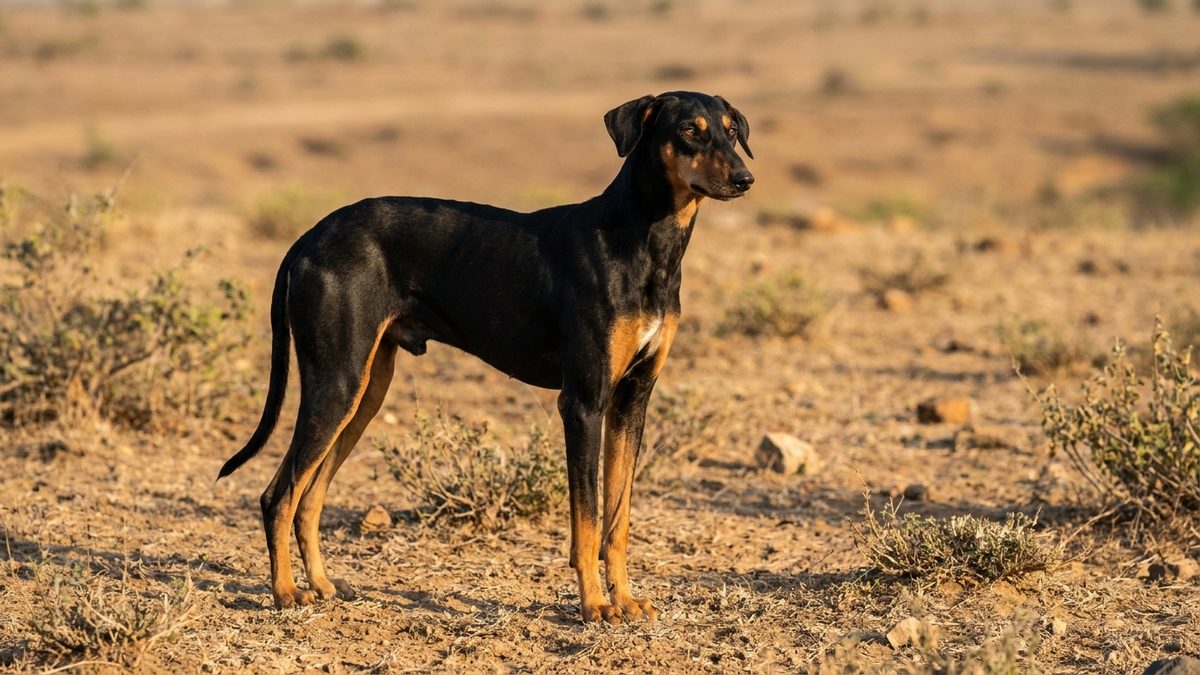
The breed is used mainly for coursing, and specifically for hunting Indian hares, relying on speed and endurance rather than scent trailing alone. Kannis are medium-sized dogs with straight top lines and tucked-up abdomens, standing 64 to 74 cm at the withers and weighing 16 to 22 kg. They have straight heads, strong jaws, golden eyes and black noses, with medium-sized flat ears that may be erect, dropping or semi-dropping, and a semi-curved tail.
| Attribute | Detail |
|---|---|
| Type | Sighthound, coursing |
| Origin | Tirunelveli, Virudhunagar and Thoothukudi districts, Tamil Nadu |
| Also called | Maiden's Beastmaster |
| Name means | Pure, in Tamil |
| Height | 64 to 74 cm |
| Weight | 16 to 22 kg |
| Coat | Short and close-lying, low shedding |
| Classic colour | Black and tan, or black and sable |
| Traditional role | Coursing hare and small game, and guarding a bride's new home |
| Recognition | Kennel Club of India only, not the AKC |
The dowry hound
The Kanni is called the Maiden's Beastmaster for two reasons, and both are documented. It defends its territory voraciously against wild animals, and it was often gifted to newlywed brides as their guardian. Tamil tradition held that the dog went with the bride for her safety. Although Kannis come in several colours, generally only the black-and-tan dogs were given as marriage gifts, and that custom is the reason the name attached itself to that one colour in dogs and in goats alike.
Among the Kambalathu Naicker community, a Kanni pup was one of the gifts a bride's family sent with her into marriage. That is not decoration on the breed's history. It explains the temperament people still report, which is a dog that attaches hard to one household and treats everyone outside it as a question rather than a friend.
Colour types, and why there are so many names
Kanni coats carry individual Tamil names by colour, which is unusual for any breed and tells you the animal mattered enough locally to warrant its own vocabulary. Documented types include brown with black, fawn (Santhana Pillai), light red through to dark red (Karum Sevalai), cream, white (Mayila Pillai), red with white, and pale grey (Sambal). Others include black with fawn markings (Paal Kanni), black with dark tan markings (Seng Kanni), black with a fawn face and legs (Karung Kanni), a fawn head and legs with the rest of the body black (Parukki), and brown and white (Semmarai).
What it was actually built to do
The Kanni's coursing ability is attributed to a light but muscular build, a large heart, a double suspension gallop and extreme flexibility of the spine, described as similar to a cheetah's. Kannis are trained to obey subtle hand signals from their handler while on the hunt, which is a far more demanding skill than most obedience work and says something real about the breed's attention.
A short-coated indigenous coursing hound is the opposite of a show breed. Nothing in the Kanni was selected for looks, and that is why it is a healthy, hardy, low-maintenance animal that costs very little to keep. It is also why it has no formal health surveillance, no large breed club and no reliable population record outside one state government dataset.
Almost every Kanni page online states the breed hits 60 km/h Rocadog, Kanni Dog Breed. That number traces back to a now-archived blog post, not to a measured study of Kanni dogs. Bonbeno reports the claim and its source quality rather than repeating it as fact. No timed, published trial of Kanni running speed exists that we could find.
Kanni dog price in India
Published Kanni prices in India range from Rs 3,000 to Rs 30,000, and the sources do not agree with each other by a factor of ten. That spread is the most honest thing anyone can tell you about buying this breed, because there is no organised market, no auction data and no registry price record to average.
| Source | Stated range | Type of source |
|---|---|---|
| Supertails | Rs 3,000 to Rs 12,000 | Retailer editorial, 2026 price list |
| Pet India Online | Rs 5,000 to Rs 15,000 | Retailer editorial, April 2026 |
| Charwaha | Rs 5,000 to Rs 20,000 | Care guide, May 2026 |
| The Pet Care India | Rs 5,000 to Rs 20,000 | Seller listing page, Tiruppur |
| Premium Pet House | Rs 5,000 to Rs 25,000 | Seller, nationwide delivery |
| Premium Pet House, Chennai and Bengaluru | Rs 5,000 to Rs 30,000 | Same seller, city-level table |
Read that table by who wrote each row, not by the numbers. The two lowest bands come from retailers with no puppy to sell you. The two highest come from sellers. A seller's published ceiling is a starting position in a negotiation, and a retailer's editorial figure is closer to what the breed actually changes hands for in its home districts.
Why the Kanni is cheap and hard to find at the same time
Most rare breeds are expensive because scarcity drives price. The Kanni breaks that pattern, and the reason is that it was never a commercial animal. It was bred by working households in the far south for coursing and guarding, and traditionally a good one was gifted rather than sold. Even now the published low end sits at Rs 3,000, which is roughly the adoption cost of an Indian Pariah Dog. What is scarce is not the money. It is a verified dog.
That is the trap. A breed with a ten-times price spread, no central registry check that a buyer outside Tamil Nadu can run, and a distinctive but easily faked colour pattern is exactly the setup in which black-and-tan crossbreeds get sold as Kannis. The colour is the thing people buy, and the colour is the thing that is easiest to fake.
Paying Rs 30,000 instead of Rs 5,000 for a Kanni does not buy a health screen, because none exists for the breed. It does not buy pedigree certainty unless the seller shows you a Kennel Club of India certificate you have verified directly. In most cases it buys distance from Tirunelveli and a seller who knows you have no alternative.
Bonbeno does not broker puppy sales, publish breeder listings or quote a live price as an offer. What we will say plainly is that the state government route described in the adoption section is the only Kanni source we found that publishes its breeding rules, its veterinary protocol and its record-keeping The Times of India, Tamil Nadu.
Monthly cost of owning a Kanni
A Kanni is one of the cheapest dogs in India to run, and two published Indian estimates put the monthly cost at Rs 2,500 to Rs 6,000 and Rs 3,000 to Rs 6,000. Both are published estimates rather than survey data, so treat them as a shape rather than a number.
| Line item | Published estimate | What actually drives it |
|---|---|---|
| Food | Rs 1,500 to Rs 4,000 | Whether you feed commercial food or home-cooked rice, eggs and chicken |
| Food, second estimate | Rs 2,000 to Rs 4,000 | Same breed, different assumptions about diet quality |
| Veterinary care | Rs 500 to Rs 2,000 | Core vaccination, deworming, and year-round tick control |
| Grooming | Minimal | Short coat, no salon visits over a 14 to 16 year lifespan |
| Total, monthly | Rs 2,500 to Rs 6,000 | Care guide estimate |
| Total, monthly | Rs 3,000 to Rs 6,000 | Retailer estimate |
The cost nobody puts in a table is space. A coursing hound that cannot run is not a cheaper dog, it is a dog you will spend money on later in destroyed furniture and behaviour consults. In a metro, safe running access usually means paid access to an enclosed field, and that single line can exceed everything above it combined.
The second under-counted cost is tick control. A parasite prevention routine that lapses for two months in a Chennai monsoon is not a saving, it is a deferred veterinary bill, and the reason is in the health section below.
When we publish cost figures we state the sample size, the cities covered and the collection date. Our verified owner cost survey across eight metros is in progress. Until then we publish other people's estimates with their names attached rather than a single averaged number nobody can check.
Heat tolerance and the Indian climate
The Kanni is among the best heat-adapted dogs available in India. Native Tamil Nadu breeds are described as physically adapted to withstand the state's scorching summer heat and the saline air of the coastal regions, without cooling equipment or air conditioning.
The short coat is the mechanism. A short, close-lying coat sheds heat rather than trapping it, and the same coat makes native breeds less susceptible to parasite infestations than heavily coated imports. Charwaha makes the practical comparison directly: breeds developed in colder countries struggle in Indian humidity and heat, while Kannis adapt naturally.
Adaptation is not immunity
Heat stroke remains a veterinary emergency in any breed, and the risk factors that matter in an Indian city are lack of water, enclosed space, excessive humidity, obesity, intense exercise and lack of acclimatisation. A dog can develop heat stroke in as little as 30 minutes of vigorous exercise in hot weather, and a raised body temperature of 40.5 C or above is one of the signs.
The car rule is the one Indian owners break most. When the outside temperature is 26 C, the inside of a car reaches 32 C in five minutes and 43 C in 25 minutes. A Chennai April afternoon starts well above 26 C.
- Run at dawn and after dusk through the hot months, which is the standard veterinary recommendation for exercise timing.
- Keep water available all day, because dehydration risk rises sharply through an Indian summer.
- Give shade rather than confinement, since an enclosed space is itself a heat stroke risk factor.
- Watch the humid months, not just the hot ones, because excessive humidity is a listed risk factor independent of temperature.
- Add a coat in a North Indian winter. A lean, short-coated southern hound in Delhi in January is outside the climate it evolved in, even though the breed can adapt to colder weather over time.
Kanni kennels at the Tamil Nadu state breeding centre are cleaned with disinfectant twice daily and deliberately kept dry, specifically to prevent skin diseases and tick infestations. That is the single most transferable piece of care advice on this page for a monsoon city. A dry sleeping surface does more for a short-coated dog through July and August than any shampoo.
Temperament and household fit
The Kanni is usually shy, but it will always defend its home or its owner if the need arises, and it is extremely faithful to its family. Reserve toward strangers is the breed's default setting rather than a training failure.
Descriptions converge unusually well for a rare breed. It is friendly and loyal to its owners while appearing shy toward strangers, and it can become protective. It bonds strongly with its owner and family, and once that bond forms it becomes loyal and protective, aloof and reserved with outsiders but not aggressive without reason. It is quiet, sensitive and intensely loyal, slow to trust outsiders and utterly devoted to its own people.
Indoors it is calm and quiet. Outdoors it becomes energetic and active, and that split is the breed's most useful trait for an Indian household. A Kanni that has run is a still, undemanding houseguest.
A Tamil Nadu kennel that keeps the breed describes the same animal from the working end, as a dog with unwavering loyalty and protective instincts, a natural suspicion of strangers, and no hesitation about defending its people, which proper socialisation softens into acceptance rather than removes. That is a useful framing. You are not training the wariness out of a Kanni. You are teaching it where the line sits.
Who this breed suits
- Good fit. Independent houses with a walled compound or land, owners who will commit to a real daily run, households that want a quiet indoor dog and a natural watchdog.
- Poor fit. Compact flats, homes with free-roaming cats or rabbits, anyone who wants a dog that greets guests at the door, and first-time owners.
- Manage carefully. The territorial streak. This breed defends its area voraciously against animals, which is exactly what you want on farmland and exactly what you do not want in a shared apartment corridor.
The separation question, where sources actually disagree
One seller states that Kannis are less likely to develop separation anxiety than most breeds and will not follow you around asking for attention. Two care guides say close to the opposite, that Kannis form deep emotional bonds, dislike neglect and may become stressed if isolated regularly. Both cannot be right, and neither is backed by behavioural data on this breed.
Our reading is that the two descriptions are of the same dog at different distances. A Kanni is not clingy in the way a retriever is clingy, so it looks independent hour to hour. It is also a one-household dog that was bred to stay with a person, so long daily absences are a genuine risk. Plan for a dog that wants you in the building rather than in the room.
A Kanni puppy that hides from visitors is not a low-energy dog and is not well-socialised. It is an under-exposed shy dog storing up a problem. Reserve toward strangers is normal and permanent in this breed. Fear is not, and the difference is decided almost entirely in the first three months.
Training a Kanni
Train a Kanni early, gently and in short sessions, because the breed is extremely faithful and easy to train in the house but thinks independently the moment a hunt begins. The veterinarian at Tamil Nadu's state breeding centre puts the training window at three to six months of age.
The Kanni is a quick study and a genuinely trainable sighthound, which is not a phrase you can use about most of the group. It learns new commands fairly easily and is capable of fast training, but like most hunting breeds it is independent and sometimes stubborn, so patient and firm handling is required, and it is not a dog for a novice owner. Kerala Kaumudi records the same local wisdom in blunter terms: these dogs have to be trained from childhood, because it becomes difficult once they are older.
Sighthound rules apply, and they are not optional
A sighthound sees further than you do, so it reacts to prey you cannot see, and when the prey drive engages the instinct to chase overrides other commands. Sighthounds are also typically less motivated by food rewards than other breeds and are gentle souls who do not respond well to harsh corrections. Charwaha reaches the same conclusion for the Kanni specifically, that harsh punishment damages trust in an emotionally sensitive breed.
Two practical consequences follow. First, build recall indoors before you ever take it outside, use a long line for longer than you would with another breed, and treat a gated field as the first outdoor step rather than a park. Second, swap your reward. Sighthounds often respond better to a small moving toy than to food, because it imitates the thrill of the chase.
| Skill | Expectation | Note |
|---|---|---|
| Name response | Fast | This is a bright, attentive breed |
| House manners | Fast | Calm and quiet indoors by nature |
| Sit | May never be comfortable | Sighthound anatomy makes sitting awkward. Use down or stay |
| Loose-lead walking | Slow, months | Strong prey drive makes lead work a long project |
| Recall, no distraction | Achievable | Build the foundation indoors first |
| Recall with prey in sight | Treat as permanently unreliable | Chase overrides commands in every sighthound |
| Hand signals at distance | Genuinely possible | Kannis are traditionally trained to subtle hand signals on the hunt |
| Relaxed with strangers | Ongoing management | Reserve is the breed, not a fault |
Sighthounds often struggle with sit because of their anatomical structure, which can make the position genuinely uncomfortable. Indian trainers working mostly with Labradors and German Shepherds will drill sit as the first command. Watch what your dog offers naturally and substitute down or stay, which serve the same purpose.
How much exercise a Kanni needs
A Kanni needs 60 to 90 minutes of activity daily, including running, open-field work and long walks. Dog Breed Info is blunter, warning that without at least an hour of vigorous exercise a day the breed easily becomes over-excited and destructive.
The distinction that matters is between walking and running. This is a coursing hound built to reach speed in a straight line, and a dog that never does is under-exercised no matter how many kilometres it covered on a lead. PetGuide is direct about it, describing the exercise requirement as at least an hour of moderate to vigorous work per day, with more preferred.
What the state breeding centre actually does
The Tamil Nadu Dog Breeding Unit gives its native dogs mandatory walks within the premises every morning and evening, plus dedicated open spaces where they can play freely without being chained. When the unit was reported on in 2018 it ran its hounds in a 5,500 square foot fenced play area morning and evening, alongside a 30-minute daily routine.
That is a useful benchmark because it is a real facility rather than a guideline. Two sessions a day, an enclosed area big enough to accelerate in, and no chaining. If you cannot approximate that, this is the wrong breed for your home.
- Secure the space before you unclip. A Kanni in pursuit will not stop for a command or for traffic.
- Split the load across morning and evening, which is both the heat-safe pattern and the pattern the state unit uses.
- Substitute scent and training games during heatwaves, when running outdoors is unsafe for weeks at a time.
- Do not run a puppy hard. Growth plates in a leggy breed need protecting well past the first year.
- Expect destruction if you skip it. Boredom and long periods alone make this breed stressed and destructive, which is a health problem before it is a furniture problem.
Grooming a Kanni in Indian humidity
Groom a Kanni once a week and you are done. The coat is short and close-lying, requires very little grooming, sheds only lightly, and never needs professional attention. Over a 14 to 16 year lifespan that is a substantial saving against any coated breed.
- Brush weekly with a rubber curry or hound glove, which is enough to remove loose hair and keep the coat in condition.
- Bathe every four to six weeks, or only when the dog is genuinely dirty.
- Check for ticks at every brush, which matters far more than the brushing itself in an Indian climate.
- Trim nails and clean ears on a routine, since ear infections appear on every published list of Kanni problems.
- Keep the sleeping surface dry, the single practice the state breeding unit uses against monsoon skin disease.
One correction worth making. A short coat is not a hypoallergenic coat. Kannis shed less than most breeds but shed throughout the year, and anyone in the household with a fur allergy should take medical advice before committing.
A sighthound carries almost no padding over its elbows and hocks, and hard Indian floors produce pressure calluses that thicken and occasionally crack. A thick bed in the spot the dog actually chooses is the whole fix, and it is the care item owners of lean breeds most often skip.
Health, lifespan and what nobody can tell you
The Kanni is a generally very healthy breed, and published lifespan figures cluster between 12 and 16 years PetGuide, Kanni Dog Breed Info Center. Beyond that, the honest position is that no breed-specific disease data exists, and PetGuide says so outright: little is known about inherited health problems in this breed.
| Source | Stated lifespan |
|---|---|
| PetGuide | 14 to 16 years |
| Wikipedia, citing PetGuide | 14 to 16 years |
| Dog Breed Info | 12 to 16 years |
| The Pet Care India | 12 to 16 years |
| Rocadog | Around 15 years |
| Charwaha | 12 to 15 years |
| Pet India Online | 12 to 14 years |
| TN state breeding centre veterinarian | 14 years |
The inherited-disease lists are inference, not evidence
Every condition attributed to the Kanni online is an assumption drawn from the dog's size and use rather than from a study. PetGuide names musculoskeletal issues and bloat as likely on that basis. Rocadog names dermatitis, parvo viral diarrhoea and patellar luxation. Dog Breed Info advises watching hip and joint problems because the dogs run hard on tall thin legs, while stating there is not a lot of information on this rare breed. Charwaha lists hip joint issues, skin allergies, ear infections, nutritional deficiencies and parasite-related illness.
None of those are wrong as things to watch. All of them are unverified as breed risks. Any page giving you a Kanni prevalence percentage is extrapolating from another breed, and we will not do that here.
The risk that is actually measured, and it is ticks
A peer-reviewed survey of canine tick-borne disease across four Indian cities tested 525 dogs and found 49.7 percent infected with one or more tick-borne pathogen by PCR. Hepatozoon canis was the most common at 30 percent, followed by Ehrlichia canis at 20.6 percent, Mycoplasma haemocanis at 12.2 percent, Anaplasma platys at 6.5 percent, Babesia vogeli at 5.5 percent and Babesia gibsoni at 0.2 percent. Concurrent infection with more than one pathogen occurred in 39 percent of cases, and ticks were found on 53 percent of the dogs examined.
That is the number an Indian Kanni owner should act on. It is measured, it is Indian, it applies to every breed in the country, and it dwarfs any speculative inherited risk in this breed. Year-round tick control is not an optional line in the monthly budget.
- Run tick prevention every month of the year, not seasonally, given that co-infection is common and half of sampled Indian dogs carried a pathogen.
- Check the dog by hand after every run, especially ears, groin and between toes, because a short coat makes ticks findable and that is an advantage worth using.
- Keep kennels and bedding dry and disinfected, the protocol the state breeding unit uses against tick infestation and skin disease.
- Ask your vet to consider tick-borne disease early in any unexplained lethargy, fever or anaemia, since practitioners in India are advised to expect co-infections.
- Flag sighthound anaesthesia sensitivity before any procedure, because low body fat changes how some agents are handled in lean hounds.
Native Indian breeds are far less prone to congenital problems such as hip dysplasia, skin disease and heart ailments than the imported breeds sold alongside them, and they need minimal expenditure on medical care. That is not marketing. It is what happens when a population is shaped by work and climate rather than by a conformation ring.
Feeding a Kanni
Feed a Kanni a protein-forward diet split into two meals a day for adults and three for puppies, and keep it visibly lean. The traditional village diet for this breed is documented, and it is not adequate for a growing modern dog.
What Kannis were traditionally fed
Kannis traditionally ate millet, corn, jowar, rice porridge with milk or curd, and non-vegetarian food. PetGuide records the daily pattern more precisely: milk for breakfast, corn porridge for lunch and ragi porridge at tea time, with meat given only on a weekly or monthly basis.
That diet kept working hounds alive on very little, which is exactly what it was designed to do. It is not what you should feed a growing puppy in a city in 2026. PetGuide's own recommendation for anyone keeping the breed is a high-quality adult, active or working-breed formula to ensure complete and balanced nutrition.
What the state breeding centre feeds
The Tamil Nadu Dog Breeding Unit feeds its Kannis specific portions of high-quality boiled chicken, rice and eggs daily, along with boiled vegetables, measured against each dog's age and weight, with extra protein, calcium or vitamins added where needed. Native breeds are described as thriving on simple Indian home food such as rice, curd, eggs and ragi porridge without packaged food or expensive supplements.
Read those two paragraphs together and the practical answer emerges. Home-cooked works for this breed, provided the protein is real and daily rather than weekly, and provided the portions are weighed rather than guessed.
- Feed to body condition, not to a chart. Ribs lightly covered, a visible waist and a clear tuck is correct for a sighthound and looks underfed to owners used to Labradors.
- Split intake into two meals for an adult and three for a puppy.
- Keep protein daily, since the historic weekly-meat pattern was a constraint rather than a recommendation.
- Avoid chocolate, grapes, onions, heavy salt, fried food and spiced leftovers, which is standard veterinary advice and matters more in Indian homes where table scraps are normal.
- Keep fresh water available continuously, because dehydration risk climbs through an Indian summer.
Bonbeno reviews Indian pet food brands separately and tests products first-hand before publishing a verdict. See our testing method for what a Bonbeno food review does and does not claim.
Kanni puppy: the first two years
A Kanni puppy grows into a 64 to 74 cm hound weighing 16 to 22 kg, and the two things that shape the adult are socialisation and restraint. The primary and most important time for puppy socialisation is the first three months of life, and for a naturally shy breed that window decides everything.
- 6 to 16 weeks. Core vaccination against parvovirus, distemper, rabies and hepatitis, plus deworming, on the schedule your veterinarian sets. State-bred puppies are vaccinated against parvovirus, rabies and distemper and dewormed before handover. Socialise in every safe way you can during this window, because sociability outweighs fear only in the first three months.
- 3 to 6 months. The training window named by the state breeding centre's veterinarian. Start lead work, handling, grooming habits and name response now. Keep exercise short, frequent and off stairs.
- 6 to 12 months. Reserve toward strangers becomes visible and prey drive emerges. Keep socialising rather than withdrawing the dog from the world, and make the long line permanent in any area with wildlife, livestock or traffic.
- 12 to 18 months. Build toward the adult load of 60 to 90 minutes daily. Introduce free running only in genuinely enclosed space.
- 18 to 24 months. Physically mature. Native breeds at the state unit are only allowed to breed from 1.5 years of age, which is a reasonable proxy for full maturity in this breed.
A genuine Kanni is black and tan or black and sable, with golden eyes, a black nose, medium flat ears that may be erect, dropping or semi-dropping, and a semi-curved tail. Because the colour pattern is common to several crossbreeds and the breed is rare, see both parents, check the height and build against the standard, and treat a cheap listing outside the home districts with deep suspicion.
Kanni vs Chippiparai, and whether they are two breeds at all
The Kanni and the Chippiparai may not be different breeds. Wikipedia states plainly that Kanni refers to the black-and-tan and black-and-sable varieties while the solid-coloured variety is known as the Chippiparai, and then adds that some experts claim the two are distinct breeds. That unresolved sentence is the honest state of the question.
Where the published sources actually disagree
| Source | What it says |
|---|---|
| Wikipedia | Kanni covers black-and-tan and black-and-sable; solid colour is Chippiparai. Some experts say they are distinct breeds |
| Kennel Club of India, as reported | Registered the black-and-tan dogs as Kanni and the solid-coloured variety as Chippiparai, under two names |
| PetGuide | Only the black-and-tan version carries the name Kanni; the black-and-sable variation is called Chippiparai |
| Dog Breed Info | Lists Chippiparai as an alternative name for the Kanni. Any coat other than black and tan is a Chippiparai though other traits are exactly the same |
| Kerala Kaumudi | The black ones are Kanni and the tan ones Chippiparai, and the KCI approved them as two different breeds |
| Dog with Blog | Essentially the same southern sighthound in different coats. The KCI settled it on paper; breeders and old-timers still insist they are distinct |
| HubPages | These two are different breeds, and they differ in tail carriage, ear set and hunting role as well as colour |
| Dog Scanner | Reproduces the Wikipedia colour definition verbatim, and repeats that some experts claim the two are distinct |
Note what PetGuide and Wikipedia do to the black-and-sable dogs. One puts them inside Kanni, the other puts them inside Chippiparai PetGuide, Kanni. Two widely-cited sources place the same animal in two different breeds. Anyone telling you the distinction is settled has not read both. The Wikipedia colour definition is also the one propagating across the wider web, reproduced word for word by breed-identification services that themselves rank for the term, which is how a contested claim becomes a consensus without anyone testing it.
The physical differences claimed, beyond colour
One Indian source argues the two are genuinely different dogs and names three distinctions that have nothing to do with coat colour. The Chippiparai's tail points upwards while the Kanni's is longer, descends downwards and is semi-curved. The Chippiparai's ears are button-shaped or erect and closed upwards while the Kanni's hang down. And the working brief differs, with the Chippiparai valued for team hunting of larger prey such as wild boar in difficult terrain, and the Kanni valued for speed, agility and endurance over long distances.
Two of those three are checkable on a live dog in about ten seconds, which makes them more useful to a buyer than any registry argument. Note that the same source gives the Chippiparai a 9 to 13 year lifespan and a 25 to 30 kg weight, both well outside what other sources publish for that breed, so weigh its numbers more cautiously than its observations.
The strongest argument that they are separate
The Tamil Nadu Department of Animal Husbandry treats them as separate populations and counts them separately. Working from data held with the National Bureau of Animal Genetic Resources and the state department, the Chippiparai accounts for roughly 6,000 dogs, the Rajapalayam 3,000 to 4,000, and the Kombai and Kanni around 3,000 each, out of an estimated 12,000 to 15,000 native dogs in the state. The state breeding centre holds them as separate stock, with eight Chippiparais and six Kannis on site.
A government that regarded the Kanni as a colour of the Chippiparai would not run two breeding lines and publish two population figures. That is the most substantive evidence on the separatist side, and no consumer breed page we found mentions it.
| Factor | Kanni | Chippiparai |
|---|---|---|
| Colour | Black and tan, black and sable | Solid colour, silver-grey, fawn, reddish |
| Home districts | Tirunelveli, Virudhunagar, Thoothukudi | Virudhunagar, around Sippipparai village |
| Height | 64 to 74 cm | About 61 cm |
| Tail | Longer, descends downwards, semi-curved | Points upwards |
| Ears | Hang down | Button-shaped, or erect and closed upwards |
| Population in Tamil Nadu | About 3,000 | About 6,000 |
| Published price floor | Rs 3,000 | Rs 4,000 |
| Published price ceiling | Rs 12,000 | Rs 15,000 |
| Traditional role | Coursing hare, guarding a bride's home | Coursing deer, hare and boar for royalty |
| Temperament note | Shy, territorial, defends the home | Gentle, reserved, one-person |
The practical answer for a buyer is simpler than the taxonomy. If you want the black-and-tan dog, ask for a Kanni. If you want a solid silver-grey or fawn hound, ask for a Chippiparai. If you want a white guarding hound rather than a coursing one, you want a Rajapalayam. Whatever the registry decides, those are three different-looking dogs with the same core requirements: space, a daily run, early socialisation and a short-coat care routine.
Dog with Blog argues that the widely-quoted 64 to 74 cm height blends Kanni and Chippiparai records, and gives males at 62 to 67 cm and females 56 to 64 cm instead. American sources are lower again, at 22 to 25 inches Dog Breed Info Center, while one seller lists 64 cm for males and 56 cm for females. We report the Wikipedia range because it is the most widely cited, and we flag that it is contested rather than presenting it as measured.
Mistakes Indian Kanni owners actually make
These recur across the published guidance and are ranked by consequence to the dog.
- Believing the apartment claim on a seller's page. Sources that sell puppies say a Kanni adapts to a flat. Sources that do not sell puppies say it needs free space, its own territory and is not suited to city life, would not do well in a small apartment, and is not suitable for apartments or confined urban living. One seller's page manages to say both things on the same page.
- Trusting recall off-lead near roads or livestock. Chase overrides commands in every sighthound, and a hound sees prey you cannot.
- Skipping socialisation because a shy puppy seems well-behaved. The first three months are the primary window, and sociability outweighs fear only during it.
- Treating tick control as seasonal. Half of sampled Indian dogs carried a tick-borne pathogen and 39 percent of infected dogs carried more than one.
- Feeding the traditional porridge diet to a growing puppy. Milk, corn porridge and ragi with meat once a week was a village constraint, not a nutrition plan.
- Exercising through the middle of an Indian afternoon. Heat stroke can develop in as little as 30 minutes of vigorous exercise in hot weather.
- Using harsh correction on a sensitive breed, which produces avoidance rather than compliance and damages trust.
- Drilling the sit command, which sighthound anatomy can make genuinely uncomfortable. Use down or stay.
- Leaving the dog alone all day and assuming independence means indifference.
- Buying a black-and-tan lookalike. The colour is the easiest thing about this breed to counterfeit, and the breed is rare enough that most buyers have never seen a real one.
Off-lead in unsecured space. Every other item here is recoverable. A coursing hound that follows a chase across a road is not.
Sourcing a Kanni, and the state route nobody writes about
Source a Kanni through the Tamil Nadu Department of Animal Husbandry's Dog Breeding Unit at Saidapet in Chennai, which breeds Kanni, Chippiparai, Rajapalayam and Kombai under published protocols and hands puppies over with veterinary paperwork. It is the only Kanni source we found that documents how it breeds.
What the state unit actually does
The centre was set up in 1980, closed in 2016 after various shortcomings, and has since been revived and is fully operational again. It currently holds 35 dogs, including six Kannis of which two are male, alongside 13 Rajapalayams, eight Kombais and eight Chippiparais. To rebuild the lines, a medical team travelled to the breeds' native regions and procured three-month-old puppies to raise at the centre.
| Rule | Detail |
|---|---|
| Minimum breeding age | 1.5 years for all four native breeds |
| Inbreeding | Strictly prevented between siblings or mother and son |
| Records | Genetic records maintained; only healthy, unrelated pairs selected |
| Breeding frequency | Once in two years, with females bred until age eight |
| At handover | Deworming and first vaccination completed |
| Paperwork | Veterinary health certificate plus a medical card with the remaining vaccination schedule |
| Allocation | By priority list once puppies are weaned and eating solids |
| Priority given to | The Army, paramilitary forces and the Tamil Nadu Police |
Read that list against what a private seller offers you. Recorded parentage, an enforced minimum breeding age, an inbreeding prohibition, a vaccination record and a health certificate is a materially better package than a photograph on WhatsApp, and the published price is described as reasonable rather than premium.
The caveats, stated plainly
This is not a fast route. Demand is described as high and allocation runs on a priority list that puts the armed forces and the state police first. The unit's own history is stop-start. It was reported in 2016 to be rearing Kanni and Kombai again after nearly 20 years, it was breeding Kanni in 2018 for the first time in 15 years after procuring three one-month-old puppies from a breeder in Virudhunagar in November 2016, and it closed in 2016 before being revived. Those accounts do not sit neatly together, and a programme that has opened, closed and reopened is not something to plan a household around. Check its current status before you rely on it.
If you are buying privately, verify these five things
- Buy in the native breeding tract where practical, meaning Tirunelveli, Virudhunagar or Thoothukudi, since that is where the working population sits.
- See both parents and check height, build and coat against the breed description rather than against a photograph.
- Ask for a veterinary health certificate dated close to handover, plus the deworming and vaccination record, which is the standard the state unit meets.
- Verify any Kennel Club of India registration claim directly with the KCI rather than trusting a photocopy, remembering that the KCI registers the Kanni and the Chippiparai under two separate names by colour.
- Decline any seller who will not let you visit the place the puppies were raised, or who offers doorstep delivery of a rare native breed sight unseen.
Adoption, and the conservation argument
Kannis and Kanni crosses occasionally appear in South Indian shelters, usually surrendered once an urban household discovers what 60 to 90 minutes of daily running actually means. An adult has a known temperament and a known energy level, which are the two things you cannot assess in a puppy. If space is your constraint rather than commitment, the Indian Pariah Dog is free to adopt and adapts far better to a flat.
The breed preservation case is real but it is not a licence to buy badly. Traditional Tamil breeds are described as teetering on the brink of extinction because of the craze for foreign breeds, and the same reporting notes that imported dogs abandoned when they develop climate-related skin disease are themselves feeding the street dog population. Indian retailers make the same argument for native breeds, citing lack of awareness and unregulated breeding as the causes of decline.
Buying a poorly-bred, unverified dog under the Kanni name damages the breed's reputation and its gene pool at once. Breeds recover when enough informed owners keep them well, not when scarcity pushes prices up. Keeping one properly, and telling other people honestly what it needs, does more for the Kanni than paying a scarcity premium ever will.
Kanni questions Indians actually search
Is Kanni a good family dog?
For the right family, yes. The Kanni is extremely faithful and will defend its home and its owner, but it is usually shy with strangers and it needs free space, its own territory and 60 to 90 minutes of exercise daily. Families in compact flats, or anyone wanting a dog that greets visitors at the door, should choose differently.
Which dog is under RS 5000?
Among Indian native breeds, the Kanni itself starts at a published Rs 3,000, the Mudhol Hound at Rs 3,000 and the Chippiparai at Rs 4,000, while an Indian Indie costs nothing beyond an adoption fee. Those are published editorial ranges, not offers, and the first-year cost of vaccination, deworming and vet visits will exceed the purchase price either way.
Which dog is under 4000?
The Indian Indie is free to adopt beyond a shelter fee, and the published low ends for the Kanni and the Mudhol Hound both sit at Rs 3,000. No imported breed is realistically available under Rs 4,000 in India, and a listing claiming otherwise is the classic bait pattern for an unhealthy or misrepresented puppy.
Which dog's price is 1 lakh?
No Indian native breed reaches Rs 1 lakh, and the Kanni does not come close. The highest published Kanni figure we found anywhere is Rs 30,000, quoted by a seller for metro cities. Rs 1 lakh questions concern imported breeds, and Bonbeno does not publish purchase prices as offers for any breed.
What is the difference between a Kanni and a Chippiparai?
Mostly colour, and possibly nothing else. The Kanni is black and tan or black and sable while the Chippiparai is solid-coloured, and the Kennel Club of India registered them under two names on that basis. Some experts maintain they are genuinely distinct breeds, and Tamil Nadu's animal husbandry department counts them as separate populations of about 3,000 and 6,000 dogs.
How much does a Kanni dog cost in India?
Published Kanni prices run from Rs 3,000 to Rs 30,000, a ten-fold spread. The lower bands come from retailers with no puppy to sell, and the higher ones come from sellers. There is no organised market, no registry price record and no health screening premium in this breed, so a higher price buys you nothing verifiable.
How fast is a Kanni dog?
The commonly quoted figure is 60 km/h, but it traces to an archived blog post rather than to any timed study, so Bonbeno does not publish it as fact. What is documented is the anatomy behind the speed: a light muscular build, a large heart, a double suspension gallop and an unusually flexible spine.
How long do Kanni dogs live?
Published figures range from 12 to 16 years and the sources disagree. PetGuide and Wikipedia say 14 to 16 years, Dog Breed Info says 12 to 16, Charwaha says 12 to 15, and the veterinarian at Tamil Nadu's state breeding centre gives 14 years for native breeds. No study of Kanni longevity exists, so treat any single number as an estimate.
Can a Kanni live in an apartment?
Poorly, and the pattern in the sources is worth noticing. Pages that do not sell puppies say the breed needs free space and is not suited to city life, while pages that sell puppies say it adapts fine. The breed needs 60 to 90 minutes of activity daily including running, which no flat provides.
Are Kanni dogs easy to train?
In the house, yes. Kannis are extremely faithful and learn commands quickly, and are traditionally trained to obey subtle hand signals while coursing. Outside, prey drive overrides commands as it does in every sighthound, so treat recall with prey in sight as permanently unreliable and keep a long line on.
Is the Kanni dog endangered?
It is rare and declining. Tamil Nadu's animal husbandry department and the National Bureau of Animal Genetic Resources put the state's total native dog population at 12,000 to 15,000, of which the Kanni accounts for roughly 3,000. Experts attribute the decline to the craze for foreign breeds, and the state runs a breeding centre at Saidapet specifically to reverse it.
What should I feed a Kanni dog?
Feed real protein daily, split into two meals for an adult and three for a puppy. Tamil Nadu's state breeding centre feeds boiled chicken, rice, eggs and boiled vegetables portioned to each dog's age and weight. The traditional village diet of milk, corn porridge and ragi with meat once a week is documented but is not adequate for a growing dog.
Do Kanni dogs shed a lot?
No. The coat is short and close-lying, sheds lightly and never needs professional grooming, so a weekly brush is the entire routine. Low shedding is not the same as hypoallergenic though, and anyone in the household with a fur allergy should take medical advice before committing to the breed.
Compare with similar breeds
Kanni sits in 3 Bonbeno groups. Each one compares it directly against the breeds it is genuinely an alternative to, on the same figures.