
Breed profile
Galgo Español in India: The Welfare Story, Checked
The most repeated number about this breed cannot be traced to any count. The numbers that can be traced are worse in some ways and better in others, and nobody publishes them.
Quick answer
The Galgo Espanol dog is a Spanish coursing sighthound, FCI standard 285, and the figure most often attached to it, 50,000 to 100,000 killed each year, traces to a single 2007 newspaper feature and no published count. What Spain does document is that the end of the hunting season is the fourth commonest declared reason for giving up a dog or cat, at 11 percent, and that its kennel club registered just 98 Galgos in 2022 against 64,488 dogs overall.
This guide summarises published breed standards, registry data, peer-reviewed veterinary literature and Spanish and Indian government texts as general information for Indian pet owners. It is not a diagnosis and it is not treatment advice. Sighthounds have breed-specific blood values and drug handling, so a Galgo Español must never be assessed against generic canine reference ranges. Consult a registered veterinarian near you before acting on anything you read here, especially before any anaesthetic, any analgesic dose or any blood-test interpretation.
Galgo Español at a glance, scored for Indian conditions
What a Galgo Español is
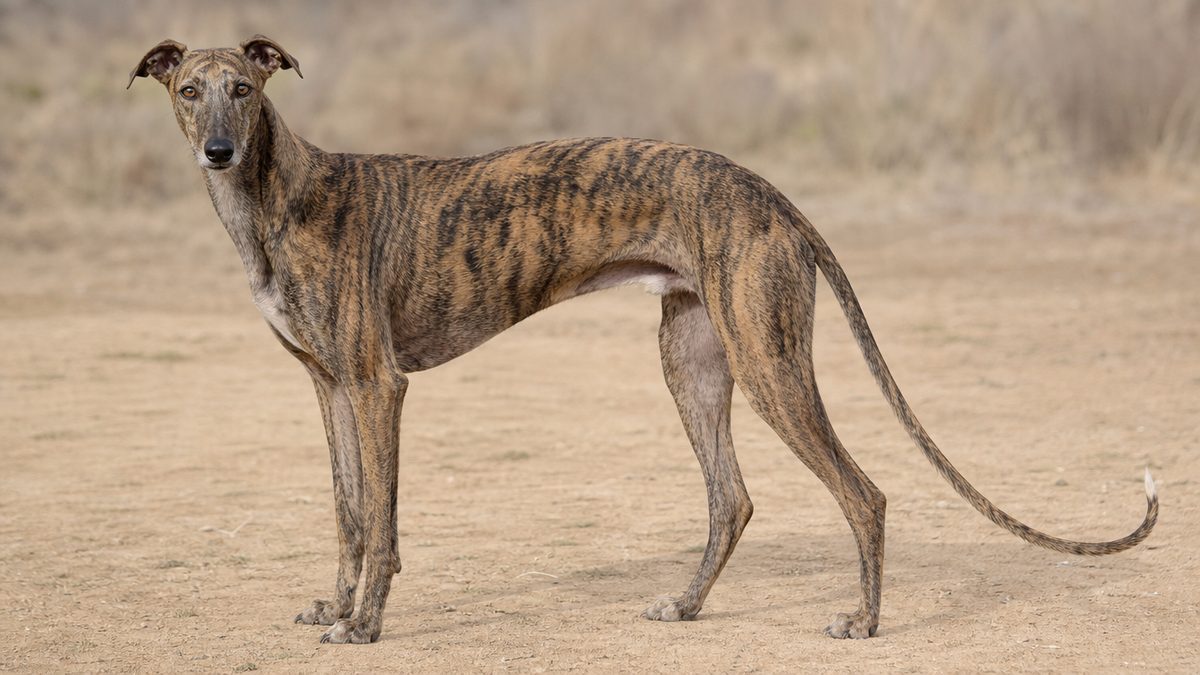
A Galgo Español is a Spanish coursing sighthound registered by the FCI as standard number 285, Group 10, Section 3 Short-haired Sighthounds, recognised on a definitive basis on 10 August 1971. Its official authentic language is Spanish and its English name in FCI nomenclature is Spanish Greyhound.
The standard is unusually blunt about what the dog is for. Under Utilization it reads: "A dog hunting the hare in fast pursuit in open fields, being directed by his sight. Formerly he has also been used and can hunt other game animals like rabbits, foxes, also boars; however the primordial utilization of the breed has been and is the hunt of the hare in open fields."; Every argument on this page, about welfare, about temperament, about whether the breed suits an Indian flat, runs back to that sentence.
The general appearance clause describes "greyhound of good size, eumetric-subconvex, sub-long line and dolichocephalic" with "compact bone structure, head long and narrow, ample thoracic capacity, belly very tucked up, very long tail";. Read against an English Greyhound the differences are real and checkable. The Galgo's chest is "deep, without reaching the elbow", and a chest let down well below the elbow is a disqualifying fault. Its cranial-facial lines are divergent rather than parallel. Its loin is arched, and the standard permits the height at the loin to exceed the height at the withers.
Size, and the figure the standard does not give
Height at the withers is 62 to 70 cm for males and 60 to 68 cm for females, with "a margin of 2 cm more admitted in subjects of perfect proportions". Note the tolerance is separate from the range, so the honest way to quote it is 62 to 70 cm plus a permitted 2 cm, not 62 to 72 cm.
The standard gives no weight at all. There is no weight clause, no range and no guidance beyond the proportions. Any page quoting a weight for this breed is quoting something other than the standard, and should say what. The same is true of the Chortai, whose standard also omits weight, and it is a useful test of whether a breed page has read its primary document.
Two coats, and a fault clause worth reading twice
The Galgo comes in two coat varieties. The smooth is "dense, very fine, short, smooth; spread all over the body down to the interdigital spaces", and the semi-long hard-haired variety carries "greater hardness and length of hair which can be variable", forming "a beard and moustaches at the muzzle, eyebrows and top knot on the head";. Colour is wide open: "All colours are admitted", with brindle and fawn listed first in order of preference, then black, flecked, burned chestnut, cinnamon, yellow, red, white and pied.
Then the fault list does something no other standard on this site does. Among the minor faults, alongside a slightly broad head and a missing premolar, it lists: "Scars, wounds and scratches in hunting season." A breed standard is a description of an ideal, and this one has written into its ideal the expectation that a show dog will arrive marked from working. Nothing else in the document tells you as much about the breed's real life.
The important faults include "Tail and ears amputated", and among disqualifying faults sit the usual aggression and shyness clauses plus "Lack of type", "Split nose", "Albinism" and "Any other typical characteristic which would recall or indicate a cross-breed";. That last one matters historically, because the breed was crossed with the English Greyhound at scale in the early twentieth century to make faster track dogs.
The FCI standard states that the Spanish greyhound "was exported in large quantities to other countries like Ireland, England during the XVIth, XVIIth and XVIIIth centuries" and that it "is one of the ancestors of the English greyhound";. So the breed most Indians know as a Greyhound is, on the FCI's own account, partly descended from this one.
Spain's own kennel club registered 98 of them in 2022
The Real Sociedad Canina de España registered 98 Galgos Españoles in 2022, out of 64,488 dogs registered across all breeds that year. That is 0.15 percent, for the national sighthound of the country whose register it is.
The RSCE publishes a comparative table of entries to the Libro de Orígenes Español and the Registro de Razas Caninas, and it is the primary Spanish document on this question. Read the Galgo's row and the arithmetic checks out exactly: the five annual figures sum to the printed accumulated total, and the printed year-on-year change matches.
| Year | Registrations |
|---|---|
| 2018 | 127 |
| 2019 | 51 |
| 2020 | 62 |
| 2021 | 126 |
| 2022 | 98 |
| Five-year total | 464 |
127 plus 51 plus 62 plus 126 plus 98 is 464, exactly the printed total, and 98 minus 126 is the printed difference of 28, which is the printed 22.22 percent fall. The row is internally consistent, which is the first thing to check on any registry table.
Set that against what Spain does register
| Breed | 2022 entries |
|---|---|
| Setter Inglés | 4,536 |
| Perro de Pastor Alemán | 3,969 |
| Caniche | 3,127 |
| Labrador Retriever | 2,675 |
| Perro de Agua Español | 1,913 |
| Epagneul Bretón | 1,690 |
| Mastín Español | 1,287 |
| Pequeño Lebrel Italiano | 525 |
| Whippet | 175 |
| Podenco Ibicenco | 139 |
| Galgo Afgano | 138 |
| Galgo Español | 98 |
| Saluki | 16 |
| Greyhound | 0 |
Two things jump out. Spain registers hunting dogs in enormous numbers, with the English Setter its second most registered breed of all at 4,536, so the Galgo's 98 is not a country that has stopped hunting. And the English Greyhound, the breed the Galgo is constantly confused with, was registered once in Spain across the whole five years, total accumulated one dog.
The pedigree register is not where galgos come from. That single structural fact explains more about this breed's situation than any adjective. A dog bred to course hare in Castilla is bred inside a hunting culture that does not use the kennel club, so the population that lives the life the welfare reports describe is almost entirely outside the register, and therefore outside its traceability, its paperwork and its counting.
The kennel club also calls it vulnerable
The RSCE publishes an annual list, "Razas españolas consideradas vulnerables", and for the period 1 May 2025 to 30 April 2026 that list names 16 breeds. The Galgo Español is the third entry on it, alongside the Mastín del Pirineo, the Ratonero Valenciano, the Podenco Andaluz, the Sabueso Español and the Pachón Navarro.
That is a strange sentence to have to write. A breed can be simultaneously the subject of an international welfare campaign about tens of thousands of dogs and, in its own country's studbook, a vulnerable breed with 98 registrations a year. Both are true, and they are true of different populations of the same dog. Holding those two facts together is the only honest way to read anything else about the Galgo.
One more piece of context makes the rarity concrete. FCI Group 10 is the smallest group in the nomenclature, holding 13 breeds in total: three long-haired or fringed sighthounds, two rough-haired, and eight short-haired. The Galgo Español is the only Spanish breed in the whole group, and no Indian sighthound appears in it at all, because the Mudhol Hound, Rampur Greyhound, Chippiparai and Kanni hold no FCI standard. So the Galgo's nearest recognised relatives on paper are the Greyhound, the Whippet, the Azawakh, the Sloughi, the Magyar agár, the Chart Polski and the Piccolo Levriero Italiano, and the dogs it most resembles in function, India's own, are not on the list.
The RSCE table's own FCI-standard column is not perfect. It lists the Flat-Coated Retriever at standard 125, which is the English Springer Spaniel's number; the Flat-Coated Retriever is FCI 121. The Galgo Español's own entry, 285, is correct against the FCI's nomenclature page. Check the row you are quoting, not the table.
What Spain actually documents about abandoned dogs
Spanish shelters took in 292,018 dogs and cats in 2024, of which 173,867 were dogs, and the end of the hunting season was recorded as the reason in 11 percent of surrenders, making it the fourth commonest reason given. These are the numbers with a method attached, and almost nobody quotes them.
The source is Fundación Affinity's annual study "Él nunca lo haría", which the foundation says it has run for more than three decades. Its 2025 edition reports on 2024 data, and it publishes its own methodology on the face of the infographic, which is exactly what the circulating galgo figures do not. The study is produced by the Cátedra Fundación Affinity together with Affinity's consumer-intelligence department and the independent research institute Punto de Fuga, and its stated purpose is to analyse the figures and the causes of pet abandonment in Spain each year. Naming the research partners is a small thing, and it is one more way a reader can verify who did the counting.
"Estudio realizado a partir de datos de una muestra de 458 sobre un total de 1.548 sociedades protectoras que acogen animales. La cifra total de animales corresponde a los datos reales de las entidades que proporcionaron información, a los que se suman los estimados para el resto de protectoras existentes en España." A sample of 458 shelters out of 1,548, with real returns from responders plus modelled estimates for the rest. Stated sample, stated frame, stated estimation. That is what a citable number looks like.
| Reason | Share |
|---|---|
| Unwanted litters | 16 percent |
| Loss of interest in the animal | 14 percent |
| Change of address or relocation | 12 percent |
| End of the hunting season | 11 percent |
| Behaviour problems | 10 percent |
| Economic factors | 7 percent |
| Hospital admission or death of the owner | 6 percent |
| Lack of time or space | 5 percent |
| Allergies | 4 percent |
| Birth of a child | 4 percent |
| Divorce | 4 percent |
| Holidays | 2 percent |
| Job loss | 1 percent |
Read the fourth row carefully. This table covers dogs and cats together, and cats are not used to hunt. So an 11 percent share across the combined population means the dog-only share is necessarily higher, and "end of the hunting season" sits above behaviour problems, above money, above divorce and above every other life event a Spanish household can have. In a country that surrendered 173,867 dogs in one year, that is not a fringe cause.
What the study does not print is a count. It gives the share of declared reasons and it gives the total intake, but it does not publish the denominator for the reasons table, so multiplying 11 percent by 173,867 would be an inference of this page's own, not a figure Affinity states. That inference lands somewhere near 19,000 dogs a year. It is offered here as arithmetic with its workings visible, and it should not be quoted as if the study said it.
The rest of the picture, with denominators
- 292,018 animals collected in 2024, up about 2 percent on 2023 and the highest of the last five years. The series runs 286,153 in 2020, 285,554 in 2021, 288,457 in 2022, 286,101 in 2023.
- 24,333 animals a month, which is the same total expressed usefully.
- 52 percent of dogs were adopted, and nine in ten of those adoptions never came back to the shelter.
- Only 25 percent of dogs arrived with a microchip, against 89 percent of dogs living in homes. Six in ten of the identified dogs were recovered by their families.
- 24 percent of dogs arriving were puppies, 60 percent adults and 16 percent seniors.
- 27 percent of dogs arriving were of a recognised breed and 73 percent were mixed.
That microchip figure is the one an Indian reader should sit with, because it is the mechanism rather than the outcome. A dog with no chip cannot be traced to an owner, cannot be prosecuted over, and cannot be counted as anything except an anonymous intake. Twenty-five percent identification at the shelter door is how a welfare problem stays statistically invisible for decades, in Spain or anywhere else.
The 50,000 figure: where it comes from, and where it stops
Following the most-cited galgo mortality figure back through its own sources ends at a 2007 newspaper feature. English Wikipedia states that "an estimated 50,000 to 100,000 Galgos and Podencos are killed, often brutally, each year by their hunters", and the reference it attaches to that sentence is a Daily Telegraph expat-section article of 24 July 2007.
That is the entire chain. There is no register behind it, no year of collection, no sample, no method and no denominator. The Spanish-language version has an equally short trail: Spanish Wikipedia's article on animal cruelty cites the same order of magnitude to a 20 Minutos news item of 17 February 2006 headlined "50.000 galgos son asesinados todos los años en España". The number is roughly twenty years old and has been restated ever since without anyone adding a count to it, and where Spanish sources do repeat it they sometimes label it "cifras no oficiales", unofficial figures.
It is worth being clear about what a reader can and cannot verify here. Bonbeno did not retrieve the 2006 news item or the 2007 feature themselves; what was checked was the citation chain that a reader following the references would find, on both the English and Spanish Wikipedia articles, and both end at press reports rather than at a count. Wikipedia en español Anyone who can point us at a register, a shelter dataset or a government return behind the figure should, and this page will change.
Saying that is not the same as saying the problem is invented. It is not. Wikipedia's own article carries a "needs more citations" maintenance banner dating from July 2018, and it reports methods of killing, training practice and a rescue movement across France, the UK, Germany, Belgium and the Netherlands, sourced to National Geographic, the Guardian, Deutsche Welle, France 24, the Telegraph and a European Parliament question. Journalism at that level is evidence that something real is happening. It is not evidence of a number.
| Claim | Traceable to | Denominator | Method stated |
|---|---|---|---|
| 50,000 to 100,000 galgos and podencos killed a year | A 2007 newspaper feature, via Wikipedia | None | No |
| End of hunting season is 11 percent of declared surrender reasons | Fundación Affinity 2025 study | 458 of 1,548 shelters | Yes |
| 173,867 dogs taken in by Spanish shelters in 2024 | Fundación Affinity 2025 study | Same sample, plus modelled estimate | Yes |
| 98 Galgos registered in Spain in 2022 | RSCE registration tables | 64,488 registrations | Yes, a register |
Why this matters more than it looks
A campaign built on an unsourced number is vulnerable in a very specific way: the moment someone checks it, the checking becomes the story and the underlying problem gets treated as exaggerated by association. That has already happened in the Spanish public argument, where hunting organisations and welfare organisations now dispute each other's figures rather than the practice. An unfalsifiable estimate cannot be defended, and it cannot be improved on either, because there is nothing to correct.
The evidenced version is stronger, not weaker. "The end of the hunting season is the fourth commonest reason Spaniards give for surrendering a dog or a cat, above money and above divorce, in a country that took in 173,867 dogs in 2024, and only a quarter of those dogs arrived identifiable" is a sentence that survives being checked. It also points at a fix, which the round number does not.
What could not be established here
- No breed-level intake count. Affinity's published outputs report reasons and totals, not breeds, so no figure for how many of the 173,867 dogs were galgos could be found.
- No official Spanish government count of hunting dogs abandoned or killed was located during this research.
- No peer-reviewed epidemiology. A controlled PubMed search returns 14 records for this breed in total, and not one of them is a mortality or abandonment study.
- No regional dataset breaking intake down by hunting-dog type was found, though the search here was in Spanish and English only and a Spanish regional archive may hold one.
- The 2007 Telegraph article itself was not retrieved. The attribution above is Wikipedia's own reference list, which is what a reader following the citation would find.
This page reports the 50,000 to 100,000 figure as a widely circulated estimate whose source chain ends at a newspaper feature, and it does not repeat it as fact. It reports the Affinity figures as measurements with a stated method, and it says which is which. If a documented count of galgos specifically exists in a Spanish register we have not reached, we would rather print that than an adjective.
Spain's 2023 animal welfare law and the hunting-dog exclusion
The exclusion is real, and it is at Article 1, paragraph 3, subparagraph (e) of Ley 7/2023. The consolidated text reads: "Igualmente quedarán excluidos los perros de caza, rehalas y animales auxiliares de caza." Hunting dogs, hunting packs and auxiliary hunting animals are excluded from the law's scope.
That sentence is worth reading in its full context, because the shape of the exclusion is the point. Article 1(3) lists five categories outside the law's scope, running from (a) animals used in bullfighting spectacles, through (b) production animals, (c) animals used in experimentation, (d) wild animals, to (e) animals used in specific activities and professional activities. Subparagraph (e) names sporting activities recognised by the Consejo Superior de Deportes, falconry birds, sheepdogs and livestock guardians, rescue dogs, assistance animals and police and armed forces animals. The hunting-dog sentence is appended to that subparagraph.
The law then adds a promise: "Todos ellos se regulan y quedarán protegidos por la normativa vigente europea, estatal y autonómica correspondiente, y que les sea de aplicación al margen de esta ley." All of them are regulated and will be protected by the applicable European, state and regional rules in force, outside this law.
Two things the law does not say
The word galgo appears zero times in the whole instrument. The exclusion is functional, not by breed: it turns on what a dog is used for, not on what it is. A Galgo Español living as a pet in Barcelona is inside the law. The same dog registered as a hunting dog is outside it. That distinction is precise and it is routinely lost in the English-language reporting, which often describes the law as excluding galgos.
And the law does not itself contain the alternative protection it promises. Whether that promise is met is a separate question, and it has been examined in the peer-reviewed literature. Ariadna Tamayo Santamaría of the Universitat Autònoma de Barcelona published exactly that analysis in Derecho Animal in 2025, asking, in the abstract's own words, "whether hunting dogs are really protected by any of the aforementioned regulations or if, on the contrary, there is a protection gap", and going on to argue "the possible unconstitutionality of the regulation, based on the difference in treatment offered to dog owners who carry out hunting activities" as a possible violation of the equality principle in Article 14 of the Spanish Constitution.
So the position is not that campaigners allege an exclusion and the government denies it. The exclusion is in the gazette text, its adequacy is contested in a university law journal, and its constitutionality is an open argument. That is a materially different thing to report than "Spain passed a law and left the galgos out", and it is more useful to a reader who wants to know what is actually happening.
| Category | Inside the law | Where |
|---|---|---|
| Companion dogs and cats | Yes | Article 1(1) |
| Wild animals in captivity | Yes | Article 1(1) |
| Bullfighting animals | No | Article 1(3)(a) |
| Production animals | No | Article 1(3)(b) |
| Laboratory animals | No | Article 1(3)(c) |
| Wild animals at liberty | No | Article 1(3)(d) |
| Sheepdogs, falconry birds, police and rescue dogs | No | Article 1(3)(e) |
| Hunting dogs, rehalas, auxiliary hunting animals | No | Article 1(3)(e) |
The structural lesson transfers. Indian law also protects animals by category rather than by breed: the Prevention of Cruelty to Animals (Dog Breeding and Marketing) Rules, 2017 bind breeders and breeding establishments, and a dog outside that category is governed by different provisions. When you are told a law protects or fails to protect a breed, the first question is always which category the law is actually written about.
Galgo Español price in India
There is no Galgo Español price in India, because there is no Indian market for the breed at all. The India-restricted search for this breed's price returns merchandise: the first result sells laser-engraved ornaments, the second an eBay ornament, the third an Amazon.in handbook. Not one of the ten organic results offers a dog in India.
The rest of that results page is US and Spanish rescue organisations, Wikipedia and an aggregator. That is a complete answer to the query, and it is a more useful answer than a fabricated rupee band would be. A page titled 'Buy Galgo Espanol Online In India' selling a ₹1,396 wooden ornament is not an Indian price for a dog, and it is the exact pattern this site documents elsewhere: a country in the title is not a country in the data.
Testing the marketplaces directly
India's largest pet marketplace by self-description carries a site-wide breed selector listing well over 250 breeds. It runs from Affenpinscher through Yorkshire Terrier and it is unusually complete for Indian sighthounds, naming the Mudhol hound, the Rampur Hound, the Pashmi Hound, the Rajapalayam, the Kombai, the Chippiparai, the Greyhound, the Italian Greyhound, the Saluki and the Whippet. It contains no entry for the Galgo Español and none for the Spanish Greyhound. The breed is not out of stock on that platform; it is not a category.
Supertails, the largest Indian pet-retail publisher, keeps a "Dog Price List in India 2026: Top 40 Breeds" updated in March 2026 with rupee bands for every breed on it. The Galgo Español does not appear. Asia Pets structures its breed pages so that a zero-listing breed still renders a page and then offers unrelated animals under a heading claiming they are "of the same breed from other locations", which is worth knowing before you read any Indian marketplace page for a rare breed as evidence of supply.
| Source | Galgo Español entry | For comparison |
|---|---|---|
| Mr n Mrs Pet breed selector | Absent from 250-plus breeds | Lists Mudhol, Rampur, Chippiparai, Saluki, Whippet |
| Supertails top-40 price list 2026 | Not listed | Labrador Rs 8,000 to Rs 80,000 |
| India-restricted price search, top 10 | Zero dogs offered | Ornaments, a book, foreign rescues |
| Bonbeno price band published | None | We will not publish one |
Why no lawful supply chain can form
Two separate constraints close this off, and neither is about demand. The first is at the Spanish end: the breed's own registry produced 98 registered dogs in 2022, and the RSCE lists it as a vulnerable native breed for 2025 to 2026. Real Sociedad Canina de Espana There is no export surplus of pedigree Galgos to draw on, and the large unregistered coursing population is precisely the population that cannot supply verifiable paperwork.
The second is at the Indian end. Dogs are a restricted import into India, and applications made for trading or breeding purposes are rejected; the lawful personal route is a pet travelling with its owner on a valid pet book in the importer's name. A rescue galgo adopted by a returning Indian family in Madrid or Barcelona can lawfully come home with them, one dog at a time. A consignment for resale cannot.
If somebody in India quotes you a firm rupee figure for a Galgo Español puppy today, the first question is not the price. It is where the parents are, whether they hold FCI or KCI papers, and how the dog entered the country. India is a full FCI member represented by the Kennel Club of India, Chennai, so an FCI-nomenclature pedigree under standard 285 is checkable.
A large lean short-coated hound offered in India as a Galgo or Spanish Greyhound is far more likely to be a Rampur Greyhound, a Mudhol Hound, a Chippiparai or a village cross of one of those. Those are excellent dogs, they cost a fraction of any import, and they are adapted to the heat this breed is not. Being sold one under a Spanish name is a pricing fraud, not a breeding one.
Monthly cost of ownership, and the lines specific to a sighthound
Budget Rs 3,000 to Rs 18,000 a month for a large dog in India, and Rs 80,000 to Rs 2,00,000 for the first year including purchase, vaccinations, food, training and supplies. A Galgo Español sits low in the food band and high in two lines almost no Indian cost guide includes.
Those national bands come from Supertails' 2026 survey, which also records that city prices vary by 15 to 30 percent, with Mumbai and Delhi the dearest markets. A 62 to 70 cm sighthound is tall but light, so its food cost sits well below a mastiff's of the same height, and its grooming cost is close to zero.
Where the money actually goes
- Food. Middle of the Rs 3,000 to Rs 18,000 band, not the top. A lean-framed hound with a very tucked-up belly is not a heavy feeder.
- Grooming. Effectively nil for the smooth variety. A rubber mitt and a nail clipper.
- Secure fencing or a long line. The single biggest one-off cost, and non-negotiable for a dog whose stated purpose is pursuing hare by sight.
- Coated winter and shaded summer. Thin skin and almost no body fat mean a Galgo needs a coat in a Delhi January and shade discipline in a Chennai May.
- Veterinary care that knows sighthounds. This is the line that matters most, and it is the hardest to find in India.
The veterinary line, priced honestly
Two published findings make routine care more expensive for this breed than for a mixed-breed dog of the same size, and both are avoidable costs rather than treatment costs. First, the breed's blood values differ from the canine reference ranges an Indian laboratory will print. In a study of 30 Galgos Españoles against 20 dogs of other breeds, the Galgos had significantly higher haematocrit, haemoglobin concentration, erythrocyte count and pH, and significantly lower platelet count. A vet reading a Galgo's count against a generic range sees polycythaemia and thrombocytopenia that are not there, and the follow-up tests cost money.
Second, the breed handles drugs differently. In a trial of 20 healthy dogs, 10 Beagles and 10 Galgos Españoles, intravenous paracetamol clearance was 1.18 L per kg per hour in the Galgos against 1.70 in the Beagles at the 10 mg per kg dose, and elimination half-life was 4.57 hours in Galgos against 2.86 in Beagles at 20 mg per kg. A dog that clears a drug roughly 30 percent more slowly and holds it around 60 percent longer is a dog whose dosing interval should not be copied from a Labrador's.
| Line | Indian band | Note |
|---|---|---|
| First year, all-in | Rs 80,000 to Rs 2,00,000 | Excludes any import cost |
| Monthly upkeep | Rs 3,000 to Rs 18,000 | Middle of the band for a light large dog |
| City premium | 15 to 30 percent | Mumbai and Delhi dearest |
| Grooming | Near zero | Smooth coat, weekly mitt |
| Secure fencing or long line | One-off, significant | Not optional for a coursing hound |
| Purchase price | Not established | No Indian market exists |
Before any anaesthetic, any surgery and any blood panel, tell your veterinarian this is a sighthound and hand over the two references above. Higher haematocrit and lower platelets are normal for the breed, and analgesic clearance is slower than in a Beagle. Serrano-Rodriguez JM, Mengual C Most Indian small-animal practices will never have seen this breed, and the papers do the explaining better than you can.
Heat tolerance: adapted to dry heat, not to Indian heat
The Galgo Español is a hot-country dog that has never met humid heat. Madrid's mean July maximum is 39.9 degrees C, which is genuinely hot, but at 35.0 percent relative humidity, giving a peak wet-bulb temperature of 15.8 degrees C. Chennai's peak is 26.1. That 10.3 degree gap is the entire argument.
Every figure here comes from NASA POWER climatology queried by explicit latitude and longitude, so no place can be substituted for another by a name lookup, and the wet-bulb column is computed from the same monthly mean temperature and relative humidity. Wet-bulb is the right measure for a dog because dogs cool by evaporation, and evaporation stops working as the air saturates. Two places at 30 degrees behave completely differently at 35 percent and at 85 percent humidity.
| Place | Annual mean temp | Hottest month mean max | Humidity that month | Peak wet-bulb |
|---|---|---|---|---|
| Madrid | 13.5 C | 40.9 C in August | 36.0 percent | 15.8 C in July |
| Salamanca, Castilla y León | 12.4 C | 39.5 C in August | 42.7 percent | 15.1 C in July |
| Bengaluru | 23.7 C | 40.4 C in April | 48.7 percent | 21.9 C in May |
| Pune | 23.9 C | 43.2 C in April | 42.1 percent | 23.0 C in June |
| Mumbai | 26.8 C | 44.9 C in April | 52.5 percent | 25.8 C in June |
| Chennai | 27.9 C | 42.7 C in May | 64.5 percent | 26.1 C in May |
| Delhi | 25.6 C | 48.8 C in June | 36.4 percent | 26.5 C in July |
| Kolkata | 25.8 C | 46.8 C in May | 67.5 percent | 27.1 C in June |
Look at the mean-max column before the wet-bulb column. Madrid at 40.9 degrees in August is hotter than Bengaluru in any month, and only three degrees off Chennai's May. On air temperature alone this breed would look well suited to India. On humidity it does not: Madrid's annual mean is 13.5 degrees against Chennai's 27.9, and Salamanca, in the Castilian plains where the breed developed, is colder still at 12.4.
So the Galgo is an arid-heat sighthound. It handles a dry 40 degrees the way a Rajasthani afternoon is dry. It has no ancestral experience of a Kolkata June at 80.4 percent humidity, and short coat or not, a dog cannot evaporate its way out of that.
Where it sits against the sighthounds Bonbeno has scored
| Breed | Heat rating | Why |
|---|---|---|
| Mudhol Hound, Rampur Greyhound, Chippiparai, Kanni | 5 | Formed in Indian heat and humidity |
| Azawakh | 4 | Sahelian, 20 to 25 kg on a 74 cm frame, no undercoat |
| Cirneco dell'Etna | 4 | Mediterranean and small, on the same dry-heat argument |
| Whippet | 4 | Fine short coat, long muzzle, small body mass |
| Galgo Español | 3 | Arid-heat adapted at a 13.5 C annual mean, and large |
| Greyhound | 3 | Short coat, but high mass and a sprint physiology |
| Chortai | 2 | Formed at an annual mean of 10.9 C |
The Galgo loses a point to the Azawakh and the Cirneco dell'Etna mostly on size. A 62 to 70 cm dog carries more heat-producing mass than a 46 to 50 cm one, and mass is the variable that matters when the air will not take the heat away. It sits above the Chortai because 13.5 degrees is not 10.9, and level with the Greyhound for different reasons.
What the heat-illness evidence supports
In the largest study of canine heat-related illness, covering 905,543 UK dogs in 2016, 1,259 events were identified from 1,222 dogs. Of those, 380 events, or 30.2 percent, had no trigger recorded. Of the remaining 879 with a recorded trigger, 652, which is 74.2 percent, were exertional; 113, or 12.9 percent, environmental; and 46, or 5.2 percent, vehicular confinement. The Galgo Español is not among the breeds that study modelled individually, so no breed-specific odds ratio is quoted here, and none should be.
The cohort-wide finding is the one that transfers, and it is uncomfortable for this breed specifically. Three in four recorded heat-illness cases were caused by the dog exercising. A Galgo's whole purpose is a hard sprint after a moving target. The activity this breed exists to do is the activity the evidence identifies as the commonest trigger.
Gallop this dog only before sunrise and after full dark, from March to October, in every city on the table. In Kolkata and Chennai, treat June to September as a walking-only season and do the running in the cool months. Never lure-course or free-run a Galgo in Indian daytime heat, however dry the air feels, because the dog will not stop on its own.
Temperament, and who this breed suits
The FCI standard describes the Galgo Español in one sentence: "Serious temperament and reserved in occasion, however when out hunting, proves to be an energetic and lively hunter."; That is a sighthound, not a retriever, and the difference decides whether the breed works in your home.
Serious and reserved means a dog that is quiet, undemanding and often almost invisible indoors, that will not greet your guests like a Labrador, and that is entirely capable of ignoring you when something moves in the distance. It does not mean nervous, and it does not mean unaffectionate. The standard's disqualifying faults include "Aggressive or overly shy", so a Galgo that cowers or snaps is a faulty one, not a typical one.
What the adoption evidence says about behaviour
There is one study that looked specifically at how adopted galgos behave in homes, and it is worth knowing because rescue is how almost every Galgo outside Spain arrives. Normando and colleagues surveyed the owners of 392 adopted dogs, 191 of them galgos, and examined which behaviours affected owner satisfaction.
The findings are nuanced rather than reassuring or alarming. Being a galgo was itself a negative predictor of the behaviours that influence satisfaction, as was the dog's age. Disobedience on walks reduced satisfaction in both galgo and non-sighthound groups, the only factor common to both. Destructiveness reduced satisfaction specifically in galgo owners, while separation problems did so in the non-sighthound group. And some behaviours cut the other way: galgo owners reported higher satisfaction when the dog was not interested in social interaction with other dogs. The authors conclude that further study is needed, which is the honest state of the field.
Two practical readings come out of that. Disobedience on walks is the behaviour that matters most across the board, which for a sighthound means recall and lead manners, and that is where the training effort should go. And the aloofness people expect to dislike in this breed turns out to be something galgo adopters actively appreciate.
Who should get one
- Households that want a quiet indoor dog. Sighthounds sleep. A Galgo will occupy a sofa for eighteen hours and be perfectly content.
- People with secure outdoor space, or reliable access to it. Not a garden for exercise; a place the dog can safely gallop.
- Owners who can accept a dog that will not obey at distance. This is a temperament, not a training failure.
- Homes without free-roaming cats, rabbits or poultry. The standard's own utilization clause tells you why.
- Adopters rather than buyers, because that is the only route by which the breed leaves Spain in any number.
Who should not
Anyone who wants a guard dog, anyone whose exercise plan is an off-lead walk in an Indian public park, and anyone buying for looks. A Galgo is a beautiful animal and that is exactly the wrong reason. If what appeals is the elegant lean hound, India has four of its own that will live better here and cost a tenth as much.
A quiet, gentle, reserved dog that is nearly furniture indoors and completely unreachable the moment something runs. Plan your household around the second half of that sentence, not the first.
Training a Galgo Español, and the one thing that matters
To train a Galgo Español, put almost all of your effort into lead manners and a long-line recall, and accept that a reliable off-lead recall around moving prey may never arrive. The only behaviour that reduced owner satisfaction in both galgos and non-sighthounds in the published survey was disobedience on walks.
That finding is the training plan. Everything else about living with this breed is easy by comparison: it is quiet, clean, house-trains readily and asks for very little. The walk is where the relationship is won or lost, and in an Indian city it is also where the safety problem lives.
Why the recall is genuinely different
A retriever was bred to look back at you. A Galgo was bred to make its own decisions at speed, out of earshot, in open country, with a hare as the reward. The FCI standard's utilization clause says so plainly, and the gait clause adds that "by nature, the typical gait is the gallop";. You are not training against stubbornness. You are training against several centuries of selection for exactly the opposite of checking in.
So build the recall on a long line and keep it there. Practise it where nothing is moving, reward it with something better than the environment, and never call the dog when you know it will not come, because every unanswered recall teaches the dog that the word is optional.
A workable Indian sequence
| Age | Priority | Why it matters here |
|---|---|---|
| 8 to 16 weeks | Socialise to lifts, gates, horns, autos, watchmen | Vaccination usually completes at eighteen weeks, so socialise deliberately and carefully rather than not at all |
| 4 to 6 months | Lead manners on a properly fitted martingale | A slim-headed sighthound backs out of a flat collar in one second |
| 6 to 12 months | Long-line recall, every day, no exceptions | This is the whole training programme |
| 12 to 18 months | Impulse control around cats and street animals | India has both, everywhere, unfenced |
| 18 months onward | Lure coursing or a secure gallop area | Give the instinct a legal outlet or it will find one |
Two Indian points on that table. A martingale or wide sighthound collar is not a style choice; a Galgo's head is narrower than its neck and a flat collar is a slip lead the dog controls. And the eight-week floor is law here, not custom: Rule 8, Conditions for sale, at sub-rule (1)(a) of the Prevention of Cruelty to Animals (Dog Breeding and Marketing) Rules, 2017 requires that "pups less than eight weeks in age are not sold";.
What works, and what does not
- Reward with food the dog actually rates. Sighthounds are not biddable for praise alone.
- Keep sessions short and low-pressure. A serious, reserved dog shuts down under drilling faster than it argues.
- Never use aversives on a reserved breed. The standard already lists overly shy as a disqualifying fault; do not manufacture it.
- Give the chase instinct a legal target. A flirt pole in a walled compound at 5.30 am does more for this dog than an hour of obedience.
- Assume a rescue dog arrives with gaps. Many adopted galgos have never seen a staircase, a lift or a glass door.
This dog does not go off lead in an unfenced Indian space, ever, however good the recall looks in the garden. A Galgo in pursuit crosses a road at forty-five kilometres an hour without looking, and that single decision is the commonest way a sighthound dies in a city.
Exercise needs: sprints, not endurance
A Galgo Español needs two short daily walks plus the chance to gallop hard two or three times a week, and it does not need hours of trotting. The FCI standard says the typical gait is the gallop, and the breed's own build, flat-muscled and slightly longer than tall, is that of a distance courser rather than a track sprinter.
That distinction matters against the English Greyhound, which was selected for a few hundred metres at maximum speed. A Galgo was selected to keep up with a hare across open Castilian ground, which is a longer effort at slightly lower speed. Practically, it means the dog wants one hard run rather than an hour of jogging beside you, and that it will then sleep for most of a day.
What that looks like in an Indian week
| City | Daily walks | Gallop sessions | Constraint |
|---|---|---|---|
| Bengaluru | 5.30 to 7 am, 6.30 to 8 pm | 2 to 3 a week, dawn | Easiest of the metros at 21.9 C peak wet-bulb |
| Pune | 5.30 to 7 am, 7 to 8.30 pm | 2 to 3 a week, dawn | June to August humidity |
| Delhi | 5 to 6.30 am, 8 to 9.30 pm | 2 a week, cool months only | July peak wet-bulb 26.5 C |
| Mumbai | 5.15 to 6.45 am, 7.30 to 9 pm | 2 a week, dawn | August humidity 90.4 percent |
| Chennai | 5 to 6.30 am, 8 to 9.30 pm | 1 to 2 a week, dawn | March to June is walking only |
| Kolkata | 5 to 6.30 am, 8 to 9.30 pm | 1 to 2 a week, dawn | June to September is walking only |
Those windows come straight from the wet-bulb figures above, and they are stricter for this breed than for a Whippet because a Galgo is twenty centimetres taller. The exertional finding from the UK heat-illness study is the reason to take them seriously: 652 of the 879 recorded events with a known trigger, 74.2 percent, were caused by the dog exercising.
Where to run a sighthound in an Indian city
- A walled or fully fenced compound, checked for gaps at ground level, is the only genuinely safe option.
- A cricket ground or school field out of hours, with permission, and only if it is enclosed.
- A long line of 15 to 20 metres in an open park, which gives the dog a gallop without giving it the road.
- A flirt pole, which delivers the chase in a five-metre circle and tires the dog faster than distance work.
- Never a beach or a riverbank at low tide. Open ground with wildlife on it is where a Galgo disappears.
One thing this breed does not need is endurance conditioning. A Galgo asked to jog five kilometres beside a bicycle in Indian heat is doing the exact activity the heat-illness data flags, for none of the mental benefit a short sharp chase provides. Twenty minutes of sprinting and sniffing beats an hour of trotting, and it beats it comfortably.
Sighthounds are famously inert at home, and that is the reason this breed can live in a flat where a working gundog cannot. Between the two daily walks a Galgo will sleep, and it will not pace, bark or dismantle the sofa, provided the gallop happens two or three times a week.
Grooming: the lowest-maintenance coat on this site
A smooth-coated Galgo Español needs a rubber mitt once a week and nothing else. The FCI standard describes hair that is "dense, very fine, short, smooth; spread all over the body down to the interdigital spaces", slightly longer at the back of the thighs. There is no undercoat to blow and nothing to mat.
The semi-long hard-haired variety is a genuinely different proposition, though still an easy one. Its coat "shows a greater hardness and length of hair which can be variable", evenly spread but forming "a beard and moustaches at the muzzle, eyebrows and top knot on the head";. Comb the furnishings weekly and check the beard after meals. Neither variety is clipped, stripped or bathed often.
What actually needs attention in India
Grooming this breed in Indian conditions is not about hair. It is about skin, and about the three things a coat this thin does not protect.
- Sun. A short fine coat over thin skin on a pale or pied dog burns. Walk in the cool hours, which you are doing anyway for heat reasons, and keep white-marked dogs out of midday sun entirely.
- Abrasion. The standard treats scars and scratches as a routine finding in a working season, which tells you how easily this skin tears. Check legs and flanks after any run in scrub.
- Pressure points. A dog with almost no subcutaneous fat develops calluses and sores on hard floors. A thick bed is a health item, not a luxury.
- Ectoparasites. A thin coat makes ticks easy to find, which is an advantage, and makes it obvious when you have missed one. In India this is the weekly job that matters.
- Cold. Delhi's January mean is 13.6 degrees C and Shimla's is 10.8. A Galgo needs a coat at those temperatures despite being a hot-country breed, because the same thin covering works in both directions.
Bathing, and the monsoon
Bathe rarely, dry properly. There is no dense coat here to trap water, which removes most of the monsoon problem that afflicts feathered and double-coated breeds in India, but wet skin in saturated air still stays wet. Towel the dog, pay attention to the folds behind the elbows and between the toes, and do not leave a damp Galgo lying on a cold floor.
One genuine advantage worth stating plainly: this is one of the very few imported breeds whose grooming needs are actually easier in India than in its homeland. There is no seasonal coat blow to manage, no undercoat rake, no professional groomer, and no drying discipline of the kind a Curly or a Flat-Coat demands. Whatever else makes the Galgo a difficult proposition here, the coat is not it.
The standard asks for "harefeet, toes tight and arched" with "pads hard and well developed" and "nails well developed";. A city dog on tiles and tarmac does not wear its nails down the way a coursing dog on stony ground does, so clip fortnightly. And brush the teeth, because sighthounds as a group are prone to dental disease and Indian law imposes no dental requirement that would catch it: the words dental and tooth appear zero times in the 2017 Rules.
Health: what is known, and how little that is
The entire peer-reviewed literature on this breed is 14 records. A PubMed search for galgo and dog, run with the query translation checked, returns 14 results, every one of them genuinely about the breed or its relatives, and not one of them a mortality study, a prevalence survey or a screening dataset.
That number is small enough to be worth listing what it contains, because the shape of the corpus is the finding. It holds two case reports (a proliferative mesocestoidosis in Algeria and a granulomatous pleuritis from calcite inhalation), one imported-heartworm case in Lithuania, two haematology and blood-gas studies, one pharmacokinetic trial, one adoption-behaviour survey, one cranial-cavity imaging study from 1991, one Spanish cardiology paper on sprint arrhythmias in greyhounds, and a surgical technique paper.
No epidemiology at all. So the honest answer to a buyer asking about this breed's health issues is that its health issues have never been catalogued. Compare it with the Flat-Coated Retriever, which has a 174-dog prospective cohort followed for eleven years, a national tumour survey that ran for twenty-five, and a breed-club register recording the cause of death of every dog whose owner files one. The Galgo has none of those things, and the reason is structural rather than accidental: a breed whose working population sits outside the pedigree register, and largely outside microchipping, is a breed nobody can build a cohort from or establish a cause of death across.
The screening registries are empty too
The Orthopedic Foundation for Animals holds a breed code for this breed, SGH, read from OFA's own markup rather than guessed. It publishes zero statistics rows for it. A search across all 292 of OFA's published statistics tables returns nothing for the Spanish Greyhound, while a control run in the same session returned the Labrador Retriever's full set, 324,743 hip evaluations, 148,619 elbow and 101,336 eye. The instrument works; the breed is simply not in it.
That is the correct way to say it. The breed has no row in OFA's published statistics tables, not that it is absent from the OFA database, because OFA publishes a breed only once it has 100 hip evaluations, or 50 for its other registries. Holding a code and clearing the publication threshold are different things.
What the literature does establish, precisely
| Measure | Galgo Español | Comparison group |
|---|---|---|
| Haematocrit | significantly higher, P < 0.001 | 20 dogs of other breeds |
| Haemoglobin concentration | significantly higher, P = 0.003 | 20 dogs of other breeds |
| Erythrocyte count | significantly higher, P = 0.016 | 20 dogs of other breeds |
| pH | significantly higher, P = 0.03 | 20 dogs of other breeds |
| Platelet count | significantly lower, P = 0.005 | 20 dogs of other breeds |
| Paracetamol clearance, 10 mg/kg IV | 1.18 L/kg/h | 1.70 L/kg/h in Beagles |
| Paracetamol half-life, 20 mg/kg IV | 4.57 hours | 2.86 hours in Beagles |
The haematology comes from 30 Galgos Españoles measured against 20 dogs of other breeds, of which 5 of 24 parameters differed significantly, and the authors' own clinical note is the operative sentence: "Practitioners need to be aware of these breed-specific differences in order to make accurate diagnoses in Galgos Españoles." They add that the differences, while real, "are not as striking as in greyhounds";.
The pharmacokinetics come from a randomised trial in 20 healthy dogs, 10 Beagles and 10 Galgos, six males and four females in each group, dosed intravenously at 10 and 20 mg per kg on two occasions. Clearance and elimination half-life both differed by breed, and the pre-dose differences in red cell count, haematocrit, haemoglobin, white cell count and serum ALT persisted at 24 hours regardless of dose. No side effects were seen at either dose.
Anything you are told about Galgo Español disease prevalence, lifespan or screening results is currently unsupported by any published dataset. Not contradicted, unsupported. The honest answer to "what is this breed prone to" is that nobody has measured it, and a page that gives you a confident list has made one up.
Life span: the breed was excluded from the study everyone quotes
There is no reliable life span figure for the Galgo Español. The largest study of companion dog longevity ever published looked at 584,734 UK dogs, knew about this breed, listed it by name, and marked it "Included in Survival Analysis: N";. It did not have enough of them.
McMillan and colleagues combined data from Dogs Trust with 17 external participants, including breed registries, veterinary corporations, pet insurers, welfare charities and academic institutions, and analysed 584,734 dogs of which 284,734 were deceased. Their inclusion rule is explicit: a breed entered the analysis only if it had more than 20 alive and more than 20 deceased individuals.
Supplementary Table S5 lists the Spanish Greyhound with FCI Group Sighthounds, body size Large, cephalic index Dolichocephalic, no UK Kennel Club group and no phylogeny abbreviation, and the inclusion flag set to N. So the breed failed to reach 20 recorded deaths in a dataset of more than half a million UK dogs. That is the most precise statement available about its numbers outside Spain.
| Breed | In the survival analysis | Median survival if included |
|---|---|---|
| Italian Greyhound | Yes | 14.0 years on 70 deaths |
| Whippet | Yes | 13.4 years on 1,483 deaths |
| Saluki | Yes | 13.3 years on 169 deaths |
| Borzoi | Yes | 12.0 years on 43 deaths |
| Greyhound | Yes | 11.5 years on 3,025 deaths |
| Afghan Hound | Yes | 11.1 years on 238 deaths |
| Spanish Greyhound | No | not calculated |
| Sloughi | No | not calculated |
| Azawakh | No | not calculated |
| Hungarian Greyhound | No | not calculated |
| Polish Greyhound | No | not calculated |
| Ibizan Hound | No | not calculated |
Six sighthounds in, six out, and the Galgo is in the second group with the Sloughi, the Azawakh, the Magyar agár, the Polish Greyhound and the Ibizan Hound. McMillan et al. 2024 Never borrow one of the included figures for this breed. A Whippet's 13.4 years and a Greyhound's 11.5 differ by nearly two years, so there is no defensible way to pick one and call it the Galgo's.
What can honestly be said about longevity
Only two things, and both are indirect. The study classifies the Spanish Greyhound as Large and Dolichocephalic, and it reports that dolichocephalic purebreds had a median survival of 12.1 years against 12.8 for mesocephalic and 11.2 for brachycephalic, while large breeds had 11.9 years against 12.5 for medium and 12.7 for small. McMillan et al. 2024 A large dolichocephalic dog therefore sits in two categories that both run slightly below the overall picture.
That is a class-level expectation, not a breed figure, and this page will not convert it into one. Anyone who tells you a Galgo Español lives 12 to 15 years is repeating a number that has never been measured. The correct answer is that the breed has no published median survival, and that the largest study that could have produced one excluded it for want of twenty recorded deaths.
The one thing that would change this
Microchipping. Affinity's data show only 25 percent of dogs arriving at Spanish shelters carry a chip, against 89 percent of dogs living in homes. Identification is what turns a dog into a record, a record into a cohort, and a cohort into a survival curve. Until the working population is identified, this breed will keep failing the inclusion threshold of every study that could tell its owners how long it lives.
Bonbeno publishes a median with a confidence interval and a death count where one exists, as it does for the Greyhound at 11.5 years on 3,025 deaths. Where one does not exist, it says so. A made-up life span is the easiest number in the world to write and the hardest for a reader to check.
Indian-specific health risks for an imported sighthound
The one imported Galgo Español in the published literature carried heartworm. A five-year-old male Spanish greyhound imported to Lithuania from southern Spain in 2018 became that country's first clinical case of Dirofilaria immitis infection. India is heartworm-endemic, so that case is a template rather than a curiosity.
Any Galgo reaching India will arrive from a Mediterranean country where Dirofilaria immitis, Leishmania and tick-borne pathogens are all present, into a country where several of the same organisms are present, and the dog is likely to have spent its early life outdoors. Treat a newly arrived rescue sighthound as a dog with a travel history, not as a puppy.
- Test for heartworm on arrival and again at six months. The single documented imported case is exactly this scenario.
- Ask specifically about Leishmania. It is endemic in southern Spain and the tests are not part of a routine Indian panel.
- Start Indian ectoparasite control immediately. A thin coat makes ticks findable, and tick-borne disease pressure in India is heavy.
- Take a full haematology baseline while the dog is healthy, so that later results are read against the dog's own numbers rather than a generic range.
- Tell every vet, every time, that this is a sighthound. Before anaesthesia, before analgesia, before interpreting any blood count.
The Indian legal clause that catches sighthounds specifically
The Prevention of Cruelty to Animals (Dog Breeding and Marketing) Rules, 2017 set out, at Second Schedule Part III paragraph 8(10), the defects a breeding dog must have been tested for. The clause reads: "The dogs shall have been tested for genetic defects, including hip dysplasia, progressive retinal atrophy, night blindness, hypothyroidism, entropion, ectropion, overshot, undershot jaw (when incisors do not touch or mesh), wry mouth, two or more missing teeth, unilateral cryptorchid or full cryptorchid males.";
Note hypothyroidism on that list, and note what it does to a sighthound. Sighthounds as a group run lower resting thyroid hormone concentrations than other dogs, so a Galgo screened against a generic canine reference interval can be reported as hypothyroid when it is entirely normal. Indian law names a test on which this breed group is structurally likely to fail, and the failure is an artefact of the reference range rather than a disease. Anyone breeding a sighthound in India needs the panel interpreted by someone who knows that, and anyone buying one needs to ask whether it was.
Note also what the Rules do not contain. Across the whole gazette, BAER and deaf appear zero times, patella appears zero times and dental appears zero times, so there is no Indian legal requirement for a hearing test, a patella grade or a dental examination on any breed. Absence of a legal requirement is not absence of a clinical need, and this page says so rather than implying the law has covered it.
Two more things that will come up
Ectropion and entropion appear in FCI standard 285's own important faults list, so the eyelid conformation the Indian clause names is something the breed's own standard already treats as a fault to be judged against. And the standard's minor-fault clause about "scars, wounds and scratches in hunting season" is a reminder that a rescue galgo may arrive with old injuries whose history nobody can give you. Have them documented on arrival, so that later problems can be attributed correctly.
Before any procedure, tell the surgeon: sighthound, low body fat, higher baseline haematocrit and lower platelet count than reference, slower clearance of at least one common analgesic. Serrano-Rodriguez JM, Mengual C Ask for a pre-anaesthetic panel interpreted with that in mind and for active warming during recovery, because a dog with almost no subcutaneous fat loses heat on a table faster than a Labrador does.
Feeding a Galgo Español in India
Feed to the standard's own description rather than to a weight chart, because FCI standard 285 gives no weight at all. It asks for a "belly very tucked up", ribs that "must be really visible and marked", and a thoracic perimeter slightly greater than the height at the withers. A correctly conditioned Galgo looks thin to someone who has only kept retrievers.
That is the single most useful feeding sentence on this page. Owners new to sighthounds routinely feed the visible ribs away, and a Galgo carrying five extra kilos is a Galgo whose joints, heat tolerance and gallop have all been degraded at once. The standard's own list of important faults includes "Musculature very protruding, round and not enough elongated", which is a way of saying that a bulked-up Galgo is a wrong Galgo.
Life stage by life stage
| Stage | Meals a day | Priority |
|---|---|---|
| 8 to 16 weeks | 4 | Large-breed puppy food, controlled growth, no calcium supplements |
| 4 to 9 months | 3 | Slow growth; a leggy sighthound puppy looks gangly and should |
| 9 to 18 months | 2 to 3 | Transition to adult food; the frame fills out late |
| 18 months to 8 years | 2 | Hold ribs visible and belly tucked, per the standard |
| 8 years and older | 2 to 3 | Watch for muscle loss, which is different from fat loss |
Indian availability is not a constraint here. A complete large-breed food, whether imported or Indian-manufactured, covers this dog's needs entirely, and there is no published evidence that any particular diet benefits the breed. What matters is portion discipline and the fact that a lean tall dog eats less than its height suggests, so the food line sits in the middle of the Rs 3,000 to Rs 18,000 monthly band rather than at the top.
Two adjustments a rescue dog needs
A Galgo arriving from a Spanish rescue may be underweight, and the temptation is to correct that quickly. Do not. Refeeding a chronically underfed dog too fast is dangerous, and the target is not a heavy dog but a correctly conditioned one, which is still a dog with visible ribs. Ask the rescue organisation what the dog has been eating and change it over ten days rather than overnight.
The second is water. A dog exercised in the Indian cool hours still loses more fluid than the same dog in Castilla, where the annual mean is 12.4 degrees C against Chennai's 27.9. Fresh water always available, and offered on every walk rather than only at the end.
- Weigh the food rather than scooping it. A cup varies by more than 20 percent by how it is filled.
- Feed after exercise, not before, with an hour either side, which is standard practice for any deep-chested breed.
- Weigh the dog monthly and write it down, so that later loss is visible early.
- Store dry food airtight, and buy smaller bags from June to September, because Indian monsoon humidity spoils an opened bag faster than the printed date suggests.
- Do not free-feed. A sighthound that grazes is a sighthound whose intake nobody is measuring.
Stand behind the dog and look down: you should see a clear waist. Look from the side: the belly should rise sharply behind the ribs, which is what the standard means by "belly abruptly tucked up behind the sternum; whippety";. Run a hand along the flank: the last two or three ribs should be visible, not just palpable. If a neighbour tells you the dog looks starved, and all three of those checks pass, the neighbour is wrong.
The first year, or the first year after adoption
Most Galgos Españoles that leave Spain leave as adults from rescue, not as puppies from breeders, so the timeline that matters for this breed is usually the first year after adoption rather than the first year of life. Both are set out below, and Indian law fixes the earliest lawful sale age at eight weeks.
Rule 8, Conditions for sale, at sub-rule (1)(a) of the 2017 Rules requires that "pups less than eight weeks in age are not sold", and the Second Schedule, Part III, at paragraph 8(9), records that "All pups shall be vaccinated which can start at the age of seven-eight weeks, and are usually completed at the age of eighteen weeks."; Those are two different provisions in two different parts of the instrument, and it is worth saying which is which when you quote them.
| Age | What matters | Indian note |
|---|---|---|
| 8 to 12 weeks | Earliest lawful sale; vaccination begun | Handle feet, ears and mouth daily from day one |
| 12 to 18 weeks | Socialisation window; course completes | Lifts, gates, horns, watchmen, street dogs behind a barrier |
| 4 to 6 months | Martingale collar and lead manners | A flat collar will not hold this head |
| 6 to 12 months | Long-line recall, daily | Never off lead in unfenced space, at any age |
| 9 to 15 months | Growth plates closing | No forced running or stair drills before this |
| 12 to 18 months | First hard gallops | Cool hours only, on safe ground |
The first year after adopting an adult
This is the more realistic scenario, and the published behaviour survey is directly relevant. Normando and colleagues found that being a galgo was itself a negative predictor of the behaviours that influence owner satisfaction, and that older dogs were harder again, while disobedience on walks was the one problem that reduced satisfaction across every group. Read that as a warning to plan for a settling period rather than as a reason not to adopt.
- Weeks 1 to 2, decompression. A quiet room, a thick bed, a predictable routine and almost no visitors. Many rescue galgos have never lived indoors.
- Weeks 2 to 6, the physical world. Stairs, lifts, glass doors, tiled floors, ceiling fans, doorbells. Each one is genuinely novel to a dog raised in a rural kennel.
- Weeks 4 to 12, the walk. Martingale collar, long line, and the recall built from zero in a boring place. This is where the work goes.
- Months 3 to 6, the household. Cats, children, the cook, the delivery rider, the neighbour's dog. Introduce deliberately and never leave the dog loose with small animals.
- Months 6 to 12, the gallop. Only once the recall is honest on a long line and only in secure ground, in the cool hours.
One Indian complication worth naming: an adult dog arriving from Europe lands in a climate it has never experienced, often in a month it should not have been asked to. If you can time an arrival, aim for November to February in the plains, which gives the dog three or four cool months to settle before its first Indian summer.
For a puppy: a KCI or FCI pedigree under standard 285 if one is claimed, the vaccination and deworming record, and the breeder's registration with the State Animal Welfare Board, which the 2017 Rules require. FCI breeds nomenclature entry For an adopted adult: the full import and quarantine paperwork, a heartworm result, a Leishmania result and a baseline blood panel, plus whatever the rescue knows about the dog's first life. Ask for all of it in writing.
Galgo Español against the sighthounds India already has
For an Indian household, every argument favours an Indian sighthound over a Galgo Español. India's four native coursing hounds rate 5 for heat tolerance where the Galgo rates 3, they cost between Rs 3,000 and Rs 40,000 where the Galgo has no Indian price at all, and they are actually available.
This is not a patriotic point. It is a climate point and a supply point, and the numbers make it without help.
| Breed | Heat rating | Height | Indian price band | Availability here |
|---|---|---|---|---|
| Mudhol Hound | 5 | 24 to 30 in | Rs 3,000 to Rs 25,000+ | Widely available |
| Rampur Greyhound | 5 | 56 to 76 cm | Rs 5,000 to Rs 1,30,000 | Available |
| Chippiparai | 5 | about 61 cm | Rs 10,000 to Rs 40,000 | Available |
| Kanni | 5 | 64 to 74 cm | Rs 3,000 to Rs 30,000 | Available |
| Whippet | 4 | 47 to 51 cm | Rs 20,000 to Rs 60,000 | 3 national listings |
| Cirneco dell'Etna | 4 | 46 to 50 cm | no established band | Effectively none |
| Greyhound | 3 | 71 to 76 cm | Rs 25,000 to Rs 3,50,000+ | Available |
| Galgo Español | 3 | 62 to 70 cm | none established | None |
| Chortai | 2 | 65 to 75 cm | no established band | Effectively none |
Why the Indian breeds win on climate, specifically
The Galgo's homeland runs an annual mean of 13.5 degrees C in Madrid and 12.4 in Salamanca, with a peak wet-bulb temperature of 15.8 and 15.1 respectively. The Chippiparai and the Kanni were formed in southern Tamil Nadu, where the peak wet-bulb is over ten degrees higher and stays there for months. Those are not the same animal problem, and no amount of management closes a ten-degree gap.
The Galgo does beat two imports on the same measure. It sits above the Chortai, which was formed at an annual mean of 10.9 degrees C, and level with the Greyhound, whose short coat helps at rest but whose sprint physiology and mass do not. It sits below the Whippet and the Cirneco dell'Etna mainly on size, since a smaller dog generates less heat to shed.
What the Galgo genuinely offers that the Indian hounds do not
Two things, and they are worth stating fairly. The first is the semi-long hard-haired variety, which is a distinctive coat type with beard, moustache and eyebrows that no Indian sighthound has, and which the FCI standard treats as fully equal to the smooth. The second is the endurance-courser build: flatter muscling, a slightly longer than tall frame, an arched loin whose height may exceed the withers, and a very long low-set tail carried in a sickle. It is a different dog to look at and a different dog to watch move.
Neither of those is a reason to import one into an Indian summer. They are reasons to admire the breed, which is a different thing, and they are the honest counterweight to a comparison that otherwise reads one way.
The Spanish comparison too
Inside Spain the Galgo is also the rarer choice on the register. In 2022 the Spanish kennel club recorded 98 Galgos against 175 Whippets, 138 Afghan Hounds, 139 Ibizan Hounds and 525 Italian Greyhounds. A Spaniard wanting a pedigree sighthound registers something else four to five times as often, which is another way of saying that the pedigree Galgo is a minority even at home.
If you want a lean, quiet, elegant coursing hound in India, get an Indian one. A Mudhol Hound or a Rampur Greyhound gives you the same dog in every way that matters to a household, at a price that exists, adapted to the heat you live in, and without a single question about how it got here.
Mistakes people make about this breed
The commonest mistake is repeating the 50,000 figure as fact, and the second is assuming a Spanish dog will handle Indian heat because Spain is hot. Both are made by people acting in good faith, and both make the underlying situation harder to address.
Nine specific errors, and what to do instead
- Quoting 50,000 to 100,000 killed per year as an established figure. Wikipedia's own reference for it is a 2007 newspaper feature, with no register, no method and no denominator. Quote the Affinity study instead, which shows its working.
- Saying the 2023 law excludes galgos. It excludes hunting dogs, hunting packs and auxiliary hunting animals, by function, at Article 1(3)(e). The word galgo appears nowhere in the law.
- Assuming Spanish heat equals Indian heat. Madrid's July humidity is 35.0 percent and Chennai's May is 64.5, so the wet-bulb gap is 10.3 degrees even though the air temperatures are similar.
- Reading its blood results against a generic range. Higher haematocrit and lower platelets are normal for this breed, on 30 dogs against 20 controls.
- Dosing analgesia like a Beagle. Intravenous paracetamol clearance was 1.18 against 1.70 L per kg per hour, and half-life 4.57 against 2.86 hours.
- Borrowing a Greyhound or Whippet life span. The breed was excluded from the study those figures come from, for want of twenty recorded deaths in 584,734 dogs.
- Treating it as a Greyhound with a different passport. The FCI's own standard makes a chest reaching the elbow a disqualifying fault, precisely to keep the two apart.
- Quoting a weight from the standard. There is no weight clause in FCI standard 285 at all.
- Letting it off lead in an unfenced Indian space. The standard describes a dog whose primordial use is pursuing hare by sight in open fields. It will go.
The mistake the rescue movement makes, said gently
Campaigning on an unverifiable number is a tactical error as well as an accuracy one. It hands opponents a free line of attack, it cannot be improved with better data because there is no data underneath it, and it makes the far more damning documented finding invisible. The end of the hunting season being the fourth commonest declared reason for surrendering a dog or cat in Spain, above money and above divorce, is a harder fact to argue with than a round number from 2007.
The mistake Indian listings make
No Indian marketplace currently lists this breed at all, so the error here is prospective rather than actual: the moment demand appears, something will be sold under the name. India's largest platform lists more than 250 breeds including the Mudhol hound, the Rampur Hound, the Pashmi Hound and the Saluki, and has no Galgo Español entry. The country's biggest top-40 price list does not carry the breed either. Anyone offering one today is offering something whose provenance you should establish before you discuss money.
Ask the seller for the FCI standard number. A Galgo Español is 285. If the answer is 158, that is the English Greyhound; if it is a weight range, the standard contains none; and if it is a life span, no published figure exists. Federation Cynologique Internationale McMillan et al. 2024 Three questions, and almost nobody selling a mislabelled dog survives them.
Adoption, and what an Indian reader can actually do
Adoption is the only route by which a Galgo Español leaves Spain in any number, and for an Indian reader the honest advice is to adopt an Indian sighthound instead. If you are living in Europe and can genuinely offer a home, the Spanish and international galgo rescues are the route; if you are in India, the dogs that need you are already here.
The scale of the Spanish rescue movement is real. Wikipedia records associations placing galgos across France, the United Kingdom, Germany, Belgium and the Netherlands, and its reference list runs to National Geographic, the Guardian, Deutsche Welle, France 24, the Telegraph, the Independent and a European Parliament written question. That is a well-documented movement even where the headline number is not.
If you are adopting a galgo abroad
- Expect a settling period and plan for it. Being a galgo was a negative predictor of the behaviours affecting owner satisfaction in the only published study, and older dogs were harder again.
- Put the work into walks. Disobedience on walks was the single problem that reduced satisfaction in every group.
- Accept the aloofness. Galgo owners in the same study reported higher satisfaction when the dog was not interested in other dogs, so what looks like a deficit is something adopters come to value.
- Get a full travel-disease workup. Heartworm, Leishmania, tick-borne pathogens, and a baseline haematology panel read as a sighthound's.
- Microchip and register. A quarter of dogs arriving at Spanish shelters carry a chip; six in ten of those go home.
If you are in India
Bringing a Galgo Español to India is possible only by the personal pet route, with the dog travelling on a valid pet book in the importer's name, and it means moving a dog adapted to a 13.5 degree annual mean into a 26 to 28 degree one. That is a defensible thing to do if you are an Indian family already living in Spain and coming home with your own dog. It is a poor thing to do to a rescue dog you have never met.
What India has instead is four native sighthounds facing their own quiet version of the same problem: bred for coursing, kept by rural households, largely unregistered, and rehomed by nobody. The Mudhol Hound, the Rampur Greyhound, the Chippiparai and the Kanni are all rated 5 for heat tolerance on this site, all available for between Rs 3,000 and Rs 40,000, and all far more likely to end up in an Indian pound than a Galgo ever will.
Three questions before you commit to any sighthound
- Do you have a securely enclosed place for it to gallop? Not a park. Enclosed.
- Can you exercise in the cool hours, year round? Dawn and after dark, from March to October, in every Indian metro.
- Does your vet know sighthound blood values and drug handling? If not, will they read two papers you hand them?
If the answer to all three is yes, you can keep a sighthound well in India. If it is yes and you were about to import a Spanish one, please look at the four Indian breeds first, then decide.
Stop repeating the unsourced number and start repeating the sourced one. The end of the hunting season is the fourth commonest declared reason Spaniards give for surrendering a dog or a cat, in a country that took in 173,867 dogs in 2024, and only 25 percent of those dogs arrived identifiable. That sentence survives being checked, it points at microchipping as the fix, and it does more for the galgos than a figure from 2007 ever has.
Galgo Español questions, answered from the documents
Are 50,000 galgos really killed in Spain every year?
That figure cannot be traced to any count. English Wikipedia gives 50,000 to 100,000 galgos and podencos killed annually and attaches a single reference to it, a Daily Telegraph feature of 24 July 2007, with no register, no method and no denominator behind it. The problem it describes is real and well reported; the number is not a measurement.
What is documented about hunting dogs being abandoned in Spain?
Fundacion Affinity's 2025 study records the end of the hunting season as the fourth commonest declared reason for giving up a dog or cat, at 11 percent, behind unwanted litters, loss of interest and moving house. That is measured from a sample of 458 of Spain's 1,548 shelters, in a year when 173,867 dogs were taken in.
Did Spain's animal welfare law really exclude hunting dogs?
Yes, and the text is explicit. Ley 7/2023, at Article 1 paragraph 3 subparagraph (e), states that hunting dogs, rehalas and auxiliary hunting animals are likewise excluded, promising that other European, state and regional rules will protect them instead. The word galgo appears nowhere in the law; the exclusion is by function.
Is that exclusion being challenged?
It is contested in the peer-reviewed literature. A 2025 paper in Derecho Animal from the Universitat Autonoma de Barcelona examines whether hunting dogs are in fact protected by the other rules the law points to, and argues the exclusion may be unconstitutional as a breach of the equality principle in Article 14 of the Spanish Constitution.
How many Galgos Espanoles are actually registered in Spain?
Ninety-eight in 2022, out of 64,488 dogs registered across all breeds by the Spanish kennel club that year, which is 0.15 percent. The five-year total from 2018 to 2022 is 464 dogs. The pedigree register is not where the working galgo population lives, and that is the central structural fact about the breed.
How much does a Galgo cost?
There is none, because no Indian market exists. India's largest pet marketplace lists more than 250 breeds including four Indian sighthounds and does not carry this one, and the biggest Indian top-40 price list does not mention it. The India-restricted search for its price returns ornaments and a book.
Can a Galgo Espanol handle Indian heat?
Only in the cool hours. Its homeland is hot but dry: Madrid's July humidity averages 35 percent, giving a peak wet-bulb temperature of 15.8 degrees C against Chennai's 26.1 and Kolkata's 27.1. That ten-degree gap is what a short coat cannot solve, and it is why this page rates the breed 3 for heat where Indian sighthounds rate 5.
How long do Galgos Espanoles live?
No published figure exists. The largest study of dog longevity, covering 584,734 UK dogs, lists the Spanish Greyhound by name and marks it as not included in the survival analysis, because a breed needed more than 20 alive and more than 20 deceased individuals to qualify. Anyone quoting 12 to 15 years is quoting nothing.
What health problems does the breed have?
Nobody has measured them. The entire PubMed corpus for this breed is 14 records, containing case reports, two haematology studies, a pharmacokinetic trial and a behaviour survey, but no mortality study and no prevalence survey. OFA holds a breed code, SGH, and publishes no statistics row at all.
Do Galgos need different blood test interpretation?
Yes. In 30 Galgos Espanoles measured against 20 dogs of other breeds, the Galgos had significantly higher haematocrit, haemoglobin and erythrocyte count and significantly lower platelet count. The authors state plainly that practitioners need to know this to make accurate diagnoses in the breed.
Are Galgos sensitive to drugs and anaesthesia?
The measured evidence is on paracetamol. In 10 Galgos against 10 Beagles, intravenous clearance was 1.18 against 1.70 litres per kg per hour and elimination half-life 4.57 against 2.86 hours at the higher dose. A dog clearing a drug thirty percent slower should not be dosed on a Beagle's schedule.
How big is a Galgo Espanol and what does it weigh?
Males stand 62 to 70 cm at the withers and females 60 to 68 cm, with a further 2 cm margin allowed in dogs of perfect proportions. The standard gives no weight at all, so any weight figure you are quoted comes from somewhere other than FCI standard 285.
What's the difference between a Galgo and a Greyhound?
Spanish Greyhound is its official English name in FCI nomenclature, but it is a separate breed from the English Greyhound, which is FCI 158. The Galgo's chest must not reach the elbow, and a chest let down well below the elbow is a disqualifying fault written specifically to keep the two types apart.
Should I adopt a Galgo Espanol in India?
Probably not, and an Indian sighthound instead. Moving a dog formed at a 13.5 degree annual mean into a 27 degree one is a serious welfare decision, and India's own Mudhol Hound, Rampur Greyhound, Chippiparai and Kanni give you the same kind of dog, adapted to this heat, at Rs 3,000 to Rs 40,000.
Are Galgos good dogs?
Good for a household that wants a quiet one. The FCI standard describes the breed in a single sentence, serious temperament and reserved on occasion, but an energetic and lively hunter when out hunting. Serious and reserved means a dog that is quiet, undemanding and often almost invisible indoors, that will not greet your guests like a Labrador, and that is entirely capable of ignoring you when something moves in the distance. It does not mean nervous or unaffectionate: the standard lists aggressive or overly shy among its disqualifying faults, so a Galgo that cowers or snaps is a faulty one, not a typical one.
Compare with similar breeds
Galgo Español sits in 1 Bonbeno group. Each one compares it directly against the breeds it is genuinely an alternative to, on the same figures.