
Breed profile
Flat-Coated Retriever in India: Price, Cancer Risk and Care
The best-documented cancer profile of any dog breed, set against an Indian market where not one verified sale could be found.
Quick answer
No verified Flat Coated Retriever price in India exists, because no verified Indian sale could be found. Four Indian marketplaces between them showed one listing with no price attached, and the rupee ranges that circulate, Rs 12,000 to Rs 1,20,000, contradict each other on the same page. What is documented is cancer. In a Cambridge cohort of 174 dogs, 72 of the 172 traced died of confirmed neoplasia, 42 percent, at a median age of nine years.
This guide summarises published breed standards, registry data, peer-reviewed veterinary literature and Indian government texts as general information for Indian pet owners. It is not a diagnosis and it is not treatment advice. A lump on a limb or near a joint in a Flat-Coated Retriever needs a veterinarian the same week, not a wait-and-see. Consult a registered veterinarian near you before acting on anything you read here, especially on lumps, lameness, collapse, heat stress, eye changes or diet.
Flat-Coated Retriever at a glance, scored for Indian conditions
What a Flat-Coated Retriever is
A Flat-Coated Retriever is a British gundog registered by the FCI as standard number 121, Group 8, Section 1 Retrievers, subject to a working trial, and recognised on a definitive basis on 23 December 1954.
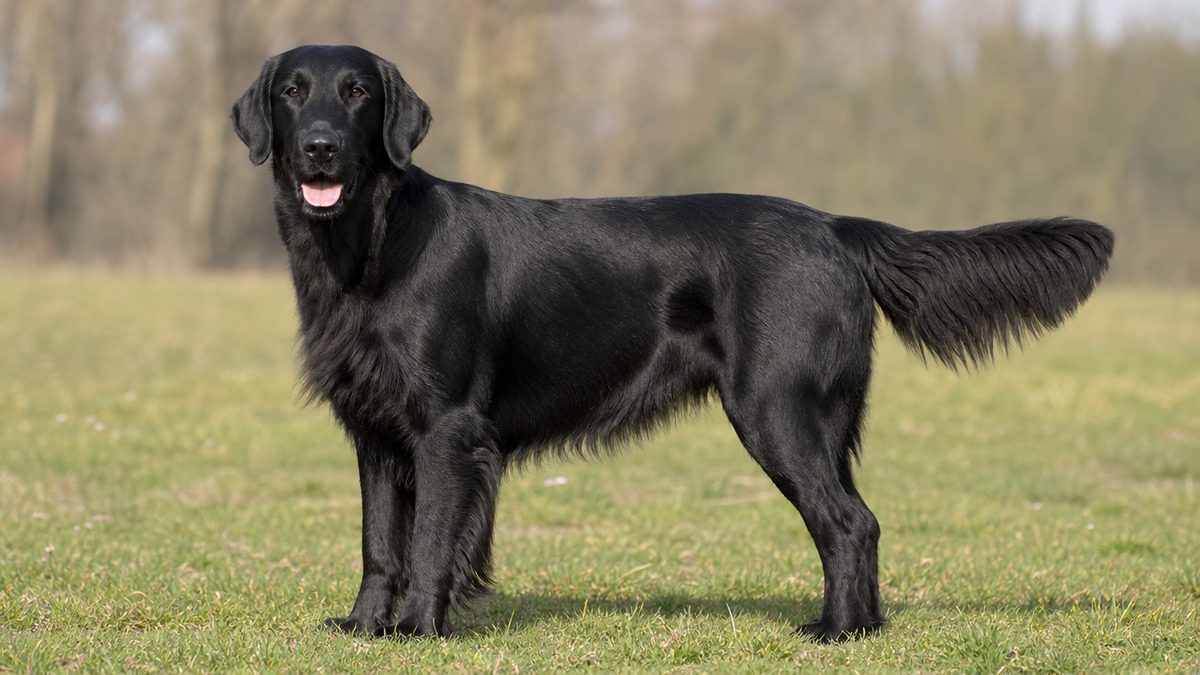
The standard describes it in one sentence that has not changed in decades: "A bright, active dog of medium size with an intelligent expression, showing power without lumber, and raciness without weediness."; Read that against a Labrador and the difference is immediate. The Flat-Coat is built lighter and longer, with a head that is "long and nicely moulded" and only a slight stop, so the whole skull and muzzle read as one piece rather than as a broad box with a nose on it.
The coat is the name. The standard asks for hair that is "dense, of fine to medium texture and good quality, as flat as possible", with legs and tail well feathered. It lies flat and glossy rather than curling like a Curly-Coated Retriever's or waving like a Golden's. Colour is settled and narrow: "Black or liver only." Any Indian listing offering a yellow, cream or golden Flat-Coat is offering something else, and one Indian price page does exactly that, printing "Colors Available: liver and yellow (blonde, black" in its own specification table.
Size, and the four sets of numbers that disagree
The FCI gives preferred height as 59 to 61.5 cm for dogs and 56.5 to 59 cm for bitches, with preferred weight in hard condition of 27 to 36 kg for dogs and 25 to 32 kg for bitches. Those are the numbers to hold a breeder to. The pages an Indian buyer meets give four different answers.
| Source | Height, dogs | Weight, dogs |
|---|---|---|
| FCI standard 121 | 59 to 61.5 cm | 27 to 36 kg |
| American Kennel Club | 58.4 to 62.2 cm (23 to 24.5 in) | 27 to 32 kg (60 to 70 lb) |
| Purina India | 58 to 61 cm | 27 to 36 kg |
| Dog Breeds List | 56 to 58 cm (22 to 23 in) | 29 to 39 kg (65 to 85 lb) |
The Dog Breeds List row is the one to distrust. Its 22 to 23 inches is the FCI's bitch range presented as the breed range, and its 65 to 85 lb ceiling sits nine kilos above the FCI's preferred maximum. Federation Cynologique Internationale The AKC's 60 to 70 lb, meanwhile, is printed without a sex split at all. Where a breeder quotes weight, ask which document they are quoting.
History, and why the breed stopped being common
The Flat-Coat was assembled in Victorian England from the Lesser Newfoundland and setter and spaniel-type water dogs, and was first established as a distinct type by Mr J Hull in 1864. It was originally the Wavy Coated Retriever, and the name changed as breeders selecting for work rather than looks bred the wave out. The AKC admitted the breed to registration in 1915.
Then it lost. The AKC's own history is blunt about it: "By 1918, the Flatcoat's popularity was overtaken by the modern Labrador Retriever, and by the end of the 1920's by the Golden Retriever. At times, particularly during the two world wars, registrations dwindled to dangerous levels."; That displacement is the single most useful fact about the breed for an Indian reader, because it explains everything downstream. The Labrador and the Golden Retriever became the world's default family dogs and reached India in numbers. The Flat-Coat did not, and a rare breed with a small gene pool is a different proposition from a common one.
The temperament clause of the standard is unusually warm for a formal document, and it is accurate: "Generously endowed with natural gundog ability, optimism and friendliness demonstrated by enthusiastic tail action; confident and kindly."; The AKC calls the breed "The Peter Pan of the Sporting Group", and Purina India records the same nickname, explaining it as slow maturation and puppy-like behaviour extending well into adulthood. Purina India, Flatcoated Retriever breed… That is charming at two years old and a real training problem at eight months.
The tail on this breed is natural. The standard asks for a tail "short, straight and well set on, gaily carried, but never much above level of back", and nowhere permits docking. Any docked Flat-Coat offered in India has been mutilated in breach of the Prevention of Cruelty to Animals (Dog Breeding and Marketing) Rules, 2017.
How rare the breed actually is, counted
The Royal Kennel Club registered 764 Flat-Coated Retrievers in the United Kingdom in 2025, down from 1,348 in 2016. That is a fall of 584 dogs, or 43.3 percent, in a single decade, and it happened while the Golden Retriever grew.
The Royal Kennel Club publishes ten-year comparative tables by breed group, and the gundog table is the one that matters here. Reading it year by year rather than as a headline shows a shape worth knowing before you go looking for a puppy.
| Year | Flat Coated | Golden | Labrador | Curly Coated |
|---|---|---|---|---|
| 2016 | 1,348 | 7,232 | 33,856 | 83 |
| 2017 | 1,098 | 7,846 | 35,068 | 53 |
| 2018 | 1,146 | 7,794 | 36,526 | 70 |
| 2019 | 1,171 | 8,422 | 35,347 | 68 |
| 2020 | 1,068 | 8,653 | 39,905 | 55 |
| 2021 | 1,544 | 11,808 | 61,559 | 62 |
| 2022 | 1,141 | 11,075 | 44,311 | 73 |
| 2023 | 958 | 10,447 | 38,074 | 83 |
| 2024 | 869 | 10,201 | 34,141 | 50 |
| 2025 | 764 | 9,976 | 29,919 | 25 |
Three things fall out of that table. The 2021 spike to 1,544 is the lockdown puppy boom, and every gundog breed shows it; the group total went from 95,652 to 144,265 in one year. Since that peak the Flat-Coat has lost 780 registrations, a fall of 50.5 percent, which is steeper than the group as a whole. And across the full decade the Golden Retriever rose 37.9 percent while the Flat-Coat fell 43.3 percent, so the two breeds have moved apart, not together. In 2025 the Flat-Coat accounted for 764 of 74,960 gundog registrations, 1.02 percent of the group.
Why we trust these particular numbers
The Royal Kennel Club's web tables and its own PDFs are known to disagree on some breeds, so this page quotes the PDF and checks it. Summing all 38 breed rows in the gundog table reproduces the printed column total exactly in all ten years, from 84,780 in 2016 to 74,960 in 2025, once the Barbet's short eight-year row is aligned to the last eight columns. Nothing is transposed and nothing is missing. The known problem cells sit in the Terrier and Toy groups, not here.
The quarterly table gives the same 2025 figure a second way. Its four quarters read 224, 223, 154 and 163, which sum to exactly 764. It also prints the first two quarters of 2026, at 173 and 247, against 224 and 223 for the same half of 2025. The decline has not stopped; it has slowed to about 6 percent.
What that means for an Indian buyer
A UK-wide annual output of 764 registered puppies is the entire supply that any legitimate export would have to come out of, and the breed's own clubs run waiting lists against it. There is no route by which a rare British gundog registering fewer than 800 puppies a year reaches an Indian pet shop in volume, and the Indian listing pages examined below bear that out. The Curly Coated Retriever at 25 registrations is rarer still, and the Chesapeake Bay Retriever at 31 is in the same bracket.
Note the direction of travel on those two as well. Chesapeake registrations fell 64.0 percent over the decade and Curly Coated fell 69.9 percent, while the Nova Scotia Duck Tolling Retriever rose 73.9 percent, from 180 to 313. The retriever group is not shrinking. Buyers are consolidating onto three breeds and abandoning the rest, and the Flat-Coat is being abandoned faster than the group average even though it is not the rarest of them.
There is no published Kennel Club of India registration count for this breed, and the KCI does not publish a breed list for any breed, so a nil return there is a broken instrument rather than a finding. What can be said is that India is a full FCI member represented by the KCI, Chennai, so the breed is FCI-recognised for Indian pedigree purposes. Recognition is not the same as supply.
Flat-Coated Retriever price in India
No verified Flat-Coated Retriever price in India exists, because no verified Indian sale could be found. Across the four Indian marketplaces that rank for this term, the total visible supply on 27 August 2026 was one listing, and that listing carried no price, no city and no age.
Start with the page Google puts first. Puppiezo's Flat Coated Retriever page opens "Flat Coated Retriever Prices in India depend on pedigree, breed, and Location" and says "We have 45+ days of Old Male and Female Puppies available."; It then shows a carousel headed "Other Available Pets" containing eight animals with prices. Not one of them is a Flat-Coated Retriever.
| Name | Breed actually offered | Price |
|---|---|---|
| Fizey | Maltipoo | Rs 98,999 |
| Kuzo | Poodle | Rs 92,599 |
| Dugu | Poodle | Rs 92,599 |
| Kazuka | Cane Corso | Rs 94,999 |
| Doir | Goldendoodle | Rs 1,20,000 |
| Samy | Maltipoo | Rs 98,999 |
| Tugi | Rottweiler | Rs 76,499 |
| Yoki | Doxiepoo | Rs 98,999 |
Three of the eight are priced at Rs 98,999. That figure is a house price point on this seller, attached to whichever puppy is in stock, and it has now been recorded on eleven separate breed pages across the site. Two of the three animals carrying it here, the Maltipoos Fizey and Samy, are the same named dogs that appear on unrelated breed pages. Rs 98,999 is not a Flat-Coated Retriever price. It is not any breed's price.
What the other three marketplaces show
Asia Pets, at position two, prints "Showing 0 results" on its own Flat Coated Retriever page, then offers three animals under the heading "Here are available pets of the same breed from other locations": a Chihuahua, a Yorkshire Terrier and a Toy Pom. None of them is the same breed, or anywhere near it. The page's body copy, written in the first person, says "Every Flat Coated Retriever puppy you see here is from a breeder we've personally checked out", which is true only because there are none.
Mr n Mrs Pet, at position three, is the only one with a real listing. It returns "1 Result Found": one male Flat Coated Retriever, quality grade "Pet Quality", with the age field blank, the city field blank, and the price hidden behind a sign-up wall. The same page's own "Most Popular Breeds" sidebar shows what the Indian market actually holds that day: Shih Tzu 650, Siberian Husky 549, Golden Retriever 487, Labrador Retriever 454, German Shepherd 412, Beagle 274, Poodle 263, Rottweiler 162, Pomeranian 136, Cane Corso 134. One against 487.
PetzLover's Indian page advertises "3+ listings" in search results, but the live URL returned HTTP 403 behind a CAPTCHA wall on 27 August 2026, so that claim could not be verified and nothing is taken from it here.
The rupee ranges that do get published
Two Indian pages print a rupee band for the breed, and they disagree by roughly a factor of ten. Neither is attached to an animal for sale.
| Source | Range printed | What it is attached to |
|---|---|---|
| Pet House (Delhi, Gurgaon, Noida) | Rs 40,000 to Rs 90,000 | A ladder of eleven 'types of Labrador', no listings |
| BarkJunction, body text | Rs 70,000 to Rs 1,20,000 | An article with no listings |
| BarkJunction, its own conclusion | Rs 12,000 to Rs 40,000 | The same article, 2,000 words later |
| Supertails, top 40 breeds 2026 | not listed | The breed is absent from the list entirely |
| Mr n Mrs Pet | hidden | One listing, price behind a sign-up wall |
BarkJunction contradicting itself inside one article is the clearest signal on the table. Its body says "Typically, these dogs will cost anywhere from Rs. 70,000 to 1,20,000/-" and its conclusion, on the same page, says the dogs "cost between Rs 12,000 to Rs 40,000";. The two ranges do not overlap at any point. A figure that cannot survive contact with its own conclusion was never observed anywhere.
Supertails, India's largest pet retailer by content reach, publishes a "Dog Price List in India 2026: Top 40 Breeds" updated in March 2026. The string "Flat-Coated" appears in it zero times. When the country's biggest price list does not carry a breed, that is the market speaking.
Treat every rupee figure on this page as editorial reporting of what other sites publish, not as a price you should expect to pay or offer. Bonbeno does not broker sales and does not recommend breeders. If you want this breed in India, read the adoption and sourcing section at the end before you contact anyone.
Testing whether those rupee figures were ever prices
Indian breed pages routinely publish a dollar price list run through one exchange rate and presented as rupees, so every figure above was divided by the four rates this problem is known to use. The Flat-Coated Retriever's Indian numbers fail all of them, and that failure is itself the finding.
The test is simple arithmetic anyone can repeat in a calculator. If a rupee table is a converted dollar table, most of its rows divide by one rate to a whole number of dollars that a real seller would print. Pet House's table gives 22 figures across eleven breeds, which is enough rows to be decisive.
| Rate tested | Figures dividing to a whole dollar | Of those, a price a seller would print |
|---|---|---|
| 84.38 | 0 of 22 | 0 |
| 80.00 | 12 of 22 | 9 |
| 74.00 | 0 of 22 | 0 |
| 66.67 | 1 of 22 | 0 |
Zero at 84.38 and zero at 74. Those are the two strong tests, and the table fails both outright. The twelve apparent matches at 80.00 prove nothing, because 10,000 divided by 80 is 125, so every figure in the table ending in four zeros divides cleanly at that rate by construction. The four figures that fail at 80 are precisely the four ending in 5,000, which is arithmetic, not evidence.
So the figures are rupee-native and arbitrary rather than converted. Look at what the ladder actually is and the mechanism becomes obvious: Black Labrador Rs 8,000 to 20,000, Yellow 10,000 to 25,000, Chocolate 15,000 to 35,000, English 15,000 to 40,000, Fox Red 20,000 to 45,000, Silver 25,000 to 60,000, Golden Retriever 15,000 to 45,000, Flat-Coated 40,000 to 90,000, Curly Coated 50,000 to 1,20,000, Chesapeake Bay 60,000 to 1,50,000. That is a hand-typed rarity ranking, ascending, with the Flat-Coat placed on rung eight because it feels rarer than a Golden and less rare than a Chesapeake. It is a guess with a rupee sign on it.
The same test on BarkJunction
BarkJunction's Rs 1,20,000 ceiling divides by 80 to exactly 1,500, and 1,500 dollars is the floor of the US range that Dog Breeds List publishes for this breed, "$1,500 to $3,000 for a good quality pet from a good breeder". Tempting. But the same page's Rs 70,000 floor divides by 80 to 875, which corresponds to nothing in any published US range, and its own conclusion's Rs 12,000 to Rs 40,000 divides to 150 and 500. One coincidental match out of four is not a converted list. It is noise.
A structural error in the same table
Pet House's table is headed "Labrador & Retriever Dog Price Range in India" and its preceding section is headed "Types of Labrador Retriever Dog Breeds", under which it lists the Flat-Coated Retriever, the Curly Coated Retriever and the Chesapeake Bay Retriever as types of Labrador. They are not. The FCI registers them as three separate breeds, numbers 121, 110 and 263 respectively, each with its own standard. A page that cannot tell three breeds apart is not a source for any of their prices.
BarkJunction's specification table fails the same way against the standard. It prints "Colors Available: liver and yellow (blonde, black" where the FCI says "Black or liver only", and "Coat: double, glossy and smooth" where the FCI describes a single flat coat, "dense, of fine to medium texture and good quality, as flat as possible";. Federation Cynologique Internationale It also says males "weigh around 55 pounds", which is 25 kg, two kilos below the FCI's preferred minimum for a dog and contradicted by its own table two paragraphs earlier, which says 27 to 36 kg.
There is no Flat-Coated Retriever price in India worth quoting, and this page will not invent one. What an Indian buyer should take away is that the four ranking marketplaces between them held one listing with no price, and that every published rupee band traces to a hand-built ladder or to an article that contradicts itself. If someone quotes you a firm figure, ask them to show you the dog, the KCI paperwork and the parents.
Monthly cost of ownership in India, and the line item nobody budgets for
Budget Rs 3,000 to Rs 18,000 a month to keep a large dog in India, and Rs 80,000 to Rs 2,00,000 for the first year including purchase, vaccinations, food, training and supplies. For a Flat-Coated Retriever, add a cancer contingency, because that is the cost line this breed actually has.
Those national bands come from Supertails' 2026 cost survey, which also records that city prices vary by 15 to 30 percent and that Mumbai and Delhi are the most expensive markets. A 27 to 36 kg dog sits at the top of the monthly band, not the middle, because food scales with bodyweight and this breed carries the weight of a large Labrador on a leaner frame.
The recurring lines, honestly bounded
- Food. A 30 kg working-build dog on a large-breed complete diet is the single biggest recurring line, and it sits at the upper end of the Rs 3,000 to Rs 18,000 monthly band rather than the lower end.
- Grooming. Low in cash and moderate in time. A flat coat brushed weekly needs no salon, but a high-volume dryer bought once is the purchase that matters in a monsoon city.
- Preventive veterinary care. Vaccination, deworming, ectoparasite control and an annual check. Indian law expects a pup's vaccination course to start at seven to eight weeks and to be usually complete by eighteen weeks.
- Screening. Hip and elbow radiographs and an annual eye examination are the tests that exist for this breed. None of them screens for the cancer that kills it.
- The contingency. Cancer care for dogs at ACTREC, the Tata Memorial Centre's Kharghar campus, was reported at Rs 40,000 to Rs 60,000 depending on the treatment cycle.
That last line is where this breed differs from every other retriever, and it is worth being precise about it rather than gesturing at "vet bills". The figure comes from a 2015 press item reproduced on ACTREC's own government domain, so treat it as a 2015 order of magnitude rather than a current quotation, and expect a decade of medical inflation on top. The point is not the exact rupee amount. The point is that a Flat-Coated Retriever owner has a materially higher chance of needing it than a Labrador owner does.
What the numbers say about the odds
In the Cambridge cohort, 72 of 172 Flat-Coated Retrievers died of confirmed neoplasia and a further 20 of unconfirmed tumours, so 92 of 172 dogs, 53.5 percent, died with or of a tumour. If you budget a cancer contingency for one dog in two, you are budgeting to the published evidence rather than to optimism.
| Line | Indian band | Notes |
|---|---|---|
| First year, all-in | Rs 80,000 to Rs 2,00,000 | Includes purchase, vaccinations, food, training, supplies |
| Monthly upkeep, large dog | Rs 3,000 to Rs 18,000 | Upper half of the band for a 27 to 36 kg dog |
| City premium | 15 to 30 percent | Mumbai and Delhi dearest |
| Cancer treatment course | Rs 40,000 to Rs 60,000 | ACTREC, as reported in 2015; expect inflation |
| Purchase price | not established | One Indian listing, price withheld |
Two costs that Indian pages routinely omit deserve naming. The first is travel: if the only unit in the country offering canine radiotherapy is in Navi Mumbai, an owner in Chennai or Kolkata is budgeting flights and accommodation on top of treatment. The second is time. Fidel's series shows that treatment for this breed's signature cancer runs in cycles over weeks, not in a single visit.
Indian pet insurance generally excludes pre-existing conditions and often caps or excludes oncology. Read the exclusion list for the word neoplasia before you buy, and read it before your dog turns five, because a lump found at six is a pre-existing condition on every policy written afterwards.
Heat tolerance and the Indian climate, measured
The Flat-Coated Retriever was bred for an English climate whose July mean is 17.6 degrees C, and Chennai's annual mean is 27.9. The gap that matters is not temperature but wet-bulb temperature, and there the distance is 11.3 degrees.
Every figure below comes from NASA POWER climatology queried by explicit latitude and longitude, so no city can be substituted for another by a slug lookup. The wet-bulb column is computed from the same monthly mean temperature and relative humidity using the Stull approximation, and it matters because a dog cools almost entirely by evaporation from the respiratory tract. Air at 30 degrees and 40 percent humidity and air at 30 degrees and 85 percent humidity are different problems for a panting dog, and only the wet-bulb figure tells them apart.
| Place | Annual mean temp | Peak wet-bulb | Month of peak |
|---|---|---|---|
| London, southern England | 10.4 C | 14.8 C | July |
| Bengaluru | 23.7 C | 21.9 C | May |
| Pune | 23.9 C | 23.0 C | June |
| Mumbai | 26.8 C | 25.8 C | June |
| Chennai | 27.9 C | 26.1 C | May |
| Delhi | 25.6 C | 26.5 C | July |
| Kolkata | 25.8 C | 27.1 C | June |
Kolkata is the hardest city on this table and Bengaluru the easiest, and the ordering is not the same as the ordering by air temperature. Delhi's June mean of 35.9 degrees C is the highest air temperature of the six, but its June wet-bulb is 24.4 because the pre-monsoon air is dry at 36.4 percent humidity. Then the monsoon arrives, July humidity jumps to 62.7 percent, and Delhi's wet-bulb peaks at 26.5 in a month when the thermometer has actually fallen. The dangerous month in Delhi is July, not June. Most Indian care advice gets that backwards.
What the heat-illness evidence actually supports
The largest study of heat-related illness in dogs reviewed 905,543 UK dogs under primary veterinary care in 2016 and identified 1,259 heat-related illness events from 1,222 dogs. Of those events, 380, or 30.2 percent, had no trigger recorded. Of the remaining 879 events with a recorded trigger, exertional heat illness accounted for 652, which is 74.2 percent, followed by environmental at 113, 12.9 percent, and vehicular confinement at 46, 5.2 percent.
Three in four recorded cases were caused by the dog exercising, not by a hot car. For a breed whose own manufacturer-published entry says it "enjoys walking more than two hours a day", that is the single most transferable finding on this page.
One honest limit: the Flat-Coated Retriever is not among the breeds that study modelled individually. Only the Labrador Retriever and the Golden Retriever appear by name among retrievers in its breed-level analysis, so no breed-specific odds ratio is quoted here. The cohort-wide finding about exertional triggers applies to any dog being exercised in heat, and that is all this page claims from it.
City by city, what it changes
- Bengaluru and Pune. Workable year-round with ordinary discipline. Bengaluru's peak wet-bulb of 21.9 in May is 7.1 degrees above London's July peak, which is a real gap but a manageable one for a fit dog exercised before 7 am.
- Mumbai. June to September is the constraint, not April. Mumbai's August relative humidity averages 90.4 percent, so the dog never fully dries and never fully cools.
- Chennai. March to June is a dawn-only regime. May combines a 31.5 degree mean with 64.5 percent humidity for a wet-bulb of 26.1.
- Delhi. Two separate seasons of risk. Dry extreme heat in May and June, then a humid monsoon peak in July and August that is worse in wet-bulb terms.
- Kolkata. The hardest of the six. June through September all sit at or above 26.3 degrees wet-bulb.
- Hill stations. NASA POWER returns a grid-cell average, and for the Shimla cell it reports an elevation of 898 m against the town's roughly 2,200 m, so the grid understates how much cooler the town is. Treat hill-station figures as an upper bound on heat, not a measurement.
Exercise this breed before sunrise and after sunset from March to October in every city on the table except Bengaluru and Pune, where a shaded early-morning session is usually enough. Swim work is the best substitute available, and this is a breed that will swim happily for an hour. Carry water on every walk, and stop at the first sign of a dog that stops pulling.
Temperament, and who should not buy one
The Flat-Coated Retriever is confident, kindly and permanently juvenile, and the FCI standard says so in terms: "optimism and friendliness demonstrated by enthusiastic tail action; confident and kindly";. The catch is that it stays juvenile for years.
Both the American Kennel Club and Purina India call the breed the Peter Pan dog, and both explain it the same way: slow maturation, with puppy-like behaviour extending well into adulthood and, Purina adds, even into old age. Purina India, Flatcoated Retriever breed… What that means in an Indian flat is a 30 kg dog that still behaves like a nine-month-old at three years, with a tail that never stops and a mouth that carries things.
Purina India's own need-to-know list is worth reading against the marketing on the listing pages, because it is franker: "Chatty and vocal dog", "Some drool", "Not a guard dog", "Enjoys walking more than two hours a day", "Requires grooming every other day";. The listing pages describe the same breed as needing "1-2 hours daily" and, in one case, as an apartment dog that "doesn't need much exercise";. BarkJunction, Flat-Coated Retriever dog… Those cannot both be right, and the manufacturer with a UK breed library behind it is the one to believe.
Who this breed suits
- Households with older children or teenagers, which is how Purina India frames it, because the breed is sensitive, slow to mature and physically clumsy around toddlers.
- People who already exercise, because two hours a day is a lifestyle, not a chore you add to one.
- Owners who want a dog that likes strangers, since this is emphatically not a guard breed and will greet an intruder with a wagging tail.
- Homes with other pets, which Purina rates the breed as great with.
- Buyers who can accept an eight to twelve year horizon, for the reasons the health sections set out.
Who should look elsewhere
Anyone wanting a guard dog, anyone in a household where the dog will be alone eight hours a day, and anyone buying on the assumption that a retriever is a retriever. The Flat-Coat is sensitive in a way the Labrador is not. Purina India notes the breed will "likely cause stress" in noisy, bustling and busy locations, which describes a great deal of urban India honestly.
There is also a specific Indian trap here. Buyers searching for a "black Golden Retriever" are sometimes shown this breed, because it is a large black feathered gundog and looks the part. It is not a colour variant of anything. It is a separate FCI breed with a different lifespan profile and a different cancer risk, and anyone selling it to you as a Golden variant either does not know that or is counting on you not knowing it.
An energetic, affectionate, sensitive gundog that will be delighted to see everyone who enters your home, will not guard it, and will still be behaving like a puppy when your neighbours' Labrador has settled down.
Training a Flat-Coated Retriever, and what it resists
To train a Flat-Coated Retriever, keep sessions short, varied and reward-heavy, and stop before the dog is bored. The breed is rated highly trainable by every source consulted, and every one of them also warns that it switches off under repetition. Dog Breeds List, Flat-Coated Retriever…
Purina India puts the failure mode precisely: "the Flattie is easily bored and surprisingly sensitive, so keep training rewarding, fun and engaging, and provide variety as the Flat Coat can switch off easily and decide 'not today thanks' if things become too repetitive."; Dog Breeds List rates trainability at the top of its scale and adds the same caveat, that the breed "may require a little more time to learn than a Golden Retriever" and does best with "brief, varied, gentle training sessions";.
That combination, high ability plus low tolerance for drilling, is why Indian owners who apply Labrador methods get poor results and conclude the dog is stubborn. It is not stubborn. It is bored, and it is sensitive enough that raising your voice makes it worse rather than better.
A realistic Indian timeline
| Age | Priority | Why it matters here |
|---|---|---|
| 8 to 16 weeks | Socialise to lifts, gates, autos, horns, watchmen | The vaccination course usually completes at eighteen weeks, so socialise carefully and deliberately rather than not at all |
| 4 to 6 months | Loose-lead walking and a reliable recall | A 20 kg adolescent that pulls is unmanageable on an Indian pavement |
| 6 to 12 months | Impulse control around food and visitors | The breed greets everyone; teach a settled greeting before it weighs 30 kg |
| 12 to 24 months | Retrieve games, scent work, swimming | This is where the boredom problem is solved, not in obedience drills |
| 2 years and beyond | Maintain variety | The breed matures late; expect adolescent behaviour longer than you think |
The Rules that govern breeding in India also set the earliest lawful sale age, and it is worth knowing as a training constraint rather than only a legal one. Rule 8, Conditions for sale, at sub-rule (1)(a), requires that "pups less than eight weeks in age are not sold". A pup offered to you at six weeks has been taken from its litter during the window in which it learns bite inhibition from its siblings, and you will spend months undoing that.
What works, specifically
- Use the retrieve. This is a breed that will work all day for the chance to carry something back to you. Build recalls and stays around a retrieve rather than around food alone.
- Keep sessions to five minutes. Three short sessions beat one long one, and the breed will stay engaged across all three.
- Change the exercise before the dog does. If the dog offers a wrong answer twice, the session has gone on too long.
- Train in the cool hours. A dog that is thermally stressed cannot learn, and in Chennai in May that rules out most of the day.
- Never punish a sensitive dog for confusion. Purina India's whole training note is built around this, and it is the fastest way to lose the breed's willingness.
Gundog work, scent games, agility and obedience competition all suit it. Dog Breeds List records the breed at rank 18 on its intelligence ranking, and the AKC's history is full of field-and-show dual champions. If you want a dog to do things with, this is one of the best in the group.
Exercise needs, and what happens without them
Two hours a day is the floor, not the target. Purina India states it plainly: "Two hours of dog exercise a day is the bare minimum for the Flat Coated Retriever", and lists the breed as enjoying walking more than two hours daily.
That figure is the one the Indian listing pages contradict, and the contradiction is not harmless. Puppiezo's specification card gives "Exercise Routine: 1-2 hours daily";. BarkJunction goes further and says the breed needs "at least 20-30 minutes of exercise every day", then in a later section says "they don't need much exercise, so they make great apartment dogs". A buyer who believes the 20-minute figure will end up with a destructive, vocal, frustrated 30 kg dog and will blame the dog.
Purina India also describes what the breed does with unmet energy in its own words, warning that the dogs "will make up their own projects to keep their minds busy" if under-occupied, a phrasing the AKC uses too. Those projects are furniture, doors and skirting boards.
Two hours in an Indian city, actually scheduled
The problem is not the two hours. It is that in most Indian metros only about four hours of the day are safe for a large dark-coated dog to work hard in, and they fall either side of the sun. Built around the wet-bulb figures above, a workable week looks like this.
| City | Morning window | Evening window | Substitute on bad days |
|---|---|---|---|
| Bengaluru | 5.30 to 7.30 am | 6.30 to 8 pm | Shaded park walk |
| Pune | 5.30 to 7.30 am | 7 to 8.30 pm | Indoor scent work |
| Mumbai | 5.15 to 7 am | 7.30 to 9 pm | Swimming, where available |
| Delhi | 5 to 6.45 am | 8 to 9.30 pm | Air-conditioned indoor training |
| Chennai | 5 to 6.30 am | 8 to 9.30 pm | Swimming, indoor retrieve games |
| Kolkata | 5 to 6.30 am | 8 to 9.30 pm | Indoor work; June to September is the worst stretch |
Swimming is the answer this breed was designed for. It is an excellent swimmer, it will do it for an hour without complaint, and water removes the thermoregulation problem entirely. Where a safe, clean swim is genuinely available in your city, use it, and count it as the day's exercise.
Why the exertional finding matters here more than elsewhere
Of the 879 UK heat-illness events with a recorded trigger, 652, or 74.2 percent, were exertional. That statistic is about dogs being exercised, and a breed that needs two hours of it a day in a country with a Chennai May is exactly the population the finding describes. The management is not to cut the exercise, which produces the destructive dog. It is to move it to the cool hours and to substitute swimming and scent work when the hours are not there.
- Watch for the dog going quiet. A Flat-Coat that stops pulling ahead is telling you something.
- Carry water and offer it. Not once at the end, every fifteen minutes.
- Never exercise on a full stomach, given the breed's noted tendency to bloat and stomach problems.
- Use scent work indoors. Twenty minutes of nose work tires this breed more than forty minutes of walking.
- Do not use a treadmill as a substitute in a hot room. That is exertional heat illness with extra steps.
A Flat-Coated Retriever can live in an Indian flat, and Purina India notes the breed does not need vast space so long as its exercise need is met. It cannot live in a flat with a working couple who walk it twice for twenty minutes. That is the honest dividing line, and no amount of square footage changes it.
Grooming a flat, glossy coat in Indian humidity
Brush the coat weekly, never clip it, and dry the feathering actively after every swim or bath. The FCI standard describes hair that is "dense, of fine to medium texture and good quality, as flat as possible", with "legs and tail well feathered", and that feathering is where Indian humidity does its damage.
The sources disagree on frequency and it is worth seeing the spread. Dog Breeds List rates grooming as low maintenance and says weekly brushing suffices. Purina India's need-to-know list says "Requires grooming every other day";. BarkJunction says both, describing the coat as needing "minimal grooming" in one section and as "a thick double coat that requires regular brushing and trimming" in another. The standard settles the anatomy at least: this is not a double coat.
The reason the frequency question matters more in India than in England is not shedding. It is drying. Mumbai's August mean relative humidity is 90.4 percent and Kolkata's is 89.1 percent. Feathering on the legs, chest, tail and behind the ears holds water against skin, and in air that saturated it does not evaporate. British breed-club advice that assumes a dog will air dry does not transfer, and following it here is how you get a hot spot.
The Indian routine, week by week
- Brush twice a week in the dry season and every other day in the monsoon. Work through the feathering with a slicker and finish with a comb through the trousers and tail.
- Never clip and never shave. The flat coat is the breed's protection against sun as well as its appearance, and it does not grow back the same.
- Dry actively after every wetting. A high-volume dryer used on cool air, or failing that a towel followed by twenty minutes in front of a fan, and always finish the ears.
- Dry inside the ear flap and around the canal. Wet ears in monsoon air are the commonest avoidable veterinary visit for a feathered gundog in India.
- Check the feet after wet walks. Interdigital skin stays damp longest and is where an Indian dog picks up a fungal problem.
The shedding claim, and what the standard says about it
The breed sheds. Puppiezo's own specification card prints "Shedding: Yes" and Dog Breeds List rates shedding as moderate. Dog Breeds List, Flat-Coated Retriever… Purina India records the breed as a "Non hypoallergenic breed" in its own need-to-know list, and that is the correct answer. No dog breed is hypoallergenic, and the FCI standard for this breed says nothing at all about shedding, because a breed standard describes conformation rather than allergen load. Anyone selling you a Flat-Coat as allergy-friendly is inventing.
One genuine advantage: a flat glossy coat is far easier to keep in Indian conditions than a curly or heavily undercoated one. There is no matting problem, no undercoat blowing twice a year, and no professional strip. The cost of this coat is discipline, not money.
A high-volume pet dryer. It costs once, it takes the drying job from thirty minutes to eight, and in a Mumbai or Kolkata monsoon it is the difference between a coat that stays healthy and one that does not.
Cancer is the health issue, and here are the numbers
In a Cambridge cohort of 174 Flat-Coated Retrievers followed from 1996 to 2007, 72 of the 172 dogs that could be traced died of confirmed neoplasia, 42 percent, at a median age of nine years. No other single fact about this breed is as well documented, and none of the pages ranking in India prints it.
The study recruited dogs aged two to seven in 1996 and followed them for eleven years using an annual health census. Two dogs were lost to follow-up, which is why the percentages run on 172 rather than 174. The four outcome groups sum exactly to that denominator, which is the first thing to check on any figure like this.
| Outcome | Dogs | Share of 172 |
|---|---|---|
| Died of confirmed neoplasia | 72 | 42 percent |
| Died of unconfirmed tumours | 20 | 11.6 percent |
| Died of non-neoplastic conditions | 61 | 35 percent |
| Cause of death unknown | 19 | 11 percent |
| Total traced | 172 | 100 percent |
Add the first two rows and 92 of 172 dogs, 53.5 percent, died with or of a tumour. The predominant cancer type was soft tissue sarcoma, and specifically histiocytic sarcoma, which affected 32 dogs, or 44 percent of all the neoplasms recorded. Six dogs died with malignant melanoma and three with lymphoma. Median age at death was nine years for the dogs with tumours, eight for the sarcoma cases, and twelve for the non-neoplastic deaths.
That four-year gap between eight and twelve is the whole argument of this page. A Flat-Coated Retriever that avoids sarcoma lives about as long as any other large gundog. One that does not loses a third of its life.
Four estimates, four methods, and why they disagree
The cancer share of deaths in this breed has been measured four times by four different means, and the answers range from 42 to 75 percent. Publishing the spread is more useful than picking one.
| Source and method | Figure | Denominator |
|---|---|---|
| Dobson 2009, prospective UK cohort, confirmed neoplasia only | 42 percent | 72 of 172 dogs |
| Dobson 2009, confirmed plus unconfirmed tumours | 53.5 percent | 92 of 172 dogs |
| Erich 2013, Dutch causes-of-death study | at least 63.8 percent | not stated in the abstract |
| Cambridge Cause of Death Register, 2018 entries | 75.0 percent | 33 of 44 entries |
The Dutch study, by Erich, Rutteman and Teske, concluded that "the death of at least 55.1% of Bernese mountain dogs and 63.8% of Flat-coated retrievers is associated with malignant tumours", and that "over 1/7 of all Bernese mountain dogs and Flat-coated retrievers die because of histiocytic sarcoma";. Its published abstract does not state the number of dogs behind those percentages, and this page could not verify that denominator, so the figure is reported with that limitation attached rather than dressed up.
The 75 percent comes from a prospective register set up by Dr Jane Dobson at Cambridge and administered through the breed clubs. In 2018 it received 44 entries, of which 33 were a cancer of some type, three were old age and two were trauma, with liver, heart, kidney and infectious disease plus unknown causes accounting for the rest. Forty-four entries is a small, self-selected sample and owners who lose a dog to cancer are more likely to file, so the true rate is almost certainly below 75 percent. The register is still worth citing, because it is the only prospective breed-wide instrument that exists.
The breed club's own summary of the 2009 study rounds it to "approximately 40% of dogs die from cancer, at an average age of 9 years";. That is a fair round-down of 42 percent, though the paper reports a median rather than an average age, and the distinction matters when a distribution has a long tail.
The word cancer appears zero times on the American Kennel Club's Flat-Coated Retriever breed page. The single best-documented fact about the breed's health is absent from the registry page most first-time buyers read.
Histiocytic sarcoma, what it looks like and how fast it moves
Histiocytic sarcoma in this breed usually presents as a swelling in a muscle group or around a joint, at a median age of 8.2 years, and median survival across 37 treated cases was 123 days. Knowing where to look is the most actionable thing an owner of this breed can learn.
The 37-case series is the clearest clinical picture available. Histiocytic-like sarcomas accounted for 36 percent of all the malignant tumours seen in the breed over the study period. Thirty-four of the 37 dogs presented with a swelling or mass in a muscle group or surrounding a joint. The other three presented with a rib mass, a cutaneous mass and a primary splenic tumour respectively.
So in 34 of 37 cases, the first sign was a lump on a limb. Not weight loss, not lethargy, not an off day. A lump, on a leg, near a joint, in a middle-aged dog. That is what to check for, and it is why the medical disclaimer on this page names lumps specifically.
Metastasis and survival, with the numbers
The tumour spreads early and widely. Metastasis to local lymph nodes was recorded in 45 percent of cases, to the thorax in 20 percent and to abdominal organs in 20 percent confirmed, and the overall metastatic rate by the time of death was 70 percent. The single strongest predictor of outcome was whether distant metastasis was already present at diagnosis.
| Group | Median survival | Comparison group |
|---|---|---|
| All dogs | 123 days | whole series |
| No distant metastasis at diagnosis | 200 days | 68 days if metastasis present |
| Received chemotherapy | 185 days | 34 days if not, P = 0.0008 |
| Received radiation | 182 days | 60 days if not, P = 0.0282 |
| Any active treatment | 167 days | 17 days on palliative therapy alone |
| Set radiation plus CCNU protocol | 208 days | 68 days for all other dogs |
Read the last two rows together and the picture is stark but not hopeless. A dog on palliative care alone survived a median of 17 days. A dog receiving any combination of radiation, chemotherapy or surgery survived 167. The set protocol combining radiation with CCNU produced 208 days with, in the authors' words, minimal toxicity. Their conclusion is measured: "While this tumour carries a poor long-term prognosis in flat-coated retrievers, it is reasonable to treat these dogs for palliation of signs and extension of life."
Why there is no screening test
There is no DNA test, no radiograph and no blood panel that predicts histiocytic sarcoma in this breed. Every screening scheme available for the Flat-Coat, hips, elbows, eyes and thyroid, tests for something else entirely. Indian law's list of genetic defects a breeding dog must have been tested for names hip dysplasia, progressive retinal atrophy, night blindness, hypothyroidism, entropion, ectropion and several jaw and dentition faults, and no cancer of any kind. That is not a criticism of the Rules; no such test exists to require.
What replaces screening is pedigree information and vigilance. A breeder who can tell you the age and cause of death of the grandparents on both sides is giving you the only prospective information available on this breed, and a breeder who cannot is selling you a dog with no cancer history at all.
- Run your hands over the dog weekly from age five. Limbs, shoulders, hips, and around every joint.
- Take any new lump to a veterinarian within the week. A fine-needle aspirate is cheap and fast.
- Do not accept 'it is just a fatty lump' without a needle in it. A lipoma and a sarcoma feel similar to a hand and different under a microscope.
- Ask about the grandparents before you buy. Age and cause of death, four dogs, both sides.
- Record what happens. The Cambridge Cause of Death Register accepts entries from owners, and it is how the breed's picture improves.
Median age at presentation was 8.2 years and median age at death for the sarcoma cases in the Cambridge cohort was eight. Dobson J, Hoather T, McKinley TJ The years to be most vigilant in are six through ten, which is exactly when most owners relax because the dog has stopped being a puppy and has not yet looked old.
Where the evidence came from, and what it says about inheritance
The Cambridge Tumour Survey ran from March 1990 to the end of 2015 and accrued 2,975 submissions. It is the reason this breed has better cancer data than almost any other, and it is also the reason the disease is known to be familial.
The survey began when two owners approached the University of Cambridge with a concern that a large number of Flat-Coated Retrievers were dying of cancer. Anecdote could not settle it, so vets across the UK were invited to submit suspected tumour tissue for free histopathology. By 1998 more than 1,000 samples had arrived from 782 dogs.
| Category | Lesions | Share |
|---|---|---|
| Not neoplastic at all | 165 | 16 percent |
| Benign | 447 | 44 percent |
| Malignant | 411 | 40 percent |
Those three counts sum to 1,023 and the three percentages sum to 100, which is the arithmetic check worth running on any published breakdown. The striking result, reported in 2000, was that soft tissue sarcomas accounted for more than 55 percent of the malignant tumours and 25 percent of all tumour submissions. One tumour family was doing most of the damage.
Where in the dog these tumours appear
The survey's anatomical finding is the one an owner can use. The majority of these undifferentiated sarcomas arose deep in the soft tissue or fascia of the limbs, 49 in a forelimb and 34 in a hindlimb, and particularly in the upper forelimb between the elbow and the shoulder. Mean age of the affected dogs was 8 years, with a range from 0 to 13, and the sex split was 78 female to 60 male.
A later analysis of 180 dogs bearing histiocytic-sarcoma-like lesions found 101 with primary limb lesions and 47, or 26.1 percent, with visceral disease, mainly splenic, and no peripheral primary tumour at all. The article rounds the limb share to 57 percent where 101 of 180 is 56.1, which is a rounding difference rather than an error, but it is worth showing the division. A quarter of affected dogs have no lump to find, which is why the limb check is necessary and not sufficient.
The two forms are biologically distinct as well as anatomically. A Dutch group demonstrated that localised and visceral histiocytic sarcoma in this breed differ in gene expression, and the paper's title says exactly that. Cambridge's own immunohistochemical review of 40 tumours, 20 from limbs and 20 from spleens, identified two phenotypic subtypes matching those two sites.
The inheritance finding, which matters when you choose a puppy
Pedigree analysis of the affected dogs in the health study, plus a further 170 affected dogs from the tumour survey, showed that they all shared six ancestors, three males and three females, four to nine generations back. Affectation status within sibships strongly suggested the disease is familial. That is the strongest available argument for asking a breeder about the grandparents rather than only about the parents' hip scores.
Molecular work has narrowed it further without producing a test. Comparative genomic hybridisation across 146 histiocytic sarcomas, 101 from Bernese Mountain Dogs and 45 from Flat-Coated Retrievers, found copy number changes almost all shared between the two breeds, including deletions of the tumour suppressor genes CDKN2A and CDKN2B, retinoblastoma protein and PTEN. Because those changes track the cancer rather than the breed, they explain the biology but do not give breeders a screening assay. A separate Cambridge investigation compared MHC class II allotypes in 40 affected and 40 control Flat-Coats and found no significant difference, ruling that mechanism out.
The tumour survey closed at the end of 2015 and the free histopathology service with it. In its place the Cambridge team and the Flatcoated Retriever Society's health sub-committee set up the Cause of Death Register in 2013, and DNA from affected dogs is being banked for research that moved to Cambridge University after the Animal Health Trust closed. Southern Flatcoated Retriever Club The breed also took part in the Give a Dog a Genome project, sequencing whole genomes across 50 breeds.
What treating this cancer actually involves in India
Radiation roughly triples median survival in this breed's signature tumour, from 60 days to 182, and in 2015 the only unit in India offering canine radiotherapy was the Tata Memorial Centre's ACTREC campus at Kharghar, Navi Mumbai. That single sentence is the reason this section exists.
ACTREC's own website carries a press item headlined "Does your dog have cancer? Don't lose heart", with the standfirst "Tata Memorial Centre in Kharghar offers chemotherapy and radiotherapy for canines; it's the only such unit in the country."; The item reports that cancer care for dogs there cost between Rs 40,000 and Rs 60,000 depending on the treatment cycle, that the centre had treated nearly 150 dogs in the preceding year, and that nearly 50 of those underwent chemotherapy.
Date that carefully. The item is posted on ACTREC's press-media section and is dated 24 June 2015. It is a newspaper report reproduced by the institution, not a current service statement, and this page does not claim it describes 2026. What it does establish is a baseline: a decade ago, India had one such facility, it treated about 150 dogs a year, and the cost of a course was in the tens of thousands of rupees rather than the lakhs. Any Indian owner planning for this breed should verify current availability directly rather than relying on a 2015 figure, including this one.
Why availability changes the arithmetic
For most breeds, oncology access is a nice-to-have. For this one it moves the survival numbers directly. Set the two facts side by side.
| Scenario | Median survival | What it requires in India |
|---|---|---|
| Palliative therapy only | 17 days | Any veterinarian |
| Any surgery, chemotherapy or radiation | 167 days | A referral oncology practice |
| Chemotherapy | 185 days | A clinic that handles cytotoxics safely |
| Radiation | 182 days | A linear accelerator; one unit reported nationally in 2015 |
| Radiation plus CCNU protocol | 208 days | Both, coordinated |
The distance between 17 days and 208 days is the distance between the care a general Indian small-animal practice can give and the care a specialist centre can. That is a fair thing to tell a prospective owner in Coimbatore or Guwahati before they buy, and no ranking page tells them.
The ACTREC item also names the second obstacle, which is not money or geography but awareness. It quotes an owner saying "It seems many vets are clueless about the availability of radiation therapy here", and reports that "many vets advise people to put their animals to sleep";. For a breed where the difference between palliation and treatment is a factor of ten in survival, an owner who does not know to ask for a referral has effectively made the decision by default.
A practical plan for an Indian owner
- Find your nearest referral oncology option before you need it. Not after a lump appears.
- Ask your regular veterinarian, now, whether they refer for oncology and to whom. The answer tells you a lot.
- Budget the contingency from year one. Rs 40,000 to Rs 60,000 was the 2015 order of magnitude for a course. Assume more and be pleasantly surprised.
- Insist on a diagnosis before a prognosis. A fine-needle aspirate or biopsy decides whether you are treating a lipoma or a sarcoma, and the treatments have nothing in common.
- Ask specifically about distant metastasis at diagnosis. It is the strongest single prognostic factor, at 200 days against 68.
This is a breed where an owner may have to choose between an expensive course of treatment that buys months rather than years, and letting the dog go. Neither choice is wrong. The choice that is wrong is making it without knowing the numbers, which is what happens when the pages a buyer reads do not print them.
Joints, eyes and thyroid: what the screening registries show
The Flat-Coated Retriever has the best hips of any common retriever, at 3.9 percent dysplastic across 7,710 evaluations, against 19.3 percent for the Golden Retriever across 192,927. Its eye registry data, by contrast, contradicts itself badly enough that no single figure should be quoted.
All figures below come from the Orthopedic Foundation for Animals disease statistics tables, read on 27 August 2026. The breed's OFA registry code is FR, which was read from OFA's own markup rather than guessed, and the guess a reasonable person would make, FCR, is not the code. Sample sizes are printed next to every percentage because these are live registers and the counts move as evaluations are added.
| Registry | Evaluations | Result | Breed rank |
|---|---|---|---|
| Hips | 7,710 | 95.7 percent normal, 3.9 percent dysplastic | 194 |
| Elbows | 4,234 | 99.2 percent normal, 0.8 percent abnormal | 149 |
| Patella | 3,850 | 98.5 percent normal, 1.5 percent abnormal | 97 |
| Eyes | 5,090 | 96.7 percent normal, 3.3 percent abnormal | 158 |
| Thyroid | 270 | 81.1 percent normal, 13.3 percent equivocal | 31 |
| Advanced cardiac | 169 | 94.1 percent normal, 1.8 percent abnormal | 96 |
| Congenital cardiac | 459 | 100.0 percent normal | 104 |
The hip breakdown is worth reading in full because it is genuinely good news: 23.3 percent excellent, 63.5 percent good, 8.8 percent fair, and 3.9 percent dysplastic split as 2.4 mild, 1.2 moderate and 0.3 severe. Those three sub-grades sum to exactly 3.9, which is the arithmetic check any published percentage should survive. Set against the retrievers an Indian buyer cross-shops, this breed's joints are the strongest in the group.
| Breed | Evaluations | Dysplastic |
|---|---|---|
| Flat-Coated Retriever | 7,710 | 3.9 percent |
| Labrador Retriever | 324,743 | 11.3 percent |
| Curly-Coated Retriever | 1,513 | 15.1 percent |
| Bernese Mountain Dog | 31,550 | 16.3 percent |
| Golden Retriever | 192,927 | 19.3 percent |
Thyroid, and where Indian law bites
The thyroid figure is the one to watch. The breed ranks 31st of the 137 breeds in OFA's thyroid table, on only 270 evaluations, with 81.1 percent normal, 4.8 percent compensative autoimmune thyroiditis, 0.7 percent idiopathic hypothyroidism and 13.3 percent equivocal. Those five values sum to 99.9, which rounds cleanly. A sample of 270 is small, so treat the rank as a signal to test rather than as a settled prevalence.
It matters in India because hypothyroidism is one of the defects the law names. The Prevention of Cruelty to Animals (Dog Breeding and Marketing) Rules, 2017, at Second Schedule Part III paragraph 8(10), states: "The dogs shall have been tested for genetic defects, including hip dysplasia, progressive retinal atrophy, night blindness, hypothyroidism, entropion, ectropion, overshot, undershot jaw (when incisors do not touch or mesh), wry mouth, two or more missing teeth, unilateral cryptorchid or full cryptorchid males."; The word is "including", so the list is illustrative rather than closed, and a breeder cannot argue that distichiasis is outside it merely because it is unlisted.
Hip and elbow scores with the scheme named, a current eye examination certificate, and a thyroid panel. Ask for the certificates themselves, not a verbal assurance, and check that the dog's registered name on the certificate matches the parent you were shown. Note also that the 2017 Rules never mention deafness, BAER testing or the patella; those three terms appear zero times across the whole gazette, so no Indian legal requirement exists for them.
The eye registry contradicts itself, by 37 percentage points
OFA reports the Flat-Coated Retriever as 96.7 percent normal across 5,090 eye evaluations, and its own per-diagnosis detail rows, on 5,088 examinations, record a finding of NORMAL in only 3,030 dogs, which is 59.6 percent. Both numbers come from the same registry on the same day.
The denominators differ by two, so these are effectively the same population, and the two normal rates differ by 37.1 percentage points. That is far too large to be rounding. Neither figure should be quoted alone as the breed's eye status, and this page prints both with the arithmetic so a reader can see the problem rather than inherit a false comfort.
What the detail rows show is what the summary hides.
| Finding | Dogs | Percent |
|---|---|---|
| Normal (other .000) | 3,030 | 59.6 |
| Cataract, significance unknown | 828 | 16.3 |
| Distichiasis | 678 | 13.3 |
| Punctate, anterior cortex | 546 | 10.7 |
| Other, suspected as not inherited | 391 | 7.7 |
| Persistent pupillary membranes, lens pigment foci | 198 | 3.9 |
| Y-suture tip opacities | 193 | 3.8 |
| Persistent pupillary membranes, iris to iris | 189 | 3.7 |
| Punctate, posterior sutures | 110 | 2.2 |
| Punctate, capsular | 98 | 1.9 |
| Punctate, nucleus | 67 | 1.3 |
| Punctate, anterior sutures | 65 | 1.3 |
Those named findings sum to 3,363 dogs across 5,088 examinations. Subtract the 3,030 normals from 5,088 and only 2,058 dogs are left, so the findings cannot be mutually exclusive. The detail rows are recorded per finding, and one dog can appear in several of them. That is the most likely explanation for the gap: the summary counts a dog as normal for certification purposes when nothing disqualifying is present, while the detail rows log every observation including minor lens opacities a breeder would be told to disregard.
The defensible reading is that 3.3 percent of examined dogs carry a disqualifying eye finding and roughly 40 percent carry at least one recorded observation of some kind. Neither of those sentences is "96.7 percent of Flat-Coated Retrievers have normal eyes", which is what a reader takes away from the summary line alone.
What the two commonest findings actually mean
Cataract of unknown significance, at 828 dogs and 16.3 percent, is the largest single non-normal row. Unknown significance means exactly that: a lens opacity was seen and the examining ophthalmologist could not classify it as inherited or acquired. It is not a diagnosis of blindness and it is not nothing.
Distichiasis, at 678 dogs and 13.3 percent, is an extra row of eyelashes growing from the meibomian gland openings on the eyelid margin. Most affected dogs are asymptomatic. A minority get corneal irritation and need the hairs removed. In Indian conditions the relevant point is that a dog with a marginal cornea and dust, heat and monsoon humidity has less margin than the same dog in England, so an owner should take persistent squinting or discharge seriously rather than treating it as normal for the breed.
Neither finding appears on any of the pages ranking in India for this breed, and neither is named in the Indian Rules' illustrative list of genetic defects, which covers entropion and ectropion but not distichiasis. Because the clause reads "including", that absence does not put distichiasis outside the requirement.
The same contradiction has now been found in OFA's eye tables on at least six breeds, including the Field Spaniel at 97.1 percent normal against 70.3 percent on the detail rows. The Flat-Coated Retriever's 37.1-point gap is the widest recorded here. Whenever you are shown a high OFA eye percentage for any breed, ask which of the two tables it came from.
Life span, and the six answers you will be given
The best available life span figure for the Flat-Coated Retriever is a median survival of 11.7 years, with a 95 percent confidence interval of 11.5 to 11.9, calculated on 784 recorded deaths in UK primary veterinary care. Almost every page an Indian buyer reads gives a shorter and less well-founded number.
That figure comes from the largest study of companion dog longevity yet published, covering 155 recognised purebreds against a crossbred comparison group. It is worth stating how it was read, because the paper's own supplementary tables disagree with each other on sample size.
Supplementary Table S3 gives the Flat Coated Retriever an n of 2,148 with 784 deaths. Supplementary Table S6 gives 1,362 alive plus 784 deceased for a total of 2,146. McMillan et al. 2024 The two totals differ by two dogs. The death count is identical in both tables, and the same two-dog style of discrepancy appears on other breeds in the same tables, so it is a property of the tables rather than of this breed. This page therefore builds on the death count and the median with its confidence interval, and names the disagreement rather than averaging it away.
Where the breed sits against the retrievers
| Breed | Deaths | Median survival | Hazard ratio vs crossbreed |
|---|---|---|---|
| Whippet | 1,483 | 13.4 years | 0.70 |
| Golden Retriever | 4,252 | 13.2 years | 0.76 |
| Labrador Retriever | 16,155 | 13.1 years | 0.80 |
| Curly Coated Retriever | 66 | 12.2 years | 0.96 |
| Crossbreed | 72,445 | 12.0 years | reference |
| Flat Coated Retriever | 784 | 11.7 years | 1.08 |
| Chesapeake Bay Retriever | 42 | 11.6 years | 1.16 |
| Bernese Mountain Dog | 449 | 10.1 years | 1.42 |
Read the hazard ratio column carefully, because it carries the finding that no ranking page reports. The Golden at 0.76 and the Labrador Retriever at 0.80 are both significantly protected relative to crossbreeds, at p below 0.001. The Flat-Coated Retriever sits at 1.08, with a confidence interval of 1.01 to 1.16 and p equal to 0.03. It is the only retriever in the study with a significantly raised hazard of death compared with a crossbred dog. The Curly-Coated and Chesapeake results are not statistically significant, at p of 0.74 and 0.35, because their death counts are 66 and 42.
The practical translation is a gap of 1.5 years against the Golden Retriever and 1.4 against the Labrador, calculated on 784 deaths here against 4,252 and 16,155 there. For a buyer choosing between three retrievers on looks, that is the number that should enter the decision.
The six published life span claims, compared
| Source | Life span given | Basis |
|---|---|---|
| McMillan 2024, Table S3 | 11.7 years median, CI 11.5 to 11.9 | 784 recorded deaths, UK primary care |
| American Kennel Club | 8 to 10 years | not stated |
| Purina India | 8 to 14 years | not stated |
| Dog Breeds List | 10 to 13 years | not stated |
| Puppiezo | 8 to 12 years | not stated |
| Asia Pets and BarkJunction | 8 to 10 years | not stated |
Five of those six are ranges with no denominator behind them, and they span six years between the lowest floor and the highest ceiling. Purina India, Flatcoated Retriever breed… Dog Breeds List, Flat-Coated Retriever… Puppiezo, Flat Coated Retriever puppies… Asia Pets, Flat Coated Retriever puppies… Only one is a measured median with a confidence interval and a death count, and it sits in the middle of the spread rather than at either end. Where sources disagree this widely, prefer the one that shows its working.
The Cambridge cohort adds the detail that a single median hides. Median age at death there was nine years for the dogs that died with tumours, eight for the sarcoma cases, and twelve for the dogs that died of non-neoplastic causes. A Flat-Coated Retriever does not live 11.7 years. It lives either about eight or about twelve, and which one depends largely on cancer.
If a seller quotes you 14 years, ask where the figure comes from. If a seller quotes you 8, they are quoting the low end of an unsourced range. The defensible answer is 11.7 years median on 784 deaths, with a wide real-world spread driven almost entirely by whether the dog develops a sarcoma.
Feeding a Flat-Coated Retriever in India
Feed a large-breed complete diet in smaller, more frequent meals, and keep the dog lean. Purina India records that Flat-Coated Retrievers "are prone to bloating and stomach problems" and recommends smaller, more frequent meals to reduce that risk.
That single recommendation carries more weight than any brand choice. A deep-chested 30 kg dog fed one large meal and then exercised is the classic bloat presentation, and this breed is on a manufacturer's own list for it. Two or three meals a day, and a settled hour either side of exercise, is the whole of the protocol.
Life stage by life stage
| Stage | Meals a day | What to prioritise |
|---|---|---|
| 8 to 16 weeks | 4 | Large-breed puppy formulation, controlled growth |
| 4 to 9 months | 3 | Do not over-supplement calcium; let the joints grow slowly |
| 9 to 18 months | 2 to 3 | Transition to adult food as growth plates close |
| 18 months to 7 years | 2 | Hold the dog at the lean end of 27 to 36 kg |
| 7 years and older | 2 to 3 | Watch weight loss as a warning sign, not a success |
The FCI standard's phrasing is the target to feed to: "Preferred weight in hard condition: Dogs 27 to 36 kg, Bitches 25 to 32 kg."; Hard condition means you can feel ribs under a thin layer with the flat of your hand and see a waist from above. An Indian Flat-Coat carrying an extra three kilos has a worse time in a Chennai May, and body condition is one of the very few levers an owner actually controls.
What to feed in India, practically
- A complete large-breed food as the base, whether imported or Indian-manufactured. The label claim to look for is a complete-and-balanced statement for the life stage, not a marketing adjective.
- Fresh water, always available, and more of it than you think between March and October.
- Weigh the food. A measuring cup varies by more than 20 percent depending on how it is filled, and this breed is prone enough to weight gain that the difference shows.
- Feed after exercise, not before, with at least an hour's gap either way, given the bloat note.
- Adjust for the season. A dog exercising two hours a day in January and one hour in May needs different portions in those months.
Purina India's own nutrition note observes that large-breed dogs benefit from a different balance of nutrients, including minerals and vitamins, compared with smaller breeds, and that is the honest reason to use a large-breed formulation rather than an all-sizes one. Nothing about this breed requires an exotic or expensive diet, and there is no evidence that any diet reduces sarcoma risk. Anyone selling you one on that basis is selling you something the literature does not support.
A senior-dog point specific to this breed
Weight loss in a Flat-Coated Retriever over six is not a dieting success. Given that 92 of 172 dogs in the Cambridge cohort died with or of a tumour, unexplained weight loss in a middle-aged dog of this breed is a reason to see a veterinarian rather than to congratulate yourself on the feeding plan. Weigh the dog monthly from age five and write it down.
Store dry food in an airtight container, not the opened bag, and buy smaller bags more often between June and September. Indian monsoon humidity turns a half-used 15 kg bag rancid faster than the best-before date suggests, and a dog that goes off its food for three days in a breed you are watching for cancer creates exactly the wrong kind of worry.
The first year, month by month
A Flat-Coated Retriever puppy may not lawfully be sold in India before eight weeks, and its vaccination course usually completes at eighteen weeks. Those two dates bracket the socialisation window, and how you use it decides most of what the adult dog becomes.
Rule 8(1)(a) of the Prevention of Cruelty to Animals (Dog Breeding and Marketing) Rules, 2017 requires that "pups less than eight weeks in age are not sold";. The Second Schedule, Part III, at paragraph 8(9), records that "All pups shall be vaccinated which can start at the age of seven-eight weeks, and are usually completed at the age of eighteen weeks."; Note which is which: the eight-week sale floor is a Rule, and the vaccination timing is a Schedule paragraph. They are different provisions in different parts of the instrument.
| Age | What is happening | What you do |
|---|---|---|
| 8 to 10 weeks | Earliest lawful sale; vaccination course begun | Settle, name, house-train, handle feet and ears daily |
| 10 to 14 weeks | Peak socialisation sensitivity | Carry the pup to lifts, gates, traffic, watchmen, markets |
| 14 to 18 weeks | Vaccination course completes | Widen the world; start the loose lead |
| 4 to 5 months | Teething; mouthing peaks | Redirect onto a retrieve toy, never onto hands |
| 5 to 7 months | Rapid growth; joints vulnerable | No forced running, no stairs drills, no jumping |
| 7 to 9 months | Adolescent recall collapse | Long line outdoors, rebuild the recall from scratch |
| 9 to 12 months | Adult height reached, filling out continues | Introduce swimming and scent work properly |
| 12 months | Screening baseline | Talk to your vet about a hip and elbow plan and an eye examination |
The Indian socialisation list
A Flat-Coat raised in an Indian city meets things an English one never will, and Purina India's warning that noisy, bustling locations cause stress in this sensitive breed is a reason to socialise deliberately rather than to avoid them.
- Lifts and stairwells, both directions, several times a week.
- Society gates, watchmen and delivery riders, so the doorbell is not a lifelong problem.
- Autos, buses and horns, from a distance first, closer over weeks.
- Street dogs behind a barrier, so the dog learns to see without engaging.
- Monsoon rain and wet ground, deliberately, before the first real downpour arrives.
Growth, and the mistake to avoid
Do not force-exercise a growing large-breed puppy. The rough guide most veterinarians use is five minutes of formal walking per month of age, twice a day, until growth plates close somewhere between twelve and eighteen months. A nine-month-old Flat-Coat that will happily run for an hour is not the same as a nine-month-old that should. The breed's OFA hip record is excellent at 3.9 percent dysplastic across 7,710 evaluations, and there is no reason to spend that advantage on a stair-climbing habit.
Two Indian additions to that. First, split the walking into the cool windows from the beginning, so the adult dog already has the habit. Second, swim as soon as the vaccination course is complete and a safe clean water body is available, because it builds condition without loading joints and it is what the breed was made for.
A KCI pedigree if one is claimed, the vaccination and deworming record, the breeder's registration details, and the sire and dam's health certificates. Under the 2017 Rules a breeder operating in India must be registered with the State Animal Welfare Board, and a seller who cannot show you that is not a lawful breeder. Ask for the grandparents' ages and causes of death too. On this breed that is a health question, not a curiosity.
Flat-Coated Retriever against the breeds Indian buyers cross-shop
Against the Golden Retriever and the Labrador, the Flat-Coated Retriever trades 1.4 to 1.5 years of median life span for markedly better hips and a rarer, more energetic dog. Whether that is a good trade depends entirely on what you want the dog for.
Every figure in this table is sourced above, and the comparison is confined to numbers that were measured on the same instrument for every breed, so the rows are actually comparable.
| Measure | Flat-Coated | Golden | Labrador | Curly-Coated |
|---|---|---|---|---|
| Median survival, UK | 11.7 yr | 13.2 yr | 13.1 yr | 12.2 yr |
| Deaths behind that figure | 784 | 4,252 | 16,155 | 66 |
| Hazard ratio vs crossbreed | 1.08 | 0.76 | 0.80 | 0.96 |
| OFA hips dysplastic | 3.9% of 7,710 | 19.3% of 192,927 | 11.3% of 324,743 | 15.1% of 1,513 |
| OFA elbows abnormal | 0.8% of 4,234 | 11.8% of 84,073 | 9.9% of 148,619 | 0.4% of 467 |
| OFA eyes abnormal, summary | 3.3% of 5,090 | 6.9% of 125,493 | 4.3% of 101,336 | 3.8% of 609 |
| UK registrations 2025 | 764 | 9,976 | 29,919 | 25 |
| Indian listings on one marketplace | 1 | 487 | 454 | not offered |
The joint columns are the Flat-Coat's real advantage and they are not close. Its 3.9 percent dysplastic hips are a fifth of the Golden Retriever's 19.3 percent and a third of the Labrador's 11.3, and its 0.8 percent abnormal elbows are a fourteenth of the Golden's 11.8. For an owner in a fourth-floor walk-up, or one who wants a dog that will still be walking well at ten, that matters.
The life span column is the counterweight, and the hazard ratio row is what makes it more than a rounding difference. The Golden and the Labrador are both significantly protected relative to crossbreeds. The Flat-Coat is significantly worse, at 1.08 with a confidence interval of 1.01 to 1.16. Cancer is doing that.
What each breed is actually for
- Labrador Retriever. The default. Widely available in India, hardiest in a first-time home, the shortest coat of the four, and the easiest to feed wrong into obesity.
- Golden Retriever. The longest-lived of the four at 13.2 years, the heaviest grooming load, and by far the worst hips at 19.3 percent dysplastic.
- Flat-Coated Retriever. The best joints, the most energy, the latest maturity, and a documented cancer problem. A working home's dog, not a first dog.
- Curly Coated Retriever. Rarer still at 25 UK registrations, with its own grooming discipline and a survival figure resting on only 66 deaths.
One comparison the table cannot make is availability. Of the four, only two exist in the Indian market in numbers. If you want a Flat-Coated Retriever in India, you are choosing a breed for which the honest supply answer is one listing with no price attached, against 487 Goldens on the same platform on the same day.
Choose the Flat-Coated Retriever for the joints, the temperament and the work you will do with it, and go in knowing you may be choosing 11.7 years instead of 13.2. Choose the Golden or the Labrador if you want a dog you can actually find in India this year.
Mistakes Indian owners and buyers actually make with this breed
The commonest mistake is buying a Flat-Coated Retriever as a black Golden Retriever, and the second commonest is believing the 20-minute exercise figure that one ranking page prints. Both come from the same place: no Indian page publishes the breed's real numbers, so buyers work from marketing.
Nine specific errors, and what to do instead
- Treating it as a colour variant of a Golden. It is FCI breed 121, a separate breed with its own standard, a different lifespan profile and a different cancer risk. Anyone offering a "black Golden" is either mistaken or counting on you being.
- Believing the low exercise figures. One ranking page says "at least 20-30 minutes of exercise every day" and later that the breed does not need much exercise. Purina India says two hours is the bare minimum. Under-exercise this breed and you get the destructive, vocal dog every club warns about.
- Paying a quoted rupee figure without seeing the dog. No verified Indian sale price exists, the ranking marketplaces hold one listing between them, and the published bands contradict each other by a factor of ten.
- Exercising in the wrong hours. Of 879 UK heat-illness events with a recorded trigger, 652, or 74.2 percent, were exertional. In Kolkata, where the June wet-bulb reaches 27.1 degrees, a midday walk is the risk, not the car.
- Letting the dog air dry after a monsoon walk. British club advice assumes English air. In Mumbai in August, at 90.4 percent mean humidity, feathering that stays wet against skin is how skin and ear problems start.
- Clipping or shaving the coat to keep the dog cool. The flat coat is protection, it does not regrow the same, and it is not what is making the dog hot. Change the hours instead.
- Dismissing a lump as a fatty growth. Thirty-four of 37 histiocytic sarcoma cases first presented as a swelling in a muscle group or around a joint. Get a needle in it.
- Quoting the OFA eye summary as settled. The summary says 96.7 percent normal of 5,090 and the detail rows say 59.6 percent of 5,088. Ask which table a breeder is quoting.
- Buying a docked puppy. The standard describes a natural tail, and docking, cropping, de-clawing and de-barking are prohibited outright by the Second Schedule, Part II, paragraph 6(8) of the 2017 Rules. Prevention of Cruelty to Animals
The two mistakes sellers make, which you should recognise
The first is substituting stock. The page ranking first in India for this breed's price shows eight priced animals, none of which is a Flat-Coated Retriever, and three of which carry the identical price of Rs 98,999. The page at position two prints "Showing 0 results" and then offers a Chihuahua, a Yorkshire Terrier and a Toy Pom under the heading "available pets of the same breed from other locations";. A buyer who does not read the breed label on each card will be sold a different dog.
The second is a taxonomy error that looks harmless and is not. One Indian price page classifies the Flat-Coated Retriever, the Curly Coated Retriever and the Chesapeake Bay Retriever as "types of Labrador Retriever Dog Breeds";. A seller who genuinely believes that will also believe the Labrador's health advice applies, and it does not: the Labrador's hips are three times worse and its cancer profile is entirely different.
Ask the seller for the ages and causes of death of the puppy's four grandparents. A real breeder of this breed will know, because the whole community has been recording it since the Cambridge tumour survey began in 1990. A dealer will not, and the way they answer that question tells you more than any price does.
Adoption and responsible sourcing in India
Adopting a Flat-Coated Retriever in India is unlikely but not impossible, and it is the route to try first. With one visible listing across four marketplaces and no verified Indian breeding population, the realistic outcomes are a rescue retriever cross, a rehomed adult, or a long wait.
Start where the dogs actually are. Indian breed rescue works through retriever-focused volunteer networks rather than through formal breed clubs, and the animals that come through are overwhelmingly Labradors, Goldens and their crosses surrendered when a family moves or an owner dies. A large black feathered retriever cross in an Indian shelter will give you most of what draws people to this breed, at a fraction of the cost and with none of the sourcing risk.
If you still want the breed specifically
- Contact the breed's own clubs first. The Flatcoated Retriever Society, affiliated to the Royal Kennel Club, the BASC, the NGO and the International Gundog League Retriever Society, and its regional clubs maintain the breed's health records and know where litters are. Expect a waiting list measured in months to years against a national output of 764 registered puppies in 2025.
- Verify FCI or KCI paperwork before money moves. India is a full FCI member represented by the Kennel Club of India, Chennai, so an FCI-nomenclature pedigree is checkable.
- Ask for the sire and dam's health certificates. Hip and elbow scores, a current eye examination, and a thyroid result.
- Ask for the grandparents' ages and causes of death. On this breed, that is the only prospective cancer information that exists.
- Check the breeder's registration. The 2017 Rules require breeders in India to be registered with the State Animal Welfare Board, and set out the conditions of sale they must meet.
- Never accept a puppy below eight weeks. Rule 8(1)(a) prohibits it outright.
What importing does and does not permit
Importing a dog into India for breeding or for sale is not a route that exists. Dogs sit under a restricted import policy, and applications made for trading or breeding purposes are rejected. The lawful personal route is a pet accompanying its owner with a valid pet book in the importer's name, which is how the occasional Flat-Coated Retriever genuinely reaches India: with a returning expatriate family, one dog at a time. That is also why the breed has no Indian breeding population to speak of, and why a seller who claims a local litter should be asked exactly where the parents came from.
Before you commit, three honest questions
- Can you give two hours a day, split around the sun, for twelve years? If not, this is the wrong breed and the Labrador Retriever is a better answer.
- Can you fund a cancer contingency? Rs 40,000 to Rs 60,000 was the 2015 order of magnitude for a treatment course at India's then-only canine oncology unit, and 92 of 172 dogs in the Cambridge cohort died with or of a tumour.
- Do you have referral oncology within reach? The difference between palliative care and active treatment in this breed's signature cancer was 17 days against 167.
If the answer to all three is yes, this is one of the finest gundogs there is: sound-jointed, brilliant to train, permanently delighted, and rare enough that you will spend a lot of walks explaining what it is. If the answer to any of them is no, adopt a retriever cross and give a dog that is already here a home.
If you already own a Flat-Coated Retriever, enter its details in the Cambridge Cause of Death Register when the time comes. It is run by the University of Cambridge, entry is by drop-down rather than free text, and it is prospective rather than retrospective, which is what makes it worth more than another survey. The breed's health picture improves only because owners file.
Flat-Coated Retriever questions Indian buyers actually ask
What is the Flat Coated Retriever price in India?
No verified Indian sale price exists. Four Indian marketplaces ranking for this term held one listing between them on 27 August 2026, and that listing kept its price behind a sign-up wall. The rupee bands that circulate, Rs 12,000 to Rs 1,20,000, contradict each other and in one case contradict themselves on the same page.
What is the flat coated retriever cost to keep each month in India?
Budget the upper half of the Rs 3,000 to Rs 18,000 monthly band that Indian pet retail publishes for large dogs, plus Rs 80,000 to Rs 2,00,000 across the first year including purchase, vaccinations, food and supplies. Add a cancer contingency, which for this breed is not optional.
Can I buy flat coated retriever puppies in India?
Rarely and with difficulty. India's largest pet-retail price list of the top 40 breeds does not mention the breed at all, the page ranking first shows a carousel of eight animals containing none of the breed, and the page ranking second prints Showing 0 results.
Do liver flat coated retriever puppies exist, or is that a scam?
Liver is one of only two permitted colours. FCI standard 121 says Colour: Black or liver only, so a liver Flat-Coat is entirely correct and a yellow, cream or golden one is not the breed at all, whatever the seller calls it.
How long do flat coated retrievers live?
Median survival is 11.7 years, with a 95 percent confidence interval of 11.5 to 11.9, calculated on 784 recorded deaths in UK primary veterinary care. That is 1.5 years shorter than the Golden Retriever's 13.2 and 1.4 shorter than the Labrador's 13.1.
How common is cancer in this breed, really?
In a Cambridge cohort of 174 dogs followed for eleven years, 72 of the 172 traced died of confirmed neoplasia, 42 percent, and a further 20 of unconfirmed tumours, so 92 of 172 dogs, 53.5 percent, died with or of a tumour at a median age of nine.
What is histiocytic sarcoma and how would I spot it?
It is an aggressive soft tissue sarcoma that this breed is strongly predisposed to. In a series of 37 cases, 34 dogs first presented with a swelling in a muscle group or around a joint, at a median age of 8.2 years, so a new lump on a limb is the sign to act on.
Are flat coated retrievers healthy apart from cancer?
Their joints are the best of any common retriever. OFA records 3.9 percent dysplastic hips across 7,710 evaluations and 0.8 percent abnormal elbows across 4,234, against 19.3 percent dysplastic hips for the Golden Retriever across 192,927 evaluations.
Can a flat coated retriever handle Indian heat?
Poorly without management. The breed's origin climate peaks at a wet-bulb temperature of 14.8 degrees C in July, while Chennai reaches 26.1 in May and Kolkata 27.1 in June. Exercise before sunrise and after sunset from March to October in every metro except Bengaluru and Pune.
How much exercise does the breed actually need?
Two hours a day is the bare minimum according to Purina's own breed library, and the breed enjoys walking more than two hours daily. Indian listing pages that quote 20 to 30 minutes are wrong, and following them produces the destructive, vocal dog every breed club warns about.
What is the flat coated retriever personality like?
Confident, kindly and permanently juvenile. The FCI standard describes optimism and friendliness demonstrated by enthusiastic tail action, and both the AKC and Purina India call it the Peter Pan breed because puppy-like behaviour extends well into adulthood. It is not a guard dog.
Are flat coated retrievers for adoption available in India?
Almost never as the pure breed, and that is the honest answer. Indian retriever rescue overwhelmingly handles Labradors, Goldens and their crosses, and a large black feathered retriever cross from a shelter gives most of the same dog without the sourcing risk.
What should I expect from a senior flat coated retriever?
Watch it more closely, not less. Median age at death was nine years for dogs that died with tumours and twelve for dogs that did not, so the vigilance years are six through ten. Weigh the dog monthly from five and check every limb and joint by hand each week.
Is a Flat-Coated Retriever a Golden Retriever?
No. It is FCI breed 121, recognised on a definitive basis in 1954, with its own standard, its own health profile and a median survival 1.5 years shorter than the Golden Retriever's. There is no such thing as a black Golden Retriever, and any seller offering one is selling this breed or a cross.
What is the difference between a Golden Retriever and a Flat-Coated Retriever?
Life span and joints run in opposite directions. Median survival in UK primary care is 11.7 years for the Flat-Coated Retriever against 13.2 for the Golden, measured on 784 and 4,252 recorded deaths, and the Flat-Coat's hazard ratio against crossbreeds is 1.08 while the Golden's is 0.76. Joints go the other way: 3.9 percent of 7,710 Flat-Coat hips are dysplastic against 19.3 percent of 192,927 Golden hips, and 0.8 percent of elbows are abnormal against 11.8 percent. The Golden is also far commoner, with 9,976 UK registrations in 2025 against 764, and 487 listings on one Indian marketplace against one.
Is a Flat-Coated Retriever the same as a labrador?
No. It is a separate breed with a different health profile. In UK primary care its median survival is 11.7 years against the Labrador's 13.1, measured on 784 and 16,155 deaths, and its hazard ratio against crossbreeds is 1.08 against the Labrador's 0.80. Its hips are markedly better, with 3.9 percent of 7,710 evaluations dysplastic against 11.3 percent of 324,743 Labradors. In India it is also far rarer: one marketplace listing against 454 for the Labrador.
What are the downsides of owning a Flat-Coated Retriever?
Cancer, exercise and heat. In a Cambridge cohort of 174 dogs followed for eleven years, 72 of the 172 traced died of confirmed neoplasia, and 92 of 172, 53.5 percent, died with or of a tumour at a median age of nine, which is why median survival is 11.7 years against 13.2 for the Golden Retriever. Purina's breed library puts the exercise minimum at two hours a day. The origin climate peaks at a wet-bulb temperature of 14.8 degrees C in July while Chennai reaches 26.1, so Indian heat needs active management, and no verified Indian sale price exists because four marketplaces held one listing between them.
Compare with similar breeds
Flat-Coated Retriever sits in 2 Bonbeno groups. Each one compares it directly against the breeds it is genuinely an alternative to, on the same figures.