
Dog breed profile
Curly-Coated Retriever in India: Price, the Single Curly Coat and Full Breed Guide
The only common retriever whose breed standard says the coat has no undercoat, a UK Vulnerable Native Breed down to 25 registrations in 2025, ranked first in OFA's exercise-induced collapse table, and priced in India off a listing site's charm number that Google's own AI Overview now repeats.
Quick answer
No verified curly coated retriever price in india exists, because no Indian sale of the breed is documented in any source we could open. Google's AI Overview answers with Rs 98,999, which is one listing site's recurring charm price. The dog itself is a 27 to 43 kg British water retriever whose single curly coat, unusually, carries no undercoat at all.
This guide summarises published breed standards, registry data, peer-reviewed veterinary literature and Indian government texts as general information for Indian pet owners. It is not a diagnosis and it is not treatment advice. Consult a registered veterinarian near you before acting on anything you read here, especially on collapse, heat stress, skin and coat disease, screening tests or diet.
Curly-Coated Retriever at a glance, rated for India
What a Curly-Coated Retriever actually is
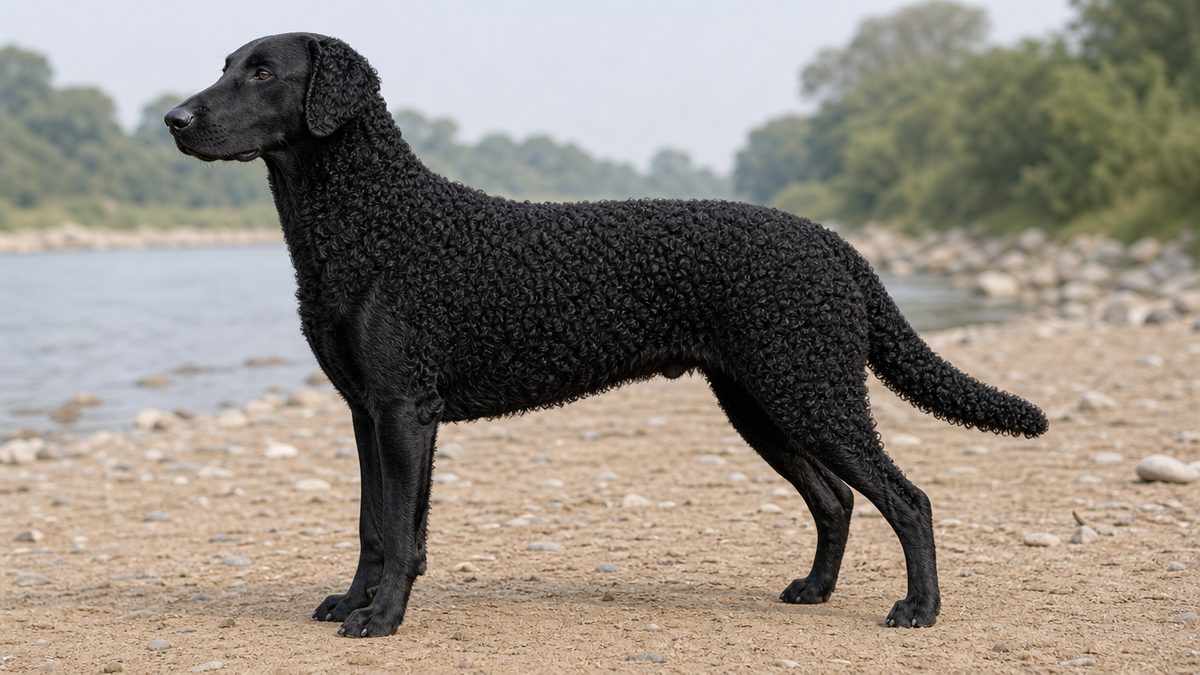
The Curly-Coated Retriever is a large British gundog defined by a single coat of small, tight, crisp curls lying close to the skin, with no undercoat anywhere on the body and smooth hair on the face, forehead, front of the forelegs and feet. It stands 69 cm at the withers for dogs and 64 cm for bitches under FCI-Standard N 110, it is the tallest of the retriever breeds, and it is one of the rarest dogs the Royal Kennel Club registers.
Take the coat first, because everything else on this page follows from it. The standard's wording is exact: "Body coat a thick mass of small tight, crisp curls lying close to skin, extending from occiput to tip of tail; without undercoat or bare patches. Elsewhere smooth hair". That single sentence separates this breed from every other common retriever. The Labrador, the Golden and the Chesapeake all carry a dense insulating undercoat under a weather coat. The Curly is single-coated, and a single-coated dog in a Mumbai monsoon behaves nothing like a double-coated one.
The AKC standard describes the same coat in more detail and adds what a fault looks like. The body coat is "a thick mass of small, tight, crisp curls, lying close to the skin, resilient, water resistant", curls run up the neck to the occiput, down the thigh to at least the hock and over the whole tail, and "a patch of uncurled hair behind the withers or bald patches anywhere on the body" is to be severely penalised. Sparse, silky, fuzzy, harsh, dry or brittle hair is a fault. Those faults matter to an Indian buyer for a reason that has nothing to do with showing, and the health section explains why.
Where it sits in the registries
Every major registry recognises the breed, which is unusual for a dog this scarce. The FCI recognised it on a definitive basis on 10 December 1954 as standard number 110, Group 8 Retrievers, Flushing Dogs and Water Dogs, Section 1 Retrievers, country of origin Great Britain, with a working trial. The AKC places it in the Sporting Group and approved its current standard on 12 October 1993, effective 30 November 1993. The Royal Kennel Club lists it in the Gundog group as Retriever (Curly Coated) and last updated its breed standard on 1 April 2025.
India follows the FCI. The FCI members register lists India as a full member represented by the Kennel Club of India, Chennai, so the KCI issues pedigrees against FCI nomenclature and FCI recognition effectively answers the India recognition question. We looked for a published KCI breed list and found none on its own site, so we make no claim about what the KCI does or does not list; that is a limit of the source, not a finding about the breed.
Temperament as the standard writes it
Both standards describe the same dog in almost the same words, and both use one adjective that no other retriever standard uses. The FCI text reads "Intelligent, steady, reliable. Bold, friendly, self confident and independent. May seem aloof". The AKC standard expands it: "Of independent nature and discerning intelligence, a Curly sometimes appears aloof or self-willed, and, as such, is often less demonstrative, particularly toward strangers, than the other retriever breeds";. A buyer expecting a Golden Retriever's open friendliness will read that reserve as a problem when it is the breed working correctly.
History, briefly and only where it is sourced
The Royal Kennel Club's own account says the breed has been claimed as the oldest of the retrievers and is also the tallest, that the coat traces to the extinct English Water Spaniel added to a retriever base probably including the Labrador, that Poodle blood was added for tightness of curl, and that the first breed club was established in 1933. The AKC agrees on the antiquity and adds that the breed was developed in England and was long a favourite of English gamekeepers. We report those as the registries' accounts rather than as settled history, because neither cites a source for the crossbreeding claim.
This breed has no undercoat. Almost every piece of retriever care advice you will find in India, from bathing to brushing to summer clipping, was written for a double-coated dog. Check that assumption before you apply anything you read.
Size, weight and the figures the standards refuse to give
The Curly-Coated Retriever's height is specified identically by the FCI and the Royal Kennel Club and slightly differently by the AKC, and none of the three breed standards gives a weight at all. Any weight figure you see for this breed comes from a registry's consumer page or from an aggregator, not from the standard, and the ranges they publish disagree by a wide margin.
| Source | Dogs, height | Bitches, height | Weight |
|---|---|---|---|
| FCI-Standard N 110 (28.07.2009) | 69 cm ideal | 64 cm ideal | no weight stated |
| Royal Kennel Club breed standard (1 April 2025) | 69 cm (27 in) ideal | 64 cm (25 in) ideal | no weight stated |
| AKC official standard (effective 30.11.1993) | 25 to 27 in (63.5 to 68.6 cm) | 23 to 25 in (58.4 to 63.5 cm) | no weight stated |
| AKC breed page | 25 to 27 in | 23 to 25 in | 60 to 95 lb (27 to 43 kg) |
| Asia Pets, India listing | 58 to 69 cm, sexes not separated | 58 to 69 cm | 27 to 36 kg |
Read the top three rows and the point is obvious. Not one of the three breed standards states a weight The Royal Kennel Club, Breed Standard American Kennel Club. The AKC standard instead says the degree of substance is "sufficient to ensure strength and endurance without sacrificing grace" and that bone and substance should be "neither spindly nor massive", which is a judgement, not a number. The 60 to 95 pound range that appears everywhere online comes from the AKC's consumer breed page, and the Indian listing that ranks for this query narrows it to 27 to 36 kg without saying where that came from.
That matters for a practical Indian reason. 60 pounds is 27.2 kg and 95 pounds is 43.1 kg, a 58 percent spread within one breed. Airline and rail crate sizing, anaesthetic dosing and monthly food budgeting all key off weight, so a buyer who plans around 27 kg and receives a 41 kg dog has budgeted wrongly by a wide margin. Weigh the actual dog rather than reading a range.
Height: the ideal figure is not a range
The FCI and Royal Kennel Club both give a single ideal height rather than a permitted band, 69 cm for dogs and 64 cm for bitches The Royal Kennel Club, Breed Standard. The AKC gives bands instead, 25 to 27 inches for dogs and 23 to 25 for bitches, and adds a clause the other two do not: "A clearly superior Curly falling outside of this range should not be penalized because of size";. So the American standard is deliberately more permissive about size than the European one, and a dog that is correct in one ring may be marked down in the other.
Colour is where the standards are strictest
Black or liver, and nothing else. The FCI standard gives colour as "Black or liver" with no further comment. The Royal Kennel Club is blunter and prints in bold: "Any other colour or combination of colours unacceptable";. The AKC allows "a few white hairs" in an otherwise good dog while calling a prominent white patch undesirable. Anyone in India offering a cream, golden, brindle or particolour Curly-Coated Retriever is not offering a Curly-Coated Retriever.
The dewclaw clause that Indian law will not let you follow
The AKC standard states that front dewclaws are generally removed and rear dewclaws are generally removed. The FCI and Royal Kennel Club standards say nothing about dewclaws at all The Royal Kennel Club, Breed Standard. In India the question is settled by statute rather than by preference, because Second Schedule Part II paragraph 6(8) of the Dog Breeding and Marketing Rules 2017 forbids de-clawing and any other kind of mutilation of any body part of the pup. An Indian-bred Curly must keep its dewclaws, and it loses nothing under the standard that actually governs Indian pedigrees.
The AKC standard specifies a tail "carried straight or fairly straight, never docked, and reaching approximately to the hock";. That happens to match Indian law exactly, since the same paragraph 6(8) forbids tail docking. A docked Curly is both a fault and an offence.
A UK Vulnerable Native Breed, and what the actual numbers are
The Curly-Coated Retriever is a UK Vulnerable Native Breed because the Royal Kennel Club applies a hard threshold of fewer than 300 annual registrations, and this breed has not come close to 300 in any year on record. It registered 25 puppies in the whole of 2025, its lowest figure in the published decade, against a threshold it would need to multiply twelvefold to escape.
The definition is not vague and it is worth quoting because so much writing about this breed treats it as an impression. The Royal Kennel Club states that it created "the vulnerable native British and Irish breeds list (breeds with fewer than 300 registrations a year) and the 'at watch' list (breeds with between 300 and 450 registrations a year)". There are 39 breeds on the vulnerable list and 8 on the at-watch list, and the Royal Kennel Club's own August 2026 show report confirms the count at "all 39 vulnerable British and Irish native breeds".
| Year | Registrations | Share of the 300 threshold |
|---|---|---|
| 2016 | 83 | 28% |
| 2017 | 53 | 18% |
| 2018 | 70 | 23% |
| 2019 | 68 | 23% |
| 2020 | 55 | 18% |
| 2021 | 62 | 21% |
| 2022 | 73 | 24% |
| 2023 | 83 | 28% |
| 2024 | 50 | 17% |
| 2025 | 25 | 8% |
Those ten years total 622 puppies, an average of 62.2 a year. The 2025 figure of 25 is the lowest in the series and half the 2024 figure. It cross-checks against a second Royal Kennel Club publication: the quarterly gundog statistics give the breed 3, 16, 6 and 0 puppies across the four quarters of 2025, which sums to exactly 25, and record 9 in the first quarter of 2026. Two independent Kennel Club documents agreeing to the puppy is as good as registration data gets.
Correcting a claim that circulates widely
A widely repeated press line says Curly-Coated Retriever registrations rose fivefold in 2023 against 2022. The Royal Kennel Club's own table gives 73 in 2022 and 83 in 2023, which is a rise of 13.7 percent, not 400 percent. We publish the disagreement rather than resolving it: the Kennel Club's published annual series is the record, and any secondary account of a fivefold jump is contradicted by the primary table. Whatever happened in 2023, it did not survive, because the two years since read 50 and 25.
What scarcity means for an Indian buyer specifically
Scale the number against the breeds an Indian buyer knows. In 2025 the Royal Kennel Club registered 29,919 Labrador Retrievers and 9,976 Golden Retrievers against 25 Curly-Coated Retrievers. That is one Curly for every 1,197 Labradors registered in the same country in the same year. Even the Chesapeake Bay Retriever, itself scarce, managed 31. If you intend to import a puppy rather than adopt one, you are drawing from a global pool that produced a few hundred dogs last year in total.
- Expect a waiting list rather than a choice of litters, and expect it to be measured in years.
- Expect to travel, because a breed producing 25 UK puppies a year does not place them by courier.
- Expect your Indian vet to have never seen one, which changes how you brief them before a procedure.
- Expect published prices to be guesses, because a market this thin generates no price signal at all.
Scarcity in the UK registry does not translate into a verified Indian price. It translates into an absence of Indian supply, which Indian listing sites fill with numbers rather than dogs. The next two sections take those numbers apart.
Curly Coated Retriever price in India: what the numbers on the search results page are
No verified Curly Coated Retriever price in india exists, because no verified Indian sale of the breed appears in any source we could open. Every rupee figure ranking for this query is either an Indian listing site's house price point, a rarity ladder typed by hand, or an answer engine repeating one of those two. The published figures range from Rs 40,000 to Rs 1,20,000, and none of them is anchored to a transaction.
Start with the fact that frames the whole market. Google India returns "About 155 results" for the exact query curly coated retriever price in india. A breed with a real Indian market does not have a 155-result index. For comparison, the same search results page's own related searches steer the user toward the Flat-Coated Retriever four times out of eight, which is Google telling you it cannot find enough Curly demand to fill the box.
| Source | Figure | What it actually is |
|---|---|---|
| Google India AI Overview | Rs 40,000 to Rs 99,000 | A synthesis of the three rows below it |
| Google India AI Overview, premium tier | Up to Rs 98,999 | One listing site's recurring charm price |
| Asia Pets, India | Rs 40,000 to Rs 80,000 | A band on a breed information page, no listing attached |
| Puppiezo, India | Rs 98,999 | The same charm price, printed as an in-stock price |
| Pet House NCR, retriever ladder | Rs 50,000 to Rs 1,20,000 | A rarity ranking with rupee signs |
| Pet House NCR, 155-breed table | no row | The breed is absent from the table entirely |
| Tyneside Curly Coated Retrievers (overseas) | USD 3,500 | An actual breeder's published waiting-list price |
| Dog Breeds List (overseas) | USD 1,500 to USD 2,500 | A US market range, plus USD 1,000 to 1,500 to import |
The two overseas figures are the only ones on that table attached to a real transaction, and they settle the question in the opposite direction from the Indian ones. A Tyneside puppy is USD 3,500. The lowest published US market figure is USD 1,500. Convert USD 1,500 at 74.00, the rate the largest Indian dog-price table on this SERP demonstrably uses, and you get Rs 1,11,000. Convert at 84.38 and you get Rs 1,26,570. Either way, the floor of the real overseas market sits above the ceiling of the Indian band Asia Pets publishes, before a single rupee of import cost.
Why that gap cannot be explained away
An Indian seller cannot be cheaper than the world market for a breed that produced 25 registered puppies in the UK last year. There is no local breeding population to undercut it with. So a rupee figure below the overseas floor is not a bargain; it is evidence that whatever is being offered is not the breed, or is not being offered at all. That is the single most useful thing this page can tell an Indian buyer, and no page currently ranking says it.
What you are actually being shown
- Auto-generated category pages. Justdial publishes Pet Shops For Curly Coated Retriever Dog for Mumbai and Surat from the same template it uses for the Kerry Blue Terrier and the Great Pyrenees.
- Breed-information pages with a price band and no listing. Asia Pets prints Rs 40,000 to Rs 80,000 beside 27 to 36 kg and 10 to 12 years, all of it descriptive rather than transactional.
- A phone number. The Puppiezo result invites you to "Call on 9211058928" to know more about prices, which is a request for contact, not a price.
- A Flat-Coated Retriever. Four of the eight related searches Google attaches to this query are Flat-Coat queries.
If someone in India quotes you a firm Curly-Coated Retriever price today, ask to see the sire and dam, their OFA numbers and their FCI-recognised pedigree before you discuss money. On the evidence available, that request ends most of these conversations.
Testing the Indian price tables, figure by figure
We tested every rupee value in the largest Indian dog-price table on this search results page against three exchange rates, and 453 of 462 values divide to an exact whole number of US dollars at 74.00. That table is an American price list converted wholesale. The Curly-Coated Retriever is not in it, which is why the same publisher had to type a number by hand somewhere else.
Here is the method, so you can rerun it. Take every rupee figure printed in a price table, divide each by a candidate exchange rate, and count how many land on a whole number of dollars. A genuine Indian price list will not do this, because Indian sellers price in rupees and round to rupee-friendly numbers. A converted list will, because every figure descends from a dollar amount somebody typed once.
| Rate tested | Values dividing to an exact whole dollar | Share |
|---|---|---|
| 74.00 | 453 of 462 | 98.1% |
| 80.00 | 206 of 462 | 44.6% |
| 84.38 | 0 of 462 | 0.0% |
Ignore the 80.00 row. One thousand divided by eighty is 12.5, so any rupee figure ending in the right number of zeros divides cleanly at 80 by construction, and that row is arithmetic noise rather than evidence. The 74.00 row is the finding, and the retriever rows show it working. Labrador Rs 59,200 is USD 800. Golden and Chesapeake both Rs 74,000, which is USD 1,000. Flat-Coated Rs 1,48,000 is USD 2,000. Nova Scotia Duck Tolling Rs 1,85,000 is USD 2,500. Every one exact.
The confirming detail is the human fingerprint. The same table prints the Caravan Hound's range as "Rs 8,ooo" with two letter o's where the zeros should be, which is somebody typing rather than a script converting. The Indian breeds are the hand-added rows, and the imported breeds came off a dollar list.
The Curly-Coated Retriever is missing from that table
Search the 155-breed table for the breed and you get nothing. Not a low figure, not a high figure, no row. Five other retrievers are present and all five convert exactly at 74. The one retriever absent from the American source list is the one absent from the Indian table, which is what you would expect if the table were copied rather than researched.
So where did Rs 50,000 to Rs 1,20,000 come from
The same publisher prints a Curly Coated Retriever band of Rs 50,000 to Rs 1,20,000 on a different page, inside a retriever ladder that runs Labrador Rs 8,000 to Rs 20,000, Golden Rs 15,000 to Rs 45,000, Flat-Coated Rs 40,000 to Rs 90,000 and Chesapeake Rs 60,000 to Rs 1,50,000. Neither Curly figure divides at 74.00 or at 84.38. They are rupee-native round numbers arranged in ascending order of obscurity, which is a rarity ladder rather than a price list.
That ladder also contradicts the same publisher's own big table. The 155-breed table gives the Chesapeake Bay Retriever Rs 40,700 to Rs 88,800 and the Flat-Coated Retriever Rs 1,11,000 to Rs 1,85,000. The retriever ladder gives the Chesapeake Rs 60,000 to Rs 1,50,000 and the Flat-Coat Rs 40,000 to Rs 90,000. The two pages reverse the ranking of the two breeds against each other. One publisher, two pages, incompatible numbers.
Rs 98,999 is a house price point, not a breed price
Rs 98,999 is the figure Google India's AI Overview reports as this breed's premium ceiling, and it is the figure the ranking Indian listing prints against an available puppy. It is not a converted dollar amount: Rs 98,999 divided by 84.38 is 1,173.25, and divided by 74.00 it is 1,337.82. Neither is a number a seller prints. It is a rupee-native charm price that recurs across that site's listings regardless of breed, and it has now been laundered into an answer engine as a fact about the Curly-Coated Retriever.
Divide any Indian breed price by 84.38, then by 74.00, then by 80.00. If a whole table lands on whole dollars at one rate, you are reading a conversion, not a market. If only the local breeds refuse to divide, those are the rows a human actually wrote. It takes a calculator and about two minutes.
Monthly cost of ownership in an Indian city
Budget the monthly cost of a Curly-Coated Retriever the way you would budget a Labrador, because no breed-specific Indian cost figure exists and the two dogs eat similar quantities. Published Indian monthly upkeep ranges for large retriever-type dogs run from Rs 3,000 at the bottom to Rs 18,000 at the top, and the honest answer is that the spread is driven by your food choice rather than by the breed.
| Source | Monthly figure | Scope |
|---|---|---|
| Pet House NCR | Rs 3,000 to Rs 4,000 | Labrador; food, vet fees, vaccination, grooming |
| Pet House NCR, upper case | up to Rs 10,000 | Labrador on top-tier care |
| Supertails | Rs 3,000 to Rs 18,000 | All breeds, by size and grooming need |
| Google India AI Overview | Rs 4,000 to Rs 9,000 | Curly-Coated Retriever, food and upkeep, unsourced |
Treat the last row with the suspicion the rest of this page has earned. Google's AI Overview attaches Rs 4,000 to Rs 9,000 to this breed specifically, but the only breed-level Indian data underneath it are generic large-dog figures Pet House NCR, Labrador Puppy Price…. There is no Indian cost study for the Curly-Coated Retriever, and a number that looks breed-specific but is not is worse than an honest range.
What genuinely differs for this breed
Three line items move for a Curly rather than for a Labrador, and only one of them moves upward.
- Grooming falls. This coat is never clipped and never shaved, so you buy no salon appointments, and the Royal Kennel Club's own guidance is simply that it needs attention more than once a week.
- Screening rises once. Three DNA tests are CHIC requirements for the breed, covering exercise-induced collapse, glycogen storage disease IIIa and cord-1 progressive retinal atrophy. You pay for those once, or the breeder does.
- Veterinary friction rises permanently. Your vet has almost certainly never seen the breed, which means longer consultations and a higher chance of a referral.
Food is the item that decides the total, and it scales with bodyweight rather than with breed. The AKC's published weight range for the breed is 60 to 95 pounds, which is 27 to 43 kg. A 43 kg dog eats roughly 1.6 times what a 27 kg dog eats, so the same feeding plan can differ by thousands of rupees a month between two correct Curlies. Weigh the dog and feed to body condition rather than to a breed table.
One-off costs an Indian owner should plan for
- A municipal dog licence, which Greater Mumbai's own application form already lists the breed on.
- Import documentation if the dog comes from abroad, which is the realistic route given 25 UK registrations in 2025.
- A high-volume dryer, because towel drying alone will not take a curl mass to the skin in a Kolkata July at a 26.17 degree dew point.
- Two DNA tests if the breeder cannot produce written results, which is cheaper than one affected dog.
One cost that does not apply is the one people expect. Air conditioning is not a Curly-specific line item the way it is for a Siberian Husky, because this is a mesocephalic single-coated dog rather than a thick double-coated arctic breed. What it needs instead is a dry, ventilated place to lie and a genuinely early walk, and neither of those is expensive.
Bonbeno reports published price ranges as editorial content. These are figures other publishers printed, tested where testing was possible, and they are not offers. We do not sell animals and we do not broker puppy sales.
Heat tolerance in India, city by city
A Curly-Coated Retriever is workable in Bengaluru and Pune, manageable in Delhi's dry season, and hard work in Chennai, Mumbai and Kolkata. The reason is dew point rather than temperature. This is a Great Britain breed by FCI record, and Chennai's annual mean dew point of 21.94 degrees Celsius is 9.1 degrees higher than London's highest monthly dew point of the year.
We queried NASA POWER's climatology endpoint by explicit latitude and longitude for each city, so no place can be substituted for another by a bad slug. The origin comparison is London because the FCI records the breed's country of origin as Great Britain. Dew point is the right axis because it measures how much water the air can still absorb, and a dog dumps heat by evaporating water from its respiratory tract. At a high dew point, panting stops working.
| City | Annual mean temp (C) | Annual mean dew point (C) | July dew point (C) | Annual max temp (C) |
|---|---|---|---|---|
| London (origin) | 10.39 | 7.62 | 12.84 | 33.96 |
| Bengaluru | 23.74 | 15.87 | 18.73 | 40.38 |
| Pune | 23.86 | 15.46 | 21.91 | 43.20 |
| Delhi | 25.60 | 10.47 | 23.20 | 48.79 |
| Mumbai | 26.77 | 18.70 | 24.74 | 44.91 |
| Kolkata | 25.81 | 19.90 | 26.17 | 46.81 |
| Chennai | 27.95 | 21.94 | 22.51 | 42.70 |
Read the July column against London's 12.84. Kolkata in July sits at 26.17 degrees, which is 13.33 degrees higher. Mumbai reaches 24.74 with a July relative humidity of 89.56 percent. In that air, a panting dog is breathing out into a medium that will not take the water, and the entire evaporative cooling mechanism the breed evolved with stops delivering.
Delhi is a different problem, twice a year
Delhi splits into two distinct climates and each one asks something different of this dog. Its annual maximum temperature is 48.79 degrees, the highest of the six, but its May dew point is only 8.69 degrees, which is lower than London's July. So Delhi in May is dry radiant heat, where panting still works and shade, water and timing carry the dog. Delhi in July flips to a 23.20 degree dew point, at which point it behaves like Mumbai. An owner who learns one Delhi routine and applies it all year will get it wrong for half the year.
What the heat-illness literature can and cannot tell us
The largest primary-care study of canine heat-related illness modelled 905,543 UK dogs, identified 395 confirmed events in 2016, and reported an incidence of 0.04 percent with an event fatality rate of 14.18 percent, 95 percent confidence interval 11.08 to 17.96. The Curly-Coated Retriever does not appear in that model. The study included only breed types with at least five cases or at least 5,000 dogs in the study population, and this breed clears neither threshold, so no breed-specific odds ratio exists for it and we will not borrow another breed's.
One factor from that study does transfer, because it is not breed-specific. Dogs at or above their own breed and sex mean bodyweight had 1.42 times the odds of heat-related illness, 95 percent confidence interval 1.12 to 1.80. A Curly-Coated Retriever at the top of the published 27 to 43 kg range is carrying that risk multiplier every summer. Keeping the dog lean is the single cheapest heat intervention available to an Indian owner, and it is free.
- Bengaluru and Pune: workable year round with an early walk, on an annual mean dew point near 15.5 degrees.
- Delhi: workable November to March, dawn-only in May, and treated as coastal in July.
- Mumbai and Kolkata: dawn-only for most of the year, with the monsoon months as the hardest, not the hottest.
- Chennai: the least forgiving, because its dew point barely falls at any point in the year.
This breed is mesocephalic, so it is not in the brachycephalic high-risk group, and it is single-coated, so it is not carrying an arctic undercoat. It is heat-sensitive for the ordinary reason that a 40 kg working gundog generates a lot of heat and Indian air will not take it away. Manage the timing and the bodyweight, not the coat.
Grooming a curly coat in Indian humidity
Groom a Curly-Coated Retriever by brushing it damp, drying it to the skin after every wetting, and never clipping or shaving the body. The coat has no undercoat to blow out, so the usual Indian retriever routine of aggressive de-shedding and summer clipping is not just unnecessary here, it damages the coat. The Royal Kennel Club's own guidance is grooming more than once a week, and it records the breed as Sheds: Yes.
The coat is genetically unusual and that is now documented. A second KRT71 allele was identified in curly coated dogs in 2019, published in Animal Genetics by Bauer and colleagues, and KRT71 is the keratin gene that produces curl. So the curl is a structural change in the hair itself, not a styling outcome. You cannot brush it straight and you should not try.
The weekly routine
- Brush the coat damp rather than dry, because a dry crisp curl breaks and a broken curl reads as the sparse, fuzzy coat the AKC standard calls a fault.
- Work in sections from the skin outward, checking for the bare patches the standard says should be severely penalised anywhere on the body.
- Groom the smooth areas separately, since the face, forehead, front of the forelegs and feet carry short straight hair rather than curls.
- Screen the skin under the curls at the same time, particularly the caudal thighs, axillae, dorsum and neck.
That last instruction is not generic. A Royal Veterinary College study surveyed 90 Curly-Coated Retrievers through the breed clubs and found 39 of them had current or previous symmetrical, non-pruritic alopecia or frizzy coat changes, usually appearing before 18 months of age and usually affecting exactly those four sites, with 23 of the 90 showing a waxing and waning course. Thirty-nine of ninety is 43.3 percent. That is not a rare complication; it is close to half the surveyed breed.
Why that finding matters more in India than in Sweden
The same study examined 14 dogs and looked at the skin down the microscope. Vertical histopathology showed infundibular hyperkeratosis in 28 of 30 sections and low-grade pigment clumping in 17 of 30, with subtle telogenisation of hair follicles confirmed by transverse histomorphometry. Infundibular hyperkeratosis means the follicle opening is plugged with keratin. A plugged follicle under a dense curl mass, in air at a 24 to 26 degree dew point, is a different clinical proposition from the same follicle in Hatfield or Uppsala.
The authors classify it as a follicular dysplasia similar to that of Irish water spaniels and Chesapeake Bay retrievers but distinct from that of Portuguese water dogs, and state that the genetic basis requires further assessment. So it is a breed-group problem rather than a management failure, and no Indian owner should read a patchy coat as evidence they groomed the dog wrongly. Photograph the pattern, date the photographs, and take them to the vet.
Drying is the part Indian owners skip
Dry the dog to the skin every time it gets wet, and plug the ears before washing the head. Overseas retriever guidance that says to towel off and air dry assumes air that can absorb water, and a British July at a 12.84 degree dew point can. Kolkata in July at 26.17 degrees cannot. A high-volume dryer is the one piece of equipment this breed genuinely needs in India, and it is cheaper than treating the skin disease it prevents.
The hypoallergenic claim, settled
A curly coat attracts the hypoallergenic claim and the claim is not supported. Vredegoor and colleagues measured Can f 1 across 196 dogs of so-called hypoallergenic breeds against 160 control dogs and found the hypoallergenic group came back higher, at 2.26 against 0.77 micrograms per gram in hair and 27.04 against 12.98 in coat, with no difference in airborne allergen, concluding that "there is no evidence for the classification of certain dog breeds as being 'hypoallergenic'". The Royal Kennel Club settles the shedding question for this breed directly by recording Sheds: Yes. Neither breed standard says anything at all about shedding American Kennel Club.
The AKC standard states that shearing of the body coat is undesirable, while permitting feathering to be trimmed from ears, belly, backs of forelegs, thighs, pasterns, hocks and feet. A shaved Curly regrows soft and open, loses the waterproof crisp curl the standard describes, and gains nothing in cooling.
Temperament and household fit in an Indian home
Expect a Curly-Coated Retriever to be steady, self-confident and noticeably reserved with strangers, which reads as aloofness beside a Golden Retriever and is exactly what both breed standards describe. It suits a household that wants a thinking dog with a job. It does not suit a household that wants a dog which greets every visitor at the lift.
The standards are unusually specific about character, and both use the same words. The FCI text gives "Intelligent, steady, reliable. Bold, friendly, self confident and independent. May seem aloof", under a general appearance of a "strong, upstanding dog with a degree of elegance";. The AKC standard reads "Self-confident, steadfast and proud, this active, intelligent dog is a charming and gentle family companion and a determined, durable hunter" and adds that the Curly "is often less demonstrative, particularly toward strangers, than the other retriever breeds";.
That last clause is the one Indian buyers should read twice. Most Indian expectations of a retriever are built on the Labrador and the Golden, both of which are indiscriminately friendly. A Curly is friendly with its own people and merely polite with everyone else. The AKC standard is careful to distinguish this from timidity: "The Curly's independence and poise should not be confused with shyness or a lack of willingness to please", and it makes shyness itself a fault, penalising any dog that shies away from ring examination.
What that means in an apartment building
Reserve plus size plus a guarding instinct that nobody bred for is a combination worth managing early in an Indian tower. Socialise the puppy deliberately to lifts, gates, delivery riders, security staff and building corridors in the first four months, because a 40 kg dog that has decided the lift lobby is its territory is a problem you fix with training rather than with apology. The breed is not a guard dog and the standards do not describe protectiveness, but reserve toward strangers is easy for a stranger to misread.
Children, other dogs and household noise
The Royal Kennel Club's account is that the Gundog group's temperament makes them "ideal all-round family dogs" and describes this breed as originally a working retriever from water. The AKC adds that at home the Curly "is calm and affectionate" while in the field it is "eager, persistent and inherently courageous";. Read together, that is a dog with a clear off switch indoors provided the on switch got used outdoors. Without the exercise, the calm indoor dog does not appear.
- Good fit: an experienced owner with time, a garden or a park, and a use for a trainable working dog.
- Workable fit: an apartment household in Bengaluru or Pune that commits to two outdoor sessions a day.
- Poor fit: a first-time owner who wanted a Golden Retriever's open friendliness and bought on looks.
- Poor fit: a household in Chennai or Mumbai with no way to exercise the dog before sunrise.
The one temperament trap that is specific to this breed
A Curly-Coated Retriever's reserve deepens if it is under-socialised, and rarity makes under-socialisation likely in India. A breed producing 25 UK puppies a year will not have a local breed club, a puppy class full of littermates or a neighbour with the same dog. The owner has to manufacture the social exposure that a Labrador owner gets for free. Plan for that before the puppy arrives rather than after the first growl at a courier.
Both the FCI and the AKC use aloof to describe correct breed character American Kennel Club. A Curly that stands its ground and looks at a stranger without wagging is doing what the breed standard asks. Judge the dog against its own standard, not against a Labrador.
Training: what works and what this breed resists
Train a Curly-Coated Retriever with short, varied, reward-based sessions, because the breed is highly trainable and bores fast, and repetition drills that suit a Labrador will get you refusal rather than compliance. The AKC standard calls the dog "wickedly smart and highly trainable" while also calling it independent and sometimes self-willed, and both halves of that sentence are true at once.
Start from what the breed was built to do. The FCI classifies it in Group 8 Section 1 Retrievers with a working trial, meaning the standard assumes a dog assessed on its ability to work rather than only on its looks. The AKC standard describes a dog that "will work as long as there is work to be done, retrieving both fur and feather in the heaviest of cover and the iciest of waters";. A dog bred to solve retrieving problems independently will make its own decisions when your instructions stop making sense to it.
A realistic Indian timeline
- Weeks 8 to 16: name, recall, crate, lift and stair confidence, and deliberate exposure to Indian street noise, all in sessions under five minutes.
- Months 4 to 6: loose-lead walking on a real Indian footpath, settle on a mat, and a reliable leave-it for street food and rubbish.
- Months 6 to 12: formal retrieve work, water introduction, and an emergency stop whistle that works at distance.
- Months 12 to 24: proofing everything already learned against heat, crowds, monkeys, other dogs and the monsoon.
Keep the sessions short and end them early. Three five-minute sessions beat one twenty-minute session with this breed, and a session that ends while the dog still wants more is the one it remembers. Owners who drill a Curly the way they would drill a Labrador report the dog switching off, which the AKC standard would call self-willed and a trainer would call boredom.
The recall that has to be bombproof, for a reason other owners do not have
Build an emergency stop before you build anything else, because 41.0 percent of tested Curly-Coated Retrievers carry the exercise-induced collapse mutation and 5.7 percent are affected. The condition is triggered by intense exercise and excitement, and the moment you most need to interrupt a dog is the moment it is most excited. A whistle stop that works at fifty metres is a medical tool for this breed, not a party trick.
Heat changes the training schedule, not the method
Move all training outdoors to before sunrise for most of the Indian year and keep indoor sessions for the middle of the day. Chennai's annual mean dew point of 21.94 degrees means the evaporative cooling a working dog relies on is impaired for most of the calendar, and a dog that is quietly overheating learns nothing. Scent work, place training and impulse control all work perfectly well on a cool floor under a fan.
What not to do
- Do not use aversive corrections, since the breed is listed as sensitive on the ranking data cards and a reserved dog that shuts down is hard to reopen.
- Do not train to exhaustion in any month, because collapse in this breed has two genetic causes and one climatic one.
- Do not skip the socialisation window on the argument that the dog is aloof by standard; aloof and fearful are different outcomes.
- Do not assume a Labrador class syllabus transfers unchanged, because the reinforcement schedule does not.
Working ability has not been bred out of this breed the way it has out of some show lines, because the population is too small to have split into separate show and field types. The FCI still attaches a working trial to the breed. If you want a dog that can genuinely be trained to a high standard, that is the compensation for everything else on this page.
Daily exercise requirement, and what happens without it
A Curly-Coated Retriever needs more than two hours of exercise a day, which is the Royal Kennel Club's own published figure for the breed and the highest band it uses. In an Indian city that has to be delivered in two sessions either side of the heat, and the failure mode without it is a large, bored, destructive dog rather than a merely restless one.
The Royal Kennel Club's breed characteristics for Retriever (Curly Coated) list exercise as "More than 2 hours per day", size of home as "Large house" and size of garden as "Large garden";. Those are the club's own judgements and they are stricter than what it publishes for many gundogs. Take them as the design specification, then work out how to meet it from a flat in Andheri.
How two hours actually gets delivered in an Indian city
| City | Morning session | Evening session | Hardest months |
|---|---|---|---|
| Bengaluru | 60 to 75 min from 06:00 | 45 to 60 min after 18:30 | March to May |
| Pune | 60 to 75 min from 06:00 | 45 to 60 min after 19:00 | April to June |
| Delhi | 75 min from 05:30 in summer | 45 min after 19:30 | May to July |
| Mumbai | 60 min from 05:30 | 45 min after 20:00 | May to September |
| Kolkata | 60 min from 05:15 | 45 min after 20:00 | May to September |
| Chennai | 60 min from 05:15 | 45 min after 20:00 | almost all year |
Kolkata's July dew point of 26.17 degrees and Mumbai's 24.74 are the reason the monsoon months, not the summer months, are the hardest in those two cities. It feels counterintuitive because the temperature has fallen. What has not fallen is the humidity, and a working dog cools by evaporation.
Swimming is the best answer and the most misused one
Let the dog swim wherever clean water is genuinely available, because this is a water retriever whose coat is described as water resistant and built to work in the iciest of waters. Swimming delivers hard exercise with almost no heat load, which is precisely what an Indian summer needs. The catch is entirely on the drying side, and the grooming section covers it: dry the dog to the skin afterwards and plug the ears before any head wash.
What under-exercise looks like
An under-exercised Curly-Coated Retriever does not become calm; it becomes an energetic problem indoors. Expect chewing, counter-surfing, digging at flooring and a dog that cannot settle in the evening. The AKC standard describes an "active, intelligent dog" that in the field is "eager, persistent";, and none of that switches off because the owner is busy. The Royal Kennel Club's own two-hour figure is the honest version of the same point.
- Split the requirement rather than shortening it, since two 60-minute sessions beat one 90-minute session in Indian heat.
- Add scent games and retrieve drills indoors on the worst days, because mental work genuinely substitutes for some physical work.
- Watch the bodyweight, since dogs at or above their breed and sex mean weight carry 1.42 times the odds of heat-related illness.
- Stop early on any session where the dog's gait changes, given the breed's exercise-induced collapse load.
The whole point of a dog bred to work all day is that it will not stop on its own. With 5.7 percent of tested dogs affected by exercise-induced collapse and 41.0 percent carriers, the owner has to be the one who calls time. Set a timer rather than watching the dog.
Feeding, body condition and what is available in India
Feed a Curly-Coated Retriever to body condition rather than to a breed chart, because the published adult weight range for the breed spans 27 to 43 kg and a single feeding plan cannot serve both ends of it. Large-breed puppy food to twelve to eighteen months, then an adult diet portioned against a monthly weigh-in, is the whole of the plan for a healthy dog.
The weight ranges disagree and that is the practical problem. The AKC breed page gives 60 to 95 pounds, which is 27 to 43 kg. Dog Breeds List gives 65 to 80 pounds, or 29 to 36 kg. The Indian listing that ranks for this query gives 27 to 36 kg. None of the three breed standards states a weight at all The Royal Kennel Club, Breed Standard American Kennel Club. So there is no authoritative weight to feed toward, only the dog on the scale.
Why leanness is a heat intervention here
Keep the dog at the lower end of its own healthy range through the Indian summer. Dogs at or above their breed and sex mean bodyweight carried 1.42 times the odds of heat-related illness in a study of 905,543 UK dogs, 95 percent confidence interval 1.12 to 1.80. That factor is not breed-specific, so it applies to a Curly even though the breed itself was below the study's inclusion threshold and does not appear in its model. Leanness is the cheapest and most affordable heat measure an Indian owner has.
The metabolic condition that changes the answer
One inherited disease in this breed makes feeding a clinical question rather than a husbandry one. Glycogen storage disease type IIIa is caused by absent debranching enzyme activity in liver and skeletal muscle, so an affected dog cannot mobilise stored glycogen normally. If a DNA test has confirmed an affected dog, feeding intervals and composition become a veterinary decision and nothing on this page substitutes for that. For a clear or carrier dog, ordinary large-breed feeding applies unchanged.
A workable Indian plan
- Weeks 8 to 16: four meals a day of a large-breed puppy food, kept to the manufacturer's weight band rather than to appetite.
- Months 4 to 12: three meals a day, with the total adjusted monthly against a weigh-in rather than against a table.
- Months 12 to 18: transition to twice daily and to an adult large-breed formulation.
- Adult: two meals a day, portioned so the ribs are easily felt and the waist is visible from above.
Split the daily ration into two meals rather than one for an adult, and avoid hard exercise immediately before or after eating. That advice is generic large-breed caution rather than a breed-specific finding, and we flag it as such: no bloat or gastric dilatation study naming the Curly-Coated Retriever exists in the five PubMed records that name the breed at all. We would rather say that plainly than borrow a deep-chested breed's incidence figure and attach this breed's name to it.
Availability and cost in India
Every major large-breed formulation sold in India works for this dog, because nothing about the breed requires a specialist diet. The cost sits inside the general Indian range for a large dog, which published Indian sources put at Rs 3,000 to Rs 18,000 a month across all breeds and sizes, and at Rs 3,000 to Rs 4,000 rising to Rs 10,000 on top-tier care for a Labrador. A 43 kg Curly sits at the upper end of that; a 27 kg one sits near the middle.
Nearly half the Curly-Coated Retrievers in the Royal Veterinary College survey showed alopecia or frizzy coat changes, and the histopathology pointed to follicular dysplasia rather than to nutrition. Do not respond to a patchy coat by changing food repeatedly. Photograph it, date it, and get the skin examined.
Month by month through the first year
Plan the first year of a Curly-Coated Retriever around three fixed dates: eight weeks, which is the earliest a pup may lawfully be sold in India; eighteen months, by which most breed coat abnormalities have appeared; and twenty-four months, which is the minimum age for the hip, cardiac and eye screening this breed's CHIC programme requires. Everything else is training and heat management.
| Age | What happens | Fixed by |
|---|---|---|
| 7 to 8 weeks | Vaccination course may begin | Second Schedule Part III para 8(9) |
| 8 weeks | Earliest lawful sale of a pup in India | Rule 8(1)(a) |
| 8 to 16 weeks | Socialisation window; lifts, gates, traffic, strangers | training practice |
| 18 weeks | Vaccination course usually completed | Second Schedule Part III para 8(9) |
| 4 to 6 months | Adult crisp curls come through over the puppy coat | breed standard description |
| 6 months | Sale without sterilisation prohibited beyond this age | Rule 8(1)(b) |
| Up to 18 months | Window in which breed coat abnormalities typically appear | Bond 2016 |
| 24 months | Minimum age for OFA hip, advanced cardiac and ACVO eye screening | OFA CHIC for code CR |
Two of those rows are Indian law rather than convention. The Rules state at Rule 8(1)(a) that a breeder shall ensure "pups less than eight weeks in age are not sold", and at Rule 8(1)(b) that "dogs over six months in age are not sold without first being sterilised, unless they are being sold to another licensed breeder";. Second Schedule Part III paragraph 8(9) adds that "all pups shall be vaccinated which can start at the age of seven-eight weeks, and are usually completed at the age of eighteen weeks";.
Months 2 to 4: the window that matters most
Spend these two months manufacturing social exposure. A rare breed in India gets none of it by accident, so the owner has to arrange it: lifts, stairwells, security cabins, delivery riders, autorickshaws, temple bells, wedding drums and other dogs, all at a distance the puppy can cope with. Keep every outing short and end it before the puppy is tired. The breed's correct adult character is reserved rather than fearful, and this is the period that decides which one you get.
Months 4 to 8: the coat changes and so does the risk
Watch the coat come through and photograph it monthly. The Royal Veterinary College survey found symmetrical, non-pruritic alopecia or frizzy coat changes "usually affecting caudal thighs, axillae, dorsum and neck before 18 months of age" in 39 of 90 dogs surveyed, with 23 showing a waxing and waning course. A dated photographic series taken by the owner is the single most useful thing an Indian vet who has never seen the breed can be handed.
Months 8 to 12: exercise ramps, carefully
Build toward the Royal Kennel Club's two-hours-plus adult requirement gradually rather than in one step, and keep sessions inside the cool part of the Indian day. Introduce water in this period if you can, because a dog that learns to swim young will swim willingly for the rest of its life and swimming is the exercise India makes easiest on a large gundog. Stop any session at the first change of gait.
Month 24: the screening that closes the file
Book the hip radiograph, the advanced cardiac examination and the ACVO eye examination at twenty-four months, because OFA sets 24 months as the minimum age for the cardiac and eye components of the CHIC programme for this breed. The three DNA tests, for exercise-induced collapse, glycogen storage disease IIIa and cord-1 progressive retinal atrophy, can be done at any age and should have been done by the breeder before the mating.
A breed with 25 UK registrations in 2025 has a register thin enough that every additional result changes the published percentages. Submitting your dog's screening results is the one thing an Indian pet owner can do that measurably helps the breed worldwide, and it costs a form.
Hips, elbows and life expectancy, with the denominators attached
The Curly-Coated Retriever's hip dysplasia rate is 15.1 percent of 1,513 evaluations and its elbow dysplasia rate is 0.4 percent of 467, both read from the Orthopedic Foundation for Animals' own per-breed table under registry code CR. Those elbows are the best numbers in the retriever group by a wide margin. The hips are middling, and the sample is small enough that the figure moves.
Two housekeeping points before the numbers, because guessing an OFA breed code returns a real, complete, plausible table for a different dog. We read the code out of OFA's own selector markup, where the checkbox carries value CR against data-name CURLY-COATED RETRIEVER, and the returned page prints CURLY-COATED RETRIEVER as its own heading. We ran the Labrador Retriever through the same tables as a control, and its rows returned as expected, so the instrument was working. OFA's own guide to its numbering spells the convention out with a worked example, LR-100E24M-C-PI, in which LR is the Labrador Retriever's breed code.
| Grade | Dogs | Share of 1,513 |
|---|---|---|
| Excellent | 176 | 11.6% |
| Good | 860 | 56.8% |
| Fair | 230 | 15.2% |
| Normal (the three above) | 1,266 | 83.7% |
| Mild dysplasia | 158 | 10.4% |
| Moderate dysplasia | 67 | 4.4% |
| Severe dysplasia | 4 | 0.3% |
| Dysplastic (the three above) | 229 | 15.1% |
| Equivocal | 18 | 1.2% |
| Total evaluated | 1,513 | 100% |
Check the arithmetic, because a table that does not add up is a table nobody read. 176 plus 860 plus 230 is 1,266. 158 plus 67 plus 4 is 229. 1,266 plus 229 plus 18 is 1,513. The equivocal row is the reason the two headline percentages sum to 98.8 rather than 100, and it is the same 1.2 percent gap that appears in the Labrador's row, so it is a property of OFA's grading rather than anything about this breed.
The hips are improving, on the register's own trend line
OFA publishes a dysplastic percentage by birth-year cohort and the recent movement is real. Dogs born up to 1990 came in at 16.8 percent dysplastic, the 2011 to 2015 cohort peaked at 18.2 percent, the 2016 to 2020 cohort fell to 14.3 percent, and the cohort born 2021 onwards sits at 7.6 percent. Excellent hips moved the same way, from 5.8 percent in the pre-1990 cohort to 32.1 percent in 2016 to 2020. The most recent cohorts are the smallest, so read the direction rather than the decimal.
The elbows are the headline nobody prints
The Curly-Coated Retriever's elbow figures are the best in its group. Of 467 elbow evaluations, 463 were normal at 99.1 percent and just 2 were dysplastic at 0.4 percent, both of them Grade 1, with zero Grade 2 and zero Grade 3 recorded in the entire breed. The Labrador Retriever's comparable figure is 9.9 percent of 148,607 and the Golden Retriever's is 11.8 percent of 84,056. A prospective owner comparing large gundogs on joint disease should know that, and no Indian page carrying this breed mentions elbow dysplasia at all.
What OFA does not have, and why that is a real finding
Five OFA databases have no Curly-Coated Retriever row: patella, thyroid, degenerative myelopathy, progressive retinal atrophy and shoulder. The Labrador Retriever appears in all five in the same retrieval, so the absence is the breed's and not the query's. OFA's own FAQ explains it: a breed needs at least 100 evaluations for hips and at least 50 for every other database before it is listed at all. Fewer than 50 Curlies have been screened for each of those five conditions worldwide.
Life expectancy: three sources, three answers
No peer-reviewed longevity estimate exists for this breed. A PubMed search on the exact phrase "curly-coated retriever" returns five records in total, with the query translation reported as "curly-coated retriever"[All Fields] and controls returning sane counts in the same session, and none of the five is a longevity study. So the published life expectancy figures are registry estimates, and they disagree. The AKC gives 10 to 12 years. The Royal Kennel Club gives "Over 10 years";. Dog Breeds List gives 8 to 12 years. We publish the spread rather than averaging it.
OFA is a live register and its counts move as submissions arrive. A percentage without its sample size cannot be checked later and cannot be compared across breeds. Every figure on this page carries the number of dogs it was calculated from, and every one was read on 27 August 2026.
Exercise-induced collapse: this breed ranks first in the OFA table
The Curly-Coated Retriever holds rank 1 in OFA's exercise-induced collapse database, with 41.0 percent carriers and 5.7 percent affected of 244 dogs tested. That is the highest mutation load of any breed OFA lists for the condition, higher than the Labrador Retriever, in which the disease was first described. In an Indian summer this is the most consequential fact on the page.
| Breed | Tested | Clear | Carrier | Affected | OFA rank |
|---|---|---|---|---|---|
| Curly-Coated Retriever | 244 | 53.3% | 41.0% | 5.7% | 1 |
| Labrador Retriever | 9,497 | 87.2% | 12.1% | 0.7% | 3 |
| Chesapeake Bay Retriever | 571 | 90.4% | 9.6% | 0.0% | 12 |
| Golden Retriever | 139 | 100.0% | 0.0% | 0.0% | 9 |
The absolute counts behind the Curly row are 130 clear, 100 carriers and 14 affected, which sums to exactly 244. From those, the mutant allele frequency works out at 100 carriers plus twice the 14 affected, divided by twice the 244 dogs, which is 128 of 488 or 26.2 percent. Roughly one in four Curly-Coated Retriever chromosomes in OFA's tested population carries the DNM1 mutation.
The literature agrees the breed is affected
This is not an artefact of a small register. Minor and colleagues surveyed the DNM1 mutation across breeds and reported that "DNM1 mutation carriers and EE dogs with a collapse phenotype were also detected in Chesapeake Bay retrievers, Curly-coated retrievers, Boykin spaniels, Pembroke Welsh corgis and mixed breed dogs", while the mutation was not identified in Golden, Flat-coated or Nova Scotia duck tolling retrievers. The same paper notes that the homozygous genotype is not completely penetrant, so an affected dog will not necessarily collapse.
The trend is going the wrong way
OFA's birth-year trend for the percentage of clear dogs runs 76.9 percent for the 2001 to 2005 cohort, 65.4 for 2006 to 2010, 53.3 for 2011 to 2015, 41.3 for 2016 to 2020 and 54.3 for dogs born 2021 onwards. The clear rate fell for fifteen years and has only partly recovered. In a breed producing 25 UK puppies a year, the gene pool is small enough that a popular sire moves the whole line, which is exactly what that curve looks like.
Why it matters more in Chennai than in Cambridge
OFA names the Curly-Coated Retriever explicitly among the breeds in which exercise-induced collapse occurs most commonly, alongside the Labrador Retriever, the Chesapeake Bay Retriever, the Boykin Spaniel, the Bouvier des Flandres and the Old English Sheepdog. Its description of an episode is precise and useful to an Indian owner. Strenuous, intense exercise elicits hind limb incoordination, a wobbly gait and eventual flaccid paraparesis of the rear limbs; episodes last five to ten minutes with complete recovery within thirty minutes of onset; affected dogs typically present before four years of age, most having collapsed at least once by eighteen months; and carriers may never show any sign at all.
That thirty-minute recovery window is the single most useful discriminator an Indian owner has. Heat exhaustion in a large dog does not resolve on its own inside half an hour, and a dog that is still down at forty minutes is a heat emergency regardless of its DNA result. In Bengaluru in January the distinction is academic because both are managed by stopping. In Chennai in May, at a 23.21 degree dew point, an owner who assumes heat and cools the dog has done the right thing either way, while an owner who assumes collapse and does not cool has not.
- Test before you buy, because both the Royal Kennel Club and OFA list the EIC DNA test for this breed Orthopedic Foundation for Animals.
- Register the result, so the next buyer can verify it, which is how a 25-puppy-a-year breed keeps a usable register.
- Train around the trigger rather than the diagnosis, keeping retrieve sessions short and ending them before the dog is frantic.
- Cool first and diagnose second, on any collapse in an Indian summer.
OFA orders its tables worst first. Rank 1 in the exercise-induced collapse database is the least favourable position in it, and this breed holds it. On hips the same breed ranks 85 and on elbows 156, which are middling and good respectively, so the ranking column has to be read against the direction of the disease.
Glycogen storage disease type IIIa, the disease named after this breed
Glycogen storage disease type IIIa is an autosomal recessive metabolic disease first characterised in Curly-Coated Retrievers, and OFA's register puts the carrier rate at 13.8 percent of 304 dogs tested, with zero affected dogs recorded. The Curly-Coated Retriever is the only breed in OFA's glycogen storage disease IIIa table at all, which is why the answer to the carrier-frequency question is a real dataset rather than an estimate.
The disease was defined in this breed. Gregory, Shelton, Bali, Chen and Fyfe studied two Curly-Coated Retrievers showing episodic exercise intolerance, collapse and lethargy, found debranching enzyme activity undetectable in liver and skeletal muscle, and identified a single adenosine deletion in exon 32 of the AGL gene predicting a frame shift and truncation of the protein by 126 amino acid residues. The mutation was homozygous in affected dogs and heterozygous in both parents, confirming simple autosomal recessive inheritance.
The carrier frequency, from two different populations
Two figures exist and they measure different things, so we give both. The 2007 paper reports the deletion as heterozygous in 16 and not detected in 31 of the related but clinically normal Curly-Coated Retrievers it tested, and records carriers found in the United States, New Zealand, Australia and Finland. Sixteen of forty-seven is 34 percent, but that sample was deliberately enriched with relatives of affected dogs, so it is not a population frequency and should never be quoted as one.
The population figure comes from OFA. Of 304 Curly-Coated Retrievers tested, 261 were clear at 85.9 percent and 42 were carriers at 13.8 percent, with zero affected. One record in that table does not resolve to any of the three categories, since 261 plus 42 is 303 against a stated total of 304, so treat the carrier rate as 42 of 304 and note the one-dog discrepancy rather than smoothing it away. That is the best population estimate available, and it is a voluntary-submission register rather than a random sample.
Carriers are not being bred out
OFA's birth-year trend for the percentage of clear dogs reads 80.5 for the 2001 to 2005 cohort, 75.0 for 2006 to 2010, 91.2 for 2011 to 2015, 88.1 for 2016 to 2020 and 84.9 for dogs born 2021 onwards. Roughly fifteen percent of the newest cohort still carries the mutation, two decades after a DNA test became available. In a breed this small that is defensible, because eliminating carriers would shrink an already tiny gene pool, but it means a buyer cannot assume a modern puppy is clear.
What an affected dog looks like
The parent club describes the clinical course plainly. Affected Curlies show very mild signs early in life and begin to demonstrate lethargy, exercise intolerance and occasional collapse as adults, and the club states that because the disease was recently identified its progression is not known, while extrapolating from other species that affected dogs will likely go on to develop liver failure and potentially heart and neurologic disease. Note that the club is explicit about the uncertainty, which is more than most breed-health pages manage.
The test route is published and cheap relative to a dog. The Curly-Coated Retriever Club of America directs samples to John C. Fyfe's laboratory at Michigan State University, the same laboratory that authored the 2007 paper, and states that if both sire and dam are clear there is no need to test the offspring, while if either parent is a carrier all offspring should be tested to prevent future carrier-to-carrier breedings. That is textbook recessive management and it costs one test per breeding animal.
Both glycogen storage disease IIIa and exercise-induced collapse present as an adult Curly-Coated Retriever going down after exertion, and both have a DNA test Minor KM, Patterson EE, Keating MK. In India a third cause, heat, presents the same way. A dog with written clear results on both genes lets an Indian vet skip straight to the heat diagnosis, which is the one that is time-critical.
The eye numbers, and where OFA contradicts itself
OFA reports the Curly-Coated Retriever's eye examinations as 96.2 percent normal and 3.8 percent abnormal across 609 dogs, and its own detail table reports distichiasis in 51 of the same 609, which is 8.4 percent. A part cannot exceed its whole. Both figures come from OFA, both are printed on the same site, and they cannot be measuring the same thing.
Here is the conflict in absolute numbers. The summary eye row gives 609 evaluations, 586 normal and 23 abnormal. The per-finding detail table, on the same 609 tested dogs, records distichiasis in 51 dogs, cataract of unknown significance in 71, Y-suture tip opacities in 57 and persistent pupillary membranes with lens pigment foci in 33. Any one of those exceeds 23. We publish the contradiction rather than picking the convenient figure, and we would advise against quoting either number as "the" eye disease rate for this breed.
| Finding | Curly, affected | Curly, share of 609 | Labrador, share of 101,187 |
|---|---|---|---|
| Cataract, significance unknown | 71 | 11.7% | 4.9% |
| Y-suture tip opacities | 57 | 9.4% | 1.1% |
| Distichiasis | 51 | 8.4% | 0.9% |
| PPM, lens pigment foci, no strands | 33 | 5.4% | 1.2% |
| PPM, iris to iris | 28 | 4.6% | 3.7% |
| Cartilage anomaly or eversion, nictitans | 5 | 0.8% | 0.0% |
| Ectropion | 2 | 0.3% | 0.2% |
| Normal (other, code .000) | 377 | 61.9% | 80.2% |
The control row explains part of it and not all of it. The Labrador shows the same structural oddity, with a summary normal rate of 95.7 percent against a detail "normal" row of 80.2 percent, so the two tables plainly use different definitions and a dog can carry more than one finding. What the Labrador does not show is a single finding exceeding its own summary abnormal rate. The Curly does, three times over. That part is specific to this breed's numbers.
Reading it usefully anyway
Treat the detail table as the informative one and the summary as a certification pass rate. On that reading, the practical Indian conclusion is that distichiasis at 8.4 percent is roughly nine times the Labrador rate, and distichiasis matters more in a dusty, high-glare climate because an extra row of lashes rubbing a cornea is aggravated by grit and by squinting. Ask any Indian vet examining this breed to look specifically at the lid margins.
The eye findings Indian law already names
Two of the findings in that table are named in Indian statute. Second Schedule Part III paragraph 8(10) of the Dog Breeding and Marketing Rules 2017 requires that breeding dogs have been tested for genetic defects "including hip dysplasia, progressive retinal atrophy, night blindness, hypothyroidism, entropion, ectropion, overshot, undershot jaw" and more. Ectropion appears in OFA's Curly table at 0.3 percent of 609. Note that the statutory word is "including", so the list is illustrative and distichiasis is not excluded merely because it is unlisted.
Progressive retinal atrophy, the one DNA test with a clean answer
Cord-1 progressive retinal atrophy is screened by DNA and the breed's numbers are reassuring. Of 202 Curly-Coated Retrievers tested for PRA-CRD4/CORD1, 196 were clear at 97.0 percent, 5 were carriers at 2.5 percent and 1 was affected at 0.5 percent, summing exactly to 202. It remains an OFA CHIC requirement for the breed despite the low frequency, which is the correct call for a gene pool this narrow.
Divide the affected count by the tested count and compare it with the summary percentage printed above it. It costs one division. Doing it on this breed found a per-finding rate more than double the summary abnormal rate on the same 609 dogs, inside a primary source that both breeders and buyers treat as definitive.
The two kennel clubs disagree about what to test
OFA and the Royal Kennel Club publish different recommended testing lists for the same breed, and the gap is not small: the Royal Kennel Club's list omits glycogen storage disease IIIa, the one inherited disease first described in Curly-Coated Retrievers. An Indian buyer importing from the United Kingdom and an Indian buyer importing from the United States are therefore working to different standards of evidence.
| Test | OFA / CHIC (with the parent club) | Royal Kennel Club |
|---|---|---|
| Hip dysplasia | Required (OFA or PennHIP) | Good practice (BVA/KC scheme) |
| Elbow dysplasia | Optional | Good practice (BVA/KC scheme) |
| Cardiac evaluation | Required, advanced exam, min age 24 months | not listed |
| ACVO eye examination | Required, min age 24 months | not listed |
| Exercise-induced collapse DNA | Required | Best practice |
| Glycogen storage disease IIIa DNA | Required | not listed |
| Cord-1 PRA DNA | Required | not listed |
| Genetic diversity | not listed | Good practice |
Both lists are quoted from the bodies themselves. OFA publishes the CHIC requirements for registry code CR as hip dysplasia, advanced cardiac exam, ACVO eye examination, GSD IIIa DNA, EIC DNA and cord-1 PRA DNA, with elbow evaluation marked optional. The Royal Kennel Club publishes genetic diversity, elbow testing and hip testing as Good Practice, and the EIC DNA test as Best Practice, and nothing else.
The omission that matters
Glycogen storage disease IIIa appears on the American list and not the British one. That is striking because the disease is a documented breed-specific autosomal recessive with a validated DNA test, because OFA's register records a 13.8 percent carrier rate in 304 tested dogs, and because the original paper reports carriers identified in four countries. We are not asserting that the Royal Kennel Club is wrong; we are reporting that the two lists differ and that a British-bred puppy may lawfully arrive with no GSD IIIa result at all.
The elbow disagreement runs the other way
OFA marks elbow evaluation optional while the Royal Kennel Club marks elbow testing Good Practice, which is its minimum recommendation The Royal Kennel Club, Breeds A to Z. On the data, OFA's position looks defensible: 467 evaluations returned a 0.4 percent dysplastic rate with zero Grade 2 or Grade 3 dogs. On the principle, the Royal Kennel Club's looks defensible too, since 467 evaluations is a thin evidence base on which to stop screening a large gundog. Reasonable bodies differ, and the buyer should know they do.
What to ask for if you import into India
- Hip score from either scheme, with the actual grade rather than a pass claim.
- Elbow grade, notwithstanding that OFA calls it optional.
- Written DNA results for exercise-induced collapse, glycogen storage disease IIIa and cord-1 PRA, all three.
- An advanced cardiac examination performed after 24 months of age, which is the OFA requirement and appears on neither UK list.
Cardiac screening is worth insisting on because the numbers are not trivial. OFA's advanced cardiac table gives the breed 196 evaluations at 93.4 percent normal, 3.6 percent equivocal and 3.1 percent abnormal, and the congenital cardiac table gives 554 evaluations at 98.4 percent normal, 0.7 percent equivocal and 0.9 percent abnormal. The congenital abnormal rate of 0.9 percent is higher than the Labrador's 0.2 percent on 12,754 evaluations, and it is a test the UK list does not name.
OFA's page for this breed states plainly that "the parent club has not initiated a health survey for this breed";. So the OFA register is not one source among several; for most conditions it is the only quantitative source that exists. That is why every figure on this page carries its denominator.
Curly-Coated Retriever against the retrievers Indian buyers actually cross-shop
Cross-shop the Curly-Coated Retriever against the Labrador, the Golden, the Flat-Coated and the Standard Poodle, because those are the four dogs an Indian buyer is realistically choosing between. The table below uses each breed's own OFA rows and the Royal Kennel Club's own registration series, so every column is the same measurement taken from the same source rather than a blog's impression.
| Breed | Hip evaluations | Hips dysplastic | Elbow evaluations | Elbows dysplastic | UK registrations 2025 |
|---|---|---|---|---|---|
| Curly-Coated Retriever | 1,513 | 15.1% | 467 | 0.4% | 25 |
| Labrador Retriever | 324,731 | 11.3% | 148,607 | 9.9% | 29,919 |
| Golden Retriever | 192,909 | 19.3% | 84,056 | 11.8% | 9,976 |
| Chesapeake Bay Retriever | 16,735 | 19.0% | 5,598 | 7.0% | 31 |
| Flat-Coated Retriever | not compared here | - | - | - | 764 |
Read that elbow column twice. The Curly-Coated Retriever's elbow dysplasia rate is 0.4 percent of 467 evaluations, against 9.9 percent of 148,607 in the Labrador and 11.8 percent of 84,056 in the Golden. Both of the two abnormal Curly elbows are Grade 1, and OFA records zero Grade 2 and zero Grade 3 in the whole breed. That is a twenty-five-fold difference against the Labrador on the same test, graded by the same panel, and no page ranking in India for this breed mentions it.
The hip column runs the other way and is more honest about what a small sample means. The Curly sits at 15.1 percent dysplastic of 1,513 hips, worse than the Labrador's 11.3 percent and better than the Golden's 19.3 percent. Its 1,513 evaluations are one two-hundredth of the Labrador's 324,731, so the percentage moves further on each new submission and a reader should treat the denominator as part of the figure.
The registration column is the one that changes the decision
The Royal Kennel Club registered 25 Curly-Coated Retriever puppies in the whole of 2025, against 29,919 Labradors, 9,976 Goldens and 764 Flat-Coated Retrievers The Royal Kennel Club. That is one Curly for every 1,197 Labradors. Every practical difficulty an Indian buyer will hit, from finding a puppy to finding a second opinion on a coat problem, follows from that ratio rather than from anything about the dog.
- Choose the Labrador if you want a dog your vet has seen a thousand times and a shortlist of Indian breeders you can actually visit.
- Choose the Golden if you accept a 19.3 percent hip dysplasia rate and want the most forgiving temperament of the group.
- Choose the Standard Poodle if you want a genuinely low-shedding curly coat, because the Curly-Coated Retriever sheds and the Royal Kennel Club records it as Sheds: Yes.
- Choose the Curly-Coated Retriever only if you can DNA screen for exercise-induced collapse and glycogen storage disease before you commit.
One comparison people make that does not survive contact with the standard is the Poodle one. The Curly's curls and the Poodle's curls are not the same structure. The Curly-Coated Retriever's breed standard specifies a thick mass of small tight, crisp curls lying close to the skin without undercoat, and smooth hair everywhere else, which is a working waterproof jacket rather than a continuously growing fleece. A Poodle coat needs clipping every six to eight weeks. A Curly coat must never be sheared, and the AKC standard says shearing of the body coat is undesirable.
Google's own related searches for this query are dominated by the Flat-Coated Retriever, including Flat Coated Retriever price in India and Buy or adopt flat coated retriever. Indian buyers searching for a Curly are being routed to a Flat-Coat. They are different breeds with different coats, and an Indian listing that offers you one when you asked for the other is telling you it has neither.
What Indian owners actually get wrong with a Curly-Coated Retriever
The commonest mistake Indian owners make with a Curly-Coated Retriever is treating the coat as a Labrador double coat, which leads them to either shave it in April or leave it to dry on its own after a swim. Both are wrong for different reasons, and both are made worse by an Indian dew point. The other five below come from the gap between what this breed's overseas guidance assumes and what an Indian city actually delivers.
Mistake 1: shaving the coat for summer
Never shave a Curly-Coated Retriever for the Indian summer. The breed standard describes a single coat of crisp curls lying close to the skin, with no undercoat and smooth hair elsewhere, and the AKC standard states plainly that shearing of the body coat is undesirable. A clipped curly coat regrows soft and open rather than crisp, which removes the physical barrier over the skin without adding any cooling, because a dog loses almost all its heat through panting rather than through its skin.
Mistake 2: letting the dog air dry after a swim
Towel and finger-dry a Curly-Coated Retriever to the skin after every swim or bath, and plug the ears before you wash the head. Overseas retriever guidance routinely says to towel off and let the dog air dry, which is written for a British afternoon at a 12.84 degree Celsius July dew point. Mumbai's July dew point is 24.74 degrees and Kolkata's is 26.17. Air at that dew point cannot take up water, so a curl mass that traps water against skin simply stays wet, which is how a healthy coat becomes a hot spot in three days.
Mistake 3: buying on a price you found in an AI answer
Do not treat Rs 98,999 as this breed's price. Google India's AI Overview for this query gives "Online Pet Platforms / Premium Breeders: Up to Rs 98,999";, and that figure is one Indian listing site's recurring charm price attached to whatever puppy is in stock. It is not a conversion of a dollar figure either, since Rs 98,999 divided by 84.38 is 1,173.25, which is not a number any seller prints. It is a rupee-native price point that has migrated into an answer engine.
Mistake 4: assuming a collapse is heatstroke
Have both DNA tests done before you decide what a collapse means, because this breed carries two separate genetic causes of exercise collapse and India adds a third. OFA's exercise-induced collapse table records 41.0 percent carriers and 5.7 percent affected of 244 Curly-Coated Retrievers tested, and the parent club describes glycogen storage disease IIIa as producing lethargy, exercise intolerance and occasional collapse in adults. A dog that goes down after ten minutes of fetch in a Chennai May could be showing any of the three, and only one of them is fixed by cooling.
Mistake 5: skipping the Indian paperwork
Register the dog with your municipal corporation. Greater Mumbai's dog licence application carries CURLY COATED RETRIEVER in its own breed list, so the form has no excuse to reject it. Owners of rare breeds routinely assume the licence system will not recognise the name and skip the step, which is exactly backwards: an unlisted, unlicensed, imported-looking dog is the one that attracts questions.
Mistake 6: buying the price ladder rather than the dog
Ignore any Indian price table that ranks breeds by obscurity. One Indian retailer's retriever ladder runs Labrador Rs 8,000 to Rs 20,000, Golden Rs 15,000 to Rs 45,000, Flat-Coated Rs 40,000 to Rs 90,000 and Curly Coated Rs 50,000 to Rs 1,20,000, which is a rarity ranking with rupee signs on it rather than a record of anything sold. The same publisher's 155-breed table has no Curly-Coated Retriever row at all.
Buying without a written DNA result for exercise-induced collapse and glycogen storage disease IIIa is the expensive mistake, not overpaying by Rs 20,000. Both are simple recessive tests with published laboratories, both are OFA CHIC requirements for this breed, and a clear-to-clear or clear-to-carrier mating removes the risk entirely.
Adoption, responsible sourcing and what Indian law requires
Adopt or import rather than buy from an Indian listing, because no verified Indian breeding population of Curly-Coated Retrievers is visible in any source we could open. The realistic routes are a breed rescue abroad, a genuine overseas breeder with an import licence, or a retriever-type dog from an Indian shelter that will give you most of what you wanted for none of the risk.
Start with rescue. The Curly-Coated Retriever Club of America runs a named Curly-Coated Retriever Rescue programme and publishes it on its own front page. The Royal Kennel Club operates breed-specific rescue services and links them from every breed page, including this one. Neither will ship a dog to India casually, and both will ask you harder questions than any Indian listing will, which is the point.
What the law requires of anyone selling you a dog in India
Any Indian breeder selling you a puppy is bound by the Prevention of Cruelty to Animals (Dog Breeding and Marketing) Rules, 2017, and four provisions decide whether the seller in front of you is lawful.
- Rule 8(1)(a) prohibits the sale of pups less than eight weeks in age.
- Rule 8(1)(b) prohibits the sale of dogs over six months in age without first being sterilised, unless the buyer is another licensed breeder.
- Second Schedule Part II paragraph 6(3) prohibits in breeding and incest breeding, permitting only out breeding and line breeding.
- Second Schedule Part III paragraph 8(10) requires that breeding dogs have been tested for genetic defects, and it names hip dysplasia, entropion and ectropion among them.
That last clause reads, verbatim, "The dogs shall have been tested for genetic defects, including hip dysplasia, progressive retinal atrophy, night blindness, hypothyroidism, entropion, ectropion, overshot, undershot jaw (when incisors do not touch or mesh), wry mouth, two or more missing teeth, unilateral cryptorchid or full cryptorchid males";. Note the word including, which makes the list illustrative rather than closed. Cite these clauses the way the gazette numbers them, as Second Schedule Part II paragraph 6(3), Second Schedule Part II paragraph 6(8) and Second Schedule Part III paragraph 8(10), never as "Rule 6(3)" or "Rule 8(10)". Rule 6 is a separate provision, headed Requirements to be met by breeders and establishments, and what it does is make the Second Schedule binding. Citing a Schedule paragraph as a Rule sends anyone who checks to the wrong text.
Where Indian law and the AKC standard collide
Do not accept a Curly-Coated Retriever whose dewclaws were removed by an Indian breeder. The AKC standard says front dewclaws are generally removed and rear dewclaws are generally removed, while Second Schedule Part II paragraph 6(8) forbids de-clawing and "any other kind of mutilation of any body part of the pup and any change of appearance by artificial means";. An American show requirement is an Indian offence. The FCI and Royal Kennel Club standards for the same breed say nothing at all about dewclaws The Royal Kennel Club, Breed Standard, so the dog loses nothing by keeping them.
Verifying a seller who claims to have one
- Ask for the sire and dam's OFA numbers and check them yourself against OFA's own records, because a CHIC number alone does not mean the results were normal.
- Ask for written DNA results for exercise-induced collapse, glycogen storage disease IIIa and cord-1 progressive retinal atrophy, all three of which are OFA CHIC requirements for this breed.
- Ask which registry issued the pedigree, and remember that India is an FCI full member represented by the Kennel Club of India in Chennai, so a genuine import should carry an FCI-recognised pedigree.
- Verify the dog in front of you is black or liver, because the Royal Kennel Club standard states that any other colour or combination of colours is unacceptable.
If the seller cannot do those four things, you are being offered a Flat-Coated Retriever, a curly-coated crossbreed or an auto-generated page. Justdial publishes Pet Shops For Curly Coated Retriever Dog pages for Mumbai and Surat that are the same template it publishes for the Kerry Blue Terrier and the Great Pyrenees, which tells you the listing was generated from a breed list rather than from stock.
An Indian shelter retriever cross will give you the swimming, the retrieving drive and the trainable temperament, at a fraction of the cost and with none of the recessive-disease exposure. If what you wanted was a smart water dog that can be trained to a high standard, that dog exists in every metro and needs a home now.
Curly-Coated Retriever questions Indian buyers actually ask
Are curly-coated retrievers a rare breed?
Yes. The Royal Kennel Club registered 25 Curly-Coated Retriever puppies in the whole of 2025, and it classes any British or Irish breed under 300 registrations a year as a Vulnerable Native Breed. Across 2016 to 2025 the breed totalled 622 puppies, an average of 62 a year.
Which dog is under 4000?
Not this one. Indian dogs available near Rs 4,000 are indie and Indian Pariah dogs from shelters and local rescues, and adoption fees are often lower still. No Curly-Coated Retriever has ever been credibly offered in India at that figure, and the lowest published band for the breed anywhere is Rs 40,000.
Which dog is under 20,000?
Indian Pariah dogs, Indian Spitz and many Labrador puppies fall under Rs 20,000 in published Indian price tables, with one Indian retailer listing black Labradors at Rs 8,000 to Rs 20,000. The Curly-Coated Retriever does not appear at any figure under Rs 40,000 in any Indian source we could open.
Which dog is 20 crore price in India?
No dog has a genuine Rs 20 crore market price, and the figure comes from press coverage of one-off claimed sales rather than from any breed's price range. It has nothing to do with the Curly-Coated Retriever, whose published Indian bands run from Rs 40,000 to Rs 1,20,000 and none of which is anchored to a verified sale.
What is the real Curly Coated Retriever price in India?
There is no verified figure. Published Indian bands run Rs 40,000 to Rs 80,000, Rs 50,000 to Rs 1,20,000 and a flat Rs 98,999, none of which is attached to a documented sale. An actual overseas breeder's published price is USD 3,500, which converts to more than the top of every Indian band before import costs.
Does a Curly-Coated Retriever need KCI registration in India?
KCI registration is the Indian pedigree route, because the FCI members register lists India as a full member represented by the Kennel Club of India in Chennai, so the KCI issues pedigrees against FCI nomenclature. The FCI recognises the breed as standard 110, so a genuine import should carry an FCI-recognised pedigree.
Can a Curly-Coated Retriever handle Indian heat?
It manages in Bengaluru and Pune and struggles in Chennai, Mumbai and Kolkata, because the limiting factor is dew point rather than temperature. Chennai's annual mean dew point of 21.94 degrees Celsius is 9.1 degrees above London's highest monthly figure, and panting cools poorly in air that saturated.
Should I shave a Curly-Coated Retriever in summer?
No. The breed standard describes a single coat of crisp curls with no undercoat, and the AKC standard states that shearing of the body coat is undesirable. A shaved curly coat regrows soft and open, loses its water resistance and delivers no cooling, because dogs shed heat by panting rather than through the skin.
What health issues does a Curly-Coated Retriever have?
Two inherited diseases dominate, both recessive and both DNA-testable. OFA records 41.0 percent exercise-induced collapse carriers and 5.7 percent affected of 244 dogs tested, and 13.8 percent glycogen storage disease IIIa carriers of 304 tested. Hips run 15.1 percent dysplastic of 1,513, while elbows are outstanding at 0.4 percent of 467.
Is a Curly-Coated Retriever hypoallergenic?
No. A study measuring Can f 1 across 196 dogs of so-called hypoallergenic breeds against 160 controls found the hypoallergenic group higher, not lower, and concluded there is no evidence for classifying any dog breed as hypoallergenic. The Royal Kennel Club records this breed as Sheds: Yes.
How much does a Curly-Coated Retriever cost per month in India?
Budget the same as a large Labrador, because no breed-specific Indian cost figure exists. Published Indian monthly ranges run Rs 3,000 to Rs 4,000 at the low end and up to Rs 10,000 to Rs 18,000 on top-tier care, and food scales with the dog's weight rather than with its breed.
Is the Curly-Coated Retriever good for first-time owners?
No. It needs more than two hours of daily exercise, deliberate socialisation that a rare breed in India will not get by accident, and an owner who can interpret a collapse correctly given the breed's exercise-induced collapse load. An experienced handler gets an outstanding dog; a first-time owner usually gets a frustrated one.
How is a Curly-Coated Retriever different from a Flat-Coated Retriever?
They are separate breeds with separate standards and very different coats: the Curly carries tight crisp curls with no undercoat, the Flat-Coat carries flat straight feathered hair. Google's related searches route Curly queries in India toward the Flat-Coat, and the Royal Kennel Club registered 764 Flat-Coats to 25 Curlies in 2025.
Compare with similar breeds
Curly-coated Retriever sits in 1 Bonbeno group. Each one compares it directly against the breeds it is genuinely an alternative to, on the same figures.