
Breed profile
Boykin Spaniel: South Carolina's Little Brown Dog, Assessed for India
A medium, solid liver-brown American flushing spaniel that traces to one stray found in South Carolina between 1905 and 1910. It is the state dog of South Carolina, its standard requires a tail India forbids docking, and a quarter of its screened hips come back dysplastic.
Quick answer
The Boykin Spaniel is a medium liver-brown American flushing spaniel, 14 to 18 inches tall, and the official state dog of South Carolina since 1985. There is no Boykin Spaniel price in India because none is for sale here: four Indian sites rank for the query and list zero dogs of the breed. OFA records 25.4 percent dysplastic hips of 6,892 evaluations.
This guide is general information for Indian pet owners and is not a diagnosis. Consult your nearby vet, a registered veterinarian, before acting on anything you read here, and treat any sudden collapse, staggering or heat episode in a dog as an emergency.
Boykin Spaniel at a glance, rated for Indian conditions
What the Boykin Spaniel actually is
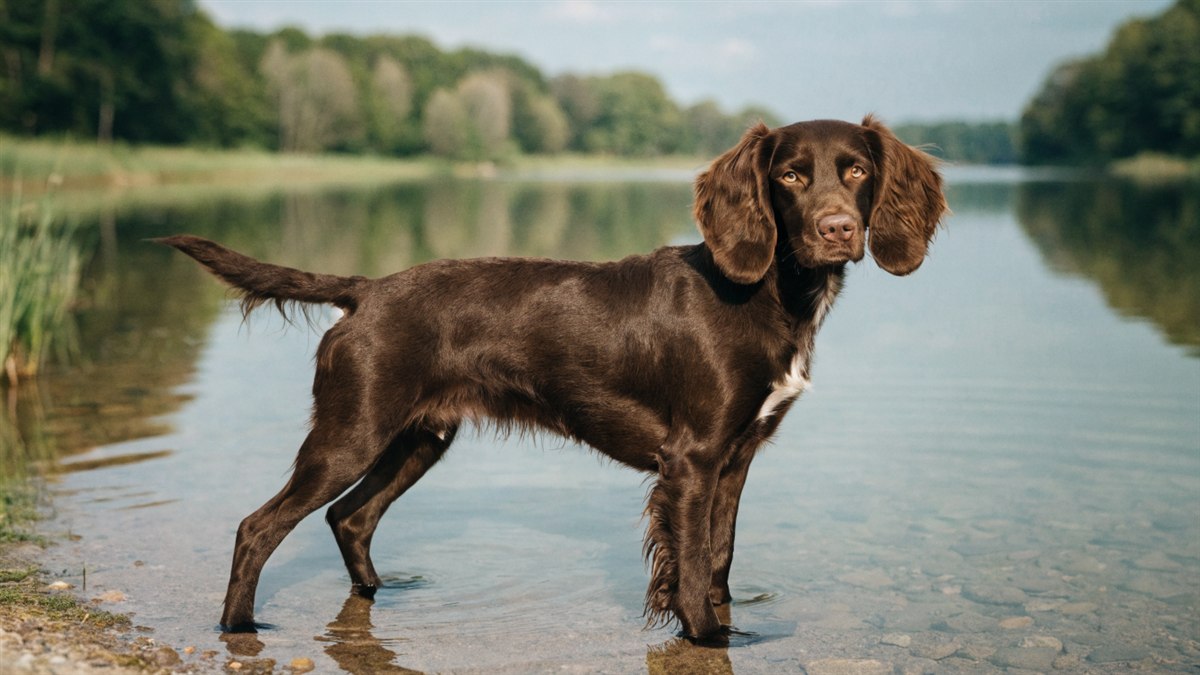
The Boykin Spaniel is a medium, solid liver-brown American flushing and retrieving spaniel developed in the Wateree River swamp of South Carolina, and it is the official state dog of South Carolina by statute. The AKC places it in the Sporting Group, recognised the breed in 2009, and ranked it 65th of 201 breeds on 2024 registrations, up ten places from 75.
Size first, because size is the whole point of the breed. The AKC standard sets the ideal height at 15.5 to 18 inches at the withers for dogs and 14 to 16.5 inches for bitches, with any variance greater than one inch above or below the ideal a major fault. Weight runs 30 to 40 pounds for males and 25 to 35 pounds for females, roughly 13.6 to 18.1 kg and 11.3 to 15.9 kg. The standard explains why: hunters needed a dog "lighter and smaller than their larger sporting dog cousins to fit in the portable section boats of the time period", which is how the breed earned the tag "the little brown dog that doesn't rock the boat";.
The coat is single, not double, and that matters in India
The standard's coat clause is the single most important line on this page for an Indian reader. It reads that the coat "can range from flat to slightly wavy to curly, with medium length", and then states plainly that "The Boykin Spaniel is typically a single coat breed but may have undercoat";. Compare that with the American Water Spaniel, whose standard makes an undercoat mandatory. A permitted single coat on a medium dog is a materially lighter thermal load than a true double coat, and it is the main reason this breed's heat rating is not the 2 out of 5 that most imported gundogs earn on this site.
Colour is fixed and narrow. The standard calls for "a solid liver color, a deep reddish brown color that includes various shades of chocolate brown, from light to very dark", with a small amount of white on the chest permitted and no other white markings allowed. Sun bleaching is explicitly acceptable, which is a quiet admission that this is a dog worked in strong sun.
Ears, feet and tail, read off the standard
Three structural features decide most of what follows. The ears are pendulous, set slightly above or level with the eye, with thin leather that "when pulled forward should almost reach the tip of the nose", hanging close to the cheeks and flat. The toes are "closely grouped, webbed and well padded", which is the answer to one of the questions the ranking set actually asks. And the tail "is docked to a length of 3 to 5 inches when fully mature", with dewclaws to be removed. That last requirement is illegal to perform in India, and it gets its own section below.
| Feature | What the AKC standard requires |
|---|---|
| Height, dogs | 15.5 to 18 inches at the withers, ideal |
| Height, bitches | 14 to 16.5 inches at the withers, ideal |
| Coat | Flat to slightly wavy to curly, medium length, typically single coated |
| Colour | Solid liver, deep reddish brown to very dark chocolate; small chest white allowed |
| Ears | Pendulous, thin leather reaching almost to the nose tip, hanging flat |
| Feet | Round, compact, toes closely grouped and webbed; dewclaws removed |
| Tail | Docked to 3 to 5 inches when fully mature |
| Trimming | May be trimmed, never shaved |
| Approved | 8 January 2019, effective 2 April 2019 |
Temperament, in the standard's own words, is "friendly, a willing worker, intelligent and easy to train", a dog that "thrives on human companionship and gets along well with other dogs and children" and shows "great eagerness and energy for the hunt yet controllable in the field";.
This breed has two governing organisations and they do not publish the same health requirements. The Boykin Spaniel Society, founded 1977, is the original registry. The Boykin Spaniel Club and Breeders Association of America is the AKC parent club. Their screening lists overlap but differ, and a seller quoting one is not quoting the other. Both lists appear in the health section below Boykin Spaniel Club and Breeders….
The founding stray, and what is actually documented
The Boykin Spaniel traces to a single stray dog found in Spartanburg, South Carolina between 1905 and 1910, and the history is unusually well attested for a breed origin story, but the parent registry itself hedges the central claim. Separating what the registry records from what the internet repeats is the useful work here, because almost every page ranking for this breed reproduces the second without the first.
What the Boykin Spaniel Society records
The registry's own history page names two men with dates. L.W. "Whit" Boykin (1861-1932) was a planter, land appraiser and sportsman of the Boykin community outside Camden, South Carolina, who with his Cantey kinsmen "experimented with many breeds" to solve the problem of hunting the Wateree from a take-apart section boat. Alexander L. White (1860-1942) was a Spartanburg banker. The registry's account of the dog itself is deliberately careful: the first Boykin Spaniel "was reportedly a small, stray spaniel type dog that befriended a banker walking from his home to the First Presbyterian Church in Spartanburg, South Carolina around 1905-1910";.
Read that sentence twice. The registry writes "reportedly", and it gives a five-year window rather than a date. It also hedges the outcrosses: "Other ancestors are reported to be the Chesapeake Bay retriever, springer spaniel, cocker spaniel, and the American water spaniel";. Reported, not recorded. That is the parent body of the breed declining to assert its own founding myth as documented fact, and no page ranking for this term mentions it.
What corroborated oral history adds
Covey Rise, working from what it describes as "corroborated oral histories in the book The Boykin Spaniel: South Carolina's Dog", places the encounter "as occurring on a summer Sunday between 1905 and 1910" near the First Presbyterian Church of Spartanburg, and then says something the club does not: "apart from these facts, the details of that day vary";. It names the more colourful versions as "spurious accounts", specifically the one in which Dumpy follows White into the sanctuary and both are ejected.
The same account supplies the second founder animal, which the registry page omits entirely. Whit Boykin "found promise in a little brown curly-coated female he named Singo, and all Boykin spaniels since and hereafter descend from this pairing";. His eldest living grandson Baynard Boykin believes his grandfather then outcrossed the Dumpy by Singo descendants to eight sporting breeds over two decades, from springer spaniels and American water spaniels to English setters and Chesapeake Bay retrievers. The article is explicit about the evidentiary status: "Official records of these litters do not exist";.
| Claim | Status | Source |
|---|---|---|
| Alexander L. White, Spartanburg banker, 1860-1942 | Documented with dates by the parent registry | Boykin Spaniel Society |
| L.W. 'Whit' Boykin, 1861-1932, of Camden | Documented with dates by the parent registry | Boykin Spaniel Society |
| A stray found near First Presbyterian, Spartanburg, 1905-1910 | Registry says 'reportedly'; Covey Rise says corroborated oral history, a summer Sunday | Both |
| The dog was named Dumpy | Consistent across registry and oral history | Both |
| The foundation bitch was named Singo | Named only in the oral-history account, absent from the registry page | Covey Rise |
| Outcrosses to Chesapeake, springer, cocker, American water spaniel | Registry says 'reported to be' | Boykin Spaniel Society |
| Outcrosses to eight breeds over two decades | Grandson's belief; 'official records of these litters do not exist' | Covey Rise |
| Registry founded 1977 on 667 foundation dogs | Quoted directly by a founding committee member | Covey Rise |
| State dog of South Carolina, 1985 | Statute, S.C. Code 1-1-655, HISTORY 1985 Act No. 31 | South Carolina Legislature |
The state dog designation is the single load-bearing claim on this page that rests on a primary legal text rather than testimony. South Carolina Code of Laws Section 1-1-655 reads, in full, "The Boykin Spaniel is the official dog of the State", with the legislative history recorded as 1985 Act No. 31, Section 1. Covey Rise dates the governor's signature to 26 March 1985, which the statute's own history line is consistent with.
One founding pair, and what the genetics literature says about it
A breed descended from one dog raises a real question about its founding gene pool, and for the Boykin Spaniel the evidence exists and is unflattering. A peer-reviewed genetics paper from 1999 describes the breed, in its own Materials section, as "a highly inbred breed afflicted with an extremely high incidence of hip dysplasia", and reports that only 5 percent of 200 random primers revealed significant polymorphisms within it.
Do the arithmetic on that figure, because it is the whole argument. Five percent of 200 primers is 10 primers. In a genetically varied population a much larger share of random markers would come back polymorphic; in this breed 190 of 200 did not. The authors chose the Boykin Spaniel precisely because it was inbred enough to make a hip-dysplasia mapping study tractable.
A second Texas A&M paper, seven years later, ran into the same wall from the other side. Tsai and Murphy genotyped 28 Boykin Spaniels across 327 microsatellite markers and reported that although "there was a positive correlation between the incidence of hip dysplasia and increased joint laxity", they "did not find significant linkage in the 28 BSs that underwent genotyping, likely owing to the small size of the pedigree";. Their average distraction index across those 28 dogs was 0.55, which is a loose-hipped population by any reading. Two further numbers in the same paper point the same way: the authors state flatly that "The breed has a high level of genetic homogeneity, according to analysis of randomly amplified polymorphic DNA", and 37 of the 272 markers they genotyped, 14 percent, came back noninformative with only one or two alleles.
The parent club says the opposite, and the two claims can both be sourced
The AKC parent club states flatly that "Boykin Spaniels have a diverse genetic makeup from their mix variety of spaniels, pointers and retrievers";. That claim is not baseless. The outcrossing programme Whit Boykin is said to have run brought in up to eight sporting breeds, and the 1977 registry did not close on two dogs, it closed on 667. Katherine "Kitty" Beard, one of the seven founding committee members, put it directly: "We weren't sure at first if we would get enough response to establish a registry, but the support was overwhelming, and in the end we wound up with 667 dogs as foundation stock";.
Bonbeno publishes the disagreement rather than resolving it, because the two positions rest on different evidence. The club's claim rests on pedigree history. The 1999 paper's claim rests on measured marker polymorphism in actual dogs. Where a history and a measurement disagree, the measurement is the one a buyer should act on.
What a small founding population looks like in the disease registers
Three OFA DNA-test tables put this breed in the top three of every breed listed, which is an unusual pattern for a breed ranked 65th of 201 by popularity. The Boykin Spaniel is 2nd of 11 breeds listed for Collie eye anomaly, 2nd of 13 for exercise-induced collapse, and 2nd for von Willebrand's disease, and 3rd for chondrodystrophy. These tables list only breeds with enough tests to appear, so they are not a population census, but appearing near the top of four unrelated recessive-disease tables is what a narrow founding base looks like from the outside.
The breed also has a disease named after it. In 2020 a North Carolina State University group sequenced a three-month-old male Boykin Spaniel with progressive weakness and found a premature stop codon in exon 13 of MTM1 (c.1467C>T, p.Arg512X), causing X-linked myotubular myopathy. The puppy was euthanised at five months. The dam was heterozygous, and three male puppies from a subsequent litter, all dead by two weeks of age, were hemizygous for the same variant. Paw Print Genetics now sells the test as "Myotubular Myopathy 1 (Boykin Spaniel Type)", and the parent club lists it in its supplemental panel.
No published inbreeding coefficient, effective population size or genome-wide diversity estimate exists for the Boykin Spaniel. A PubMed search for the breed name combined with inbreeding, genetic diversity, heterozygosity or effective population size returned zero records on 23 August 2026, with the query translation checked and three controls run in the same session: the breed name alone returned 5 records, 'Labrador Retriever' with 'genetic diversity' returned 6, and a nonsense term returned 0. The search worked. The study has not been done.
Boykin Spaniel price in India, and why no honest figure exists
There is no Boykin Spaniel price in India, because there are no Boykin Spaniels in India that anyone will show you. Four Indian commercial sites rank for the query and Bonbeno opened all four on 23 August 2026. Between them they list zero Boykin Spaniels and publish zero rupee figures attached to the breed.
| Site | What the page claims | What the page actually shows |
|---|---|---|
| Mr n Mrs Pet | "KCI-certified Boykin Spaniel Puppies" from "verified Boykin Spaniel dog breeders" | "3 Result Found", and all three are French Bulldogs, in Bangalore, Kolkata and Patna, under a heading reading "Similar breeds at other locations". No price shown; prices sit behind a sign-up wall |
| Puppiezo | "Buy KCI registered Boykin Spaniel puppies in India" | The "Available Boykin Spaniel Puppies" panel is empty. The visible price carousel offers two Maltipoos, two Poodles, a Cane Corso, a Goldendoodle, a Rottweiler and a Doxiepoo |
| Breed n Breeder | "Best Top Boykin spaniel Dog Breeders Online in India" | A breed dropdown and a phone-capture form. Zero listings, zero prices. "Mr. Vansh will connect with you to discuss the Boykin spaniel puppies price" |
| Call 4 Dog | "100% KCI Registered Boykin Spaniel Puppies", "Best price" | A spec card and a WhatsApp button whose pre-filled message reads "Please Share Best Price". No price on the page |
The 98,999 rupee figure is a Maltipoo
A reader who lands on the Puppiezo Boykin Spaniel page and scrolls will see 98,999 rupees in large type, and will reasonably assume it is the Boykin price. It is not. That figure sits on a Maltipoo puppy called Fizey. The same 98,999 appears twice more on the same page, on a second Maltipoo called Samy and on a Doxiepoo called Yoki. Three of the eight animals visible carry the identical number. It is a house price point, not a breed valuation, and Bonbeno has now caught it on nine separate pages across this site.
The 84.38 test, and what it says here
Indian pages routinely publish a "price" that is a US dollar figure run through one exchange rate, and dividing by 84.38 exposes it. Bonbeno ran the test on every rupee figure visible on the Puppiezo page. None of them resolves to a round dollar amount: 98,999 divided by 84.38 is 1,173.25; 92,599 gives 1,097.40; 94,999 gives 1,125.85; 120,000 gives 1,422.14; and 76,499 gives 906.60. These are not converted dollars. They are Indian retail price points engineered to end in 999 and 599, which is a different kind of unreliable, and worth saying plainly rather than implying a conversion that did not happen.
The only real price is in dollars, and it is not an Indian price
The one page on the India-localised pull that publishes an actual number is a US price blog. DogBreedsList gives an average Boykin Spaniel puppy price of 900 US dollars in a band of 700 to 1,200. At 84.38 rupees to the dollar that band is roughly 59,100 to 101,300 rupees, with a midpoint near 75,900. Treat that as a scale reference for what the breed costs where it exists, not as a price anyone in India can pay, because the import route that would deliver such a puppy commercially does not exist in Indian law.
Every one of the four Indian pages advertises KCI or KCI-certified Boykin Spaniels. The Kennel Club of India is India's FCI member body, and the FCI does not recognise the Boykin Spaniel at all. Its Group 8 nomenclature, Retrievers, Flushing Dogs and Water Dogs, lists 22 breeds including the American Water Spaniel and the American Cocker Spaniel, and no Boykin. Its alphabetical index of B breeds runs 42 entries from Barbet to Bullmastiff, with nothing between Bouvier des Ardennes and Bracco Italiano where a Boykin would fall. Both checks were run on 23 August 2026 and both lists returned populated.
Why no lawful Indian supply chain for this breed can form
Two independent facts close the route. Indian law restricts dog imports to three named purposes, none of which is buying or breeding, and the FCI does not recognise the Boykin Spaniel, so no KCI pedigree for it can exist. Read together they mean an Indian seller advertising a KCI-registered Boykin Spaniel is advertising something that cannot lawfully be produced here and cannot be papered from abroad.
What DGFT Trade Notice 22/2022-23 actually says
Bonbeno read the trade notice itself rather than a summary of it. Dogs fall under ITC (HS) 01061900, "Mammals: Other", and the import policy for that line is "Restricted", subject to Policy Condition 6. Policy Condition 7 then narrows it to three purposes in the notice's own words: "i. Pet dog with valid pet book and relevant records/documents in the name of importer. ii. Dogs imported by the R&D Organisations for conducting research with the recommendation of CPCSEA. iii. For the internal security by the Defence and Police Force";. Policy Condition 8 adds that "Import of commercial dogs for breeding or any other commercial activities other than the purposes mentioned above is not permitted", and paragraph 6 of the notice states that "any applications for trading/breeding purposes, or applications made on behalf of some another person/entity shall be duly rejected";.
- Permanent import as passenger baggage without a DGFT authorisation is open only to a person transferring residence to India after two years of continuous stay abroad, and only for cats and dogs.
- Anything else, including a stay abroad shorter than two years, more than two animals, or an animal not travelling as baggage, needs an import authorisation from DGFT, applied for on form ANF-2M.
- Entry is permitted only through the airports and seaports of Delhi, Mumbai, Chennai, Hyderabad, Bengaluru and Kolkata and, since October 2024, Kochi airport, seven ports in total.
- An advance No Objection Certificate from the AQCS quarantine officer must be obtained seven days before travel, relaxable to three days.
- DGFT advises starting the application at least two months before the travel date.
The practical reading for a buyer is short. A returning Indian family that already owns a Boykin Spaniel abroad, with a pet book in the owner's name and two years of continuous residence behind them, can bring their dog. Nobody can lawfully import one to sell you.
The registry route is closed too
The Kennel Club of India issues pedigrees under the FCI system, and the FCI has never recognised this breed. Bonbeno checked twice, with the returned document's own heading confirmed each time. The FCI Group 8 page, headed "Group8 : Retrievers - Flushing Dogs - Water Dogs", lists 22 breeds, including the American Water Spaniel at number 301 and the American Cocker Spaniel at 167, and no Boykin. The FCI alphabetical index for B is fully populated with 42 entries and jumps straight from Bouvier des Flandres to Bracco Italiano. Both lists were live and populated, so the absence is a finding and not a failed page load.
That leaves the AKC and the Boykin Spaniel Society as the only bodies that register this breed, and neither issues Indian pedigrees. An Indian seller offering "KCI registered Boykin Spaniel puppies" is therefore offering paperwork that does not exist for a dog it does not have Call 4 Dog, Boykin Spaniel Puppy.
On the evidence of the four pages audited, an Indian reader searching this breed is being funnelled towards French Bulldogs, Maltipoos, Poodles, a Cane Corso, a Goldendoodle, a Rottweiler and a Doxiepoo, or into a phone call Puppiezo, Boykin Spaniel Price in India Breed n Breeder, Boykin Spaniel Puppies…. If you want a brown, biddable, medium flushing spaniel that actually exists in India, the English Cocker Spaniel is the honest substitute, and it has a real Indian price range and a real Indian population behind it.
Monthly cost of ownership, honestly bounded
Three cost lines on this breed can be quoted from real published rates, and one cannot be quoted at all. Grooming, ear care and genetic screening have numbers attached. Purchase price does not, because no Indian purchase market for the breed exists, and Bonbeno will not invent a band to fill the gap.
Start with grooming, because a medium curly coat in Indian humidity is a recurring line and not a one-off. A 2026 Indian survey of salon rates puts a full groom for a medium dog, its worked examples being the Beagle, Cocker Spaniel and Boxer, at 1,200 to 2,000 rupees. A Boykin Spaniel sits squarely in that size class at 25 to 40 pounds. Assume a full groom every six to eight weeks through the monsoon and every eight to ten weeks otherwise, and the annual line is roughly 7,000 to 14,000 rupees before any medicated bathing.
The ear line is the one Indian owners underestimate
Ear care on this breed is not grooming, it is disease prevention, and the cost sits in vet visits rather than salon bills. In the Palam valley series, 81 of 2,476 dogs presented were diagnosed with otitis externa, a hospital prevalence of 3.27 percent, and 48 of those 81 cases, 59.25 percent, fell in the July to August rainy season. In the Anand series, 67 of 116 dogs presenting with ear complaints had otitis, and the authors' stated conclusion was that "the most common cause of otitis was bathing without ear plugging";. Budget for a monsoon-season vet check every four to six weeks rather than for an annual one.
Screening costs, and the shipping problem nobody mentions
The breed's mandatory DNA panel cannot currently be run in India through the recognised route, which turns a modest fee into a logistics exercise. The University of Minnesota charges 65 US dollars per dog for one to three dogs and 58 dollars each for four or more, and its own instructions require USDA importation documents for any shipment originating outside the United States. The UC Davis Veterinary Genetics Laboratory prices the same exercise-induced collapse test at 58 dollars as a single test and 27 dollars as an additional health test on the same animal.
| Test | Minimum age | Boykin Spaniel Foundation reimbursement |
|---|---|---|
| Hip dysplasia radiographs | 24 months | USD 75, paid regardless of the OFA outcome |
| ACVO ophthalmologist eye exam | 6 weeks, 12 preferred | USD 50 |
| Exercise-induced collapse, DNA | No minimum | USD 25 |
| Collie eye anomaly, DNA | No minimum | USD 25 |
| Degenerative myelopathy, DNA | No minimum | USD 25 |
| Patellar luxation evaluation | 12 months | USD 25 |
| Pulmonic stenosis, cardiac | 12 months | USD 25 |
That subsidy is real and it is generous, and it is also American. An Indian owner gets none of it, pays international courier charges on the swabs, and still has to find a veterinary ophthalmologist and a vet willing to position and submit OFA hip radiographs. Treat the screening line as a genuine barrier rather than a small fee.
Bonbeno publishes no monthly food, insurance or boarding estimate specific to this breed, because doing so would require an Indian population of Boykin Spaniels to observe and there is not one. Feed it as a 12 to 18 kg active dog, which is the honest generalisation, and read the feeding section below for the body-condition method that replaces a made-up rupee figure.
Suitability for the Indian climate, rated 3 out of 5
The Boykin Spaniel earns a 3 for heat tolerance, the highest rating Bonbeno has given an imported gundog, and the reason is mechanical rather than generous. This breed comes from a genuinely hot, humid place, and its own standard permits a single coat. Four Indian cities still beat its origin climate for months at a stretch, and two do not beat it at all.
The origin is Camden, South Carolina, on the Wateree, named by both the parent registry and the breed's published history Sharman MK. Little Brown Dogs. Covey Rise. Bonbeno queried NASA POWER's long-term climatology by explicit latitude and longitude rather than by a place slug, so no server could substitute a different location, and the API echoed the coordinates back: 34.246 north, 80.607 west, elevation 69.17 metres. One caveat is worth stating: the POWER grid is coarse enough that the Boykin community itself, 24 km south, returned identical values, so read these as the Wateree corridor rather than one village.
The origin is hot, and that is the honest starting point
Camden's hottest month is July at a 28.1 degree Celsius mean, with August at 27.4 and June at 26.5. Its climatological daily maximum peaks at 42.4 degrees in June and 42.1 in August. July relative humidity averages 68.6 percent. A dog bred to work a swamp in that is not a cold-climate animal, and pretending otherwise would be the mirror image of the mistake this site usually corrects.
But look at the annual mean, which is 17.74 degrees, and at January, which is 6.3. Camden gives the breed four months at or above a 24 degree mean and eight months below it. India's contribution is not extra heat so much as the removal of the off-season.
Wet-bulb temperature is the number that decides this
A panting dog cools by evaporation, so the ceiling on its cooling is set by how much water the air will still accept, which is what wet-bulb temperature measures. Camden's highest monthly wet-bulb is 24.5 degrees, in July. Use that single figure as the threshold the breed is demonstrably built for, and the Indian comparison resolves cleanly.
| Place | Coordinates queried | Annual mean wet-bulb, C | Peak monthly wet-bulb, C | Months above 24.5 C |
|---|---|---|---|---|
| Camden, South Carolina | 34.2465, -80.6070 | 15.0 | 24.5 (July) | 0 |
| Chennai | 13.0827, 80.2707 | 24.9 | 27.4 (May) | 7 |
| Kolkata | 22.5726, 88.3639 | 22.9 | 27.9 (June) | 6 |
| Mumbai | 19.0760, 72.8777 | 22.7 | 26.6 (June) | 5 |
| Delhi | 28.6139, 77.2090 | 18.0 | 27.7 (July) | 4 |
| Pune | 18.5204, 73.8567 | 19.7 | 23.6 (June) | 0 |
| Bengaluru | 12.9716, 77.5946 | 19.8 | 22.7 (May) | 0 |
Two Indian cities never exceed the humid heat load the breed's origin reaches in July, and both are on the Deccan plateau: Bengaluru at 841.72 metres and Pune at 635.99 metres, elevations the API returned alongside the data. Both also give the breed exactly four months at or above a 24 degree mean air temperature, the same count Camden gives it. Chennai, at the other end, spends seven months of the year above the origin's annual peak wet-bulb and never drops below a 24.1 degree monthly mean in any month of the year.
Three things cap it. The coat is solid liver to very dark chocolate, and the standard forbids shaving. India removes the recovery season that a 6.3 degree January provides. And this breed carries a collapse gene whose triggers are intense exercise plus excitement, with the University of Minnesota noting that collapse "may be more likely" when "the temperature is much warmer or the humidity is much higher than what the dog is accustomed to";. A UK primary-care study of 905,543 dogs found 395 heat-related illness events at a 14.18 percent event fatality rate, and exertional heat illness, not hot cars, is the pattern that matters for a working spaniel.
Temperament and household fit
The Boykin Spaniel is a people-oriented working spaniel, not a guard dog and not an independent one. Its own standard describes it as "friendly, a willing worker, intelligent and easy to train", a dog that "thrives on human companionship and gets along well with other dogs and children" while showing "great eagerness and energy for the hunt yet controllable in the field";.
Take the phrase "thrives on human companionship" as a requirement rather than a compliment. Published owner accounts say the breed prefers company "to such extent that having them in the home is often recommended";. A dog kept on a balcony or in a service area for the working day is being kept wrongly, and in an Indian summer that arrangement is also a heat risk.
Who this breed suits in India
- Households on the Deccan plateau, in Bengaluru or Pune, where the humid heat load never exceeds what the breed's origin climate delivers in July.
- Owners who want a medium dog they can genuinely train, and who enjoy teaching rather than commanding.
- Families with children and other dogs, which both the standard and published owner accounts describe as a natural fit.
- People who will swim the dog, throw retrieves and give it a job three or four times a week, all year, not only in winter.
- Owners willing to run and pay for a seven-test screening panel through overseas laboratories.
Who should not buy one
- Buyers wanting a watchdog. Nothing in the standard describes protectiveness, and the breed's listed virtues are all sociability.
- Chennai and Kolkata households without air conditioning and without a shaded morning routine, given the seven and six months respectively above the origin's peak wet-bulb.
- Anyone out of the house eleven hours a day. This is a companionship breed with a working engine.
- Owners who plan to leave ear care to a monthly salon visit rather than a weekly routine.
- Anyone buying on the basis of an Indian listing, because none of the four audited listings had a Boykin Spaniel to sell.
The intelligence is a training variable, not a bonus
Published owner and trainer accounts are unusually consistent that this breed's cleverness cuts both ways. Covey Rise records a professional gundog trainer's line that "a Boykin likes to do calculus to solve a simple problem, whereas other breeds will simply execute", and his recommendation to keep sessions "short, light, and positive" and to show the dog what you want before applying pressure. A dog that solves problems will also solve your gate latch, your bin lid and the question of what is behind the kitchen door.
Physically a 14 to 18 inch, 11 to 18 kg dog fits an Indian flat without difficulty; it was designed to sit in a one-man boat without rocking it. The constraint is behavioural and thermal, not spatial. An Indian commercial page rates the breed's ideal space as "Medium-Large" and its energy as "High" with "1 hour daily" exercise, which underestimates the second figure badly. Read the exercise section before you take an hour a day as sufficient.
Training approach, and what this breed resists
To train a Boykin Spaniel, teach rather than command, keep sessions short and end them while the dog still wants more. The breed standard calls it "easy to train", and every published account of working the breed converges on the same qualification: it resists pressure and rewards demonstration Sharman MK. Little Brown Dogs. Covey Rise.
The most useful sentence anyone has published on training this breed comes from a South Carolina gundog professional quoted in Covey Rise: "A Boykin wants to learn, so if they're not working against you, take that into account before applying pressure. Show them what you want out of them first. They prefer you teach them something rather than mandate it, and more often than not, you'll get a much better outcome from this approach";. That is a specific instruction, not a platitude, and it inverts the correction-first habit many Indian trainers still use.
A realistic first-year timeline for an Indian household
- Weeks 8 to 16: name response, recall on a long line indoors, crate acceptance, and daily ear handling so the dog volunteers its ears without restraint.
- Weeks 12 to 20: retrieve games with a soft dummy on a hallway or corridor, five to eight repetitions and stop. Introduce water in a shallow tub, never by throwing the puppy in.
- Months 4 to 7: sit, stay and a reliable recall proofed against distraction. Begin marked retrieves in a walled garden or a quiet park at dawn.
- Months 7 to 12: introduce steadiness, delivery to hand, and quartering. Keep every session under fifteen minutes in any month where the wet-bulb load is high.
- Months 12 onward: extend distance and complexity. Do not extend intensity in April, May or June in Chennai, Kolkata, Mumbai or Delhi.
What this breed genuinely resists
Repetition under pressure is the failure mode. The University of Minnesota's list of activities that most commonly trigger exercise-induced collapse in affected dogs reads like a training plan: "retrieving drills or repetition of difficult marks or blinds where the dog is being repeatedly corrected or is anticipating electric collar correction", and "training drills with electric collar pressure";. On a breed where 55 of 801 dogs tested at that laboratory, one in fifteen, carry two copies of the mutation, hard repetitive drilling is not merely poor technique, it is a documented collapse trigger.
Two practical consequences follow. First, run the DNA test before you begin serious retrieve work, not after the first collapse. Second, build the habit of stopping on a success rather than grinding for one more repetition, which is good spaniel training anyway and here is also a safety measure.
In Chennai, Kolkata and Mumbai the only reliable training windows from March to October are the ninety minutes after first light and the last hour before dark. In Bengaluru and Pune the window is wider, because neither city exceeds the origin climate's peak wet-bulb in any month. Plan the training year around the calendar rather than around your own free evenings, and the breed's biddable side does the rest.
Daily exercise requirement, and what happens without it
Give an adult Boykin Spaniel 60 to 90 minutes of real work a day, split across two sessions, with swimming or retrieving in at least three of them a week. The Indian commercial page that rates the breed "High" energy and then prescribes "1 hour daily" has the energy rating right and the prescription at the floor rather than the target.
The requirement comes from what the breed was built to do. The standard asks for a dog "built to cover all types of ground conditions with agility and reasonable speed", exhibited "in hard muscled working condition", showing "great eagerness and energy for the hunt";. Published accounts describe a dog that hunts doves in early autumn heat, flushes quail in dense cover and retrieves waterfowl through winter. A walk around the block does not touch that engine.
Split the day around the wet-bulb, not around your schedule
| Session | When | What |
|---|---|---|
| Morning, 35 to 50 minutes | Within 90 minutes of first light | Brisk walk plus 8 to 12 marked retrieves on grass, ending on a success |
| Evening, 25 to 40 minutes | After sunset, not before | Scent games, a short quartering pattern, or obedience under distraction |
| Water, 2 to 3 times a week | Morning slot | Swim or wade. Dry the ears immediately afterwards, every single time |
| Brain work, daily | Indoors, any time | Food puzzles, find-it games, ten minutes of shaping. This breed solves problems for fun |
Two hard rules apply in India and neither is optional. Stop at the first sign of a rocking gait, wobbliness or a dog that keeps running while dragging its hind legs, because that is the opening picture of exercise-induced collapse and dogs have died when owners let them continue. And do not exercise hard between 10am and 5pm from March to October in any city on the humid list, because exertional heat illness, not hot cars, is the pattern that kills working dogs.
What happens without it
An under-exercised Boykin Spaniel does not become calm. It becomes a problem-solving dog with nothing to solve, which in an Indian flat means door-scratching, gate work, counter surfing, vocalising at every lift arrival and destruction of anything soft. The breed's own literature is blunt that these dogs "live to please their owners" and that their energy is "manageable" only "with training and regular exercise";. Remove either half and the arithmetic fails.
The feet are webbed by standard and the breed was made for water. Swimming also loads a dysplastic hip far less than concrete does, which matters when 25.4 percent of 6,892 OFA-evaluated Boykin Spaniels came back dysplastic. The University of Minnesota notes that affected dogs are less likely to collapse while swimming, but adds that some have drowned during a collapse in water, so swim the dog where you can reach it.
Exercise-induced collapse: the real number, and what the test does not tell you
Exercise-induced collapse in this breed is caused by a single known mutation, DNM1 c.767G>T, inherited as a simple autosomal recessive, and there is a definitive DNA test for it. Two registers publish a Boykin Spaniel carrier frequency and they disagree by a factor of nearly three. Both are given below with their denominators, because averaging them would hide the more useful fact.
| Source | Dogs | Clear | Carrier | Affected | As of |
|---|---|---|---|---|---|
| University of Minnesota Canine Genetics Laboratory, all dogs tested | 801 | 484 (60.4%) | 262 (32.7%) | 55 (6.9%) | 12 September 2018 |
| OFA registry, results owners chose to register | 1,532 | 87.2% | 11.8% | 1.0% | read 23 August 2026 |
| Labrador Retriever, University of Minnesota, for scale | 45,994 | 25,910 (56.3%) | 17,265 (37.5%) | 2,819 (6.1%) | 12 September 2018 |
| Labrador Retriever, OFA registry, for scale | 9,496 | 87.2% | 12.1% | 0.7% | read 23 August 2026 |
The divergence is not a Boykin problem, it is a register problem, and the Labrador rows prove it: the same three-fold gap appears there. A university laboratory records every sample it runs, including dogs sent in because they collapsed. OFA records only the results an owner chose to publish, which skews towards breeding stock and towards clear results. The honest reading is that the true breed carrier frequency lies between 11.8 and 32.7 percent, and that a buyer should plan for the higher end.
A third source, independent of both, corroborates the laboratory figures. The Western College of Veterinary Medicine at the University of Saskatchewan, whose clinicians described the syndrome, states that the mutation "has been identified in Boykin spaniels (33 per cent carriers, seven per cent affected)";. That is the Minnesota table rounded, from a different institution.
Convert the Minnesota counts into an allele frequency and the scale becomes plain. With 262 carriers and 55 affected among 801 dogs, the mutant allele accounts for 372 of 1,602 chromosomes, or 23.2 percent. Roughly one Boykin Spaniel gene copy in four, in that tested population, carries the variant. OFA's numbers give 6.9 percent by the same arithmetic.
What a cheek swab tells you
- Test a dog and you get a definitive genotype, because this is a test for the actual mutation rather than for a linked marker.
- Clear, written N/N, means the dog will not collapse from this mutation and cannot pass it to a puppy.
- Carrier, written N/EIC, means the dog will not collapse from this mutation but will pass it to half its offspring. Two carriers bred together produce 25 percent affected puppies.
- Affected, written EIC/EIC, means the dog is prone to collapse under intense exercise with high excitement.
What it does not tell you
Three limits matter and none of them is on the lab report. First, the affected genotype is not a diagnosis of certainty: Minor and colleagues state explicitly that "the DNM1 EE genotype is not completely penetrant", and Minnesota records that a few affected dogs never collapse, probably because they never meet the right combination of exercise and excitement University of Minnesota College…. Second, it does not predict severity, and Saskatchewan notes that deaths have not been confined to dogs rated severely affected. Third, a clear result does not explain a collapse you have already witnessed, because heat stroke, an unusual Labrador-associated epilepsy, malignant hyperthermia and cardiac disease all produce collapse and all need ruling out separately.
An Indian vet seeing a collapsed brown spaniel in May will reach for heat stroke, and will usually be right. The two conditions separate on recovery and on bloods. Heat stroke gives a slow or prolonged recovery over hours to days, muscle enzymes typically seven to eleven times normal, and severe persistent mentation change in 80 percent of cases. Exercise-induced collapse resolves in 5 to 25 minutes with normal laboratory results and no residual weakness. Body temperature is no help at all: it averages 41.7 C during an EIC collapse and reaches 42.2 C, but normal dogs doing the same exercise reach the same temperatures.
Grooming and coat care in Indian humidity
Groom a Boykin Spaniel twice a week with a slicker and a comb, trim rather than clip, and never shave it. The standard permits a coat ranging "from flat to slightly wavy to curly, with medium length", says the breed is "typically a single coat breed but may have undercoat", and instructs that the coat "may be trimmed, never shaved";.
That single-coat clause is the reason this breed is easier to keep in a humid Indian city than most imported gundogs, and it is also the reason the usual Indian shortcut is off the table. A dog with no obligatory undercoat does not need the aggressive de-shedding a Golden Retriever needs. A dog whose standard forbids shaving cannot be clipped to the skin in April, which is what most Indian salons will offer for a brown curly coat they do not recognise. Say no, and ask for a trim around the head, throat, ears, tail and feet, which is exactly what the standard describes as legitimate.
Shedding, and the hypoallergenic question
This breed sheds. The AKC's own trait card carries a Shedding Level rating for it, and the Indian retail page selling the breed prints "Shedding: Yes" on its own spec card Puppiezo, Boykin Spaniel Price in India. Anyone offering you a Boykin Spaniel as a low-shed or allergy-safe dog is selling something the breed's paperwork does not support, and the underlying claim is unsupported for every breed. See the FAQ below for the measured evidence.
A weekly routine that works in an Indian monsoon
| Task | Dry season | Monsoon and post-swim |
|---|---|---|
| Brush and comb through | Twice weekly | Twice weekly, plus after every swim |
| Ear check, lift and look | Twice weekly | Daily |
| Ear dry after water | Every time | Every time, and towel the canal opening, never plug cotton deep |
| Bath | Every 6 to 8 weeks | Only when needed, with the ears protected |
| Full salon groom | Every 8 to 10 weeks, 1,200 to 2,000 rupees for a medium dog | Every 6 to 8 weeks |
| Feet and between-toe trim | Monthly | Fortnightly, because wet feathering holds grit and moisture |
| Nails | Every 3 to 4 weeks | Every 3 to 4 weeks |
Air drying is Wisconsin advice
Overseas breed clubs write grooming guidance for their own climate, and the instruction to towel a spaniel off and let it air dry is sound in a North American autumn and wrong in a Mumbai July. In the Palam valley series, 48 of 81 canine otitis externa cases, 59.25 percent, presented in the July to August rainy season, against 15 in the April to June summer and 10 in winter. In Gujarat, the Anand group's stated conclusion was that "the most common cause of otitis was bathing without ear plugging", and it advised owners on "routine ear cleaning and plugging of ears while bathing of dogs to prevent the chances of moisture retention";. Dry the dog actively, with a towel and a cool blower on a low setting, and dry the ear folds specifically.
The standard equips the ears, chest, legs and belly with "light fringe or feathering" and permits trimming about the ears. In India that trim is functional: shorter feathering on the underside of a pendulous ear leaf dries faster and traps less. The AKC parent club runs a dedicated ear-care seminar for owners, which is not something most breed clubs bother to do.
Pendulous ears in an Indian monsoon, and an arithmetic correction
The Boykin Spaniel's ears are the breed's highest-risk feature in India, because the standard writes three recognised predisposing factors for otitis externa straight into the dog. The ears are pendulous, the leather is long enough that "when pulled forward should almost reach the tip of the nose", they hang close to the cheeks and flat, and the breed is bred to swim.
Two Indian series give the local picture. At CSK HPKV Palampur, 81 of 2,476 dogs presented between June 2022 and July 2023 were diagnosed with otitis externa, a hospital prevalence of 3.27 percent, and the authors identify "breeds with pendulous or densely haired ears" as predisposed "due to poor ventilation and moisture retention";. At Anand Agricultural University in Gujarat, 67 of 116 dogs presenting with ear complaints had otitis, 57.76 percent, and "most of the cases had history of bathing before seven to twelve days".
The pendulous-ear figure does not divide out, and the correct count is 56
Bonbeno divides out every percentage it is handed, and one figure in the Palampur paper fails. Table 5 prints the predisposing factor "Pendulous ear breed" as 53 cases at 69.13 percent. Those two numbers cannot both be right, and three independent checks all point the same way.
- Divide it out. 53 of 81 is 65.43 percent, not 69.13 percent. Work backwards instead and 69.13 percent of 81 is 55.99, which rounds to 56.
- Check the complement. The same table prints "Erect ear breed" as 25 cases at 30.86 percent, and 25 of 81 is 30.864 percent, which is correct. Add the two counts and 53 plus 25 gives 78, three short of the paper's own n of 81. Substitute 56 and the total is exactly 81.
- Check the percentages sum. 69.13 plus 30.86 is 99.99, which is what a clean two-way split of 81 should give. A 65.43 plus 30.86 split gives 96.29 and leaves three cases in no category at all.
So the count is 56, printed as 53 in error, and Bonbeno reports it as 56 of 81, or 69.1 percent. The likely source of the slip is visible in the same paper: cocci-associated bacteria in 30 cases plus rod-associated in 23 gives 53, and the text prints "Bacterial infections were present in 65.43%", which is exactly 53 of 81. A genuine 53 and 65.43 percent pair exists a few lines away, and one half of it landed in the wrong row.
What else in that paper does and does not check out
The rest of the audit is reassuring with three exceptions. Every figure in the age, sex and season tables divides out exactly against n equals 81, including the rainy-season 48 at 59.25 percent and the 1 to 5 year age band's 34 at 41.97 percent. In the breed table, two entries of 10 cases each, Pomeranian and Mongrel, are printed at 12.43 percent where 10 of 81 is 12.35, and the season table prints the same count correctly as 12.34 percent, so 12.43 is a second transposition. The Pug's 8 cases are printed at 9.80 percent where 8 of 81 is 9.88. And the text opens the aetiology paragraph with "In a study of 50 cases of Otitis externa" while every fraction in that paragraph is expressed out of 81.
Ears are not the only reason to run your hands over this dog after every outing. A 2024 multiplex PCR survey of 719 dogs at Ludhiana in Punjab found Babesia gibsoni in 8.9 percent, Hepatozoon canis in 5.1 percent, Ehrlichia canis in 2.6 percent and Babesia vogeli in 1.1 percent, with microscopy alone detecting far less than PCR in every case. A long-eared dog that pushes through Indian scrub and swims in standing water collects ticks in the ear folds, between the toes and in the leg feathering, which are the three places an owner is least likely to check. Keep tick prophylaxis continuous rather than seasonal.
Whether the figure is 53 or 56, roughly two in three Indian otitis cases in that series occurred in dogs with pendulous ears, and this breed has them by standard. Lift and look at both ears daily through the monsoon. Dry the ear after every swim and every bath. Plug the ears before bathing, which the Gujarat authors advised their own clients to do. Treat head shaking, pawing at the ear or a foul smell as a same-week vet visit, not a wait-and-see.
Health risks and screening, with the denominators
Hip dysplasia is this breed's defining health problem and the number is large. OFA records 25.4 percent dysplastic hips across 6,892 Boykin Spaniel evaluations, which places the breed 33rd of the 220 breeds in the hip table and is 1.8 times the all-breed figure of 14.2 percent across 1,711,996 evaluations.
Bonbeno read those rows off OFA's own statistics dump on 23 August 2026, having first read the breed code out of OFA's advanced-search markup, where the checkbox carries value BY and data-name BOYKIN SPANIEL in the AKC Sporting Group. A guessed OFA code silently returns a complete, plausible table for a different breed, so the code was confirmed rather than assumed. Live registers drift, so every figure below is published with the evaluation count it rests on and the date it was read.
| Database | Boykin evaluations | Boykin result | All breeds | Breed rank |
|---|---|---|---|---|
| Hips | 6,892 | 72.9% normal, 25.4% dysplastic (15.5 mild, 8.5 moderate, 1.4 severe) | 14.2% dysplastic of 1,711,996 | 33 of 220 |
| Patella | 2,636 | 95.9% normal, 4.1% abnormal (3.2 grade 1, 0.8 grade 2, 0.1 grade 3) | 3.5% abnormal of 225,384 | 50 of 173 |
| Elbows | 2,148 | 97.2% normal, 2.7% abnormal | 12.0% abnormal of 649,720 | 114 of 166 |
| Eyes, CAER | 4,399 | 93.2% normal, 6.8% abnormal | 6.6% abnormal of 885,999 | 56 of 237 |
| Basic cardiac | 1,435 | 99.9% normal | 99.7% normal of 120,641 | 28 of 142 |
| Congenital cardiac | 1,819 | 99.8% normal | 98.9% normal of 209,851 | 104 of 157 |
| Degenerative myelopathy, DNA | 1,465 | 87.4% clear, 11.7% carrier, 0.9% at risk | 65.5% clear of 90,460 | 65 of 111 |
The hip figure is old news, and that is the point
This is not a new finding, and the useful part is that it is moving in the right direction. A 1999 Journal of Heredity paper chose the breed as its hip-dysplasia model because it was "a highly inbred breed afflicted with an extremely high incidence of hip dysplasia";. Writing in 2006, Tsai and Murphy recorded that across the 1974 to 2003 window "the OFA evaluated more than 1400 BSs: approximately 40% were classified as showing dysplasia, and less than 1% received an excellent score", and that the breed then held "the 9th-highest incidence of hip dysplasia" of any breed. Read against today's 25.4 percent of 6,892 evaluations, 5.3 percent excellent and rank 33 of 220, that is roughly a 15 percentage-point fall and a 24-place improvement over about two decades of screening. It is still a quarter of the breed.
Patellar luxation is the second orthopaedic line and it is milder than the reputation suggests. At 4.1 percent abnormal of 2,636 evaluations the breed sits slightly above the all-breed 3.5 percent, and 3.2 of those 4.1 percentage points are grade 1, the least severe grade. Both parent bodies still require the evaluation, from 12 months of age Boykin Spaniel Club and Breeders….
The Boykin Spaniel does not appear in OFA's thyroid table at all. That table is populated with 128 breed rows and an all-breed total of 121,377 evaluations, and the same document returns 73 Boykin Spaniel rows across its other tables, so the search was working and the breed is simply below OFA's listing threshold for thyroid. Indian law nonetheless names hypothyroidism among the genetic defects a breeding dog must be tested for, alongside hip dysplasia, in the Second Schedule Part III paragraph 8(10) of the Dog Breeding and Marketing Rules 2017.
Two distraction-index figures exist for the breed and they are not the same measurement. The PennHIP registry gave the Boykin Spaniel the 12th-highest mean distraction index of any breed at 0.64, while the 28 dogs Tsai and Murphy genotyped averaged 0.55, against the authors' own affected threshold of a distraction index above 0.60. A higher index means a looser hip and a higher probability of osteoarthritis, so both figures sit on the wrong side of comfortable and the registry-wide one sits above the study's own cut-off.
Life expectancy, where four sources disagree and none is a study
No published longevity study exists for the Boykin Spaniel, so Bonbeno publishes a range rather than a number. The four figures in circulation span 10 to 16 years, and the difference between them is larger than most owners realise.
The AKC gives 10 to 15 years. Hill's gives 14 to 16. The Indian retail page selling the breed gives 12 to 14, and a second Indian page gives 14 to 16 Call 4 Dog, Boykin Spaniel Puppy. That is a six-year spread on the low end and a two-year spread on the high end. Bonbeno publishes no single figure, because a PubMed search for the breed returns five records in total and not one of them is a longevity study.
| Source | Figure | Basis given |
|---|---|---|
| American Kennel Club breed page | 10 to 15 years | None stated |
| Hill's Pet Nutrition breed page | 14 to 16 years | None stated |
| Puppiezo, Indian retail listing | 12 to 14 years | None stated |
| Call 4 Dog, Indian retail listing | 14 to 16 years | None stated |
| PubMed | No figure | Five records for the breed in total, none on longevity |
Notice which way the retail pages lean. The two Indian sellers publish the top of the range or close to it, and the American Kennel Club, which has no puppy to move, publishes the widest and lowest band Call 4 Dog, Boykin Spaniel Puppy. That is a pattern worth carrying into every other claim a listing page makes about this breed.
Nothing in the published lifespan figures is actionable, but three things on this page are. A collapse episode allowed to continue can kill an affected dog outright. Heat-related illness carried a 14.18 percent event fatality rate across 395 cases in a UK primary-care population of 905,543 dogs, in a climate far milder than India's. And a dysplastic hip carrying excess weight shortens comfortable years rather than total ones. Manage those three and the lifespan question mostly answers itself.
Collie eye anomaly in a spaniel, and what 4,391 eye exams found
The Boykin Spaniel carries collie eye anomaly at the second-highest carrier frequency of any breed OFA lists, which is an odd thing to say about a South Carolina gundog. OFA records 25.9 percent carriers and 1.0 percent affected across 1,447 Boykin Spaniel CEA tests, against an all-breed 13.8 percent carrier rate of 5,856 tests.
Only the Collie itself ranks above it in that table, at 41.2 percent affected of 408 tests, and the Australian Shepherd sits below at 3.7 percent carriers of 216. Collie eye anomaly is an autosomal recessive disorder of eye development in the NHEJ1 gene, and the Boykin Spaniel Society describes it in its own checklist as "a genetic eye disease, prohibiting proper development of many eye parts" that "leads to partial or full blindness";. Both parent bodies have required the DNA test since 1 November 2015.
The reassuring part of that number is the gap between 25.9 percent carriers and 1.0 percent affected. A quarter of tested dogs carry one copy and one in a hundred carries two, which is what a recessive disease looks like when breeders are testing and avoiding carrier-to-carrier matings. The unnerving part is that a quarter of a breed carrying any single recessive is a lot, and it belongs in the same paragraph as the 1999 finding that only 5 percent of 200 random primers were polymorphic in this breed.
What the eye examinations themselves found
OFA's CAER by-diagnosis tables give a separate and larger picture, built on 4,391 Boykin Spaniels examined by veterinary ophthalmologists. Of those, 2,829 were recorded normal, which is 64.4 percent. That figure is lower than the 93.2 percent normal in the summary eye table because the by-diagnosis tables record every observed finding, including minor ones that do not block certification.
| Finding | Dogs | Percent of 4,391 |
|---|---|---|
| Normal | 2,829 | 64.4 |
| Distichiasis (eyelids 25.110) | 617 | 14.1 |
| Cataract, significance unknown (lens 100.210) | 354 | 8.1 |
| Punctate cataract, anterior cortex | 140 | 3.2 |
| Punctate cataract, capsular | 133 | 3.0 |
| Persistent pupillary membranes, iris to iris | 125 | 2.8 |
| Persistent hyaloid artery (vitreous 110.120) | 84 | 1.9 |
| Incipient cataract, posterior cortex | 84 | 1.9 |
| Persistent pupillary membranes, lens pigment foci | 79 | 1.8 |
| Punctate cataract, nucleus | 73 | 1.7 |
Distichiasis at 14.1 percent is the standout, and it is a practical problem rather than an abstract one. Extra lashes growing from the meibomian gland openings rub the cornea, and in a dusty Indian summer that irritation compounds. If a Boykin Spaniel in your house squints, tears or rubs one eye repeatedly, ask specifically about distichiasis rather than accepting conjunctivitis as the diagnosis.
Juvenile cataract is why the Boykin Spaniel Society sets its eye-exam minimum age at six weeks, with twelve weeks preferred, and puts the ophthalmologist reimbursement at 50 US dollars, its second-largest. Cataract findings of unknown significance in 354 dogs, 8.1 percent, are the register's way of recording changes an ophthalmologist saw but could not classify.
Four separate PRA tests appear in the OFA record for this breed and every one comes back near-clear: general PRA 99.4 percent normal of 162, rcd4 PRA 98.3 percent of 351, cone rod dystrophy 99.2 percent of 128, and PRA-crd4/cord1 98.5 percent of 65. Progressive retinal atrophy is one of the genetic defects Indian law requires a breeding dog to be tested for, and on the published evidence this breed would pass it comfortably.
The breed standard requires a procedure India forbids
The AKC standard for this breed is not optional about the tail. It states that "The tail is docked to a length of 3 to 5 inches when fully mature", and under Forequarters it states that "Dewclaws should be removed";. Both procedures are prohibited outright in India, and no page written about this breed anywhere appears to have noticed.
The prohibition is not ambiguous and it is not buried. The Prevention of Cruelty to Animals (Dog Breeding and Marketing) Rules, 2017, notified as G.S.R.496(E) on 23 May 2017, carry it in the Second Schedule, Part II, General requirements to be adhered to by breeders, at paragraph 6(8). Bonbeno extracted the gazette text and read the clause directly rather than a summary of it. It reads: "There shall be no tail docking, ear cropping de-barking, de-clawing, branding, dyeing, injecting substances to enhance visual appeal, performing a surgery or procedure to camouflage or hide any defect or infirmity or any other kind of mutilation of any body part of the pup and any change of appearance by artificial means is strictly forbidden";.
Note the numbering, because this document numbers its clauses twice and agents have got it wrong before. Part II opens with paragraph 5, Breeding requirements, and paragraph 6, Breeding techniques, whose sub-paragraph (8) is the clause above. Separately, Rule 8(1)(a) in the body of the Rules is the provision that "pups less than eight weeks in age are not sold". Two different eights, two different documents-within-a-document.
Why the tail is docked at all
The reason is specific and it has expired. Whit Boykin docked his spaniels' tails to stop them rustling fallen leaves while he called wild turkeys in autumn, and although a fall turkey season no longer exists in South Carolina, the docked-tail standard remains in the breed. A cosmetic requirement that outlived its function is exactly the category the 2017 Rules were written to close, and paragraph 6(9) of the same Second Schedule adds that "Breeding to create new breeds of dogs or unusual looks shall be strictly prohibited".
What this means in practice for an Indian owner
- A Boykin Spaniel bred and raised lawfully in India would have a full natural tail and its dewclaws, and would therefore fail its own breed standard on two counts.
- A breeder in India who docks a Boykin Spaniel puppy's tail has committed a breach of paragraph 6(8), regardless of what the American standard says.
- An imported pet dog already docked abroad is a different case. The 2017 Rules bind breeders in India; they do not retrospectively criminalise a dog that arrives with a docked tail and a valid pet book.
- Any Indian seller who offers you a docked Boykin Spaniel puppy is either lying about the dog's origin or admitting to the procedure. Ask which.
The same Rules also prohibit father-to-daughter and half-sibling matings, defining incest breeding as "mating between parents and children or between brother and sister" and in-breeding as mating within the first four generations, and permitting only out breeding and line breeding. On a breed descended from one recorded pair, whose own foundation registry closed on 667 dogs, that clause is not theoretical. In the copy Bonbeno extracted, those mating prohibitions sit in the same Second Schedule Part II paragraph 6, at sub-paragraph (3), two clauses above the docking ban. Any breeding advice imported from an American club has to be checked against it before it is followed here.
Feeding, body condition and nutrition
Feed a Boykin Spaniel to a body condition score, not to a cup measurement, and keep it at the lean end of ideal for life. The breed's adult weight range is 11.3 to 18.1 kg, and on a dog where a quarter of screened hips come back dysplastic, every extra kilogram is loaded onto a joint that may already be loose.
The measurement to use is the WSAVA nine-point body condition score. At the ideal score of 5 the chart's own wording is "Ribs palpable without excess fat covering. Waist observed behind ribs when viewed from above. Abdomen tucked up when viewed from side";. Run your hands over the ribs weekly and look down at the dog from above. If you cannot feel individual ribs through a thin fat layer, reduce the ration by ten percent and reassess in three weeks.
Why leanness matters twice on this breed
The first reason is orthopaedic and obvious. The second is thermal and is measured. The UK primary-care study of 905,543 dogs found that "higher bodyweight relative to the breed/sex mean" was a significant risk factor for heat-related illness on multivariable analysis, alongside breed and being over two years of age. A heavy Boykin Spaniel in a Chennai May is carrying two separate penalties at once, and body condition is the only one of them an owner controls day to day.
| Life stage | Meals per day | What to watch |
|---|---|---|
| 8 to 16 weeks | 4 | Steady growth, never rapid. Weigh weekly and plot the curve |
| 4 to 8 months | 3 | Keep visibly lean through the growth spurt; this is a dysplasia-prone breed |
| 8 to 14 months | 2 | Transition to adult food. Reassess body condition monthly |
| Adult, 14 months on | 2 | Body condition score 4 to 5. Main meal after the evening walk, not before the morning one |
| Senior, 8 years on | 2 | Watch for hind-limb stiffness rising with any weight gain |
In an Indian summer, timing matters as much as quantity. Feed the larger meal in the evening after the dog has cooled from exercise, and keep the pre-exercise morning feed small. A full stomach and hard work in humid heat is a poor combination for any dog and a worse one for a breed whose collapse trigger is intense exertion with excitement.
Availability in India, and one Indian list to ignore
No breed-specific food is required or available. A good medium-breed adult formula from any of the brands stocked in Indian pet retail meets the requirement, and there is no evidence base for a Boykin-specific diet. What does deserve correction is the food-safety list the Indian retail page publishes for this breed, which names almonds, avocados, cherries, grapes, lemon, onions, salt and sugar. Grapes and onions belong on that list. Chocolate, xylitol and macadamia nuts, the three most common serious canine poisonings, do not appear on it at all.
The single most useful nutritional intervention for this breed in India is unlimited cool water in more than one place, refilled through the day. Nothing else on the shelf comes close. Joint supplements have not been shown to prevent hip dysplasia, which is a developmental and heritable disorder, and no supplement affects the DNM1 genotype. Spend the money on the screening panel instead.
Month by month through the first year
The Boykin Spaniel's first year has three fixed calendar points set by its own health programme, and everything else is built around them. The exercise-induced collapse and collie eye anomaly DNA tests have no minimum age, the patella evaluation begins at 12 months, and hip radiographs are not read until 24 months.
| Age | Health and legal | Training and handling |
|---|---|---|
| Before 8 weeks | No lawful sale. Rule 8(1)(a) of the Dog Breeding and Marketing Rules 2017 requires that "pups less than eight weeks in age are not sold" | Puppy stays with the litter |
| 8 to 10 weeks | First vaccinations; Indian law expects the course to start at seven to eight weeks. Send the EIC, CEA and DM cheek swabs now | Name, crate, daily ear handling, gentle novel surfaces |
| 10 to 16 weeks | Vaccination course completes by about 18 weeks. First veterinary ophthalmologist exam possible from 6 weeks, 12 preferred | Socialisation window. Lifts, traffic, autos, temple bells, monsoon rain on a roof |
| 4 to 6 months | Tick prophylaxis in place before the first monsoon. Weigh monthly and plot | Recall on a long line, soft dummy retrieves, first shallow water |
| 6 to 9 months | Watch for hind-limb weakness after excitement. Collapse can begin as early as 5 months | Short quartering, delivery to hand, no repetitive drilling |
| 9 to 12 months | Patella evaluation from 12 months. Cardiac auscultation from 12 months | Extend distance, not intensity. Adjust every session to the season |
| 12 to 24 months | Hip radiographs at 24 months, the earliest OFA will read them | Full adult workload, still season-limited |
The three months that decide the dog
Weeks 8 to 16 are the socialisation window and in India they are also the window in which the ear habit is either built or lost. Handle both ears every single day from the day the puppy arrives, lift the leather, look inside, touch the canal opening, and pay for it. A dog that volunteers its ears at eight months is a dog whose owner will actually check them in July. A dog that has to be wrestled is a dog whose ears get checked when it is already shaking its head.
Introduce water in the same window and introduce it gently. The breed has webbed feet and will take to swimming, but a puppy thrown into a tank learns the opposite lesson. Start with a shallow tub, then a still pond edge, and dry the ears afterwards every time from the very first session, so that drying becomes part of swimming rather than an argument after it.
When to worry, and about what
Signs first appear in young dogs, usually between five months and three years, with an average onset around 14 months, and the picture is characteristic: a rocking or forced gait, then hind limbs that will not bear weight, in a dog that often keeps trying to run. It worsens for three to five minutes even after exercise stops. Most dogs recover fully in 5 to 25 minutes. If you see this once, stop that session immediately, cool the dog, and book the DNA test rather than deciding it was just the heat.
Hips cannot be certified until 24 months, which means the whole of the first year is spent with an unknown joint. Treat the puppy as if it will be one of the 25.4 percent. That means no stairs on repeat, no jumping down from height, no long lead-walks on concrete, no forced running alongside a bicycle, and a lean body condition throughout. None of this prevents dysplasia, which is heritable, but it avoids adding to it.
How the Boykin Spaniel compares with the breeds Indians can actually get
Against every gundog an Indian buyer can realistically obtain, the Boykin Spaniel has the worst hips and the second-worst collapse-gene burden, and it is the only one of them with no Indian population at all. The comparison below uses two registers with published denominators rather than opinion.
| Breed | OFA hips dysplastic | Hip evaluations | DNM1 carriers | Dogs DNM1 tested | Available in India |
|---|---|---|---|---|---|
| Boykin Spaniel | 25.4% | 6,892 | 32.7% | 801 | No |
| Golden Retriever | 19.3% | 192,883 | 0.2% | 422 | Yes, widely |
| Chesapeake Bay Retriever | 19.1% | 16,734 | 17.6% | 888 | Rarely |
| Curly-Coated Retriever | 15.1% | 1,512 | 40.1% | 426 | No |
| Beagle | 18.5% | 1,777 | 0% | 43 | Yes, widely |
| Labrador Retriever | 11.3% | 324,662 | 37.5% | 45,994 | Yes, most widely |
| American Water Spaniel | 7.8% | 984 | 0% | 120 | No |
| English Cocker Spaniel | 6.0% | 10,115 | 0% | 4 | Yes |
Read the two right-hand columns together and the shape of the problem appears. The Labrador Retriever carries the collapse mutation at a higher carrier rate than the Boykin Spaniel but has hips more than twice as good. The English Cocker Spaniel, the closest available equivalent in size, temperament and job, has hips four times better, though its four dogs in the DNM1 dataset are too few to mean anything and the laboratory's separate unspecified-variety Cocker Spaniel row shows one carrier in 12. The American Water Spaniel, the Boykin's nearest structural relative, returned zero carriers across 120 dogs tested.
What the Boykin Spaniel offers that the alternatives do not
- A hotter origin climate than any other gundog on this list. Camden, South Carolina runs a 28.1 degree July mean and a 24.5 degree July wet-bulb, which is warmer and more humid than the origin of every breed above it here.
- A permitted single coat, where the Golden Retriever and the American Water Spaniel both carry mandatory or near-universal undercoats.
- A compact 11 to 18 kg frame designed to sit still in a small boat, which suits an Indian flat better than a 30 kg retriever does.
- A parent-body health programme that subsidises seven separate screening tests, which is unusual generosity even among well-run breed clubs.
The honest recommendation
If what you want is a brown, biddable, medium flushing spaniel that swims, the English Cocker Spaniel is the answer in India and the Boykin Spaniel is not. The Cocker exists here, has a real price range, has a real population of Indian vets who recognise it, and has substantially better published hips. If what you want specifically is heat resilience in a working dog, the Indian Pariah Dog beats every breed in the table above and costs nothing to adopt.
Two situations. First, a returning family that already owns one abroad and is bringing it home under the pet-baggage route, in which case this page is a care guide rather than a buying guide. Second, a Bengaluru or Pune household with a genuine working interest, where the climate never exceeds the breed's origin conditions and the owner will run the full screening panel. Outside those two cases, pick the Beagle or the Cocker and be happier.
Mistakes Indian buyers and owners actually make with this breed
The commonest mistake is believing that a Boykin Spaniel is for sale in India, and it is made because four commercial pages rank for the query while listing none of the breed. The rest of the list follows from the coat, the ears, the hips and one gene.
Buying mistakes
- Reading a price off the page and assuming it is the breed's. The 98,999 rupees visible on the Puppiezo Boykin Spaniel page belongs to a Maltipoo, and the same number appears twice more on that page against a second Maltipoo and a Doxiepoo.
- Accepting a KCI claim. All four Indian pages advertise KCI or KCI-registered Boykin Spaniels. The FCI does not recognise the breed in Group 8 or in its alphabetical index, so no KCI pedigree for it can exist Federation Cynologique Internationale.
- Paying a deposit against a photograph. Two of the four pages show no listing at all and exist to capture a phone number.
- Assuming the import route can be arranged. Indian import policy permits a dog only as a pet with a valid pet book in the importer's name, for CPCSEA-recommended research, or for Defence and Police use, and states that applications for trading or breeding "shall be duly rejected".
- Buying a docked puppy in India without asking who docked it. The procedure is forbidden here.
Ownership mistakes
- Letting the dog air dry after swimming. That instruction comes from a temperate climate. In the Palam valley series 59.25 percent of otitis cases fell in the July to August rains, and the Gujarat authors named bathing without ear plugging as the commonest cause.
- Shaving the coat for summer. The standard states the coat "may be trimmed, never shaved". Trim the feathering and shorten the ear underside instead.
- Treating one collapse as heat exhaustion. Recovery separates them: exercise-induced collapse resolves in 5 to 25 minutes with normal bloods, heat stroke does not. Test the dog rather than guessing.
- Drilling retrieves for another repetition. Repetitive marks with correction pressure is on the University of Minnesota's own list of collapse triggers.
- Exercising hard between 10am and 5pm from March to October. Chennai spends seven months of the year above the wet-bulb the breed's origin reaches only in July.
- Skipping the hip radiographs because the dog looks sound at 18 months. OFA does not read hips before 24 months, and 25.4 percent of 6,892 evaluated dogs came back dysplastic.
The mistake the internet makes
Almost every page written about this breed reproduces the founding story as settled fact, when the parent registry itself writes "reportedly" and gives a five-year window, and the fullest published account states that "official records of these litters do not exist"; Sharman MK. Little Brown Dogs. Covey Rise. A reader who knows that the origin is oral history is better placed to evaluate the rest of what a seller tells them. The ranking set is otherwise accurate on the checkable facts and unhelpful on the useful ones. A US gundog-kennel brand correctly reports the breed "only becoming an official registered breed with the American Kennel Club in 2009";, Wikipedia carries a nine-section article covering appearance, hunting use, temperament, care, history and health, and Orvis publishes the three reader questions this page answers verbatim in its own Breed FAQ. None of the three carries a single OFA denominator, a wet-bulb figure, an Indian price audit or the Indian legal position on the docked tail.
Continuing exercise past the first wobble. Saskatchewan records that "a few dogs have died during or immediately after an episode of exercise-induced collapse", with inadequate ventilation and hyperthermia the suspected mechanisms, and that these deaths were not confined to dogs rated severely affected. Stop at the first hint of incoordination, cool the dog with water, keep the airway unobstructed so it can pant, and enforce rest until it is fully recovered.
Adoption, and how to source responsibly
Adopt rather than buy, because in India buying this breed is not actually available to you and adopting a dog is. There is no Indian Boykin Spaniel rescue, no Indian breed club and no Indian population from which a rescue could form, and Bonbeno will not pretend otherwise to fill a section.
The realistic Indian adoption route for someone drawn to this breed runs through the shelters that already exist. What attracts buyers to a Boykin Spaniel is a medium, brown, water-loving, biddable dog that fits a flat and wants a job. Indian shelters are full of medium brown dogs that want a job, and the Indian Pariah Dog additionally has erect ears, which removes the single biggest health liability on this page. Spaniel-type crossbreds turn up regularly in Mumbai, Bengaluru, Delhi and Chennai shelter listings.
If you already own one and are moving to India
This is the one route that works, and it is worth spelling out because the DGFT notice is not written for a general reader. Permanent import as passenger baggage without a DGFT authorisation is available only to a person transferring residence to India after two years of continuous stay abroad, and only for cats and dogs. If your stay abroad was shorter, or the dog is not travelling as baggage, or you have more than two animals, you need an import authorisation from DGFT on form ANF-2M, applied for at least two months before travel. Entry is restricted to the airports and seaports of Delhi, Mumbai, Chennai, Hyderabad, Bengaluru and Kolkata and, since October 2024, Kochi airport, and an advance No Objection Certificate from the AQCS quarantine officer is required seven days before travel Department of Animal Husbandry…. The full route is set out in how to import a dog to India.
Verifying a breeder, if you are sourcing abroad
- Ask for OFA numbers, not verbal assurances. A responsible Boykin Spaniel breeder can show hips read at 24 months, a patella evaluation from 12 months, an ACVO ophthalmologist exam, and DNA results for exercise-induced collapse, collie eye anomaly and degenerative myelopathy.
- Check the EIC result on both parents. Two carriers bred together produce 25 percent affected puppies.
- Ask about the supplemental panel, specifically phosphofructokinase deficiency and Myotubular Myopathy 1, Boykin Spaniel Type, the X-linked myopathy that killed a proband at five months and three hemizygous male littermates by two weeks of age Boykin Spaniel Club and Breeders….
- Ask whether the breeder tests for chondrodystrophy. OFA's CDDY table places this breed third of all listed breeds at 17.4 percent affected of 132 dogs tested.
- Walk away from any seller who offers a puppy under eight weeks of age. In India that sale is prohibited by Rule 8(1)(a) of the 2017 Rules.
What responsible sourcing costs, honestly
The full screening panel is cheap in the United States and expensive in India, and the difference is logistics rather than fees. The Boykin Spaniel Foundation reimburses 75 dollars for hips, 50 for the eye exam and 25 each for the DNA and patella tests, and pays the hip reimbursement regardless of the outcome. An Indian owner receives none of that, pays international courier costs on the swabs, and needs USDA importation documents for any sample shipped from outside the United States.
Bonbeno does not sell animals, does not broker puppy sales and does not accept payment from breeders or listing sites. This page exists because four Indian commercial pages rank for this breed's price while listing none of it, and an Indian reader deserves to be told that plainly rather than sold a Maltipoo. Read the Golden Retriever and English Cocker Spaniel guides for breeds that genuinely exist here.
Boykin Spaniel questions Indian readers actually ask
Are Boykin Spaniels hypoallergenic?
No. No dog breed is hypoallergenic, and the measurement that settles it compared Can f 1 allergen across 196 dogs of so-called hypoallergenic breeds against 160 control dogs. The hypoallergenic group came back higher, not lower, at 2.26 against 0.77 micrograms per gram in hair and 27.04 against 12.98 in coat samples, with no difference in airborne allergen. The authors conclude there is no evidence for classifying any breed as hypoallergenic. The Boykin Spaniel also sheds, and the Indian page selling the breed prints Shedding: Yes on its own spec card.
Do Boykin Spaniels point?
No, they flush and retrieve rather than point. The AKC standard describes the breed as "an active flushing spaniel" and asks for a coat thick enough to protect it in heavy cover, and the breed's own history describes dogs that flush upland birds and retrieve waterfowl from a small boat. A Boykin Spaniel that freezes on scent is holding, not pointing, and the breed was never selected for a staunch point the way a Braque or a setter was.
Do Boykin Spaniels have webbed feet?
Yes, and it is written into the breed standard. Under Forequarters the AKC standard requires feet that are "round, compact, well-arched, of medium size with thick pads" and toes that are "closely grouped, webbed and well padded". The webbing is functional rather than decorative, because this breed was developed to retrieve waterfowl in the Wateree River swamp of South Carolina and swims for a living.
What is the Boykin Spaniel price in India?
There is no Boykin Spaniel price in India, because there are no Boykin Spaniels for sale here. Bonbeno opened all four Indian commercial pages ranking for this query on 23 August 2026 and none of them lists a single dog of the breed or publishes a rupee figure attached to it. The 98,999 rupees a reader will see on the Puppiezo page belongs to a Maltipoo, and the same figure appears twice more on that page against a second Maltipoo and a Doxiepoo.
Can I get a KCI registered Boykin Spaniel in India?
No, and every Indian seller advertising one is advertising paperwork that cannot exist. The Kennel Club of India registers under the FCI system, and the FCI does not recognise this breed. Its Group 8 list of retrievers, flushing dogs and water dogs contains 22 breeds and no Boykin, and its alphabetical B index runs 42 entries from Barbet to Bullmastiff with nothing where a Boykin would fall. Both lists were live and populated when checked.
How hot is too hot for a Boykin Spaniel?
Use wet-bulb temperature rather than air temperature, because a panting dog cools by evaporation. The breed's origin climate at Camden, South Carolina peaks at a 24.5 degree Celsius monthly wet-bulb in July. Chennai exceeds that for seven months of the year, Kolkata for six, Mumbai for five and Delhi for four. Bengaluru and Pune never exceed it in any month. Treat any day above the origin peak as a dawn-and-dusk day, and avoid hard exercise entirely between 10am and 5pm from March to October.
What is exercise induced collapse, and should I test for it?
Test for it before you begin any serious retrieve work. Exercise-induced collapse is caused by a recessive mutation in the DNM1 gene, and an affected dog collapses after five to twenty minutes of strenuous exercise with high excitement, recovering in five to twenty-five minutes. The University of Minnesota laboratory found 262 carriers and 55 affected among 801 Boykin Spaniels tested, 32.7 and 6.9 percent, and the University of Saskatchewan reports the same figures rounded to 33 and seven percent. A cheek swab settles it.
Do Boykin Spaniels have hip problems?
Yes, and this is the breed's defining health issue. OFA records 25.4 percent dysplastic hips across 6,892 Boykin Spaniel evaluations read on 23 August 2026, which is 1.8 times the all-breed figure of 14.2 percent across 1,711,996 evaluations, and places the breed 33rd of the 220 breeds listed. A 1999 genetics paper chose the breed as its hip-dysplasia model because of an extremely high incidence, so this is a long-standing problem rather than a recent drift.
Is tail docking a Boykin Spaniel legal in India?
No. The AKC standard requires the tail to be "docked to a length of 3 to 5 inches when fully mature" and dewclaws removed, but paragraph 6(8) of the Second Schedule Part II of India's Prevention of Cruelty to Animals (Dog Breeding and Marketing) Rules, 2017 states that "There shall be no tail docking, ear cropping de-barking, de-clawing" or "any other kind of mutilation of any body part of the pup". A dog lawfully bred in India would therefore fail its own breed standard.
How long do Boykin Spaniels live?
Bonbeno publishes no single figure, because the four available sources disagree and none rests on a study. The AKC gives 10 to 15 years, Hill's gives 14 to 16, one Indian retail page gives 12 to 14 and another gives 14 to 16. A PubMed search for the breed returns five records in total and not one is a longevity study, so the honest answer is a range of roughly 10 to 16 years with no evidence base behind either end.
Do Boykin Spaniels shed?
Yes. The AKC carries a shedding level rating for the breed on its own trait card, and the Indian retail page selling it prints Shedding: Yes on its spec card. The coat runs from flat to slightly wavy to curly at medium length, and the standard describes it as typically single coated, so it sheds less than a true double-coated retriever but it does shed. Brush twice a week and expect hair on the sofa.
Are Boykin Spaniels good family dogs?
Yes, on the standard's own description, with two conditions. The AKC standard calls the breed friendly, intelligent and easy to train, says it thrives on human companionship and gets along well with other dogs and children. The conditions are that it needs sixty to ninety minutes of real work a day and that it should not be left alone for an eleven-hour working day. It is not a guard dog; nothing in the standard describes protectiveness.
Why does my Boykin Spaniel keep getting ear infections?
Because the standard builds three recognised predisposing factors into the dog and the Indian monsoon supplies the fourth. The ears are pendulous with leather that almost reaches the nose tip, they hang close and flat, and the breed swims. In the Palam valley series 48 of 81 canine otitis cases, 59.25 percent, fell in the July to August rains, and the Gujarat series named bathing without ear plugging as the commonest cause. Dry the ears after every swim and plug them before every bath.
Is the Boykin Spaniel a rare breed?
Not in the United States and completely absent in India, which is an unusual combination. The AKC's 2024 registration list ranks it 65th of 201 breeds, ten places up from 75 the year before, so it is a mid-popularity American breed rather than a rare one. In India it has no FCI or KCI recognition, no listings on any of the four commercial pages ranking for its name, and no lawful commercial import route, so the scarcity here is regulatory rather than genetic.
What two breeds make up a Boykin Spaniel?
More than two, and none of it is documented. The breed descends from Dumpy, a small stray spaniel-type dog reportedly found in Spartanburg, South Carolina between 1905 and 1910, paired with a curly-coated female named Singo; the Boykin Spaniel Society says other ancestors are reported to be the Chesapeake Bay retriever, springer spaniel, cocker spaniel and American water spaniel, and a founder's grandson believes eight sporting breeds were used over two decades, but official records of those litters do not exist.
What is the difference between a Boykin and cocker spaniel?
Hips, genes and availability. On OFA figures the Boykin Spaniel has 25.4 percent dysplastic hips across 6,892 evaluations against 6.0 percent for the English Cocker Spaniel across 10,115, and 32.7 percent of 801 Boykins tested carried the exercise-induced collapse mutation. The cocker spaniel is one of the Boykin's reported ancestors, is the closest available equivalent in size, temperament and job, and exists in India with a real price range, while no Boykin Spaniel is for sale here at all.
Do Boykins like to cuddle?
They are built for company rather than independence. The AKC standard describes a dog that thrives on human companionship and gets along well with other dogs and children, and published owner accounts say the breed prefers company to such an extent that having it in the home is often recommended. A Boykin kept on a balcony or in a service area for the working day is being kept wrongly, and the page rules the breed out for anyone away from home eleven hours a day.
Compare with similar breeds
Boykin Spaniel sits in 1 Bonbeno group. Each one compares it directly against the breeds it is genuinely an alternative to, on the same figures.