
Dog breed profile
Bergamasco Shepherd in India: Coat, Climate and Cost
The Bergamasco's flocked coat is defined precisely by FCI-Standard 194, and every piece of published care advice for it assumes an Italian alpine climate. In Mumbai or Kochi that advice is dangerous.
Quick answer
The Bergamasco Shepherd price in India cannot be quoted, because the breed has no Indian breeding population and no lawful commercial import route. DGFT Trade Notice 22/2022-23 makes live dogs a Restricted import and states that applications for trading or breeding purposes shall be duly rejected. Published overseas prices run about USD 1,000 to USD 2,000. Any rupee figure you find is a converted foreign price, not an observed Indian sale.
This guide is general information for Indian pet owners and is not a diagnosis. Always consult a registered veterinarian near you before acting on anything you read here, and treat any sudden change in your dog's condition as urgent.
Bergamasco Shepherd at a glance, scored for India
What a Bergamasco Shepherd is
The Bergamasco Shepherd is a medium-sized Italian herding breed built to drive and guard flocks in the Alps, and it is governed by FCI-Standard 194. The FCI accepted it on a definitive basis on 23 February 1956, and the currently valid standard was published on 4 September 2020. It sits in Group 1, Sheepdogs and Cattledogs, Section 1 Sheepdogs, and it is one of the sheepdog breeds subject to a working trial.
The standard calls for a dog of medium size and rustic appearance, with abundant hair covering all parts of the body, powerfully constructed but well proportioned. The body is square, meaning the length from the point of the shoulder to the point of the buttock equals the height at the withers. Two further proportions are fixed: the length of the head is four tenths of the height at the withers, and the depth of chest must be 50 percent of the height at the withers.
Size, and where the published figures disagree
Three governing bodies give near-identical measurements, and one commercial marketplace does not. That gap is worth seeing before you read any care advice written around it.
| Source | Male height | Male weight |
|---|---|---|
| FCI-Standard 194 | 60 cm ideal, 2 cm tolerance | 32 to 38 kg |
| Royal Kennel Club | 58 to 62 cm | 32 to 38 kg |
| American Kennel Club | 23.5 in, about 59.7 cm | 70 to 84 lb, 31.8 to 38.1 kg |
| Lancaster Puppies | 22 to 24 in, 55.9 to 61 cm | 64 to 75 lb, 29 to 34 kg |
The first three agree to within a rounding error. The fourth is roughly 3 kg light at both ends and matches no standard at all. A buyer using that figure to size a crate, a harness or a food budget starts about 10 percent under.
The breed is medium, not large. FCI-Standard 194 opens with "medium-sized dog of rustic appearance", the Royal Kennel Club opens with "medium-sized sheepdog of ancient origin", and Royal Canin's India page files it under size category Medium The Royal Kennel Club Royal Canin India. Two widely-read commercial pages call it large instead, one describing "a large, muscular shepherd dog" and another listing Size as Large Dog Breeds List, Bergamasco price. In India that difference lands on the grocery bill, because large-breed feeding guidance assumes a heavier dog.
Where the breed comes from
The Bergamasco is an ancient flock dog of the Italian Alpine and pre-Alpine arc, most heavily concentrated in the valleys around Bergamo where sheep farming was carried out on a large scale. Its job was to move herds during the seasonal migration between the alpine pastures and the plains of the Po Valley. ENCI, the Italian national kennel body, records the first dogs entered in the Italian Stud Book in 1891, and attributes the breed's earliest visual evidence to a sixteenth-century painting by Lorenzo Lotto.
ENCI is also candid about how close the breed came to disappearing. In the immediate post-war years it went to risk of extinction, and only the work of a few enthusiasts recovered the best remaining animals and rebuilt a sufficient gene pool. Distribution remains limited today, to northern Italy, Switzerland, Germany, the Netherlands, Sweden and Finland, with the breed listed among the rare breeds in the United States and the number of breeders small.
The American Kennel Club recognised the breed in 2015. Its AKC popularity ranking has sat between 173rd and 187th every year from 2015 to 2022, which is the numerical definition of rare rather than a marketing adjective.
A United States marketplace page dates the breed to "approximately 7,000 years" ago in the region now called Iran. Neither FCI-Standard 194 nor ENCI's own breed history says anything of the kind. Both trace the breed to the Italian alpine arc and date the documentary record to a sixteenth-century painting and an 1891 stud book entry Ente Nazionale della Cinofilia Italiana. Treat the older number as folklore until someone produces a source for it.
What the breed standard actually says about the coat
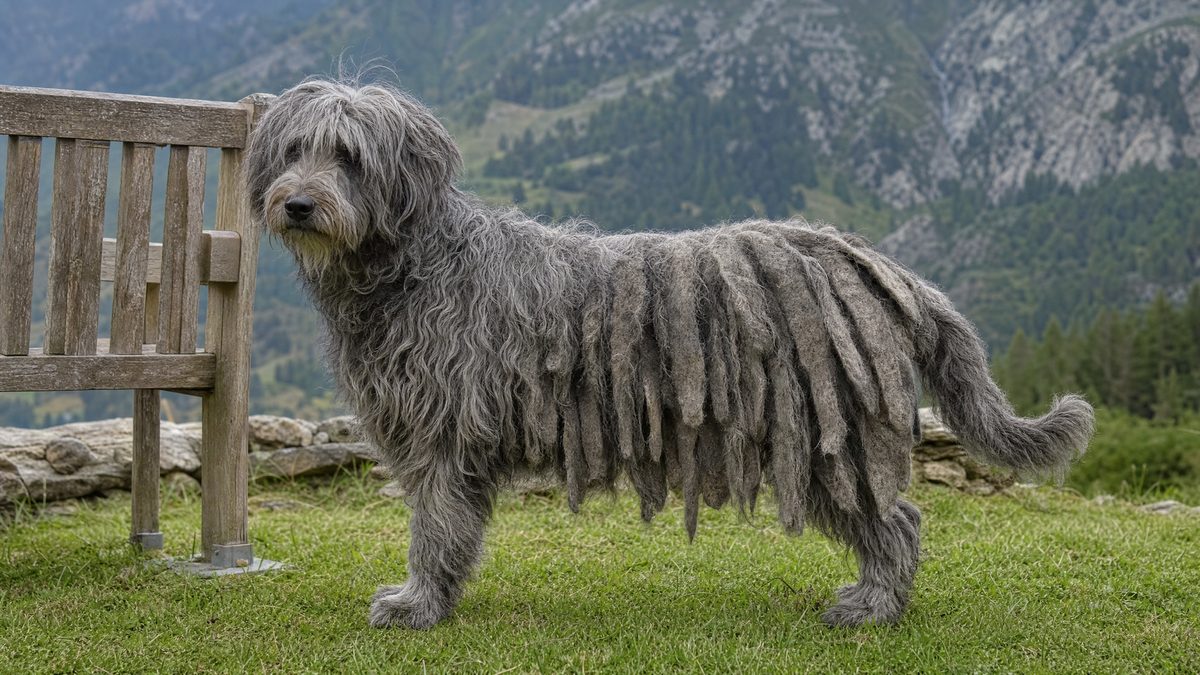
FCI-Standard 194 describes the coat as three different kinds of hair distributed unevenly across the body, not as one uniform covering. Harsh goat-like hair with wavy flocks sits on the front of the dog, woolly hair runs from the middle of the chest rearward, and beneath both lies an undercoat that the wool traps. Most pages describe this vaguely. The standard is precise, and the precision is what tells you how to care for it.
The operative passage reads that the hair is very abundant and very long and varies depending on the region of the body. It is rather harsh, similar to goat hair, with wavy flocks on the front part of the body, while from the middle of the chest region to the rear it is woolly and forms broad strands of varied length depending on the age of the dog. The woolly coat does not moult, and it traps the undercoat, which is quite long and soft, forming mats of felted hair which are very protective. The flocks start from the topline and fall down the sides of the body.
The three hair types, and the three sets of names
Sources agree on the anatomy and disagree on the vocabulary, which is why the same coat sounds like three different coats depending on which page you read.
| Layer | AKC name | What it does |
|---|---|---|
| Innermost | "Dog" hair, elsewhere called the undercoat | Fine, dense and oily to the touch, forming a water-repellent protective layer |
| Middle | "Goat" hair | Thin grey strands, strong and harsh like a goat's coat. Dominant over the shoulders and saddle |
| Outer | "Wool" | Finer and softer. Woven together with the goat hair, it is what actually creates the flock |
The American Kennel Club names them dog, goat and wool, and notes that the goat and wool hairs do not begin to appear until the dog is a year old. Grooming sources working with the breed describe the same three as a fine oily undercoat, a longer coarser goat-hair layer and a woolly outer layer. Read "dog hair" and "undercoat" as the same thing and the three accounts line up exactly.
The coat is not the same on every part of the dog
The international breed association sets out the distribution region by region, and it matters because each region needs different handling.
- Saddle and upper neck carry only undercoat and goat hair. The coat is smooth here and should be brushed regularly to remove dead undercoat.
- Shoulder, underside of neck and chest carry woolly hair mixed with abundant goat hair, so the mats there are softer and thinner.
- Rear of the trunk, flanks and hind legs are where woolly hair clearly dominates, so the mats are thicker, stiffer and longer, growing down from the croup into a wide skirt.
- Forelegs carry soft flocks and hind legs carry matted flock, and the hair hanging from the elbows should be abundant, long and thick, tending to flocks.
- Head carries less harsh hair falling over the face, and the ears carry slightly wavy soft hair forming pointed fringes at the tip.
What the standard treats as correct, and what it faults
A coat that fails to differentiate is a severe fault. FCI-Standard 194 lists as severe "coat with no differentiation between woolly and goat-like hair, soft all over, short on the forelegs and on the muzzle, sparse hair on the tail, too thick and long so as to compromise the function of the dog";. So the correct coat is not simply the most impressive one. It is the one where the two textures remain distinct and the dog can still work.
ENCI puts the same point in commercial terms. An excess of wool produces a hypertypical coat that often wins in the show ring but reduces functionality, and for that reason it must be penalised. ENCI adds that the presence of harsh goat-type hair must be maintained, because it is what gives the coat its consistency.
FCI-Standard 194 does not treat grooming as optional. It states that the coat should be cared for and kept clean, avoiding in particular matted flocks on the beard, muzzle and ear flaps, and that in old dogs a coat too thick and long to allow normal movement compromises welfare and should be avoided. That single sentence is the hinge of this entire page. Keeping the coat clean means wetting it, and wetting it is the problem in an Indian city.
How the flocks form, and over what timescale
Flocking begins at 12 to 15 months under FCI-Standard 194, and the coat is not finished for years after that. The standard states plainly that the coat is soft in puppies, that the flocks begin to form at 12 to 15 months, and that their length depends on age, so young dogs must not be penalised for a coat that has not yet lengthened. Everything an owner has to do by hand happens inside that window.
Three stages describe the whole process, and the middle one is the only demanding part.
- Birth to roughly 10 to 12 months. The puppy coat is soft and short and shows no felting tendency. Occasional brushing with a steel-toothed brush keeps it in order. Grooming guidance for the breed is firmer, telling owners to keep the puppy coat brushed and combed through to the skin and to allow no matting at all at this stage, watching behind the ears, the collar line, the armpits and the groin.
- Roughly 9 to 24 months. The adult textures arrive and the coat must be separated by hand. Woolly hair appears first at the rear, on the croup and hind legs, while goat hair starts on the tail and then the withers before spreading over the saddle. This is the period requiring the most concentrated attention, and the work is done with the fingers rather than a brush.
- Roughly 3 years onward. After the adjustment period the coat needs very little. Maintenance becomes inspection rather than brushing, with weekly hands-on checks to open the flocks, look at the skin and re-separate any that are fusing.
How wide a flock should be, according to four sources that do not agree
Nobody disputes that flocks must be separated by hand. The published widths differ by roughly a factor of two, and the page you happen to read decides how you groom a dog for life.
| Source | Recommended width |
|---|---|
| ENCI, the Italian national kennel body | 3 to 5 cm |
| International Bergamasco Sheepdog Association | 5 to 7 cm |
| Dog Breed Info flocking guide | 1.5 to 3 in, about 3.8 to 7.6 cm |
| Dog Breed Info, working rule of thumb | Split anything wider than 2 to 3 fingers |
The ranges overlap between about 4 and 5 cm, which is the only band all four endorse. Erring wide is safer than erring narrow, because a flock made too thin eventually breaks off under its own weight or during ordinary play. ENCI adds that the separation is done with the hands, a little each day, and that the coat must not be cut except in exceptional cases.
When the coat is actually finished
ENCI states the mantle is complete and abundant only after two and a half to three years, and the international association agrees that only around the age of three will the coat be fully formed. Reaching the ground takes longer still. The American parent club puts full ground length at approximately 5 years, a detailed grooming guide says up to five years for the layers to extend from shoulders to paws, and one aggregator says approximately six. Read three to five years as the honest range and treat the sixth year as unconfirmed.
A correctly formed flock is not woven all the way down. At the skin the base of the flock is straight, non-woven hair, which leaves a deliberate gap between the skin and the felted part. That gap stops the flock pulling on the skin and, critically, lets air reach the skin between the flocks. The American parent club describes the same thing, noting that the matting does not extend down to the skin and that air circulates down to the skin between the mats, allowing it to breathe. The whole safety of this coat rests on that airflow. Remember it, because the next two sections are about what happens when the air reaching that gap is already saturated with water.
Heat tolerance, argued from the standard and the numbers
The Bergamasco Shepherd has poor heat tolerance in Indian conditions, and the argument does not need a veterinary opinion to make. It follows from what the standard says the coat is, and from a straight comparison between the climate the coat was selected in and the climate an Indian owner would keep it in. Both halves are measurable.
Start with the coat. FCI-Standard 194 describes woolly hair that does not moult, trapping a long soft undercoat and forming mats of felted hair which are very protective. ENCI describes the resulting felts, the taccole, as impenetrable to water and to bad weather. The Royal Kennel Club adds that the undercoat obscures the skin and that the coat is greasy to the touch. Every one of those properties is an insulation property, selected to keep an alpine dog warm and dry.
Now the climate. Bonbeno compared Bergamo, the valley system the breed is named for, against two Indian cities using one source on one methodology, the Climate-Data.org 1991 to 2021 normals, so the figures are directly comparable rather than stitched from three national agencies.
| Measure | Bergamo | Mumbai | Kochi |
|---|---|---|---|
| Hottest month, mean daily maximum | 26.4 C, July | 32.8 C, April | 31.5 C, March |
| Coolest month, mean daily maximum | 6.1 C, January | 27.2 C, August | 27.3 C, July and August |
| Coldest month, mean daily minimum | -3.3 C, January | 18.8 C, January | 23.2 C, January |
| Lowest monthly relative humidity | 69%, July | 57%, December | 74%, February |
| Highest monthly relative humidity | 81%, October and November | 89%, July and August | 89%, June, July and August |
One line in that table settles the question. Bergamo's hottest month averages a daily maximum of 26.4 C. Mumbai's coolest month averages 27.2 C, and Kochi's coolest averages 27.3 C Climate-Data.org, Mumbai climate table Climate-Data.org, Kochi climate table. Every single month of the year in either Indian city runs hotter than the hottest month this breed's coat was selected against. There is no cool season for a Bergamasco in coastal India. There is a hot season and a hotter one.
The humidity gap is the larger of the two
Bergamo reaches 81 percent relative humidity in exactly two months of the year, October and November, and its driest month sits at 69 percent. Kochi is at or above 81 percent in eight months of the year, from April through November, and its driest month, February at 74 percent, is still wetter than Bergamo has ever been on a monthly average. Mumbai holds 89 percent through July and August, with 22 rainy days in each of those months.
That gap matters more than the temperature gap, for two separate reasons. A dog cools itself by evaporating water from its respiratory tract, and evaporation slows as the surrounding air approaches saturation, so panting does less work in Kochi in July than in Bergamo in July at the same air temperature. And a coat built to hold a protective air layer against the skin only works while that air is dry enough to carry moisture away.
What the breed's own advocates claim, and what the claim is measured against
The American parent club states that the coat is also a thermoregulator, keeping dogs cooler in the heat of summer and protecting them from sunburn. The AKC agrees the coat aids thermoregulation and concludes that a Bergamasco should never be shaved down. Bonbeno does not dispute either claim. It notes what summer means in the sentence. The summer those clubs are describing peaks at a 26.4 C mean daily maximum with 69 percent humidity. A claim that a felt blanket keeps a dog cool in that summer is not a claim that it keeps a dog cool in Chennai in May.
One of the ranking commercial pages concedes the point without arguing it, stating that the breed is best suited to seasonal or cold climates. ENCI describes the characteristic tuft over the eyes, held up by unusually long lashes, as forming a genuine protective visor against the sun during the alpine summer pasture. That is a real adaptation, and it is an adaptation to alpine ultraviolet at altitude, not to tropical heat at sea level.
Three independent sources say the same thing. The AKC states the dog should never be shaved down because the coat aids thermoregulation. The parent club warns that regrowth after shaving is a mess of mats and that the dog loses its ability to regulate heat and cold. A breed care guide calls shaving strongly discouraged because it damages the coat's protective qualities. Where a full coat is genuinely unmanageable, the parent club's own stated alternative is to trim to a shorter length of 4 to 5 inches while keeping the flock construction intact, not to clip the dog down.
Grooming a flocked coat in Indian humidity
A soaked adult Bergamasco coat takes between 8 hours and 3 days to dry, and the published figure you get depends entirely on whether the source assumes forced airflow or still air. That range, not the brushing routine, is the whole grooming problem in India. Everything else about this coat is genuinely low effort.
Four sources give a drying time or a drying window, and they do not agree, so Bonbeno prints all four rather than averaging them into a number nobody published.
| Source | Stated drying time | What it assumes |
|---|---|---|
| Lancaster Puppies breed guide | Up to 8 hours to dry thoroughly after water exposure | Active drying, stated as necessary to avoid skin issues |
| American Kennel Club | Can remain damp for up to 48 hours | Air drying, which it tells owners to avoid |
| Dog Breed Info flocking guide | Two to three days for a full-coated adult | No breeze and no warm day |
| Bergamasco Sheepdog Club of America | Longer as the coat lengthens, no hours given | A crate surrounded by box fans |
Read across those rows and the pattern is clear. Eight hours is the best case with real airflow. Two to three days is the still-air case. The AKC's 48-hour figure sits between them and is the one attached to a stated consequence, mildew and odour.
The overseas advice that is dangerous in India
The breed's own international association tells owners to let the dog dry naturally. Its guidance is to avoid a hairdryer unless absolutely essential, because forced heat dries out the hairs that hold the flocks together, and instead to choose a sunny day with a bit of breeze to wash your dog and let it dry naturally.
The AKC's corded-coat guidance says the opposite in as many words. Avoid air drying, because densely corded coats can remain damp for up to 48 hours, which can lead to mildew and odour, and use cage dryers with attention to ventilation and temperature instead.
Both pieces of advice are correct for the climate each assumes. The association's sentence is written for Lombardy, where a July day averages a 26.4 C maximum at 69 percent relative humidity with 11 to 12 hours of sun. In Mumbai in July there are 22 rainy days in the month and relative humidity averages 89 percent. In Kochi, humidity holds at 89 percent across June, July and August with 21 to 22 rainy days in each. The sunny day with a bit of breeze does not arrive for months at a time, and air that is already 89 percent saturated carries very little additional water away from a wet felt.
If you keep a Bergamasco in Mumbai, Kochi, Chennai, Kolkata, Goa or Mangaluru, do not follow the international association's advice to wash the dog and let it dry naturally. In those cities, for most of the year, natural drying of a full flocked coat means a warm damp felt held against the skin for a day or more. That is not a grooming preference. It is the condition every source on this coat names as the thing to avoid.
Why damp flocks are the specific risk
Two mechanisms combine, and both are described by sources that like the breed.
- The coat tightens as it wets. When the coat gets wet the hair becomes tighter and tighter to the skin, described as being like a wool sweater shrinking. That closes the deliberate air gap at the base of each flock, which is the exact feature that normally lets air reach the skin and keeps this breed free of skin trouble.
- Trapped moisture does the damage. Moisture trapped beneath the flocks causes skin flare-ups or infections if the coat is not dried properly. A grooming reference for the breed puts it more bluntly, noting that bathing frequency is debated within the Bergamasco community but that all sources agree on the critical risk, which is moisture trapped inside flocks, and that damp flocks are where problems start.
The tell that something has gone wrong is a musty smell. Cindra's troubleshooting table lists musty odour and mildew after baths with a single stated cause, a coat not fully dried through the flocks. One aggregator records the same phenomenon without drawing the conclusion, noting only that the coat can smell like a sweater when it is wet. In a humid Indian July, that smell is an early warning, not a cosmetic complaint.
How often to bathe, and what the Indian skin data shows
Bathe a Bergamasco as rarely as the dog's condition allows, and spot-clean instead wherever you can. Five sources give a frequency and four of them cluster tightly. The fifth is the Italian national kennel body, and it is the outlier whose reasoning fits an Indian pet dog best and whose consequences in India are worst.
| Source | Recommended frequency |
|---|---|
| International Bergamasco Sheepdog Association | Not more than once, at most twice, a year |
| Bergamasco Sheepdog Club of America | 1 to 3 times a year |
| American Kennel Club | No more than two or three times a year |
| Dog Breed Info | 2 to 3 times a year |
| ENCI, Italy's national kennel body | Periodically, as for any dog, and more often for dogs that live indoors |
ENCI's logic is sound and it is the logic that applies to almost every Bergamasco anyone in India would actually keep. A dog living inside a flat gets dirtier than a dog living in an alpine pasture, so it needs washing more often. The difficulty is that ENCI's advice was written where a wash costs a sunny afternoon, and in Kochi the same wash costs a day or more of damp felt. The Indian owner needs the most washing and can afford it least. That vice is the honest summary of this breed's fit with the country.
Two pieces of the overseas guidance do transfer intact. Shampoo dissolves the natural oils that waterproof the hair and hold the flocks together, so the association advises washing in plenty of water with only a very small dose of detergent. And spot-washing works. The same source recommends washing only the parts that get dirty, the extremities and around the mouth, at more frequent intervals, again with plenty of water and very little soap. In Indian conditions that is the default and the full bath is the exception.
Two Indian studies, and they disagree about the season
Indian veterinary series confirm that humidity drives canine fungal skin disease, and they do not agree on when it peaks. Bonbeno publishes both rather than picking the convenient one.
- Jaipur, semi-arid Rajasthan. Across 109 dogs presented with alopecia, erythema and itching, overall dermatophytosis prevalence was 41.28 percent, which is 45 of 109 dogs. Of those 45 affected dogs, 23, or 51.11 percent, presented during the pre-monsoon and monsoon months from June to October. The authors attribute this to humidity being congenial to faster multiplication of fungal elements.
- Thrissur, humid coastal Kerala. Across 100 dogs presented with dermatitis signs, 25 percent yielded dermatophyte colonies on culture. Here occurrence was higher during the summer season than during the monsoon or winter, the reverse of the Jaipur pattern.
Both series are Indian, both are peer-reviewed, and they point opposite ways on season. The question is not settled, and an owner should not conclude that any month is safe. What both support is the underlying driver, which is humidity rather than the calendar.
The Jaipur authors report that infection was more severe and more prevalent in pets kept indoors in cooler surroundings using desert coolers and air conditioners. That is the exact intervention a worried owner reaches for when a heavily coated dog is struggling with heat. Bonbeno notes one limitation the study does not resolve: a desert cooler works by evaporating water and therefore raises indoor humidity, while an air conditioner removes moisture, and the paper groups the two together. Until someone separates them, treat a desert cooler as the higher-risk option for a flocked coat and prefer a dehumidifying air conditioner or a fan.
One arithmetic note on the Kerala paper, offered so readers can check it themselves. Its abstract reports Trichophyton species at 68 percent and Microsporum at 32 percent, while its Results section reports Trichophyton 68 percent, Microsporum 28 percent and Epidermophyton floccosum 4 percent. Both add to 100. The Results version separates a species the abstract folds in, so cite the Results figures rather than the abstract if you use this paper.
Whether to brush at all
Guidance splits here too, and the split is resolvable. The AKC states that a Bergamasco does not need to be brushed, and a breed grooming reference warns against brushing an adult out like a typical long-coated breed because it disrupts flock structure. The international association, by contrast, says the saddle always needs combing and that regular brushing with a fine curved steel-toothed brush roughly twice a month is needed all over, adding that once the flocks are properly formed no correct amount of brushing can alter their internal structure.
Both are right about different parts of the same dog. The saddle and upper neck carry only undercoat and goat hair with no wool, so they stay smooth and should be brushed. The flanks and hindquarters are felted by design and must never be brushed out. In India the saddle work matters more than it does in Italy, because that smooth region is where air still reaches the skin freely.
Can an Indian groomer actually handle this coat
No Indian grooming service Bonbeno could find advertises corded or flocked coat work, and the standard Indian grooming product is built around the two operations this coat must never receive. Those are de-matting and combing out. This is not a complaint about Indian groomers, who are good at the coats they see. It is a statement about which coats they see.
Bonbeno read the published service menus of Indian grooming businesses rather than assuming. Two are representative because they are large and they publish their offer in detail.
What the published menus actually contain
A Bangalore studio advertises groomers certified across more than 40 dog breed standards and devotes a section to breed-specific grooming. The breeds it names are the Golden Retriever, the Shih Tzu, the Poodle, the Indian Pariah Dog and the Persian cat. No corded or flocked breed appears anywhere on the page. Its service list includes a De-Matting and De-Shedding Treatment, described as essential for double-coated and curly-coated dogs, and a typical session runs 45 to 90 minutes depending on package and coat complexity.
A doorstep service operating across nine cities and reporting more than 25,000 grooming sessions offers five packages. Every one of them includes a blow dry, and every one lists Combing among its free add-ons. Its own FAQ explains that grooming happens inside the customer's home and asks the customer to provide a bucket and water, plus a space such as a balcony, terrace or bathroom.
Four mechanical mismatches, in order of how much damage they do
- De-matting destroys the coat permanently. A Bergamasco's flocks are mats, required by FCI-Standard 194, which describes mats of felted hair that are very protective. A groomer trained to remove mats will remove these. Regrowth is not a season, it is years. ENCI puts a complete coat at two and a half to three years and the American parent club puts full ground length at about five. The international association warns that if the hairs holding the mats together are lost, the dog will not resume its normal appearance for many months.
- Combing out disrupts flock structure. Breed grooming guidance is explicit that an adult must not be brushed out like a typical long-coated breed. Combing is a free add-on on every package one national service sells.
- A bucket cannot deliver the bath this coat needs. The AKC's corded-coat protocol requires soaking the dog in a tub for 30 minutes or more so that water fully penetrates, then working shampoo through gently without scrubbing or roughing up the coat, then rinsing thoroughly. A bucket on a balcony wets the outside of the flocks and leaves the inside dirty and damp, which is the worst of both outcomes.
- A 45 to 90 minute appointment cannot dry the dog. The best published drying figure is up to 8 hours with active airflow, and still-air drying runs to two or three days. A dog bathed in a 90-minute slot goes back to its family wet, and in a Mumbai July at 89 percent humidity it stays that way.
The Bangalore studio's own page states the biology correctly. It explains that matted fur traps moisture against the skin, which leads to infections, and its FAQ notes that severe matting sometimes requires a shorter trim for the dog's comfort and skin health, since removing dense mats without cutting can cause pain. Every word of that is true. It is also precisely why a groomer who has never met this breed will look at a correctly flocked adult Bergamasco and see a welfare problem to be clipped off. The dog will leave shaved.
What Bonbeno checked, and what it did not
This finding rests on published service menus, and the search method demonstrably works, because the same searches returned Indian grooming businesses in Delhi, Bangalore, Gurugram, Noida, Greater Noida, Hyderabad, Mumbai, Kolkata and Faridabad, with detailed packages and pricing The Pets Unlimited. What those searches did not return was any Indian service advertising corded or flocked coat handling.
Bonbeno did not telephone every salon in India, so this is an absence from published menus rather than proof that no groomer anywhere in the country can do the work. If you own this breed here, assume you are the groomer. Every source describes the adult routine as inspection rather than styling, meaning weekly hands-on checks to open the flocks, look at the skin, remove debris and separate any flocks that are fusing. That is a task you can learn. Handing it to someone who has never seen the coat is the risk.
Bergamasco Shepherd price in India
No Bergamasco Shepherd price in India exists, because there is no Indian market for the breed and no lawful route to create one. That is the single most useful fact on this page, and it belongs in the first line rather than the last. Any rupee figure you find for this breed is a foreign price run through an exchange rate.
Bonbeno pulled the top ten organic results for "bergamasco shepherd price in india" from within India on 21 August 2026. Not one of them offered a Bergamasco for sale in India. The set breaks down as follows.
- Four United States marketplaces and cost guides, all quoting dollars, at lancasterpuppies.com, dogbreedslist.info, gooddog.com and dogster.com.
- Four merchandise listings. The top Indian result was a paperback book about the breed priced at Rs 2,302 on Amazon.in, alongside Etsy Bergamasco merchandise from Rs 354, an eBay ceramic figurine and a Flipkart notebook.
- One Indian price list that omits the breed, a Supertails guide covering the top 40 dog breeds in India.
- One India-facing brand page with no price at all, Royal Canin's Indian breed page, which carries a life expectancy and three care notes and nothing about cost.
That is what an Indian buyer searching this term is actually offered. A book, a notebook, a figurine, some Etsy prints, and four American puppy listings.
The absence was tested against a control
A search returning nothing can mean the breed is absent or it can mean the search is broken, so Bonbeno ran a paired control in the same tool, in the same session, with the same India restriction. The query "labrador retriever puppy for sale India price rupees breeder" returned abundant genuine Indian listings with rupee prices, including a marketplace publishing city-by-city bands of Rs 30,000 to Rs 1,20,000 across Hyderabad, Bangalore, Delhi, Chennai, Lucknow, Mumbai, Jaipur and Pune, plus several Indian breeder sites and classifieds. The tooling finds Indian puppy listings perfectly well. It found none for this breed.
One further detail is worth recording. When the Bergamasco query exhausted its genuine matches, the engine substituted other breeds entirely, surfacing an Indian Facebook group for long-haired German Shepherds and a video listing Belgian Shepherd puppies for sale in India. An Indian buyer chasing this breed does not find it unavailable. They find a different shepherd offered in its place.
What the breed costs where it is actually sold
| Source and basis | Published USD | Converted at 84.38 |
|---|---|---|
| Dogster, adoption fee | $50 to $300 | Rs 4,219 to Rs 25,314 |
| Dogster, from a breeder | $1,000 to $1,200 | Rs 84,380 to Rs 1,01,256 |
| Lancaster Puppies, United States pedigree | $1,000 to $1,900 | Rs 84,380 to Rs 1,60,322 |
| Dog Breeds List, reputable breeder | $1,000 to $2,000 | Rs 84,380 to Rs 1,68,760 |
Indian pages routinely publish a "price" that is a United States dollar figure passed through one exchange rate, and Bonbeno has now caught this on several breeds at exactly 84.38. Run the test in reverse here. If an Indian page quotes a Bergamasco at Rs 84,380, Rs 1,01,256, Rs 1,60,322 or Rs 1,68,760, or anything close, divide it by 84.38. You will get 1,000, 1,200, 1,900 or 2,000, and you will have found not an Indian sale but an American one wearing rupees. A figure that resolves to a round dollar amount was never observed in an Indian transaction.
Bonbeno found no Indian rupee price for this breed to run that test against. A targeted search for the breed name with rupee, lakh and cost terms returned only noise, specifically a Facebook scam-warning post that happened to mention a person surnamed Bergamasco, a Quora thread about how dogs bark in different languages, a water-treatment chemistry paper citing an unrelated researcher of the same name, and two university word-frequency files. The word is a common Italian surname, and on this query that is all it returns.
Bonbeno does not broker puppy sales and does not publish breeder listings. The overseas figures above are reported as editorial context so a reader can recognise a converted price, and they are not offers.
Why no Indian supply chain can lawfully form
Live dogs are a Restricted import into India, and applications to import them for trading or breeding are rejected as a matter of stated policy. That is why the price section above has no Indian figure in it. The rule is set out in DGFT Trade Notice No. 22/2022-23 dated 19 December 2022, and Bonbeno read the notice rather than a summary of it.
Under the notice, mammals other than those separately classified fall under ITC(HS) heading 01061900, and the import policy for that heading is Restricted, subject to Policy Condition 6 of the chapter.
Policy Condition (7) then limits the purposes for which a dog may enter the country at all. Import of dogs is allowed only for three named purposes.
- A pet dog with a valid pet book and relevant records or documents in the name of the importer.
- Dogs imported by R&D organisations for conducting research, with the recommendation of CPCSEA.
- Dogs for internal security by the Defence and Police Force.
Policy Condition (8) closes the remaining door, stating that import of commercial dogs for breeding or any other commercial activities other than the purposes above is not permitted. An independent reproduction of the same notice carries Policy Conditions 6, 7 and 8 in identical terms.
Paragraph 6 of the notice is the sentence that settles the question. It states that any applications for trading or breeding purposes, or applications made on behalf of some other person or entity, shall be duly rejected.
What the one lawful route actually requires
The single realistic path is a person relocating to India with a dog they already own. Even that is tightly bounded.
| Requirement | What the notice specifies |
|---|---|
| Baggage route, up to two pets | Allowed without DGFT authorisation only to persons transferring residence to India after two years of continuous stay abroad |
| When authorisation is required | Stay abroad under two years, pet not travelling as baggage, or pet not importable under baggage rules |
| More than two pets | DGFT authorisation required, with the application examined by DAH&D |
| Entry points | Airports and seaports of Delhi, Mumbai, Chennai, Hyderabad, Bangalore and Kolkata only, with quarantine at those ports where required; DAHD added Kochi for pets arriving under the baggage rules in October 2024 |
| Lead time | Owners are advised to begin the import authorisation process at least two months before travel |
| Advance NOC | From the Regional or Quarantine Officer, AQCS, seven days before travel, relaxable to three |
All six rows come from the notice itself. Note the practical consequence of the entry-port list. If you relocate to Pune, Ahmedabad or Jaipur, the dog still lands at one of those six ports and travels onward from there; a pet arriving under the baggage rules can also land at Kochi since October 2024. The full route is set out in how to import a dog to India.
The registry route is not a workaround
The Kennel Club of India is a member body of the Fédération Cynologique Internationale, which means FCI-Standard 194 is the standard that would formally apply to this breed in India. The FCI publishes the KCI's registration statistics, showing 32,219 puppies and 7,412 litters registered in 2025, against a cumulative total of 1,425,001 pure-bred dogs since the stud book was created.
Those figures describe a functioning national registry. They do not describe this breed, and Bonbeno will not pretend otherwise. The FCI statistics page publishes no breed-level breakdown, so no Bergamasco registration count for India can be quoted from it, and none is quoted here. What can be said is narrower and still decisive. Breeding stock cannot lawfully be imported for breeding, and no Indian breeder, litter or listing for the breed surfaced in a search that readily surfaced them for a common breed. Between those two facts, a domestic supply chain has no way to start.
If you are moving to India and already own a Bergamasco abroad, the law accommodates you, and the paperwork is a pet book in your own name, a veterinary health certificate from the exporting country with the prescribed tests done there, and an advance NOC from AQCS. Start two months out. If you are in India and want to buy one, there is no lawful commercial route to a puppy, and anyone offering you one has either mislabelled a different dog or is proposing something the notice says shall be duly rejected.
Health risks, screening and life expectancy
One usable population figure exists for this breed, and it concerns hips. The Orthopedic Foundation for Animals holds 105 Bergamasco hip evaluations, of which 24.8 percent are dysplastic and 75.2 percent normal, read on 21 August 2026. Every other OFA database has too few Bergamascos to publish. Those two sentences are the whole verified health picture, and this section explains what each is worth.
The hip figure, with its denominator attached
The 105 evaluations break down as 11.4 percent excellent, 50.5 percent good and 13.3 percent fair, totalling 75.2 percent normal, against 14.3 percent mild, 7.6 percent moderate and 2.9 percent severe, totalling 24.8 percent dysplastic. Those sub-totals add correctly, which is worth checking on any figure quoted as parts of a whole.
Context matters more than the headline. Across the whole OFA hip database of 1,711,735 evaluations, 14.2 percent are dysplastic. The Bergamasco's 24.8 percent is roughly 1.75 times that rate, and the breed sits 35th worst of the 220 breeds the hip table lists.
| Breed | Evaluations | Dysplastic |
|---|---|---|
| Bergamasco | 105 | 24.8% |
| Spanish Water Dog | 437 | 21.5% |
| Old English Sheepdog | 12,635 | 18.9% |
| Briard | 3,144 | 14.0% |
| Komondor | 1,103 | 13.1% |
| Puli | 2,004 | 10.4% |
| Bearded Collie | 5,343 | 6.1% |
| All breeds | 1,711,735 | 14.2% |
The Bergamasco has the worst rate in this group and by far the smallest sample, 105 evaluations against 12,635 for the Old English Sheepdog. OFA data is voluntarily submitted, so a rare breed's figure rests on whichever hundred dogs somebody chose to X-ray and report. Treat 24.8 percent as a real signal that hips deserve attention in this breed, not as a settled population rate. OFA counts also move as evaluations are added, so quote the sample size beside the percentage whenever you repeat it.
Everything else is below OFA's publication threshold
The breed appears in the hip table and nowhere else in OFA's statistics. It is absent from the elbow, patella, thyroid, eye and cardiac tables and from every DNA-test table.
That absence was tested rather than assumed. OFA publishes all of its statistics tables inline on one page, and in the full 2.2 million character document the string "BERGAMASCO" occurs exactly once. In the same document, read in the same session, "GOLDEN RETRIEVER" occurs 101 times, "PULI" 33 times and "KOMONDOR" 21 times, so the parse plainly worked. The elbow table's smallest listed entry is the French Spaniel at exactly 100 evaluations, which is the threshold in action, and the Puli does appear there with 301 evaluations and 4.0 percent abnormal. The Bergamasco simply has not reached 100 elbow evaluations. Absent is a legitimate finding here, and a guessed figure would not be.
The screening standard that does exist
ENCI publishes concrete requirements for selected breeding under its Riproduzione Selezionata scheme, and they are the most specific health gate anywhere in this breed's paperwork. To qualify, a Bergamasco must be at least 18 months old, hold a morphological qualification of at least Molto Buono awarded at a breed speciality or gathering, pass the NHAT working assessment, and carry hip grades A, B or C and elbow grades 0, BL or 1.
That gives a buyer anywhere a precise thing to ask for. If a breeder cannot show a hip grade of A, B or C and an elbow grade of 0, BL or 1 on both parents, they have not met the Italian registry's own bar. Ask to see the certificates and screen the parents rather than the puppy, because hip status is inherited and a young dog's hips tell you little.
Life expectancy, and where the number does not come from
Five sources give the same life expectancy of 13 to 15 years, including the AKC, Royal Canin's India page, two commercial breed guides and a cost guide Lancaster Puppies Dog Breeds List, Bergamasco price Dogster, How Much Does It Cost to Own…. No published study underlies it, and Bonbeno could not find one.
One provenance note is worth making, because it is checkable. Royal Canin's Indian page states that its key facts and characteristics are sourced from the Fédération Cynologique Internationale, and it then lists an average life expectancy of 13 to 15 years. FCI-Standard 194 contains no life expectancy figure at all. Bonbeno read the full standard, which covers utilisation, proportions, temperament, every body region, coat, colour, size, weight, faults and disqualifications, and nowhere states a lifespan. Whatever the source of 13 to 15 years is, it is not the standard. Use the figure as the industry's shared assumption, and do not present it as a finding.
The entire peer-reviewed literature on this breed is one paper
PubMed indexes exactly one study about the Bergamasco Shepherd. It is a 2015 microsatellite genetics paper, and it is not about health. There is no lifespan study, no disease-prevalence study and no breed health survey to cite, which is why the health section above rests on a registry table rather than on research.
That claim needs proving rather than asserting, because a search returning little can mean a rare breed or a broken query. Bonbeno ran both a control and a record-by-record check.
The result count is not the answer
A search for "bergamasco dog" returns 13 records, which looks like a small but real literature. It is not. Nine of the ten records on the first page are papers co-authored by a veterinary neurologist whose surname is Bergamasco, and their subjects are other breeds entirely. They include quantitative electroencephalography in beagles under propofol, benign familial juvenile epilepsy in Lagotto Romagnolo dogs, an idiopathic epilepsy locus in Belgian Shepherd dogs, electroencephalography and MRI in Finnish Spitz with epilepsy, and lymphocyte beta-adrenoceptor changes in Great Danes with dilated cardiomyopathy.
Restricting the query to the breed's actual names, in English and Italian, returns 6 records. Bonbeno opened all six by identifier through NCBI's E-utilities rather than trusting the count.
| PMID | What it actually is | About this breed |
|---|---|---|
| 33761533 | SARS-CoV-2 vaccination modelling for safe surgery, Br J Surg 2021 | No, human surgery |
| 33690889 | Timing of surgery following SARS-CoV-2 infection, Anaesthesia 2021 | No, human surgery |
| 34371522 | Pre-operative isolation and pulmonary complications, Anaesthesia 2021 | No, human surgery |
| 34428858 | SARS-CoV-2 infection and venous thromboembolism after surgery, Anaesthesia 2022 | No, human surgery |
| 22457775 | Idiopathic epilepsy locus in Belgian Shepherd dogs, PLoS One 2012 | No, wrong breed |
| 26245492 | Genetic characterization of four native Italian shepherd dog breeds, Animal 2015 | Yes |
The four surgical papers are enormous multi-centre collaborations, and they surface because somebody in a collaborator list carries the surname. PubMed also reported a query translation that had invented an author field, rendering the Italian breed name "cane da pastore bergamasco" as a search for canes or cane, AND an author called "pastore, da", AND the term bergamasco.
The control passed in the same session. A search for "komondor" returned 12 records, so PubMed and the tooling were both working normally. Six hits, one of them real, is the honest answer, and an agent trusting the count would have reported the opposite.
What the one real paper found
Bigi and colleagues genotyped 212 individuals from 10 dog breeds at 18 autosomal microsatellite loci, comparing four native Italian shepherd breeds, the Maremma, Bergamasco, Lupino del Gigante and Oropa, against cosmopolitan breeds long kept in Italy.
- All 10 breeds were clearly genetically differentiated from each other, regardless of current population size or when separate breeding began.
- The level of genetic diversity explained 20 percent of the total genetic variation.
- The native Italian breeds showed generally higher genetic diversity than the long-established cosmopolitan breeds, which is an unusual and encouraging result for a breed that nearly died out after the war.
- Among cosmopolitan shepherds, the Border Collie sat closest to the Italian breeds.
The authors frame the data as input to conservation programmes designed to reduce inbreeding and minimise loss of genetic variability. The published abstract does not state how many of the 212 dogs were Bergamascos, so Bonbeno does not quote a per-breed sample size. With ten breeds sharing 212 animals the subsample is necessarily small, and that is as far as the source supports.
Three separate things do not exist for this breed and no page should imply otherwise. There is no published lifespan study, so the 13 to 15 year figure is consensus rather than measurement. There is no disease-prevalence study, so claims that the breed is robustly healthy are impressions, including the AKC's own and ENCI's Ente Nazionale della Cinofilia Italiana. And there is no breed health survey, so nobody knows what these dogs actually die of. The one hip figure with a denominator, 24.8 percent of 105 evaluations, is the only hard number on this page's health section.
What a Bergamasco would actually cost to keep in India
No verified India-wide monthly figure exists for this breed, because no Indian population exists to survey. What can be done honestly is to take a published Indian cost structure for a medium-sized dog, then correct the two lines this breed changes. Bonbeno does that below rather than inventing a total.
The Bergamasco is a medium breed under FCI-Standard 194 and the Royal Kennel Club, and Royal Canin's Indian page files it as Medium The Royal Kennel Club Royal Canin India. A widely-read Indian cost table puts a medium breed at Rs 6,000 to Rs 10,000 a month, built from roughly Rs 2,500 to Rs 4,000 on food, Rs 800 to Rs 1,500 on routine veterinary visits, Rs 1,500 a year on vaccination, Rs 800 to Rs 1,500 on grooming, Rs 500 to Rs 1,000 on treats and toys, and Rs 400 to Rs 700 on flea control and deworming. Two of those lines do not describe this dog.
The grooming line inverts
Indian grooming pricing assumes a recurring salon visit, which is why that table charges a small breed more for grooming than a large one, Rs 1,500 to Rs 3,000 against Rs 500 to Rs 1,200, since small coats get clipped often. A Bergamasco needs one to three baths a year and no clipping at all, so the recurring salon line falls close to zero.
It is replaced by a capital cost and a time cost. The capital item is a drying setup, because the alternative is a coat that stays damp. The American parent club's own solution is a crate surrounded by box fans, and the AKC recommends cage dryers used with attention to ventilation and temperature rather than strong-force dryers, which tangle the coat. The time cost is the hand-separation work through the second year and weekly flock inspections thereafter. Neither appears on any Indian cost table because no Indian cost table has this breed in mind.
The skin line is the one to provision for
In a humid Indian city the realistic recurring veterinary risk for this coat is dermatological rather than orthopaedic. Bonbeno will not turn the Indian dermatology studies into a probability, because doing so would misread them, and the misreading is easy to make.
The Jaipur figure of 41.28 percent is 45 of 109 dogs that had already been presented to a clinic with alopecia, erythema and itching. The Thrissur figure of 25 percent is 25 of 100 dogs already presented with signs of dermatitis. Both are the share of symptomatic dogs testing positive for dermatophytes. Neither is the chance that a healthy dog develops a fungal skin infection this year, and any page quoting them as population risk has misread the denominator.
The overseas totals disagree with each other by a factor of nine
Two United States cost guides published in the same year give monthly figures that do not overlap in any useful way.
| Source | Published | At 84.38 |
|---|---|---|
| Dogster, monthly | $55 to $1,500 and above | Rs 4,641 to Rs 1,26,570 |
| Lancaster Puppies, monthly | $110 to $170 | Rs 9,282 to Rs 14,345 |
| Lancaster Puppies, lifetime over 13 to 15 years | Upwards of $15,000 | About Rs 12,65,700 |
A range running from $55 to more than $1,500 a month is not an estimate, it is the span between a quiet month and an emergency, presented as though it were a budget. The narrower $110 to $170 figure is more useful and happens to convert to roughly Rs 9,300 to Rs 14,300, which sits just above the Indian medium-breed band. Bonbeno reports both and endorses neither, because neither was measured in India.
One line from the same Indian table is worth keeping in view when weighing all of this. An adopted Indian street dog costs Rs 0 to Rs 3,000, and that source describes its health profile as excellent on account of hybrid vigour.
Temperament and household fit
The Bergamasco is a watchful, independent guarding sheepdog that bonds hard to one household and treats strangers with reserve until introduced. FCI-Standard 194 requires vigilance, concentration and a capacity for learning combined with moderation and patience, and it states that the breed must never be aggressive or fearful, while allowing that slight natural diffidence is typical of some sheepdogs.
Aggressive or overly shy dogs are a disqualifying fault under the standard, which is the strongest language a standard has. ENCI describes the guarding style precisely, as a dog that guards with intelligence, gauges its own force against the opponent's, and intervenes only when necessary and then effectively. The AKC puts the same trait as serene vigilance, adding that the breed is wary of strangers until properly introduced and aggressive only as a last resort.
One AKC observation matters more than any rating scale. The breed thinks independently and often sees itself as an equal partner rather than a subordinate. That is the working temperament of a dog bred to make decisions alone on a mountainside, and it is the trait that decides whether a household suits it.
Where this fits an Indian home, and where it does not
- Good fit. A house with secure outdoor space, a family that is home for part of the day, and an owner who has kept an independent working breed before. ENCI notes the breed lives serenely in houses despite being selected for outdoor life, and becomes a precious playmate for children and a reassuring presence for older people.
- Poor fit. A flat in a building with constant footfall. A guarding breed that is reserved with strangers meets delivery riders, domestic staff, security guards, plumbers and festival visitors every single day in an Indian apartment block, and each of those is a stranger arriving at the door of a dog bred to announce exactly that.
- Poor fit. A household out for ten hours. Separation anxiety and destructive behaviour when left alone for long stretches is named as a specific challenge for the breed.
- Watch item. Strong prey drive requires secure containment and careful off-lead management. In Indian cities that also means around free-roaming dogs and cattle.
- Not for a first dog. The breed is explicitly not recommended for novice owners because of its training demands, and one aggregator rates its trainability at 2 of 5 with the note that training will be difficult.
With children the picture is better than the guarding description suggests. The AKC calls the breed generally happy with kids and other animals, patient but protective, and an aggregator rates it 5 of 5 for child friendliness. Supervision still applies, as it does with any 32 to 38 kg dog.
The standard requires hair falling over the face, held up by unusually long eyelashes, and ENCI describes the resulting tuft as a genuine sun visor. The consequence is that most people cannot read this dog's eyes. In a country where dogs meet a large number of unfamiliar people at close quarters every day, a guarding breed whose face is hard to read is a dog whose early warning signals get missed. Keep the beard, muzzle and ear flaps free of matted flocks as the standard requires, introduce visitors deliberately rather than letting them approach, and never rely on strangers correctly interpreting a dog they cannot see the face of.
Training a Bergamasco, and the one lesson unique to the breed
Train a Bergamasco by explaining rather than commanding, because this breed complies when it understands the point. The AKC states it directly, that a Bergamasco who can be made to understand what is wanted of him, and why he should do it, will happily comply, in his own way. Handle it as a subordinate and you get a stalemate.
The raw material is good. FCI-Standard 194 credits the breed with a capacity for learning and a determination combined with moderation and patience, and the FCI lists the breed as subject to a working trial, which is not something awarded to a dog that cannot be taught. ENCI reports that Bergamascos learn very easily and are worked successfully not only in sheepdog trials but in obedience, agility, civil protection work and assistance roles for people with disabilities.
What the breed resists is pressure. Guidance for the breed names punishment-based training, inconsistent commands and overly long sessions as the classic failures, and recommends short, varied, engaging sessions with gentle correction rather than harsh discipline. Early socialisation matters as much as it does in any guarding breed, and the socialisation window opens long before the coat becomes an issue.
The lesson no other breed needs this badly
Teach this dog to be handled all over, standing still, for a long time. Between roughly 9 and 24 months an owner will spend many hours with both hands buried in the coat, separating flocks down to the skin, and revisiting the same areas repeatedly. A dog that will not tolerate that turns a manageable job into an impossible one.
The window to build that tolerance is the puppy coat stage, before the flocks arrive. Breed grooming guidance is explicit that the point of brushing and combing a puppy through to the skin is not only to prevent tangles but to build handling tolerance, and it names the friction areas to work on, which are behind the ears, the collar line, the armpits, the groin and the rear. It adds that because these dogs are sensitive and tuned in to handling, coat work goes best when it is routine, slow and matter of fact.
| Period | Priority |
|---|---|
| 8 weeks to 6 months | Socialisation to people, places, surfaces and sounds. Daily full-body handling to the skin. |
| 8 weeks to 8 months | Brush and comb the puppy coat through to the skin. Allow no matting at this stage. |
| 4 to 12 months | Loose-lead work, recall and settle. Introduce standing on a table or mat for extended handling. |
| 9 to 24 months | The coat separation itself. Treat each session as a training session, short and calm. |
| 18 months plus | The age at which ENCI's selected-breeding scheme will even assess a dog, which is a fair marker for maturity. |
A puppy born so that its socialisation window falls across an Indian monsoon gets fewer outings, meets fewer strangers and is harder to dry after every one of them. If you are choosing timing and have the choice, aim for the window to fall in the drier months. If you do not have the choice, do the socialisation indoors and in covered spaces rather than skipping it, because an under-socialised guarding breed is a far larger problem than a wet one.
Daily exercise, and why the Indian timing is forced
An adult Bergamasco needs about one hour of brisk walking a day, split into two sessions, with room for free running in a secure area. The AKC describes the requirement as only moderate, and stresses that it should take the form of a shared activity rather than the dog being left alone in a yard. In India the amount is not the problem. The timing is.
FCI-Standard 194 describes the natural gait as free with long steps, with a preferred rather extended trot maintained for quite long periods, and notes the dog can drop into an ordinary gallop and hold it for a relatively long time. This is a distance-covering trotter, not a sprinter, which is why a long steady walk suits it better than a short burst of fetch.
Both sessions have to sit outside the heat, all year
Most Indian breed pages tell owners to shift exercise to the cooler months and the cooler hours. For this breed in coastal India the first half of that advice does not exist. Mumbai's coolest month still averages a 27.2 C daily maximum and Kochi's averages 27.3 C, both above Bergamo's hottest month at 26.4 C Climate-Data.org, Kochi climate table Climate-Data.org, Bergamo. There is no season in which the middle of the day becomes usable. Walk at first light and after dark, every month of the year, and check the pavement with the back of your hand before you set out.
The monsoon problem is the walks, not the baths
The grooming sections above are about bathing, which happens one to three times a year. Walking happens twice a day, and in the monsoon it soaks the dog far more often than any bath does. Mumbai records 22 rainy days in July and 22 in August. Kochi records 21 to 22 rainy days in each of June, July and August Climate-Data.org, Kochi climate table.
A dog walked twice daily through those months gets its coat wet on roughly two days in three, in air holding 89 percent relative humidity, with a coat that takes up to 8 hours to dry even with active airflow. That is the arithmetic that decides whether this breed can live in Mumbai, and no ranking page performs it. The practical answers are a covered walking route, a rain coat that actually covers the flanks and hindquarters where the felting is heaviest, and a towel-and-fan routine that runs after every wet walk rather than after every bath.
Swimming is the standard Indian recommendation for a heavily coated dog in summer, and for this coat it is the wrong one. The AKC cautions against allowing heavily corded dogs to swim, because wet cords become extremely heavy, quoting a specialist that the cords of a heavily corded dog can weigh 20 pounds or more when soaked. A Bergamasco's coat is flocked rather than corded, but it is the same felted mass absorbing the same water. A soaked adult carries the weight, then takes a day or more to dry.
Puppies get less
Puppies have limited exercise tolerance and should get short, frequent sessions until maturity, specifically to protect developing joints. In a breed where 24.8 percent of 105 OFA hip evaluations came back dysplastic, stacking early over-exercise on top of that is a risk on a risk. No stair marathons, no running alongside a cycle and no long forced walks in the first year.
Mental work substitutes well for distance and is available indoors during a heatwave or a downpour. The breed thrives on herding trials, agility, obedience and scent games, and on interactive feeders and puzzle work when the weather closes the door Ente Nazionale della Cinofilia Italiana.
Feeding, and why you cannot judge this dog by eye
Feed a Bergamasco as a medium breed and assess its body condition with your hands rather than your eyes. Both halves of that sentence are breed-specific corrections, and both cost money or health when they are got wrong.
Start with size, because the feeding chart follows from it. FCI-Standard 194 and the Royal Kennel Club both open by calling the breed medium-sized, and Royal Canin's Indian page files it as size category Medium The Royal Kennel Club Royal Canin India. Two widely-read commercial pages call it large Dog Breeds List, Bergamasco price. On the Indian cost table that difference is Rs 2,500 to Rs 4,000 a month on food for a medium breed against Rs 4,000 to Rs 6,000 for a large one. Feeding to the wrong chart overshoots by roughly a third, every month, for thirteen to fifteen years.
The published nutritional guidance is unremarkable and transfers fine. A high-quality diet with adequate protein and balanced fatty acids, puppies fed three to four meals a day reducing to two by adulthood, and portions adjusted to age, activity and condition rather than to a number on a bag. The AKC adds the usual and correct warnings, that some dogs of the breed get overweight, that treats are a common cause, and that clean fresh water should be available at all times.
Weight control is a hip decision, not a cosmetic one
This breed's only hard health number is a hip figure, 24.8 percent dysplastic across 105 OFA evaluations. Excess weight loads exactly those joints. Obesity risk is also flagged as rising after neutering or spaying, making diet and exercise management critical at that point. Omega fatty acid supplementation is suggested for skin and coat support given the coat's density, which in an Indian climate is worth discussing with your vet.
Body condition scoring normally starts with looking at the dog from above for a waist and from the side for an abdominal tuck. On an adult Bergamasco both views are hidden under felted flocks that hang from the topline down the sides of the body. Score this breed by hand. Part the flocks, run your fingers along the ribs and feel whether they are easy to find under a thin layer, and repeat it monthly at the same time as the weekly flock inspection you are already doing. An owner relying on the eye will not notice this dog gaining weight until it is substantial.
One piece of published advice Bonbeno is not repeating
One breed guide recommends elevated bowls on the basis that they aid digestion and reduce the risk of bloat, and separately names bloat, or gastric dilatation-volvulus, as a breed concern needing immediate veterinary attention when a swollen belly and restlessness appear. Bonbeno reports the bloat warning and does not repeat the elevated-bowl recommendation, because the relationship between raised feeders and bloat risk is contested rather than settled and this page could not verify the claim against a primary source. Ask your veterinarian about feeder height for your individual dog.
Appetite commonly falls in Indian summers, which is normal within limits. Persistent inappetence is a veterinary matter rather than a feeding preference, and in a dog whose skin you cannot see, a change in appetite may be the first sign you get of something happening under the coat.
The first year, month by month
A Bergamasco puppy's first year is ordinary. Its second is not. The coat change that defines the breed begins somewhere between 7 and 15 months depending on the individual and the source you read, and everything an owner must do by hand falls in that window. Plan the first year around arriving at it prepared.
- 8 to 12 weeks. Home, name, toilet routine, vaccination course with your vet. Socialisation starts now. The puppy coat is soft and short and shows no felting tendency. Begin daily full-body handling to the skin, which is the foundation for the coat work later.
- 3 to 6 months. Continue socialisation hard, because this is a guarding breed and the window does not reopen. Add loose-lead work and teach the dog to stand still on a mat for extended handling. In an Indian summer, heat management becomes real in this window.
- 6 to 9 months. Watch for the first texture change. Felting can begin as early as 7 months in some dogs, though closer to a year is more common, and one guide puts the first flocking at 8 to 9 months. Exercise stays short and frequent to protect developing joints.
- 9 to 12 months. The adult textures arrive. The coat appears to rise as the fine abundant undercoat grows in and blends with the moulting puppy hair. Woolly hair appears first at the rear, on the croup and hind legs, while goat hair starts on the tail and then the withers before extending across the saddle. Put the brush down on the woolly regions and start separating by hand.
- 12 to 24 months. The only demanding stretch in this breed's life. Separate clumps down to the skin by hand, a little each day, leaving flocks in the 4 to 5 cm band that all sources support International Bergamasco Sheepdog…. Expect to revisit the same areas repeatedly as the coat tries to rejoin. Watch the trouble spots, which are behind and under the ears, the limbs, the chest and both sets of armpits.
- 2 to 3 years. The flocks separate, flatten and become visible along the topline, still short. Keep splitting any that grow too wide. ENCI puts a complete coat at two and a half to three years.
When the coat change starts, according to five sources
| Source | Stated onset |
|---|---|
| FCI-Standard 194 | Flocks begin to form at 12 to 15 months |
| American Kennel Club | Goat and wool hairs appear from about 1 year |
| Bergamasco Sheepdog Club of America | As early as 7 months, more commonly near a year |
| International association | Around the 10th to 12th month |
| Cindra grooming guide | Adolescent change begins around 9 to 10 months |
Read that as 7 to 15 months with wide individual variation, and inspect the coat by hand from six months so you catch it starting rather than discovering it a month late.
The American parent club advises not bathing during the coat-change period at all, because wetting causes the developing coat to shrink and tighten, and without full flock separation air cannot circulate around the flocks to dry them properly. That is sound and it collides with an Indian monsoon, where a dog walked twice daily gets soaked on 21 or 22 days a month Climate-Data.org, Kochi climate table. You cannot avoid wetting an Indian dog in July. What you can do is avoid adding baths in that year, keep the walks short and covered through the wettest weeks, and dry the coat actively every single time rather than letting it dry on the dog.
One last expectation to set. Through most of the second year the dog looks unkempt, with budding flocks sticking out in every direction, and owners are told plainly that Bergamascos are not particularly attractive during this period. Owners report being asked why they do not groom their dog. In India, where a matted dog reads to most people as a neglected one, expect that comment more often, and expect it from people whose opinion you value.
Three things said about this coat that the standards contradict
Three claims follow the Bergamasco around the internet, and a governing breed standard contradicts each one. None of them is harmless, because each changes how somebody handles the dog or decides to buy it.
One. This is not a corded breed
The Royal Kennel Club settles it inside the standard itself. Its coat clause reads that the coat tends to form into strands or loose mats from the topline of the body, and then adds three words in parentheses, (not cords). A detailed flocking guide makes the same distinction and explains it, that cording is the twisting of hairs together into a spiral strand, whereas the Bergamasco's hairs weave together to create flat layers, which is what a flock is.
The AKC contradicts itself across two of its own pages. Its breed page uses the correct term, describing naturally occurring loose mats or flocks, strands of hair woven together creating flat layers of felted hair. Its corded-breeds article lists the Bergamasco Sheepdog among AKC-recognised breeds capable of developing cords, alongside the Komondor, Puli, Poodle, Havanese, Spanish Water Dog and Pyrenean Shepherd.
The distinction is not pedantry. A cord is a round twisted rope and a flock is a flat felted ribbon, and they behave differently in water and under a brush. Corded-coat bathing and drying protocols still transfer, which is why this page uses the AKC's 48-hour damp figure. Advice about rolling or twisting cords does not.
Two. The two governing standards disagree about the undercoat
FCI-Standard 194 states that the woolly coat traps the undercoat, which is quite long and soft. The Royal Kennel Club states that a short, dense undercoat obscures the skin. Those are opposite adjectives describing the same layer in the same breed, published by two bodies that agree exactly on height and weight.
Bonbeno cannot resolve it and will not average it. The reason to flag it is practical. A long soft undercoat holds considerably more water than a short dense one, so the two standards imply different drying times for the same dog. If you are budgeting drying effort in an Indian climate, plan for the FCI's description, because that is the more demanding of the two and the FCI standard is the one that applies through the Kennel Club of India's FCI membership.
Three. It is not hypoallergenic
One aggregator states flatly "Hypoallergenic: Yes"; on its Bergamasco page. The breed's American parent club puts a softer version, that many people who are allergic to other dogs find they are not bothered by the Bergamasco's coat. The published allergen evidence does not support the claim for any breed.
Vredegoor and colleagues measured the major dog allergen Can f 1 in the hair and homes of different dog breeds, comparing breeds commonly marketed as hypoallergenic against control breeds. The paper is titled, in its own words, "Can f 1 levels in hair and homes of different dog breeds: lack of evidence to describe any dog breed as hypoallergenic";. That is the finding, stated in the title of a paper in the Journal of Allergy and Clinical Immunology.
FCI-Standard 194 says the woolly coat does not moult, and that is true. It is also not the same claim. The allergen people react to is carried in dander and saliva, not principally in shed hair, and a felted coat that does not moult retains that material in the flocks rather than releasing it into the room. A buyer should not read low shedding as low allergen. In India the claim compounds badly, because this is also a coat you are told to bathe only one to three times a year. If somebody in your household is allergic to dogs, spend time with an adult Bergamasco before committing, and treat any seller's allergy-safe claim as marketing rather than fact.
Bergamasco against the breeds it gets confused with, and the ones you can actually get
Two comparisons matter. The first is against the Komondor and the Puli, because those are the breeds people mistake this one for and the only ones with comparable registry data. The second is against what an Indian buyer can lawfully obtain, which is a different list entirely.
The three coats people confuse
| Factor | Bergamasco | Komondor | Puli |
|---|---|---|---|
| Coat structure | Flat felted flocks, explicitly not cords | Corded | Corded |
| OFA hip evaluations | 105 | 1,103 | 2,004 |
| Dysplastic | 24.8% | 13.1% | 10.4% |
| In the OFA elbow table | No, under 100 evaluations | No | Yes, 301 evaluations, 4.0% abnormal |
| Indexed PubMed papers about the breed | 1 | 12 records returned | Not assessed here |
| Country of origin | Italy | Hungary | Hungary |
Read the second and third rows together. The Bergamasco's hip rate is roughly double the Puli's, and it rests on a twentieth of the sample. That is not proof the breed's hips are worse. It is proof that nobody knows, and that the little evidence there is points the wrong way.
What an Indian buyer can actually get
The Bergamasco cannot lawfully be imported into India for sale or breeding, and it does not appear in the leading Indian dog price list, which covers the top 40 breeds. So the real comparison for an Indian reader is against breeds that exist here.
| Breed | Indian price band | Why it is on this list |
|---|---|---|
| Bergamasco Shepherd | No Indian market exists | Import for sale or breeding is not permitted |
| Bakharwal | Rs 10,000 to Rs 30,000 | An Indian mountain flock guardian, the closest functional match, suited to large properties |
| Rajapalayam | Rs 5,000 to Rs 20,000 | Indian breed, short coat, described as loyal and protective |
| Mudhol Hound | Rs 3,000 to Rs 15,000 | Indian breed, athletic, short coat, suited to active owners |
| German Shepherd | Rs 20,000 to Rs 75,000 | The most widely available guarding herder in India |
| Indian indie, adopted | Rs 0 to Rs 3,000 | Described in the same source as excellent on health through hybrid vigour |
Every one of those is available, lawful and adapted to the climate. None of them needs 8 hours of active drying after a wet walk, and none needs a groomer who has never been trained on the coat.
Most people drawn to this breed are drawn to the look, which is fair, because there is nothing else like it. The honest trade is worth stating. To get that coat in an Indian city you accept a dog that cannot lawfully be bought here, whose hottest ancestral month is cooler than your coolest one Climate-Data.org, Mumbai climate table, whose coat takes up to 8 hours to dry with fans and up to three days without, whose flocks no Indian salon advertises the ability to handle Woofly, doorstep dog and cat grooming…, and about which exactly one peer-reviewed paper exists. If you can meet all four, the breed is a wonderful companion. If you cannot meet the drying one, nothing else on the list matters.
The mistakes that cost this breed the most in India
Ten failures account for almost all the avoidable harm to a Bergamasco kept in India, and they are ranked below by how much damage each does and how hard it is to undo. The first three are effectively irreversible.
- Booking an ordinary Indian grooming appointment. The standard Indian service is built on de-matting, de-shedding, combing and a haircut. This coat *is* mats, required by the standard. A groomer who has not been trained on it will remove them, and the coat takes years to come back, with ENCI putting a complete coat at two and a half to three years and the parent club putting ground length at about five Bergamasco Sheepdog Club of America.
- Letting the coat dry naturally because an overseas club says to. The international association's advice is to pick a sunny breezy day and let the dog dry on its own. The AKC says the opposite, that air drying leaves densely corded coats damp for up to 48 hours with mildew and odour as the result. In Mumbai and Kochi at 89 percent humidity, follow the AKC Climate-Data.org, Kochi climate table.
- Shaving the dog for the heat. It removes the thermoregulation the coat provides, and regrowth is a mess of mats. Where a full coat is genuinely unmanageable, trim to 4 to 5 inches keeping the flock construction, which the parent club permits.
- Brushing out the flanks and hindquarters. An adult must not be brushed out like a long-coated breed, because it disrupts flock structure. Brush the saddle and upper neck, which carry only undercoat and goat hair and stay smooth, and leave the felted regions alone.
- Adding baths during the second-year coat change. Wetting at that stage makes the developing coat shrink and tighten, and without full flock separation air cannot circulate to dry it. In an Indian monsoon the walks already wet the dog. Do not add to it.
- Splitting the flocks too thin. Thin flocks eventually break off under their own weight or during play, so err wide rather than narrow within the 4 to 5 cm band the sources share Ente Nazionale della Cinofilia Italiana.
- Missing the coat-change window entirely. If separation starts too late and felting has already set, opening the clumps by hand may become difficult or impossible, and scissors then have to be used sparingly and only in the direction of the mats. Inspect by hand from six months, because onset ranges from 7 to 15 months Fédération Cynologique Internationale.
- Cooling the dog with a desert cooler. An Indian series found dermatophytosis more severe and more prevalent in pets kept indoors in cooler surroundings using desert coolers and air conditioners. A desert cooler works by evaporating water into the room, which is the opposite of what a felted coat needs.
- Buying it as an allergy-safe dog. The published allergen work found a lack of evidence to describe any dog breed as hypoallergenic, yet one aggregator prints Hypoallergenic: Yes on its Bergamasco page.
- Feeding to a large-breed chart. Three authorities call the breed medium Royal Canin India, and the Indian gap between medium and large feeding is roughly Rs 1,500 to Rs 2,000 a month. Score condition by hand, because the flocks hide the waist entirely.
Believing an Indian seller who offers you a Bergamasco puppy is the error that precedes all the others. There is no lawful commercial import route, and DGFT Trade Notice 22/2022-23 states that applications for trading or breeding purposes shall be duly rejected. When Bonbeno searched for this breed for sale in India, the engine returned no Indian listing for it and instead substituted other breeds, including long-haired German Shepherds and Belgian Shepherd puppies. A control search for a common breed returned Indian listings in abundance in the same session, so the tooling was working. Whatever you are being shown is most likely a different dog.
Responsible sourcing, verification and the adoption route
In India, adoption or rehoming is not the ethical alternative to buying a Bergamasco. It is close to the only lawful way one reaches an Indian home, because the country's import rules leave no commercial route open. That reframes this section from a moral appeal into a practical one.
The routes that actually exist
- You already own one and are relocating. This is the route the notice is written for. Up to two pets travel as baggage without DGFT authorisation if you are transferring residence after two years of continuous stay abroad, with a pet book in your own name, entering through Delhi, Mumbai, Chennai, Hyderabad, Bengaluru, Kolkata or, since October 2024, Kochi, and with an advance AQCS no-objection certificate seven days before travel Department of Animal Husbandry….
- Rehoming a dog already in India. When a relocating family leaves the country or can no longer keep the dog, that animal is already here lawfully. This is the realistic domestic route, and it is the one worth asking breed communities about.
- Importing an overseas rescue is fragile. The permitted category is a pet dog with a valid pet book and records in the name of the importer, and applications made on behalf of another person or entity shall be duly rejected. A dog adopted abroad last month, to be brought in for someone else, does not sit comfortably in that category. Take advice before spending money on it.
How to tell a real Bergamasco from what you are likely to be offered
If an Indian seller shows you a large shaggy grey dog and calls it a Bergamasco, four checks from the standards will usually settle it in a minute.
- Two coat textures, not one. The front of the body carries harsh goat-like hair and the region from mid-chest rearward is woolly, and a coat with no differentiation between woolly and goat-like hair is a severe fault under FCI-Standard 194. A uniformly long soft coat is a different dog, most often an Old English Sheepdog cross.
- Flocks that start at the topline. The standard specifies flocks starting from the topline and falling down the sides of the body. Matting that starts anywhere else is neglect rather than breed type.
- Colour. Solid grey, or grey patches through to black, with isabella and light fawn tinges permitted and opaque black allowed. White on more than one fifth of the body is a disqualifying fault, and the Royal Kennel Club rules any other colour unacceptable.
- Eyes. A wholly de-pigmented blue iris is a disqualifying fault, and ENCI notes the popular belief that a Bergamasco should have two differently coloured eyes is simply wrong, being a merle-linked defect rather than a breed feature.
For pedigree and health, ask for what Italy's own registry asks for. Under ENCI's selected-breeding scheme a Bergamasco must be at least 18 months old, hold a morphological grade of at least Molto Buono, pass the NHAT assessment, and carry hip grades A, B or C with elbow grades 0, BL or 1. If the parents cannot show that, the litter has not met the standard of the country the breed comes from.
This breed nearly disappeared after the Second World War, and only a few enthusiasts recovering the best remaining animals rebuilt a sufficient gene pool. The one peer-reviewed study on the breed exists precisely to support conservation programmes that reduce inbreeding and minimise loss of genetic variability, and it found the native Italian breeds carried generally higher genetic diversity than long-established cosmopolitan breeds. Buying carelessly from an undocumented source does not just risk one dog. It undermines the thing that saved the breed.
The Indian dog that already does this job
If what you want is a watchful, independent, weather-hardy guarding dog, India has several, and every one of them is lawful to obtain, affordable and adapted to the climate. The Bakharwal is the closest functional match, a Himalayan flock guardian quoted at Rs 10,000 to Rs 30,000. The Himalayan Sheepdog and Tibetan Mastiff occupy neighbouring ground. For a short-coated guarding companion in a hot city, the Rajapalayam and the Mudhol Hound are quoted at Rs 5,000 to Rs 20,000 and Rs 3,000 to Rs 15,000.
The Indian Pariah Dog costs nothing to adopt from most shelters and is described in the same Indian source as having an excellent health profile through hybrid vigour. It is also the only dog on this page whose coat dries in an Indian afternoon. If you want a widely available trained guarding herder instead, the German Shepherd is quoted at Rs 20,000 to Rs 75,000.
Bonbeno does not broker sales and does not publish breeder listings. See how we test and what our reviews claim for what a Bonbeno verdict does and does not assert.
Bergamasco Shepherd questions, answered for India
What is the Bergamasco Shepherd price in India?
No Bergamasco Shepherd price exists in India, because the breed has no Indian breeding population and no lawful commercial import route. DGFT Trade Notice 22/2022-23 makes live dogs a Restricted import and states that applications for trading or breeding purposes shall be duly rejected. Any rupee figure you find is a foreign price converted at an exchange rate.
How much do Bergamasco shepherds cost?
Where the breed is actually sold, published United States prices run from about 1,000 to 2,000 dollars from a breeder, with adoption fees of 50 to 300 dollars. At 84.38 rupees to the dollar those become roughly Rs 84,380 to Rs 1,68,760 and Rs 4,219 to Rs 25,314. Those are American prices, not Indian ones.
What's the expected price for a Bergamasco Sheepdog?
Published breeder ranges disagree. One marketplace quotes 1,000 to 1,900 dollars, an aggregator quotes 1,000 to 2,000 dollars, and a cost guide quotes 1,000 to 1,200 dollars from a breeder. All three are United States figures. None of them was observed in an Indian transaction, and no Indian rupee price for this breed could be found at all.
Can I import a Bergamasco into India?
Only as your own pet when you relocate. Import of dogs is allowed for a pet dog with a valid pet book in the importer's name, for research organisations with CPCSEA recommendation, or for Defence and Police use. Import of commercial dogs for breeding or other commercial activity is not permitted, and entry is limited to seven ports.
What is a Bergamasco?
The Bergamasco is a medium-sized Italian herding breed governed by FCI-Standard 194, accepted by the FCI on a definitive basis in 1956, bred to drive and guard flocks across the Italian Alps. Males stand about 60 cm and weigh 32 to 38 kg. Its defining feature is a coat of three hair types that felts into flat flocks.
Which dog breeds can have corded coats?
The AKC lists the Komondor, Puli, Bergamasco Sheepdog, Poodle, Havanese, Spanish Water Dog and Pyrenean Shepherd. The Bergamasco's inclusion is contested, because the Royal Kennel Club standard states in its own text that the coat forms strands or loose mats and explicitly not cords. A flock is a flat felted ribbon rather than a twisted rope.
Are dogs born with cords?
No. Bergamasco puppies are born with a soft short coat that shows no felting tendency at all. The goat and woolly hairs only begin to appear from around a year old, and FCI-Standard 194 states the flocks begin to form at 12 to 15 months. The adult coat has to be separated by hand as it develops.
How long does it take to develop a corded coat?
For a Bergamasco, flocking starts somewhere between 7 and 15 months depending on the individual and the source. ENCI puts a complete coat at two and a half to three years, and full ground length arrives at roughly five years according to the American parent club. The demanding hand-separation work falls between about 9 and 24 months.
How long does a Bergamasco take to dry after a bath?
Published figures range from up to 8 hours with active airflow to two or three days in still air, and the AKC warns that densely corded coats can stay damp for up to 48 hours, leading to mildew and odour. In Indian coastal humidity of 89 percent, assume the slow end of that range applies.
Can a Bergamasco handle Indian heat?
Poorly. Bergamo's hottest month averages a 26.4 C daily maximum, while Mumbai's coolest month averages 27.2 C and Kochi's averages 27.3 C. Every month of the year in either Indian city runs hotter than the hottest month the coat was selected against, and the felted coat is insulation that must never be shaved off.
Is the Bergamasco hypoallergenic?
No. One aggregator prints Hypoallergenic: Yes, and the parent club says many people allergic to other dogs are not bothered by this coat. Published allergen research measuring Can f 1 across breeds concluded there is a lack of evidence to describe any dog breed as hypoallergenic. Low shedding is not the same thing as low allergen.
Can grooming help with a matted coat?
For most breeds yes, and for this one that instinct is dangerous. A Bergamasco's mats are the correct adult coat required by FCI-Standard 194, not a fault. De-matting an adult destroys a coat that takes two and a half to five years to rebuild. Only the smooth saddle should be brushed; the felted flanks must be left alone.
Is the Bergamasco good with children and other pets?
Generally yes with its own family. The AKC calls the breed happy with children and other animals, patient but protective, and one aggregator rates child friendliness 5 out of 5. It is reserved with strangers and strangers' dogs, so early socialisation matters, and supervision applies as with any 32 to 38 kg dog.
Do Bergamascos shed?
Barely. FCI-Standard 194 states the woolly coat does not moult, and the parent club notes the breed does not throw a coat, though loose hairs still turn up around the house. During the second-year coat change the dog may appear to shed temporarily as the puppy coat moults out. Shedding little does not make it allergy-safe.
Is there any Indian health data for this breed?
Almost none. The Orthopedic Foundation for Animals holds 105 Bergamasco hip evaluations, of which 24.8 percent are dysplastic against 14.2 percent across all breeds, and the breed appears in no other OFA database. PubMed indexes exactly one study about the breed, a 2015 genetics paper. No lifespan or disease-prevalence study exists.
Are Bergamasco Sheepdogs good pets?
For the right household, yes. FCI-Standard 194 requires vigilance, patience and a capacity for learning, states the breed must never be aggressive or fearful, and ENCI notes it lives serenely in houses and becomes a precious playmate for children. The AKC calls it patient but protective, wary of strangers until introduced, and a dog that often sees itself as an equal partner rather than a subordinate, so it suits an experienced owner with secure outdoor space and someone home for part of the day, not a novice in a busy apartment block.
Do Bergamasco sheepdogs smell?
Only when the flocked coat stays wet. The AKC's corded-coat guidance warns that densely corded coats can remain damp for up to 48 hours after a bath, which leads to mildew and odour, and says to avoid air drying in favour of cage dryers with proper ventilation. A grooming troubleshooting guide lists musty odour after baths with a single cause, a coat not dried through the flocks, and one aggregator notes the coat can smell like a wet sweater. In Indian coastal humidity of 89 percent, that musty smell is an early warning.
Are Bergamasco sheepdogs rare?
Yes. ENCI records that the breed went to risk of extinction in the immediate post-war years and was rebuilt by a few enthusiasts, that distribution today is limited to northern Italy, Switzerland, Germany, the Netherlands, Sweden and Finland, and that it is listed among the rare breeds in the United States with a small number of breeders. Its AKC popularity ranking sat between 173rd and 187th every year from 2015 to 2022, and India has no breeding population and no lawful commercial import route.
Compare with similar breeds
Bergamasco Shepherd sits in 3 Bonbeno groups. Each one compares it directly against the breeds it is genuinely an alternative to, on the same figures.