
Breed profile
Spino degli Iblei: a Sicilian flock guardian whose standard is headed with an FCI number the FCI has never issued
A 57 to 70 cm Sicilian livestock guardian of 32 to 50 kg, bred for centuries on the Hyblaean plateau to protect sheep and goats, and admitted to Italy's supplementary studbook with limitations from 1 July 2021.
Quick answer
The Spino degli Iblei is a Sicilian livestock guardian, not a scent hound: a 57 to 70 cm dog of 32 to 50 kg bred on the Hyblaean plateau to protect sheep and goats from wolves, foxes and feral dogs. ENCI holds it at code 906 on its supplementary register. The FCI has never issued a standard 906.
This page reports registry documents, a breed standard and Indian government instruments. It is not veterinary advice and it cannot diagnose your dog. No veterinary literature about this breed exists at all, so the health section is a map of what is unknown, and that makes a real examination more important rather than less. Consult your nearby vet before acting on anything you read, treat collapse or a temperature above 40 C as an emergency, and take any eyelid abnormality or repeated head shaking to a clinic the same week.
Spino degli Iblei at a glance
What the Spino degli Iblei is, in the words of its own standard
The Spino degli Iblei is a large Sicilian livestock guardian, 57 to 70 cm at the withers and 32 to 50 kg, bred for centuries on the Hyblaean plateau of south-eastern Sicily to protect sheep and goats, and filed by Italy's national studbook in Group 1 at code 906.
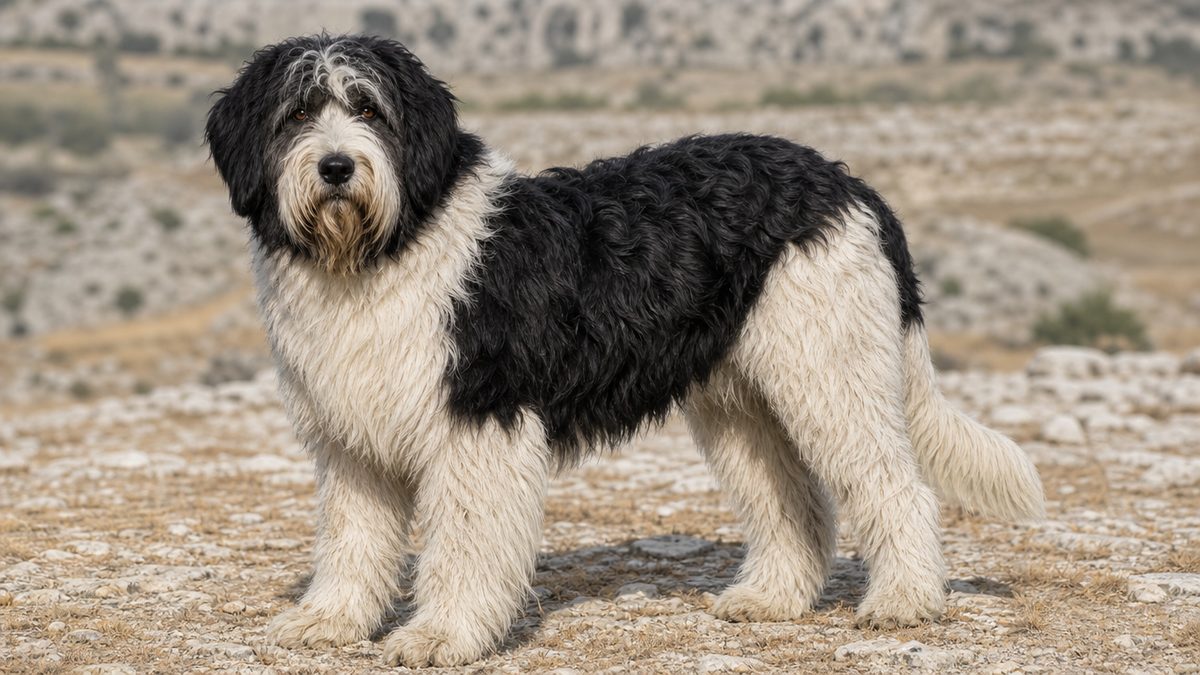
Three characteristics identify it, and none of them belongs to a hound. It is big, at 40 to 50 kg for a male. It is bearded, with a thick wig of hair on the skull, rich eyebrows, a moustache and a beard, all of them compulsory. And its job, in the standard's own words, is the protection of sheep and goats.
There is only one coat variety in this breed, unlike the Segugio Maremmano and the Segugio dell'Appennino, which each carry two. The standard describes a single shaggy, wavy, rustic covering and disqualifies the alternatives, so a buyer has no coat variety to choose between and no short-coated version to hope for.
The general appearance clause asks for a medium-sized to large dog with the conformation of a robust mesomorph, harmonic, compact and strong, with strong and big bone, whose appearance at first sight must show power and rusticity without ever appearing squat, and in which sexual dimorphism is well pronounced. That last clause is doing real work: a 50 kg male and a 32 kg female are the same breed, and a buyer looking at photographs of one sex will misjudge the other.
The head is broad, and the proportions say how broad. The length of the head is about four tenths of the height at the withers. The width of the skull is almost equivalent to its length. The skull is longer than the muzzle at roughly three to two, so the muzzle is about 40 percent of head length. Compare a Segugio Italiano, whose muzzle is exactly half its head length. This is a broader, shorter-faced head than any hound in this cluster, though it is nowhere near a short-faced breed in the airway sense.
The numbers the standard gives
| Clause | What the standard says |
|---|---|
| Height at withers, males | 62 to 70 cm, ideal 66 cm |
| Height at withers, females | 57 to 65 cm, ideal 61 cm |
| Weight, males | 40 to 50 kg |
| Weight, females | 32 to 42 kg |
| Head length | About four tenths of the height at withers |
| Skull width to skull length | Almost equivalent |
| Skull to muzzle length | About 3 to 2 |
| Body length to height | Just slightly greater than the height at withers |
| Chest depth | Around 48 percent of height, never exceeding 50 percent |
| Coat | Thick, ruffled, little to very wavy, never curly, dense undercoat |
| Face furnishings | Thick wig on the skull, rich eyebrows, moustache and beard |
| Ears | Natural and hanging, V-shaped, long-haired with fringes exceeding the pavilion |
| Colour | White-black, white-fawn in all grades, or white |
| Tail | Reaching at least the hock, low sabre at rest, never rolled on the back |
Colour is a closed list with an unusual rule attached. The permitted colours are white-black, white-fawn in all grades, and white. In bicoloured coats at least one white spot on the chest must be present. White-grey dogs are considered white-black, and the fawn carbonate colour is tolerated. Tricolour and brindle are not allowed. The disqualifying faults then close the loop: a coat colour other than those provided, or total absence of white mark, puts a dog out.
The disqualifying list is worth reading in full, because two entries on it are veterinary rather than cosmetic. It runs: unmotivated aggressive or shy dogs; cranial-facial axes convergent; overshot or undershot bite; blue eye; entropion or ectropion; absence of beard and moustache or short haired limbs; coat colour other than those provided, or total absence of white mark; and height below the minimum limit or more than 1 cm above the maximum. A breed standard that disqualifies entropion and ectropion is a breed standard whose club has seen eyelid problems.
The severe faults are mostly structural: partial or total depigmentation, excessive divergence of the cranial-facial axes, too marked a stop, erect or semi-erect ears, short or curly hair, cow hocks, dewlap, an elbow-to-ground height below 50 percent of the height at the withers, and a rolled or ring tail carried on the back.
A big, thick-boned, shaggy white-and-black or white-and-fawn Sicilian flock guardian of 32 to 50 kg, with a compulsory beard, moustache and eyebrows, hanging fringed ears and a broad skull. It is not a hound and it was never bred to hunt anything.
FCI Standard n 906: a number the FCI has never issued
The only breed standard that exists for the Spino degli Iblei is headed FCI Standard n 906 and prints an FCI Group 1 classification. The FCI has never issued a standard 906. The number is ENCI's own internal code, and the classification line is ENCI's own filing.
Open the document ENCI serves and the first line reads FCI Standard n 906 - SPINO DEGLI IBLEI. Four lines down it prints CLASSIFICAZIONE F.C.I.: Gruppo 1, Cani da Pastore e Bovari (esclusi bovari svizzeri), Sezione 1, Cani da pastore, Senza prova di lavoro, and the English half repeats it as FCI CLASSIFICATION: Group 1, Sheepdogs and cattle dogs, Section 1, Sheepdogs, Without working trial. Anyone reading that document has been told, twice, in two languages, that this is an FCI breed.
It is not. Three independent checks say so, each with its own control.
| Check | What was searched | Result | Control |
|---|---|---|---|
| FCI Group 1 index, Italy block | The whole rendered page | Two breeds only: 201 and 194 | MAREMMANO 1, BERGAMASCO 2, CANE DA PASTORE 2 hits |
| FCI Group 1 index, breed name | SPINO, IBLEI, SICIL | 0, 0 and 0 hits | Same page, same session, controls passed |
| FCI provisional register | All twenty entries | Highest number in use is 378 | No 900-series number anywhere |
| Breed numbers on the Group 1 page | All 43 numbers present | Highest is 350 | No number above 378 in either register |
The FCI's Group 1 index carries exactly two Italian breeds: CANE DA PASTORE ABRUZZESE MAREMMANO (201) and CANE DA PASTORE BERGAMASCO (194). A case-insensitive search of that whole page returns SPINO 0 times, IBLEI 0 times and SICIL 0 times, while MAREMMANO, BERGAMASCO and CANE DA PASTORE all return hits, so the search string works. The provisional register runs to twenty entries whose highest number is 378. There is no 906 to hold.
It is an ENCI internal code in a series the Italian studbook uses for native populations it holds outside the FCI system. Neighbouring numbers in the same series belong to other Italian recovery breeds. An FCI classification printed by any body other than the FCI is that body's own filing, and this is a clear case of it.
This matters commercially rather than academically. A document headed with an FCI standard number is the document a seller will show you, an importer will file and a translation service will render. It reads as international recognition and it is not. The honest description of this breed's status is national Italian recognition, which is a real and respectable thing, and it is set out in the next section.
One more thing the document does that is worth knowing
ENCI's bilingual standard drifts between its own two halves, in small ways that matter if you are comparing figures across sources. Three examples, all from the same PDF. The Italian eye clause reads L'iride varia dall'ocra chiaro al nocciola, light ochre to hazel; the English renders it as Iris color ranges from light ochre to dark ochre, which is a different colour. The English size clause reads Females: da 57 a 65 cm, leaving the Italian preposition untranslated inside the English text. And the English jaw clause reads Jaws large and stromg, an uncorrected typographical error.
None of those changes the dog. All of them tell you that this is a small breed club's document rather than a large registry's, produced once and not proofed since, and that a figure appearing in only one of the two halves should be checked against the other.
Breed or type? A written standard and a studbook, both from ENCI
The Spino degli Iblei is a breed, not a type, and the test is simple: a written breed standard exists anywhere, and a studbook registers the dogs anywhere. Both conditions are met, and both by the same body, the Ente Nazionale della Cinofilia Italiana.
The register comes first because it is the harder condition. ENCI's breed record for the Spino degli Iblei opens with the words RAZZA AMMESSA AL RSR (REGISTRO SUPPLEMENTARE RICONOSCIUTI), a breed admitted to the Supplementary Register of Recognised breeds, and then prints Codice FCI 906 and Gruppo 1, Sezione 1. That is a national studbook stating that it holds the dogs.
ENCI's own RSR list confirms it with a date and a club. The document, titled ELENCO DELLE RAZZE AMMESSE AL REGISTRO SUPPLEMENTARE RICONOSCIUTI (R.S.R.) DI PRIMA GENERAZIONE CON LIMITAZIONI and updated to 22 December 2025, carries the entry: 906. Spino degli Iblei (I), Club del Pastore Siciliano, A far data 1.7.2021 l'accesso al RSR e limitato ai soli raduni e alle mostre speciali.
1 July 2021 is not the date the breed entered the RSR. It is the date from which access to the RSR became LIMITED to raduni, breed gatherings, and special shows. In other words a dog can no longer be entered on the register anywhere; it has to be presented at a designated event. That is a tightening, and it is the sign of a register moving from open enrolment toward a closed population.
The standard is the second condition and it is plainly met: an eight-page bilingual document, Italian and English, covering general appearance, proportions, temperament, every anatomical region, gait, skin, coat, colour, size and weight, and three tiers of faults. Whatever one thinks of its FCI header, it is a real breed standard with a real disqualification list.
| Body | Status | Detail |
|---|---|---|
| ENCI, Italy | Razza ammessa al RSR, code 906 | Access limited to raduni and special shows from 1 July 2021 |
| Specialised club | Club del Pastore Siciliano | Named on ENCI's own RSR list |
| ENCI Group 1 index | Listed among the Cani da Pastore | Between Slovensky Cuvac and Welsh Corgi Cardigan |
| ENCI Razze Italiane | One of eighteen Italian breeds | With the Cirneco dell'Etna and the Mastino Siciliano from Sicily |
| FCI | Not recognised, definitively or provisionally | Absent from Group 1 and from the provisional register |
| American Kennel Club | No entry | No page and no Foundation Stock Service listing |
| The Royal Kennel Club | No entry | Never held |
| English Wikipedia | No article of its own | The title redirects to List of Italian dog breeds |
| Kennel Club of India | Publishes no breed list for any breed | Not a finding about this breed |
Two of those rows deserve their caveats stated rather than implied. The Kennel Club of India publishes no breed list at all, so a query there returns nothing for this breed and nothing for a common control either: that is an instrument limit and not evidence. And the ENCI Group 1 row matters as a positive control, because it shows that ENCI's per-group indexes do include breeds held on the supplementary registers, so an absence from a group list would have been a real absence.
How many Italian breeds are there? Two authorities, two numbers
ENCI's own Razze Italiane page names eighteen Italian breeds and this one is among them. English Wikipedia's List of Italian dog breeds states that seventeen are recognised by ENCI, of which fifteen are also recognised by the FCI, with a further six in the process of recognition. The two counts disagree, and the breed has no English Wikipedia article of its own: searching the title redirects to that list.
History, as the standard tells it
The standard's historical summary is short and it is about work rather than about antiquity. For centuries the dog Spino of Iblei has been bred in South-eastern Sicily, precisely in the Hyblaean Mountains and in the surrounding area up to the marina. The primary criterion of breeding of this breed has always been and still is the utilization of this dog for the guard and the defense of sheep and goats, for this reason today's dogs have preserved their temperament.
Note what that does not claim. There is no Egyptian origin, no Phoenician trade route and no Roman statue, which is what the Segugio Italiano's standard offers. It claims continuous use for one job in one place, which is a much smaller and much more checkable assertion.
Spino degli Iblei price in India: no listing, no market, and an entirely Italian search result
No published Spino degli Iblei price in india exists and no Indian listing for a live animal appears on the search results at all. Every organic result on the Indian query is Italian-language or Italian-origin, which is a cleaner picture of an absent market than any price could give.
Run the query and look at what ranks. On 8 September 2026 a Google India search for spino degli iblei dog returned About 133 results, and the organic set was razzecinofileitaliane.it, clinicalaveterinaria.it, asspnicosia.en.it, thedogshow.it, nativi.bio, devilsthorn.com, a Koko Genetics DNA-test page, ENCI itself and a Facebook page called Spino Degli Iblei USA with just over 200 followers. Not one Indian seller, not one Indian directory, not one rupee figure attached to a live animal.
That composition is the evidence, and it is worth saying why rather than leaning on the result count. An absolute number of search results measures nothing on its own, because an exact-phrase Indian query returns only a page or two even for a thick commercial breed term. What a page-one result set made entirely of Italian veterinary clinics, Sicilian associations and one American Facebook group does tell you is that the breed's entire online presence is a small community of enthusiasts in and around its home region.
Not even a fabricated price, which is unusual
Bonbeno's other pages in this Italian cluster document Google India's AI answers converting euro prices into rupees and presenting the result as an Indian price, in one case printing the conversion code underneath the answer. This breed does not attract even that. Its AI answer describes a rare, ancient Sicilian sheepdog used for centuries to protect livestock from predators on the rocky Iblei Mountains, gives its size and coat broadly correctly, and offers no price at all.
Test it. Take any euro figure quoted nearby, divide the rupee band by it, and see whether the quotient lands near an exchange rate. If it does, nothing was observed in India. Bonbeno publishes no rupee conversion of a foreign price, because converting is the operation that creates the numbers this site keeps having to correct.
One commercial artefact worth naming, because it is real
A canine DNA panel, Koko Genetics, lists the Spino degli Iblei as a breed it can identify and describes it from the ENCI standard as a shepherd dog for the protection of sheep and goats. That is not a market for the dog, but it does mean a reference population of genotyped Spini exists somewhere, which is more than can be said for several breeds in this cluster. It is also the kind of thing worth asking a breeder about, since a commercial panel that includes the breed can confirm what a dog is.
Why no Indian supply chain can form
Import of dogs sits at ITC(HS) 01061900, Mammals: Other, marked Restricted. Policy Condition 7 permits import only for a pet dog with a valid pet book and records in the importer's own name, for research by an R&D organisation with a CPCSEA recommendation, or for internal security by the Defence and Police Force. Policy Condition 8 states that import of commercial dogs for breeding or any other commercial activity outside those purposes is not permitted, and paragraph 6 of Trade Notice 22/2022-23 states that applications for trading or breeding purposes shall be duly rejected. The DGFT's FAQ closes the last gap: new born puppies of less than 7 months are not to be allowed.
Entry is limited to the airports and seaports of Delhi, Mumbai, Chennai, Hyderabad, Bengaluru and Kolkata and, since October 2024, Kochi airport, with quarantine at the government quarantine station of those ports where required Department of Animal Husbandry…. There is also a supply-side constraint that no Indian rule creates: access to Italy's own register for this breed has been limited to breed gatherings and special shows since 1 July 2021, which is not the profile of a population with an export surplus. The full route is set out in how to import a dog to India.
And the other Indian legal question, since Google raises it
The People also ask panel for this breed opens with Are Kangal legal in India?, which is the search engine recognising the functional category and missing the breed. The instrument behind that question is CBIC Instruction No. 05/2024-Customs of 14 March 2024, which reproduced a Department of Animal Husbandry and Dairying letter prohibiting the import of a list of breeds including mixed and cross breeds.
The list runs to 24 comma-separated entries: Pitbull Terrier, Tosa Inu, American Staffordshire Terrier, Fila Brasileiro, Dogo Argentino, American Bulldog, Boerboel, Kangal, Central Asian Shepherd Dog (ovcharka), Caucasian Shepherd Dog (ovcharka), South Russian Shepherd Dog (ovcharka), Tornjak, Sarplaninac, Japanese Tosa and Akita, Mastiffs (boerbulls), Rottweiler, Terriers, Rhodesian Ridgeback, Wolf dogs, Canario, Akbash dog, Moscow Guard dog, Cane corso, and every dog of the type commonly known as a Ban Dog A second, independent reproduction of CBIC….
The Spino degli Iblei is not on it. But notice what is: Kangal, Central Asian Shepherd, Caucasian Shepherd, South Russian Shepherd, Tornjak, Sarplaninac, Akbash dog and Moscow Guard dog. Eight of the 24 entries are livestock guardians or guard breeds, which is a third of the list and is exactly this breed's functional category. A reader should know that the breed sits close to a line it does not cross rather than nowhere near one.
Two independent reproductions of the customs instruction were read, and both carry the SAME typographic defects: a double comma after Tosa Inu and a full stop where a comma belongs after Fila Brasileiro. Two transcriptions that agree on their defects are transcribing the same underlying document rather than copying each other's summary. The instruction was challenged in Indian High Courts during 2024, and Bonbeno has not read those judgments, so this page states no verdict on their form.
Monthly cost of ownership for a 45 kg guardian in India
Budget upward of Rs 5,000 a month before food, and expect food to be the largest single line for a 40 to 50 kg dog. The widely quoted Indian parasite-control price does not even cover this weight, which is the first thing most cost estimates get wrong about a guardian breed.
Start with the mistake almost every Indian cost page makes with big dogs. The NexGard Spectra pack that Indian sellers list at Rs 3,308 for three tablets is the 15 to 30 kg presentation. A male Spino degli Iblei weighs 40 to 50 kg and a female 32 to 42 kg, so every adult of this breed is above that pack's range and needs the larger presentation at a higher price. Any monthly figure built on the 15 to 30 kg pack understates a Spino's parasite cover.
Deworming scales the same way. Drontal Plus costs Rs 813 for a strip of six against an MRP of Rs 838, which is Rs 135.50 a tablet, and the label doses one tablet per 10 kg of bodyweight. A 45 kg dog therefore needs four to five tablets per deworming, which is Rs 542 to Rs 678 each time, against Rs 271 for a 20 kg hound. Note also that the Drontal price moved: an earlier Bonbeno reading of the same page recorded Rs 754.
| Line | Price basis | Frequency | Note for this weight |
|---|---|---|---|
| Tick and flea cover | Rs 3,308 covers 15-30 kg only | Monthly | This breed needs the larger pack, priced higher |
| Drontal Plus deworming | Rs 813 for 6 tablets | Quarterly, 4-5 tablets | Rs 542 to Rs 678 per deworming |
| Annual vaccination booster | From Rs 3,199 | Yearly | Rs 267 a month equivalent |
| Anti-rabies alone | Rs 699 | Yearly | Rs 58 a month equivalent |
| Bath and coat drying | From Rs 934 | Every 6 to 8 weeks | A 45 kg shaggy dog is not a home-bath job |
| Delhi pet dog registration | Rs 500 new, Rs 500 renewal | Yearly | Rs 42 a month equivalent |
| Chennai pet licence | Rs 50 | Yearly | Rs 4 a month equivalent |
| Food | Varies by brand | Monthly | The largest line by far at this weight |
Vaccination and the municipal route
At Vetic, a chain with clinics across several metros, the puppy course starts at Rs 6,499 against a struck-through Rs 8,111, the annual booster starts at Rs 3,199 against Rs 3,806, anti-rabies alone is Rs 699, the 9-in-1 DHPPiL is Rs 899 and kennel cough is Rs 1,349. Those are promotional floors from one chain, and the same chain quotes different course prices on different city pages on the same day.
Greater Chennai Corporation's pet clinics are listed as providing all treatment and anti-rabies vaccination free of cost for pet animals, and the corporation issued 9,115 pet licences during 2024 at Rs 50 each. Delhi charges Rs 500 to register a pet dog and Rs 500 to renew, with a Rs 100 per month late fee and a one-month grace period after the anti-rabies certificate expires, the certificate valid for a maximum of one year tied to the vaccination date. Municipal fees are the durable figures here.
Grooming is a real line for this breed, unlike the hounds
Vetic's Delhi list gives bathing from Rs 934, a haircut from Rs 1,359 and a complete bath and styling from Rs 1,869. A 45 kg dog with a thick wavy coat over a dense undercoat, plus a beard, moustache and eyebrows, is not a bucket-in-the-balcony job, and the drying is more work than the washing. Budget the bath price and expect to pay toward the upper end of it for size.
One thing you must not buy is a clip-off. The standard disqualifies absence of beard and moustache or short haired limbs, and severely faults short or curly hair. A groomer who offers to take a Spino down for the Indian summer is offering to make it a different dog, and the coat will not come back the same. Manage heat with shade, cooling, timing and water instead.
Weight. Almost every Indian pet-cost figure in circulation is built for a 15 to 30 kg dog, and this breed sits entirely above that band. Parasite cover, deworming, food, boarding and any anaesthetic procedure all scale, and boarding for a 45 kg guardian is charged at the top of any kennel's range.
Indian climate: the coat is the problem, and Indian law names it
This is the worst-adapted breed in Bonbeno's Italian cluster for Indian conditions, and not because its homeland is cold. Sicily is the warmest homeland of the five. The problem is a 40 to 50 kg body under a thick wavy coat with a dense undercoat, which is exactly the profile Indian law singles out for outdoor housing.
The climate arithmetic is the friendliest in this cluster and it still does not save the dog. Bonbeno queried NASA POWER by explicit latitude and longitude and echoed back the elevation the model reports for every cell. Vittoria, in the Iblei foothills, returns a cell at 171.62 m against a real 168 m, an error of only plus 3.6 metres, and gives an annual mean of 18.25 C and 72.14 percent relative humidity, a hottest month of August at 27.60 C, a coolest month of February at 10.45 C and a peak wet bulb of 21.37 C.
Ragusa, Modica, Noto and Palazzolo Acreide all return a SINGLE grid cell at 242.65 m, against real elevations of 502, 296, 152 and 670 metres. One cell is covering four towns across a 518 m vertical range and is 427 m below Palazzolo. The plateau where this breed actually works with flocks is therefore COOLER than any cell POWER will give you, and the figures below describe the foothills. Bonbeno uses Vittoria because it is the one cell in the region standing where its town is.
| Place | Annual mean C | Annual RH percent | Hottest month | Peak wet bulb C |
|---|---|---|---|---|
| Vittoria, Iblei foothills | 18.25 | 72.14 | August, 27.60 | 21.37 |
| Delhi | 25.60 | 45.56 | June, 35.88 | 26.50 |
| Mumbai | 26.77 | 67.39 | May, 31.19 | 25.77 |
| Chennai | 27.95 | 72.39 | May, 31.51 | 26.11 |
| Bengaluru | 23.74 | 67.94 | April, 28.37 | 21.86 |
| Pune | 23.86 | 66.80 | April, 28.93 | 22.97 |
| Kolkata | 25.81 | 73.93 | May, 31.53 | 27.09 |
| Kochi | 27.31 | 78.83 | March, 29.42 | 25.79 |
Two things in that table are genuinely encouraging and one is decisive. Encouraging first: Sicily's annual humidity of 72.14 percent is almost exactly Chennai's 72.39, so there is no humidity shock at all for this breed, and it is drier at home than Kolkata or Kochi. And Bengaluru's peak wet bulb of 21.86 C is within half a degree of the Iblei's 21.37 C. On the numbers alone, Bengaluru is close to a match.
The decisive part is the coat. This dog carries a covering that is thick and ruffled with a dense undercoat, abundant on head and body, forming a thick wig on the skull with rich eyebrows, moustache and beard, with long hair on the front and rear faces of all four limbs and maximum length on the back. Insulation designed for a windy Sicilian winter on an animal that sleeps outdoors with a flock is not neutral in a Chennai August, and it cannot be removed: absence of beard and moustache, or short haired limbs, is a disqualifying fault and short hair is a severe one.
Indian law names this exact case
Second Schedule Part IV paragraph 21(1) of the Prevention of Cruelty to Animals (Dog Breeding and Marketing) Rules, 2017 bars keeping certain dogs in outdoor facilities without the attending veterinary practitioner's written approval. Its three categories are: dogs that are not accustomed to the temperatures prevalent in the area or region in question; dog breeds that cannot tolerate the temperatures prevalent in the area or region in question, such as long-haired breeds in high temperature locations; and sick, infirm, aged or young animals.
An imported Spino degli Iblei is the first category on the day it lands and is arguably the second permanently. That matters more for this breed than for any hound in this cluster, because a livestock guardian's entire working life is outdoors. A Spino kept indoors with cooling is a Spino not doing its job; a Spino doing its job in an Indian summer is the case that clause was written about.
Weight, and the one figure from the literature that reaches this breed
Hall 2020's Scientific Reports analysis of 905,543 UK dogs under primary veterinary care found an overall heat-related illness incidence of 0.04 percent and a case fatality of 14.18 percent across 395 events. Bodyweight at or above the mean for the breed and sex carried an odds ratio of 1.42, confidence interval 1.12 to 1.80, and dogs over 50 kg carried an odds ratio of 3.42, confidence interval 1.54 to 7.57.
Read that second figure carefully in relation to this breed. The standard's ceiling for males is exactly 50 kg, so a correct large male sits at the boundary of the band that carries more than triple the odds, and an overweight one crosses it. The breed itself was not in Hall's study and no breed-specific figure exists for it, so the transferable findings are the bodyweight one and the size band, and neither is a prediction about any individual dog.
The head does not help as much as it does for the hounds either. The Segugio Italiano is classified dolichocephalic in McMillan 2024's own table, meaning a long nasal passage with a large evaporative surface. This breed is not classified anywhere, and its own standard gives a skull whose width almost equals its length and a muzzle at roughly 40 percent of head length, against a hound's 50 percent FCI-Standard N 337. That is a broader, shorter face and therefore less cooling surface, though it is nowhere near a short-faced breed in the airway sense and this page makes no claim that it is.
Temperament: a guardian that decides for itself, and two claims worth reading sceptically
The Spino degli Iblei is a fearless and tireless guardian, a firm and incorruptible defender of the flocks entrusted to it, that socialises with strangers when its owner is present. Its standard also makes two claims about hardiness that an owner should not act on literally.
Take the behaviour clause in full, because it is short and every sentence carries weight. The breed's utilisation is the protection of flocks from the attacks of wolves, foxes and feral dogs. It is accustomed to live without suffering in extreme areas in spite of the very poor diet that shepherds give their dogs, and for this reason it is very resistant to common diseases. It is a fearless and tireless guardian, firm and incorruptible defender of flocks entrusted to it, but it tends to socialize with strangers when the shepherd or owner is with it. It is a perfect playmate for children towards whom it naturally assumes a docile and submissive behaviour. It shows pronounced ability to adapt to any new environment.
The claim that the dog thrives on a very poor diet and is therefore very resistant to common diseases is a breed club's account of a landrace's history, not a feeding or vaccination guideline. Underfeeding a 45 kg growing dog causes orthopaedic disease. And the claim that it adapts to any new environment is not tested against a climate ten degrees warmer than Sicily. Read both as folklore about toughness rather than as instructions.
The socialisation clause is the practically useful one, and it is worth reading precisely. The dog socialises with strangers when the shepherd or owner is with it. The unstated other half is what it does when the owner is not there, which is guard. That is the correct behaviour for the job and it is the single hardest thing about keeping a livestock guardian in a dense human environment, where gates open, couriers arrive and children come over.
The ideal owner, stated plainly
- Households with livestock, land and a real guarding job, which is the only setting this breed was designed for
- Households with a large securely fenced area, because a guardian without a defined territory invents one
- Households in the coolest region available, since the coat cannot be reduced and the law restricts outdoor keeping
- Households prepared to manage visitors deliberately and permanently rather than hoping the dog settles
- Households experienced with independent working breeds, because obedience was never a selection criterion here
- Apartments of any size, since a guardian in a corridor environment is a liability to itself and everyone else
- Indian plains cities in summer, where a 45 kg long-haired dog cannot work outdoors and cannot be clipped
- Households wanting an obedient dog, since nothing in the standard mentions trainability or biddability
- Households with frequent unfamiliar visitors, deliveries or gate traffic
- First-time owners, who will meet a 45 kg animal making its own decisions before they meet a training problem
What the standard does not say, which is as informative
There is no clause about the voice, none about exercise requirement, none about trainability and none about living with other dogs. That silence is normal for a livestock guardian standard, because the dog's working context supplies all four answers: it barks at night as a deterrent, it patrols rather than exercises, it decides rather than obeys, and it works with other dogs of its own kind. An owner outside that context has to supply substitutes for all of it.
For an Indian household the honest summary is that this breed is a poor pet and a good guardian, in that order, and that almost nobody reading this page has the job it was made for. Bonbeno says so rather than softening it, because a 45 kg independent guardian acquired as a family dog is the kind of mismatch that ends badly for the dog.
Training a dog selected to ignore you
To train this breed, train management rather than obedience. Nothing in its standard mentions trainability, biddability or willingness, and a livestock guardian is selected precisely to make decisions about threats without waiting for a human.
Read the standard for what it asks of the dog's mind and you find one word: guardian. Fearless, tireless, firm and incorruptible in defence of the flocks entrusted to it. There is no clause about the handler, none about learning, none about response to command. Compare the Segugio dell'Appennino's standard, which says its obedience is an innate and atavic talent. Two Italian standards, two entirely different pictures of the human relationship.
That absence is not a gap in the drafting; it is the breed. A guardian working a Sicilian hillside at night is valuable exactly because it acts without instruction. Selecting for a dog that checks with a person before acting would produce a worse guardian, so nobody selected for it.
What to train instead, in order
- Weeks 8 to 16: handling above everything, because a 45 kg adult that will not accept nail trims, ear checks and veterinary examination is a permanent problem
- Weeks 10 to 16: deliberate, positive exposure to strangers arriving at a gate WITH you present, which is the one context the standard says the dog accepts
- Months 3 to 9: a rock-solid place or mat behaviour, which is the practical substitute for a recall in a guardian
- Months 4 to 12: crate or pen conditioning, so visitors, deliveries and tradespeople are managed by containment rather than by trust
- Throughout: lead manners early and seriously, since a 45 kg dog that pulls is not walkable by most owners
Notice what is absent from that list: off-lead recall. A livestock guardian's recall is unreliable by design and a dog of this weight making its own decision at a distance is not a manageable situation in an Indian public space. Plan for a securely fenced area and a lead, permanently, and treat that as the correct arrangement rather than a training failure.
The visitor problem, which is the whole job
The standard's socialisation clause is conditional: the dog tends to socialise with strangers when the shepherd or owner is with it. Every practical training decision follows from that condition. Introduce people at the boundary with you present, never let strangers enter unaccompanied, use a gate or a pen for deliveries, and do not test the dog's tolerance by leaving it to work out a new arrival on its own. This is management that never stops rather than training that finishes.
The children clause is generous and should still be managed. The standard calls the breed a perfect playmate for children towards whom it naturally assumes a docile and submissive behaviour. Even taken at face value that describes the family's own children, not visiting ones, and a 45 kg dog and a small child need supervision regardless of temperament.
One legal note binding any Indian breeder rather than any owner. The 2017 Rules permit only out breeding and line breeding, and prohibit in breeding, defined as breeding between relatives of the second to fourth grade in straight or side line within the first four generations, and incest breeding, defined as mating between parents and children or between brother and sister. On a breed whose access to its own national register has been limited to breed gatherings since 1 July 2021, and whose population is confined to one Sicilian region, that constraint bites hard.
Do not rely on obedience for safety. Rely on a gate, a fence, a lead and a pen. Every guardian breed that ends up rehomed or worse does so because someone trusted training where they should have used a barrier.
Exercise: territory rather than mileage, which is the harder thing to supply
This breed needs space to patrol rather than distance to cover. Its standard describes a free and fluid step whose natural gait is a trot, with the footprint of the rear foot reaching that of the front without passing it, and a dog that must never trudge.
The gait clause is the closest thing the standard gives to an exercise specification: a free and fluid step; the footprint of the rear foot reaches that of the front foot without passing it; the natural gait is trotting with a firm back and the head almost on the extension of the dorsal line; and the dog must never trudge when trotting. That is an economical, all-day patrolling gait, not a galloping one. Compare the Segugio Maremmano's standard, which describes a galloper.
What that means practically is that a Spino degli Iblei does not need the two hours of hard running the hounds in this cluster do. What it needs instead is a large, secure, defined area it can walk the boundary of, several times a day, on its own initiative. In rural Sicily that is a hillside with a flock on it. In urban India there is no equivalent, and a substitute has to be built rather than found.
| Need | Why | Indian substitute |
|---|---|---|
| A defined territory to patrol | The working behaviour is boundary walking | A large fenced compound, farm or plot |
| Something to be responsible for | The dog guards a flock, not a house | Livestock, poultry, or a genuine property role |
| Cool hours to work in | 40 to 50 kg under a dense undercoat | Dawn and after dark for most of the year |
| Low-impact movement | The natural gait is a trot, not a gallop | Long slow walks rather than running or fetch |
| Company of its own kind | Guardians traditionally work in pairs or groups | Rarely available; expect a lonely dog if solo |
| Shade and water at all times | Indian heat plus insulation | Non-negotiable, and legally relevant outdoors |
Space requirements are the honest sticking point, and they are not about floor area indoors. A guardian needs ground it can define and walk, and an Indian flat cannot supply that at any size. This is also a vocal breed by function rather than by any clause in the standard, since a deterrent bark at night is what guarding consists of, so a shared boundary wall counts against you as much as a small one does.
The row about cool hours is the one that constrains everything else. Vittoria in the Iblei foothills peaks in August at 27.60 C; Delhi peaks in June at 35.88 C and Chennai in May at 31.51 C. Those are whole-day means, so afternoons run well above them. A dog that patrols by nature and cannot patrol for eight hours a day for eight months of the year is a frustrated dog, and there is no indoor scent-game substitute for a guardian the way there is for a hound.
The weight and heat interaction, stated once more because it matters here
Hall 2020 found dogs at or above the mean bodyweight for their breed and sex carried an odds ratio of 1.42 for heat-related illness, and dogs over 50 kg an odds ratio of 3.42, against an overall case fatality of 14.18 percent across 395 events in 905,543 dogs. This breed's standard tops males out at exactly 50 kg. Keep a working guardian at the lean end of its range in India, and never let exercise, heat and excess weight coincide.
Frantic panting that does not slow when the dog stops, bright red gums, unsteadiness, vomiting or collapse. Move to shade, wet the coat right down to the skin with cool rather than iced water, and get to a vet. A dense undercoat means water sits on the surface and does nothing unless you work it in, which is a specific hazard of long-coated breeds in hot countries.
Grooming: a compulsory beard, a dense undercoat and an Indian monsoon
Groom this breed weekly at minimum and dry it thoroughly every time it gets wet. The coat is thick, ruffled and wavy over a dense undercoat, the head carries a compulsory wig, eyebrows, moustache and beard, and none of it may lawfully be clipped away without disqualifying the dog.
The coat clause sets the work. The covering hair is of good thickness, ruffled, from little to very wavy without ever being curly, over a thick undercoat, abundant on both the head and the body. On the skull the hair forms a thick wig and rich eyebrows; the muzzle carries moustache and beard; the limbs are covered with long hair on both the front and rear faces; and the maximum length of hair is on the back.
Then read the fault list, because it removes the obvious Indian shortcut. Absence of beard and moustache, or short haired limbs, is a DISQUALIFYING fault, and short or curly hair is a severe fault. There is no version of this breed with a summer clip that is still a correct dog. Manage the heat with shade, timing, cooling and water, and leave the coat alone.
The weekly routine, and the daily one
- Brush the body coat thoroughly at least once a week, working down to the undercoat rather than over the top of it
- Wipe the beard and moustache dry after every drink and every meal, which on a bearded breed in a humid country is the single most useful daily habit
- Check the skin under the beard, under the ear fringes and in the armpits weekly, because long hair hides early skin disease
- Lift and check both ears weekly, parting the fringe, since the standard itself says the ears are little visible because of the drooping hair of the skull
- Dry the coat to the skin after every bath and every wet walk, because a dense undercoat holds water for hours
- Trim nails as needed and brush the teeth, since the 2017 Rules impose no dental requirement at all
The ears deserve their own paragraph. They are natural and hanging, wide at the base, V-shaped with slightly rounded tips, covered with long hair with fringes that abundantly exceed the pavilion, and the standard notes they are little visible either frontally or laterally because of the long drooping hair of the skull. A hanging ear under a curtain of hair, in Kochi at 78.83 percent annual relative humidity or Kolkata at 73.93, is a poorly ventilated canal in a wet country. Weekly checks are not optional.
The eyes, because the standard flags them
This is the only breed in Bonbeno's Italian cluster whose standard disqualifies entropion and ectropion outright. Those are inward and outward rolling of the eyelid, both painful and both surgical. A club that writes them into a disqualification list has seen them, and Indian law separately names both among the genetic defects a breeding dog must have been tested for, under Second Schedule Part III paragraph 8(10).
So examine the eyelids of any puppy carefully and again at six months, ask the breeder directly about entropion in the line, and take any squinting, watering or rubbing to a vet rather than waiting. On a breed with heavy facial furnishing, an owner is unlikely to notice an eyelid problem early by eye alone.
Thirty to forty minutes of proper brushing on a 45 kg coat, a beard wipe after every meal and drink, a weekly ear check under the fringes, and a full dry after any soaking. In the monsoon the drying is the job. This is the highest grooming burden of any breed in this cluster by a wide margin.
Health: no literature at all, and one clue the standard gives away
No veterinary literature about the Spino degli Iblei exists. PubMed returns zero records naming it under every form tested against passing controls, it is absent from McMillan 2024 entirely, and no screening scheme covers it. The only health signal available is what its own standard chose to disqualify.
State the absence precisely rather than vaguely. There is no median lifespan, no published life expectancy, no hip or elbow screening scheme, no published OFA statistics row, no breed health survey and no prevalence figure of any kind for this breed. That is an absence of data, not an absence of disease, and on a breed held on a national supplementary register with no international recognition it is exactly what one would expect.
How the literature absence was tested
Every name form was searched with the query translation line read and controls run in the same session. 'Spino degli Iblei' was rewritten by PubMed into spino AND degli AND iblei and returned 0 with a quotedphrasesnotfound warning. 'Spino of Iblei', the English name used in ENCI's own translation, was rewritten into spino AND iblei and returned 0. Hyblaean dog returned 0. Controls in the same session gave Labrador Retriever 1,109 and Bracco Italiano 5.
| Query | Records | What they are about |
|---|---|---|
| "Spino degli Iblei" | 0 | No records at all |
| "Spino of Iblei" | 0 | No records at all |
| Hyblaean dog | 0 | No records at all |
| Iblei[tiab] | 2 | Olive oil phenolics, and a sand fly survey |
| Iblei, all fields | 3 | The above plus splenic haemangioma sonography |
| "Labrador Retriever"[tiab], control | 1109 | Control passed |
| "Bracco Italiano"[tiab], control | 5 | Control passed |
The breed is likewise absent from McMillan 2024's supplementary Table S5 altogether. That table holds 345 rows, 155 flagged Y and 189 flagged N, and a flexible search of every row returns zero hits for spino, iblei and sicil. So unlike the Segugio Italiano, which appears in that table and was considered and excluded, this breed was never listed at all.
The one real clue: what the standard disqualifies
A breed standard's disqualification list is a health document if you read it as one, because clubs disqualify what they are trying to remove. This one disqualifies entropion or ectropion, inward and outward rolling of the eyelid, alongside blue eye, overshot or undershot bite, and convergent cranial-facial axes. It severely faults partial or total depigmentation and cow hocks.
The eyelid entry is the one to act on. Entropion and ectropion are painful, they are surgical, and on a heavy-headed breed with abundant facial furnishing they are hard for an owner to spot early. Indian law reaches them too: Second Schedule Part III paragraph 8(10) of the 2017 Rules requires that dogs used for breeding shall have been tested for genetic defects including hip dysplasia, progressive retinal atrophy, night blindness, hypothyroidism, entropion, ectropion, overshot and undershot jaw, wry mouth and two or more missing teeth. The word including makes that list illustrative rather than closed.
The claim in the standard that should not be treated as health information
The temperament clause states that the breed is accustomed to live without suffering in extreme areas in spite of the very poor diet that shepherds give their dogs, and for this reason it is very resistant to common diseases. That is a breed club's account of a landrace's survival, and it is not a veterinary finding. No study supports it, because no study of this breed exists. Feeding a 45 kg growing dog poorly causes orthopaedic disease, and a dog that has never been vaccinated is not disease-resistant, it is unvaccinated.
The only published science from the breed's own home range
There is exactly one, and it is not about dogs directly. A three-year sand fly investigation between 1997 and 1999 covered a densely inhabited area at the foot of Mount Etna and the area of the Iblei mounts, capturing 9,095 sand flies of which 63.4 percent were male, across six species. In the Iblei region Sergentomyia minuta showed the highest prevalence at 84.5 percent, followed by Phlebotomus perniciosus at 14.4 percent, P. perfiliewi at 0.9 percent and P. neglectus at 0.1 percent, with P. sergenti very rare at below 0.02 percent.
P. perniciosus is the principal vector of canine leishmaniasis in Italy, so that survey establishes that the vector is present, at scale, in the plateau this breed works. India has both the parasite and sand fly vectors, so the disease is a live consideration on both ends of any move. Bonbeno publishes no Indian prevalence figure, because the available Indian numbers come from clinic caseloads of already-suspected dogs and describe a different population from the one your dog would join.
There is no breed-specific health answer to look up for this dog, which makes an actual examination more important rather than less. Have the eyelids checked at every visit, take repeated head shaking or a squinting eye seriously the same week, and treat any large-breed lameness between six and eighteen months as an orthopaedic question rather than a strain.
Feeding: a 45 kg growing dog, and a standard that romanticises going hungry
Feed this breed properly and ignore the line in its own standard about thriving on a very poor diet. That sentence describes how a Sicilian landrace survived, not how a 40 to 50 kg dog should be raised, and following it during growth causes orthopaedic disease.
Nutrition and feeding for this breed are governed by one fact and one myth. The fact is size: a dog reaching 50 kg needs a large-breed growth plan. The myth is that a hardy landrace needs less than other dogs, which is what the standard's own history clause implies and what an owner should not act on.
The standard's own words are: accustomed to live without suffering in extreme areas in spite of the very poor diet that shepherds give their dogs. For this reason it is very resistant to common diseases. Read that as history. A population that persisted on scraps for centuries selected for animals that could, which says nothing about what an individual dog needs to grow correctly, and nothing at all about disease resistance in any measurable sense.
Growth is the part that matters most
A dog reaching 40 to 50 kg for males and 32 to 42 kg for females spends eighteen months building a skeleton, and large-breed growth is the period where feeding errors are least recoverable. Overfeeding accelerates growth and loads immature joints; underfeeding, which the standard's line invites, produces the same problem from the other direction. Steady, unhurried growth on a food formulated for large breeds is the whole objective.
| Stage | Target condition | Meals a day | Priority |
|---|---|---|---|
| 8 to 16 weeks | Growing steadily, ribs easily felt | 4 | Large-breed formulation, never free feeding |
| 4 to 8 months | Waist visible, no sudden gains | 3 | Slow growth protects immature joints |
| 8 to 14 months | Frame filling, still lean | 2 to 3 | Do not push weight to look impressive |
| 14 to 24 months | Approaching 32 to 50 kg by sex | 2 | Muscle rather than bulk |
| Adult male | 40 to 50 kg per the standard | 2 | Stay at the lean end in India |
| Adult female | 32 to 42 kg per the standard | 2 | Stay at the lean end in India |
| Adult, Indian summer | Same, fed away from the heat | 2, early and late | Water constantly, food away from midday |
| Senior, 7 years plus | Slightly lighter | 2 | Protein maintained, calories reduced |
Why the top of the weight range is a bad place to be in India
Hall 2020's Scientific Reports analysis of 905,543 UK dogs found dogs at or above the mean bodyweight for their breed and sex carried an odds ratio of 1.42 for heat-related illness, and dogs over 50 kg an odds ratio of 3.42, against a case fatality of 14.18 percent across 395 events. The standard's ceiling for a male is exactly 50 kg. A correct large male is at the boundary of the higher-odds band and an overweight one is inside it. This breed was not in that study, so the size band and the bodyweight factor are the only transferable findings.
Practical Indian notes
Feed away from the heat of the day, and split meals to the two cool ends. Water must be constantly available and refreshed rather than topped up, because a bowl standing in Indian warmth all day is a culture medium, and a 45 kg dog under a dense undercoat drinks a great deal.
The bowl itself matters on a bearded breed. A deep bowl soaks the beard at every drink and a soaked beard in humid weather stays soaked, so use a heavy, wide, shallow one that keeps the furnishings above the waterline, and wipe the muzzle dry afterwards. That single habit prevents most of the beard staining and skin irritation that bearded breeds attract in wet climates.
Bonbeno publishes no monthly food figure for this breed. Indian retail prices move within weeks, a monthly total is arithmetic from a grams-per-day figure that depends entirely on the food chosen, and at this weight the number would be the largest and least reliable line on the page. Price the bag you intend to buy, divide by its own feeding guide for a 40 to 50 kg dog, and treat the vaccination and municipal figures in the cost section as the stable part of the budget Municipal Corporation of Delhi.
The first year, month by month, with the Indian dates that bind
Plan the first two years rather than the first one, because a 40 to 50 kg dog is not finished at twelve months. The fixed points are the eight-week floor Indian law sets on any sale, the socialisation window that closes near four months, and a long growth period on heavy bone.
Indian law sets the earliest date. Rule 8(1)(a) of the Prevention of Cruelty to Animals (Dog Breeding and Marketing) Rules, 2017 requires every breeder to ensure that pups less than eight weeks in age are not sold, and Second Schedule Part III paragraph 8(9) states that all pups shall be vaccinated starting at seven to eight weeks and usually completed at eighteen weeks.
| Age | What is happening | What you do about it in India |
|---|---|---|
| Under 8 weeks | Legally unsaleable in India | Refuse the puppy and report the breeder |
| 8 to 10 weeks | Home, vaccination course begins | Book the puppy course, budget from Rs 6,499 |
| 10 to 14 weeks | Socialisation window open | Visitors at the gate WITH you present, plus traffic and crowds |
| 10 to 16 weeks | Handling habits set for life | Nails, ears under the fringe, eyelids, mouth, every week |
| 14 to 16 weeks | Window closing, course completing | Anti-rabies, then municipal registration |
| 4 to 8 months | Rapid growth on heavy bone | No stairs work, no jumping, no forced running |
| 6 months | Eyelid conformation readable | Have entropion and ectropion checked specifically |
| 8 to 14 months | Guarding behaviour emerging | Manage visitors by containment, not by trust |
| 12 to 24 months | Still filling out to adult weight | Hold lean; the top of the range is the wrong place in India |
Register once the anti-rabies certificate exists, because the registration hangs on it. Delhi charges Rs 500 for a new pet dog registration and Rs 500 to renew, with a Rs 100 per month late fee and a one-month grace period after that certificate expires, valid for a maximum of one year tied to the vaccination date. Chennai charges Rs 50 for a pet licence and issued 9,115 of them in 2024.
The six-month eyelid check, which is specific to this breed
Book it deliberately. This breed's own standard disqualifies entropion and ectropion, and Indian law names both among the genetic defects a breeding dog must have been tested for. Eyelid conformation on a heavy-headed puppy is readable by six months, the abundant facial furnishing makes it hard for an owner to see, and the condition is painful and progressive. Ask the vet to look specifically rather than in passing.
What not to do during growth
- Do not force-exercise a growing large-breed puppy, since repeated stairs, jumping and long tarmac walks load immature joints
- Do not push weight to make a young guardian look substantial, because that is the single commonest way to damage a large breed
- Do not follow the standard's line about a very poor diet, which describes a landrace's history rather than a feeding plan
- Do not clip the coat for the Indian summer, since absence of beard and moustache or short haired limbs is a disqualifying fault
- Do not skip the ear checks under the fringe, because the standard itself says the ears are barely visible through the hair
Weeks 10 to 14, and for this breed the specific content matters more than the volume. A guardian that meets strangers pleasantly at a gate with its owner present, dozens of times, before four months, is a manageable adult. One that does not meet them until it is 40 kg is a different and much harder animal.
Head to head: against Italy's other guardians, Italy's other Sicilians, and India's own
The right comparison for this breed is not the Italian scent hounds it is grouped with by geography. It is the Maremmano-Abruzzese Sheepdog, which does the same job with an FCI number and a real literature behind it, and India's own Himalayan Sheepdog, which does it here already.
Start by clearing away the wrong comparison. Bonbeno covers this breed alongside four Italian Segugi because ENCI lists all five among its eighteen Italian breeds, but functionally it belongs with none of them.
| Breed | Group | Job | Males, cm | Weight, kg |
|---|---|---|---|---|
| Spino degli Iblei | ENCI Group 1, sheepdogs | Guard sheep and goats | 62 to 70 | 40 to 50 |
| Segugio Italiano a Pelo Raso | FCI Group 6, scent hounds | Hunt hare and wild boar | 52 to 58 | 18 to 28 |
| Segugio Maremmano | FCI Group 6, scent hounds | Hunt wild boar | 48 to 54 | 16 to 23 |
| Segugio dell'Appennino | FCI Group 6, scent hounds | Hunt hare | 44 to 50 | 10 to 18 |
A 50 kg guardian and a 10 kg hare hound are not variations on a theme. Care advice, exercise plans, training approaches and heat management all differ, and the only thing the five genuinely share is a national list and a country.
Against the Maremmano-Abruzzese, which is the real comparison
Italy has a livestock guardian that the FCI does hold: the Cane da Pastore Abruzzese Maremmano at number 201, one of exactly two Italian breeds in the FCI's Group 1 index. It does the same job, in the same country, at a similar size, with a full international standard, a large population and a body of published material behind it. If what a reader wants is an Italian flock guardian, that is the breed with the paperwork.
| Breed | International status | Available in India | Documentation |
|---|---|---|---|
| Spino degli Iblei | None; ENCI RSR only, code 906 | No | One bilingual standard, zero literature |
| Maremmano-Abruzzese Sheepdog | FCI 201, definitive | Occasionally, for farm work | Full FCI standard and a real literature |
| Bergamasco Shepherd | FCI 194, definitive | Rare | Full FCI standard; also on ENCI's RSR list with limits |
| Kangal Shepherd Dog | FCI 331 | Named in India's 2024 import circular | Full FCI standard |
| Himalayan Sheepdog | None internationally | Yes, in the Himalayan states | Indian, climate-adapted, already here |
The Bergamasco row is worth a note because it shows this breed's Italian status is not unusual. The Cane da Pastore Bergamasco holds FCI number 194 and appears on ENCI's RSR list with limitations from 1 January 2021, alongside this breed's 1 July 2021 Federation Cynologique Internationale. Being on the RSR with limitations is a normal management tool for a small population, not a mark against a breed.
Against Italy's other two Sicilian breeds
ENCI's list of eighteen Italian breeds contains three from Sicily: the Cirneco dell'Etna, the Mastino Siciliano / Cane di Mannara and this one. Two of the three sit on the RSR: the Mastino Siciliano at code 903 from 1 January 2024 and this breed at 906 from 1 July 2021. The Cirneco is the outlier, holding a full FCI number and an international show career.
They could hardly be more different animals. A Cirneco dell'Etna is a 10 kg fine-boned sighthound that hunts rabbit by sight and hearing on volcanic ground. This is a 50 kg shaggy guardian that stands with a flock. Sicily produced both, which is worth knowing before assuming anything about what a Sicilian breed is like.
Against what India can actually supply
India has its own large flock guardians and they are already adapted to the climate. The Himalayan Sheepdog does the same job in the Indian mountains, is available here, and is lawful to breed here. For a guarding role in a warmer part of the country the Kombai, a documented Tamil Nadu guarding and boar-hunting breed, is a shorter-coated animal at a fraction of the weight and is genuinely available.
The honest position is that importing a Sicilian flock guardian into India solves no problem that an Indian breed does not already solve better. It is a 40 to 50 kg long-coated dog that cannot lawfully be housed outdoors in a high-temperature location without written veterinary approval, has no published health data of any kind, has no international registry, and cannot lawfully be imported as a puppy or for breeding Directorate General of Foreign Trade.
Six mistakes readers make about the Spino degli Iblei
The commonest mistake is believing the FCI number printed on its own standard. The rest follow from treating a working flock guardian as a large family dog, and from a standard whose romantic language about toughness reads as care advice.
1. Believing the FCI number on the standard
The document is headed FCI Standard n 906 and prints an FCI Group 1 classification, and the FCI has never issued a standard 906. The highest FCI number in use is 378, the FCI's Group 1 index carries exactly two Italian breeds and neither is this one, and a search of that index returns SPINO 0, IBLEI 0 and SICIL 0 against three passing controls. The 906 is ENCI's own internal code.
2. Calling it a hound because of the company it keeps
It is grouped with four Segugi on ENCI's eighteen-breed list and on this site, and it is not one. ENCI files it in Group 1, Cani da Pastore, and its own standard gives its utilisation as a shepherd dog used for the protection of sheep and goats. Care advice written for a scent hound is wrong for it in almost every particular.
3. Reading the poor-diet clause as a feeding guide
The standard says the breed is accustomed to live without suffering in extreme areas in spite of the very poor diet that shepherds give their dogs, and is for this reason very resistant to common diseases. That is folklore about a landrace, not a veterinary finding, and no study of this breed exists to support it. Underfeeding a 45 kg growing dog causes orthopaedic disease.
4. Planning to clip the coat for the Indian summer
You cannot. Absence of beard and moustache, or short haired limbs, is a disqualifying fault, and short or curly hair is a severe fault. A clipped Spino is not a correct Spino, the coat regrows differently, and the undercoat is also sun protection. Manage heat with shade, timing, cooling and water, and accept that this is a poor breed for a hot country.
5. Budgeting from a 15 to 30 kg price list
Every adult of this breed weighs more than 30 kg, and most Indian pet-cost figures in circulation are built for the 15 to 30 kg band. The commonly quoted NexGard Spectra pack at Rs 3,308 covers 15 to 30 kg and does not fit this dog, and Drontal Plus at one tablet per 10 kg means four to five tablets per deworming rather than two. Food, boarding and anaesthesia scale the same way.
6. Assuming Indian humidity is the problem
It is not, and this breed is the clearest case in the cluster. Vittoria in the Iblei foothills runs 72.14 percent annual relative humidity and Chennai runs 72.39. Those are effectively identical. What separates them is nine and a half degrees of annual mean temperature and, more importantly, a dense undercoat that Sicily's winters justify and Chennai's summers do not.
Acquiring a livestock guardian as a family dog and expecting the socialisation clause to cover visitors. The standard says the dog socialises with strangers WHEN THE OWNER IS WITH IT. Everything about managing this breed in a dense human environment follows from that condition, and no amount of training removes it.
Adoption and responsible sourcing: a register limited to breed shows, and no route to India
Adopt an Indian guardian rather than importing a Sicilian one. There is no lawful route into India for a Spino degli Iblei puppy, no Indian breeder can lawfully produce one, and access to the breed's own Italian register has been limited to breed gatherings and special shows since 1 July 2021.
The Indian law closes the question in the same way it does for every breed in this cluster. Import of dogs sits at ITC(HS) 01061900, Mammals: Other, marked Restricted. Policy Condition 7 permits import only for a pet dog with a valid pet book and records in the importer's own name, for research by an R&D organisation with a CPCSEA recommendation, and for internal security by the Defence and Police Force. Policy Condition 8 states that import of commercial dogs for breeding or any other commercial activity outside those purposes is not permitted, and paragraph 6 of Trade Notice 22/2022-23 states that applications for trading or breeding purposes shall be duly rejected. The DGFT's FAQ adds that new born puppies of less than 7 months are not to be allowed.
The Italian supply side is just as narrow, and this is the part no other page mentions. ENCI's RSR list records that from 1 July 2021 access to the RSR is limited to breed gatherings and special shows only for this breed, under the Club del Pastore Siciliano. A register that can only be entered at designated events is a register managing a small closed population, not one feeding an export trade.
Who could lawfully have one in India
- Someone returning to India after two years or more abroad, bringing their own adult dog as passenger baggage with a pet book in their own name
- Someone holding a DGFT import authorisation obtained on documented justification through the Department of Animal Husbandry and Dairying
- An R&D organisation with a CPCSEA recommendation, which is not a pet-ownership route
- The Defence or Police forces, which is also not a pet-ownership route
Nobody else, and there is no Indian rescue population to fall back on because there is no Indian population at all. The entire organic search result set for this breed in India is Italian-language or Italian-origin, plus one American Facebook page with just over 200 followers.
What to check if a dog is genuinely in front of you
- Ask for the ENCI registration under Codice FCI 906 and confirm the dog was entered at a raduno or special show, since that is the only route open since 1 July 2021
- Check for the beard, moustache and eyebrows, and for long hair on the front and rear faces of the limbs, since their absence is disqualifying
- Check the coat is wavy and never curly, and is not short anywhere it should be long
- Check there is white on the dog and a white chest spot on any bicolour, since total absence of white is disqualifying
- Have the eyelids examined by a vet for entropion and ectropion, both of which this standard disqualifies
- Check the ears are natural and hanging, since erect or semi-erect ears are a severe fault and cropping is illegal in India
- Check the tail is full length and not carried rolled on the back, and remember docking is illegal in India
On breeding practice, the 2017 Rules bind any Indian breeder and matter unusually much for a population this small. Only out breeding and line breeding are permitted; in breeding, defined as breeding between relatives of the second to fourth grade in straight or side line within the first four generations, and incest breeding, defined as mating between parents and children or between brother and sister, are both prohibited.
The alternative, said plainly
If what you want is a large flock guardian in India, India already has one and it is adapted to the place. A Himalayan Sheepdog does the same work in the same way in the Indian mountains. If you want a guarding dog in a warmer state, a Kombai is a documented Tamil Nadu breed at a fraction of the weight with a coat suited to the climate. If what you specifically want is an Italian flock guardian with international paperwork, the Maremmano-Abruzzese Sheepdog holds FCI number 201 and is one of only two Italian breeds in the FCI's Group 1 index.
This page exists to describe a breed accurately, not to help anyone acquire one. There is no lawful route to a Spino degli Iblei puppy in India, no published Indian price, no Indian population, and no published health data of any kind. This is a working guardian from a Sicilian plateau, and the honest advice is to admire it and adopt an Indian dog.
Spino degli Iblei questions, including the three Google asks instead
Are Kangal legal in India?
Google returns this first for the Spino degli Iblei, which is the engine recognising the type and missing the breed. On the law: CBIC Instruction 05/2024-Customs of 14 March 2024 reproduced a list of 24 breeds, including mixed and cross breeds, whose import it prohibited, and the Kangal is the eighth entry. That instruction was challenged in Indian High Courts during 2024 and Bonbeno has not read the judgments directly, so this page states no verdict on their form. What is certain is that the Spino degli Iblei is not on the list.
Who is a famous dog from Italy?
Google offers no individual dog here, and the honest answer is a list of breeds rather than a name. ENCI recognises eighteen Italian breeds, and the ones a reader outside Italy is most likely to know are the Cane Corso, the Mastino Napoletano, the Bracco Italiano, the Lagotto Romagnolo, the Maltese and the Cane da Pastore Abruzzese Maremmano. This breed is on that same list of eighteen, and is among the least known on it.
Is kombai a street dog?
No. The Kombai is a documented Indian guarding and boar-hunting breed from Theni district in Tamil Nadu, developed by an identifiable community for a specific working purpose, and it is not the same thing as a free-ranging Indian dog. Google returns the question here because it has correctly worked out that this page is about a guarding breed and has then reached for an Indian one. Bonbeno's Kombai page covers that breed properly.
Is the Spino degli Iblei a scent hound?
No, and this is the commonest misconception about it. ENCI files the breed in Group 1, Cani da Pastore e Bovari, Sezione 1, Cani da Pastore, and its own standard gives its utilisation as a shepherd dog used for the protection of sheep and goats. It is grouped with Italy's other Segugi only by geography and by the accident of appearing on the same eighteen-breed list. Functionally it is a livestock guardian, closer to a Maremmano-Abruzzese than to any hound.
Does the FCI recognise the Spino degli Iblei?
No, despite what its own standard's header says. The document ENCI serves is headed FCI Standard n 906 and prints an FCI Group 1 classification, but the highest FCI breed number in use is 378 and the FCI's Group 1 index carries exactly two Italian breeds, the Cane da Pastore Abruzzese Maremmano at 201 and the Cane da Pastore Bergamasco at 194. A case-insensitive search of that index returns zero hits for SPINO, IBLEI and SICIL against three passing controls.
Is the Spino degli Iblei a real breed or just a type?
A real breed by the two conditions that matter, and both are met by the same body. A written breed standard exists, published by ENCI in Italian and English. A studbook holds the dogs: ENCI's Registro Supplementare Riconosciuti, where the breed sits at code 906 under the Club del Pastore Siciliano, with access limited to breed gatherings and special shows from 1 July 2021. Standard plus register equals breed. What it does not have is any international recognition.
How big is a Spino degli Iblei?
Males stand 62 to 70 cm with an ideal of 66 cm and weigh 40 to 50 kg; females stand 57 to 65 cm with an ideal of 61 cm and weigh 32 to 42 kg. Sexual dimorphism is described as very evident. That makes it by far the largest breed in Bonbeno's Italian cluster, roughly twice the weight of a Segugio Maremmano and three times that of a Segugio dell'Appennino.
Can a Spino degli Iblei live in India?
Poorly, and Indian law effectively says so. This is a 40 to 50 kg dog with a thick wavy coat over a dense undercoat, long hair on the head, face and all four limbs, and a beard and moustache that cannot be trimmed off without disqualifying the dog. Second Schedule Part IV paragraph 21(1) of the 2017 Rules bars keeping long-haired breeds outdoors in high temperature locations without written veterinary approval. Indoors with cooling it is possible; as a working guardian in an Indian summer it is not.
What is the Spino degli Iblei price in India?
No published Indian price exists and no Indian listing for a live animal appears on the search results at all. The organic set for this breed on Google India is entirely Italian-language or Italian-origin. Bonbeno publishes no rupee conversion of any European figure, because a converted price is not an Indian price.
How long does a Spino degli Iblei live?
Nobody has measured it and Bonbeno publishes no figure. McMillan 2024, the largest UK companion dog longevity study, does not list this breed anywhere in its supplementary tables. PubMed returns zero records naming it under every form tested, with controls returning 1,109 and 5 in the same session, and the three records the word Iblei does return are about splenic ultrasound, olive oil and sand flies.
How much does it cost to keep a 45 kg dog in India each month?
Budget upward of Rs 5,000 a month before food, which for a 45 kg dog is the largest line by far. Note that the widely available NexGard Spectra pack priced at Rs 3,308 covers 15 to 30 kg only, so a dog of this size needs the larger presentation and a higher monthly figure. An annual vaccination booster starts at Rs 3,199, Delhi charges Rs 500 to register a pet dog and Chennai charges Rs 50 for a licence.
Is the Spino degli Iblei legal to import into India?
An adult pet dog is importable, a puppy is not, and a breeding dog is not. Import falls under ITC(HS) 01061900, Restricted, and Policy Condition 7 permits only a pet dog with a valid pet book in the importer's own name, research imports with a CPCSEA recommendation, and Defence or Police use. Applications for trading or breeding are duly rejected, and puppies under seven months are refused entry.
Compare with similar breeds
Spino degli Iblei sits in 1 Bonbeno group. Each one compares it directly against the breeds it is genuinely an alternative to, on the same figures.